Tag Archives: launch

New EC2 T4g Instances – Burstable Performance Powered by AWS Graviton2 – Try Them for Free

Post Syndicated from Danilo Poccia original https://aws.amazon.com/blogs/aws/new-t4g-instances-burstable-performance-powered-by-aws-graviton2/

Two years ago Amazon Elastic Compute Cloud (EC2) T3 instances were first made available, offering a very cost effective way to run general purpose workloads. While current T3 instances offer sufficient compute performance for many use cases, many customers have told us that they have additional workloads that would benefit from increased peak performance and lower cost.

Today, we are launching T4g instances, a new generation of low cost burstable instance type powered by AWS Graviton2, a processor custom built by AWS using 64-bit Arm Neoverse cores. Using T4g instances you can enjoy a performance benefit of up to 40% at a 20% lower cost in comparison to T3 instances, providing the best price/performance for a broader spectrum of workloads.

T4g instances are designed for applications that don’t use CPU at full power most of the time, using the same credit model as T3 instances with unlimited mode enabled by default. Examples of production workloads that require high CPU performance only during times of heavy data processing are web/application servers, small/medium data stores, and many microservices. Compared to previous generations, the performance of T4g instances makes it possible to migrate additional workloads such as caching servers, search engine indexing, and e-commerce platforms.

T4g instances are available in 7 sizes providing up to 5 Gbps of network and up to 2.7 Gbps of Amazon Elastic Block Store (EBS) performance:

Name vCPUs Baseline Performance/vCPU CPU Credits Earned/Hour Memory
t4g.nano 2 5% 6 0.5 GiB
t4g.micro 2 10% 12 1 GiB
t4g.small 2 20% 24 2 GiB
t4g.medium 2 20% 24 4 GiB
t4g.large 2 30% 36 8 GiB
t4g.xlarge 4 40% 96 16 GiB
t4g.2xlarge 8 40% 192 32 GiB

Free Trial
To make it easier to develop, test, and run your applications on T4g instances, all AWS customers are automatically enrolled in a free trial on the t4g.micro size. Starting September 2020 until December 31st 2020, you can run a t4g.micro instance and automatically get 750 free hours per month deducted from your bill, including any CPU credits during the free 750 hours of usage. The 750 hours are calculated in aggregate across all regions. For details on terms and conditions of the free trial, please refer to the EC2 FAQs.

During the free trial, have a look at this getting started guide on using the Arm-based AWS Graviton processors. There, you can find suggestions on how to build and optimize your applications, using different programming languages and operating systems, and on managing container-based workloads. Some of the tips are specific for the Graviton processor, but most of the content works generally for anyone using Arm to run their code.

Using T4g Instances
You can start an EC2 instance in different ways, for example using the EC2 console, the AWS Command Line Interface (CLI), AWS SDKs, or AWS CloudFormation. For my first T4g instance, I use the AWS CLI:

$ aws ec2 run-instances \
  --instance-type t4g.micro \
  --image-id ami-09a67037138f86e67 \
  --security-groups MySecurityGroup \
  --key-name my-key-pair

The Amazon Machine Image (AMI) I am using is based on Amazon Linux 2. Other platforms are available, such as Ubuntu 18.04 or newer, Red Hat Enterprise Linux 8.0 and newer, and SUSE Enterprise Server 15 and newer. You can find additional AMIs in the AWS Marketplace, for example Fedora, Debian, NetBSD, CentOS, and NGINX Plus. For containerized applications, Amazon ECS and Amazon Elastic Kubernetes Service optimized AMIs are available as well.

The security group I selected gives me SSH access to the instance. I connect to the instance and do a general update:

$ sudo yum update -y

Since the kernel has been updated, I reboot the instance.

I’d like to set up this instance as a development environment. I can use it to build new applications, or to recompile my existing apps to the 64-bit Arm architecture. To install most development tools, such as Git, GCC, and Make, I use this group of packages:

$ sudo yum groupinstall -y "Development Tools"

AWS is working with several open source communities to drive improvements to the performance of software stacks running on AWS Graviton2. For example, you can see our contributions to PHP for Arm64 in this post.

Using the latest versions helps you obtain maximum performance from your Graviton2-based instances. The amazon-linux-extras command enables new versions for some of my favorite programming environments:

$ sudo amazon-linux-extras enable golang1.11 corretto8 php7.4 python3.8 ruby2.6

The output of the amazon-linux-extras command tells me which packages to install with yum:

$ yum clean metadata
$ sudo yum install -y golang java-1.8.0-amazon-corretto \
  php-cli php-pdo php-fpm php-json php-mysqlnd \
  python38 ruby ruby-irb rubygem-rake rubygem-json rubygems

Let’s check the versions of the tools that I just installed:

$ go version
go version go1.13.14 linux/arm64
$ java -version
openjdk version "1.8.0_265"
OpenJDK Runtime Environment Corretto-8.265.01.1 (build 1.8.0_265-b01)
OpenJDK 64-Bit Server VM Corretto-8.265.01.1 (build 25.265-b01, mixed mode)
$ php -v
PHP 7.4.9 (cli) (built: Aug 21 2020 21:45:13) ( NTS )
Copyright (c) The PHP Group
Zend Engine v3.4.0, Copyright (c) Zend Technologies
$ python3.8 -V
Python 3.8.5
$ ruby -v
ruby 2.6.3p62 (2019-04-16 revision 67580) [aarch64-linux]

It looks like I am ready to go! Many more packages are available with yum, such as MariaDB and PostgreSQL. If you’re interested in databases, you might also want to try the preview of Amazon RDS powered by AWS Graviton2 processors.

Available Now
T4g instances are available today in US East (N. Virginia, Ohio), US West (Oregon), Asia Pacific (Tokyo, Mumbai), Europe (Frankfurt, Ireland).

You now have a broad choice of Graviton2-based instances to better optimize your workloads for cost and performance: low cost burstable general-purpose (T4g), general purpose (M6g), compute optimized (C6g) and memory optimized (R6g) instances. Local NVMe-based SSD storage options are also available.

You can use the free trial to develop new applications, or migrate your existing workloads to the AWS Graviton2 processor. Let me know how that goes!

— Danilo

Announcing a second Local Zone in Los Angeles

Post Syndicated from Steve Roberts original https://aws.amazon.com/blogs/aws/announcing-a-second-local-zone-in-los-angeles/

In December 2019, Jeff Barr published this post announcing the launch of a new Local Zone in Los Angeles, California. A Local Zone extends existing AWS regions closer to end-users, providing single-digit millisecond latency to a subset of AWS services in the zone. Local Zones are attached to parent regions – in this case US West (Oregon) – and access to services and resources is performed through the parent region’s endpoints. This makes Local Zones transparent to your applications and end-users. Applications running in a Local Zone have access to all AWS services, not just the subset in the zone, via Amazon’s redundant and very high bandwidth private network backbone to the parent region.

At the end of the post, Jeff wrote (and I quote) – “In the fullness of time (as Andy Jassy often says), there could very well be more than one Local Zone in any given geographic area. In 2020, we will open a second one in Los Angeles (us-west-2-lax-1b), and are giving consideration to other locations.”

Well – that time has come! I’m pleased to announce that following customer requests, AWS today launched a second Local Zone in Los Angeles to further help customers in the area (and Southern California generally) to achieve even greater high-availability and fault tolerance for their applications, in conjunction with very low latency. These customers have workloads that require very low latency, such as artist workstations, local rendering, gaming, financial transaction processing, and more.

The new Los Angeles Local Zone contains a subset of services, such as Amazon Elastic Compute Cloud (EC2), Amazon Elastic Block Store (EBS), Amazon FSx for Windows File Server and Amazon FSx for Lustre, Elastic Load Balancing, Amazon Relational Database Service (RDS), and Amazon Virtual Private Cloud, and remember, applications running in the zone can access all AWS services and other resources through the zone’s association with the parent region.

Enabling Local Zones
Once you opt-in to use one or more Local Zones in your account, they appear as additional Availability Zones for you to use when deploying your applications and resources. The original zone, launched last December, was us-west-2-lax-1a. The additional zone, available to all customers now, is us-west-2-lax-1b. Local Zones can be enabled using the new Settings section of the EC2 Management Console, as shown below

As noted in Jeff’s original post, you can also opt-in (or out) of access to Local Zones with the AWS Command Line Interface (CLI) (aws ec2 modify-availability-zone-group command), AWS Tools for PowerShell (Edit-EC2AvailabilityZoneGroup cmdlet), or by calling the ModifyAvailabilityZoneGroup API from one of the AWS SDKs.

Using Local Zones for Highly-Available, Low-Latency Applications
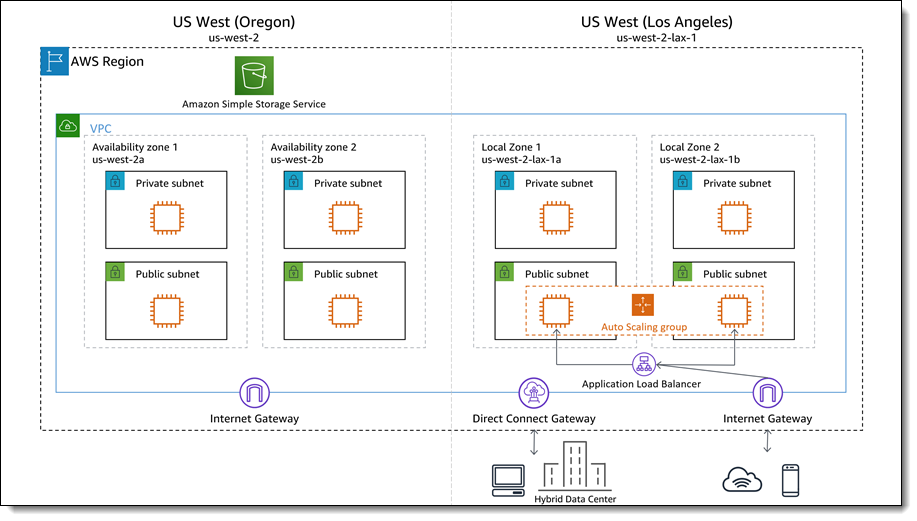
Local Zones can be used to further improve high availability for applications, as well as ultra-low latency. One scenario is for enterprise migrations using a hybrid architecture. These enterprises have workloads that currently run in existing on-premises data centers in the Los Angeles metro area and it can be daunting to migrate these application portfolios, many of them interdependent, to the cloud. By utilizing AWS Direct Connect in conjunction with a Local Zone, these customers can establish a hybrid environment that provides ultra-low latency communication between applications running in the Los Angeles Local Zone and the on-premises installations without needing a potentially expensive revamp of their architecture. As time progresses, the on-premises applications can be migrated to the cloud in an incremental fashion, simplifying the overall migration process. The diagram below illustrates this type of enterprise hybrid architecture.

Anecdotally, we have heard from customers using this type of hybrid architecture, combining Local Zones with AWS Direct Connect, that they are achieving sub-1.5ms latency communication between the applications hosted in the Local Zone and those in the on-premises data center in the LA metro area.

Virtual desktops for rendering and animation workloads is another scenario for Local Zones. For these workloads, latency is critical and the addition of a second Local Zone for Los Angeles gives additional failover capability, without sacrificing latency, should the need arise.

As always, the teams are listening to your feedback – thank you! – and are working on adding Local Zones in other locations, along with the availability of additional services, including Amazon ECS Amazon Elastic Kubernetes Service, Amazon ElastiCache, Amazon Elasticsearch Service, and Amazon Managed Streaming for Apache Kafka. If you’re an AWS customer based in Los Angeles or Southern California, with a requirement for even greater high-availability and very low latency for your workloads, then we invite you to check out the new Local Zone. More details and pricing information can be found at Local Zone.

— Steve

New EBS Volume Type (io2) – 100x Higher Durability and 10x More IOPS/GiB

Post Syndicated from Jeff Barr original https://aws.amazon.com/blogs/aws/new-ebs-volume-type-io2-more-iops-gib-higher-durability/

We launched EBS Volumes with Provisioned IOPS way back in 2012. These volumes are a great fit for your most I/O-hungry and latency-sensitive applications because you can dial in the level of performance that you need, and then (with the launch of Elastic Volumes in 2017) change it later.

Over the years, we have increased the ratio of IOPS per gibibyte (GiB) of SSD-backed storage several times, most recently in August 2016. This ratio started out at 10 IOPS per GiB, and has grown steadily to 50 IOPS per GiB. In other words, the bigger the EBS volume, the more IOPS it can be provisioned to deliver, with a per-volume upper bound of 64,000 IOPS. This change in ratios has reduced storage costs by a factor of 5 for throughput-centric workloads.

Also, based on your requests and your insatiable desire for more performance, we have raised the maximum number of IOPS per EBS volume multiple times:

The August, 2014 change in the I/O request size made EBS 16x more cost-effective for throughput-centric workloads.

Bringing the various numbers together, you can think of Provisioned IOPS volumes as being defined by capacity, IOPS, and the ratio of IOPS per GiB. You should also think about durability, which is expressed in percentage terms. For example, io1 volumes are designed to deliver 99.9% durability, which is 20x more reliable than typical commodity disk drives.

Higher Durability & More IOPS
Today we are launching the io2 volume type, with two important benefits, at the same price as the existing io1 volumes:

Higher Durability – The io2 volumes are designed to deliver 99.999% durability, making them 2000x more reliable than a commodity disk drive, further reducing the possibility of a storage volume failure and helping to improve the availability of your application. By the way, in the past we expressed durability in terms of an Annual Failure Rate, or AFR. The new, percentage-based model is consistent with our other storage offerings, and also communicates expectations for success, rather than for failure.

More IOPS – We are increasing the IOPS per GiB ratio yet again, this time to 500 IOPS per GiB. You can get higher performance from your EBS volumes, and you can reduce or outright eliminate any over-provisioning that you might have done in the past to achieve the desired level of performance.

Taken together, these benefits make io2 volumes a perfect fit for your high-performance, business-critical databases and workloads. This includes SAP HANA, Microsoft SQL Server, and IBM DB2.

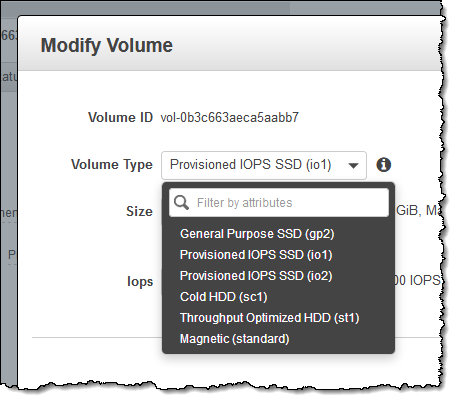
You can create new io2 volumes and you can easily change the type of an existing volume to io2:

Or:

$aws ec2 modify-volume --volume-id vol-0b3c663aeca5aabb7 --volume-type io2

io2 volumes support all features of io1 volumes with the exception of Multi-Attach, which is on the roadmap.

Available Now
You can make use of io2 volumes in the US East (Ohio), US East (N. Virginia), US West (N. California), Canada (Central), Europe (Frankfurt), Europe (Ireland), Europe (London), Europe (Stockholm), Asia Pacific (Hong Kong), Asia Pacific (Mumbai), Asia Pacific (Seoul), Asia Pacific (Singapore), Asia Pacific (Sydney), Asia Pacific (Tokyo), and Middle East (Bahrain) Regions today.

— Jeff;