Drew DeVault has announced
the existence of a new programming language called “Hare”.
Hare is a systems programming language designed to be simple,
stable, and robust. Hare uses a static type system, manual memory
management, and a minimal runtime. It is well-suited to writing
operating systems, system tools, compilers, networking software,
and other low-level, high performance tasks.
Nathan Willis took
a long look at the Open Source Initiative’s 2022 board election and
wasn’t entirely pleased with what he saw.
So it’s a troubling ballot to look at. There’s an ostensibly
non-profit organization that’s an official OSI affiliate trying to
run its CEO as an individual candidate while also running a second
member (a board director) on the appropriate, affiliate ballot in
the same election. There’s also two financial sponsors running
candidates on the individual ballot, one of them (Red Hat) running
two candidates at the same time for the two open seats.
The 5.18-rc5 kernel prepatch is out for
testing. “So if rc4 last week was tiny and smaller than usual, it seems to have
been partly timing, and rc5 is now a bit larger than usual.
But only a very tiny bit larger – certainly not outrageously so, and
not something that worries me.”
Performing controlled chaos experiments on your Amazon Relational Database Service (RDS) database instances and validating the application behavior is essential to making sure that your application stack is resilient. How does the application behave when there is a database failover? Will the connection pooling solution or tools being used gracefully connect after a database failover is successful? Will there be a cascading failure if the database node gets rebooted for a few seconds? These are some of the fundamental questions that you should consider when evaluating the resiliency of your database stack. Chaos engineering is a way to effectively answer these questions.
Traditionally, database failure conditions, such as a failover or a node reboot, are often triggered using a script or 3rd party tools. However, at scale, these external dependencies often become a bottleneck and are hard to maintain and manage. Scripts and 3rd party tools can fail when called, whereas a web service is highly available. The scripts and 3rd party tools also tend to require elevated permissions to work, which is a management overhead and insecure from a least privilege access model perspective. This is where AWS Fault Injection Simulator (FIS) comes to the rescue.
AWS Fault Injection Simulator (AWS FIS) is a fully managed service for running fault injection experiments on AWS that makes it easier to improve an application’s performance, observability, and resiliency. Fault injection experiments are used in chaos engineering, which is the practice of stressing an application in testing or production environments by creating disruptive events, such as a sudden increase in CPU or memory consumption, database failover and observing how the system responds, and implementing improvements.
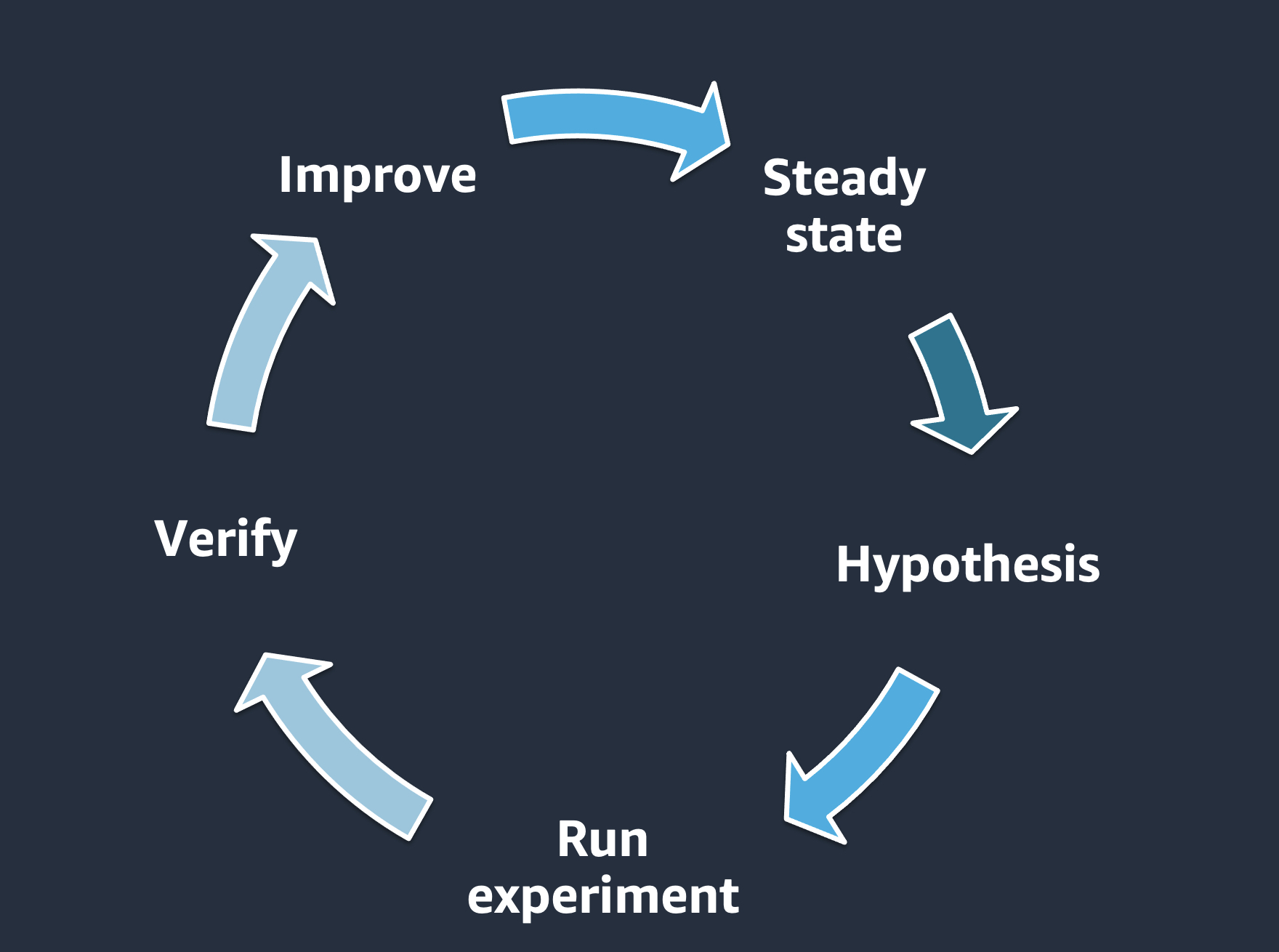
We can define the key phases of chaos engineering as identifying the steady state of the workload, defining a hypothesis, running the experiment, verifying the experiment results and making necessary improvements based on the experiment results. These phases will confirm that you are injecting failures in a controlled environment through well-planned experiments in order to build confidence in the workloads and tools we are using to withstand turbulent conditions.
Example—
Baseline: we have a managed database with a replica and automatic failover enabled.
Hypothesis: failure of a single database instance / replica may slow down a few requests but will not adversely affect our application.
Run experiment: trigger a DB failover.
Verify: confirm/dis-confirm the hypothesis by looking at KPIs for the application (e.g., via CloudWatch metric/alarm).
Methodology and Walkthrough
Let’s look at how you can configure AWS FIS to perform failure conditions for your RDS database instances. For this walkthrough, we’ll look at injecting a cluster failover for Amazon Aurora PostgreSQL. You can leverage an existing Aurora PostgreSQL cluster or you can launch a new cluster by following the steps in the Create an Aurora PostgreSQL DB Cluster documentation.
Step 1: Select the Aurora Cluster.
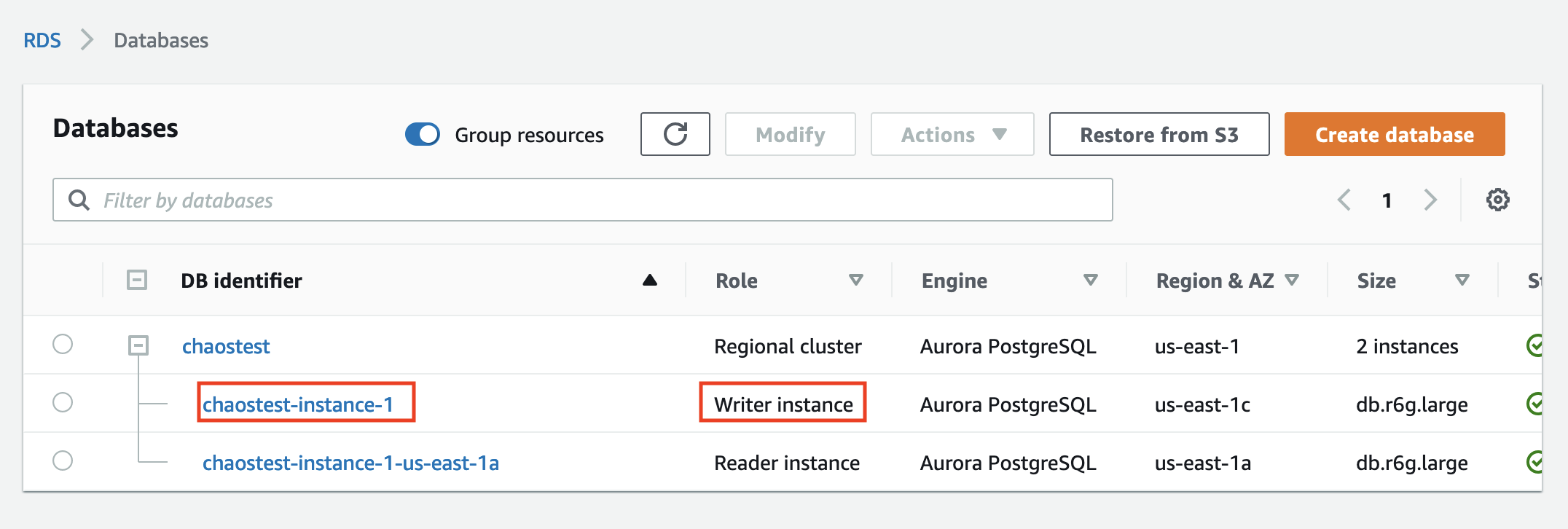
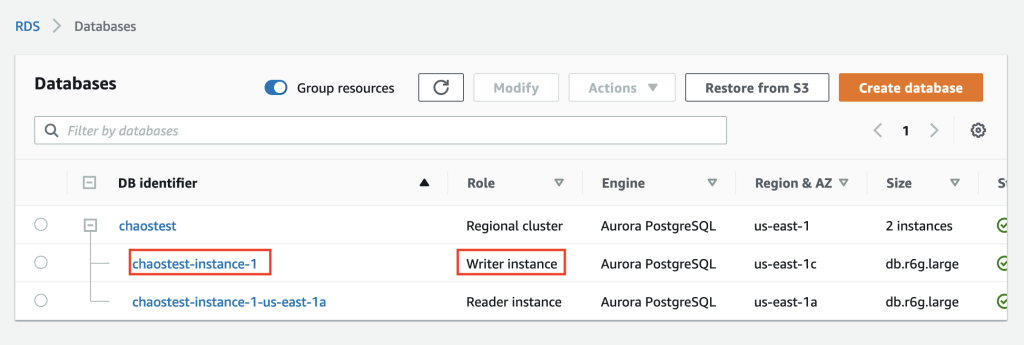
The Aurora PostgreSQL instance that we’ll use for this walkthrough is provisioned in us-east-1 (N. Virginia), and it’s a cluster with two instances. There is one writer instance and another reader instance (Aurora replica). The cluster is named chaostest, the writer instance is named chaostest-instance-1, and the reader is named chaostest-intance-1-us-east-1a.
The goal is to simulate a failover for this Aurora PostgreSQL cluster so that the existing chaostest-intance-1-us-east-1a reader instance will switch roles and then be promoted as the writer, and the existing chaostest-instance-1 will become the reader.
Step 2: Navigate to the AWS FIS console.
We will now navigate to the AWS FIS console to create an experiment template. Select Create experiment template.
Step 3: Complete the AWS FIS template pre-requisites.
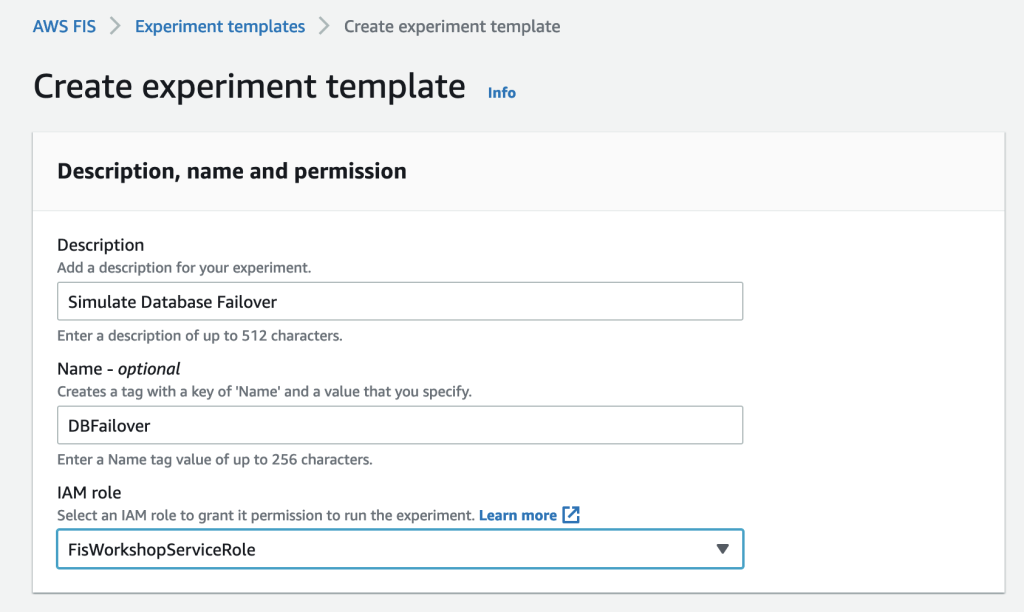
Enter a Description, Name, and select the AWS IAM Role for the experiment template.
The IAM role selected above was pre-created. To use AWS FIS, you must create an IAM role that grants AWS FIS the permissions required so that the service can run experiments on your behalf. The role follows the least privileged model and includes permissions to act on your database clusters like trigger a failover. AWS FIS only uses the permissions that have been delegated explicitly for the role. To learn more about how to create an IAM role with the required permissions for AWS FIS, refer to the FIS documentation.
Step 4: Navigate to the Actions, Target, Stop Condition section of the template.
The next key section of AWS FIS is Action, Target, and Stop Condition.
Action—An action is an activity that AWS FIS performs on an AWS resource during an experiment. AWS FIS provides a set of pre-configured actions based on the AWS resource type. Each Action runs for a specified duration during an experiment, or until you stop the experiment. An action can run sequentially or in parallel.
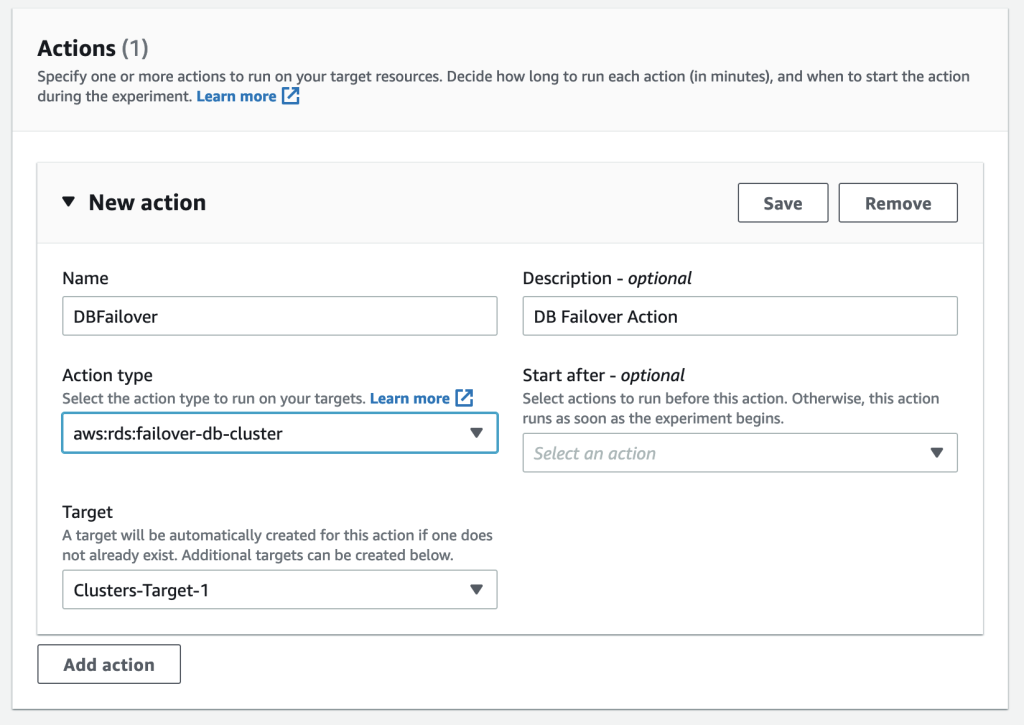
For our experiment, the Action will be aws:rds:failover-db-cluster.
Target—A target is one or more AWS resources on which AWS FIS performs an action during an experiment. You can choose specific resources or select a group of resources based on specific criteria, such as tags or state.
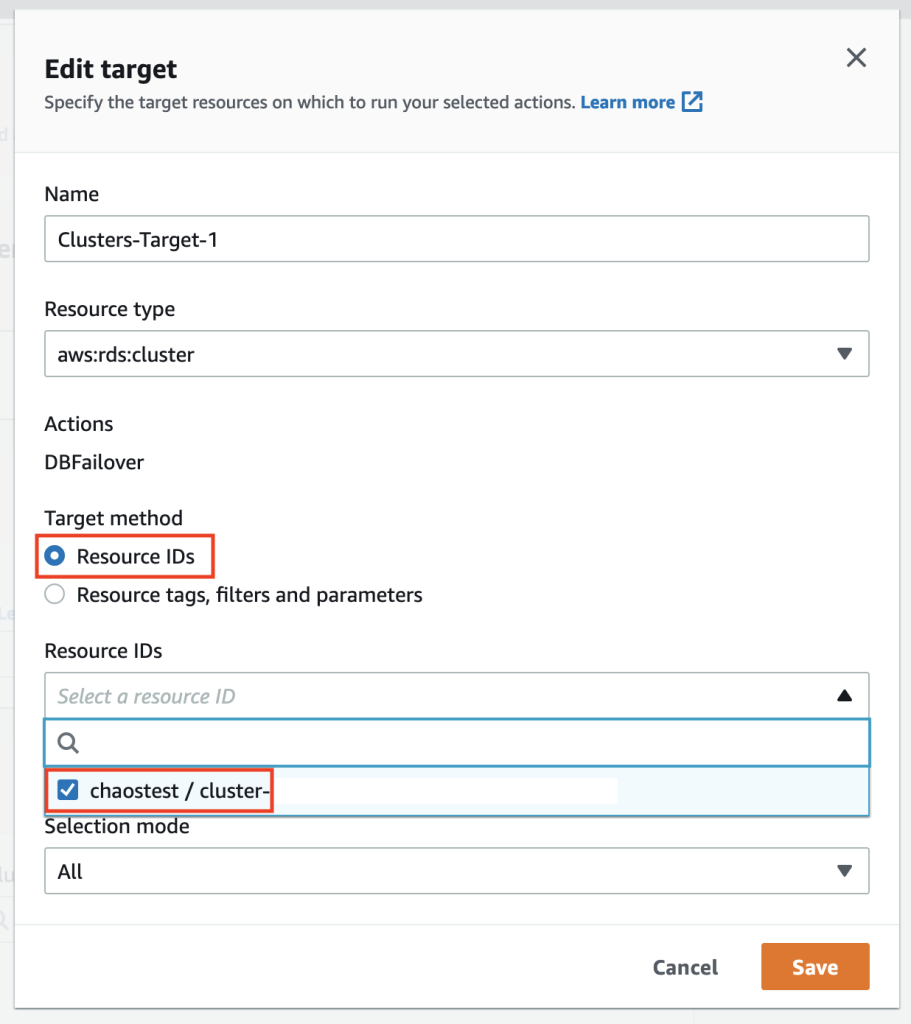
For our experiment, the target will be the chaostest Aurora PostgreSQL cluster.
Stop Condition—AWS FIS provides the controls and guardrails that you need to run experiments safely on your AWS workloads. A stop condition is a mechanism to stop an experiment if it reaches a threshold that you define as an Amazon CloudWatch alarm. If a stop condition is triggered while the experiment is running, then AWS FIS stops the experiment.
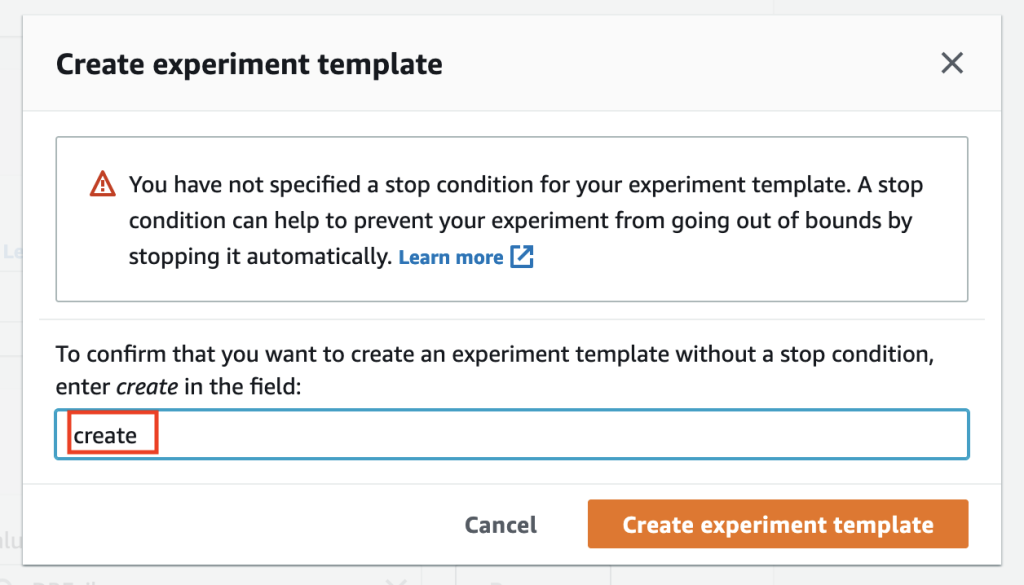
For our experiment, we won’t be defining a stop condition. This is because this simple experiment contains only one action. Stop conditions are especially useful for experiments with a series of actions, to prevent them from continuing if something goes wrong.
Step 5: Configure Action.
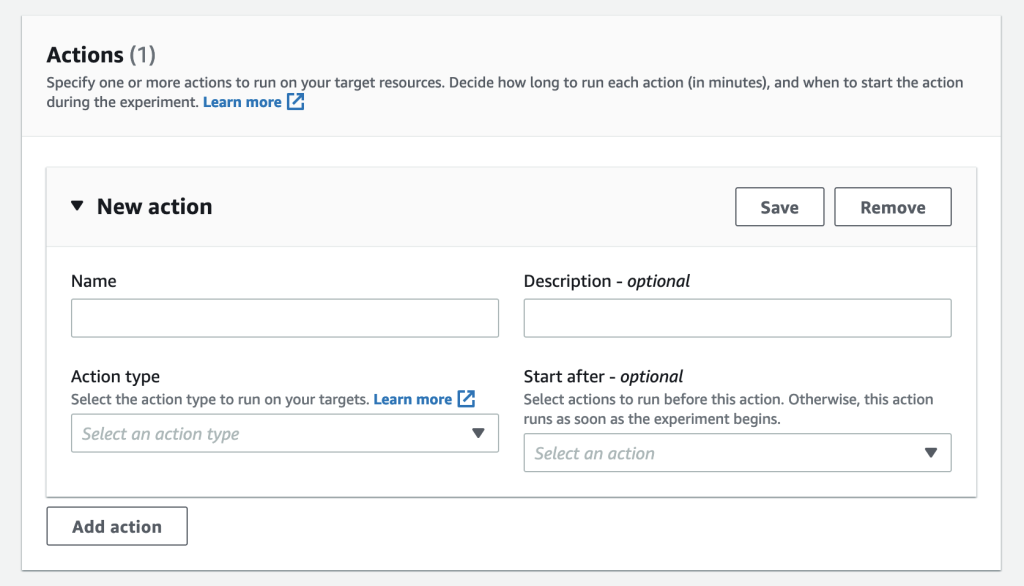
Now, let’s configure the Action and Target for our experiment template. Under the Actions section, we will select Add action to get the New action window.
Enter a Name, a Description, and select Action type aws:rds:failover-db-cluster. Start after is an optional setting. This setting allows you to specify an action that should precede the one we are currently configuring.
Step 6: Configure Target.
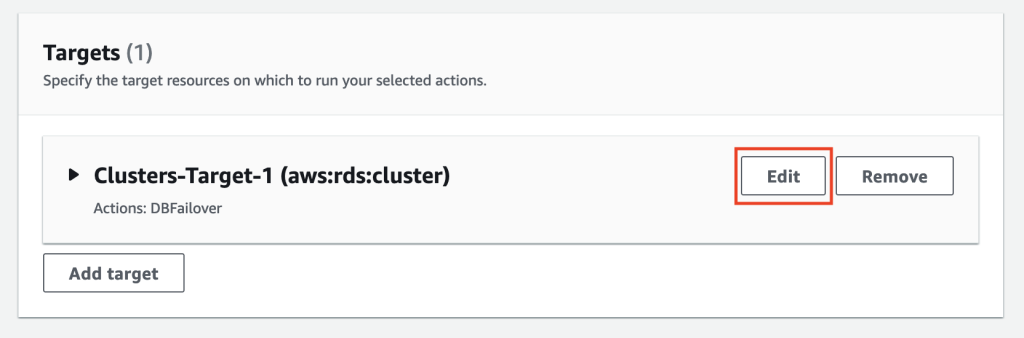
Note that a Target has been automatically created with the name Clusters-Target-1. Select Save to save the action.
Next, you will edit the Clusters-Target-1 target to select the target, i.e., the Aurora PostgreSQL cluster.
Select Target method as Resource IDs, and select the chaostest cluster. If you are interested to select a group of resources, then select Resource tags, filters and parameters option.
Step 7: Create the experiment template to complete this stage.
We will wrap up the process by selecting the create experiment template.
We will get a warning stating that a stop condition isn’t defined. We’ll enter create in the provided field to create the template.
We will get a success message if the entries are correct and the template will be successfully created.
Step 8: Verify the Aurora Cluster.
Before we run the experiment, let’s double-check the chaostest Aurora Cluster to confirm which instance is the writer and which is the reader.
We confirmed that chaostest-instance-1 is the writer and chaostest-instance-1-us-east-1a is the reader.
Step 9: Run the AWS FIS experiment.
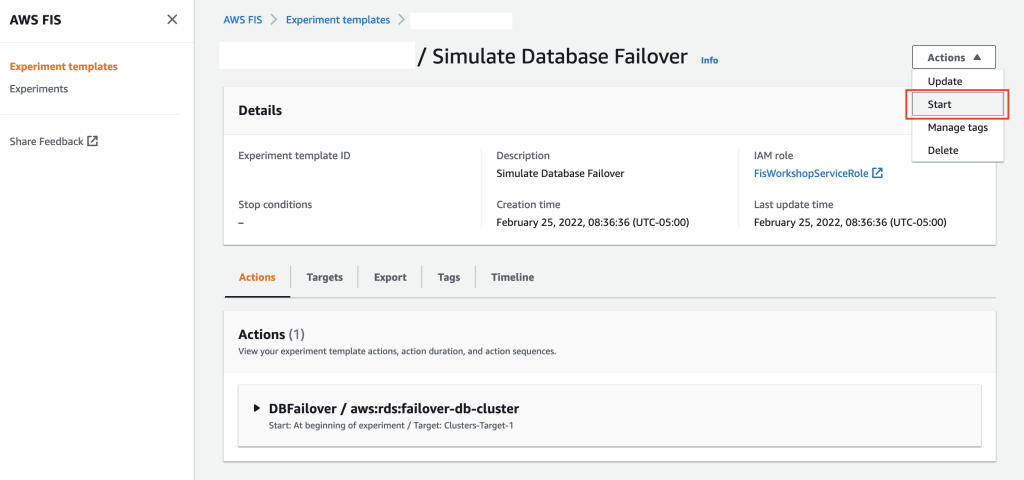
Now we’ll run the FIS experiment. Select Actions, and then select Start for the experiment template.
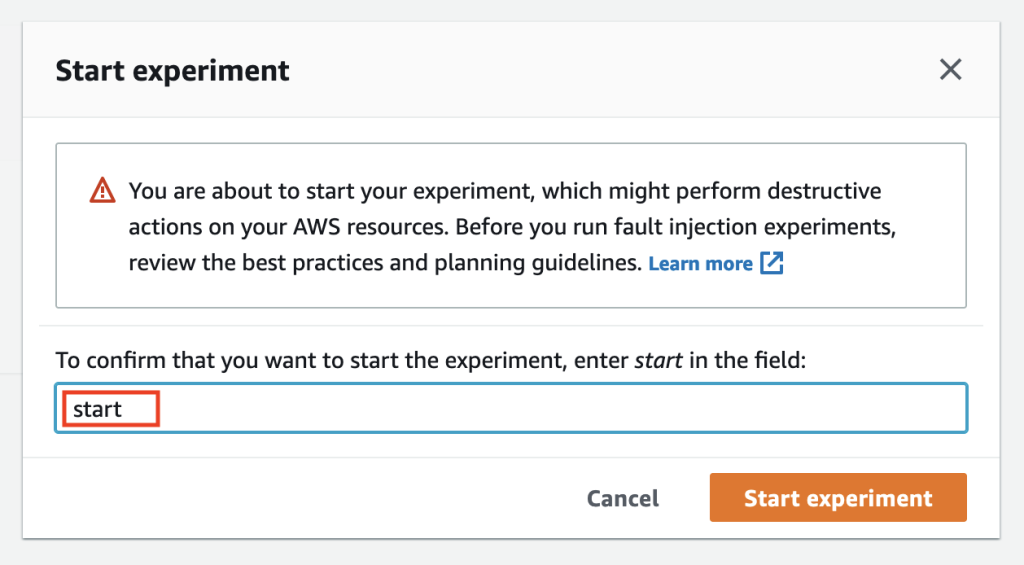
Select Start experiment and you’ll get another warning to confirm if you really want to start this experiment. Confirm by entering start say Start experiment.
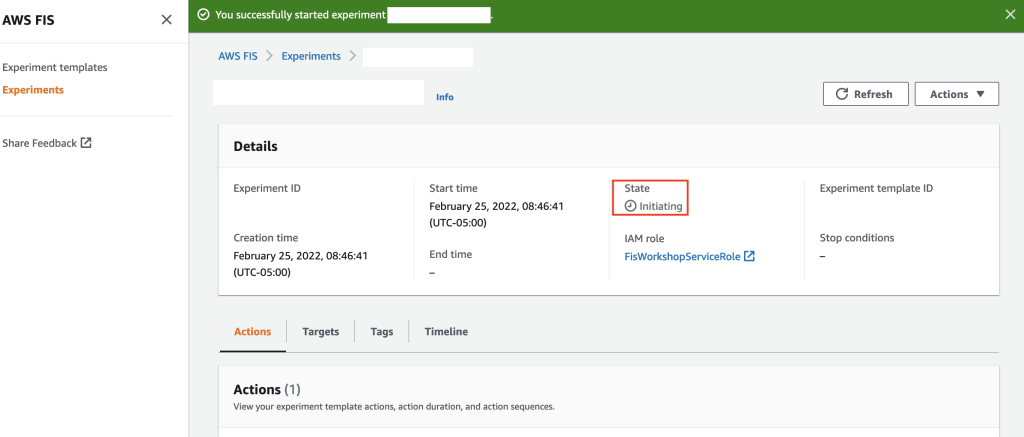
Step 10: Observe the various stages of the experiment.
The experiment will be in initiating, running and will eventually be in completed states.
Step 11: Verify the Aurora Cluster to confirm failover.
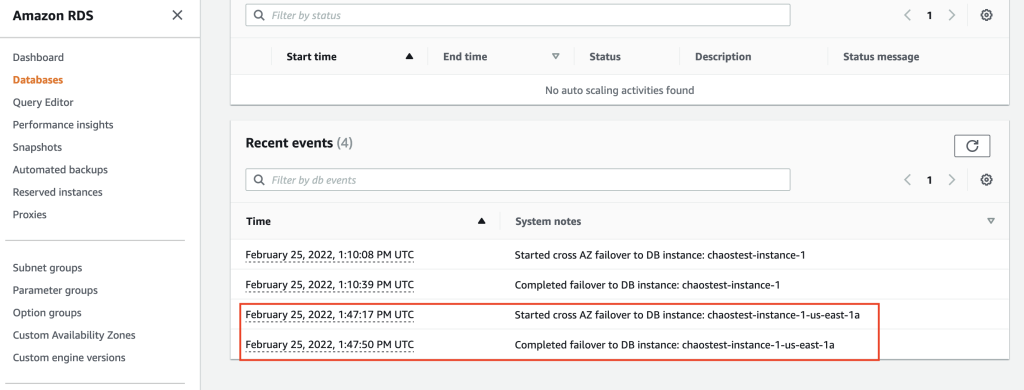
Now let’s look at the chaostest Aurora PostgreSQL cluster to check the state. Note that a failover was indeed triggered by FIS and chaostest-instance-1-us-east-1a is the newly promoted writer and chaostest-instance-1 is the reader now.
Step 12: Verify the Aurora Cluster logs.
We can also confirm the failover action by looking at the Logs and events section of the Aurora Cluster.
Clean up
If you created a new Aurora PostgreSQL cluster for this walkthrough, then you can terminate the cluster to optimize the costs by following the steps in the Deleting an Aurora DB cluster documentation.
You can also delete the AWS FIS experiment template by following the steps in the Delete an experiment template documentation.
In this walkthrough, you learned how you can leverage AWS FIS to inject failures into your RDS Instances. To get started with AWS Fault Injection Service for Amazon RDS, refer to the service documentation.
An about 3-meter-long giant squid was found stranded on a beach here on April 20, in what local authorities said was a rare occurrence.
At around 10 a.m., a nearby resident spotted the squid at Ugu beach in Obama, Fukui Prefecture, on the Sea of Japan coast. According to the Obama Municipal Government, the squid was still alive when it was found. It is unusual for a giant squid to be washed ashore alive, officials said.
The deep-sea creature will be transported to Echizen Matsushima Aquarium in the prefectural city of Sakai.
Sadly, I do not expect the giant squid to survive, certainly not long enough for me to fly there and see it. But if any Japanese readers can supply more information, I would very much appreciate it.
Войната продължава. Изминаха два месеца от нейното начало и започна третият. По данни на британското разузнаване от петък основната цел на Русия продължава да е контролът върху областите Донецк и Луганск, но съпротивата на Украйна е силна и напредването на агресора е ограничено и с цената на големи загуби. Според „Вашингтон Пост“ по-дългосрочната цел на Путин може да е Приднестровието. Експертите обаче са по-скоро скептични за такова развитие. Защо този номер „няма да мине“, може да прочетете в статията на Татяна Ваксберг за „Свободна Европа“.
У нас новината на седмицата е, че „Газпром“ едностранно наруши договорите си с България и Полша и прекрати доставките на газ. Целта, разбира се, е прозрачна. Лабилната конструкция на българското правителство и бездруго едва се крепи на плаващите пясъци, върху които е сглобена. Това е опит за дестабилизация на страната ни и за евентуална подмяна на властта с по-угодна на Москва. От европейска перспектива пък е опит за разлом в мненията и нагласите в ЕС към санкциите спрямо Русия.
Вместо обаче да извади очи, може да се окаже, че Путин изписа вежди на българското правителство. Водещата партия в коалицията „Продължаваме промяната“ най-накрая събра кураж, зае категорична позиция в подкрепа на военна помощ за Украйна и се разграничи от президента Радев. Това е и шанс за партията да заличи негативите от мекушавостта си дотук, потвърждавайки позиционирането на България от правилната страна на историята. Прочетете повече по темата в анализа на Емилия Милчева, озаглавен „Русия, освободителкa наша“.
Не пропускайте обаче и този откъс от изявлението на вицепремиера Асен Василев на пресконференцията на съпредседателите на „Продължаваме промяната“. Особено ако сте зажаднели за лидерство, достойнство и принципност в българската политика.
Архитектурата никога не е само изкуство и винаги е била политическа, винаги е флиртувала с властта, категорична е Анета Василева в най-новия си текст, озаглавен „Архитектура и диктатори“. В него с редица красноречиви примери тя се движи по острието на болезнения въпрос „Опортюнисти и конформисти ли са най-звездните архитекти на съвремието ни?“. Оправдания винаги се намират – особено когато проектите са изкусително престижни и добре финансирани. Не пропускайте това четиво.
Продължаваме с ново интервю от поредицата „Опазване и граждански мобилизации“, в която Слава Савова разговаря с активисти, борещи се за съхраняване на недвижимите паметници на културата. Нейна събеседничка е д-р Карин Беркеман, съоснователка на дигиталната платформа moderneREGIONAL, посветена на архитектурния модернизъм в Германия. Д-р Беркеман разказва за разминаванията между различните поколения и надбягването с времето, защото винаги „разрушаването е по-бързо от опазването“.
А в рубриката „На второ четене“ този път Севда Семер е избрала дебютния роман на американския писател Джордж Сондърс „Линкълн в бардо“, за който той е отличен с „Мен Букър“ през 2017 г. Предпочитам да оставя текста на Севда да ви разходи из това литературно произведение, което определено е оставило отпечатък в душата ѝ, понеже накрая тя споделя: „… именно книги като „Линкълн в бардо“ са причината изобщо да я има тази рубрика за връщане назад към хубавите четива. Всеки понякога усеща, че само на ръка разстояние може да съществува цяла градина, пълна с чудеса.“
И накрая…
През седмицата нашият непрежалим Марин навърши 51 години. Нарочно не казвам „щеше“… С него имах особена връзка, изпълнена с огромно уважение и интензивни разговори на живо, когато успявахме да се видим. Но рядко, изключително рядко общувахме онлайн. Сякаш не ни беше пълноценно. Само понякога си разменяхме кратки имейли, между които често имаше месеци пауза. И сега още ми се струва, че просто отдавна не сме си писали.
Няма място за притеснения
Чиста нощ, непроницаема нощ. Владетелят щади и тонизира, а пръстенът му подпечатва с лилии фантомите на старостта
И да не се обаждам, ще бъда винаги наоколо
Тази работна седмица беше по-къса от обичайното, а следващата ще бъде още по-кратка, затова и „Тоест“ ще направи пауза до 8 май включително.
Винаги съм се забавлявала, когато някои хора определят архитектурата просто като изкуство. Като изкуството да създаваш чиста красота. Като извънмерен стремеж към съвършеното пространство. Като материалност отвъд всякакъв контекст, включително политически. Сериозно ли? Измамна естетика. Архитектурата винаги е била политическа. И винаги е флиртувала с властта, със силните играчи на деня. Естетика – да, но архитектура и етика са две думи, които рядко са успявали да застанат смислено в едно изречение.
Фостър и Харков
На 21 април т.г. първо архитектурните, а после и всички масови медии огласиха новината, че популярният архитект Норман Фостър е предложил помощта си за възстановяване на разрушения украински град Харков. На среща в Женева, по време на втория Форум на кметовете, организиран от Икономическата комисия на ООН за Европа, британският архитект казал на кмета на Харков Игор Терехов, че ще събере най-добрите умове в градоустройството, архитектурата и дизайна, за да построи отново съсипания град. Медиите подчертават, че Фостър е архитектът, проектирал реконструкцията на Райхстага в Берлин, както и „Милениъм Бридж“ в Лондон.
Благороден жест, действително. Подадена ръка, но къде – в комфортна Швейцария, не примерно в Мариупол или Буча. След началото на войната срещу Украйна Foster + Partners са прекратили всички свои проекти в Русия, не пропускат да споменат медиите. Според официалния сайт на студиото обаче единственият им активен преди войната проект там е 15-етажна офис кула в Екатеринбург. В същото време студиото има редица проекти в други страни със съмнителна демокрация – като Казахстан и Саудитска Арабия.
„Възстановяването на Харков трябва да започне с общ устройствен план. Трябва да измислим града на бъдещето“, обяснява Фостър, който бил подготвил презентацията предварително специално за форума. „25% от всички сгради в града са унищожени, всички нови трябва да се проектират с бомбоубежища и подземни паркинги с двойно предназначение“, казва от своя страна кметът Терехов.
Световният архитектурен елит очевидно иска да покаже съпричастност в случая с Украйна. Циничното е, че само преди няколко години именно Русия беше тяхното експериментално поле, мястото, където всички се тълпяха да строят. И действително, няма какво да се лъжем, точно там се случваха някои от най-интересните неща в съвременната архитектура – не просто лъскави здания, а големи публични проекти с реален ефект върху градската среда. Пари имаше достатъчно, а властта с удоволствие приемаше да бъде легитимирана чрез архитектурните звезди.
Стархитектите и Путин
През 2013-та например, година преди анексирането на Крим, московският експериментален архитектурно-дизайнерски институт „Стрелка“ (основан през 2009 г. и впрочем едно от явленията в съвременната архитектурна култура) организира журнален международен архитектурен конкурс за чисто нов парк в центъра на Москва – на 130 000 кв.м изоставена земя, точно до Кремъл и Червения площад и на мястото на съборения през 2007 г. хотел „Русия“.
Конкурсът беше спечелен от американското архитектурно студио Diller Scofidio + Renfro (автори и на мегапопулярния линеен парк The High Line върху изоставените релси в Западен Манхатън) с проекта им за „див урбанизъм“, в който преплитат различни климатични зони и природни хабитати, характерни за Русия. Паркът „Зарядие“, открит през 2017 г. лично от Владимир Путин и кмета на Москва Сергей Собянин, се превърна в първия проект за подобно публично пространство в такъв мащаб от 50 години насам и всъщност е глобален успех.
Още от избирането на Собянин за кмет през 2010 г. Москва започва последователно да изгражда и подобрява публичните си пространства (и публичния си образ). Датският урбанист Ян Геел работи за Москва – град за хората. През 2011 г. е завършена суперуспешната реконструкция на западналата съветска легенда парк „Горки“, превърнат в оживено място, пълно с нови кафенета и барове, галерия за съвременно изкуство, свободна Wi-Fi мрежа и много хора. В Москва става популярно да се прави публична архитектура, при това по западен модел. Създават се арт квартали, масово се реновират западналите паркове.
Всичко се засилва особено след 2012 г., когато мощни протести срещу поредното преизбиране на Путин разтърсват столицата. „Реконструкцията на парк „Горки“ се случи точно навреме, за да разсее хората от всичко: протестите, правителствената корупция, купените гласове в парламентарните избори – разказва пред „Гардиън“ студентката Катерина Шчербакова през 2014 г. – След откриването на парка вече беше невъзможно да се твърди, че Общината (и властта) са корумпирани, че не ги е грижа за хората, мразят Запада и искат връщане към СССР.“
Руските архитекти, урбанисти и културни предприемачи, ангажирани в дизайна на тази нова Москва, тогава са по-прагматични. Андрей Гринев е от създателите на урбанистичното студио Citymakers, които са сред местните партньори на победителя в конкурса за парка „Зарядие“. В същата статия на „Гардиън“ той казва: „Какво можем да направим? Да се бием за гражданските си свободи? Да напуснем страната? Или да направим живота си колкото може по-красив и по-удобен и да не се тревожим за свободите, които нямаме. Аз предпочитам третото.“
Но не са само местните архитекти.
През есента на 2018 г. главният архитект на Москва Сергей Кузнецов (който е и дясна ръка на кмета Собянин) гостува в София. По време на близо 40-минутната си презентация той предпочете да наблегне върху наистина впечатляващите строителни инициативи в центъра на града, където с помощта на световни архитектурни звезди – като MVRDV, OMA, Diller Scofidio + Renfro, Zaha Hadid Architects, Steven Holl Architects – столицата на Русия се превръща в едно от най-интересните места за архитектурни експерименти в света. Отделно градът слуша Ян Геел, разказа Кузнецов, и се бори срещу автомобилите, бори се за повече пешеходни и велосипедни зони, за повече публични пространства. Нещо повече, за последните 5 години в града са проведени 60 архитектурни конкурса, от които 30 големи международни, и много от вече реализираните намеси са резултат именно от такива успешни конкурси.
През лятото на 2018 г. в новоизградената зала в пространството на парк „Зарядие“ беше проведено поредното издание на Moscow Urban Forum с тема „Мегаполис на бъдещето: нови жилищни пространства“, на който бяха обсъдени мащабните градски трансформации в Москва от последните години. Събраха се почти всички изброени по-горе международни архитектурни звезди плюс всички архитекти, които все още само участват в конкурсите на град Москва, но се надяват един ден да се включат и с реални проекти в същите тези мащабни трансформации.
На този форум Владимир Путин изнесе реч, беше аплодиран, а никой от гостувалите чужди архитекти – включително и Рем Кулхас, не си позволи сериозна критика срещу властта. Дори когато става въпрос за спорни общински намерения, като масовото разрушаване на хиляди панелни блокове и пренастаняването на над милион и половина жители на Москва в нови жилища в рамките на 15–20 години. Изобщо, по участниците в този форум може да се прецени популярността на Москва като „стархитектска“ дестинация.
Бярке и Болсонаро
Още един пример. Датската архитектурна мегазвезда Бярке Ингелс, любимото дете на глобалния техсвят, направи стремителна кариера през последното десетилетие и в момента строи от небостъргачи в Бруклин и Ванкувър до новата централа на Google в Калифорния. Той беше и един от архитектите, поканени през септември 2021 г. от Урсула фон дер Лайен на кръглата маса на високо равнище за „Новия европейски Баухаус“. Като човек, който поддържа екзотичен Instagram профил със снимки от всички точки на света, където проектира и пътува, Бярке не пропусна да сподели снимката с председателката на Европейската комисия.
Интересното е, че само няколко месеца по-рано профилът му изобилстваше от главозамайващи снимки от пампасите и разни бразилски потайности. Оказа се, че BIG (Bjarke Ingels Group) е въвлечена в стратегическото планиране на поредица устойчиви туристически селища в североизточните части на Бразилия. Снимката на усмихнатия Бярке до крайнодесния президент Жаир Болсонаро изтече не от профила на архитекта, а от самото бразилско Министерство на туризма и предизвика скандал в архитектурния свят. Но само частичен.
В същото време в Будапеща Виктор Орбан поема щафетата. Докато Европейският съюз критикува крайнодесния унгарски лидер, той омайва архитектурния свят с грандиозни архитектурни проекти. През януари 2022 г. впечатляващият музей на музиката Magyar Zene Háza на японския архитект Соу Фуджимото отвори врати в новия културен парков хъб Városliget, който Будапеща изгражда. През последните години Унгария направи редица архитектурни конкурси за лъскави културни сгради именно там – спечелени само от световни звезди. Последната новина е, че проектът на американците от Diller Scofidio + Renfro за нов унгарски Музей на транспорта в Будапеща най-после е получил зелена светлина.
Архитектура и етика
Въпросът дали е редно архитектите да работят с репресивни режими и откровени диктатори, не е от днес. Дилемата дали да бойкотират, или да проектират, стои отдавна. Оправдания винаги се намират – особено когато проектите са изкусително престижни и добре финансирани. Ето, Бярке Ингелс смята, че добрите идеи са отвъд политиката и трябва да се опитва. Той продължава да опитва – дори и в Саудитска Арабия, въпреки че много архитекти замразиха проектите си в страната след убийството на журналиста Джамал Хашоги през 2018 г.
Доста архитекти смятат, че добрите намерения и добрата архитектура би следвало да помогнат на хората дори и в условията на най-потискащия режим. През лятото на 2008 г. например, преди откриването на Лятната олимпиада в Китай, в „Шпигел“ имаше интервю с Жак Херцог от Herzog & de Meuron – архитектурното студио, проектирало популярния олимпийски стадион „Гнездото“ в Пекин. На въпроса защо са приели да проектират толкова голяма правителствена поръчка в недемократична страна като Китай, Херцог просто отговаря: „Само идиот би отказал.“ Той допълва обаче, че сградата е и един вид „троянски кон“ в Китай, защото е пълен с ниши и малки чупки и в тези ниши китайците можели да се срещат на малки групички, ненаблюдавани от властта, и да говорят свободно. Това било съпротива.
Оправдания много. Архитектурата винаги надживява идеологиите, факт. Но това, което архитектите не бива да забравят, е, че в момента на своето създаване всяка архитектура, особено пък добрата, само подкрепя и засилва политическите режими, които са я поръчали.
Никой от нас не чете единствено най-новите книги. Тогава защо само за тях се пише? „На второ четене“ е рубрика, в която отваряме списъците с книги, публикувани преди поне година, четем ги и препоръчваме любимите си от тях. Рубриката е част от партньорската програма Читателски клуб „Тоест“. Изборът на заглавия обаче е единствено на авторите – Стефан Иванов и Севда Семер, които биха ви препоръчали тези книги и ако имаше как веднъж на две седмици да се разходите с тях в книжарницата.
превод от английски Владимир Полеганов, изд. „Лист“, 2019
За дебютния си роман „Линкълн в бардо“ американският писател Джордж Сондърс получава наградата „Мен Букър“ за 2017 г., но това далеч не е първият успех за автора. Сондърс е известен с кратките си разкази, преди да се впусне в обичания американски жанр – книги за президенти и тяхното семейство и обкръжение, за времето преди, във и извън Белия дом. Ако потърсим биография или исторически роман за който и да е американски президент, обичайно ще намерим цяла лавица от книги – и то ако броим само добрите. Джордж Сондърс се включва с експериментален роман за починалото дете на президента Линкълн. Книгата отдава почит не само на трогващата история за баща, изгубил сина си, но и на всички текстове около нея.
„Линкълн в бардо“ е разказана от десетки гласове, които се преплитат, прекъсват, носят собствения си заряд от тъга, радост, хумор, дори граматика, разказват истории, правят признания или опити да се превърнат в значими исторически източници. Чисто формално това не е предшествано от тире отпред – като при диалог. Нито пък името на този, който говори, е поместено в началото на репликата – като в пиеса. Вместо това колажът от цитати е оформен точно както би бил поместен епитаф: първо е текстът, а после – името и евентуално източникът. Епитафите тук обаче текат един след друг. И няма друго.
В тази река от цитати има риск страниците да се пометат и разтворят в течението, докато накрая остане само кашава целулоза. Това, което прави романа толкова впечатляващ, е именно че структурата издържа, макар първоначално да не разбираш точно как. Причината е, че това не е самоцелен експеримент, а е подкрепен от литературна традиция – и тя се усеща, без значение дали си наясно с нея, или не. Но важно е и друго – емоционалният център на една от най-хубавите книги за скръбта, които съм чела.
Действието се развива в една-единствена нощ. За сметка на това в известен смисъл протича на две места. Едното е физическото: гробището, в което е положен Уили. Историческите източници показват, че Линкълн е посетил гроба на сина си поне два пъти в първата нощ, и именно това е зрънцето, от което се заражда целият роман. Заради скръбта на баща си Уили е заседнал в бардо. Това е второто, метафизичното място, на което се осъществява романът – будистката представа за пространството между живота и смъртта. Тук то се обитава от духове, заседнали между световете.
Духовете в бардо не успяват да пуснат живота и да приемат смъртта. Те наричат ковчезите си „болнични кутии“, които биха били „ефикасни“ за особения вид „болест“, от която страдат. Все пак обаче изглежда, че всичко това са внимателно построени евфемизми, но всеки знае точно какво се случва. В състоянието, в което се намират, те се виждат един друг, но остават невидими за живите – на които обаче успяват да влияят емоционално. Придобиват и особени външни белези, символ на това, което ги задържа между световете. Размислилият след самоубийството си Роджър Бевинс III например, който късно осъзнава колко е изпуснал от света, има много очи, които се оглеждат, носове, които се опитват да подушат, ръце, които искат да докосват.
Бевинс III е единият от тримата главни герои в бардо. Другите са Ханс Волман, починал в нощта, преди да консумира брака със съпругата си, и преподобният Евърли Томас. В срещата с 11-годишния Уили те искат да му помогнат да приеме смъртта си, преди да бъде трансформиран в нещо чудовищно. Децата обичайно не се задържат в бардо, но когато това стане, те минават през страшни трансформации, както се е случило с едно момиче:
Тя светкавично се преобрази в рухналия мост, лешояда, голямото куче, зловещата старица, тъпчеща се с черна торта, царевичната нива, съсипана от наводнение, чадъра, разкъсан от вятър, който не можехме да усетим.
Дори при подобни детайли от историята, тя е изненадващо нежна. Духовете се подкрепят при трудното си пътешествие. Срещаме се и с живи „гласове“, които разказват за своята съдба по време на Гражданската война. Между духовете се ражда приятелство, в което има и място за тъга. Колкото и евфемизми да използват, все пак знаят, че положението, в което се намират, е най-трудното за всички тях. Те са дълбоко затрогнати от посещението на президента в гробището: доказателство, че не са напълно забравени. В тези моменти е голямата сила на книгата.
Чела съм я три пъти, първите два – на английски. Още при излизането ѝ ревютата бяха толкова силни, че си купих първото издание с твърди корици. Тогава ми направи силно впечатление формата – признавам, че първите 15–20 страници се четат трудно, но като свикнеш, полифоничността на романа е чудесна. Бързо разбираш, че няма да получиш стандартен сюжет, а нещо по-интересно, поне в случая. Втория път я четох за книжен клуб миналото лято – тогава най-голямо впечатление ми направи колко утеха може да донесе на скърбящия (поне според мен: някак намалява самотата в тази тема). Третия път, за написването на този текст, я четох на български. Най-голямо впечатление ми направи преводът на Владимир Полеганов (с награда за ярко постижение в областта на превода на художествена литература от Съюза на преводачите в България през 2020 г.). Беше хубаво да срещна по съвсем нов начин един от любимите си пасажи от книгата – поетично описания момент, в който Бевинс размишлява в последните минути на живота си:
Едва тогава (вече с единия крак отвъд, така да се каже) осъзнах колко неописуемо красиво е всичко това, с каква прецизност е създадено за наша наслада, и разбрах, че съм на ръба да пропилея този удивителен дар, дара да можеш – всеки ден – да блуждаеш из безкрайния рай на сетивата, из огромния пазар, зареден всеотдайно с всички велики неща: рояци насекоми, разтанцували се в лъчите на августовското слънце; трио черни коне, допрели глави, затънали до коленете в снежно поле; ароматът на телешки бульон, донесен от бриза от осветен в оранжево прозорец в хладния есенен ден…
Накрая ми се иска да кажа само, че именно книги като „Линкълн в бардо“ са причината изобщо да я има тази рубрика за връщане назад към хубавите четива. Всеки понякога усеща, че само на ръка разстояние може да съществува цяла градина, пълна с чудеса. А романът на Сондърс е точно от тези градини, които според мен трябва да се посетят – ако не три пъти, то поне веднъж.
Заглавно изображение: Колаж от корицата на „Линкълн в бардо“ (худ. Виктория Николова, изд. „Лист“) и снимка на Lisa Fotios / Pexels
Активните дарители на „Тоест“ получават постоянна отстъпка в размер на 20% от коричната цена на всички заглавия от каталога на „Лист“, както и на няколко други български издателства в рамките на партньорската програма Читателски клуб „Тоест“. За повече информация прочетете на toest.bg/club.
At AWS re:Invent 2021, we announced the AWS Well-Architected Sustainability Pillar, which marks sustainability as a key pillar of building workloads to best deliver on business need. In session ARC325 – Architecting for Sustainability, Adrian Cockcroft, Steffen Grunwald, and Drew Engelson (Director of Engineering at Starbucks) gave a detailed explanation of what to expect from the Sustainability Pillar whitepaper and how Starbucks has applied AWS best practices to their workloads.
AWS is committed to building a sustainable business for our customers and the planet. Amazon co-founded The Climate Pledge in 2019, committing to reach net-zero carbon by the Year 2040 — 10 years ahead of the Paris Agreement. As part of reaching our commitment, Amazon is on a path to powering our operations with 100% renewable energy by 2025 — 5 years ahead of our original target of 2030.
In 2020, we became the world’s largest corporate purchaser of renewable energy, reaching 65% renewable energy across our business. Amazon also continues to invest in renewable energy projects paired with energy storage: the energy storage systems allow Amazon to store clean energy produced by its solar projects and deploy it when solar energy is unavailable, such as in the evening hours, or during periods of high demand. This strengthens the climate impact of Amazon’s clean energy portfolio by enabling carbon-free electricity throughout more parts of the day.
As customers architect solutions with AWS services to fulfill their business needs, they also influence the sustainability of a workload. AWS had published five pillars in the AWS Well-Architected Framework that capture best practices for operational excellence, security, reliability, performance, and cost of workloads. These pillars have supported the business need for faster time-to-value for features and the delivery of products.
In light of the climate crisis, we have a new challenge to help businesses optimize their application architectures and workloads for sustainability. With sustainability as the sixth pillar in the AWS Well-Architected Framework, builders have guidance to optimize their workloads for energy reduction and efficiency improvement across all components of a workload.
How Starbucks is reducing their footprint
Starbucks has set very ambitious sustainability goals to reduce the environmental impact of their business. As Drew Engelson mentioned in his presentation, there was a gap between these major goals and how members of the technology teams could participate in this mission. Drew decided to evaluate the systems his team was responsible for and initiated an internal framework for understanding the environmental impact of the systems.
Sustainability proxy metrics based on service usage, as demonstrated in the AWS Well-Architected Lab for Sustainability, complemented AWS customer carbon footprint tool data to help the team drive reductions. The goal was to snap a baseline and identify areas for further optimization. The Starbucks team applied the Well-Architected Sustainability Pillar best practices after performing an AWS Well-Architected review early in the process.
Through working with AWS, Starbucks saw that from 2019 to 2020, the actual carbon footprint of their AWS workloads was reduced by approximately 32%, despite tremendous business growth during that same period. The customer carbon footprint tool indicates that these systems’ carbon footprint was further reduced by 50% in subsequent quarters.
Optimizing beyond cost
The Starbucks team already optimized their workloads for cost efficiency, leading to high energy and resource efficiency. Starbucks relies heavily on Kubernetes, which allows them to densely pack their services onto the underlying infrastructure, yielding very high utilization. Binary protocols, like gRPC, are used for efficient communication between microservices. This also cuts down on the data transfer between different networks. Many of their services are written in efficient Scala code, which adds another layer of optimization to the workload.
By taking a data-driven approach, Drew and his team at Starbucks also were able to review scaling thresholds. Based on data, they were able to adjust the auto scaling curve much more closely and smoothly, matching the actual demand curve and reducing the resources they needed to provision.
Drew’s team went beyond the initial optimization cost-benefits to sustainability of the whole stack. They identified workloads suitable for Amazon EC2 Spot Instances to leverage unused, on-demand capacity and increase the overall resource utilization of the cloud. The Starbucks team is starting to examine the impact of their mobile application to end-user devices, and they are taking steps to reduce the downstream impacts: for example, considering the size of client-side scripts, devices’ CPU usage, and color scheme (dark mode reduces the energy required for certain display types).
Starbucks takes optimization for sustainability seriously—so seriously that they coined the term “TCO2”, which highlights the importance climate impact when measuring Total Costs of Ownership (Figure). Drew raised an important question for application teams and architects that frequently make tradeoffs for cost benefits:
If carbon was the thing we’re optimizing for, would we make different choices?
Figure. Drew Engelson, Director of Engineering at Starbucks, discussing “TCO2“
Get started, the sustainable way
At AWS, we encourage architects to build solutions with sustainability in mind. If your team wants to get started with the concepts from the AWS Well-Architected Sustainability Pillar, conduct a review of your workload in the Well-Architected Tool, or check out the AWS Well-Architected Framework and AWS Well-Architected Labs to learn more!
Our very own Jake Baines wrote a module that performs a sandbox escape on Redis versions between 5.0.0 and 6.1.0 and achieves remote code execution as the redis user. Redis installations can be password protected, so this module supports exploiting the vulnerability with and without authentication.
While this module targets Redis software, the vulnerability (CVE-2022-0543) only presents itself on Debian-based Linux distributions due to the Lua package interface remaining enabled. The existence of the Lua package interface means that arbitrary libraries can be loaded and used to evade the protections of the sandbox. This vulnerability has been reported as being exploited in the wild.
Antivirus Enumeration
Thanks to sempervictus we now have a post module for enumerating installed antivirus products on Windows systems. Using either a Meterpreter or shell session, the module detects these installations through WMI queries and saves the information to the database. Some of the data returned includes versioning information, possibly clueing a user in on a potential next target for privilege escalation.
New module content (2)
Redis Lua Sandbox Escape by Reginaldo Silva and jbaines-r7, which exploits CVE-2022-0543 – This exploit achieves remote code execution as the redis user via a sandbox escape in several Redis versions distributed through Debian-based Linux distributions.
#16450 from ORelio – This updates exploit/multi/vnc/vnc_keyboard_exec to include a delay that increases reliability when getting a shell and typing out long commands.
#16509 from adfoster-r7 – This ensures proper escaping of HTML in code blocks that are produced by the info -d command.
Get it
As always, you can update to the latest Metasploit Framework with msfupdate
and you can get more details on the changes since the last blog post from
GitHub:
If you are a git user, you can clone the Metasploit Framework repo (master branch) for the latest. To install fresh without using git, you can use the open-source-only Nightly Installers or the binary installers (which also include the commercial edition).
socialscan is an accurate command-line tool to check For email and social media username usage on online platforms, given an email address or username, socialscan returns whether it is available, taken or invalid on online platforms.
Other similar tools check username availability by requesting the profile page of the username in question and based on information like the HTTP status code or error text on the requested page, determine whether a username is already taken.
Basically, every modern language provides a lot of building blocks
that usually come from other smaller open-source projects. These
are libraries, and they do things like format text, handle images,
connect to databases and deal with talking across the
internet. Projects like Fedora or Debian used to work to try to
package up every such library in our own format, made to work
nicely with everything else.
Now, every new language — Rust, for example — comes with its own
tools to manage these, and they don’t work nicely together with our
old way. The sheer scale is overwhelming — for Rust alone, as I
checked just now there are 81,541 such libraries. We can’t keep up
with repackaging all of that into our own format, let alone that
plus all of the other languages. We need to approach this
differently in order to still provide a good solution to software
developers.
I think a lot of that will need machine learning and automation …
we’ll need to keep adjusting so we can provide the value that Linux
distributions give users in trust, security and coherent
integration at an exponential scale.
We’re proud to announce the availability of search-based code navigation for the Elixir programming language. Yet this is more than just new functionality. It’s the first example of a language community writing and submitting their own code for search-based code navigation.
Since GitHub introduced code navigation, we’ve received enthusiastic feedback from users. However, we hear one question over and over again: “When will my favorite language be supported?” We believe that every programming language deserves best-in-class support in GitHub. However, GitHub hosts code written in thousands of different programming languages, and we at GitHub can commit to supporting only a small subset of these languages ourselves. To this end, we’ve been working hard to empower language communities to integrate with our code navigation systems. After all, nobody understands a programming language better than the people who build it!
Community contributions welcome!
Would you like to develop and contribute search-based code navigation for a language? If a Tree-sitter grammar tool exists for your language, you can do so using Tree-sitter’s tree query language. This language describes how our code navigation systems scan through syntax trees and how to extract the important parts of a declaration or reference. This process is known as tagging, and it’s integrated with the tree-sitter command-line tool so that you can run and test tag queries locally. When a user pushes new commits or creates a pull request, the GitHub code navigation systems use tag queries to extract jump-to-definition and find-all-references information. Note: If you’re interested in how search-based code navigation works, you can read a technical report that describes the architecture and evolution of GitHub’s implementation of code navigation.
How do I get started?
Complete documentation, including how to write unit tests for your tags queries, can be found here. For examples of tag queries, you can check out the Elixir tags implementation, or those written for Python or Ruby. Once you’ve implemented tag queries for a language, have written unit tests, and are satisfied with the output from tree-sitter tags, you can submit a request on the Code Search and Navigation Feedback discussion page in the GitHub Discussions page in the GitHub feedback repository. The Code Navigation team will add this to their roadmap. When we’re confident in the quality of yielded tags and the load on the back-end systems that handle code navigation, we can enable it in testing for a subset of contributors, eventually rolling it out to all GitHub users, on both private and public repositories.
Please note that search-based code navigation is distinct from GitHub code search. Code search provides a view across all of the corpus of code on GitHub, whereas search-based code navigation is a part of the experience of reading code within a single repository. Search-based code navigation is also distinct from our support for precise code navigation. However, we hope to empower language communities to inform and contribute to the development of and support for these and other features in the future.
We’re committed to working with language maintainers and contributors to keep these rules as useful and up-to-date as possible. Whether you’re a longtime language contributor or someone seeking to enter the community for the first time, we encourage you to take a look at adding support for search-based code navigation, and join the community on the GiHub Discussions Page.
The collective thoughts of the interwebz
Manage Consent
To provide the best experiences, we use technologies like cookies to store and/or access device information. Consenting to these technologies will allow us to process data such as browsing behavior or unique IDs on this site. Not consenting or withdrawing consent, may adversely affect certain features and functions.
Functional
Always active
The technical storage or access is strictly necessary for the legitimate purpose of enabling the use of a specific service explicitly requested by the subscriber or user, or for the sole purpose of carrying out the transmission of a communication over an electronic communications network.
Preferences
The technical storage or access is necessary for the legitimate purpose of storing preferences that are not requested by the subscriber or user.
Statistics
The technical storage or access that is used exclusively for statistical purposes.The technical storage or access that is used exclusively for anonymous statistical purposes. Without a subpoena, voluntary compliance on the part of your Internet Service Provider, or additional records from a third party, information stored or retrieved for this purpose alone cannot usually be used to identify you.
Marketing
The technical storage or access is required to create user profiles to send advertising, or to track the user on a website or across several websites for similar marketing purposes.








 :
 Marcos Correa