A Detailed Look at the Conti Ransomware Gang

Post Syndicated from Bruce Schneier original https://www.schneier.com/blog/archives/2022/03/a-detailed-look-at-the-conti-ransomware-gang.html

Based on two years of leaked messages, 60,000 in all:

The Conti ransomware gang runs like any number of businesses around the world. It has multiple departments, from HR and administrators to coders and researchers. It has policies on how its hackers should process their code, and shares best practices to keep the group’s members hidden from law enforcement.

Build a multi-language notification system with Amazon Translate and Amazon Pinpoint

Post Syndicated from Praveen Allam original https://aws.amazon.com/blogs/architecture/build-a-multi-language-notification-system-with-amazon-translate-and-amazon-pinpoint/

Organizations with global operations can struggle to notify their customers of any business-related announcements or notifications in different languages. Their customers want to receive notifications in their local language and communication preference. Organizations often rely on complicated third-party services or individuals to manually translate the notifications. This can lead to a loss of revenue due to delayed communication and additional operational expenses.

This blog post demonstrates how to build a straightforward, cost-effective, and scalable multi-language notification system using AWS Serverless technologies. You can post a business-related announcement or notification in English, and based on the customer profile data, it will convert this announcement or notification into different languages. Additionally, the system will also deliver these translated announcements or notifications as an email, voice, or SMS.

Example of a multi-language notification use case

A restaurant franchise company is adding a new item to their menu and plans to release it in North America, Germany, and France. The corporate office has decided to send the following notification.

The company is adding a new item to the menu, and this will go live by May 10. Please ensure you are prepared for this change and plan accordingly.

The franchise owners in Germany want to receive the notifications in the German language, whereas the franchise owners in France want to receive it in French. North American franchises want to receive it in English.

Solution design for multi-language notification system

The solution in Figure 1 demonstrates how to build a multi-language notification system using Amazon Translate and Amazon Pinpoint.

AWS Serverless technologies handle automatic scaling, have built-in high availability architecture, and a pay-for-use billing model, which increases agility and optimizes costs. The system built with this solution is invoked using REST API endpoints. Once this solution is deployed, it can be integrated with any frontend application where users can log in and send out notification events.

Figure 1 illustrates the architecture of this solution.

Solution architecture for multi-language notification system. It includes all the AWS services that are required in this solution. The flow is described as follows.

Figure 1. Solution architecture for multi-language notification system

1. The restaurant franchise will log in to their UI to type the notification message in English. Upon submission, the notification message is sent to the Amazon API Gateway REST endpoint.
Note: In this solution, there is no UI available. You will use a terminal to submit the message.

2. Amazon API Gateway will send this message to Amazon Simple Queue Service (SQS), which will keep the HTTP requests asynchronous.

3. The SQS queue will invoke the SQS AWS Lambda function.

4. The SQS Lambda function invokes the AWS Step Functions state machine. This SQS Lambda function is used as a proxy mechanism to start the state machine workflow. AWS Step Functions are used to orchestrate the notification workflow process. The workflow process validates the message, converts it into different languages, and notifies the customers in their preferred way of communication (email, voice, or SMS). It also handles errors if any of the steps fail by using SQS dead-letter queue.

5. The message entered must be validated in order to ensure that the organizational standards are followed. To perform the message validation, we use the Amazon Comprehend service. Comprehend’s Sentiment analysis will determine whether to send or flag the message. All flagged messages are sent for review.

  • In the example use case message preceding, the message sentiment neutral score is 0.85 confidence. If you set the acceptable score to anything greater than 0.5 confidence, then it is a valid message. Once it passes the validation step, the workflow will proceed to the next step.
  • If the message is vague or not clear, the sentiment score might be less than 0.5 confidence. For example, if this is the message used: We are adding a dish; be ready for it, the sentiment score might be only 0.45 confidence. This is under the acceptable score, and the message will not be processed further.

6. After the message is successfully validated, the message is translated into various languages depending on the customers’ profiles. The Translate Lambda function determines the number of unique languages by referring to the customer profile data in the Amazon DynamoDB table. The function then uses Amazon Translate to translate the message to the different languages required for that notification event. In our example use case, the converted messages will look as follows:

  • German (de):

Das Unternehmen fügt dem Menü einen neuen Punkt hinzu, der bis zum 10. Mai live geschaltet wird. Bitte stellen Sie sicher, dass Sie auf diese Änderung vorbereitet sind und planen Sie entsprechend.

  • French (fr):

La société ajoute un nouvel article au menu, qui sera mis en ligne d’ici le 10 mai. Assurez-vous d’être prêt pour ce changement et de planifier en conséquence.

7. The last step in the workflow is to build the notification logic and deliver the notifications. The Amazon Pinpoint Lambda function retrieves the customer’s profile from the Amazon DynamoDB table. It then parses each record for a given notification event to find out the delivery mode (email, voice, or SMS message). The function then builds the notification logic using Amazon Pinpoint. Amazon Pinpoint notifies each customer either by email, voice, or SMS.

Code repository

The code for this solution is available on GitHub. Review the README file for detailed instructions on how to download and run the solution in your AWS account.

Conclusion

Organizations that operate on an international basis often struggle to build a multi-language notification system to communicate any business-related announcements or notifications to their customers in different languages. Communicating these announcements or notifications in a variety of formats such as email, voice, and SMS can be time-consuming. Our solution addresses these challenges using AWS services with fewer steps than traditional third-party options. This solution also features automatic scaling, built-in high availability, and a pay-for-use billing model to increase agility and optimize costs. These technologies not only decrease infrastructure management tasks like capacity provisioning and patching, but provides for a better customer experience.

Further reading:

AWS Week in Review – March 28, 2022

Post Syndicated from Marcia Villalba original https://aws.amazon.com/blogs/aws/aws-week-in-review-march-28-2022/

This post is part of our Week in Review series. Check back each week for a quick round up of interesting news and announcements from AWS!

Welcome to another round up of the most significant AWS launches from the previous week. Among the most relevant news, we have improvements done in AWS Lambda, a new service for game developers, and we are back with the AWS Summits all around the world.

Last Week’s Launches
Here are some launches that got my attention during the previous week.

AWS Lambda Now Supports Up to 10 GB Ephemeral Storage – This new launch allows you to configure the temporary file system capacity (/tmp) of Lambda up to 10 GB! This is very useful for customers that are trying to use Lambda for ETL jobs, ML inference or other data-intensive workloads. Check Channy’s launch blog post to learn more about how to get started.

Amazon GameSparks – Last week we announced the launch of Amazon GameSparks in preview. Amazon GameSparks is a new serverless service that makes it easy for developers to create, test, and tune custom game features without thinking about the underlying servers or infrastructure. It comes with out-of-the-box features ideal for game backends and it is pre-integrated with the Unity game engine. Learn more in Tabitha’s blog post.

Amazon Connect Forecasting, Capacity Planning, and Scheduling – This set of ML-powered capabilities makes it easier for contact center managers to predict customer service workloads, determine ideal staffing levels, and schedule agents accordingly. These features are available in preview and you can learn more in Sajith’s blog post.

AWS Proton Support for Terraform Open Source – Last November we announced the preview for this feature, and now it is generally available in all the AWS Regions where Proton is available. Platform teams can now define Proton templates using Terraform modules. Read the What’s New post for more information.

Amazon Polly Now Offers Neural TTS Voices in Catalan and Mexican Spanish – Polly is a service that turns your text into lifelike speech. It has support for Neural TTS voices in many languages, and last week they added two more, in Mexican Spanish and in Catalan. You can read more in the What’s New post and listen to the Mexican voice in this audio.


For a full list of AWS announcements, be sure to keep an eye on the What’s New at AWS page.

Other AWS News

Podcast Charlas Técnicas de AWS – If you understand Spanish, this podcast is for you. Podcast Charlas Técnicas is one of the official AWS podcasts in Spanish. It has episodes every other week. The podcast is meant for builders, and it shares stories on how customers implemented and learned AWS and how to architect applications using AWS services. You can listen to all the episodes directly from your favorite podcast app or the podcast web page.

AWS Open Source News and Updates – Ricardo Sueiras, my colleague from the AWS Developer Relation team, runs this newsletter. It brings you all the latest open-source projects, posts and more. This week he shares the latest open source project, tools and also AWS and community blog posts related to open-source. Read edition #106 here.

Upcoming AWS Events
Check your calendars and sign up for these AWS events:

Building a Tech-Enabled Biotech with Celsius Therapeutics on Tuesday March 29 at 10 PM UTC – My colleague Mark Birch hosts regular Clubhouse events, in which he talks with different startups. These companies share their journey and experience using AWS. Join the live event here.

The AWS Summits Are Back – Don’t forget to register for the AWS Summits in Brussels (on March 31), Paris (on April 12), San Francisco (on April 20-21), and London (on April 27). More summits are coming in the next weeks, and we’ll let you know in these weekly posts.

That’s all for this week. Check back next Monday for another Week in Review!

— Marcia

Creating a Multi-Region Application with AWS Services – Part 3, Application Management and Monitoring

Post Syndicated from Joe Chapman original https://aws.amazon.com/blogs/architecture/creating-a-multi-region-application-with-aws-services-part-3-application-management-and-monitoring/

In Part 1 of this series, we built a foundation for your multi-Region application using AWS compute, networking, and security services. In Part 2, we integrated AWS data and replication services to move and sync data between AWS Regions.

In Part 3, we cover AWS services and features used for messaging, deployment, monitoring, and management.

Developer tools

Automation that uses infrastructure as code (IaC) removes manual steps to create and configure infrastructure. It offers a repeatable template that can deploy consistent environments in different Regions.

IaC with AWS CloudFormation StackSets uses a single template to create, update, and delete stacks across multiple accounts and Regions in a single operation. When writing an AWS CloudFormation template, you can change the deployment behavior by pairing parameters with conditional logic. For example, you can set a “standby” parameter that, when “true,” limits the number of Amazon Elastic Compute Cloud (Amazon EC2) instances in an Amazon EC2 Auto Scaling group deployed to a standby Region.

Applications with deployments that span multiple Regions can use cross-Region actions in AWS CodePipeline for a consistent release pipeline. This way you won’t need to set up different actions in each Region. EC2 Image Builder and Amazon Elastic Container Registry (Amazon ECR) have cross-Region copy features to help with consistent AMI and image deployments, as covered in Part 1.

Event-driven architecture

Decoupled, event-driven applications produce a more extensible and maintainable architecture by having each component perform its specific task independently.

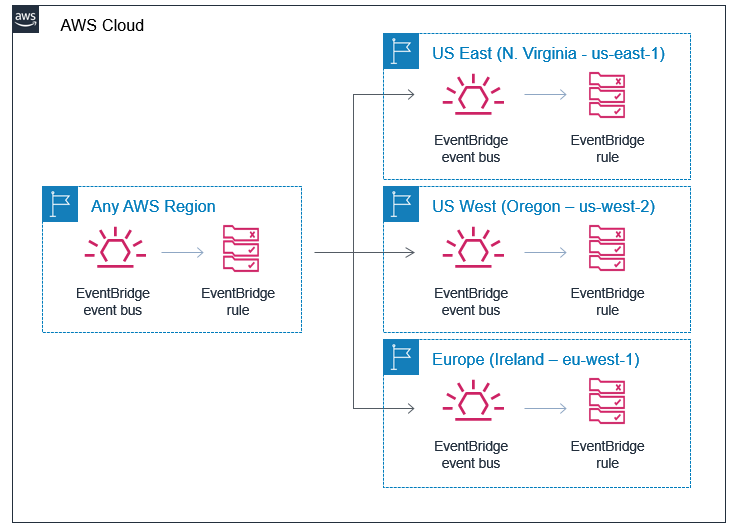
Amazon EventBridge, a serverless event bus, can send events between AWS resources. By utilizing cross-Region event routing, you can share events between workloads in different Regions (Figure 1) and accounts. For example, you can share health and utilization events across Regions to determine which Regional workload deployment is best suited for requests.

EventBridge routing events from one Region to event buses in other Regions

Figure 1. EventBridge routing events from one Region to event buses in other Regions

If your event-driven application relies on pub/sub messaging, Amazon Simple Notification Service (Amazon SNS) can fan out to multiple destinations. When the destination targets are Amazon Simple Queue Service (Amazon SQS) queues or AWS Lambda functions, Amazon SNS can notify recipients in different Regions. For example, you can send messages to a central SQS queue that processes orders for a multi-Region application.

Monitoring and observability

Observability becomes even more important as the number of resources and deployment locations increases. Being able to quickly identify the impact and root cause of an issue will influence recovery activities, and ensuring your observability stack is resilient to failures will help you make these decisions. When building on AWS, you can pair the health of AWS services with your application metrics to obtain a more complete view of the health of your infrastructure.

AWS Health dashboards and APIs show account-specific events and scheduled activities that may affect your resources. These events cover all Regions, and can expand to include all accounts in your AWS Organization. EventBridge can monitor events from AWS Health to take immediate actions based on an event. For example, if multiple services are reporting as degraded, you could set the EventBridge event target to an AWS Systems Manager automated runbook that prepares your disaster recovery (DR) application for failover.

AWS Trusted Advisor offers actionable alerts to optimize cost, increase performance, and improve security and fault tolerance. Trusted Advisor shows results across all Regions and can generate a report that shows an aggregated view of all check results across all accounts within an organization.

To maintain visibility over an application deployed across multiple Regions and accounts, you can create a Trusted Advisor dashboard and an operations dashboard with AWS Systems Manager Explorer. The operations dashboard offers a unified view of resources, such as Amazon EC2, Amazon CloudWatch, and AWS Config data. You can combine the metadata with Amazon Athena to create a multi-Region and multi-account inventory view of resources.

You can view metrics from applications and resources deployed across multiple Regions in the CloudWatch console. This makes it easy to create graphs and dashboards for multi-Region applications. Cross-account functionality is also available in CloudWatch, so you can create a centralized view of dashboards, alarms, and metrics across your organization.

Amazon OpenSearch Service aggregates unstructured and semi-structured log files, messages, metrics, documents, configuration data, and more. Cross-cluster replication replicates indices, mappings, and metadata in an active-passive setup from one OpenSearch Service domain to another. This reduces latency across Regions and ensures high availability of your data.

AWS Resilience Hub assesses and tracks the resiliency of your application. It checks how well an application will maintain availability when performing a Regional failover. For example, it can check if an application has cross-Region replication configured on Amazon Simple Storage Service (Amazon S3) buckets or that Amazon Relational Database Service (Amazon RDS) instances have a cross-Region read-replica. Figure 2 shows an output of a Resilience Hub assessment. It recommends use of Route 53 Application Recovery Controller (covered in Part 1) to ensure the Amazon EC2 Auto Scaling group in a Region is scaled and ready to accept traffic before we fail over to it.

Resilience Hub recommendations

Figure 2. Resilience Hub recommendations

Management: Governance

Growing an application into a new country means there may be additional data privacy laws and regulations to follow. These will vary depending on the country, and we encourage you to investigate with your legal team to fully understand how this affects your application.

AWS Control Tower supports data compliance by providing guardrails to control and meet data residency requirements. These guardrails are a collection of Service Control Policies (SCPs) and AWS Config rules. You can implement them independently of AWS Control Tower if needed. Additional security-centric multi-Region services are covered in part 1.

AWS Config provides a detailed view of the configuration and history of AWS resources. An AWS Config aggregator collects configuration and compliance data from multiple accounts and Regions into a central account. This centralized view offers a comprehensive view of the compliance and actions on resources, regardless of which account or Region they reside in.

Management: Operations

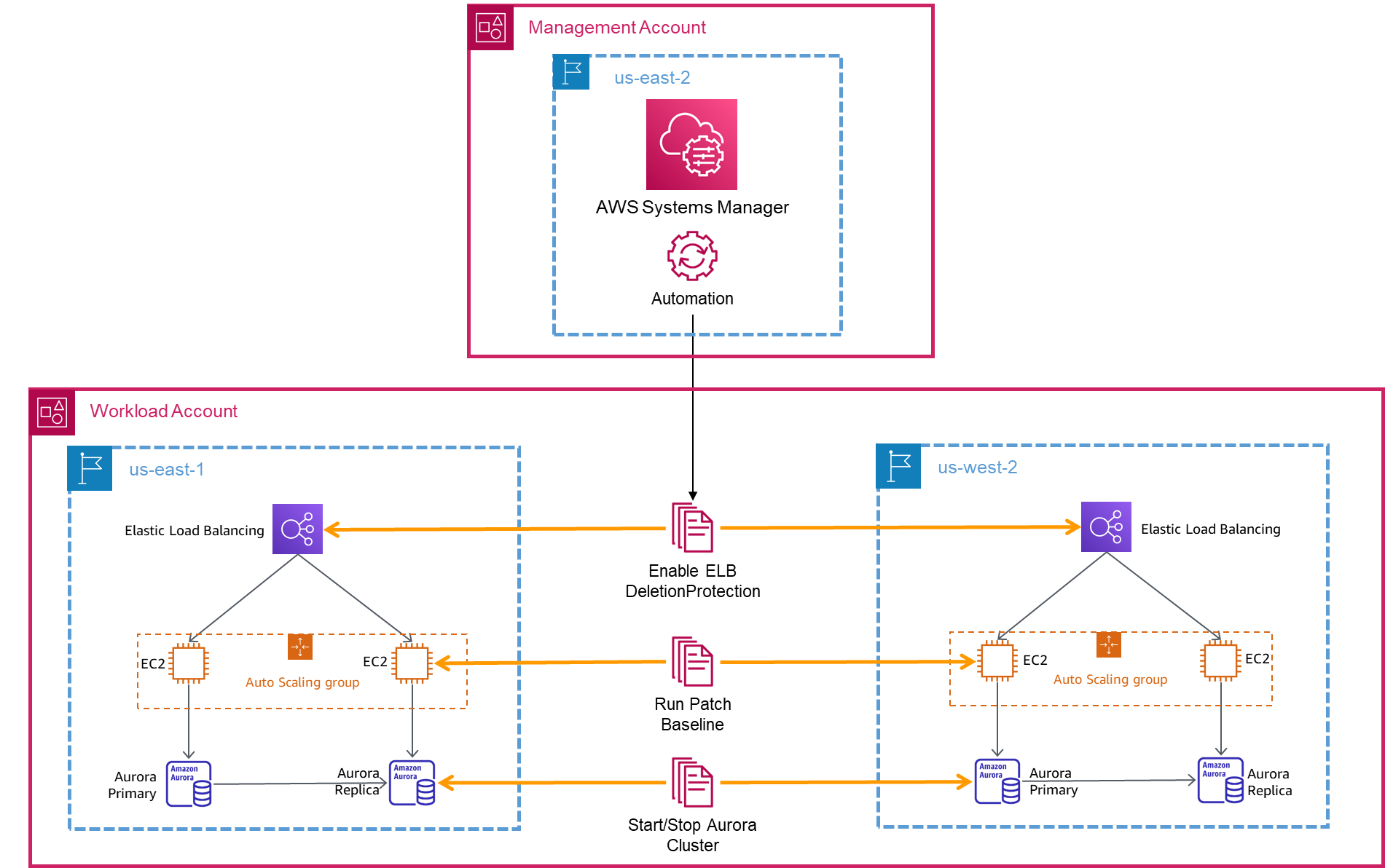
Several AWS Systems Manager capabilities allow for easier administration of AWS resources, especially as applications grow. Systems Manager Automation simplifies common maintenance and deployment tasks for AWS resources with automated runbooks. These runbooks automate actions on resources across Regions and accounts. You can pair Systems Manager Automation with Systems Manager Patch Manager to ensure instances maintain the latest patches across accounts and Regions. Figure 3 shows Systems Manager running several automation documents on a multi-Region architecture.

Using Systems Manager automation from a central operations AWS account to automate actions across multiple Regions

Figure 3. Using Systems Manager automation from a central operations AWS account to automate actions across multiple Regions

Bringing it together

At the end of each part of this blog series, we build on a sample application based on the services covered. This shows you how to bring these services together to build a multi-Region application with AWS services. We don’t use every service mentioned, just those that fit the use case.

We built this example to expand to a global audience. It requires high availability across Regions, and favors performance over strict consistency. We have chosen the following services covered in this post to accomplish our goals, building on our foundation from part 1 and part 2:

  • CloudFormation StackSets to deploy everything with IaC. This ensures the infrastructure is deployed consistently across Regions.
  • AWS Config rules provide a centralized place to monitor, record, and evaluate the configuration of our resources.
  • For added observability, we created dashboards with CloudWatch dashboard, Personal Health dashboard, and Trusted Advisor dashboard.
Building an application with multi-Region services

Figure 4. Building an application with multi-Region services

While our primary objective is expanding to a global audience, we note that some of the services such as CloudFormation StackSets rely on Region 1. Each Regional deployment is set up for static stability, but if there were an outage in Region 1 for an extended period of time, our DR playbook would outline how to make CloudFormation changes in Region 2.

Summary

Many AWS services have features to help you build and manage a multi-Region architecture, but identifying those capabilities across 200+ services can be overwhelming.

In this 3-part blog series, we’ve explored AWS services with features to assist you in building multi-Region applications. In Part 1, we built a foundation with AWS security, networking, and compute services. In Part 2, we added in data and replication strategies. Finally, in Part 3, we examined application and management layers.

Ready to get started? We’ve chosen some AWS Solutions, AWS Blogs, and Well-Architected labs to help you!

Other posts in this series

Related information

[$] Pointer tagging for x86 systems

Post Syndicated from original https://lwn.net/Articles/888914/

Pointers are a fact of life for developers working in numerous languages.
It is often convenient to be able to associate a small
amount — a few bits at most — of ancillary information with a pointer.
This can often be done within the pointer value itself with some careful
masking and shifting. CPU manufacturers have been adding ways to support
the addition of this sort of “tag” to pointers; the most recent may be
AMD’s “upper address ignore” (UAI) feature, support for which was
recently posted
by Bharata B Rao. This feature has an uncertain future in Linux, though,
as the result of a fundamental design decision.

Using larger ephemeral storage for AWS Lambda

Post Syndicated from James Beswick original https://aws.amazon.com/blogs/compute/using-larger-ephemeral-storage-for-aws-lambda/

AWS Lambda functions have always had ephemeral storage available at /tmp in the file system. This was set at 512 MB for every function, regardless of runtime or memory configuration. With this new feature, you can now configure ephemeral storage for up to 10 GB per function instance.

You can set this in the AWS Management Console, AWS CLI, or AWS SDK, AWS Serverless Application Model (AWS SAM), AWS Cloud Development Kit (AWS CDK), AWS Lambda API, and AWS CloudFormation. This blog post explains how this works and how to use this new setting in your Lambda functions.

How ephemeral storage works in Lambda

All functions have ephemeral storage available at the fixed file system location /tmp. This provides a fast file system-based scratch area that is scoped to a specific instance of a Lambda function. This storage is not shared between instances of Lambda functions and the space is guaranteed to be empty when a new instance starts.

This means that you can use the same execution environment to cache static assets in /tmp between invocations. This is a common use case that can help reduce function duration for subsequent invocations. The contents are deleted when the Lambda service eventually terminates the execution environment.

With this new configurable setting, ephemeral storage works in the same way. The behavior is identical whether you use zip or container images to deploy your functions. It’s also available for Provisioned Concurrency. All data stored in /tmp is encrypted at rest with a key managed by AWS.

Common use cases for ephemeral storage

There are three common customer use cases that can benefit from the expanded ephemeral storage.

Extract-transform-load (ETL) jobs: Your code may perform intermediate computation or download other resources to complete processing. More temporary space enables more complex ETL jobs to run in Lambda functions.

Machine learning (ML) inference: Many inference tasks rely on large reference data files, including libraries and models. More ephemeral storage allows you to download larger models from Amazon S3 to /tmp and use these in your processing. To learn more about using Lambda for ML inference, read Building deep learning inference with AWS Lambda and Amazon EFS and Pay as you go machine learning inference with AWS Lambda.

Data processing: For workloads that download objects from S3 in response to S3 events, the larger /tmp space makes it possible to handle larger objects without using in-memory processing. Workloads that create PDFs, use headless Chromium, or process media also benefit from more ephemeral storage.

Zip processing: Some workloads use large zip files from data providers to initialize local databases. These can now unzip to the local file system without the need for in-memory processing. Similarly, applications that generate zip files also benefit from more /tmp space.

Graphics processing: Image processing is a common use-case for Lambda-based applications. For workloads processing large tiff files or satellite images, this makes it easier to use libraries like ImageMagick to perform all the computation in Lambda. Customers using geospatial libraries also gain significant flexibility from writing large satellite images to /tmp.

Deploying the example application

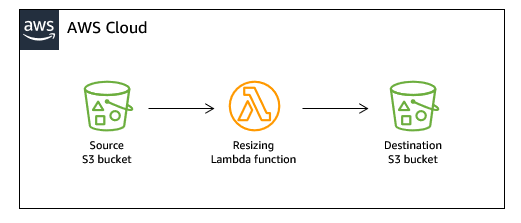
The example application shows how to resize an MP4 file from Amazon S3, using the temporary space for intermediate processing. In this example, you can process video files much larger than the standard 512 MB temporary storage:

Example application architecture

Before deploying the example, you need:

This example uses the AWS Serverless Application Model (AWS SAM). To deploy:

  1. From a terminal window, clone the GitHub repo:
    git clone https://github.com/aws-samples/s3-to-lambda-patterns
  2. Change directory to this example:
    cd ./resize-video
  3. Follow the installation instructions in the README file.

To test the application, upload an MP4 file into the source S3 bucket. After processing, the destination bucket contains the resized video file.

How the example works

The resize function downloads the original video from S3 and saves the result in Lambda’s temporary storage directory:

	// Get signed URL for source object
	const Key = decodeURIComponent(record.s3.object.key.replace(/\+/g, ' '))

	const data = await s3.getObject({
		Bucket: record.s3.bucket.name,
		Key
	}).promise()

	// Save original to tmp directory
	const tempFile = `${ffTmp}/${Key}`
	console.log('Saving downloaded file to ', tempFile)
	fs.writeFileSync(tempFile, data.Body)

The application uses FFmpeg to resize the video and store the output in the temporary storage space:

// Save resized video to /tmp
	const outputFilename = `${Key.split('.')[0]}-smaller.mp4`
	console.log(`Resizing and saving to ${outputFilename}`)
	await execPromise(`${ffmpegPath} -i "${tempFile}" -loglevel error -vf scale=160:-1 -sws_flags fast_bilinear ${ffTmp}/${outputFilename}`)

After processing, the function reads the file from the temporary directory and then uploads to the destination bucket in S3:

	const tmpData = fs.readFileSync(`${ffTmp}/${outputFilename}`)
	console.log(`tmpData size: ${tmpData.length}`)

	// Upload to S3
	console.log(`Uploading ${outputFilename} to ${outputFilename}`)
	await s3.putObject({
		Bucket: process.env.OutputBucketName,
		Key: outputFilename,
		Body: tmpData
	}).promise()
	console.log(`Object written to ${process.env.OutputBucketName}`)

Since temporary storage is not deleted between warm Lambda invocations, you may also choose to remove unneeded files. This example uses a tmpCleanup function to delete the contents of /tmp:

const fs = require('fs')
const path = require('path')
const directory = '/tmp/'

// Deletes all files in a directory
const tmpCleanup = async () => {
	console.log('Starting tmpCleanup')
	fs.readdir(directory, (err, files) => {
		return new Promise((resolve, reject) => {
			if (err) reject(err)

			console.log('Deleting: ', files)				
			for (const file of files) {
				const fullPath = path.join(directory, file)
				fs.unlink(fullPath, err => {
					if (err) reject (err)
				})
			}
			resolve()
		})
	})
}

Setting ephemeral storage with the AWS Management Console or AWS CLI

In the Lambda console, you can view the ephemeral storage allocated to a function in the Generation configuration menu in the Configuration tab:

Lambda function configuration

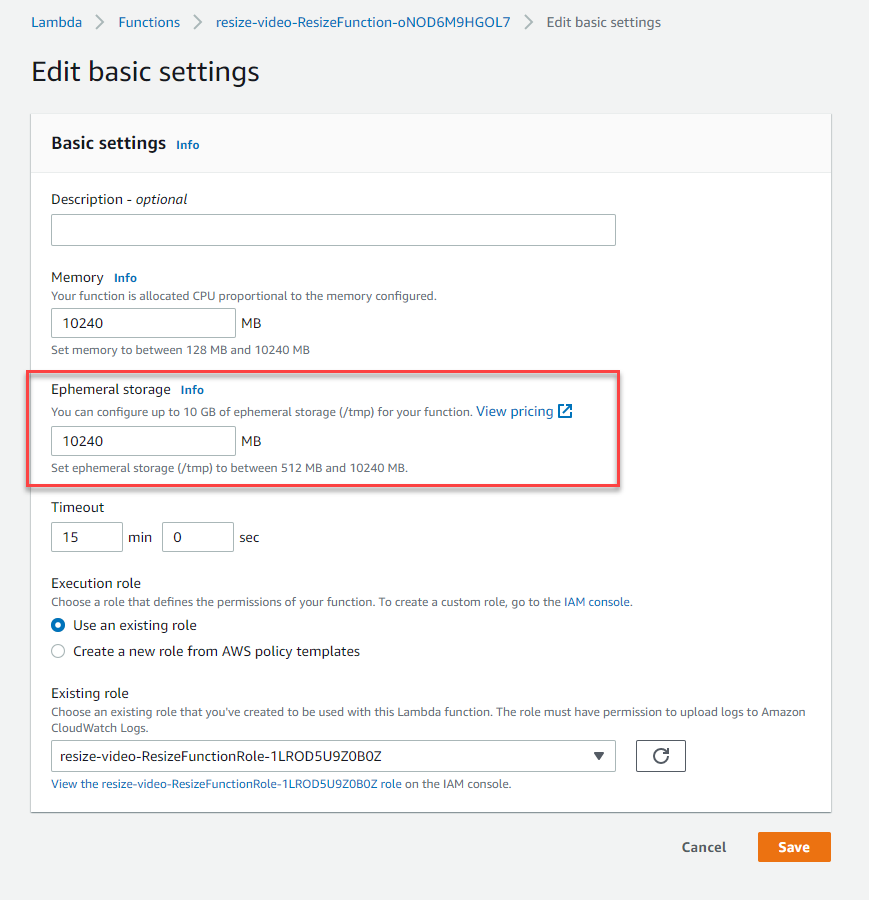
To make changes to this setting, choose Edit. In the Edit basic settings page, adjust the Ephemeral Storage to any value between 512 MB and 10240 MB. Choose Save to update the function’s settings.

Basic settings

You can also define the ephemeral storage setting in the create-function and update-function-configuration CLI commands. In both cases, use the ephemeral-storage switch to set the value:

aws lambda create-function --function-name testFunction --runtime python3.9 --handler lambda_function.lambda_handler --code S3Bucket=myBucket,S3Key=function.zip --role arn:aws:iam::123456789012:role/testFunctionRole --ephemeral-storage '{"Size": 10240}' 

To modify this setting for testFunction, run:

aws lambda update-function-configuration --function-name testFunction --ephemeral-storage '{"Size": 5000}'

Setting ephemeral storage with AWS CloudFormation or AWS SAM

You can define the size of ephemeral storage in both AWS CloudFormation and AWS SAM templates by using the EphemeralStorage attribute. As shown in the example’s template.yaml, there is a new attribute called EphemeralStorage:

  ResizeFunction:
    Type: AWS::Serverless::Function
    Properties:
      CodeUri: resizeFunction/
      Handler: app.handler
      Runtime: nodejs14.x
      Timeout: 900
      MemorySize: 10240
      EphemeralStorage:
        Size: 10240

You define this on a per-function basis. If the attribute is missing, the function is allocated 512 MB of temporary storage.

Using Lambda Insights to monitor temporary storage usage

You can use Lambda Insights to query on the metrics emitted by the Lambda function relating to the usage of temporary storage. First, enable Lambda Insights on a function by following these steps in the documentation.

After running the function, the Lambda service writes ephemeral storage metrics to Amazon CloudWatch Logs. With Lambda Insights enabled, you can now query these from the CloudWatch console. From the Logs Insights feature, you can query to determine the maximum, used, and available space available:

fields @timestamp,
tmp_max/(1024*1024),
tmp_used/(1024*1024),
tmp_free/(1024*1024)

Calculating the cost of more temporary storage

Ephemeral storage is free up to 512 MB, as it always has been. You are charged for the amount you select between 512 MB and 10,240 MB. For example, if you select 1,024 MB, you only pay for 512 MB. Expanded ephemeral storage costs $0.0000000308 per GB/second in the us-east-1 Region (see the pricing page for other Regions).

In us-east-1, for a workload invoking a Lambda function 500,000 times with a 10 second duration, using the maximum temporary storage, the cost is $0.63:

Invocations 500,000
Duration (ms) 10,000
Ephemeral storage (over 512 MB) 9,728
Storage price per GB/s $0.0000000308
GB/s total 20,480,000
Price of storage $0.63

Choosing between ephemeral storage and Amazon EFS

Generally, ephemeral storage is designed for intermediary processing of a function. You can download reference data, machine learning models, or database metadata from other sources such as Amazon S3, and store these in /tmp for further processing. Ephemeral storage can provide a cache for data for repeat usage across invocations and offers fast I/O throughout.

Alternatively, EFS is primarily intended for customers that need to:

  • Share data or state across function invocations.
  • Process files larger than the 10,240 MB storage allows.
  • Use file-system type functionality, such as appending to or modifying files.

Conclusion

Serverless developers can now configure the amount of temporary storage available in AWS Lambda functions. This blog post discusses common use cases and walks through an example application that uses larger temporary storage. It also shows how to configure this in CloudFormation and AWS SAM and explains the cost if you use more than the free, provisioned 512 MB that’s automatically provisioned for every function.

For more serverless learning resources, visit Serverless Land.

А другата гледна точка?

Post Syndicated from original https://bivol.bg/%D0%B0-%D0%B4%D1%80%D1%83%D0%B3%D0%B0%D1%82%D0%B0-%D0%B3%D0%BB%D0%B5%D0%B4%D0%BD%D0%B0-%D1%82%D0%BE%D1%87%D0%BA%D0%B0.html

понеделник 28 март 2022


„Ако се намесим във войната, вие ще видите какво ще стане!“; „Тази война не е наша, да си се оправят там“; „Руските туристи няма да идват в България“. Лодки. Джетове.…

Debian decides to allow secret votes

Post Syndicated from original https://lwn.net/Articles/889444/

The Debian project has been voting on a general
resolution
that would allow secret voting on future issues. The results have
been posted
in unofficial form, and the winner was “proposal B”: “Hide identities of
Developers casting a particular vote and allow verification”. One might
think that closes the discussion, but Debian project leader candidate Felix
Lechner is questioning
the election
and calling for it to be redone — something that the
Debian constitution lacks provisions for.

Rapid7 Announces Partner of the Year Awards 2022 Winners

Post Syndicated from Rapid7 original https://blog.rapid7.com/2022/03/28/rapid7-announces-partner-of-the-year-awards-2022-winners/

Rapid7 Announces Partner of the Year Awards 2022 Winners

It’s with immense pleasure that we announce today the winners of the Rapid7 Partner of the Year Awards 2022. All our category winners have achieved exceptional growth, demonstrating dedication and collaboration to the Rapid7 Partner Program throughout the year.

We’re very proud to share our complete list of winners. Please join us in congratulating them all.

APAC Awards

Rapid7 APAC Partner of the Year: Cythera Pty Ltd

APAC Distributor of the Year: Netpoleon Solutions Pte Ltd

APAC Emerging Partner of the Year: Murdoch Webster Technology Group Pty Ltd

APAC Fastest Growth Partner of the Year: Blue Apache Information Systems

APAC Best Customer Retention of the Year: Content Security Pty Ltd

APAC Detection & Response Partner of the Year: DGplex Pty Ltd

APAC Vulnerability Management Partner of the Year: The Missing Link

EMEA Awards

EMEA Partner of the Year: Softcat Plc

EMEA Distributor of the Year: Infinigate Deutschland GmbH

EMEA Emerging Partner of the Year: Telonic GmbH

EMEA Fastest Growth Partner of the Year: Caretower Limited

EMEA Best Customer Retention of the Year: Saepio Solutions Ltd

EMEA MSSP Partner of the Year: Tesorion

EMEA Detection & Response Partner of the Year: Orange CyberDefense

EMEA Threat Intelligence Partner of the Year: Sorint.SEC

EMEA Vulnerability Management Partner of the Year: Tieto

North America Awards

Rapid7 North America Partner of the Year: SHI International Corp.

North America Distribution Partner of the Year: Liquid PC

North America Emerging Partner of the Year: AccessIT Group, Inc.

“We are pleased to be recognized as North America Emerging Partner of the Year, and we value our evolving partnership with Rapid7,” said Bob Reilly, Vice President of Sales at AccessIT Group. “Rapid7 is a great partner that allows us to deliver shared visibility, analytics, and automation to unite our customers’ security, IT, and DevOps teams.”

North America Fastest Growth Partner of the Year: CDW Corporation

North America Best Customer Retention of the Year: Carahsoft Technology Corp.

“We are pleased to be recognized as the 2022 North America Best Customer Retention Partner,” said Alex Whitworth, Sales Director, who leads the Rapid7 Team at Carahsoft. “Carahsoft and our reseller partners enable customers to unlock more value from their Rapid7 investments through our proactive customer onboarding, nurture, and support process. We combine dedicated Rapid7 expertise, customer success technology and automation, and a constant communication approach to build valuable relationships with customers. We thank Rapid7 and our reseller partners for this amazing award.”

North America MSSP Partner of the Year: RKON Technologies

“RKON is honored and grateful to receive the MSSP of the Year for North America award from Rapid7. This award is a testament that the RKON and Rapid7 teams’ shared vision, strong working partnership, and endless determination have been fruitful in driving aggressive growth and adding value to our client’s security programs.”

– Chris Hueneke, Chief Information Security Officer at RKON Technologies

North America Detection & Response Partner of the Year: CyberWatch Systems

North America Threat Intelligence Partner of the Year: Deepwatch, Inc.

North America Vulnerability Management Partner of the Year: GuidePoint Security LLC

North America AppSec Partner of the Year: GuidePoint Security LLC

North America Cloud Security Partner of the Year: SHI International Corp.

Rapid7 Canadian Partner of the Year: Forecight

“This is a big honor for our entire team, who supported the company to attain its overwhelming success over the past few years. Our mutual achievements are truly a testament to our partnership and our ability to work together to give our clients the best cybersecurity solutions. We look forward to continuing our robust and fruitful partnership with Rapid7.”

– Arezou Marzara, LL.M., Director, Strategy & Operations at Forecight

Congratulations again to all our winners!

More about our partner program

The Rapid7 PACT Program is built to inspire our partners to grow with us and achieve mutual success through accountability, consistency, and transparency. By participating in the program, partners can offer powerful, industry-leading solutions to our joint customers, resulting in mutual success for all. If you’re interested in becoming a Rapid7 partner, you can learn more here.

NEVER MISS A BLOG

Get the latest stories, expertise, and news about security today.

The collective thoughts of the interwebz