Enabling R8 optimization at scale with AI-assisted debugging

Post Syndicated from Grab Tech original https://engineering.grab.com/r8-optimization-at-scale-with-ai-assisted-debugging

Grab is Southeast Asia’s leading superapp, providing a suite of services that bring essential needs to users throughout the region. Its offerings include ride-hailing, food delivery, parcel delivery, mobile payments, and more. With safety, efficiency, and user-centered design at heart, Grab remains dedicated to solving everyday issues and improving the lives of millions. As our app continues to expand, we identified platform-level performance challenges that were affecting user experience across the board. In this article, we share how we successfully enabled R8 optimization for the Grab Android app, achieving significant improvements in app size, startup time, and stability through innovative AI-assisted debugging techniques.

Introduction

Since 2024, our team observed a concerning trend: Application Not Responding (ANR) rates were spiking across the Grab app. Unlike typical isolated issues, the data revealed that ANRs were happening everywhere, not confined to specific features or modules. This pattern pointed to platform-level causes, with our analysis showing strong correlations between ANRs and several factors like memory pressure (particularly when garbage collection was triggered), ad-heavy user flows, overhead from heavy use of Jetpack Compose within XML layouts, and XML views within Compose code.

The Android community had long proven that R8 optimization (beyond basic code shrinking) could deliver substantial performance gains and app size reductions. As Grab has been adopting Jetpack Compose over the last two years, Google’s Jetpack Compose performance documentation specifically recommends R8 optimization for Compose-heavy apps. This made it a natural solution for our systemic performance issues.

The challenge at scale

However, enabling R8 optimization for Grab’s Android app was far from straightforward. Our app operates at a massive scale with over 9 million lines of code and more than a hundred engineers actively working on it daily. While we had basic R8 shrinking enabled, advanced optimization had proven challenging despite multiple attempts over six years (earlier with adopting DexGuard, later with R8 optimization).

In 2022, we almost succeeded with R8 optimization after successfully rolling it out onto our early access build. We were unfortunately faced with critical roadblocks that compelled us to put the project on hold. After analyzing our previous attempts and the current project situation, we identified three fundamental challenges that had to be solved simultaneously.

This article explains how we tackled each challenge through targeted innovations, including AI-assisted debugging for slow investigation cycles, pragmatic testing strategy for validation at scale, and optimized feedback loop for rapid iteration.

Understanding R8 optimization

Before diving into our solution, it’s important to understand what R8 optimization actually provides beyond basic R8 shrinking.
Figure 1. The R8 processing pipeline involves multiple interconnected phases that transform, analyze, and optimize code. Understanding this complexity helps explain both the benefits of optimization and why debugging issues become challenging.

What we had in place

With minifyEnabled=true and shrinkResources=true using proguard-android.txt, we already had:

  • Tree shaking (shrink phase): Removes unused/unreachable code.
  • Code minification (obfuscation): Renames classes/methods to short names.
  • Resource shrinking: Removes unused XML files and drawables.
  • Desugaring: Java 8+ compatibility.

What’s new with optimization

By switching to proguard-android-optimize.txt, we gained access to:

  • Method inlining: Replaces method calls with actual code, reducing call overhead.
  • Class merging: Makes code more compact by combining similar classes.
  • Constant folding: Pre-computes constant expressions at compile time.
  • Dead code elimination: More aggressive than tree shaking, removes unreachable branches.
  • Devirtualization: Converts virtual calls to direct calls when possible.

These optimizations work together to improve runtime performance while significantly reducing app size.

Three core challenges

Despite R8’s clear benefits, enabling it at Grab’s scale remains hard. Lessons from prior attempts and current project context surfaced three fundamental challenges we needed to solve.

Challenge 1: Slow debugging

R8 optimization issues are notoriously difficult to debug:

  • Code is obfuscated, class names become a, b, c.
  • Code is modified, inlined, merged, and optimized beyond recognition.
  • Stack traces are unreadable without proper mapping files when crashes occur.
  • Pinpointing the root cause requires manual reverse engineering.

The challenge was compounded by limited bandwidth and high labor requirements. Most issues had to be either addressed directly or have solutions provided for other teams to fix. Manual decompilation, deobfuscation, and context gathering for each issue are inherently time-consuming, making the investigation cycle prohibitively slow.

Challenge 2: Testing at scale

R8 optimization affects every corner of the app. Unlike feature-specific changes, enabling optimization transforms how the entire codebase is compiled, inlined, and optimized. A single misconfiguration or missing keep rule can break seemingly unrelated features across different modules and Software Development Kits (SDKs).

When we first enabled R8 optimization, the impact was immediate and widespread—most of the app’s features simply stopped working correctly. This presented us with a deeper problem: not just how to test, but what kind of testing strategy would actually give us confidence to roll out to production.

In theory, R8 optimization works reliably with standard codebases that follow Google’s and the community’s best practices. However, considering the large scale of Grab’s project, legacy code patterns, reflection usage, and SDK integrations have been accumulated over the years, creating numerous edge cases.

This combination makes comprehensive testing necessary, but at our scale, it’s nearly impossible to execute due to:

  • Full regression testing: Requires significant effort from all teams across the organization.
  • Quality Assurance (QA) resource constraints: Exhaustive testing is impractical.
  • High-quality bar: At Grab, app stability and zero runtime errors are non-negotiable standards.

This creates a catch-22: we need broad coverage because consistency can’t be guaranteed everywhere, yet the scale makes that coverage infeasible.

Challenge 3: Slow feedback

Due to the large scale of the project, compiling a build with R8 optimization enabled on a standard engineering laptop is physically impossible. This created a significant bottleneck: a slow feedback loop where every experimental change required a remote Continuous Integration (CI) build to verify, with each R8-optimized build taking up to 2 hours to complete.

Additionally, R8 treats debug and release build types differently. At Grab, we have a QA build for QA testing. This is a debug build type with R8 enabled, pointed to our staging environment. We had to ensure this QA build’s R8 configuration matched our production build exactly. This alignment was critical for catching R8-specific issues during QA testing that would actually reflect production behavior.

Our three-innovation solution

To overcome these three fundamental challenges, we developed a comprehensive strategy centered on targeted innovations that addressed each bottleneck:

Innovation 1: AI-assisted debugging

Solving challenge 1:

How do we speed up the investigation of R8 issues in obfuscated, optimized code at scale? The answer is in emerging AI technology that wasn’t available during our previous attempts.

The AI context at Grab:

Unlike 2022 and earlier attempts, the landscape had changed dramatically. After the LLM explosion, Grab proactively promoted Large Language Model (LLM) usage to boost engineering productivity. Over the past two years, Grab has dedicated 1 to 2 months annually for engineers to learn how to use AI efficiently. This investment in AI literacy became crucial for this project.

This year, my team gained experience building Model Context Protocol (MCP) servers and identified an opportunity: applying this technology to solve the R8 debugging challenge.

Our solution:

At Grab, we use GitLab for Continuous Integration and Continuous Delivery (CI/CD). To tackle R8 debugging bottlenecks, we built a comprehensive solution combining:

Build MCP tools: Eliminate manual reverse engineering

  • Automatic Android Application Package (APK) decompilation: Parse and decompile APKs.
  • Stack trace deobfuscation: Automatically map obfuscated traces to source code.
  • Class/method context fetching: Pull relevant decompiled code sections for analysis.

AI and CI pipeline workflow:

We developed a systematic two-phase approach for investigating and fixing each runtime issue, combining AI assistance with parallel testing. The phase breakdown is as follows:

Phase 1: MCP server tools for debugging

  1. Detect runtime issue: From End-to-End (E2E) tests, QA testing, or crash reports.
  2. MCP tool orchestrates APK analysis: Coordinates decompilation tools for reverse engineering.
  3. MCP tool provides decompiled code context: Pulls and decompiles problematic code sections.
  4. Engineer and AI analysis: The engineer uses AI assistance to analyze the decompiled code context and note down multiple solution approaches.

Phase 2: GitLab CI integration

We leveraged the GitLab CLI tool (glab) and instructed AI to use it for interacting with our CI pipeline:

  1. AI creates multiple Merge Requests (MRs): Using glab CLI, AI creates merge requests for different solution approaches from Phase 1, each triggering CI compilation.
  2. Track progress: Maintain an MD file as the source of truth for the investigation, containing all notes about the issue (root cause analysis, test cases, test branches, CI build status).
  3. AI fetches APK from CI: Using glab CLI to retrieve built APKs from completed CI pipelines.
  4. Verify: Ask AI to use Android Debug Bridge (ADB) to install APK, then manually test the fix.
  5. Iterate: If issues remain, loop back to step 2 for further analysis.

Why this worked:

Our approach functions as an AI assistant that:

  • Decodes the obfuscated code automatically.
  • Finds the relevant code sections without manual searching.
  • Suggests multiple solutions based on the context provided by the MCP tools.
  • Creates multiple test branches simultaneously and runs parallel CI builds to test different approaches.
  • Tracks everything to ensure no progress is lost on complex investigations.

Instead of testing solutions one-by-one (waiting 2 hours per build), AI creates multiple MRs in parallel, dramatically accelerating the verification process. Engineers focus on making decisions about which solutions to pursue while the AI handles both the mechanical work and the parallel experimentation.

The impact: Accelerating investigation

While investigating a single R8 issue might still take days, our MCP tools dramatically accelerated critical investigation tasks. Manual tasks that previously took hours for decompilation, deobfuscation, and context gathering were reduced to minutes. Additionally, AI assistance significantly sped up the analysis phase, helping engineers quickly identify patterns, suggest solutions, and explore multiple approaches in parallel, both analytically and through simultaneous CI builds, further accelerating the overall investigation process.

Innovation 2: Pragmatic testing strategy

Solving challenge 2:

How do we do testing at scale? How do we validate R8 optimization across a mature codebase containing more than seven million lines of code when comprehensive testing is necessary but impossible? Our solution came from a critical insight about R8 issues at scale.

Testing approaches that don’t work with R8:

  • Unit tests: Run on Java Virtual Machine (JVM), while R8 optimizations affect Android Runtime behavior – fundamentally different environments.
  • UI tests with R8: Community solutions exist as Gradle plugins, but our tests run on Bazel – complex setup and reliability concerns.

Key insight:

From our experience, R8 issues tend to share similar root causes across the codebase. Legacy patterns like reflection usage, parser implementations, and dynamic class loading follow consistent patterns within a large codebase. This insight led to two key advantages:

  • Fix one, help many: Fixing one place often resolves issues in others.
  • Pattern recognition: Once we identify a pattern, we can search the codebase to find similar issues instead of waiting for QA to discover them.

If we could identify and fix these pattern-based issues, we could address many problems without testing every corner of the app. We decided to start with critical paths and expand from there. This “ripple effect” strategy began at the center with the most important flows, then expanded by identifying common root causes and similar patterns across the codebase.

We designed a progressive risk-based validation strategy:

  • Stage 1: E2E tests – pattern discovery phase: Fortunately, we had existing E2E tests covering most critical paths in the project, and they could be executed with R8 optimization enabled. Initially, all E2E tests failed after enabling optimization. This became our opportunity for pattern discovery. We systematically fixed issues and applied our pattern-based approach to resolve similar problems across the project.

  • Stage 2: QA smoke tests – coverage expansion: After E2E tests stabilized, we requested our QA team to run smoke tests on critical flows, especially those not covered by E2E automation. This caught additional edge cases and validated that the pattern-based fixes we applied were effective across different user journeys. We fixed any issues that appeared during this phase.

  • Stage 3: Daily QA build enablement – real-world integration: After confirming stability in controlled testing, we made a significant decision to enable R8 optimization in our daily QA build (the build our QA team uses for daily feature testing). This integrated R8 optimization into the normal development workflow without requiring additional testing effort.

  • Stage 4: Regression testing and Grab Early Access (GEA) – parallel production-scale validation: After confirming stability in daily QA builds, we moved to production-scale validation with two parallel tracks. Every release at Grab includes regression testing covering all critical paths and new features. With R8 optimization now enabled in the QA build, we ran regression tests using this build for a few weeks, providing sustained validation across multiple release cycles. One week after regression testing, we rolled out to GEA, Grab’s internal production release channel for Grab employees and partners. While GEA users typically receive features one week before general production rollout, for this R8 optimization project, we extended the GEA phase to 2 weeks, given the significance of the change. With hundreds of daily active users using the app in real-world production conditions during this extended period, we encountered only one remaining R8 issue during the GEA phase. This combination of regression testing and real-world GEA production usage gave us the confidence needed before full production rollout.

Pattern-based issue resolution:

Throughout these validation phases, when we identified R8 issues, we followed a systematic pattern-based resolution process.

  1. Identify the issue: Catch the failure through E2E, QA, or monitoring.
  2. Find the pattern: Analyze the root cause to identify if it’s a common pattern across the codebase.
  3. Detect similar instances: Search the entire codebase to find the same pattern across different modules and the internal SDKs.
  4. Coordinate fixes: Create tickets requesting teams to modify their code to prevent the same issue in their modules.

This approach required cross-team coordination for fixing, but critically, not for testing. The difference is significant: asking teams to fix identified issues in their modules is much more scalable than requiring all teams to perform comprehensive testing upfront.

Production rollout results:

When we made it to production, only one issue escaped to production. Notably, we had actually detected this issue through our pattern-based approach during testing and created a ticket for the responsible team to fix it. However, with ongoing daily development, the team missed one instance when implementing the fix, which caused the production issue.

This demonstrates that while our testing strategy worked effectively, human coordination challenges can still occur at scale. With a project of this scale, having only one small production issue is considered a highly successful rollout.

This approach transformed an “impossible” comprehensive testing problem into a manageable, systematic validation process, reducing what would have been months of coordinated testing effort to days, proving that a smart strategy can overcome resource constraints.

Innovation 3: Optimized feedback loop

Solving challenge 3:

The slow feedback challenge—2-hour CI builds and QA configuration misalignment—created a bottleneck for R8 debugging. We addressed this through a comprehensive infrastructure strategy targeting these critical areas:

Remote compilation to enable local build and fast feedback loop:

At Grab, we used to use Mainframer for remote execution to handle slow performance on local Gradle builds. However, since migrating to Bazel (only for the debug build without R8 enabled), we removed the large-scale Mainframer setup for every engineer. From that experience, to tackle the local compilation blocker for R8 builds, we decided to deploy a new Mainframer setup, a much smaller one with one powerful Amazon Elastic Compute Cloud (EC2) instance, serving as a solution for local compilation in a short time.

This targeted deployment transformed physically impossible local R8 builds into a manageable remote process, enabling engineers to test R8 changes without requiring powerful local hardware.

The performance improvement was substantial: from up to 2 hours in CI to around 1 hour with Mainframer—a ~50% reduction that enabled rapid iteration cycles essential for R8 debugging.

QA build configuration alignment:

We eliminated the critical gap between QA and production R8 behavior by aligning build configurations exactly. The key change was setting debuggable = false for QA builds while maintaining the environment configuration.

buildTypes {
    debug {
        if (isQaBuild()) {
            minifyEnabled true
            shrinkResources true
            debuggable false
            buildConfigField 'boolean', 'DEBUG', 'true'
            ...
        }
    }
}

From our understanding, R8 applies different optimization levels based on the debuggable flag, with more aggressive optimizations when debuggable=false. This ensured our QA testing reflected actual production R8 processing. We preserved DEBUG = true to maintain staging environment routing while achieving R8 parity.

This infrastructure foundation was essential, providing faster feedback loops that accelerated verification and investigation, while the QA build configuration matching production exactly was critical for catching real production issues during testing.

A lucky break

Perhaps most surprising: the R8 flakiness issue that blocked us in 2022 (Issue #240077160) appears to have been resolved by the R8 team. We encountered no build determinism issues during this attempt, which significantly smoothed our path to production.

Results

After ~10 weeks of systematic implementation led by one engineer collaborating with multiple teams across the organization, we achieved substantial improvements using Android Gradle Plugin 8.6.1 with R8 version 8.6.39:

  • Stability: Around 25% reduction in ANR rates.
  • App size: Reduced by 21.6MB (16% decrease) in download size on our reference device (zipped APK).
  • Performance: Nearly 27% improvement in startup time. After enabling R8 optimization, we saw ~12% app startup improvement. However, during our analysis, we discovered that our existing baseline and startup profiles implementation was incorrect. After proper implementation, the combination of R8 optimization plus the corrected profiles delivered the full 27% improvement.

These results exceeded our initial targets and validated the significant effort required to enable R8 optimization at scale.

What’s next

Our journey doesn’t end here. We’re exploring several areas for continued optimization:

  • R8 full mode: More extreme/aggressive optimization than the current mode for additional performance benefits.
  • Revisit R8 keep rules: Clean up unnecessary rules that prevent optimization, and implement a governance solution to guardrail R8 rules in our pre-merge CI pipeline.
  • Dead code removal for experiment framework: We discovered a solution to help R8 understand our experiment framework flags and remove dead branches for fully turned-off features.

Conclusion

Enabling R8 optimization for the Grab Android app at scale required innovation beyond traditional debugging approaches. By combining AI-assisted debugging, pragmatic testing strategies, and infrastructure investment, we overcame challenges that had blocked previous attempts for many years.

For other teams considering R8 optimization at scale: the journey is challenging, but the results speak for themselves. With the right tools, strategy, and team collaboration, it’s achievable even for the largest codebases.

Join us

Grab is a leading superapp in Southeast Asia, operating across the deliveries, mobility, and digital financial services sectors. Serving over 900 cities in eight Southeast Asian countries: Cambodia, Indonesia, Malaysia, Myanmar, the Philippines, Singapore, Thailand, and Vietnam. Grab enables millions of people every day to order food or groceries, send packages, hail a ride or taxi, pay for online purchases or access services such as lending and insurance, all through a single app. We operate supermarkets in Malaysia under Jaya Grocer and Everrise, which enables us to bring the convenience of on-demand grocery delivery to more consumers in the country. As part of our financial services offerings, we also provide digital banking services through GXS Bank in Singapore and GXBank in Malaysia. Grab was founded in 2012 with the mission to drive Southeast Asia forward by creating economic empowerment for everyone. Grab strives to serve a triple bottom line. We aim to simultaneously deliver financial performance for our shareholders and have a positive social impact, which includes economic empowerment for millions of people in the region, while mitigating our environmental footprint.

Powered by technology and driven by heart, our mission is to drive Southeast Asia forward by creating economic empowerment for everyone. If this mission speaks to you, join our team today!
[$] LWN.net Weekly Edition for March 12, 2026

Post Syndicated from jzb original https://lwn.net/Articles/1061465/

Inside this week’s LWN.net Weekly Edition:

  • Front: Chardet; Linux and age verification; Debian AI; Python lazy imports; Python type-system PEP; PQC HTTPS certificates; MGLRU; Fedora strategy.
  • Briefs: LLM vulnerability; NTP security; OpenWrt 25.12.0; SUSE sale; Buildroot 2026.02; digiKam 9.0.0; Rust 1.94.0; Quotes; …
  • Announcements: Newsletters, conferences, security updates, patches, and more.

[$] California’s Digital Age Assurance Act and Linux distributions

Post Syndicated from jzb original https://lwn.net/Articles/1062112/

A recently enacted law in California imposes an age-verification requirement on
operating-system providers beginning next year. The language of the Digital
Age Assurance Act
does not restrict its requirements to proprietary or commercial
operating systems; projects like Debian, FreeBSD, Fedora, and others seem to be on
the hook just as much as Apple or Microsoft. There is some hope that the law will be
amended, but there is no guarantee that it will be. This means that the developer
communities behind Linux distributions are having to discuss whether and how to
comply with the law with little time and even less legal guidance.

Rapid7 Detection Coverage for Iran-Linked Cyber Activity

Post Syndicated from Rapid7 Labs original https://www.rapid7.com/blog/post/tr-detection-coverage-iran-linked-cyber-activity

The tension arising out of the conflict in Iran is beginning to show signs of expanding beyond a strictly regional crisis. Following our recent published advisories, this communication is intended to outline and summarize the detection and enrichment coverage available to Rapid7 customers, broadly assess the macro cyber threat landscape, and demonstrate the specific actions undertaken within the Rapid7 portfolio to assure our customers of the protection they receive and can expect moving forward. For a research-driven companion piece from Rapid7 Labs, dive into Iran’s Cyber Playbook in the Escalating Regional Conflict.

Tracking the campaigns associated with the current conflict 

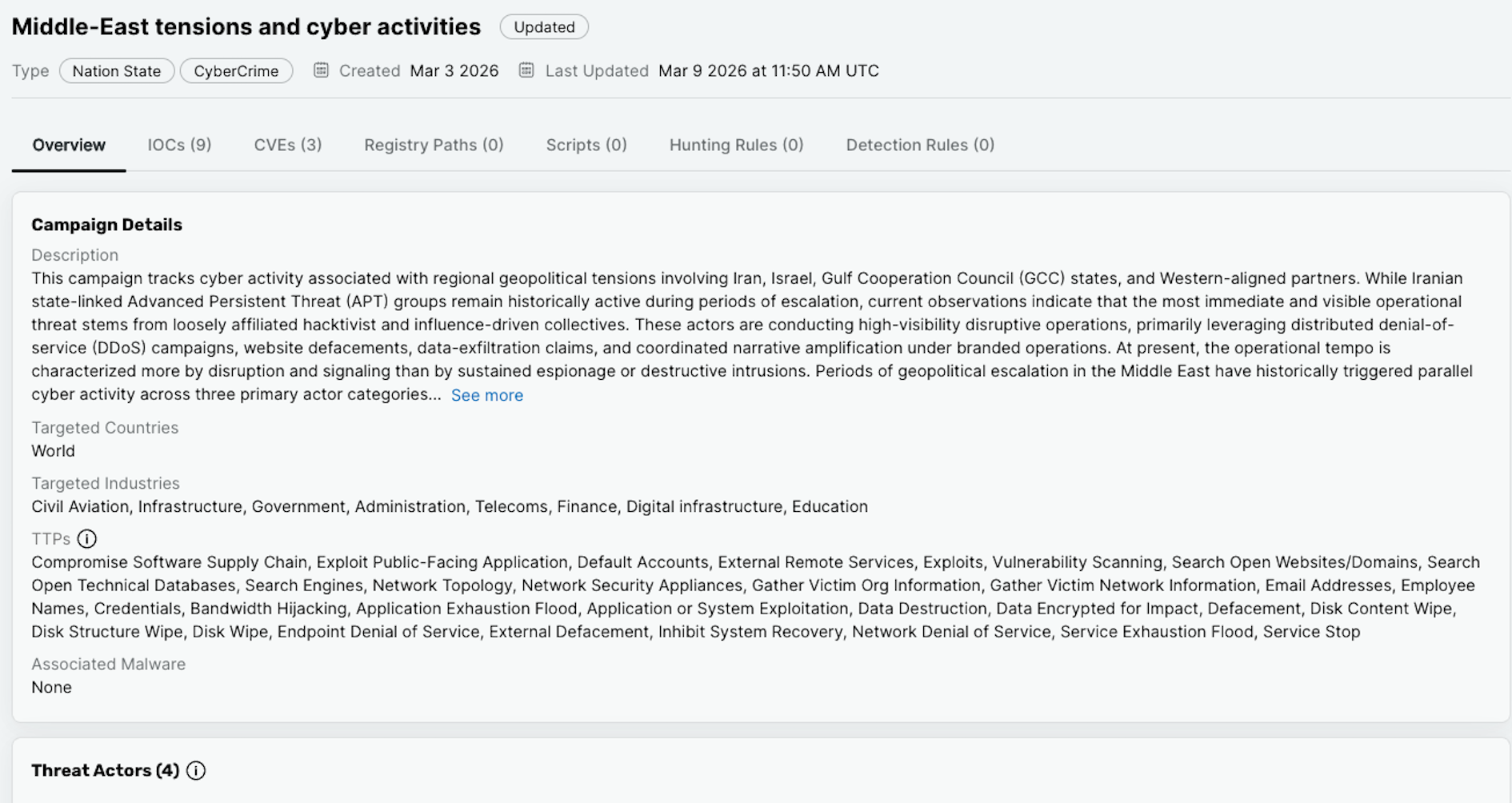
There exists a number of threat campaigns (both directly and indirectly) associated with groups associated with Iranian APT actors. In order to track details of these campaigns, any relevant indicators of compromise will be made available within Intelligence Hub.

collective-campaign-_Intelligence-Hub.png
Figure 1: A screenshot of the collective campaign available within Intelligence Hub.

⠀

As additional intelligence is identified and verified this campaign (and any others) will be incorporated and made available both within the detection stack across the Rapid7 portfolio, but equally for enrichment purposes within Intelligence Hub.

Hacktivist activity and Digital Risk Protection (DRP) coverage 

Since the regional military escalations began in late February 2026, Rapid7 Labs has tracked a significant and ongoing spike in retaliatory cyber activity targeting regional and Western infrastructure. What we’re seeing falls into two broad buckets. The first is state-directed operations, primarily espionage and data exfiltration, carried out by actors like:

  • MuddyWater/Seedworm (MOIS)

  • CyberAv3ngers (IRGC)

  • The Handala persona (assessed as being maintained by Void Manticore under MOIS direction). 

The second is a much noisier layer of hacktivist activity, stemming from groups that lack sophistication but generate outsized visibility through DDoS campaigns and public breach claims. These groups include:

  • Keymous+

  • DieNet

  • NoName057(16).

A major theme across this escalation is fabrication. Many of the breach claims circulating on Telegram and dark web forums are exaggerated or outright fake. Threat actors, especially on the hacktivist side, are recycling old leaked datasets, overstating their access, and running what amount to psychological operations aimed at causing panic and reputational damage. That said, where state-directed actors are involved, legitimate data theft is a real concern, and there is a strong likelihood that stolen material will be weaponized publicly and quickly.

Rapid7’s Digital Risk Protection platform is purpose-built to cover exactly these kinds of threats. Here is how our coverage maps to the current activity:

  • Dark web and forum monitoring — The coordination and announcements driving these campaigns are happening across Telegram, X (formerly Twitter), and dark web leak sites. DRP continuously monitors clear, deep, and dark web sources, with proprietary crawlers, inspecting tens of millions of pages. This gives us visibility into restricted forums and early warning when campaigns begin targeting specific organizations or sectors.

  • Data leakage detection and claim verification — With so many unsubstantiated breach claims in circulation, the ability to quickly distinguish real exposures from fabricated ones is critical. DRP monitors threat actor dumps and leak sites for exposed company assets and correlates what it finds against each customer’s digital footprint, giving organizations a clear answer on whether a claimed breach actually affects them.

  • Brand security and phishing defense — Threat actors are exploiting public confusion to register lookalike domains, clone websites, and create impersonation profiles on social media. DRP identifies these phishing and impersonation threats and supports the takedown of the attacker’s infrastructure.

  • Analyst-verified intelligence — Our threat intelligence analysts investigate and triage what surfaces through the platform to ensure customers receive only intelligence that has been verified and is actionable. When a real compromise or data exposure is confirmed, our team works directly with the affected organization to assess the impact and support remediation.

CVE intelligence 

To fuel the data leak and psychological operations discussed above, state-directed actors like MuddyWater and Void Manticore are actively weaponizing recently disclosed, high-impact vulnerabilities. Rather than focusing on a single product, these APTs are broadly targeting a combination of internet-facing edge devices, enterprise management infrastructure, and client productivity software to gain their initial foothold.

The vulnerabilities being leveraged in these campaigns all provide either authentication bypass or remote code execution, giving attackers a direct path into the environment. Once inside, the goal is the same every time: establish persistence and get data out. As noted above, any legitimate data stolen during these intrusions is highly likely to be handed off to hacktivist personas and weaponized publicly to support the broader disinformation campaigns.

The following CVEs have been identified as actively exploited or assessed as high-priority targets in the current threat environment:

  • CVE-2026-1281

    • Description: A critical command injection vulnerability in Ivanti Endpoint Manager Mobile (EPMM) that grants unauthenticated attackers root-level remote code execution. This has been leveraged as a zero-day vulnerability to compromise mobile endpoint management environments.
      Tied to: MuddyWater (MOIS)

    • Metasploit Module: https://github.com/rapid7/metasploit-framework/pull/20932

  • CVE-2024-4577

    • Description: A critical OS command injection vulnerability in PHP running in CGI mode on Windows. By exploiting Windows “Best-Fit” encoding behaviors, attackers can bypass escape mechanisms and execute arbitrary code on the host server.
      Tied to: Void Manticore (the MOIS-affiliated actor that maintains the Handala hacktivist persona)

    • Metasploit Module: https://github.com/rapid7/metasploit-framework/pull/19247

  • CVE-2025-32433

  • CVE-2025-52691

  • CVE-2025-9316

    • Description: An unauthenticated session bypass vulnerability impacting N-able N-Central. Attackers frequently chain this with an XML External Entity (XXE) vulnerability to read highly sensitive local configuration and backup files from the host infrastructure.

    • Metasploit Module: https://github.com/rapid7/metasploit-framework/pull/20713 

  • CVE-2026-21514

    • Description: A security feature bypass vulnerability in Microsoft Word that allows an unauthorized attacker to bypass Object Linking & Embedding (OLE) mitigations locally. Exploitation requires user interaction to open a maliciously crafted document.

    • Rapid7 Coverage: Analyzed extensively in Rapid7’s Patch Tuesday – February 2026 blog post and prioritized for customer patching due to active exploitation

Detection and Response for Rapid7 customers 

Rapid7’s Threat Hunting team has been actively hunting for activity related to Iranian actors since the regional conflict began. We are utilizing threat intelligence related to new indicators of compromise and known tactics, techniques, and procedures to conduct these hunts. If we have validated findings, the MDR SOC will investigate and communicate the details of findings using the standard notification processes.

Additional reading from Rapid7 Labs: Iran’s Cyber Playbook in the Escalating Regional Conflict

Iran’s Cyber Playbook in the Escalating Regional Conflict

Post Syndicated from Rapid7 Labs original https://www.rapid7.com/blog/post/tr-iran-cyber-playbook-escalating-regional-conflict

Following our recent published advisories, this publication is intended to outline a summary of the cyber activities associated with the tension. Based on the available information, we believe the conflict is beginning to show signs of expanding beyond a strictly regional crisis. Initial threat reporting pointed to a measurable increase in cyber activity linked to the crisis predominantly focused on hacktivist mobilization, with reports of phishing campaigns, and claims of data theft and disruptive operations. For a companion piece focused around our customers, dive into Rapid7 Detection Coverage for Iran-Linked Cyber Activity.

Cyber activity by groups associated with Iran and their affiliated ecosystems have begun to surface. Much of the visible activity currently appears to have limited immediate operational impact as it consists primarily of website defacements, distributed denial-of-service (DDoS) attacks, coordinated messaging campaigns, phishing attempts, and reconnaissance against exposed digital infrastructure. While these incidents may appear opportunistic or symbolic, historical patterns of such behavior suggest that this activity can represent early-stage signaling, pressure, and preparatory shaping operations rather than isolated disruption.

Iran’s cyber ecosystem operates through a layered structure that includes state-linked advanced persistent threat (APT) groups, proxy actors, hacktivist personas, and sympathetic foreign collectives. Even when not centrally coordinated, these actors often converge on the same narratives and target sets during geopolitical crises, enabling simultaneous visible disruption and covert intelligence-driven intrusion activity. As the conflict evolves, this ecosystem provides a scalable and deniable tool for retaliation that can gradually intensify.

It is very likely that the cyber risk will widen accordingly as the current conflict continues. Governments and organizations located in regions hosting U.S. military infrastructure or closely aligned with U.S. and Israeli positions may face increased exposure, particularly across sectors such as logistics, critical infrastructure, public administration, energy, and telecommunications.

Strategic context and operational trends

Iran does not operate according to a single publicly articulated cyberwarfare doctrine. Instead, its cyber strategy has evolved pragmatically as part of the country’s broader asymmetric security model. Since 2010, there has been an expansion of its cyber capabilities as instruments for intelligence gathering, internal control, retaliation, coercive messaging, and regional influence. Cyber operations are therefore best understood not as a separate military domain with a fully transparent doctrine, but as an adaptable component of the regime’s survival and strategic competition against outsiders.

Broadly speaking, Iranian cyber activity tends to serve three overlapping strategic objectives. The first is regime security and domestic control, in which cyber tools support surveillance, information control, and disruption of dissident or opposition networks. The second is strategic intelligence collection, in which state-linked actors target governments, defense organizations, technology providers, telecommunications firms, and critical infrastructure to gather political, military, and economic intelligence. The third is coercive signaling and regional influence, in which cyber operations impose costs on adversaries, shape perceptions, and demonstrate retaliatory capability while remaining below the threshold of overt interstate war.

A key feature of this regime’s approach is the development of long-term access. Iranian APT groups often conduct sustained intrusion campaigns focused not only on immediate collection but also on access persistence, credential harvesting, and network familiarity. In a crisis environment, these pre-existing footholds can become strategically important, supporting either intelligence collection or later disruptive operations. This is one reason current low-visibility intrusions deserve as much analytical attention as public hacktivist claims. The visible DDoS or defacement campaign may dominate headlines, but the more significant strategic risk often lies in covert access established inside other targets. 

Another defining feature of Iran’s cyber strategy is its layered operational model. State-linked APT groups frequently operate alongside contractors, proxies, persona-driven influence actors, and hacktivist collectives. This structure offers several advantages: it creates deniability, increases operational tempo; broadens the range of possible targets; and allows Iran-aligned ecosystems to combine disruptive spectacle with intelligence-driven depth. During periods of heightened tension, this blended model enables visible pressure operations to coexist with quieter espionage or pre-positioning campaigns. Current reporting on the conflict strongly supports this interpretation, with activist and proxy campaigns surging in parallel to concern over state-linked phishing, malware, wipers, and infrastructure-focused targeting.

Iran’s threat actor landscape

State sponsored 

Iran’s cyber capabilities are distributed across a hybrid ecosystem of state institutions, intelligence services, military structures, and semi-official operators. Rather than relying on a single centralized cyber command, Tehran appears to allocate responsibilities across different organs, primarily the Islamic Revolutionary Guard Corps and the Ministry of Intelligence and Security, with support from contractors, front entities, and affiliated personas. Strategic coordination of the cyber domain is overseen by the Supreme Council of Cyberspace, while operational activities are carried out through a mix of official and semi-official channels.

IRGC-linked actors

The Islamic Revolution Guard Corp (IRGC) maintains one of Iran’s most visible offensive cyber capabilities and has been associated with cyber espionage, influence operations, credential theft, and politically aligned disruptive activity. Among the principal IRGC-linked actors are APT35 (also known as Charming Kitten or Mint Sandstorm), which has long conducted spear-phishing and credential-harvesting operations against diplomats, journalists, researchers, and policy communities; APT42 is an actor particularly associated with surveillance and social engineering targeting dissidents, activists, journalists, and policy experts. Cotton Sandstorm (also known as Holy Souls and Emennet Pasargad), meanwhile, has been linked to both espionage and influence-oriented operations targeting regional adversaries and Western institutions. Recent reporting also highlights continued concern around malware associated with this broader actor set, including infostealing and espionage tooling used in phishing-led operations.

MOIS-linked actors

The Ministry of Intelligence and Security (MOIS) operates parallel cyber capabilities that tend to emphasize intelligence collection, long-term access, and strategic espionage. The most prominent groups in this cluster include MuddyWater and OilRig (also known as APT34). CISA has previously described MuddyWater as an Iranian government-sponsored actor conducting cyber espionage and malicious cyber operations across multiple sectors, while current reporting continues to place the group among the most operationally relevant Iranian state-linked threats in the present crisis environment. OilRig remains a longstanding espionage actor focused on governments, financial institutions, energy entities, and other strategic organizations.

These actors illustrate Iran’s distributed cyber-operational model: Intelligence-driven access development, influence, psychological pressure, and opportunistic disruptive action are not separate lines of effort but parts of a broader strategic continuum.

Parallel hacktivist and proxies

Beginning in June 2025, a noticeable surge in hacktivist and proxy cyber activity accompanied the broader escalation of tensions in the Middle East. This reflects a recurring pattern observed during previous geopolitical crises, in which ideologically aligned non-state cyber actors mobilize alongside, or in parallel with, state-linked cyber operations. In the current confrontation, this dynamic has again expanded the cyber landscape beyond traditional state-directed espionage or sabotage.

By early March 2026, several dozen hacktivists or proxy collectives emerged related to the conflict. These groups vary significantly in capability and reliability. Some focus on distributed denial-of-service (DDoS) attacks, while others conduct website defacements or hack-and-leak campaigns. Some primarily amplify claims of compromise that are exaggerated or only partially verifiable. Their significance, therefore, lies less in technical sophistication than in the cumulative pressure they place on defenders and the broader information environment.

In crisis situations, this activity can produce strategic effects. Numerous low-impact incidents can consume defensive resources, complicate attribution, and obscure more sophisticated intrusions occurring simultaneously. Hacktivist campaigns may therefore function as distractions, signals, or psychological pressure while more capable actors pursue quieter access to high-value networks. For this reason, the analytical distinction between advanced persistent threat (APT) activity and hacktivism can become blurred during periods of geopolitical confrontation.

Several collectives active in the current environment publicly position themselves as ideologically aligned with Iran or with members of the so-called “Axis of Resistance.” Among the more visible groups are Handala Hack Team, Dienet, FAD Team, APT IRAN, Cyber Islamic Resistance, and Fatimion cyber team. These actors frequently frame their operations as retaliatory cyber campaigns targeting Israeli, Western, or allied regional entities, claiming responsibility for activities such as website defacements, DDoS attacks, and hack-and-leak operations targeting mainly government, telecommunications, energy, and financial entities. Although many claims remain difficult to verify independently, their messaging strategy often emphasizes their psychological and reputational impact.

In parallel, several pro-Russia hacktivist groups have also engaged in operations linked to the confrontation, including NoName057(16), Sever Killer, and Russian Legion. These groups typically conduct large-scale DDoS campaigns targeting government portals, financial services, and transportation or telecommunications infrastructure in states perceived as supporting Israel or broader Western policy positions. Their participation illustrates how regional conflicts can attract cyber actors from outside the immediate theater when ideological alignment or strategic narratives converge.

Cyber activities linked to the ongoing conflict

Iranian APT group operations 

Beyond the highly visible hacktivist activity circulating on social media, defacement platforms, and Telegram channels, a quieter but more strategically significant layer of cyber operations is unfolding through Iranian state-linked APT groups. These operations appear ongoing and aligned with broader geopolitical objectives tied to the current conflict environment.

Recent threat reporting indicates continued operations by the Iranian APT group, MuddyWater, which is widely assessed to be linked to MOIS. Since at least early February 2026, reporting has suggested potential compromises or attempted intrusions targeting organizations associated with the United States and allied interests. 

According to public reporting, activity linked to the group was reportedly observed within the networks of a United States–based bank, a United States airport, a nonprofit organization operating across the United States and Canada, and a software company with operations in Israel. In several of these incidents, threat actors reportedly deployed a previously undocumented backdoor known as Dindoor, suggesting a coordinated, ongoing campaign rather than isolated compromise events.

Hacktivist and proxy disruption activities

The most visible form of cyber activity so far remains hacktivist and proxy-led disruption.

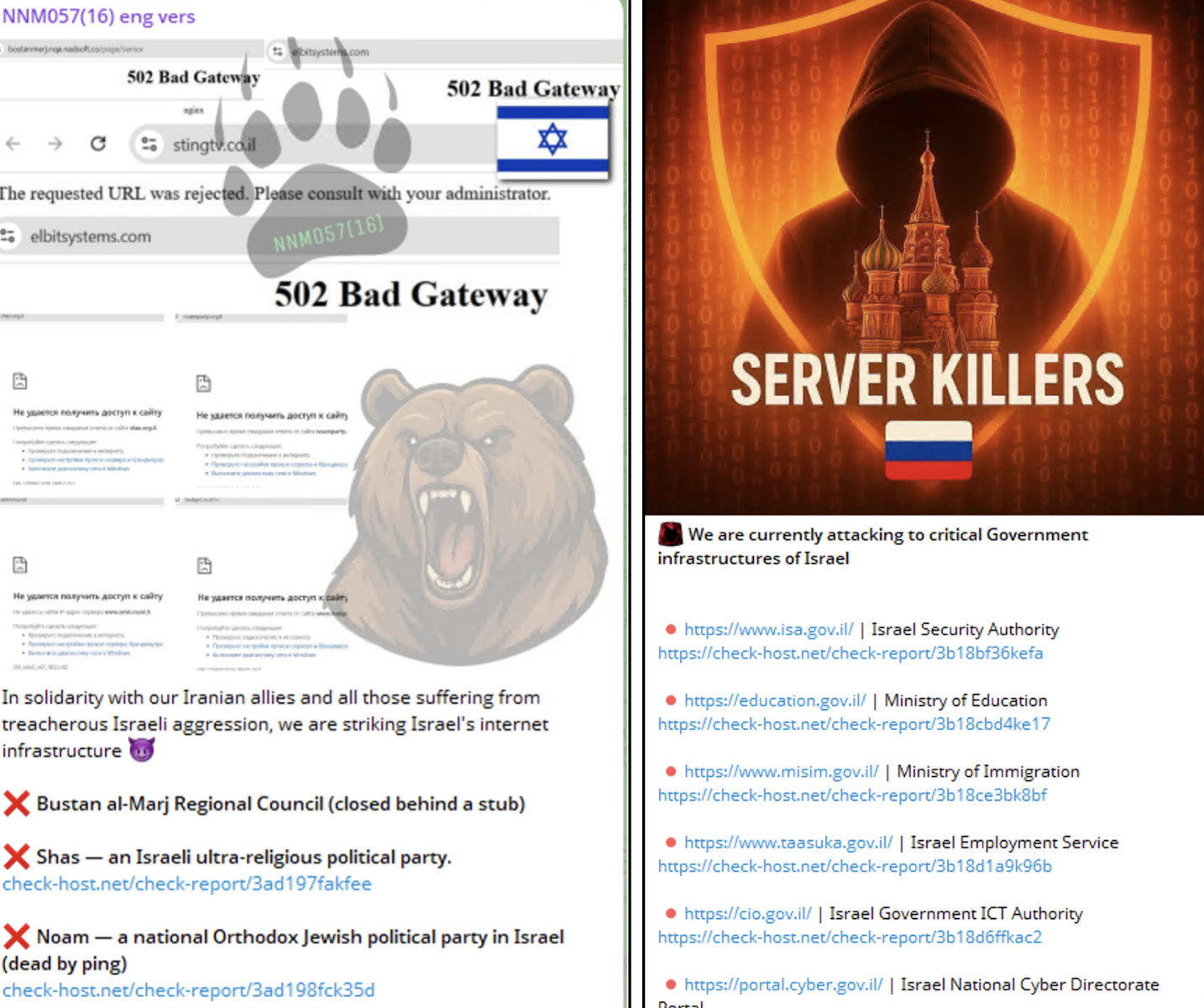
DDoS attacks are among the most common tactics employed by hacktivist groups. Pro-Russia groups such as NoName057(16) and Server Killer, along with other pro-Iran collectives affiliated with them, have been linked to waves of coordinated DDoS attacks against Israel, Qatar, Bahrain, and other politically symbolic targets. These attacks are generally inexpensive and cause only short-term technical damage, but they remain strategically useful because they disrupt public services, tie up defense resources, generate media coverage, and fuel the narrative of a sustained cyber response.

Telegram-Russian-hacktivist-targets-Israeli-website.png
Figure 1: Telegram post from pro-Russia hacktivist groups claiming responsibility for targeting an Israeli website in support of Iran

⠀

Website defacement also remains a common tactic. Groups such as FAD Team, 313, and Cyber Islamic Resistance have been associated with claims of attacks on several websites. Although defacements are technically simple to execute, they remain analytically significant: They are highly visible, rapidly disseminated, and psychologically impactful, often creating an exaggerated perception of widespread systemic compromise.

Data breaches represent a far more significant dimension of cyber operations. The Iranian-aligned group Handala, in particular, continues to blend political messaging with claims of data theft and the selective release of allegedly compromised information. The group recently asserted that it had infiltrated a Saudi energy company and exfiltrated internal documents, framing the operation as a combination of data exfiltration, coercive pressure, and psychological warfare targeting the energy sector. Even when the full authenticity of released datasets cannot be independently verified, the publication of partially credible material can still generate substantial reputational damage and potential operational disruption for affected organizations.

Targeting critical infrastructure has emerged as one of the most concerning aspects of the current cyber activity by pro-Iran hacktivists and proxy collectives. Groups operating in this ecosystem, including Iranian APTs, Handala, and networks associated with the Cyber Islamic Resistance umbrella, have publicly claimed operations targeting infrastructure across the region. Recent Telegram posts indicate that an Iranian APT group claimed responsibility for attempts to sabotage Jordanian critical infrastructure, while other Iran-aligned hacktivist personas have asserted access to sectors including fuel systems, water utilities, and other operational technology environments.

In a separate case, the Handala Hack Team has alleged that it compromised both Oil and gas companies in the United Arab Emirates and Israel, claiming to have exfiltrated more than 1.3 TB of sensitive data from oil and gas sector networks. These claims, which would represent a significant intrusion into Middle Eastern energy infrastructure if confirmed, have circulated primarily through hacktivist communication channels and social media reporting and have not been independently verified.

Iran-APT-group-claims-targeting-Jordanian-critical-infrastructure.png
Figure 2: IRAN APT group claimed attempts to target Jordanian critical infrastructure

⠀

Although many of these claims remain difficult to independently verify, the recurring focus on industrial control systems and essential services is analytically significant. Hacktivist collectives aligned with Iranian geopolitical narratives frequently leverage infrastructure-related claims as part of information operations designed to amplify perceived impact, generate psychological pressure, and signal the potential for escalation into operational technology environments. Even when technical disruption is limited or exaggerated, the persistent narrative around infrastructure compromise can shape defensive priorities and highlight potential escalation pathways within the broader cyber conflict.

Sectoral exposure and risk landscape

In the current geopolitical context, cyberattacks extend far beyond military networks and defense institutions. Modern cyber operations increasingly aim to affect the broader ecosystem that supports government activity, economic stability, and public trust. Consequently, adversaries seek not only technically vulnerable targets but also organizations whose compromise or disruption can increase visibility, influence public perception, or create cascading effects across interconnected systems.

A successful intrusion into a widely used service provider, a major infrastructure operator, or a publicly accessible institution can quickly produce consequences that extend far beyond the initial target, affecting supply chains, service availability, and public confidence. In this context, cyber operations often serve multiple purposes simultaneously: intelligence gathering, strategic positioning within critical networks, and generating disruption or exerting influence during periods of heightened geopolitical tension.

At present, several sectors appear particularly exposed:

  • Government institutions and public administration

  • Defense and aerospace industry

  • Energy sector, including oil, gas, and electricity

  • Telecommunications providers

  • Financial services

  • Transportation systems

However, the risk landscape extends beyond these sectors themselves. Organizations that form part of the broader digital supply chain supporting these industries may also represent attractive entry points. This includes cloud service providers, managed service providers, technology vendors, and other third-party platforms that maintain privileged access to client environments. Compromising such intermediaries can allow adversaries to reach high-value targets indirectly. By gaining access to a supplier or service provider, attackers may obtain pathways into multiple networks simultaneously, access sensitive information, or move laterally across interconnected operational systems. Supply chain compromise, therefore, offers both scale and stealth, making it an increasingly common tactic in sophisticated cyber campaigns.

Geopolitical alignment can also influence targeting decisions. Organizations based in countries that host United States military assets or are publicly aligned with United States or Israeli policy positions may attract additional attention from adversaries. In these cases, targeting can carry symbolic, political, or strategic value beyond the immediate technical impact of the intrusion. Within this environment, cyber exposure can generally be understood through three overlapping targeting dynamics.

Symbolic targets include municipalities, universities, media outlets, and public institutions. These organizations may be targeted primarily for visibility, messaging, or propaganda purposes. Even limited disruption or data exposure can generate headlines and amplify the perceived reach of the attackers.

Operational targets include sectors that support everyday economic and social activity, such as telecommunications providers, transportation systems, payment networks, and fuel distribution infrastructure. Disruptions in these areas can quickly affect daily life, creating public anxiety and increasing pressure on authorities to respond.

Strategic targets consist of entities whose compromise offers long-term intelligence or operational value. This category includes defense contractors, major financial institutions, government networks, and operators of critical infrastructure. In these cases, adversaries may prioritize persistence and stealth to collect intelligence, monitor decision-making processes, or maintain access that could be leveraged during future crises.

Taken together, these targeting patterns illustrate a broader shift in cyber operations: Attackers are increasingly selecting targets not only for their intrinsic value, but for the broader political, economic, and societal effects that disruption or compromise can produce.

What should organizations monitor?

In the current phase of the conflict, organizations should continue to monitor for indicators that activity is shifting from opportunistic disruption toward deliberate intrusion or access preparation.

Internet-facing infrastructure is often the initial entry point. Elevated scanning or probing of public websites, VPN gateways, remote access portals, cloud services, and email authentication infrastructure may indicate early reconnaissance. While some scanning is routine, sudden increases in probing activity or authentication attempts should be treated as potential precursors to intrusion.

Phishing and social engineering campaigns are also likely to intensify. Threat actors may exploit developments in the conflict by using lures that reference civil defense alerts, battlefield updates, humanitarian messaging, or urgent requests that appear to originate from leadership or trusted partners. In some cases, malicious applications or replicas of legitimate services may be used to harvest credentials or deploy malware.

Credential misuse remains a primary access vector. Security teams should monitor for abnormal authentication patterns, including logins from unusual geographic locations, access at unexpected hours, repeated failed logins followed by success, changes to multi-factor authentication settings, or the creation of new privileged accounts.

Organizations operating critical infrastructure should closely monitor activities within their operational environments. Suspicious access to remote management platforms, unusual connectivity between IT and OT networks, or unexpected activity involving engineering workstations or vendor access channels may signal reconnaissance within sensitive systems.

Finally, monitoring the broader information environment can provide early warning and signal the need to increase monitoring. Hacktivist groups frequently use platforms such as Telegram and X to circulate target lists, claim attacks, or release fragments of allegedly stolen data tied to geopolitical events. Tracking these channels can help organizations identify potential targets and strengthen their defensive posture before malicious activity reaches their networks.

Additional reading from Rapid7 Labs, for Rapid7 customers: Rapid7 Detection Coverage for Iran-Linked Cyber Activity

Checking out the Supermicro NVIDIA B300 Solutions and What it Takes to Build an AI Factory

Post Syndicated from Patrick Kennedy original https://www.servethehome.com/checking-out-the-supermicro-nvidia-b300-solutions-and-what-it-takes-to-build-an-ai-factory/

We take you on a tour looking a the Supermicro NVIDIA B300 generation versus the NVIDIA B200 generation and the other components of an AI factory

The post Checking out the Supermicro NVIDIA B300 Solutions and What it Takes to Build an AI Factory appeared first on ServeTheHome.

Amazon Redshift DC2 migration approach with a customer case study

Post Syndicated from Satoru Ishikawa original https://aws.amazon.com/blogs/big-data/amazon-redshift-dc2-migration-approach-with-a-customer-case-study/

This is a guest post by Satoru Ishikawa, Solutions Architect at Classmethod in partnership with AWS.

In April 2025, AWS announced the deprecation of Amazon Redshift DC2 instances, guiding users to migrate to either Redshift RA3 instances or Redshift Serverless. Redshift RA3 instances and Serverless adopt a design that separates storage and compute, offers new features such as data sharing, concurrency scaling for writes, zero-ETL , and cluster relocation.

In this post, we share insights from one of our customers’ migration from DC2 to RA3 instances. The customer, a large enterprise in the retail industry, operated a 16-node dc2.8xlarge cluster for business intelligence (BI) and ETL workloads. Facing growing data volumes and disk capacity limitations, they successfully migrated to RA3 instances using a Blue-Green deployment approach, achieving improved ETL query performance and expanded storage capacity while maintaining cost efficiency.

Amazon Redshift architecture types

Amazon Redshift offers two deployment options: Provisioned mode, where you choose the instance type and number of nodes and manage resizing as needed, and Redshift Serverless, which automatically provisions data warehouse capacity and intelligently scales the underlying resources. The following diagram compares these two architecture types.

Provisioned clusters require you to determine cluster size in advance, but you can optimize costs by purchasing Reserved Instances (RI) or scheduling pause and resume actions. Serverless automatically provisions resources as needed, with a pay-per-use model where you only pay for compute resources consumed. Both services support migration between each other and offer the same features including SQL, zero-ETL, and Federated Query capabilities. For specific pricing details, see Amazon Redshift pricing.

Provisioned clusters are suitable for large-scale, predictable workloads and offer automatic scaling based on queuing. Serverless provides management-free automatic scaling for variable workloads with AI-driven optimization that scales based on workload complexity and data volumes. For more details, refer to Comparing Amazon Redshift Serverless to an Amazon Redshift provisioned data warehouse.

Customer case study: Migration from DC2 instances

This section describes the customer’s migration from Amazon Redshift DC2 to RA3 instance types. The migration used a Blue-Green deployment approach that minimized downtime while achieving both cost optimization and performance improvement.

The customer’s workload had the following characteristics:

Use cases

The customer had the following key use cases for their Amazon Redshift deployment:

  1. Query via BI tool during business hours
    1. High volume of read queries
    2. Peak access during Mondays and beginning of months
  2. Data processing in early morning
    1. Concentrated write queries for data loading and transformation
  3. Steady-state workload characteristics
    1. Run queries more than 16 hours daily

Requirements

The customer had the following key requirements for their Amazon Redshift migration:

  1. Performance
    1. Use auto-scaling (such as concurrency scaling) during peak access periods
  2. Data size
    1. Disk capacity expansion needed
  3. Cost Management
    1. Easy budget prediction and management
    2. Utilize discount services for long-term usage
  4. Compatibility
    1. Maintain compatibility with existing applications and BI tools
    2. Avoid endpoint changes
  5. Availability
    1. Maximum downtime of 8 hours acceptable during migration
  6. Network
    1. Do not modify the existing 2-Availability Zone (AZ) subnet configuration
  7. When to migrate
    1. To be conducted during low-load days and hours
    2. Planned downtime possible within 8 hours

Key considerations in system design, implementation, and operation included extended operation hours, ease of budget prediction and management, cost optimization through Reserved Instances (RI), and maintaining compatibility with existing systems (avoiding endpoint changes). The customer evaluated Amazon Redshift Serverless, which offered attractive features such as a pay-per-use model, automatic scaling capabilities, and the potential for better price performance for variable workloads. While both Redshift Serverless and provisioned clusters could effectively support their workload patterns, the customer chose the provisioned model with RA3 nodes, leveraging their years of operational experience with provisioned environments, existing RI strategy, and established capacity planning approach.

Features of RA3 instance type

Built on the AWS Nitro System, RA3 instances with managed storage adopt an architecture that separates computing and storage, allowing independent scaling and separate billing for each component. These instances use high-performance SSDs for hot data and Amazon S3 for cold data, providing ease of use, cost-effective storage, and fast query performance. For more details, refer to Amazon Redshift RA3 instances with managed storage.

Migration prerequisites

The customer had the following migration prerequisites in place:

  • The customer used a Redshift cluster with 16 nodes of dc2.8xlarge configuration.
  • The customer chose a Blue-Green deployment approach for migration, where they would restore from a snapshot to RA3 instance type, enabling quick rollback if necessary.
  • The customer implemented cluster switching and rollback through endpoint switching using cluster identifier rotation.
  • Additionally, to improve performance with high concurrency, they transitioned the transaction isolation level from SERIALIZABLE ISOLATION to SNAPSHOT ISOLATION.

Cluster migration methods

There were two migration options available: Elastic Resize and Classic Resize.

Amazon Redshift’s Classic Resize functionality had been enhanced, for resizing to RA3 instance types, significantly reducing the write-unavailable period. Based on PoC testing, after initiating the resize, the cluster’s status was modifying for 16 minutes before it became available. Based on these results, the customer proceeded with the Classic Resize approach.

Cluster sizing

Sizing involved determining the instance type and number of nodes for the migration target. Sizing points considered workload characteristics such as CPU-intensive (queries using high CPU), I/O-intensive (queries with high data read/write), or both.When migrating from DC2 instance types, additional nodes might be required depending on workload requirements. Nodes were added or removed based on the computing requirements for necessary query performance.

Comparing configurations with similar cluster costs in terms of instance size and count, for a dc2.8xlarge 16-node cluster, the recommended configuration was 8 nodes of ra3.16xlarge. The following was the cost comparison in the Tokyo Region:

  1. Recommended: dc2.8xlarge 16-node cluster => ra3.16xlarge * 8-node cluster
    1. $97.52/h (6.095/h * 16 nodes) => $122.776/h (15.347/h * 8 nodes)
  2. Cost-focused: dc2.8xlarge 16-node cluster => ra3.16xlarge * 6-node cluster
    1. $97.52/h (6.095/h * 16 nodes) => $92.082/h (15.347/h * 6 nodes)

For this migration, the customer proceeded with a cost-efficient 6-node ra3.16xlarge cluster to stay within existing budget constraints. However, since this node count could face throughput limitations during certain times, they enabled concurrent scaling for the RA3 instance type to handle spike access.

Concurrency scaling provides up to 1 hour of free credits per day for each active cluster, accumulating up to 30 hours. On-demand usage fees apply when exceeding this free tier.While the customer chose to implement concurrency scaling, Elastic Resize to temporarily increase nodes during peak loads was also considered but rejected due to on-demand costs for additional nodes and the brief disconnection period during switching.

Managed storage cost

RA3 instances use Redshift Managed Storage (RMS), which is charged at a fixed GB-month rate. The customer’s approximately 2 TB of data required including storage costs in the estimates. For pricing details, see Amazon Redshift pricing.

Migration step from DC2 to RA3

After creating an RA3 cluster from the DC2 cluster’s snapshot, the customer swapped the cluster identifiers. The following diagram shows this process.

  1. Take a snapshot of the current DC2 cluster.
  2. Restore RA3 cluster from the snapshot with a different cluster identifier (Classic Resize)
  3. Swap the cluster identifiers between the current DC2 cluster and the new RA3 cluster.

If any issues arise after the cluster switch, you can quickly roll back by returning the original DC2 cluster to its original cluster identifier.

Note: Restore from a snapshot

Running the restore operation using CLI commands is recommended to minimize operational errors and ensure reproducibility. The following is a sample command.

aws redshift restore-from-cluster-snapshot \
--cluster-identifier for-ra3-20250207 \
--snapshot-identifier cm-cluster-for-ra3-20250207 \
--cluster-subnet-group-name cm-cluster \
--vpc-security-group-ids sg-1234567a sg-2345678b sg-3456789c \
--cluster-parameter-group-name cm-cluster \
--node-type ra3.16xlarge \
--number-of-nodes 6 \
--port 5439 \
--no-publicly-accessible \
--enhanced-vpc-routing \
--availability-zone ap-northeast-1a \
--preferred-maintenance-window sat:17:00-sat:17:30 \
--automated-snapshot-retention-period 14 \
--iam-roles 'arn:aws:iam::123456789012:role/AmazonRedshift-CommandsAccessRole' 'arn:aws:iam::123456789012:role/AmazonRedshift-Spectrum' \
--maintenance-track-name current

Production migration duration

The time required for the restore and classic resize steps can vary significantly depending on data volume and target cluster specifications. The customer conducted a rehearsal beforehand to measure the actual required time.

Test results

Before the production migration, the customer created a test cluster by restoring a snapshot to the RA3 instance type. While Redshift Test Drive is typically useful for workload testing, this customer faced unique constraints: enabling audit logging in their production cluster would require configuration changes, cluster restarts, and complex approval processes under their strict change management policies. To address this, they developed a custom load testing tool that captured workload patterns using Amazon Redshift system views (SYS_QUERY_HISTORY and SYS_QUERY_TEXT), which maintain 7 days of query history. The tool replayed 55,755 historical queries with 50-way parallelism against both DC2 and RA3 clusters, comparing metrics including query execution time, CPU utilization, and disk I/O. Query result caching was disabled during testing to ensure accurate comparisons.

BI query performance

BI queries were tested using the custom load testing tool. The results represent the average execution time from 15 test runs of 55,755 queries executed with 50-way parallelism. Without concurrency scaling, the dc2.8xlarge 16-node cluster averaged 45.82 seconds per query, while the ra3.16xlarge 6-node cluster averaged 91.30 seconds. This indicated that RA3 instances showed longer execution times for short and medium queries in a direct migration without optimizations. However, enabling concurrency scaling improved RA3 performance progressively. With concurrency scaling enabled at maximum 2 clusters, the ra3.16xlarge 6-node cluster achieved an average of 72.48 seconds per query, a 21% improvement over the non-scaled configuration.

Node Type / Number of nodes Average Query Time
ra3.16xlarge 6-node cluster 72.48 seconds

ETL query performance comparison

For long-running ETL queries (execution time greater than 10 minutes), the RA3 cluster demonstrated better performance than DC2. These results represented a direct migration of the customer’s workload with no optimizations applied.

  • For the Large-scale data load workload 1, the ra3.16xlarge cluster completed the query 28% faster than the dc2.8xlarge cluster (41 minutes vs. 57 minutes).
  • For the Complex transformation workload 1, the ra3.16xlarge cluster was 23% faster (1 hour 1 minute vs. 1 hour 20 minutes).

These results indicated that the RA3 node type was more performant for time-intensive data loading and transformation tasks. The higher CPU utilization values for RA3 suggested more effective compute resource usage.

Node Type / Number of nodes Average Query Time MAXCPU%
ra3.16xlarge 6-node cluster 41 mins 09 seconds 11:45
dc2.8xlarge 16-node cluster 57 mins 07 seconds 10:85
Node Type / Number of nodes Average Query Time MAXCPU%
ra3.16xlarge 6-node cluster 1 hour 01 mins 33 seconds 74:23
dc2.8xlarge 16-node cluster 1 hour 20 mins 36 seconds 53:58

Performance tuning

Based on the test results, the customer identified that RA3 showed longer execution times for short and medium BI queries but faster performance for long-running ETL queries compared to DC2. To optimize overall performance, they focused on identifying slow queries and frequently referenced tables, prioritizing optimizations with the highest impact.

Performance tuning strategy

The customer considered several optimization strategies to leverage RA3’s architectural advantages. One key strategy involved pre-processing ad-hoc short and medium query workloads during low-load periods, creating pre-processed tables or materialized views for queries that repeatedly performed joins, aggregations, filters, and projections. RA3’s separated compute and storage architecture, with cost-effective large-scale storage, supported this approach.

Converting regular views to materialized views

Analysis of slow queries revealed the use of joins in views, and frequently referenced tables were being accessed multiple times through these views. As a countermeasure, the customer replaced frequently used regular views with materialized views, removing unnecessary data ranges and redundant columns.

Amazon Redshift supports incremental updates of materialized view contents via the REFRESH MATERIALIZED VIEW command, enabling efficient data updates.

Materialized views and query rewrite

By converting regular views to materialized views, existing queries may be automatically optimized through the “query rewrite” feature provided by the query planner. For more details, refer to “Automatic query rewriting to use materialized views“.

Automatic tuning with AutoMV

On the DC2 cluster, disk utilization consistently exceeded 80%, which disabled the AutoMV feature due to insufficient disk space. With RA3’s expanded storage, automatic tuning through AutoMV became possible, leading to further performance improvements. For more details about AutoMV, refer to Automated materialized views.

Performance tuning results

After applying these optimizations, the customer achieved the following results:

  • Maintained existing performance while controlling cost increases
  • Achieved higher CPU utilization while maintaining throughput
  • Enhanced dynamic throughput during peak load periods using concurrency scaling’s automatic scaling

Conclusion

In this post, you learned how a large retail enterprise successfully migrated from Amazon Redshift DC2 to RA3 instances. The Blue-Green deployment approach enabled a safe migration with quick rollback capability, while the separated compute and storage architecture of RA3 provided flexibility to handle growing data volumes. Although RA3 showed different performance characteristics for short BI queries compared to DC2, the customer achieved significant improvements in long-running ETL query performance (up to 28% faster for data loads and 23% faster for complex transformations). By leveraging RA3-specific features such as materialized views and AutoMV, they optimized overall query performance while maintaining cost efficiency through Reserved Instances and concurrency scaling.

To continue your RA3 migration journey, see Best practices for upgrading from Amazon Redshift DC2 to RA3 and Amazon Redshift Serverless and Resize Amazon Redshift from DC2 to RA3 with minimal or no downtime for additional guidance and best practices.


About the authors

Satoru Ishikawa

Satoru Ishikawa

Satoru specializes in data analytics and AI consulting, focusing on Amazon SageMaker and multi-cloud. He also develops the backend for Classmethod’s “Members,” driving digital transformation through advanced data and AI capabilities.

Junpei Ozono

Junpei Ozono

Junpei drives technical market creation for data and AI solutions, working closely with global teams to build scalable GTM motions. His expertise spans modern data architectures — Data Mesh, Data Lakehouse, and AI — helping customers accelerate their cloud transformation with AWS.

Introducing Moonforge: a Yocto-based Linux OS (Igalia Blog)

Post Syndicated from jzb original https://lwn.net/Articles/1062451/

Igalia has announced
the Moonforge Linux
distribution, based on OpenEmbedded
and Yocto.

Moonforge is an operating system framework for Linux devices that
simplifies the process of building and maintaining custom operating
systems.

It provides a curated collection of Yocto layers and configuration
files that help developers generate immutable, maintainable, and
easily updatable operating system images.

The goal is to offer the best possible developer experience for
teams building embedded Linux products. Moonforge handles the complex
aspects of operating system creation, such as system integration,
security, updates, and infrastructure, so developers can focus on
building and deploying their applications or devices.

[$] HTTPS certificates in the age of quantum computing

Post Syndicated from daroc original https://lwn.net/Articles/1060941/

There has been ongoing discussion in the

Internet Engineering Task Force
(IETF)
about how to protect internet traffic against future quantum computers. So far,
that work has focused on key exchange as the most urgent problem; now,

a new IETF working group
is looking at adopting post-quantum cryptography
for authentication and certificate transparency as well. The main challenge to
doing so is the increased size of
certificates — around 40 times larger. The techniques that the working group is investigating
to reduce that overhead could have efficiency benefits for traditional
certificates as well.

Security updates for Wednesday

Post Syndicated from jzb original https://lwn.net/Articles/1062403/

Security updates have been issued by AlmaLinux (kernel, kernel-rt, libvpx, nfs-utils, nginx:1.26, osbuild-composer, postgresql, postgresql:12, postgresql:13, postgresql:15, postgresql:16, and python-pyasn1), Debian (imagemagick), Fedora (perl-Crypt-SysRandom-XS and systemd), Mageia (yt-dlp), Oracle (delve, gimp, git-lfs, go-rpm-macros, image-builder, kernel, libpng, libvpx, mysql8.4, nfs-utils, osbuild-composer, postgresql16, postgresql:12, postgresql:13, postgresql:15, postgresql:16, python-pyasn1, python3, python3.12, python3.9, and thunderbird), SUSE (python-aiohttp, python-maturin, python311-pymongo, rclone, and util-linux), and Ubuntu (linux-nvidia, linux-nvidia, linux-nvidia-6.8, linux-nvidia-lowlatency, and python-geopandas).

Intel Intros Core Ultra 250K & 270K Plus Chips, Refreshing Desktop Arrow Lake for Enthusiasts

Post Syndicated from Ryan Smith original https://www.servethehome.com/intel-intros-core-ultra-250k-270k-plus-chips-refreshing-desktop-arrow-lake-for-enthusiasts/

With Intel’s latest-generation Panther Lake silicon (Core Ultra 3 series) being a mobile-only product generation, the task of carrying the torch for Intel’s desktop product lineup falls to the company’s existing Arrow Lake processors (Core Ultra 2 series) for a second year. A technologically solid but overall unexceptional processor lineup, Arrow Lake’s desktop existence has […]

The post Intel Intros Core Ultra 250K & 270K Plus Chips, Refreshing Desktop Arrow Lake for Enthusiasts appeared first on ServeTheHome.

Slashing agent token costs by 98% with RFC 9457-compliant error responses

Post Syndicated from Sam Marsh original https://blog.cloudflare.com/rfc-9457-agent-error-pages/

AI agents are no longer experiments. They are production infrastructure, making billions of HTTP requests per day, navigating the web, calling APIs, and orchestrating complex workflows.

But when these agents hit an error, they still receive the same HTML error pages we built for browsers: hundreds of lines of markup, CSS, and copy designed for human eyes. Those pages give agents clues, not instructions, and waste time and tokens. That gap is the opportunity to give agents instructions, not obstacles.

Starting today, Cloudflare returns RFC 9457-compliant structured Markdown and JSON error payloads to AI agents, replacing heavyweight HTML pages with machine-readable instructions.

That means when an agent sends Accept: text/markdown, Accept: application/json, or Accept: application/problem+json and encounters a Cloudflare error, we return one semantic contract in a structured format instead of HTML. And it comes complete with actionable guidance. (This builds on our recent Markdown for Agents release.)

So instead of being told only “You were blocked,” the agent will read: “You were rate-limited — wait 30 seconds and retry with exponential backoff.” Instead of just “Access denied,” the agent will be instructed: “This block is intentional: do not retry, contact the site owner.”

These responses are not just clearer — they are dramatically more efficient. Structured error responses cut payload size and token usage by more than 98% versus HTML, measured against a live 1015 (‘rate-limit’) error response. For agents that hit multiple errors in a workflow, the savings compound quickly.

This is live across the Cloudflare network, automatically. Site owners do not need to configure anything. Browsers keep getting the same HTML experience as before.

These are not just error pages. They are instructions for the agentic web.

What agents see today

When an agent receives a Cloudflare-generated error, it usually means Cloudflare is enforcing customer policy or returning a platform response on the customer’s behalf — not that Cloudflare is down. These responses are triggered when a request cannot be served as-is, such as invalid host or DNS routing, customer-defined access controls (WAF, geo, ASN, or bot rules), or edge-enforced limits like rate limiting. In short, Cloudflare is acting as the customer’s routing and security layer, and the response explains why the request was blocked or could not proceed.

Today, those responses are rendered as HTML designed for humans:

<!DOCTYPE html>
<html>
<head>
<title>Access denied | example.com used Cloudflare to restrict access</title>
<style>/* 200 lines of CSS */</style>
</head>
<body>
  <div class="cf-wrapper">
    <h1 data-translate="block_headline">Sorry, you have been blocked</h1>
    <!-- ... hundreds more lines ... -->
  </div>
</body>
</html>

To an agent, this is garbage. It cannot determine what error occurred, why it was blocked, or whether retrying will help. Even if it parses the HTML, the content describes the error but doesn’t tell the agent — or the human, for that matter — what to do next.

If you’re an agent developer and you wanted to handle Cloudflare errors gracefully, your options were limited. For Cloudflare-generated errors, structured responses existed only in configuration-dependent paths, not as a consistent default for agents.

Custom Error Rules can customize many Cloudflare errors, including some 1xxx cases. But they depend on per-site configuration, so they cannot serve as a universal agent contract across the web. Cloudflare sits in front of the request path. That means we can define a default machine response: retry or stop, wait and back off, escalate or reroute. Error pages stop being decoration and become execution instructions.

What we did

Cloudflare now returns RFC 9457-compliant structured responses for all 1xxx-class error paths — Cloudflare’s platform error codes for edge-side failures like DNS resolution issues, access denials, and rate limits. Both formats are live: Accept: text/markdown returns Markdown, Accept: application/json returns JSON, and Accept: application/problem+json returns JSON with the application/problem+json content type.

This covers all 1xxx-class errors today. The same contract will extend to Cloudflare-generated 4xx and 5xx errors next.

Markdown responses have two parts:

  • YAML frontmatter for machine-readable fields

  • prose sections for explicit guidance (What happened and What you should do)

JSON responses carry the same fields as a flat object.

The YAML frontmatter is the critical layer for automation. It lets an agent extract stable keys without scraping HTML or guessing intent from copy. Fields like error_code, error_name, and error_category let the agent classify the failure. retryable and retry_after drive backoff logic. owner_action_required tells the agent whether to keep trying or escalate. ray_id, timestamp, and zone make logs and support handoffs deterministic.

The schema is stable by design, so agents can implement durable control flow without chasing presentation changes.

That stability is not a Cloudflare invention. RFC 9457 — Problem Details for HTTP APIs defines a standard JSON shape for reporting errors over HTTP, so clients can parse error responses without knowing the specific API in advance. Our JSON responses follow this shape, which means any HTTP client that understands Problem Details can parse the base members without Cloudflare-specific code:

RFC 9457 member

What it contains

type

A URI pointing to Cloudflare’s documentation for the specific error code

status

The HTTP status code (matching the actual response status)

title

A short, human-readable summary of the problem

detail

A human-readable explanation specific to this occurrence

instance

The Ray ID identifying this specific error occurrence

The operational fields — error_code, error_category, retryable, retry_after, owner_action_required, and more — are RFC 9457 extension members. Clients that don’t recognize them simply ignore them.

This is network-wide and additive. Site owners do not need to configure anything. Browsers keep receiving HTML unless clients explicitly ask for Markdown or JSON.

What the response looks like

Here is what a rate-limit error (1015) looks like in JSON:

{
  "type": "https://developers.cloudflare.com/support/troubleshooting/http-status-codes/cloudflare-1xxx-errors/error-1015/",
  "title": "Error 1015: You are being rate limited",
  "status": 429,
  "detail": "You are being rate-limited by the website owner's configuration.",
  "instance": "9d99a4434fz2d168",
  "error_code": 1015,
  "error_name": "rate_limited",
  "error_category": "rate_limit",
  "ray_id": "9d99a4434fz2d168",
  "timestamp": "2026-03-09T11:11:55Z",
  "zone": "<YOUR_DOMAIN>",
  "cloudflare_error": true,
  "retryable": true,
  "retry_after": 30,
  "owner_action_required": false,
  "what_you_should_do": "**Wait and retry.** This block is transient. Wait at least 30 seconds, then retry with exponential backoff.\n\nRecommended approach:\n1. Wait 30 seconds before your next request\n2. If rate-limited again, double the wait time (60s, 120s, etc.)\n3. If rate-limiting persists after 5 retries, stop and reassess your request pattern",
  "footer": "This error was generated by Cloudflare on behalf of the website owner."
}

The same error in Markdown, optimized for model-first workflows:

---
error_code: 1015
error_name: rate_limited
error_category: rate_limit
status: 429
ray_id: 9d99a39dc992d168
timestamp: 2026-03-09T11:11:28Z
zone: <YOUR_DOMAIN>
cloudflare_error: true
retryable: true
retry_after: 30
owner_action_required: false
---

# Error 1015: You are being rate limited

## What Happened

You are being rate-limited by the website owner's configuration.

## What You Should Do

**Wait and retry.** This block is transient. Wait at least 30 seconds, then retry with exponential backoff.

Recommended approach:
1. Wait 30 seconds before your next request
2. If rate-limited again, double the wait time (60s, 120s, etc.)
3. If rate-limiting persists after 5 retries, stop and reassess your request pattern

---
This error was generated by Cloudflare on behalf of the website owner.

Both formats give an agent everything it needs to decide and act: classify the error, choose retry behavior, and determine whether escalation is required. This is what a default machine contract looks like — not per-site configuration, but network-wide behavior. The contrast is explicit across error families: a transient error like 1015 says wait and retry, while intentional blocks like 1020 or geographic restrictions like 1009 tell the agent not to retry and to escalate instead.

One contract, two formats

The core value is not format choice. It is semantic stability.

Agents need deterministic answers to operational questions: retry or not, how long to wait, and whether to escalate. Cloudflare exposes one policy contract across two wire formats. Whether a client consumes Markdown or JSON, the operational meaning is identical: same error identity, same retry/backoff signals, same escalation guidance.

Clients that send Accept: application/problem+json get application/problem+json; charset=utf-8 back — useful for HTTP client libraries that dispatch on media type. Clients that send Accept: application/json get application/json; charset=utf-8 — same body, safe default for existing consumers.

Size reduction and token efficiency

That contract is also dramatically smaller than what it replaces. Cloudflare HTML error pages are browser-oriented and heavy, while structured responses are compact by design.

Measured comparison for 1015:

Payload

Bytes

Tokens (cl100k_base)

Size vs HTML

Token vs HTML

HTML response

46,645

14,252

—

—

Markdown response

798

221

58.5x less

64.5x less

JSON response

970

256

48.1x less

55.7x less

Both structured formats deliver a ~98% reduction in size and tokens versus HTML. For agents, size translates directly into token cost — when an agent hits multiple errors in one run, these savings compound into lower model spend and faster recovery loops.

Ten categories, clear actions

Every 1xxx error is mapped to an error_category. That turns error handling into routing logic instead of brittle per-page parsing.

Category

What it means

What the agent should do

access_denied

Intentional block: IP, ASN, geo, firewall rule

Do not retry. Contact site owner if unexpected.

rate_limit

Request rate exceeded

Back off. Retry after retry_after seconds.

dns

DNS resolution failure at the origin

Do not retry. Report to site owner.

config

Configuration error: CNAME, tunnel, host routing

Do not retry (usually). Report to site owner.

tls

TLS version or cipher mismatch

Fix TLS client settings. Do not retry as-is.

legal

DMCA or regulatory block

Do not retry. This is a legal restriction.

worker

Cloudflare Workers runtime error

Do not retry. Site owner must fix the script.

rewrite

Invalid URL rewrite output

Do not retry. Site owner must fix the rule.

snippet

Cloudflare Snippets error

Do not retry. Site owner must fix Snippets config.

unsupported

Unsupported method or deprecated feature

Change the request. Do not retry as-is.

Two fields make this operationally useful for agents:

  • retryable answers whether a retry can succeed

  • owner_action_required answers whether the problem must be escalated

You can replace brittle “if status == 429 then maybe retry” heuristics with explicit control flow. Parse the frontmatter once, then branch on stable fields. A simple pattern is:

  • if retryable is true, wait retry_after and retry

  • if owner_action_required is true, stop and escalate

  • otherwise, fail fast without hammering the site

Here is a minimal Python example using that pattern:

import time
import yaml


def parse_frontmatter(markdown_text: str) -> dict:
    # Expects: ---\n<yaml>\n---\n<body>
    if not markdown_text.startswith("---\n"):
        return {}
    _, yaml_block, _ = markdown_text.split("---\n", 2)
    return yaml.safe_load(yaml_block) or {}


def handle_cloudflare_error(markdown_text: str) -> str:
    meta = parse_frontmatter(markdown_text)

    if not meta.get("cloudflare_error"):
        return "not_cloudflare_error"

    if meta.get("retryable"):
        wait_seconds = int(meta.get("retry_after", 30))
        time.sleep(wait_seconds)
        return f"retry_after_{wait_seconds}s"

    if meta.get("owner_action_required"):
        return f"escalate_owner_error_{meta.get('error_code')}"

    return "do_not_retry"

This is the key shift: agents are no longer inferring intent from HTML copy. They are executing explicit policy from structured fields.

How to use it

Send Accept: text/markdown, Accept: application/json, or Accept: application/problem+json.

For quick testing, you can hit any Cloudflare-proxied domain directly at /cdn-cgi/error/1015 (or replace 1015 with another 1xxx code).

curl -s --compressed -H "Accept: text/markdown" -A "TestAgent/1.0" -H "Accept-Encoding: gzip, deflate" "<YOUR_DOMAIN>/cdn-cgi/error/1015"

Example with another error code:

curl -s --compressed -H "Accept: text/markdown" -A "TestAgent/1.0" -H "Accept-Encoding: gzip, deflate" "<YOUR_DOMAIN>/cdn-cgi/error/1020"

JSON example:

curl -s --compressed -H "Accept: application/json" -A "TestAgent/1.0" -H "Accept-Encoding: gzip, deflate" "<YOUR_DOMAIN>/cdn-cgi/error/1015" | jq .

RFC 9457 Problem Details example:

curl -s --compressed -H "Accept: application/problem+json" -A "TestAgent/1.0" -H "Accept-Encoding: gzip, deflate" "<YOUR_DOMAIN>/cdn-cgi/error/1015" | jq .

The behavior is deterministic — the first explicit structured type wins:

Accept header

Response

application/json

JSON

application/json; charset=utf-8

JSON

application/problem+json

JSON (application/problem+json content type)

application/json, text/markdown;q=0.9

JSON

application/json, text/markdown

JSON (equal q, first-listed wins)

text/markdown

Markdown

text/markdown, application/json

Markdown (equal q, first-listed wins)

text/markdown, */*

Markdown

text/*

Markdown

*/*

HTML (default)

Wildcard-only requests (*/*) do not signal a structured preference; clients must explicitly request Markdown or JSON.

If the request succeeds, you get normal origin content. The header only affects Cloudflare-generated error responses.

Real-world use cases

There are a number of situations where structured error responses help immediately:

  1. Agent blocked by WAF rule (1020). The agent parses error_code, records ray_id, and stops retrying. It can escalate with useful context instead of looping.

  2. MCP (Model Context Protocol) tool hitting geo restriction (1009). The tool gets a clear, machine-readable reason, returns it to the orchestrator, and the workflow can choose an alternate path or notify the user.

  3. Rate-limited crawler (1015). The agent reads retryable: true and retry_after, applies backoff, and retries predictably instead of hammering the endpoint.

  4. Developer debugging with curl. The developer can reproduce exactly what the agent sees, including frontmatter and guidance, without reverse-engineering HTML.

  5. HTTP client libraries that understand RFC 9457. Any client that dispatches on application/problem+json or parses Problem Details objects can handle Cloudflare errors without Cloudflare-specific code.

In each case, the outcome is the same: less guessing, fewer wasted retries, lower model cost, and faster recovery.

Try it now

Send a structured Accept header and test against any Cloudflare-proxied domain:

curl -s --compressed -H "Accept: text/markdown" -A "TestAgent/1.0" -H "Accept-Encoding: gzip, deflate" "<YOUR_DOMAIN>/cdn-cgi/error/1015"
curl -s --compressed -H "Accept: application/json" -A "TestAgent/1.0" -H "Accept-Encoding: gzip, deflate" "<YOUR_DOMAIN>/cdn-cgi/error/1015" | jq .
curl -s --compressed -H "Accept: application/problem+json" -A "TestAgent/1.0" -H "Accept-Encoding: gzip, deflate" "<YOUR_DOMAIN>/cdn-cgi/error/1015" | jq .

Error pages are the first conversation between Cloudflare and an agent. This launch makes that conversation structured, standards-compliant, and cheap to process.

To make this work across the web, agent runtimes should default to explicit structured Accept headers, not bare */*. Use Accept: text/markdown, */* for model-first workflows and Accept: application/json, */* for typed control flow. If you maintain an agent framework, SDK, or browser automation stack, ship this default and treat bare */* as legacy fallback.

And it is only the first layer. We are building the rest of the agent stack on top of it: AI Gateway for routing, controls, and observability; Workers AI for inference; and the identity, security, and access primitives agents will need to operate safely at Internet scale.

Cloudflare is helping our customers deliver content in agent-friendly ways, and this is just the start. If you’re building or operating agents, start at agents.cloudflare.com.

AI Security for Apps is now generally available

Post Syndicated from Liam Reese original https://blog.cloudflare.com/ai-security-for-apps-ga/

Cloudflare’s AI Security for Apps detects and mitigates threats to AI-powered applications. Today, we’re announcing that it is generally available.

We’re shipping with new capabilities like detection for custom topics, and we’re making AI endpoint discovery free for every Cloudflare customer—including those on Free, Pro, and Business plans—to give everyone visibility into where AI is deployed across their Internet-facing apps.

We’re also announcing an expanded collaboration with IBM, which has chosen Cloudflare to deliver AI security to its cloud customers. And we’re partnering with Wiz to give mutual customers a unified view of their AI security posture.

A new kind of attack surface

Traditional web applications have defined operations: check a bank balance, make a transfer. You can write deterministic rules to secure those interactions. 

AI-powered applications and agents are different. They accept natural language and generate unpredictable responses. There’s no fixed set of operations to allow or deny, because the inputs and outputs are probabilistic. Attackers can manipulate large language models to take unauthorized actions or leak sensitive data. Prompt injection, sensitive information disclosure, and unbounded consumption are just a few of the risks cataloged in the OWASP Top 10 for LLM Applications.

These risks escalate as AI applications become agents. When an AI gains access to tool calls—processing refunds, modifying accounts, providing discounts, or accessing customer data—a single malicious prompt becomes an immediate security incident.

Customers tell us what they’re up against. “Most of Newfold Digital’s teams are putting in their own Generative AI safeguards, but everybody is innovating so quickly that there are inevitably going to be some gaps eventually,” says Rick Radinger, Principal Systems Architect at Newfold Digital, which operates Bluehost, HostGator, and Domain.com.

What AI Security for Apps does

We built AI Security for Apps to address this. It sits in front of your AI-powered applications, whether you’re using a third-party model or hosting your own, as part of Cloudflare’s reverse proxy. It helps you (1) discover AI-powered apps across your web property, (2) detect malicious or off-policy behavior to those endpoints, and (3) mitigate threats via the familiar WAF rule builder.


Discovery — now free for everyone

Before you can protect your LLM-powered applications, you need to know where they’re being used. We often hear from security teams who don’t have a complete picture of AI deployments across their apps, especially as the LLM market evolves and developers swap out models and providers. 

AI Security for Apps automatically identifies LLM-powered endpoints across your web properties, regardless of where they’re hosted or what the model is. Starting today, this capability is free for every Cloudflare customer, including Free, Pro, and Business plans. 


Cloudflare’s dashboard page of web assets, showing 2 example endpoints labelled as cf-llm

Discovering these endpoints automatically requires more than matching common path patterns like /chat/completions. Many AI-powered applications don’t have a chat interface: think product search, property valuation tools, or recommendation engines. We built a detection system that looks at how endpoints behave, not what they’re called. To confidently identify AI-powered endpoints, sufficient valid traffic is required.

AI-powered endpoints that have been discovered will be visible under Security → Web Assets, labeled as cf-llm. For customers on a Free plan, endpoint discovery is initiated when you first navigate to the Discovery page. For customers on a paid plan, discovery occurs automatically in the background on a recurring basis. If your AI-powered endpoints have been discovered, you can review them immediately.

Detection

AI Security for Apps detections follow the always-on approach for traffic to your AI-powered endpoints. Each prompt is run through multiple detection modules for prompt injection, PII exposure, and sensitive or toxic topics. The results—whether the prompt was malicious or not—are attached as metadata you can use in custom WAF rules to enforce your policies. We are continuously exploring ways to leverage our global network, which sees traffic from roughly 20% of the web, to identify new attack patterns across millions of sites before they reach yours.


New in GA: Custom topics detection

The product ships with built-in detection for common threats: prompt injections, PII extraction, and toxic topics. But every business has its own definition of what’s off-limits. A financial services company might need to detect discussions of specific securities. A healthcare company might need to flag conversations that touch on patient data. A retailer might want to know when customers are asking about competitor products.

The new custom topics feature lets you define these categories. You specify the topic, we inspect the prompt and output a relevance score that you can use to log, block, or handle however you decide. Our goal is to build an extensible tool that flexes to your use cases.


Prompt relevance score inside of AI Security for Apps

New in GA: Custom prompt extraction

AI Security for Apps enforces guardrails before unsafe prompts can reach your infrastructure. To run detections accurately and provide real-time protection, we first need to identify the prompt within the request payload. Prompts can live anywhere in a request body, and different LLM providers structure their APIs differently. OpenAI and most providers use $.messages[*].content for chat completions. Anthropic’s batch API nests prompts inside $.requests[*].params.messages[*].content. Your custom property valuation tool might use $.property_description.

Out of the box, we support the standard formats used by OpenAI, Anthropic, Google Gemini, Mistral, Cohere, xAI, DeepSeek, and others. When we can’t match a known pattern, we apply a default-secure posture and run detection on the entire request body. This can introduce false positives when the payload contains fields that are sensitive but don’t feed directly to an AI model, for example, a $.customer_name field alongside the actual prompt might trigger PII detection unnecessarily.

Soon, you’ll be able to define your own JSONPath expressions to tell us exactly where to find the prompt. This will reduce false positives and lead to more accurate detections. We’re also building a prompt-learning capability that will automatically adapt to your application’s structure over time.

Mitigation

Once a threat is identified and scored, you can block it, log it, or deliver custom responses, using the same WAF rules engine you already use for the rest of your application security. The power of Cloudflare’s shared platform is that you can combine AI-specific signals with everything else we know about a request, represented by hundreds of fields available in the WAF. A prompt injection attempt is suspicious. A prompt injection attempt from an IP that’s been probing your login page, using a browser fingerprint associated with previous attacks, and rotating through a botnet is a different story. Point solutions that only see the AI layer can’t make these connections.

This unified security layer is exactly what they need at Newfold Digital to discover, label, and protect AI endpoints, says Radinger: “We look forward to using it across all these projects to serve as a fail-safe.”

Growing ecosystem

AI Security for Applications will also be available through Cloudflare’s growing ecosystem, including through integration with IBM Cloud. Through IBM Cloud Internet Services (CIS), end users can already procure advanced application security solutions and manage them directly through their IBM Cloud account. 

We’re also partnering with Wiz to connect AI Security for Applications with Wiz AI Security, giving mutual customers a unified view of their AI security posture, from model and agent discovery in the cloud to application-layer guardrails at the edge.

How to get started

AI Security for Apps is available now for Cloudflare’s Enterprise customers. Contact your account team to get started, or see the product in action with a self-guided tour.

If you’re on a Free, Pro, or Business plan, you can use AI endpoint discovery today. Log in to your dashboard and navigate to Security → Web Assets to see which endpoints we’ve identified. Keep an eye out — we plan to make all AI Security for Apps capabilities available for customers on all plans soon.

For configuration details, see our documentation.

Protect What Matters Most: Aligning Sensitive Data with Exposure Risk

Post Syndicated from Michael Chroney original https://www.rapid7.com/blog/post/em-protect-breaches-align-sensitive-data-with-exposure-risk

This blog was written in collaboration with Symmetry Systems’ Claude Mandy.

Rapid7 and Symmetry Systems are partnering to help organizations reduce breach impact by aligning sensitive data intelligence with real-world exposure paths across both human and machine identities.

Breaches are measured in data, not vulnerabilities

Vulnerabilities are one thing, but the breaches that follow are rarely just technical incidents. More often, they become business events with far-reaching consequences, driven by something far more simple than a sophisticated exploit.

According to the 2025 Verizon Data Breach Investigations Report, 98% of system intrusion breaches involved the use of stolen credentials or brute force attacks against easily guessable passwords. Attackers are not just exploiting vulnerabilities; they are leveraging identity access to move through environments and reach sensitive data. 

The financial impact of these breaches is staggering. IBM’s 2025 Cost of a Data Breach Report found the global average cost of a data breach is $4.44 million. In highly regulated regions and industries, that cost climbs significantly higher. Those figures reflect detection and response costs, regulatory fines, lost business, and operational disruption. Those figures also rarely capture the longer-term impact on brand trust and customer confidence.

Ultimately sensitive data defines breach impact. Yet, most organizations still evaluate exposure and data risk in isolation. Security teams understand where vulnerabilities exist. Data teams understand where sensitive data lives. But leadership often lacks a unified answer to the most important question:

If an attacker compromises an identity or gains a foothold in our environment, what sensitive data could they realistically reach?

That gap is exactly what Rapid7 and Symmetry Systems are addressing through a new partnership. 

Knowing where your data lives is only the beginning

Gartner® Market Guide for Data Security Posture Management (DSPM) describes DSPM in clear terms:

“DSPM is an all-seeing, all-feeling nervous system for data security. It creates awareness of data vulnerabilities and enables mitigation before those are exploited.” 

That awareness is foundational. Organizations need continuous visibility into where sensitive data lives, how it is classified, and who can access it. Without that foundation, security and risk decisions are based on assumptions rather than evidence. Awareness alone does not account for how attackers move through an environment.

Exposure management shows how adversaries move across cloud, SaaS, and on-prem environments, while DSPM shows what data is at stake and the potential impact for a compromised identity. Connecting the two is what turns visibility into impact-driven prioritization. 

AI agents, copilots, and the new exposure multiplier

As organizations deploy AI agents and copilots across collaboration platforms and cloud systems, identity-driven exposure expands even further. These systems operate with delegated permissions, often aggregating and surfacing data across repositories. If misconfigured or compromised, they can amplify blast radius by inheriting privileged access to sensitive data. AI dramatically increases the scale and speed at which identity-based access can affect data exposure.

This makes the alignment between sensitive data context and attacker reachability even more critical, and that alignment is exactly what this partnership is designed to deliver.

Where sensitive data meets attacker reality

Rapid7 Exposure Command brings attacker context into focus by correlating signals across the attack surface, including: 

  • Internet-facing exposure

  • Identity-driven access paths

  • Vulnerabilities and exploitability signals 

  • Reachability across cloud and on-prem environments

Symmetry DataGuard delivers sensitive data and identity context. It provides: 

  • Continuous sensitive data discovery and classification across cloud and SaaS environments

  • Identity and permission mapping to understand who can access sensitive data

  • Over-privileged, dormant, and risky access detection to reduce blast radius

  • Anomalous activity monitoring to surface data misuse and policy violations

  • Actionable data vulnerability insights to drive targeted remediation

Sensitive data insights from Symmetry are surfaced directly within Rapid7 workflows, showing whether high-value data is actually reachable through real-world attack paths.

Instead of asking “What is vulnerable?”, organizations can confidently answer “What sensitive data could actually get breached?”

Reduce breach impact before it disrupts the business

Every organization faces exposure, and AI only increases the scale and speed at which data can be accessed. This partnership brings together two focused capabilities through a strategic reseller and integrated experience between Rapid7 and Symmetry Systems.

Customers can access full DSPM capability through Rapid7, with sensitive data insights surfaced directly within Exposure Command. From there, teams can seamlessly pivot into Symmetry DataGuard for deeper investigation, governance, and remediation workflows.

Rapid7 provides attacker-aware exposure modeling across hybrid environments. Symmetry delivers deep data security posture management, including sensitive data discovery, identity-to-data mapping, and visibility into AI and machine identities. Together, they create a unified view of exposure and data risk while preserving the depth and specialization of each platform.

By connecting sensitive data intelligence with exposure reachability, organizations gain clarity into what is truly at risk and which actions will have the greatest impact.

The result is measurable: reduced blast radius, a stronger regulatory posture, and remediation aligned to business consequences.

If you are ready to bring sensitive data and identity-driven access (human and machine) into your exposure strategy, Rapid7 and Symmetry are working together to help you prioritize with clarity and confidence.

The collective thoughts of the interwebz