Post Syndicated from The History Guy: History Deserves to Be Remembered original https://www.youtube.com/watch?v=cd8LIqhnbZI
Showcasing Our Potential at Europol Industry and Research Days
Post Syndicated from Michael Kammer original https://blog.zabbix.com/showcasing-our-potential-at-europol-industry-and-research-days/32733/

On February 24-26, Europol, the official law enforcement agency of the European Union. welcomed leading innovators, researchers, and law enforcement representatives to its headquarters in The Hague for the third edition of Europol Industry and Research Days.
This year marked the first time Zabbix met the criteria for event participation, an achievement that allowed us to showcase the benefits of Zabbix for law enforcement. Let’s take a look at the event, explore why Zabbix’s participation was a true milestone, and dive into the solutions Zabbix can provide for this rapidly growing vertical.
Onstage at Europol Industry and Research Days
The three-day event brought together Europol staff, representatives from law enforcement agencies in EU member states and Schengen-associated countries, private sector innovators, and research organizations. In total, 40 companies and eight EU-funded research projects were selected to present leading-edge technical solutions designed to address the evolving needs of European law enforcement.
Participants explored practical tools and emerging technologies via keynote speeches, short pitches, and in-depth live demonstrations. The event also served as a collaborative platform to strengthen the bond between law enforcement and the private sector, making sure that innovation keeps pace with increasingly complex security challenges.
Tops among 120 applicants
Zabbix’s participation in the event marks a significant achievement, as we were chosen from a group of more than 120 applicants to showcase our technology. It’s a strong public endorsement of our expertise and relevance in supporting mission-critical environments.
Our team demonstrated how robust IT infrastructure monitoring with Zabbix can enhance operational resilience, situational awareness, and system reliability — all essential components for modern law enforcement agencies.

A first for Zabbix – and Latvia
Zabbix’s presence at the Industry and Research Days also represents a milestone for Latvia. We are the first Latvian organization ever selected to participate in the event, highlighting both our technical leadership and Latvia’s growing role in the European cybersecurity and IT innovation landscape.
By contributing to discussions and live demonstrations, we reinforced our commitment to supporting secure and resilient digital infrastructures across Europe and highlighted the increasing importance of cross-sector collaboration in safeguarding Europe’s digital and operational environments.
Zabbix for law enforcement
By providing real-time monitoring and visualization of critical IT infrastructure, Zabbix allows law enforcement agencies to maintain full visibility over servers, networks, databases, and applications. At the same time, customizable dashboards and alerts allow operators to quickly identify performance issues, service outages, or abnormal behavior across complex environments.
When it comes to surveillance systems, Zabbix can monitor cameras, video management systems, storage devices, and network connectivity, making sure that surveillance infrastructure remains continuously operational and immediately alerting key personnel when cameras go offline, storage capacity is low, or network latency affects video streams.
Zabbix is also well suited for air-gapped environments, which are common in sensitive law enforcement and security infrastructures. Because it can be deployed entirely on-premise without relying on external cloud services, it enables secure monitoring of isolated networks while still delivering comprehensive metrics, alerts, and reporting.
Thanks to proactive incident detection and mitigation, Zabbix analyzes system metrics and triggers alerts when thresholds are exceeded or anomalies are detected. Automated notifications and integrations with response tools allow IT teams to react quickly and resolve issues before they disrupt operations.
Zabbix also supports compliance efforts (including requirements aligned with frameworks such as NIS2) by providing audit trails, monitoring logs, availability reports, and security-related metrics. These capabilities help agencies demonstrate operational oversight, risk management, and system reliability.
What’s more, APIs and webhooks allow Zabbix to easily integrate with existing law enforcement IT ecosystems, including ticketing systems, incident response platforms, SIEM solutions, and custom internal tools. This makes it a flexible component within a broader operational workflow, helping agencies centralize monitoring, automate responses, and maintain the reliability of mission-critical services.
Conclusion
Our participation in Europol Industry and Research Days marked an important step in expanding our collaboration with the European law enforcement community. By demonstrating how reliable, secure, and flexible infrastructure monitoring can support mission-critical operations, we highlighted the growing role of Zabbix in strengthening digital resilience.
The connections established and ideas exchanged during the event open the door to promising new collaborations, and we look forward to building on this momentum in the near future.
The post Showcasing Our Potential at Europol Industry and Research Days appeared first on Zabbix Blog.
Canada Needs Nationalized, Public AI
Post Syndicated from Bruce Schneier original https://www.schneier.com/blog/archives/2026/03/canada-needs-nationalized-public-ai.html
Canada has a choice to make about its artificial intelligence future. The Carney administration is investing $2-billion over five years in its Sovereign AI Compute Strategy. Will any value generated by “sovereign AI” be captured in Canada, making a difference in the lives of Canadians, or is this just a passthrough to investment in American Big Tech?
Forcing the question is OpenAI, the company behind ChatGPT, which has been pushing an “OpenAI for Countries” initiative. It is not the only one eyeing its share of the $2-billion, but it appears to be the most aggressive. OpenAI’s top lobbyist in the region has met with Ottawa officials, including Artificial Intelligence Minister Evan Solomon.
All the while, OpenAI was less than open. The company had flagged the Tumbler Ridge, B.C., shooter’s ChatGPT interactions, which included gun-violence chats. Employees wanted to alert law enforcement but were rebuffed. Maybe there is a discussion to be had about users’ privacy. But even after the shooting, the OpenAI representative who met with the B.C. government said nothing.
When tech billionaires and corporations steer AI development, the resultant AI reflects their interests rather than those of the general public or ordinary consumers. Only after the meeting with the B.C. government did OpenAI alert law enforcement. Had it not been for the Wall Street Journal’s reporting, the public would not have known about this at all.
Moreover, OpenAI for Countries is explicitly described by the company as an initiative “in co-ordination with the U.S. government.” And it’s not just OpenAI: all the AI giants are for-profit American companies, operating in their private interests, and subject to United States law and increasingly bowing to U.S. President Donald Trump. Moving data centres into Canada under a proposal like OpenAI’s doesn’t change that. The current geopolitical reality means Canada should not be dependent on U.S. tech firms for essential services such as cloud computing and AI.
While there are Canadian AI companies, they remain for-profit enterprises, their interests not necessarily aligned with our collective good. The only real alternative is to be bold and invest in a wholly Canadian public AI: an AI model built and funded by Canada for Canadians, as public infrastructure. This would give Canadians access to the myriad of benefits from AI without having to depend on the U.S. or other countries. It would mean Canadian universities and public agencies building and operating AI models optimized not for global scale and corporate profit, but for practical use by Canadians.
Imagine AI embedded into health care, triaging radiology scans, flagging early cancer risks and assisting doctors with paperwork. Imagine an AI tutor trained on provincial curriculums, giving personalized coaching. Imagine systems that analyze job vacancies and sectoral and wage trends, then automatically match job seekers to government programs. Imagine using AI to optimize transit schedules, energy grids and zoning analysis. Imagine court processes, corporate decisions and customer service all sped up by AI.
We are already on our way to having AI become an inextricable part of society. To ensure stability and prosperity for this country, Canadian users and developers must be able to turn to AI models built, controlled, and operated publicly in Canada instead of building on corporate platforms, American or otherwise.
Switzerland has shown this to be possible. With funding from the federal government, a consortium of academic institutions—ETH Zurich, EPFL, and the Swiss National Supercomputing Centre—released the world’s most powerful and fully realized public AI model, Apertus, last September. Apertus leveraged renewable hydropower and existing Swiss scientific computing infrastructure. It also used no illegally pirated copyrighted material or poorly paid labour extracted from the Global South during training. The model’s performance stands at roughly a year or two behind the major corporate offerings, but that is more than adequate for the vast majority of applications. And it’s free for anyone to use and build on.
The significance of Apertus is more than technical. It demonstrates an alternative ownership structure for AI technology, one that allocates both decision-making authority and value to national public institutions rather than foreign corporations. This vision represents precisely the paradigm shift Canada should embrace: AI as public infrastructure, like systems for transportation, water, or electricity, rather than private commodity.
Apertus also demonstrates a far more sustainable economic framework for AI. Switzerland spent a tiny fraction of the billions of dollars that corporate AI labs invest annually, demonstrating that the frequent training runs with astronomical price tags pursued by tech companies are not actually necessary for practical AI development. They focused on making something broadly useful rather than bleeding edge—trying dubiously to create “superintelligence,” as with Silicon Valley—so they created a smaller model at much lower cost. Apertus’s training was at a scale (70 billion parameters) perhaps two orders of magnitude lower than the largest Big Tech offerings.
An ecosystem is now being developed on top of Apertus, using the model as a public good to power chatbots for free consumer use and to provide a development platform for companies prioritizing responsible AI use, and rigorous compliance with laws like the EU AI Act. Instead of routing queries from those users to Big Tech infrastructure, Apertus is deployed to data centres across national AI and computing initiatives of Switzerland, Australia, Germany, and Singapore and other partners.
The case for public AI rests on both democratic principles and practical benefits. Public AI systems can incorporate mechanisms for genuine public input and democratic oversight on critical ethical questions: how to handle copyrighted works in training data, how to mitigate bias, how to distribute access when demand outstrips capacity, and how to license use for sensitive applications like policing or medicine. Or how to handle a situation such as that of the Tumbler Ridge shooter. These decisions will profoundly shape society as AI becomes more pervasive, yet corporate AI makes them in secret.
By contrast, public AI developed by transparent, accountable agencies would allow democratic processes and political oversight to govern how these powerful systems function.
Canada already has many of the building blocks for public AI. The country has world-class AI research institutions, including the Vector Institute, Mila, and CIFAR, which pioneered much of the deep learning revolution. Canada’s $2-billion Sovereign AI Compute Strategy provides substantial funding.
What’s needed now is a reorientation away from viewing this as an opportunity to attract private capital, and toward a fully open public AI model.
This essay was written with Nathan E. Sanders, and originally appeared in The Globe and Mail.
What the Wild Rise and Fall of Oil Prices Could Mean for Americans
Post Syndicated from The Atlantic original https://www.youtube.com/shorts/ZKKuQ-RVPxU
Credential Stuffing in 2025 – How Combolists, Infostealers and Account Takeover Became an Industry
Post Syndicated from Darknet original https://www.darknet.org.uk/2026/03/credential-stuffing-in-2025-how-combolists-infostealers-and-account-takeover-became-an-industry/
Credential stuffing drove 22% of all breaches in 2025. How combolists, infostealers and ATO tooling are fuelling enterprise account takeover at scale
За лекарите и пациентите
Post Syndicated from Григор original http://www.gatchev.info/blog/?p=2683
Това ми го разказа днес на улицата един състудент, сега шеф на болнично отделение. Промених идентифициращите подробности, за опазване на лекарската тайна (а нищо чудно и той да не ми е казал истинските). Ето разказа му, по памет:
—-
Когато ни докараха баба Гана, не ѝ обърнах особено внимание. Дребничка и съсухрена, 92 години, конгестивна кардиомиопатия, вероятно още не повече от месец живот дори с що-годе прилично лечение. Най-близки роднини – внуци на починала вече нейна сестра, някъде из чужбините, може дори да не знаят, че тя съществува. Някаква съседка разбрала, че тя вече няма сили да става от леглото, и звъннала на Бърза помощ.
– Човек не е тук завинаги, сине – каза ми тя, докато я преглеждах. – Пък аз стоях доста. От наборите ми на село един няма жив вече, всичките ме чакат горе. А за какво още да се бавя? Пущайте ме, да си ходя…
Ама работата ни е да спираме тези като нея, не да ги пускаме. Назначих ѝ лечение, отметнах другите грижи за деня… До края на смяната оставаше половин спокоен час. Забих тайно един фас в кабинета, да ми олекне малко, и тръгнах да видя пациентите.
Тя беше в последната стая. Като ме видя, ме изгледа с един пронизителен поглед и се усмихна беззъбо:
– Нещо угрижен ми се видиш, сине. Сподели, па току-виж ти олекне.
– То са си мои проблеми, бабо. Защо да те товаря с тях?
– Сине, аз вече ни да копам мога, ни сено и вода да сипя на добитъка. Ама да изслушам човек още ставам. Да има смисъл някакъв от мене. Па и споделена болка – половин болка. Думай.
Права беше. Пък и наистина имах нужда да споделя.
– Не се разбираме с жената. Уж двайсет и пет години заедно, деца изгледахме, ама някак… вече не сме същите. Изстинахме един към друг, мислим да се развеждаме…
– Че сте изстинали иди го кажи на някой млад, сине, не на мене. Ако си изстинал към нея, ще си намусен ли, че ще се развеждате, или ще се радваш?
Въздъхнах и приседнах до леглото ѝ.
– Така е, бабо Гано. Много хубаво мина между нас, тежи ми да се разделим. Ама някак не се разбираме вече…
– Видиш ли кожухчето ми? Ей там, на закачалката. Донеси ми го, да ти покажа нещо… Видиш ли това тук? И това?
– Ми… кръпки. Това кожухче на колко години е бе, бабо? То е кръпка до кръпка.
– Анджак, сине. Купи ми го Митю, преди вече повече от седемдесе години… Гледай го хубаво. Ще познаеш ли кое от него си е оттогава? Не мож, щото няма такова. И кожата му е подменяна цялата, един път това парче, друг път онова. И копчета съм губила и подменяла, и на джебовете плата… По мойто време не хвърляхме нещата като тръгнат да се късат, сине. Кърпехме ги и те стояха. Нищо старо да не остане, новото и по-добро ставаше. На туй кожата беше преди една тъничка, джиджава, за млада булка. Като почнаха да се трупат лазарниците, и кръпките почнаха да са от по-дебела кожа, по-топла. Вече не бях същата, та че кожухчето се е прокъсало беше добре дошло, и то да се промени с мен. И ми е хубаво, пази ме, другар ми е цял живот…
Изгледах я въпросително – какво искаше да ми каже? Бях карал нощна смяна преди дневната, едвам се държах от умора и не ми просветваше.
– И семейството е като дреха, сине. Няма как да го носиш и да не се протрива и къса. Ама не го ли запуснеш доде се разпадне съвсем, не е за хвъргане, нищо че у магазина има нови и лъскави. Кърпиш го и му слагаш кръпки според трябването. Ще се променяте и двамата, времето и камъка не жали. И че семейството ви се е протрило е добре, ако имате акъл да го закърпите, вместо да го хвърлите. Ще го пригодите по както сте се променили, да ви е сгодно сега. А като остареете още – пак. Доде ви има.
– То ако беше толкова лесно. И аз пробвам, пък ми се струва, че и жената пробва. Ама все нещо не ни се получава.
– Ми иди ѝ купи нещо, сине. Нещо само за нея, дето никой друг файда няма от него. Може да е дребно и евтино, ама без повод да е, ей така. Женско чадо е, хич да не ѝ личи, няма как да не се зарадва. – Тя се усмихна беззъбо. – Утре пак, или направи нещо за нея. Кога ти е трудно и късаш от твоето време, да види тя, че ти е скъпа… Първите пъти ще минават без следа, като шепа вода на съвсем пресъхнала земя. Ама сипваш ли пак и пак и пак, ще дойде време земята да омекне. Щом не сте истински изстинали един към друг, има в тая дреха още хляб, закърпете я. И я направете по каквито сте станали, не като кога сте били млади и щури. Сега не ви е сгодна, щото вие сте вече други. Пробвай…
Няколко дни по-късно пък една от сестрите, също напоследък угрижена и с ядове, направо за една нощ стана друг човек. Какво точно е било – не знам, може на жените да е казала, на мен не е. Ама разбрах, че си е говорила две нощни дежурства с баба Гана.
Още два дни по-късно Стефанов един ден дойде угрижен. Някакъв проблем с детето му, също не разбрах какъв точно, нали уж съм им шеф и пред мен не говорят много. Ама и той седя два часа при баба Гана и си говори с нея, нищо че не ѝ е лекуващият. И като излезе, му се бяха развеяли облаците от физиономията.
Съседката ѝ по стая също се промени. Млада жена, петдесетинагодишна, и проблемът ѝ не е наистина сериозен, ама се беше предала духом. Чудехме се какво да я правим. Ама и тя тръгна нагоре – придоби воля за живот, почна да се усмихва… Ще ми е странно причината да е различна от разговор с баба Гана.
Три седмици по-късно като че ли цялото отделение вече не беше същото. Персоналът ходеше по коридорите усмихнат и винаги готов да помогне с нещо. Бойка чистачката, дето преди се мусеше като ѝ кажеш да измие коридора, сама се хвана и изми прозорците. Болните също придобиха кураж и оптимизъм. То вярно че моите семейни неща като се пооправиха, и аз станах друг човек, и нали съм шефът, то се предава надолу. Пък и сигурно по виждам хубавото, като ми е по-леко на главата. Ама съм сигурен, че не е само от мен.
Та, миналата седмица влиза при мен Минков, той ѝ е лекуващият:
– Шефе, баба Гана нещо почва да потъва. Май ѝ се поизчерпват ресурсите вече. Можем ли да направим нещо?…
Сепнах се. Въпреки тежката диагноза, бях приел баба Гана като някаква даденост. А сега…
– Имаш ли предложение?
Минков ме изгледа малко колебливо, след това изстреля името на едно лекарство. Замислих се и кимнах:
– Не го покрива здравната каса, а е кошмарно скъпо. Но признавам, може би е подходящо за нейния случай… Как мислиш да го осигурим?
– Предлага се като (Минков назова търговската марка и фармацевтичната фирма). Шефе, ти нали имаше някакви връзки с тях? Дали биха отпуснали поне една-две опаковки – пробно, рекламно? Ще им направим каквато реклама е нужна… Или поне да го дадат с отстъпка? Пък аз ще дам колкото мога, и други в отделението ще дадат…
Грабнах телефона. От представителството на фирмата се опитаха да ме отсвирят, но изнахалствах и се свързах със зам-шефа им. Може би го помниш, Кирчо, беше в трети поток. Падна молене и обещания за услуги, но се нави да отпусне пет опаковки на промоционална цена, под половината на официалната на едро. Говорих след това със счетоводството ни, излъгах ги, че става дума за един от нас – пренасочиха тихомълком едни пари, останали от ремонта преди два месеца. Пак не стигаха, ама персоналът на отделението събрахме разликата.
Та, и сега отделението ни е слънчево. Ходим на работа с удоволствие. Май с повече удоволствие от всякога. Имаме си в една от стаите деветдесет и две годишно слънчице. Дето който е влязал при нея, всекиго е намерила как да стопли.
Още не е за нагоре. Лекарството я постегна прилично, а още не сме го свършили. Вече кроя схеми как да ѝ подсигуря още един курс. Няма да е лесно, де. Ама като разказах на жената историята, сама предложи ремонтът на банята да изчака. И тая нощ двамата… абе, сещаш се, за пръв път от сигурно две-три години вече. Май семейството ни ще го бъде.
Другите от персонала също се стегнаха, вече събират пари. Стефанов говорил с някакъв роднина от друго фармацевтично представителство – ако предложим добри условия, ще докарат едни тестове на лекарства да са при нас. Аз днес убеждавах шефа на болницата, да видим ще разреши ли. Успеем ли да ѝ изкараме още един курс, с малко късмет ще може да издържи ендоскопска подмяна на митралната клапа, това ще я позакрепи още малко. Стане ли, ще говоря с Националната кардиология, да видим ще ги убедя ли…
Та, лекуваме я баба Гана… ама май тя повече лекува нас.
Comic for 2026.03.11 – House Fly
Post Syndicated from Explosm.net original https://explosm.net/comics/house-fly
New Cyanide and Happiness Comic
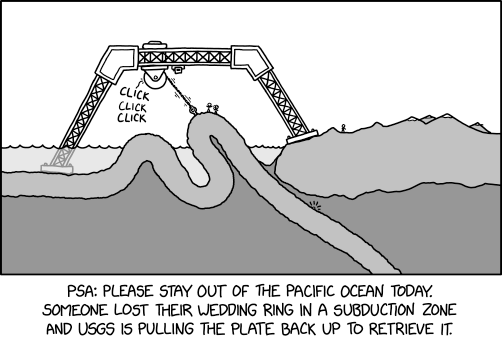
Subduction Retrieval
Post Syndicated from xkcd.com original https://xkcd.com/3218/
Six-Day and IP Address Certificates Available in Certbot
Post Syndicated from Let's Encrypt original https://letsencrypt.org/2026/03/11/shorter-certs-certbot.html
As we announced earlier this year, Let’s Encrypt now issues IP address and six-day certificates to the general public. The Certbot team at the Electronic Frontier Foundation has been working on two improvements to support these features: the --preferred-profile flag released last year in Certbot 4.0, and the --ip-address flag, new in Certbot 5.3. With these improvements together, you can now use Certbot to get those IP address certificates!
If you want to try getting an IP address certificate using Certbot, install version 5.4 or higher (for webroot support with IP addresses), and run this command:
sudo certbot certonly --staging \
  --preferred-profile shortlived \
  --webroot \
  --webroot-path <filesystem path to webserver root> \
  --ip-address <your ip address>
Two things of note:
-
This will request a non-trusted certificate from the Let’s Encrypt staging server. Once you’ve got things working the way you want, run without the
--stagingflag to get a publicly trusted certificate. -
This requests a certificate with Let’s Encrypt’s “shortlived” profile, which will be good for 6 days. This is a Let’s Encrypt requirement for IP address certificates.
As of right now, Certbot only supports getting IP address certificates, not yet installing them in your web server. There’s work to come on that front. In the meantime, edit your webserver configuration to load the newly issued certificate from /etc/letsencrypt/live/<ip address>/fullchain.pem and /etc/letsencrypt/live/<ip address>/privkey.pem.
The command line above uses Certbot’s “webroot” mode, which places a challenge response file in a location where your already-running webserver can serve it. This is nice since you don’t have to temporarily take down your server.
There are two other plugins that support IP address certificates today: --manual and --standalone. The manual plugin is like webroot, except Certbot pauses while you place the challenge response file manually (or runs a user-provided hook to place the file). The standalone plugin runs a simple web server that serves a challenge response. It has the advantage of being very easy to configure, but has the disadvantage that any running webserver on port 80 has to be temporarily taken down so Certbot can listen on that port. The nginx and apache plugins don’t yet support IP addresses.
You should also be sure that Certbot is set up for automatic renewal. Most installation methods for Certbot set up automatic renewal for you. However, since the webserver-specific installers don’t yet support IP address certificates, you’ll have to set a --deploy-hook that tells your webserver to load the most up-to-date certificates from disk. You can provide this --deploy-hook through the certbot reconfigure command using the rest of the flags above.
We hope you enjoy using IP address certificates with Let’s Encrypt and Certbot, and as always if you get stuck you can ask for help in our Community Forum.
[$] Disabling Python’s lazy imports from the command line
Post Syndicated from jake original https://lwn.net/Articles/1061112/
The advent of lazy imports in the Python language is upon us, now that PEP 810 (“Explicit lazy
imports”) was accepted by the steering
council and the feature will appear in the upcoming Python 3.15 release
in October. There are a number of good reasons,
performance foremost, for wanting to defer spending—perhaps wasting—the
time to do an import before a needed symbol is used. However, there are
also good reasons not to want that behavior, at least in some cases. The
tension between those two positions is what led to an earlier PEP rejection,
but it is also playing into a recent discussion of the API used to control
lazy imports.
Lenovo ThinkStation PGX Review The NVIDIA GB10 128GB AI Workstation Goes Corporate
Post Syndicated from Ryan Smith original https://www.servethehome.com/lenovo-thinkstation-pgx-review-the-nvidia-gb10-128gb-ai-workstation-goes-corporate/
We test the Lenovo ThinkStation PGX, a NVIDIA GB10-based 128GB small AI workstation with a fast Arm CPU, Blackwell GPU, and 200G networking
The post Lenovo ThinkStation PGX Review The NVIDIA GB10 128GB AI Workstation Goes Corporate appeared first on ServeTheHome.
SUSE may be for sale, again
Post Syndicated from jzb original https://lwn.net/Articles/1062316/
Reuters is reporting
that private-equity firm EQT may be looking to sell SUSE:
EQT has hired investment bank Arma Partners to sound out a group of
private equity investors for a possible sale of the company, said the
sources, who requested anonymity to discuss confidential matters. The
deliberations are at an early stage and there is no certainty that EQT
will proceed with a transaction, the sources said.
SUSE has traded hands a number of times over the years. Most
recently it was acquired by
EQT in 2018, was listed
on the Frankfurt Stock Exchange in 2021, and then taken
private again by EQT in August 2023.
Patch Tuesday – March 2026
Post Syndicated from Adam Barnett original https://www.rapid7.com/blog/post/em-patch-tuesday-march-2026
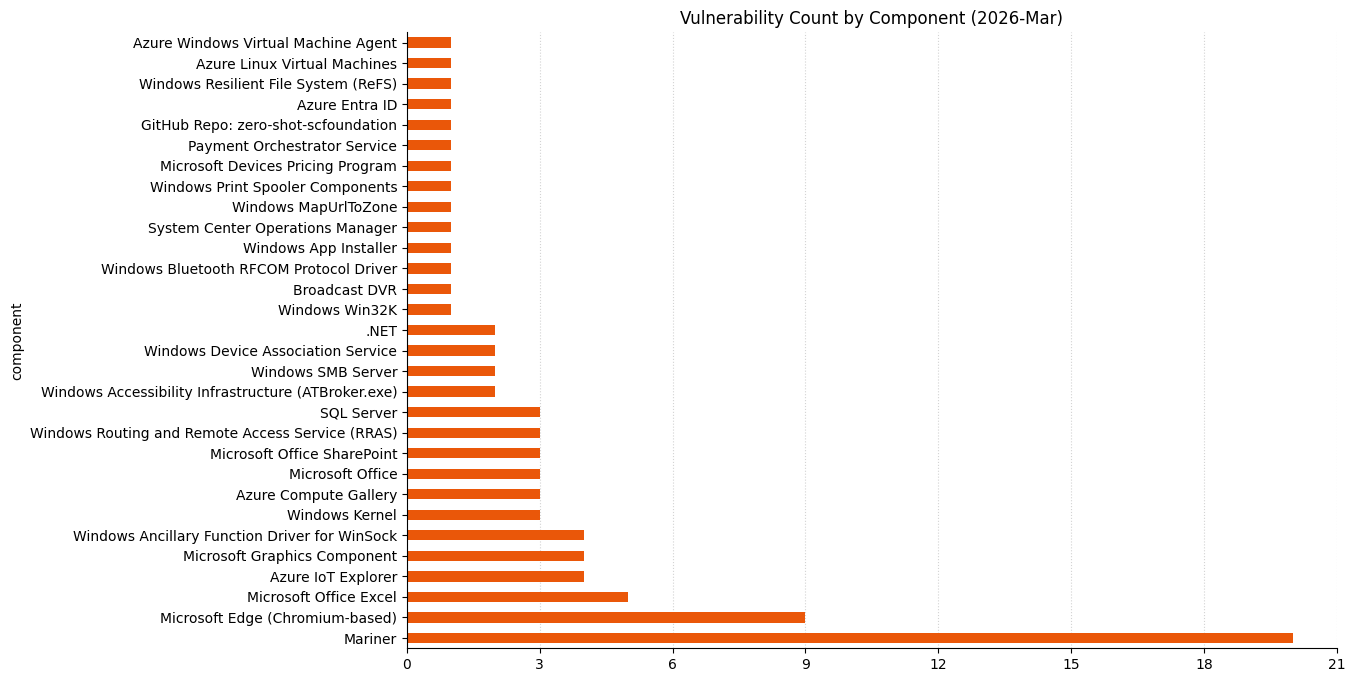
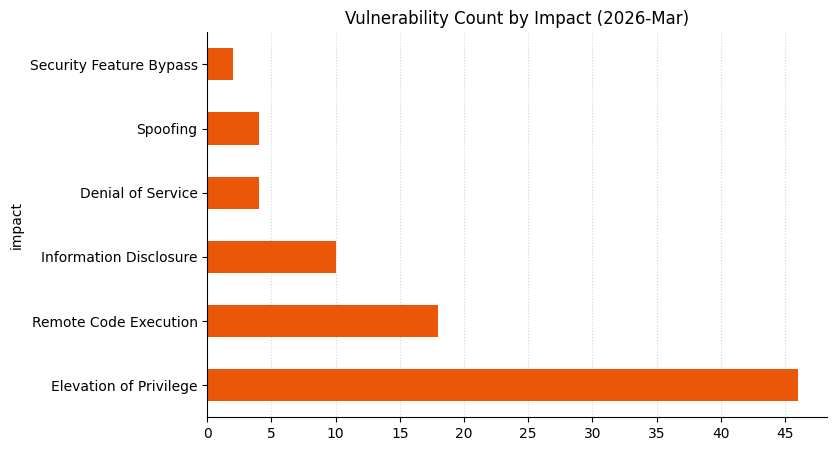
Microsoft is publishing 77 vulnerabilities this March 2026 Patch Tuesday. Microsoft is aware of public disclosure of two of today’s vulnerabilities, but without evidence of exploitation in the wild for any (yet), so there are no Microsoft additions to CISA KEV today. Earlier in the month, Microsoft provided patches to address nine browser vulnerabilities, which are not included in the Patch Tuesday count above.
SQL Server: zero-day remote EoP
SQL Server often goes several months in a row without any mention on Patch Tuesday. Today, however, all versions from the latest and greatest SQL Server 2025 back as far as SQL Server 2016 SP3 receive patches for CVE-2026-21262, a SQL Server elevation of privilege vulnerability. This isn’t just any elevation of privilege vulnerability, either; the advisory notes that an authorized attacker can elevate privileges to sysadmin over a network. The CVSS v3 base score of 8.8 is just below the threshold for critical severity, since low-level privileges are required.
Microsoft is aware of public disclosure, so while they assess the likelihood of exploitation as less likely, it would be a courageous defender who shrugged and deferred the patches for this one. Most SQL Server admins and security teams concluded many years ago that exposing SQL Server directly to the internet was not a good idea. Then again, popular search engines for internet-connected devices describe tens of thousands of SQL Server instances, and they can’t all be honeypots.
What could an attacker do as SQL Server sysadmin? Beyond exfiltrating or interfering with the database itself, the obvious target is xp_cmdshell, which allows direct callouts to the underlying OS. The good news is that xp_cmdshell is disabled by default as far back as SQL Server 2005; the bad news is that anyone acting as SQL Server sysadmin can enable it in seconds. At that point, the attacker is acting with the full privileges of the security context under which SQL Server runs, which is ideally a purpose-built account designed with least privilege in mind. If you want to hear some hair-raising stories, you have only to ask any incident response veteran if they’ve ever seen it set up differently.
Anyone paying for Extended Security Updates (ESU) for SQL Server 2014 or SQL Server 2012 may be forgiven for wondering why there’s no security update for those venerable versions of the world’s most widely deployed closed-source database product. We can hope that the vulnerability described by CVE-2026-21262 was introduced in newer codebases only.
.NET: zero-day DoS
Attackers fond of low-effort denial of service attacks against .NET applications will be checking out CVE-2026-26127 today. Microsoft is aware of public disclosure. While the immediate impact of exploitation is likely contained to denial of service by triggering a crash, opportunities for other types of attacks might emerge during a service reboot. Alternatively, if a log forwarder or security agent is impacted, even for a brief period of time, an attacker might carry out an attack in that moment hoping to evade detection under cover of this artificial darkness. Even if a low-skilled attacker simply causes downtime, in some contexts that could be enough to cause an SLA breach or loss of revenue, or at the very least cause a bleary-eyed defender to get paged in the middle of the night.
Authenticator: QR code impersonation
Microsoft Authenticator mobile app users on both iOS and Android should update to the latest version to prevent exploitation of CVE-2026-26123, which involves a malicious app disguising itself as Microsoft Authenticator. Exploitation succeeds when the malicious app receives enough information to impersonate the user. The legitimate Authenticator app could be installed on a personal device, but often provides multi-factor authentication (MFA) codes for production services in a bring-your-own-device context. Typically, users can choose their own authenticator app. Accordingly, defenders should consider how well their mobile device management policy covers app choice enforcement and patching for MFA apps.
The CVSS v3 base score of 5.5 is unremarkable, and exploitation requires user interaction, since the user must select the malicious app as the handler for the sign-in flow. However, exploitation could begin via an attacker-controlled link, or even a malicious QR code that drives users to the malicious app, and a motivated attacker with a physical presence near the user base might well consider this option. Microsoft ranks this vulnerability as important on their proprietary severity scale. The advisory also provides a brief peek behind the curtain, since the executive summary notes that “Cwe is not in rca”. The weakness listed on the advisory is CWE-939: Improper Authorization in Handler for Custom URL Scheme.
Microsoft lifecycle update
There are no significant Microsoft product lifecycle changes this month, unless you are responsible for a Microsoft SQL Server 2012 Parallel Data Warehouse instance, which moves beyond extended support as of March 31st. It would be wise not to count on a last-minute extension, since Microsoft has already granted a six month reprieve.
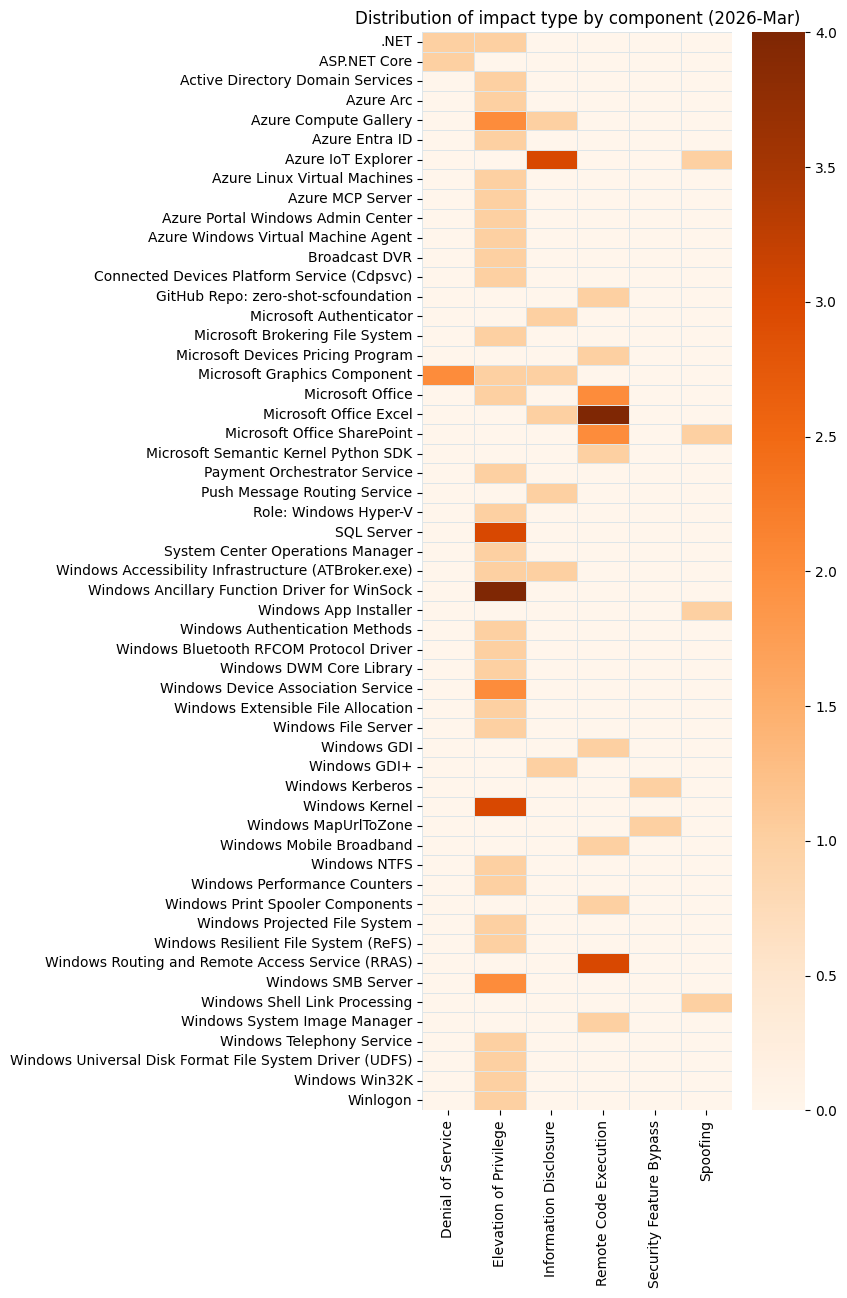
Summary charts
Summary tables
Apps vulnerabilities
|
CVE |
Title |
Exploitation status |
Publicly disclosed? |
CVSS v3 base score |
|---|---|---|---|---|
| CVE-2026-26123 |
Microsoft Authenticator Information Disclosure Vulnerability |
Exploitation Less Likely |
No |
5.5 |
Azure vulnerabilities
|
CVE |
Title |
Exploitation status |
Publicly disclosed? |
CVSS v3 base score |
|---|---|---|---|---|
| CVE-2026-26117 |
Arc Enabled Servers – Azure Connected Machine Agent Elevation of Privilege Vulnerability |
Exploitation Unlikely |
No |
7.8 |
| CVE-2026-23664 |
Azure IoT Explorer Information Disclosure Vulnerability |
Exploitation Less Likely |
No |
7.5 |
| CVE-2026-23661 |
Azure IoT Explorer Information Disclosure Vulnerability |
Exploitation Less Likely |
No |
7.5 |
| CVE-2026-23662 |
Azure IoT Explorer Information Disclosure Vulnerability |
Exploitation Less Likely |
No |
7.5 |
| CVE-2026-26121 |
Azure IOT Explorer Spoofing Vulnerability |
Exploitation Less Likely |
No |
7.5 |
| CVE-2026-26118 |
Azure MCP Server Tools Elevation of Privilege Vulnerability |
Exploitation Less Likely |
No |
8.8 |
| CVE-2026-26141 |
Hybrid Worker Extension (Arc‑enabled Windows VMs) Elevation of Privilege Vulnerability |
Exploitation Unlikely |
No |
7.8 |
| CVE-2026-23665 |
Linux Azure Diagnostic extension (LAD) Elevation of Privilege Vulnerability |
Exploitation Less Likely |
No |
7.8 |
| CVE-2026-26148 |
Microsoft Azure AD SSH Login extension for Linux Elevation of Privilege Vulnerability |
Exploitation Unlikely |
No |
8.1 |
| CVE-2026-23660 |
Windows Admin Center in Azure Portal Elevation of Privilege Vulnerability |
Exploitation Less Likely |
No |
7.8 |
Developer Tools vulnerabilities
|
CVE |
Title |
Exploitation status |
Publicly disclosed? |
CVSS v3 base score |
|---|---|---|---|---|
| CVE-2026-26127 |
.NET Denial of Service Vulnerability |
Exploitation Unlikely |
Yes |
7.5 |
| CVE-2026-26131 |
.NET Elevation of Privilege Vulnerability |
Exploitation Less Likely |
No |
7.8 |
| CVE-2026-26130 |
ASP.NET Core Denial of Service Vulnerability |
Exploitation Less Likely |
No |
7.5 |
ESU vulnerabilities
|
CVE |
Title |
Exploitation status |
Publicly disclosed? |
CVSS v3 base score |
|---|---|---|---|---|
| CVE-2026-25177 |
Active Directory Domain Services Elevation of Privilege Vulnerability |
Exploitation Less Likely |
No |
8.8 |
| CVE-2026-23667 |
Broadcast DVR Elevation of Privilege Vulnerability |
Exploitation Unlikely |
No |
7.0 |
| CVE-2026-25190 |
GDI Remote Code Execution Vulnerability |
Exploitation Less Likely |
No |
7.8 |
| CVE-2026-25181 |
GDI+ Information Disclosure Vulnerability |
Exploitation Less Likely |
No |
7.5 |
| CVE-2026-23674 |
MapUrlToZone Security Feature Bypass Vulnerability |
Exploitation Unlikely |
No |
7.5 |
| CVE-2026-25165 |
Performance Counters for Windows Elevation of Privilege Vulnerability |
Exploitation Unlikely |
No |
7.8 |
| CVE-2026-24282 |
Push message Routing Service Elevation of Privilege Vulnerability |
Exploitation Less Likely |
No |
5.5 |
| CVE-2026-24285 |
Win32k Elevation of Privilege Vulnerability |
Exploitation Less Likely |
No |
7.0 |
| CVE-2026-24291 |
Windows Accessibility Infrastructure (ATBroker.exe) Elevation of Privilege Vulnerability |
Exploitation More Likely |
No |
7.8 |
| CVE-2026-25186 |
Windows Accessibility Infrastructure (ATBroker.exe) Information Disclosure Vulnerability |
Exploitation Less Likely |
No |
5.5 |
| CVE-2026-24293 |
Windows Ancillary Function Driver for WinSock Elevation of Privilege Vulnerability |
Exploitation Less Likely |
No |
7.8 |
| CVE-2026-25176 |
Windows Ancillary Function Driver for WinSock Elevation of Privilege Vulnerability |
Exploitation Less Likely |
No |
7.8 |
| CVE-2026-25178 |
Windows Ancillary Function Driver for WinSock Elevation of Privilege Vulnerability |
Exploitation Less Likely |
No |
7.0 |
| CVE-2026-25179 |
Windows Ancillary Function Driver for WinSock Elevation of Privilege Vulnerability |
Exploitation Less Likely |
No |
7.0 |
| CVE-2026-25171 |
Windows Authentication Elevation of Privilege Vulnerability |
Exploitation Less Likely |
No |
7.0 |
| CVE-2026-23671 |
Windows Bluetooth RFCOM Protocol Driver Elevation of Privilege Vulnerability |
Exploitation Less Likely |
No |
7.0 |
| CVE-2026-24292 |
Windows Connected Devices Platform Service Elevation of Privilege Vulnerability |
Exploitation Less Likely |
No |
7.8 |
| CVE-2026-24295 |
Windows Device Association Service Elevation of Privilege Vulnerability |
Exploitation Less Likely |
No |
7.0 |
| CVE-2026-24296 |
Windows Device Association Service Elevation of Privilege Vulnerability |
Exploitation Unlikely |
No |
7.0 |
| CVE-2026-25189 |
Windows DWM Core Library Elevation of Privilege Vulnerability |
Exploitation Less Likely |
No |
7.8 |
| CVE-2026-25174 |
Windows Extensible File Allocation Table Elevation of Privilege Vulnerability |
Exploitation Unlikely |
No |
7.8 |
| CVE-2026-25168 |
Windows Graphics Component Denial of Service Vulnerability |
Exploitation Less Likely |
No |
6.2 |
| CVE-2026-25169 |
Windows Graphics Component Denial of Service Vulnerability |
Exploitation Less Likely |
No |
6.2 |
| CVE-2026-23668 |
Windows Graphics Component Elevation of Privilege Vulnerability |
Exploitation More Likely |
No |
7.0 |
| CVE-2026-25180 |
Windows Graphics Component Information Disclosure Vulnerability |
Exploitation Less Likely |
No |
5.5 |
| CVE-2026-24297 |
Windows Kerberos Security Feature Bypass Vulnerability |
Exploitation Less Likely |
No |
6.5 |
| CVE-2026-24287 |
Windows Kernel Elevation of Privilege Vulnerability |
Exploitation Less Likely |
No |
7.8 |
| CVE-2026-24289 |
Windows Kernel Elevation of Privilege Vulnerability |
Exploitation More Likely |
No |
7.8 |
| CVE-2026-26132 |
Windows Kernel Elevation of Privilege Vulnerability |
Exploitation More Likely |
No |
7.8 |
| CVE-2026-24288 |
Windows Mobile Broadband Driver Remote Code Execution Vulnerability |
Exploitation Less Likely |
No |
6.8 |
| CVE-2026-25175 |
Windows NTFS Elevation of Privilege Vulnerability |
Exploitation Less Likely |
No |
7.8 |
| CVE-2026-23669 |
Windows Print Spooler Remote Code Execution Vulnerability |
Exploitation Less Likely |
No |
8.8 |
| CVE-2026-24290 |
Windows Projected File System Elevation of Privilege Vulnerability |
Exploitation Less Likely |
No |
7.8 |
| CVE-2026-23673 |
Windows Resilient File System (ReFS) Elevation of Privilege Vulnerability |
Exploitation Unlikely |
No |
7.8 |
| CVE-2026-25172 |
Windows Routing and Remote Access Service (RRAS) Remote Code Execution Vulnerability |
Exploitation Less Likely |
No |
8.8 |
| CVE-2026-25173 |
Windows Routing and Remote Access Service (RRAS) Remote Code Execution Vulnerability |
Exploitation Less Likely |
No |
8.0 |
| CVE-2026-26111 |
Windows Routing and Remote Access Service (RRAS) Remote Code Execution Vulnerability |
Exploitation Less Likely |
No |
8.8 |
| CVE-2026-25185 |
Windows Shell Link Processing Spoofing Vulnerability |
Exploitation Less Likely |
No |
5.3 |
| CVE-2026-24294 |
Windows SMB Server Elevation of Privilege Vulnerability |
Exploitation More Likely |
No |
7.8 |
| CVE-2026-26128 |
Windows SMB Server Elevation of Privilege Vulnerability |
Exploitation Less Likely |
No |
7.8 |
| CVE-2026-25166 |
Windows System Image Manager Assessment and Deployment Kit (ADK) Remote Code Execution Vulnerability |
Exploitation Unlikely |
No |
7.8 |
| CVE-2026-25188 |
Windows Telephony Service Elevation of Privilege Vulnerability |
Exploitation Unlikely |
No |
8.8 |
| CVE-2026-23672 |
Windows Universal Disk Format File System Driver (UDFS) Elevation of Privilege Vulnerability |
Exploitation Unlikely |
No |
7.8 |
| CVE-2026-25187 |
Winlogon Elevation of Privilege Vulnerability |
Exploitation More Likely |
No |
7.8 |
Microsoft Office vulnerabilities
|
CVE |
Title |
Exploitation status |
Publicly disclosed? |
CVSS v3 base score |
|---|---|---|---|---|
| CVE-2026-26144 |
Microsoft Excel Information Disclosure Vulnerability |
Exploitation Unlikely |
No |
7.5 |
| CVE-2026-26112 |
Microsoft Excel Remote Code Execution Vulnerability |
Exploitation Less Likely |
No |
7.8 |
| CVE-2026-26107 |
Microsoft Excel Remote Code Execution Vulnerability |
Exploitation Less Likely |
No |
7.8 |
| CVE-2026-26108 |
Microsoft Excel Remote Code Execution Vulnerability |
Exploitation Less Likely |
No |
7.8 |
| CVE-2026-26109 |
Microsoft Excel Remote Code Execution Vulnerability |
Exploitation Unlikely |
No |
8.4 |
| CVE-2026-26134 |
Microsoft Office Elevation of Privilege Vulnerability |
Exploitation Less Likely |
No |
7.8 |
| CVE-2026-26113 |
Microsoft Office Remote Code Execution Vulnerability |
Exploitation Less Likely |
No |
8.4 |
| CVE-2026-26110 |
Microsoft Office Remote Code Execution Vulnerability |
Exploitation Less Likely |
No |
8.4 |
| CVE-2026-26114 |
Microsoft SharePoint Server Remote Code Execution Vulnerability |
Exploitation Less Likely |
No |
8.8 |
| CVE-2026-26106 |
Microsoft SharePoint Server Remote Code Execution Vulnerability |
Exploitation Less Likely |
No |
8.8 |
| CVE-2026-26105 |
Microsoft SharePoint Server Spoofing Vulnerability |
Exploitation Less Likely |
No |
8.1 |
| CVE-2026-24285 |
Win32k Elevation of Privilege Vulnerability |
Exploitation Less Likely |
No |
7.0 |
| CVE-2026-25180 |
Windows Graphics Component Information Disclosure Vulnerability |
Exploitation Less Likely |
No |
5.5 |
Open Source Software vulnerabilities
|
CVE |
Title |
Exploitation status |
Publicly disclosed? |
CVSS v3 base score |
|---|---|---|---|---|
| CVE-2026-26030 |
GitHub: CVE-2026-26030 Microsoft Semantic Kernel InMemoryVectorStore filter functionality vulnerable |
Exploitation Unlikely |
No |
9.9 |
| CVE-2026-23654 |
GitHub: Zero Shot SCFoundation Remote Code Execution Vulnerability |
Exploitation Unlikely |
No |
8.8 |
SQL Server vulnerabilities
|
CVE |
Title |
Exploitation status |
Publicly disclosed? |
CVSS v3 base score |
|---|---|---|---|---|
| CVE-2026-21262 |
SQL Server Elevation of Privilege Vulnerability |
Exploitation Less Likely |
Yes |
8.8 |
| CVE-2026-26115 |
SQL Server Elevation of Privilege Vulnerability |
Exploitation Less Likely |
No |
8.8 |
| CVE-2026-26116 |
SQL Server Elevation of Privilege Vulnerability |
Exploitation Less Likely |
No |
8.8 |
System Center vulnerabilities
|
CVE |
Title |
Exploitation status |
Publicly disclosed? |
CVSS v3 base score |
|---|---|---|---|---|
| CVE-2026-20967 |
System Center Operations Manager (SCOM) Elevation of Privilege Vulnerability |
Exploitation Less Likely |
No |
8.8 |
Windows vulnerabilities
|
CVE |
Title |
Exploitation status |
Publicly disclosed? |
CVSS v3 base score |
|---|---|---|---|---|
| CVE-2026-25177 |
Active Directory Domain Services Elevation of Privilege Vulnerability |
Exploitation Less Likely |
No |
8.8 |
| CVE-2026-23667 |
Broadcast DVR Elevation of Privilege Vulnerability |
Exploitation Unlikely |
No |
7.0 |
| CVE-2026-25190 |
GDI Remote Code Execution Vulnerability |
Exploitation Less Likely |
No |
7.8 |
| CVE-2026-25181 |
GDI+ Information Disclosure Vulnerability |
Exploitation Less Likely |
No |
7.5 |
| CVE-2026-23674 |
MapUrlToZone Security Feature Bypass Vulnerability |
Exploitation Unlikely |
No |
7.5 |
| CVE-2026-25167 |
Microsoft Brokering File System Elevation of Privilege Vulnerability |
Exploitation Less Likely |
No |
7.4 |
| CVE-2026-24283 |
Multiple UNC Provider Kernel Driver Elevation of Privilege Vulnerability |
Exploitation Less Likely |
No |
8.8 |
| CVE-2026-25165 |
Performance Counters for Windows Elevation of Privilege Vulnerability |
Exploitation Unlikely |
No |
7.8 |
| CVE-2026-24282 |
Push message Routing Service Elevation of Privilege Vulnerability |
Exploitation Less Likely |
No |
5.5 |
| CVE-2026-24285 |
Win32k Elevation of Privilege Vulnerability |
Exploitation Less Likely |
No |
7.0 |
| CVE-2026-24291 |
Windows Accessibility Infrastructure (ATBroker.exe) Elevation of Privilege Vulnerability |
Exploitation More Likely |
No |
7.8 |
| CVE-2026-25186 |
Windows Accessibility Infrastructure (ATBroker.exe) Information Disclosure Vulnerability |
Exploitation Less Likely |
No |
5.5 |
| CVE-2026-24293 |
Windows Ancillary Function Driver for WinSock Elevation of Privilege Vulnerability |
Exploitation Less Likely |
No |
7.8 |
| CVE-2026-25176 |
Windows Ancillary Function Driver for WinSock Elevation of Privilege Vulnerability |
Exploitation Less Likely |
No |
7.8 |
| CVE-2026-25178 |
Windows Ancillary Function Driver for WinSock Elevation of Privilege Vulnerability |
Exploitation Less Likely |
No |
7.0 |
| CVE-2026-25179 |
Windows Ancillary Function Driver for WinSock Elevation of Privilege Vulnerability |
Exploitation Less Likely |
No |
7.0 |
| CVE-2026-23656 |
Windows App Installer Spoofing Vulnerability |
Exploitation Unlikely |
No |
|
| CVE-2026-25171 |
Windows Authentication Elevation of Privilege Vulnerability |
Exploitation Less Likely |
No |
7.0 |
| CVE-2026-23671 |
Windows Bluetooth RFCOM Protocol Driver Elevation of Privilege Vulnerability |
Exploitation Less Likely |
No |
7.0 |
| CVE-2026-24292 |
Windows Connected Devices Platform Service Elevation of Privilege Vulnerability |
Exploitation Less Likely |
No |
7.8 |
| CVE-2026-24295 |
Windows Device Association Service Elevation of Privilege Vulnerability |
Exploitation Less Likely |
No |
7.0 |
| CVE-2026-24296 |
Windows Device Association Service Elevation of Privilege Vulnerability |
Exploitation Unlikely |
No |
7.0 |
| CVE-2026-25189 |
Windows DWM Core Library Elevation of Privilege Vulnerability |
Exploitation Less Likely |
No |
7.8 |
| CVE-2026-25174 |
Windows Extensible File Allocation Table Elevation of Privilege Vulnerability |
Exploitation Unlikely |
No |
7.8 |
| CVE-2026-25168 |
Windows Graphics Component Denial of Service Vulnerability |
Exploitation Less Likely |
No |
6.2 |
| CVE-2026-25169 |
Windows Graphics Component Denial of Service Vulnerability |
Exploitation Less Likely |
No |
6.2 |
| CVE-2026-23668 |
Windows Graphics Component Elevation of Privilege Vulnerability |
Exploitation More Likely |
No |
7.0 |
| CVE-2026-25180 |
Windows Graphics Component Information Disclosure Vulnerability |
Exploitation Less Likely |
No |
5.5 |
| CVE-2026-25170 |
Windows Hyper-V Elevation of Privilege Vulnerability |
Exploitation Less Likely |
No |
7.0 |
| CVE-2026-24297 |
Windows Kerberos Security Feature Bypass Vulnerability |
Exploitation Less Likely |
No |
6.5 |
| CVE-2026-24287 |
Windows Kernel Elevation of Privilege Vulnerability |
Exploitation Less Likely |
No |
7.8 |
| CVE-2026-24289 |
Windows Kernel Elevation of Privilege Vulnerability |
Exploitation More Likely |
No |
7.8 |
| CVE-2026-26132 |
Windows Kernel Elevation of Privilege Vulnerability |
Exploitation More Likely |
No |
7.8 |
| CVE-2026-24288 |
Windows Mobile Broadband Driver Remote Code Execution Vulnerability |
Exploitation Less Likely |
No |
6.8 |
| CVE-2026-25175 |
Windows NTFS Elevation of Privilege Vulnerability |
Exploitation Less Likely |
No |
7.8 |
| CVE-2026-23669 |
Windows Print Spooler Remote Code Execution Vulnerability |
Exploitation Less Likely |
No |
8.8 |
| CVE-2026-24290 |
Windows Projected File System Elevation of Privilege Vulnerability |
Exploitation Less Likely |
No |
7.8 |
| CVE-2026-23673 |
Windows Resilient File System (ReFS) Elevation of Privilege Vulnerability |
Exploitation Unlikely |
No |
7.8 |
| CVE-2026-25172 |
Windows Routing and Remote Access Service (RRAS) Remote Code Execution Vulnerability |
Exploitation Less Likely |
No |
8.8 |
| CVE-2026-25173 |
Windows Routing and Remote Access Service (RRAS) Remote Code Execution Vulnerability |
Exploitation Less Likely |
No |
8.0 |
| CVE-2026-26111 |
Windows Routing and Remote Access Service (RRAS) Remote Code Execution Vulnerability |
Exploitation Less Likely |
No |
8.8 |
| CVE-2026-25185 |
Windows Shell Link Processing Spoofing Vulnerability |
Exploitation Less Likely |
No |
5.3 |
| CVE-2026-24294 |
Windows SMB Server Elevation of Privilege Vulnerability |
Exploitation More Likely |
No |
7.8 |
| CVE-2026-26128 |
Windows SMB Server Elevation of Privilege Vulnerability |
Exploitation Less Likely |
No |
7.8 |
| CVE-2026-25166 |
Windows System Image Manager Assessment and Deployment Kit (ADK) Remote Code Execution Vulnerability |
Exploitation Unlikely |
No |
7.8 |
| CVE-2026-25188 |
Windows Telephony Service Elevation of Privilege Vulnerability |
Exploitation Unlikely |
No |
8.8 |
| CVE-2026-23672 |
Windows Universal Disk Format File System Driver (UDFS) Elevation of Privilege Vulnerability |
Exploitation Unlikely |
No |
7.8 |
| CVE-2026-25187 |
Winlogon Elevation of Privilege Vulnerability |
Exploitation More Likely |
No |
7.8 |
Zero-Day Vulnerabilities: Publicly Disclosed (No known exploitation)
|
CVE |
Title |
Exploitation status |
Publicly disclosed? |
CVSS v3 base score |
|---|---|---|---|---|
| CVE-2026-26127 |
.NET Denial of Service Vulnerability |
Exploitation Unlikely |
Yes |
7.5 |
| CVE-2026-21262 |
SQL Server Elevation of Privilege Vulnerability |
Exploitation Less Likely |
Yes |
8.8 |
AWS European Sovereign Cloud achieves first compliance milestone: SOC 2 and C5 reports plus seven ISO certifications
Post Syndicated from Julian Herlinghaus original https://aws.amazon.com/blogs/security/aws-european-sovereign-cloud-achieves-first-compliance-milestone-soc-2-and-c5-reports-plus-seven-iso-certifications/
In January 2026, we announced the general availability of the AWS European Sovereign Cloud, a new, independent cloud for Europe entirely located within the European Union (EU), and physically and logically separate from all other AWS Regions. The unique approach of the AWS European Sovereign Cloud provides the only fully featured, independently operated sovereign cloud backed by strong technical controls, sovereign assurances, and legal protections designed to meet the sensitive data needs of European governments and enterprises.
One of the foundational components of how AWS European Sovereign Cloud enables verifiable trust of technical controls and delivers assurance is through our compliance programs and assurance frameworks. These programs help customers understand the robust controls in place at AWS European Sovereign Cloud to maintain security and compliance of the cloud. To meet the needs of our customers, we committed that the AWS European Sovereign Cloud will maintain key certifications such as ISO/IEC 27001:2022, System and Organization Controls (SOC) reports, and Cloud Computing Compliance Criteria Catalogue (C5) attestation, all validated regularly by independent auditors to assure our controls are designed appropriately, operate effectively, and can help customers satisfy their compliance obligations.
Today, AWS European Sovereign Cloud is pleased to announce that SOC 2 and C5 Type 1 attestation reports, along with seven key ISO certifications (ISO 27001:2022, 27017:2015, 27018:2019, 27701:2019, 22301:2019, 20000-1:2018, and 9001:2015) are now available. These attestation reports and certifications cover 69 AWS services operating within the AWS European Sovereign Cloud, and this achievement marks a pivotal first step in our journey to establish the AWS European Sovereign Cloud as a trusted and compliant cloud for European organizations. By securing these foundational certifications and attestation reports early in our implementation, we are demonstrating our commitment to earning customer trust. AWS European Sovereign Cloud customers in Germany and across Europe can now run their applications with enhanced assurance and confidence that our infrastructure aligns with internationally recognized security standards and the AWS European Sovereign Cloud: Sovereign Reference Framework (ESC-SRF). These certifications and attestation reports provide independent validation of our security controls and operational practices, demonstrating our commitment to meeting the heightened expectations towards cloud service providers. Beyond compliance, these certifications and reports help customers meet regulatory requirements and innovate with confidence.
SOC 2 Type 1 report
SOC reports are independent third-party examinations that show how AWS European Sovereign Cloud meets compliance controls and sovereignty objectives. The AWS European Sovereign Cloud SOC 2 report addresses three critical AICPA Trust Services Criteria: Security, Availability, and Confidentiality and includes internal controls mapped to the ESC-SRF. The ESC-SRF establishes sovereignty criteria across key domains including governance independence, operational control, data residency, and technical isolation. As part of the SOC 2 Type 1 attestation, independent third-party auditors have validated suitability of the design and implementation of our controls addressing measures such as independent European Union (EU) corporate structures, operation by EU-resident AWS personnel, strict residency requirements for Customer Content and Customer-Created Metadata, and separation from all other AWS Regions. The ESC-SRF controls in our SOC 2 report show customers how AWS delivers on its sovereignty commitments.
C5 Type 1 report
C5 is a German Government-backed attestation scheme introduced in Germany by the Federal Office for Information Security (BSI) and represents one of the most comprehensive cloud security standards in Europe. The AWS European Sovereign Cloud C5 Type 1 report provides customers with independent third-party attestation on the suitability of the design and implementation of our controls to meet both C5 basic criteria and C5 additional criteria.
The basic criteria establish fundamental security requirements for cloud service providers, covering areas such as organization of information security, human resources security, asset management, access control, cryptography, physical security, operations security, communications security, system acquisition and development, supplier relationships, incident management, business continuity, and compliance. The additional criteria address enhanced requirements for handling sensitive data and critical applications, making this attestation particularly valuable for AWS European Sovereign Cloud customers with stringent data security and sovereignty requirements.
Key ISO certifications
AWS European Sovereign Cloud has achieved seven key ISO certifications that collectively demonstrate comprehensive operational excellence:
- ISO 27001:2022 for information security management
- ISO 27017:2015 for cloud-specific security controls
- ISO 27018:2019 for personal data protection in cloud environments
- ISO 27701:2019 for privacy information management
- ISO 22301:2019 for business continuity and organizational resilience
- ISO 20000-1:2018 for IT service management
- ISO 9001:2015 for quality management
These certifications confirm that AWS European Sovereign Cloud has integrated rigorous security, privacy, continuity, service delivery, and quality programs into a comprehensive framework, helping to ensure sensitive information remains secure, services remain available, and operations meet the highest standards through systematic risk management processes and continuous improvement practices.
How to access the reports
To access SOC 2, C5 reports and ISO certifications, customers should sign in to their AWS European Sovereign Cloud account and navigate to AWS Artifact in the AWS Management Console. AWS Artifact is a self-service portal that provides on-demand access to AWS compliance reports and certifications.
We recognize that compliance is not a destination but a continuous journey, and these initial SOC 2, C5 reports and ISO certifications represent the beginning of our certification portfolio. They lay the essential groundwork upon which we will continue to build to meet AWS European Sovereign Cloud customers’ compliance needs as they continue to evolve. As we expand our compliance coverage in the months ahead, customers can be confident that security, transparency, and regulatory alignment have been part of the very DNA of the AWS European Sovereign Cloud design from day one. To learn more about our compliance and security programs, visit AWS European Sovereign Cloud Compliance, or reach out to your AWS European Sovereign Cloud account team.
Security and compliance is a shared responsibility between AWS European Sovereign Cloud and the customer. For more information, see the AWS Shared Security Responsibility Model.
If you have feedback about this post, submit comments in the Comments section below.
Security is a team sport: AWS at RSAC 2026 Conference
Post Syndicated from Idaliz Seymour original https://aws.amazon.com/blogs/security/security-is-a-team-sport-aws-at-rsac-2026-conference/
The RSAC 2026 Conference brings together thousands of professionals, practitioners, vendors, and associations to discuss issues covering the entire spectrum of cybersecurity—a place where innovation meets collaboration and the industry’s brightest minds converge to shape its future. This March, Amazon Web Services (AWS) returns to the annual RSAC Conference in San Francisco to share how unifying security and data empowers teams to protect AI-driven workloads while maximizing existing security investments.
Experience innovation at the AWS booth
Visit us at booth S-0466 in South Expo to experience three interactive demo kiosks:
- The AWS Security Solutions kiosk features live demonstrations of AWS security services including new launches showcasing the latest cloud security innovations and how they work with partner solutions to provide comprehensive protection for your organization. Meet with AWS Security Specialists to discuss your specific security challenges.
- The AWS Security Partners kiosk showcases live demos from more than 20 AWS Partners showcasing how these partners integrate seamlessly with AWS to address your most critical security challenges.
- The Humanoid Security Guardian kiosk offers an interactive AI-powered experience that generates customized well-architected framework guides, delivered through QR code for implementation reference.
Partner Passport program: Stop by the AWS booth to pick up your playbook to start exploring integrated AWS Partner security solutions across the show floor. Visit participating partner booths throughout the conference to learn about joint solutions that combine AWS infrastructure with partner innovations. After you’ve received all partner booth visit stamps, you’ll receive AWS swag and entry into a daily raffle to win an exclusive prize.
Beyond the booth: Deep dive sessions and hands-on workshops
AWS security experts will be sharing insights across four sessions throughout RSAC 2026 Conference. These sessions cover the most pressing challenges in AI security, from privacy-by-design principles to preparing for AI-native incidents. Don’t miss learning directly from AWS experts in these sessions.
Privacy by Design in the AI Era | Reserve a seat
Monday, March 23, 2026 | 8:30 AM–9:20 AM PDT
Attendees will learn how to design AI systems with privacy embedded from the start. This session will cover data minimization strategies, architectural patterns for consent-aware decision-making, and practical approaches for building privacy-respecting AI in dynamic environments. Speakers: Juan David Alvares Builes, Senior Security Consultant, Amazon Web Services and Zully Romero, Security and Solutions Architect, Bancolombia.
Trusted Identity Propagation for Autonomous Agents Across Cloud & SaaS | Reserve a seat
Monday, March 23, 2026 | 9:40 AM–10:30 AM PDT
This session will explore trusted identity propagation for autonomous agents across cloud, SaaS, and multi-domain environments. Compare AWS, Azure, Apple, and Cloudflare approaches, focusing on identity continuity, credential management, and privacy-aware designs for secure, agent-driven enterprise systems. Speakers: Swara Gandhi, Senior Solutions Architect, Amazon Web Services and Vijeth Lomada, Lead AI Engineer, Adobe.
How to Secure Containerized Applications from Supply Chain Attacks | Reserve a seat
Monday, March 23, 2026 | 1:10 PM–2:00 PM PDT
Software supply chain attacks target development pipelines to inject malicious code into container images and dependencies. This session demonstrates how to secure containerized applications through automated scanning, Software Bill of Materials (SBOM) generation, and image signing. Learn to implement security controls in CI/CD pipelines using open-source and commercial solutions. Speakers: Patrick Palmer, Principal Security, Solutions Architect, Amazon Web Services and Monika Vu Minh, Quantitative Technologist, Qube Research & Technologies
From Prompt to Pager: Preparing for AI-Native Incidents Now | Reserve a seat
Wednesday, March 25, 2026 | 1:15 PM–2:05 PM PDT
AI incidents start as prompts and end as actions like code edits, SQL writes, workflow changes, yet most playbooks are not ready. This talk will explain why AI incidents differ, show where classic guardrails miss, and share field-tested steps to prepare now: log model-generated actions, add pre/post-conditions, capture provenance, limit blast radius, and rehearse one AI-native scenario. Speaker: Aviral Srivastava, Security Engineer, Amazon
AWS activities and events
AWS will host events at Cloud Village, an interactive community space where security practitioners explore offensive and defensive cloud security through hands-on activities, technical talks, and collaborative discussions. AWS is hosting two technical workshops that provide hands-on practical skills security teams can implement immediately. AWS has also crafted multiple capture the flag (CTF) community challenges at both RSAC 2026 Conference and BSidesSF that advance the broader security community’s capabilities – built by the same team behind the AWS Vulnerability Disclosure Program, where researchers can responsibly report security concerns directly to AWS. Cloud Village will be located in Moscone South, Level 2, Room 204 and is open to All Access Pass and Expo Plus Pass holders.
Finally, you can also join us at a customer soiree AWS is co-hosting with CrowdStrike, on Wednesday, March 25 at The Mint, for an evening of discovery, where artists, thinkers, and leaders gather to challenge convention, shape the future and have some fun. Register to join us
If you’re looking for opportunities for meaningful connections across the security community, AWS is hosting several events including;
- AWS Edge startup reception on Monday, March 23 at Movida in San Francisco
- OCSF networking breakfast on Wednesday, March 25 at the Intercontinental San Francisco
Join us in San Francisco
Whether you’re exploring how to secure AI workloads, seeking to unify security across distributed environments, or looking to optimize your security data strategy, the AWS team at RSAC 2026 Conference is ready to collaborate. Visit booth S-0466 in South Expo, attend our technical workshops at the Cloud Village, or join AWS-led sessions. You can also schedule time to meet with AWS experts for more in-depth discussions. Together, we’ll demonstrate that when it comes to cybersecurity, we’re all on the same team.
Learn more about AWS Security solutions at aws.amazon.com/security
See you in San Francisco, March 23–26, 2026.
Reducing costs for shuffle-heavy Apache Spark workloads with serverless storage for Amazon EMR Serverless
Post Syndicated from Praveen Mohan Prasad original https://aws.amazon.com/blogs/big-data/reducing-costs-for-shuffle-heavy-apache-spark-workloads-with-serverless-storage-for-amazon-emr-serverless/
At re:Invent 2025, we announced serverless storage for Amazon EMR Serverless, eliminating the need to provision local disk storage for Apache Spark workloads. Serverless storage of Amazon EMR Serverless reduces data processing costs by up to 20% while helping prevent job failures from disk capacity constraints.
In this post, we explore the cost improvements we observed when benchmarking Apache Spark jobs with serverless storage on EMR Serverless. We take a deeper look at how serverless storage helps reduce costs for shuffle-heavy Spark workloads, and we outline practical guidance on identifying the types of queries that can benefit most from enabling serverless storage in your EMR Serverless Spark jobs.
Benchmark results for EMR 7.12 with serverless storage against standard disks
We conducted the performance and cost savings benchmarking using the TPC-DS dataset at 3TB scale, running 100+ queries that included a mix of high and low shuffle operations. The test configuration utilized Dynamic Resource Allocation (DRA) with no pre-initialized capacity. The system was set up with 20GB of disk space, and Spark configurations included 4 cores and 14GB memory for both driver and executor, with dynamic allocation starting at 3 initial executors (spark.dynamicAllocation.initialExecutors = 3). A comparative analysis was performed between local disk storage and serverless storage configurations. The aim was to assess both total and average cost implications between these storage approaches.
The following table and chart compare the cost reduction we observed in the testing environment described above. Based on us-east-1 pricing, we saw a cost savings of more than 26% when using serverless storage.
| Shuffle | |||
| serverless storage | standard Disks | savings | |
| Total Cost ($) | 24.28 | 33.1 | 26.65% |
| Average Cost ($) | 0.233 | 0.318 | 26.73% |
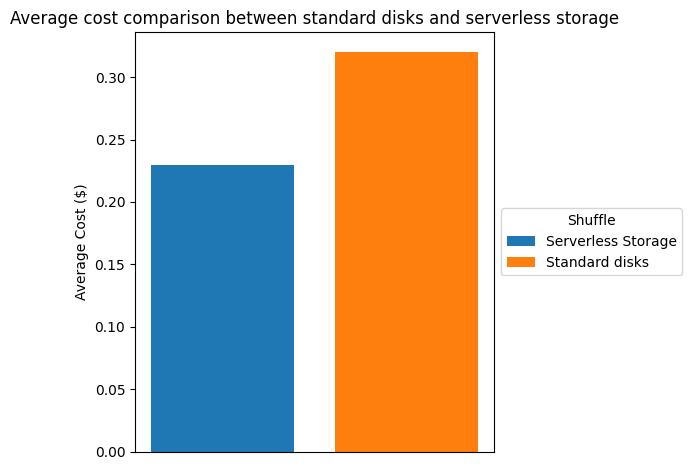
% Relative savings (per query) of serverless storage compared to standard disk shuffle
In this testing, we observed that serverless storage in EMR Serverless reduces cost for approximately 80% of TPC-DS queries. For the queries where it provides benefits, it delivers an average cost saving of approximately 47%, with savings of up to 85%. Queries that regress typically have low shuffle intensity, maintain high parallelism throughout execution, or complete quickly enough that executor scale-down opportunities are minimal. The following figure shows the percentage cost difference for each of the TPC-DS queries when serverless storage was enabled, compared to the baseline configuration without serverless storage. Positive values indicate cost savings (higher is better), while negative values indicate cost regressions.
Percentage cost savings per TPC-DS query with serverless storage enabled

Runtime comparison
There is significant cost savings due to the increased elasticity from terminating executors earlier. However, job completion time may increase because the shuffle data is stored in serverless storage rather than locally on the executors. The additional read and write latency for shuffle data contributes to the longer runtime. The following table and chart show the runtime comparison, we observed in our testing environment.
| Shuffle | |||
| serverless storage | standard disks | runtime | |
| Total Duration (sec) | 6770.63 | 4908.52 | -37.94% |
| Average Duration (sec) | 65.1 | 47.2 | -37.92% |
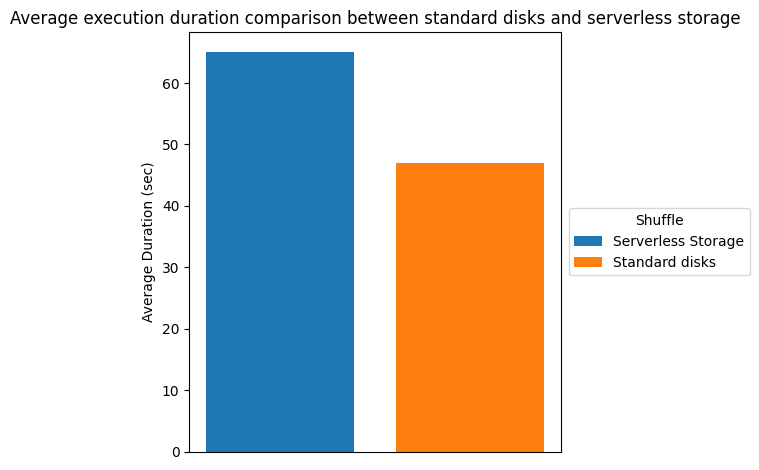
Storing shuffle externally and decoupling from the compute allowed the flexibility for EMR Serverless to turn off unused resources dynamically as the state info has been offloaded from the compute. However, these cost savings can be realized only when DRA is on. If DRA is turned off, Spark would keep those unused resources alive adding to the total cost.
Query patterns that benefit from serverless storage
The cost savings from serverless storage depend heavily on how executor demand changes across stages of a job. In this section, we examine common execution patterns and explain which query shapes are most likely to benefit from serverless storage of EMR Serverless and which query patterns may not benefit from shuffle externalization.
Inverted triangle pattern queries
In order to understand why externalizing the shuffle data can allow such a significant cost savings, consider a simplified query. The following query calculates annual total sales from the TPC-DS dataset by joining the store_sales and date_dim tables, summing the sales amounts per year, and ordering the results.
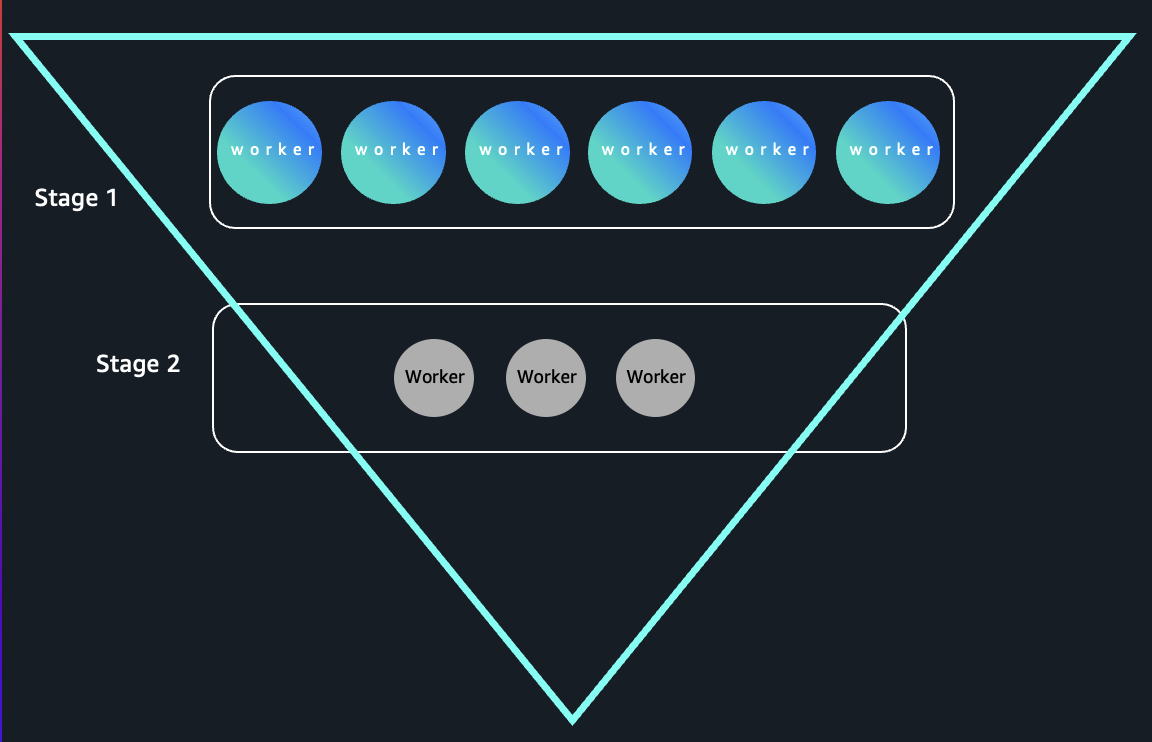
This query demonstrates that high executor demand during the map phase and low executor demand in the reduce phase is an aggregation query with a high cardinality input and a low cardinality group by.
- Stage 1 (High Executor Demand)
The join and read steps scan the entire store_sales and date_dim tables. This often involves billions of rows in large-scale TPC-DS datasets, so Spark will try to parallelize the scan across many executors to maximize read throughput and compute efficiency.
- Stage 2 (Low Executor Demand)
The aggregation is on d_year, which typically has few unique values, such as only a handful of years in the data. This means after the shuffle stage, the reduce phase combines the partial aggregates into a number of keys equal to the number of years (often < 10). Only a few Spark tasks are needed to finish the final aggregation, so most executors become idle.
With shuffle information stored on the local disk, the compute resources associated with these idle executors would still be running in order to keep the shuffle data available. With shuffle data offloaded from the nodes running the executors, with DRA enabled, those nodes with idle executors get released immediately.
Because early stages process high-cardinality inputs and later stages collapse data into a small number of keys, these queries form an “inverted triangle” execution pattern: wide parallelism at the top and narrow parallelism at the bottom as shown in the following image:
Hourglass pattern queries
Depending upon the complexity of the job, there can be multiple stages with varying demand on number of executors needed for the stage. Such jobs can benefit from greater elasticity obtained by offloading shuffle data to external serverless storage. One such pattern is the hour glass pattern. The following figure shows a workload pattern where executor demand expands, contracts during shuffle-heavy stages, and expands again. Serverless storage of EMR Serverless decouples shuffle data from compute, enabling more efficient scale-down during narrow stages and helping improve cost optimization for elastic workloads.
Hourglass pattern in Spark stage execution
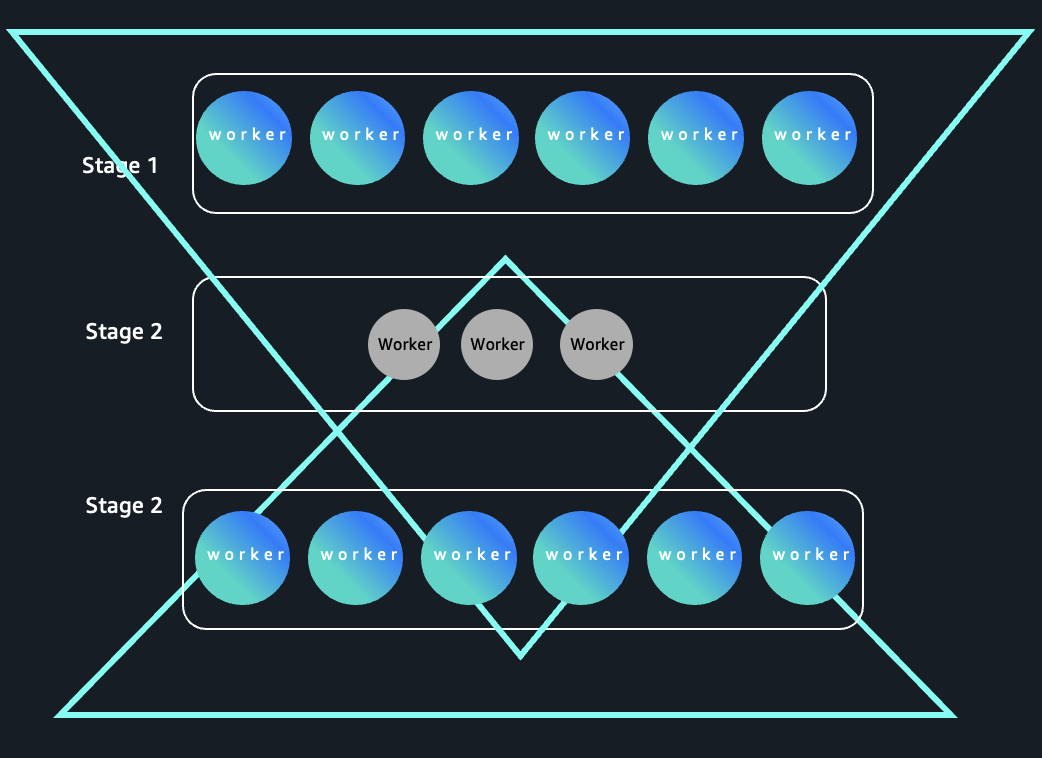
To identify queries of this category, consider the following example, The query progresses through three stages:
- Stage 1: The initial join and filter between
store_salesanditemproduces a wide, high-cardinality intermediate dataset, requiring high parallelism (many executors). - Stage 2: Aggregation groups by a small set of categories such as “Home” or “Electronics”, resulting in a drastic drop in output partitions. So this stage efficiently runs with only a few executors, as there’s little data to parallelize.
- Stage 3: The small result is joined (usually a broadcast join) back to a large fact table with a date dimension, again producing a large result that is well-parallelized, causing Spark to ramp up executor usage for this stage.
This pattern is common for reporting and dimensional analysis scenarios and is effective for demonstrating how Spark dynamically adjusts resource usage across job stages based on cardinality and parallelism needs. Such queries can also benefit from the elasticity enabled by external serverless storage.
Rectangle pattern queries
Not all queries benefit from externalizing the shuffle. Consider a query where the cardinality is high throughout, meaning both the stages operate on a large number of partitions and keys. Typically, queries that group by high-cardinality columns (such as item or customer) cause most stages to require similar amounts of parallelism. The following figure illustrates a Spark workload where parallelism remains consistently high across stages. In this pattern, both Stage 1 and Stage 2 operate on a large number of partitions and keys, resulting in sustained executor demand throughout the job lifecycle.
High-cardinality execution pattern with sustained parallelism
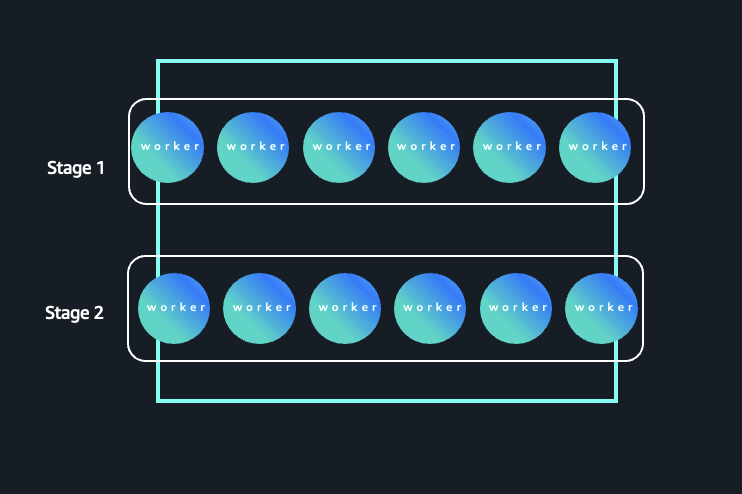
The following query is the same query that we used in the inverted triangle pattern earlier, with one change. We have replaced the dim_date table (low cardinality) with item (high cardinality).
- Stage 1: Reads the rows from
store_salesand joins withitem, spreading data across many partitions—similar to the original query’s first stage. - Stage 2: The aggregation is by
i_item_id, which normally has thousands to millions of distinct values in real datasets. This keeps parallelism high; many tasks handle non-overlapping keys, and shuffle outputs remain large.
There is no significant drop in cardinality: Because neither stage is reduced to a small group set, most executors stay busy throughout the job’s main phases, with little idle time even after the shuffle. This type of query results in a flatter executor utilization profile because each stage processes a similar volume of work, thus minimizing variation in resource utilization. These rectangle pattern queries will not see the cost benefit from the elasticity obtained by offloading shuffle data. However, there may still be other benefits such as reduction of job failures and performance bottlenecks from disk constraints, freedom from capacity planning and sizing, and provisioning of storage for intermediate data operations.
Conclusion
Serverless storage for Amazon EMR Serverless can deliver substantial cost savings for workloads with dynamic resource patterns, as seen in the 26% average cost savings we observed in our testing environment. By externalizing shuffle data, you can gain the elasticity to release idle executors immediately, demonstrated by the savings reaching up to 85% in our testing environment, on queries following inverted triangle and hourglass patterns when Dynamic Resource Allocation is enabled.Understanding your workload characteristics is key. While rectangle pattern queries may not see dramatic cost reductions, they can still benefit from improved reliability and removal of capacity planning overhead.
To get started: Analyze your job execution patterns, enable Dynamic Resource Allocation, and pilot serverless storage on shuffle-heavy workloads. Looking to reduce your Amazon EMR Serverless costs for Spark workloads? Explore serverless storage for EMR Serverless today.
About the authors
Optimize HBase reads with bucket caching on Amazon EMR
Post Syndicated from Yu-Ting Su original https://aws.amazon.com/blogs/big-data/optimize-hbase-reads-with-bucket-caching-on-amazon-emr/
Apache HBase is a database system for big data applications that efficiently manages billions of rows and millions of columns. Its distributed, column-oriented structure handles both structured and unstructured data while addressing speed, flexibility, and scalability challenges. Amazon EMR HBase on Amazon S3 extends these features by storing data directly in Amazon S3, enabling data persistence and cross-zone access while supporting compute-based cluster sizing and read-only replicas.
HBase BucketCache serves as an advanced L2 caching mechanism that works alongside traditional on-heap memory cache. It stores large data volumes outside the JVM heap, reducing garbage collection overhead while maintaining fast access. When combined with Amazon EBS gp3 SSDs, it provides near-HDFS performance at lower costs.
However, implementing terabyte-scale BucketCache in production environments presents challenges: determining optimal cache sizes, balancing cost versus performance, and configuring eviction policies for S3-backed storage.
In this post, we demonstrate how to improve HBase read performance by implementing bucket caching on Amazon EMR. Our tests reduced latency by 57.9% and improved throughput by 138.8%. This solution is particularly valuable for large-scale HBase deployments on Amazon S3 that need to optimize read performance while managing costs.
The following diagram shows Amazon EMR’s integration with Apache HBase and Amazon S3 to implement a multi-tiered caching strategy.
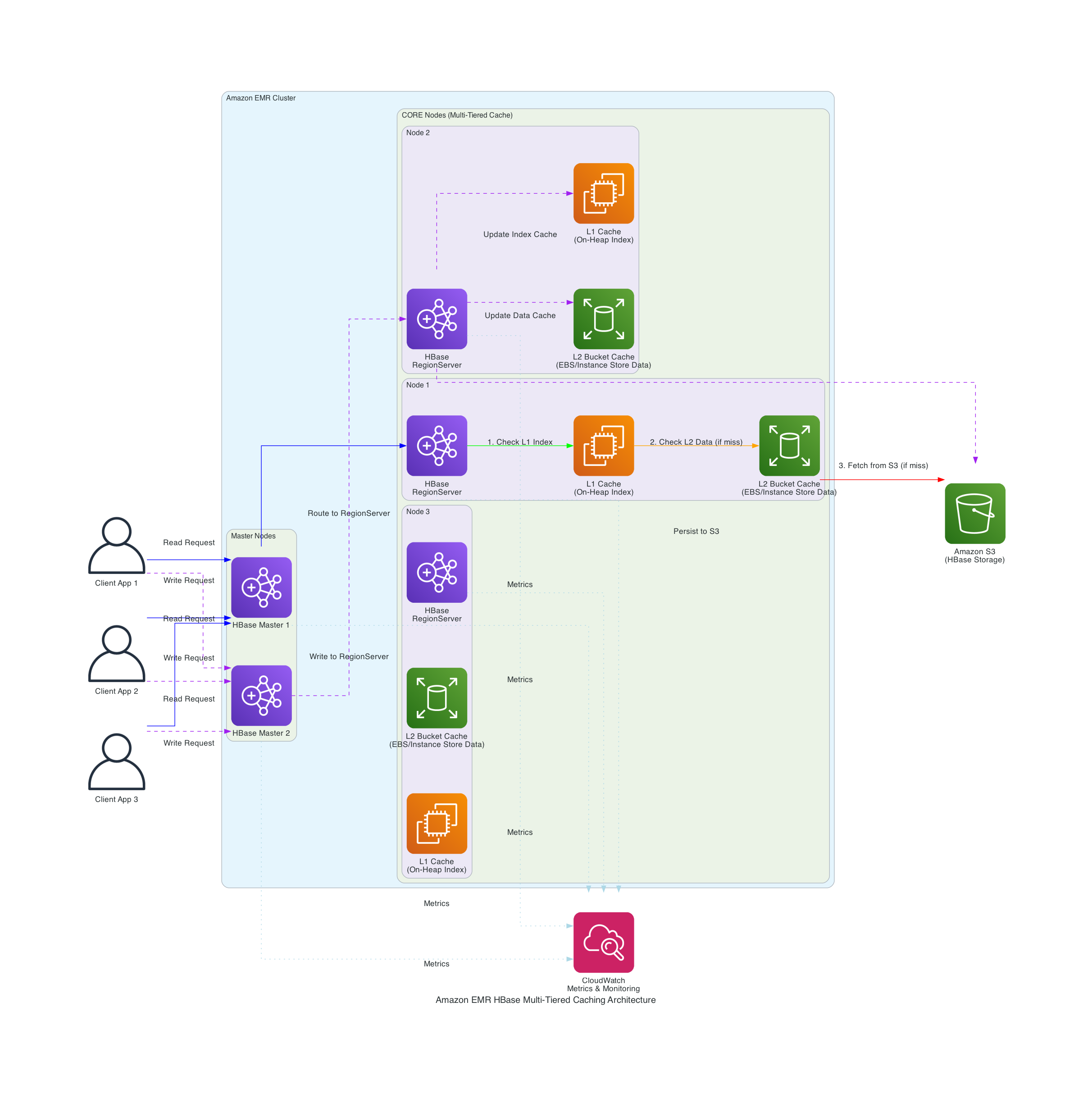
Figure 1 – Solution Architecture
The solution implements key components:
- Configure persistent bucket cache with validated parameters
- Implement cache-aware load balancing
- Use ZGC for improved garbage collection performance
- Monitor cache effectiveness through l2CacheHitRatio using Amazon EMR metrics
In our testing with datasets in terabytes, we achieved:
- Bucket cache hit ratios exceeding 95%
- S3 GET requests reduced to under 1,000/hour at peak performance
- Read latencies reduced to milliseconds
- Zero JVM pause detection during high read workloads
- 138.8% improvement in read throughput
Walkthrough
Prerequisites
This section shows how we improved HBase read performance using bucket caching on Amazon EMR in our tests. Before implementing this solution, you should have:
AWS resources
- An AWS account with appropriate permissions
- The following IAM roles:
- EMR_DefaultRole_V2
- EMR_EC2_DefaultRole with Amazon S3 access
- Familiarity with Apache HBase and Amazon EMR
Technical requirements:
- Amazon EMR version 7.10.0 or later
- Apache HBase 2.6.2 on Amazon EMR 7.10.0 or later
- ycsb 0.17.0 for benchmarking
- AWS CLI installed and configured
For setup instructions, refer to:
Create an EMR Cluster with optimized configuration
Create your EMR cluster using the following exampled launch command. This command is an optimization demo for terabyte-scale bucket caching:
Explain configurations for HBase optimized cache performance
In the above launch command, you can see configurations through the EMR software configurations. These settings are specifically for terabyte-scale caching scenarios. When HBase is installed on EMR, Apache YARN’s memory allocation is reduced by approximately 50% from its default configuration (68-73% of RAM) to 34-36% of physical RAM, reserving memory for HBase RegionServer operations. The cache and memstore sizes must be carefully balanced against available node memory to prevent resource contention.
The hbase.bucketcache.size parameter determines the total bucket cache size per RegionServer in megabytes, which directly affects how much data can be stored in bucket cache. If the data files are stored in compressed formats, you have to enable hbase.block.data.cachecompressed . This feature keeps blocks compressed in the cache, reducing memory footprint while maintaining quick access times. Your EBS size per RegionServer depends on the value of hbase.bucketcache.size. The configured EBS size can be the value of this feature plus a buffer for system usage. The hbase.bucketcache.bucket.sizes setting defines bucket sizes to efficiently accommodate different data block sizes, while hbase.bucketcache.writer.threads controls the number of threads used for writing to the cache, optimizing write performance.
In the above launch command, we configured ZGC settings to optimize garbage collection.
Using ZGC minimizes the need for a large JVM heap to accommodate JVM objects for large-scale bucket cache operations, resulting in fewer JVM pauses. By adjusting the heap size through increasing or decreasing the HBASE_HEAPSIZE parameter, you can optimize memory allocation for your specific workload. A key advantage of ZGC is that it keeps JVM pause times short regardless of heap size, whereas traditional garbage collectors experience longer full GC times as heap size increases. This makes ZGC particularly valuable for HBase deployments with terabyte-scale bucket caches, where maintaining consistent low-latency performance is critical.
The generational garbage collection settings efficiently manage memory by separating short-lived objects from long-lived ones, reducing collection frequency and overhead. The AlwaysPreTouch parameter improves Apache HBase responsiveness by pre-allocating memory during operation.
Explain EMR metrics collection configurations
In the above launch command, we set up configurations to publish emr metrics to CloudWatch through CloudWatch Agents. We can use these metrics to track bucket cache request amount and hit ratios. If L2CacheHitRatio is high but L2CacheMissCount is low, it means HBase can fetch most of the requested data in bucket cache. The read latencies can be shorted to milliseconds in this case.
Performance testing and results
This section details our performance testing methodology and results using a 7.9 TB dataset.
Test setup
- We used ycsb to generate and test with a 7.9 TB dataset.
- We used the following command to run a read-only workload:
| Configuration | Throughput (ops/sec) | Latency (ms) |
| Without Cache | 371.93 | 2680 |
| With Cache | 888.67 | 1127 |
| Improvement | 138.80% | 57.90% |
In our read performance test using bucket cache to cache terabytes of data, we achieved a 138.8% improvement in read throughput (from 371.93 to 888.67 ops/sec) and a 57.9% reduction in read latency (from 2680ms to 1127ms) compared to a scenario without bucket cache.
Read performance improvement
As shown in the previoustable, implementing bucket cache led to improvements in both throughput and latency. The system achieved a 138.8% increase in throughput, processing 888.67 operations per second compared to the baseline 371.93 ops/sec. Similarly, latency was reduced by 57.9%, dropping from 2680ms to 1127ms, demonstrating the performance benefits of the caching solution. The following chart shows implementing bucket cache led to improvements in average throughput compared to a scenario without bucket cache.
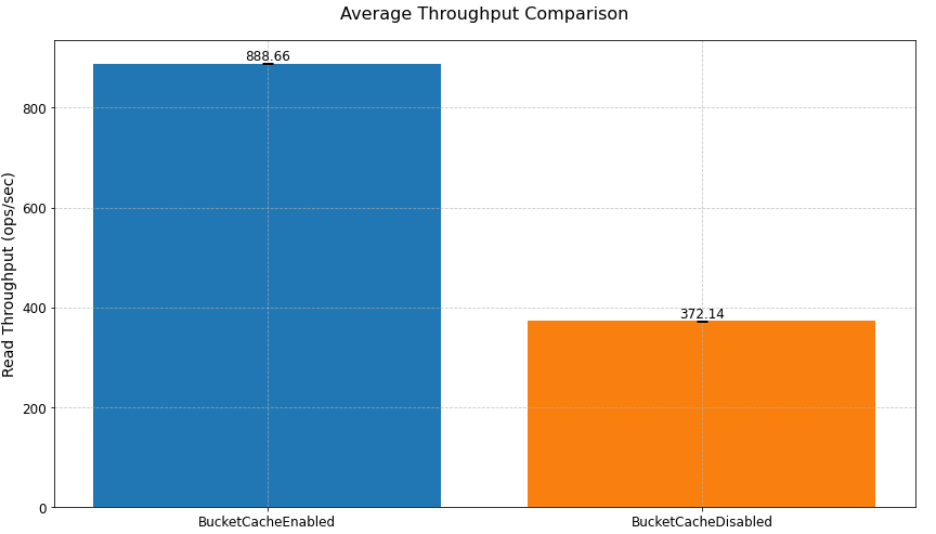
Figure 2 – Average throughput comparison
Cache hit ratio progression
The cache hit ratio data demonstrates the effectiveness of the bucket cache implementation over time. Starting from 0% at initialization, the cache hit ratio improved to 85% within 12 hours, ultimately stabilizing above 95% after 24 hours. This progression corresponded with an extensive reduction in Amazon S3 GetObject requests, from 95,000 per hour initially to fewer than 1,000 per hour at peak performance, reducing both latency and costs.
| Time (hours) | Hit Ratio | S3 Requests/hour |
| 0 | 0% | 95,000 |
| 12 | 85% | 15,000 |
| 24 | 95%+ | <1,000 |
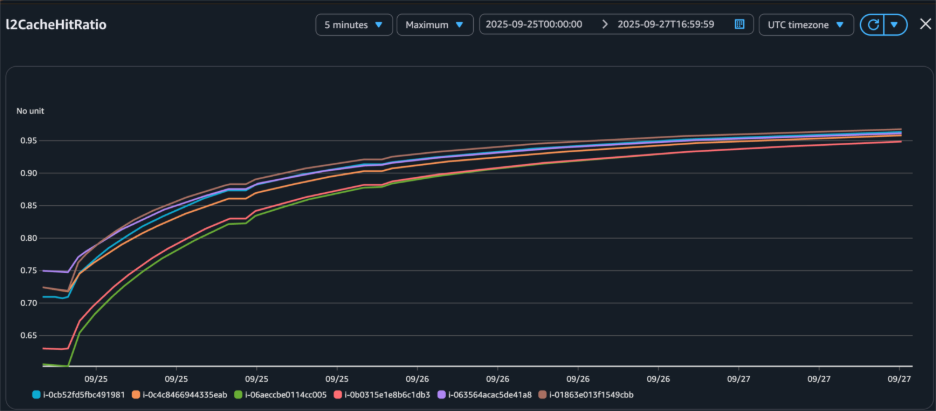
Figure 3 – Bucket cache hit ratio increased after we loaded data to bucket cache through read-only workload.
Figure 4 – Amazon S3 GetObject request count decreased as bucket cache hit ratio increased.
Key implementation: persistent bucket cache
One of the key features introduced in HBase 2.6.0 after Amazon EMR 7.6.0 is persistent bucket cache, which maintains cache data across RegionServer restarts. This feature is particularly for production environments where maintaining consistent performance during maintenance operations is crucial. The following section demonstrate how to configure persistent bucket cache.
Configuring persistent bucket cache
Set up persistent bucket cache by implementing these configurations:
Performance impact of persistent cache
The following table shows the tests demonstrated significant improvements in RegionServer restart performance. With persistent cache enabled, the HBase cluster maintained consistent read request performance and low latency after RegionServer restarts since data remained directly accessible in the bucket cache. In contrast, clusters without persistent cache required 6 hours to reload bucket cache after RegionServer restarts before achieving comparable read operation performance and latency levels. It demonstrates significant improvements from enabling persistent cache.
| Pre-restart throughput | Post-restart throughput | Recovery time | |
| Without Persistent Cache | 888.67 ops/sec | 371.93 ops/sec | ~6 hours |
| With Persistent Cache | 889.08 ops/sec | 886.71 ops/sec | <2 minutes |
In the following graph, the RegionServer L2 cache size metrics revealed that the bucket cache size remained stable after RegionServer restart, confirming that the cached data was preserved rather than reset during the process. The metrics were unavailable between 16:30 and 16:35 because the RegionServer was stopped and restarted.
Figure 5 – The bucket cache size remained stable after RegionServer restart
L2 cache miss count is a cumulative metric that tracks cache misses from RegionServer startup. When the RegionServer restarts, this metric resets to zero. In the following graph, the L2 cache miss count increased steeply at the beginning because read requests retrieved data from HFiles, as the data had not yet been loaded into bucket cache. Over time, the bucket cache was populated with data through read-only workload, and the slope of the L2 cache miss count decreased. We restarted RegionServer between 16:30 and 16:35 . Thus, L2 cache miss count reset to 0. Notably, these metrics remained at zero even during subsequent client read operations. The requests did not retrieve data from HFiles that caused an increase in L2 cache miss count. This confirmed that data persisted in the bucket cache and was directly accessible without requiring cache rebuilding.
Figure 6 – Regionserver bucketcache miss count remained 0 after restarting RegionServer
The RegionServer read request count metrics demonstrated consistent read operation volumes following restart. This indicated that RegionServers maintained read performance levels without needing to fetch HFiles from Amazon S3, thus avoiding the increased latency and reduced throughput typically associated with S3 lookups. This persistent cache behavior directly reduces S3 costs by minimizing API calls—our above testing statistics showed S3 GET requests dropping from 95,000 per hour during initial cache warming to fewer than 1,000 per hour once the cache reached optimal performance, representing a 99% reduction in S3 API call volume.
Figure 7 – Regionserver read request count
Best practices and recommendations
In this section, we share guidelines to optimize HBase bucket cache performance.
cache sizing guidelines
- Enable
hbase.block.data.cachecompressedwhen working with compressed Hfiles: This setting ensures data blocks are stored in the bucket cache in compressed form, saving memory and improving efficiency. - Activate
hbase.rs.cachecompactedblocksonwrite: This prevents data eviction during HBase compactions.
For optimal performance, size your bucket cache appropriately by ensuring the total cache size exceeds your target cached data volume. Insufficient bucket cache size will lead to frequent data evictions, degrading system performance. Monitor free cache space using Amazon CloudWatch metrics to prevent overflow issues. Furthermore, consistently analyze L2 cache hit ratio metrics to assess performance, and adjust bucket cache size based on your specific workload patterns and L2 hit ratio trends. These ongoing monitoring and adjustment practices will help maintain optimal cache performance and resource utilization.
Performance optimization
To further enhance HBase read performance, consider implementing the following configuration settings. These optimizations are designed to improve cache utilization, reduce disk I/O, and minimize latency for common read operations:
Resource monitoring
Set up Amazon CloudWatch dashboards to monitor key metrics. These dashboards should track L2 cache hit ratios, which provide insight into the effectiveness of your caching strategy. Additionally, monitor Amazon S3 request patterns to understand your data access trends and optimize accordingly. Keep a close eye on memory utilization to ensure your instances have sufficient resources to handle the workload efficiently. Finally, regularly analyze garbage collection (GC) patterns to identify and address any potential memory management issues that could impact performance.
Cleaning up
To avoid incurring unnecessary charges, clean up your resources when you’re done testing
Conclusion
In this post, you learned how to implement and optimize HBase bucket cache with persistent storage on Amazon EMR. In our testing, we achieved 95%+ cache hit ratios with consistent millisecond latencies. The implementation reduced Amazon S3 access costs by minimizing the number of direct Amazon S3 requests required. Read performance saw 138.8% improvement in read throughput. The system maintained stable performance during maintenance windows, eliminating performance degradation during routine operations. Additionally, the solution demonstrated better resource utilization, maximizing the efficiency of the allocated infrastructure while minimizing waste.
Related resources
About the author
How Neocloud Alliances Reduce the Internet’s Largest Single Point of Failure
Post Syndicated from Maddie Presland original https://www.backblaze.com/blog/how-neocloud-alliances-reduce-the-internets-largest-single-point-of-failure/

When AWS’s us-east-1 region went down for over 15 hours on October 20, 2025, the cascade of failures exposed just how fragile the internet’s infrastructure has become. Major services like Discord, Slack, Atlassian, and parts of Netflix suddenly went dark. These companies weren’t all direct AWS customers, but the vendors they relied on were. Authentication systems failed. CDNs stopped responding. Monitoring tools went blind. Companies that thought they’d diversified their cloud strategy discovered their backups were just as offline as their primary systems.
This was far from an isolated incident. CrowdStrike’s faulty update took down 8.5 million Windows machines in July 2024. Microsoft Azure suffered multiple regional outages throughout 2024 and 2025 affecting Office 365, Teams, and Azure DevOps. The pattern is clear: As more of the internet’s critical infrastructure consolidates onto a handful of hyperscale providers, the blast radius of any single failure grows exponentially.
The solutions organizations thought they’d implemented, like multi-cloud deployments, redundant architectures, and disaster recovery plans, often provide little more than the illusion of protection.
The illusion of diversification
A company migrates its primary compute workload from AWS to Google Cloud or Azure, checks the “multi-cloud” box, and considers the job done. But authentication still runs through AWS Cognito. The CDN is CloudFront. Monitoring lives in CloudWatch. DNS resolution depends on Route 53. When AWS’s control plane fails, the entire architecture collapses regardless of where the compute actually runs.
ThousandEyes documented exactly this pattern during the October 2025 AWS outage. Packet loss and routing instability affected direct AWS customers and cascaded into dependent networks and services that appeared independent on paper, but shared the same regional infrastructure under the hood. Organizations often discover these dependencies only during outages, when it’s too late to do anything about them.
Why concentration accelerates despite known risks
Everyone knows concentration is dangerous, yet it keeps accelerating. The same forces that make hyperscalers attractive—operational simplicity, unified tooling, procurement efficiency—concentrate risk faster than diversification efforts can mitigate it.
Teams often adopt unified tooling for operational simplicity, which reduces integration costs and builds vendor-specific expertise. As more systems integrate with that tooling, switching costs increase. Eventually, the platform becomes the default rather than a choice. Each new service added to the stack makes it harder to leave.
Hyperscaler architecture isn’t just a risk, it’s a cost
Amplify’s AWS egress fees were growing to 10x their storage costs as customers downloaded more datasets. CTO Ameya Pathare evaluated Azure, Google Cloud, Digital Ocean, and Wasabi before building a modular architecture: Snowflake for data transformation and Backblaze B2 for staging, with outputs available across Google BigQuery and Tableau.
The two-week migration with zero downtime delivered 70% cost savings that compound with every download. When individual providers experience issues, customers maintain access through alternative paths. “If we had stayed on AWS, we’d have needed to change our pricing and pass on those egress fees to the customer,” Pathare says.
Diversification efforts lag behind because they require deliberate architectural decisions that run counter to operational efficiency. According to the CNCF’s 2025 State of Cloud report, 30% of organizations deploy to hybrid cloud environments and 23% to multi-cloud. That sounds encouraging until you look at what they’re actually distributing. Most organizations spread their compute across providers while consolidating authentication, orchestration, and monitoring with a single vendor. Deployment location differs from dependency structure.
Gartner projects that 90% of organizations will adopt hybrid cloud approaches by 2027. But without intentional failure domain separation, these deployments maintain the same concentrated dependencies they’re meant to avoid.
Why untested recovery paths fail
Most organizations treat failover mechanisms like insurance policies: pay the premium, file the documentation, and hope you never need to use it. Then an outage hits and they discover their recovery paths don’t actually work.
Google’s SRE team analyzed this pattern in their twenty-year retrospective: “Recovery mechanisms that are not tested before an incident routinely fail when they are needed most.” Configuration drift makes systems behave differently in production than they did in testing. Teams encounter unfamiliar tooling under pressure. Communication systems fail because they rely on the same infrastructure that’s down.
Three practices separate resilient systems from brittle ones:
- Explicit failure domain mapping: Document which components fail together, including indirect dependencies. During Google’s 2017 OAuth incident, teams assumed Hangouts and Meet would remain available for coordination during the recovery. Both services relied on the failing authentication system.
- Continuous exercised recovery: Failover paths tested regularly rather than only during incidents. YouTube’s 2016 caching failure required risky load-shedding operations that had never been practiced outside staging environments.
- Graceful degradation by design: Systems intentionally reduce functionality rather than collapse completely. Without this capability built in and tested, systems crash entirely instead of slowing down when they encounter partial failures.
Most organizations implement sophisticated monitoring and alerting but lack tested mechanisms to act on that information when infrastructure degrades.
How modular infrastructure reduces risk
Resilient architectures break infrastructure into interoperable components from specialized providers. Organizations can select compute, storage, networking, and delivery independently based on performance and reliability characteristics. A disruption in one layer no longer automatically incapacitates the entire system.
Cloudflare’s October 30, 2023 incident demonstrates what happens when this separation doesn’t exist. A deployment misconfiguration propagated across tightly coupled internal services. Workers KV became unreachable, which cascaded into failures across Pages, Access, Zero Trust, Images, and the Cloudflare Dashboard itself. Shared tooling and control systems collapsed multiple services into a single failure domain, even within a provider marketed as redundant.
Sardius Media demonstrates what modular cloud infrastructure looks like in practice. The company architected its system from inception to be cloud-agnostic, using a race algorithm that queries multiple cloud providers and CDNs for every API call and selects the fastest response. True resilience through competitive redundancy.
The data layer as a gating factor
Storage architecture determines whether all this architectural planning actually works. Can your data move when you need it to? The answer depends on whether systems can replicate and recover across providers under real-world conditions.
Control-plane access matters more than data replication. During Google Cloud’s June 2025 API misconfiguration, Gmail, Spotify, and Cloudflare went dark despite having intact data layers. Replication across availability zones provided no protection when authentication and API access failed.
Three technical barriers trap workloads in place:
- Large dataset transfer costs make migration prohibitively expensive.
- Proprietary vendor APIs create application lock-in that requires substantial refactoring to escape.
- Unpredictable egress charges turn what was supposed to be a temporary deployment into permanent infrastructure because moving the data out costs more than leaving it there.
Storage architectures that support open APIs, predictable pricing, and cross-provider replication enable genuine mobility. Systems can replicate data across providers, recover faster from incidents through parallel data access, and maintain portable compute and delivery layers. Implementation requires mapping both direct dependencies (compute, storage, CDN) and indirect ones (managed services that converge on the same infrastructure), then assigning explicit recovery requirements to critical workloads.
From scattered clouds to a united front
The internet’s reliability challenges stem from correlated dependencies rather than cloud technology. Neocloud ecosystems make resilient architectures achievable by promoting specialization and interoperability.
Organizations can select best-of-breed providers for each infrastructure layer—compute, storage, networking, delivery—without forcing everything through a single vendor’s control plane. Open cloud storage ensures those ecosystems remain flexible under pressure, with data that can replicate across providers, portable applications that aren’t locked into proprietary APIs, and predictable costs that don’t trap workloads in place.
The result is systems that continue operating when individual providers fail. They’ve ensured that failures remain isolated rather than cascading across the entire architecture.
The post How Neocloud Alliances Reduce the Internet’s Largest Single Point of Failure appeared first on Backblaze Blog | Cloud Storage & Cloud Backup
Purple Teaming in 2026: From Assumed Protection to Measurable Resilience
Post Syndicated from Aaron Herndon original https://www.rapid7.com/blog/post/so-purple-teaming-assumed-protection-to-measurable-resilience
What is purple teaming?
Purple teaming is often described as the collaboration between red teams and blue teams. That definition is accurate, but incomplete. At its core, purple teaming is about exposure validation: deliberately testing whether the threats you believe you can detect and contain are actually visible in your environment.
Red teams simulate attacker behavior. Blue teams defend and respond. Purple teaming ensures those two functions operate in lockstep, sharing telemetry, assumptions, and findings to strengthen detection coverage and close control gaps.
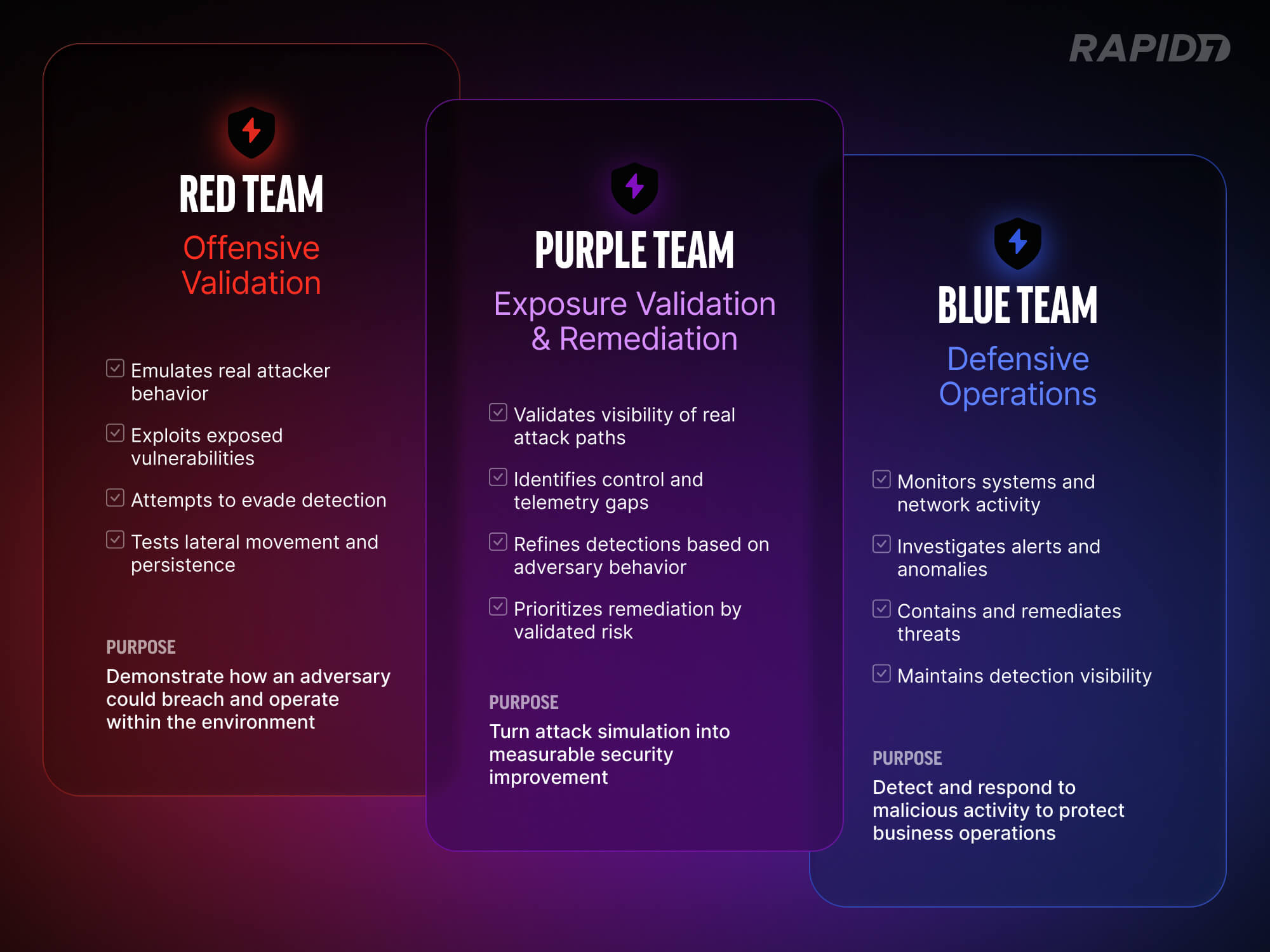
⠀
Unlike traditional penetration testing, which is often point-in-time and compliance-driven, purple teaming is iterative. It is designed to measure, refine, and retest. The goal is not to “win” an exercise. The goal is to improve the organization’s ability to detect, investigate, and contain real attack paths.
Many security programs look mature on paper. Controls are deployed. EDR is in place. Logging is centralized. Dashboards show green indicators. Yet when realistic attacker behavior is exercised inside the environment, gaps often surface quickly. Telemetry may be incomplete. Detection rules may exist but lack tuning. Alerts may trigger without clear ownership or response workflow.
Purple teaming exists to close the gap between perceived protection and actual defensive capability. It replaces assumption with validation.
What purple teaming actually means in 2026
Purple teaming is often described as collaboration between red and blue teams. In practice, it is structured exposure validation conducted in an open-book format.
Offensive operators simulate real-world attack scenarios in coordination with defensive teams. The security operations or incident response team is aware of the exercise from the outset. Together, they define the threat scenarios to test specific response playbooks and detection coverage. The objective is not to surprise the SOC. It is to measure whether detection, telemetry, and response workflows operate as intended and to refine them in real time.
If defensive teams cannot follow a tactic or lack necessary telemetry, activities pause. Gaps are identified and corrected collaboratively. Purple teaming strengthens detection engineering, investigative workflows, and cross-team communication without the pressure of a live incident.
Beyond scorecards: Real-world context matters
Some organizations equate purple teaming with automated breach and attack simulation tools. A sequence of techniques is executed against an assumed compromised host, and a report shows which detection rules are fired. Those metrics can provide visibility into rule coverage. They do not show whether an attacker can exploit real exposures in the environment.
A more contextual approach begins with tailored threat scenarios based on the organization’s actual risk profile. Operators assess real vulnerabilities and misconfigurations rather than firing generic techniques. The focus is not simply to validate rules but to determine whether exploitable exposures exist that blend into legitimate functionality.
Attackers often operate within intended system behavior. They abuse excessive permissions, leverage trust relationships, and exploit architectural weaknesses that were never designed to generate alerts. In these cases, writing a new detection rule does not address the underlying issue. The exposure stems from posture and configuration.
Lateral movement is then executed using access that genuinely exists in the environment. The question becomes whether the organization can observe attacker progression through normal administrative pathways and whether defensive visibility extends beyond initial compromise.
Persistence techniques are established in ways consistent with how an adversary would maintain access in that specific configuration. Detection is measured continuously.
The engagement concludes with a collaborative hunt exercise. The breach lifecycle is recreated without triggering alerts, followed by the intentional generation of a single alert. Teams then work from that signal to reconstruct the attack chain. This phase often reveals how tooling, telemetry, and processes function under structured scrutiny.
Where red teaming fits: Vector Command
It is important to distinguish purple teaming from red teaming.
In a true red team engagement, the SOC and incident response teams are not aware of the breach. Operators attempt to remain undetected for as long as possible. The goal is to emulate a real adversary and test how the organization responds under live conditions.
This is how Vector Command operates. It functions as a continuous red team service, attempting to breach client environments and achieve defined objectives while avoiding detection. If detection occurs during a red team engagement, the SOC response is observed as it would be during a genuine incident. This tests process maturity, investigative speed, and real-world visibility. If and when a breach is detected, the engagement can transition into a collaborative purple team phase. At that point, operators work openly with the SOC to walk through the attack path, identify detection gaps, and refine telemetry and response workflows.
Red teaming measures whether defenses hold up under pressure. Purple teaming refines those defenses collaboratively.
The two approaches are complementary. A red team engagement may identify a successful breach path. After that breach concludes, organizations can transition into purple team activities. Offensive findings are shared openly with defensive teams, and gaps are tuned and remediated. When paired with managed detection and response services, this refinement can occur in coordination with both the customer’s security team and the managed SOC.
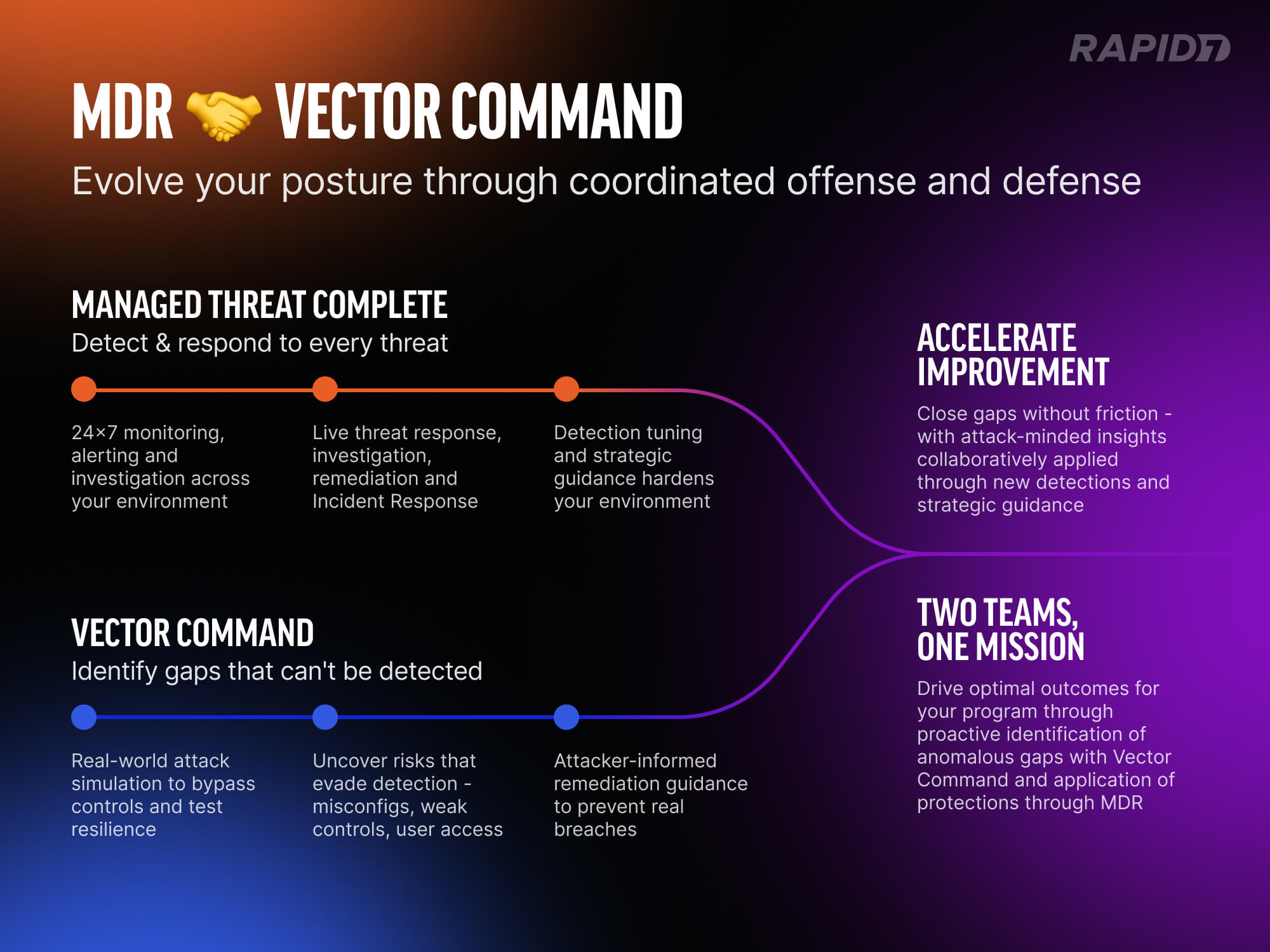
⠀
In this model, red teaming exposes real weaknesses. Purple teaming strengthens defenses against them.
What effective purple teaming delivers
Effective purple teaming produces operational improvement rather than a static report.
-
Detection logic improves because it is tuned against real attacker behavior
-
Telemetry gaps are identified and corrected
-
Ownership of investigation workflows becomes clear
-
Remediation is prioritized against validated attack paths rather than theoretical risk
For senior security leaders, the value is measurable control effectiveness. Purple teaming provides evidence that investments in tools and people translate into improved resilience. It also builds alignment between offensive and defensive teams. That alignment accelerates improvement and reduces friction across security, IT, and operations.
In an environment where attack techniques evolve and exposure surfaces expand, purple teaming offers something concrete: validated insight into how well the organization can detect, investigate, and contain adversary behavior.
Resilience should not be assumed. It should be tested.
AWS Security Hub is expanding to unify security operations across multicloud environments
Post Syndicated from Gee Rittenhouse original https://aws.amazon.com/blogs/security/aws-security-hub-is-expanding-to-unify-security-operations-across-multicloud-environments/
After talking with many customers, one thing is clear: the security challenge has not gotten easier. Enterprises today operate across a complex mix of environments, including on-premises infrastructure, private data centers, and multiple clouds, often with tools that were never designed to work together. The result is enterprise security teams spend more time managing tools than managing risk, making it harder to stay ahead of threats across an increasingly complex environment.
At Amazon Web Service (AWS), we believe security should be simple, integrated, and built for the way enterprises actually operate. This belief is what drove us to reimagine AWS Security Hub, delivering full-stack security through a single experience, and this vision is driving our next chapter.
Building on a foundation of unified security
We transformed Security Hub into a unified security operations solution by bringing together AWS security services, including Amazon GuardDuty, Amazon Inspector, AWS Security Hub Cloud Security Posture Management (Security Hub CSPM), and Amazon Macie, into a single experience that automatically and continuously analyzes security signals across threats, vulnerabilities, misconfigurations, and sensitive data. Security Hub delivers a common foundation, bringing together findings from across your AWS environment so your security team spends less time translating signals and more time acting on them. Built on top of that foundation, a unified operations layer gives security teams near real-time risk analytics, automated analysis, and prioritized insights, helping them focus on what matters most, at scale.
We also introduced new capabilities (the Extended plan) that simplify how enterprises procure, deploy, and integrate a full-stack security solution across endpoint, identity, email, network, data, browser, cloud, AI, and security operations. Now, customers can use Security Hub to expand their security portfolio through a curated selection of AWS Partner solutions (at launch: 7AI, Britive, CrowdStrike, Cyera, Island, Noma, Okta, Oligo, Opti, Proofpoint, SailPoint, Splunk (a Cisco company), Upwind, and Zscaler), all through one unified experience. With AWS as the seller of record, you benefit from pay-as-you-go pricing, a single bill, and no long-term commitments. Our goal is simple: unified security, everywhere your enterprise operates.
Freedom to innovate, wherever your workloads are
At AWS, interoperability means giving customers the freedom to choose solutions that best suit their needs, and the ability to use them wherever their workloads run. But freedom to innovate across multicloud environments also means that it is critical to secure them consistently, and without adding operational complexity.
What’s coming for Security Hub
In the coming months, we are expanding Security Hub with new multicloud capabilities that extend unified security operations beyond AWS. The foundation of this expansion is a common data layer that unifies security signals from wherever your workloads run. On top of that, a unified policy and operations layer delivers consistent posture management, exposure analysis, and risk prioritization, so your security team operates from a single view of risk rather than a fragmented collection of consoles.
Security Hub will deliver unified risk analytics that surface critical risks across your multicloud estate. You’ll be able to manage cloud security posture with Security Hub CSPM checks that give you consistent posture visibility, and extend vulnerability management with expanded Amazon Inspector capabilities, including virtual machine scanning, container image scanning, and serverless scanning. Security Hub will also deliver external network scanning that enriches security findings with context about internet-facing exposure across your multicloud environment, including for resources not running in AWS.
The result is more comprehensive risk coverage across your enterprise. It’s about giving your security team a single, unified experience to detect and respond to risks, wherever you operate.
Security as a business enabler
The security leaders I speak with aren’t just asking for better tools. They’re asking for a way to get ahead of risk, not just manage it. They want security that keeps pace with the business, not security that slows it down.
That’s the vision behind AWS Security Hub: unified security through a single, integrated security operations experience, built on a common data foundation, powered by intelligent analytics, and delivered through a consistent operations layer, to help reduce security risk, improve team productivity, and strengthen security operations across AWS and beyond.
Our multicloud expansion is underway, and we are just getting started.
You can learn more at aws.amazon.com/security-hub, or visit us at the AWS booth (S-0466) at RSA Conference, March 23–26 in San Francisco.