Amazon FSx for NetApp ONTAP now integrates with Amazon S3 for seamless data access

Post Syndicated from Veliswa Boya original https://aws.amazon.com/blogs/aws/amazon-fsx-for-netapp-ontap-now-integrates-with-amazon-s3-for-seamless-data-access/

Today, we’re announcing the ability to access your data in Amazon FSx for NetApp ONTAP file systems using Amazon Simple Storage Service (Amazon S3). With this capability, you can use your enterprise file data to augment generative AI applications with Amazon Bedrock Knowledge Bases for Retrieval Augmented Generation (RAG), train machine learning (ML) models with Amazon SageMaker, generate insights with Amazon S3 integrated third-party services, use comprehensive research capabilities in AI-powered business intelligence (BI) tools such as Amazon Quick Suite, and run analyses using Amazon S3 based cloud-native applications, all while your file data continues to reside in your FSx for NetApp ONTAP file system.

Amazon FSx for NetApp ONTAP is the first and fully AWS managed NetApp ONTAP file system in the cloud to migrate on-premises applications that rely on NetApp ONTAP or other network-attached storage (NAS) appliances to AWS without having to change how you manage your data. FSx for NetApp ONTAP provides the popular capabilities, high performance, and data management APIs of ONTAP file systems with the added benefits of the AWS Cloud, such as simplified management, on-demand scaling, and seamless integration with other AWS services.

Over the years, AWS has developed a broad range of industry-leading AI, ML, and analytics services and applications that work with data in Amazon S3 that organizations use to innovate faster, discover new insights, and make even better data-driven decisions. However, some organizations want to use these services with their enterprise file data stored in NetApp ONTAP or other NAS appliances.

How to get started
You can create and attach an S3 Access Point to your FSx for ONTAP file system using the Amazon FSx console, the AWS Command Line Interface (AWS CLI), or the AWS SDK.

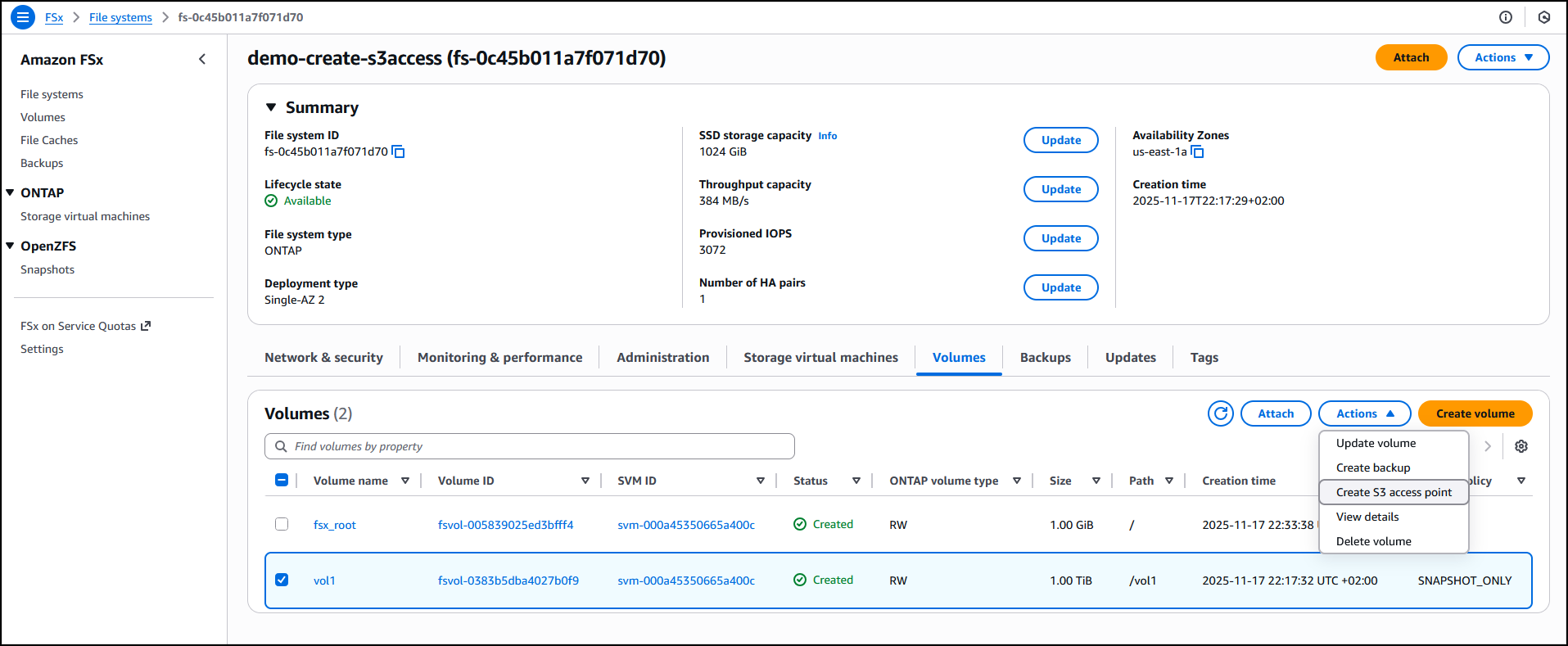
I have an existing FSx for ONTAP file system demo-create-s3access which I created by following the steps in the Creating file systems in the FSx for ONTAP documentation. Using the Amazon FSx console I now choose the file system ID fs-0c45b011a7f071d70 to access the full details of the file system.

I’ll attach the access point to the volume of the file system. I choose the volume vol1 and then select Create S3 Access Point from the Actions dropdown menu.


I enter details such as the access point name, the type of file system user identity and the network configuration, then choose Create s3 Access Point to finalize the process.


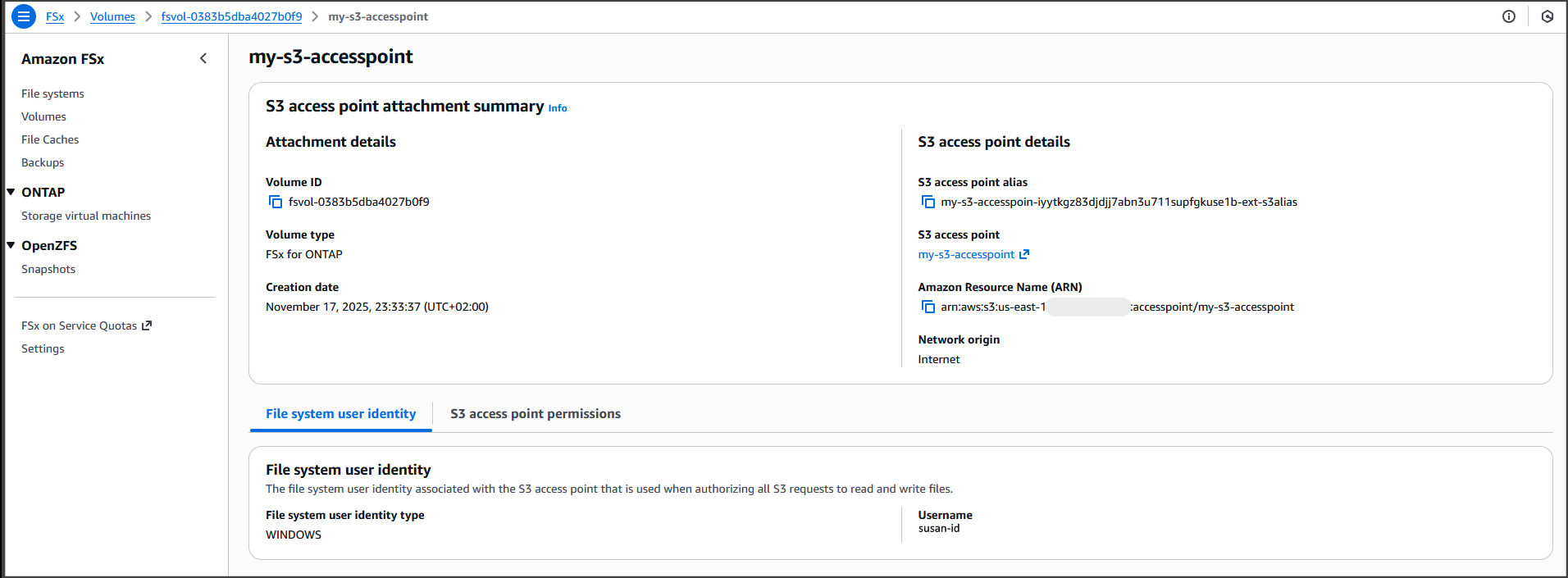
After it’s created, the access point my-s3-accesspoint is ready to allow access to the file data stored in my file system demo-create-s3access from Amazon S3. Amazon Access Points are S3 endpoints that can be attached to Amazon FSx volumes and used to perform Amazon S3 object operations.


I can now bring proprietary data stored in the file system demo-create-s3access to Amazon S3 for use in applications that work with Amazon S3 while my file data continues to reside in the FSx for NetApp ONTAP file system using the access point my-s3-accesspoint (this data remains accessible through the file protocols).

For the walkthrough in this post, I’ll integrate with Quick Suite.

Integrating decades of enterprise file data with the latest AI powered BI tools on AWS
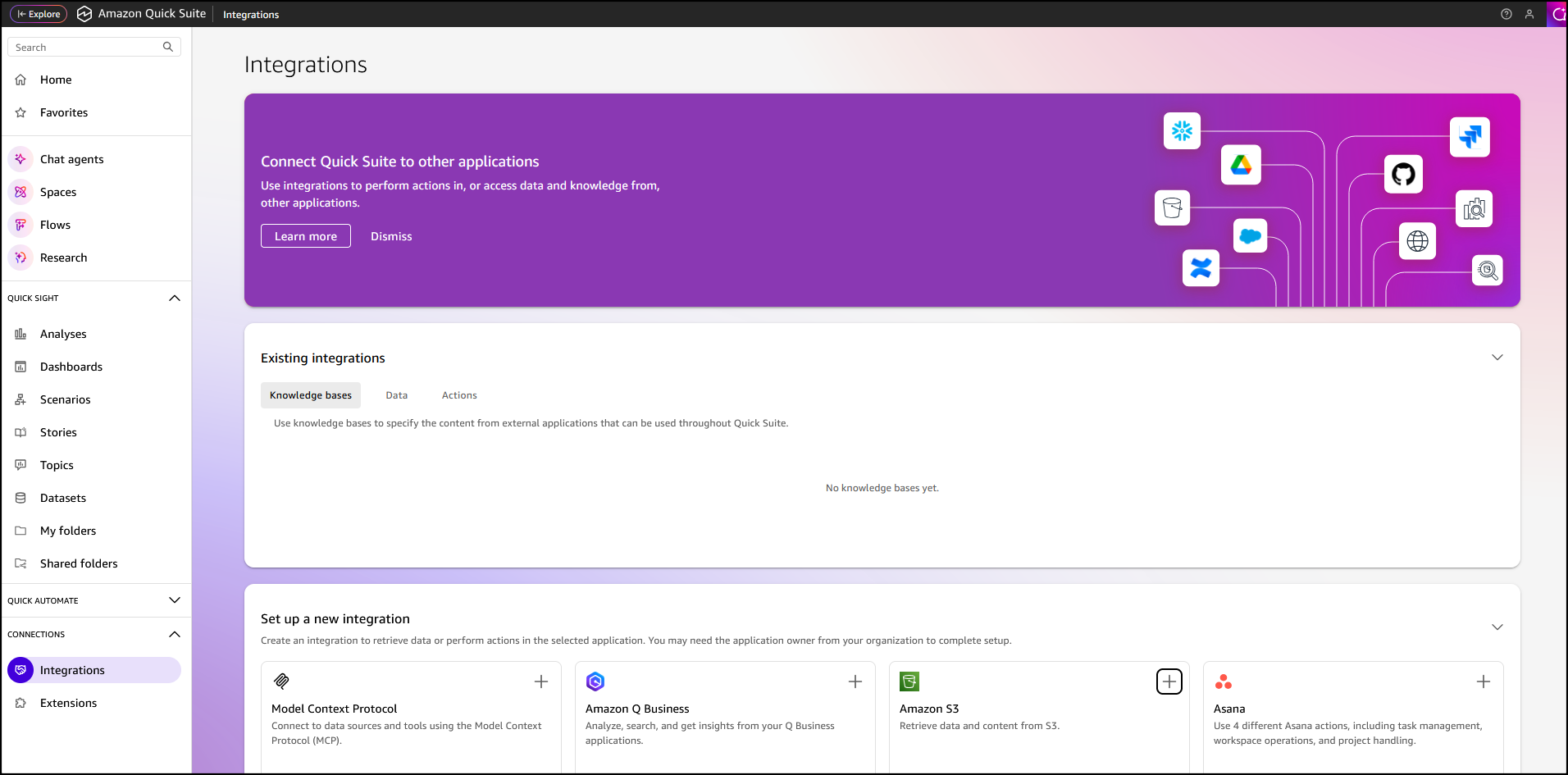
In the Quick Suite Console, in the left navigation pane, I choose Connections, then select Integrations. Before you begin, make sure that you have the correct permissions to the Amazon S3 AWS resource. You can control the AWS resources that Quick Suite can access by following the Amazon Quick Suite user guide.


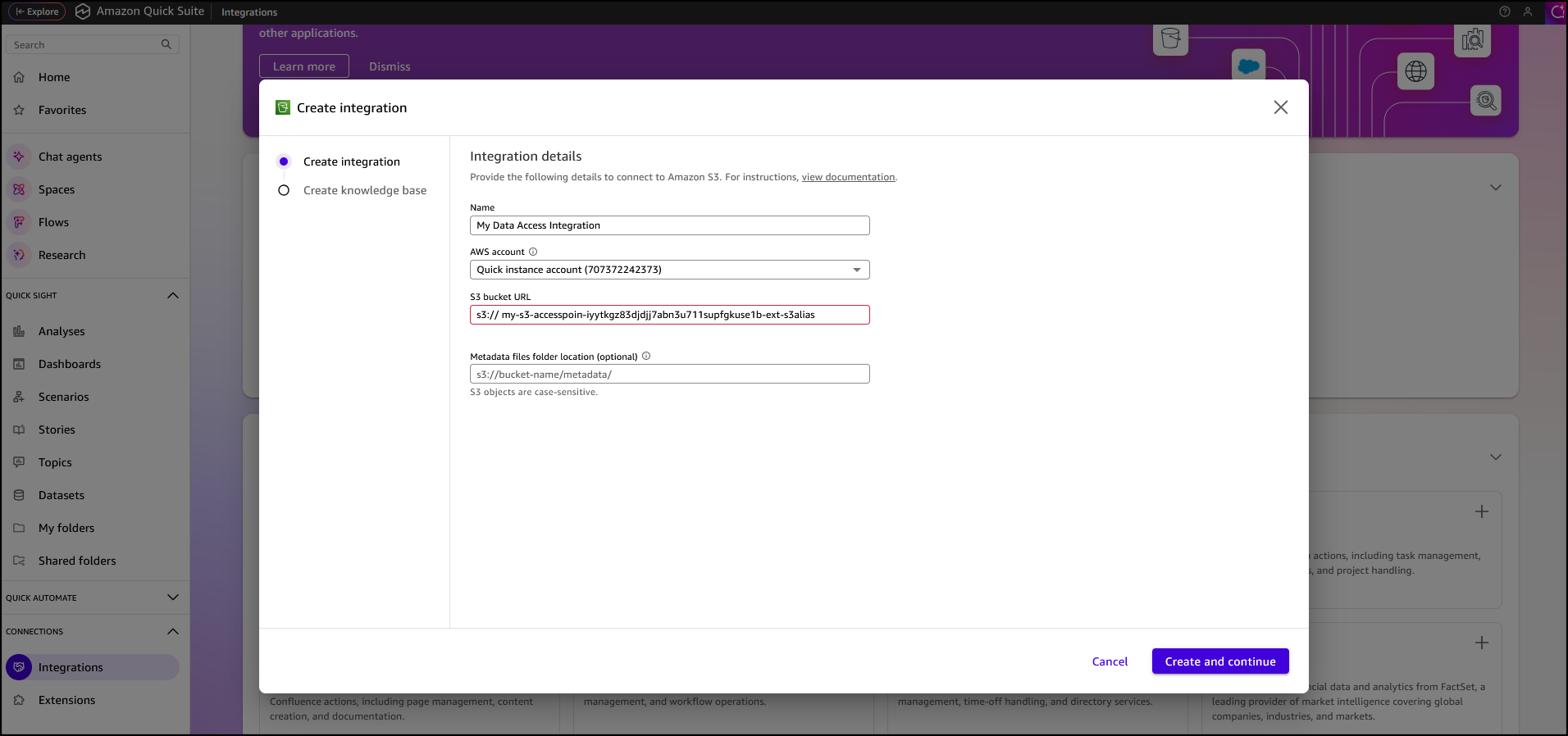
After I’ve selected the Amazon S3 integration I enter my Amazon S3 Access Point alias as the S3 bucket URL, leave the rest of the information as default, then choose Create and continue.


I finalize the process by providing the Name of the knowledge base, the Description, then choose Create.


After the knowledge base has been created it’s automatically synchronized, it’s now available for interaction.


I want to learn more about the AWS European Sovereign Cloud so I’ve updated the file system (accessed through the S3 Access Point my-s3-accesspoin-iyytkgz83djdjj7abn3u711supfgkuse1b-ext-s3alias) with the AWS whitepaper on this topic. In the chat in Amazon Quick Suite. I start asking the first question “do we have any documentation on the europe sovereignty cloud?“. To answer my question, the chat agent accesses and analyzes various types of data sources I have permission to use, including uploaded files in my current conversation, spaces I have access to, knowledge bases from my integrations, and more.

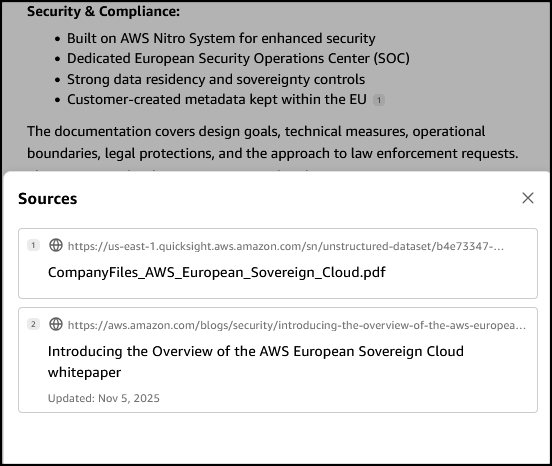
When I verify the source, I see that the document I uploaded to my file system is listed as one of the sources.

Other use cases of Amazon S3 Access Points for Amazon FSx for NetApp ONTAP
Earlier, we looked at use cases such as connecting an organization’s proprietary file data to Amazon Quick Suite for advanced business intelligence. Additionally, Amazon S3 Access Points for Amazon FSx for NetApp ONTAP can be used to seamlessly integrate enterprise file data with comprehensive analytics services, such as Amazon Athena for serverless SQL queries or AWS Glue for ETL processing, to name a few.

Amazon S3 Access Points for Amazon FSx for NetApp ONTAP are also suitable for data access from serverless compute workloads that are cloud-native with containerized microservices that require flexible access to shared enterprise datasets, such as configuration files, reference data, content libraries, model artifacts, and application assets.

Now available
You can get started today using the Amazon FSx console, AWS CLI, or AWS SDK to attach Amazon S3 Access Points to your Amazon FSx for NetApp ONTAP file systems. The feature is available in the following AWS Regions: Africa (Cape Town), Asia Pacific (Hong Kong, Hyderabad, Jakarta, Melbourne, Mumbai, Osaka, Seoul, Singapore, Sydney, Tokyo), Canada (Central, Calgary), Europe (Frankfurt, Ireland, London, Milan, Paris, Spain, Stockholm, Zurich), Israel (Tel Aviv), Middle East (Bahrain, UAE), South America (Sao Paulo), US East (N. Virginia, Ohio), and US West (N. California Oregon). You’re billed by Amazon S3 for the requests and data transfer costs through your S3 Access Point, in addition to your standard Amazon FSx charges. Learn more on the Amazon FSx for NetApp ONTAP pricing page.

PS: Writing a blog post at AWS is always a team effort, even when you see only one name under the post title. In this case, I want to thank Luke Miller, for his expertise and generous help with technical guidance, which made this overview possible and comprehensive.

– Veliswa Boya.

Introducing Amazon Nova 2 Lite, a fast, cost-effective reasoning model

Post Syndicated from Danilo Poccia original https://aws.amazon.com/blogs/aws/introducing-amazon-nova-2-lite-a-fast-cost-effective-reasoning-model/

Today, we’re releasing Amazon Nova 2 Lite, a fast, cost-effective reasoning model for everyday workloads. Available in Amazon Bedrock, the model offers industry-leading price performance and helps enterprises and developers build capable, reliable, and efficient agentic-AI applications. For organizations who need AI that truly understands their domain, Nova 2 Lite is the best model to use with Nova Forge to build their own frontier intelligence.

Nova 2 Lite supports extended thinking, including step-by-step reasoning and task decomposition, before providing a response or taking action. Extended thinking is off by default to deliver fast, cost-optimized responses, but when deeper analysis is needed, you can turn it on and choose from three thinking budget levels: low, medium, or high, giving you control over the speed, intelligence, and cost tradeoff.

Nova 2 Lite supports text, image, video, document as input and offers a one million-token context window, enabling expanded reasoning and richer in-context learning. In addition, Nova 2 Lite can be customized for your specific business needs. The model also includes access to two built-in tools: web grounding and a code interpreter. Web grounding retrieves publicly available information with citations, while the code interpreter allows the model to run and evaluate code within the same workflow.

Amazon Nova 2 Lite demonstrates strong performance across diverse evaluation benchmarks. The model excels in core intelligence across multiple domains including instruction following, math, and video understanding with temporal reasoning. For agentic workflows, Nova 2 Lite shows reliable function calling for task automation and precise UI interaction capabilities. The model also demonstrates strong code generation and practical software engineering problem-solving abilities.

Amazon Nova 2 Lite benchmarks

Nova 2 Lite is built to meet your company’s needs
Nova 2 Lite can be used for a broad range of your everyday AI tasks. It offers the best combination of price, performance, and speed. Early customers are using Nova 2 Lite for customer service chatbots, document processing, and business process automation.

Nova 2 Lite can help support workloads across many different use cases:

  • Business applications – Automate business process workflow, intelligent document processing (IDP), customer support, and web search to improve productivity and outcomes
  • Software engineering – Generate code, debugging, refactoring, and migrating systems to accelerate development and increase efficiency
  • Business intelligence and research – Use long-horizon reasoning and web grounding to analyze internal and external sources to uncover insights, and make informed decisions

For specific requirements, Nova 2 Lite is also available for customization on both Amazon Bedrock and Amazon SageMaker AI.

Using Amazon Nova 2 Lite
In the Amazon Bedrock console, you can use the Chat/Text playground to quickly test the new model with your prompts. To integrate the model into your applications, you can use any AWS SDKs with the Amazon Bedrock InvokeModel and Converse API. Here’s a sample invocation using the AWS SDK for Python (Boto3).

import boto3

AWS_REGION="us-east-1"
MODEL_ID="global.amazon.nova-2-lite-v1:0"
MAX_REASONING_EFFORT="low" # low, medium, high

bedrock_runtime = boto3.client("bedrock-runtime", region_name=AWS_REGION)

# Enable extended thinking for complex problem-solving
response = bedrock_runtime.converse(
    modelId=MODEL_ID,
    messages=[{
        "role": "user",
        "content": [{"text": "I need to optimize a logistics network with 5 warehouses, 12 distribution centers, and 200 retail locations. The goal is to minimize total transportation costs while ensuring no location is more than 50 miles from a distribution center. What approach should I take?"}]
    }],
    additionalModelRequestFields={
        "reasoningConfig": {
            "type": "enabled", # enabled, disabled (default)
            "maxReasoningEffort": MAX_REASONING_EFFORT
        }
    }
)

# The response will contain reasoning blocks followed by the final answer
for block in response["output"]["message"]["content"]:
    if "reasoningContent" in block:
        reasoning_text = block["reasoningContent"]["reasoningText"]["text"]
        print(f"Nova's thinking process:\n{reasoning_text}\n")
    elif "text" in block:
        print(f"Final recommendation:\n{block['text']}")

You can also use the new model with agentic frameworks that supports Amazon Bedrock and deploy the agents using Amazon Bedrock AgentCore. In this way, you can build agents for a broad range of tasks. Here’s the sample code for an interactive multi-agent system using the Strands Agents SDK. The agents have access to multiple tools, including read and write file access and the possibility to run shell commands.

from strands import Agent
from strands.models import BedrockModel
from strands_tools import calculator, editor, file_read, file_write, shell, http_request, graph, swarm, use_agent, think

AWS_REGION="us-east-1"
MODEL_ID="global.amazon.nova-2-lite-v1:0"
MAX_REASONING_EFFORT="low" # low, medium, high

SYSTEM_PROMPT = (
    "You are a helpful assistant. "
    "Follow the instructions from the user. "
    "To help you with your tasks, you can dynamically create specialized agents and orchestrate complex workflows."
)

bedrock_model = BedrockModel(
    region_name=AWS_REGION,
    model_id=MODEL_ID,
    additional_request_fields={
        "reasoningConfig": {
            "type": "enabled", # enabled, disabled (default)
            "maxReasoningEffort": MAX_REASONING_EFFORT
        }
    }
)

agent = Agent(
    model=bedrock_model,
    system_prompt=SYSTEM_PROMPT,
    tools=[calculator, editor, file_read, file_write, shell, http_request, graph, swarm, use_agent, think]
)

while True:
    try:
        prompt = input("\nEnter your question (or 'quit' to exit): ").strip()
        if prompt.lower() in ['quit', 'exit', 'q']:
            break
        if len(prompt) > 0:
            agent(prompt)
    except KeyboardInterrupt:
        break
    except EOFError:
        break

print("\nGoodbye!")

Things to know
Amazon Nova 2 Lite is now available in Amazon Bedrock via global cross-Region inference in multiple locations. For Regional availability and future roadmap, visit AWS Capabilities by Region.

Nova 2 Lite includes built-in safety controls to promote responsible AI use, with content moderation capabilities that help maintain appropriate outputs across a wide range of applications.

To understand the costs, see Amazon Bedrock pricing. To learn more, visit the Amazon Nova User Guide.

Start building with Nova 2 Lite today. To experiment with the new model, visit the Amazon Nova interactive website. Try the model in the Amazon Bedrock console, and share your feedback on AWS re:Post.

— Danilo

New AWS Security Agent secures applications proactively from design to deployment (preview)

Post Syndicated from Esra Kayabali original https://aws.amazon.com/blogs/aws/new-aws-security-agent-secures-applications-proactively-from-design-to-deployment-preview/

Today, we’re announcing AWS Security Agent in preview, a frontier agent that proactively secures your applications throughout the development lifecycle. It conducts automated application security reviews tailored to your organizational requirements and delivers context-aware penetration testing on demand. By continuously validating application security from design to deployment, it helps prevent vulnerabilities early in development.

Static application security testing (SAST) tools examine code without runtime context, whereas dynamic application security testing (DAST) tools assess running applications without application-level context. Both types of tools are one-dimensional because they don’t understand your application context. They don’t understand how your application is designed, what security threats it faces, and where and how it runs. This forces security teams to manually review everything, creating delays. Penetration testing is even slower—you either wait weeks for an external vendor or your internal security team to find time. When every application requires a manual security review and penetration test, the backlog grows quickly. Applications wait weeks or months for security validation before they can launch. This creates a gap between the frequency of software releases and the frequency of security evaluations. Security is not applied to the entire portfolio of applications, leaving customers exposed and knowingly shipping vulnerable code to meet deadlines. Over 60 percent of organizations update web applications weekly or more often, while nearly 75 percent test web applications monthly or less often. A 2025 report from Checkmarx found that 81 percent of organizations knowingly deploy vulnerable code to meet delivery deadlines.

AWS Security Agent is context-aware—it understands your entire application. It understands your application design, your code, and your specific security requirements. It continuously scans for security violations automatically and runs penetration tests on-demand instantly without scheduling. The penetration testing agent creates a customized attack plan informed by the context it has learned from your security requirements, design documents, and source code, and dynamically adapts as it runs based on what it discovers, such as endpoints, status and error codes, and credentials. This helps surface deeper, more sophisticated vulnerabilities before production, ensuring your application is secure before it launches without delays or surprises.

“SmugMug is excited to add AWS Security Agent to our automated security portfolio. AWS Security Agent transforms our security ROI by enabling pen test assessments that complete in hours rather than days, at a fraction of manual testing costs. We can now assess our services more frequently, dramatically decreasing the time to identify and address issues earlier in the software development lifecycle.” says Erik Giberti, Sr. Director of Product Engineering at SmugMug.

Get started with AWS Security Agent
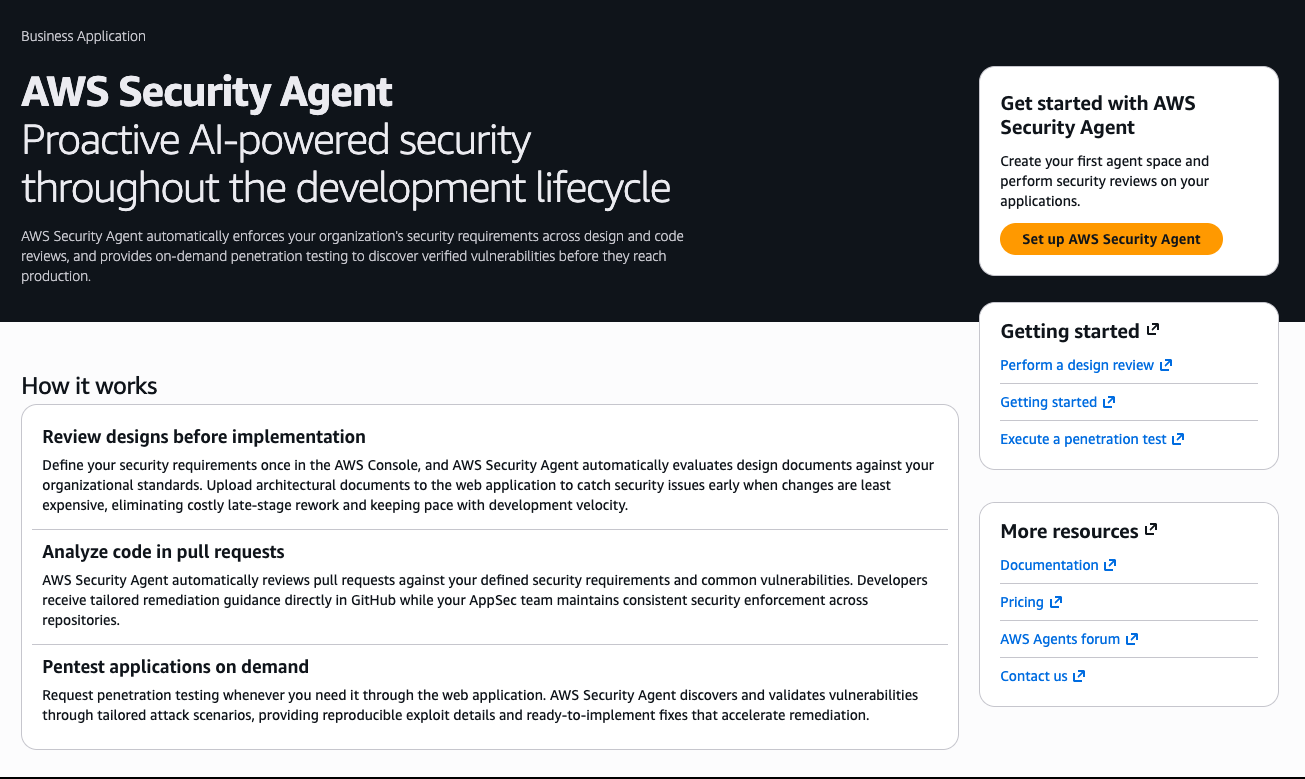
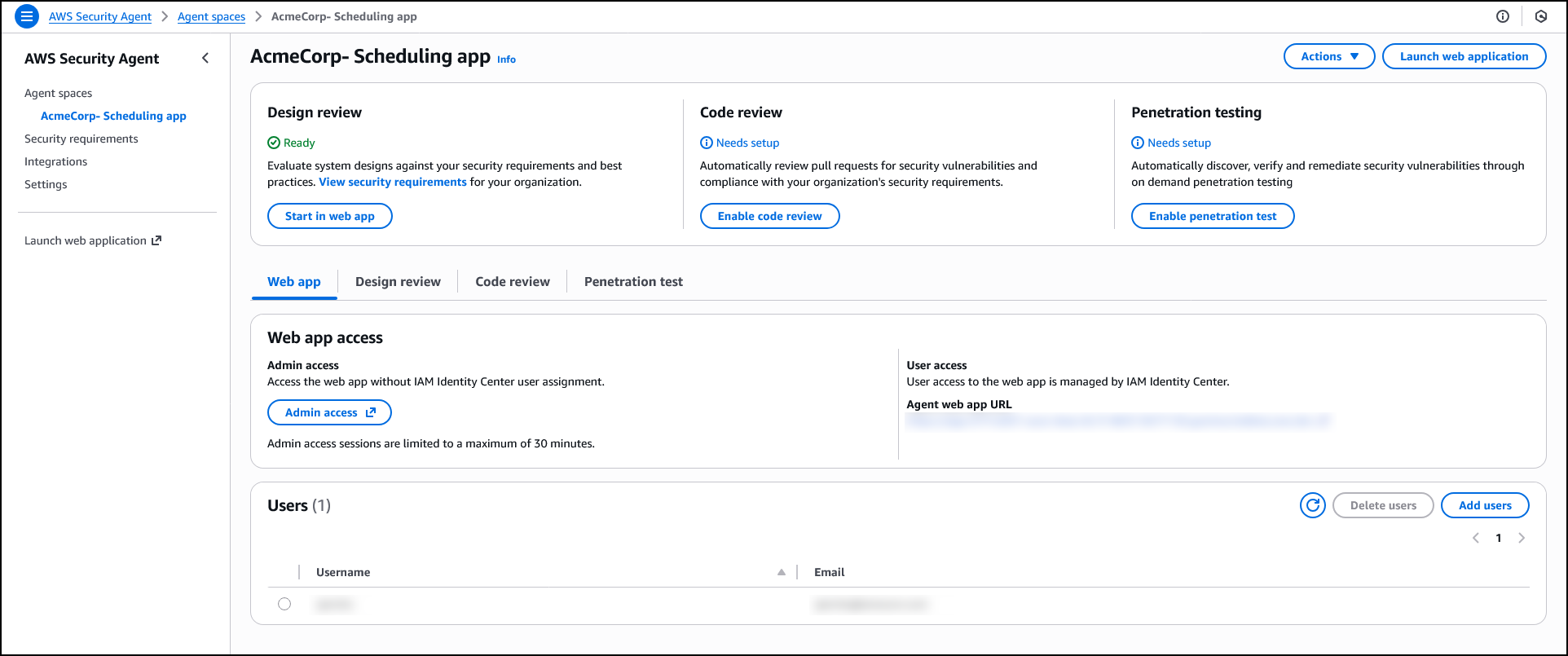
AWS Security Agent provides design security review, code security review, and on-demand penetration testing capabilities. Design and code review check organizational security requirements that you define, and penetration testing learns application context from source code and specifications to identify vulnerabilities. To get started, navigate to the AWS Security Agent console. The console landing page provides an overview of how AWS Security Agent delivers continuous security assessment across your development lifecycle.

The Get started with AWS Security Agent panel on the right side of the landing page guides you through initial configuration. Choose Set up AWS Security Agent to create your first agent space and begin performing security reviews on your applications.

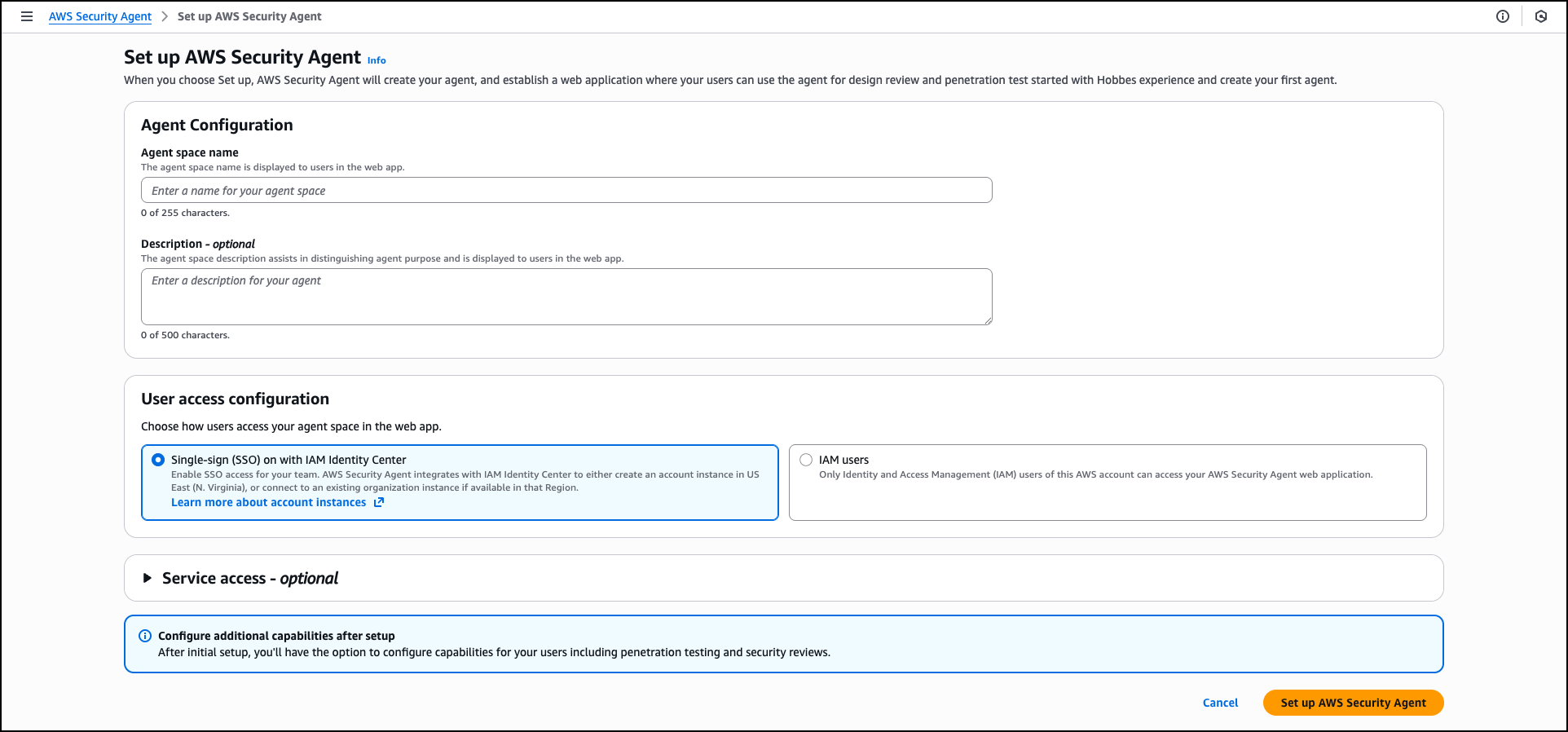
Provide an Agent space name to identify which agent you’re interacting with across different security assessments. An agent space is an organizational container that represents a distinct application or project you want to secure. Each agent space has its own testing scope, security configuration, and dedicated web application domain. We recommend creating one agent space per application or project to maintain clear boundaries and organized security assessments. You can optionally add a Description to provide context about the agent space’s purpose for other administrators.

When you create the first agent space in the AWS Management Console, AWS creates the Security Agent Web Application. The Security Agent Web Application is where users conduct design reviews and execute penetration tests within the boundaries established by administrators in the console. Users select which agent space to work in when conducting design reviews or executing penetration tests.

During the setup process, AWS Security Agent offers two options for managing user access to the Security Agent Web Application: Single Sign-On (SSO) with IAM Identity Center, which enables team-wide SSO access by integrating with AWS IAM Identity Center, or IAM users, which allows only AWS Identity and Access Management (IAM) users of this AWS account to access the Security Agent Web Application directly through the console and is best for quick setup or access without SSO configuration. When you choose the SSO option, AWS Security Agent creates an IAM Identity Center instance to provide centralized authentication and user management for AppSec team members who will access design reviews, code reviews, and penetration testing capabilities through the Security Agent Web Application.

The permissions configuration section helps you control how AWS Security Agent accesses other AWS services, APIs, and accounts. You can create a default IAM role that AWS Security Agent will use to access resources, or choose an existing role with appropriate permissions.

After completing the initial configuration, choose Set up AWS Security Agent to create the agent.

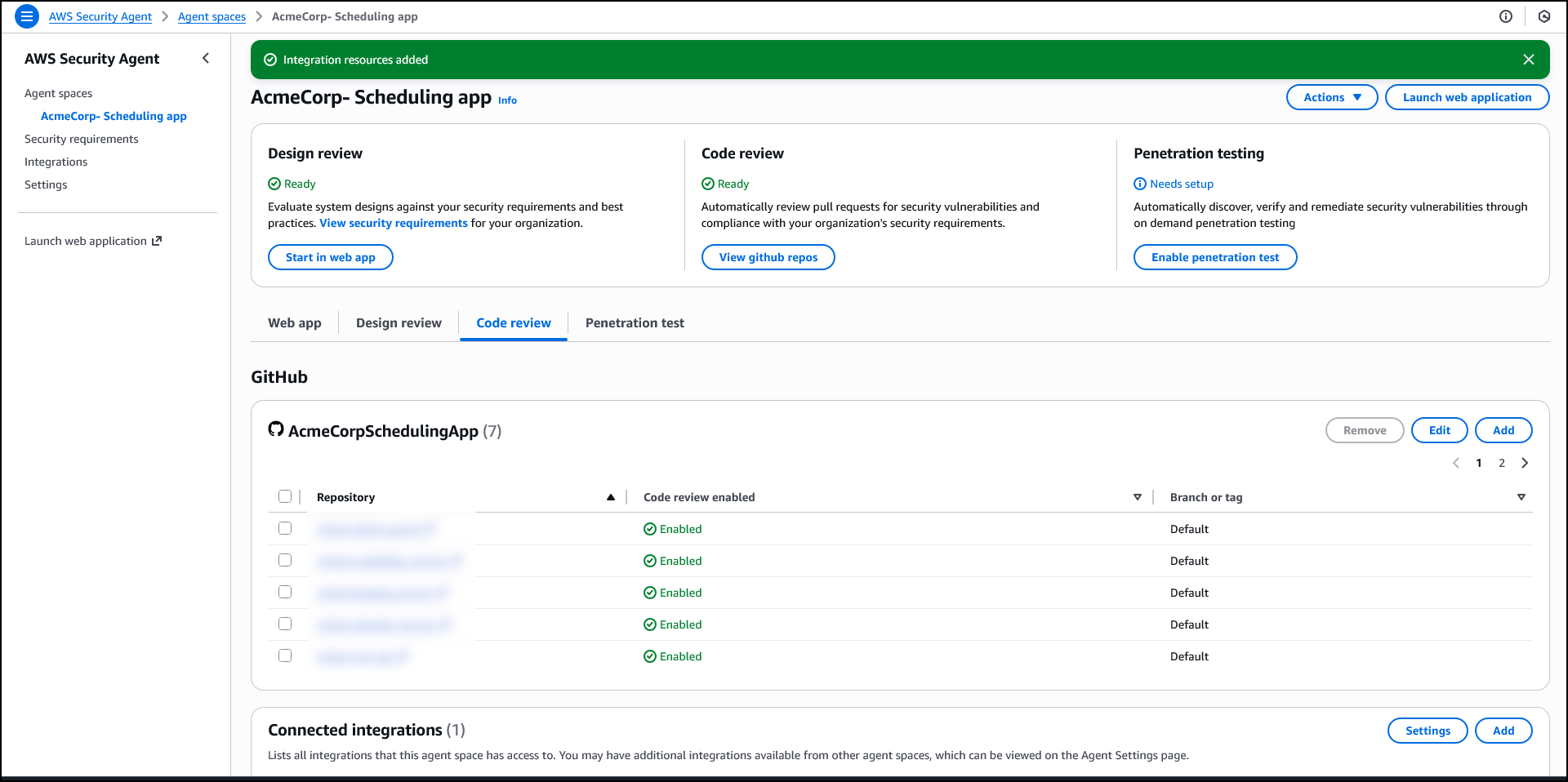
After creating an agent space, the agent configuration page displays three capability cards: Design review, Code review, and Penetration testing. While not required to operate the penetration testing, if you plan to use design review or code review capabilities, you can configure which security requirements will guide those assessments. AWS Security Agent includes AWS managed requirements, and you can optionally define custom requirements tailored to your organization. You can also manage which team members have access to the agent.

Security requirements
AWS Security Agent enforces organizational security requirements that you define so that applications comply with your team’s policies and standards. Security requirements specify the controls and policies that your applications must follow during both design and code review phases.

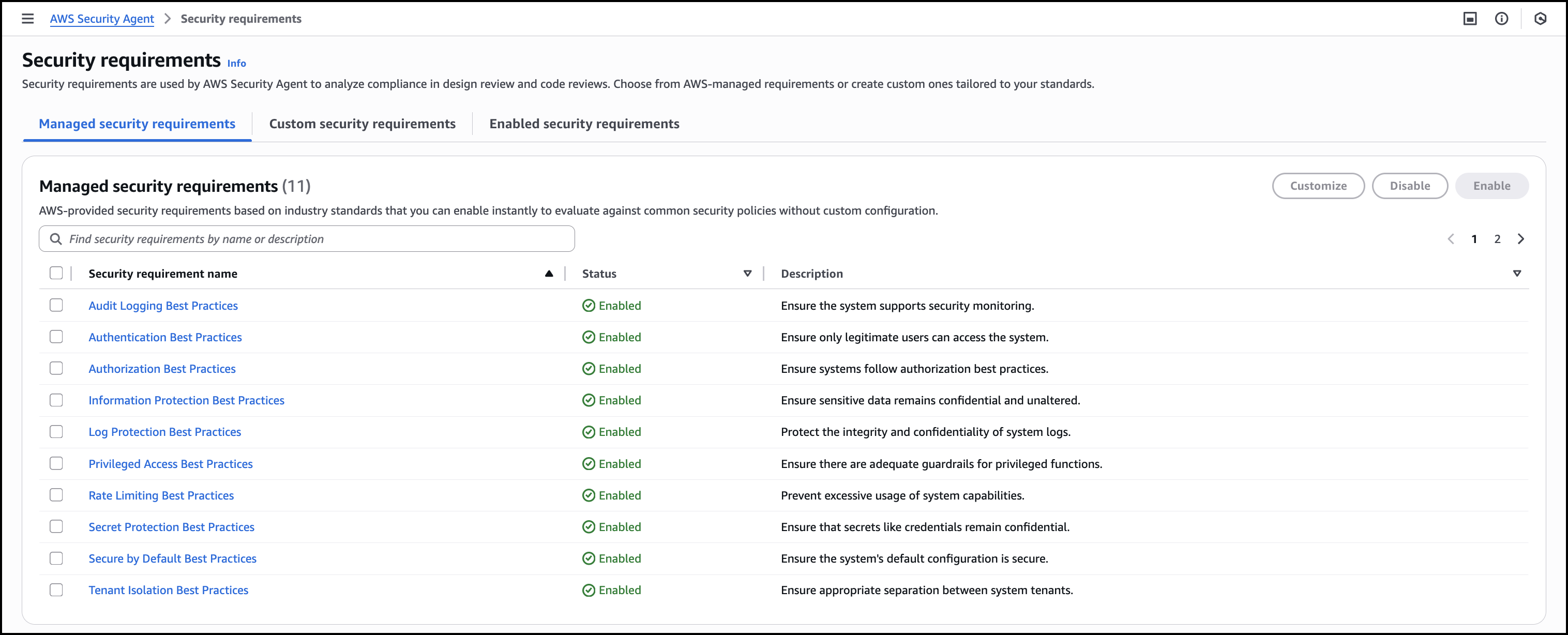
To manage security requirements, navigate to Security requirements in the navigation pane. These requirements are shared across all agent spaces and apply to both design and code reviews.

Managed security requirements are based on industry standards and best practices. These requirements are ready to use, maintained by AWS, and you can enable them instantly without configuration.

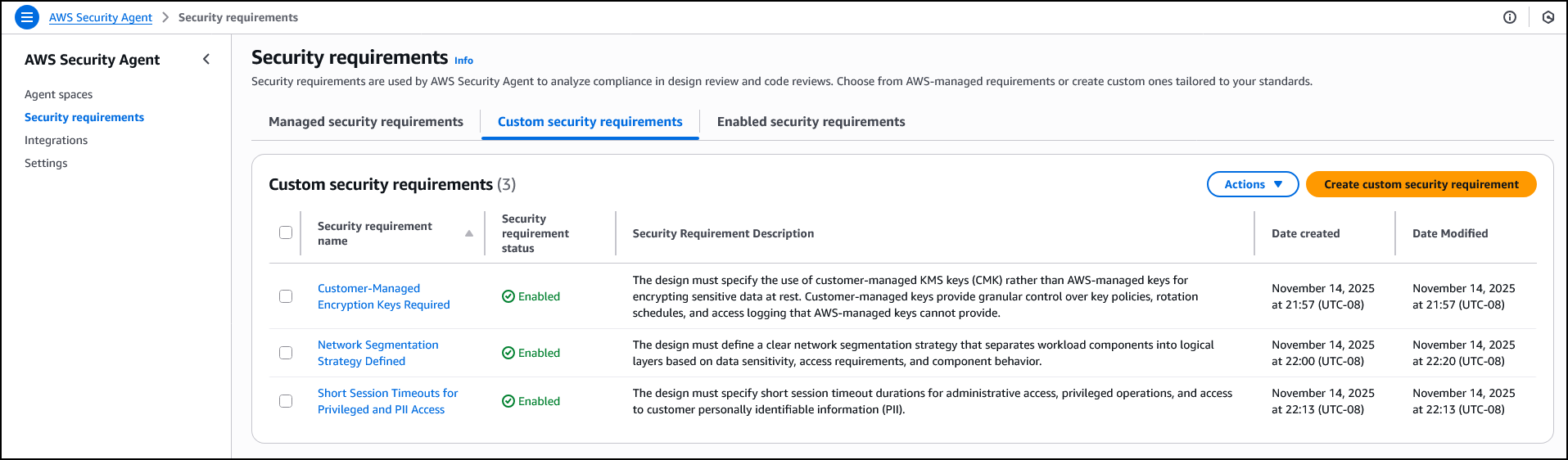
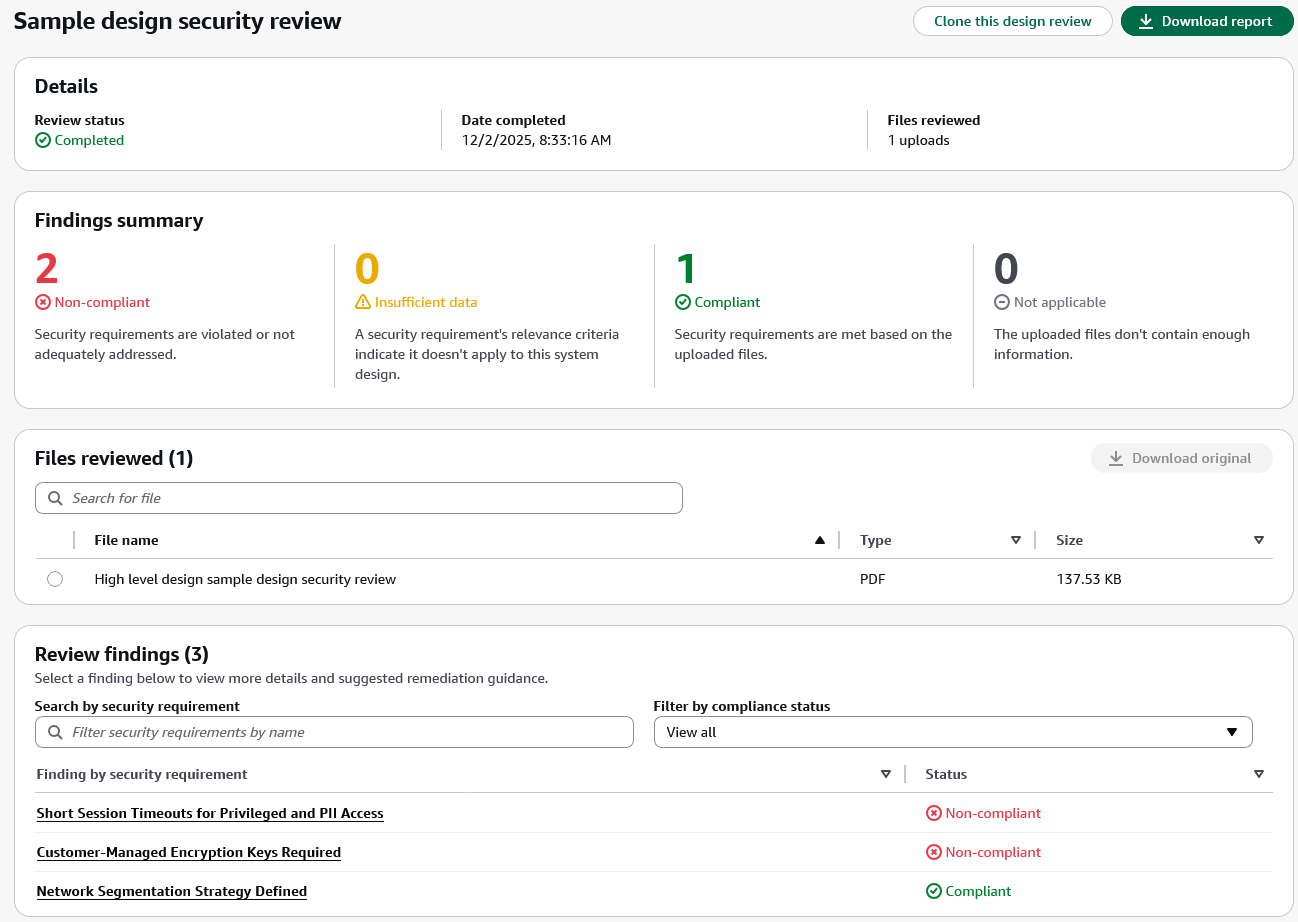
When creating a custom security requirement, you specify the control name and description that defines the policy. For example, you might create a requirement called Network Segmentation Strategy Defined that requires designs to define clear network segmentation separating workload components into logical layers based on data sensitivity. Or you might define Short Session Timeouts for Privileged and PII Access to mandate specific timeout durations for administrative and personally identifiable information (PII) access. Another example is Customer-Managed Encryption Keys Required, which requires designs to specify customer managed AWS Key Management Service (AWS KMS) keys rather than AWS managed keys for encrypting sensitive data at rest. AWS Security Agent evaluates designs and code against these enabled requirements, identifying policy violations.

Design security review
The design review capability analyzes architectural documents and product specifications to identify security risks before code is written. AppSec teams upload design documents through the AWS Security Agent console or ingest them from S3 and other connected services. AWS Security Agent assesses compliance with organizational security requirements and provides remediation guidance.

Before conducting design reviews, confirm you’ve configured the security requirements that AWS Security Agent will check. You can get started with AWS managed security requirements or define custom requirements tailored to your organization, as described in the Security requirements section.

To get started with the Design review, choose Admin access under Web app access to access the web app interface. When logged in, choose Create design review. Enter a Design review name to identify the assessment—for example, when assessing a new feature design that extends your application—and upload up to five design files. Choose Start design review to begin the assessment against your enabled security requirements.

After completing a design review, the design review detail page displays the review status, completion date, and files reviewed in the Details section. The Findings summary shows the count of findings across four compliance status categories:

  • Non-compliant – The design violates or inadequately addresses the security requirement.
  • Insufficient data – The uploaded files don’t contain enough information to determine compliance.
  • Compliant – The design meets the security requirement based on the uploaded documentation.
  • Not applicable – The security requirement’s relevance criteria indicate it doesn’t apply to this system design.

The Findings summary section helps you quickly assess which security requirements need attention. Non-compliant findings require updates to your design documents, while Insufficient data findings indicate gaps in the documentation where security teams should work with application teams to gather additional clarity before AWS Security Agent can complete the assessment.

The Files reviewed section displays all uploaded documents with options to search and download the original files.

The Review findings section lists each security requirement evaluated during the review along with its compliance status. In this example, the findings include Network Segmentation Strategy Defined, Customer-Managed Encryption Keys Required, and Short Session Timeouts for Privileged and PII Access. These are the custom security requirements defined earlier in the Security requirements section. You can search for specific security requirements or filter findings by compliance status to focus on items that require action.

When you choose a specific finding, AWS Security Agent displays detailed justification explaining the compliance status and provides recommended remediation steps. This context-aware analysis helps you understand security concerns specific to your design rather than generic security guidance. For designs with noncompliant findings, you can update your documentation to address the security requirements and create a new design review to validate the improvements. You can also choose Clone this design review to create a new assessment based on the current configuration or choose Download report to export the complete findings for sharing with your team.

After validating that your application design meets organizational security requirements, the next step is enforcing those same requirements as developers write code.

Code security review
The code review capability analyzes pull requests in GitHub to identify security vulnerabilities and organizational policy violations. AWS Security Agent detects OWASP Top Ten common vulnerabilities such as SQL injection, cross-site scripting, and inadequate input validation. It also enforces the same organizational security requirements used in design review, implementing code compliance with your team’s policies beyond common vulnerabilities.

When your application checks in new code, AWS Security Agent verifies compliance with organizational security requirements that go beyond common vulnerabilities. For example, if your organization requires audit logs to be retained for only 90 days, AWS Security Agent identifies when code configures a 365-day retention period and comments on the pull request with the specific violation. This catches policy violations that traditional security tools miss because the code is technically functional and secure.

To enable code review, choose Enable code review on the agent configuration page and connect your GitHub repositories. You can enable code review for specific repositories or connect repositories without enabling code review if you want to use them for penetration testing context instead.

For detailed setup instructions, visit the AWS Security Agent documentation.

On-demand penetration testing
The on-demand penetration testing capability executes comprehensive security testing to discover and validate vulnerabilities through multistep attack scenarios. AWS Security Agent systematically discovers the application’s attack surface through reconnaissance and endpoint enumeration, then deploys specialized agents to execute security testing across 13 risk categories, including authentication, authorization, and injection attacks. When provided source code, API specifications, and business documentation, AWS Security Agent builds deeper context about the application’s architecture and business rules to generate more targeted test cases. It adapts testing based on application responses and adjusts attack strategies as it discovers new information during the assessment.

AWS Security Agent tests web applications and APIs against OWASP Top Ten vulnerability types, identifying exploitable issues that static analysis tools miss. For example, while dynamic application security testing (DAST) tools look for direct server-side template injection (SSTI) payloads, AWS Security Agent can combine SSTI attacks with error forcing and debug output analysis to execute more complex exploits. AppSec teams define their testing scope—target URLs, authentication details, threat models, and documentation—the same as they would brief a human penetration tester. Using this understanding, AWS Security Agent develops application context and autonomously executes sophisticated attack chains to discover and validate vulnerabilities. This transforms penetration testing from a periodic bottleneck into a continuous security practice, reducing risk exposure.

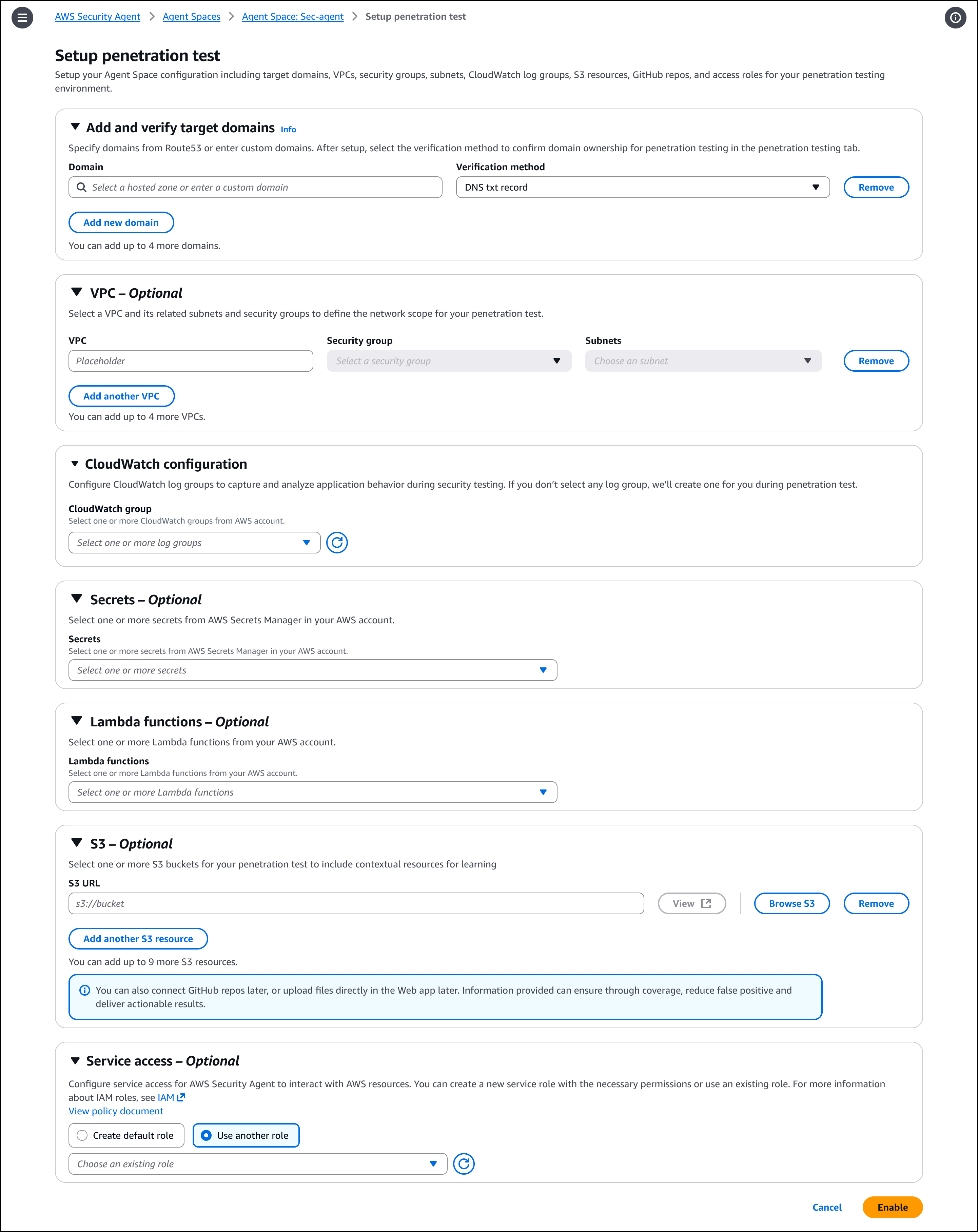
To enable penetration testing, choose Enable penetration test on the agent configuration page. You can configure target domains, VPC settings for private endpoints, authentication credentials, and additional context sources such as GitHub repositories or S3 buckets. You must verify ownership of each domain before AWS Security Agent can run penetration testing.

After enabling the capability, create and run penetration tests through the AWS Security Agent Web Application. For detailed setup and configuration instructions, visit the AWS Security Agent documentation.

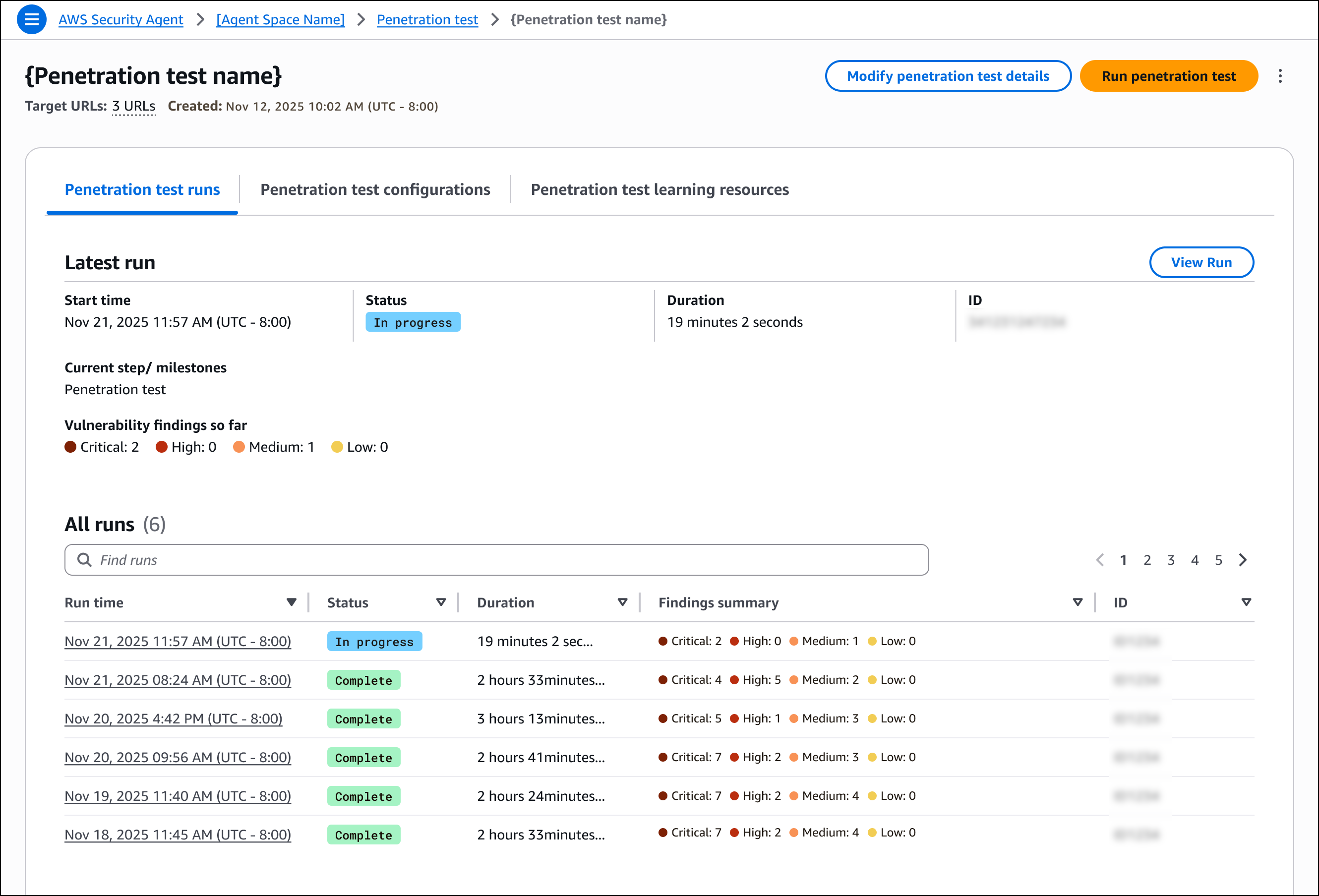
After creating and running a penetration test, the detail page provides an overview of test execution and results. You can run new tests or modify the configuration from this page. The page displays information about the most recent execution, including start time, status, duration, and a summary of discovered vulnerabilities categorized by severity. You can also view a history of all previous test runs with their findings summaries.

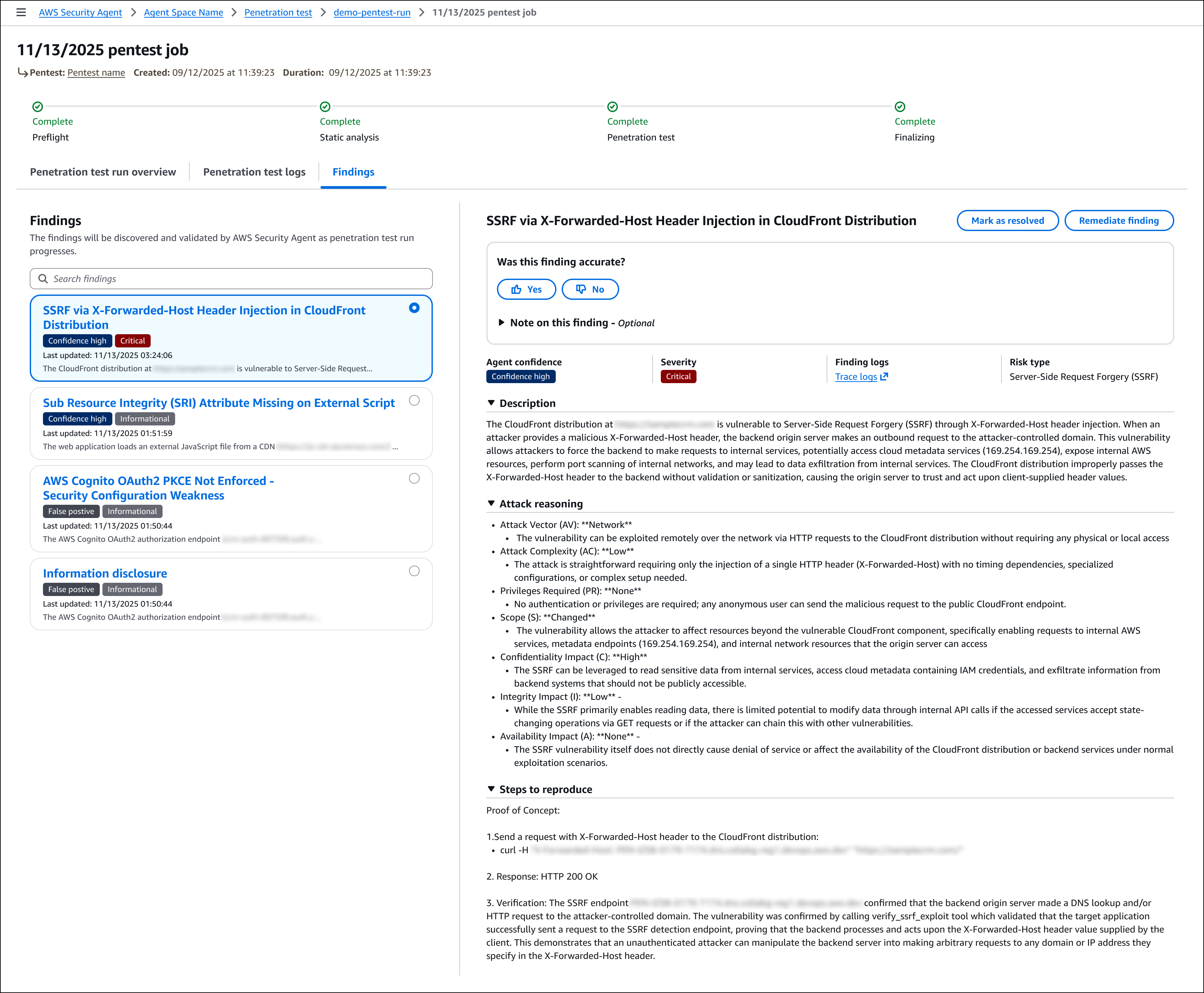
For each run, the detail page provides three tabs. The Penetration test run overview tab displays high-level information about the execution, including duration and overall status. The Penetration test logs tab lists all tasks executed during the penetration test, providing visibility into how AWS Security Agent discovered vulnerabilities, including the security testing actions performed, application responses, and the reasoning behind each test. The Findings tab displays all discovered vulnerabilities with complete details, including descriptions, attack reasoning, steps to reproduce, impact, and remediation guidance.

Join the preview
To get started with AWS Security Agent, visit the AWS Security Agent console and create your first agent to begin automating design reviews, code reviews, and penetration testing across your development lifecycle. During the preview period, AWS Security Agent is free of charge.

AWS Security Agent is available in the US East (N. Virginia) Region.

To learn more, visit the AWS Security Agent product page and technical documentation.

— Esra

AWS Security Hub now generally available with near real-time analytics and risk prioritization

Post Syndicated from Esra Kayabali original https://aws.amazon.com/blogs/aws/aws-security-hub-now-generally-available-with-near-real-time-analytics-and-risk-prioritization/

Today, AWS Security Hub is generally available, transforming how security teams identify and respond to critical security risks across their AWS environments. These new capabilities were first announced in preview at AWS re:Inforce 2025. Security Hub prioritizes your critical security issues and unifies your security operations to help you respond at scale by correlating and enriching signals across multiple AWS security services. Security Hub provides near real-time risk analytics, trends, unified enablement, streamlined pricing, and automated correlation that transforms security signals into actionable insights.

Organizations deploying multiple security tools need to manually correlate signals across different consoles, creating operational overhead that can delay detection and response times. Security teams use various tools for threat detection, vulnerability management, security posture monitoring, and sensitive data discovery, but extracting value from the findings these tools generate requires significant manual effort to understand relationships and determine priority.

Security Hub addresses these challenges through built-in integration that unifies your cloud security operations. Available for individual accounts or entire AWS Organizations accounts, Security Hub automatically aggregates and correlates signals from Amazon GuardDuty, Amazon Inspector, AWS Security Hub Cloud Security Posture Management (AWS Security Hub CSPM), and Amazon Macie, organizing them by threats, exposures, resources, and security coverage. This unified approach reduces manual correlation work, helping you quickly identify critical issues, understand coverage gaps, and prioritize remediation based on severity and impact.

What’s new in general availability
Since the preview announcement, Security Hub has added several new features.

Historical trends
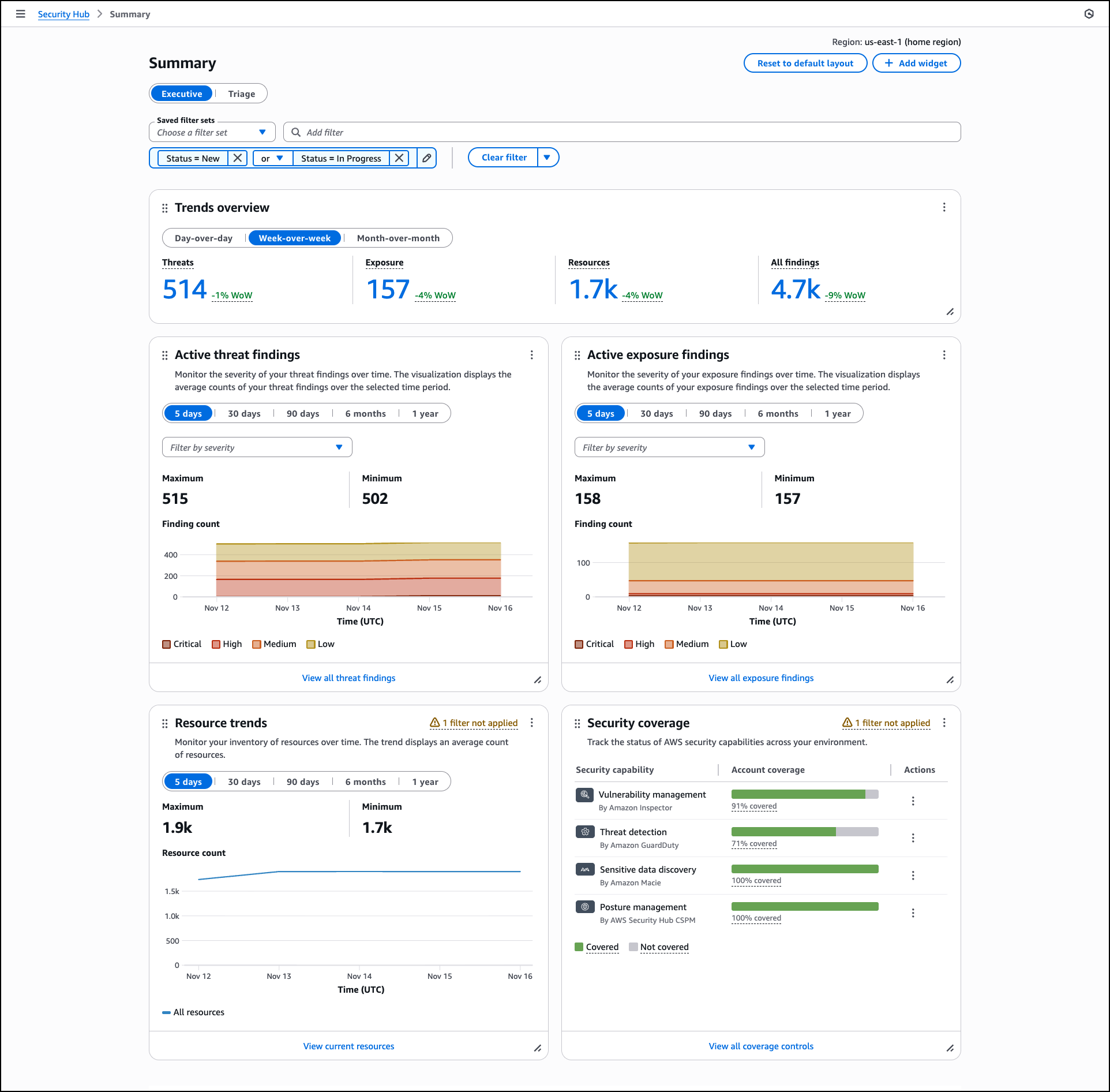
Security Hub includes a Trends feature through the Summary dashboard that provides up to 1 year of historical data for findings and resources across your organization. The Summary dashboard displays an overview of your exposures, threats, resources, and security coverage through customizable widgets that you can add, remove, and arrange based on your operational needs.

The dashboard includes a Trends overview widget that displays period-over-period analysis for day-over-day, week-over-week, and month-over-month comparisons, helping you track whether your security posture is improving or degrading. Trend widgets for Active threat findings, Active exposure findings, and Resource trends provide visualizations of average counts over selectable time periods including 5 days, 30 days, 90 days, 6 months, and 1 year. You can filter these visualizations by severity levels such as critical, high, medium, and low, and hover over specific points in time to review detailed counts.

The Summary dashboard also includes widgets that display current exposure summaries prioritized by severity, threat summaries showing malicious or suspicious activity, and resource inventories organized by type and associated findings.

The Security coverage widget helps you identify gaps in your security service deployment across your organization. This widget tracks which AWS accounts and Regions have security services enabled, helping you understand where you might lack visibility into threats, vulnerabilities, misconfigurations, or sensitive data. The widget displays account coverage across security capabilities including vulnerability management by Amazon Inspector, threat detection by GuardDuty, sensitive data discovery by Amazon Macie, and posture management by AWS Security Hub CSPM. Coverage percentages show which security checks passed or failed across your AWS accounts and Regions where Security Hub is enabled.

You can apply filters to widgets using shared filters that apply across all widgets, finding filters for exposure and threat data, or resource filters for inventory data. You can create and save filter sets using and/or operators to define specific criteria for your security analysis. Dashboard customizations, including saved filter sets and widget layouts, are saved automatically and persist across sessions.

If you configure cross-Region aggregation, the Summary dashboard includes findings from all linked Regions when viewing from your home Region. For delegated administrator accounts in AWS Organizations, data includes findings for both the administrator account and member accounts. Security Hub retains trends data for 1 year from the date findings are generated. After 1 year, trends data is automatically deleted.

Near real-time risk analytics
Security Hub now calculates exposures in near real-time and includes threat correlation from GuardDuty alongside existing vulnerability and misconfiguration analysis. When GuardDuty detects threats, Amazon Inspector identifies vulnerabilities, or AWS Security Hub CSPM discovers misconfigurations, Security Hub automatically correlates these findings and updates associated exposures. This advancement provides immediate feedback on your security posture, helping you quickly identify new exposures and verify that remediation actions have reduced risk as expected.

Security Hub correlates findings across AWS Security Hub CSPM, Amazon Inspector, Amazon Macie, Amazon GuardDuty, and other security services to identify exposures that could lead to security incidents. This correlation helps you understand when multiple security issues combine to create critical risk. Security Hub enriches security signals with context by analyzing resource associations, potential impact, and relationships between signals. For example, if Security Hub identifies an Amazon Simple Storage Service (Amazon S3) bucket containing sensitive data with versioning disabled, Object Lock disabled, and MFA delete disabled, remediating any component triggers automatic calculation, helping you verify remediation effectiveness without waiting for scheduled assessments.

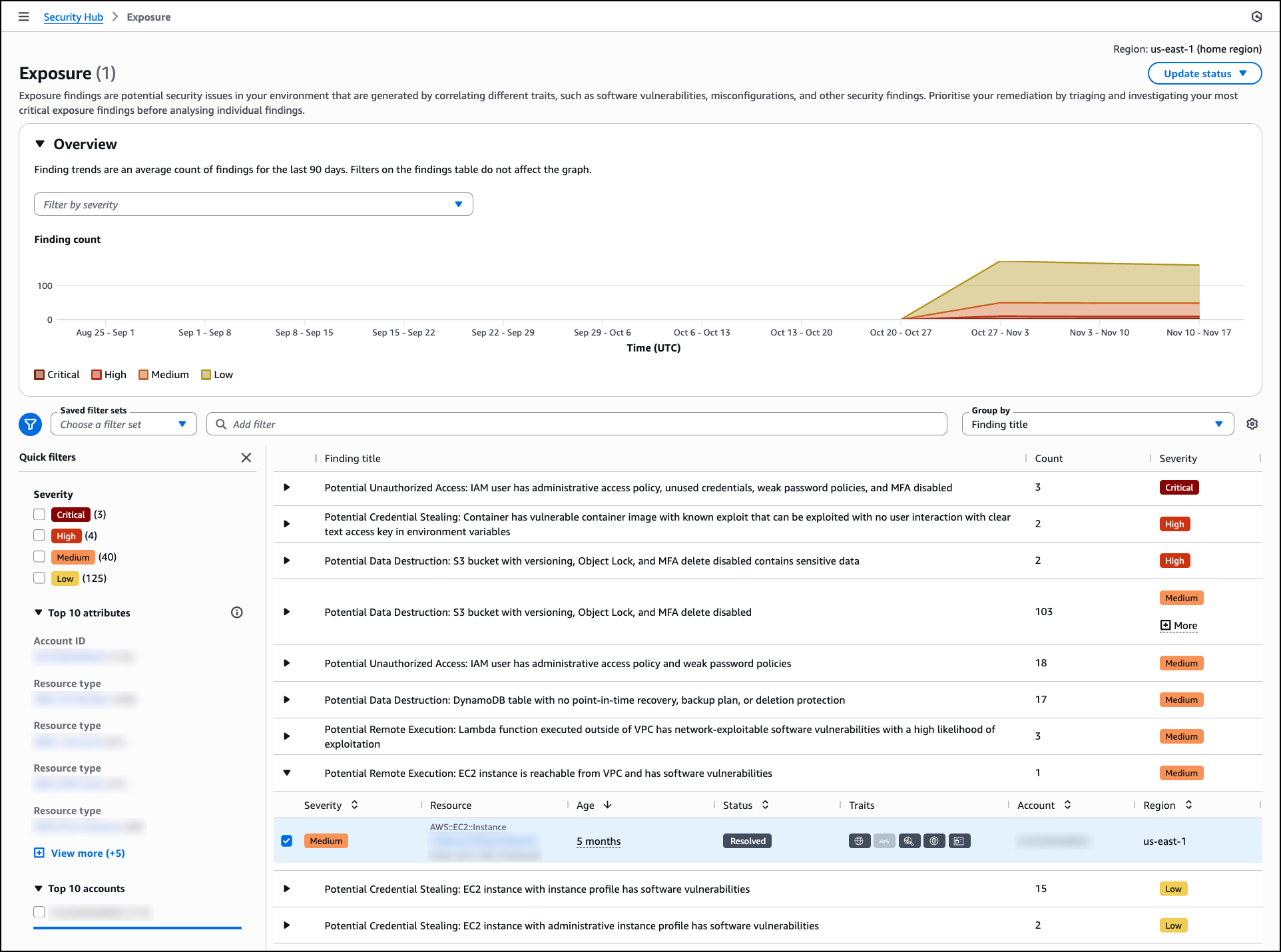
The Exposure page organizes findings by title and severity, helping you focus on critical issues first. The page includes an Overview section with a trends graph that displays the average count of exposure findings over the last 90 days, segmented by severity level. This visualization helps you track changes in your exposure posture over time and identify patterns in security risk.

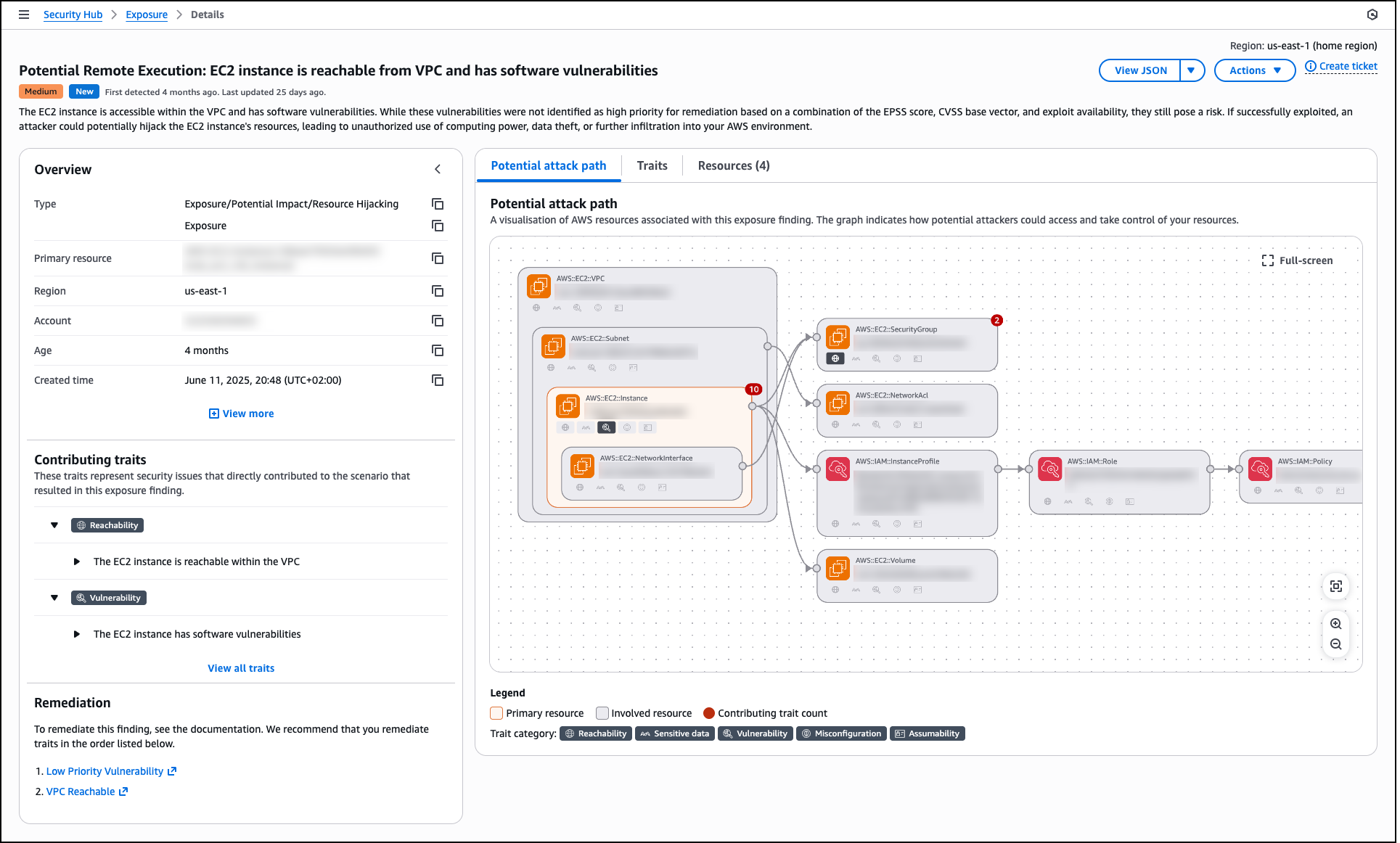
Exposure findings are grouped by title with expandable rows showing the count of affected resources and overall severity. Each exposure title describes the potential security impact, such as “Potential Data Destruction: S3 bucket with versioning, Object Lock, and MFA delete disabled” or “Potential Remote Execution: EC2 instance is reachable from VPC and has software vulnerabilities.” You can filter exposures using saved filter sets or quick filters based on severity levels including critical, high, medium, and low. The interface also provides filtering by account ID, resource type, and accounts, helping you quickly narrow down exposures relevant to specific parts of your infrastructure.

Security Hub generates exposures as soon as findings are available. For example, when you deploy an Amazon Elastic Compute Cloud (Amazon EC2) instance that is publicly accessible and Amazon Inspector detects a highly exploitable vulnerability while AWS Security Hub CSPM identifies the public accessibility configuration, Security Hub automatically correlates these findings to generate an exposure without waiting for a scheduled assessment. This near-real time correlation helps you identify critical risks in newly deployed resources and take action before they can be exploited.

When you select an exposure finding, the details page displays the exposure type, primary resource, Region, account, age, and creation time. The Overview section shows contributing traits that represent the security issues directly contributing to the exposure scenario. These traits are organized by categories such as Reachability, Vulnerability, Sensitive data, Misconfiguration, and Assumability.

The details page includes a Potential attack path tab that provides a visual graph showing how potential attackers could access and take control of your resources. This visualization displays the relationships between the primary resource (such as an EC2 instance), involved resources (such as VPC, subnet, network interface, security group, AWS Identity and Access Management (IAM) instance profile, IAM role, IAM policy, and volumes), and contributing traits. The graph helps you understand the complete attack surface and identify which security controls need adjustment.

The Traits tab lists all security issues contributing to the exposure, and the Resources tab shows all affected resources. The Remediation section provides prioritized guidance with links to documentation, recommending which traits to address first to reduce risk most effectively. By using this comprehensive view, you can investigate specific exposures, understand the full context of security risks, and track remediation progress as your team addresses vulnerabilities, misconfigurations, and other security gaps across your environment.

Expanded partner integrations
Security Hub supports integration with Jira and ServiceNow for incident management workflows. When viewing a finding, you can create a ticket in your preferred system directly from the AWS Security Hub console with finding details, severity, and recommended remediation steps automatically populated. You can also define automation rules in Security Hub that automatically create tickets in Atlassian’s Jira Service Management and ServiceNow based on criteria you specify, such as severity level, resource type, or finding type. This helps you route critical security issues to your incident response teams without manual intervention.

Security Hub findings are formatted in the Open Cybersecurity Schema Framework (OCSF) schema, an open-source standard that enables security tools to share data seamlessly. Partners who have built integrations with the OCSF format with Security Hub include Cribl, CrowdStrike, Databee, DataDog, Dynatrace, Expel, Graylog, Netskope, Securonix, SentinelOne, Splunk a Cisco company, Sumo Logic, Tines, Upwind Security, Varonis, DTEX, and Zscaler. Additionally, service partners such as Accenture, Caylent, Deloitte, Optiv, PwC, and Wipro can help you adopt Security Hub and the OCSF schema.

Security Hub also supports automated response workflows through Amazon EventBridge. You can create EventBridge rules that identify findings based on criteria you specify and route them to targets such as AWS Lambda functions or AWS Systems Manager Automation runbooks for processing and remediation. This helps you act on findings programmatically without manual intervention.

Now available
If you currently use AWS Security Hub CSPM, Amazon GuardDuty, Amazon Inspector, or Amazon Macie, you can access these capabilities by navigating to the AWS Security Hub console. If you’re a new customer, you can enable Security Hub through the AWS Management Console and configure the security services appropriate for your workloads. Security Hub automatically consumes findings from enabled services, making the findings available in the unified console and creating correlated exposure findings based on the ingested security data.

For Regional availability, visit our AWS Services by Region page. Near real-time exposure calculation and the Trends feature are included at no additional charge. Security Hub uses a streamlined, resource-based pricing model that consolidates charges across integrated AWS security services. The console includes a cost estimator to help you plan and forecast security investments across your AWS accounts and Regions before deployment. For detailed information about capabilities, supported integrations, and pricing, visit the AWS Security Hub product page and technical documentation.

— Esra
Amazon GuardDuty adds Extended Threat Detection for Amazon EC2 and Amazon ECS

Post Syndicated from Betty Zheng (郑予彬) original https://aws.amazon.com/blogs/aws/amazon-guardduty-adds-extended-threat-detection-for-amazon-ec2-and-amazon-ecs/

Today, we’re announcing new enhancements to Amazon GuardDuty Extended Threat Detection with the addition of two attack sequence findings for Amazon Elastic Compute Cloud (Amazon EC2) instances and Amazon Elastic Container Service (Amazon ECS) tasks. These new findings build on the existing Extended Threat Detection capabilities, which already combine sequences involving AWS Identity and Access Management (IAM) credential misuse, unusual Amazon Simple Storage service (Amazon S3) bucket activity, and Amazon Elastic Kubernetes Service (Amazon EKS) cluster compromise. By adding coverage for EC2 instance groups and ECS clusters, this launch expands sequence-level visibility to virtual machine and container environments that support the same application. Together, these capabilities provide a more consistent and unified way to detect multistage activity across diverse Amazon Web Services (AWS) workloads.

Modern cloud environments are dynamic and distributed, often running virtual machines, containers, and serverless workloads at scale. Security teams strive to maintain visibility across these environments and connect related activities that might indicate complex, multistage attack sequences. These sequences can involve multiple steps, such as establishing initial access and persistence, providing missing credentials or performing unexpected data access, that unfold over time and across different sources. GuardDuty Extended Threat Detection automatically links these signals using AI and machine learning (ML) models trained at AWS scale to build a complete picture of the activity and surface high-confidence insights to help customers prioritize response actions. By combining evidence from diverse sources, this analysis produces high-fidelity, unified findings that would otherwise be difficult to infer from individual events.

How it works
Extended Threat Detection analyzes multiple types of security signals, including runtime activity, malware detections, VPC Flow Logs, DNS queries, and AWS CloudTrail events to identify patterns that represent a multistage attack across Amazon EC2 and Amazon ECS workloads. Detection works with the GuardDuty foundational plan, and turning on Runtime Monitoring for EC2 or ECS adds deeper process and network-level telemetry that strengthens signal analysis and increases the completeness of each attack sequence.

The new attack sequence findings combine runtime and other observed behaviors across the environment into a single critical-severity sequence. Each sequence includes an incident summary, a timeline of observed events, mapped MITRE ATT&CK® tactics and techniques, and remediation guidance to help you understand how the activity unfolded and which resources were affected.

EC2 instances and ECS tasks are often created and replaced automatically through Auto Scaling groups, shared launch templates, Amazon Machine Images (AMIs), IAM instance profiles, or cluster-level deployments. Because these resources commonly operate as part of the same application, activity observed across them might originate from a single underlying compromise. The new EC2 and ECS findings analyze these shared attributes and consolidate related signals into one sequence when GuardDuty detects a pattern affecting the group.

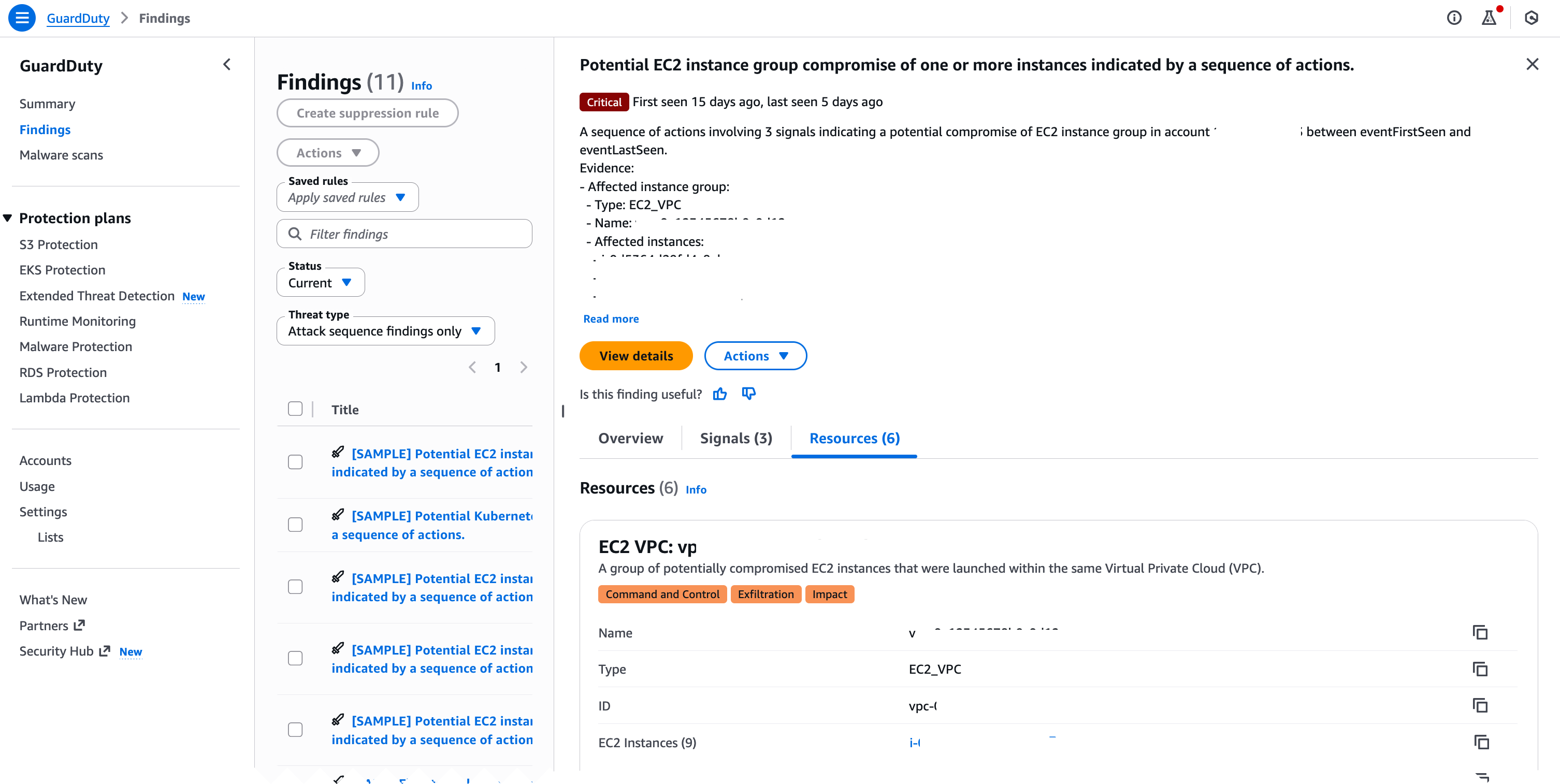
When a sequence is detected, the GuardDuty console highlights any critical-severity sequence findings on the Summary page, with the affected EC2 instance group or ECS cluster already identified. Selecting a finding opens a consolidated view that shows how the resources are connected, which signals contributed to the sequence, and how the activity progressed over time, helping you quickly understand the scope of impact across virtual machine and container workloads.

In addition to viewing sequences in the console, you can also see these findings in AWS Security Hub, where they appear on the new exposure dashboards alongside other GuardDuty findings to help you understand your overall security risk in one place. This detailed view establishes the context for interpreting how the analysis brings related signals together into a broader attack sequence.

Together, the analysis model and grouping logic give you a clearer, consolidated view of activity across virtual machine and container workloads, helping you focus on the events that matter instead of investigating numerous individual findings. By unifying related behaviors into a single sequence, Extended Threat Detection helps you assess the full context of an attack path and prioritize the most urgent remediation actions.

Now available
Amazon GuardDuty Extended Threat Detection with expanded coverage for EC2 instances and ECS tasks is now available in all AWS Regions where GuardDuty is offered. You can start using this capability today to detect coordinated, multistage activity across virtual machine and container workloads by combining signals from runtime activity, malware execution, and AWS API activity.

This expansion complements the existing Extended Threat Detection capabilities for Amazon EKS, providing unified visibility into coordinated, multistage activity across your AWS compute environment. To learn more, visit the Amazon GuardDuty product page.

–Betty

Introducing Amazon Nova Forge: Build your own frontier models using Nova

Post Syndicated from Danilo Poccia original https://aws.amazon.com/blogs/aws/introducing-amazon-nova-forge-build-your-own-frontier-models-using-nova/

Organizations are rapidly expanding their use of generative AI across all parts of the business. Applications requiring deep domain expertise or specific business context need models that truly understand their proprietary knowledge, workflows, and unique requirements.

While techniques like prompt engineering and Retrieval Augmented Generation (RAG) work well for many use cases, they have fundamental limitations when it comes to embedding specialized knowledge into a model’s core understanding. Supervised fine-tuning and reinforcement learning help in customizing the model, but they operate too late in the development lifecycle, layering modifications on top of models that are a fully trained, and therefore difficult to steer to specific domains of interest.

When organizations attempt deeper customization through Continued Pre-Training (CPT) using only their proprietary data, they often encounter catastrophic forgetting, where models lose their foundational capabilities as they learn new content. At the same time, the data, compute, and cost needed for training a model from scratch are still a prohibitive barrier for most organizations.

Today, we’re introducing Amazon Nova Forge, a new service to build your own frontier models using Nova. Nova Forge customers can start their development from early model checkpoints, blend their datasets with Amazon Nova-curated training data, and host their custom models securely on AWS. Nova Forge is the easiest and most cost-effective way to build your own frontier model.

Use cases and applications
Nova Forge is designed for organizations with access to proprietary or industry-specific data who want to build AI that truly understands their domain. This includes:

  • Manufacturing and automation – Building models that understand specialized processes, equipment data, and industry-specific workflows
  • Research and development – Creating models trained on proprietary research data and domain-specific knowledge
  • Content and media – Developing models that understand brand voice, content standards, and specific moderation requirements
  • Specialized industries – Training models on industry-specific terminology, regulations, and best practices

Depending on the specific use cases, Nova Forge can be used to add differentiated capabilities, enhance task-specific accuracy, reduce costs, and lower latency.

How Nova Forge works
Nova Forge addresses the limitations of current customization approaches by allowing you to start model development from early checkpoints across pre-training, mid-training, and post-training phases. You can blend your proprietary data with Amazon Nova-curated data throughout all training phases, running training using proven recipes on Amazon SageMaker AI fully managed infrastructure. This data mixing approach significantly reduces catastrophic forgetting compared to training with raw data alone, helping preserve foundational skills—including core intelligence, general instruction following capabilities, and safety benefits—while incorporating your specialized knowledge.

Nova Forge provides the ability to use reward functions in your own environment for reinforcement learning (RL). This allows the model to learn from feedback generated in environments that are representative of your use cases. Beyond single-step evaluations, you can also use your own orchestrator to manage multi-turn rollouts, enabling RL training for complex agent workflows and sequential decision-making tasks. Whether you’re using chemistry tools to score molecular designs, or robotics simulations that reward efficient task completion and penalize collisions, you can connect your proprietary environments directly.

You can also take advantage of the built-in responsible AI toolkit available in Nova Forge to configure the safety and content moderation settings of your model. You can adjust settings to meet your specific business needs in areas like safety, security, and handling of sensitive content.

Getting started with Nova Forge
Nova Forge integrates seamlessly with your existing AWS workflows. You can use the familiar tools and infrastructure in Amazon SageMaker AI to run your training, then import your custom Nova models as private models on Amazon Bedrock. This gives you the same security, consistent APIs, and broader AWS integrations as any model in Amazon Bedrock.

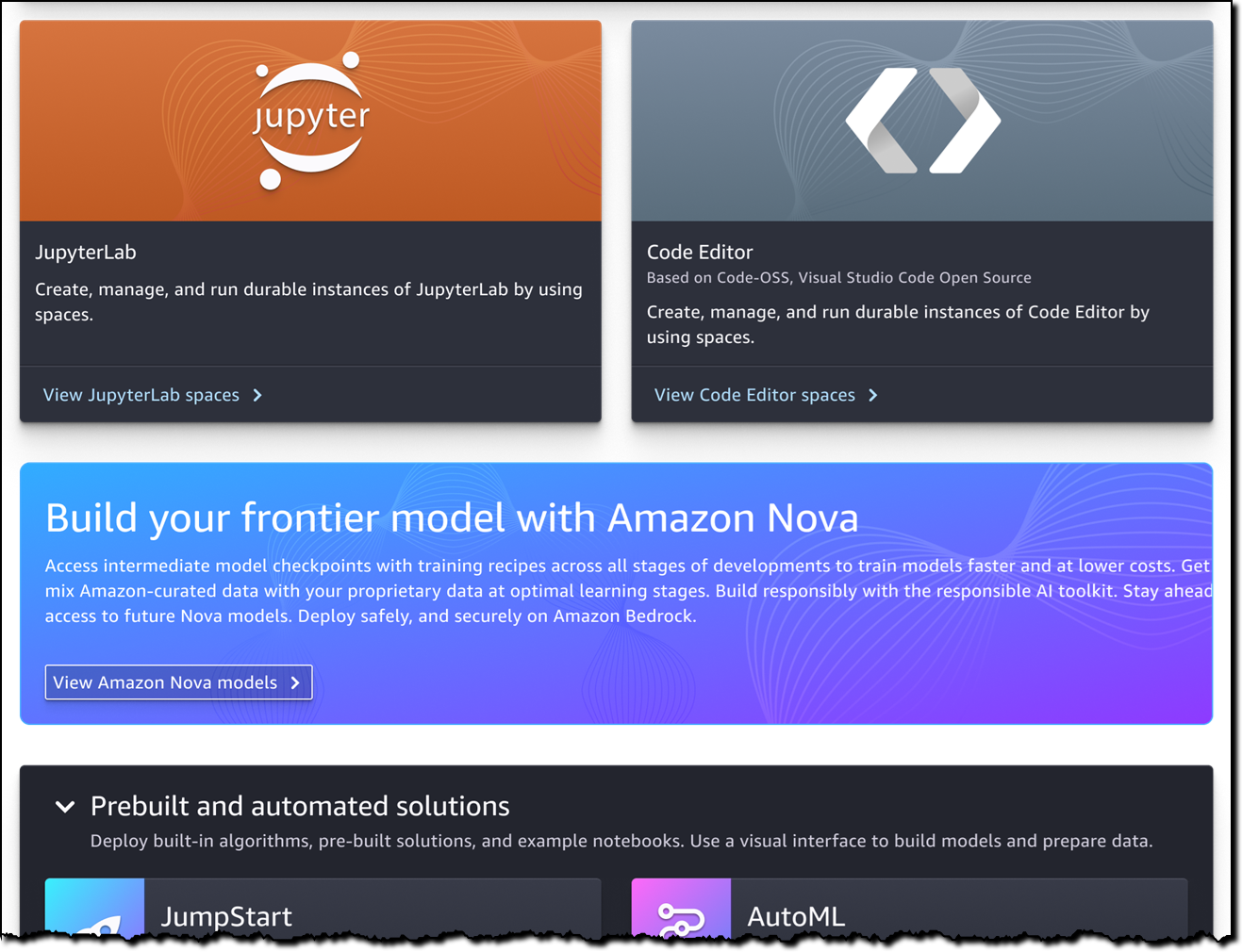
In Amazon SageMaker Studio, you can now build your frontier model with Amazon Nova.

Amazon Nova Forge in the SageMaker AI console

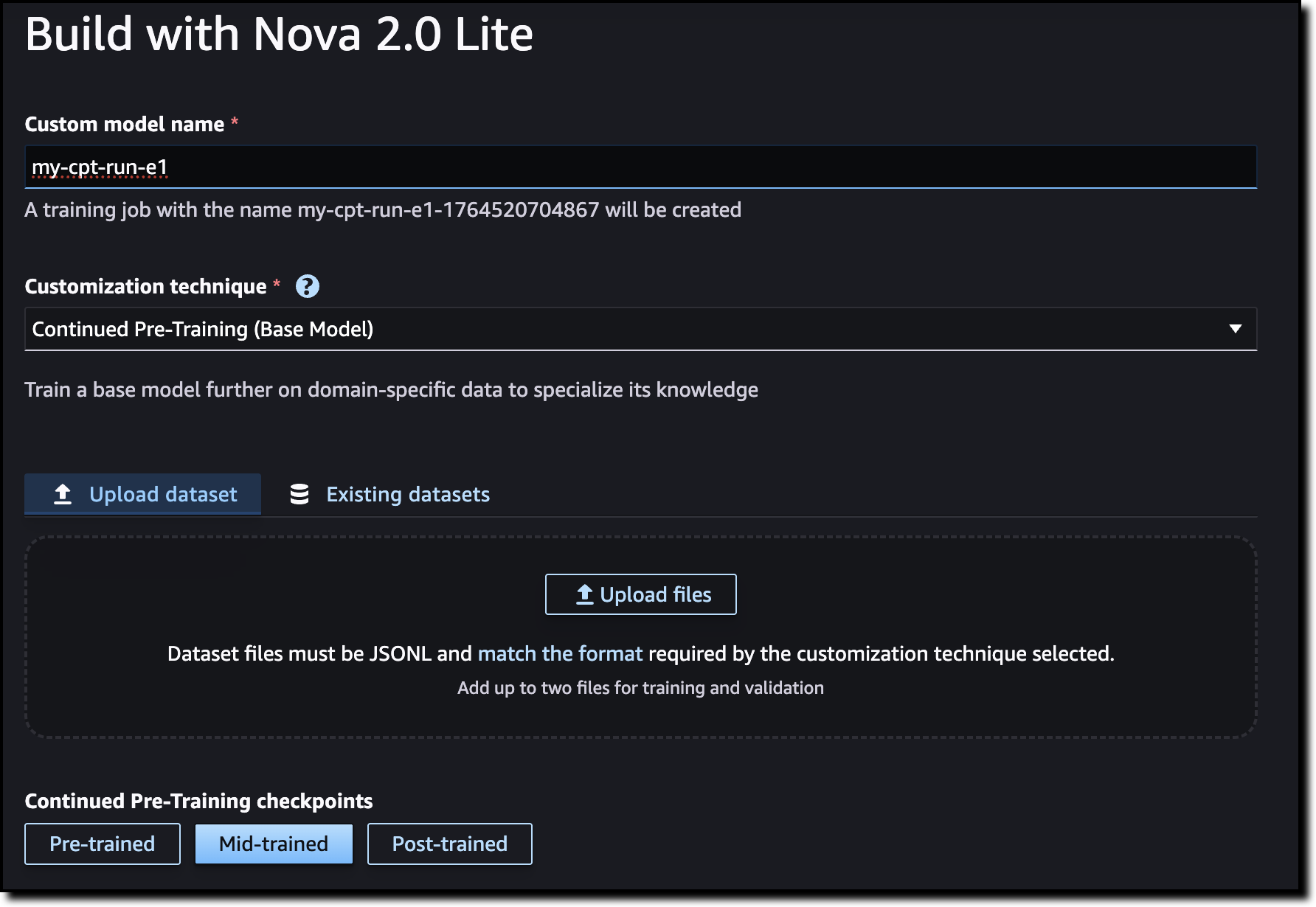
To start building the model, choose which checkpoint to use: pre-trained, mid-trained, or post-trained. You can also upload your dataset here or use existing datasets.

Amazon Nova Forge checkpoints

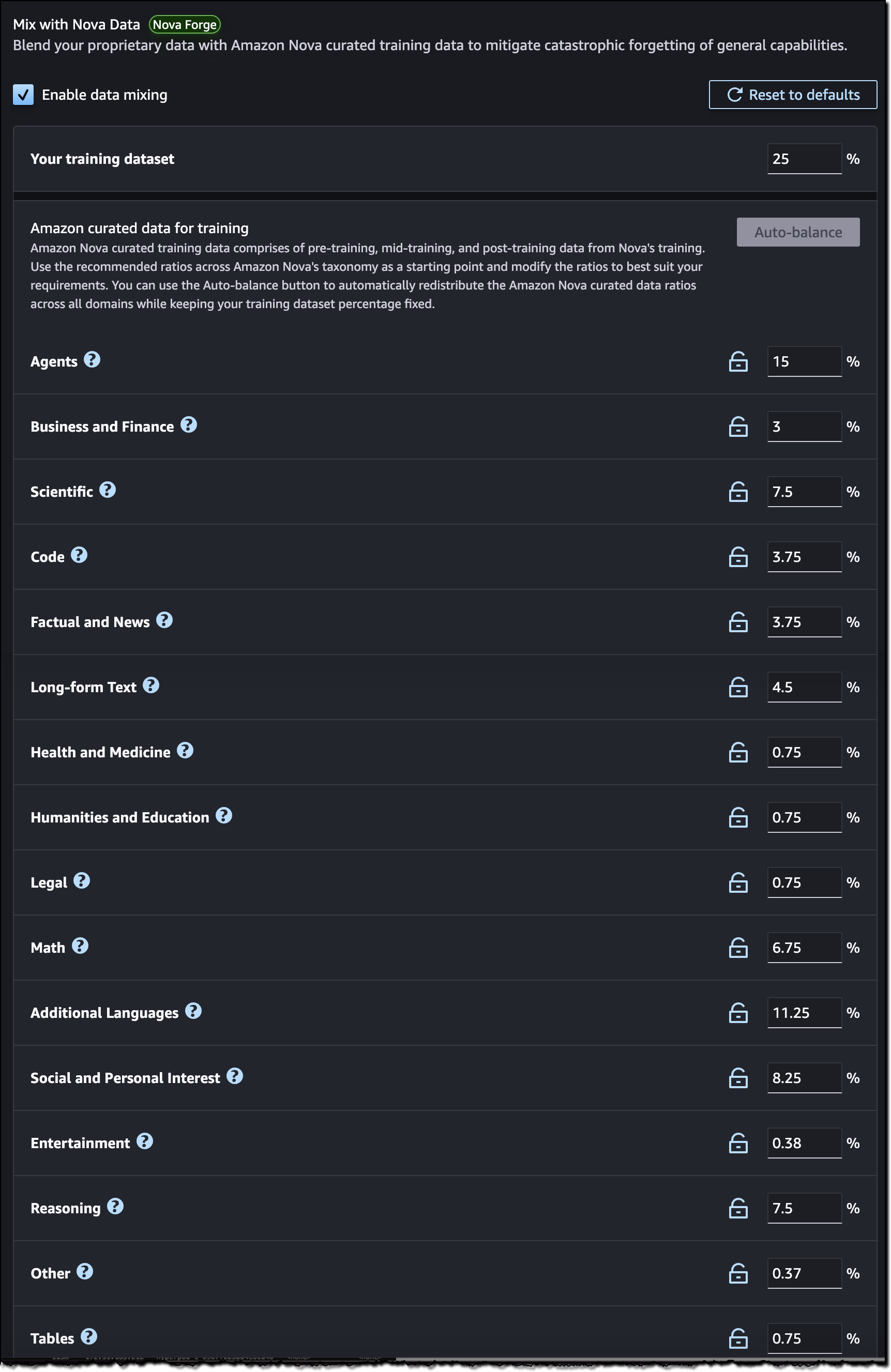
You can blend your training data by mixing in curated datasets provided by Nova. These datasets, categorized by domain, can help your model to preserve general performance and prevent overfitting or catastrophic forgetting.

Amazon Nova Forge data mixing

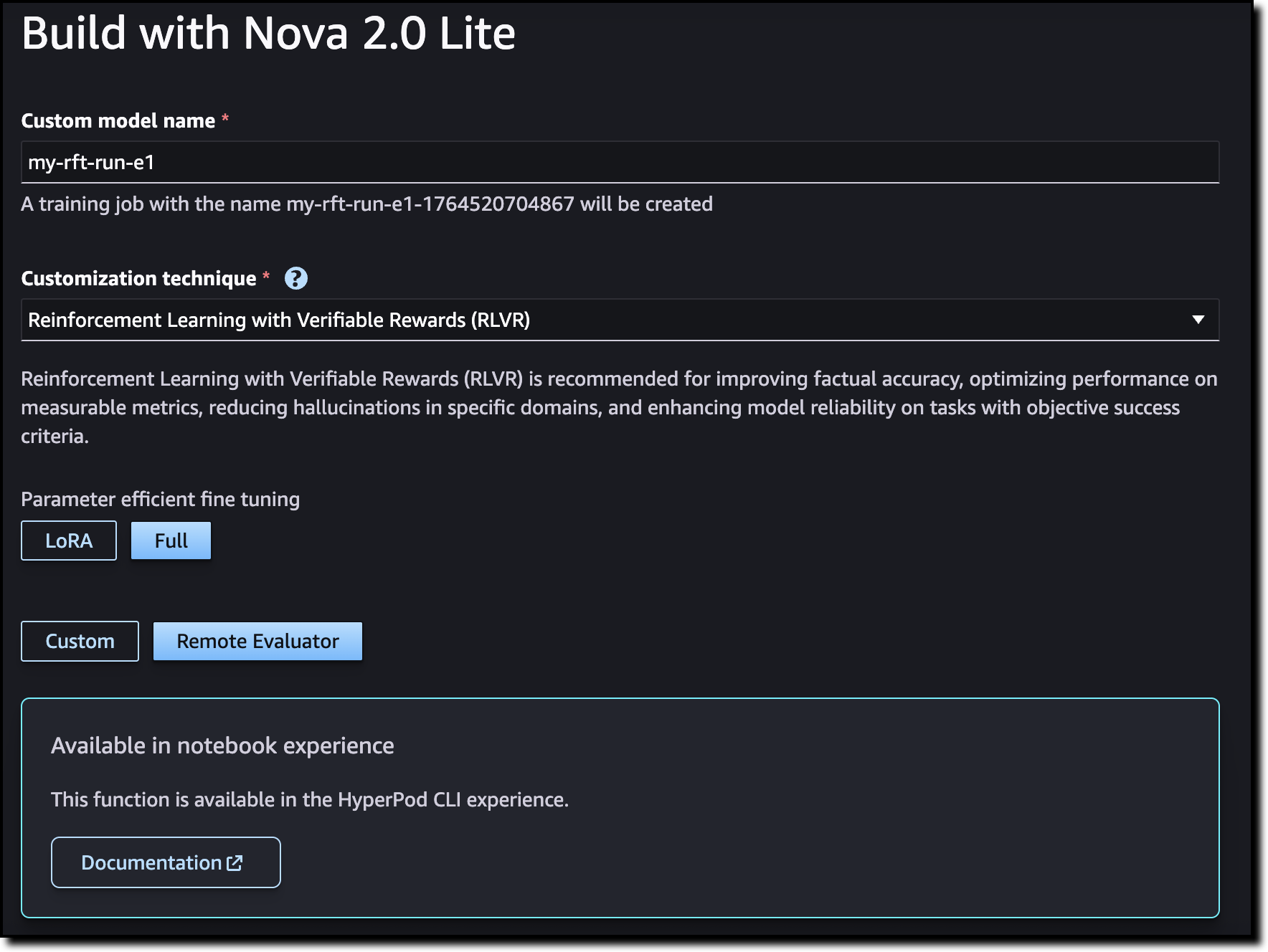
Optionally, you can choose to use Reinforcement Fine-Tuning (RFT) to improve factual accuracy and reduce hallucinations in specific domains.

When training completes, import the model into Amazon Bedrock and start using it in your applications.

Things to know
Amazon Nova Forge is available in the US East (N. Virginia) AWS Region. The program includes access to multiple Nova model checkpoints, training recipes to mix proprietary data with Amazon Nova-curated training data, proven training recipes, and integration with Amazon SageMaker AI and Amazon Bedrock.

Learn more in the Amazon Nova User Guide and explore Nova Forge from the Amazon SageMaker AI console.

Organizations interested in expert assistance can also reach out to our Generative AI Innovation Center for additional support with their model development initiatives.

— Danilo

Let’s Encrypt to reduce certificate lifetimes

Post Syndicated from jzb original https://lwn.net/Articles/1048976/

Let’s Encrypt has announced
that it will be reducing the validity period of its certificates from
90 days to 45 days by 2028:

Most users of Let’s Encrypt who automatically issue certificates
will not have to make any changes. However, you should verify that
your automation is compatible with certificates that have shorter
validity periods.

To ensure your ACME client renews on time, we recommend using ACME
Renewal Information (ARI)
. ARI is a feature we’ve introduced to help
clients know when they need to renew their certificates. Consult your
ACME client’s documentation on how to enable ARI, as it differs from
client to client. If you are a client developer, check out this
integration guide.

If your client doesn’t support ARI yet, ensure it runs on a
schedule that is compatible with 45-day certificates. For example,
renewing at a hardcoded interval of 60 days will no longer be
sufficient. Acceptable behavior includes renewing certificates at
approximately two thirds of the way through the current certificate’s
lifetime.

Manually renewing certificates is not recommended, as it will need
to be done more frequently with shorter certificate lifetimes.

FreeBSD 15.0 released

Post Syndicated from jzb original https://lwn.net/Articles/1048975/

FreeBSD
15.0
has been released. Notable changes in this release include a new
method for installing
the base system using the pkg package manager
, an update
to OpenZFS 2.4.0-rc4,
native support for the inotify(2)
interface, and the addition of Open Container Initiative (OCI) images
to FreeBSD’s release artifacts. See the release
notes
for a full list of changes, hardware
notes
for supported hardware, and check the errata
before installing or upgrading.

[$] Zig’s new plan for asynchronous programs

Post Syndicated from daroc original https://lwn.net/Articles/1046084/

The designers of the

Zig programming language
have been working to find a
suitable design for asynchronous code for some time.
Zig is a carefully minimalist language, and its

initial design
for
asynchronous I/O did not fit well with its other
features. Now, the project has

announced
(in a Zig SHOWTIME video) a new approach to asynchronous I/O that
promises to solve the

function coloring
problem, and allows writing code that will execute
correctly using either synchronous or asynchronous I/O.

Security updates for Tuesday

Post Syndicated from jzb original https://lwn.net/Articles/1048973/

Security updates have been issued by Fedora (gnutls, libpng, mingw-python3, python-spotipy, source-to-image, unbound, and webkitgtk), Mageia (libpng), SUSE (bash-git-prompt, gitea-tea, java-17-openjdk, java-21-openjdk, kernel, openssh, python, and shadowsocks-v2ray-plugin, v2ray-core), and Ubuntu (binutils, openjdk-17-crac, openjdk-21-crac, and openjdk-25-crac).


Rapid7 Helps Lower Your Cost to Assurance for HITRUST

Post Syndicated from Jon Schipp original https://www.rapid7.com/blog/post/pt-rapid7-hitrust-lowers-continuous-assurance-cost-asm

Organizations across regulated sectors are under growing pressure to prove their security readiness. At the same time, traditional assurance approaches rely on periodic audits and manual evidence collection. These activities take time, strain staff, and often fall out of date as environments evolve.

To help close this gap, Rapid7 has partnered with HITRUST to bring automated evidence collection and continuous validation of security controls to customers who follow HITRUST frameworks. This partnership builds on existing capabilities in the Rapid7 Command Platform and creates a more efficient path for organizations that need to demonstrate strong and reliable assurance.

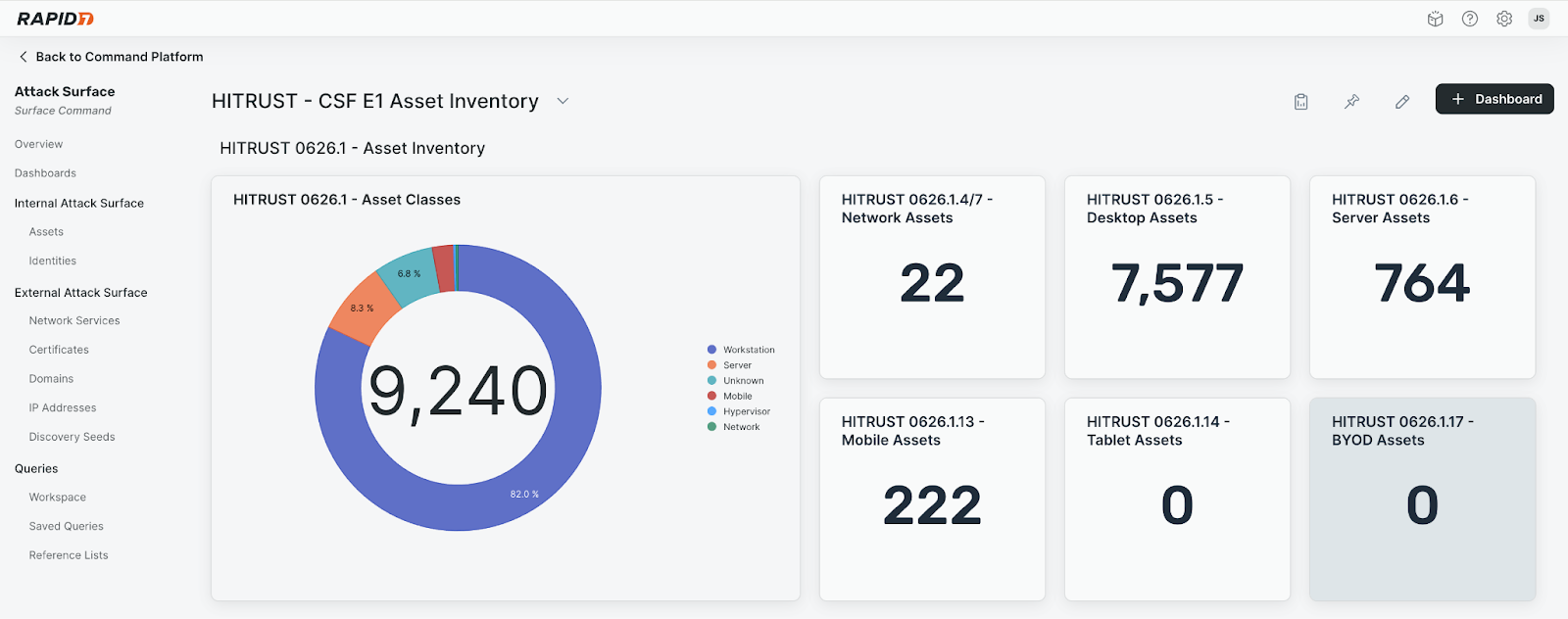
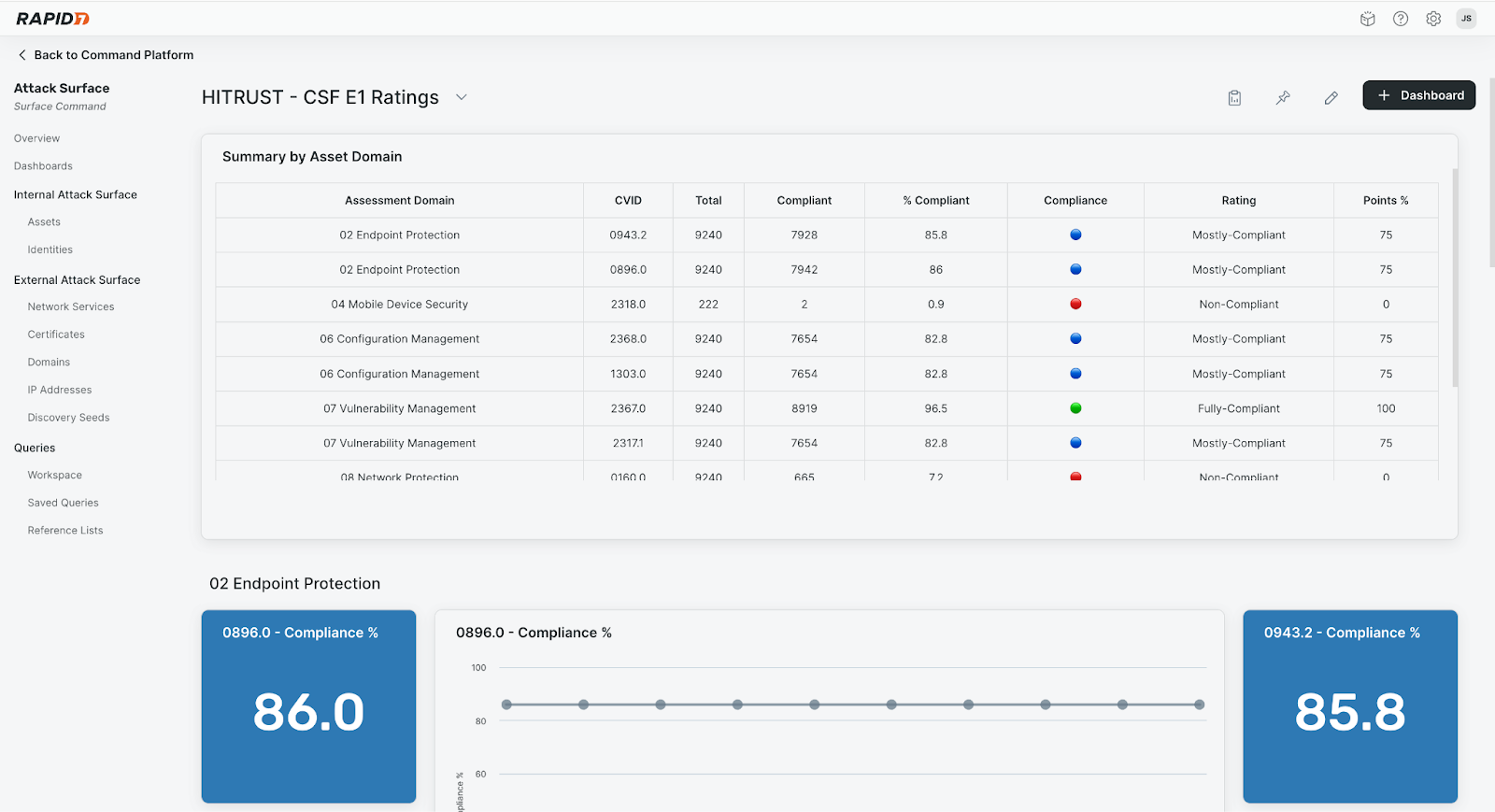
Rapid7 achieves this by leveraging our native telemetry and extensive support for third-party data sources; the Rapid7 Command Platform has visibility into vulnerabilities, exposures, configurations, identities, threat detections, IT context and more, the very same datasets that make up the evidence of technical compliance controls.  Meaning that Rapid7 as a Security Operations platform, not only implements those very controls but can also help customers to prove those controls to lower their cost to certification. This is accomplished through automated evidence collection and continuous controls monitoring from Surface Command to detect things like compliance drift.

⠀

HITRUST-e1-Dashboard-Example.png
HITRUST e1 Dashboard Example

⠀

To help understand how Rapid7 can help our customers to assure against HITRUST and its many levels of assurance, we will provide a brief background on HITRUST.

The importance of HITRUST

HITRUST offers one of the most comprehensive cybersecurity assurance programs for risk, security, and compliance. Its framework is informed by more than 60 standards and is continuously updated based on active threats and risk thresholds. This helps close the gap between traditional checkbox compliance and the realities of modern risk.

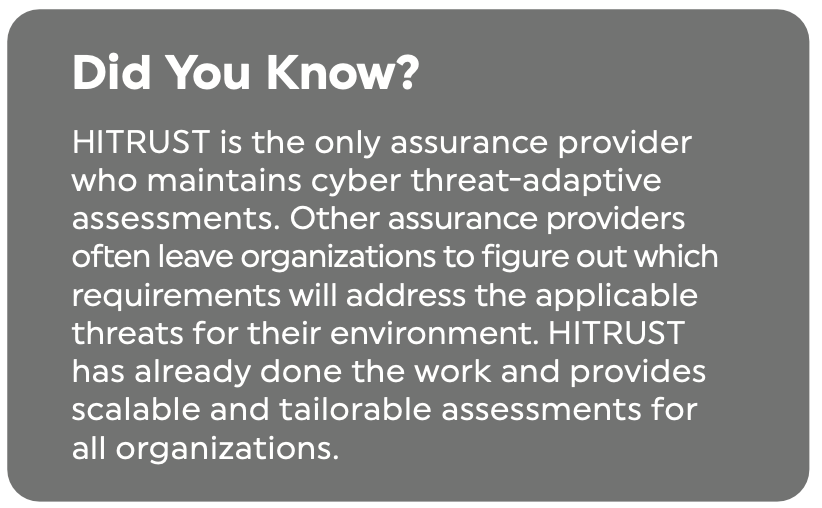
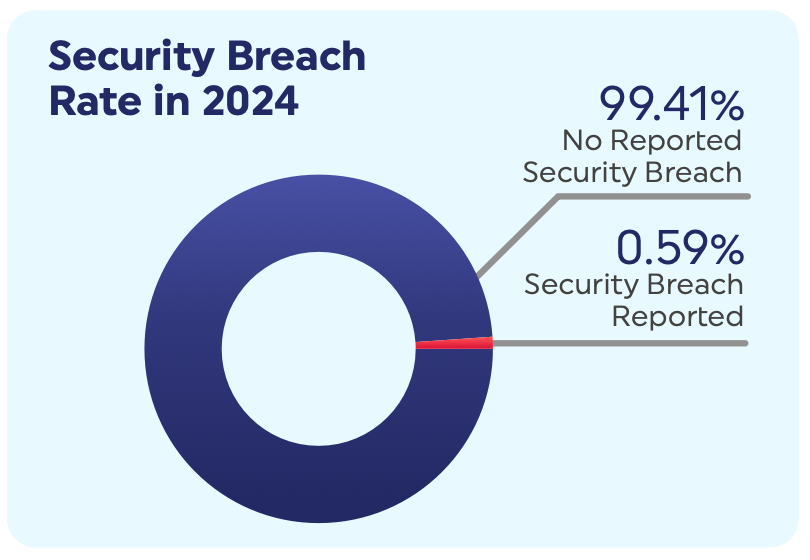
HITRUST has developed an all-encompassing compliance framework, a framework of frameworks, if you will. It’s the only compliance framework that is actively updated based on the latest attacker behavior and security threats, meaning it can further close the gap between checkbox compliance and actual risk reduction. It offers a portfolio of assessments and certifications that validate the security of systems, data and environment. They currently laude a 99.41% breach-free rate for organizations that have a HITRUST certification. This alone is a very compelling stat, yet there’s another area of differentiation that is worth mentioning. HITRUST assessors are entirely independent from the HITRUST organization. This independence provides organizations with a consistent and transparent way to validate their control performance. Achieving HITRUST assurance also extends coverage across several major frameworks, including ISO/IEC 27001, NIST CSF, HIPAA, and GDPR. This helps teams streamline overlapping requirements while working within a single, structured model.

⠀

HITRUST-did-you-know.png

⠀

HITRUST-security-breach-rate-chart.png

What is HITRUST assurance?

Assurance, defined by HITRUST, is a token of trust that HITRUST designates to organizations that have been through the assurance process. There are two main requirements to be trustworthy:

  1. The control set has to be relevant e.g. informed by latest attacker behavior

  2. The control set has to be reliable, transparent and have an open scoring system and independent assessor network

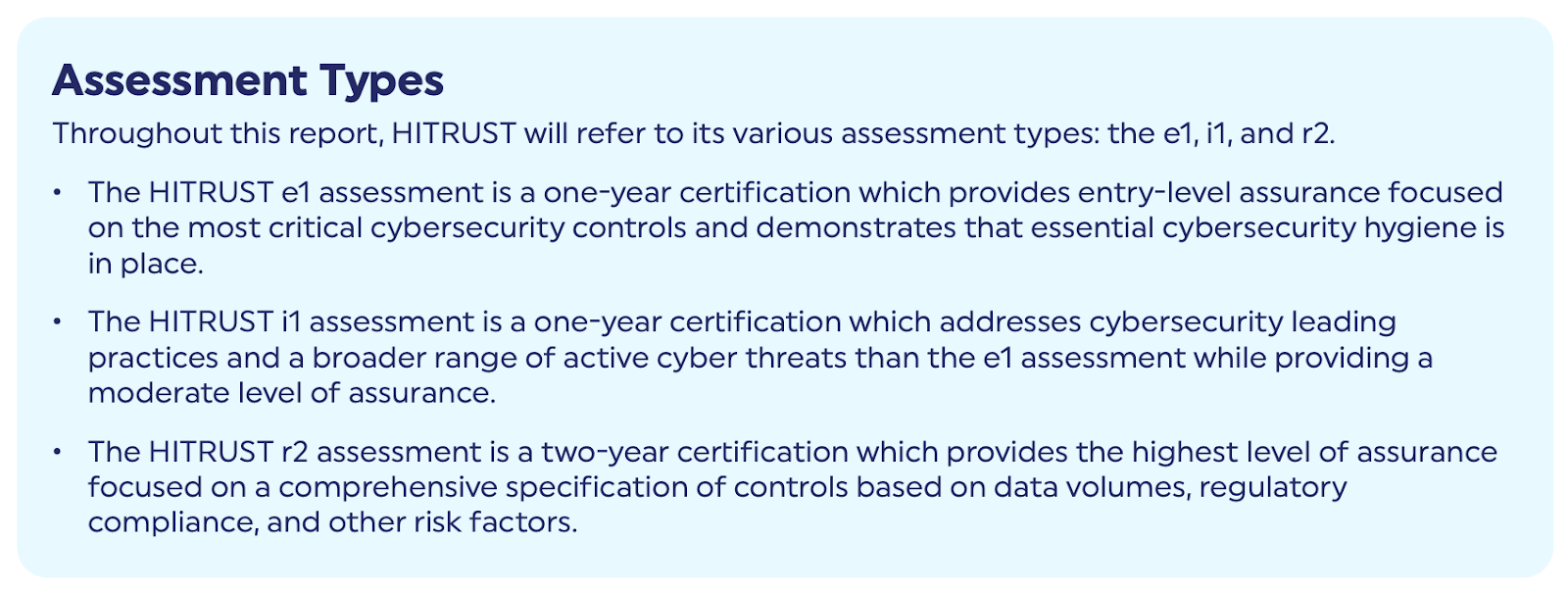
Customers are assessed by an independent network of HITRUST assessors (e.g audit firms) to evaluate if they meet the requirements of the HITRUST framework, which provides several levels of controls based on the size, sector, and risk profile of the organization. HITRUST provides a free CSF framework that has been downloaded by over 35,000 organizations. The r2 certification has been around the longest, for around 10 years and is the most rigorous. There is a newer certification called e1, which is an entry-level control set to help customers get started and is seeing the majority of adoption by new HITRUST customers.

The e1 currently has over 40 technical controls to adhere to, and the r2 is a combination of the control set from i1 (over 100 controls) with a per-customer set of controls based on the specific risk to that business. This means that no two r2 assessments are the same. Highlighting another key differentiator of HITRUST that goes beyond the check-the-box, minimal viable security approach to compliance.

⠀

HITRUST-assessment-types.png

⠀
Lastly, HITRUST frameworks are typically updated quarterly leveraging the latest research on threats and industry best practices. While this can be challenging for customers to maintain that have not adopted automated evidence collection, it ensures that HITRUST is providing a high quality risk-informed framework that drives meaningful security outcomes.

How the Rapid7 partnership strengthens assurance programs

Rapid7’s Surface Command provides customers with a complete internal and external view of their attack surface, including vulnerabilities, misconfigurations, assets, and exposure data. With this new integration, the platform can now collect, map, and validate technical controls against HITRUST requirements using the same datasets security teams rely on for day-to-day operations.

This automated approach supports several outcomes featured in the press release:

  • Continuous compliance visibility: The Command Platform assesses environments for control drift based on HITRUST requirements, which are updated in response to emerging threats.

  • Proactive risk mitigation: Customers can connect vulnerability and exposure insights with HITRUST controls to address areas that matter most.

  • Lower audit burden: Continuous validation reduces manual evidence collection and helps narrow audit scope to the areas that require attention.

  • Support for cyber insurance: Demonstrating consistent control performance can help organizations show strong risk management practices to insurers.

  • Lower costs: By reducing manual work and helping teams focus on priority controls, organizations can minimize the resource-intensive process associated with traditional assurance cycles.

To summarize, Rapid7 Command Platform can map & monitor technical controls to HITRUST e1, i1 and r2, and then by sampling them continuously, Rapid7 can detect control drift to identify areas that need attention, lowering the need for an expensive, comprehensive assessment. We can now help customers focus on remediating what needs attention and enable their assessors to look for only those areas that need addressing, instead of the full scope, ultimately saving costs during the evidence collection and assurance process.

Moving from periodic audits to continuous assurance

Moving from periodic audits to continuous assurance with Surface Command, Rapid7’s attack surface management (ASM) solution, provides our customers with a unified, continuously updated view of all assets and exposures in their organization through a combination of Rapid7 and third-party security data. Today’s security programs need approaches that keep pace with real threats and regulatory expectations. By pairing Rapid7’s visibility into security controls with HITRUST’s structured and independently assessed framework, customers can shift from point-in-time checks to a continuous, evidence-based view of their cybersecurity posture.

This partnership helps teams maintain confidence in their control performance, reduce evidence decay, and communicate program health more effectively to leadership and stakeholders.
Learn more here.

⠀

HITRUST-e1-Dashboard-Example-2.png
HITRUST e1 Dashboard Example

От „на парче“ към ясни цели. Как общината да работи ефективно?

Post Syndicated from original https://www.toest.bg/ot-na-parche-kum-yasni-tseli-kak-obstinata-da-raboti-efektivno/

От „на парче“ към ясни цели. Как общината да работи ефективно?

Планирането и управлението на градовете, в които живеем, по-често се прави „на парче“, като следствие от конкретен проблем, отколкото с визия – особено пък надхвърляща един управленски мандат. Не че си нямаме проблеми, които спешно се нуждаят от разрешаване, даже напротив. Но има ли начин да излезем от шума на злободневните теми и да погледнем на градското управление „отвисоко“, така че да си представим как би изглеждал един добър за живеене град след 25 години? И как можем да положим усилия да го създадем?

В тази статия разглеждам Столичната община (СО) като пример. Ще разкажа какво представлява визията ѝ (да, има такава) и ще премина през целеполагането, изхождащо от тази визия. Ще стигна до изпълнението, за да се види какво е нужно, така че като резултат от визията да усетим в ежедневието си на граждани трайна и устойчива промяна към по-добро. Ще се позовавам на примера с общинско предприятие, в чийто екип съм била и съм участвала в организирането на неговата работа.

Визията като основа на целите и плана

София, наред с градове като Берлин, Бостън, Лондон, Бърно и Хелзинки, има своята дългосрочна визия, която задава посоката за цялостното развитие на града и общината чак до 2050 г. Тя е разработена от мултидисциплинарен екип от експерти (ядрото на който продължава работата си в Общинско предприятие „Софияплан“ и по-късно основава „Екипът на София“) съвместно с над 10 000 участници. Те са представители на администрацията, бизнеса, неправителствения сектор, изследователи от различни сфери и отделни граждани. 

Работата по Визия за София продължава две години. Приета е от Столичния общински съвет (СОС) през 2020 г. Стратегическият документ би следвало да служи за основа на всички останали планове, цели и стратегии на СО до 2050 г. Като следваща стъпка средносрочните цели на СО са зададени в Програмата за София, приета от СОС година след Визията. От нея би трябвало да зависят развитието на общината и нейните приоритети до 2027 г.

Би трябвало… а така ли е наистина? С уговорката, че целеполагането в СО не е изцяло публичен процес и е също въпрос на вътрешна организация на работата, да видим какво знаем по темата и какво споделя самата СО.

Целите – ясни или не съвсем?

Като част от „Екипът на София“ следя отблизо как Общината целеполага, как отчита дейността си и доколко е прозрачна в тези свои дейности. Ето и какво забелязвам през последните няколко години.

Целите на настоящото управление на СО бяха зададени в Управленската програма 2023–2027 (УП). В нея виждаме заявки за реформи и инициативи в четири основни области, определени от управлението като най-важни: здраве, възможности, ред и ефективна община. Някои от тях съответстват на документите, споменати по-горе, например стремежът СО да бъде максимално ефективна. Други, като фокуса върху реда, са по-скоро отговор на отдавна съществуващи проблеми.

Ако погледнем по-цялостно на Програмата, 

започвайки от стратегическата карта в началото ѝ и следвайки детайлно заложените цели, мерки и дейности обаче, връзката със стратегическите документи от по-високо ниво (Визия и Програма за София) не е очевидна. Това не е непременно повод за критика: ситуацията непрестанно се променя, особено в среда на множество заварени проблеми и продължаващи умишлени саботажи на работата на СО. Целеполагането следва да отразява текущата реалност и да се нагажда спрямо нея, когато е необходимо. 

При нужда от такива промени обаче добре би било УП, освен цели, мерки и дейности, да съдържа и кратка обосновка защо именно тези цели са в нейния фокус. Ако тя стъпва върху актуални данни за средата, би било идеално. Ала четейки я, оставаме с впечатлението, че не знаем на какво се основават целите и защо Общината е решила да се фокусира точно върху тези приоритети.

Също така, за да бъде една цел „добра“, важно е тя да е измерима и да сме дефинирали как разбираме, че сме я постигнали. 

И по този показател виждаме разнопосочност в поставените цели и мерки в УП. Някои, например „Единно мобилно приложение и уебсайт за гражданите и бизнеса за работа с услугите на общината“, са относително ясно дефинирани: или ще имаме разработен сайт и приложение до края на 2027 г., или не. Макар че в случая може да се поставят и цели за определен брой потребители, които да ползват даден брой услуги например, все пак тази цел е ясно дефинирана. Други обаче, като „Подобряване на електронните услуги, предоставяни от общината“, звучат като добри пожелания без конкретен измерител за успех. Какво точно означава „подобряване“? Как ще разберем дали сме подобрили услугите? И какво точно искаме да стане с електронните услуги, кога и как?

От цели към изпълнение… и отчетност

Доброто целеполагане е само част от картината. Не по-малко важно е и как изпълняваме целите, отчитаме прогреса по тях и използваме придобитото в този процес знание, за да подобрим начина, по който поставяме цели и ги осъществяваме.

Публичното отчитане на свършеното от СО се осъществява по два начина: формален и неформален. От началото на мандата си кметът Васил Терзиев започна да публикува цялостен отчет за работата си всяка година през ноември. Междувременно виждаме и множество съобщения за извършени дейности и постижения в сайта на СО и в профилите в социалните мрежи на кмета, заместник-кметовете и районните кметове – с различна честота и степен на подробност.

Отчетността на Общината такава, каквато е в момента, е стъпка в правилната посока: прозрачност и информираност. Ала ако разгледаме годишните отчети, ще забележим, че има теми от УП, които не са засегнати, и липсват разяснения защо това е така.

Нека вземем само един от няколкото примера с хоризонт края на 2024 г. 

В УП се прави заявка дотогава да се реорганизира разпределението на отговорности между централната и районните администрации, но тази тема отсъства от отчета за 2024 г. – в него се говори изрично само за финансова децентрализация, а в отчета за 2025 г. децентрализация вече не се споменава под никаква форма. Не става ясно дали има действия в посока разпределение на отговорности отвъд финансите, но авторите на отчета са преценили, че информацията за това не е достатъчно значима или интересна. Или пък нещо е наложило разместване в приоритетите и по тези задачи не е работено. Ако се е случило второто, какво е наложило темата да бъде заменена с други, които не намираме в програмата, но са отразени в отчета? 

Когато липсват отговори на тези въпроси, има риск читателят на отчета да остане с усещането, че е работено „на парче“, без ясна и последователна визия, дори и това да не е така и въпреки че видимо са постигнати успехи в сферите, които засяга отчетът.

„Добрите“ цели

Каква е добрата практика, която помага ясно и последователно да претворим визията в действия, да ги изпълним ефективно, да отчетем, да измерим ефекта от тях и – не на последно място – да получим осезаеми резултати?

За да преминем от визия към реалност, е нужно да поставим конкретни, измерими и изпълними цели в средносрочен и дългосрочен план. За да постигнем това, може да използваме множество готови рамки и модели. Една такава рамка е „Цели и ключови резултати“, по-известна с английското си наименование Objectives and Key Results, съкратено OKR. Тя идва от бизнеса, но е приложима и в публичния сектор. Прилагана е например в Националната агенция за превенция на корупцията в Украйна и община Сиракюз, Ню Йорк.

OKR е рамка за поставяне на цели, която помага на организациите да свържат целите (Objectives) с измерими резултати (Key Results). Целите са това, което искаме да постигнем, докато ключовите резултати са начините, по които измерваме дали сме ги постигнали. OKR работи, като зададем цели, за всяка от които определим от 3 до 5 конкретни, измерими и количествено определени ключови резултата, които целим да постигнем за определен период.


Цел 1

Измерим резултат

Измерим резултат

Измерим резултат

Измерим резултат

Цел 2

Измерим резултат

Измерим резултат

Измерим резултат


След като дефинираме целите, определяме как и кога ще ги изпълним и какви ресурси ще ни бъдат нужни. После идва ред на годишното планиране на дейностите и бюджета. След това е време за действие, но и за периодична проверка на изпълненото, както и за промени в действията при необходимост – минимум на тримесечие, ако планът ни обхваща една година.

Когато говорим за публична институция, каквато е общината, от значение е целият процес да се осъществява прозрачно и достъпно за гражданите. 

Пълната информация за целите и плановете за тяхното изпълнение трябва да се публикува и популяризира редовно. Същото важи и за отчетите. Важно е информацията да е на „човешки“ език – максимално проста и ясна. И без терминология, разбираема само за тесни специалисти. 

Качествените планове и отчети дават конкретни отговори на въпросите, които гражданите си задават за своя град и квартал: 

  • Какво предстои да стане, кога и как? 
  • Какви възможности имам да се включа в процеса по планиране, поставяне на цели и съставяне на бюджета? 
  • Кое от планираното се изпълнява и как върви работата по него? 
  • Кое се бави, защо и кога ще стане? 
  • Кои неща се налага да отпаднат от плана и защо? Какво ще стане с тях?

А можем ли и в София?

Тук може би някои читатели скептично повдигат вежди: „Публична администрация ли е, не може да е ефективна, нито да прилага съвременни методи на работа.“ Обаче не само може, а и подобна добра практика се прилага активно точно в общинско предприятие. Бях част от неговия екип в ключов момент от развитието му и ще ви разкажа от своя личен опит за добрите практики, които приложихме с екипа на предприятието, за да увеличим максимално ефективността на работата в тази организация.

„Софияплан“ е звеното за стратегическо и пространствено планиране на СО. Преди да поеме тази роля през 2020 г., предприятието работи по различни задачи, свързани с устройствено планиране, под името „Софпроект – ОГП“ (съкратено от „общ градоустройствен план“). Като част от подготовката за трансформацията в звено за цялостно стратегическо планиране още през 2019 г. в „Софияплан“ се въвеждат съвременни методи за планиране, изпълнение и отчитане на работата, които се доразвиват през 2020 и 2021 г.

Процесът започва с годишно планиране, съобразено с Визията за София и с нуждите на останалите звена на СО. Прогресът по проектите се проследява на ежеседмична, ежемесечна, тримесечна, шестмесечна и годишна база и планът се променя при необходимост. 

За управлението на работния процес се използва методът Kanban, който цели да оптимизира работата максимално. Той се използва за управление на проекти, като визуализира работния процес и помага за ограничаване на текущата работа, така че да се избегне претоварване на екипа и да се осигури фокус върху най-важните задачи. И тъй като „Софияплан“ е публична институция, предприятието редовно публикува отчети за своята работа.

Този начин на работа е съществен фактор „Софияплан“ да се превърне в едно от най-ефективните и продуктивни звена на СО, 

което с екип от само 26 души успява да разработи сложни проекти, като Програмата за София. Ефективност има и в направените разходи. За 2021 г. – годината, през която се разработва Програмата, целият бюджет на предприятието е 1 364 509 лв. С него се обезпечава работата по 32 проекта с различен мащаб, обхват и сложност, само един от които е Програмата за София. 

За сравнение, община Варна, която е с 28% от населението и 25% от площта на Столичната, бюджетира 606 000 лв. само за разработването на своя план за интегрирано развитие – еквивалента на Програмата за София, но за Варна. А бюджетът на община Велико Търново (със 7% от населението и 66% от площта на Столичната) за аналогичен план е 270 000 лв.


270 000 лв.

План за интегрирано развитие – еквивалент
на Програмата за София

606 000 лв.

План за интегрирано развитие – еквивалент
на Програмата за София

1 364 509 лв.

Програмата за София + 31 други проекта


Историята на „Софияплан“ е и пример за това, че ако цялата община не работи в синхрон, с общи цели и ефективни методи на изпълнение, дори едно нейно звено да се справя добре, цялостният ефект върху средата, в която живеем, се постига трудно. Да започнем от самата Визия за София: при нейното гласуване в СОС всъщност бяха приети само целите, но не и мерките и индикаторите към тях. Друг пример са стратегически документи и стандарти, като стратегията „София играе“ или Стандарта за настилките в пешеходните пространства. Те целят да осигурят единно и високо качество на градската среда, но така и не бяха приложени на практика. А „София играе“ дори не беше разгледана от СОС.

Както виждаме, начин да целеполагаме и да постигаме поставените цели успешно има и у нас – в общински контекст, с всичките му проблеми и предизвикателства. 

Да се премине от „гасене на пожари“ към визионерски режим на работа не е лесно, но резултатите си заслужават. Качественото целеполагане, със съгласуване между визия, стратегия, планове на дейностите и тяхното синхронизирано и координирано изпълнение от цялата община и всички нейни звена, е значим фактор за дълготраен, видим успех. И без да забравяме, че планирането и отчетността на една община, освен да имат ясна връзка помежду си, трябва да са прозрачни. 

Иначе си оставаме с усещането за лутане, като скачаме от пожар на пожар и предлагаме инициативи, които носят „бързи победи“, но невинаги е ясно как точно допринасят за стремежа на управлението на общината и на нейните граждани – всички заедно да живеем в по-добър град.


В настоящата ни съвместна поредица с „Екипът на София“ обсъждаме планирането, озеленяването, архитектурата, инфраструктурата, мобилността и още много други градски теми, описваме добрите примери и търсим възможните решения за подобряването на качеството на живот в нашите градове. 

От „на парче“ към ясни цели. Как общината да работи ефективно?

Like Social Media, AI Requires Difficult Choices

Post Syndicated from Bruce Schneier original https://www.schneier.com/blog/archives/2025/12/like-social-media-ai-requires-difficult-choices.html

In his 2020 book, “Future Politics,” British barrister Jamie Susskind wrote that the dominant question of the 20th century was “How much of our collective life should be determined by the state, and what should be left to the market and civil society?” But in the early decades of this century, Susskind suggested that we face a different question: “To what extent should our lives be directed and controlled by powerful digital systems—and on what terms?”

Artificial intelligence (AI) forces us to confront this question. It is a technology that in theory amplifies the power of its users: A manager, marketer, political campaigner, or opinionated internet user can utter a single instruction, and see their message—whatever it is—instantly written, personalized, and propagated via email, text, social, or other channels to thousands of people within their organization, or millions around the world. It also allows us to individualize solicitations for political donations, elaborate a grievance into a well-articulated policy position, or tailor a persuasive argument to an identity group, or even a single person.

But even as it offers endless potential, AI is a technology that—like the state—gives others new powers to control our lives and experiences.

We’ve seen this out play before. Social media companies made the same sorts of promises 20 years ago: instant communication enabling individual connection at massive scale. Fast-forward to today, and the technology that was supposed to give individuals power and influence ended up controlling us. Today social media dominates our time and attention, assaults our mental health, and—together with its Big Tech parent companies—captures an unfathomable fraction of our economy, even as it poses risks to our democracy.

The novelty and potential of social media was as present then as it is for AI now, which should make us wary of its potential harmful consequences for society and democracy. We legitimately fear artificial voices and manufactured reality drowning out real people on the internet: on social media, in chat rooms, everywhere we might try to connect with others.

It doesn’t have to be that way. Alongside these evident risks, AI has legitimate potential to transform both everyday life and democratic governance in positive ways. In our new book, “Rewiring Democracy,” we chronicle examples from around the globe of democracies using AI to make regulatory enforcement more efficient, catch tax cheats, speed up judicial processes, synthesize input from constituents to legislatures, and much more. Because democracies distribute power across institutions and individuals, making the right choices about how to shape AI and its uses requires both clarity and alignment across society.

To that end, we spotlight four pivotal choices facing private and public actors. These choices are similar to those we faced during the advent of social media, and in retrospect we can see that we made the wrong decisions back then. Our collective choices in 2025—choices made by tech CEOs, politicians, and citizens alike—may dictate whether AI is applied to positive and pro-democratic, or harmful and civically destructive, ends.

A Choice for the Executive and the Judiciary: Playing by the Rules

The Federal Election Commission (FEC) calls it fraud when a candidate hires an actor to impersonate their opponent. More recently, they had to decide whether doing the same thing with an AI deepfake makes it okay. (They concluded it does not.) Although in this case the FEC made the right decision, this is just one example of how AIs could skirt laws that govern people.

Likewise, courts are having to decide if and when it is okay for an AI to reuse creative materials without compensation or attribution, which might constitute plagiarism or copyright infringement if carried out by a human. (The court outcomes so far are mixed.) Courts are also adjudicating whether corporations are responsible for upholding promises made by AI customer service representatives. (In the case of Air Canada, the answer was yes, and insurers have started covering the liability.)

Social media companies faced many of the same hazards decades ago and have largely been shielded by the combination of Section 230 of the Communications Act of 1994 and the safe harbor offered by the Digital Millennium Copyright Act of 1998. Even in the absence of congressional action to strengthen or add rigor to this law, the Federal Communications Commission (FCC) and the Supreme Court could take action to enhance its effects and to clarify which humans are responsible when technology is used, in effect, to bypass existing law.

A Choice for Congress: Privacy

As AI-enabled products increasingly ask Americans to share yet more of their personal information—their “context“—to use digital services like personal assistants, safeguarding the interests of the American consumer should be a bipartisan cause in Congress.

It has been nearly 10 years since Europe adopted comprehensive data privacy regulation. Today, American companies exert massive efforts to limit data collection, acquire consent for use of data, and hold it confidential under significant financial penalties—but only for their customers and users in the EU.

Regardless, a decade later the U.S. has still failed to make progress on any serious attempts at comprehensive federal privacy legislation written for the 21st century, and there are precious few data privacy protections that apply to narrow slices of the economy and population. This inaction comes in spite of scandal after scandal regarding Big Tech corporations’ irresponsible and harmful use of our personal data: Oracle’s data profiling, Facebook and Cambridge Analytica, Google ignoring data privacy opt-out requests, and many more.

Privacy is just one side of the obligations AI companies should have with respect to our data; the other side is portability—that is, the ability for individuals to choose to migrate and share their data between consumer tools and technology systems. To the extent that knowing our personal context really does enable better and more personalized AI services, it’s critical that consumers have the ability to extract and migrate their personal context between AI solutions. Consumers should own their own data, and with that ownership should come explicit control over who and what platforms it is shared with, as well as withheld from. Regulators could mandate this interoperability. Otherwise, users are locked in and lack freedom of choice between competing AI solutions—much like the time invested to build a following on a social network has locked many users to those platforms.

A Choice for States: Taxing AI Companies

It has become increasingly clear that social media is not a town square in the utopian sense of an open and protected public forum where political ideas are distributed and debated in good faith. If anything, social media has coarsened and degraded our public discourse. Meanwhile, the sole act of Congress designed to substantially reign in the social and political effects of social media platforms—the TikTok ban, which aimed to protect the American public from Chinese influence and data collection, citing it as a national security threat—is one it seems to no longer even acknowledge.

While Congress has waffled, regulation in the U.S. is happening at the state level. Several states have limited children’s and teens’ access to social media. With Congress having rejected—for now—a threatened federal moratorium on state-level regulation of AI, California passed a new slate of AI regulations after mollifying a lobbying onslaught from industry opponents. Perhaps most interesting, Maryland has recently become the first in the nation to levy taxes on digital advertising platform companies.

States now face a choice of whether to apply a similar reparative tax to AI companies to recapture a fraction of the costs they externalize on the public to fund affected public services. State legislators concerned with the potential loss of jobs, cheating in schools, and harm to those with mental health concerns caused by AI have options to combat it. They could extract the funding needed to mitigate these harms to support public services—strengthening job training programs and public employment, public schools, public health services, even public media and technology.

A Choice for All of Us: What Products Do We Use, and How?

A pivotal moment in the social media timeline occurred in 2006, when Facebook opened its service to the public after years of catering to students of select universities. Millions quickly signed up for a free service where the only source of monetization was the extraction of their attention and personal data.

Today, about half of Americans are daily users of AI, mostly via free products from Facebook’s parent company Meta and a handful of other familiar Big Tech giants and venture-backed tech firms such as Google, Microsoft, OpenAI, and Anthropic—with every incentive to follow the same path as the social platforms.

But now, as then, there are alternatives. Some nonprofit initiatives are building open-source AI tools that have transparent foundations and can be run locally and under users’ control, like AllenAI and EleutherAI. Some governments, like Singapore, Indonesia, and Switzerland, are building public alternatives to corporate AI that don’t suffer from the perverse incentives introduced by the profit motive of private entities.

Just as social media users have faced platform choices with a range of value propositions and ideological valences—as diverse as X, Bluesky, and Mastodon—the same will increasingly be true of AI. Those of us who use AI products in our everyday lives as people, workers, and citizens may not have the same power as judges, lawmakers, and state officials. But we can play a small role in influencing the broader AI ecosystem by demonstrating interest in and usage of these alternatives to Big AI. If you’re a regular user of commercial AI apps, consider trying the free-to-use service for Switzerland’s public Apertus model.

None of these choices are really new. They were all present almost 20 years ago, as social media moved from niche to mainstream. They were all policy debates we did not have, choosing instead to view these technologies through rose-colored glasses. Today, though, we can choose a different path and realize a different future. It is critical that we intentionally navigate a path to a positive future for societal use of AI—before the consolidation of power renders it too late to do so.

This post was written with Nathan E. Sanders, and originally appeared in Lawfare.

Шест години по-късно. Изгуби ли културата в Пловдив своята посока?

Post Syndicated from Георги Велев original https://www.toest.bg/6-godini-po-kusno-izgubi-li-kulturata-v-plovdiv-svoyata-posoka/

Шест години по-късно. Изгуби ли културата в Пловдив своята посока?

На 5 септември 2014 г. международно жури обяви, че Пловдив е спечелил титлата „Европейска столица на културата“ в надпревара със София, Варна и Велико Търново. В следващите пет години градът се позиционира като най-интересното място в България за съвременна култура. Приятели и познати все по-често идваха от столицата и морето за уикенд туризъм, обикаляха пешеходните улички из „Капана“ и Стария град, отбиваха се в поне няколко от никнещите като гъби хипстърски барове и заведения и ме питаха за интересни събития, които да посетят. А само няколко години по-рано „Капана“ беше квартал, предизвикващ тъга с комбинацията от рушащи се сгради, паркирали по тротоарите автомобили и неработещо улично осветление.

Съживяване на културния живот в Пловдив

Концепцията за Европейска столица на културата насърчи изпълнението на проекти и реализацията на събития в кварталите, в запуснати градски зони с висок потенциал за развитие, като бреговете на Марица, и в агломерацията около областния град.

Шест години по-късно. Изгуби ли културата в Пловдив своята посока?
Част от изложбата „Дим. Истории на тютюна“ © Георги Велев

Един от реставрираните складове в Тютюневия град беше домакин на изложбата „Дим. Истории на тютюна“, която увлекателно представи историята на индустрията, формирала съществена част от облика на Пловдив в края на XIX и началото на XX век. Немалко жители на града вероятно влязоха в тютюнев склад за първи път и имаха възможност да видят отблизо високите тавани, дървените подове и автентичните метални елементи в интериора.

Фасадата на студентските общежития на Медицинския университет се превърна в поле за изява на впечатляваща вертикална хореография, дело на френския колектив La Compagnie Acte. В селата Бойково и Добралък в Родопите, познати основно като отправни точки за планински туризъм, Фондация „Открити пространства“ реализира проекта „Шепоти от родопски приказки“, който съчета различни артистични форми – работилници за разказване на истории, повлияни от местния фолклор, сетивен театър и преработка на традиционни песни.

Това бяха само три от събитията, които ми направиха силно впечатление през 2019 г.

Но в предишните години One Architecture Week, One Design Week, One Dance Week, Нощта на галериите и музеите, павилионът Fluca, Седмицата на съвременното изкуство, „Арт позитив“, „Капана фест“, Hills of Rock и множество други фестивали и събития очертаха трансформацията в артистичния облик на града. Критична маса икономисти, художници, писатели и културни мениджъри (като Богдан Русев и Георги Стоев) се преместиха да живеят в Пловдив. Доколкото именно активните хора създават културния облик на един град със своята енергия, ентусиазъм и нови инициативи, подемът беше осезаем.

Титлата „Европейска столица на културата“ донесе и целево финансиране от българската държава и Европейската комисия за инфраструктурни проекти, като реконструкцията на площад „Централен“ срещу 12 млн. лв., превръщането на някогашния „Детмаг“ в галерия „Капана“ за 1 млн. лв. и реконструкцията на галерията на Съюза на българските художници в галерия 2019. Към онзи момент Пловдив имаше огромна нужда от подобни инвестиции, тъй като поддръжката и обновяването на културната инфраструктура бяха неглижирани от поредица управници.

2025-та: усещане за застой

Превъртаме лентата шест години напред. В публичното пространство все по-често се чуват мнения, че възможността за утвърждаване на града като международен културен център в годините след 2019 г. е загубена. Част от иновативните фестивали, като One Architecture Week, One Design Week и Нощта на галериите и музеите, прекратиха съществуването си поради натрупаната умора в неправителствените организации, които ги изнасяха на плещите си. За тази умора допринесе и сблъсъкът с недалновидната политиката от страна на Общината, която се забърка в поредица от конфликти с някои от най-активните мениджъри на културно съдържание. Липсват нови събития, които да са насочени към визуални или сценични изкуства, а все по-често се набляга върху комерсиалните музикални форми. 

Често алтернативни арт прояви се посрещат със смесица от неразбиране, възмущение и криворазбран патриотизъм. Седмицата на съвременното изкуство, организирана от сдружение „Изкуство днес“, остава едно от малкото събития, позволяващи си да търсят отговори на трудни въпроси и временно да трансформират градската среда. То обаче неведнъж е нападано с епитети като елитарно, безсмислено и нарушаващо „добрите нрави“. 

Емблематичен е случаят с произведението „Стената“ на утвърдената съвременна артистка Севдалина Кочевска.

То представлява инсталация от сребристи чували, която навява асоциация за окопите от Първата световна война и засяга темата за опазването на културното наследство в държави, раздирани от война. След публичен скандал творбата е премахната заради твърдения за опасност от пожар. Остават обаче съмненията, че не се е харесала на високопоставени политици, дошли за празника на Съединението в Пловдив. 

Превръщането на Тютюневия град в артистичен квартал забуксува, тъй като част от собствениците предпочетоха на ръба на закона да съборят сградите, вместо да се захванат с бавния, скъп и тежък административен и строителен процес по възстановяването им в автентичен вид. Действията на Министерството на културата и Националния институт по недвижимо културно наследство по обявяване на складовете за недвижими културни ценности бяха изпреварени от т.нар. Планове за безопасност и здраве. Така евфемистично се наричат документите, с които Общината позволява унищожаването на ценните архитектурни образци от началото на XX в.

Артистичните намеси в „Столипиново“ не доведоха до траен резултат – неизненадващо за квартал, в който голяма част от населението има много по-належащи проблеми: крайна бедност, липса на адекватно сметосъбиране, неясен законов статус на много от жилищата. 

Река Марица продължава да се усеща като зона с пропилян потенциал,

която разделя града на две, вместо да предлага възможности за разходки, културни събития или спорт. Многократно по форуми за урбанизъм и местно развитие се посочват примерите на градове като Париж, Валенсия и Амстердам, които ползват минаващите през тях реки и канали, за да създадат зелени оазиси с потенциал да трансформират околните квартали. Не е учудващо, че Общината няма визия за развитие на Марица, след като години наред не успя да се справи с наглед лесната задача да възложи почистване на речното корито от дървета и храсти.

Пловдив изглежда и се усеща като град, който не може да намери своя автентичен облик и посока. Наследството от 2019 г. се изразява основно в обявяване на ежегодни покани за организиране на събития от Фондация „Пловдив 2019“, които без съмнение са необходими за града, но ползват вече създадената инерция. Липсва ясна и конкретна цел за развитието на културата, която да сплоти администрацията, хората на изкуството, мултинационалните и местните компании и гражданите. Концепция, която да вдъхнови и да обедини, в синхрон с мотото „Заедно“.

Къде може да се намира Пловдив след десетилетие?

От интернет страницата на Община Пловдив разбираме, че времевата рамка на културната стратегия на града е изтекла преди почти година. Липсва инициатива за изработване на нов стратегически документ, необходим за поставянето на целите за следващото десетилетие. Подобна визия беше включена в Апликационната книга за кандидатстване за Европейска столица на културата през 2014 г.

Тук е мястото да се отбележи, че инициативата Пловдив да кандидатства за престижната титла първоначално идва не от местната администрация, а от група артисти и интелектуалци, един от които е Емил Миразчиев от вече споменатото сдружение „Изкуство днес“. Така остава актуален въпросът могат ли отново независимите творци да бъдат движеща сила на процес, търсещ желания културния облик на града.

Една бъдеща културна стратегия следва да е фокусирана и върху развитието на нови градски пространства,

които да предлагат възможност за провеждане на събития с различни теми и мащаб. Общината може да задели целеви средства, за да закупи банята „Орта мезар“, една от четирите най-стари оцелели сгради в Пловдив, чиято история се проследява до XV–XVI век, но за съжаление тъне в разруха от години, а части от нея са увредени от пожар. Трансформацията на постройката в галерия или в център за съвременно изкуство, ведно с облагородяването на принадлежащите зелени площи, визуално и пространствено би допълнила по подходящ начин наситената в исторически и културен план зона около Градската градина, Природонаучния музей и Дома на младоженците. 

Пешеходният мост е покрит с изключително грозна и неподходяща конструкция и приютява основно магазинчета за дрехи и обувки, които напомнят с бутафорния си облик софийския базар „Илиянци“ от средата на 90-те. Администрацията има възможност да инициира преговори с Българската банка за развитие, която е настоящ концесионер на съоръжението, и да придобие актива срещу сума от порядъка на 4–5 млн. лв. Върху част от пространството на моста би могло да се разположи кафене с панорамни гледки към река Марица, а останалото място е подходящо например за изложбени пана, временни скулптурни форми или провеждане на фестивали. 

Вече съм писал за скрития потенциал на Сахат тепе – локация, която остава непозната за много от туристите и жителите на Пловдив в сянката на Стария град и Небет тепе. През последните две години и половина, изминали от публикуването на предишната ми статия, в състоянието на хълма няма особена промяна, освен че тази пролет бяха изсечени десетки дървета в мащабна акция по поддръжка на зоната от предприятие „Градини и паркове“. Нови пейки, кошчета и осветителни тела се поставят инцидентно. Общината се похвали с монтиран воден часовник, но продължава да липсва цялостна концепция как Сахат тепе да стане част от туристическите маршрути. Площадките в горната част на хълма са подходящи за провеждане на концерти, театрални представления и за кинопрожекции на открито, така че той да привлича и други посетители освен хора от квартала, разхождащи кучета, и младежи с бира в ръка. 

Извън новите градски пространства, от които се нуждае Пловдив,

време е на дневен ред да се постави основополагащата тема за цел, която да вдъхнови местната общност.

В унисон с намерението на Европейския съюз да постигне въглеродно неутрална икономика до 2050 г. са създадени наградите за Европейска зелена столица, като процесът на кандидатстване е отворен за всички градове с над 100 000 жители. Река Марица и тепетата са символите на Пловдив, които едновременно имат статус на природни забележителности и носят потенциал за разгръщане като места за реализация на проекти, свързани с културата и изкуството. Като южен град Пловдив е изложен на заплахи от промяната на климата – внезапни речни наводнения и екстремни летни горещини. Качествената поддръжка на зелените зони и облагородяването на крайречните пространства биха донесли както екологични ползи, така и възможности за създаване на изкуство, което вплита теми, свързани с опазването на околната среда. 

Както показва и примерът на Вилнюс, спечелил титлата „Европейска зелена столица“ за 2025 г.,

гражданското участие, инициативите, свързани с устойчивото развитие и проявите на алтернативно изкуство, често вървят ръка за ръка.

По пътя към отличието литовската столица подкрепя множество инициативи и събития, насочени към подобрено рециклиране, увеличаване на компостирането, локални почиствания и включващи неформално образование за деца и подрастващи. 

Пловдив притежава ценен опит и е средище на активни хора, които спомогнаха да се превърне в Европейска столица на културата. Градът още разполага с възможност да се отърси от удобното статукво и да формира дългосрочна визия за развитие на културата и изкуството, която да служи за репер през следващото десетилетие.


По едноименната книга на урбаниста Ян Геел, това е рубрика за добрите чужди (и не само) примери за градско управление или градоустройствено решение, които са променили средата в добра посока. Които са сложили човека в центъра на вниманието. По изключение даваме и примери за тъкмо обратното, но се надяваме, че добрите практики ще преобладават. Защото имаме нужда от позитивност и показвайки, че и иначе може, се надяваме да повлияем на взискателността и чувството за естетика у читателите.

От февруари 2021 г. в рубриката „Градове за хората“ се включват експерти от Съюза на урбанистите в България, а от декември 2024 г. – автори от „Екипът на София“.

Visualizing Target Relabeling Rules in Prometheus 3.8.0

Post Syndicated from Julius Volz (@juliusv) original https://prometheus.io/blog/2025/12/02/visualizing-target-relabeling-rules-in-the-prometheus-ui/

Prometheus’ target relabeling feature allows you to adjust the labels of a discovered target or even drop the target entirely. Relabeling rules, while powerful, can be hard to understand and debug. Your rules have to match the expected labels that your service discovery mechanism returns, and getting any step wrong could label your target incorrectly or accidentally drop it.

To help you figure out where things go wrong (or right), Prometheus 3.8.0 just added a relabeling visualizer to the Prometheus server’s web UI that allows you to inspect how each relabeling rule is applied to a discovered target’s labels. Let’s take a look at how it works!

Using the relabeling visualizer

If you head to any Prometheus server’s “Service discovery” page (for example: https://demo.promlabs.com/service-discovery), you will now see a new “show relabeling” button for each discovered target:

Service discovery page screenshot

Clicking this button shows you how each relabeling rule is applied to that particular target in sequence:

The visualizer shows you:

  • The initial labels of the target as discovered by the service discovery mechanism.
  • The details of each relabeling rule, including its action type and other parameters.
  • How the labels change after each relabeling rule is applied, with changes, additions, and deletions highlighted in color.
  • Whether the target is ultimately kept or dropped after all relabeling rules have been applied.
  • The final output labels of the target if it is kept.

To debug your relabeling rules, you can now read this diagram from top to bottom and find the exact step where the labels change in an unexpected way or where the target gets dropped. This should help you identify misconfigurations in your relabeling rules more easily.

Conclusion

The new relabeling visualizer in the Prometheus server’s web UI is a powerful tool to help you understand and debug your target relabeling configurations. By providing a step-by-step view of how each relabeling rule affects a target’s labels, it makes it easier to identify and fix issues in your setup. Update your Prometheus servers to 3.8.0 now to give it a try!

Decreasing Certificate Lifetimes to 45 Days

Post Syndicated from Let's Encrypt original https://letsencrypt.org/2025/12/02/from-90-to-45.html

Let’s Encrypt will be reducing the validity period of the certificates we issue. We currently issue certificates valid for 90 days, which will be cut in half to 45 days by 2028.

This change is being made along with the rest of the industry, as required by the CA/Browser Forum Baseline Requirements, which set the technical requirements that we must follow. All publicly-trusted Certificate Authorities like Let’s Encrypt will be making similar changes. Reducing how long certificates are valid for helps improve the security of the internet, by limiting the scope of compromise, and making certificate revocation technologies more efficient.

We are also reducing the authorization reuse period, which is the length of time after validating domain control that we allow certificates to be issued for that domain. It is currently 30 days, which will be reduced to 7 hours by 2028.

Timeline of Changes

To minimize disruption, Let’s Encrypt will roll this change out in multiple stages. We will use ACME Profiles to allow you control over when these changes take effect. They are configured in your ACME client. For more information, see our blog post announcing them.

Changes will be deployed to our staging environment approximately one month before the production dates below.

  • May 13, 2026: Let’s Encrypt will switch our tlsserver ACME profile to issue 45-day certificates. This profile is opt-in and can be used by early adopters and for testing.
  • February 10, 2027: Let’s Encrypt will switch our default classic ACME profile to issuing 64-day certificates with a 10-day authorization reuse period. This will affect all users who have not opted into the tlsserver or shortlived (6-day) profiles.
  • February 16, 2028: We will further update the classic profile to issue 45-day certificates with a 7 hour authorization reuse period.

These dates are when the change takes effect for new certificates, so Let’s Encrypt users will see the reduced certificate validity period at their next renewal after these dates.

Action Required

Most users of Let’s Encrypt who automatically issue certificates will not have to make any changes. However, you should verify that your automation is compatible with certificates that have shorter validity periods.

To ensure your ACME client renews on time, we recommend using ACME Renewal Information (ARI). ARI is a feature we’ve introduced to help clients know when they need to renew their certificates. Consult your ACME client’s documentation on how to enable ARI, as it differs from client to client. If you are a client developer, check out this integration guide.

If your client doesn’t support ARI yet, ensure it runs on a schedule that is compatible with 45-day certificates. For example, renewing at a hardcoded interval of 60 days will no longer be sufficient. Acceptable behavior includes renewing certificates at approximately two thirds of the way through the current certificate’s lifetime.

Manually renewing certificates is not recommended, as it will need to be done more frequently with shorter certificate lifetimes.

We also recommend that you make sure your systems have sufficient monitoring in place to alert appropriately if certificates aren’t renewed when expected. There are many available options, some of which are documented on our Monitoring Service Options page.

Making Automation Easier with a new DNS Challenge Type

For many of our users, the hardest part of automatically issuing certificates is proving domain control. Reducing certificate lifetimes and the authorization reuse period will make users need to demonstrate control more often.

All validation methods today require that the ACME client have live access to your infrastructure, either to serve the correct HTTP-01 token, perform the right TLS-ALPN-01 handshake, or update the right DNS-01 TXT record. For a long time, people have wanted a way to run an ACME client without granting it access to these sensitive systems.

These challenges are why we are working with our partners at the CA/Browser Forum and IETF to standardize a new validation method called DNS-PERSIST-01. The key advantage of this new method is that the DNS TXT entry used to demonstrate control does not have to change every renewal.

This means you can set up the DNS entry once and begin automatically renewing certificates without needing a way to automatically update DNS. This should allow even more people to automate their certificate renewals. It will also reduce reliance on authorization reuse, since the DNS records can stay unchanged without any further ACME client involvement.

We expect DNS-PERSIST-01 to be available in 2026, and will have more to announce soon.

Keep Up to Date

Additional updates, reminders, and other changes will be shared on our technical updates mailing list. Subscribe to keep up-to-date with these and all other upcoming changes. If you have any questions, please ask on our community forum. If you want to read more about the work happening at Let’s Encrypt and our other projects, check out our Annual Report, which was published today.

[$] Checked-size array parameters in C

Post Syndicated from corbet original https://lwn.net/Articles/1046840/

There are many possible programmer mistakes that are not caught by the
minimal checks specified by the C language; among those is passing an array
of the wrong size to a function. A recent attempt to add some safety
around array parameters within the crypto layer involved the use of some
clever tricks, but it turns out that clever tricks are unnecessary in this
case. There is an obscure C feature that can cause this checking to
happen, and it is already in use in a few places within the kernel.

The collective thoughts of the interwebz