We just shipped support for the ugliest part of HTTP: Vary

Post Syndicated from Alex Krivit original https://blog.cloudflare.com/vary-support/

The response header, Vary, has been called “the ugliest part of HTTP that we haven't yet improved.” The same post describes it as a “horrible, kludgy mechanism” with “pretty abysmal interoperability” across intermediaries. That is usually where sensible engineers back away slowly with their hands raised. 

That’s not exactly an endorsement of Vary, but ugly doesn’t mean useless. 

One URL can have more than one correct response. A server might, for example, deliver different image formats to different browsers. If a cache ignores Vary, it risks serving the wrong bytes to a request. But if it treats every raw header value as distinct, a handful of similar requests can spread into thousands of barely reusable cache entries. Vary tells a cache which request fields may affect the response, but it does not tell the cache which differences actually matter.

Vary support is now available in Cache Rules on every plan. The origin still names the request headers that may affect a response, but you decide how Cloudflare handles each one. You can normalize known negotiation headers, pass exact values through when those small differences matter, or bypass cache when the variation is too unpredictable. The origin declares what may vary, and you decide how much variation is actually meaningful for the cache.

How Vary works

Vary is a standard HTTP response header that tells intermediary caches (like Cloudflare) which request fields may affect the response sent by the origin. Sites use Vary to serve different languages, image formats, compression schemes, or regional content from the same URL.

Take one URL that produces two valid representations. A browser requests a webpage:

The origin returns HTML and identifies Accept as a field that may affect the response:

An API client can request the same URL with a different preference:

This time, the correct response is JSON. The Vary: Accept header tells the cache that the URL alone is not enough to choose between responses. The request’s Accept value must also be considered.

Without Vary, whichever response enters the cache first can be served to both clients. If HTML wins, the API client receives markup and its JSON parser fails. If JSON wins, a browser expecting a web page receives an API response.

Vary prevents the cache from serving the wrong response to the requesting client. But it introduces a harder question: when two requests contain different header values, do they actually need different responses?

When correct caching becomes useless

Vary can tell a cache which request fields may affect a response. It does not tell the cache what the response represents. For example, take an origin that serves content in only English, French, and German. A client might send:

While another client might request:

Both requests prefer English here. The origin’s response may map both requests to exactly the same English response. But a cache comparing the raw values cannot safely assume they are equivalent. They have different orders and language tags (that the origin doesn’t differentiate). So the cache may store them as separate variants, even when their response bodies contain identical bytes.

This is Vary’s central problem. Applications often produce a small, finite set of representations from an enormous set of possible request values. The origin understands that thousands of language preferences collapse into three supported languages, while a cache usually does not.

This problem compounds when a response varies on multiple fields. Ten possible values across one field create ten variants. Ten values across three fields can create 1,000 combinations. Real headers can have far greater cardinality: User-Agent values are numerous, cookies can be unique to individual visitors, and preference headers can differ in ordering, formatting (spaces and tabs matter!), and quality values.

The result is a cache that can be perfectly correct and almost permanently cold (an entry never reused). Identical responses can be scattered across entries that receive too little traffic to remain hot and in cache. They can consume capacity, evict one another, reduce cache hit ratios, and send more requests back to origin servers. Eviction can remove cold entries, but it cannot merge them just because the responses are identical. 

An analysis of more than 120 million responses from nearly 50,000 popular sites found almost 3,000 sites varying on four or more fields. Some varied on 10, 23, or even 47 fields. We want to make sure that customers have the tools they need to use Vary when appropriate, but not so much that they create a useless cache. 

Some high-cardinality variation is deliberate. CDNs or reverse proxies may inject values, such as a geographic region, to partition content predictably. That works when the possible values are controlled and every component agrees on their meaning. Without those constraints, the cache fragments into variants it may never reuse.

That was the design problem we needed to solve to support Vary. We needed to preserve enough variation to serve the right response, without allowing incidental differences between requests to destroy cache efficiency.

How Cache Rules control Vary

Cloudflare customers already had several ways to handle negotiated content similar to Vary. They could bypass cache and let their origin deal with it, reproduce the origin's negotiation logic in a custom cache key or other rule, use a Worker, or use features like Vary for images

Those options remain useful, but they either give up caching, duplicate application logic, need to write additional code, or address a narrower use case. Vary in Cache Rules may fill the gap between these existing features by splitting support into two decisions: 

  1. The origin uses Vary to identify the request headers that may affect a response.
  2. The Cache Rule determines how Cloudflare handles the value of each header.

A Cache Rule does not force every response to vary. If the origin does not return Vary, Cloudflare caches the response normally, though the rule may still rewrite Accept and Accept-Language before forwarding the request to the origin. 

When the origin does return Vary, Cloudflare uses the configured action for each header it names.  Headers without an individual setting use the rule’s default action. The three available actions are:

We recommend normalize as the default. For individual headers with personal or unbounded values, use bypass. Use passthrough when the exact value changes the response.

For example, passthrough preserves distinctions in casing, whitespace, ordering, and duplicate values, even when the origin treats them as equivalent. With Vary: X-View and passthrough, these three values produce separate cache keys:

X-View: compact,full

X-View: Compact,full

X-View: compact, full

Enough incidental variation can turn a reusable response into many one-off variants in your cache.

Regardless of the configured actions, Vary: * always bypasses cache. It means any aspect of the request, even information outside the HTTP message (like the client’s IP address), may affect which response the origin selects. Cloudflare therefore cannot reuse the response for a later request without contacting the origin.

How a response moves through cache

Let’s follow one of the /catalog requests from above through Cloudflare.

On the first request, Cloudflare has no stored Vary data for the resource, so the cache lookup misses. The matching Cache Rule can normalize configured fields before Cloudflare contacts the origin. 

This can happen before Cloudflare knows whether the eventual response will contain Vary. The Cache Rule defines the permitted normalization; the response later determines whether those fields become part of the cached variant.

That ordering matters. If Cloudflare grouped several raw values under one normalized cache key, but the origin still received those raw values, the origin could produce different responses that the cache would later consider interchangeable. Forwarding the normalized value keeps origin selection aligned with cache matching.

The origin responds with:

Vary: Accept, Accept-Language

Cloudflare records those header names and stores the response as a cached variant. The header values, processed according to the Cache Rule, distinguish this variant from others for the same resource.

When another request for /catalog arrives, Cloudflare starts with the resource’s base cache key: generally the URL plus any other configured key fields. It then reads the stored Vary fields and applies the Cache Rule to those headers in the new request to identify the matching cached variant.

​​Suppose they normalize to:

Accept: text/html

Accept-Language: en,fr

Cloudflare uses those values to look up the matching cached variant directly. It does not compare the request against every stored variant one by one.

If a matching variant exists and is fresh, the request is a cache hit. If not, Cloudflare sends the request to the origin and may store the resulting response as another variant.

The origin response closes the loop. For each header named in Vary, Cloudflare uses the action configured for that header, or the rule’s default action if the header is not listed individually:

  • If it does not contain Vary, Cloudflare caches it normally.
  • If every named header resolves to normalize or passthrough, Cloudflare can store the response as a cached variant.
  • If any named field uses bypass, Cloudflare does not store the response.
  • If the response contains Vary: *, Cloudflare does not store it.

This places an important responsibility on the origin. Every cacheable response that can differ based on request fields must return the appropriate Vary header consistently, including errors and fallback responses. If one response omits it, Cloudflare could cache that response without the variance needed to keep it isolated.

The cache keys in the diagram are conceptual. The later request assumes a fresh cached response.

Any purge targeting a cached resource covers all its Vary variants. Existing requirements for purging custom cache keys still apply.

Changing a Vary configuration does not automatically purge existing content. The new policy may produce different cache keys: requests can miss and refill under the new keys, while old entries remain until they expire or are purged.

Normalization keeps equivalent requests together

Remember the requests from above asking for English and French? 

Accept-Language: en-US, fr;q=0.8

Accept-Language: fr;q=0.8, en-GB

Both requests prefer English, but passthrough would treat them as different variants. If the Cache Rule allows en, fr, and de, normalize reduces both to en,fr, allowing them to share a cached response.

To do this, Cloudflare lowercases values in Accept, Accept-Language, and Accept-Encoding, then sorts them by quality value, the highest first, with alphabetical ordering to break ties. The client’s ordering therefore does not affect the cache key. After sorting, Cloudflare strips parameters from entries with a nonzero quality value. It can also lose q=0 (“not acceptable”) when shortening language tags or filtering to the configured formats and languages. For example, en-US;q=0 can become en. Use passthrough for Accept or Accept-Language if the origin needs to see those exclusions.

You can also configure the rule to keep only specified media types or languages in Accept and Accept-Language. Regional language tags such as en-US reduce to their base language, en, unless the full tag is configured. This lets you align normalization with the formats and languages your origin actually serves.

To keep origin selection aligned with cache matching, Cloudflare forwards the normalized Accept and Accept-Language values to the origin. It also forwards normalized Accept-Encoding values when Respect Strong ETags is enabled. Other headers are normalized only for cache matching.

Configure Vary in Cache Rules

In the Cloudflare dashboard, go to Caching > Cache Rules, create or edit a rule, make the response eligible for cache, and add the Vary setting. Set the default behavior, then add the headers your origin is expected to name.

The same configuration is available through the Rulesets API in the http_request_cache_settings phase. The default setting chooses a fallback action for headers your origin names in Vary that you have not configured individually.

This example normalizes Accept and Accept-Language to a configured set of formats and languages. The default normalize action also applies to other headers named in Vary:

This is a complete request body for a PUT to the http_request_cache_settings phase entrypoint. A PUT replaces every rule in that entrypoint. If you already have Cache Rules, include them in the rules array or use the appropriate single-rule create or update operation instead.

If the origin serves one representation for each media type and language pair, there are six content combinations. That does not cap the cache at six keys. Preference order, missing headers, and values that normalize to empty can create more. Keep the supported set small and define the rule’s boundaries clearly. After rollout, test the same URL with different header values that should normalize to the same cached variant. Send the test requests from the same client, confirm they return the expected format and language, and inspect CF-Cache-Status. Look for hits once the cache is populated, and investigate persistent miss responses or unexpected bypass responses.

For limitations, additional examples, and how to set this in Terraform, see the Vary documentation.

Why not use a custom cache key?

At this point, an obvious question is, “why not add Accept and Accept-Language to a custom cache key?”

That works when those fields are always part of the resource’s identity. But a custom cache key adds the configured dimensions to every response covered by the rule, whether the origin used them or not.

Vary is response-driven, but cacheable responses under the same base key need a consistent set of Vary fields. 

Use a custom cache key when a request property always defines the resource. Use Vary when the origin declares the same set of request fields across cacheable responses. Avoid placing the same header in both unless the duplication is deliberate and tested.

Use Vary in Cache Rules today! 

Vary helps solve an obvious problem: one URL can have more than one correct response. But it hands a cache a harder problem, which request differences actually matter? The origin knows which responses it can serve. The cache needs to know which requests can reuse each response.

Vary in Cache Rules connects those two views. The origin identifies the request fields that may affect a response. You decide whether to normalize values, use passthrough for exact differences, or keep the response out of cache.

Vary was never too ugly to be useful. But configuring supported formats and languages manually may not suit every application. We’re evaluating whether ideas from the expired Availability Hints draft could reduce that work by letting origins describe the representations they serve directly.

Vary in Cache Rules is available today on Free, Pro, Business, and Enterprise plans through the Cloudflare dashboard, Rulesets API, and Terraform.

Introducing Worker Previews: isolated preview environments for every change your agent makes

Post Syndicated from Yomna Shousha original https://blog.cloudflare.com/worker-previews/

Nothing is worse than testing out a change that works in staging, only to see it behave differently in production. That’s why we wanted to give you an environment that’s as close to production as possible — so you can battle-test your changes and make sure they behave exactly as you expect them to.

Agents are helping us push more lines of code than ever before, and larger changes mean more ground needs to be tested ahead of release. Ideally, that testing is done in a way that doesn’t slow agents down, but gives them the tools to take on more of the development lifecycle.

That’s why today we’re launching Worker Previews. Each Git branch gets a production-like place to run, with its own code, configuration, URL, observability, and state.

So now, for every change in your codebase, you can:

  • Deploy an isolated Preview with npx wrangler preview, using its own variables, secrets, and bindings, separate from production configuration and traffic.
  • Share a stable Preview URL for the branch so that every push updates the same running Preview where you can send requests, click through the UI, and test runtime responses.
  • Isolate Durable Objects and Containers per branch, keeping state changes, sessions, memory, migrations, and concurrent tests scoped to that Preview.
  • Inspect logs, errors, metrics, and traces for that Preview to confirm the change works, catch failures, push a fix, and verify it before production sees it.
  • Start from the Preview configuration you set, so each Preview begins with a copy of the variables, secrets, bindings, and settings you define — just like a code branch starts from main. We call this the base configuration.
  • Override a Preview’s configuration when needed, like pointing it at its own database or test API key for migrations — without changing production, the base, or other Previews’ configuration.
  • Serve Preview URLs on a custom domain so that auth providers, cookies, cross-origin resource sharing (CORS), and OAuth redirects work the same way they will in production.

The result is a pre-production feedback loop for every branch. Push your change to a branch, test behavior, inspect performance — before you merge to production.

This enables an Agent Development Lifecycle (ADLC) where each change is atomic, independently deployable, observable, and revisable. And it gives agents and humans the evidence they need to self-improve: catch what failed, push a fix, and verify the next deployment before it hits production.

Every Git branch gets its own environment

When you start work on a new feature, the first thing you do is branch off of main. You get your own copy of the code and make your changes without affecting anything in production.

Worker Previews extend that same model beyond code. Each branch gets its own isolated environment and URL. You can run hundreds of Previews at the same time — each operating independently without affecting other Previews or production.

Production and each Preview have their own configuration — served on their own URL.

When you run npx wrangler preview, the branch gets its own copy of your Previews configuration that you have defined, running on its own URL — all under the same Worker.

In the dashboard, this works like switching branches. Click the breadcrumb next to your Worker's name (it defaults to Production) to see all your Previews:

The dashboard brings every environment into one view. Production sits alongside as many Previews as you need, so contributors can work on separate changes without fighting over a shared staging site. Unlike Wrangler environments, where each environment requires deploying and managing a separate Worker, Previews keep that isolation in one dashboard view.

Each Preview runs as a real version of your Worker. Some changes can only be validated at runtime: an API endpoint has to handle a real request and return the right response. More subjective changes, like a UI update, a new onboarding step, or a different error state, need to be experienced in context before they reach production.

Every Preview has its own isolated and persistent state, with Durable Objects and Containers 

For isolation to extend across your application, stateful resources need special treatment. The reason for that is that Durable Objects run on a singleton model. One instance is responsible for a given object ID, and that instance owns its storage.

If a Preview shared the same DO namespace as production, you wouldn't just be reading stale data — you could modify the same instance serving live traffic in real time (scary!).

That is why every time you run npx wrangler preview, Cloudflare automatically creates a new Durable Object namespace and Container application for that Preview — so that a failed migration or a bad schema change stays contained to that branch and that branch only.

All you need to do is export the class, add its migration, and access it through ctx.exports:

In production, ctx.exports.Counter resolves to the production namespace, while in a Preview, it resolves to that Preview’s namespace.

You now have an entire playground to experiment with. Take Sandboxes, for example, where milliseconds of improvement to startup time can make or break the experience. If you have been trying to improve cold-start performance, you can run different configurations across branches at the same time, compare their cold and warm performance side by side, and find the best setup faster.

Test, observe, and revise each Preview (or have your agent do it)

Now that each branch runs at its own URL in an isolated environment with its own state, you can enter the feedback loop and start battle-testing every change before it reaches production.

You can send traffic to the Preview URL however you normally would — from your terminal, probe from CI, an agent, or by clicking through it yourself. Once that traffic starts flowing, every Workers Observability tool you’re already used to is available, scoped to each individual Preview.

As each request hits the Preview, Workers Observability traces its full lifecycle in a waterfall, including fetch calls, binding operations, and handler invocations. So when something fails, you can follow exactly what happened without sorting through production traffic or signals from other changes.

Observability for Previews looks just like you're already used to for production Workers. Select your Preview from the breadcrumb and open the Observability tab to see its events, errors, and traces:

To give your agents even more control, you can have them open the Preview URL in a headless browser, click through a login flow step by step, and capture a screenshot or record the entire session as replayable DOM events – with Browser Run. 

Below is an example where an agent opens the Preview, captures what was rendered, and connects a failed request to Workers Observability events from the same run.

A reviewer can watch the session in real time with Live View or step in with Human in the Loop when the automation needs judgment.

If something fails, you see it from both angles: what rendered and what happened at runtime. 

That gives the agent enough evidence to keep the pre-production loop running autonomously: deploy, open the URL with Playwright MCP, click through, query the traces through the Workers Observability MCP server, patch, redeploy, and verify. Every iteration stays scoped to the branch.

Configure a base configuration for Previews once, then override as needed

Just like you wouldn't reconfigure your code from scratch every time you branch, you shouldn't have to reconfigure your environment either. 

You set base configuration for Previews once, in a previews block in your Wrangler configuration file.

In the dashboard under Worker → Settings, you see this inlined as Production and Previews Base. Once the base is set, run npx wrangler preview from any branch to create a Preview. If your Worker is Git-connected through Workers Builds, it happens automatically on push.

You can override any setting for only one Preview — without affecting production, the base, or other Previews.

Preview URLs on your own custom domain, protected with Cloudflare Access

To bring the whole setup even closer to production, your preview URLs can be served from your own custom domain. If your app runs on example.com, a Preview for a login branch could run at feature-login.previews.example.com.

If you want to keep those URLs private, you can protect your Previews with Cloudflare Access and require visitors to sign in first.

Testing the whole system before production

We’ve already been dogfooding Worker Previews inside Cloudflare, most notably to build and test CloudflareOS, our open-source platform for safely connecting agents to company systems.

CloudflareOS lets agents work with services such as Google, GitHub, and Slack through Gatekeepers, which control what those agents can access and change. That makes Gatekeeper changes especially sensitive, because a bug could expose data or permit an action that should never have been allowed.

Some of these bugs only appear when OAuth callbacks, permissions, approval flows, and application state are running together. Because testing each component separately cannot show us how the complete system will behave, we deploy an isolated Preview of CloudflareOS and its Gatekeepers for every change under review. We then run the full workflow, fix what fails, and test it again before merging.

We’re seeing customers use Previews for the same basic reason: some problems only show themselves when the change is actually running.

"Previews gives us the ability to iterate earlier at the edge. For IKEA.com, custom domain support helps us avoid Content Security Policy and cookie issues. We’re especially excited for Service Binding support, which will enable communication between Previews and be a game changer for end-to-end testing across our Worker chain." — Santosh Kumar Dwivedi, Senior Software Engineer, IKEA

"At Supermemory, we use Cloudflare heavily, and Worker Previews are exactly the kind of developer experience improvement we wanted to see. For HTTP flows, we can preview Worker changes before they reach production, including routes backed by Durable Objects, and catch issues earlier without slowing down shipping." — Dhravya Shah, Founder, Supermemory

"Previews is amazing for Inspect [Ramp’s coding agent]. I used it to review and test an Inspect PR on my phone that is making reviewing and testing PRs with Inspect on phones responsive…with Inspect." — Dylan Garcia, Senior Staff Engineer, Ramp

What’s next?

You might be thinking: Didn't Workers already have preview URLs? It’s true, we did. We're now calling those Version URLs because they point to specific uploaded Worker versions. Unlike Worker Previews, they don't create an isolated environment for each branch and could only point to production resources. To learn more and compare the different workflows, check out our docs.

Worker Previews is a big improvement from what we offered before, but there's still more to come. Here's what we're working on next:

  • Preview multi-Worker applications. Today, a service binding from a Preview still calls the bound Worker's production deployment. We're working toward keeping the entire request path inside matching Previews.
  • Run Queue consumers and Workflows inside each Preview. Today, Previews can send messages to Queues but cannot consume them, while isolating Workflow executions requires separate configuration. We want the entire asynchronous flow scoped to the branch automatically.
  • Support long-lived Previews for staging and QA. We've heard from teams in the private beta that not every branch is short-lived — some maintain staging, QA, or per-developer environments that persist across sprints. We want to support these end-to-end, and we want to hear how you use them, so we can get it right.

Worker Previews are available now. Get started with the docs, and if you have a feature request or run into an issue, open an issue on GitHub or join the Cloudflare Developers community on Discord.

Acknowledgements: This project was made possible by the design and implementation efforts of Greg Brimble, Patrick O’Donnell, Matt Price, Korinne Alpers, Max Peterson, Cina Saffary, Josh Wheeler, Thomas Ankcorn, Matt Rothenberg, and Brandon Strittmatter, with leadership from Brendan Irvine-Broque and Dan Carter.

GPT-6 Astra Breaks an Old Enigma Message

Post Syndicated from Bruce Schneier original https://www.schneier.com/blog/archives/2026/09/gpt-6-astra-breaks-an-old-enigma-message.html

This is pretty amazing:

However, the most astonishing thing about this break is that the GPT­6 Astra did it entirely on its own. Carter Leffer only directed GPT­6 Astra to see if it could break any of the unbroken Enigma messages published on the Crypto Cellar Research web page. After analysing the unbroken messages on the website, it decided that the most promising message was Nr. 172, MVUEH and it also quickly suspected that the plaintext of Nr. 173, SIPVX, might be related to the plaintext of the unbroken MVUEH message. After trying many different approaches, GPT­6 Astra focused on using the repeated place name ROSENOW ROSENOW as a crib. After developing the necessary Python and C++ software for an Enigma simulator and an Enigma Bombe, GPT­6 Astra started a thorough break with the ROSENOW crib, which in the end resulted in the correct key and plaintext for the MVUEH message being found.

We are still analysing the GPT­6 Astra logs to see exactly how it executed the break. And we are discovering amazing details.

More details at the link.

Join our new UK study on teaching AI ethics and sustainability in lower secondary school

Post Syndicated from Diana Kirby original https://www.raspberrypi.org/blog/join-our-new-uk-study-on-teaching-ai-ethics-and-sustainability-in-lower-secondary-school/

Are you a computing teacher in England, Scotland, or Wales who works with 11- to 14-year-olds and is interested in how young people learn about AI ethics and sustainability? 

The Raspberry Pi Computing Education Research Centre is launching an exciting new research study, and we would love you to get involved.

Two learners in a computing classroom.

In this study, we will explore teaching about the impacts of AI on people, the environment, and society. Our aims for the study are to:

  • Investigate the opportunities and challenges of teaching about AI ethics and sustainability in secondary computing lessons
  • Identify pedagogical approaches for developing students’ ethical reasoning, critical thinking, and agency in relation to AI tools

The study involves attending two in-person workshops in Cambridge, co-designing and teaching a unit of work, and taking part in evaluation activities such as surveys and interviews. Where necessary, we can offer support with the costs of attending the workshops, such as travel, accommodation, and supply cover.

Why focus on AI ethics and sustainability?

According to a recent report, in the UK more than half of 8- to 17-year-olds use AI tools, and as these systems become an increasingly significant part of everyday life, helping young people to critically evaluate their impact is vital.

We recently conducted a scoping literature review to explore what ethical concepts are covered by AI literacy interventions for lower secondary students (11- to 14-year-olds). This work has been accepted for publication at the Frontiers in Education conference, which is taking place in October.

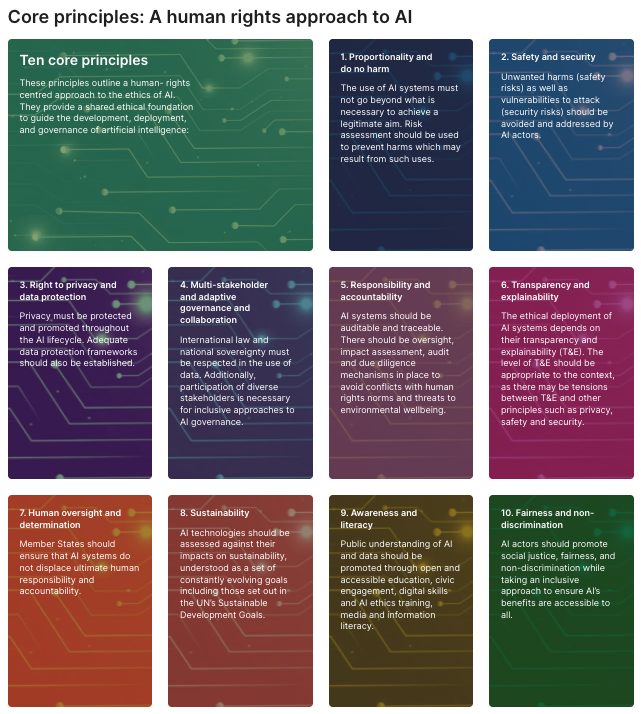
In this work, we used the 10 principles set out in UNESCO’s Recommendation on the Ethics of Artificial Intelligence as a framework for analysis of the ethical concepts covered by the interventions.

UNESCO’s AI ethics principles

Our research showed that when AI ethics is taught to lower secondary students, interventions tend to focus most on concepts such as fairness and privacy. For example, multiple activities explored the important issue of algorithmic bias, teaching students about the causes of bias (such as training AI systems with small or unrepresentative datasets) and discussing real-world examples of bias in AI. 

However, we found that other ethical concepts, such as proportionality and governance, are not often taught. And while a few interventions featured the theme of sustainability, we found that only one directly taught students about the environmental impact of AI itself.

Our new study aims to help address this gap by supporting young people to explore the social and ethical impact of AI tools from a sustainability perspective. Teachers will use real-world examples to engage their students in discussion and ethical reasoning. We hope the findings will support more computing teachers to teach about AI ethics in their lessons, and help students to think critically about the use of AI tools.

What does the study involve?

We are using a design-based research approach to work collaboratively with teachers to co-design a unit of lessons focused on AI ethics and sustainability. 

In a computing classroom, two young children look at a computer screen.

Participating in the study will involve:

  1. Attending two in-person professional development and design workshops in Cambridge (one in early December 2026 and one during the 2027–28 school year)
  2. Delivering the co-designed lessons in your classroom (in early 2027 and the spring of  2028)
  3. Taking part in evaluation activities such as surveys, classroom observations, and interviews

How can I join the study?

If you teach computing at lower secondary level (Years 7–9 or S1–S3) in England, Scotland, or Wales and would like to help shape the way we teach young people about ethical issues around AI, we would love to hear from you. Please register your interest via the form below.

http://rpf.io/sage-application

If you have any questions about the project, please email [email protected].

The post Join our new UK study on teaching AI ethics and sustainability in lower secondary school appeared first on Raspberry Pi Foundation.

Igalia celebrates “Twenty-Five Years Upstream”

Post Syndicated from jake original https://lwn.net/Articles/1095723/

The open-source consulting firm Igalia has put out an
announcement celebrating 25 years
of working on upstream FOSS projects
for its clients. The list of projects the company has worked on is rather
eye-opening: WebKit, mobile-browser rendering (on Maemo, Moblin, MeeGo, and
Tizen), the Linux kernel (CPU and GPU scheduling), 3D graphics drivers, the
Orca screen reader,
GStreamer, and lots more. Beyond that, the company, which is a
worker-owned cooperative, does its work in ways that benefit the community
as well as its clients:

None of this is charity. Igalia is a consultancy, and most of the work above was paid for by someone with a product to ship: a device maker who needs the web to run well on their hardware, a platform that needs a feature its users keep asking for, a company whose roadmap depends on something deep in the stack working better than it does today. What they get from us is not a patch to carry forever. We do the work upstream, in the project itself, so it arrives in the next release and keeps working long after the contract ends. Our customers ship products built on code that nobody has to maintain alone, and everyone else gets the same code. That has been the arrangement from the start.

AWS Weekly Roundup: AWS Builder Center mobile apps, Amazon Connect Talent GA, Amazon Corretto 27, and more (September 21, 2026)

Post Syndicated from Esra Kayabali original https://aws.amazon.com/blogs/aws/aws-weekly-roundup-aws-builder-center-mobile-apps-amazon-connect-talent-ga-amazon-corretto-27-and-more-september-14-2026/

Living in the Netherlands, I spend a fair amount of time on trains, and that is usually where I catch up on what the builder community is writing. Until now, that meant opening a laptop or squinting at a browser tab on my phone. This week I found myself scrolling through trending articles and checking a workshop from the AWS Builder Center mobile app while waiting for a delayed train, and it made those spare twenty minutes very useful. That is why I am glad to open this week with the Builder Center mobile app.

AWS Builder Center is now available as a mobile app on iOS and Android, extending the experience beyond desktop and web. Using your AWS Builder ID, you stay signed in across sessions and can browse trending articles, access 600+ AWS Skill Builder courses, and manage hands-on workshops with free sandbox environments from your mobile device. You can follow AWS Heroes, Community Builders, and User Group Leaders, check Builder Loft event calendars on the go, and receive push notifications for subscribed topics and communities. The app also supports the Wishlist feature for submitting product feedback directly to AWS teams. It is available worldwide on the Apple App Store and Google Play Store.

Builder Center also added two features this week. Polls give you a way to ask the community a question from the Home feed: write a question, add 2 to 5 answer options, set a deadline, and people vote, with results updating live and discussion happening in the comments. Votes are anonymous, and creators see aggregate counts and percentages only. Separately, the Zero to Shipped hackathon is open from September 18 to October 2. You connect your coding agent to AWS, build a real application, and ship it live on AWS for a chance to win a share of a $28,000 prize pool. Five winning projects each receive $5,000 in AWS credits and an AWS Builder swag bundle.

Last week’s launches

Here is what else happened this week.


  • Amazon Connect Talent is now generally available – Amazon Connect Talent is an AI-powered hiring solution for talent acquisition teams managing hiring at scale. Informed by decades of Amazon hiring science, it uses AI agents to conduct structured voice interviews, administer evidence-based assessments, and score candidates consistently, so recruiters can focus on final decisions. Candidates interview 24/7 from any device, and recruiters review scores, transcripts, and detailed evaluations the next morning. All candidate data is anonymized during AI evaluation, each competency is scored against a rubric with every score tied to specific evidence from the interview, and recruiters keep final decision authority over every hire. General availability includes competency-based assessments, AI-led voice interviews with adaptive questioning, a brand-customizable mobile-first candidate portal, and admin onboarding tools.
  • Amazon Corretto 27 is now generally available – Amazon Corretto 27, a Feature Release version of the no-cost, multi-platform distribution of OpenJDK, is now available for download on Linux, Windows, and macOS, with support through April 2027. Notable features include G1 as the default garbage collector across all environments (JEP 523), post-quantum hybrid key exchange for TLS 1.3 (JEP 527), compact object headers by default for a smaller memory footprint (JEP 534), and JFR in-process data redaction to remove sensitive data from Java Flight Recorder recordings before they leave the JVM (JEP 536). It also continues previews of enhanced pattern matching, structured concurrency, and lazy constants, along with the Vector API incubator.
  • Kimi K3 by Moonshot AI is now generally available on Amazon Bedrock – Kimi K3 is now available on Amazon Bedrock for coding and knowledge work. According to Moonshot AI, Kimi K3 is its most capable model and the first open model to reach 2.8 trillion parameters. It combines native vision capabilities with a 1-million-token context window, making it well suited to long-running coding sessions across large repositories, multi-document analysis, and extended agent workflows. Moonshot AI reports an approximate 2.5x improvement in scaling efficiency over Kimi K2. Kimi K3 is the first open-weight model on Amazon Bedrock to support explicit prompt caching, which helps reduce latency and input costs when reusing context across model calls.
  • AWS reimagines the getting started experience – We announced a new simplified experience for builders starting a new project. Instead of completing configuration tasks first, you start with sensible defaults: sign up using an existing identity from providers including Google, GitHub, and Apple, and for most new customers no credit card is required, with $100 in free credits as part of the AWS Free Tier. AWS organizes your work in a project, which contains an AWS account and sharing settings, and applies security controls for you. You can invite collaborators by email without setting up IAM users, set a monthly spend limit starting at $20, and activate advanced AWS features later at no additional cost with no migration. The experience is gradually rolling out to new customers.
  • New low-cost burstable Amazon EC2 T8i instances are generally available – Amazon EC2 T8i instances, powered by custom sixth-generation Intel Xeon Scalable processors (Granite Rapids), are among the lowest-cost EC2 instances and deliver up to 30% better price performance over previous-generation T3 instances. They are designed for low-to-moderate CPU utilization workloads such as microservices, low-traffic websites, development and testing environments, and small databases. T8i instances deliver up to 70% higher compute performance, up to 1.25x higher network bandwidth, and up to 2.4x higher Amazon EBS bandwidth compared to T3, and they use the same CPU credit system, so upgrading from T3 is straightforward.
  • AWS Elastic Beanstalk introduces Cluster Mode – AWS Elastic Beanstalk Cluster Mode is a new fully managed option for teams running a portfolio of applications on shared infrastructure powered by Amazon EKS. Instead of operating each application in isolation, you run multiple applications through one experience with a single operational baseline, so per-application cost decreases as your portfolio grows. You can upload source code in Java, .NET, Python, Node.js, PHP, Ruby, or Go, and Elastic Beanstalk handles containerization automatically through Cloud Native Buildpacks when needed. Cluster Mode includes production-grade deployment strategies with automatic rollback, event-driven autoscaling, AWS Secrets Manager integration, native OpenTelemetry observability, and AI-powered troubleshooting. Standard and Cluster Mode environments run side by side within the same application, so teams can migrate one environment at a time.

For a full list of AWS announcements, be sure to keep an eye on the What’s New with AWS page.

Other AWS news

Here are some additional posts you may find useful:

  • Building in the AWS European Sovereign Cloud – Two new posts cover building on the AWS European Sovereign Cloud, an independent cloud for Europe that runs as a distinct partition with its own control plane, IAM, billing, console, and service endpoints, and its first Region in Brandenburg, Germany. The first post walks through architecting a secure landing zone, covering account structure and governance, identity as infrastructure as code, centralized logging, data protection, and partition-aware ARN construction that works across AWS partitions. The second announces the general availability of Gemma 4 open-weight models on the Amazon Bedrock next-generation inference engine in the AWS European Sovereign Cloud, with inference staying entirely within eusc-de-east-1 under a zero data retention and zero operator access model.
  • The new AgentCore runtime: elastic, optimized, and consistently fast starts – We announced a new version of the Amazon Bedrock AgentCore runtime, the managed compute layer for running agents. The new runtime reclaims memory as a session releases it rather than holding it at the peak, so the bill tracks real usage over the life of a session. It also delivers consistent cold start times regardless of container image size or concurrency by preparing the environment once, snapshotting it, and restoring that snapshot for each new instance. In testing with an empty echo agent, the new runtime delivered a P75 cold start of about 2 seconds from a 200 MB image up to 2 GB, compared to roughly 5.4 to nearly 30 seconds for the original runtime.
  • Introducing the updated AWS Well-Architected Streaming Media Lens – We published a revised Streaming Media Lens, which provides architectural best practices for video streaming workloads. The revision expands from the original 2021 version to cover five streaming scenarios, including interactive live streaming with Amazon IVS Real-Time Streaming for up to 25,000 concurrent viewers, low-latency live streaming, and ad-supported content monetization, alongside enhanced video-on-demand and live streaming guidance. It also adds new sustainability best practices focused on reducing carbon footprint, expanded observability and incident-response frameworks, and advanced content protection with multi-layered DRM and forensic watermarking. The lens whitepaper and custom lens are available now.

For a full list of AWS blog posts, be sure to keep an eye on the AWS Blogs page.

Upcoming AWS events

Check your calendar and sign up for upcoming AWS events:

  • AWS re:Invent – AWS re:Invent returns to Las Vegas from November 30 to December 4. 2, 200+ session times, locations, and speakers are live. Reserved seating for AWS re:Invent opens October 6. Register now and be ready to claim your spot in chalk talks, workshops, and builders’ sessions when reserved seating opens.
  • AWS Summits – AWS Summits are free in-person events covering cloud and AI. With re:Invent on the horizon, the Summits are coming to an end for the year. The last Summit is Dubai (September 30) at the Dubai World Trade Center, with 60+ sessions, an AWS Village, and hands-on workshops.
  • AWS Community Days – Community-led conferences planned and delivered by community leaders. Upcoming events include Lebanon (September 26), Malaysia, Kuala Lumpur (September 26), Cebu, Philippines (September 26), Davao, Philippines (September 26), ComSum Manchester, UK (October 1), and Italy, Rome (October 2).

Summer has officially given way to September, but the weather where I am has not quite caught up. The days are still unusually warm, and I suspect these are the last mild afternoons before autumn settles in for good. I am making the most of them while they last. Come back next week for more!

— Esra

Reverse-Engineering Flock Cameras

Post Syndicated from Bruce Schneier original https://www.schneier.com/blog/archives/2026/09/reverse-engineering-flock-cameras.html

Hackers captured a Flock camera and got a look (alternate link) at the software:

While much of the automatic license plate reader’s (ALPR) most sensitive storage remained encrypted and inaccessible, the joint analysis of the recovered data shows that software running on the device explicitly detects people as well as vehicles, license plates, and bicycles. The camera can produce dozens of images of a single passing vehicle and, according to several weeks of recovered logs, generated more than a million images. Its computer-vision software also sometimes isolated bumper stickers and other graphics, including, in one case, an American flag patch on a motorcyclist’s saddlebag.

If you’re wondering how the hackers got by disk encryption, one of the unencrypted partitions contained the key for an encrypted partition. That’s pretty bad security engineering.

[$] Testing compat_linux on NetBSD with the Linux Test Project

Post Syndicated from jzb original https://lwn.net/Articles/1094310/

NetBSD has long had support for
running Linux binaries via its kernel-level compat_linux
feature, but test coverage for it was less complete than some might
hope. In order to provide better testing for compat_linux,
Google Summer of Code (GSoC) participant Henrique Brito opted to work
on enabling the Linux Test
Project (LTP)
test suite to compile and run on NetBSD. At EuroBSDCon 2026, Brito’s
mentor, Stephen Borrill, provided a report on the project, and the
status of LTP on NetBSD. The work has already resulted in some minor
fixes, and a good list of additional problems to solve.

Security updates for Monday

Post Syndicated from jake original https://lwn.net/Articles/1095702/

Security updates have been issued by AlmaLinux (kernel, perl-Net-DNS, sudo, tomcat, and tomcat9), Debian (chromium, gimp, libde265, libevent, linux-6.12, ruby-jwt, and unbound), Fedora (asterisk, chromium, doctl, dovecot, evolution, firefox, forgejo, freeciv, freeipa, gegl04, gimp, libheif, nss, opkssh, parted, ruby, stb, thunderbird, unbound, and webkitgtk), Mageia (bind, gawk, gdk-pixbuf2.0, graphicsmagick, gstreamer1.0-plugins-base, libde265, libpcap, libssh, mpg123, ntfs-3g, ntpsec, patch, perl-YAML, postfix, python-configargparse, and python-httplib2), Oracle (.NET 10.0, .NET 8.0, .NET 9.0, firefox, image-builder, kernel, libevent, libsoup, libsoup3, perl-Net-DNS, python-lxml, sudo, tomcat, tomcat9, and unbound), Slackware (stunnel), SUSE (alloy, dovecot22, ffmpeg-8, firefox, firefox-esr, freeipmi, glibc, google-guest-agent, google-osconfig-agent, helm, ImageMagick, jq, kbd, kernel-devel, libpcap, libsoup, libzypp, zypper, NetworkManager-applet-l2tp, nginx, openCryptoki, pcre2, python311, python313-aiosmtplib, python313-litellm, rpm, and thunderbird), and Ubuntu (linux-aws, linux-aws-fips, linux-azure-5.15, linux-azure-fde-5.15, linux-azure-fips, linux-azure-5.4, linux-gcp-fips, linux-azure-fips, linux-nvidia-tegra, linux-raspi, linux-raspi-realtime, and rclone).

The collective thoughts of the interwebz