Public-inbox 2.0.0 released

Post Syndicated from corbet original https://lwn.net/Articles/1045965/

Version 2.0.0 of public-inbox, the mail archiving system behind
lore.kernel.org and LWN’s email archive, has been released. “This
release includes several new features and fixes; mostly around improved
integration between inboxes and coderepos for solver. Portability and
reliability is also improved, especially in the internal process management
of lei.
”

[$] Magic kernel functions for BPF

Post Syndicated from daroc original https://lwn.net/Articles/1044824/

When programs written in BPF (the kernel’s hot-loadable virtual-machine
bytecode) call kernel functions (kfuncs), it may be useful
for those functions to have additional information about the context in which
those BPF programs are executing. Rather than requiring it to supply
that information, it would be convenient to let the BPF verifier pass that
information to the called function automatically. That is already possible, but

a recent patch set
from Ihor Solodrai would make it more ergonomic.
It allows kernel
developers to specify that a kfunc should be passed additional
parameters inferred by the verifier, invisibly to the BPF program. The
discussion included concerns that Solodrai’s implementation was unnecessarily
complex, however.

Security updates for Monday

Post Syndicated from jzb original https://lwn.net/Articles/1045922/

Security updates have been issued by AlmaLinux (galera and mariadb, kernel, kernel-rt, mingw-libtiff, redis:7, tigervnc, and xorg-x11-server-Xwayland), Fedora (bind, bind-dyndb-ldap, bpfman, chromium, dolphin-emu, dotnet9.0, golang-github-openprinting-ipp-usb, kea, libnbd, luksmeta, python-cloudpickle, python-pydantic, python-pydantic-core, python-uv-build, ruby, ruff, rust-get-size-derive2, rust-get-size2, rust-regex, rust-regex-automata, rust-reqsign, rust-reqsign-aws-v4, rust-reqsign-command-execute-tokio, rust-reqsign-core, rust-reqsign-file-read-tokio, rust-reqsign-http-send-reqwest, singularity-ce, uv, xen, and xorg-x11-server-Xwayland), Mageia (libxml2, libxslt, opencontainers-runc, and xen), Oracle (bind, galera and mariadb, libsoup, linux-firmware, mariadb:10.5, mingw-libtiff, osbuild-composer, qt5-qt3d, tigervnc, and xorg-x11-server-Xwayland), SUSE (chromium, erlang, google-osconfig-agent, govulncheck-vulndb, java-11-openjdk, java-17-openjdk, java-1_8_0-openj9, opentofu, python-djangorestframework-simplejwt, python311-Django, python315, squid, thunderbird, tiff, tomcat, tomcat11, and xen), and Ubuntu (linux-fips, linux-hwe-6.14, and linux-nvidia-tegra, linux-nvidia-tegra-5.15, linux-nvidia-tegra-igx,
linux-raspi).

Protecting What Powers Business: Rapid7 and Microsoft Partner to Simplify Security

Post Syndicated from Rapid7 original https://www.rapid7.com/blog/post/pt-rapid7-partner-mdr-for-microsoft

Across industries, Microsoft is everywhere. It powers productivity, collaboration, and security through Defender, Sentinel, Entra, and the broader Microsoft ecosystem that underpins how modern organizations operate.

⠀

As organizations deepen their Microsoft investments, there’s an even greater opportunity to strengthen and simplify threat detection and response. Microsoft delivers powerful visibility and security insights across user identities, endpoints, and cloud workloads, but security teams often need help bringing those capabilities together with the rest of their environment to ensure that data, detections, and decisions that drive their threat detection and response program align seamlessly. 

⠀

That’s where Rapid7 comes in.

⠀

A shared vision for simplified, unified security

We’re excited to announce the launch of an expanded partnership between Rapid7 and Microsoft, focused on helping organizations fully realize the potential of their Microsoft security investments. Together, we’re building a unified approach to threat detection and response that combines Microsoft’s ecosystem and scale with Rapid7’s AI-native security operations platform and decades of SOC expertise.

⠀

Our shared goal: help customers protect their businesses with clarity, speed, and confidence.

⠀

For many organizations, Microsoft is the backbone of their IT and security programs. But it’s only one part of a larger, interconnected environment. Security leaders need a way to bring Microsoft Defender, Sentinel, and Entra data into context with the rest of their infrastructure, cloud, and SaaS investments. Rapid7 helps make that possible by connecting Microsoft’s advanced telemetry and analytics with broader visibility and context into all security data, automation, and 24/7 expert-led managed operations.

⠀

We’ve long incorporated deep Microsoft visibility across the Command Platform, integrating with tools across different use cases, such as attack surface management, exposure management, cloud security, and application security. This foundation already allows us to correlate insights across on-premises and cloud environments, including Active Directory, Azure, and Microsoft 365 – providing outcomes across endpoints, workloads, and applications. These capabilities unify context from more than a dozen different Microsoft and Azure tools, giving customers a complete picture of risk across their environment. 

⠀

This partnership combines Microsoft Defender’s signal depth with Rapid7’s threat intelligence, automation, and human-led operations to deliver complete visibility and coordinated response across your environment – from Microsoft to everything it touches.

⠀

This means:

  • Unified security operations managed for you: Rapid7 delivers 24×7 monitoring, investigation, and response across Microsoft and non-Microsoft environments, combining Defender insights with our own detection and response workflows to act quickly on what matters most.

  • Faster, smarter response: AI-driven correlation and human-led expertise reduce alert noise and accelerate containment when threats arise.

  • Simplified, predictable operations: Our managed detection and response (MDR) service removes ingestion complexity so you can focus on security outcomes.

  • Transparency and trust: Built in through seamless integration with the Microsoft consoles security teams already use.

⠀

A foundation for what’s next

Over the coming months, we’ll introduce new capabilities that make it easier for customers to operationalize Microsoft security within the Rapid7 ecosystem, including unified MDR coverage across the Defender products that protect the key vectors of endpoint, identity, cloud, and email.

⠀

These enhancements will enable organizations to not only respond to Microsoft-based threats faster but also proactively reduce risk across their entire environment through unified detection, investigation, and response.

⠀

We’re excited for this next step in advancing our MDR services to meet Microsoft customers where they are and maximize their investments with comprehensive visibility, faster response, and measurable security outcomes.

⠀

We’ll be releasing more information soon. In the meantime, learn more about Rapid7’s leading MDR service here.

A closer look at Python Workflows, now in beta

Post Syndicated from Caio Nogueira original https://blog.cloudflare.com/python-workflows/

Developers can already use Cloudflare Workflows to build long-running, multi-step applications on Workers. Now, Python Workflows are here, meaning you can use your language of choice to orchestrate multi-step applications.

With Workflows, you can automate a sequence of idempotent steps in your application with built-in error handling and retry behavior. But Workflows were originally supported only in TypeScript. Since Python is the de facto language of choice for data pipelines, artificial intelligence/machine learning, and task automation – all of which heavily rely on orchestration – this created friction for many developers.

Over the years, we’ve been giving developers the tools to build these applications in Python, on Cloudflare. In 2020, we brought Python to Workers via Transcrypt before directly integrating Python into workerd in 2024. Earlier this year, we built support for CPython along with any packages built in Pyodide, like matplotlib and pandas, in Workers. Now, Python Workflows are supported as well, so developers can create robust applications using the language they know best.

Why Python for Workflows?

Imagine you’re training an LLM. You need to label the dataset, feed data, wait for the model to run, evaluate the loss, adjust the model, and repeat. Without automation, you’d need to start each step, monitor manually until completion, and then start the next one. Instead, you could use a workflow to orchestrate the training of the model, triggering each step pending the completion of its predecessor. For any manual adjustments needed, like evaluating the loss and adjusting the model accordingly, you can implement a step that notifies you and waits for the necessary input.

Consider data pipelines, which are a top Python use case for ingesting and processing data. By automating the data pipeline through a defined set of idempotent steps, developers can deploy a workflow that handles the entire data pipeline for them.

Take another example: building AI agents, such as an agent to manage your groceries. Each week, you input your list of recipes, and the agent (1) compiles the list of necessary ingredients, (2) checks what ingredients you have left over from previous weeks, and (3) orders the differential for pickup from your local grocery store. Using a Workflow, this could look like:

  1. await step.wait_for_event() the user inputs the grocery list

  2. step.do() compile list of necessary ingredients

  3. step.do() check list of necessary ingredients against left over ingredients

  4. step.do() make an API call to place the order

  5. step.do() proceed with payment

Using workflows as a tool to build agents on Cloudflare can simplify agents’ architecture and improve their odds for reaching completion through individual step retries and state persistence. Support for Python Workflows means building agents with Python is easier than ever.

How Python Workflows work

Cloudflare Workflows uses the underlying infrastructure that we created for durable execution, while providing an idiomatic way for Python users to write their workflows. In addition, we aimed for complete feature parity between the Javascript and the Python SDK. This is possible because Cloudflare Workers support Python directly in the runtime itself. 

Creating a Python Workflow

Cloudflare Workflows are fully built on top of Workers and Durable Objects. Each element plays a part in storing Workflow metadata, and instance level information. For more detail on how the Workflows platform works, check out this blog post.

At the very bottom of the Workflows control plane sits the user Worker, which is the WorkflowEntrypoint. When the Workflow instance is ready to run, the Workflow engine will call into the run method of the user worker via RPC, which in this case will be a Python Worker.

This is an example skeleton for a Workflow declaration, provided by the official documentation:

export class MyWorkflow extends WorkflowEntrypoint<Env, Params> {
  async run(event: WorkflowEvent<Params>, step: WorkflowStep) {
    // Steps here
  }
}

The run method, as illustrated above, provides a WorkflowStep parameter that implements the durable execution APIs. This is what users rely on for at-most-once execution. These APIs are implemented in JavaScript and need to be accessed in the context of the Python Worker.

A WorkflowStep must cross the RPC barrier, meaning the engine (caller) exposes it as an RpcTarget. This setup allows the user’s Workflow (callee) to substitute the parameter with a stub. This stub then enables the use of durable execution APIs for Workflows by RPCing back to the engine. To read more about RPC serialization and how functions can be passed from caller and callee, read the Remote-Procedure call documentation.

All of this is true for both Python and JavaScript Workflows, since we don’t really change how the user Worker is called from the Workflows side. However, in the Python case, there is another barrier – language bridging between Python and the JavaScript module. When an RPC request targets a Python Worker, there is a Javascript entrypoint module responsible for proxying the request to be handled by the Python script, and then returned to the caller. This process typically involves type translation before and after handling the request.

Overcoming the language barrier

Python workers rely on Pyodide, which is a port of CPython to WebAssembly. Pyodide provides a foreign function interface (FFI) to JavaScript which allows for calling into JavaScript methods from Python. This is the mechanism that allows other bindings and Python packages to work within the Workers platform. Therefore, we use this FFI layer not only to allow using the Workflow binding directly, but also to provide WorkflowStep methods in Python. In other words, by considering that WorkflowEntrypoint is a special class for the runtime, the run method is manually wrapped so that WorkflowStep is exposed as a JsProxy instead of being type translated like other JavaScript objects. Moreover, by wrapping the APIs from the perspective of the user Worker, we allow ourselves to make some adjustments to the overall development experience, instead of simply exposing a JavaScript SDK to a different language with different semantics. 

Making the Python Workflows SDK Pythonic

A big part of porting Workflows to Python includes exposing an interface that Python users will be familiar with and have no problems using, similarly to what happens with our JavaScript APIs. Let’s take a step back and look at a snippet for a Workflow (written in Typescript) definition.

import { WorkflowEntrypoint, WorkflowStep, WorkflowEvent} from 'cloudflare:workers';
 
export class MyWorkflow extends WorkflowEntrypoint {
    async run(event: WorkflowEvent<YourEventType>, step: WorkflowStep) {
        let state = step.do("my first step", async () => {
          // Access your properties via event.payload
          let userEmail = event.payload.userEmail
          let createdTimestamp = event.payload.createdTimestamp
          return {"userEmail": userEmail, "createdTimestamp": createdTimestamp}
	    })
 
        step.sleep("my first sleep", "30 minutes");
 
        await step.waitForEvent<EventType>("receive example event", { type: "simple-event", timeout: "1 hour" })
 
   	 const developerWeek = Date.parse("22 Sept 2025 13:00:00 UTC");
        await step.sleepUntil("sleep until X times out", developerWeek)
    }
}

The Python implementation of the workflows API requires modification of the do method. Unlike other languages, Python does not easily support anonymous callbacks. This behavior is typically achieved through the use of decorators, which in this case allow us to intercept the method and expose it idiomatically. In other words, all parameters maintain their original order, with the decorated method serving as the callback.

The methods waitForEvent, sleep, and sleepUntil can retain their original signatures, as long as their names are converted to snake case.

Here’s the corresponding Python version for the same workflow, achieving similar behavior:

from workers import WorkflowEntrypoint
 
class MyWorkflow(WorkflowEntrypoint):
    async def run(self, event, step):
        @step.do("my first step")
        async def my_first_step():
            user_email = event["payload"]["userEmail"]
            created_timestamp = event["payload"]["createdTimestamp"]
            return {
                "userEmail": user_email,
                "createdTimestamp": created_timestamp,
            }
 
        await my_first_step()
 
        step.sleep("my first sleep", "30 minutes")
 
         await step.wait_for_event(
            "receive example event",
            "simple-event",
            timeout="1 hour",
        )
 
        developer_week = datetime(2024, 10, 24, 13, 0, 0, tzinfo=timezone.utc)
        await step.sleep_until("sleep until X times out", developer_week)

DAG Workflows

When designing Workflows, we’re often managing dependencies between steps even when some of these tasks can be handled concurrently. Even though we’re not thinking about it, many Workflows have a directed acyclic graph (DAG) execution flow. Concurrency is achievable in the first iteration of Python Workflows (i.e.: minimal port to Python Workers) because Pyodide captures Javascript thenables and proxies them into Python awaitables.

Consequently, asyncio.gather works as a counterpart to Promise.all. Although this is perfectly fine and ready to be used in the SDK, we also support a declarative approach.

One of the advantages of decorating the do method is that we can essentially provide further abstractions on the original API, and have them work on the entrypoint wrapper. Here’s an example of a Python API making use of the DAG capabilities introduced:

from workers import Response, WorkflowEntrypoint

class PythonWorkflowDAG(WorkflowEntrypoint):
    async def run(self, event, step):

        @step.do('dependency 1')
        async def dep_1():
            # does stuff
            print('executing dep1')

        @step.do('dependency 2')
        async def dep_2():
            # does stuff
            print('executing dep2')

        @step.do('demo do', depends=[dep_1, dep_2], concurrent=True)
        async def final_step(res1=None, res2=None):
            # does stuff
            print('something')

        await final_step()

This kind of approach makes the Workflow declaration much cleaner, leaving state management to the Workflows engine data plane, as well as the Python workers Workflow wrapper. Note that even though multiple steps can run with the same name, the engine will slightly modify the name of each step to ensure uniqueness. In Python Workflows, a dependency is considered resolved once the initial step involving it has been successfully completed.

Try it out

Check out writing Workers in Python and create your first Python Workflow today! If you have any feature requests or notice any bugs, share your feedback directly with the Cloudflare team by joining the Cloudflare Developers community on Discord.


Network Stats for Q3 2025: The Magnitude of AI Workflows

Post Syndicated from Brent Nowak original https://www.backblaze.com/blog/network-stats-for-q3-2025-the-magnitude-of-ai-workflows/

A textured background with the words Network Stats overlaid.

The way data moves is changing in the age of AI. As AI training, model tuning, and inferencing accelerate massive, unpredictable flows of data across clouds, our network telemetry here at Backblaze offers a real-world view into the AI data gravity shift: where data lives, how it moves, and what it takes to keep it accessible and affordable.

Over the past couple of years, we’ve shared Network Stats snapshots that shed light on how data moves across Backblaze’s storage cloud. This quarter, we’re taking that foundation further, and evolving this series into a full-fledged transparency report that stands alongside Drive Stats with regular quarterly reporting and stats you can analyze for yourself.

This report isn’t just about traffic patterns. It’s a look at how data movement is changing in the age of AI and what those shifts reveal about performance, cost, and resilience at scale. 

Tune in live for The Stats Lab webinar

Drive Stats was the beginning. Want to see the evolution? Check out the Backblaze Stats Lab webinar, bringing together content from all of our Stats articles. We’re going to chat about all things Backblaze and beyond—by the numbers.

Save My Seat

In this first report, we’re going to outline the fundamentals of our dataset, highlight standout examples for AI related traffic, and lay the foundation to start sharing our quarter-over-quarter metrics.

Dataset details 

Our internal tools allow us to capture network flow data, meaning transmission control protocol (TCP) conversations between parties on our network. Along with basic information such as who is talking and how many bits are being exchanged, we have the ability to record additional pieces of anonymized information like what country, what ISP, or if we’ve seen a particular IP address before. And for each of these metrics, we have numbers for the average, 95th percentile, and maximum values.

Let’s talk about the three elements that make up our dataset: time, values, and metadata.

1. Monthly time slices

For every month, for every region, and for each direction (egress and ingress), we are data warehousing the following metrics. We plan on either using month-by-month numbers, or rolling up into a quarterly value for Network Stats reports going forward.

Item Detail
Date range Every month
Location scope Every region (eg US-West, EU-Central)
Network traffic direction Ingress, egress

2. Metric values

For each monthly snapshot, we’re recording the following details in our data warehouse. Capturing the average, 95th weighted value, and the maximum allows us enough information to profile our traffic. 

The 95th value (discarding the highest 5% bursts) gives us a good profile for daily operations and the maximum helps profile bust traffic. 

The most interesting metrics that I’m excited to explore are the “bits per IP” values. This combination of “amount of traffic” transferred with “how many actors are involved” per network is a good proxy for what I’m calling the “magnitude” of the network flow. We’re exploring the first insight into this metric below in our chart section.

Defining the Network Stats Quarterly Data

Item Field(s) Detail
Name name
asn
Common name and BGP ASN of the network
Bits bits_avg
bits_95th
bits_max
Number of bits/second
Packets packets_avg
packets_95th
packets_max
Number of packets/second
Flows flow_avg
flow_95th
flow_max
Number of TCP flows
IPs ip_unique_avg
ip_unique_95th
ip_unique_max
Number of unique IP addresses
Bits per IP bits_ip_avg
bits_ip_95th
bits_ip_max
Number of bits per IP address
Protocol v4
v6
Amount of traffic using IPv4 vs IPv6

3. Additional metadata

One of the first custom additions to our dataset is a category field. This helps us define the BGP ASNs (Autonomous System Number), basically the organizations common name associated with a range of IP addresses, that we talk to and group them into categories such as neocloud, hyperscaler, CDN, or general ISP.

Additional Network Stats Metadata

Item Field Detail
category group The class of network carrying the traffic (Cloud, PNI, traditional Internet Transit, or Internal Backblaze-Backblaze)
category type The type of network receiving the traffic (Neocloud, Hosting/Compute provider, Hyperscaler, CDN, Regional ISP, more localised ISP, etc)

The global picture

We started capturing this dataset in August of 2025, so we don’t yet have a good amount of data to pull out quarter over quarter trends. But what we can do for now is take a look into some standout metrics for the month of August that we’re interested in tracking over time.

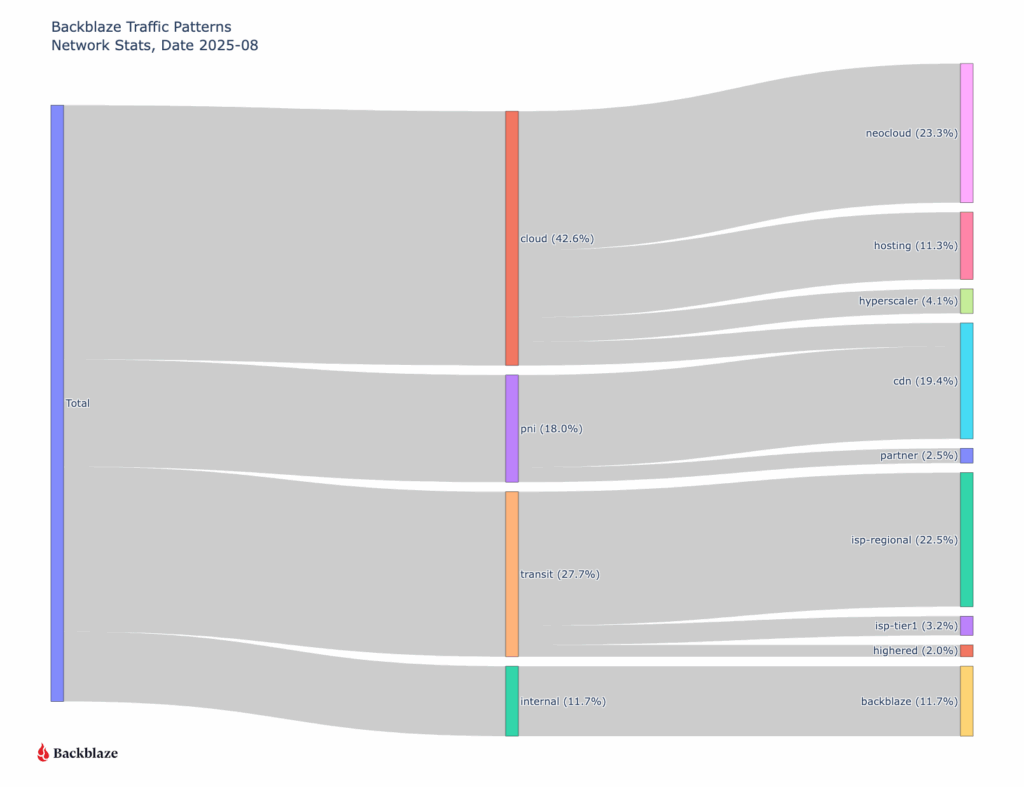
First let’s take a look at where all our traffic goes from a global perspective.

When we look at the data, one pattern stands out immediately: traffic associated with neocloud networks—cloud providers offering compute, GPU, or other AI-related services—already represents nearly a quarter of total ingress and egress across Backblaze’s network. That’s a meaningful signal. Historically CDN traffic has been the majority of our traffic as our B2 Object Storage has been growing. Now, we’re seeing clear evidence of a new class of workload emerging, and it’s AI-shaped.

Neocloud network behavior

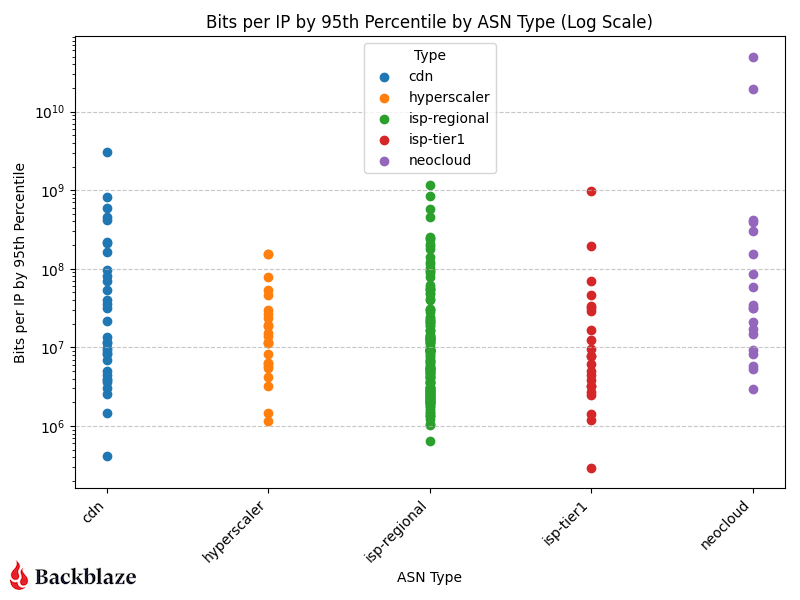
Let’s look at the magnitude of our network traffic based on the category of the traffic destination. To help quantify our data set, we interact with around 123,000 unique IP addresses every month. 

CDN, hyperscaler, isp-regional, and isp-tier one traffic cluster in the same general range of bits per IP, but neoclouds have a couple outliers—the two purple data points in the upper right corner of the log scale graph. 

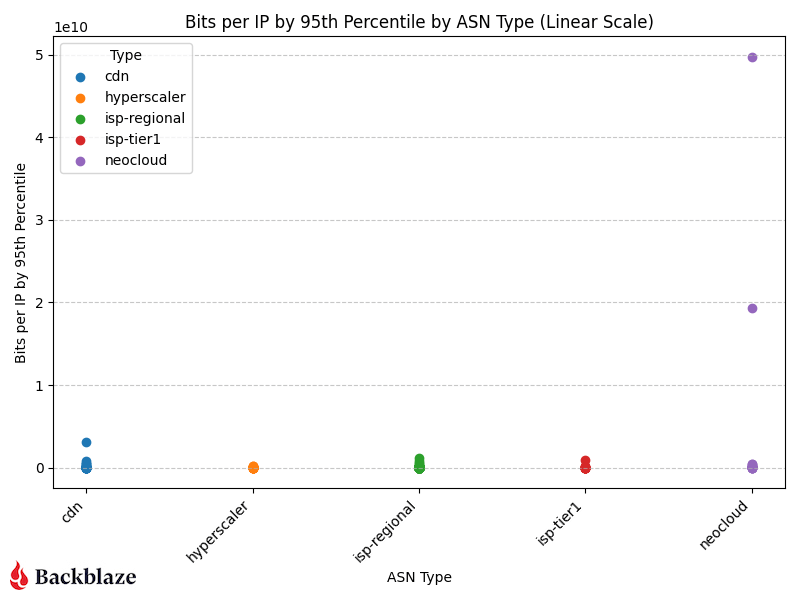
If we change the scale to linear (chart below), now we can see how much of an outlier the AI related traffic is in our sample range.

The “magnitude” (as we’re calling it) of the transfers we’re servicing for AI related flows to neoclouds is an order of magnitude greater than all our traffic patterns. This means that there are only a few unique IP addresses that we’re interacting with transferring large amounts of data in their flows.

The rise of AI-driven data movement

Over the past year, AI training and inference have transformed global data flows. Where traditional workloads move steadily, AI workloads move in bursts—rapid retrievals of massive datasets, short high-volume transfers for model training or tuning, and sustained outbound throughput for inferencing pipelines. The magnitude metric we’re introducing (bits per IP address) captures this shift. 

As shown in the charts above, AI-related traffic to neoclouds isn’t just heavier, it’s denser. Those purple data points represent a small number of IPs exchanging a disproportionate amount of data. That concentration of flow is a hallmark of AI compute pipelines, where a few high-bandwidth endpoints (often GPU clusters) interact with object storage to repeatedly feed and retrieve training data. 

In other words:

  • Fewer talkers, bigger flows. AI systems operate in fewer, more intense network sessions than traditional applications.
  • Shorter duration, higher peaks. Transfer patterns spike sharply, often corresponding to dataset replication or model checkpointing cycles.
  • Cross-cloud mobility. Much of this traffic routes between Backblaze and external compute platforms (classified as neoclouds) showing the rise of multi-cloud AI architectures.

The macro trend: The AI data gravity shift

This pattern reflects a broader macro trend in the cloud ecosystem: AI data gravity is pulling more storage and compute closer together. As AI models grow larger and datasets become more complex, organizations are rethinking where data “lives.” Instead of centralizing everything in one hyperscaler like AWS or Google Cloud Platform, they’re increasingly using cost-efficient, high-throughput storage clouds like Backblaze connected to specialized GPU clouds for compute (case in point: Why CoreWeave’s Object Storage Launch is Good for AI—and Everyone Building It).

This architectural shift explains the outlier traffic patterns we’re seeing on our network. Data isn’t just moving more—it’s moving smarter, following cost, performance, and regional availability cues. 

Why it matters

Tracking this kind of data movement and magnitude helps us, and more importantly our customers, understand a few key things:

  • Operational readiness for AI workloads: How our network scales under bursty, compute-linked demands. (For more on this check out Making the Backblaze Network AI Ready)
  • Cost predictability: Where and when ingress or egress volume spikes may occur.
  • Industry evolution: How AI is reshaping the underlying patterns of internet traffic.

What’s next?

This is just the first glimpse of that industry evolution. As our dataset matures, we’ll be able to watch these AI-linked flows change quarter over quarter, offering not just transparency, but a longitudinal view of how the data backbone of the AI economy takes shape. 

We’re planning to look at quarter over quarter number tracking for network types, IPv4 traffic vs IPv6 traffic, AI related workflows, cross-cloud connectivity trends, and more. We’re also planning to release the raw data quarterly going forward.

Anything specific you want to see? Let us know in the comments or reach out to our Evangelism team. 

We’re excited to share these insights from our network telemetry, the patterns we’re seeing, and what they mean for the broader data economy. This is the stuff we stay up at night studying, and sharing it publicly means we can all better understand the forces shaping digital infrastructure and build with greater confidence and foresight. 

The post Network Stats for Q3 2025: The Magnitude of AI Workflows appeared first on Backblaze Blog | Cloud Storage & Cloud Backup

New Attacks Against Secure Enclaves

Post Syndicated from Bruce Schneier original https://www.schneier.com/blog/archives/2025/11/new-attacks-against-secure-enclaves.html

Encryption can protect data at rest and data in transit, but does nothing for data in use. What we have are secure enclaves. I’ve written about this before:

Almost all cloud services have to perform some computation on our data. Even the simplest storage provider has code to copy bytes from an internal storage system and deliver them to the user. End-to-end encryption is sufficient in such a narrow context. But often we want our cloud providers to be able to perform computation on our raw data: search, analysis, AI model training or fine-tuning, and more. Without expensive, esoteric techniques, such as secure multiparty computation protocols or homomorphic encryption techniques that can perform calculations on encrypted data, cloud servers require access to the unencrypted data to do anything useful.

Fortunately, the last few years have seen the advent of general-purpose, hardware-enabled secure computation. This is powered by special functionality on processors known as trusted execution environments (TEEs) or secure enclaves. TEEs decouple who runs the chip (a cloud provider, such as Microsoft Azure) from who secures the chip (a processor vendor, such as Intel) and from who controls the data being used in the computation (the customer or user). A TEE can keep the cloud provider from seeing what is being computed. The results of a computation are sent via a secure tunnel out of the enclave or encrypted and stored. A TEE can also generate a signed attestation that it actually ran the code that the customer wanted to run.

Secure enclaves are critical in our modern cloud-based computing architectures. And, of course, they have vulnerabilities:

The most recent attack, released Tuesday, is known as TEE.fail. It defeats the latest TEE protections from all three chipmakers. The low-cost, low-complexity attack works by placing a small piece of hardware between a single physical memory chip and the motherboard slot it plugs into. It also requires the attacker to compromise the operating system kernel. Once this three-minute attack is completed, Confidential Compute, SEV-SNP, and TDX/SDX can no longer be trusted. Unlike the Battering RAM and Wiretap attacks from last month—which worked only against CPUs using DDR4 memory—TEE.fail works against DDR5, allowing them to work against the latest TEEs.

Yes, these attacks require physical access. But that’s exactly the threat model secure enclaves are supposed to secure against.

About KeePassXC’s code quality control (KeePassXC blog)

Post Syndicated from jzb original https://lwn.net/Articles/1045807/

The KeePassXC project has recently updated its contribution
policy
and README
to note its policy around contributions created with generative AI
tools. The project’s use of those tools, such as GitHub Copilot, have
raised a number of questions and concerns, which the project has
responded
to
:

There are no AI features inside KeePassXC and there never
will be!

The use of Copilot for drafting pull requests is reserved for very
simple and focused tasks with a small handful of changes, such as
simple bugfixes or UI changes. We use it sparingly (mostly because
it’s not very good at complex tasks) and only where we think it offers
a benefit. Copilot is good at helping developers plan complex changes
by reviewing the code base and writing suggestions in markdown, as
well as boilerplate tasks such as test development. Copilot can mess
up, and we catch that in our standard review process (e.g., by
committing a full directory of rubbish, which we identified and
fixed). You can review our copilot instructions. Would we ever let AI
rewrite our crypto stack? No. Would we let it refactor and rewrite
large parts of the application? No. Would we ask it to fix a
regression or add more test cases? Yes, sometimes.

Emphasis in the original. See the full post to learn more about the
project’s processes and pull requests that have been created with AI
assistance.

A proposed kernel policy for LLM-generated contributions

Post Syndicated from corbet original https://lwn.net/Articles/1045806/

The kernel community is currently reviewing a
proposed policy
for contributors who are using large language models to
assist in the creation of their patches; the primary focus is on disclosure
of the use of those tools. “The goal here is to clarify community
expectations around tools. This lets everyone become more productive while
also maintaining high degrees of trust between submitters and
reviewers.
“

Опитите за отслабване на криптирането водят в стена

Post Syndicated from Bozho original https://blog.bozho.net/blog/4544

Четох съобщението на Европейската комисия за стратегията за сигурност ProtectEU (пак започвам скучно). И вътре освен логичните и очаквани неща, видях един голям проблем:

„Ще представи през 2026 г. технологична пътна карта относно криптирането с цел идентифициране и оценка на технологични решения, които да предоставят законен достъп до данни на правоприлагащите органи;“ като препраща към документ, който казва, че „Групата на високо равнище препоръча редица мерки, за да се гарантира, че широк кръг от доставчици, включително доставчици на OTT услуги (чат приложения), отговарят на искания за законно прихващане“ и съответно, че Комисията ще „проучи мерки за създаване на равнопоставени условия за всички видове доставчици на съобщителни услуги, що се отнася до изпълнението на задължения за законно прихващане;“.

Под бюрократичните евфемизми се крие следното: в целия свят, от 30 години, все някой се опитват да отслаби криптирането, за да може държавата да „слуша“. Спрете се. Това не може да стане. Ще ги хващате по други начини. Ще ползвате метаданни, агенти под прикритие и др.. С криптирането ще си загубите времето, а и политическата подкрепа. Ще стане като с „chat control“ – няма технологично решение, което да не нарушава основни конституционни права.

Може би ако изхождаш от съдебните системи на Германия, Франция, Белгия, изглежда разумно да имаш „законно прихващане“. Тук винаги припомням подслушването на десетки протестиращи през 2020 г. по разследване за държавен преврат на прокуратурата. При нашата прокуратура и при нашите служби (все по-овладяни), няма „законно прихващане“. Понякога ще е законно, понякога ще е полу-законно – ще се прихващат политици, опозиция, бизнеси, посолства – каквото ѝ хрумне на държавата с главно Д.

Технологично това е нонсенс – ако отслабиш криптирането за правоохранителните органи, отслабваш го за всички; ако сложиш тайна „задна вратичка“ в алгоритъма, тя ще спре да бъде тайна на втория месец; ако ползваш т.нар.“призрачен потребител“, както предложиха британските служби преди години, чупиш гаранциите за идентификация на потребителите (и някой друг също ще намери как да добави призрачен потребител в разговора); разделянето на криптографски ключове е несъвместимо с гаранциите за т.нар. forward secrecy и създава много други проблеми.

И най-лошото е, че дори да се приеме някаква законодателна глупост, която да отлсаби криптирането „от край до край“, тя ще бъде заобиколена точно от организираните престъпни групи, които цели да засегне. Ако накарате Signal, Threema, Wire или някое друго приложение с криптиране „от край до край“ да сложи вратичка, през която да се подслушва, те или ще излязат от европейския пазар, или дори да се съобразят, ще продължат да бъдат с отворен код, и криминалните групи ще могат да си направят своя версия, без възможността за прихващане. И ще си ползват нея, докато за нормалните хора ще отпаднат гаранциите и някой следващ Гешев ще може да ги слуша за държавен преврат, докато всъщност се опитва да превземе бизнес или да събира компромати.

С две думи – изобщо не тръгвайте по тая наклонена плоскост. Свършва в стена.

Материалът Опитите за отслабване на криптирането водят в стена е публикуван за пръв път на БЛОГодаря.

The collective thoughts of the interwebz