Post Syndicated from The History Guy: History Deserves to Be Remembered original https://www.youtube.com/watch?v=0ETc4NbzwpI
32 Towels
Post Syndicated from Oglaf! -- Comics. Often dirty. original https://www.oglaf.com/32-towels/


Stream w/ Guest – Zigbee, Lincstation, Homey, IKEA and other odd Smart Home Products
Post Syndicated from digiblur DIY original https://www.youtube.com/watch?v=QNPf02XL6Ko
Great Dismal Swamp: A Marvel of Biodiversity
Post Syndicated from Geographics original https://www.youtube.com/watch?v=ts62t78IUhE
Easy Zigbee2MQTT Dongle Migration – Sonoff USB to SLZB-06 Ethernet
Post Syndicated from digiblur DIY original https://www.youtube.com/watch?v=MJ3UZw-Zkn0
The Rome Poisoner Ring
Post Syndicated from The History Guy: History Deserves to Be Remembered original https://www.youtube.com/watch?v=RXXVKU5cNXs
Comic for 2024.06.29 – Licking
Post Syndicated from Explosm.net original https://explosm.net/comics/licking
New Cyanide and Happiness Comic
Candy TV – Portable Digital TV & Radio – a bad idea, done badly
Post Syndicated from Techmoan original https://www.youtube.com/watch?v=I3GBWC6c4NQ
Седмицата (24–29 юни)
Post Syndicated from Надежда Радулова original https://www.toest.bg/sedmitsata-24-29-yuni/

От известно време ни стана навик посред лято да сваляме правителства, да ходим на избори, да гледаме парламентарен цирк, в който се подхвърлят мандати и се сглобяват и разглобяват мнозинства и малцинства, широки и тесни, стабилни и паянтови коалиции. Лош навик, бих казала. Защото при 36 градуса, на чаша узо или пък пред екрана със смразяващи кръвта новини от света, лека-полека вътрешнополитическите събития заприличват на умиляващ междуфамилен селски събор, който от година на година все повече преставаме да забелязваме („Говори си, не ми пречиш!“). В седмичния си анализ „България в средата на нищото“ Емилия Милчева обобщава ситуацията така: политическата нестабилност, подсилена с краен популизъм, води до тежък застой и липса на каквато и да било управленска последователност и визия. И какво от това?! Вече сме претръпнали. И претръпването, разбира се, се отразява на избирателната активност, а оттам и на изборните резултати, и на какво ли още не.
Лошото е, че претръпването към тясно политическото има общоанестетичен ефект. Ето така например проспиваме факта, че само през първите три седмици на юни (най-малко) четири жени в България са били убити от свои близки мъже – партньори, синове… Светла Енчева разглежда случаите през призмата на променящото се законодателство, но и в една по-широка ценностна рамка, защото „Насилието над жени не чака България да се оправи“.
Анестетичен ефект сковава все повече и реактивността ни към войните, които се водят в Украйна и в Близкия изток. Лесно е от привидно безопасно разстояние да слагаме етикети и да раздаваме присъди, да сме винаги прави, да се прилепяме към бързо смилаеми лозунги, които да „осмислят“ вместо нас трудни или дори немислими неща. Повече за всекидневната сложност да живееш във война и да формулираш (дори и само за себе си) какво се случва и какво може да се направи, четете в разговора на Еми Барух с израелския писател Етгар Керет „Проблемът е, че всички искат да е просто и ясно, а то не е“.
Яснота и еднозначност няма и по отношение на един на пръв поглед ясен казус – този, свързан с цифровите ни права и уреждащото ги законодателство. Белгийското председателство се отказа да подложи на гласуване в ЕС предложенията за изключения по Директивата за правото на неприкосновеност на личния живот и електронни комуникации (2002/58/ЕО). Това е пореден бюрократичен опит за премахване на криптирането от приложенията за съобщения и разговори, или с други думи – ново посегателство върху тайната на личната кореспонденция. Предложенията включват автоматизирано масово наблюдение на комуникациите чрез използване на компютърни алгоритми и изкуствен интелект.
Идеята е особено опасна, защото изхожда от изключително благородни мотиви, а именно „борба със сексуалните посегателства срещу деца в интернет“, което би провокирало напълно разбираема подкрепа. Проблемът е, че винаги когато се жертва малко свобода, за да се постигне малко сигурност, в крайна сметка се губят и двете. Защото престъпниците няма да спрат да ползват нелегални системи за комуникации с криптиране, а всички останали ще сме в паноптикума на „Големия дигитален брат“.
Опасността #chatcontrol не е отминала, а е само отложена. И макар Съдът на Европейския съюз вече да е постановявал, че постоянното и цялостно автоматизирано претърсване и следене на частни комуникации нарушава основни права и поради това следва да е недопустимо, темата се връща непрекъснато на дневен ред заради популизъм и елементарно мислене от неадекватни политици.
Какво е становището на България по този въпрос, е напълно неясно. Обществен дебат у нас също изцяло липсва. С този въпрос се е заел Богомил Шопов от Сдружението за свободен софтуер, софтyер с отворен код и цифрови права, който се опитва да разбере как възнамерява да гласува българският представител в Съвета на Европа, и да подскаже опасностите от евентуална подкрепа на такова изключение на неприкосновеността на комуникациите. „Тоест“ ще следи развитието по темата.
Не е проста и ясна и ситуацията с предстоящите избори в САЩ. При все че Съединените щати са ключов глобален политически играч, за избирателите приоритет продължава да бъде „Икономиката, глупако!“. За това „Кои са най-важните проблеми за американците в изборната година? Част 1: Икономиката“ четете анализа на Йоанна Елми.
Тази седмица ви предлагаме още един външнополитически текст – и образователен, и аналитичен: „За Китай, Европа и червените линии“ от Искрен Иванов. И докато у нас думички като „възраждане“, „величие“ и „възход“ вече отчетливо кънтят на тенекия и папиемаше, в случая с Китай не става дума за „исторически парк“, отделен от европейското с безкрайна стена, а за „острието на триъгълника, което балансира отношенията между глобалните актьори“ (по Кисинджър).
Доста жилава за осмисляне е „порцията език“, която ни поднася Павлина Върбанова този месец. „Слонът в стаята на българския правопис“ се оказва разделът с правилата за слято, полуслято и разделно писане. Защо вкъщи не е като у дома, е въпрос, на който няма да можете да си отговорите дори след като прочетете текста. Пореден пример за това, че липсата на бързи и окончателни отговори не отменя валидността на въпросите.
Стихотворението на месеца „Вниманието“ е от ирландския поет Ник Леърд и пристига при нас в превод на Ангел Игов. Красиво и тъжно размишление за обичта, загубата и деликатния, осмислящ света начин, по който бихме могли да извървим пътя си, ако не бързахме с отговорите, ако не обезболявахме мислите си.
Приятно четене (с разбиране)! И безгрижно – доколкото е възможно – лято! Без да забравяме, че след по-малко от три месеца ще свърши.
Fun with hats… and Jimmy
Post Syndicated from The History Guy: History Deserves to Be Remembered original https://www.youtube.com/watch?v=ly1GD_64b5A
Friday Squid Blogging: New Squid Species
Post Syndicated from Bruce Schneier original https://www.schneier.com/blog/archives/2024/06/friday-squid-blogging-new-squid-species-3.html
A new squid species—of the Gonatidae family—was discovered. The video shows her holding a brood of very large eggs.
Research paper.
Metasploit Weekly Wrap-Up 06/28/2024
Post Syndicated from Jack Heysel original https://blog.rapid7.com/2024/06/28/metasploit-weekly-wrap-up-06-28-2024/
Unauthenticated Command Injection in Netis Router

This week’s Metasploit release includes an exploit module for an unauthenticated command injection vulnerability in the Netis MW5360 router which is being tracked as CVE-2024-22729. The vulnerability stems from improper handling of the password parameter within the router’s web interface which allows for command injection. Fortunately for attackers, the router’s login page authorization can be bypassed by simply deleting the authorization header, leading to the vulnerability. All router firmware versions up to V1.0.1.3442 are vulnerable.
New module content (2)
MS-NRPC Domain Users Enumeration
Author: Haidar Kabibo https://x.com/haider_kabibo
Type: Auxiliary
Pull request: #19205 contributed by sud0Ru
Path: scanner/dcerpc/nrpc_enumusers
Description: This adds a new module that can enumerate accounts on a target Active Directory Domain Controller without authenticating to it; instead the module does so by issuing a DCERPC request and analyzing the returned error status.
Netis router MW5360 unauthenticated RCE.
Authors: Adhikara13 and h00die-gr3y [email protected]
Type: Exploit
Pull request: #19188 contributed by h00die-gr3y
Path: linux/http/netis_unauth_rce_cve_2024_22729
AttackerKB reference: CVE-2024-22729
Description: This adds an exploit module that leverages CVE-2024-22729, a command injection vulnerability in Netis router MW5360 to achieve remote code execution as the user root. All router firmware versions up to V1.0.1.3442 are vulnerable.
Bugs fixed (3)
- #19259 from dledda-r7 – This updates Metasploit to check for a new flag that is sent as part of the encryption key negotiation with Meterpreter which indicates if Meterpreter had to use a weak source of entropy to generate the key.
- #19267 from zeroSteiner – Fixes a crash in the
ldap_esc_vulnerable_cert_findermodule when targeting an AD CS server that has a certificate template containing parenthesis. - #19283 from adeherdt-r7 – Fixes the
auxiliary/scanner/redis/redis_loginmodule to correctly track the registered service name asredis– previously it was blank.
Documentation
You can find the latest Metasploit documentation on our docsite at docs.metasploit.com.
Get it
As always, you can update to the latest Metasploit Framework with msfupdate
and you can get more details on the changes since the last blog post from
GitHub:
If you are a git user, you can clone the Metasploit Framework repo (master branch) for the latest.
To install fresh without using git, you can use the open-source-only Nightly Installers or the
commercial edition Metasploit Pro

[$] FreeDOS turns 30
Post Syndicated from jzb original https://lwn.net/Articles/979780/
FreeDOS is an open-source
operating system designed to be compatible with the now-defunct MS-DOS. Three decades
have now passed since the FreeDOS project was first announced, and it
is still alive and well with a small community of developers and
users committed to running legacy DOS software, classic DOS games, and
developing modern applications that extend its functionality well beyond the
original MS-DOS. It may well be around in another 30 years.
Last Week Tonight Library: Season 3, Coming 6/30!
Post Syndicated from LastWeekTonight original https://www.youtube.com/watch?v=63dp_pacFZ0
NVIDIA NVLink Switch Chips Change to the HGX B200
Post Syndicated from Patrick Kennedy original https://www.servethehome.com/ingrasys-shows-big-nvidia-nvlink-switch-chips-change-to-the-hgx-b200-b100/
The NVIDIA HGX B200 and HGX B100 platforms use only two NVLink Switches (down from four) and reposition them for shorter trace lengths
The post NVIDIA NVLink Switch Chips Change to the HGX B200 appeared first on ServeTheHome.
How the first 2024 US presidential debate influenced Internet traffic and security trends
Post Syndicated from João Tomé original https://blog.cloudflare.com/how-the-first-2024-us-presidential-debate-influenced-internet-traffic-and-security-trends

Key findings:
- The Biden vs. Trump debate influenced Internet traffic at the state level in the US, with drops in traffic as high as 17% (in Vermont) during the debate.
- Microblogging and video streaming platforms saw traffic changes during the debate.
- Trump-related sites, including donation platforms, gained much more traction than Biden’s during and after the debate.
- Emails with “Trump” in the subject had higher rates of spam and malicious content compared to those with “Biden.”
- No increase in cyberattacks during the debate, but frequent DDoS attacks targeted government and political sites in the preceding months.
Internet traffic ebbs and flows usually follow human patterns, and high visibility events that are broadcast on TV usually have an impact. Let’s take a look at the first of the 2024 United States presidential debates between the two major presumptive candidates, Joe Biden and Donald Trump, for the November presidential election.
2024 has been dubbed “the year of elections,” with elections taking place in over 60 countries, as we have mentioned before (1, 2, 3). We are regularly updating our election report on Cloudflare Radar, including analysis of recent elections in South Africa, India, Iceland, Mexico, and the European Union.
Typically, from what we usually observe, election days don’t come with highly intensive changes to Internet traffic, and the same is true for debates. Yet, debates can also draw attention that impacts traffic, especially when there is heightened anticipation. The 2024 debates are not only aired on broadcast and cable television but also streamed on platforms like YouTube, enhancing their reach and impact.
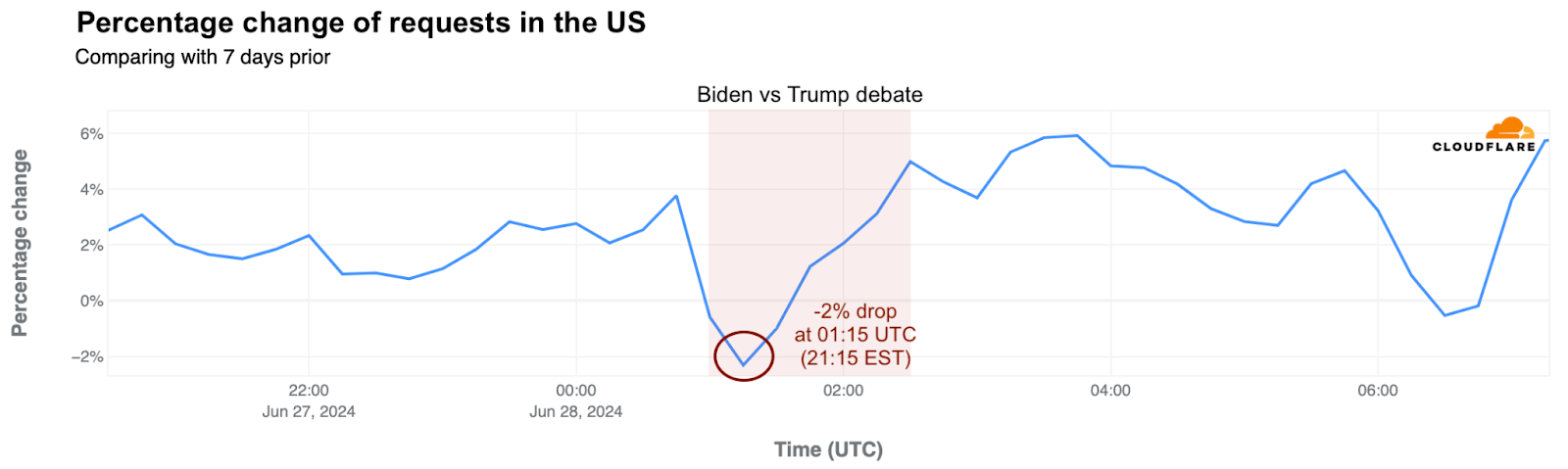
During the June 27, 2024, debate between Biden and Trump, hosted by CNN at 21:00 EST (01:00 UTC), Cloudflare noted a slight drop in nationwide Internet requests, falling to 2% below the same time a week prior at 21:15 EST (01:15 UTC). Interestingly, Internet traffic was 4% higher just before the debate started and surged to 6% above the previous week’s levels after the debate concluded at 23:45 EST (03:45 UTC).
Internet traffic dips across US states
Traffic shifts at the time of the debate, as compared to the previous week, are much more revealing at a state-level perspective than at the country level. The map below summarizes traffic changes observed at a state level:
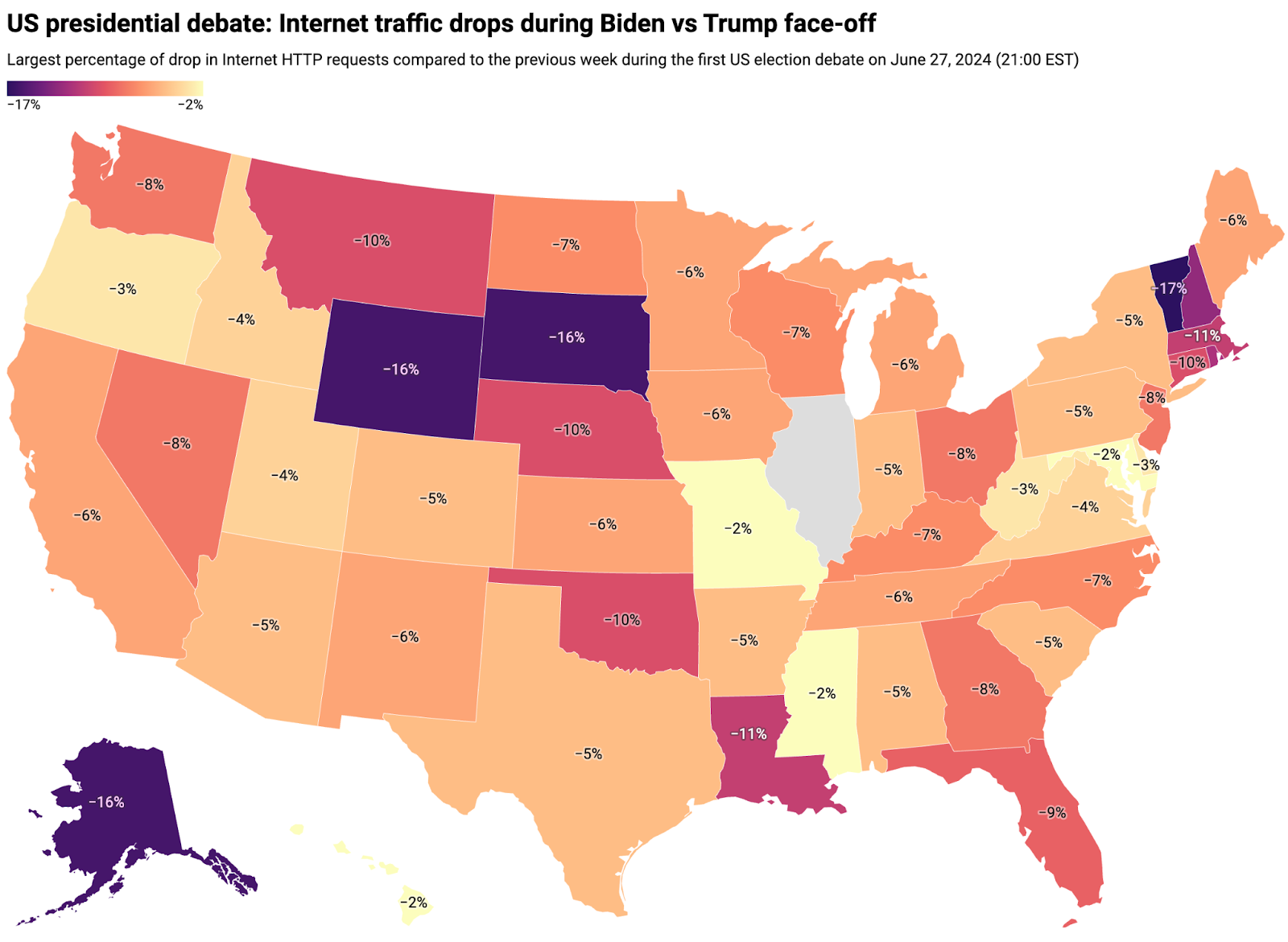
The most significant traffic drops were seen in Vermont (-17%), South Dakota (-16%), Wyoming (-16%), and Alaska (-16%). More populous states like California, Texas, and New York saw milder reductions of between 5% and 6%, and Florida experienced a 9% drop at 21:45 local time (01:45 UTC) during the debate.
The six swing states that are said to be decisive in the election, Arizona, Georgia, Michigan, Nevada, Pennsylvania and Wisconsin, all saw traffic drop between 5% and 8%.
The initial minutes of the Biden vs. Trump debate triggered the largest traffic declines in most states, though several, including Florida, Louisiana, Georgia, Nevada, and Wisconsin, observed deeper dips midway through. States like Ohio and Missouri recorded their most substantial traffic drops towards the debate’s conclusion.
In the next table, we provide a detailed breakdown of the same perspective shown on the US map ordered by the magnitude of the drop in traffic. We include the time of the biggest traffic drop compared to the previous week, at a 5-minute granularity, and also the percentage of the drop compared to the previous week. (Illinois is not included due to data issues.)
| State | Drop in traffic (%) | Time of drop in traffic (local) | Time of drop in traffic (UTC) |
|---|---|---|---|
| Vermont | -17% | 21:00 | 1:00 |
| Alaska | -16% | 17:30 | 1:30 |
| South Dakota | -16% | 20:10 / 19:10 | 1:10 |
| Wyoming | -16% | 19:25 | 1:25 |
| New Hampshire | -13% | 21:05 | 1:05 |
| Rhode Island | -12% | 21:05 | 1:05 |
| Louisiana | -11% | 20:45 | 1:45 |
| Massachusetts | -11% | 21:05 | 1:05 |
| Connecticut | -10% | 21:30 | 1:30 |
| Montana | -10% | 19:10 / 18:10 | 1:10 |
| Nebraska | -10% | 20:05 / 19:05 | 1:05 |
| Oklahoma | -10% | 20:05 | 1:05 |
| Florida | -9% | 21:45 | 1:45 |
| Georgia | -8% | 21:45 | 1:45 |
| Nevada | -8% | 18:40 | 1:40 |
| New Jersey | -8% | 21:05 | 1:05 |
| Ohio | -8% | 22:25 | 2:25 |
| Washington | -8% | 18:30 | 1:30 |
| Kentucky | -7% | 21:15 | 1:15 |
| North Carolina | -7% | 21:15 | 1:15 |
| North Dakota | -7% | 20:10 / 19:10 | 1:10 |
| Wisconsin | -7% | 20:45 | 1:45 |
| California | -6% | 18:05 | 1:05 |
| Iowa | -6% | 20:35 | 1:35 |
| Kansas | -6% | 20:05 | 1:05 |
| Maine | -6% | 21:05 | 1:05 |
| Michigan | -6% | 21:05 | 1:05 |
| Minnesota | -6% | 20:05 | 1:05 |
| New Mexico | -6% | 19:10 | 1:10 |
| Tennessee | -6% | 20:30 / 21:30 | 1:30 |
| Alabama | -5% | 20:10 | 1:10 |
| Arizona | -5% | 18:20 | 1:20 |
| Arkansas | -5% | 20:25 | 1:25 |
| Colorado | -5% | 19:15 | 1:15 |
| Indiana | -5% | 21:10 | 1:10 |
| New York | -5% | 21:25 | 1:25 |
| Pennsylvania | -5% | 21:15 | 1:15 |
| South Carolina | -5% | 21:35 | 1:35 |
| Texas | -5% | 20:20 / 19:20 | 1:20 |
| Idaho | -4% | 19:45 / 18:45 | 1:45 |
| Utah | -4% | 19:05 | 1:05 |
| Virginia | -4% | 21:05 | 1:05 |
| Delaware | -3% | 21:05 | 1:05 |
| Oregon | -3% | 18:15 | 1:15 |
| West Virginia | -3% | 21:05 | 1:05 |
| District of Columbia | -2% | 21:55 | 1:55 |
| Hawaii | -2% | 15:20 | 1:20 |
| Maryland | -2% | 21:10 | 1:10 |
| Mississippi | -2% | 20:20 | 1:20 |
| Missouri | -2% | 21:10 | 2:10 |
| Illinois | – | – | – |
DNS trends: Trump-related sites see accelerated growth
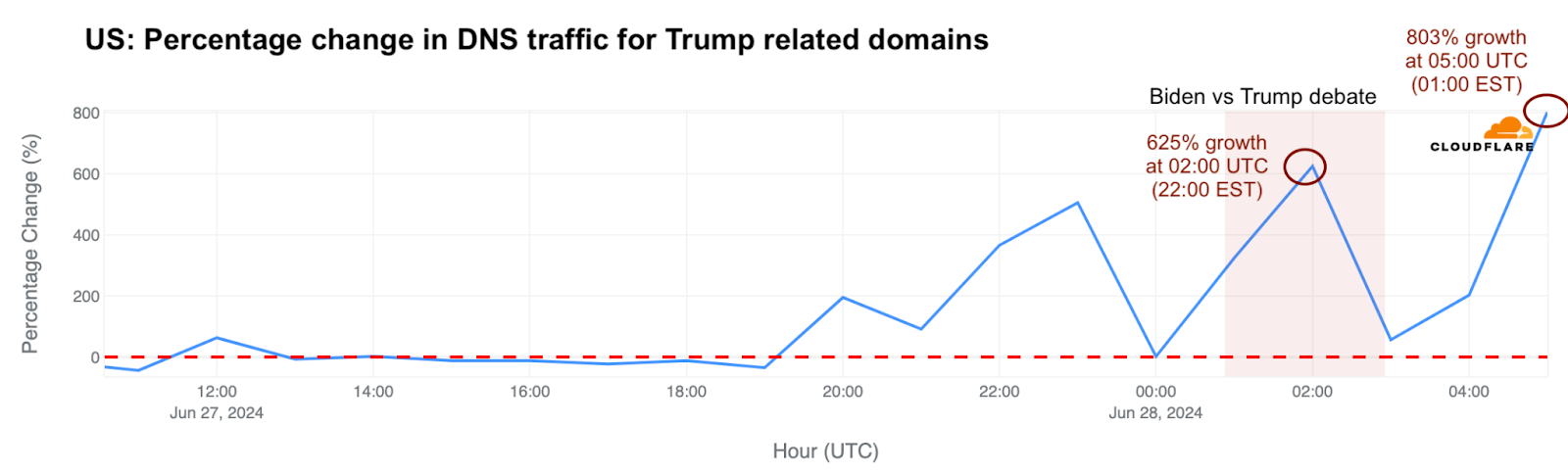
Switching focus to domain trends, our 1.1.1.1 resolver data reveals a more targeted impact from the debate. Considering the candidates individually (using the official sites related to both candidates), we found that Biden-associated websites saw a 176% surge in DNS queries at around 23:00 EST (03:00 UTC), compared to the previous week.
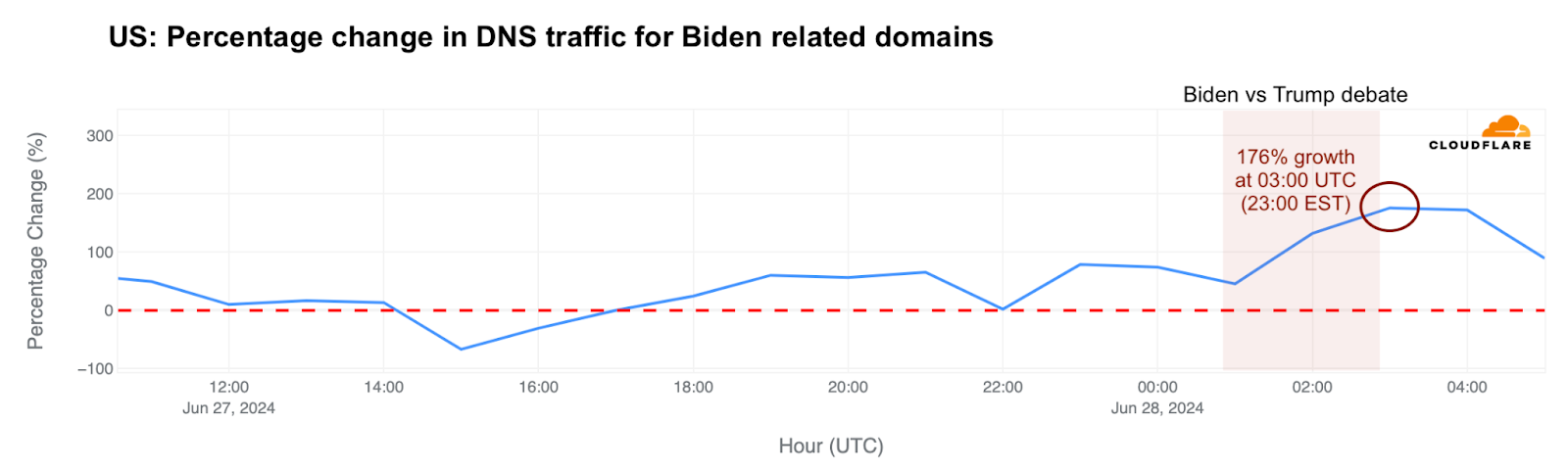
However, Trump-associated sites saw a greater increase than Biden-associated sites, showing an increase before, during, and after the debate, with the peak growth reaching 803% over the previous week at 01:00 EST (05:00 UTC).
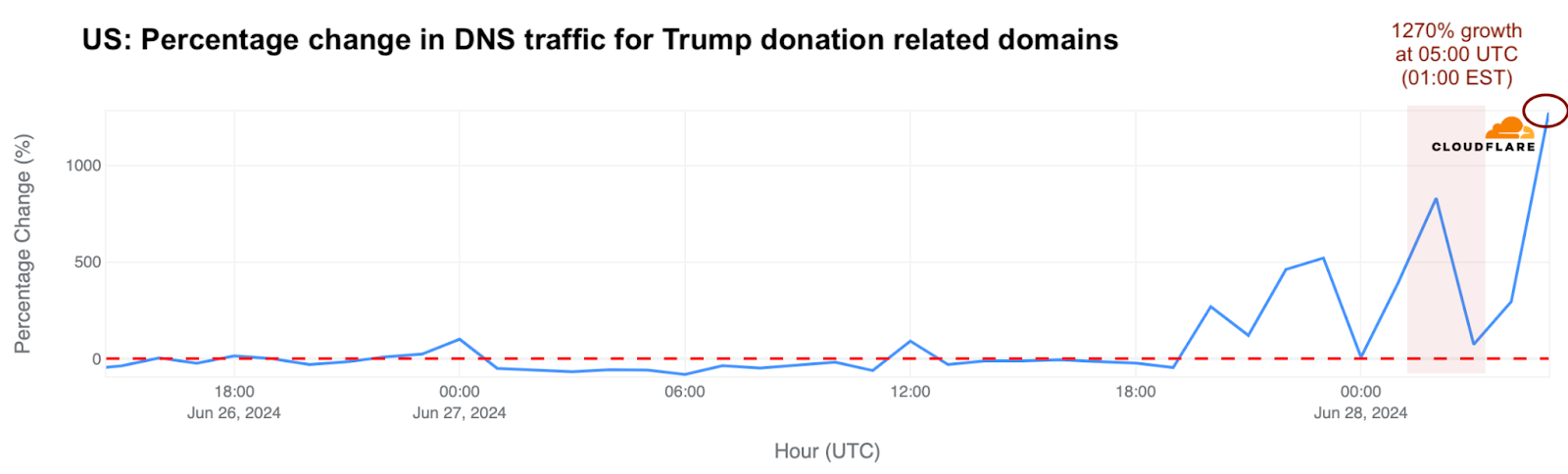
For donation sites, those linked to Biden were busiest before the debate on June 17 and 18, thanks to events with Barack Obama and Bill and Hillary Clinton. DNS traffic for Trump’s donation sites, as compared with the previous week, increased during the debate, growing 830% at 22:00 EST (02:00 UTC) and reaching a high of 1270% increase by 01:00 EST.
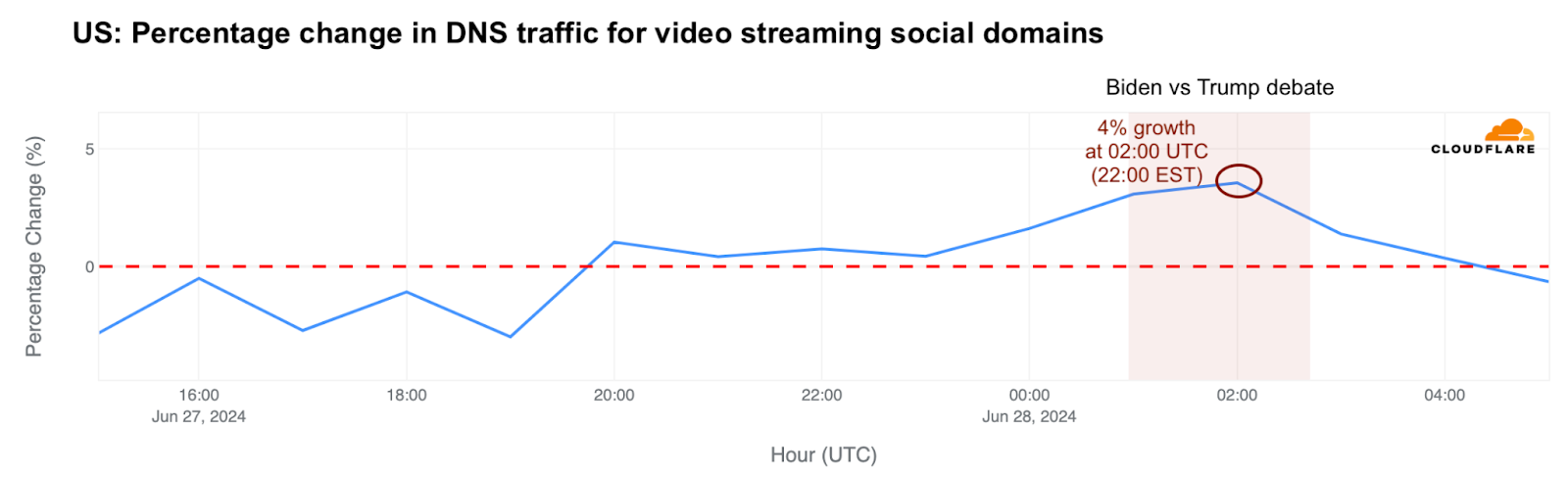
The debate aired on multiple TV channels and was streamed on YouTube. During the debate, video streaming platforms like TikTok and YouTube, which are among the top Internet services globally, saw a 4% increase in DNS traffic at 22:00 EST (02:00 UTC). Significant changes in DNS traffic on these platforms are uncommon due to their widespread popularity.
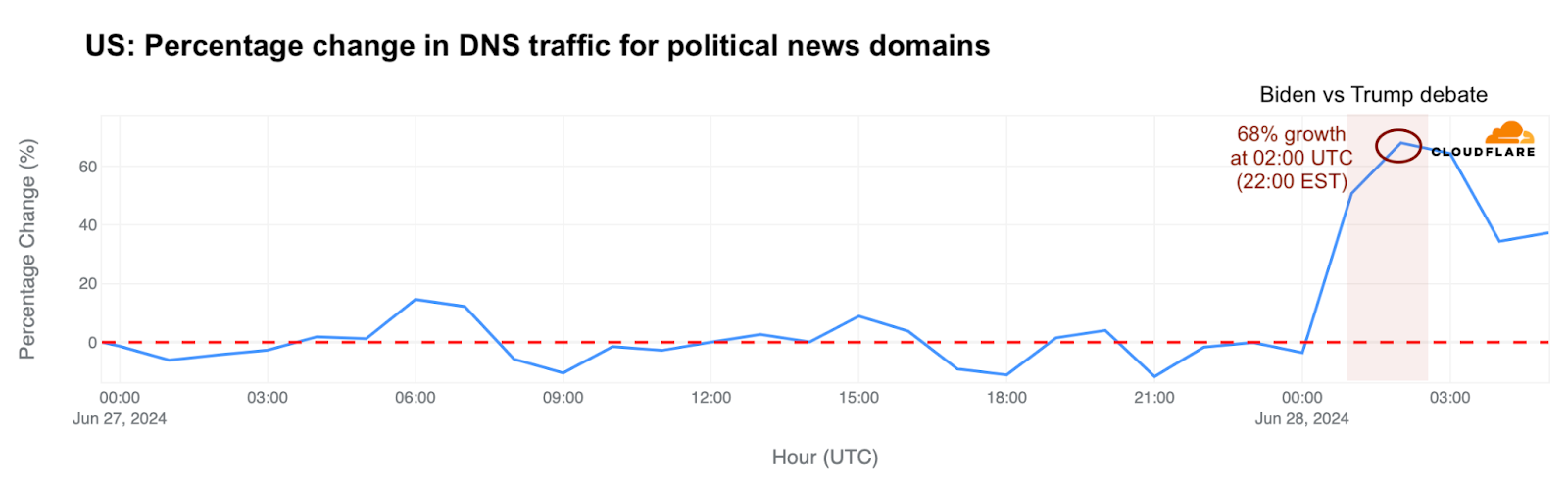
Political news sites also spiked, with a 68% traffic increase around 22:00 EST (02:00 UTC).
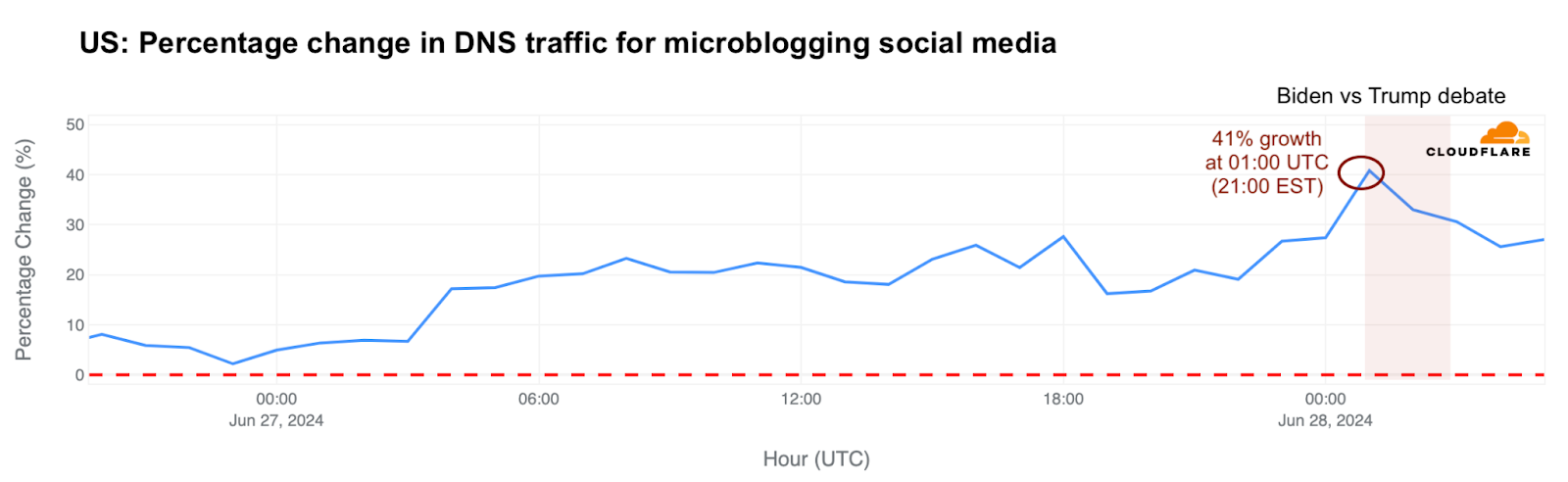
Microblogging social platforms like X or Threads outperformed their previous week’s traffic throughout the debate day, with growth peaking at 41% at the start of the debate around 21:00 EST (01:00 UTC).
Biden vs Trump: spam and malicious emails
In June 2024 (through June 27), Cloudflare’s Cloud Email Security service processed over 2.5 million emails containing “Biden” or “Trump” in the subject line. Trump-related subjects appeared 13% more often than those related to Biden. Moreover, emails with “Trump” had higher percentages of spam, at 3%, and malicious messages, at 0.6%, compared to 0.8% for spam and 0.2% for malicious messages with “Biden.”
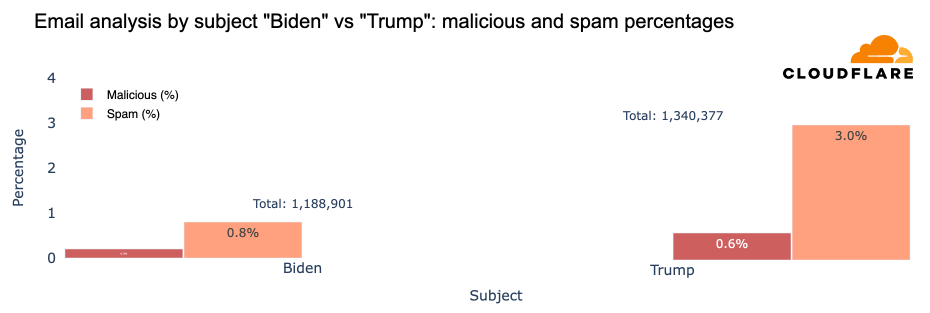
The peak occurrence of spam emails with “Trump” was on June 9, at 19.8%, and the highest rate of malicious messages was on June 12, at 2.9%. For “Biden,” the highest spam rate was on June 21, at 1.2%, and the peak for malicious messages was also on June 9, at 0.8%.
Attacks: government and political impact
Focusing on attacks, those are usually constant, and aren’t necessarily driven always by elections. But, as we’ve seen at the start of the war in Ukraine or more recently in the Netherlands, events do trigger attacks. Already in June 2024, during the European elections, we recently published a blog post about the cyberattack on Dutch political-related websites that lasted two days – June 5 and 6. The main DDoS (Distributed Denial of Service attack) attack on June 5, the day before the Dutch election, reached 73,000 requests per second (rps).
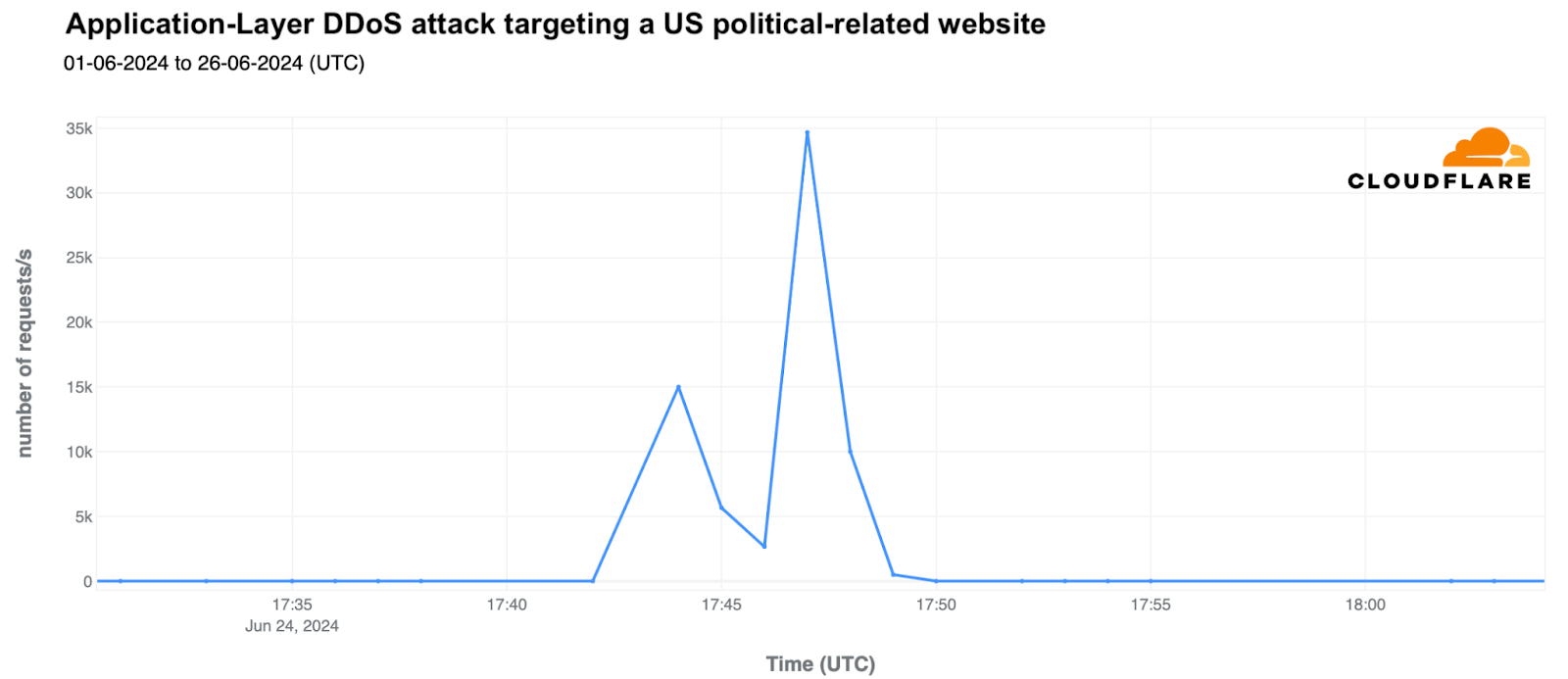
Shifting our focus to the US in particular, in the weeks since April 2024, we’ve seen some DDoS attacks targeting both government, state or political-related websites in the United States. That said, we haven’t seen any substantial attacks targeting political sites during the day of debate, June 27. The most recent one we saw was this week, on June 24, and targeted a political-related website involved in the current elections. It was a small attack that lasted under 10 minutes and peaked at 35,000 requests per second (rps).
Now that we’ve explored the US presidential debate trends, let’s compare it with Internet trends from other debates in the UK and France from the week of June 24, 2024.
UK and France: debates with an impact
In other countries like the UK and France, election-related debates during the week of June 24 also serve as examples for comparison with the Biden vs Trump debate. Both the UK and France experienced more significant nationwide traffic impacts during their debates compared to the US. However, the geographic and population size of the US, coupled with the debate’s broad availability on streaming platforms, could have influenced this disparity.
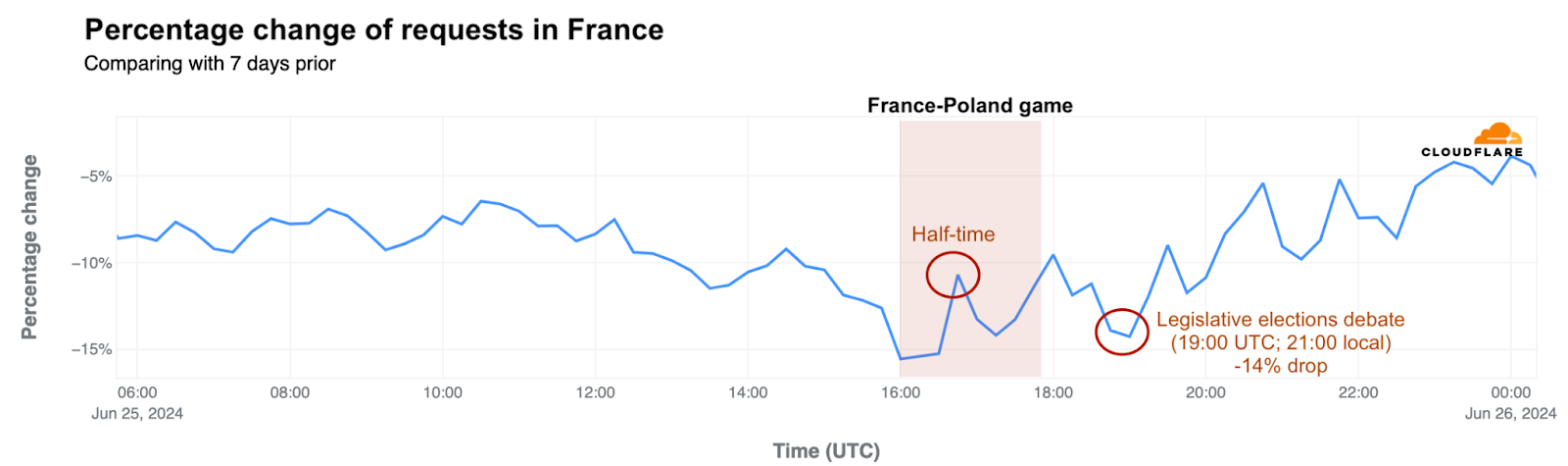
In France, the snap election is scheduled for Sunday, June 30, 2024, and the runoff on July 7, 2024. The final debate among the leading candidates on Tuesday, June 25, 2024 (21:00 local time), led to a 14% drop in Internet HTTP requests, as it was broadcast nationally and carried broad interest. Despite this, the UEFA Euro 2024 football match between France and Poland on the same day, at 18:00 local time, caused an even greater traffic decrease of 16%.
The following day, Wednesday, June 26, 2024, the two main candidates for the snap UK general election — scheduled for July 4, 2024 — participated in their final debate on BBC national TV. The debate between Rishi Sunak and Sir Keir Starmer, which started at 20:15 local time, resulted in a 7% drop in UK Internet traffic compared to the previous week. The most significant decrease occurred at 20:45. At a more detailed level, Wales experienced an 11% drop during the debate, followed by England at 8%, Scotland at 7%, and Northern Ireland at 5%.
Conclusion: high intensity election year
Even if major political events don’t always bring significant changes to Internet traffic, our data shows that the Biden vs. Trump debate had an impact, especially at the state level. Microblogging and video streaming social platforms also saw traffic shifts during the debate, with Trump-related sites seeing larger spikes in DNS traffic than Biden-related sites, especially after the debate.
We also observed a higher percentage of spam and malicious emails sent with “Trump” in the subject of the messages than with “Biden.” Although we didn’t see an uptick in cyberattacks during the debate, we note that these have been frequent, especially DDoS attacks in the months before, targeting both federal and state government services as well as politically related sites.
If you want to follow more trends and insights about the Internet and elections in particular, you can check Cloudflare Radar, and more specifically our new 2024 Elections Insights report, which will be updated as elections take place throughout the year.
FSF Europe condemns Apple’s DMA noncompliance
Post Syndicated from daroc original https://lwn.net/Articles/980003/
The Free Software Foundation Europe has
submitted a joint position to the European Commission (EC), claiming that Apple
has failed to comply with the EU’s Digital Markets Act (DMA). This is the law
that requires Apple to support alternative application stores on the devices it
makes.
Apple’s unfair behaviour against Free Software highlights the critical need to
monitor the implementation of the DMA. The FSFE collaborated with F-Droid, the
AppFair project, and other interoperability experts to scrutinize Apple’s DMA
compliance, and it’s impact on Free Software. Since then, we coordinated several
expert workshops with stakeholders,
discussed with regulators in FOSDEM, had
official meetings with the EC’s DMA team, and submitted a
comprehensive position
to the EC detailing several problematic elements in the Apple compliance that
will harm the Free Software.
[$] Redox: An operating system in Rust
Post Syndicated from daroc original https://lwn.net/Articles/979524/
With the
Rust-for-Linux project starting to gain some ground, it is worth
looking at other operating systems that use Rust in their kernels. There
are
many attempts to use
Rust for operating system development, but Redox
may be the most complete.
Redox is an MIT-licensed microkernel and corresponding user space, designed
around concepts taken from
Plan 9. While nowhere near being usable as a
replacement for Linux, it already provides a graphical user interface and
the ability to run many POSIX programs.
How the Retro Scene Has Changed 2009-2024
Post Syndicated from LGR original https://www.youtube.com/watch?v=VQ-RUn5lzgw