Tag Archives: USA

How the Harris-Trump US presidential debate influenced Internet traffic

Post Syndicated from João Tomé original https://blog.cloudflare.com/how-the-harris-trump-us-presidential-debate-influenced-internet-traffic

Much has changed in the 2024 United States presidential election since the June 27 debate between Donald Trump and Joe Biden, then the presumptive nominees for the November election. Now, over two months later, on September 10, the debate was between Kamala Harris, the Democratic nominee, and Donald Trump, the Republican nominee. In this post, we will explore the event’s impact on Internet traffic in specific states where there was a bigger impact than during the Biden-Trump debate, as well as examine cyberattacks, email phishing trends, and general DNS data on candidates, news, and election-related activity.

We’ve been tracking the 2024 elections globally through our blog and election report on Cloudflare Radar, covering some of the more than 60 national elections this year. Regarding the US elections, we have previously reported on trends surrounding the first Biden vs. Trump debate, the attempted assassination of Trump, the Republican National Convention, and the Democratic National Convention.

Typically, we have observed that election days don’t come with significant changes to Internet traffic, and the same is true for debates. Yet, debates can also draw attention that impacts traffic, especially when there is heightened anticipation. The 2024 debates were not only aired on broadcast and cable television, but also streamed on platforms like YouTube, increasing their reach and impact.

Key takeaways:

  • The September 10 Harris-Trump debate caused bigger drops in Internet traffic in the US than the Biden-Trump debate on June 27. 

  • There was also a noticeable increase in DNS traffic to both Kamala Harris-related and Donald Trump-related domains, with Trump-related DNS traffic peaking around the start of the debate and Harris-related DNS traffic peaking after the debate ended, around the time Taylor Swift announced she was endorsing Harris.

  • We also observed increases in DNS traffic to US news media outlets and election-related domains right after the debate ended.

  • Donald Trump remains the candidate with the most mentions in email subjects and the highest percentages of emails classified as spam (26.7%) and malicious (2.4%). Since mid-August, there has been a slight increase in the percentage of spam and malicious emails mentioning Kamala Harris.

Traffic drop in the US

During the September 10, 2024, debate between Harris and Trump, hosted by ABC News at 21:00 EST (01:00 UTC) in Philadelphia, Pennsylvania, Cloudflare noted a trend similar to the Biden-Trump debate, with a clear drop in nationwide Internet requests, falling as much as 9% below the same time a week prior at 21:15 EST (01:15 UTC). At the end of the debate, around 22:45 EST (02:45 UTC), the drop was less evident, at just 2%. Traffic increased slightly just after the debate.
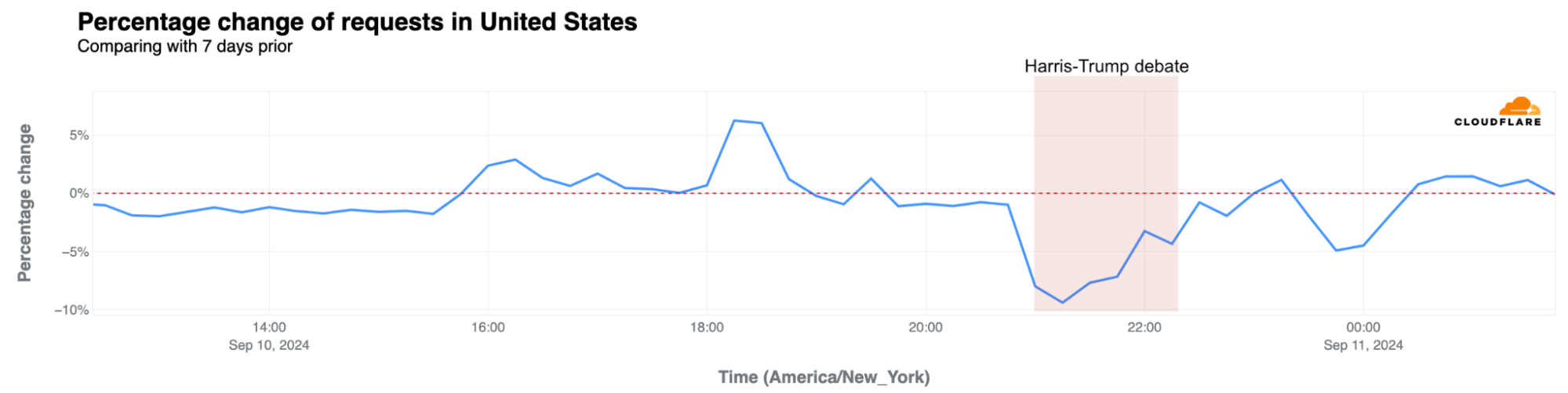

Note: there were two four-minute breaks during the debate, at around 22:00 and 22:30, and our data here has 15-minute granularity.

There’s a clear difference between this second debate, with a drop of up to 9%, and the first one between Biden and Trump on June 27, when the traffic dropped just 2% below the same time a week prior. Interestingly, the biggest drop occurred at the same time in both debates, right after they started, at 21:15 EST (01:15 UTC).

Internet traffic dips across US states

Traffic shifts at the time of the debate, as compared to the previous week, can reveal more detail at a state-level perspective than at the country level. The map below summarizes traffic changes observed at a state level. A key observation is that traffic declines at a state level were much more pronounced during the Harris-Trump debate, than during the Biden-Trump debate in late June.
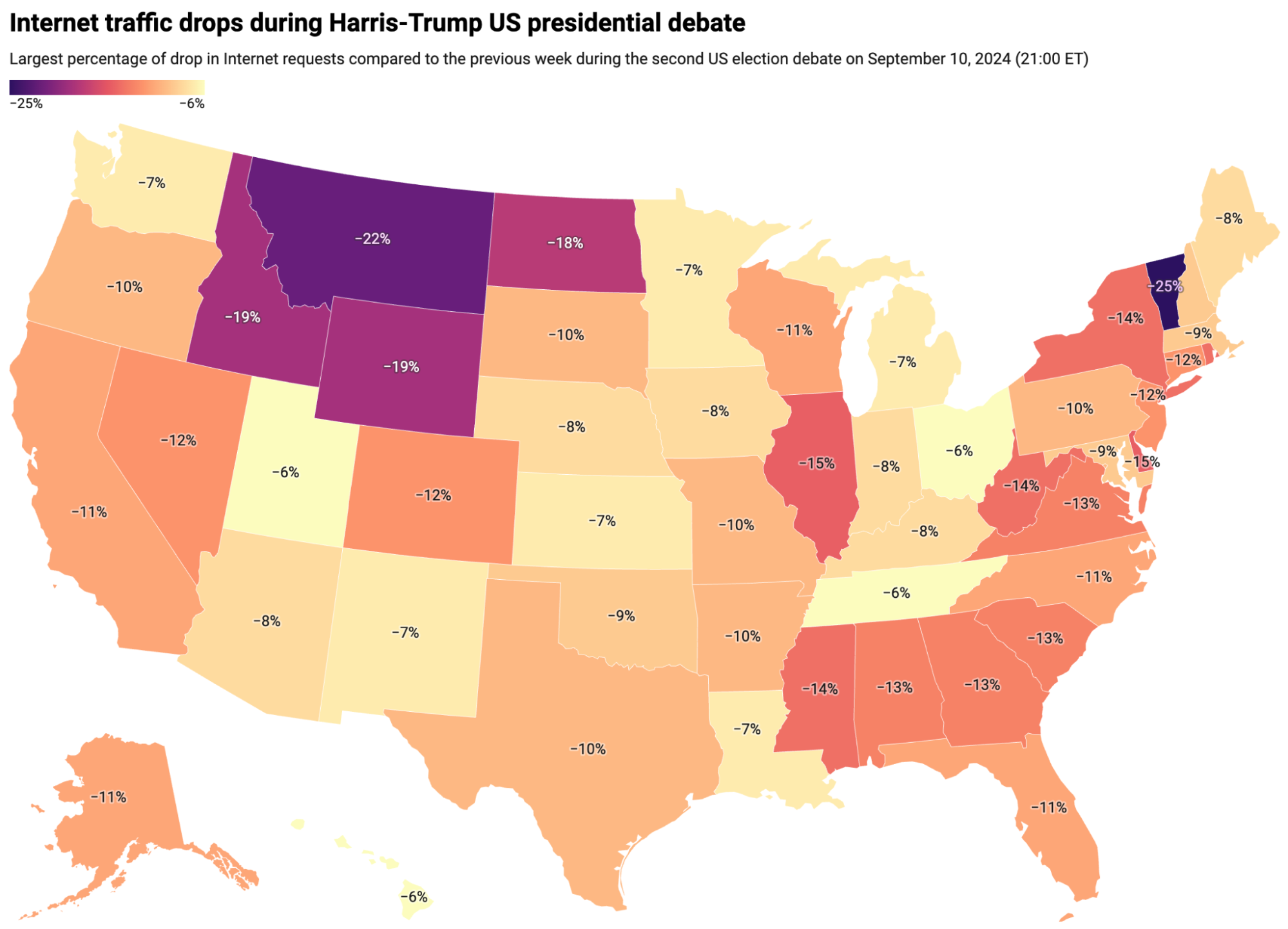

(Source: Cloudflare; created with Datawrapper)

The most significant traffic drops were observed in Vermont (-25%), Montana (-22%), and Idaho (-19%). More populous states such as California (-11%), Texas (-10%), and New York (-14%) also experienced notable declines in traffic.

Just for comparison, here’s the state map from that June 27 Biden-Trump debate:
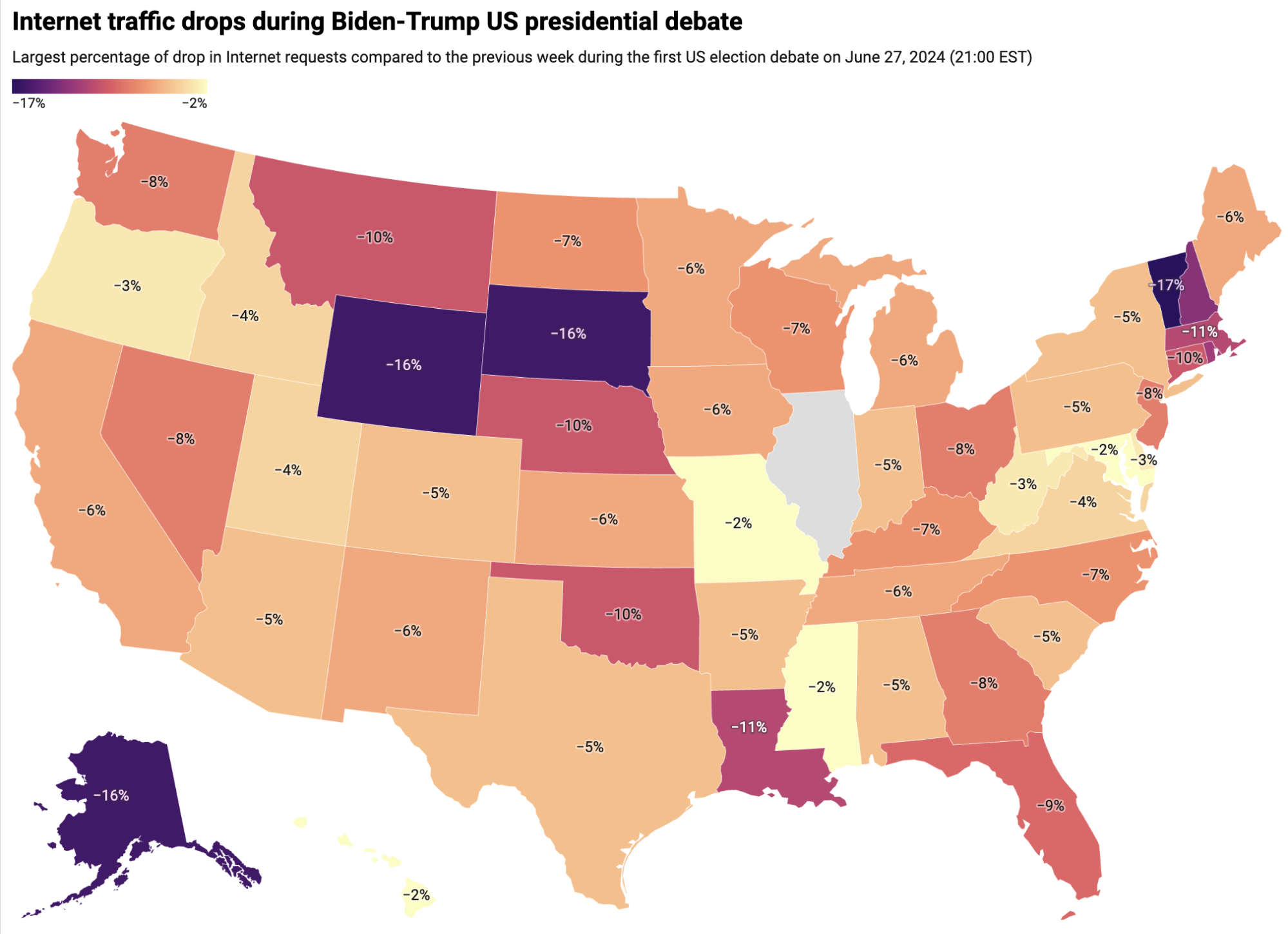

(Source: Cloudflare; created with Datawrapper)

The initial minutes of the Harris-Trump debate triggered the largest traffic declines in most states, at least up until the first break, at around 21:30 ET (01:30 UTC).

In the next table, we provide a detailed breakdown of the same perspective shown on the US map ordered by the magnitude of the drop in traffic. We include the time of the biggest traffic drop compared to the previous week, at a 5-minute granularity, and also the percentage of the drop compared to the previous week. As noted above, the largest declines appeared to occur earlier in the debate.

State

Drop in traffic (%)

Local Time

UTC

Vermont

-25%

21:05 EDT

1:05

Montana

-22%

19:10 MDT

1:10

Idaho

-19%

19:10 MDT

1:10

Wyoming

-19%

19:15 MDT

1:15

North Dakota

-18%

20:15 CDT

1:15

Delaware

-15%

21:20 EDT

1:20

Illinois

-15%

20:20 CDT

1:20

Mississippi

-14%

20:05 CDT

1:05

New York

-14%

21:05 EDT

1:05

Rhode Island

-14%

21:45 EDT

1:45

West Virginia

-14%

21:15 EDT

1:15

Alabama

-13%

20:05 CDT

1:05

Georgia

-13%

21:20 EDT

1:20

South Carolina

-13%

21:15 EDT

1:15

Virginia

-13%

21:15 EDT

1:15

Colorado

-12%

19:45 MDT

1:45

Connecticut

-12%

21:05 EDT

1:05

Nevada

-12%

18:20 PDT

1:20

New Jersey

-12%

21:20 EDT

1:20

Alaska

-11%

17:15 AKDT

1:15

California

-11%

18:15 PDT

1:15

Florida

-11%

21:05 EDT

1:05

North Carolina

-11%

21:05 EDT

1:05

Wisconsin

-11%

20:20 CDT

1:20

Arkansas

-10%

20:05 CDT

1:05

District of Columbia

-10%

21:55 EDT

1:55

Missouri

-10%

20:25 CDT

1:25

Oregon

-10%

18:40 PDT

1:40

Pennsylvania

-10%

21:05 EDT

1:05

South Dakota

-10%

20:20 CDT

1:20

Texas

-10%

20:05 CDT

1:05

Maryland

-9%

21:20 EDT

1:20

Massachusetts

-9%

21:20 EDT

1:20

New Hampshire

-9%

21:05 EDT

1:05

Oklahoma

-9%

20:05 CDT

1:05

Arizona

-8%

18:15 MST

1:15

Indiana

-8%

21:05 EDT

1:05

Iowa

-8%

20:05 CDT

1:05

Kentucky

-8%

21:05 EDT

1:05

Maine

-8%

21:15 EDT

1:15

Nebraska

-8%

19:45 MDT

1:45

Kansas

-7%

20:25 CDT

1:25

Louisiana

-7%

20:20 CDT

1:20

Michigan

-7%

21:20 EDT

1:20

Minnesota

-7%

20:30 CDT

1:30

New Mexico

-7%

19:25 MDT

1:25

Washington

-7%

18:05 PDT

1:05

Hawaii

-6%

15:20 HST

1:20

Ohio

-6%

21:15 EDT

1:15

Tennessee

-6%

20:05 CDT

1:05

Utah

-6%

19:10 MDT

1:10

Swing state drops in traffic higher than first debate

The seven swing states that are said to be decisive in the election — Arizona, Georgia, Michigan, Nevada, North Carolina, Pennsylvania, and Wisconsin — each saw traffic drop between 8% and 13%, which is more than during the Biden-Trump debate (between 5% and 8% at that time). Here’s a more focused view of those swing states for easier visualization:

State

Drop in traffic

Local Time

UTC

Arizona

-8%

18:15 MST

1:15

Georgia

-13%

21:20 EDT

1:20

Michigan

-7%

21:20 EDT

1:20

Nevada

-12%

18:20 PDT

1:20

North Carolina

-11%

21:05 EDT

1:05

Pennsylvania

-10%

21:05 EDT

1:05

Wisconsin

-11%

20:20 CDT

1:20

DNS trends 

Shifting our attention to domain trends, our 1.1.1.1 resolver data highlights a more targeted impact during and around the debate. Let’s start with Kamala Harris-related insights. 

Harris and the Taylor Swift effect

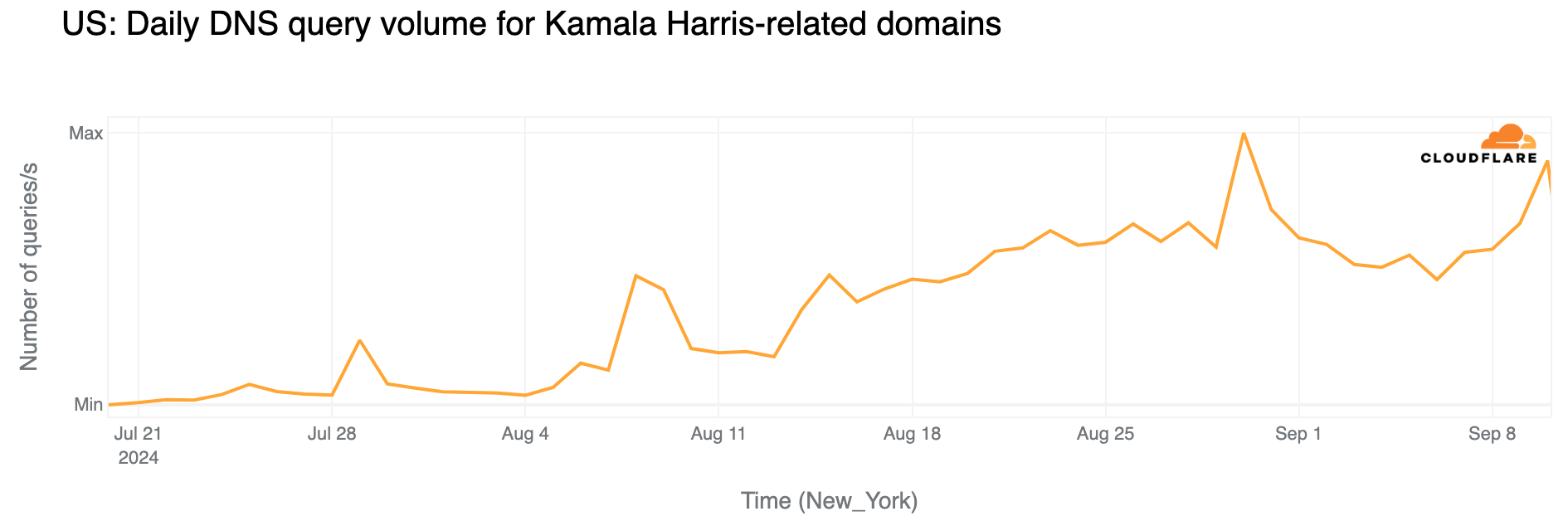
Since July 21, the date of Biden’s withdrawal and endorsement of Harris, daily DNS traffic to Harris-related domains has significantly increased, with notable peaks on August 30 (the day after the Harris-Walz interview on CNN) and September 10 (the debate with Trump).

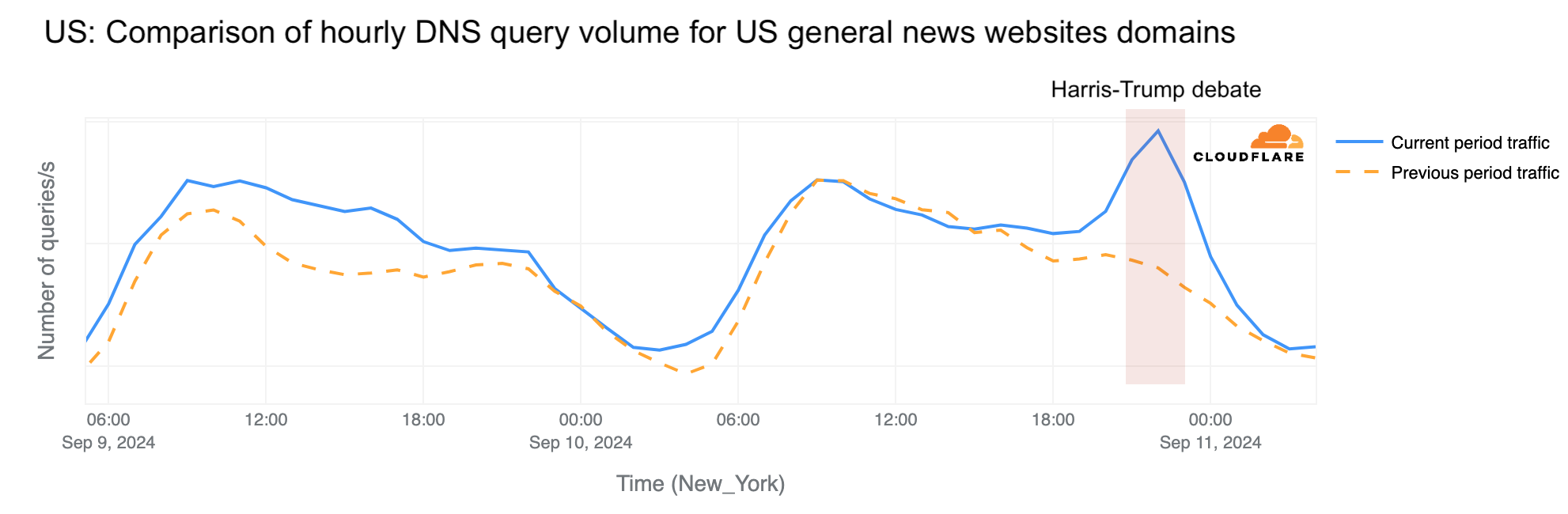
From an hourly perspective, the impact of the debate on Kamala Harris-related sites is evident, with increased DNS traffic throughout the day (September 10). The peak occurred at the debate’s start (21:00 ET / 01:00 UTC) with a 54% increase from the previous week, and again after it ended (23:00 ET / 03:00 UTC) with a 56% rise. This spike coincided with Taylor Swift’s endorsement of Kamala Harris.

Trump and the Elon Musk interview effect

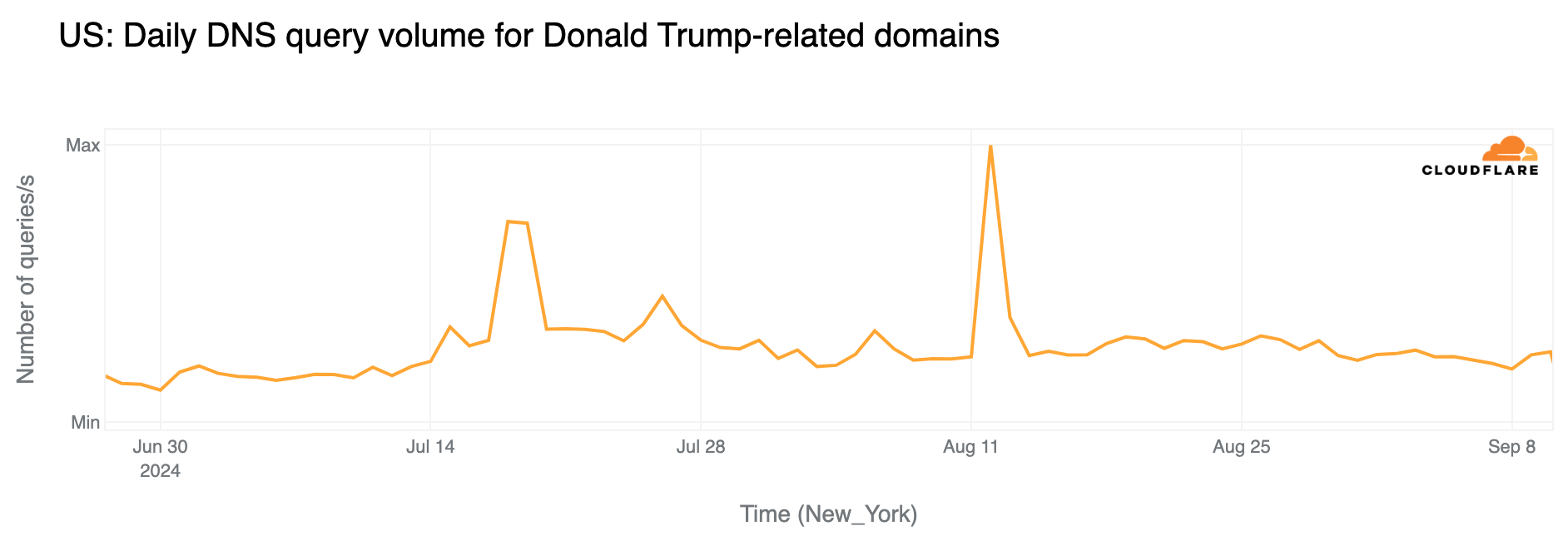
Donald Trump, having a longer-standing campaign and websites compared to Kamala Harris, shows different trends. Aggregated daily DNS traffic to Trump-related domains has also increased in recent months. Significant peaks were observed on July 15 (two days after the assassination attempt), then during the Republican National Convention (August 19-22), with the highest spike occurring on August 12, following Elon Musk’s interview with Trump on X.

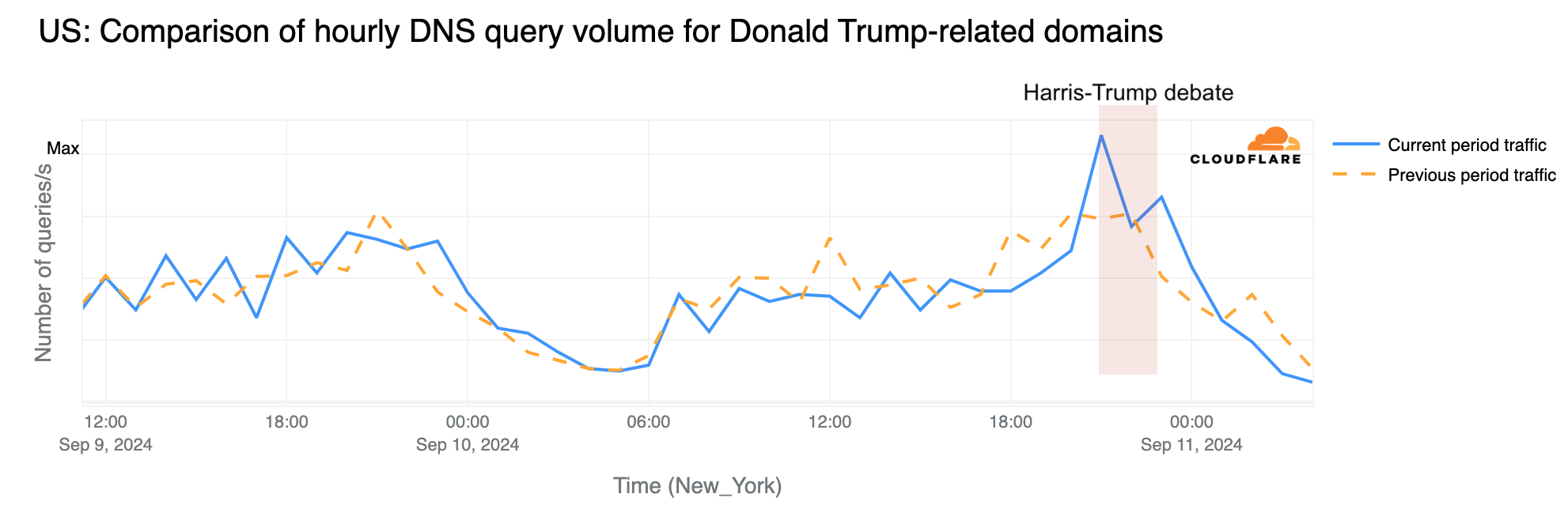
Hourly data shows the debate’s impact on Trump-related sites with a noticeable increase around the debate’s start (21:00 ET / 01:00 UTC), where DNS traffic was 46% higher than the previous week. This elevated traffic continued for a few hours, after the debate ended.

From news to election-related sites

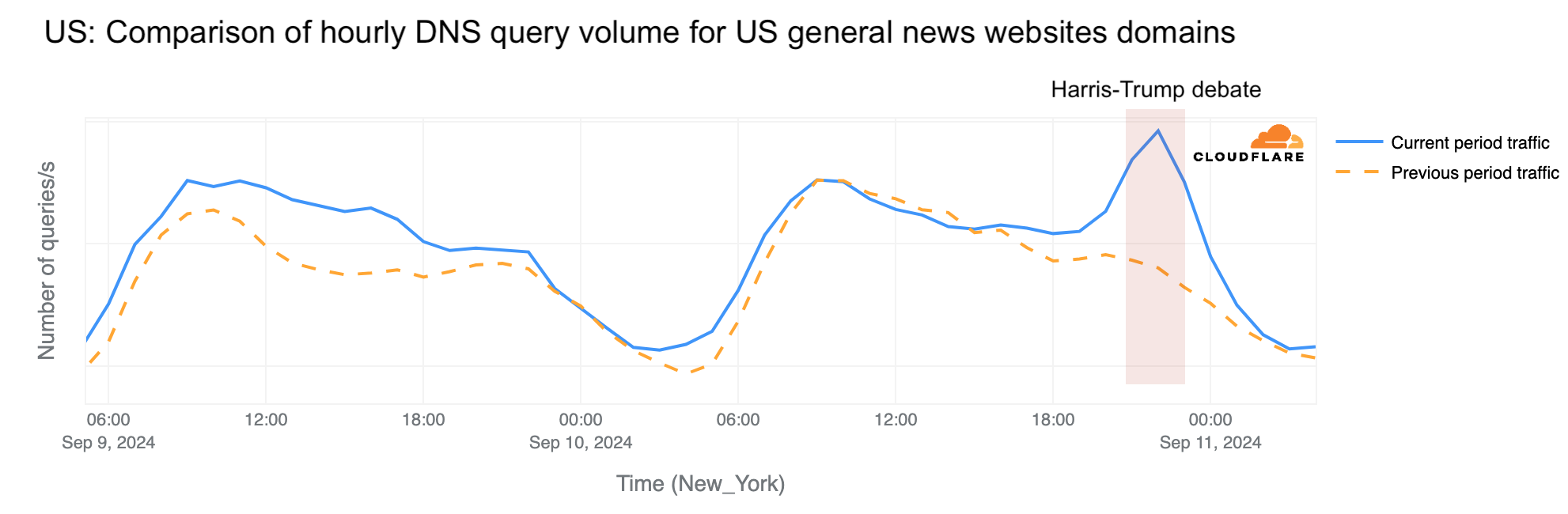
Like previous US election-related events, the debate generated significant interest in US news organizations, leading to a rise in aggregated DNS traffic to general US news sites. This increase peaked during the debate at 22:00 ET (02:00 UTC), with DNS traffic 62% higher than the previous week. The elevated DNS traffic began before the debate and persisted afterward, with a 19% increase at 20:00 ET (00:00 UTC) and a 25% increase at 00:00 ET (04:00 UTC).

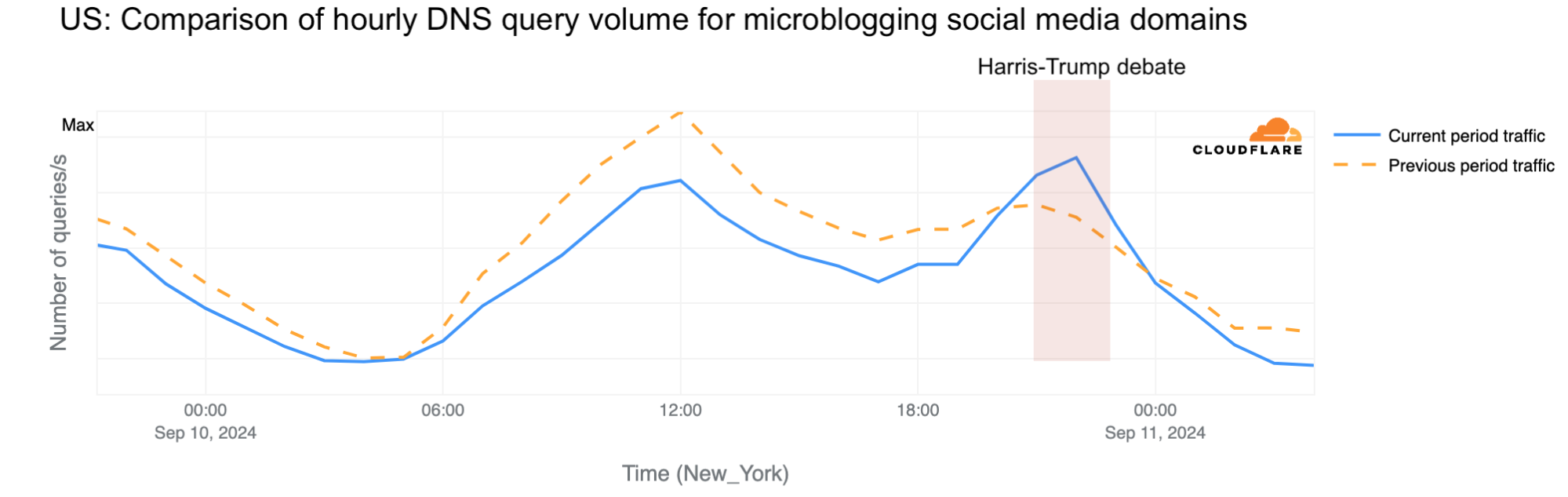
Microblogging social platforms like X or Threads outperformed their previous week’s traffic throughout the debate, peaking at 16% growth around 22:00 ET (02:00 UTC).

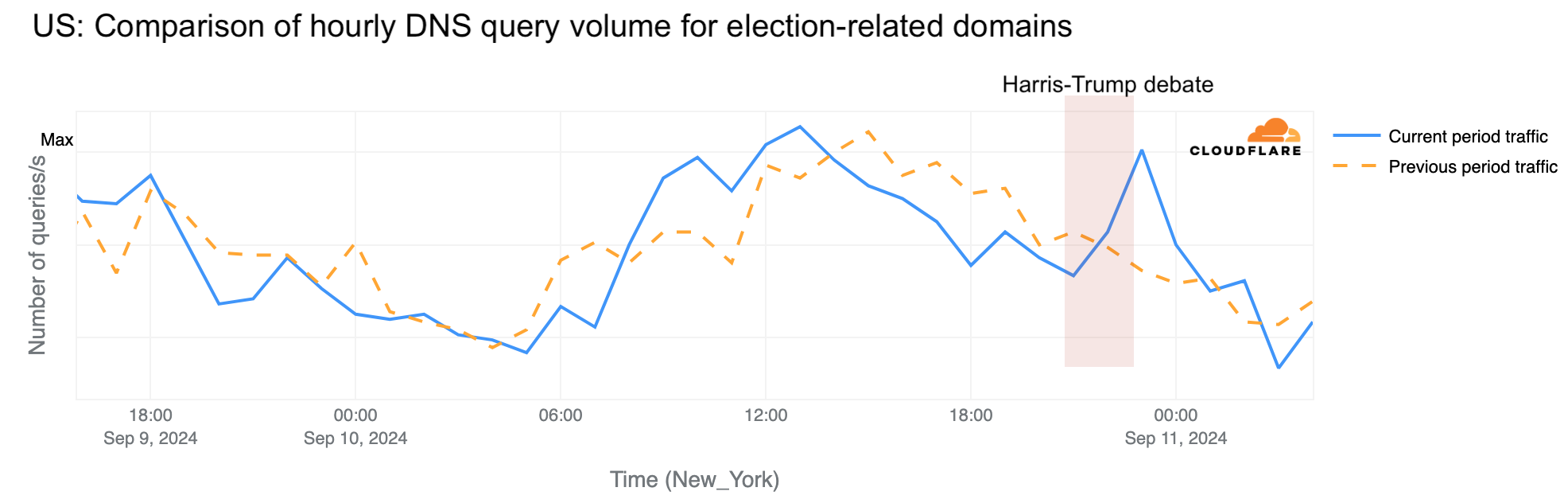
Additionally, there was a notable increase in DNS traffic to election-related websites, including official voting registration and election sites. During the morning of September 10 in the US, DNS traffic was 38% higher at 10:00 ET (14:00 UTC), with a significant spike at 23:00 ET (03:00 UTC) right after the debate, where DNS traffic surged by 76% compared to the previous week.

Harris-Trump: spam and malicious emails

From a cybersecurity perspective, trending events, topics, and individuals often attract more emails, including malicious, phishing, and spam messages. Our earlier analysis covered email trends involving “Joe Biden” and “Donald Trump” since January. We’ve since updated it to include Kamala Harris after the Democratic Convention.

From June 1, 2024, through August 21, Cloudflare’s Cloud Email Security service processed over 16 million emails that included the names “Donald Trump”, “Joe Biden”, or “Kamala Harris” in the subject, with 8.7 million referencing Trump, 4.8 million referencing Biden, and 3 million referencing Harris.

The chart below highlights a surge in emails mentioning Trump in mid-July, contrasting with a drop in the number of emails mentioning Biden in the subject and an increase in emails mentioning Harris.
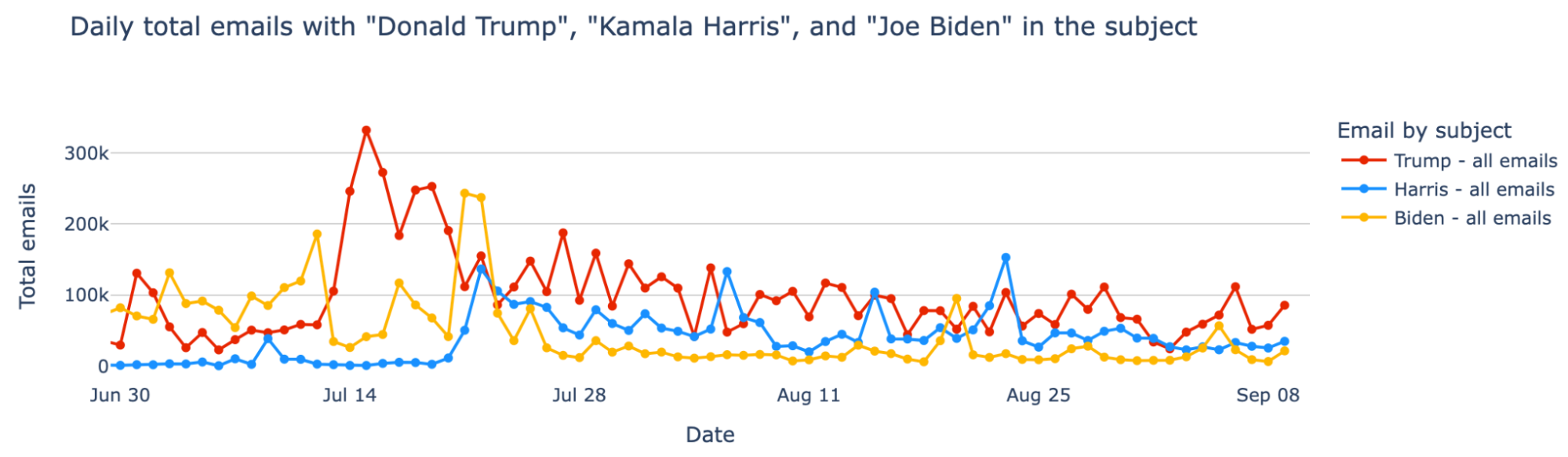

Since July 21, following changes in the presumptive Democratic candidate, over 4.5 million emails mentioned “Donald Trump,” over 1.5 million mentioned “Joe Biden,” and around 2.8 million mentioned “Kamala Harris” in the subject. Of these, 26.7% of emails with Trump’s name were classified as spam, and 2.4% were classified as malicious. For Kamala Harris, 1.1% were classified as spam and 0.2% were classified as malicious, while Biden’s figures were 1.1% for spam and 0.1% for malicious.
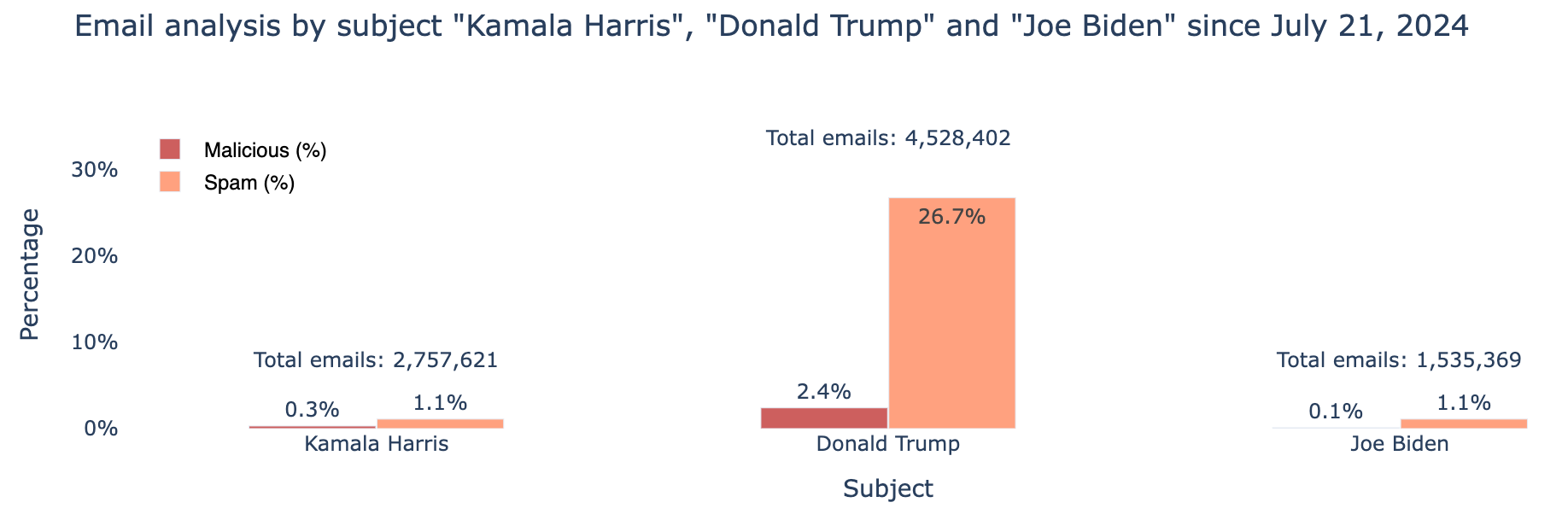

Since mid-August, there has been a slight increase in the percentage of spam and malicious emails mentioning Kamala Harris. Trump remains the candidate with the most mentions in email subjects and the highest percentages of emails classified as spam and malicious.

September attacks on political and news sites

In our blog posts about several of the 2024 elections, we have noted that attacks on politically-related websites have remained a significant threat this year. In Europe, we’ve seen political parties and associated websites targeted around elections. We previously reported on DDoS attacks around the Republican National Convention and Democratic National Convention.

In our post about the Democratic National Convention, we showed that during late July and August, Cloudflare blocked DDoS attacks targeting three US politically related organizations, including a site associated with one of the major parties, with attacks occurring just before the Democratic Convention.

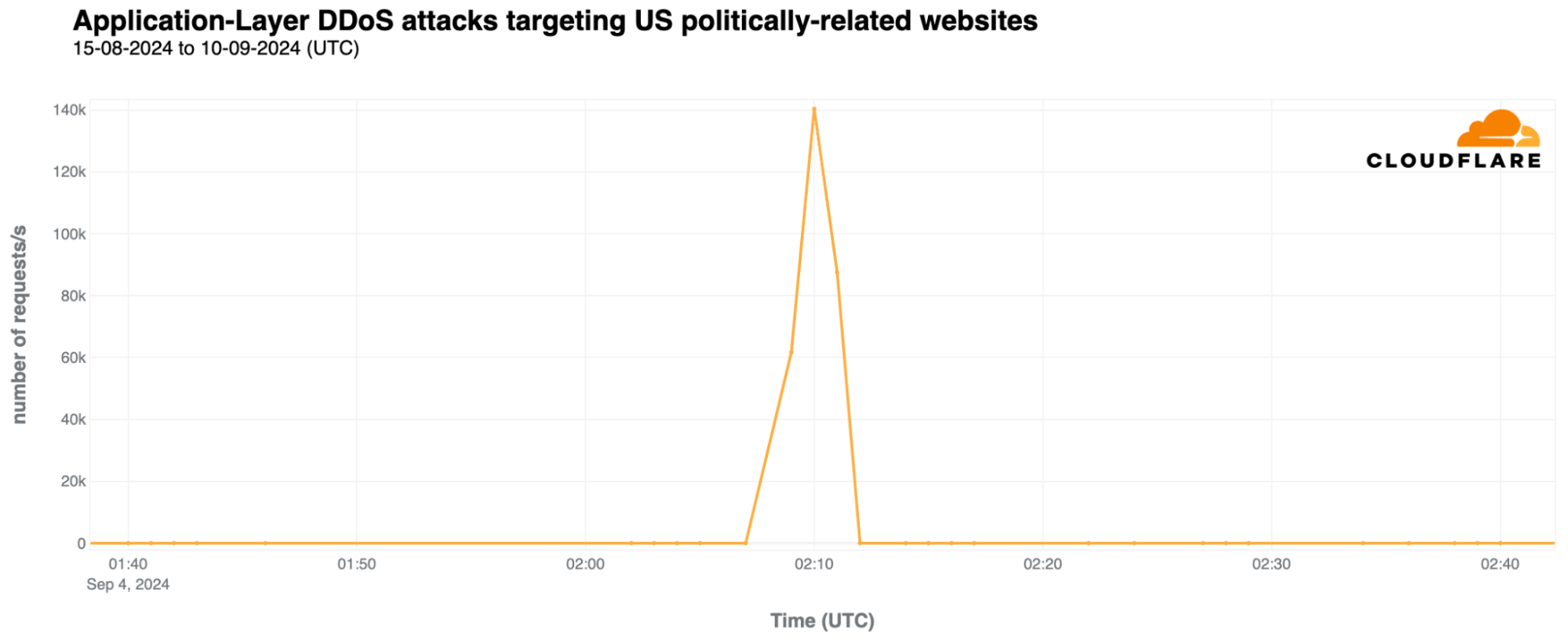
The largest DDoS attack recorded in recent days against politically-related websites targeted specifically a US political-party related website on September 4, peaking at 140,000 requests per second (rps) and lasting about 5 minutes.

But it’s not only US politically-related websites that could be the target of cyber attacks. News organizations are often attacked during relevant events, as we saw during the first year of the war in Ukraine, for example. Already in September, we’ve seen an example of a relevant US news organization that covers politics being the target of a DDoS attack on September 3, peaking at 343,000 requests per second (rps) and lasting about 5 minutes.
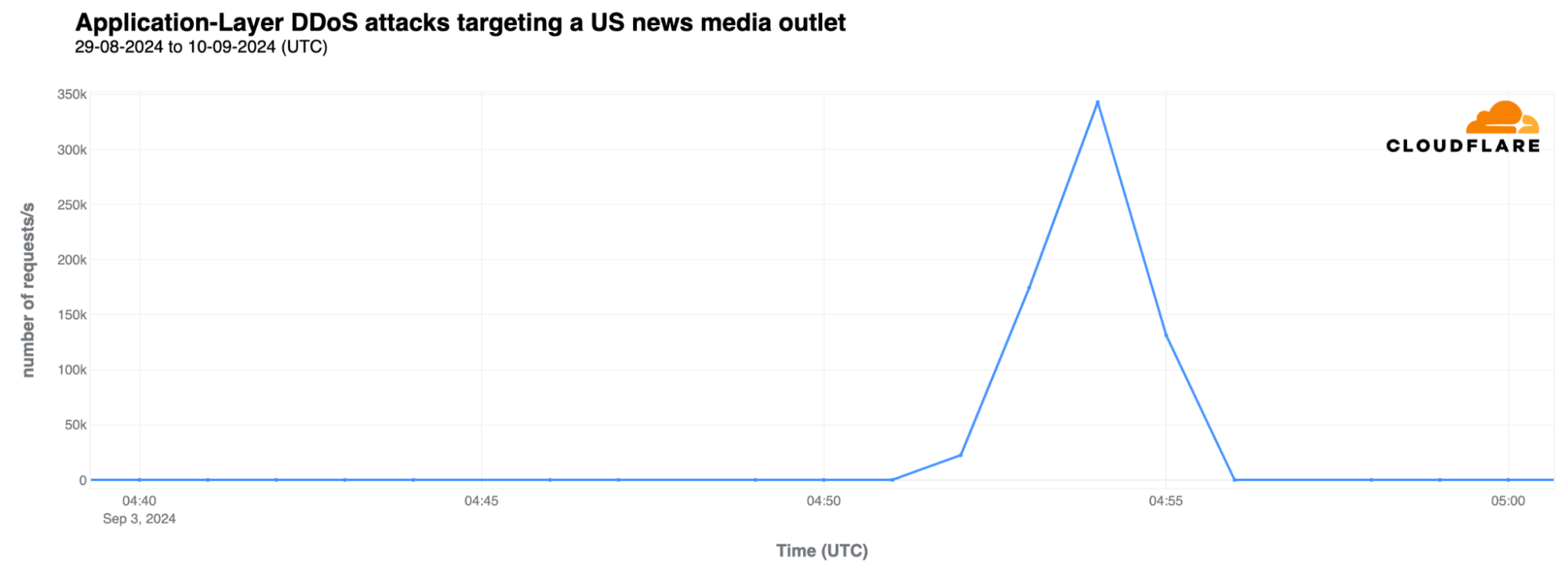

As highlighted in our Q2 DDoS report, most DDoS attacks are short-lived, as exemplified by the two mentioned attacks. Also, 81% of HTTP DDoS attacks peak at under 50,000 requests per second (rps), and only 7% reach between 100,000 and 250,000 rps. While a 140,000 rps attack might seem minor to Cloudflare, it can be devastating for websites not equipped to handle such high levels of traffic.

Conclusion

In this analysis of the Harris-Trump debate, we’ve observed that the September 10 debate caused bigger drops in traffic in the US than the Biden-Trump debate in late June. There was also a noticeable increase in DNS traffic to both Kamala Harris-related and Donald Trump-related domains, as well as to US news media outlets and election-related domains — in this case, right after the debate ended.

If you’re interested in more trends and insights about the Internet and elections, check out Cloudflare Radar, specifically our 2024 Elections Insights report. It will be updated throughout the year as elections (or election-related events) occur.

Celebrating one year of Project Cybersafe Schools

Post Syndicated from Zaid Zaid original https://blog.cloudflare.com/celebrating-one-year-of-project-cybersafe-schools


August 8, 2024, is the first anniversary of Project Cybersafe Schools, Cloudflare’s initiative to provide free security tools to small school districts in the United States.

Cloudflare announced Project Cybersafe Schools at the White House on August 8, 2023 as part of the Back to School Safely: K-12 Cybersecurity Summit hosted by First Lady Dr. Jill Biden. The White House highlighted Cloudflare’s commitment to provide free resources to small school districts in the United States. Project Cybersafe Schools supports eligible K-12 public school districts with a package of Zero Trust cybersecurity solutions – for free, and with no time limit. These tools help eligible school districts minimize their exposure to common cyber threats.
Cloudflare’s mission is to help build a better Internet. One way we do that is by supporting organizations that are particularly vulnerable to cyber threats and lack the resources to protect themselves through projects like Project Galileo, the Athenian Project, the Critical Infrastructure Defense Project, Project Safekeeping, and most recently, Project Secure Health.

Schools are vulnerable to cyber attacks

In Q2 2024, education ranked 4th on the list of most attacked industries. Between 2016 and 2022, there were 1,619 K-12 cyber incidents. Since we launched Project Cybersafe Schools in August 2023, there have been a number of cyber attacks targeting hundreds of thousands of students. In August 2023, Prince George’s County Public Schools in Maryland fell victim to a ransomware attack that affected the personal data of more than 100,000 people. Then, in December 2023, a Cincinnati area school district suffered a cyber attack that resulted in the loss of $1.7M. In 2024, there have been numerous incidents affecting K-12 schools across the U.S., including in Massachusetts, New Jersey, and Washington state. The smallest school districts are often the most vulnerable because of a lack of resources or capacity. Sometimes, the person responsible for cybersecurity does so in addition to another primary role, whether as a teacher, coach or administrator.

We are proud of our impact, but we can do more

There are about 14,000 school districts in the United States, and about 9,800 of them have fewer than 2,500 students. All 9,800 of those small public school districts are eligible for Project Cybersafe Schools (for free, and with no time limit – see below for all the details), and we want to help as many as possible. We are proud of the number of school districts that we have onboarded since August 2023, but it is not enough. We want to do more, and we can onboard more school districts by getting the word out about Project Cybersafe Schools. When we published an update in December 2023 encouraging school districts to sign up before the holiday break, we saw a noticeable bump in the number of inquiries from eligible school districts. If you work at a small school district in the United States, we encourage you to see if you qualify for this program.

Nearly 30 states have school districts now enrolled in Project Cybersafe Schools, representing every region of the country. Since we launched the program, we have onboarded nearly 120 qualifying school districts. As a result, more than 160,000 students, teachers, and staff are protected by Cloudflare’s cloud email security to protect against a broad spectrum of threats including Business Email Compromise, multichannel phishing, credential harvesting, and other targeted attacks. These school districts are also receiving protection against Internet threats with DNS filtering by preventing users from reaching unwanted or harmful online content like ransomware or phishing sites.

Attacks prevented by Project Cybersafe Schools in 2024

When the White House launched its National Cybersecurity Strategy in March 2023, Acting National Cyber Director Kemba Walden noted in her remarks that “we expect school districts to go toe-to-toe with transnational criminal organizations largely by themselves. This isn’t just unfair; it’s ineffective.” Cloudflare agrees, and this is one of the reasons we launched Project Cybersafe Schools after conversations with officials from the Cybersecurity & Infrastructure Security Agency (CISA), the Department of Education, and the White House about how we could help to protect small school districts in the United States from cyber threats.

Year to date, Cloudflare’s cloud email security solution has identified and blocked more than 2 million malicious emails targeting the school districts enrolled in Project Cybersafe Schools. This represents roughly 3.5% of their total email traffic, though certain school districts are attacked at a far higher rate. In one district, malicious emails blocked by Cloudflare represented more than 15% of all email traffic.

Another challenge facing these schools is the large volume of spam emails sent their way. While some of this spam is promotional and not overtly malicious, it can often be used in a variety of attacks. Project Cybersafe Schools has prevented more than 2.2 million spam emails from clogging the inboxes of the school districts who have enrolled.

According to CISA, more than 90% of all cyber attacks begin with a phishing email. So helping these school districts secure their email inboxes is a critical factor in reducing their cyber risk. With email providing a relatively high success rate for gaining initial access, it’s no surprise that attackers continue to exploit email users with increasingly sophisticated and evasive techniques that bypass native security controls. And the consequences of these attacks can be severe: ​​Recovery time can extend from two all the way up to nine months – that’s almost an entire school year.

Here’s what a few Project Cybersafe Schools participants have to say about the impact of the program on their school district:

What Cloudflare’s Project Cybersafe Schools has allowed us to do as a rural district is add a missing layer of protection to our devices, providing a previously missing and unique layer of security even off our secure network. Where other options would cost us somewhere in the thousands, we are now able to secure devices for free using one of the simplest and scalable platforms, featuring one of the easiest learning curves I’ve worked with. Cloudflare’s feature set as a whole for districts are unparalleled and integration is a must for schools looking to add an additional layer of protection to their network architecture, which by my estimation should be everyone.” – Wyatt Determan, Technology Specialist (HLWW Public School District, Minnesota)

“Since implementing the Cybersafe Schools program as our secure email gateway, we’ve saved over $5,000 per year compared to similar solutions. The program has effectively filtered out numerous malicious emails, greatly enhancing our security posture. Its seamless integration and user-friendly interface make it easy for our IT team to manage. Cybersafe Schools has become a critical part of our IT infrastructure, ensuring a safe and secure educational environment.”Paul Strout, Network Manager (Regional School Unit RSU71, Belfast, Maine)

What Zero Trust services are available?

Eligible K-12 public school districts in the United States have access to a package of enterprise-level Zero Trust cybersecurity services for free and with no time limit – there is no catch and no underlying obligations. Eligible organizations will benefit from:

  • Email Protection: Safeguards inboxes with cloud email security by protecting against a broad spectrum of threats including malware-less Business Email Compromise, multichannel phishing, credential harvesting, and other targeted attacks.
  • DNS Filtering: Protects against Internet threats with DNS filtering by preventing users from reaching unwanted or harmful online content like ransomware or phishing sites and can be deployed to comply with the Children’s Internet Protection Act (CIPA).

Who can apply?

To be eligible, Project Cybersafe Schools participants must be:

  • K-12 public school districts located in the United States
  • Up to 2,500 students in the district

If you think your school district may be eligible, we welcome you to contact us to learn more.  Please fill out the form today.

For schools or school districts that do not qualify for Project Cybersafe Schools, Cloudflare has other packages available with educational pricing. If you do not qualify for Project Cybersafe Schools, but are interested in our educational services, please contact us at [email protected].

Exploring Internet traffic during the 2024 U.S. Republican National Convention

Post Syndicated from João Tomé original https://blog.cloudflare.com/exploring-internet-traffic-during-the-2024-us-republican-national-convention


Internet traffic typically mirrors human behavior, with significant fluctuations during large political events. This comes during a time when the United States is in election mode, as political campaigns are in full swing and candidates for various offices, primaries and caucuses make their case to voters and debates are being held. This week, the Republican National Convention was hosted in Milwaukee, Wisconsin from July 15 to 18, 2024. We examined traffic shifts and cyberattacks since June 2024 to see how these events have impacted the Internet.

Attacks on political related websites

Cyberattacks are a constant threat, and aren’t necessarily driven by elections. With that said, notable trends can often be observed, and we’ve seen before how specific geopolitical events can trigger online attacks. For example, we saw cyberattacks at the start of the war in Ukraine to more recently in the Netherlands, when the June 2024 European elections coincided with cyberattacks on Dutch political-related websites that lasted two days — June 5th and 6th. The main DDoS (Distributed Denial of Service attack) attack on June 5, the day before the Dutch election, reached 73,000 requests per second (rps).

Shifting our focus to the United States in particular, in the weeks since April 2024, we’ve seen several DDoS attacks targeting both federal and state government and political-related websites in the United States. In recent days Cloudflare has also blocked DDoS attacks targeting two political-related websites.

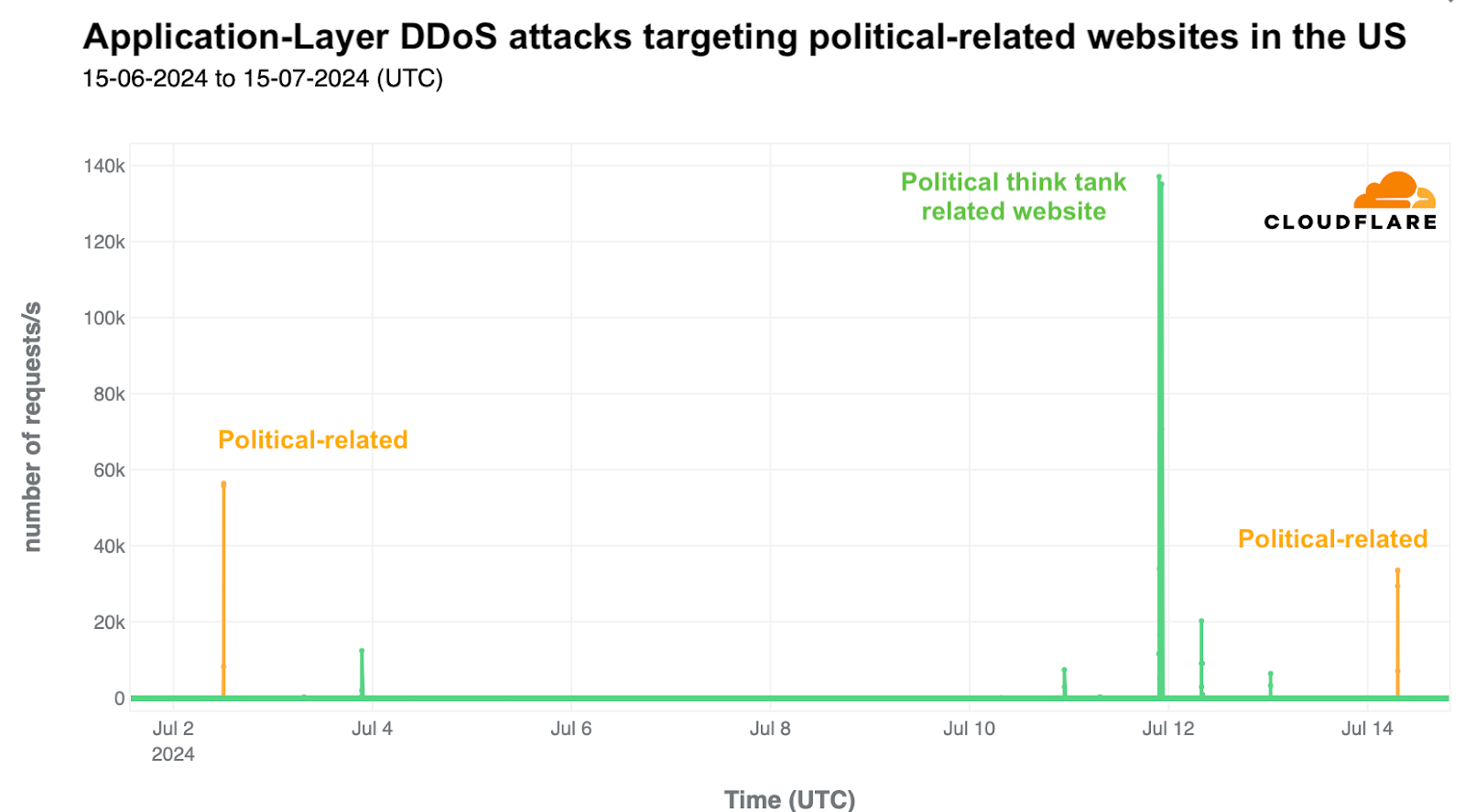
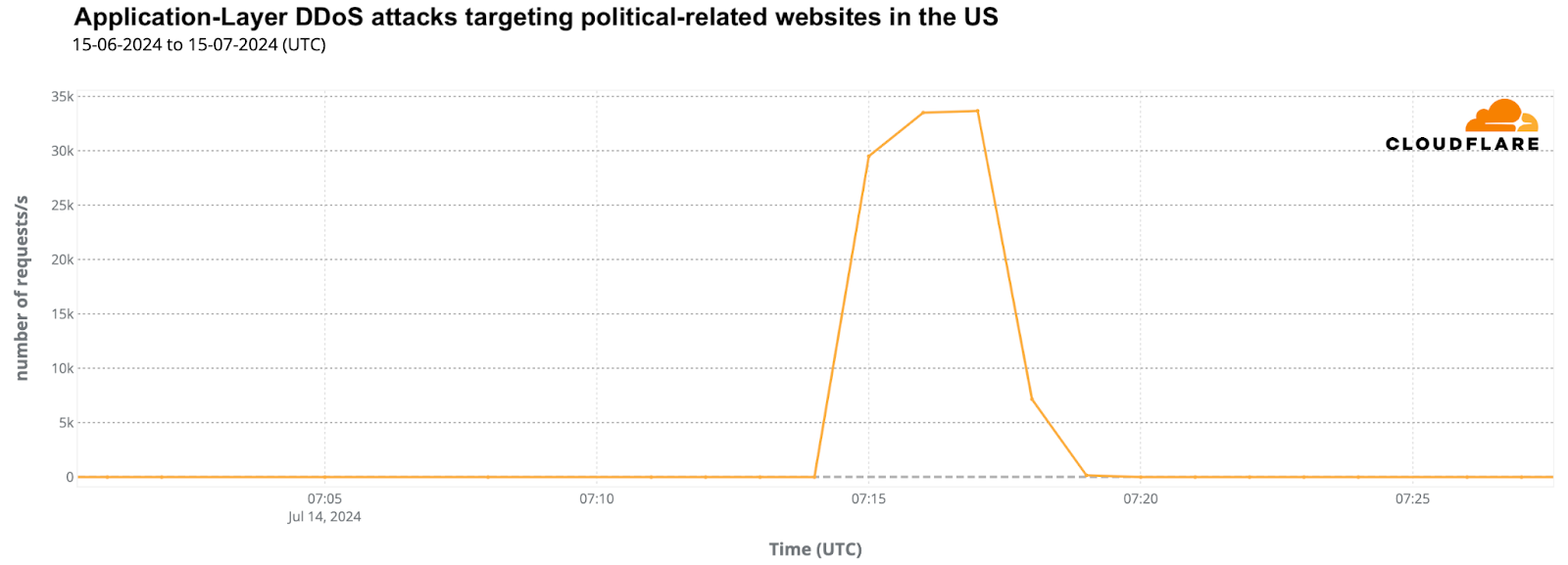
One of those is related to a political campaign, represented by the yellow line on the chart below. The first spike was a DDoS attack on July 2, 2024, peaking at 56,000 rps and lasting around 10 minutes. The same political-related site was attacked later on July 14, with a 34,000 rps peak, lasting four minutes.

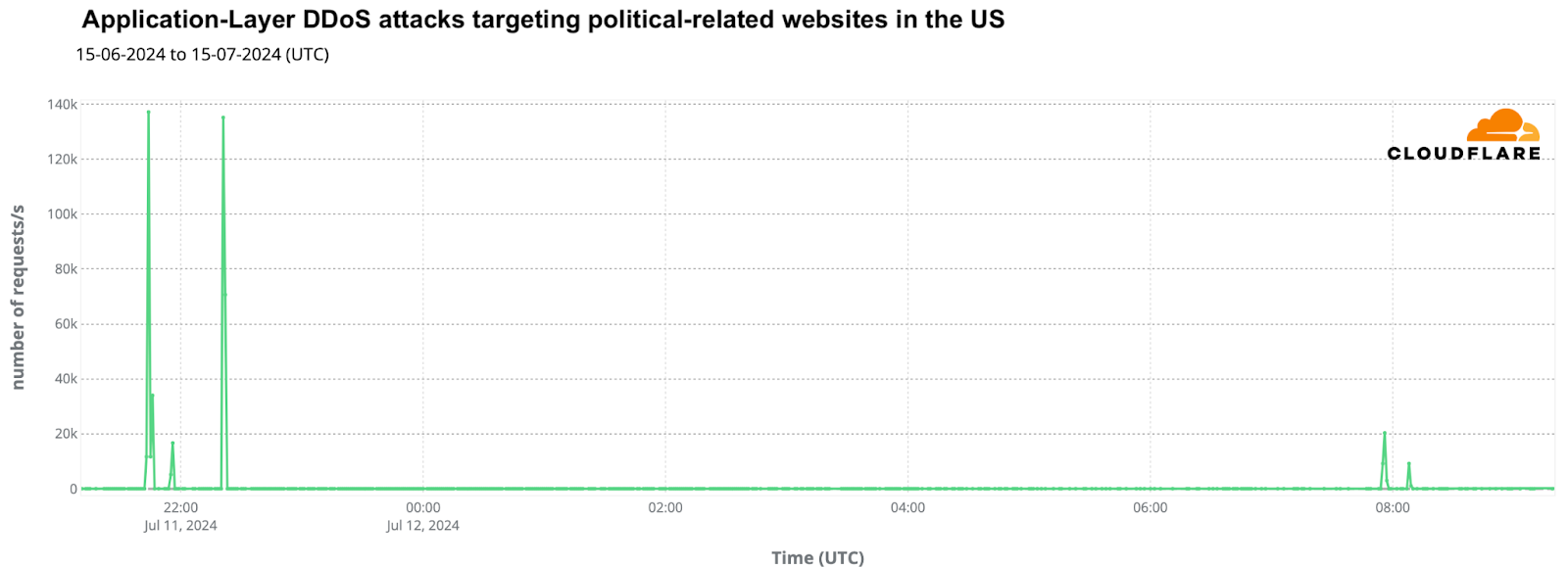
The other political-related site under attack, in green on the previous chart, is a think tank website that does policy advocacy related to presidential politics. It was already attacked before, around the time of the Biden vs Trump debate, as we’ve published at the time in a related blog post. The main attack was on July 11, with a 137,000 rps peak, lasting a few minutes, and was repeated, with slightly lower intensity, a few hours later on July 12.

As we’ve seen in our recent DDoS report, the vast majority of DDoS attacks are short. This emphasizes the need for automated, in-line detection and mitigation systems. Ten minutes are hardly enough time for a human to respond to an alert, analyze the traffic, and apply manual mitigations.

Trump assassination attempt impact

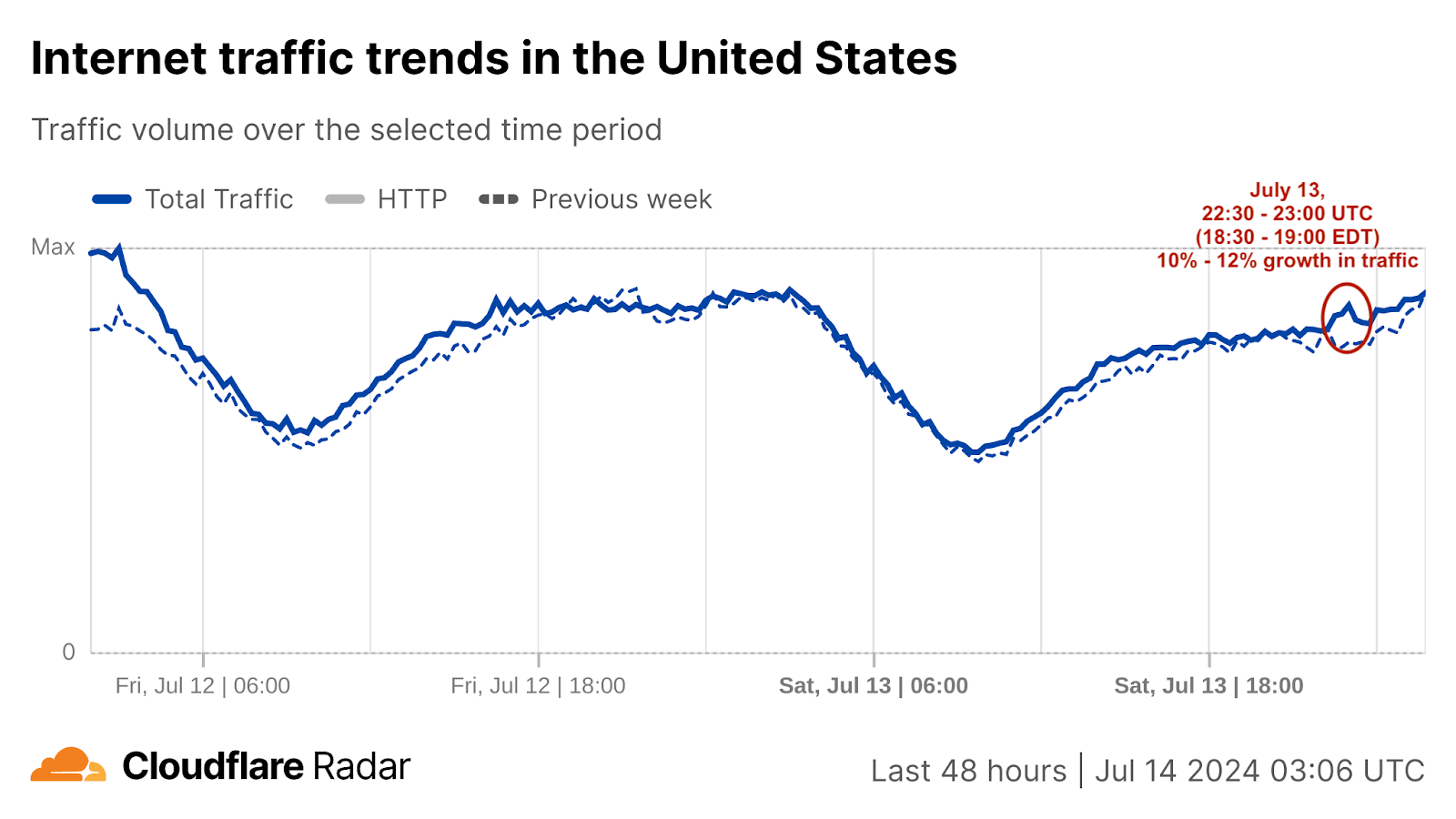
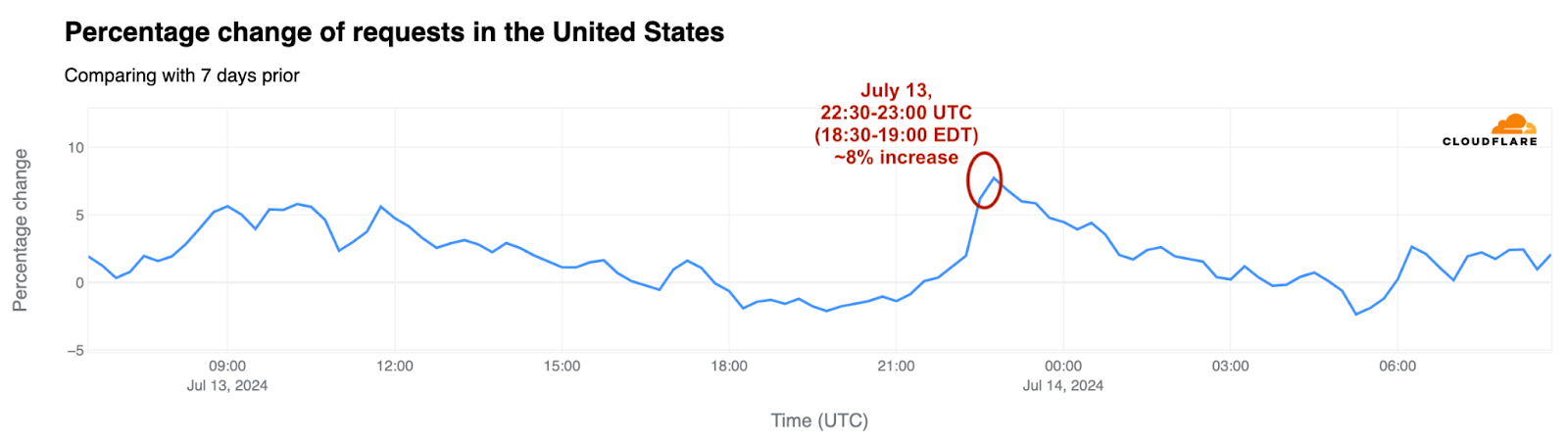
The attempted assassination of former President Trump at a campaign rally near Butler, Pennsylvania precipitated an increase in Internet traffic within the United States, particularly to news-related media outlets. As news broke of shots fired at a Trump rally, injuring the former president, Internet traffic in the United States (in bytes) increased around 22:30 – 23:00 UTC (18:30-19:00 EST) by 10% to 12%.

HTTP requests in the United States saw up to an 8% increase on July 13th compared to the previous week.

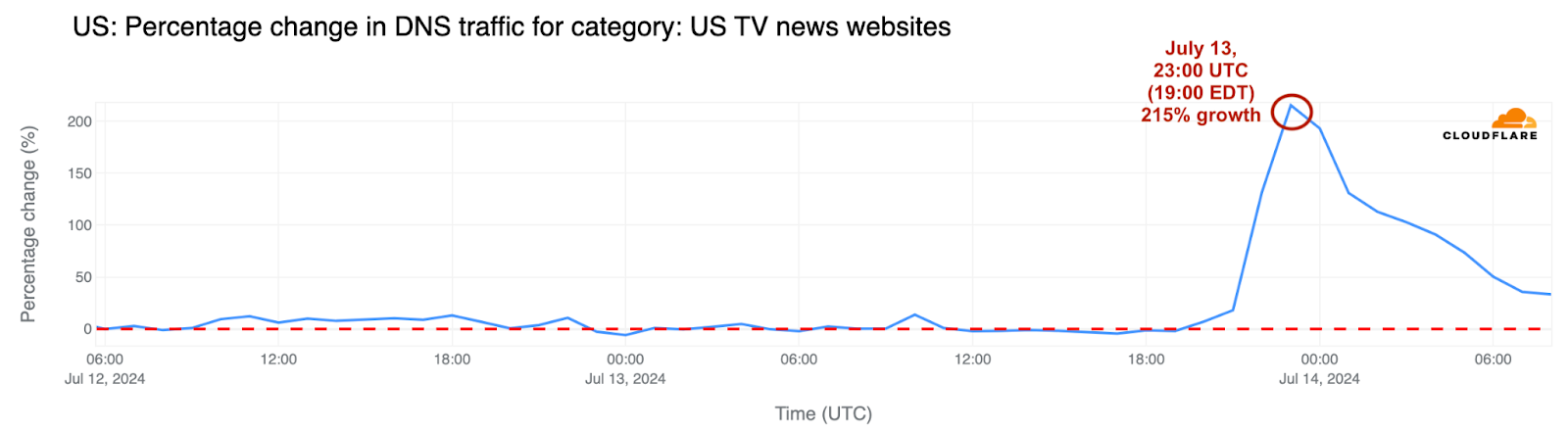
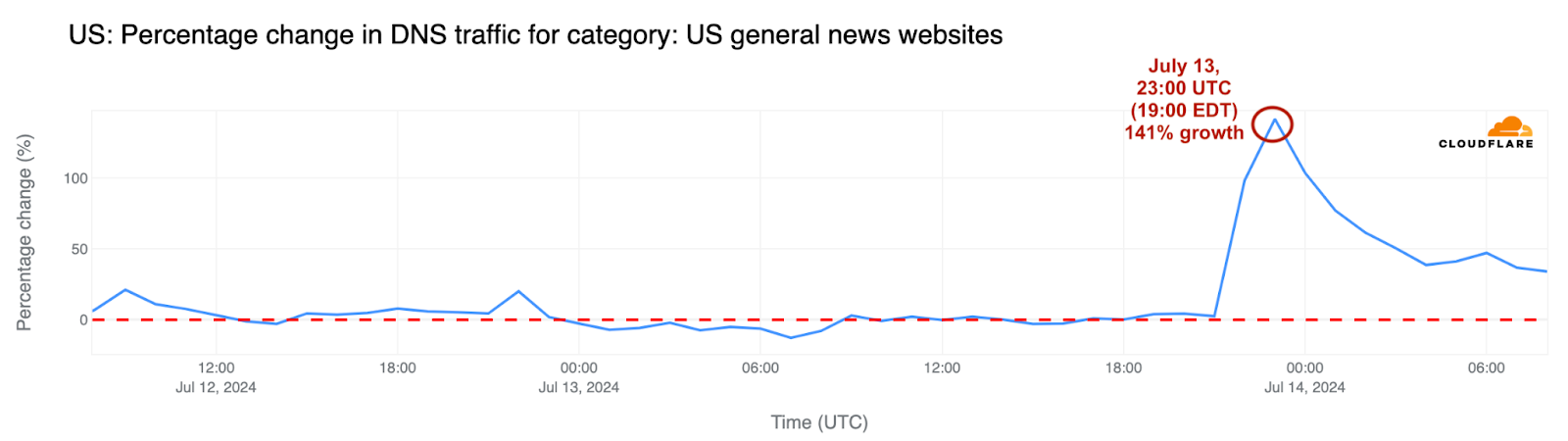
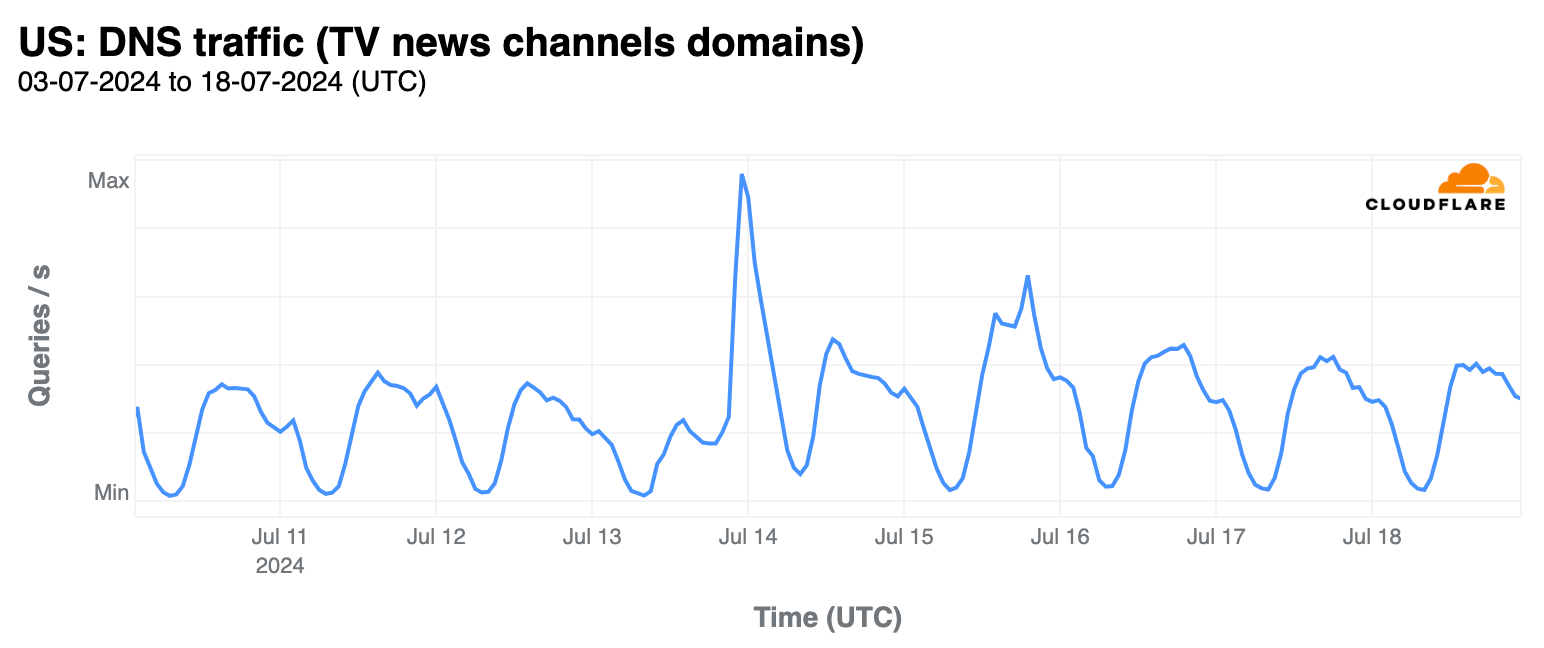
At the same time, DNS traffic to TV news sites, via our 1.1.1.1 resolver, surged by as much as 215%, and to general news sites by 141%.

Republican National Convention

The Republican National Convention is an important political event as delegates of the United States Republican Party choose the party’s nominees for president and vice president in the 2024 United States presidential election. Over the four-day event, convention delegates formally nominate the party’s presidential and vice presidential candidates and adopt the party’s platform, which outlines its policies and positions on various issues. The convention features speeches from prominent party members, including the nominees, party leaders, and other influential figures.

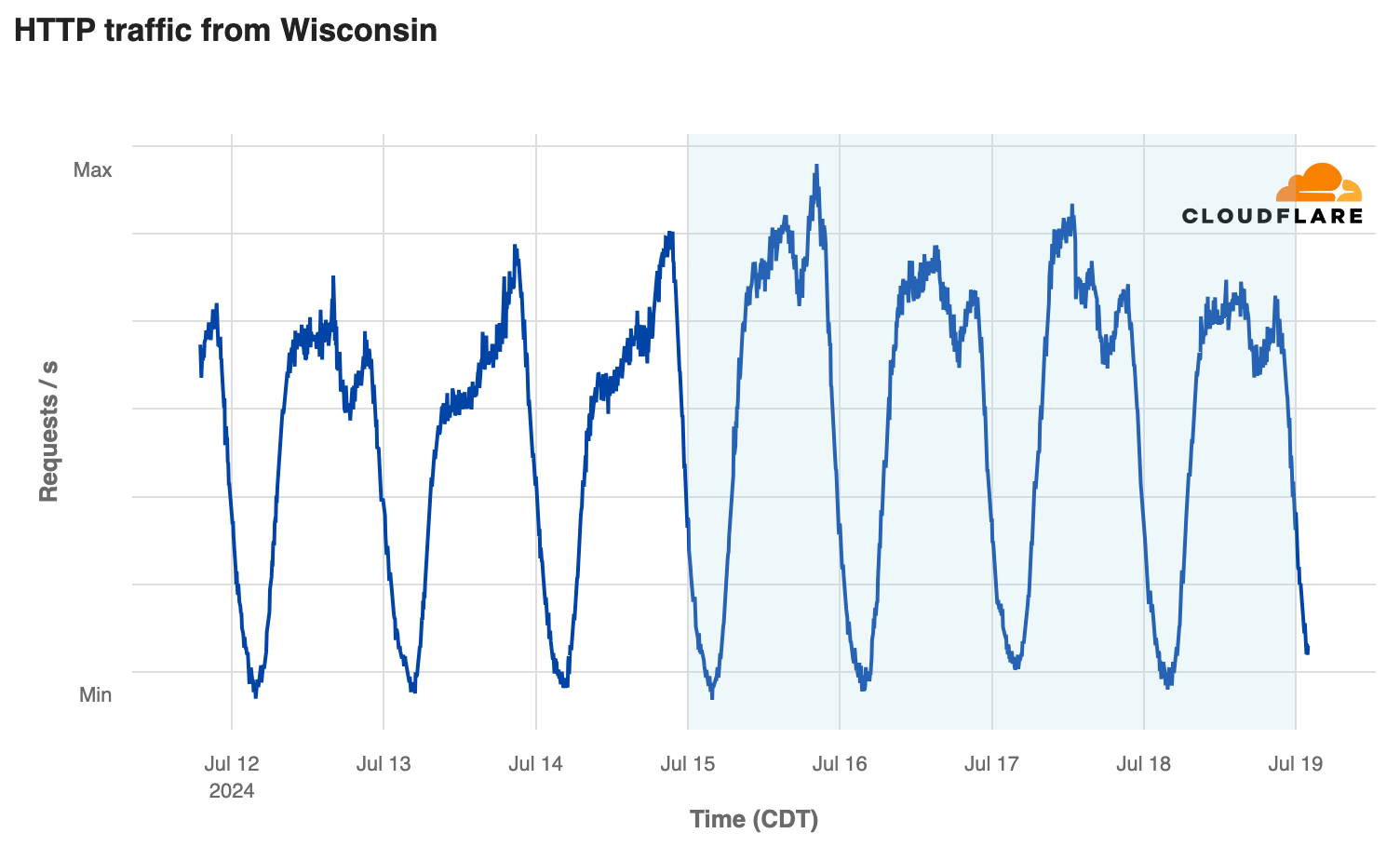
This year’s convention was held in Milwaukee, Wisconsin. During this time, we didn’t identify any noticeable traffic spikes from Milwaukee or from Wisconsin in general.

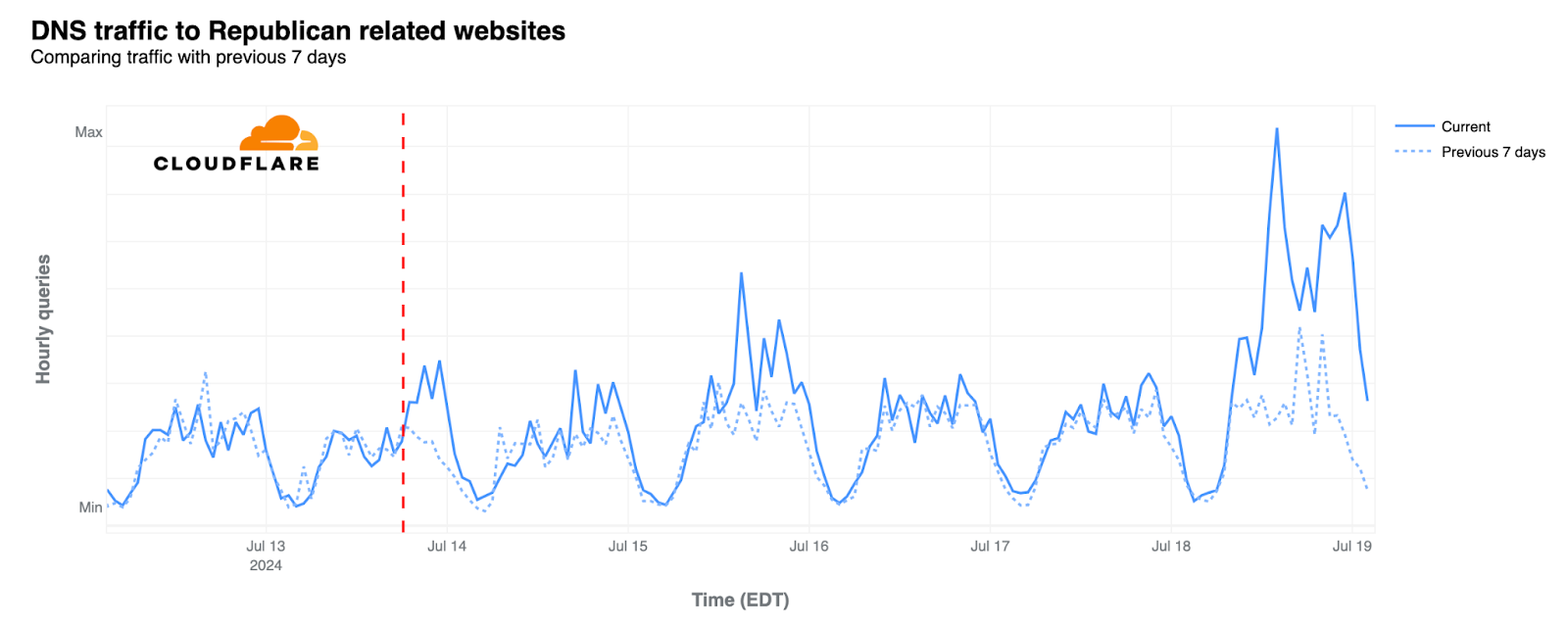
Compared to the previous week, there was an increase in DNS traffic to Republican political party and fundraising websites. On July 18th, the last day of the convention, we saw two considerable increases in hourly traffic compared to a week prior. The first at 14:00 EDT, an increase of 268% in traffic to these sites. The second, at 23:00 EDT with another increase at 266%. The daily aggregation on this day was an increase of 90.48% compared to daily traffic aggregations in the previous week.

For DNS traffic during the convention for TV news channels, we see steady traffic numbers with the highest peaking days before the convention on July 14, then during the late hours of July 15th.

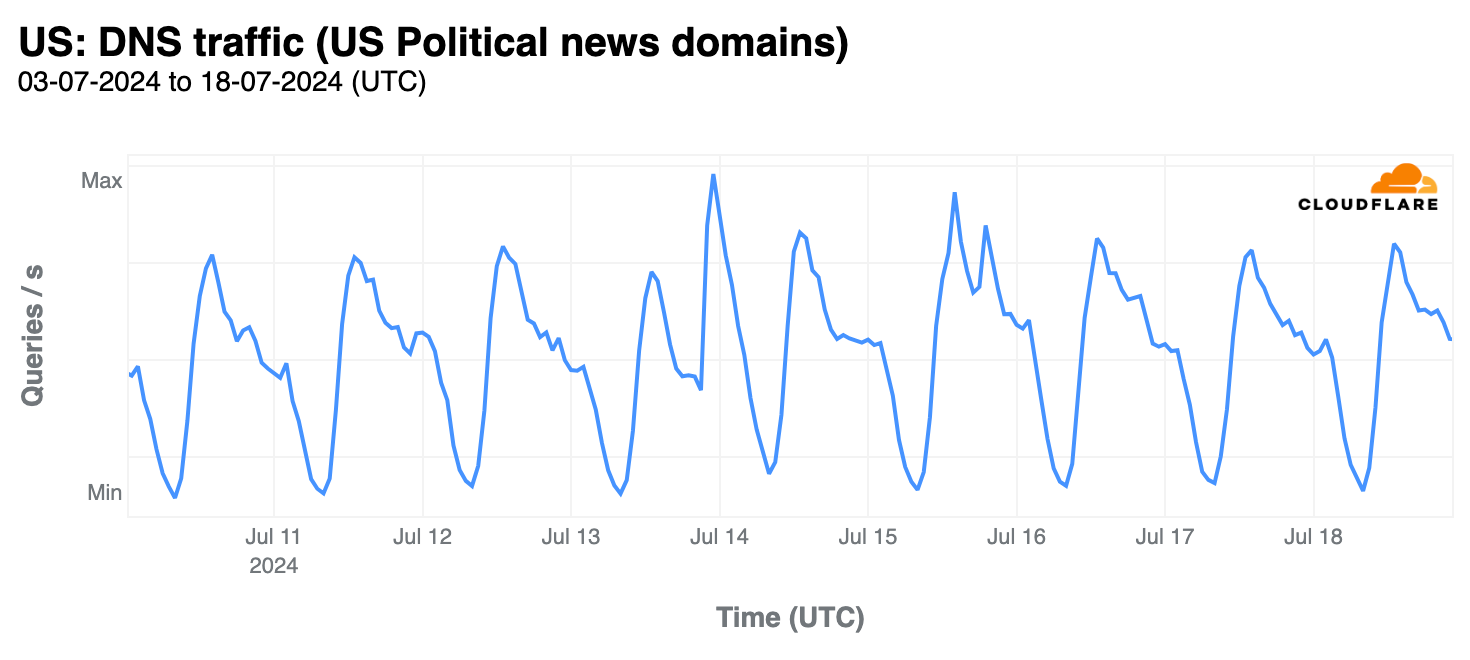
For political news websites covering the RNC, traffic numbers tend to decrease slightly as the event progresses.

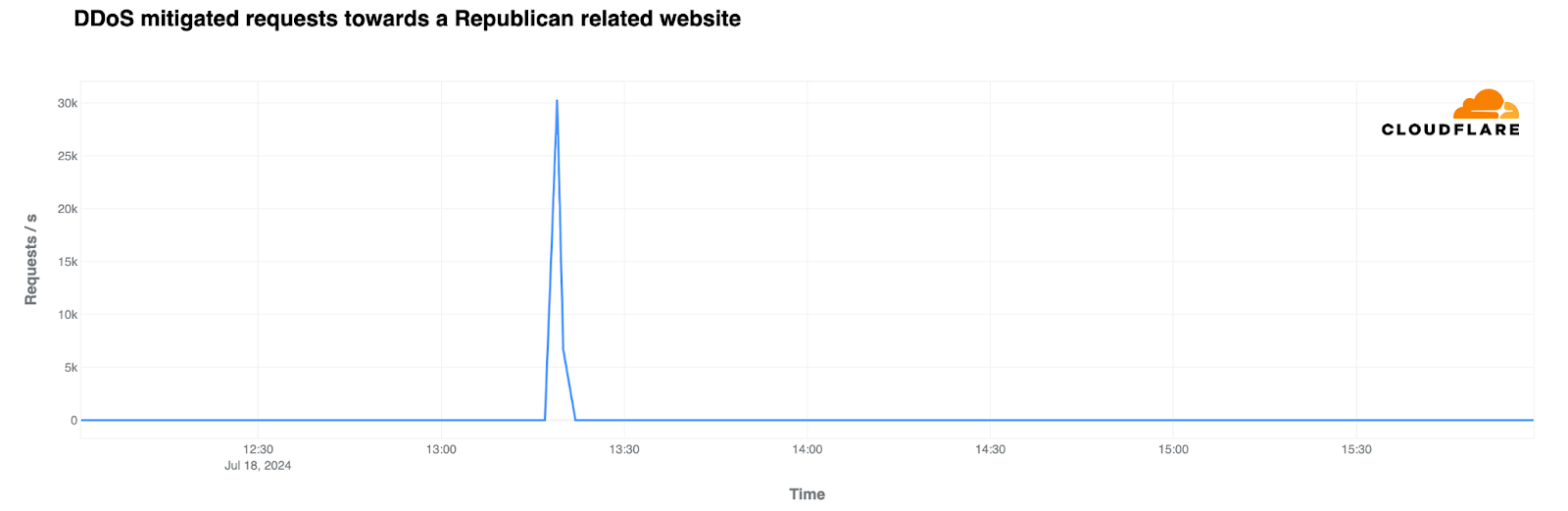
We identified an attack against a think-tank based in Washington D.C. that does policy advocacy related to presidential politics. The attack itself lasted around 3 minutes, from July 18th 13:18 to 13:22 exclusive (EDT) with a total of 3.12 million DDoS requests mitigated. The attack peaked at around 30.33k rps.

We see that major political events may not always cause significant shifts in Internet traffic. Our data indicates increases in traffic primarily to news and media organizations from July 13th onward. When it comes to cyber attacks, a majority of activity we see targets political campaigns and policy organizations.

If you want to follow more trends and insights about the Internet and elections in particular, you can check Cloudflare Radar, and more specifically our new 2024 Elections Insights report, which will be updated as elections take place throughout the year.

How the first 2024 US presidential debate influenced Internet traffic and security trends

Post Syndicated from João Tomé original https://blog.cloudflare.com/how-the-first-2024-us-presidential-debate-influenced-internet-traffic-and-security-trends


Key findings:

  • The Biden vs. Trump debate influenced Internet traffic at the state level in the US, with drops in traffic as high as 17% (in Vermont) during the debate.
  • Microblogging and video streaming platforms saw traffic changes during the debate.
  • Trump-related sites, including donation platforms, gained much more traction than Biden’s during and after the debate.
  • Emails with “Trump” in the subject had higher rates of spam and malicious content compared to those with “Biden.”
  • No increase in cyberattacks during the debate, but frequent DDoS attacks targeted government and political sites in the preceding months.

Internet traffic ebbs and flows usually follow human patterns, and high visibility events that are broadcast on TV usually have an impact. Let’s take a look at the first of the 2024 United States presidential debates between the two major presumptive candidates, Joe Biden and Donald Trump, for the November presidential election.

2024 has been dubbed “the year of elections,” with elections taking place in over 60 countries, as we have mentioned before (1, 2, 3). We are regularly updating our election report on Cloudflare Radar, including analysis of recent elections in South Africa, India, Iceland, Mexico, and the European Union.

Typically, from what we usually observe, election days don’t come with highly intensive changes to Internet traffic, and the same is true for debates. Yet, debates can also draw attention that impacts traffic, especially when there is heightened anticipation. The 2024 debates are not only aired on broadcast and cable television but also streamed on platforms like YouTube, enhancing their reach and impact.

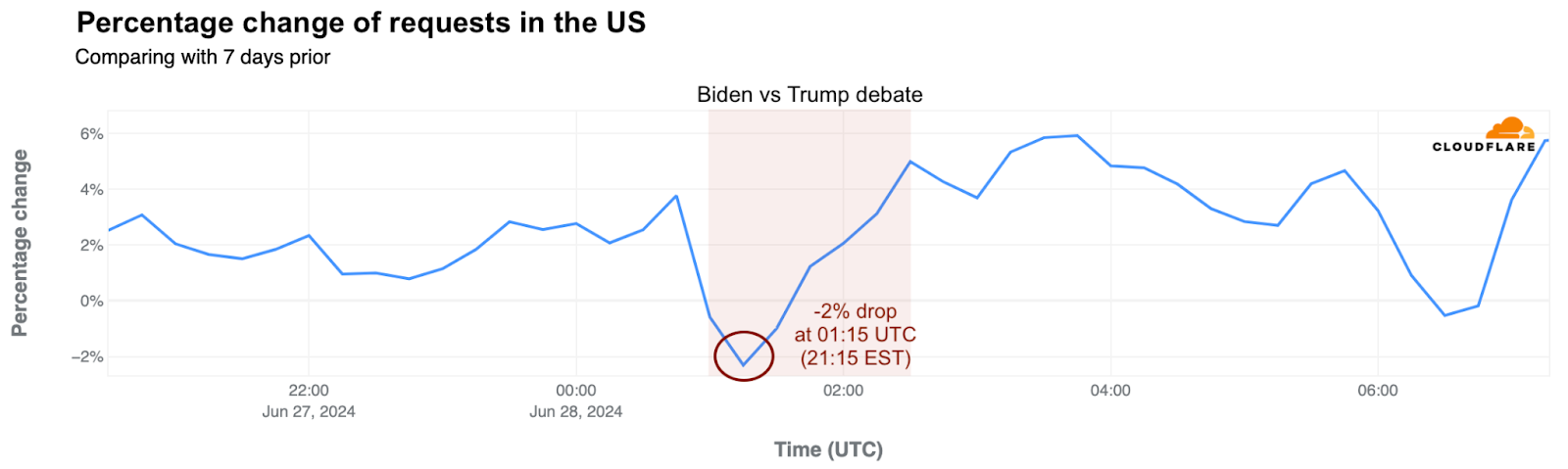
During the June 27, 2024, debate between Biden and Trump, hosted by CNN at 21:00 EST (01:00 UTC), Cloudflare noted a slight drop in nationwide Internet requests, falling to 2% below the same time a week prior at 21:15 EST (01:15 UTC). Interestingly, Internet traffic was 4% higher just before the debate started and surged to 6% above the previous week’s levels after the debate concluded at 23:45 EST (03:45 UTC).

Internet traffic dips across US states

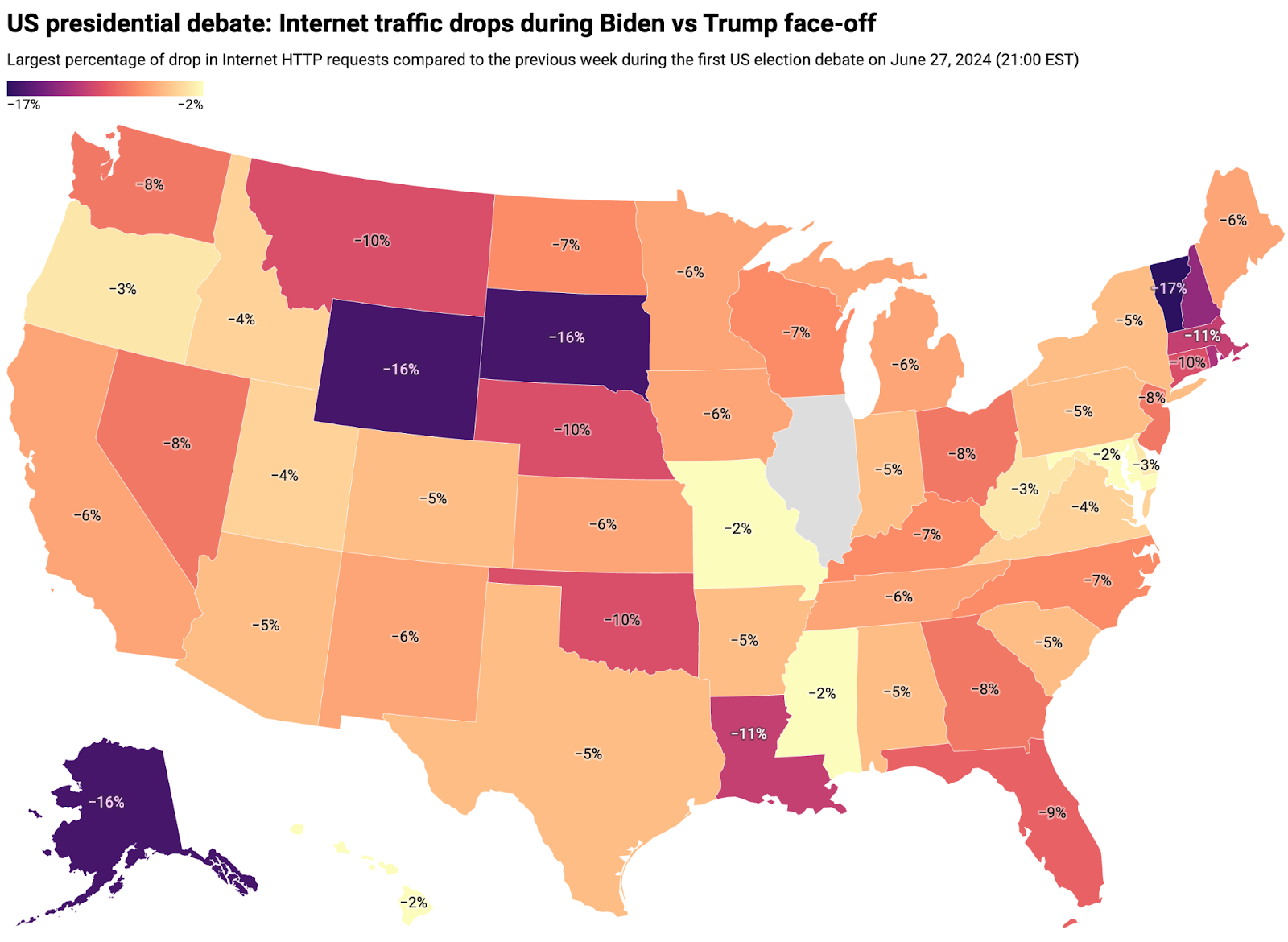
Traffic shifts at the time of the debate, as compared to the previous week, are much more revealing at a state-level perspective than at the country level. The map below summarizes traffic changes observed at a state level:

The most significant traffic drops were seen in Vermont (-17%), South Dakota (-16%), Wyoming (-16%), and Alaska (-16%). More populous states like California, Texas, and New York saw milder reductions of between 5% and 6%, and Florida experienced a 9% drop at 21:45 local time (01:45 UTC) during the debate.

The six swing states that are said to be decisive in the election, Arizona, Georgia, Michigan, Nevada, Pennsylvania and Wisconsin, all saw traffic drop between 5% and 8%.

The initial minutes of the Biden vs. Trump debate triggered the largest traffic declines in most states, though several, including Florida, Louisiana, Georgia, Nevada, and Wisconsin, observed deeper dips midway through. States like Ohio and Missouri recorded their most substantial traffic drops towards the debate’s conclusion.

In the next table, we provide a detailed breakdown of the same perspective shown on the US map ordered by the magnitude of the drop in traffic. We include the time of the biggest traffic drop compared to the previous week, at a 5-minute granularity, and also the percentage of the drop compared to the previous week. (Illinois is not included due to data issues.)

State Drop in traffic (%) Time of drop in traffic (local) Time of drop in traffic (UTC)
Vermont -17% 21:00 1:00
Alaska -16% 17:30 1:30
South Dakota -16% 20:10 / 19:10 1:10
Wyoming -16% 19:25 1:25
New Hampshire -13% 21:05 1:05
Rhode Island -12% 21:05 1:05
Louisiana -11% 20:45 1:45
Massachusetts -11% 21:05 1:05
Connecticut -10% 21:30 1:30
Montana -10% 19:10 / 18:10 1:10
Nebraska -10% 20:05 / 19:05 1:05
Oklahoma -10% 20:05 1:05
Florida -9% 21:45 1:45
Georgia -8% 21:45 1:45
Nevada -8% 18:40 1:40
New Jersey -8% 21:05 1:05
Ohio -8% 22:25 2:25
Washington -8% 18:30 1:30
Kentucky -7% 21:15 1:15
North Carolina -7% 21:15 1:15
North Dakota -7% 20:10 / 19:10 1:10
Wisconsin -7% 20:45 1:45
California -6% 18:05 1:05
Iowa -6% 20:35 1:35
Kansas -6% 20:05 1:05
Maine -6% 21:05 1:05
Michigan -6% 21:05 1:05
Minnesota -6% 20:05 1:05
New Mexico -6% 19:10 1:10
Tennessee -6% 20:30 / 21:30 1:30
Alabama -5% 20:10 1:10
Arizona -5% 18:20 1:20
Arkansas -5% 20:25 1:25
Colorado -5% 19:15 1:15
Indiana -5% 21:10 1:10
New York -5% 21:25 1:25
Pennsylvania -5% 21:15 1:15
South Carolina -5% 21:35 1:35
Texas -5% 20:20 / 19:20 1:20
Idaho -4% 19:45 / 18:45 1:45
Utah -4% 19:05 1:05
Virginia -4% 21:05 1:05
Delaware -3% 21:05 1:05
Oregon -3% 18:15 1:15
West Virginia -3% 21:05 1:05
District of Columbia -2% 21:55 1:55
Hawaii -2% 15:20 1:20
Maryland -2% 21:10 1:10
Mississippi -2% 20:20 1:20
Missouri -2% 21:10 2:10
Illinois

DNS trends: Trump-related sites see accelerated growth

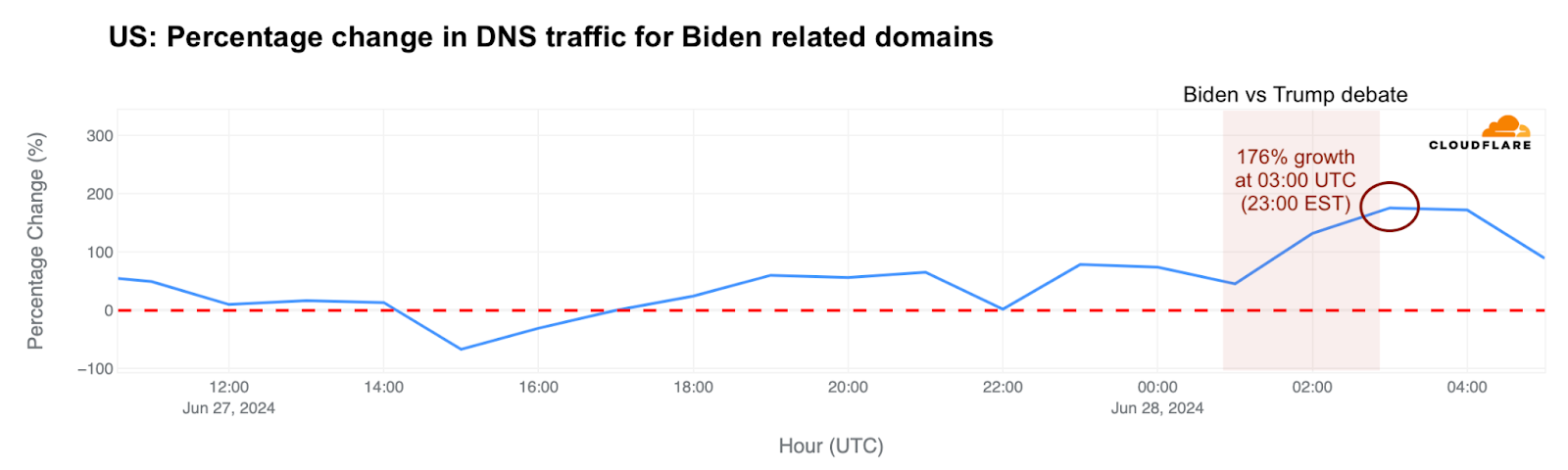
Switching focus to domain trends, our 1.1.1.1 resolver data reveals a more targeted impact from the debate. Considering the candidates individually (using the official sites related to both candidates), we found that Biden-associated websites saw a 176% surge in DNS queries at around 23:00 EST (03:00 UTC), compared to the previous week.

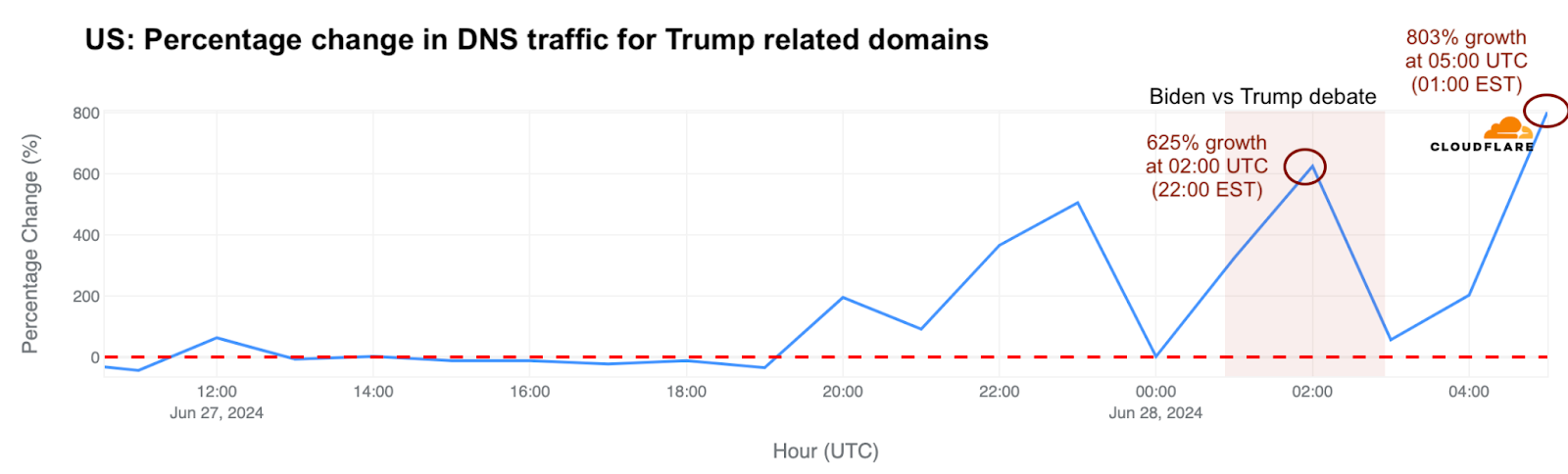
However, Trump-associated sites saw a greater increase than Biden-associated sites, showing an increase before, during, and after the debate, with the peak growth reaching 803% over the previous week at 01:00 EST (05:00 UTC).

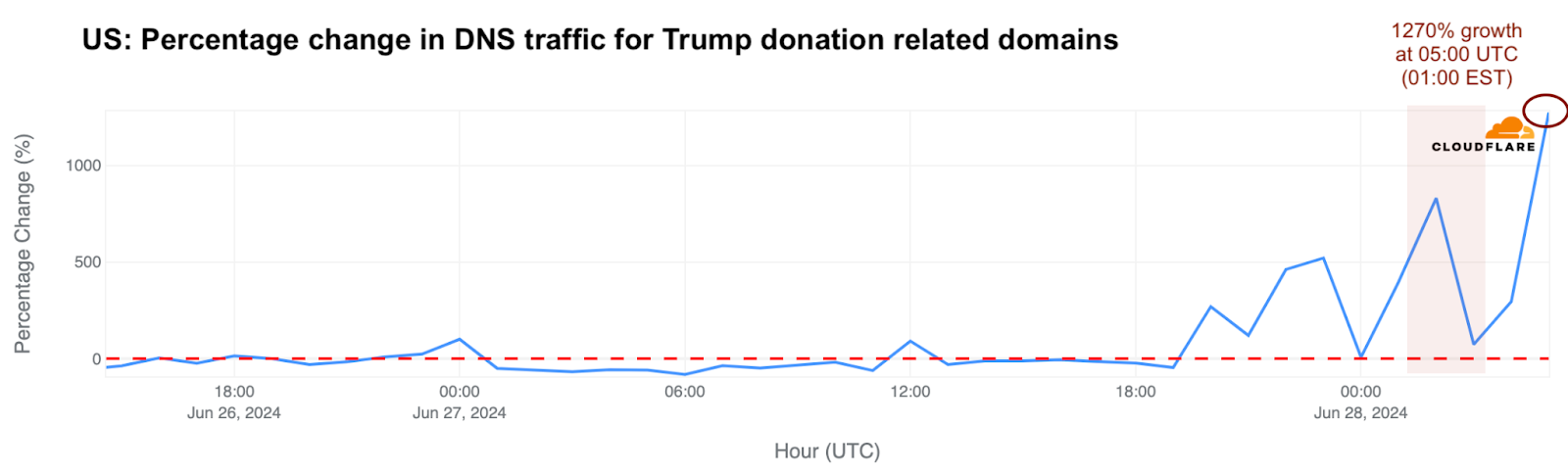
For donation sites, those linked to Biden were busiest before the debate on June 17 and 18, thanks to events with Barack Obama and Bill and Hillary Clinton. DNS traffic for Trump’s donation sites, as compared with the previous week, increased during the debate, growing 830% at 22:00 EST (02:00 UTC) and reaching a high of 1270% increase by 01:00 EST.

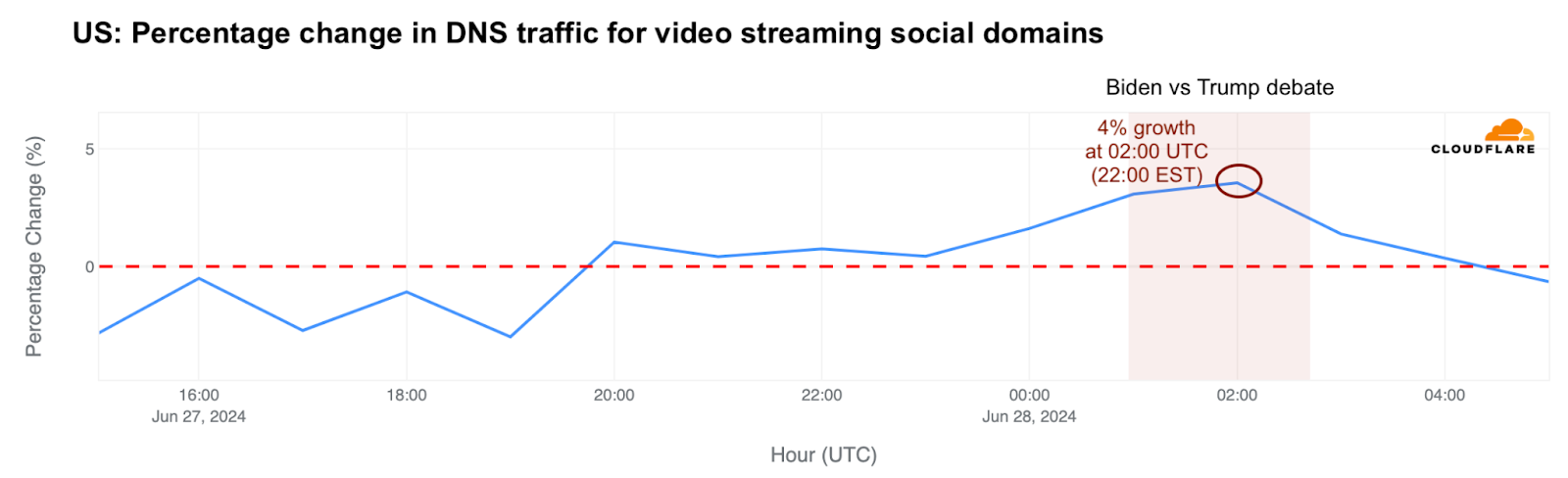
The debate aired on multiple TV channels and was streamed on YouTube. During the debate, video streaming platforms like TikTok and YouTube, which are among the top Internet services globally, saw a 4% increase in DNS traffic at 22:00 EST (02:00 UTC). Significant changes in DNS traffic on these platforms are uncommon due to their widespread popularity.

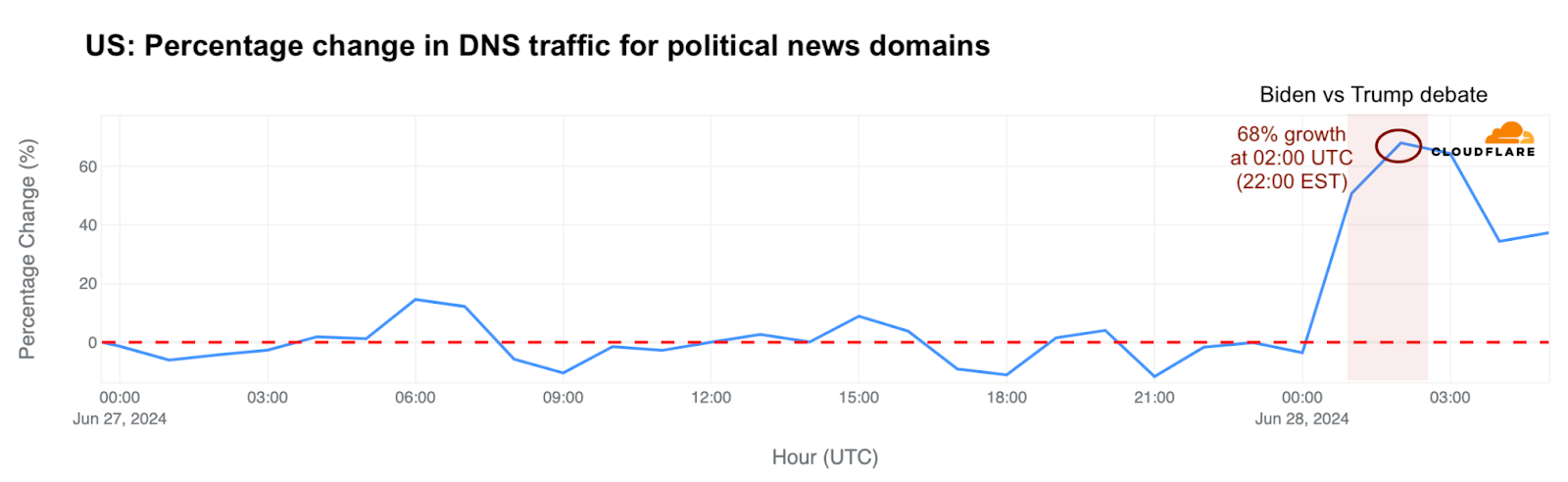
Political news sites also spiked, with a 68% traffic increase around 22:00 EST (02:00 UTC).

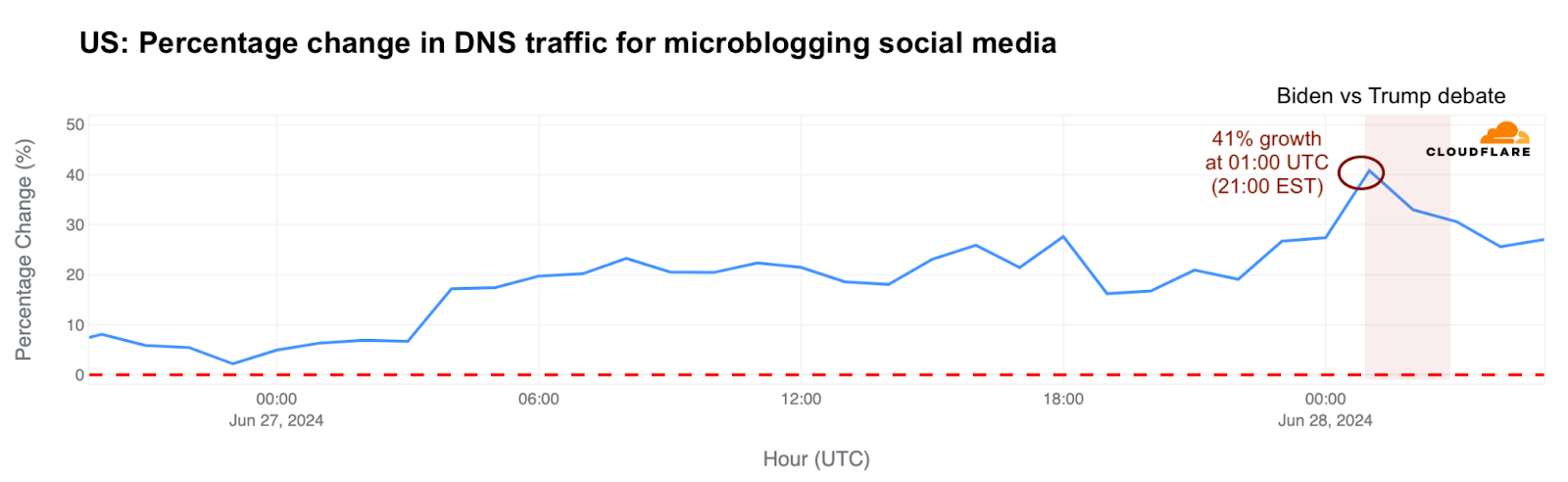
Microblogging social platforms like X or Threads outperformed their previous week’s traffic throughout the debate day, with growth peaking at 41% at the start of the debate around 21:00 EST (01:00 UTC).

Biden vs Trump: spam and malicious emails

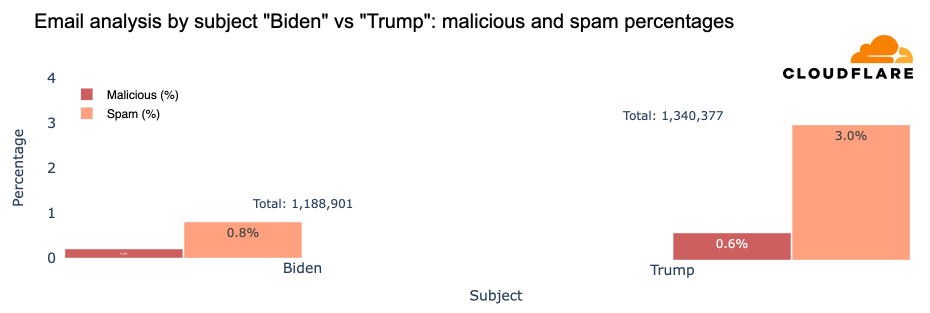
In June 2024 (through June 27), Cloudflare’s Cloud Email Security service processed over 2.5 million emails containing “Biden” or “Trump” in the subject line. Trump-related subjects appeared 13% more often than those related to Biden. Moreover, emails with “Trump” had higher percentages of spam, at 3%, and malicious messages, at 0.6%, compared to 0.8% for spam and 0.2% for malicious messages with “Biden.”

The peak occurrence of spam emails with “Trump” was on June 9, at 19.8%, and the highest rate of malicious messages was on June 12, at 2.9%. For “Biden,” the highest spam rate was on June 21, at 1.2%, and the peak for malicious messages was also on June 9, at 0.8%.

Attacks: government and political impact

Focusing on attacks, those are usually constant, and aren’t necessarily driven always by elections. But, as we’ve seen at the start of the war in Ukraine or more recently in the Netherlands, events do trigger attacks. Already in June 2024, during the European elections, we recently published a blog post about the cyberattack on Dutch political-related websites that lasted two days – June 5 and 6. The main DDoS (Distributed Denial of Service attack) attack on June 5, the day before the Dutch election, reached 73,000 requests per second (rps).

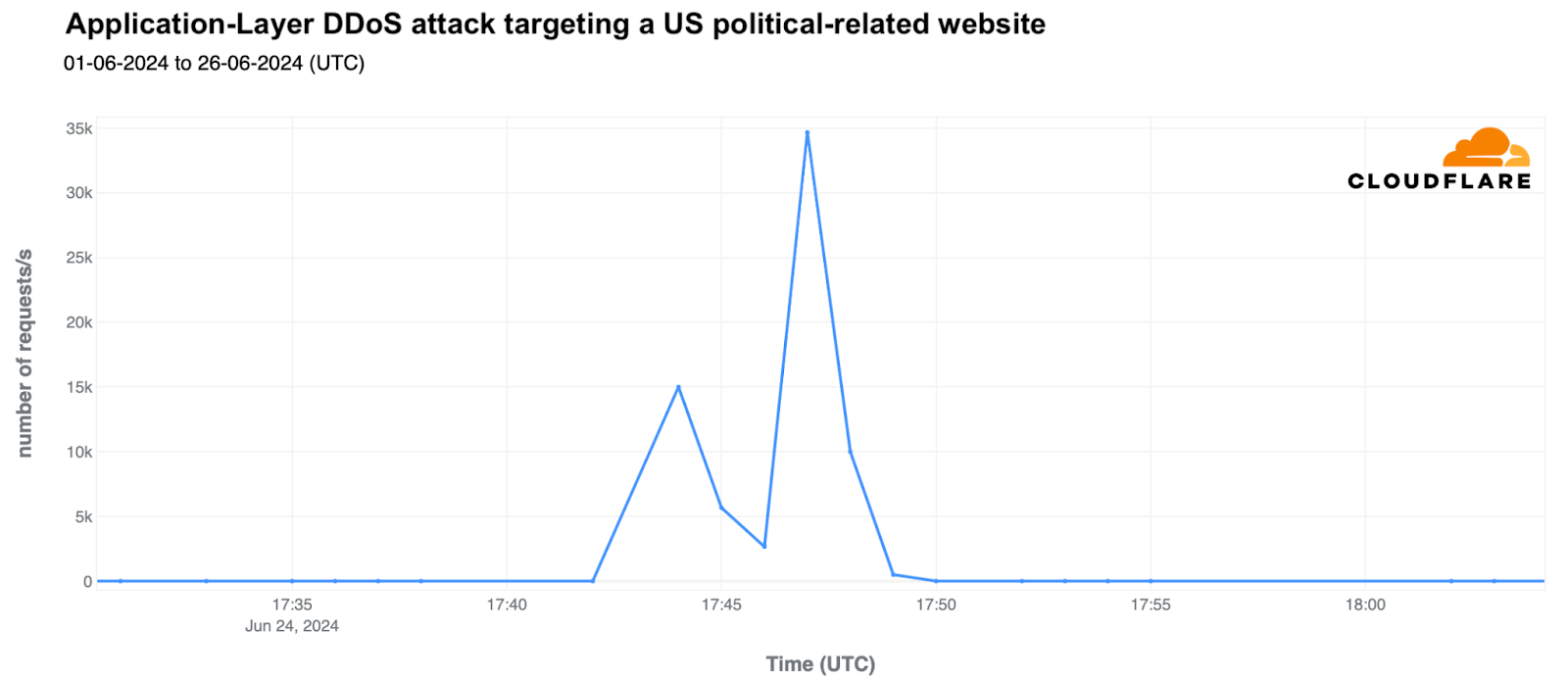
Shifting our focus to the US in particular, in the weeks since April 2024, we’ve seen some DDoS attacks targeting both government, state or political-related websites in the United States. That said, we haven’t seen any substantial attacks targeting political sites during the day of debate, June 27. The most recent one we saw was this week, on June 24, and targeted a political-related website involved in the current elections. It was a small attack that lasted under 10 minutes and peaked at 35,000 requests per second (rps).

Now that we’ve explored the US presidential debate trends, let’s compare it with Internet trends from other debates in the UK and France from the week of June 24, 2024.

UK and France: debates with an impact

In other countries like the UK and France, election-related debates during the week of June 24 also serve as examples for comparison with the Biden vs Trump debate. Both the UK and France experienced more significant nationwide traffic impacts during their debates compared to the US. However, the geographic and population size of the US, coupled with the debate’s broad availability on streaming platforms, could have influenced this disparity.

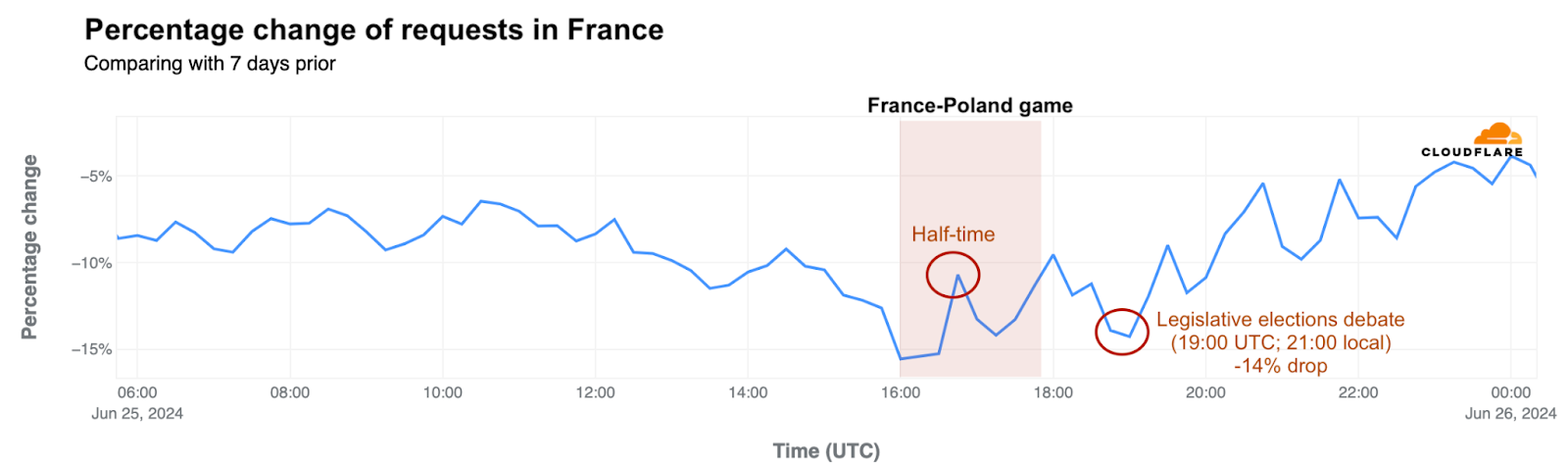
In France, the snap election is scheduled for Sunday, June 30, 2024, and the runoff on July 7, 2024. The final debate among the leading candidates on Tuesday, June 25, 2024 (21:00 local time), led to a 14% drop in Internet HTTP requests, as it was broadcast nationally and carried broad interest. Despite this, the UEFA Euro 2024 football match between France and Poland on the same day, at 18:00 local time, caused an even greater traffic decrease of 16%.

The following day, Wednesday, June 26, 2024, the two main candidates for the snap UK general election — scheduled for July 4, 2024 — participated in their final debate on BBC national TV. The debate between Rishi Sunak and Sir Keir Starmer, which started at 20:15 local time, resulted in a 7% drop in UK Internet traffic compared to the previous week. The most significant decrease occurred at 20:45. At a more detailed level, Wales experienced an 11% drop during the debate, followed by England at 8%, Scotland at 7%, and Northern Ireland at 5%.

Conclusion: high intensity election year

Even if major political events don’t always bring significant changes to Internet traffic, our data shows that the Biden vs. Trump debate had an impact, especially at the state level. Microblogging and video streaming social platforms also saw traffic shifts during the debate, with Trump-related sites seeing larger spikes in DNS traffic than Biden-related sites, especially after the debate.

We also observed a higher percentage of spam and malicious emails sent with “Trump” in the subject of the messages than with “Biden.” Although we didn’t see an uptick in cyberattacks during the debate, we note that these have been frequent, especially DDoS attacks in the months before, targeting both federal and state government services as well as politically related sites.

If you want to follow more trends and insights about the Internet and elections in particular, you can check Cloudflare Radar, and more specifically our new 2024 Elections Insights report, which will be updated as elections take place throughout the year.

Patrick Finn: why I joined Cloudflare as VP Sales for the Americas

Post Syndicated from Patrick S. Finn original https://blog.cloudflare.com/patrick-finn


I’m delighted to be joining Cloudflare as Vice President of Sales in the US, Canada, and Latin America.

I’ve had the privilege of leading sales for some of the world’s most iconic tech companies, including IBM and Cisco. During my career I’ve led international teams numbering in the thousands and driving revenue in the billions of dollars while serving some of the world’s largest enterprise customers. I’ve seen first-hand the evolution of technology and what it can achieve for businesses, from robotics, automation, and data analytics, to cloud computing, cybersecurity, and AI.

I firmly believe Cloudflare is well on its way to being one of the next iconic tech companies.

Why Cloudflare

Cloudflare has a unique opportunity to help businesses navigate an enduring wave of technological change. There are few companies in the world that operate in the three most exciting fields of innovation that will continue to shape our world in the coming years: cloud computing, AI, and cybersecurity. Cloudflare is one of those companies. When I was approached for this role, I spoke to a wide range of connections across the financial sector, private companies, and government. The feedback was unanimous that Cloudflare is poised on the edge of exhilarating growth.

Driving predictable, profitable revenue

I was fortunate to join Cisco two years after its annual revenue passed the $1 billion mark and had the privilege of helping scale the business to more than $49 billion in revenue the year I left. Cloudflare passed the $1 billion milestone just last year, and I see the same potential for growth here as I saw at Cisco.

Cloudflare’s global sales organization is growing. I’m excited to help accelerate that process in a way that delivers recurring revenue for the business while ensuring we retain a very high bar in terms of the talent we bring onto the team. My experience leading complex, cross-functional sales organizations within large global companies has taught me a great deal about the common traits among highly effective sales functions.

The groups of individuals that come together to make true teams are the ones that successfully focus on a unifying goal and develop skills like communication, attitude, process, organization, consistency, collaboration, partnership, and accountability.  These teams embrace diversity and bring out of each other the best expertise, creativity, and skills, making the team stronger and keeping the goal in focus.

Making our customers our north star

We will achieve the opportunity ahead of us only as long as we have our customers as our north star. Today, the Americas represent more than half of Cloudflare’s revenue worldwide and are home to some of our largest and most strategic customers – both in the private and public sectors – including 30% of the Fortune 1000. Brands from Zendesk to Shopify and from Colgate-Palmolive to Mars rely on Cloudflare to operate their businesses in a fast, secure, and reliable way.

Whatever the technology, there are three common fundamentals I’ve found essential to creating value for customers: being the expert on their challenges, understanding how to pick the right combination of products, services, and solutions from those available, and knowing your competition.

Cloudflare already has an incredible and growing range of products and services that are helping millions of individuals and organizations maximize the opportunities presented by cloud computing and generative AI, all while staying safe from the threat of cyberattacks.

What helping to build a better Internet means to me

If it were needed, one additional deciding factor behind my excitement in joining Cloudflare is its ambitious mission to help build a better Internet. As a father, I want the Internet to be a safe and valuable resource for my family and friends and for generations to come. I don’t want my daughter to have to worry about her personal data and privacy as she’s buying Billie Eilish concert tickets online (and, yes, I’m going too).

Today Cloudflare’s connectivity cloud protects nearly 20% of all websites online and stops 209 billion cyber attacks daily. In addition to its growing customer base, Cloudflare is living up to its mission by offering its services for free to millions more individuals and small businesses, including the most vulnerable voices online through its Project Galileo initiative.

The combination of a strong mission, genuine values, a great team, and incredible technology isn’t a given in every company, but is evident at Cloudflare. I’m excited to play a part as Cloudflare continues to scale its business and help build a better Internet for everyone.

If you’re interested in learning more about what Cloudflare can do for your organization, please get in touch here. If you’re an ambitious, talented sales professional looking for your next challenging and rewarding career move, check out our open positions here.

Don’t Let the Cyber Grinch Ruin your Winter Break: Project Cybersafe Schools protects small school districts in the US

Post Syndicated from Zaid Zaid http://blog.cloudflare.com/author/zaid-zaid/ original https://blog.cloudflare.com/project-cybersafe-schools-update


As the last school bell rings before winter break, one thing school districts should keep in mind is that during the winter break, schools can become particularly vulnerable to cyberattacks as the reduced staff presence and extended downtime create an environment conducive to security lapses. Criminal actors make their move when organizations are most vulnerable: on weekends and holiday breaks. With fewer personnel on-site, routine monitoring and response to potential threats may be delayed, providing cybercriminals with a window of opportunity. Schools store sensitive student and staff data, including personally identifiable information, financial records, and confidential academic information, and therefore consequences of a successful cyberattack can be severe. It is imperative that educational institutions implement robust cybersecurity measures to safeguard their digital infrastructure.

If you are a small public school district in the United States, Project Cybersafe Schools is here to help. Don’t let the Cyber Grinch ruin your winter break.

The impact of Project Cybersafe Schools thus far

In August of this year, as part of the White House Back to School Safely: K-12 Cybersecurity Summit, Cloudflare announced Project Cybersafe Schools to help support eligible K-12 public school districts with a package of Zero Trust cybersecurity solutions — for free, and with no time limit.

The response from school districts across the United States exceeded our expectations. We have had inquiries from over 200 school districts in over 30 states and Guam. Over the past few months, we have onboarded dozens of qualifying school districts into the program. As a result, over 60,000 students, teachers, and staff are protected by Cloudflare’s cloud email security to protect against a broad spectrum of threats including Business Email Compromise, multichannel phishing, credential harvesting, and other targeted attacks. These school districts are also receiving protection against Internet threats with DNS filtering by preventing users from reaching unwanted or harmful online content like ransomware or phishing sites. There are more than 9,000 small public school districts across the United States with fewer than 2,500 students. All of those school districts are eligible for Project Cybersafe Schools (for free, and with no time limit — see below for all the details), and we want to help as many as possible.

Since we launched the program, the White House has continued to amplify awareness around the risks for schools as well as the opportunities school districts have to protect themselves. Cloudflare hosted a series of live onboarding sessions at the start of the program and also created a Cybersafe School Resource Hub for school districts to learn more about the program and submit an inquiry.

What our participants are saying about the program

Here’s what a few Project Cybersafe Schools have to say about the impact of the program on small school districts.

“Project Cybersafe Schools has been incredibly helpful, especially for school districts with smaller enrollments, to provide resources, tools and information that otherwise might be out of grasp. Often, these smaller districts have individuals with many responsibilities and cybersecurity may not always be at the forefront. The tools Cloudflare offers as part of the White House focus to strengthen Cybersecurity across the K-12 spectrum allow us greater visibility into the threats experienced through E-Mail as well as protect our devices by layering DNS-based filtering on top of our existing environment to protect against threats that may come through via ransomware or phishing sites. Being able to leverage multiple layers of security helps us be more robust in protecting our student and teacher devices and ensure our learning environment is successful, safe and productive in the current digital landscape.”  
Randy Saeks, Network Manager, Glencoe School District 35, Glencoe, Illinois

“Quitman School District was excited to add another layer of security for our staff and students with Cloudflare Project Cybersafe Schools. Living in a low income, rural community, we were grateful for the opportunity to add a world-class free service to our school’s network architecture. Partnering with Cloudflare allowed us to continue to modernize and strengthen our security measures and protect our staff and students from a wide variety of threats. This implementation was quick and easy, and we were ecstatic that there was no expiration date for this service.  We were amazed to see that Cloudflare caught nearly 4,000 malicious emails in the first month of implementation!  We are confident that Cloudflare will continue to keep our district and infrastructure safe from harmful threats.”
Matt Champion, Technology Coordinator, Quitman School District, Quitman, Mississippi

What Zero Trust services are available?

Eligible K-12 public school districts in the United States will have access to a package of enterprise-level Zero Trust cybersecurity services for free and with no time limit – there is no catch and no underlying obligations. Eligible organizations will benefit from:

  • Email Protection: Safeguards inboxes with cloud email security by protecting against a broad spectrum of threats including malware-less Business Email Compromise, multichannel phishing, credential harvesting, and other targeted attacks.
  • DNS Filtering: Protects against Internet threats with DNS filtering by preventing users from reaching unwanted or harmful online content like ransomware or phishing sites and can be deployed to comply with the Children’s Internet Protection Act (CIPA).

Who can apply?

To be eligible, Project Cybersafe Schools participants must be:

  • K-12 public school districts located in the United States
  • Up to 2,500 students in the district

If you think your school district may be eligible, we welcome you to contact us to learn more.  Please visit our Project Cybersafe Schools Resource Hub.

For schools or school districts that do not qualify for Project Cybersafe Schools, Cloudflare has other packages available with educational pricing. If you do not qualify for Project Cybersafe Schools, but are interested in our educational services, please contact us at [email protected].

Project Cybersafe Schools: Bringing security tools for free to small K-12 school districts in the US

Post Syndicated from Zaid Zaid original http://blog.cloudflare.com/project-cybersafe-schools/

Project Cybersafe Schools: Bringing security tools for free to small K-12 school districts in the US

Project Cybersafe Schools: Bringing security tools for free to small K-12 school districts in the US

Like other under-resourced organizations, schools face cyber attacks from malicious actors that can impact their ability to safely perform their basic function: teach children. Schools face email, phishing, and ransomware attacks that slow access and threaten leaks of confidential student data. And these attacks have real effects. In a report issued at the end of 2022, the U.S. Government Accountability Office concluded that schools serving kindergarten through 12th grade (K-12) reported significant educational impact and monetary loss due to cybersecurity incidents, such as ransomware attacks. Recovery time can extend from 2 all the way up to 9 months — that’s almost an entire school year.

Cloudflare’s mission is to help build a better Internet, and we have always believed in helping protect those who might otherwise not have the resources to protect themselves from cyberattack.

It is against this backdrop that we’re very excited to introduce an initiative aimed at small K-12 public school districts: Project Cybersafe Schools. Announced as part of the Back to School Safely: K-12 Cybersecurity Summit at the White House on August 8, 2023, Project Cybersafe Schools will support eligible K-12 public school districts with a package of Zero Trust cybersecurity solutions — for free, and with no time limit. These tools will help eligible school districts minimize their exposure to common cyber threats.

Schools are prime targets for cyberattacks

In Q2 2023 alone, Cloudflare blocked an average of 70 million cyber threats each day targeting the U.S. education sector, and saw a 47% increase in DDoS attacks quarter-over-quarter. In September 2022, the Los Angeles Unified School District suffered a cyber attack, and the perpetrators later posted students’ private information on the dark web. Then, in January 2022, the public school system in Albuquerque, New Mexico was forced to close down for two days following a cyber attack that compromised student data. The list goes on. Between 2016 and 2022, there were 1,619 publicly reported cybersecurity-related incidents aimed at K-12 public schools and districts in the United States.

As an alliance member of the Joint Cyber Defense Collaborative, Cloudflare began conversations with officials from the Cybersecurity & Infrastructure Security Agency (CISA), the Department of Education, and the White House about how we could partner to protect K-12 schools in the United States from cyber threats. We think that we are particularly well-suited to help protect K-12 schools against cyber attacks. For almost a decade, Cloudflare has supported organizations that are particularly vulnerable to cyber threats and lack the resources to protect themselves through projects like Project Galileo, the Athenian Project, the Critical Infrastructure Defense Project, and Project Safekeeping.

Unlike many colleges, universities, and even some larger school districts, smaller school districts often lack the capacity to manage cyber threats. The lack of funding and staff make schools prime targets for hackers. These attacks prevent students from learning, put students’ personal information at risk, and cost school districts time and money in the aftermath of the attacks.

Project Cybersafe Schools: protecting the smallest K-12 public school districts

Project Cybersafe Schools will help support small K-12 public school districts by providing cloud email security to protect against a broad spectrum of threats including Business Email Compromise, multichannel phishing, credential harvesting, and other targeted attacks. Project Cybersafe Schools will also protect against Internet threats with DNS filtering by preventing users from reaching unwanted or harmful online content like ransomware or phishing sites. It can also be deployed to comply with the Children’s Internet Protection Act (CIPA), which Congress passed in 2000, to address concerns about children’s access to obscene or harmful content on the Internet.

We believe that Cloudflare can make a meaningful impact on the cybersecurity needs of our small school districts, which allows the schools to focus on what they do best: teaching students. Hopefully, this project will bring privacy, security, and peace of mind to school managers, staff, teachers, and students, allowing them to focus solely on teaching and learning fearlessly.

What Zero Trust services are available?

Eligible K-12 public school districts in the United States will have access to a package of enterprise-level Zero Trust cybersecurity services for free and with no time limit – there is no catch and no underlying obligations. Eligible organizations will benefit from:

  • Email Protection: Safeguards inboxes with cloud email security by protecting against a broad spectrum of threats including malware-less Business Email Compromise, multichannel phishing, credential harvesting, and other targeted attacks.
  • DNS Filtering: Protects against Internet threats with DNS filtering by preventing users from reaching unwanted or harmful online content like ransomware or phishing sites and can be deployed to comply with the Children’s Internet Protection Act (CIPA).

Who can apply?

To be eligible, Project Cybersafe Schools participants must be:

  • K-12 public school districts located in the United States
  • Up to 2,500 students in the district

If you think your school district may be eligible, we welcome you to contact us to learn more. To apply please visit: https://www.cloudflare.com/lp/cybersafe-schools/

For schools or school districts that do not qualify for Project Cybersafe Schools, Cloudflare has other packages available with educational pricing. If you do not qualify for Project Cybersafe Schools, but are interested in our educational services, please contact us at [email protected].

Cloudflare achieves FedRAMP authorization to secure more of the public sector

Post Syndicated from Aron Nakazato original https://blog.cloudflare.com/cloudflare-achieves-fedramp-authorization/

Cloudflare achieves FedRAMP authorization to secure more of the public sector

This post is also available in Deutsch, Français and Español.

Cloudflare achieves FedRAMP authorization to secure more of the public sector

We are excited to announce our public sector suite of services, Cloudflare for Government, has achieved FedRAMP Moderate Authorization. The Federal Risk and Authorization Management Program (“FedRAMP”) is a US-government-wide program that provides a standardized approach to security assessment, authorization, and continuous monitoring for cloud products and services. FedRAMP Moderate Authorization demonstrates Cloudflare’s continued commitment to customer trust, and Cloudflare for Government’s ability to secure and protect US public sector organizations.

Key differentiators

We believe public sector customers deserve the same experience as any other customer — so rather than building a separate platform, we leveraged our existing platform for Cloudflare for Government. Cloudflare’s platform protects and accelerates any Internet application without adding hardware, installing software, or changing a line of code. It’s also one of the largest and fastest global networks on the planet.

One of the things that distinguishes Cloudflare for Government from other FedRAMP cloud providers is the number of data centers we have in scope, with each able to run our full stack of FedRAMP Authorized services locally, with a single control plane on our private backbone. Networking and security services can only improve the user experience if they are run as close to the user as possible, even if the user doesn’t live on an east or west coast hub. While other cloud service providers may only have a handful of data centers within their FedRAMP environment, Cloudflare for Government includes over 30 of our US-based data centers. This provides Cloudflare for Government customers with the same speed, availability, and security that non-highly regulated customers have come to expect from us.

Cloudflare for Government services

Cloudflare for Government is a suite of services for U.S. government and public sector agencies, delivered from our global, highly resilient cloud network with built-in security and performance.

Cloudflare achieves FedRAMP authorization to secure more of the public sector

Application services

Web Application Firewall with API protection provides an intelligent, integrated and scalable solution to protect your critical web applications. Rate Limiting protects against denial of service attacks, brute force login attempts, and other abusive behavior that targets the application layer. Load Balancing improves application performance and availability by steering traffic from unhealthy origin servers and dynamically distributing it to the most available and responsive server pools.

Bot Management manages good and bad bots in real-time, helps prevent credential stuffing, content scraping, content spam, inventory hoarding, credit card stuffing, and application DDoS. CDN provides ultra-fast static and dynamic content delivery over our global network; it offers users the ability to exercise precise control over how content is cached, helps reduce bandwidth costs and take advantage of built-in unmetered DDoS protections. Enterprise grade DNS offers the fastest response time, unparalleled redundancy, and advanced security with built-in DDoS mitigation and DNSSEC.

Zero trust

Zero Trust Network Access creates secure boundaries for applications by allowing access to resources after verifying identity, context, and policy adherence for each specific request. Remote Browser Isolation provides a fast and reliable solution for remote browsing by running all browser code in the cloud. Secure Web Gateway protects users and data by inspecting user traffic, filtering and blocking malicious content, and identifying compromised devices.

Network services

Cloudflare for Government can replace your legacy WAN architecture with Cloudflare’s WAN-as-a-Service which provides expansive connectivity, cloud-based security, performance and control. L3/4 DDoS can protect your websites, applications, and network — Cloudflare blocks an average of 87 billion threats per day! Network Interconnect enables you to directly connect your on-premise networks and cloud hosted environments to Cloudflare for Government.

Developer platform

Workers provides a serverless execution environment that allows you to create entirely new applications or augment existing ones without configuring or maintaining infrastructure. Workers KV is a global, low-latency, key-value data store. It supports exceptionally high read volumes with low-latency, making it possible to build highly dynamic APIs and websites which respond as quickly as a cached static file would. Durable Objects provides low-latency coordination and consistent storage for the Workers platform through two features: global uniqueness and a transactional storage API.

What’s next for Cloudflare for Government

Our achievement of FedRAMP Moderate for our Cloudflare for Government suite of products is the first step in our journey to help secure government entities. As you may have read earlier this week, our focus hasn’t been only with the US public sector. Our Zero Trust products are being leveraged to protect critical infrastructure in Japan, Australia, Germany, Portugal, and the UK. We’re also securing organizations qualified under Project Galileo and Athenian with our Cloudflare One Zero Trust suite at no cost.  We will expand the Cloudflare for Government suite to allow governments all over the world to have the opportunity to use our services to protect their assets and users.

We aim to help agencies build stronger cybersecurity, without compromising the customer experience of the government services that all US citizens rely on. We invite all our Cloudflare for Government public and private partners to learn more about our capabilities and work with us to develop solutions to the rapidly evolving security demands required in complex environments. Please reach out to us at [email protected] with any questions.

For more information on Cloudflare’s FedRAMP status, please visit the FedRAMP Marketplace.

The US government is working on an “Internet for all” plan. We’re on board.

Post Syndicated from Mike Conlow original https://blog.cloudflare.com/internet-for-all-us/

The US government is working on an “Internet for all” plan. We’re on board.

The US government is working on an “Internet for all” plan. We’re on board.

Recently, the United States Department of Commerce announced that all 50 states and every eligible territory had signed on to the “Internet for All” initiative. Internet for All is the US government’s $65 billion initiative to close the Digital Divide once and for all through new broadband deployment and digital equity programs. Cloudflare is on a mission to help build a better Internet, and we support initiatives like this because we want more people using the Internet on high-throughput, low-latency, resilient and affordable Internet connections. It’s been written often since the start of the pandemic because it’s true: it isn’t acceptable that students need to go to a Taco Bell parking lot to do their homework, and a good Internet connection is increasingly important for doing adult jobs as well.

The Internet for All initiative is the result of $65 billion in broadband-related funding appropriated by the US Congress as part of the Infrastructure Investment and Jobs Act (IIJA). It’s been called a “once in a generation” funding opportunity, and compared with the Rural Electrification Act which brought power lines to rural America in the 1930s. The components of the broadband portion of the Infrastructure bill are:

  • \$42.5 billion for broadband deployment – new wires and wireless radios in places that don’t have them – called the Broadband Equity, Access, and Deployment Program (BEAD).
  • \$14.2 billion to make permanent a $30 per month subsidy for low-income families to purchase a home Internet subscription.
  • \$2.75 billion to establish a grant program that will improve digital equity, which means teaching Americans how to make the most of the Internet and their home connection.
  • \$2 billion for new connectivity on tribal lands.
  • \$1 billion to establish new “middle-mile” capacity, which will connect rural communities to the Internet “backbone”.

The US should be applauded for making this kind of investment in broadband infrastructure. By appropriating federal funds, the government is able to ensure the money is used as it’s intended. For example, federal rules will require that areas with no infrastructure and disadvantaged urban areas will receive priority funding. Individual states will have the option of adding their own rules.

There’s significant work to do. According to the latest numbers from the Federal Communications Commission, 12% of Americans lack access to home broadband with throughput of at least 100 Mbps download and 20 Mbps upload.

There’s another way to think about access to broadband. A wire running near your house doesn’t do any good if the residents can’t afford it, or don’t know how to use the Internet. According to Pew Research, 23% of Americans say they don’t have an Internet connection at home. Those aren’t just rural areas without broadband infrastructure, it’s also urban areas where the connection is too expensive.

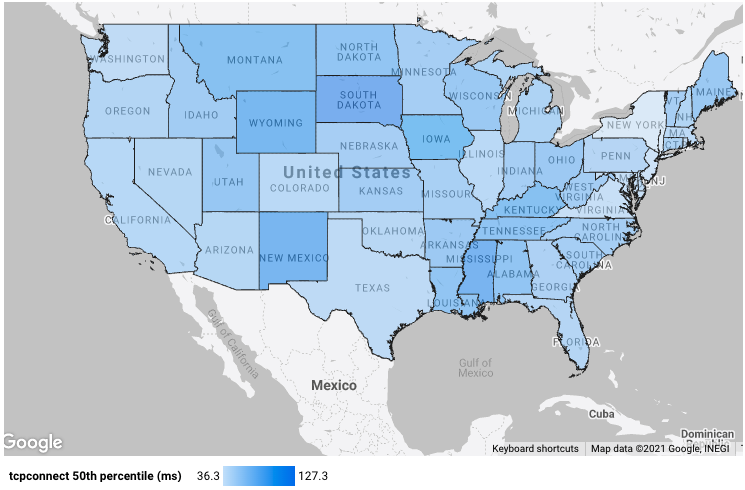
Cloudflare isn’t a disinterested observer. When Internet users don’t have access to good broadband, their experience with our services – the websites, APIs and security products we offer – won’t work as well as they should. In the map below, we use the Resource Timing API to measure the latency between Internet users and the major Content Delivery Networks (CDNs), including Cloudflare. We see rural and southern states have worse performance than the northeastern United States, with Hawaii and Alaska being off the charts in terms of their poor speed.

50th percentile TCP Connect Time (ms) to Major Content Delivery Networks

The US government is working on an “Internet for all” plan. We’re on board.
*Alaska and Hawaii have TCP Connect times of 263 and 160 respectively. 

Access technology, which is how Internet users connect to the Internet (cable, fiber, DSL, wireless, satellite), is one important part of the overall quality of their connection, but there are other, less talked about factors. Another factor is how close geographically the user is to the content and services they are accessing. Midwestern states where requests for data need to travel to Internet hubs in Chicago or Dallas are going to be slower than requests for data from Washington, DC, served by the giant Internet hub around Ashburn, Virginia. To be as close as possible to users geographically, Cloudflare has servers in 51 locations across 28 states in the US, and is still growing.

Programs that provide funding for deployment are one piece of the puzzle, but there are important non-financial initiatives as well. For example, the IIJA directed the Federal Communications Commission to come up with “broadband nutrition labels” that will be shown to consumers at the point of purchase for any Internet service. Just a few weeks ago, the FCC announced their implementation. Cloudflare filed comments with the FCC with our suggestions for how to make these labels informative, future-proof, and easy for consumers to understand. We also wrote about it here.

The US government is working on an “Internet for all” plan. We’re on board.

We’d be remiss to not also mention our own contribution to digital divide initiatives – Project Pangea. For community and non-profit networks that have invested in last-mile infrastructure but need a connection to the Internet – “transit” in industry terms – the network can connect to Cloudflare, and we’ll provide that Internet transit at no charge to the network. It’s one piece of the puzzle, and we’re always looking for additional ways to help.

One thing everyone can do is help the FCC build the most accurate broadband map possible by going to the map, entering your address, and verifying the data. The map will show your individual location and all ISPs that claim to serve your address. If there’s a problem – and there can be, it’s a new map and new process – you can file a challenge right from the FCC’s mapping site.

It’s laudable that the US government is stepping up with billions of dollars in funding for broadband networks and digital equity programs. In the shared project of helping build a better Internet, this is an important and big step.

Powerful US Lobbyist Aids Businesses Linked to Sanctioned Bulgarian Lawmaker, Has Joint Company with Notorious Attorney

Post Syndicated from Екип на Биволъ original https://bivol.bg/powerful-us-lobbyist-aids-businesses-linked-to-sanctioned-bulgarian-lawmaker-has-joint-company-with-notorious-attorney.html

събота 8 януари 2022


United States (US) Democratic Party lobbyist Anthony Podesta has signed lobbying deals worth more than USD 2 million with Bulgarian companies whose owners are linked to controversial Bulgarian lawmaker, former media mogul…