Post Syndicated from The History Guy: History Deserves to Be Remembered original https://www.youtube.com/watch?v=yqC9ICdfhQM
SolarWinds and Market Incentives
Post Syndicated from Bruce Schneier original https://www.schneier.com/blog/archives/2023/02/solarwinds-and-market-incentives.html
In early 2021, IEEE Security and Privacy asked a number of board members for brief perspectives on the SolarWinds incident while it was still breaking news. This was my response.
The penetration of government and corporate networks worldwide is the result of inadequate cyberdefenses across the board. The lessons are many, but I want to focus on one important one we’ve learned: the software that’s managing our critical networks isn’t secure, and that’s because the market doesn’t reward that security.
SolarWinds is a perfect example. The company was the initial infection vector for much of the operation. Its trusted position inside so many critical networks made it a perfect target for a supply-chain attack, and its shoddy security practices made it an easy target.
Why did SolarWinds have such bad security? The answer is because it was more profitable. The company is owned by Thoma Bravo partners, a private-equity firm known for radical cost-cutting in the name of short-term profit. Under CEO Kevin Thompson, the company underspent on security even as it outsourced software development. The New York Times reports that the company’s cybersecurity advisor quit after his “basic recommendations were ignored.” In a very real sense, SolarWinds profited because it secretly shifted a whole bunch of risk to its customers: the US government, IT companies, and others.
This problem isn’t new, and, while it’s exacerbated by the private-equity funding model, it’s not unique to it. In general, the market doesn’t reward safety and security—especially when the effects of ignoring those things are long term and diffuse. The market rewards short-term profits at the expense of safety and security. (Watch and see whether SolarWinds suffers any long-term effects from this hack, or whether Thoma Bravo’s bet that it could profit by selling an insecure product was a good one.)
The solution here is twofold. The first is to improve government software procurement. Software is now critical to national security. Any system of procuring that software needs to evaluate the security of the software and the security practices of the company, in detail, to ensure that they are sufficient to meet the security needs of the network they’re being installed in. If these evaluations are made public, along with the list of companies that meet them, all network buyers can benefit from them. It’s a win for everybody.
But that isn’t enough; we need a second part. The only way to force companies to provide safety and security features for customers is through regulation. This is true whether we want seat belts in our cars, basic food safety at our restaurants, pajamas that don’t catch on fire, or home routers that aren’t vulnerable to cyberattack. The government needs to set minimum security standards for software that’s used in critical network applications, just as it sets software standards for avionics.
Without these two measures, it’s just too easy for companies to act like SolarWinds: save money by skimping on safety and security and hope for the best in the long term. That’s the rational thing for companies to do in an unregulated market, and the only way to change that is to change the economic incentives.
This essay originally appeared in the March/April 2021 issue of IEEE Security & Privacy.” I forgot to publish it here.
Comic for 2023.02.08 – Yeah
Post Syndicated from Explosm.net original https://explosm.net/comics/yeah
New Cyanide and Happiness Comic
Coordinate Plane Closure
Post Syndicated from original https://xkcd.com/2735/

Ранна карта на спиранията на тока в западна България
Post Syndicated from original https://yurukov.net/blog/2023/%D1%80%D0%B0%D0%BD%D0%BD%D0%B0-%D0%BA%D0%B0%D1%80%D1%82%D0%B0-%D0%BD%D0%B0-%D1%81%D0%BF%D0%B8%D1%80%D0%B0%D0%BD%D0%B8%D1%8F%D1%82%D0%B0-%D0%BD%D0%B0-%D1%82%D0%BE%D0%BA%D0%B0-%D0%B2-%D0%B7%D0%B0%D0%BF/
Когато се опитвам да осмисля някакви данни, често прибягвам до бързи графики и карти, за да разбера измеренията, интересните аспекти или грешките в тях. За целта използвам инструменти като Mapbox, Carto, OpenRefine или дори Google Docs. Почти винаги тези карти биват бързо изстивани или остават за мен. Тук публикувам единствено тези, които са добре описани, документирани и лесни за употреба и разбиране. Сега искам да направя нещо различно
От повече от година събирам данните за спиранията на тока, парното и водата в София. За съжаление, има доста дупки в събирането по различни причини – от грешки в моя скрипт, до блокиране от страна на иначе публичните ресурси на съответните компании.
В последно време пак обърнах внимание специално на данните за тока и искам да ви покажа две такива карти. Първата е на София и показва всички трафопостове на ЧЕЗ/Електрохолд, за които е съобщено поне едно прекъсване на тока в последните 81 дни – от средата на ноември насам. Големината на балона показва колко спирания е имало – между 1 и 32. Цветът – колко сумарно време е нямало ток. В жълто е под два часа. Оранжево – под 12 часа, а в червено – повече от 12 часа.
Тук може би трябва да уточня, че това не са всички трафопостове в западна България, а само онези 4411 трафопоста в столицата, в които е имало поне пет минути спиране на тока за последните почти три месеца.
Следващата карта показва същите данни със същите условия за цветове и размер на точките, но за цялата западна България. Виждаме, че София е дори в добро положение в сравнение с други региони. Тази карта показва 15189 трафопоста.
Картите може да видите на нов прозорец тук за София и тук за западна България. Данните от тях може да свалите тук. Опитвам се да ги систематизирам в инструмент за лесен анализ и преглед, но не знам кога ще имам време. Пропуските в свалянето на данните също е проблем, но съм го оправим в момента. Друг проблем е, че не знаем колко абонати/жители са засегнати от спирането на тока във всеки един трафопост. Ще се опитам да получа тези данни от регулатора, тъй като Електрохолд е частно дружество и не отговаря по ЗДОИ. Все пак ще е интересно да се види как това качество на услугата влияе на хората.
The post Ранна карта на спиранията на тока в западна България first appeared on Блогът на Юруков.
[$] Fedora packages versus upstream Flatpaks
Post Syndicated from original https://lwn.net/Articles/922387/
The Flatpak package format promises to
bring “the future of apps on Linux
“, but a Linux distribution like
Fedora already provides packages in its native format—and built
to its specifications. Flatpaks that come from upstream projects may or
may not follow the packaging guidelines, philosophy, and practices so they
exist in their own world, separate from the packages that come directly
from Fedora. But those worlds have
collided to a certain extent over the
past year to two. Recently, a
packager announced their plans to stop packaging the Bottles tool, used for running
Windows programs in Wine-based containers on Linux, in favor of
recommending that Fedora users install the upstream Flatpak.
Automate schema evolution at scale with Apache Hudi in AWS Glue
Post Syndicated from Subhro Bose original https://aws.amazon.com/blogs/big-data/automate-schema-evolution-at-scale-with-apache-hudi-in-aws-glue/
In the data analytics space, organizations often deal with many tables in different databases and file formats to hold data for different business functions. Business needs often drive table structure, such as schema evolution (the addition of new columns, removal of existing columns, update of column names, and so on) for some of these tables in one business function that requires other business functions to replicate the same. This post focuses on such schema changes in file-based tables and shows how to automatically replicate the schema evolution of structured data from table formats in databases to the tables stored as files in cost-effective way.
AWS Glue is a serverless data integration service that makes it easy to discover, prepare, and combine data for analytics, machine learning (ML), and application development. In this post, we show how to use Apache Hudi, a self-managing database layer on file-based data lakes, in AWS Glue to automatically represent data in relational form and manage their schema evolution at scale using Amazon Simple Storage Service (Amazon S3), AWS Database Migration Service (AWS DMS), AWS Lambda, AWS Glue, Amazon DynamoDB, Amazon Aurora, and Amazon Athena to automatically identify schema evolution and apply it to manage data load at petabyte scale.
Apache Hudi supports ACID transactions and CRUD operations on a data lake. This lays the foundation of a data lake architecture by enabling transaction support and schema evolution and management, decoupling storage from compute, and ensuring support for accessibility through business intelligence (BI) tools. In this post, we implement an architecture to build a transactional data lake built on the aforementioned Hudi features.
Solution overview
This post assumes a scenario where multiple tables are present in a source database, and we want to replicate any schema changes in any of those tables in Apache Hudi tables in the data lake. It uses the native support for Apache Hudi on AWS Glue for Apache Spark.
In this post, the schema evolution of source tables in the Aurora database is captured via the AWS DMS incremental load or change data capture (CDC) mechanism, and the same schema evolution is replicated in Apache Hudi tables stored in Amazon S3. Apache Hudi tables are discovered by the AWS Glue Data Catalog and queried by Athena. An AWS Glue job, supported by an orchestration pipeline using Lambda and a DynamoDB table, takes care of the automated replication of schema evolution in the Apache Hudi tables.
We use Aurora as a sample data source, but any data source that supports Create, Read, Update, and Delete (CRUD) operations can replace Aurora in your use case.
The following diagram illustrates our solution architecture.

The flow of the solution is as follows:
- Aurora, as a sample data source, contains a RDBMS table with multiple rows, and AWS DMS does the full load of that data to an S3 bucket (which we call the raw bucket). We expect that you may have multiple source tables, but for demonstration purposes, we only use one source table in this post.
- We trigger a Lambda function with the source table name as an event so that the corresponding parameters of the source table are read from DynamoDB. To schedule this operation for specific time intervals, we schedule Amazon EventBridge to trigger the Lambda with the table name as a parameter.
- There are many tables in the source database, and we want to run one AWS Glue job for each source table for simplicity in operations. Because we use each AWS Glue job to update each Apache Hudi table, this post uses a DynamoDB table to hold the configuration parameters used by each AWS Glue job for each Apache Hudi table. The DynamoDB table contains each Apache Hudi table name, corresponding AWS Glue job name, AWS Glue job status, load status (full or delta), partition key, record key, and schema to pass to the corresponding table’s AWS Glue Job. The values in the DynamoDB table are static values.
- To trigger each AWS Glue job (10 G.1X DPUs) in parallel to run an Apache Hudi specific code to insert data in the corresponding Hudi tables, Lambda passes each Apache Hudi table specific parameters read from DynamoDB to each AWS Glue job. The source data comes from tables in the Aurora source database via AWS DMS with full load and incremental load or CDC.
Create resources with AWS CloudFormation
We provide an AWS CloudFormation template to create the following resources:
- Lambda and DynamoDB as the data load management orchestrators
- S3 buckets for the raw, refined zone, and assets for holding code for schema evolution
- An AWS Glue job to update the Hudi tables and perform schema evolution, both forward- and backward-compatible
The Aurora table and AWS DMS replication instance is not provisioned via this stack. For instructions to set up Aurora, refer to Creating an Amazon Aurora DB cluster.
Launch the following stack and provide your stack name.
eu-west-1 |
 |
Schema evolution
To access your Aurora database, refer to How do I connect to my Amazon RDS for MySQL instance by using MySQL Workbench. Then complete the following steps:
- Create a table named object following the queries in the Aurora database and change its schema so that we can see the schema evolution is reflected at the data lake level:
After you create the stacks, some manual steps are needed to prepare the solution end to end.
- Create an AWS DMS instance, AWS DMS endpoints, and AWS DMS task with the following configurations:
- Add dataFormat as Parquet in the target endpoint.
- Point the target endpoint of AWS DMS to the raw bucket, which is formatted as
raw-bucket-<account_number>-<region_name>, and the folder name should be POC.
- Start the AWS DMS task.
- Create a test event in the
HudiLambdaLambda function with the content of the event JSON asPOC.dband save it. - Run the Lambda function.
In this post, the schema evolution is reflected through Hudi Hive sync in AWS Glue. You don’t alter queries separately in the data lake.
Now we complete the following steps to change the schema at the source. Trigger the Lambda function after each step to generate a file in the POC/db/object folder within the raw bucket. AWS DMS almost instantly picks up the schema changes and reports to the raw bucket.
- Add a column called
test_columnto the source tableobjectin your Aurora database:
- Rename the column
new_field_1tonew_field_2in the source table object:
The column new_field_1 is expected to stay in the Hudi table but without any new values being populated to it anymore.
- Delete the column
new_field_2from the source table object:
Similar to the previous operation, the column new_field_2 is expected to stay in the Hudi table but without any new values being populated to it anymore.
If you already have AWS Lake Formation data permissions set up in your account, you may encounter permission issues. In that case, grant full permission (Super) to the default database (before triggering the Lambda function) and all tables in the POC.db database (after the load is complete).
Review the results
When the aforementioned run happens after schema changes, the following results are generated in the refined bucket. We can view the Apache Hudi tables with its contents in Athena. To set up Athena, refer to Getting started.
The table and the database are available in the AWS Glue Data Catalog and ready for browsing the schema.
Before the schema change, the Athena results look like the following screenshot.

After you add the column test_column and insert a value in the test_column field in the object table in the Aurora database, the new column (test_column) is reflected in its corresponding Apache Hudi table in the data lake.
The following screenshot shows the results in Athena.

After you rename the column new_field_1 to new_field_2 and insert a value in the new_field_2 field in the object table, the renamed column (new_field_2) is reflected in its corresponding Apache Hudi table in the data lake, and new_field_1 remains in the schema, having no new value populated to the column.
The following screenshot shows the results in Athena.

After you delete the column new_field_2 in the object table and insert or update any values under any columns in the object table, the deleted column (new_field_2) remains in the corresponding Apache Hudi table schema, having no new value populated to the column.
The following screenshot shows the results in Athena.

Clean up
When you’re done with this solution, delete the sample data in the raw and refined S3 buckets and delete the buckets.
Also, delete the CloudFormation stack to remove all the service resources used in this solution.
Conclusion
This post showed how to implement schema evolution with an open-source solution using Apache Hudi in an AWS environment with an orchestration pipeline.
You can explore the different configurations of AWS Glue to change the AWS Glue job structures and implement it for your data analytics and other use cases.
About the Authors
 Subhro Bose is a Senior Data Architect in Emergent Technologies and Intelligence Platform in Amazon. He loves solving science problems with emergent technologies such as AI/ML, big data, quantum, and more to help businesses across different industry verticals succeed within their innovation journey. In his spare time, he enjoys playing table tennis, learn theories of environmental economics and explore the best muffins across the city.
 Ketan Karalkar is a Big Data Solutions Consultant at AWS. He has nearly 2 decades of experience helping customers design and build data analytics, and database solutions. He believes in using technology as an enabler to solve real life business problems.
 Eva Fang is a Data Scientist within Professional Services in AWS. She is passionate about using the technology to provide value to customers and achieve business outcomes. She is based in London, in her spare time, she likes to watch movies and musicals.
Year In Review: Rapid7 InsightIDR
Post Syndicated from Dina Durutlic original https://blog.rapid7.com/2023/02/07/year-in-review-rapid7-insightidr/

You’re in cybersecurity, so we’ll guess: 2022 crashed in with Log4Shell and, for the most part, got more challenging—never less. So, we kept making tangible improvements to InsightIDR, our cloud-native next-gen SIEM and XDR. We worked with some of our most forward-deployed practitioners: Rapid7 MDR, Threat Intelligence and Detections Engineering, our open source communities, and our customers. New features and functions address pain points and achieve specific goals.
Let’s review some of the highlights:
Accelerated response time with automated Quick Actions
Earlier in the year, InsightIDR launched the Quick Actions feature which provides teams with instant automation to reduce the time it takes to search, investigate, and respond with a simple click. Example use-cases include:
- Threat hunting within log search. Using the “Look Up File Hash with Threat Crowd” quick action, teams can learn more about a hash within an endpoint log. If the output of the quick action finds the file hash is malicious, practitioners can choose to investigate further.
- More context around alerts in investigations. Leveraging the “Look Up Domain with WHOIS” quick action enables teams to receive more context around an IP associated with an alert in an investigation

“InsightIDR is a real savior, we have reduced our time for log correlation, responding to incidents, not opening multiple tabs and logging into different platforms to understand what happened.”—Abhi Patel, Information Security Officer, Prime Bank. Source: TechValidate
Expanded visibility across cloud and external attack surface
With InsightIDR, teams have security that grows and scales alongside their business – both on-prem and in the cloud. This year we focused on empowering security teams with cloud incident response capabilities by providing robust integrations with AWS CloudTrail and Microsoft Azure, while also enabling cloud detections with our AWS Guard Duty Detections, AWS Cloud Trail Detections, and more.Customers have the full context of their cloud telemetry and detections alongside their wider environment to get a full, cohesive picture and investigate malicious activity and threats that may move across multiple devices and infrastructures.
Additionally, with Threat Command and InsightIDR together, customers can unlock a complete view of your external and internal attack surface. You can now view Threat Command alerts alongside their broader detection set in InsightIDR:
- Prioritize and investigate Threat Command alerts: Use InsightIDR’s investigation management capabilities and seamlessly pivot back to Threat Command to remediate the threat or ask an analyst for help.
- Tune Threat Command detection rules directly in InsightIDR: Adjust the rule action, set the rule priority, and add exceptions.
Lastly, Rapid7 provides all customers with 13 months of data retention by default—so they are always audit-ready. To support compliance regulations, we launched new dashboards for organizations to ensure they are meeting requirements. For example, we launched new dashboards for CIS, a common security framework, covering:
- CIS Control 5 – Account Management
- CIS Control 9 – Email and Web Browser Protections
- CIS Control 10 – Malware Defense
“With Rapid7’s InsightIDR, we have a greater handle on threats. We are able to resolve issues quicker and reduce maximum tolerable downtime, our incident management procedures and real-time actions have improved immeasurably too, and we have better cyber hygiene as well.”—Security Officer, Medium Enterprise Chemicals Company. Source: TechValidate
Confidence with expertly curated and vetted detections
Rapid7 Threat Intelligence and Detection Engineering (TIDE) team has curated and is continuously updating our XDR detection library that is expertly vetted by the Rapid7 MDR SOC. The detection library is a result of meticulous research, our vast open source community, security forums, and industry expertise to provide your teams the data they need for sophisticated detection and response. Last year we launched a slew of new detections, a bulk being IDS rules, but worth highlighting is the expanded coverage of tracked threat actors with the Threat Command integration. By integrating our Attacker Behavior Analytics (ABA) detection engine with Threat Command’s threat library intelligence, customers can access broader detections, and new threat groups with around 400 new ABA detection rules powered by thousands of new IOCs.
We also added a new ABA detection rule – Anomalous Data Transfer (ADT) that uses the Insight Network Sensor to identify large transfers of data sent by assets on a network and outputs alerts for easier monitoring of unusual behavior and potential exfiltration.

“InsightIDR provided value to us on Day-1. We didn’t have to write long lists of rules or tweak hundreds of settings in order to get security alerts from our operating environment. Better still, the signal-to-noise ratio of the alerts is great; little-to-no false positives.”—Philip Daly, VP Infrastructure and Information Security, Carlton One Engagement. Source: TechValidate
Looking ahead
Watch this space! We’re always working on new product enhancements and functionality to ensure your team can stay ahead of potential threats and malicious activity. Keep an eye on the Rapid7 blog and the InsightIDR release notes to keep up to date with the latest detection and response releases at Rapid7.
Rapid7 Recognized on Bloomberg Gender Equality Index, Continues Commitments to Support DEI
Post Syndicated from Rapid7 original https://blog.rapid7.com/2023/02/07/rapid7-recognized-on-bloomberg-gender-equality-index-continues-commitments-to-support-dei/

For the fifth year in a row, Rapid7 is pleased to share that we’ve been included in the Bloomberg Gender Equality Index. The Gender Equality Index (GEI) recognizes publicly traded companies for being transparent in their commitment to gender equality. This includes how they score in areas such as talent pipeline and leadership, equal pay and gender pay parity, inclusive culture, anti-harassment policies, and more. Inclusion in the GEI for 2023 recognizes our commitment to transparency while building a workplace that enables every person to have the career experience of a lifetime.
Diversity, Equity, and Inclusion at Rapid7
We know that diversity of backgrounds and mindsets help us close gaps in experience and spark innovation. A deep commitment to Diversity, Equity, and Inclusion is core to the strength and success of our business. It empowers communities, makes our company healthier, and makes our customers more secure. It’s also, quite simply, the right thing to do.
Bring You is an initiative that builds on the focused efforts we started in 2018 to ensure that every employee—regardless of their ethnicity, gender, religion, or background—has the opportunity to thrive in their career and feel a sense of belonging within our community. More than just a set of goals, Bring You is using targeted investments to cultivate an increasingly diverse workforce as we continue to grow. While that overarching mission speaks to the essence of inclusion, Bring You highlights our focus on continuing to strengthen our gender and racial diversity in the organization in a measurable, impactful way.
In 2022, we celebrated the addition of three new employee resource groups, while bringing additional structure and resources to the existing three. The resource groups, referred to as our Rapid Impact Groups, are entirely driven by employees who serve as local leads, while being supported by the business. Today, these Rapid Impact Groups include:
- Rapid7 Women: Supporting and advocating for women and female identifying individuals
- Moose Mosaic: Supporting and advocating for our AAPI community
- Moose Vets: Supporting and advocating for our veterans and former military community
- Rapid7 Diversability and Neurodiversity: Aims to level the playing field by making the day-to-day experience of ALL employees equivalent in challenge level regardless of disability or neurodivergence
- Rapid7 Pride: Supporting and advocating for our LGBTQIA+ community
- Rapid7 Vibranium: Supporting and advocating for our Black and LatinX community
Click here to learn more about Diversity, Equity, and Inclusion at Rapid7, including our latest social good report.
Looking Ahead
One of our core values is: Never Done. We will continue to be transparent about progress and push forward to create more inclusive environments, build a workforce that reflects all communities present in the world, and create a culture committed to educating ourselves to better empathize and support one another.
In 2023, we will continue to challenge ourselves, leaning into additional programming, creating new ways for employees to build cultural competency and investing in more tools so we can continue to build teams that are dynamic, innovative, and more effective in driving positive customer outcomes.
We value visibility and being included in surveys such as the Bloomberg Gender Equality Index, as it allows us to measure the progress on our journey and be accountable, as a responsible leader in the Cybersecurity space.

Как ефективно да изграждаме системи в администрацията
Post Syndicated from Bozho original https://blog.bozho.net/blog/4029
Със закони вече често се въвеждат софтуерни системи – електронни регистри или нови функционалности на съществуващи системи. В този парламент приехме няколко такива и пред приемане бяха още няколко.
В тези слуачаи изпълнителната власт казва „тук ни трябват две години“. Понякога планираният срок не стига и НС гласува удължаване. В закон не трябва да се пишат спецификации, но на практика законовите изисквания очертават рамката на софтуера, който ще ги обслужва.
Народните представители не могат (и не се очаква да могат) да оценяват времето и сложностра за възлагане и разряботка на софтуер. В правна комисия, напр., отвхърлиха мое предкижение за отваряне на статистически дани за сигнали, защото било много сложно и скъпо да се направи (една SQL заявка). Но това предизвикателство трябва да бъде решено без да напълваме парламента с ИТ мениджъри и програмисти.
Част от проблемът е, че Законът за обществените поръчки не е адекватен за разработка на софтуер по съвременни методологии. И сроковете за процедурите и обжалване правят модернизацията мудна и трудно предвидима.
На този проблем съм предлагал три допълващи се решения, за които ще продължа да работа.
Първото е въвеждането на централизирана система за управление на регистри. Системата е предвидена в проекта ни за изменение на Закона за електронното управление. Тя ще позволи по-прости регистри да се правят с няколко настройки и няма да отнемат година и половина.
Второто е използването на low-code платформи, с които бързо могат да се създават нови системи с ограничени функционалности. Възложих на администрацията да подготви проучване на такива системи, като дори използвахме една такава с отворен код за нетривиалната анкетна система за украинските бежанци.
Третото е налагане на нов подход при ИТ обслужването на администрациите. Други държави използват т.нар. рамкови споразумения по директивата за обществените поръчки, които дават повече гъвкавост и бързина. Подготвяме законодателни изменения, които да уредят този процес с допълнителна прозрачност (защото рамковите споразумения не са достатъчно прозрачни).
С тези подходи ще можем да модернизираме администрацията по-бързо и качествено, като така ще се подобри и административното обслужване, и възможностите за по-адекватни политики, базирани на данни.
Материалът Как ефективно да изграждаме системи в администрацията е публикуван за пръв път на БЛОГодаря.
How Cloudflare erroneously throttled a customer’s web traffic
Post Syndicated from Jeremy Hartman original https://blog.cloudflare.com/how-cloudflare-erroneously-throttled-a-customers-web-traffic/


Over the years when Cloudflare has had an outage that affected our customers we have very quickly blogged about what happened, why, and what we are doing to address the causes of the outage. Today’s post is a little different. It’s about a single customer’s website not working correctly because of incorrect action taken by Cloudflare.
Although the customer was not in any way banned from Cloudflare, or lost access to their account, their website didn’t work. And it didn’t work because Cloudflare applied a bandwidth throttle between us and their origin server. The effect was that the website was unusable.
Because of this unusual throttle there was some internal confusion for our customer support team about what had happened. They, incorrectly, believed that the customer had been limited because of a breach of section 2.8 of our Self-Serve Subscription Agreement which prohibits use of our self-service CDN to serve excessive non-HTML content, such as images and video, without a paid plan that includes those services (this is, for example, designed to prevent someone building an image-hosting service on Cloudflare and consuming a huge amount of bandwidth; for that sort of use case we have paid image and video plans).
However, this customer wasn’t breaking section 2.8, and they were both a paying customer and a paying customer of Cloudflare Workers through which the throttled traffic was passing. This throttle should not have happened. In addition, there is and was no need for the customer to upgrade to some other plan level.
This incident has set off a number of workstreams inside Cloudflare to ensure better communication between teams, prevent such an incident happening, and to ensure that communications between Cloudflare and our customers are much clearer.
Before we explain our own mistake and how it came to be, we’d like to apologize to the customer. We realize the serious impact this had, and how we fell short of expectations. In this blog post, we want to explain what happened, and more importantly what we’re going to change to make sure it does not happen again.
Background
On February 2, an on-call network engineer received an alert for a congesting interface with Equinix IX in our Ashburn data center. While this is not an unusual alert, this one stood for two reasons. First, it was the second day in a row that it happened, and second, the congestion was due to a sudden and extreme spike of traffic.
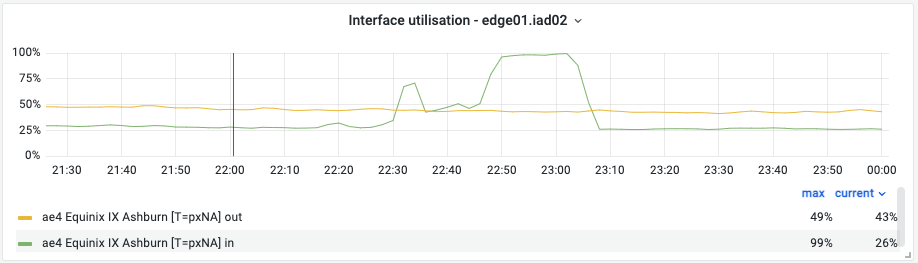
The engineer in charge identified the customer’s domain as being responsible for this sudden spike of traffic between Cloudflare and their origin network, a storage provider. Because this congestion happens on a physical interface connected to external peers, there was an immediate impact to many of our customers and peers. A port congestion like this one typically incurs packet loss, slow throughput and higher than usual latency. While we have automatic mitigation in place for congesting interfaces, in this case the mitigation was unable to resolve the impact completely.
The traffic from this customer went suddenly from an average of 1,500 requests per second, and a 0.5 MB payload per request, to 3,000 requests per second (2x) and more than 12 MB payload per request (25x).
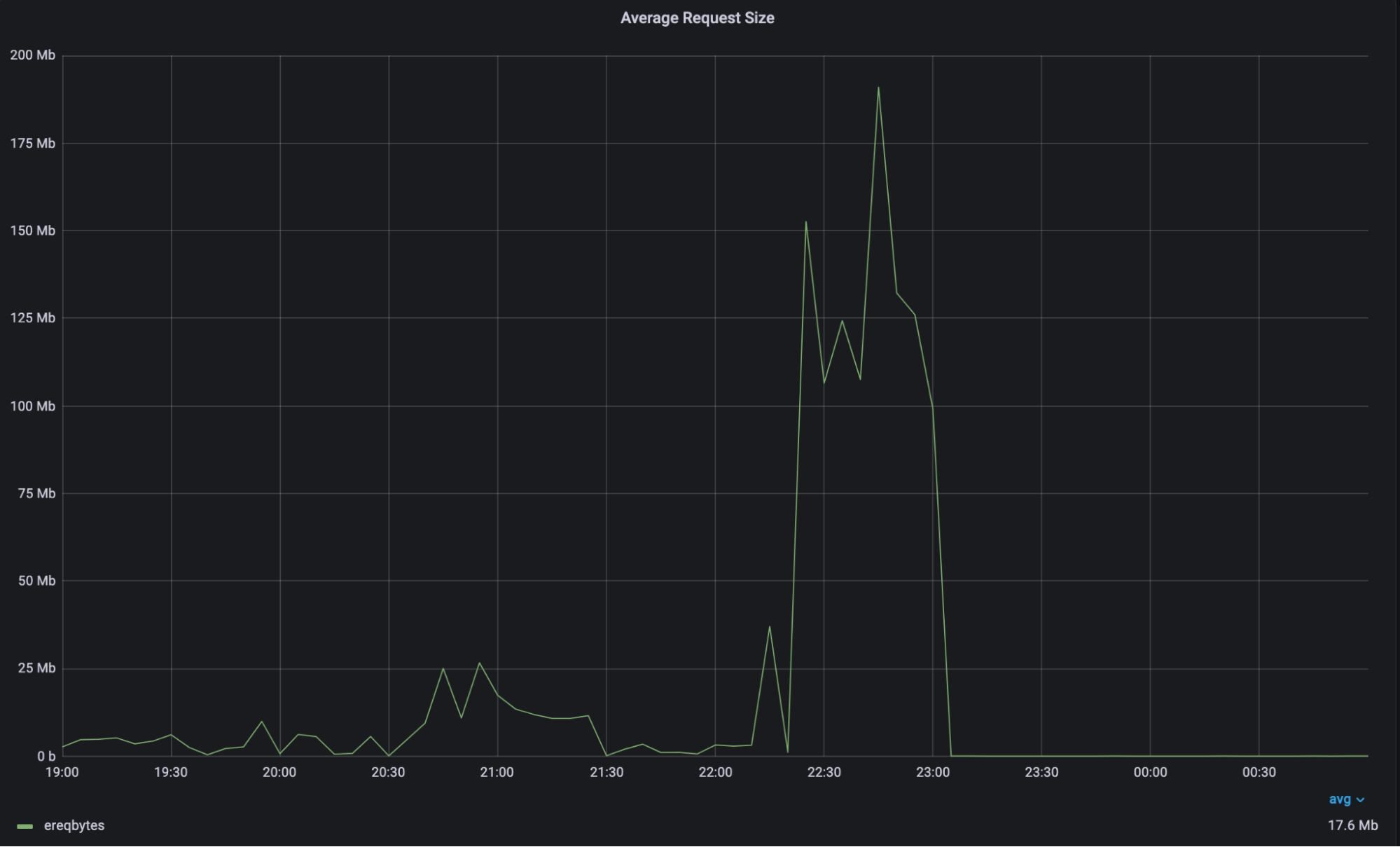
The congestion happened between Cloudflare and the origin network. Caching did not happen because the requests were all unique URLs going to the origin, and therefore we had no ability to serve from cache.
A Cloudflare engineer decided to apply a throttling mechanism to prevent the zone from pulling so much traffic from their origin. Let’s be very clear on this action: Cloudflare does not have an established process to throttle customers that consume large amounts of bandwidth, and does not intend to have one. This remediation was a mistake, it was not sanctioned, and we deeply regret it.
We lifted the throttle through internal escalation 12 hours and 53 minutes after having set it up.
What’s next
To make sure a similar incident does not happen, we are establishing clear rules to mitigate issues like this one. Any action taken against a customer domain, paying or not, will require multiple levels of approval and clear communication to the customer. Our tooling will be improved to reflect this. We have many ways of traffic shaping in situations where a huge spike of traffic affects a link and could have applied a different mitigation in this instance.
We are in the process of rewriting our terms of service to better reflect the type of services that our customers deliver on our platform today. We are also committed to explaining to our users in plain language what is permitted under self-service plans. As a developer-first company with transparency as one of its core principles, we know we can do better here. We will follow up with a blog post dedicated to these changes later.
Once again, we apologize to the customer for this action and for the confusion it created for other Cloudflare customers.
Building ad-hoc consumers for event-driven architectures
Post Syndicated from Benjamin Smith original https://aws.amazon.com/blogs/compute/building-ad-hoc-consumers-for-event-driven-architectures/
This post is written by Corneliu Croitoru (Media Streaming and Edge Architect) and Benjamin Smith (Principal Developer Advocate, Serverless)
In January 2022, the Serverless Developer Advocate team launched Serverlesspresso Extensions, a program that lets you contribute to Serverlesspresso. This is a multi-tenant event-driven application for a pop-up coffee bar that allows you to order from your phone. In 2022, Serverlesspresso processed over 20,000 orders at technology events around the world. The goal of Serverlesspresso extensions is to showcase the power and simplicity of evolving an event-driven application.
Event-driven architecture is a design pattern that allows developers to create and evolve applications by responding to events generated by various parts of the system. For modern applications, the need for flexible and scalable approaches is critical, and event-driven architecture can provide a powerful solution.
This blog post shows how to build and deploy an extension to an event-driven application. It describes the benefits and challenges of evolving event-driven applications. It also walks through a real-life example that was created in under 24 hours.
Decoupled integrations
A key benefit of event-driven architecture is its ability to decouple different parts of the system, making it easier to manage changes and evolve the application. In traditional, monolithic applications, changes to one part of the system can affect the entire application.
With event-driven architecture, you can change individual parts of the system without affecting the rest of the application. Event-driven architecture also makes it easier to integrate new functionality into an existing application by creating new event handlers to respond to existing events. This way, you can add new functionality without affecting the existing system, making it easier to test and deploy.
The following diagrams illustrate how to add and remove consumers and producers without affecting the core application.

Adding and removing event-driven extensions
Extension 2 is consuming events from the event bus and emitting events back onto the bus. It can be added to the core application without creating any dependencies. When extension 2 is removed, the core application remains unchanged.
In monolithic applications, additional features can create dependencies on the core application. Removing those features keeps those dependencies in place, making it more complex to remove them.

Adding and removing monolithic extensions
Collaboration
In a traditional monolithic application, it can be difficult to collaborate with multiple developers on a single code base. It can lead to conflicts, bugs, and other issues that must be resolved. Integrating new features and components into these applications can be challenging, especially when multiple developers are using different technologies. Deploying updates can also be complex when multiple developers are involved and different parts of the application must be updated simultaneously.
With event-based applications, these challenges are often less significant. A well-designed consumer contains well-defined permissions boundaries. Its resources should not need permission to interact with resources outside the extension definition. This means you can deploy and delete them independently of other extensions and of the core application. This makes it easier to collaborate with multiple developers across different languages, runtimes, and deployment frameworks.
Near real-time feedback
Another characteristic of event-driven architecture is the ability to provide real-time feedback to users. This is because consumers can process events as they occur, making it possible to provide immediate feedback. This can be useful in applications that handle high volumes of data or interact with multiple users, as they can provide real-time updates and ensure that the application remains responsive.
An alternative approach for near real-time feedback is to use batching. This involves grouping multiple events or data points into a batch and processing them. Choosing between batching and processing data in real-time with events depends on the amount of data being processed, the latency requirements, and the complexity of the processing logic. Batching can be more efficient for large volumes of data as it reduces the overhead of processing each event individually, while processing data with events can be better suited for real-time applications that require low latency.
The newest Serverlesspresso extension uses an event-driven approach to gain real-time insight into the application.
The average wait time extension
A new extension was created by Corneliu Croitoru that calculates the average wait for each drink at the Serverlesspresso coffee bar. This extension uses AWS Step Functions, DynamoDB, and AWS Lambda. The app displays the results in near real-time, allowing customers to see how long they may need to wait for their order. The extension uses the AWS Cloud Development Kit (CDK) for deployment.
The extension uses the existing Amazon EventBridge event bus to start a Step Functions workflow. The workflow is triggered by the order submission and order completion events and calculates the average wait time for each type of drink (for example, Caffe Latte). This information is then sent back to the Serverlesspresso event bus.
The following diagram illustrates the Step Functions workflow:

When a new order submission event is emitted, the Step Functions workflow persists the event timestamp to a DynamoDB table, a key/value data store. It uses the unique order ID as the key. When an order completion event is emitted, the workflow persists the completion timestamp to DynamoDB. The workflow then invokes a Lambda function to calculate the average duration of that specific drink by using the last 10 orders stored in the DynamoDB table.
This is the DynamoDB table structure:

The workflow sends an event to the Serverlesspresso event bus with the calculated duration and drink type. A rule on the event bus routes this event to an IoT topic, which publishes it to the front-end application via an existing open WebSocket connection. The result appears on the front end:

Alternative approaches
There are a number of alternative approaches that you could use to build a real-time “average wait” extension without using events.
One such approach might be to use DynamoDB as a cache for the event-driven data. This way it would be possible to query the database periodically to check for updates. This approach can be implemented by adding a timestamp field to the database records and querying for records that have been updated since the last time you checked.
Alternatively, you could use DynamoDB streams to capture changes as they occur instead of subscribing to new events directly. However, these approaches may face several challenges. The extension would require permission to read data from the DynamoDB table or stream. Since the DynamoDB table resource is defined in the application’s core template, this presents challenges of ownership, permissions boundaries and dependencies. It adds additional complexity to the application as the extension would not be decoupled from the core.
The challenges
The biggest challenge in building this extension is the required shift in developer mindset. Despite understanding the principles of decoupled event-driven architecture, it was not until building an event-driven architecture extension that the concept became clear.
For example, you may think it necessary to deploy the existing application to submit orders, emit events onto the application event bus, and interact with various core resources. The development team had discussions about the degree to which the extension should interact with existing application components. This was not an event-driven mindset.
Each new extension must be based entirely on events. This means it can only interact with the core application through the shared event bus by consuming and emitting events. It also means that you could write the extension in any runtime, with any infrastructure as code (IaC) framework, and that it should be possible to deploy and destroy the extension stack with no effect on the core application.
Once you understand this, the next challenge is discoverability. Finding the right events to consume may prove harder than expected. This is why documenting events as you build your application is important. The event schema, producer and consumer should be documented, and evolve with each version of the event. The Serverlesspresso Events Catalog helps to overcome this in this example.
Finally, the event player can emit realistic Serverlesspresso events onto the event bus. This replaces the need to deploy the core application stack.
Conclusion
The Serverlesspresso Extensions program shows the simplicity of developing event-driven applications. Building event-driven architectures allows for decoupled integrations, making it easier to manage changes and develop the application. It also simplifies collaboration among multiple teams as consumers of events can come and go independently without affecting the procedure or core application.
Using these principles, the average wait time extension was built and deployed within 24 hours, using a different IaC framework to the core application.
Use the Serverlesspresso extensions GitHub repository to read how to build more Serverlesspresso extensions.
For more serverless learning resources, visit Serverless Land.
Open Sourcing the IPO
Post Syndicated from original https://www.backblaze.com/blog/open-sourcing-the-ipo/
Taking a company public is an investment. At Backblaze, we spent more than $10 million* in connection with our IPO and learned a lot in the process. Now, all that knowledge is yours for free. Why? We’re open sourcing our IPO.

In the tech world, the open source movement has long promoted growth, innovation, and collaboration. The push to democratize code is such a powerful thing that it is credited with the rapid expansion of technological innovation in recent decades. And yet, while open sourcing is widespread in our industry, you don’t find it in many others.
Some of the most common and repetitive business practices are still not well understood. The IPO process, for example, is as cryptic as the most jealously guarded algorithms for anyone who hasn’t been through it, and for no good reason. Entrepreneurs and business leaders often enter into this process not entirely blind, but without the building blocks those who IPO’d before had constructed. It doesn’t make sense.
When Backblaze went public in 2021, we found ourselves wondering why there wasn’t a better roadmap available to any entrepreneur who dared to take the IPO path. It’s an investment not only of management time, but also a significant amount of financial resources. Having more information going into it is never a bad thing.
Last year, I wrote about why you should go IPO, but in this series what I really want to do is open source our IPO process and share every step along the way: who to talk to, what to chase, what to build. I want any business leader to be able to use this series as a foundation along the journey to IPO. An IPO will still be an investment, but you’ll be armed with the knowledge to make it lean and mean. (And whether you actually go public or not is beside the point—the preparation takes your business to a whole new level.)
More to Come
This blog series is for everyone: from those of you dreaming up your first idea, to startups still in stealth mode, to the thousands of companies with revenue in the tens of millions. Check out the first installment here:
You can also tune in to our Stocks and Storage series on YouTube for more explainers on Wall Street jargon from IPO to EBITDA. And stay tuned for more—I’ll be filling in the details over the next year and writing the playbook I wish we had when we started down our IPO path.
The Backblaze Way
In the 20 years leading up to 2021—the year Backblaze was listed—around 4,500 companies went public, and yet there was still no definitive resource for us to follow when we started out. It wasn’t just that the roadmap was unclear, the process was also clouded by perceptions of what type of company could make the journey. The message we frequently heard was that without lots of media buzz, multiple rounds of traditional venture capital (VC) funding, public declarations of money raised, revenue above $100M, and lofty growth metrics, don’t even bother getting started.
But we’d already taken a different route to get where we were, bootstrapping our way to profitability and growth without following the road most traveled and the structure that provides, so we weren’t afraid to do the same thing in an IPO. It created some unique obstacles, but it worked for us, and we hope other entrepreneurs and business leaders can leverage our learnings, avoid our mistakes, and find some of the same benefits we did in going public.
Potential Stumbling Blocks
The road to IPO was something we thought about from day one of our company, but we started moving along it more seriously in early 2020.
We had some excellent advisors and mentors guiding our first steps (and if you’re contemplating an IPO, I highly, highly recommend starting to seek out folks with experience with IPOs who can help guide you along the way). At the same time, I wanted to make sure I was developing my own understanding of the process and forming my own opinions. My research included everything from digging deep into the resources shared by outside counsel to a late night “how to IPO” Google search (with limited results).
So what would have been most helpful to me at the time? What were the gray areas? What resources could have made all the difference at the beginning of the process? Below are the key points that I would give myself if I could go back in time, and they form the backbone of my thinking as I’ve begun to open source our experience for you.
How to IPO: The Things That Should Keep You Up at Night
- The Unicorn CFO: We all know the importance of the CFO in the IPO process, but when the markets are strong and many companies are marching towards a public offering, CFOs with IPO-specific experience are rare. Can we start with a head of Financial Planning & Analysis (FP&A)? A controller? What’s right for our company?
- General Guidance from General Counsel (GC): At the end of 2019, our in-house legal team was essentially nonexistent. We needed to hire a GC to help us navigate many of the nuanced IPO best practices, but where else should they provide guidance? Your GC should instruct you on how to start thinking and acting like a public company and direct your executive team on the specific roles they should play.
- What Is My Role in All of This?: As a CEO, I naturally wanted to have my hands in every part of the IPO process. But, that was impractical and impossible. For example, I needed to play a very specific role as chief executive in the drafting of the S-1. (That’s the document you file with the SEC when you want to go public.) I had to approach the document with company vision/storytelling as my main focus—to ensure the picture we were painting of the company’s future was neither slanted by the desires of the market, nor overshadowed by legal and financial jargon.
- Avoiding Fyre Festival: While on one hand you want to deliver a strong company narrative, many entrepreneurs can get carried away. You want to make sure you’re not telling a story you can’t deliver on. I don’t fault anyone for building a vision, but when thousands of influencers wind up in FEMA tents on a remote Caribbean island, you’ve taken your business narrative too far.
- Systems, Processes, & People: These are the core components necessary to have in place for a successful IPO. When we started having the IPO conversations, ours were sufficient for the operations at a scrappy startup. I thought we had been informally putting the right infrastructure in place as we scaled, but preparing for an IPO takes a more concerted and intentional effort.
The Tip of the Iceberg
What I’ve touched on above is truly just the tip of the iceberg—something to get you thinking. In the rest of this series, I plan to dig deep into the inner workings of the IPO and share my insights—plus, many of the materials, planning docs, decks, spreadsheets, and more—with full transparency.
Here are some of the topics on deck for the rest of the year:
- Building the Foundation: If you want to take your startup public, what’s the best way to set yourself up for success as you grow?
- IPO Readiness: The opportunity stars have aligned. What does it take to actually be ready to take advantage of it?
- Making the Call: When are you ready to pull the trigger and how does your mentality need to change?
- Building the IPO Machine: What cogs are essential for the IPO machine, and how and when do you select them? Think bankers, analysts, executive team members, etc. And what if you pick wrong?
- Storytelling: How to sell success and navigate the S-1.
- Old Friends: Managing morale and focus.
- The Roadshow: Storytelling beyond the S-1: How does it work and how do you prepare?
- Notes on Not Drowning: Testing the waters.
- The Final Steps: What are the final details you need to consider and what could go wrong?
- IPO Day: My experience and key learnings.
In the meantime, please let me know in the comments if there’s anything in particular you’d like to learn more about as we help more businesses grow better.
The post Open Sourcing the IPO appeared first on Backblaze Blog | Cloud Storage & Cloud Backup.
CVE-2022-21587: Rapid7 Observed Exploitation of Oracle E-Business Suite Vulnerability
Post Syndicated from Glenn Thorpe original https://blog.rapid7.com/2023/02/07/etr-cve-2022-21587-rapid7-observed-exploitation-of-oracle-e-business-suite-vulnerability/

Emergent threats evolve quickly, and as we learn more about this vulnerability, this blog post will evolve, too.
Rapid7 is responding to various compromises arising from the exploitation of CVE-2022-21587, a critical arbitrary file upload vulnerability (rated 9.8 on the CVSS v3 risk metric) impacting Oracle E-Business Suite (EBS). Oracle published a Critical Patch Update Advisory in October 2022 which included a fix, meanwhile, CISA added CVE-2022-21587 to its Known Exploited Vulnerabilities (KEV) catalog on February 2, 2023.
Oracle E-Business Suite is a packaged collection of enterprise applications for a wide variety of tasks such as customer relationship management (CRM), enterprise resource planning (ERP), and human capital management (HCM).
CVE-2022-21587 can lead to unauthenticated remote code execution.
On January 16, 2023, Viettel Security published an analysis of the issue detailing both the vulnerability’s root cause and a method of leveraging the vulnerability to gain code execution. An exploit based on the Viettel Security analysis technique was published on GitHub by “HMs” on February 6, 2023.
Affected products
- Oracle Web Applications Desktop Integrator as shipped with Oracle E-Business Suite versions 12.2.3 through 12.2.11 are vulnerable.
What we’re seeing
The attacker(s) are using the above-mentioned proof of concept exploit, uploading a perl script, which fetches (via curl/wget) additional scripts to download a malicious binary payload making the victim host part of a botnet.
Rapid7 customers
InsightVM & Nexpose customers: Authenticated vulnerability checks for CVE-2022-21587 have been available since November 2022. Note that these require valid Oracle Database credentials to be configured in order to collect the relevant patch level information.
InsightIDR & Managed Detection & Response (MDR) customers: in our current investigations, the previously existing detections have been triggering post exploitation:
Suspicious Process - Wget to External IP AddressAttacker Technique - Curl or Wget To Public IP Address With Non Standard Port
We’re also testing new rules more specific to Oracle E-Business Suite.
Claire Saffitz | What’s for Dessert: Simple Recipes for Dessert People | Talks at Google
Post Syndicated from Talks at Google original https://www.youtube.com/watch?v=F-M4HXRTUAY
Supermicro X12SDV-4C-SP6F Review 25GbE and Intel Xeon D-1718T
Post Syndicated from Patrick Kennedy original https://www.servethehome.com/supermicro-x12sdv-4c-sp6f-review-25gbe-and-intel-xeon-d-1718t/
In our Supermicro X12SDV-4C-SP6F review, we see what is new with this FlexATX Intel Xeon D-1718T platform with 25GbE onboard
The post Supermicro X12SDV-4C-SP6F Review 25GbE and Intel Xeon D-1718T appeared first on ServeTheHome.
Security updates for Tuesday
Post Syndicated from original https://lwn.net/Articles/922519/
Security updates have been issued by Debian (graphite-web, openjdk-11, webkit2gtk, wpewebkit, and xorg-server), Mageia (advancecomp, apache, dojo, git, java/timezone, libtiff, libxpm, netatalk, nodejs-minimist, opusfile, python-django, python-future, python-mechanize, ruby-sinatra, sofia-sip, thunderbird, and tigervnc), Oracle (git and thunderbird), Red Hat (git, libksba, rh-git227-git, rh-nodejs14-nodejs and rh-nodejs14-nodejs-nodemon, and thunderbird), SUSE (apache2, nginx, php8-pear, redis, rubygem-activesupport-5_1, rubygem-rack, sssd, xorg-x11-server, and xwayland), and Ubuntu (tmux).
SwitchBot Lock Wyze Review – Works with Home Assistant BT Proxy
Post Syndicated from digiblurDIY original https://www.youtube.com/watch?v=13WVQP4oDBY
Устойчив мир или нова желязна завеса?
Post Syndicated from Александър Нуцов original https://www.toest.bg/ustoichiv-mir-ili-nova-zhelyazna-zavesa/

Войната в Украйна фокусира вниманието на експерти и анализатори върху актуалната обстановка на фронта, политическите решения за предоставяне на военна помощ и съответните реакции на страните по конфликта. Така дебатът за установения ред в международните отношения и структурните причини за избухване на войната остава маргинализиран в политическото и медийното пространство. Той обаче е крайно необходим за установяването на по-справедлив и траен мир, който ограничава възможността за ново разпалване на конфликта.
Мирът като понятие
В науката понятията за мир и насилие са неразривно свързани. Йохан Галтунг, един от създателите на дисциплината за изследване на мира и военните действия, различава две понятия – негативен и позитивен мир. Под негативен мир разбираме отсъствието на пряко насилие (например война) между държави или народи.
Позитивният мир пък е състояние, което се характеризира с отсъствието както на пряко, така и на структурно и културно насилие. А със структурно насилие Галтунг означава репресивни състояния, като бедност, социално неравенство, дискриминация, неравен достъп до образование и здравеопазване, цензура и др. Културното насилие пък обхваща залегналите обществени нагласи и идеологии, които оправдават и възпроизвеждат различните форми на насилие.
Понятийното разграничаване е важно заради необходимостта от правилен подбор на подхода и средствата. Когато даден конфликт придобие насилствен характер, присъщите за борбата със структурното и културното насилие меки мерки, като посредничество, дипломация, изграждане на комуникационни канали, ангажиране на граждански организации и неправителствения сектор, не играят толкова съществена роля. Те обаче имат ключово значение по време на възстановителния период след прекратяване на огъня.
Формулата за мир с мирни средства все пак е най-ефикасна в превенцията, създавайки условия за устойчив мир, антивоенна култура и модели за разрешаване на конфликтите по мирен път. При вече разразило се насилие тя сработва много по-трудно, а доказателство за това е ограниченият успех на Турция в търсенето на диалог и дипломатическо решение след началото на руската инвазия в Украйна.
Русия и НАТО
Действията на международни институции като ООН и Организацията за сигурност и сътрудничество в Европа ще имат водеща роля в следвоенното опазване и изграждане на мира. Независимо от това усилията за траен и дълбок мир ще имат ефект, ако международната общност съумее да анализира структурните причини за войната. А те се коренят предимно в отношенията между Русия и НАТО, стъпващи на постулатите на реализма – баланс на силите, сфери на влияние, политика на сдържане, надпревара във въоръжаването и т.н.
Добре е да се вземе под внимание и схващането, че всяка структура, организация или власт се стреми изначално да продължи да съществува и разширява влиянието си. Така след разпада на СССР и Варшавския договор наяве излиза въпросът за ролята на НАТО в една чисто нова геополитическа действителност.
Без враговете, заради които е създаден, Алиансът търси аргументи да оправдае самото си съществуване. Той първо черпи смисъл от устрема на бившите членки на Варшавския договор за присъединяване, а в хода на историческите събития намира източника на несигурност, от който се нуждае, за да засили влиянието си в Европа – Русия.
Авторитарният режим на Путин се нуждае от НАТО също толкова силно – предимно за вътрешна консолидация и обособяване на хомогенна „руска“ идентичност чрез образа на външния враг, както и за да оправдае външнополитическите си амбиции. Структурният проблем се състои именно в това, че Русия и НАТО имат взаимна потребност от несигурността в Европа, за да продължават да се утвърждават като геополитически фактор въпреки заплахата от военна ескалация.
Възможно ли е войната в Украйна да промени това?
Много вероятно е да се случи точно обратното – издигане на нова желязна завеса, по думите на полския президент Анджей Дуда. Главните причини са две. Първата – преврат в Русия или поне частична демократизация на режима – засега изглежда с малка вероятност с оглед на противоречивите нагласи в руското общество към инвазията в Украйна и все още здравата хватка на Путин около властовите структури. Втората причина е, че НАТО съумя да засили позициите си като гарант за сигурността на своите членове, което на практика ограничава възможността на Европейския съюз да се еманципира.
Какво значи това? В научното и политическото пространство отдавна се тиражира идеята за създаване на обща европейска армия. Тази идея спечели допълнително внимание след хаоса в Афганистан и инвазията в Украйна, когато зависимостта на ЕС от военните и оперативните способности на САЩ и НАТО стана твърде очевидна. Поддръжниците ѝ посочват като аргументи нуждата от по-силен и независим Европейски съюз, способен да реагира бързо и адекватно на кризи и непредвидени обстоятелства, по-високата ефективност на армията и инвестициите, както и укрепването на общата европейска идентичност.
Една част от опозиционерите, обикновено от крайнодесния политически спектър, изтъкват като контрааргумент загубата на национален суверенитет. По-правдиви обаче са опасенията на онези, които се страхуват, че заради продължаващата интеграция в отбраната ЕС рискува да загуби нормативната си сила, тоест способността си да отстоява изконните си принципи и норми – демокрация, мир и свобода. Тези страхове определено биха се оправдали, ако ЕС влезе изцяло в руслото на милитаристичната логика, изграждайки инструменти за краткосрочна военна реакция за сметка на дългосрочните си мерки за превенция и на механизмите за помирение и възстановяване на засегнатите общества.
Дублиране или допълване на НАТО?
Най-голямата пречка пред евроинтеграцията в отбраната засега обаче остава НАТО. Алиансът не може да си позволи да загуби позиции и да се превърне в „реликва на миналото“ заради откъсването на ЕС от военната му орбита – теза, защитавана още от администрацията на Бил Клинтън.
И въпреки известното отдръпване на САЩ при Тръмп, президентът Байдън затвърди ангажиментите на страната си към Алианса и към сигурността на европейските си съюзници и приветства идеята за присъединяване на Швеция и Финландия. Освен това прибалтийските държави и страните от Централна и Източна Европа разчитат главно на военната мощ на САЩ и НАТО като сдържащ фактор срещу потенциална руска агресия, което предполага разнобой в ЕС по въпроса дали може да се изгради съизмерима алтернативна структура.
Поради това европейските лидери говорят повече за развиване на способности, които не дублират функциите на НАТО, а ги допълват. Такава теза застъпи и бившият председател на Военния комитет на ЕС генерал Клаудио Грациано, в интервю от март миналата година, в което говори за вече одобрения от ЕС Капацитет за бързо разгръщане. Считан за важна стъпка към по-силна интеграция, механизмът ще бъде приведен в оперативна готовност до 2025 г. и ще позволи на Съюза да реагира незабавно при различни обстоятелства – например при нужда от първоначална стабилизация на засегнати от конфликт страни и при спасителни и евакуационни операции.
Засилването на евроинтеграцията в областта на отбраната е още в зародиш, но има потенциала да размести пластовете в международните отношения така, че да превърне ЕС в балансиращ фактор на световната сцена. Това означава разширен инструментариум в отговор на конфликти от различно естество, както и подсилване на меките инструменти за влияние.
Осланяйки се на мира като ценност и цел, ЕС ще бъде предвидим актьор в международните отношения, ако военният му потенциал стъпи на принципите за превенция и териториална отбрана, а не на агресивна проекция на сила. Вътрешната консолидация на Съюза не противоречи на стратегическите партньорства със САЩ и Великобритания, а създава условия за промяна в отношенията между Запада и Русия в по-далечно бъдеще.
Разбира се, задълбочаването на интеграцията в тази област е дългосрочен процес, пред който застават неимоверни трудности от логистичен, оперативен и управленски характер, както и много отворени въпроси – например за взаимодействието с НАТО и опасността от подмяна на ценностите и поведението на ЕС във външната политика.
Multiple DMS XSS (CVE-2022-47412 through CVE-20222-47419)
Post Syndicated from Tod Beardsley original https://blog.rapid7.com/2023/02/07/multiple-dms-xss-cve-2022-47412-through-cve-20222-47419/

Through the course of routine security testing and analysis, Rapid7 has discovered several issues in on-premises installations of open source and freemium Document Management System (DMS) offerings from four vendors. While all of the discovered issues are instances of CWE-79: Improper Neutralization of Input During Web Page Generation, in this disclosure, we have ordered them from most severe to least.
The issues are summarized in the table below.
| Vendor | Product | Version | CVE | Patched? |
|---|---|---|---|---|
| ONLYOFFICE | Workspace | 12.1.0.1760 | CVE-2022-47412 | Unpatched |
| OpenKM | OpenKM | 6.3.12 | CVE-2022-47413 | Unpatched |
| OpenKM | OpenKM | 6.3.12 | CVE-2022-47414 | Unpatched |
| LogicalDOC | LogicalDOC CE/Enterprise | 8.7.3/8.8.2 | CVE-2022-47415 | Unpatched |
| LogicalDOC | LogicalDOC CE/Enterprise | 8.7.3/8.8.2 | CVE-2022-47416 | Unpatched |
| LogicalDOC | LogicalDOC CE/Enterprise | 8.7.3/8.8.2 | CVE-2022-47417 | Unpatched |
| LogicalDOC | LogicalDOC CE/Enterprise | 8.7.3/8.8.2 | CVE-2022-47418 | Unpatched |
| Mayan | Mayan EDMS | 4.3.3 | CVE-2022-47419 | Unpatched |
All of these issues were discovered by Rapid7 researcher Matthew Kienow, and validated by Rapid7’s security sciences team. Unfortunately, none of these vendors were able to respond to Rapid7’s disclosure outreach, despite having coordinated these disclosures with CERT/CC. As such, these issues are being disclosed in accordance with Rapid7’s vulnerability disclosure policy. When we become aware of patches or vendor advisories, we will update this advisory with that information.
CVE-2022-47412: ONLYOFFICE Workspace Search Stored XSS
Given a malicious document provided by an attacker, the ONLYOFFICE Workspace DMS is vulnerable to a stored (persistent, or "Type II") cross-site scripting (XSS) condition.
Product Description
ONLYOFFICE Workspace is an AGPL licensed DMS, available as an on-prem or cloud-hosted collaboration platform. Read more about ONLYOFFICE at the vendor’s website.
This vulnerability was identified in testing against ONLYOFFICE Workspace Version 12.1.0.1760. It is likely the vulnerability exists in previous versions of the software as well as the Enterprise offering. The test instance was installed using the Docker image and the instructions for installing ONLYOFFICE Workspace using the provided script.
CVE-2022-47412 Exploitation
The attack hinges on the ability of the attacker to get a document saved in the DMS for indexing. The details of how this might happen are going to vary significantly between sites, ranging from an email or web-based portal for submitting documents automatically to the target organization, to convincing a human operator to manually save the malicious document on behalf of the attacker, to an insider indexing their own document and waiting for another user to trigger the XSS condition.
Once indexed, the attacker then needs to wait for, or convince, a user to trigger the stored document via the search functionality provided by ONLYOFFICE Workspace. One technique to ensure success would be to create a document with several commonly searched-for terms, which will depend on the target organization’s industry, commonly spoken language, and other factors.
Reproduction of the issue is straightforward:
- Upload or create a new document that contains the following two lines of text and tags:
One <img src/onerror=alert('XSS-doc-1')> two
Three <script>alert('XSS-doc-2')</script> four
- Select the document and open it with either the edit or preview option. For example,
/Products/Files/DocEditor.aspx?fileid=11is a typical path. - Open the search panel by clicking the magnifying glass icon on the left side of the editor.
- Type one of the words on either side of the tag (one, two, three, or four) and it will cause the related XSS to execute in the user’s web browser.
Impact
Once an attacker has provided a malicious document, and a suitable victim has triggered the XSS condition, the attacker has several avenues for furthering their control over the target organization. A typical attack pattern would be to steal the session cookie that a locally-logged in administrator is authenticated with, and reuse that session cookie to impersonate that user to create a new privileged account.
A slightly more subtle and extensible attack would be to hook the victim’s browser session and inject the attacker’s own commands under the identity of the hooked user, using BeEF or similar post-exploitation tooling.
Once enabled, the attacker would have access to the stored documents, which may be critically important to the targeted organization.
Remediation
In the absence of an update from the vendor, users of the affected DMS should take care when importing documents from unknown or untrusted sources. Of course, many modern workflows depend on cataloging inbound documents, so this advice should be backed up with a robust document scanner that automatically searches for common XSS patterns embedded in documents. XSS filter evasion is a constantly evolving field, but a reasonable scanner should be able to at least pick out common XSS patterns.
Given the high severity of a stored XSS vulnerability in a document management system, especially one that is often part of automated workflows, administrators are urged to apply any vendor-supplied updates on an emergency basis.
Disclosure Timeline
- October-November: Research project on DMS vulnerabilities initiated by Matthew Kienow
- Thu, Dec 1, 2022: Initial notification to the vendor via guessed email addresses and support channels.
- Fri, Dec 2, 2022: Support ticket #37150 suggests emailing [email protected]
- Mon, Dec 5, 2022: Provided details to the vendor
- Fri, Dec 16, 2022: Details disclosed to CERT/CC via VINCE (VRF#22-12-LFBLV)
- Tue, Feb 7, 2023: Public disclosure
CVE-2022-47413, CVE-2022-47414: OpenKM Document and Application XSS
Two XSS vulnerabilities were discovered in OpenKM, a popular DMS.
Given a malicious document provided by an attacker, the OpenKM DMS is vulnerable to a stored (persistent, or "Type II") XSS condition.
For the second issue, direct access to OpenKM is required in order for the attacker to craft a malicious "note" attached to a stored document.
Product Description
OpenKM is a GPL licensed DMS, available as an on-prem or cloud-hosted collaboration platform. Read more about OpenKM at the vendor’s website.
These vulnerabilities were identified in testing against OpenKM Version 6.3.12 (build: a3587ce). It is likely the vulnerability exists in previous versions of the software. The tested instance was installed using the Docker image and the installation instructions.
CVE-2022-47413 Exploitation
The attack hinges on the ability of the attacker to get a document saved in the DMS for indexing. The details of how this might happen are going to vary significantly between sites, ranging from an email or web-based portal for submitting documents automatically to the target organization, to convincing a human operator to manually save the malicious document on behalf of the attacker, to an insider indexing their own document and waiting for another user to trigger the XSS condition.
Once indexed, the attacker then needs to wait for, or convince, a user to trigger the stored document via either direct navigation to the document, or the search functionality provided by OpenKM. One technique to ensure success would be to create a document with several commonly searched-for terms, which will depend on the target organization’s industry, commonly spoken language, and other factors.
Reproduction of the issue is straightforward:
- Create a PDF and a text file that contains the following line of text and tag:
One <img src/onerror=alert('XSS-doc-1')> two
- Upload both documents
- A user that selects the text document will trigger the XSS to execute in their web browser. This does not require the Preview tab to be selected, and it will trigger when the default tab, Properties, is selected.
- The stored XSS in the document will also execute via a search
a. Click the Search tab and check the “View advanced mode” checkbox
b. On the Basic tab, change the Context drop-down to “My documents”
c. In the Content field enter one of the words on either side of the tag (one or two)
d. Click the Search button.
e. The XSS will execute in the user’s web browser as long as the document was included in the displayed search results.
CVE-2022-47414 Exploitation
If an attacker has access to the console for OpenKM (and is authenticated), a stored XSS vulnerability is reachable in the document "note" functionality. Reproduction of the issue is below.
- Upload or navigate to a document in the system and click to select it.
- In the lower panel click the Notes tab and enter a tag such as
<img src/onerror=alert('XSS-doc-note')> in the note field. - Click the Add button
- A user that selects this document will trigger the XSS to execute in their web browser. This does not require the Notes tab to be selected, and it will trigger when the default tab, Properties, is selected.
Impact
Once a suitable victim has triggered one of the described XSS conditions, the attacker has several avenues for furthering their control over the target organization. A typical attack pattern would be to steal the session cookie a locally-logged in administrator is authenticated with, and reuse that session cookie to impersonate that user to create a new privileged account.
A slightly more subtle and extensible attack would be to hook the victim’s browser session and inject the attacker’s own commands under the identity of the hooked user, using BeEF or similar post-exploitation tooling.
Once enabled, the attacker would then have access to the stored documents, which may be critically important to the targeted organization.
Remediation
For the first issue, in the absence of an update from the vendor, users of the affected DMS should take care when importing documents from unknown or untrusted sources. Of course, many modern workflows depend on cataloging inbound documents, so this advice should be backed up with a robust document scanner that automatically searches for common XSS patterns embedded in documents. XSS filter evasion is a constantly evolving field, but a reasonable scanner should be able to at least pick out common XSS patterns.
For the second issue, in the absence of an update from the vendor, administrators should limit the creation of untrusted users for the affected DMS, since all users have access to the note creation system by default. Until a patch or updated is provided by the vendor, only known, trusted users of the DMS should be permitted to use the tagging features of the application.
Given the high severity of a stored XSS vulnerability in a document management system, especially one that is often part of automated workflows, administrators are urged to apply any vendor-supplied updates on an emergency basis.
Disclosure Timeline
- October-November: Research project on DMS vulnerabilities initiated by Matthew Kienow
- Thu, Dec 1, 2022: Initial notification to the vendor via guessed email addresses and support channels.
- Fri, Dec 16, 2022: Details disclosed to CERT/CC via VINCE (VRF#22-12-PNWWF)
- Tue, Feb 7, 2023: Public disclosure
CVE-2022-47415 through CVE-2022-47418: LogicalDOC Multiple Stored XSS
Four XSS vulnerabilities were discovered in the LogicalDOC DMS. Successful XSS exploitation was observed in the in-product messaging system, the chat system, stored document file name indexes, and stored document version comments.
Product Description
LogicalDOC Community Edition is an LGPL licensed document management system (DMS), available as an on-prem or cloud-hosted collaboration platform. Read more about LogicalDOC at the vendor’s website.
These vulnerabilities were identified in testing against LogicalDOC Enterprise version 8.8.2 and Community version 8.7.3. It is likely the vulnerability exists in previous versions of the software. The instances tested were installed using the Docker images and the Community installation and Enterprise installation instructions.
Exploitation
The XSS issues identified in LogicalDOC each have their own unique vectors for attacker utility. All require some level of access to the DMS system itself, though "Guest" access is often sufficient to target administrators.
CVE-2022-47415 Exploitation
CVE-2022-47415 is a stored XSS in the in-app messaging system (both subject and bodies of the messages). Reproduction steps are detailed below.
- Click messages tab
- Click Send message button
- Enter one or more Recipients
- In the subject field enter a tag such as
<img src/onerror=alert('XSS-msg-subject')> - In the message body field enter a tag such as
<img src/onerror=alert('XSS-msg-body')> - Click the Send button
- If the message recipient is logged into LogicalDOC in the Chrome web browser a pop-up will appear notifying the user of the new message and the XSS will execute in their web browser. If the user was not logged in at the time the message was sent, or they are using the Firefox web browser the XSS will execute in their web browser when they navigate to the messages panel if the XSS was placed in the subject field. If the XSS was placed in the message body it will execute when they select the message.
Note that the "Guest" group is able to send messages to other users by default, including administrators. This would be the likely attack path for an otherwise untrusted, but technically authenticated, user.
CVE-2022-47416 Exploitation
CVE-2022-47416 is a stored XSS in the in-app chat system, and was observed in the Enterprise edition of the DMS. Reproduction steps are detailed below.
- Click Dashboard tab
- Click Chat tab
- In the message input box at the bottom of the bag enter a tag such as
<img src/onerror=alert('XSS-chat-msg')> - Click the Post button
- The XSS will execute in a user’s web browser if the user is logged into LogicalDoc with the Chat tab selected. If the user was not logged in at the time the message was sent, the XSS will execute in their web browser when they navigate to the Chat tab.
Note that the "Guest" group is able to initiate chats to other users by default, including administrators. This would be the likely attack path for an otherwise untrusted, but technically authenticated, user.
CVE-2022-47417 Exploitation
CVE-2022-47417 is a stored XSS in the document file name, but the filename must be changed in-app (rather than being merely provided by the attacker through some other mechanism). Reproduction steps are detailed below.
- Click Documents tab
- Click Add documents button
- Select a PDF document to upload, check the “Immediate indexing” checkbox, click the Send button and then click the Save button
- Select the uploaded document in the upper panel
- In the lower panel locate the “File name” field and enter as tag such as
<img src/onerror=alert('XSS-filename')>.pdf - Click the Save button
- A dialog box will appear asking “The file extension has been changed. Do you want to proceed?”, click the Yes button
Once the file name is changed to include the malicious XSS payload, there are a number of conditions that trigger the XSS.
- The XSS will execute in a user’s web browser when they navigate to the Documents tab.
- The stored XSS will execute in another user’s web browser, such as the administrator, without them performing any actions as long as that user previously clicked the Documents tab before the adversarial user performed steps 1-7. The user does not need to remain on the Documents tab for the zero-click XSS to execute in their browser.
- The stored XSS in the document file name will also execute via a search
a. Either using the search box in the upper right hand corner or the Search tab, enter a unique term that appears within the previously uploaded document and click the magnifying glass icon (search button).
b. The XSS will execute in a user’s web browser as long as the document was included in the displayed search results.
CVE-2022-47418 Exploitation
CVE-2022-47418 is an XSS in document version comments. Reproduction steps are detailed below.
- Click Documents tab
- Click Add documents button
- Select a document and click the Send button
- In the input box for the “Version comment” at the bottom of the dialog box enter a value such as
<img src/onerror=alert('XSS-version-comment')>and click the Save button. - The stored XSS will execute in any user’s web browser if they select the document in the document panel and then click on either the Versions or History tabs.
Impact
Once a suitable victim has triggered one of the described XSS conditions, the attacker has several avenues for furthering their control over the target organization. A typical attack pattern would be to steal the session cookie a locally-logged in administrator is authenticated with, and reuse that session cookie to impersonate that user to create a new privileged account.
A slightly more subtle and extensible attack would be to hook the victim’s browser session and inject the attacker’s own commands under the identity of the hooked user, using BeEF or similar post-exploitation tooling.
Once enabled, the attacker would then have access to the stored documents, which may be critically important to the targeted organization.
Remediation
In the absence of an update from the vendor, administrators should limit the creation of anonymous, untrusted users for the affected DMS, since in many cases, the "Guest" access level is capable of launching these stored XSS attacks against more privileged users. Until a patch or updated is provided by the vendor, only known, trusted users of the DMS should be permitted to use the messaging, chat, document rename, and document version features of the application.
Given the high severity of a stored XSS vulnerability in a document management system, especially one that is often part of automated workflows, administrators are urged to apply any vendor-supplied updates on an emergency basis.
Disclosure Timeline
- October-November: Research project on DMS vulnerabilities initiated by Matthew Kienow
- Thu, Dec 1, 2022: Initial notification to the vendor via guessed email addresses and support channels. Ticket #11105 opened automatically.
- Fri, Dec 16, 2022: Details disclosed to CERT/CC via VINCE (VRF#22-12-ZMXZP)
- Mon, Dec 19, 2022: Details disclosed to OpenKM
- Tue, Feb 7, 2023: Public disclosure
CVE-2022-47419: Mayan EDMS Tag XSS
An XSS vulnerability was discovered in the Mayan EDMS DMS. Successful XSS exploitation was observed in the in-product tagging system.
Product Description
Mayan EDMS Workspace is an Apache licensed DMS, available as an on-prem or cloud-hosted collaboration platform. Read more about Mayan EDMS at the vendor’s website.
This vulnerability was identified in testing against Mayan EDMS Version 4.3.3 (Build number: v4.3.3_Tue Nov 15 18:12:36 2022 -0500). It is likely the vulnerability exists in previous versions of the software. Installed using the Docker image and the installation instructions.
CVE-2022-47419 Exploitation
CVE-2022-47419 is a stored XSS in the in-product tagging system. Reproduction steps are below.
- Click Tags and then the “Create new tag” link in the panel on the left. This will take you to the URL http://hostname/#/tags/tags/create/.
- In the Label field enter a tag such as
<script>alert('XSS-tag-label')</script> - Click the Save button
- Select Documents and then the “All documents” link in the panel on the left.
- Click a document to open the document preview
- Click the Tags link on the panel to the right.
- Click the “Attach tags” button
- Click in the Tags drop-down menu and the XSS will execute in the user’s web browser.
Impact
Once a suitable victim has triggered the described XSS condition, the attacker has several avenues for furthering their control over the target organization. A typical attack pattern would be to steal the session cookie a locally-logged in administrator is authenticated with, and reuse that session cookie to impersonate that user to create a new privileged account.
A slightly more subtle and extensible attack would be to hook the victim’s browser session and inject the attacker’s own commands under the identity of the hooked user, using BeEF or similar post-exploitation tooling.
Once enabled, the attacker would then have access to all stored documents, which may be critically important to the targeted organization.
Remediation
In the absence of an update from the vendor, administrators should limit the creation of anonymous, untrusted users for the affected DMS, since all users have access to the tagging system by default. Until a patch or updated is provided by the vendor, only known, trusted users of the DMS should be permitted to use the tagging features of the application.
Given the high severity of a stored XSS vulnerability in a document management system, especially one that is often part of automated workflows, administrators are urged to apply any vendor-supplied updates on an emergency basis.
Disclosure Timeline
- October-November: Research project on DMS vulnerabilities initiated by Matthew Kienow
- Thu, Dec 1, 2022: Initial notification to the vendor via guessed email addresses and support channels.
- Fri, Dec 16, 2022: Details disclosed to CERT/CC via VINCE (VRF#22-12-WMFKG)
- Tue, Feb 7, 2023: Public disclosure