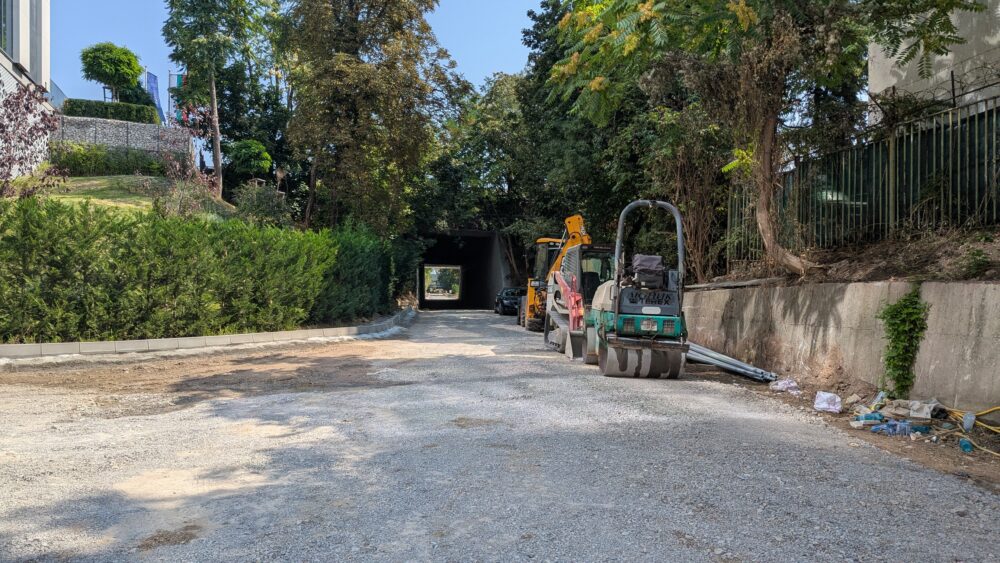
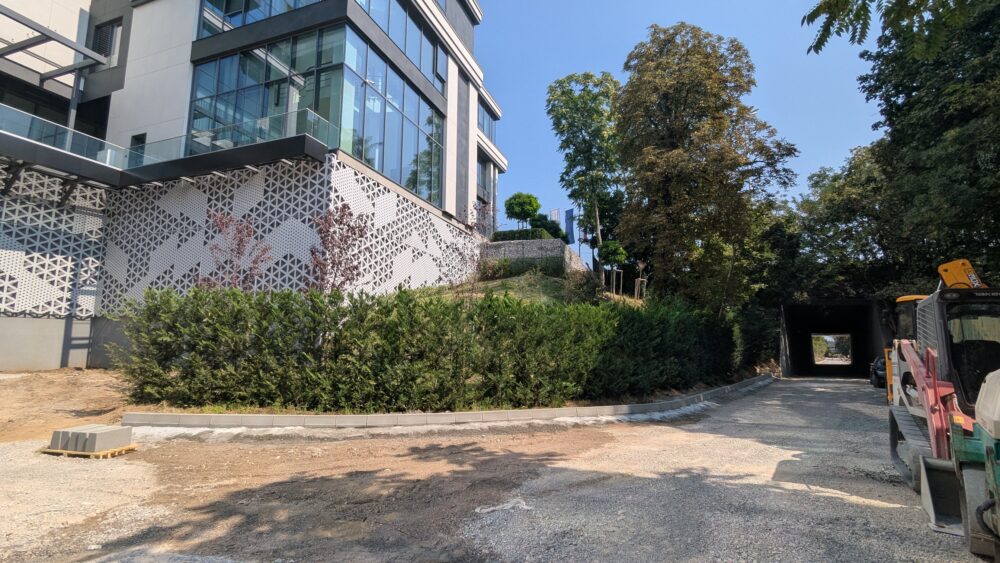
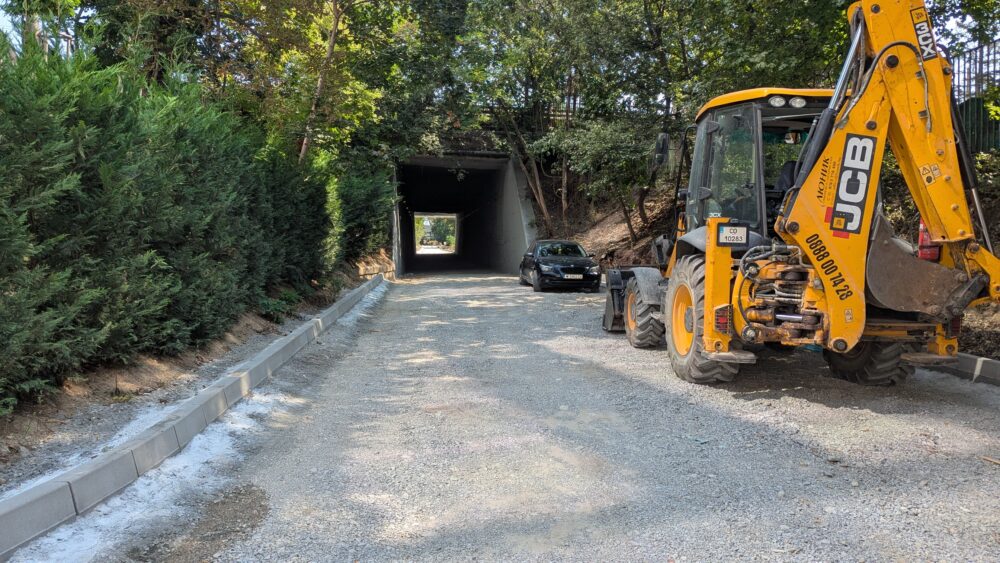
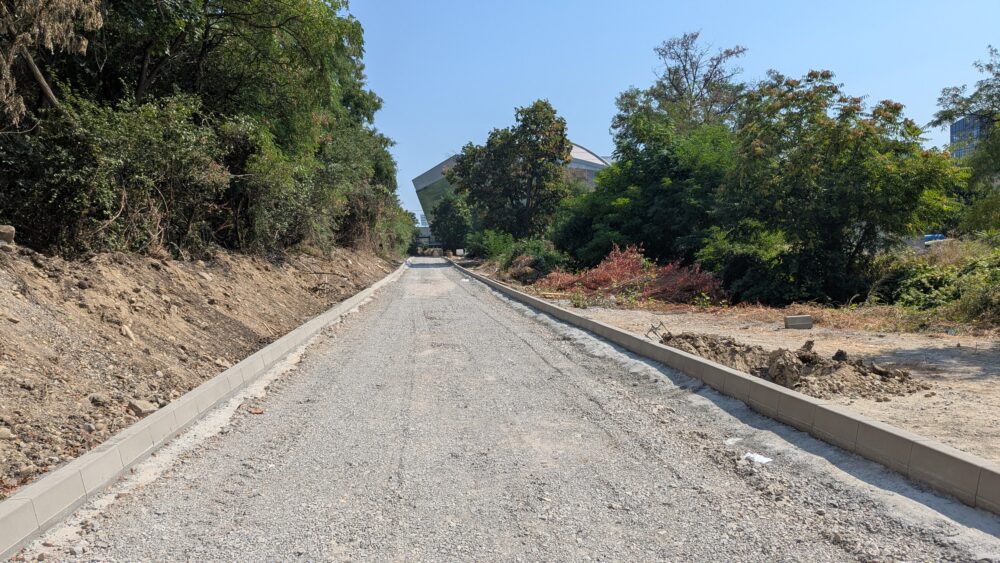
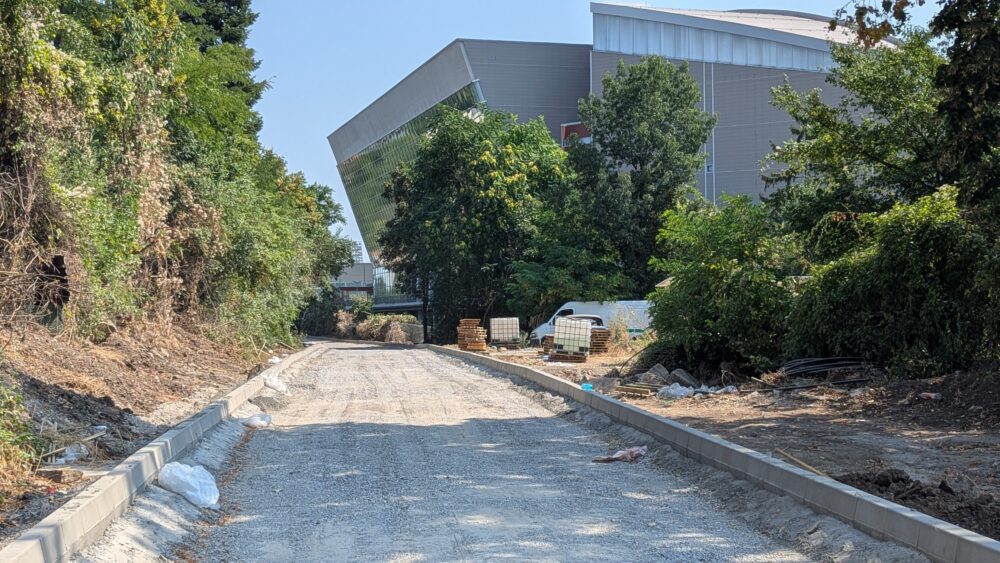
В събота реших да мина през отсечката на Зеления ринг в Изгрев и Слатина, за която от общината през страницата си за проекта за Зеления ринг писаха, че ще се ремонтира и доведе до временно състояние, за да могат феновете да стигат по-лесно до европейското по волейбол в Арената след две седмици. Това всъщност е много добра идея, тъй като всеки път като има събитие там тротоарите и пешеходните пътеки около кръговото на 4-ти км. се препълват създавайки опасност както за пешеходците, така и блокирайки движението.
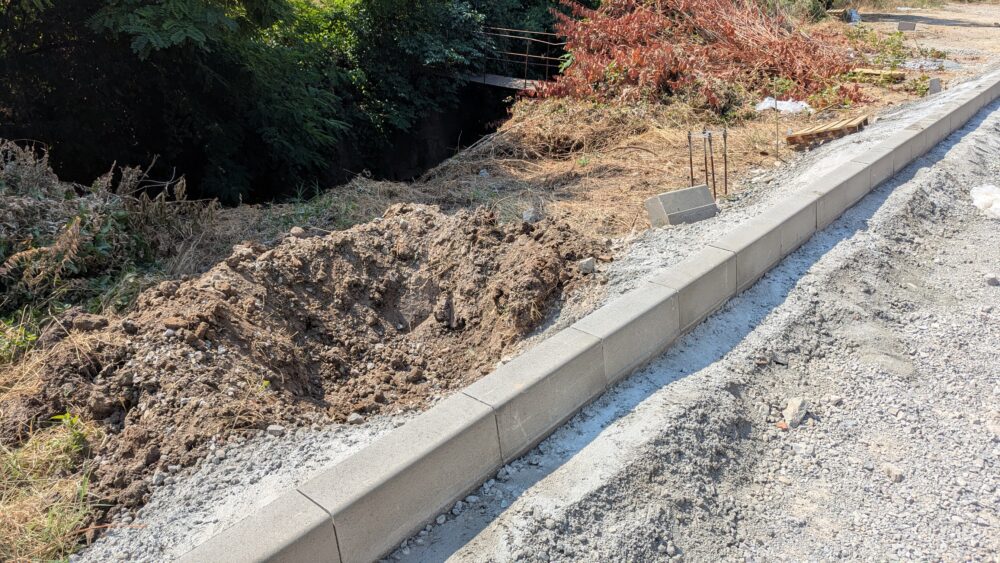
Отсечката е от началото на хотела на Тиков до края Арената. Вижда се, че са сложили бордюри и вече е насипан част от чакъла. Хотел East Plasa партнирали като ще предоставят достъп за 10 метра през имота си и ще изградят стълби до нивото на зеления ринг. Това, всъщност, е най-малкото, което следва да направят предвид, че изсякоха дърветата там, унищожиха почвения слой и са оставили строителни отпадъци в края на разчистената площ докато строяха хотела си.
Попитах и ми отговориха, че няма да се слага асфалт и бордюрите са само, за да държат чакъла. Лампите са също временно докато не се реши как да изглежда цялата отсечка от гара Пионер. Събитията за обсъждане на плановете щели започнат през септември. Питах и какви са плановете за минаване с колело или детска количка и отговориха, че се обмисля и това.
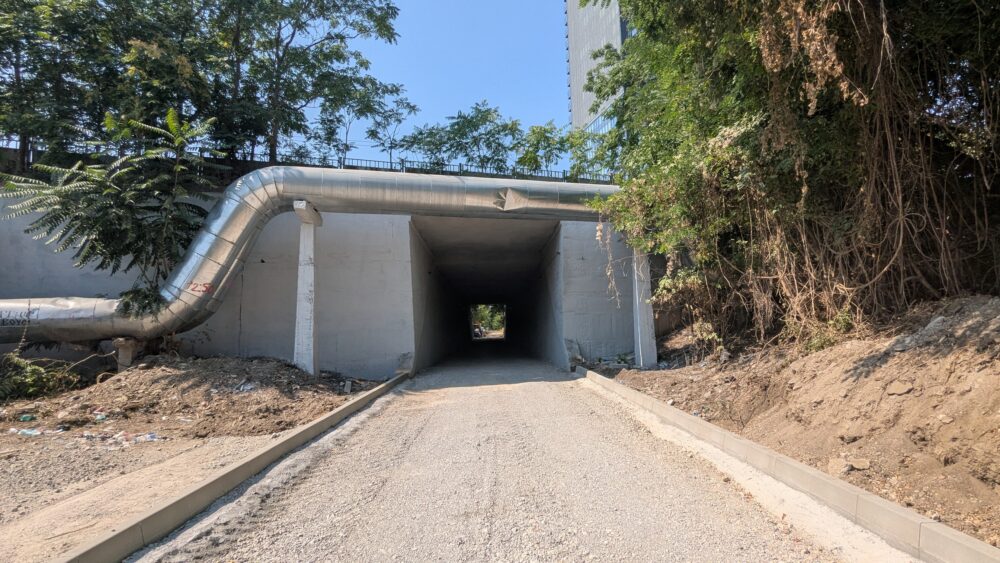
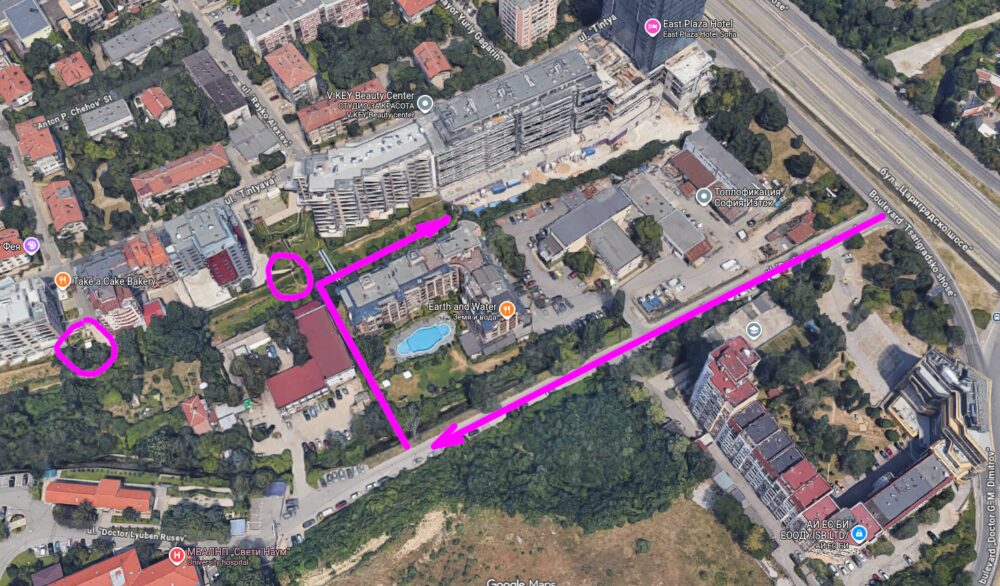
Ако искате да стигнете до същото място. Единственият начин в момента е да влезете откъм ул. Любен Русев – където е Топлофикация и където районният кмет на Изгрев иска да му строи частник ново кметство по схема кон за кокошка. Там има едно мостче (единственото водещо до бъдещото кметство), по което ще стигнете до още неразчистената част от зеления ринг. Завивате надясно и ще ви пречат само строителните отпадъци от строежа на East Plasa. Ако се разчистят бетонните блокове, ще може да се минава с колело и от там.
Има една пътека вляво, която обаче стига до частен имот (дясното кръгче на последната снимка). Би трябвало да може да се влезе и от пътека още на изток, но общински имот-улица стигаща до зеления ринг е застроена с вход на гараж (лявото кръгче). Не е ясно дали и как е позволено това, но ще трябва да се разруши.
Всъщност, докато бях в Зеления ринг видях поне три случая на незаконно строителство или нарушения в готови сгради. Разпознават се с просто око. Когато районният ни кмет, на когото са разпределени от call.sofia тези сигнали, неизбежно слезе да се снима за фейса след две седмици на вече свършената работа, надявам се да ги забележи и най-вече да ги санкционира. Ха дано, ама надали.
Още статии свързани с темата за Зеления ринг може да прочетете тук:
During my time at AWS, I have always looked for opportunities to work with students. I have delivered over 50 talks at universities across the region, and watching the potential in the room is always a strong motivator. It reminds me of why I do this work, and that the students I meet today may well become our customers and collaborators tomorrow. That is why I am happy to open this week with Student Rewards on AWS Builder Center.
Rick Suttles published Introducing Student Rewards on AWS Builder Center, a new benefit for verified higher education students. When you verify your enrollment through SheerID and complete your Builder Center profile, you unlock 12 months of premium AWS Skill Builder access (900+ courses, hands-on labs, certification exam prep, and game-based learning). From there, you earn badges through actions on Builder Center: publishing articles, commenting, and maintaining engagement. At 7 badges, you unlock $10 in AWS Credits. At 14 badges, another $20 in credits. At 21 badges, you earn an AWS Foundational Certification exam voucher ($100 value).
This represents a commitment of over $500 million in resources during this back-to-school season, providing students with the training, tools, and certification needed to start building their careers in cloud and AI. Student Rewards is available to students 18 years or older and enrolled at accredited higher education institutions worldwide, subject to verification and applicable terms.
Last week’s launches Here’s what else happened this week.
A new AWS Local Zone in Las Vegas, Nevada – This new Local Zone supports Amazon EC2 C7i, M7i, R7i, and C8gn instances, Amazon EBS, Amazon ECS, Amazon EKS, Application Load Balancer, and AWS Direct Connect. AWS Local Zones are now available in more than 30 metropolitan areas worldwide. In addition, AWS added a fourth Availability Zone to the Europe (London) Region, delivering next-generation AI and ML capacity with Trn3 and P6 accelerated instances alongside general-purpose compute.
Amazon EC2 Auto Scaling now supports batch instance termination – You can now pass up to 100 instance IDs to the TerminateInstanceInAutoScalingGroup API to terminate them as a batch, reducing the number of API calls needed to scale down your Auto Scaling groups. Batch termination is designed for workloads that need to rapidly scale down, such as AI/ML training jobs, container orchestrators, or event-driven architectures that spin up large fleets temporarily.
AWS CloudShell now includes a built-in visual file editor – CloudShell now includes a visual file editor that you can launch directly from your shell session using a single edit command. The editor supports syntax highlighting, find-and-replace, multi-line selection, copy-paste, and undo-redo in a single browser session. Whether you are updating a deployment script, modifying an agent steering file, editing a CloudFormation template, or fixing a Lambda function, the editor provides a seamless edit-and-run experience without leaving CloudShell.
Amazon Bedrock now supports SpaceXAI Grok 4.6 with cross-Region inference – Grok 4.6, a frontier model built for coding, agentic tasks, and knowledge work, is now available on Amazon Bedrock. The model runs on the bedrock-runtime endpoint with support for the Responses, Chat Completions, and Converse APIs, and works with existing account-level controls including model invocation logging, Amazon CloudWatch metrics, and cost itemization in AWS Cost Explorer.
Amazon Bedrock expands API support and introduces cross-Region inference for OpenAI models – Amazon Bedrock now supports OpenAI GPT-5.6 models (Sol, Terra, and Luna) with the Responses, Converse, and Chat Completions APIs, and adds cross-Region inference. Geo cross-Region inference routes requests within a predefined geography (including new US Geo support with this launch), while Global cross-Region inference serves requests from any commercial AWS Region at a lower per-token cost.
AgentCore payments is now generally available in Amazon Bedrock AgentCore – At general availability, AgentCore payments includes Quick Create for Coinbase credential provisioning directly within the AgentCore console, a curated Coinbase Bazar MCP server of pay-per-use x402 endpoints via AgentCore gateway, support for the Machine Payment Protocol (MPP), and the “upto” scheme in the x402 protocol for pay-per-inference and dynamic pricing use cases. To learn more, visit the AI Blog post.
AWS Glue 6.0 delivers 30% price reduction and Iceberg v3 support – AWS Glue 6.0 is built on a fully modernized runtime, Apache Spark 4.1, Python 3.13, and Scala 2.13, delivering 30% lower pricing than previous AWS Glue versions. With Iceberg v3, Glue 6.0 adds the VARIANT data type with automatic shredding for faster reads on semi-structured data, deletion vectors for high-performance row-level updates, geometry and geography data types for spatial processing, and flexible schema evolution.
For a full list of AWS announcements, be sure to keep an eye on the What’s New with AWS page.
Other AWS news Here are some additional posts you may find useful:
Updates to your AWS Sign-In experience – AWS is gradually introducing updates to the sign-in and sign-up experience. The redesigned sign-in page introduces a unified email entry point for root users and customers using the new email-based sign-in method, while IAM users continue signing in with their account ID, username, and password. The page also includes sign-in options for customers whose AWS account was created using a supported identity provider (Google, GitHub, Apple, or Amazon.com). A redesigned session selection page simplifies viewing and managing multiple active account and role sessions. If your organization relies on browser automation or scripted workflows that interact with the sign-in page, review the post to understand how these changes might affect your configuration.
In the works: AWS Builder Lofts in Berlin, Hyderabad, and São Paulo – My colleague Channy announced plans to open new Builder Lofts in three cities. Since the first Builder Loft opened in San Francisco in July 2025, it has welcomed more than 22,500 developers through its doors. Each new location will be a permanent community space offering free workshops, networking events, pitch nights, content creation spaces, and co-working areas. Berlin will focus on digital sovereignty and security-readiness, Hyderabad on AI and cloud-native architecture, and São Paulo on supporting Latin America’s developer ecosystem.
AWS and Amazon WorkSpaces recognized as a Leader in the 2026 Gartner Magic Quadrant for Desktop as a Service – AWS has been named a Leader in the 2026 Gartner Magic Quadrant for Desktop as a Service (DaaS) for the third consecutive year, evaluated on Completeness of Vision and Ability to Execute. Gartner noted strengths in operations, geographic strategy, and overall viability. This is also the first year the evaluation includes Amazon WorkSpaces for AI agents, a capability that runs AI agents within the same desktop environment, security perimeter, and audit trail as human users.
For a full list of AWS blog posts, be sure to keep an eye on the AWS Blogs page.
Upcoming AWS events Check your calendar and sign up for upcoming AWS events:
AWS Summits – Free in-person events for builders and innovators to learn, connect, and explore the latest in cloud. Coming up: Zurich (September 2), São Paulo (September 3), Tel Aviv (September 10), and Dubai (September 30). You can also watch keynotes and sessions on the AWS Summits Global Livestream + On-Demand Hub. To access live and on-demand content for a particular Summit, you need to be registered for that event.
Visit the AWS Builder Center to meet other builders, contribute solutions, and find resources that help you keep building.
Summer is slowly coming to an end, and I am already planning a few days off in the coming months to keep me motivated through the rainy autumn ahead. I hope you are doing the same. Come back next week for more!
Accounts move between organizations in AWS Organizations whenever a business changes shape. A merger folds one estate into another. A divestiture carves one out, and some companies run more than one organization by design.
The moves take more care when AWS Resource Access Manager (AWS RAM) resource shares are involved. An organization-bound share trusts an account through its organization membership, so when the account leaves, AWS RAM removes that association. Anything in production that depends on a shared resource needs a continuity plan before the first account moves.
A leading worldwide provider of payment technology and software solutions, based out of the United States, used temporary AWS RAM resource shares to preserve AWS Lake Formation permissions during an AWS Organizations migration of 382 AWS accounts. The payment processor serves merchants and financial institutions around the world. The program separated them from their former parent company, a US-headquartered financial technology provider serving banking and capital markets clients globally, before a Transitional Service Agreement (TSA) expired in April 2026.
The migration unfolded alongside wider corporate change. In January 2026, the payment processor was acquired by a leading payments technology company headquartered in the United States. The transaction transforms the acquirer into a pure-play commerce solutions provider, serving the full spectrum of clients from small businesses to global enterprises worldwide. The migrating estate also included the payment processor’s embedded payments platform, a US-based provider of embedded payment and automated onboarding tools for software-as-a-service (SaaS) platforms.
Most workloads kept running when the original organization-bound shares broke, but the control plane lost access. They needed a migration pattern that preserved service continuity without leaving temporary permissions behind.
AWS partnered with them to design and validate that pattern in two weeks. It uses retained bridge shares for the move, then restores the original shares as the durable permission objects.
An AWS account can consume a resource to share automatically while it belongs to the same organization as the producer. When the account leaves, AWS RAM removes that organization-bound principal association. Creating a retained bridge share as an external association before the move preserves access through the organization’s change.
After the move, the company restores the migrated account to the original share, verifies access, and removes the bridge. The original share remains the AWS Lake Formation-managed source of truth. New grants and resource changes continue to attach to it, not to the point-in-time bridge copy. Keeping both would create duplicate permission state and drift.
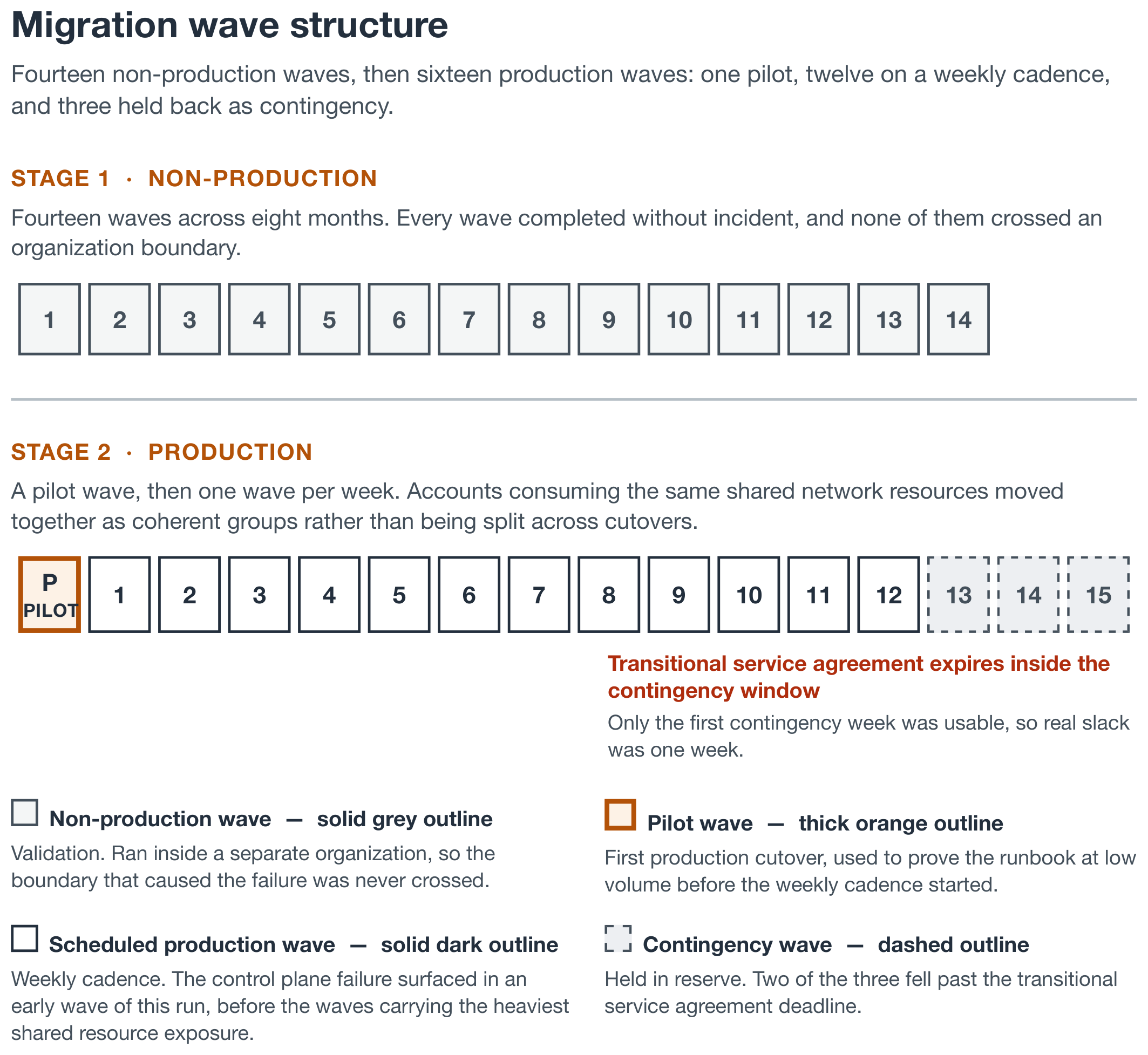
The following diagram shows the migration wave structure.
Migration wave structure. Stage one covers fourteen non-production waves across eight months, none of which crossed an organization boundary. Stage two covers sixteen production waves: one pilot wave, twelve scheduled waves on a weekly cadence, and three contingency waves. The transitional service agreement expires inside the contingency window, leaving only the first contingency week usable.
The company’s cloud engineering team ran 14 non-production waves, a production pilot, 12 weekly production waves, and three contingency waves. The TSA expired inside the contingency window, leaving about one week of usable slack.
Challenge
The risk surfaced in a production wave in February 2026. A terraform apply against a shared AWS Transit Gateway failed with a permission error, although traffic kept flowing and no alarm fired.
This was a control plane failure. Existing attachments, DNS paths, and certificates continued to work, but engineers could not change shared resources. The dedicated AWS Transit Gateway, Amazon Route 53 Resolver, and the embedded payments platform’s AWS Glue Data Catalog waves were still ahead.
Why the issue stayed hidden
Most services retain their data plane when an AWS RAM association breaks. For example, an Amazon Elastic Compute Cloud (Amazon EC2) instance in a shared Amazon Virtual Private Cloud (Amazon VPC) keeps running, but the account cannot launch a new instance. Infrastructure-as-code exposed the problem because it needed control-plane access.
The following table summarizes the affected resource types confirmed by the customer.
Keeps the data plane, blocks new resource creation
AWS Glue Data Catalog databases and tables
AWS Glue and AWS Lake Formation
Requires bridge-share validation before migration
Some services require additional handling. Depending on its resource-cleanup configuration, an AWS Firewall Manager policy can remove AWS Network Firewall rules, which you must then redeploy, and organization-integrated AWS CloudFormation StackSets can delete stacks unless you set them to retain.
The embedded payments platform initially entered the estate through an acquisition by the former parent company. Its embedded payment and automated onboarding capabilities were subsequently integrated into the payment processor’s ecosystem to support a broader platform-focused offering for SaaS providers. The platform shared databases and tables across 10 accounts with account IDs as principals, and the workstream was paused rather than testing the migration against production.
Why the original shares broke
The company had enabled sharing with AWS Organizations in the producer account. AWS RAM therefore trusted each in-organization principal through organization membership, even when a share named an account ID. When an account left the source organization, AWS RAM removed that organization-bound association.
A share created for a principal outside the organization behaves differently. AWS RAM sends an invitation, and the accepted association is external. Because it does not depend on organization membership, it survives the account move. The bridge-share pattern uses this behavior.
Why non-production testing missed it
The company’s non-production accounts were already in a separate organization. They never crossed the boundary that caused production associations to break.
Fourteen clean waves validated the migration process but not the production-only condition. Each validation environment must cross the same trust boundary as production.
Applying the bridge-share pattern
This failure was raised with the AWS account team, which brought AWS RAM, AWS Glue, AWS Lake Formation, and AWS Organizations service teams into the response. The company first used a manual recovery path for 21 accounts while the teams automated a scalable approach.
On February 27, 2026, AWS released RetainSharingOnAccountLeaveOrganization for new AWS RAM resource shares. The setting marks principals as external after they accept the invitation. The customer confirmed that the setting does not retrofit existing shares, so those shares needed a temporary parallel share.
Retaining access during the move
AWS RAM allows a resource to belong to more than one resource share, so a parallel share can exist alongside the original. A second retained share was created alongside each original, targeting the same consumer account.
The consumer accepted the invitation before migration, creating an external association. During the move, AWS RAM removed the original organization-bound association while the bridge continued to grant access. AWS Organizations also support transferring an account directly between organizations, so the move itself does not require an intermediate standalone period.
Why restore the original share?
The bridge is a migration-only continuity copy. The original AWS Lake Formation-created share remains the durable, service-managed permission object. If a team adds a grant or changes a shared resource during the migration window, that change applies to the original share, not automatically to the bridge.
The company therefore restored migrated principals to the original share before deleting the bridge. Leaving both in place would create two permission paths that can diverge, complicate audits, and conceal which share is authoritative.
Automation deletes a bridge only after it finds a non-bridge original whose resources, principals, and permissions cover the bridge and whose associations are all ASSOCIATED. This check confirms the original share’s associations are active before removing the temporary path. Access and connectivity were validated separately, as described in the Outcome section.
Validated workflow
AWS validated the pattern across three test accounts and two organizations before it was used in production. Testing confirmed that allowExternalPrincipals alone was not enough. The bridge also required retainSharingOnAccountLeaveOrganization.
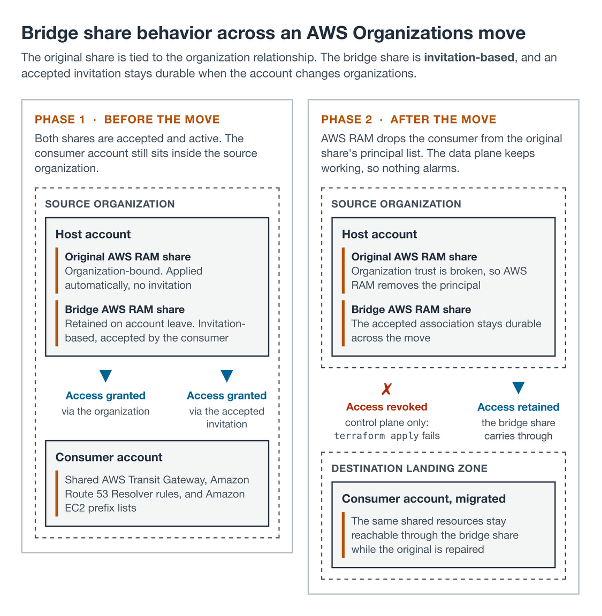
The following diagram shows the bridge before and after the account move.
Bridge share behavior before and after an account moves between AWS Organizations. Before the move, the original organization-scoped share and the accepted bridge share both grant access. After the move, the original share is revoked and the accepted bridge share continues to grant access.
Each production wave used five steps:
Inventory. Map each original share, resource, principal, permission, and Region. AWS RAM is Regional, so repeat the inventory in every in-scope Region.
Create and accept bridges. Create a retained share for the same resource and principals, then accept its invitation from each consumer account before migration.
Migrate. Move the account. AWS RAM removes the organization-bound association, while the accepted bridge keeps access active.
Restore originals. Add the migrated account IDs back to the original shares as external principals. This reactivates the durable shares and includes grants created during the migration window.
Validate and remove bridges. Confirm resources, principals, permissions, and association status, then delete only bridge shares fully covered by active originals.
This workflow ran for every remaining production wave and kept the weekly cadence.
Validating AWS Glue and Lake Formation permissions
The embedded payments platform shared AWS Glue Data Catalog databases and tables across 10 accounts, with account IDs as principals. The configuration was reproduced in disposable accounts, and the resource policy was recorded through a cross-organization move.
The validated automation records principal-to-share mappings, supports dry-run and execute modes, restores principals to the original shares, and deletes bridges only after validation. The embedded payments platform completed its production migration on July 21, 2026.
Outcome
The global payment processor migrated 378 of the 382 accounts into its landing zone. The final four awaited approvals from external stakeholders.
The TSA with the former parent company ended on schedule in April 2026. No customer-facing workload lost availability, and the company recorded no network drops across the production waves. The company and AWS moved from discovery to a validated bridge-share pattern in two weeks.
After each migration, the cloud engineering team restored the original shares, verified access and connectivity, and removed the bridges. Deleting the temporary copies confirmed that the original service-managed permission path was active and authoritative.
Production, non-production, and the embedded payments platform now run in one landing zone. They control their own guardrails, security posture, provisioning, and change process.
AWS has published the validated pattern and automation, so other organizations can start with a tested procedure.
Lessons learned
This program produced three lessons for organizations planning similar migrations.
Match validation boundaries to production
A test organization cannot expose this failure unless it crosses the same organization boundary as production. Map each production risk to an environment that can reproduce it before the first wave.
Monitor control plane changes
AWS RAM emits resource share state-change events directly to Amazon EventBridge, and AWS CloudTrail records DisassociateResourceShare API calls for audit. A weekly post-migration sweep provided a periodic reconciliation check to catch stale shares.
Inventory dependencies and destination guardrails
The Account Assessment for AWS Organizations tool inventories AWS RAM dependencies before teams set the wave plan. The company’s cloud engineering team reviewed destination guardrails at the same time. A service control policy that blocked ram:AcceptResourceShareInvitation during migration windows was temporarily adjusted.
Conclusion
The migration of this leading payment technology and software company shows how a retained bridge share can protect access while an account moves between AWS Organizations. The bridge is temporary: restoring the original share keeps AWS Lake Formation permissions aligned with future grants and avoids two sources of permission state. Inventory, dry-run-first automation, and post-move validation helped the company meet its deadline without customer disruption.
Practical quantum computers have been ten years away for the last several
decades. Now, however, it’s beginning to look as though they will be
possible in just a few years. Recent
research with obfuscated results demonstrated much lower memory requirements to factor
ECDSA keys on a quantum computer, with
work by other researchers in the open more than halving memory use compared
to the state of the art in 2023.
At the same time, computer
manufacturers are
boasting quantum processors that retain viable superpositions over longer periods.
Given how slowly software updates filter out to stable systems, it’s worth
looking at what configuration changes and protocol updates are needed to be safe
from quantum computers now.
Version 31.1 of the Emacs editor has been released. There is a long list of
changes including the removal of the Emacs dumper, a new user Lisp
directory feature, a “Send to…” menu item in context-menu-mode, and
many other changes; see the NEWS file for
more information. Mickey Petersen, author of Mastering Emacs, also has
a rundown
of some of the quality-of-life features appearing in this release.
Abstract: With entrepreneurial fraud cases on the rise, we investigate how entrepreneurs carry out criminal deception, employing deceptive means to defraud audiences. Analyzing court data from Silicon Valley ventures and their founders prosecuted for fraud between 2000 and 2023, our findings reveal that entrepreneurs carry out criminal deception through a process of façading: Entrepreneurs construct, perform, and protect illusory appearances (façades) that externally project high-growth performance to audiences while masking ventures’ actual underperformance. We identify three forms of façading—surface, reinforced, and deep façading—that are contingent on the severity of the gap that entrepreneurs face between audiences’ performance expectations and ventures’ performance reality. Our theoretical framework captures how entrepreneurs facing minor, wide, and extreme expectation-reality gaps engage in evermore sophisticated efforts to detach the venture’s externally projected appearance from its actual operational reality. Practically, we propose several approaches to deter and detect criminal deception, including the extension of U.S. Securities and Exchange Commission surveillance and whistleblower program, investor due diligence reform, and dedicated entrepreneurship education interventions that clearly demarcate when entrepreneurs transgress into criminal deception. We make contributions to literatures on cultural entrepreneurship, organizational wrongdoing, and the social effects of entrepreneurship.
To provide the best experiences, we use technologies like cookies to store and/or access device information. Consenting to these technologies will allow us to process data such as browsing behavior or unique IDs on this site. Not consenting or withdrawing consent, may adversely affect certain features and functions.
Functional
Always active
The technical storage or access is strictly necessary for the legitimate purpose of enabling the use of a specific service explicitly requested by the subscriber or user, or for the sole purpose of carrying out the transmission of a communication over an electronic communications network.
Preferences
The technical storage or access is necessary for the legitimate purpose of storing preferences that are not requested by the subscriber or user.
Statistics
The technical storage or access that is used exclusively for statistical purposes.The technical storage or access that is used exclusively for anonymous statistical purposes. Without a subpoena, voluntary compliance on the part of your Internet Service Provider, or additional records from a third party, information stored or retrieved for this purpose alone cannot usually be used to identify you.
Marketing
The technical storage or access is required to create user profiles to send advertising, or to track the user on a website or across several websites for similar marketing purposes.