d-Matrix Raptor 3D-DRAM Accelerator for Generative Inference at Hot Chips 2026

Post Syndicated from Patrick Kennedy original https://www.servethehome.com/d-matrix-raptor-3d-dram-accelerator-for-generative-inference-at-hot-chips-2026/

At Hot Chips 2026, d-Matrix showed off its Raptor 3D-DRAM accelerator for AI breaking free of using HBM for memory by stacking DRAM and logic

The post d-Matrix Raptor 3D-DRAM Accelerator for Generative Inference at Hot Chips 2026 appeared first on ServeTheHome.

Mourning Steve French

Post Syndicated from corbet original https://lwn.net/Articles/1090098/

From Jeremy Allison we have the
sad news
of the passing of Steve French. He was the maintainer of the
kernel’s SMB filesystem code for many years, having only dropped that
role
due to health issues in the last week. “I’ve known Steve for
over 20 years. He was a legend in the community, and a really good
friend. He will be greatly missed. Farewell Steve.
” He will indeed be missed.

Чии са фейсбук троловете?

Post Syndicated from Bozho original https://blog.bozho.net/blog/4622

„Троловете са на ДБ и ПП“. Тази лъжа тръгна от интервю вицепремиера по пропагандата Иво Христов и се поде от всякакви говорители, политици, журналисти.

Разбира се, ние в Демокртична България тролове нямаме.

Няколкото фейсбук страници, които бъркат в здравето на политическите манипулатори, не са наши и дори не познаваме хората, които стоят зад тях (с изключение на един от хората зад страницата BG Elves, когото познавам като местен активист).

Дали е редно политически мнения да се разпростаняват под псевдоним е отделен въпрос. Аз смятам, че е допустимо и част от културата в интернет. Но дори на страницата да пишеше „Зад страницата стои Иван Георгиев от Горна Оряховица“, нямаше да има особена разлика.

Но „трол“ значи друго и има друга цел – троловете са фалшиви профили, в общия случай без зад тях да стоят истински хора, чиято цел е да разпространяват и усилват дадено послание. Тролове могат да бъдат и обикновени хора, които със собственити си профили срещу заплащане да правят същото. А има и хибриден вариант, при който се плаща на обикновени хора да си направят по няколко акаунта – има такива репортажи по националните ни телевизии. Затова се говори за „ферми“ или „фабрики“ с тролове – защото бройката е много важна, за да бъдат подлъгани алгоритмите на социалните мрежи, че съдържанието, което харесват, споделят или създават е масово мнение.

Ние не само нямаме тролове, а сме единствената политическа сила, която е правила опити да намери решение на този проблем. И ще дам три примера.

През 2023 г. представихме публично законопроект, който целеше в определени случаи (допустими от гледна точка на хармонизираното европейско право) да задължим социалните мрежи да установяват координирано неавтентично поведение (т.е. профили, действащи по команда, най-често автоматизирано, да коментират/харесват/разпространяват дадено съдържание). Със законопроекта се предлагаха решения и на други канали за разпространение на пропаганда и дезинформация – напр. монетизирането на сайтове за фалшиви новини чрез фалшиви реклами – на хранителни добавки, фалшиви лекарства и др.

Тогава много от хората, които сега обясняват кой имал тролове, скочиха и казаха „сакън, цензура!“. Цензура, разбира се, нямаше, и от нас никога не би излязло нещо, което да отваря вратата за цензура, но тогава опитът за справяне с троловете беше удавен в такива заглавия и нравоучения.

През 2022 г., докато бях министър, на събитие в Давос, организирано от Украйна, говорих за ролята на социалните мрежи в борбата с разпространението на съдържание чрез координирано неавтентично поведение (тролове). Тогава имаше доклад на Фейсбук, че в месеците около нахлуването на Русия в Украйна, Фейсбук са свалили 2 фалшиви профила, свързани с Русия. Да, 2. Абсолютен провал – всички знаехме и виждахме какво се случва в социалните мрежи.

В този период имахме и срещи и кореспонденция с Мета на високо ниво. Изпратихме конкретно предложение – българското фейсбук пространство да бъде обект на задълбочено изследване за координирано неавтентично поведение. Мета отказа. В резултат на този отказ се роди и гореспоменатия законопроект.

Тогава от Мета ни попитаха „защо не използвате директния канал за докладване на съдържание“, на което моят отговор беше „защото не може правителството да казва кое е вярно и кое е грешно – ваша работа е да установите проблеми с поведението, а не със самото съдържание“.

Тази разлика е съществена. Винаги думата „цензура“ се появява, когато някой опита да говори по тази тема. А никога, по никакъв повод не е ставало дума за това държавата да определя кое е вярно и кое е „фалшива новина“ – това е гршено, опасно и не работи.

Пак тогава, през 2022 г. имах среща с двама еврокомисари в Брюксел – Тиери Бретон и Вера Йорова по отношение на същия проблем с троловете. Бретон поиска доклад с примери, какъвто подготвихме и му изпратих. Йоурова потвърди, че наблюдават същите проблеми с троловете и пропагандните наративи в Чехия, а и в много други източноевропейски държави. За съжаление Актът за цифровите услуги на ЕС беше в твърде напреднала фаза тогава и не беше възможно да се предложат допълнителни гаранции, че тролове няма да се използват за усилване на съдържание.

Все пак, Актът за цифровите услуги даде инструментариум на Европейската комисия да изисква мерки срещу това поведение. И това дава някакъв резултат. В последната предизборна кампания ТикТок свали 34 фалшиви профила на ДПС.

А Иво Христов вероятно може да разкаже повече за това кои профили, промотиращи Прогресивна България са били свалени от ТикТок и защо. Вероятно затова тогава Радев подскочи и заговори за „румънски сценарий“ ни в клин, ни в ръкав. Може би има обяснение и за десетките профили, пускащи едно също съдържание в подкрепа на ПБ, които бяха осветени в последните дни.

Пиша всичко това, за да не бъде подменяна реалността – нещо, което вероятно е добре описано в кремълските учебници по пропаганда. Учебници, които са успешно адаптирани за дигиталната ера.

Но както писах и онзи ден по друг повод – би било грешка да обвиним руската пропаганда за всички несгоди – най-малкото защото има достатъчно местни играчи, които си мислят, че като платят на „агенция“, която да организира тролски профили да им слагат сърчица, ще подквасят политическото море.

Различното мнение не значи, че някой е трол. Установяването на тролове е много лесно за Фейсбук и много трудно за странични наблюдатели, които не разполагат с метаданни. Трудно е, но не невъзможно да бъде намерено решение на този проблем и призовавам да търсим такова, вместо вицепремиери да си споделят фрустрациите от 3-4 анонини страници.

Материалът Чии са фейсбук троловете? е публикуван за пръв път на БЛОГодаря.

Say it once: introducing Bot Preference Sync

Post Syndicated from Jin-Hee Lee original https://blog.cloudflare.com/bot-preference-sync%20/

We’re constantly building for the different goals of our customers. Some customers want to optimize for discovery, while others want to protect their content with the strictest security policy. Among these differing policies, there are multiple ways to mitigate bot traffic. Some mechanisms simply state your preference, assuming best intent from crawlers, and other approaches actually lock down content by outright blocking with a Bot Management solution.

We recognize that it's cumbersome to maintain multiple layers of protection on your website. For example, there are cases in which your robots.txt states that a crawler is Disallowed from accessing your website, while your enforcement rules actually don’t block that crawler. When your stated preferences and your enforced rules disagree, some crawlers treat it as a basis to disregard your preferences or try to bypass your enforced rules.

A couple of years ago, Cloudflare announced an easier way to disallow AI training on your website by tackling two of these layers: a managed value of robots.txt that told a fixed list of major Training crawlers not to train on your content, along with edge-enforced blocks to Training crawlers. On July 1, 2026, we launched easier options to manage different kinds of AI traffic use cases. You can say what you want to do about Search, Agent, and Training traffic on your website.

We're announcing Bot Preference Sync, available to all customers from the Free tier to Enterprise. Bot Preference Sync reflects what you've set in your AI bot configuration by updating corresponding preferences to your robots.txt, and it can be turned on or off at any time. No more static file for one use case: we'll help you tailor your robots.txt to reflect what you’ve already configured for different AI bot categories.

New questions facing the Internet

For years, the most pressing question in this space was: "Is my content being used to train AI models without my permission?" It's an important question, and it isn't going away. Alongside this, the questions we increasingly hear are about discoverability and engagement. How do I show up when someone asks an AI assistant something my site can answer? How much of my traffic is coming from AI crawlers versus real people? What content is actually driving referrals, and what is it worth?

The answers differ by business model. Discoverability and engagement are key, top-of-mind issues for any businesses trying to thrive on the modern web, but the funnels for these are different: an e-commerce store may want everything crawled and trained on, so its products surface when a shopper asks a chatbot for "the best sofa for a small apartment." A publisher that monetizes pages with ads may want the opposite: stay in the search index that sends readers to the page, but keep its articles out of model training and, crucially, be able to verify that its content really wasn't used without permission.

There's no single right answer, which is exactly the point. Your controls should reflect your strategy, which is why we've been building tools to give you visibility and choice at every layer. Bot Preference Sync ties these together, so the preference you set is the preference you publish.

The call for Transparency

On July 1, 2026, we made the case that mixed-use crawlers, or “bots that blend search, agent use, and training behind a single user agent,” put site owners at a disadvantage precisely because they make it hard to separate what you want from what you don't. That's still true, and our position on Transparency for site owners hasn't changed.

But there’s more than one way to approach Transparency. We want to reward the operators who are clear about their identity and how they are using the data they crawl. For purposes of bot Verification, the owners of bots that perform both Search and Training will need to provide additional information in order to not be blocked when “Disallow Training” is set. Those requirements are:

  • The bot must respect, via any mechanism, a “no training” preference in robots.txt
  • They give site owners a way to opt out of AI summaries.
  • They provide URL-level visibility into which pages were made available for training, as well metrics on search results, so you can see how your content was used for search and for training.
  • They can show publicly that Disallowing Training does not hurt your traditional search results.

Bots of leading AI models and service providers that meet these criteria are tracked publicly in the AI bot transparency section in Cloudflare Radar, which includes examples in which best practices are honored, as well as when they are not. Crawlers that don't provide Transparency will not get the benefit of the doubt — they're still blocked when you disallow training. In other words, this is a way of making Transparency the price of admission. 

Introducing Bot Preference Sync

Bot Preference Sync is a new feature that keeps your robots.txt reflecting the AI bot preferences you've already set for Search, Agent, and Training on the Cloudflare zone-level dashboard. If a site owner already has a robots.txt file, the contents added by Bot Preference Sync will be prepended to the existing material, so any existing Disallow directives are maintained.

Instead of a site owner maintaining a separate static file, Cloudflare generates or updates your robots.txt based on your configuration, so what you say to the world and what you enforce at the edge are kept in sync.

For Search and Agent, the three options we announced on July 1 remain: Allow, Block on pages that serve ads, or Block everywhere. For Training, we’re refining the option to stop your content being used for training models with the Disallow option:

Disallow: a "no training" preference is written to your robots.txt, so that cooperating mixed-use crawlers who take the extra Transparency step can still access your content for search indexing, since they’re allowing site owners to directly verify how their data is used. Cooperating crawlers honor the preferences in robots.txt, and your Search visibility for cooperating crawlers is unaffected.

Let’s take the example below, in which someone has configured their AI bot policy to say “Allow Search, Allow Agents, Disallow Training.”

Since this example site has Bot Preference Sync on, their robots.txt would prepend something like the following (which has been shortened and anonymized for the sake of the example):

We’ll use bots that we track in BotBase to periodically update the list of bots that is added to robots.txt when you choose to Block or Disallow a given category. The Verified bots that are classified as Search, Agent, and Training can be viewed at any time in our public bots directory.

For all new customers, Bot Preference Sync will be on by default, to make it easier to manage blocks and preferences that reflect the same policy. For existing customers who are using the legacy managed robots.txt feature, we'll prompt you to review and confirm your preferences to transition to the new Bot Preference Sync upon its upcoming launch. 

Some customers may want or need to be more hands-on in stating their preferences, for example, if they have a special arrangement with a given company to which they want to grant an exception. Because Bot Preference Sync is designed to tackle policy decisions made category-wide rather than case-by-case, it will not directly read from individual custom rules with more complex logic. Customers with a more fine-tuned security policy always have the option to turn off the sync that sets group policies, and tailor their file to match their custom policy.

We’re also making a change that allows publishers or ad-supported sites to have a different default from other site owners. We’ve created a default to make it easier for publishing sites that rely on ads and expect them to be reserved for human visitors. At the time of onboarding, such customers can select the option, “I monetize from pages with ads on this domain", which will set Training to Disallow as the default. (Customers have the choice to change this setting at any time.) This way, you stay in search while keeping your content out of model training.

For the non-publisher case, new customers will not have any blocks or disallows added by default when they onboard a domain: the choice is up to the customer. You can choose if you want to block Search or Agent or Training at any point, but the starting point will not add any blocks on your behalf.

What's next?

Bot Preference Sync will be available to all customers, on every plan, in the coming week. Keep an eye on our changelog for availability, and watch your dashboard (and inbox) for the prompt to confirm your preferences!

This is one step in a longer effort. We'll keep working with the large bot operators to make sure we're not compromising on familiar challenges (like training without consent) nor emerging questions (like discoverability and engagement). Beneath it all is our effort to promote greater Transparency and control for site owners.

Friday Squid Blogging: Neon Flying Squid

Post Syndicated from Bruce Schneier original https://www.schneier.com/blog/archives/2026/08/friday-squid-blogging-neon-flying-squid.html

The neon flying squid can fly in formation.

The shoal of about 100 squid rose unexpectedly from a patch of the Pacific Ocean around 370 miles from Tokyo and glided near the boat for about 30 metres. The astonished researchers were the first to capture photographs of such a thing, which looked like the early stages of an alien invasion.

They were probably neon flying squid (Ommastrephes bartramii), the subsequent study states, a species that is part of a 20-strong flying squid family that was known to leap from the water but, until then, was only rumoured to also be able to glide above it.

The neon flying squid was able to gain such elevation by using the hyponome, a funnel-like muscular organ also present in other cephalopods, such as octopuses. The organ is able to force water out in a jet, propelling the body along both in and out of the sea. Photographs of the gliding squid show them with their arms (they have 10 limbs in all) splayed outwards.

As usual, you can also use this squid post to talk about the security stories in the news that I haven’t covered.

Blog moderation policy.

AWS Glue 6.0 now available with 30% lower price and full Apache Iceberg v3 support

Post Syndicated from Channy Yun (윤석찬) original https://aws.amazon.com/blogs/aws/aws-glue-6-0-now-available-with-30-lower-price-and-full-apache-iceberg-v3-support/

Today, we are announcing the general availability of AWS Glue 6.0, delivering 30% lower pricing than previous AWS Glue versions and introducing full support for Apache Iceberg v3 features. AWS Glue 6.0 is built on a fully modernized runtime, Apache Spark 4.1, Python 3.12, and Scala 2.13, delivering faster performance.

With this release, AWS Glue provides the most complete Iceberg v3 implementation on any fully serverless managed Spark service, along with new capabilities that simplify ETL authoring, improve PySpark performance, and enable real-time streaming with single-digit millisecond latency.

What is new in AWS Glue 6.0
AWS Glue 6.0 delivers the complete Apache Iceberg v3 specification, built on Iceberg 1.11.0. The headline feature is the VARIANT data type with shredding support, which achieves faster query read performance compared to traditional string data type columns for semi-structured data.

With VARIANT shredding, you can store and query JSON, logs, and event data without flattening schemas, eliminating duplicate data copies, custom parsing code, and pipeline breakage when schemas change. This capability transforms how teams handle semi-structured data at scale.

Additional Iceberg v3 capabilities include:

  • Geometry and Geography data types: Enable native spatial processing for GIS analytics, location intelligence, and geospatial data pipelines directly on managed Spark.
  • Nanosecond-precision timestamps: Support IoT sensor data, scientific computing, and high-frequency financial workloads that require precision beyond standard milliseconds.
  • Unknown type handling: Process data with unexpected or evolving schemas without pipeline failures, providing resilience against upstream schema changes.

AWS Glue 6.0 also includes most significant upgrade in Spark 4.1, the modern runtime engine:

  • Spark declarative pipelines: Spark Declarative Pipelines introduces a simplified approach to ETL authoring. Data engineers declare transformations, specifying what data should look like, while the engine automatically determines execution order and optimization. This reduces the complexity of pipeline development and eliminates manual orchestration overhead.
  • Arrow-native Python UDFs and UDTFs: AWS Glue 6.0 introduces Arrow-native execution for Python User-Defined Functions (UDFs) and User-Defined Table Functions (UDTFs). This eliminates serialization overhead between Python and the JVM, improving PySpark performance for complex transformations.
  • Real-time streaming mode: For stateless streaming use cases, AWS Glue 6.0 introduces a real-time streaming mode that achieves single-digit millisecond latency. Built on Spark 4.1’s Real-Time Mode with Glue-optimized execution, this capability supports real-time event processing, low-latency data transformation pipelines, and time-sensitive data routing.

Getting started with AWS Glue 6.0
No API changes are required to use AWS Glue 6.0. You can select the new version using the existing --glue-version parameter in the create-job or update-job APIs through AWS Command Line Interface (AWS CLI)AWS SDK, AWS Glue Studio, Amazon SageMaker Unified Studio, and your preferred IDE.

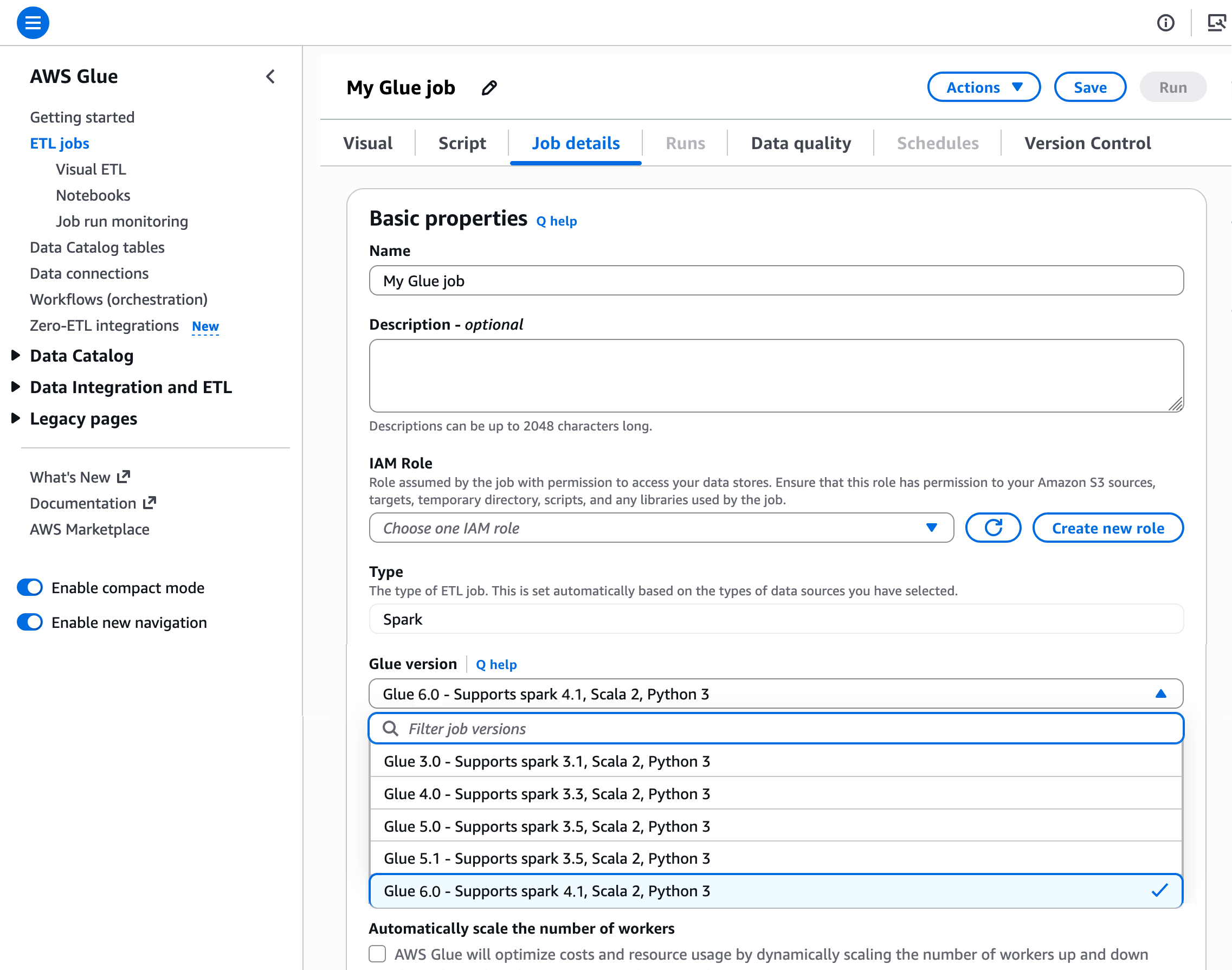
To get started with AWS Glue 6.0 jobs in the AWS Glue Studio console, open the AWS Glue job and on the Job Details tab, choose the version Glue 6.0 – Supports Spark 4.1, Scala 2, Python 3. You can create new AWS Glue jobs on AWS Glue 6.0 to get the benefit from the improvements, or migrate your existing AWS Glue jobs.

To start using AWS Glue 6.0 on an AWS Glue Studio notebook or an interactive session through a Jupyter notebook, set 6.0 in the %glue_version magic. You can also upgrade existing jobs to Glue 6.0 using the Spark upgrade agent on AWS Glue Studio or use the auto-upgrade feature in their existing Glue jobs to automatically upgrade them to Glue 6.0.

To learn more, visit the AWS Glue 6.0 version detail and Migrating AWS Glue for Spark jobs to AWS Glue version 6.0 in the AWS documentation.

Now available
AWS Glue 6.0 is generally available today in all AWS Regions where AWS Glue operates. For Regional availability and a future roadmap, visit the AWS Capabilities by Region. If you want to call APIs, search documentation, find regional availability, and check troubleshooting about this new feature, try using the AWS MCP Server and plugins with your preferred AI tool.

You pay an hourly rate, billed by the second, for crawlers (discovering data) and extract, transform, and load (ETL) jobs (processing and loading data). For the AWS Glue Data Catalog, you pay a simplified monthly fee for storing and accessing the metadata. The first million objects stored are free, and the first million accesses are free. To learn more, visit AWS Glue Pricing page.

Give it a try in the AWS Glue Studio console, and send feedback to AWS re:Post for AWS Glue or through your usual AWS support contacts.

Channy

Build a unified AI agent architecture with DynamoDB and Bedrock

Post Syndicated from Dhananjay Karanjkar original https://aws.amazon.com/blogs/architecture/build-a-unified-ai-agent-architecture-with-dynamodb-and-bedrock/

Teams building AI agents on AWS often face a fragmented data architecture: operational data lives in Amazon DynamoDB while vector embeddings for semantic search sit in a separate, purpose-built vector store. This duplication increases infrastructure cost, adds synchronization complexity, and widens the window for stale retrieval results. With the general availability of native vector search in Amazon DynamoDB (launched August 5, 2026), you can now store embeddings alongside your operational data in the same table. You query them using the SearchVectors API operation.

In this post, I show you how to build a unified AI agent architecture where an Amazon Bedrock agent uses a single DynamoDB table for both structured lookups and semantic similarity search. The agent calls AWS Lambda action groups that invoke SearchVectors for natural language retrieval and standard DynamoDB APIs for create, read, update, and delete (CRUD) operations. An Amazon DynamoDB Streams pipeline automatically generates embeddings using Amazon Titan Text Embeddings V2 whenever content changes. This keeps the vector index synchronized without manual intervention.

Use case

Consider a technical knowledge management platform where a team maintains hundreds of internal documents: runbooks, architecture decision records, and troubleshooting guides. Team members interact with a conversational agent to find relevant content (“What’s our retry strategy for payment failures?”), retrieve specific documents by ID, or update existing entries.

Without native vector search, this architecture requires a DynamoDB table for document storage plus a separate vector database (or Amazon OpenSearch Service cluster) for semantic retrieval. The Amazon DynamoDB Streams pipeline must write to both stores, and the agent must route requests to the correct backend. With DynamoDB vector search, you collapse this into a single table and reduce operational overhead.

Solution overview

This solution uses a single-table design in DynamoDB that serves two access patterns: key-value lookups for operational data and approximate nearest neighbor (ANN) search for semantic queries. A Bedrock agent orchestrates user interactions and routes requests to the appropriate action group function.

The following list summarizes the core components:

  • DynamoDB table with vector index stores documents, metadata, and 1,024-dimension embeddings in one place.
  • Bedrock agent handles conversation orchestration, tool selection, and response synthesis.
  • Action group Lambda executes semantic search (using SearchVectors) and CRUD operations against the same table.
  • Embedding pipeline Lambda (triggered by DynamoDB Streams) generates embeddings for new or modified content using Amazon Titan Text Embeddings V2.

Architecture

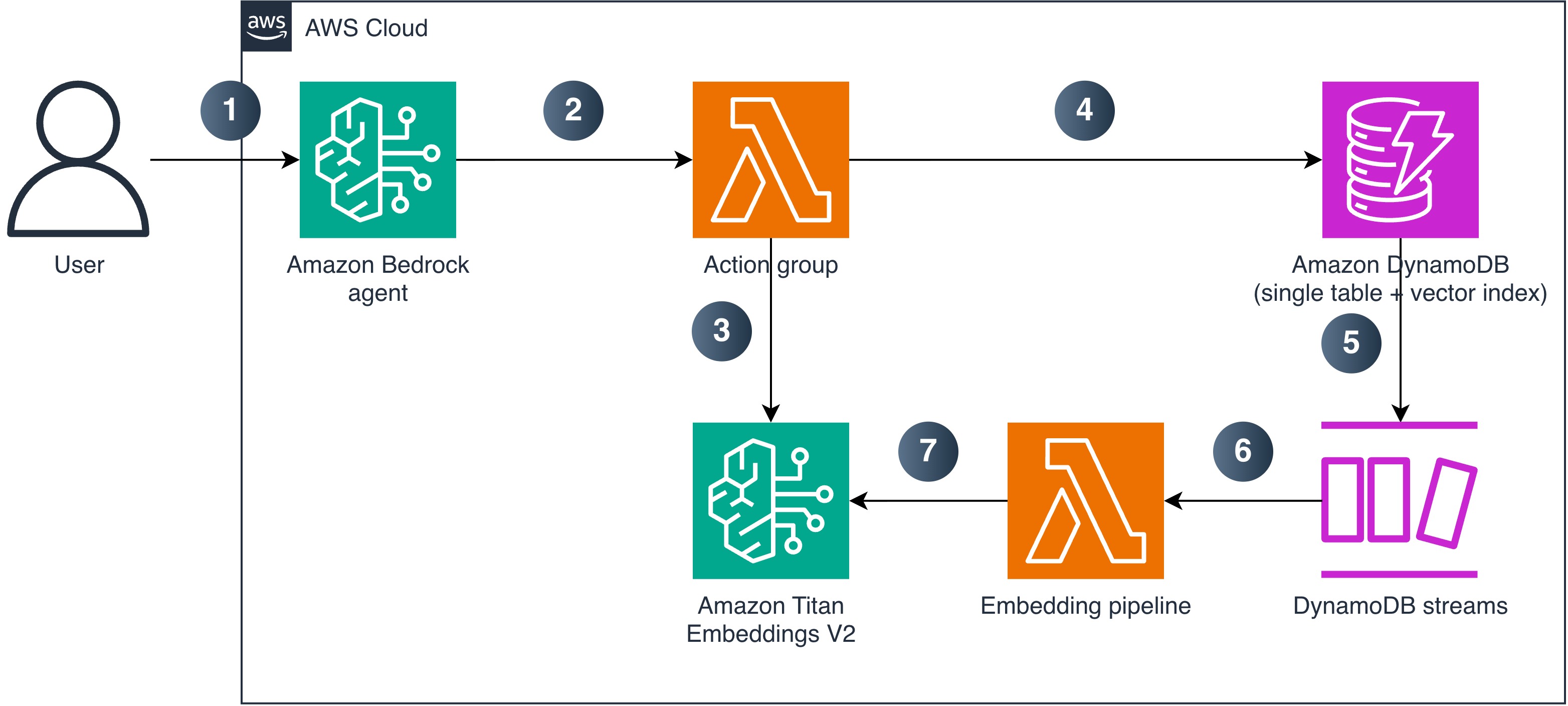
The following diagram illustrates the data flow through the unified architecture.

Architecture diagram showing a user query flowing to an Amazon Bedrock agent, which invokes action group Lambda functions that call the DynamoDB SearchVectors API and standard CRUD APIs, with DynamoDB Streams triggering an embedding pipeline Lambda that generates vectors with Amazon Titan Text Embeddings V2

Figure 1: Unified AI agent architecture using DynamoDB vector search and Amazon Bedrock

The numbered steps describe the data and request flow:

  1. A user sends a natural language query to the Bedrock agent.
  2. The agent analyzes the request and invokes the appropriate action group Lambda function.
  3. For semantic search, the action group Lambda generates a query embedding using Amazon Titan Text Embeddings V2.
  4. The Lambda function calls the DynamoDB SearchVectors API (or standard CRUD APIs for operational lookups) against the single table with vector index.
  5. When new content is written to the table, DynamoDB Streams captures the change.
  6. DynamoDB Streams triggers the embedding pipeline Lambda.
  7. The embedding pipeline Lambda calls Amazon Titan Text Embeddings V2 to generate a vector for the new content and writes it back to the same DynamoDB item, where the vector index automatically indexes it.

Prerequisites

To implement this architecture in your account, you need the following:

  • An AWS account with permissions to create DynamoDB tables, Lambda functions, Bedrock agents, and IAM roles.
  • DynamoDB Streams enabled on the table with StreamViewType set to NEW_AND_OLD_IMAGES (the embedding pipeline compares old and new content to prevent a write loop).
  • Access to the Amazon Titan Text Embeddings V2 model (amazon.titan-embed-text-v2:0) enabled in Amazon Bedrock model access.
  • Access to an Anthropic Claude or Amazon Nova model for the Bedrock agent foundation model (check model support by Region).
  • Python 3.12 or later (for Lambda function code).

Implementation

This section walks through the key components of the architecture.

Designing the single-table schema

The table uses a composite primary key (entity_id as partition key, sk as sort key) and stores embeddings as a list of numbers:

# Table schema overview
# PK: entity_id (S) - unique document identifier
# SK: sk (S) - sort key for item versioning
# Attributes: title, content, category, metadata, embedding (L of N)

The vector index partitions search results by the category attribute. Choose a partition key with moderate cardinality that matches your query patterns. A very low-cardinality key (a handful of values) concentrates data in few partitions and limits throughput scaling, while a unique-per-item key leaves no neighbors to compare. For multi-tenant workloads, tenant_id is usually the right partition key. For more information, refer to the DynamoDB vector search best practices.

The following AWS Command Line Interface (AWS CLI) command creates the vector index on an existing table:

aws dynamodb update-table \
    --table-name unified-agent-data \
    --stream-specification StreamEnabled=true,StreamViewType=NEW_AND_OLD_IMAGES \
    --attribute-definitions \
        AttributeName=category,AttributeType=S \
    --vector-index-updates \
    '[{"Create": {
        "IndexName": "content-embedding-index",
        "VectorAttribute": {"AttributeName": "embedding"},
        "Dimensions": 1024,
        "DistanceFunction": "COSINE",
        "SearchSchema": [
            {"AttributeName": "category", "SearchSchemaElementType": "HASH"}
        ],
        "Projection": {"ProjectionType": "INCLUDE", "NonKeyAttributes": ["title", "category"]}
    }}]'

After creating the index, wait for it to become searchable. Poll DescribeTable until IndexStatus is ACTIVE and Backfilling is no longer true. The first few searches after the index reports ACTIVE can still return ValidationException because SearchVectors is served by a dedicated search endpoint. Treat these as retryable rather than as a failure.

aws dynamodb describe-table --table-name unified-agent-data \
    --query 'Table.VectorIndexes[?IndexName==`content-embedding-index`].[IndexStatus,Backfilling]'

Key constraints to keep in mind:

  • DynamoDB vector indexes require on-demand capacity mode (provisioned mode isn’t supported).
  • Maximum five vector indexes per table, with up to 4,096 dimensions each.
  • The SearchSchema HASH attribute is mandatory in every SearchConditionExpression.
  • Only equality operators are supported in search conditions.
  • SearchVectors responses are limited to 16 MB and don’t support pagination. Project only the attributes you need and keep TopK modest to stay within this limit.
  • Items missing the SearchSchema HASH attribute (category in this example) are silently excluded from the vector index while remaining in the base table.

Building the action group Lambda

The action group Lambda handles both semantic search and operational lookups. The agent invokes it with a function name and parameters based on the tool definition.

The semantic search function generates a query embedding and calls SearchVectors. This index uses COSINE distance, where lower scores indicate greater similarity. Name the field accordingly so the agent doesn’t invert the ranking:

def semantic_search(query: str, category: str, max_results: int = 5):
    embedding = generate_embedding(query)
    results = dynamodb.search_vectors(
        TableName=TABLE_NAME,
        IndexName=INDEX_NAME,
        SearchVector=[{"N": str(v)} for v in embedding],
        TopK=min(max_results, 100),
        SearchConditionExpression="category = :cat",
        ExpressionAttributeValues={":cat": {"S": category}},
    )
    return [
        {"entity_id": r["Item"]["entity_id"]["S"],
         "title": r["Item"].get("title", {}).get("S", ""),
         "distance": r["Score"]}  # COSINE: lower = more similar
        for r in results.get("SearchResults", [])
    ]

The generate_embedding helper calls Amazon Titan Text Embeddings V2:

def generate_embedding(text: str) -> list[float]:
    response = bedrock_runtime.invoke_model(
        modelId="amazon.titan-embed-text-v2:0",
        body=json.dumps({
            "inputText": text,
            "dimensions": 1024,
            "normalize": True
        }),
    )
    return json.loads(response["body"].read())["embedding"]

The Lambda handler routes requests based on the function name passed by the Bedrock agent:

def handler(event, context):
    function = event.get("function")
    parameters = {p["name"]: p["value"] for p in event.get("parameters", [])}
    if function == "semantic_search":
        result = semantic_search(parameters["query"], parameters["category"])
        body = json.dumps({"results": result})
    elif function == "get_item_details":
        body = json.dumps(get_item_details(parameters["entity_id"]))
    else:
        body = json.dumps({"error": f"Unknown function: {function}"})
    return {
        "messageVersion": "1.0",
        "response": {
            "actionGroup": event["actionGroup"],
            "function": function,
            "functionResponse": {"responseBody": {"TEXT": {"body": body}}}
        }
    }

Automating embeddings with DynamoDB Streams

The embedding pipeline Lambda triggers on INSERT and MODIFY events. It generates an embedding for new or changed content and writes it back to the same item:

def handler(event, context):
    for record in event["Records"]:
        if record["eventName"] not in ("INSERT", "MODIFY"):
            continue
        new_image = record["dynamodb"]["NewImage"]
        old_image = record["dynamodb"].get("OldImage", {})
        content = new_image.get("content", {}).get("S")
        if not content:
            continue
        # Prevent infinite loop: skip if content hasn't changed
        if "embedding" in new_image and old_image.get("content") == new_image.get("content"):
            continue
        embedding = generate_embedding(content)
        dynamodb.update_item(
            TableName=TABLE_NAME,
            Key={"entity_id": new_image["entity_id"], "sk": new_image["sk"]},
            UpdateExpression="SET embedding = :emb",
            ExpressionAttributeValues={
                ":emb": {"L": [{"N": str(v)} for v in embedding]}
            },
        )

The infinite-loop guard is critical. Without it, the Lambda writes back an embedding, which triggers another Streams event, which triggers another embedding generation, and so on. The check compares the content field between old and new images, skipping processing when only the embedding attribute changed. This guard requires StreamViewType = NEW_AND_OLD_IMAGES. Without it, OldImage is empty and the guard never fires.

For production use, configure the event source mapping with ReportBatchItemFailures so that only failed records are retried. Add an Amazon Simple Queue Service (Amazon SQS) dead-letter queue (or on-failure destination) for records that repeatedly fail. Retry Amazon Bedrock InvokeModel calls with exponential backoff to handle throttling.

Defining the agent tool schema

The Bedrock agent needs a function schema that describes the available tools. This tells the agent when and how to call each function:

{
    "functions": [
        {
            "name": "semantic_search",
            "description": "Search documents by meaning using natural language. Returns results ranked by COSINE distance (lower = more similar).",
            "parameters": {
                "query": {"type": "string", "required": true,
                          "description": "Natural language search query"},
                "category": {"type": "string", "required": true,
                             "description": "Document category to search within"}
            }
        },
        {
            "name": "get_item_details",
            "description": "Retrieve a specific document by its unique ID.",
            "parameters": {
                "entity_id": {"type": "string", "required": true,
                              "description": "Unique document identifier"}
            }
        }
    ]
}

When to use this pattern

This unified architecture works best when your application already uses DynamoDB as its primary operational store and you want to add semantic search without managing a separate service. Consider the following decision points:

  • Use this pattern when your application meets these conditions:
    • Documents update frequently and must be immediately searchable.
    • Your dataset fits within the DynamoDB vector index constraints.
    • You want to minimize infrastructure components.
  • Use Amazon Bedrock Knowledge Bases when your source data lives in Amazon Simple Storage Service (Amazon S3), you need managed chunking and ingestion, or you don’t need real-time index updates tied to operational writes.
  • Use Amazon OpenSearch Service when you need advanced search features (range filters, aggregations, faceted search), your queries require more than equality-based filtering, or you need results beyond the 100-item TopK limit.

Security considerations

The following list highlights the key security aspects of this architecture:

  • Least-privilege IAM policies: Scope dynamodb:SearchVectors to the specific index ARN (arn:aws:dynamodb:{region}:{account}:table/{table}/index/{index}). The embedding Lambda needs only dynamodb:UpdateItem, not search permissions.
  • No fine-grained access control for SearchVectors: DynamoDB condition keys like dynamodb:LeadingKeys don’t apply to the SearchVectors API. For multi-tenant workloads, use the SearchSchema HASH partition key to scope queries by tenant, or use separate tables for strict isolation.
  • Encryption at rest: DynamoDB encrypts data including vector embeddings using your choice of AWS owned keys, AWS managed keys, or customer managed keys through AWS Key Management Service (AWS KMS).
  • Transport encryption: All SearchVectors traffic uses TLS. The API routes to a dedicated search endpoint that the AWS SDKs handle automatically.
  • Bedrock model access: Restrict bedrock:InvokeModel permissions to the specific embedding and agent foundation model ARNs required by the solution.
  • Agent-to-Lambda invocation: Grant lambda:InvokeFunction to bedrock.amazonaws.com on the action group Lambda, scoped with an aws:SourceArn condition matching the agent ARN. Without this resource-based policy, the agent can’t invoke the action group.

Clean up

To avoid ongoing charges, delete the resources in the following order:

  1. Delete the Bedrock agent and its action group.
  2. Delete the embedding pipeline Lambda function and its event source mapping.
  3. Delete the DynamoDB table (this also removes the vector index). If you want to keep the table but remove the vector index, run the following command first:
    aws dynamodb update-table \
        --table-name unified-agent-data \
        --vector-index-updates '[{"Delete": {"IndexName": "content-embedding-index"}}]'

  4. Delete the action group Lambda function and associated IAM roles.

Conclusion

With this pattern, you can build a unified AI agent architecture that uses a single DynamoDB table for both operational data and vector-based semantic search. The native vector search of DynamoDB combined with Bedrock agent action groups eliminates the need for a separate vector database. DynamoDB Streams-driven embedding generation keeps the index synchronized in real time.

This pattern reduces infrastructure complexity for applications that already rely on DynamoDB and need to add conversational AI capabilities. The automatic embedding pipeline keeps your vector index synchronized with operational writes, and the action group design gives the agent access to both semantic and structured query paths.

Adapt the table schema, embedding dimensions, and agent instructions to your domain. Clone the sample-dynamodb-vector-search-architecture repository to deploy the complete working implementation. For more information about DynamoDB vector search capabilities and limits, refer to the Amazon DynamoDB vector search documentation.

References

About the author

AI Is Learning to Write Genetic Code

Post Syndicated from Bruce Schneier original https://www.schneier.com/blog/archives/2026/08/ai-is-learning-to-write-genetic-code.html

This sort of research is both exciting and terrifying:

The two models in question were told to generate complete genomes for a viable bacteriophage—a type of virus able to infect and replicate itself inside bacteria, destroying them from the inside.

Using an existing bacteriophage as an example—ΦX174 (pronounced “fie-ex-1-7-4”), known for its ability to infect and destroy E. coli bacteria—the models generated about 700,000 potential designs, of which the researchers picked 285 that looked most promising.

The researchers then synthesised new DNA molecules using those designs and inserted them into E. coli bacteria, before waiting to see if viable bacteriophages would emerge.

Shortly afterwards, 16 of the Petri dishes in which the bacteria were growing began to show clear spots, as the viruses began to attack and replicate themselves inside the E. coli, demonstrating their viability.

Some of those viable viruses proved more effective at attacking E. coli than the original ΦX174 bacteriophage.

That’s a positive use of a synthetic virus. We can all imagine the negative uses.

The collective thoughts of the interwebz