Post Syndicated from The Atlantic original https://www.youtube.com/watch?v=i-Hu3p7SJVI
The Best $300–$600 Robot Vacuums (They Beat the Flagships!)
Post Syndicated from The Hook Up original https://www.youtube.com/watch?v=NVD8SJgXu0Y
These Compact Cameras That (Easily) Beat Your Phone
Post Syndicated from Matt Granger original https://www.youtube.com/watch?v=8ilYUuNk_Ow
[$] Eventual Rust in CPython
Post Syndicated from daroc original https://lwn.net/Articles/1046933/
Emma Smith and Kirill Podoprigora, two of Python’s core developers, have
opened a
discussion about including Rust code in CPython, the reference implementation of
the Python programming language. Initially, Rust would only be used for optional
extension modules, but they would like to see Rust become a required dependency
over time. The initial plan was to make Rust required by 2028, but Smith and
Podoprigora indefinitely postponed that goal in response to concerns raised in the discussion.
Security updates for Friday
Post Syndicated from jzb original https://lwn.net/Articles/1049417/
Security updates have been issued by AlmaLinux (buildah, firefox, gimp:2.8, go-toolset:rhel8, ipa, kea, kernel, kernel-rt, pcs, qt6-qtquick3d, qt6-qtsvg, systemd, and valkey), Debian (chromium and unbound), Fedora (alexvsbus, CuraEngine, fcgi, libcoap, python-kdcproxy, texlive-base, timg, and xpdf), Mageia (digikam, darktable, libraw, gnutls, python-django, unbound, webkit2, and xkbcomp), Oracle (bind, firefox, gimp:2.8, haproxy, ipa, java-25-openjdk, kea, kernel, libsoup3, libssh, libtiff, openssl, podman, qt6-qtsvg, squid, systemd, vim, and xorg-x11-server-Xwayland), Slackware (httpd and libpng), SUSE (chromedriver, kernel, and python-mistralclient), and Ubuntu (cups, linux-azure, linux-gcp, linux-gcp, linux-gke, linux-gkeop, linux-ibm-6.8, linux-iot, and mame).
Voices of the Experts: What to Expect from Our Predictions Webinar
Post Syndicated from Rapid7 original https://www.rapid7.com/blog/post/it-experts-voices-2026-predictions-webinar-teaser
Every year, Rapid7 brings together some of the most experienced minds in cybersecurity to pause, zoom out, and take stock of where the threat landscape is heading. Last year’s predictions webinar sparked lively debate among practitioners, leaders, and researchers alike, and many of those early warnings were proven accurate.
We talked about expanding attack surfaces, the acceleration of zero-day exploitation, and the shifting role of SecOps teams navigating unpredictable regulatory and operational pressure. We explored how AI was beginning to shape attacker behavior and how defenders could prepare for a world where speed and context matter more than ever. Looking back, the real takeaway was not just the predictions themselves. It was how quickly the landscape shifted around them.
This year’s predictions webinar builds on that momentum. The conversation feels different now. Threat actors have adapted. Business environments have tightened. Defenders are operating with more constraints and higher expectations than at any point in recent memory. That is exactly why our experts are once again stepping up to share what they are seeing, what is keeping them curious, and what they believe security teams should be paying closer attention to as we head into 2026.
A panel shaped by diverse vantage points
One of the strengths of this session is the range of perspectives represented on the panel.
Philip Ingram, Former Senior Military Intelligence Officer at Grey Hare Media, brings a global geopolitical lens that connects cyber activity with real-world tensions and state-aligned movements. His vantage point helps translate complex geopolitical signals into practical considerations for security teams.
Raj Samani, SVP and Chief Scientist at Rapid7, offers deep insight into attacker behavior, AI-driven disruption, and the evolving threat landscape. His work tracking threat actor tradecraft and the mechanics of cybercrime economies gives him a unique perspective on how attacks scale and shift over time.
Sabeen Malik, VP of Global Government Affairs and Public Policy at Rapid7, brings a policy and regulatory perspective that is essential for understanding how global mandates and governance trends influence security operations. Her insights shed light on the intersection of cyber risk, legislative pressure, and organizational responsibility.
Together, they create a multi-dimensional picture of what is coming next. Not hype. Not speculation. Instead, grounded observations from experts who see attacker behavior unfold from very different angles.
What we learned from last year
Last year’s session made one thing clear: the forces shaping cyber risk are not isolated. They are interconnected, and they are accelerating.
We saw that:
-
Attackers were closing the gap between vulnerability disclosure and exploitation.
-
Identity-based compromise continued to outpace traditional malware.
-
Economic and operational pressures made it harder for security teams to keep up.
-
Global events had tangible ripple effects on what attackers chose to target next.
Those insights helped set a realistic direction for 2025. Only twelve months later, the ground has shifted again. AI-assisted exploitation, insider-driven breaches, geopolitical instability, and expanding exposure surfaces are changing both attacker priorities and defender responsibilities.
This webinar is not a rehash. It is a recalibration, grounded in what is actually happening across the threat landscape right now.
Themes our experts will explore
While the predictions themselves will be revealed live during the session, we can share a few of the themes shaping this year’s discussion.
-
How global tensions are redefining cyber risk for private organizations, even those far from the front lines
-
Why identity, behavior, and access are becoming the most reliable early indicators of compromise
-
Where AI is helping and hurting defenders, and how attackers are using automation and tooling to accelerate the earliest stages of intrusion
-
Why context and prioritization are becoming essential as vulnerability volumes and exploitation speeds continue to rise
-
How security teams can get ahead of exposure, not just react to it, through more integrated and risk-aware workflows
These are not abstract conversations. They reflect the real operational and strategic challenges security teams face every day.
Why you will not want to miss it
Whether you are leading a security program or defending in the trenches, this session will help you:
-
Understand the forces shaping attacker strategy
Identify the signals that matter most for early detection -
Anticipate the operational pressures teams will face in 2026
-
Prioritize investments, workflows, and practices that support resilience
You will walk away with a clearer sense of where to focus, what to watch for, and how to prepare your team for what comes next, without getting lost in noise or speculation.
Join the conversation
This webinar is one of our most anticipated sessions of the year. If you have not registered yet, now is the perfect time to save your spot and hear directly from the experts shaping the conversation around what 2026 will look like for security teams everywhere.
Pearl Harbor December 5. 1941
Post Syndicated from The History Guy: History Deserves to Be Remembered original https://www.youtube.com/watch?v=ZcgXVg329XM
Sic transit gloria Boyki*
Post Syndicated from Емилия Милчева original https://www.toest.bg/sic-transit-gloria-boyki/

Когато олигархът-който-се-прави-на-политик Делян Пеевски казваше през 2023 г., че най-хубавото предстои, не е предполагал, че то ще сполети първо него. На протестите, чийто старт даде грабителският за гражданите, бизнеса и публичните финанси бюджет за 2026 г., искат Пеевски да си отиде, но също и Пеевските марионетки, Пеевските зависимости, Пеевският морал, Пеевските закони. Пеевски отдавна е нарицателно име, символ на пленената държава. След протестите през 2013–2014 г. той не си отиде, просто се скри от публиката, но продължи да бъде депутат от ДПС.
Вече няма обаче никакво значение кое място могат да му гарантират контролираните избиратели на ДПС – Ново начало – 71,3% от българите подкрепят протестите, а всеки втори иска оставка на правителството според проучване на агенция „Мяра“. Въпрос на време е това коалиционно управление да се разпадне. Неизвестното е какъв вариант на падане ще бъде избран – „меко“ или „твърдо“ – и кога, защото до президентските избори идната есен няма да издържи.
Засега управляващите предприемат отстъпление на малки крачки, но тази тактика на печелене на време не сработва. Първоначално властта възнамеряваше да се откаже от някои от най-скандалните предложения в бюджета за догодина, но след втория голям протест на 1 декември, пренесъл се и извън София, обяви, че го оттегля.
Паралелно с това чарковете на пропагандната ѝ машина се задвижиха в опити за дискредитиране на протестиращите. Първо, заради трийсетината ултраси, пробвали се да вандализират една от най-големите прояви на гражданско недоволство в новата история на България, второ, чрез различни говорители, единогласни, че Gen Z, каквито бяха значителна част от гражданите на площада, не знаели какво искат, и трето, с наратива как на протестиращи били предлагани пари от името на президента Радев.
ПП–ДБ, свикали първия протест на 26 ноември, внесоха днес вот на недоверие за икономическата политика на правителството. Те най-сетне произнесоха и призива за неговата оставка, от който по-рано се въздържаха.
Бюджетът беше само последната капка на грешната икономическа политика срещу средната класа и бизнеса.
Божидар Божанов, съпредседател на „Да, България“
Следващият протест ще е в деня на дебатите по вота, който ще бъде насрочен следващата седмица. В някой от дните Министерският съвет се кани да внесе и поправения бюджет. Засега партия МЕЧ е обявила, че ще подкрепи вота, а по-рано нейният председател Радостин Василев настоя и за отказ от еврозоната. Всички депутати от АПС (на Ахмед Доган) също са се подписали под заявката за вот на недоверие.
Въпросът вече не е дали, а кога ще падне правителството.
Хасан Адемов, АПС
Падне ли Пеевски, Борисов е отдолу
Ако лидерът на ГЕРБ Бойко Борисов не изтегли овреме партията си от това управление, всеки следващ ден ще му носи нови и нови загуби на избиратели. Така вместо мобилизация на най-голямата (все още) политическа сила ръководството ѝ безпомощно и ядно ще наблюдава нейния упадък. Пеевски държи като заложник Борисов, Борисов държи партията. Но когато заложническата криза по върховете се разреши, всички те до един ще са нейни жертви.
Политикът, който хвърляше оставка при най-малкия полъх на гражданско недоволство, днес не помръдва при многохилядни протести. Личи му, че е уморен и обезверен. Достатъчно опитен е, за да разбира, че влиянието му отслабва. Всяко забавяне, всяко колебание добавя тежест към оттеглянето на ГЕРБ и вместо да води, Борисов е принуден да наблюдава как времето работи срещу него. Цяло облекчение ще е премиерът Росен Желязков да внесе оставката на кабинета и управлението да премине в ръцете на служебно правителство начело с Рая Назарян, председателката на парламента.
При такива катаклизми ключови назначения обикновено се замразяват, особено когато става въпрос за специалните служби. Съмнително е дали управляващото мнозинство ще избере временно изпълняващия длъжността шеф на ДАНС Деньо Денев за титуляр, въпреки че правителството внесе предложението си в парламента и той вече беше изслушан в Комисията по вътрешна сигурност и обществен ред. Като знак, че и.ф. главен прокурор Борислав Сарафов няма да е следващият обвинител №1, бе разчетена и оттеглената от него жалба срещу прекратената процедура за избор на главен прокурор на 28 ноември (два дни след първия протест).
А т.нар. комисия „Анти-Сорос“, създадена по предложение на Пеевски и ДПС – Ново начало, не успя да проведе първото си заседание. Днес ГЕРБ–СДС внесе и искане за закриването ѝ, което може да бъде изтълкувано като явно несъгласие с инициативата на Пеевски.
За най-голямата партия е унизително да е в наведено положение пред Пеевски – и със сигурност политици от ГЕРБ калкулират загубите от този съюз, но не се осмеляват да се разбунтуват и да поискат от Борисов да го прекрати. Въпреки облагите те си дават сметка, че ще понесат сериозни щети, още повече при появата на политически проект на президента Радев. „Сглобката“ с Борисов–Пеевски причини на ПП–ДБ загуба от 313 000 гласа на изборите на 9 юни 2024 г., което е над 50% от резултата им на предходните парламентарни избори. За ГЕРБ сметката също се очертава да е солена.
Според Борисов подаването на оставка ще доведе до „изключителен хаос“ с приемането на еврото. Той отказа да отговори на журналистически въпрос дали Пеевски не му позволява да го направи.
… тази година НАП и митниците са събрали над 8,6 млрд. лева повече. И затова ли правителството да подаде оставка?! Ако бях сам, 100% я давах веднага. Но това първо ще дискредитира ГЕРБ, че не е партньор, който, след като подписа споразумението, няма как да върне назад. […] Ако сега падне правителството, първо, означава, че следващите 3–4 месеца ще има изключителен хаос, защото служебните правителства знаете как работят. Тогава цените по магазините и във всички сектори ще отидат в небесата, така ще се компрометира еврото от 1 януари, че ние може да станем първата държава, в която следващото правителство да иска да излезе от еврото.
Бойко Борисов
Борисов очевидно се заиграва със страховете на хората, но пред европейските партньори падането на правителство, водено от ГЕРБ, е и репутационна щета.
България може да влезе в еврозоната от 1 януари 2026 г. с опция за месечни разходи не по-големи от 1/12 от настоящия бюджет за 2025 г. Но служебно правителство начело на държавата в първите месеци на новата валута е проблем, смята членът на Фискалния съвет Любомир Дацов, който е и сред големите критици на проектобюджета за 2026 г.
Технически е възможно да влезем в еврозоната с бюджета от 2025 г., но политически е проблем. Посланието е важно. След подписването на договора за присъединяване към ЕС влизането в еврозоната е следващата най-голяма политическа стъпка, която правим. И в тази обстановка да се размият нещата и да загубиш цялата тази добавена стойност…
Любомир Дацов в „Още от деня“ по БНТ
Ще изненада ли Радев
На фона на разпада на това управление, което ще навърши една година на 16 януари, се очертава един играч, който засега стои встрани, но внимателно подрежда фигурите си. Президентът Румен Радев от месеци подготвя партиен проект и политиците са в напрегнато очакване кога ще скочи. Аха-аха – когато избухнаха протестите, но той се задоволи с дежурна критика, представена като „извънредно обръщение“ на президента в 17 часа на 2 декември – без да вдига юмрук.
Властта е бламирана, оставката е неотложна, предсрочните избори са единственият път напред. Вярвам, че ще успеем.
Румен Радев
Тази позиция е удобна. Оставя другите да грешат, докато гради ореол на алтернатива. За Румен Радев кризата не е заплаха, а шанс. Разпадането на управлението, деградацията на ГЕРБ, компрометираният Пеевски отварят вакуум, който Радев и неговият кръг усещат. Въпросът е дали този вакуум ще се изпълни с поредното персонално лидерство, изградено около идеята за „силната ръка“ и „независимия спасител“ – или с държавност от нов тип.
Предизвикателство за опозиционните сили ще бъде и протестната активност да се трансформира в избирателна.
Президентът не е лидер на протестите, но се подготвя да бъде техен бенефициер. Гражданската енергия обаче не се роди, за да катапултира поредния самозван пазител на нацията, а за да възстанови държавата така, че да не се нуждае от спасители.
* Така минава славата на Бойко (лат.).
Comic for 2025.12.05 – Time Travel Employee
Post Syndicated from Explosm.net original https://explosm.net/comics/time-travel-employee
New Cyanide and Happiness Comic
New Anonymous Phone Service
Post Syndicated from Bruce Schneier original https://www.schneier.com/blog/archives/2025/12/new-anonymous-phone-service.html
A new anonymous phone service allows you to sign up with just a zip code.
Т.Е. от Е.Т. – епизод 34
Post Syndicated from Тоест original https://www.toest.bg/t-e-ot-e-t-epizod-34/

Много скучна седмица… Нищо интересно не се случи. Нищо важно.
Следете видеорубриката на Елена Телбис за „Тоест“ и във Facebook, Instagram и TikTok.
China-nexus cyber threat groups rapidly exploit React2Shell vulnerability (CVE-2025-55182)
Post Syndicated from CJ Moses original https://aws.amazon.com/blogs/security/china-nexus-cyber-threat-groups-rapidly-exploit-react2shell-vulnerability-cve-2025-55182/
Within hours of the public disclosure of CVE-2025-55182 (React2Shell) on December 3, 2025, Amazon threat intelligence teams observed active exploitation attempts by multiple China state-nexus threat groups, including Earth Lamia and Jackpot Panda. This critical vulnerability in React Server Components has a maximum Common Vulnerability Scoring System (CVSS) score of 10.0 and affects React versions 19.x and Next.js versions 15.x and 16.x when using App Router. While this vulnerability doesn’t affect AWS services, we are sharing this threat intelligence to help customers running React or Next.js applications in their own environments take immediate action.
China continues to be the most prolific source of state-sponsored cyber threat activity, with threat actors routinely operationalizing public exploits within hours or days of disclosure. Through monitoring in our AWS MadPot honeypot infrastructure, Amazon threat intelligence teams have identified both known groups and previously untracked threat clusters attempting to exploit CVE-2025-55182. AWS has deployed multiple layers of automated protection through Sonaris active defense, AWS WAF managed rules (AWSManagedRulesKnownBadInputsRuleSet version 1.24 or higher), and perimeter security controls. However, these protections aren’t substitutes for patching. Customers using managed AWS services aren’t affected, and no action is required. Customers running React or Next.js in their own environments (Amazon Elastic Compute Cloud (Amazon EC2), containers, and so on) must update vulnerable applications immediately.
Understanding CVE-2025-55182 (React2Shell)
Discovered by Lachlan Davidson and disclosed to the React Team on November 29, 2025, CVE-2025-55182 is an unsafe deserialization vulnerability in React Server Components. The vulnerability was named React2Shell by security researchers.
Key facts:
- CVSS score: 10.0 (Maximum severity)
- Attack vector: Unauthenticated remote code execution
- Affected components: React Server components in React 19.x and Next.js 15.x/16.x with App Router
- Critical detail: Applications are vulnerable even if they don’t explicitly use server functions, as long as they support React Server Components
The vulnerability was responsibly disclosed by Vercel to Meta and major cloud providers, including AWS, enabling coordinated patching and protection deployment prior to the public disclosure of the vulnerability.
Who is exploiting CVE-2025-55182?
Our analysis of exploitation attempts in AWS MadPot honeypot infrastructure has identified exploitation activity from IP addresses and infrastructure historically linked to known China state-nexus threat actors. Because of shared anonymization infrastructure among Chinese threat groups, definitive attribution is challenging:
- Infrastructure associated with Earth Lamia: Earth Lamia is a China-nexus cyber threat actor known for exploiting web application vulnerabilities to target organizations across Latin America, the Middle East, and Southeast Asia. The group has historically targeted sectors across financial services, logistics, retail, IT companies, universities, and government organizations.
- Infrastructure associated with Jackpot Panda: Jackpot Panda is a China-nexus cyber threat actor primarily targeting entities in East and Southeast Asia. The activity likely aligns to collection priorities pertaining to domestic security and corruption concerns.
- Shared anonymization infrastructure: Large-scale anonymization networks have become a defining characteristic of Chinese cyber operations, enabling reconnaissance, exploitation, and command-and-control activities while obscuring attribution. These networks are used by multiple threat groups simultaneously, making it difficult to attribute specific activities to individual actors.
This is in addition to many other unattributed threat groups that share commonality with Chinese-nexus cyber threat activity. The majority of observed autonomous system numbers (ASNs) for unattributed activity are associated with Chinese infrastructure, further confirming that most exploitation activity originates from that region. The speed at which these groups operationalized public proof-of-concept (PoC) exploits underscores a critical reality: when PoCs hit the internet, sophisticated threat actors are quick to weaponize them.
Exploitation tools and techniques
Threat actors are using both automated scanning tools and individual PoC exploits. Some observed automated tools have capabilities to deter detection such as user agent randomization. These groups aren’t limiting their activities to CVE-2025-55182. Amazon threat intelligence teams observed them simultaneously exploiting other recent N-day vulnerabilities, including CVE-2025-1338. This demonstrates a systematic approach: threat actors monitor for new vulnerability disclosures, rapidly integrate public exploits into their scanning infrastructure, and conduct broad campaigns across multiple Common Vulnerabilities and Exposures (CVEs) simultaneously to maximize their chances of finding vulnerable targets.
The reality of public PoCs: Quantity over quality
A notable observation from our investigation is that many threat actors are attempting to use public PoCs that don’t actually work in real-world scenarios. The GitHub security community has identified multiple PoCs that demonstrate fundamental misunderstandings of the vulnerability:
- Some of the example exploitable applications explicitly register dangerous modules (
fs,child_process,vm) in the server manifest, which is something real applications should never do. - Several repositories contain code that would remain vulnerable even after patching to safe versions.
Despite the technical inadequacy of many public PoCs, threat actors are still attempting to use them. This demonstrates several important patterns:
- Speed over accuracy: Threat actors prioritize rapid operationalization over thorough testing, attempting to exploit targets with any available tool.
- Volume-based approach: By scanning broadly with multiple PoCs (even non-functional ones), actors hope to find the small percentage of vulnerable configurations.
- Low barrier to entry: The availability of public exploits, even flawed ones, enables less sophisticated actors to participate in exploitation campaigns.
- Noise generation: Failed exploitation attempts create significant noise in logs, potentially masking more sophisticated attacks.
Persistent and methodical attack patterns
Analysis of data from MadPot reveals the persistent nature of these exploitation attempts. In one notable example, an unattributed threat cluster associated with IP address 183[.]6.80.214 spent nearly an hour (from 2:30:17 AM to 3:22:48 AM UTC on December 4, 2025) systematically troubleshooting exploitation attempts:
- 116 total requests across 52 minutes
- Attempted multiple exploit payloads
- Tried executing Linux commands (
whoami,id) - Attempted file writes to
/tmp/pwned.txt - Tried to read
/etc/passwd
This behavior demonstrates that threat actors aren’t just running automated scans, but are actively debugging and refining their exploitation techniques against live targets.
How AWS helps protect customers
AWS deployed multiple layers of protection to help safeguard customers:
-
Sonaris Active Defense
Our Sonaris threat intelligence system automatically detected and restricted malicious scanning attempts targeting this vulnerability. Sonaris analyzes over 200 billion events per minute and integrates threat intelligence from our MadPot honeypot network to identify and block exploitation attempts in real time.
-
AWS WAF Managed Rules
The default version (1.24 or higher) of the AWS WAF
AWSManagedRulesKnownBadInputsRuleSetnow includes updated rules for CVE-2025-55182, providing automatic protection for customers using AWS WAF with managed rule sets. -
MadPot Intelligence
Our global honeypot system provided early detection of exploitation attempts, enabling rapid response and threat analysis.
-
Amazon Threat Intelligence
Amazon threat intelligence teams are actively investigating CVE-2025-55182 exploitation attempts to protect AWS infrastructure. If we identify signs that your infrastructure has been compromised, we will notify you through AWS Support. However, application-layer vulnerabilities are difficult to detect comprehensively from network telemetry alone. Do not wait for notification from AWS.
Important: These protections are not substitutes for patching. Customers running React or Next.js in their own environments (EC2, containers, etc.) must update vulnerable applications immediately.
Immediate recommended actions
- Update vulnerable React/Next.js applications. See the AWS Security Bulletin (https://aws.amazon.com/security/security-bulletins/AWS-2025-030/) for affected and patched versions.
- Deploy the custom AWS WAF rule as interim protection (rule provided in the security bulletin).
- Review application and web server logs for suspicious activity.
- Look for POST requests with
next-actionorrsc-action-idheaders. - Check for unexpected process execution or file modifications on application servers.
If you believe your application may have been compromised, open an AWS Support case immediately for assistance with incident response.
Note: Customers using managed AWS services are not affected and require no action.
Indicators of compromise
Network indicators
- HTTP POST requests to application endpoints with
next-actionorrsc-action-idheaders - Request bodies containing
$@patterns - Request bodies containing
"status":"resolved_model"patterns
Host-based indicators
- Unexpected execution of reconnaissance commands (
whoami,id,uname) - Attempts to read
/etc/passwd - Suspicious file writes to
/tmp/ directory(for example,pwned.txt) - New processes spawned by Node.js/React application processes
Threat actor infrastructure
IP Address, Date of Activity, Attribution
206[.]237.3.150, 2025-12-04, Earth Lamia
45[.]77.33.136, 2025-12-04, Jackpot Panda
143[.]198.92.82, 2025-12-04, Anonymization Network
183[.]6.80.214, 2025-12-04, Unattributed threat cluster
Additional resources
- AWS Security Bulletin: CVE-2025-55182 https://aws.amazon.com/security/security-bulletins/AWS-2025-030/
- AWS WAF Documentation: https://docs.aws.amazon.com/waf/
- React Team Security Advisory: https://react.dev/blog/2025/12/03/react-server-components-security-advisory
If you have feedback about this post, submit comments in the Comments section below. If you have questions about this post, contact AWS Support.
Chessboard Alignment
Post Syndicated from xkcd.com original https://xkcd.com/3177/

Cloudflare outage on December 5, 2025
Post Syndicated from Dane Knecht original https://blog.cloudflare.com/5-december-2025-outage/
On December 5, 2025, at 08:47 UTC (all times in this blog are UTC), a portion of Cloudflare’s network began experiencing significant failures. The incident was resolved at 09:12 (~25 minutes total impact), when all services were fully restored.
A subset of customers were impacted, accounting for approximately 28% of all HTTP traffic served by Cloudflare. Several factors needed to combine for an individual customer to be affected as described below.
The issue was not caused, directly or indirectly, by a cyber attack on Cloudflare’s systems or malicious activity of any kind. Instead, it was triggered by changes being made to our body parsing logic while attempting to detect and mitigate an industry-wide vulnerability disclosed this week in React Server Components.
Any outage of our systems is unacceptable, and we know we have let the Internet down again following the incident on November 18. We will be publishing details next week about the work we are doing to stop these types of incidents from occurring.
The graph below shows HTTP 500 errors served by our network during the incident timeframe (red line at the bottom), compared to unaffected total Cloudflare traffic (green line at the top).

Cloudflare’s Web Application Firewall (WAF) provides customers with protection against malicious payloads, allowing them to be detected and blocked. To do this, Cloudflare’s proxy buffers HTTP request body content in memory for analysis. Before today, the buffer size was set to 128KB.
As part of our ongoing work to protect customers using React against a critical vulnerability, CVE-2025-55182, we started rolling out an increase to our buffer size to 1MB, the default limit allowed by Next.js applications. We wanted to make sure as many customers as possible were protected.
This change was being rolled out using our gradual deployment system, and, as part of this rollout, we identified an increase in errors in one of our internal tools which we use to test and improve new WAF rules. As this was an internal tool, and the fix being rolled out was a security improvement, we decided to disable the tool for the time being as it was not required to serve or protect customer traffic.
Disabling this was done using our global configuration system. This system does not use gradual rollouts but rather propagates changes within seconds to the entire network and is under review following the outage we recently experienced on November 18.
In our FL1 version of our proxy under certain circumstances, this latter change caused an error state that resulted in 500 HTTP error codes to be served from our network.
As soon as the change propagated to our network, code execution in our FL1 proxy reached a bug in our rules module which led to the following LUA exception:
[lua] Failed to run module rulesets callback late_routing: /usr/local/nginx-fl/lua/modules/init.lua:314: attempt to index field 'execute' (a nil value)resulting in HTTP code 500 errors being issued.
The issue was identified shortly after the change was applied, and was reverted at 09:12, after which all traffic was served correctly.
Customers that have their web assets served by our older FL1 proxy AND had the Cloudflare Managed Ruleset deployed were impacted. All requests for websites in this state returned an HTTP 500 error, with the small exception of some test endpoints such as /cdn-cgi/trace.
Customers that did not have the configuration above applied were not impacted. Customer traffic served by our China network was also not impacted.
Cloudflare’s rulesets system consists of sets of rules which are evaluated for each request entering our system. A rule consists of a filter, which selects some traffic, and an action which applies an effect to that traffic. Typical actions are “block”, “log”, or “skip”. Another type of action is “execute”, which is used to trigger evaluation of another ruleset.
Our internal logging system uses this feature to evaluate new rules before we make them available to the public. A top level ruleset will execute another ruleset containing test rules. It was these test rules that we were attempting to disable.
We have a killswitch subsystem as part of the rulesets system which is intended to allow a rule which is misbehaving to be disabled quickly. This killswitch system receives information from our global configuration system mentioned in the prior sections. We have used this killswitch system on a number of occasions in the past to mitigate incidents and have a well-defined Standard Operating Procedure, which was followed in this incident.
However, we have never before applied a killswitch to a rule with an action of “execute”. When the killswitch was applied, the code correctly skipped the evaluation of the execute action, and didn’t evaluate the sub-ruleset pointed to by it. However, an error was then encountered while processing the overall results of evaluating the ruleset:
if rule_result.action == "execute" then
  rule_result.execute.results = ruleset_results[tonumber(rule_result.execute.results_index)]
end
This code expects that, if the ruleset has action=”execute”, the “rule_result.execute” object will exist. However, because the rule had been skipped, the rule_result.execute object did not exist, and Lua returned an error due to attempting to look up a value in a nil value.
This is a straightforward error in the code, which had existed undetected for many years. This type of code error is prevented by languages with strong type systems. In our replacement for this code in our new FL2 proxy, which is written in Rust, the error did not occur.
We made an unrelated change that caused a similar, longer availability incident two weeks ago on November 18, 2025. In both cases, a deployment to help mitigate a security issue for our customers propagated to our entire network and led to errors for nearly all of our customer base.
We have spoken directly with hundreds of customers following that incident and shared our plans to make changes to prevent single updates from causing widespread impact like this. We believe these changes would have helped prevent the impact of today’s incident but, unfortunately, we have not finished deploying them yet.
We know it is disappointing that this work has not been completed yet. It remains our first priority across the organization. In particular, the projects outlined below should help contain the impact of these kinds of changes:
-
Enhanced Rollouts & Versioning: Similar to how we slowly deploy software with strict health validation, data used for rapid threat response and general configuration needs to have the same safety and blast mitigation features. This includes health validation and quick rollback capabilities among other things.
-
Streamlined break glass capabilities: Ensure that critical operations can still be achieved in the face of additional types of failures. This applies to internal services as well as all standard methods of interaction with the Cloudflare control plane used by all Cloudflare customers.
-
“Fail-Open” Error Handling: As part of the resilience effort, we are replacing the incorrectly applied hard-fail logic across all critical Cloudflare data-plane components. If a configuration file is corrupt or out-of-range (e.g., exceeding feature caps), the system will log the error and default to a known-good state or pass traffic without scoring, rather than dropping requests. Some services will likely give the customer the option to fail open or closed in certain scenarios. This will include drift-prevention capabilities to ensure this is enforced continuously.
Before the end of next week we will publish a detailed breakdown of all the resiliency projects underway, including the ones listed above. While that work is underway, we are locking down all changes to our network in order to ensure we have better mitigation and rollback systems before we begin again.
These kinds of incidents, and how closely they are clustered together, are not acceptable for a network like ours. On behalf of the team at Cloudflare we want to apologize for the impact and pain this has caused again to our customers and the Internet as a whole.
|
Time (UTC) |
Status |
Description |
|
08:47 |
INCIDENT start |
Configuration change deployed and propagated to the network |
|
08:48 |
Full impact |
Change fully propagated |
|
08:50 |
INCIDENT declared |
Automated alerts |
|
09:11 |
Change reverted |
Configuration change reverted and propagation start |
|
09:12 |
INCIDENT end |
Revert fully propagated, all traffic restored |
Confidential Computing Needs to Go Mainstream
Post Syndicated from Patrick Kennedy original https://www.servethehome.com/confidential-computing-needs-to-go-mainstream-amd-google-microsoft/
We discuss confidential computing, how remote attestation and the TEE works, and why this needs to go mainstream in the era of AI
The post Confidential Computing Needs to Go Mainstream appeared first on ServeTheHome.
AV1 — Now Powering 30% of Netflix Streaming
Post Syndicated from Netflix Technology Blog original https://netflixtechblog.com/av1-now-powering-30-of-netflix-streaming-02f592242d80
AV1 — Now Powering 30% of Netflix Streaming
Liwei Guo, Zhi Li, Sheldon Radford, Jeff Watts
Streaming video has become an integral part of our daily lives. At Netflix, our top priority is delivering the best possible entertainment experience to our members, regardless of their devices or network conditions. One of the key technologies enabling this is AV1, a modern, open video codec that is rapidly transforming both how we stream content and how users experience it. Today, AV1 powers approximately 30% of all Netflix viewing, marking a major milestone in our efforts to bring more efficient and higher-quality streaming to our members.
In this post, we’ll revisit Netflix’s AV1 journey to date, highlight emerging use cases, and share adoption trends across the device ecosystem. Having witnessed AV1’s significant impact,and with AV2 on the horizon, we’re more excited than ever about how open codecs will continue to revolutionize streaming for everyone.
AV1: A Modern, Open Codec
Since entering the streaming business in 2007, Netflix has primarily relied on H.264/AVC as its streaming format. However, we quickly recognized that a modern, open codec would benefit not only Netflix, but the entire multimedia industry. In 2015, together with a group of like-minded industry leaders, Netflix co-founded the Alliance for Open Media (AOMedia) to develop and promote next generation, open source media technologies. The AV1 codec became the first major project of this collaboration, with ambitious goals: to deliver significant improvements in compression efficiency over state-of-the-art codecs, and to introduce rich features that enable new use cases. After three years of collaborative development, AV1 was officially released in 2018.
Netflix’s AV1 Journey: From Android to TVs and Beyond
Piloting on Android Mobile
When we first set out to bring AV1 streaming to Netflix members, Android was the ideal starting point. Android’s flexibility allowed us to quickly integrate a software AV1 decoder using the efficient dav1d library, which was already optimized for ARM chipsets in mobile devices.
AV1’s superior compression efficiency was especially valuable for mobile users, many of whom are mindful of their data usage and network conditions. By adopting AV1, we were able to deliver noticeably better video quality at lower bitrates. For members relying on cellular data, this meant crisper images with fewer compression artifacts, even when bandwidth was limited. Launching AV1 support on Android in 2020 marked a significant step forward for Netflix on mobile, making high-quality streaming more accessible and enjoyable for members everywhere.
Front-and-Center for Netflix VOD Streaming
The success of our AV1 launch on Android proved its value for Netflix streaming, motivating us to expand support to smart TVs and other large-screen devices, where most of our members watch their favorite shows.
Smart TVs depend on hardware decoders for efficient high-quality playback. We worked closely with device manufacturers and SoC vendors to certify these devices, ensuring they are both conformant and performant. This collaborative effort enabled our AV1 streaming to TV devices in late 2021. Shortly thereafter, we expanded AV1 streaming to web browsers (in 2022) and continued to broaden device support. In 2023, this included Apple devices with the introduction of AV1 hardware support in the new M3 and A17 Pro chips.
As more devices began shipping with AV1 hardware support, a rapidly growing share of our members could enjoy the benefits of this advanced codec. Combined with our investment in adding AV1 streams across the entire catalog, AV1 viewing share has been consistently increasing in recent years. Today, AV1 accounts for approximately 30% of all Netflix streaming, making it our second most-used codec — and it’s on track to become number one very soon. The payoff has been substantial.
- Elevating Streaming Experience Across the Board: Large-screen TVs and other devices demand higher bitrates to deliver stunning 4K, high frame rate (HFR) experiences. AV1’s superior compression efficiency has allowed us to provide these experiences using less data, making high-quality streaming more accessible and reliable. On average, AV1 streaming sessions achieve VMAF scores¹ that are 4.3 points higher than AVC and 0.9 points higher than HEVC sessions. At the same time, AV1 sessions use one-third less bandwidth than both AVC and HEVC, resulting in 45% fewer buffering interruptions. Moreover, Netflix’s diverse content catalog benefits universally from AV1, with improvements across all content types.
- Driving Network Efficiency Worldwide: Netflix streams are delivered through our own content delivery network (Open Connect), in partnership with local ISPs around the globe. With more than 300 million members, Netflix streaming constitutes a non-trivial portion of global internet traffic. Because AV1 is a more efficient codec, its streams are smaller in size (while providing even better visual quality). By shifting a substantial share of our streaming to AV1, we reduce overall internet bandwidth consumption, and lessen system and network load for both Netflix and our partners.
Unlocking Advanced Experiences
In addition to its superior compression efficiency, AV1 was designed to support a rich set of features. Once we established a robust framework for the continuous expansion of AV1 streaming, we quickly shifted our focus towards exploring AV1’s unique features to unlock even more advanced and immersive experiences for our members.
High-Dynamic-Range(HDR)
HDR brings enhanced detail, vivid colors, and greater clarity to images. As a premium streaming service, Netflix has been a pioneer in adopting HDR, offering HDR streaming since 2016. In March 2025, we launched AV1 HDR streaming. We chose HDR10+ as the HDR format for its use of dynamic metadata, which enabled us to adapt the tone mapping per device in a scene-dependent manner.
As anticipated, the combination of AV1 and HDR10+ allows us to deliver images with greater detail, more vibrant colors, and an overall heightened sense of immersion for our members. At the moment, 85% of our HDR catalog (from the perspective of view-hours) has AV1-HDR10+ coverage, and this number is expected to reach 100% in the next couple of months.

Cinematic Film Grain
Film grain is a hallmark of the cinematic experience, widely used in the movie industry to enhance a film’s depth, texture, and realism. However, because film grain is inherently random, faithfully representing it in digital video requires a significant amount of data. This presents a unique challenge for streaming: restricting the bitrate can result in grain that appears unnatural or distorted, while increasing the bitrate to accurately preserve cinematic grain almost inevitably leads to elevated rebuffering. The AV1 specification incorporates a unique solution called Film Grain Synthesis (FGS). Instead of encoding grain as part of every frame, the grain is stripped out before encoding and then resynthesized at the decoder using parameters sent in the bitstream, delivering a realistic cinematic film grain experience without the usual data costs.
This approach represents a significant shift from traditional compression and streaming techniques. Our team invested substantial effort in fine-tuning the media processing pipeline, ensuring FGS delivers robust performance at scale. In July 2025, we successfully productized AV1 FGS, and the results were astonishing: AV1 with FGS could deliver videos with cinematic film grain at a bitrate well within the capabilities of typical household internet connections. For non-FGS AV1 encodings, even at much higher bitrate, they may not be able to achieve comparable quality.

Beyond VOD Streaming
So far, our AV1 journey has been mainly on VOD, but we see significant opportunities for AV1 beyond traditional VOD streaming. On a mission to entertain the world, Netflix has constantly explored and established other ways to bring joy to our members, and we believe AV1 could contribute to the success of these new products.
Live Streaming
Debuting in 2023, live streaming has experienced rapid growth at Netflix, becoming a key part of our streaming offerings in just two short years. We are actively evaluating the use of AV1 in live streaming, as we believe it could help further scale Netflix’s live programming:
- Hyper-scale concurrent viewership: Live streaming at Netflix means delivering content to tens of millions of viewers simultaneously. AV1’s superior compression efficiency could significantly reduce the required bandwidth, enabling us to deliver high-quality live experiences to large audiences without compromising video quality.
- Customizable graphics overlay: for live sport events such as football, tennis and boxing, graphics overlays have become an integral part of the member experience — from embedding game statistics to delivering sponsorships. AV1 offers an opportunity to make the graphics highly customizable: layered coding is supported in AV1’s main profile, allowing encoding the main content in the base layer, and graphics in the enhancement layer, and easily swapping out one version of the enhancement layer with another. We envision that the use of AV1’s layered coding can greatly simplify the live streaming workflow and reduce delivery costs.
Cloud Gaming
Cloud gaming is a new Netflix offering that is currently in the beta phase and is available to members in select countries. The game engines run on cloud servers, while the rendered graphics are streamed directly to members’ devices. By removing barriers and transforming every Netflix-enabled device into a game console, Cloud gaming aims to deliver a seamless, “play anywhere” experience for our members. For a glimpse of this in action, watch as Co-CEO Greg Peters and CTO Elizabeth Stone play a round of Boggle Party — powered entirely by Netflix’s cloud gaming platform!
Unlike traditional video streaming, cloud gaming requires that every player action is reflected instantly on the screen to ensure a responsive and immersive experience. This makes delivering high-quality video frames with extremely low latency, despite fluctuating network conditions, one of the biggest challenges in cloud gaming.
Our team is actively working on productizing AV1 for cloud gaming. Given AV1’s high compression efficiency, we can reduce frame sizes, helping video frames get through even when network conditions become challenging. This positions AV1 as a promising technology for enabling a high-quality, low-latency gaming experience across a wide range of devices.
A Device Ecosystem United for AV1
Netflix is a streaming company, and we have worked diligently to create highly efficient and standards-conformant AV1 streams for our catalog. However, an equally, if not more, important factor in AV1’s success is the widespread support from device manufacturers. Throughout our AV1 journey, we have been impressed by the unprecedented pace at which the device ecosystem has embraced AV1.
Just six months after the AV1 specification was finalized, the open-source AV1 decoder library sponsored by AOM, dav1d, was released. Small, performant, and highly resource-efficient, dav1d bridged the gap for early adopters like Netflix while hardware solutions were still in development. Continuous improvements to its performance and compatibility have made dav1d the preferred choice for a wide range of platforms and practical applications. Today, it serves as Android’s default software decoder. Additionally, it plays a key role in web browsers — for Netflix, it powers approximately 40% of our browser playback. This broad adoption has significantly expanded access to high-quality AV1 streaming, even in the absence of dedicated hardware decoders.
Netflix maintains a close working relationship with device manufacturers and SoC vendors, and we have witnessed first-hand their enthusiasm for adopting AV1. To ensure optimal streaming performance, Netflix has a rigorous certification process to verify proper support for our streaming formats on devices. AV1 was added to this certification process in 2019, and since then, we have seen a steady increase in the number of devices with full AV1 decoding capabilities. Over the past five years (2021–2025), 88% of large-screen devices, including TVs, set-top boxes, and streaming sticks, submitted for Netflix certification have supported AV1, with the vast majority offering full 4K@60fps capability. Notably, since 2023, almost all devices we have received for certification are AV1-capable.
We have also been impressed by the robustness of AV1 implementations across these devices. As mentioned earlier, FGS is an innovative tool that departs from traditional codec architectures and was not included in our initial full-scale AV1 streaming rollout. When we launched FGS this July, we worked closely with our partners to ensure broad device compatibility. We are pleased with the successful progress made, and AV1 with FGS is now supported across a significant and growing number of in-field devices.
Looking Ahead: AV1 Today, AV2 Tomorrow
As we reflect on our AV1 journey, it’s clear that the codec has already transformed the streaming experience for hundreds of millions of Netflix members worldwide. Thanks to industry-wide collaboration and rapid device adoption, AV1 is delivering higher quality, greater efficiency, and new cinematic features to more screens than ever before.
Looking ahead, we are excited about the forthcoming release of AV2, announced by the Alliance for Open Media for the end of 2025. AV2 is poised to set a new benchmark for compression efficiency and streaming capabilities, building on the solid foundation laid by AV1. At Netflix, we remain committed to adopting the best open technologies to delight our members around the globe. While AV2 represents the future of streaming, AV1 is very much the present — serving as the backbone of our platform and powering exceptional entertainment experiences across a vast and ever-expanding ecosystem of devices.
Acknowledgement
The success of AV1 at Netflix is the result of the dedication, expertise, and collaboration of many teams across the company — including Encoding, Clients, Device Certification, Partner Engineering, Data Science & Engineering, Infra, Platform, etc.
We would also like to thank Artem Danylenko, Aditya Mavlankar, Anne Aaron, Cyril Concolato, Allan Zhou and Anush Moorthy for their valuable comments and feedback on earlier drafts of this post.
Footnotes
- These numbers represent a snapshot of data from November 13, 2025. Actual values may vary slightly from day to day and across different regions, depending on the mix of content, devices, and internet connectivity.


AV1 — Now Powering 30% of Netflix Streaming was originally published in Netflix TechBlog on Medium, where people are continuing the conversation by highlighting and responding to this story.
Alpine Linux 3.23.0 released
Post Syndicated from jzb original https://lwn.net/Articles/1049299/
Version 3.23.0 of Alpine Linux has been released. Notable changes
in this release include an upgrade to version 3.0
of the Alpine
Package Keeper (apk), and replacing the linux-edge
package with linux-stable:
For years, linux-lts and linux-edge grew apart and developed their
own kernel configs, different architectures, etc.Now linux-edge gets replaced with linux-stable which has the
identical configuration as linux-lts, but follows the stable releases
instead of the long-term releases (see https://kernel.org/).
The /usr
merge planned for this release has been postponed; a new timeline
for the change will be published later. See the release
notes for more information on this release.
[$] The beginning of the 6.19 merge window
Post Syndicated from corbet original https://lwn.net/Articles/1048869/
As of this writing, 4,124 non-merge commits have been pulled into the
mainline repository for the 6.19 kernel development cycle. That is a
relatively small fraction of what can be expected this time around, but it
contains quite a bit of significant work, with changes to many core kernel
subsystems. Read on for a summary of the first part of the 6.19 merge
window.
Accelerate autonomous incident resolutions using the Datadog MCP server and AWS DevOps agent (in preview)
Post Syndicated from Nina Chen original https://aws.amazon.com/blogs/devops/accelerate-autonomous-incident-resolutions-using-the-datadog-mcp-server-and-aws-devops-agent-in-preview/
This post was co-written with Omri Sass (Director of Product Management), Cansu Berkem (Director of Product Management), and Mohammad Jama (Product Marketing Manager) from Datadog.
On-call engineers spend hours manually investigating incidents across multiple observability tools, logs, and monitoring systems. This process delays incident resolution and impacts business operations, especially when teams need to correlate data across different monitoring platforms. AWS DevOps Agent (in preview) is a frontier agent that resolves and proactively prevents incidents, continuously improving reliability and performance of applications in AWS, multicloud, and hybrid environments. Frontier agents represent a new class of AI agents that are autonomous, massively scalable, and work for hours or days without constant intervention. AWS DevOps Agent offers built-in integration with Datadog Model Context Protocol (MCP) Server, enabling you to access the untapped insights in your data by connecting directly to Datadog’s monitoring solutions. DevOps Agent maps your application resources and correlates telemetry, code, and deployment data to reduce MTTR (Mean Time To Resolution) and drive operational excellence.
You can use this integration to collect and analyze Datadog logs, metrics, and traces, correlating this data across AWS services. When incidents occur, AWS DevOps Agent identifies issues and provides mitigation plans which engineers can then implement. Engineers can monitor automated investigations through a central dashboard and engage with the agent through interactive chat at any time. Using this integration, engineers are able to reduce mean time to resolution (MTTR) from hours to minutes, while maintaining full visibility into automated actions.
How Datadog MCP and AWS DevOps Agent work together
The integration between Datadog MCP Server and AWS DevOps Agent connects your monitoring data with automated incident response. Datadog MCP Server acts as a central access point for your monitoring data. It securely connects to Datadog through a standardized protocol, allowing AWS DevOps Agent to query logs, metrics, and traces during investigations. The service uses OAuth 2.0 authentication and supports multiple regions to help maintain data sovereignty requirements.
AWS DevOps Agent learns your resources and relationships while correlating data from both AWS services and Datadog. It analyzes Amazon CloudWatch logs and metrics, deployment data, and code alongside Datadog telemetry to build a complete picture of the incident. This combined view helps identify root causes faster than examining each data source separately. Security considerations are built into every interaction. All interactions between AWS DevOps Agent and Datadog MCP Server uses authentication, authorization, encryption, and logging for audit purposes. While the service currently only runs in us-east-1, it can monitor and analyze applications deployed across any AWS Region in customer accounts globally.
Setting up and using AWS DevOps Agent with Datadog
In this section, we will guide you through the steps required to enable Datadog MCP Server in your AWS DevOps Agent account and configure it for incident resolution.
Pre-requisites
For this walkthrough, you should have access to and understanding of the following:
- An AWS account with permissions to create AWS IAM (Identity and Access Management) roles:
- Agent Space role – for basic service operations
- Agent Space web app role – for using the Agent Space web app functionality
- (Optional) Secondary source account roles if monitoring multiple AWS accounts. Refer to the DevOps Agent user guide for the details on setting up these roles.
- A Datadog account
- Access to Datadog MCP Server (in preview)
Setting up Datadog in the AWS DevOps Agent console
Start the setup in the AWS DevOps Agent console by connecting your Datadog MCP Server. Navigate to Settings, select the Datadog integration panel, and choose “Register.” Enter your Datadog MCP Server details when prompted (you can learn more about requesting access to this server in their documentation). AWS DevOps Agent validates the connection and displays a confirmation message.
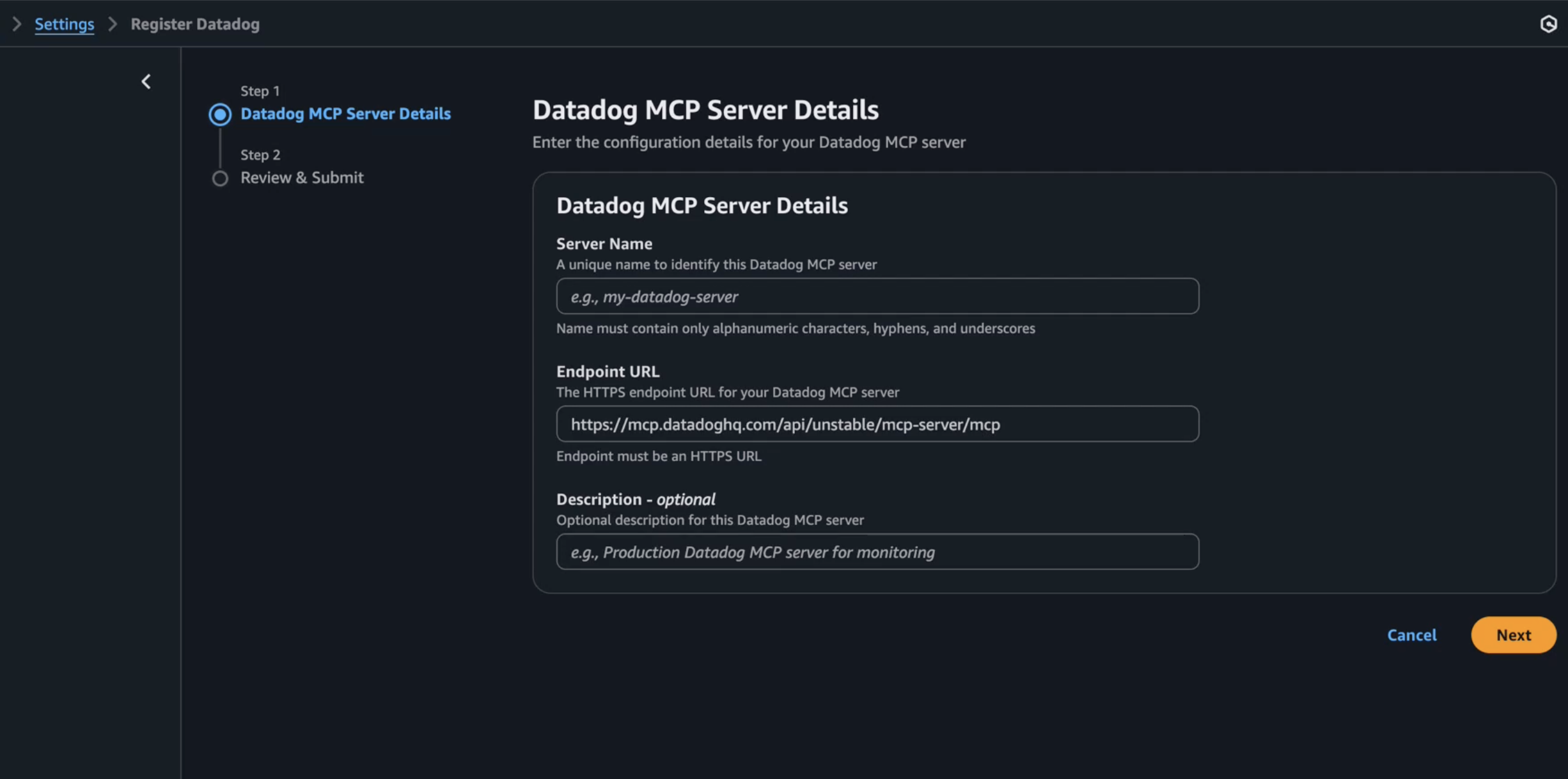 Figure 1: Setting up Datadog MCP Server in AWS DevOps Agent Console
Create an AWS DevOps Agent Agent Space
Next, create an Agent Space in your primary AWS account. This requires an AWS IAM role that grants AWS DevOps Agent access to your AWS resources. After creating your Agent Space, add Datadog MCP Server as a telemetry source to enable comprehensive incident investigation.
To create your Agent Space, start by accessing the AWS DevOps Agent console in us-east-1. Choose the “Create Agent Space” button and provide a meaningful name and description for your space. After submitting the form, you’ll need to configure the required IAM roles, which can be done through either the automated creation process or manual setup.
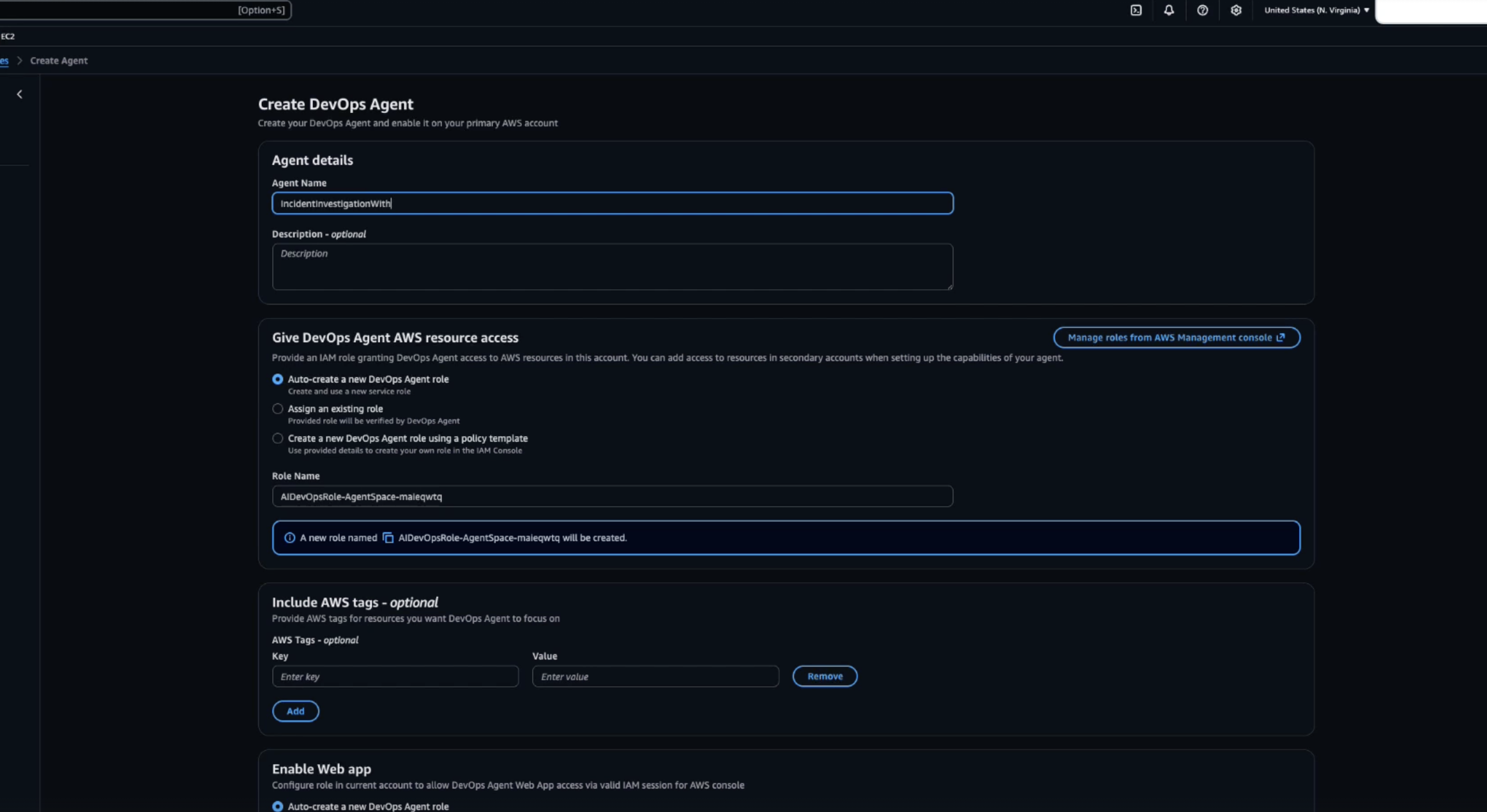 Figure 2: Creating a AWS DevOps Agent in Agent Space
Your Agent Space topology can be initialized using either AWS CloudFormation stacks or AWS Tags as starting points to identify your application components. Once the basic setup is complete, you can enhance your Agent Space configuration by adding Secondary source accounts for multi-account monitoring and configuring integrations with services like SIM ticketing system, Pipelines (where GitFarm packages and CloudFormation Stacks are located), Slack, and most importantly for our use case, Telemetry with the Datadog MCP Server.
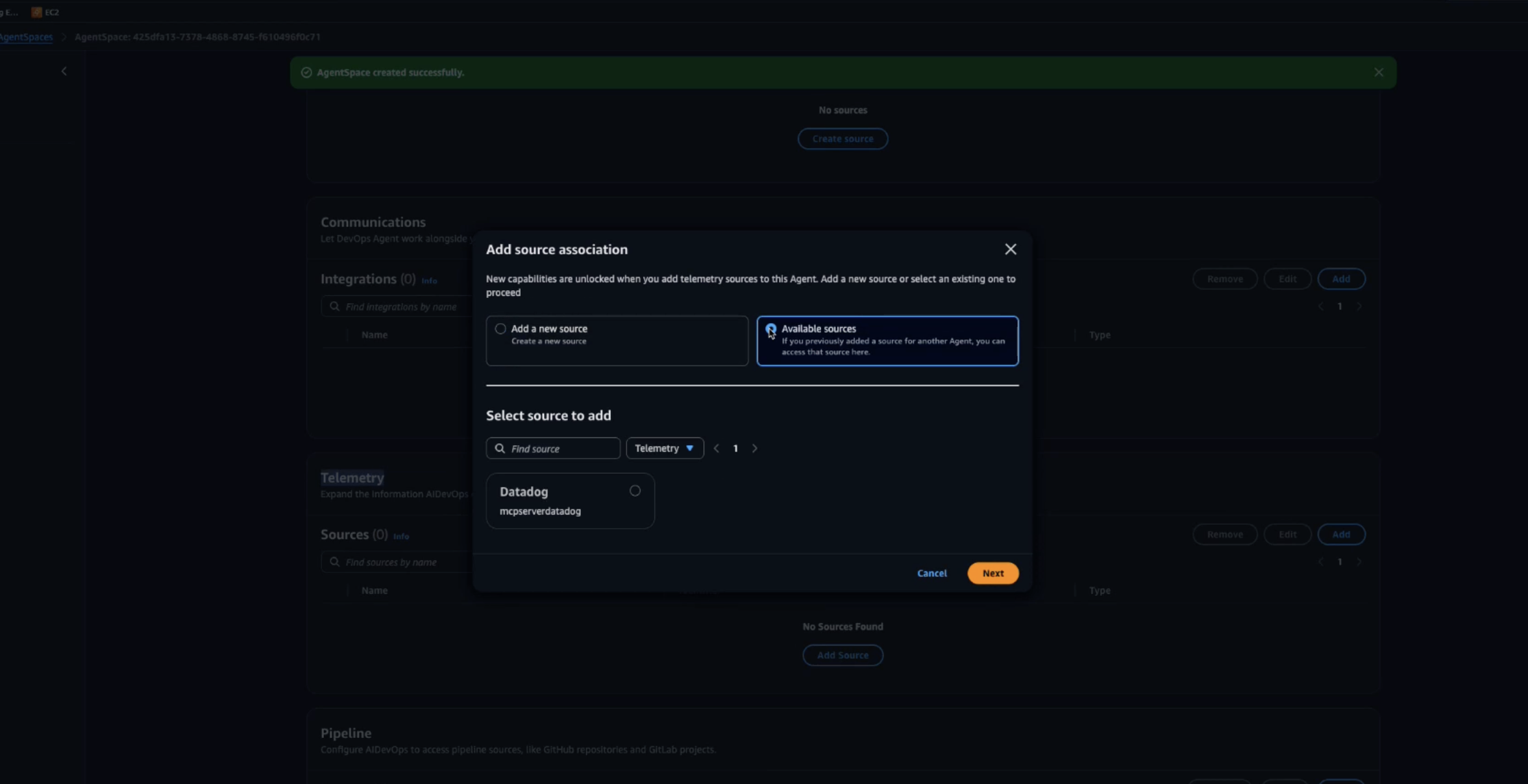 Figure 3: Add additional telemetry sources for AWS DevOps Agent to investigate
From here, we can launch the Agent Space web app to begin the investigation.
Real-World example: Resolving API Gateway errors
Let’s walk through how AWS DevOps Agent and Datadog work together to resolve a production incident. In this scenario, Datadog detects a spike in Amazon API Gateway 5XX errors affecting downstream services.
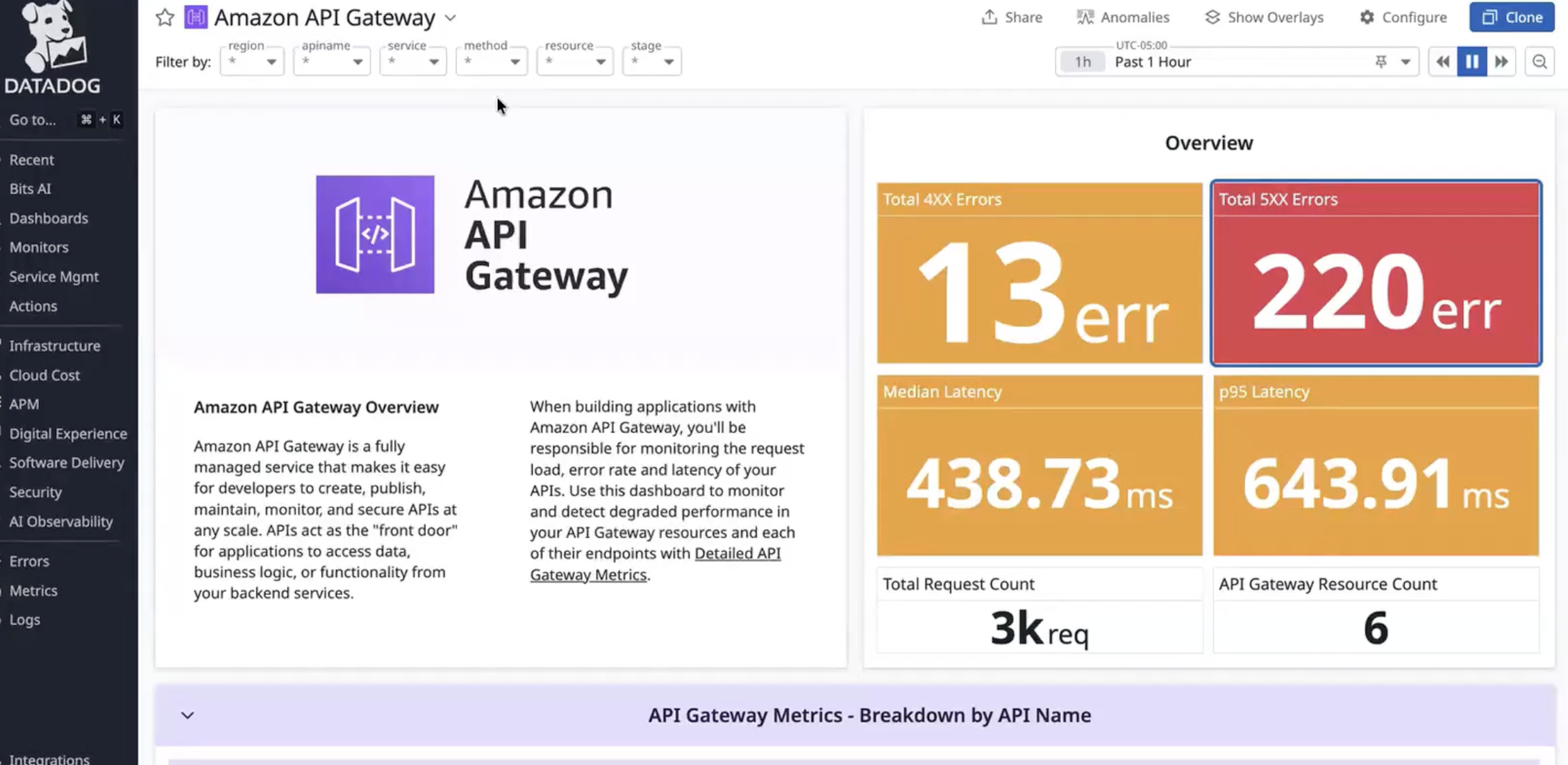 Figure 4: Sample API Gateway errors in Datadog
Investigating 5XX errors from API Gateway Incident with the Datadog MCP Server and AWS DevOps Agent
When the alert triggers, AWS DevOps Agent automatically analyzes both Datadog metrics and API Gateway logs. Through the investigation chat interface, an engineer guides AWS DevOps Agent to examine the API Gateway configuration. The agent correlates API Gateway and AWS Lambda execution logs, quickly identifying error patterns.
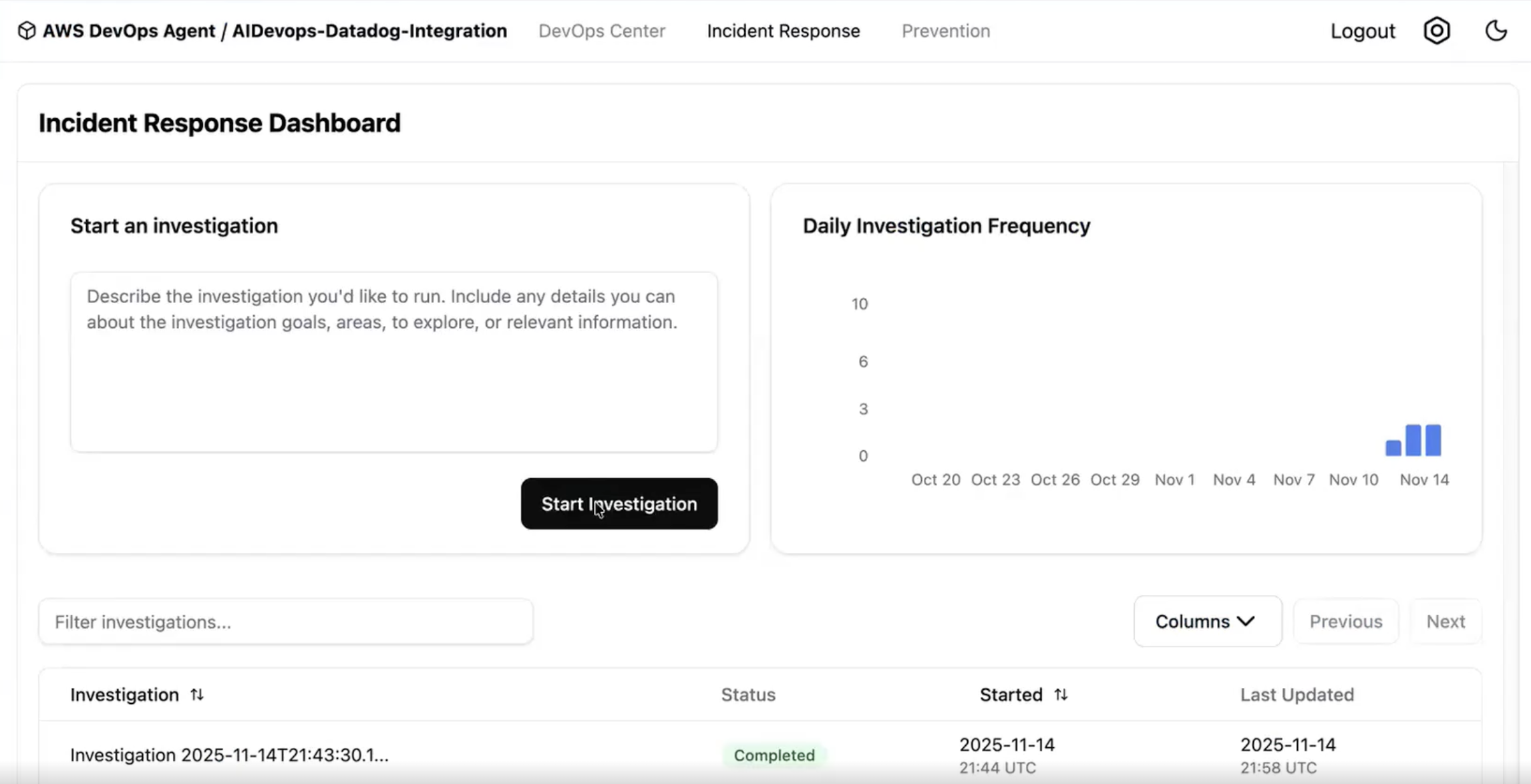 Figure 4: Investigating an incident with AWS DevOps Agent and Datadog MCP
Resolving and prevention
AWS DevOps Agent helps identify potential misconfigurations in the Lambda and Amazon DynamoDB integration and implements immediate fixes. The agent documents all findings and actions in an incident record, backed by telemetry from both Datadog and AWS services. After resolution, AWS DevOps Agent generates a detailed analysis report with specific recommendations to prevent similar incidents. Teams can review and implement these suggestions through the Prevention feature in the AWS DevOps Agent web app.
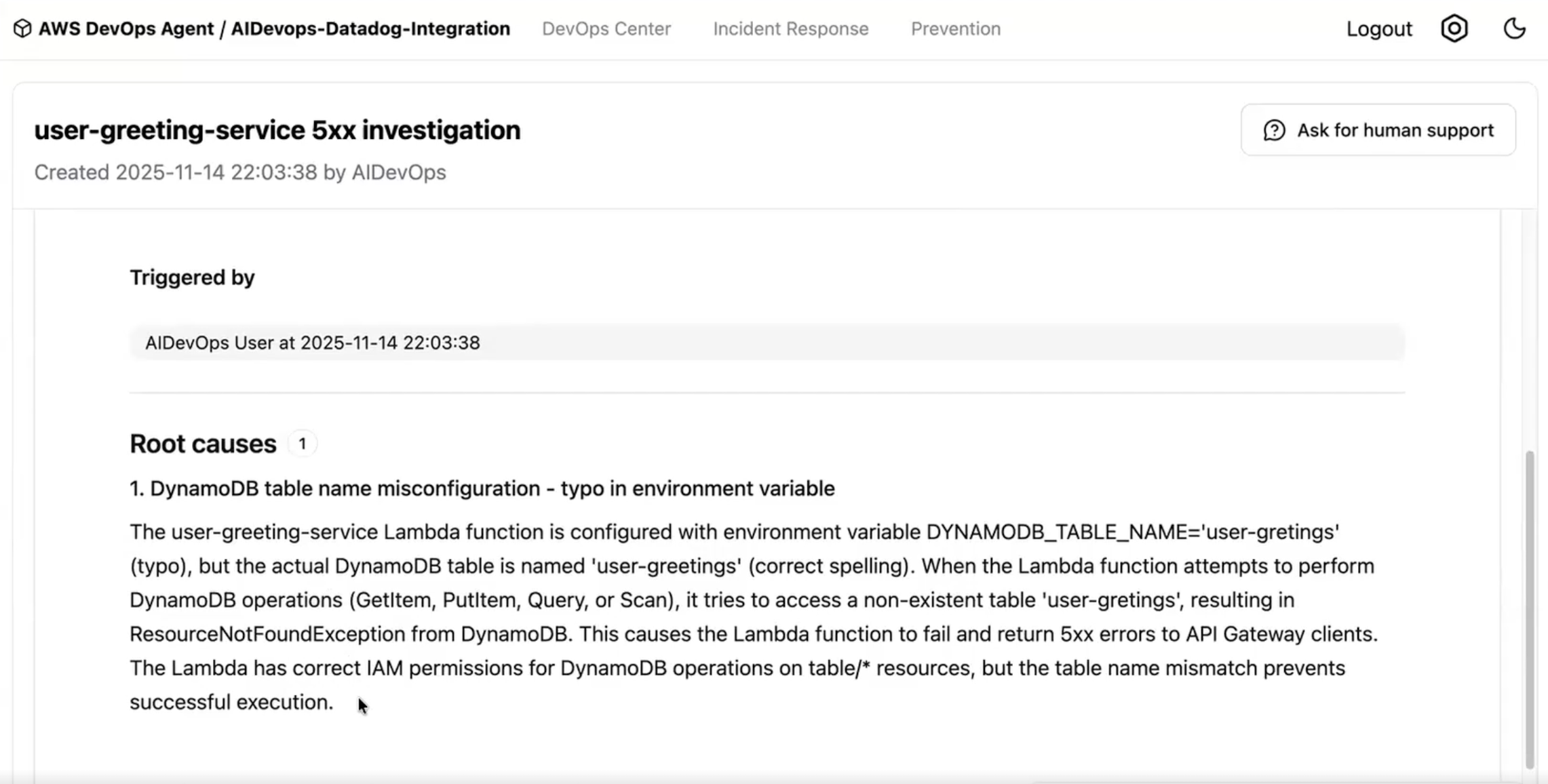 Figure 5: Investigation summary produced by AWS DevOps Agent
Clean up
When you’re done using the integration, you can clean up your resources by following these steps:
- Delete your Agent Space from the AWS DevOps Agent console
- Remove the Datadog MCP Server connection from your settings
- Delete the IAM roles created for the Agent Space
- (Optional) If you created additional source account roles, remove those as well
Conclusion
The integration between Datadog MCP Server and AWS DevOps Agent reduces incident resolution time by automatically correlating data across your monitoring tools. Instead of manually switching between Datadog and AWS dashboards during incidents, teams can now get an AI-powered investigation that identifies root causes and suggests fixes. Early adopters report significant improvements in their incident response. Resolution times drop from hours to minutes, while on-call teams spend less time gathering data. Teams also see more consistent incident responses and improved root cause analysis through comprehensive data correlation. To learn more, check out the AWS DevOps Agent product page.
Datadog is an AWS Specialization Partner and AWS Marketplace Seller that has been building integrations with AWS services for over a decade, amassing a growing catalog of 100+ AWS and 1000+ built-in integrations. This new AWS DevOps Agent and Datadog MCP Server integration builds upon Datadog’s strong track record of AWS partnership success. If you’re not already using Datadog, you can get started with a 14-day free trial via the AWS Marketplace.
React2Shell (CVE-2025-55182) – Critical unauthenticated RCE affecting React Server Components
Post Syndicated from Rapid7 original https://www.rapid7.com/blog/post/etr-react2shell-cve-2025-55182-critical-unauthenticated-rce-affecting-react-server-components
Overview
On December 3, 2025, Meta disclosed a new vulnerability, CVE-2025-55182, which has since been dubbed React2Shell. A second CVE identifier, CVE-2025-66478, was assigned and published to track the vulnerability in the context of Next.js. However this second CVE has since been rejected as a duplicate of CVE-2025-55182, as the root cause in all cases is the same and should be referred to with a single common CVE identifier.
CVE-2025-55182 is a critical unauthenticated remote code execution vulnerability affecting React, a very popular library for building modern web applications. This new vulnerability has a CVSS rating of 10.0, which is the maximum rating possible and indicates the highly critical nature of the issue. Successful exploitation of CVE-2025-55182 allows a remote unauthenticated attacker to execute arbitrary code on an affected server via malicious HTTP requests.
The vulnerability affects React applications that support React Server Components. While the vulnerability affects the React Server Components feature, server applications may still be vulnerable even if the application does not explicitly implement any React Server Function endpoints but does support React Server Components. Additionally many popular frameworks based on React, such as Next.js, are also affected by this vulnerability.
A separate advisory was published by Vercel, the vendor for Next.js. This advisory tracks the impact of CVE-2025-55182 as it applies to the Next.js framework, and provides information for Next.js users to remediate the issue.
As of December 4, 2025, there is no known public exploit code available at this time. Several exploits have been published claiming to exploit CVE-2025-55182, however they have not been successfully verified as actually exploiting this vulnerability. This has been noted in the original finders website, react2shell.com. Therefore, broad exploitation has not yet begun, however once a viable public exploit becomes available we expect this to change.
Organizations who use React, or the affected downstream frameworks, are urged to remediate this vulnerability on an urgent basis, outside of normal patch cycles and before broad exploitation begins.
Mitigation guidance
CVE-2025-55182 affects versions 19.0, 19.1.0, 19.1.1, and 19.2.0 of the following React packages:
A vendor supplied update for the above packages is available in versions 19.0.1, 19.1.2, and 19.2.1. Users of affected React packages are advised to update the latest remediated version on an urgent basis.
Downstream frameworks that depend on React are also affected, this includes (but is not limited to):
For the latest mitigation guidance for React, please refer to the React security advisory. For the latest mitigation guidance specific to Next.js, please refer to the Vercel security advisory.
Rapid7 customers
Exposure Command, InsightVM and Nexpose
Exposure Command, InsightVM and Nexpose customers can assess exposure to CVE-2025-55812 with an unauthenticated check expected to be available in today’s (December 4) content release. Note that the “Potential” check type must be enabled before running the scan to successfully assess for the vulnerability.