Post Syndicated from The Atlantic original https://www.youtube.com/watch?v=1-Di3VbW99Q
Наистина ли им пука за децата?
Post Syndicated from Светла Енчева original https://www.toest.bg/naistina-li-im-puka-za-detsata/

Мой приятел обича да се позовава на стар скеч, пародиращ как всякакъв аргумент може да мине, ако кажеш „заради децата“ и наклониш глава настрани.
Защо България не ратифицира Конвенцията за борба с насилието над жени и домашното насилие и дори я обяви за противоконституционна?
Заради децата.
Защо в светските училища се забрани говоренето по теми, свързани с ЛГБТИ, но пък задължителноизбираемото обучение по религия вече мина на първо четене в парламента?
Разбира се, заради децата.
Представете си как някой властимащ или популярна личност казва тези неща, мило накланяйки главата си на една страна.
Законодателството срещу педофилията
Думата „педофилия“ влезе в българското законодателство през 2023 г., когато по предложение на „Възраждане“ в Закона за закрила на детето беше предвиден т.нар. Национален регистър за случаите на педофилия. И понеже законодателната промяна беше „заради децата“, тя се прие с огромно мнозинство – едва 17 депутати гласуваха против, а двама се въздържаха.
Нямаше дебат за прецизиране на логическите несъответствия между проектозакона и Наказателния кодекс (НК). Едно такова несъответствие е, че според НК в общия случай са забранени сексуалните отношения с деца под 14-годишна възраст, а в регистъра на педофилите следва да бъдат вкарани всички случаи на сексуални престъпления срещу малолетни (до 14 г.) и непълнолетни (до 18 г.). При това без да има изискване за възрастова разлика между извършителя и жертвата.
Поредното асоцииране на хомосексуалността с педофилията
В края на октомври 2025 г. стана известен случай, в който са замесени дългогодишният председател на Националната пациентска организация (с абревиатура НПО, дублираща тази на неправителствените организации) Станимир Хасърджиев, актьорът Росен Белов, гръцкият модел Анастасиос Михаилидис и бившият френски легионер Симеон Дряновски. Те са обвинени, че са дрогирали насила 20-годишен младеж, държали са го часове наред вързан и са го заплашвали с огнестрелно оръжие. Младият мъж успял да избяга, скачайки от балкона на долния етаж, и се обадил на майка си за помощ.
Този безспорно тревожен (според публично известната информация) случай обаче катализира хомофобски настроения. Въпреки че жертви на принуда, в това число групова, нерядко се оказват и жени. Друг е въпросът, че някой може да е принципно съгласен на нещо (примерно секс), но в представите му то да не върви в комплект с дрога, насилие и заплахи.
Скоро институции, организации и хора започнаха да се отричат от замесените като свети Петър от Христос.
Първо пациентската организация побърза да се разграничи от собствения си председател. Тя изпрати съобщение до медиите с намеци за негови „лични проблеми“, които той пренебрегвал и отказвал да потърси професионална помощ. Затова оперативният екип на организацията напуснал и последвали много беди за нея.
Гръцкият модел пък се разграничи от останалите обвиняеми, твърдейки, че за разлика от тях не е гей. Присъствал е на партитата у Хасърджиев, но въпросната вечер хем нищо не видял, хем се възмутил и си тръгнал (очевидно без да уведоми полицията).
Актьорът Росен Белов беше отстранен и от частната детска театрална школа, където преподава, и от Театър „София“, в който играе.
Историята придоби политически привкус,
след като стана ясно, че школата е била собственост на министъра на културата Мариан Бачев (прехвърлил я на съпругата си при заемането на поста в правителството). Предполагаемо близките му отношения с Белов станаха повод „Възраждане“ да иска оставката му.
„Слава богу, по отношение на работата с децата администрацията няма бележки и притеснения“, заяви Делян Георгиев – кмет на район „Изгрев“, където се помещава театралната работилница. Той обвини културния министър, че се опитва да го сплаши, като му праща нотариална покана.
Бачев определи Белов като „прекрасен професионалист“, добавяйки, че актьорът е пълнолетен и отговаря за постъпките си. Въпреки че професионализмът няма отношение към евентуалната му вина. Той публикува и писмо от родителите на децата в школата, в което изразяват увереност, че тя предоставя безопасна среда на децата им.
Защо децата станаха тема в този скандал, след като на партито, заради което са арестувани четиримата мъже, е нямало непълнолетни? Една от устойчивите хомофобски опорки е асоциирането на хомосексуалната ориентация с педофилията. Разбира се, всичко е „заради децата“. Да не помисли човек, че един районен кмет използва всеки удобен случай, за да си прави актив, или че някой може да има апетити към министерски пост. Или пък към достъпа на една казионна неправителствена организация до ресурси и влияние.
Институционална слепота при сериозни подозрения за педофилия
Съвсем по различен начин реагират кметът на друга община – Поморие, и представители на местните институции при наличието на данни, изискващи сериозна проверка дали е имало реално сексуално насилие над дете. Случаят придоби публичност основно благодарение на журналистическото разследване на Тина Ивайлова за сайта GlasNews (част 1, 2, 3).
Майката на 4-годишно момиченце, което посещава детската градина в град Каблешково (община Поморие), забелязва промяна в поведението на детето, както и следи от насилие, като изпочупени нокти, сякаш отделени от основата.
През януари 2025 г. момичето разказва на майка си, че нараняванията по ноктите са от учителката му в детската градина Мариета Герова. То твърди, че учителката всекидневно го е подлагала и на други форми на физическо насилие, между които настъпване, душене, връзване, събаряне от стола.
Майката вади съдебномедицинска експертиза за ноктите, в която се казва: „Причинено е болка.“ Подава жалба до директорката на градината с копие до общината и местния клон на Държавната агенция за закрила на детето. По думите ѝ, директорката обещава да премести момичето в друга група и да следи дали всичко е наред, само и само да се оттегли жалбата. Майката не оттегля жалбата, а учителката излиза в болнични.
Около началото на март разказите на момиченцето навеждат и на хипотезата за сексуално насилие от страна на Герова. Детето споделя за това и с психотерапевт. Следва нова съдебномедицинска експертиза, която установява разкъсан химен и зарастващи рани в интимната област.
Какви са реакциите на институциите?
Въпреки жалбите и съдебномедицинските експертизи институциите не само не реагират своевременно, а и действат заедно против семейството на пострадалото дете. Директорката на градината Афродита Данданова разполага с вътрешна информация за разследването, до която родителите нямат достъп, и няма да се стигне до дело. Пред скрита камера тя разказва, че на прокурорката ѝ станало „смешно“, и прави внушения, че виновни за насилието са самите родители или хипотетичен любовник на майката:
Те прикриват нещо чрез нашата градина […] „Закрила на детето“ казаха – има нещо тук в семейството. […] То бащата повечето време го нямаше […] Няма един мъж на този свят, нищо не се знае.
Самата учителка отрича и нарича Ивайлова „купен журналист“.
Тъй като според прокуратурата съдебномедицинските експертизи не са взети по правилния начин (макар това да е бил единственият начин, възможен за родителите), те назначават нова, която се провежда чак през септември. На нея, естествено, вече няма рани по химена на детето, който е все така перфориран. Но районната прокурорка на Бургас Мария Маркова заявява:
Не са налице доказателства относно извършване сексуално насилие по отношение на детето. Към настоящия момент няма предявено обвинение.
Не се възприемат сериозно и показанията на детето в т.нар. синя стая. От 4-годишното момиченце, което не познава часовника, се е изисквало да посочи в какъв времеви диапазон са ставали посегателствата върху него.
Отгоре на всичко един ден на внезапна проверка в дома на семейството идват представители на Регионалния инспекторат към МОН, Агенция „Социално подпомагане“ и Общината.
Най-възмутен е кметът на Поморие Иван Алексиев (от ГЕРБ).
Но не от насилието, а от семейството, което търси справедливост, и от журналистката, която дава гласност на случая.
Твърдо защитавам госпожа Данданова и целия колектив на детска градина „Радост“, град Каблешково, както и госпожа Герова. […] Докато в държавата няма критерий за разследващ журналист, за електронна медия, ще се случват тези неща… Съсипаха живота на госпожа Герова, на госпожа Данданова.
Кметът, за когото се смята, че е близък със съпруга на учителката Мариета Герова, е гневен и че случаят е стигнал до парламента, и показва нагледно какво е местен феодализъм:
Не можеш да използваш трибуната на Народното събрание, най-високата трибуна в държавата ни. В тази връзка ще използвам една още по-висока трибуна – а именно трибуната на Община Поморие.
Какво казват експертите?
Чак след излъчването на първата част от разследването на Тина Ивайлова по случая се вдига шум и той е прехвърлен към варненската прокуратура в опит да се гарантира независимо разследване.
В следващите части на материала се представят интервюта с експерти – криминалните психолози Тодор Тодоров и Христина Алексова, Мария Брестничка от „Национална мрежа за децата“, адвокатката по медицинско право Мария Янева и Цветеслава Гълъбова – директорка на психиатрията „Св. Иван Рилски“ в Курило. Според тях е практически невъзможно детето да си измисля какво му се е случило, защото едно 4-годишно момиченце няма съответния опит, за да си въобрази толкова конкретни детайли.
В търсене на изгубената логика
В резултат на натиска, на който са подложени, защото искат насилието върху дъщеря им да бъде разследвано, родителите на пострадалото момиченце продават къщата си и се местят с трите си деца в нов дом другаде. За семейството вече няма място там, където кмет, институции и част от местното население го демонизират. Публичната информация за преживяното насилие ще преследва момичето, където и да иде. Учителката Мариета Герова продължава да е в болнични, а след изтичането им, по думите на поморийския кмет, ще излезе в годишен отпуск.
Контрастът със случая с принудително дрогирания младеж в София е огромен. Участниците в партито бяха арестувани. На младежа и родителите му не се е наложило да излязат от анонимност в името на справедливостта и по този начин си спестяват ретравматизирането. Както и би трябвало да бъде.
Ако търсим логика защо в единия случай е така, а в другия – иначе, трудно ще я намерим. Защото тук няма логика, а феодални отношения в малките населени места, които държавата не се и опитва особено да пребори. Има и „борба с педофилията“ от лицемерна загриженост за децата. Лицемерна, защото при данни за реална педофилия свидетелствата на пострадалото дете не се приемат сериозно. Както и на многото деца от домове и гета, върху които е упражнено сексуално насилие, останало ненаказано. И на всички други, срещу които има посегателства, но те ще останат скрити, защото „какво ще си кажат хората“.
А ние нека си казваме, че всичко е „заради децата“. И за по-сигурно да накланяме глава настрани.
TP-Link BE3600 Wi-Fi 7 Portable Travel Router TL-WR3602BE Review
Post Syndicated from Rohit Kumar original https://www.servethehome.com/tp-link-be3600-wi-fi-7-portable-travel-router-tl-wr3602be-review/
We test the TP-Link BE3600 Wi-Fi 7 Portable Travel Router (TL-WR3602BE) and see some good features and some that we would skip in our review
The post TP-Link BE3600 Wi-Fi 7 Portable Travel Router TL-WR3602BE Review appeared first on ServeTheHome.
What Abraham Lincoln Can Teach Us About The American Revolution
Post Syndicated from The Atlantic original https://www.youtube.com/shorts/5eVIuZjrAwE
The attendee’s guide to the AWS re:Invent 2025 Compute track
Post Syndicated from Mai Kulkarni original https://aws.amazon.com/blogs/compute/the-attendees-guide-to-the-aws-reinvent-2025-compute-track/
From December 1st to December 5th, Amazon Web Services (AWS) will hold its annual premier learning event: re:Invent. At this event, attendees can become stronger and more proficient in any area of AWS technology through a variety of experiences: large keynotes given by AWS leaders, smaller innovation talks, interactive working sessions given by AWS experts, and fun activities such as live music and games at re:Play.
There are over 2000+ learning sessions that focus on specific topics at various skill levels, and the compute team have created 76 unique sessions for you to choose. There are many sessions you can choose from, and we are here to help you choose the sessions that best fit your needs. Even if you cannot join in person, you can catch-up with many of the sessions on-demand and even watch the keynote and innovation sessions live.
The basics: Session types
If you can join us, then remember that we offer several types of sessions that can help maximize your learning in a variety of AWS topics.
re:Invent attendees can also choose to attend chalk-talks, builder sessions, workshops, or code talk sessions. Each of these are live non-recorded interactive sessions.
- Breakout sessions: Attendees are in a lecture-style 60-minute informative sessions presented by AWS experts, customers, or partners. These sessions are recorded and uploaded a few days after to the AWS Events YouTube channel.
- Chalk-talk sessions: Attendees interact with presenters, asking questions, and using a whiteboard in session.
- Builder Sessions: Attendees participate in a one-hour session and build something.
- Workshops sessions: Attendees join a two-hour interactive session where they work in a small team to solve a real problem using AWS services.
- Code talk sessions: Attendees participate in engaging code-focused sessions where an expert leads a live coding session.
- Lightning talk sessions: Attendees watch a 20-minute demo dedicated to either a specific service or customer story (located in the Venetian Expo Hall or Mandalay Bay Level 2 South).
Getting started with Amazon EC2
The foundation of compute in AWS is Amazon Elastic Compute Cloud (Amazon EC2). Amazon EC2 offers the broadest and deepest compute platform, with over 1000 instances and choice of the latest processor, storage, networking, operating system, and purchase model to help you best match the needs of your workload. We’ve created the following sessions to help you implement and manage your workloads on EC2.
CMP356 | How well do you know EC2
EC2 offers 1000+ instance types with diverse processors, accelerators, and the AWS Nitro System. Options include cost-effective Spot Instances and Savings Plans. Learn how to optimize workload-instance matching for better performance and savings.
CMP343 | Select and launch the right instance for your workload and budget
Explore the newest EC2 instances featuring Intel Xeon Scalable (Granite Rapids), AMD EPYC (Turin), and AWS Graviton processors. Learn how to choose the optimal instance type for your workload and budget requirements.
CMP305 | Assembling the Complete AI Stack: Optimizing your AI hardware on AWS
Learn how to optimize your AI infrastructure on AWS: Choose the right processors, accelerators, storage, and pricing models for your workloads. Get practical guidance on GPU selection, vector databases, and building cost-effective, scalable AI platforms.
CMP332 | Mastering EC2 Image Builder: From basics to advanced techniques
Hands-on session: Build an automated image pipeline with AWS experts. Learn the basics and advanced features such as multi-account distribution and continuous integration/continuous development (CI/CD) integration in 60 minutes.
CMP331 | Managing Amazon EC2 capacity and availability
Learn how to optimize EC2 costs and capacity using different reservation models, such as On-Demand, Capacity Blocks for machine learning (ML), and capacity reservations, to improve efficiency and availability.
CMP330 | Use Auto Scaling to proactively scale and optimize EC2 workloads
Learn how to harness the latest features of EC2 Auto Scaling to optimize your cloud resources. This hands-on workshop covers predictive scaling, dynamic scaling, and warm pools to automatically manage capacity based on demand. This is perfect for those wanting to improve application availability while reducing costs. Bring your laptop for practical exercises.
Learn about AWS Compute innovations
AWS has invested years into designing custom silicon optimized for the cloud to deliver the best price performance for a wide range of applications and workloads using AWS services. Learn more about the AWS Nitro System, processors at AWS, and ML chips.
CMP316 | Deep Dive into the AWS Nitro System
Explore the architecture behind the groundbreaking AWS Nitro System: the custom hardware and security components driving modern EC2 instances. Learn how this innovative platform enables unprecedented compute, storage, and networking capabilities, and discover the latest advances making new cloud possibilities reality.
CMP307 | AWS Graviton: The best price performance for your AWS workloads
Explore how AWS Graviton processors deliver superior performance and energy efficiency in EC2. Learn optimization best practices, common use cases, and customer success stories to accelerate your AWS Graviton adoption journey.
CMP336 | Optimize network and Amazon EBS intensive workloads on Amazon EC2 instances
Discover how to maximize the EC2 network and Amazon Elastic Block Store (Amazon EBS)-optimized instances for high-performance workloads. Learn to use new AWS Graviton and Intel instances for security appliances, databases, and network-intensive applications. Get practical insights into the latest networking and storage technologies to optimize your EC2 workload performance.
CMP315 | Maximizing EC2 Local NVMe Storage: Enhanced NVMe Metrics and Kubernetes Integration
Learn to optimize data-intensive workloads using AWS Nitro SSDs. Explore new performance metrics (latency, IOPS, throughput) and best practices for monitoring and tuning application performance.
CMP407 | Innovating with AWS confidential computing: An integrated approach
Learn how AWS confidential computing (Nitro System, Enclaves, TPM) protects sensitive data during processing. Explore solutions for secure data handling across CPU, GPU, and AI workloads.
CMP302 | Accelerating engineering: Cross-industry HPC cloud transformations
Discover how AWS high performance computing (HPC) transformed engineering and product development across industries. Learn how customers used cloud HPC to revolutionize their design processes to reduce time-to-market and increase innovation efficiency. Observe how HPC instances, Elastic Fabric Adapter (EFA), Amazon FSx for Lustre, and AWS ParallelCluster accelerate global R&D innovation.
Optimize your compute costs
At AWS, we focus on delivering the best possible cost structure for our customers. Frugality is one of our founding leadership principles. Cost effective design continues to shape everything we do, from how we develop products to how we run our operations. Come learn new ways to optimize your compute costs through AWS services, tools, and optimization strategies in the following sessions:
CMP347 | The Frugal Architect in a chaotic world
Discover the practical implementation of Werner Vogels’ Frugal Architect principles through a hands-on exploration of AWS Graviton, EC2 Spot, Karpenter, and AI tools. Watch as we optimize a shopping cart using AI and flame graphs, demonstrating how to build efficient systems without compromising quality. Learn to combine Karpenter’s intelligent scaling, the performance benefits of AWS Graviton, and AI-driven analysis to create systems that are faster, leaner, and more cost-effective by design.
CMP349 | 5-Star customer service: Duolingo’s path to compute savings
Learn how Duolingo partnered with their AWS Technical Account Manager to transform their cloud spending. Discover their successful transition to AWS Graviton processors, from initial cost analysis through enterprise-wide implementation. Observe how the AWS customer-focused approach delivered significant savings and business value for Duolingo.
CMP337 | Optimizing EC2: Hands-on strategies for cost-effective performance
Get hands-on with advanced EC2 instance optimization in this technical workshop. Learn to analyze workloads, measure performance metrics, and master benchmarking tools through guided exercises. Walk away with practical strategies to choose and tune EC2 instances for your specific application needs. Perfect for architects and developers looking to maximize their AWS infrastructure performance.
CMP314 | Data-driven EC2 optimization: Efficiency, metrics, and sustainability
Join this chalk talk to discover how metric-driven decisions can transform your EC2 fleet optimization. Through real-world scenarios, learn to analyze workload data, choose optimal instance types, and fine-tune capacity for your specific needs. We explore practical approaches to balance cost, performance, and sustainability using AWS-native tools, providing you with actionable strategies that you can implement immediately.
CMP412 | EC2 Flex instances: Get the latest generation performance at lower costs
Explore how EC2 Flex instances deliver the latest generation performance at reduced costs. Learn about optimal workload types, architectural design, and implementation strategies. Discover practical approaches to adoption and performance monitoring to maximize your EC2 Flex instance benefits.
Maximize your workload’s performance
Your workload’s performance matters beyond just cost because it directly impacts the quality, efficiency, and effectiveness of your compute solution. It can significantly influence customer satisfaction, business growth, and overall productivity. Even if a cheaper option exists, a low-cost option with poor performance can lead to long-term financial losses due to issues such as lost customers, engineering rework, and negative reputation. We have several sessions that help you optimize your workload’s performance.
CMP333 | Maximizing EC2 performance: A hands-on guide to instance optimization
Live coding session: Learn to optimize EC2 performance using Amazon CloudWatch and APerf. Observe real-world examples of workload analysis and code optimization across different instance types and programming languages.
CMP351 | Building for efficiency and reliability with performance testing on AWS
Learn performance testing strategies on AWS to optimize costs, identify bottlenecks, and improve reliability. Discover how to measure system behavior under various loads to inform architecture and instance selection decisions.
CMP405 | Everything you’ve wanted to know about performance on EC2 instances
Explore compute optimization techniques in this code talk. Learn about memory topology, hardware counters, hyperthreading effects, and methods for accurate performance testing and latency optimization.
Customer experience and applications with AI and ML
ML has been evolving for decades and has an inflection point with generative AI applications capturing widespread attention and imagination. Learn about generative AI infrastructure at Amazon or get hands-on experience building ML applications through our ML focused sessions, such as the following:
CMP201 | Architecting solution patterns for GPU-accelerated HPC and AI/ML
Interactive discussion on GPU-accelerated HPC and AI/ML architecture. Explore EC2 GPU instance families, architectural tradeoffs , and cost optimization strategies. Share your challenges and learn how to build scalable GPU solutions on AWS.
CMP403 | Build, scale, and optimize agentic AI on CPUs with AWS Graviton
Hands-on workshop: Build cost-efficient AI applications on AWS Graviton. Deploy large language model (LLM) inference, multi-agent systems, and vector databases using Amazon Elastic Kubernetes Service (Amazon EKS) and Karpenter. Create a chat app showcasing the performance benefits of AWS Graviton.
CMP346 | Supercharge ML and inference on Apple Silicon with EC2 Mac
Learn to optimize ML workloads on EC2 Mac instances with Apple silicon. Explore Apple Neural Engine, Core ML, and efficient PyTorch/TensorFlow deployment for iOS and cloud ML applications.
CMP338 | Protect privacy in generative AI applications using AWS Confidential Computing
Build three secure generative AI applications while learning to protect sensitive data in prompts, augmented sources, and model weights. Practice implementing AWS Confidential Computing features in EC2 to mitigate common security threats. Get hands-on experience using both open source models and Amazon Bedrock to create privacy-first AI solutions.
CMP410 | Secure generative AI using trusted execution environments
Hands-on session: Build a secure AI environment using Nitro TPM-enabled EC2 instances. Deploy an LLM with cryptographic attestation and learn to protect sensitive data using trusted execution environments.
Accelerate your AWS Graviton adoption journey
The AWS Graviton Processors are custom designed server processors designed by AWS. They deliver the best price performance for your cloud workloads running in AWS and help you reduce your carbon footprint. Ready to realize up to 40% better price performance for your workloads? We have curated the following session to help you accelerate your AWS Graviton adoption:
CMP329 | Learnings from developers adopting AWS Graviton at scale
Learn how the custom-designed AWS Graviton processors deliver optimal price-performance across diverse workloads: from microservices to HPC. Engage with AWS experts to explore adoption strategies, best practices, and real customer success stories for scaling AWS Graviton in production.
CMP352 | Unlock cost efficiency with AWS Graviton Savings Dashboard
Discover how the enhanced AWS Graviton Savings Dashboard provides deeper analytics for workload modernization, enabling up to 40% better price performance. Learn to use advanced features for granular workload analysis and streamlined migration planning. This lightning talk shows you how to transform efficiency insights into actionable strategies for measurable cloud cost savings.
CMP326 | Java modernization and performance optimization GameDay
Hands-on workshop: Use Amazon Q Developer to modernize Java applications from v8 to v21. Practice automated code analysis, performance benchmarking, and cost optimization across different instances. Laptop needed.
CMP335 | Optimize .NET TCO with agentic AI powered AWS Transform and AWS Graviton
Hands-on workshop: Use agentic AI to accelerate the migration of Windows-based .NET applications to .NET Core running on Linux with AWS Graviton for 40% better price performance. Learn code analysis, automated transformations, and CI/CD updates. For .NET developers/architects. Laptop needed.
Optimizing your container-based workloads
Maximizing the efficiency of container-based workloads is crucial for modern cloud applications. Whether you’re running microservices, web applications, or high-performance computing tasks, optimizing your container infrastructure can significantly impact both performance and cost. In this track, we’ve assembled essential sessions focused on using AWS Graviton processors and modernization tools to enhance your containerized applications. From real-world adoption stories to hands-on workshops, these sessions can help you achieve better price performance while maintaining operational excellence. Join us to explore the following:
CMP310 | Boost Amazon EKS efficiency: Amazon EKS Auto Mode, AWS Graviton, and EC2 Spot
Explore how Amazon EKS Auto Mode streamlines Kubernetes operations by removing infrastructure management complexity. Learn to optimize costs using AWS Graviton and EC2 Spot, with practical examples for building more efficient, cost-effective container environments.
CMP311 | Build once, run everywhere: Multi-architecture in your CI/CD pipelines
Learn to build multi-architecture containers for x86 and AWS Graviton processors. Observe how to optimize web applications for both platforms and integrate with CI/CD systems such as ArgoCD, GitLab, and GitHub.
CMP348 | Using Amazon Q to cost optimize your containerized workloads
Learn to achieve 40% better price-performance by migrating containerized workloads to AWS Graviton using Amazon EKS and Karpenter. Use Amazon Q to accelerate x86-to-Graviton migration, implement multi-architecture CI/CD pipelines, and optimize deployment strategies.
Quantum computing
Quantum computing is moving from theoretical possibility to practical reality, offering groundbreaking potential across industries. As organizations prepare for this technology, AWS provides the tools and infrastructure needed to explore quantum applications today. Through Amazon Braket, our managed quantum computing service, we’re making quantum experimentation accessible to enterprises, researchers, and developers alike. Whether you’re interested in drug discovery, optimization problems, or cybersecurity, this track offers a comprehensive journey from quantum basics to advanced hybrid solutions. Join industry leaders, such as AstraZeneca and Accenture, to discover how quantum computing is already delivering value and how you can begin your quantum journey:
CMP202 | Amazon Braket: Get hands-on with quantum computing
Get started with quantum computing in this practical workshop. Learn to implement quantum algorithms and run circuits on gate-based devices using Amazon Braket. Explore the quantum algorithm library of AWS through hands-on exercises. Bring your laptop to begin your quantum journey.
CMP209 | Amazon Braket hubs: Accelerating R&D in national quantum initiatives
Learn how AWS supports quantum computing research hubs worldwide, helping create secure environments and providing access to cutting-edge quantum technologies for researchers and startups.
CMP411 | Quantum computing with Amazon Braket: From exploration to enterprise
Explore quantum computing with Amazon Braket, featuring the AWS strategy and AstraZeneca’s drug discovery research. Learn how to combine quantum and classical workloads and prepare for future quantum technologies.
CMP205 | Q-CTRL Fire Opal on Amazon Braket: Quantum solutions from security to finance
Learn how organizations use Q-CTRL and Amazon Braket for quantum computing breakthroughs. Observe how Accenture Federal Services achieved 3x better network security detection using Q-CTRL’s optimizer, and explore quantum-classical solutions for various industries.
CMP304 | Architectures for hybrid quantum-classical workflows at scale
Learn to build hybrid quantum-classical computing solutions using Amazon Braket with AWS services (AWS Batch, AWS ParallelCluster) and GPU-accelerated instances. Explore architectures integrating CPUs, GPUs, and quantum processors using NVIDIA CUDA-Q.
Check out workload-specific sessions
EC2 offers the broadest and deepest compute platform to help you best match the needs of your workload. Join sessions focused on your specific workload to learn about how you can use AWS solutions to accelerate your innovations.
CMP207 | Startup to scale: Powering business growth with Amazon Lightsail
Get started in the cloud with just a few clicks with Amazon Lightsail. Discover how it can support your business at any stage of growth. Whether you’re launching your first cloud workload, migrating existing applications, or managing services for your customers, learn proven approaches for success. We explore how customers are using Lightsail today, including cost optimization and best practices for efficient scaling.
CMP320 | Full stack web apps on EC2: Using AWS Elastic Beanstalk with Amazon Q
Accelerate your cloud journey with AWS Elastic Beanstalk and Amazon Q. Learn how Elastic Beanstalk streamlines deployment and maintenance of full stack web applications on EC2 with automated infrastructure provisioning, while Amazon Q enhances your Elastic Beanstalk experience with natural language commands, intelligent troubleshooting guidance, and deployment best practices recommendations. This is perfect for teams ready to focus on building exceptional applications instead of managing infrastructure.
CMP334 | Modernize Apple platform development with AWS and EC2 Mac
Explore how EC2 Mac instances enable scalable, cost-effective macOS workloads on AWS. Learn about the latest features and hear a customer success story showcasing optimized Apple development workflows in the cloud.
CMP341 | SAP workloads on memory optimized Amazon EC2 instances
Discover how the memory-optimized instances (R, X, U) of EC2 revolutionize SAP HANA deployments, eliminating traditional infrastructure compromises. Learn from SAP’s experience managing RISE with SAP on AWS, and explore how high-memory instances can transform your SAP operations.
CMP319 | Exploring the spectrum of architecture patterns for 3D rendering
Explore the complete rendering toolkit of AWS for 3D and spatial applications: from GPU-powered EC2 instances to distributed rendering with Deadline Cloud and real-time GameLift Streams. Learn practical architecture patterns and cost optimization strategies to scale your rendering pipeline for games, architectural visualization, and AR/VR experiences.
CMP321 | Generative AI storyboarding: From Sketch to 3D Scene with generative AI on AWS
Learn to create visual content using Amazon Bedrock: convert sketches to storyboards, generate 2D/3D assets, and compose scenes. Explore AI-assisted workflows for film, games, and UI design while maintaining artistic control.
CMP211 | Hybrid science: AI + physics simulations for climate and life sciences
Explore how to combine AI with physics simulations using AWS services (such as AWS Batch, AWS ParallelCluster, Amazon FSx, EFA). Learn real-world patterns for integrating AI and simulation workflows in climate, weather, and healthcare applications.
CMP345 | Accelerate drug discovery R&D at scale with AWS
Interactive session on how top pharma companies use AWS for drug discovery R&D. Explore solutions for imaging, molecular simulation, and AI-driven research, with focus on managing large-scale data and diverse compute needs.
CMP350 | Accelerating vehicle innovation: ML and HPC best practices
Learn how Toyota and Deloitte transformed automotive engineering by migrating HPC and ML workloads to AWS. Using NVIDIA GPUs and EC2 HPC instances, they dramatically reduced development cycles. You can gain practical insights for your own high-performance computing initiatives.
CMP401 | Accelerating semiconductor design, simulation, and verification on AWS
This session covers the latest compute and storage innovations such as the new generation of EC2 instances powered by custom Intel Xeon Scalable processors (Granite Rapids), AMD EPYC processors (Turin), and AWS Graviton, and new features of Amazon FSx for NetApp ONTAP.
CMP406 | HPC infrastructure for financial services using AWS Batch and AWS CDK
Hands-on session: Build HPC infrastructure using AWS Cloud Development Kit (AWS CDK). Deploy AWS Batch for financial risk analysis workloads. This is suitable for HPC experts new to AWS and AWS developers new to HPC.
CMP204 | Quantum computing: Accelerating pharma innovation
Explore how Merck Sharp & Dohme partners with MathWorks and AWS to revolutionize pharmaceutical development through quantum computing. Using MATLAB and Amazon Braket, they implement QAOA for optimizing drug production and enhancing cancer diagnostics.
Ready to unlock new possibilities?
The AWS Compute team looks forward to seeing you in Las Vegas. Come meet us at the Compute Booth in the Expo and check out our various EC2 demos. And if you’re looking for more session recommendations, check-out more re:Invent attendee guides curated by experts.
Introducing Our Final AWS Heroes of 2025
Post Syndicated from Taylor Jacobsen original https://aws.amazon.com/blogs/aws/introducing-our-final-aws-heroes-of-2025/
With AWS re:Invent approaching, we’re celebrating three exceptional AWS Heroes whose diverse journeys and commitment to knowledge sharing are empowering builders worldwide. From advancing women in tech and rural communities to bridging academic and industry expertise and pioneering enterprise AI solutions, these leaders exemplify the innovative spirit that drives our community forward. Their stories showcase how technical excellence, combined with passionate advocacy and mentorship, strengthens the global AWS community.
Dimple Vaghela – Ahmedabad, India
 Community Hero Dimple Vaghela leads both the AWS User Group Ahmedabad and AWS User Group Vadodara, where she drives cloud education and technical growth across the region. Her impact spans organizing numerous AWS meetups, workshops, and AWS Community Days that have helped thousands of learners advance their cloud careers. Dimple launched the “Cloud for Her” project to empower girls from rural areas in technology careers and serves as co-organizer of the Women in Tech India User Group. Her exceptional leadership and community contributions were recognized at AWS re:Invent 2024 with the AWS User Group Leader Award in the Ownership category, while she continues building a more inclusive cloud community through speaking, mentoring, and organizing impactful tech events.
Rola Dali – Montreal, Canada
 Community Hero Rola Dali is a senior Data, ML, and AI expert specializing in AWS cloud, bringing unique perspective from her PhD in neuroscience and bioinformatics with expertise in human genomics. As co-organizer of the AWS Montreal User Group and a former AWS Community Builder, her commitment to the cloud community earned her the prestigious Golden Jacket recognition in 2024. She actively shapes the tech community by architecting AWS solutions, sharing knowledge through blogs and lectures, and mentoring women entering tech, academics transitioning to industry, and students starting their careers.
Vivek Velso – Toronto, Canada
 Machine Learning Hero Vivek Velso is a seasoned technology leader with over 27 years of IT industry experience, specializing in helping organizations modernize their cloud infrastructure for generative AI workloads. His deep AWS expertise earned him the prestigious Golden Jacket award for completing all AWS certifications, and he actively contributes to the AWS Subject Matter Expert (SME) program for multiple certification exams. A former AWS Community Builder and AWS Ambassador, he continues to share his knowledge through more than 100 technical blogs, articles, conference engagements, and AWS livestreams, helping the community confidently embrace cloud innovation.
Learn More
Visit the AWS Heroes webpage if you’d like to learn more about the AWS Heroes program, or to connect with a Hero near you.
— Taylor
Why I Didn’t Run Fiber (And Why You’re Wrong)
Post Syndicated from Crosstalk Solutions original https://www.youtube.com/shorts/whCNZII4-rw
Trump & Epstein #lastweektonight
Post Syndicated from LastWeekTonight original https://www.youtube.com/shorts/SLVL_wg3Hz0
Amazon Elastic Kubernetes Service gets independent affirmation of its zero operator access design
Post Syndicated from Manuel Mazarredo original https://aws.amazon.com/blogs/security/amazon-elastic-kubernetes-service-gets-independent-affirmation-of-its-zero-operator-access-design/
Today, we’re excited to announce the Amazon Elastic Kubernetes Service (Amazon EKS) zero operator access posture.
Because security is our top priority at Amazon Web Services (AWS), we designed an operational architecture to meet the data privacy posture our regulated and most stringent customers want in a managed Kubernetes service, giving them continued confidence to run their most critical and data-sensitive workloads on AWS services. Our services are designed to prevent AWS personnel from having technical pathways to read, copy, extract, modify, or otherwise access customer content in the management of Amazon EKS.
At AWS, earning trust isn’t only a goal, it’s one of the core Leadership Principles that guides every decision we make. Customers choose AWS because they trust us to provide the most secure global cloud infrastructure on which to build, migrate, and run their workloads, and to store their data. To build on this trust, we launched the AWS Trust Center to make information about how we secure our customers’ assets in the AWS Cloud more accessible. Along with this launch, we’re describing how we approach operator access to demonstrate an industry leading data privacy posture, and how we fulfill our part of the AWS Shared Responsibility Model in the AWS Cloud.
Many of the AWS core systems and services are designed with zero operator access, meaning they operate based on an architecture and model that, at the minimum, prevents any form of access to customer content in the management of the service. Instead, their systems and services are administered through automation and secure APIs that protect customer content from inadvertent or even coerced disclosure. Some of these services are AWS Key Management Service (AWS KMS), Amazon Elastic Compute Cloud (Amazon EC2) (through the AWS Nitro System), AWS Lambda, Amazon EKS, and AWS Wickr.
When AWS made its Digital Sovereignty Pledge, we committed to providing greater transparency and assurance to customers about how AWS services are designed and operated, especially when it comes to handling customer content. As part of that increased transparency, we engaged NCC Group, a leading cybersecurity consulting firm based in the United Kingdom, to conduct an independent architecture review of Amazon EKS, and the security assurances we provide to our customers. NCC Group has now issued its report and affirmed our claims. The report states:
“NCC Group found no architectural gaps that would directly compromise the security claims asserted by AWS.”
Specifically, the report validates the following statements about the Amazon EKS security posture:
- There are no technical means for AWS personnel to gain interactive access to a managed Kubernetes control plane instance.
- There are no technical means available to AWS personnel to read, copy, extract, modify, or otherwise access customer content in a managed Kubernetes control plane instance.
- Internal administrative APIs used by AWS personnel to manage the Kubernetes control plane instances cannot access customer content in the Kubernetes data plane.
- Changes to internal administrative APIs used to manage the Kubernetes control plane always requires multi-party review and approval.
- There are no technical means available to AWS personnel to access customer content in backup storage for the etcd database. No AWS personnel can access any plaintext encryption keys used for securing data in the etcd database.
- AWS personnel can only interact with the Kubernetes cluster API endpoint using internal administrative APIs without access to customer content in the managed Kubernetes control plane or the Kubernetes data plane. All actions performed on the Kubernetes cluster API endpoint by AWS personnel are visible to customers through customer enabled audit logs.
- Access to internal administrative APIs always requires authentication and authorization. All operational actions performed by internal administrative APIs are logged and audited.
- A managed Kubernetes control plane instance can only run tested software that has been deployed by a trusted pipeline. No AWS personnel can deploy software to a managed Kubernetes control plane instance outside of this pipeline.
The detailed NCC Group report examines each of these claims, including the scope, methodology, and steps that NCC Group used to evaluate the claims.
How Amazon EKS is designed for zero operator access
AWS has always used a least privilege model to minimize the number of humans that have access to systems processing customer content. This means that we design our products and services to provide each Amazonian access to only the minimum set of systems required to do their assigned task or responsibility and limit that access to when it’s needed. Any ccess to systems that store or process customer data is logged, monitored for anomalies, and audited. AWS designs all of its systems to prevent access by AWS personnel to customer content for unauthorized purposes. We commit to that in our AWS Customer Agreement and AWS Service Terms. AWS operations never require us to access, copy, or move a customer’s content without that customer’s knowledge and authorization.
Our operational architecture includes the exclusive use of AWS Nitro System-based instances to provide a confidential compute baseline for the managed Kubernetes control plane.
We use a set of restricted administrative APIs to enable precise control of access so our operators can conduct precise, allow-listed actions for troubleshooting and diagnostics without requiring direct or interactive access to the Kubernetes control plane instances. These APIs have been purposefully engineered without technical means to access customer content in the Kubernetes control plane or the customer’s Kubernetes data plane.
Following our standard change management mechanisms, we enforce a built-in, multi-party review and approval process for modifications to these restricted administrative APIs, and the accompanied policies that further strengthen the guardrails of how we operate the service. This model is implemented consistently across Amazon EKS clusters, regardless of the customer’s chosen launch mode for the Kubernetes data plane.
Additionally, every interaction with these restricted administrative APIs generates logs, with mandatory authentication and authorization, following the least privilege principle. By enabling their cluster’s audit logs, customers can maintain visibility into all actions performed by AWS personnel on the cluster’s API endpoint.
By default, we envelope encrypt all Kubernetes API data before it is stored at rest in the etcd database, and further secure backup storage of the etcd database to add multi-layered protection to prevent access to customer content in cluster snapshots. Furthermore, our system is designed so that no AWS personnel can access any of the plaintext encryption keys used to secure data in the etcd database and its backups.
These operator access controls apply uniformly to the Amazon EKS control plane, regardless of how you run your worker nodes—whether self-managed, through Amazon EKS Auto Mode, or with AWS Fargate. As stated in the AWS Shared Responsibility Model, customers remain responsible for securing the configurations of the Kubernetes worker nodes, with the exception of Amazon EKS Auto Mode and Fargate launch modes. For more information about the security of these AWS managed data plane launch modes in Amazon EKS, see the relevant links in the Learn more section.
Conclusion
Amazon EKS is designed and built to make sure that no AWS employee can read, copy, modify, or otherwise access customer content in Amazon EKS. By using AWS Nitro System‑based confidential compute, tightly‑scoped administrative APIs, multi‑party change‑approval processes, and end‑to‑end encryption, AWS avoids technical pathways for operator access. Independent validation from the NCC Group found no architectural gaps that would undermine these guarantees. In short, Amazon EKS delivers a zero operator access model that can meet the strictest regulatory and sovereignty requirements, giving organizations the confidence to run their most sensitive, mission‑critical workloads on AWS.
Learn more
- NCC Group report
- Amazon EKS documentation
- Security Overview of Amazon EKS Auto Mode
- Security Overview of AWS Fargate
- AWS Digital Sovereignty Pledge
- AWS continuous delivery practices and safe pipelines automation
If you have feedback about this post, submit comments in the Comments section below. If you have questions about this post, contact AWS Support.
Comic for 2025.11.12 – Ho Ho Ho!
Post Syndicated from Explosm.net original https://explosm.net/comics/ho-ho-ho
New Cyanide and Happiness Comic
Bambu Lab P2S + HA = Perfection 💡 The Ultimate Smart 3D Printer Setup!
Post Syndicated from BeardedTinker original https://www.youtube.com/watch?v=IEIZ0lMf1vM
MAGA Has Repulsed Young Women | The David Frum Show
Post Syndicated from The Atlantic original https://www.youtube.com/watch?v=Hk4dChFT8eQ
XGody N6 Portable Projector for Camping #glamping
Post Syndicated from digiblur DIY original https://www.youtube.com/shorts/bAJQspRWMmA
Amazon discovers APT exploiting Cisco and Citrix zero-days
Post Syndicated from CJ Moses original https://aws.amazon.com/blogs/security/amazon-discovers-apt-exploiting-cisco-and-citrix-zero-days/
The Amazon threat intelligence teams have identified an advanced threat actor exploiting previously undisclosed zero-day vulnerabilities in Cisco Identity Service Engine (ISE) and Citrix systems. The campaign used custom malware and demonstrated access to multiple undisclosed vulnerabilities. This discovery highlights the trend of threat actors focusing on critical identity and network access control infrastructure—the systems enterprises rely on to enforce security policies and manage authentication across their networks.
Initial discovery
Our Amazon MadPot honeypot service detected exploitation attempts for the Citrix Bleed Two vulnerability (CVE-2025-5777) prior to public disclosure, indicating a threat actor had been exploiting the vulnerability as a zero-day. Through further investigation of the same threat exploiting the Citrix vulnerability, Amazon Threat Intelligence identified and shared with Cisco an anomalous payload targeting a previously undocumented endpoint in Cisco ISE that used vulnerable deserialization logic. This vulnerability, now designated as CVE-2025-20337, allowed the threat actors to achieve pre-authentication remote code execution on Cisco ISE deployments, providing administrator-level access to compromised systems. What made this discovery particularly concerning was that exploitation was occurring in the wild before Cisco had assigned a CVE number or released comprehensive patches across all affected branches of Cisco ISE. This patch-gap exploitation technique is a hallmark of sophisticated threat actors who closely monitor security updates and quickly weaponize vulnerabilities.
Custom web shell deployment
Following successful exploitation, the threat actor deployed a custom web shell disguised as a legitimate Cisco ISE component named IdentityAuditAction. This wasn’t typical off-the-shelf malware, but rather a custom-built backdoor specifically designed for Cisco ISE environments. The web shell demonstrated advanced evasion capabilities. It operated completely in-memory, leaving minimal forensic artifacts, used Java reflection to inject itself into running threads, registered as a listener to monitor all HTTP requests across the Tomcat server, implemented DES encryption with non-standard Base64 encoding to evade detection, and required knowledge of specific HTTP headers to access.
The following is a snippet of the deserialization routine showing the actor’s extensive authentication to access their web shell:
Security implications
As previously noted, Amazon threat intelligence identified through our MadPot honeypots that the threat actor was exploiting both CVE-2025-20337 and CVE-2025-5777 as zero-days, and was indiscriminately targeting the internet with these vulnerabilities at the time of investigation. The campaign underscored the evolving tactics of threat actors targeting critical enterprise infrastructure at the network edge. The threat actor’s custom tooling demonstrated a deep understanding of enterprise Java applications, Tomcat internals, and the specific architectural nuances of the Cisco Identity Service Engine. The access to multiple unpublished zero-day exploits indicates a highly resourced threat actor with advanced vulnerability research capabilities or potential access to non-public vulnerability information.
Recommendations for security teams
For security teams, this serves as a reminder that critical infrastructure components like identity management systems and remote access gateways remain prime targets for threat actors. The pre-authentication nature of these exploits reveals that even well-configured and meticulously maintained systems can be affected. This underscores the importance of implementing comprehensive defense-in-depth strategies and developing robust detection capabilities that can identify unusual behavior patterns. Amazon recommends limiting access, through firewalls or layered access, to privileged security appliance endpoints such as management portals.
Vendor references
- NetScaler ADC and NetScaler Gateway Security Bulletin for CVE-2025-5349 and CVE-2025-5777
- Cisco Identity Services Engine Unauthenticated Remote Code Execution Vulnerabilities
If you have feedback about this post, submit comments in the Comments section below. If you have questions about this post, contact AWS Support.
Backblaze Performance Stats for Q3 2025
Post Syndicated from Performance Stats Team original https://www.backblaze.com/blog/backblaze-performance-stats-for-q3-2025/
In cloud storage and compute, “less is more” no longer applies. As data grows and expectations rise, businesses need performance, reliability, and real value—not just lower costs. It can be tempting to rely solely on hyperscalers like AWS, but the challenge is understanding where cloud performance truly meets value.
That’s why Backblaze is launching Performance Stats, our newest stats content built on the transparency of Drive Stats and Network Stats. This ongoing, quarterly report will share performance testing results—for both Backblaze and competitors—as well as the testing methodology so that anyone can recreate, compare results, and contribute to building better tests if necessary. (So, feel free to argue with us in the comments.)
By publishing everything—strengths, weaknesses, and all—we’re hoping to give AI leaders, app developers, and decision-makers a clear, honest view of how Backblaze and other cloud storage providers perform in the wild.
Get the full Stats picture live
Drive Stats was the beginning. Want to see the evolution? Check out the Backblaze Stats webinar, bringing together content from all of our Stats series. We’re going to chat about all things Backblaze and beyond—by the numbers.

Cutting through the noise on cloud performance
Frankly, it’s super frustrating how opaque performance metrics can be, and how many misleading storage reports are out there. Building accurate tests is complicated for a lot of reasons—so many factors are contingent on things that product builders and even end users control, like where and how data is stored, where it’s being served to end users, and so on. And, most published content on this topic has been tested from inside the cloud storage company’s architecture, which means that they’d give themselves preferential results.
While our report may not be perfect, our transparent approach—particularly publishing the testing methodology—will allow us to mitigate some of those concerns.
We want to take a hard look at performance on a level playing field for two reasons:
- Buyers should know what they’re getting and have the tools to sniff out the hype and misleading messaging many providers peddle about their performance.
- If we don’t measure ourselves, we won’t get better. We want you to understand where we’re doing well today, and we want to take you along for the ride as we work to improve where we’re not.
Without further ado, here are the results
We ran performance testing for Backblaze B2, AWS S3, Cloudflare R2, and Wasabi Object Storage. These tests were conducted using Warp, an open-source S3 benchmarking tool for cloud object storage performance. We’ll expand on the methodology after we get into the numbers.
Key findings:
- While AWS S3 demonstrates the lowest average download speeds across the board, the hyperscaler didn’t win on sustained download throughput measurements. Five minute single- and multi-threaded benchmarking tests showed AWS winning on only one out of eight sustained throughput tests, indicating that there’s much more to the story than average download speeds. Meanwhile, Backblaze won in six out of eight categories, with Wasabi coming in first on the remaining test. (That being said, it’s wise to take this with a grain of salt given the small cohort in this initial dataset—more robust testing may show different results.)
- Sustained throughput testing shows the most differentiation at small file sizes for both single and multi-threaded testing. For example, in multi-threaded upload benchmarking for the 256KiB file size, our highest value was 580% higher than the lowest. In single threaded upload benchmarking for the same file size, the highest value is 700% higher. Download throughput showed 247% and 304% in multi- and single-threaded tests, respectively. Small file size testing can have interesting impacts on overall performance—these files have the most overhead, and are typically more likely to show latency.
- Backblaze B2 demonstrates the fastest average upload speeds for small file sizes, with AWS S3 leading for larger file sizes. And, similar to downloads, the story becomes more nuanced when we look at sustained upload throughput, where Backblaze leads for both the smallest (256KiB) and largest (100MiB) file sizes on multi-threaded tests with Wasabi taking the lead in the mid-range.
And, here’s a jump-to if you want to quickly reach each test:
- Upload averages (in milliseconds)
- Five minute multi-threaded upload test
- Five minute single-threaded upload test
- Download averages and TTFB (in milliseconds)
- Five minute multi-threaded download test
- Five minute single-threaded download test
Upload comparisons
This test shows the average time in milliseconds it takes to upload a file. Averages were taken across a month of data and for three different file sizes.
In these tests, a lower result is better (i.e., it represents a faster result). Note that we do not have data for Wasabi: Wasabi does not allow users to run HTTP requests for the first 30 days of a new account period, and when we ran this report, our testing account was still within that time period.
In each of the charts, we’ve outlined the “winner” in green for each category for easy readability.


Backblaze B2 wins for small files, coming in at 12.11ms, and AWS S3 leads for 2MiB and 5MiB files, coming in at 76.79ms and 201.40ms, respectively. Whether or not these numbers are inherently “good” or tolerable depends on quite a few factors—we’ll run through some examples comparing use cases to where we see Backblaze succeeding later in the report.
Five minute multi-threaded upload benchmark
In these tests, a higher result is better, as the result represents more average data being pushed in the five minute time period. This gives us quite a bit more information than just average upload time for a single file—rather, it tells us the sustained amount of data you can push to a cloud storage provider in five minutes.


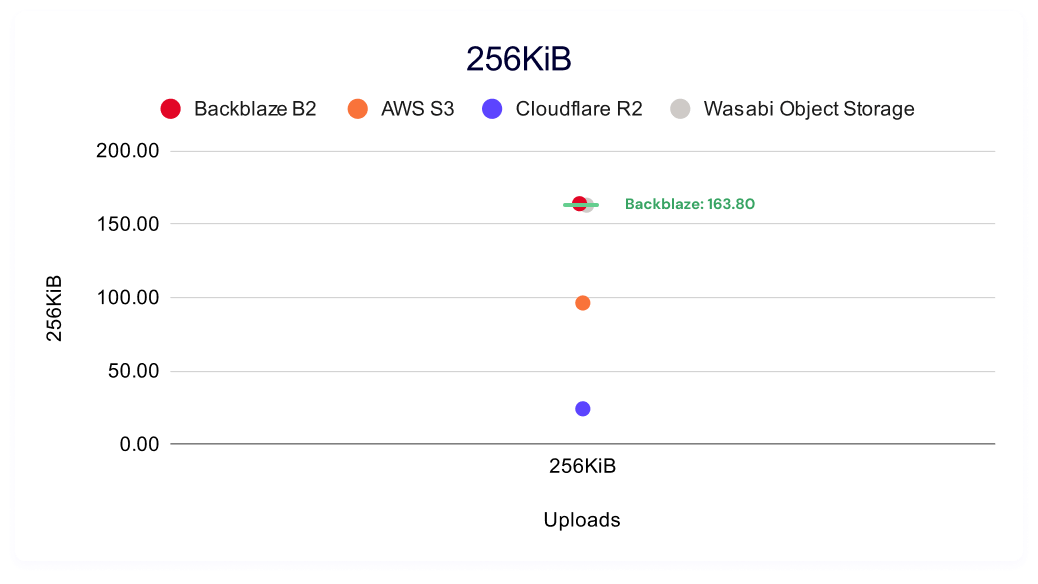
Interestingly, we have a pretty large spread between our highest and lowest values, most stark amongst the smallest files where Backblaze B2 demonstrates the highest sustained throughput at 163.80MiB/s and Cloudflare R2 demonstrates the lowest at 24.10MiB/s.
This is important because the strength of object storage is that it lets you run concurrent operations to read many ranges of bytes in the same file. Moreover, thread operations are a configurable element of most cloud storage accounts (though too many concurrent operations can trip rate limits that are dependent on the provider).
So, when we think about contextualizing with the average time to a file upload completion, the task includes making the request, the handshake between requester and server, routing the request through the cloud storage provider, then time it takes to read all data, and then notification that your upload is complete.
Threading lets you run the actual process of the return of information concurrently—so while file overhead (handshake) should be relatively consistent, you can get quite a bit faster on large file uploads. And, even when you have consistent results on file overhead, networking paths can make a difference on delivery times. While we can consider networking routes mostly stable (especially for synthetic performance testing), it’s certainly not a guarantee. Peering policy changes, network maintenance and/or outages, and CDN usage can all affect your routing day to day or month to month.
Changing the view a bit, we see some interesting shapes when we plot each providers’ improvement as file sizes get larger:
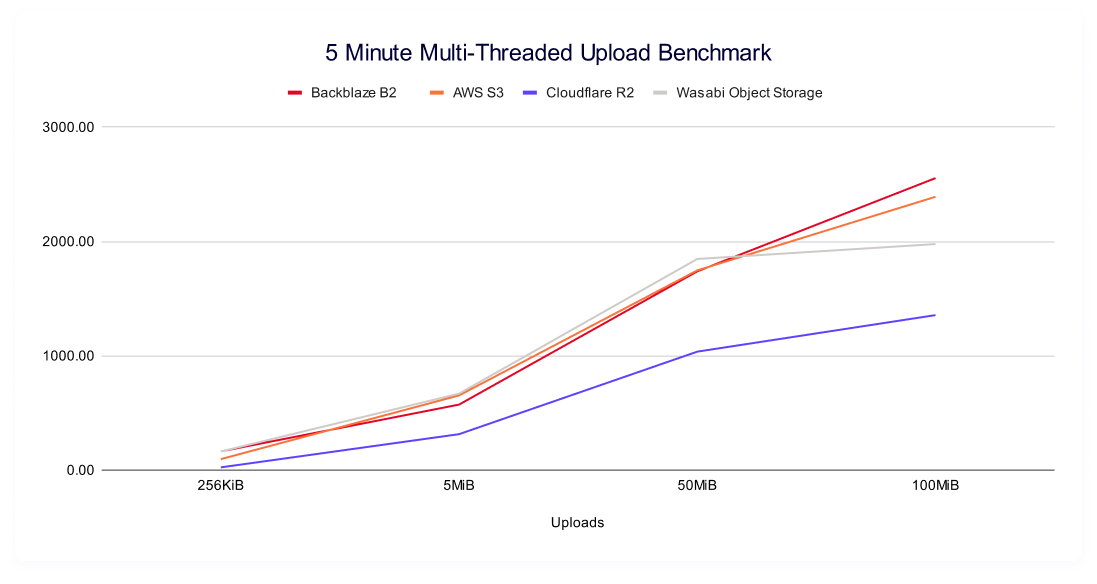
It’s intuitive that you’d automatically push more data as file sizes get larger, but the shape of each’s improvement is a stark contrast. The rate of increase (which you can see in our trendlines as the slope) isn’t constant, and we see Backblaze and AWS showing consistently better performance at the higher file sizes. Wasabi tracks with that growth in the smaller file sizes, but falls off at the 50MiB and 100MiB. Meanwhile, we see Cloudflare returning the lowest net values, while flattening out at smaller file sizes as well.
In most performance data, you expect a logarithmic relationship between data points—and so comparing their different shapes—when the trendline flattens out and/or when it deviates from an ideal logarithmic scale—can be telling. You can define an expected logarithmic curve using an average of all providers, then compare each provider’s residuals (how far above or below that curve it sits). We’ll save that analysis for another day, and a more mature dataset.
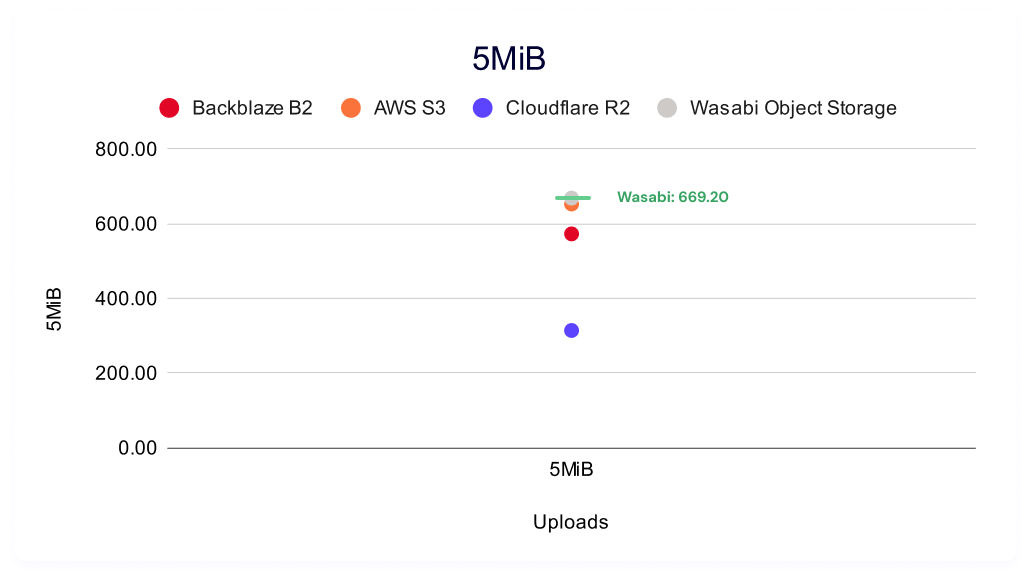
It’s also interesting to look at data point clustering by file size. As our dataset matures over time and as we add providers, clustering in these charts start to tell a story. If you want a quick idea of good, better, best and you don’t have a large enough cohort for a true tiered definitional schema, it’s a good visual shortcut—you can easily see if different providers’ results are spread out or if they cluster together at a specific level of performance. The winners for each test are labeled in green.

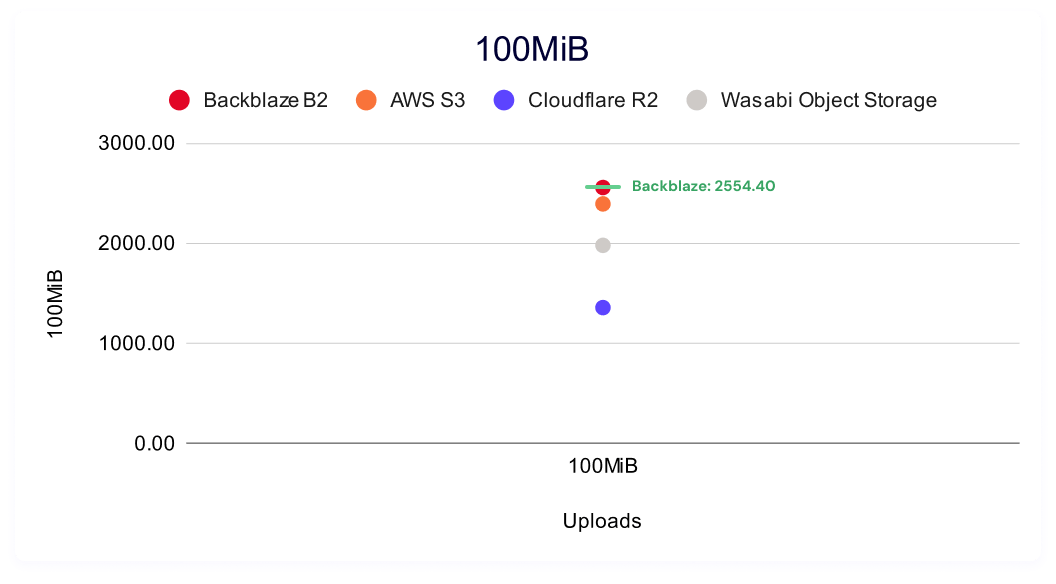
And, as we said above, in all cases (and one of the most frustrating parts about collecting performance stats) is that your mileage may vary—you always want to compare the needs of your customers and product to the performance you need and how much it costs you.
Five minute single threaded upload
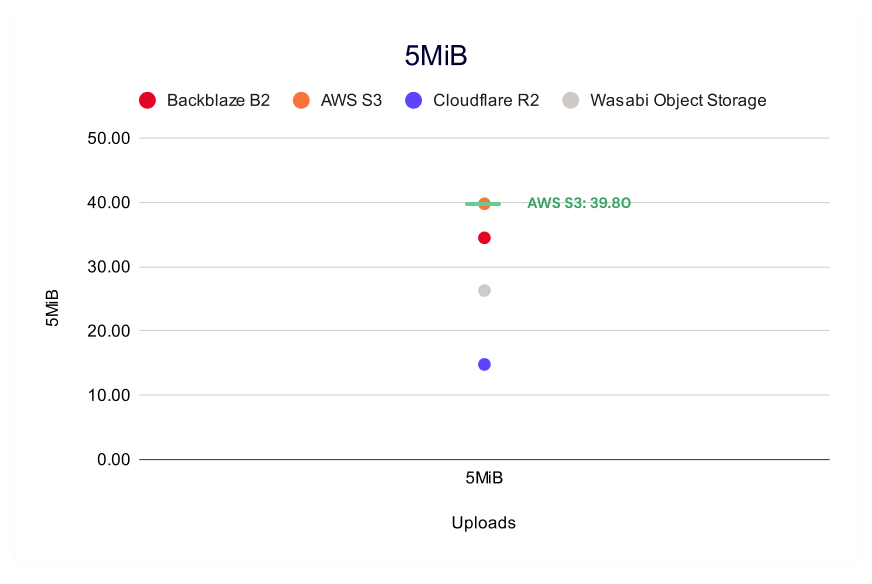
Once again, higher is better in this result, and it measures the sustained amount of data you can push to a server based on file size. As a reminder, multi-threading allows you to concurrently read a single file; while single threading is one, sustained process from start to finish.


Backblaze B2 again leads in small file sizes, with AWS S3 leading for 5MiB files and Wasabi for 50MiB and 100MiB files.
As above, here’s the trendline:
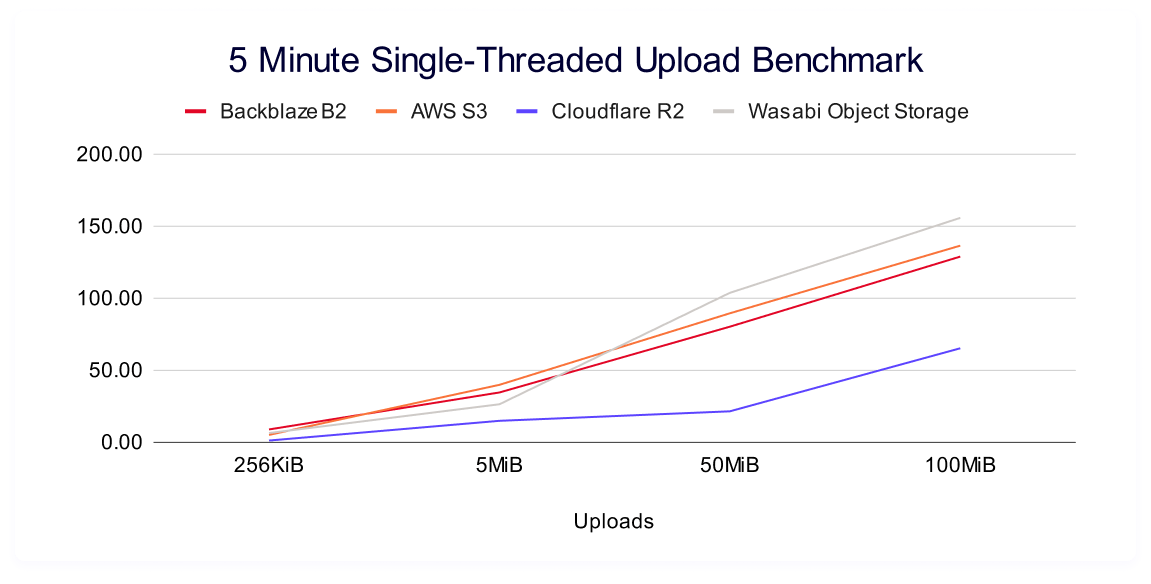
And, like in the multi-threading results, we can look at the clustering in each file type size:



Download comparisons
This test shows the average time in milliseconds it takes to download a file. Averages were taken across a month of data and for three different file sizes.
A reminder that lower is better in this test as it represents a faster result, and there’s no data for Wasabi in this series due to limitations on HTTP requests within the first 30 days of opening a new account.
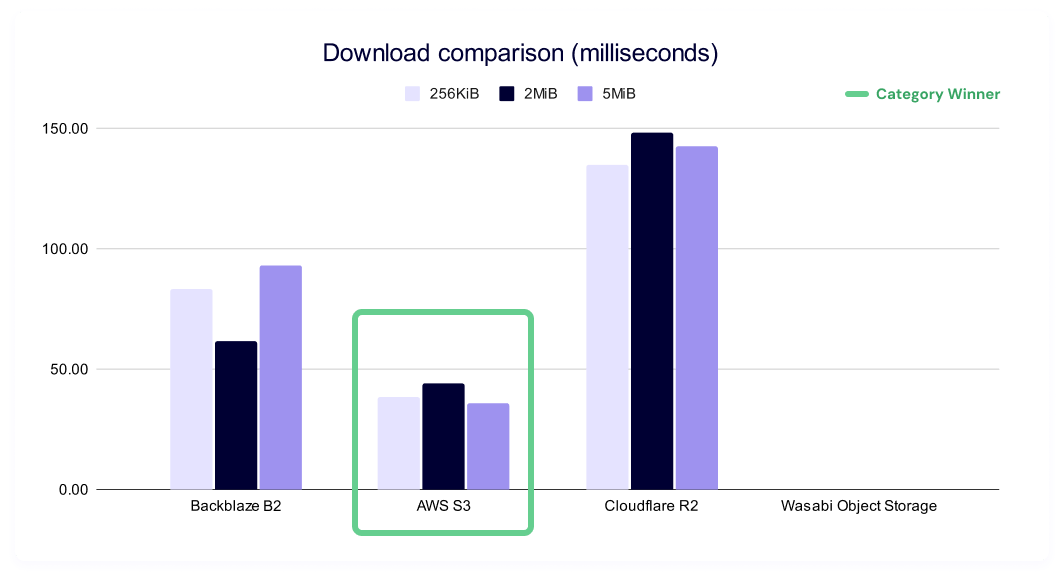

AWS S3 leads across the board on this test, with Backblaze B2 taking second and Cloudflare R2 taking third consistently.
And, it’s worth separately tracking TTFB because TTFB is a good, but not sufficient statistic when we’re interpreting results.

Why isn’t this datapoint sufficient to fastest speeds? Not only does TTFB conflate many parts of your networking layer (so it can be affected by things like connection reuse policies), but it’s also such a small part of the overall transfer time and highly variable based on environment. So, its use is really in conversation with the sustained throughput numbers.
Cached vs. uncached downloads (Backblaze only)
We were also curious to see if caching within our own network would show up, and, if so, we’d want to make sure we weren’t unintentionally giving ourselves a favorable stance. So, we ran a series of tests for cached and uncached downloads by including the header X-Bz-Flush-Cache-First=true.


We do see slightly slower speeds in uncached downloads, but they’re likely a result of the same factors anyone externally hitting our system would see. Additionally, during the course of our testing, Backblaze made cacheless downloads the default behavior for our architecture—so, it will be interesting to monitor this statistic going forward.
Five minute multi-threaded download benchmark
In these tests, a higher result is better, as the result represents more average data being downloaded in the five minute time period.


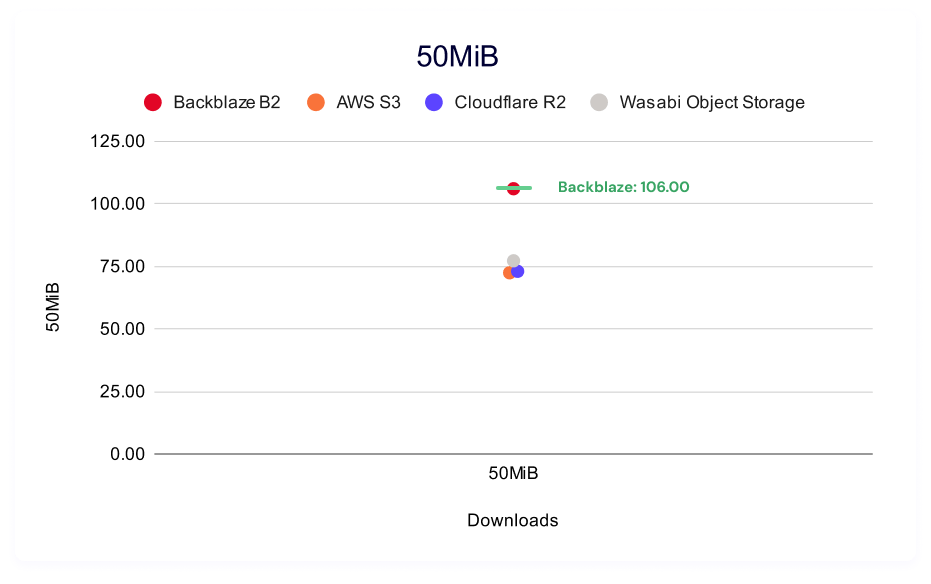
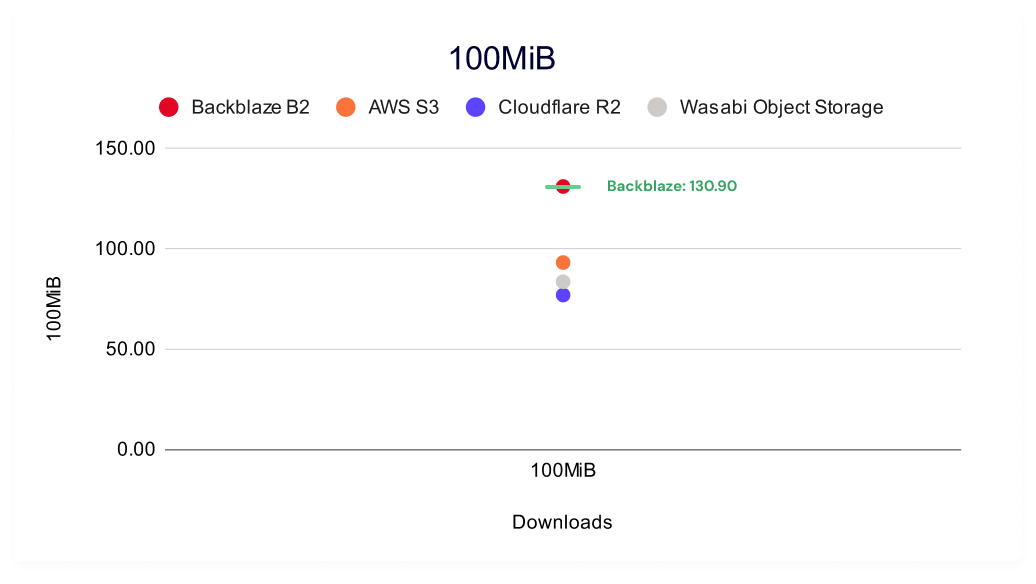
Backblaze B2 leads for 256KiB, 50MiB, and 100MiB file sizes. AWS S3 has a slight advantage for 5MiB files.
And, let’s give ourselves the same charts as our above upload tests for consistency’s sake. Here’s the trendline:

While AWS and Backblaze track closely for the 256KiB and 5MiB file sizes, Backblaze wins out at 50MiB and 100MiB. Meanwhile, Cloudflare lags at the smallest file sizes, but shows rapid improvement, peaking at the 50MiB file sizes. Interestingly, this is arguably Wasabi’s weakest showing compared to all other sustained throughput testing, though they have strong results at the 256KiB file size and a respectable showing at the 5MiB file size.
And here’s the per-file size clustering:


Five minute single-threaded download throughput
Again, in these tests, a higher result is better, as the result represents more average data being downloaded in the five minute time period.


Here, Wasabi wins for 256KiB files, and Backblaze wins for 5MiB, 50MiB and 100MiB files. Note that this is a solid trend for Wasabi in the 256KiB file sizes—they came in second in the multi-threading download testing, as well as both single and multi-threaded upload testing.

And here’s our clustering:


Test methodology
Our goal with these benchmarks is simple: to understand how our cloud performs under real-world conditions and to share that information as clearly as possible. To do that, our Cloud Operations team runs repeatable, synthetic tests that measure upload (PUT) and download (GET) performance.
We ran both upload and download tests across all four vendors. Upload tests measured the following file sizes:
- 256KiB
- 5MiB
- 50MiB
- 100MiB
Download tests measured:
- Time-to-first-byte (TTFB)
- Total time to download the following file sizes:
- 256KiB
- 5MiB
- 50MiB
- 100MiB
Why do performance tests use mebibytes (MiB) instead of megabytes (MB)?
We’ve written articles in the past about how all computers are fundamentally a collection of logic circuits (transistors) in either an on or an off state, which means that they communicate in binary, or a base two language. Humans, however, tend to prefer base 10 languages. There are lots of reasons for this, but that’s a story for another time.
MiB is a base two unit of measurement, whereas MB is a base 10. Here’s a comparison:
| Unit | Definition | Bytes |
|---|---|---|
| 1MB (megabyte) | Base-10 (decimal) | 1,000,000 bytes |
| 1MiB (mebibyte) | Base-2 | 1,048,576 bytes (1024×1024) |
The difference between those two measurements may seem small, but it has a significant impact when you’re talking about performance sensitive systems. Oftentimes you’ll see marketing language shift to talking about MB because it’s more understandable to a wider audience, but to get accurate results, MiB is what you need.
Tests run in five-minute profiles to observe consistency over time, and we ran both single and multi-threaded download and upload tests. From a practical perspective, what’s happening is that we’re pushing repeated requests to a cloud storage provider as many times as we can for five minutes.
All tests originate from a Vultr-hosted Ubuntu virtual machine (VM) located in the New York/New Jersey area, routing through Catchpoint’s network into object storage regions located generally in US-East. By keeping the source environment stable and the test target consistent, we isolate performance variables within each provider’s infrastructure rather than the test environment itself.
Consistency measures
To ensure each test result represents genuine performance rather than environmental noise, we built repeatability into the process:
- Identical test instances: All runs used the same VM type, operating system (OS) image, and configuration.
- Fixed regions: Tests originated from the same location (NY/NJ) targeting the same US-East region across providers.
- Controlled routing: Network paths were held constant through Catchpoint’s monitoring network to minimize geographic or peering variation.
- Repeated runs: Each test profile (5 min) was executed multiple times, and averages were used to reduce the impact of transient spikes.
- Standardized payloads: All uploads and downloads used identical objects to ensure a consistent file-size baseline.
- Unchanged test intervals: Tests were scheduled at regular intervals over multiple days to capture both typical and outlier performance.
About synthetic testing
Synthetic monitoring provides a controlled, apples-to-apples comparison, but it doesn’t replicate every production workload. These tests are run outside our own infrastructure—from neutral vantage points—to simulate a customer’s experience at the “last mile.” This distinguishes our approach from competitors who benchmark internally under optimized conditions.
It’s important to note that synthetic results won’t mirror every customer’s experience. Different architectures, connection paths, and file patterns will produce different performance profiles. Our intent is to offer transparency into the methodology and relative behaviors, not to suggest that all workloads will perform identically.
Limitations and future work
Every benchmark is an approximation. These results provide a controlled look at how cloud storage performs under repeatable conditions, but they don’t capture every variable in production environments. Below, we outline what our current tests don’t measure and where we’re headed next to deepen the picture.
- Synthetic, not real-world workloads: These benchmarks simulate real activity but don’t reproduce the full variability of customer workloads, concurrency levels, or data locality patterns. They are best understood as directional insights rather than absolute truths.
- The internet is the internet: Once traffic leaves the test node, we can’t control the routing, peering, or transient network conditions between endpoints. Each provider’s own network policies and routing optimizations—for example, Wasabi’s inbound connection rules—can influence the results.
- Static test conditions: All tests were conducted from a single region (NY/NJ to US-East cloud providers). Real-world customers operate globally, where peering arrangements, congestion, and latency differ widely.
- Potential caching effects: Although we designed the tests to avoid cached reads, Catchpoint does not allow full data randomization. It’s possible some repeated reads benefited from intermediate caching at any network layer.
- Traffic shaping and rate limiting: Providers may apply rate limits or throttling when detecting high-frequency test traffic. For example, Wasabi temporarily blacklisted our IPs due to testing volume—a reminder that these results represent observed behavior, not formal service guarantees.
Each of these limitations points toward future testing opportunities. Here’s what’s next on our testing roadmap:
- Regional expansion: Extend current US-East tests to US-West and EU regions using equivalent test setups.
- Vendor expansion: Extend testing to more vendors, including Google Cloud Platform and Azure.
- File size sensitivity testing: Investigate performance across a wider range of file sizes, including 100MiB+ objects. This will help clarify where different architectures favor small-object throughput versus sustained large transfers.
- Traffic rate & throttling analysis: Incorporate monitoring for request-per-minute and total-bytes-transferred metrics to detect possible provider-level rate limiting. We’d love to invite vendors to validate thresholds and eliminate false negatives.
- Concurrency patterns: Test multiple thread and connection strategies to model real-world transfer concurrency, especially for use cases involving parallel uploads or downloads.
- Benchmark visualization: Transition from CSV data collection to Grafana dashboards, enabling continuous visualization of test results and performance drift over time.
Performance is an evolving target, and so is our testing methodology. Each round of analysis helps us not only understand how Backblaze performs in context, but also refine how we measure, compare, and communicate that performance. Our goal remains the same: make the data real, repeatable, and useful.
What this means for real-world use cases
Based on the results we’ve shared here, there’s plenty of room for argument around the value of different performance profiles. But, continuing our theme of transparency: Since we’re transparent about our performance, warts and all, we’re going to be transparently candid in the areas where think the Backblaze platform is showing some nice results:
- AI/ML inference: Our strong read latency and throughput make Backblaze ideal for inference workloads that need to pull model artifacts, inputs, and outputs quickly. For example, when a service like Hugging Face or Runway ML feeds an image into a convolutional neural network, lower read latency directly translates to faster inference delivery.
- Feature stores & embedding lookups (AI/ML): Optimized small-object reads and efficient small writes support rapid lookups and occasional updates common in vector databases and feature stores like Feast, Qdrant, Pinecone, or Weaviate.
- LLM-based retrieval-augmented generation (RAG) systems: RAG systems store many small document chunks that are written once and read repeatedly, so our read-optimized performance accelerates retrieval of document chunks or embeddings, improving response times for large language model applications. Vectorized databases are also a hot topic right now for good reason—they’re changing patterns around file sizes and retrieval patterns in RAG applications and LLM training.
- Log & event analytics (SIEM, IoT, etc.): Competitive small-write performance and fast reads make Backblaze well suited for log aggregation and analytical querying with tools like Loki, Fluentd, Vector.dev, and OpenObserve once data is ingested.
- Interactive data lake querying: Consistent throughput and fast download speeds deliver responsive querying and exploration for business intelligence (BI) and ad hoc analytics workloads.
- CDN origin: Excellent read throughput, stable performance, and free egress make Backblaze a high-value choice for powering content delivery at scale.
As discussed, one of the reasons it’s so hard to get directly comparable performance benchmarks is because there are so many configurable elements on the user’s side that can affect the results. For example, if you know that your provider is faster on smaller files, you might choose to store your unstructured data in smaller parts so that you achieve faster performance.
That means that when we share results like this, it enables you to interpret which provider is a better fit for your different types of workflows.
For a cloud storage provider, tracking these metrics over time and comparing to other aspects of our internal architecture enables us to support ongoing and continual performance improvement, and to understand how much of an impact single changes might make. This means that what seems like a simple project to change the way we read header requests can produce asymmetrically favorable results.
And, there’s a layer of this that’s always going to come down to design decisions. For example, we’ve talked about some of the logic behind where our architecture knows which server to store data on. Basically, our system chooses to store a new file based on the available space of each server. So, if we have a server that has 40% space available, it would receive 40% of the incoming storage writes. (That’s a bit of an oversimplification, but you get the idea.)
Other cloud storage providers might prioritize, say, randomness in their write architecture. When a request would enter their system, the routing protocol would say, “Hey, we haven’t written to this server over here in a while,” and write it in that sector. It’s a different choice that can have a subtle ripple effect across different aspects of storage architecture.
What’s next?
Our performance story is one of steady, measurable progress. We’re not optimizing for a single headline number; we’re building toward consistent reliability across diverse workloads. That’s why we test openly, publish what we find, and continuously refine how we measure.
Looking ahead, our next Performance Stats report will continue to share these findings quarterly, which will give us all a more mature dataset to work with, and will expand testing. This isn’t just a transparency exercise for us, it’s a commitment to the developers and teams building on Backblaze: you deserve data you can trust—and we intend to keep earning it.
We’d love it if others—third parties and our competitors—also got involved, but we’ll see how things evolve. For now, feel free to let us know if these tests work for you.
Disclaimer:
The performance data and comparisons presented here are based on tests conducted by Backblaze under the specific environments, configurations, and conditions described in this post. Actual results may vary depending on network conditions, workloads, geographic location, and other factors.
Backblaze has published its testing methodology so others can replicate or challenge the results; however, Backblaze makes no representation or warranty that its tests capture all possible variables or configurations. The information is provided for general informational purposes only and does not constitute a guarantee of future performance. In addition, the information in this post is based on data available at the time of publication, and Backblaze reserves the right to update or revise this information as new data, testing methodologies, or performance results become available.
All product names, trademarks, and registered trademarks are property of their respective owners. References to third-party products or services are for identification purposes only and do not imply endorsement or affiliation.
The post Backblaze Performance Stats for Q3 2025 appeared first on Backblaze Blog | Cloud Storage & Cloud Backup
Connecting to production: the architecture of remote bindings
Post Syndicated from Samuel Macleod original https://blog.cloudflare.com/connecting-to-production-the-architecture-of-remote-bindings/
Remote bindings are bindings that connect to a deployed resource on your Cloudflare account instead of a locally simulated resource – and recently, we announced that remote bindings are now generally available.
With this launch, you can now connect to deployed resources like R2 buckets and D1 databases while running Worker code on your local machine. This means you can test your local code changes against real data and services, without the overhead of deploying for each iteration.
In this blog post, we’ll dig into the technical details of how we built it, creating a seamless local development experience.
A key part of the Cloudflare Workers platform has been the ability to develop your code locally without having to deploy it every time you wanted to test something – though the way we’ve supported this has changed greatly over the years.
We started with wrangler dev running in remote mode. This works by deploying and connecting to a preview version of your Worker that runs on Cloudflare’s network every time you make a change to your code, allowing you to test things out as you develop. However, remote mode isn’t perfect — it’s complex and hard to maintain. And the developer experience leaves a lot to be desired: slow iteration speed, unstable debugging connections, and lack of support for multi-worker scenarios.
Those issues and others motivated a significant investment in a fully local development environment for Workers, which was released in mid-2023 and became the default experience for wrangler dev. Since then, we’ve put a huge amount of work into the local dev experience with Wrangler, the Cloudflare Vite plugin (alongside @cloudflare/vitest-pool-workers) & Miniflare.
Still, the original remote mode remained accessible via a flag: wrangler dev --remote. When using remote mode, all the DX benefits of a fully local experience and the improvements we’ve made over the last few years are bypassed. So why do people still use it? It enables one key unique feature: binding to remote resources while locally developing. When you use local mode to develop a Worker locally, all of your bindings are simulated locally using local (initially empty) data. This is fantastic for iterating on your app’s logic with test data – but sometimes that’s not enough, whether you want to share resources across your team, reproduce bugs tied to real data, or just be confident that your app will work in production with real resources.
Given this, we saw an opportunity: If we could bring the best parts of remote mode (i.e. access to remote resources) to wrangler dev, there’d be one single flow for developing Workers that would enable many use cases, while not locking people out of the advancements we’ve made to local development. And that’s what we did!
As of Wrangler v4.37.0 you can pick on a per-binding basis whether a binding should use remote or local resources, simply by specifying the remote option. It’s important to re-emphasise this—you only need to add remote: true! There’s no complex management of API keys and credentials involved, it all just works using Wrangler’s existing Oauth connection to the Cloudflare API.
{
  "name": "my-worker",
  "compatibility_date": "2025-01-01",
  "kv_namespaces": [{
    "binding": "KV",
    "id": "my-kv-id",
  },{
    "binding": "KV_2",
    "id": "other-kv-id",
    "remote": true
  }],
  "r2_buckets": [{
    "bucket_name": "my-r2-name",
    "binding": "R2"
  }]
}
The eagle-eyed among you might have realised that some bindings already worked like this, accessing remote resources from local dev. Most prominently, the AI binding was a trailblazer for what a general remote bindings solution could look like. From its introduction, the AI binding always connected to a remote resource, since a true local experience that supports all the different models you can use with Workers AI would be impractical and require a huge upfront download of AI models.
As we realised different products within Workers needed something similar to remote bindings (Images and Hyperdrive, for instance), we ended up with a bit of a patchwork of different solutions. We’ve now unified under a single remote bindings solution that works for all binding types.
We wanted to make it really easy for developers to access remote resources without having to change their production Workers code, and so we landed on a solution that required us to fetch data from the remote resource at the point of use in your Worker.
const value = await env.KV.get("some-key")The above code snippet shows accessing the “some-key” value in the env.KV KV namespace, which is not available locally and needs to be fetched over the network.
So if that was our requirement, how would we get there? For instance, how would we get from a user calling env.KV.put(“key”, “value”) in their Worker to actually storing that in a remote KV store? The obvious solution was perhaps to use the Cloudflare API. We could have just replaced the entire env locally with stub objects that made API calls, transforming env.KV.put() into PUT http:///accounts/{account_id}/storage/kv/namespaces/{namespace_id}/values/{key_name}.
This would’ve worked great for KV, R2, D1, and other bindings with mature HTTP APIs, but it would have been a pretty complex solution to implement and maintain. We would have had to replicate the entire bindings API surface and transform every possible operation on a binding to an equivalent API call. Additionally, some binding operations don’t have an equivalent API call, and wouldn’t be supportable using this strategy.
Instead, we realised that we already had a ready-made API waiting for us — the one we use in production!
Most bindings on the Workers platform boil down to essentially a service binding. A service binding is a link between two Workers that allows them to communicate over HTTP or JSRPC (we’ll come back to JSRPC later).
For example, the KV binding is implemented as a service binding between your authored Worker and a platform Worker, speaking HTTP. The JS API for the KV binding is implemented in the Workers runtime, and translates calls like env.KV.get() to HTTP calls to the Worker that implements the KV service.

Diagram showing a simplified model of how a KV binding works in production
You may notice that there’s a natural async network boundary here — between the runtime translating the env.KV.get() call and the Worker that implements the KV service. We realised that we could use that natural network boundary to implement remote bindings. Instead of the production runtime translating env.KV.get() to an HTTP call, we could have the local runtime (workerd) translate env.KV.get() to an HTTP call, and then send it directly to the KV service, bypassing the production runtime. And so that’s what we did!

Diagram showing a locally run worker with a single KV binding, with a single remote proxy client that communicates to the remote proxy server, which in turn communicates with the remote KV
The above diagram shows a local Worker running with a remote KV binding. Instead of being handled by the local KV simulation, it’s now being handled by a remote proxy client. This Worker then communicates with a remote proxy server connected to the real remote KV resource, ultimately allowing the local Worker to communicate with the remote KV data seamlessly.
Each binding can independently either be handled by a remote proxy client (all connected to the same remote proxy server) or by a local simulation, allowing for very dynamic workflows where some bindings are locally simulated while others connect to the real remote resource, as illustrated in the example below:

The above diagram and config shows a Worker (running on your computer) bound to 3 different resources—two local (KV & R2), and one remote (KV_2)
The above section deals with bindings that are backed by HTTP connections (like KV and R2), but modern bindings use JSRPC. That means we needed a way for the locally running workerd to speak JSRPC to a production runtime instance.
In a stroke of good luck, a parallel project was going on to make this possible, as detailed in the Cap’n Web blog. We integrated that by making the connection between the local workerd instance and the remote runtime instance communicate over websockets using Cap’n Web, enabling bindings backed by JSRPC to work. This includes newer bindings like Images, as well as JSRPC service bindings to your own Workers.
We didn’t want to limit this exciting new feature to only wrangler dev. We wanted to support it in our Cloudflare Vite Plugin and vitest-pool-workers packages, as well as allowing any other potential tools and use cases from the JavaScript ecosystem to also benefit from it.
In order to achieve this, the wrangler package now exports utilities such as startRemoteProxySession that allow tools not leveraging wrangler dev to also support remote bindings. You can find more details in the official remote bindings documentation.
Just use wrangler dev! As of Wrangler v4.37.0 (@cloudflare/vite-plugin v1.13.0, @cloudflare/vitest-pool-workers v0.9.0), remote bindings are available in all projects, and can be turned on a per-binding basis by adding remote: true to the binding definition in your Wrangler config file.
Attackers accelerate, adapt, and automate: Rapid7’s Q3 2025 Threat Landscape Report
Post Syndicated from Rapid7 original https://www.rapid7.com/blog/post/tr-rapid7-q3-2025-threat-landscape-report
The Q3 2025 Threat Landscape Report, authored by the Rapid7 Labs team, paints a clear picture of an environment where attackers are moving faster, working smarter, and using artificial intelligence to stay ahead of defenders. The findings reveal a threat landscape defined by speed, coordination, and innovation.⠀
The quarter showed how quickly exploitation now follows disclosure: Rapid7 observed newly reported vulnerabilities weaponized within days, if not hours, leaving organizations little time to patch before attackers struck. Critical business platforms and third-party integrations were frequent targets, as adversaries sought direct paths to disruption. Ransomware remained a most visible threat, but the nature of these operations continued to evolve.
Groups such as Qilin, Akira, and INC Ransom drove much of the activity, while others went quiet, rebranded, or merged into larger collectives. The overall number of active groups increased compared to the previous quarter, signaling renewed energy across the ransomware economy. Business services, manufacturing, and healthcare organizations were the most affected, with the majority of incidents occurring in North America.
Many newer actors opted for stealth, limiting public exposure by leaking fewer victim details, opting for “information-lite” screenshots in an effort to thwart law enforcement. Some established groups built alliances and shared infrastructure to expand reach such as Qilin extending its influence through partnerships with DragonForce and LockBit. Meanwhile, SafePay gained ground by running a fully in-house, hands-on model avoiding inter-party duelling and law enforcement. These trends show how ransomware has matured into a complex, service-based ecosystem.
Nation-state operations in Q3 favored persistence and stealth over disruption. Russian, Chinese, Iranian, and North Korean-linked groups maintained long-running campaigns. Many targeted identity systems, telecom networks, and supply chains. Rapid7’s telemetry showed these actors shrinking the window between disclosure and exploitation and relying on legitimate synchronization processes to remain hidden for months. The result: attacks that are harder to spot and even harder to contain.
Threat actors are fully operationalizing AI to enhance deception, automate intrusions, and evade detection. Generative tools now power realistic phishing, deepfake vishing, influence operations, and adaptive malware like LAMEHUG. This means the theoretical risk of AI has been fully operationalized. Defenders must now assume attackers are using these tools and techniques against them and not just supposing they are.
This is but a taste of the valuable threat information the report has to offer. In addition to deeper dives on the subjects above, the threat report includes analysis of some of the most common compromise vectors, new vulnerabilities and existing ones still favored by attackers, and, of course, our recommendations to safeguard against compromises across your entire attack surface.
⠀
Want to learn more? Click here to download the report.
Best of: Kitsch
Post Syndicated from The History Guy: History Deserves to Be Remembered original https://www.youtube.com/watch?v=2NbC135Aa74
On Hacking Back
Post Syndicated from Bruce Schneier original https://www.schneier.com/blog/archives/2025/11/on-hacking-back.html
Former DoJ attorney John Carlin writes about hackback, which he defines thus: “A hack back is a type of cyber response that incorporates a counterattack designed to proactively engage with, disable, or collect evidence about an attacker. Although hack backs can take on various forms, they are—by definition—not passive defensive measures.”
His conclusion:
As the law currently stands, specific forms of purely defense measures are authorized so long as they affect only the victim’s system or data.
At the other end of the spectrum, offensive measures that involve accessing or otherwise causing damage or loss to the hacker’s systems are likely prohibited, absent government oversight or authorization. And even then parties should proceed with caution in light of the heightened risks of misattribution, collateral damage, and retaliation.
As for the broad range of other hack back tactics that fall in the middle of active defense and offensive measures, private parties should continue to engage in these tactics only with government oversight or authorization. These measures exist within a legal gray area and would likely benefit from amendments to the CFAA and CISA that clarify and carve out the parameters of authorization for specific self-defense measures. But in the absence of amendments or clarification on the scope of those laws, private actors can seek governmental authorization through an array of channels, whether they be partnering with law enforcement or seeking authorization to engage in more offensive tactics from the courts in connection with private litigation.
И пак за руската хибридна война срещу демокрациите
Post Syndicated from Григор original http://www.gatchev.info/blog/?p=2672
Ето ви сериозно съкратен разказ за една от многото руски групи за пропагандни лъжи, кръстена от изследователите на Майкрософт “Storm-1516”. (Числото е пореден номер.)
—-
Започнала е като клон на Агенцията за Интернет проучвания – руска пропагандна група, създадена от Евгений Пригожин и регистрирана като „частна фирма“, за да се прикрие фактът, че е управлявана от отдела за активни мероприятия в чужбина на КГБ. Отделното съществуване на Storm-1516 е забелязано за пръв път от група изследователи на дезинформацията в медиите в университета Клемсън.
Основният им канал за разпространение са създавани в YouTube и X акаунти, представящи се за разследващи журналисти или уисълблоуъри. След това разпространява чрез тях пропагандни лъжи на английски, руски, финландски, арабски и френски езици. Често една и съща лъжа се пуска през няколко акаунта, за да оставя впечатление за достоверност.
Основният ѝ метод е заснемане на фалшиви видеота с участие на актьори или генерирането им с AI (по-рано – с дийпфейкване). Вероятната локация на екипа, който заснема видеотата с актьори, е Санкт Петербург. Те често се позовават на източници, които всъщност не съществуват. Пуснатите от тях видеота, както и другите пропагандни лъжи, след това биват споделяни от контролирани от ГРУ ботмрежи за ехо-акаунти.
В командването на групата вероятно взимат участие, или се намират под общо командване с нея, антилибералният „Центр геополитических экспертиз“ и друга пропагандна група, известна като „Фондация для борьбы с несправедливости“. Тясно свързани с нея са:
– групата Storm-1099, специализирана в създаване на фалшиви или имитационни пропагандни уебсайтове
– групата Storm-1679, специализирана в създаване на фалшиви документи и новинарски рапорти от името на достоверно изглеждащи, но фалшиви организации
– Ruza Flood, Volga Flood и Rybar – организации, които също разпространяват фалшива информация, често под името на реална личност (напр. Rybar – Михаил Звинчук) или фалшива персона, изпълнявана от актьор (напр. „Саня от Флорида“).
Свързана с нея изглежда и руската медийна компания Tenet Media, затворена през 2024 г. Основната ѝ дейност е била да плаща на десни блогъри в САЩ да снимат видеота с поръчано от нея съдържание.
Някои от основните теми, по които Storm-1516 генерират фалшиво съдържание, са:
– Намаляване на подкрепата за западна помощ за Украйна срещу руската агресия
През май 2024 г. те пускат фалшиво видео, което показва как украински войници горят чучело на Доналд Тръмп.
Много от фалшивките им лъжат, че украинските лидери злоупотребяват със западната помощ – купуват си яхти, имения, луксозни коли, наркотици и т.н. Имало е случаи, когато американски политици са се хващали на тези лъжи.
– Подкрепа за Доналд Тръмп
Честа тяхна теза е че украински тролски ферми работят срещу избирането на Доналд Тръмп. Целта ѝ е да прикрие отлично доказания факт, че всички руски тролски ферми бяха ангажирани в подкрепа на Доналд Тръмп. Едно от фалшивите видеота показва „служител на украинска тролска ферма“, който „си признава“, че ЦРУ изпълнява заговор, за да попречи на Тръмп да стане президент.
– Свързване на Украйна с Хамас
През октомври 2023 г. те пускат фалшиво видео, в което „ръководител на Хамас“ (лицето му е скрито) „благодари на Зеленски за доставките на оръжие и муниции“. В реалността между Украйна и Хамас няма връзки. Същият актьор в друго видео, пуснато преди Олимпийските игри в Париж, предупреждава, че „Хамас ще атакуват Олимпийските игри“. Видеото е широко разпространено чрез руските тролски мрежи. Френските и израелските служби потвърждават, че е фалшиво.
– Подкрепа за Доналд Тръмп
От началото на лятото на 2024 г. до самите избори за президент в САЩ групата, както и всички други тролски ресурси на ГРУ, е съсредоточена върху подкрепа за Доналд Тръмп. Storm-1516 основно произвеждат фалшиви видеота и новини, обвиняващи кандидатите на демократите в престъпления и разпространяващи конспиративни теории спрямо тях. През това време групата оперира над 100 фалшиви уебсайта, които очернят демократите и хвалят Тръмп и Русия. Частта от групата, която се грижи за тези сайтове, е ръководена от Джон Марк Дугън – бивш полицай от Флорида, конспиративен теорист, уличен в платена проруска пропаганда и потърсил политическо убежище в Русия.
Един от разпространяваните от групата фалшификати е, че Сикрет Сървис са открили в имението на Тръмп подслушвателни устройства, монтирани там от ФБР. Тръмп и Ванс също споделят тази лъжа в социалните мрежи.
Друг гласи, че при посещение в Замбия Камала Харис е застреляла нелегално Касуба – популярен женски черен носорог (видът е застрашен от изчезване). Фалшификатът е споделен от над милион фалшиви акаунта в Х, както и от работещи за Русия западни пропагандисти (Chay Bowes и т.н.)
Друго тяхно фалшиво видео, разпространено от Джон Дугън, „показва“ как поддръжници на Камала Харис атакуват сбирка на поддръжници на Тръмп и пребиват един от посетителите. Към това са прикрепени обичайните опорки за „агресивните леви екстремисти“, и коментари, целящи да засилят междурасови напрежения в САЩ.
На друго тяхно фалшиво видео „нелегален имигрант от Хаити“ разказва „как му е било платено да гласува за Харис многократно с различни шофьорски книжки“.
На друго тяхно фалшиво видео, пуснато в деня на изборите, „американски гласоподавател“ разказва как двама поддръжници на Харис нападнали и пребили поддръжник на Тръмп, за да му попречат да гласува.
В много агресивно разпространявано тяхно видео, видяно от почти 3 милиона души, жена твърди че е била блъсната като тинейджърка през 2011 г. от Камала Харис с кола и оставена да умре. Била цялата изпотрошена, претърпяла 11 операции преди да проходи отново, била и до момента в постоянни болки и т.н… Жената, посочена в различни източници като „Алисия Браун“, „Алиша Браун“ и т.н., е платена актриса. Рентгеновата снимка, показана във видеото за нейна, е взета от медицинско списание. Снимката на катастрофата от видеото е от катастрофа в Гуам през 2018 г. Новинарската агенция, посочена във видеото като източник на материала, не съществува (с изключение на фалшив уебсайт, създаден и поддържан от Storm-1516). Частта от видеото, на която Камала Харис напуска мястото на катастрофата, е дийпфейк… Видеото е споделено от много конгресмени-републиканци, включително Дж. Д. Ванс.
През октомври 2024 г., точно преди изборите, Storm-1516 прави съвместна кампания с QAnon за изкарване на Тим Валц (кандидат за вицепрезидент на демократите) педофил. Близко до QAnon радио излъчва „интервюта“ с „родител“ (в ролята – Джон Дугън) на „ученик“ на Валц, и със „студент на Валц от Казахстан“. (Проверката показва, че в училището, където преподава Валц, за последните 20 години не е имало студенти от Казахстан.) Части от излъчването са споделени масово от руски тролски ботмрежи и са видени от над 800 000 души в САЩ.
Един от акаунтите, споделили излъчването, е “BlackInsurrectionist” – създаден и управляван от Storm-1516. Има го във всички големи социални мрежи, следван е от водещи републикански политици (вкл. Тръмп-младши и Роджър Стоун). С тяхна помощ излъчването стига до около 33 милиона души.
В средата на октомври 2024 г. този акаунт пуска видео с е-майл, за който твърди, че е от малолетен, сексуално преследван от Валц. Многобройни признаци, че видеото е фалшификат, са моментално посочени от много негови зрители, но търсенията в Гугъл за „Tim Waltz pedophile“ скачат стократно. Няколко дни по-късно друг акаунт за конспиративни теории, също управляван от Storm-1516, пуска друго видео с подобни твърдения. Трето подобно видео, очевидно дело на същата група, е пуснато от акаунт на QAnon. Анализ на експерти от Wired показва, че всичките тези видеота са дийпфейкове.
На 19 октомври почти всички сайтове, управлявани от Джон Дугън, пускат голям репортаж, който цитира тези видеота (и ги представя за истински). Репортажът е цитиран от десни инфлуенсъри, между тях Кендис Оуенс и Джак Пособиец. На 21 октомври експерти на Wired успяват да докажат, че видеотата са дело на Storm-1516.
Друго фалшиво видео, създадено от същата група и пуснато през акаунт на QAnon 2 дни преди изборите, показва как член на изборна комисия проверява пратени по пощата бюлетини и къса тези, които са за Доналд Тръмп. Експертите веднага забелязват, че материалите и бюлетините, показани във видеото, не са истински – очевидно реквизиторът на групата се е изложил.
… Мога да напиша още няколко пъти по толкова за тях. А като погледнете поредния им номер, се досещайте колко още са като тях.
Правете си изводите.