Models are now good enough to work for hours or even days on their own. You don’t have to watch over every thing they do, but you still need to be able to check in, no matter where you are. An agent can’t live only inside one application. The work should continue even If you close a window or switch devices.
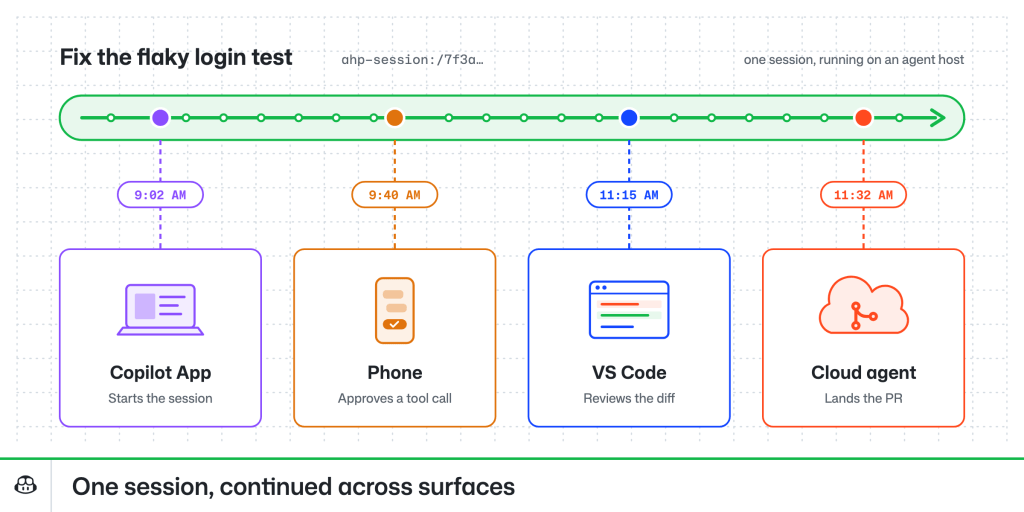
In GitHub Copilot you can start an agent session in one place and pick it up in another. This session continuity runs on the Agent Host Protocol (AHP), an open standard built first in VS Code and adopted across GitHub. Here’s how it works, what we learned building it, and how you can use it to bring your agents into your own apps and workflows.
Why one integration per client stopped working
GitHub Copilot was first built in VS Code as an extension that bundled its own harness. This gave you access to your agents in VS Code, but it tied their lifetime to the editor. Extensions are attached to a single VS Code window. Close that window, and the agent is gone. Update VS Code, and every agent stops as the application restarts. Connect to a remote machine, and you get an entirely new extension host commit-locked against the version of the VS Code workbench you have.
At the same time, the Copilot app was being developed, alongside the existing GitHub mobile apps for iOS and Android. Each product was doing its own distinct integration with cloud-based agents to work towards delivering session continuity.
Each of these integrations solved the problem for one product, but developers also still want to be able to pull their agents into their own workflows–whether that’s an editor, a terminal, a phone, or a tool they built themselves–and they can’t do that if every client needs its own one-off integration. That’s why developers needed a protocol: a standard, independently versioned language across versions of VS Code, the GitHub Copilot app, mobile apps, and any other client that might host an agent. A shared protocol means every client sees the same agents, history, and state without bespoke integrations, and you aren’t tied to one app’s idea of what an agent session is.
Designing a protocol for agents on every client
The protocol needed to allow multiple clients to interact with the same set of agents seamlessly. Start a session in the cloud from your phone, for example, then continue it from your laptop. It should tolerate network interruptions, reconnections, and concurrent client mutations. And it needed to be full-featured enough for you to do real work from each of your clients.
At the same time, the protocol needed to stay out of agent behavior. Unlike the domains that produced the Language Server Protocol and Debug Adapter Protocol, the world of agents is evolving quickly. That’s why AHP avoids encoding how agents work, and instead focuses on how you want to interact with them.
You also need the protocol to be simple enough to implement on your own client or server. While the full feature set would necessarily be extensive, the core protocol needed to be minimal.
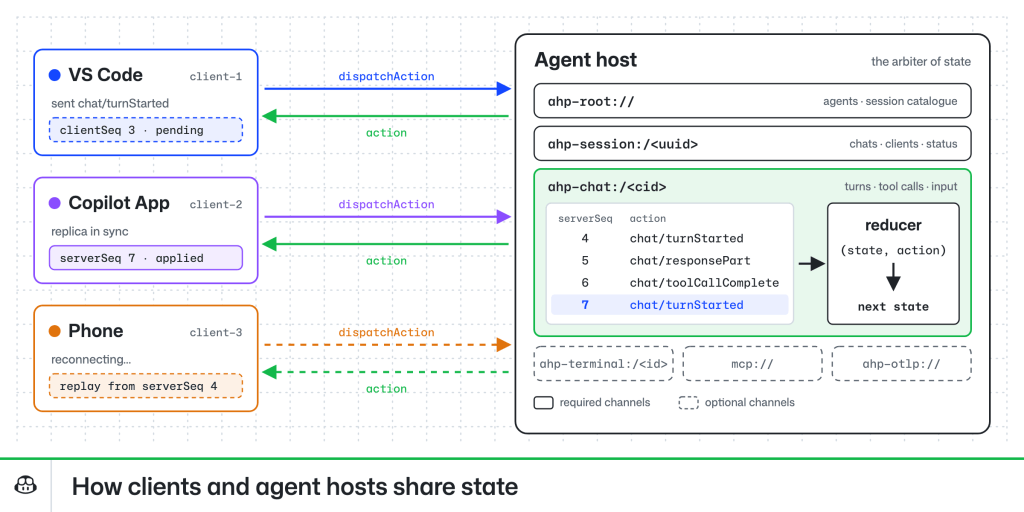
The result of these requirements is the Agent Host Protocol (AHP). It is oriented around URI-identified “channels”, which are the coarsest unit of functionality in the protocol. Every server must implement the root, session, and chat channels, but can also implement more channels that provide terminal support, MCP additions, or OTel reporting, for example.
Within each channel is a reducer-based state object, which drives most of the logic for clients. The server is the arbiter of the state, and each client sends a sequence of actions that either mutate the state or trigger side effects, like sending a chat message. This provides a few very nice properties. Reconnection and replay in poor network conditions are easy: a client sends all queued actions, presents the right ‘loading’ state, and waits for the server to reconcile and acknowledge the actions before confirming them. Clients and servers are straightforward to debug. And reducer-based state also plays nicely with popular UI frameworks like React.
Shipping five clients and two hosts
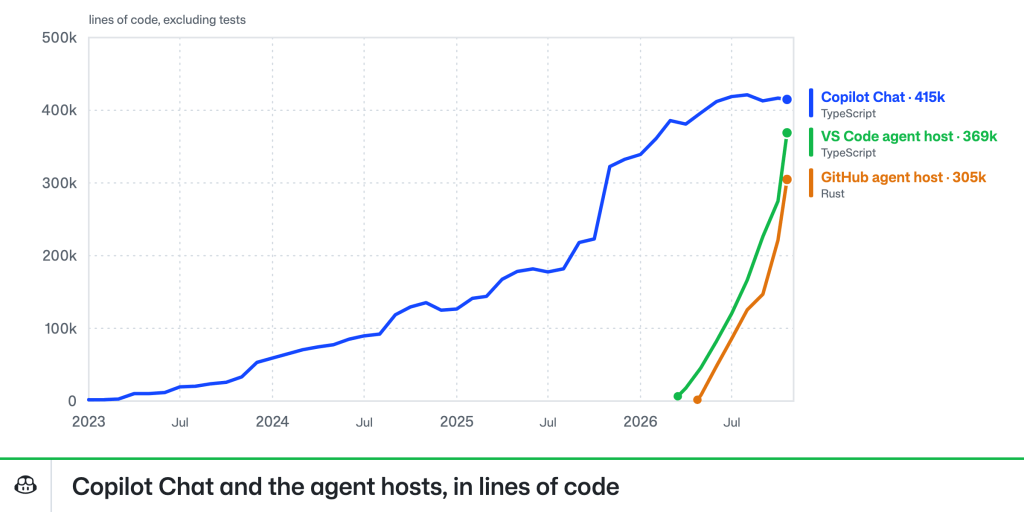
Adopting the Agent Host Protocol in VS Code required building a new harness and agentic stack underneath it. The Copilot Chat extension, which used to provide all of VS Code’s AI and agentic capabilities, had been growing for over three years, reaching over 400,000 lines of TypeScript, not counting tests. But, as a VS Code extension, it was structured around the lifecycle of a VS Code window and depended entirely on the VS Code extension API. Neither that lifetime nor those APIs would be available in a standalone agent host process.
As we started building the Agent Host Protocol in early 2026, the Copilot SDK was also being developed, and it made sense to leverage it as the foundation for the new agentic stack. This was a big transition. It’s easy to build a harness implementation that says hello and can edit files—we were using the agent host to develop the agent host after the first couple weeks—but it’s another thing to build one that covers the long tail of features developers had come to expect from Copilot Chat.
GitHub has had Copilot cloud agents for a couple of years, allowing developers to run tasks in the cloud from any device. While VS Code was quietly developing the Agent Host Protocol, GitHub was looking to expand that capability to coordinate sessions running on your own devices via the Copilot app, or in cloud sandboxes. This was exactly the N:M problem that AHP was built to solve, so adopting the same technology made perfect sense.
From the outset, the GitHub Agent Host had different requirements than VS Code’s implementation. VS Code runs the host locally and can drop its host on other compute over SSH, containers, WSL, or Dev Tunnels, and it is actually included as part of the VS Code Server bundle. The GitHub Agent Host needed to run in the cloud and across a much wider variety of infrastructure, environments, and security constraints.
Those differing requirements are why they’re separate implementations written in different languages: VS Code’s in TypeScript and GitHub’s in Rust. For now, having two agent hosts has been a good acid-test for the protocol itself. How well does it work when two entirely different teams and sets of agents implement the same protocol independently?
Pretty well, it turns out. Like MCP, the Agent Host Protocol provides escape hatches via custom methods and _metadata on objects that consumers can use for out-of-band signaling. After several months heads-down on our respective implementations, our first task as we worked toward unification was inventorying the ways each implementation had extended the protocol. Many of these extensions reasonably stay GitHub-specific, such as the GitHub Agent Host using metadata to link to project boards. In other cases, variance was a sign of a gap in the protocol; early versions, for example, could not accurately represent shell-type tool output that wasn’t backed by a PTY. And some were bad assumptions, like VS Code’s client assuming a particular structure for the session URIs it received from the agent host. A protocol with only one implementation isn’t truly portable; as we taught our clients and servers to talk to each other, AHP became portable in practice, not just in theory.
Today, the Agent Host Protocol provides that same continuity across all VS Code and GitHub surfaces. Agent sessions running locally in the GitHub Copilot app, in cloud sandboxes, and in VS Code all share the same underlying protocol. To see how it’s used, read about how you can work from anywhere with the new connected Copilot cloud experience.
Using the Agent Host Protocol
AHP was designed to be easy to use in clients and servers. Agent Host Protocol libraries are available in Rust, TypeScript, Kotlin, Swift, .NET, and Go, and agents are able to build clients and servers with little prompting. I have a macropad sitting on my desk that reflects my agent’s state in real time, and others have built everything from smart watch apps to Kanban-style task management tools against the protocol. Whether you want a companion app for your own agents, a way to bring agent sessions into your team’s tools, or AHP support in your own editor or agent, the protocol is open for you to build on.
You can connect to an agent host you implement in the Copilot app (enable Experimental > Direct Connections, then go to Environments > Add Agent Host Protocol Host) and in VS Code (via Add Remote Agent Host in the Agents window). You can spawn a standalone version of VS Code’s agent host by running code agent host in your terminal, or see the endpoints for the one in your editor by running code agent endpoints, and samples can help you and your agent get started.
The Agent Host Protocol is an open standard, and questions and suggestions are welcome on GitHub.
AI coding agents have changed the economics of writing software. Tools like Kiro turn specifications into working code, tests, and documentation, and a single agent can open dozens of pull requests across your repositories in an afternoon. What they have not changed is the number of senior engineers available to review those pull requests. The AI Productivity Paradox research from Faros AI drew on telemetry from more than 10,000 developers. It found that teams with high AI adoption merged 98% more pull requests while review time rose 91%. The gains did not show up in company-level delivery metrics. The constraint moved downstream, from writing code, to reviewing it.
The intuitive fix is to add an AI reviewer to every pull request. The evidence says that alone is not enough. Human-Centric to Agentic Code Review, a study of 1.02 million pull requests across 207 open source projects, found that reviews involving AI agents reached decisions faster but did not improve quality. After AI reviewers took part, the strongest factor explaining review efficiency was not the tooling, but how humans and agents were wired together in the review flow.
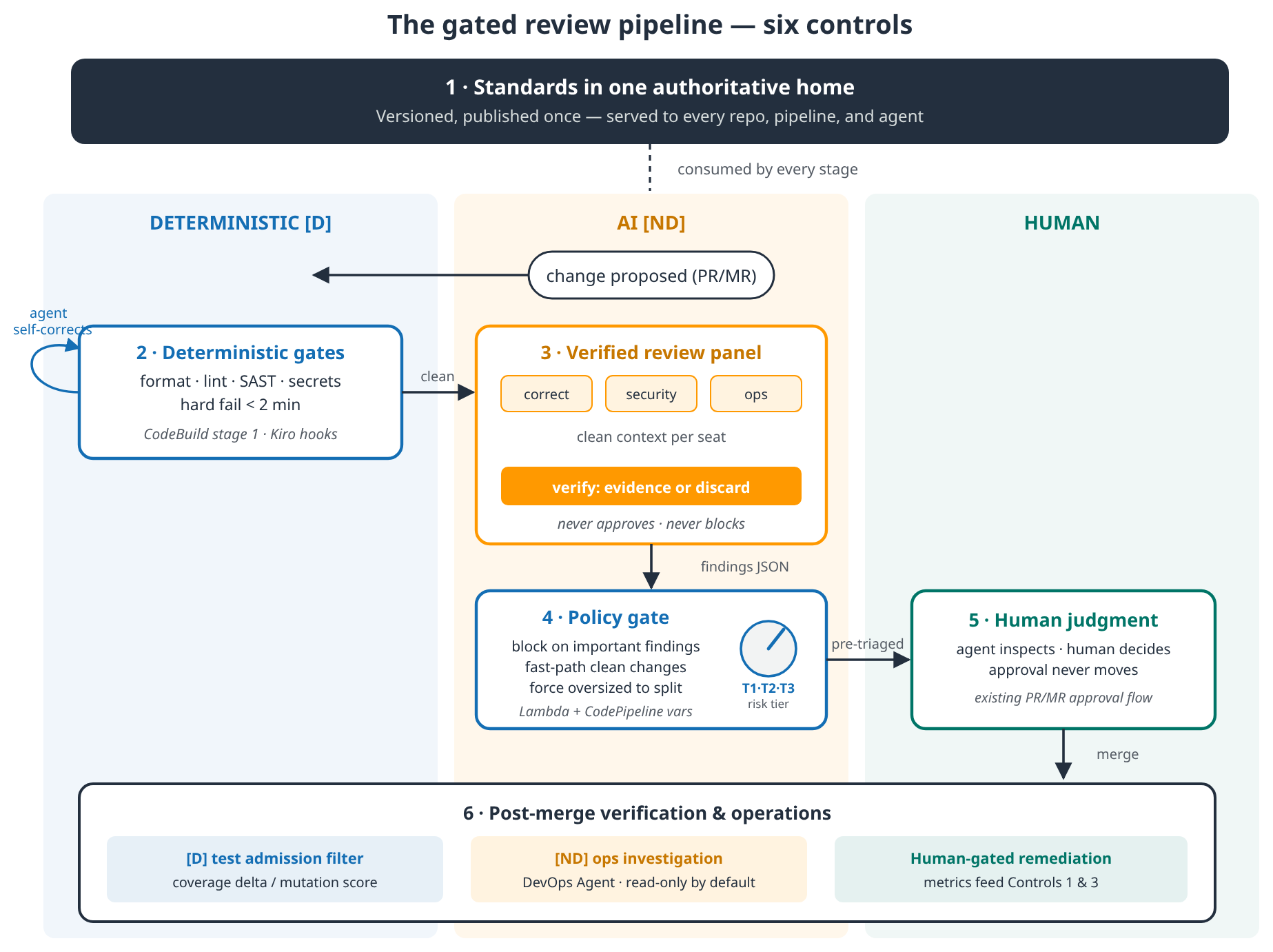
This post presents a pattern for wiring together humans and agents as part of code review. It introduces a gated review pipeline with six controls that pairs deterministic checks with verified AI review, applies your policy through risk-tiered gates, and keeps humans in charge of every consequential decision. It describes the core components of each control, how to implement them with AWS services, and how to measure the effect on defect and rework rates.
Two kinds of controls, and one wiring pattern
The AWS Blog Balancing speed and safety: a control framework for AI coding agents establishes a control taxonomy for what agents produce, through author-time controls (steering documents, specifications, and agent hooks) and pipeline scanning. It also introduces an AI-assisted review control. In this post, we expand that control into an operational design pattern. The pattern includes a review panel that produces verified findings, a deterministic gate that applies policy to findings, risk tiers that set agent autonomy, and metrics that show whether defect and rework rates fell.
This pipeline adds two design rules to that foundation. The first is a deliberate pattern for human and agent collaboration, because the research cited earlier found that collaboration patterns shape review efficiency. The second is risk-tiered autonomy. A documentation fix and a payments change carry different risk, so they shouldn’t pass through the same gate.
Assign the initial tier deterministically from what the change touches, not from what the author declares. Certain critical paths and files should be assigned the highest risk tier regardless of the change, for example changes to build and pipeline definitions, the Control 4 policy bundle, steering files, and the panel reviewer prompts. Changes such as a new dependency or an AWS Identity and Access Management (IAM) policy change should also escalate the risk tier. Evaluate related changesets together so a high-risk change can’t be split into low-risk pieces.
Tier
Change risk
Autonomy
Review depth
Evidence required
T1
Low (docs, internal tooling)
Agent drafts, human approves
Light spot-check
Pull request + provenance tag (agent, model, requester)
T2
Medium (standard features)
Agent drafts, engineer edits
Full review + tech-lead sign-off
Pull request + tests + approved spec or design notes
T3
High (payments, auth, data, changes to pipeline configuration)
Agent assists, engineer implements
Two human reviewers, plus architecture review when the design changes
Full audit package
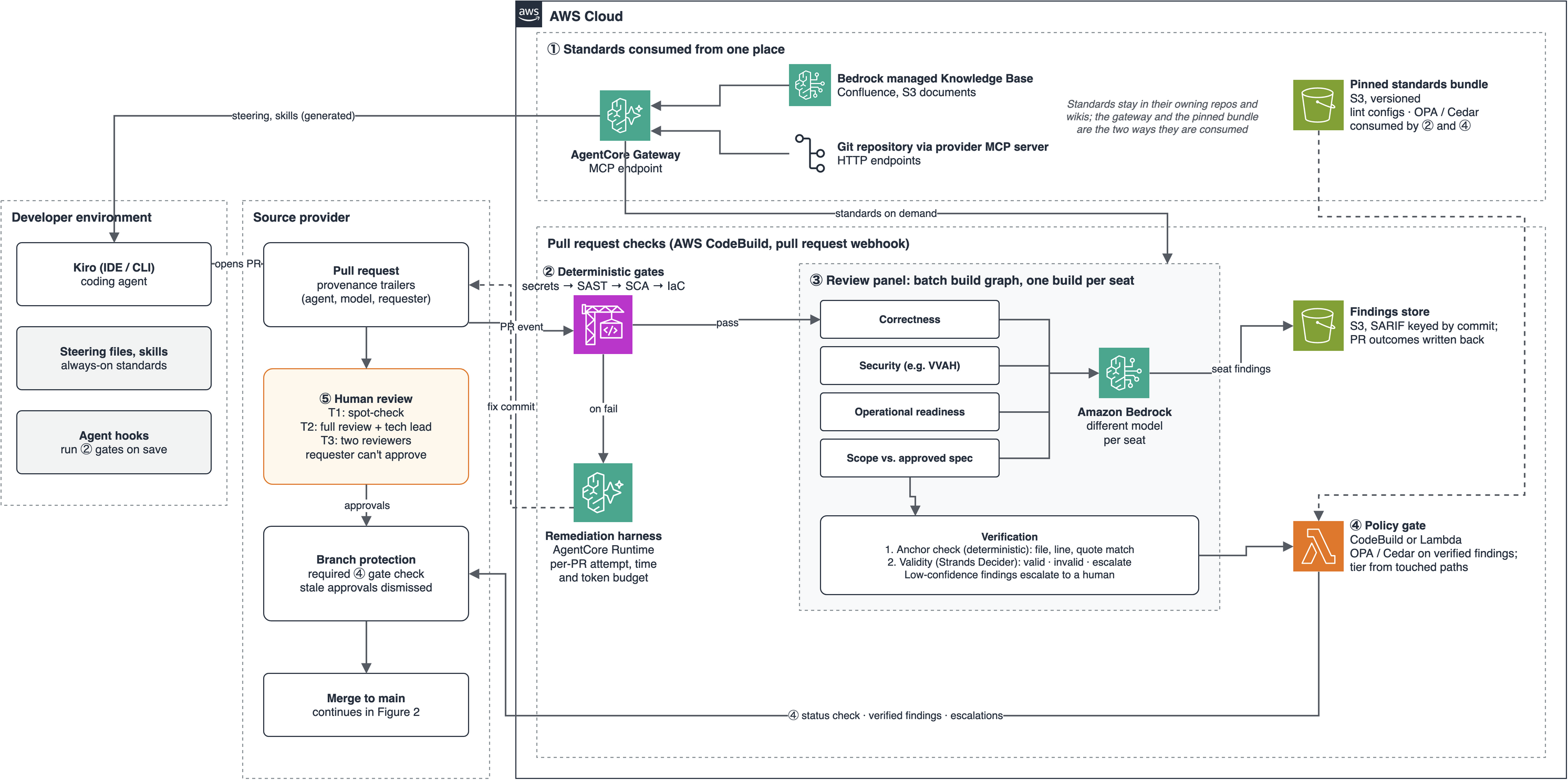
Figure 1: An overview of the six controls in the gated review pipeline
The framework is methodology-agnostic. It composes naturally with structured approaches such as the AI-Driven Development Life Cycle (AI-DLC), but requires none of them. Where a team approves the specification before generation, that review settles whether this is the right change before any diff exists, leaving the pull request review to confirm it was built correctly.
Control 1: Standards consumable from one place
Code quality rules, architectural preferences, security standards, and compliance requirements each have an authoritative home where they’re owned, versioned, and published. Those homes can differ. A security team might keep a policy repository, compliance teams a wiki, and architects a decision log. All of these should feed a single consumption endpoint, so that every repository, pipeline, and agent pulls the same standards through the same mechanism instead of integrating with each source directly. Curating organizational knowledge into a form agents can consume is an easily underestimated investment. Funneling it through one consumption point means you make that investment once, not once for each repository and each source.
A single consumption point doesn’t require a single delivery mechanism. Retrieve situational standards on demand. Small, non-negotiable ones, such as production-safety guardrails, inclusive-language rules, and conventions for working with internal systems, belong in context on every interaction. Push those as baseline configuration, such as a global steering file or default agent configuration, so the agent doesn’t need to fetch them.
On AWS: Keep each standard in its authoritative home and put a single consumption layer in front of them. AgentCore Gateway, a capability of Amazon Bedrock AgentCore, can serve as that consumption point. It exposes each source as Model Context Protocol (MCP) tools from configuration alone, whether the source is a Git repository behind its provider’s MCP server, an HTTP endpoint, or Amazon Bedrock Knowledge Bases built over documents in Confluence or Amazon Simple Storage Service (Amazon S3). Every agent and tool then pulls the same versioned standards at runtime. The knowledge base is a retrieval layer for prose-style guidance that benefits from semantic search. It isn’t the system of record, and the owning team’s repository or document store remains authoritative. If you need evidence of which standard was in force for a given change, either sync a pinned copy into the repository as a pipeline step and record the version, or write the consumed standard version to an audit log at time of use. Deterministic consumers, such as linter configurations and the Control 4 policy bundle, should take the pinned path. A standards change then arrives as a version bump instead of failing every repository’s next build.
In the developer’s environment, the consumption format is whatever the agent reads, such as Kiro steering files or agent skills. Generate or sync those files from the gateway instead of writing them for each repository, so a local project becomes one more consumer of the same standards. For the always-on class of standards, generate the global steering files or default agent configuration from the gateway’s sources, and push them out through whatever provisions your developer environments. The gateway remains the on-demand path for situational standards.
Control 2: Deterministic gates first, with agent self-correction
The first gates to run are fast, deterministic, and hard-fail. These include formatting, lint, type checks, static application security testing (SAST), and secrets scanning. The remediation agent then self-corrects in a build, fail, fix loop until the stage passes or hits a maximum iteration cap, which hands the change to human review. Don’t use AI to review what a rule can catch. When the deterministic gates run first, the AI review stage sees only mechanically clean code and spends its reasoning on semantics instead of style. It also keeps most mechanical defects out of human review.
The self-correction loop is told to make the gates pass, and the shortest path to a passing gate is often a weaker gate. Treat suppression annotations, threshold changes, and removed or skipped tests in agent commits as change risk escalations.
The blog CI/CD Pipelines with agentic AI describes how Elastic does this. When a build fails, an agent steps in as a pipeline stage. It reads the failure logs, applies fixes from a deterministic tool allowlist, verifies the build, and commits, with auto-merge turned off whenever agent commits are present. In its first month, covering under half of Elastic’s dependencies, it fixed 24 broken pull requests and saved 20 days of development work.
On AWS: Run the same gates in two places. In the developer’s environment, Kiro agent hooks run them on file save and task completion. That catches defects before a pull request exists, where the fix loop is cheapest to run. The pipeline is the enforcement backstop. The same gates run in AWS CodeBuild on every pull request as a required status check, so a failing gate blocks the merge and nothing reaches review on the strength of a local run alone. Order them by cost and severity, as the predecessor post describes: secrets detection, SAST, software composition analysis (SCA), and then infrastructure as code (IaC) scanning.
When a pipeline gate fails, a remediation agent takes over. Because this agent commits to the repository, host it as a harness on AgentCore runtime, a capability of Amazon Bedrock AgentCore, outside the build, and call it from the failing CodeBuild action. The harness runs the agent loop in its own managed workspace. It treats the failure logs as untrusted data, applies fixes constrained by a tool allowlist, re-runs the gates, and commits to the source branch, reporting progress back to the pipeline. Authenticate that call with the pipeline’s IAM role so the automation runs on a workload identity you control, with no developer credential embedded in the build. Bound the loop with the harness’s execution limits. Cap fix attempts, set a wall-clock timeout, and give the agent a token budget. Count them per pull request, because each agent commit starts a new build. When any limit trips, the build stops and hands the failure to a human. Configure branch protection to dismiss approvals on new commits, so an agent fix always gets a fresh human review. For standing up the harness itself, see Hosting coding agents on Amazon Bedrock AgentCore.
Control 3: AI review as a verified panel
Run AI review as a panel of reviewers with distinct focus areas, for example, correctness, security, operational readiness, and, where the change was built from an approved specification, scope. Each seat on the panel is an agent that starts from its own clean context, which keeps it from inheriting assumptions about the code. Give each seat the diff as its focus, plus the full changed files and the dependencies they touch, so it reviews the change in context. An agent that sees only the changed lines can’t judge cross-file or architectural impact, and those are the defects most likely to survive the deterministic gates. From a security perspective, the code is untrusted input, so seats should be limited to sandbox environments with read-only tools.
Two sessions of the same model share the same blind spots. For each focus area on the panel, assign at least one agent to use a different model family than the author recorded in the provenance tag. For high-risk changes, you might run multiple agents with different models for the same focus area. Choose models by measurement. Evaluate candidates against past pull requests with known findings and prioritize models that score best for that focus area.
A two-stage verification step decides what reaches a human at the review gate. The first stage is deterministic. It confirms that the cited file and line exist and that the quoted code matches what’s there. A deterministic check can’t tell whether an anchored finding describes a real problem, which is a semantic judgment. The second stage can use a decision model, which returns one bounded answer (valid, invalid, or escalate to a human) with a confidence score. Because the answer is bounded, you can measure it. Evaluate the model against past findings with known outcomes, calibrate its thresholds, and route low-confidence cases to a human. Without this filter, volume works against you, as seen in one industrial deployment of a large language model (LLM)-based review tool. Average pull request closure time rose by more than 40%, even though developers acted on most of the automated comments.
On AWS: Run the panel seats as a single AWS CodeBuild batch build graph, one build per seat, each invoking an agentic coding harness in a fresh session and writing its findings to Amazon S3 under the commit’s key. Mount the checked-out repository so each seat has that context. The agents run inside CodeBuild because they only read code the build has already checked out, in an environment discarded after the run. The remediation agent in Control 2 writes to the repository, so it runs on AgentCore runtime under its own identity and limits.
A verification build that depends on the agents then reads their findings and runs the two-stage check. The deterministic pass checks each finding against the checked-out code and discards any finding whose file, line, or quoted code doesn’t match. A validity judgment then runs on what remains. The open source Strands Decider models fit that judgment, returning a bounded valid, invalid, or escalate classification with a confidence score. The verified, high-confidence set passes to the Control 4 gate, and low-confidence cases go to a human. For the security seat, you can use an open source harness such as the Visa Vulnerability Agentic Harness, which applies the same pattern to vulnerabilities. It uses deterministic stages for repeatable work and agentic stages for judgment, verifies each finding adversarially, and produces Static Analysis Results Interchange Format (SARIF) output that a gate can read. Run your chosen harness in a detection-only mode, so it emits findings without editing code, and feed its output to the same verification step and gate as the other agents.
Control 4: A deterministic policy gate on structured findings
The AI review panel in Control 3 never approves or blocks. It emits structured findings, each with a severity (important or minor), whether this change introduced it or it was pre-existing, and its evidence. Findings use a standard format such as SARIF, so deterministic and AI findings reach the gate in the same shape. A deterministic gate then applies your policy to that signal. It blocks on important findings, fast-paths clean changes, forces oversized changesets to split, and scales all of it by risk tier. Keeping policy in a deterministic component, apart from the model judgment it acts on, is the core of this pipeline. It makes the merge gate auditable, reproducible, and tunable for each repository. An empty finding set means the panel found nothing, not that nothing is there. Fast-path rules might shorten the queue for T1 changes but should never reduce human review depth at T2 or T3.
On AWS: Have the verification build write the verified findings to Amazon S3, keyed to the commit, as the record of that run. Then make the gate itself policy as code. A CodeBuild step or an AWS Lambda function evaluates the findings against rules written in Open Policy Agent or Cedar. The rules encode the preceding policy, scaled by risk tier. Oversized changes reach the gate less often when the specification breaks work into reviewable tasks. The gate reports to the pull request as a status check and posts a severity summary, for example “2 important, 4 minor,” before the verified findings. The rules ship in the pinned standards bundle from Control 1, so changing the merge bar means publishing a new policy version.
Control 5: Human judgment on a pre-triaged change
Human review remains a key pipeline component. What changes is what the human reads. Instead of a raw diff, the reviewer gets a change that the gates have made mechanically clean and the panel has triaged into ranked, evidence-backed findings. The reviewer no longer needs to catch what rules and agents already catch, and can focus on the judgments only a person can make. Is this change worth its risk? Does it fit the system’s design? Does it carry business context the agents never had? Are the important findings resolved, or only acknowledged?
Scale the depth to the tier: a T1 change needs one approver doing a light spot-check, a T2 change a full review with tech-lead sign-off, a T3 change two human reviewers plus architecture review when it changes a design boundary. The person who directed the agent is the change’s author and doesn’t count toward its reviewers. Review depth scales with risk, and the human decision is never delegated.
On AWS: Your existing pull request approval flow stays the baseline human gate. The panel’s verified findings land as review comments with a severity summary at the top, so the approver starts from a pre-triaged change. For T3 changes, require a second human reviewer before merge, and use your source provider’s approval rules to block approval by the requester. After merge, an AWS CodePipeline manual approval action adds a second recorded decision before production. It notifies approvers through an Amazon Simple Notification Service (Amazon SNS) topic routed to wherever they already work. Have the tooling that runs the agent, not the agent itself, write the provenance tag as commit trailers that record the agent, model, session, specification, standards version, and requester.
Figure 2: The pre-merge pipeline, where standards, deterministic gates, the verified review panel, and the policy gate run as pull request checks and branch protection enforces the gate and the tiered human review
Control 6: Post-merge verification and operations
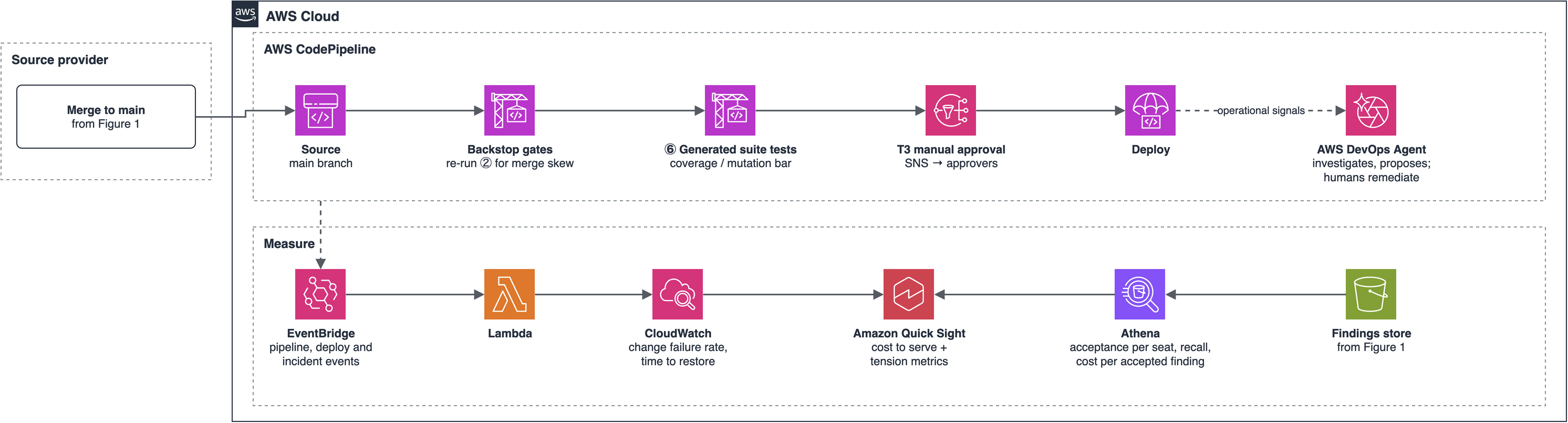
The same logic extends after merge. Tests that ship with a change go through Controls 2 and 3 with the change. This control covers suite-improvement tests that an agent generates against existing code. Meta’s TestGen-LLM is an example. It admits a generated test only after the test clears filters showing that it measurably improves the existing suite. Admit these tests as you would untrusted contributions. They must build, pass reliably across repeated runs, and measurably improve the suite, through a coverage delta or a mutation score, before a human spends time on them. The filter removes tests that add nothing, but it can’t tell whether the asserted behavior is correct, because a test generated against existing code records what the code does today. That judgment belongs to a person, and it matters more here. A test that pins wrong behavior into the regression pack blocks the future change that fixes it. Tests that clear the bar join the regression pack that the deterministic gates run on every later change, so post-merge generation keeps strengthening the pre-merge gates. In operations, agents investigate on their own, reading telemetry, correlating signals, and proposing mitigation plans, while a person approves any remediation.
On AWS: Enforce the coverage or mutation threshold in a CodeBuild project that runs as an action in a dedicated stage of your CodePipeline. A generated test that doesn’t measurably improve the suite fails the build and never reaches the regression pack. This is the same mechanism as Control 2, pointed at a different signal. There, the build fails on lint, type, or SAST violations. Here, it fails on a coverage delta or mutation score that doesn’t clear the bar. For operations, AWS DevOps Agent fits this split. It’s read-only by default, investigating pipeline and operational failures and proposing mitigation plans for a person to approve.
Measuring whether it works
The research cited earlier found that AI review made decisions faster without making them better. Cycle time is the number most readily moved, and it can improve while quality degrades. Track review cycle time, because review is the constraint this approach exists to relieve, but only alongside the following quality measures. Avoid lines of code and pull request counts entirely, because they measure activity, not outcomes.
Measure instead:
Defect escape rate and rework rate – Bugs found after merge, and changes that need follow-up fixes.
Change failure rate and time to restore – The DevOps Research and Assessment (DORA) stability metrics, which show whether stability held as change volume grew.
Finding acceptance rate per panel seat – A falling rate means the seat is getting noisier, or that reviewers have stopped engaging with its findings. Check the seat first.
Panel recall – The share of escaped defects the panel would have flagged, found by replaying them through it. Acceptance shows what the panel gets right, and recall shows what it misses.
Changeset size drift – Agents will absorb ever-larger diffs if you let them. Keep changes small even as more of them are automated.
Cost per accepted finding – Model and compute spend divided by the findings that reviewers acted on, by seat and tier. It shows which seats earn their place and where tier policy should run fewer.
For the executive rollup, cost to serve software, defined as total delivery cost divided by units of value delivered, captures the whole system. Faster generation that creates more review burden shows up as a worse cost to serve. Pair cost to serve with tension metrics, such as security incidents and rollback rate, so the number can’t be improved by cutting controls. Developer experience work at Amazon reported a 15.9% year-over-year reduction on this measure in 2024.
On AWS: Measure from the signals the pipeline already emits instead of building a parallel system. Route CodePipeline and AWS CodeDeploy deployment events, plus your incident records, through Amazon EventBridge to AWS Lambda and into Amazon CloudWatch for the change failure rate and time-to-restore metrics. The DORA metrics sample is a useful reference for wiring this up. The review-quality metrics come from artifacts the pipeline already writes. Query the Control 4 findings store in Amazon S3 with Amazon Athena for acceptance rate per seat and changeset size drift. For that, the gate records each change’s tier and size in its report, and each finding’s outcome on the pull request (resolved or dismissed) is written back to the store. Defect escape and rework rates need one deliberate link. Tag post-merge defects and their follow-up fixes back to the commit that caused them, so the numbers attribute to a change.
Roll the executive view up in Amazon QuickSight, showing cost to serve software alongside the tension metrics that keep it from being gamed.
Figure 3: The post-merge pipeline re-runs the gates, admits generated tests, adds the T3 approval before production, and feeds delivery and review-quality metrics
An incremental adoption path
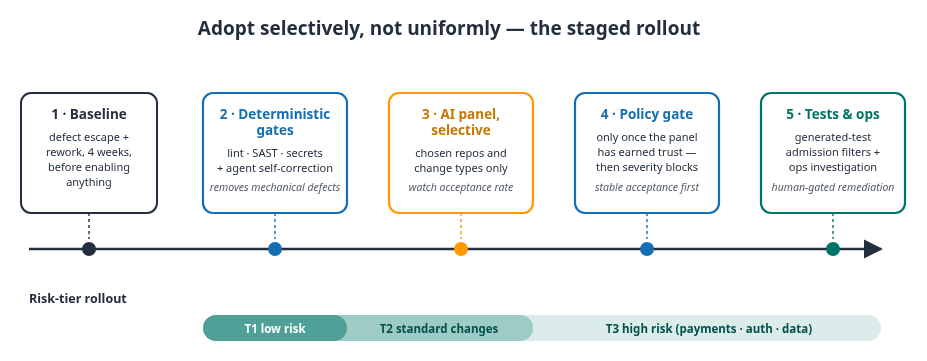
Roll the pipeline out in stages instead of all at once. Each stage produces the evidence you need to trust the next. A baseline tells you whether anything improved, airtight deterministic gates show what the panel adds beyond rules, and an advisory panel shows whether its findings deserve to block.
Baseline first. Capture defect escape and rework for four weeks before you turn anything on, or you will have no evidence story. Expect escape rates to lag, because defects surface weeks after merge. Rework moves sooner.
Deterministic gates next. Get Control 2 airtight with the agent self-correction loop. This step alone keeps most mechanical defects out of human review.
Add the panel selectively. Pick starter repositories with high pull request volume and moderate (T2) risk, where you get signal fast without affecting a critical system. In this phase, the panel is advisory. It posts findings but doesn’t block anything, because the policy gate isn’t wired yet. Use this window to confirm its value. Watch the finding acceptance rate, and check whether the panel surfaces real issues your reviewers were missing before you let severity block anything.
Wire the policy gate only after the panel has earned trust. When acceptance rates are stable and engineers act on the findings, let severity block merges.
Extend to tests and operations last.The same evidence can widen agent autonomy over time, for example letting the remediation agent fix verified findings in categories where the panel has proven reliable. Teams with long-established trust in their pipeline sometimes go further and auto-merge low-risk changes, as the Kiro Crew team describes.
Figure 4: The staged rollout, from a measurement baseline through deterministic gates, a selective AI panel, the policy gate, and finally tests and operations, aligned to rising risk tiers
The same pipeline, two changes
The following table follows a T1 change and a T3 change through all six controls. The pipeline is the same for both. What changes is autonomy and review depth.
Control
T1: fix a broken link in the README
T3: change refund-retry logic in the payments service
1. Standards
Pulls the same standards, and the always-on security and compliance guardrails that are baseline config for every change
2. Deterministic gates
Formatting and link-check run, pass, nothing to self-correct
SAST, secrets, SCA, and IaC scans run. The agent self-corrects a flagged dependency, re-runs, and passes within the bounded loop
3. AI review panel
Skipped by T1 policy, because the Control 2 link check already verified the fix
Full panel runs with repository context. The security and correctness seats flag an auth-scope concern on the retry path, which is verified and passed to the gate
4. Policy gate
T1 policy: no important findings, fast-path to a single approver
T3 policy: an important finding blocks, oversized-diff check passes, routed for full review
5. Human review
One approver, light spot-check, merge
Two human reviewers, and the auth-scope finding must be resolved, not only acknowledged. T3 adds the CodePipeline manual approval before production
6. Post-merge
Nothing further
Agent-generated suite-improvement tests on the touched module must clear the coverage bar before a human looks. Operational signals are watched after deploy
Conclusion
AI coding agents are accelerating code generation and making code review the constraint. Adding an AI reviewer doesn’t remove that constraint on its own. Outcomes depend on how humans and agents are wired together. In this post, we showed a pipeline that wires them together to speed up review while reducing risk. Deterministic rules catch the first issues. A verified panel reviews what remains and emits a structured signal, a deterministic gate applies your risk-tiered policy to that signal, and a human makes the final call on a pre-triaged change. The same pattern extends to generated tests and operations.
The AWS Workbook for BNM RMiT, available through AWS Artifact, maps each RMiT provision to AWS Control Objectives (AWS responsibilities under the AWS Shared Responsibility Model) and AWS Well-Architected Framework best practices (your responsibilities). It tells you, for every RMiT requirement, what AWS is responsible for and what you implement.
The compliance guides published by AWS SAS over the past year provide implementation guidance for International Organization for Standardization (ISO) and International Electrotechnical Commission (IEC) standards that complements the workbook. These guides show how to implement controls that meet the requirements of specific standards and frameworks using AWS services, giving your technical and compliance teams a clear path from regulatory expectation to deployed architecture.
Malaysian financial institutions can now trace from BNM regulatory requirement, through AWS control implementation, to the evidence that demonstrates it: AWS third-party attestations for AWS-side controls, and your own workload evidence for customer-side controls. BNM expects this specificity in notification documentation.
AWS Workbook for BNM RMiT
The workbook is a structured Excel document available through AWS Artifact. For each of the 394 RMiT provisions, it identifies:
Whether the requirement is an AWS responsibility or a customer responsibility under the Shared Responsibility Model
The specific AWS Control Objective that addresses the requirement (where AWS is responsible)
The relevant AWS Well-Architected Framework best practice for customer implementation (where the customer is responsible)
Supporting information and references for each mapping
The following is a sample entry from the workbook:
RMiT Requirement
Responsibility
Source
AWS supporting information
10.49: A financial institution should ensure network resilience…
AWS
AWS Control Objectives
AWS Control Section: Network Security. AWS maintains redundant network connectivity with multiple tier-1 transit providers across each Availability Zone.
10.49: (Customer responsibility)
Customer
Well-Architected
REL 2: How do you plan your network topology? Implement multi-AZ deployments. Configure VPC flow logs and use AWS Network Firewall.
The workbook currently includes 394 rows across all RMiT appendix requirements, with 208 mapped to AWS responsibilities and 186 to customer responsibilities.
Why this matters now
BNM revised RMiT guidelines effective 28 November 2025, and updated them on 25 September 2026 to add requirements for National Critical Information Infrastructure (NCII) entities. Financial institutions operating under both BNM Outsourcing and BNM RMiT must demonstrate that their cloud service providers maintain controls aligned with regulatory expectations. Institutions preparing notification submissions for material cloud workloads need auditable evidence of this alignment.
The revised guidelines set higher expectations for evidence quality. Institutions submitting notifications without clear, structured control mapping evidence might face extended review cycles and requests for additional information from BNM. Workloads that could be deployed in weeks remain in governance queues for months when supporting documentation lacks the specificity regulators expect.
Compliance guides from AWS Security Assurance Services
Start with the RMiT workbook to identify which provisions AWS addresses and which you implement. Then use the following compliance guides to design and implement your customer-side controls. The guides are implementation guidance for your teams. Audit evidence comes from two places. For AWS-side controls, use AWS third-party attestations, such as ISO certificates and System and Organization Controls (SOC) reports, available in AWS Artifact. For your workload, use evidence from your own environment, including configurations, logs, and AWS Config conformance pack results. Auditors can also use the guides as a reference for how a control is typically implemented on AWS.
AWS SAS has published five compliance guides over the past year. Each guide provides control-level implementation guidance on the customer side of the Shared Responsibility Model, showing how AWS services can be configured to meet the requirements of specific standards and frameworks. These guides were written by AWS SAS practicing security assessors and auditors holding Payment Card Industry Qualified Security Assessor (PCI QSA), Certified Information Systems Security Professional (CISSP), Certified Information Security Manager (CISM), ISO 27001 Lead Auditor, and Certified Cloud Security Professional (CCSP) certifications, drawing on experience from hundreds of cloud security assessments across financial services globally.
The following is the list of guides AWS SAS practicing auditors have published, which include control mapping information relevant to BNM RMiT:
A Malaysian financial institution preparing a BNM notification can use these resources together:
The RMiT workbook identifies which RMiT provisions are AWS responsibilities and which are customer responsibilities.
For AWS responsibilities, the workbook references the specific AWS Control Objective.
AWS third-party reports in AWS Artifact, such as the AWS ISO/IEC 27001 certificate and SOC reports, attest to those AWS Control Objectives. For customer responsibilities, the ISO compliance guides show how to implement the corresponding controls using AWS services.
The ISO 31000 guide can inform the risk management methodology you apply to your cloud workloads.
Compliance teams across Association of Southeast Asian Nations (ASEAN) financial services have already begun referencing the AWS Guide to BNM RMiT and associated resources in their cloud risk assessment processes and BNM notification documentation.
Looking ahead: AI governance
For institutions deploying generative AI and machine learning, ISO/IEC 42001:2023 (Artificial Intelligence Management Systems) is relevant to BNM technology governance expectations. In November 2024, AWS became the first major cloud provider to announce ISO/IEC 42001 certification for AI services. AWS passed its first surveillance audit in November 2025 with zero findings. The ISO 42001 compliance guide published in May 2026 supports institutions building their own responsible AI systems on their side of the AWS Shared Responsibility Model.
How to get started
Access the RMiT workbook through AWS Artifact and review with your compliance lead to identify which provisions apply to your material cloud workloads.
Download the relevant ISO compliance guides to plan how you implement your customer-side controls. Download AWS ISO certificates and SOC reports from AWS Artifact for AWS-side evidence.
Map your workload-specific controls using the workbook as the RMiT baseline and the ISO guides as implementation guidance.
Engage your AWS account team or AWS SAS for additional guidance on implementing customer-side controls referenced in the workbook.
As BNM updates its regulatory expectations, AWS will update these resources to reflect revised requirements. Subscribe to the AWS Security Blog for update notifications.
As AWS re:Invent is around the corner, we’re proud to recognize a new group of AWS Heroes. Every Hero finds their own way to give back, whether through sharing what they know, bringing people together, or building tools that help others succeed. What they have in common is a genuine commitment to supporting the builders around them learn, grow, and lead.
Let us take a moment to meet them!
Andres Moreno – El Paso, United States
Serverless Hero Andres Moreno leads the Cloud del Norte AWS User Group and is a former AWS Community Builder. On his blog, And More Dev, and at conferences and community events, he explains serverless, cloud native architectures, generative AI, and agentic systems in ways that make new technology easier to try. Andres puts special energy into supporting builders across Latin America and helping them explore what’s possible on AWS.
Geethika Guruge – Auckland, New Zealand
Community Hero Geethika Guruge is a Principal Consultant at Mantel Group whose work spans serverless, DevOps, cloud infrastructure, and agentic AI. Geethika has shared real lessons from building agentic applications and leading large migration and modernization programs at AWS re:Invent, AWS Summits, and AWS Community Days. At home in Auckland, Geethika organizes local AWS meetups that encourage grassroots innovation and mentors the next generation of cloud architects and leaders.
Jéssica Cristina Coelho – Belo Horizonte, Brazil
Data Hero Jéssica Cristina Coelho is a Database Reliability Engineer and a former AWS Community Builder with more than 15 years of experience in databases, cloud, and data engineering. She leads the AWS User Group in Minas Gerais, hosts DataTalks Brasil, teaches MBA courses, and supports Women in Cloud, DevOpsDays, and AWS Community Day events. She speaks at events such as AWS Summit São Paulo and Web Summit Rio on database modernization and generative AI. At AWS re:Invent 2025, she was recognized as a LATAM Diversity & Inclusion Champion.
Kazuho Cryer Shinozuka – Tokyo, Japan
DevTools Hero Kazuho Cryer Shinozuka is an AWS CDK Top Contributor and Trusted CDK Community Reviewer. With 200 merged pull requests, he ranks 18th among more than 1,700 contributors. He has reviewed more than 120 pull requests, has been involved in about 2% of all CDK commits, and has published 10 construct libraries, along with tools such as cfn idle cost. Through talks at JAWS DAYS and CDK Conference Japan and through hands on contribution workshops, he helps more developers in Japan start contributing to open source.
We recently introduced AI Discover, a new tab in our TV app where a small group of members can try new ways to find something to watch. For years, our recommendations have worked in the background, inferring what a member might enjoy from their viewing history. AI Discover moves from that silent ranking toward steerable discovery. A member picks a theme, say “Quick Watches,” and gets a row of matching titles, a short note on why they fit and a few narrower themes to try next. From there, they can keep narrowing, head somewhere new or tune what they see.
Building AI Discover raised a question many teams will recognize: how do you deliver a better member experience with generative AI on TV without sacrificing speed, reliability or safety? Our answer is a new intelligence layer, the agent harness behind AI Discover. For each request, it decides how to combine LLMs with our recommendation systems. It builds on years of work understanding what members enjoy, and on our recent work applying LLMs to recommendations and generative experiences. The layer itself plans each request, runs it across those systems, serves the result and evaluates it offline.
This post covers the challenges we designed for and the key decisions we made along the way.
Why an intelligence layer?
Every Netflix page combines recommendations with rules. We pick titles a member may enjoy, and eligibility, maturity and safety rules decide what can appear. An experience built on LLMs needs the same rules, plus code that decides when to call an LLM and how to handle its output. That code is called an agent harness, and it’s the core of our intelligence layer.
The simplest implementation hands the entire request to an LLM and lets it pick the titles, write the labels and decide what happens next. However, that leaves us relying on probabilistic output where we need governed results, because every turn in AI Discover ends on a screen in someone’s living room. At our scale, even rare failures happen many times a day. A member sees every slow call, unavailable title or off-brand line. Seven challenges shaped our design:
Fitting LLMs into a product and architecture designed without them. Traditional recommenders rank titles based on past behavior. LLMs can do more: understand what a member is asking for and plan how to respond. Our existing experience would leave most of that unused.
Keeping recommendations grounded. Every pick must be a real, available title from our changing catalog. Retrieval and rankers work in tandem with LLMs to choose titles that fit the member’s taste and intent.
Working with slow, unpredictable LLMs. LLM calls are the slowest and most expensive part of the system. Tail latencies can spike, and the output may not be what you asked for. So we use LLMs selectively, treat what they return as untrusted input and test performance and quality before anything ships.
Adapting to fast-changing models, tools and prompts. Modeling and engineering solutions keep evolving, so the product can’t depend on any single model, tool or prompt.
Building for TV. Typing on a TV is hard, so members rely on the remote, and the app should respond to every press right away on widely varying hardware. TV apps also update slowly, so changes have to ship without an app release. A typical TV request returns in moments, while multi-step generation can take several seconds.
Holding a safety and reliability bar at scale. Members always get a page, even when an LLM call fails or yields poor results. Their choices and our content standards hold on every request, and when something breaks, structured records show why.
Learning from what members say alongside what we already know. Recommendations have always learned from viewing behavior. AI Discover also lets members tell us what they want, and that has to shape what they see next.
System Architecture
When a member picks a theme, the TV app sends the request to the Page Server, which builds pages for all Netflix apps and hands the request asynchronously to the intelligence layer. At a high level, this new layer has two components: a controller and an executor.
The controller decides what to run. It gathers the context needed for each request, including real-time signals such as the time of day. It then settles on a plan, either an established one or a new one drafted by its planner, validates it and retrieves only the member details that this plan requires from Memory Hub, our per-member memory store. These details may include member taste summaries generated by MemberLLM, our in-house language model for personalized recommendations, or feedback shared by the member. We talk more about Memory Hub and member taste summaries later.
A plan is a graph of approved steps, each running a capability. A capability is a named unit of work that can have multiple versions and belongs to a family such as retrieval, ranking, generation or packaging. It declares its inputs and outputs, the context it may see and what happens if it fails.
Capability declarations make a plan verifiable. Before execution, the controller validates the graph: every step is approved, every input has a producer, nothing loops and the plan ends in exactly one page. Afterward, the controller checks the result before it’s served.
The executor runs the plan. Steps pass typed outputs to each other through the declared contracts, so each receives exactly what it asked for. Independent steps run in parallel, each with its own deadline and appropriate fallback behaviors. Some steps are optimized LLM calls with one task each, such as writing row titles or suggesting next themes, and they act only within the validated plan. Checks before the run and contracts during it give us governed execution, where every action stays within limits set in code.
Both parts write to the request records, the traces we use offline to evaluate and improve the system.
System Architecture Diagram
Key Decisions
Each challenge led to one decision. Here’s what we chose and what it bought us.
1. Design the product and architecture around LLMs
We reimagined the experience around LLMs. The easier path would have been to drop them in as rankers, keep today’s latency budgets and precompute where necessary. AI Discover is built on a back-and-forth around themes a member can steer, which gives LLMs work only they can do: generating themes, explaining rows, summarizing taste and helping choose the titles that fit the member and the moment. Members pick themes with the remote, so they never have to type. On the TV, those themes and explanations get their own native UI elements. Behind the screen, LLMs can draft plans, and asynchronous serving gives multi-step agentic orchestration the time it needs.
This opens up experiences our traditional stack couldn’t support on its own.
2. Make existing systems composable
Keeping recommendations grounded meant building on the systems that already know our catalog and members. Most capabilities wrap complex, proven Netflix systems such as search, large-scale ranking and catalog metadata access. Some of them may run their own agents in the future.
Reshaping them took careful work, because agentic orchestration challenges many long-standing assumptions of distributed systems. A capability now has to work in combinations no one designed, for a caller that chooses to call it at runtime. Each one needs a clear purpose and a semantic interface, and shaping it means deciding how much to combine into a single step and how much to leave to the planner. Too fine, and the planner has more ways to go wrong; too coarse, and it loses room to compose richer plans.
In return, the planner gets building blocks it can mix in new ways, and connecting services takes far less manual wiring. Because plans can only use these blocks, even one drafted on the fly stays grounded in our catalog and member taste.
3. Plan first, then execute
To contain LLM latency and errors, we plan every request before anything runs. The familiar way to let an agent use tools is a loop: reason, call a tool, read the result, reason again. It’s flexible, but you can’t tell up front how many steps it will take or whether it has gone down a wrong path. In agent terms, ours is a plan-and-execute agent: an LLM can propose the path, but code decides whether it runs.
Plans come from two places: established plans we’ve already tested, and plans an LLM drafts on the fly. A router we control decides which one is served. Either way, the plan passes the same checks before it runs. If the planner is slow or its plan fails a check, we fall back to a tested plan.
This allows for adaptive planning. The planner can find new ways to serve a request, and we can balance cost, latency and quality for each task, from a lean single-call plan to a richer multi-step one.
4. Stay model and capability agnostic
The best model or capability for a task today may be second-best, or overkill, in a few months, so we built the system to switch between them. We assign each task to the model or capability version that fits it. Today that’s a per-task setting we can override live. Only some steps in a request use an LLM.
That only works if switching is easy. All the LLMs we use sit behind one common interface. Before we switch, each candidate is scored on the same tasks by automated checks and LLM judges, so every swap is a measured change.
Much of the system’s behavior lives in server-side prompts and configuration, so we can swap models, tools and capabilities without new code or a TV app release.
Upgrades get cheap and experiments get easy. Moving to a better model, ranker or retrieval system is a plan or setting change, not a migration, so each component can keep improving without a large investment.
5. Make page generation asynchronous
Inference keeps getting faster, but member expectations rise just as quickly: richer responses, more context and more of the page shaped by LLMs. The line between what feels instant and what’s worth waiting for will keep shifting, so we built the asynchronous path as a first-class way of serving.
Most of a TV app is synchronous: press a button, get a page. Generative work breaks that pattern. Holding one request open for many seconds across services would tie up too many threads. So requests that involve generation are asynchronous. The press returns right away with an acknowledgement, and the TV switches to a thinking state that explains what’s being prepared. Meanwhile, the executor runs the plan in the background. When the result is ready, the server notifies the TV, which then fetches it.
Slow generation no longer slows anything else. The serving path stays healthy however long a turn takes, and every press still gets immediate feedback on screen.
Async Sequence Diagram
6. Enforce safety in code
Some rules must hold no matter what an LLM writes: content and maturity standards, what each step can access, and what a member has asked us not to show them. Putting those rules in a prompt makes them probabilistic, so we enforce them in code. Generated text is cleaned up before it reaches the screen. The planner sees a stripped-down request, and member details are limited to what the validated plan needs.
For example, the planner decides which inputs each step needs, such as the profile’s maturity rating for retrieval. Instead of writing parameter values directly, it uses placeholders. After the plan passes validation, the controller fills them with values from the request, matched by declared type. This also protects against prompt injection.
Each request also leaves a structured record: the plan, each step and its outcome, and which rules applied. When a page misses, we can tell whether the plan, the data, a rule or the model was at fault. The same records feed our offline evaluation and replay.
Together, these rules and records let an experiment ship at the same safety and privacy bar as the rest of the product.
7. Remember what members tell us
A taste summary is a short profile of what a member enjoys, such as favorite genres, tone and recurring themes. MemberLLM generates it ahead of time from the member’s viewing history, which keeps that LLM work off the request path. It helps us further personalize their page, and steps that write themes and explanations receive it as context, so their wording reflects the member. We’ll cover MemberLLM in more detail in an upcoming post.
In AI Discover, members can also tune their recommendations and tell us directly what they want. Those choices apply right away and carry across visits, and they give us a new signal alongside what we already know about their taste. This is a first step toward remembering more about each member, from their preferences to the habits that show up over time and the corners of the catalog they like to explore. We keep it all in Memory Hub, our persistent, low-latency memory store, next to their taste summaries, and we can add new kinds of memory as we need them. We apply these memories to later requests where they’re relevant, together with real-time context.
The member holds the remote
In this version, members interact by selecting themes and using tuning options such as “don’t recommend.” There’s no free-text input or open-ended chat. That keeps the LLM’s job narrow by design.
The usual protections still apply. Profile settings and our safety and privacy policies hold here as everywhere else.
Generated text was tested before launch. We ran safety evaluations on theme labels, row titles and explanations to make sure they meet our standards.
What’s next
It would have been faster to let an LLM do everything and stop there. The intelligence layer gave us an AI-native product, grounded building blocks, adaptive planning, quicker experimentation, asynchronous generation, governed execution and agent memory for tunable personalization. While AI Discover is its first experience, we designed it with more in mind.
We’ve organized our efforts to answer two questions:
How much do members want to shape their recommendations? Whether they’d rather steer or lean back, and how much, which kinds of themes help, and how we should blend what members tell us with our existing personalization systems.
What tradeoffs does this technology bring? How cost and latency hold up in production as we ramp traffic, how long members will wait for generated results, and whether errors came from the model, the harness or our existing systems. Multi-turn sessions also need different evaluation and observability than single requests.
Longer term, our goal is a system that improves itself, starting from the record each request leaves behind. Today we replay past requests against a new prompt, model or rule to see what changes, and we judge each change with automated checks, LLM judges and human evaluations. Eventually, we want the system to propose improvements, test them safely and keep only what proves better, within our privacy and data-use policies. As LLMs improve, more of the work may move into them, and the intelligence layer lets us move that line deliberately.
This is part of a bigger shift. Recommendation systems have long learned quietly from what members watch and answered with ranked rows. LLMs let them listen and respond, and members may increasingly expect that. We’ll keep exploring what that means for discovery on Netflix.
Acknowledgements
We would like to thank Adi Suresh, Akash Katipally, Allan Johns, Becks Wood, Bhargav Mangipudi, Carrie Santiago, Chris Martin, Claire Campbell, Corey Waldin, Dana Sittler, Daneo Zhang, David Leen, Devon Bryant, Dharamendra Kumar, Dharini Chandrasekaran, Ebony Turner, Federico Roa, Gianfranco Cuoco, Guru Tahasildar, Haley Clanton, Haresh Chudgar, Ivan Provalov, James Schultz, JingXu Yang, Josie Shaw, Kamelia Aryafar, Kate Cummings, Kathleen Garrity, Kelley Robinson, Kevin Du, Kevin O’Connor, Kyla Moore, Kyle Lind, Laura Matsuura, Leah Cusella, Lingyi Liu, Lingyong Wang, Mallory Walkup, Matthew Pereira, Michael Galassi, Minsu Jang, Moumita Bhattacharya, Paran Jain, Paul Lee, Qusai Al-Rabadi, Scarlet Chen, Sergi Perez, Sriram Rao, Stephen Shaw, Sura Elamurugu, Varad Pathak, Yesu Feng, Zainab Mahar Mir, and Zhongli Cheng for their contributions to this work.
Engineering AI Discover was originally published in Netflix TechBlog on Medium, where people are continuing the conversation by highlighting and responding to this story.
Drew DeVault has announced that Redict, a fork of Redis that was created in response to Redis’s 2024 license change, has been deprecated. He recommends switching to Valkey, the permissively licensed Redis fork supported by the Linux Foundation. The two projects are mutually compatible, so switching should be as simple as changing which package is installed and renaming the configuration file.
I had hoped to rally the Redis diaspora around a copyleft initiative, to protect ourselves from future rug-pulls, and made Redict to serve this purpose. However, with the valkey project’s success, and Redis’s return to a copyleft license, Redict was not able to build a sustainable community.
We recommend that Redict users switch to valkey, which uses a permissive license but has better long-term prospects. We advise against switching back to Redis; though it is once again open source, and copyleft, it uses a contributor license agreement which will facilitate another rug-pull when Redis has a bad financial quarter.
In this post, we discuss how Rakbank retail digital banking platform ingests approximately 150 GB a day of telemetry across a cross-account, Multi-Availability Zone (Multi-AZ) Amazon OpenSearch Service design, with hot/warm/cold tiering, 7-year compliance retention backed by Amazon Simple Storage Service (Amazon S3), and approximately 55 percent cost savings over an all-hot cluster.
Context and workload profile
Rakbank’s retail digital banking platform runs as containerized microservices on Amazon Elastic Kubernetes Service (Amazon EKS), and its observability requirements are driven by a few hard numbers. The platform now generates roughly 150 GB of logs per day on average, up from about 5 GB/day before the migration. That produces around 9 TB retained in OpenSearch Service over a 60-day window (150 GB/day × 60 days), with the most recent 30 days directly searchable. Retention runs to seven years for compliance, aligned with Central Bank of the UAE (CBUAE) requirements and Rakbank’s internal data-retention policy. At an average of 150 GB per day, that archives approximately 54 TB of log data per year, or approximately 383 TB over seven years. On the consumption side, 25 dashboards serve about 25 concurrent users. The data itself has an important property: logs are append-only. After written, a log document is never updated or deleted, so there is no update or delete-by-query churn. (Where regulatory write-once-read-many immutability is required, the S3 archive bucket can enforce it with Amazon S3 Object Lock.)
The append-only pattern is architecturally significant: because indices are no longer written to once they roll over, force-merging them to a single segment per shard before warm migration is safe, and there is no update overhead as indices roll down the tiers.
Telemetry pipeline: Fluent Bit
Instrumentation follows an instrument once, standardize everywhere model on a Fluent Bit standard across all banking domains (retail, business, wholesale). Concretely:
Fluent Bit runs as a DaemonSet on the EKS cluster, tailing container stdout/stderr on each node and enriching records with Kubernetes metadata (pod, namespace, labels) before routing.
Fluent Bit performs a dual-write/parallel archive: one path ships to the OpenSearch Service ingest endpoint (hot), a parallel path lands raw log objects directly in Amazon Simple Storage Service (Amazon S3) for durable backup independent of the search tier.
Cross-account topology and private connectivity
The design separates the workload from its observability plane using two accounts:
Application account
Amazon EKS cluster running the app pods in the Application virtual private cloud (VPC).
Fluent Bit DaemonSet for container-log collection and routing.
A parallel archive path to Amazon S3 (Log Archive & Backup).
Observability account
A dedicated OpenSearch Service centralized logging domain in the OpenSearch Service VPC, spanning three Availability Zones.
OpenSearch Service Dashboards as the access/visualization layer, routed to the hot data nodes.
Connectivity. Cross-account log flow traverses an AWS Transit Gateway, keeping all communication private within AWS. No traffic egresses to the public internet. In practice, Transit Gateway route tables provide reachability between the application and OpenSearch Service VPCs. Access is scoped at the VPC boundary by security groups and network ACLs that permit only the required ingest traffic (HTTPS/443) to the domain.
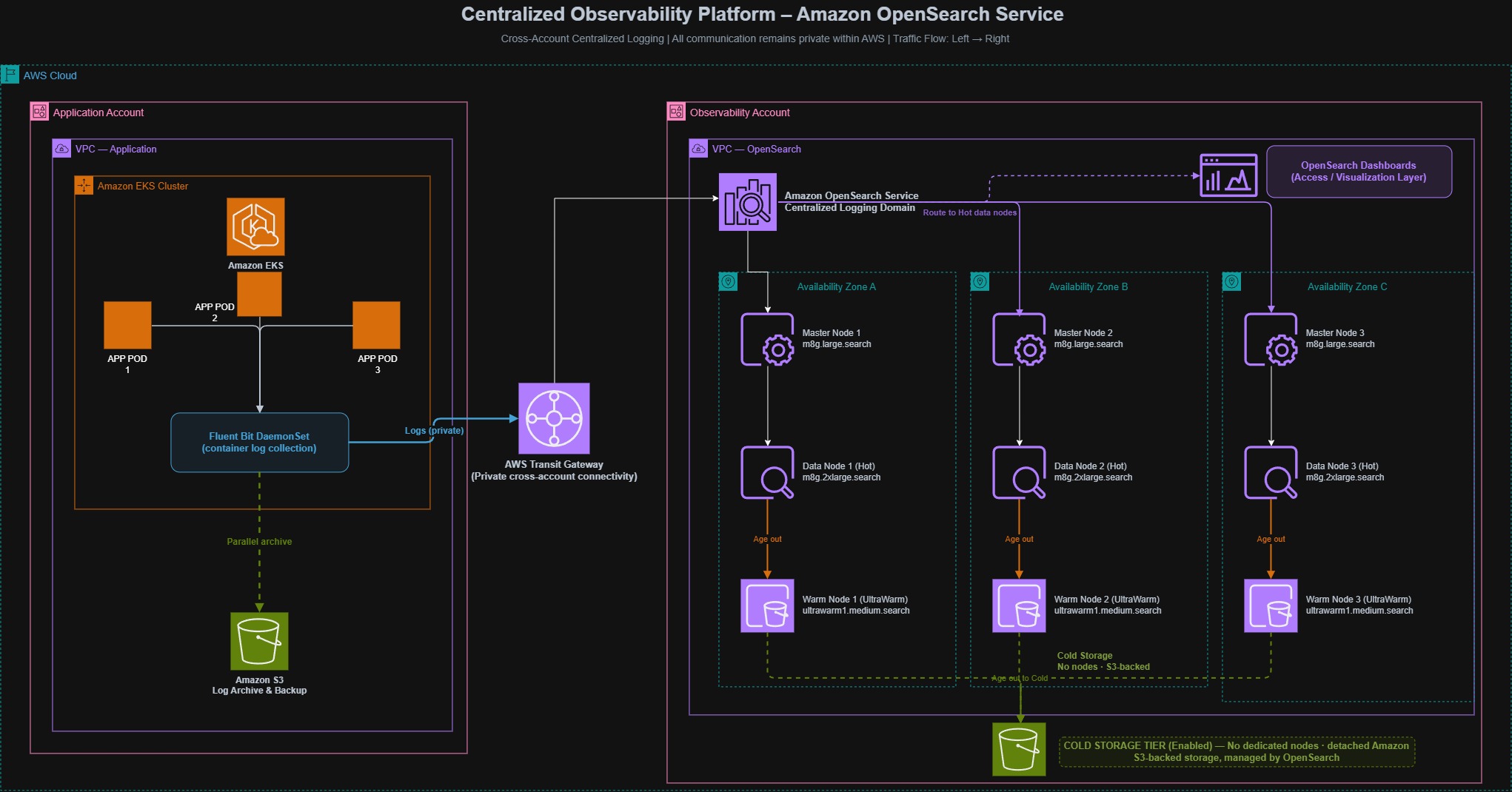
The following diagram shows the full cross-account path: application pods write logs through a Fluent Bit DaemonSet, which both forwards them privately over AWS Transit Gateway to the OpenSearch Service domain and archives a parallel copy to Amazon S3.
Figure 1: Centralized observability platform showing cross-account log flow from the EKS application account across AWS Transit Gateway into the Multi-AZ OpenSearch Service domain with hot, UltraWarm, and cold tiering and Amazon S3 archival
In the Application account, three application pods on the Amazon EKS cluster write logs that a Fluent Bit DaemonSet collects. Fluent Bit ships one copy over AWS Transit Gateway to the Observability account and archives a parallel copy to the Amazon S3 Log Archive and Backup bucket. In the Observability account, the OpenSearch Service centralized logging domain spans three Availability Zones. Each zone has a dedicated cluster-manager node (m8g.large.search) and a hot data node (m8g.2xlarge.search) that ages out to an UltraWarm node (ultrawarm1.medium.search) and then to a shared, node-free S3-backed cold storage tier. OpenSearch Service Dashboards reads from the hot data nodes for visualization.
Identity and cross-account authorization flow
The platform spans two accounts, with access governed by the layered security model of OpenSearch Service: network isolation (VPC and private Transit Gateway connectivity), the domain’s resource-based access policy, and fine-grained access control (FGAC) on the VPC domain. End users reach OpenSearch Service Dashboards through Security Assertion Markup Language (SAML) 2.0 single sign-on federated to Rakbank’s corporate Active Directory. Access follows existing enterprise identities and group memberships, with no separate OpenSearch Service credentials. Log ingestion from the application account is authorized separately from user access, keeping the write path and the read path on distinct, least-privilege roles. Together these layers keep all telemetry flowing privately within AWS while access stays centrally governed in Active Directory.
Cluster topology (per-AZ node roles)
The domain is a 3-AZ deployment with dedicated cluster-manager nodes separated from data nodes:
Role
Per-AZ instance
Count
Purpose
Cluster manager
m8g.large.search
3 (1/AZ)
Cluster state, shard allocation, no data
Hot data node
m8g.2xlarge.search
3 (1/AZ)
Active indexing + real-time query
UltraWarm node
ultrawarm1.medium.search
3 (1/AZ)
Read-only, S3-backed warm segments
Cold tier
No nodes
—
Detached S3-backed storage, managed by OpenSearch Service
The hot data and cluster-manager nodes are Graviton (m8g) for better price/performance. Dedicated cluster-manager nodes isolate cluster-state management from indexing and query load, which matters after you’re pushing 150 GB/day through the hot tier.
Storage tiering: right data · right store · right cost
The core mechanism is OpenSearch Service multi-tier storage, with indices aging through tiers using Index State Management (ISM) policies keyed off index age:
Tier
Backing
Retention
Access pattern
Instance/store
Hot
Amazon Elastic Block Store (Amazon EBS) (gp3) volumes on data nodes
0–15 days
Real-time dashboards, active troubleshooting, alerting
m8g.2xlarge.search
Warm (UltraWarm)
Amazon S3 + local cache
15–30 days
Read-only historical analysis. Cost-optimized, still fully searchable
ultrawarm1.medium.search
Cold
Amazon S3 (detached, no nodes)
30–60 days
Older logs for on-demand investigation. Attach to UltraWarm when needed
S3-backed, 0 compute at rest
How the lifecycle behaves:
Hot → UltraWarm: ISM transitions indices at approximately 15 days. UltraWarm keeps primary shard data in S3 while caching hot blocks locally, so queries still run, only at higher latency and far lower cost per GB. Because rolled-over indices are no longer written to, they are force-merged before migration for faster warm-tier read performance.
UltraWarm → Cold: At approximately 30 days, indices detach to the cold tier, which is pure S3 storage with no dedicated compute. Cold indices are not directly searchable: to query them, you selectively attach them back to UltraWarm nodes on demand. (Querying the raw S3 archive without reattaching is a separate path that uses Amazon Athena.)
Compliance archive (S3 + Athena): Everything also lands in a separate Amazon S3 bucket for the full 7-year window, and is queried with Amazon Athena, at the lowest cost per GB. This decouples how long data must be kept from how much hot compute is paid for.
Durability details called out in the design: The durability of Amazon S3 means the design can run 0 replicas on the warm/cold tiers and remain durable (S3 handles redundancy), which further cuts cost. UltraWarm is a read-only warm tier, and Graviton (m8g) powers the hot and cluster-manager nodes.
Alerting. Hot-tier data drives OpenSearch Service alerting with email and Microsoft Teams destinations for real-time operational alarms.
Production sizing and cost model
Sizing target: 150 GB/day average, 60-day retention (30 days directly searchable) (the cluster is provisioned with headroom for an approximately 200 GB/day peak, which is the basis for the node sizing that follows). Rakbank evaluated two topologies:
Option 1 — Hot + UltraWarm (recommended)
3 × m8g.2xlarge hot data nodes.
3 × ultrawarm1.medium.search + cold tier.
3 × m8g.large dedicated cluster-manager nodes.
Approximately 55 percent savings compared to all-hot.
Option 2 — All Hot
3 × r8g.4xlarge, approximately 8,320 GB each.
3 × m8g.large admin, no warm tier.
Higher cost, all data resident hot.
Pricing is On-Demand. Reserved Instances reduce it further. The takeaway: for a 9 TB, 60-day window, the bulk of data is rarely queried after the first couple of weeks. Pushing older indices to an S3-backed warm/cold tier removes the need to keep the full working set on hot r8g nodes, which is where the approximately 55 percent delta comes from.
Scaling the observability architecture with OpenSearch Service
As the platform grew from approximately 5 GB/day to approximately 150 GB/day with 25 dashboards and approximately 25 concurrent users, the observability architecture had to meet three requirements:
Predictable cost at high ingestion volume, repeated dashboard queries without per-query cost coupling, and multi-tier retention spanning real-time access through to 7-year archival. OpenSearch Service meets these requirements with an instance-based model and hot/warm/cold tiering: ingestion and queries run on provisioned capacity, and older indices age into S3-backed tiers for long-term retention at a low cost per GB. This gives Rakbank a predictable, capacity-based cost model as data volume and dashboard usage grow.
Resilience: Multi-AZ and the Standby trade-off
Deployment option
SLA
Failover
Nodes
Multi-AZ (no Standby)
99.9% out-of-the-box
automatic
3 AZ · 3 data nodes + 3 dedicated cluster-manager nodes
Multi-AZ with Standby
99.99%
< 1 min automatic on AZ failure
3 AZ · 2 data active + 1 standby
The trade-off to understand: with Multi-AZ with Standby enabled, only two of three data nodes serve search requests. The third is reserved for failover. That is a 33 percent reduction in active search capacity in exchange for the higher service level agreement (SLA). Standby also requires at least two replicas per index, which increases storage, and is supported only on specific instance families, so check the current list before planning it. If a 99.99 percent SLA is not a hard requirement, running without Standby keeps all data nodes serving search. Rakbank runs its production domain without Standby, with data nodes across all three Availability Zones and replica shards for redundancy.
AI-powered observability capabilities
Rakbank is evaluating newer, machine learning (ML) and agent-driven features of OpenSearch Service that can layer on top of the tiered store:
AI Assistant – Natural-language → query generation (for example, “Show error spikes in the last 24h”), backed by Amazon Bedrock.
MCP Server + Agent investigator – DevOps agents autonomously execute PPL queries for root-cause analysis. A Memory Store provides persistent context across agent conversations.
Direct Query – Query Amazon S3 data without ingesting it into OpenSearch Service, an option alongside Amazon Athena for the S3 archive.
Trace Correlation – Available as trace collection is added to the pipeline: unify logs, traces, and metrics in one view, with automatic trace/log correlation and service maps.
Query surface – PPL, DSL, SQL, PromQL. Integrates with Amazon Managed Service for Prometheus and Amazon OpenSearch Ingestion for high-performance ingest.
Outcomes
Running on the Fluent Bit standard, the platform now serves three audiences from a single pane of glass. Support operations get faster triage and guided troubleshooting, engineering teams use it for root-cause analysis and debugging across the request path, and the business gains journey trends and actionable insights.
Net results: lower mean time to resolution (MTTR), higher reliability, data-driven insights, and improved operational efficiency. In their own environment, Rakbank measured faster performance after upgrading across OpenSearch Service versions (1.3 → current), with single-digit-millisecond latencies for lexical and vector queries.
Engineering lessons learned
Multi-tier from day one – Design hot/warm/cold up front. Retrofitting tiering onto a live 150 GB/day cluster is significantly harder than starting with ISM policies in place.
Size for peak, not today – Ingestion grows as more microservices come online. Provision headroom in the hot tier and shard count.
Model the Standby trade-off explicitly – 99.99 percent costs you 33 percent of active search capacity and requires two replicas per index. Decide per workload whether that SLA is worth it.
Exploit the append-only advantage – Append-only logs are the recommended candidate for multi-tier storage: no update overhead, clean force-merge before warm migration, and predictable rollover.
Marking their return to the HPC market, at SC26 NVIDIA has announced the Rubin HPC chip. The science and engineering-focused GPU will have over 50,000 CUDA cores and will be released in 2028
Zellij is a relatively new entrant in the terminal-multiplexer
category. Like GNU
Screen and tmux it gives
users the ability to manage a workspace inside a terminal with split panes,
provides session management, and so forth; but Zellij also includes a web server for
browser access to a terminal session, is extensible via a plugin API, and is likely
more beginner-friendly than its predecessors. Its most recent release, version 0.46,
adds a standalone terminal emulator, a built-in inbox for notifications, and a settings
screen so users can configure the application without fussing with
configuration files. While the low version number might suggest that it is not
yet ready for serious use, it seems stable and full-featured enough to
meet the needs of many users.
Approving an AI service is only the starting point. As employees adopt Claude and their responsibilities change, security teams need to know who has access, which users hold administrative privileges, and whether those roles and group memberships still reflect the work they do.
IBM’s 2025 Cost of a Data Breach Report found that, among studied organizations reporting an AI-related breach, 97% lacked proper AI access controls. The finding highlights a broader challenge: AI adoption needs security practices that extend beyond the initial approval, supported by information teams can use to review access with administrators and service owners.
Rapid7 Surface Command now integrates with Claude’s Compliance API, bringing supported organization, user, role, group, and settings information into the same platform teams use to understand other assets and identities. The integration helps security teams make enterprise Claude access part of their existing review practices.
Bring enterprise AI access into your security view
An account list tells security teams who is present, while roles and group memberships help explain how access is organized and where further review may be needed. Surface Command’s integration with Claude’s Compliance API brings together:
Organizations and users: Visibility into the Claude organization and its associated user accounts.
Roles and groups: Context to understand users’ assigned roles and group memberships.
Organizational settings: Available configuration information to support review of the enterprise Claude environment.
With those details in Surface Command, practitioners can examine Claude identities alongside the other assets and identities they manage. That gives them a clearer basis for working with service owners to evaluate whether access remains appropriate as teams and responsibilities change.
The integration focuses on administrative visibility. It does not ingest Claude conversation content, provide threat detection on Claude activity, or control Claude’s behavior.
From a user record to an informed access review
Consider a security practitioner reviewing administrative access to Claude. In Surface Command, they can inspect an imported user’s details, review their organization role and administrative status, and examine their group memberships. The relationship graph provides a visual view of how that user connects to the organization and its groups, making those associations easier to follow.
The practitioner can then work with the service owner to confirm whether administrative privileges are still needed, whether group memberships reflect current responsibilities, and whether those assignments align with the organization’s access model.
Surface Command provides information to support the review, while the team applies its policies and judgment to determine whether a change is needed.
Support AI adoption with clearer accountability
As Claude becomes part of everyday work, reviewing its users and access relationships becomes part of managing the environment. Bringing that information into Surface Command helps security practitioners and service owners work from a shared understanding of assigned roles and group memberships. It supports more informed access decisions and helps security leaders incorporate enterprise AI into established oversight practices.
Get started with Claude and Surface Command today
The integration is available through the Anthropic connector in the Rapid7 Extension Library. Using Claude’s Compliance API requires a Compliance API key and the appropriate entitlement for your Claude organization.
Visit the connector page to get started and see how Surface Command brings Claude users, roles, and group relationships into view.
Google Deepmind researchers used agentic AI to mathematically prove, or “formally verify,” a number of the Signal protocol’s key cryptographic guaranteesa landmark development for the widely used cryptography and AI itself.
Conducted as a sort of proof-of-concept project in just four weeks, the work is significant in two ways. It serves as further independent validation of the cryptography that protects massive quantities of the world’s communications on platforms like the Signal app, Google Messages, and WhatsApp. And it demonstrates Google DeepMind’s formal verification capabilities using a new AI framework called AlphaProof Code.
[…]
The DeepMind analysis did not find any new vulnerabilities in the portions of the Signal protocol it looked at, but when the researchers used AlphaProof Code on older versions of Signal that contain known and long-fixed vulnerabilities, it correctly identified them and showed that the protocol could not be formally verified. The researchers are releasing the specification and proof they developed for the Signal protocol analysis to aid other formal verification work.
First, our researchers collaborated with a mix of models to translate Signal’s security goals into formal mathematical specifications, with human experts reviewing every one. From there, agents powered by Gemini Carbon did the proofs, generating over six million lines of Lean, a computer language that mathematically proves the accuracy of code.
Next, the agents audited the proof and highlighted areas that needed a second look by a human just one percent of the codebase, a massive time savings. Because Lean automatically checks the rest, our experts could focus their review where human judgment matters most.
Amazon Managed Streaming for Apache Kafka (Amazon MSK) Express brokers deliver Apache Kafka topic data to general purpose Amazon Simple Storage Service (Amazon S3) buckets at lower cost and without the operational overhead of running Kafka Connect. Because Express brokers handle both ingestion and delivery, you can reduce your ingestion and delivery costs by up to 60% compared to self-managed alternatives. There is no connector or infrastructure to manage, you pay only for the data delivered, and delivery doesn’t consume broker throughput.
Many Kafka workloads need a durable copy at rest in Amazon S3 for backup and archive. Compliance rules often require you to keep raw events for years for audits. You require a replayable copy that outlives topic retention, raw training data for artificial intelligence and machine learning (AI/ML) models, and a staging area for scheduled extract, transform, and load (ETL) jobs. For analytics, Express brokers also deliver to streaming tables, which continuously materialize your Kafka topics as Apache Iceberg tables on Amazon S3 Tables, a capability of Amazon S3, with no Kafka connectors, Apache Flink jobs, or custom consumers to run. The tables are registered automatically in AWS Glue Data Catalog, so you can query them with Amazon Athena, Amazon Redshift, and Apache Spark, and inline compaction reduces downstream query costs by up to 30%. Because delivery doesn’t add broker load, one topic can feed both an S3 bucket and a streaming table. For more information, see Deliver Apache Kafka data to streaming tables for Apache Iceberg with Amazon MSK Express brokers.
In this post, we look at the two challenges of delivering Kafka data to Amazon S3 today, managing Kafka brokers and managing the delivery pipeline, and how Express brokers and data delivery to Amazon S3 address each one. We then walk through the architecture and show how to get started on the console and with Agent Skills.
Challenges with delivering streaming data to Amazon S3 on self-managed Kafka
To deliver Kafka data to Amazon S3 today, you typically run an S3 sink connector on Kafka Connect next to your Kafka cluster. That leaves you with two systems to run:
Managing Kafka brokers: You size and provision broker storage upfront, monitor its utilization to avoid disruptions, and keep paying for it even if your workload scales down. You recover failed brokers, manage Kafka configurations for availability and performance, and patch brokers during maintenance windows. Adding capacity means provisioning brokers and rebalancing partitions, which can take hours or days, so you size the cluster for peak traffic and plan scaling well ahead.
Managing the delivery pipeline: Running Kafka Connect typically causes the following three challenges:
Operational complexity: You find or build a connector, take it through security approval, deploy it, and apply security updates across your Kafka Connect workers. When delivery fails, you troubleshoot across brokers, workers, and Amazon S3.
Cost: You size Kafka Connect workers for peak demand and keep paying for it when traffic is low, and a pipeline assembled from several services adds a charge at every hop.
Contention with real-time consumers: A connector reading from a Kafka topic consumes broker egress throughput, so feeding the archive competes with your real-time applications. Cluster scaling and version upgrades can also interrupt delivery.
How Express brokers and data delivery to Amazon S3 address these challenges
Managing Kafka brokers: Express brokers include pay-as-you-go storage that scales automatically, so there’s no storage to size, provision, or monitor. When your workload scales down, the cluster uses less storage and your storage charges go down automatically. MSK recovers failed brokers for you, manages critical cluster and topic configurations for availability and performance on your behalf, and updates cluster hardware on an ongoing basis with no maintenance windows. To add capacity, you add brokers, and Express rebalances partitions onto them in minutes, so you don’t need to over-provision for traffic spikes or plan scaling far ahead. For details, see Simplifying Kafka operations with Amazon MSK Express brokers. To move from self-managed or third-party Kafka, Amazon MSK Replicator copies your data and consumer group offsets into an Express cluster, and the migrate-to-msk Agent Skill recommends a right-sized Express cluster before you start. For more information, see Migrate Kafka workloads to an Amazon MSK cluster.
Managing the delivery pipeline: Data delivery to Amazon S3 is built into Express brokers, so there’s no Kafka Connect to run. You create a channel on a topic, and MSK runs the delivery. This addresses each of the three challenges:
Operational complexity: There’s no connector to find, build, or take through security approval, nothing to deploy beyond the channel, and no workers to patch. MSK handles retries and backpressure. When a record can’t be processed, the channel writes its identifiers and error context to a dead-letter queue (DLQ) bucket and delivery continues, and you troubleshoot in one place, through the channel’s Amazon CloudWatch metrics and logs.
Cost: There’s no capacity to size for peak, because MSK scales delivery with your workload. You pay only for the data delivered, billed per byte, so you pay less when traffic is low. Delivery adds one charge on top of standard Amazon S3 charges, with no connector or worker fees, no charge for the broker egress that delivery uses, and no charge for records routed to the DLQ.
Contention with real-time consumers: The channel reads the topic without consuming broker throughput, so archiving doesn’t compete with your real-time applications, and you can add channels to a topic without adding broker load. Capacity scaling and version upgrades happen without delivery gaps.
MSK data delivery to Amazon S3 architecture
Producers write to a Kafka topic exactly as they do today. The channel reads records from the topic, batches them, and writes them as objects to your S3 bucket. You choose the compression (NONE, GZIP, or ZSTD), the storage class (S3 Standard, S3 Intelligent-Tiering, or S3 Glacier Instant Retrieval), and an output key template that defines the object key layout, such as date-based prefixes with the partition and offset in each object name. Records keep the format the producer wrote them in, whether JSON, UTF-8 strings, or raw bytes, and no schema registry is required.
For JSON and String records, the channel validates each record. If a record fails validation, the channel writes the record’s identifiers and the error context to the DLQ bucket in Amazon S3, and delivery continues. You can also send delivery logs to Amazon CloudWatch Logs, Amazon S3, or Amazon Data Firehose.
The following diagram illustrates this architecture.
Figure 1: Producers publish to a Kafka topic on Amazon MSK Express brokers. Data delivery writes the topic to a general purpose S3 bucket as objects in their source format, which you can use for backup and archival, compliance retention, replay beyond topic retention, AI/ML model training, and scheduled ETL jobs. Streaming tables write the same topic to Apache Iceberg tables on Amazon S3 Tables, registered in AWS Glue Data Catalog, so you can bring your own engine for query and analytics, such as Amazon Athena, Amazon Redshift, Apache Spark on Amazon EMR, or AI agents built with Amazon Bedrock. No connector runs between the cluster and Amazon S3
If you’re moving from an existing connector, create the channel before you retire the connector, and keep both running until you confirm that the delivered data overlaps.
You can also manage channels with the Amazon MSK APIs and the AWS Command Line Interface (AWS CLI) (for example, aws kafka create-channel) through infrastructure as code or automation across many clusters and topics, or let an AI agent do it for you, as the next section shows.
Getting started with Agent Skills
AWS publishes open source Agent Skills, available through the Agent Toolkit for AWS, that give AI coding agents guidance for configuring delivery on services. The managing-amazon-msk skill covers data delivery to Amazon S3 on an Express broker cluster. The skills guide your agent through the setup steps that are easy to get wrong: the IAM role and trust policy, output key template rules, DLQ setup, and verifying delivery after the channel is running.
Skills are discovered automatically by compatible tools through the SKILL.md file. Follow the Agent Toolkit installation guide, then add the skill for the service you are working with:
We also recommend installing the AWS MCP Server, which gives your agent tools for searching AWS documentation, blogs, and Skills dynamically at runtime. This makes both discovery and installation more flexible, and the agent itself more accurate. To verify the installation, interact with the skill in your preferred tool.
To begin delivery, prompt your agent of choice. For Amazon MSK, “Set up data delivery from my orders topic to my archive bucket”:
Figure 2: Issuing the delivery prompt in an agent chat
The agent first dynamically loads the relevant skill, inventories the clusters, topics, and buckets available in your account. It then confirms the resources to use or create before creating the delivery configuration. After creation, the agent summarizes the status and can help with the data operations that follow, such as setting up an AWS Glue crawler so the delivered objects are queryable as partitioned tables in Amazon Athena, or configuring CloudWatch alarms on delivery freshness and dead-letter queue activity.
Figure 3: The agent creates the channel
Clean up
To avoid ongoing charges, delete the resources you created for this walkthrough. An active channel keeps delivering records and incurring delivery charges until you delete it. On Amazon MSK, open your cluster in the Amazon MSK console, choose the Channel tab, and delete the channel. Objects already written to Amazon S3 keep incurring storage charges after the channel is deleted, so delete the delivered objects, and the destination and DLQ buckets if you no longer need them. Finally, delete the IAM service execution role and any CloudWatch log groups created for the channel, including any that your agent created.
Conclusion
With data delivery to Amazon S3 on Amazon MSK, you can keep a durable copy of your streaming data in Amazon S3 without running a connector. You pay only for data that is delivered, and delivery doesn’t compete with your real-time consumers for throughput.
At British Airways (BA), engineering at scale means supporting services used across the airline for millions of passengers, while simultaneously preparing for what comes next. After completing a major migration of legacy data center infrastructure to AWS, the next question was how BA could use its new cloud capabilities to improve scalability and efficiency. The team also wanted to accelerate the next phase of modernization.
As part of this next phase, BA began exploring how agentic AI could help accelerate the modernization of its technology estate. Working with AWS, the team identified AWS Transform custom as a way to support this at scale. This purpose-built solution is designed to modernize large legacy platforms using agentic AI and automation. The first major target was a legacy Java platform of more than 250 business services across around 750 code repositories. BA set out to migrate it from Amazon Elastic Compute Cloud (Amazon EC2) to a modern, cloud-native architecture on Amazon Elastic Container Service (Amazon ECS) with AWS Fargate and AWS Graviton. The new architecture is containerized, auto scaling, and resilient by design.
About British Airways
British Airways is the UK’s flag carrier airline, serving more than 40 million customers annually across more than 200 destinations worldwide, and a subsidiary of International Airlines Group (IAG).
Challenge
British Airways’ Java platform had supported the airline for many years, but maintaining and updating it required valuable engineering time that could be more efficiently spent advancing innovation. As BA continued to modernize its technology foundations, the team identified an opportunity to move services to a more scalable architecture and simplify their ongoing management.
“Can AI really transform hundreds of code repositories at enterprise scale? That was the question everyone asked when we started this journey. With more than 250 business services on a legacy platform, maintaining the estate demanded considerable engineering time. We needed a more efficient approach that would free our teams to focus on innovation rather than routine maintenance.”
— Gary Holland, Principal Platform Architect at British Airways
Solution
British Airways partnered with AWS to deploy AWS Transform custom, purpose-built to modernize large legacy estates using agentic AI and automation. Starting with an Experience Based Acceleration (EBA) using Amazon Q Developer, the team moved swiftly. When AWS Transform custom launched at AWS re:Invent 2025, BA was among the first to build with it. Its first fully transformed service went live in production shortly after.
How the transformation engine works
Each service passes through a 20-step transformation lifecycle that blends deterministic automation with agentic AI, designed to be repeatable across hundreds of services without manual re-engineering.
Figure 1: The 20-step transformation lifecycle British Airways uses with AWS Transform custom
Phase 1: Deterministic preparation. GitHub Actions workflows analyze each service repository to identify the production-versioned artifact currently deployed, then catalog its dependencies and data source configurations. Automation runs against live production logs to extract peak and mean traffic rates. It then infers the non-functional requirements (scaling thresholds, resource sizing, and observability settings) needed to configure each service’s new container on Amazon ECS. Baseline regression and performance test packs are executed against the existing platform to establish a known-good benchmark before any code is touched. The infrastructure for each service is then created, and the service code is copied, branched, and wired up, ready for transformation.
Phase 2: Agentic transformation. AWS Transform custom transforms the codebase for the target architecture. This includes upgrading to Java 21 and migrating from Amazon EC2 deployment patterns to Amazon ECS on AWS Fargate with Graviton. It also replaces legacy framework dependencies and resolves hard-coded version numbers that would otherwise block future patching. The agentic engine handles the complex transformation activity that would previously have consumed months of engineering time per service. The team then checks for any remaining hard-coded version numbers and pushes the transformed code to GitHub.
Phase 3: Deterministic testing and deployment. The transformed code is built and deployed into lower environments, and API gateway routing is updated to point to Amazon ECS. The service is then validated through the same automated regression and performance test packs run during Phase 1. Results are compared against the baseline to confirm that business logic is preserved. Human-in-the-loop code reviews, security and code quality scanning, a service operations review, and cybersecurity approval confirm that every service meets BA’s standards before support handover and go-live.
This separation of concerns is deliberate. Deterministic steps handle everything that should be repeatable and auditable. Agentic AI handles the complex transformation work that would otherwise consume months of engineering time. The result is a repeatable engine that can securely and accurately process hundreds of services far faster than a manual, service-by-service migration.
With AWS Transform custom, British Airways can:
Accelerate the modernization of Java services while reducing the manual effort required from engineers.
Move services from Amazon EC2 to a more scalable architecture using Amazon ECS on AWS Fargate with Graviton, supported by testing and assurance to confirm that business logic continues to perform as intended.
Upgrade outdated software versions and frameworks, supporting a more resilient and maintainable platform.
Apply lessons from the work to other engineering activities, including improving unit-test coverage.
Outcome
The benefits go beyond the technology itself. By reducing the manual effort involved in modernization, BA can give engineers more time to focus on resilient technology and better experiences for colleagues and customers.
“Modernising hundreds of code repositories is a significant engineering challenge. By combining agentic and generative AI and automation with human review and assurance, we’re accelerating that work and reducing the manual effort involved. Most importantly, it gives our engineers more time to focus on delivering value to the business and better experiences for our colleagues and customers.”
— Gary Holland, Principal Platform Architect at British Airways
“This is more than a technology upgrade. It is about building stronger, more resilient technology foundations for British Airways so our teams can deliver change more quickly and create better experiences for our customers. The early results are encouraging, and we are now applying what we have learned across the wider platform.”
— Liz Wright, Director of Delivery for BA Digital Customer and Commercial
Get started today
For British Airways, the work demonstrates how modern cloud technology, automation, and responsible use of AI can strengthen the airline’s technology foundations and create more capacity to innovate for customers.
If you’re planning to modernize your own Java applications, explore AWS Transform custom to see how agentic AI and automation, combined with human review, can reduce the manual effort involved.
To provide the best experiences, we use technologies like cookies to store and/or access device information. Consenting to these technologies will allow us to process data such as browsing behavior or unique IDs on this site. Not consenting or withdrawing consent, may adversely affect certain features and functions.
Functional
Always active
The technical storage or access is strictly necessary for the legitimate purpose of enabling the use of a specific service explicitly requested by the subscriber or user, or for the sole purpose of carrying out the transmission of a communication over an electronic communications network.
Preferences
The technical storage or access is necessary for the legitimate purpose of storing preferences that are not requested by the subscriber or user.
Statistics
The technical storage or access that is used exclusively for statistical purposes.The technical storage or access that is used exclusively for anonymous statistical purposes. Without a subpoena, voluntary compliance on the part of your Internet Service Provider, or additional records from a third party, information stored or retrieved for this purpose alone cannot usually be used to identify you.
Marketing
The technical storage or access is required to create user profiles to send advertising, or to track the user on a website or across several websites for similar marketing purposes.