Greg Kroah-Hartman has posted three new stable kernel updates: 6.12.7, 6.6.68, and 6.1.122. As usual, he warns that all users of
stable kernels must upgrade, although for many systems that seems unlikely to
happen until January.
At Cloudflare, we are constantly innovating and launching new features and capabilities across our product portfolio. Today’s roundup blog post shares two exciting updates across our platform: our cross-platform 1.1.1.1 & WARP applications (consumer) and device agents (Zero Trust) now use MASQUE, a cutting-edge HTTP/3-based protocol, to secure your Internet connection. Additionally, DEX is now available for general availability.
Faster and more stable: our 1.1.1.1 & WARP apps now use MASQUE by default
We’re excited to announce that as of today, our cross-platform 1.1.1.1 & WARP apps now use MASQUE, a cutting-edge HTTP/3-based protocol, to secure your Internet connection.
As a reminder, our 1.1.1.1 & WARP apps have two main functions: send all DNS queries through 1.1.1.1, our privacy-preserving DNS resolver, and protect your device’s network traffic via WARP by creating a private and encrypted tunnel to the resources you’re accessing, preventing unwanted third parties or public Wi-Fi networks from snooping on your traffic.
There are many ways to encrypt and proxy Internet traffic — you may have heard of a few, such as IPSec, WireGuard, or OpenVPN. There are many tradeoffs we considered when choosing a protocol, but we believe MASQUE is the future of fast, secure, and stable Internet proxying, it aligns with our belief in building on top of open Internet standards, and we’ve deployed it successfully at scale for customers like iCloud Private Relay and Microsoft Edge Secure Network.
Why MASQUE?
MASQUE is a modern framework for proxying traffic that allows a variety of application protocols, including HTTP/3, to utilize QUIC as their transport mechanism. That’s a lot of acronyms, so let’s make sure those are clear.
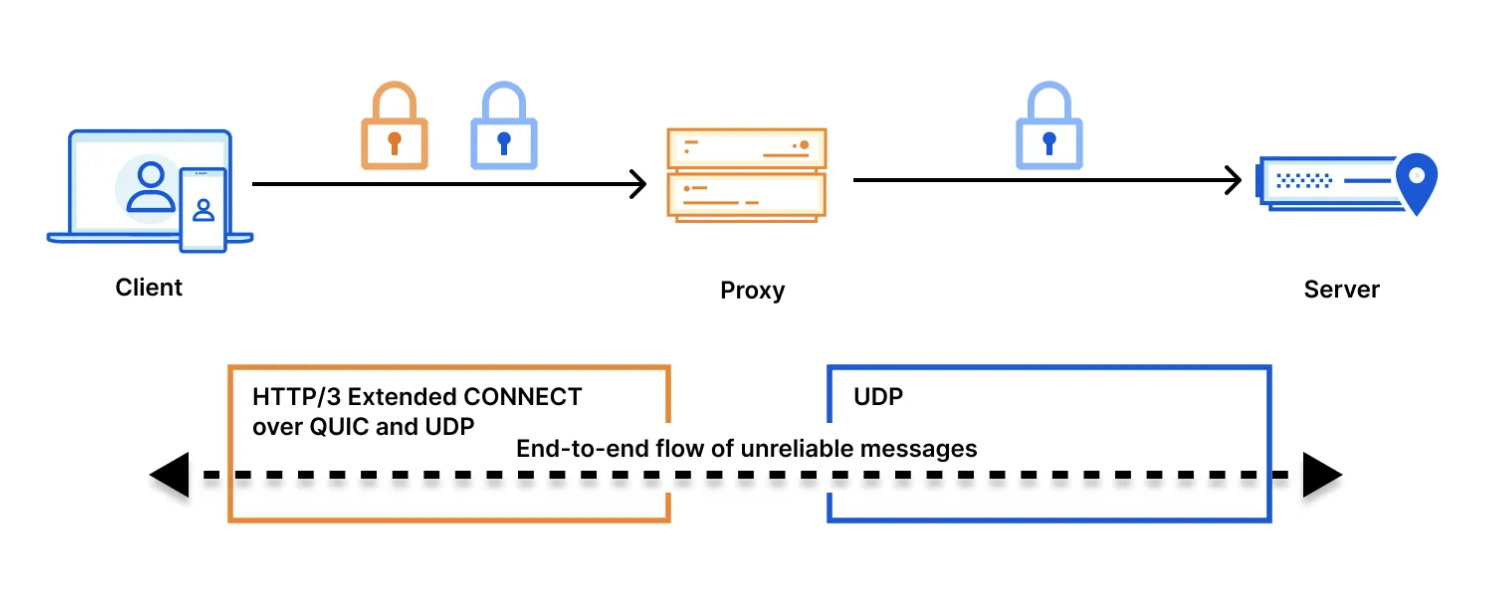
QUIC is a general-purpose transport protocol and Internet standard that operates on top of UDP (instead of TCP), is encrypted by default, and solves several performance issues that plagued its predecessors. HTTP/3is the latest version of the HTTP protocol, defining the application-layer protocol that runs on top of QUIC as its transport mechanism. MASQUE is a set of mechanisms for tunneling traffic over HTTP. It extends the existing HTTP CONNECT model, to allow tunneling UDP and IP traffic. This is especially efficient when combined with the QUIC’s unreliable datagram extension.
For example, we can use MASQUE’s CONNECT-IP method to establish a tunnel that can send multiple concurrent requests over a single QUIC connection:
The benefit these protocols have for the quality and security of everyone’s Internet browsing experience is real. Earlier transport protocols were built before the advent of smartphones and mobile networks, so QUIC was designed to support a mobile world, maintaining connections even in poorly connected networks, and minimizing disruptions as people switch rapidly between networks as they move through their day. Leveraging HTTP/3 as the application layer means that MASQUE is more like “normal” HTTP traffic on the Internet, meaning that it is easier to support, is compatible with existing firewall and security rules, and that it supports cryptographic agility (i.e. support for post-quantum crypto), making this traffic more secure and resilient in the long term.
Get started now
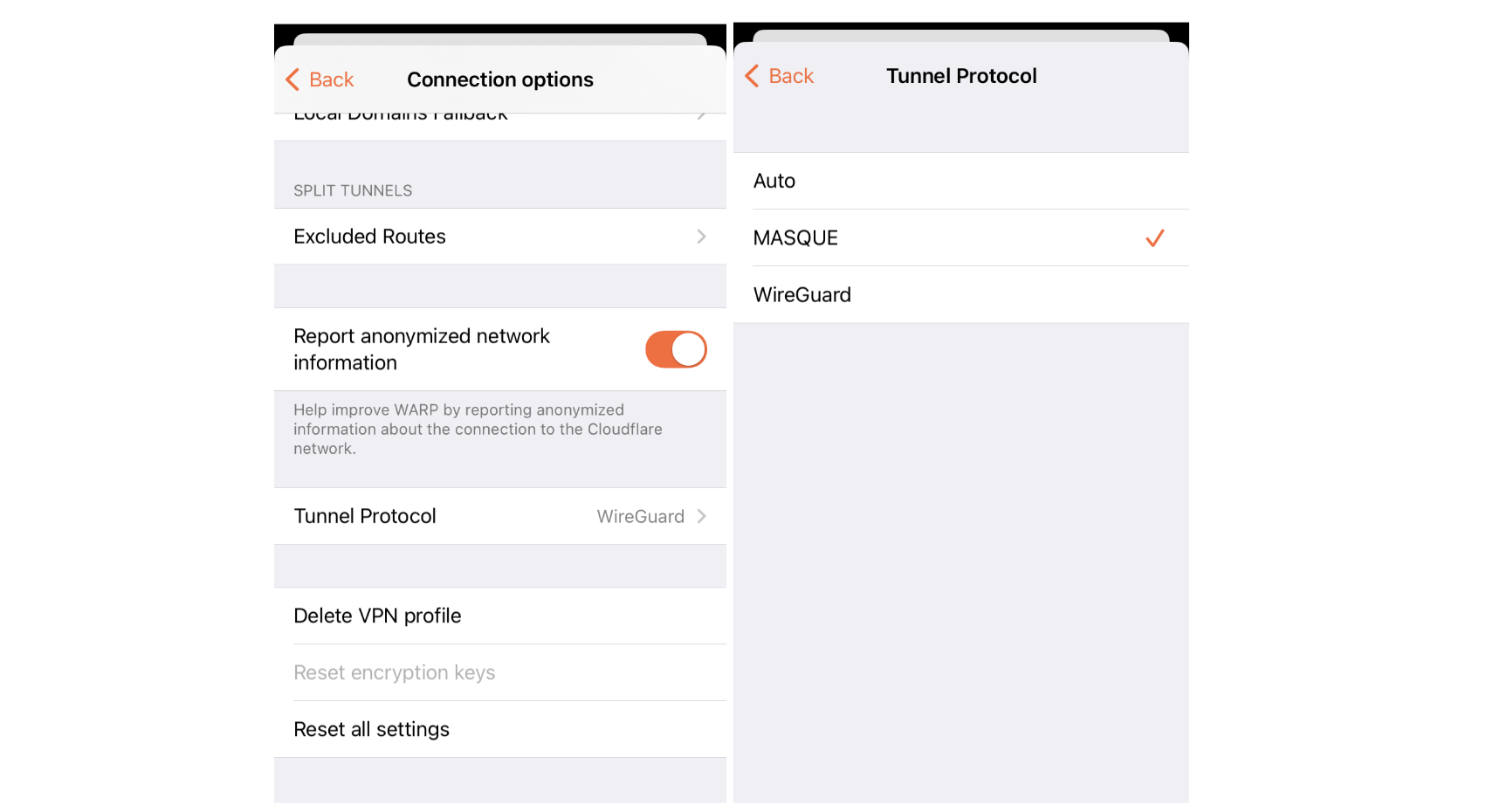
All new installations of our 1.1.1.1 & WARP apps support MASQUE, including iOS, Android, macOS, Windows, and Linux, and we’ve started to roll it out as the preferred protocol over WireGuard. On mobile, to check if your connection is already secured over MASQUE, or change your device’s default option, you can toggle this setting via Advanced > Connection options > Tunnel protocol:
Protocol connection options shown here on the iOS app
We offer the following options:
Auto: this allows the app to choose the protocol.
MASQUE: always use MASQUE to secure your connection.
WireGuard: always use WireGuard to secure your connection.
On desktop versions, you can switch the protocol by using the WARP command-line interface. For example:
warp-cli tunnel protocol set WireGuard
warp-cli tunnel protocol set MASQUE
With this rollout, we’re excited to see MASQUE deliver increased performance and stability to millions of users. Download one of the WARP apps today!
DEX now Generally Available: Announcing detailed device visibility with DEX Remote Captures
Following the successful beta launch of Digital Experience Monitoring (DEX), we are thrilled to announce the general availability of DEX, along with new Remote Captures functionality.
Imagine this: an end user is frustrated with a slow application, and your IT team is struggling to pinpoint the root cause. Traditionally, troubleshooting such issues involved contacting the end user and asking them to manually collect and share network traffic data. This process is time-consuming, prone to errors, and often disruptive to the end user’s workflow.
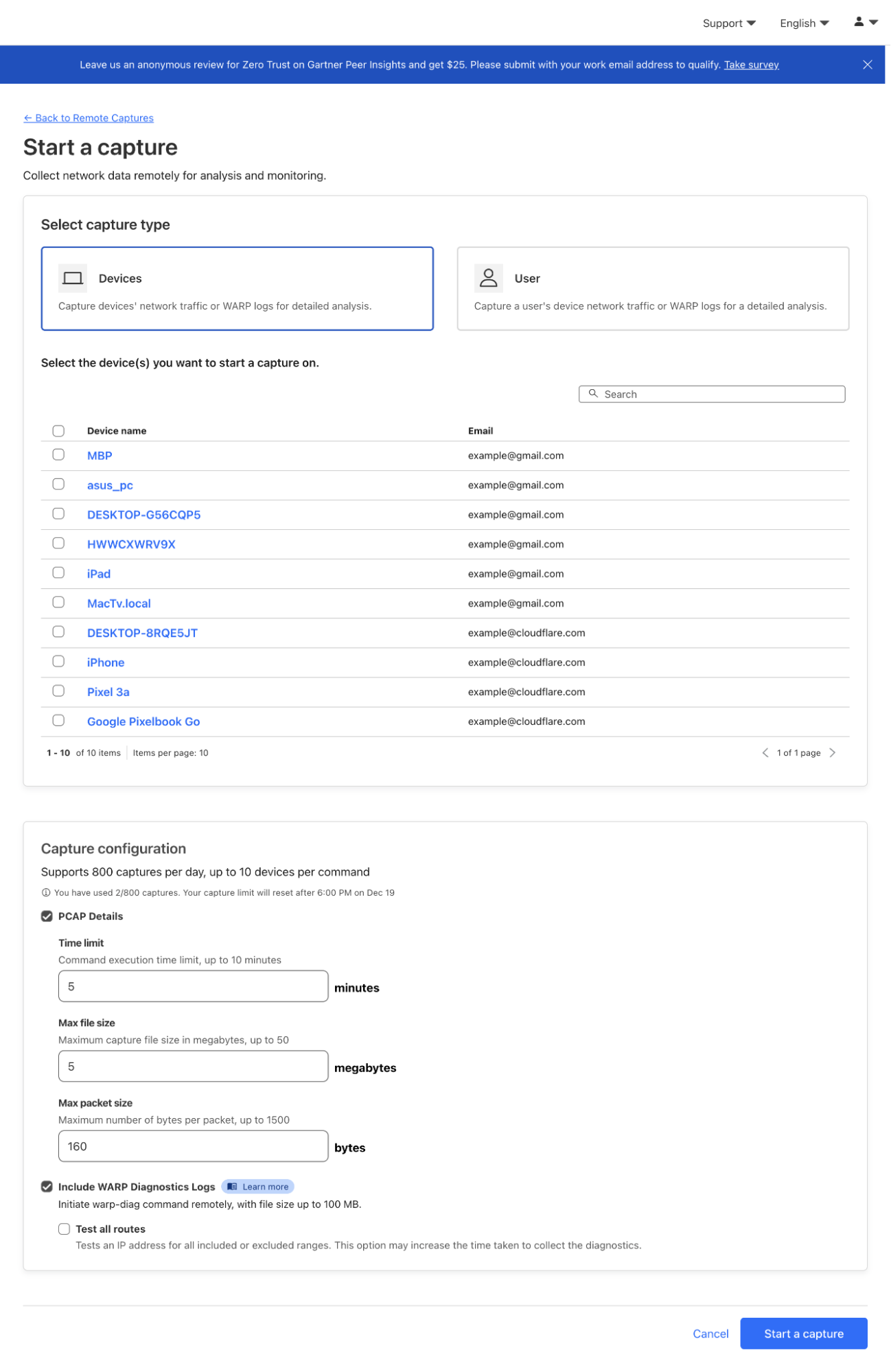
Building upon the capabilities of DEX, we are excited to introduce Remote Captures, a powerful new feature that empowers IT admins to gain unprecedented visibility into end-user devices and network performance. DEX now introduces Remote Captures, a powerful new feature that empowers IT admins to remotely initiate network packet captures (PCAP) and WARP Diag logs directly from your end users’ devices and capture diagnostic information automatically from our device client. This streamlined approach accelerates troubleshooting, reduces the burden on end users, and provides valuable insights into network performance and security.
Why Remote Captures?
Remote Captures offer several key advantages. By analyzing detailed network traffic, IT teams can quickly pinpoint the root cause of network issues. Furthermore, granular network data empowers security teams to proactively detect and investigate potential threats. Finally, by identifying bottlenecks and latency issues, Remote Captures enable organizations to optimize network performance for a smoother user experience.
How Remote Captures work
Initiating a Remote Capture is straightforward. First, select the specific device you wish to troubleshoot. Then, with a few simple clicks, start capturing network traffic and/or WARP Diag data. Once the capture is complete, download the captured data and utilize your preferred tools for in-depth analysis.
Get started today
DEX Remote Captures are now available for Cloudflare One customers. They can be configured by going to Cloudflare Dashboard > Zero Trust > DEX > Remote Captures, and then selecting the device you wish to collect from. For more information, refer to Remote captures. This new capability highlights just one of the many ways our unified SASE platform helps organizations find and fix security issues across SaaS applications. Try it out now using our free tier to get started.
Never miss an update
We hope you enjoy reading our roundup blog posts as we continue to build and innovate. Stay tuned to the Cloudflare Blog for the latest news and updates.
Security updates have been issued by Debian (node-postcss), Fedora (age, dr_libs, incus, libxml2, moodle, and python-sql), and SUSE (poppler and python-grpcio).
The basic strategy is to place a device with a hidden camera in a position to capture normally hidden card values, which are interpreted by an accomplice off-site and fed back to the player via a hidden microphone. Miniaturization is making these devices harder to detect. Presumably AI will soon obviate the need for an accomplice.
Pizza Hut in Taiwan has a history of weird pizzas, including a “2022 scalloped pizza with Oreos around the edge, and deep-fried chicken and calamari studded throughout the middle.”
Continuing its tradition of yearly major releases on December 25, the Ruby programming-language project
has released
Ruby 3.4.0 (followed quickly by 3.4.1,
which simply updates the version number). Ruby 3.4 includes lots of
changes, including the addition of it as a
less-confusing shorthand for _1 as a block parameter, switching to Prism as the default
parser, adding the Happy Eyeballs
version 2 algorithm to the socket library,
just-in-time (JIT) compiler (YJIT) improvements, garbage-collection
modularization, and more.
Security updates have been issued by Debian (fastnetmon, webkit2gtk, and xen), Fedora (sympa), Oracle (postgresql), and Red Hat (pcp, tigervnc, and xorg-x11-server and xorg-x11-server-Xwayland).
Нещо, което ще е добре да си припомняме занапред. Ще ни трябва.
За мой срам, не зная кой е авторът.
Today I should have been ninety four,
I would be having a party with cake
I’d have two fine sons and a daughter too
Grandchildren to cuddle and stay.
I’d have met a great man, dashing and tall
He’d have worked in an office in town
We’d have lived in the country, two dogs and a cat
I’d have had a fine wedding gown.
Margot would have lived nearby,
Surely a mother herself?
My mother and father would have been so proud
We’d have raised a glass to good health.
Instead we slept on wooden slats
As we shivered with hunger and cold
We were beaten for any discriminatory thing
We were given no toys to hold.
My mother was starving, she gave us her food
Scabies was rife in our camp
I wanted to die, this wasn’t life
Living with rats in the damp.
My best friend was in the camp next door
I missed her riotous laugh
I was glad to have my sister with me
Loneliness, was my first and my last.
I dreamed of food that I could eat
I wished for potatoes and meat
If I survived, I’d wash it all down
With wine and something sweet.
Typhus arrived and we both got sick
Doctors were never called in
We died one by one, Margot went first
Death was an easier win.
I hope I didn’t die in vain
I hope the world has learned
Hatred has no place in life
My diary forever preserved.
HTTP caching is conceptually simple: if the response to a request is in the cache, serve it, and if not, pull it from your origin, put it in the cache, and return it. When the response is old, you repeat the process. If you are worried about too many requests going to your origin at once, you protect it with a cache lock: a small program, possibly distinct from your cache, that indicates if a request is already going to your origin. This is called cache revalidation.
In this blog post, we dive into how cache revalidation works, and present a new approach based on probability. For every request going to the origin, we simulate a die roll. If it’s 6, the request can go to the origin. Otherwise, it stays stale to protect our origin from being overloaded. To see how this is built and optimised, read on.
Background
Let’s take the example of an online image library. When a client requests an image, the service first checks its cache to see if the resource is present. If it is, it returns it. If it is not, the image server processes the request, places the response into the cache for a day, and returns it. When the cache expires, the process is repeated.
Figure 1: Uncached request goes to the origin
Figure 2: Cached request stops at the cache
And this is where things get complex. The image of a cat might be quite popular. Let’s say it’s requested 10 times per second. Let’s also assume the image server cannot handle more than 1 request per second. After a day, the cache expires. 10 requests hit the service. Given there are no up-to-date items in cache, these 10 requests are going to go directly to the image server. This problem is known as cache stampede. When the image server sees these 10 requests all happening at the same time, it gets overloaded.
Figure 3: Image server overloaded upon cache expiration. This can happen to one or multiple users, across locations.
This all stops if the cache gets populated, as it can handle a lot more requests than the origin.
Figure 4: Cache is populated and can handle the load. The image server is healthy again.
In the following sections, we build this image service, see how it can prevent cache stampede with a cache lock, then dive into probabilistic cache revalidation, and its optimisation.
Setup
Let’s write this image service. We need an image, a server, and a cache. For the image we’re going to use a picture of my cat, Cloudflare Workers for the server, and the Cloudflare Cache API for caching.
Note to the reader: On purpose, we aren’t using Cloudflare KV or Cloudflare CDN Cache, because they already solve our cache validation problem by using a cache lock.
let cache = caches.default
const CACHE_KEY = new Request('https://cache.local/')
const CACHE_AGE_IN_S = 86_400 // 1 day

function cacheExpirationDate() {
  return new Date(Date.now() + 1000*CACHE_AGE_IN_S)
}

function fetchAndCache(ctx) {
  let response = await fetch('https://files.research.cloudflare.com/images/cat.jpg')
  response = new Response(
	await response.arrayBuffer(),
	{
  	  headers: {
  	    'Content-Type': response.headers.get('Content-Type'),
  	    'Expires': cacheExpirationDate().toUTCString(),
  	  },
	},
  )
  ctx.waitUntil(cache.put(CACHE_KEY, response.clone()))
  return response
}

export default {
  async fetch(request, env, ctx) {
	let cachedResponse = await cache.match(CACHE_KEY)
	if (cachedResponse) {
  	  return cachedResponse
	}
	return fetchAndCache(ctx)
  }
}
Codeblock 1: Image server with a non-collapsing cache
Expectation about cache revalidation
The image service is receiving 10 requests per second, and it caches images for a day. It’s reasonable to assume we would like to start revalidating the cache 5 minutes before it expires. The code evolves as follows:
let cache = caches.default
const CACHE_KEY = new Request('https://cache.local/')
const CACHE_AGE_IN_S = 86_400 // 1 day
const CACHE_REVALIDATION_INTERVAL_IN_S = 300

function cacheExpirationDate() {
  // Date constructor in workers takes Unix time in milliseconds
  // Date.now() returns time in milliseconds as well
  return new Date(Date.now() + 1000*CACHE_AGE_IN_S)
}

async function fetchAndCache(ctx) {
  let response = await fetch('https://files.research.cloudflare.com/images/cat.jpg')
  response = new Response(
	await response.arrayBuffer(),
	{
  	  headers: {
  	    'Content-Type': response.headers.get('Content-Type'),
  	    'Expires': cacheExpirationDate().toUTCString(),
  	  },
	},
  )
  ctx.waitUntil(cache.put(CACHE_KEY, response.clone()))
  return response
}

// Revalidation function added here
// This is were we are going to focus our effort: should the request be revalidated ?
function shouldRevalidate(expirationDate) {
  let remainingCacheTimeInS = (expirationDate.getTime() - Date.now()) / 1000

  return remainingCacheTimeInS <= CACHE_REVALIDATION_INTERVAL_IN_S
}

export default {
  async fetch(request, env, ctx) {
	let cachedResponse = await cache.match(CACHE_KEY)
	if (cachedResponse) {
       // revalidation happens only if the request was cached. Otherwise, the resource is fetched anyway
  	  if (shouldRevalidate()) {
    	    ctx.waitUntil(fetchAndCache(ctx))
  	  }
  	  return cachedResponse
	}
	return fetchAndCache(ctx)
  }
}
Codeblock 2: Image server with early-revalidation and a non-collapsing cache
That code works, and we can now revalidate 5 minutes in advance of cache expiration. However, instead of fetching the image from the origin server at expiration time, all requests are going to be made 5 minutes in advance, and that does not solve our cache stampede problem. This happens no matter if requests are coming to a single location or not, given the code above does not collapse requests.
To solve our cache stampede problem, we need the revalidation process to not send too many requests at the same time. Ideally, we would like only one request to be sent between expiration - 5min and expiration.
The usual solution: a cache lock
To make sure there is only one request at a time going to the origin server, the solution that’s usually deployed is a cache lock. The idea is that for a specific item, a cat picture in our case, requests to the origin try to obtain a lock. The request obtaining the lock can go to the origin, the others will serve stale content.
The lock has two methods: try_lock() and unlock.
* try_lock if the lock is free, take it and return true. If not, return false.
* unlock releases the lock.
import { WorkerEntrypoint } from 'cloudflare:workers'

class Lock extends WorkerEntryPoint {
  async try_lock(key) {
	let value = await this.ctx.storage.get(key)
	if (!value) {
  	  await this.ctx.storage.put(key, true)
  	  return true
	}
	return false
  }

  unlock() {
	return this.ctx.storage.delete(key)
  }
}
Codeblock 3: Lock service implemented with a Durable Object
That service can then be used as a cache lock.
// CACHE_LOCK is an instantiation of the above binding
// Assuming the above is deployed as a worker with name `lock`
// It can be bound in wrangler.toml as follows
// services = [ { binding = "CACHE_LOCK", service = "lock" } ]

const LOCK_KEY = "cat_image_service"

async function fetchAndCache(env, ctx) {
  let response = await fetch('...')
  ctx.waitUntil(env.CACHE_LOCK.unlock(LOCK_KEY))
  ...
}

function shouldRevalidate(env, expirationDate) {
  let remainingCacheTimeInS = (expirationDate.getTime() - Date.now()) / 1000

  // check if the expiry window is now, and then if the revalidation lock is available. if it is, take it
  return remainingCacheTimeInS <= CACHE_REVALIDATION_INTERVAL_IN_S && env.CACHE_LOCK.try_lock(LOCK_KEY)
}
Codeblock 4: Image server with early-revalidation and a cache using a cache-lock
Now you might say “Et voilà. No need for probabilities and mathematics. Peak engineering has triumphed.” And you might be right, in most cases. That’s why cache locks are so predominant: they are conceptually simple, deterministic for the same key, and scale well with predictable resource usage.
On the other hand, cache locks add latency and fallibility. To take ownership of a lock, cache revalidation has to contact the lock service. This service is shared across different processes, possibly different machines in different locations. Requests therefore take time. In addition, this service might be unavailable. Probabilistic cache revalidation does not suffer from these, given it does not reach out to an external service but rolls a die with the local randomness generator. It does so at the cost of not guaranteeing the number of requests going to the origin server: maybe zero for an extended period, maybe more than one. On average, this is going to be fine. But there can be border cases, similar to how one can roll a die 10 times and get 10 sixes. It’s unlikely, but not unrealistic, and certain services need that certainty. In the following sections, we dissect this approach.
First dive into probabilities given a stable request rate
A first approach is to reduce the number of requests going to the origin server. Instead of always sending a request to revalidate, we are going to send 1 out of 10. This means that instead of sending 10 requests per second when the cache is invalidated, we send 1 per second.
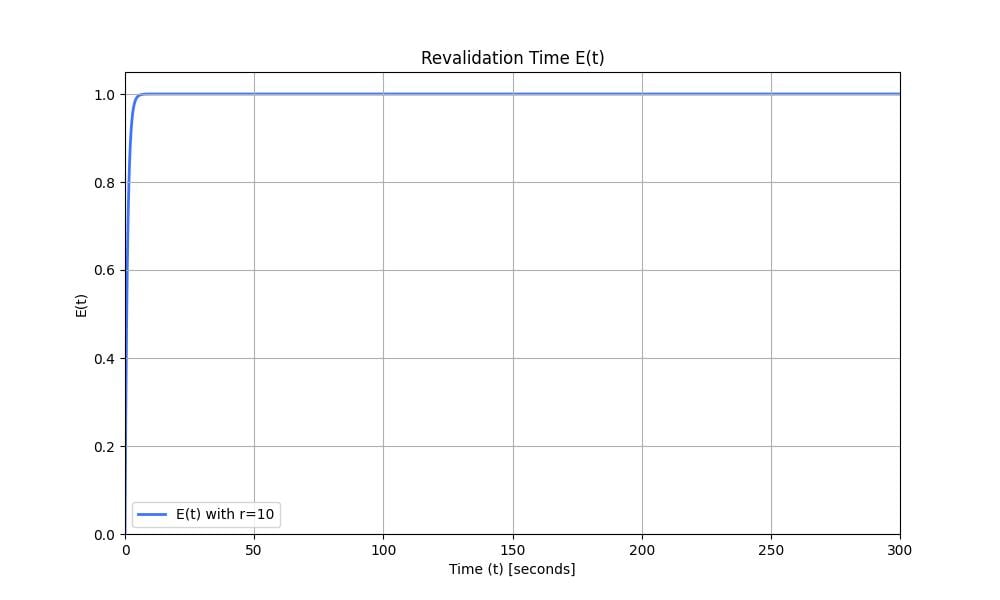
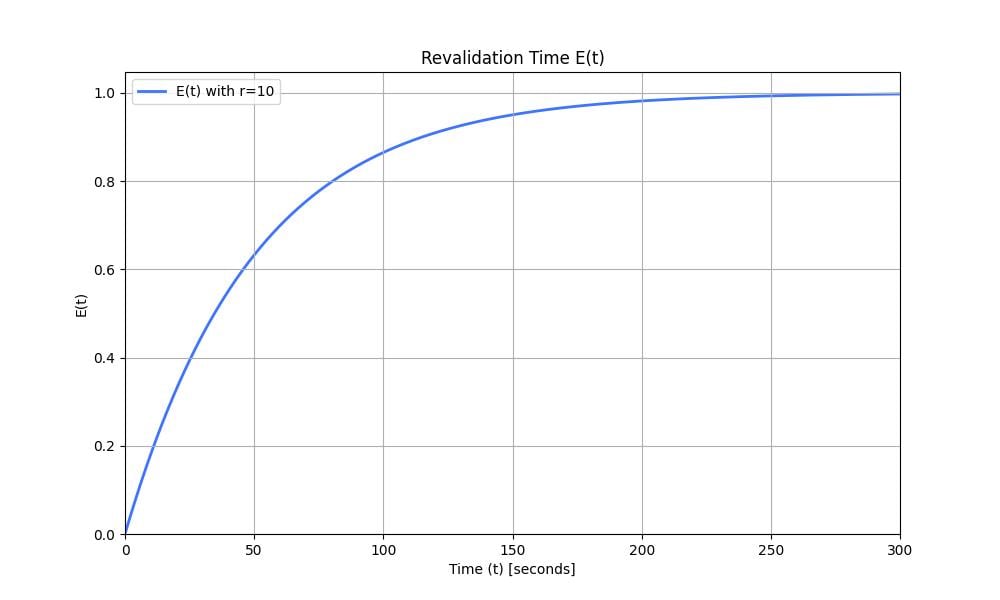
Because we don’t have a lock, we do that with probabilities. We set the probability of sending a request to the origin to be $p=\frac{1}{10}$. With a rate of 10 requests per second, after 1 second, the expectancy of a request being sent to the origin is $1-(1-p)^10=65\%$. We draw the evolution of the function $E(r, t)=1-(1-p)^{r \times t}$ representing the expectancy of a request being sent to the server over time. $r = 10$ and is the request rate.
Figure 5: Revalidation time $E(t)$ with $r=10$ and $p=\frac{1}{10}$. At time $t$, $E(t)$ is the probability that an early revalidation occurred.
The graph moves very quickly towards $1$. This means we might still have space to reduce the number of requests going to our origin server. We can set a lower probability, such as $p_2=\frac{1}{500}$ (1 request every 5 seconds on average). The graph looks as follows:
Figure 6: Revalidation time $E(t)$ with $r=10$ and $p=\frac{1}{500}$.
This looks great. Let’s implement it.
const CACHE_REVALIDATION_INTERVAL_IN_S = 300
const CACHE_REVALIDATION_PROBABILITY = 1/500

function shouldRevalidate(expirationDate) {
  let remainingCacheTimeInS = (expirationDate.getTime() - Date.now()) / 1000

  if (remainingCacheTimeInS > CACHE_REVALIDATION_INTERVAL_IN_S) {
	return false
  }
  if (remainingCacheTimeInS <= 0) {
	return true
  }
  return Math.random() < CACHE_REVALIDATION_PROBABILITY
}
Codeblock 5: Image server with early-revalidation and a probabilistic cache using uniform distribution
That’s it. If the cache is not close to expiration, we don’t revalidate. If the cache is expired, we revalidate. Otherwise, we revalidate based on a probability.
Adaptive cache revalidation
Until now, we assumed the picture of the cat received a stable request rate. However, for a real service, this does not necessarily hold. For instance, if instead of 10 requests per second, imagine the service receives only 1. The expectancy function does not look as good. After 5 minutes (300s), $E(r=1, t=300)=45\%$. On the other hand, if the image service is receiving 10,000 requests per second, $E(r=10000, t = 300) \approx 100\%$, but our server receives on average $10000 \times \frac{1}{500} = 20$ requests per second. It would be ideal to design a probability function that would adapt to the request rate.
That function would return a low probability when expiration time is far in the future, and increase over time such that the cache is revalidated before it expires. It would cap the request rate going to the origin server.
Let’s design the variation of probability $p$ over 5 minutes. When far from the expiration, the probability to revalidate should be low. This should help match the high request rate. For example, with a request rate of 10k requests per second, we would like the revalidation probability $p$ to be $\frac{1}{100000}$. This ensures the request rates seen by our server are going to be low on average, at about 1 request every 10 seconds. As time passes, we increase this probability to allow for revalidation even at a lower request rate.
Time to expiration $t$ (in s)
Revalidation probability $p$
Target request rate $r$ (in rps)
300
1/100000
10000
240
1/10000
1000
180
1/1000
100
120
1/100
10
60
1/10
1
0
1
–
Table 1: Variation of revalidation probability over time
For each of these intervals, there is a high likelihood that a request rate $r$ will trigger a cache revalidation, and low likelihood that a lower request rate will trigger it. If it does, it’s ok.
We can update our revalidation function as follows:
const CACHE_REVALIDATION_INTERVAL_IN_S = 300
const CACHE_REVALIDATION_PROBABILITY_PER_MIN = [1/100_000, 1/10_000, 1/1000, 1/100, 1/10, 1]

function shouldRevalidate(expirationDate) {
  let remainingCacheTimeInS = (expirationDate.getTime() - Date.now()) / 1000

  if (remainingCacheTimeInS > CACHE_REVALIDATION_INTERVAL_IN_S) {
	return false
  }
  if (remainingCacheTimeInS <= 0) {
	return true
  }
  let currentMinute = Math.floor(remainingCacheTimeInS/60)
  return Math.random() < CACHE_REVALIDATION_PROBABILITY_PER_MIN[currentMinute]
}
Codeblock 6: Image server with early-revalidation and a probabilistic cache using piecewise uniform distribution
Optimal cache stampede solution
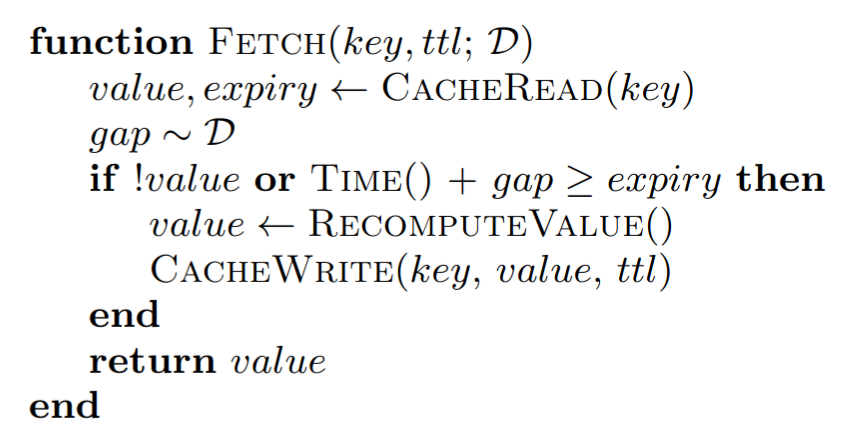
There seems to be a lot of decisions going on here. To solve this, we can reference an academic paper written by A Vattani, T Chierichetti, and K Lowenstein in 2015 called Optimal Probabilistic Cache Stampede Prevention. If you read it, you’ll recognise that what we have been discussing until now is close to what the paper presents. For instance, both the cache revalidation algorithm structure and the early revalidation function look similar.
Figure 7: Probabilistic early expiration of a cache item as defined by Figure 2 of Optimal Probabilistic Cache Stampede Prevention paper. In our case, $\mathcal{D}=300$
One takeaway from the paper is that instead of discretization, with a probability from 0 to 60s, then from 60s to 120s, …, the probability function can be continuous. Instead of a fixed $p$, there is a function $p(t)$ of time $t$.
$p(t)=e^{-\lambda (expiry-t)}, \text{ with } expiry=300, \text{ and } t \in [0, 300]$
We call $\lambda$ the steepness parameter, and set it to $\frac{1}{300}$, $300$ being our early expiration gap.
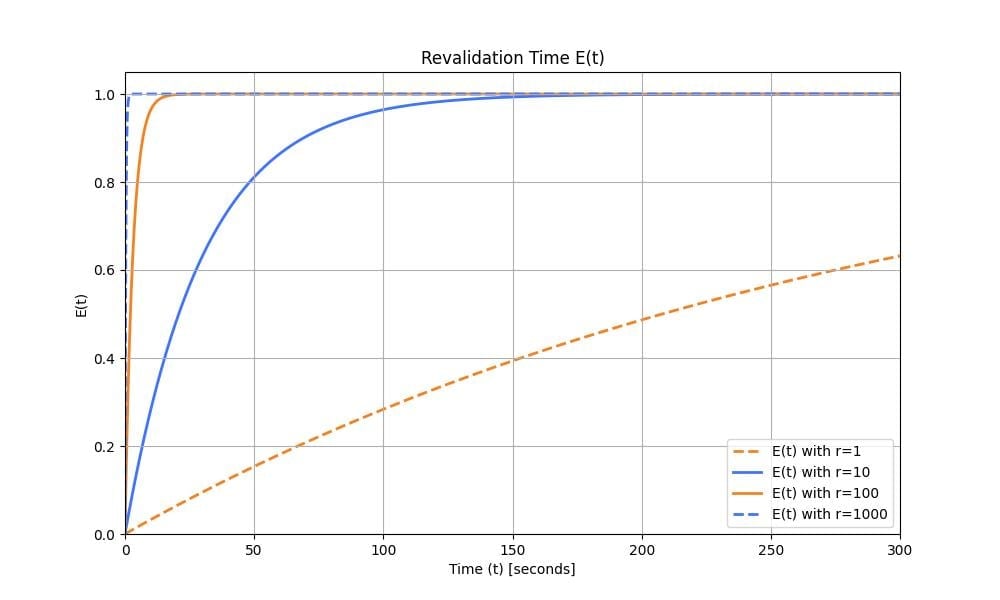
The expectancy over time is $E(r, t)=1-e^{-rλt}$. This leads to the expectancy below for various request rates. You can note that when $r=1$, there is not a $100%$ chance that the request will be revalidated before expiry.
Figure 8: Revalidation time $E(t)$ for multiple $r$ with an exponential distribution.
This leads to the final code snippet:
const CACHE_REVALIDATION_INTERVAL_IN_S = 300
const REVALIDATION_STEEPNESS = 1/300

function shouldRevalidate(expirationDate) {
  let remainingCacheTimeInS = (expirationDate.getTime() - Date.now()) / 1000

  if (remainingCacheTimeInS > CACHE_REVALIDATION_INTERVAL_IN_S) {
	return false
  }
  if (remainingCacheTimeInS <= 0) {
	return true
  }
  // p(t) is evaluated here
  return Math.random() < Math.exp(-REVALIDATION_STEEPNESS*(CACHE_REVALIDATION_INTERVAL_IN_S-remainingCacheTimeInS)
}
Codeblock 7: Image server with early-revalidation and a probabilistic cache using exponential distribution
And that’s it. Given Date.now() has a granularity, and is not continuous, it would also be possible to discretise these functions, even though the gains are minimal. This is what we have done in a production worker implementation, where the number of requests is important. It is a service that benefits from caching for performance consideration, and that cannot use built-in stale-while-revalidate from within Cloudflare workers. Probabilistic cache stampede prevention is well-suited here, as no new component has to be built, and it performs well at different request rates.
Conclusion
We have seen how to solve cache stampede without a lock, its implementation, and why it is optimal. In the real world, you likely will not encounter this issue: either because it’s good enough to optimize your origin service to serve more requests, or because you can leverage a CDN cache. In fact, most HTTP caches provide an API that follows Cache Control, and likely have all the tools you need. This primitive is also built into certain products, such as Cloudflare KV.
If you have not done so, you can go and experiment with all the code snippets presented in this blog on the Cloudflare Workers Playground at cloudflareworkers.com.
To provide the best experiences, we use technologies like cookies to store and/or access device information. Consenting to these technologies will allow us to process data such as browsing behavior or unique IDs on this site. Not consenting or withdrawing consent, may adversely affect certain features and functions.
Functional
Always active
The technical storage or access is strictly necessary for the legitimate purpose of enabling the use of a specific service explicitly requested by the subscriber or user, or for the sole purpose of carrying out the transmission of a communication over an electronic communications network.
Preferences
The technical storage or access is necessary for the legitimate purpose of storing preferences that are not requested by the subscriber or user.
Statistics
The technical storage or access that is used exclusively for statistical purposes.The technical storage or access that is used exclusively for anonymous statistical purposes. Without a subpoena, voluntary compliance on the part of your Internet Service Provider, or additional records from a third party, information stored or retrieved for this purpose alone cannot usually be used to identify you.
Marketing
The technical storage or access is required to create user profiles to send advertising, or to track the user on a website or across several websites for similar marketing purposes.