Post Syndicated from BeardedTinker original https://www.youtube.com/watch?v=uZlfo2xrbIA
I Baked My Way Through The Atlantic’s Archive
Post Syndicated from The Atlantic original https://www.youtube.com/shorts/DQhAGWD4KR4
Security updates for Thursday
Post Syndicated from jzb original https://lwn.net/Articles/1109990/
Security updates have been issued by AlmaLinux (cifs-utils, cjose, cockpit-machines, containernetworking-plugins, dhcp, edk2, firewalld, fltk, freerdp, gdm, ghostscript, grafana, kernel, librabbitmq, netpbm, nginx:1.24, nginx:1.26, openscap, openssl, php, python-botocore, qt6-qt3d, resource-agents, rsync, ruby, ruby:2.5, ruby:3.3, ruby:4.0, skopeo, spice, thunderbird, and webkit2gtk3), Debian (exim4, firefox-esr, librsvg, lrzsz, roundcube, shadow, and thunderbird), Fedora (chromium, cri-o1.35, cri-o1.36, dotnet10.0, dotnet11.0, dotnet8.0, dotnet9.0, firefox, fluidsynth, kernel, libreswan, mingw-dbus, perl-Config-General, perl-HTTP-Body, perl-libnet, perl-SQL-Abstract, poppler, radicale, sbsigntools, webkitgtk, and xorg-x11-server-Xwayland), Mageia (php), Oracle (dpdk, gcc-toolset-15-gcc, grafana, gstreamer1-plugins-bad-free, librabbitmq, mod_http2, nginx, php:7.4, php:8.3, python-oauthlib, python3.12, sqlite, tftp, xfsprogs, and xorg-x11-server-Xwayland), Red Hat (brotli, cjose, containernetworking-plugins, expat, firefox, kernel, mod_auth_openidc:2.3, nodejs:24, podman, ruby, ruby4.0, ruby:2.5, ruby:3.3, ruby:4.0, and thunderbird), Slackware (seamonkey), SUSE (389-ds, amazon-ssm-agent, apache2, aws-nitro-enclaves-cli, bouncycastle, bugwarden, diffutils, docker, glibc, go1.26, go1.27, google-guest-agent, google-osconfig-agent, gssproxy, gvfs, haproxy, helm, jackson-annotations, jackson-core, jackson-databind, java-17-openjdk, java-21-openjdk, java-25-openjdk, kubernetes-old, libosmocodec-devel, libQt63DAnimation6, libQt6Concurrent6, librsvg, libXfont2, libXi, mozilla-nss, MozillaFirefox, mutt, nginx, nodejs24, opensc, pcre2, perl-HTTP-Parser-XS, php8, python-CairoSVG, python-filelock, python-PyJWT, python-pymongo, python-sqlparse, python-urllib3, python-virtualenv, python313-Authlib, python313-GitPython, python313-sqlparse, qemu, ruby3.4, util-linux, webkit2gtk3, and zbar), and Ubuntu (alsa-lib, authd, bcel, dav1d, elfutils, expat, krb5, libhttp-tiny-perl, libpcap, network-manager, php8.5, php8.3, php8.1, php7.4, php7.2, php7.0, php5, and speex).
Comic for 2026.11.26 – Thanksgiving
Post Syndicated from Explosm.net original https://explosm.net/comics/thanksgiving-2
New Cyanide and Happiness Comic
Гласовете на Америка. Денят на благодарността – брой 21
Post Syndicated from Йоанна Елми original https://www.toest.bg/glasovete-na-amerika-denyat-na-blagodarnostta-broiu-21/

Върху „Картината на Деня на благодарността“, както е широко известна в Съединените щати, са изобразени възрастен мъж и жена. Той благо гледа над рамото ѝ, докато тя полага огромна печена пуйка на масата. Виждаме само главите на останалите девет души – другата част от семейството. Някои следят пуйката с очи, други разговарят, а в долния десен ъгъл едно лице гледа право към нас с палава, детинска искра в погледа.
„Свобода от нищета“, както е официалното име на картината, нарисувана от американския художник Норман Рокуел, е третата от серията „Четирите свободи“, вдъхновени от речта на президента Франклин Делано Рузвелт през 1941 г. Той я произнася по-малко от година преди атаките над Пърл Харбър, след които САЩ официално влизат във Втората световна война. В речта си Рузвелт формулира четирите свободи, които хората навсякъде по света следва да имат: свобода на словото и изразяването, свобода на вероизповеданието, свобода от оскъдица и свобода от страх.
Мечтата на Рузвелт за свободно изразяване на мнението, за правото на всеки да почита бога по свой начин, за икономическо разбирателство, осигуряващо просперитет, и за световно разоръжаване, е утопична и някак наивна в навечерието на войната, но има важна цел – да създаде символ. Защото във времена на страх и несигурност хората имат нужда най-вече от символи. Защото в крайна сметка не само реалността създава символите – символите определят реалността. И защото, ако добрите не създават и не подсилват символите на доброто, ще ги създадат онези, които няма да ги ползват за добро.

Свободата да определиш значението на свободата
И до днес Норман Рокуел е един от най-известните американски художници, може би е Американският художник. Макар че е съвременник на Пикасо и Матис, Рокуел отхвърля абстрактното, кубизма, минимализма и други модерни течения в полза на традиционна, достъпна и силно носталгична стилистика, която много критици не харесват, но тя го превръща в култова попкултурна фигура от първата половина на XX век та чак до днес (почти едноименният албум на Лана Дел Рей от 2019 г. например контрастира с идиличната Америка на Рокуел с разбитите от американската мечта сърца, погребването на илюзиите за страната и културните сътресения в нея).
Списание Saturday Evening Post, където Рокуел публикува голяма част от илюстрациите си, включително и „Свобода от нищета“, отпечатва в допълнение есе със същото заглавие от филипинско-американския поет и романист Карлос Булосан, в което той пише за трудностите на американците.
И продължаваме напред, въпреки че понякога странни настроения обземат синовете и дъщерите ни. Нашият поход към сигурността и мира е походът на свободата – свободата, от която искаме да бъдем част. Защото е достойно за индивида да живее в общество на свободни хора, където съществува духът на разбирателството и вярата; да разбира, че всички хора са равни; че всички хора, с какъвто и да е цвят на кожата, от каквато и да е раса, религия или социално положение ще получат равна възможност да служат на себе си и другите според нуждите и способностите си. […]
Ние не приемаме демокрацията за даденост. Усещаме я как зрее като плод на общия ни труд – милиони от нас, които се трудят за обща цел. И ако ни е отнело няколко десетилетия жертви да достигнем до това убеждение, то е, защото толкова време измина, докато разберем коя част от Америка е наша. […]
Вярата ни биваше разклатена множество пъти и сега отново е под въпрос. Надеждата ни е живо същество, което може да бъде осакатено или въдворено във вериги. То може да бъде убито, ако ни бъде отказана достатъчно храна или дрехи, ако бъде смачкана личността ни, ако бъдем държани в постоянен страх. Ако не сме добре подготвени, тъмните сили ще имат добра възможност да ни изненадат и да потъпчат живота ни. […]
Тоталитарните нации мразят демокрацията. Те ни мразят, защото изискваме сигурна гаранция за свободата на вероизповеданието, на изразяването, за свободата от страх и нищета. Ние предизвикваме тиранията с дълбината на вярата си в демокрация, за която си заслужава да се борим. И въпреки че разпространяват лъжи за нас, онзи начин на живот, който така ценим, не е унищожен. Американската мечта просто е скрита, но ще си проправи път, за да покълне, за да порасне отново. […]
Есето на Булосан предизвиква полемика. Той пристига в САЩ от Филипините като момче и преди да изгрее като автор (а и след това), живее в бедност и работи за ниско заплащане в земеделието на Западното крайбрежие, където работниците са подложени на тежка расова дискриминация, а по това време в САЩ има сблъсъци не само между властта и профсъюзите, но и между самите профсъюзи.
Есето е в пълен контраст с домашния уют от картината на Рокуел (на която всички са бели) и предизвиква фурор в САЩ, където основна тема е борбата срещу фашизма и тиранията в Европа. Истинската борба срещу тиранията обаче, казва Булосан, е и борба за равностойно заплащане и силни профсъюзи. Това е въпрос, който ще вълнува Америка и по време на войната, и след нея – кои сме ние да въдворяваме справедливост навън, ако несправедливостта царува у дома?
На Стария континент есето, както и картината на Рокуел предизвикват неприязън – според европейците американците изобщо не могат да си представят що е то борба и трудности.
Американската амбивалентност на символите
Както сме писали и преди в „Гласовете на Америка“, американската история е история на полярностите и противоречията, калейдоскоп на човешката природа във всички проявления. Рокуел рисува в годините на Втората световна война, когато САЩ оказват решаваща помощ за спасяването на Европа от нацистката диктатура – война, от която Америка излиза като героичен спасител на света и една от двете сили в двуполюсния свят. У дома обаче сегрегацията, ограничените права на жените и социалните разделения са също толкова важна част от реалността и неслучайно следвоенните години, особено 50-те и 60-те, се оказват силно турбулентни в социален план. Но това е друг разказ.
Сякаш в историята на САЩ съществува вечно напрежение между благородните идеи, смелата визия, наивната вяра в доброто, в прогреса и човешкия потенциал, както и в националния мит, от една страна, и алчността, диспропорционалната власт, превратното тълкуване на думата „свобода“, както и злоупотребата с националния мит и инструментализацията му срещу някого или нещо, от друга страна. Това напрежение може да се изтълкува повърхностно като „лицемерие“, но в същината си то е нещо съвсем друго – огледало на човешкото битие, в което всяка смела идея често е обречена на несъвършеното си проявление в реалността; това носи промяна до едно време, а после често се изражда или има грозен край, за да може да се роди следващата голяма идея.
Нещо такова се случва и с Деня на благодарността, който се празнува всеки последен четвъртък от месец ноември. От приказни разкази за враждуващите пилигрими (новодошлите на континента европейци) и коренното американско население, които постигат мир и сядат заедно на една трапеза; през попкултурата – Норман Рокуел или пък култовата сцена от „Семейство Адамс“, в която Уензди Адамс е принудена да влезе в ролята на индианка в училищна пиеса, но променя сценария на живо, за да отмъсти на пилигримите и да подпали декорите на селото им; чак до недотам интересните дебати за колониалното наследство и езическите корени на празника –
какво всъщност е Денят на благодарността?
В повечето култури има празници, в които хората честват края на активния земеделски сезон и прибирането на реколтата и се отблагодаряват за плодотворната жътва. По време на Реформацията в Англия (управлението на Хенри VIII и раздялата с католическата църква) подобни празници и служби стават особено важни като част от новите ритуали, с които се легитимира религиозната (и политическата) власт.
Религиозният календар се променя из основи и оттогава са първите данни за „дни на благодарността“, по време на които често се провеждат специални богослужения и се случват особени неща, считани за знак свише. Такива дни се обявяват понякога и след големи победи и събития. Освен тях се определят и дни за пости, например след големи бедствия. И в двата случая ритуалността е една и съща – благодарност и смирение. Дни на благодарност са обявявани както от Континенталния конгрес през 1777 г. по повод победата над британците при Саратога, така и от президента Джордж Вашингтон през 1789 г. по повод установяването на новия конституционен ред в САЩ.
Има нещо гнило в (името на) пуйката
Пуйката има много названия и всички те доказват фалшивите ѝ идентичности. Индийка, туркиня, португалка, перуанка или египтянка, пуйката е преди всичко агент (под прикритието на кестени или кисело зеле). Един кулинарно-лингвистичен поздрав от Екатерина Петрова за предстоящия Ден на благодарността.
Европейските преселници пренасят традицията със себе си със стъпването на американския континент. Свидетелства за отбелязване на „дни на благодарността“ има не само от английските колонии, но и от испанските и френските. Споровете за това къде и кога точно е отслужен първият подобен ритуал, продължават и до днес. Ритуали за благодарност в този период от годината се отслужват редовно във вирджинските колонии например. Колкото до историята за вечерята между колонизатори (пилигрими) и коренното население в колонията в Плимът, Масачузетс, като всяка добра история в нея се преплитат мит и реалност.
Новият свят е особено безмилостен към европейските заселници, които не само че пристигат в напълно непозната среда, но и трябва да се научат да оцеляват в нея. Освен да се пазят от набезите на коренните жители, също трябва и да отглеждат различни земеделски култури, да съхраняват реколтата и да приготвят храна с нея, да строят селищата си на безопасни места и т.н. След особено жестоката зима на 1620–1621 г. коренни жители от няколко индиански племена, сред които племето уампаноаг, решават да установят търговски и дипломатически отношения с поомаломощените новодошли. По това време коренното население страда както от завоевателите, така и от изключително висока смъртност поради донесените от европейците болести, към които автохтонните жители на Америка нямат изграден имунитет.
Отслабените позиции и на преселниците, и на индианските племена, както и политическата амбиция за съюзяване срещу други вражески индиански племена (европейците притежават по-добри оръжия все пак), води до близки контакти между коренното население и колониите. Така пилигримите се научават да ловят змиорки и да отглеждат непознати дотогава култури като царевицата. През есента на 1621 г. пилигримите празнуват няколко дни на благодарност за това, че са оцелели през зимата и са отгледали добра реколта. Първоначално членовете на племето уампаноаг не са поканени и пристигат на мястото въоръжени, но впоследствие се присъединяват към ритуала.
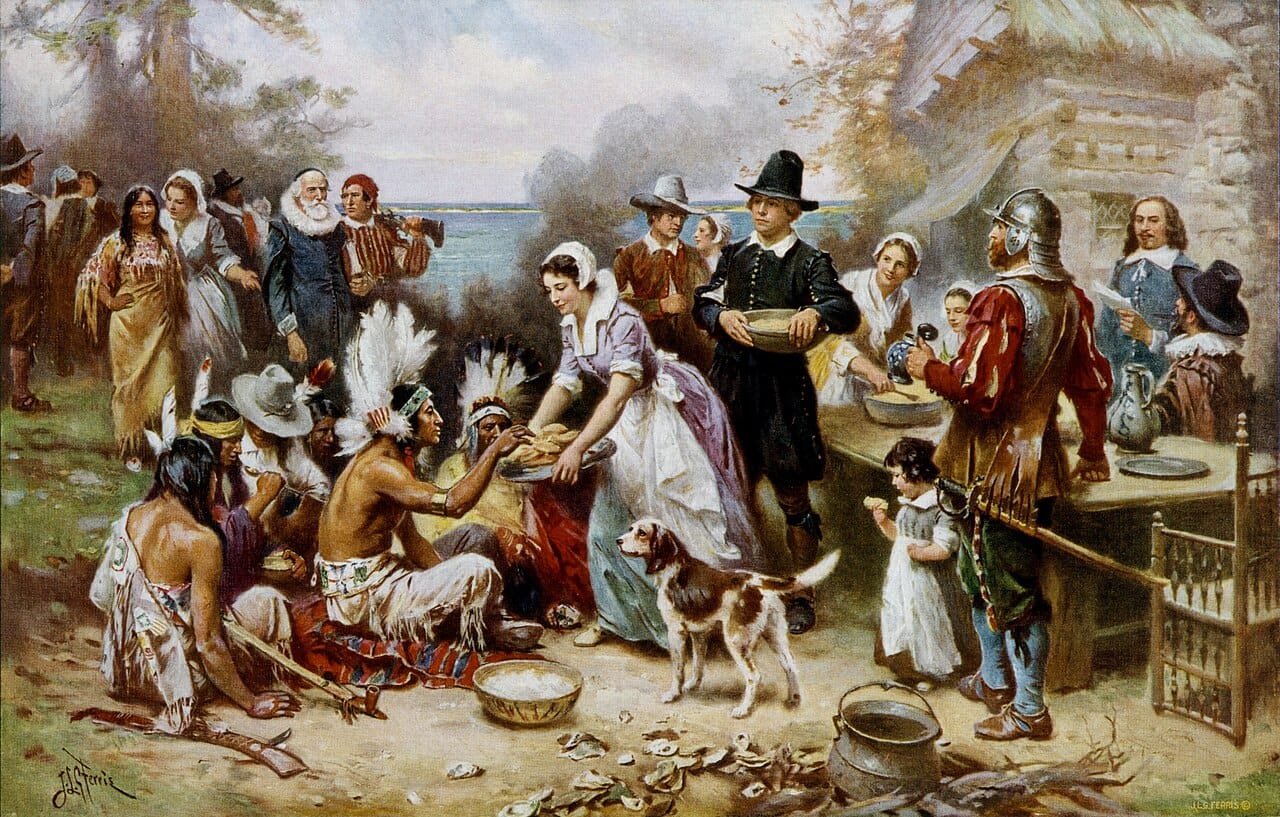
От истории към история: фрагментираният ритуал става национален символ
Както често се случва в историята, и тези събития са забравени и възродени по-късно при съвсем други обстоятелства. Из цяла Нова Англия продължават да се празнуват най-различни дни на благодарността, но едва през 1841 г. събитията от почти двеста години по-рано се наричат официално „Първият ден на благодарността“.
С разпръсването на жители на Нова Англия из континента в рамките на разширяването на САЩ ритуалите на благодарността достигат до нови земи. По това време вече се наблюдават някои от съвременните черти на празника – завръщане вкъщи, църковна служба, голяма богата вечеря, различни занимания, като игри и дори официални балове. За цялостния облик на празника обаче е виновна – съвсем неизненадващо – една жена.
Сара Джозефа Хейл е дългогодишна редакторка на едно от най-разпространените издания за жени в Америка преди Гражданската война. Именно нейните насоки и идеи как точно се празнува Денят на благодарността – от менюто до украсата, – оформят облика му.
Разтревожена от разделението на нацията в годините преди войната, Хейл се опитва да създаде от празника символ на обединението, за да се почете домашното огнище, както и домът, традициите и корените, споделяни от всички американци. Според Хейл един от най-лесните начини за асимилиране на новодошлите имигранти е именно чрез отбелязването на американски празници като Деня на благодарността.
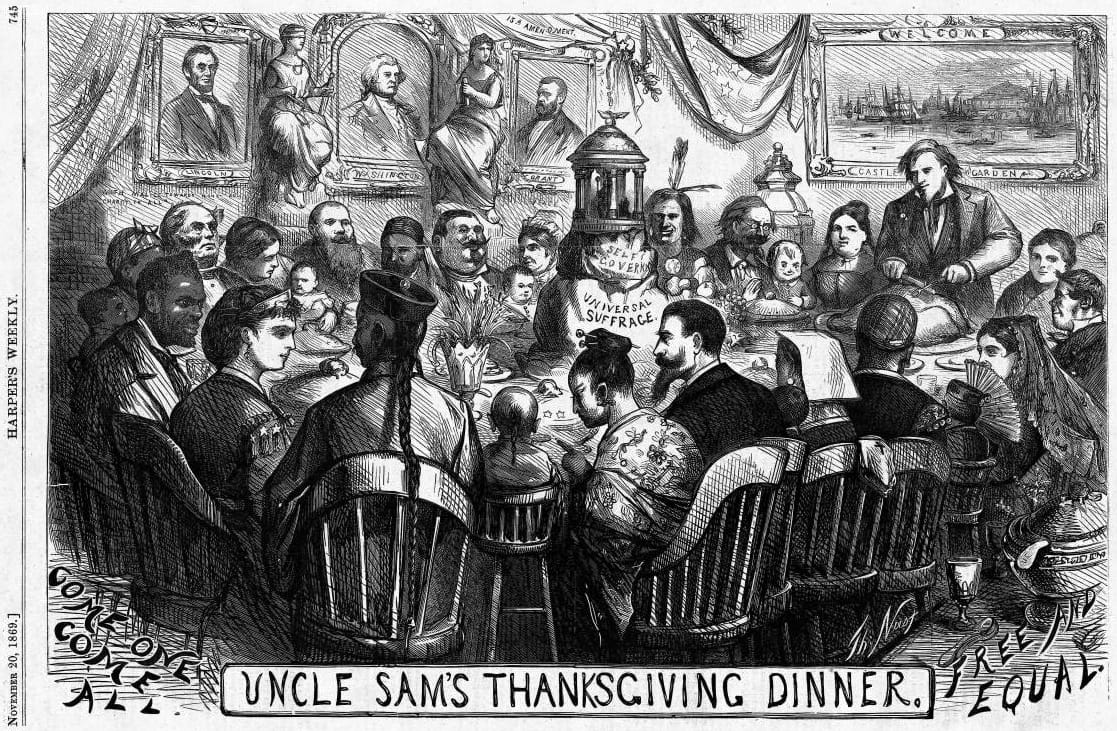
Хейл пише писма до няколко американски президенти, сред които и Ейбрахам Линкълн, който, подтикнат от нея, започва регулярно да обявява национални Дни на благодарността. Първият е през април 1862 г., в разгара на Гражданската война. След победата в Гетисбърг Линкълн обявява Национален ден на благодарността на 26 ноември, последния четвъртък от месеца. През 1870 г. президентът Грант прави празника ежегоден и официален почивен ден заедно с Нова година, Коледа и Деня на независимостта – четвърти юли. Въпреки това ритуалите продължават да се различават и да са фрагментирани – ако в Ню Йорк хората се обличат в костюми и правят карнавал, в Нова Англия се събират за сутрешна стрелба.
Както вече казахме, на символите е нужна история не само за да се родят, но и за да узреят. През 1939 г., десет трудни години след Голямата депресия, в навечерието на Втората световна война, Франклин Делано Рузвелт обявява четвъртия четвъртък от ноември за официалния Ден на благодарността. Решението е стратегическо: чрез символите и традициите Рузвелт се надява да стимулира търговията и оттам все още затруднената икономика. По онова време рекламата на коледни стоки преди Деня на благодарността се счита за неуместна.
Републиканците осъждат решението на Рузвелт с обвинението, че то опетнява паметта на Линкълн, и правят свой „републикански“ Ден на благодарността на 30 ноември, лепвайки етикет на по-ранния Ден на благодарността. Всякаква прилика с настоящи лица и събития е дотолкова случайна, доколкото я пише и пренаписва и до днес историята. Цялата галиматия завършва през 1942 г., когато последният четвъртък на ноември е определен за регулярен Ден на благодарността. Президентът Рузвелт подписва закона, разбира се. Само мир да е.
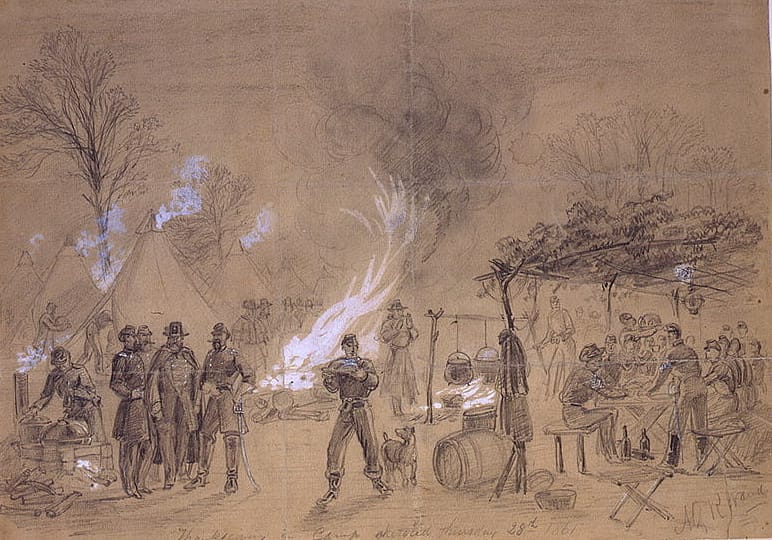
Най-американският празник
Днес пътуването към дома за Деня на благодарността започва в началото на същата седмица. И тази година има новини за нестабилността на авиолиниите, както и дебати дали потребителите ще бъдат защитени – борбата между малкия човек и корпорациите, каква по-американска история от това, разказана и от Карлос Булосан преди стотина години. После пристигаме у дома, където жените (а за щастие все по-често и мъжете) готвят и подреждат трапезата, украсяват къщата с есенни листа и житни класове (най-често пластмасови и найлонови), рогове на изобилието, кочани царевица, тикви, порцеланови фигурки на пуйки.
Макар нито картофите, нито тиквеният пай (захарта, брашното и картофите навлизат на континента масово по-късно) да са част от първите Дни на благодарността преди толкова векове, днес сладките картофи и сладкишите са част от традицията. Освен тях имаме например зелен боб, макарони със сирене (американския вариант), пълнеж за пуйката, често правен от царевичен хляб. Повечето продукти за ястията на масата, включително и пуйката, европейците срещат и внасят в Европа с развитието на колониите – в противен случай биха били непознати за нас.
Пилигримите и уампаноагите може би са яли пуйка, но освен това е имало и морски дарове, и риба в изобилие на двата бряга на САЩ. Пуйката става още по-традиционно ястие (изненада!) вследствие на масирани рекламни кампании през XIX и XX век, както и поради големината си – месото стига за цялото семейство. Самата Сара Джозефа Хейл обявява пуйката за перфектното ястие за Деня на благодарността, а както стана ясно, с нея не може да спори дори президентът Линкълн.
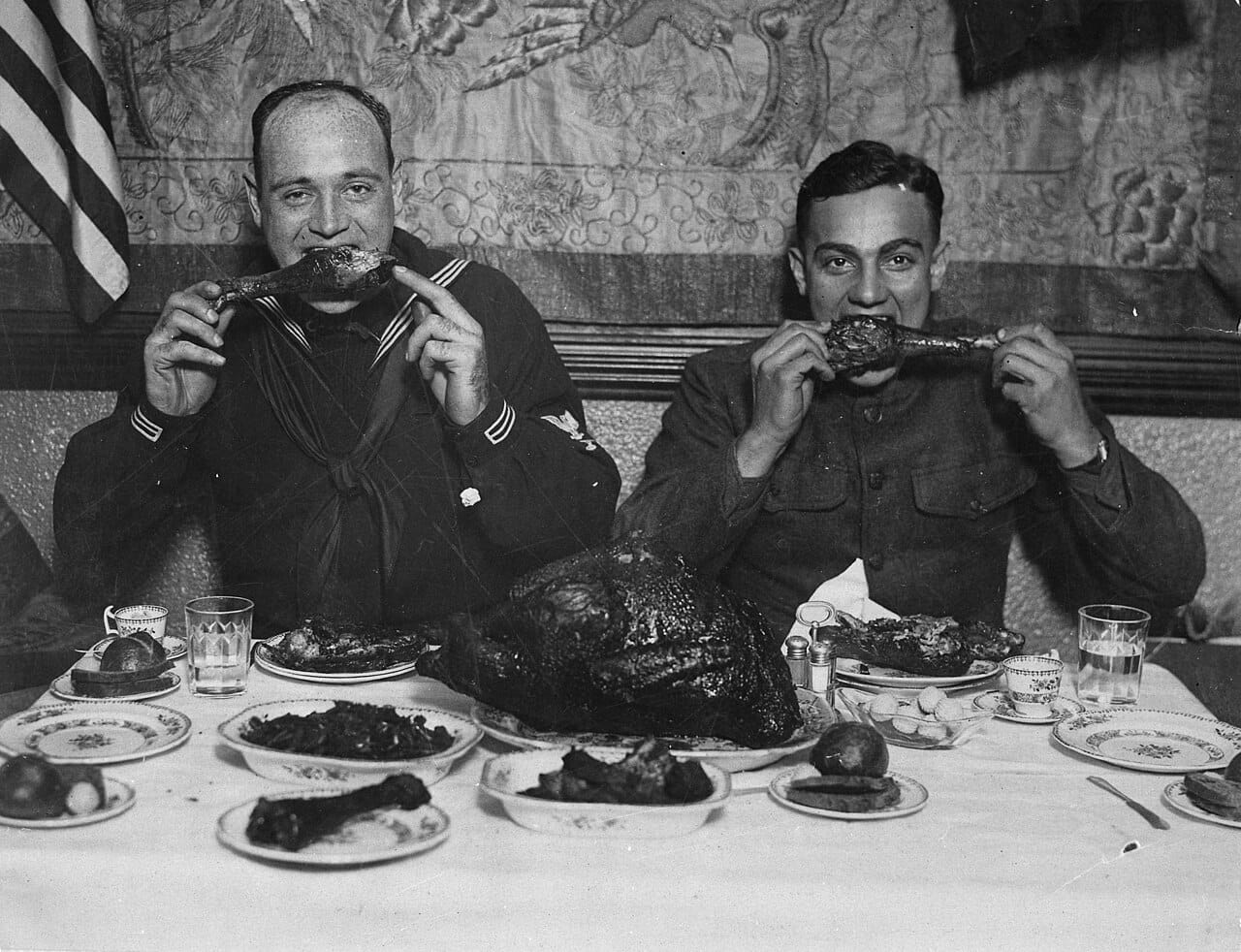
Символната трапеза на Деня на благодарността е богата: езически природни ритуали, примесени с религиозните и политическите промени в Европа, предизвикали масово преселване на множество европейци към Новия континент, който обаче не бил съвсем нов, а Великите географски открития не били съвсем велики, тъй като там вече имало хора, орисани да са от губещата страна на историята.
След това имаме история за завладяването на цял континент, за имиграция и интеграция през общи ритуали, за реклама и изграждане на символи, за Гражданска война и опит за лекуване на раните на нацията, за икономика и пазари, за визионерски политически решения, за пропаганда, за Световна война и образа на Америка преди и след нея, чак до днес, когато образът на Деня на благодарността е уеднаквен и утвърден от Холивуд, съвременния капитализъм и неговия безпощаден маркетинг. Попкултурата – комиксите с Чарли Браун, сериалът „Приятели“ и др. – раждат и т.нар. Friendsgiving, или Деня на приятелите, в който вместо със семейството празникът се отбелязва с близки приятели.

Чрез Деня на благодарността разбираме не само какво е Америка, но и как тя вижда и мисли себе си. Как ще отпразнувам тази година? С някои от рецептите, които ви подарявам тук по-долу, и с нова звезда на масата – порцеланова солница във формата на пуйка, произведена в Ленинградския порцеланов завод „Ломоносов“ по времето на СССР. Защото какво е традицията освен един ритуал, към който привнасяме нещо от своята история.
С надеждата, че въпреки лабиринтите и двусмислиците на историята, въпреки войните, въпреки маркетинга и въпреки ужаса на света няма да забравим, че дори от най-голямото зло – инцидентно и може би за да не губим надежда – се ражда, някак си, добро.
С надеждата, че въпреки бавното превръщането в банален навик на всеки ритуал, все още можем да се върнем към общия му корен – смирението и благодарността.
С надеждата за надежда – на инат:
Честит Ден на благодарността!
РЕЦЕПТИТЕ
Маслено тесто за пай

За тиквения пай ви е необходимо, на първо място, тесто.
Масленото тесто се приготвя с 320 г бяло брашно, 230 г качествено краве масло (82% масленост), малко захар, сол и ледена вода – около 120 мл, като е хубаво във водата да има кубчета лед, за да се поддържа температурата.
Маслото трябва да бъде добре охладено и нарязано на малки кубчета – може да го замразите във фризера и да го преместите в хладилника няколко часа преди готвене.
Именно студените продукти са тайната на ронливата и многопластова текстура на масленото тесто – докато го приготвяме, се стараем маслото да остане на отделни малки парченца, а не да се разтопи и да попие в брашното. При печене тези парченца ще се стопят и ще отделят пара, която ще създаде фини въздушни пространства между пластовете тесто и нежна, хрупкава и приятно ронлива кора.
Смесете нарязаното на кубчета масло с брашното в робот или в купа с помощта на две вилици, докато се получат трохи с размера на грахови зърна. Работата е трудна, но резултатът си заслужава. Малки парченца масло тук-там са напълно приемливи. После добавяйте ледената вода по една-две супени лъжици и разбърквайте, докато тестото започне да се събира и да се оформя лесно, но в никакъв случай не месете прекалено. Извадете тестото от съда, щом започне да се слепва само̀ на по-едри парчета. Не бива да изглежда твърде мокро.
Готовото тесто се разделя на две равни части, оформя се на плоски дискове, увива се в домакинско фолио и се оставя в хладилника за минимум 2 часа. Така маслото се стяга, а с тестото се работи по-лесно. Разточете нежно и внимателно с малко брашно, като внимавате тестото да не се стопли твърде много.
Тиквен пай

Тиквеният пай е изкуство, но си заслужава да се провалите няколко пъти, докато го нацелите; освен това дори неуспешните опити са вкусни.
За него са ви необходими около 450 г тиквено пюре. Най-лесният начин е да опечете тиква, да отделите и пюрирате количеството, а ако тиквата е по-водна, поизцедете я леко през фин тензух, както се цеди кисело мляко.
Разбърквате пюрето с 250 г кафява захар, 3 яйца на стайна температура, 1 ч.л. царевично нишесте, 240 мл сметана (30–35% масленост) и 60 мл прясно мляко. Към сместа добавете ½ ч.л. сол, 1½ ч.л. канела, ½ ч.л. сух джинджифил, ¼ ч.л. индийско орехче, ⅛ ч.л. смлян карамфил и щипка прясно смлян черен пипер. Традиционно тази комбинация от подправки се нарича allspice, но в България близък роднина са ѝ подправките за греяно вино, предлагани в големите магазини – препоръчвам да си направите сместа у дома, но ако не ви се занимава, това е алтернатива.
Разточете охладеното маслено тесто, поставете го във форма за пай или в кръгла тавичка (стъклена, за да се изпече равномерно) с диаметър 20–25 см и го сложете във фурната предварително за 10 минути на 190°C. За това предварително печене ще направите нещо крайно странно – ще изсипете вътре суров боб, така че да тежи и да покрива цялата повърхност. Използваме бобените зърна като тежест, за да предотвратим надуването и деформирането на тестото по време на предварителното изпичане и за да получим равна, стабилна и хрупкава основа.
Отстранете бобчетата и печете още 7–8 минути. След това изсипете пълнежа върху основата и печете на 190°C 55–60 минути, докато краищата се стегнат, а центърът все още леко потреперва при разклащане. Оставете пая да се охлади напълно за поне 3 часа, за да стегне пълнежът и да придобие характерната си нежна кремообразна текстура. Ако крайчетата на пая ви започнат да загарят, може да изрежете рамка от алуминиево фолио и да я поставите за защита.
Американски царевичен хляб

За приготвянето са необходими 120 г фино смляно царевично брашно, смесено със 125 г бяло брашно тип 500, 1 ч.л. бакпулвер, ½ ч.л. сода бикарбонат и ⅛ ч.л. сол – смесвате ги и ги оставяте настрана. Важно е царевичното брашно да бъде фино смляно, а не царевичен грис за качамак или царевично нишесте.
В отделна купа смесвате около 100 г краве масло, разтопено и леко охладено, 70 г кафява захар, 1–2 с.л. мед, 1 голямо яйце на стайна температура и 240 мл мътеница (buttermilk). Тъй като може и да не намерите мътеница, има как да си я приготвите сами, като добавите 2 ч.л. лимонов сок или бял оцет към 240 мл пълномаслено прясно мляко, разбъркате и оставите за 5 минути. Съставките се смесват в тази последователност.
След това загрейте фурната на 200°C. Обикновено хлябът се пече в квадратна тава с размери 20 х 20 или 23 х 23 см, така че може да подготвите подобна, като я намаслите или я покриете с хартия за печене. Изсипете течната смес при сухите съставки и разбъркайте внимателно само докато се смесят, без да прекалявате. Прехвърлете тестото в тавата и печете 20–25 минути до златиста коричка и суха клечка при проверка в центъра. Оставете хляба леко да се охлади, преди да го нарежете, и го поднесете с масло, мед или сладко. Получава се мек, сочен и леко сладък царевичен хляб с апетитна хрупкава коричка.
Пуйка за Деня на благодарността

Има много начини за приготвяне на пуйката. Печенето на цяла пуйка отнема време и трябва задължително да я проверявате с термометър. Има значение и дали я пълните, или не.
Обикновено пълня пуйката със свежи стръкове розмарин, мащерка и чубрица, нарязвам на едро 2 портокала, 1 глава лук, няколко парчета целина и пъхам всичко това в птицата. Отделно подготвям около 100 г меко, но не разтопено масло, размесено със сол и част от розмарина, мащерката и чубрицата, с което намазвам птицата отгоре и го втривам и отдолу под кожата на пуйката, така че месото да се овкуси добре, а кожата да стане хрупкава и златиста.
Coolest Projects Spain 2026: Young creators shine in Gavà
Post Syndicated from Helen Gardner original https://www.raspberrypi.org/blog/coolest-projects-spain-2026-young-creators-shine-in-gava/
On Saturday 24 October, young tech creators gathered at Espai Jove La Casa Gran in Gavà for Coolest Projects Spain, a lively celebration of young people and their digital projects. Organised by DEQ4Future, the event welcomed 29 creators who shared projects ranging from games to hardware builds to web apps.
Here are some project highlights from the event
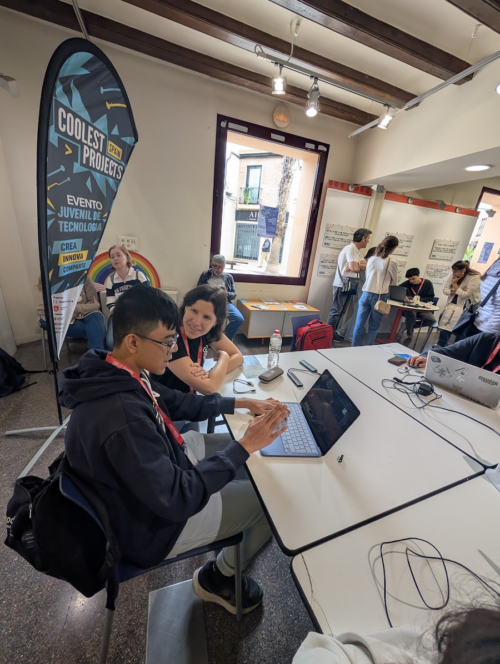
Nohan | Lost Abyss, Games
Nohan, 15, was inspired to build Lost Abyss in Roblox by the horror games he loves. He enjoys making games because they let him bring together lots of different skills: coding knowledge, design, imagination, and database management. Nohan shared that the hardest part for him was coming up with the initial idea for the game!
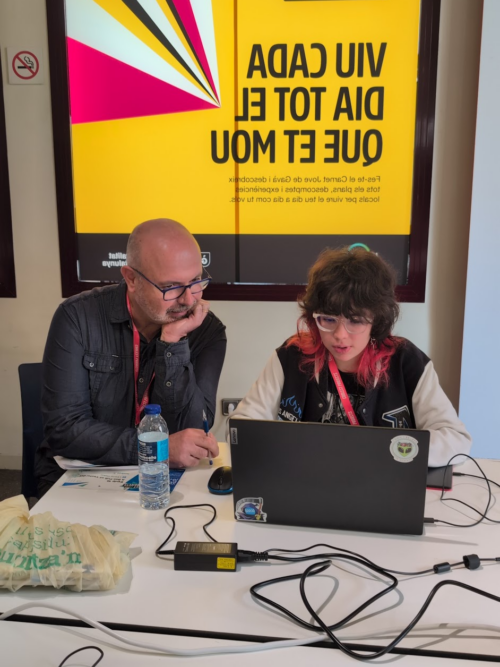
Isabel | A Box Full of Yesterday, Games
A Box Full of Yesterday is the first video game Isabel, 15, has ever made. Created in Unity, it’s a game about moving house and packing up boxes of memories. It took her a month to make, and she learned the skills needed at an online summer camp, as well as from YouTube tutorials and ChatGPT. Isabel shared more on how it works:
“It’s like a history game, and you control a character who is going to move house, and you have to pack his last box of things. These things are objects that represent a memory from his life, for example, a photo with his best friend, or his favourite game that he played with his father when he was little.”
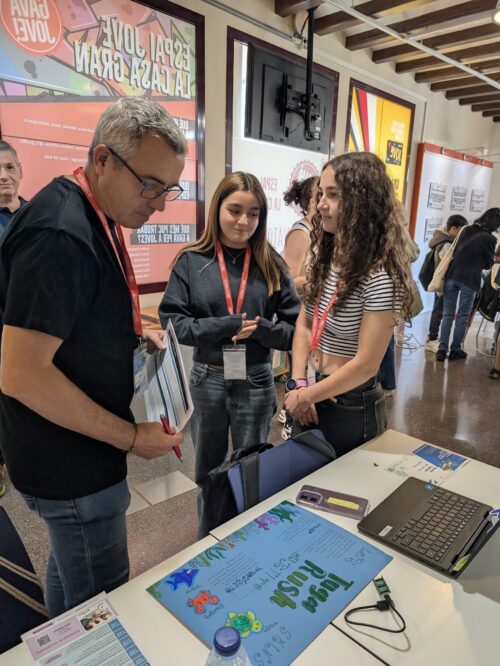
Iris and Abril | TugaRush, Scratch
Iris and Abril, both 15, created TugaRush in Scratch. In the game, you play as Tuga, a turtle who has been separated from her family by ocean currents and must dodge rubbish and pollution, such as plastic bags and rusty objects, to be reunited with them. Every piece of rubbish that reaches the edge of the screen scores a point, and a separate counter tracks your all-time high score. Players can also collect coins and spend them in a shop on new skins, including Tuga the turtle, Cangri the crab, and Tibul the shark. Iris and Abril told us the thinking behind their game:
“We wanted to create something accessible, perfect for when you’re tired and don’t want to think too hard, yet still engaging enough to keep you hooked.”
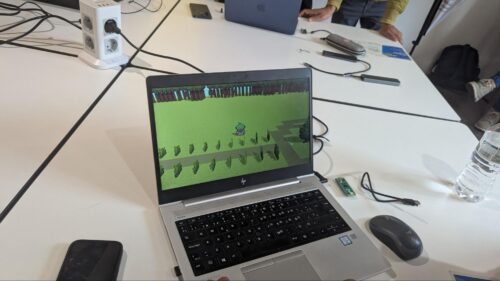
Arnau | Salvem el Planeta, Games
Arnau, 13, coded Salvem el Planeta at school using RPG Paper Maker, and it took him around 10 hours to make. Players go on a mission to collect rubbish from a riverbank, learning about the UN Sustainable Development Goals (SDGs) along the way.
Arnau explains that, “The project is based on the SDGs, which relate to sustainability and global issues, and involves going to the river to collect waste, such as plastics and other debris found along the riverbank. It also explains which SDGs are being addressed and how your actions help the world.”
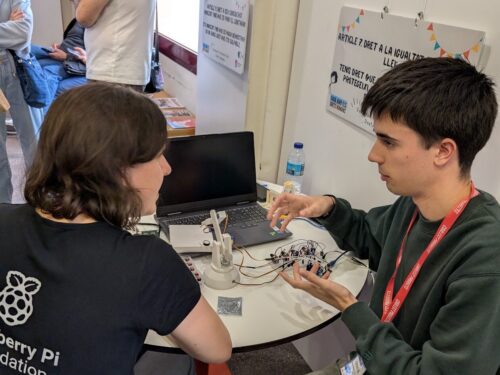
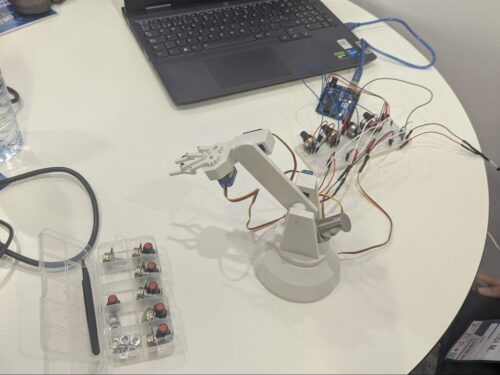
Oriol | Robotic Arm, Hardware
Oriol, 17, built an articulated robotic arm using 3D printing and Arduino for his high school science and technology project. He started building it this summer, inspired by the idea of making something cool and being ambitious. Oriol has been coding for seven years, so he came well prepared for the challenge!
Judges’ favourites
With so many incredible projects on display, the judges had a tough job ahead of them picking their favourites. Some of the projects highlighted included:
Hardware: Guillem and Eloi from Igualada created Signo, which uses programming to create a game controlled by sign language. In their Python video game, the system recognises gestures that players can use to attack a monster.
Games: Nil from Girona was the judges’ favourite with Animal Defense, a strategy game in which you deploy animals to conquer your opponent’s base.
Web: Alejandro from Gavà created Memvia, an app designed to support people with memory loss in their day-to-day lives. It connects them with their family, routines, and memories through a clear and accessible interface.
Get involved
Congratulations and thank you to every young creator who joined us for Coolest Projects Spain this year. Sharing your projects, celebrating your achievements, and inspiring others is what Coolest Projects is all about.
A huge thank you also to DEQ4Future for organising the event, and to everyone who helped make the day possible. Want to see even more highlights from the day? Check out DEQ4Future’s blog.
Want to be a part of Coolest Projects next year? Sign up to our newsletter to hear more about in-person events around the world and the global online showcase. Entries for the 2027 cycle will open in January! You can find out more at coolestprojects.org.
The post Coolest Projects Spain 2026: Young creators shine in Gavà appeared first on Raspberry Pi Foundation.
Make post-quantum cryptography updates routine with AWS-LC
Post Syndicated from Josh Williams original https://aws.amazon.com/blogs/security/make-post-quantum-cryptography-updates-routine-with-aws-lc/
As your organization plans upgrades to post-quantum cryptography (PQC), you should also think about cryptographic agility to more easily update algorithms used to protect your data. Changes to cryptography and related protocols aren’t new, but PQC is accelerating the pace at which organizations must add new algorithms and remove old ones to keep up with changing regulations and evolving business risk. AWS believes our key to success is standardizing on one cryptographic library that embodies three key properties: compatibility, assurance, and performance. In this blog post, you’ll learn how we think of the cost and friction of ongoing cryptographic updates in terms of these properties. You’ll learn how AWS built AWS-LC to embody these properties, thus making cryptographic upgrades straightforward and low-impact for ourselves and our customers. For custom applications where you can’t yet use AWS services and must operate your own stacks, this post also shares why you might consider using AWS-LC as your standardized library.
Every cryptographic algorithm used to protect your data today has an expiration date, even if no regulator has set one yet. Algorithms that were once the standard, such as MD5 and SHA-1, have been retired. Standards are revised and flaws are found in implementations. The move to post-quantum cryptography is the current wave of changes, with dates set by governments and regulators to complete the transition. PQC itself will progress in phases to enable hybrid and pure post-quantum algorithms and then deprecate traditional cryptography. Each change reaches your systems as a software library update, so the practical question is how often you can roll out a new version of your cryptographic library, and what each rollout costs. At AWS, we think of this cost in terms of three properties. Compatibility means an update doesn’t require application changes. Assurance means new code can be trusted when it ships, without a long bake period. Performance means a new algorithm doesn’t add so much computational overhead or latency that it gives teams a reason to wait. This post describes how AWS-LC provides each property, and how you can apply the same approach to the cryptography you own.
AWS-LC is the general-purpose cryptographic library that AWS maintains and uses across its services. It is derived from BoringSSL, which originated from OpenSSL. If you’ve called an AWS API, AWS-LC was used on the server side. Through s2n-tls, it provides hybrid post-quantum key exchange on AWS service endpoints and in services like Application Load Balancer and Network Load Balancer. It’s also the cryptography under aws-lc-rs for Rust, the default provider for rustls, and under the Amazon Corretto Crypto Provider for Java. Because so much of AWS depends on one library, we built it to be updated often. AWS-LC keeps an OpenSSL-compatible API so applications can replace algorithms without a rewrite. It uses formal verification to prove selected algorithm implementations correct. It optimizes algorithm implementations to reduce the latency and compute costs that new algorithms add. The same properties work outside AWS. For example, 1Password used AWS-LC to move its clients to hybrid post-quantum key exchange with no application code changes.
Hand off what you can, standardize what you keep
Each piece of cryptography you own is one more thing to change at every transition. By owning as little of your cryptographic stack as your constraints or requirements allow, and using AWS services to manage the rest, you can minimize your ongoing responsibility and operational risk.
If your workload relies solely on managed services like AWS Key Management Service (AWS KMS) and managed resources like Elastic Load Balancer or Amazon Relational Database Service (Amazon RDS), you’re already reaping the benefits of AWS-LC and the AWS shared responsibility model. You only need to keep your clients and resource configurations updated. Many organizations can rely on AWS to provide the infrastructure and basic automation, but still own and manage the endpoints and applications where most of the work happens. For these components, it’s helpful to standardize on as few cryptographic libraries as possible. With fewer libraries, your team learns each one well: how to configure it, run it, and update it. The library you standardize on also decides how often you can update it. If an update requires application changes, ships new code that no one trusts yet, or adds compute and latency, teams have a reason to wait. In the rest of this post, we show you how AWS-LC removes each of those reasons through compatibility, assurance, and performance.
Compatibility
The best library update is one that doesn’t impact your application and that your users don’t notice. Code changes happen at three points: adopting a library, adding an algorithm, and updating the library. AWS-LC keeps each one small.
- Adopting AWS-LC – For TLS, AWS-LC
libsslkeeps an OpenSSL-compatible API, so most applications that use OpenSSL for TLS build against it with small changes. Applications that call libcrypto directly might need more work, because the AWS-LC libcrypto API differs from OpenSSL’s in places. See the porting guide for where behavior differs. - Adding an algorithm – When new algorithms are added in AWS-LC behind interfaces applications already call, s2n-tls, s2n-quic, aws-lc-rs, and the Amazon Corretto Crypto Provider adopt them automatically. Hybrid ML-KEM key exchange, for example, is enabled through existing TLS configuration APIs. For 1Password, that meant a one-line Cargo.toml change and no application code changes.
- Updating the library – AWS-LC long-term support (LTS) releases keep a stable application binary interface (ABI). Applications link once, then take library updates without a rebuild. One update reaches every application on the host when each process restarts. The Amazon Linux 2027 preview uses this method to ship AWS-LC as a system library.
We built these properties so AWS services could move to AWS-LC with minimal effort. aws-lc-rs is also used by open source projects; it’s the default cryptography provider for rustls with over 100 million downloads in the past 90 days, CPython tests against AWS-LC in continuous integration, and HAProxy publishes packages built on it. Each new use surfaces problems earlier in the update process, and every fix is recorded in one codebase.
Assurance
Every new algorithm arrives as new code, and new code is where bugs and security vulnerabilities are usually found. If you can’t trust new code when it ships, you wait, and each wait delays the next change. Tests check the inputs you run, and proofs check every input. AWS-LC uses machine-checked proofs for its most critical code, including its post-quantum algorithms and parts of its classical algorithms, such as its 25519 elliptic-curve code.
AWS-LC contributes to and takes its ML-KEM and ML-DSA code from two open source projects: mlkem-native and mldsa-native. The algorithmic implementations in these projects already incorporate formal verification safeguards such as ensuring no out of bound memory access, no integer overflows, constant assembly run time, and functional correctness using tools like CBMC and HOL Light (for more information, see Verifying and optimizing post-quantum cryptography at Amazon). AWS-LC imports this code from upstream without changing it. The proofs don’t depend on instruction order, so the assembly can be re-optimized without redoing them. That prevents verification from becoming the reason a faster implementation waits. Other cryptographic implementations of the library are verified in s2n-bignum.
We use these proofs alongside testing and FIPS validation. For workloads that require FIPS 140-3, a validated module is required to allow new code to be deployed. AWS-LC FIPS 3.0 was the first cryptographic library to include ML-KEM in a FIPS 140-3 validation. ML-DSA, the NIST post-quantum signature standard (FIPS 204), is in the AWS-LC FIPS 4.0 module, and the FIPS 5.0 module includes the faster, formally verified mldsa-native implementation. Both have been submitted to NIST for validation.
Performance
A new algorithm that costs more to run gives teams a reason to delay, and across many connections a small cost per connection adds up. AWS-LC optimizes each algorithm it adds so that cost doesn’t delay the update. Amazon Science reports 2.0 to 2.4 times more ML-KEM operations per second than the reference implementations across Amazon Elastic Compute Cloud (Amazon EC2) instance types. Earlier work applied the same approach to 25519 elliptic-curve cryptography. The optimized code is covered by the proofs described in the previous section, so speed doesn’t reduce assurance.
ML-DSA followed the same path. AWS-LC moved from its original implementation to mldsa-native, with optimized assembly for AArch64 and x86_64 platforms, and it now signs and verifies faster on both Graviton and x86 EC2 instance types. As a result, compute is no longer the main cost of post-quantum signatures: in the measurements in the following section, we show that ML-DSA-44 certificates lowered average TLS handshake latency compared with RSA-2048. What remains is size, which the next section measures.
What it costs to move
AWS services handle billions of requests every second, so anything that could affect those requests must be carefully considered. Post-quantum cryptography impacts the performance of every new TLS connection, so before we adopted ML-KEM and ML-DSA, we invested heavily in making them fast. Figure 1 shows the resulting reduction in time for both key exchange and authentication. Today, moving to PQ confidentiality has no net cost for most AWS use-cases, and PQ authentication takes less compute than the RSA certificates we use today.
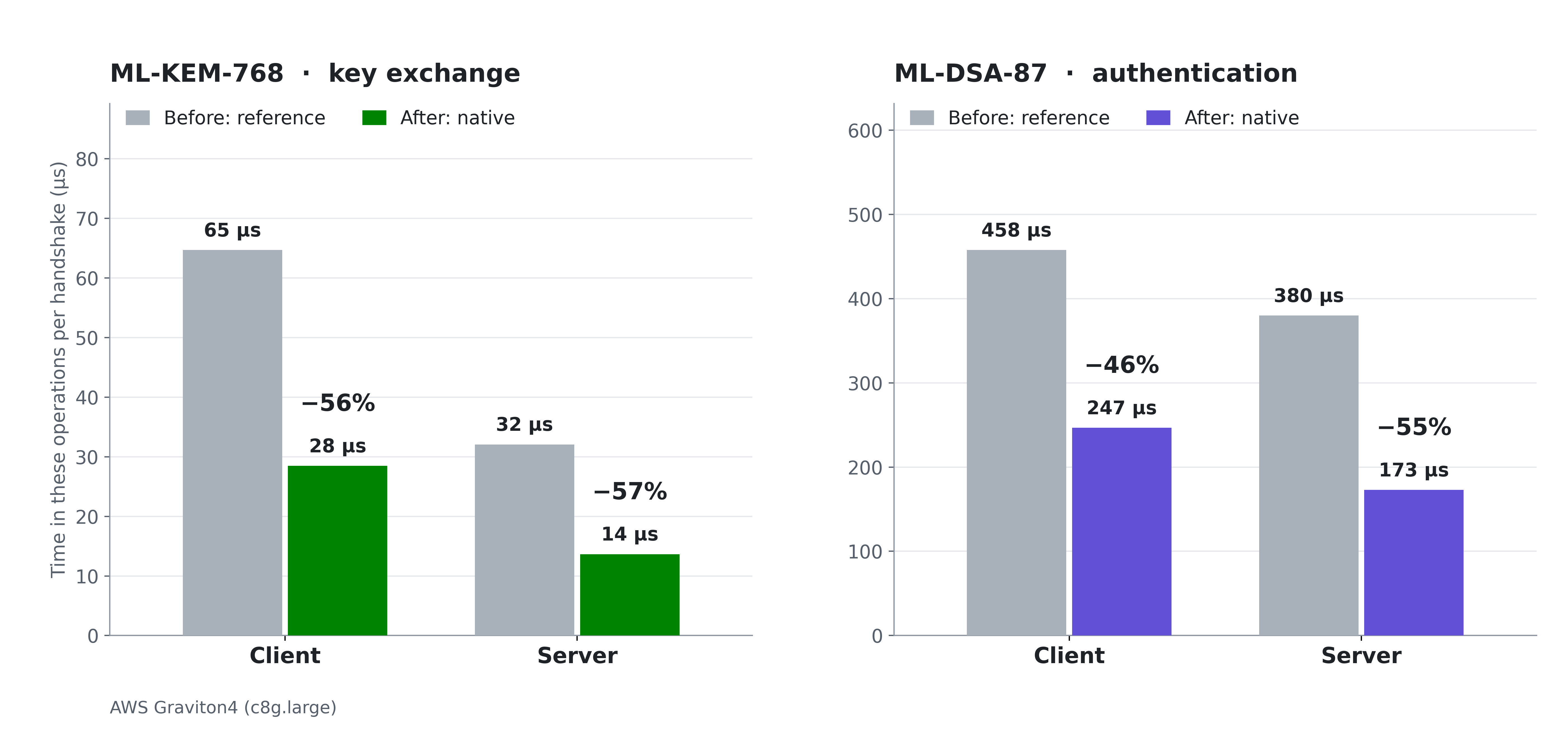
Figure 1. ML-KEM-768 and ML-DSA-87 time per handshake, before and after AWS-LC’s native implementations, on AWS Graviton4
ML-KEM-768 key exchange decreased by over 50 percent on both the client and the server (as shown in Figure 1); we described how in Verifying and optimizing post-quantum cryptography at Amazon. In this post, we’re focusing on ML-DSA. In AWS-LC v1.49.1, ML-DSA used the original AWS-LC implementation, adapted from the reference code. In v5.10.0, it runs on mldsa-native, which implements the performance-critical kernels in hand-written Arm64 Neon assembly for AWS Graviton, including: the number-theoretic transform (NTT) and its inverse, tuned for Arm cores with the SLOTHY superoptimizer, along with pointwise multiplication, rejection sampling, and the decompose, hint, and norm-check steps of signing and verification. It also expands the public matrix four entries at a time using the AWS-LC four-way parallel SHA-3 (Keccak). These optimizations, as shown in the right half of Figure 1, reduced ML-DSA-87 signing time on the server and verification time on the client, and the same assembly is covered by the formal proofs described earlier. mldsa-native is open source, part of the PQ Code Package in the Linux Foundation’s Post-Quantum Cryptography Alliance (PQCA), and the AWS Cryptography team and Amazon Automated Reasoning Group contribute to it.
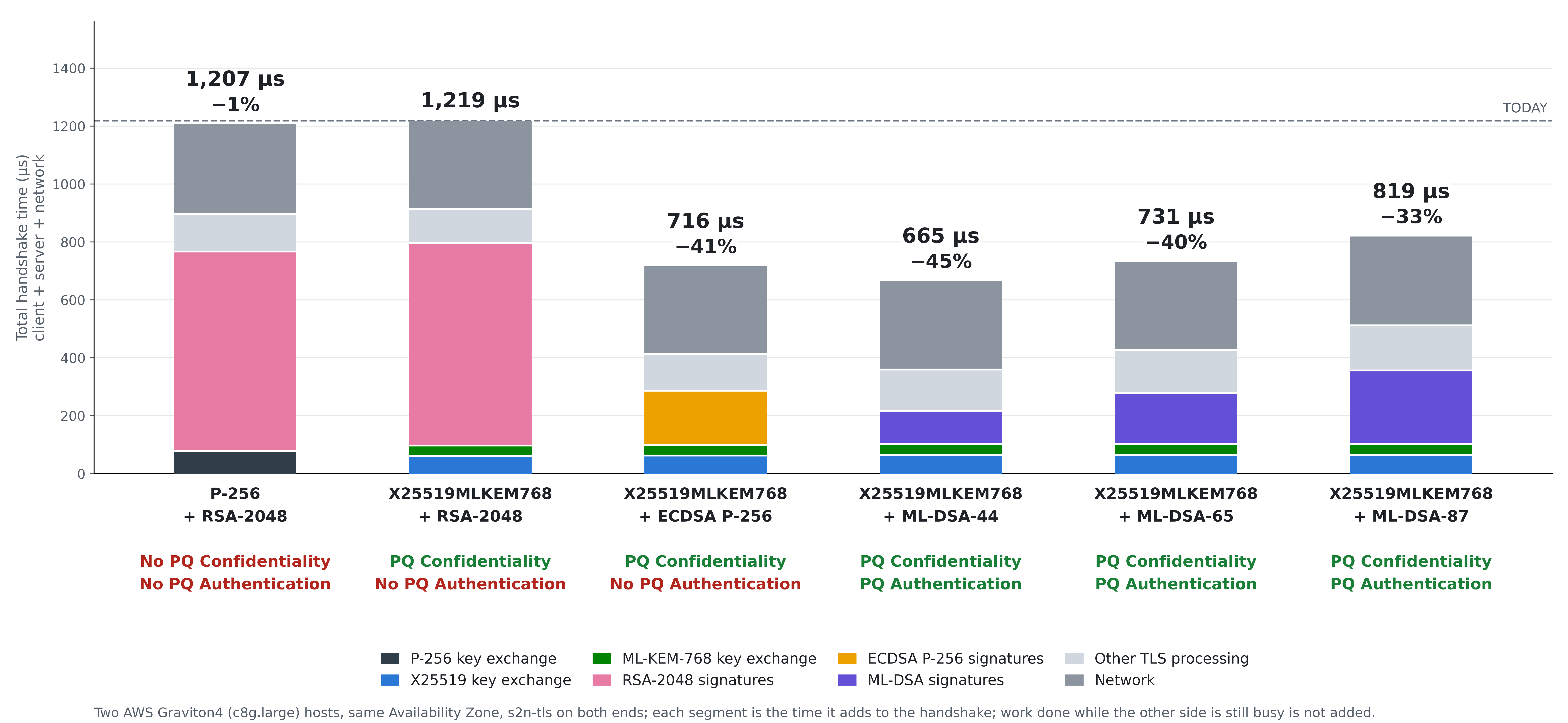
Figure 2. TLS 1.3 connection setup time by algorithm, between two AWS Graviton4 hosts in the same Availability Zone
Figure 2 shows total handshake time for various configurations, when the client and server are in the same AWS Region. For a baseline, we used TLS performance when the server prioritized ECDHE with P-256 for key exchange and RSA-2048 certificates for authentication. With the optimizations to ML-KEM, there is negligible overhead from moving to hybrid ML-KEM key exchange (the second bar from left). The hybrid key exchange preferred in AWS systems today pairs X25519 with ML-KEM-768. X25519 is faster than P-256, and that saving covers the remaining ML-KEM work, so a full connection setup takes roughly 12 microseconds more, which doesn’t meaningfully impact throughput or latency. It’s worth noting here that ML-KEM-768 introduces approximately 2.3 KB to the handshake.
PQ authentication carries more risk, because authentication is more of the handshake cost. The server signs once for each handshake, and the client verifies three signatures: the server’s handshake signature, the signature on the leaf, and the signature on the intermediate certificate. RSA-2048 signing is expensive and verification is inexpensive. ML-DSA-87 reverses that balance, shifting some work from the server to the client.
ML-DSA keys and signatures are also much larger, so the server’s handshake messages grow from 4–7 KB to 17–24 KB depending on the chosen certificate parameters. That adds certificate parsing on the client and more data to encrypt and send on the server. Within an Availability Zone, those messages still arrive in one round trip, and we measured no difference in network time between configurations.
Compared to RSA 2048, which is still prevalent today, ECDSA offers faster processing. However, both must be replaced by ML-DSA for post-quantum authentication. With the optimizations in AWS-LC, ML-DSA-44 comes close to ECDSA, and every ML-DSA parameter set is significantly faster than RSA-2048, as shown in Figure 2. As a result, we’re confident in managing the performance impact from migrating to post-quantum certificates.
Another facet of our investments in reducing performance impact is session resumption. Handshake costs apply only to new connections. Session resumption reduces how often that cost is paid. A resumed TLS 1.3 handshake authenticates with a key from the earlier session and sends no certificates or signatures, so the larger ML-DSA keys and signatures apply only to full handshakes. We’ll note here that in psk_dhe_ke mode, the resumed handshake still runs a fresh hybrid ML-KEM key exchange, which preserves forward secrecy. Now, resumption only helps if the client can present its ticket to any server behind the endpoint, so AWS has been extending support for resumption across the hosts behind its service endpoints. AWS SDKs can reuse connections across many requests, and session resumption can skip certificates and signatures entirely, which gives the most performance benefit for workloads using AWS managed services. If you’re using AWS-LC directly in your own custom applications, consider keeping session tickets enabled, prefer TLS 1.3 with psk_dhe_ke, and reuse clients so that they keep their tickets between connections.
Conclusion
Every cryptographic choice has an expiration date, so the goal isn’t to pick the right algorithm once and never replace or update it, but to make each replacement routine. Start by handing off what you can to AWS services and standardizing what you keep on as few libraries as possible. For the cryptography you own, three properties decide how quickly and how often you can implement each update. For compatibility, new algorithms arrive behind the APIs your applications already call, and long-term support releases keep a stable ABI, so adopting one takes a library update and a restart, not a rebuild. For assurance, machine-checked proofs cover a library’s most critical code, ML-KEM is inside a FIPS 140-3 validated module, and ML-DSA is in modules submitted for validation. For performance, optimized implementations keep each new algorithm from adding compute or latency that might give teams a reason to wait. Post-quantum cryptography is the change in front of us now, and it won’t be the last.
If you have questions about this post, contact AWS Support or start a new thread on AWS re:Post.
ICYMI: October 2026 @AWS Security
Post Syndicated from Rodolfo Brenes original https://aws.amazon.com/blogs/security/icymi-october-2026-aws-security/
Welcome to this month’s AWS Security news! Organizations need current information about AWS Security developments to maintain their cloud security. This monthly digest covers key AWS Security updates. Each month, we compile new announcements, features, and resources to help you improve your security. Based on AWS Security developments, you’ll find expert perspectives in blogs, announcements of new features and capabilities, ready-to-use code samples, reference architectures, and hands-on workshops and labs to build practical security skills. Not every edition will include all of these categories, but we’ll consistently bring you the most relevant and impactful updates to help you enhance your security and governance posture.
AWS Security Blog posts
October brought 19 AWS Security Blog posts focused on the remediation flow, from a security finding to a tested fix. Learn how AI agents can find, confirm, and repair vulnerabilities, and how to add penetration testing to every deployment. You’ll also find guidance on extending existing access controls to AI agents with trusted identity propagation and preparing your signing workflows for post-quantum cryptography. The PHP2Shell posts show why patch timelines for internet-facing systems are now measured in hours, and how AWS WAF can help reduce risk while you upgrade. Other posts cover identity source changes in AWS IAM Identity Center, workload identity outside AWS, and domain-based filtering in AWS Network Firewall.
Threat detection and incident response
AWS Continuum sets a new standard in autonomous code security
Authors: Alexander Greaves-Tunnell, Neha Rungta | Published: October 5, 2026
AWS Continuum for code vulnerabilities achieved an 89.0 percent end-to-end success rate on the CyberGym-E2E benchmark. It found, demonstrated, and repaired vulnerabilities in real open source codebases, 23.1 percentage points above the previous public high.
Part 1 – Cybersecurity journeys: I didn’t plan this
Author: Shannon Brazil | Published: October 7, 2026
The first post in a four-part Cybersecurity Awareness Month series shares how 11 AWS security professionals moved into security from unexpected backgrounds, showing there’s no single path into the field.
GuardDuty Extended Threat Detection has added five new indicators to surface attack sequences
Authors: Aman Khare, Kyle Koeller | Published: October 12, 2026
Learn to use five new indicator types in Amazon GuardDuty Extended Threat Detection: vulnerability, malicious package, reachability, misconfiguration, and sensitive data. They bring signals from Amazon Inspector, Amazon Virtual Private Cloud (Amazon VPC) Reachability Analyzer, Amazon Macie, and AWS Security Hub into sequence findings, and the post shows how to add them to your incident response workflow.
Part 2 – Cybersecurity journeys: What even is this job?
Author: Shannon Brazil | Published: October 13, 2026
The second post in the series covers lesser-known security roles. These include measuring risk across a million applications, building detection tools from the customer service side, and securing infrastructure launched into orbit.
Penetration testing every deployment with AWS Continuum
Authors: Jigar Bhatt, Benjamin Li | Published: October 14, 2026
Learn to add AWS Continuum for penetration testing (formerly AWS Security Agent) to your continuous integration and delivery (CI/CD) pipeline as a check after each deployment. It tests only the change you deployed to staging and can stop that change from reaching production when a finding meets a severity threshold you set. The post includes an example for GitHub Actions.
AWS Security Agent (now part of AWS Continuum) exploited 33 of 37 new real-world CVEs
Authors: Dazhi Zhang, Hamed Soleimani | Published: October 15, 2026
AWS Continuum for penetration testing was tested against a new internal benchmark of 37 recently disclosed CVEs in live, containerized applications. Starting from a low-privilege position, it confirmed 33 of the 37 vulnerabilities end to end through the intended path, an 89.2 percent success rate.
Amazon Threat Intelligence identifies PHP2Shell exploitation prior to public disclosure in MadPot
Author: CJ Moses | Published: October 21, 2026
Amazon Threat Intelligence detected activity targeting the PHP2Shell vulnerabilities (CVE-2026-109618 and CVE-2026-109619) on its MadPot sensors four days before public disclosure. The post explains what this means for security leaders: patch critical internet-facing systems within hours, and start investigations from the earliest activity seen, not the disclosure date.
Part 3 – Cybersecurity journeys: The work behind the work
Author: Shannon Brazil | Published: October 27, 2026
The third post in the series looks at the day-to-day work of AWS security professionals that rarely gets attention. It covers application security reviews that depend on conversations with builders and on sharing hard feedback with empathy.
AI security
Identity-aware AI data agents with AWS Lake Formation and Trusted Identity Propagation
Authors: Thiyagarajan Mani, Mihir Borkar, Philippe Duplessis-Guindon, Umang Khambhalikar | Published: October 6, 2026
Learn to pass each user’s identity through Amazon Bedrock AgentCore to AWS Lake Formation using trusted identity propagation. Your existing data access policies then apply to AI agent queries without changes to application code, and AWS CloudTrail records the actual user behind each query.
Building your AI vulnerability harness, Part 1
Authors: Nidhi Ramakant, Ievgeniia Ieromenko, Justin Kontny | Published: October 7, 2026
Learn to build a three-layer pipeline that uses AI to reduce raw scanner findings to a small, prioritized set with documented evidence, so engineers can act without repeating the analysis. The architecture works with your own scanners and models.
Configuring your AI vulnerability harness, Part 2: The steering file
Authors: Justin Kontny, Ievgeniia Ieromenko, Nidhi Ramakant | Published: October 7, 2026
Learn to configure a steering file that has an AI model confirm the code structure before it reports a finding, score its confidence from that structural evidence, and set priority based on the controls in your infrastructure as code. The result is vulnerability triage that gives the same findings each time it runs.
Identity
Improving SPIRE security and resiliency with AWS managed services
Authors: Brendan Paul, Meg Peddada | Published: October 6, 2026
Learn to run SPIRE in production by moving key management, workload identity registration, certificate authority integration, and identity delivery for serverless workloads to AWS managed services. This helps you move from static credentials to short-lived workload identities. A GitHub repository walks you through deploying the reference architecture.
Managing identity source transition for AWS IAM Identity Center
Authors: Xiaoxue Xu, Kanwar Bajwa, Laura Reith, Richard Merritt, Taimur Ijlal, Yee Fei Ooi | Published: October 20, 2026
Learn to change the identity source in AWS IAM Identity Center using a step-by-step runbook and sample code. The post covers the new migration from Active Directory to an external identity provider or the Identity Center directory, which keeps your users, groups, memberships, and assignments in place.
Best practices for integrating IAM Roles Anywhere with your PKI
Authors: Abhishek Avinash Agawane, Manoj Gupta | Published: October 21, 2026
Learn to apply best practices for connecting your public key infrastructure (PKI) to AWS Identity and Access Management (IAM) Roles Anywhere. Workloads running outside AWS can then get temporary credentials using X.509 certificates, each with its own identity and set of permissions.
Data protection
Quantum-resistant signing on AWS, Part 1: Build a software supply chain with ML-DSA
Author: Harshvardhan Chunawala | Published: October 12, 2026
Learn to build an end-to-end post-quantum signing architecture for binaries, container images, and software bills of materials (SBOMs). It combines ML-DSA keys in AWS Key Management Service (AWS KMS), ML-DSA certificate hierarchies in AWS Private Certificate Authority, and ML-DSA trust anchors in IAM Roles Anywhere.
Quantum-resistant signing on AWS, Part 2: Enforce your ML-DSA algorithm policy with SCPs and IAM
Authors: Harshvardhan Chunawala, Blake Roberts | Published: October 12, 2026
Learn to turn your organization’s post-quantum algorithm policy into preventive and detective controls using service control policies (SCPs) and AWS Identity and Access Management (IAM). Only approved ML-DSA parameter sets can then be used with AWS KMS across your environment.
Infrastructure security
Using AWS WAF to apply mitigations for PHP2Shell RCE vulnerabilities (CVE-2026-109618 and CVE-2026-109619)
Authors: Alex Waddell, Eitav Arditti, Lawton Pittenger, Ian Olson | Published: October 21, 2026
Learn to use the AWS WAF PHP application managed rule group to help reduce risk from the PHP2Shell vulnerabilities while you upgrade PHP across your fleet. The post also covers guidance for end-of-life PHP versions and a related issue, CVE-2026-115560.
Introducing Route 53 Resolved IP Validation for AWS Network Firewall
Authors: Lawton Pittenger, Amish Shah, Amit Gaur, Jesse Lepich, Preetkumar Shah | Published: October 27, 2026
Learn to use Route 53 Resolved IP Validation, available at no additional charge. Amazon Route 53 Resolver shares the IP addresses it returns for each domain name with AWS Network Firewall, which checks new outbound connections against them. You can then filter non-web traffic such as SSH and SFTP by domain name and validate Server Name Indication (SNI) in TLS traffic without turning on TLS inspection.
Governance and compliance
AWS becomes first CSP in Canada to complete the Cloud High profile assessment with 172 services and features in scope
Author: Naranjan Goklani | Published: October 27, 2026
AWS completed the Canadian Centre for Cyber Security (CCCS) Cloud High (PBHH) security assessment, with 172 services and features assessed in the Canada (Central) and Canada West (Calgary) AWS Regions. This helps public and commercial customers meet security requirements for more sensitive workloads up to the Protected B level. The summary assessment is available in AWS Artifact.
October security bulletins
In October 2026, AWS published 41 security bulletins addressing vulnerabilities across open source SDKs, Model Context Protocol (MCP) servers, AI agent frameworks, embedded software, and widely used runtimes. The AI agent tool surface remained the main theme. An authentication bypass in Loom for AWS could allow network clients to gain administrative access to the agent control plane, and the AWS API MCP Server accepted OAuth tokens issued to other applications. Prompt-injected content could turn off secret masking in Strands Agents Tools or trigger command execution through the databases-on-aws agent plugin. The category also included cross-session conversation exposure in the Strands Agents Agent-to-Agent (A2A) server, missing authorization in the Kiro Crew WhatsApp channel, and code injection and server-side request forgery (SSRF) in the Amazon Bedrock AgentCore Starter Toolkit. Several broad-impact advisories called for customer action, including remote code execution in PHP web runtimes and the native Brotli decoder, a Linux kernel IPv4 TCP use-after-free issue, and recoverable eMudhra intermediate CA keys in AWS trust bundles.
Other notable issues include OS command injection in the AWS Serverless Application Model Command Line Interface (AWS SAM CLI) Terraform hook and the Amazon SageMaker Distribution startup script, SQL injection in the AWS Cloud Development Kit (AWS CDK) Amazon Redshift alpha constructs, an RSA padding oracle in the Amazon Simple Storage Service (Amazon S3) Encryption Client for .NET, and memory-safety issues in FreeRTOS, the AWS Nitro Enclaves SDK for C, and aws-c-mqtt. Credential exposure recurred in client tooling. AWS Tools for PowerShell, the Amazon SageMaker Python SDK, and the Amazon Kinesis Producer Library wrote secrets to logs. The Amazon SageMaker Python SDK and AWS SDK for pandas also used predictably named Amazon S3 buckets without verifying bucket ownership. A common thread: tools trusted inputs they didn’t control, such as content an agent ingests, a token issued to another application, or a bucket in another account. Patches or mitigations are available for every bulletin, so upgrade promptly. For more information, see AWS Security Bulletins.
AWS samples
This month’s eight AWS samples give you deployable code that puts the remediation flow into practice. Learn how to have AI agents investigate an incident together, connect public security events to the affected lines in your code, and hold off risk at the edge until a patch is merged. Other samples show you how to run AI-assisted vulnerability scanning in isolated environments and add security requirements to specs before any code is written. You’ll also find patterns for protecting MCP servers, private VPC workloads, and browser sessions driven by AI agents, plus a dashboard for governing generative AI usage and cost.
Infrastructure security
AWS Lambda Web Functions reference architecture: Amazon CloudFront and private VPC access
Learn to run a web application on AWS Lambda Web Functions behind Amazon CloudFront, using Origin Access Control so the function only accepts signed requests. A Lambda network connector lets the function reach private resources in your VPC. The sample uses Amazon Aurora Serverless v2 as the example database, with AWS Identity and Access Management (IAM) database authentication, so no credentials need to be stored.
Architecture patterns for MCP servers behind Amazon CloudFront
Learn to run a remote Model Context Protocol (MCP) server behind Amazon CloudFront and AWS WAF using four AWS Cloud Development Kit (AWS CDK) patterns, one for each origin type. The origins include Amazon Bedrock AgentCore, Amazon API Gateway, and Amazon Elastic Kubernetes Service (Amazon EKS). Each pattern uses the same edge protection and OAuth 2.0 authentication, applies AWS WAF rate limits to each tool and IP address, and only accepts traffic to the origin that comes through Amazon CloudFront.
Mitigating agentic bot threats with Amazon CloudFront and AWS WAF
Learn to add a human verification step for browser sessions driven by AI agents. AWS WAF Bot Control flags sessions that look automated, and AWS Lambda@Edge sends them to an Amazon Rekognition Face Liveness check, which needs a live person in front of a camera. A daily limit on how often the same face can pass the check helps keep a few people from verifying many agent-controlled sessions.
AI security
Security Scanning with Claude Code on AWS
Learn to deploy a separate, isolated Amazon Elastic Compute Cloud (Amazon EC2) environment for each user that runs Claude Code on Amazon Bedrock, so security teams can find, triage, and fix vulnerabilities in code they own. Each environment has no inbound access and is reached through AWS Systems Manager Session Manager. Prompts, commands, and sessions are recorded in your AWS account for audit.
Specification Hardening Engine – Kiro Power
Learn to add security requirements to your Kiro specs before any code is written. The Specification Hardening Engine checks EARS-format requirements against CWE and OWASP weakness categories and proposes security requirements you can trace and test. You review each proposed requirement and confirm it before it’s added to the spec.
Threat detection and incident response
DevOps-orchestrated security investigation
Learn to use two managed AWS agents to investigate one incident together. AWS DevOps Agent traces an alarm to a faulty deployment and, using the Agent-to-Agent (A2A) protocol, hands the code review to an agent on Amazon Bedrock AgentCore Runtime. That agent runs an AWS Security Agent review, and its findings appear in the same investigation timeline, with a human approving every action.
Security Radar
Learn to track more than 200 public security sources, including CVE records, CISA advisories, and AWS security bulletins, and match new events to the affected lines in your code. Security Radar then calls AWS Continuum to validate a patch and deliver it as a pull request. Until the patch is merged, temporary rules in AWS WAF and Amazon Route 53 Resolver DNS Firewall help reduce risk.
Governance and compliance
Bedrock Activity Dashboard
Learn to deploy a monitoring and governance dashboard for Amazon Bedrock that tracks token use, model use, and cost by user and team. It runs 13 agents on Amazon Bedrock AgentCore Runtime for security, compliance, cost optimization, and usage insights. Usage data comes from Amazon CloudWatch Logs, Amazon S3, and AWS CloudTrail. The dashboard also recommends Amazon Bedrock Guardrails configurations for sensitive data and lets you reconcile chargebacks with AWS Cost Explorer reports.
Conclusion
In October, AI agents took on a larger part of the remediation flow. The posts and samples show agents that find, confirm, and repair vulnerabilities, and pipelines that test each deployment before it reaches production. The PHP2Shell event showed that activity can begin before an advisory is published. Teams can respond by prioritizing findings by evidence, patching internet-facing systems within hours, and keeping edge mitigations in place until patches roll out. The identity guidance applies existing access controls to AI agents and to workloads outside AWS through identity propagation, short-lived credentials, and centrally enforced algorithm policy. In each case, people review and approve the changes that agents propose. To stay current with AWS security updates, subscribe to the AWS Security Blog RSS feed.
Secure agentic access to AWS with Enterprise-Managed Authorization
Post Syndicated from Vaibhav Chowla original https://aws.amazon.com/blogs/security/secure-agentic-access-to-aws-with-enterprise-managed-authorization/
AWS Sign-In is introducing support for Enterprise-Managed Authorization (EMA) using the Identity Assertion JWT Authorization Grant (ID-JAG), enabling organizations to securely authorize AI agents to access AWS MCP Server through their existing enterprise identity providers (IdPs), such as Okta. With this capability, organizations can centrally manage which applications can access Amazon Web Services (AWS) resources on behalf of their employees, without requiring users to manage additional long-term credentials or complete separate consent flows.
In our previous blog post, Introducing OAuth Support for AWS MCP Server, we introduced OAuth-based authorization, enabling AI agents to securely access AWS MCP Server through interactive sign-in or programmatic authentication using AWS credentials. EMA builds on these capabilities by enabling organizations to authorize AI agents through their existing enterprise IdPs. Because authentication to an AI application doesn’t automatically grant access to AWS resources, EMA provides a way to authorize access across these separate trust domains while maintaining existing AWS Identity and Access Management (IAM) permissions.
In this post, we explain how EMA and ID-JAG work with AWS Sign-In, discuss security best practices, and walk you through configuring Okta to authorize AI agents to access AWS MCP Server.
How Enterprise-Managed Authorization works with AWS Sign-In
Enterprise-Managed Authorization (EMA) is an extension of the Model Context Protocol (MCP) that enables organizations to centrally manage how AI applications access protected resources on behalf of employees. EMA uses the Identity Assertion JWT Authorization Grant (ID-JAG), an OAuth-based authorization grant that enables enterprise IdPs to authorize access across different trust domains. Rather than requiring employees to individually authorize each MCP server, administrators can define policies in their existing IdP to control which AI applications can access specific resources.
When an employee signs in to an AI application such as Claude using their enterprise IdP, the authentication establishes their identity within Claude but doesn’t automatically grant access to AWS resources. When the AI application requests access to an MCP server, the enterprise IdP evaluates its configured access policies and issues a short-lived, signed ID-JAG assertion for the intended resource. The AI application then exchanges this assertion with the authorization server configured for the MCP server to obtain an OAuth access token, without requiring the employee to complete an additional interactive authorization flow.
For AWS MCP Server, AWS Sign-In serves as the configured OAuth authorization server. The AI application presents the ID-JAG assertion to the AWS Sign-In OAuth token endpoint. As part of the authorization process, AWS validates the assertion against the trusted IdP and uses AWS Security Token Service (AWS STS) to evaluate the IAM role’s trust policy and establish the authorized role session. AWS Sign-In then issues an OAuth access token associated with the IAM role. IAM policies attached to the role determine which AWS operations the agent can perform, allowing organizations to manage agent authorization through their enterprise IdP while enforcing existing AWS permissions.
Figure 1 illustrates how an AI application, such as Claude, uses EMA with Okta and AWS Sign-In to obtain an OAuth access token and securely access AWS MCP Server using IAM role-based permissions.
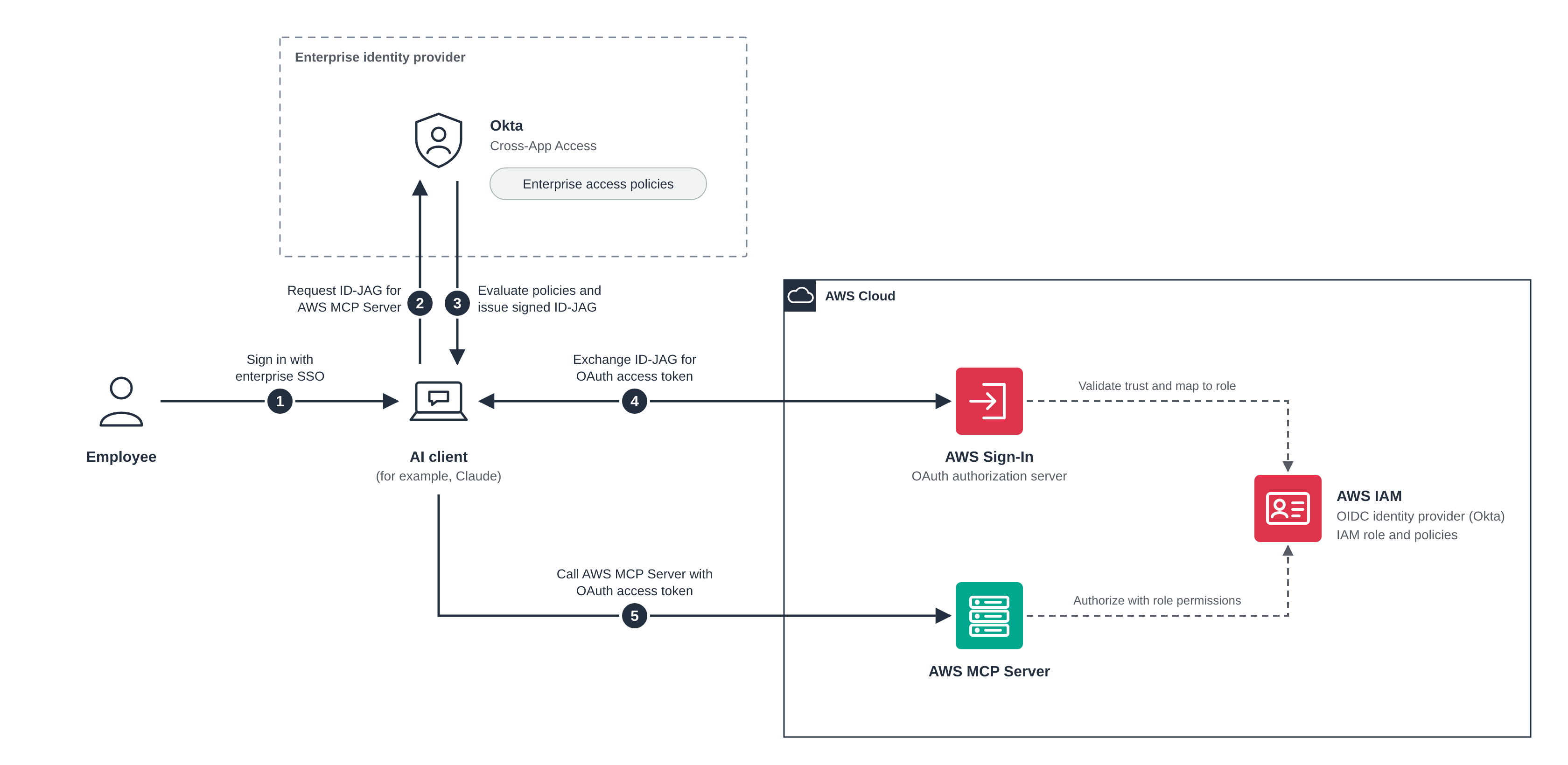
Figure 1: Enterprise-Managed Authorization flow using Okta, AWS Sign-In, and AWS MCP Server
The authorization flow consists of the following steps, as illustrated in Figure 1:
- Employee authentication: The employee signs in to the AI application, such as Claude, using their enterprise IdP, such as Okta, through single sign-on (SSO).
- ID-JAG request: When the AI application needs to access AWS MCP Server, it requests an ID-JAG from Okta for the intended resource.
- Enterprise authorization: Okta evaluates the configured access policies to determine whether the employee and AI application are authorized to access AWS MCP Server. If authorized, Okta issues a short-lived, signed ID-JAG assertion.
- Token exchange with AWS Sign-In: The AI application sends the ID-JAG to the AWS Sign-In OAuth token endpoint. AWS Sign-In validates the assertion, including its issuer, signature, audience/tenant, expiration, and intended resource, and verifies the associated IAM role authorization before issuing an OAuth access token.
- Access AWS MCP Server: The AI application presents the AWS-issued OAuth access token to AWS MCP Server. The server validates the token, and access to AWS resources is governed by the permissions associated with the IAM role.
Configure Enterprise-Managed Authorization using Okta and AWS Sign-In
In this section, we walk you through configuring Enterprise-Managed Authorization (EMA) to enable an AI application, such as Claude, to securely access AWS MCP Server using an enterprise identity managed in Okta.
The configuration establishes trust between Okta and AWS, defines IAM permissions for accessing AWS resources, and configures enterprise authorization policies that govern AI application access. This walkthrough uses AWS MCP Server in the US West (Oregon) AWS Region (us-west-2).
Prerequisites
Before you begin, make sure you have the following:
- An AWS account with permissions to configure IAM IdPs, roles, and policies.
- An Okta organization with administrative permissions to manage applications and configure Cross-App Access policies.
- An AI application, such as Claude, that supports EMA and ID-JAG.
- Access to AWS MCP Server with support for OAuth-based Enterprise-Managed Authorization.
- The AWS Region where you will configure the integration.
Step 0: Configure the AI application in Okta
Configure an application in Okta so that employees can sign in to the AI application through enterprise single sign-on (SSO). For this walkthrough, we use Claude as the AI application. If your organization already uses Claude with Okta SSO, you can use the existing application. This application is the requesting application when you configure Cross-App Access in Step 3.
- Create the Claude SSO application: In the Okta Admin Console, go to Applications, choose Create App Integration, and create an OIDC web application, for example Claude SSO, as shown in Figure 2.
- If your agent was imported through an Okta AI Agent Provider, create the OIDC application by going to Directory, AI Agents, then navigating to User access from the selected agent.
- Choose the grant types: Select Authorization Code and Refresh Token. Claude uses the refresh token to request new ID-JAG assertions without asking employees to sign in again.
- Add the redirect URI: Set Sign-in redirect URIs to Claude’s SSO callback URL.
- Assign employees: Under Assignments, select which employees or groups can access the application.
- Confirm SSO works: Check that employees can sign in to Claude through Okta before you continue.
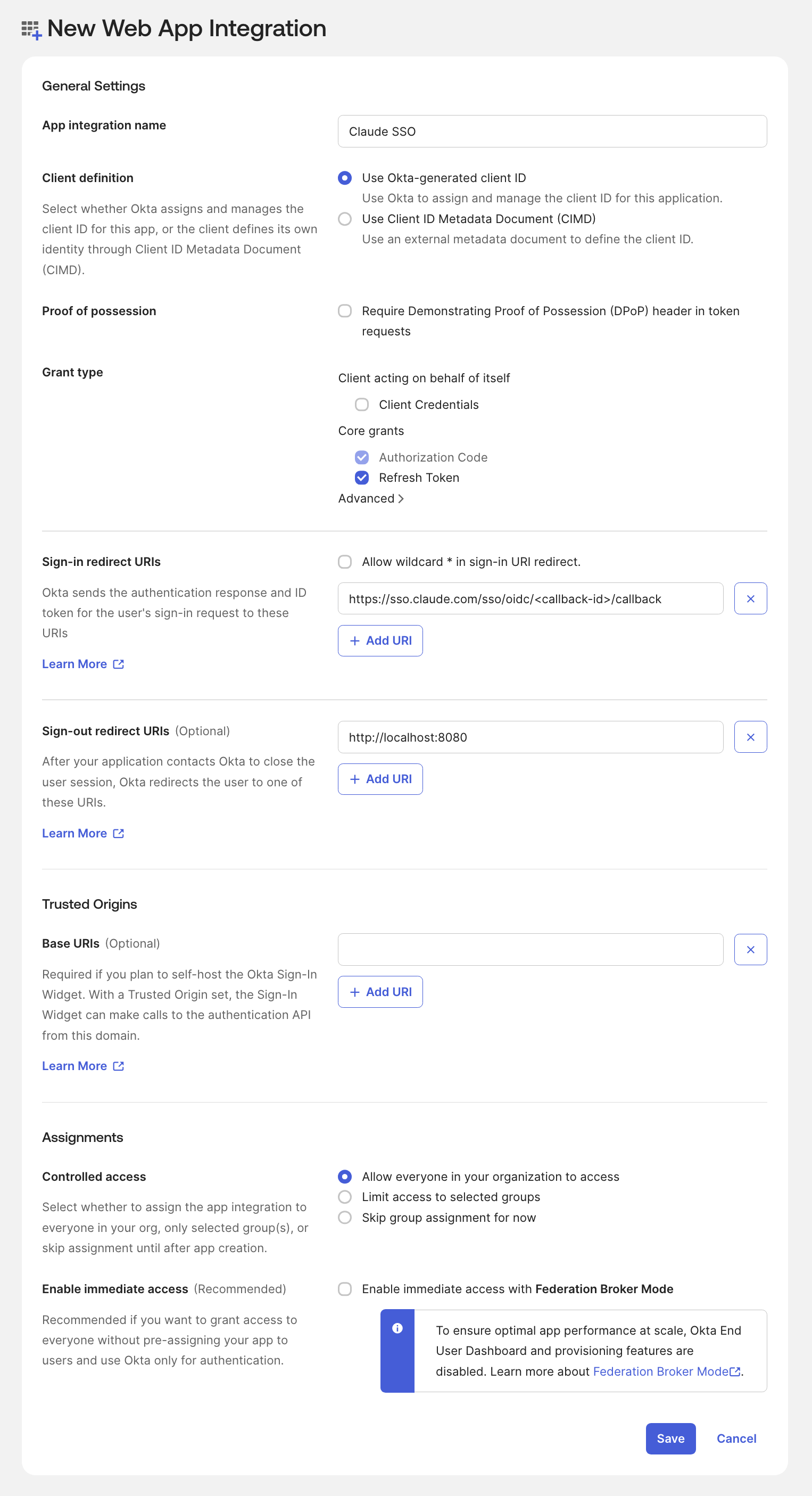
Figure 2: Creating the Claude SSO app integration in Okta
Step 1: Configure Okta as an OIDC IdP in IAM
Create an OpenID Connect (OIDC) IdP so that AWS trusts the ID-JAG assertions that Okta issues, as shown in Figure 3.
- Add the IdP: In the AWS Management Console for IAM, go to Identity providers, choose Add provider, and select OpenID Connect.
- Enter the provider URL: For Provider URL, enter your Okta org URL, for example
https://integrator-1234567.okta.com. Okta issues ID-JAG assertions from the org authorization server, not from a custom authorization server. - Enter the audience: For Audience, enter the AWS Sign-In authorization server for your Region, for example
https://us-west-2.oauth.signin.aws, and choose Add provider.
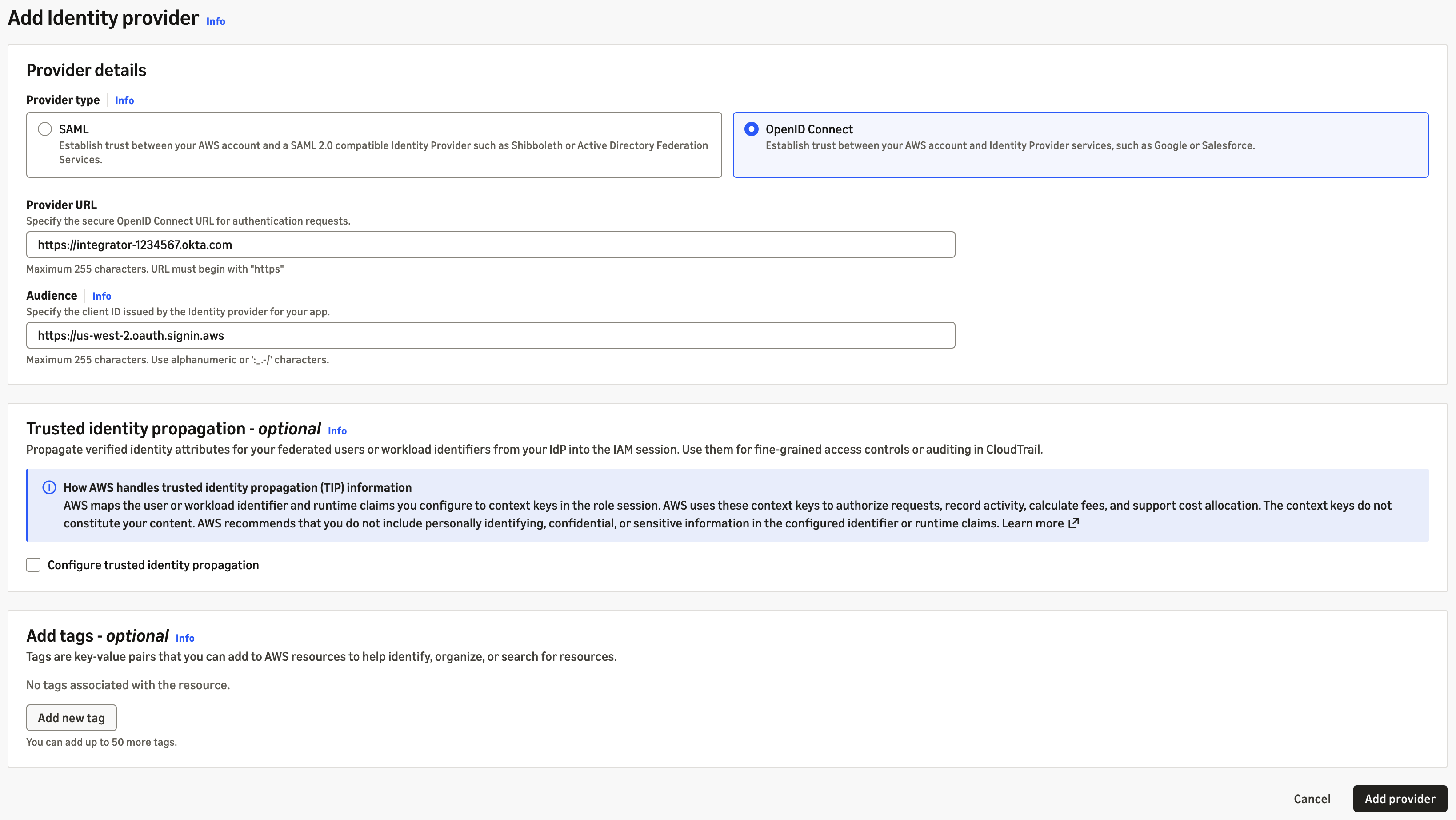
Figure 3: Adding Okta as an OpenID Connect identity provider in IAM
Step 2: Create an IAM role and configure permissions
Create an IAM role that defines the AWS permissions granted to the AI application, as shown in Figure 4.
- Create the role: In the IAM console, go to Roles, choose Create role, and select Web identity as the trusted entity type. Choose the Okta IdP from Step 1 and its audience. This creates a trust policy that allows access only through assertions from that provider.
- Attach the AWS MCP Server permissions: Attach the AWS managed policy AWSMCPSignInOAuthAccessPolicy. It grants the
signin:CreateOAuth2Tokenpermission required for OAuth access to AWS MCP Server. - Attach the AWS permissions the AI application needs: Attach other IAM policies that grant only the AWS permissions required by the AI application. For this walkthrough, we use a read-only role.
- Name and create the role: Enter a role name, for example
OktaAwsMcpReadOnly, and choose Create role. - Copy the role ARN: You’ll enter the role Amazon Resource Name (ARN) as the Audience/tenant ID in Okta in Step 3.
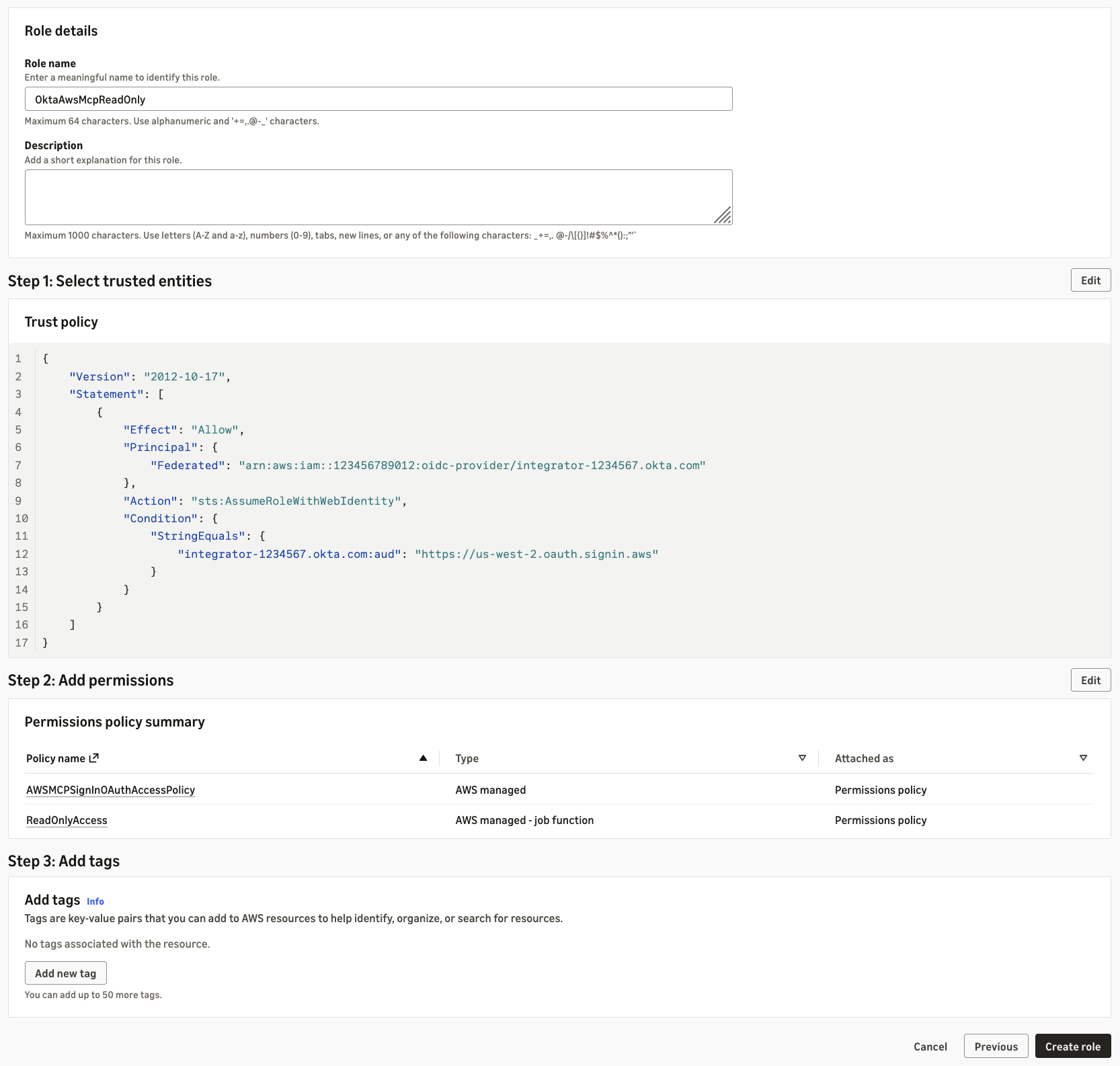
Figure 4: Reviewing the IAM role and its trust policy
Step 3: Configure Cross-App Access in Okta
In the Okta Admin Console, create a resource application that represents AWS MCP Server, and then connect Claude to it. The Claude SSO App from Step 0 stays the requesting application, so you don’t enable Cross-App Access on it.
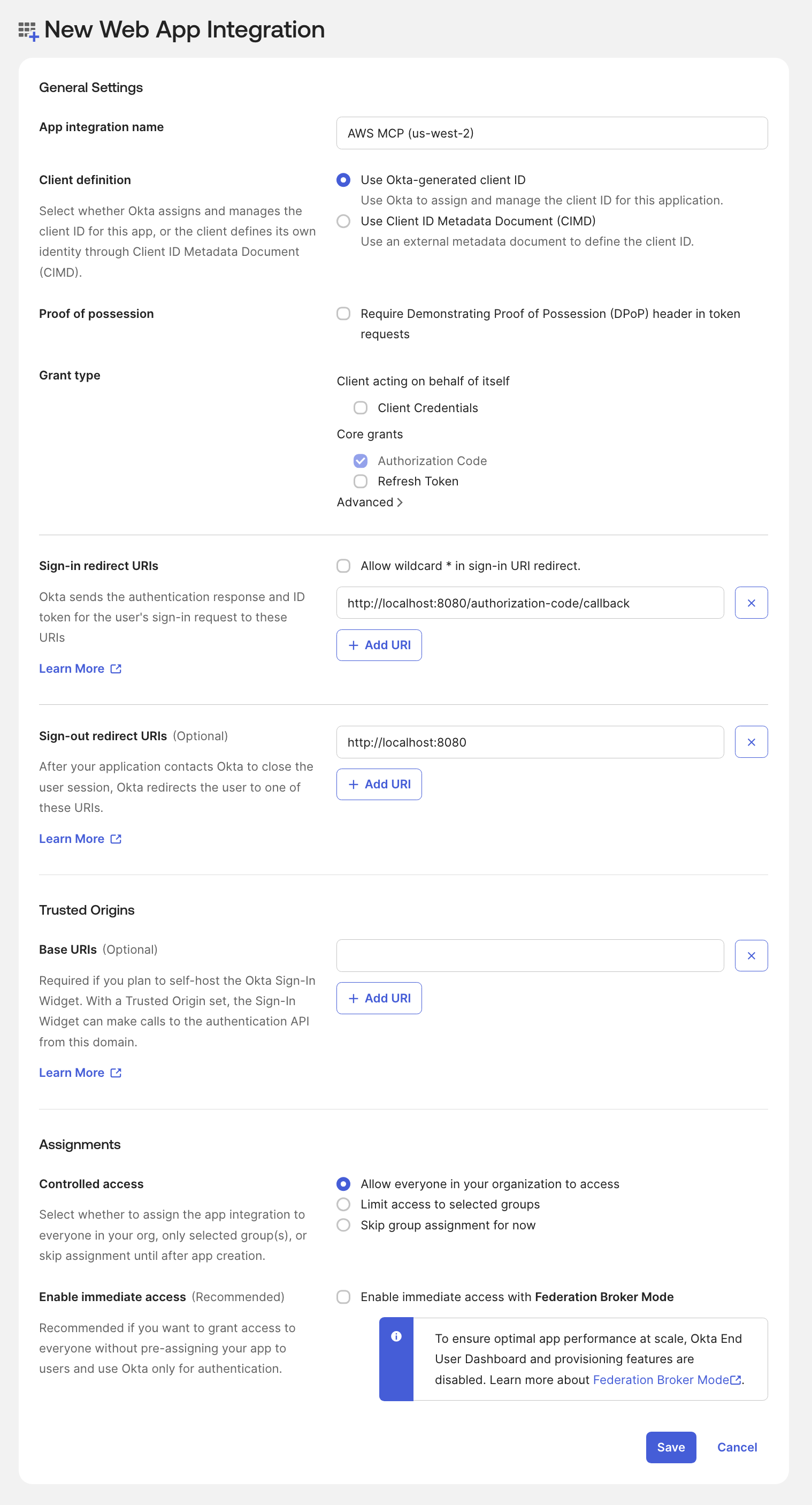
- Create the AWS MCP resource application: Go to Applications, choose Create App Integration, and create an OIDC web application, for example AWS MCP (us-west-2). Okta doesn’t use this application’s sign-in redirect URI, so you can keep the default value.

Figure 5: Creating the AWS MCP resource application in Okta
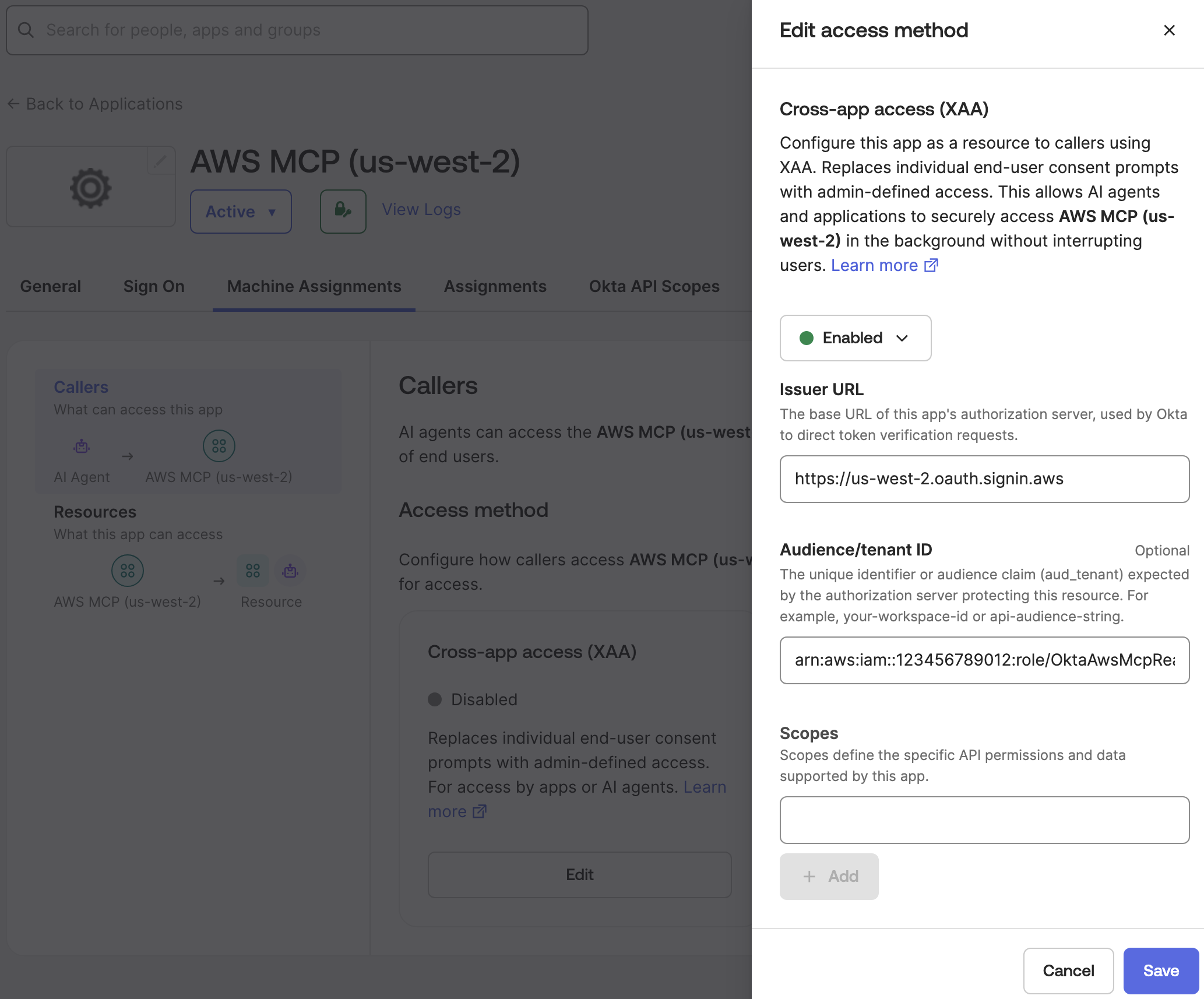
- Enable Cross-App Access on the resource application: On the Machine Assignments tab, edit the access method and enable Cross-App Access. Set Issuer URL to
https://us-west-2.oauth.signin.awsand set Audience/tenant ID to the IAM role ARN from Step 2.
Figure 6: Enabling Cross-App Access on the AWS MCP resource application
- Assign employees: On the Assignments tab, assign the employees or groups who can access AWS MCP Server through Claude.
- Register Claude as an AI agent: Go to Directory, AI Agents, and choose Register AI agent. Under User access, choose Select an existing app and pick the Claude SSO App from Step 0.
- Skip this step if the agent was already imported via an Okta AI Agent Provider.
- Connect the AI agent to AWS MCP Server: On the AI agent page, add a resource connection with the Application resource type. Set Application instance to the AWS MCP resource application. Set the client ID registered in AWS MCP to the client ID that you configure in Claude in Step 4, for example
anthropic-claude. Set Resource identifier tohttps://aws-mcp.us-west-2.api.aws/mcp.

Figure 7: Connecting the Claude AI agent to the AWS MCP resource application
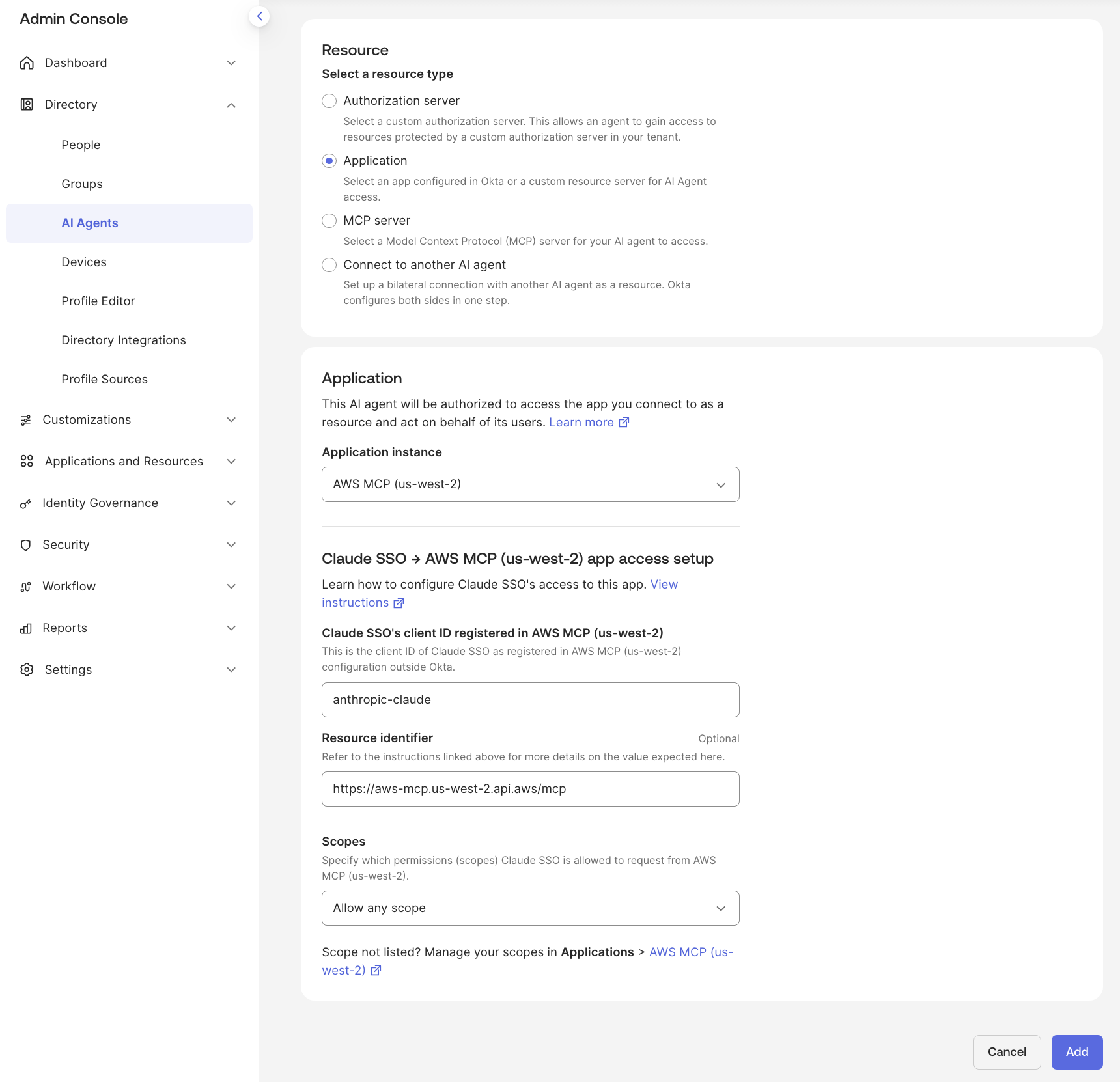
When Claude requests access, Okta checks that the employee is assigned access and issues an ID-JAG for AWS Sign-In that carries the IAM role ARN. AWS Sign-In validates the assertion and issues an OAuth access token associated with the IAM role.
Step 4: Configure Claude to access AWS MCP Server
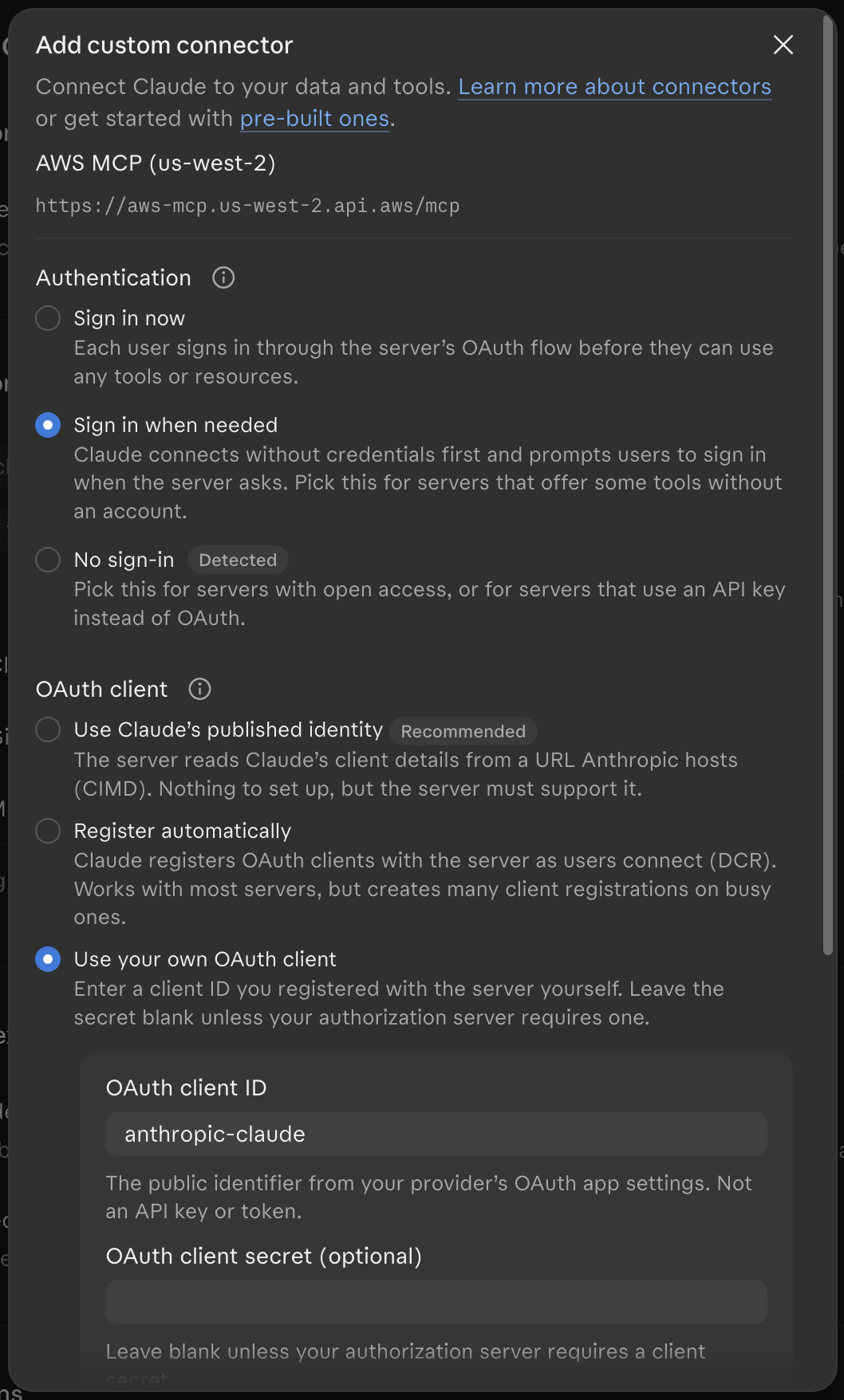
- Add a custom connector: In Claude, open Admin settings, choose Connectors, and then choose Add, Custom connector. Enter a name and the AWS MCP Server endpoint, for example
https://aws-mcp.us-west-2.api.aws/mcp. - Configure OAuth authentication: For Authentication, choose Sign in when needed. For OAuth client, choose Use your own OAuth client, enter the client ID from the resource connection in Step 3 and leave the client secret blank.

Figure 8: Adding AWS MCP Server as a custom connector in Claude
- Set up managed authorization: Open the connector, and on the Configuration tab, choose Set up next to Managed authorization.

Figure 9: The connector’s Configuration tab
- Configure IdP-managed access: Choose IdP-managed as the identity source and confirm that the connection checks pass. Then choose Continue, select the Claude roles that connect through managed authorization, and choose Save.

Figure 10: Setting up managed authorization with Okta as the identity source
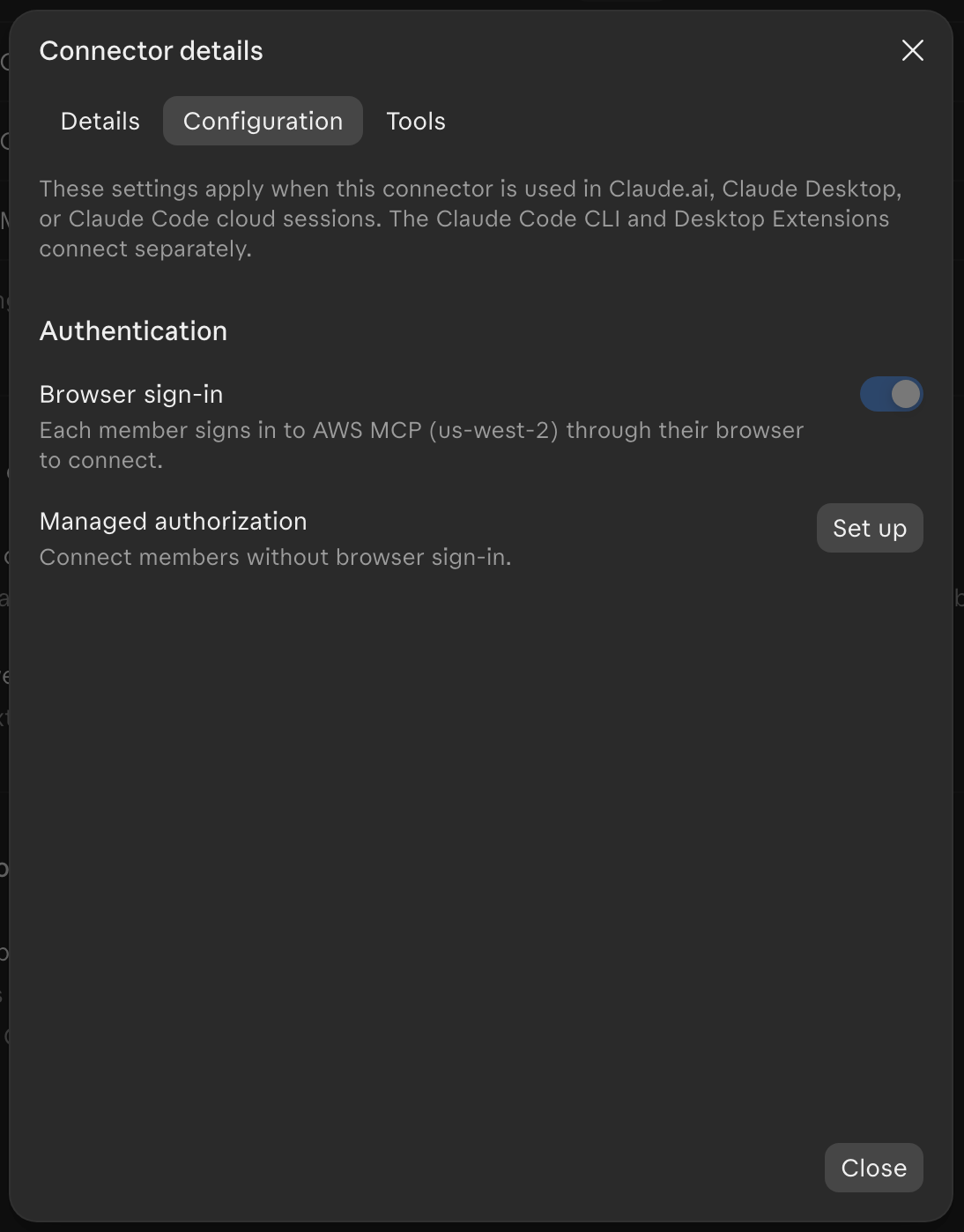
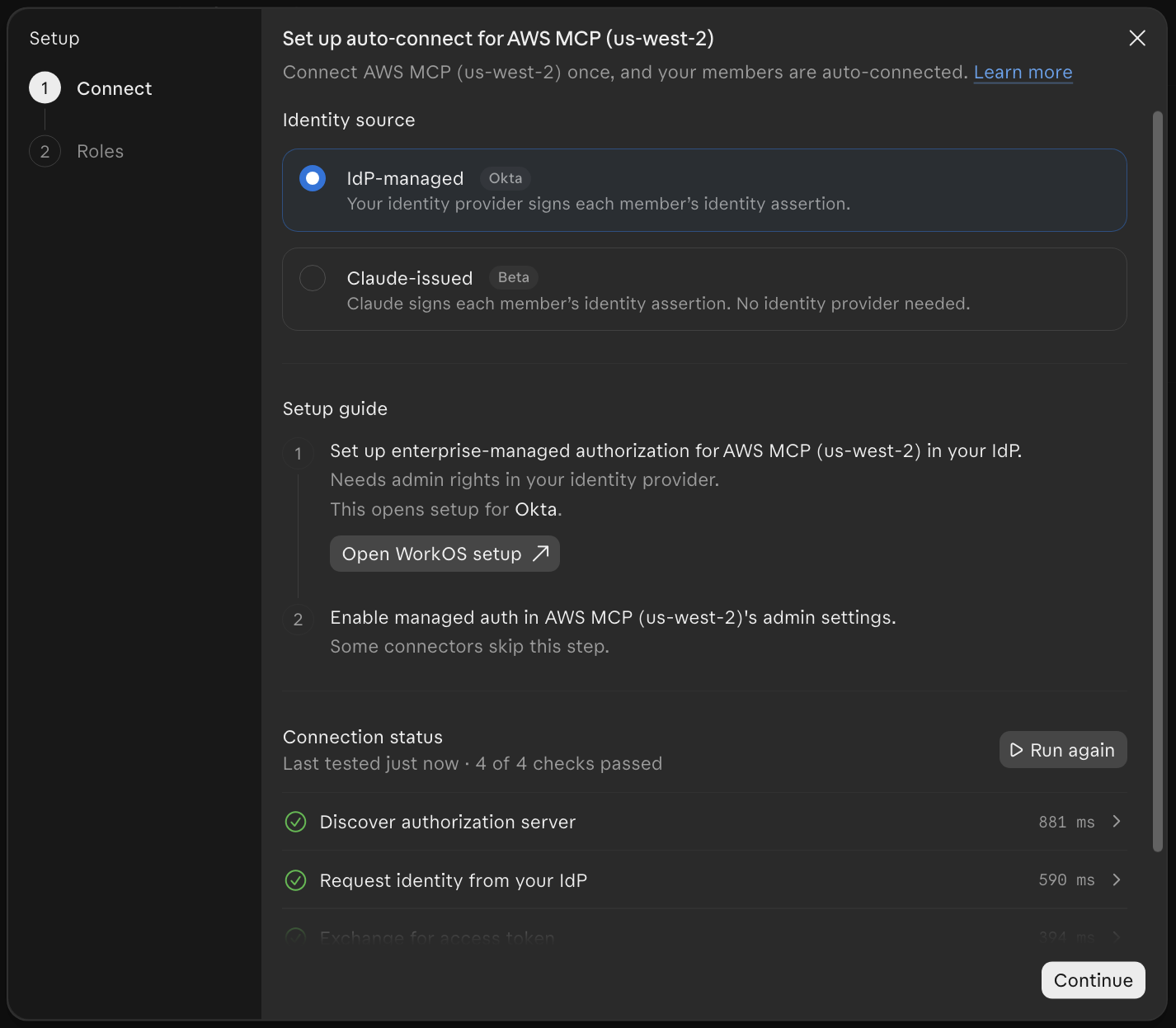
When an employee accesses AWS MCP Server, Claude requests an ID-JAG assertion from Okta. Following successful policy evaluation, Okta issues the assertion, which Claude exchanges at the AWS Sign-In OAuth token endpoint for an OAuth access token associated with the configured IAM role. Claude uses this token to access AWS MCP Server without requiring an additional AWS sign-in.
Step 5: Validate access to AWS MCP Server
To validate the configuration:
- Sign in using enterprise SSO: Sign in to the AI application using your Okta identity.

Figure 11: Signing in to Claude with SSO
- Connect to AWS MCP Server: Connect the AI application to AWS MCP Server.
- Verify OAuth token issuance: Confirm that Claude successfully connects to AWS MCP Server without requiring a separate AWS authorization flow. You can verify successful OAuth token issuance using AWS CloudTrail, as described in Step 6.
- Validate authorized access: Perform an AWS operation permitted by the configured IAM role.

Figure 12: Calling AWS MCP Server from Claude Code
- Verify access restrictions: Attempt an operation outside the IAM role’s permissions and confirm that access is denied.
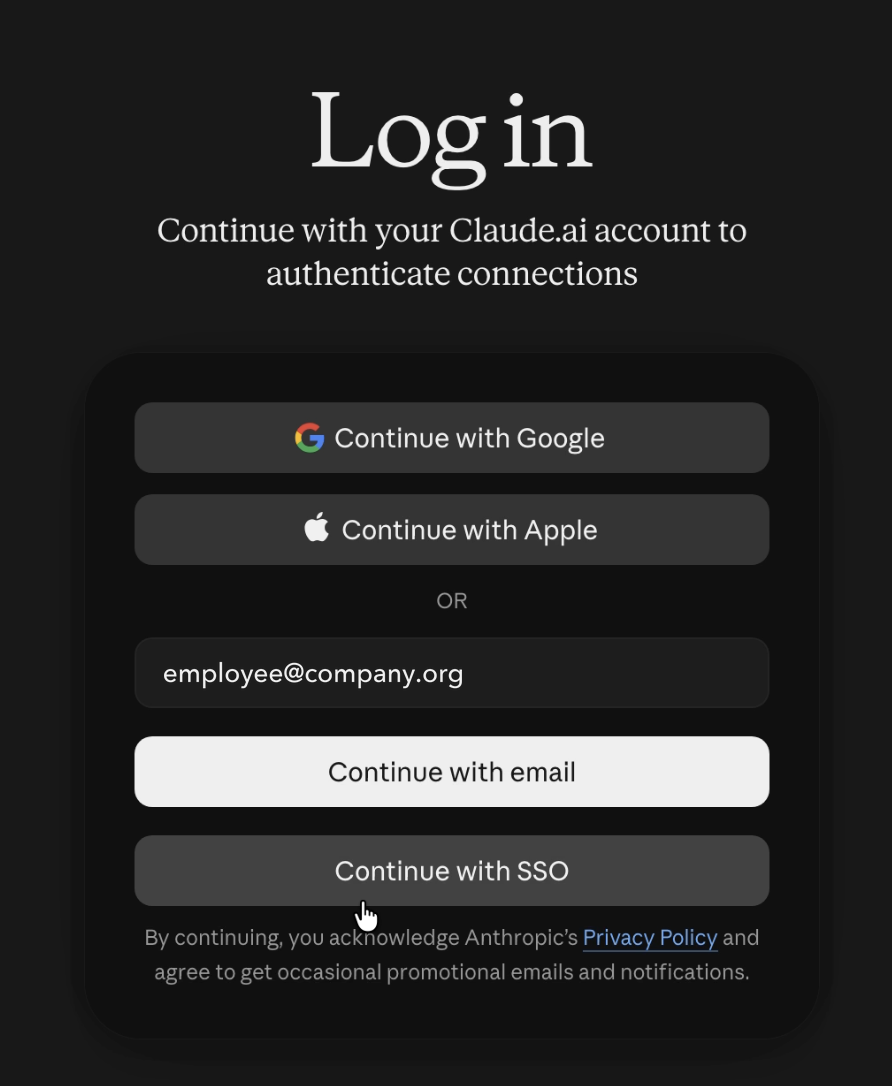
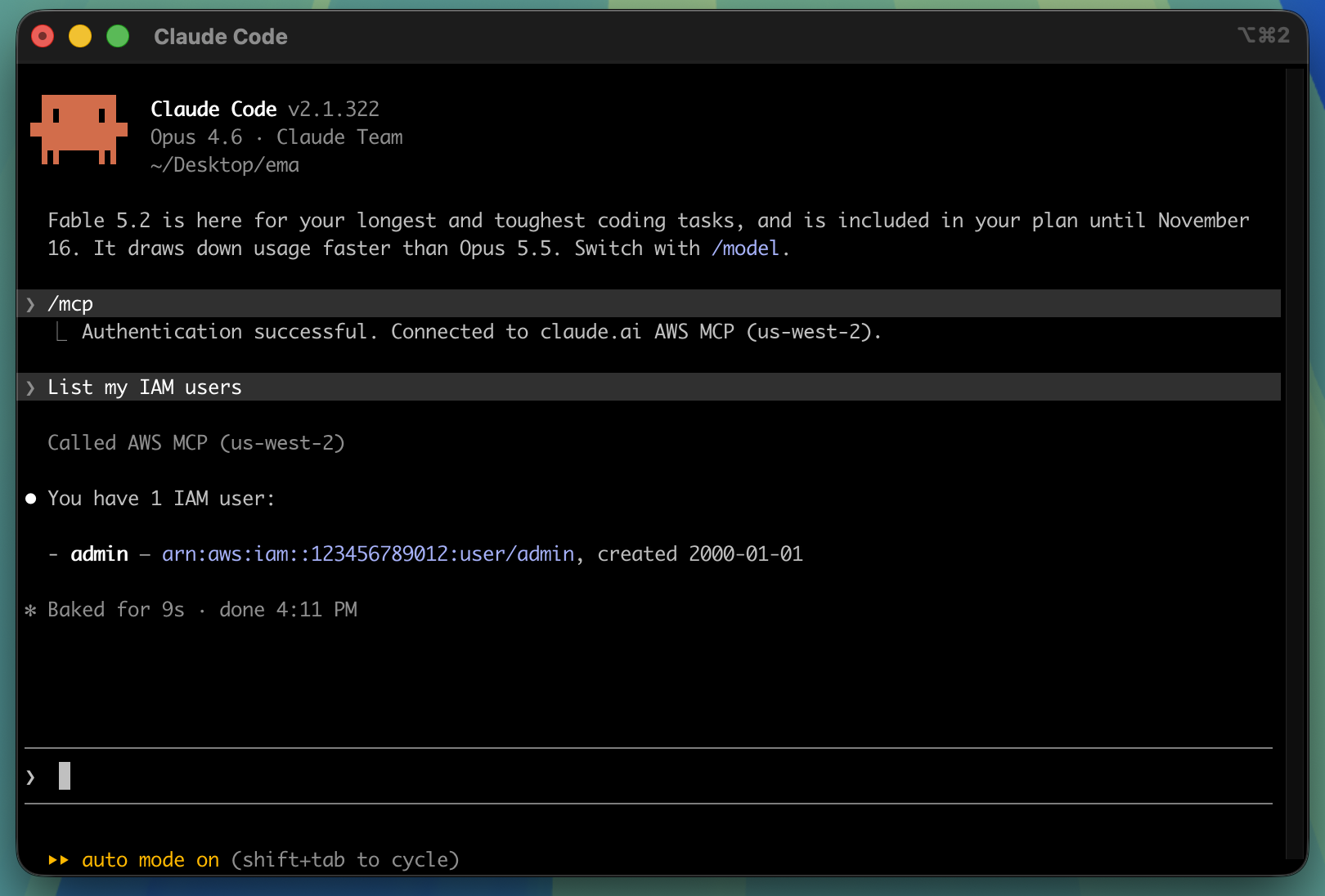


You can also validate enterprise authorization policies by attempting access using an employee who is not authorized in Okta and verifying that the ID-JAG request is denied.
Step 6: Verify authorization activity using AWS CloudTrail
AWS Sign-In and AWS MCP Server integrate with AWS CloudTrail to help organizations monitor OAuth authorization activity and API requests made by AI applications. CloudTrail provides visibility into token issuance, the applications requesting access, and operations performed through AWS MCP Server.
After successfully connecting your AI application to AWS MCP Server, you can verify the authorization activity in CloudTrail:
- Open the CloudTrail console and navigate to Event history.
- Select the AWS Region used for the integration.
- Filter events by Event source
signin.amazonaws.comor Event nameCreateOAuth2Tokento locate OAuth token issuance activity. - Review the event details, including the OAuth client identifier, target resource, authorization grant type, and token issuance status, where recorded.
- To review subsequent MCP activity, examine events from
aws-mcp.amazonaws.com with the same session ARN and verify that the operations performed by the AI application match the permissions configured for the IAM role. Calls to global services such as IAM are recorded in US East (N. Virginia).
Example 1: AWS Sign-In OAuth token issuance
The following example illustrates the CloudTrail fields used to examine an OAuth token issuance event.
Example 2: AWS API call performed through AWS MCP Server
The following example illustrates the CloudTrail fields used to examine an AWS API call performed through AWS MCP Server.
Together, these events help administrators audit OAuth token issuance and subsequent AWS MCP Server activity, supporting security investigations, compliance monitoring, and access reviews.
For more information, see Monitoring OAuth activity and Logging AWS MCP Server API calls using AWS CloudTrail.
Best practices for securing AI agent access with EMA and AWS IAM
When configuring Enterprise-Managed Authorization (EMA), consider the following security recommendations to help protect AI agent access to AWS resources:
- Use short-lived ID-JAG assertions: Configure your enterprise IdP to issue ID-JAG assertions with short expiration periods. This limits the time during which an assertion can be exchanged for an OAuth access token and reduces the risk associated with token exposure.
- Use tenant-specific IdP issuers: In multi-tenant environments, configure tenant-specific issuer URLs to establish explicit trust relationships between AWS and the intended enterprise IdP. This helps prevent assertions issued for one tenant from being accepted in another tenant’s authorization context.
- Restrict OAuth authorization using IAM condition keys: Use IAM condition keys to limit OAuth token issuance to approved AI applications, authorization flows, and AWS resources. For example, use
signin:OAuthClientIdto restrict access to approved AI applications, such asarn:aws:signin:::external-client/jwt-bearer/anthropic-claudeandsignin:OAuthGrantTypeto restrict the permitted grant type tourn:ietf:params:oauth:grant-type:jwt-bearer. Scope these permissions to the AWS MCP Server service principal to prevent unintended access to other AWS services. - Apply least-privilege IAM permissions: Grant the IAM role only the permissions required by the AI application. Use managed policies to control which AWS operations the agent can perform through AWS MCP Server, reducing the impact of unauthorized or unintended actions.
For more information about available IAM condition keys and permissions, see the AWS Sign-In condition keys reference and the AWSMCPSignInOAuthAccessPolicy documentation.
Conclusion
Enterprise-Managed Authorization (EMA) with AWS Sign-In enables organizations to securely connect AI agents to AWS resources using their existing enterprise IdPs. By combining centralized authorization policies with IAM permissions, organizations can control which AI applications access their resources while reducing the need for employees to manage AWS credentials or complete additional authorization flows.
Using ID-JAG, AWS Sign-In exchanges enterprise-issued identity assertions for short-lived OAuth access tokens associated with IAM roles. This approach helps organizations enforce least-privilege access, reduce credential exposure, and simplify how employees securely access AWS resources through AI agents.
To get started, see the Sign-in with OAuth 2.0, Configure EMA for MCP servers, and Introducing OAuth Support for AWS MCP Server to learn more about OAuth-based access to AWS resources.
If you have questions about this post, contact AWS Support or start a new thread on AWS re:Post.
Reduce operational overhead by migrating from AWS CloudHSM to AWS KMS
Post Syndicated from Derek Tumulak original https://aws.amazon.com/blogs/security/reduce-operational-overhead-by-migrating-from-aws-cloudhsm-to-aws-kms/
AWS Key Management Service (AWS KMS) supports the security certifications, algorithms, and performance that most AWS CloudHSM workloads require. Organizations that migrate from AWS CloudHSM to AWS KMS have significantly reduced costs while eliminating hardware security module (HSM) provisioning, patching, and high-availability management. For a detailed comparison of both services, see AWS KMS or AWS CloudHSM: Choose the right key management solution. For payment workloads, see AWS Payment Cryptography in the following table.
Is migration right for you?
Most AWS CloudHSM workloads can migrate to AWS KMS. The following requirements might appear to need CloudHSM, but most have a resolution path:
| Potential requirement | Resolution |
| Contractual or compliance mandate requiring single-tenant HSMs | Review your compliance documentation for explicit single-tenant language; many organizations find that it’s assumed, not mandated. Where mandated, a security review of AWS KMS typically confirms that its logical cryptographic isolation architecture satisfies the underlying intent. |
| Applications that rely on traditional HSM interfaces (PKCS#11, Java Cryptography Extension, OpenSSL Provider, or Key Storage Provider) | These interfaces are a communication pattern, not an architectural constraint. Contact your AWS account team to assess the refactoring effort needed for your workloads to use modern RESTful interfaces to web services. |
| Deprecated algorithms (TDES, PKCS#1 v1.5 with RSA) or less common operations (AES key wrapping, AES-CTR, AES-CBC) | Evaluate whether you can retire the dependency as part of your security modernization. |
| Over 1 billion cryptographic operations per month, where higher per-operation AWS KMS costs might favor the per-hour AWS CloudHSM cost model | Per-operation pricing is only one of several factors that affect cost. Also consider saved staff time, patching, and high-availability management. With envelope encryption (Option B in the following section), optional data key caching can further reduce API call volume. |
| Payment workloads using older or payment-specific cryptography (TDES, AES-CBC) | While AWS KMS embeds cryptographic best practices in a managed service, some payment systems still rely on older cryptography such as TDES. Evaluate Payment Cryptography, which supports payment use cases, including TDES-based algorithms such as CVV2, ARQC, and PIN validation. It also provides low-level algorithms, such as AES-CBC, that third-party systems might require for interoperability. |
If you can resolve these requirements, it’s possible to migrate from AWS CloudHSM to AWS KMS. You can use the rest of this post to review the basic steps of migration to AWS KMS.
How migration works
Migration has three parts: updating application code to call KMS APIs, rotating or importing your cryptographic keys, and transitioning existing data. You re-encrypt previously encrypted data under KMS keys, and existing signatures remain verifiable without AWS CloudHSM. You can complete each part gradually, with zero downtime. Application refactoring is the bulk of the effort, though AI-assisted code transformation tools can reduce this work. Because you’re already refactoring application code, this migration is also an opportunity to adopt post-quantum cryptography (PQC) algorithms, discussed in the following section.
Digital signature workloads
During the transition, the AWS CloudHSM private key continues to sign existing workloads. If AWS CloudHSM lets you export (wrap) a copy of your private key, import it directly into AWS KMS to maintain continuity. For details, see How to Migrate Asymmetric Keys from CloudHSM to AWS KMS. If the key is non-exportable, create a new key pair in AWS KMS. A new asymmetric KMS key (or the imported key from CloudHSM) signs new data flowing to AWS KMS. Shift traffic from AWS CloudHSM to AWS KMS at your own pace. If you created a new key pair, export the CloudHSM public key before decommissioning and use it to verify existing signatures locally with libraries such as AWS-LC or OpenSSL as shown in Figure 1. AWS KMS doesn’t support importing public keys.
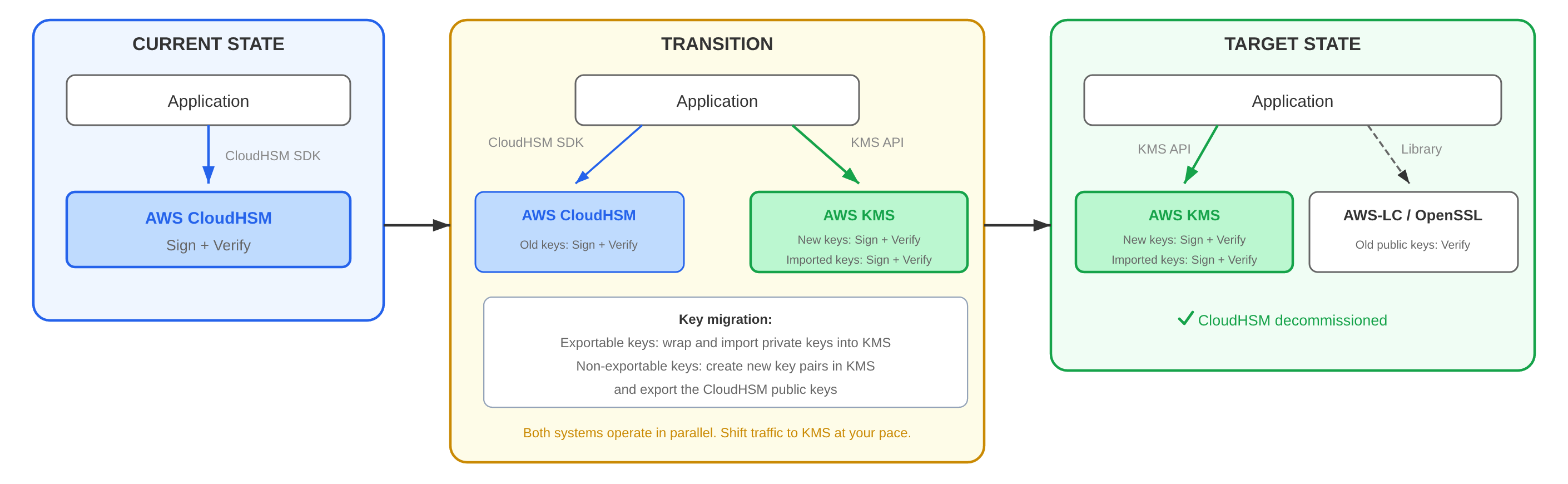
Figure 1 – Digital signature migration
Post-quantum readiness: When creating new signing keys in AWS KMS as part of this migration, consider adopting post-quantum cryptography (PQC). AWS KMS supports ML-DSA (FIPS 204), so you can begin issuing PQC signatures now rather than as a separate future effort. This matters most for long-lived signatures, such as document signing, code signing, and certificate issuance.
Durability of imported asymmetric keys: Asymmetric key material imported into AWS KMS (using ImportKeyMaterial) doesn’t have the same durability guarantees as keys generated within AWS KMS. In the unlikely event of an AWS Region-wide infrastructure failure, imported key material could become unavailable. To protect against this, create the key as a multi-Region key, then import the same key material into each replica key in other Regions. Also keep secure backups of imported private keys outside of AWS KMS. An AWS CloudHSM cluster backup is a zero-cost option; CloudHSM stores backups in Amazon Simple Storage Service (Amazon S3) at no additional charge. For keys created in AWS KMS (not imported), AWS KMS automatically manages durability within a Region, and multi-Region keys replicate the key material for you.
Encryption workloads
For encryption workloads, use the gradual re-encryption pattern: encrypt new data with AWS KMS while a background process re-encrypts existing data created under AWS CloudHSM keys. This achieves a zero-downtime migration. The following are two approaches to gradual re-encryption, depending on your requirements.
Option A: Direct encryption with AWS KMS API (recommended)
Call the AWS KMS Encrypt and Decrypt APIs directly (Figure 2). Your application passes plaintext to kms:Encrypt and receives a self-contained ciphertext blob. To decrypt, pass the blob to kms:Decrypt. There are no data keys to manage, no local cryptography, and no libraries beyond the AWS SDK. When decrypting, AWS KMS identifies the correct key from metadata it embeds in the ciphertext, including the key material identifier. As a result, ciphertext produced by AWS KMS is larger (by about 150 bytes) than AWS CloudHSM would produce for the same plaintext. During transition, your application must handle data encrypted by both systems. On decrypt, call kms:Decrypt first. If the ciphertext was created by kms:Encrypt, it will succeed. If it was created by CloudHSM, kms:Decrypt will return InvalidCiphertextException immediately without attempting decryption. Your application then falls back to the CloudHSM decrypt path and can optionally re-encrypt the plaintext with kms:Encrypt and store the new ciphertext. All new encrypt operations go to AWS KMS immediately; only decrypt needs the fallback until re-encryption is complete.
The following pseudocode illustrates this pattern:
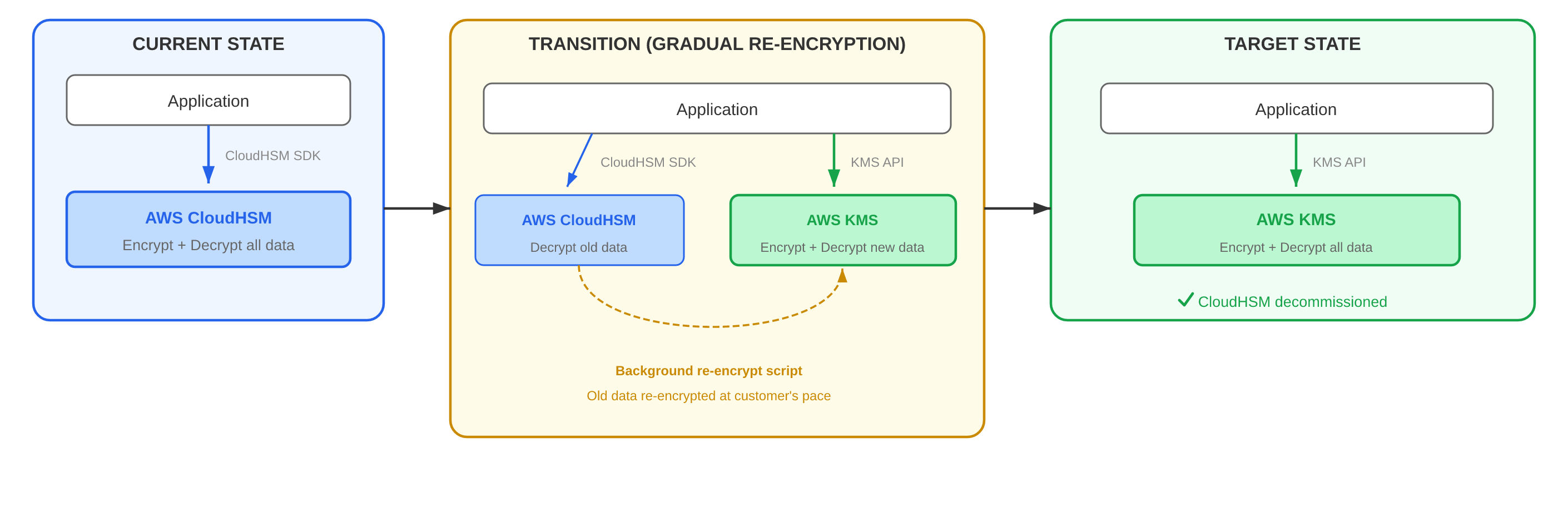
Figure 2 – Encryption migration with AWS KMS API
More about AWS KMS encryption
- AWS KMS direct encryption supports plaintext up to 4 KB per request. For larger payloads, use Option B (AWS Encryption SDK), which handles envelope encryption for you and supports data of any size.
- AWS KMS also supports asymmetric encryption with RSA keys for use cases such as encrypting data destined for a specific key pair holder. This post focuses on symmetric encryption because it covers the majority of AWS CloudHSM encryption workloads.
Option B: Envelope encryption with AWS Encryption SDK
For workloads that require envelope encryption, use the AWS Encryption SDK as shown in Figure 3. Your application calls encrypt() on plaintext and decrypt() on ciphertext. The SDK manages data key generation, local 256-bit AES-GCM encryption, and serialization automatically. Its portable ciphertext format works across multiple runtimes of the AWS Encryption SDK. You can also enable data key caching to reduce calls to AWS KMS. Use this approach when you share encrypted data across services, languages, or with third parties outside of AWS.
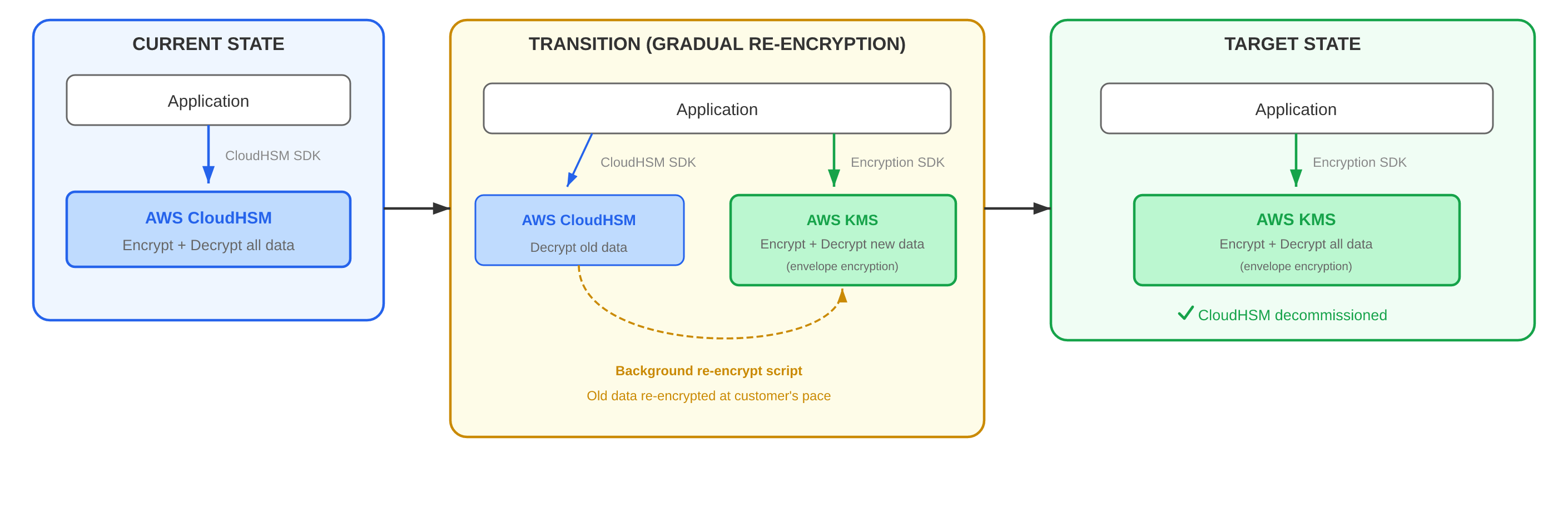
Figure 3 – Encryption migration with AWS Encryption SDK
Migration results
A financial services company migrated their transaction data encryption from AWS CloudHSM to AWS KMS. Prior to migration, their workload ran 75 million cryptographic operations per month on three HSMs provisioned for high availability and the operational burden was 25 hours per month. After the migration, they no longer had to manage HSMs, which reduced their operational burden to near zero.
| Metric | Before (AWS CloudHSM) | After (AWS KMS) |
| Monthly cost | $3,456 (three HSMs) | Approximately $250 (93% reduction) |
| Operational burden | 25 hours per month (patching, certificates, and monitoring) | Near zero: no HSMs to manage |
| Compliance | FIPS 140-3 Level 3 | FIPS 140-3 Level 3 |
| Disaster recovery | Multi-Availability Zone (AZ) HSMs that they provisioned, sized, and monitored | Automatic multi-AZ availability. Optional multi-Region replication |
| Migration duration | – | 10 weeks, zero downtime |
Recommendations
We recommend the following as you migrate from AWS CloudHSM to AWS KMS.
- Use AI-assisted code transformation tools to accelerate refactoring and reduce manual effort.
- Run the complete migration in staging first, including re-encryption of representative data volumes.
- Document specific rollback criteria. During gradual re-encryption, you can pause at any point while AWS CloudHSM continues to decrypt data that has not yet moved. Keep KMS keys enabled after a rollback, because data already re-encrypted under AWS KMS still needs them.
- Design AWS Identity and Access Management (IAM) policies, key policies, grants, and encryption context schemas before migration. Encryption context enables fine-grained audit trails not available in CloudHSM. See the AWS KMS Developer Guide for a list of log entries.
- Delete CloudHSM keys only after all data is re-encrypted and verified. Before deleting, create a CloudHSM cluster backup of any keys imported into AWS KMS and export the public key of any signing key you replaced. Maintain an audit trail of the decommissioning.
Next steps
Start by auditing your current AWS CloudHSM usage: document your keys, the applications that use them, your monthly operation volume, and any compliance constraints. Use the AWS Pricing Calculator to estimate AWS KMS costs for your workload, then test a proof-of-concept migration with a non-critical application.
Conclusion
Migrating from AWS CloudHSM to AWS KMS removes the recurring work of provisioning, scaling, patching, and monitoring HSM clusters, freeing your team to focus on your application rather than the cryptographic infrastructure beneath it. You gain built-in high availability across multiple Availability Zones, with optional multi-Region replication, at a usage-based cost rather than a per-hour commitment for hardware you manage. Because the migration involves refactoring application code, it is also a natural point to adopt post-quantum signing algorithms such as ML-DSA, so you modernize your security posture in the same effort.
For implementation support, contact your AWS account team or AWS Professional Services. For API integration details, see the AWS KMS Developer Guide.
If you have questions about this post, contact AWS Support or start a new thread on AWS re:Post.
Rapid7 Named a Leader in the 2026 Gartner® Magic Quadrant™ for Integrated Security Operations Center Systems
Post Syndicated from Rapid7 original https://www.rapid7.com/blog/post/so-rapid7-named-leader-2026-gartner-magic-quadrant-integrated-security-operations-center-systems-isocs
Recognized for Completeness of Vision and Ability to Execute.
We are proud to share that Rapid7 has been recognized as a Leader in the 2026 Gartner® Magic Quadrant™ for Integrated Security Operations Center Systems.
Our perspective: less stitching, more stopping threats
Most security teams don’t struggle to find tools. They struggle to make them work together. We believe SOC analysts lose too much of their day moving between consoles and matching alerts to assets by hand, which is time not spent stopping threats.
To us, an integrated approach to security operations means detection, investigation and response working from the same data and the same view, so analysts can get from “what fired?” to “what do we do about it?” faster.
The importance of exposure management in the SOC
Rapid7 Incident Command, part of the Rapid7 Command Platform, brings together SIEM, SOAR, DFIR, attack surface management and threat intelligence. We built it on the idea that exposure management, and the context it brings, belongs inside the SOC, not next to it. In our view, when an alert arrives with what we know about the asset and how exposed it is, analysts can prioritize what matters instead of working from separate vulnerability reports and alert queues.
Context to act, not another console to check
We believe adopting an integrated SOC shouldn’t be all-or-nothing. Incident Command is available in tiers from Essentials to Ultimate, so teams that want extra coverage can add managed services. That helps resource-pressured teams to start with what they need and grow at their own pace, spending less time building and maintaining integrations and more time on investigations.
To us, security operations work best when analysts have the context to act, not another console to check. We’re proud to be recognized as a Leader in this Magic Quadrant, and we believe it reflects our focus on bringing detection, response and exposure context together for our customers.
⠀
The Gartner Magic Quadrant evaluates vendors based on their Ability to Execute and Completeness of Vision. We are honored to be included among the recognized vendors in this important report. Learn more about the Gartner Magic Quadrant here.
⠀
Gartner, Magic Quadrant for Integrated Security Operations Center Systems, Angel Berrios, Kevin Schmidt, Eric Ahlm, 24 November 2026.
Gartner does not endorse any vendor, product or service depicted in its research publications, and does not advise technology users to select only those vendors with the highest ratings or other designation. Gartner research publications consist of the opinions of Gartner’s research organization and should not be construed as statements of fact. Gartner disclaims all warranties, expressed or implied, with respect to this research, including any warranties of merchantability or fitness for a particular purpose.
GARTNER is a registered trademark and service mark of Gartner, Inc. and/or its affiliates in the U.S. and internationally. MAGIC QUADRANT is a registered trademark of Gartner, Inc. and/or its affiliates and is used herein with permission. All rights reserved.
Dave Täht given the Jonathan B. Postel Service Award
Post Syndicated from corbet original https://lwn.net/Articles/1109691/
The Internet Society has announced
that the Jonathan B. Postel Service Award has been awarded to Dave Täht for
his many efforts to improve the Internet.
Täht’s legacy can be found in community hubs in Nicaragua, where he
worked to expand connectivity, and first discovered the urgency of
solving bufferbloat. It can be found in every lag-free video call
with a loved one. It can be found in outer space—Täht helped
Starlink solve its latency challenges. And it can be found in the
countless people he mentored and befriended over the years, who
will not stop until bufferbloat stops getting in the way of band
practice.
Dave is still deeply missed by those of us who knew him; this is an award
he richly deserved.
Supermicro SYS-E103-14P-H Review: A Fanless Panther Lake Edge Appliance
Post Syndicated from Vic A original https://www.servethehome.com/supermicro-sys-e103-14p-h-fanless-panther-lake-review/
The Supermicro SYS-E103-14P-H is an interesting little fanless appliance that pairs Intel’s new Panther Lake Core Ultra X7 368H processor with a dense industrial I/O layout
The post Supermicro SYS-E103-14P-H Review: A Fanless Panther Lake Edge Appliance appeared first on ServeTheHome.
Planning for 99.99 percent availability with the Amazon Cognito Plus feature plan
Post Syndicated from Brian Song original https://aws.amazon.com/blogs/security/planning-for-99-99-percent-availability-with-the-amazon-cognito-plus-feature-plan/
Amazon Cognito handles sign-in and access control for users, AI agents, and microservices with managed user directories, social and enterprise federation, and passwordless sign-in with passkeys or one-time passwords.
Sign-in is the front door to your application. If your customer identity and access management (CIAM) layer is unavailable, users can’t sign in or refresh their sessions, and they can’t reach the rest of your application. Your application’s availability directly depends on the availability of your identity layer.
Starting November 1, 2026, the Amazon Cognito Service Level Agreement (SLA) commits to a Monthly Uptime Percentage of 99.99 percent for user pools on the Plus feature plan, up from 99.9 percent. A user pool is a multi-tenant user directory that stores your users’ profiles and settings. User pools on Essentials and Lite feature plans remain at the 99.9 percent Service Commitment, while user pools already on Plus receive the new Service Commitment automatically.
This post explains why we made the change, how availability is measured, what’s in the updated SLA, how the SLA measures availability, historical availability data, and how to switch a user pool to Plus.
Why we raised the Service Commitment
Many customers use Amazon Cognito for sign-in to applications with strict availability requirements, such as patient portals and retail checkout flows. They need the services they build on to support high availability. We raised the Service Commitment for the Plus feature plan to 99.99 percent so that their identity layer is backed by an SLA that matches their commitments.
The new Service Commitment and Service Credits
For each AWS Region, during each monthly billing cycle, AWS commits to a Monthly Uptime Percentage of at least 99.99 percent for user pools on Plus, and at least 99.9 percent for user pools on Essentials and Lite. If Amazon Cognito doesn’t meet the Service Commitment for your feature plan, you may be eligible for a Service Credit, as shown in Tables 1 and 2. For full terms and exclusions, see the Amazon Cognito SLA.
Table 1: Service Credit percentage for the Plus Feature Plan
| Monthly Uptime Percentage | Plus |
| Less than 99.99% but equal to or greater than 99.0% | 10% |
| Less than 99.0% but equal to or greater than 95.0% | 25% |
| Less than 95.0% | 100% |
Table 2: Service Credit percentage for the Essentials and Lite Feature Plan
| Monthly Uptime Percentage | Essentials and Lite |
| Less than 99.9% but equal to or greater than 99.0% | 10% |
| Less than 99.0% but equal to or greater than 95.0% | 25% |
| Less than 95.0% | 100% |
What 99.99 percent means in practice
The 99.99 percent Service Commitment is a 10-times improvement over 99.9 percent. In a 30-day month, the allowable monthly downtime drops from about 43 minutes to about 4.3 minutes. For teams that set availability targets for their own applications, this gives a stronger baseline to plan against and to share with stakeholders.
How Amazon Cognito measures availability
The SLA measures availability separately for each AWS Region. Amazon Cognito divides each monthly billing cycle into 5-minute intervals and calculates the percentage of requests in each interval that don’t return an HTTP 500 or 503 error. Intervals with no requests count as 100 percent available. The Monthly Uptime Percentage is the average of these interval values over the billing cycle, minus downtime covered by the exclusions in the SLA. For the full definitions and exclusions, see the Amazon Cognito SLA.
Historical availability over the past 12 months
As we introduce the new SLA, we also looked back at the past 12 months to show how Amazon Cognito performed against the new Service Commitment. Table 3 shows monthly availability for Amazon Cognito user pools from November 2025 through October 2026.
Availability was at or above 99.99 percent in 10 of the 12 months. It was below 99.99 percent in January (99.988 percent) and March (99.979 percent), but stayed above the previous 99.9 percent Service Commitment in both months and was at or above 99.99 percent the following month.
Table 3: Amazon Cognito user pools monthly availability, November 2025 to October 2026
| Month | Monthly availability |
| November 2025 | 99.999% |
| December 2025 | 99.999% |
| January 2026 | 99.988% |
| February 2026 | 99.999% |
| March 2026 | 99.979% |
| April 2026 | 99.999% |
| May 2026 | 99.999% |
| June 2026 | 99.999% |
| July 2026 | 99.993% |
| August 2026 | 99.999% |
| September 2026 | 99.998% |
| October 2026 | 99.997% |
We calculated availability for each Region using the Monthly Uptime Percentage method in the SLA, then combined the Regional results into one monthly figure weighted by each Region’s request volume. These are aggregate figures, so the availability an individual account experienced might differ.
Switch to the Plus feature plan
If your user pools use the Plus feature plan, the 99.99 percent Service Commitment applies to them starting November 1, 2026, with no action needed. If your user pools use Essentials or Lite feature plans, you can switch them to Plus in the AWS Management Console for Amazon Cognito or programmatically. Before you switch, see user pool feature plans and Amazon Cognito pricing to compare features and costs. To learn more about the features that Plus adds, see the advanced security features with threat protection.
To switch a user pool to the Plus feature plan (AWS Management Console):
- Sign in to the Amazon Cognito console.
- Choose User pools and then choose your user pool.
- Choose Settings.
- Choose the Feature plans tab.
- Choose Switch to Plus.
- Review your choice and then choose Confirm.
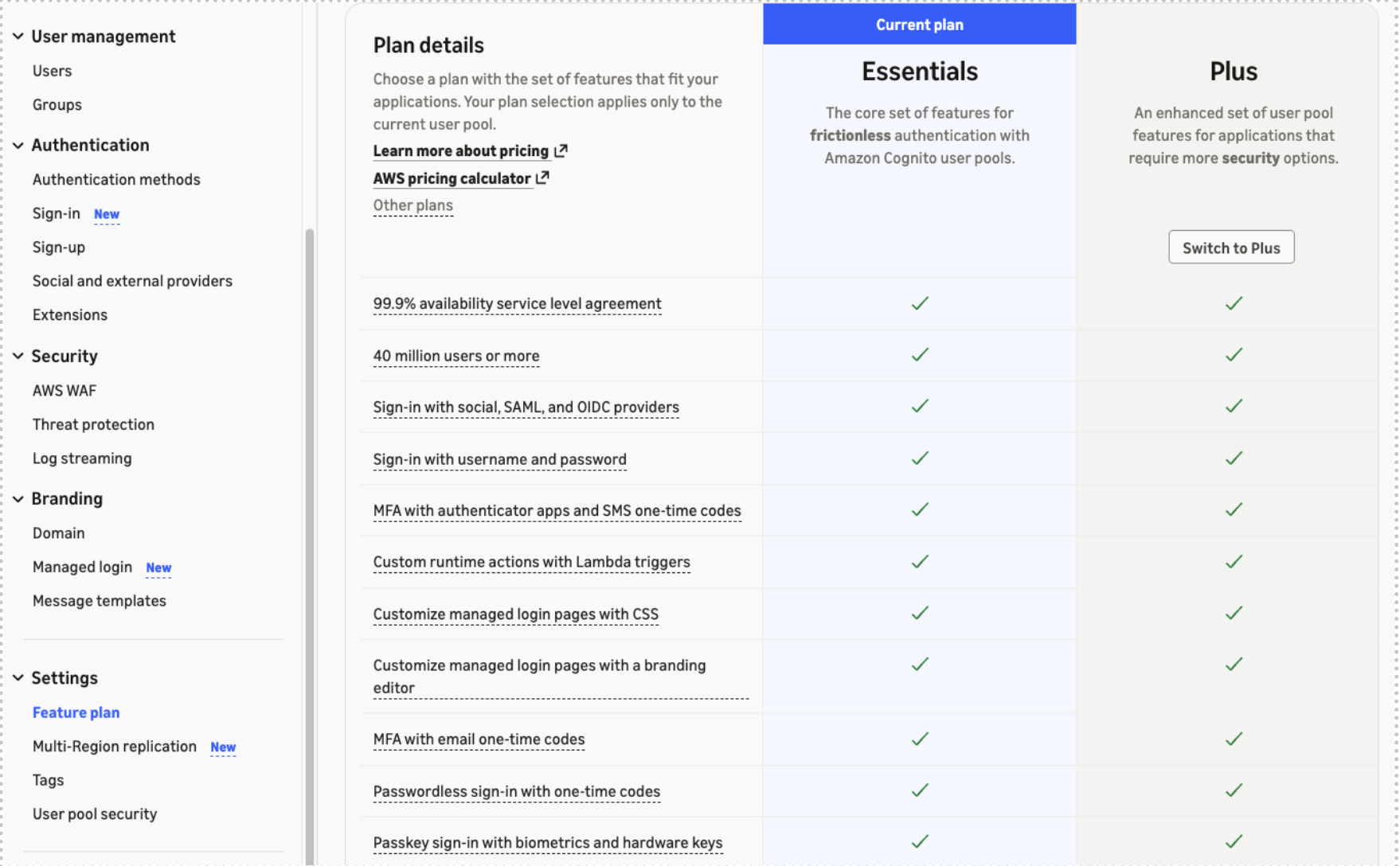
Figure 1: Amazon Cognito console Feature plans tab with the Switch to Plus button
To switch a user pool to Plus feature plan (AWS CLI):
Important: The
Update-user-poolcommand and theUpdateUserPoolAPI operation reset any parameter that you don’t include in the request to its default value. To avoid unintended changes to your user pool, retrieve your existing configuration first and include it in your update request.
- Use the AWS Command Line Interface (AWS CLI) to retrieve your current user pool configuration with describe-user-pool:
- Run the update-user-pool command, including your existing configuration parameters and the Plus tier:
If you use an AWS SDK, set UserPoolTier to PLUS in an UpdateUserPool request, and include your existing settings in the same way.
Conclusion
In this post, we shared the updated Service Commitment for Amazon Cognito user pools on the Plus feature plan, how availability is measured, and 12 months of historical data. Starting November 1, 2026, user pools on Plus are covered by a 99.99 percent Monthly Uptime Percentage Service Commitment, with no action required if you already use Plus. We plan to keep investing in the availability and resilience of Amazon Cognito.
To review the full terms, see the Amazon Cognito SLA. To learn more about the features in each plan, see user pool feature plans and advanced security features with threat protection.
If you have questions about this post, contact AWS Support or start a new thread on AWS re:Post.
Fine Art Portraiture – The Body as a Canvas
Post Syndicated from Matt Granger original https://www.youtube.com/watch?v=Lsz_vA_JePk
How Did Any Child Survive the 1970s? | The David Frum Show
Post Syndicated from The Atlantic original https://www.youtube.com/watch?v=v3TEYKy_WAs
Home Assistant 2026.12 Release Party
Post Syndicated from Home Assistant original https://www.youtube.com/watch?v=mTs3nH1O5zc
[$] Tainting (or not) on manual driver binding
Post Syndicated from corbet original https://lwn.net/Articles/1103714/
Early in the 7.4 merge window, Greg
Kroah-Hartman applied a patch
that caused the kernel to be marked as tainted whenever user space manually
binds or unbinds a device driver to a device. This change was meant to be
a defense against a flood of spurious bug reports generated by fuzzers, but
it also turned out to get in the way of some real use cases. After some
discussion, the patch has been reverted, but this situation hints at an
area where better kernel interfaces are needed.
Pop!_OS 26.04 LTS released
Post Syndicated from jzb original https://lwn.net/Articles/1109662/
System76 has announced
the release of Pop!_OS 26.04 LTS, which is based on
Ubuntu 26.04 LTS. Notable features in this release include drawing
tablet support, automatic updates, a number of new COSMIC applications, and
more. Updates for users on Pop!_OS 24.04 LTS will be enabled in
December.
LWN last covered Pop!_OS and
an early version of its COSMIC desktop in August 2024.
(У)бий хлапето
Post Syndicated from Светла Енчева original https://www.toest.bg/u-biy-hlapeto/

„Бий хлапето“ е песен на „Контрол“ от началото на 90-те, чийто текст представя едно широко разпространено отношение към децата по онова време. Спомних си за нея, наблюдавайки реакциите в социалните мрежи по повод на поредния станал обществено известен случай на насилие, извършено от деца. След като в началото на август 2026 г. група непълнолетни „ловци на педофили“ пребиха до смърт Георги Кузев в Пловдив, близо три месеца по-късно няколко момчета са се гаврили сексуално с момиче в безпомощно състояние. И двата пъти издевателствата са заснети и разпространени онлайн от самите деца.
Кой още има принос, за да се стигне до убийството на Георги Кузев?
Светла Енчева проследява нишката от хора, събития и обстоятелства, довели до убийството на Георги Кузев – от нормализирането на омразата и самоуправството до ролята на медиите, институциите и политиците. „Обичайните заподозрени“ – родителите и социалните мрежи, са само част от картината.
Важно е обаче да разграничим потвърдените факти от слуховете и конспиративните теории.
До момента се знае със сигурност, че посегателството срещу момичето е било по време на купон в нощта на Хелоуин. Присъстващите тийнейджъри са били пили доста алкохол. На място са пристигнали полицаи – заради сигнал за силен шум. Видели пияните деца, казали им да пазят тишина и… си тръгнали. Не е ясно дали това е станало преди, или след сексуалната злоупотреба.
15-годишното пострадало момиче е било в безпомощно състояние. Злоупотребата срещу него е определена като блудство; няма данни то да е изнасилено (поне според дефиницията в Наказателния кодекс за изнасилване, която, да си признаем, не е съвършена). Задържани са три момчета, а по-късно – и единственият пълнолетен, който е присъствал на купона.
Междувременно е станало известно, че по-рано, в други ситуации, същите момчета още поне два пъти са посягали на непълнолетни момичета. Полицията разследва и отделен случай, при който едно от задържаните момчета е стреляло по момиче с газов пистолет, но няма данни някой да е бил ранен.
Кое не е потвърдено
В социални мрежи и в някои медии се разпространява снимка на момчета – евентуални участници и присъствали на сексуалното посегателство на Хелоуин. Не съм гледала видеото с издевателството и не мога да потвърдя дали са те, но липсват и твърдения, че не са. Всички момчета на снимката са с черни тениски, на една от тях пише „Левски или смърт“ – характерен слоган на ултрасите на „Левски“, а на друга се вижда надпис на английски: I can see your fear („Мога да видя страха ти“).
Страница на ултраси във Facebook публикува снимката с осъждащ момчетата пост. В него се твърди, че на въпросния купон извършителите са простреляли две момичета в краката и след това са ги изнасилили. Досега обаче няма данни някое от пострадалите момичета и в трите известни случая да е било простреляно или изнасилено.
Разпространяват се и твърдения, че информация по случая се укрива, защото бащата на един от извършителите е служител на МВР. По този начин се прави паралел със случая в университета „Корнел“ в САЩ, чието ръководство се е опитало да потули случай с групово изнасилване на студентка от седем студенти, членове на мъжко братство. При българския казус обаче засега няма данни родител на някого от заподозрените да работи в МВР. От СДВР казаха, че извършват вътрешна проверка, за да установят дали сред роднините на извършителите има техен колега.
Онлайн „правосъдието“ и правата на детето
Снимката на евентуалните извършители се споделя масово в социалните мрежи. Видях я дори във Facebook група, посветена на правата на децата. Въпреки че разпространяването на информация за деца без съгласието на родителите им (и на самите деца, ако са навършили определена възраст) представлява нарушение на Закона за закрила на детето, както и на други нормативни актове, например GDRP.
Споделянията са придружени с осъдителни постове и коментари, в които заподозрените са наричани с различни епитети, например „изроди“. Попаднах дори на твърдение, че заради подобни случаи трябва да се върне смъртното наказание. Тоест в страна от ЕС, където няма смъртно наказание, будни граждани предлагат то да се възстанови, за да се прилага върху деца. В наши дни деца не се екзекутират (и извършители под 18 г. не се осъждат на смърт) дори в САЩ, където смъртното наказание намира широко приложение. Екзекутират се в Иран, Саудитска Арабия и Сомалия.
Трябва да поговорим за смъртното наказание
Готови ли сте да гледате публични екзекуции? Пийт Хегсет, министърът на войната на САЩ, смята, че една екзекуция чрез разстрел на стрийм в интернет ще ни дойде много освежаващо на цивилизацийката. И по този повод Светла Енчева се пита колко далеч сме стигнали от времената на бесилките по улиците.
След като в продължение на ден-два многократно се натъквах на въпросната снимка, си позволих да напиша във Facebook, че не е окей да се публикуват за назидание снимки на деца, дори да са сексуални насилници и ултрасчета. В резултат на реакциите си дадох сметка, че неволно съм произвела
социален експеримент, тестващ отношението към правата на детето (а и на човека).
Коментиращите поста ми са като цяло от моя „балон“, тоест с демократични убеждения. Трябва да отбележа и че всички коментари, които цитирам по-долу, са от жени. Реакциите им обаче варират от „какво пък толкова“, през призиви за ограничаване на права, до откровено дехуманизиращи послания, характерни по-скоро за неонацистите, каквито са доста от ултрасите, отколкото за хора, смятащи се за демократични и проевропейски.
Ето извадка от коментарите. Опитала съм се да ги градирам според радикалността им, започвайки от най-меките:
Някога снимка на когото и да било […] довела ли е до някакви последствия, след като дори истинска справедливост за престъпниците няма?
Те сами са избрали да си покажат лицата, заснемайки зверството!
Откъде-накъде престъпниците да имат повече защита от жертвите? [От] момента, в който престъпниците или престъпните деца сами си слагат видеата и снимките на собствените си деяния […] в мрежата, […] нямат никакво право […] да не им се показвали снимките. Никакво назидание не виждам в това да показваш този, който сам се показва.
Значи те могат да бъдат достатъчно осъзнати да изнасилват, бият, тормозят, крадат, убиват и да не зачитат никакви морални, етични и законови права на останалите, но тях трябва да ги пазят и да бъдат толерантни към личността им. Съжалявам, но този път не съм съгласна.
Сексуалните престъпления имат много висок процент рецидив и почти невъзможна ресоциализация […]. Затова мисля, че лицата на всички изнасилвачи трябва да са видими, дори и да са непълнолетни. Да, знам, че звуча крайно, знам, че децата насилници често са жертви на такова, знам, че правата не са избирателни, но според мен някои престъпления трябва автоматично да изключват определени права като правото да не ти разпространяват снимката.
За първи път в мен се надигна жестокост срещу уж-хора и бих искала физически да ги малтретирам. Гнусни и гадни са. Подчовеци.
Нека разгледаме горните аргументи.
Ако пияни тийнейджъри са извършили нещо нередно, това основание ли е то да се възпроизвежда от отговорни възрастни? Ако приемем аргумента „щом те са се снимали, защо ние да не им показваме снимките“, с какво показваме, че сме по-зрели от тези момчета?
Следващият аргумент може да се обобщи по следния начин: щом са насилници, така им се пада. Това обаче е просто различна формулировка на принципа от Стария завет „око за око, зъб за зъб“, който не отговаря на съвременното право.
По отношение на предложението да се ограничат правата на децата сексуални насилници: човешките права, тоест правата, които се отнасят до всички хора (в случая всички деца),
не са нещо, което се дава по заслуги и се отнема заради прегрешения.
Нито пък спазването на правата е пречка пред правосъдието. Напротив, пречка може да бъде неспазването им. Ще дам пример: заради това, че самопризнанията на Орлин Владимиров и баща му за убийството на Евгения Владимирова са взети, без да са спазени правата им, доказателствата, събрани с тяхна помощ, не могат да се използват в съда. Което води до оправдаване на бащата и намаляване на присъдата на сина.
Що се отнася до призивите за малтретиране и дехуманизиращата лексика („уж-хора“, „подчовеци“) – нито едното, нито другото би спомогнало за намаляването на насилието, включително и между деца. Нормализирането на подобни послания би могло обаче да доведе до увеличаването му.
Защо няма адекватни мерки срещу сексуалното насилие между деца
Деца извършват сексуални престъпления срещу деца не защото имат права и не защото не получават достатъчно строги наказания. Ето някои от предпоставките в България подобни престъпления да се извършват, а обществото да няма особени очаквания, че жертвите ще получат подкрепа, а виновните – справедливо наказание.
Липса на сексуално образование
В България съпротивата срещу въвеждането на сексуално образование е част от същата пропаганда, която заклеймява и Истанбулската конвенция, и Стратегията за детето, и Закона за социалните услуги. Създава се погрешната представа, че сексуалното образование учи и стимулира децата да правят секс. Целта му обаче е друга – да помогне на подрастващите да уважават себе си и другите, да зачитат както своите, така и чуждите граници.
Разбира се, ако нещо се преподава, няма гаранция, че то ще се усвои и практикува – все едно дали става дума за математика, или за принципи на поведение. Но ако посланието, че границите на другия трябва да се уважават, не се възприема от подрастващите като общосподелимо, те ще са по-склонни да нарушават тези граници. И дори да се гордеят с това. Особено като имаме предвид, че момчетата попиват от знайни и незнайни инфлуенсъри други послания, някои от които са открито женомразки и насилнически.
Развитието на маносферата и как избягах от нея
Обикновено за маносферата говорят външни за нея хора. Димитри Захов обаче е бил инсайдър и ни разказва за личния си опит с нея. Докато ние, възрастните, още се плашим от червеното хапче, вече има по-актуално хапче – черното. То е по-опасно за момчетата в маносферата, отколкото за околните.
Кампанията срещу Истанбулската конвенция
Истанбулската конвенция предлага мерки за ограничаване и превенция на насилието срещу жени и домашното насилие. В резултат на кампанията срещу нея обаче предметът ѝ беше подменен с темата за „джендъра“, а говоренето за джендъра – сведено до хомофобия и трансфобия.
Заради това така и нямаше сериозен дебат за насилието срещу жени и момичета. Темата избликва при драстични случаи като убийството на Евгения Владимирова или обезобразяването на Дебора Михайлова, но общественият разговор не отива по-далеч от призивите за възможно най-тежки наказания. Сещате ли се за някакви мерки за превенция, които да се прилагат? Аз не.
Неадекватната „борба срещу педофилията“
През 2023 г. парламентът прие промени в Закона за закрила на детето, с които се въведе т.нар. регистър на педофилите, а през 2026 г. този регистър беше направен публичен. Това нормативно нововъведение, което все още не се прилага (публичен регистър няма), се използва основно за политически натиск и разправа с политически противници. Но „благодарение“ на него сексуалното насилие срещу деца беше сведено до педофилията. Което пък доведе до абсурда, че деца, осъдени за сексуални злоупотреби с деца, също влизат в регистъра на педофилите.
По този начин се замита под килима въпросът защо деца насилват сексуално други деца. А докато няма смислени отговори на този въпрос, не можем да говорим за превенция.
Какво (не) знаем за сексуалните злоупотреби с деца
Какво знаят институциите за сексуалните злоупотреби с деца в България и какви мерки предприемат? Теодора Станимирова се сдоби с информация от ВСС, МВР, АСП, ДАЗД и МЗ, разговаря с експерти и ни разказва какво е научила.
Кампанията срещу Стратегията за детето
Националната стратегия за детето 2019–2030 г. така и не беше приета в резултат на организираната кампания срещу нея. Стратегията предвиждаше не на последно място защита на децата от насилие, включително сексуално, превенция, както и подкрепа за децата, преживели такова насилие.
Разпространиха се слухове обаче, че заради Стратегията ще се отнемат деца от родителите им. Чрез евангелски църкви тези слухове достигнаха до ромски махали, където родителите вкупом си изтеглиха децата от училище, за да не им ги отмъкнат социалните.
Патосът на кампанията срещу Стратегията беше, че децата са едва ли не собственост на родителите си и затова родителите имат право да ги възпитават, както преценят, включително с пердах. От ВМРО, тогава в управляващата коалиция, дори излязоха с позиция, в която се казваше в прав текст: „Детето не е отделен субект.“
Ако не гледаме на децата като на субекти, а като на обекти, как да очакваме те да се уважават едни други и да зачитат границите си?
От глупост ли се страхуват ромите за децата си?
Началото на седмицата беше ознаменувано от поредната обществена истерия. Родителите от няколко ромски махали в Сливен, Карнобат, Ямбол, Асеновград, Сунгурларе, а според просветния министър и в София…
Липсващият закон за детското правосъдие
Приемането на нов закон за детското правосъдие буксува от десет години. То беше и един от елементите на отхвърлената Стратегия за детето – с акцент върху възстановителното правосъдие.
Понастоящем децата, които са в конфликт със закона, попадат в лапите на правна рамка от времето на сталинизма. Законът за борба срещу противообществените прояви на малолетните и непълнолетните е приет през 1958 г. Променян е неколкократно, за последен път през 2019 г., но духът му въплъщава времето, когато за танцуване на „неправилни“ танци тийнейджъри са изпращани в концлагер (това се е случило на двама съученици на баща ми; единият починал в лагера).
В чл. 28, ал. 1 законът предвижда например, че 8-годишно дете може да бъде пратено в интернат – дори да не е извършило „противообществена проява“, а само да има предпоставки, че може да извърши:
В социално-педагогическите интернати се настаняват малолетни над 8-годишна възраст и непълнолетни, които са извършили или съществуват предпоставки за извършване на противообществени прояви.
При подобна правна рамка не може да се очаква адекватно отношение нито към извършителите, нито към потърпевшите. Извършителите на сексуалното посегателство на Хелоуин може би ще бъдат изпратени в интернат, където на свой ред няма да са защитени от насилие, включително сексуално. Мнозина ще си кажат: така им се пада. Но при едно съвременно европейско детско правосъдие с тези момчета ще се работи, за да осъзнаят какво са направили, да се научат на самоконтрол и уважение към другите и да бъдат пълноценни членове на обществото, когато излязат на свобода. Докато интернатите обричат на социално изключване и рецидивизъм.
Възстановителното правосъдие – опит за помирение
Възстановителното правосъдие е тема, която не е много позната на широката публика в България, макар че страната ни има традиции в тази насока. За нас е истинска чест, че двамата съдии Мирослава…
Що се отнася до децата, преживели сексуално насилие, на теория т.нар. сини стаи, в които се разпитват, би трябвало да предоставят щадяща среда. Но на практика разпитите нерядко травматизират потърпевшите, защото се повтарят неколкократно. Друг въпрос е доколко изобщо децата, преживели сексуално насилие в България, могат да се надяват на адекватно отношение от институциите.
Институционално безхаберие
Полицаите, които са пристигнали по време на купона на Хелоуин, са видели пияни деца, както и момичето, което е пострадало, в неадекватно състояние. Но понеже са извикани заради силния шум, не са забелязали по-сериозния проблем, който е бил пред очите им. Не е ясно дали са пристигнали преди, или след сексуалното посегателство. Но в първия случая намесата им би спасила едно момиче от насилие и публично унижение, а във втория щеше да му осигури незабавна защита, можеше да се съберат доказателства от местопрестъплението и записът да се свали веднага от интернет (ако вече е бил качен там).
Подобно безхаберие демонстрира и Министерството на здравеопазването в отговора си на въпрос на „Тоест“ дали информира МВР за случаите на малолетни родилки. От Министерството отговарят, че в „действащото законодателство не е предвидена правна норма“, която да задължава медицинските специалисти да правят това. Тоест дори да виждат нарушение на закона (щом едно малолетно момиче е родило, значи е забременяло малолетно, а сексът с деца под 16 години е престъпление; според настоящия закон – дори когато се извършва от деца), не намират за нужно да реагират, щом не им е изрично вменено.
Могат да бъдат дадени още доста примери за институционално безхаберие към сексуалното насилие срещу деца, но това е тема за цяла поредица.
Наистина ли им пука за децата?
Светла Енчева с паралел между два нашумели случая, в които са намесени деца. В единия ги намесиха от „голяма загриженост“, но без реална нужда, институциите и политиците, а в другия пак институциите и политиците си затварят очите за истинския проблем – насилие над малко дете от учителката му.
Трябва ли ни още насилие?
На 25 ноември е Международният ден за елиминиране на насилието срещу жените. В София и още няколко града в България за пореден път се провеждат шествия и протести под наслов „Нито една повече“.
Този ден е повод и да се замислим как насилието срещу жени може и как не може да бъде ограничено. Може да бъде ограничено например чрез възпитание и образование, чрез публично отстояване на ценността на човека и човешката автономия, чрез адекватно на съвремието правосъдие и механизми за превенция, чрез работа с извършителите, особено ако са във възраст, в която личността им още се изгражда, и т.н., и т.н.
Насилието срещу жени и момичета няма да се ограничи посредством призиви за още насилие, но срещу мъже и момчета. И не, подобни призиви не са проява на феминизъм. Феминизмът е борба за равноправие – тоест равенство в правата, а не равенство в насилието.