Building custom connectors using the Amazon AppFlow Custom Connector SDK

Post Syndicated from James Beswick original https://aws.amazon.com/blogs/compute/building-custom-connectors-using-the-amazon-appflow-custom-connector-sdk/

This post is written by Kamen Sharlandjiev, Sr. Specialist SA, Integration, Ray Jang, Principal PMT, Amazon AppFlow, and Dhiraj Mahapatro, Sr. Specialist SA, Serverless.

Amazon AppFlow is a fully managed integration service that enables you to transfer data securely between software as a service (SaaS) applications like Salesforce, SAP, Zendesk, Slack, ServiceNow, and AWS services like Amazon S3 and Amazon Redshift. Amazon AppFlow lets you run enterprise-scale data flows on a schedule, in response to business events, or on-demand.

Overview diagram

Amazon AppFlow is a managed integration service that replaces the heavy-lifting of developing, maintaining, and updating connectors. It supports bidirectional integration between external SaaS applications and AWS services.

The Custom Connector Software Development Kit (SDK) now makes it easier to integrate with private API endpoints, proprietary applications, or other cloud services. It provides access to all available managed integrations and the ability to build your own custom integration as part of the integrated experience. The SDK is open-source and available for Java or Python.

You can deploy custom connectors built with the SDK in different ways:

  • Private – The connector is available only inside the AWS account where deployed.
  • Shared – The connector can be shared for use with other AWS accounts.
  • Public – Publish connectors on the AWS Marketplace for free or charge a subscription fee. For more information, refer to Sharing AppFlow connectors via AWS Marketplace.

Overview

This blog takes you through building and deploying your own Amazon AppFlow Custom Connector using the Java SDK. The sample application shows how to build your first custom connector with Amazon AppFlow.

Custom connector flow

The process of building, deploying, and using a custom connector is:

  1. Create a custom connector as an AWS Lambda function using the Amazon AppFlow Custom Connector SDK.
  2. Deploy the custom connector Lambda function, which provides the serverless compute for the connector.
  3. Lambda function integrates with a SaaS application or private API.
  4. Register the custom connector with Amazon AppFlow.
  5. Users can now use this custom connector in the Amazon AppFlow service.

Building an Amazon AppFlow custom connector

The sample application used in this blog creates a new custom connector that implements a MySQL JDBC driver. With this connector, you can connect to a remote MySQL or MariaDB instance to read and write data.

The SDK allows you to build custom connectors and use the service’s built-in authentication support for: OAuth2, API key, and basic auth. For other use cases, such as JDBC, you must create your own custom authentication implementation.

The SDK includes the source code for an example Salesforce connector. This highlights a complete use case for a source and destination Amazon AppFlow connector using OAuth2 as authentication.

Details

There are three mandatory Java interfaces that a connector must implement:

  1. ConfigurationHandler.java: Defines the functionality to implement connector configurations, and credentials-related operations.
  2. MetadataHandler.java: Represents the functionality to implement for objects metadata.
  3. RecordHandler.java: Defines functionality to implement record-related CRUD operations.

Prerequisites

Ensure that the following software is installed on your workstation:

  1. Java 11
  2. Maven
  3. AWS CLI
  4. AWS SAM CLI

To run the sample application:

  1. Clone the code repository:
    git clone https://github.com/aws-samples/amazon-appflow-custom-jdbc-connector.git
    
    cd amazon-appflow-custom-jdbc-connector
  2. After cloning the sample application, visit these Java classes for more details:

To add JDBC clients for other database engines, implement JDBCClient.java interface. The custom connector uses a Lambda function as a POJO class to handle requests. The SDK provides an abstract BaseLambdaConnectorHandler class that, which you use as follows:

import com.amazonaws.appflow.custom.connector.lambda.handler.BaseLambdaConnectorHandler;

public class JDBCConnectorLambdaHandler extends BaseLambdaConnectorHandler {

  public JDBCConnectorLambdaHandler() {
    super(
      new JDBCConnectorMetadataHandler(),
      new JDBCConnectorRecordHandler(),
      new JDBCConnectorConfigurationHandler()
    );
  }
}

Local testing and debugging

While developing the connector specific functionality, developers require local testing capability to build and debug faster. The SDK and the example connector provides examples on testing custom connectors.

Additionally, you can experiment with JUnit and the DSL builders provided by the SDK. The JUnit test allows you to test this implementation locally by simulating an appropriate request to the Lambda functions. You can use debug points and step into the code implementation from start to end using the built-in IDE debugger. The sample application comes with example of JUnit tests that can be used with debug points.

Credentials management 

Amazon AppFlow stores all sensitive information in AWS Secrets Manager. The secret is created when you create a connector profile. The secret ARN is passed in the ConnectorContext that forms part of the Lambda function’s invocation request.

To test locally:

  • Mock the “CredentialsProvider” and stub out the response of GetCredentials API. Note that the CredentialProvider provides several different GetCredentials methods, depending on the authentication used.
  • Create a secret in AWS Secrets Manager. Configure an IAM user with programmatic access and sufficient permissions to allow the secretsmanager:GetSecretValue action and let the CredentialsProvider call Secrets Manager locally. When you initialize a new service client without supplying any arguments, the SDK attempts to find AWS credentials by using the default credential provider chain.

For more information, read Working with AWS Credentials (SDK for Java) and Creating an IAM user with programmatic access.

Deploying the Lambda function in an AWS account

This example connector package provides an AWS Serverless Application Model (AWS SAM) template in the project folder. It describes the following resources:

  1. The Lambda function containing the custom connector code.
  2. The AWS IAM policy, allowing the function to read secrets from AWS Secrets Manager.
  3. The AWS Lambda policy permission allowing Amazon AppFlow to invoke the Lambda function.

The sample application’s AWS SAM template provides two resources:

AWSTemplateFormatVersion: '2010-09-09'
Transform: 'AWS::Serverless-2016-10-31'
Description: Template to deploy the lambda connector in your account.
Resources:
  ConnectorFunction:
    Type: 'AWS::Serverless::Function'
    Properties:
      Handler: "org.custom.connector.jdbc.handler.JDBCConnectorLambdaHandler::handleRequest"
      CodeUri: "./target/appflow-custom-jdbc-connector-jdbc-1.0.jar"
      Description: "AppFlow custom JDBC connector example"
      Runtime: java11
      Timeout: 30
      MemorySize: 1024
      Policies:
        Version: '2012-10-17'
        Statement:
          Effect: Allow
          Action: 'secretsmanager:GetSecretValue'
          Resource: !Sub 'arn:aws:secretsmanager:${AWS::Region}:${AWS::AccountId}:secret:appflow!${AWS::AccountId}-*'

  PolicyPermission:
    Type: 'AWS::Lambda::Permission'
    Properties:
      FunctionName: !GetAtt ConnectorFunction.Arn
      Action: lambda:InvokeFunction
      Principal: 'appflow.amazonaws.com'
      SourceAccount: !Ref 'AWS::AccountId'
      SourceArn: !Sub 'arn:aws:appflow:${AWS::Region}:${AWS::AccountId}:*'

Deploy this custom connector by using the following command from the amazon-appflow-custom-jdbc-connector base directory:

mvn package && sam deploy –-guided

Once deployment completes, follow below steps to register and use the connector.

Registering the custom connector

There are two ways to register the custom connector.

1. Register through the AWS Management Console

  1. From the AWS Management Console, navigate to Amazon AppFlow. Select Connectors on the left-side menu. Choose on the “Register New Connector” button.
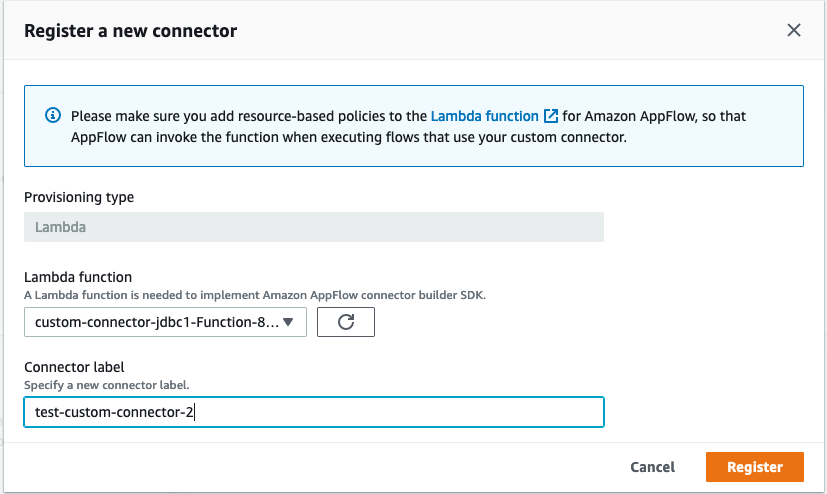
  2. Register the connector by selecting your Lambda function and typing in the connector label.
    Register a new connectorThe newly created custom connector Lambda function appears in the list if you deployed using AWS SAM by following the steps in this tutorial. If you deployed the Lambda function manually, ensure that appropriate Lambda permissions are set, as described in the Lambda Permissions and Resource Policy section.
  3. Provide a label for the connector. The label must be unique per account per Region. Choose Register.
    Provide a label
  4. The connector appears in the list of custom connectors.
    List of connectors

2. Register with the API

Invoke the registerConnector public API endpoint with the following request payload:

{
   "connectorLabel":"TestCustomConnector",
   "connectorProvisioningType":"LAMBDA",
   "connectorProvisioningConfig":{
      "lambda":{ "lambdaArn":"arn:aws:lambda:<region>:<aws_account_id>:function:<lambdaFunctionName>"
      }
   }
}

For connectorLabel, use a unique label. Currently, the only supported connectorProvisioningType is LAMBDA.

Using the new custom connector

  1. Navigate to the Connections link from the left-menu. Select the registered connector from the drop-down.
    Selecting the connector
  2. Choose Create Connection.
    Choose Create Connection
  3. Complete the connector-specific setup:
    Setup page
  4. Proceed with creating a flow and selecting your new connection.
  5. Check Lambda function’s Amazon CloudWatch Logs to troubleshoot errors, if any, during connector registration, connector profile creation, and flow execution process.

Production considerations

This example is a proof of concept. To build a production-ready solution, review the non-exhaustive list of differences between sample and production-ready solutions.

If you plan to use the custom connector with high concurrency, review AWS Lambda quotas and limitations.

Cleaning up the custom connector stack

To delete the connector:

  1. Delete all flows in Amazon AppFlow that you created as part of this tutorial.
  2. Delete any connector profiles.
  3. Unregister the custom connector.
  4. To delete the stack, run the following command from the amazon-appflow-custom-jdbc-connector base directory:
    sam delete

Conclusion

This blog post shows how to extend the Amazon AppFlow service to move data between SaaS endpoints and custom APIs. You can now build custom connectors using the Amazon AppFlow Custom Connector SDK.

Using custom connectors in Amazon AppFlow allows you to integrate siloed applications with minimal code. For example, different business units using legacy applications in an organization can now integrate their services via the Amazon AppFlow Custom Connectors SDK.

Depending on your choice of framework you can use the open source Python SDK or Java SDK from GitHub. To learn more, refer to the Custom Connector SDK Developer Guide.

For more serverless learning resources, visit Serverless Land.

Демокрацията зависи от осъзнатото участие 

Post Syndicated from Йоанна Елми original https://toest.bg/demokratsiyata-zavisi-ot-osuznatoto-uchastie/

Виждайки как повечето млади хора в чужбина са запознати с партиите, лидерите и идеологиите на настоящия политически живот и са ангажирани като граждани, се замислихме, че и ние искаме да бъдем такъв пример, на първо място – за по-малките си сестри. 

Това казват Роберта Костадинова и Виктория Лазарова, част от екипа на „Царски Пищови“ – инициатива, която цели да информира младите българи за различни аспекти на българската и световната политика по интересен, достъпен и разбираем начин. От чужбина идва вдъхновението и за друга нашумяла платформа – „Стража“, първоначално замислена като проект, подобен на немския Abgeordnetenwatch, и впоследствие адаптирана към нашата политическа реалност. Общото между „Царски Пищови“ и „Стража“ е не само политическата насоченост, а и това, че създателите са млади българи, които вярват, че не просто има смисъл от индивидуално участие в гражданския живот, а и че именно там се крие ключът към успеха.

Знанието е сила

Посланието на „Царски Пищови“ от самото начало е да насърчава младите хора в България да бъдат активни в гражданския си живот, казват Роберта и Виктория. Въпреки че фокусът им е върху политиката и социалните проблеми по света и у нас, стремежът им е да изградят у обществото култура на информираност като антидот срещу дезинформацията и манипулацията. Противно на популярната фраза, че невежеството е блаженство, те вярват на друго „клише“ – че знанието е сила.

Другата основна цел, която си поставя проектът, е да направи политическата терминология, събития и новини в България достъпни и за хора без опит и задълбочени познания в областта. Оттам идва и името на проекта – най-същественото съдържание накратко, като пищов в училище.

Искаме да провокираме дискусия и да покажем, че по много въпроси има различни мнения и добрите решения обикновено са резултат от отворен дебат, комуникация и уважение към чуждата гледна точка. 

Екипът се старае да осъществи целите си чрез споделяне на графики, илюстрации и цитати в социалните мрежи, които често стимулират публиката да обсъжда дадени теми. Антони Герасимов от „Стража“ споделя тази гледна точка:

Демокрацията не е просто лозунг. Не е достатъчно да кажем, че живеем в демокрация, и това автоматично да ни причисли към онези държави, достигнали най-справедливата форма на управление. Демокрацията е сложен организъм, съставен от институции, но и политическа култура, обществени нагласи към актуални събития и цял куп други елементи, които си взаимодействат и търпят промяна. Неглижирането на който и да от елементите дава превес на други и изважда цялата система от баланс. За да живеем в истинска демокрация, не е достатъчно просто да си повтаряме, че в Конституцията ни пише така. Затова посланието, което отправяме, е много просто, но същевременно поставя много важен казус: демокрацията не е просто лозунг и ние сме длъжни да се грижим за нея, за да не я загубим. 

Проектът работи с отворени данни, които се представят в разбираеми категории, позволявайки на хората да видят кой ги представлява в Народното събрание и как гласуват депутатите. Стенограмите от заседанията са визуализирани като чат в приложение за телефон.

От младите за младите?

Екипът на „Стража“ се стреми да включи всички граждани в демократичния процес и смята, че ако избирателните права се придобиват на 18-годишна възраст, то интересът към ставащото в държавата би следвало да се заражда в още по-ранна възраст. От инициативата искат да привлекат колкото може повече млади хора към политическото, но начинът, по който е създаден проектът, предполага широк обхват и привличане на интереса на всички възрастови групи, казва Антони. Имайки предвид, че и „Стража“, и „Царски Пищови“ са разработени онлайн, достъпът до тях предполага определено ниво на дигитална грамотност. И двете платформи разчитат достатъчно на социалните мрежи, за да бъдат видими поне за българите, които четат новини онлайн.

Самите ние сме усещали липса на адекватно политическо и гражданско образование в младежките си години – казват Роберта и Виктория. – Рядко се срещат хора, които, гласувайки за пръв път, имат ясна представа защо подкрепят конкретния кандидат или партия. Обикновено този избор е повлиян от възгледите на роднини, приятели и близки. 

Затова от „Царски Пищови“ се насочват към младите хора с цел да им осигурят арсенал от знания по политически въпроси. Когато тези базисни неща са усвоени, човек лесно може да надгражда, без да се чувства объркан от термини или от сложността на някои анализи, смятат те и се надяват, че тази основа ще помогне на младите хора да следят новините и да разбират същината на политическите проблеми – а това е първата стъпка към по-активното ангажиране с политиката и гражданското общество в страната.

„В България има страхотни млади хора – дейни, активни и ангажирани. Макар и някои от тях да трупат опит в чужбина, прави впечатление, че всички са еднакво отдадени на каузата за по-добро общество. Но е и факт, че има стереотипи спрямо младите и затова мненията им се неглижират. Гласът им сякаш няма същата тежест – поради „липса на опит“ и „влиянието на западната култура“, както често се изтъква от по-възрастните. Аудиторията ни е много разнородна и това безкрайно ни радва. Смятаме, че е сигурен знак, че политиката, екологичните и социалните проблеми не са занимание само за отбрани групи, а за всеки гражданин“, коментират Роберта и Виктория.

Ако става въпрос за клишета относно младите българи в България и в чужбина, екипът на „Стража“ покрива три различни представи: Благослав Михайлов завършва Шефилдския университет, но се връща в България; Фридрих Крепиев все още учи и живее в Германия; Антони Герасимов, с когото разговаряме, получава образованието си изцяло в България. Останалите участници в екипа също имат доста пъстра биография.

Познавам много дейни млади хора и се надявам те да стават все повече – споделя Антони. – Не бих казал, че образованието в чужбина е задължителен фактор, за да бъде един млад човек предприемчив и инициативен. Живеем в много динамична среда, която търпи постоянни промени, и увличането на младите хора в политическите процеси е неизбежно. Наречете ме безнадежден оптимист или живеещ в собствения си балон, но смятам, че качествената промяна в мисленето на много млади хора вече е факт, сега остава количествено това да се разпространи и сред останалите. Разбира се, не може да очакваме 100% от младите да са ангажирани с политиката, но смятам, че все повече започват да се интересуват от това, което се случва в страната. 

Коренна промяна в политическото съзнание

Идеята за демократично участие претърпява промяна с годините. Ако за поколенията от втората половина на XX в. гражданският дълг се състои в задължително гласуване и следене на политическия процес, то по-младите разбират изпълнението на този дълг през процеси като протести, активно участие в гражданския живот и изразяване на позиция, обвързване с каузи и гласуване по-скоро около специфични проблеми (например околна среда), отколкото за партии и идеологии. Антони е оптимист, че тези процеси се развиват и у нас:

Като част от страните от Източния блок България е в процес на трансформация от онзи поданически тип политическа култура, който е бил изграден и наложен в периода преди 1989 г. Подобна промяна е дълъг процес, от който и самите ние сме част. Съвсем нормално е да виждаме все повече млади хора, които осъзнават, че ако те не се интересуват от политиката, то политиката живо се интересува от тях. Всеки има своя професия и е отдал живота си на нея, но общото между всички нас е, че сме граждани и като такива дължим част от времето си, за да моделираме и подобряваме средата, в която живеем и желаем да се развиваме.

Антони е съгласен, че процесите се движат по-бавно, отколкото ни се иска, но вижда все повече млади хора, които разбират, че никой не им е длъжен и че добрата среда за живот зависи единствено от нас като общество. Като преподавател той вижда промяна спрямо времето, когато самият той е бил студент. Феноменът „20-годишни соцносталгици“, които са научени от семействата си, че държавата им е длъжна за всичко, без те да си мръднат пръста, се среща значително по-рядко, казва той, а след още 10 години се надява това явление да изчезне напълно. Държавата – това са гражданите и институциите, които те са създали. Промяна в нагласите трудно може да се осъществи у хора, които вече са изградили своя светоглед. Затова именно младите са носителите на новия вид политическа култура, от който демокрацията има нужда, тъй като колкото по-късно след 1989 г. си се родил, толкова по-малко си повлиян от старите привички и нагласи в обществото.

Роберта и Виктория от „Царски Пищови“ също смятат, че поради историческия товар българските граждани тотално са забравили своята огромна роля в политиката. Те виждат надежда в дейността на редица неправителствени и граждански организации и определят като позитивна тенденцията, че все повече хора намират смисъл в личния пример и се ангажират с инициативи, които допринасят за вълнуващите ги теми – било то политика, екология, човешки права, защита на животните и т.н. Ще отнеме време, докато този модел на активния гражданин се утвърди като народопсихология, но заедно можем да постигнем много, смятат те.

Едва в началото на процеса

И двете начинания са прозрачни относно методите си на работа. В „Стража“ използват отворени данни, като голяма част от работата им се състои в това да направят обемните и трудно четими файлове, качени от институциите, достъпни и разбираеми за гражданите. Това се постига чрез специален скрипт, който прехвърля информацията директно към платформата.

За публикациите си избираме теми според интереса, който са предизвикали по време на обсъжданията в парламента – уточнява Антони. – Основната цел е да предизвикаме любопитство, което да тласне хората към платформата и сами да потърсят това, което ги вълнува. Предстои да започнем да публикуваме интересни анализи, които се основават на количествени изследвания. Разполагаме с толкова данни и би било грехота, ако не установим кой е депутатът с най-богат речник или коя е любимата дума на Волен Сидеров, нали?

От „Царски Пищови“ подбират темите, като преценяват важността и се съобразяват с новините, използвайки най-различни източници – от официални сайтове на институции до местни и чуждестранни медии. Стараят се да култивират обективност и да посочват всички източници, така че аудиторията да може да ги потърси и прочете. Споделят, че безспорно имат пропуски и получават и критична обратна връзка, на която се радват, тъй като това е сигнал, че аудиторията е изградена от мислещи хора. „Ето така функционира гражданската отговорност на практика – казват те. – Разбира се, има и негативни коментари без аргументация и без предложения за подобрение. В такива случаи се опитваме да обърнем внимание на това колко по-силно е едно съобщение, когато е обосновано.“

И двата екипа имат много планове за бъдещето. За да ги осъществят, от „Царски Пищови“ се стремят на първо време да привлекат повече хора към екипа, който работи на доброволчески начала, така че всеки би могъл да се включи. „Търсим мотивирани и отговорни хора с разнообразен опит, интереси и възгледи, така че да можем да разглеждаме социалните и политическите новини и проблеми от перспективата на различни общности и да сме коректни и обективни в публикациите си. Възрастта, етносът и полът са без никакво значение за нас. Дори напротив – стремим се към разнообразие!“, казват те.

Амбициите са големи и в „Стража“:

Немските ни колеги работят с депутати, които са се съгласили да имат собствена регистрация в сайта и да отговарят на въпроси на граждани. Смятаме, че имаме потенциал да бъдем подобна връзка между гражданите и народните им представители. Успехът на такава инициатива би превърнал платформата в съществена част от българската демокрация, защото тя би създала връзка между гражданите и политическия елит, която досега е липсвала.

Антони мисли, че подобни инициативи могат да изградят критични и взискателни граждани, без значение какви са техните политически предпочитания. Той споделя, че не липсват ентусиасти, които да предлагат своята помощ, и това радва екипа.

„Стража“ се издържа единствено от граждански дарения, а „Царски Пищови“ към момента разчита на доброволен труд. Плановете за бъдещето са само повърхността на амбициите и на двата екипа, а оптимизмът им е ако не заразителен, то поне обнадеждаващ за средата в България. Вероятно затова след разговорите ни се сетих за Вазовото възклицание, макар и с малка промяна: „Младите, младите – те да са живи!“

Заглавна снимка: Josh Barwick / Unsplash

Източник

Share your tech project with the world through Coolest Projects Global 2022

Post Syndicated from original https://www.raspberrypi.org/blog/coolest-projects-global-2022-registration-open/

It’s time for young tech creators to share with the world what they’ve made! Coolest Projects Global 2022 registration is NOW OPEN. Starting today, young people can register their technology creation on the Coolest Projects Global website, where it will be featured in the online showcase gallery for the whole world to see.

Five young coders show off their robotic garden tech project for Coolest Projects.

By registering a tech project, you’ll represent your community, and you’ll get the coolest, limited-edition swag. You may even win a prize and earn the recognition of the special project judges.

What you need to know about Coolest Projects Global

Now in its 10th year, Coolest Projects is all about celebrating young people and what they create with code. Here’s what you need to know:

  • Coolest Projects Global is completely free for all participants around the world, and it’s entirely online.
  • Coolest Projects Global is open to tech creators up to 18 years old, working independently or in teams of up to 5.
  • We welcome creators of all skill levels: this world-leading technology showcase is for young people who are coding their very first project, or who are already experienced, or anything in between.
  • You’re invited to a live online celebration, which we will live-stream in early June — more details to follow.
  • Opening today, project registration stays open until 11 May.
A young coder shows off her tech project tech project for Coolest Projects to two other young tech creators.
  • Projects can be registered in the following categories: Scratch, games, web, mobile apps, hardware, and advanced programming.
  • Judges will evaluate projects based on their coolness, complexity, design, usability, and presentation.

Why Coolest Projects Global is so cool

Here are just a few of the reasons why young tech creators should register their project for the Coolest Projects Global showcase:

  • Share your project with the world. Coolest Projects Global is the world’s leading technology showcase for young people, and it’s your chance to shine on the global stage.
  • Get feedback on your project. A great team of judges will check out your project and give you feedback, which will land in your inbox after registration closes.
  • Earn some swag. Every creator who registers a project will be eligible to receive some limited-edition digital or physical swag. Pssst… Check out the sneak peek below.
  • Win a prize. Creators of projects that are selected as the judges’ favourites in the six showcase categories will receive a Coolest Projects medal to commemorate their accomplishment. The judges’ favourites will be announced at our live online celebration in June.
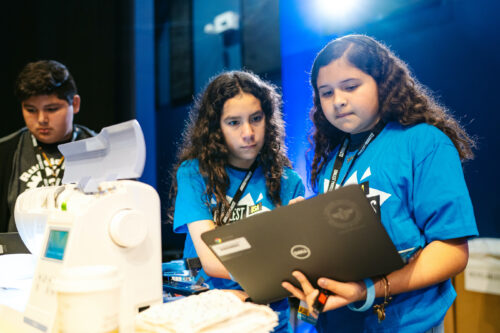
Two young coders work on their tech project on a laptop to control a sewing machine for Coolest Projects.

If you don’t have a tech project or an idea for one yet, you’ve got plenty of time to imagine and create, and we’re here to support you. Check out our guides to designing and building a tech creation — one that you’ll be proud to share with the Coolest Projects community in the online showcase gallery. And there’s no shortage of inspiration among the projects that young tech creators shared in last year’s showcase gallery.

Four young coders show off their tech project for Coolest Projects.

We have a lot more exciting stuff to share about Coolest Projects Global in the coming months, so be sure to subscribe for email updates. Until next time… be cool, creators!

""
A hint at the swag Coolest Projects Global participants will receive 👀

The post Share your tech project with the world through Coolest Projects Global 2022 appeared first on Raspberry Pi.

Кочината ке падне!

Post Syndicated from original https://bivol.bg/%D0%BA%D0%BE%D1%87%D0%B8%D0%BD%D0%B0%D1%82%D0%B0-%D0%BA%D0%B5-%D0%BF%D0%B0%D0%B4%D0%BD%D0%B5.html

понеделник 14 февруари 2022


Системата си работеше като добре смазана машина дълго време. Толкова дълго време, че се беше превърнало в безвремие. Всички виждахме, че нещата не са наред, някои от нас дори имаха…

Разследване на OCCRP с участие на “Биволъ” #OpenLux: Вила за €25 млн. за синове на руски олигарх, лишен от златен паспорт у нас

Post Syndicated from Екип на Биволъ original https://bivol.bg/openlux-%D0%B2%D0%B8%D0%BB%D0%B0-%D0%B7%D0%B0-e25-%D0%BC%D0%BB%D0%BD-%D0%B7%D0%B0-%D1%81%D0%B8%D0%BD%D0%BE%D0%B2%D0%B5-%D0%BD%D0%B0-%D1%80%D1%83%D1%81%D0%BA%D0%B8-%D0%BE%D0%BB%D0%B8%D0%B3%D0%B0.html

неделя 13 февруари 2022


Докато в Народното събрание на Република България опозицията и управляващите търсят виновните за мащабните афери със златните паспорти у нас, сайтът за разследваща журналистика “Биволъ”. продължава действа. След като през…

Friday Squid Blogging: Climate Change Causing “Squid Bloom” along Pacific Coast

Post Syndicated from Bruce Schneier original https://www.schneier.com/blog/archives/2022/02/friday-squid-blogging-climate-change-causing-squid-bloom-along-pacific-coast.html

The oceans are warmer, which means more squid.

As usual, you can also use this squid post to talk about the security stories in the news that I haven’t covered.

Read my blog posting guidelines here.

Metasploit Wrap-Up

Post Syndicated from Christophe De La Fuente original https://blog.rapid7.com/2022/02/11/metasploit-wrap-up-148/

Welcome, Little Hippo: PetitPotam

Metasploit Wrap-Up

Our very own @zeroSteiner ported the PetitPotam exploit to Metasploit this week. This module leverages CVE-2021-36942, a vulnerability in the Windows Encrypting File System (EFS) API, to capture machine NTLM hashes. This uses the EfsRpcOpenFileRaw function of the Microsoft’s Encrypting File System Remote Protocol API (MS-EFSRPC) to coerce machine authentication to a user-controlled listener host. Metasploit’s SMB capture server module can be used for this. The captured hashes are typically used as part of a NTLM relaying attack to take over other Windows hosts. Note that Microsoft has published some guidance about how to mitigate NTLM relay attacks.

QEMU Human Monitor Interface RCE

Contributor @bcoles added an exploit module that abuse QEMU’s Monitor Human Monitor Interface (HMP) TCP server to execute arbitrary commands by using the migrate HMP command. Furthermore, since the HMP TCP service is reachable from emulated devices, it is possible to escape QEMU from a guest system using this module. Note that it doesn’t work on Windows hosts since the migrate command cannot spawn processes on this platform.

New module content (2)

  • PetitPotam by GILLES Lionel and Spencer McIntyre, which exploits CVE-2021-36942 – This adds a new auxiliary scanner module that ports the PetitPotam tool to Metasploit andleverages CVE-2021-36942 to coerce Windows hosts to authenticate to a user-specific host, which enables an attacker to capture NTLM credentials for further actions, such as relay attacks.
  • QEMU Monitor HMP ‘migrate’ Command Execution by bcoles – This adds a module that can exploit the QEMU HMP service to execute OS commands. The HMP TCP service is reachable from emulated devices, so it is possible to escape QEMU by exploiting this vulnerability.

Enhancements and features

  • #16010 from lap1nou – This updates the zabbix_script_exec module with support for Zabbix version 5.0 and later. It also adds a new item-based execution technique and support for delivering Linux native payloads.
  • #16163 from zeroSteiner – Support has been added for the ClaimsPrincipal .NET deserialization gadget chain, which was found by jang. An exploit which utilizes this enhancement will arrive shortly.
  • #16125 from bcoles – This module can exploit GXV3140 models now that an ARCH_CMD target has been added.

Bugs fixed

  • #16121 from timwr – This fixes an exception caused by exploits that call rhost() in Msf::Post::Common without a valid session.
  • #16142 from timwr – This fixes an issue with Meterpreter’s getenv command that was not returning NULL when querying for a non-existing environment variable.
  • #16143 from sjanusz-r7 – This fixes an issue where a Cygwin SSH session was not correctly identified being a Windows device, due to a case sensitivity issue
  • #16147 from zeroSteiner – This fixes a bug where ssh_enumusers would only use one source in the generation of its user word list if both USERNAME and USER_FILE options were set. The module now pulls from all possible datastore options if they are set, including a new option DB_ALL_USERS.
  • #16160 from zeroSteiner – This fixes a crash when msfconsole is unable to correctly determine the hostname and current user within a shell prompt.

Get it

As always, you can update to the latest Metasploit Framework with msfupdate
and you can get more details on the changes since the last blog post from
GitHub:

If you are a git user, you can clone the Metasploit Framework repo (master branch) for the latest.
To install fresh without using git, you can use the open-source-only Nightly Installers or the
binary installers (which also include the commercial edition).

C5 Type 2 attestation report now available with 141 services in scope

Post Syndicated from Mercy Kanengoni original https://aws.amazon.com/blogs/security/c5-type-2-attestation-report-now-available-with-141-services-in-scope/

Amazon Web Services (AWS) is pleased to announce the issuance of the new Cloud Computing Compliance Controls Catalogue (C5) Type 2 attestation report. We added 18 additional services and service features to the scope of the 2021 report.

Germany’s national cybersecurity authority, Bundesamt für Sicherheit in der Informationstechnik (BSI), established C5 to define a reference standard for German cloud security requirements. The C5 Type 2 report covers the time period from October 1, 2020, through September 30, 2021. It was issued by an independent third-party attestation organization, and assesses the design and the operational effectiveness of AWS’s controls against the new version C5:2020’s basic and additional criteria.

Customers in Germany and other European countries can use AWS’s attestation report to confirm that AWS meets the security requirements of the C5:2020 framework, and to review the details of the tested controls. This attestation demonstrates our commitment to meet and exceed the security expectations for cloud service providers set by the BSI.

AWS has added the following 18 services and service features to the new C5 scope:

You can see a current list of the services in scope for C5 on the AWS Services in Scope by Compliance Program page.

AWS strives to continuously bring services into scope of its compliance programs to help you meet your architectural and regulatory needs. Please reach out to your AWS account team if you have questions or feedback about the C5 report.

The C5 report and Continuing Operations Letter is available to AWS customers through AWS Artifact. For more information, see Cloud Computing Compliance Controls Catalogue (C5).

 
If you have feedback about this post, submit comments in the Comments section below. If you have questions about this post, start a new thread on the Security Hub forum. To start your 30-day free trial of Security Hub, visit AWS Security Hub.

Want more AWS Security how-to content, news, and feature announcements? Follow us on Twitter.

Mercy Kanengoni

Mercy Kanengoni

Mercy is a Security Audit Program Manager at AWS based in Manchester, UK. She leads security audits across Europe, and she has previously worked in security assurance and technology risk management.

Author

Karthik Amrutesh

Karthik is a Senior Manager, Security Assurance at AWS based in New York, U.S. His team is responsible for audits, attestations, certifications, and assessments globally. Karthik has previously worked in risk management, security assurance, and technology audits for the past 18 years.

[$] Debian reconsiders NEW review

Post Syndicated from original https://lwn.net/Articles/884301/

The Debian project is known for its commitment to free software, the effort
that it puts into ensuring that its distribution is compliant with the
licenses of the software it ships, and the energy it
puts into discussions around that work. A recent (and ongoing) discussion
started with
a query about a relatively obscure aspect of the process by which new
packages enter the distribution, but ended up questioning the project’s
approach toward licensing and copyright issues. While no real conclusions
were reached, it seems likely that the themes heard in this discussion,
which relate to Debian’s role in the free-software community in general, will
play a prominent part in future debates.

The collective thoughts of the interwebz