Google says that it will fully transition to post-quantum cryptography by 2029. I think this is a good move, not because I think we will have a useful quantum computer anywhere near that year, but because crypto-agility is always a good thing.
The Arctic Freezer 4U-SP5 is something really interesting. As the name suggests, it is a 4U cooler that is designed to cool AMD SP5 platform processors. For those who are buying AMD EPYC 9004/9005 series processors like Genoa, Bergamo, and Turin. Perhaps the best part is that these sell for around $55, which is less […]
LWN recently reported on the Trivy
compromise that led, in turn, to the compromise of the LiteLLM system; that
article made the point that the extent of the problem was likely rather
larger than was known. The Next Web now reports
that the Trivy attack was used to compromise a wide range of European
Commission systems.
The European Union’s computer emergency response team said on
Thursday that a supply chain attack on an open-source security
scanner gave hackers the keys to the European Commission’s cloud
infrastructure, resulting in the theft and public leak of
approximately 92 gigabytes of compressed data including the
personal information and email contents of staff across dozens of
EU institutions.
Докато Румен Радев ни уверява, че „евтиният петрол, за който е пригодена нашата рафинерия, е на два дни прав път през Черно море“, а Бойко Борисов – че „всички гласуват за ГЕРБ по любов“, Artemis II започна своето пътуване към и около Луната. Може да го следите в live stream канала на мисията:
Съветвам ви да го правите при всяка възможност, за да не забравяте, че винаги има надежда да бъдем на по-добро място. Било то и извън орбита. Така както прави и астронавтката Кристина Кох, част от 4-членния екипаж на борда на Orion, първата жена, която ще отиде до Луната и обратно, впечатляваща специалистка с рекордните 328 дни на Международната космическа станция и съпруга и майка, която е щастлива, че ще има едни десет дни, в които никой няма да ѝ се обажда по телефона с въпроса „А това къде ми е?“.
Обратно на Земята, чиято гравитация напоследък сякаш ни натиска повече от обикновено и където постоянно ни се налага да търсим едно или друго – я ключове, я смелост да отидем до магазина, където всичко е по 400 евро, я логика в действията на световните лидери.
Тук, долу, нещата са „още от същото“. Стоим на прага на нова криза, горе-долу с мащабите на ковидската, само че този път енергийна, предупреждават от Брюксел. Не е лоша идея, казват, да си работите от вкъщи и да не шофирате много-много, а ако шофирате, правете го бавно.
Ако веднага след видеото на Румен Радев, което линкнах по-горе, ви се зарежда рийл с плетене на една кука, значи сте направили най-доброто за себе си и за менталното си здраве. Ако обаче ви влиза Томислав Дончев с отговори на „Пет въпроса от младите хора“ (кои са тия млади хора?), от които става ясно, че България превъзхожда другите страни „с много неща“, не знам как да ви помогна. Освен да ви препоръчам текста на Веселин Златков за Варна и за „многото неща“, които са готови, но не са хубави в този град, управляван 10 години от ГЕРБ.
Във връзка с войната и световното лидерство споделям с вас карикатурата на Бил Брамхол за New York Daily News, препостната в X от английския профил на Иранската информационна агенция. Просто е толкова хубаво всичко!
A Western Cartoonist's Jab at Trump's Claims
"The Iranians you've been talking to for two days. Are they in the room with us now? pic.twitter.com/bXHmdhrOOP
Не мога да си представя живот без това, което изкуството дава. То те владее, поставя въпроси, тревожи те и в това е красотата му. В него са възможни много различни светове. И аз обичам да потъвам в тях. Но те също така вдъхновяват – независимо дали филм, книга или картина могат да породят у теб желание да създадеш нещо твое, да продължиш диалога.
Тодора говори за желанието да продължиш диалога. За съжаление, по някои теми въобще не сме го почвали. Или сме го повлекли в тотално грешна посока. Една от тях е „Какво е да остарееш в България?“. Или не говорим по нея, или я принизяваме до „ексклузивността“ на сутрешен блок, който прави „шокиращи разкрития“ в дом за възрастни хора.
За да започнем диалога по по-смислен начин, ви каним на прожекциите на документалния филм на Лина Кривошиева „Какво е да остарееш в България“.
Премиерата ще бъде в София на 5 април (тази неделя) от 15:00 ч. в Дома на киното. Всички останали места, дати и часове, както и повече информация за филма може да видите в публикацията за филма в сайта ни.
А в този разговор Лина разказва за личната си мотивация да тръгне към темата за остаряването. Тема, от която повечето от нас се боят, може би докато не си дадем сметка, че остаряването всъщност е привилегия. Как обаче изглежда тя в държава като нашата?
И понеже в „Тоест“ сме по разговорите – ако не сме ги почнали, си намираме повод, а ако сме ги стартирали, гледаме да не ги спираме – затова и в новия епизод на видеопоредицата ни „Тоест разговаряме“ (много разговор, много нещо!) продължаваме с диалозите по важни теми с нашите редовни автори.
На 4 април (тази събота) от 16:00 ч. в YouTube LiveВладислав Севов се среща с Надежда Цекулова, за да я пита „Какво му липсва на нашето здравеопазване?“, а тя да му отговори „А какво НЕ му липсва на нашето здравеопазване?!“. Разбира се, няма да е така, защото това ще е най-краткият стрийминг в историята на стриймингите, а и защото Надежда има доста да каже за системните дефицити в здравеопазването.
Да обобщя, за да няма неразбрали:
В събота (4 април) сте в 16:00 ч. в YouTube Liveза разговора с Надежда Цекулова за българското здравеопазване.
В неделя (5 април) сте в 15:00 ч. в Дома на киното за прожекцията на „Какво е да остарееш в България“.
През останалото време сте където пожелаете, но най-вече в сърцата на екипа на „Тоест“, защото, ако ви няма вас, верните читатели на медията, тя няма как да съществува.
Ако харесвате това, което правим, и го намирате за важно, но още не сте станали дарители, може да го направите с малък месечен абонамент, който би означавал много за нас.
Ако вече сте част от хората, които ни подкрепят, благодарим ви сърдечно! Четете и споделяйте съдържанието ни и разказвайте на вашите приятели какво ви е харесало в медията, за да продължи да я има.
Today’s filmmakers capture more footage than ever to maximize their creative options, often generating hundreds, if not thousands, of hours of raw material per season or franchise. Extracting the vital moments needed to craft compelling storylines from this sheer volume of media is a notoriously slow and punishing process. When editorial teams cannot surface these key moments quickly, creative momentum stalls and severe fatigue sets in.
Meanwhile, the broader search landscape is undergoing a profound transformation. We are moving beyond simple keyword matching toward AI-driven systems capable of understanding deep context and intent. Yet, while these advances have revolutionized text and image retrieval, searching through video, the richest medium for storytelling, remains a daunting “needle in a haystack” challenge.
The solution to this bottleneck cannot rely on a single algorithm. Instead, it demands orchestrating an expansive ensemble of specialized models: tools that identify specific characters, map visual environments, and parse nuanced dialogue. The ultimate challenge lies in unifying these heterogeneous signals, textual labels, and high-dimensional vectors into a cohesive, real-time intelligence. One that cuts through the noise and responds to complex queries at the speed of thought, truly empowering the creative process.
Why Video Search is Deceptively Complex
Since video is a multi-layered medium, building an effective search engine required us to overcome significant technical bottlenecks. Multi-modal search is exponentially more complex than traditional indexing: it demands the unification of outputs from multiple specialized models, each analyzing a different facet of the content to generate its own distinct metadata. The ultimate challenge lies in harmonizing these heterogeneous data streams to support rich, multi-dimensional queries in real time.
Unifying the Timeline
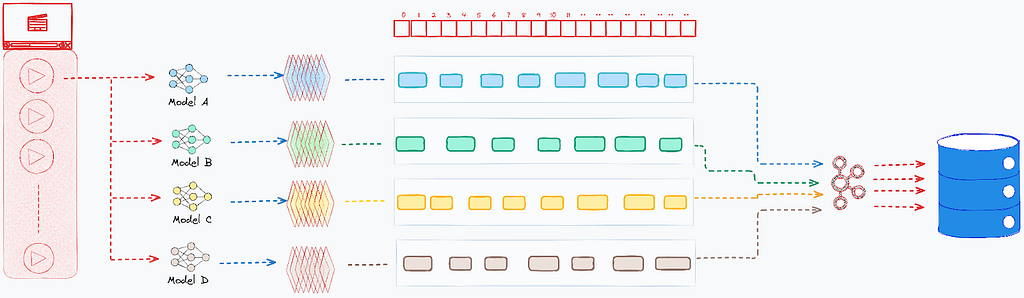
To ensure critical moments aren’t lost across scene boundaries, each model segments the video into overlapping intervals. The resulting metadata varies wildly, ranging from discrete text-based object labels to dense vector embeddings. Synchronizing these disjointed, multi-modal timelines into a unified chronological map presents a massive computational hurdle.
2. Processing at Scale
A standard 2,000-hour production archive can contain over 216 million frames. When processed through an ensemble of specialized models, this baseline explodes into billions of multi-layered data points. Storing, aligning, and intersecting this staggering volume of records while maintaining sub-second query latency far exceeds the capabilities of traditional database architectures.
3. Surfacing the Best Moments
Surface-level mathematical similarity is not enough to identify the most relevant clip. Because continuous shots naturally generate thousands of visually redundant candidates, the system must dynamically cluster and deduplicate results to surface the singular best match for a given scene. To achieve this, effective ranking relies on a sophisticated hybrid scoring engine that weighs symbolic text matches against semantic vector embeddings, ensuring both precision and interpretability.
4. Zero-Friction Search
For filmmakers, search is a stream-of-consciousness process, and a ten-second delay can disrupt the creative flow. Because sequential scanning of raw footage is fundamentally unscalable, our architecture is built to navigate and correlate billions of vectors and metadata records efficiently, operating at the speed of thought.
Figure 1: Unified Multimodal Result Processing
The Ingestion and Fusion Pipeline
To ensure system resilience and scalability, the transition from raw model output to searchable intelligence follows a decoupled, three-stage process:
1. Transactional Persistence
Raw annotations are ingested via high-availability pipelines and stored in our annotation service, which leverages Apache Cassandra for distributed storage. This stage strictly prioritizes data integrity and high-speed write throughput, guaranteeing that every piece of model output is safely captured.
Figure 2: Sample Scene Search Model Annotation Output
2. Offline Data Fusion
Once the annotation service securely persists the raw data, the system publishes an event via Apache Kafka to trigger an asynchronous processing job. Serving as the architecture’s central logic layer, this offline pipeline handles the heavy computational lifting out-of-band. It performs precise temporal intersections, fusing overlapping annotations from disparate models into cohesive, unified records that empower complex, multi-dimensional queries.
Cleanly decoupling these intensive processing tasks from the ingestion pipeline guarantees that complex data intersections never bottleneck real-time intake. As a result, the system maintains maximum uptime and peak responsiveness, even when processing the massive scale of the Netflix media catalog.
Temporal Bucketing and Intersection
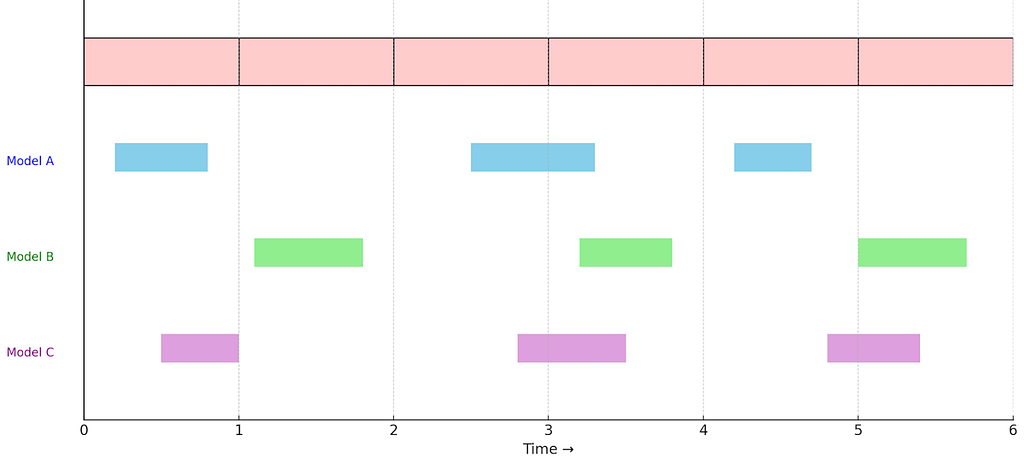
To achieve this intersection at scale, the offline pipeline normalizes disparate model outputs by mapping them into fixed-size temporal buckets (one-second intervals). This discretization process unfolds in three steps:
Bucket Mapping: Continuous detections are segmented into discrete intervals. For example, if a model detects a character (“Joey”) from seconds 2 through 8, the pipeline maps this continuous span of frames into seven distinct one-second buckets.
Annotation Intersection: When multiple models generate annotations for the exact same temporal bucket, such as character recognition “Joey” and scene detection “kitchen” overlapping in second 4, the system fuses them into a single, comprehensive record.
Optimized Persistence: These newly enriched records are written back to Cassandra as distinct entities. This creates a highly optimized, second-by-second index of multi-modal intersections, perfectly associating every fused annotation with its source asset.
Figure 3: Temporal Data Fusion with Fixed-Size Time Buckets
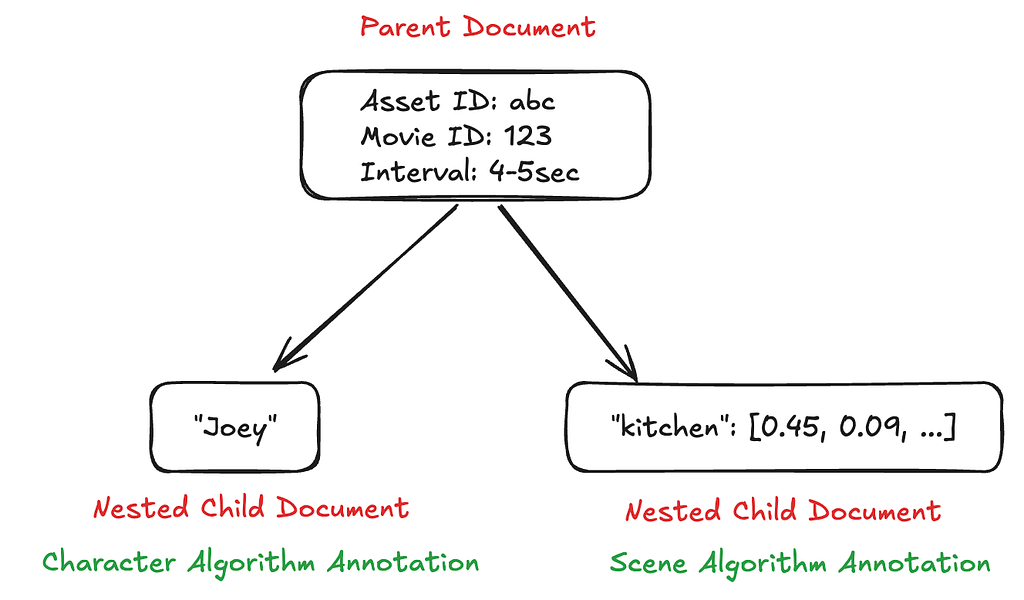
The following record shows the overlap of the character “Joey” and scene “kitchen” annotations during a 4 to 5 second window in a video asset:
Figure 4: Sample Intersection Record For Character + Scene Search
3. Indexing for Real Time Search
Once the enriched temporal buckets are securely persisted in Cassandra, a subsequent event triggers their ingestion into Elasticsearch.
To guarantee absolute data consistency, the pipeline executes upsert operations using a composite key (asset ID + time bucket) as the unique document identifier. If a temporal bucket already exists for a specific second of video, perhaps populated by an earlier model run, the system intelligently updates the existing record rather than generating a duplicate. This mechanism establishes a single, unified source of truth for every second of footage.
Architecturally, the pipeline structures each temporal bucket as a nested document. The root level captures the overarching asset context, while associated child documents house the specific, multi-modal annotation data. This hierarchical data model is precisely what empowers users to execute highly efficient, cross-annotation queries at scale.
The search service provides a high-performance interface for real-time discovery across the global Netflix catalog. Upon receiving a user request, the system immediately initiates a query preprocessing phase, generating a structured execution plan through three core steps:
Query Type Detection: Dynamically categorizes the incoming request to route it down the most efficient retrieval path.
Filter Extraction: Isolates specific semantic constraints such as character names, physical objects, or environmental contexts to rapidly narrow the candidate pool.
Vector Transformation: Converts raw text into high-dimensional, model-specific embeddings to enable deep, context-aware semantic matching.
Once generated, the system compiles this structured plan into a highly optimized Elasticsearch query, executing it directly against the pre-fused temporal buckets to deliver instantaneous, frame-accurate results.
Fine-Tuning Semantic Search
To support the diverse workflows of different production teams, the system provides fine-grained control over search behavior through configurable parameters:
Exact vs. Approximate Search: Users can toggle between exact k-Nearest Neighbors (k-NN) for uncompromising precision, and Approximate Nearest Neighbor (ANN) algorithms (such as HNSW) to maintain blazing speed when querying massive datasets.
Dynamic Similarity Metrics: The system supports multiple distance calculations, including cosine similarity and Euclidean distance. Because different models shape their high-dimensional vector spaces distinctly based on their underlying training architectures, the flexibility to swap metrics ensures that mathematical closeness perfectly translates to true semantic relevance.
Confidence Thresholding: By establishing strict minimum score boundaries for results, users can actively prune the “long tail” of low-probability matches. This aggressively filters out visual noise, guaranteeing that creative teams are not distracted and only review results that meet a rigorous standard of mathematical similarity.
Textual Analysis & Linguistic Precision
To handle the deep nuances of dialogue-heavy searches, such as isolating a character’s exact catchphrase amidst thousands of hours of speech, we implement a sophisticated text analysis strategy within Elasticsearch. This ensures that conversational context is captured and indexed accurately.
Phrase & Proximity Matching: To respect the narrative weight of specific lines (e.g., “Friends don’t lie” in Stranger Things), we leverage match-phrase queries with a configurable slop parameter. This guarantees the system retrieves the correct scene even if the user’s memory slightly deviates from the exact transcription.
N-Gram Analysis for Partial Discovery: Because video search is inherently exploratory, we utilize edge N-gram tokenizers to support “search-as-you-type” functionality. By actively indexing dialogue and metadata substrings, the system surfaces frame-accurate results the moment an editor begins typing, drastically reducing cognitive load.
Tokenization and Linguistic Stemming: To seamlessly support the global scale of the Netflix catalog, our analysis chain applies sophisticated stemming across multiple languages. This ensures a query for “running” automatically intersects with scenes tagged with “run” or “ran,” collapsing grammatical variations into a single, unified search intent.
Levenshtein Fuzzy Matching: To account for transcription anomalies or phonetic misspellings, we incorporate fuzzy search capabilities based on Levenshtein distance algorithms. This intelligent soft-matching approach ensures that high-value shots are never lost to minor data-entry errors or imperfect queries.
Aggregations and Flexible Grouping
The architecture operates at immense scale, seamlessly executing queries within a single title or across thousands of assets simultaneously. To combat result fatigue, the system leverages custom aggregations to intelligently cluster and group outputs based on specific parameters, such as isolating the top 5 most relevant clips of an actor per episode. This guarantees a diverse, highly representative return set, preventing any single asset from dominating the search results.
Search Response Curation
While temporal buckets are the internal mechanism for search efficiency, the system post-processes Elasticsearch results to reconstruct original time boundaries. The reconstruction process ensures results reflect narrative scene context rather than arbitrary intervals. Depending on the query intent, the system generates results based on two logic types:
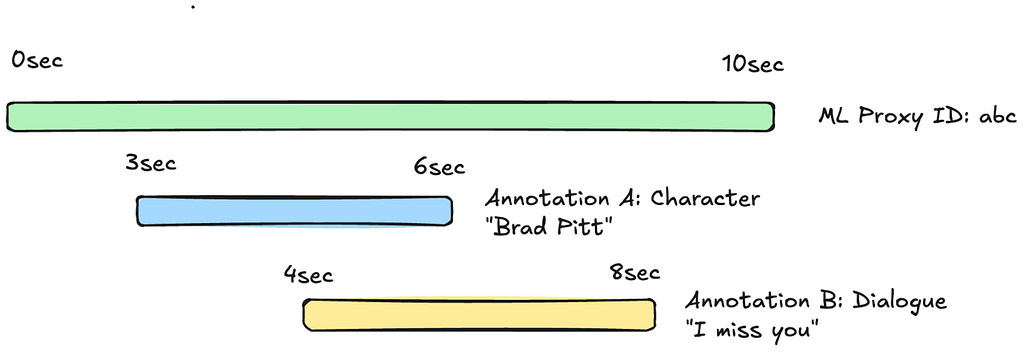
Figure 6: Depiction of Temporal Union vs Intersection
Union: Returns the full span of all matching annotations (3–8 sec), which prioritizes breadth, capturing any instance where a specified feature occurs.
Intersection: Returns only the exact overlapping duration of matching signals (4–6 sec). The intersection logic focuses on co-occurrence, isolating moments when multiple criteria align.
While our current architecture establishes a highly resilient and scalable foundation, it represents only the first phase of our multi-modal search vision. To continuously close the gap between human intuition and machine retrieval, our roadmap focuses on three core evolutions:
Natural Language Discovery: Transitioning from structured JSON payloads to fluid, conversational interfaces (e.g., “Find the best tracking shots of Tom Holland running on a roof”). This will abstract away underlying query complexity, allowing creatives to interact with the archive organically.
Adaptive Ranking: Implementing machine learning feedback loops to dynamically refine scoring algorithms. By continuously analyzing how editorial teams interact with and select clips, the system will self-tune its mathematical definition of semantic relevance over time.
Domain-Specific Personalization: Dynamically calibrating search weights and retrieval behaviors to match the exact context of the user. The platform will tailor its results depending on whether a team is cutting high-action marketing trailers, editing narrative scenes, or conducting deep archival research.
Ultimately, these advancements will elevate the platform from a highly optimized search engine into an intelligent creative partner, fully equipped to navigate the ever-growing complexity and scale of global video media.
Acknowledgements
We would like to extend our gratitude to the following teams and individuals whose expertise and collaboration were instrumental in the development of this system:
Today, we’re announcing the general availability of cross-account safeguards in Amazon Bedrock Guardrails, a new capability that enables centralized enforcement and management of safety controls across multiple AWS accounts within an organization.
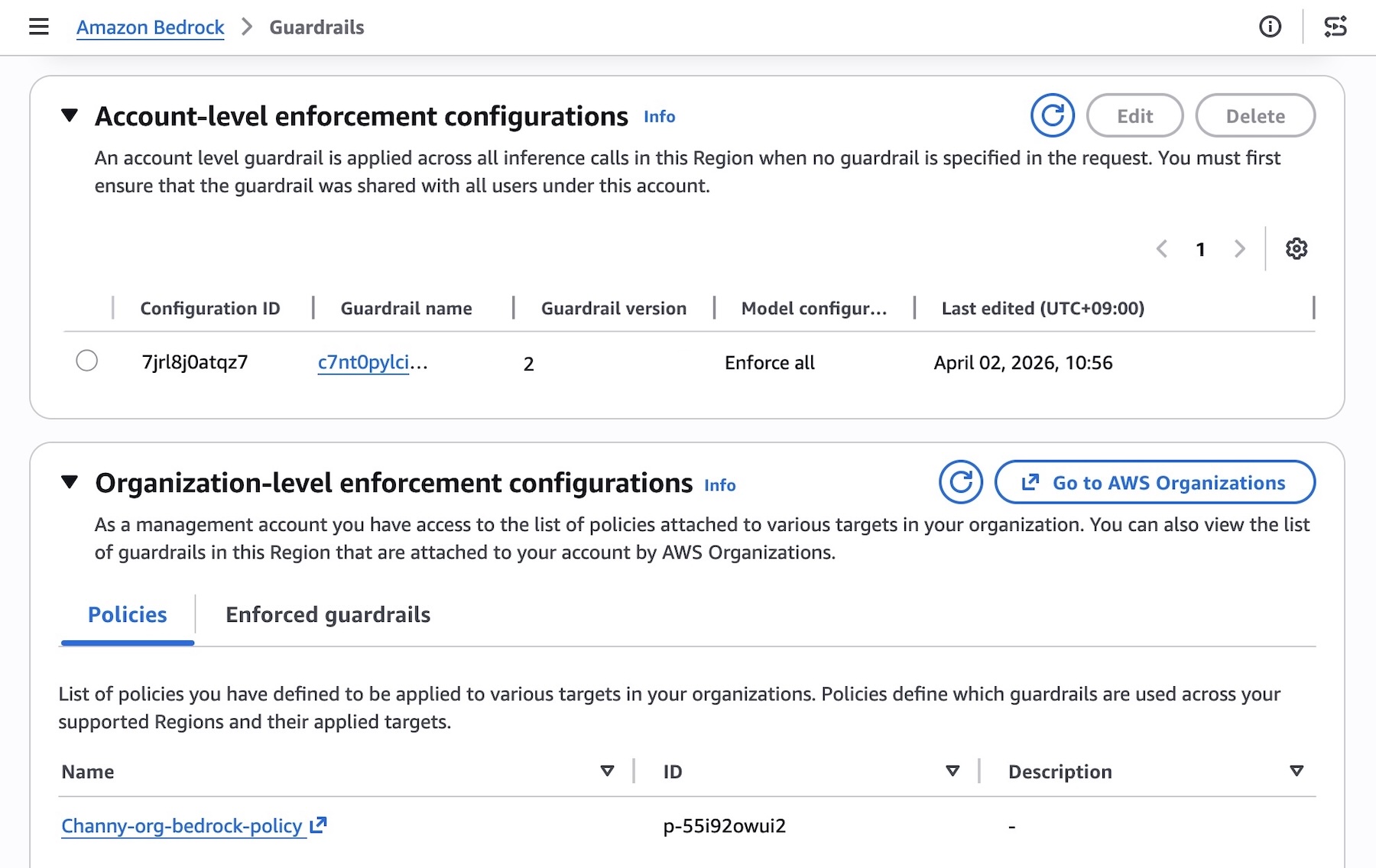
With this new capability, you can specify a guardrail in a new Amazon Bedrock policy within the management account of your organization that automatically enforces configured safeguards across all member entities for every model invocation with Amazon Bedrock. This organization-wide implementation supports uniform protection across all accounts and generative AI applications with centralized control and management. This capability also offers flexibility to apply account-level and application-specific controls depending on use case requirements in addition to organizational safeguards.
Organization-level enforcements apply a single guardrail from your organization’s management account to all entities within the organization through policy settings. This guardrail automatically enforces filters across all member entities, including organizational units (OUs) and individual accounts, for all Amazon Bedrock model invocations.
Account-level enforcement enables automatic enforcement of configured safeguards across all Amazon Bedrock model invocations in your AWS account. The configured safeguards in the account-level guardrail apply to all inference API calls.
You can now establish and centrally manage dependable, comprehensive protection through a single, unified approach. This supports consistent adherence to corporate responsible AI requirements while significantly reducing the administrative burden of monitoring individual accounts and applications. Your security team no longer needs to oversee and verify configurations or compliance for each account independently.
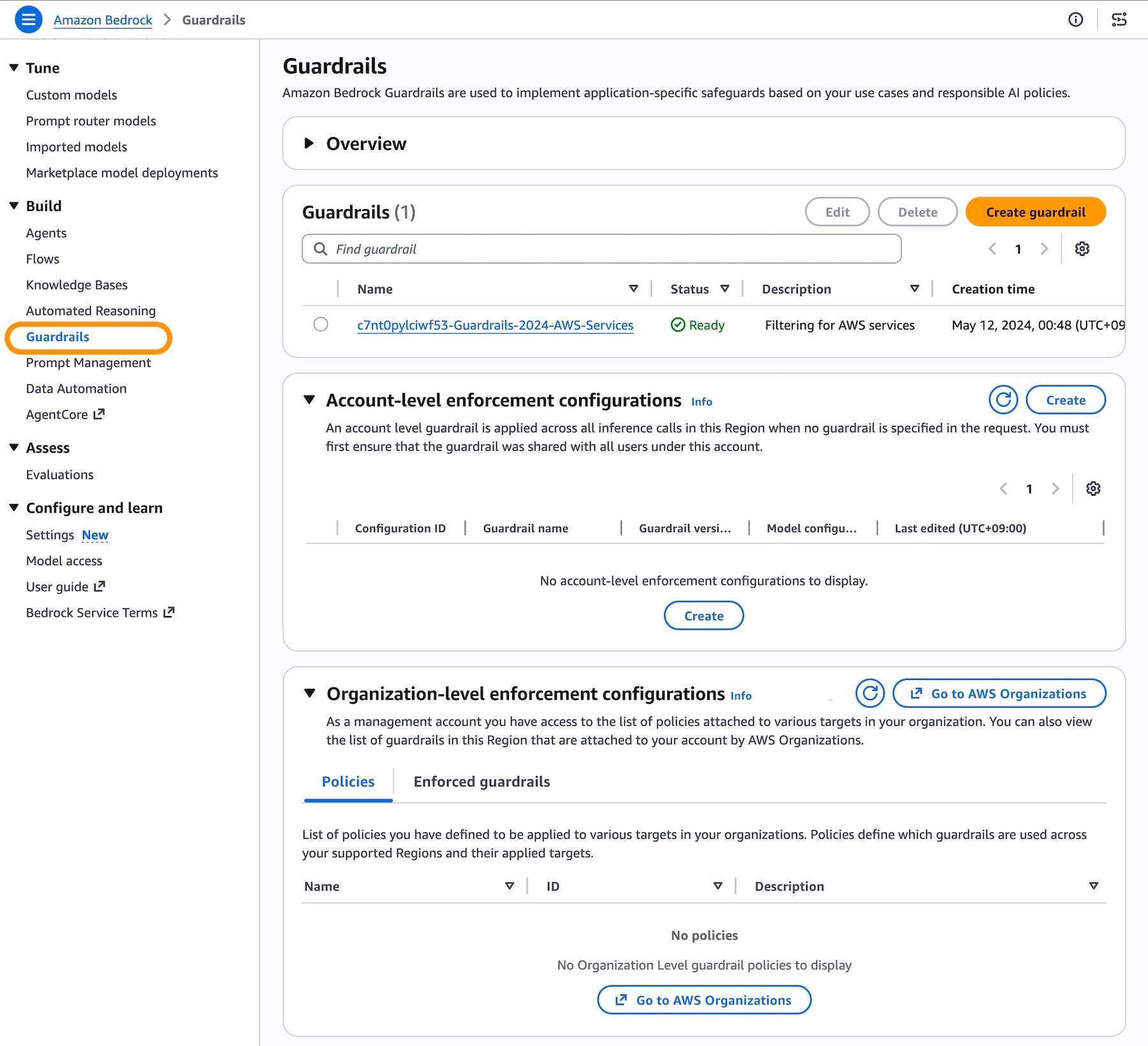
Getting started with centralized enforcement in Amazon Bedrock Guardrails You can get started with account-level and organization-level enforcement configuration in the Amazon Bedrock Guardrails console. Before the enforcement configuration, you need to create a guardrail with a particular version to support the guardrail configuration remains immutable and cannot be modified by member accounts and complete prerequisites for using the new capability such as resource-based policies for guardrails.
To enable account-level enforcement, choose Create in the section of Account-level enforcement configurations.
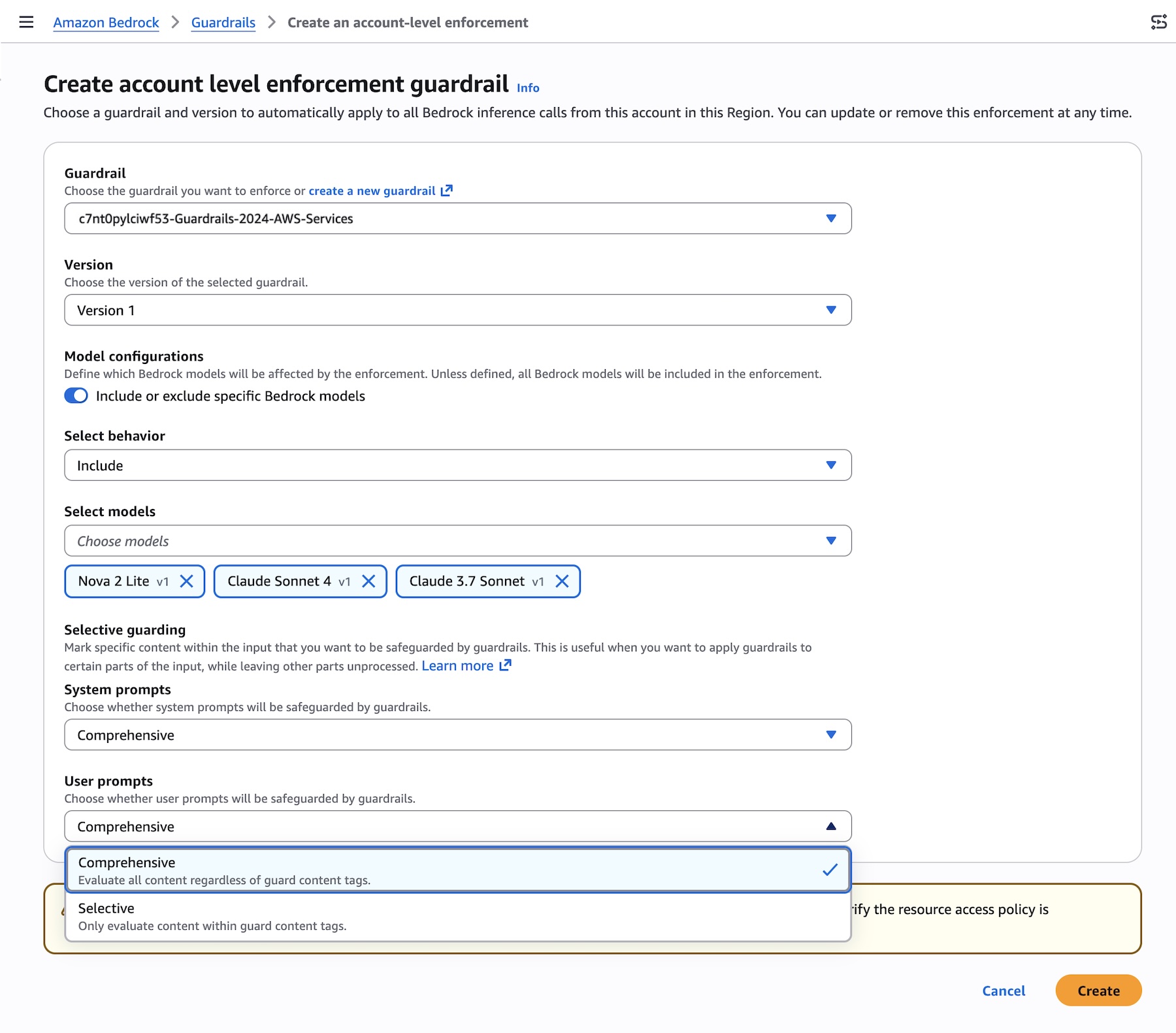
You can choose the guardrail and version to automatically apply to all Bedrock inference calls from this account in this Region. With general availability, we introduce the new feature defining which models will be affected by the enforcement with either Include or Exclude behavior.
You can also configure selective content guarding controls for system prompts and user prompts with either Comprehensive or Selective.
Use Comprehensive when you want to enforce guardrails on everything, regardless of what the caller tags. This is the safer default when you don’t want to rely on callers to correctly identify sensitive content.
Use Selective when you trust callers to tag the right content and want to reduce unnecessary guardrail processing. This is useful when callers handle a mix of pre-validated and user-generated content, and only need guardrails applied to specific portions.
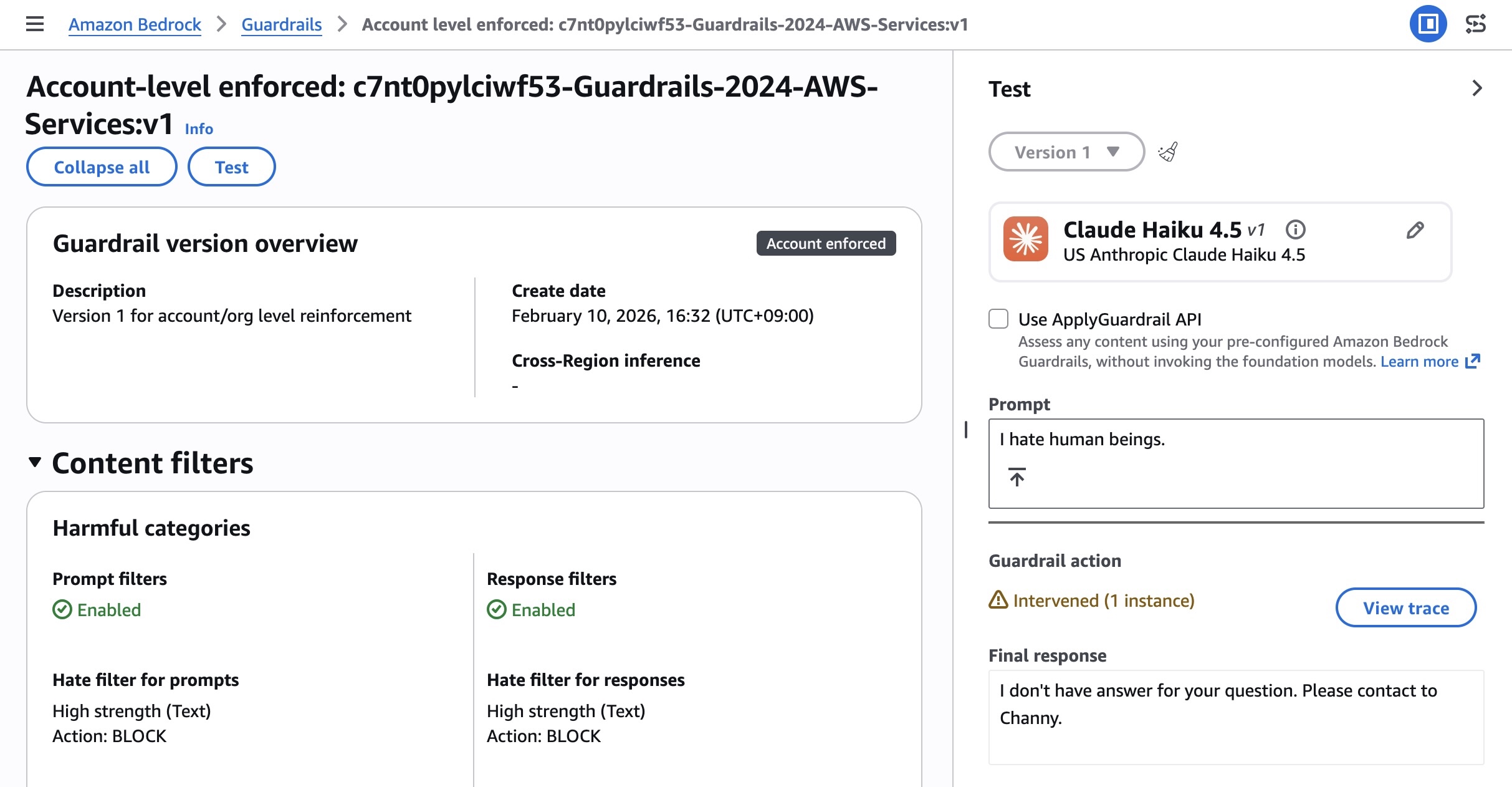
After creating the enforcement, you can test and verify enforcement using a role in your account. The account-enforced guardrail should automatically apply to both prompts and outputs.
Check the response for guardrail assessment information. The guardrail response will include enforced guardrail information. You can also test by making a Bedrock inference call using InvokeModel, InvokeModelWithResponseStream, Converse, or ConverseStream APIs.
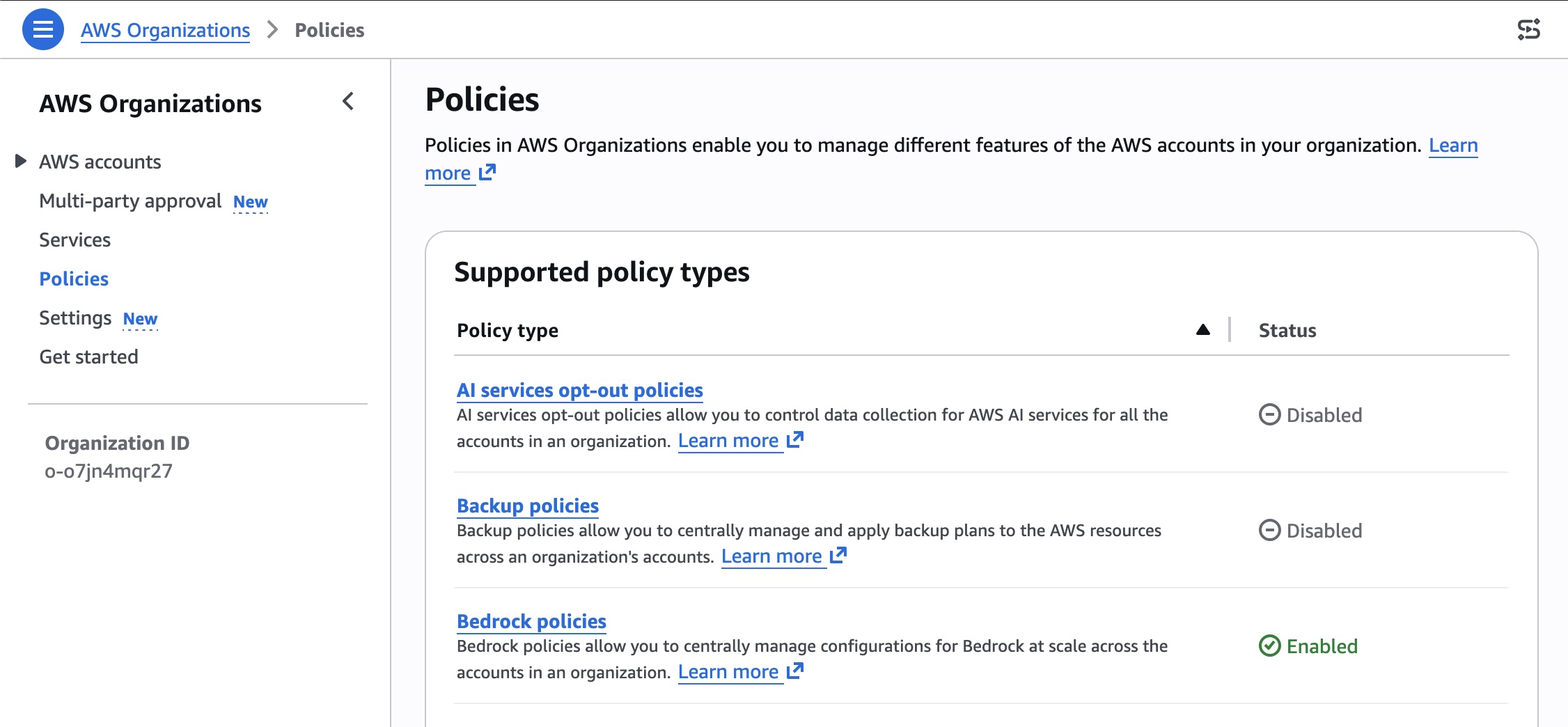
To enable organization-level enforcement, go to AWS Organizations console and choose Policies menu. You can enable the Bedrock policies in the console.
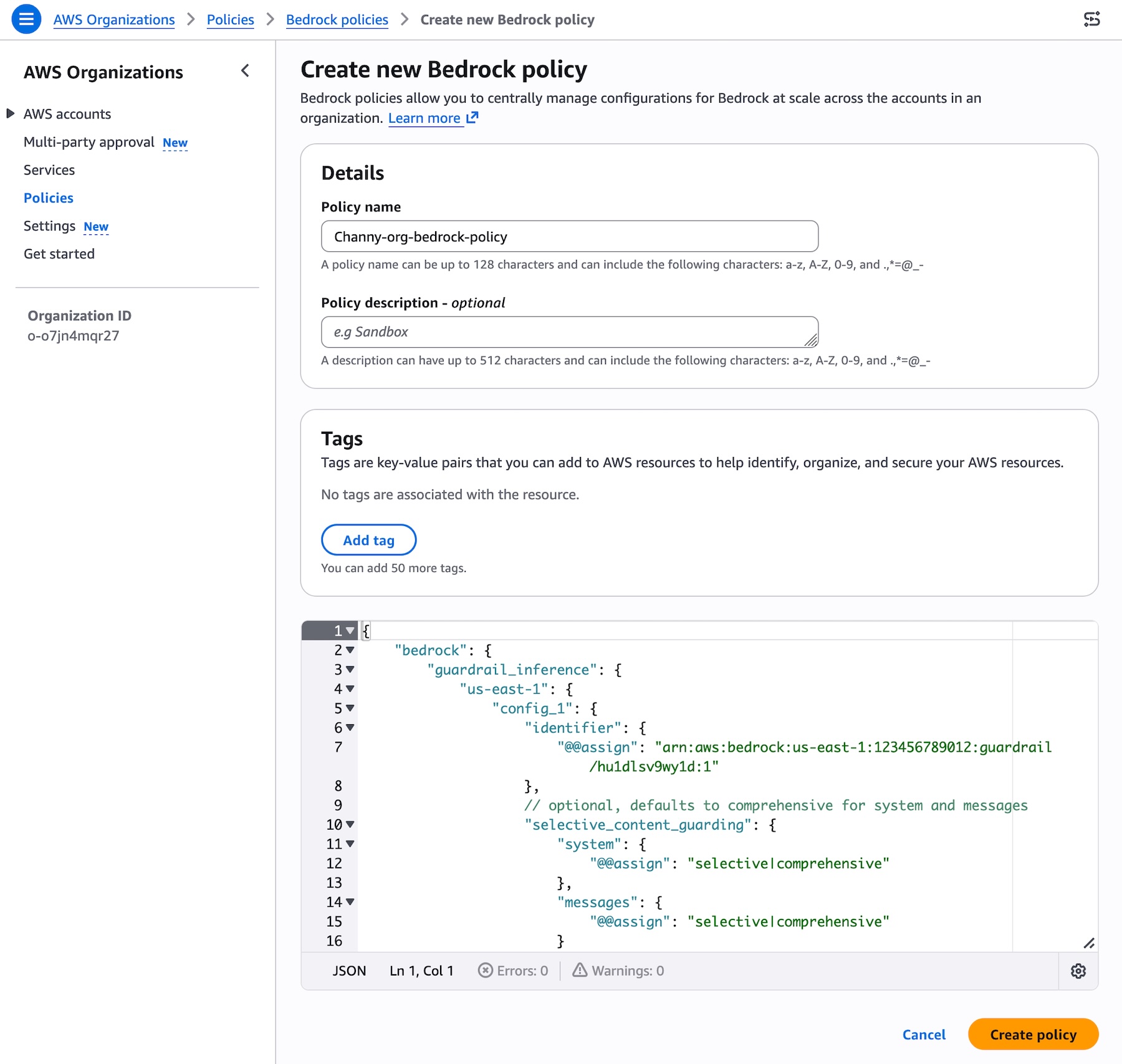
You can create a Bedrock policy that specifies your guardrail and attach it to your target accounts or OUs. Choose Bedrock policies enabled and Create policy. Specify your guardrail ARN and version and configure the input tags setting for in the AWS Organizations. To learn more, visit Amazon Bedrock policies in AWS Organizations and Amazon Bedrock policy syntax and examples.
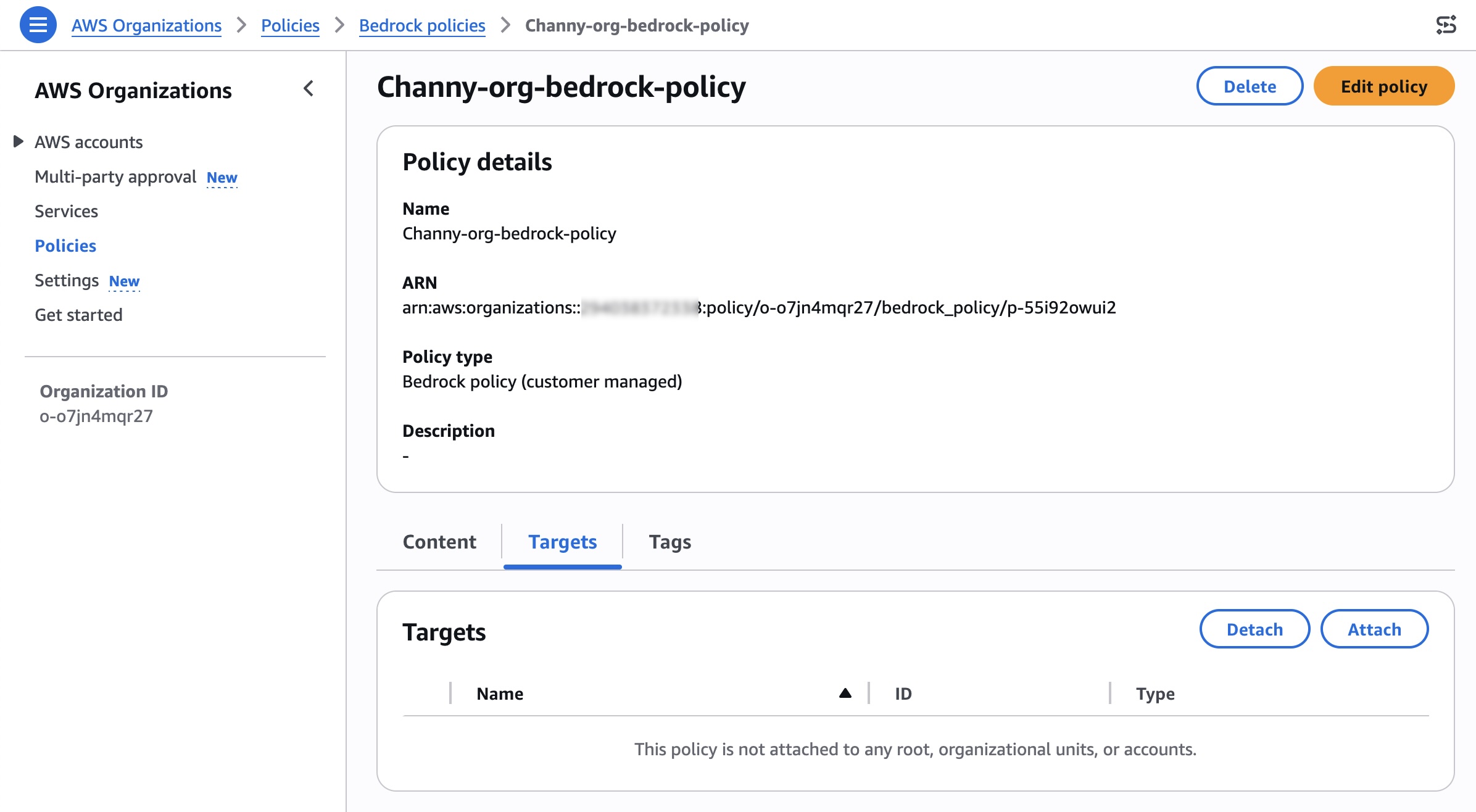
After creating the policy, you can attach the policy to your desired organizational units, accounts, root in the Targets tab.
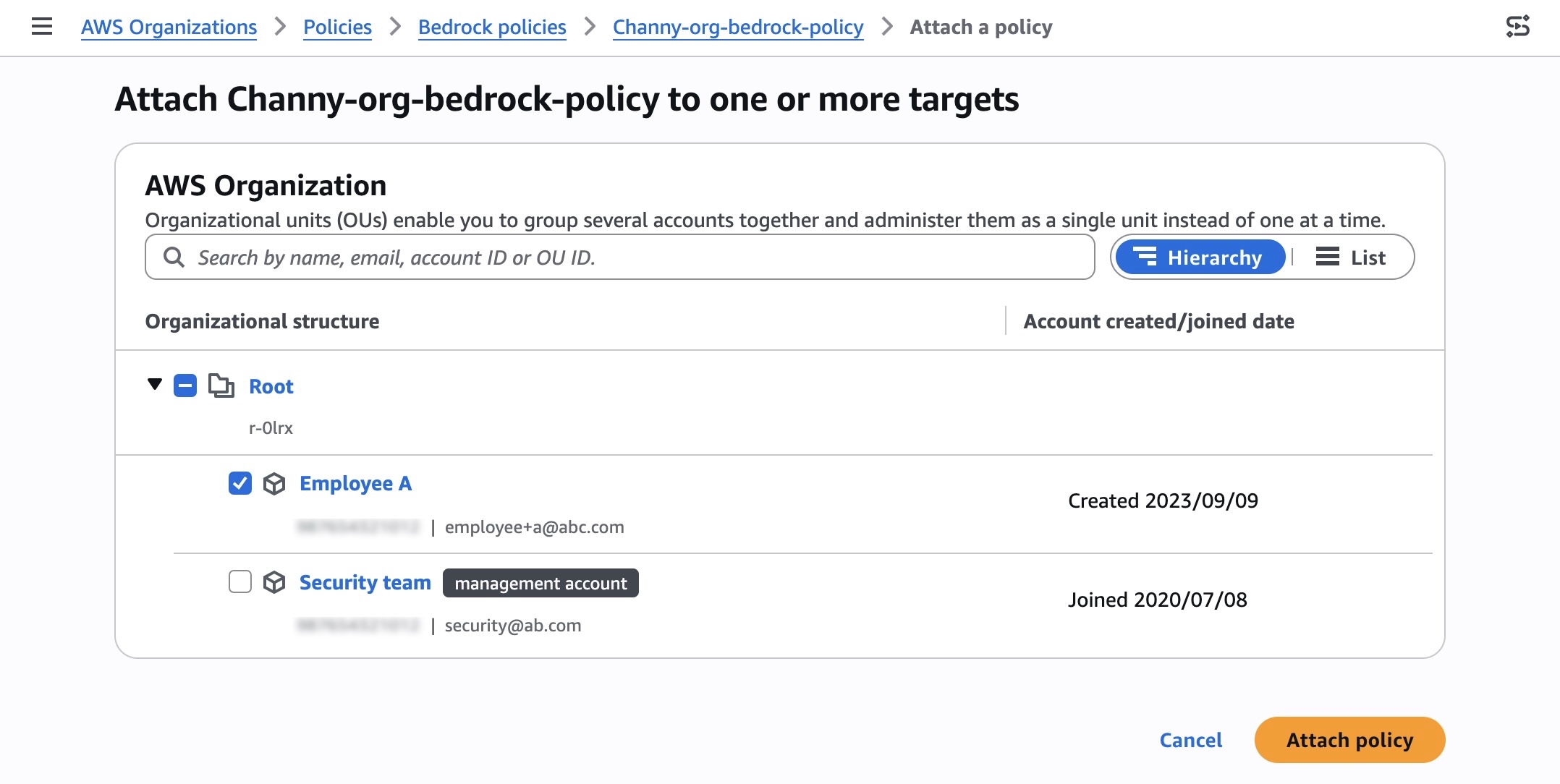
Search and select your organization root, OUs, or individual accounts to attach your policy, and choose Attach policy.
You can test that the guardrail is being enforced on member accounts and verify which guardrail is enforced. From a member account attached, you should see the organization enforced guardrail under the section Organization-level enforcement configurations.
The underlying safeguards within the specified guardrail are then automatically enforced for every model inference request across all member entities, ensuring consistent safety controls. To accommodate varying requirements of individual teams or applications, you can attach different policies with associated guardrails to different member entities through your organization.
Things to know Here are key considerations to know about GA features:
You can now choose to include or exclude specific models in Bedrock for inference, enabling centralized enforcement on model invocation calls. You can also choose to safeguard partial or complete system prompts and input prompts. To learn more, visit Apply cross-account safeguards with Amazon Bedrock Guardrails enforcement.
Ensure you are specifying the accurate guardrail Amazon Resource Names (ARN) in the policy. Specifying an incorrect or invalid ARN will result in policy violations, non-enforcement of safeguards, and the inability to use the models in Amazon Bedrock for inference. To learn more, visit Best practices for using Amazon Bedrock policies.
Automated Reasoning checks are not supported with this capability.
Now available Cross-account safeguards in Amazon Bedrock Guardrails is generally available today in the all AWS commercial and GovCloud Regions where Bedrock Guardrails is available. For Regional availability and a future roadmap, visit the AWS Capabilities by Region. Charges apply to each enforced guardrail according to its configured safeguards. For detailed pricing information on individual safeguards, visit Amazon Bedrock Pricing page.
This week, we added a whole new bunch of HTTP/HTTPS-based CMD payloads for X64 and X86 versions of Windows. The additional breadth of selectable payloads and delivery techniques allows users new options to tailor the attack workflow for their environment. This was contributed by bwatters-r7. Adding new architectures for adapted payloads is surprisingly easy and something a first-time contributor might want to look into!
New modules added to Metasploit Framework also allow for targeting FreeScout and Grav CMS, both of which result in remote code execution. These modules were contributed by Chocapikk and x1o3 respectively. Thanks!
Thanks to g0tmi1k, Metasploit Framework now also includes an exploit module, multi/http/os_cmd_exec, which allows for targeting generic HTTP command execution vulnerabilities where user-supplied input is directly passed to system execution functions via an HTTP request. This can result in a Meterpreter shell on the remote target.
To round this week off, we have a new persistence technique on Windows, thanks to Nayeraneru, which abuses the HKCU\Environment\UserInitMprLogonScript registry value to execute a payload at user logon.
New module content (5)
FreeScout Unauthenticated RCE via ZWSP .htaccess Bypass
Description: This adds an exploit module for CVE-2026-28289, an unauthenticated remote code execution vulnerability in FreeScout versions prior or equal to 1.8.206.
Grav CMS Admin Direct Install Authenticated Plugin Upload RCE
Description: This adds a new exploit module for CVE-2025-50286, an authenticated RCE vulnerability in Grav CMS 1.1.x–1.7.x with Admin Plugin 1.2.x–1.10.x. The module exploits the Direct Install feature to upload a malicious plugin ZIP and execute an arbitrary PHP payload as the web server user.
Description: Adds a new exploits/multi/http/os_cmd_exec module that targets generic HTTP command execution vulnerabilities where user-supplied input is directly passed to system execution functions via an HTTP request.
Description: This adds a new Windows persistence module that abuses the HKCU\Environment\UserInitMprLogonScript registry value to execute a payload at user logon.
Description: This adds HTTP and HTTPS fetch payloads for 32-bit Windows targets.
Enhancements and features (8)
#20999 from Aaditya1273 – Removes the legacy windows/local/persistence module, which has been superseded by the modernized windows/persistence/registry module. A moved_from alias ensures that existing scripts and workflows referencing the old module path are automatically redirected to the new one with a deprecation warning.
#21090 from g0tmi1k – Updates multiple modules to make use of report_service().
#21097 from g0tmi1k – Updates auxiliary/scanner/ftp/anonymous.rb to report the FTP service regardless of anonymous being enabled.
#21144 from Nayeraneru – Improves YARD documentation for lib/msf/core/auxiliary/web/http.rb by documenting the Request and Response helpers, the public HTTP request APIs, and the internal custom-404/request-handling flow.
#21145 from Nayeraneru – Adds YARD docs to lib/msf/core/auxiliary/auth_brute.rb, focusing on the AuthBrute mixin’s credential-building, brute-force state, logging, and cleanup helpers.
#21150 from Nayeraneru – Adds YARD documentation to lib/msf/core/payload/adapter/fetch.rb to improve consistency and clarify how the fetch adapter generates URIs, builds fetch commands, and resolves platform-specific execution behavior.
#21194 from bcoles – This updates the post/linux/gather/enum_protections module by adding documentation and additional checks for modern protections and applications.
#21214 from adfoster-r7 – Adds additional validation to db_import before attempting to import values.
#21048 from zeroSteiner – Not written – add release notes directly to the pull request, then regenerate. Do not edit manually without ensuring the pull request has the release note present.
Bugs fixed (6)
#21004 from EclipseAditya – This fixes a bug in the #normalize_key method provided by the Windows Registry mixin. The result is correct behavior when using shell sessions to check for keys with trailing \ characters.
#21138 from g0tmi1k – Fixes a bug that stopped the auxiliary/server/dhcp module from running as a background job when RHOSTS had been set.
#21188 from adfoster-r7 – Fixes a crash on older Ruby versions when scanning binary files.
#21199 from Hemang360 – Fixes crash in auxiliary/scanner/http/wp_perfect_survey_sqli when run against invalid or unreachable targets.
#21207 from zeroSteiner – Fixes warning when running the linux/gather/enum_protections module.
#21208 from adfoster-r7 – Fixes multiple warnings in modules that reported notes incorrectly.
#21073 from Hemang360 – Fixes a bug where running exploit/multi/handler with a reverse HTTP/HTTPS payload multiple times on the same port caused cleanup issues.
Documentation added (6)
#21149 from Adithyadspawar – Adds documentation to the following login scanners: ftp/bison_ftp_traversal, http/apache_activemq_traversal, http/coldfusion_version, http/drupal_views_user_enum and http/elasticsearch_traversal.
#21186 from Devansh7006 – Adds documentation for the wordpress_pingback_access module.
#21187 from Devansh7006 – Updates documentation for auxiliary/scanner/http/http_put.
#21200 from dineshg0pal – Updates the example code snippet for writing Metasploit Go modules.
#21201 from aryan9190 – Adds YARD documentation for Rex::Post::IO class.
#21217 from dineshg0pal – Fixes minor errors in documentation files.
You can always find more documentation on our docsite at docs.metasploit.com.
Get it
As always, you can update to the latest Metasploit Framework with msfupdate and you can get more details on the changes since the last blog post from GitHub:
To provide the best experiences, we use technologies like cookies to store and/or access device information. Consenting to these technologies will allow us to process data such as browsing behavior or unique IDs on this site. Not consenting or withdrawing consent, may adversely affect certain features and functions.
Functional
Always active
The technical storage or access is strictly necessary for the legitimate purpose of enabling the use of a specific service explicitly requested by the subscriber or user, or for the sole purpose of carrying out the transmission of a communication over an electronic communications network.
Preferences
The technical storage or access is necessary for the legitimate purpose of storing preferences that are not requested by the subscriber or user.
Statistics
The technical storage or access that is used exclusively for statistical purposes.The technical storage or access that is used exclusively for anonymous statistical purposes. Without a subpoena, voluntary compliance on the part of your Internet Service Provider, or additional records from a third party, information stored or retrieved for this purpose alone cannot usually be used to identify you.
Marketing
The technical storage or access is required to create user profiles to send advertising, or to track the user on a website or across several websites for similar marketing purposes.