Post Syndicated from The Atlantic original https://www.youtube.com/shorts/MpIt4fSLFdg
Данни за българите в Германия за 2025
Post Syndicated from Боян Юруков original https://yurukov.net/blog/2026/bgde-2025/
От над десетилетие следя данните за диаспората ни в Германия. Разглеждал съм различни аспекти като защо имаме няколко различни числа за броя им, колко деца се раждат на българи в Германия, както и социалните, образователните и икономическите показатели. В края на този текст ще пусна списък с всичките ми статии по темата.
Повечето данни, които разглеждам идват от DeStatis – немското НСИ. В последните два месеца излязоха два ресурса от тях – данните на имиграционните и тези от т.н. микропреброяване. Макар да съм критикувал доста числата на имиграционните им, те са единствените, които имаме с разбивка по общини. Т.е. само от тях може да научим къде точно са българите в Германия. Има още няколко числа посочващи общия брой българи в Германия обаче, които е важно да разберем.
Българите в Германия намаляват
През февруари описах подробно защо има различни числа за броя българи в Германия, как се различават те, какво значат, какво показват и какви условности имат. Накратко, имиграционните казват, че през 2023-та в Германия е имало 436860 хора с българско гражданство, а според адресите регистрации статистическата служба казват, че са 410623. След преброяването в Германия обаче, последното число обаче е коригирано с около 10% надолу и вече ще намерите, че българите в Германия са 371128 през 2023-та. В този брой не се включват българите взели германско гражданство, които са между 1600 и 2800 в последните 10 години.
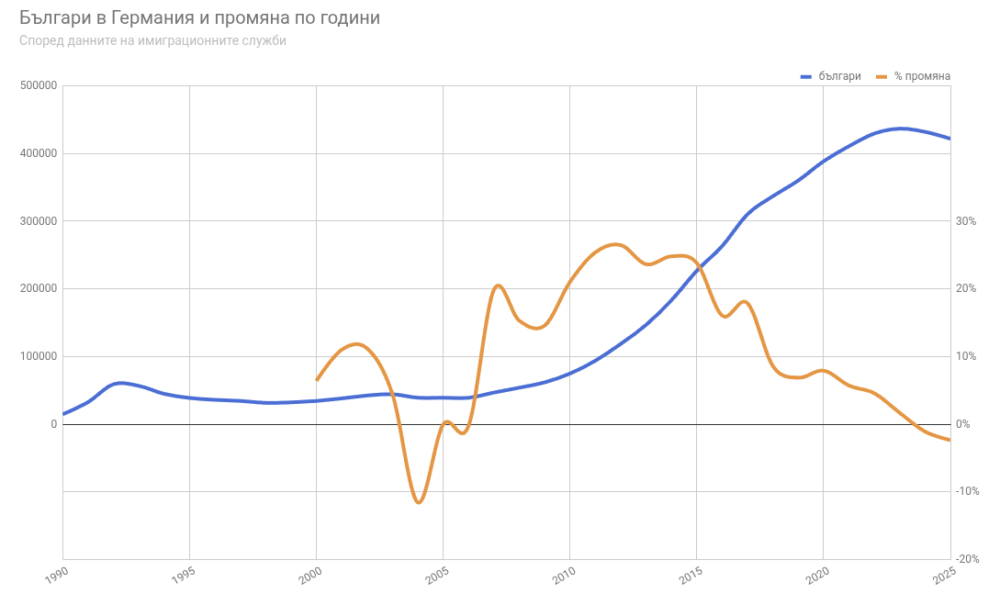
През 2024-та година виждаме намаление в оценките за диаспората ни – имиграционните отчитат 1.1% намаление или 4780 души на 432080, а по адресна регистрация намалението е с 2.4% на 362421. За 2025-та имаме данните само на имиграционните и виждаме ускоряване на намалението с 2.36% или 10185 души достигайки 421895 български граждани. Данните за демографията на Германия ще излязат през август, така че тогава ще разберем колко е тяхната оценка за намаление.
На долната графика виждате динамиката на данните на имиграционните от 1990 до сега. В жълто е промяната година за година в процент. Виждаме, че през 2004-та година е имало за кратко намаление и почти никаква промяна през 2005 и 2006-та. След присъединяването към ЕС се вижда няколко години подред 25% растеж в миграцията ни, който обаче отслабва след 2017-та поради редица фактори в България и най-вече в Германия. След короната практически се изравняват напусналите и пристигащите се в Германия като в последните две вече намаляват.
Карта на българите по общини
В последните 10 години поддържам една карта, която показва оценката на имиграционните къде се намират българите по общини. Пуснал съм картата в статии подобни на тази през времето, които ще намерите в линковете накрая. Тази година освен, че обнових данните, реших да обновя картата. Първо защото кодът ѝ беше на десетилетие, второ, защото открих някои неточности и исках да я направя по-функционална.
Картата разглежда периодът от 1998-ма до сега. Междувременно е имало няколко промени на административното делене в Германия, където общини са били сливани, свободни градове са променяли статута си и прочие. Това усложнява задачата за разглеждане на данните, тъй като тези за предходни години трябва да се преразпределят в различно териториално деление в сегашния контекст. Отделно на места като Saarland събират данни за няколко общини наедно, затова съм ги събрал. Доколкото отчитах тези промени в миналото, заех се да преразгледам всички такива в последните 30 години и да ги отбележа наново. На картата виждате сегашното административно делене на Германия и в сегашните общини се събират демографската и имиграционна статистика от предишни години преди промените.
Друга промяна е, че направих картата да работи на цял екран и на мобилно устройство. Добавих изглед освен абсолютен брой на българите и индекс спрямо населението (българи на всеки 100 хиляди души), също и промяна в броя българи спрямо предходната година. Така може да се види по-лесно къде има отлив на българи и къде има увеличение. Не показвам тази оценка за места, където има до 50 българи, защото тогава дори 10 добавени ще означават 20% увеличение, което не е толкова релевантно. Остава възможността за анимация, която може да пуснете през менюто и ще върти през годините, за да покаже нагледно промените. Натискайки на отделна община ще покаже графика само за нея и детайли като съотношение мъже/жени, население и прочие.
Картата може да разгледате и на цял екран тук.
Демографски аспекти
Следващите данни и числа се базират на т.н. микро-преброяване. Това е редовно допитване, което немската статистическа служба осъществява, което допълва интересни аспекти за населението на Германия. В случая – миграцията. Таблиците им ще намерите тук. Достъпна информация за самото преброяване има тук. Следващите изводи и графики се основават на тези данни за 2025-та като използвам същите методи и изчисления като в предходните ми статии по темата. Поради промяна в параметри, метрики и възрастови отрязъци обаче сравнение с предходни години не винаги възможно.
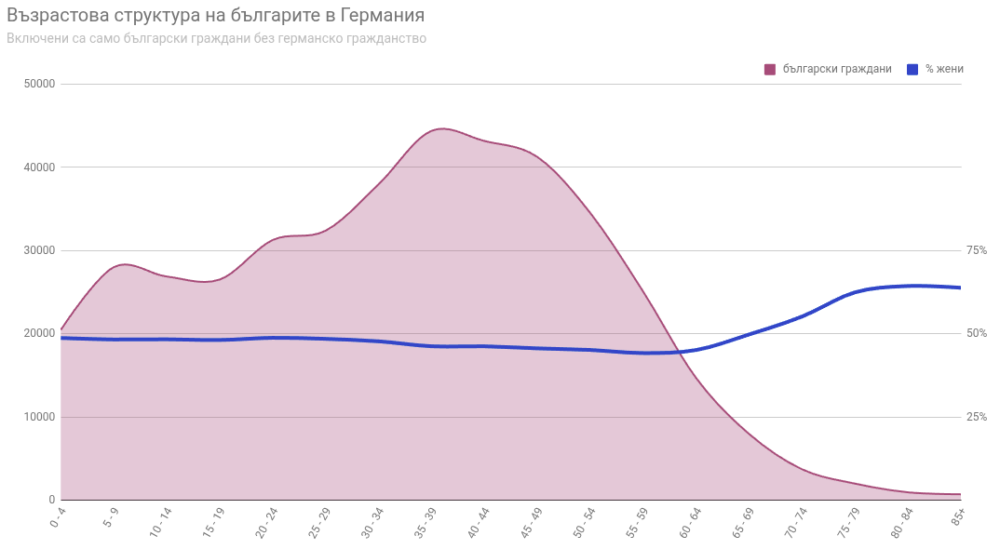
На долната графика ще видите възрастовата структура на диаспората ни. Виждате, че най-много хора има между 30 и 50 годишна възраст. Разпределението мъже/жени не изненадва и следва това,което срещаме в България. Вижда се ясно, че има все по-малко хора между 19 и 30 годишна възраст, което потвърждава тенденцията описана горе.
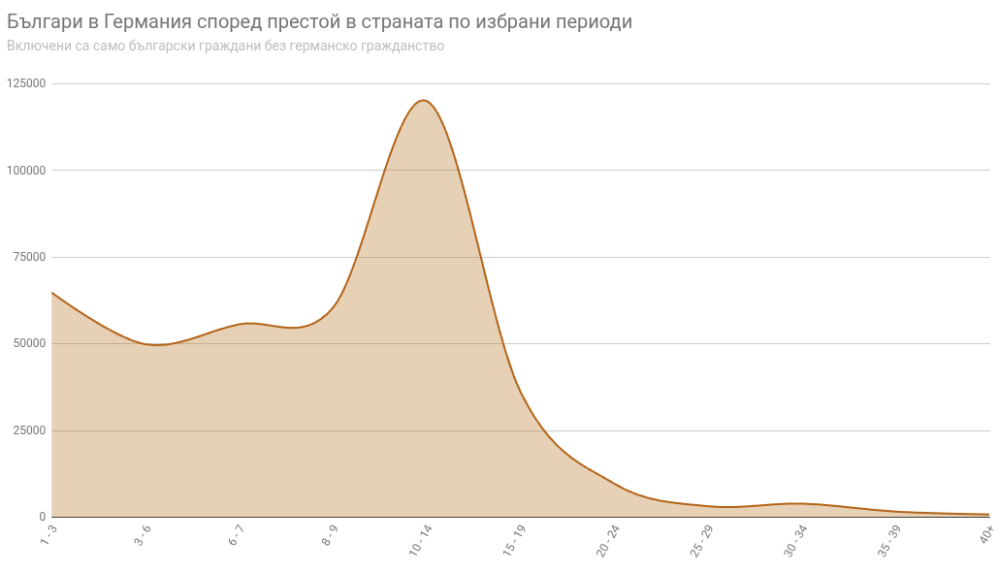
На следващата графика виждаме колко време са стояли българите в Германия. Избраните периоди не са с равномерен отрязък, тъй като се базира на това как имиграционните водят статистиката си, а тях ги интересува колко хора имат право на немско гражданство след 7-мата и 8-мата година. Тук виждаме, че най-много българи вече за минали 10-тата година престой в Германия. На този фон намаляващия дял на българите взели немско гражданство всяка година трудно може да се обясни само с тромавата администрация. Изглежда остава мнението сред диаспортата ни, че няма особен смисъл.
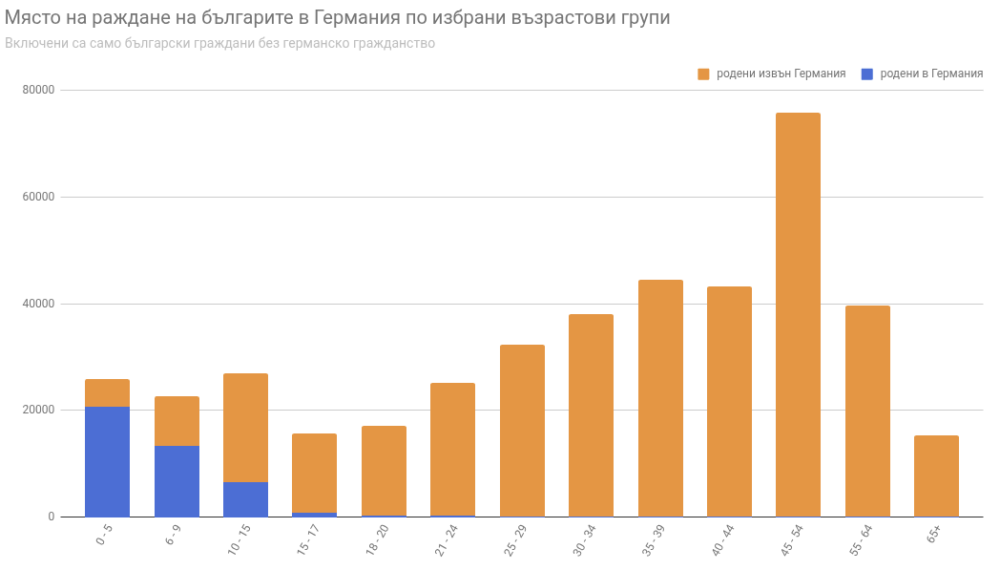
Интересен е погледа над това къде са родени българските граждани в Германия. Тук виждаме, че мнозинството от българчетата до 5 г. са родени в страната, както и над половината от тези между 6 и 9 години. Това значи, че са деца на мигранти, които все още нямат право на немско гражданство. В противен случай биха получили автоматично такова и нямаше да се причисляват към тази статистика. Пикът при възрастите над 45 г. е поради това, че в статистиката ги бяха групирали на 10 годишни отрязъци.
В данните от микропреброяването виждаме и няколко нови интересни метрики, които дават нов изглед над произхода на българските граждани в Германия. Една от тях е за месторождението по държави.
Както споменах, оценката на имиграционните за българите в страната е за 421895. От тях обаче 77.8% са родени в България. 10.1% са родени в Германия, както се вижда на графиката горе. 18165 български граждани или 4.3% са родени в Македония. 6255 или 1.5% са родени в Турция – най-вероятно наследниците на насилствено изселените български турци. 4395 или около 1% са родом от Молдова. Иначе казано, 22% от диаспората ни или около 39 хиляди български граждани в Германия не са родени в България.
94.8% от българите са в западна Германия. По провинции най-много има в Nordrhein-Westfalen – 24.2%, следвана от Bayern – 15.5% и Baden-Württemberg с 12.3%.
В това число не се включват обаче тези, които са взели германско гражданство. Според оценката на имиграционните това са 33 хиляди души родени в България. Доколкото някои от тях са се отказали от българското си гражданство, тези случаи са около 4 хиляди и са предимно от преди приемането ни в ЕС. 29 хиляди души родени в България имат двойно гражданство като жените са две трети от тях. Сред децата на българи родени в Германия, за които родителите им се е занимавало да извадят български акт за раждане, 15 хиляди има двойно гражданство и разпределението момчета и момичета е равномерно. Общо 44 хиляди български граждани имат двойно гражданство според германските институции.
Социални аспекти
Следващите данни се отнасят само за хората в Германия, които са родом от България и нямат германско гражданство, както и за техните деца и домакинства.
39% от българите в Германия са неженени. 52.9% имат брак като 84.8% от тези с брак към са се оженили за друг мигрант в Германия – предимно други българи. Това е високо предвид повечето млади хора в диаспората ни спрямо населението на България и причината е, че има финансова изгода – със семейното доходно облагане включването на брак дори фиктивно намалява данъчната тежест в мнозинството от случаите. Около 5.48% са разведени.
12.6% от българите са все още в училищна възраст или са в университет. От останалите, 32.5% имат завършено само основно образование. 31% имат само средно. Отгоре на тях още 18.5% имат професионално и само 18% имат някакво висше образование, което не е дори непременно университет. Писал съм за този аспект преди и как влиза в противоречие с възприятието на обществото за структурата на имиграцията ни.
Като домакинства, 61% от българите в Германия живеят в семейства с деца. Трудно е да се прецени колко средно деца имат, тъй като тази статистика не отчита партньорите немци, както и децата с немско гражданство. 19.7% от хората родени в България, но живеещи в Германия живеят в двойки без деца. 18.4% живеят сами като 26% тях се налага да споделят жилище с други (т.н. WG или просто съквартиранти).
58.4% от българите са заети. Тук интересното е, че тези нива са значително по-високи от средното за Германия. Само 47.9% от жените в Германия са заети – без значение гражданство или произход. Сред жените мигрирали в Германия средното е 49.1%. При българките – 53.1%. Аналогично е при мъжете – средното за всички в Германия е 54.9%. Сред мигрантите – 62.09%, а сред българските мъже – 64.9%.
По часове на графиката долу виждаме, че мнозинството работи по около 40-42 часа седмично. Почти толкова българки обаче работят на половина работен ден, колкото на пълен. Основна причина за това, според мен, е лошият достъп до детски градини и късият им график. Често затварят в 4 или 5 следобед. Същото важи и за доста училища, където местата в занималните не стигат. Това е особено вярно в големите градове, където мнозинството от съгражданите ни живеят.
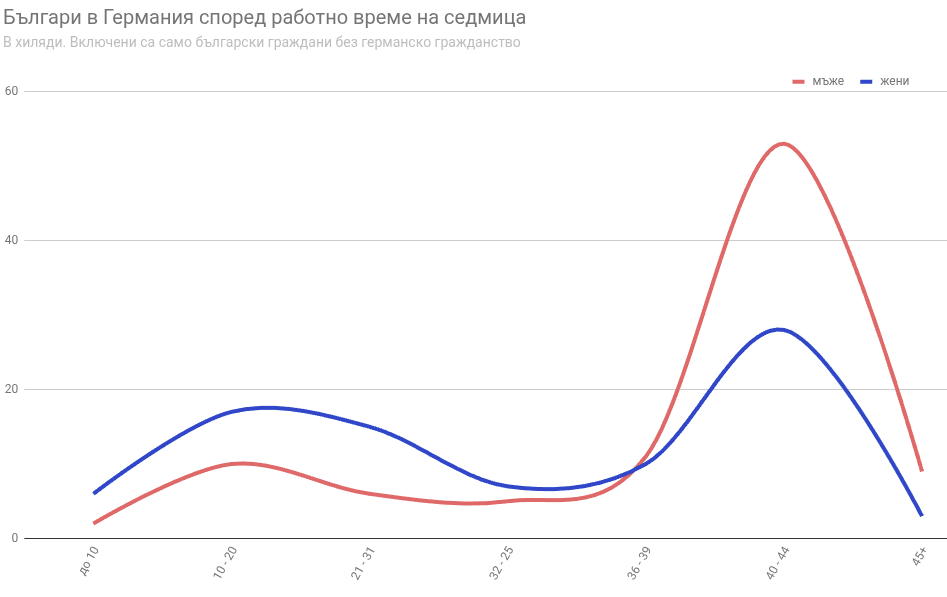
32% от сънародниците ни работят в неделя като отново има превес при мъжете – 34.4% спрямо 30.2% за жените. 21.6% работят в неделя и 16.6% работят на смени. 24.3% работят в производството. 34.3% работят в магазини, места за настаняване или транспорт.
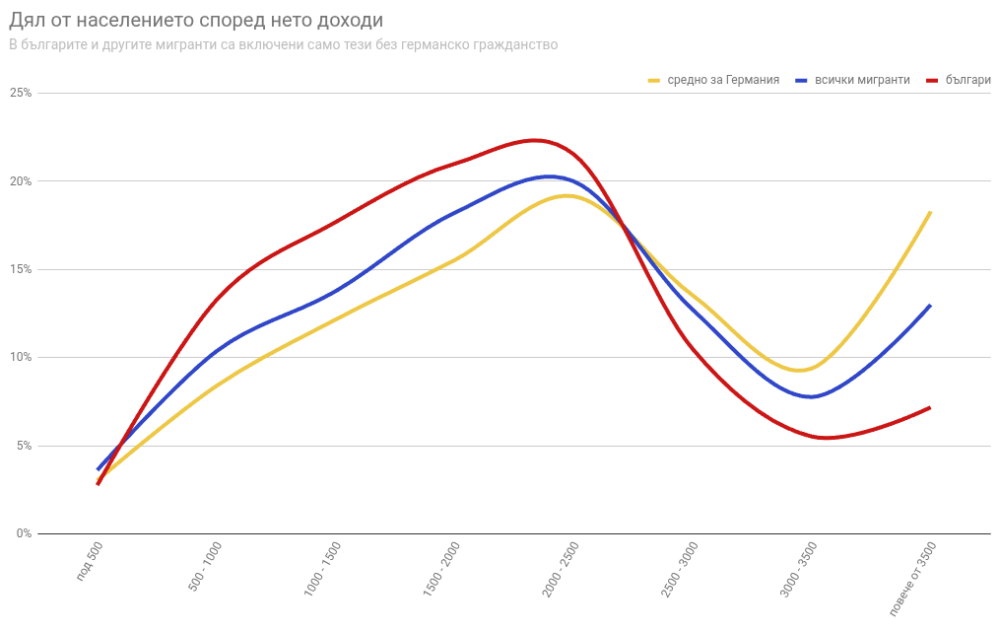
Гледайки доходите, най-голямата група българи в Германия (около 43%) получава между 1500 и 2500 евро чисти (т.е. нето). При жените доходите са значително по-ниски и най-голямата група получава между 1000 и 2000 евро нето. Причините за това са отчасти по-малкото отработени часове, но и редица типични за Германия и Европа фактори ограничаващи растежа в кариерата. Разбира се, от тези „чисти“ пари, не сме приспаднали значителните местни такси, сметки за ток, множеството практически задължителни застраховки и прочие.
Средно може да кажем, че работещите българи получават около 1986 евро нето. При жените това е 6.9% по-малко на 1849 евро, а при мъжете – 6.4% повече и 2114 евро нето. Тези стойности са значително по-ниски за средното за Германия. Нето заплатата на българите е 11% по-ниска от средното за страната. При жените е аналогична заплатата спрямо средното за мигрантите, но отново с 11% надолу спрямо всички работещи жени в Германия. При мъжете разликата е по-драматична – 16% по-малко от средното за всички мигранти и 23.5% по-малко от средното за страната.
На следващите графики виждате разбивка по нето доходи и какъв дял от съответната демография спада към коя група. Първо виждате средно за хората в Германия родени в България като сравнение с другите мигранти и всички в страната. Вижда се, че мнозинството получават под 2500 евро и много малък дял получават над 3500 в сравнение със средното за страната.
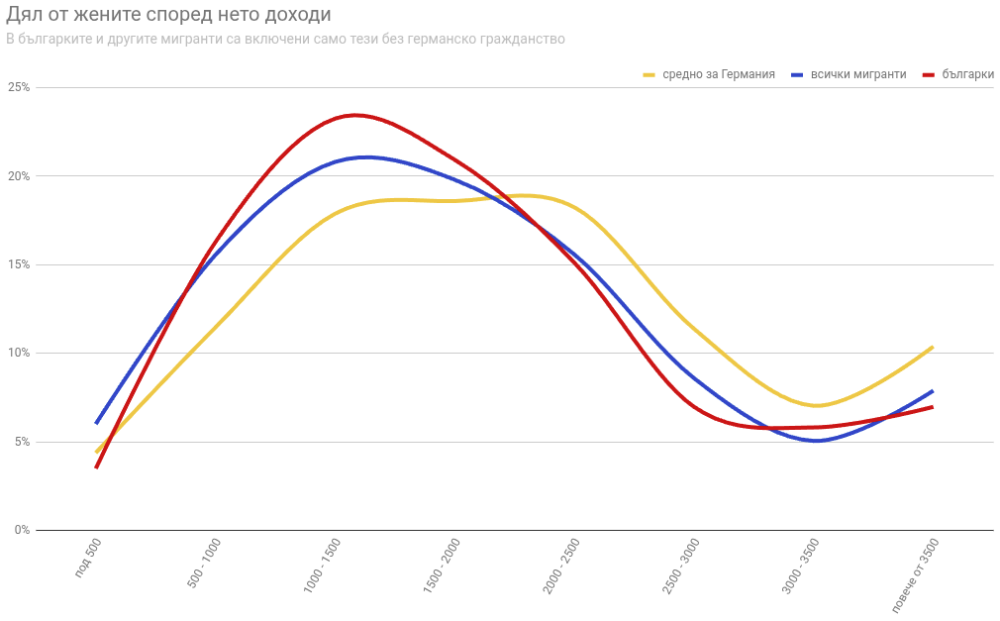
В следващите две графики виждате разбивка на мъже и жени отделно. При жените се забелязва подобна крива сред българките и всички мигрантки. Тази е за българките е с определена грешка заради по-малката извадка и закръглянето от DeStatis до 1000 души. Интересно е, че кривата сред всички жени в Германия не много по-различна. Това дава допълнителни индикации за структурните проблеми в Германия по отношение на възможностите, образованието и подкрепата в семейството влияещи на тези и други индикатори за равенство на половете.
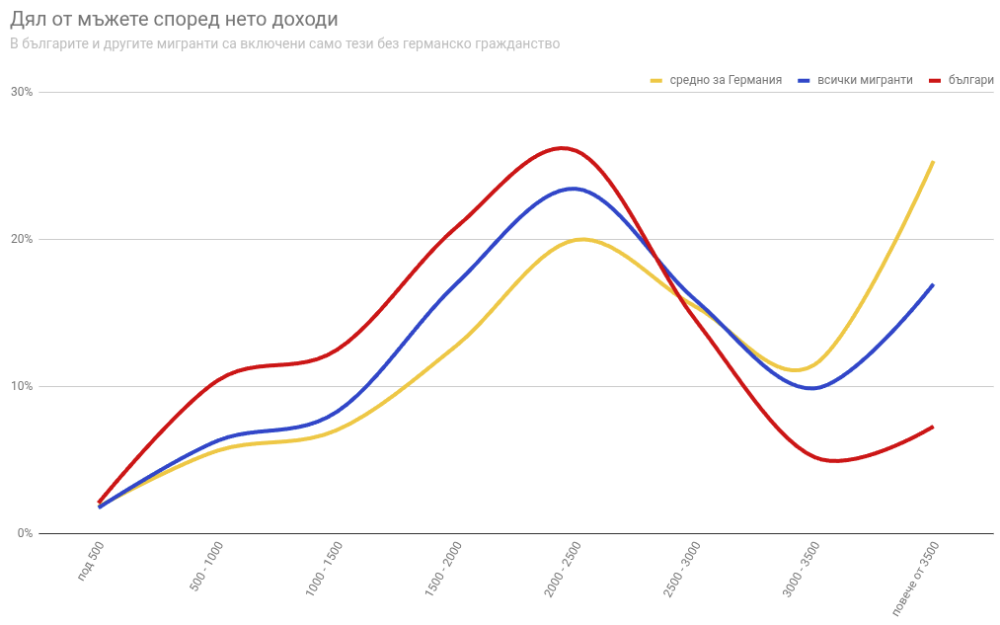
При мъжете се вижда аналогични криви, но с отчетливо изместване на по-голямата част от сънародниците ни към позиции със значително по-ниски доходи. Докато най-голям дял от хората в Германия печели над 3500 евро нето, аналогичен дял сред българите прибира двойно по-малко на месец.
Разчитайки само на тези доходи получаваме, че поне 34.3% от българи пренесли се в Германия живеят под прага на бедността. Ако добавим допълнителните социални помощи този дял намалява на 22.9%. Това отново е доста над средното за България за 2025-та от 21.2%. Някой ще оспорят, че линията на бедност е различна и означава различни неща. Индикаторът обаче е условен с причина и се отнася до разпределението на доходите на населението по еднаква формула. Линията на бедността е условна и е индикатор каква част от населението има проблем да свързва двата края независимо, че работи. Много от тези хора под линията са т.н. работещи бедни.
Сред работещите българи има 42% по-голяма вероятност да живеят в бедност въпреки труда си, отколкото средното за Германия и 21% по-голяма вероятност от всички мигранти. Има сериозна разлика и при половете. При работещите българки в Германия 44.2% са под линията на бедността или 83.3% по-голяма вероятност от средното за населението на Германия и 56.3% повече от средното за всички жени работещи е страната. Подобно е нивото на българките и всички останали мигрантки. При мъжете ни има само 8% по-високо ниво на бедност от средното за цялото население. Ако обаче сравняваме с всички мъже в Германия обаче, вероятността мъж роден в България и работещ в Германия да е под линията на бедността е с 74% по-голяма, отколкото при останалите мъже там. За разлика от жените, има голяма разлика между българските мъже и останалите мигранти – 55% по-висок шанс да са в бедност.
Затова не трябва да ви учудва, че 16.5% получават помощи за безработица и социални. Пенсия получават 3.9%. Още 10.3% получават друга форма на помощ, което значи, че доходите им са твърде ниски, за да свързват двата края. Доколкото виждаме увеличение сред получаващите помощи за безработица (например спрямо 2018-та г. когато отчетох 15%) и намаление сред т.н. бедните работещи, сравнението е подвеждащо. Първо, защото микропреброяването тогава разглеждаше домакинства, а не отделни работещи, но най-вече защото промените в социалната система са причина много хора в затруднено положение да нямат достъп до помощ. Не на последно място, много се говори за работата на черно и как заетостта реално е по-висока. Доколкото го има този феномен, също е вярно, че хиляди българи само се водят проформа регистрирани в Германия надувайки статистиката на отпадналите от трудовия пазар.
Предишни статии за българите в Германия
Тук съм събрал повечето от статиите, които съм писал в последните 14 години за диаспората ни в Германия, икономически и социални аспекти, които ги засягат. Картата поместена горе публикувах за пръв път през август 2017-та. В някои от останалите статии съм публикувал обновени версии, както данни аналогични на тези, които описах горе.
- За данните за българите в Германия и дали се връщат – февруари 2026
- Риск от бедност и изключване за чужденците в Германия – февруари 2026
- Колко и какви са българите в Германия – август 2025 (статия от поредица на Капитал)
- Няколко бързи справки за българите в Германия – февруари 2025
- Данни за българите в Германия за 2023 – юни 2024
- Данни за българите в Германия за 2020 – септември 2021
- Данни за българите в Германия за 2019 – февруари 2021
- Колко са българите в Германия? Зависи кого питаш – април 2020
- Майчинските в Германия и социалният проблем надничащ зад тях – февруари 2020
- Данни за българите в Германия за 2018 – септември 2019
- Майчинските в Германия – април 2019
- Мрънкането на един бг-татко за една детска градина в Германия – декември 2018
- Данни за българите в Германия за 2017 – ноември 2018
- Преброяване на българите в Германия по общини и години – август 2017
- Няколко интересни числа за българите в Германия – декември 2016
- Българите в Германия – последни данни – август 2014
- Калейдоскоп с разходите и инфлацията в Германия – ноември 2013
- Колко български студенти има в Германия? – март 2012
- Престъпността в Германия – март 2012
- Колко българи има в Германия? – март 2012
Други статии свързани с Германия, които може да са ви интересни:
- Тротоари (на цени) като в Германия
- Възстановяване на данък от дивиденти изплатени в Германия
- Поръчване на лекарства с рецепта от Германия
- Промяната в данъчното споразумение с Германия, която засяга всички работещи сезонно там
- Германия вече със задължение да се ваксинира
- Ваксините и една ясла в Германия
Sharp GF-777 The original…& best?
Post Syndicated from Techmoan original https://www.youtube.com/watch?v=et4W90STW1Y
Седмицата (20–25 април)
Post Syndicated from Йовко Ламбрев original https://www.toest.bg/sedmitsata-20-25-april/

През първата седмица след изборите няма как новинарският поток да не бъде подчинен на резултатите от вота и на първоначалните оценки и анализи, провокирани от тях. Очевидно е, че след 19 април 2026 г. политическата сцена в България ще бъде различна и доминирана от нов ключов играч. Би трябвало да напиша, че това е новата партия „Прогресивна България“, но понеже тя бе учредена буквално два дни преди изборите, по-честно ще е да уточним, че победител е бившият президент Румен Радев. Той спечели невиждано отдавна мнозинство, привидяло лично в него това, което му се искаше да види. Тези 44,6% от хората, дали вота си за него, тепърва ще валидират предположенията и надеждите си за идеите и личностите, които ще задават дневния ред на държавата през следващите четири години.
Какво обаче извън предположенията и надеждите е сигурно?
ГЕРБ не просто загубиха изборите, а без малко щяха да останат трета политическа сила в новия парламент. „Възраждане“ едва се закрепиха над 4-процентовата бариера. Жалко! Щяха да липсват на малцина.
На никого няма да липсват със сигурност ИТН, които заслужено безславно приключиха завинаги авантюрите си в политиката. В новия парламент няма да присъстват и БСП, а ДПС (на Делян Пеевски) се сви до малко над 7% подкрепа.
Единствената политическа формация от предишното Народно събрание, която увеличава електоралната си тежест, е коалицията „Продължаваме промяната“ – „Демократична България“ (ПП–ДБ), въпреки атаките на всички срещу тях, преливането на гласове към победителя и собствените им грешки и пропуски, които поне част от лидерите им изглежда да осъзнават.
Юмрукът на Радев след тези избори обаче вече не е символ на бунт, а инструмент на властта, напомня Емилия Милчева в политическия обзор на първата следизборна седмица. Защото абсолютното мнозинство предполага олигархичният модел да бъде „размазан“, както си го представят гласувалите за „Прогресивна България“. И както им беше обещано. Макар те да предоставиха доверието си, без много да се интересуват точно как и от кого ще бъде свършено това. Тези и други въпроси стоят зад заглавието „Радев, ще удряш ли с юмрука?“
Радев, ще удряш ли с юмрука?
Абсолютното мнозинство дава възможност за бързи решения без оправдания. Първият тест е кадровият – ВСС, главен прокурор, регулатори. От него ще се види към обещаната промяна ли се върви, или „юмрукът“ ще пренарежда същата система с други лица. От Емилия Милчева.
 Емилия Милчева

„Видях роботи!“ – възкликва Дарина Сарелска в новия си анализ за „Тоест“, тема на който този път е медийното отразяване на изборния ден и нощта след него. И според нея това възклицание, за жалост, почти напълно изчерпва темата. Защото големите телевизии ползваха хуманоидни роботи и холограми само като екзотичен фон на скучни и остарели журналистически клишета, а в студиата продължиха да дефилират „говорещи глави“ с опорни точки от миналото десетилетие. Текстът търси отговори на въпроса защо при наличието на нови технологии, чиято сила е в бързата проверка на факти, анализа на данни и изобразяването им, водещите телевизии избраха патриотарския кич, преразказ на публикации от социалните мрежи и „пликове с прогнози“ пред модерната журналистика.
Неотразимото медийно отразяване на изборите
В отразяването на изборите телевизиите вкараха роботи, но не и особен смисъл. И това ни показа предимно докъде се простират границите им – и технологични, и редакционни, и най-вече зрителски. На телевизионния фронт нищо ново, освен поредната пропусната възможност. От Дарина Сарелска.
Дарина Сарелска
С новия си коментар за „Тоест“ Светла Енчева предлага да погледнем на случилото се в неделя под малко по-различен ъгъл. А именно дали пък фиксацията върху определени (макар и наболели) теми, като антикорупция и съдебна реформа, и твърде абстрактното им обговаряне не доведоха до тази неочаквана концентрация на власт. Особено на фона на демократичната ни култура в момента, тази концентрация е с потенциал да произведе далеч по-страшни чудовища от тези, от които се опитваме да се отървем.
Казах ви
В случая „казах ви“ е опит за равносметка как някои пренебрегвани процеси, фокусът върху корупцията и страхът от ценностни позиции доведоха до (не)очаквана концентрация на власт. Текст на Светла Енчева за пропуснатите сигнали и изкривените прогнози.
Светла Енчева
И понеже преди, след и по време на избори (да не кажа непрекъснато) у нас циркулира темата как някаква друга избирателна система, видите ли, щяла да произведе по-справедлив резултат, сега е моментът да се замислим какъв парламент щеше да ни очаква след няколко дни, ако се бяхме подхлъзнали по идеята за мажоритарна система. Александър Драганов обаче призовава да не я демонизираме прекалено и разбира се, има валидни аргументи за това. Ще ги прочетете в статията му „Избори и избирателни системи. Между черните дупки и реалността“.
Избори и избирателни системи. Между черните дупки и реалността
След дългата поредица от предсрочни избори все по-често на дневен ред излизаше въпросът трябва ли да променим избирателната си система, за да се реши проблемът. Александър Драганов разсъждава по темата, представяйки плюсовете и минусите на пропорционалните и мажоритарните системи.
Александър Драганов
И стига толкова политика…
Повече от половин век след като последният екипаж от програмата „Аполо“ напусна Луната, човешкото присъствие около нашия естествен спътник отново предизвиква внимание. В новия си обзор научни новини за „Тоест“ Михаил Ангелов прави дисекция на мисията Artemis II – събитие, което не предизвика голяма медийна експлозия, но подложи на изпитание актуалната технологична готовност на човечеството за космически мисии. Статията представя и чисто човешките (и понякога комични) предизвикателства на живота в Космоса – от запушената „космическа тоалетна“ до вълнуващото наблюдение на слънчево затъмнение отвъд земната атмосфера.
Научни новини: Artemis II завинаги
Artemis II не донесе големи изненади и обществени придихания. (Макар че част от нас пророниха по някоя и друга сълза при излитането и кацането.) Но без рекорди за показ пак има смисъл, особено когато правим проверка дали можем отново да стигнем до Луната и обратно. Обобщение от Михаил Ангелов.
Михаил Ангелов
„Втората цедка“ на класацията на авторите на „Игромислие“ разпали важен и не неочакван дебат: защо все още се страхуваме да превеждаме игрите на български? Тръгвайки от спора дали Baldur’s Gate трябва да е „Портата на Балдур“, или просто топоним, Миглена Николчина, Еньо Стоянов и останалите атакуват „езиковия мързел“ и липсата на институционална подкрепа за гейм индустрията у нас. Публикацията прави паралел с полския успех на „Вещерът“, започнал именно от силна локализация, и задава неудобния въпрос: защо българските програмисти и държавата ни продължават да се държат така, сякаш езикът няма значение за дигиталните светове?
Авторите напомнят, че дори когато играем сами вкъщи, видеоигрите са социално преживяване, което чака да бъде разказано. А гейм субкултурата трябва да е част от националния ни културен контекст – тема, която антрополозите подминават, но тя дооформя представите на цели поколения за изкуство и общност.
Втора цедка на „класацията“. Превод и локализация
На какъв език играем? Ако мислим, разговаряме и четем на български, ако гледаме филми със субтитри, защо това не важи за игрите ни? Втората част от класацията на игромислещите обръща внимание на този проблем, който като че ли най-сетне събуди интереса на играещите общности.
Миглена Николчина
Тази седмица може да прочетем и втората част на необичайната „кулинарна география“ на отвъдното в рубриката „Ориент кафе“. След като в първата част Атанас Шиников ни запозна с общите представи за задгробния живот в исляма, сега ни потапя в детайлните и често стряскащи описания на това какво всъщност има на „трапезата“ в Рая и Ада. От реките с вино, което не замайва главата, или мед, до гнойната вода, запазена за грешниците, текстът изследва как ислямската традиция използва сетивните усещания, за да очертае границите на морала. Ще оставя на читателя да прецени дали Атанас е написал екзотичен разказ, или по-скоро метафорично размишление по темата как въображението за „там“ винаги казва нещо важно за живота „тук“.
Вино или гной: Какво се яде и пие в отвъдното според исляма (продължение)
И тази седмица продължаваме да разлистваме заедно с Атанас Шиников двете „менюта“ в мюсюлманското отвъдно. Тези, които възнаграждават праведните, и онези, които изгарят вътрешностите на грешниците. За да допълни преживяването, Атанас е „поканил на масата“ сведущи по темата теолози и коментатори.
Атанас Шиников
Новото „Стихотворение на месеца“ от японската поетеса Чика Сагауа се нарича „Сутрешен хляб“ и е сюрреалистичен сън отвъд ръба на едно уж банално измъкване през прозореца… Или може би е взиране в абсурда на ежедневието, прочетено като разбъркан кинокадър, търсещ смисъла на собственото ни смирение. Не съм сигурен.
Сутрешен хляб
Сутринта виждам няколко приятели да се измъкват през прозореца. Зеленото червейче на изкушението. В овощната градина е убита жена със свалени чорапи. Утрото, нахлупило цилиндър, се задава иззад овощната градина. В ръката с вестник, напечатан със зелено мастило. Най-сетне и аз трябва да сляза от хълма. Градските кафенета са красиви
Тоест
Сигурен съм обаче, че няма никакъв шанс да откриете такива текстове другаде. А екипът на „Тоест“ разчита на вашите дарения, за да продължи да съществува, затова не забавяйте и не забравяйте финансовата си подкрепа.
Приятно четене!
И не заспивайте! Оставете сетивата си обострени.
Why Allbirds Is Pivoting to AI
Post Syndicated from The Atlantic original https://www.youtube.com/shorts/0GBuGd9kU6k
A Conversation with Ruthie Rogers
Post Syndicated from The Atlantic original https://www.youtube.com/watch?v=iPxPFIFKo4I
The Rise of the “Clip Economy”
Post Syndicated from The Atlantic original https://www.youtube.com/shorts/YSsCmGLmZu4
Friday Squid Blogging: How Squid Survived Extinction Events
Post Syndicated from Bruce Schneier original https://www.schneier.com/blog/archives/2026/04/friday-squid-blogging-how-squid-survived-extinction-events.html
Science news:
Scientists have finally cracked a long-standing mystery about squid and cuttlefish evolution by analyzing newly sequenced genomes alongside global datasets. The research reveals that these bizarre, intelligent creatures likely originated deep in the ocean over 100 million years ago, surviving mass extinction events by retreating into oxygen-rich deep-sea refuges. For millions of years, their evolution barely changed—until a dramatic post-extinction boom sparked rapid diversification as they moved into new shallow-water habitats.
As usual, you can also use this squid post to talk about the security stories in the news that I haven’t covered.
Metasploit Wrap-Up 04/25/2026
Post Syndicated from Spencer McIntyre original https://www.rapid7.com/blog/post/pt-metasploit-wrap-up-04-25-2026
Check Method Visibility
Metasploit has supported check methods for many years now. It’s not always desirable to jump straight into exploiting a vulnerability but instead to determine if the target is vulnerable. Metasploit tries to be very conservative with classifying a target as “vulnerable” unless the vulnerability is leveraged as part of the check method, reserving the “appears” status for version checks. The different check codes a module is capable of returning and the logic to select among them varies from exploit to exploit and is not always the easiest to understand. Aligning with the consistent feedback that Metasploit has received that module actions should be more transparent, adfoster-r7 has been adding reasoning information en masse to the check codes returned by a variety of exploits. This information will help users understand why a particular vulnerability status was determined, making troubleshooting efforts easier and increasing confidence in the results.
Legacy SMB Improvements
This week, community member g0tm1lk made multiple improvements for legacy and non-Windows SMB targets. Version information is now more reliably extracted from targets running SMB 1, and a variety of minor bugs were fixed across multiple modules that would have affected users targeting systems the module was not intended to target as is often the case when the module is used to scan an entire network.
New module content (4)
Camaleon CMS Directory Traversal CVE-2024-46987
Authors: Goultarde, Peter Stockli, and bootstrapbool
Type: Auxiliary
Pull request: #21122 contributed by bootstrapbool
Path: gather/camaleon_download_private_file
AttackerKB reference: CVE-2024-46987
Description: This adds an auxiliary module to exploit an arbitrary file vulnerability, CVE-2024-46987, on Camaleon CMS >= 2.8.0 as well as 2.9.0.
Langflow RCE
Authors: Takahiro Yokoyama and weblover12
Type: Exploit
Pull request: #21260 contributed by Takahiro-Yoko
Path: multi/http/langflow_rce_cve_2026_27966
AttackerKB reference: CVE-2026-27966
Description: Adds exploit module for CVE-2026-27966, a prompt injection RCE vulnerability in Langflow < 1.8.0. By creating and sending a specially-crafted flow containing python code, the LangChain will execute that code because LangChain’s Read-Eval-Print Loop (REPL) is exposed by default and runs any Python code it is given.
WebDAV PHP Upload
Authors: g0tmi1k and theLightCosine [email protected]
Type: Exploit
Pull request: #21256 contributed by g0tmi1k
Path: multi/http/webdav_upload_php
AttackerKB reference: CVE-2012-10062
Description: Updates code and adds features: Linux support, check() method, and cleanup after exploit.
Linux Chmod
Author: bcoles [email protected]
Type: Payload (Single)
Pull request: #21238 contributed by bcoles
Path: linux/loongarch64/chmod
Description: Adds a new linux/loongarch64/chmod payload to change the permissions of a specified file.
Enhancements and features (11)
- #21019 from g0tmi1k – This adds support for phpMyAdmin v3.1.x to the phpMyAdmin Config File Code Injection module (CVE-2009-1285). This also adds a check method.
- #21230 from bcoles – Reduces the memory footprint of the module metadata cache in Metasploit.
- #21231 from bcoles – Improves the performance of the module metadata cache as well as bug fixes.
- #21232 from bcoles – Add a method to discover writable directories on Unix targets using the find command.
- #21256 from g0tmi1k – Updates code and adds features: Linux support, check() method, and cleanup after exploit.
- #21347
Bugs fixed (4)
- #21327 from tair-m – Fixes a crash when loading HTTP modules.
- #21341 from g0tmi1k – This fixes multiple issues related to various SMB modules when targeting Samba.
- #21344 from adfoster-r7 – Fixes a bug when running the check method for scanner/http/elasticsearch_traversal against non-vulnerable targets.
- #21346 from adfoster-r7 – Fixes a false positive that was present in auxiliary/scanner/couchdb/couchdb_enum.
Documentation
You can find the latest Metasploit documentation on our docsite at docs.metasploit.com.
Get it
As always, you can update to the latest Metasploit Framework with msfupdate and you can get more details on the changes since the last blog post from GitHub:
If you are a git user, you can clone the Metasploit Framework repo (master branch) for the latest. To install fresh without using git, you can use the open-source-only Nightly Installers or the commercial edition Metasploit Pro
Protecting your secrets from tomorrow’s quantum risks
Post Syndicated from Stéphanie Mbappe original https://aws.amazon.com/blogs/security/protecting-your-secrets-from-tomorrows-quantum-risks/
As outlined in the AWS post-quantum cryptography (PQC) migration plan, addressing the risk of harvest now, decrypt later (HNDL) attack is an important part of your post-quantum plan. Upgrading the client-side of your workloads to support quantum-resistant confidentiality is an important aspect of your side of the PQC shared responsibility model. Timelines to plan and execute your PQC upgrades vary by region and by industry and will depend on your own business risk profile. To learn more, see the AWS PQC frequently asked questions.
AWS Secrets Manager uses SSL/TLS to communicate with AWS resources, currently supporting TLS 1.2 and 1.3 in all AWS Regions. The service supports using TLS 1.3 with hybrid post-quantum key exchange for clients that support this capability. The hybrid post-quantum approach establishes TLS connections by combining traditional cryptography (such as X25519) with post-quantum algorithms (ML-KEM), and helps to protect your secrets against both current classical attacks and future quantum computer threats. Regardless of how your workload accesses Secrets Manager, this client-side software upgrade is the only action you need to take to address risk to secrets from HNDL. Your secrets at rest are already encrypted using keys managed by AWS Key Management Service (AWS KMS). Properly implemented symmetric encryption is considered quantum-resistant; asymmetric cryptography faces quantum threats. To learn more, watch AWS re:Inforce 2025 – Post-Quantum Cryptography Demystified.
To reduce builder effort for client-side upgrades, we’re pleased to announce the following Secrets Manager clients now enable and prefer post-quantum TLS when initiating connections to Secrets Manager: Secrets Manager Agent (v2.0.0 or later), the AWS Lambda extension (v19 or later) and the Secrets Manager CSI Driver (v2.0.0 or later). For SDK-based clients, hybrid post-quantum key exchange is available in supported AWS SDKs. Enablement requirements vary by language, version, and operating system. See the following table for your SDK client.
This launch is part of the ongoing commitment AWS has made to migrate systems to post-quantum cryptography and making it straightforward for our customers to do the same. See Post-Quantum Cryptography to learn more.
Client hybrid post-quantum key exchange requirements
The following table summarizes the behavior for each client. When the client is upgraded to support hybrid post-quantum key exchange, the Secrets Manager service endpoint automatically selects it during the TLS handshake. Upgrading to the versions listed in the table is the only action you need to take for your workload to begin using hybrid post-quantum key exchange when calling Secrets Manager APIs.
| Client | Requirements |
| Secrets Manager Agent | Hybrid PQ key exchange in TLS preferred by default (v2.0.0 and later) |
| AWS Lambda extension | Hybrid PQ key exchange in TLS preferred by default (Version 19 and later) |
| Secrets Manager CSI Driver | Hybrid PQ key exchange in TLS preferred by default (v2.0.0 and later) |
| AWS SDK for Rust | Hybrid PQ key exchange in TLS preferred by default (releases after August 29, 2025) |
| AWS SDK for Go | Hybrid PQ key exchange in TLS preferred by default (Go v1.24 and later) |
| AWS SDK for Node.js | Hybrid PQ key exchange in TLS preferred by default (Node.js v22.20 and v24.9.0 and later) |
| AWS SDK for Kotlin | Hybrid PQ key exchange in TLS preferred by default on Linux (v1.5.78 and later) |
| AWS SDK for Python | The AWS SDK for Python (boto3) uses the OS-provided OpenSSL for TLS. Hybrid PQ key exchange in TLS requires running on a system with OpenSSL 3.5 or later installed. |
| AWS SDK for Java v2 | AWS SDK for Java v2 requires an AWS CRT HTTP client that supports PQ TLS when configured using postQuantumTlsEnabled. |
| Secrets Manager caching clients | The Secrets Manager caching libraries are built on the AWS SDKs and inherit their TLS behavior. Note for Java: The JDBC driver flag and Java Caching flag must be set to enable Hybrid PQ key exchange in TLS. |
If you’re using the Secrets Manager Agent, the Lambda extension, or the CSI Driver, upgrade to the listed version to use hybrid post-quantum key exchange in TLS as the default. Customers using the AWS SDK for Rust, Go, or Node.js at the versions listed in the table are already upgraded and no additional action is required. The SDK will select the hybrid post-quantum key exchange for API calls. For customers using the AWS SDK for Python, hybrid post-quantum key exchange in TLS requires OpenSSL 3.5 or later to be present on the host system. Guidance on verifying and enabling this is available in the AWS Secrets Manager documentation. For customers using the AWS SDK for Java v2, hybrid post-quantum key exchange in TLS requires using the AWS CRT HTTP client. The postQuantumTlsEnabled(true) must be set on the CRT client to enable hybrid post-quantum key exchange in TLS.
After your client versions meet the requirements listed in the table, you can verify that your connections are actively using hybrid post-quantum key exchange.
How to verify your connection uses hybrid post-quantum key exchange
With hybrid post-quantum key exchange using ML-KEM now enabled by default for Secrets Manager clients (see the preceding table), most customers will not need ongoing monitoring to verify correct behavior or detect regressions. However, security teams and compliance officers might want to confirm that their Secrets Manager API calls are negotiating the hybrid key exchange. On the server side, you can confirm hybrid post-quantum key exchange in TLS by using AWS CloudTrail. On the client side, you can inspect TLS handshake details using a utility like Wireshark or by using developer tools built into major web browsers.
Verification is a two-step process: first, fetch a secret using your Secrets Manager client to generate a GetSecretValue API call, then confirm in AWS CloudTrail that the call negotiated hybrid post-quantum key exchange.
Fetch your secret using your Secrets Manager client
The following examples show how to retrieve your secret using the Secrets Manager Agent, Lambda extension, and CSI Driver—each of which will automatically negotiate hybrid post-quantum key exchange when calling the GetSecretValue API.
To verify hybrid post-quantum TLS with Secrets Manager Agent on EC2 instance:
Install the agent on your Amazon Elastic Compute Cloud (Amazon EC2) instance and use it as a client to fetch your secret.
- Follow the instructions for AWS Secrets Manager Agent.
- Ensure that your EC2 instance profile has the permission for
secretsmanager:GetSecretValueto fetch the secret. - Connect to your private EC2 instance.
- Install the agent on your EC2 instance.
- Use the agent to fetch your secret.
curl -H “X-Aws-Parameters-Secrets-Token: $(</tmp/awssmatoken)” localhost:2773/secretsmanager/get?secretId=<YOUR-SECRET-ARN> - Wait for about 5 minutes for CloudTrail to deliver the logs.
- Go to the CloudTrail event history and search for the event
GetSecretValue.
To verify hybrid post-quantum TLS with Lambda extension:
Use the AWS parameters and Secrets Manager Lambda extension to create a Lambda function that will consume your secrets from Secrets Manager using direct API calls.
- Follow Using the AWS parameters and secrets Lambda extension to create the Lambda layer and the Lambda function.
- Select the latest extension version.
- Wait for about 5 minutes for CloudTrail to deliver the logs.
- Go to the CloudTrail event history and search for the event
GetSecretValue.
To verify hybrid post-quantum TLS with CSI driver on Amazon EKS:
On your Amazon Elastic Kubernetes Service (Amazon EKS) cluster, use the AWS Secrets Store CSI Driver provider to fetch secrets from Secrets Manager in Kubernetes pods:
- Confirm the installed add-on version is 2.0.0 or later.
eksctl get addon --cluster <CLUSTER-NAME> --name aws-secrets-store-csi-driver-provider - Trigger a secret retrieval by restarting a pod that mounts a secret, or deploying a new one.
- Wait for about 5 minutes for CloudTrail to deliver the logs.
- Go to the CloudTrail event history and search for the event
GetSecretValue.
Confirm hybrid post-quantum key exchange using CloudTrail
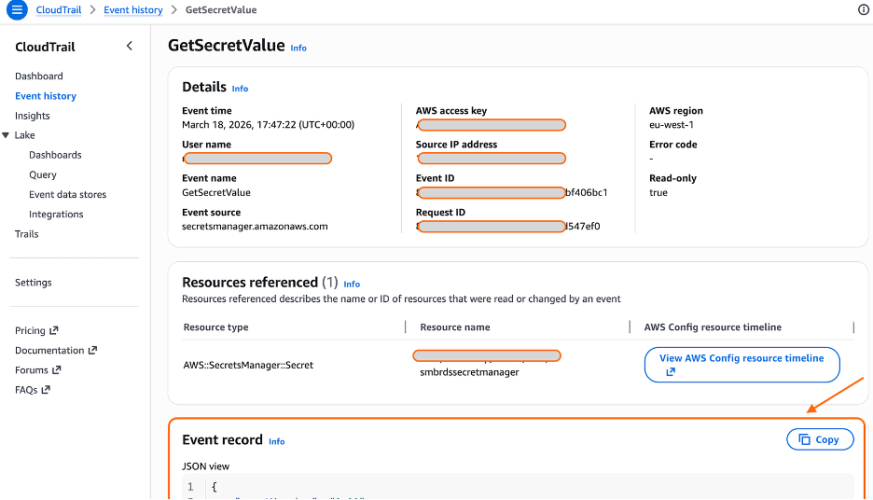
CloudTrail logs include a tlsDetails field for Secrets Manager API calls. When hybrid post-quantum key exchange in TLS is active, the keyExchange field in tlsDetails will show X25519MLKEM768. Each CloudTrail record includes a tlsDetails field that contains the cipher suite and, where available, the key exchange group negotiated during the TLS handshake.
You can work with CloudTrail event history using the AWS Management Console for CloudTrail or the AWS Command Line Interface (AWS CLI).
To look up CloudTrail events using the console:
- Verify you are in the correct AWS Region.
- Open the CloudTrail console and select Event History.
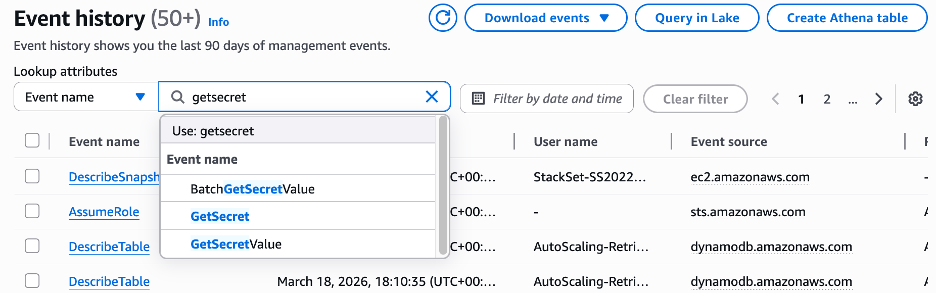
- Under Lookup attributes filter, select Event name and GetSecretValue.

Figure 1: Search CloudTrail event history by event name
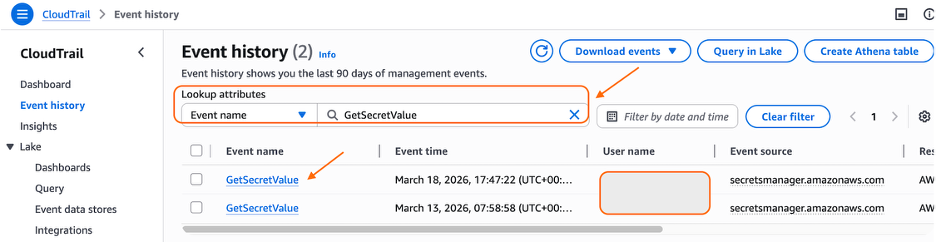
- Select your event.

Figure 2: Select the event
- View the output in the Event Record section of the page.

Figure 3: CloudTrail – GetSecretValue event
To look up CloudTrail events using AWS CLI :
Using AWS CLI, select the last events and look at the output.
Example of CloudTrail Event for GetSecretValue API call:
In the following example, the userAgent field reflects what it used as a client to connect to Secrets Manager.
Note: The
userAgentvalue depends on the client you use.
If the keyExchange field shows X25519MLKEM768, then hybrid post-quantum key exchange in TLS is active. If it shows a traditional algorithm such as X25519, the client is not advertising ML-KEM support, and you should check the client version and configuration.
Troubleshooting
If your Secrets Manager API calls aren’t negotiating X25519MLKEM768 after updating your clients, check your SDK version, OpenSSL version (Python), and firewall or proxy configuration as shown in the Client Hybrid Post-Quantum Key Exchange Requirements section near the beginning of this post.
What’s next
This launch is one step in a broader migration. AWS is continuing to roll out ML-KEM support across AWS service HTTPS endpoints as part of Workstream 2 of the AWS PQC Migration Plan, with a target of full coverage across public AWS endpoints.
Support for CRYSTALS-Kyber, the pre-standardization predecessor to ML-KEM, is phasing out across AWS endpoints in 2026. Customers on older SDK versions that advertise only CRYSTALS-Kyber support will fall back gracefully to traditional TLS rather than negotiate the deprecated algorithm. To avoid this fallback, upgrade to the SDK versions listed in this post.
The journey of PQC migration extends beyond confidentiality of data in transit. To stay informed about the latest developments in the AWS PQC journey and your side of shared responsibility, follow the AWS Post-Quantum Cryptography page.
Conclusion
AWS Secrets Manager now enables hybrid post-quantum key exchange using ML-KEM by default to help protect your secrets and support your compliance efforts. This update requires no code changes or configuration updates for customers using the latest client versions.
This post covered how AWS Secrets Manager uses hybrid post-quantum cryptography to secure TLS connections, which clients support this capability, and how to verify that your connections are protected against harvest now, decrypt later attacks.
To benefit from this announcement today:
- Upgrade your Secrets Manager client (Agent, Lambda extension, or CSI Driver) to the latest available versions to enable hybrid post-quantum key exchange using ML-KEM
- If your workload uses the AWS SDK instead of a caching client, upgrade your AWS SDK and underlying dependencies to the minimum versions listed in this post
- Verify hybrid post-quantum key exchange in TLS is active by checking the
keyExchangefield in CloudTrailtlsDetailsfor your Secrets Manager API calls - Test end-to-end hybrid post-quantum key exchange TLS connectivity in your environment, including network paths that traverse corporate firewalls or proxies
AWS will continue rolling out post-quantum cryptography support. For information about the broader migration effort, see the AWS PQC Migration Plan. Keep an updated cryptographic inventory of your broader environment to identify other uses of traditional public-key cryptography that will require migration. The CISA Quantum-Readiness guidance and the AWS PQC Migration Plan are good starting points.
Additional resources
If you have feedback about this post, submit comments in the Comments section below.
The Aides Keeping the President in the Dark, by David A. Graham
Post Syndicated from The Atlantic original https://www.youtube.com/shorts/4wJkVw0AsIM
Kalshi & Don Jr. #lastweektonight
Post Syndicated from LastWeekTonight original https://www.youtube.com/shorts/xwS0DeEsKWA
Scaling Camera File Processing at Netflix
Post Syndicated from Netflix Technology Blog original https://netflixtechblog.com/scaling-camera-file-processing-at-netflix-6dab2b1e80be
Orchestrating Media Workflows Through Strategic Collaboration
Authors: Eric Reinecke, Bhanu Srikanth
Introduction to Content Hub’s Media Production Suite
At Netflix, we want to provide filmmakers with the tools they need to produce content at a global scale, with quick turnaround and choice from an extraordinary variety of cameras, formats, workflows, and collaborators. Every series or film arrives with its own creative ambitions and technical requirements. To reduce friction and keep productions moving smoothly, we built Netflix’s Media Production Suite (MPS) with the goal of automating repeatable tasks, standardizing key workflows, and giving productions more time to focus on creative collaboration and craftsmanship.
A critical part of this effort is how we handle image processing and camera metadata across the hundreds of hours and terabytes of camera footage that Netflix productions ingest on a daily basis. Rather than build every component from scratch, we chose to partner where it made sense–especially in areas where the industry already had trusted, battle-tested solutions.
This article explores how Netflix’s Media Production Suite integrates with FilmLight’s API (FLAPI) as the core studio media processing engine in Netflix’s cloud compute infrastructure, and how that collaboration helps us deliver smarter, more reliable workflows at scale.
Why We Built MPS
As Netflix’s production slate grew, so did the complexity of file-based workflows. We saw recurring challenges across productions:
- File wrangling sapping time from creative decision-making
- Inconsistent media handling across shows, regions, or vendors
- Difficult to audit manual processes that are prone to human error
- Duplication of effort as teams reinvented similar workflows for each production
Content Hub Media Production Suite was created to address these pain points. MPS is designed to:
- Bring efficiency, consistency, and quality control to global productions
- Streamline media management and movement from production through post-production
- Reduce time spent on non-creative file management
- Minimize human error while maximizing creative time
To achieve this, MPS needed a robust, flexible, and trusted way to handle camera-original media and metadata at scale.
The Right Tool for the Job
From the start, we knew that building a world-class image processing engine in-house is a significant, long-term commitment: one that would require deep, continuous collaboration with camera manufacturers and the wider industry.
When designing the system, we set out some core requirements:
- Inspect, trim, and transcode original camera files and metadata for any Netflix production with trusted color science
- Support a wide variety of cameras and recording formats used worldwide while staying current as new ones are released
- Run well in our paved-path encoding infrastructure, enabling us to take advantage of proven compute and storage scalability with robust observability
FilmLight develops Baselight and Daylight, which are commonly used in the industry for color grading, dailies, and transcoding. Their FilmLight API (FLAPI) allows us to use that same media processing engine as a backend API.
Rather than duplicating that work, we chose to integrate. FilmLight became a trusted technology partner, and FLAPI is now a foundational part of how MPS processes media.
The Media Processing Engine
MPS is not a single application; it’s an ecosystem of tools and services that support Netflix productions globally. Within that ecosystem, the FilmLight API plays the following key roles.
- Parsing camera metadata on ingest
Productions upload media to Netflix’s Content Hub with ASC MHL (Media Hash List) files to ensure completeness and integrity of initial ingest, but soon after, it’s important to understand the technical characteristics of each piece of media. We call this workflow phase “inspection.”
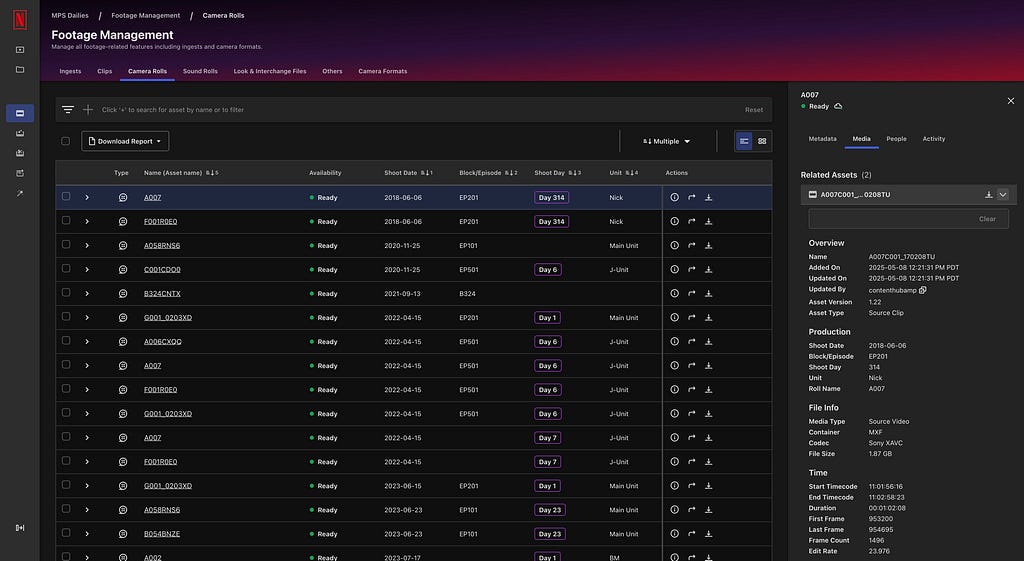
At this stage, we:
- Use FLAPI to gather camera metadata from the original camera files
- Conform the workflow critical fields to Netflix’s normalized schema
- Make it searchable and reusable for downstream processes
This metadata is integral to:
- Matching footage based on timing and reel name for automated retrieval
- Debugging (e.g., why a shot looks a certain way after processing)
- Validations and checks across the pipeline
FLAPI provides consistent, camera-aware insight into footage that may have originated anywhere in the world. Additionally, since we’re able to package FLAPI in a Docker image, we can deploy almost identical code to both cloud and our production compute and storage centers around the world, ensuring a consistent assessment of footage wherever it may exist.
2. Generating VFX plates and other deliverables
Visual effects workflows constantly push image processing pipelines to their absolute limits. For MPS to succeed, it must generate images with accurate framing, consistent color management, and correct debayering/decoding parameters — all while maintaining rapid turnaround times.
To achieve this, we leverage Netflix’s Cosmos compute and storage platform and use open standards to provide predictable and consistent creative control.
At this phase, we use the FilmLight API to:
- Debayer original camera files with the correct format-specific decoding parameters
- Crop and de-squeeze images using Framing Decision Lists (ASC FDL) to ensure spatial creative decisions are preserved
- Apply ACES Metadata Files (AMF), providing repeatable color pipelines from dailies through finishing
- Generate an array of media deliverables in varied formats
These processes are automated, repeatable, and auditable. We deliver AMFs alongside the OpenEXRs to ensure recipients know exactly what color transforms are already applied, and which need to be applied to match dailies.
Because we use FilmLight’s tools on the backend, our workflow specialists can use Baselight on their workstations to manually validate pipeline decisions for productions before the first day of principal photography.
The Media Processing Factory in the Cloud
Finding an engine that competently processes media in line with open standards is an important part of the equation. To maximize impact, we want to make these tools available to all of the filmmakers we work with. Luckily, we’re no strangers to scaled processing at Netflix, and our Cosmos compute platform was ready for the job!
Cloud-first integration
The traditional model for this kind of processing in filmmaking has been to invest in beefy computers with large GPUs and high-performance storage arrays to rip through debayering and encoding at breakneck speed. However, constraints in the cloud environment are different.
Factors that are essential for tools in our runtime environment include that they:
- Are packageable as Serverless Functions in Linux Docker images that can be quickly invoked to run a single unit of work and shut down on completion
- Can run on CPU-only instances to allow us to take advantage of a wide array of available compute
- Support headless invocation via Java, Python, or CLI
- Operate statelessly, so when things do go wrong, we can simply terminate and re-launch the worker
Operating within these constraints lets us focus on increasing throughput via parallel encoding rather than focusing on single-instance processing power. We can then target the sweet spot of the cost/performance efficiency curve while still hitting our target turnaround times.
When tools are API-driven, easily packaged in Linux containers, and don’t require a lot of external state management, Netflix can quickly integrate and deploy them with operational reliability. FilmLight API fit the bill for us. At Netflix, we leverage:
- Java and Python as the primary integration languages
- Ubuntu-based Docker images with Java and Python code to expose functionality to our workflows
- CPU instances in the cloud and local compute centers for running inspection, rendering, and trimming jobs
While FLAPI also supports GPU rendering, CPU instances give us access to a much wider segment of Netflix’s vast encoding compute pool and free up GPU instances for other workloads.
To use FilmLight API, we bundle it in a package that can be easily installed via a Dockerfile. Then, we built Cosmos Stratum Functions that accept an input clip, output location, and varying parameters such as frame ranges and AMF or FDL files when debayering footage. These functions can be quickly invoked to process a single clip or sub-segment of a clip and shut down again to free up resources.
Elastic scaling for production workloads
Production workloads are inherently spiky:
- A quiet day on set may mean minimal new footage to inspect.
- A full VFX turnover or pulling trimmed OCF for finishing might require thousands of parallel renders in a short time window.
By deploying FLAPI in the cloud as functions, MPS can:
- Allocate compute on demand and release it when our work queue dies down
- Avoid tying capacity to a fixed pool of local hardware
- Smooth demand across many types of encoding workload in a shared resource pool
This elasticity lets us swarm pull requests to get them through quickly, then immediately yield resources back to lower priority workloads. Even in peak production periods, we avoid the pain of manually managing render queues and prioritization by avoiding fixed resource allocation. All this means lightning-fast turnaround times and less anxiety around deadlines for our filmmakers.
Designed for Seasoned Pros and Emerging Filmmakers
Netflix productions range from highly experienced teams with very specific workflows to newer teams who may be less familiar with potential pitfalls in complex file-based pipelines.
MPS is designed to support both:
- Industry veterans who need to configure precise, bespoke workflows and trust that underlying image processing will respect those decisions.
- Productions without a color scientist on staff — those who benefit from guardrails and sane defaults that help them avoid common workflow issues (e.g., mismatched color transforms, inconsistent debayering, or incomplete metadata handling).
The partnership with FilmLight lets Netflix focus on workflow design, orchestration, and production support, while FilmLight focuses on providing competent handling of a wide variety of camera formats with world-class image science!
Collaboration and Co-Evolution
Netflix aimed to integrate MPS into a wider tool ecosystem by developing a comprehensive solution based on emerging open standards, rather than making MPS a self-contained system. Integrating FLAPI into our system requires more than an API reference–it requires ongoing partnership. FilmLight worked closely with Netflix teams to:
- Align on feature roadmaps, particularly around new camera formats and open standards
- Validate the accuracy and performance of key operations
- Debug edge cases discovered in large-scale, real-world workloads
- Evolve the API in ways that serve both Netflix and the wider industry
- Create a positive feedback cycle with open standards like ACES and ASC FDL to solve for gaps when the rubber hits the road
One example of this has been with the implementation of ACES 2. FilmLight’s developers quickly provided a roadmap for support. As our engineering teams collaborated on integration, we also provided feedback to the ACES technical leadership to quickly address integration challenges and test drive updates in our pipeline.
This collaborative relationship–built on open communication, joint validation, and feedback to the greater industry–is how we routinely work with FilmLight to ensure we’re not just building something that works for our shows, but also driving a healthy tooling and standards ecosystem.
Impact
While much of this work takes place behind the scenes, its impact is felt directly by our productions. Our goal with building MPS is for producers, post supervisors, and vendors to experience:
- Fewer delays caused by missing, incomplete, or incorrect media
- Faster turnaround on VFX plates and other technical deliverables
- More predictable, consistent handoffs between editorial, color, and VFX
- Less time spent troubleshooting technical issues, and more time focused on creative review
In practice, this often shows up as the absence of crisis: the time a VFX vendor doesn’t have to request a re-delivery, or the time editorial doesn’t have to wait for corrected plates, or the time the color facility doesn’t have to reinvent a tone-mapping path because the AMF and ACES pipeline are already in place.
Looking Ahead
As camera technology, codecs, open standards, and production workflows continue to evolve, so will MPS. The guiding principles remain:
- Automate what’s repeatable
- Centralize what benefits from standardization
- Partner where deep domain expertise already exists
The integration with FilmLight API is one example of this philosophy in action. By treating image processing as a specialized discipline and collaborating with a trusted industry partner, Netflix is delivering smarter, more reliable workflows to productions worldwide.
At its core, this partnership supports a simple goal: reduce manual workflow and tool management, giving filmmakers more time to tell stories.
Acknowledgements
This project is the result of collaboration and iteration over many years. In addition to the authors, the following people have contributed to this work:
- Matthew Donato
- Prabh Nallani
- Andy Schuler
- Jesse Korosi

Scaling Camera File Processing at Netflix was originally published in Netflix TechBlog on Medium, where people are continuing the conversation by highlighting and responding to this story.
How Short-Form Clips Took Over the Internet
Post Syndicated from The Atlantic original https://www.youtube.com/watch?v=ILvDLbel4iM
GnuPG 2.5.19 released
Post Syndicated from jzb original https://lwn.net/Articles/1069552/
Werner Koch has announced
the release of GnuPG 2.5.19. This release includes a few new options
and a number of bug fixes, and comes with the reminder that the
GnuPG 2.4 series will reach end-of-life soon
The main features in the 2.5 series are improvements for 64 bit Windows
and the introduction of Kyber (aka ML-KEM or FIPS-203) as PQC encryption
algorithm. Other than PQC support the 2.6 series will not differ a lot
from 2.4 because the majority of changes are internal to make use of
newer features from the supporting libraries.Note that the old 2.4 series reaches end-of-life in just two months.
Thus update to 2.5.19 in time. As always with GnuPG new versions are
fully compatible with previous versions.
LWN recently
covered Fedora’s discussion about what to offer after GnuPG 2.4 is no
longer supported.
[$] On pages and folios
Post Syndicated from corbet original https://lwn.net/Articles/1064861/
The kernel coverage here at LWN often touches on memory-management topics
and, as a result, tends to talk a lot about both pages and folios. As the
folio transition in the kernel has moved forward, it has often become
difficult to decide which term to use in writing that is meant to be both
approachable and technically correct. As this work continues, it will be
increasingly common to use “folio” rather than page. This article is
intended to be a convenient reference for readers wanting to differentiate
the two terms or understand the state of this transition.
Security updates for Friday
Post Syndicated from jzb original https://lwn.net/Articles/1069549/
Security updates have been issued by Fedora (anaconda, dnf5, firefox, flatpak-builder, libexif, minetest, nss, plasma-setup, python-blivet, rpki-client, and xorg-x11-server), Oracle (bind, kernel, osbuild-composer, thunderbird, webkit2gtk3, and wireshark), Red Hat (java-25-openjdk), SUSE (cacti, cacti, cacti-spine, cockpit-machines, cockpit-podman, cockpit-tukit, csync2, flannel, gdk-pixbuf, go1.25-openssl, go1.26-openssl, haproxy, kernel, libcap, libpng16, libtree-sitter0_26, libvirt, ncurses, ntfs-3g_ntfsprogs, openssl-1_1, openssl-3, openvswitch, perl, python-pyOpenSSL, python311, rclone, sudo, and tomcat), and Ubuntu (gst-plugins-bad1.0, jq, libopenmpt, linux-ibm, linux-ibm-5.15, and php-league-commonmark).
3 Reasons to Attend our Global Cybersecurity Summit if you’re Focused on AI, Threats, and CTEM
Post Syndicated from Emma Burdett original https://www.rapid7.com/blog/post/it-why-attend-global-cybersecurity-summit-ai-exposure-management-ctem
Security teams are dealing with a different kind of pressure now. It is not just the volume of alerts or the pace of attacks, but also the gap between what teams can see and what they can act on with confidence.
That gap shows up in different ways. Threats move across identity and cloud in ways that are difficult to track, exposure data exists but often sits disconnected from response, and AI is being introduced into workflows without a clear role in decision-making.
This year’s Rapid7 Global Cybersecurity Summit brings those threads together as part of the same operational solution.
1. You need a clearer view of how attacks actually unfold
A lot of detection strategies still assume attacks follow a clean path. In practice, they do not. They start in one place, move quickly, and often rely on small gaps rather than obvious failures.
Sessions like The Reality of Running a SOC in 2026 break this down in detail, looking at how attacks begin with things like identity misuse or cloud misconfiguration, then evolve as defenders try to keep up. That matters because it changes how detection should be designed. Coverage alone is not enough if teams do not have the context created by strong exposure management to interpret what they are seeing.
That same idea carries into Inside the Modern SOC, where a real investigation is followed from first alert to outcome. It is a useful reminder that detection is only part of the problem.Deciding how to respond, and doing it quickly, is the critical next step.
2. Exposure only matters if it connects to action
Most teams already have some form of exposure management in place. The challenge is making it useful. A long list of vulnerabilities does not help much if it is not tied to how risk actually shows up in the environment.
Sessions like Beyond the Vulnerability List and From Cloud Exposure to Runtime Attack focus on that connection. They look at how exposures turn into active threats, often before any alert is triggered, and how teams can use that information to prioritize earlier.
Here’s the part people miss. Exposure is not just about knowing what is wrong. It is about understanding what matters now, based on how the environment is being used and how attackers are likely to move through it.
3. AI is only useful if it improves decisions
AI is already part of most security conversations, but the reality is nuanced. In some cases it helps reduce noise and speed up investigations. In others, it creates new questions around trust and transparency.
The AI Dilemma: Automating Defense Without Surrendering Judgment tackles this directly. It looks at where AI is helping in real SOC workflows, where it can get in the way, and why explainability matters if teams are going to rely on it. The discussion is grounded in how analysts actually work, not just what the technology promises.
There is also a broader point here. Attackers are using AI as well, which means the balance between speed and accuracy is becoming more important on both sides.
Join the conversation
Across these sessions, the common doesn’t stem from any single technology. It is how teams connect signals, context, and decisions in a way that holds up under pressure, which shows up in how threats are understood, how exposure is prioritized, and how AI is applied. It is also why the summit is structured the way it is, moving from shared context on day one into more focused, role-based sessions on day two.
More sessions and speakers will be added in the coming weeks, but the direction is already clear. Security operations are shifting toward earlier decisions, better prioritization, and fewer assumptions.
If your work touches AI, threat detection, or exposure management, this is where those conversations start to come together.
Join us May 12–13 and see how teams are approaching it in practice.
Meta Buys Tens of Millions of AWS Graviton Arm Cores in a CPU Land Grab
Post Syndicated from Patrick Kennedy original https://www.servethehome.com/meta-buys-tens-of-millions-of-aws-graviton-arm-cores-in-a-cpu-land-grab/
Meta is buying “tens of millions” of AWS Graviton CPU cores in a big move to bolster its agentic AI compute portfolio
The post Meta Buys Tens of Millions of AWS Graviton Arm Cores in a CPU Land Grab appeared first on ServeTheHome.
The Torpedo That Transformed the World’s Navies
Post Syndicated from The History Guy: History Deserves to Be Remembered original https://www.youtube.com/watch?v=Id9R_--GwE4