Post Syndicated from LastWeekTonight original https://www.youtube.com/shorts/WcGFbw947JA
AMD Expands Ryzen AI Embedded P100 Family With 8 to 12 Core Parts
Post Syndicated from Ryan Smith original https://www.servethehome.com/amd-expands-ryzen-ai-embedded-p100-family-with-8-to-12-core-parts/
The AMD Ryzen AI Embedded P100 family is expanding with 8 and 12 core parts to address new performance tiers
The post AMD Expands Ryzen AI Embedded P100 Family With 8 to 12 Core Parts appeared first on ServeTheHome.
Active defense: introducing a stateful vulnerability scanner for APIs
Post Syndicated from John Cosgrove original https://blog.cloudflare.com/vulnerability-scanner/
Security is traditionally a game of defense. You build walls, set up gates, and write rules to block traffic that looks suspicious. For years, Cloudflare has been a leader in this space: our Application Security platform is designed to catch attacks in flight, dropping malicious requests at the edge before they ever reach your origin. But for API security, defensive posturing isn’t enough.
That’s why today, we are launching the beta of Cloudflare’s Web and API Vulnerability Scanner.
We are starting with the most pervasive and difficult-to-catch threat on the OWASP API Top 10: Broken Object Level Authorization, or BOLA. We will add more vulnerability scan types over time, including both API and web application threats.
The most dangerous API vulnerabilities today aren’t generic injection attacks or malformed requests that a WAF can easily spot. They are logic flaws—perfectly valid HTTP requests that meet the protocol and application spec but defy the business logic.
To find these, you can’t just wait for an attack. You have to actively hunt for them.
The Web and API Vulnerability Scanner will be available first for API Shield customers. Read on to learn why we are focused on API security scans for this first release.
In the web application world, vulnerabilities often look like syntax errors. A SQL injection attempt looks like code where data should be. A cross-site scripting (XSS) attack looks like a script tag in a form field. These have signatures.
API vulnerabilities are different. To illustrate, let’s imagine a food delivery mobile app that communicates solely with an API on the backend. Let’s take the orders endpoint:
Endpoint Definition: /api/v1/orders
|
Method |
Resource Path |
Description |
|
GET |
/api/v1/orders/{order_id} |
Check Status. Returns the tracking status of a specific order (e.g., “Kitchen is preparing”). |
|
PATCH |
/api/v1/orders/{order_id} |
Update Order. Allows the user to modify the drop-off location or add delivery instructions. |
In a broken authorization attack like BOLA, User A (the attacker) requests to update the delivery address of a paid-for order belonging to User B (the victim). The attacker simply inserts User B’s {order_id} in the PATCH request.
Here is what that request looks like, with ‘8821’ as User B’s order ID. Notice that User A is fully authenticated with their own valid token:
PATCH /api/v1/orders/8821 HTTP/1.1
Host: api.example.com
Authorization: Bearer <User_A_Valid_Token>
Content-Type: application/json

{
  "delivery_address": "123 Attacker Way, Apt 4",
  "instructions": "Leave at front door, ring bell"
}
The request headers are valid. The authentication token is valid. The schema is correct. To a standard WAF, this request looks perfect. A bot management offering may even be fooled if a human is manually sending the attack requests.
User A will now get B’s food delivered to them! The vulnerability exists because the API endpoint fails to validate if User A actually has permission to view or update user B’s data. This is a failure of logic, not syntax. To fix this, the API developer could implement a simple check: if (order.userID != user.ID) throw Unauthorized;

You can detect these types of vulnerabilities by actively sending API test traffic or passively listening to existing API traffic. Finding these vulnerabilities through passive scanning requires context. Last year we launched BOLA vulnerability detection for API Shield. This detection automatically finds these vulnerabilities by passively scanning customer traffic for usage anomalies. To be successful with this type of scanning, you need to know what a “valid” API call looks like, what the variable parameters are, how a typical user behaves, and how the API behaves when those parameters are manipulated.
Yet there are reasons security teams may not have any of that context, even with access to API Shield’s BOLA vulnerability detection. Development environments may need to be tested but lack user traffic. Production environments may (thankfully) have a lack of attack traffic yet still need analysis, and so on. In these circumstances, and to be proactive in general, teams can turn to Dynamic Application Security Testing (DAST). By creating net-new traffic profiles intended specifically for security testing, DAST tools can look for vulnerabilities in any environment at any time.
Unfortunately, traditional DAST tools have a high barrier to entry. They are often difficult to configure, require you to manually upload and maintain Swagger/OpenAPI files, struggle to authenticate correctly against modern complex login flows, and can simply lack any API-specific security tests (e.g. BOLA).
In the food delivery order example above, we assumed the attacker could find a valid order to modify. While there are often avenues for attackers to gather this type of intelligence in a live production environment, in a security testing exercise you must create your own objects before testing the API’s authorization controls. For typical DAST scans, this can be a problem, because many scanners treat each individual request on its own. This method fails to chain requests together in the logical pattern necessary to find broken authorization vulnerabilities. Legacy DAST scanners can also exist as an island within your security tooling and orchestration environment, preventing their findings from being shared or viewed in context.
Vulnerability scanning from Cloudflare is different for a few key reasons.
First, Security Insights will list results from our new scans alongside any existing Cloudflare security findings for added context. You’ll see all your posture management information in one place.
Second, we already know your API’s inputs and outputs. If you are an API Shield customer, Cloudflare already understands your API. Our API Discovery and Schema Learning features passively catalog your endpoints and learn your traffic patterns. While you’ll need to manually upload an OpenAPI spec to get started for our initial release, you will be able to get started quickly without one in a future release.
Third, because we sit at the edge, we can turn passive traffic inspection knowledge into active intelligence. It will be easy to verify BOLA vulnerability detection risks (found via traffic inspection) by sending net-new HTTP requests with the vulnerability scanner.
And finally, we have built a new, stateful DAST platform, as we detail below. Most scanners require hours of setup to “teach” the tool how to talk to your API. With Cloudflare, you can effectively skip that step and get started quickly. You provide the API credentials, and we’ll use your API schemas to automatically construct a scan plan.
APIs are commonly documented using OpenAPI schemas. These schemas denote the host, method, and path (commonly, an “endpoint”) along with the expected parameters of incoming requests and resulting responses. In order to automatically build a scan plan, we must first make sense of these API specifications for any given API to be scanned.
Our scanner works by building up an API call graph from an OpenAPI document and subsequently walking it, using attacker and owner contexts. Owners create resources, attackers subsequently try to access them. Attackers are fully authenticated with their own set of valid credentials. If an attacker successfully reads, modifies or deletes an unowned resource, an authorization vulnerability is found.
Consider for example the above delivery order with ID 8821. For the server-side resource to exist, it needed to be originally created by an owner, most likely in a “genesis” POST request with no or minimal dependencies (previous necessary calls and resulting data). Modelling the API as a call graph, such an endpoint constitutes a node with no or few incoming edges (dependencies). Any subsequent request, such as the attacker’s PATCH above, then has a data dependency (the data is order_id) on the genesis request (the POST). Without all data provided, the PATCH cannot proceed.

Here we see in purple arrows the nodes in this API graph that are necessary to visit an order to add a note to an order via the POST /api/v1/orders/{order_id}/note/{note_id} endpoint. Importantly, none of the steps or logic shown in the diagram is available in the OpenAPI specification! It must be inferred logically through some other means, and that is exactly what our vulnerability scanner will do automatically.
In order to reliably and automatically plan scans across a variety of APIs, we must accurately model these endpoint relationships from scratch. However, two problems arise: data quality of API specifications is not guaranteed, and even functionally complete schemas can have ambiguous naming schemes. Consider a simplified OpenAPI specification for the above API, which might look like
openapi: 3.0.0
info:
  title: Order API
  version: 1.0.0
paths:
  /api/v1/orders:
    post:
      summary: Create an order
      requestBody:
        required: true
        content:
          application/json:
            schema:
              type: object
              properties:
                product:
                  type: string
                count:
                  type: integer
              required:
                - product
                - count
      responses:
        '201':
          description: Item created successfully
          content:
            application/json:
              schema:
                type: object
                properties:
                  result:
                    type: object
                    properties:
                      id:
                        type: integer
                      created_at:
                        type: integer
                  errors:
                    type: array
                    items:
                      type: string
  /api/v1/orders/{order_id}:
    patch:
      summary: Modify an order by ID
      parameters:
        - name: order_id
          in: path
We can see that the POST endpoint returns responses such as
{
    "result": {
        "id": 8821,
        "created_at": 1741476777
    },
   "errors": []
}
To a human observer, it is quickly evident that $.result.id is the value to be injected in order_id for the PATCH endpoint. The id property might also be called orderId, value or something else, and be nested arbitrarily. These subtle inconsistencies in OpenAPI documents of arbitrary shape are intractable for heuristics-based approaches.
Our scanner uses Cloudflare’s own Workers AI platform to tackle this fuzzy problem space. Models such as OpenAI’s open-weight gpt-oss-120b are powerful enough to match data dependencies reliably, and to generate realistic fake data where necessary, essentially filling in the blanks of OpenAPI specifications. Levering structured outputs, the model produces a representation of the API call graph for our scanner to walk, injecting attacker and owner credentials appropriately.
This approach tackles the problem of needing human intelligence to infer authorization and data relationships in OpenAPI schemas with artificial intelligence to do the same. Structured outputs bridge the gap from the natural language world of gpt-oss back to machine-executable instructions. In addition to Workers AI solving the planning problem, self-hosting on Workers AI means our system automatically benefits from Cloudflare’s highly available, globally distributed architecture.
Building a vulnerability scanner that customers will trust with their API credentials demands proven infrastructure. We did not reinvent the wheel here. Instead, we integrated services that have been validated and deployed across Cloudflare for two crucial components of our scanner platform: the scanner’s control plane and the scanner’s secrets store.
The scanner’s control plane integrates with Temporal for Scan Orchestration, on which other internal services at Cloudflare already rely. The complexity of the numerous test plans executed in each Scan is effectively managed by Temporal’s durable execution framework.
The entire backend is written in Rust, which is widely adopted at Cloudflare for infrastructure services. This lets us reuse internal libraries and share architectural patterns across teams. It also positions our scanner for potential future integration with other Cloudflare systems like FL2 or our test framework Flamingo – enabling scenarios where scanning could coordinate more tightly with edge request handling or testing infrastructure.
Scanning for broken authentication and broken authorization vulnerabilities requires handling API user credentials. Cloudflare takes this responsibility very seriously.
We ensure that our public API layer has minimal access to unencrypted customer credentials by using HashiCorp’s Vault Transit Secret Engine (TSE) for encryption-as-a-service. Immediately upon submission, credentials are encrypted by TSE—which handles the encryption but does not store the ciphertext—and are subsequently stored on Cloudflare infrastructure.
Our API is not authorized to decrypt this data. Instead, decryption occurs only at the last stage when a TestPlan makes a request to the customer’s infrastructure. Only the Worker executing the test is authorized to request decryption, a restriction we strengthen using strict typing with additional safety rails inside Rust to enforce minimal access to decryption methods.
We further secure our customers’ credentials through regular rotation and periodic rewraps using TSE to mitigate risk. This process means we only interact with the new ciphertext, and the original secret is kept unviewable.
We are releasing BOLA vulnerability scanning starting today as an Open Beta for all API Shield customers, and are working on future API threat scans for future release. Via the Cloudflare API, you can trigger scans, manage configuration, and retrieve results programmatically to integrate directly into your CI/CD pipelines or security dashboards. For API Shield Customers: check the developer docs to start scanning your endpoints for BOLA vulnerabilities today.
We are starting with BOLA vulnerabilities because they are the hardest API vulnerability to solve and the highest risk for our customers. However, this scanning engine is built to be extensible.
In the near future, we plan to expand the scanner’s capabilities to cover the most popular of the OWASP Web Top 10 as well: classic web vulnerabilities like SQL injection (SQLi) and cross-site scripting (XSS). To be notified upon release, sign up for the waitlist here, and you’ll be first to learn when we expand the engine to general web application vulnerabilities.
Fixing request smuggling vulnerabilities in Pingora OSS deployments
Post Syndicated from Edward Wang original https://blog.cloudflare.com/pingora-oss-smuggling-vulnerabilities/
In December 2025, Cloudflare received reports of HTTP/1.x request smuggling vulnerabilities in the Pingora open source framework when Pingora is used to build an ingress proxy. Today we are discussing how these vulnerabilities work and how we patched them in Pingora 0.8.0.
The vulnerabilities are CVE-2026-2833, CVE-2026-2835, and CVE-2026-2836. These issues were responsibly reported to us by Rajat Raghav (xclow3n) through our Bug Bounty Program.
Cloudflare’s CDN and customer traffic were not affected, our investigation found. No action is needed for Cloudflare customers, and no impact was detected.
Due to the architecture of Cloudflare’s network, these vulnerabilities could not be exploited: Pingora is not used as an ingress proxy in Cloudflare’s CDN.
However, these issues impact standalone Pingora deployments exposed to the Internet, and may enable an attacker to:
-
Bypass Pingora proxy-layer security controls
-
Desync HTTP request/responses with backends for cross-user hijacking attacks (session or credential theft)
-
Poison Pingora proxy-layer caches retrieving content from shared backends
We have released Pingora 0.8.0 with fixes and hardening. While Cloudflare customers were not affected, we strongly recommend users of the Pingora framework to upgrade as soon as possible.
The reports described a few different HTTP/1 attack payloads that could cause desync attacks. Such requests could cause the proxy and backend to disagree about where the request body ends, allowing a second request to be “smuggled” past proxy‑layer checks. The researcher provided a proof-of-concept to validate how a basic Pingora reverse proxy misinterpreted request body lengths and forwarded those requests to server backends such as Node/Express or uvicorn.
Upon receiving the reports, our engineering team immediately investigated and validated that, as the reporter also confirmed, the Cloudflare CDN itself was not vulnerable. However, the team did also validate that vulnerabilities exist when Pingora acts as the ingress proxy to shared backends.
By design, the Pingora framework does allow edge case HTTP requests or responses that are not strictly RFC compliant, because we must accept this sort of traffic for customers with legacy HTTP stacks. But this leniency has limits to avoid exposing Cloudflare itself to vulnerabilities.
In this case, Pingora had non-RFC-compliant interpretations of request bodies within its HTTP/1 stack that allowed these desync attacks to exist. Pingora deployments within Cloudflare are not directly exposed to ingress traffic, and we found that production traffic that arrived at Pingora services were not subject to these misinterpretations. Thus, the attacks were not exploitable on Cloudflare traffic itself, unlike a previous Pingora smuggling vulnerability disclosed in May 2025.
We’ll explain, case-by-case, how these attack payloads worked.
The first report showed that a request with an Upgrade header value would cause Pingora to pass through subsequent bytes on the HTTP connection immediately, before the backend had accepted an upgrade (by returning 101 Switching Protocols). The attacker could thus pipeline a second HTTP request after the upgrade request on the same connection:
GET / HTTP/1.1
Host: example.com
Upgrade: foo


GET /admin HTTP/1.1
Host: example.com
Pingora would parse only the initial request, then treat the remaining buffered bytes as the “upgraded” stream and forward them directly to the backend in a “passthrough” mode due to the Upgrade header (until the response was received).
This is not at all how the HTTP/1.1 Upgrade process per RFC 9110 is intended to work. The subsequent bytes should only be interpreted as part of an upgraded stream if a 101 Switching Protocols header is received, and if a 200 OK response is received instead, the subsequent bytes should continue to be interpreted as HTTP.
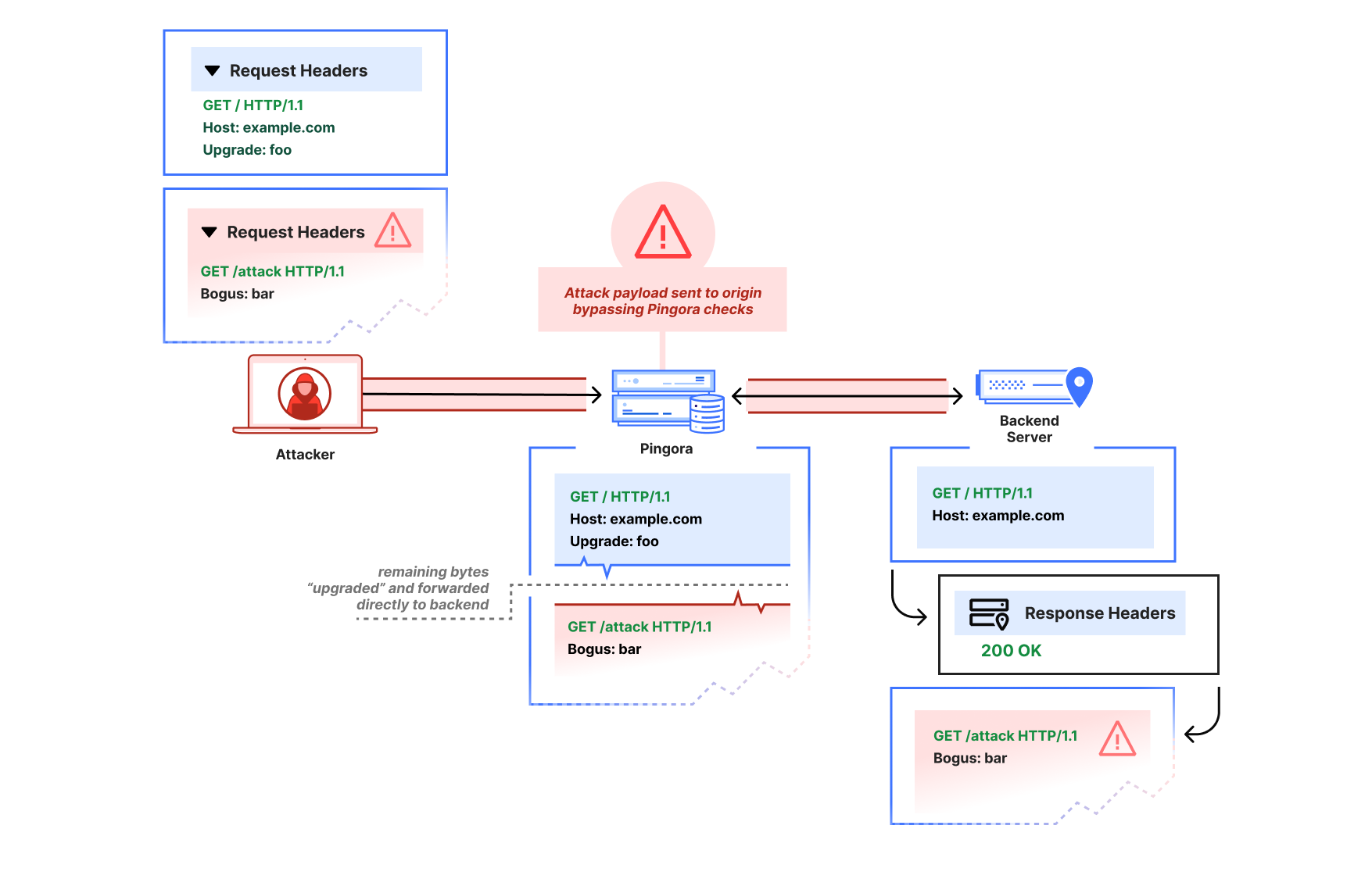
An attacker that sends an Upgrade request, then pipelines a partial HTTP request may cause a desync attack. Pingora will incorrectly interpret both as the same upgraded request, even if the backend server declines the upgrade with a 200.
Via the improper pass-through, a Pingora deployment that received a non-101 response could still forward the second partial HTTP request to the upstream as-is, bypassing any Pingora user‑defined ACL-handling or WAF logic, and poison the connection to the upstream so that a subsequent request from a different user could improperly receive the /admin response.
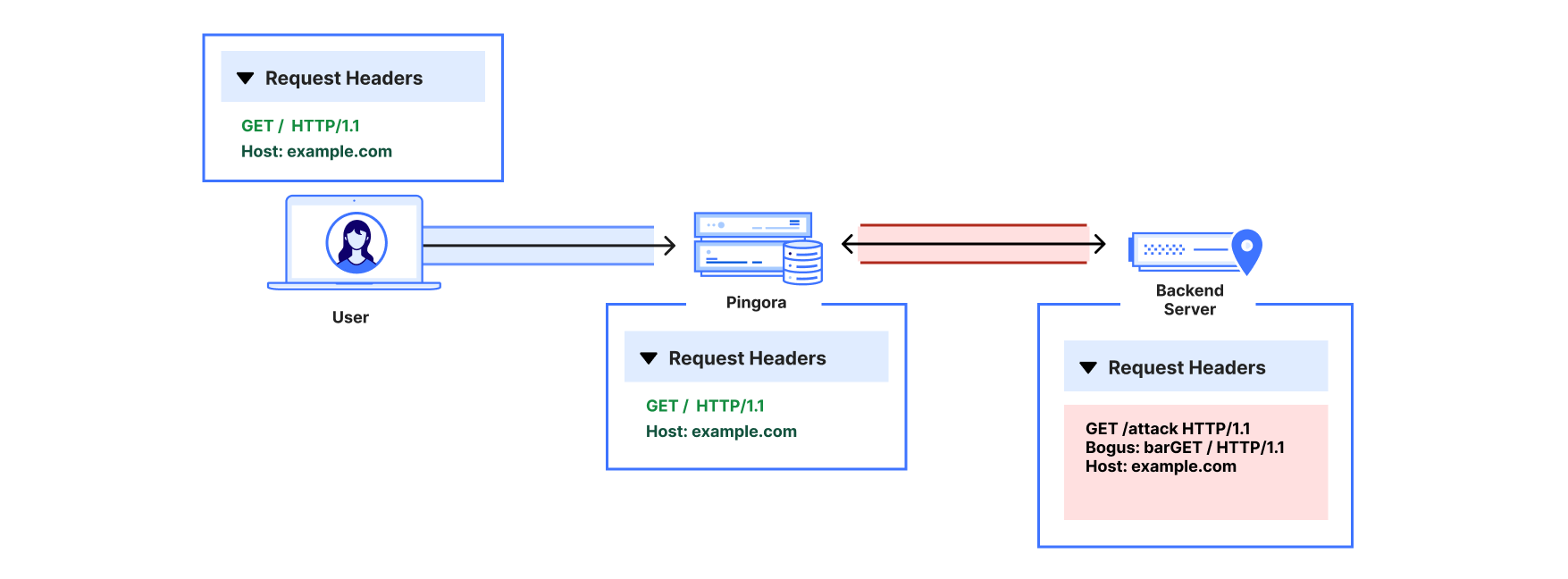
After the attack payload, Pingora and the backend server are now “desynced.” The backend server will wait until it thinks the rest of the partial /attack request header that Pingora forwarded is complete. When Pingora forwards a different user’s request, the two headers are combined from the backend server’s perspective, and the attacker has now poisoned the other user’s response.
We’ve since patched Pingora to switch the interpretation of subsequent bytes only once the upstream responds with 101 Switching Protocols.
We verified Cloudflare was not affected for two reasons:
-
The ingress CDN proxies do not have this improper behavior.
-
The clients to our internal Pingora services do not attempt to pipeline HTTP/1 requests. Furthermore, the Pingora service these clients talk directly with disables keep-alive on these
Upgraderequests by injecting aConnection: closeheader; this prevents additional requests that would be sent — and subsequently smuggled — over the same connection.
The reporter also demonstrated what appeared to be a more classic “CL.TE” desync-type attack, where the Pingora proxy would use Content-Length as framing while the backend would use Transfer-Encoding as framing:
GET / HTTP/1.0
Host: example.com
Connection: keep-alive
Transfer-Encoding: identity, chunked
Content-Length: 29

0

GET /admin HTTP/1.1
X:
In the reporter’s example, Pingora would treat all subsequent bytes after the first GET / request header as part of that request’s body, but the node.js backend server would interpret the body as chunked and ending at the zero-length chunk. There are actually a few things going on here:
-
Pingora’s chunked encoding recognition was quite barebones (only checking for whether
Transfer-Encodingwas “chunked”) and assumed that there could only be one encoding orTransfer-Encodingheader. But the RFC only mandates that the final encoding must bechunkedto apply chunked framing. So per RFC, this request should have a chunked message body (if it were not HTTP/1.0 — more on that below). -
Pingora was also not actually using the
Content-Length(because the Transfer-Encoding overrode the Content-Length per RFC). Because of the unrecognized Transfer-Encoding and the HTTP/1.0 version, the request body was instead treated as close-delimited (which means that the response body’s end is marked by closure of the underlying transport connection). An absence of framing headers would also trigger the same misinterpretation on HTTP/1.0. Although response bodies are allowed to be close-delimited, request bodies are never close-delimited. In fact, this clarification is now explicitly called out as a separate note in RFC 9112. -
This is an HTTP/1.0 request that did not define Transfer-Encoding. The RFC mandates that HTTP/1.0 requests containing Transfer-Encoding must “treat the message as if the framing is faulty” and close the connection. Parsers such as the ones in nginx and hyper just reject these requests to avoid ambiguous framing.
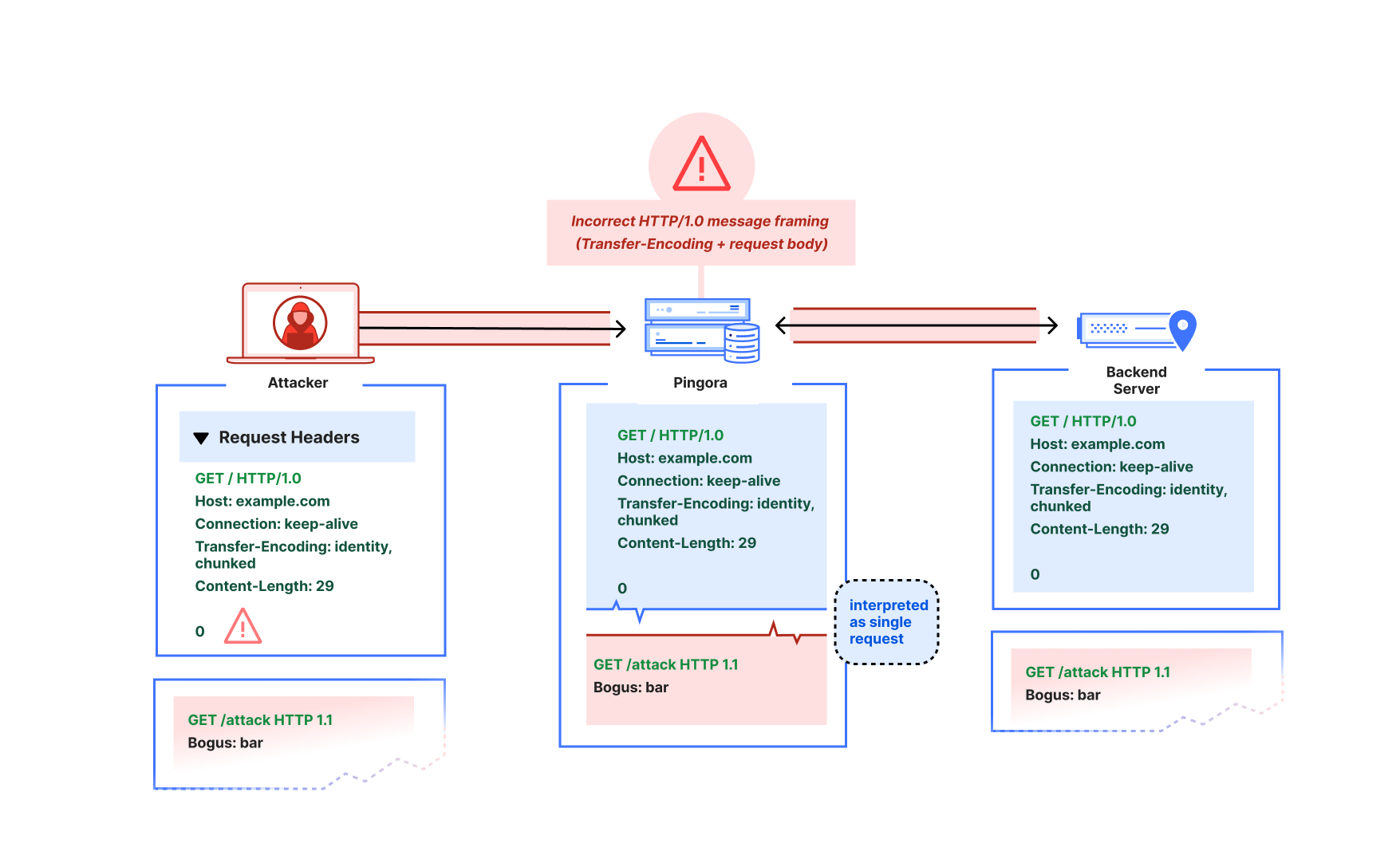
When an attacker pipelines a partial HTTP request header after the HTTP/1.0 + Transfer-Encoding request, Pingora would incorrectly interpret that partial header as part of the same request, rather than as a distinct request. This enables the same kind of desync attack as described in the premature Upgrade example.
This spoke to a more fundamental misreading of the RFC particularly in terms of response vs. request message framing. We’ve since fixed the improper multiple Transfer-Encoding parsing, adhere strictly to the request length guidelines such that HTTP request bodies can never be considered close-delimited, and reject invalid Content-Length and HTTP/1.0 + Transfer-Encoding request messages. Further protections we’ve added include rejecting CONNECT requests by default because the HTTP proxy logic doesn’t currently treat CONNECT as special for the purposes of CONNECT upgrade proxying, and these requests have special message framing rules. (Note that incoming CONNECT requests are rejected by the Cloudflare CDN.)
When we investigated and instrumented our services internally, we found no requests arriving at our Pingora services that would have been misinterpreted. We found that downstream proxy layers in the CDN would forward as HTTP/1.1 only, reject ambiguous framing such as invalid Content-Length, and only forward a single Transfer-Encoding: chunked header for chunked requests.
The researcher also reported one other cache poisoning vulnerability regarding default CacheKey construction. The naive default implementation factored in only the URI path (without other factors such as host header or upstream server HTTP scheme), which meant different hosts using the same HTTP path could collide and poison each other’s cache.
This would affect users of the alpha proxy caching feature who chose to use the default CacheKey implementation. We have since removed that default, because while using something like HTTP scheme + host + URI makes sense for many applications, we want users to be careful when constructing their cache keys for themselves. If their proxy logic will conditionally adjust the URI or method on the upstream request, for example, that logic likely also must be factored into the cache key scheme to avoid poisoning.
Internally, Cloudflare’s default cache key uses a number of factors to prevent cache key poisoning, and never made use of the previously provided default.
If you use Pingora as a proxy, upgrade to Pingora 0.8.0 at your earliest convenience.
We apologize for the impact this vulnerability may have had on Pingora users. As Pingora earns its place as critical Internet infrastructure beyond Cloudflare, we believe it’s important for the framework to promote use of strict RFC compliance by default and will continue this effort. Very few users of the framework should have to deal with the same “wild Internet” that Cloudflare does. Our intention is that stricter adherence to the latest RFC standards by default will harden security for Pingora users and move the Internet as a whole toward best practices.
– 2025‑12‑02: Upgrade‑based smuggling reported via bug bounty.
– 2026‑01‑13: Transfer‑Encoding / HTTP/1.0 parsing issues reported.
– 2026-01-18: Default cache key construction issue reported.
– 2026‑01‑29 to 2026‑02‑13: Fixes validated with the reporter. Work on more RFC-compliance checks continues.
– 2026-02-25: Cache key default removal and additional RFC checks validated with researcher.
– 2026‑03-02: Pingora 0.8.0 released.
– 2026-03-04: CVE advisories published.
We thank Rajat Raghav (xclow3n) for the report, detailed reproductions, and verification of the fixes through our bug bounty program. Please see their corresponding blog for more information.
We would also extend a heartfelt thank you to the Pingora open source community for their active engagement, issue reports, and contributions to the framework. You truly help us build a better Internet.
[$] Inspecting and modifying Python types during type checking
Post Syndicated from daroc original https://lwn.net/Articles/1061083/
Python has a
unique approach to static typing. Python programs can contain type
annotations, and even access those annotations at run time, but the annotations
aren’t evaluated by default. Instead, it is up to external programs to ascribe
meaning to those annotations. The annotations themselves can be arbitrary Python
expressions, but in practice usually involve using helpers from the built-in
typing module, the meanings of which external type-checkers mostly
agree upon. Yet the type system implicitly defined by the typing module
and common type-checkers is insufficiently powerful to model all of the kinds of
dynamic metaprogramming found in real-world Python programs.
PEP 827 (“Type Manipulation”)
aims to add additional
capabilities to Python’s type system to fix this, but
discussion
of the PEP has been of mixed sentiment.
digiKam 9.0.0 released
Post Syndicated from jzb original https://lwn.net/Articles/1062105/
Version
9.0.0 of the digiKam photo-management system has been
released. “This major version introduces groundbreaking
” Some of the changes include a
improvements in performance, usability, and workflow efficiency, with
a strong focus on modernizing the user interface, enhancing metadata
management, and expanding support for new camera models and file
formats.
new survey tool, more advanced search and sorting options, as well
as bulk
editing of geolocation coordinates.
Security updates for Monday
Post Syndicated from jzb original https://lwn.net/Articles/1062103/
Security updates have been issued by AlmaLinux (delve, git-lfs, and postgresql16), Fedora (cef, chezmoi, chromium, coturn, erlang-hex_core, firefox, gh, gimp, k9s, keylime, keylime-agent-rust, libsixel, microcode_ctl, nextcloud, nss, perl-Crypt-URandom, pgadmin4, php-zumba-json-serializer, postgresql16-anonymizer, prometheus, python-asyncmy, python3.10, python3.11, python3.9, staticcheck, valkey, and vim), SUSE (chromedriver, chromium, coredns, expat, freetype2-devel, gitea-tea, go1.24-openssl, go1.25-openssl, grpc, gstreamer-rtsp-server, gstreamer-plugins-ugly,, helm, jetty-annotations, kubeshark-cli, libaec, libblkid-devel, libsoup, libxml2, libxslt, NetworkManager-applet-strongswan, podman, python-joserfc, python-Markdown, python-pypdf2, python-tornado, python-uv, python311-Django, python311-joserfc, python311-nltk, roundcubemail, and valkey), and Ubuntu (python3.4, python3.5, python3.6, python3.7, python3.8, python3.9, python3.10, python3.11, python3.12, python3.13, python3.14).
Warfarin: A Biochemical Miracle
Post Syndicated from The History Guy: History Deserves to Be Remembered original https://www.youtube.com/watch?v=ScSAC8jl_JI
New Attack Against Wi-Fi
Post Syndicated from Bruce Schneier original https://www.schneier.com/blog/archives/2026/03/new-attack-against-wi-fi.html
It’s called AirSnitch:
Unlike previous Wi-Fi attacks, AirSnitch exploits core features in Layers 1 and 2 and the failure to bind and synchronize a client across these and higher layers, other nodes, and other network names such as SSIDs (Service Set Identifiers). This cross-layer identity desynchronization is the key driver of AirSnitch attacks.
The most powerful such attack is a full, bidirectional machine-in-the-middle (MitM) attack, meaning the attacker can view and modify data before it makes its way to the intended recipient. The attacker can be on the same SSID, a separate one, or even a separate network segment tied to the same AP. It works against small Wi-Fi networks in both homes and offices and large networks in enterprises.
With the ability to intercept all link-layer traffic (that is, the traffic as it passes between Layers 1 and 2), an attacker can perform other attacks on higher layers. The most dire consequence occurs when an Internet connection isn’t encrypted—something that Google recently estimated occurred when as much as 6 percent and 20 percent of pages loaded on Windows and Linux, respectively. In these cases, the attacker can view and modify all traffic in the clear and steal authentication cookies, passwords, payment card details, and any other sensitive data. Since many company intranets are sent in plaintext, traffic from them can also be intercepted.
Even when HTTPS is in place, an attacker can still intercept domain look-up traffic and use DNS cache poisoning to corrupt tables stored by the target’s operating system. The AirSnitch MitM also puts the attacker in the position to wage attacks against vulnerabilities that may not be patched. Attackers can also see the external IP addresses hosting webpages being visited and often correlate them with the precise URL.
Here’s the paper.
Италианско сърце с гръцка душа или защо кафето на остров Корфу е различно
Post Syndicated from Йовко Ламбрев original https://yovko.net/coffee-culture-at-corfu/

Попаднах на Корфу съвсем в началото на месец октомври 2024 година. Планирано нарочно, когато активният сезон поприключваше. Заради онова чудно есенно време, в което жегата вече не те притиска, но островът все още е пълен с позакъснели туристи, опитващи се да откраднат още малко от лятото.
Корфу не е типичен гръцки остров с бели къщи и сини прозорци. Тук историята е напластена на слоеве, с които се сблъскваш на всяка крачка. Владян е от римляните и Византия, минал през ръцете на Неапол, Франция, Австрия и Англия. Всеки завоевател е оставил по нещо след себе си там, но нищо не е оформило Корфу така, както управлението на Венецианската република. Тази връзка е и причината в главния град на острова Керкира човек да се чувства по-скоро в Италия. Докато останалата част от Гърция попада под османска власт, венецианците превръщат Корфу в своя стратегическа крепост. Това дълго присъствие е попило в самата тъкан на града – от плътно прилепените една до друга сгради в пастелни цветове, до местния диалект и, разбира се, кухнята.
Прекарах седмица там, но не можах да изям толкова sofrito, колкото ми се искаше. Със същото име има поне няколко разпознаваеми ястия от най-различни кулинарни географии, при това без някакви задължителни прилики помежду им. Но корфуанското софрито от бавно готвено телешко във винено-оцетен сос, в който чесънът и подправките доминират без дори намек за извинение, завинаги зае специално място в сърцето и душата ми. На български нямаме добър превод на т.нар. comfort food, но затова пък изразът храна за душата пасва идеално за светата троица ястия на корфуанската кухня pastitsada, sofrito и bourdeto.
Йонийските вина никак не са лоши, но и местната крафт бира не е за пропускане. Без претенцията да съм опитал всичко, много ми допадна един чуден плътен червен ейл с леко карамелизиран малцов вкус.
Иначе, разбира се, никой който е стигнал до тук не трябва да пропуска местните архитектурни и исторически забележителности като Старата крепост, историята на която започва още от византийски времена. А гледките отгоре към морето и града си заслужават всяко издрапано стъпало.




Старата крепост и гледки от нея към Керкира и морето
На десетина километра на юг от града, дворецът Ахилион пък напомня за австрийското влияние. Построен за лятна резиденция на Елизабет Баварска (Сиси) – императрица на Австрия и кралица на Унгария – Ахилион днес е музей и своеобразен паметник на личната ѝ меланхолия, обграден от впечатляващи градини с още по-приказни гледки към Йонийско море.


Дворецът Ахилион
Едва ли пък изобщо е възможно да се пропуснат площад Спианада и улица Листон. Тук архитектурата рязко сменя стила си на френска – елегантна, подредена, с високи тавани и широки сводове, под които са се приютили кафенета с бели покривки.
И понеже започнах тази публикация с идеята да пиша за кафе културата на остров Корфу, мисля че кулинарно-визуалното въведение е крайно време да приключи някъде тук… преди този текст да стане банален туристически пътепис.
Това, което моментално прави впечатление на всеки кафе-маниак, попаднал в Керкира е, че тук почти отсъстват популярните индустриални марки кафе. Кафенетата най-често сервират напитки от прясно изпечено кафе, което или се пече на място в самото заведение, или се доставя от някой местен пекар от Корфу. Предлагат се (макар и по-рядко) и кафета от популярни пекари от други части на Гърция като нашумелите напоследък The Underdog от Атина или Hue от Солун. Срещат се и Coffee Island – доста популярна кафе-верига в Гърция, но с фокус върху кафета с установен произход.
В Керкира за седмица успях да видя едва две места, където имаше рекламни табели на Kimbo и Illy, и разбира се, много бързо ги подминах.

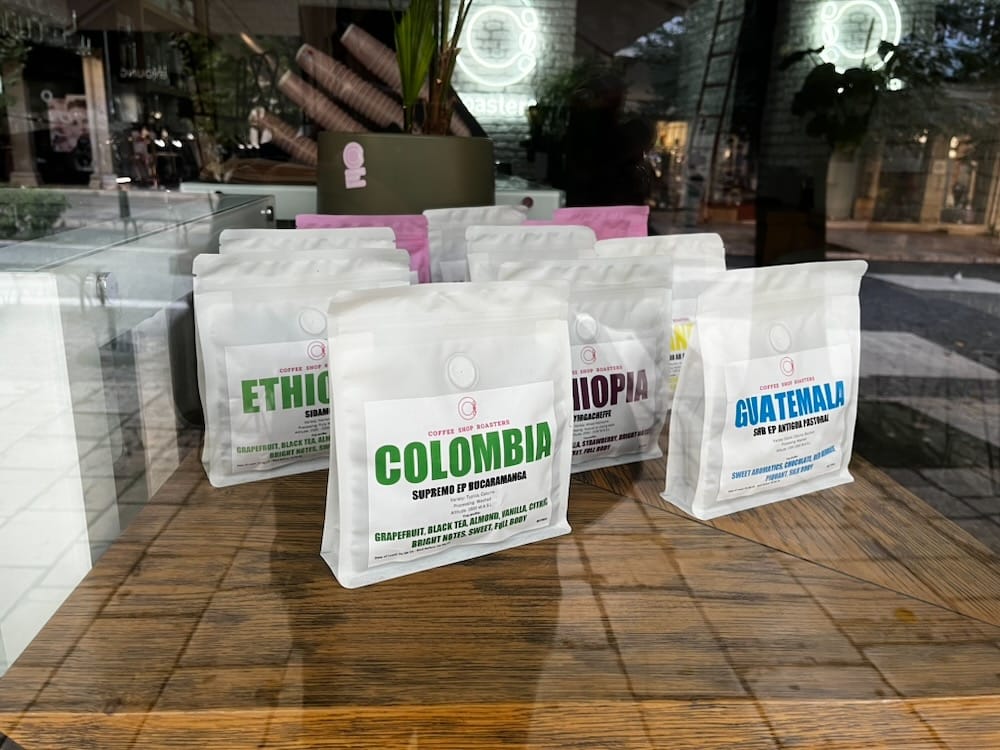

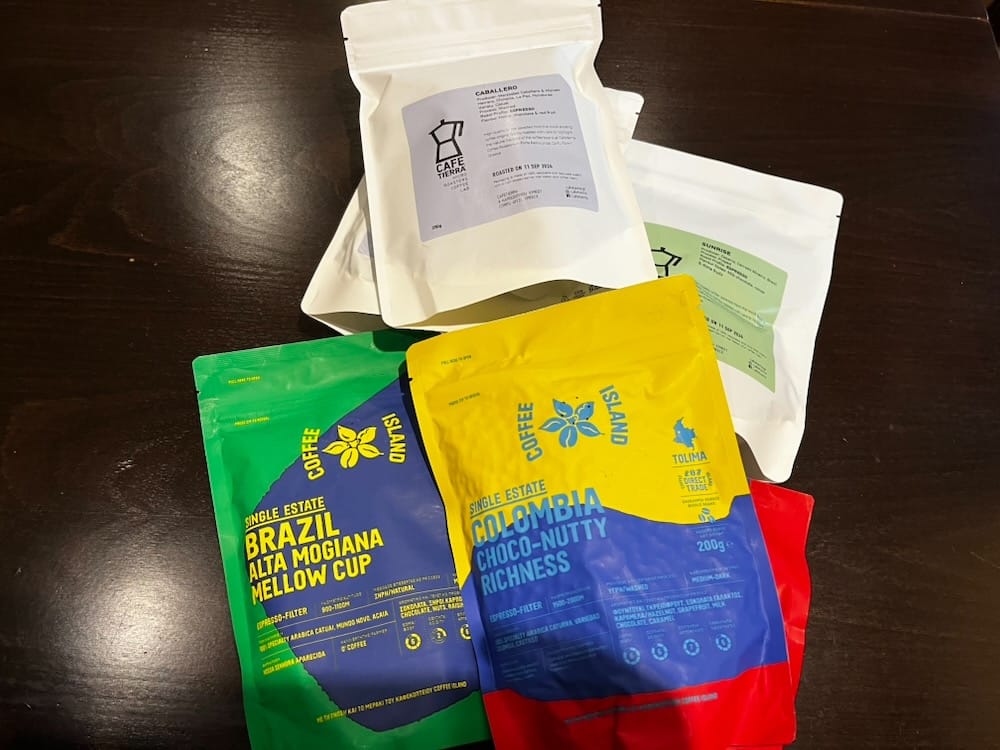
Един от популярните доставчици на кафе в Корфу е Cofeco. Те едновременно дистрибутират кафе на някои по-малки пекари и предлагат свое. Изглежда, че много кафенета из острова разчитат на тях за своето кафе. Дори на някои места, където първоначално твърдяха, че предлагат собствено печено на място кафе, в последствие признаха, че всъщност кафето им е от Cofeco.
Любопитен факт е, че Cofeco и по-конкретно роденият на Корфу Янис Зоис допринасят за развитието и на българската кафе култура. Той е замесен както в създаването на дистрибутора на кафе (и други продукти) Ibeco, така и в появата и развитието на Memento, които (ако не греша) бяха първите в България, които пробваха да се заявят със собствен бленд кафе.
Янис Зоис
който предлага чудесно кафе на ъгъла на ”Гурко” и ”Дякон Игнатий”
 Александър Бойчев
През 2018 г. в Гърция се появява и U-ROAST – шотландска компания, която се опитва да промени начина, по който малките кафенета пекат кафето си. Вместо да разчитат на доставки с готово изпечени зърна от популярните брандове, те да могат да пекат своето кафе на място, чрез компактна автоматизирана машина. А доставките зелено кафе (от около 8 региона по света) са подсигурени в точните за въпросната машина разфасовки от по 2 килограма. Така кафенетата от програмата предлагат винаги прясно изпечени зърна и имат свободата да експериментират с различни блендове и произход всеки ден.
И така, сега… на входа на доста кафенета в града Керкира и на острова се забелязва голямата черно-бяла емблема на U-ROAST.
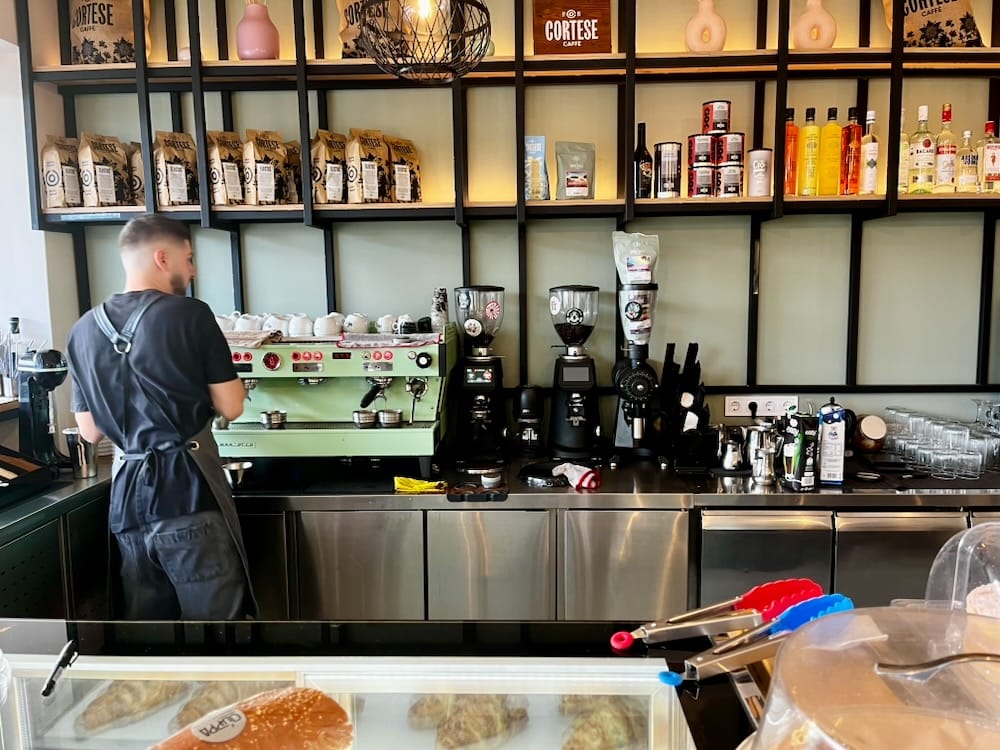
Най-впечатляващите кафета, които опитах на Корфу обаче бяха от една местна микропекарна, наречена CafeTierra която пече кафе съвсем близо до парка в подножието на Старата крепост. Част от кафетата им могат да се опитат на място, приготвени по различни начини на филтър и еспресо. Самото местенце е притегателен център и за много чужденци, които са се озовали в Корфу по различни причини.
CafeTierra имат и още една локация – точно на живописното площадче пред църквата Св. Спиридон в центъра на стария град на Керкира.
Не си купих достатъчно пакетчета с техни кафета за България и малко съжалявах като се прибрах.

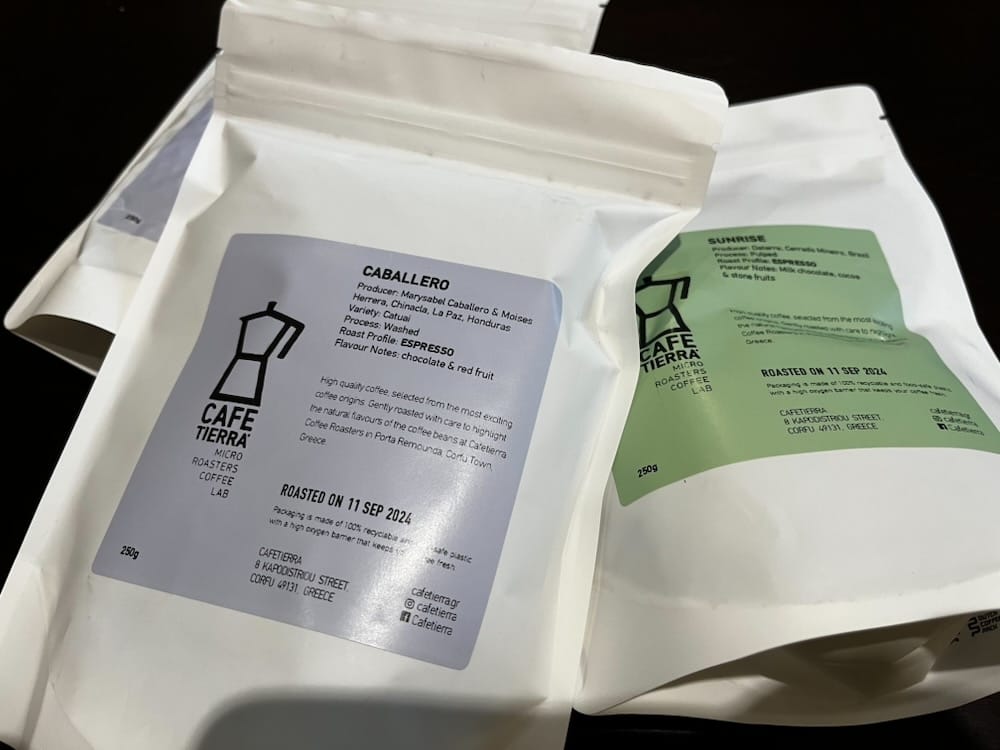
Но в крайна сметка хубавото прясно печено кафе учи точно на това – да цениш момента тук и сега, защото ароматът му не може винаги да бъде опакован в куфар.
За мен важна част от спомена за Корфу остана плътния вкус на софритото, препечения малц в местната бира и нежната киселинност на еспресото от прясно изпеченото кафе на CafeTierra. Защото островът може и да има венецианска фасада, но сърцето му е гръцко – бавно, гостоприемно и влюбено в добрия живот с вкусна храна и напитки.
Прибирайки се към България, в главата ми се загнезди идеята да си купя своя печка за кафе и… към днешна дата вече трупам втората си година стаж в този занаят. Само като хоби. Без амбиция да го превръщам в бизнес. Но и до днес ми е любопитно как така се е случило на остров Корфу за мнозинството кафенета да е важно да предлагат собствено или поне местно прясно печено кафе. И колко време е отнела тази революция, благодарение на която буквално на всеки ъгъл човек да може да се наслади на много добро кафе.
А ако някога се озовете на площадчето пред църквата Св. Спиридон в Керкира… поръчайте си любимата кафеена напитка от CafeTierra, оставете телефона настрани и се насладете на факта, че сте на място, където историята се пие на малки глътки, а храната наистина е за душата.
И си купете поне два пакета кафе повече, отколкото мислите, че са ви нужни. Ще ми благодарите някой друг път.
USAID: Last Week Tonight with John Oliver (HBO)
Post Syndicated from LastWeekTonight original https://www.youtube.com/watch?v=tU8S13xYJNM
Complexity is a choice. SASE migrations shouldn’t take years.
Post Syndicated from Warnessa Weaver original https://blog.cloudflare.com/complexity-is-a-choice-sase-migrations-shouldnt-take-years/
For years, the cybersecurity industry has accepted a grim reality: migrating to a zero trust architecture is a marathon of misery. CIOs have been conditioned to expect multi-year deployment timelines, characterized by turning screws, manual configurations, and the relentless care and feeding of legacy SASE vendors.
But at Cloudflare, we believe that kind of complexity is a choice, not a requirement. Today, we are highlighting how our partners are proving that what used to take years now takes weeks. By leveraging Cloudflare One, our agile SASE platform, partners like TachTech and Adapture are showing that the path to safe AI and Zero Trust adoption is faster, more seamless, and more programmable than ever before.
The traditional migration path for legacy SASE products—specifically the deployment of Secure Web Gateway (SWG) and Zero Trust Network Access (ZTNA)—often stretches to 18 months for large organizations. For a CIO, that represents a year and a half of technical debt and persistent security gaps.
By contrast, partners like TachTech and Adapture are proving that this marathon of misery is not a technical necessity. By using a unified connectivity cloud, they have compressed these timelines from 18 months down to just six weeks.
Kyle Jerome Thompson, a solutions architect at TachTech with 30 years of experience, says Cloudflare One fundamentally changes this calculus. By replacing legacy tools with Cloudflare’s robust telemetry and global network, TachTech has slashed deployment times for large organizations down to just four to six weeks.
“Cloudflare has taken the ‘wizardry’ out of zero trust,” says Thompson. “Unlike legacy solutions that require continual care and feeding, Cloudflare Access is lightweight and ‘no-touch’ after deployment. It commoditizes security in the same way you think about plumbing or electricity—it just works, it’s cost-effective, and it lets our customers get back to their real day jobs.”
Legacy migrations typically fail when they are treated as a series of hardware replacements rather than a software transformation. Traditional vendors often require complex service chaining where traffic is passed from one inspection cluster to another. This creates a “trombone effect,” adding latency and making troubleshooting nearly impossible.
When you decouple the security policy from the physical network, the migration speed changes. Our partners focus on three pillars to accelerate this transition:
-
Identity-first on-ramps: Instead of rebuilding network segments, they use existing identity provider (IdP) groups to define access.
-
Consolidated policy engines: By using a single pass for both SWG and ZTNA, administrators avoid the need to “sync” different products.
-
Cloud-native connectors: Using lightweight daemons like
cloudflaredallows for instant connectivity without opening inbound firewall ports.
The story is similar at Adapture, where they have a simple mission: improve IT performance and mitigate risk for clients. For one client, what started as a small contractor-focused footprint quickly exploded from 600 seats to a 5,000-seat deployment of Cloudflare Access.
This rapid elasticity proved that Cloudflare’s easy-to-use SASE platform bypasses legacy deployment hurdles—a transition Adapture characterized as “seamless.”
“Organizations can’t afford an implementation that stretches across months,” says Greg O’Connor, VP of Strategic Alliances at Adapture. “Cloudflare is creating a new standard when it comes to SASE implementation, bringing our clients to the cutting edge of SASE.”
In global infrastructure, unique environments and highly specialized workflows are the reality. A hallmark of the Cloudflare One architecture is that it is software-defined and extensible, allowing partners to unblock specific requirements without compromising the organization’s overall security posture.
Cloudflare One is a truly composable and programmable platform, allowing proactive partners to move away from static GUIs and build without bounds.
For example, when Thompson at TachTech encountered a developer team utilizing Arch Linux, they didn’t have to sacrifice visibility or create a security exception. They were able to extend the Cloudflare One Client to support the specific requirements of that environment.
By extracting the binaries from the Ubuntu .deb package and creating a custom PKGBUILD, the team ensured the client could run as a native service on Arch. This ensured the organization maintained consistent device posture checks—verifying disk encryption and firewall status—even on non-standard developer workstations.
As organizations move toward agentic workflows, O’Connor notes “both threats and security measures are moving faster than ever.” Across the industry, the role of the SWG is evolving. It is no longer just about blocking malicious URLs; it’s about controlling the flow of data into Large Language Models (LLMs). Cloudflare One serves as the fast path to safe AI adoption by integrating security directly into the user’s path to the Internet.
Our goal is to set our partners up for success across a wide variety of customer challenges. Rather than managing disparate security tools, our partners deploy the Cloudflare AI Security Suite to provide a unified defense across the entire AI lifecycle. This native set of controls allows organizations to:
Secure your workforce as they use AI. For employees leveraging public LLMs, Cloudflare One provides a “safe harbor” that balances innovation with strict data governance.
-
Shadow AI visibility: Instantly discover and categorize which unapproved third-party AI tools are being used across your network via the Shadow AI dashboard.
-
AI confidence scores: Move beyond “block-all” policies by grading models on their compliance posture (SOC 2, ISO 42001) and data handling reliability before sanctioning them.
-
DLP AI prompt protection: Secure your intellectual property by using AI-powered Cloudflare Data Loss Prevention (DLP) to block sensitive source code, PII, or financials from being submitted into public training sets.
Secure your AI-powered apps. For the AI-powered applications your team builds and hosts, we provide a dedicated Firewall for AI to protect the integrity of your models.
-
LLM discovery: Automatically discover and label every LLM endpoint exposed to the internet, providing immediate visibility into your AI attack surface.
-
Request validation: Prevent “AI-jacking” by blocking prompt injections and malicious inputs designed to coerce your model into producing wrong or embarrassing outputs.
-
Response scrubbing: Ensure your model doesn’t accidentally “hallucinate” sensitive internal data back to a customer by scrubbing the response for PII or toxic topics before it crosses the wire.
Secure agentic AI. As we move toward autonomous agents, MCP server portals provide a central registry and least-privilege control over how AI interacts with corporate resources like Slack or Confluence. This prevents the autonomous horror stories of data heists and rogue actions by returning visibility and control to IT admins.
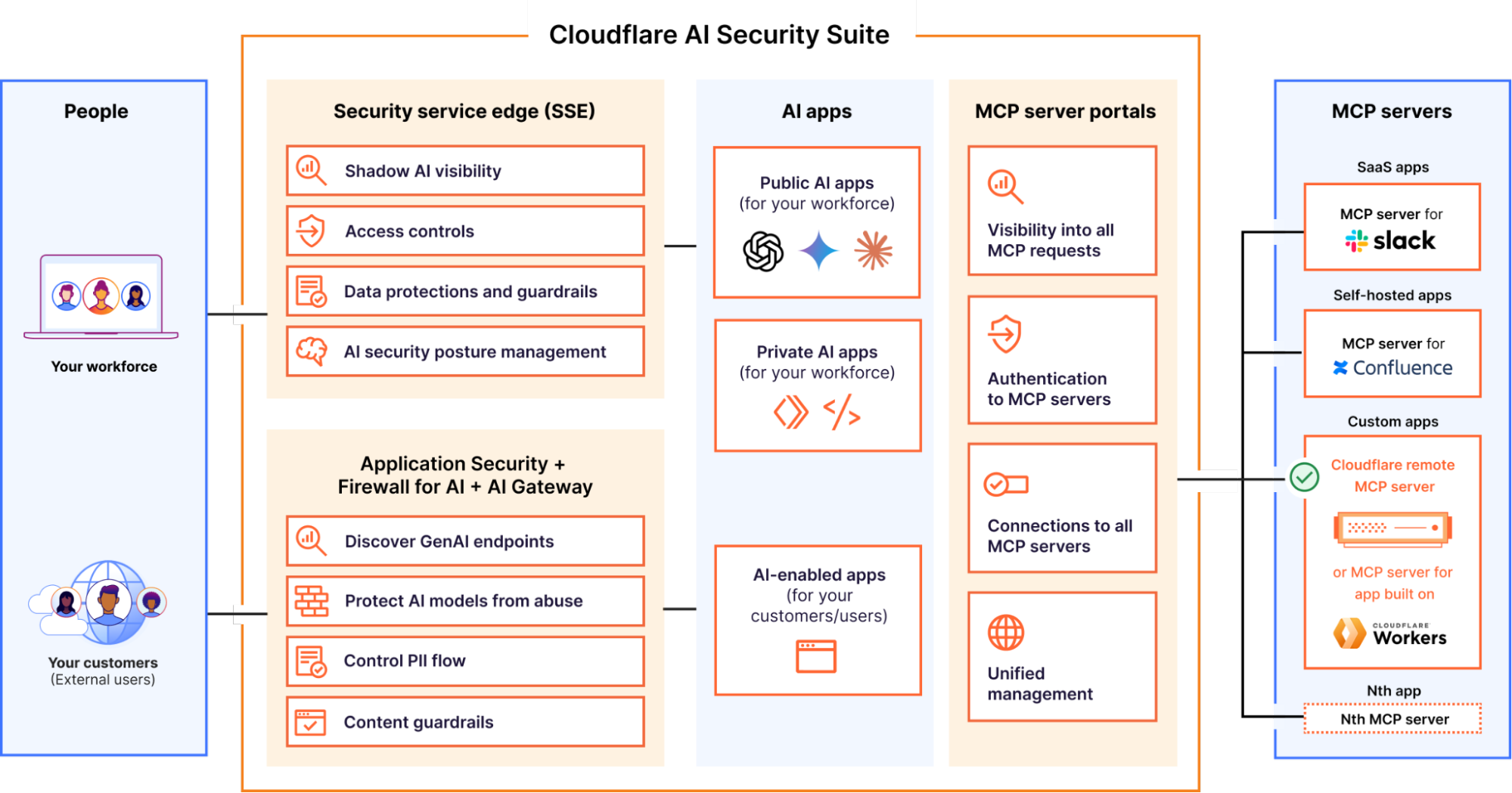
The Cloudflare AI Security Suite acts as a secure intermediary between users and AI ecosystems, providing visibility, data protection, and governance for public, private, and agentic AI applications.
If you are a CIO still tethered to a multi-year migration roadmap, you are operating at a competitive disadvantage. Cloudflare One integrates your network and security into a single fabric that is fast, safe, and infinitely more programmable than the legacy solution in your current stack.
Don’t let the fear of a difficult migration keep you trapped in a legacy mindset. Our partners are proving every day that the move to SASE can be fast, effective, and—dare we say—easy.
Connect with a Cloudflare One expert to start mapping your migration.
S13 E04: Iran, USAID & Soap Operas: 3/8/26: Last Week Tonight with John Oliver
Post Syndicated from LastWeekTonight original https://www.youtube.com/watch?v=bCroWm39-gY
DumpBrowserSecrets – Browser Credential Harvesting with App-Bound Encryption Bypass
Post Syndicated from Darknet original https://www.darknet.org.uk/2026/03/dumpbrowsersecrets-browser-credential-harvesting-with-app-bound-encryption-bypass/
DumpBrowserSecrets extracts saved passwords, cookies, OAuth tokens and autofill data from Chrome, Edge, Firefox, Opera and Vivaldi, bypassing App-Bound Encryption via Early Bird APC injection.
Kernel prepatch 7.0-rc3
Post Syndicated from corbet original https://lwn.net/Articles/1062002/
Linus has released 7.0-rc3 for testing.
“So it’s still pretty early in the release cycle, and it just feels a
“
bit busier than I’d like. But nothing particularly stands out or looks
bad.
Comic for 2026.03.09 – Epic Prank
Post Syndicated from Explosm.net original https://explosm.net/comics/epic-prank
New Cyanide and Happiness Comic
Home Remedies
Post Syndicated from xkcd.com original https://xkcd.com/3217/

GigaPlus GP-S50-0800 Review An 8-Port 5GbE Switch
Post Syndicated from Ryan Smith original https://www.servethehome.com/gigaplus-gp-s50-0800-review-an-8-port-5gbe-switch/
In our GigaPlus GP-S50-0800 review, we see how this 8-port 5GbE switch performs and how the switch is built compared to others
The post GigaPlus GP-S50-0800 Review An 8-Port 5GbE Switch appeared first on ServeTheHome.
5 new lenses from 7Artisans
Post Syndicated from Matt Granger original https://www.youtube.com/shorts/FexZ_AxgD0w
Security Camera Captures Wild Animals & Controls Your Smart Home! #shorts
Post Syndicated from BeardedTinker original https://www.youtube.com/shorts/6ZtD0gidkMA