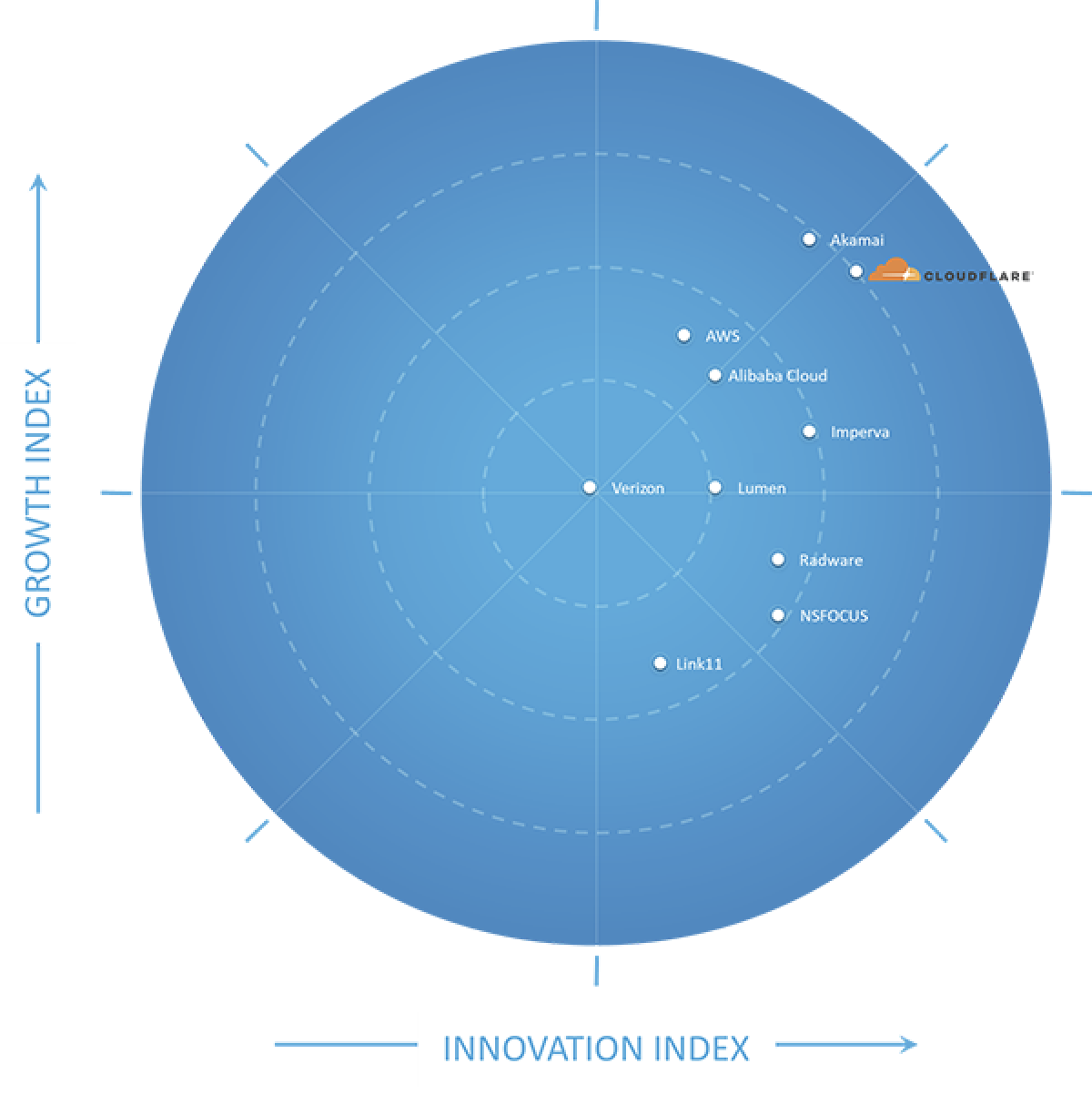
Forester has recognised Cloudflare as a Leader in The Forrester Wave™: Web Application Firewalls, Q3 2022 report. The report evaluated 12 Web Application Firewall (WAF) providers on 24 criteria across current offering, strategy and market presence.
You can register for a complimentary copy of the report here. The report helps security and risk professionals select the correct offering for their needs.
We believe this achievement, along with recent WAF developments, reinforces our commitment and continued investment in the Cloudflare Web Application Firewall (WAF), one of our core product offerings.
The WAF, along with our DDoS Mitigation and CDN services, has in fact been an offering since Cloudflare’s founding, and we could not think of a better time to receive this recognition: Birthday Week.
We’d also like to take this opportunity to thank Forrester.
Leading WAF in strategy
Cloudflare received the highest score of all assessed vendors in the strategy category. We also received the highest possible scores in 10 criteria, including:
Innovation
Management UI
Rule creation and modification
Log4Shell response
Incident investigation
Security operations feedback loops
According to Forrester, “Cloudflare Web Application Firewall shines in configuration and rule creation”, “Cloudflare stands out for its active online user community and its associated response time metrics”, and “Cloudflare is a top choice for those prioritizing usability and looking for a unified application security platform.”
Protecting web applications
The core value of any WAF is to keep web applications safe from external attacks by stopping any compromise attempt. Compromises can in fact lead to complete application take over and data exfiltration resulting in financial and reputational damage to the targeted organization.
The Log4Shell criterion in the Forrester Wave report is an excellent example of a real world use case to demonstrate this value.
Log4Shell was a high severity vulnerability discovered in December 2021 that affected the popular Apache Log4J software commonly used by applications to implement logging functionality. The vulnerability, when exploited, allows an attacker to perform remote code execution and consequently take over the target application.
Due to the popularity of this software component, many organizations worldwide were potentially at risk after the immediate public announcement of the vulnerability on December 9, 2021.
We believe that we scored the highest possible score in the Log4Shell criterion due to our fast response to the announcement, by ensuring that all customers using the Cloudflare WAF were protected against the exploit in less than 17 hours globally.
We did this by deploying new managed rules (virtual patching) that were made available to all customers. The rules were deployed with a block action ensuring exploit attempts never reached customer applications.
The Cloudflare WAF ultimately “bought” valuable time for our customers to patch their back end systems before attackers may have been able to find and attempt compromise of vulnerable applications.
You can read about our response and our actions following the Log4Shell announcement in great detail on our blog.
Use the Cloudflare WAF today
Cloudflare WAF keeps organizations safer while they focus on improving their applications and APIs. We integrate leading application security capabilities into a single console to protect applications with our WAF while also securing APIs, stopping DDoS attacks, blocking unwanted bots, and monitoring for 3rd party JavaScript attacks.
Gartner has recognised Cloudflare as a Leader in the 2022 “Gartner® Magic Quadrant™ for Web Application and API Protection (WAAP)” report that evaluated 11 vendors for their ‘ability to execute’ and ‘completeness of vision’.
You can register for a complimentary copy of the report here.
We believe this achievement highlights our continued commitment and investment in this space as we aim to provide better and more effective security solutions to our users and customers.
Keeping up with application security
With over 36 million HTTP requests per second being processed by the Cloudflare global network we get unprecedented visibility into network patterns and attack vectors. This scale allows us to effectively differentiate clean traffic from malicious, resulting in about 1 in every 10 HTTP requests proxied by Cloudflare being mitigated at the edge by our WAAP portfolio.
Visibility is not enough, and as new use cases and patterns emerge, we invest in research and new product development. For example, API traffic is increasing (55%+ of total traffic) and we don’t expect this trend to slow down. To help customers with these new workloads, our API Gateway builds upon our WAF to provide better visibility and mitigations for well-structured API traffic for which we’ve observed different attack profiles compared to standard web based applications.
We believe our continued investment in application security has helped us gain our position in this space, and we’d like to thank Gartner for the recognition.
Cloudflare WAAP
At Cloudflare, we have built several features that fall under the Web Application and API Protection (WAAP) umbrella.
DDoS protection & mitigation
Our network, which spans more than 275 cities in over 100 countries is the backbone of our platform, and is a core component that allows us to mitigate DDoS attacks of any size.
To help with this, our network is intentionally anycasted and advertises the same IP addresses from all locations, allowing us to “split” incoming traffic into manageable chunks that each location can handle with ease, and this is especially important when mitigating large volumetric Distributed Denial of Service (DDoS) attacks.
The system is designed to require little to no configuration while also being “always-on” ensuring attacks are mitigated instantly. Add to that some very smart software such as our new location aware mitigation, and DDoS attacks become a solved problem.
Our WAF is a core component of our application security and ensures hackers and vulnerability scanners have a hard time trying to find potential vulnerabilities in web applications.
This is very important when zero-day vulnerabilities become publicly available as we’ve seen bad actors attempt to leverage new vectors within hours of them becoming public. Log4J, and even more recently the Confluence CVE, are just two examples where we observed this behavior. That’s why our WAF is also backed by a team of security experts who constantly monitor and develop/improve signatures to ensure we “buy” precious time for our customers to harden and patch their backend systems when necessary. Additionally, and complementary to signatures, our WAF machine learning system classifies each request providing a much wider view in traffic patterns.
Our Bot Management product works in parallel to our WAF and scores every request with the likelihood of it being generated by a bot, allowing you to easily filter unwanted traffic by deploying a WAF Custom Rule, all this backed by powerful analytics. We make this easy by also maintaining a list of verified bots that can be used to further improve a security policy.
In the event you want to block automated traffic, Cloudflare’s managed challenge ensures that only bots receive a hard time without impacting the experience of real users.
API Gateway
API traffic, by definition, is very well-structured relative to standard web pages consumed by browsers. At the same time, APIs tend to be closer abstractions to back end databases and services, resulting in increased attention from malicious actors and often go unnoticed even to internal security teams (shadow APIs).
API Gateway, that can be layered on top of our WAF, helps you both discover API endpoints served by your infrastructure, as well detect potential anomalies in traffic flows that may indicate compromise, both from a volumetric and sequential perspective.
The nature of APIs also allows API Gateway to much more easily provide a positive security model contrary to our WAF: only allow known good traffic and block everything else. Customers can leverage schema protection and mutual TLS authentication (mTLS) to achieve this with ease.
Page Shield
Attacks that leverage the browser environment directly can go unnoticed for some time, as they don’t necessarily require the back end application to be compromised. For example, if any third party JavaScript library used by a web application is performing malicious behavior, application administrators and users may be none the wiser while credit card details are being leaked to a third party endpoint controlled by an attacker. This is a common vector for Magecart, one of many client side security attacks.
Page Shield, just like our other WAAP products, is fully integrated on the Cloudflare platform and requires one single click to turn on.
Security Center
Cloudflare’s new Security Center is the home of the WAAP portfolio. A single place for security professionals to get a broad view across both network and infrastructure assets protected by Cloudflare.
Moving forward we plan for the Security Center to be the starting point for forensics and analysis, allowing you to also leverage Cloudflare threat intelligence when investigating incidents.
The Cloudflare advantage
Our WAAP portfolio is delivered from a single horizontal platform, allowing you to leverage all security features without additional deployments. Additionally, scaling, maintenance and updates are fully managed by Cloudflare allowing you to focus on delivering business value on your application.
This applies even beyond WAAP, as, although we started building products and services for web applications, our position in the network allows us to protect anything connected to the Internet, including teams, offices and internal facing applications. All from the same single platform. Our Zero Trust portfolio is now an integral part of our business and WAAP customers can start leveraging our secure access service edge (SASE) with just a few clicks.
If you are looking to consolidate your security posture, both from a management and budget perspective, application services teams can use the same platform that internal IT services teams use, to protect staff and internal networks.
Continuous innovation
We did not build our WAAP portfolio overnight, and over just the past year we’ve released more than five major WAAP portfolio security product releases. To showcase our speed of innovation, here is a selection of our top picks:
API Shield Schema Protection: traditional signature based WAF approaches (negative security model) don’t always work well with well-structured data such as API traffic. Given the fast growth in API traffic across the network we built a new incremental product that allows you to enforce API schemas directly at the edge using a positive security model: only let well-formed data through to your origin web servers;
API Abuse Detection: complementary to API Schema Protection, API Abuse Detection warns you whenever anomalies are detected on your API endpoints. These can be triggered by unusual traffic flows or patterns that don’t follow normal traffic activity;
Our new Web Application Firewall: built on top of our new Edge Rules Engine, the core Web Application Firewall received a complete overhaul, all the way from engine internals to the UI. Better performance both in terms of latency and efficacy at blocking malicious payloads, along with brand-new capabilities including but not limited to Exposed Credential Checks, account wide configurations and payload logging;
DDoS customizable Managed Rules: to provide additional configuration flexibility, we started exposing some of our internal DDoS mitigation managed rules for custom configurations to further reduce false positives and allow customers to increase thresholds / detections as required;
Security Center: Cloudflare view on infrastructure and network assets, along with alerts and notifications for miss configurations and potential security issues;
Page Shield: based on growing customer demand and the rise of attack vectors focusing on the end user browser environment, Page Shield helps you detect whenever malicious JavaScript may have made its way into your application’s code;
API Gateway: full API management, including routing directly from the Cloudflare edge, with API Security baked in, including encryption and mutual TLS authentication (mTLS);
Machine Learning WAF: complementary to our WAF Managed Rulesets, our new ML WAF engine, scores every single request from 1 (clean) to 99 (malicious) giving you additional visibility in both valid and non-valid malicious payloads increasing our ability to detect targeted attacks and scans towards your application;
Looking forward
Our roadmap is packed with both new application security features and improvements to existing systems. As we learn more about the Internet we find ourselves better equipped to keep your applications safe. Stay tuned for more.
Gartner, “Magic Quadrant for Web Application and API Protection”, Analyst(s): Jeremy D’Hoinne, Rajpreet Kaur, John Watts, Adam Hils, August 30, 2022.
Gartner and Magic Quadrant are registered trademarks of Gartner, Inc. and/or its affiliates in the U.S. and internationally and is used herein with permission. All rights reserved.
Gartner does not endorse any vendor, product or service depicted in its research publications, and does not advise technology users to select only those vendors with the highest ratings or other designation.
Gartner research publications consist of the opinions of Gartner’s research organization and should not be construed as statements of fact. Gartner disclaims all warranties, expressed or implied, with respect to this research, including any warranties of merchantability or fitness for a particular purpose.
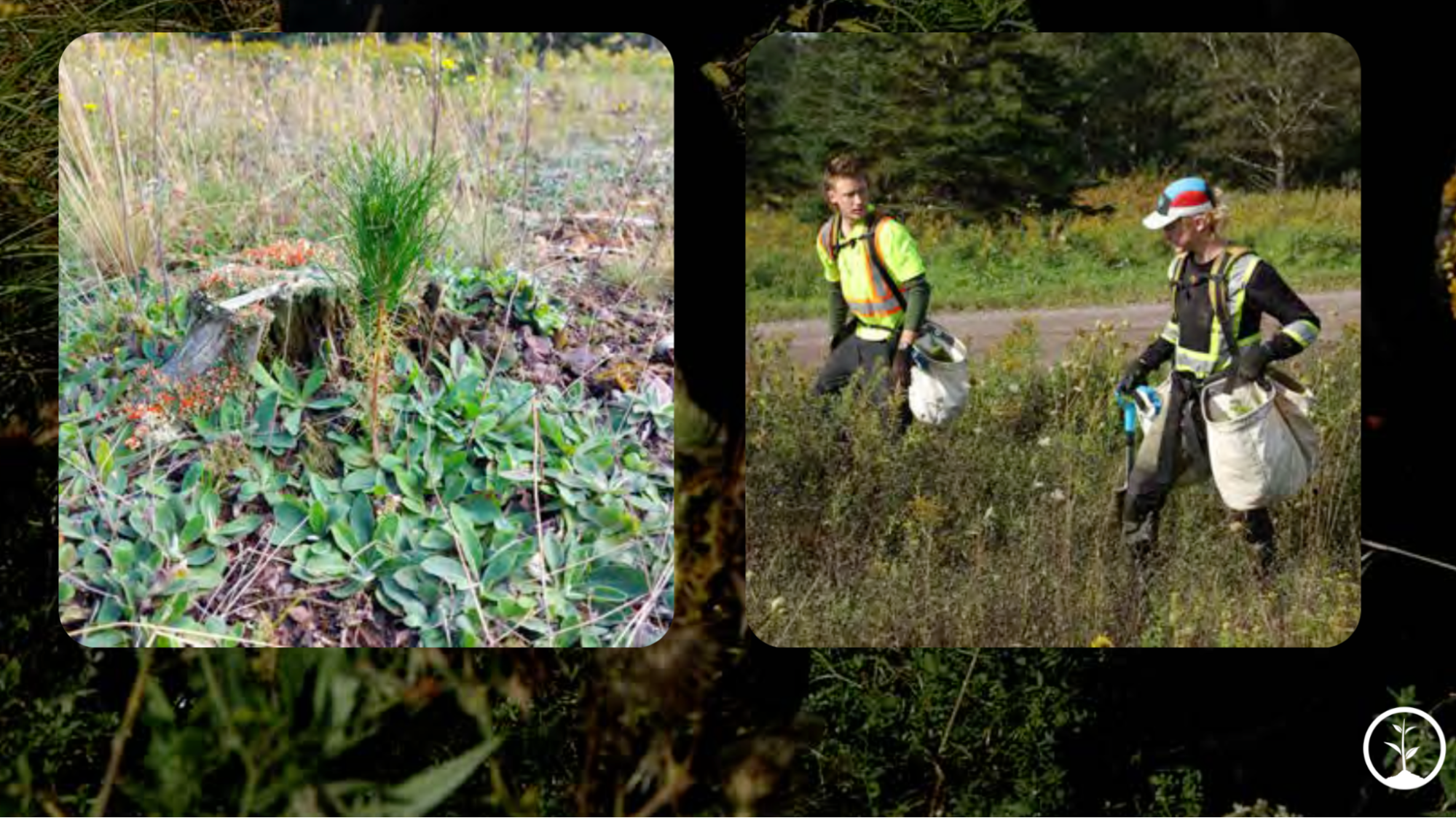
Cloudflare is proud to announce the first 35,000 trees from our commitment to help clean up bad bots (and the climate) have been planted.
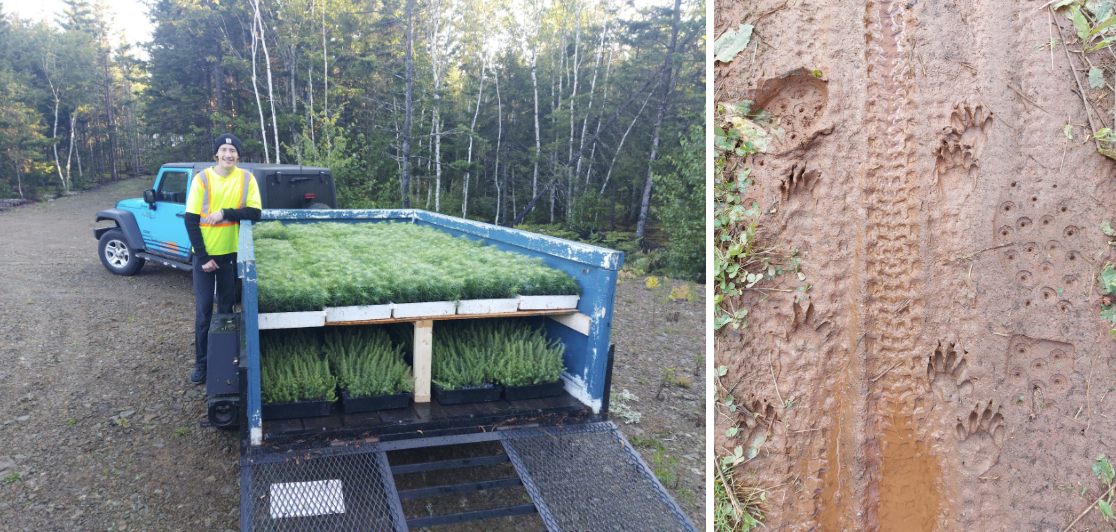
Working with our partners at One Tree Planted (OTP), Cloudflare was able to support the restoration of 20 hectares of land at Victoria Park in Nova Scotia, Canada. The 130-year-old natural woodland park is located in the heart of Truro, NS, and includes over 3,000 acres of hiking and biking trails through natural gorges, rivers, and waterfalls, as well as an old-growth eastern hemlock forest.
The planting projects added red spruce, black spruce, eastern white pine, eastern larch, northern red oak, sugar maple, yellow birch, and jack pine to two areas of the park. The first area was a section of the park that recently lost a number of old conifers due to insect attacks. The second was an area previously used as a municipal dump, which has since been covered by a clay cap and topsoil.
Our tree commitment began far from the Canadian woodlands. In 2019, we launched an ambitious tool called Bot Fight Mode, which for the first time fought back against bots, targeting scrapers and other automated actors.
Our idea was simple: preoccupy bad bots with nonsense tasks, so they cannot attack real sites. Even better, make these tasks computationally expensive to engage with. This approach is effective, but it forces bad actors to consume more energy and likely emit more greenhouse gasses (GHG). So in addition to launching Bot Fight Mode, we also committed to supporting tree planting projects to account for any potential environmental impact.
What is Bot Fight Mode?
As soon as Bot Fight Mode is enabled, it immediately starts challenging bots that visit your site. It is available to all Cloudflare customers for free, regardless of plan.
When Bot Fight Mode identifies a bot, it issues a computationally expensive challenge to exhaust it (also called “tarpitting”). Our aim is to disincentivize attackers, so they have to find a new hobby altogether. When we tarpit a bot, we require a significant amount of compute time that will stall its progress and result in a hefty server bill. Sorry not sorry.
We do this because bots are leeches. They draw resources, slow down sites, and abuse online platforms. They also hack into accounts and steal personal data. Of course, we allowlist a small number of bots that are well-behaved, like Slack and Google. And Bot Fight Mode only acts on traffic from cloud and hosting providers (because that is where bots usually originate from).
Over 550,000 sites use Bot Fight Mode today! We believe this makes it the most widely deployed bot management solution in the world (though this is impossible to validate). Free customers can enable the tool from the dashboard and paid customers can use a special version, known as Super Bot Fight Mode.
How many trees? Let’s do the math 🚀
Now, the hard part: how can we translate bot challenges into a specific number of trees that should be planted? Fortunately, we can use a series of unit conversions, similar to those we use to calculate Cloudflare’s total GHG emissions.
Next, we selected a high-traffic day to model the rate and duration of bot challenges on our network. On May 23, 2021, Bot Fight Mode issued 2,878,622 challenges, which lasted an average of 50 seconds each. In total, bots spent 39,981 hours engaging with our network defenses, or more than four years of challenges in a single day!
We then converted that time value into kilowatt-hours (kWh) of energy based on the rate of power consumed by our generic server listed in Table 1 above.
39,981 (hours) x .2 (kWh/hour) = 7,996 (kWh)
Once we knew the total amount of energy consumed by bad bot servers, we used an emissions factor (the amount of greenhouse gasses emitted per unit of energy consumed) to determine total emissions.
7,996 (kwh) x 338.52 (gCO2e/kwh) = 2,706,805 (gCO2e)
If you have made it this far, clearly you like to geek out like we do, so for the sake of completeness, the unit commonly used in emissions calculations is carbon dioxide equivalent (CO2e), which is a composite unit for all six GHGs listed in the Kyoto Protocol weighted by Global Warming Potential.
The last conversion we needed was from emissions to trees. Our partners at OTP found that a mature tree absorbs roughly 21 kgCO2e per year. Based on our total emissions that translates to roughly 47,000 trees per server, or 840 trees per CPU core. However, in our original post, we also noted that given the time it takes for a newly planted tree to reach maturity, we would multiply our donation by a factor of 25.
In the end, over the first two years of the program, we calculated that we would need approximately 42,000 trees to account for all the individual CPU cores engaged in Bot Fight Mode. For good measure, we rounded up to an even 50,000.
We are proud that most of these trees are already in the ground, and we look forward to providing an update when the final 15,000 are planted.
A piece of the puzzle
“Planting trees will benefit species diversity of the existing forest, animal habitat, greening of reclamation areas as well as community recreation areas, and visual benefits along popular hiking/biking trail networks.” – Stephanie Clement, One Tree Planted, Project Manager North America
Reforestation is an important part of protecting healthy ecosystems and promoting biodiversity. Trees and forests are also a fundamental part of helping to slow the growth of global GHG emissions.
However, we recognize there is no single solution to the climate crisis. As part of our mission to help build a better, more sustainable Internet, Cloudflare is investing in renewable energy, tools that help our customers understand and mitigate their own carbon footprints on our network, and projects that will help offset or remove historical emissions associated with powering our network by 2025.
Want to be part of our bots & trees effort? Enable Bot Fight Mode today! It’s available on our free plan and takes only a few seconds. By the time we made our first donation to OTP in 2021, Bot Fight Mode had already spent more than 3,000 years distracting bots.
Help us defeat bad bots and improve our planet today!
This is a guest post by Ryan Marlow, CTO, and Michael Taggart, Co-founder of Envoy Media Group.
My name is Ryan Marlow, and I’m the CTO of Envoy Media Group. I’m excited to share a story with you about Envoy, Cloudflare, and how we use Bot Management to monitor automated traffic.
Background
Envoy Media Group is a digital marketing and lead generation company. The aim of our work is simple: we use marketing to connect customers with financial services. For people who are experiencing a particular financial challenge, Envoy provides informative videos, money management tools, and other resources. Along the way, we bring customers through an online experience, so we can better understand their needs and educate them on their options. With that information, we check our database of highly vetted partners to see which programs may be useful, and then match them up with the best company to serve them.
As you can imagine, it’s important for us to responsibly match engaged customers to the right financial services. Envoy develops its own brands that guide customers throughout the process. We spend our own advertising dollars, work purely on a performance basis, and choose partners we know will do right by customers. Envoy serves as a trusted guide to help customers get their financial lives back on track.
A bit of technical detail
We often say that Envoy offers a “sophisticated online experience.” This is not your average lead generation engine. We’ve built our own multichannel marketing platform called Revstr, which handles content management, marketing automation, and business intelligence. Envoy has an in-house technology team that develops and maintains Revstr’s multi-million line PHP application, cloud computing services, and infrastructure. With Revstr’s systems, we are able to A/B test any combination of designs with any set of business rules. As a result, Envoy shows the right experience to the right customer every time, and even adapts to the responses of each individual.
Revstr tracks each aspect of the customer’s progress through our pages and forms. It also integrates with advertising platforms, client companies’ CRM systems, and third-party marketing tools. Revstr creates a 360° view of our performance and the customer’s experience. All this information goes into our proprietary data warehouse and is served to the business team. This warehouse also provides data — already cleaned, normalized, and labeled — to our machine learning pipeline. Where needed, we can perform quick and easy testing, training, and deployment of ML models. Both our business team and our marketing automation rely heavily on guidance from these reports and models. And that’s where Cloudflare comes into the picture…
Why we care about automated traffic
One of our key challenges is evaluating the quality of our traffic. Bad actors are always advancing and proliferating. Importantly: any fake traffic to our sites has a direct impact on our business, including wasted resources in advertising, UX optimization, and customer service.
In our world of digital marketing, especially in the industries we compete in, each click is costly and must be treated like a precious commodity. The saying goes that “he or she who is able to spend the most for a click wins.” We spend our own money on those clicks and are only paid when we deliver real leads who consistently convert to enrollments for our clients.
Any money spent on illegitimate clicks will hurt our bottom line — and bots tend to be the lead culprits. Bots hurt our standing in auctions and reduce our ability to buy. The media buyers on our business team are always watching statistics on the cost, quantity, engagement, and conversion rates of our ad traffic. They look for anomalies that might represent fraudulent clicks to ensure we trim out any wasted spend.
Cloudflare offers Bot Management, which spots the exact traffic we need to look out for.
How we use Cloudflare’s Bot Score to filter out bad traffic
We solved our problem by using Cloudflare. For each request that reaches Envoy, Cloudflare calculates a “bot score” that ranges from 1 (automated) to 99 (human). It’s generated using a number of sophisticated methods, including machine learning. Because Cloudflare sees traffic from millions of requests every second, they have an enormous training set to work with. The bot scores are incredibly accurate. By leveraging the bot score to evaluate the legitimacy of an ad click and switching experiences accordingly, we can make the most of every click we pay for.
Because of the high cost of a click, we cannot afford to completely block that click even if Cloudflare indicates it might be a bot. Instead, we ingest the bot score as a custom header and use it as an input to our rules engine. For example, we can put much longer, more qualifying forms in front of traffic that looks suspicious, and render more streamlined forms to higher scoring visitors. In an extreme case, we can even require suspect visitors to contact us by phone instead of completing an online form. This allows us to convert leads which may have a more dubious origin but still prove to be legitimate, while maintaining a pleasant experience for the best leads.
We also pull the bot score into our data warehouse and provide it to our marketing team. Over the long term, if they see that any ad campaign or traffic source has a low average bot score, we can reduce or eliminate spend on that traffic source, seek refunds from providers, and refocus our efforts on more profitable segments.
Using the Bot Score to predict conversion rate
Envoy also leverages the bot score by integrating it into our ML models. For most lead generation companies, it would be sufficient to track lead volume and profit margins. For Envoy, it’s part of our DNA to go beyond making a sale and really assess the lifetime value of those leads for our clients. So we turn to machine learning. We use ML to predict the lifetime value of new visitors based on known data about past leads, and then pass that signal on to our advertising vendors. By skewing the conversion value higher for leads with a better predicted lifetime value, we can influence those pay-per click (PPC) platforms’ own smart bidding algorithms to search for the best qualified leads.
One of the models we use in this process does a prediction of backend conversion rate — how likely a given lead is to become an enrollment for the client company. When we added the bot score and behavioral metrics to this model, we saw a significant increase in its accuracy. When we can better predict conversion rate, we get better leads. This accuracy boost is a force multiplier for our whole platform; it makes an impact not only in media management but also in form design, lead delivery integrations, and email automation.
Why is Bot Score so valuable for Envoy Media?
At Envoy, we take pride in being analytical and data driven. Here are some of the insights we found by combining Cloudflare’s Bot Score with our own internal data:
1. When we added bot score along with behavioral metrics to our conversion rate prediction ML model, its precision increased by 15%. Getting even a 1% improvement in such a carefully tuned model is difficult; a 15% improvement is a huge win.
2. Bot score is included in 76 different reports used by our media buying and UX optimization teams, and in 9 different ML models. It is now a standard component of all new UX reports.
3. Because bot score is so accurate and because bot score is now broadly available within our organization, it is driving organizational performance in ways that we didn’t expect. For example, here is a testimonial from our UX Optimization Team:
I use bot score in PPC search reports. Before I had access to the bot score our PPC reports were muddied with automated traffic – one day conversion rates are 11%, the next day they are at 5%. That is no way to run a business! I spent a lot of time investigating to understand and justify these differences – and many times there just wasn’t a satisfactory answer, and we had to throw the analysis out. Today I have access to bot score data, and it prevents data dilution and gives me a much higher degree of confidence in my analysis.
Thank You and More to Come!
Thanks to the Cloudflare team for giving us the opportunity to share our story. We’re constantly innovating and hope that we can share more of our developments with you in the future.
This week, a group of US lawmakers introduced the Stopping Grinch Bots Act — new legislation that could stop holiday hoarders on the Internet. This inspired us to put a spin on a Dr. Seuss classic:
Each person on the Internet liked Christmas a lot But the Grinch Bot, built by the scalper did not! The Grinch Bot hated Christmas! The whole Christmas season! Now, please don’t ask why. No one quite knows the reason.
Cloudflare stops billions of bad bots every day. As you might have guessed, we see all types of attacks, but none is more painful than a Grinch Bot attack. Join us as we take a closer look at this notorious holiday villain…
25 days seconds of Christmas
What is the Grinch Bot? Technically speaking, it’s just a program running on a computer, making automated requests that reach different websites. We’ve come to refer to these requests as “bots” on the Internet. Bots move quickly, leveraging the efficiency of computers to carry out tasks at scale. The Grinch Bot is a very special type that satisfies two conditions:
It only pursues online inventory, attempting to purchase items before humans can complete their orders.
It only operates during the holiday season.
Now, attackers use bots to perform these tasks all year long. But in these winter months, we like to use the term “Grinch Bot” as seasonal terminology.
The Grinch Bot strikes first around Black Friday. It knows that the best discounts come around Thanksgiving, and it loves to get a good deal. Exclusive items are always the first to go, so attackers use the Grinch Bot to cut every (virtual) line and checkpoint. Cloudflare detected nearly 1.5 trillion bot requests on Black Friday. That’s about half of all our traffic; but more on this in a bit.
The Grinch Bot strikes again on Cyber Monday. As shoppers find gifts for their loved ones, bots are ten steps ahead — selecting “add to cart” automatically. Many bots have payment details ready (perhaps even stolen from your account!).
The Grinch Bot will buy 500 pairs of Lululemon joggers before you even get one. And it’ll do so in seconds.
Nearly 44% of traffic comes from bad bots
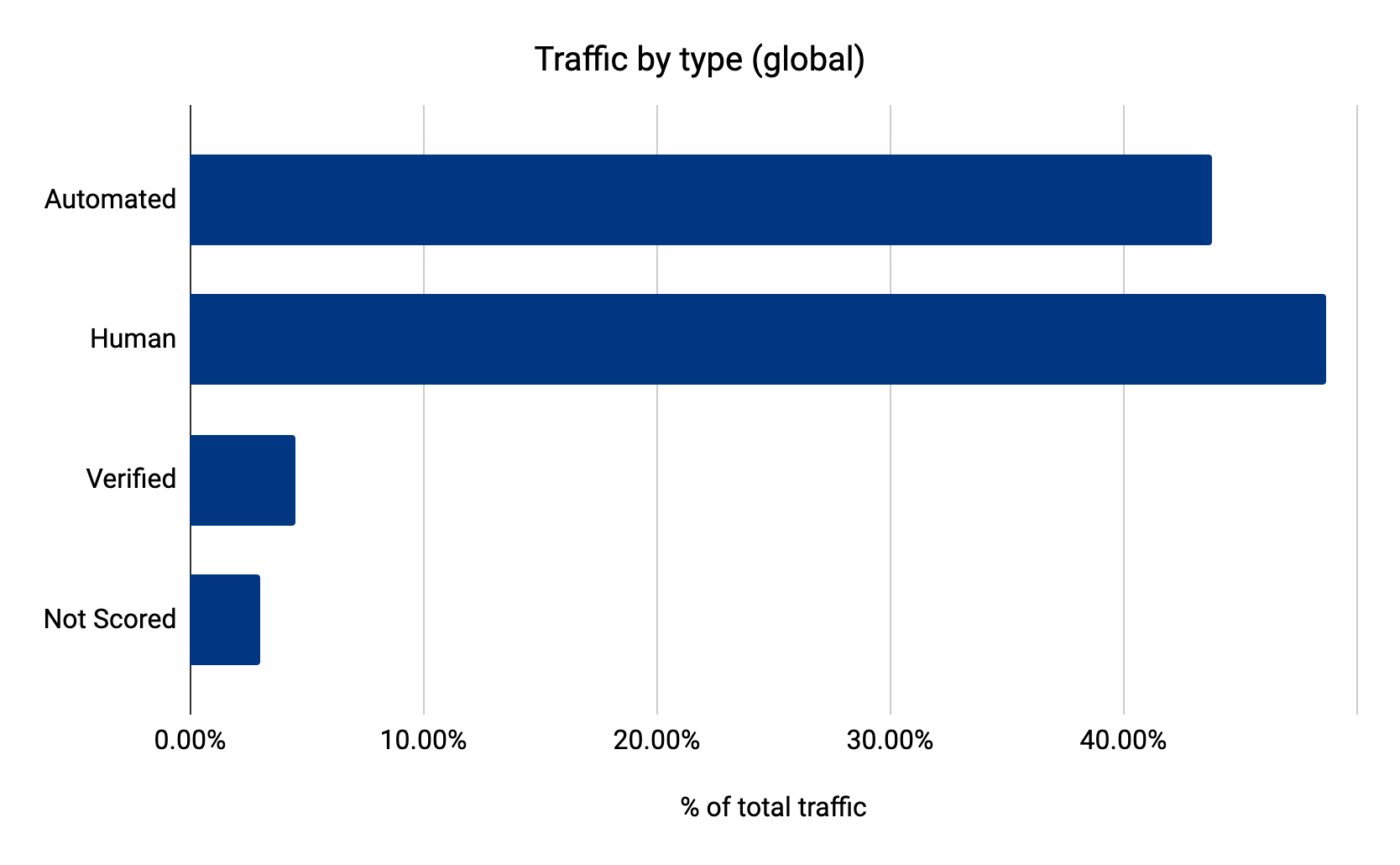
The Grinch Bot has friends working throughout the year, putting pressure on security teams and moving undetected. 43.8% of Internet traffic comes from these bots. When the holidays arrive, the Grinch Bot can ask its friends how to attack the largest sites. They have already been testing tactics for months.
In response, many sites block individual IP addresses, groups of devices, or even entire countries. Other sites use Rate Limiting to reduce traffic volume. At Cloudflare, we’ve advocated not only for Rate Limiting, but also for a more sophisticated approach known as Bot Management, which dynamically identifies threats as they appear. Here’s a look at bot traffic before the holidays (1H 2021):
When we looked at bot traffic on Black Friday, we found that it had surged to nearly 50%.Cloudflare Radar showed data close to 55% (if you want to include the good bots as well). Businesses tell us this is the most vulnerable time of the year for their sites.
Over 300 billion bots…
Bots are highly effective at scale. While humans can purchase one or two items within a few minutes, bots can purchase far more inventory with little effort.
During the year, Cloudflare observed over 300 billion bots try to “add to cart.” How did we find this? We ran our bot detection engines on every endpoint that contains the word “cart.” Keep in mind, most bots are stopped before they can even view item details. There are trillions of inventory hoarding bots that were caught earlier in their efforts by our Bot Management and security solutions.
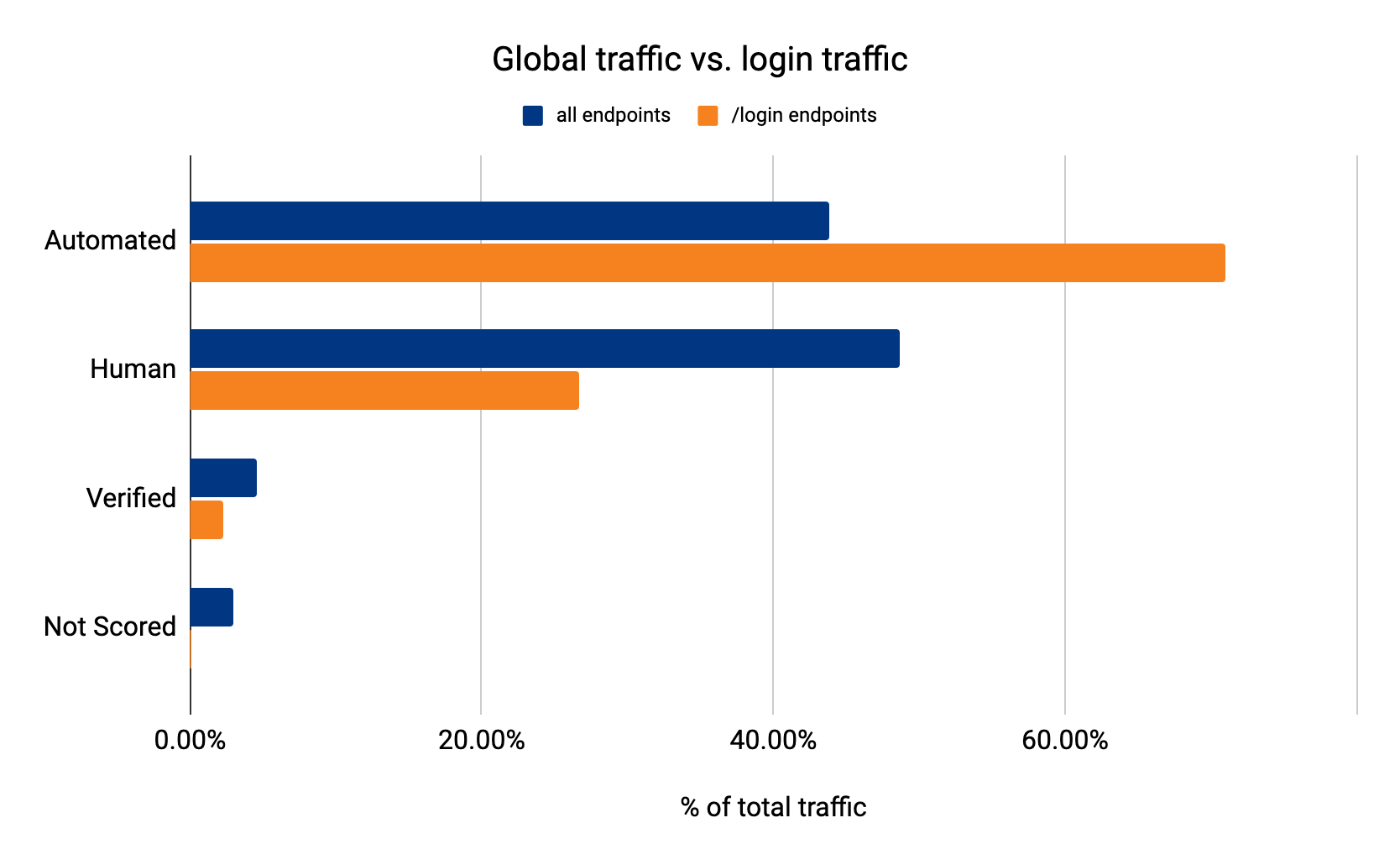
Even worse, some bots want to steal your holiday funds. They skip the ecommerce sites and head right for your bank, where they test stolen credentials and try to break into your account. 71% of login traffic comes from bots:
Bots operate at such an immense scale that they occasionally succeed. When this happens, they can break into accounts, retrieve your credit card information, and begin a holiday shopping spree.
Deck the halls with JS Challenges
We hate CAPTCHAs almost as much as we hate the Grinch Bot, so we built JS challenges as a lightweight, non-interactive alternative:
Not surprisingly, we issue more JS Challenges when more bots reach our network. These challenges are traditionally a middle ground between taking no action and completely blocking requests. They offer a chance for suspicious looking requests to prove their legitimacy. Cloudflare issued over 35 billion JS Challenges over the shopping weekend.
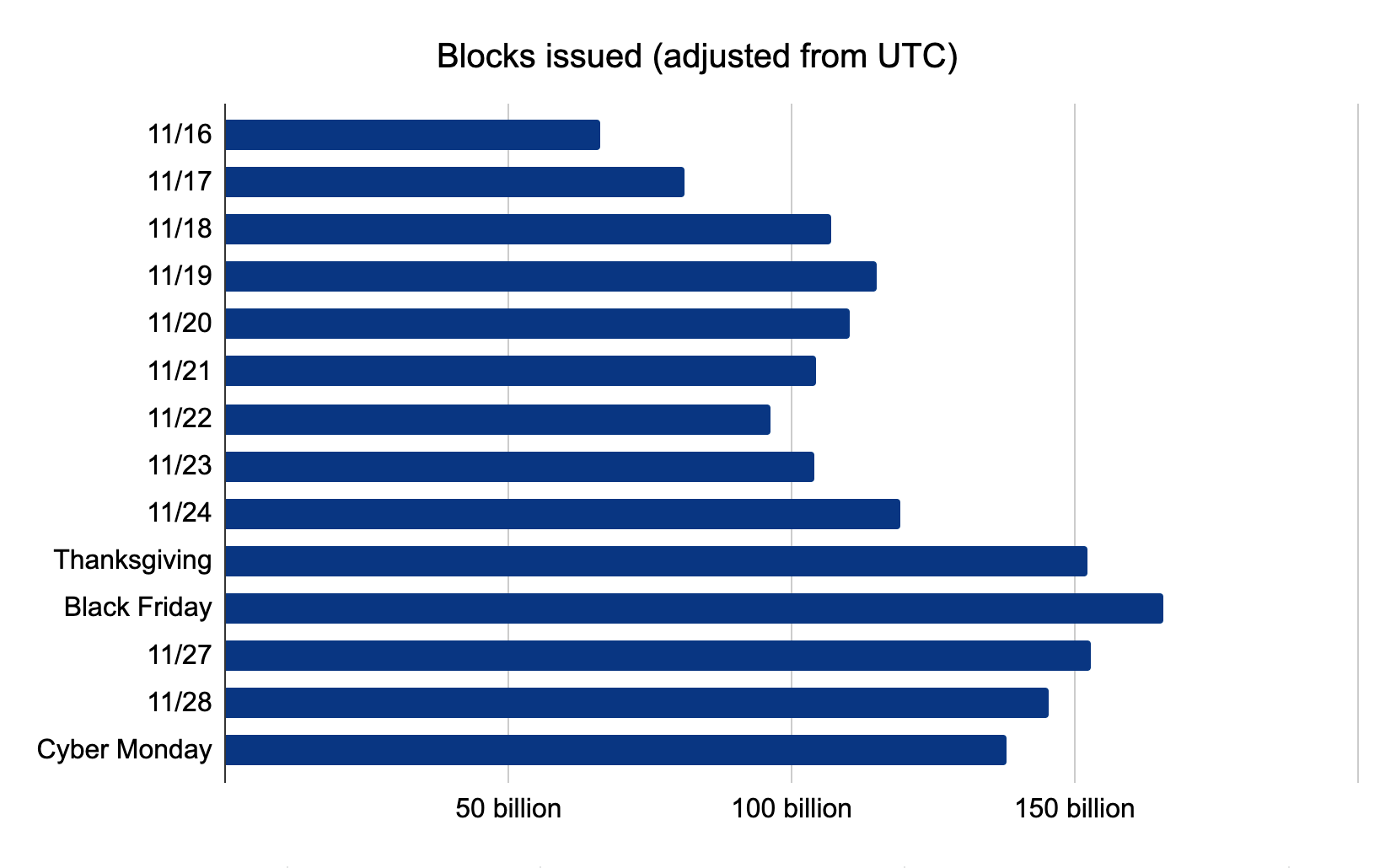
Even more impressive, however, is the number of threats blocked around this time. On Black Friday, Cloudflare blocked over 150 billion threats:
While we expected the Grinch Bot to make its move on Friday, we did not expect it to recede as it did on Cyber Monday. Bot traffic decreased as the shopping weekend continued. We like to think the Grinch Bot spent its time furiously trying to avoid blocks and JS Challenges, but eventually gave up.
Saving the Internet (and Christmas)
While large retailers can afford to purchase bot solutions, not every site is so fortunate. We decided to fix that.
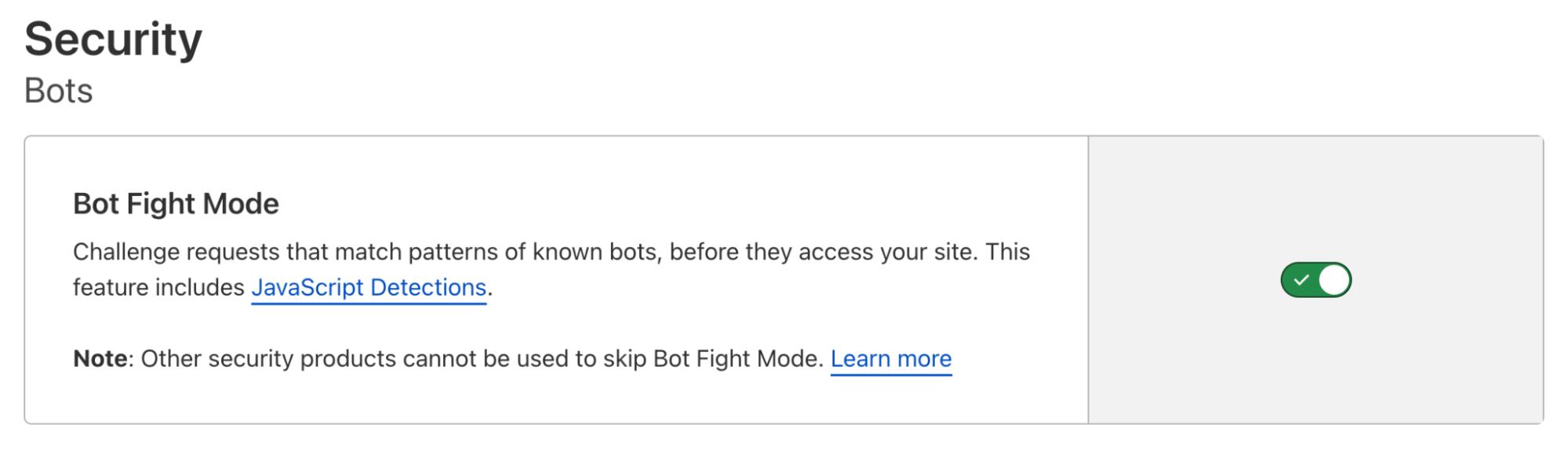
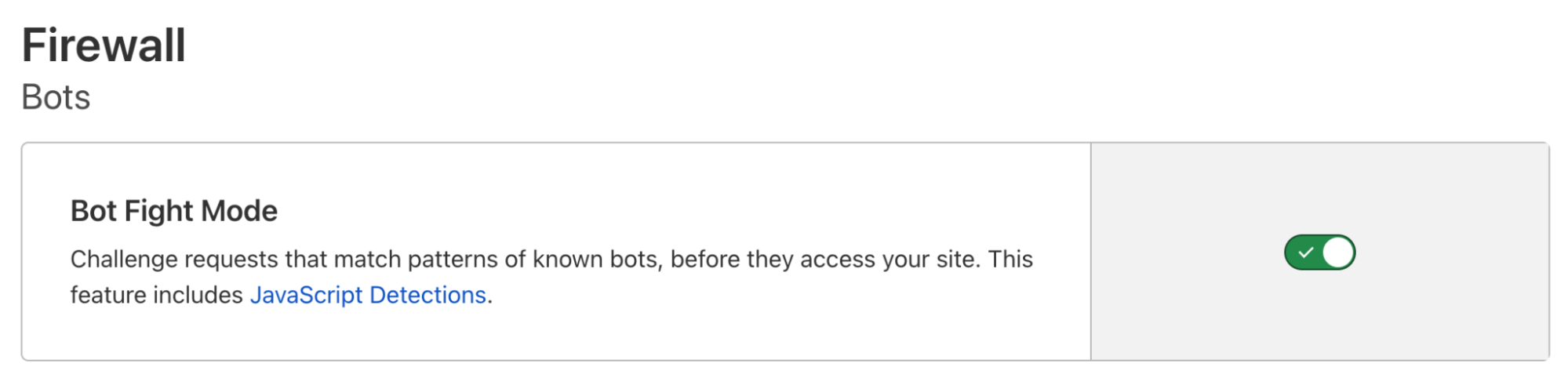
Cloudflare’s Bot Fight Mode is a completely free tool that stops bots. You can activate it with one click, drawing on our advanced detection engines to protect your site. It’s easy:
And Bot Fight Mode doesn’t just stop bots — it makes them pay. We unleash a tarpit challenge that preoccupies each bot with nonsense puzzles, ultimately handing bot operators a special gift: a massive server bill. We even plant trees to offset the carbon emissions of these expensive challenges. In fact, with so many bots stopped in the snow, there’s really just one thing left to say…
Every person on the Internet, the tall and the small, Called out with joy that their shopping didn’t stall! He hadn’t stopped Christmas from coming! It came! Somehow or other, it came just the same! And the Grinch Bot, with his grinch feet ice-cold in the snow, Stood puzzling and puzzling. “How could it be so?”
I love building products that solve real problems for our customers. These days I don’t get to do so as much directly with our Engineering teams. Instead, about half my time is spent with customers listening to and learning from their security challenges, while the other half of my time is spent with other Cloudflare Product Managers (PMs) helping them solve these customer challenges as simply and elegantly as possible. While I miss the deeply technical engineering discussions, I am proud to have the opportunity to look back every year on all that we’ve shipped across our application security teams.
Taking the time to reflect on what we’ve delivered also helps to reinforce my belief in the Cloudflare approach to shipping product: release early, stay close to customers for feedback, and iterate quickly to deliver incremental value. To borrow a term from the investment world, this approach brings the benefits of compounded returns to our customers: we put new products that solve real-world problems into their hands as quickly as possible, and then reinvest the proceeds of our shared learnings immediately back into the product.
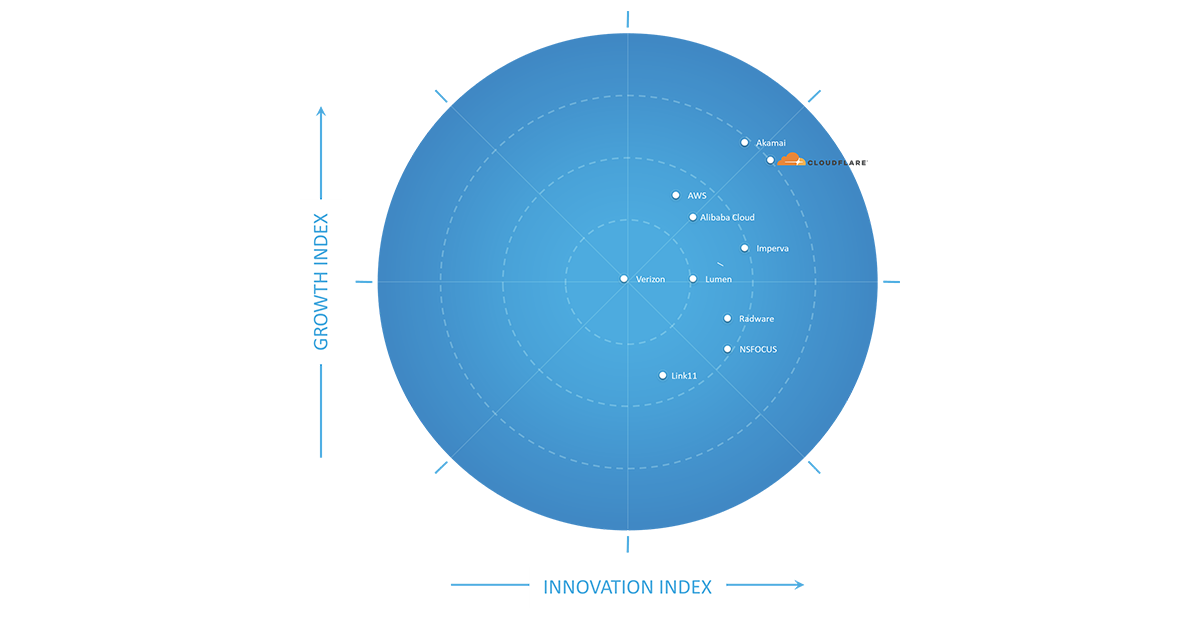
It is these sustained investments that allow us to release a flurry of small improvements over the course of a year, and be recognized by leading industry analyst firms for the capabilities we’ve accumulated and distributed to our customers. Today we’re excited to announce that Frost & Sullivan has named Cloudflare the Innovation Leader in their Frost Radar™: Global Holistic Web Protection Market Report. Frost & Sullivan’s view that this market “will gradually absorb the markets formed around legacy and point solutions” is consistent with our view of the world, and we’re leading the way in “the consolidation of standalone WAF, DDoS mitigation, and Bot Risk Management solutions” they believe is “poised to happen before 2025”.
We are honored to receive this recognition, based on the analysis of 10 providers’ competitive strengths and opportunities as assessed by Frost & Sullivan. The rest of this post explains some of the capabilities that we shipped in 2020 across our Web Application Firewall (WAF), Bot Management, and Distributed Denial-of-Service product lines—the scope of Frost & Sullivan’s report. Get a copy of the Frost & Sullivan Frost Radar report to see why Cloudflare was named the Innovation Leader here.
2020 Web Security Themes and Roundup
Before jumping into specific product and feature launches, I want to briefly explain how we think about building and delivering our web security capabilities. The most important “product” by far that’s been built at Cloudflare over the past 10 years is the massive global network that moves bits securely around the world, as close to the speed of light as possible. Building our features atop this network allows us to reject the legacy tradeoff of performance or security. And equipping customers with the ability to program and extend the network with Cloudflare Workers and Firewall Rules allows us to focus on quickly delivering useful security primitives such as functions, operators, and ML-trained data—then later packaging them up in streamlined user interfaces.
We talk internally about building up the “toolbox” of security controls so customers can express their desired security posture, and that’s how we think about many of the releases over the past year that are discussed below. We begin by providing the saw, hammer, and nails, and let expert builders construct whatever defenses they see fit. By watching how these tools are put to use and observing the results of billions of attempts to evade the erected defenses, we learn how to improve and package them together as a whole for those less inclined to build from components. Most recently we did this with API Shield, providing a guided template to create “positive security” models within Firewall Rules using existing primitives plus new data structures for strong authentication such as Cloudflare-managed client SSL/TLS certificates. Each new tool added to the toolbox increases the value of the existing tools. Each new web request—good or bad—improves the models that our threat intelligence and Bot Management capabilities depend upon.
Web application firewall (WAF) usability at scale
Last year we spoke with many customers about our plan to decouple configuration from the zone/domain model and allow rules to be set for arbitrary paths and groups of services across an account. In 4Q2020 we put this granular control in the hands of a few developers and some of our most sophisticated enterprise customers, and we’re currently collecting and incorporating feedback before defaulting the capabilities on for new customers.
Rules are great, especially with increased flexibility, but without data structures and request enrichment at the edge (such as the Bot Management techniques described below) they cannot act on anything beyond static properties of the request. In 3Q2020 we released our IP Lists capabilities and customers have been steadily uploading their home-grown and third-party subscription lists. These lists can be referenced anywhere in a customer’s account as named variables and then combined with all other attributes of the request, even Bot Management scores, e.g., http.request.uri.path contains “/login” and (not ip.src in $pingdom_probes and cf.bot_management.score < 30) is a Firewall Rule filter that blocks all bots except Pingdom from accessing the login endpoint.
Built predominantly in 4Q2020 and currently being tested in the Firewall Rules engine is a brand new implementation of our Rate Limiting engine. By moving this matching and enforcement logic from a standalone tool to a component within a performant, memory-safe, expressive engine built in Rust, we have increased the utility of existing functions. Additional examples of improving this library of capabilities include the work completed in 1Q2020 to add HMAC functions and regex-based HTTP header and body inspection to the engine.
Bots and machine learning (ML)
In addition to making edge data sets accessible for request evaluation, we continued to invest heavily within our Bot Management team to provide actionable data so that our customers could decide what (if any) automated traffic they wanted to allow to interact with their applications. Our highest priority for Bot research and development has always been efficacy, and last year was no different. A significant portion of our engineering effort was dedicated to our detection engines — both updating and iterating on existing systems or creating entirely new detection engines from scratch.
In 1Q2020 we completed a total rewrite of our Machine Learning engine, and are continually focused on improving the efficacy of our ML engines. To do this, we draw on one of our major competitive advantages: the massive amount of data flowing through Cloudflare’s network. The early 2020 upgrade to our ML model nearly doubled the number of features we use to evaluate and score requests. And to help customers better understand why requests are flagged as bots, we have recently complemented the bot likelihood score in our logs with attribution to the specific engine that generated the score.
Also in 1Q2020, we upgraded our behavioral analysis engine to incorporate more features and increase overall accuracy. This engine conducts histogram-based outlier scoring and is now fully deployed to nearly all Bot Management zones.
In 2Q2020, we developed a lightweight JavaScript element that further advanced our browser fingerprinting capabilities and aids in detection. Specifically, we now silently challenge browsers and detect if a browser is misrepresenting its User Agent. This technique will be incorporated into our ML models and combined with our heuristics engine for more accurate browser fingerprinting. This feature is entirely optional and can be enabled or disabled by customers through our UI and API. Customers with extremely performance sensitive zones or traffic types that are unsuitable for JavaScript (such as API or some mobile app traffic) can still be accurately scored by our Bot Management engine.
In addition to detection, we also spent (and will continue to spend) engineering effort on mitigation. Our entire JavaScript and CAPTCHA challenge platform was rewritten in the last year and deployed to our customer zones in a staged fashion in the second half of 2020. Our new platform is faster and more robust at detecting automated systems attempting to solve the challenges. More importantly, this platform allows us to further invest in new challenge types and modes as we enter 2021.
The biggest and most well received feature released in 2020 was our dedicated Bot Management analytics, released in 3Q2020. We now present informative graphs that double as diagnostic tools. Customers have found that analytics are far more than interesting charts and statistics: in the case of Bot Management, analytics are essential to spotting and subsequently eliminating false positives.
Last but definitely not least, we announced the deprecation of the __cfduid cookie in 4Q2020 which was used primarily to detect bots but caused confusion for some customers including questions about whether they needed to display a cookie banner because of what we do.
To get a sense of the Bot Attack trends we saw in the first half of 2020, take a read through this blog post. And if you’re curious about how our ML models and heuristic engines work to keep your properties safe, this deep dive by Alex Bocharov, Machine Learning Tech Lead on the Bots team, is an excellent guide.
API and IoT security and protection
At the beginning of 4Q2020, we released a product called API Shield that was purpose built to secure, protect, and accelerate API traffic — and will eventually provide much of the common functionality expected in traditional API Gateways. The UI for API Shield was built on top of Firewall Rules for maximum flexibility, and will serve as the jump-off point for configuring additional API security features we have planned this year.
As part of API Shield, every customer now gets a fully managed, domain-scoped private CA generated for each of their zones, and we plan to continue working closely with the SSL/TLS team to expand CA management options based on feedback. Since the release, we’ve seen great adoption from in particular IoT companies focused on locking down their APIs using short-lived client certificates distributed out to devices. Customers can also now upload OpenAPI schemas to be matched against incoming requests from these devices, with bad requests being dropped at the edge rather than passed on to origin infrastructure.
Another capability we released in 4Q2020 was support for gRPC-based API traffic. Since that release, customers have expressed significant interest in using Cloudflare as a secure API gateway between easy-to-use customer-facing JSON endpoints and internal-facing gRPC or GraphQL endpoints. Like most customer challenges at Cloudflare, early adopters are looking to solve these use cases initially with Cloudflare Workers, but we’re keeping an eye on whether there are aspects for which we’ll want to provide first-class feature support.
Distributed Denial-of-Service (DDoS) protections for web applications and APIs
The application-layer security of a web application or API is of minimal importance if the service itself is not available due to a persistent DDoS attack at L3-L7. While mitigating such attacks has long been one of Cloudflare’s strengths, attack methodologies evolve and we continued to invest heavily in 2020 to drop attacks more quickly, more efficiently, and more precisely; as a result, automatic mitigation techniques are applied immediately and most malicious traffic is blocked in less than 3 seconds.
Early in 2020 we responded to a persistent increase in smaller, more localized attacks by fine-tuning a system that can autonomously detect attacks on any server in any datacenter. In the month prior to us first posting about this tool, it mitigated almost 300,000 network-layer attacks, roughly 55 times greater than the tool we previously relied upon. This new tool, dubbed “dosd”, leverages Linux’s eXpress Data Path (XDP) and allows our system to quickly — and automatically — deploy rules eBPF rules that run on each packet received. We further enhanced our edge mitigation capabilities in 3Q2020 by developing and releasing a protection layer that can operate even in environments where we only see one side of the TCP flow. These network layer protections help protect our customers who leverage both Magic Transit to protect their IP ranges and our WAF to protect their applications and APIs.
To document and provide visibility into these attacks, we released a GraphQL-backed interface in 1Q2020 called Network Analytics. Network Analytics extends the visibility of attacks against our customers’ services from L7 to L3, and includes detailed attack logs containing data such as top source and destination IPs and ports, ASNs, data centers, countries, bit rates, protocol and TCP flag distributions. A litany of improvements made to this graphical rendering engine over the course of 2020 have benefitted all analytics tools using the same front-end. In 4Q2020, Network Analytics was extended to provide traffic and attack insights into Cloudflare Spectrum-protected applications, which are terminated at L4 (TCP/UDP).
2020 was a tough year around the world. Throughout what has also been, and continues to be, a period of heightened cyberattacks and breaches, we feel proud that our teams were able to release a steady flow of new and improved capabilities across several critical security product areas reviewed by Frost & Sullivan. These releases culminated in far greater protections for customers at the end of the year than the beginning, and a recognition for our sustained efforts.
We are pleased to have been named the Innovation Leader in their Frost Radar™: Global Holistic Web Protection Market Report, which “addresses organizations’ demand for consolidated, single pane of glass solutions, which not only reduce the security gaps of legacy products but also provide simplified management capabilities”.
As we look towards 2021 we plan to continue releasing early and often, listening to feedback from our customers, and delivering incremental value along the way. If you have ideas on what additional capabilities you’d like to use to protect your applications and networks, we’d love to hear them below in the comments.
Bots — both good and bad — are everywhere on the Internet. Roughly 40% of Internet traffic is automated. Fortunately, Cloudflare offers a tool that can detect and block unwanted bots: we call it Bot Management. This is the most recent platform in our long history of detecting bots for our customers. In fact, Cloudflare has always offered some form of bot detection. Over the past two years, our team has focused on building advanced detection engines, innovating as bots become more sophisticated, and creating new features.
Today, we are releasing Bot Analytics to help you visualize your automated traffic.
Background
It’s worth including some background for those who are new to bots.
Many websites expect human behavior. When I shop online, I behave as anyone else would: I might search for a few items, read reviews when I find something interesting, and eventually complete an order. This is expected. It is a standard use of the Internet.
Unfortunately, without protection these sites can be ripe for exploitation. Those shoes I was looking at? They are limited edition sneakers that resell for five times the price. Sneaker hoarders clamor at the chance to buy a pair (or fifty). Or perhaps I just added a book to my cart: there are probably hundreds of online retailers that sell the same book, each one eager to offer the best price. These retailers desperately want to know what their competitors’ prices are.
You can see where this is going. While most humans make good use of the Internet, some use automated tools to perform abuse at scale. For example, attackers will deplete sneaker inventories by using automated bots to check out quickly. By the time humans click “add to cart,” bots have already paid for shipping. Humans hardly stand a chance. Similarly, online retailers keep track of their competitors with “price scraping” bots that collect pricing information. So when one retailer lowers a book price to $10, another retailer’s bot will respond by pricing at $9.99. This is how we end up with weird prices like $12.32 for toilet paper. Worst of all, malicious bots are incentivized to hide their identities. They’re hidden among us.
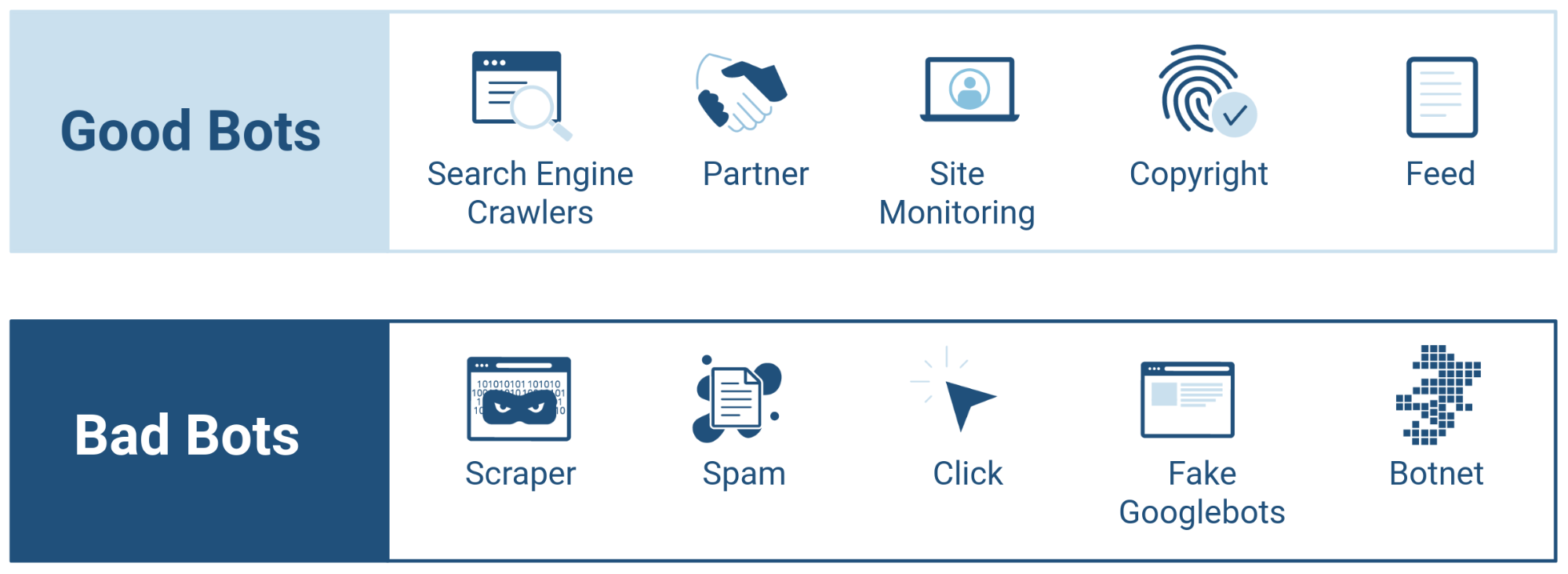
Not all bots are bad. Cloudflare maintains a list of verified good bots that we keep separated from the rest. Verified bots are usually transparent about who they are: DuckDuckGo, for example, publicly lists the IP addresses it uses for its search engine. This is a well-intentioned service that happens to be automated, so we verified it. We also verify bots for error monitoring and other tools.
Enter: Bot Analytics
As discussed earlier, we built a Bot Management platform that intelligently detects bots on the Internet, allowing our customers to block bad ones and allow good ones. If you’re curious about how our solution works, read here.
Beginning today, we are going to show you the bots that reach your website. You can see these bots with a new tool called Bot Analytics. It’s fast, accurate, and loaded with information. You can query data up to one month in the past with no noticeable lag. To accomplish this, we exposed the data with GraphQL and paired it with adaptive bitrate (ABR) technology to dynamically load content. If you already have Bot Management added to your Cloudflare account, Bot Analytics is included in your service. Open up your dashboard and let’s take a tour…
The Tour
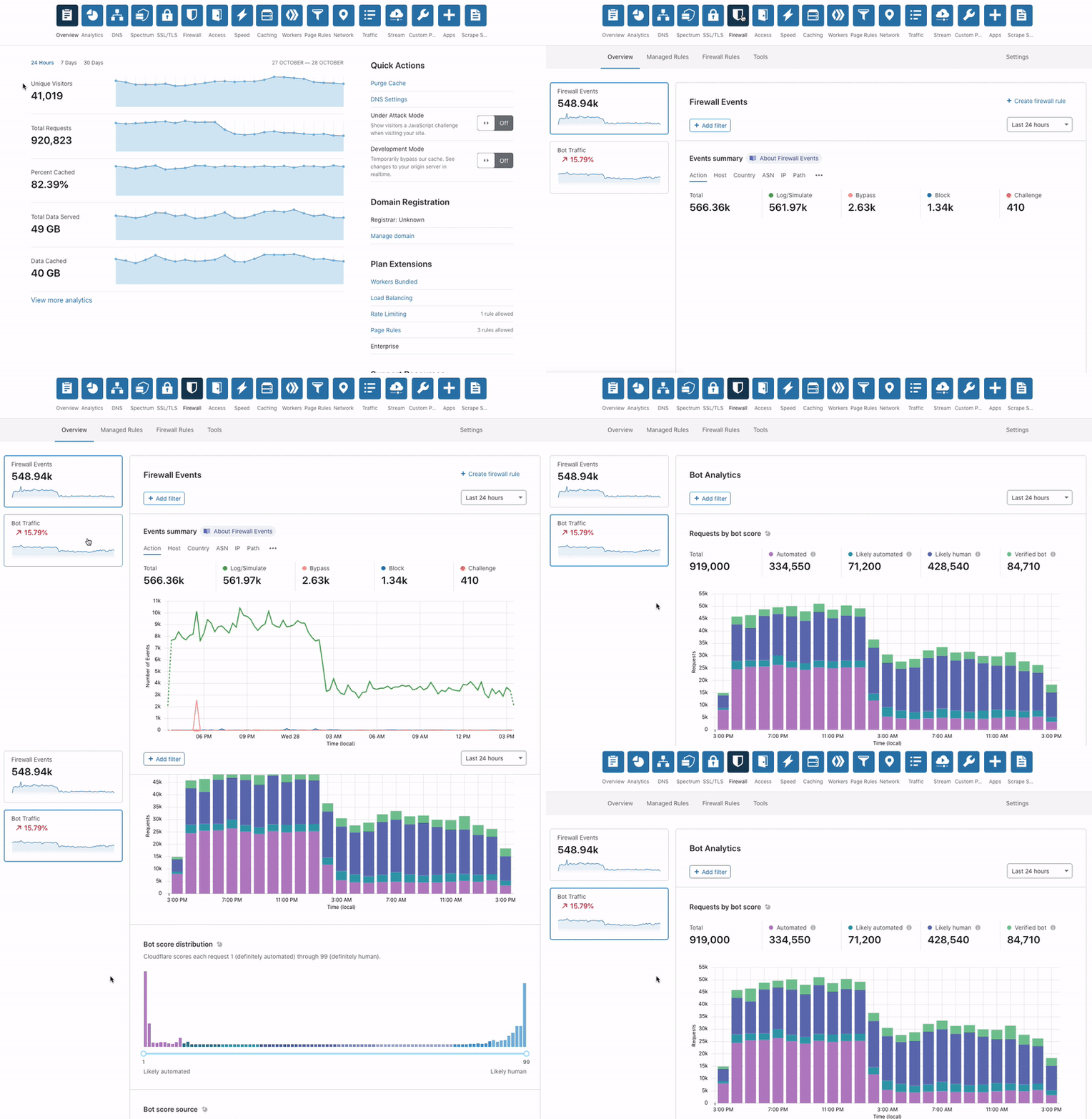
First: where to go? Bot Analytics lives under the Firewall tab of the dashboard. Once you’re in the Firewall, go to “Overview” and click the second thumbnail on the left. Remember, Bot Management must be added to your account for full access to analytics.
It’s worth noting that Enterprise sites without Bot Management can see a snapshot of their bot traffic. This data is updated in real time and should help you determine if you have a bot problem. Generally speaking, if you have a double-digit percentage of automated traffic, you might be spending more on origin costs than you have to. More importantly, you might be losing revenue or sensitive information to inventory hoarding and credential stuffing.
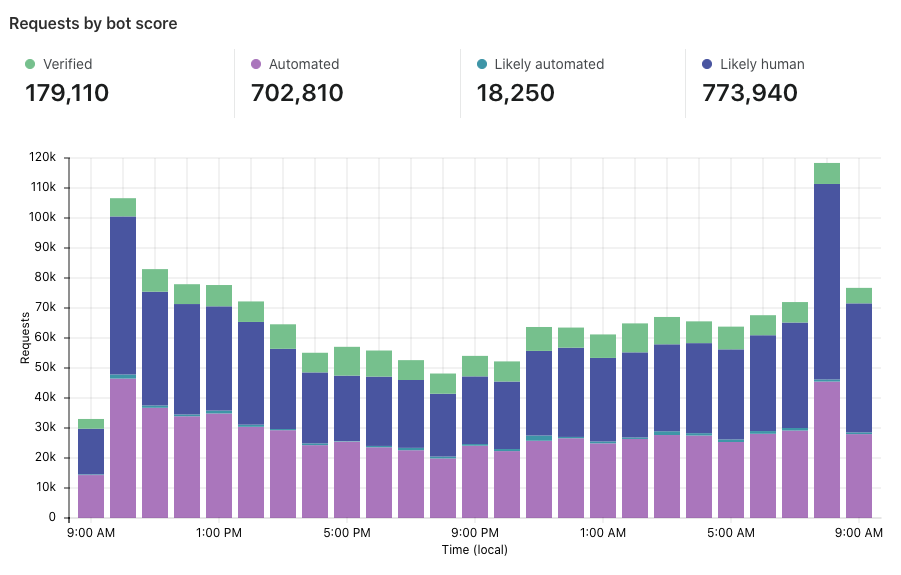
“Requests by bot score” is the first section on the page. Here, we show traffic over time, but we split it vertically by the traffic type. Green segments represent verified bots, while shades of purple and blue show varying degrees of bot/human likelihood.
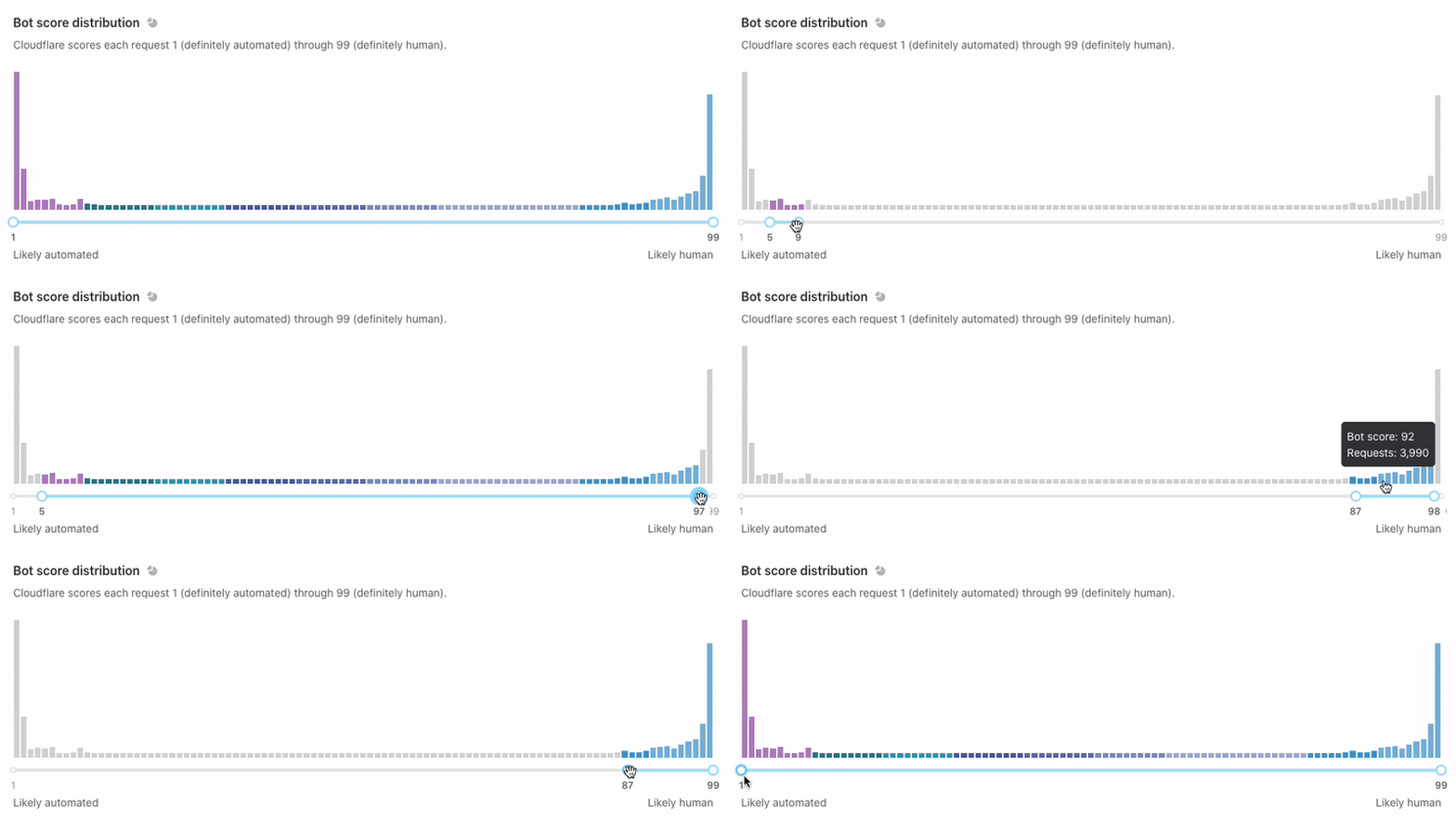
“Bot score distribution” is next. This shows similar data, but we display it horizontally without the notion of time. Use the slider below to filter on subsets of traffic and watch the rest of the page adapt.
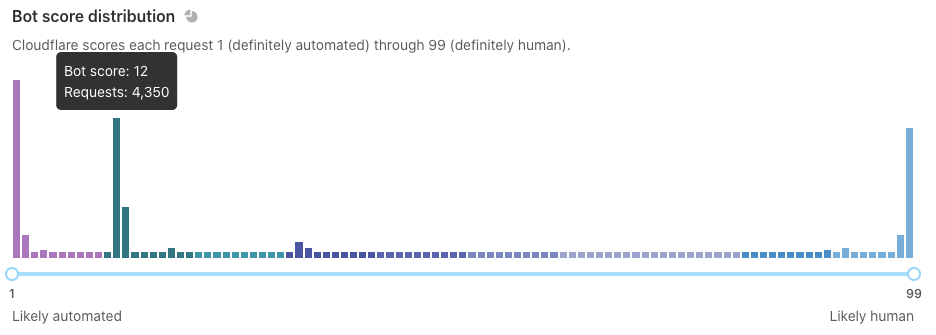
We recommend that you use the slider to find your ideal bot threshold. In other words: what is the cutoff for suspicious traffic on your site? We generally consider traffic below 30 to be automated, but customers might choose to challenge traffic below 40 or block traffic below 10 (you can even do both!). You should set a threshold that is ambitious but not too aggressive. If your traffic looks like the example below, consider setting a threshold at a “drop off” point like 3 or 14. Why? Notice that the request density is very high near scores 1-2 and 12-13. Many of these requests will have similar characteristics, meaning that the scores immediately above them (3 and 14) offer some differentiating quality. These are the most promising places to segment your bot rules. Notably, not every graph is this pronounced.
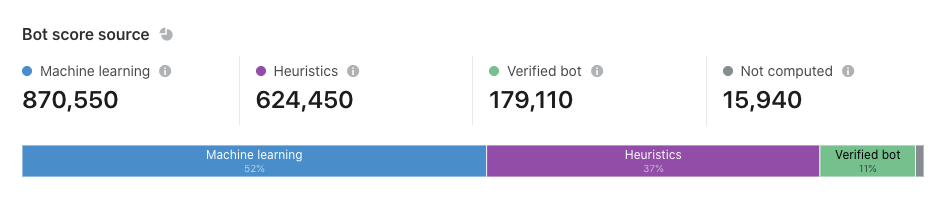
“Bot score source” sits lower on the page. Here, you can examine the detection engines that are responsible for scoring your traffic. If you can’t remember the purpose of each engine, simply hover over the tooltip to view a brief description. Customers may wonder why some requests are flagged as “not computed.” This commonly occurs when Cloudflare has issued an error page on your behalf. Perhaps a visitor’s request was met with a gateway timeout (error 504), in which case Cloudflare responded with a branded error page. The error page would not have warranted a challenge or a block, so we did not spend time calculating a bot score. We published another blog post that provides an overview of the most common sources, including machine learning and heuristics.
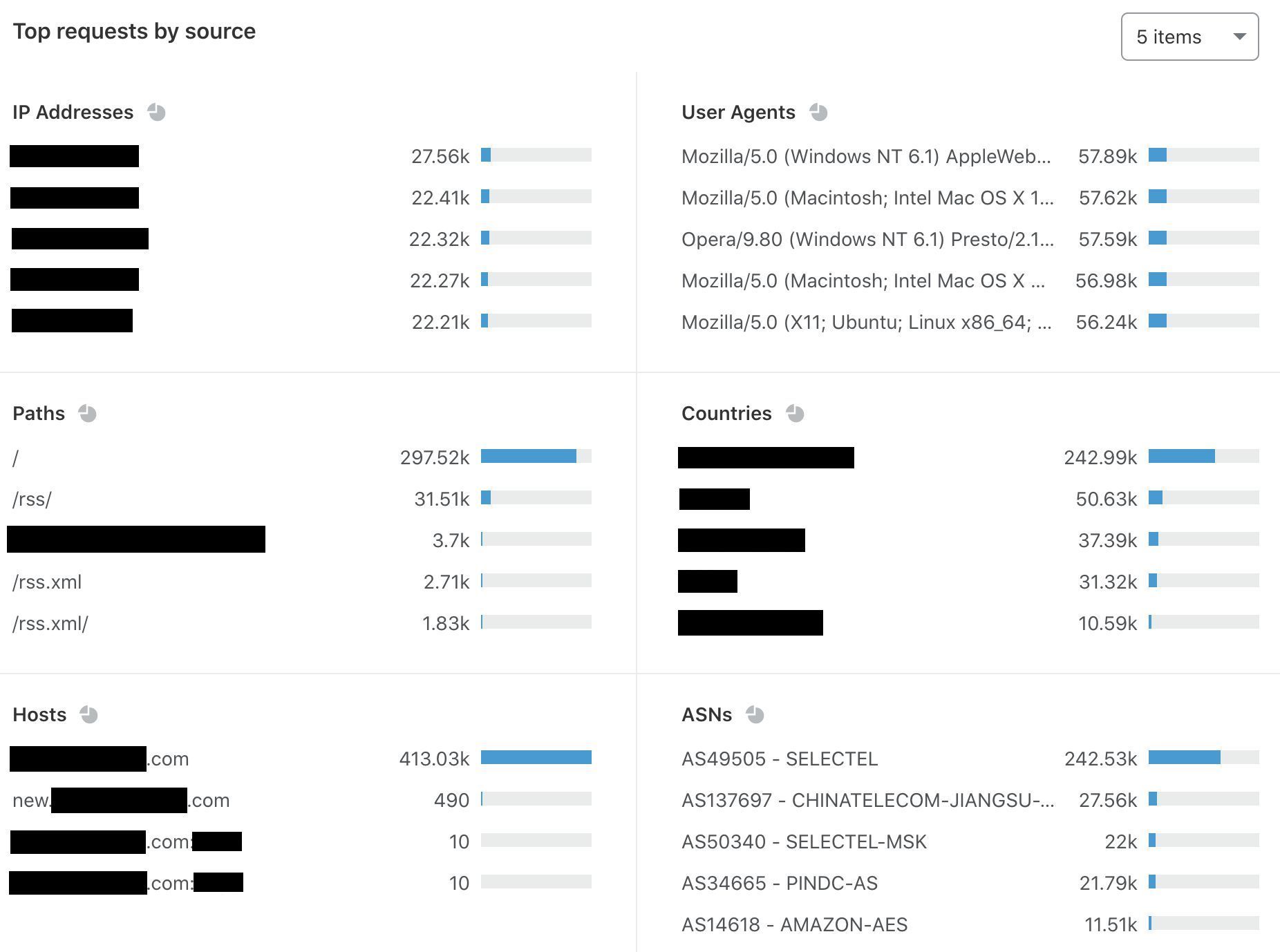
“Top requests by source” is the final section of Bot Analytics. Although it’s not quite as colorful as the sections above, this section grounds Bot Analytics in highly specific data. You can filter or exclude request attributes, including IP addresses, user agents, and ASNs. In the next section, we’ll use this to spot a bot attack.
Let’s Spot A Bot Attack!
First, I’m going to use the “bot score source” tool to select the most obvious bot requests — those detected by our heuristics engine. This provides us with the following information, some of which has been redacted for privacy reasons:
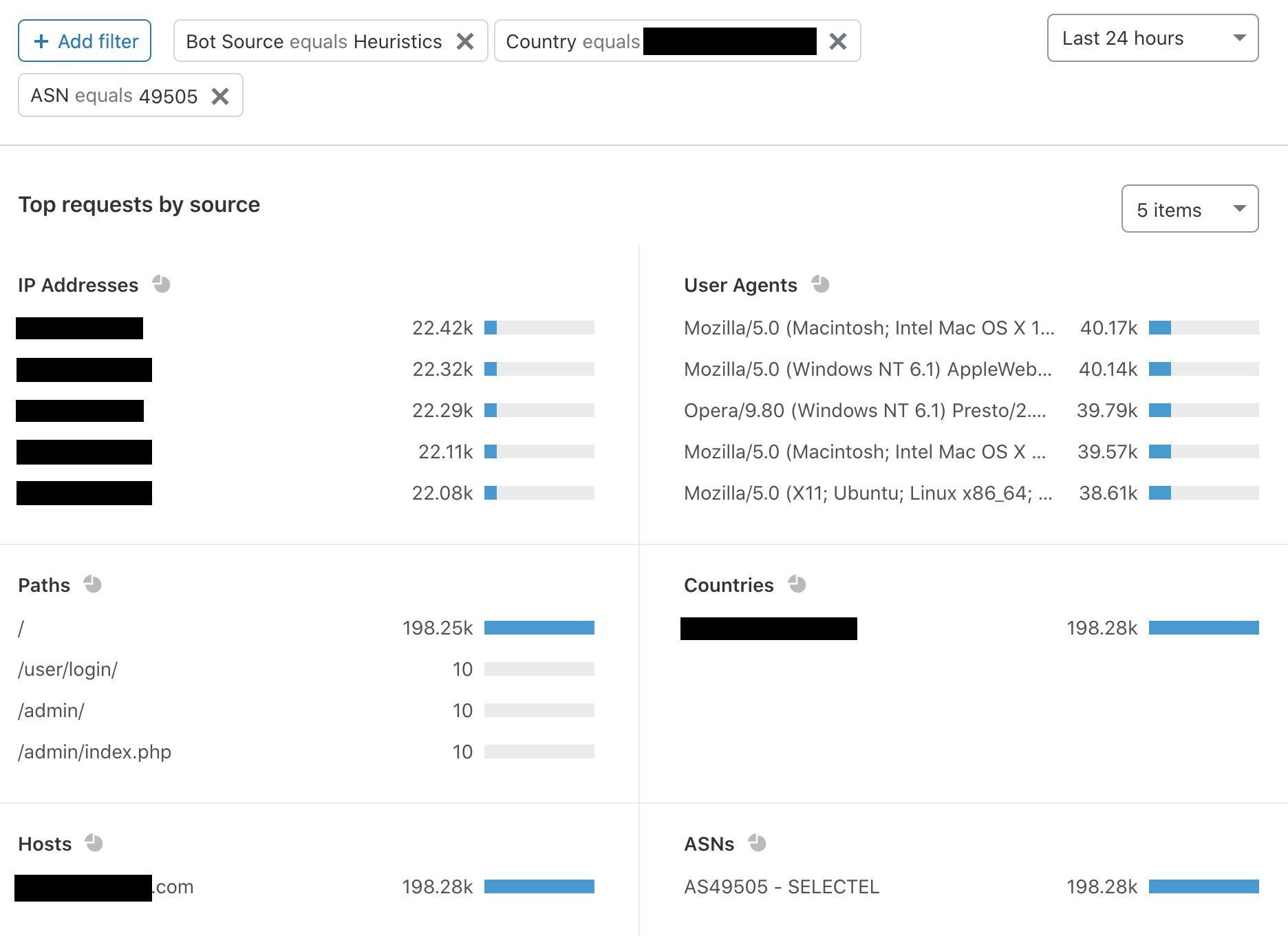
I already suspect a correlation between a few of these attributes. First, the IP addresses all have very similar request counts. No human would access a site 22,000 times, and the uniformity across IPs 2-5 suggests foul play. Not surprisingly, the same pattern occurs for user agents on the right. User agents tell us about the browser and device associated with a particular request. When Bot Analytics shows this much uniformity and presents clear anomalies in country and ASN, I get suspicious (and you should too). I’m now going to filter on these anomalies to see if my instinct is right:
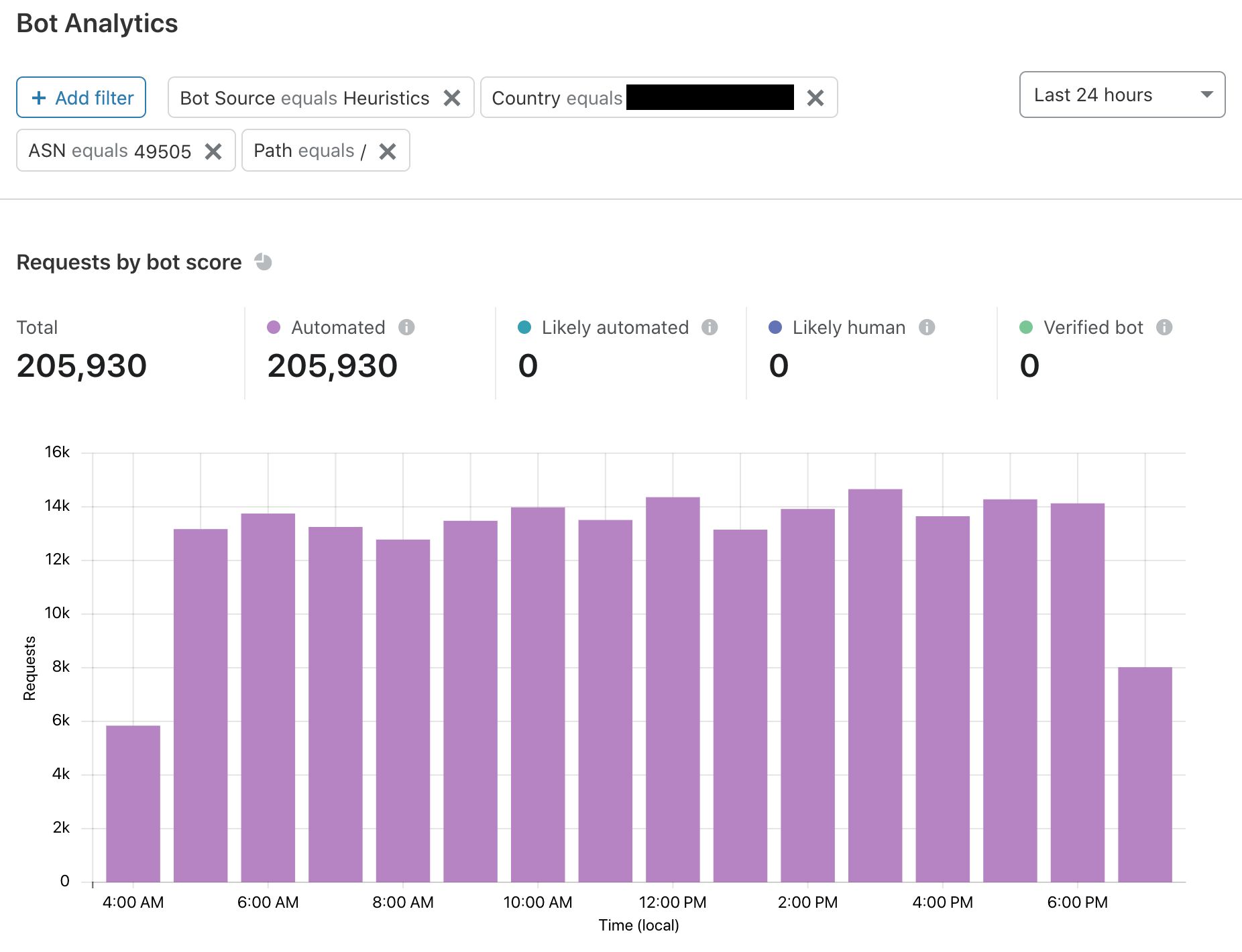
The trends hold true — to be sure, I briefly expanded the table and found nine separate IP addresses exhibiting the same behavior. This is likely an aggressive content scraper. Notably, it is not marked as a verified bot, so Bot Management issued the lowest possible score and flagged it as “automated.” At the top of Bot Analytics, I will narrow down the traffic and keep the time period at 24 hours:
The most severe attacks come and go. This traffic is clearly sustained, and my best guess is that someone is frequently scraping the homepage for content. This isn’t the most malicious of attacks, but content is still being taken. If I wanted to, I could set a firewall rule to target this bot score or any of the filters I used.
Try It Out
As a reminder, all Enterprise customers will be able to see a snapshot of their bot traffic. Even if you don’t have Bot Management for your site, visit the Firewall for some high-level insights that are updated in real time.
And for those of you with Bot Management — check out Bot Analytics! It’s live now, and we hope you’ll have fun using it. Keep your eyes open for new analytics features in the coming months.
Now that we’re a long way through 2020, let’s take a look at automated traffic, which makes up almost 40% of total Internet traffic.
This blog post is a high-level overview of bot traffic on Cloudflare’s network. Cloudflare offers a comprehensive Bot Management tool for Enterprise customers, along with an effective free tool called Bot Fight Mode. Because of the tremendous amount of traffic that flows through our network each day, Cloudflare is in a unique position to analyze global bot trends.
In this post, we will cover the basics of bot traffic and distinguish between automated requests and other human requests (What Is A Bot?). Then, we’ll move on to a global overview of bot traffic around the world (A RoboBird’s Eye View, A Bot Day and Bots All Over The World), and dive into North American traffic (A Look into North American Traffic). Lastly, we’ll finish with an overview of how the coronavirus pandemic affected global traffic, and we’ll take a deeper look at European traffic (Bots During COVID-19 In Europe).
On average, Cloudflare processes 18 million HTTP requests every second. This is a great opportunity to understand how bots shape the Internet, how much infrastructure is dedicated to these automated requests, and why our customers need a great bot management solution.
What Is A Bot?
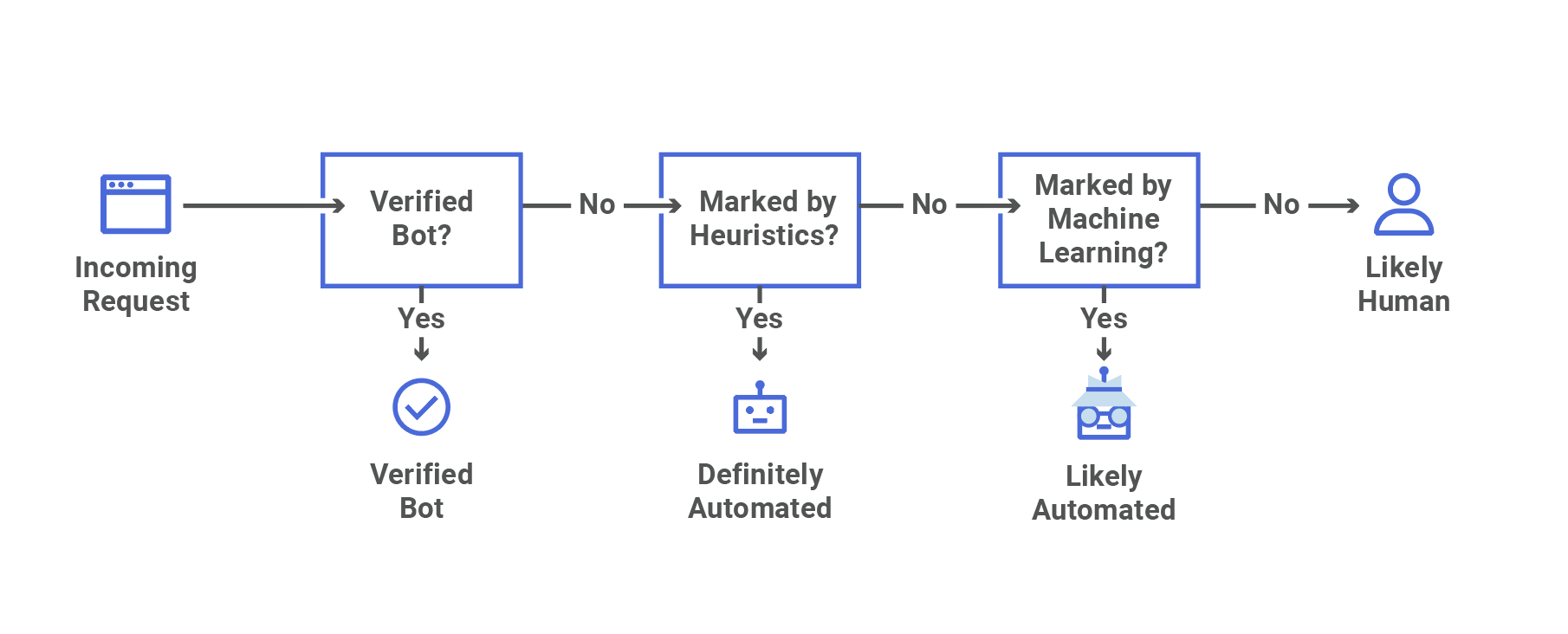
Cloudflare groups traffic into four bot-related categories:
Our goal is to stop malicious and unwanted bots from harming our customers, while giving customers the opportunity to control how other automated traffic is managed.
We label each request that comes into Cloudflare with a “bot score” 1 through 99, where a lower score means that a request probably came from a bot. A higher score means that a request probably came from a human. This score is available in our Firewall, logs, and Workers, giving customers the flexibility to act on any score.
Cloudflare also maintains a challenge platform that customers can choose to deploy on suspected bots. You’ll recognize these as CAPTCHA challenges or JavaScript challenges. In fact, having the score available in Firewall Rules means that customers can take any action they choose. This platform can be used for mitigation, ensuring that unwanted traffic is stopped in its tracks.
To learn more about how Bot Management interacts with our firewall, check out our support page.
We track successes and failures during these challenges, which ultimately allows us to improve our detection systems. Assuming that our challenges are solvable by humans, effective detections should have low solve rates, given that they are usually presented to bots.
Verified bots are registered in an internal verified bot directory. These good bots power search engines and monitoring tools. Good bots enable our customers’ web pages to be found by search engines, for example.
For known non-verified bots (such as a scraper using a simple curl library), we keep a similar directory that is managed by our heuristics engine. If not otherwise verified, we consider requests caught by this engine to be definitely automated.
Our machine learning engine provides another way to identify potential bots. This engine identifies requests with a high probability of automation and marks them as likely automated. This detection mechanism benefits from models built on data from our global network.
If a request is not marked as automated, we mark it as likely human and pass along the bot score from our machine learning system.
We also have a behavioral analysis engine and a JavaScript detections engine. You can learn more about these systems by checking out Alex Bocharov’s previous post on Cloudflare Bot Management.
The two bot definitions for automated traffic are somewhat complementary. Requests caught by heuristic detections will not count towards machine learning detections. Requests that are reliably caught by our machine learning detections won’t need to be registered in our known heuristics bot directory. Because of this, we combine these two together when we discuss “automated traffic” in general.
A RoboBird’s Eye View
Data from this piece comes from information about Cloudflare’s customers, analyzed between January 15, 2020 and July 31, 2020.
First, let’s get a basic understanding of the traffic on our network.
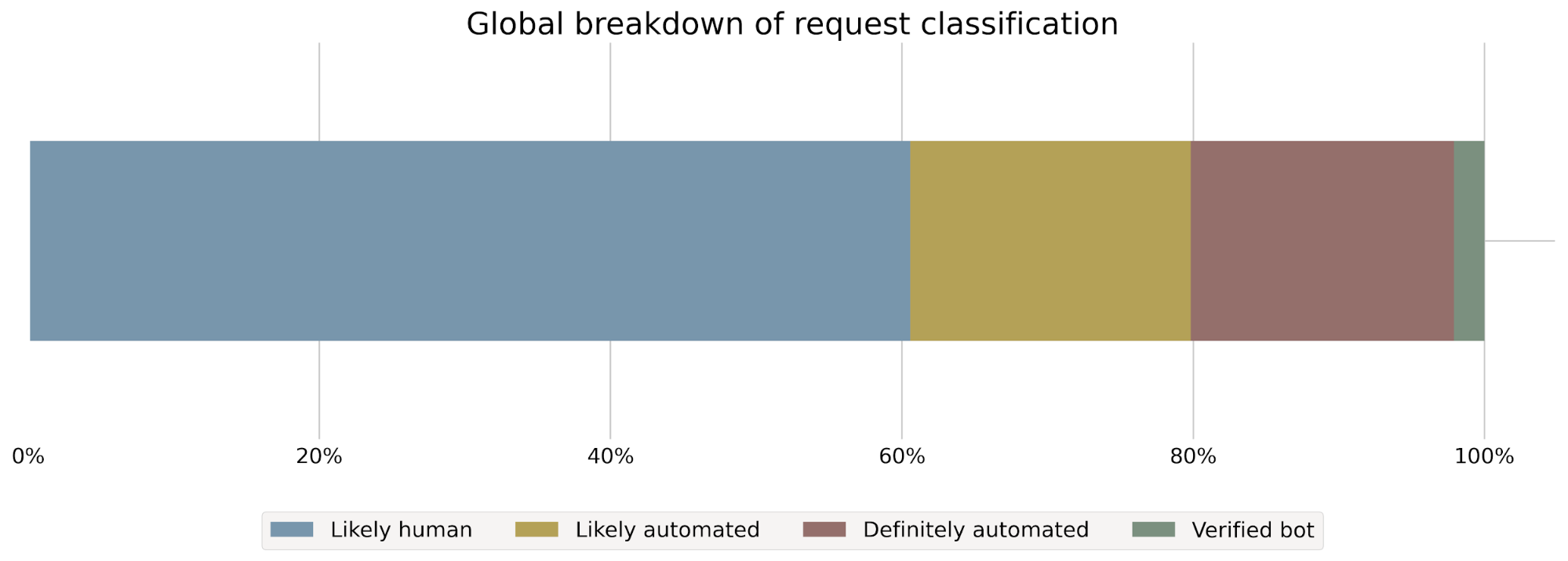
Figure 1.1 Traffic type on Cloudflare’s network.
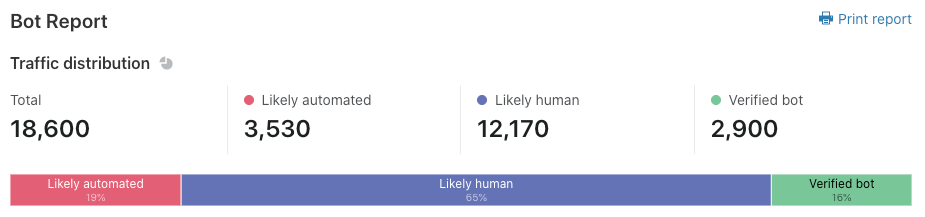
Figure 1.1 has a global breakdown regarding classification; 60.6% of traffic is likely human, 19.3% is likely automated, 18.1% is definitely automated and only 2.1% is from verified bots. In total, 39.5% of requests we score come from some kind of bot.
A Bot Day
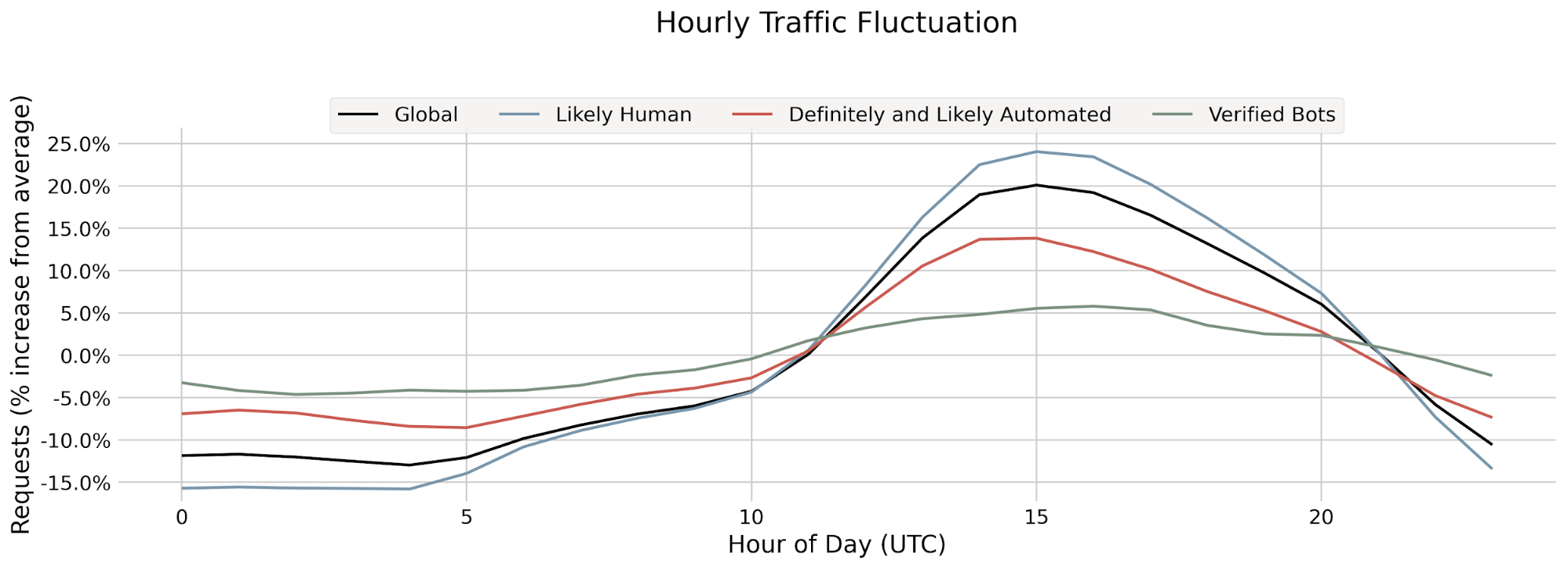
Regular traffic fluctuates throughout the day. Do bots follow suit? Let’s check. Figure 2.1 represents traffic deviation from the average hourly traffic. An increase of 10% would mean that the hour is 10% busier than the average hour (measuring requests per hour). We include the total overall traffic in this chart to serve as a comparison to other types of traffic.
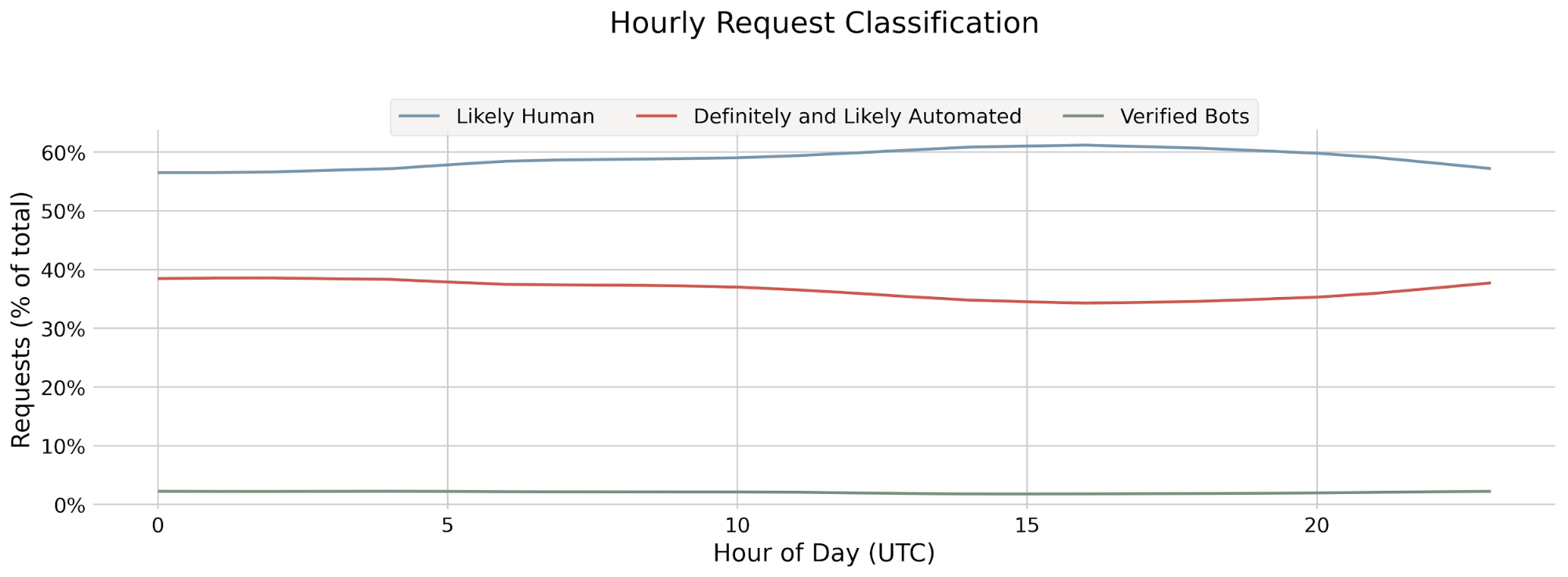
Figure 2.1 Hourly traffic as a deviation from the average hour.Figure 2.2 Bot classification over an average day.
We can clearly see a difference between human traffic and bot traffic. Human traffic varies heavily, but predictably, throughout the day. We can see a 15% decrease in human traffic early in the day, between midnight and 05:00 UTC, corresponding to the end of business hours in the Americas, and up to a 25% increase during business hours, 14:00 to 17:00 UTC, where traffic is highest. Conversely, bot traffic is more consistent. Slow hours still see a smaller drop than overall traffic, and busy hours are less busy. The difference between good and bad bots is also apparent: good bots are even more consistent, with small fluctuations in hourly traffic.
But why would this happen? A large portion of bots, good and bad, perform the same task across the Internet. Bad bots may be scraping websites or looking to infect unprotected machines, and they will do this with little intervention from human operators. Good bots could be doing some of these operations, but less frequently and in a more targeted fashion. A good bot scraping a website may be doing so to add it to a search engine, while a bad bot will do the same thing at a much higher rate, for other reasons.
A lot of bots follow business hours. For example, sneaker bots—focused on nabbing exclusive items from sneaker stores—will naturally be active when new products launch.
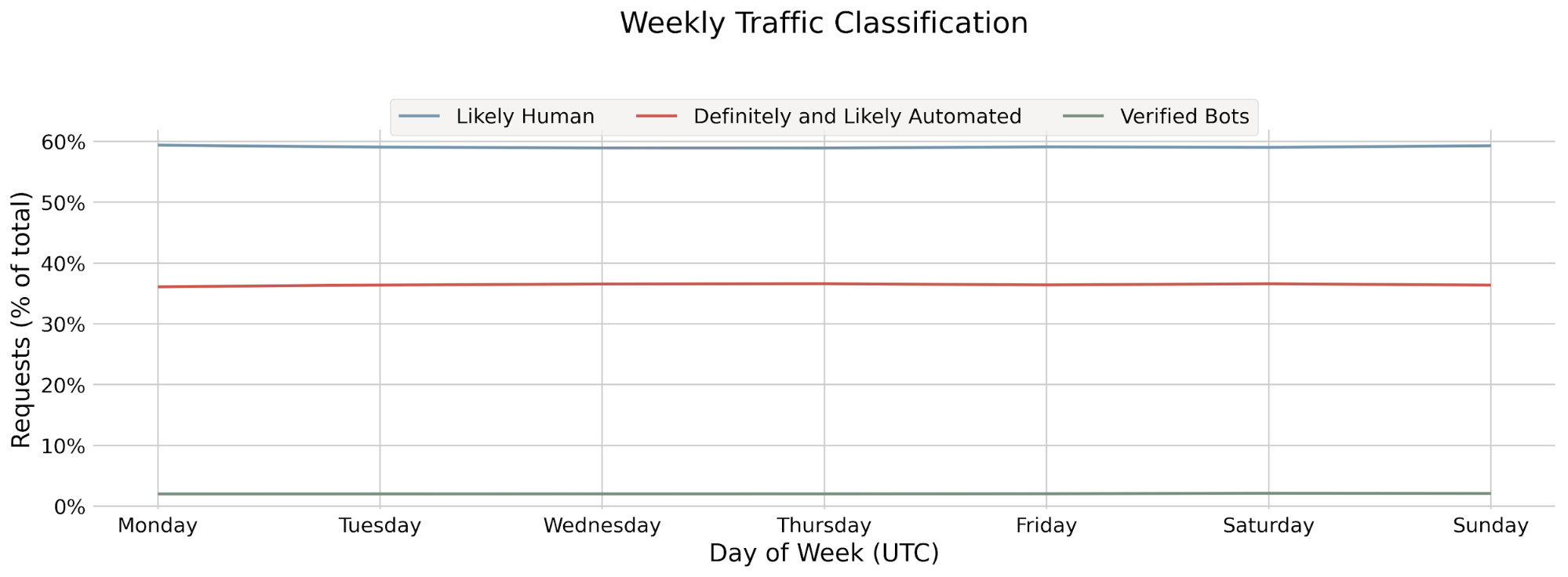
This difference in volume does not mean that our classifications are affected: our scores remain consistent throughout the day, as Figure 2.1 shows.
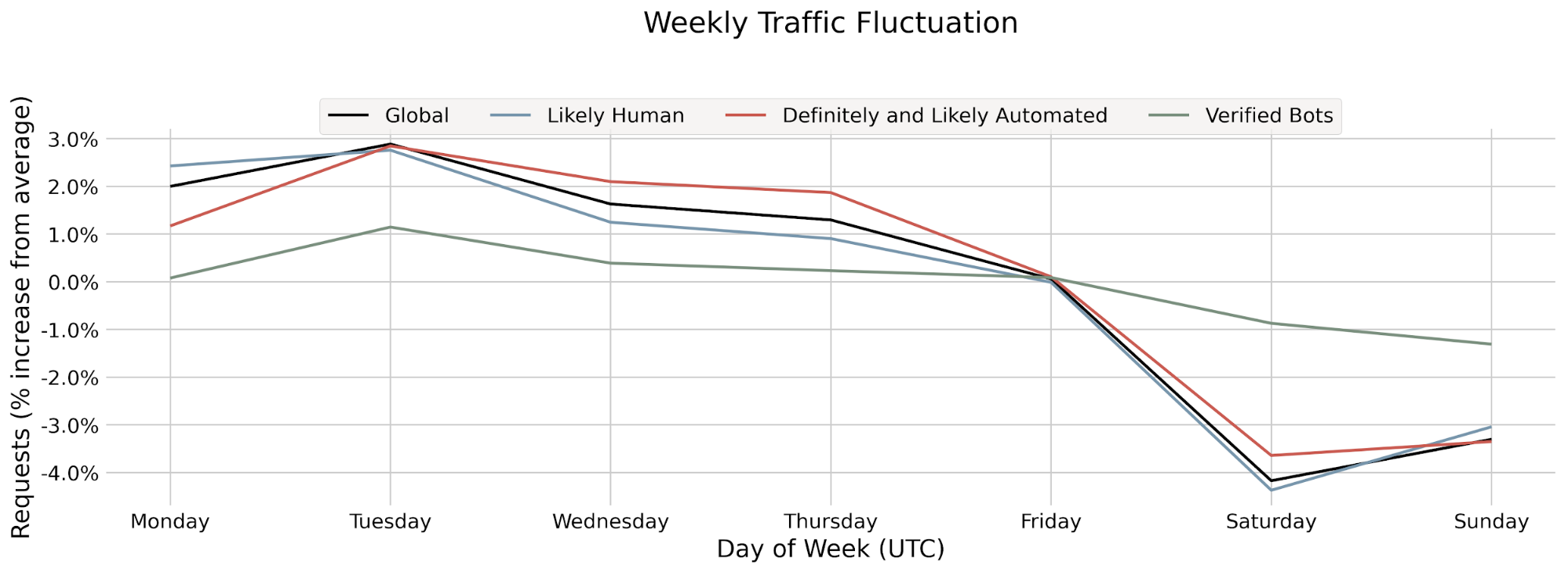
Figure 2.3 Daily traffic as a deviation from the average day. Grouped by day of week.Figure 2.4 Bot classification over an average week.
We can also see that good bots don’t take weekends off. Weekdays and weekends have fairly marked differences for most traffic, but good bots keep a consistent schedule. Whereas a typical weekday is slightly above average, we can see a drop of about 4% in overall traffic. This does not fully apply to verified bots, which only see a small 1% drop in traffic.
Bots All Over The World
Now that we’ve taken a look at global traffic, let’s dig a little deeper.
Different regions have distinct traffic landscapes regarding automated traffic.
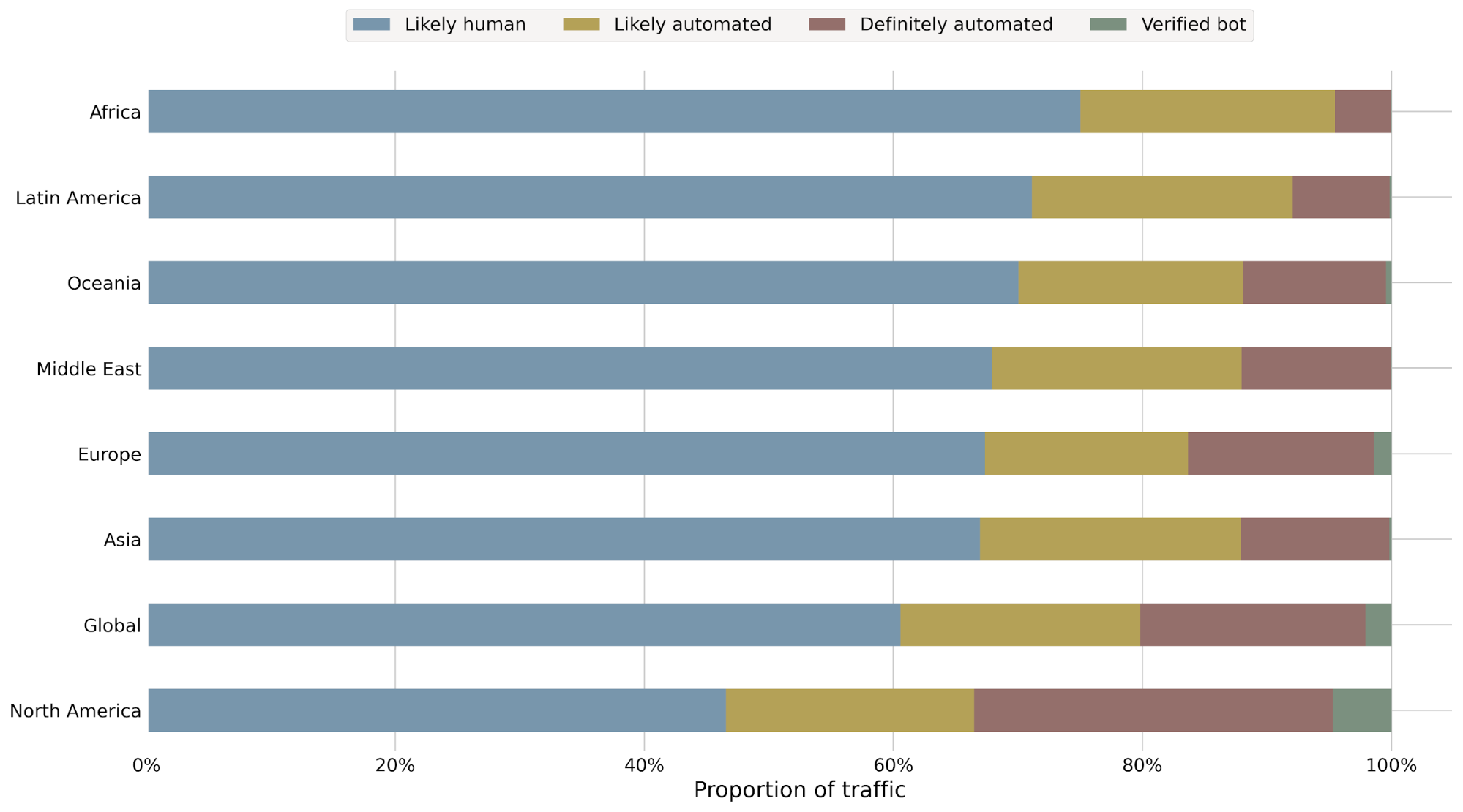
Figure 3.1Traffic type by region.
Figure 3.1 breaks down traffic by region, letting us peek into where each type of traffic comes from. North America stands out as a major automated traffic source; over 50% of definitely automated traffic comes from there, and they also contribute almost 80% of all verified bot traffic. Europe makes up the second largest chunk of traffic, followed by Asia.
Figure 3.2 Traffic classification within each region.
Looking at regional breakdown of traffic in Figure 3.2, we can see just how much North American traffic is automated, well above the global average.
A Look into North American Traffic
As the largest source of automated traffic, North America deserves a closer look.
First, we’ll start with a breakdown of each country.
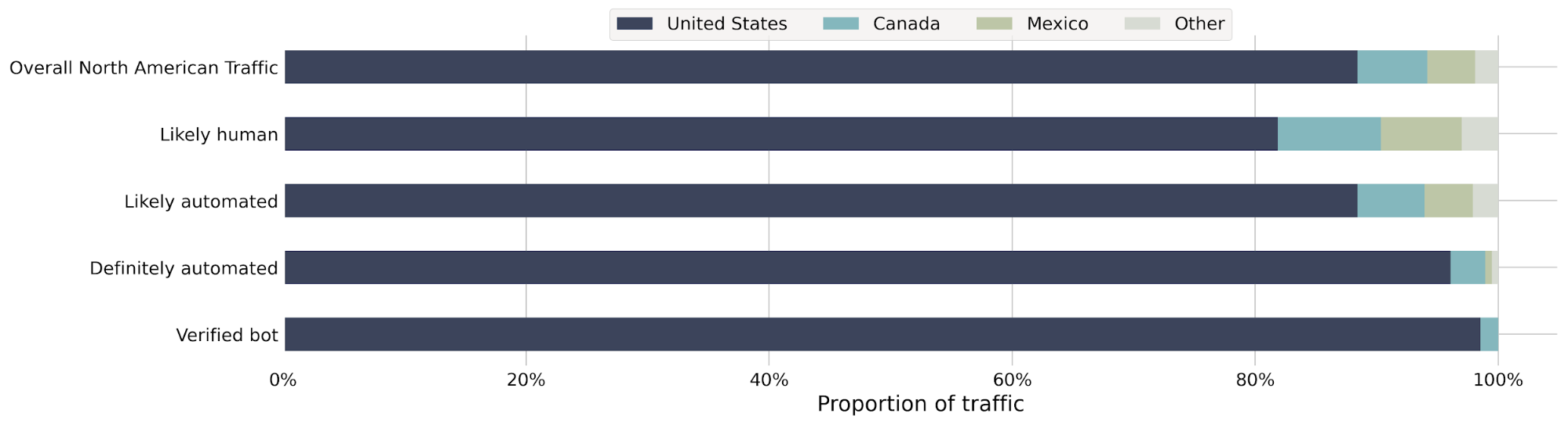
Figure 3.3 Percentage of traffic within North America.
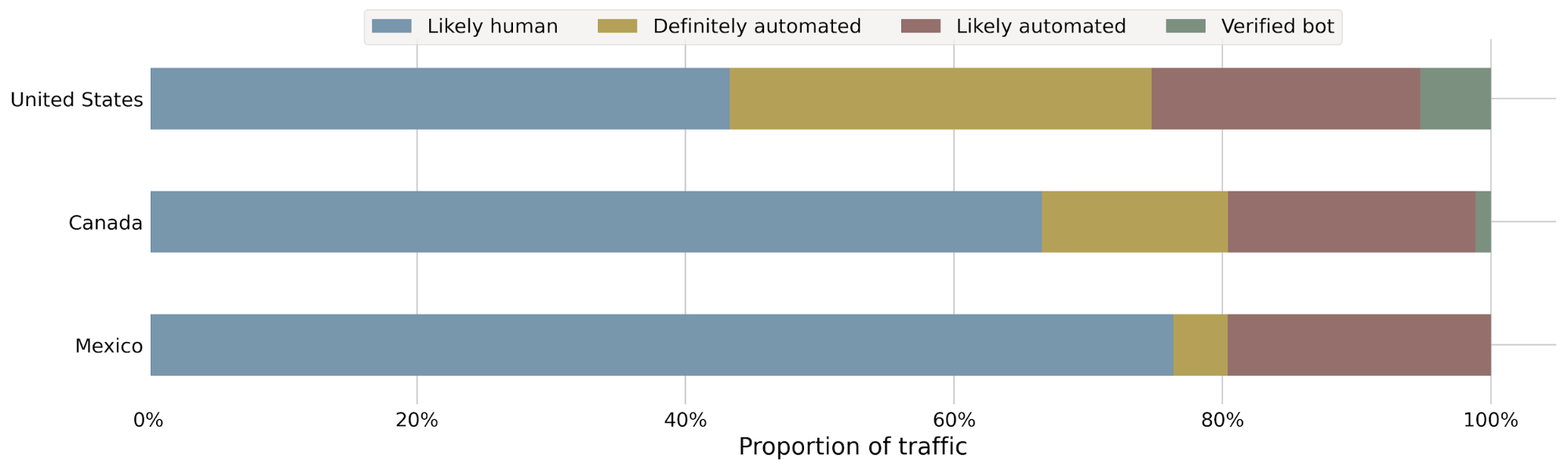
Most of our requests in North America come from just three countries—the United States, Canada and Mexico. These account for 98% of all requests from North America, 97% of all requests from likely human sources and 100% of requests from verified bots. The United States alone accounts for 88% of total requests, 82% of requests from likely human sources, 96% of requests from definitely automated sources, 88% of requests from likely automated traffic sources and 98% of requests from verified bot.
However, this alone does not mean that the United States has an unusual amount of activity. These countries have a combined population of roughly 497 million people. The United States accounts for 66.5% of that, Mexico 25.9% and Canada 7.6%. With this context, we can see that the United States is overrepresented in terms of raw requests, but underrepresented in terms of how much of that traffic is likely to be human. Conversely, Canadian traffic is more likely to be human.
Let’s take another look at each country.
Figure 3.4 Percentage of traffic within each country.
Over half of the traffic from the United States is automated in some way, which is a clear departure from trends in Mexico and Canada.
American Bots
So far, we’ve seen how much the United States contributes to automated traffic. If we want to go deeper, a good place to start is by understanding how these bots get online. We can do this by examining the networks from which the traffic originates. Networks are identified by Autonomous System Numbers, or ASNs. These form the backbone of the Internet infrastructure.
Think of these as Internet Service Providers, but facing inward towards the network instead of outward towards end consumers. ISPs like Comcast and Verizon are examples of residential ASNs, where we expect mostly human traffic. Cloud providers such as Google and Amazon are also ASNs, but targeted towards cloud services. We expect most of these requests to be automated in some way.
Looking at traffic on the ASN level is important because we can identify cloud-based traffic, or traffic using residential proxies, among others.
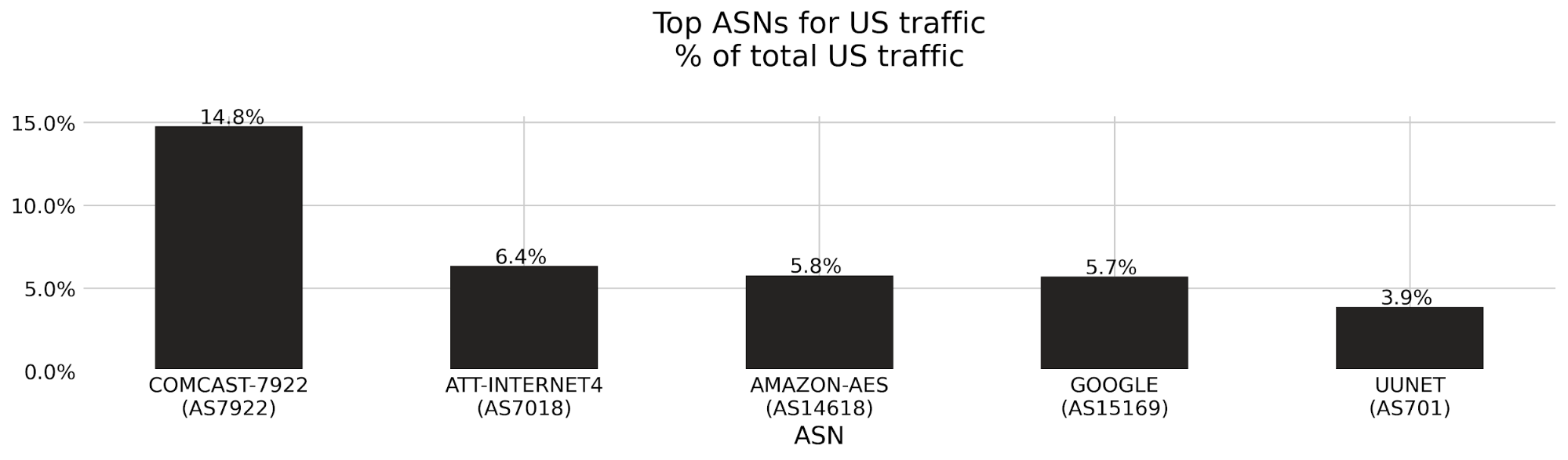
Let’s take a look at which ASNs are associated with visitors in the United States. We’ll restrict ourselves to “eyeball” traffic, which is the term we use for requests coming from site visitors.
Figure 4.1 Top ASN in the United States.
From figure 4.1 we can clearly see the impact that cloud services have on traffic; 11.5% of all eyeball traffic comes from Amazon and Google.
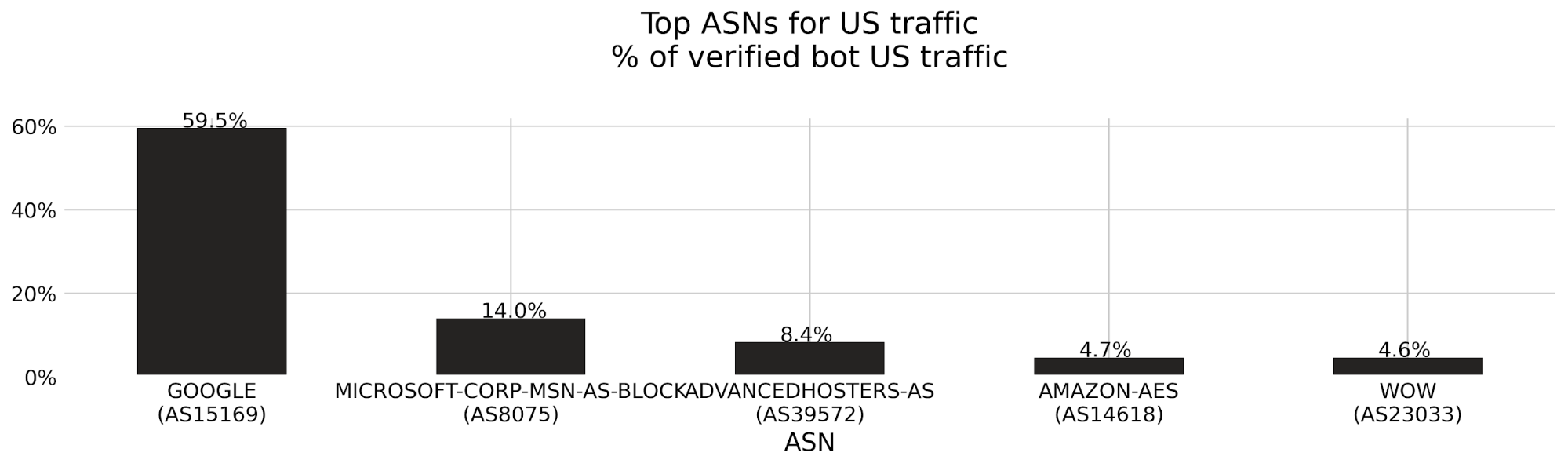
Figure 4.2 Top ASN in the United States for verified bot traffic.
Verified bots operate in a different landscape, coming from cloud providers such as Amazon, Google, Microsoft, Advanced Hosting and Wowrack.
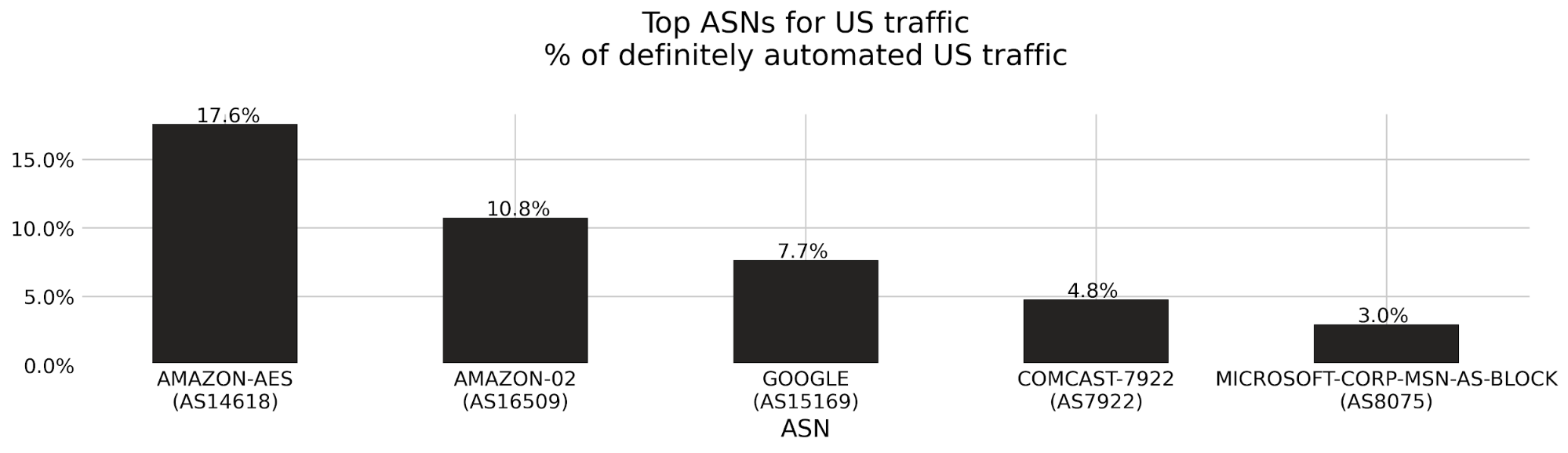
Figure 4.3 Top ASN in the United States for likely and definitely automated traffic.
Automated traffic has a variety of ASNs. Cloud providers such as Amazon, Google and Microsoft make up the 30% of automated traffic. Comcast also makes up a significant portion of traffic at 4.8%, indicating that some bots come from residential services.
Bots During COVID-19 In Europe
Lockdowns and limits on public events came as a consequence of the ongoing coronavirus pandemic. Many people have been working from home, and even those who do not have this option are using the Internet in new ways. Overall, this has meant that Cloudflare’s network has grown tremendously.
But how does this impact bot traffic? First let’s get an idea of how it impacted traffic in general. Countries were impacted by the virus at different times, so we expect to see differences, right?
Figure 5.1Total traffic across all regions.
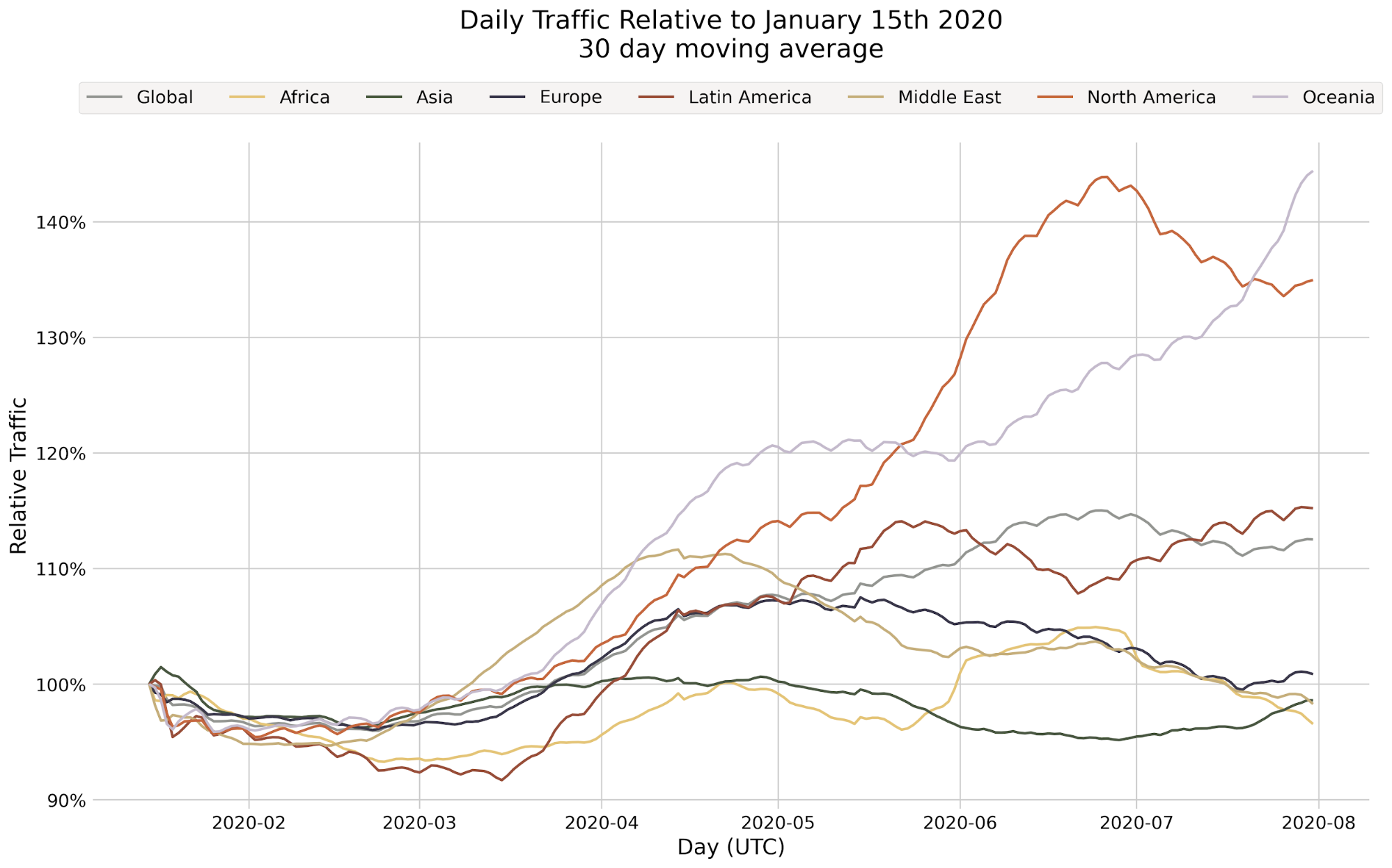
Figure 5.1 has just the traffic increase. Globally, we are seeing an average increase of 10%, while North America saw an increase of over 40% compared to the beginning of the year. Some regions did not change much, such as Africa and Asia, while others, such as Europe saw an increased period, but has since normalized to previous levels.
Let’s look at a few countries, so we can understand what this looks like.
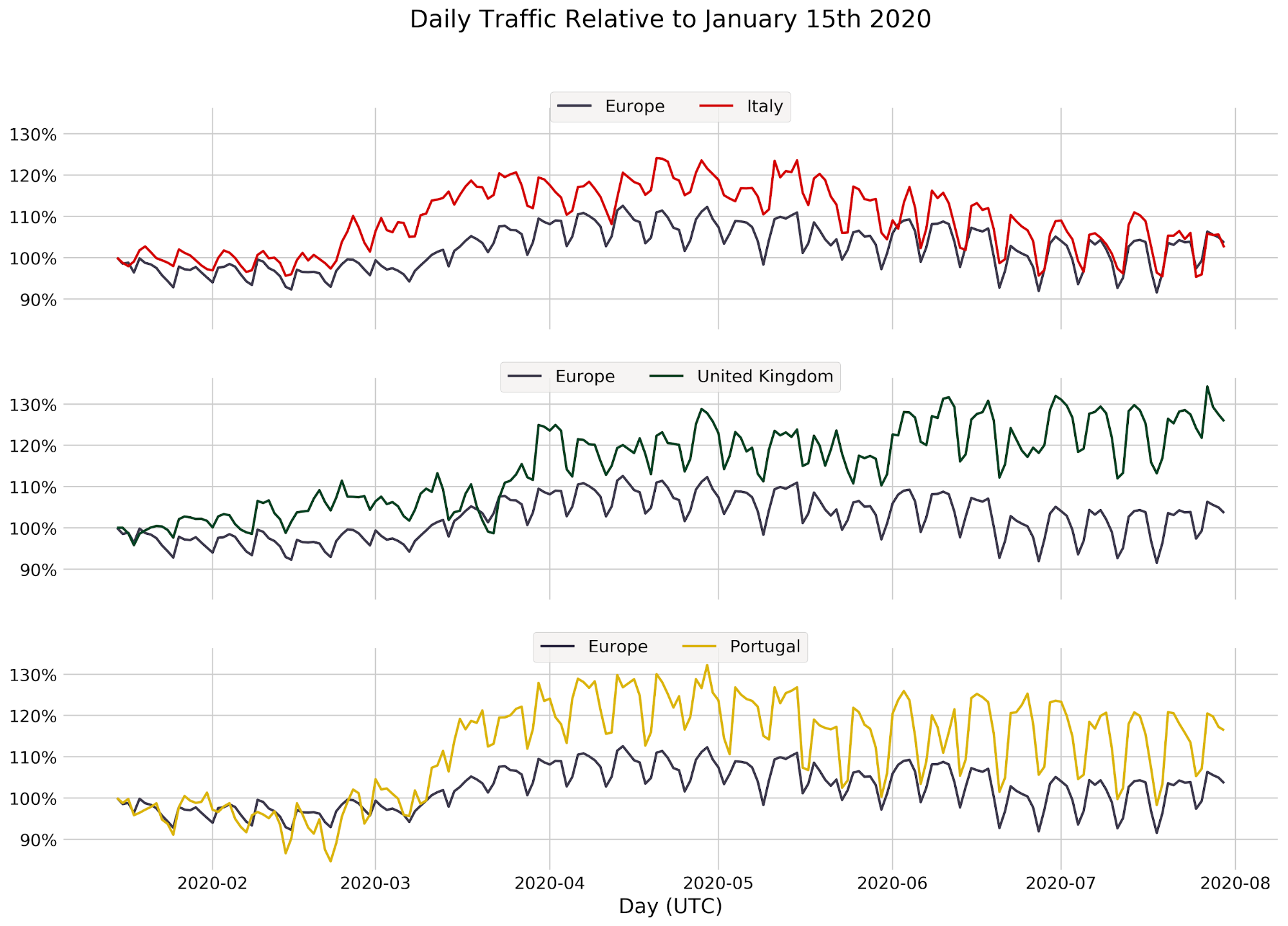
Figure 5.2 Daily traffic evolution for Italy, the United Kingdom and Portugal, overlaid with Europe.
Figure 5.2 shows daily traffic relative to January 15, when data collection started. For comparison, we have overall European traffic, and three selected countries: Italy, the United Kingdom and Portugal. Italy was picked because it was one of the first countries in Europe to face the worst of the coronavirus and enact lockdown measures. The United Kingdom took another strategy, with an initial focus on herd immunity, and enacted measures later than the others. Portugal is somewhere in between, locking down later than Italy, in slightly different circumstances.
At the beginning of the year, traffic kept stable and fluctuations kept in line with the European average. As lockdown measures began, traffic increased. Italy was first out of these countries, rising a few weeks before the others, and keeping well above average. Eventually, all countries saw a growth in traffic, followed by a stabilization. Italy seems to have adjusted to a normal, with its growth in line with the European average. Portugal has also stabilized, but with busier weekdays. Conversely, the United Kingdom showed no signs of stopping, exceeding a growth of 40% compared to the beginning of the year.
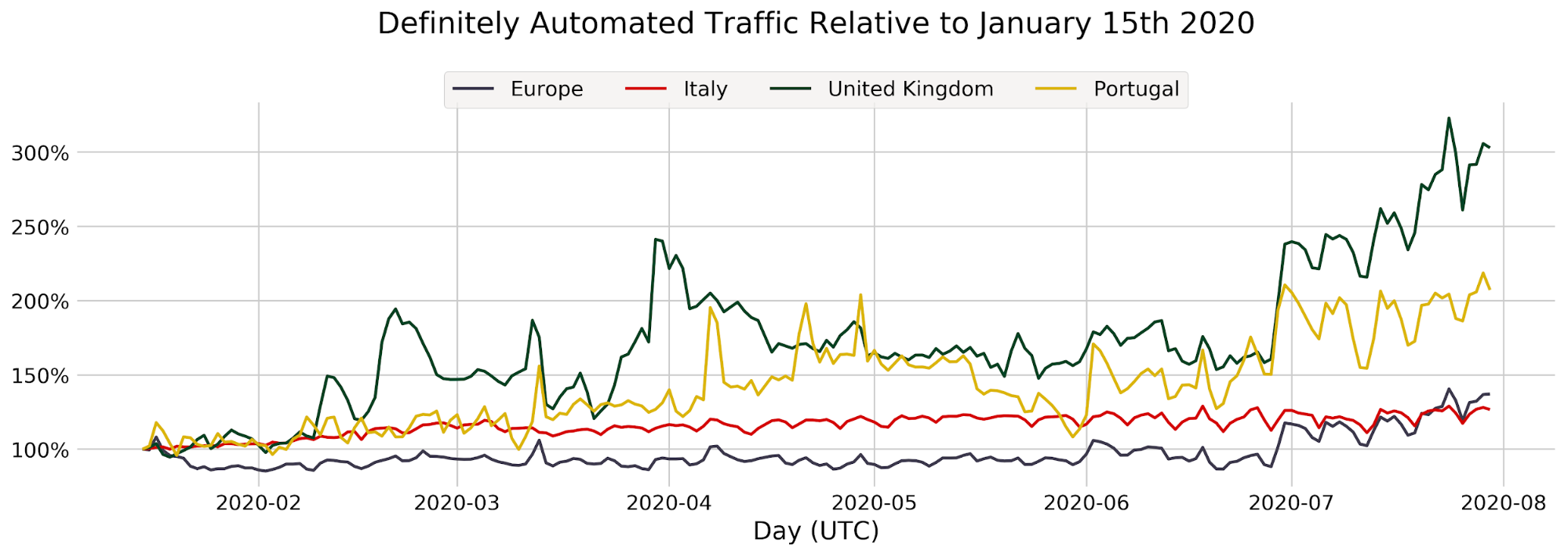
Figure 5.3 Daily definitely automated traffic evolution for Italy, the United Kingdom and Portugal, overlaid with Europe.
Definitely automated traffic did not have that much of a pronounced variation. Italian traffic kept steady throughout, and Portugal had a rather large increase. The biggest one, however, was the United Kingdom, which tripled its initial count.
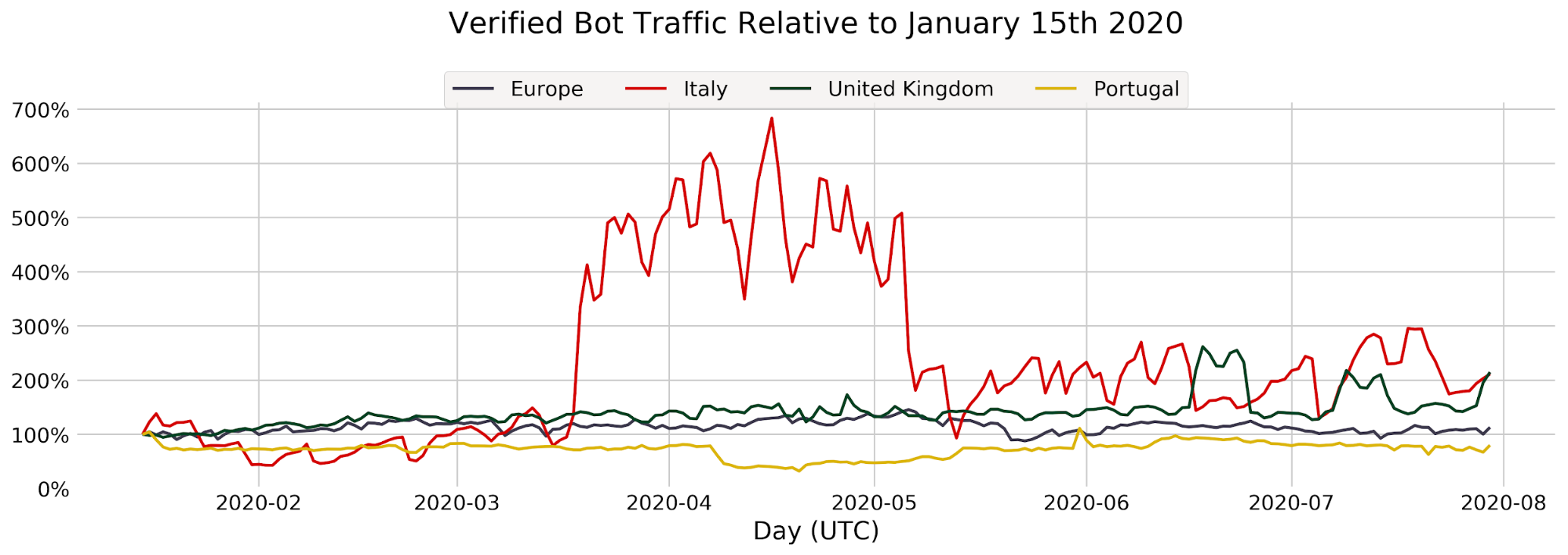
Figure 5.4 Verified bot traffic evolution for Italy, the United Kingdom and Portugal, overlaid with Europe.
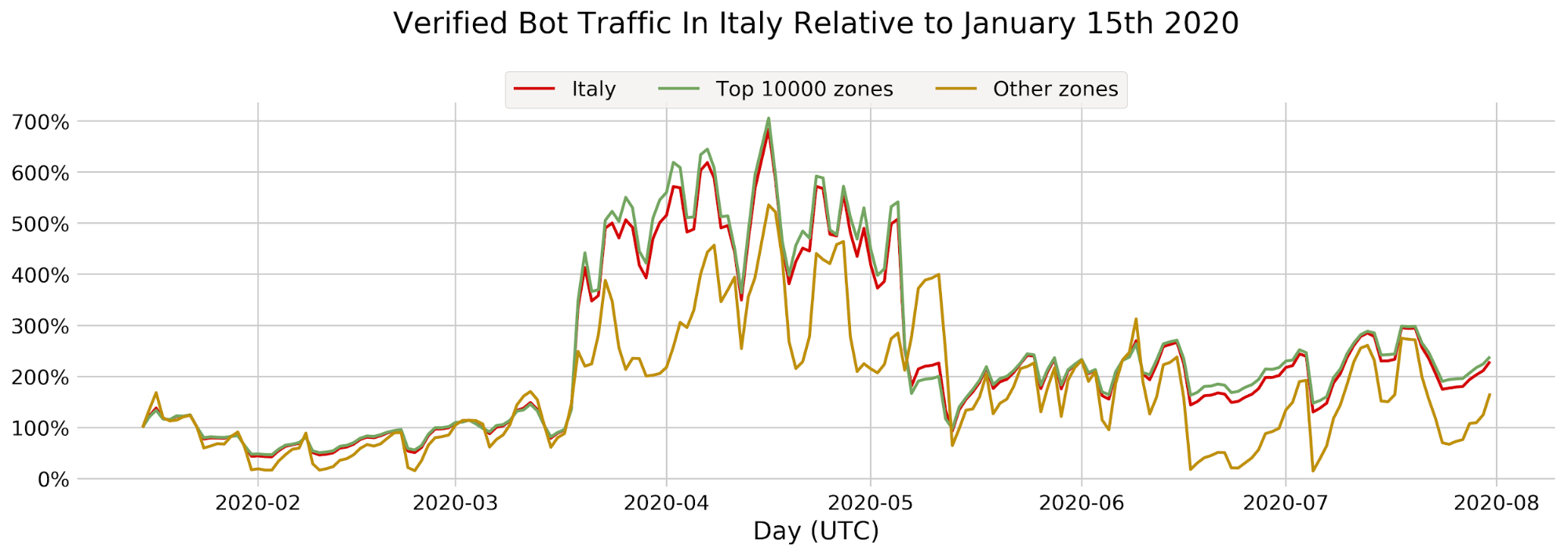
Verified bot traffic is steady, except in Italy, with a massive increase between March and May. What could be the cause of this? Are these a few zones, getting a massive number of requests?
Figure 5.5 Verified bot traffic in Italy for the top 10 000 zones, relative to January 15th 2020.
Well, no. If we only examine the top 10,000 zones (by total verified bot requests), we can still see a massive increase in traffic for other zones. So, what’s happening?
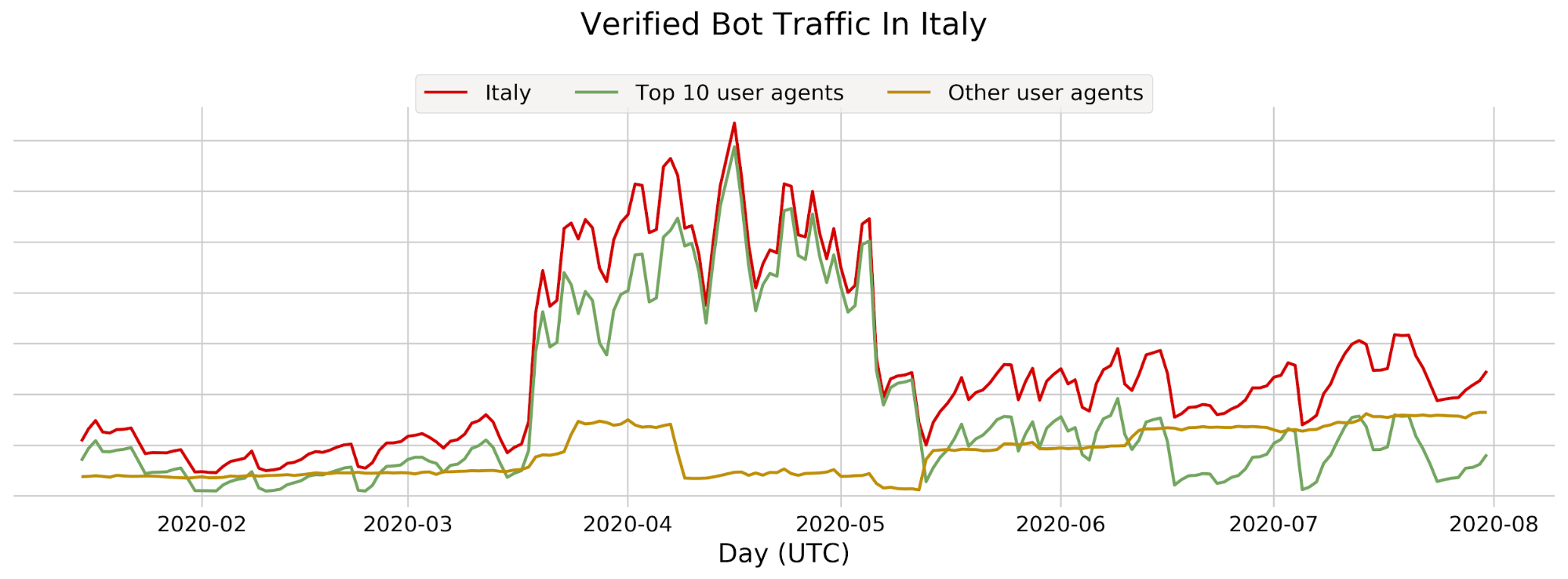
Let’s look at user agents. We can separate the top 10 user agents during the bump, and see how they evolve over time.
Figure 5.6 Verified bot traffic in Italy for the top 10 user agents, relative to January 15th 2020.
We can see that these 10 user agents are responsible for the majority of verified traffic coming from Italy.
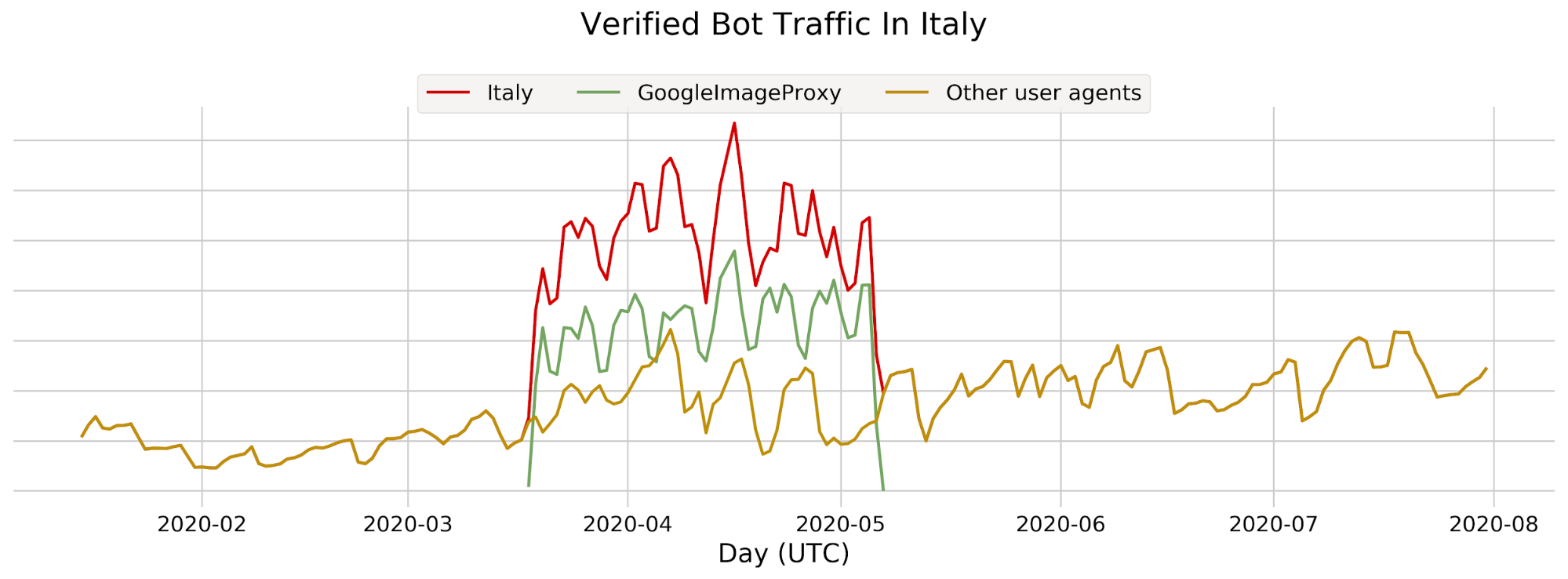
Figure 5.7 Verified bot traffic in Italy for the top user agent, relative to January 15 2020.
In fact, most of this increase is from a single user agent. This instance of Google image proxy anonymizes image requests from Gmail, which explains its popularity.
Where does this increase come from? Did this bot suddenly appear and disappear?
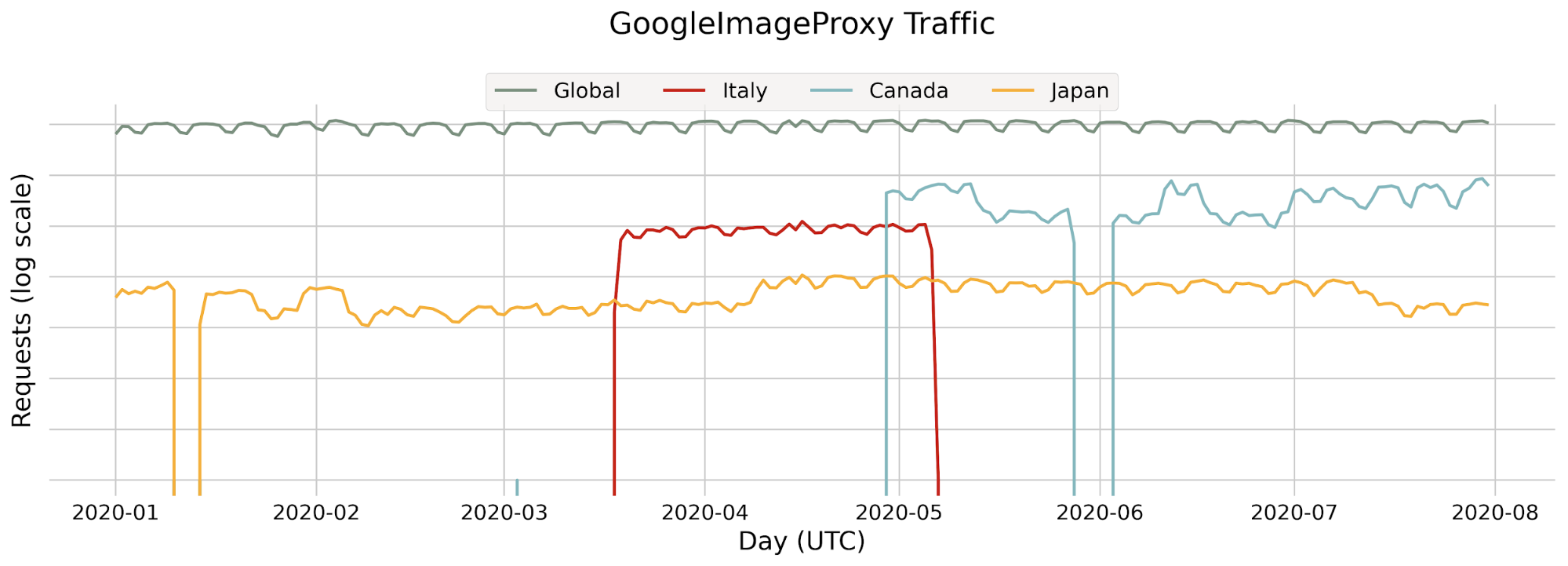
Not quite. One thing to keep in mind when dealing with bots is that they cross borders easily. As a proxy service, this bot is making calls on behalf of the end user – people opening emails. These requests will originate from a data center, which can be anywhere in the world. To see this in action, let’s take a look at traffic for this bot in a few select countries.
Figure 5.8. Countries of origin for GoogleImageProxy.
We can see that the global average barely budges. It appears that Google may be moving image proxy traffic between data centers and during the period we observed above that traffic was coming from Italy.
Summary
With Cloudflare’s global reach, we’re in a position to understand how bots behave.
The first half of 2020 saw a massive increase in web traffic of around 35% since the beginning of the year, driven by the ongoing coronavirus pandemic, and some bots have taken advantage of it.
We explained how bot management works for our customers, and how we distinguish between likely automated and human traffic.
We showed an overview of how much of our global traffic is automated, and how bots change their behavior throughout the day and the week. Notably, 39.4% of all traffic Cloudflare processes comes from a suspected automated source.
A regional overview of automated traffic lets us know which regions were the source of traffic from likely automated agents. North America, Europe and Asia were the primary sources of traffic, and also of automated traffic in particular.
We then focused on North America, where the majority of automated traffic originates. The United States alone accounted for the majority of requests, over half of which come from automated sources.
To explore this further, we briefly dived into ASN traffic in the United States, so we could see where these requests were coming from. ASNs like Comcast and AT&T were the top ASNs for overall traffic, but unsurprisingly, data centers like Google and Amazon AWS were the main drivers of automated traffic.
Finally, we examined how the coronavirus has impacted traffic in Europe, with a deeper dive on Italian traffic. This led to some interesting insights on verified bot traffic, which saw a massive increase in Italy for a few months.
This post is a small peek into bot management at Cloudflare. In the future, we hope to expand this series of blog posts on bot management, exposing even more insights about bots on the Internet.
Anyone with public-facing web properties is likely to have bot traffic on their website.
One type of bot that commonly targets eCommerce and online portals is a ‘scraper bot’.
Some scraper bots are good (such as those used by search engines to assess your website’s content to inform search results, or price comparison sites to help inform consumer decisions), however many are malicious, and will work to scrape not only images but also pricing data from your site for use by a competitor.
Many Bot Management providers will need to divert your traffic to a dedicated data centre to analyse your traffic and ‘scrub’ it clean from malicious bot traffic before sending it on to your site. While effective this will almost certainly add latency to the traffic’s ‘journey’ resulting in degraded user experience. Look for a technology partner with an expansive network who can scan your traffic in real time as it passes through any data centre on their network.
Good and bad scraper bots behave in largely the same way, making it difficult for bot protection systems to differentiate between the two. A common challenge with Bot Management solutions is that they can return a high number of false positives (legitimate bot or customer traffic blocked as though it were malicious). This can result in legitimate customers being challenged to various and repeated authentication challenges, or in extreme cases, blocked altogether. Look for a technology partner who can consistently return low rates of false positives on your traffic.
The Success Story
I often joke that the key to understanding what that role of Customer Success is all about is to say: repeat the sentence again slowly… it’s there, in the name. Customer Success is, at its core, about making customers successful. And this is what makes our day, and makes us happy. Allow me to share a short story on how Cloudflare made a successful customer even more so with our Bot Management solution.
Once upon a time, an online property portal, let’s call them Property Portal, came to Cloudflare for our DDoS and WAF solution. We worked well together. The customer liked our ease of use and we delivered on our promise to provide performance and security to them. As Property Portal’s brand and digital footprint grew, so did the instances of malicious bot traffic, in particular ‘scraper bots’.
They say that imitation is the sincerest form of flattery. But when that imitation turns into someone else profiting off your IP, the shine starts to wear off, and that ‘imitation’ starts to become something more akin to outright theft. This is a challenge common to market leaders in the eCommerce and online portal space, where market leading organizations who pride themselves on presenting a solid portfolio of quality product offerings often find that competing sites seem to be not only replicating their content but matching or undercutting their prices in near real time.
Cloudflare wasn’t working with Property Portal when they first started facing these challenges, and as such, Property Portal engaged another party – at that time, one of the market leaders in the space – to provide a Bot Management solution for them.
At first pass, this seemed to solve the problem, however it wasn’t long before additional challenges became apparent:
performance was impacted slightly as this solution required traffic to be re-routed to a scrubbing centre to be ‘scrubbed’ of requests from bad bots before coming to their site;
a small percentage of malicious bots were still getting through and scraping valuable content of their website, and most damagingly;
Property Portal discovered that they were seeing a significant number of ‘false positives’, resulting in rising frustration for legitimate visitors (buyers, sellers and renters) repeatedly being asked to complete challenges in order to validate that they were human and not bots as they tried to navigate through the site.
During this time, Cloudflare released and matured our own Bot Management offering. Being aware that Property Portal weren’t seeing success from their existing solution, the account team began discussing the value of consolidating their bot solution with their DDoS and WAF offering from Cloudflare. We were given very clear success criteria which in technical terms, translated to the following:
Don’t mess anything up, deprecate our user experience, or make us change our domains if we switch to you;
Stop more of the bad traffic.;
And most importantly, let more of the good users in, and stop challenging them as much as our current provider does (reduce the number of false positives).
We passed with flying colours. In addition, Property Portal was happy that they were able to consolidate additional services under one vendor.
For our side, Cloudflare now has the privilege of knowing that we are helping to improve the experience for many of Property Portal’s end customers, while at the same time working to protect their IP and hard work by keeping the ‘imitators’ and their scraper bots at a safe distance.
Does any of the above feel familiar to you? Do your competitors have the uncanny ability to present near identical inventory, images or pricing to yours just as soon as you publish changes to your site? Or, are you keen to learn more in order to stay ahead of the bot armies?
Well, you’ve come to the right place, friend:
If you’re the self-serve type then take a look at our learning centre here and here, or our product pages. (And yes, we have a (good) chat bot there waiting to help you).
If ‘tuning in and geeking out’ is your preferred method of learning, then tune into the next episode of ‘Customers + Success’ on Cloudflare TV where I’ll be interviewing some of the people involved in this case, and hearing more about the challenges that this customer faced first-hand. The segment will air at 4PM PST October 21st / 7AM SGT October 22nd / 10AM AEST October 22nd, and will be appearing on the CFTV schedule in the next week.
Alternatively, if you consume your knowledge in old-fashioned human style feel free to contact us here. Someone from our team will be in touch to get you the answers you are looking for.
The collective thoughts of the interwebz
Manage Consent
To provide the best experiences, we use technologies like cookies to store and/or access device information. Consenting to these technologies will allow us to process data such as browsing behavior or unique IDs on this site. Not consenting or withdrawing consent, may adversely affect certain features and functions.
Functional
Always active
The technical storage or access is strictly necessary for the legitimate purpose of enabling the use of a specific service explicitly requested by the subscriber or user, or for the sole purpose of carrying out the transmission of a communication over an electronic communications network.
Preferences
The technical storage or access is necessary for the legitimate purpose of storing preferences that are not requested by the subscriber or user.
Statistics
The technical storage or access that is used exclusively for statistical purposes.The technical storage or access that is used exclusively for anonymous statistical purposes. Without a subpoena, voluntary compliance on the part of your Internet Service Provider, or additional records from a third party, information stored or retrieved for this purpose alone cannot usually be used to identify you.
Marketing
The technical storage or access is required to create user profiles to send advertising, or to track the user on a website or across several websites for similar marketing purposes.