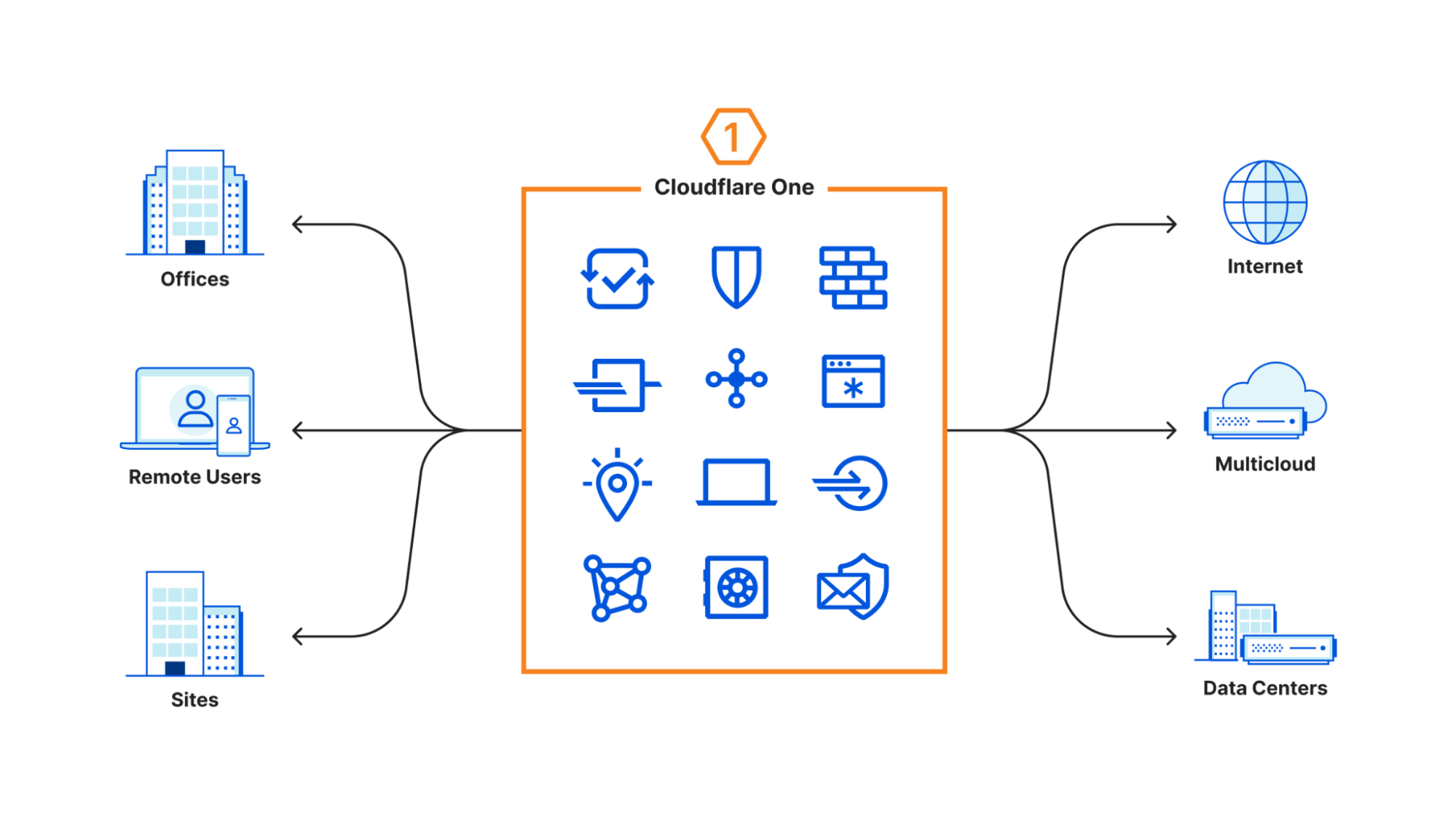
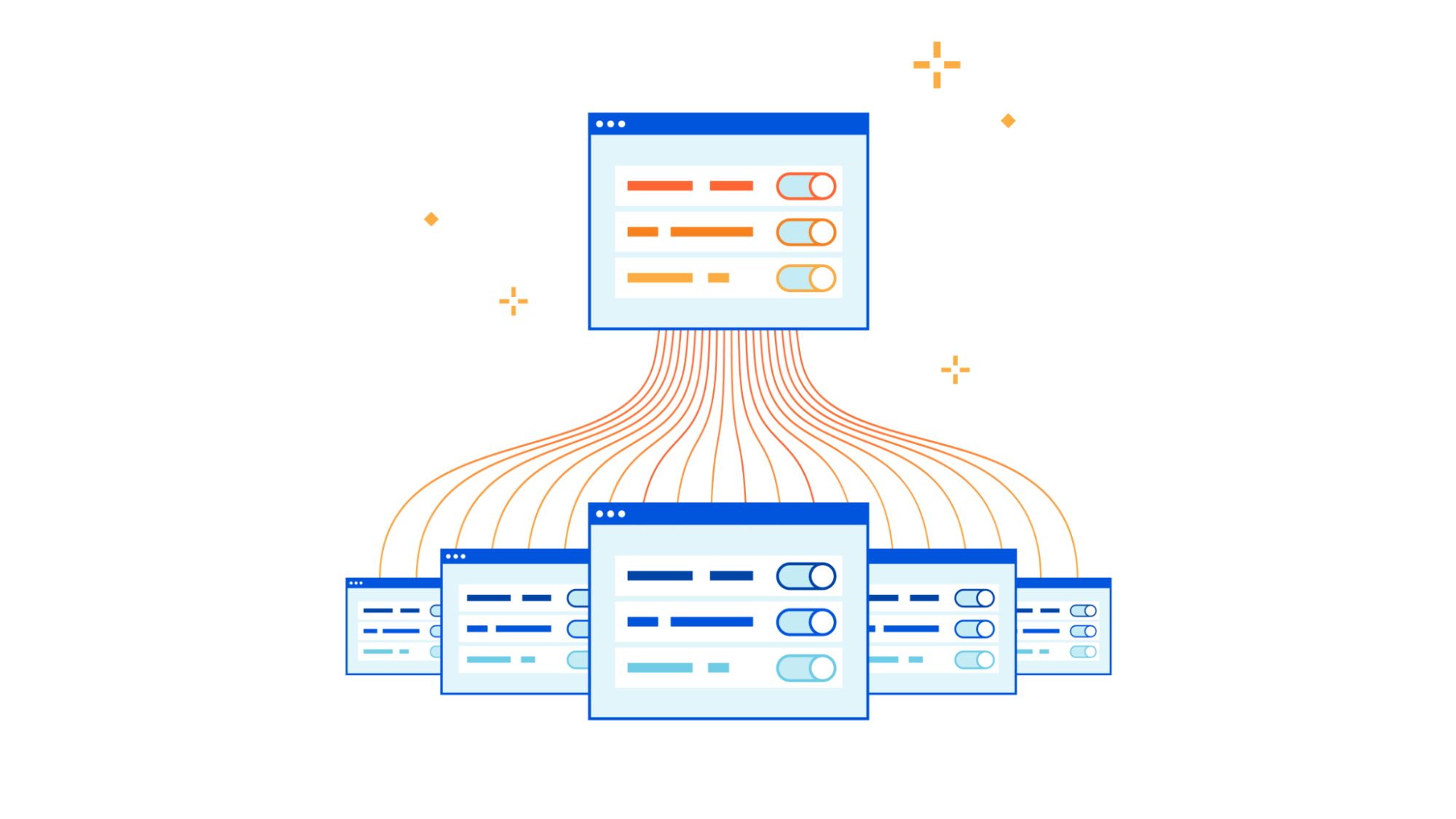
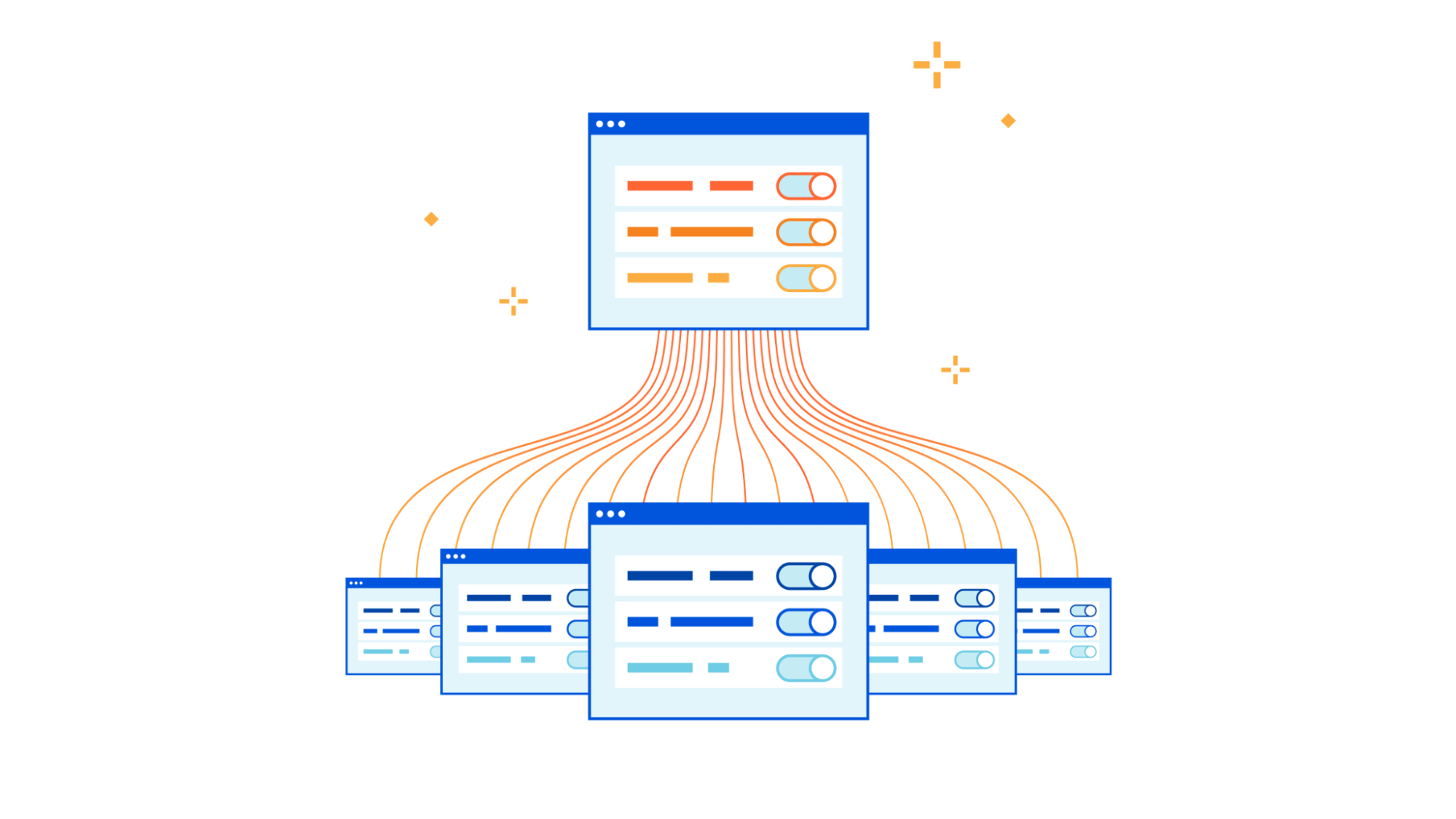
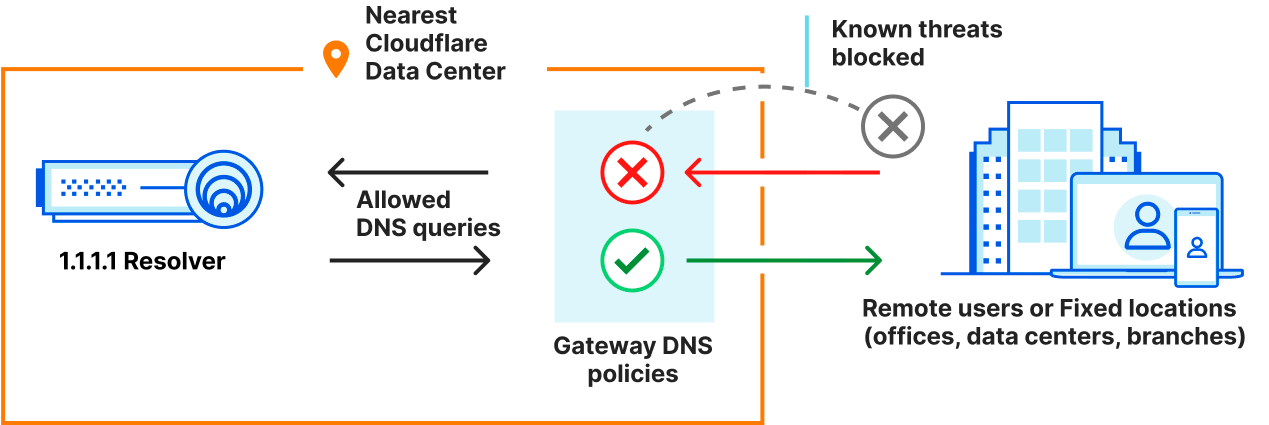
Tag Archives: Cloudflare One

Cloudflare One for Data Protection

Post Syndicated from James Chang original http://blog.cloudflare.com/cloudflare-one-data-protection-announcement/

Cloudflare One for Data Protection

This post is also available in 日本語, 한국어, Deutsch, Français.

Cloudflare One for Data Protection

Data continues to explode in volume, variety, and velocity, and security teams at organizations of all sizes are challenged to keep up. Businesses face escalating risks posed by varied SaaS environments, the emergence of generative artificial intelligence (AI) tools, and the exposure and theft of valuable source code continues to keep CISOs and Data Officers up at night.

Over the past few years, Cloudflare has launched capabilities to help organizations navigate these risks and gain visibility and controls over their data — including the launches of our data loss prevention (DLP) and cloud access security broker (CASB) services in the fall of 2022.

Announcing Cloudflare One’s data protection suite

Today, we are building on that momentum and announcing Cloudflare One for Data Protection — our unified suite to protect data everywhere across web, SaaS, and private applications. Built on and delivered across our entire global network, Cloudflare One’s data protection suite is architected for the risks of modern coding and increased usage of AI.

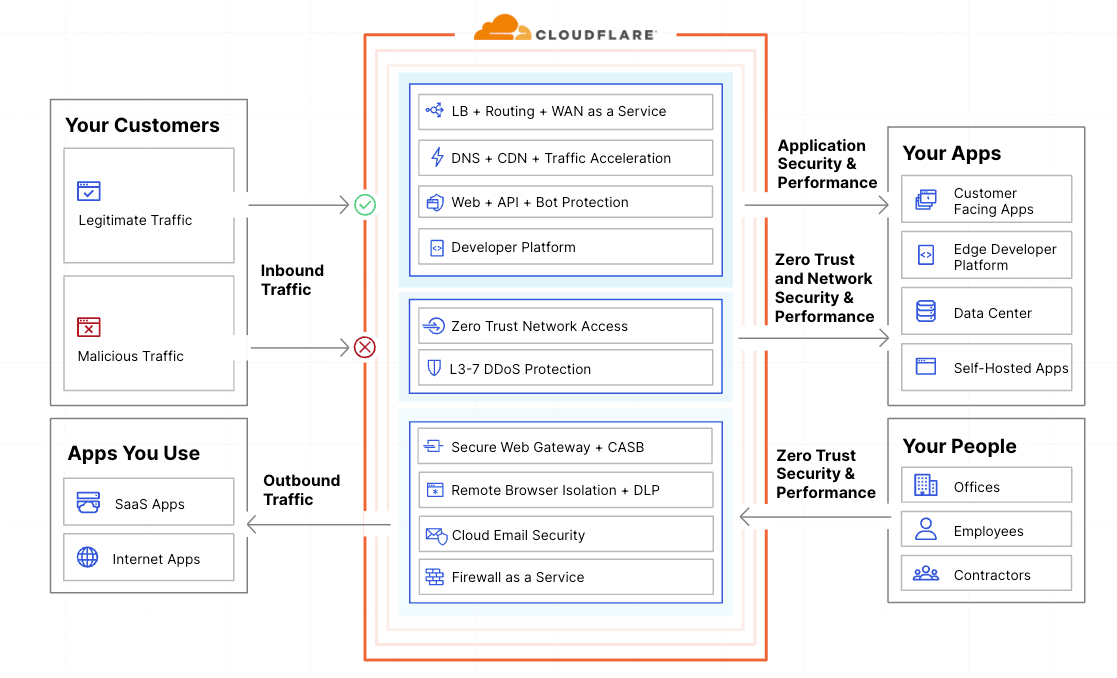
Specifically, this suite converges capabilities across Cloudflare’s DLP, CASB, Zero Trust network access (ZTNA), secure web gateway (SWG), remote browser isolation (RBI), and cloud email security services onto a single platform for simpler management. All these services are available and packaged now as part of Cloudflare One, our SASE platform that converges security and network connectivity services.

A separate blog post published today looks back on what technologies and features we delivered over the past year and previews new functionality that customers can look forward to.

In this blog, we focus more on what impact those technologies and features have for customers in addressing modern data risks — with examples of practical use cases. We believe that Cloudflare One is uniquely positioned to deliver better data protection that addresses modern data risks. And by “better,” we mean:

  • Helping security teams be more effective protecting data by simplifying inline and API connectivity together with policy management
  • Helping employees be more productive by ensuring fast, reliable, and consistent user experiences
  • Helping organizations be more agile by innovating rapidly to meet evolving data security and privacy requirements

Harder than ever to secure data

Data spans more environments than most organizations can keep track of. In conversations with customers, three distinctly modern risks stick out:

  1. The growing diversity of cloud and SaaS environments: The apps where knowledge workers spend most of their time — like cloud email inboxes, shared cloud storage folders and documents, SaaS productivity and collaboration suites like Microsoft 365 — are increasingly targeted by threat actors for data exfiltration.
  2. Emerging AI tools: Business leaders are concerned about users oversharing sensitive information with opaque large language model tools like ChatGPT, but at the same time, want to leverage the benefits of AI.
  3. Source code exposure or theft: Developer code fuels digital business, but that same high-value source code can be exposed or targeted for theft across many developer tools like GitHub, including in plain sight locations like public repositories.

These latter two risks, in particular, are already intersecting. Companies like Amazon, Apple, Verizon, Deutsche Bank, and more are blocking employees from using tools like ChatGPT for fear of losing confidential data, and Samsung recently had an engineer accidentally upload sensitive code to the tool. As organizations prioritize new digital services and experiences, developers face mounting pressure to work faster and smarter. AI tools can help unlock that productivity, but the long-term consequences of oversharing sensitive data with these tools is still unknown.

All together, data risks are only primed to escalate, particularly as organizations accelerate digital transformation initiatives with hybrid work and development continuing to expand attack surfaces. At the same time, regulatory compliance will only become more demanding, as more countries and states adopt more stringent data privacy laws.

Traditional DLP services are not equipped to keep up with these modern risks. A combination of high setup and operational complexity plus negative user experiences means that, in practice, DLP controls are often underutilized or bypassed entirely. Whether deployed as a standalone platform or integrated into security products or SaaS applications, DLP products can often become expensive shelfware. And backhauling traffic through on-premise data protection hardware – whether, DLP, firewall and SWG appliances, or otherwise — create costs and slow user experiences that hold businesses back in the long run.

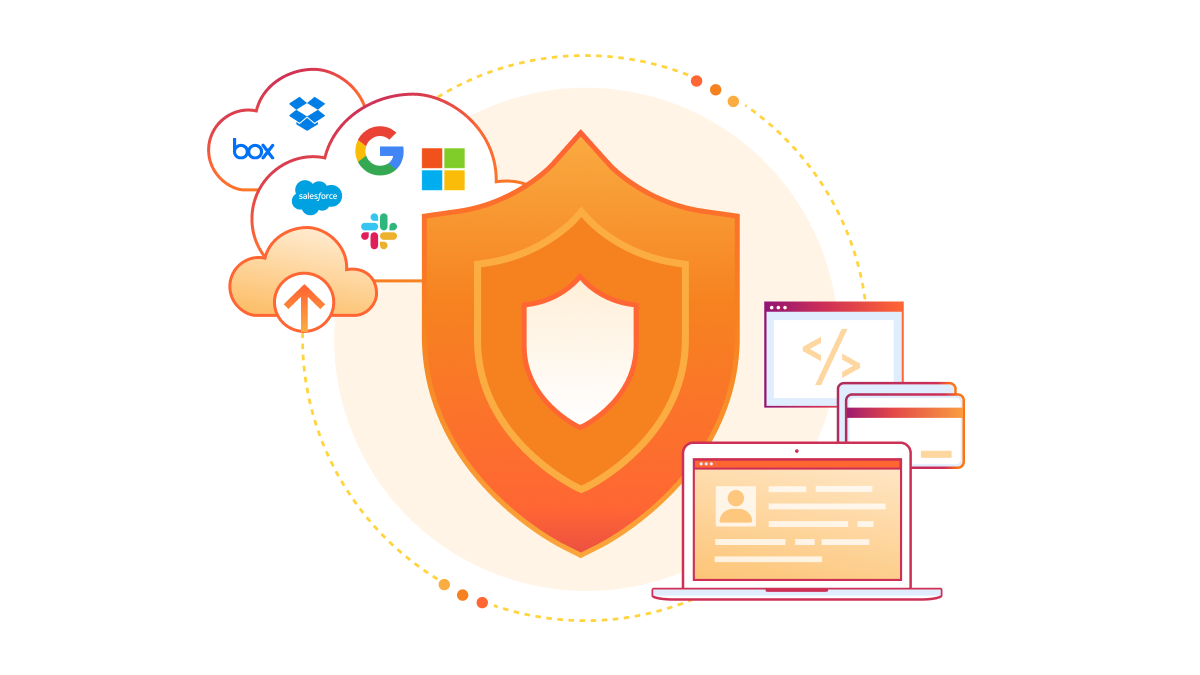
Figure 1: Modern data risks

Cloudflare One for Data Protection

How customers use Cloudflare for data protection

Today, customers are increasingly turning to Cloudflare to address these data risks, including a Fortune 500 natural gas company, a major US job site, a regional US airline, an Australian healthcare company and more. Across these customer engagements, three use cases are standing out as common focus areas when deploying Cloudflare One for data protection.

Use case #1: Securing AI tools and developer code (Applied Systems)

Applied Systems, an insurance technology & software company, recently deployed Cloudflare One to secure data in AI environments.

Specifically, the company runs the public instance of ChatGPT in an isolated browser, so that the security team can apply copy-paste blocks: preventing users from copying sensitive information (including developer code) from other apps into the AI tool. According to Chief Information Security Officer Tanner Randolph, “We wanted to let employees take advantage of AI while keeping it safe.”

This use case was just one of several Applied Systems tackled when migrating from Zscaler and Cisco to Cloudflare, but we see a growing interest in securing AI and developer code among our customers.

Use case #2: Data exposure visibility

Customers are leveraging Cloudflare One to regain visibility and controls over data exposure risks across their sprawling app environments. For many, the first step is analyzing unsanctioned app usage, and then taking steps to allow, block, isolate, or apply other controls to those resources. A second and increasingly popular step is scanning SaaS apps for misconfigurations and sensitive data via a CASB and DLP service, and then taking prescriptive steps to remediate via SWG policies.

A UK ecommerce giant with 7,5000 employees turned to Cloudflare for this latter step. As part of a broader migration strategy from Zscaler to Cloudflare, this company quickly set up API integrations between its SaaS environments and Cloudflare’s CASB and began scanning for misconfigurations. Plus, during this integration process, the company was able to sync DLP policies with Microsoft Pureview Information Protection sensitivity labels, so that it could use its existing framework to prioritize what data to protect. All in all, the company was able to begin identifying data exposure risks within a day.

Use case #3: Compliance with regulations

Comprehensive data regulations like GDPR, CCPA, HIPAA, and GLBA have been in our lives for some time now. But new laws are quickly emerging: for example, 11 U.S. states now have comprehensive privacy laws, up from just 3 in 2021. And updates to existing laws like PCI DSS now include stricter, more expansive requirements.

Customers are increasingly turning to Cloudflare One for compliance, in particular by ensuring they can monitor and protect regulated data (e.g. financial data, health data, PII, exact data matches, and more). Some common steps include first, detecting and applying controls to sensitive data via DLP, next, maintaining detailed audit trails via logs and further SIEM analysis, and finally, reducing overall risk with a comprehensive Zero Trust security posture.

Let’s look at a concrete example. One Zero Trust best practice that is increasingly required is multi-factor authentication (MFA). In the payment cards industry, PCI DSS v4.0, which takes effect in 2025, requires that requests to MFA be enforced for every access request to the cardholder data environment, for every user and for every location – including cloud environments, on-prem apps, workstations and more. (requirement 8.4.2). Plus, those MFA systems must be configured to prevent misuse – including replay attacks and bypass attempts – and must require at least two different factors that must be successful (requirement 8.5). To help organizations comply with both of these requirements, Cloudflare helps organizations enforce MFA across all apps and users – and in fact, we use our same services to enforce hard key authentication for our own employees.

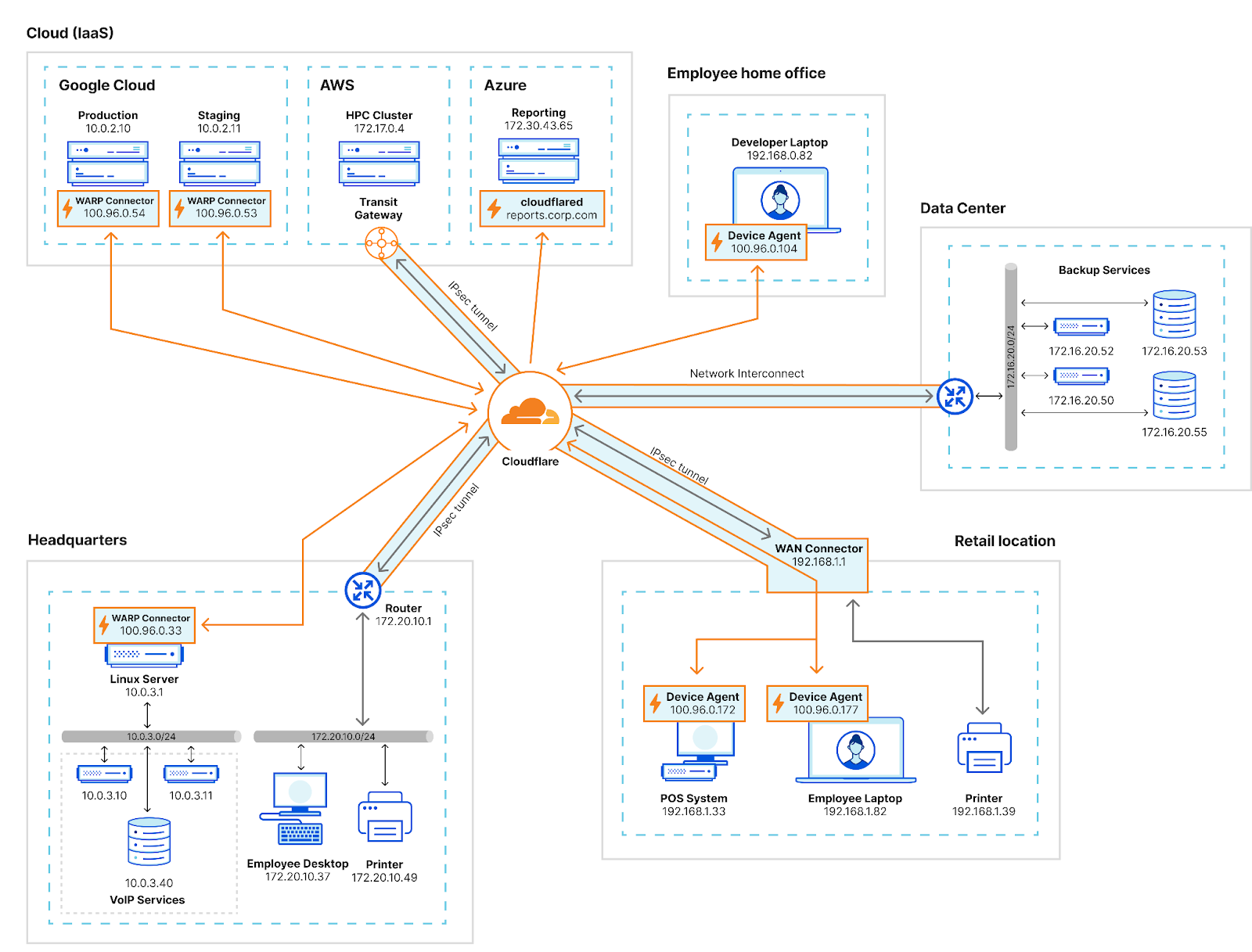
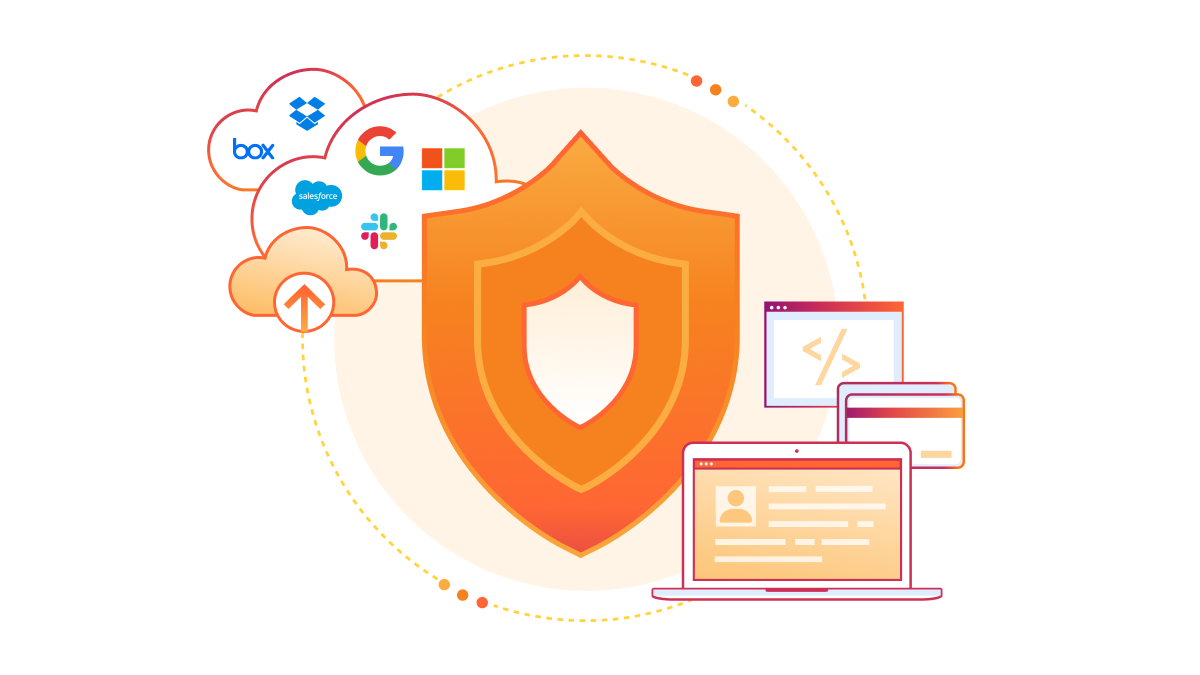
Figure 2: Data protection use cases

Cloudflare One for Data Protection

The Cloudflare difference

Cloudflare One’s data protection suite is built to stay at the forefront of modern data risks to address these and other evolving use cases.

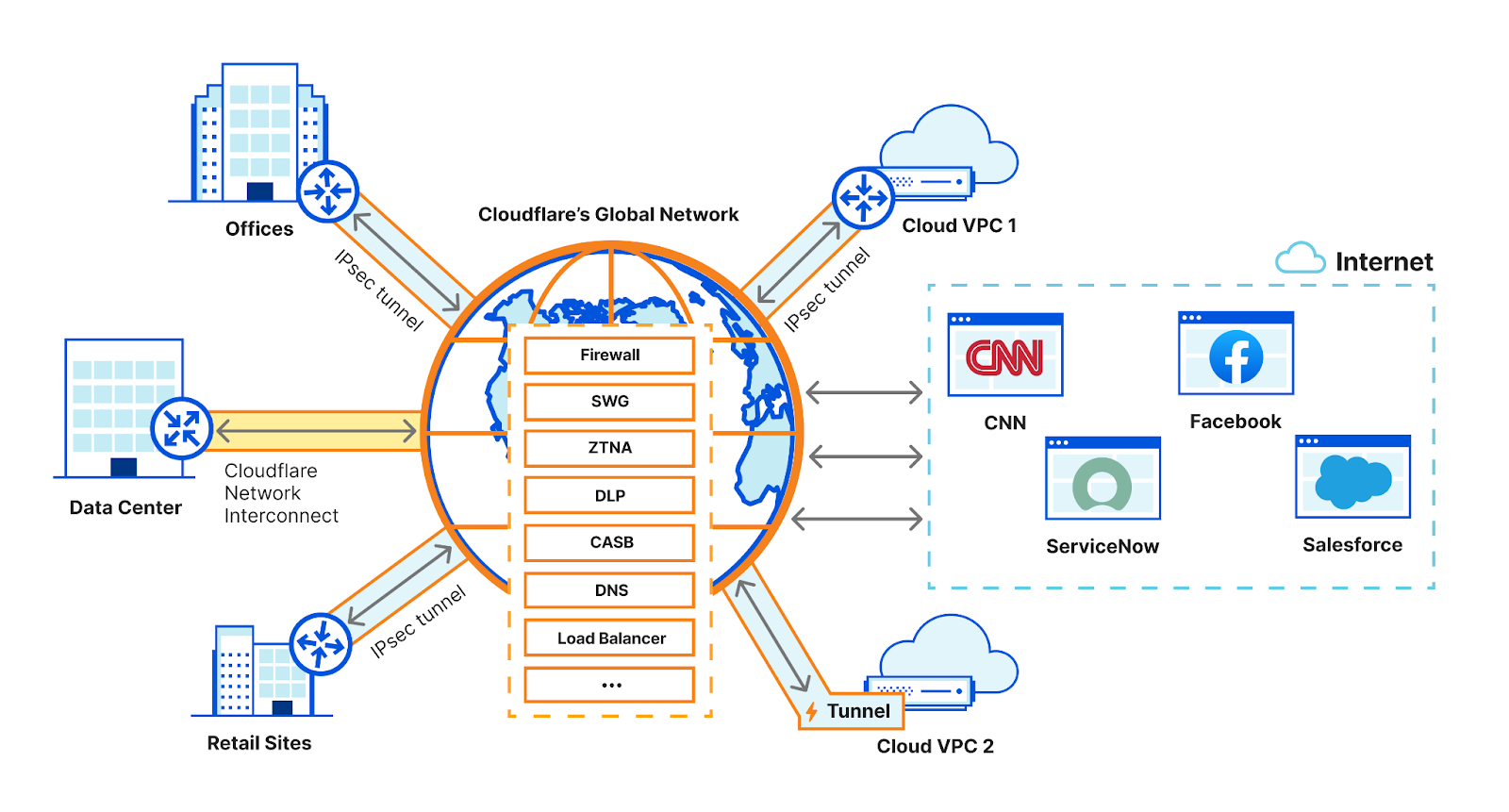
With Cloudflare, DLP is not just integrated with other typically distinct security services, like CASB, SWG, ZTNA, RBI, and email security, but converged onto a single platform with one control plane and one interface. Beyond the acronym soup, our network architecture is really what enables us to help organizations be more effective, more productive, and more agile with protecting data.

We simplify connectivity, with flexible options for you to send traffic to Cloudflare for enforcement. Those options include API-based scans of SaaS suites for misconfigurations and sensitive data. Unlike solutions that require security teams to get full app permissions from IT or business teams, Cloudflare can find risk exposure with read-only app permissions. Clientless deployments of ZTNA to secure application access and of browser isolation to control data within websites and apps are scalable for all users — employees and third-parties like contractors — for the largest enterprises. And when you do want to forward proxy traffic, Cloudflare offers one device client with self-enrollment permissions or wide area network on-ramps across security services. With so many practical ways to deploy, your data protection approach will be effective and functional — not shelfware.

Just like your data, our global network is everywhere, now spanning over 300 cities in over 100 countries. We have proven that we enforce controls faster than vendors like Zscaler, Netskope, and Palo Alto Networks — all with single-pass inspection. We ensure security is quick, reliable, and unintrusive, so you can layer on data controls without disruptive work productivity.

Our programmable network architecture enables us to build new capabilities quickly. And we rapidly adopt new security standards and protocols (like IPv6-only connections or HTTP/3 encryption) to ensure data protection remains effective. Altogether, this architecture equips us to evolve alongside changing data protection use cases, like protecting code in AI environments, and quickly deploy AI and machine learning models across our network locations to enforce higher precision, context-driven detections.

Figure 3: Unified data protection with Cloudflare

Cloudflare One for Data Protection

How to get started

Modern data risks demand modern security. We feel that Cloudflare One’s unified data protection suite is architected to help organizations navigate their priority risks today and in the future — whether that is securing developer code and AI tools, regaining visibility over SaaS apps, or staying compliant with evolving regulations.

If you’re ready to explore how Cloudflare can protect your data, request a workshop with our experts today.

Or to learn more about how Cloudflare One protects data, read today’s press release, visit our website, or dive deeper with our accompanying technical blog.

***

  1. The State of Secrets Sprawl 2023, GitGuardian
  2. Top Generative AI Statistics for 2023, Salesforce
  3. Cost of a Data Breach Report 2023, IBM
  4. 2023 “State of the CISO” report, conducted by Global Survey
  5. United Nations Conference on Trade & Development
  6. International Association of Privacy Professionals (IAPP)

What’s next for Cloudflare One’s data protection suite

Post Syndicated from Corey Mahan original http://blog.cloudflare.com/cloudflare-one-data-protection-roadmap-preview/

What’s next for Cloudflare One’s data protection suite

What’s next for Cloudflare One’s data protection suite

Today, we announced Cloudflare One for Data Protection — a unified suite to protect data everywhere across web, SaaS, and private applications. This suite converges capabilities including our data loss prevention (DLP), cloud access security broker (CASB), Zero Trust network access (ZTNA), secure web gateway (SWG), remote browser isolation (RBI), and cloud email security services. The suite is available and packaged now as part of Cloudflare One, our SASE platform.

In the announcement post, we focused on how the data protection suite helps customers navigate modern data risks, with recommended use cases and real-world customer examples.

In this companion blog post, we recap the capabilities built into the Cloudflare One suite over the past year and preview new functionality that customers can look forward to. This blog is best for practitioners interested in protecting data and SaaS environments using Cloudflare One.

DLP & CASB capabilities launched in the past year

Cloudflare launched both DLP and CASB services in September 2022, and since then have rapidly built functionality to meet the growing needs of our organizations of all sizes. Before previewing how these services will evolve, it is worth recapping the many enhancements added in the past year.

Cloudflare’s DLP solution helps organizations detect and protect sensitive data across their environment based on its several characteristics. DLP controls can be critical in preventing (and detecting) damaging leaks and ensuring compliance for regulated classes of data like financial, health, and personally identifiable information.

Improvements to DLP detections and policies can be characterized by three major themes:

  • Customization: making it easy for administrators to design DLP policies with the flexibility they want.
  • Deep detections: equipping administrators with increasingly granular controls over what data they protect and how.
  • Detailed detections: providing administrators with more detailed visibility and logs to analyze the efficacy of their DLP policies.

Cloudflare’s CASB helps organizations connect to, scan, and monitor third-party SaaS applications for misconfigurations, improper data sharing, and other security risks — all via lightweight API integrations. In this way, organizations can regain visibility and controls over their growing investments in SaaS apps.

CASB product enhancements can similarly be summarized by three themes:

  • Expanding API integrations: Today, our CASB integrates with 18 of the most popular SaaS apps — Microsoft 365 (including OneDrive), Google Workspace (including Drive), Salesforce, GitHub, and more. Setting up these API integrations takes fewer clicks than first-generation CASB solutions, with comparable coverage to other vendors in the Security Services Edge (SSE) space.
  • Strengthening findings of CASB scans: We have made it easier to remediate the misconfigurations identified by these CASB scans with both prescriptive guides and in-line policy actions built into the dashboard.
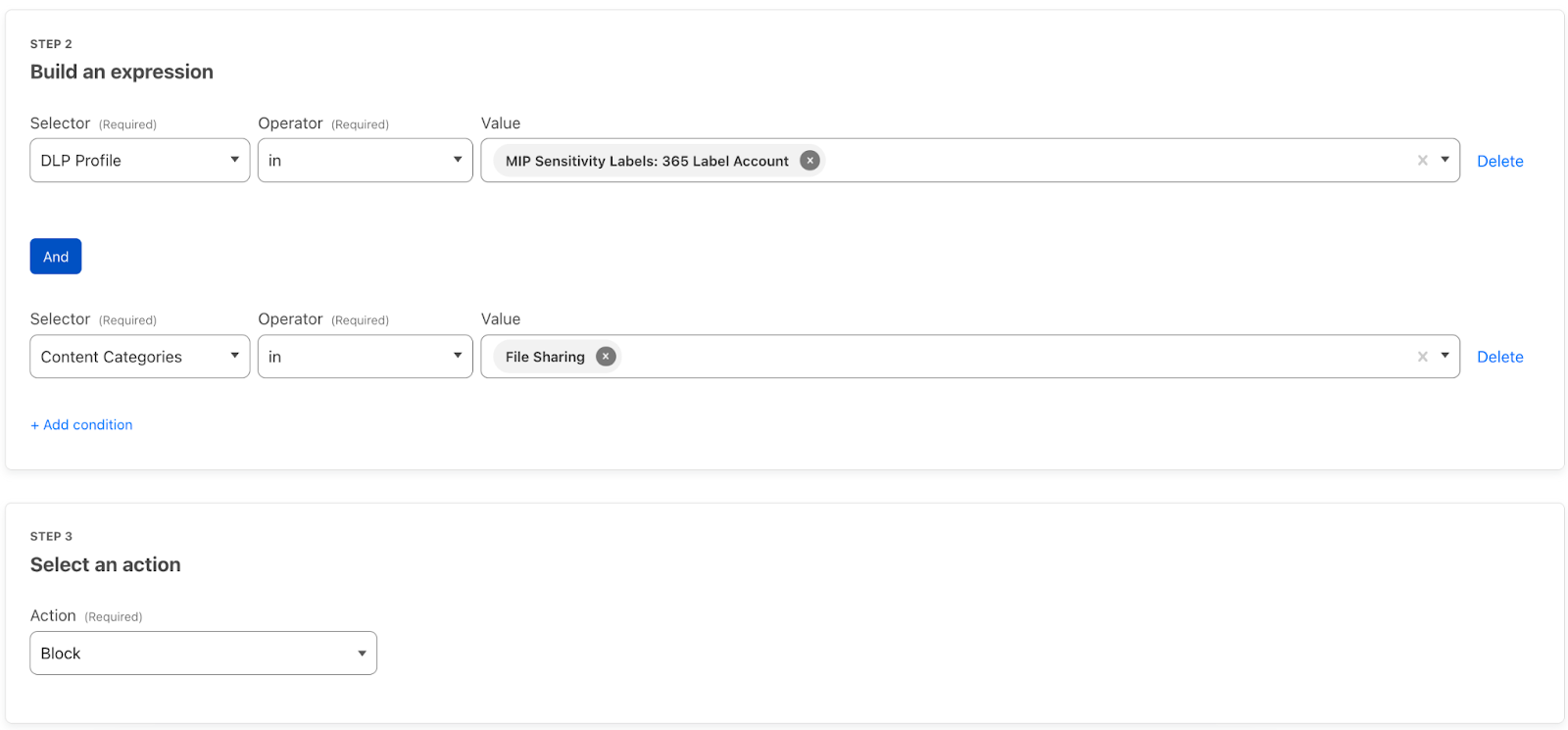
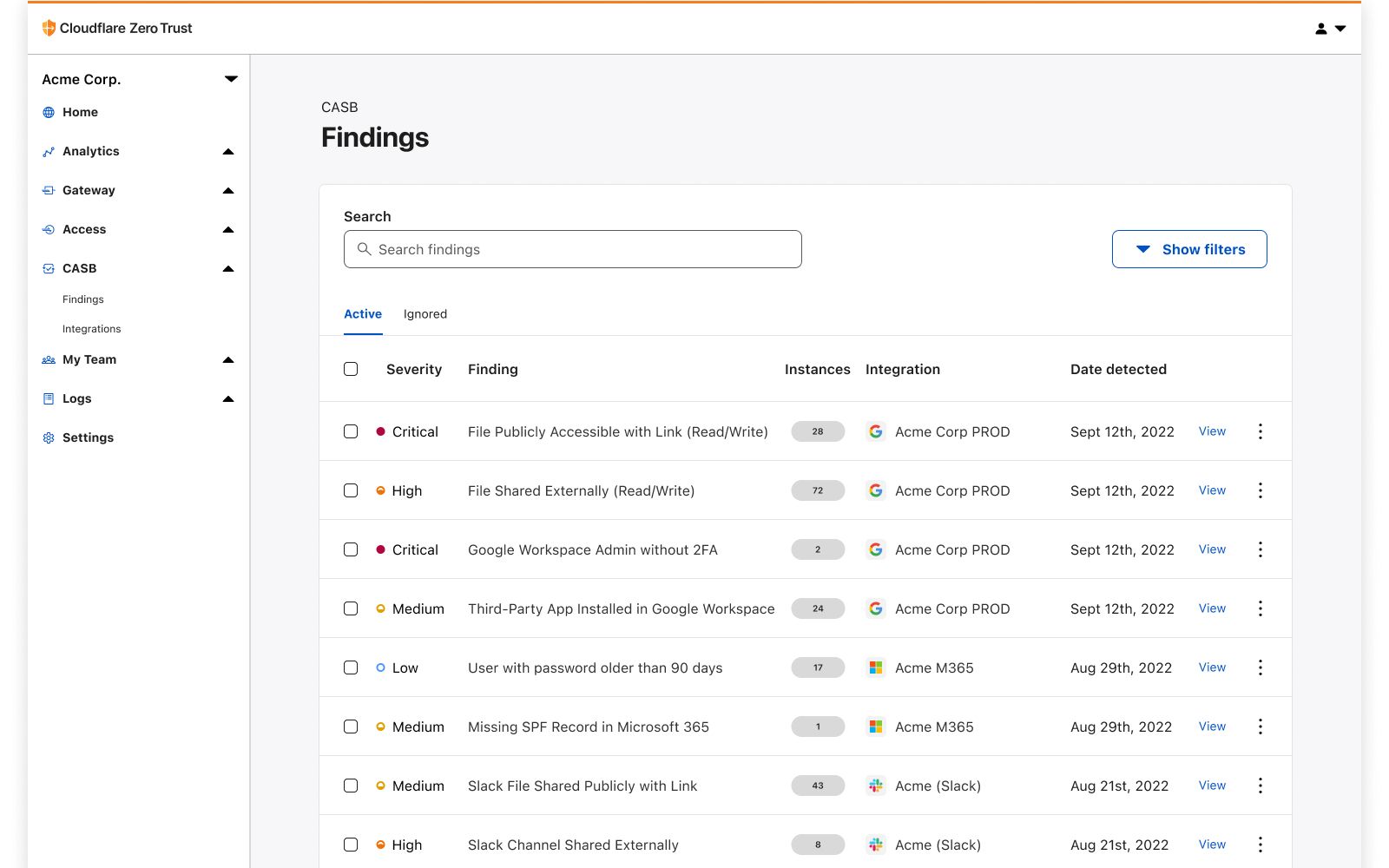
  • Converging CASB & DLP functionality: We started enabling organizations to scan SaaS apps for sensitive data, as classified by DLP policies. For example, this helps organizations detect when credit cards or social security numbers are in Google documents or spreadsheets that have been made publicly available to anyone on the Internet.

This last theme, in particular, speaks to the value of unifying data protection capabilities on a single platform for simple, streamlined workflows. The below table highlights some major capabilities launched since our general availability announcements last September.

Table 1: Select DLP and CASB capabilities shipped since 2022 Q4

Theme Capability Description
DLP: Customizability Microsoft Information Protection labels integration After a quick API integration, Cloudflare syncs continuously with the Microsoft Information Protection (MIP) labels you already use to streamline how you build DLP policies.
Custom DLP profiles Administrators can create custom detections using the same regex policy builder used across our entire Zero Trust platform for a consistent configuration experience across services.
Match count controls Administrators can set minimum thresholds for the number of times a detection is made before an action (like block or log) is triggered. This way, customers can create policies that allow individual transactions but block up/downloads with high volumes of sensitive data.
DLP: Deepening detection Context analysis Context analysis helps reduce false positive detections by analyzing proximity keywords (for example: seeing “expiration date” near a credit card number increases the likelihood of triggering a detection).
File type control DLP scans can be scoped to specific file types, such as Microsoft Office documents, PDF files, and ZIP files.
Expanded predefined DLP profiles Since launch, DLP has built out a wider variety of detections for common data types, like financial data, personal identifiers, and credentials.
DLP: Detailed detections Expanded logging details Cloudflare now captures more wide-ranging and granular details of DLP-related activity in logs, including payload analysis, file names, and higher fidelity details of individual files. A large percentage of our customers prefer to push these logs to SIEM tools like DataDog and Sumo Logic.
CASB: Expanding integrations and findings API-based integrations
Managing findings
Today, Cloudflare integrates with 18 of the most widely used SaaS apps, including productivity suites, cloud storage, chat tools, and more.
API-based scans not only reveal misconfigurations, but also offer built-in HTTP policy creation workflows and step-by-step remediation guides.
DLP & CASB convergence Scanning for sensitive data in SaaS apps Today, organizations can set up CASB to scan every publicly accessible file in Google Workspace for text that matches a DLP profile (financial data, personal identifiers, etc.).

New and upcoming DLP & CASB functionality

Today’s launch of Cloudflare One’s data protection suite crystalizes our commitment to keep investing in DLP and CASB functionality across these thematic areas. Below we wanted to preview a few new and upcoming capabilities on the Cloudflare One’s data protection suite roadmap that will become available in the coming weeks for further visibility and controls across data environments.

Exact data matching with custom wordlists

Already shipped: Exact Data Match, moves from out of beta to general availability, allowing customers to tell Cloudflare’s DLP exactly what data to look for by uploading a dataset, which could include names, phone numbers, or anything else.

Next 30 days: Customers will soon be able to upload a list of specific words, create DLP policies to search for those important keywords in files, and block and log that activity.

How customers benefit: Administrators can be more specific about what they need to protect and save time creating policies by bulk uploading the data and terms that they care most about. Over time, many organizations have amassed long lists of terms configured for incumbent DLP services, and these customizable upload capabilities streamline migration from other vendors to Cloudflare. Just as with all other DLP profiles, Cloudflare searches for these custom lists and keywords within in-line traffic and in integrated SaaS apps.

Detecting source code and health data

Next 30 days: Soon, Clouflare’s DLP will include predefined profiles to detect developer source code and protected health information (PHI). Initially, code data will include languages like Python, Javascript, Java, and C++ — four of the most popular languages today — and PHI data will include medication and diagnosis names — two highly sensitive medical topics.

How customers benefit: These predefined profiles expand coverage to some of the most valuable — and in the case of PHI, one of the most regulated — types of data within an organization.

Converging API-driven CASB & DLP for data-at-rest protections

Next 30 days: Soon, organizations will be able to scan for sensitive data at rest in Microsoft 365 (e.g. OneDrive). API-based scans of these environments will flag, for example, whether credit card numbers, source code, or other data configured via DLP policies reside within publicly accessible files. Administrators can then take prescriptive steps to remediate via in-line CASB gateway policies.

Shipping by the end of the year: Within the next few months, this same integration will be available with GitHub.

How customers benefit: Between the existing Google Workspace integration and this upcoming Microsoft 365 integration, customers can scan for sensitive data across two of the most prominent cloud productivity suites — where users spend much of their time and where large percentages of organizational data lives. This new Microsoft integration represents a continued investment in streamlining security workflows across the Microsoft ecosystem — whether for managing identity and application access, enforcing device posture, or isolating risky users.

The GitHub integration also restores visibility over one of the most critical developer environments that is also increasingly a risk for data leaks. In fact, according to GitGuardian, 10 million hard-coded secrets were exposed in public GitHub commits in 2022, a figure that is up 67% from 2021 and only expected to grow. Preventing source code exposure on GitHub is a problem area our product team regularly hears from our customers, and we will continue to prioritize securing developer environments.

Layering on Zero Trust context: User Risk Score

Next 30 days: Cloudflare will introduce a risk score based on user behavior and activities that have been detected across Cloudflare One’s services. Organizations will be able to detect user behaviors that introduce risk from action like an Impossible Travel anomaly or detections from too many DLP violations in a given period of time. Shortly following the detection capabilities will be the option to take preventative or remediative policy actions, within the wider Cloudflare One suite. In this way, organizations can control access to sensitive data and applications based on changing risk factors and real-time context.

How customers benefit: Today, intensive time, labor, and money are spent on analyzing large volumes of log data to identify patterns of risk. Cloudflare's ‘out-of-the-box’ risk score simplifies that process, helping organizations gain visibility into and lock down suspicious activity with speed and efficiency.

How to get started

These are just some of the capabilities on our short-term roadmap, and we can’t wait to share more with you as the data protection suite evolves. If you’re ready to explore how Cloudflare One can protect your data, request a workshop with our experts today.

Or to learn more about how Cloudflare One protects data, read today’s press release, visit our website, or dive deeper with a technical demo.

DLP Exact Data Match beta now available

Post Syndicated from Noelle Kagan original http://blog.cloudflare.com/edm-beta/

DLP Exact Data Match beta now available

DLP Exact Data Match beta now available

The most famous data breaches–the ones that keep security practitioners up at night–involved the leak of millions of user records. Companies have lost names, addresses, email addresses, Social Security numbers, passwords, and a wealth of other sensitive information. Protecting this data is the highest priority of most security teams, yet many teams still struggle to actually detect these leaks.

Cloudflare’s Data Loss Prevention suite already includes the ability to identify sensitive data like credit card numbers, but with the volume of data being transferred every day, it can be challenging to understand which of the transactions that include sensitive data are actually problematic. We hear customers tell us, “I don’t care when one of my employees uses a personal credit card to buy something online. Tell me when one of my customers’ credit cards are leaked.”

In response, we looked for a method to distinguish between any credit card and one belonging to a specific customer. We are excited to announce the launch of our newest Data Loss Prevention feature, Exact Data Match. With Exact Data Match (EDM), customers securely tell us what data they want to protect, and then we identify, log, and block the presence or movement of that data. For example, if you provide us with a set of credit card numbers, we will DLP scan your traffic or repositories for only those cards. This allows you to create targeted DLP detections for your organization.

What is Exact Data Match?

Many Data Loss Prevention (DLP) detections begin with a generic identification of a pattern, often using a regular expression, and then are validated by additional criteria. Validation can leverage a wide range of techniques from checksums to machine learning models. However, this validates that the pattern is a credit card, not that it is your credit card.

With Exact Data Match, you tell us exactly the data you want to protect, but we never see it in cleartext. You provide a list of data of your choosing, such as a list of names, addresses, or credit card numbers, and that data is hashed before ever reaching Cloudflare. We store the hashes and scan your traffic or content for matches of the hashes. When we find a match, we log or block it according to your policy.

By using a finite list of data, we drastically reduce false positives compared to generic pattern matching. Meanwhile, hashing the data maintains your data privacy. Our goal is to meet your data protection and privacy needs.

How do I use it?

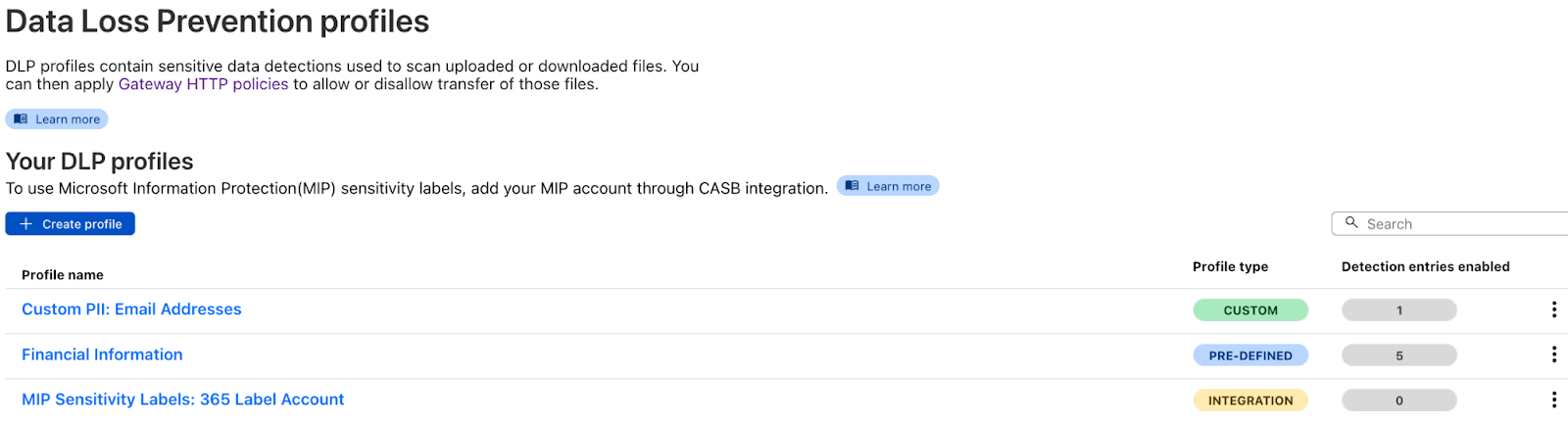
We now offer you the ability to upload DLP datasets. These allow you to provide batches of data to be used for your DLP detections.

DLP Exact Data Match beta now available

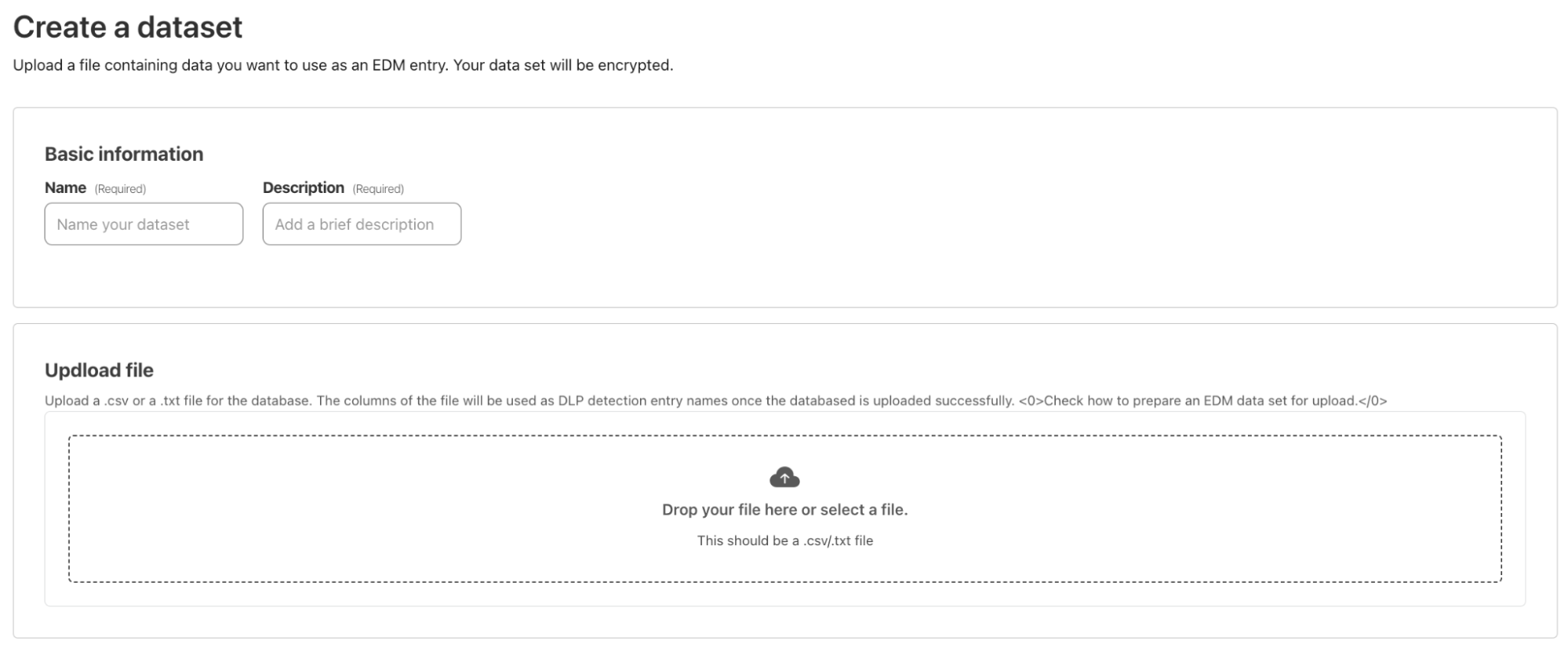
When creating a dataset, provide a name, description, and a file containing the data to match.

DLP Exact Data Match beta now available

When you upload the file, Cloudflare one-way hashes the data right in your browser. The hashed data is then transferred via API to Cloudflare, while the cleartext data never leaves the browser.

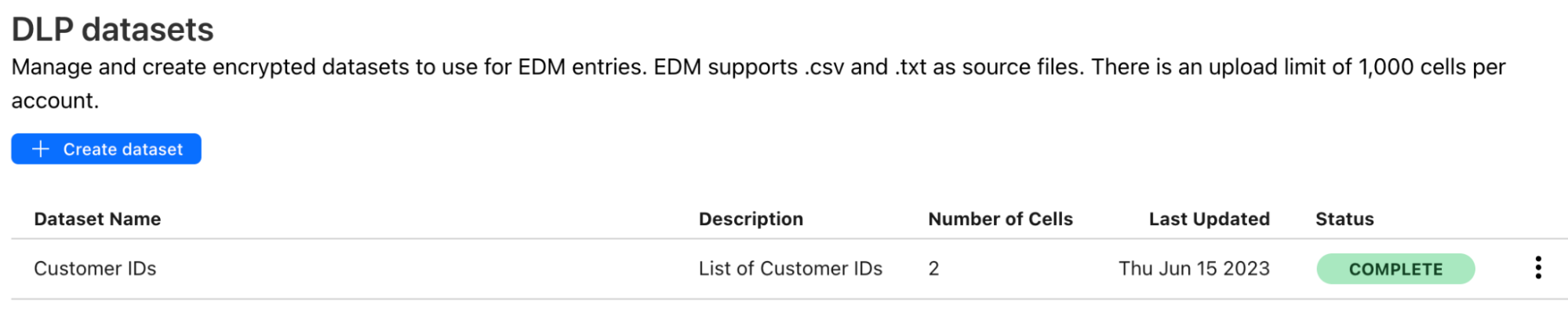
You can see the status of the upload in the datasets table.

DLP Exact Data Match beta now available

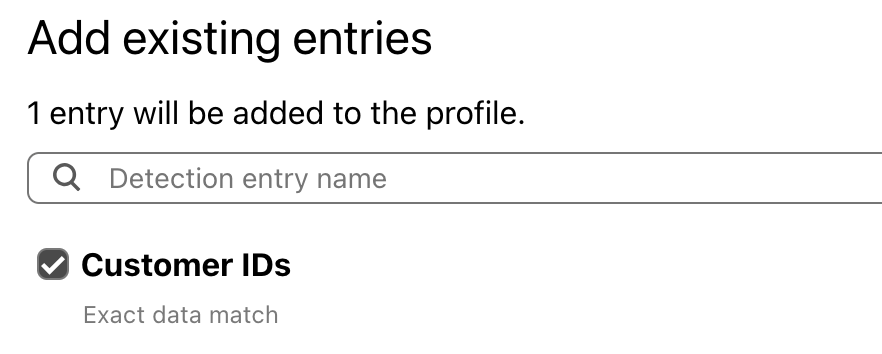
The dataset can now be added to a DLP profile for detection. You can also add other predefined and custom entries to the same DLP profile.

DLP Exact Data Match beta now available

DLP Profiles can be used for inline scanning and protection with Cloudflare Gateway or scanning your data at rest with Cloudflare CASB.

Can I join the beta?

Exact data match is now available for every DLP customer. If you are not a DLP customer but would like to learn more about Cloudflare One and DLP, reach out for a consultation.

What’s next?

Customers have many different formats to store data, and many different ways in which they want to monitor it. Our goal is to offer as much flexibility as your organization needs to meet your data protection goals.

A complete suite of Zero Trust security tools to get the most from AI

Post Syndicated from Sam Rhea original http://blog.cloudflare.com/zero-trust-ai-security/

A complete suite of Zero Trust security tools to get the most from AI

This post is also available in French, Spanish, German.

A collection of tools from Cloudflare One to help your teams use AI services safely

A complete suite of Zero Trust security tools to get the most from AI

Cloudflare One gives teams of any size the ability to safely use the best tools on the Internet without management headaches or performance challenges. We’re excited to announce Cloudflare One for AI, a new collection of features that help your team build with the latest AI services while still maintaining a Zero Trust security posture.

Large Language Models, Larger Security Challenges

A Large Language Model (LLM), like OpenAI’s GPT or Google’s Bard, consists of a neural network trained against a set of data to predict and generate text based on a prompt. Users can ask questions, solicit feedback, and lean on the service to create output from poetry to Cloudflare Workers applications.

The tools also bear an uncanny resemblance to a real human. As in some real-life personal conversations, oversharing can become a serious problem with these AI services. This risk multiplies due to the types of use cases where LLM models thrive. These tools can help developers solve difficult coding challenges or information workers create succinct reports from a mess of notes. While helpful, every input fed into a prompt becomes a piece of data leaving your organization’s control.

Some responses to tools like ChatGPT have been to try and ban the service outright; either at a corporate level or across an entire nation. We don’t think you should have to do that. Cloudflare One’s goal is to allow you to safely use the tools you need, wherever they live, without compromising performance. These features will feel familiar to any existing use of the Zero Trust products in Cloudflare One, but we’re excited to walk through cases where you can use the tools available right now to allow your team to take advantage of the latest LLM features.

Measure usage

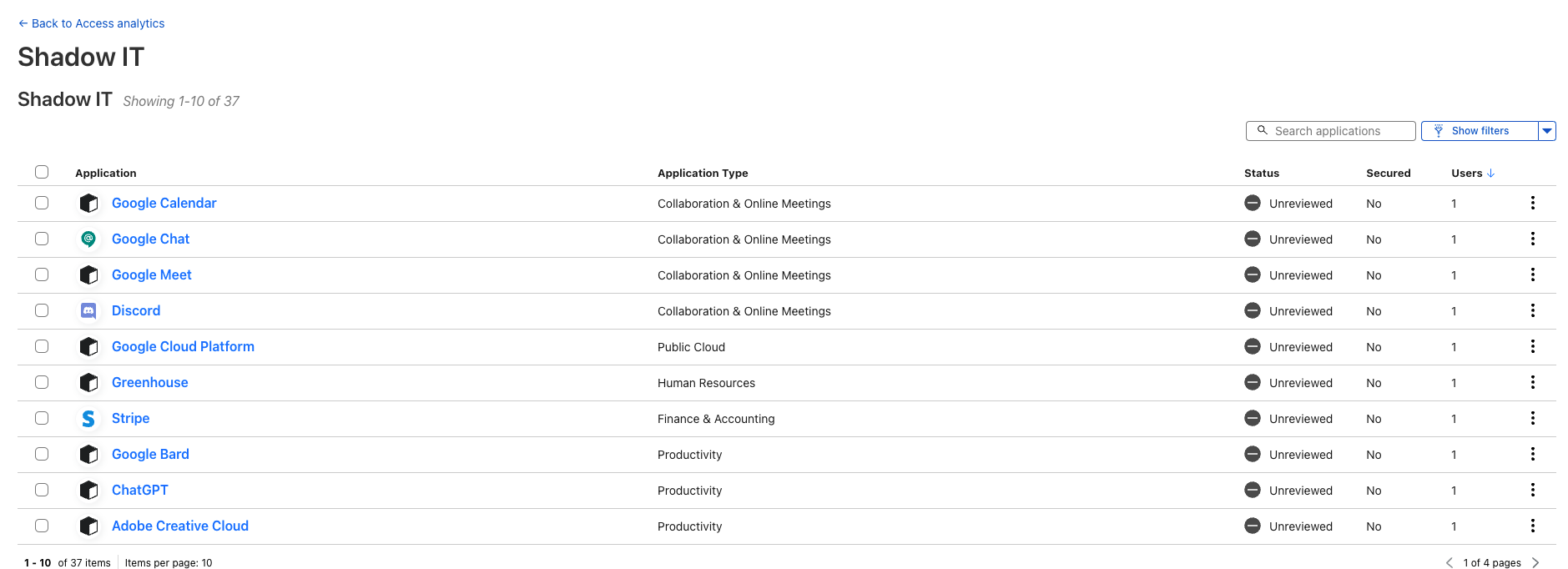
SaaS applications make it easy for any user to sign up and start testing. That convenience also makes these tools a liability for IT budgets and security policies. Teams refer to this problem as “Shadow IT” – the adoption of applications and services outside the approved channels in an organization.

In terms of budget, we have heard from early adopter customers who know that their team members are beginning to experiment with LLMs, but they are not sure how to approach making a commercial licensing decision. What services and features do their users need and how many seats should they purchase?

On the security side, the AIs can be revolutionary for getting work done but terrifying for data control policies. Team members treat these AIs like sounding boards for painful problems. The services invite users to come with their questions or challenges. Sometimes the context inside those prompts can contain sensitive information that should never leave an organization. Even if teams select and approve a single vendor, members of your organization might prefer another AI and continue to use it in their workflow.

Cloudflare One customers on any plan can now review the usage of AIs. Your IT department can deploy Cloudflare Gateway and passively observe how many users are selecting which services as a way to start scoping out enterprise licensing plans.

A complete suite of Zero Trust security tools to get the most from AI

Administrators can also block the use of these services with a single click, but that is not our goal today. You might want to use this feature if you select ChatGPT as your approved model, and you want to make sure team members don’t continue to use alternatives, but we hope you don’t block all of these services outright. Cloudflare’s priority is to give you the ability to use these tools safely.

Control API access

When our teams began experimenting with OpenAI’s ChatGPT service, we were astonished by what it already knew about Cloudflare. We asked ChatGPT to create applications with Cloudflare Workers or guide us through how to configure a Cloudflare Access policy and, in most cases, the results were accurate and helpful.

In some cases the results missed the mark. The AIs were using outdated information, or we were asking questions about features that had only launched recently. Thankfully, these AIs can learn and we can help. We can train these models with scoped inputs and connect plug-ins to provide our customers with better AI-guided experiences when using Cloudflare services.

We heard from customers who want to do the same thing and, like us, they need to securely share training data and grant plug-in access for an AI service. Cloudflare One’s security suite extends beyond human users and can give teams the ability to securely share Zero Trust access to sensitive data over APIs.

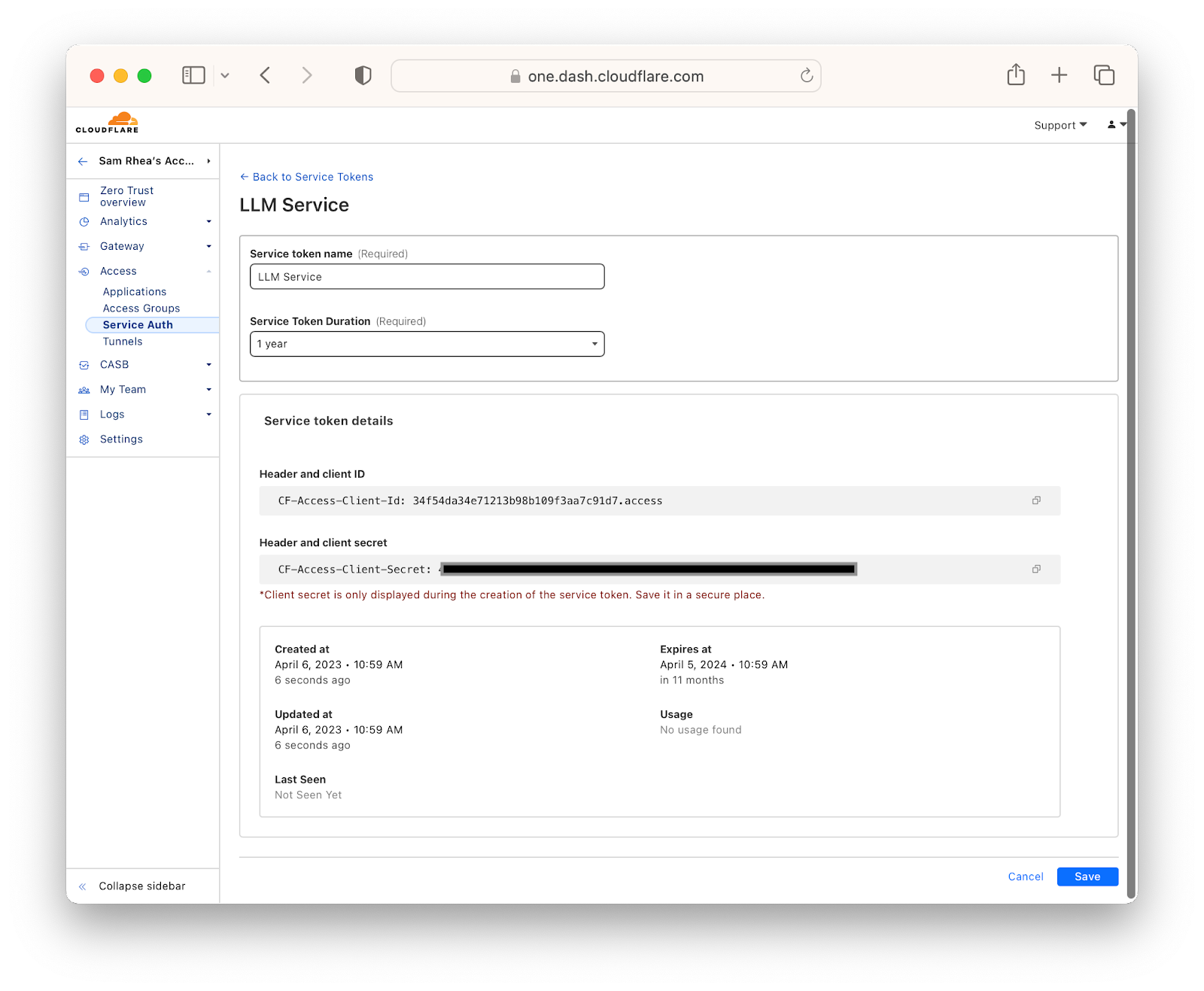
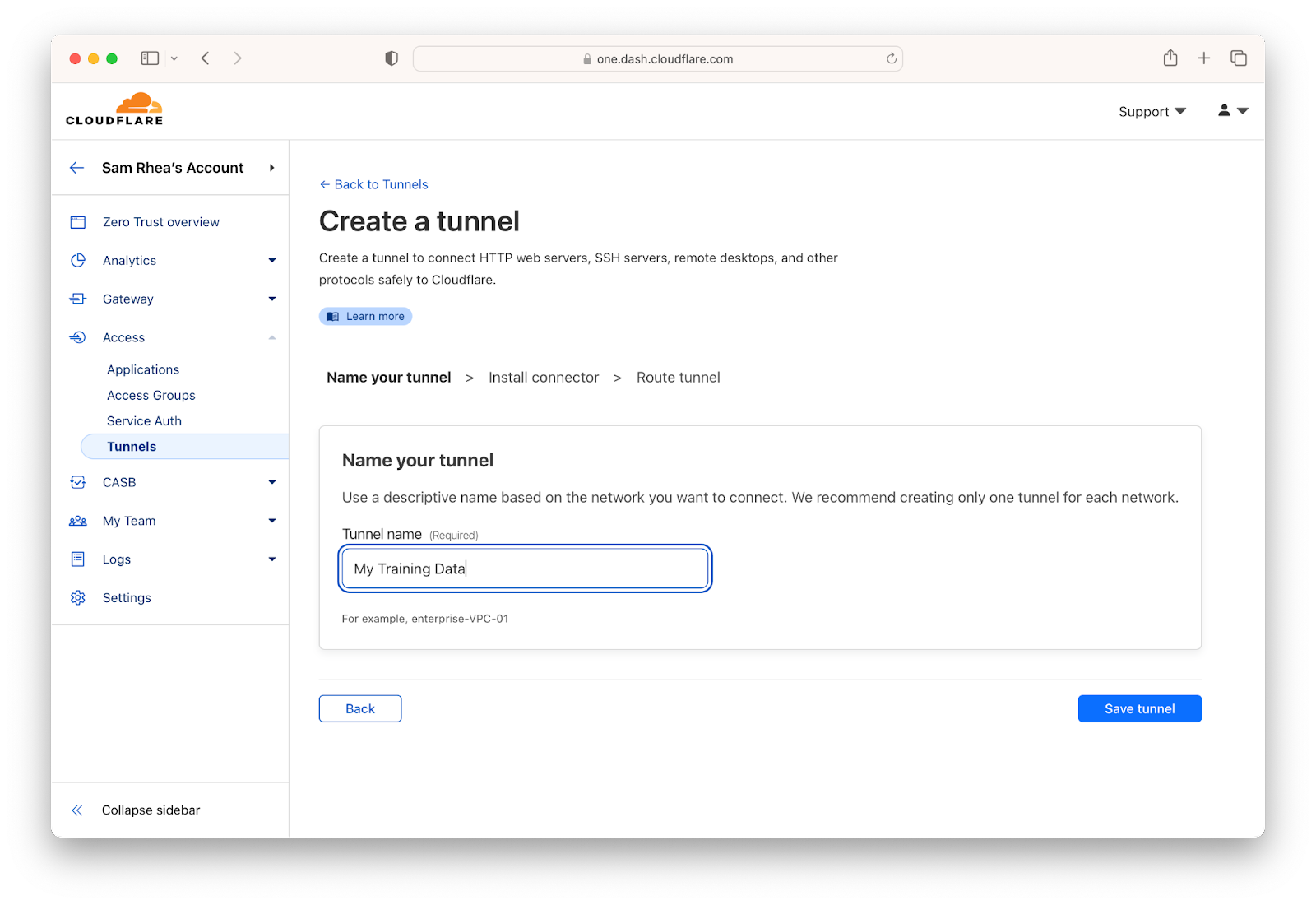
First, teams can create service tokens that external services must present to reach data made available through Cloudflare One. Administrators can provide these tokens to systems making API requests and log every single request. As needed, teams can revoke these tokens with a single click.

A complete suite of Zero Trust security tools to get the most from AI

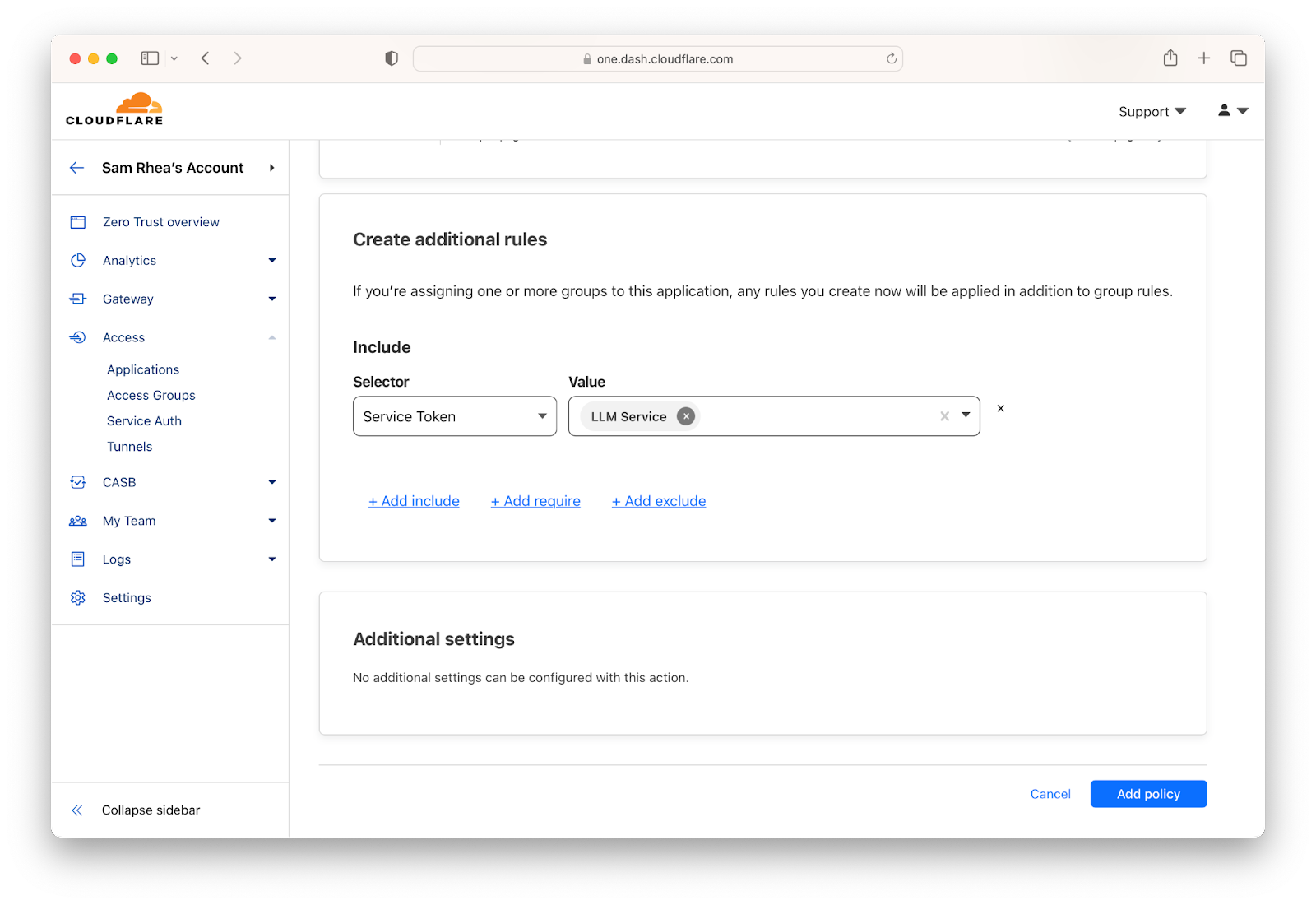
After creating and issuing service tokens, administrators can create policies to allow specific services access to their training data. These policies will verify the service token and can be extended to verify country, IP address or an mTLS certificate. Policies can also be created to require human users to authenticate with an identity provider and complete an MFA prompt before accessing sensitive training data or services.

A complete suite of Zero Trust security tools to get the most from AI

When teams are ready to allow an AI service to connect to their infrastructure, they can do so without poking holes in their firewalls by using Cloudflare Tunnel. Cloudflare Tunnel will create an encrypted, outbound-only connection to Cloudflare’s network where every request will be checked against the access rules configured for one or more services protected by Cloudflare One.

A complete suite of Zero Trust security tools to get the most from AI

Cloudflare’s Zero Trust access control gives you the ability to enforce authentication on each and every request made to the data your organization decides to provide to these tools. That still leaves a gap in the data your team members might overshare on their own.

Restrict data uploads

Administrators can select an AI service, block Shadow IT alternatives, and carefully gate access to their training material, but humans are still involved in these AI experiments. Any one of us can accidentally cause a security incident by oversharing information in the process of using an AI service – even an approved service.

We expect AI playgrounds to continue to evolve to feature more data management capabilities, but we don’t think you should have to wait for that to begin adopting these services as part of your workflow. Cloudflare’s Data Loss Prevention (DLP) service can provide a safeguard to stop oversharing before it becomes an incident for your security team.

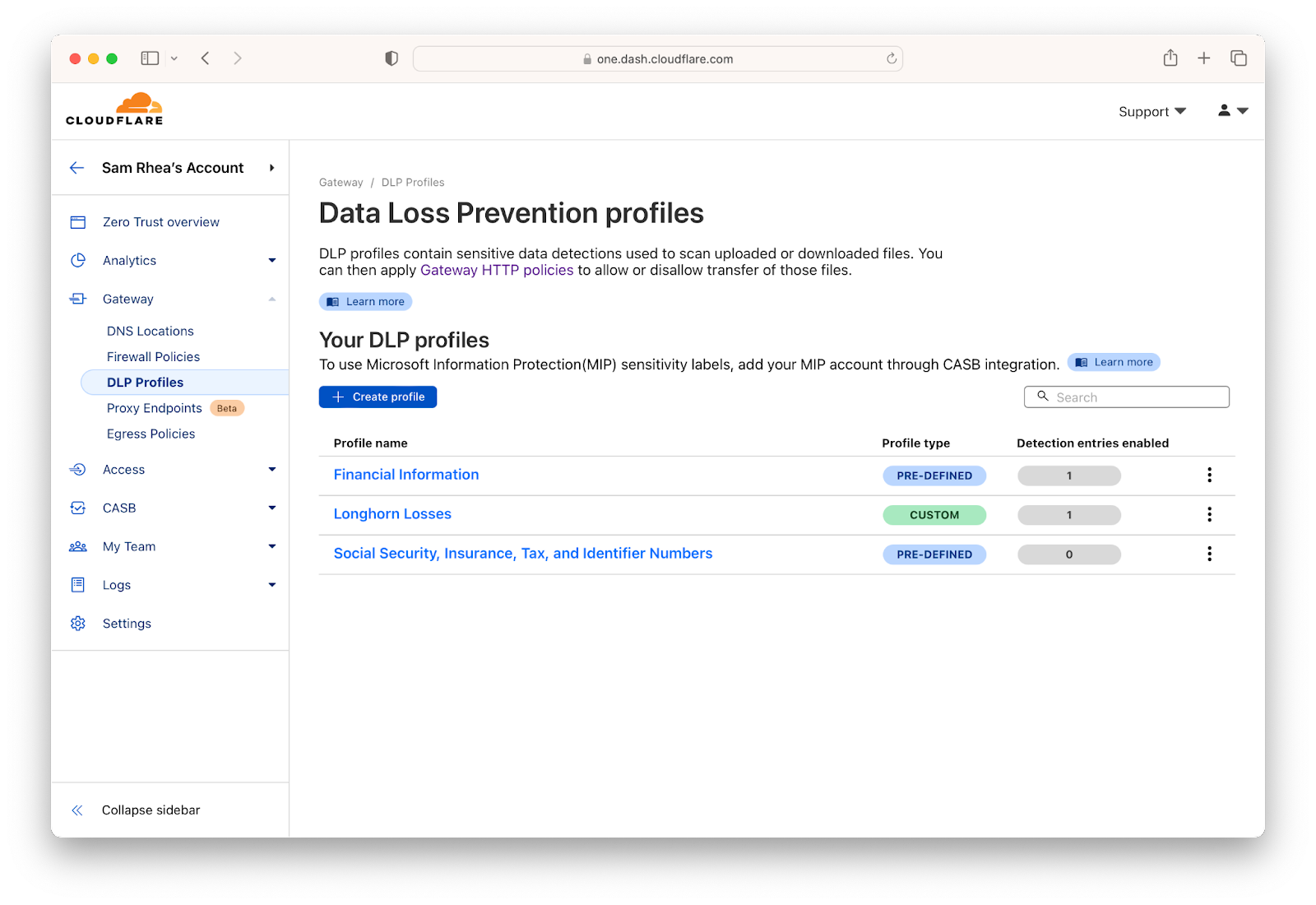
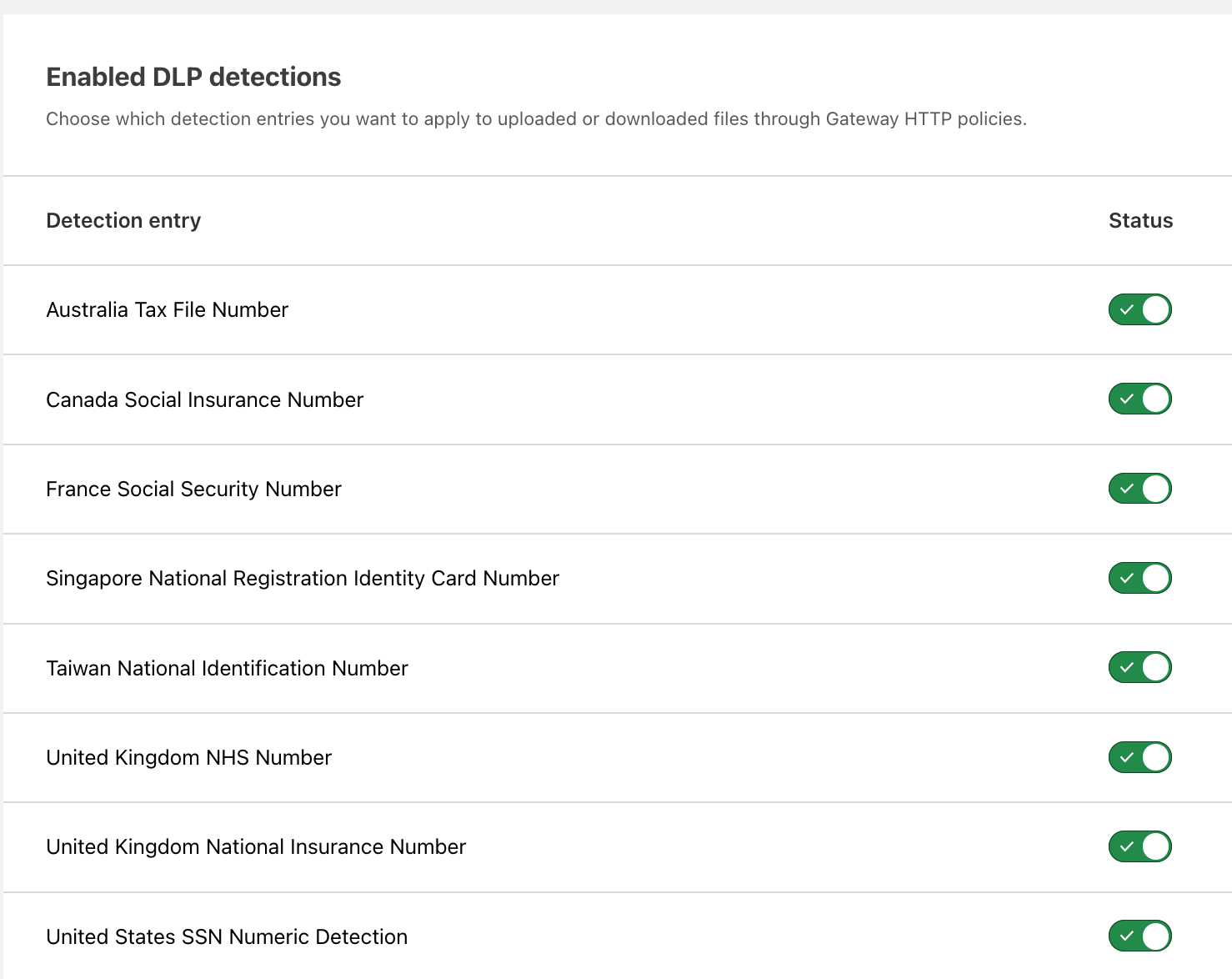
First, tell us what data you care about. We provide simple, preconfigured options that give you the ability to check for things that look like social security numbers or credit card numbers. Cloudflare DLP can also scan for patterns based on regular expressions configured by your team.

A complete suite of Zero Trust security tools to get the most from AI

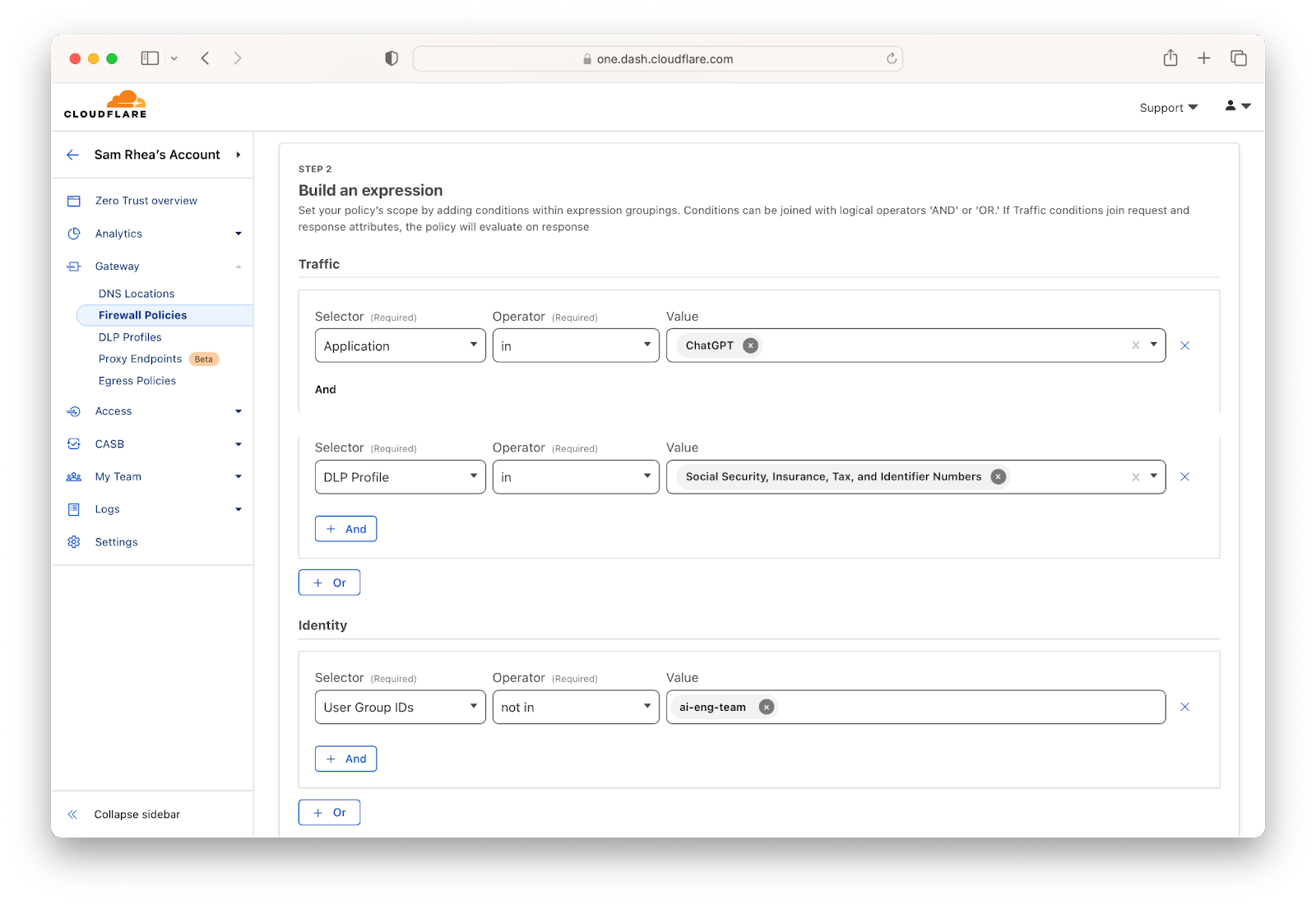
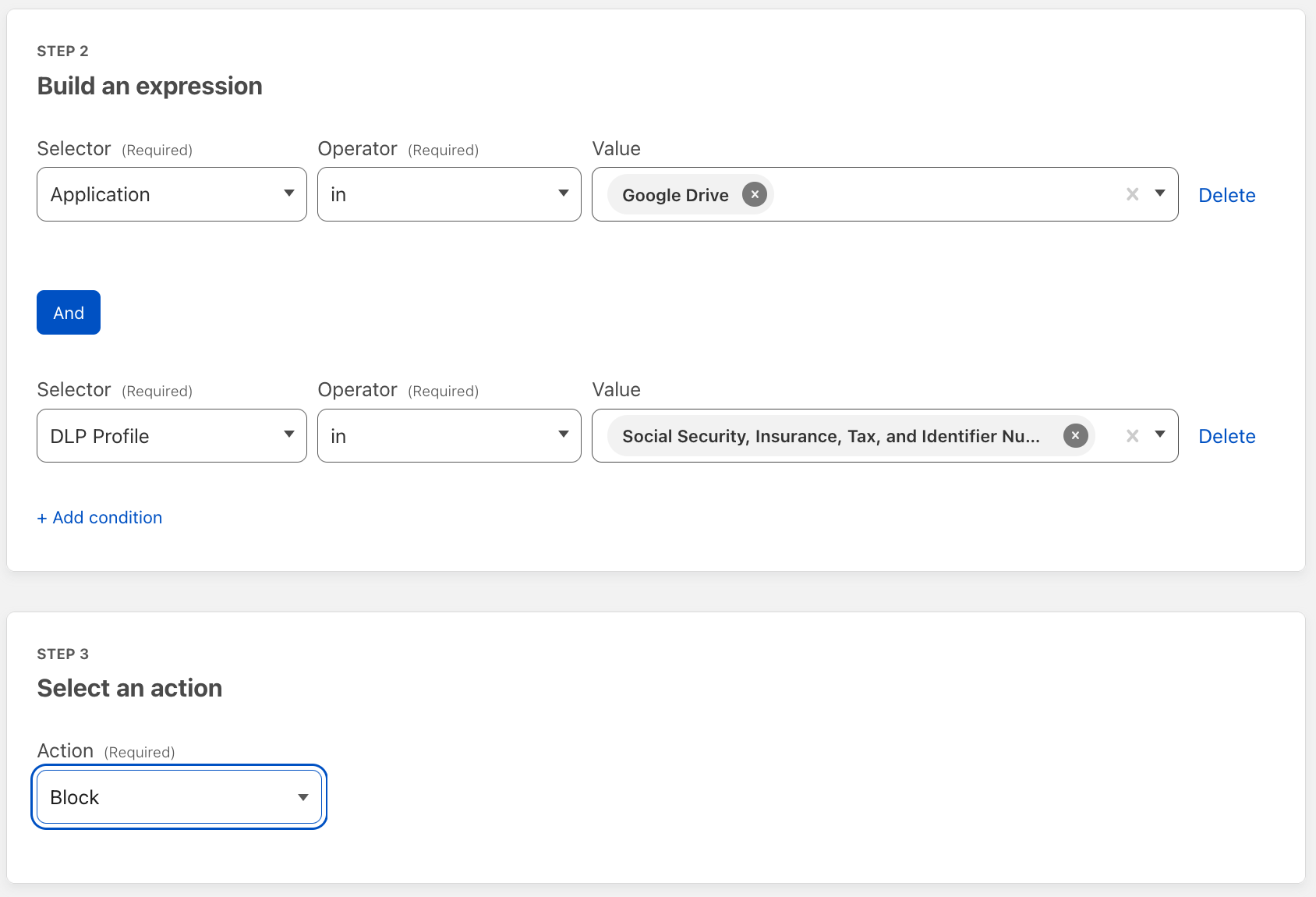
Once you have defined the data that should never leave your organization, you can build granular rules about how it can and cannot be shared with AI services. Maybe some users are approved to experiment with projects that contain sensitive data, in which case you can build a rule that only allows an Active Directory or Okta group to upload that kind of information while everyone else is blocked.

A complete suite of Zero Trust security tools to get the most from AI

Control use without a proxy

The tools in today’s blog post focus on features that apply to data-in-motion. We also want to make sure that misconfigurations in the applications don’t lead to security violations. For example, the new plug-in feature in ChatGPT brings the knowledge and workflows of external services into the AI interaction flow. However, that can also lead to the services behind plug-ins having more access than you want to.

Cloudflare’s Cloud Access Security Broker (CASB) scans your SaaS applications for potential issues that can occur when users make changes. Whether alerting you to files that someone accidentally just made public on the Internet to checking that your GitHub repositories have the right membership controls, Cloudflare’s CASB removes the manual effort required to check each and every setting for potential issues in your SaaS applications.

Available soon, we are working on new integrations with popular AI services to check for misconfigurations. Like most users of these services, we’re still learning more about where potential accidents can occur, and we are excited to provide administrators who use our CASB with our first wave of controls for AI services.

What’s next?

The usefulness of these tools will only accelerate. The ability of AI services to coach and generate output will continue to make it easier for builders from any background to create the next big thing.

We share a similar goal. The Cloudflare products focused on helping users build applications and services, our Workers platform, remove hassles like worrying about where to deploy your application or how to scale your services. Cloudflare solves those headaches so that users can focus on creating. Combined with the AI services, we expect to see thousands of new builders launch the next wave of products built on Cloudflare and inspired by AI coaching and generation.

We have already seen dozens of projects flourish that were built on Cloudflare Workers using guidance from tools like ChatGPT. We plan to launch new integrations with these models to make this even more seamless, bringing better Cloudflare-specific guidance to the chat experience.

We also know that the security risk of these tools will grow. We will continue to bring functionality into Cloudflare One that aims to stay one step ahead of the risks as they evolve with these services. Ready to get started? Sign up here to begin using Cloudflare One at no cost for teams of up to 50 users.

Cloudflare One named in Gartner® Magic Quadrant™ for Security Service Edge

Post Syndicated from Sam Rhea original https://blog.cloudflare.com/cloudflare-sse-gartner-magic-quadrant/

Cloudflare One named in Gartner® Magic Quadrant™ for Security Service Edge

Cloudflare One named in Gartner® Magic Quadrant™ for Security Service Edge

Gartner has recognized Cloudflare in the 2023 “Gartner® Magic Quadrant™ for Security Service Edge (SSE)” report for its ability to execute and completeness of vision. We are excited to share that the Cloudflare Zero Trust solution, part of our Cloudflare One platform, is one of only ten vendors recognized in the report.
Of the 10 companies named to this year’s Gartner® Magic Quadrant™ report, Cloudflare is the only new vendor addition. You can read more about our position in the report and what customers say about using Cloudflare One here.

Cloudflare is also the newest vendor when measured by the date since our first products in the SSE space launched. We launched Cloudflare Access, our best-in-class Zero Trust access control product, a little less than five years ago. Since then, we have released hundreds of features and shipped nearly a dozen more products to create a comprehensive SSE solution that over 10,000 organizations trust to keep their organizations data, devices and teams both safe and fast. We moved that quickly because we built Cloudflare One on top of the same network that already secures and accelerates large segments of the Internet today.
We deliver our SSE services on the same servers and in the same locations that serve some of the world’s largest Internet properties. We combined existing advantages like the world’s fastest DNS resolver, Cloudflare’s serverless compute platform, and our ability to route and accelerate traffic around the globe. We might be new to the report, but customers who select Cloudflare One are not betting on an upstart provider; they are choosing an industry-leading solution made possible by a network that already secures millions of destinations and billions of users every day.

We are flattered by the recognition from Gartner this week and even more thrilled by the customer outcomes we make possible today. That said, we are not done and we are only going faster.

What is a Security Service Edge?

A Security Service Edge (SSE) “secures access to the web, cloud services and private applications. Capabilities include access control, threat protection, data security, security monitoring, and acceptable-use control enforced by network-based and API-based integration. SSE is primarily delivered as a cloud-based service, and may include on-premises or agent-based components.”1

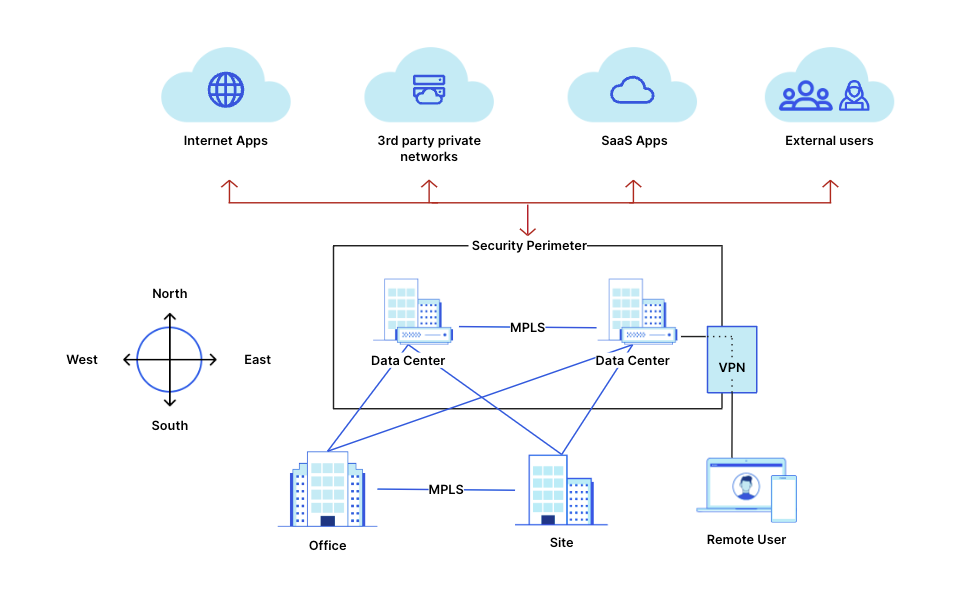
The SSE space developed to meet organizations as they encountered a new class of security problems. Years ago, teams could keep their devices, services, and data safe by hiding from the rest of the world behind a figurative castle-and-moat. The defense perimeter for an enterprise corresponded to the literal walls of their office. Applications ran in server closets or self-managed data centers. Businesses could deploy firewalls, proxies, and filtering appliances in the form of on-premise hardware. Remote users suffered through the setup by backhauling their traffic through the physical office with a legacy virtual private network (VPN) client.

That model began to break down when applications started to leave the building. Teams began migrating to SaaS tools and public cloud providers. They could no longer control security by placing physical appliances in the flow of their one path to the Internet.

Meanwhile, users also left the office, placing stress on the ability of a self-managed private network to scale with the traffic. Performance and availability suffered while costs increased as organizations carried more traffic and deployed more bandaids to try and buy time.

Bad actors also evolved. Attacks became more sophisticated and exploited the migration away from a classic security perimeter. The legacy appliances deployed could not keep up with the changes in attack patterns and scale of attacks.

SSE vendors provide organizations with a cloud-based solution to those challenges. SSE providers deploy and maintain security services in their own points of presence or in a public cloud provider, giving enterprises a secure first hop before they connect to the rest of the Internet or to their internal tools. IT teams can deprecate the physical or virtual appliances that they spent days maintaining. Security teams benefit from filtering and policies that update constantly to defend against new threats.

Some SSE features target remote access replacement by offering customers the ability to connect users to internal tools with Zero Trust access control rules. Other parts of an SSE platform focus on applying Zero Trust scrutiny to the rest of the Internet, replacing the on-premise filtering appliances of an enterprise with cloud-based firewalls, resolvers, and proxies that filter and log traffic leaving a device closer to the user instead of forcing a backhaul to a centralized location.

What about SASE?

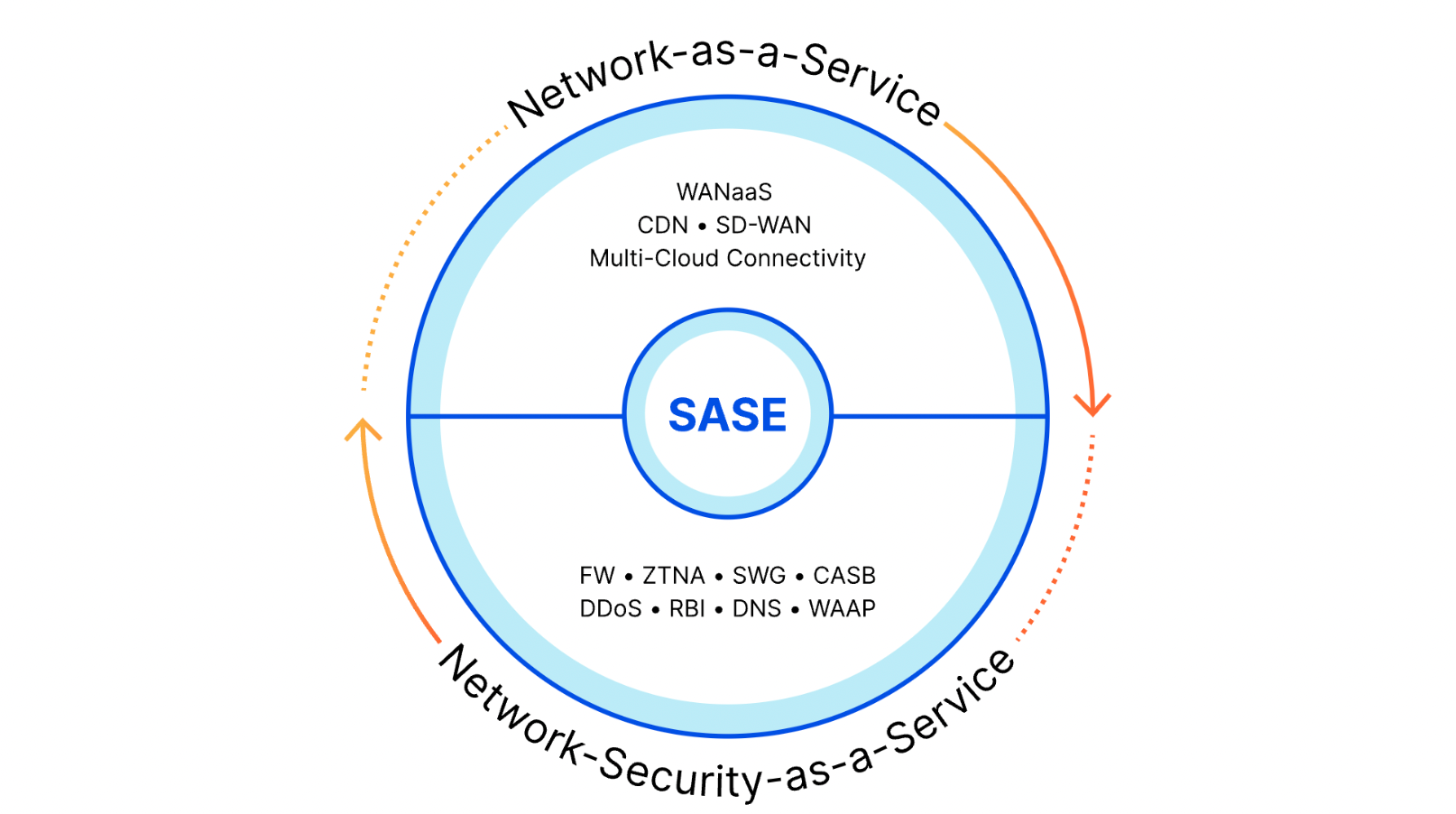
You might also be familiar with the term Secure Access Service Edge (SASE). We hear customers talk about their “SASE” goals more often than “SSE” alone. SASE extends the definition of SSE to include managing the connectivity of the traffic being secured. Network-as-a-Service vendors help enterprises connect their users, devices, sites, and services. SSE providers secure that traffic.

Cloudflare One named in Gartner® Magic Quadrant™ for Security Service Edge

Most vendors focus on one side of the equation. Network-as-a-service companies sell software-defined wide area network (SD-WAN), interconnection, and traffic optimization solutions to help enterprises manage and accelerate connectivity, but those enterprises wind up losing those benefits by sending all that traffic to an SSE provider for filtering. SSE providers deliver security tools for traffic of nearly any type, but they still need customers to buy additional networking services to get that traffic to their locations.

Cloudflare One is a single vendor SASE platform. Cloudflare offers enterprises a comprehensive network-as-a-service where teams can send all traffic to Cloudflare’s network, where we can help teams manage connectivity and improve performance. Enterprises can choose from flexible on-ramps, like their existing hardware routers, agents running on laptops and mobile devices, physical and virtual interconnects, or Cloudflare’s own last mile connector.

When that traffic reaches Cloudflare’s network, our SSE services apply security filtering in the same locations where we manage and route connectivity. Cloudflare’s SSE solution does not add additional hops; we deliver filtering and logging in-line with the traffic we accelerate for our customers. The value of our single vendor SASE solution is just another outcome of an obsession we’ve had since we first launched our reverse proxy over ten years ago: customers should not have to compromise performance for security and vice versa.

So where does Cloudflare One fit?

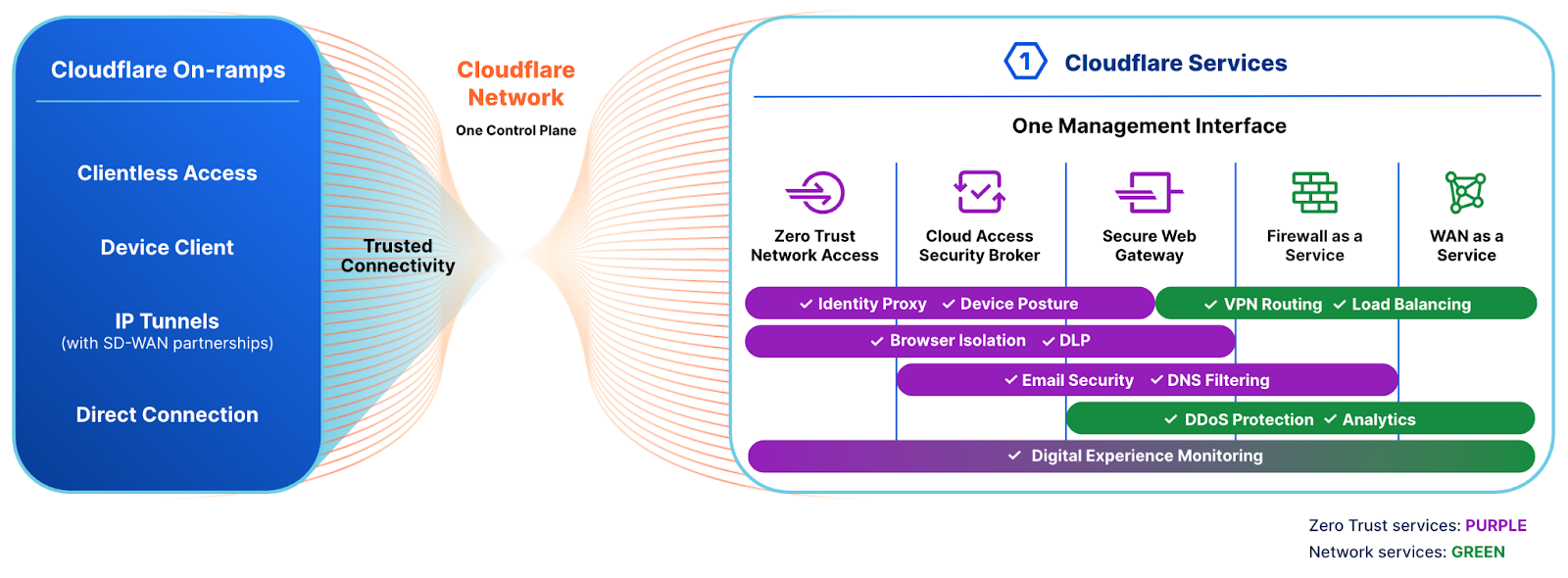
Cloudflare One connects enterprises to the tools they need while securing their devices, applications and data without compromising on performance. The platform consists of two primary components: our Cloudflare Zero Trust products, which represent our SSE offering, and our network-as-a-service solution. As much as today’s announcement separates out those features, we prefer to talk about how they work together.

Cloudflare’s network-as-a-service offering, our Magic WAN solution, extends our network for customers to use as their own. Enterprises can take advantage of the investments we have made over more than a decade to build out one of the world’s most peered, most performant, and most available networks. Teams can connect individual roaming devices, offices and physical sites, or entire networks and data centers through Cloudflare to the rest of the Internet or internal destinations.

We want to make it as easy as possible for customers to send us their traffic, so we provide many flexible “on-ramps” to easily fit into their existing infrastructure. Enterprises can use our roaming agent to connect user devices, our Cloudflare Tunnel service for application-level connectivity, network-level tunnels from our Magic WAN Connector or their existing router or SD-WAN hardware, and/or direct physical or virtual interconnections for dedicated connectivity to on-prem or cloud infrastructure at 1,600+ locations around the world. When packets arrive at the closest Cloudflare location, we provide optimization, acceleration and logging to give customers visibility into their traffic flows.

Instead of sending that accelerated traffic to an additional intermediary for security filtering, our Cloudflare Zero Trust platform can take over to provide SSE security filtering in the same location – generally on the exact same server – as our network-as-a-service functions. Enterprises can pick and choose what SSE features they want to enable to strengthen their security posture over time.

Cloudflare One and the SSE feature set

The security features inside of Cloudflare One provide comprehensive SSE coverage to enterprises operating at any scale. Customers just need to send traffic to a Cloudflare location within a few milliseconds of their users and Cloudflare Zero Trust handles everything else.

Cloudflare One named in Gartner® Magic Quadrant™ for Security Service Edge

Cloudflare One SSE Capabilities

Zero Trust Access Control
Cloudflare provides a Zero Trust VPN replacement for teams that host and control their own resources. Customers can deploy a private network inside of Cloudflare’s network for more traditional connectivity or extend access to contractors without any agent required. Regardless of how users connect, and for any type of destination they need, Cloudflare’s network gives administrators the ability to build granular rules on a per-resource or global basis. Teams can combine one or more identity providers, device posture inputs, and other sources of signal to determine when and how a user should be able to connect.

Organizations can also extend these types of Zero Trust access control rules to the SaaS applications where they do not control the hosting by introducing Cloudflare’s identity proxy into the login flow. They can continue to use their existing identity provider but layer on additional checks like device posture, country, and multifactor method.

DNS filtering
Cloudflare’s DNS filtering solution runs on the world’s fastest DNS resolver, filtering and logging the DNS queries leaving individual devices or some of the world’s largest networks.

Network firewall
Organizations that maintain on-premise hardware firewalls or cloud-based equivalents can deprecate their boxes by sending traffic through Cloudflare where our firewall-as-a-service can filter and log traffic. Our Network Firewall includes L3-L7 filtering, Intrusion Detection, and direct integrations with our Threat Intelligence feeds and the rest of our SSE suite. It enables security teams to build sophisticated policies without any of the headaches of traditional hardware: no capacity or redundancy planning, no throughput restrictions, no manual patches or upgrades.

Secure Web Gateway
Cloudflare’s Secure Web Gateway (SWG) service inspects, filters, and logs traffic in a Cloudflare PoP close to a user regardless of where they work. The SWG can block HTTP requests bound for dangerous destinations, scan traffic for viruses and malware, and control how traffic routes to the rest of the Internet without the need for additional hardware or virtualized services.

In-line Cloud Access Security Broker and Shadow IT
The proliferation of SaaS applications can help teams cut costs but poses a real risk; sometimes users prefer tools other than the ones selected by their IT or Security teams. Cloudflare’s in-line Cloud Access Security Broker (CASB) gives administrators the tools to make sure employees use SaaS applications as intended. Teams can build tenant control rules that restrict employees from logging into personal accounts, policies that only allow file uploads of certain types to approved SaaS applications, and filters that restrict employees from using unapproved services.

Cloudflare’s “Shadow IT” service scans and catalogs user traffic to the Internet to help IT and Security teams detect and monitor the unauthorized use of SaaS applications. For example, teams can ensure that their approved cloud storage is the only place where users can upload materials.

API-driven Cloud Access Security Broker
Cloudflare’s superpower is our network, but sometimes the worst attacks start with data sitting still. Teams that adopt SaaS applications can share work products and collaborate together from any location; that same convenience makes it simple for mistakes or bad actors to cause a serious data breach.

In some cases, employees might overshare a document with sensitive information by selecting the wrong button in the “Share” menu. With just one click, a spreadsheet with customer contact data could become public on the Internet. In other situations, users might share a report with their personal account without realizing they just violated internal compliance rules.

Regardless of how the potential data breach started, Cloudflare’s API-driven CASB constantly scans the SaaS applications that your team uses for potential misconfiguration and data loss. Once detected, Cloudflare’s CASB will alert administrators and provide a comprehensive guide to remediating the incident.

Data Loss Prevention
Cloudflare’s Data Loss Prevention service scans traffic to detect and block potential data loss. Administrators can select from common precreated profiles, like social security numbers or credit card numbers, or create their own criteria using regular expressions or integrate with existing Microsoft Information Protection labels.

Remote Browser Isolation
Cloudflare’s browser isolation service runs a browser inside of our network, in a data center just milliseconds from the user, and sends the vector rendering of the web page to the local device. Team members can use any modern browser and, unlike other approaches, the Internet just feels like the Internet. Administrators can isolate sites on the fly, choosing to only isolate unknown destinations or providing contractors with an agentless workstation. Security teams can add additional protection like blocking copy-paste or printing.

Security beyond the SSE

Many of the customers who talk to us about their SSE goals are not ready to begin adopting every security service in the category from Day 1. Instead, they tend to have strategic SSE goals and tactical immediate problems. That’s fine. We can meet customers wherever they begin on their journey and sometimes that journey starts with pain points that sit just a bit outside of the current SSE definition. We can help in those areas, too.

Many of the types of attacks that an SSE model aims to prevent begin with email, but that falls outside of the traditional SSE definition. Attackers will target specific employees or entire workforces with phishing links or malware that the default filtering available from email providers today miss.

We want to help customers stop these attacks at the inbox before SSE features like DNS or SWG filtering need to apply. Cloudflare One includes industry-leading email security through our Area 1 product to protect teams regardless of their email provider. Area 1 is not just a standalone solution bundled into our SSE; Cloudflare Zero Trust features work better together alongside Area 1. Suspicious emails can open links in an isolated browser, for example, to give customers a defense-in-depth security model without the risk of more IT help desk tickets.

Cloudflare One customers can also take advantage of another Gartner-recognized platform in Cloudflare, our application security suite. Cloudflare’s industry-leading application security features, like our Web Application Firewall and DDoS mitigation service, can be deployed in-line with our Zero Trust security features. Teams can add bot management alerts, API protection, and faster caching to their internal tools with a single click.

Why Cloudflare?

Over 10,000 organizations trust Cloudflare One to connect and secure their enterprise. Cloudflare One helps protect and accelerate teams from the world’s largest IT organization, the US Federal Government, to thousands of small groups who rely on our free plan. A couple of months ago we spoke with customers as part of our CIO Week to listen to the reasons they select Cloudflare One. Their feedback followed a few consistent themes.

1) Cloudflare One delivers more complete security
Nearly every SSE vendor offers improved security compared to a traditional castle-and-moat model, but that is a low bar. We built the security features in Cloudflare One to be best in class. Our industry-leading access control solution provides more built-in options to control who can connect to the tools that power your business.

We partner leading identity providers and endpoint protection platforms, like Microsoft and CrowdStrike, to provide a Zero Trust VPN replacement that is better than anything else on the market. On the outbound filtering side, every filtering option relies on threat intelligence gathered and curated by Cloudforce One, our dedicated threat research team.

2) Cloudflare One makes your team faster
Cloudflare One accelerates your end users from the first moment they connect to the Internet by starting with the world’s fastest DNS resolver. End users send those DNS queries and establish connectivity over a secure tunnel optimized based on feedback from the millions of users who rely on our popular consumer forward proxy. Entire sites connect through a variety of tunnel options to Cloudflare’s network where we are the fastest connectivity provider for the most number of the world’s 3,000 largest networks.

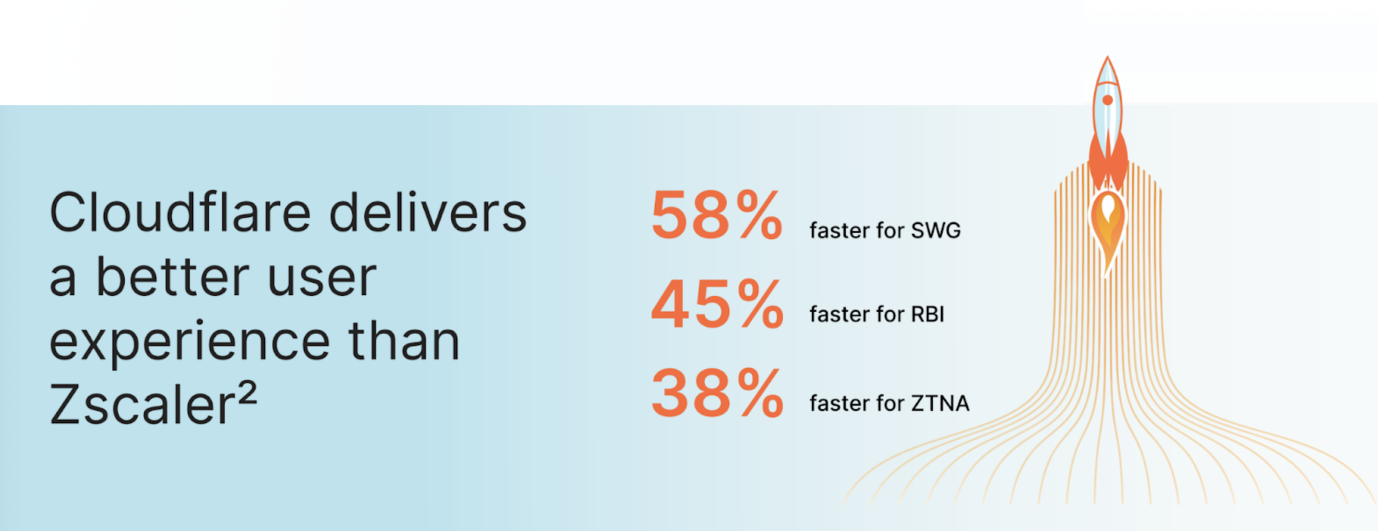
We compete and measure ourselves against pure connectivity providers. When we measure ourselves against pure SSE providers, like Zscaler, we significantly outperform by 38% to 59% depending on use case.

3) Cloudflare One is easier to manage
The Cloudflare Zero Trust products are unique in the SSE market in that we offer a free plan that covers nearly every feature. We make these services available at no cost to groups of up to 50 users because we believe that security on the Internet should be accessible to anyone on any budget.

A consequence of that commitment is that we built products that have to be easy to use. Unlike other SSE providers who only sell to the enterprise and can rely on large systems integrators for deployment, we had to create a solution that any team could deploy. From human rights organizations without full-time IT departments to start ups who want to spend more time building and less time worrying about vulnerabilities.

We also know that administrators want more options than just an intuitive dashboard. We provide API support for managing every Cloudflare One feature, and we maintain a Terraform provider for teams that need the option for peer reviewed configuration-as-code management.

4) Cloudflare One is the most cost-efficient comprehensive SASE offering
Cloudflare is responsible for delivering and securing millions of websites on the Internet every day. To support that volume of traffic, we had to build our network for scale and cost-efficiency.

The largest enterprises’ internal network traffic does not (yet) match the volume of even moderately popular Internet properties. When those teams send traffic to Cloudflare One, we rely on the same hardware and the same data centers that power our application services business to apply security and networking features. As a result, we can help deliver comprehensive security to any team at a price point that is made possible by our existing investment in our network.

5) Cloudflare can be your single, consolidated security vendor
Cloudflare One is only the most recent part of the Cloudflare platform to be recognized in industry analyst reports. In 2022 Gartner named Cloudflare a Leaderin Web Application and API Protection (WAAP). When customers select Cloudflare to solve their SSE challenges, they have the opportunity to add best-in-class solutions all from the same vendor.

Dozens of independent analyst firms continue to recognize Cloudflare for our ability to deliver results to our customers on services ranging from DDoS protection, CDN and edge computing to bot management.

What’s next?

When customers choose Cloudflare One, they trust our network to secure the most sensitive aspects of their enterprise without slowing down their business. We are grateful to the more than 10,000 organizations who have selected us as their vendor in the last five years, from small teams on our free plan to Fortune 500 companies and government agencies.

Today’s announcement only accelerates the momentum in Cloudflare One. We are focused on building the next wave of security and connectivity features our customers need to focus on their own mission. We’re going to keep going faster to help more and more organizations. Want to get started on that journey with us? Let us know here and we’ll reach out.

Gartner, “Magic Quadrant for Security Service Edge”, Analyst(s): Charlie Winckless, Aaron McQuaid, John Watts, Craig Lawson, Thomas Lintemuth, Dale Koeppen, April 10, 2023.

……
1https://www.gartner.com/en/information-technology/glossary/security-service-edge-sse

GARTNER is a registered trademark and service mark of Gartner and Magic Quadrant is a registered trademark of Gartner, Inc. and/or its affiliates in the U.S. and internationally and are used herein with permission. All rights reserved.
Gartner does not endorse any vendor, product or service depicted in its research publications and does not advise technology users to select only those vendors with the highest ratings or other designation. Gartner research publications consist of the opinions of Gartner’s research organization and should not be construed as statements of fact. Gartner disclaims all warranties, expressed or implied, with respect to this research, including any warranties of merchantability or fitness for a particular purpose.

Introducing our first Authorized Service Delivery Partners for Cloudflare One

Post Syndicated from Anil Erduran original https://blog.cloudflare.com/introducing-our-first-authorized-service-delivery-partners-for-cloudflare-one/

Introducing our first Authorized Service Delivery Partners for Cloudflare One

Introducing our first Authorized Service Delivery Partners for Cloudflare One

Cloudflare’s commitment to building the most compelling and easy-to-use SASE platform on the market has led to significant growth over the past year. Cloudflare One services have seen the fastest adoption among our customers, with a 3x increase in partner bookings and a 70% YoY increase in transacting partners. Partners consistently cite the simplicity of our platform, our innovation, and our global network as key differentiators that are driving strong customer demand.

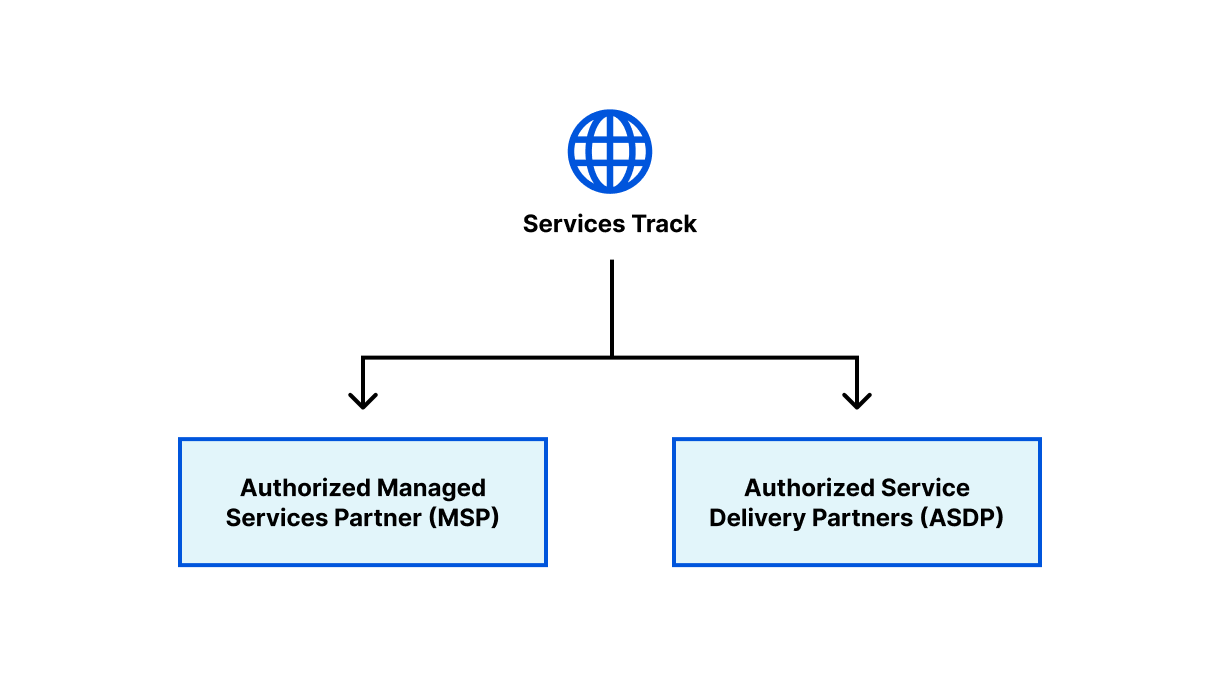
To continue building on this momentum and deliver required services that our customers may require, we previously announced the creation of our new specialization track for Authorized Services Delivery Partners (ASDP) as part of our efforts to continue growing our partnership program.

Cloudflare’s Authorized Services Delivery Partner track is designed to authorize partners that meet our high standards for professional services delivery around Cloudflare One. Partners who undergo the rigorous technical validation process and meet the criteria for security, performance, and reliability of their services delivery capabilities are designated as Cloudflare Authorized Service Delivery Partners. This designation provides a variety of benefits, including access to Cloudflare One sourced opportunities requiring services, access to named Cloudflare One Service Delivery Managers, and access to special partner incentive funds designed to ensure that authorized partner services are actively used in Cloudflare One customer engagements.

In addition, we’re pleased to announce that our authorized partners, with their deep skills and capabilities, will play a critical role in the Descaler Program. Authorized partners will work closely with customers to understand their unique needs and goals, and provide strategic consultation and technical expertise throughout the migration journey. Authorized partners will also have the opportunity to leverage the Descaler toolkit to automatically export settings and configurations of deployed Zscaler products to be migrated into Cloudflare, enabling a frictionless transition to Cloudflare One.

Since launch, Cloudflare One’s Authorized Services Delivery Partner track is having a notable impact on our partner ecosystem, providing a framework for partners to showcase their expertise in Cloudflare One services and delivering high-quality professional and managed services to customers. The program has attracted a diverse range of partners who bring different skillsets and expertise to the table, including Zero Trust security assessments, network transformation, and advisory and migration services, among others. By authorizing partners who meet our high standards for services delivery, we are providing customers with a clear path to trusted advisors who can help them navigate their journey to a cloud-delivered SASE architecture.

We are thrilled to now announce the first partners who have achieved the ASDP designation.

CDS (EMEA)

CDS enables strategic change by partnering with best-in-class technology providers like Cloudflare, delivering the professional services wrap that ensures that organisations get the best value from their chosen technology including strategic guidance, implementation, architectural governance and for clients with complex needs, a managed service. CDS’ approach ensures Cloudflare services are continuously optimised to the highest standards and that clients achieve the fullest value from their licence. CDS offers a Cloudflare certified team of experts with genuine market experience, who can solve significant security challenges while allowing clients to see their projects from multiple angles, encouraging more secure, creative and innovative solutions

Miguel Ferreira, Head of Cloud Services for CDS says:

“We are thrilled to be one of the first partners in EMEA to achieve Cloudflare’s ‘Authorized Service Delivery Partner’ status. Being a part of this program is critical for us because it validates our commitment to excellence and provides us with the tools and support we need to deliver successful engagements. At CDS, we consider ourselves to be the champions of our clients, helping them to navigate and enable change. Part of this is giving our clients confidence to make significant technology decisions that could make or break their aspirations for digital transformation. Being able to rely on a professional services partner with, in this case, Cloudflare Authorized Services Delivery Partner status, significantly reduces the risk associated with these types of decisions. We look forward to working closely with the Cloudflare team to deliver innovative solutions and exceptional customer experiences.”

Primary Guard (APJC)

Primary Guard provides a leading-edge cybersecurity solution that specializes in IT & network security services in Southeast Asia, delivering fast and secured websites through tailor-made solutions that comply with cybersecurity best practices and performance requirements such as DDoS protection and DDoS mitigation, business endpoint protection, and access control management. They are the award winner for 2020 Cloudflare APJC Partner Champions under Partner System Engineer of the Year category. Being a leader in cybersecurity service provider in ASEAN region, their Lead Security Consultant is also awarded as Cloudflare Community MVP for 2021-2023.

Commenting on their designation as an Authorized Service Partner, Johary Mustapha, CEO of Primary Guard says:

“We are thrilled to be a part of the Authorized Service Delivery Partners program which recognizes Primary Guard’s expertise in zero-trust solutions and adherence to industry best practices. Being a part of this program truly validates our commitment to excellence and provides us with the tools and support we need to deliver successful client engagements across industries and of all sizes. We look forward to working closely with the Cloudflare team to deliver more innovative cybersecurity solutions and exceptional customer experiences.”

AZ-AP (APJC)

AZ Asia-Pacific is a full-fledged Cyber Security Distribution Services Hub headquartered in Singapore with offices and operations in Malaysia, Thailand, Philippines, Indonesia, China and Hong Kong that works with the best of breed System Integrators and Service Providers across the Asia-Pacific Region. AZ AP focus is on delivering quality Solutions and Services in Cyber Security Technology, which includes Zero Trust Network Architecture, Application Security, Cloud and Network Security.

According to Jeremy Woo – Founder & CEO of AZ-AP:

“We are honored to be included in the prestigious Authorized Service Delivery Partners program. This recognition reflects our proficiency in zero trust solutions and our dedication to upholding industry standards, while also providing us with invaluable access to exclusive benefits and resources that will enable us to better support our partners. Joining this program is essential for us because it validates our unwavering commitment to providing outstanding service and equips us with the necessary tools and support to deliver successful engagements. We eagerly anticipate collaborating with the Cloudflare team to deliver ground breaking solutions and unparalleled customer experiences.”

Layer8 (EMEA)

LAYER8 is a company fully focused on the business of information security and compliance management. With more than 80 highly specialized professionals, they deliver solutions that add value to the business and simplify the adoption of information security in organizations around the world. Cloudflare Zero Trust Platform embodies these qualities with its simple and flexible yet highly secure architecture.

Fernando Cardoso, COO at Layer8 says:

“Being part of the Authorized Service Delivery Partners program not only acknowledges our proficiency in zero trust solutions but also equips us with the necessary resources and support to carry out successful projects, enabling us to serve our clients more effectively. This partnership with Cloudflare will certainly strengthen our focus on innovation and business value creation activities.”

Opticca Security (AMER)

Opticca Security is a boutique consulting firm specialized in Edge, Cloud, DevOps and Application Security. Supporting Mid, Large and Enterprise organizations across North America integrate & automate security controls across multiple facets of their IT architecture and software development pipelines. Opticca Security has been a certified Cloudflare Solution reseller and Services partner since 2019 and continues to benefit from Cloudflare’s innovative technology stack, coupled with Opticca Security’s expertise regarding Application Modernization and DevSecOps enablement.

Managing Director Joey Campione from Opticca Security offers their perspective on their achievement, stating that:

“We are very excited to be involved with Cloudflare’s Authorized Services Delivery Partner program, as it will permit us to continue to drive superior security and performance to our existing and future clients. Cloudflare’s continuous investments in platform innovation and the partner ecosystems is allowing us to help our customers be more efficient and competitive by modern standards”.

These partners have demonstrated their expertise in Cloudflare One services and their commitment to delivering high-quality services to customers. We congratulate them on this achievement and look forward to continuing to work with them to deliver exceptional value to our mutual customers.

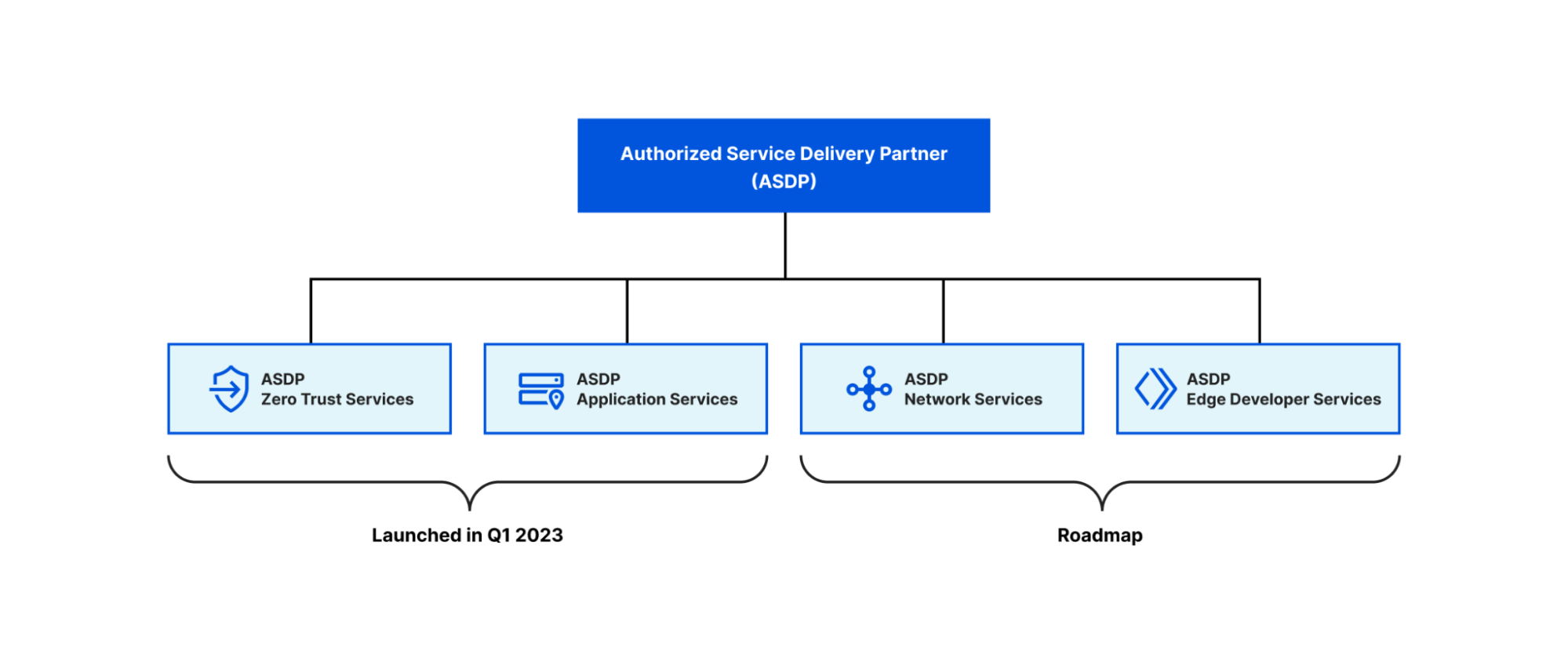
Roadmap

As of today, Authorized Service Delivery Partner Program has two specializations: ASDP Zero Trust Services and ASDP Application Services. We are also planning to launch two additional specializations in the near future: ASDP Network Services and ASDP Edge Developer Services. Our goal is to work closely with our partners to develop comprehensive solutions that deliver real value to our customers. The launch of additional specializations will provide even more opportunities for our partners to differentiate themselves in the market.

Introducing our first Authorized Service Delivery Partners for Cloudflare One

Conclusion

At Cloudflare, we remain committed to building a strong and strategic network of channel partners who can help us deliver the best possible services and solutions to our customers. We are excited to continue growing our partnership program and to work with our ASDP partners to deliver exceptional value and results. If you are a prospective partner interested in the ASDP track, please see our Cloudflare Authorized Service Delivery Partner validation checklist for details on the application process. If you are an existing Cloudflare partner, please reach out to your named Channel Account Manager for additional information.

How sophisticated scammers and phishers are preying on customers of Silicon Valley Bank

Post Syndicated from Shalabh Mohan original https://blog.cloudflare.com/how-sophisticated-scammers-and-phishers-are-preying-on-customers-of-silicon-valley-bank/

How sophisticated scammers and phishers are preying on customers of Silicon Valley Bank

How sophisticated scammers and phishers are preying on customers of Silicon Valley Bank

By now, the news about what happened at Silicon Valley Bank (SVB) leading up to its collapse and takeover by the US Federal Government is well known. The rapid speed with which the collapse took place was surprising to many and the impact on organizations, both large and small, is expected to last a while.

Unfortunately, where everyone sees a tragic situation, threat actors see opportunity. We have seen this time and again – in order to breach trust and trick unsuspecting victims, threat actors overwhelmingly use topical events as lures. These follow the news cycle or known high profile events (The Super Bowl, March Madness, Tax Day, Black Friday sales, COVID-19, and on and on), since there is a greater likelihood of users falling for messages referencing what’s top of mind at any given moment.

The SVB news cycle makes for a similarly compelling topical event that threat actors can take advantage of; and it’s crucial that organizations bolster their awareness campaigns and technical controls to help counter the eventual use of these tactics in upcoming attacks. It’s tragic that even as the FDIC is guaranteeing that SVB customers’ money is safe, bad actors are attempting to steal that very money!

Preemptive action

In anticipation of future phishing attacks taking advantage of the SVB brand, Cloudforce One (Cloudflare’s threat operations and research team) significantly increased our brand monitoring focused on SVB’s digital presence starting March 10, 2023 and launched several additional detection modules to spot SVB-themed phishing campaigns. All of our customers taking advantage of our various phishing protection services automatically get the benefit of these new models.

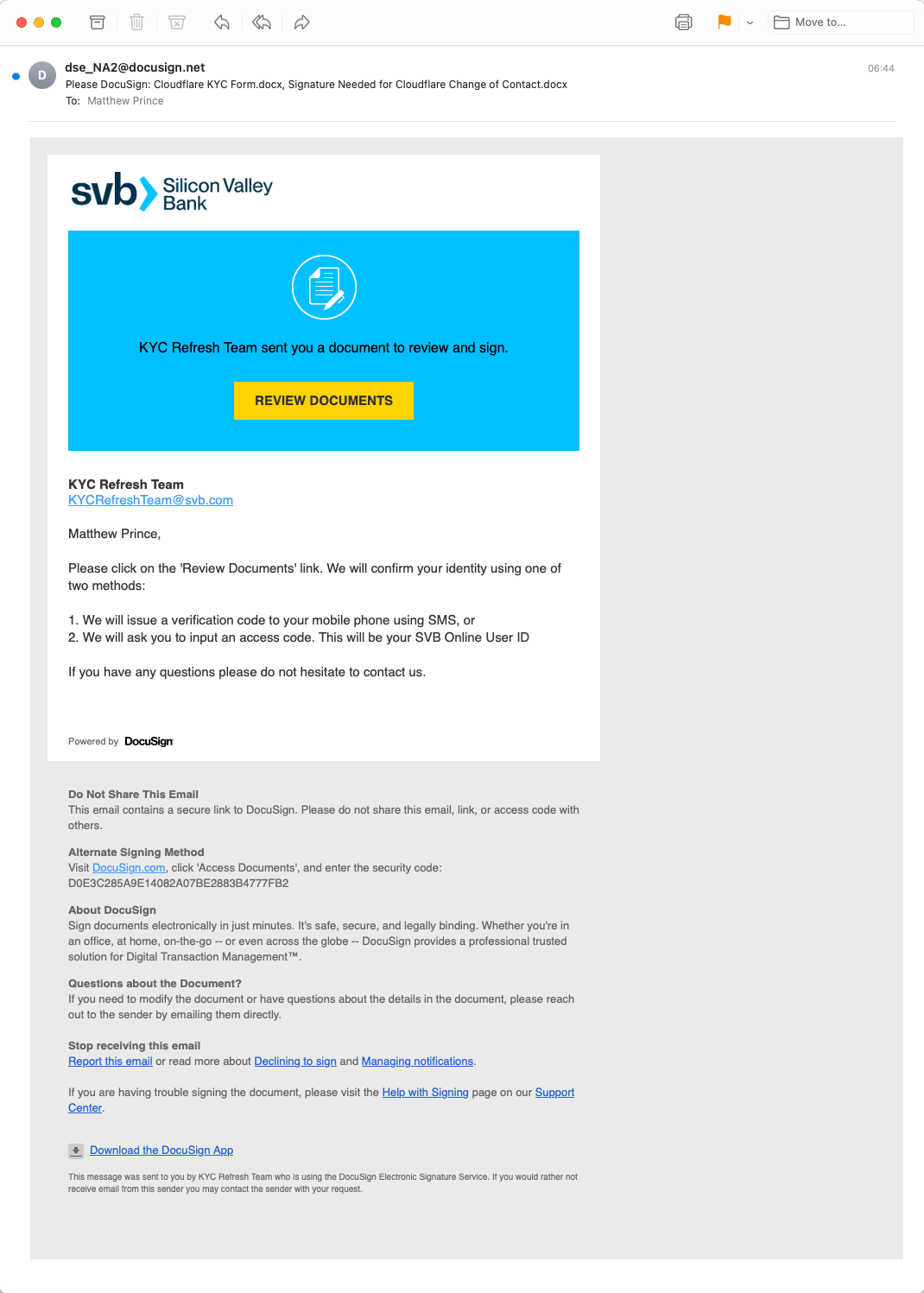
Here’s an actual example of a real campaign involving SVB that’s happening since the bank was taken over by the FDIC.

KYC phish – DocuSign-themed SVB campaign

A frequent tactic used by threat actors is to mimic ongoing KYC (Know Your Customer) efforts that banks routinely perform to validate details about their clients. This is intended to protect financial institutions against fraud, money laundering and financial crime, amongst other things.

On March 14, 2023, Cloudflare detected a large KYC phishing campaign leveraging the SVB brand in a DocuSign themed template. This campaign targeted Cloudflare and almost all industry verticals. Within the first few hours of the campaign, we detected 79 examples targeting different individuals in multiple organizations. Cloudflare is publishing one specific example of this campaign along with the tactics and observables seen to help customers be aware and vigilant of this activity.

Campaign Details

The phishing attack shown below targeted Matthew Prince, Founder & CEO of Cloudflare on March 14, 2023. It included HTML code that contains an initial link and a complex redirect chain that is four-deep. The chain begins when the user clicks the ‘Review Documents’ link. It takes the user to a trackable analytic link run by Sizmek by Amazon Advertising Server bs[.]serving-sys[.]com. The link then further redirects the user to a Google Firebase Application hosted on the domain na2signing[.]web[.]app. The na2signing[.]web[.]app HTML subsequently redirects the user to a WordPress site which is running yet another redirector at eaglelodgealaska[.]com. After this final redirect, the user is sent to an attacker-controlled docusigning[.]kirklandellis[.]net website.

How sophisticated scammers and phishers are preying on customers of Silicon Valley Bank

Campaign Timeline

2023-03-14T12:05:28Z		First Observed SVB DoucSign Campaign Launched
2023-03-14T15:25:26Z		Last Observed SVB DoucSign Campaign Launched

A look at the HTML file Google Firebase application (na2signing[.]web[.]app)

The included HTML file in the attack sends the user to a WordPress instance that has recursive redirection capability. As of this writing, we are not sure if this specific WordPress installation has been compromised or a plugin was installed to open this redirect location.

<html dir="ltr" class="" lang="en"><head>
    <title>Sign in to your account</title>
    
    <script type="text/javascript">
    window.onload = function() {
        function Redirect (url){
            window.location.href = url;
        }
        var urlParams = new URLSearchParams(window.location.href);
        var e = window.location.href;
        
       
        Redirect("https://eaglelodgealaska[.]com/wp-header.php?url="+e);
    }
</script>

Indicators of Compromise

na2signing[.]web[.]app	Malicious Google Cloudbase Application.
eaglelodgealaska[.]com	Possibly compromised WordPress website or an open redirect.

*[.]kirklandellis[.]net		Attacker Controlled Application running on at least docusigning[.]kirklandellis[.]net.

Recommendations

  1. Cloudflare Email Security customers can determine if they have received this campaign in their dashboard with the following search terms:

    SH_6a73a08e46058f0ff78784f63927446d875e7e045ef46a3cb7fc00eb8840f6f0

    Customers can also track IOCs related to this campaign through our Threat Indicators API. Any updated IOCs will be continually pushed to the relevant API endpoints.

  2. Ensure that you have appropriate DMARC policy enforcement for inbound messages. Cloudflare recommends [p = quarantine] for any DMARC failures on incoming messages at a minimum. SVB’s DMARC records [v=DMARC1; p=reject; pct=100] explicitly state rejecting any messages that impersonate their brand and are not being sent from SVB’s list of designated and verified senders. Cloudflare Email Security customers will automatically get this enforcement based on SVB’s published DMARC records. For other domains, or to apply broader DMARC based policies on all inbound messages, Cloudflare recommends adhering to ‘Enhanced Sender Verification’ policies across all inbound emails within their Cloudflare Area 1 dashboard.

  3. Cloudflare Gateway customers are automatically protected against these malicious URLs and domains. Customers can check their logs for these specific IOCs to determine if their organization had any traffic to these sites.

  4. Work with your phishing awareness and training providers to deploy SVB-themed phishing simulations for your end users, if they haven’t done so already.

  5. Encourage your end users to be vigilant about any ACH (Automated Clearing House) or SWIFT (Society for Worldwide Interbank Financial Telecommunication) related messages. ACH & SWIFT are systems which financial institutions use for electronic funds transfers between entities. Given its large scale prevalence, ACH & SWIFT phish are frequent tactics leveraged by threat actors to redirect payments to themselves. While we haven’t seen any large scale ACH campaigns utilizing the SVB brand over the past few days, it doesn’t mean they are not being planned or are imminent. Here are a few example subject lines to be aware of, that we have seen in similar payment fraud campaigns:

    “We’ve changed our bank details”
    “Updated Bank Account Information”
    “YOUR URGENT ACTION IS NEEDED –
    Important – Bank account details change”
    “Important – Bank account details change”
    “Financial Institution Change Notice”

  6. Stay vigilant against look-alike or cousin domains that could pop up in your email and web traffic associated with SVB. Cloudflare customers have in-built new domain controls within their email & web traffic which would prevent anomalous activity coming from these new domains from getting through.

  7. Ensure any public facing web applications are always patched to the latest versions and run a modern Web Application Firewall service in front of your applications. The campaign mentioned above took advantage of WordPress, which is frequently used by threat actors for their phishing sites. If you’re using the Cloudflare WAF, you can be automatically protected from third party CVEs before you even know about them. Having an effective WAF is critical to preventing threat actors from taking over your public Web presence and using it as part of a phishing campaign, SVB-themed or otherwise.

Staying ahead

Cloudforce One (Cloudflare’s threat operations team) proactively monitors emerging campaigns in their formative stages and publishes advisories and detection model updates to ensure our customers are protected. While this specific campaign is focused on SVB, the tactics seen are no different to other similar campaigns that our global network sees every day and automatically stops them before it impacts our customers.

Having a blend of strong technical controls across multiple communication channels along with a trained and vigilant workforce that is aware of the dangers posed by digital communications is crucial to stopping these attacks from going through.

Learn more about how Cloudflare can help in your own journey towards comprehensive phishing protection by using our Zero Trust services and reach out for a complimentary assessment today.

Cloudflare One DLP integrates with Microsoft Information Protection labels

Post Syndicated from Noelle Kagan original https://blog.cloudflare.com/cloudflare-dlp-mip/

Cloudflare One DLP integrates with Microsoft Information Protection labels

Cloudflare One DLP integrates with Microsoft Information Protection labels

The crown jewels for an organization are often data, and the first step in protection should be locating where the most critical information lives. Yet, maintaining a thorough inventory of sensitive data is harder than it seems and generally a massive lift for security teams. To help overcome data security troubles, Microsoft offers their customers data classification and protection tools. One popular option are the sensitivity labels available with Microsoft Purview Information Protection. However, customers need the ability to track sensitive data movement even as it migrates beyond the visibility of Microsoft.

Today, we are excited to announce that Cloudflare One now offers Data Loss Prevention (DLP) detections for Microsoft Purview Information Protection labels. Simply integrate with your Microsoft account, retrieve your labels, and build rules to guide the movement of your labeled data. This extends the power of Microsoft’s labels to any of your corporate traffic in just a few clicks.

Data Classification with Microsoft Labels

Every organization has a wealth of data to manage, from publicly accessible data, like documentation, to internal data, like the launch date of a new product. Then, of course, there is the data requiring the highest levels of protection, such as customer PII. Organizations are responsible for confining data to the proper destinations while still supporting accessibility and productivity, which is no small feat.

Microsoft Purview Information Protection offers sensitivity labels to let you classify your organization’s data. With these labels, Microsoft provides the ability to protect sensitive data, while still enabling productivity and collaboration. Sensitivity labels can be used in a number of Microsoft applications, which includes the ability to apply the labels to Microsoft Office documents. The labels correspond to the sensitivity of the data within the file, such as Public, Confidential, or Highly Confidential.

Cloudflare One DLP integrates with Microsoft Information Protection labels

The labels are embedded in a document’s metadata and are preserved even when it leaves the Microsoft environment, such as a download from OneDrive.

Sync Cloudflare One and Microsoft Information Protection

Cloudflare One, our SASE platform that delivers network-as-a-service (NaaS) with Zero Trust security natively built-in, connects users to enterprise resources, and offers a wide variety of opportunities to secure corporate traffic, including the inspection of data moving across the Microsoft productivity suite. We’ve designed Cloudflare One to act as a single pane of glass for your organization. This means that after you’ve deployed any of our Zero Trust services, whether that be Zero Trust Network Access or Secure Web Gateway, you are clicks, not months, away from deploying Data Loss Prevention, Cloud Access Security Broker, Email Security, and Browser Isolation to enhance your Microsoft security and overall data protection.

Specifically, Cloudflare’s API-driven Cloud Access Security Broker (CASB) can scan SaaS applications like Microsoft 365 for misconfigurations, unauthorized user activity, shadow IT, and other data security issues that can occur after a user has successfully logged in.

With this new integration, CASB can now also retrieve Information Protection labels from your Microsoft account. If you have labels configured, upon integration, CASB will automatically populate the labels into a Data Loss Prevention profile.

Cloudflare One DLP integrates with Microsoft Information Protection labels

DLP profiles are the building blocks for applying DLP scanning. They are where you identify the sensitive data you want to protect, such as Microsoft labeled data, credit card numbers, or custom keywords. Your labels are stored as entries within the Microsoft Purview Information Protection Sensitivity Labels profile using the name of your CASB integration. You can also add the labels to custom DLP profiles, of  fering more detection flexibility.

Build DLP Rules

You can now extend the power of Microsoft’s labels to protect your data as it moves to other platforms. By building DLP rules, you determine how labeled data can move around and out of your corporate network. Perhaps you don’t want to allow Highly Confidential labels to be downloaded from your OneDrive account, or you don’t want any data more sensitive than Confidential to be uploaded to file sharing sites that you don’t use. All of this can be implemented using DLP and Cloudflare Gateway.

Simply navigate to your Gateway Firewall Policies and start implementing building rules using your DLP profiles:

Cloudflare One DLP integrates with Microsoft Information Protection labels

How to Get Started

To get access to DLP, reach out for a consultation, or contact your account manager.

No hassle migration from Zscaler to Cloudflare One with The Descaler Program

Post Syndicated from Corey Mahan original https://blog.cloudflare.com/descaler-program/

No hassle migration from Zscaler to Cloudflare One with The Descaler Program

This post is also available in 简体中文, Français and Español.

No hassle migration from Zscaler to Cloudflare One with The Descaler Program

Today, Cloudflare is excited to launch the Descaler Program, a frictionless path to migrate existing Zscaler customers to Cloudflare One. With this announcement, Cloudflare is making it even easier for enterprise customers to make the switch to a faster, simpler, and more agile foundation for security and network transformation.

Zscaler customers are increasingly telling us that they’re unhappy with the way in which they have to manage multiple solutions to achieve their goals and with the commercial terms they are being offered. Cloudflare One offers a larger network, a ‘single stack’ solution with no service chaining that enables innovation at an incredible rate, meaning lots of new product and feature releases.

At its core, the Descaler Program helps derisk change. It’s designed to be simple and straightforward, with technical resources to ensure a smooth transition and strategic consultation to ensure the migration achieves your organization’s goals. Customers can expect to be up and running on Cloudflare One in a matter of weeks without disruption to their business operations.

What makes up the Descaler Program?

Knowledgeable people. Clear process. Like-magic technology. Getting the people, process, and technology right is critical for any successful change. That’s why we’ve brought together the best of each to help customers experience a frictionless migration to Cloudflare One.

Cloudflare One is our Secure Access Service Edge (SASE) platform that combines network connectivity services with Zero Trust security services on one of the fastest, most resilient and most composable global networks. The platform dynamically connects users to enterprise resources, with identity-based security controls delivered close to users, wherever they are.

Eligibility

Enterprise organizations who use competitive security products from Zscaler, such as ZIA or ZPA, and have 1,000 employees or more are eligible to participate. The Descaler Program builds in resources and touch points with Cloudflare experts on two related paths – one focused on technical success, the other focused on business success.

Technology success

Administrators rejoice. The Descaler Program includes the tools, process and partners you need for a frictionless technical migration.

1. Architecture workshops. Our experts and yours will take a fresh look at where you are and where you need to go over the next two to three years to enable digital transformation. This interactive session with Cloudflare experts will help us focus together on the most meaningful migration paths for your organization and dive into the supporting technologies available to make the transition to Cloudflare even easier.

Outcomes from this mutual investment of time will include a custom migration plan, access to the Descaler toolkit, and dedicated resources from Cloudflare to facilitate a seamless cutover while sharpening focus on your short, medium, and long term business goals facilitated through networking and security technology. You will leave with a better  understanding of your migration path to an Internet-native SASE platform, but more importantly, how you can make Zero Trust and SASE concepts tangible for your business.

2. Technical migration tools. In addition to providing people and processes focused on supporting your migration, Cloudflare can help you leverage a suite of technical tools and scripts that in just a few clicks, automatically export settings and configurations of already deployed Zscaler products to be migrated into Cloudflare One. This toolkit is positioned to save countless hours of unnecessary point-and-click time wasted.

The magic of this flow is in its simplicity. Following extract, transform, and load (ETL) best practices, using supported and documented API calls to your current account, the Descaler toolkit will export your current configuration and settings from ZIA or ZPA, transform them to be Cloudflare One-compatible before migrating into a new Cloudflare One account.

Take a ZPA application for example, the Descaler toolkit will look at existing settings around Application name, Domain/SNI, IPs, Ports allowed, Protocols allowed, User groups, and more before exporting, transforming, and importing into a new Cloudflare One account. In situations where time is of the essence, quick time to value migration paths can be taken. For example, if faced with an urgent ZIA migration then it’s simply a matter of switching over DNS to get a baseline of protection, turning off Zscaler and then managing the process to deploy WARP and a full Secure Web Gateway in short order.

Getting started with the toolkit
You’ll first be asked to create a new API key in your ZIA or ZPA account. From there the Cloudflare team will share the toolkit to be run locally by one of your system administrators alongside members of the Cloudflare team to support in case there are any questions. Cloudflare won’t ever need or ask for your API key, just the outputs. Cloudflare will then use the output to transform and load the configurations into a newly provisioned Cloudflare One account.

The Descaler toolkit only performs read and list API requests to your Zscaler account. In scenarios where systems or services you wish to migrate do not map 1:1, the Cloudflare team and our Authorized Partners will be standing by to assist in making the migration process as smooth as possible.

3. Trusted partner engagements. The Cloudflare Partner Network includes service and implementation partners who deliver security, reliability and performance solutions with a broad range of value-added services. Our Technology Partners offer customers complementary solutions within the cloud stack for hands-on keyboard assistance when desired. Back in January we announced the Authorized Partner Service Delivery Track for Cloudflare One and are excited to connect customers to authorized partners that meet Cloudflare’s high standards for professional services delivery.

As the Descaler Program continues to grow additional capabilities such as full technical training with customer certification courses along with support for in-house professional services and authorized partner professional services delivery are being explored to make the transition process even easier. This is only the beginning of the technical resources being made available to customers looking to make the switch to Cloudflare.

Business components

For CxOs, it couldn’t be more clear when it comes to showing tangible business value and cost savings that impact your businesses bottom line.

  1. Return On Investment (ROI) calculation. We value showing, not just telling you about the value from Cloudflare One. We want to make sure customers migrating anything  recognize the quantifiable business impacts that can potentially be realized by moving to the Cloudflare One platform.
  2. Escape hatch for your current contract. Don’t let your existing contract be a stopper to your long term security modernization. Cloudflare is committed to making the migration process as cost-effective as possible – which means tools and flexible financial options for customers to reach escape velocity from Zscaler and land safely with Cloudflare. You won’t regret this interaction come renewal time.
  3. Zero Trust roadmap assessment. Going from zero to Zero Trust means looking ahead to what’s next with a concrete understanding of where you are today. For business leaders, that means using resources like our vendor-agnostic Zero Trust Roadmap to map out future initiatives today with help from architects, engineers and other business leaders.

If your Internet pipes are all clogged up then use The Descaler Program to get a faster flow:

No hassle migration from Zscaler to Cloudflare One with The Descaler Program
[2] https://blog.cloudflare.com/network-performance-update-cio-edition, SWG = Secure Web Gateway, RBI = Remote Browser Isolation, ZTNA = Zero Trust Network Access.

Why migrating from Zscaler to Cloudflare One just makes sense

More and more organizations are choosing Cloudflare over Zscaler to modernize security, and when they do, they typically cite our strengths across a few key evaluation criteria:

  1. User experience: IT and security administrators have found our services easier to deploy and simpler to manage. End users benefit from faster performance across security services. Whereas Zscaler’s fragmented clouds and piecemeal services add management complexity over time, Cloudflare offers a single, unified control plane that keeps your organization progressing quickly towards its security goals.
  2. Connectivity: Customers value the reliability and scalability of our larger global network footprint to secure any traffic. Plus, unlike Zscaler, Cloudflare’s network is designed to run every service in every location to ensure consistent protections for users around the world.
  3. Agility for the future: Customers recognize that progressing towards Zero Trust and SASE require long-term partnerships. For that journey, they trust in Cloudflare’s track record of rapid innovation and value our flexible architecture to adopt new security standards and technologies and stay ahead of the curve.

These are just a few reasons why organizations choose Cloudflare – and if you’re looking for even more reasons and customer stories, we encourage you to check out this recent blog post.

If you’re looking to motivate your colleagues to take advantage of the Descaler Program, we encourage you to explore more direct comparisons with this infographic or our website.

How to get started

Joining the Descaler Program is as easy as signing up using the link below. From there, the Cloudflare team will reach out to you for further enrollment details. By providing details about your current Zscaler deployments, ongoing challenges and your future Zero Trust or SASE goals we’ll be able to hit the ground running.

With the Descaler Program we’re excited to offer a clear path for customers to make the switch to Cloudflare One. To get started, sign up here.

No hassle migration from Zscaler to Cloudflare One with The Descaler Program

Manage and control the use of dedicated egress IPs with Cloudflare Zero Trust

Post Syndicated from Ankur Aggarwal original https://blog.cloudflare.com/gateway-egress-policies/

Manage and control the use of dedicated egress IPs with Cloudflare Zero Trust

Manage and control the use of dedicated egress IPs with Cloudflare Zero Trust

Before identity-driven Zero Trust rules, some SaaS applications on the public Internet relied on the IP address of a connecting user as a security model. Users would connect from known office locations, with fixed IP address ranges, and the SaaS application would check their address in addition to their login credentials.

Many systems still offer that second factor method. Customers of Cloudflare One can use a dedicated egress IP for this purpose as part of their journey to a Zero Trust model. Unlike other solutions, customers using this option do not need to deploy any infrastructure of their own. However, not all traffic needs to use those dedicated egress IPs.

Today, we are announcing policies that give administrators control over when Cloudflare uses their dedicated egress IPs. Specifically, administrators can use a rule builder in the Cloudflare dashboard to determine which egress IP is used and when, based on attributes like identity, application, IP address, and geolocation. This capability is available to any enterprise-contracted customer that adds on dedicated egress IPs to their Zero Trust subscription.

Why did we build this?

In today’s hybrid work environment, organizations aspire for more consistent security and IT experiences to manage their employees’ traffic egressing from offices, data centers, and roaming users. To deliver a more streamlined experience, many organizations are adopting modern, cloud-delivered proxy services like secure web gateways (SWGs) and deprecating their complex mix of on-premise appliances.

One traditional convenience of these legacy tools has been the ability to create allowlist policies based on static source IPs. When users were primarily in one place, verifying traffic based on egress location was easy and reliable enough. Many organizations want or are required to maintain this method of traffic validation even as their users have moved beyond being in one place.

So far, Cloudflare has supported these organizations by providing dedicated egress IPs as an add-on to our proxy Zero Trust services. Unlike the default egress IPs, these dedicated egress IPs are not shared amongst any other Gateway accounts and are only used to egress proxied traffic for the designated account.

As discussed in a previous blog post, customers are already using Cloudflare’s dedicated egress IPs to deprecate their VPN use by using them to identify their users proxied traffic or to add these to allow lists on third party providers. These organizations benefit from the simplicity of still using fixed, known IPs, and their traffic avoids the bottlenecks and backhauling of traditional on-premise appliances.

When to use egress policies

The Gateway Egress policy builder empowers administrators with enhanced flexibility and specificity to egress traffic based on the user’s identity, device posture, source/destination IP address, and more.

Traffic egressing from specific geolocations to provide geo-specific experiences (e.g. language format, regional page differences) for select user groups is a common use case. For example, Cloudflare is currently working with the marketing department of a global media conglomerate. Their designers and web experts based in India often need to verify the layout of advertisements and websites that are running in different countries.

However, those websites restrict or change access based on the geolocation of the source IP address of the user. This required the team to use an additional VPN service for just this purpose. With egress policies, administrators can create a rule to match the domain IP address or destination country IP geolocation and marketing employees to egress traffic from a dedicated egress IP geo-located to the country where they need to verify the domain. This allows their security team to rest easy as they no longer have to maintain this hole in their perimeter defense, another VPN service just for marketing, and can enforce all of their other filtering capabilities to this traffic.

Another example use case is allowlisting access to applications or services maintained by a third party. While security administrators can control how their teams access their resources and even apply filtering to their traffic they often can’t change the security controls enforced by third parties. For example, while working with a large credit processor they used a third party service to verify the riskiness of transactions routed through their Zero Trust network. This third party required them to allowlist their source IPs.

To meet this goal, this customer could have just used dedicated egress IPs and called it a day, but this means that all of their traffic is now being routed through the data center with their dedicated egress IPs. So if a user wanted to browse any other sites they would receive a subpar experience since their traffic may not be taking the most efficient path to the upstream. But now with egress policies this customer can now only apply this dedicated egress IP to this third party provider traffic and let all other user traffic egress via the default Gateway egress IPs.

Building egress policies

To demonstrate how easy it is for an administrator to configure a policy let’s walk through the last scenario. My organization uses a third-party service and in addition to a username/password login they require us to use a static source IP or network range to access their domain.

To set this up, I just have to navigate to Egress Policies under Gateway on the Zero Trust dashboard. Once there I can hit ‘Create egress policy’:

Manage and control the use of dedicated egress IPs with Cloudflare Zero Trust

For my organization most of my users accessing this third-party service are located in Portugal so I’ll use my dedicated egress IPs that are assigned to Montijo, Portugal. The users will access example.com hosted on 203.0.113.10 so I’ll use the destination IP selector to match all traffic to this site; policy configuration below:

Manage and control the use of dedicated egress IPs with Cloudflare Zero Trust

Once my policy is created, I’ll add in one more as a catch-all for my organization to make sure they don’t use any dedicated egress IPs for destinations not associated with this third-party service. This is key to add in because it makes sure my users receive the most performant network experience while still maintaining their privacy by egress via our shared Enterprise pool of IPs; policy configuration below:

Manage and control the use of dedicated egress IPs with Cloudflare Zero Trust

Taking a look at the egress policy list we can see both policies are enabled and now when my users try to access example.com they will be using either the primary or secondary dedicated IPv4 or the IPv6 range as the egress IP. And for all other traffic, the default Cloudflare egress IPs will be used.

Manage and control the use of dedicated egress IPs with Cloudflare Zero Trust

Next steps

We recognize that as organizations migrate away from on-premise appliances, they want continued simplicity and control as they proxy more traffic through their cloud security stack. With Gateway egress policies administrators will now be able to control traffic flows for their increasingly distributed workforces.

If you are interested in building policies around Cloudflare’s dedicated egress IPs, you can add them onto a Cloudflare Zero Trust Enterprise plan or contact your account manager.

China Express: Cloudflare partners to boost performance in China for corporate networks

Post Syndicated from Dafu Wang original https://blog.cloudflare.com/china-express/

China Express: Cloudflare partners to boost performance in China for corporate networks

China Express: Cloudflare partners to boost performance in China for corporate networks

Cloudflare has been helping global organizations offer their users a consistent experience all over the world. This includes mainland China, a market our global customers cannot ignore but that continues to be challenging for infrastructure teams trying to ensure performance, security and reliability for their applications and users both in and outside mainland China. We are excited to announce China Express — a new suite of capabilities and best practices in partnership with our partners China Mobile International (CMI) and CBC Tech — that help address some of these performance challenges and ensure a consistent experience for customers and employees everywhere.

Cloudflare has been providing Application Services to users in mainland China since 2015, improving performance and security using in-country data centers and caching. Today, we have a presence in 30 cities in mainland China thanks to our strategic partnership with JD Cloud. While this delivers significant performance improvements, some requests still need to go back to the origin servers which may live outside mainland China. With limited international Internet gateways and restrictive cross-border regulations, international traffic has a very high latency and packet drop rate in and out of China. This results in inconsistent cached content within China and a poor experience for users trying to access dynamic content that requires frequent access to the origin.

Last month, we expanded our Cloudflare One, Zero Trust network-as-a-service platform to users and organizations in China with additional connectivity options. This has received tremendous interest from customers, so we’re looking at what else we could do to further improve the user experience for customers with employees or offices in China.

What is China Express?

China Express is a suite of connectivity and performance offerings designed to simplify connectivity and improve performance for users in China. To understand these better, let’s take an example of Acme Corp, a global company with offices in Shanghai and Beijing — with origin data centers in London and Ashburn. And let’s see how we can help their infrastructure teams better serve employees and users in mainland China.

China Express Premium DIA

Premium Dedicated Internet Access, is an optimized, high-quality public Internet circuit for cross-border connectivity provided by our local partners CMI and CBC Tech. With this service, traffic from mainland China will arrive at our partner data center in Hong Kong, using a fixed NAT IP. Customers do not worry about compliance issues because their traffic still goes through the public Internet with all regulatory controls in place.

Acme Corp can use Premium DIA to improve origin performance for their Cloudflare service in mainland China. Requests to the origin data centers in Ashburn and London would traverse the Premium DIA connection, which offers more bandwidth and lower packet loss resulting in more than a 60% improvement in performance.

Acme employees in mainland China would also see an improvement while accessing SaaS applications such as Microsoft 365 over the Internet when these apps are delivered from outside China. They would also notice an improvement in Internet speed in general.

While Premium DIA offers Acme performance improvements over the public Internet, they may want to keep some mission-critical application traffic on a private network for security reasons. Private link offers a dedicated private tunnel between Acme’s locations in China and their data centers outside of China. Private Link can also be used to establish dedicated private connectivity to SaaS data centers like Salesforce.

Private Link is a highly regulated area in China and depending on your use case, there might be additional requirements from our partners to implement it.

China Express: Cloudflare partners to boost performance in China for corporate networks

China Express Travel SIM

Acme Corp might have employees visiting China on a regular basis and need access to their corporate apps on their mobile devices including phones and tablets. Their IT teams not only have to procure and provision mobile Internet connectivity for their users, but also enforce consistent Zero Trust security controls.

Cloudflare is pleased to announce that the Travel SIM provided by Cloudflare’s partner CMI automatically provides network connectivity and can be used together with the Cloudflare WARP Client on mobile devices to provide Cloudflare’s suite of Zero Trust security services. Using the same Zero Trust profiles assigned to the user, the WARP client will automatically use the available 4G LTE network and establish a WireGuard tunnel to the closest Cloudflare data center outside of China. The data connection can also be shared with other devices using the hotspot function on the mobile device.

With the Travel SIM, users can enjoy the same Cloudflare global service as the rest of the world when traveling to China. And IT and security teams no longer need to worry about purchasing or deploying additional Zero Trust seats and device clients to ensure the employees’ Internet connection and the security policy enforcement.

China Express: Cloudflare partners to boost performance in China for corporate networks

China Express — Extending Cloudflare One to China

As mentioned in a previous blog post, we are extending Cloudflare One, our zero trust network-as-a-service product, to mainland China through our strategic partnerships. Acme Corp will now be able to ensure their employees both inside and outside China will be able to use consistent zero trust security policy using the Cloudflare WARP device client. In addition, they will be able to connect their physical offices in China to their global private WAN using Magic WAN with consistent security policies applied globally.

Get started today

Cloudflare is excited to work with  our partners to help our customers solve connectivity and performance challenges in mainland China. All the above solutions are easy and fast to deploy and are available now. If you’d like to get started, contact us here or reach out to your account team.

Cloudflare Application Services for private networks: do more with the tools you already love

Post Syndicated from Annika Garbers original https://blog.cloudflare.com/app-services-private-networks/

Cloudflare Application Services for private networks: do more with the tools you already love

Cloudflare Application Services for private networks: do more with the tools you already love

Cloudflare’s Application Services have been hard at work keeping Internet-facing websites and applications secure, fast, and reliable for over a decade. Cloudflare One provides similar security, performance, and reliability benefits for your entire corporate network. And today, we’re excited to announce new integrations that make it possible to use these services together in new ways. These integrations unlock operational and cost efficiencies for IT teams by allowing them to do more with fewer tools, and enable new use cases that are impossible without Cloudflare’s  “every service everywhere” architecture.

“Just as Canva simplifies graphic design, Cloudflare simplifies performance and security. Thanks to Cloudflare, we can focus on growing our product and expanding into new markets with confidence, knowing that our platform is fast, reliable, and secure.” – Jim Tyrrell, Head of Infrastructure, Canva

Every service everywhere, now for every network

One of Cloudflare’s fundamental architectural principles has always been to treat our network like one homogeneous supercomputer. Rather than deploying services in specific locations – for example, using some of our points of presence to enforce WAF policies, others for Zero Trust controls, and others for traffic optimization – every server runs a virtually identical stack of all of our software services. This way, a packet can land on any server and flow through a full set of security filters in a single pass, without having to incur the performance tax of hair pinning to multiple locations.

Cloudflare Application Services for private networks: do more with the tools you already love

The software that runs on each of these servers is Linux-based and takes advantage of core concepts of the Linux kernel in order to create “wiring” between services. This deep dive on our DDoS mitigation stack explains just one example of how we use these tools to route packets through multiple layers of protection without sacrificing performance. This approach also enables us to easily add new paths for packets and requests, enabling deeper integrations and new possibilities for traffic routed to Cloudflare’s network from any source or to any destination. Let’s walk through some of these new use cases we’re developing for private networks.

Web Application Firewall for private apps with any off-ramp

Today, millions of customers trust Cloudflare’s WAF to protect their applications that are exposed to the public Internet – either fully public apps or private apps connected via Cloudflare Tunnel and surfaced with a public hostname. We’ve increasingly heard from customers that are excited about putting our WAF controls in front of any application with any traffic on or off-ramp, for a variety of reasons.

Some customers want to do this in order to enforce stronger Zero Trust principles: filtering all traffic, even requests sourced from within a “trusted” private network, as though it came from the open Internet. Other customers want to connect an entire datacenter or cloud property with a network-layer on-ramp like a GRE or IPsec tunnel or CNI. And yet others want to adopt the Cloudflare WAF for their private apps without specifying public hostnames.

By fully integrating Cloudflare’s WAF with the Cloudflare One dataplane, we’re excited to address all of these use cases: enabling customers to create WAF policies in-path for fully private traffic flows by building their private network on Cloudflare.

API security for internal APIs

After web applications, one of the next attack surfaces our customers turn to addressing is their public-facing APIs. Cloudflare offers services to protect public APIs from DDoS, abuse, sensitive data loss, and many other attack vectors. But security concerns don’t stop with public-facing APIs: as engineering organizations continue to embrace distributed architecture, multicloud and microsegmentation, CIOs and teams that provide internal services are also interested in securing their private APIs.

With Cloudflare One, customers can connect and route their entire private network through our global fabric, enabling private API traffic to flow through the same stack of security controls we’ve previously made available for public APIs. Networking and security teams will be able to apply the principles of zero trust to their private API traffic flow to help improve their overall security posture.

Global and local traffic management for private apps

So far, we’ve focused on the security controls customers have available to filter malicious traffic to their applications and APIs. But Cloudflare’s services don’t stop with security: we make anything connected to the Internet faster and more reliable. One of the key tools enabling this is our suite of load balancing services, which include application-layer controls for any origin server behind Cloudflare’s reverse proxy and network-layer controls for any IP traffic.

Customers have asked for even more flexibility and new ways to use our traffic management tools: the ability to create application-layer load balancing policies for traffic connected with any off-ramp, such as Cloudflare Tunnel for applications, GRE or IPsec tunnels or CNI for IP networks. They also are excited about the potential to extend load balancing policies into their local networks, managing traffic across servers within a datacenter or cloud property in addition to across multiple “global” locations. These capabilities, which will improve resiliency for any application – both by enforcing more granular controls for private apps and managing local traffic for any app – are coming soon; stay tuned for more updates.

Full-stack performance optimization for private apps

Cloudflare has always obsessed over the speed of every request routed through our network. We’re constantly developing new ways to deliver content closer to users, automatically optimize any kind of traffic, and route packets over the best possible paths, avoiding congestion and other issues on the Internet. Argo Smart Routing speeds up any reverse proxied traffic with application-layer optimizations and IP packets with intelligent decisions at the network layer, using Cloudflare’s extensive interconnectivity and global private backbone to make sure that traffic is delivered as quickly and efficiently as possible.

As we more deeply integrate Cloudflare’s private networking dataplane and our application services to realize the security and reliability benefits described above, customers will automatically be able to see the benefits of Argo Smart Routing at all layers of the OSI stack for any traffic connected to Cloudflare.

Private DNS for one-stop management of internal network resources

Cloudflare’s industry-leading authoritative DNS protects millions of public Internet domains. These can be queried by anyone on the public Internet, which is great for most organizations, but some want to be able to restrict this access. With our private DNS, customers will be able to resolve queries to private domains only when connected to the Zero Trust private network they define within Cloudflare. Because we’re building this using our robust authoritative DNS and Gateway filtering services, you can expect all the other goodness already possible with Cloudflare to also apply to private DNS: support for all common DNS record types, the ability to resolve to DNS queries to virtual networks with overlapping IPs, and all the other Zero Trust filtering control offered by Gateway DNS filtering. Consolidating management of external and internal DNS in one place, with the fastest response time, unparalleled redundancy, and advanced security already built in, will greatly simplify customers’ infrastructure and save time and operational overhead.

And more new use cases every day

We love hearing about new ways you’re using Cloudflare to make any user, application, or network faster, more secure, and more reliable. Get on the list for beta access to the new integrations described today and reach out to us in the comments if you’ve got more ideas for new problems you’d like to solve using Cloudflare.

CIO Week 2023 recap

Post Syndicated from James Chang original https://blog.cloudflare.com/cio-week-2023-recap/

CIO Week 2023 recap

CIO Week 2023 recap

In our Welcome to CIO Week 2023 post, we talked about wanting to start the year by celebrating the work Chief Information Officers do to keep their organizations safe and productive.

Over the past week, you learned about announcements addressing all facets of your technology stack – including new services, betas, strategic partnerships, third party integrations, and more. This recap blog summarizes each announcement and labels what capability is generally available (GA), in beta, or on our roadmap.

We delivered on critical capabilities requested by our customers – such as even more comprehensive phishing protection and deeper integrations with the Microsoft ecosystem. Looking ahead, we also described our roadmap for emerging technology categories like Digital Experience Monitoring and our vision to make it exceedingly simple to route traffic from any source to any destination through Cloudflare’s network.

Everything we launched is designed to help CIOs accelerate their pursuit of digital transformation. In this blog, we organized our announcement summaries based on the three feelings we want CIOs to have when they consider partnering with Cloudflare:

  1. CIOs now have a simpler roadmap to Zero Trust and SASE: We announced new capabilities and tighter integrations that make it easier for organizations to adopt Zero Trust security best practices and move towards aspirational architectures like Secure Access Service Edge (SASE).
  2. CIOs have access to the right technology and channel partners: We announced integrations and programming to help organizations access the right expertise to modernize IT and security at their own pace with the technologies they already use.
  3. CIOs can streamline a multi-cloud strategy with ease: We announced new ways to connect, secure, and accelerate traffic across diverse cloud environments.

Thank you for following CIO Week, Cloudflare’s first of many Innovation Weeks in 2023. It can be hard to keep up with our pace of innovation sometimes, but we hope that reading this blog and registering for our recap webinar will help!

If you want to speak with us about how to modernize your IT and security and make life easier for your organization’s CIO, fill out the form here.

Simplifying your journey to Zero Trust and SASE

Securing access
These blog posts are focused on making it faster, easier, and safer to connect any user to any application with the granular controls and comprehensive visibility needed to achieve Zero Trust.

Blog Summary
Beta: Introducing Digital Experience Monitoring Cloudflare Digital Experience Monitoring will be an all-in-one dashboard that helps CIOs understand how critical applications and Internet services are performing across their entire corporate network. Sign up for beta access.
Beta: Weave your own global, private, virtual Zero Trust network on Cloudflare with WARP-to-WARP With a single click, any device running Cloudflare’s device client, WARP, in your organization can reach any other device running WARP over a private network. Sign up for beta access.
GA: New ways to troubleshoot Cloudflare Access ‘blocked’ messages Investigate ‘allow’ or ‘block’ decisions based on how a connection was made with the same level of ease that you can troubleshoot user identity within Cloudflare’s Zero Trust platform.
Beta: One-click data security for your internal and SaaS applications Secure sensitive data by running application sessions in an isolated browser and control how users interact with sensitive data – now with just one click. Sign up for beta access.
GA: Announcing SCIM support for Cloudflare Access & Gateway Cloudflare’s ZTNA (Access) and SWG (Gateway) services now support the System for Cross-domain Identity Management (SCIM) protocol, making it easier for administrators to manage identity records across systems.
GA: Cloudflare Zero Trust: The Most Exciting Ping Release Since 1983 Cloudflare Zero Trust administrators can use familiar debugging tools that use the ICMP protocol (like Ping, Traceroute, and MTR) to test connectivity to private network destinations.

Threat defense
These blog posts are focused on helping organizations filter, inspect, and isolate traffic to protect users from phishing, ransomware, and other Internet threats.

Blog Summary
GA: Email Link Isolation: your safety net for the latest phishing attacks Email Link Isolation is your safety net for the suspicious links that end up in inboxes and that users may click. This added protection turns Cloudflare Area 1 into the most comprehensive email security solution when it comes to protecting against phishing attacks.
GA: Bring your own certificates to Cloudflare Gateway Administrators can use their own custom certificates to apply HTTP, DNS, CASB, DLP, RBI and other filtering policies.
GA: Announcing Custom DLP profiles Cloudflare’s Data Loss Prevention (DLP) service now offers the ability to create custom detections, so that organizations can inspect traffic for their most sensitive data.
GA: Cloudflare Zero Trust for Managed Service Providers Learn how the U.S. Federal Government and other large Managed Service Providers (MSPs) are using Cloudflare’s Tenant API to apply security policies like DNS filtering across the organizations they manage.

Secure SaaS environments
These blog posts are focused on maintaining consistent security and visibility across SaaS application environments, in particular to protect leaks of sensitive data.

Blog Summary
Roadmap: How Cloudflare CASB and DLP work together to protect your data Cloudflare Zero Trust will introduce capabilities between our CASB and DLP services that will enable administrators to peer into the files stored in their SaaS applications and identify sensitive data inside them.
Roadmap: How Cloudflare Area 1 and DLP work together to protect data in email Cloudflare is combining capabilities from Area 1 Email Security and Data Loss Prevention (DLP) to provide complete data protection for corporate email.
GA: Cloudflare CASB: Scan Salesforce and Box for security issues Cloudflare CASB now integrates with Salesforce and Box, enabling IT and security teams to scan these SaaS environments for security risks.

Accelerating and securing connectivity
In addition to product capabilities, blog posts in this section highlight speed and other strategic benefits that organizations realize with Cloudflare.

Blog Summary
Why do CIOs choose Cloudflare One? As part of CIO Week, we spoke with the leaders of some of our largest customers to better understand why they selected Cloudflare One. Learn six thematic reasons why.
Cloudflare is faster than Zscaler Cloudflare is 38-55% faster at delivering Zero Trust experiences than Zscaler, as validated by third party testing.
GA: Network detection and settings profiles for the Cloudflare One agent Cloudflare’s device client (WARP) can now securely detect pre-configured locations and route traffic based on the needs of the organization for that location.

Making Cloudflare easier to use
These blog posts highlight innovations across the Cloudflare portfolio, and outside the Zero Trust and SASE categories, to help organizations secure and accelerate traffic with ease.

Blog Summary
Preview any Cloudflare product today Enterprise customers can now start previewing non-contracted services with a single click in the dashboard.
GA: Improved access controls: API access can now be selectively disabled Cloudflare is making it easier for account owners to view and manage the access their users have on an account by allowing them to restrict API access to the account.
GA: Zone Versioning is now generally available Zone Versioning allows customers to safely manage zone configuration by versioning changes and choosing how and when to deploy those changes to defined environments of traffic.
Roadmap: Cloudflare Application Services for private networks: do more with the tools you already love Cloudflare is unlocking operational efficiencies by working on integrations between our Application Services to protect Internet-facing websites and our Cloudflare One platform to protect corporate networks.

Collaborating with the right partners

In addition to new programming for our channel partners, these blog posts describe deeper technical integrations that help organizations work more efficiently with the IT and security tools they already use.

Blog Summary
GA: Expanding our Microsoft collaboration: Proactive and automated Zero Trust security for customers Cloudflare announced four new integrations between Microsoft Azure Active Directory (Azure AD) and Cloudflare Zero Trust that reduce risk proactively. These integrated offerings increase automation, allowing security teams to focus on threats versus implementation and maintenance.
Beta: API-based email scanning Now, Microsoft Office 365 customers can deploy Area 1 cloud email security via Microsoft Graph API. This feature enables O365 customers to quickly deploy the Area 1 product via API, with onboarding through the Microsoft Marketplace coming in the near future.
GA: China Express: Cloudflare partners to boost performance in China for corporate networks China Express is a suite of offerings designed to simplify connectivity and improve performance for users in China and developed in partnership with China Mobile International and China Broadband Communications.
Beta: Announcing the Authorized Partner Service Delivery Track for Cloudflare One Cloudflare announced the limited availability of a new specialization track for our channel and implementation partners, designed to help develop their expertise in delivering Cloudflare One services.

Streamlining your multi-cloud strategy

These blog posts highlight innovations that make it easier for organizations to simply ‘plug into’ Cloudflare’s network and send traffic from any source to any destination.

Blog Summary
Beta: Announcing the Magic WAN Connector: the easiest on-ramp to your next generation network Cloudflare is making it even easier to get connected with the Magic WAN Connector: a lightweight software package you can install in any physical or cloud network to automatically connect, steer, and shape any IP traffic. Sign up for early access.
GA: Cloud CNI privately connects your clouds to Cloudflare Customers using Google Cloud Platform, Azure, Oracle Cloud, IBM Cloud, and Amazon Web Services can now open direct connections from their private cloud instances into Cloudflare.
Cloudflare protection for all your cardinal directions This blog post recaps how definitions of corporate network traffic have shifted and how Cloudflare One provides protection for all traffic flows, regardless of source or destination.

Cloudflare Zero Trust for managed service providers

Post Syndicated from Ankur Aggarwal original https://blog.cloudflare.com/gateway-managed-service-provider/

Cloudflare Zero Trust for managed service providers

Cloudflare Zero Trust for managed service providers

As part of CIO week, we are announcing a new integration between our DNS Filtering solution and our Partner Tenant platform that supports parent-child policy requirements for our partner ecosystem and our direct customers. Our Tenant platform, launched in 2019, has allowed Cloudflare partners to easily integrate Cloudflare solutions across millions of customer accounts. Cloudflare Gateway, introduced in 2020, has grown from protecting personal networks to Fortune 500 enterprises in just a few short years. With the integration between these two solutions, we can now help Managed Service Providers (MSPs) support large, multi-tenant deployments with parent-child policy configurations and account-level policy overrides that seamlessly protect global employees from threats online.

Why work with Managed Service Providers?

Managed Service Providers (MSPs) are a critical part of the toolkit of many CIOs. In the age of disruptive technology, hybrid work, and shifting business models, outsourcing IT and security operations can be a fundamental decision that drives strategic goals and ensures business success across organizations of all sizes. An MSP is a third-party company that remotely manages a customer’s information technology (IT) infrastructure and end-user systems. MSPs promise deep technical knowledge, threat insights, and tenured expertise across a variety of security solutions to protect from ransomware, malware, and other online threats. The decision to partner with an MSP can allow internal teams to focus on more strategic initiatives while providing access to easily deployable, competitively priced IT and security solutions. Cloudflare has been making it easier for our customers to work with MSPs to deploy and manage a complete Zero Trust transformation.

One decision criteria for selecting an appropriate MSP is the provider’s ability to keep the partner’s best technology, security and cost interests in mind. An MSP should be leveraging innovative and lower cost security solutions whenever possible to drive the best value to your organization. Out of date technology can quickly incur higher implementation and maintenance costs compared to more modern and purpose-built solutions given the broader attack surface brought about by hybrid work. In a developing space like Zero Trust, an effective MSP should be able to support vendors that can be deployed globally, managed at scale, and effectively enforce global corporate policy across business units. Cloudflare has worked with many MSPs, some of which we will highlight today, that implement and manage Zero Trust security policies cost-effectively at scale.

The MSPs we are highlighting have started to deploy Cloudflare Gateway DNS Filtering to complement their portfolio as part of a Zero Trust access control strategy. DNS filtering provides quick time-to-value for organizations seeking protection from ransomware, malware, phishing, and other Internet threats. DNS filtering is the process of using the Domain Name System to block malicious websites and prevent users from reaching harmful or inappropriate content on the Internet. This ensures that company data remains secure and allows companies to have control over what their employees can access on company-managed networks and devices.

Filtering policies are often set by the Organization with consultation from the service provider. In some cases, these policies also need to be managed independently at the account or business unit level by either the MSP or the customer. This means it is very common for a parent-child relationship to be required to balance the deployment of corporate level rules from customization across devices, office locations, or business units. This structure is vital for MSPs that are deploying access policies across millions of devices and accounts.

Cloudflare Zero Trust for managed service providers

Better together: Zero Trust ❤️ Tenant Platform

To make it easier for MSPs to manage millions of accounts with appropriate access controls and policy management, we integrated Cloudflare Gateway with our existing Tenant platform with a new feature that provides parent-child configurations. This allows MSP partners to create and manage accounts, set global corporate security policies, and allow appropriate management or overrides at the individual business unit or team level.

Cloudflare Zero Trust for managed service providers

The Tenant platform allows MSPs ability to create millions of end customer accounts at their discretion to support their specific onboarding and configurations. This also ensures proper separation of ownership between customers and allows end customers to access the Cloudflare dashboard directly, if required.

Each account created is a separate container of subscribed resources (zero trust policies, zones, workers, etc.) for each of the MSPs end customers. Customer administrators can be invited to each account as necessary for self-service management, while the MSP retains control of the capabilities enabled for each account.

With MSPs now able to set up and manage accounts at scale, we’ll explore how the integration with Cloudflare Gateway lets them manage scaled DNS filtering policies for these accounts.

Tiered Zero Trust accounts

With individual accounts for each MSP end customer in place, MSPs can either fully manage the deployment or provide a self-service portal backed by Cloudflare configuration APIs. Supporting a configuration portal also means you would never want your end users to block access to this domain, so the MSP can add a hidden policy to all of its end customer accounts when they onboard which would be a simple one time API call. Although issues start to arise anytime they need to push an update to said policy, this now means they have to update the policy once for each and every MSP end customer and for some MSPs that can mean over 1 million API calls.

To help turn this into a single API call, we introduced the concept of a top level account aka parent account. This parent account allows MSPs to set global policies which are applied to all DNS queries before the subsequent MSP end customer policies aka child account policies. This structure helps ensure MSPs can set their own global policies for all of their child accounts while each child account can further filter their DNS queries to meet their needs without impacting any other child account.

Cloudflare Zero Trust for managed service providers

This extends further than just policies as well, each child account can create their own custom block page, upload their own certificates to display these block pages, and set up their own DNS endpoints (IPv4, IPv6, DoH, and DoT) via Gateway locations. Also, because these are the exact same as non-MSP Gateway accounts, there aren’t any lower limits when it comes to the default limits on the number policies, locations, or lists per parent or child account.

Managed Service Provider integrations

To help bring this to life, below are real-world examples of how Cloudflare customers are using this new managed service provider feature to help protect their organizations.

US federal government

The US federal government requires many of the same services to support a protective DNS service for their 100+ civilian agencies, and they often outsource many of their IT and security operations to service providers like Accenture Federal Services (AFS).

In 2022, Cloudflare and AFS were selected by Cybersecurity and Infrastructure Security Agency (CISA) with the Department of Homeland Security (DHS) to develop a joint solution to help the federal government defend itself against cyberattacks. The solution consists of Cloudflare’s protective DNS resolver which will filter DNS queries from offices and locations of the federal government and stream events directly to Accenture’s platform to provide unified administration and log storage.

Accenture Federal Services is providing a central interface to each department that allows them to adjust their DNS filtering policies. This interface works with Cloudflare’s Tenant platform and Gateway client APIs to provide a seamless customer experience for government employees managing their security policies using our new parent-child configurations. CISA, as the parent account, can set their own global policies, while allowing agencies, child accounts, to bypass select global policies, and set their own default block pages.

In conjunction with our parent-child structure we provided a few improvements to our DNS location matching and filtering defaults. Currently, all Gateway accounts can purchase a dedicated IPv4 resolver IP address(es) and these are great for situations where a customer doesn’t have a static source IP address or wants their own IPv4 address to host the solution.

For CISA, they wanted not only a dedicated IPv4 address but to assign that same address from their parent account to their child accounts. This would allow them to have their own default IPv4 addresses for all agencies easing the burden of onboarding. Next they also want the ability to fail closed, which means if a DNS query did not match any location (which must have a source IPv4 address/network configured) it would be dropped. This allows CISA to ensure only configured IPv4 networks had access to their protective services. Lasty, we didn’t have to address this with IPv6, DoH, and DoT DNS endpoints as those are custom with each and every DNS location created.

Malwarebytes

Malwarebytes, a global leader in real-time cyber protection, recently integrated with Cloudflare to provide a DNS filtering module within their Nebula platform. The Nebula platform is a cloud-hosted security operations solution that manages control of any malware or ransomware incident—from alert to fix. This new module allows Malwarebytes customers to filter on content categories and add policy rules for groups of devices. A key need was the ability to easily integrate with their current device client, provide individual account management, and provide room for future expansion across additional Zero Trust services like Cloudflare Browser Isolation.

Cloudflare was able to provide a comprehensive solution that was easily integrated into the Malwarebytes platform. This included using DNS-over-HTTP (DoH) to segment users across unique locations and adding a unique token per device to properly track the device ID and apply the correct DNS policies. And lastly, the integration was completed using the Cloudflare Tenant API which allowed seamless integration with their current workflow and platform. This combination of our Zero Trust services and Tenant platform let Malwarebytes quickly go to market for new segments within their business.

“It’s challenging for organizations today to manage access to malicious sites and keep their end users safe and productive. Malwarebytes’ DNS Filtering module extends our cloud-based security platform to web protection. After evaluating other Zero Trust providers it was clear to us that Cloudflare could offer the comprehensive solution IT and security teams need while providing lightning fast performance at the same time. Now, IT and security teams can block whole categories of sites, take advantage of an extensive database of pre-defined scores on known, suspicious web domains, protect core web-based applications and manage specific site restrictions, removing the headache from overseeing site access.” – Mark Strassman, Chief Product Officer, Malwarebytes

Large global ISP

We’ve been working with a large global ISP recently to support DNS filtering which is a part of a larger security solution offered for families for over one million accounts in just the first year! The ISP leverages our Tenant and Gateway APIs to seamlessly integrate into their current platform and user experience with minimal engineering effort. We look forward to sharing more detail around this implementation in the coming months.

What’s next

As the previous stories highlight, MSPs play a key role in securing today’s diverse ecosystem of organizations, of all sizes and maturities. Companies of all sizes find themselves squaring off against the same complex threat landscape and are challenged to maintain a proper security posture and manage risk with constrained resources and limited security tooling. MSPs provide the additional resources, expertise and advanced security tooling that can help reduce the risk profile for these companies. Cloudflare is committed to making it easier for MSPs to be effective in delivering Zero Trust solutions to their customers.

Given the importance of MSPs for our customers and the continued growth of our partner network, we plan to launch quite a few features in 2023 and beyond that better support our MSP partners. First, a key item on our roadmap is the development of a refreshed tenant management dashboard for improved account and user management. Second, we want to extend our multi-tenant configurations across our entire Zero Trust solution set to make it easier for MSPs to implement secure hybrid work solutions at scale.

Lastly, to better support hierarchical access, we plan to expand the user roles and access model currently available to MSP partners to allow their teams to more easily support and manage their various accounts. Cloudflare has always prided itself on its ease of use, and our goal is to make Cloudflare the Zero Trust platform of choice for service and security providers globally.

Throughout CIO week, we’ve touched on how our partners are helping modernize the security posture for their customers to align with a world transformed by hybrid work and hybrid multi-cloud infrastructures. Ultimately, the power of Cloudflare Zero Trust comes from its existence as a composable, unified platform that draws strength from its combination of products, features, and our partner network.

  • If you’d like to learn more about becoming an MSP partner, you can read more here: https://www.cloudflare.com/partners/services
  • If you’d like to learn more about improving your security with DNS Filtering and Zero Trust, or would like to get started today, test the platform yourself with 50 free seats by signing up here.

How Cloudflare CASB and DLP work together to protect your data

Post Syndicated from Alex Dunbrack original https://blog.cloudflare.com/casb-dlp/

How Cloudflare CASB and DLP work together to protect your data

How Cloudflare CASB and DLP work together to protect your data

Cloudflare’s Cloud Access Security Broker (CASB) scans SaaS applications for misconfigurations, unauthorized user activity, shadow IT, and other data security issues. Discovered security threats are called out to IT and security administrators for timely remediation, removing the burden of endless manual checks on a long list of applications.

But Cloudflare customers revealed they want more information available to assess the risk associated with a misconfiguration. A publicly exposed intramural kickball schedule is not nearly as critical as a publicly exposed customer list, so customers want them treated differently. They asked us to identify where sensitive data is exposed, reducing their assessment and remediation time in the case of leakages and incidents. With that feedback, we recognized another opportunity to do what Cloudflare does best: combine the best parts of our products to solve customer problems.

What’s underway now is an exciting effort to provide Zero Trust users a way to get the same DLP coverage for more than just sensitive data going over the network: SaaS DLP for data stored in popular SaaS apps used by millions of organizations.

With these upcoming capabilities, customers will be able to connect their SaaS applications in just a few clicks and scan them for sensitive data – such as PII, PCI, and even custom regex – stored in documents, spreadsheets, PDFs, and other uploaded files. This gives customers the signals to quickly assess and remediate major security risks.

Understanding CASB

How Cloudflare CASB and DLP work together to protect your data

Released in September, Cloudflare’s API CASB has already enabled organizations to quickly and painlessly deep-dive into the security of their SaaS applications, whether it be Google Workspace, Microsoft 365, or any of the other SaaS apps we support (including Salesforce and Box released today). With CASB, operators have been able to understand what SaaS security issues could be putting their organization and employees at risk, like insecure settings and misconfigurations, files shared inappropriately, user access risks and best practices not being followed.

“But what about the sensitive data stored inside the files we’re collaborating on? How can we identify that?”

Understanding DLP

Also released in September, Cloudflare DLP for data in-transit has provided users of Gateway, Cloudflare’s Secure Web Gateway (SWG), a way to manage and outright block the movement of sensitive information into and out of the corporate network, preventing it from landing in the wrong hands. In this case, DLP can spot sensitive strings, like credit card and social security numbers, as employees attempt to communicate them in one form or another, like uploading them in a document to Google Drive or sent in a message on Slack. Cloudflare DLP blocks the HTTP request before it reaches the intended application.

How Cloudflare CASB and DLP work together to protect your data

But once again we received the same questions and feedback as before.

“What about data in our SaaS apps? The information stored there won’t be visible over the network.”

CASB + DLP, Better Together

Coming in early 2023, Cloudflare Zero Trust will introduce a new product synergy that allows customers to peer into the files stored in their SaaS applications and identify any particularly sensitive data inside them.

Credit card numbers in a Google Doc? No problem. Social security numbers in an Excel spreadsheet? CASB will let you know.

With this product collaboration, Cloudflare will provide IT and security administrators one more critical area of security coverage, rounding out our data loss prevention story. Between DLP for data in-transit, CASB for file sharing monitoring, and even Remote Browser Isolation (RBI) and Area 1 for data in-use DLP and email DLP, respectively, organizations can take comfort in knowing that their bases are covered when it comes to data exfiltration and misuse.

While development continues, we’d love to hear how this kind of functionality could be used at an organization like yours. Interested in learning more about either of these products or what’s coming next? Reach out to your account manager or click here to get in touch if you’re not already using Cloudflare.

Announcing the Magic WAN Connector: the easiest on-ramp to your next generation network

Post Syndicated from Annika Garbers original https://blog.cloudflare.com/magic-wan-connector/

Announcing the Magic WAN Connector: the easiest on-ramp to your next generation network

Announcing the Magic WAN Connector: the easiest on-ramp to your next generation network

Cloudflare One enables organizations to modernize their corporate networks by connecting any traffic source or destination and layering Zero Trust security policies on top, saving cost and complexity for IT teams and delivering a better experience for users. Today, we’re excited to make it even easier for you to get connected with the Magic WAN Connector: a lightweight software package you can install in any physical or cloud network to automatically connect, steer, and shape any IP traffic.

You can install the Magic WAN Connector on physical or virtual hardware you already have, or purchase it pre-installed on a Cloudflare-certified device. It ensures the best possible connectivity to the closest Cloudflare network location, where we’ll apply security controls and send traffic on an optimized route to its destination. Embracing SASE has never been simpler.

Solving today’s problems and setting up for tomorrow

Over the past few years, we’ve had the opportunity to learn from IT teams about how their corporate networks have evolved and the challenges they’re facing today. Most organizations describe a starting point of private connectivity and “castle and moat” security controls: a corporate WAN composed of point-to-point and MPLS circuits and hardware appliances at the perimeter of physical networks. This architecture model worked well in a pre-cloud world, but as applications have shifted outside of the walls of the corporate data center and users can increasingly work from anywhere, the concept of the perimeter has crumbled.

In response to these shifts, traditional networking and security vendors have developed a wide array of point solutions to fill specific gaps: a virtual appliance to filter web traffic, a physical one to optimize bandwidth use across multiple circuits, a cloud-based tool to prevent data loss, and so on. IT teams now need to manage a broader-than-ever set of tools and contend with gaps in security, visibility, and control as a result.

Announcing the Magic WAN Connector: the easiest on-ramp to your next generation network
Today’s fragmented corporate network

We view this current state, with IT teams contending with a patchwork of tools and a never-ending ticket queue, as a transitional period to a world where the Internet forms the foundation of the corporate network. Cloudflare One is enabling organizations of all sizes to make the transition to SASE: connecting any traffic source and destination to a secure, fast, reliable global network where all security functions are enforced and traffic is optimized on the way to its destination, whether that’s within a private network or on the public Internet.

Announcing the Magic WAN Connector: the easiest on-ramp to your next generation network
Secure Access Service Edge architecture

Magic WAN Connector: the easiest way to connect your network to Cloudflare

The first step to adopting SASE is getting connected – establishing a secure path from your existing network to the closest location where Zero Trust security policies can be applied. Cloudflare offers a broad set of “on-ramps” to enable this connectivity, including client-based and clientless access options for roaming users, application-layer tunnels established by deploying a lightweight software daemon, network-layer connectivity with standard GRE or IPsec tunnels, and physical or virtual interconnection.

Today, to make this first step to SASE even easier, we’re introducing a new member to this family of on-ramps. The Magic WAN Connector can be deployed in any physical or cloud network to provide automatic connectivity to the closest Cloudflare network location, leveraging your existing last mile Internet connectivity and removing the requirement for IT teams to manually configure network gear to get connected.

Announcing the Magic WAN Connector: the easiest on-ramp to your next generation network
Magic WAN Connector provides easy connectivity to Cloudflare’s network

End-to-end traffic management

Hundreds of customer conversations over the past few years have helped us define a slim set of functionality that customers need within their on-premise and cloud networks. They’ve described this as “light branch, heavy cloud” architecture – minimizing the footprint at corporate network locations and shifting the majority of functions that used to be deployed in on-premise hardware to a globally distributed network.

The Magic WAN Connector includes a critical feature set to make the best possible use of available last mile connectivity. This includes traffic routing, load balancing, and failover; application-aware traffic steering and shaping; and automatic configuration and orchestration. These capabilities connect you automatically to the closest Cloudflare location, where traffic is optimized and routed to its destination. This approach allows you to use Cloudflare’s network – presence in 275 cities and 100 countries across the globe, 11,000+ interconnects and a growing fiber backbone – as an extension of your own.

Network function Magic WAN Connector Cloudflare Network
Branch routing (traffic shaping, failover, QoS) Application-aware routing and traffic steering between multiple last mile Internet circuits Application-aware routing and traffic steering across the middle mile to get traffic to its destination
Centralized device management Connector config controlled from unified Cloudflare dashboard Cloudflare unified dashboard portal, observability, Zero Trust services
Zero-touch configuration Automagic config; boots with smart defaults and sets up tunnels + routes Automagic config; Magic WAN Connector pulls down updates from central control plane
VPN + Firewall VPN termination + basic network segmentation included Full-featured SASE platform including ZTNA, FWaaS, DDoS, WAAP, and Email Security
Application-aware path selection Application-aware traffic shaping for last mile Application-aware Enhanced Internet for middle mile
Application auto discovery Works with Cloudflare network to perform application discovery and classification in real time 1+1=3: Cloudflare Zero Trust application classification tools reused in this context
Application performance visibility Acts as telemetry source for Cloudflare observability tools Cloudflare One Analytics platform & Digital Experience Monitoring
Software can be deployed in the cloud Software can be deployed as a public cloud VM All configuration controlled via unified Cloudflare dashboard

Fully integrated security from day 0

The Magic WAN Connector, like all of Cloudflare’s products, was developed from the ground up to natively integrate with the rest of the Cloudflare One portfolio. Connecting your network to Cloudflare’s with the Magic WAN Connector means automatic access to a full suite of SASE security capabilities, including our Firewall-as-a-Service, Zero Trust Network Access, Secure Web Gateway, Data Loss Prevention, Browser Isolation, Cloud Access Security Broker, Email Security, and more.

Optionally pre-packaged to make deployment easy

Cloudflare’s goal is to make it as easy as possible to on-ramp to our network, so there are flexible deployment options available for the Magic WAN Connector. You can install the software on physical or virtual Linux appliances that you manage, or purchase it pre-installed and configured on a hardware appliance for the lowest-friction path to SASE connectivity. Plug the device into your existing network and you’ll be automatically connected to and secured by the Cloudflare network within minutes.

And open source to make it even easier

We’re excited to make access to these capabilities available to all kinds of organizations, including those who want to DIY more aspects of their network deployments. To do this, we’ll be open sourcing the Magic WAN Connector software, so customers can even more easily connect to Cloudflare’s network from existing hardware.

Part of a growing family of on-ramps

In addition to introducing the Magic WAN Connector today, we’re continuing to grow the options for how customers can connect to us using existing hardware. We are excited to expand our Network On-Ramp partnerships to include leading networking companies Cisco, SonicWall, and Sophos, joining previous partners Aruba, VMWare, and Arista, to help you onboard traffic to Cloudflare smoothly.

Customers can connect to us from appliances offered by these vendors using either Anycast GRE or IPSec tunnels. Our partners have validated their solutions and tested that their networking hardware can connect to Cloudflare using these standards. To make setup easier for our mutual customers, detailed configuration instructions will be available soon at both the Cloudflare Developer Docs and partner websites.

If you are a networking solutions provider and are interested in becoming a Network On-Ramp partner, please reach out to us here.

Ready to start building the future of your corporate network?

We’re beyond excited to get the Magic WAN Connector into customer hands and help you jumpstart your transition to SASE. Learn more and sign up for early access here.

Announcing Custom DLP profiles

Post Syndicated from Adam Chalmers original https://blog.cloudflare.com/custom-dlp-profiles/

Announcing Custom DLP profiles

Introduction

Announcing Custom DLP profiles

Where does sensitive data live? Who has access to that data? How do I know if that data has been improperly shared or leaked? These questions keep many IT and security administrators up at night. The goal of data loss prevention (DLP) is to give administrators the desired visibility and control over their sensitive data.

We shipped the general availability of DLP in September 2022, offering Cloudflare One customers better protection of their sensitive data. With DLP, customers can identify sensitive data in their corporate traffic, evaluate the intended destination of the data, and then allow or block it accordingly — with details logged as permitted by your privacy and sovereignty requirements. We began by offering customers predefined detections for identifier numbers (e.g. Social Security #s) and financial information (e.g. credit card #s). Since then, nearly every customer has asked:

“When can I build my own detections?”

Most organizations care about credit card numbers, which use standard patterns that are easily detectable. But the data patterns of intellectual property or trade secrets vary widely between industries and companies, so customers need a way to detect the loss of their unique data. This can include internal project names, unreleased product names, or unannounced partner names.

As of today, your organization can build custom detections to identify these types of sensitive data using Cloudflare One. That’s right, today you are able to build Custom DLP Profile using the same regular expression approach that is used in policy building across our platform.

How to use it

Cloudflare’s DLP is embedded in our secure web gateway (SWG) product, Cloudflare Gateway, which routes your corporate traffic through Cloudflare for fast, safe Internet browsing. As your traffic passes through Cloudflare, you can inspect that HTTP traffic for sensitive data and apply DLP policies.

Building DLP custom profiles follows the same intuitive approach you’ve come to expect from Cloudflare.

First, once within the Zero Trust dashboard, navigate to the DLP Profiles tab under Gateway:

Announcing Custom DLP profiles

Here you will find any available DLP profiles, either predefined or custom:

Announcing Custom DLP profiles

Select to Create Profile to begin a new one.  After providing a name and description, select Add detection entry to add a custom regular expression. A regular expression, or regex, is a sequence of characters that specifies a search pattern in text, and is a standard way for administrators to achieve the flexibility and granularity they need in policy building.

Cloudflare Gateway currently supports regexes in HTTP policies using the Rust regex crate. For consistency, we used the same crate to offer custom DLP detections. For documentation on our regex support, see our documentation.

Regular expressions can be used to build custom PII detections of your choosing, such as email addresses, or to detect keywords for sensitive intellectual property.

Announcing Custom DLP profiles

Provide a name and a regex of your choosing. Every entry in a DLP profile is a new detection that you can scan for in your corporate traffic. Our documentation provides resources to help you create and test Rust regexes.

Below is an example of regex to detect a simple email address:

Announcing Custom DLP profiles

When you are done, you will see the entry in your profile.  You can turn entries on and off in the Status field for easier testing.

Announcing Custom DLP profiles

The custom profile can then be applied to traffic using an HTTP policy, just like a predefined profile. Here both a predefined and custom profile are used in the same policy, blocking sensitive traffic to dlptest.com:

Announcing Custom DLP profiles

Our DLP roadmap

This is just the start of our DLP journey, and we aim to grow the product exponentially in the coming quarters. In Q4 we delivered:

  • Expanded Predefined DLP Profiles
  • Custom DLP Profiles
  • PDF scanning support
  • Upgraded file name logging

Over the next quarters, we will add a number of features, including:

  • Data at rest scanning with Cloudflare CASB
  • Minimum DLP match counts
  • Microsoft Sensitivity Label support
  • Exact Data Match (EDM)
  • Context analysis
  • Optical Character Recognition (OCR)
  • Even more predefined DLP detections
  • DLP analytics
  • Many more!

Each of these features will offer you new data visibility and control solutions, and we are excited to bring these features to customers very soon.

How do I get started?

DLP is part of Cloudflare One, our Zero Trust network-as-a-service platform that connects users to enterprise resources. Our GA blog announcement provides more detail about using Cloudflare One to onboard traffic to DLP.

To get access to DLP via Cloudflare One, reach out for a consultation, or contact your account manager.

Why do CIOs choose Cloudflare One?

Post Syndicated from Sam Rhea original https://blog.cloudflare.com/why-cios-select-cloudflare-one/

Why do CIOs choose Cloudflare One?

Why do CIOs choose Cloudflare One?

Cloudflare’s first customers sought us out as the “Web Application Firewall vendor” or their DDoS-mitigating Content Delivery Network. We earned their trust by solving their problems in those categories and dozens of others. Today, over 100,000 customers now rely on Cloudflare to secure and deliver their Internet properties.

However, our conversations with CIOs evolved over the last few years. The discussions stopped centering around a specific product. CIOs, and CSOs too, approached us with the challenge of managing connectivity and security for their entire enterprise. Whether they described their goals as Zero Trust or Secure Access Service Edge (SASE), their existing appliances and point solutions could no longer keep up. So we built Cloudflare One to help them.

Today, over 10,000 organizations trust Cloudflare One to connect and secure their users, devices, applications, and data. As part of CIO Week, we spoke with the leaders of some of our largest customers to better understand why they selected Cloudflare.

The feedback centered around six themes:

  1. Cloudflare One delivers more complete security.
  2. Cloudflare One makes your team faster.
  3. Cloudflare One is easier to manage.
  4. Cloudflare One products work better together.
  5. Cloudflare One is the most cost-efficient comprehensive SASE offering.
  6. Cloudflare can be your single security vendor.

If you are new to Cloudflare, or more familiar with our Internet property products, we’re excited to share how other customers approached this journey and why they partnered with Cloudflare. Today’s post breaks down their feedback in serious detail. If you’d prefer to ask us directly, skip ahead to the bottom, and we’d be glad to find time to chat.

Cloudflare One delivers more complete security

The first SASE conversations we had with customers started when they asked us how we keep Cloudflare safe. Their Internet properties relied on us for security and availability – our own policies mattered to their decisions to trust us.

That’s fair. We are a popular target for attack. However, we could not find anything on the market that could keep us safe without slowing us down. Instead, we decided to use our own network to connect employees to internal resources and secure how those same team members connected to the rest of the Internet.

After learning what we built to replace our own private network, our customers started to ask if they could use it too. CIOs were on the same Zero Trust journey with us. They trusted our commitment to delivering the most comprehensive security on the market for their public-facing resources and started partnering with us to do the same thing for their entire enterprise.

We kept investing in Cloudflare One over the last several years based on feedback from our own internal teams and those CIOs. Our first priority was to replace our internal network with a model that applies Zero Trust controls by default. We created controls that could adapt to the demands of security teams without the need to modify applications. We added rules to force hard keys on certain applications, restrict access to specific countries, or require users to ask for approval from an administrator. The flexibility meant that every request, and every connection, could be scrutinized in a way that matched the sensitivity of internal tools.

We then turned that skepticism in the other direction. Customers on this journey with us asked “how could we have Zero Trust in the rest of the Internet?” To solve that, we turned Cloudflare’s network in the other direction. We built our DNS filtering product by combining the world’s fastest DNS resolver with our unique view into threat patterns on the Internet. We layered on a comprehensive Secure Web Gateway and network firewall. We sent potentially risky sites to Cloudflare’s isolated browser, a unique solution that pushes the industry forward in terms of usability.

More recently, we started to create tools that help control the data sitting in SaaS applications and to prevent sensitive data from leaving the enterprise. We’ve been delighted to watch customers adopt every stage in this progression with us, but we kept comparing notes with other CIOs and CSOs about the risk of something that most vendors do not consider part of the SASE stack: email.

We also spent so many hours monitoring email-based phishing attacks aimed at Cloudflare. To solve that challenge, we deployed Area 1 Email Security. The efficacy of Area 1 stunned our team to the point that we acquired the company, so we could offer the same security to our customers as part of Cloudflare One.

When CIOs describe the security challenges they need to solve, we can recommend a complete solution built on our experience addressing those same concerns. We cannot afford shortcuts in how we secure Cloudflare and know they cannot either in how they keep their enterprises safe.

Zero Trust security at a social media company

Like Cloudflare, social media services are a popular target for attack. When the security team at one of the world’s most prominent social media platforms began a project to overhaul their access controls, they ran a comprehensive evaluation of vendors who could keep their platform safe from phishing attacks and lateral movement. They selected Cloudflare One due to the granular access control our network provides and the layers of security policies that can be evaluated on any request or connection without slowing down end users.

Cloudflare One makes your team faster

Many of our customers start with our Application Services products, like our cache and smart routing, because they have a need for speed. The performance of their Internet properties directly impacts revenue. These customers hunt down opportunities to use Cloudflare to shave off milliseconds.

The CIOs who approach us to solve their SASE problems tend to rank performance lower than security and maintainability. In early conversations they describe their performance goals as “good enough that my users do not complain.”

Those complaints drive IT help desk tickets, but CIOs are used to sacrificing speed for security. We don’t believe they should have to compromise. CIOs select Cloudflare One because the performance of our network improves the experience of their end users and reduces overhead for their IT administrators.

We accelerate your users from the first moment they connect. When your team members visit a destination on the Internet, their experience starts with a DNS query to find the address of the website. Cloudflare runs the world’s fastest DNS resolver, 1.1.1.1, and the DNS filtering features of our SASE offering use the same technology.

Next, your users’ devices open a connection and send an HTTP request to their destination. The Cloudflare agent on their device does so by using a BoringTun, our Rust-based and open sourced WireGuard implementation. WireGuard allows us to provide a highly-performant on-ramp to the Internet through our network without compromising battery life or security. The same technology supports the millions of users who choose to use our WARP consumer offering. We take their feedback and optimize WARP constantly to improve how our enterprise users connect.

Finally, your users rely on our network to connect them to their destination and return the responses. Out of the 3,000 top networks in the world, measured by IPv4 addresses advertised, we rank the fastest in 1,310. Once connected, we apply our smart routing technology to route users through our network to find the fastest path to and from their destination.

We develop new technologies to improve the speed of Cloudflare One, but we cannot change the speed of light. Instead, we make the distance shorter by bringing websites closer to your users. Cloudflare is the reverse proxy for more than 20% of the HTTP Internet. We serve those websites from the same data centers where your employees connect to our Secure Web Gateway. In many cases, we can deliver content from a server centimeters away from where we apply Cloudflare One’s filtering, shaving off milliseconds and reducing the need for more hops.

Faster DNS filtering for the United States Federal Government

The Cybersecurity and Infrastructure Security Agency (CISA) works within the United States Department of Homeland Security as the “nation’s risk advisor.”1 Last year they launched a program to find a protective DNS resolver for the civilian government. These agencies and departments operate around the country, in large cities and rural areas, and they need a solution that would deliver fast DNS resolutions close to where those users sit. After a thorough evaluation, they selected Cloudflare, in partnership with Accenture Federal Services, as the country’s protective DNS resolver.

Performance at a Fortune 500 Energy Company

An American energy company attempted to deploy Zscaler, but became frustrated after spending eight months attempting to integrate and maintain systems that slowed down their users. This organization already observed Cloudflare’s ability to accelerate their traffic with our network-layer DDoS protection product and ran a pilot with Cloudflare One. Following an exhaustive test, the team observed significant performance improvements, particularly with Cloudflare’s isolated browser product, and decided to rip out Zscaler and consolidate around Cloudflare.

Cloudflare One products are easier to manage

The tools that a SASE solution like Cloudflare One replaces are cumbersome to manage. Hardware appliances or virtual equivalents require upfront deployment work and ongoing investment to maintain and upgrade them. Migrating to other cloud-based SASE vendors can reduce pain for some IT teams, but that is a low bar.

CIOs tell us that the ability to manage the solution is nearly as important as the security outcomes. If their selected vendor is difficult to deploy, the migration drags on and discourages adoption of more advanced features. If the solution is difficult to use or manage, team members find ways to avoid using it or IT administrators waste time.

We built Cloudflare One to make the most advanced SASE technologies available to teams of any size, including those that lack full IT departments. We invested in building a system that could be configured and deployed without operational overhead. Over 10,000 teams rely on Cloudflare One as a result. That same commitment to ease-of-use extends to the enterprise IT and Security teams who manage Cloudflare One deployments for some of the world’s largest organizations.

We also provide features tailored to the feedback we hear from CIOs and their teams about the unique challenges of managing larger deployments at global scale. In some cases, their teams need to update hundreds of policies or their global departments rely on dozens of administrators who need to coordinate changes. We provide API support for managing every Cloudflare One feature, and we also maintain a Terraform provider for teams that need the option for peer reviewed configuration-as-code management.

Ease-of-use at a Fortune 500 telecommunications provider

We make our free and pay-as-you-go plans available to anyone with a credit card in order to make these technologies accessible to teams of any size. Sometimes, the largest teams in the world start with those plans too. A European Fortune 500 telecommunications company began adopting our Zero Trust platform on a monthly subscription when their Developer Operations (DevOps) lost their patience with their existing VPN. Developers across their organization complained about how their legacy private network slowed down their access to the tools they needed to do their job.

Their DevOps administrators adopted Cloudflare One after being able to set it up in a matter of minutes without talking to a sales rep at Cloudflare. Their company now relies on Cloudflare One to secure their internal resources and their path to the Internet for over 100,000 employees.

Cloudflare One products work better together

CIOs who start their SASE evaluation often attempt to replace a collection of point solutions. The work to glue together those products demands more time from IT departments and the gaps between those tools present security blind spots.

However, many SASE vendors offer a platform that just cobbles together point solutions. There might be one invoice, but the same pain points remain around interoperability and security challenges. We talk to CIOs and CSOs who expand their vendor search radius after realizing that the cloud-based alternative from their existing hardware provider still includes those challenges.

When CIOs select Cloudflare One, they pick a single, comprehensive SASE solution. We don’t believe that any feature, or product, should be an island. The sum should be greater than the parts. Every capability that we build in Cloudflare One adds more value to what is already available without adding more maintenance overhead.

When an organization secures their applications behind our Zero Trust access control, they can enable Cloudflare’s Web Application Firewall (WAF) to run in-line with a single button. Users who click on an unknown link open that website in our isolated browser without any additional steps. Launching soon, the same Data Loss Prevention (DLP) rules that administrators build for data-in-transit filters will apply to data sitting at rest with our API-driven Cloud Access Security Broker (CASB).

Product integration at national residential services provider

Just a few months ago, a US-based national provider of residential services, like plumbing and climate control repair, selected Cloudflare One because they could consolidate their disparate stack of existing cloud-based security vendors into a single solution. After evaluating other vendors who stitch together point solutions under a single brand name, they found more value in deploying Cloudflare’s Zero Trust network access solution together with our outbound filtering products for thousands of employees.

Cloudflare One is the most cost-efficient comprehensive SASE offering

Some CIOs approach Cloudflare to replace their collection of hardware appliances that perform, or attempt to perform, Zero Trust functions. The decision to migrate to a cloud-based solution can deliver immediate cost savings by eliminating the cost to continue to license and maintain that hardware or by avoiding the need for new capital expenditure to purchase the latest generation of hardware that can better attempt to support SSE Goals.

We’re happy to help you throw out those band-aid boxes. We’ve spent the last decade helping over 100,000 organizations get rid of their hardware in favor of a faster, safer, and more cost-efficient solution. However, we have seen CIOs approach us in the last with a newer form of this problem: renewals. CIOs who first adopted a cloud-based SSE solution two or three years ago now describe extortionate price increases from their existing vendors.

Unlike Cloudflare, many of these vendors rely on dedicated appliances that struggle to scale with increased traffic. To meet that demand, they purchased more appliances and now need to find a way to bake that cost into the price they charge existing and new customers. Other vendors rely on public cloud providers to run their services. As those providers increase their costs, these vendors pass them on to their customers at a rate that scales with usage.

Cloudflare’s network provides a different model that allows Cloudflare One to deliver a comprehensive SASE offering that is more cost-efficient than anything in the market. Rather than deploying dedicated appliances, Cloudflare deploys commodity hardware on top of which any Cloudflare service can run allowing us to scale up and down for any use case from our Bot Management features to our Workers, including our SASE products. We also purchase server hardware from multiple vendors in the exact same configuration, providing us with supply chain flexibility and reducing the risk that any one component from a specific vendor drives up our hardware costs.

We obsess over the efficiency of the computing costs of that hardware because we have no choice – over 20% of the world’s HTTP Internet relies on it today. Since every service can run on every server, including Cloudflare One, that investment in computing efficiency also benefits Cloudflare One. We also avoid the need to buy more hardware specifically for Cloudflare One capacity. We built our network to scale with the demands of some of the world’s largest Internet properties. That model allows us to absorb the traffic spikes of any enterprise SASE deployment without noticing.

However, Cloudflare One, like all of our network-driven products, has another cost component: transit. We need to reliably deliver your employee’s traffic to its destination. While that destination is increasingly on our network already if it uses our reverse proxy, sometimes employees need other websites.

Thankfully we’ve spent the last decade reducing or eliminating the cost of transit. In many cases, our reverse proxy motivates exchanges and ISPs to waive transit fees for us. It is in their best interest to provide their users with the fastest, most reliable, path to the ever-increasing number of websites that use our network. When we turn our network in the other direction for our SASE customers we still benefit from the same savings.

Cost-savings at an African infrastructure company

Earlier this year, an infrastructure based in South Africa came to Cloudflare with this exact problem. Their existing cloud-based Secure Web Gateway vendor, Zscaler, insisted on a significant price increase for the same services and threatened to turn off the system if the customer did not agree. Instead, this infrastructure company already trusted our network for their Internet properties and decided to rip out their existing SASE vendor in favor of Cloudflare One’s more cost-efficient model without the loss of any functionality.

Cloudflare can be your single security and connectivity vendor

We hear from more and more CIOs who want to reduce the number of invoices they pay and vendors they manage. Hundreds of enterprises who have adopted our SASE platform started as customers of our Application Services and Application Security products.

We’ve seen this take two forms. In one form, CIOs describe the challenge of stitching together multiple security point solutions into a single SASE deployment. They choose our network for the reasons described above; the CIO’s team benefits from features that work better together, and they avoid the need to maintain multiple systems.

In the second form, the migration to more cloud-based services across use cases ranging from SASE to public cloud infrastructure led to vendor bloat. We hear from customers who struggle to inventory which vendors their team has purchased and which of those services they even use.

That proliferation of vendors introduces more cost in terms of dollars and time. In financial terms, each vendor’s contract model might introduce new fees, like fixed platform costs, that would be redundant when paying for a single vendor. In management terms, every new vendor adds one more account manager to go find during issues or one more vendor to involve when debugging an issue that could impact multiple systems.

Bundling Cloudflare One with our Application Services, and Application Security allows your organization to rely on a single vendor for every connection that you need to secure and accelerate. Your teams can rely on a single control plane for everything from customizing your website’s cache rules to reviewing potential gaps in your Zero Trust deployment. CIOs have one point of contact, a Cloudflare Customer Success Manager, they can reach out to if they need help escalating a request across what used to require dozens of potential vendors.

Vendor consolidation at a 10,000 person research publication company

A large American data analytics company chose Cloudflare One as part of that same journey. They first sought Cloudflare to help load-balance their applications and protect their sites from DDoS attacks. After becoming familiar with our platform, and learning how performance features they used for their public-facing applications could be delivered to their internal resources, they selected Cloudflare One over Zscaler and Cisco.

What’s next?

Not every CIO shares the same motivations. One of the reasons above might be more important to you based on your business, your industry, or your stage in a Zero Trust adoption journey.

That’s fine by us! We’d love to learn more about what drives your search and how we can help. We have a team dedicated to listening to organizations who are evaluating SASE options and helping them understand and experiment with Cloudflare One. If you’d like to get started, let us know here, and we’ll reach out.

Do you prefer to avoid talking to someone just yet? Nearly every feature in Cloudflare One is available at no cost for up to 50 users. Many of our largest enterprise customers start by exploring the products themselves on our free plan, and we invite you to do so by following the link here.

……
1https://www.cisa.gov/about-cisa

Cloudflare protection for all your cardinal directions

Post Syndicated from Annika Garbers original https://blog.cloudflare.com/cardinal-directions-and-network-traffic/

Cloudflare protection for all your cardinal directions

Cloudflare protection for all your cardinal directions

As the Internet becomes the new corporate network, traditional definitions within corporate networking are becoming blurry. Concepts of the corporate WAN, “north/south” and “east/west” traffic, and private versus public application access dissolve and shift their meaning as applications shift outside corporate data center walls and users can access them from anywhere. And security requirements for all of this traffic have become more stringent as new attack vectors continue to emerge.

The good news: Cloudflare’s got you covered! In this post, we’ll recap how definitions of corporate network traffic have shifted and how Cloudflare One provides protection for all traffic flows, regardless of source or destination.

North, south, east, and west traffic

In the traditional perimeter security model, IT and network teams defined a “trusted” private network made up of the LANs at corporate locations, and the WAN connecting them. Network architects described traffic flowing between the trusted network and another, untrusted one as “north/south,” because those traffic flows are typically depicted spatially on network diagrams like the one below.

Connected north/south networks could be private, such as one belonging to a partner company, or public like the Internet. Security teams made sure all north/south traffic flowed through one or a few central locations where they could enforce controls across all the “untrusted” traffic, making sure no malicious actors could get in, and no sensitive data could get out.

Cloudflare protection for all your cardinal directions
Network diagram depicting traditional corporate network architecture

Traffic on a single LAN, such as requests from a desktop computer to a printer in an office, was referred to as “east/west” and generally was not subject to the same level of security control. The “east/west” definition also sometimes expanded to include traffic between LANs in a small geographic area, such as multiple buildings on a large office campus. As organizations became more distributed and the need to share information between geographically dispersed locations grew, “east/west” also often included WAN traffic transferred over trusted private connections like MPLS links.

As applications moved to the Internet and the cloud and users moved out of the office, clean definitions of north/south/east/west traffic started to dissolve. Traffic and data traditionally categorized as “private” and guarded within the boundaries of the corporate perimeter is now commonly transferred over the Internet, and organizations are shifting to cloud-first security models such as SASE which redefine where security controls are enforced across that traffic.

How Cloudflare keeps you protected

Cloudflare’s services can be used to secure and accelerate all of your traffic flows, regardless of whether your network architecture is fully cloud-based and Internet-native or more traditional and physically defined.

For “north/south” traffic from external users accessing your public applications, Cloudflare provides protection at all layers of the OSI stack and for a wide range of threats. Our application security portfolio, including DDoS protection, Web Application Firewall, API security, Bot Management, and more includes all the tools you need to keep public facing apps safe from malicious actors outside your network; our network services extend similar benefits to all your IP traffic. Cloudflare One has you covered for the growing amount of north/south traffic from internal users – Zero Trust Network Access provides access to corporate resources on the Internet without sacrificing security, and Secure Web Gateway filters outgoing traffic to keep your data safe from malware, ransomware, phishing, command and control, and other threats.

Cloudflare protection for all your cardinal directions
Cloudflare protection for all your traffic flows

As customers adopt SASE and multicloud architectures, the amount of east/west traffic within a single location continues to decrease. Cloudflare One enables customers to use Cloudflare’s network as an extension of theirs for east/west traffic between locations with a variety of secure on-ramp options including a device client, application and network-layer tunnels, and direct connections, and apply Zero Trust policies to all traffic regardless of where it’s headed. Some customers choose to use Cloudflare One for filtering local traffic as well, which involves a quick hop out to the closest Cloudflare location – less than 50ms from 95% of the world’s Internet-connected population – and enables security and IT teams to enforce consistent security policy across all traffic from a single control plane.

Because Cloudflare’s services are all delivered on every server in all locations across our network, customers can connect to us to get access to a full “service mesh” for any traffic. As we develop new capabilities, they can apply across any traffic flow regardless of source or destination. Watch out for some new product announcements coming later this week that enhance these integrations even further.

Get started today

As the Internet becomes the new corporate network, Cloudflare’s mission to help build a better Internet enables us to help you protect anything connected to it. Stay tuned for the rest of CIO Week for new capabilities to make all of your north, south, east, and west traffic faster, more secure, and more reliable, including updates on even more flexible application-layer capabilities for your private network traffic.

Announcing the Authorized Partner Service Delivery Track for Cloudflare One

Post Syndicated from Matthew Harrell original https://blog.cloudflare.com/cloudflare-one-authorized-services-delivery-partner-track/

Announcing the Authorized Partner Service Delivery Track for Cloudflare One

This post is also available in 简体中文, 日本語, Deutsch, Français, Español.

Announcing the Authorized Partner Service Delivery Track for Cloudflare One

In this Sunday’s Welcome to CIO Week blog, we talked about the value for CIOs in finding partners for long term digital transformation initiatives. As the adage goes, “If you want to go fast, go alone, if you want to go far, go together.”

As Cloudflare has expanded into new customer segments and emerging market categories like SASE and Zero Trust, we too have increasingly focused on expanding our relationship with go-to-market partners (e.g. service providers, implementation / consulting firms, system integrators, and more). Because security and network transformation can feel inherently daunting, customers often need strategic advice and practical support when implementing Cloudflare One – our SASE platform of Zero Trust security and networking services. These partners play a pivotal role in easing customer adoption by helping them assess, implement, and manage our services.

This blog is primarily intended for prospective and current Cloudflare go-to-market channel partners and highlights how we have grown our partnership program over the past year and will continue to, going forward.

Cloudflare One: fastest growing portfolio among Cloudflare partners

Over the past year, adoption of Cloudflare One services has been the fastest area of growth among our customer base. Investments we have made to our channel ecosystem have helped us capitalize on increased customer demand for SASE platforms, including Zero Trust security and cloud-delivered networking.

In the last year alone, we’ve seen a 3x increase in Cloudflare One partner bookings. At the same time, the number of transacting partners has increased 70% YoY.

Partners repeatedly cite the simplicity of our platform to deploy and manage, our pace of innovation to give them confidence in our roadmap, and our global network to ensure scale, speed, and resilience as key differentiators that are fueling strong customer demand for Cloudflare One services.

Migrating from legacy, on-premise appliance to a cloud-delivered SASE architecture is a journey. For most customers, partners help break that journey into two categories, broadly defined: network layer transformation and Zero Trust security modernization.

Transforming the network layer

Multi-cloud and hybrid cloud architecture are increasingly the norm. As enterprises embrace this approach, their networking infrastructure will likewise need to adapt to be able to easily connect to a variety of cloud environments.

Organizations that have traditionally relied on SD-WAN and MPLS based technologies will turn to cloud-based network-as-a-service (NaaS) offerings like Cloudflare’s Magic WAN (part of our Cloudflare One platform) to increase flexibility and reduce costs. This will also drive revenue opportunities for a new generation of cloud networking experts and advisors who have the skills to help organizations migrate from traditional on-premise hardware to a NaaS architecture.

For some organizations, transforming the network may in fact be a more attractive, initial entry point than beginning a Zero Trust security migration, as NaaS allows organizations to maintain their existing security tools while still providing a strategic path towards a full perimeter-less architecture with cloud-delivered protection in the future.

Implementing a Zero Trust architecture

For many organizations today, modernizing security for employees, devices, data, and offices with Zero Trust best practices is an equally critical priority. Trends towards hybrid and remote working have put additional pressure on IT and security teams to re-imagine how they secure access to corporate resources and move away from traditional ‘castle-and-moat’ architectures. Zero Trust promises enhanced visibility, more granular controls, and identity-aware protection across all traffic, regardless of origin or destination.

While the benefits of moving to a Zero Trust architecture are undeniable, implementing a full Zero Trust architecture is a journey that often requires the help of third parties. According to a recent report by iVanti, while 73% of companies plan to move to a cloud based architecture over the next 18 months, 46% of these companies IT security teams lack the confidence in their ability to apply a Zero Trust model on their own which is why 34% reportedly are relying on third party security providers to help them implement Zero Trust.1 This is where partners can help.

Announcing the Authorized Services Delivery Partner Track for Cloudflare One

Cloudflare is hyper focused on building the most compelling and easy-to-use SASE platform on the market to help accelerate how organizations can transform their network and security architectures. The scale and resiliency of our global network – which spans across 275+ cities in 100+ countries and has 172+ Tbps of network capacity – ensures that we can deliver our protections reliably and with high speed, regardless of where customers are around the world.

Just as our physical network of data centers continues to expand, so too does our strategic network of channel partners, who we rely on to deliver professional and managed services that customers may require as part of their Cloudflare One deployment. Cloudflare is actively working with partners worldwide to build advisory, migration, and managed services with the goal of wrapping partner services expertise around Cloudflare One engagements to ensure 100% customer adoption and satisfaction.

To help partners develop their Cloudflare One services expertise and distinguish themselves in the marketplace, today we are excited to announce the limited availability of a new specialization track for Authorized Services Delivery Partners (ASDP). This track is designed to authorize partners that meet Cloudflare’s high standards for professional services delivery around Cloudflare One.

To become an Authorized Partner, partners will need to go through a rigorous technical validation process and will be assessed on the merits of the security, performance, and reliability of their services delivery capabilities. Partners that achieve the Authorized Service Partner designation will receive a variety of benefits, such as:

  • Engagement in Cloudflare One sourced opportunities requiring services
  • Access to named Cloudflare One partner service delivery managers who can assist partners in the building of their services practices
  • Access to special partner incentive funds designed to ensure that authorized partner services are actively used in Cloudflare One customer engagements.
Announcing the Authorized Partner Service Delivery Track for Cloudflare One

To support this new partner track, we are also announcing advanced enablement and training paths that will be available in both instructor-led training and online formats via our partner portal, as well as advanced lab environments designed to help partners learn how to implement and support Cloudflare One deployments. Partners that successfully complete the ADSP requirements will also be given opportunities to shadow customer deployments to further their capabilities and expertise.

For current and prospective Cloudflare partners interested in this track, we are launching a new Cloudflare Authorized Service Delivery Partner Validation checklist, which includes details on the application process.

If you are an existing Cloudflare partner, you can also reach out to your named Channel Account Manager for additional information.

….
1iVanti 2021 Zero Trust Progress Report