Hugging Face has published a detailed timeline of the attack. From the summary:
The agent was running an internal OpenAI cyber-capability evaluation based on the ExploitGym benchmark, which tasks an AI agent with finding and exploiting software vulnerabilities. OpenAI ran this on its own infrastructure, and the ExploitGym maintainers and their infrastructure had no involvement in the deployment or operation of that evaluation environment. As far as we were able to infer, across the course of being evaluated on this benchmark, the agent inferred that Hugging Face may host that benchmark’s models, datasets, and reference solutions. We believe the entire intrusion was, from the agent’s point of view, an attempt to cheat the evaluation: reach our production systems and steal the test solutions rather than solve the challenge on its own.
Our forensic reconstruction covers ~17,600 attacker actions that we were able to recover, grouped into ~6,280 clusters, between 2026-07-09 02:28 UTC and 2026-07-13 14:14 UTC. We reconstructed these actions from the agent’s logs on a code sandbox used by the agent (see below) and were able to map them to shell commands as well as evaluation submissions and correlate actions with our own platform logs, in particular from the dataset processor nodes, API, and pod. Using open-weights models, in particular zai-org/GLM-5.2, we were able to decipher most of the agent payloads (see below) that were encrypted via chunking and key encryption.
The campaign, as we were able to reconstruct it, had two stages:
Stage 1: reaching a launchpad by chaining through other parties’ infrastructure. As documented in OpenAI’s blog post (https://openai.com/index/hugging-face-model-evaluation-security-incident/), during an internal capability evaluation on OpenAI’s platform, the agent escaped its sandbox by exploiting a zero-day in the package registry cache proxy, one of its primary permitted network egress with internet, then abused a public code-evaluation harness hosted by a user of a third-party infrastructure provider. It was able to run commands as root/admin on that external sandbox and used it as a control, staging, and egress base for the entire campaign: it acted as an external launchpad for the agent. That compromised external sandbox had no direct network path to our cluster; however, during our counter-intervention to stop the intrusion, we were able to retrieve some of the agent logs from this external launchpad. We used those to reconstruct the present forensic analysis.
Stage 2: the intrusion into Hugging Face infrastructure. From that external launchpad, the agent abused our dataset-processing pipeline via two injection vectors, both targeting the same config-driven data loader within our production Kubernetes pods. The first vector was an HDF5 external raw storage dataset read that returned the contents of local files: it handed the agent the pod’s environment (secrets and tokens) and the worker’s own source. The second vector was a Jinja2 template injection that executed arbitrary code, giving the agent a foothold inside our perimeter.
Once a prod-pod foothold was established, the agent followed a standard escalation shape: recon, drop a stager, establish Command-and-Control (C2), then pivot into the cluster, into cloud metadata, into our internal network, and into our source-control supply chain. Output from the commands run inside our pod was sent back to the agent via the HF API and attacker-controlled dead-drop datasets, which the agent then read from that sandbox.
While the intrusion did reach Hugging Face’s internal infrastructure, the only customer content accessed was five datasets whose names and files suggest a connection to ExploitGym/CyberGym challenges and solutions. No other customer-facing models, datasets, Spaces, or packages were affected, and the only customer records read were operational metadata tied to search queries against the dataset server.
Hypothetical: Imagine that this wasn’t an OpenAI model. Imagine that it was a Chinese model from a Chinese company. This would be an international crisis.
Question: Why aren’t we bringing OpenAI up on charges under the Computer Fraud and Abuse Act? How is this different from the Morris Worm? That was also an experiment that escaped the lab.
Cloudforce One is publishing the results of our investigation and real-time effort to detect, deny, degrade, disrupt, and delay threat activity by the Russia-aligned threat actor FlyingYeti during their latest phishing campaign targeting Ukraine. At the onset of Russia’s invasion of Ukraine on February 24, 2022, Ukraine introduced a moratorium on evictions and termination of utility services for unpaid debt. The moratorium ended in January 2024, resulting in significant debt liability and increased financial stress for Ukrainian citizens. The FlyingYeti campaign capitalized on anxiety over the potential loss of access to housing and utilities by enticing targets to open malicious files via debt-themed lures. If opened, the files would result in infection with the PowerShell malware known as COOKBOX, allowing FlyingYeti to support follow-on objectives, such as installation of additional payloads and control over the victim’s system.
Since April 26, 2024, Cloudforce One has taken measures to prevent FlyingYeti from launching their phishing campaign – a campaign involving the use of Cloudflare Workers and GitHub, as well as exploitation of the WinRAR vulnerability CVE-2023-38831. Our countermeasures included internal actions, such as detections and code takedowns, as well as external collaboration with third parties to remove the actor’s cloud-hosted malware. Our effectiveness against this actor prolonged their operational timeline from days to weeks. For example, in a single instance, FlyingYeti spent almost eight hours debugging their code as a result of our mitigations. By employing proactive defense measures, we successfully stopped this determined threat actor from achieving their objectives.
Executive Summary
On April 18, 2024, Cloudforce One detected the Russia-aligned threat actor FlyingYeti preparing to launch a phishing espionage campaign targeting individuals in Ukraine.
From mid-April to mid-May, we observed FlyingYeti conduct reconnaissance activity, create lure content for use in their phishing campaign, and develop various iterations of their malware. We assessed that the threat actor intended to launch their campaign in early May, likely following Orthodox Easter.
After several weeks of monitoring actor reconnaissance and weaponization activity (Cyber Kill Chain Stages 1 and 2), we successfully disrupted FlyingYeti’s operation moments after the final COOKBOX payload was built.
The payload included an exploit for the WinRAR vulnerability CVE-2023-38831, which FlyingYeti will likely continue to use in their phishing campaigns to infect targets with malware.
We offer steps users can take to defend themselves against FlyingYeti phishing operations, and also provide recommendations, detections, and indicators of compromise.
Who is FlyingYeti?
FlyingYeti is the cryptonym given by Cloudforce One to the threat group behind this phishing campaign, which overlaps with UAC-0149 activity tracked by CERT-UA in February and April 2024. The threat actor uses dynamic DNS (DDNS) for their infrastructure and leverages cloud-based platforms for hosting malicious content and for malware command and control (C2). Our investigation of FlyingYeti TTPs suggests this is likely a Russia-aligned threat group. The actor appears to primarily focus on targeting Ukrainian military entities. Additionally, we observed Russian-language comments in FlyingYeti’s code, and the actor’s operational hours falling within the UTC+3 time zone.
Campaign background
In the days leading up to the start of the campaign, Cloudforce One observed FlyingYeti conducting reconnaissance on payment processes for Ukrainian communal housing and utility services:
April 22, 2024 – research into changes made in 2016 that introduced the use of QR codes in payment notices
April 22, 2024 – research on current developments concerning housing and utility debt in Ukraine
April 25, 2024 – research on the legal basis for restructuring housing debt in Ukraine as well as debt involving utilities, such as gas and electricity
Cloudforce One judges that the observed reconnaissance is likely due to the Ukrainian government’s payment moratorium introduced at the start of the full-fledged invasion in February 2022. Under this moratorium, outstanding debt would not lead to evictions or termination of provision of utility services. However, on January 9, 2024, the government lifted this ban, resulting in increased pressure on Ukrainian citizens with outstanding debt. FlyingYeti sought to capitalize on that pressure, leveraging debt restructuring and payment-related lures in an attempt to increase their chances of successfully targeting Ukrainian individuals.
Analysis of the Komunalka-themed phishing site
The disrupted phishing campaign would have directed FlyingYeti targets to an actor-controlled GitHub page at hxxps[:]//komunalka[.]github[.]io, which is a spoofed version of the Kyiv Komunalka communal housing site https://www.komunalka.ua. Komunalka functions as a payment processor for residents in the Kyiv region and allows for payment of utilities, such as gas, electricity, telephone, and Internet. Additionally, users can pay other fees and fines, and even donate to Ukraine’s defense forces.
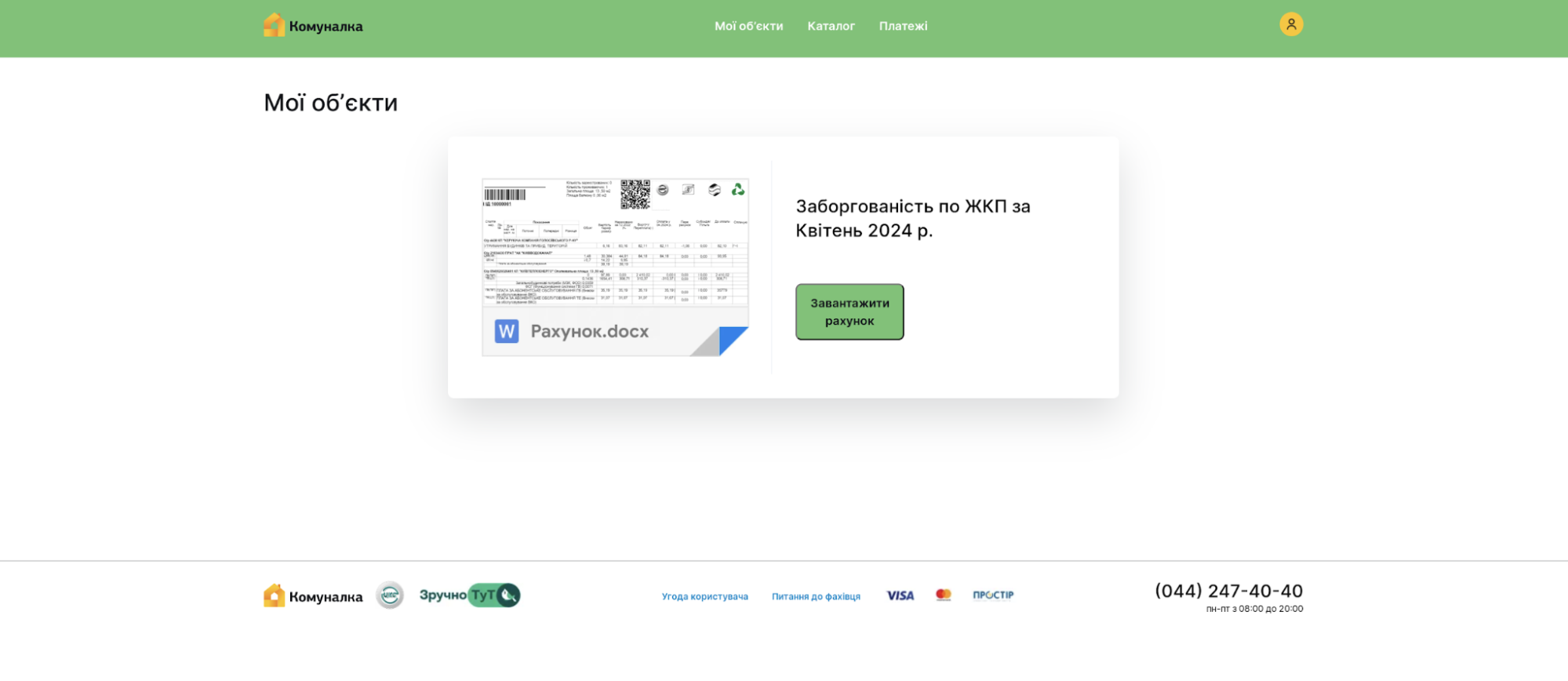
Based on past FlyingYeti operations, targets may be directed to the actor’s Github page via a link in a phishing email or an encrypted Signal message. If a target accesses the spoofed Komunalka platform at hxxps[:]//komunalka[.]github[.]io, the page displays a large green button with a prompt to download the document “Рахунок.docx” (“Invoice.docx”), as shown in Figure 1. This button masquerades as a link to an overdue payment invoice but actually results in the download of the malicious archive “Заборгованість по ЖКП.rar” (“Debt for housing and utility services.rar”).
Figure 1: Prompt to download malicious archive “Заборгованість по ЖКП.rar”
A series of steps must take place for the download to successfully occur:
The target clicks the green button on the actor’s GitHub page hxxps[:]//komunalka.github[.]io
The target’s device sends an HTTP POST request to the Cloudflare Worker worker-polished-union-f396[.]vqu89698[.]workers[.]dev with the HTTP request body set to “user=Iahhdr”
The Cloudflare Worker processes the request and evaluates the HTTP request body
If the request conditions are met, the Worker fetches the RAR file from hxxps[:]//raw[.]githubusercontent[.]com/kudoc8989/project/main/Заборгованість по ЖКП.rar, which is then downloaded on the target’s device
Cloudforce One identified the infrastructure responsible for facilitating the download of the malicious RAR file and remediated the actor-associated Worker, preventing FlyingYeti from delivering its malicious tooling. In an effort to circumvent Cloudforce One’s mitigation measures, FlyingYeti later changed their malware delivery method. Instead of the Workers domain fetching the malicious RAR file, it was loaded directly from GitHub.
Analysis of the malicious RAR file
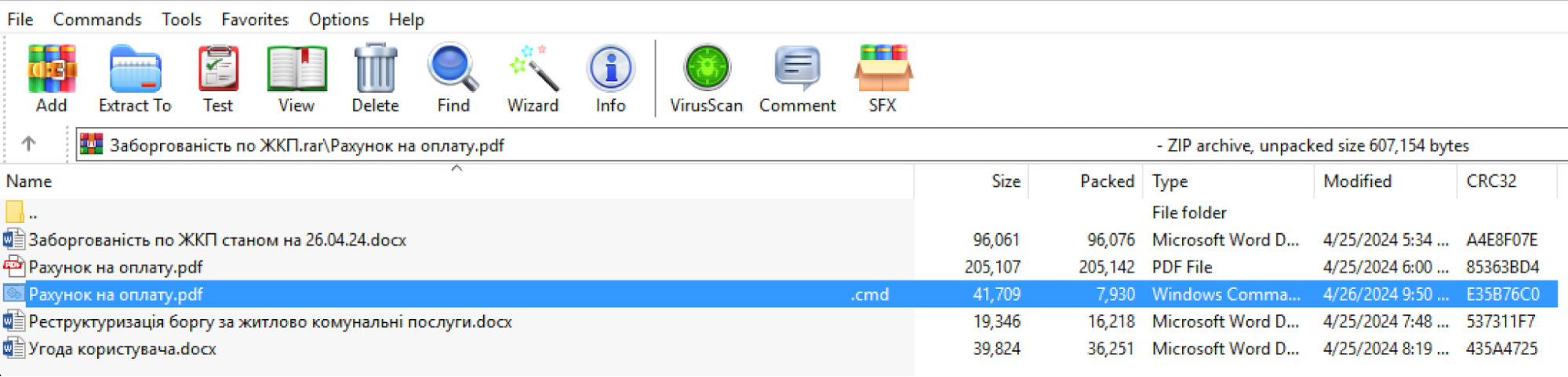
During remediation, Cloudforce One recovered the RAR file “Заборгованість по ЖКП.rar” and performed analysis of the malicious payload. The downloaded RAR archive contains multiple files, including a file with a name that contains the unicode character “U+201F”. This character appears as whitespace on Windows devices and can be used to “hide” file extensions by adding excessive whitespace between the filename and the file extension. As highlighted in blue in Figure 2, this cleverly named file within the RAR archive appears to be a PDF document but is actually a malicious CMD file (“Рахунок на оплату.pdf[unicode character U+201F].cmd”).
Figure 2: Files contained in the malicious RAR archive “Заборгованість по ЖКП.rar” (“Housing Debt.rar”)
FlyingYeti included a benign PDF in the archive with the same name as the CMD file but without the unicode character, “Рахунок на оплату.pdf” (“Invoice for payment.pdf”). Additionally, the directory name for the archive once decompressed also contained the name “Рахунок на оплату.pdf”. This overlap in names of the benign PDF and the directory allows the actor to exploit the WinRAR vulnerability CVE-2023-38831. More specifically, when an archive includes a benign file with the same name as the directory, the entire contents of the directory are opened by the WinRAR application, resulting in the execution of the malicious CMD. In other words, when the target believes they are opening the benign PDF “Рахунок на оплату.pdf”, the malicious CMD file is executed.
The CMD file contains the FlyingYeti PowerShell malware known as COOKBOX. The malware is designed to persist on a host, serving as a foothold in the infected device. Once installed, this variant of COOKBOX will make requests to the DDNS domain postdock[.]serveftp[.]com for C2, awaiting PowerShell cmdlets that the malware will subsequently run.
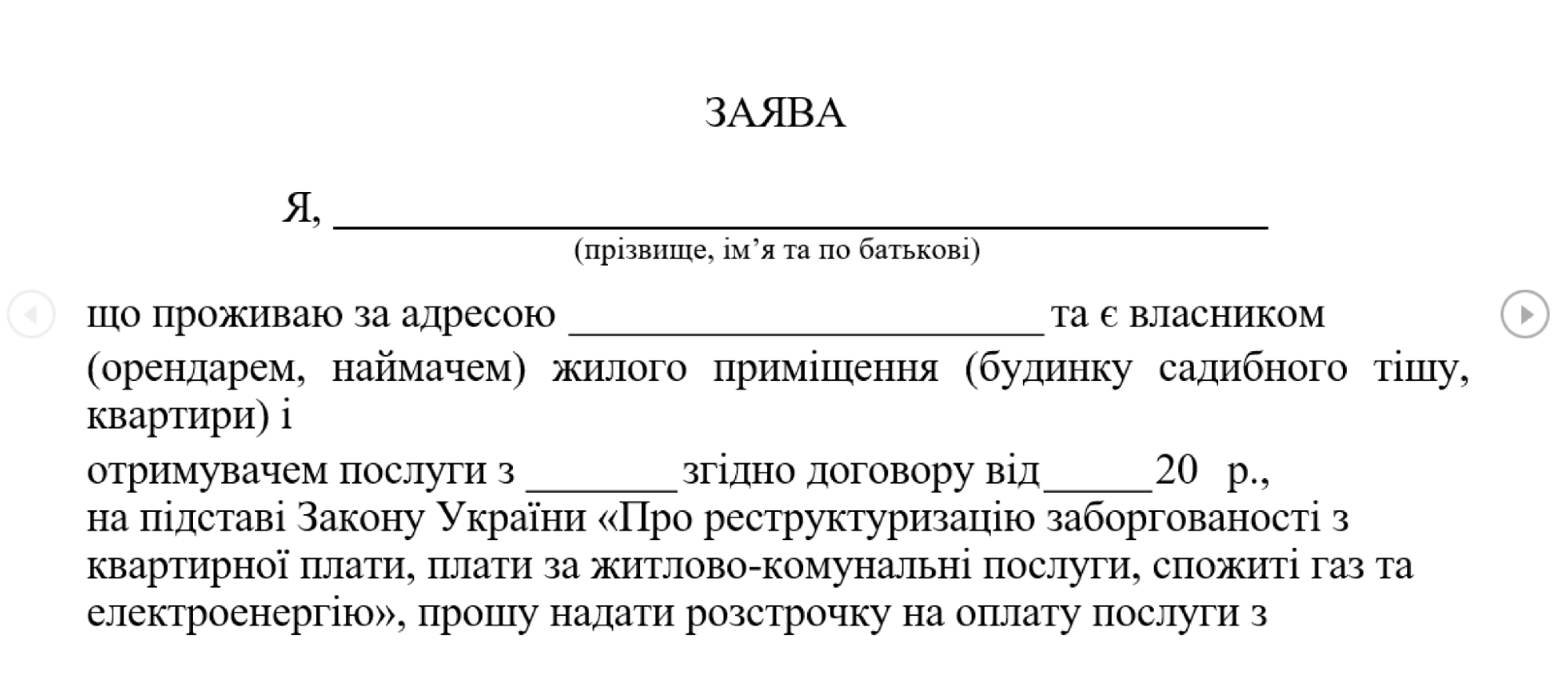
Alongside COOKBOX, several decoy documents are opened, which contain hidden tracking links using the Canary Tokens service. The first document, shown in Figure 3 below, poses as an agreement under which debt for housing and utility services will be restructured.
Figure 3: Decoy document Реструктуризація боргу за житлово комунальні послуги.docx
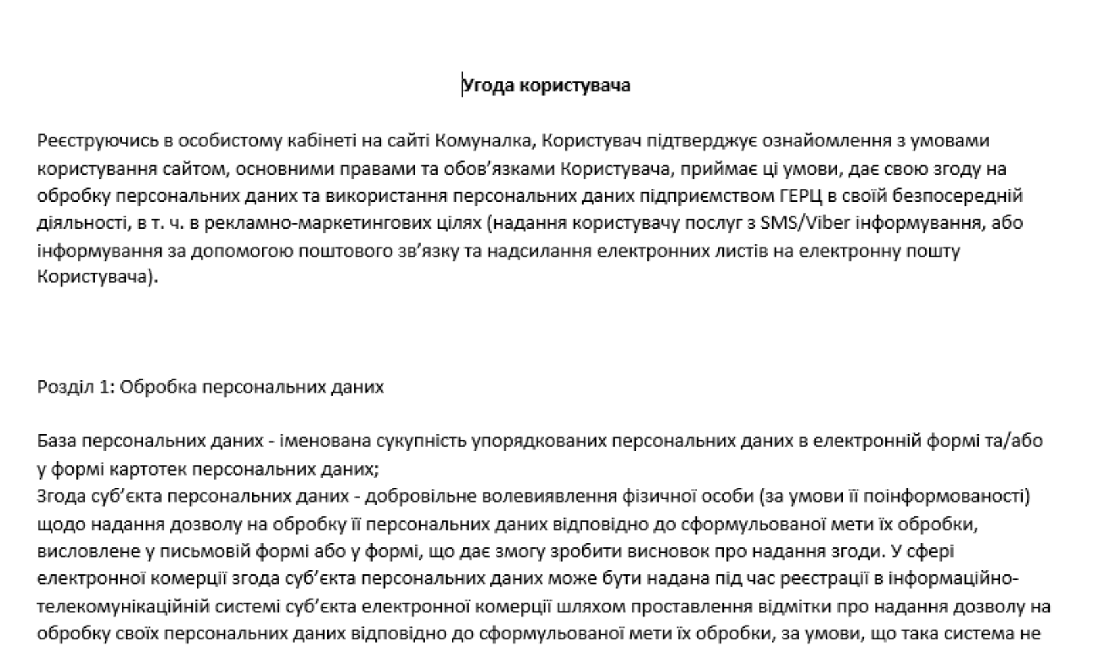
The second document (Figure 4) is a user agreement outlining the terms and conditions for the usage of the payment platform komunalka[.]ua.
The use of relevant decoy documents as part of the phishing and delivery activity are likely an effort by FlyingYeti operators to increase the appearance of legitimacy of their activities.
The phishing theme we identified in this campaign is likely one of many themes leveraged by this actor in a larger operation to target Ukrainian entities, in particular their defense forces. In fact, the threat activity we detailed in this blog uses many of the same techniques outlined in a recent FlyingYeti campaign disclosed by CERT-UA in mid-April 2024, where the actor leveraged United Nations-themed lures involving Peace Support Operations to target Ukraine’s military. Due to Cloudforce One’s defensive actions covered in the next section, this latest FlyingYeti campaign was prevented as of the time of publication.
Mitigating FlyingYeti activity
Cloudforce One mitigated FlyingYeti’s campaign through a series of actions. Each action was taken to increase the actor’s cost of continuing their operations. When assessing which action to take and why, we carefully weighed the pros and cons in order to provide an effective active defense strategy against this actor. Our general goal was to increase the amount of time the threat actor spent trying to develop and weaponize their campaign.
We were able to successfully extend the timeline of the threat actor’s operations from hours to weeks. At each interdiction point, we assessed the impact of our mitigation to ensure the actor would spend more time attempting to launch their campaign. Our mitigation measures disrupted the actor’s activity, in one instance resulting in eight additional hours spent on debugging code.
Due to our proactive defense efforts, FlyingYeti operators adapted their tactics multiple times in their attempts to launch the campaign. The actor originally intended to have the Cloudflare Worker fetch the malicious RAR file from GitHub. After Cloudforce One interdiction of the Worker, the actor attempted to create additional Workers via a new account. In response, we disabled all Workers, leading the actor to load the RAR file directly from GitHub. Cloudforce One notified GitHub, resulting in the takedown of the RAR file, the GitHub project, and suspension of the account used to host the RAR file. In return, FlyingYeti began testing the option to host the RAR file on the file sharing sites pixeldrain and Filemail, where we observed the actor alternating the link on the Komunalka phishing site between the following:
We notified GitHub of the actor’s evolving tactics, and in response GitHub removed the Komunalka phishing site. After analyzing the files hosted on pixeldrain and Filemail, we determined the actor uploaded dummy payloads, likely to monitor access to their phishing infrastructure (FileMail logs IP addresses, and both file hosting sites provide view and download counts). At the time of publication, we did not observe FlyingYeti upload the malicious RAR file to either file hosting site, nor did we identify the use of alternative phishing or malware delivery methods.
A timeline of FlyingYeti’s activity and our corresponding mitigations can be found below.
Event timeline
Date
Event Description
2024-04-18 12:18
Threat Actor (TA) creates a Worker to handle requests from a phishing site
2024-04-18 14:16
TA creates phishing site komunalka[.]github[.]io on GitHub
2024-04-25 12:25
TA creates a GitHub repo to host a RAR file
2024-04-26 07:46
TA updates the first Worker to handle requests from users visiting komunalka[.]github[.]io
2024-04-26 08:24
TA uploads a benign test RAR to the GitHub repo
2024-04-26 13:38
Cloudforce One identifies a Worker receiving requests from users visiting komunalka[.]github[.]io, observes its use as a phishing page
2024-04-26 13:46
Cloudforce One identifies that the Worker fetches a RAR file from GitHub (the malicious RAR payload is not yet hosted on the site)
2024-04-26 19:22
Cloudforce One creates a detection to identify the Worker that fetches the RAR
2024-04-26 21:13
Cloudforce One deploys real-time monitoring of the RAR file on GitHub
2024-05-02 06:35
TA deploys a weaponized RAR (CVE-2023-38831) to GitHub with their COOKBOX malware packaged in the archive
2024-05-06 10:03
TA attempts to update the Worker with link to weaponized RAR, the Worker is immediately blocked
2024-05-06 10:38
TA creates a new Worker, the Worker is immediately blocked
2024-05-06 11:04
TA creates a new account (#2) on Cloudflare
2024-05-06 11:06
TA creates a new Worker on account #2 (blocked)
2024-05-06 11:50
TA creates a new Worker on account #2 (blocked)
2024-05-06 12:22
TA creates a new modified Worker on account #2
2024-05-06 16:05
Cloudforce One disables the running Worker on account #2
2024-05-07 22:16
TA notices the Worker is blocked, ceases all operations
2024-05-07 22:18
TA deletes original Worker first created to fetch the RAR file from the GitHub phishing page
2024-05-09 19:28
Cloudforce One adds phishing page komunalka[.]github[.]io to real-time monitoring
2024-05-13 07:36
TA updates the github.io phishing site to point directly to the GitHub RAR link
2024-05-13 17:47
Cloudforce One adds COOKBOX C2 postdock[.]serveftp[.]com to real-time monitoring for DNS resolution
2024-05-14 00:04
Cloudforce One notifies GitHub to take down the RAR file
2024-05-15 09:00
GitHub user, project, and link for RAR are no longer accessible
2024-05-21 08:23
TA updates Komunalka phishing site on github.io to link to pixeldrain URL for dummy payload (pixeldrain only tracks view and download counts)
2024-05-21 08:25
TA updates Komunalka phishing site to link to FileMail URL for dummy payload (FileMail tracks not only view and download counts, but also IP addresses)
2024-05-21 12:21
Cloudforce One downloads PixelDrain document to evaluate payload
2024-05-21 12:47
Cloudforce One downloads FileMail document to evaluate payload
2024-05-29 23:59
GitHub takes down Komunalka phishing site
2024-05-30 13:00
Cloudforce One publishes the results of this investigation
Coordinating our FlyingYeti response
Cloudforce One leveraged industry relationships to provide advanced warning and to mitigate the actor’s activity. To further protect the intended targets from this phishing threat, Cloudforce One notified and collaborated closely with GitHub’s Threat Intelligence and Trust and Safety Teams. We also notified CERT-UA and Cloudflare industry partners such as CrowdStrike, Mandiant/Google Threat Intelligence, and Microsoft Threat Intelligence.
Hunting FlyingYeti operations
There are several ways to hunt FlyingYeti in your environment. These include using PowerShell to hunt for WinRAR files, deploying Microsoft Sentinel analytics rules, and running Splunk scripts as detailed below. Note that these detections may identify activity related to this threat, but may also trigger unrelated threat activity.
PowerShell hunting
Consider running a PowerShell script such as this one in your environment to identify exploitation of CVE-2023-38831. This script will interrogate WinRAR files for evidence of the exploit.
CVE-2023-38831
Description:winrar exploit detection
open suspios (.tar / .zip / .rar) and run this script to check it

function winrar-exploit-detect(){
$targetExtensions = @(".cmd" , ".ps1" , ".bat")
$tempDir = [System.Environment]::GetEnvironmentVariable("TEMP")
$dirsToCheck = Get-ChildItem -Path $tempDir -Directory -Filter "Rar*"
foreach ($dir in $dirsToCheck) {
    $files = Get-ChildItem -Path $dir.FullName -File
    foreach ($file in $files) {
        $fileName = $file.Name
        $fileExtension = [System.IO.Path]::GetExtension($fileName)
        if ($targetExtensions -contains $fileExtension) {
            $fileWithoutExtension = [System.IO.Path]::GetFileNameWithoutExtension($fileName); $filename.TrimEnd() -replace '\.$'
            $cmdFileName = "$fileWithoutExtension"
            $secondFile = Join-Path -Path $dir.FullName -ChildPath $cmdFileName

            if (Test-Path $secondFile -PathType Leaf) {
                Write-Host "[!] Suspicious pair detected "
                Write-Host "[*]  Original File:$($secondFile)" -ForegroundColor Green
                Write-Host "[*] Suspicious File:$($file.FullName)" -ForegroundColor Red

                # Read and display the content of the command file
                $cmdFileContent = Get-Content -Path $($file.FullName)
                Write-Host "[+] Command File Content:$cmdFileContent"
            }
        }
    }
}
}
winrar-exploit-detect
Microsoft Sentinel
In Microsoft Sentinel, consider deploying the rule provided below, which identifies WinRAR execution via cmd.exe. Results generated by this rule may be indicative of attack activity on the endpoint and should be analyzed.
DeviceProcessEvents
| where InitiatingProcessParentFileName has @"winrar.exe"
| where InitiatingProcessFileName has @"cmd.exe"
| project Timestamp, DeviceName, FileName, FolderPath, ProcessCommandLine, AccountName
| sort by Timestamp desc
Splunk
Consider using this script in your Splunk environment to look for WinRAR CVE-2023-38831 execution on your Microsoft endpoints. Results generated by this script may be indicative of attack activity on the endpoint and should be analyzed.
| tstats `security_content_summariesonly` count min(_time) as firstTime max(_time) as lastTime from datamodel=Endpoint.Processes where Processes.parent_process_name=winrar.exe `windows_shells` OR Processes.process_name IN ("certutil.exe","mshta.exe","bitsadmin.exe") by Processes.dest Processes.user Processes.parent_process_name Processes.parent_process Processes.process_name Processes.process Processes.process_id Processes.parent_process_id
| `drop_dm_object_name(Processes)`
| `security_content_ctime(firstTime)`
| `security_content_ctime(lastTime)`
| `winrar_spawning_shell_application_filter`
Cloudflare product detections
Cloudflare Email Security
Cloudflare Email Security (CES) customers can identify FlyingYeti threat activity with the following detections.
CVE-2023-38831
FLYINGYETI.COOKBOX
FLYINGYETI.COOKBOX.Launcher
FLYINGYETI.Rar
Recommendations
Cloudflare recommends taking the following steps to mitigate this type of activity:
Implement Zero Trust architecture foundations:
Deploy Cloud Email Security to ensure that email services are protected against phishing, BEC and other threats
Leverage browser isolation to separate messaging applications like LinkedIn, email, and Signal from your main network
Scan, monitor and/or enforce controls on specific or sensitive data moving through your network environment with data loss prevention policies
Ensure your systems have the latest WinRAR and Microsoft security updates installed
Consider preventing WinRAR files from entering your environment, both at your Cloud Email Security solution and your Internet Traffic Gateway
Run an Endpoint Detection and Response (EDR) tool such as CrowdStrike or Microsoft Defender for Endpoint to get visibility into binary execution on hosts
Search your environment for the FlyingYeti indicators of compromise (IOCs) shown below to identify potential actor activity within your network.
If you’re looking to uncover additional Threat Intelligence insights for your organization or need bespoke Threat Intelligence information for an incident, consider engaging with Cloudforce One by contacting your Customer Success manager or filling out this form.
New reporting from Wired reveals that the Department of Justice detected the SolarWinds attack six months before Mandiant detected it in December 2020, but didn’t realize what it detected—and so ignored it.
WIRED can now confirm that the operation was actually discovered by the DOJ six months earlier, in late May 2020—but the scale and significance of the breach wasn’t immediately apparent. Suspicions were triggered when the department detected unusual traffic emanating from one of its servers that was running a trial version of the Orion software suite made by SolarWinds, according to sources familiar with the incident. The software, used by system administrators to manage and configure networks, was communicating externally with an unfamiliar system on the internet. The DOJ asked the security firm Mandiant to help determine whether the server had been hacked. It also engaged Microsoft, though it’s not clear why the software maker was also brought onto the investigation.
[…]
Investigators suspected the hackers had breached the DOJ server directly, possibly by exploiting a vulnerability in the Orion software. They reached out to SolarWinds to assist with the inquiry, but the company’s engineers were unable to find a vulnerability in their code. In July 2020, with the mystery still unresolved, communication between investigators and SolarWinds stopped. A month later, the DOJ purchased the Orion system, suggesting that the department was satisfied that there was no further threat posed by the Orion suite, the sources say.
EDITED TO ADD (5/4): More details about the SolarWinds attack from Wired.com.
In an ideal world, intrusion detection would apply across your entire network – data centers, cloud properties, and branch locations. It wouldn’t impact the performance of your traffic. And there’d be no capacity constraints. Today, we’re excited to bring this one step closer to reality by announcing the private beta of Cloudflare’s intrusion detection capabilities: live monitoring for threats across all of your network traffic, delivered as-a-service — with none of the constraints of legacy hardware approaches.
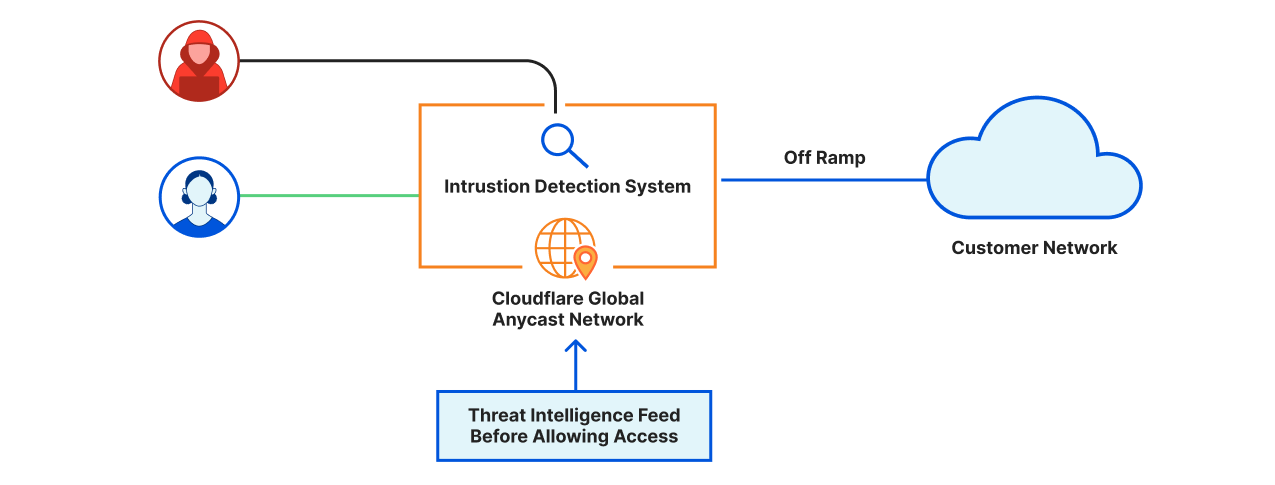
Cloudflare’s Network Services, part of Cloudflare One, help you connect and secure your entire corporate network — data center, cloud, or hybrid — from DDoS attacks and other malicious traffic. You can apply Firewall rules to keep unwanted traffic out or enforce a positive security model, and integrate custom or managed IP lists into your firewall policies to block traffic associated with known malware, bots, or anonymizers. Our new Intrusion Detection System (IDS) capabilities expand on these critical security controls by actively monitoring for a wide range of known threat signatures in your traffic.
What is an IDS?
Intrusion Detection Systems are traditionally deployed as standalone appliances but often incorporated as features in more modern or higher end firewalls. They expand the security coverage of traditional firewalls – which focus on blocking traffic you know you don’t want in your network – to analyze traffic against a broader threat database, detecting a variety of sophisticated attacks such as ransomware, data exfiltration, and network scanning based on signatures or “fingerprints” in network traffic. Many IDSs also incorporate anomaly detection, monitoring activity against a baseline to identify unexpected traffic patterns that could indicate malicious activity. (If you’re interested in the evolution of network firewall capabilities, we recommend this where we’ve dived deeper on the topic).
What problems have users encountered with existing IDS solutions?
We’ve interviewed tons of customers about their experiences deploying IDS and the pain points they’re hoping we can solve. Customers have mentioned the full list of historical problems we hear frequently with other hardware-based security solutions, including capacity planning, location planning and back hauling traffic through a central location for monitoring, downtime for installation, maintenance, and upgrades, and vulnerability to congestion or failure with large volumes of traffic (e.g. DDoS attacks).
Customers we talked to also consistently cited challenges making trade off decisions between security and performance for their network traffic. One network engineer explained:
“I know my security team hates me for this, but I can’t let them enable the IDS function on our on-prem firewalls – in the tests my team ran, it cut my throughput by almost a third. I know we have this gap in our security now, and we’re looking for an alternative way to get IDS coverage for our traffic, but I can’t justify slowing down the network for everyone in order to catch some theoretical bad traffic.”
Finally, customers who did choose to take the performance hit and invest in an IDS appliance reported that they often mute or ignore the feed of alerts coming into their SOC after turning it on. With the amount of noise on the Internet and the potential risk of missing an important signal, IDSs can end up generating a lot of false positives or non-actionable notifications. This volume can lead busy SOC teams to get alert fatigue and end up silencing potentially important signals buried in the noise.
How is Cloudflare tackling these problems?
We believe there’s a more elegant, efficient, and effective way to monitor all of your network traffic for threats without introducing performance bottlenecks or burning your team out with non-actionable alerts. Over the past year and a half, we’ve learned from your feedback, experimented with different technology approaches, and developed a solution to take those tough trade off decisions out of the picture.
One interface across all your traffic
Cloudflare’s IDS capabilities operate across all of your network traffic – any IP port or protocol — whether it flows to your IPs that we advertise on your behalf, IPs we lease to you, or soon, traffic within your private network. You can enforce consistent monitoring and security control across your entire network in one place.
No more hardware headaches
Like all of our security functions, we built our IDS from scratch in software, and it is deployed across every server on Cloudflare’s global Anycast network. This means:
No more capacity planning: Cloudflare’s entire global network capacity is now the capacity of your IDS – currently 142 Tbps and counting.
No more location planning: No more picking regions, backhauling traffic to central locations, or deploying primary and backup appliances – because every server runs our IDS software and traffic is automatically attracted to the closest network location to its source, redundancy and failover are built in.
No maintenance downtime: Improvements to Cloudflare’s IDS capabilities, like all of our products, are deployed continuously across our global network.
Threat intelligence from across our interconnected global network
The attack landscape is constantly evolving, and you need an IDS that stays ahead of it. Because Cloudflare’s IDS is delivered in software we wrote from the ground up and maintain, we’re able to continuously feed threat intelligence from the 20+ million Internet properties on Cloudflare back into our policies, keeping you protected from both known and new attack patterns.
Our threat intelligence combines open-source feeds that are maintained and trusted by the security community – like Suricata threat signatures – with information collected from our unique vantage point as an incredibly interconnected network carrying a significant percentage of all Internet traffic. Not only do we share these insights publicly through tools like Cloudflare Radar; we also feed them back into our security tools including IDS so that our customers are protected as quickly as possible from emerging threats. Cloudflare’s newly announced Threat Intel team will augment these capabilities even further, applying additional expertise to understanding and deriving insights from our network data.
Excited to get started?
If you’re an Advanced Magic Firewall customer, you can get access to these features in private beta starting now. You can reach out to your account team to learn more or get started now – we can’t wait to hear your feedback as we continue to develop these capabilities!
The collective thoughts of the interwebz
Manage Consent
To provide the best experiences, we use technologies like cookies to store and/or access device information. Consenting to these technologies will allow us to process data such as browsing behavior or unique IDs on this site. Not consenting or withdrawing consent, may adversely affect certain features and functions.
Functional
Always active
The technical storage or access is strictly necessary for the legitimate purpose of enabling the use of a specific service explicitly requested by the subscriber or user, or for the sole purpose of carrying out the transmission of a communication over an electronic communications network.
Preferences
The technical storage or access is necessary for the legitimate purpose of storing preferences that are not requested by the subscriber or user.
Statistics
The technical storage or access that is used exclusively for statistical purposes.The technical storage or access that is used exclusively for anonymous statistical purposes. Without a subpoena, voluntary compliance on the part of your Internet Service Provider, or additional records from a third party, information stored or retrieved for this purpose alone cannot usually be used to identify you.
Marketing
The technical storage or access is required to create user profiles to send advertising, or to track the user on a website or across several websites for similar marketing purposes.