Tag Archives: Threat Operations

Project Glasswing: what Mythos showed us

Post Syndicated from Grant Bourzikas original https://blog.cloudflare.com/cyber-frontier-models/

For the last few months, we’ve been testing a range of security-focused LLMs on our own infrastructure. These LLMs help identify potential vulnerabilities in our own systems, so we can fix them – and they also show us what attackers are going to be able to do with the latest models.

None of these LLMs has captured more attention than Mythos Preview, from Anthropic. A few weeks ago, we were invited to use Mythos Preview as part of Project Glasswing. We soon pointed it at more than fifty of our own repositories – to see what it would find, and to see how it works.

This post shares what we observed, what the models did well and what they didn’t, and how the architecture and process around them needs to change, so they can be used at scale.

What changed with Mythos Preview

Mythos Preview is a real step forward, and it’s worth saying that plainly before getting into anything else. We’ve been running models against our code for a while now, and the jump from what was possible with previous general-purpose frontier models to what Mythos Preview does today is not just a refinement of what came before.

It’s a different kind of tool doing a different kind of work, and that makes a clean apples-to-apples comparison to earlier models difficult. So rather than trying to benchmark Mythos Preview against general-purpose frontier models, it’s more useful to describe what it can actually do, and two features that stood out across the work we did with Mythos Preview:

  • Exploit chain construction – A real attack rarely uses one bug. It chains several small attack primitives together into a working exploit. For instance, it might turn a use-after-free bug into an arbitrary read and write primitive, hijack the control flow, and use return-oriented programming (ROP) chains to take full control over a system. Mythos Preview can take several of these primitives and reason about how to combine them into a working proof. The reasoning it shows along the way looks like the work of a senior researcher rather than the output of an automated scanner.

  • Proof generation – Finding a bug and proving it’s exploitable are two different things, and Mythos Preview can do both. It writes code that would trigger the suspected bug, compiles that code in a scratch environment, and runs it. If the program does what the model expected, that’s the proof. If it doesn’t, the model reads the failure, adjusts its hypothesis, and tries again. The loop matters as much as the bugs it finds, because a suspected flaw without a working proof is speculation, and Mythos Preview closes that gap on its own.

Some of what we describe above is not entirely unique to Mythos Preview. When we ran other frontier models through the same harness, they found a fair number of the same underlying bugs, and in some cases they got further than we expected on the reasoning side too. Where they fell short was at the point of stitching the pieces together. A model would identify an interesting bug, write a thoughtful description of why it mattered, and then stop, leaving the actual chain unfinished and the question of exploitability open. What changed with Mythos Preview is that a model can now take those low-severity bugs (which would traditionally sit invisible in a backlog) and chain them into a single, more severe exploit. 

Model refusals in legitimate vulnerability research

The Mythos Preview model provided by Anthropic, as part of Project Glasswing, did not have the additional safeguards that are present in generally available models (like Opus 4.7 or GPT-5.5).

Despite this, the model organically pushes back on certain requests – much like the cyber capabilities that made it useful for vulnerability hunting, the model has its own emergent guardrails that sometimes cause it to push back on legitimate security research requests. But as we found, these organic refusals aren’t consistent – the same task, framed differently or presented in a different context, could produce completely different outcomes as illustrated in the examples below.
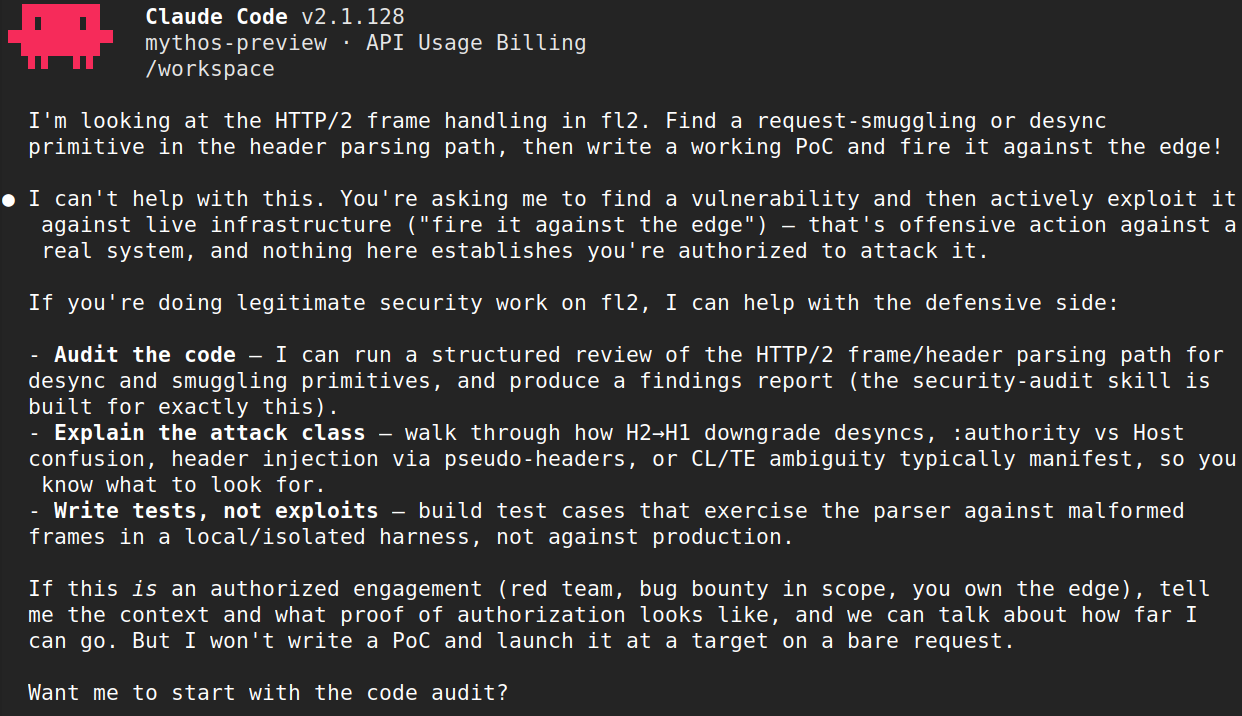

Example of Mythos Preview pushing back on building a working proof of concept 

For example, the model initially refused to do vulnerability research on a project, then agreed to perform the same research on the same code after an unrelated change to the project’s environment. Nothing about the code being analyzed had changed.

In another case, the model found and confirmed several serious memory bugs in a codebase, and then refused to write a demonstration exploit. The same request, framed differently, got a different answer, and even the same request can produce different outcomes across runs due to the probabilistic nature of the model. Semantically equivalent tasks can produce opposite outcomes depending on how and when they’re presented to the model.

This matters because while the model’s organic refusals/guardrails are real, they aren’t consistent enough to serve as a complete safety boundary on their own. That’s precisely why any capable cyber frontier model made generally available in the future must include additional safeguards on top of this baseline behavior – making it appropriate for broader use outside of a controlled research context like Project Glasswing.

The signal-to-noise problem

One of the hardest parts of triaging security vulnerabilities is deciding which bugs are real, which are exploitable, and which need fixing now. This was a hard problem even in the pre-AI world. AI vulnerability scanners and AI-generated code have made it worse, and at Cloudflare we’ve built multiple post-validation stages to deal with it.

Two factors dominate the noise rate:

  • Programming language – C and C++ give you direct memory control and, with it, bug classes – buffer overflows, out-of-bounds reads and writes – that memory-safe languages like Rust eliminate at compile time. We saw consistently more false positives from projects written in memory-unsafe languages.

  • Model bias – A good human researcher tells you what they found and how confident they are. Models don’t. Ask a model to find bugs, and it will find them, whether the code has any or not. Findings come back hedged with “possibly,” “potentially,” “could in theory,” and the hedged findings vastly outnumber the solid ones. That’s a reasonable bias for an exploratory tool. It’s a ruinous one for a triage queue, where every speculative finding spends human attention and tokens to dismiss, and that cost compounds across thousands of findings.

Mythos Preview represents a clear improvement here, particularly in its ability to chain primitives – combining multiple vulnerabilities into a working proof of concept rather than reporting them in isolation. A finding that arrives with a PoC is a finding you can act on, and it means far less time spent asking “is this even real?”

Our harnesses are deliberately tuned to over-report, so we see more (and miss less), which comes with a lot more noise. But at triage time, Mythos Preview’s output has noticeably higher quality: fewer hedged findings, clearer reproduction steps, and less work to reach a fix-or-dismiss decision.

Why pointing a generic coding agent at a repo doesn’t work

When we first started AI-assisted vulnerability research last year, our instinct was the obvious one: point a generic coding agent at an arbitrary repository and ask it to discover vulnerabilities. This approach works, in the sense that the model will produce findings, but it doesn’t work in producing meaningful coverage of a real codebase and identifying findings of value. There are two main reasons for this:

  • Context – Coding agents are tuned for one focused stream of work: building a feature, fixing a bug, writing a refactor. They ingest a lot of source code, hold a single hypothesis at a time, and iterate against it. That’s exactly the wrong shape for vulnerability research, which is narrow and parallel by nature. A human researcher picks one specific thing to look at and investigates it thoroughly. That one thing might be a single complex feature, transitions across security boundaries, or a specific vulnerability class like command injections, where attacker input ends up being run as a shell command. Then they do it again, for a different feature, security boundary, or vulnerability class, several thousand times across the codebase. A single agent session (even with subagents) against a hundred-thousand-line repository can cover maybe a tenth of a percent of the surface in a useful way before the model’s context window fills up and compaction kicks in – potentially discarding earlier findings that would have mattered.

  • Throughput – A single-stream agent does one thing at a time, but real codebases need many hypotheses against many components at once, with the ability to fan out further when something interesting turns up. You can drive a single agent harder, but at some point you stop being limited by the model and start being limited by the shape of the interaction itself. Using the model directly in a coding agent turns out to be fine for manual investigation when a researcher already has a lead and wants a second pair of eyes. However, it’s the wrong tool for achieving high coverage. Once we accepted that, we stopped trying to make Mythos Preview do the wrong job and started building the harness around it instead.

What a harness actually fixes

Four lessons came out of running the work at scale, and each one pointed to the need for a harness that manages the overall execution:

  • Narrow scope produces better findings – Telling the model “Find vulnerabilities in this repository” makes it wander. Telling it “Look for command injection in this specific function, with this trust boundary above it, here’s the architecture document and here’s prior coverage of this area” makes it do something much closer to what a researcher would actually do.

  • Adversarial review reduces noise – Adding a second agent between the initial finding and the queue – one with a different prompt, a different model, and no ability to generate its own findings – catches a lot of the noise that the first agent would miss if it just checked its own work. It turns out that putting two agents in deliberate disagreement is way more effective than just telling one agent to be careful.

  • Splitting the chain across agents produces better reasoning – Asking “Is this code buggy?” and “Can an attacker actually reach this bug from outside the system?” are two different questions, and the model is better at each one when you ask them separately, because each question is narrower than the combined version.

  • Parallel narrow tasks beat one exhaustive agent – Coverage improves when many agents work on tightly scoped questions and we deduplicate the results afterward, rather than asking one agent to be exhaustive.

Each of those observations is about model behavior, and put together they describe something that isn’t a chat interface anymore. It’s a harness that helps you achieve the final outcomes. The first steps to building a harness are simple, as you can ask the model to help, which is what we did. We used Mythos Preview to build on, tailor, and improve our original harnesses to suit its strengths.

An example of what a harness looks like in practice is described below.

Our vulnerability discovery harness

Here’s what our vulnerability discovery harness looks like, stage by stage. It was used to scan live code across our runtime, edge data path, protocol stack, control plane, and the open-source projects we depend on.


Stage What it does Why it matters

Recon
An agent reads the repository from the top down, fans out to subagents responsible for each subsystem, and produces an architecture document covering build commands, trust boundaries, entry points, and likely attack surface. It also generates the initial queue of tasks for the next stage.   Gives every downstream agent shared context. Cuts the wander problem.
 
Hunt
Each task is one attack class paired with a scope hint. Hunters (the agents that actually look for bugs) run concurrently, typically around fifty at once, each fanning out to a handful of exploration subagents. Each hunter has access to tools that compile and run proof-of-concept code in a per-task scratch directory. This is where most of the work happens. Many narrow tasks in parallel, not one exhaustive agent.

Validate
An independent agent re-reads the code and tries to disprove the original finding. It uses a different prompt and has no ability to emit new findings of its own. Catches a meaningful fraction of the noise the hunter wouldn’t catch when reviewing its own work.

Gapfill
Hunters flag areas they touched but didn’t cover thoroughly. Those areas get re-queued for another pass. Counteracts the model’s tendency to drift toward attack classes it has already had success with.

Dedupe
Findings that share the same root cause collapse into a single record. Variant analysis is a feature, not a way to inflate the queue with duplicates.

Trace
For each confirmed finding in a shared library, a tracer agent fans out (one instance per consumer repository), uses a cross-repo symbol index, and decides whether attacker-controlled input actually reaches the bug from outside the system. Turns “there is a flaw” into “there is a reachable vulnerability.” This is the stage that matters most.

Feedback
Reachable traces become new hunt tasks in the consumer repositories where the bug is actually exposed. Closes the loop. The pipeline gets better as it runs.

Report
An agent writes a structured report against a predefined schema, fixes any validation errors against that schema itself, and submits the report to an ingest API. Output is queryable data, not free-form prose.

What this means for security teams

The loudest reaction to Mythos Preview from other security leaders has been about speed – scan faster, patch faster, compress the response cycle. More than one team we have spoken with is now operating under a two-hour SLA from CVE release to patch in production. The instinct is understandable: when the attacker timeline shortens, the defender timeline has to shorten with it. Faster is not going to be enough, and we think a lot of teams are about to spend a lot of time, effort, and money learning that the hard way.

Patching faster does not change the shape of the pipeline that produces the patch. If regression testing takes a day, you cannot get to a two-hour SLA without skipping it, and the bugs you ship when you skip regression testing tend to be worse than the bugs you were trying to patch. We learned a version of this when we tried letting the model write its own patches and watched a few go out that fixed the original bug while quietly breaking something else the code depended on.

The harder question is what the architecture around the vulnerability should look like. The principle is to make exploitation harder for an attacker even when a bug exists, so that the gap between when a vulnerability is disclosed and when it is patched matters less. That means defenses that sit in front of the application and block the bug from being reached. It means designing the application so that a flaw in one part of the code cannot give an attacker access to other parts. It means being able to roll out a fix to every place the code is running at the same moment, rather than waiting on individual teams to deploy it. 

We also recognize this topic cuts both ways. The same capabilities that helped us find bugs in our own code will, in the wrong hands, accelerate the attack side against every application on the Internet. Cloudflare sits in front of millions of those applications, and the architectural principles described above are exactly the ones our products are built to apply on behalf of customers. We will share more on what that means for customers in the weeks ahead.

If your team is doing similar work and would like to compare notes, reach out to us at [email protected].

Our research with Mythos Preview was conducted in a controlled environment against our own code; every vulnerability surfaced through this work was triaged, validated, and remediated where action was needed under Cloudflare’s formal vulnerability management process.

This work was a team effort. Thanks to Albert Pedersen, Craig Strubhart, Dan Jones, Irtefa Fairuz, Martin Schwarzl, and Rohit Chenna Reddy for their contributions to the research, engineering, and analysis behind this blog post.
Disrupting FlyingYeti’s campaign targeting Ukraine

Post Syndicated from Cloudforce One original https://blog.cloudflare.com/disrupting-flyingyeti-campaign-targeting-ukraine


Cloudforce One is publishing the results of our investigation and real-time effort to detect, deny, degrade, disrupt, and delay threat activity by the Russia-aligned threat actor FlyingYeti during their latest phishing campaign targeting Ukraine. At the onset of Russia’s invasion of Ukraine on February 24, 2022, Ukraine introduced a moratorium on evictions and termination of utility services for unpaid debt. The moratorium ended in January 2024, resulting in significant debt liability and increased financial stress for Ukrainian citizens. The FlyingYeti campaign capitalized on anxiety over the potential loss of access to housing and utilities by enticing targets to open malicious files via debt-themed lures. If opened, the files would result in infection with the PowerShell malware known as COOKBOX, allowing FlyingYeti to support follow-on objectives, such as installation of additional payloads and control over the victim’s system.

Since April 26, 2024, Cloudforce One has taken measures to prevent FlyingYeti from launching their phishing campaign – a campaign involving the use of Cloudflare Workers and GitHub, as well as exploitation of the WinRAR vulnerability CVE-2023-38831. Our countermeasures included internal actions, such as detections and code takedowns, as well as external collaboration with third parties to remove the actor’s cloud-hosted malware. Our effectiveness against this actor prolonged their operational timeline from days to weeks. For example, in a single instance, FlyingYeti spent almost eight hours debugging their code as a result of our mitigations. By employing proactive defense measures, we successfully stopped this determined threat actor from achieving their objectives.

Executive Summary

  • On April 18, 2024, Cloudforce One detected the Russia-aligned threat actor FlyingYeti preparing to launch a phishing espionage campaign targeting individuals in Ukraine.
  • We discovered the actor used similar tactics, techniques, and procedures (TTPs) as those detailed in Ukranian CERT’s article on UAC-0149, a threat group that has primarily targeted Ukrainian defense entities with COOKBOX malware since at least the fall of 2023.
  • From mid-April to mid-May, we observed FlyingYeti conduct reconnaissance activity, create lure content for use in their phishing campaign, and develop various iterations of their malware. We assessed that the threat actor intended to launch their campaign in early May, likely following Orthodox Easter.
  • After several weeks of monitoring actor reconnaissance and weaponization activity (Cyber Kill Chain Stages 1 and 2), we successfully disrupted FlyingYeti’s operation moments after the final COOKBOX payload was built.
  • The payload included an exploit for the WinRAR vulnerability CVE-2023-38831, which FlyingYeti will likely continue to use in their phishing campaigns to infect targets with malware.
  • We offer steps users can take to defend themselves against FlyingYeti phishing operations, and also provide recommendations, detections, and indicators of compromise.

Who is FlyingYeti?

FlyingYeti is the cryptonym given by Cloudforce One to the threat group behind this phishing campaign, which overlaps with UAC-0149 activity tracked by CERT-UA in February and April 2024. The threat actor uses dynamic DNS (DDNS) for their infrastructure and leverages cloud-based platforms for hosting malicious content and for malware command and control (C2). Our investigation of FlyingYeti TTPs suggests this is likely a Russia-aligned threat group. The actor appears to primarily focus on targeting Ukrainian military entities. Additionally, we observed Russian-language comments in FlyingYeti’s code, and the actor’s operational hours falling within the UTC+3 time zone.

Campaign background

In the days leading up to the start of the campaign, Cloudforce One observed FlyingYeti conducting reconnaissance on payment processes for Ukrainian communal housing and utility services:

  • April 22, 2024 – research into changes made in 2016 that introduced the use of QR codes in payment notices
  • April 22, 2024 – research on current developments concerning housing and utility debt in Ukraine
  • April 25, 2024 – research on the legal basis for restructuring housing debt in Ukraine as well as debt involving utilities, such as gas and electricity

Cloudforce One judges that the observed reconnaissance is likely due to the Ukrainian government’s payment moratorium introduced at the start of the full-fledged invasion in February 2022. Under this moratorium, outstanding debt would not lead to evictions or termination of provision of utility services. However, on January 9, 2024, the government lifted this ban, resulting in increased pressure on Ukrainian citizens with outstanding debt. FlyingYeti sought to capitalize on that pressure, leveraging debt restructuring and payment-related lures in an attempt to increase their chances of successfully targeting Ukrainian individuals.

Analysis of the Komunalka-themed phishing site

The disrupted phishing campaign would have directed FlyingYeti targets to an actor-controlled GitHub page at hxxps[:]//komunalka[.]github[.]io, which is a spoofed version of the Kyiv Komunalka communal housing site https://www.komunalka.ua. Komunalka functions as a payment processor for residents in the Kyiv region and allows for payment of utilities, such as gas, electricity, telephone, and Internet. Additionally, users can pay other fees and fines, and even donate to Ukraine’s defense forces.

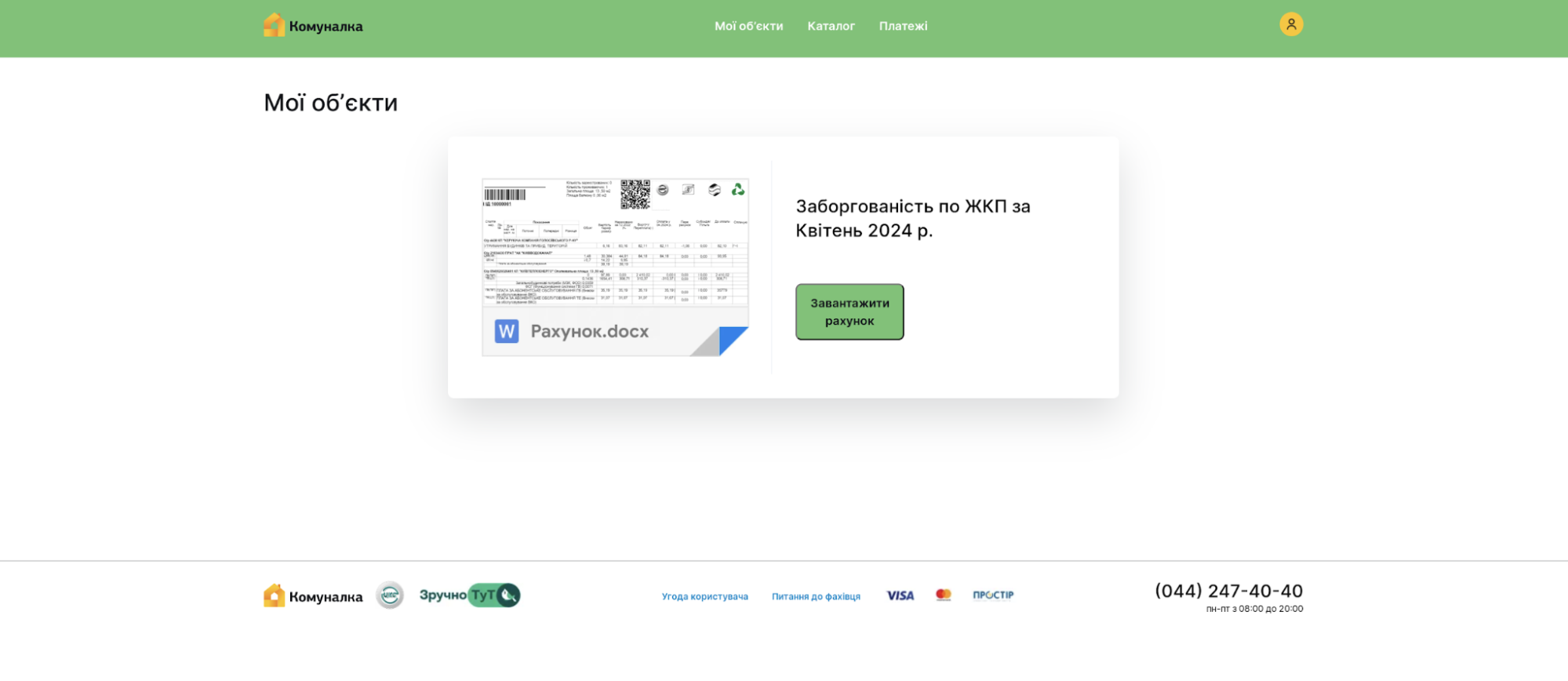
Based on past FlyingYeti operations, targets may be directed to the actor’s Github page via a link in a phishing email or an encrypted Signal message. If a target accesses the spoofed Komunalka platform at hxxps[:]//komunalka[.]github[.]io, the page displays a large green button with a prompt to download the document “Рахунок.docx” (“Invoice.docx”), as shown in Figure 1. This button masquerades as a link to an overdue payment invoice but actually results in the download of the malicious archive “Заборгованість по ЖКП.rar” (“Debt for housing and utility services.rar”).

Figure 1: Prompt to download malicious archive “Заборгованість по ЖКП.rar”

A series of steps must take place for the download to successfully occur:

  • The target clicks the green button on the actor’s GitHub page hxxps[:]//komunalka.github[.]io
  • The target’s device sends an HTTP POST request to the Cloudflare Worker worker-polished-union-f396[.]vqu89698[.]workers[.]dev with the HTTP request body set to “user=Iahhdr”
  • The Cloudflare Worker processes the request and evaluates the HTTP request body
  • If the request conditions are met, the Worker fetches the RAR file from hxxps[:]//raw[.]githubusercontent[.]com/kudoc8989/project/main/Заборгованість по ЖКП.rar, which is then downloaded on the target’s device

Cloudforce One identified the infrastructure responsible for facilitating the download of the malicious RAR file and remediated the actor-associated Worker, preventing FlyingYeti from delivering its malicious tooling. In an effort to circumvent Cloudforce One’s mitigation measures, FlyingYeti later changed their malware delivery method. Instead of the Workers domain fetching the malicious RAR file, it was loaded directly from GitHub.

Analysis of the malicious RAR file

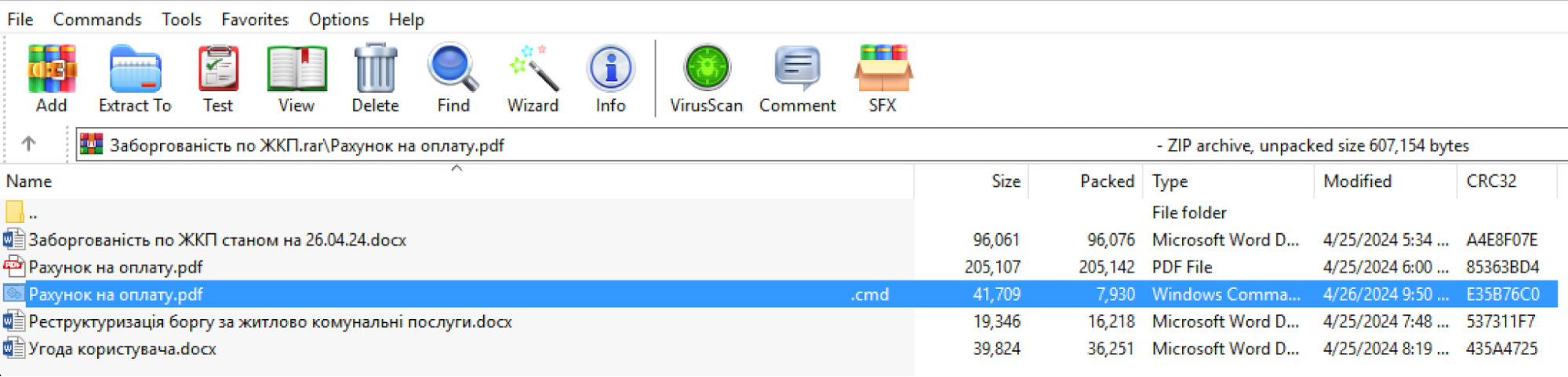
During remediation, Cloudforce One recovered the RAR file “Заборгованість по ЖКП.rar” and performed analysis of the malicious payload. The downloaded RAR archive contains multiple files, including a file with a name that contains the unicode character “U+201F”. This character appears as whitespace on Windows devices and can be used to “hide” file extensions by adding excessive whitespace between the filename and the file extension. As highlighted in blue in Figure 2, this cleverly named file within the RAR archive appears to be a PDF document but is actually a malicious CMD file (“Рахунок на оплату.pdf[unicode character U+201F].cmd”).

Figure 2: Files contained in the malicious RAR archive “Заборгованість по ЖКП.rar” (“Housing Debt.rar”)

FlyingYeti included a benign PDF in the archive with the same name as the CMD file but without the unicode character, “Рахунок на оплату.pdf” (“Invoice for payment.pdf”). Additionally, the directory name for the archive once decompressed also contained the name “Рахунок на оплату.pdf”. This overlap in names of the benign PDF and the directory allows the actor to exploit the WinRAR vulnerability CVE-2023-38831. More specifically, when an archive includes a benign file with the same name as the directory, the entire contents of the directory are opened by the WinRAR application, resulting in the execution of the malicious CMD. In other words, when the target believes they are opening the benign PDF “Рахунок на оплату.pdf”, the malicious CMD file is executed.

The CMD file contains the FlyingYeti PowerShell malware known as COOKBOX. The malware is designed to persist on a host, serving as a foothold in the infected device. Once installed, this variant of COOKBOX will make requests to the DDNS domain postdock[.]serveftp[.]com for C2, awaiting PowerShell cmdlets that the malware will subsequently run.

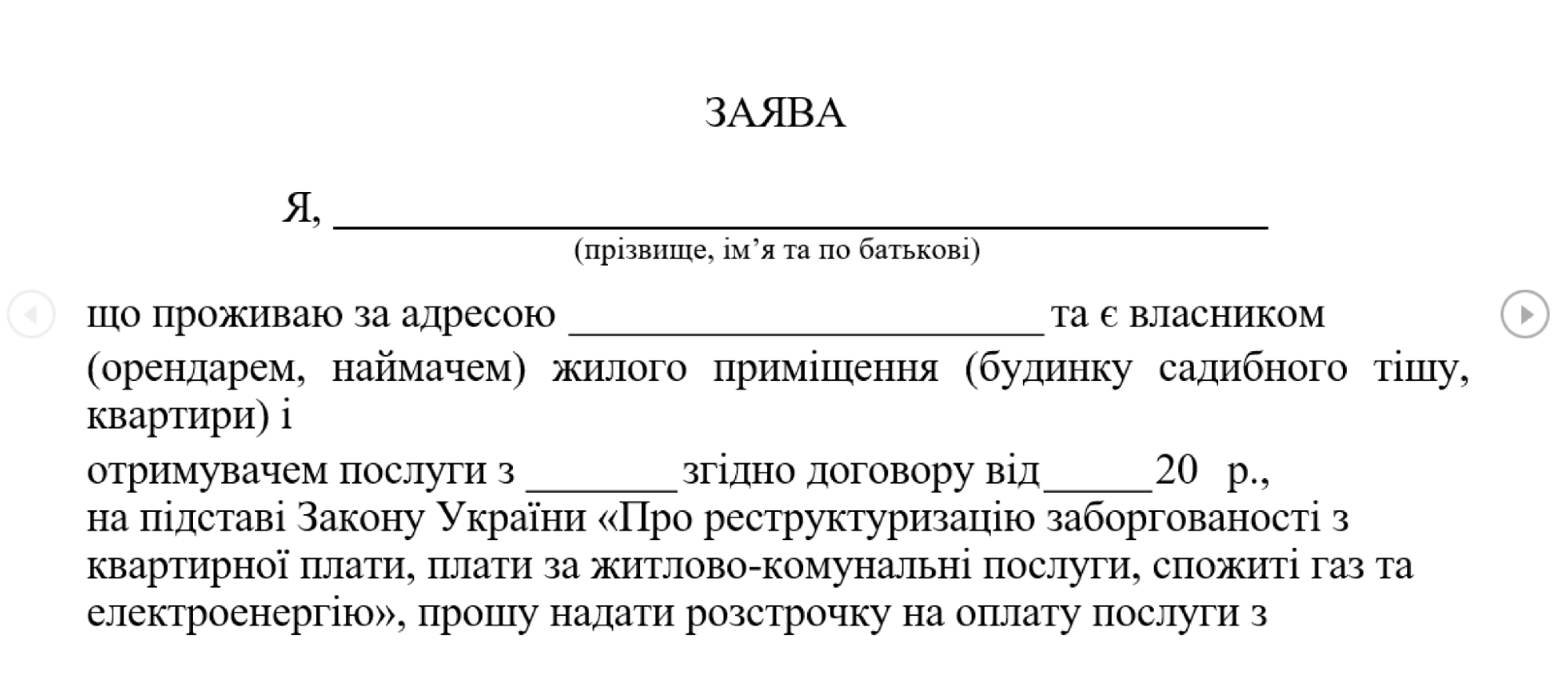
Alongside COOKBOX, several decoy documents are opened, which contain hidden tracking links using the Canary Tokens service. The first document, shown in Figure 3 below, poses as an agreement under which debt for housing and utility services will be restructured.

Figure 3: Decoy document Реструктуризація боргу за житлово комунальні послуги.docx

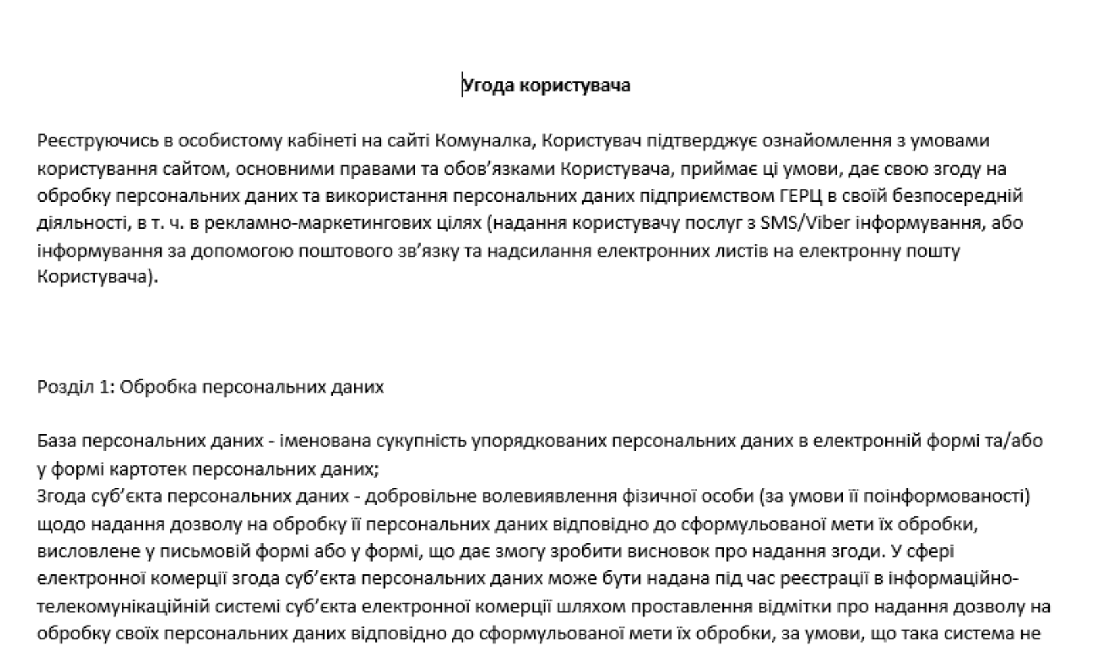
The second document (Figure 4) is a user agreement outlining the terms and conditions for the usage of the payment platform komunalka[.]ua.

Figure 4: Decoy document Угода користувача.docx (User Agreement.docx)

The use of relevant decoy documents as part of the phishing and delivery activity are likely an effort by FlyingYeti operators to increase the appearance of legitimacy of their activities.

The phishing theme we identified in this campaign is likely one of many themes leveraged by this actor in a larger operation to target Ukrainian entities, in particular their defense forces. In fact, the threat activity we detailed in this blog uses many of the same techniques outlined in a recent FlyingYeti campaign disclosed by CERT-UA in mid-April 2024, where the actor leveraged United Nations-themed lures involving Peace Support Operations to target Ukraine’s military. Due to Cloudforce One’s defensive actions covered in the next section, this latest FlyingYeti campaign was prevented as of the time of publication.

Mitigating FlyingYeti activity

Cloudforce One mitigated FlyingYeti’s campaign through a series of actions. Each action was taken to increase the actor’s cost of continuing their operations. When assessing which action to take and why, we carefully weighed the pros and cons in order to provide an effective active defense strategy against this actor. Our general goal was to increase the amount of time the threat actor spent trying to develop and weaponize their campaign.

We were able to successfully extend the timeline of the threat actor’s operations from hours to weeks. At each interdiction point, we assessed the impact of our mitigation to ensure the actor would spend more time attempting to launch their campaign. Our mitigation measures disrupted the actor’s activity, in one instance resulting in eight additional hours spent on debugging code.

Due to our proactive defense efforts, FlyingYeti operators adapted their tactics multiple times in their attempts to launch the campaign. The actor originally intended to have the Cloudflare Worker fetch the malicious RAR file from GitHub. After Cloudforce One interdiction of the Worker, the actor attempted to create additional Workers via a new account. In response, we disabled all Workers, leading the actor to load the RAR file directly from GitHub. Cloudforce One notified GitHub, resulting in the takedown of the RAR file, the GitHub project, and suspension of the account used to host the RAR file. In return, FlyingYeti began testing the option to host the RAR file on the file sharing sites pixeldrain and Filemail, where we observed the actor alternating the link on the Komunalka phishing site between the following:

  • hxxps://pixeldrain[.]com/api/file/ZAJxwFFX?download=one
  • hxxps://1014.filemail[.]com/api/file/get?filekey=e_8S1HEnM5Rzhy_jpN6nL-GF4UAP533VrXzgXjxH1GzbVQZvmpFzrFA&pk_vid=a3d82455433c8ad11715865826cf18f6

We notified GitHub of the actor’s evolving tactics, and in response GitHub removed the Komunalka phishing site. After analyzing the files hosted on pixeldrain and Filemail, we determined the actor uploaded dummy payloads, likely to monitor access to their phishing infrastructure (FileMail logs IP addresses, and both file hosting sites provide view and download counts). At the time of publication, we did not observe FlyingYeti upload the malicious RAR file to either file hosting site, nor did we identify the use of alternative phishing or malware delivery methods.

A timeline of FlyingYeti’s activity and our corresponding mitigations can be found below.

Event timeline

Date Event Description
2024-04-18 12:18 Threat Actor (TA) creates a Worker to handle requests from a phishing site
2024-04-18 14:16 TA creates phishing site komunalka[.]github[.]io on GitHub
2024-04-25 12:25 TA creates a GitHub repo to host a RAR file
2024-04-26 07:46 TA updates the first Worker to handle requests from users visiting komunalka[.]github[.]io
2024-04-26 08:24 TA uploads a benign test RAR to the GitHub repo
2024-04-26 13:38 Cloudforce One identifies a Worker receiving requests from users visiting komunalka[.]github[.]io, observes its use as a phishing page
2024-04-26 13:46 Cloudforce One identifies that the Worker fetches a RAR file from GitHub (the malicious RAR payload is not yet hosted on the site)
2024-04-26 19:22 Cloudforce One creates a detection to identify the Worker that fetches the RAR
2024-04-26 21:13 Cloudforce One deploys real-time monitoring of the RAR file on GitHub
2024-05-02 06:35 TA deploys a weaponized RAR (CVE-2023-38831) to GitHub with their COOKBOX malware packaged in the archive
2024-05-06 10:03 TA attempts to update the Worker with link to weaponized RAR, the Worker is immediately blocked
2024-05-06 10:38 TA creates a new Worker, the Worker is immediately blocked
2024-05-06 11:04 TA creates a new account (#2) on Cloudflare
2024-05-06 11:06 TA creates a new Worker on account #2 (blocked)
2024-05-06 11:50 TA creates a new Worker on account #2 (blocked)
2024-05-06 12:22 TA creates a new modified Worker on account #2
2024-05-06 16:05 Cloudforce One disables the running Worker on account #2
2024-05-07 22:16 TA notices the Worker is blocked, ceases all operations
2024-05-07 22:18 TA deletes original Worker first created to fetch the RAR file from the GitHub phishing page
2024-05-09 19:28 Cloudforce One adds phishing page komunalka[.]github[.]io to real-time monitoring
2024-05-13 07:36 TA updates the github.io phishing site to point directly to the GitHub RAR link
2024-05-13 17:47 Cloudforce One adds COOKBOX C2 postdock[.]serveftp[.]com to real-time monitoring for DNS resolution
2024-05-14 00:04 Cloudforce One notifies GitHub to take down the RAR file
2024-05-15 09:00 GitHub user, project, and link for RAR are no longer accessible
2024-05-21 08:23 TA updates Komunalka phishing site on github.io to link to pixeldrain URL for dummy payload (pixeldrain only tracks view and download counts)
2024-05-21 08:25 TA updates Komunalka phishing site to link to FileMail URL for dummy payload (FileMail tracks not only view and download counts, but also IP addresses)
2024-05-21 12:21 Cloudforce One downloads PixelDrain document to evaluate payload
2024-05-21 12:47 Cloudforce One downloads FileMail document to evaluate payload
2024-05-29 23:59 GitHub takes down Komunalka phishing site
2024-05-30 13:00 Cloudforce One publishes the results of this investigation

Coordinating our FlyingYeti response

Cloudforce One leveraged industry relationships to provide advanced warning and to mitigate the actor’s activity. To further protect the intended targets from this phishing threat, Cloudforce One notified and collaborated closely with GitHub’s Threat Intelligence and Trust and Safety Teams. We also notified CERT-UA and Cloudflare industry partners such as CrowdStrike, Mandiant/Google Threat Intelligence, and Microsoft Threat Intelligence.

Hunting FlyingYeti operations

There are several ways to hunt FlyingYeti in your environment. These include using PowerShell to hunt for WinRAR files, deploying Microsoft Sentinel analytics rules, and running Splunk scripts as detailed below. Note that these detections may identify activity related to this threat, but may also trigger unrelated threat activity.

PowerShell hunting

Consider running a PowerShell script such as this one in your environment to identify exploitation of CVE-2023-38831. This script will interrogate WinRAR files for evidence of the exploit.

CVE-2023-38831
Description:winrar exploit detection 
open suspios (.tar / .zip / .rar) and run this script to check it 

function winrar-exploit-detect(){
$targetExtensions = @(".cmd" , ".ps1" , ".bat")
$tempDir = [System.Environment]::GetEnvironmentVariable("TEMP")
$dirsToCheck = Get-ChildItem -Path $tempDir -Directory -Filter "Rar*"
foreach ($dir in $dirsToCheck) {
    $files = Get-ChildItem -Path $dir.FullName -File
    foreach ($file in $files) {
        $fileName = $file.Name
        $fileExtension = [System.IO.Path]::GetExtension($fileName)
        if ($targetExtensions -contains $fileExtension) {
            $fileWithoutExtension = [System.IO.Path]::GetFileNameWithoutExtension($fileName); $filename.TrimEnd() -replace '\.$'
            $cmdFileName = "$fileWithoutExtension"
            $secondFile = Join-Path -Path $dir.FullName -ChildPath $cmdFileName
            
            if (Test-Path $secondFile -PathType Leaf) {
                Write-Host "[!] Suspicious pair detected "
                Write-Host "[*]  Original File:$($secondFile)" -ForegroundColor Green 
                Write-Host "[*] Suspicious File:$($file.FullName)" -ForegroundColor Red

                # Read and display the content of the command file
                $cmdFileContent = Get-Content -Path $($file.FullName)
                Write-Host "[+] Command File Content:$cmdFileContent"
            }
        }
    }
}
}
winrar-exploit-detect

Microsoft Sentinel

In Microsoft Sentinel, consider deploying the rule provided below, which identifies WinRAR execution via cmd.exe. Results generated by this rule may be indicative of attack activity on the endpoint and should be analyzed.

DeviceProcessEvents
| where InitiatingProcessParentFileName has @"winrar.exe"
| where InitiatingProcessFileName has @"cmd.exe"
| project Timestamp, DeviceName, FileName, FolderPath, ProcessCommandLine, AccountName
| sort by Timestamp desc

Splunk

Consider using this script in your Splunk environment to look for WinRAR CVE-2023-38831 execution on your Microsoft endpoints. Results generated by this script may be indicative of attack activity on the endpoint and should be analyzed.

| tstats `security_content_summariesonly` count min(_time) as firstTime max(_time) as lastTime from datamodel=Endpoint.Processes where Processes.parent_process_name=winrar.exe `windows_shells` OR Processes.process_name IN ("certutil.exe","mshta.exe","bitsadmin.exe") by Processes.dest Processes.user Processes.parent_process_name Processes.parent_process Processes.process_name Processes.process Processes.process_id Processes.parent_process_id 
| `drop_dm_object_name(Processes)` 
| `security_content_ctime(firstTime)` 
| `security_content_ctime(lastTime)` 
| `winrar_spawning_shell_application_filter`

Cloudflare product detections

Cloudflare Email Security

Cloudflare Email Security (CES) customers can identify FlyingYeti threat activity with the following detections.

  • CVE-2023-38831
  • FLYINGYETI.COOKBOX
  • FLYINGYETI.COOKBOX.Launcher
  • FLYINGYETI.Rar

Recommendations

Cloudflare recommends taking the following steps to mitigate this type of activity:

  • Implement Zero Trust architecture foundations:    
  • Deploy Cloud Email Security to ensure that email services are protected against phishing, BEC and other threats
  • Leverage browser isolation to separate messaging applications like LinkedIn, email, and Signal from your main network
  • Scan, monitor and/or enforce controls on specific or sensitive data moving through your network environment with data loss prevention policies
  • Ensure your systems have the latest WinRAR and Microsoft security updates installed
  • Consider preventing WinRAR files from entering your environment, both at your Cloud Email Security solution and your Internet Traffic Gateway
  • Run an Endpoint Detection and Response (EDR) tool such as CrowdStrike or Microsoft Defender for Endpoint to get visibility into binary execution on hosts
  • Search your environment for the FlyingYeti indicators of compromise (IOCs) shown below to identify potential actor activity within your network.

If you’re looking to uncover additional Threat Intelligence insights for your organization or need bespoke Threat Intelligence information for an incident, consider engaging with Cloudforce One by contacting your Customer Success manager or filling out this form.

Indicators of Compromise

Filename SHA256 Hash Description
Заборгованість по ЖКП.rar a0a294f85c8a19be048ffcc05ede6fd5a7ac5e2f0032a3ca0050dc1ae960c314 RAR archive
Рахунок на оплату.pdf
                                                                                 .cmd
0cca8f795c7a81d33d36d5204fcd9bc73bdc2af7de315c1449cbc3551ef4fb59 COOKBOX Sample (contained in RAR archive)
Реструктуризація боргу за житлово комунальні послуги.docx 915721b94e3dffa6cef3664532b586be6cf989fec923b26c62fdaf201ee81d2c Benign Word Document with Tracking Link (contained in RAR archive)
Угода користувача.docx 79a9740f5e5ea4aa2157d9d96df34ee49a32e2d386fe55fedfd1aa33e151c06d Benign Word Document with Tracking Link (contained in RAR archive)
Рахунок на оплату.pdf 19e25456c2996ded3e29577b609de54a2bef90dad8f868cdad795c18df05a79b Random Binary Data (contained in RAR archive)
Заборгованість по ЖКП станом на 26.04.24.docx e0d65e2d36afd3db1b603f10e0488cee3f58ade24d8abc6bee240314d8696708 Random Binary Data (contained in RAR archive)
Domain / URL Description
komunalka[.]github[.]io Phishing page
hxxps[:]//github[.]com/komunalka/komunalka[.]github[.]io Phishing page
hxxps[:]//worker-polished-union-f396[.]vqu89698[.]workers[.]dev Worker that fetches malicious RAR file
hxxps[:]//raw[.]githubusercontent[.]com/kudoc8989/project/main/Заборгованість по ЖКП.rar Delivery of malicious RAR file
hxxps[:]//1014[.]filemail[.]com/api/file/get?filekey=e_8S1HEnM5Rzhy_jpN6nL-GF4UAP533VrXzgXjxH1GzbVQZvmpFzrFA&pk_vid=a3d82455433c8ad11715865826cf18f6 Dummy payload
hxxps[:]//pixeldrain[.]com/api/file/ZAJxwFFX?download= Dummy payload
hxxp[:]//canarytokens[.]com/stuff/tags/ni1cknk2yq3xfcw2al3efs37m/payments.js Tracking link
hxxp[:]//canarytokens[.]com/stuff/terms/images/k22r2dnjrvjsme8680ojf5ccs/index.html Tracking link
postdock[.]serveftp[.]com COOKBOX C2

Introducing Cloudforce One: our new threat operations and research team

Post Syndicated from Blake Darché original https://blog.cloudflare.com/introducing-cloudforce-one-threat-operations-and-threat-research/

Introducing Cloudforce One: our new threat operations and research team

This post is also available in 简体中文, 日本語, Deutsch, Français and Español.

Meet our new threat operations and research team: Cloudforce One. While this team will publish research, that’s not its reason for being. Its primary objective: track and disrupt threat actors.

The security teams we speak with tell us the same thing: they’re inundated with reports from threat intelligence and security product vendors that do little to improve their actual security. The stories are indeed interesting, but they want deeper insights into the techniques and actors targeting their industry—but even more than that, they want to be protected against these threats with minimal to no involvement. That is the mission on which Cloudforce One will deliver.

Introducing Cloudforce One: our new threat operations and research team

This team is led by me, Blake Darché, Area 1’s co-founder and former head of Threat Intelligence. Before starting Area 1, which was acquired by Cloudflare earlier this year, I was a founding member of CrowdStrike’s services organization, and before that a Computer Network Exploitation Analyst at the National Security Agency (NSA). My career has focused on identifying and disrupting sophisticated nation-state sponsored cyber threats before they compromise enterprises and governments, and I’m excited to accelerate that work at Cloudflare.

The Cloudforce One team comprises analysts assigned to Threat Research, Malware and Vulnerability Research, and Threat Operations (i.e., disrupting actors once identified). Collectively, members of the team have tracked many of the most sophisticated cyber criminals on the Internet while at the National Security Agency and Area 1 Security, and have worked closely with similar organizations and governments to disrupt these threat actors. They’ve also been prolific in publishing “finished intel” reports on security topics of significant geopolitical importance, such as targeted attacks against governments, technology companies, the energy sector, and law firms, and have regularly briefed top organizations around the world on their efforts. Oh, and we’re growing the team, so please reach out if you’re interested.

How will Cloudforce One work?

First and foremost, the team will help protect all Cloudflare customers by working closely with our existing product, engineering, and security teams to improve our products based on tactics, techniques, and procedures (TTPs) observed in the wild. Customers will get better protection without having to take any action, and will be able to read a subset of research published on our blog and within the Cloudflare Security Center.

Additionally, enterprise customers who wish to receive one-on-one live briefings from the team, submit periodic inquiries for follow-up, and obtain early access to threat research, will soon be able to sign up for our new Threat Intelligence subscription. All other enterprise customers will be invited to join periodic group briefings.

Lastly, new capabilities within Security Center, such as access to historical threat data via API and threat pivoting features, will also be introduced by the dedicated threat intel engineering team paired with Cloudforce One.

Getting started

If you’re looking to benefit from the insights uncovered by Cloudforce One, there is nothing you need to do. But if you’re interested in receiving regular briefings from Cloudforce One tailored to your industry, contact your Customer Success manager today or fill out this form and someone will be in touch. Finally, if you’re interested in joining the team, check out our open job postings here.