Connect your data for faster decisions with AWS

Post Syndicated from Rahul Pathak original https://aws.amazon.com/blogs/big-data/connect-your-data-for-faster-decisions-with-aws/

The most impactful data-driven insights come from connecting the dots between all your data sources—across departments, services, on-premises tools, and third-party applications. But typically, connecting data requires complex extract, transform, and load (ETL) pipelines, taking hours or days. That’s too slow for decision-making speed. ETL needs to be easier and sometimes eliminated.

AWS is investing in addressing this in several ways. First, for common use cases where ETL is repeated with little value-add, we’re integrating services to decrease or eliminate the need for ETL. Second, organizations still need transformations like cleansing, deduplication, and combining datasets for analysis and machine learning (ML). For these, AWS Glue provides fast, scalable data transformation. Third, AWS continues adding support for more data sources including connections to software as a service (SaaS) applications, on-premises applications, and other clouds so organizations can act on their data.

In this post, we discuss how we’re delivering on these investments with a number of data integration innovations that span AWS databases, analytics, business intelligence (BI), and ML services.

Amazon Aurora MySQL zero-ETL integration with Amazon Redshift is now generally available
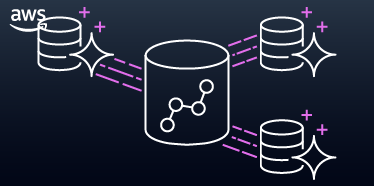
In June 2023, we announced the public preview of Amazon Aurora MySQL-Compatible Edition zero-ETL integration with Amazon Redshift. We are thrilled to announce that this zero-ETL integration is now generally available. Amazon Aurora MySQL zero-ETL integration with Amazon Redshift processes over 1 million transactions per minute, enabling near-real-time analytics. Within seconds of new data coming into Amazon Aurora MySQL, the data is replicated to Amazon Redshift. Updates in Amazon Aurora MySQL are automatically and continuously propagated to Amazon Redshift. Customers and partners can derive tremendous time savings by reducing traditional ETL bottlenecks. They can now analyze business metrics in near-real time and make data-driven decisions faster than ever before.

In the retail industry, for example, Infosys wanted to gain faster insights about their business, such as best-selling products and high-revenue stores, based on transactions in a store management system. They used Amazon Aurora MySQL zero-ETL integration with Amazon Redshift to achieve this. With this integration, Infosys replicated Aurora data to Amazon Redshift and created Amazon QuickSight dashboards for product managers and channel leaders in just a few seconds, instead of several hours. Now, as part of Infosys Cobalt and Infosys Topaz blueprints, enterprises can have near real-time analytics on transactional data, which can help them make informed decisions related to store management.

– Sunil Senan, SVP and Global Head of Data, Analytics, and AI, Infosys

Amazon SageMaker Canvas integration with Amazon QuickSight

We are empowering business analysts to create predictive, interactive dashboards by connecting Amazon SageMaker Canvas, our no-code ML service, with Amazon QuickSight, our BI service. Business analysts use SageMaker Canvas to build ML models and generate predictions without needing to write code. They can then seamlessly integrate these predictions in QuickSight to create interactive dashboards that can be shared across their organization. This enables democratization of predictive insights for better decision-making.

Moreover, we have enabled deep, bidirectional integration between SageMaker Canvas and QuickSight. Business analysts can send ML models from SageMaker Canvas to QuickSight and run predictions from within QuickSight. Analysts can now also directly send data from QuickSight to SageMaker Canvas with just a few clicks to rapidly build ML models using a simple point-and-click interface, without needing to create or maintain complex data pipelines between the two services. This integration empowers users to go from data to predictions and visualizations faster than ever.

Connecting to SaaS applications

AWS services already connect to hundreds of AWS and third-party data sources. Data engineers can use services such as Amazon AppFlow and AWS Glue to make data quickly accessible from diverse sources. This enables organizations to derive unified insights across siloed datasets. We recently added new Amazon AppFlow and AWS Glue integrations to our existing portfolio.

Amazon AppFlow now supports concurrent processing for data transfers from SAP applications

Amazon AppFlow, a fully managed integration service that helps you securely transfer data between AWS services and SaaS applications, now supports concurrent processing and configurable page sizes for faster data transfers from SAP. This reduces the time taken to move SAP data into AWS data and artificial intelligence (AI) services.

Google BigQuery connectivity for AWS Glue for Apache Spark is now generally available

AWS Glue for Apache Spark has added native connectivity to Google BigQuery, enabling reading and writing of BigQuery data directly without the need to install or manage libraries. You can now add BigQuery as a source or target in AWS Glue Studio’s visual interface or directly in an AWS Glue ETL script.

Summary

The data integration innovations we have highlighted show our commitment to empowering organizations to easily connect their data. Whether it’s achieving near-real-time insights, democratizing predictive analytics, or connecting diverse data sources, we are focused on helping you derive more value from your data. With the new capabilities of Amazon Aurora MySQL, Amazon Redshift, SageMaker Canvas, QuickSight, Amazon AppFlow, and AWS Glue, data engineers and business analysts can break down data silos to uncover insights.

Visit Data integration with AWS to learn more.


About the authors

Rahul Pathak is VP of Relational Database Engines, leading Amazon Aurora, Amazon Redshift, and Amazon QLDB. Prior to his current role, he was VP of Analytics at AWS, where he worked across the entire AWS database portfolio. He has co-founded two companies, one focused on digital media analytics and the other on IP-geolocation.

G2 Krishnamoorthy is VP of Analytics, leading AWS data lake services, data integration, Amazon OpenSearch Service, and Amazon QuickSight. Prior to his current role, G2 built and ran the Analytics and ML Platform at Facebook/Meta, and built various parts of the SQL Server database, Azure Analytics, and Azure ML at Microsoft.

Amazon Aurora MySQL zero-ETL integration with Amazon Redshift is now generally available

Post Syndicated from Donnie Prakoso original https://aws.amazon.com/blogs/aws/amazon-aurora-mysql-zero-etl-integration-with-amazon-redshift-is-now-generally-available/

“Data is at the center of every application, process, and business decision,” wrote Swami Sivasubramanian, VP of Database, Analytics, and Machine Learning at AWS, and I couldn’t agree more. A common pattern customers use today is to build data pipelines to move data from Amazon Aurora to Amazon Redshift. These solutions help them gain insights to grow sales, reduce costs, and optimize their businesses.

To help you focus on creating value from data instead of preparing data for analysis, we announced Amazon Aurora zero-ETL integration with Amazon Redshift at AWS re:Invent 2022 and in public preview for Amazon Aurora MySQL-Compatible Edition in June 2023.

Now generally available: Amazon Aurora MySQL zero-ETL integration with Amazon Redshift
Today, we announced the general availability of Amazon Aurora MySQL zero-ETL integration with Amazon Redshift. With this fully managed solution, you no longer need to build and maintain complex data pipelines in order to derive time-sensitive insights from your transactional data to inform critical business decisions.

This zero-ETL integration between Amazon Aurora and Amazon Redshift unlocks opportunities for you to run near real-time analytics and machine learning (ML) on petabytes of transactional data in Amazon Redshift. As this data gets written into Aurora, it will be available in Amazon Redshift within seconds.

It also enables you to run consolidated analytics from multiple Aurora MySQL database clusters in Amazon Redshift to derive holistic insights across many applications or partitions. Amazon Aurora MySQL zero-ETL integration with Amazon Redshift processes over 1 million transactions per minute (an equivalent of 17.5 million insert/update/delete row operations per minute) from multiple Aurora databases and makes them available in Amazon Redshift in less than 15 seconds (p50 latency lag).

Furthermore, you can take advantage of the analytics and built-in ML capabilities of Amazon Redshift, such as materialized views, cross-Region data sharing, and federated access to multiple data stores and data lakes.

Let’s get started
In this article, I’ll highlight some steps along with information on how you can get started easily. I will use my existing Amazon Aurora MySQL serverless database and Amazon Redshift data warehouse.

To get started, I need to navigate to Amazon RDS and select Create zero-ETL integration on the Zero-ETL integrations page.

On the Create zero-ETL integration page, I need to follow a few steps to configure the integration for my Amazon Aurora database cluster and my Amazon Redshift data warehouse.

First, I define an identifier for my integration and select Next.

On the next page, I need to select the source database by selecting Browse RDS databases.

Here, I can select my existing database as the source.

The next step asks me the target Amazon Redshift data warehouse. Here, I have the flexibility to choose the Amazon Redshift Serverless or RA3 data warehouse in my account or in different account. I select Browse Redshift data warehouses.

Then, I choose the target data warehouse.

Because Amazon Aurora needs to replicate into the data warehouse, we need to add an additional resource policy and add the Aurora database as an authorized integration source in the Amazon Redshift data warehouse.

I can solve this by manually updating in the Amazon Redshift console or let Amazon RDS fix it for me. I tick the checkbox.

On the next page, it shows me the changes that Amazon RDS will perform for us. I select Continue.

On the next page, I can configure the tags and also the encryption. By default, zero-ETL integration encrypts your data using AWS Key Management Service (AWS KMS), and I have the option to use my own key.

Then, I need to review all the configurations and select Create zero-ETL integration to create the integration.

After a few minutes, my zero-ETL integration is sucessfully created. Then, I switch to Amazon Redshift, and on the Zero-ETL integrations page, I can see that I have my recently created zero-ETL integration.

Since the integration does not yet have a target database inside Amazon Redshift, I need to create one.

Now the integration configuration is complete. On this page, I can see the integration status is active, and there is one table that has been replicated.

For testing, I create a new table in my Amazon Aurora database and insert a record into this table.

Then I switched to the Redshift query editor v2 inside Amazon Redshift. Here I can make a connection to the database that I formed as part of the integration. By running a simple query, I can see that my data is already available inside Amazon Redshift.

I found this zero-ETL integration very convenient for two reasons. First, I could unify all data from multiple database clusters together and analyze it in aggregate. Second, within seconds of the transactional data being written into Amazon Aurora MySQL, this zero-ETL integration seamlessly made the data available in Amazon Redshift.

Things to know

Availability – Amazon Aurora zero-ETL integration with Amazon Redshift is available in US East (Ohio), US East (N. Virginia), US West (Oregon), Asia Pacific (Singapore), Asia Pacific (Sydney), Asia Pacific (Tokyo), Europe (Frankfurt), Europe (Ireland), and Europe (Stockholm).

Supported Database Engines – Amazon Aurora zero-ETL Integration with Amazon Redshift currently supports MySQL-compatible editions of Amazon Aurora. Support for Amazon Aurora PostgreSQL-Compatible Edition is a work in progress.

Pricing –  Amazon Aurora zero-ETL integration with Amazon Redshift is provided at no additional cost. You pay for existing Amazon Aurora and Amazon Redshift resources used to create and process the change data created as part of a zero-ETL integration.

We’re one step closer to helping you focus more on creating value from data instead of preparing it for analysis. To learn more on how to get started, please visit the Amazon Aurora MySQL zero-ETL integration with Amazon Redshift page.

Happy integrating!
— Donnie

New – Create application-consistent snapshots using Amazon Data Lifecycle Manager and custom scripts

Post Syndicated from Jeff Barr original https://aws.amazon.com/blogs/aws/new-create-application-consistent-snapshots-using-amazon-data-lifecycle-manager-and-custom-scripts/

Amazon Data Lifecycle Manager now supports the use of pre-snapshot and post-snapshot scripts embedded in AWS Systems Manager documents. You can use these scripts to ensure that Amazon Elastic Block Store (Amazon EBS) snapshots created by Data Lifecycle Manager are application-consistent. Scripts can pause and resume I/O operations, flush buffered data to EBS volumes, and so forth. As part of this launch we are also publishing a set of detailed blog posts that show you how to use this feature with self-managed relational databases and Windows Volume Shadow Copy Service (VSS).

Data Lifecycle Manager (DLM) Recap
As a quick recap, Data Lifecycle Manager helps you to automate the creation, retention, and deletion of Amazon EBS volume snapshots. Once you have completed the prerequisite steps such as onboarding your EC2 instance to AWS Systems Manager, setting up an IAM role for DLM, and tagging your SSM documents, you simply create a lifecycle policy and indicate (via tags) the applicable Amazon Elastic Compute Cloud (Amazon EC2) instances, set a retention model, and let DLM do the rest. The policies specify when they are to be run, what is to be backed up, and how long the snapshots must be retained. For a full walk-through of DLM, read my 2018 blog post, New – Lifecycle Management for Amazon EBS Snapshots.

Application Consistent Snapshots
EBS snapshots are crash-consistent, meaning that they represent the state of the associated EBS volume at the time that the snapshot was created. This is sufficient for many types of applications, including those that do not use snapshots to capture the state of an active relational database. To make a snapshot that is application-consistent, it is necessary to take pending transactions into account (either waiting for them to finish or causing them to fail), momentarily pause further write operations, take the snapshot, and then resume normal operations.

And that’s where today’s launch comes in. DLM now has the ability to tell the instance to prepare for an application-consistent backup. The pre-snapshot script can manage pending transactions, flush in-memory data to persistent storage, freeze the filesystem, or even bring the application or database to a stop. Then the post-snapshot script can bring the application or database back to life, reload in-memory caches from persistent storage, thaw the filesystem, and so forth.

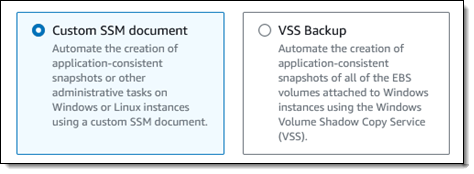
In addition to the base-level support for custom scripts, you can also use this feature to automate the creation of VSS Backup snapshots:

Pre and Post Scripts
The new scripts apply to DLM policies for instances. Let’s assume that I have created a policy that references SSM documents with pre-snapshot and post-snapshot scripts, and that it applies to a single instance. Here’s what happens when the policy is run per its schedule:

  1. The pre-snapshot script is started from the SSM document.
  2. Each command in the script is run and the script-level status (success or failure) is captured. If enabled in the policy, DLM will retry failed scripts.
  3. Multi-volume EBS snapshots are initiated for EBS volumes attached to the instance, with further control via the policy.
  4. The post-snapshot script is started from the SSM document,
  5. Each command in the script is run and and the script-level status (success or failure) is captured.

The policy contains options that give you control over the actions that are taken (retry, continue, or skip) when either of the scripts times out or fails. The status is logged, Amazon CloudWatch metrics are published, Amazon EventBridge events are emitted, and the status is also encoded in tags that are automatically assigned to each snapshot.

The pre-snapshot and post-snapshot scripts can perform any of the actions that are allowed in a command document: running shell scripts, running PowerShell scripts, and so forth. The actions must complete within the timeout specified in the policy, with an allowable range of 10 seconds to 120 seconds.

Getting Started
You will need to have a detailed understanding of your application or database in order to build a robust pair of scripts. In addition to handling the “happy path” when all goes well, your scripts need to plan for several failure scenarios. For example, a pre-snapshot script should fork a background task that will serve as a failsafe in case the post-snapshot script does not work as expected. Each script must return a shell-level status code, as detailed here.

Once I have written and tested my scripts and packaged them as SSM documents, I open the Data Lifecycle Manager page in the EC2 Console, select EBS snapshot policy, and click Next step:

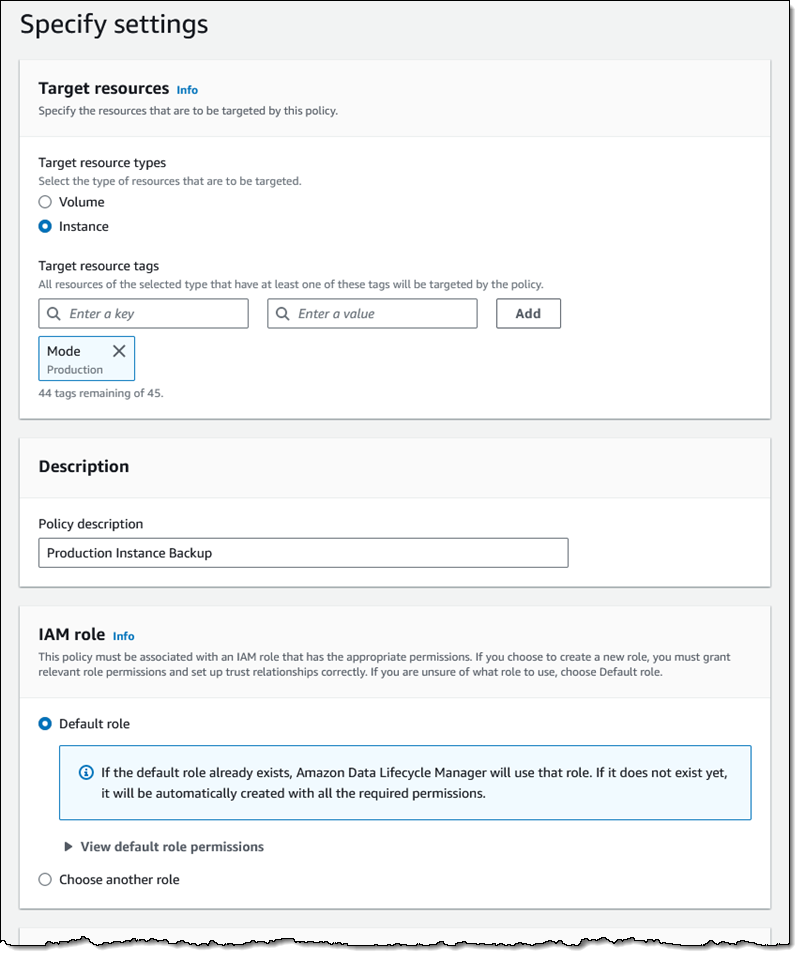
I target all of my instances that are tagged with a Mode of Production, and use the default IAM role (if you use a different role, it must enable access to SSM), leave the rest of the values as-is, and proceed:

On the next page I scroll down to Pre and post scripts and expand the section. I click Enable pre and post scripts, choose Custom SSM document, and then select my SSM document from the menu. I also set the timeout and retry options, and choose to default to a crash-consistent backup if one of my scripts fails. I click Review policy, do one final check, and click Create policy on the following page:

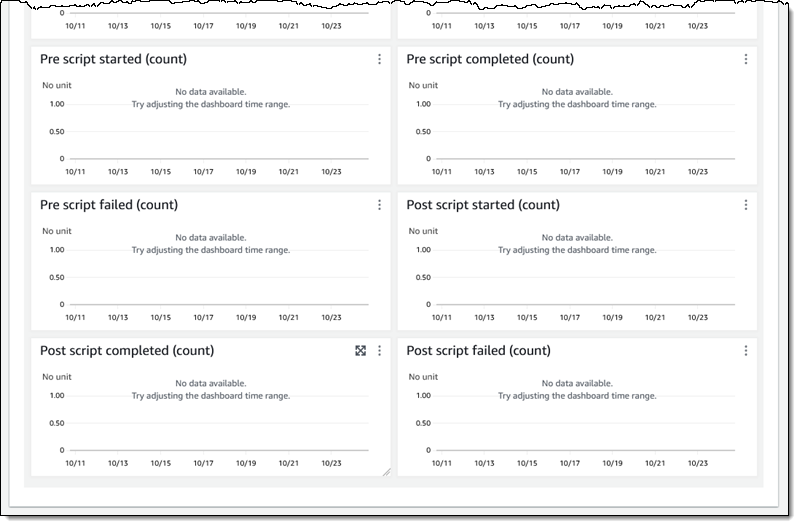
My policy is created, and will take effect right away. After it has run at least once, I can inspect the CloudWatch metrics to check for starts, completions, and failures:

Additional Reading
Here are the first of the detailed blog posts that I promised you earlier:

We have more in the works for later this year and I will update the list above when they are published.

You can also read the documentation to learn more.

DLM Videos
While I’ve got your attention, I would like to share a couple of helpful videos with you:

This new feature is available now and you can start using it today!

— Jeff;

[$] Progress in wrangling the Python C API

Post Syndicated from jake original https://lwn.net/Articles/950457/

There has been a lot of action for the Python C API in the last month or
so—much of it organizational in nature. As predicted in our late September article on using the “limited”
C API in the standard library, the core developer sprint in October was the
scene of some discussions about the API and the plans for it. Out
of those discussions have come two PEPs, one of which describes the API,
its purposes, strengths, and weaknesses, while the other would establish a C
API working group to coordinate and oversee the development and maintenance
of it.

AWS KMS is now FIPS 140-2 Security Level 3. What does this mean for you?

Post Syndicated from Rushir Patel original https://aws.amazon.com/blogs/security/aws-kms-now-fips-140-2-level-3-what-does-this-mean-for-you/

AWS Key Management Service (AWS KMS) recently announced that its hardware security modules (HSMs) were given Federal Information Processing Standards (FIPS) 140-2 Security Level 3 certification from the U.S. National Institute of Standards and Technology (NIST). For organizations that rely on AWS cryptographic services, this higher security level validation has several benefits, including simpler set up and operation. In this post, we will share more details about the recent change in FIPS validation status for AWS KMS and explain the benefits to customers using AWS cryptographic services as a result of this change.

Background on NIST FIPS 140

The FIPS 140 framework provides guidelines and requirements for cryptographic modules that protect sensitive information. FIPS 140 is the industry standard in the US and Canada and is recognized around the world as providing authoritative certification and validation for the way that cryptographic modules are designed, implemented, and tested against NIST cryptographic security guidelines.

Organizations follow FIPS 140 to help ensure that their cryptographic security is aligned with government standards. FIPS 140 validation is also required in certain fields such as manufacturing, healthcare, and finance and is included in several industry and regulatory compliance frameworks, such as the Payment Card Industry Data Security Standard (PCI DSS), the Federal Risk and Authorization Management Program (FedRAMP), and the Health Information Trust Alliance (HITRUST) framework. FIPS 140 validation is recognized in many jurisdictions around the world, so organizations that operate globally can use FIPS 140 certification internationally.

For more information on FIPS Security Levels and requirements, see FIPS Pub 140-2: Security Requirements for Cryptographic Modules.

What FIPS 140-2 Security Level 3 means for AWS KMS and you

Until recently, AWS KMS had been validated at Security Level 2 overall and at Security Level 3 in the following four sub-categories:

  • Cryptographic module specification
  • Roles, services, and authentication
  • Physical security
  • Design assurance

The latest certification from NIST means that AWS KMS is now validated at Security Level 3 overall in each sub-category. As a result, AWS assumes more of the shared responsibility model, which will benefit customers for certain use cases. Security Level 3 certification can assist organizations seeking compliance with several industry and regulatory standards. Even though FIPS 140 validation is not expressly required in a number of regulatory regimes, maintaining stronger, easier-to-use encryption can be a powerful tool for complying with FedRAMP, U.S. Department of Defense (DOD) Approved Product List (APL), HIPAA, PCI, the European Union’s General Data Protection Regulation (GDPR), and the ISO 27001 standard for security management best practices and comprehensive security controls.

Customers who previously needed to meet compliance requirements for FIPS 140-2 Level 3 on AWS were required to use AWS CloudHSM, a single-tenant HSM solution that provides dedicated HSMs instead of managed service HSMs. Now, customers who were using CloudHSM to help meet their compliance obligations for Level 3 validation can use AWS KMS by itself for key generation and usage. Compared to CloudHSM, AWS KMS is typically lower cost and easier to set up and operate as a managed service, and using AWS KMS shifts the responsibility for creating and controlling encryption keys and operating HSMs from the customer to AWS. This allows you to focus resources on your core business instead of on undifferentiated HSM infrastructure management tasks.

AWS KMS uses FIPS 140-2 Level 3 validated HSMs to help protect your keys when you request the service to create keys on your behalf or when you import them. The HSMs in AWS KMS are designed so that no one, not even AWS employees, can retrieve your plaintext keys. Your plaintext keys are never written to disk and are only used in volatile memory of the HSMs while performing your requested cryptographic operation.

The FIPS 140-2 Level 3 certified HSMs in AWS KMS are deployed in all AWS Regions, including the AWS GovCloud (US) Regions. The China (Beijing) and China (Ningxia) Regions do not support the FIPS 140-2 Cryptographic Module Validation Program. AWS KMS uses Office of the State Commercial Cryptography Administration (OSCCA) certified HSMs to protect KMS keys in China Regions. The certificate for the AWS KMS FIPS 140-2 Security Level 3 validation is available on the NIST Cryptographic Module Validation Program website.

As with many industry and regulatory frameworks, FIPS 140 is evolving. NIST approved and published a new updated version of the 140 standard, FIPS 140-3, which supersedes FIPS 140-2. The U.S. government has begun transitioning to the FIPS 140-3 cryptography standard, with NIST announcing that they will retire all FIPS 140-2 certificates on September 22, 2026. NIST recently validated AWS-LC under FIPS 140-3 and is currently in the process of evaluating AWS KMS and certain instance types of AWS CloudHSM under the FIPS 140-3 standard. To check the status of these evaluations, see the NIST Modules In Process List.

For more information on FIPS 140-3, see FIPS Pub 140-3: Security Requirements for Cryptographic Modules.

Legal Disclaimer

This document is provided for the purposes of information only; it is not legal advice, and should not be relied on as legal advice. Customers are responsible for making their own independent assessment of the information in this document. This document: (a) is for informational purposes only, (b) represents current AWS product offerings and practices, which are subject to change without notice, and (c) does not create any commitments or assurances from AWS and its affiliates, suppliers or licensors. AWS products or services are provided “as is” without warranties, representations, or conditions of any kind, whether express or implied. The responsibilities and liabilities of AWS to its customers are controlled by AWS agreements, and this document is not part of, nor does it modify, any agreement between AWS and its customers.

AWS encourages its customers to obtain appropriate advice on their implementation of privacy and data protection environments, and more generally, applicable laws and other obligations relevant to their business.

AWS encourages its customers to obtain appropriate advice on their implementation of privacy and data protection environments, and more generally, applicable laws and other obligations relevant to their business.

If you have feedback about this post, submit comments in the Comments section below. If you have questions about this post, contact AWS Support.

Want more AWS Security news? Follow us on Twitter.

Rushir Patel

Rushir Patel

Rushir is a Senior Security Specialist at AWS, focused on data protection and cryptography services. His goal is to make complex topics simple for customers and help them adopt better security practices. Before joining AWS, he worked in security product management at IBM and Bank of America.

Rohit Panjala

Rohit Panjala

Rohit is a Worldwide Security GTM Specialist at AWS, focused on data protection and cryptography services. He is responsible for developing and implementing go-to-market (GTM) strategies and sales plays and driving customer and partner engagements for AWS data protection services on a global scale. Before joining AWS, Rohit worked in security product management and electrical engineering roles.

Anything as a Service: All the “as a Service” Acronyms You Didn’t Know You Needed

Post Syndicated from Molly Clancy original https://www.backblaze.com/blog/anything-as-a-service-all-the-as-a-service-acronyms-you-didnt-know-you-needed/

A decorative image showing acronyms for different "as as service" acronyms.

Have you ever felt like you need a dictionary just to understand what tech-savvy folks are talking about? Well, you’re in luck, because we’re about to decode some of the most common jargon of the digital age, one acronym at a time. Welcome to the world of “as a Service” acronyms, where we take the humble alphabet and turn it into a digital buffet. 

So, whether you’re SaaS-savvy or PaaS-puzzled, or just someone desperately searching for a little HaaS (Humor as a Service …yeah, we made that one up), you’ve come to the right place. Let’s take a big slurp from this alphabet soup of tech terms.

The One That Started It All: SaaS

SaaS stands for software as a service, and it’s the founding member of the “as a service” nomenclature. (Though, very confusingly, there’s also Sales as a Service—it’s just not shortened to SaaS. Usually.)

Imagine your software as a pizza delivery service. You don’t need to buy all the ingredients, knead the dough, and bake it yourself. Instead, you simply order a slice, and it magically appears on your table (a.k.a. screen). SaaS products are like that, but instead of pizza they serve up everything from messaging to video conferencing to email marketing to …well, really you name it. Which brings us to…

The Kind of Ironic One: XaaS

XaaS stands for, variously, “everything” or “anything” as a service. No one is really sure about the term’s provenance, but it’s a fair guess to say it came into existence when, well, everything started to become a service, probably sometime around the mid-2010s. The thinking is: if it exists in the digital realm, you can probably get it “as a service.” 

The Hardware Related Ones: HaaS, IaaS, and PaaS

HaaS (Hardware as a Service): Instead of purchasing hardware yourself, like computers, servers, networking equipment, and other physical infrastructure components, with HaaS, you can lease or rent the equipment for a given period. It would be like renting a pizza kitchen to make your specialty pies specifically for your sister’s wedding or your grandma’s birthday.

IaaS (Infrastructure as a Service): Infrastructure as a service is kind of like hardware as a service, but it comes with some additional goodies thrown in. Instead of renting just the kitchen, you rent the whole restaurant, chair, tables, and servers (no pun intended) included. IaaS delivers virtualized computing resources, like virtual machines, storage (that’s us!), and networking, over the internet.

PaaS (Platform as a Service): Think of PaaS as a step even further than IaaS—you’re not just renting a pizza restaurant, you’re renting a test kitchen where you can develop your award-winning pie. PaaS provides developers the ability to build, manage, and deploy applications with services like development frameworks, databases, and infrastructure management. It’s the ultimate DIY platform for tech enthusiasts.

The Bad One: RaaS

RaaS stands for Ransomware as a Service, and this is one “as a service” variant you don’t want to mess with. Basically, cybercriminals can purchase ransomware just as easily as you would purchase any app on the app store (it’s probably more complicated than that, but you get the general gist). This makes it easy for even the least savvy cybercriminal to get into the ransomware game. Not great. 

The Ones That Help With the Last One: BaaS and DRaaS

BaaS (Backup as a Service): Backup as a Service is a cloud-based data protection solution that allows individuals and organizations to back up their data to a remote cloud. (Hey! That’s us too!) Instead of managing on-premises backup infrastructure, users can securely store their data off-site, often on highly redundant and geographically distributed servers.

DRaaS (Disaster Recovery as a Service): DRaaS stands for disaster recovery as a service, and it’s the antidote to RaaS. Of course, you need good backups to begin with, but adding DRaaS allows businesses to ensure specific recovery time objectives (RTOs, FYI) so they can get back up and running in the event they’re attacked by ransomware or there’s a natural disaster at your primary storage location. DRaaS solutions used to be made almost exclusively with the large enterprise in mind, but today, it’s possible to architect a DRaaS solution for your business affordably and easily.

The Analytical One: DaaS

DaaS stands for data as a service, and it’s your data’s personal chauffeur. It fetches the information you need and serves it up on a silver platter. DaaS offers data on-demand, making structured data accessible to users over the internet. It simplifies data sharing and access, often in real-time, without the need for complex data management.

The Development-Focused Ones: CaaS, BaaS (again), and FaaS

CaaS (Containers as a Service): CaaS simplifies the deployment, scaling, and orchestration of containerized applications. It’s the tech version of a literal container ship. The individual containers “ship” individual pieces of software, and a CaaS tool helps carry all of those individual containers. Check out container management software Docker’s logo for a visualization:

It looks more like a whale carrying containers, which is far more adorable, in our opinion.

BaaS (Backend as a Service): It wouldn’t be the first time an acronym has two meanings. BaaS, in this context, provides a backend infrastructure for mobile and web app developers, offering services like databases, user authentication, and APIs. Imagine your own team of digital butlers tending to the back end of your apps. They handle all the behind-the-scenes stuff, so you can focus on making your app shine. 

FaaS (Function as a Service): FaaS is a serverless computing model where developers focus on writing and deploying individual functions or code snippets. These functions run in response to specific events, promoting scalability and efficiency in application development. It’s like having a team of tiny, code-savvy robots doing your bidding.

Go Forth and Abbreviate

Now that you’ve sampled all of the flavors the vast “as a service” world has to offer, we hope you’ve gained a clearer understanding of these sometimes confounding terms. So whether you’re a business professional navigating the cloud or just curious about the tech world, you can wield these acronyms with confidence. 

Did we miss any? I’m sure. Let us know in the comments.

The post Anything as a Service: All the “as a Service” Acronyms You Didn’t Know You Needed appeared first on Backblaze Blog | Cloud Storage & Cloud Backup.

Sponsorship for the Openwall lists

Post Syndicated from corbet original https://lwn.net/Articles/950538/

Alexander “Solar Designer” Peslyak, the longtime maintainer of the
oss-security and linux-distros mailing lists, has announced
that this work has gained a sponsor:

After 15+ years of being a 100% volunteer effort, Openwall’s
maintenance of oss-security and (linux-)distros is finally
sponsored by the OpenSSF, a project of the Linux Foundation. This
sponsorship does not provide the Linux Foundation with the ability
to set policies for community resources managed by Openwall. I am
grateful for the support, which will help ensure continued
operation of these resources on a new level while retaining
independence.

As part of this arrangement, Peslyak is now producing statistics on
vulnerability handling; the first
set for 2023
has been posted.

Fedora 39 released

Post Syndicated from corbet original https://lwn.net/Articles/950524/

Fedora
39
has been released, one day after the Fedora project’s 20th
anniversary. See the list of
approved changes
and this Fedora
Magazine article
for more information.

As always, we’ve updated many, many other packages as we work to
bring you the best of everything the free and open source software
world has to offer. Fedora Linux 39 includes gcc 13.2, binutils
2.40, glibc 2.38, gdb 13.2, and rpm 4.19. It also has updates to
popular programming language stacks, including Python 3.12 and Rust
1.73.

Security updates for Tuesday

Post Syndicated from corbet original https://lwn.net/Articles/950523/

Security updates have been issued by Debian (trapperkeeper-webserver-jetty9-clojure), Mageia (libsndfile, packages, thunderbird, and x11-server), Oracle (.NET 6.0), SUSE (kernel, kubevirt, virt-api-container, virt-controller-container, virt-handler-container, virt-launcher-container, virt-libguestfs-tools- container, virt-operator-container, redis, and squid), and Ubuntu (gsl).

New micro:bit coding projects for kids

Post Syndicated from Author original https://www.raspberrypi.org/blog/microbit-coding-projects/

Young people can now learn to code and create with our brand-new path of micro:bit coding projects. The ‘Intro to micro:bit’ path is free and kids can follow it to code projects that focus on wellbeing, including topics like mental health, relaxation, and exercise.

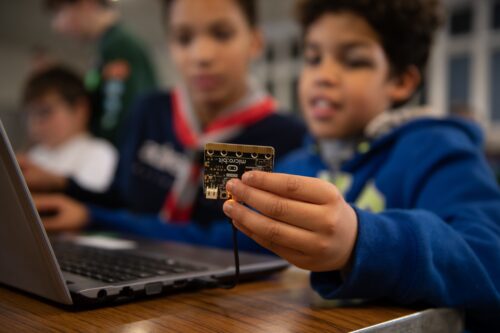
As you might know, a micro:bit (pronounced “microbit”) is a small, programmable device designed for education. You can program it using any computer. It’s easy to use and learn with, and suitable for beginners, especially young people in and out of school.

The theme of the new project path: Wellbeing

Our aim for this new micro:bit project path is to help young people explore how they can create their own tech tools that help them look after themselves and others. By designing the micro:bit coding projects around wellbeing, we want to not only help kids develop programming and digital literacy skills, but also promote open conversations about the important topic of mental health.

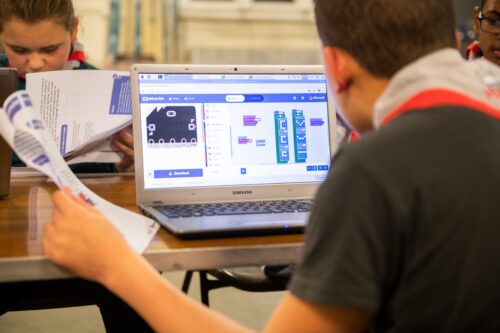
Kids coding a microbit project.
Credit: David Bird

The six micro:bit coding projects in our new path all cover different aspects of wellbeing in a fun, creative way:

  1. Good sleep patterns
  2. Relaxation
  3. Self-confidence
  4. Happiness
  5. Health 
  6. Entertainment

We hope that following the path and making projects helps encourage learners to ask questions, share their experiences, and feel like they can ask parents, teachers, or mentors for support, and help support their friends and peers.

What is in the ‘Intro to micro:bit’ project path?

The ‘Intro to micro:bit’ path is designed according to our Digital Making Framework. Its aim is to encourage young people to become independent coders and tech creators as they progress along the projects in a path by gently removing scaffolding.

  • Our project paths begin with three Explore projects, in which learners are guided through tasks that introduce them to new coding skills.
  • Next, learners complete two Design projects. Here, they are encouraged to practise their skills and bring in their own interests to personalise their coding creations.
  • Finally, learners complete one Invent project. This is where they put everything that they have learned together and create something unique that matters to them.

The structure of the path means that learners are led through the development process of a coding project and learn how to turn their ideas into reality. The path structure also supports them with fixing programming errors (debugging), showing them that errors are a normal part of computer programming and just temporary setbacks that they can overcome.

Credit: David Bird

Because community is important for learning, the path also offers young people the chance to share the projects they make with peers around the world.

What coding skills and knowledge will young people learn?

The Explore projects at the start of the path are where the initial learning takes place. Learners then develop their new skills and knowledge by putting them into practice in the Design and Invent projects, where they add in their own ideas and creativity.

The key programming concepts covered in this path are:

  • Variables
  • Using selection (if, else if, and else)
  • Using repetition (for loops)
  • Using randomisation
  • Using functions
Kids coding a microbit project.
Credit: David Bird

There are two versions of the micro:bit (V1 and V2) and learners can use either version to create the micro:bit coding projects in the path, using the micro:bit’s input and output features:

Input features:

  • Buttons
  • Accelerometer
  • Sound sensor/microphone (micro:bit V2 only)
  • Capacitive touch sensor
  • Light sensor

Output features:

  • LED display
  • Speaker
  • Headphones connected via GPIO (micro:bit V1 only)

Explore project 1: Music player

In this Explore project, kids create a music player on the micro:bit to explore how listening to music can improve their mood. While creating their music player, young people get to choose melodies that they enjoy or that make them feel more relaxed. They also add a range of functions such as pausing, skipping, and shuffling tracks.

Explore project 2: Sound level meter

Noise levels can affect people’s well-being, so in this project, kids create a program to use the micro:bit to display how noisy their environment is. They will also learn how to save the noise data the micro:bit measures so they can identify the noisiest times in their day.

Explore project 3: Sleep tracker

Sleep is an important factor that contributes towards well-being. With this third Explore project, kids create a program to track their sleep movements using the micro:bit. This teaches them about variables and about using the micro:bit’s accelerometer, and its LEDs to display data.

Design project 1: How’s your day?

The first Design project of the path gets young people to build a mood checker program using the question ‘How’s your day?’. Kids get creative design control over the mood checker’s outputs according to the user’s replies, including displaying an animation or positive messages, or playing music. Kids can also make use of sensors to measure the various factors in the environment that could be affecting the user’s mood.

In this project, young people apply all of the coding skills and knowledge covered in the Explore projects, including selection, repetition, variables, functions, and randomisation.

Design project 2: Active assistant

In the second Design project, young people create an assistant that helps them get active.The project provides examples, a structure, and brief summaries of what kids have learned to do on the path so far to inspire and motivate them. This mean young people can work independently to produce their own outcomes and the functionality of their assistant is up to each young tech creator.

Invent project: Party game

The final project, Party game, encourages learners to independently replicate their favourite party game for entertainment and relaxation. Learners will combine all of the knowledge and skills they’ve gained throughout the path to make something of their own around the theme of well-being. This is a chance for them to unleash their creativity and reflect on real-life games they enjoy. The outcome will be unique, and fun for them to share with their friends and family.

Key questions answered

Who is this path for?

We have written these micro:bit coding projects with young people around the age of 6 to 13 in mind. Building the projects on the path does not require any previous coding experience, although complete beginners may want to try our free ‘Intro to Scratch’ path first.

What software do learners need to code these projects?

A web browser on a computer. In every project, starter code is provided in the MakeCode online code editor. Learners can either download their project code to a physical micro:bit (recommended) or use the micro:bit simulator in MakeCode.

Kids coding a microbit project.
Credit: David Bird

Young people who live where there isn’t constant internet connectivity can also download the offline version of the MakeCode editor. There are also free micro:bit coding apps for smartphones and tablets.

How long will the path take to complete?

We’ve designed the ‘Intro to micro:bit’ path to be completed in six one-hour sessions, with one hour per project. However, the project instructions invite learners to take additional time to upgrade their projects if they wish.

What can learners do next?

Take part in Coolest Projects

At the end of the micro:bit path, learners are encouraged to register a project they’re making with their new coding skills for Coolest Projects, our annual online technology showcase for young people around the world.

Taking part is free, and beginners as well as more experienced young tech creators are invited. This is their opportunity to share their ingenuity in an online gallery for the world and the Coolest Projects community to celebrate.

The post New micro:bit coding projects for kids appeared first on Raspberry Pi Foundation.

The collective thoughts of the interwebz