What to consider when modernizing APIs with GraphQL on AWS

Post Syndicated from Lewis Tang original https://aws.amazon.com/blogs/architecture/what-to-consider-when-modernizing-apis-with-graphql-on-aws/

In the next few years, companies will build over 500 million new applications, more than has been developed in the previous 40 years combined (see IDC article). API operations enable innovation. They are the “front door” to applications and microservices, and an integral layer in the application stack. In recent years, GraphQL has emerged as a modern API approach. With GraphQL, companies can improve the performance of their applications and the speed in which development teams can build applications. In this post, we will discuss how GraphQL works and how integrating it with AWS services can help you build modern applications. We will explore the options for running GraphQL on AWS.

How GraphQL works

Imagine you have an API frontend implemented with GraphQL for your ecommerce application. As shown in Figure 1, there are different services in your ecommerce system backend that are accessible via different technologies. For example, user profile data is stored in a highly scalable NoSQL table. Orders are accessed through a REST API. The current inventory stock is checked through an AWS Lambda function. And the pricing information is in an SQL database.

How GraphQL works

Figure 1. How GraphQL works

Without using GraphQL, client applications must make multiple separate calls to each one of these services. Because each service is exposed through different API endpoints, the complexity of accessing data from the client side increases significantly. In order to get the data, you have to make multiple calls. In some cases, you might over fetch data as the data source would send you an entire payload including data you might not need. In some other circumstances, you might under fetch data as a single data source would not have all your required data.

A GraphQL API combines the data from all these different services into a single payload that the client defines based on its needs. For example, a smartphone has a smaller screen than a desktop application. A smartphone application might require less data. The data is retrieved from multiple data sources automatically. The client just sees a single constructed payload. This payload might be receiving user profile data from Amazon DynamoDB, or order details from Amazon API Gateway. Or it could involve the injection of specific fields with inventory availability and price data from AWS Lambda and Amazon Aurora.

When modernizing frontend APIs with GraphQL, you can build applications faster because your frontend developers don’t need to wait for backend service teams to create new APIs for integration. GraphQL simplifies data access by interacting with data from multiple data sources using a single API. This reduces the number of API requests and network traffic, which results in improved application performance. Furthermore, GraphQL subscriptions enable two-way communication between the backend and client. It supports publishing updates to data in real time to subscribed clients. You can create engaging applications in real time with use cases such as updating sports scores, bidding statuses, and more.

Options for running GraphQL on AWS

There are two main options for running GraphQL implementation on AWS, fully managed on AWS using AWS AppSync, and self-managed GraphQL.

I. Fully managed using AWS AppSync

The most straightforward way to run GraphQL is by using AWS AppSync, a fully managed service. AWS AppSync handles the heavy lifting of securely connecting to data sources, such as Amazon DynamoDB, and to develop GraphQL APIs. You can write business logic against these data sources by choosing code templates that implement common GraphQL API patterns. Your APIs can also interact with other AWS AppSync functionality such as caching, to improve performance. Use subscriptions to support real-time updates, and client-side data stores to keep offline devices in sync. AWS AppSync will scale automatically to support varied API request loads. You can find more details from the AWS AppSync features page.

AWS AppSync in an ecommerce system implementation

Figure 2. AWS AppSync in an ecommerce system implementation

Let’s take a closer look at this GraphQL implementation with AWS AppSync in an ecommerce system. In Figure 2, a schema is created to define types and capabilities of the desired GraphQL API. You can tie the schema to a Resolver function. The schema can either be created to mirror existing data sources, or AWS AppSync can create tables automatically based the schema definition. You can also use GraphQL features for data discovery without viewing the backend data sources.

After a schema definition is established, an AWS AppSync client can be configured with an operation request, such as a query operation. The client submits the operation request to GraphQL Proxy along with an identity context and credentials. The GraphQL Proxy passes this request to the Resolver, which maps and initiates the request payload against pre-configured AWS data services. These can be an Amazon DynamoDB table for user profile, an AWS Lambda function for inventory service, and more. The Resolver initiates calls to one or all of these services within a single API call. This minimizes CPU cycles and network bandwidth needs. The Resolver then returns the response to the client. Additionally, the client application can change data requirements in code on demand. The AWS AppSync GraphQL API will dynamically map requests for data accordingly, enabling faster prototyping and development.

II. Self-Managed GraphQL

If you want the flexibility of selecting a particular open-source project, you may choose to run your own GraphQL API layer. Apollo, graphql-ruby, Juniper, gqlgen, and Lacinia are some popular GraphQL implementations. You can leverage AWS Lambda or container services such as Amazon Elastic Container Service (ECS) and Amazon Elastic Kubernetes Services (EKS) to run GraphQL open-source implementations. This gives you the ability to fine-tune the operational characteristics of your API.

When running a GraphQL API layer on AWS Lambda, you can take advantage of the serverless benefits of automatic scaling, paying only for what you use, and not having to manage your servers. You can create a private GraphQL API using Amazon ECS, EKS, or AWS Lambda, which can only be accessed from your Amazon Virtual Private Cloud (VPC). With Apollo GraphQL open-source implementation, you can create a Federated GraphQL that allows you to combine GraphQL APIs from multiple microservices into a single API, illustrated in Figure 3. The Apollo GraphQL Federation with AWS AppSync post shows a concrete example of how to integrate an AWS AppSync API with an Apollo Federation gateway. It uses specification-compliant queries and directives.
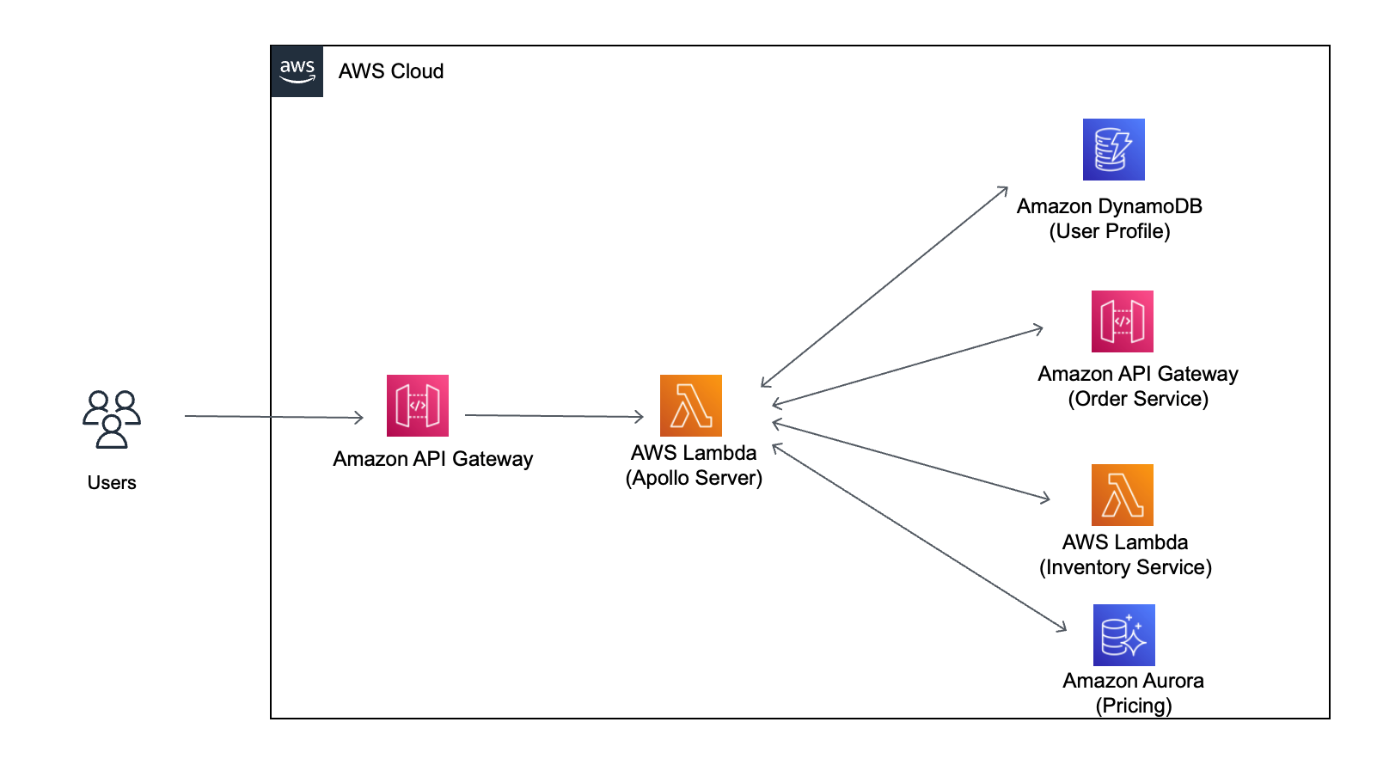
Apollo GraphQL implementation on AWS Lambda

Figure 3. Apollo GraphQL implementation on AWS Lambda

When choosing self-managed GraphQL implementation, you have to spend time writing non-business logic code to connect data sources. You must implement authorization, authentication, and integrate other common functionalities. This can be caches to improve performance, subscriptions to support real-time updates, and client-side data stores to keep offline devices in sync. Because of these responsibilities, you have less time to focus on the business logic of application.

Similarly, backend development teams and API operators of an open-source GraphQL implementation must provision and maintain their own GraphQL servers. Remember that even with a serverless model, API developers and operators are still responsible for monitoring, performance tuning, and troubleshooting the API platform service.

Conclusion

Modernizing APIs with GraphQL gives your frontend application the ability to fetch just the data that’s needed from multiple data sources with an API call. You can build modern mobile and web applications faster, because GraphQL simplifies API management. You have flexibility to run an open-source GraphQL implementation most closely aligned with your needs on AWS Lambda, Amazon ECS, and Amazon EKS. With AWS AppSync, you can set up GraphQL quickly and increase your development velocity by reducing the amount of non-business API logic code.

Further reading:

Apple Only Commits to Patching Latest OS Version

Post Syndicated from Bruce Schneier original https://www.schneier.com/blog/archives/2022/10/apple-only-commits-to-patching-latest-os-version.html

People have suspected this for a while, but Apple has made it official. It only commits to fully patching the latest version of its OS, even though it claims to support older versions.

From ArsTechnica:

In other words, while Apple will provide security-related updates for older versions of its operating systems, only the most recent upgrades will receive updates for every security problem Apple knows about. Apple currently provides security updates to macOS 11 Big Sur and macOS 12 Monterey alongside the newly released macOS Ventura, and in the past, it has released security updates for older iOS versions for devices that can’t install the latest upgrades.

This confirms something that independent security researchers have been aware of for a while but that Apple hasn’t publicly articulated before. Intego Chief Security Analyst Joshua Long has tracked the CVEs patched by different macOS and iOS updates for years and generally found that bugs patched in the newest OS versions can go months before being patched in older (but still ostensibly “supported”) versions, when they’re patched at all.

Kernel prepatch 6.1-rc3

Post Syndicated from original https://lwn.net/Articles/913122/

The 6.1-rc3 kernel prepatch is out for
testing.

So while rc2 was just _way_ bigger than usual, rc3 is only a bit
larger than an average rc3 release is. But it’s still on the
largish side. I hope that things start calming down, and we’ll
start seeing the size of these rc’s shrink. Please?

Лечението на тежко болни деца – четири години без напредък

Post Syndicated from original https://yurukov.net/blog/2022/nzok-deca-4y/

Макар да изчезна от медийното внимание, не трябва да забравяме, че почти всеки ден деца биват диагностицирани с тежка болест и отговорността на обществото ни към тях не изчезва. Исторически това се правеше през фонда за лечение за деца, но в началото на 2019 години функциите ѝ бяха пренесени в НЗОК. Следя фонда и регистъра им отдавна, а след това въпреки опитите да се скрият данните, показах колко неподготвени бяха независимо от годините предполагаема подготовка. Това го забелязахме всички най-малкото по увеличените призиви за дарения за лечение зад граница в социални мрежи, кутии в магазини, SMS-и и платформи за дарения.

В предишната ми статия от юли 2021 показах последните изводи от тези данни. Няма да се впускам в детайлите от тогава – нещата и обясненията за аналогични и почти нищо не се е променило. Реших да обновя графиките с това, което са публикували от тогав. Нищо изглежда не се е променило в работата на НЗОК. Най-малкото докладите и регистърът са същите.

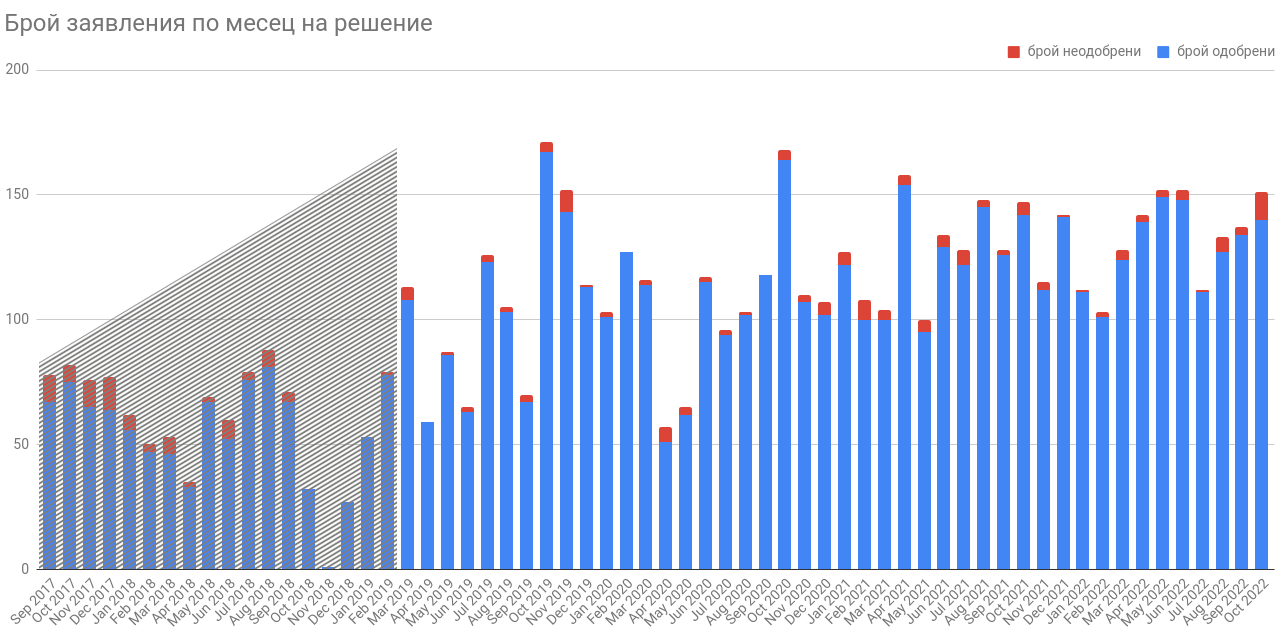
По броя подадени заявления се забелязва известно увеличение в последните 7 месеца. Не се вижда особена разлика в чакащите одобрение, но се запазва увеличеният брой отказани заявления, който се видя в края на 2020. Интересен е обаче резкият скок през март.

Едно положително нещо е, че изглежда леко намалява времето до решение. В следващата графика гледаме само тези с решение, а не всички подадени. Все пак се вижда, че в средата на годината пак отнема над три седмици да се стигне до някакъв резултат. При това времето, в което се чака мнение на експерти се увеличава и стига до над седмица средно.

Броят взети решения по месеци не се увеличават въпреки повечето заявления, особено в последно време. Необяснима е и голямата вариация, особено предвид големия иначе брой – по 100-150 на месец.

Следващата графика показва колко време са чакали хора за решение към момента на взимането му. Например, ако са получили одобрение през март 2022, то са чакали 14 дни за решение плюс 3 дни за експерти. През март 2021-ва обаче е било 24 дни за комисията плюс 3 дни за становище от експерти. През последните два месеца е над 20 дни за комисия и 13 дни за експерти. Така времето за чакане на заявленията решени след август се връща на нивата с огромните забавяния от началното фиаско със закриването на Фонда за лечение на деца през март 2019-та.

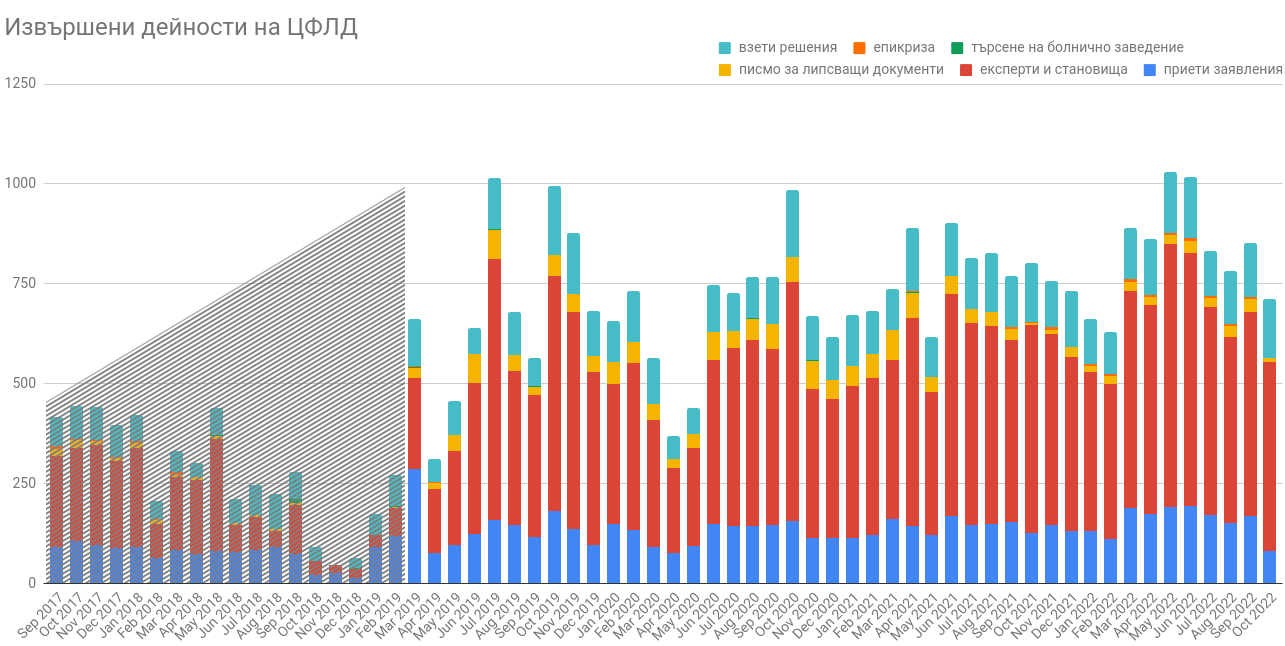
Броят дейности също расте значително. Тук отчитам не срокът или сложността им, а чистия брой. Виждаме доста повече искане на становище от експерти и епикризи, но по-малко писма за липсващи документи. Поне съдейки по информацията, която сами си отчитат в системата.

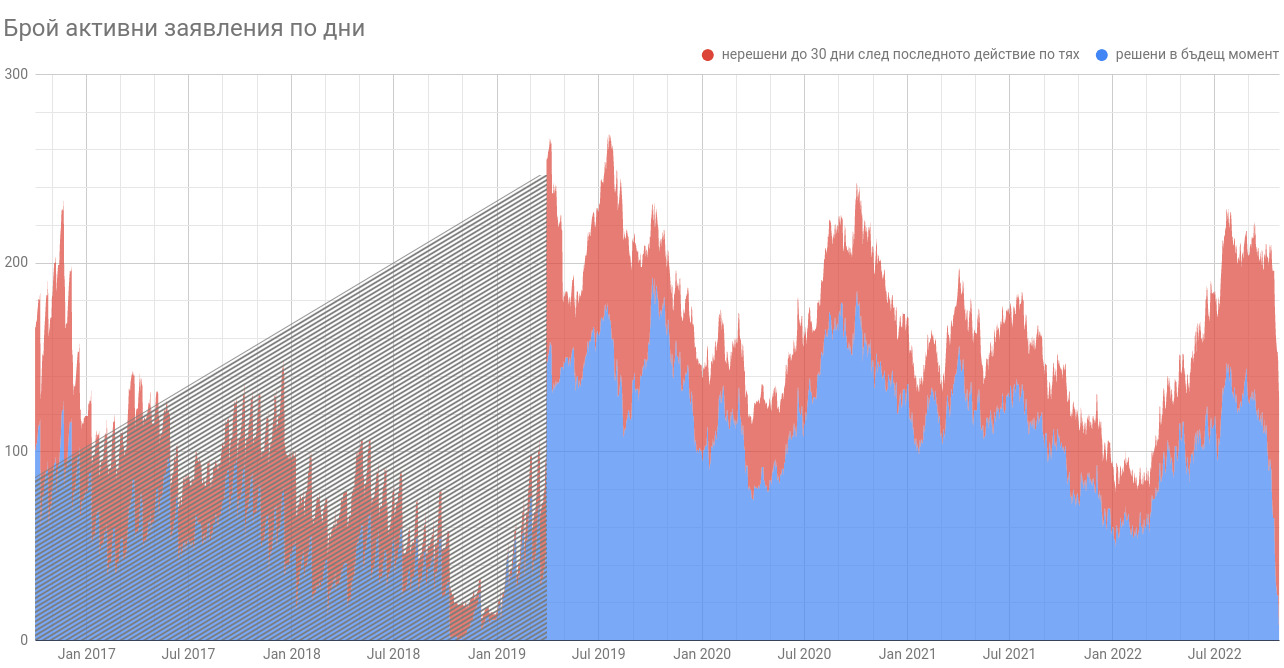
Тук отново виждаме броя заявления „отлежаващи“ на бюрото на НЗОК. Това са искания за често спешно лечение на тежко болни деца, които във всеки един момент чакат решение. В червено съм маркирал тези, които все пак ще получат такова до месец. С синьо са такива, които може и да не бъдат решени, но често получават отговор след 2-3 месеца.

След големия скок при прехвърлянето в НЗОК виждаме подобрение в началото на 2020-та причинено обаче изцяло от по-малкото подадени заявления покрай пандемията. Не заради друго, ами заради блокирането на здравната система. Значително подобрение има в края на 2021-ва и началото на 2022-ра, а в последните 6 месеца ситуацията се е влошила и по този показател до нивата от началото на 2019-та.

Отново предупреждавам, че тези числа и изводи се базират изцяло на публичния регистър, който НЗОК сам поддържа и въвежда като информация. Това са данните, които всеки от тези хиляди родители виждат за своите деца. Аз само ги обобщавам, за да намеря тенденции. Доколко НЗОК въвежда коректно дати и информация е невъзможно да се провери.

Като цяло от тези числа може да си направим няколко извода. Първият е, че качеството на работата е непостоянно и има силни вариации както в работата на експертите, така и в бързината на взимане на решения. Докато няма еднакви случаи и е очаквано някои да се бавят повече от други, при толкова много документи трудно е да се приеме друго обяснение освен общо забавяне.

Собствените им отчети показват и друга притеснителна тенденция, която беше отбелязана вече от други в последните години – рязко пренасочване на средства към български болници. При това оправданията им за по-ниски цени и нуждата от добри специалисти у нас бързо бяха развенчани в увеличените средства непропорционално на случаите, както и лошата успеваемост, особено при определени лекари.

За съжаление, НЗОК по този, както и по много други показатели като електронни услуги и намаляване на бюрократичната тежест, остава далеч на опашката на българската администрация. Нещо, което не следва да се приема просто така предвид какъв огромен ресурс разпределят и колко ключова роля имат в обществения живот.

The post Лечението на тежко болни деца – четири години без напредък first appeared on Блогът на Юруков.

Friday Squid Blogging: Chinese Squid Fishing

Post Syndicated from Bruce Schneier original https://www.schneier.com/blog/archives/2022/10/friday-squid-blogging-chinese-squid-fishing.html

China claims that it is “engaging in responsible squid fishing”:

Chen Xinjun, dean of the College of Marine Sciences at Shanghai Ocean University, made the remarks in response to recent accusations by foreign reporters and actor Leonardo DiCaprio that China is depleting its own fish stock and that Chinese boats have sailed to other waters to continue deep-sea fishing, particularly near Ecuador, affecting local fish stocks in the South American nation.

As usual, you can also use this squid post to talk about the security stories in the news that I haven’t covered.

Read my blog posting guidelines here.

Generic associated types in Rust 1.65

Post Syndicated from original https://lwn.net/Articles/912932/

The Rust Types Team announces
that the long-awaited generic associated types feature will be stable in Rust 1.65.

At its core, generic associated types allow you to have generics
(type, lifetime, or const) on associated types. Note that this is
really just rounding out the places where you can put generics: for
example, you can already have generics on freestanding type aliases
and on functions in traits. Now you can just have generics on type
aliases in traits (which we just call associated types).

How to Automatically Prevent Email Throttling when Reaching Concurrency Limit

Post Syndicated from Mark Richman original https://aws.amazon.com/blogs/messaging-and-targeting/prevent-email-throttling-concurrency-limit/

Introduction

Many users of Amazon Simple Email Service (Amazon SES) send large email campaigns that target tens of thousands of recipients. Regulating the flow of Amazon SES requests can prevent throttling due to exceeding the AWS service limit on the account.

Amazon SES service quotas include a soft limit on the number of emails sent per second (also known as the “sending rate”). This quota is intended to protect users from accidentally sending unintended volumes of email, or from spending more money than intended. Most Amazon SES customers have this quota increased, but very large campaigns may still exceed that limit. As a result, Amazon SES will throttle email requests. When this happens, your messages will fail to reach their destination.

This blog provides users of Amazon SES a mechanism for regulating the flow of messages that are sent to Amazon SES. Cloud Architects, Engineers, and DevOps Engineers designing new, or improving an existing Amazon SES solution would benefit from reading this post.

Overview

A common solution for regulating the flow of API requests to Amazon SES is achieved using Amazon Simple Queue Service (Amazon SQS). Amazon SQS can send, store, and receive messages at virtually any volume and can serve as part of a solution to buffer and throttle the rate of API calls. It achieves this without the need for other services to be available to process the messages. In this solution, Amazon SQS prevents messages from being lost while waiting for them to be sent as emails.

Fig 1 — High level architecture diagram

But this common solution introduces a new challenge. The mechanism used by the Amazon SQS event source mapping for AWS Lambda invokes a function as soon as messages are visible. Our challenge is to regulate the flow of messages, rather than invoke Amazon SES as messages arrive to the queue.

Fig 2 — Leaky bucket

Developers typically limit the flow of messages in a distributed system by implementing the “leaky bucket” algorithm. This algorithm is an analogy to a bucket which has a hole in the bottom from which water leaks out at a constant rate. Water can be added to the bucket intermittently. If too much water is added at once or at too high a rate, the bucket overflows.

In this solution, we prevent this overflow by using throttling. Throttling can be handled in two ways: either before messages reach Amazon SQS, or after messages are removed from the queue (“dequeued”). Both of these methods pose challenges in handling the throttled messages and reprocessing them. These challenges introduce complexity and lead to the excessive use of resources that may cause a snowball effect and make the throttling worse.

Developers often use the following techniques to help improve the successful processing of feeds and submissions:

  • Submit requests at times other than on the hour or on the half hour. For example, submit requests at 11 minutes after the hour or at 41 minutes after the hour. This can have the effect of limiting competition for system resources with other periodic services.
  • Take advantage of times during the day when traffic is likely to be low, such as early evening or early morning hours.

However, these techniques assume that you have control over the rate of requests, which is usually not the case.

Amazon SQS, acting as a highly scalable buffer, allows you to disregard the incoming message rate and store messages at virtually any volume. Therefore, there is no need to throttle messages before adding them to the queue. As long as you eventually process messages faster than you receive new ones, you will be fine with the inflow that will get processed later on.

Regulating flow of messages from Amazon SQS

The proposed solution in this post regulates the dequeue of messages from one or more SQS queues. This approach can help prevent you from exceeding the per-second quota of Amazon SES, thereby preventing Amazon SES from throttling your API calls.

Available configuration controls

When it comes to regulating outflow from Amazon SQS you have a few options. MaxNumberOfMessages controls the maximum number of messages you can dequeue in a single read request. WaitTimeSeconds defines whether Amazon SQS uses short polling (0 seconds wait) or long polling (more than 0 seconds) while waiting to read messages from a queue. Though these capabilities are helpful in many use cases, they don’t provide full control over outflow rates.

Amazon SQS Event source mapping for Lambda is a built-in mechanism that uses a poller within the Lambda service. The poller polls for visible messages in the queue. Once messages are read, they immediately invoke the configured Lambda function. In order to prevent downstream throttling, this solution implements a custom poller to regulate the rate of messages polled instead of the Amazon SQS Event source mechanism.

Custom poller Lambda

Let’s look at the process of implementing a custom poller Lambda function. Your function should actively regulate the outflow rate without throttling or losing any messages.

First, you have to consider how to invoke the poller Lambda function once every second. Using Amazon EventBridge rules you can schedule Lambda invocations at a rate of once per minute. You also have to consider how to complete processing of Amazon SES invocations as soon as possible. And finally, you have to consider how to send requests to Amazon SES at a rate as close as possible to your per-second quota, without exceeding it.

You can use long polling to meet all of these requirements. Using long polling (by setting the WaitTimeSeconds value to a number greater than zero) means the request queries all of the Amazon SQS servers, or waits until the maximum number of messages you can handle per second (the MaxNumberOfMessages value) are read. By setting the MaxNumberOfMessages equal to your Amazon SES request per-second quota, you prevent your requests from exceeding that limit.

By splitting the looping logic from the poll logic (by using two Lambda functions) the code loops every second (60 times per minute) and asynchronously runs the polling logic.

Fig 3 — Custom poller diagram

You can use the following Python code to create the scheduler loop function:

import os
from time import sleep, time_ns

import boto3

SENDER_FUNCTION_NAME = os.getenv("SENDER_FUNCTION_NAME")
lambda_client = boto3.client("lambda")

def lambda_handler(event, context):
    print(event)

    for _ in range(60):
        prev_ns = time_ns()

        response = lambda_client.invoke_async( 
            FunctionName=SENDER_FUNCTION_NAME, InvokeArgs="{}" 
        ) 
        print(response)

        delta_ns = time_ns() - prev_ns

        if delta_ns < 1_000_000_000: 
            secs = (1_000_000_000.0 - delta_ns) / 1_000_000_000 
            sleep(secs)

This Python code creates a poller function:

import json 
import os

import boto3

UNREGULATED_QUEUE_URL = os.getenv("UNREGULATED_QUEUE_URL") 
MAX_NUMBER_OF_MESSAGES = 3 
WAIT_TIME_SECONDS = 1 
CHARSET = "UTF-8"

ses_client = boto3.client("ses") 
sqs_client = boto3.client("sqs")

def lambda_handler(event, context): 
    response = sqs_client.receive_message( 
        QueueUrl=UNREGULATED_QUEUE_URL, 
        MaxNumberOfMessages=MAX_NUMBER_OF_MESSAGES, 
        WaitTimeSeconds=WAIT_TIME_SECONDS, 
    )

    try: 
        messages = response["Messages"] 
    except KeyError: 
        print("No messages in queue") 
        return

    for message in messages: 
        message_body = json.loads(message["Body"]) 
        to_address = message_body["to_address"] 
        from_address = message_body["from_address"] 
        subject = message_body["subject"] 
        body = message_body["body"]

        print(f"Sending email to {to_address}")

        ses_client.send_email( 
            Destination={ 
                "ToAddresses": [ 
                    to_address, 
                ], 
            }, 
            Message={ 
                "Body": { 
                    "Text": { 
                        "Charset": CHARSET, 
                        "Data": body, 
                    } 
                }, 
                "Subject": { 
                    "Charset": CHARSET, 
                    "Data": subject, 
                }, 
            }, 
            Source=from_address, 
        )

        sqs_client.delete_message( 
            QueueUrl=UNREGULATED_QUEUE_URL, ReceiptHandle=message["ReceiptHandle"] 
        )

Regulating flow of prioritized messages from Amazon SQS

In the use case above, you may be serving a very large marketing campaign (“campaign1”) that takes hours to process. At the same time, you may want to process another, much smaller campaign (“campaign2″), which won’t be able to run until campaign1 is complete.

Obvious solution is to prioritize the campaigns by processing both campaigns in parallel. For example, allocate 90% of the Amazon SES per-second capacity limit to process the larger campaign1, while allowing the smaller campaign2 to take 10% of the available capacity under the limit. Amazon SQS does not provide message priority functionalities out-of-the-box. Instead, create two separate queues and poll each queue according to your desired frequency.

Fig 4 — Prioritize campaigns by queue diagram

This solution works fine if you have consistent flow of incoming messages to both queues. Unfortunately, once you finish processing campaign2 you will keep processing campaign1, using only 90% of the limit capacity per second.

Handling unbalanced flow

For handling unbalanced flow of messages merge both of your poller Lambdas. Implement one Lambda that polls both queues for MaxNumberOfMessages (that equals 100% of the limits of both). In this implementation send from your poller Lambda 90% of campaign1 messages and 10% of campaign2 messages. When campaign2 no longer has messages to process, keep processing 100% of the capacity from campaign1’s queue.

Do not delete unsent messages from the queues. These messages will become visible after their queue’s visibility timeout is reached.


To further improve on the previous implementations, introduce a third FIFO Queue to aggregate all messages from both queues and regulate dequeuing from that third FIFO queue. This will allow you to use all available capacity under your SES limit, while interweaving messages from both campaigns at a 1:10 ratio.

Fig 5 — Adding FIFO merge queue diagram

Processing 100% of the available capacity limit of the large campaign1 and 10% of the capacity limit of the small campaign2 allows you to make sure campign2 messages will not wait until campaign1 messages were all processed. Once campain2 messages are all processed, campign1 messages will continue to be processed using 100% of the capacity limit.

You can find here instructions for Configuring Amazon SQS queues.

Conclusion

In this blog post, we have shown you how to regulate the dequeue of Amazon SQS queue messages. This will prevent you from exceeding your Amazon SES per second limit. This will also remove the need to deal with throttled requests. We explained how to combine Amazon SQS, AWS Lambda, Amazon EventBridge to create a custom serverless regulating queue poller. Finally, we described how to regulate the flow of Amazon SES requests when using multiple priority queues. These technics can reduce implementation time for reprocessing throttled requests, optimize utilization of SES request limit, and reduce costs.

About the Authors

This blog post was written by Guy Loewy and Mark Richman, AWS Senior Solutions Architects for SMB.

Metasploit Weekly Wrap-UP

Post Syndicated from Shelby Pace original https://blog.rapid7.com/2022/10/28/metasploit-weekly-wrap-up-180/

GLPI htmLawed PHP Command Injection

Metasploit Weekly Wrap-UP

Our very own bwatters-r7 wrote a module for an unauthenticated PHP command injection vulnerability that exists in various versions of GLPI. The vulnerability is due to a third-party vendor test script being present in default installations. A POST request to vendor/htmlawed/htmlawed/htmLawedTest.php directly allows an attacker to execute exec() through the hhook and test parameters, resulting in unauthenticated RCE as the www-data user. The GLPI project has released an advisory detailing patched versions available for download and also noting that this vulnerability has been seen exploited in the wild.

Vagrant Breakout Exploit

Community contributor bcoles added a module that exploits a built-in Vagrant feature to break out of a Vagrant box and gain access to the host system. Specifically, the shared project folder that exists on the host is mounted on the guest Vagrant box as a writable directory, and the project’s configuration file exists there. Every time a user on the host executes a vagrant command from within the project directory, the Ruby code within the config file gets executed. As a result, an attacker can add arbitrary code to the config file, wait for the user to run a vagrant command, and then gain a shell on the host system with the privileges of the user who ran the command. Since there is no intention to patch this issue, denying the shared folders feature for Vagrant projects is the best way to prevent this.

vCenter Secrets Dump Module

h00die and npm-cesium137-io submitted a post module that targets vCenter appliances. Using an elevated session, this module collects DC credentials, SSO user accounts and hashes, domain information, certificates, and more. The information gathered can be used to add new SSO admin users to vCenter, sign forged SAML assertions, and to dump more data via the auxiliary/gather/vmware_vcenter_vmdir_ldap module.

New module content (3)

  • GLPI htmLawed php command injection by bwatters-r7 and cosad3s, which exploits CVE-2022-35914 – This PR adds a module for CVE-2022-35914, a php command injection vulnerability in GLPI versions up to and including 10.0.2.
  • Vagrant Synced Folder Vagrantfile Breakout by bcoles – This PR adds a module that exploits a default Vagrant shared folder to append a Ruby payload to the Vagrant project Vagrantfile config file. The payload gets executed the next time the user runs a vagrant command.
  • vCenter Secrets Dump by h00die and npm-cesium137-io – This PR adds the post/linux/gather/vcenter_secrets_dump module to dump vCenter vmdir dcAccountPassword and platform certificates.

Enhancements and features (7)

  • #16979 from gwillcox-r7 – This improves the existing ldap_query module by allowing it to decode some data types into a human readable format.
  • #17050 from usiegl00 – This updates the osx stager to no longer write artifacts to disk when performing in-memory code loading.
  • #17071 from gwillcox-r7 – This adds additional predefined LDAP queries to the existing ldap_query module that can help enumerate specific information in support of certain attack paths.
  • #17128 from cgranleese-r7 – Updates auxiliary/scanner/smb/smb_enumshares to support specifying a share name such as run smb://Account:Password@TargetIP spidershares=true showfiles=true share=TargetShareName. Useful files are now also highlighted automatically.
  • #17164 from r3nt0n – This adds a new option, THEME_DIR to the exploit/multi/http/wp_crop_rce module that is useful when the current WordPress theme cannot be auto-detected by the module or when a user leverages other means of determining the theme.
  • #17176 from llamasoft – This updates the Python Meterpreter stage to calculate the necessary data for AES encryption at runtime which reduces the stage size by about 6,000 bytes.
  • #17185 from adfoster-r7 – Updates msfconsole’s tips command to include the analyze command, as well as hosts -R and services -R

Bugs fixed (2)

  • #17172 from bcoles – Fixes a bug in Msf::Post::File.append_file which caused file contents to be overwritten on non-Windows sessions.
  • #17187 from ErikWynter – Fixes an issue in the aerohive_netconfig_lfi_log_poison_rce exploit module that resulted in the vulnerable version 10.0r8 being flagged as non-vulnerable

Get it

As always, you can update to the latest Metasploit Framework with msfupdate
and you can get more details on the changes since the last blog post from
GitHub:

If you are a git user, you can clone the Metasploit Framework repo (master branch) for the latest.
To install fresh without using git, you can use the open-source-only Nightly Installers or the
binary installers (which also include the commercial edition).

The collective thoughts of the interwebz