While we are still early in what is likely going to be a substantial shift in how the world operates, two things are clear: the Internet, and how we interact with it, will change, and the boundaries of security and data privacy have never been more difficult to trace, making security an important topic in this shift.
At Cloudflare, we have a mission to help build a better Internet. And while we can only speculate on what AI will bring in the future, its success will rely on it being reliable and safe to use.
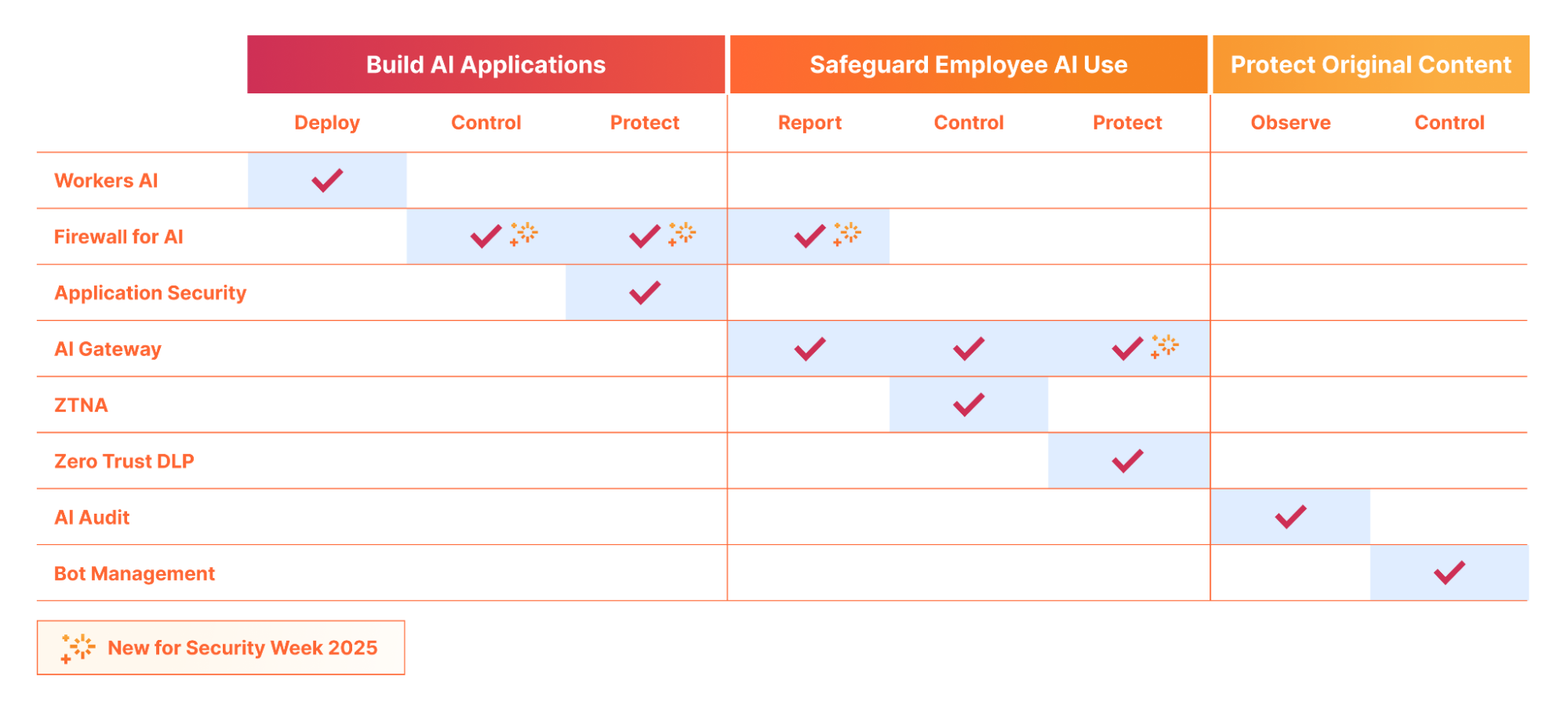
Today, we are introducing Cloudflare for AI: a suite of tools aimed at helping businesses, developers, and content creators adopt, deploy, and secure AI technologies at scale safely.
Cloudflare for AI is not just a grouping of tools and features, some of which are new, but also a commitment to focus our future development work with AI in mind.
Let’s jump in to see what Cloudflare for AI can deliver for developers, security teams, and content creators…
For developers
If you are building an AI application, whether a fully custom application or a vendor-provided hosted or SaaS application, Cloudflare can help you deploy, store, control/observe, and protect your AI application from threats.
Build & deploy: Workers AI and our new AI Agents SDK facilitates the scalable development & deployment of AI applications on Cloudflare’s network. Cloudflare’s network enhances user experience and efficiency by running AI closer to users, resulting in low-latency and high-performance AI applications. Customers are also using Cloudflare’s R2 to store their AI training data with zero egress fees, in order to develop the next-gen AI models.
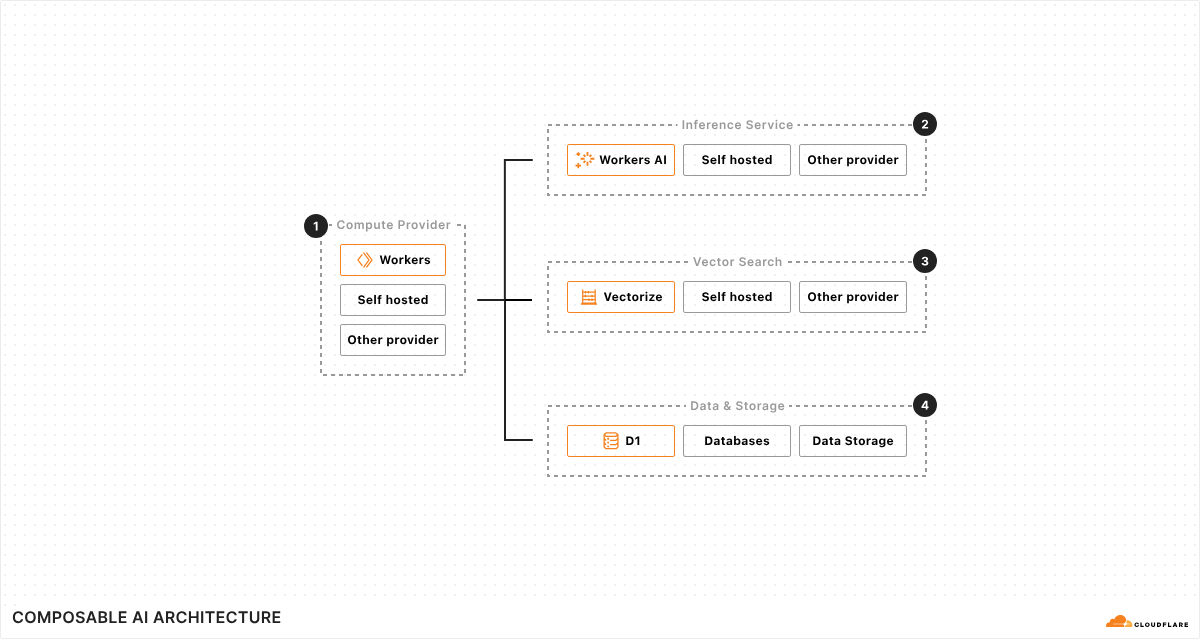
We are continually investing in not only our serverless AI inference infrastructure across the globe, but also in making Cloudflare the best place to build AI Agents. Cloudflare’s composable AI architecture has all the primitives that enable AI applications to have real time communications, persist state, execute long-running tasks, and repeat them on a schedule.
Protect and control: Once your application is deployed, be it directly on Cloudflare, using Workers AI, or running on your own infrastructure (cloud or on premise), Cloudflare’s AI Gateway lets you gain visibility into the cost, usage, latency, and overall performance of the application.
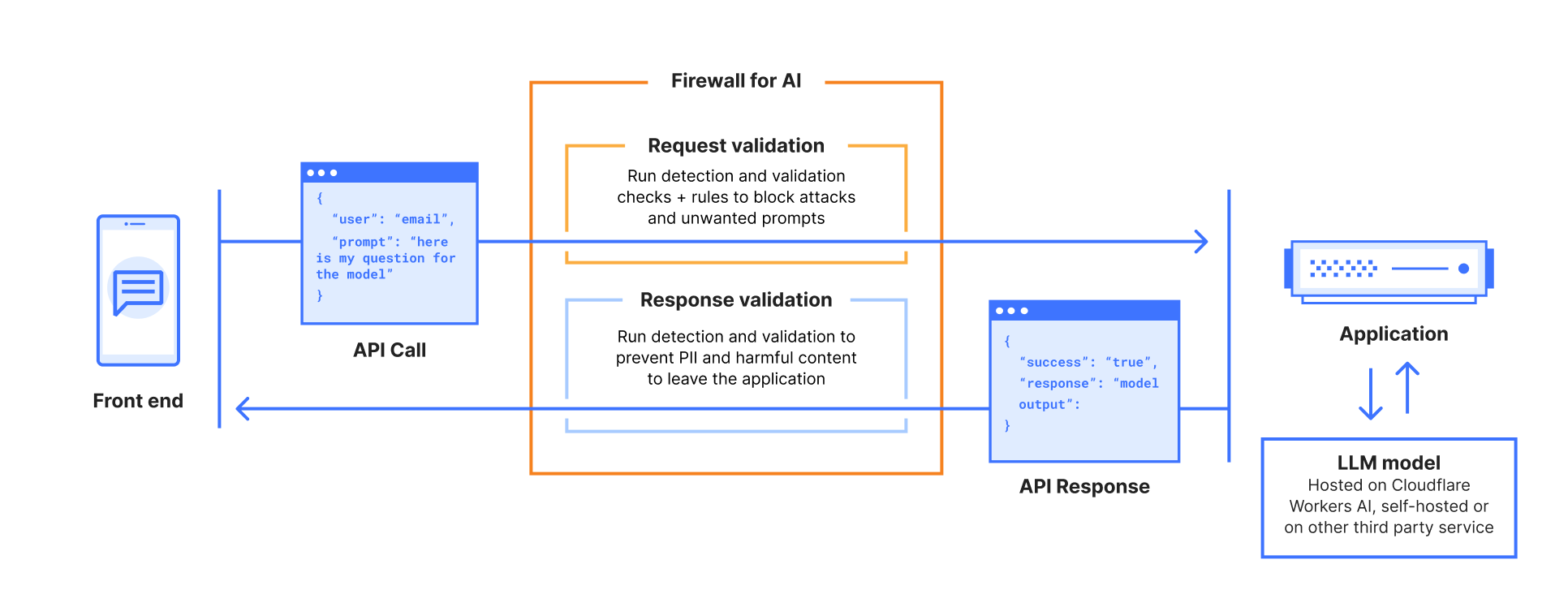
Additionally, Firewall for AI lets you layer security on top by automatically ensuring every prompt is clean from injection, and that personally identifiable information (PII) is neither submitted to nor (coming soon) extracted from, the application.
For security teams
Security teams have a growing new challenge: ensure AI applications are used securely, both in regard to internal usage by employees, as well as by users of externally-facing AI applications the business is responsible for. Ensuring PII data is handled correctly is also a growing major concern for CISOs.
Discover applications: You can’t protect what you don’t know about. Firewall for AI’s discovery capability lets security teams find AI applications that are being used within the organization without the need to perform extensive surveys.
Control PII flow and access: Once discovered, via Firewall for AI or other means, security teams can leverage Zero Trust Network Access (ZTNA) to ensure only authorized employees are accessing the correct applications. Additionally, using Firewall for AI, they can ensure that, even if authorised, neither employees nor potentially external users, are submitting or extracting personally identifiable information (PII) to/from the application.
Protect against exploits: Malicious users are targeting AI applications with novel attack vectors, as these applications are often connected to internal data stores. With Firewall for AI and the broader Application Security portfolio, you can protect against a wide number of exploits highlighted in the OWASP Top 10 for LLM applications, including, but not limited to, prompt injection, sensitive information disclosure, and improper output handling.
Safeguarding conversations: With Llama Guard integrated into both AI Gateway and Firewall for AI, you can ensure both input and output of your AI application is not toxic, and follows topic and sentiment rules based on your internal business policies.
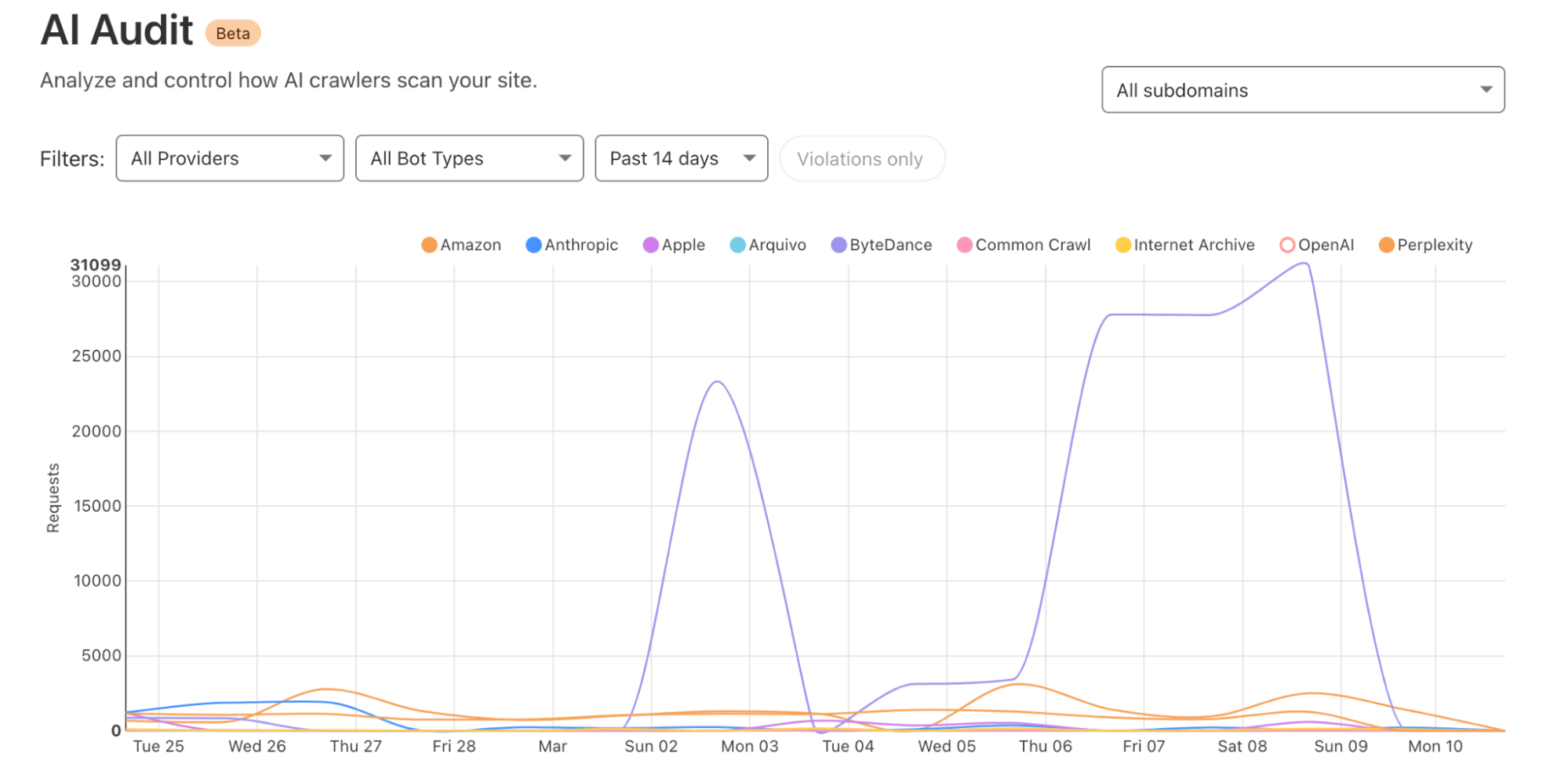
Observe who is accessing your content: With our AI Audit dashboard, you gain visibility (who, what, where and when) into the AI platforms crawling your site to retrieve content to use for AI training data. We are constantly classifying and adding new vendors as they create new crawlers.
Block access: If AI crawlers do not follow robots.txt or other relevant standards, or are potentially unwanted, you can block access outright. We’ve provided a simple “one click” button for customers using Cloudflare on our self-serve plans to protect their website. Larger organizations can build fine tune rules using our Bot Management solution allowing them to target individual bots and create custom filters with ease.
Cloudflare for AI: making AI security simple
If you are using Cloudflare already, or the deployment and security of AI applications is top of mind, reach out, and we can help guide you through our suite of AI tools to find the one that matches your needs.
Ensuring AI is scalable, safe and resilient, is a natural extension of Cloudflare’s mission, given so much of our success relies on a safe Internet.
Today, we’re excited to announce AI Labyrinth, a new mitigation approach that uses AI-generated content to slow down, confuse, and waste the resources of AI Crawlers and other bots that don’t respect “no crawl” directives. When you opt in, Cloudflare will automatically deploy an AI-generated set of linked pages when we detect inappropriate bot activity, without the need for customers to create any custom rules.
AI Labyrinth is available on an opt-in basis to all customers, including the Free plan.
Using Generative AI as a defensive weapon
AI-generated content has exploded, reportedly accounting for four of the top 20 Facebook posts last fall. Additionally, Medium estimates that 47% of all content on their platform is AI-generated. Like any newer tool it has both wonderful and malicious uses.
At the same time, we’ve also seen an explosion of new crawlers used by AI companies to scrape data for model training. AI Crawlers generate more than 50 billion requests to the Cloudflare network every day, or just under 1% of all web requests we see. While Cloudflare has several tools for identifying and blocking unauthorized AI crawling, we have found that blocking malicious bots can alert the attacker that you are on to them, leading to a shift in approach, and a never-ending arms race. So, we wanted to create a new way to thwart these unwanted bots, without letting them know they’ve been thwarted.
To do this, we decided to use a new offensive tool in the bot creator’s toolset that we haven’t really seen used defensively: AI-generated content. When we detect unauthorized crawling, rather than blocking the request, we will link to a series of AI-generated pages that are convincing enough to entice a crawler to traverse them. But while real looking, this content is not actually the content of the site we are protecting, so the crawler wastes time and resources.
As an added benefit, AI Labyrinth also acts as a next-generation honeypot. No real human would go four links deep into a maze of AI-generated nonsense. Any visitor that does is very likely to be a bot, so this gives us a brand-new tool to identify and fingerprint bad bots, which we add to our list of known bad actors. Here’s how we do it…
How we built the labyrinth
When AI crawlers follow these links, they waste valuable computational resources processing irrelevant content rather than extracting your legitimate website data. This significantly reduces their ability to gather enough useful information to train their models effectively.
To generate convincing human-like content, we used Workers AI with an open source model to create unique HTML pages on diverse topics. Rather than creating this content on-demand (which could impact performance), we implemented a pre-generation pipeline that sanitizes the content to prevent any XSS vulnerabilities, and stores it in R2 for faster retrieval. We found that generating a diverse set of topics first, then creating content for each topic, produced more varied and convincing results. It is important to us that we don’t generate inaccurate content that contributes to the spread of misinformation on the Internet, so the content we generate is real and related to scientific facts, just not relevant or proprietary to the site being crawled.
This pre-generated content is seamlessly integrated as hidden links on existing pages via our custom HTML transformation process, without disrupting the original structure or content of the page. Each generated page includes appropriate meta directives to protect SEO by preventing search engine indexing. We also ensured that these links remain invisible to human visitors through carefully implemented attributes and styling. To further minimize the impact to regular visitors, we ensured that these links are presented only to suspected AI scrapers, while allowing legitimate users and verified crawlers to browse normally.
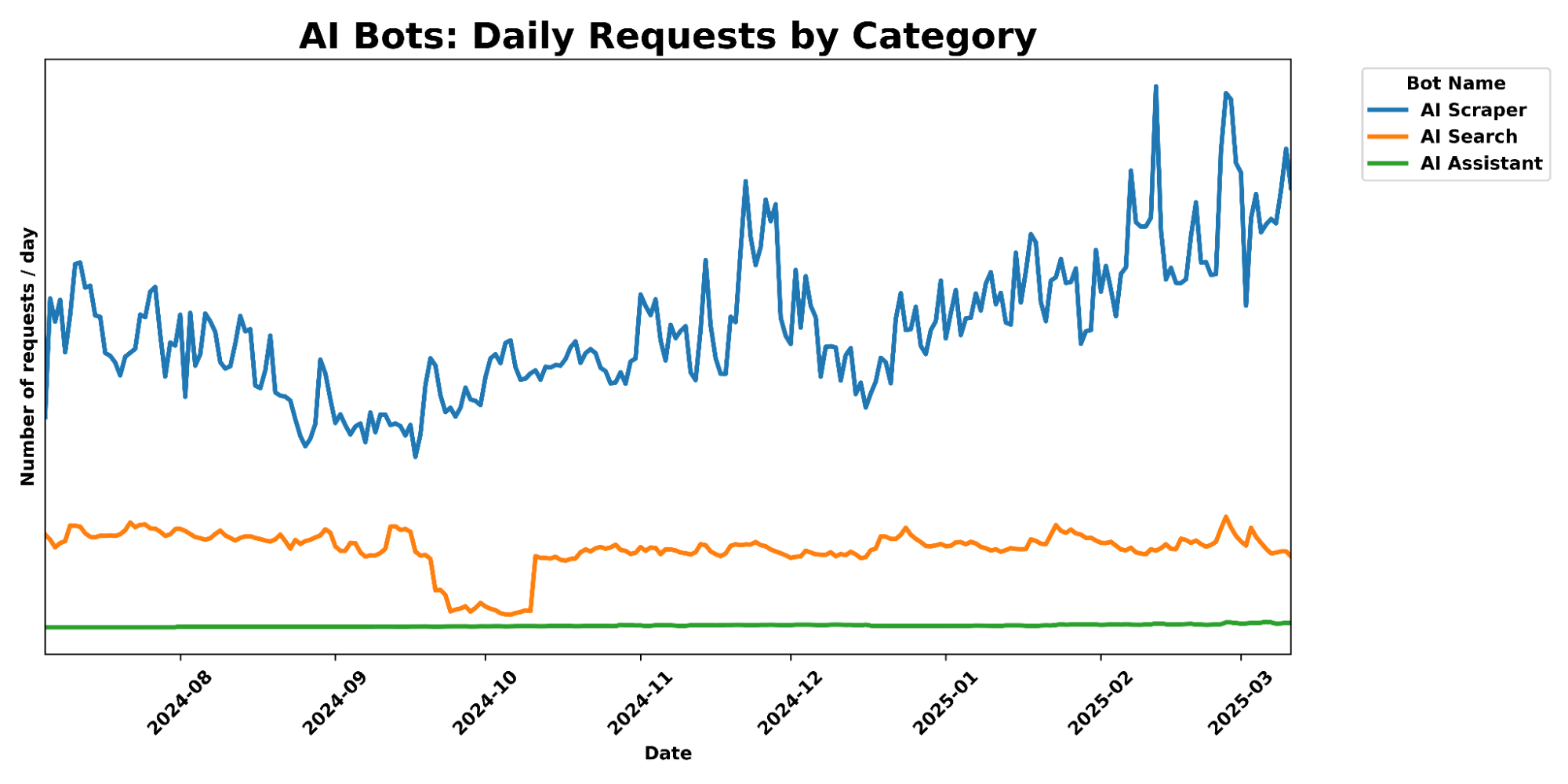
A graph of daily requests over time, comparing different categories of AI Crawlers.
What makes this approach particularly effective is its role in our continuously evolving bot detection system. When these links are followed, we know with high confidence that it’s automated crawler activity, as human visitors and legitimate browsers would never see or click them. This provides us with a powerful identification mechanism, generating valuable data that feeds into our machine learning models. By analyzing which crawlers are following these hidden pathways, we can identify new bot patterns and signatures that might otherwise go undetected. This proactive approach helps us stay ahead of AI scrapers, continuously improving our detection capabilities without disrupting the normal browsing experience.
By building this solution on our developer platform, we’ve created a system that serves convincing decoy content instantly while maintaining consistent quality – all without impacting your site’s performance or user experience.
How to use AI Labyrinth to stop AI crawlers
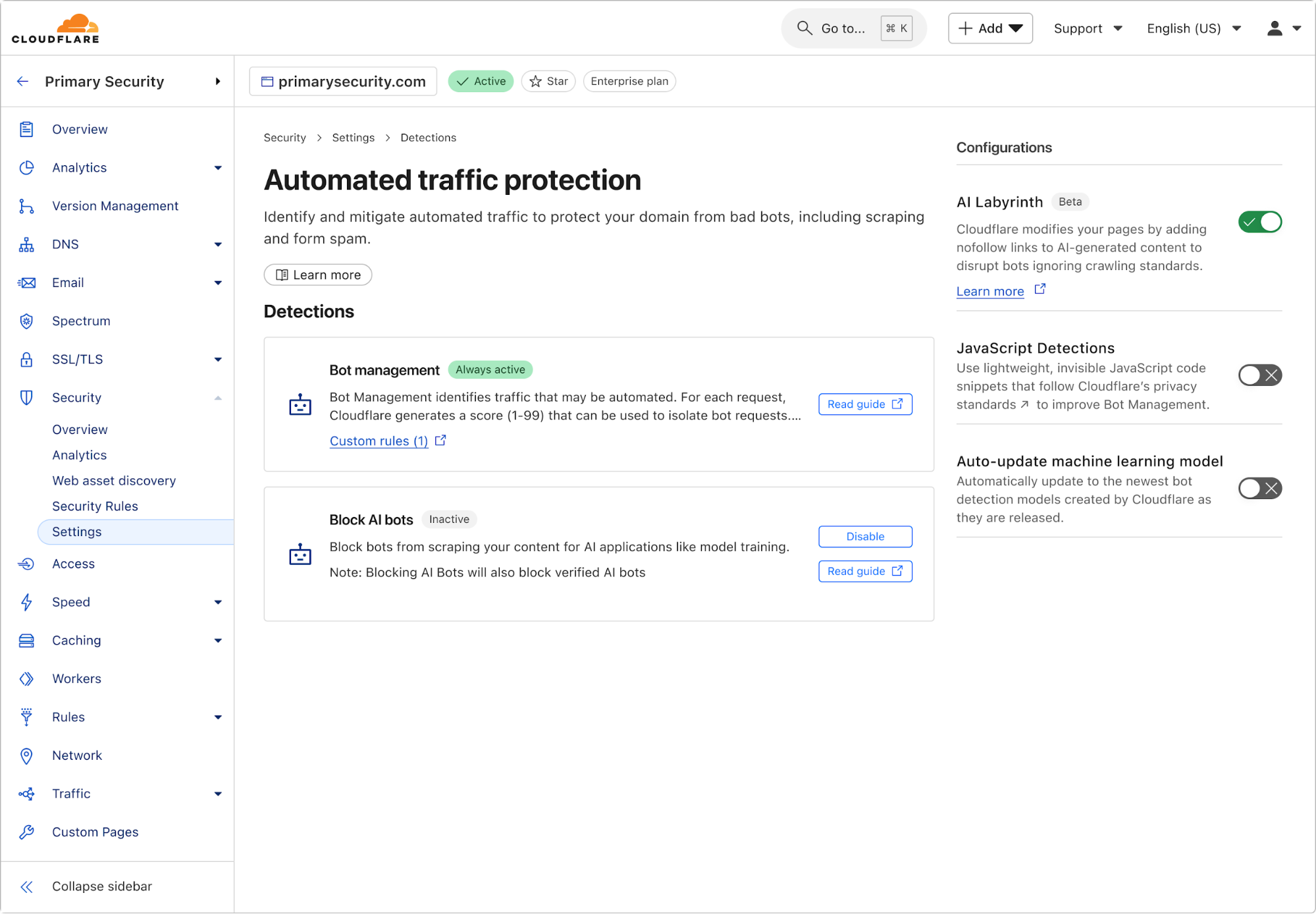
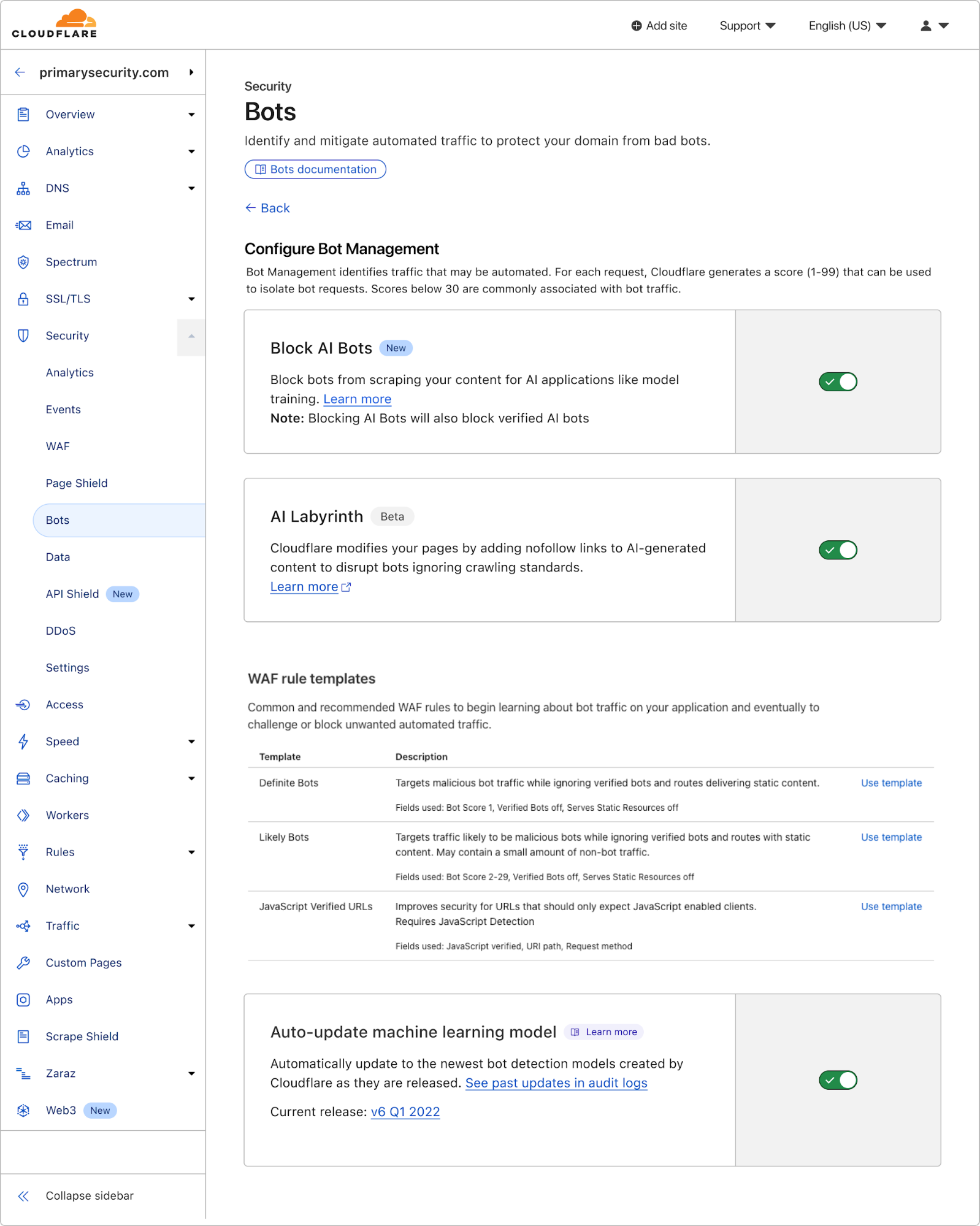
Enabling AI Labyrinth is simple and requires just a single toggle in your Cloudflare dashboard. Navigate to the bot management section within your zone, and toggle the new AI Labyrinth setting to on:
Once enabled, the AI Labyrinth begins working immediately with no additional configuration needed.
AI honeypots, created by AI
The core benefit of AI Labyrinth is to confuse and distract bots. However, a secondary benefit is to serve as a next-generation honeypot. In this context, a honeypot is just an invisible link that a website visitor can’t see, but a bot parsing HTML would see and click on, therefore revealing itself to be a bot. Honeypots have been used to catch hackers as early as the late 1986 Cuckoo’s Egg incident. And in 2004, Project Honeypot was created by Cloudflare founders (prior to founding Cloudflare) to let everyone easily deploy free email honeypots, and receive lists of crawler IPs in exchange for contributing to the database. But as bots have evolved, they now proactively look for honeypot techniques like hidden links, making this approach less effective.
AI Labyrinth won’t simply add invisible links, but will eventually create whole networks of linked URLs that are much more realistic, and not trivial for automated programs to spot. The content on the pages is obviously content no human would spend time-consuming, but AI bots are programmed to crawl rather deeply to harvest as much data as possible. When bots hit these URLs, we can be confident they aren’t actual humans, and this information is recorded and automatically fed to our machine learning models to help improve our bot identification. This creates a beneficial feedback loop where each scraping attempt helps protect all Cloudflare customers.
What’s next
This is only the first iteration of using generative AI to thwart bots for us. Currently, while the content we generate is convincingly human, it won’t conform to the existing structure of every website. In the future, we’ll continue to work to make these links harder to spot and make them fit seamlessly into the existing structure of the website they’re embedded in. You can help us by opting in now.
Generative AI is reshaping many aspects of our lives, from how we work and learn, to how we play and interact. Given that it’s Security Week, it’s a good time to think about some of the unintended consequences of this information revolution and the role that we play in bringing them about.
Today’s web is full of AI-generated content: text, code, images, audio, and video can all be generated by machines, normally based on a prompt from a human. Some models have become so sophisticated that distinguishing their artifacts — that is, the text, audio, and video they generate — from everything else can be quite difficult, even for machines themselves. This difficulty creates a number of challenges. On the one hand, those who train and deploy generative AI need to be able to identify AI-created artifacts they scrape from websites in order to avoid polluting their training data. On the other hand, the origin of these artifacts may be intentionally misrepresented, creating myriad problems for society writ large.
Part of the solution to this problem might be watermarking. The basic idea of watermarking is to modify the training process, the inference process, or both so that an artifact of the model embeds some identifying information of the model from which it originates. This way a model operator, or potentially the consumer of the content themselves, can determine whether some artifact came from the model by checking for the presence of the watermark.
Watermarking shares many of the same goals as the C2PA initiative. C2PA seeks to add provenance of media from a variety of sources, not just AI. Think of it as a chain of digital signatures, where each link in the chain corresponds to some modification of the artifact. For example, if you’re a Cloudflare customer using Images to serve C2PA-tagged content, you can opt in to preserve the provenance by extending this signature chain, even after the image is compressed on our network.
The challenge of this approach is that it requires participation by each entity in the chain of custody of the artifact. Watermarking has the potential to make C2PA more robust by preserving the origin of the artifact even after unattributed modification. Whereas the C2PA signature is encoded in an image’s metadata, a watermark is embedded in the pixels of the image itself.
In this post, we’re going to take a look at an emerging paradigm for AI watermarking. Based on cryptography, these new watermarks aim to provide rigorous, mathematical guarantees of quality preservation and robustness to modification of the content. This field is, as of 2025, only a couple of years old, and we don’t yet know if it will yield schemes that are practical to deploy. Nevertheless, we believe this is a promising area of research, and we hope this post inspires someone to come up with the next big idea.
The case for cryptography
It’s often said that cryptography is necessary but not sufficient for security. In other words, cryptographers make certain assumptions about the state of the system, like that a key is kept secret from the attacker, or that some computational puzzle is hard to solve. When these assumptions hold, a good cryptosystem provides a mathematical proof of security against the class of attacks it is designed to prevent.
Artifact watermarking usually has three security goals:
Robustness: Users of the model should not be able to easily misrepresent the origin of its artifacts. The watermark should be verifiable even after the artifact is modified to some extent.
Undetectability: Watermarking should have negligible impact on the quality of the model output. In particular, watermarked artifacts should be indistinguishable from non-watermarked artifacts of the same model.
Unforgeability: It should be impossible for anyone but the model operator to produce watermarked artifacts. No one should be able to convince the model operator that an artifact was generated by the model when it wasn’t.
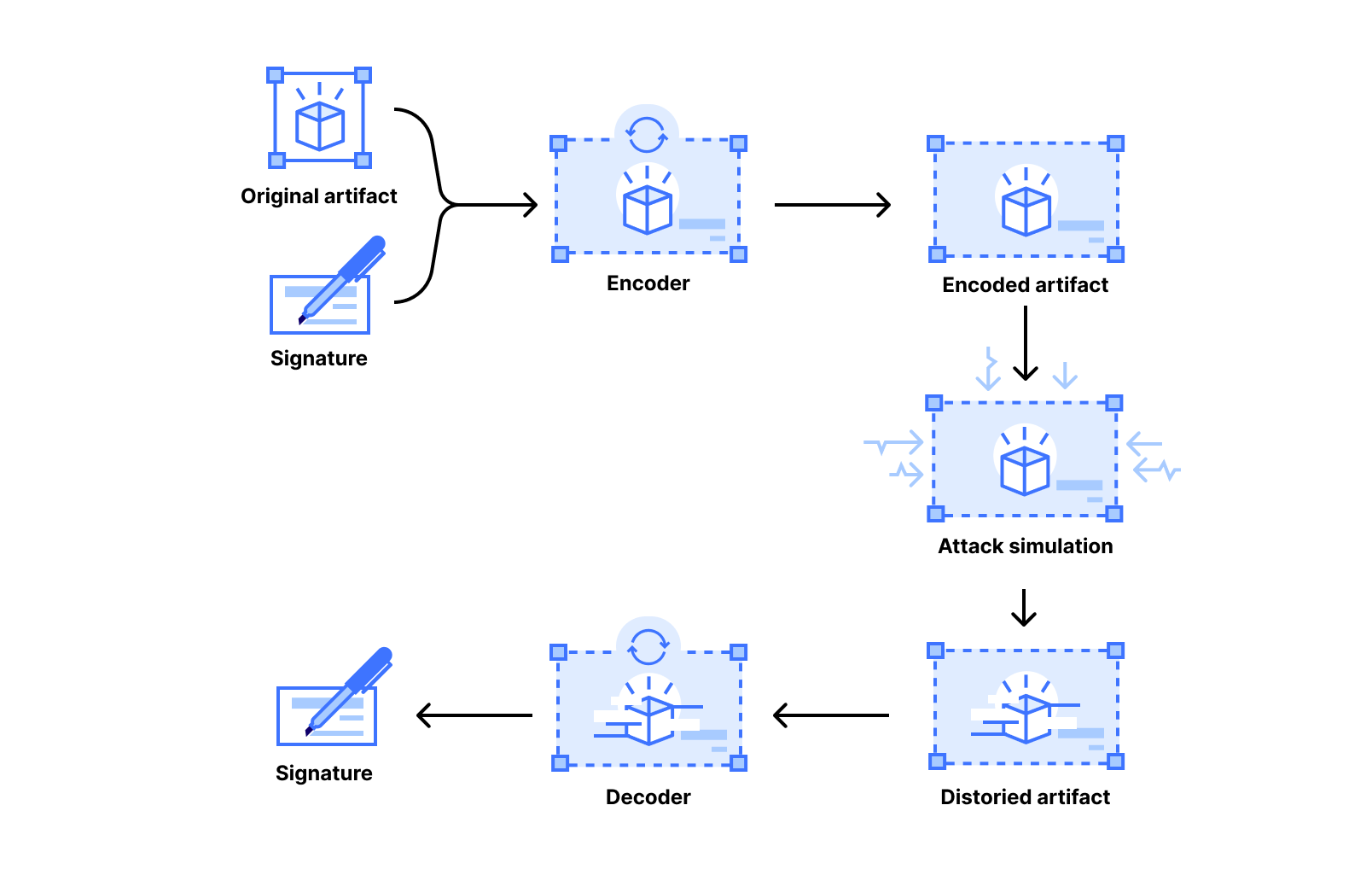
Today’s state-of-the-art watermarks, including Google’s SynthID and Meta’s Video Seal, are often based on deep learning. These schemes involve training a machine learning model, typically one with an encoder–decoder architecture where the encoder encodes a signature into an artifact and the decoder decodes the signature:
Figure 1: Illustration of the process of training an encoder-decoder watermarking model.
The training process involves subjecting the watermarked artifact to a series of known attacks. The more attacks the model thwarts, the higher the model quality. For example, the trainer would alter the artifact in various ways and run the decoder on the outputs: the model scores high if the decoder manages to correctly output the signature most of the time.
This idea is quite beautiful. It’s like a scaled up version of penetration testing, an essential practice of security engineering whereby the system is subjected to a suite of known attacks until all known vulnerabilities are patched. Of course, there will always be new attack variants or new attack strategies that the model was not trained on and that may evade the model.
And so ensues the proverbial game of cat-and-mouse that consumes so much time in security engineering. Coping with new attacks on robustness, undetectability, or unforgeability of deep-learning based watermarks requires continual intelligence gathering and re-training of deployed models to keep up with attackers.
The promise of cryptography is that it helps us break out of these kinds of cat-and-mouse games. Cryptography reduces the attack surface by focusing the attacker’s attention on breaking some narrow aspect of the system that is easier to reason about. This might be gaining access to some secret key, or solving some (seemingly unrelated) computational puzzle that is believed to be impossible to solve.
Pseudorandom codes
To the best of our knowledge, the first cryptographic AI watermark was proposed by Scott Aaronson in the summer of 2022 while he was working at OpenAI. Tailored specifically for chatbots, Aaronson’s simple scheme was both undetectable and unforgeable. However, it was susceptible to some simple attacks on robustness.
Figure 2: The “emoji attack”: Ask the chatbot to embed a simple pattern in its response, then remove the pattern manually. This is sufficient to remove some cryptographic watermarks from the model output.
In the year or so that followed, other cryptographic watermarks were proposed, all making different trade-offs between detectability and robustness. Two years later, in a paper that appeared at CRYPTO 2024, Miranda Christ and Sam Gunn articulated a new framework for watermarks that, if properly instantiated, would provide all three properties simultaneously.
Along with the prompt provided by the user, generative AI models typically take as input some randomness generated by the model operator. For many such models, it is often possible to run the model “in reverse” such that, given an artifact of the model, one can recover an approximation of the initial randomness used to generate it. We’ll see why this is important in a moment.
The starting point for Christ-Gunn-2024 is a mathematical tool called an error correcting code. These codes are normally used to transmit messages over noisy channels and are found in just about every system we rely on, including fiber optics, satellites, the data bus on your motherboard, and even quantum computers.
To transmit a message m, one first encodes it into a codewordc=encode(m). Then the receiver attempts to decode the codeword as decode(c). Error correcting codes are designed to tolerate some fraction of the codeword bits being flipped: if too many bits are flipped, then decoding will fail.
Now, ignoring undetectability and unforgeability for a moment, we can use an error correcting code to make a robust watermark as follows:
Generate the initial randomness.
Embed a codeword c=encode(m) into the randomness in some manner, by overwriting bits of randomness with bits of c. The message m can be whatever we want, for example a short string identifying the version of our model.
Run the model with the modified randomness.
To verify the watermark, we:
Run the model “in reverse” on the artifact, obtaining an approximation of the initial randomness.
Extract the codeword c* from the randomness.
If decode(c*) succeeds, then the watermark is present.
Why does this work? Since c is a codeword, we can verify the watermark even if our approximation of the initial randomness isn’t perfect. Some of the bits will be flipped, but the error correcting property of the code allows us to compensate for this. In fact, this is also what makes the watermark robust, since we can also tolerate bit flips caused by an attacker munging the artifact. Of course, the better our approximation of the initial randomness, the more robust our watermark will be, since we’ll be able to correct for more bit flips.
To see why this watermark is detectable, notice that overwriting bits of the randomness with a fixed codeword (c=encode(m)) biases the randomness and thereby the output of the model. Thus, the distribution of watermarked artifacts will be slightly different from unwatermarked artifacts, perhaps even noticeably so. This watermark is also forgeable, since the encoding algorithm is public and can be run by anyone.
The challenge then is to design error-correcting codes for which codewords look random, and generating codewords requires knowledge of a secret key held by the model operator. Christ-Gunn-2024 names these pseudorandom error-correcting codes, or simply pseudorandom codes.
A pseudorandom code consists of three algorithms:
k = key_gen(): the key generation algorithm. Let’s call k the watermarking key.
c = encode(k,m): the encoding algorithm takes in a message m and outputs a codeword c.
m = decode(k,c): the decoding algorithm takes in a codeword c and outputs the underlying message m, or an indication that decoding failed.
The term “pseudorandom” refers to the fact that codewords aren’t technically random bit strings. Intuitively, an attacker can distinguish a codeword from a random string if it manages to guess the watermarking key. Thus, our goal is to choose parameters for the code such that distinguishing codewords from random — for example, by guessing the watermarking key — is hard for any computationally bounded attacker.
To use a pseudorandom code for watermarking, the operator first generates a watermarking key k. Then each time it gets a prompt from a user, it generates the initial randomness, embeds c=encode(k,m) into the initial randomness, and runs the model. To verify the watermark, the operator runs the model in reverse to get the inverted randomness, extracts the inverted codeword, c*, and computes decode(k,c*): if decoding succeeds, then the watermark is present.
In order for this watermark to be undetectable, we need to pick an embedding of the codeword that doesn’t change the distribution of the initial randomness. The details of this embedding depend on the model. Let’s take a look at Stable Diffusion as an example.
A watermark for Stable Diffusion
Stable Diffusion is a model used for image generation that takes as input a tensor of normally distributed floating point numbers called a latent. The model uses the user’s prompt to “denoise” the latent tensor over a number of iterations, then converts the final version of the latent to an image.
Approximating the initial latent
Diffusion inversion is an iterative process that returns an exact or approximate initial latent by reversing the sampling process that generated an image. Inversion for text to image diffusion models is a relatively new area of research. A common application of diffusion inversion is editing images by text prompts.
Denoising Diffusion Implicit Models (DDIMs) are iterative, implicit probabilistic models that can generate high quality images using a faster sampling process than other approaches, as it only requires a relatively small number of timesteps to generate a sample. This makes DDIM Inversion a popular inversion technique because it is computationally fast, as it requires only a few timesteps to return an approximate initial latent of a generated image. Despite its popularity, it has some known limitations and can be problematic to use for tasks where exact image reproduction is required. These limitations have led researchers to explore techniques that produce exact initial latents. However, since watermarks based on pseudorandom codes can tolerate errors, it’s worth investigating whether DDIM Inversion suffices for our purposes.
Before we can generate an approximate initial latent, we need a generated image. To do this we use a pretrained Stable Diffusion model that uses a DDIM scheduler. The scheduler performs the “denoising” process that generates an image from a random noise seed (initial latent). By default, the pipeline computes random latents; when embedding a watermark we will generate this latent ourselves as described in the next section. The Stable Diffusion pipelines in the code snippets below sets the number of inference steps to 50. This parameter controls the number of steps the denoising process takes. 50 steps provides a nice balance between speed and image quality.
from stable_diffusion.utils import build_stable_diffusion_pipeline
from stable_diffusion.schedulers import ddim_scheduler

# Instantiate Stable Diffusion pipeline
model_cache_path = './model_cache'
model = 'stabilityai/stable-diffusion-2-1-base'
scheduler, _ = ddim_scheduler()
pipe, device = build_stable_diffusion_pipeline(model, model_cache_path, scheduler)

# Generate image
prompt = 'grainy photo of a UFO at night'
image, _ = pipe(prompt, num_inference_steps=50, return_dict=False)
To compute the approximate initial latent for the image we generated, we run the sampling process backwards. We could include the prompt, but in the case of verifying a watermark, we will usually not know the initial prompt, so we instead just set it to the empty string:
from PIL import Image
from stable_diffusion.utils import build_stable_diffusion_pipeline,
                                   convert_pil_to_latents
from stable_diffusion.schedulers import ddim_inverse_scheduler

# Load image
img = Image.open(image_path)

# Instantiate Stable Diffusion pipeline with DDIM Inverse scheduler
model_cache_path = './model_cache'
model = 'stabilityai/stable-diffusion-2-1-base'
scheduler, _= ddim_inverse_scheduler()
pipe, _ = build_stable_diffusion_pipeline(model, model_cache_path, scheduler)

# Convert the input image to latent space
image_latent = convert_pil_to_latents(pipe, img)

# Invert the sampling process that generated the image with an empty prompt
inverted_latent, _ = pipe('', output_type='latent', latents=image_latent,
                          num_inference_steps=50, return_dict=False)
Embedding the code
The initial latent used for stable diffusion consists of a bunch of floating point numbers, each independently and normally distributed with a mean of zero.
The following observation is from a recent evaluation of the watermark of Christ and Gunn for stable diffusion. (There they used a more sophisticated but expensive inversion method than DDIM.) Observe that the probability that each number is negative is equal to the probability that the number is positive. Likewise, if the code is indeed pseudorandom, then each bit of the codeword is computationally indistinguishable from a bit that is one with probability ½ and zero with probability ½.
To embed the codeword in the latent, we just set the sign of each number according to the corresponding bit of the codeword:
from stable_diffusion.utils import build_stable_diffusion_pipeline
from stable_diffusion.schedulers import ddim_scheduler
import numpy as np
import torch

# Generate a normally distributed latent. For the default image
# size of 512x512 pixels, the latent shape is `[1, 4, 64, 64]`.
initial_latent = np.abs(np.random.randn(*LATENTS_SHAPE))

with np.nditer(initial_latent, op_flags=['readwrite']) as it:
    	codeword = encode(k, m)
    	for (i, x) in enumerate(it):
             # `codeword[i]` is a `bool` representing the `i`-th bit of
             # the codeword.
             x *= 1 if codeword[i] else -1

watermarked_latent = torch.from_numpy(initial_latent).to(dtype=torch.float32)

# Instantiate Stable Diffusion pipeline
model_cache_path = './model_cache'
model = 'stabilityai/stable-diffusion-2-1-base'
scheduler, _ = ddim_scheduler()
pipe, _ = build_stable_diffusion_pipeline(model, model_cache_path, scheduler)

# Generate watermarked image
prompt = 'grainy photo of a UFO at night'
watermarked_image, _ = pipe(prompt, num_inference_steps=50,
                                              latents=watermarked_latent,
                                              return_dict=False)
To verify this watermark, we compute the inverted latent, extract the codeword, and attempt to decode:
from PIL import Image
from stable_diffusion.utils import build_stable_diffusion_pipeline,
                                   convert_pil_to_latents
from stable_diffusion.schedulers import ddim_inverse_scheduler
import numpy as np

# Load image
img = Image.open(image_path)

# Instantiate Stable Diffusion pipeline with DDIM Inverse scheduler
model_cache_path = './model_cache'
model = 'stabilityai/stable-diffusion-2-1-base'
scheduler, _ = ddim_inverse_scheduler()
pipe, _ = build_stable_diffusion_pipeline(model, model_cache_path, scheduler)

# Convert the input image to latent space
image_latent = convert_pil_to_latents(pipe, img)

# Invert the sampling process that generated the image
inverted_latent, _ = pipe('', output_type='latent', latents=image_latent,
                         num_inference_steps=50, return_dict=False)

watermark_verified = False
with np.nditer(inverted_latent.cpu().numpy()) as it:
    inverted_codeword = []
    for x in it:
         inverted_codeword.append(x > 0)

    if decode(k, inverted_codeword) == m:
         watermark_verified = True
This should work in theory given the error-correcting properties of the code. But does it work in practice?
Evaluation
A good approximate initial latent is one that is very similar to the original latent that generated an image. Given our embedding of a codeword into the latent, we define similarity as latents that have a high percentage of overlapping or matching signs.
To get a feel for this difference, we can visualize it by comparing a generated image to the same image, but with the inverted latent (these images are unwatermarked):
Figure 3: Image generated with prompt ‘grainy photo of a UFO at night’ (left) and the same image generated using the inverted latent (right).
To evaluate how good the approximate latents are for preserving the robustness of watermarks, we randomly sampled 1,000 prompts from the PartiPrompts benchmark dataset. For each of these prompts we generated initial latent and inverted latent pairs. We then computed our similarity metric for each pair. We found that on average, 82% of the signs matched for all initial latent and inverted latent pairs, and at least 75% of signs matched for 90% of the pairs.
We were pleasantly surprised with how accurate the approximation was on average. If 75% of the signs are preserved, then this gives us a decent margin for correcting for errors introduced by an attacker attempting to remove the watermark. Of course a better approximation would give us a better robustness margin. More study is required to fully understand the strengths and limitations of using DDIM Inversion for watermark decoding.
Candidate pseudorandom codes
Now that we have a feel for how to apply pseudorandom codes, let’s take a look at how we actually build them. Although the field is barely a year old, we already have a handful of candidates.
One obvious idea to try is to compose a plain error-correcting code with some cryptographic primitive to make the code pseudorandom. For instance, we might use some standard authenticated encryption scheme, like AES-GCM-SIV, to encrypt m, then apply an error correcting code to the ciphertext. (The watermarking key would be the encryption key.) This “encrypt-then-encode” composition seems natural because encryption schemes are already designed so that their ciphertexts are pseudorandom. Unfortunately, error correcting codes are generally highly structured, and this structure would be betrayed by the codeword, even when applied to a (pseudo)random input.
The dual composition, “encode-then-encrypt”, also doesn’t work. If the ciphertext is non-malleable, as in AES-GCM-SIV, then we wouldn’t be able to tolerate any number of bit flips. On the other hand, if the ciphertext were malleable, as in AES-CTR, then the attacker would be able to forge codewords by manipulating a known codeword in a targeted manner.
The strategy of Christ-Gunn-2024 is to modify an existing error-correcting code to make it pseudorandom.
Pseudorandom LDPC codes
Their starting point is the widely used Low-Density Parity-Check (LDPC) code. This code is defined by a parity check matrix P with and a corresponding generator matrix G. The parity check matrix has bit entries and might look something like this:
This matrix is used to check if a given bit string is a codeword. By definition, a codeword is any bit string c for which the weight of P*c (the number ones in the output of P*c) is small. (Note that arithmetic is modulo 2 here.) The generator matrix G is constructed from P so that it can be used as the encoder. In particular, for any bit string m, c=G*m is a codeword. The performance of this code depends in large part on the sparsity of the parity check matrix: roughly speaking, the more zero entries the matrix has, the more the bit flips the code can tolerate.
The main idea of Christ-Gunn-2024 is to tune the parameters of the LDPC code (the dimensions of the parity check matrix and its density) so that when the parity-check matrix P is chosen at random, the generator matrix G is pseudorandom. This means that, intuitively, when we encode a random input m as c=G*m, the codeword c is also pseudorandom. (There is a bit more that goes into constructing the input m, but this is roughly the idea.)
It’s easy to see that a watermark based on this construction is robust, as it follows immediately from the capacity of LDPC to tolerate bit flips. Ensuring the watermark remains undetectable is more delicate, as it relies on relatively strong and understudied computational assumptions. As a result, it’s not clear today for what parameter ranges this scheme is concretely secure. (There has been some progress here: a recent preprint by Surendra Ghentiyala and Venkatesan Guruswami showed that the pseudorandomness of Christ-Gunn-2024 can be proved with slightly weaker assumptions.)
To get a feel for how things might go wrong, consider what happens if the attacker manages to guess one of the rows of the parity check matrix P. When we take the dot product of this row with a codeword, then the output will be 0 with high probability. (By definition, c is a codeword if the sum of the dot products of c with each row of P is small.) But if we take the dot product of this row with a random bit string, then we should expect to see 0 with probability roughly ½. This gives us a way of distinguishing codewords from random bit strings.
Guessing a row of P is easy if the matrix is too sparse. In the extreme case, if each row has only one bit set, then there are only n possible values for that row, where n is the number of columns of P. On the other hand, making P too dense will degrade the code’s ability to detect bit flips.
Similarly, it may be easy to guess a row of P if the length of the codeword itself (n) is too small. Thus, in order for this code to be pseudorandom, it is necessary (but not sufficient) for the number of possible parity check matrices to be so large that exhaustively searching for P is not feasible. This can be done by increasing the size of the codeword or tolerating fewer bit flips.
Pseudorandom codes from PRFs
Another approach to constructing pseudorandom codes comes from a 2024 preprint from Noah Golowich and Ankur Moitra. Their starting point is a common cryptographic primitive called a pseudorandom function (PRF). They require a PRF that takes as input a key k, a bit string x of length m and outputs a bit, denoted F(k,m).
Suppose our codewords are x1, w1=F(k,x1), …, xn, wn=F(k,xn) where x1, …, xn are random m-bit strings. (Notice that the codeword length is (m+1)*n.) To verify if a string is a codeword, we parse the codeword into x1, w1, …, xn, wnand check if wi = F(k,xi) for all i. If the number of checks that pass is sufficiently high, then the string is likely a codeword.
It’s easy to see that this code is pseudorandom if the output of F is pseudorandom. However, it’s not very robust: to make the i-th check fail, we just need to flip a single bit, wi. The attacker just needs to flip a sufficient number of these bits to cause verification to fail. To defeat this attack, the encoder permutes the bits of the codeword with a secret, random permutation. That way the attacker has to guess the position of a sufficient number of wis in the permuted bit string. (A bit more is required to make this scheme provably robust, but this is the idea.)
Note that the number of bit flips we can tolerate with this scheme depends significantly on the number of PRF checks. This in turn determines the length of the codeword, so we may only get a reasonable degree of robustness for longer codewords. Note that we can increase the number of PRF checks by decreasing the length m of the xis, but making these strings too short is detrimental for pseudorandomness. (What happens if we happen to randomly pick xi==xjfor i!=j?)
Are these schemes practical?
In our own experiments with Stable Diffusion, we were able to tune the LDPC code to tolerate up to 33% of the codeword bits being mangled, which is likely more than sufficient for robustness in practice. However, achieving this required making the parity check matrix so sparse that the code is not strongly pseudorandom. Thus, the resulting watermark cannot be considered cryptographically undetectable. Among the parameter sets for which the code is plausibly pseudorandom, we didn’t find any for which the code tolerates more than 5% bit flips.
Our findings were similar for the PRF-based code: with plausibly pseudorandom parameters, we couldn’t tune the code to tolerate more than 1% bit flips. Like the LDPC code, we can crank this higher by sacrificing pseudorandomness, but we weren’t able to crack 5% with any parameters we tried.
There are a few ways to think about this.
First, for both codes, robustness improves as the codeword gets larger. In particular, if the latent space for Stable Diffusion were larger, then we’d expect to be able to tolerate more bit flips. In general, cryptographic watermarks of all kinds perform better when there is more randomness to work with. For example, short responses produced by chatbots are especially hard for any watermarking strategy, including pseudorandom codes.
Another takeaway is that we need a better approximation of the initial latent than provided by DDIM. Indeed, in their own evaluation of the LDPC-based code, Sam Gunn, Xuandong Zhao, and Dawn Song chose a much more sophisticated inversion method, which exhibited better results, albeit at a higher computational cost.
A third view is that, as a practical matter, cryptographic undetectability might not be all that important for some applications. For instance, we might decide the watermark is good enough on the basis of statistical tests to check for biases within, or correlations across, codewords. Of course, such tests can’t rule out the possibility of perceptible differences between watermarked and unwatermarked artifacts.
Figure 4: Images with verified LDPC watermarks generated with prompt ‘grainy photo of a UFO at night’.
Conclusion
The sign of a good abstraction boundary is that it allows folks to collaborate across disciplines. With pseudorandom codes, it seems like we’ve landed on the right abstraction for AI watermarking: it’s up to cryptography experts to figure out how to instantiate them; and it’s up to AI/ML experts to figure out how to embed them in their applications. We believe this separation of concerns has the potential to make watermarking easier to deploy, especially for operators like Cloudflare’s Workers AI, who don’t train and maintain the models themselves.
After spending a few weeks playing around with this stuff, we’re excited by the potential of pseudorandom codes to make strong watermarks for generative AI. However, we feel it will take some time for this field to yield practical schemes.
Existing candidates will require further study to determine the parameter ranges for which they provide good security. It is also worthwhile to investigate new approaches to building pseudorandom codes, perhaps starting with some other error correcting code besides LDPC. We should also examine what is even theoretically possible in this space: perhaps there is a fundamental tension between detectability and robustness that can’t be resolved for some parameter regimes.
It’s also going to be important for watermarks based on pseudorandom codes to be publicly verifiable, as some other cryptographic watermarks are. Concretely, the LDPC code is sort of analogous to public key encryption, where the ciphertext corresponds to a codeword. It might be possible to flip this paradigm around and make a digital signature where the signature is a codeword. Of course, this only works when the weights of the model are also publicly available.
On the AI/ML side, we need to look closer at methods of approximating the initial randomness for different types of models. This blog looked at what is perhaps the simplest possible method for Stable Diffusion, and while this seems to work pretty well, it’s obvious that we can do a lot better. It’s just a matter of keeping costs low. A good rule of thumb might be that verifying the watermark should not be more expensive than watermarked inference.
Pseudorandom codes may also have applications beyond watermarking. When we circulated this blog post internally, an idea that came up a lot was to somehow apply this technology to non-AI content, to embed in the content its provenance. Indeed, this is the idea behind the C2PA integration. Pseudorandom codes aren’t immediately applicable, but may be in the future. Wherever you have a source of randomness in the process of generating some artifact, like digital photography, you can embed in that randomness a codeword.
Thanks for reading! We hope we’ve managed to pique your interest in this field. We certainly will be following along. If you’d like to play with the code we used to produce the numbers in this blog, or just make some cool watermarked AI content, you can find our demo on GitHub.
Modern websites rely heavily on JavaScript. Leveraging third-party scripts accelerates web app development, enabling organizations to deploy new features faster without building everything from scratch. However, supply chain attacks targeting third-party JavaScript are no longer just a theoretical concern — they have become a reality, as recent incidents have shown. Given the vast number of scripts and the rapid pace of updates, manually reviewing each one is not a scalable security strategy.
Cloudflare provides automated client-side protection through Page Shield. Until now, Page Shield could scan JavaScript dependencies on a web page, flagging obfuscated script content which also exfiltrates data. However, these are only indirect indicators of compromise or malicious intent. Our original approach didn’t provide clear insights into a script’s specific malicious objectives or the type of attack it was designed to execute.
Taking things a step further, we have developed a new AI model that allows us to detect the exact malicious intent behind each script. This intelligence is now integrated into Page Shield, available to all Page Shield add-on customers. We are starting with three key threat categories: Magecart, crypto mining, and malware.
Screenshot of Page Shield dashboard showing results of three types of analysis.
With these improvements, Page Shield provides deeper visibility into client-side threats, empowering organizations to better protect their users from evolving security risks. This new capability is available to all Page Shield customers with the add-on. Head over to the dashboard, and you can find the new malicious code analysis for each of the scripts monitored.
In the following sections, we take a deep dive into how we developed this model.
Training the model to detect hidden malicious intent
We built this new Page Shield AI model to detect the intent of JavaScript threats at scale. Training such a model for JavaScript comes with unique challenges, including dealing with web code written in many different styles, often obfuscated yet benign. For instance, the following three snippets serve the same function.
With such a variance of styles (and many more), our machine learning solution needs to balance precision (low false positive rate), recall (don’t miss an attack vector), and speed. Here’s how we do it:
Using syntax trees to classify malicious code
JavaScript files are parsed into syntax trees (connected acyclic graphs). These serve as the input to a Graph Neural Network (GNN). GNNs are used because they effectively capture the interdependencies (relationships between nodes) in executing code, such as a function calling another function. This contrasts with treating the code as merely a sequence of words — something a code compiler, incidentally, does not do. Another motivation to use GNNs is the insight that the syntax trees of malicious versus benign JavaScript tend to be different. For example, it’s not rare to find attacks that consist of malicious snippets inserted into, but otherwise isolated from, the rest of a benign base code.
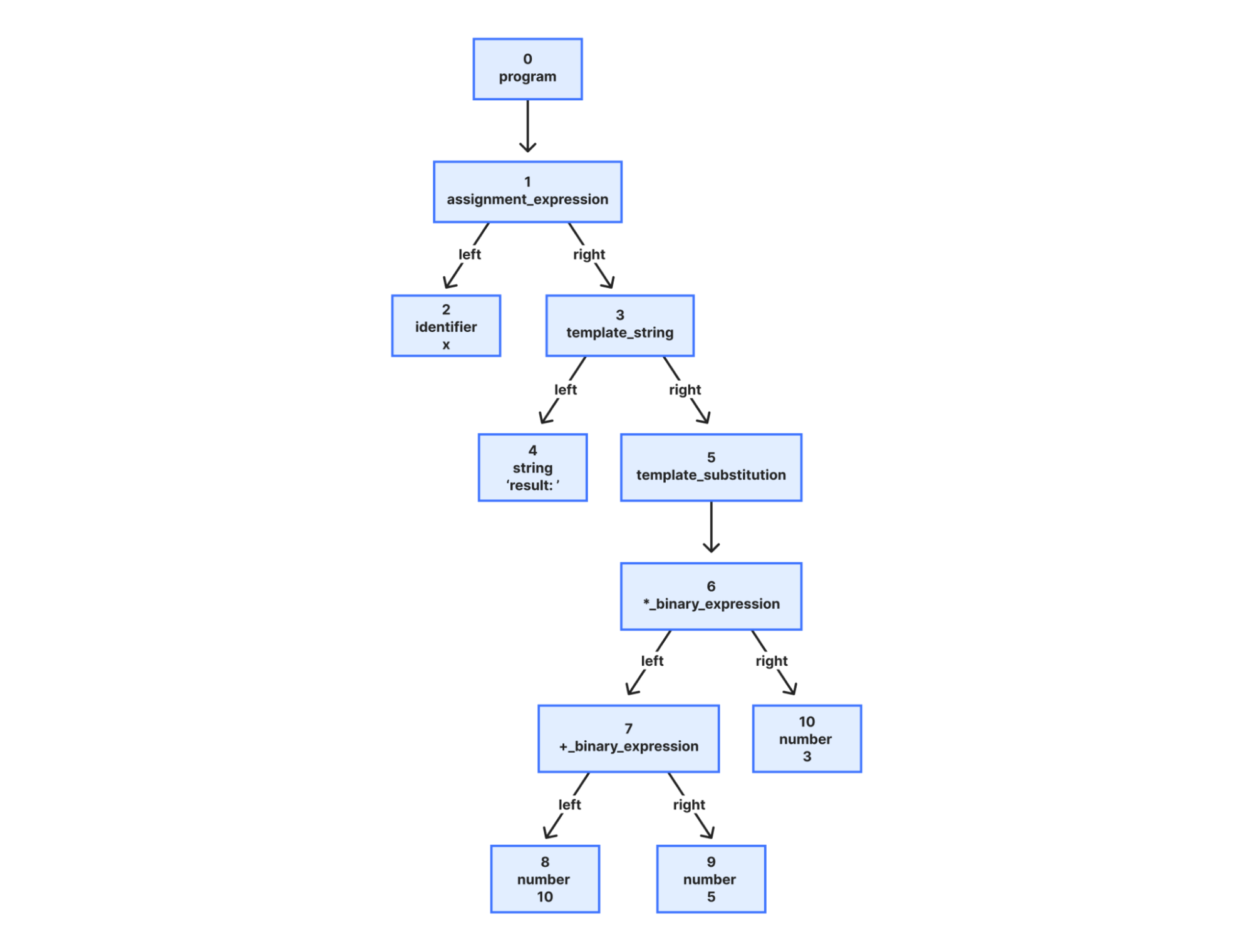
To parse the files, the tree-sitter library was chosen for its speed. One peculiarity of this parser, specialized for text editors, is that it parses out concrete syntax trees (CST). CSTs retain everything from the original text input, including spacing information, comments, and even nodes attempting to repair syntax errors. This differs from abstract syntax trees (AST), the data structures used in compilers, which have just the essential information to execute the underlying code while ignoring the rest. One key reason for wanting to convert the CST to an AST-like structure, is that it reduces the tree size, which in turn reduces computation and memory usage. To do that, we abstract and filter out unnecessary nodes such as code comments. Consider for instance, how the following snippet
x = `result: ${(10+5) * 3}`;;; //this is a comment
… gets converted to an AST-like representation:
Abstract Syntax Tree (AST) representation of the sample code above. Unnecessary elements get removed (e.g. comments, spacing) whereas others get encoded in the tree structure (order of operations due to parentheses).
One benefit of working with parsed syntax trees is that tokenization comes for free! We collect and treat the node leaves’ text as our tokens, which will be used as features (inputs) for the machine learning model. Note that multiple characters in the original input, for instance backticks to form a template string, are not treated as tokens per se, but remain encoded in the graph structure given to the GNN. (Notice in the sample tree representations the different node types, such as “assignment_expression”). Moreover, some details in the exact text input become irrelevant in the executing AST, such as whether a string was originally written using double quotes vs. single quotes.
We encode the node tokens and node types into a matrix of counts. Currently, we lowercase the nodes’ text to reduce vocabulary size, improving efficiency and reducing sparsity. Note that JavaScript is a case-sensitive language, so this is a trade-off we continue to explore. This matrix and, importantly, the information about the node edges within the tree, is the input to the GNN.
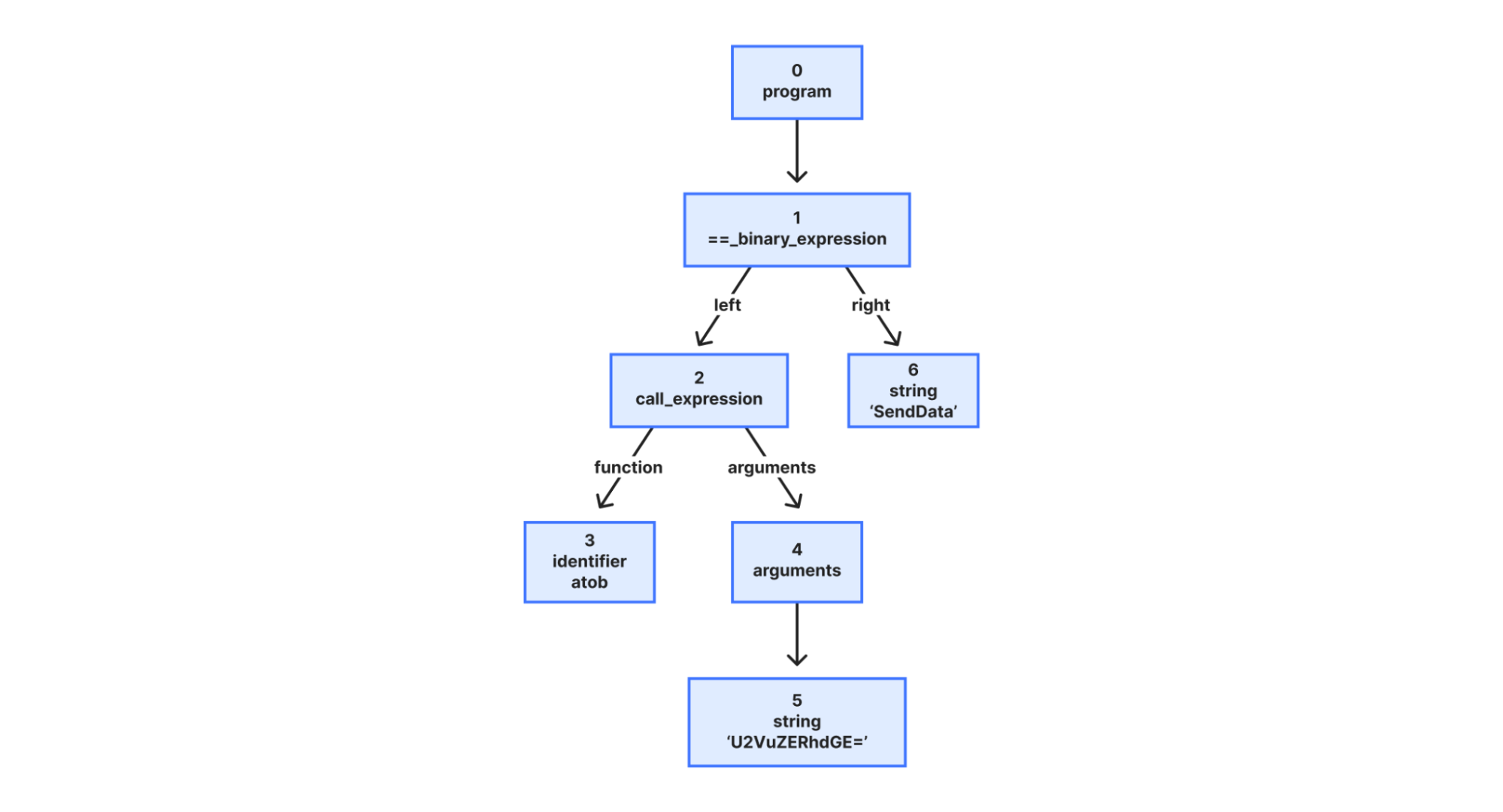
How do we deal with obfuscated code? We don’t treat it specially. Rather, we always parse the JavaScript text as is, which incidentally unescapes escape characters too. For instance, the resulting AST shown below for the following input exemplifies that:
Abstract Syntax Tree (AST) representation of the sample code above. JavaScript escape characters are unescaped.
Moreover, our vocabulary contains several tokens that are commonly used in obfuscated code, such as double escaped hexadecimal-encoded characters. That, together with the graph structure information, is giving us satisfying results — the model successfully classifies malicious code whether it’s obfuscated or not. Analogously, our model’s scores remain stable when applied to plain benign scripts compared to obfuscating them in different ways. In other words, the model’s score on a script is similar to the score on an obfuscated version of the same script. Having said that, some of our model’s false positives (FPs) originate from benign but obfuscated code, so we continue to investigate how we can improve our model’s intelligence.
Architecting the Graph Neural Network
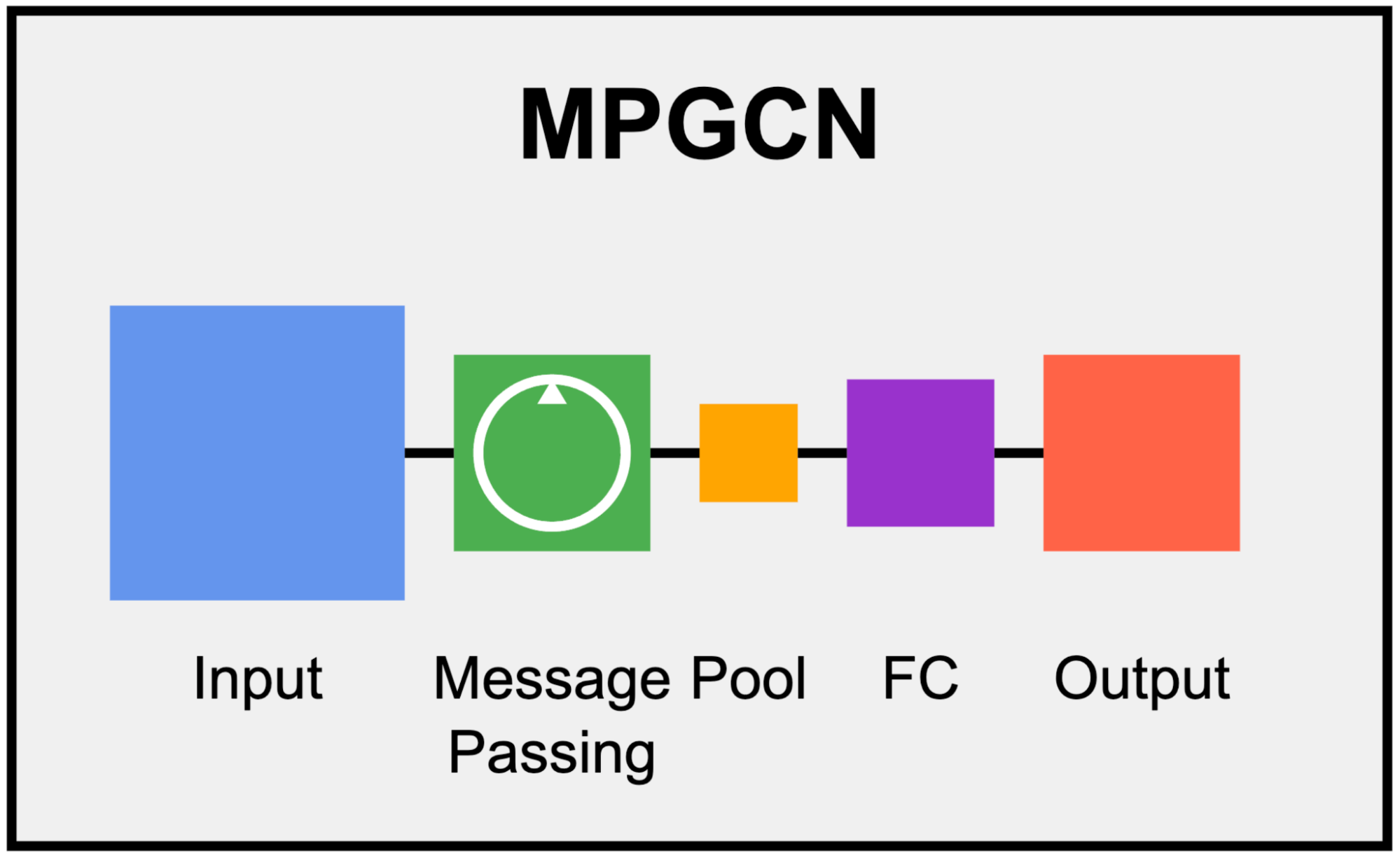
We train a message-passing graph convolutional network (MPGCN) that processes the input trees. The message-passing layers iteratively update each node’s internal representation, encoded in a matrix, by aggregating information from its neighbors (parent and child nodes in the tree). A pooling layer then condenses this matrix into a feature vector, discarding the explicit graph structure (edge connections between nodes). At this point, standard neural network layers, such as fully connected layers, can be applied to progressively refine the representation. Finally, a softmax activation layer produces a probability distribution over the four possible classes: benign, magecart, cryptomining, and malware.
We use the TF-GNN library to implement graph neural networks, with Keras serving as the high-level frontend for model building and training. This works well for us with one exception: TF-GNN does not support sparse matrices / tensors. (That lack of support increases memory consumption, which also adds some latency.) Because of this, we are considering switching to PyTorch Geometric instead.
Graph neural network architecture, transforming the input tree with features down to the 4 classification probabilities.
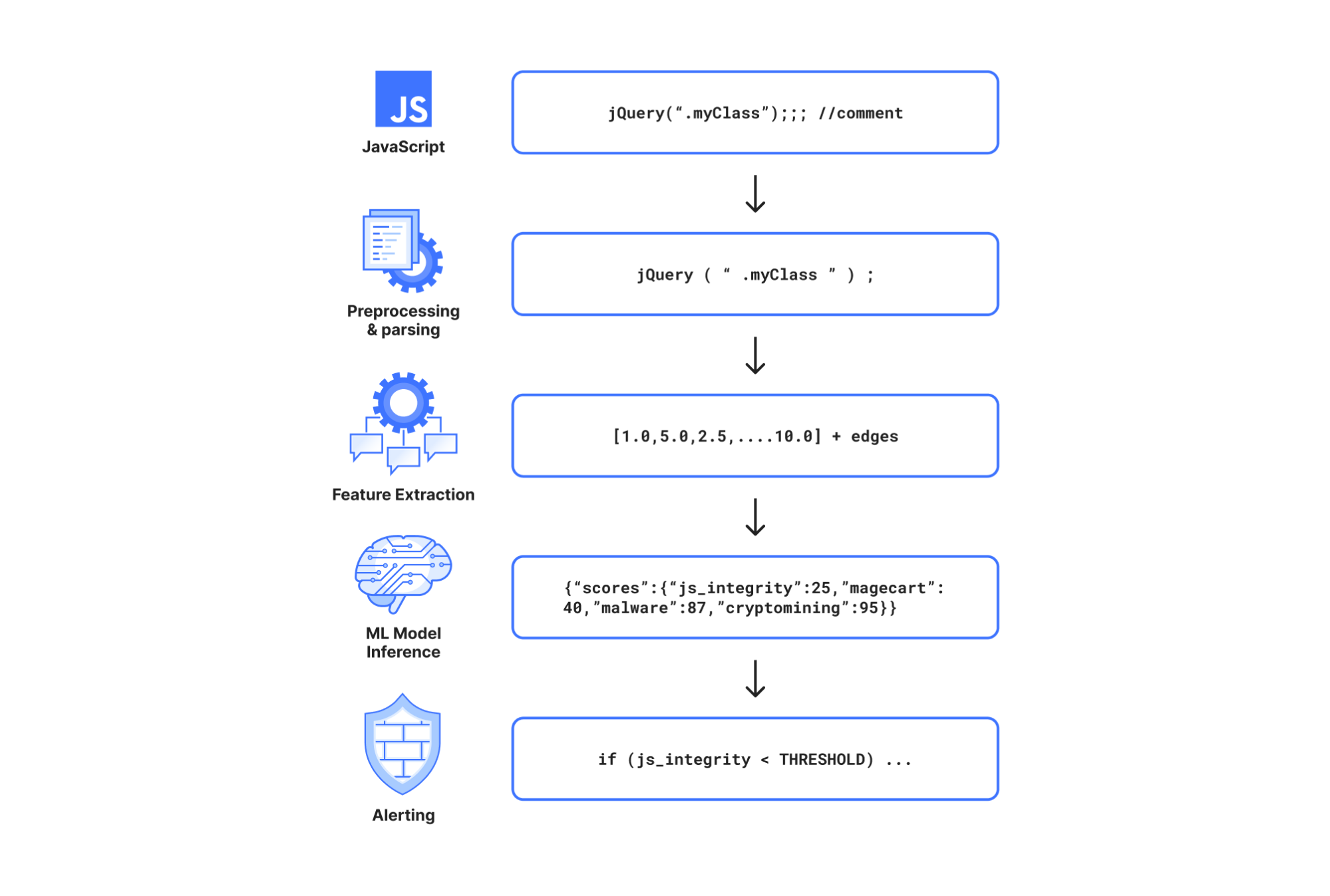
The model’s output probabilities are finally inverted and scaled into scores (ranging from 1 to 99). The “js_integrity” score aggregates the malicious classes (magecart, malware, cryptomining). A low score means likely malicious, and a high score means likely benign. We use this output format for consistency with other Cloudflare detection systems, such as Bot Management and the WAF Attack Score. The following diagram illustrates the preprocessing and feature analysis pipeline of the model down to the inference results.
Model inference pipeline to sniff out and alert on malicious JavaScript.
Tackling unbalanced data: malicious scripts are the minority
Finding malicious scripts is like finding a needle in a haystack; they are anomalies among plenty of otherwise benign JavaScript. This naturally results in a highly imbalanced dataset. For example, our Magecart-labeled scripts only account for ~6% of the total dataset.
Not only that, but the “benign” category contains an immense variance (and amount) of JavaScript to classify. The lengths of the scripts are highly diverse (ranging from just a few bytes to several megabytes), their coding styles vary widely, some are obfuscated whereas others are not, etc. To make matters worse, malicious payloads are often just small, carefully inserted fragments within an otherwise perfectly valid and functional benign script. This all creates a cacophony of token distributions for an ML model to make sense of.
Still, our biggest problem remains finding enough malevolent JavaScript to add to our training dataset. Thus, simplifying it, our strategy for data collection and annotation is two-fold:
Malicious scripts are about quantity → the more, the merrier (for our model, that is 😉). Of course, we still care about quality and diversity. But because we have so few of them (in comparison to the number of benign scripts), we take what we can.
Benign scripts are about quality → the more variance, the merrier. Here we have the opposite situation. Because we can collect so many of them easily, the value is in adding differentiated scripts.
Learning key scripts only: reduce false positives with minimal annotation time
To filter out semantically-similar scripts (mostly benign), we employed the latest advancements in LLM for generating code embeddings. We added those scripts that are distant enough from each other to our dataset, as measured by vector cosine similarity. Our methodology is simple — for a batch of potentially new scripts:
Call an LLM to generate its embedding. We’ve had good results with starcoder2, and most recently qwen2.5-coder.
Search in the database for the top-1 closest other script’s vectors.
If the distance > threshold (0.10), select it and add it to the database.
Else, discard the script (though we consider it for further validations and tests).
Although this methodology has an inherent bias in gradually favoring the first seen scripts, in practice we’ve used it for batches of newly and randomly sampled JavaScript only. To review the whole existing dataset, we could employ other but similar strategies, like applying HDBSCAN to identify an unknown number of clusters and then selecting the medoids, boundary, and anomaly data points.
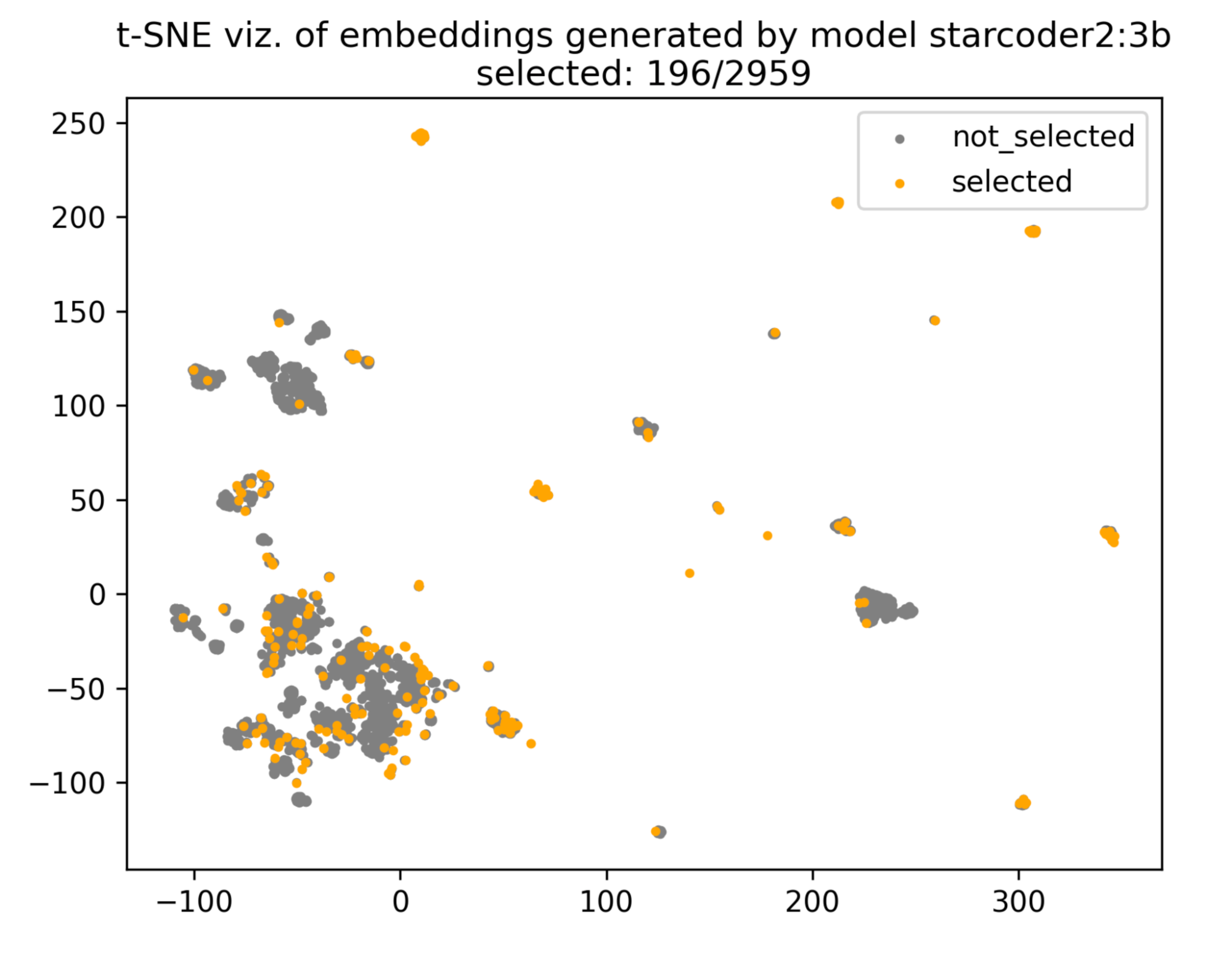
We’ve successfully employed this strategy for pinpointing a few highly varied scripts that were relevant for the model to learn from. Our security researchers save a tremendous amount of time on manual annotation, while false positives are drastically reduced. For instance, in a large and unlabeled bucket of scripts, one of our early evaluation models identified ~3,000 of them as malicious. That’s too many to manually review! By removing near duplicates, we narrowed the need for annotation down to only 196 samples, less than 7% of the original amount (see the t-SNE visualization below of selected points and clusters). Three of those scripts were actually malicious, one we could not fully determine, and the rest were benign. By just re-training with these new labeled scripts, a tiny fraction of our whole dataset, we reduced false positives by 50% (as gauged in the same bucket and in a controlled test set). We have consistently repeated this procedure to iteratively enhance successive model versions.
2D visualization of scripts projected onto an embedding space, highlighting those sufficiently dissimilar from one another.
From the lab, to the real world
Our latest model in evaluation has both a macro accuracy and an overall malicious precision nearing 99%(!) on our test dataset. So we are done, right? Wrong! The real world is not the same as the lab, where many more variances of benign JavaScript can be seen. To further assure minimum prediction changes between model releases, we follow these three anti-fool measures:
Evaluate metrics uncertainty
First, we thoroughly estimate the uncertainty of our offline evaluation metrics. How accurate are our accuracy metrics themselves? To gauge that, we calculate the standard error and confidence intervals for our offline metrics (precision, recall, F1 measure). To do that, we calculate the model’s predicted scores on the test set once (the original sample), and then generate bootstrapped resamples from it. We use simple random (re-)sampling as it offers us a more conservative estimate of error than stratified or balanced sampling.
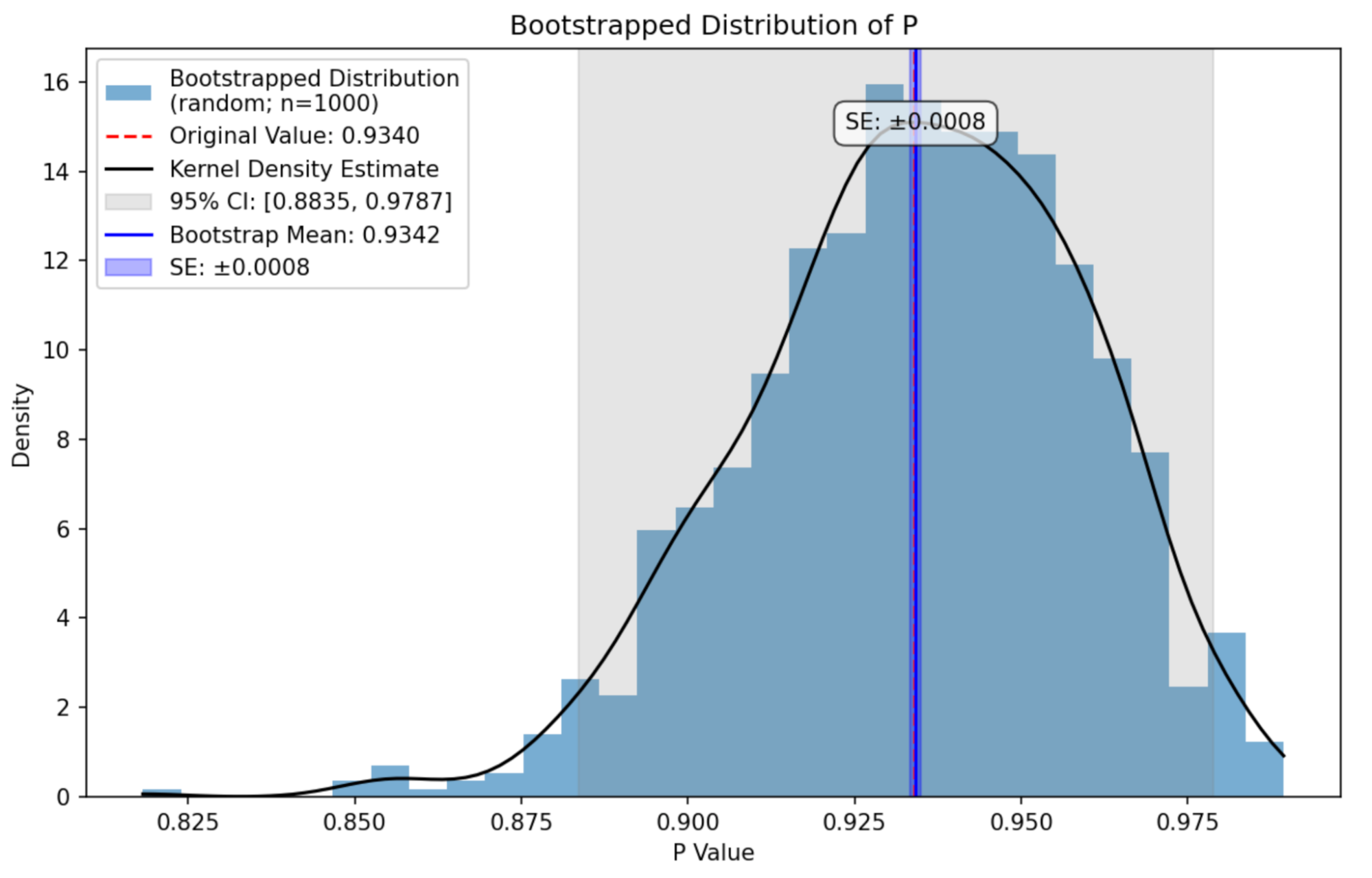
We would generate 1,000 resamples, each a fraction of 15% resampled from the original test sample, then calculate the metrics for each individual resample. This results in a distribution of sampled data points. We measure its mean, the standard deviation (with Bessel’s correction), and finally the standard error and a confidence interval (CI) (using the percentile method, such as the 2.5 and 97.5 percentiles for a 95% CI). See below for an example of a bootstrapped distribution for precision (P), illustrating that a model’s performance is a continuum rather than a fixed value, and that might exhibit subtly (left-)skewed tails. For some of our internally evaluated models, it can easily happen that some of the sub-sampled metrics decrease by up to 20 percentage points within a 95% confidence range. High standard errors and/or confidence ranges signal needs for model improvement and for improving and increasing our test set.
An evaluation metric, here precision (P), might change significantly depending on what’s exactly tested. We thoroughly estimate the metric’s standard error and confidence intervals.
Benchmark against massive offline unlabeled dataset
We run our model on the entire corpus of scripts seen by Cloudflare’s network and temporarily cached in the last 90 days. By the way, that’s nearly 1 TiB and 26 million different JavaScript files! With that, we can observe the model’s behavior against real traffic, yet completely offline (to ensure no impact to production). We check the malicious prediction rate, latency, throughput, etc. and sample some of the predictions for verification and annotation.
Review in staging and shadow mode
Only after all the previous checks were cleared, we then run this new tentative version in our staging environment. For major model upgrades, we also deploy them in shadow mode (log-only mode) — running on production, alongside our existing model. We study the model’s behavior for a while before finally marking it as production ready, otherwise we go back to the drawing board.
AI inference at scale
At the time of writing, Page Shield sees an average of 40,000 scripts per second. Many of those scripts are repeated, though. Everything on the Internet follows a Zipf’s law distribution, and JavaScript seen on the Cloudflare network is no exception. For instance, it is estimated that different versions of the Bootstrap library run on more than 20% of websites. It would be a waste of computing resources if we repeatedly re-ran the AI model for the very same inputs — inference result caching is needed. Not to mention, GPU utilization is expensive!
The question is, what is the best way to cache the scripts? We could take an SHA-256 hash of the plain content as is. However, any single change in the transmitted content (comments, spacing, or a different character set) changes the SHA-256 output hash.
A better caching approach? Since we need to parse the code into syntax trees for our GNN model anyway, this tree structure and content is what we use to hash the JavaScript. As described above, we filter out nodes in the syntax tree like comments or empty statements. In addition, some irrelevant details get abstracted out in the AST (escape sequences are unescaped, the way of writing strings is normalized, unnecessary parentheses are removed for the operations order is encoded in the tree, etc.).
Using such a tree-based approach to caching, we can conclude that at any moment over 99.9% of reported scripts have already been seen in our network! Unless we deploy a new model with significant improvements, we don’t re-score previously seen JavaScript but just return the cached score. As a result, the model only needs to be called fewer than 10 times per minute, even during peak times!
Let AI help ease PCI DSS v4 compliance
One of the most popular use cases for deploying Page Shield is to help meet the two new client-side security requirements in PCI DSS v4 — 6.4.3 and 11.6.1. These requirements make companies responsible for approving scripts used in payment pages, where payment card data could be compromised by malicious JavaScript. Both of these requirements become effective on March 31, 2025.
Page Shield with AI malicious JavaScript detection can be deployed with just a few clicks, especially if your website is already proxied through Cloudflare. Sign up here to fast track your onboarding!
Take Command 2025 is bringing together some of the sharpest minds in cybersecurity to tackle today’s most urgent challenges. From attacker methodologies and AI-driven security to MDR, red teaming, and exposure management, this year’s virtual event will provide security professionals with practical insights, cutting-edge research, and real-world defense strategies.
While we’ve already announced an impressive lineup of industry experts, we’re excited to introduce even more voices joining the discussion. These new speakers will bring fresh perspectives and invaluable expertise to the Take Command 2025 stage, making this year’s event even more essential for security practitioners, team leaders, and researchers.
Shawnee Delaney: Cyber Intelligence, Insider Threats & AI Resilience
Cyber threats aren’t just external—insider risks, intelligence tactics, and machine-driven attacks are playing an increasingly significant role in security breaches. Shawnee Delaney, CEO of Vaillance Group and expert on cybersecurity, insider threat & counterintelligence, brings deep expertise in intelligence-driven security, insider threat management, and proactive cyber defense strategies.
Her session, ‘Rise of the Machines: Building Cyber Resilience with AI’, will explore:
How organizations can manage overwhelming volumes of security data using big data analytics, data fabric, and Generative AI
Strategies for leveraging AI-driven insights to detect and mitigate emerging threats
The balance between automation, human expertise, and proactive risk management in modern security operations
This session will provide practical, real-world takeaways for security teams looking to harness AI effectively in their operations.
Future-Proofing Vulnerability Management with Rapid7 customers
Security teams are shifting from traditional vulnerability scanning to proactive exposure management, and leading organizations are pioneering new strategies. In this panel, security leaders from Miltenyi Biotec , Phibro Animal Health Corporation, and Cross Financial Corp.will share firsthand insights on how they are evolving their vulnerability management programs to keep pace with today’s complex threat landscape.
Moderated by Aniket Menon, VP, Product Management at Rapid7, this session, Expert Tips to Help You Future-proof Your VM Program with Continuous Attack Surface Visibility, will explore real-world experiences from security leaders implementing modern vulnerability management frameworks. They will discuss the challenges of adapting to emerging threats, lessons learned from refining their security programs, and best practices for improving visibility and risk prioritization. This customer-led discussion will provide actionable insights for security teams looking to strengthen their exposure management strategies and build a more resilient security posture.
Industry Experts Leading the Conversation
Take Command 2025 brings together top cybersecurity minds to explore threat intelligence, AI-driven security, exposure management, and evolving regulations. Raj Samani (Rapid7) and Trent Teyema (CSG Strategies, former FBI Special Agent) will break down attacker methodologies, while Will Hunt (In.Security) will discuss how red teaming is adapting to modern threats.
Ted Harrington (ISE) and Tyler Shields (ESG) will share strategies on AI-driven defense and proactive risk management, while Sabeen Malik (Rapid7) will guide CISOs through pieces of legislation that are considered important for cybersecurity.. Throughout the event, Rapid7’s SOC and MDR experts will offer real-world insights into evolving detection and response strategies.
The Tempest Two: Lessons in Resilience
Cybersecurity isn’t just about technology—it’s about mindset, resilience, and adaptability. The Tempest Two will bring a unique perspective on overcoming challenges and decision-making under pressure, drawing from their experiences tackling some of the world’s most extreme endurance challenges.
Their session will provide actionable takeaways on mental resilience and adaptability, offering insights that security professionals can apply to cyber incident response, crisis management, and high-pressure decision-making.
Register Now to Take Command 2025
Take Command 2025 is a free, global, virtual event happening on April 9. Don’t miss your chance to hear from security leaders and experts on the biggest challenges shaping the industry.
One of the most critical clients of our Premium Partners at the ATS Group is a large MSP that acts as a service and administration platform for their own clients, providing them with hardware, software, engineers, support staff, metrics, and reporting.
The challenge
The MSP needed a stable, high-performance platform monitoring solution that would cover all the services they provided. They didn’t have the capabilities or budget to run multiple monitoring solutions – a single, flexible solution that could track every service was paramount, as was the ability to react to anomalies before they became serious problems.
After an initial trial with a different monitoring solution that was notable for poor service, a lack of integrations, no community, and almost no documentation, they took a closer look at Zabbix, thanks in large part to our focus on preventative action and automation.
The solution
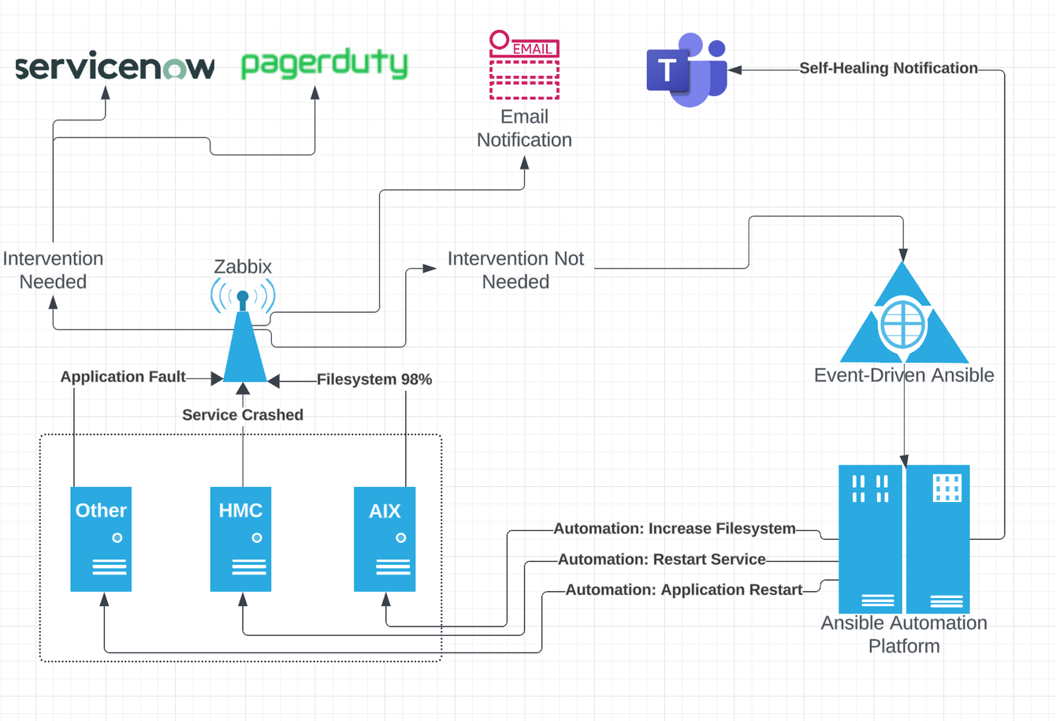
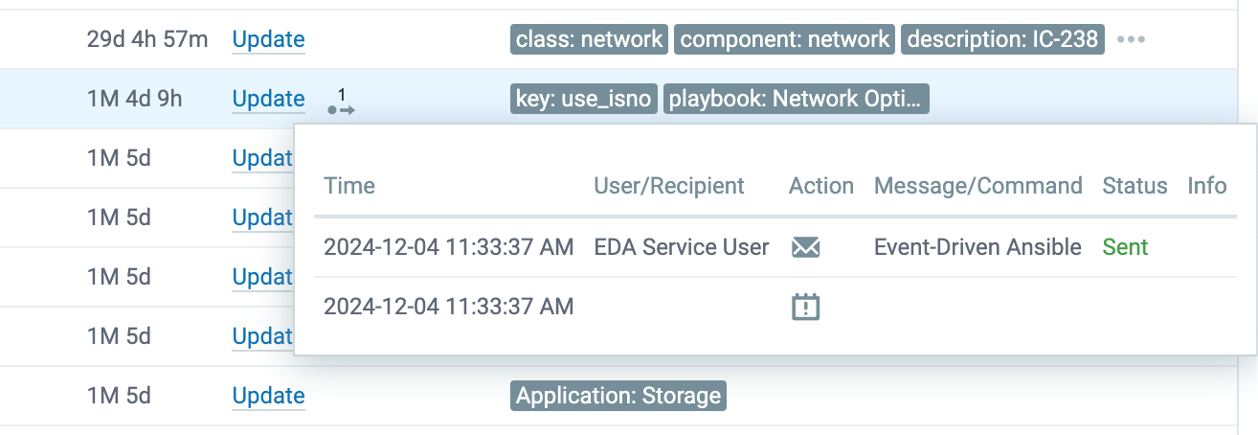
Because of their focus on performance-based monitoring, the client went with a “hot-cold” architecture and an integration with Ansible EDA, which stands for Event-Driven Ansible. It turned out to be a true “force multiplier”, as using Zabbix, Ansible, and EDA together allowed the MSP to monitor their systems, automate tasks based on real-time events, and provide immediate responses to issues without manual intervention.
The integration was designed to sort issues by whether or not they were able to be automated. If an issue arose that required human intervention, alerts could be sent to ServiceNow via multiple channels. If human intervention was unnecessary, the issue was rerouted to Event-Driven Ansible, which runs automation on all monitored hosts.
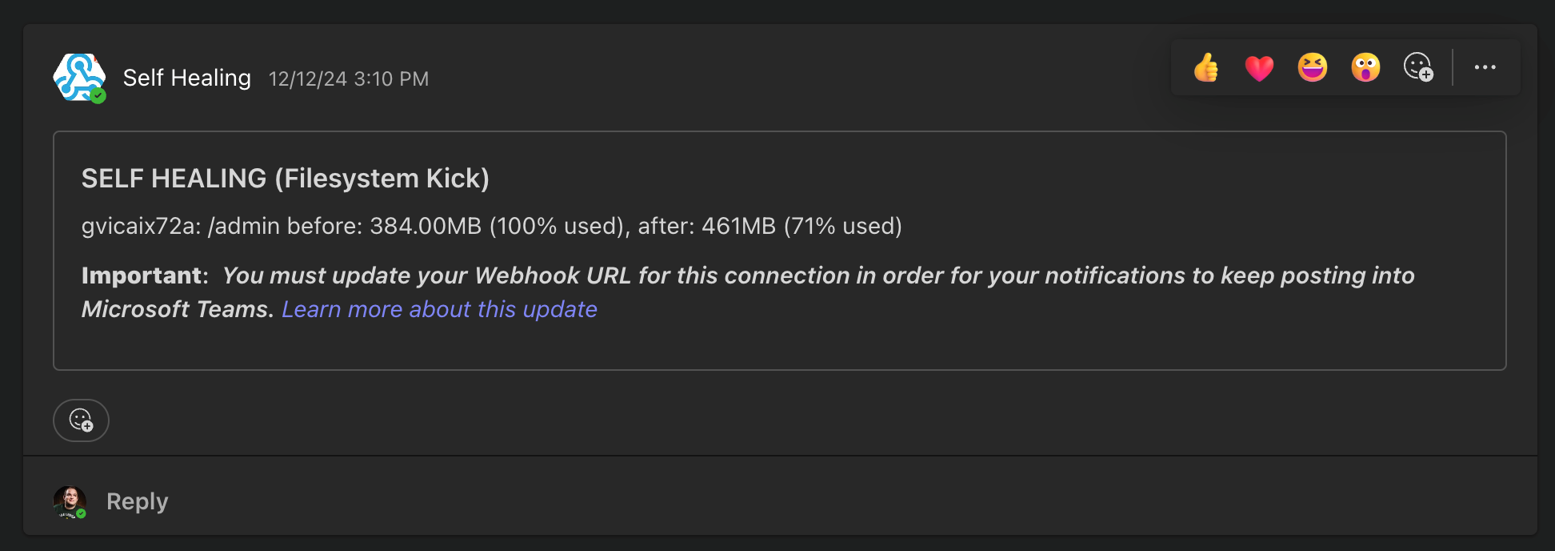
For example, with the joint Zabbix/Ansible solution, a slash admin backstage management system filling up at 2AM because of an overflowing log file for some script is no longer an urgent issue. If there are multiple gigabytes of room in the volume group, Zabbix can tell Ansible it’s a problem. Ansible can then increase the file system by 25% and send a message letting the engineers know in the morning that they took action on their behalf.
The results
With essentially no software costs and an automation integration that can find issues and fix them independently, the MSP was able to rapidly achieve a much higher service-to-spend ratio than they’d ever imagined possible.
There has been a noted increase in employee satisfaction as well – thanks to automation, engineers no longer have to be “on call” at all hours to solve simple issues, while C-level executives have seen productivity skyrocket thanks to the joint solution’s ability to find potential issues before they become real problems.
In conclusion
At Zabbix, we work hard to stay on the forefront of automation. That means constantly improving our own product while also staying on top of new technologies like Event-Driven Ansible in order to better integrate with them. To learn more about what Zabbix can do for MSPs, visit us here.
Update 2025-03-21: During the 2025 Open Source Initiative
I used my blog as a campaigning tool (for reasons discussed below) before I
knew how much interest there would ultimately be in the
FOSS community
about the 2025 OSI Board of Directors election. Since this was used as a
source for the LWN article, keeping the original record easy to find is
obviously important and folks shouldn’t have to go to archive.org/web to
find it. Nevertheless, if you’re just digging into this story fresh, I
don’t really recommend reading the below. Instead, I suggest just
reading Brockmeier’s
LWN article because he’s a journalist and writes better and more
concise than me, and he’s unbiased and the below is my (understandably) biased view as a
candidate who lived through this problematic election.
An Update Regarding the 2025 Open Source Initiative Elections
I’ve
explained in
other posts that I ran for the 2025 Open Source Initative Board of
Directors in the “Affiliate” district.
Voting closed on MON 2025-03-17 at 10:00 US/Pacific. One hour later,
candidates were surprised to receive an email from OSI demanding
that all candidates sign a Board agreement before results were
posted. This was surprising because during mandatory orientation,
candidates were told the opposite: that a Board agreement need not be
signed until the Board formally appointed you as a Director (as the
elections are only advisory &mdash: OSI’s Board need not follow election
results in any event. It was also surprising because the deadline was a
mere 47 hours later (WED 2025-03-19 at 10:00 US/Pacific).
Many of us candidates attempted to get clarification over the last 46
hours, but OSI has not
communicated clear answers in response to those requests. Based on
these unclear responses, the best we can surmise is that OSI intends to
modify the ballots cast by Affiliates and Members to remove any candidate
who misses this new deadline. We are loathe to assume the worst, but
there’s little choice given the confusing responses and surprising change
in requirements and deadlines.
In addition to
the twokeynotes
mentioned above, I propose these analogies that really are apt to
this situation:
Imagine if the Board of The Nature Conservancy told Directors they
would be required, if elected, to use a car service to attend Board
meetings. It’s easier, they argue, if everyone uses the same service and
that way, we know you’re on your way, and we pay a group rate anyway. Some
candidates for open Board seats retort that’s not environmentally sound,
and insist — not even that other Board members must stop using the
car service &mdash: but just that Directors who chose should be allowed to
simply take public transit to the Board meeting — even though it
might make them about five minutes late to the meeting. Are these Director
candidates engaged in “passive-aggressive politicking”?
Imagine if the Board of Friends of Trees made a decision that all
paperwork for the organization be printed on non-recycled paper made from
freshly cut tree wood pulp. That paper is easier to move around, they say
— and it’s easier to read what’s printed because of its quality.
Some candidates for open Board seats run on a platform that says Board
members should be allowed to get their print-outs on 100% post-consumer
recycled paper for Board meetings. These candidates don’t insist that
other Board members use the same paper, so, if these new Directors are
seated, this will create extra work for staff because now they have to do
two sets of print-outs to prep for Board meetings, and refill the machine
with different paper in-between. Are these new Director candidates, when
they speak up about why this position is important to them as a moral
issue, a “a distracting waste of time”?
Imagine if the Board of the APSCA made the decision that Directors must
work through lunch, and the majority of the Directors vote that they’ll get
delivery from a restaurant that serves no vegan food whatsoever. Is it
reasonable for this to be a non-negotiable requirement — such that
the other Directors must work through lunch and just stay hungry? Or
should they add a second restaurant option for the minority? After all,
the ASPCA condemns animal cruelty but doesn’t go so far as to
demand that everyone also be a vegan. Would the meat-eating directors then
say something like “opposing cruelty to animals could be so much more
than merely being vegan” to these other Directors?
Update 2025-03-21: During the 2025 Open Source Initiative
I used my blog as a campaigning tool (for reasons discussed below) before I
knew how much interest there would ultimately be in the
FOSS community
about the 2025 OSI Board of Directors election. Since this was used as a
source for the LWN article, keeping the original record easy to find is
obviously important and folks shouldn’t have to go to archive.org/web to
find it. Nevertheless, if you’re just digging into this story fresh, I
don’t really recommend reading the below. Instead, I suggest just
reading Brockmeier’s
LWN article because he’s a journalist and writes better and more
concise than me, and he’s unbiased and the below is my (understandably) biased view as a
candidate who lived through this problematic election.
An Update Regarding the 2025 Open Source Initiative Elections
I’ve
explained in
other posts that I ran for the 2025 Open Source Initative Board of
Directors in the “Affiliate” district.
Voting closed on MON 2025-03-17 at 10:00 US/Pacific. One hour later,
candidates were surprised to receive an email from OSI demanding
that all candidates sign a Board agreement before results were
posted. This was surprising because during mandatory orientation,
candidates were told the opposite: that a Board agreement need not be
signed until the Board formally appointed you as a Director (as the
elections are only advisory &mdash: OSI’s Board need not follow election
results in any event. It was also surprising because the deadline was a
mere 47 hours later (WED 2025-03-19 at 10:00 US/Pacific).
Many of us candidates attempted to get clarification over the last 46
hours, but OSI has not
communicated clear answers in response to those requests. Based on
these unclear responses, the best we can surmise is that OSI intends to
modify the ballots cast by Affiliates and Members to remove any candidate
who misses this new deadline. We are loathe to assume the worst, but
there’s little choice given the confusing responses and surprising change
in requirements and deadlines.
In addition to
the twokeynotes
mentioned above, I propose these analogies that really are apt to
this situation:
Imagine if the Board of The Nature Conservancy told Directors they
would be required, if elected, to use a car service to attend Board
meetings. It’s easier, they argue, if everyone uses the same service and
that way, we know you’re on your way, and we pay a group rate anyway. Some
candidates for open Board seats retort that’s not environmentally sound,
and insist — not even that other Board members must stop using the
car service &mdash: but just that Directors who chose should be allowed to
simply take public transit to the Board meeting — even though it
might make them about five minutes late to the meeting. Are these Director
candidates engaged in “passive-aggressive politicking”?
Imagine if the Board of Friends of Trees made a decision that all
paperwork for the organization be printed on non-recycled paper made from
freshly cut tree wood pulp. That paper is easier to move around, they say
— and it’s easier to read what’s printed because of its quality.
Some candidates for open Board seats run on a platform that says Board
members should be allowed to get their print-outs on 100% post-consumer
recycled paper for Board meetings. These candidates don’t insist that
other Board members use the same paper, so, if these new Directors are
seated, this will create extra work for staff because now they have to do
two sets of print-outs to prep for Board meetings, and refill the machine
with different paper in-between. Are these new Director candidates, when
they speak up about why this position is important to them as a moral
issue, a “a distracting waste of time”?
Imagine if the Board of the APSCA made the decision that Directors must
work through lunch, and the majority of the Directors vote that they’ll get
delivery from a restaurant that serves no vegan food whatsoever. Is it
reasonable for this to be a non-negotiable requirement — such that
the other Directors must work through lunch and just stay hungry? Or
should they add a second restaurant option for the minority? After all,
the ASPCA condemns animal cruelty but doesn’t go so far as to
demand that everyone also be a vegan. Would the meat-eating directors then
say something like “opposing cruelty to animals could be so much more
than merely being vegan” to these other Directors?
Update 2025-03-21: During the 2025 Open Source Initiative
I used my blog as a campaigning tool (for reasons discussed below) before I
knew how much interest there would ultimately be in the
FOSS community
about the 2025 OSI Board of Directors election. Since this was used as a
source for the LWN article, keeping the original record easy to find is
obviously important and folks shouldn’t have to go to archive.org/web to
find it. Nevertheless, if you’re just digging into this story fresh, I
don’t really recommend reading the below. Instead, I suggest just
reading Brockmeier’s
LWN article because he’s a journalist and writes better and more
concise than me, and he’s unbiased and the below is my (understandably) biased view as a
candidate who lived through this problematic election.
An Update Regarding the 2025 Open Source Initiative Elections
I’ve
explained in
other posts that I ran for the 2025 Open Source Initative Board of
Directors in the “Affiliate” district.
Voting closed on MON 2025-03-17 at 10:00 US/Pacific. One hour later,
candidates were surprised to receive an email from OSI demanding
that all candidates sign a Board agreement before results were
posted. This was surprising because during mandatory orientation,
candidates were told the opposite: that a Board agreement need not be
signed until the Board formally appointed you as a Director (as the
elections are only advisory &mdash: OSI’s Board need not follow election
results in any event. It was also surprising because the deadline was a
mere 47 hours later (WED 2025-03-19 at 10:00 US/Pacific).
Many of us candidates attempted to get clarification over the last 46
hours, but OSI has not
communicated clear answers in response to those requests. Based on
these unclear responses, the best we can surmise is that OSI intends to
modify the ballots cast by Affiliates and Members to remove any candidate
who misses this new deadline. We are loathe to assume the worst, but
there’s little choice given the confusing responses and surprising change
in requirements and deadlines.
In addition to
the twokeynotes
mentioned above, I propose these analogies that really are apt to
this situation:
Imagine if the Board of The Nature Conservancy told Directors they
would be required, if elected, to use a car service to attend Board
meetings. It’s easier, they argue, if everyone uses the same service and
that way, we know you’re on your way, and we pay a group rate anyway. Some
candidates for open Board seats retort that’s not environmentally sound,
and insist — not even that other Board members must stop using the
car service &mdash: but just that Directors who chose should be allowed to
simply take public transit to the Board meeting — even though it
might make them about five minutes late to the meeting. Are these Director
candidates engaged in “passive-aggressive politicking”?
Imagine if the Board of Friends of Trees made a decision that all
paperwork for the organization be printed on non-recycled paper made from
freshly cut tree wood pulp. That paper is easier to move around, they say
— and it’s easier to read what’s printed because of its quality.
Some candidates for open Board seats run on a platform that says Board
members should be allowed to get their print-outs on 100% post-consumer
recycled paper for Board meetings. These candidates don’t insist that
other Board members use the same paper, so, if these new Directors are
seated, this will create extra work for staff because now they have to do
two sets of print-outs to prep for Board meetings, and refill the machine
with different paper in-between. Are these new Director candidates, when
they speak up about why this position is important to them as a moral
issue, a “a distracting waste of time”?
Imagine if the Board of the APSCA made the decision that Directors must
work through lunch, and the majority of the Directors vote that they’ll get
delivery from a restaurant that serves no vegan food whatsoever. Is it
reasonable for this to be a non-negotiable requirement — such that
the other Directors must work through lunch and just stay hungry? Or
should they add a second restaurant option for the minority? After all,
the ASPCA condemns animal cruelty but doesn’t go so far as to
demand that everyone also be a vegan. Would the meat-eating directors then
say something like “opposing cruelty to animals could be so much more
than merely being vegan” to these other Directors?
Update 2025-03-21: During the 2025 Open Source Initiative
I used my blog as a campaigning tool (for reasons discussed below) before I
knew how much interest there would ultimately be in the
FOSS community
about the 2025 OSI Board of Directors election. Since this was used as a
source for the LWN article, keeping the original record easy to find is
obviously important and folks shouldn’t have to go to archive.org/web to
find it. Nevertheless, if you’re just digging into this story fresh, I
don’t really recommend reading the below. Instead, I suggest just
reading Brockmeier’s
LWN article because he’s a journalist and writes better and more
concise than me, and he’s unbiased and the below is my (understandably) biased view as a
candidate who lived through this problematic election.
An Update Regarding the 2025 Open Source Initiative Elections
I’ve
explained in
other posts that I ran for the 2025 Open Source Initative Board of
Directors in the “Affiliate” district.
Voting closed on MON 2025-03-17 at 10:00 US/Pacific. One hour later,
candidates were surprised to receive an email from OSI demanding
that all candidates sign a Board agreement before results were
posted. This was surprising because during mandatory orientation,
candidates were told the opposite: that a Board agreement need not be
signed until the Board formally appointed you as a Director (as the
elections are only advisory &mdash: OSI’s Board need not follow election
results in any event. It was also surprising because the deadline was a
mere 47 hours later (WED 2025-03-19 at 10:00 US/Pacific).
Many of us candidates attempted to get clarification over the last 46
hours, but OSI has not
communicated clear answers in response to those requests. Based on
these unclear responses, the best we can surmise is that OSI intends to
modify the ballots cast by Affiliates and Members to remove any candidate
who misses this new deadline. We are loathe to assume the worst, but
there’s little choice given the confusing responses and surprising change
in requirements and deadlines.
In addition to
the twokeynotes
mentioned above, I propose these analogies that really are apt to
this situation:
Imagine if the Board of The Nature Conservancy told Directors they
would be required, if elected, to use a car service to attend Board
meetings. It’s easier, they argue, if everyone uses the same service and
that way, we know you’re on your way, and we pay a group rate anyway. Some
candidates for open Board seats retort that’s not environmentally sound,
and insist — not even that other Board members must stop using the
car service &mdash: but just that Directors who chose should be allowed to
simply take public transit to the Board meeting — even though it
might make them about five minutes late to the meeting. Are these Director
candidates engaged in “passive-aggressive politicking”?
Imagine if the Board of Friends of Trees made a decision that all
paperwork for the organization be printed on non-recycled paper made from
freshly cut tree wood pulp. That paper is easier to move around, they say
— and it’s easier to read what’s printed because of its quality.
Some candidates for open Board seats run on a platform that says Board
members should be allowed to get their print-outs on 100% post-consumer
recycled paper for Board meetings. These candidates don’t insist that
other Board members use the same paper, so, if these new Directors are
seated, this will create extra work for staff because now they have to do
two sets of print-outs to prep for Board meetings, and refill the machine
with different paper in-between. Are these new Director candidates, when
they speak up about why this position is important to them as a moral
issue, a “a distracting waste of time”?
Imagine if the Board of the APSCA made the decision that Directors must
work through lunch, and the majority of the Directors vote that they’ll get
delivery from a restaurant that serves no vegan food whatsoever. Is it
reasonable for this to be a non-negotiable requirement — such that
the other Directors must work through lunch and just stay hungry? Or
should they add a second restaurant option for the minority? After all,
the ASPCA condemns animal cruelty but doesn’t go so far as to
demand that everyone also be a vegan. Would the meat-eating directors then
say something like “opposing cruelty to animals could be so much more
than merely being vegan” to these other Directors?
Update 2025-03-21: During the 2025 Open Source Initiative
I used my blog as a campaigning tool (for reasons discussed below) before I
knew how much interest there would ultimately be in the
FOSS community
about the 2025 OSI Board of Directors election. Since this was used as a
source for the LWN article, keeping the original record easy to find is
obviously important and folks shouldn’t have to go to archive.org/web to
find it. Nevertheless, if you’re just digging into this story fresh, I
don’t really recommend reading the below. Instead, I suggest just
reading Brockmeier’s
LWN article because he’s a journalist and writes better and more
concise than me, and he’s unbiased and the below is my (understandably) biased view as a
candidate who lived through this problematic election.
An Update Regarding the 2025 Open Source Initiative Elections
I’ve
explained in
other posts that I ran for the 2025 Open Source Initative Board of
Directors in the “Affiliate” district.
Voting closed on MON 2025-03-17 at 10:00 US/Pacific. One hour later,
candidates were surprised to receive an email from OSI demanding
that all candidates sign a Board agreement before results were
posted. This was surprising because during mandatory orientation,
candidates were told the opposite: that a Board agreement need not be
signed until the Board formally appointed you as a Director (as the
elections are only advisory &mdash: OSI’s Board need not follow election
results in any event. It was also surprising because the deadline was a
mere 47 hours later (WED 2025-03-19 at 10:00 US/Pacific).
Many of us candidates attempted to get clarification over the last 46
hours, but OSI has not
communicated clear answers in response to those requests. Based on
these unclear responses, the best we can surmise is that OSI intends to
modify the ballots cast by Affiliates and Members to remove any candidate
who misses this new deadline. We are loathe to assume the worst, but
there’s little choice given the confusing responses and surprising change
in requirements and deadlines.
In addition to
the twokeynotes
mentioned above, I propose these analogies that really are apt to
this situation:
Imagine if the Board of The Nature Conservancy told Directors they
would be required, if elected, to use a car service to attend Board
meetings. It’s easier, they argue, if everyone uses the same service and
that way, we know you’re on your way, and we pay a group rate anyway. Some
candidates for open Board seats retort that’s not environmentally sound,
and insist — not even that other Board members must stop using the
car service &mdash: but just that Directors who chose should be allowed to
simply take public transit to the Board meeting — even though it
might make them about five minutes late to the meeting. Are these Director
candidates engaged in “passive-aggressive politicking”?
Imagine if the Board of Friends of Trees made a decision that all
paperwork for the organization be printed on non-recycled paper made from
freshly cut tree wood pulp. That paper is easier to move around, they say
— and it’s easier to read what’s printed because of its quality.
Some candidates for open Board seats run on a platform that says Board
members should be allowed to get their print-outs on 100% post-consumer
recycled paper for Board meetings. These candidates don’t insist that
other Board members use the same paper, so, if these new Directors are
seated, this will create extra work for staff because now they have to do
two sets of print-outs to prep for Board meetings, and refill the machine
with different paper in-between. Are these new Director candidates, when
they speak up about why this position is important to them as a moral
issue, a “a distracting waste of time”?
Imagine if the Board of the APSCA made the decision that Directors must
work through lunch, and the majority of the Directors vote that they’ll get
delivery from a restaurant that serves no vegan food whatsoever. Is it
reasonable for this to be a non-negotiable requirement — such that
the other Directors must work through lunch and just stay hungry? Or
should they add a second restaurant option for the minority? After all,
the ASPCA condemns animal cruelty but doesn’t go so far as to
demand that everyone also be a vegan. Would the meat-eating directors then
say something like “opposing cruelty to animals could be so much more
than merely being vegan” to these other Directors?
Update 2025-03-21: During the 2025 Open Source Initiative
I used my blog as a campaigning tool (for reasons discussed below) before I
knew how much interest there would ultimately be in the
FOSS community
about the 2025 OSI Board of Directors election. Since this was used as a
source for the LWN article, keeping the original record easy to find is
obviously important and folks shouldn’t have to go to archive.org/web to
find it. Nevertheless, if you’re just digging into this story fresh, I
don’t really recommend reading the below. Instead, I suggest just
reading Brockmeier’s
LWN article because he’s a journalist and writes better and more
concise than me, and he’s unbiased and the below is my (understandably) biased view as a
candidate who lived through this problematic election.
An Update Regarding the 2025 Open Source Initiative Elections
I’ve
explained in
other posts that I ran for the 2025 Open Source Initative Board of
Directors in the “Affiliate” district.
Voting closed on MON 2025-03-17 at 10:00 US/Pacific. One hour later,
candidates were surprised to receive an email from OSI demanding
that all candidates sign a Board agreement before results were
posted. This was surprising because during mandatory orientation,
candidates were told the opposite: that a Board agreement need not be
signed until the Board formally appointed you as a Director (as the
elections are only advisory &mdash: OSI’s Board need not follow election
results in any event. It was also surprising because the deadline was a
mere 47 hours later (WED 2025-03-19 at 10:00 US/Pacific).
Many of us candidates attempted to get clarification over the last 46
hours, but OSI has not
communicated clear answers in response to those requests. Based on
these unclear responses, the best we can surmise is that OSI intends to
modify the ballots cast by Affiliates and Members to remove any candidate
who misses this new deadline. We are loathe to assume the worst, but
there’s little choice given the confusing responses and surprising change
in requirements and deadlines.
In addition to
the twokeynotes
mentioned above, I propose these analogies that really are apt to
this situation:
Imagine if the Board of The Nature Conservancy told Directors they
would be required, if elected, to use a car service to attend Board
meetings. It’s easier, they argue, if everyone uses the same service and
that way, we know you’re on your way, and we pay a group rate anyway. Some
candidates for open Board seats retort that’s not environmentally sound,
and insist — not even that other Board members must stop using the
car service &mdash: but just that Directors who chose should be allowed to
simply take public transit to the Board meeting — even though it
might make them about five minutes late to the meeting. Are these Director
candidates engaged in “passive-aggressive politicking”?
Imagine if the Board of Friends of Trees made a decision that all
paperwork for the organization be printed on non-recycled paper made from
freshly cut tree wood pulp. That paper is easier to move around, they say
— and it’s easier to read what’s printed because of its quality.
Some candidates for open Board seats run on a platform that says Board
members should be allowed to get their print-outs on 100% post-consumer
recycled paper for Board meetings. These candidates don’t insist that
other Board members use the same paper, so, if these new Directors are
seated, this will create extra work for staff because now they have to do
two sets of print-outs to prep for Board meetings, and refill the machine
with different paper in-between. Are these new Director candidates, when
they speak up about why this position is important to them as a moral
issue, a “a distracting waste of time”?
Imagine if the Board of the APSCA made the decision that Directors must
work through lunch, and the majority of the Directors vote that they’ll get
delivery from a restaurant that serves no vegan food whatsoever. Is it
reasonable for this to be a non-negotiable requirement — such that
the other Directors must work through lunch and just stay hungry? Or
should they add a second restaurant option for the minority? After all,
the ASPCA condemns animal cruelty but doesn’t go so far as to
demand that everyone also be a vegan. Would the meat-eating directors then
say something like “opposing cruelty to animals could be so much more
than merely being vegan” to these other Directors?
Update 2025-03-21: During the 2025 Open Source Initiative
I used my blog as a campaigning tool (for reasons discussed below) before I
knew how much interest there would ultimately be in the
FOSS community
about the 2025 OSI Board of Directors election. Since this was used as a
source for the LWN article, keeping the original record easy to find is
obviously important and folks shouldn’t have to go to archive.org/web to
find it. Nevertheless, if you’re just digging into this story fresh, I
don’t really recommend reading the below. Instead, I suggest just
reading Brockmeier’s
LWN article because he’s a journalist and writes better and more
concise than me, and he’s unbiased and the below is my (understandably) biased view as a
candidate who lived through this problematic election.
An Update Regarding the 2025 Open Source Initiative Elections
I’ve
explained in
other posts that I ran for the 2025 Open Source Initative Board of
Directors in the “Affiliate” district.
Voting closed on MON 2025-03-17 at 10:00 US/Pacific. One hour later,
candidates were surprised to receive an email from OSI demanding
that all candidates sign a Board agreement before results were
posted. This was surprising because during mandatory orientation,
candidates were told the opposite: that a Board agreement need not be
signed until the Board formally appointed you as a Director (as the
elections are only advisory &mdash: OSI’s Board need not follow election
results in any event. It was also surprising because the deadline was a
mere 47 hours later (WED 2025-03-19 at 10:00 US/Pacific).
Many of us candidates attempted to get clarification over the last 46
hours, but OSI has not
communicated clear answers in response to those requests. Based on
these unclear responses, the best we can surmise is that OSI intends to
modify the ballots cast by Affiliates and Members to remove any candidate
who misses this new deadline. We are loathe to assume the worst, but
there’s little choice given the confusing responses and surprising change
in requirements and deadlines.
In addition to
the twokeynotes
mentioned above, I propose these analogies that really are apt to
this situation:
Imagine if the Board of The Nature Conservancy told Directors they
would be required, if elected, to use a car service to attend Board
meetings. It’s easier, they argue, if everyone uses the same service and
that way, we know you’re on your way, and we pay a group rate anyway. Some
candidates for open Board seats retort that’s not environmentally sound,
and insist — not even that other Board members must stop using the
car service &mdash: but just that Directors who chose should be allowed to
simply take public transit to the Board meeting — even though it
might make them about five minutes late to the meeting. Are these Director
candidates engaged in “passive-aggressive politicking”?
Imagine if the Board of Friends of Trees made a decision that all
paperwork for the organization be printed on non-recycled paper made from
freshly cut tree wood pulp. That paper is easier to move around, they say
— and it’s easier to read what’s printed because of its quality.
Some candidates for open Board seats run on a platform that says Board
members should be allowed to get their print-outs on 100% post-consumer
recycled paper for Board meetings. These candidates don’t insist that
other Board members use the same paper, so, if these new Directors are
seated, this will create extra work for staff because now they have to do
two sets of print-outs to prep for Board meetings, and refill the machine
with different paper in-between. Are these new Director candidates, when
they speak up about why this position is important to them as a moral
issue, a “a distracting waste of time”?
Imagine if the Board of the APSCA made the decision that Directors must
work through lunch, and the majority of the Directors vote that they’ll get
delivery from a restaurant that serves no vegan food whatsoever. Is it
reasonable for this to be a non-negotiable requirement — such that
the other Directors must work through lunch and just stay hungry? Or
should they add a second restaurant option for the minority? After all,
the ASPCA condemns animal cruelty but doesn’t go so far as to
demand that everyone also be a vegan. Would the meat-eating directors then
say something like “opposing cruelty to animals could be so much more
than merely being vegan” to these other Directors?
Update 2025-03-21: During the 2025 Open Source Initiative
I used my blog as a campaigning tool (for reasons discussed below) before I
knew how much interest there would ultimately be in the
FOSS community
about the 2025 OSI Board of Directors election. Since this was used as a
source for the LWN article, keeping the original record easy to find is
obviously important and folks shouldn’t have to go to archive.org/web to
find it. Nevertheless, if you’re just digging into this story fresh, I
don’t really recommend reading the below. Instead, I suggest just
reading Brockmeier’s
LWN article because he’s a journalist and writes better and more
concise than me, and he’s unbiased and the below is my (understandably) biased view as a
candidate who lived through this problematic election.
An Update Regarding the 2025 Open Source Initiative Elections
I’ve
explained in
other posts that I ran for the 2025 Open Source Initative Board of
Directors in the “Affiliate” district.
Voting closed on MON 2025-03-17 at 10:00 US/Pacific. One hour later,
candidates were surprised to receive an email from OSI demanding
that all candidates sign a Board agreement before results were
posted. This was surprising because during mandatory orientation,
candidates were told the opposite: that a Board agreement need not be
signed until the Board formally appointed you as a Director (as the
elections are only advisory &mdash: OSI’s Board need not follow election
results in any event. It was also surprising because the deadline was a
mere 47 hours later (WED 2025-03-19 at 10:00 US/Pacific).
Many of us candidates attempted to get clarification over the last 46
hours, but OSI has not
communicated clear answers in response to those requests. Based on
these unclear responses, the best we can surmise is that OSI intends to
modify the ballots cast by Affiliates and Members to remove any candidate
who misses this new deadline. We are loathe to assume the worst, but
there’s little choice given the confusing responses and surprising change
in requirements and deadlines.
In addition to
the twokeynotes
mentioned above, I propose these analogies that really are apt to
this situation:
Imagine if the Board of The Nature Conservancy told Directors they
would be required, if elected, to use a car service to attend Board
meetings. It’s easier, they argue, if everyone uses the same service and
that way, we know you’re on your way, and we pay a group rate anyway. Some
candidates for open Board seats retort that’s not environmentally sound,
and insist — not even that other Board members must stop using the
car service &mdash: but just that Directors who chose should be allowed to
simply take public transit to the Board meeting — even though it
might make them about five minutes late to the meeting. Are these Director
candidates engaged in “passive-aggressive politicking”?
Imagine if the Board of Friends of Trees made a decision that all
paperwork for the organization be printed on non-recycled paper made from
freshly cut tree wood pulp. That paper is easier to move around, they say
— and it’s easier to read what’s printed because of its quality.
Some candidates for open Board seats run on a platform that says Board
members should be allowed to get their print-outs on 100% post-consumer
recycled paper for Board meetings. These candidates don’t insist that
other Board members use the same paper, so, if these new Directors are
seated, this will create extra work for staff because now they have to do
two sets of print-outs to prep for Board meetings, and refill the machine
with different paper in-between. Are these new Director candidates, when
they speak up about why this position is important to them as a moral
issue, a “a distracting waste of time”?
Imagine if the Board of the APSCA made the decision that Directors must
work through lunch, and the majority of the Directors vote that they’ll get
delivery from a restaurant that serves no vegan food whatsoever. Is it
reasonable for this to be a non-negotiable requirement — such that
the other Directors must work through lunch and just stay hungry? Or
should they add a second restaurant option for the minority? After all,
the ASPCA condemns animal cruelty but doesn’t go so far as to
demand that everyone also be a vegan. Would the meat-eating directors then
say something like “opposing cruelty to animals could be so much more
than merely being vegan” to these other Directors?
Update 2025-03-21: During the 2025 Open Source Initiative
I used my blog as a campaigning tool (for reasons discussed below) before I
knew how much interest there would ultimately be in the
FOSS community
about the 2025 OSI Board of Directors election. Since this was used as a
source for the LWN article, keeping the original record easy to find is
obviously important and folks shouldn’t have to go to archive.org/web to
find it. Nevertheless, if you’re just digging into this story fresh, I
don’t really recommend reading the below. Instead, I suggest just
reading Brockmeier’s
LWN article because he’s a journalist and writes better and more
concise than me, and he’s unbiased and the below is my (understandably) biased view as a
candidate who lived through this problematic election.
An Update Regarding the 2025 Open Source Initiative Elections
I’ve
explained in
other posts that I ran for the 2025 Open Source Initative Board of
Directors in the “Affiliate” district.
Voting closed on MON 2025-03-17 at 10:00 US/Pacific. One hour later,
candidates were surprised to receive an email from OSI demanding
that all candidates sign a Board agreement before results were
posted. This was surprising because during mandatory orientation,
candidates were told the opposite: that a Board agreement need not be
signed until the Board formally appointed you as a Director (as the
elections are only advisory &mdash: OSI’s Board need not follow election
results in any event. It was also surprising because the deadline was a
mere 47 hours later (WED 2025-03-19 at 10:00 US/Pacific).
Many of us candidates attempted to get clarification over the last 46
hours, but OSI has not
communicated clear answers in response to those requests. Based on
these unclear responses, the best we can surmise is that OSI intends to
modify the ballots cast by Affiliates and Members to remove any candidate
who misses this new deadline. We are loathe to assume the worst, but
there’s little choice given the confusing responses and surprising change
in requirements and deadlines.
In addition to
the twokeynotes
mentioned above, I propose these analogies that really are apt to
this situation:
Imagine if the Board of The Nature Conservancy told Directors they
would be required, if elected, to use a car service to attend Board
meetings. It’s easier, they argue, if everyone uses the same service and
that way, we know you’re on your way, and we pay a group rate anyway. Some
candidates for open Board seats retort that’s not environmentally sound,
and insist — not even that other Board members must stop using the
car service &mdash: but just that Directors who chose should be allowed to
simply take public transit to the Board meeting — even though it
might make them about five minutes late to the meeting. Are these Director
candidates engaged in “passive-aggressive politicking”?
Imagine if the Board of Friends of Trees made a decision that all
paperwork for the organization be printed on non-recycled paper made from
freshly cut tree wood pulp. That paper is easier to move around, they say
— and it’s easier to read what’s printed because of its quality.
Some candidates for open Board seats run on a platform that says Board
members should be allowed to get their print-outs on 100% post-consumer
recycled paper for Board meetings. These candidates don’t insist that
other Board members use the same paper, so, if these new Directors are
seated, this will create extra work for staff because now they have to do
two sets of print-outs to prep for Board meetings, and refill the machine
with different paper in-between. Are these new Director candidates, when
they speak up about why this position is important to them as a moral
issue, a “a distracting waste of time”?
Imagine if the Board of the APSCA made the decision that Directors must
work through lunch, and the majority of the Directors vote that they’ll get
delivery from a restaurant that serves no vegan food whatsoever. Is it
reasonable for this to be a non-negotiable requirement — such that
the other Directors must work through lunch and just stay hungry? Or
should they add a second restaurant option for the minority? After all,
the ASPCA condemns animal cruelty but doesn’t go so far as to
demand that everyone also be a vegan. Would the meat-eating directors then
say something like “opposing cruelty to animals could be so much more
than merely being vegan” to these other Directors?
Update 2025-03-21: During the 2025 Open Source Initiative
I used my blog as a campaigning tool (for reasons discussed below) before I
knew how much interest there would ultimately be in the
FOSS community
about the 2025 OSI Board of Directors election. Since this was used as a
source for the LWN article, keeping the original record easy to find is
obviously important and folks shouldn’t have to go to archive.org/web to
find it. Nevertheless, if you’re just digging into this story fresh, I
don’t really recommend reading the below. Instead, I suggest just
reading Brockmeier’s
LWN article because he’s a journalist and writes better and more
concise than me, and he’s unbiased and the below is my (understandably) biased view as a
candidate who lived through this problematic election.
An Update Regarding the 2025 Open Source Initiative Elections
I’ve
explained in
other posts that I ran for the 2025 Open Source Initative Board of
Directors in the “Affiliate” district.
Voting closed on MON 2025-03-17 at 10:00 US/Pacific. One hour later,
candidates were surprised to receive an email from OSI demanding
that all candidates sign a Board agreement before results were
posted. This was surprising because during mandatory orientation,
candidates were told the opposite: that a Board agreement need not be
signed until the Board formally appointed you as a Director (as the
elections are only advisory &mdash: OSI’s Board need not follow election
results in any event. It was also surprising because the deadline was a
mere 47 hours later (WED 2025-03-19 at 10:00 US/Pacific).
Many of us candidates attempted to get clarification over the last 46
hours, but OSI has not
communicated clear answers in response to those requests. Based on
these unclear responses, the best we can surmise is that OSI intends to
modify the ballots cast by Affiliates and Members to remove any candidate
who misses this new deadline. We are loathe to assume the worst, but
there’s little choice given the confusing responses and surprising change
in requirements and deadlines.
In addition to
the twokeynotes
mentioned above, I propose these analogies that really are apt to
this situation:
Imagine if the Board of The Nature Conservancy told Directors they
would be required, if elected, to use a car service to attend Board
meetings. It’s easier, they argue, if everyone uses the same service and
that way, we know you’re on your way, and we pay a group rate anyway. Some
candidates for open Board seats retort that’s not environmentally sound,
and insist — not even that other Board members must stop using the
car service &mdash: but just that Directors who chose should be allowed to
simply take public transit to the Board meeting — even though it
might make them about five minutes late to the meeting. Are these Director
candidates engaged in “passive-aggressive politicking”?
Imagine if the Board of Friends of Trees made a decision that all
paperwork for the organization be printed on non-recycled paper made from
freshly cut tree wood pulp. That paper is easier to move around, they say
— and it’s easier to read what’s printed because of its quality.
Some candidates for open Board seats run on a platform that says Board
members should be allowed to get their print-outs on 100% post-consumer
recycled paper for Board meetings. These candidates don’t insist that
other Board members use the same paper, so, if these new Directors are
seated, this will create extra work for staff because now they have to do
two sets of print-outs to prep for Board meetings, and refill the machine
with different paper in-between. Are these new Director candidates, when
they speak up about why this position is important to them as a moral
issue, a “a distracting waste of time”?
Imagine if the Board of the APSCA made the decision that Directors must
work through lunch, and the majority of the Directors vote that they’ll get
delivery from a restaurant that serves no vegan food whatsoever. Is it
reasonable for this to be a non-negotiable requirement — such that
the other Directors must work through lunch and just stay hungry? Or
should they add a second restaurant option for the minority? After all,
the ASPCA condemns animal cruelty but doesn’t go so far as to
demand that everyone also be a vegan. Would the meat-eating directors then
say something like “opposing cruelty to animals could be so much more
than merely being vegan” to these other Directors?
Update 2025-03-21: During the 2025 Open Source Initiative
I used my blog as a campaigning tool (for reasons discussed below) before I
knew how much interest there would ultimately be in the
FOSS community
about the 2025 OSI Board of Directors election. Since this was used as a
source for the LWN article, keeping the original record easy to find is
obviously important and folks shouldn’t have to go to archive.org/web to
find it. Nevertheless, if you’re just digging into this story fresh, I
don’t really recommend reading the below. Instead, I suggest just
reading Brockmeier’s
LWN article because he’s a journalist and writes better and more
concise than me, and he’s unbiased and the below is my (understandably) biased view as a
candidate who lived through this problematic election.
An Update Regarding the 2025 Open Source Initiative Elections
I’ve
explained in
other posts that I ran for the 2025 Open Source Initative Board of
Directors in the “Affiliate” district.
Voting closed on MON 2025-03-17 at 10:00 US/Pacific. One hour later,
candidates were surprised to receive an email from OSI demanding
that all candidates sign a Board agreement before results were
posted. This was surprising because during mandatory orientation,
candidates were told the opposite: that a Board agreement need not be
signed until the Board formally appointed you as a Director (as the
elections are only advisory &mdash: OSI’s Board need not follow election
results in any event. It was also surprising because the deadline was a
mere 47 hours later (WED 2025-03-19 at 10:00 US/Pacific).
Many of us candidates attempted to get clarification over the last 46
hours, but OSI has not
communicated clear answers in response to those requests. Based on
these unclear responses, the best we can surmise is that OSI intends to
modify the ballots cast by Affiliates and Members to remove any candidate
who misses this new deadline. We are loathe to assume the worst, but
there’s little choice given the confusing responses and surprising change
in requirements and deadlines.
In addition to
the twokeynotes
mentioned above, I propose these analogies that really are apt to
this situation:
Imagine if the Board of The Nature Conservancy told Directors they
would be required, if elected, to use a car service to attend Board
meetings. It’s easier, they argue, if everyone uses the same service and
that way, we know you’re on your way, and we pay a group rate anyway. Some
candidates for open Board seats retort that’s not environmentally sound,
and insist — not even that other Board members must stop using the
car service &mdash: but just that Directors who chose should be allowed to
simply take public transit to the Board meeting — even though it
might make them about five minutes late to the meeting. Are these Director
candidates engaged in “passive-aggressive politicking”?
Imagine if the Board of Friends of Trees made a decision that all
paperwork for the organization be printed on non-recycled paper made from
freshly cut tree wood pulp. That paper is easier to move around, they say
— and it’s easier to read what’s printed because of its quality.
Some candidates for open Board seats run on a platform that says Board
members should be allowed to get their print-outs on 100% post-consumer
recycled paper for Board meetings. These candidates don’t insist that
other Board members use the same paper, so, if these new Directors are
seated, this will create extra work for staff because now they have to do
two sets of print-outs to prep for Board meetings, and refill the machine
with different paper in-between. Are these new Director candidates, when
they speak up about why this position is important to them as a moral
issue, a “a distracting waste of time”?
Imagine if the Board of the APSCA made the decision that Directors must
work through lunch, and the majority of the Directors vote that they’ll get
delivery from a restaurant that serves no vegan food whatsoever. Is it
reasonable for this to be a non-negotiable requirement — such that
the other Directors must work through lunch and just stay hungry? Or
should they add a second restaurant option for the minority? After all,
the ASPCA condemns animal cruelty but doesn’t go so far as to
demand that everyone also be a vegan. Would the meat-eating directors then
say something like “opposing cruelty to animals could be so much more
than merely being vegan” to these other Directors?
Update 2025-03-21: During the 2025 Open Source Initiative
I used my blog as a campaigning tool (for reasons discussed below) before I
knew how much interest there would ultimately be in the
FOSS community
about the 2025 OSI Board of Directors election. Since this was used as a
source for the LWN article, keeping the original record easy to find is
obviously important and folks shouldn’t have to go to archive.org/web to
find it. Nevertheless, if you’re just digging into this story fresh, I
don’t really recommend reading the below. Instead, I suggest just
reading Brockmeier’s
LWN article because he’s a journalist and writes better and more
concise than me, and he’s unbiased and the below is my (understandably) biased view as a
candidate who lived through this problematic election.
An Update Regarding the 2025 Open Source Initiative Elections
I’ve
explained in
other posts that I ran for the 2025 Open Source Initative Board of
Directors in the “Affiliate” district.
Voting closed on MON 2025-03-17 at 10:00 US/Pacific. One hour later,
candidates were surprised to receive an email from OSI demanding
that all candidates sign a Board agreement before results were
posted. This was surprising because during mandatory orientation,
candidates were told the opposite: that a Board agreement need not be
signed until the Board formally appointed you as a Director (as the
elections are only advisory &mdash: OSI’s Board need not follow election
results in any event. It was also surprising because the deadline was a
mere 47 hours later (WED 2025-03-19 at 10:00 US/Pacific).
Many of us candidates attempted to get clarification over the last 46
hours, but OSI has not
communicated clear answers in response to those requests. Based on
these unclear responses, the best we can surmise is that OSI intends to
modify the ballots cast by Affiliates and Members to remove any candidate
who misses this new deadline. We are loathe to assume the worst, but
there’s little choice given the confusing responses and surprising change
in requirements and deadlines.
In addition to
the twokeynotes
mentioned above, I propose these analogies that really are apt to
this situation:
Imagine if the Board of The Nature Conservancy told Directors they
would be required, if elected, to use a car service to attend Board
meetings. It’s easier, they argue, if everyone uses the same service and
that way, we know you’re on your way, and we pay a group rate anyway. Some
candidates for open Board seats retort that’s not environmentally sound,
and insist — not even that other Board members must stop using the
car service &mdash: but just that Directors who chose should be allowed to
simply take public transit to the Board meeting — even though it
might make them about five minutes late to the meeting. Are these Director
candidates engaged in “passive-aggressive politicking”?
Imagine if the Board of Friends of Trees made a decision that all
paperwork for the organization be printed on non-recycled paper made from
freshly cut tree wood pulp. That paper is easier to move around, they say
— and it’s easier to read what’s printed because of its quality.
Some candidates for open Board seats run on a platform that says Board
members should be allowed to get their print-outs on 100% post-consumer
recycled paper for Board meetings. These candidates don’t insist that
other Board members use the same paper, so, if these new Directors are
seated, this will create extra work for staff because now they have to do
two sets of print-outs to prep for Board meetings, and refill the machine
with different paper in-between. Are these new Director candidates, when
they speak up about why this position is important to them as a moral
issue, a “a distracting waste of time”?
Imagine if the Board of the APSCA made the decision that Directors must
work through lunch, and the majority of the Directors vote that they’ll get
delivery from a restaurant that serves no vegan food whatsoever. Is it
reasonable for this to be a non-negotiable requirement — such that
the other Directors must work through lunch and just stay hungry? Or
should they add a second restaurant option for the minority? After all,
the ASPCA condemns animal cruelty but doesn’t go so far as to
demand that everyone also be a vegan. Would the meat-eating directors then
say something like “opposing cruelty to animals could be so much more
than merely being vegan” to these other Directors?
Update 2025-03-21: During the 2025 Open Source Initiative
I used my blog as a campaigning tool (for reasons discussed below) before I
knew how much interest there would ultimately be in the
FOSS community
about the 2025 OSI Board of Directors election. Since this was used as a
source for the LWN article, keeping the original record easy to find is
obviously important and folks shouldn’t have to go to archive.org/web to
find it. Nevertheless, if you’re just digging into this story fresh, I
don’t really recommend reading the below. Instead, I suggest just
reading Brockmeier’s
LWN article because he’s a journalist and writes better and more
concise than me, and he’s unbiased and the below is my (understandably) biased view as a
candidate who lived through this problematic election.
An Update Regarding the 2025 Open Source Initiative Elections
I’ve
explained in
other posts that I ran for the 2025 Open Source Initative Board of
Directors in the “Affiliate” district.
Voting closed on MON 2025-03-17 at 10:00 US/Pacific. One hour later,
candidates were surprised to receive an email from OSI demanding
that all candidates sign a Board agreement before results were
posted. This was surprising because during mandatory orientation,
candidates were told the opposite: that a Board agreement need not be
signed until the Board formally appointed you as a Director (as the
elections are only advisory &mdash: OSI’s Board need not follow election
results in any event. It was also surprising because the deadline was a
mere 47 hours later (WED 2025-03-19 at 10:00 US/Pacific).
Many of us candidates attempted to get clarification over the last 46
hours, but OSI has not
communicated clear answers in response to those requests. Based on
these unclear responses, the best we can surmise is that OSI intends to
modify the ballots cast by Affiliates and Members to remove any candidate
who misses this new deadline. We are loathe to assume the worst, but
there’s little choice given the confusing responses and surprising change
in requirements and deadlines.
In addition to
the twokeynotes
mentioned above, I propose these analogies that really are apt to
this situation:
Imagine if the Board of The Nature Conservancy told Directors they
would be required, if elected, to use a car service to attend Board
meetings. It’s easier, they argue, if everyone uses the same service and
that way, we know you’re on your way, and we pay a group rate anyway. Some
candidates for open Board seats retort that’s not environmentally sound,
and insist — not even that other Board members must stop using the
car service &mdash: but just that Directors who chose should be allowed to
simply take public transit to the Board meeting — even though it
might make them about five minutes late to the meeting. Are these Director
candidates engaged in “passive-aggressive politicking”?
Imagine if the Board of Friends of Trees made a decision that all
paperwork for the organization be printed on non-recycled paper made from
freshly cut tree wood pulp. That paper is easier to move around, they say
— and it’s easier to read what’s printed because of its quality.
Some candidates for open Board seats run on a platform that says Board
members should be allowed to get their print-outs on 100% post-consumer
recycled paper for Board meetings. These candidates don’t insist that
other Board members use the same paper, so, if these new Directors are
seated, this will create extra work for staff because now they have to do
two sets of print-outs to prep for Board meetings, and refill the machine
with different paper in-between. Are these new Director candidates, when
they speak up about why this position is important to them as a moral
issue, a “a distracting waste of time”?
Imagine if the Board of the APSCA made the decision that Directors must
work through lunch, and the majority of the Directors vote that they’ll get
delivery from a restaurant that serves no vegan food whatsoever. Is it
reasonable for this to be a non-negotiable requirement — such that
the other Directors must work through lunch and just stay hungry? Or
should they add a second restaurant option for the minority? After all,
the ASPCA condemns animal cruelty but doesn’t go so far as to
demand that everyone also be a vegan. Would the meat-eating directors then
say something like “opposing cruelty to animals could be so much more
than merely being vegan” to these other Directors?
The collective thoughts of the interwebz
Manage Consent
To provide the best experiences, we use technologies like cookies to store and/or access device information. Consenting to these technologies will allow us to process data such as browsing behavior or unique IDs on this site. Not consenting or withdrawing consent, may adversely affect certain features and functions.
Functional
Always active
The technical storage or access is strictly necessary for the legitimate purpose of enabling the use of a specific service explicitly requested by the subscriber or user, or for the sole purpose of carrying out the transmission of a communication over an electronic communications network.
Preferences
The technical storage or access is necessary for the legitimate purpose of storing preferences that are not requested by the subscriber or user.
Statistics
The technical storage or access that is used exclusively for statistical purposes.The technical storage or access that is used exclusively for anonymous statistical purposes. Without a subpoena, voluntary compliance on the part of your Internet Service Provider, or additional records from a third party, information stored or retrieved for this purpose alone cannot usually be used to identify you.
Marketing
The technical storage or access is required to create user profiles to send advertising, or to track the user on a website or across several websites for similar marketing purposes.