Post Syndicated from Talks at Google original https://www.youtube.com/watch?v=7co7G7MX51k
Video annotator: building video classifiers using vision-language models and active learning
Post Syndicated from Netflix Technology Blog original https://netflixtechblog.com/video-annotator-building-video-classifiers-using-vision-language-models-and-active-learning-8ebdda0b2db4
Video annotator: a framework for efficiently building video classifiers using vision-language models and active learning
Amir Ziai, Aneesh Vartakavi, Kelli Griggs, Eugene Lok, Yvonne Jukes, Alex Alonso, Vi Iyengar, Anna Pulido
Introduction
Problem
High-quality and consistent annotations are fundamental to the successful development of robust machine learning models. Conventional techniques for training machine learning classifiers are resource intensive. They involve a cycle where domain experts annotate a dataset, which is then transferred to data scientists to train models, review outcomes, and make changes. This labeling process tends to be time-consuming and inefficient, sometimes halting after a few annotation cycles.
Implications
Consequently, less effort is invested in annotating high-quality datasets compared to iterating on complex models and algorithmic methods to improve performance and fix edge cases. As a result, ML systems grow rapidly in complexity.
Furthermore, constraints on time and resources often result in leveraging third-party annotators rather than domain experts. These annotators perform the labeling task without a deep understanding of the model’s intended deployment or usage, often making consistent labeling of borderline or hard examples, especially in more subjective tasks, a challenge.
This necessitates multiple review rounds with domain experts, leading to unexpected costs and delays. This lengthy cycle can also result in model drift, as it takes longer to fix edge cases and deploy new models, potentially hurting usefulness and stakeholder trust.
Solution
We suggest that more direct involvement of domain experts, using a human-in-the-loop system, can resolve many of these practical challenges. We introduce a novel framework, Video Annotator (VA), which leverages active learning techniques and zero-shot capabilities of large vision-language models to guide users to focus their efforts on progressively harder examples, enhancing the model’s sample efficiency and keeping costs low.
VA seamlessly integrates model building into the data annotation process, facilitating user validation of the model before deployment, therefore helping with building trust and fostering a sense of ownership. VA also supports a continuous annotation process, allowing users to rapidly deploy models, monitor their quality in production, and swiftly fix any edge cases by annotating a few more examples and deploying a new model version.
This self-service architecture empowers users to make improvements without active involvement of data scientists or third-party annotators, allowing for fast iteration.
Video understanding
We design VA to assist in granular video understanding which requires the identification of visuals, concepts, and events within video segments. Video understanding is fundamental for numerous applications such as search and discovery, personalization, and the creation of promotional assets. Our framework allows users to efficiently train machine learning models for video understanding by developing an extensible set of binary video classifiers, which power scalable scoring and retrieval of a vast catalog of content.
Video classification
Video classification is the task of assigning a label to an arbitrary-length video clip, often accompanied by a probability or prediction score, as illustrated in Fig 1.
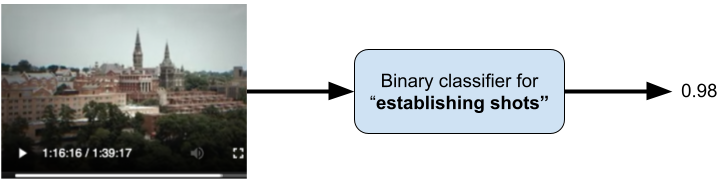
Video understanding via an extensible set of video classifiers
Binary classification allows for independence and flexibility, allowing us to add or improve one model independent of the others. It also has the additional benefit of being easier to understand and build for our users. Combining the predictions of multiple models allows us a deeper understanding of the video content at various levels of granularity, illustrated in Fig 2.

Video Annotator (VA)
In this section, we describe VA’s three-step process for building video classifiers.
Step 1 — search
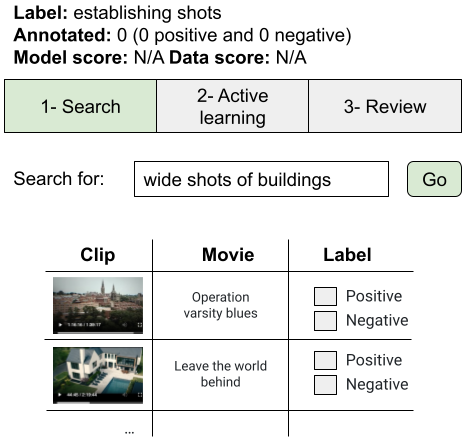
Users begin by finding an initial set of examples within a large, diverse corpus to bootstrap the annotation process. We leverage text-to-video search to enable this, powered by video and text encoders from a Vision-Language Model to extract embeddings. For example, an annotator working on the establishing shots model may start the process by searching for “wide shots of buildings”, illustrated in Fig 3.
Step 2 — active learning
The next stage involves a classic Active Learning loop. VA then builds a lightweight binary classifier over the video embeddings, which is subsequently used to score all clips in the corpus, and presents some examples within feeds for further annotation and refinement, as illustrated in Fig 4.
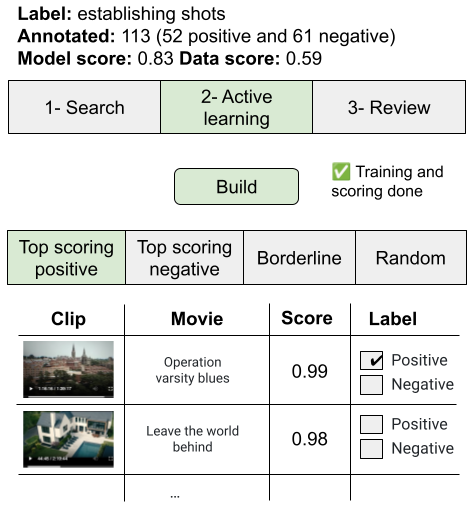
The top-scoring positive and negative feeds display examples with the highest and lowest scores respectively. Our users reported that this provided a valuable indication as to whether the classifier has picked up the correct concepts in the early stages of training and spot cases of bias in the training data that they were able to subsequently fix. We also include a feed of “borderline” examples that the model is not confident about. This feed helps with discovering interesting edge cases and inspires the need for labeling additional concepts. Finally, the random feed consists of randomly selected clips and helps to annotate diverse examples which is important for generalization.
The annotator can label additional clips in any of the feeds and build a new classifier and repeat as many times as desired.
Step 3 — review
The last step simply presents the user with all annotated clips. It’s a good opportunity to spot annotation mistakes and to identify ideas and concepts for further annotation via search in step 1. From this step, users often go back to step 1 or step 2 to refine their annotations.
Experiments
To evaluate VA, we asked three video experts to annotate a diverse set of 56 labels across a video corpus of 500k shots. We compared VA to the performance of a few baseline methods, and observed that VA leads to the creation of higher quality video classifiers. Fig 5 compares VA’s performance to baselines as a function of the number of annotated clips.

You can find more details about VA and our experiments in this paper.
Conclusion
We presented Video Annotator (VA), an interactive framework that addresses many challenges associated with conventional techniques for training machine learning classifiers. VA leverages the zero-shot capabilities of large vision-language models and active learning techniques to enhance sample efficiency and reduce costs. It offers a unique approach to annotating, managing, and iterating on video classification datasets, emphasizing the direct involvement of domain experts in a human-in-the-loop system. By enabling these users to rapidly make informed decisions on hard samples during the annotation process, VA increases the system’s overall efficiency. Moreover, it allows for a continuous annotation process, allowing users to swiftly deploy models, monitor their quality in production, and rapidly fix any edge cases.
This self-service architecture empowers domain experts to make improvements without the active involvement of data scientists or third-party annotators, and fosters a sense of ownership, thereby building trust in the system.
We conducted experiments to study the performance of VA, and found that it yields a median 8.3 point improvement in Average Precision relative to the most competitive baseline across a wide-ranging assortment of video understanding tasks. We release a dataset with 153k labels across 56 video understanding tasks annotated by three professional video editors using VA, and also release code to replicate our experiments.

Video annotator: building video classifiers using vision-language models and active learning was originally published in Netflix TechBlog on Medium, where people are continuing the conversation by highlighting and responding to this story.
Libgcrypt 1.11.0 released
Post Syndicated from jzb original https://lwn.net/Articles/978939/
Version 1.11.0 of Libgcrypt, a general-purpose library of
cryptographic building blocks, has been released by the GnuPG project:
This release starts a new stable branch of Libgcrypt with full API and
ABI compatibility to the 1.10 series. Over the last years Jussi
Kivilinna put again a lot of work into speeding up the algorithms for
many commonly used CPUs. Niibe-san implemented new APIs and algorithms
and also integrated quantum-resistant encryption algorithms.
Apply fine-grained access and transformation on the SUPER data type in Amazon Redshift
Post Syndicated from Ritesh Sinha original https://aws.amazon.com/blogs/big-data/apply-fine-grained-access-and-transformation-on-the-super-data-type-in-amazon-redshift/
Amazon Redshift is a fast, scalable, secure, and fully managed cloud data warehouse that makes it simple and cost-effective to analyze all your data using standard SQL and your existing ETL (extract, transform, and load), business intelligence (BI), and reporting tools. Tens of thousands of customers use Amazon Redshift to process exabytes of data per day and power analytics workloads such as BI, predictive analytics, and real-time streaming analytics.
Amazon Redshift, a cloud data warehouse service, supports attaching dynamic data masking (DDM) policies to paths of SUPER data type columns, and uses the OBJECT_TRANSFORM function with the SUPER data type. SUPER data type columns in Amazon Redshift contain semi-structured data like JSON documents. Previously, data masking in Amazon Redshift only worked with regular table columns, but now you can apply masking policies specifically to elements within SUPER columns. For example, you could apply a masking policy to mask sensitive fields like credit card numbers within JSON documents stored in a SUPER column. This allows for more granular control over data masking in Amazon Redshift. Amazon Redshift gives you more flexibility in how you apply data masking to protect sensitive information stored in SUPER columns containing semi-structured data.
With DDM support in Amazon Redshift, you can do the following:
- Define masking policies that apply custom obfuscation policies, such as masking policies to handle credit card, personally identifiable information (PII) entries, HIPAA or GDPR needs, and more
- Transform the data at query time to apply masking policies
- Attach masking policies to roles or users
- Attach multiple masking policies with varying levels of obfuscation to the same column in a table and assign them to different roles with priorities to avoid conflicts
- Implement cell-level masking by using conditional columns when creating your masking policy
- Use masking policies to partially or completely redact data, or hash it by using user-defined functions (UDFs)
In this post, we demonstrate how a retail company can control the access of PII data stored in the SUPER data type to users based on their access privilege without duplicating the data.
Solution overview
For our use case, we have the following data access requirements:
- Users from the Customer Service team should be able to view the order data but not PII information
- Users from the Sales team should be able to view customer IDs and all order information
- Users from the Executive team should be able to view all the data
- Staff should not be able to view any data
The following diagram illustrates how DDM support in Amazon Redshift policies works with roles and users for our retail use case.

The solution encompasses creating masking policies with varying masking rules and attaching one or more to the same role and table with an assigned priority to remove potential conflicts. These policies may pseudonymize results or selectively nullify results to comply with retailers’ security requirements. We refer to multiple masking policies being attached to a table as a multi-modal masking policy. A multi-modal masking policy consists of three parts:
- A data masking policy that defines the data obfuscation rules
- Roles with different access levels depending on the business case
- The ability to attach multiple masking policies on a user or role and table combination with priority for conflict resolution
Prerequisites
To implement this solution, you need the following prerequisites:
- An AWS account.
- An Amazon Redshift cluster or an Amazon Redshift Serverless endpoint.
- Superuser privilege or the
sys:secadminrole on the Amazon Redshift data warehouse
Prepare the data
To set up our use case, complete the following steps:
- On the Amazon Redshift console, choose Query editor v2 under Explorer in the navigation pane.
If you’re familiar with SQL Notebooks, you can download the SQL notebook for the demonstration and import it to quickly get started.
- Create the table and populate contents:
Implement the solution
To satisfy the security requirements, we need to make sure that each user sees the same data in different ways based on their granted privileges. To do that, we use user roles combined with masking policies as follows:
- Create users and roles, and add users to their respective roles:
- Create masking policies:
- Attach the masking policies:
- Attach the masking policy for the customer service use case:
- Attach the masking policy for the sales use case:
- Attach the masking policy for the staff use case:
Test the solution
Let’s confirm that the masking policies are created and attached.
- Check that the masking policies are created with the following code:

- Check that the masking policies are attached:


Now you can test that different users can see the same data masked differently based on their roles.
- Test that the customer support can’t see customer PHI/PII data but can see the order ID, order details, and status:

- Test that the sales team can see the customer ID (non PII data) and all order information:

- Test that the executives can see all data:
- Test that the staff can’t see any data about the order. All columns should masked for them.


Object_Transform function
In this section, we dive into the capabilities and benefits of the OBJECT_TRANSFORM function and explore how it empowers you to efficiently reshape your data for analysis. The OBJECT_TRANSFORM function in Amazon Redshift is designed to facilitate data transformations by allowing you to manipulate JSON data directly within the database. With this function, you can apply transformations to semi-structured or SUPER data types, making it less complicated to work with complex data structures in a relational database environment.
Let’s look at some usage examples.
First, create a table and populate contents:

Apply the transformations with the OBJECT_TRANSFORM function:

As you can see in the example, by applying the transformation with OBJECT_TRANSFORM, the person name is formatted in lowercase and the salary is increased by 10%. This demonstrates how the transformation makes is less complicated to work with semi-structured or nested data types.
Clean up
When you’re done with the solution, clean up your resources:
- Detach the masking policies from the table:
- Drop the masking policies:
- Revoke or drop the roles and users:
- Drop the table:
Considerations and best practices
Consider the following when implementing this solution:
- When attaching a masking policy to a path on a column, that column must be defined as the SUPER data type. You can only apply masking policies to scalar values on the SUPER path. You can’t apply masking policies to complex structures or arrays.
- You can apply different masking policies to multiple scalar values on a single SUPER column as long as the SUPER paths don’t conflict. For example, the SUPER paths a.b and a.b.c conflict because they’re on the same path, with a.b being the parent of a.b.c. The SUPER paths a.b.c and a.b.d don’t conflict.
Refer to Using dynamic data masking with SUPER data type paths for more details on considerations.
Conclusion
In this post, we discussed how to use DDM support for the SUPER data type in Amazon Redshift to define configuration-driven, consistent, format-preserving, and irreversible masked data values. With DDM support in Amazon Redshift, you can control your data masking approach using familiar SQL language. You can take advantage of the Amazon Redshift role-based access control capability to implement different levels of data masking. You can create a masking policy to identify which column needs to be masked, and you have the flexibility of choosing how to show the masked data. For example, you can completely hide all the information of the data, replace partial real values with wildcard characters, or define your own way to mask the data using SQL expressions, Python, or Lambda UDFs. Additionally, you can apply conditional masking based on other columns, which selectively protects the column data in a table based on the values in one or more columns.
We encourage you to create your own user-defined functions for various use cases and achieve your desired security posture using dynamic data masking support in Amazon Redshift.
About the Authors
 Ritesh Kumar Sinha is an Analytics Specialist Solutions Architect based out of San Francisco. He has helped customers build scalable data warehousing and big data solutions for over 16 years. He loves to design and build efficient end-to-end solutions on AWS. In his spare time, he loves reading, walking, and doing yoga.
 Tahir Aziz is an Analytics Solution Architect at AWS. He has worked with building data warehouses and big data solutions for over 15+ years. He loves to help customers design end-to-end analytics solutions on AWS. Outside of work, he enjoys traveling and cooking.
 Omama Khurshid is an Acceleration Lab Solutions Architect at Amazon Web Services. She focuses on helping customers across various industries build reliable, scalable, and efficient solutions. Outside of work, she enjoys spending time with her family, watching movies, listening to music, and learning new technologies.
[$] Capturing stack traces asynchronously with BPF
Post Syndicated from daroc original https://lwn.net/Articles/978736/
Andrii Nakryiko led a session at
the 2024
Linux Storage,
Filesystem, Memory Management, and BPF Summit giving
a look into the APIs for capturing stack traces
using BPF, and how the APIs could be made more useful. BPF programs can capture the
current stack trace of a running process, including the portion in the kernel
during execution of a system call, which can be useful for diagnosing
performance problems, among other things. But there are substantial problems with
the existing API.
[$] How kernel CVE numbers are assigned
Post Syndicated from corbet original https://lwn.net/Articles/978711/
It has been four months since Greg
Kroah-Hartman and MITRE
announced that the Linux kernel project had become its own CVE Numbering
Authority (CNA). Since then, the Linux CNA Team has developed workflows
and mechanisms to help manage the various tasks associated with this
challenge. There does however, appear to be a lack of understanding among
community members of the processes and rules the team have been working
within. The principal aim of this article, written by a member of the
Linux kernel CNA team, is to clarify how the team works and how kernel CVE
numbers are assigned.
Security updates for Wednesday
Post Syndicated from jzb original https://lwn.net/Articles/978907/
Security updates have been issued by AlmaLinux (container-tools, firefox, and flatpak), Debian (composer, roundcube, and thunderbird), Fedora (kitty and webkitgtk), Oracle (container-tools and flatpak), Red Hat (flatpak and java-1.8.0-ibm), SUSE (gdcm, gdk-pixbuf, libarchive, libzypp, zypper, ntfs-3g_ntfsprogs, openssl-1_1, openssl-3, podman, python-Werkzeug, and thunderbird), and Ubuntu (git, linux-hwe-6.5, mariadb, mariadb-10.6, and thunderbird).
1965 B-52 collision
Post Syndicated from The History Guy: History Deserves to Be Remembered original https://www.youtube.com/watch?v=NYgfUooKyZ4
The Hacking of Culture and the Creation of Socio-Technical Debt
Post Syndicated from Bruce Schneier original https://www.schneier.com/blog/archives/2024/06/the-hacking-of-culture-and-the-creation-of-socio-technical-debt.html
Culture is increasingly mediated through algorithms. These algorithms have splintered the organization of culture, a result of states and tech companies vying for influence over mass audiences. One byproduct of this splintering is a shift from imperfect but broad cultural narratives to a proliferation of niche groups, who are defined by ideology or aesthetics instead of nationality or geography. This change reflects a material shift in the relationship between collective identity and power, and illustrates how states no longer have exclusive domain over either. Today, both power and culture are increasingly corporate.
Blending Stewart Brand and Jean-Jacques Rousseau, McKenzie Wark writes in A Hacker Manifesto that “information wants to be free but is everywhere in chains.”1 Sounding simultaneously harmless and revolutionary, Wark’s assertion as part of her analysis of the role of what she terms “the hacker class” in creating new world orders points to one of the main ideas that became foundational to the reorganization of power in the era of the internet: that “information wants to be free.” This credo, itself a co-option of Brand’s influential original assertion in a conversation with Apple cofounder Steve Wozniak at the 1984 Hackers Conference and later in his 1987 book The Media Lab: Inventing the Future at MIT, became a central ethos for early internet inventors, activists,2 and entrepreneurs. Ultimately, this notion was foundational in the construction of the era we find ourselves in today: an era in which internet companies dominate public and private life. These companies used the supposed desire of information to be free as a pretext for building platforms that allowed people to connect and share content. Over time, this development helped facilitate the definitive power transfer of our time, from states to corporations.
This power transfer was enabled in part by personal data and its potential power to influence people’s behavior—a critical goal in both politics and business. The pioneers of the digital advertising industry claimed that the more data they had about people, the more they could influence their behavior. In this way, they used data as a proxy for influence, and built the business case for mass digital surveillance. The big idea was that data can accurately model, predict, and influence the behavior of everyone—from consumers to voters to criminals. In reality, the relationship between data and influence is fuzzier, since influence is hard to measure or quantify. But the idea of data as a proxy for influence is appealing precisely because data is quantifiable, whereas influence is vague. The business model of Google Ads, Facebook, Experian, and similar companies works because data is cheap to gather, and the effectiveness of the resulting influence is difficult to measure. The credo was “Build the platform, harvest the data…then profit.” By 2006, a major policy paper could ask, “Is Data the New Oil?”3
The digital platforms that have succeeded most in attracting and sustaining mass attention—Facebook, TikTok, Instagram—have become cultural. The design of these platforms dictates the circulation of customs, symbols, stories, values, and norms that bind people together in protocols of shared identity. Culture, as articulated through human systems such as art and media, is a kind of social infrastructure. Put differently, culture is the operating system of society.
Like any well-designed operating system, culture is invisible to most people most of the time. Hidden in plain sight, we make use of it constantly without realizing it. As an operating system, culture forms the base infrastructure layer of societal interaction, facilitating communication, cooperation, and interrelations. Always evolving, culture is elastic: we build on it, remix it, and even break it.
Culture can also be hacked—subverted for specific advantage.4 If culture is like an operating system, then to hack it is to exploit the design of that system to gain unauthorized control and manipulate it towards a specific end. This can be for good or for bad. The morality of the hack depends on the intent and actions of the hacker.
When businesses hack culture to gather data, they are not necessarily destroying or burning down social fabrics and cultural infrastructure. Rather, they reroute the way information and value circulate, for the benefit of their shareholders. This isn’t new. There have been culture hacks before. For example, by lending it covert support, the CIA hacked the abstract expressionism movement to promote the idea that capitalism was friendly to high culture.5 Advertising appropriated the folk-cultural images of Santa Claus and the American cowboy to sell Coca-Cola and Marlboro cigarettes, respectively. In Mexico, after the revolution of 1910, the ruling party hacked muralist works, aiming to construct a unifying national narrative.
Culture hacks under digital capitalism are different. Whereas traditional propaganda goes in one direction—from government to population, or from corporation to customers—the internet-surveillance business works in two directions: extracting data while pushing engaging content. The extracted data is used to determine what content a user would find most engaging, and that engagement is used to extract more data, and so on. The goal is to keep as many users as possible on platforms for as long as possible, in order to sell access to those users to advertisers. Another difference between traditional propaganda and digital platforms is that the former aims to craft messages with broad appeal, while the latter hyper-personalizes content for individual users.
The rise of Chinese-owned TikTok has triggered heated debate in the US about the potential for a foreign-owned platform to influence users by manipulating what they see. Never mind that US corporations have used similar tactics for years. While the political commitments of platform owners are indeed consequential—Chinese-owned companies are in service to the Chinese Communist Party, while US-owned companies are in service to business goals—the far more pressing issue is that both have virtually unchecked surveillance power. They are both reshaping societies by hacking culture to extract data and serve content. Funny memes, shocking news, and aspirational images all function similarly: they provide companies with unprecedented access to societies’ collective dreams and fears.6 By determining who sees what when and where, platform owners influence how societies articulate their understanding of themselves.
Tech companies want us to believe that algorithmically determined content is effectively neutral: that it merely reflects the user’s behavior and tastes back at them. In 2021, Instagram head Adam Mosseri wrote a post on the company’s blog entitled “Shedding More Light on How Instagram Works.” A similar window into TikTok’s functioning was provided by journalist Ben Smith in his article “How TikTok Reads Your Mind.”7 Both pieces boil down to roughly the same idea: “We use complicated math to give you more of what your behavior shows us you really like.”
This has two consequences. First, companies that control what users see in a nontransparent way influence how we perceive the world. They can even shape our personal relationships. Second, by optimizing algorithms for individual attention, a sense of culture as common ground is lost. Rather than binding people through shared narratives, digital platforms fracture common cultural norms into self-reinforcing filter bubbles.8
This fragmentation of shared cultural identity reflects how the data surveillance business is rewriting both the established order of global power, and social contracts between national governments and their citizens. Before the internet, in the era of the modern state, imperfect but broad narratives shaped distinct cultural identities; “Mexican culture” was different from “French culture,” and so on. These narratives were designed to carve away an “us” from “them,” in a way that served government aims. Culture has long been understood to operate within the envelope of nationality, as exemplified by the organization of museum collections according to the nationality of artists, or by the Venice Biennale—the Olympics of the art world, with its national pavilions format.
National culture, however, is about more than museum collections or promoting tourism. It broadly legitimizes state power by emotionally binding citizens to a self-understood identity. This identity helps ensure a continuing supply of military recruits to fight for the preservation of the state. Sociologist James Davison Hunter, who popularized the phrase “culture war,” stresses that culture is used to justify violence to defend these identities.9 We saw an example of this on January 6, 2021, with the storming of the US Capitol. Many of those involved were motivated by a desire to defend a certain idea of cultural identity they believed was under threat.
Military priorities were also entangled with the origins of the tech industry. The US Department of Defense funded ARPANET, the first version of the internet. But the internet wouldn’t have become what it is today without the influence of both West Coast counterculture and small-l libertarianism, which saw the early internet as primarily a space to connect and play. One of the first digital game designers was Bernie De Koven, founder of the Games Preserve Foundation. A noted game theorist, he was inspired by Stewart Brand’s interest in “play-ins” to start a center dedicated to play. Brand had envisioned play-ins as an alternative form of protest against the Vietnam War; they would be their own “soft war” of subversion against the military.10 But the rise of digital surveillance as the business model of nascent tech corporations would hack this anti-establishment spirit, turning instruments of social cohesion and connection into instruments of control.
It’s this counterculture side of tech’s lineage, which advocated for the social value of play, that attuned the tech industry to the utility of culture. We see the commingling of play and military control in Brand’s Whole Earth Catalog, which was a huge influence on early tech culture. Described as “a kind of Bible for counterculture technology,” the Whole Earth Catalog was popular with the first generation of internet engineers, and established crucial “assumptions about the ideal relationships between information, technology, and community.”11 Brand’s 1972 Rolling Stone article “Spacewar: Fantastic Life and Symbolic Death Among the Computer” further emphasized how rudimentary video games were central to the engineering community. These games were wildly popular at leading engineering research centers: Stanford, MIT, ARPA, Xerox, and others. This passion for gaming as an expression of technical skills and a way for hacker communities to bond led to the development of MUD (Multi-User Dungeon) programs, which enabled multiple people to communicate and collaborate online simultaneously.
The first MUD was developed in 1978 by engineers who wanted to play fantasy games online. It applied the early-internet ethos of decentralism and personalization to video games, making it a precursor to massive multiplayer online role-playing games and modern chat rooms and Facebook groups. Today, these video games and game-like simulations—now a commercial industry worth around $200 billion12—serve as important recruitment and training tools for the military.13 The history of the tech industry and culture is full of this tension between the internet as an engineering plaything and as a surveillance commodity.
Historically, infrastructure businesses—like railroad companies in the nineteenth-century US—have always wielded considerable power. Internet companies that are also infrastructure businesses combine commercial interests with influence over national and individual security. As we transitioned from railroad tycoons connecting physical space to cloud computing companies connecting digital space, the pace of technological development put governments at a disadvantage. The result is that corporations now lead the development of new tech (a reversal from the ARPANET days), and governments follow, struggling to modernize public services in line with the new tech. Companies like Microsoft are functionally providing national cybersecurity. Starlink, Elon Musk’s satellite internet service, is a consumer product that facilitates military communications for the war in Ukraine. Traditionally, this kind of service had been restricted to selected users and was the purview of states.14 Increasingly, it is clear that a handful of transnational companies are using their technological advantages to consolidate economic and political power to a degree previously afforded to only great-power nations.
Worse, since these companies operate across multiple countries and regions, there is no regulatory body with the jurisdiction to effectively constrain them. This transition of authority from states to corporations and the nature of surveillance as the business model of the internet rewrites social contracts between national governments and their citizens. But it also also blurs the lines among citizen, consumer, and worker. An example of this are Google’s Recaptchas, visual image puzzles used in cybersecurity to “prove” that the user is a human and not a bot. While these puzzles are used by companies and governments to add a layer of security to their sites, their value is in how they record a user’s input in solving the puzzles to train Google’s computer vision AI systems. Similarly, Microsoft provides significant cybersecurity services to governments while it also trains its AI models on citizens’ conversations with Bing.15 Under this dyanmic, when citizens use digital tools and services provided by tech companies, often to access government webpages and resources, they become de facto free labor for the tech companies providing them. The value generated by this citizen-user-laborer stays with the company, as it is used to develop and refine their products. In this new blurred reality, the relationships among corporations, governments, power, and identity are shifting. Our social and cultural infrastructure suffers as a result, creating a new kind of technical debt of social and cultural infrustructure.
In the field of software development, technical debt refers to the future cost of ignoring a near-term engineering problem.16 Technical debt grows as engineers implement short-term patches or workarounds, choosing to push the more expensive and involved re-engineering fixes for later. This debt accrues over time, to be paid back in the long term. The result of a decision to solve an immediate problem at the expense of the long-term one effectively mortgages the future in favor of an easier present. In terms of cultural and social infrastructure, we use the same phrase to refer to the long-term costs that result from avoiding or not fully addressing social needs in the present. More than a mere mistake, socio-technical debt stems from willfully not addressing a social problem today and leaving a much larger problem to be addressed in the future.
For example, this kind of technical debt was created by the cratering of the news industry, which relied on social media to drive traffic—and revenue—to news websites. When social media companies adjusted their algorithms to deprioritize news, traffic to news sites plummeted, causing an existential crisis for many publications.17 Now, traditional news stories make up only 3 percent of social media content. At the same time, 66 percent of people ages eighteen to twenty-four say they get their “news” from TikTok, Facebook, and Twitter.18 To be clear, Facebook did not accrue technical debt when it swallowed the news industry. We as a society are dealing with technical debt in the sense that we are being forced to pay the social cost of allowing them to do that.
One result of this shift in information consumption as a result of changes to the cultural infrastructure of social media is the rise in polarization and radicalism. So by neglecting to adequately regulate tech companies and support news outlets in the near term, our governments have paved the way for social instability in the long term. We as a society also have to find and fund new systems to act as a watchdog over both corporate and governmental power.
Another example of socio-technical debt is the slow erosion of main streets and malls by e-commerce.19 These places used to be important sites for physical gathering, which helped the shops and restaurants concentrated there stay in business. But e-commerce and direct-to-consumer trends have undermined the economic viability of main streets and malls, and have made it much harder for small businesses to survive. The long-term consequence of this to society is the hollowing out of town centers and the loss of spaces for physical gathering—which we will all have to pay for eventually.
The faltering finances of museums will also create long-term consequences for society as a whole, especially in the US, where Museums mostly depend on private donors to cover operational costs. But a younger generation of philanthropists is shifting its giving priorities away from the arts, leading to a funding crisis at some institutions.20
One final example: libraries. NYU Sociologist Eric Klinenberg called libraries “the textbook example of social infrastructure in action.”21 But today they are stretched to the breaking point, like museums, main streets, and news media. In New York City, Mayor Eric Adams has proposed a series of severe budget cuts to the city’s library system over the past year, despite having seen a spike in usage recently. The steepest cuts were eventually retracted, but most libraries in the city have still had to cancel social programs and cut the number of days they’re open.22 As more and more spaces for meeting in real life close, we increasingly turn to digital platforms for connection to replace them. But these virtual spaces are optimized for shareholder returns, not public good.
Just seven companies—Alphabet (the parent company of Google), Amazon, Apple, Meta, Microsoft, Nvidia and Tesla—drove 60 percent of the gains of the S&P stock market index in 2023.23 Four—Alibaba, Amazon, Google, and Microsoft—deliver the majority of cloud services.24 These companies have captured the delivery of digital and physical goods and services. Everything involved with social media, cloud computing, groceries, and medicine is trapped in their flywheels, because the constellation of systems that previously put the brakes on corporate power, such as monopoly laws, labor unions, and news media, has been eroded. Product dependence and regulatory capture have further undermined the capacity of states to respond to the rise in corporate hard and soft power. Lock-in and other anticompetitive corporate behavior have prevented market mechanisms from working properly. As democracy falls into deeper crisis with each passing year, policy and culture are increasingly bent towards serving corporate interest. The illusion that business, government, and culture are siloed sustains this status quo.
Our digitized global economy has made us all participants in the international data trade, however reluctantly. Though we are aware of the privacy invasions and social costs of digital platforms, we nevertheless participate in these systems because we feel as though we have no alternative—which itself is partly the result of tech monopolies and the lack of competition.
Now, the ascendence of AI is thrusting big data into a new phase and new conflicts with social contracts. The development of bigger, more powerful AI models means more demand for data. Again, massive wholesale extractions of culture are at the heart of these efforts.25 As AI researchers and artists Kate Crawford and Vladan Joler explain in the catalog to their exhibition Calculating Empires, AI developers require “the entire history of human knowledge and culture … The current lawsuits over generative systems like GPT and Stable Diffusion highlight how completely dependent AI systems are on extracting, enclosing, and commodifying the entire history of cognitive and creative labor.”26
Permitting internet companies to hack the systems in which culture is produced and circulates is a short-term trade-off that has proven to have devastating long-term consequences. When governments give tech companies unregulated access to our social and cultural infrastructure, the social contract becomes biased towards their profit. When we get immediate catharsis through sharing memes or engaging in internet flamewars, real protest is muzzled. We are increasing our collective socio-technical debt by ceding our social and cultural infrastructure to tech monopolies.
Cultural expression is fundamental to what makes us human. It’s an impulse, innate to us as a species, and this impulse will continue to be a gold mine to tech companies. There is evidence that AI models trained on synthetic data—data produced by other AI models rather than humans—can corrupt these models, causing them to return false or nonsensical answers to queries.27 So as AI-produced data floods the internet, data that is guaranteed to have been derived from humans becomes more valuable. In this context, our human nature, compelling us to make and express culture, is the dream of digital capitalism. We become a perpetual motion machine churning out free data. Beholden to shareholders, these corporations see it as their fiduciary duty—a moral imperative even—to extract value from this cultural life.
We are in a strange transition. The previous global order, in which states wielded ultimate authority, hasn’t quite died. At the same time, large corporations have stepped in to deliver some of the services abandoned by states, but at the price of privacy and civic well-being. Increasingly, corporations provide consistent, if not pleasant, economic and social organization. Something similar occurred during the Gilded Age in the US (1870s–1890s). But back then, the influence of robber barons was largely constrained to the geographies in which they operated, and their services (like the railroad) were not previously provided by states. In our current transitionary period, public life worldwide is being reimagined in accordance with corporate values. Amidst a tug-of-war between the old state-centric world and the emerging capital-centric world, there is a growing radicalism fueled partly by frustration over social and personal needs going unmet under a transnational order that is maximized for profit rather than public good.
Culture is increasingly divorced from national identity in our globalized, fragmented world. On the positive side, this decoupling can make culture more inclusive of marginalized people. Other groups, however, may perceive this new status quo as a threat, especially those facing a loss of privilege. The rise of white Christian nationalism shows that the right still regards national identity and culture as crucial—as potent tools in the struggle to build political power, often through anti-democratic means. This phenomenon shows that the separation of cultural identity from national identity doesn’t negate the latter. Instead, it creates new political realities and new orders of power.
Nations issuing passports still behave as though they are the definitive arbiters of identity. But culture today—particularly the multiverse of internet cultures—exposes how this is increasingly untrue. With government discredited as an ultimate authority, and identity less and less connected to nationality, we can find a measure of hope for navigating the current transition in the fact that culture is never static. New forms of resistance are always emerging. But we must ask ourselves: Have the tech industry’s overwhelming surveillance powers rendered subversion impossible? Or does its scramble to gather all the world’s data offer new possibilities to hack the system?
1. McKenzie Wark, A Hacker Manifesto (Harvard University Press, 2004), thesis 126. ↑
2. Jon Katz, “Birth of a Digital Nation,” Wired, April 1, 1997. ↑
3. Marcin Szczepanski, “Is Data the New Oil? Competition Issues in the Digital Economy,” European Parliamentary Research Service, January 2020. ↑
4. Bruce Schneier, A Hacker’s Mind: How the Powerful Bend Society’s Rules, and How to Bend Them Back (W. W. Norton & Sons, 2023). ↑
5. Lucie Levine, “Was Modern Art Really a CIA Psy-Op?” JStor Daily, April 1, 2020. ↑
6. Bruce Schneier, Data and Goliath: The Hidden Battles to Collect Your Data and Control Your World (W. W. Norton & Sons, 2015). ↑
7. Adam Mosseri, “Shedding More Light on How Instagram Works,” Instagram Blog, June 8, 2021; Ben Smith, “How TikTok Reads Your Mind,” New York Times, December 5, 2021. ↑
8. Giacomo Figà Talamanca and Selene Arfini, “Through the Newsfeed Glass: Rethinking Filter Bubbles and Echo Chambers,” Philosophy & Technology 35, no. 1 (2022). ↑
9. Zack Stanton, “How the ‘Culture War’ Could Break Democracy,” Politico, May 5, 2021. ↑
10. Jason Johnson, “Inside the Failed, Utopian New Games Movement,” Kill Screen, October 25, 2013. ↑
11. Fred Turner, “Taking the Whole Earth Digital,” chap. 4 in From Counter Culture to Cyberculture: Stewart Brand, The Whole Earth Network, and the Rise of Digital Utopianism (University of Chicago Press, 2006). ↑
12. Kaare Ericksen, “The State of the Video Games Industry: A Special Report,” Variety, February 1, 2024. ↑
13. Rosa Schwartzburg, “The US Military Is Embedded in the Gaming World. It’s Target: Teen Recruits,” The Guardian, February 14, 2024; Scott Kuhn, “Soldiers Maintain Readiness Playing Video Games,” US Army, April 29, 2020; Katie Lange, “Military Esports: How Gaming Is Changing Recruitment & Moral,” US Department of Defense, December 13, 2022. ↑
14. Shaun Waterman, “Growing Commercial SATCOM Raises Trust Issues for Pentagon,” Air & Space Forces Magazine, April 3, 2024. ↑
15. Geoffrey A Fowler, “Your Instagrams Are Training AI. There’s Little You Can Do About It,” Washington Post, September 27, 2023. ↑
16. Zengyang Li, Paris Avgeriou, and Peng Liang, “A Systematic Mapping Study on Technical Debt and Its Management,” Journal of Systems and Software, December 2014. ↑
17. David Streitfeld, “How the Media Industry Keeps Losing the Future,” New York Times, February 28, 2024. ↑
18. “The End of the Social Network,” The Economist, February 1, 2024; Ollie Davies, “What Happens If Teens Get Their News From TikTok?” The Guardian, February 22, 2023. ↑
19. Eric Jaffe, “Quantifying the Death of the Classic American Main Street,” Medium, March 16, 2018. ↑
20. Julia Halprin, “The Hangover from the Museum Party: Institutions in the US Are Facing a Funding Crisis,” Art Newspaper, January 19, 2024. ↑
21. Quoted in Pete Buttigieg, “The Key to Happiness Might Be as Simple as a Library or Park,” New York Times, September 14, 2018. ↑
22. Jeffery C. Mays and Dana Rubinstein, “Mayor Adams Walks Back Budget Cuts Many Saw as Unnecessary,” New York Times, April 24, 2024. ↑
23. Karl Russell and Joe Rennison, “These Seven Tech Stocks Are Driving the Market,” New York Times, January 22, 2024. ↑
24. Ian Bremmer, “How Big Tech Will Reshape the Global Order,” Foreign Affairs, October 19, 2021. ↑
25. Nathan Sanders and Bruce Schneier, “How the ‘Frontier’ Became the Slogan for Uncontrolled AI,” Jacobin, February 27, 2024. ↑
26. Kate Crawford and Vladan Joler, Calculating Empires: A Genealogy of Technology and Power, 1500–2025 (Fondazione Prada, 2023), 9. Exhibition catalog. ↑
27. Rahul Rao, “AI Generated Data Can Poison Future AI Models,” Scientific American, July 28, 2023. ↑
This essay was written with Kim Córdova, and was originally published in e-flux.
Изгрява ли дъга над София и България?
Post Syndicated from Светла Енчева original https://www.toest.bg/izgryava-li-duga-nad-sofia-i-bulgaria/

На 22 юни „София прайд“ ще се проведе за 17-та поредна година. Както винаги досега, най-голямото събитие в защита на правата на ЛГБТИ+ хората в България е съпроводено с дискусии „за“ и „против“. Отново има антипарад. Даже два, понеже в редиците на основното от години насам „антисъбитие“ настъпи разкол. В резултат т.нар. „Поход за семейството“ поосиротя и се проведе седмица преди прайда. В деня на „София прайд“ ще се състои „Шествие за семейството“, което се очаква да привлече повече участници и на което е обещала да пее бившата пънк икона Милена Славова.
Под семейство и „Походът“, и „Шествието“ разбират хетеросексуалното семейство от мъж, жена и техните деца. Според организаторите това е „традиционното семейство“, за което хомосексуалните връзки – и по-общо ЛГБТИ+ хората – са заплаха.
Тази година обаче публичната активност около прайда надхвърля обичайните безплодни спорове „за“ и „против“. Едно събитие в Столичния общински съвет (СОС) не се превърна във водеща новина, но е важен прецедент за ЛГБТИ+ хората. Този прецедент е станал възможен, защото почти незабелязано е настъпил друг, и то двоен прецедент. За какво става дума?
Две декларации. И рецепта за розови еднорози
„Рецепта за розови еднорози“ е песен на групата Cool Den. Няколко групи в СОС също забъркаха рецепта, увенчана с голям плюшен розов еднорог, настанил се на стола на един общински съветник.
На 7 май „Синя България“ разпространи декларация във Facebook в подкрепа на „Шествието за семейството“ и призова симпатизантите си да се включат в него. В декларацията се казва, че коалицията застава „зад каузата на семейството, вярата и борбата с демографската криза“, защото е „дясноконсервативна формация“. Също и че „няма по-голям проблем за България от демографската криза и борбата с нея трябва да бъде приоритет на всяко бъдещо управление“.
„Синя България“ е коалиция от седем партии, опитала се (безуспешно) да разшири на национално равнище успеха на „Синя София“, която е част от коалицията на местните избори. В СОС „Синя София“ е представена от трима общински съветници – Вили Лилков, Иван Сотиров и Ивайло Йонков. Декларацията е разпространена в последния предизборен ден, в който политическата агитация е разрешена.
На 13 юни групата общински съветници от „Продължаваме Промяната“, „Демократична България“ и „Спаси София“ излезе със своя декларация по повод „Шествието за семейството“ и „София прайд“. Прочете я адв. Христо Копаранов, който заедно с Гергин Борисов (и двамата от „Спаси София“) е неин инициатор и вносител. Това е първият път, когато най-голямата група в СОС се обявява в подкрепа на „София прайд“ и по-общо – на правата на ЛГБТИ+ хората.
В декларацията противопоставянето на прайда и „Шествието за семейството“ се нарича „фалшива дилема“, защото „семейството не е математическа формула“ от майка, баща и техните деца – самотните родители и децата им, както партньорите без деца например също са семейства. И „всеки заслужава достоен живот“.
„Затова, когато години наред хиляди граждани излизат, за да ни кажат, че се чувстват онеправдани, че живеят в страх, че са лишени от права, ние сме длъжни да ги чуем“, се казва в декларацията и се споменават случаи на хомофобско насилие. В нея се подчертава и че прайдът не е само за ЛГБТИ+ хората, а за „утвърждаване правата и достойнството на всеки, който е различен от мнозинството – било то расово, етнически или по какъвто и да е друг признак“.
Всички семейства са ценни. Всички имаме семейства – някои сме родени в тях, други ги избираме, трети ги създаваме,
завършва декларацията.
Докато Копаранов чете от трибуната, от групата на БСП слагат на мястото му плюшен еднорог. Човек би могъл да възприеме този жест и като подигравка и да се обиди, но адвокатът предпочита да реагира позитивно. Той публикува селфи с еднорога, като благодари на колегите си „за милия подарък“. Копаранов го тълкува като знак, че „БСП най-накрая се позиционираха като европейска лява партия“ и че „резултатите им на последните избори са довели до катарзис“.
Двойният прецедент
Инициаторите на декларацията Христо Копаранов и Гергин Борисов са застъпници за правата на ЛГБТИ+ хората от години. Затова „Тоест“ разговаря с тях.
Копаранов е ядрото на изследователския екип, който през 2018 г. публикува юридически анализ на 70 закона. Според проучването българската държава лишава еднополовите двойки от около 300 права, защото не признава партньорството им. Неотдавна Борисов припомни свой пост от 2021 г., в който разказва измислена, но възможна и плашещо реалистична история на мъж, чийто партньор умира в болница, а той не може нито да получи информация за състоянието му, нито да продължи да живее в дома, който са градили двамата.
„Откакто пуснах онзи си пост с историята за болницата, хората, които ми казаха, че напускат [България], са поне 10. 10 човека за 3 години. Повечето бяха специалисти със заплати над 5000 лева месечно“, споделя Гергин Борисов и пресмята в духа на скорошното изследване на Института за пазарна икономика за икономическата цена на хомофобията: „1,8 милиона лева икономическа активност изчезна… защото е важно да се правят референдуми против джендър идеологията.“
„Жалко е, че подобна декларация трябва да бъде четена. Страшно е, че живеем във време, в което да кажеш, че всички семейства са важни и ценни може да бъде тема, по която не всички да са съгласни“, казва Борисов и допълва, че иска да живее в нормална държава и затова се опитва да я промени.
Искам познатите ми, които се отказаха да чакат, да имат повод да се върнат – защото виждат, че става по-добро, по-толерантно и по-европейско място за живот.
„Отбягването на темата за правата на ЛГБТ хората от страна на много политици е естествена последица от токсичната среда в българската политика и сред избирателите“, смята Христо Копаранов. Според него е разбираемо, но „тази предпазливост води до това, че във всеки един момент „не е сега моментът“. И моментът да се заговори за темата никога не идва“. А същевременно хомофобските гласове стават все по-силни.
На въпроса защо продължава да говори по темата, след като вече е общински съветник, той отговаря, че връзката в питането всъщност трябва да е обратна:
Влизането в Общинския съвет не трябва да е повод да престане да се говори по темата, а точно обратното – повод да се говори още повече. Като член на Общинския съвет един съветник трябва да формира насоките, в които да се развива неговият град, да създава визията за него. Затова […] искаме да създадем сигурен и приемащ град, в който всеки да може да бъде себе си с достойнство.
Според Гергин Борисов „Спаси София“ е партия, която „не мери теми по това какво е популярно, а по това кое е важно“. А е важно София да е „град за всички и това включва ЛГБТИ+ общността“. Борисов допълва: „Аз продължавам да говоря по темата, защото съм част от тази общност и стремежът за равноправие е и мой.“ На учудването, че човек на изборна публична длъжност в България може да каже това, отговаря с усмивка:
„Аз съм открит от години и няма сила на планетата, която да ме набута обратно в килера“.
„Откритото говорене без страх е много важно, но още по-важно е предприемането на реални мерки“, смята Христо Копаранов, на когото също като Борисов не му се налага да разкрива сексуалната си ориентация, понеже не я и крие. Той има опит с говоренето без страх, знае и каква е цената му. „Например след последните ми публикации и декларацията, прочетена в Общинския съвет, аз станах обект на сериозна хомофобска реакция, включително съм получавал заплахи за живота си.“
Конкретно тази заплаха той е изпратил на прокуратурата:

А в лични съобщения адвокатът получава и ето такива „пожелания“:

Копаранов си търси правата, но в същото време не престава да реагира с добродушна ирония на подигравките и слуховете по свой адрес. „Защото ако няма смели политици, които да говорят, и ако обществото проявява толерираща търпимост към ответната хомофобска реакция, мълчанието ще продължи завинаги.“
Знаейки, че жълто-кафявите медии разнасят клюки по негов адрес, той публикува във Facebook актуална снимка, на която е с мъж до себе си – „да си обновят архива, че ми писна да качват стари наши снимки, когато решат да правят интриги“.
Без да дават признаци, че осъзнават колко голям прецедент са, Христо Копаранов и Гергин Борисов са комай първите хора на изборна публична длъжност в България, които са открити за сексуалната си ориентация.
Веднъж на десетина години
В България се появява открито хомосексуален политик веднъж на десетина години. Малко артефакти са оцелели във виртуалното пространство от далечната 2004 година, когато 27-годишният тогава член на БСП Ивелин Йорданов разкрива сексуалната си ориентация пред медиите. Той е бил учредител на куиър организация и изглежда, е вярвал, че Столетницата може да стане лява партия от европейски тип.
Според активистите Моника Писанкънева и Станимир Панайотов, отразили случая тогава, с разкриването на младия социалист мълчанието по темата за ЛГБТИ+ хората е „веднъж завинаги разклатено“. Но БСП, изглежда, се опитва да заглуши случая, като не изпраща Йорданов на форум по темата. А партийният орган – вестник „Дума“ – му дава право на отговор, след което обявява „своята задача в обсъждането на сложния проблем на хомосексуалността за приключена“. И „веднъж завинаги разклатеното мълчание“ се завръща.
11 години по-късно – през 2015 г. – Виктор Лилов, който тогава беше кандидат за кмет от малката либерална партия ДЕОС – се разкри като хомосексуален в интервю на вече покойния Емил Коен за сайта „Маргиналия“. Татяна Ваксберг отбеляза, че в България за първи път се случва някой, който се кандидатира за изборен пост, да декларира нехетеросексуалната си ориентация.
Случаят имаше широк обществен отзвук, а в продължение на години сексуалността на Лилов беше почти единственото нещо, с което беше асоцииран. Тя беше и една от причините за настроенията срещу него в ДЕОС. Две години след разкриването на Лилов партията, чийто председател беше станал междувременно, го изключи по скалъпени обвинения. Малко по-късно ДЕОС се самозакри, оставайки куха регистрация, която евентуално да бъде използвана за целите на някой нов политически проект. А Виктор Лилов опита да влезе в политиката и чрез други формации – без успех.
Девет години по-късно, през 2024 г., Гергин Борисов и Христо Копаранов са избрани за членове на СОС. Без да се крият, но и без скандал. Като нещо най-нормално, каквото всъщност е. И също като нещо най-нормално, те се опитват да впрегнат своята група и целия Общински съвет в работа за равни права.
Чувал съм за много случаи, когато [депутати] са гласували по определен начин, защото еди-кой си разполага с касетка, снимка и т.н. След 1990 г. групичка хора определяха съдбата на България, но не знам дали сами решаваха, или ръководени от други съображения заради скритата си сексуална ориентация.
Тези думи са напълно актуални днес (само дето вече няма касетки, а флашки, социални мрежи, приложения и лични съобщения), но са изречени от Ивелин Йорданов при разкриването му през 2004 г. Не само за доста политици, а и за журналисти и други публични личности, разкриването на сексуалната им ориентация е равносилно на публичен линч. Макар ориентацията на някои от тях да е обществена тайна, те продължават да търпят натиск и унижения, без да са в състояние да си позволят да се разкрият.
Може би Христо Копаранов и Гергин Борисов, които разполагат с мандат от четири години да говорят от публична трибуна, най-сетне „веднъж завинаги“ ще катурнат мълчанието, за което говорят преди 20 години Моника Писанкънева и Станимир Панайотов. И ще спомогнат да изгрее дъгата, под която всеки може да бъде себе си. Възможно е обаче и стигмата да заглуши гласовете им. След още 20 години със сигурност ще знаем отговора.
Comic for 2024.06.19 – Genie Lamp
Post Syndicated from Explosm.net original https://explosm.net/comics/genie-lamp
New Cyanide and Happiness Comic
Confederate ironclad of the civil war – CSS Albemarle
Post Syndicated from The History Guy: History Deserves to Be Remembered original https://www.youtube.com/watch?v=722SmVzsnP0
Electric vs Gas
Post Syndicated from xkcd.com original https://xkcd.com/2948/

Why Does SpaceX Use 33 Engines While NASA Used Just 5?
Post Syndicated from Curious Droid original https://www.youtube.com/watch?v=okK7oSTe2EQ
ASUS AI Servers at Computex 2024
Post Syndicated from John Lee original https://www.servethehome.com/asus-ai-servers-at-computex-2024-nvidia-intel-amd-arm/
At Computex 2024, we saw NVIDIA GH200, GB200 NVL72, B100, and B200 servers, an AMD MI300X option, Intel Xeon 6 servers, and 500W TDP AMD EPYC
The post ASUS AI Servers at Computex 2024 appeared first on ServeTheHome.
Build multimodal search with Amazon OpenSearch Service
Post Syndicated from Praveen Mohan Prasad original https://aws.amazon.com/blogs/big-data/build-multimodal-search-with-amazon-opensearch-service/
Multimodal search enables both text and image search capabilities, transforming how users access data through search applications. Consider building an online fashion retail store: you can enhance the users’ search experience with a visually appealing application that customers can use to not only search using text but they can also upload an image depicting a desired style and use the uploaded image alongside the input text in order to find the most relevant items for each user. Multimodal search provides more flexibility in deciding how to find the most relevant information for your search.
To enable multimodal search across text, images, and combinations of the two, you generate embeddings for both text-based image metadata and the image itself. Text embeddings capture document semantics, while image embeddings capture visual attributes that help you build rich image search applications.
Amazon Titan Multimodal Embeddings G1 is a multimodal embedding model that generates embeddings to facilitate multimodal search. These embeddings are stored and managed efficiently using specialized vector stores such as Amazon OpenSearch Service, which is designed to store and retrieve large volumes of high-dimensional vectors alongside structured and unstructured data. By using this technology, you can build rich search applications that seamlessly integrate text and visual information.
Amazon OpenSearch Service and Amazon OpenSearch Serverless support the vector engine, which you can use to store and run vector searches. In addition, OpenSearch Service supports neural search, which provides out-of-the-box machine learning (ML) connectors. These ML connectors enable OpenSearch Service to seamlessly integrate with embedding models and large language models (LLMs) hosted on Amazon Bedrock, Amazon SageMaker, and other remote ML platforms such as OpenAI and Cohere. When you use the neural plugin’s connectors, you don’t need to build additional pipelines external to OpenSearch Service to interact with these models during indexing and searching.
This blog post provides a step-by-step guide for building a multimodal search solution using OpenSearch Service. You will use ML connectors to integrate OpenSearch Service with the Amazon Bedrock Titan Multimodal Embeddings model to infer embeddings for your multimodal documents and queries. This post illustrates the process by showing you how to ingest a retail dataset containing both product images and product descriptions into your OpenSearch Service domain and then perform a multimodal search by using vector embeddings generated by the Titan multimodal model. The code used in this tutorial is open source and available on GitHub for you to access and explore.
Multimodal search solution architecture
We will provide the steps required to set up multimodal search using OpenSearch Service. The following image depicts the solution architecture.

Figure 1: Multimodal search architecture
The workflow depicted in the preceding figure is:
- You download the retail dataset from Amazon Simple Storage Service (Amazon S3) and ingest it into an OpenSearch k-NN index using an OpenSearch ingest pipeline.
- OpenSearch Service calls the Amazon Bedrock Titan Multimodal Embeddings model to generate multimodal vector embeddings for both the product description and image.
- Through an OpenSearch Service client, you pass a search query.
- OpenSearch Service calls the Amazon Bedrock Titan Multimodal Embeddings model to generate vector embedding for the search query.
- OpenSearch runs the neural search and returns the search results to the client.
Let’s look at steps 1, 2, and 4 in more detail.
Step 1: Ingestion of the data into OpenSearch
This step involves the following OpenSearch Service features:
- Ingest pipelines – An ingest pipeline is a sequence of processors that are applied to documents as they’re ingested into an index. Here you use a text_image_embedding processor to generate combined vector embeddings for the image and image description.
- k-NN index – The k-NN index introduces a custom data type,
knn_vector, which allows users to ingest vectors into an OpenSearch index and perform different kinds of k-NN searches. You use the k-NN index to store both the general field data types, such as text, numeric, etc., and specialized field data types, such asknn_vector.
Steps 2 and 4: OpenSearch calls the Amazon Bedrock Titan model
OpenSearch Service uses the Amazon Bedrock connector to generate embeddings for the data. When you send the image and text as part of your indexing and search requests, OpenSearch uses this connector to exchange the inputs with the equivalent embeddings from the Amazon Bedrock Titan model. The highlighted blue box in the architecture diagram depicts the integration of OpenSearch with Amazon Bedrock using this ML-connector feature. This direct integration eliminates the need for an additional component (for example, AWS Lambda) to facilitate the exchange between the two services.
Solution overview
In this post, you will build and run multimodal search using a sample retail dataset. You will use the same multimodal generated embeddings and experiment by running text search only, image search only and both text and image search in OpenSearch Service.
Prerequisites
- Create an OpenSearch Service domain. For instructions, see Creating and managing Amazon OpenSearch Service domains. Make sure the following settings are applied when you create the domain, while leaving other settings as default.
- OpenSearch version is 2.13
- The domain has public access
- Fine-grained access control is enabled
- A master user is created
- Set up a Python client to interact with the OpenSearch Service domain, preferably on a Jupyter Notebook interface.
- Add model access in Amazon Bedrock. For instructions, see add model access.
Note that you need to refer to the Jupyter Notebook in the GitHub repository to run the following steps using Python code in your client environment. The following sections provide the sample blocks of code that contain only the HTTP request path and the request payload to be passed to OpenSearch Service at every step.
Data overview and preparation
You will be using a retail dataset that contains 2,465 retail product samples that belong to different categories such as accessories, home decor, apparel, housewares, books, and instruments. Each product contains metadata including the ID, current stock, name, category, style, description, price, image URL, and gender affinity of the product. You will be using only the product image and product description fields in the solution.
A sample product image and product description from the dataset are shown in the following image:

Figure 2: Sample product image and description
In addition to the original product image, the textual description of the image provides additional metadata for the product, such as color, type, style, suitability, and so on. For more information about the dataset, visit the retail demo store on GitHub.
Step 1: Create the OpenSearch-Amazon Bedrock ML connector
The OpenSearch Service console provides a streamlined integration process that allows you to deploy an Amazon Bedrock-ML connector for multimodal search within minutes. OpenSearch Service console integrations provide AWS CloudFormation templates to automate the steps of Amazon Bedrock model deployment and Amazon Bedrock-ML connector creation in OpenSearch Service.
- In the OpenSearch Service console, navigate to Integrations as shown in the following image and search for Titan multi-modal. This returns the CloudFormation template named Integrate with Amazon Bedrock Titan Multi-modal, which you will use in the following steps.
 Figure 3: Configure domain
- Select Configure domain and choose ‘Configure public domain’.
- You will be automatically redirected to a CloudFormation template stack as shown in the following image, where most of the configuration is pre-populated for you, including the Amazon Bedrock model, the ML model name, and the AWS Identity and Access Management (IAM) role that is used by Lambda to invoke your OpenSearch domain. Update Amazon OpenSearch Endpoint with your OpenSearch domain endpoint and Model Region with the AWS Region in which your model is available.
 Figure 4: Create a CloudFormation stack
- Before you deploy the stack by clicking ‘Create Stack’, you need to give necessary permissions for the stack to create the ML connector. The CloudFormation template creates a Lambda IAM role for you with the default name
LambdaInvokeOpenSearchMLCommonsRole, which you can override if you want to choose a different name. You need to map this IAM role as a Backend role forml_full_accessrole in OpenSearch dashboards Security plugin, so that the Lambda function can successfully create the ML connector. To do so,- Login to the OpenSearch Dashboards using the master user credentials that you created as a part of prerequisites. You can find the Dashboards endpoint on your domain dashboard on the OpenSearch Service console.
- From the main menu choose Security, Roles, and select the
ml_full_accessrole. - Choose Mapped users, Manage mapping.
- Under Backend roles, add the ARN of the Lambda role (
arn:aws:iam::<account-id>:role/LambdaInvokeOpenSearchMLCommonsRole) that needs permission to call your domain. - Select Map and confirm the user or role shows up under Mapped users.
 Figure 5: Set permissions in OpenSearch dashboards security plugin
- Return back to the CloudFormation stack console, check the box, ‘I acknowledge that AWS CloudFormation might create IAM resources with customised names‘ and click on ‘Create Stack’.
- After the stack is deployed, it will create the Amazon Bedrock-ML connector (
ConnectorId) and a model identifier (ModelId). Figure 6: CloudFormation stack outputs
- Copy the
ModelIdfrom the Outputs tab of the CloudFormation stack starting with prefix ‘OpenSearch-bedrock-mm-’ from your CloudFormation console. You will be using thisModelIdin the further steps.


Step 2: Create the OpenSearch ingest pipeline with the text_image_embedding processor
You can create an ingest pipeline with the text_image_embedding processor, which transforms the images and descriptions into embeddings during the indexing process.
In the following request payload, you provide the following parameters to the text_image_embedding processor. Specify which index fields to convert to embeddings, which field should store the vector embeddings, and which ML model to use to perform the vector conversion.
- model_id (
<model_id>) – The model identifier from the previous step. - Embedding (
<vector_embedding>) – The k-NN field that stores the vector embeddings. - field_map (
<product_description>and<image_binary>) – The field name of the product description and the product image in binary format.
Step 4: Create the k-NN index and ingest the retail dataset
Create the k-NN index and set the pipeline created in the previous step as the default pipeline. Set index.knn to True to perform an approximate k-NN search. The vector_embedding field type must be mapped as a knn_vector. vector_embedding field dimension must be mapped with the number of dimensions of the vector that the model provides.
Amazon Titan Multimodal Embeddings G1 lets you choose the size of the output vector (either 256, 512, or 1024). In this post, you will be using the default 1024 dimensional vectors from the model. You can check the size of dimensions of the model by selecting ‘Providers’ -> ‘Amazon’ tab -> ‘Titan Multimodal Embeddings G1’ tab -> ‘Model attributes’, from your Bedrock console.
Given the smaller size of the dataset and to bias for better recall, you use the faiss engine with the hnsw algorithm and the default l2 space type for your k-NN index. For more information about different engines and space types, refer to k-NN index.
Finally, you ingest the retail dataset into the k-NN index using a bulk request. For the ingestion code, refer to the step 7, ‘Ingest the dataset into k-NN index using Bulk request‘ in the Jupyter notebook.
Step 5: Perform multimodal search experiments
Perform the following experiments to explore multimodal search and compare results. For text search, use the sample query “Trendy footwear for women” and set the number of results to 5 (size) throughout the experiments.
Experiment 1: Lexical search
This experiment shows you the limitations of simple lexical search and how the results can be improved using multimodal search.
Run a match query against the product_description field by using the following example query payload:
Results:

Figure 7: Lexical search results
Observation:
As shown in the preceding figure, the first three results refer to a jacket, glasses, and scarf, which are irrelevant to the query. These were returned because of the matching keywords between the query, “Trendy footwear for women” and the product descriptions, such as “trendy” and “women.” Only the last two results are relevant to the query because they contain footwear items.
Only the last two products fulfil the intent of the query, which was to find products that match all words in the query.
Experiment 2: Multimodal search with only text as input
In this experiment, you will use the Titan Multimodal Embeddings model that you deployed previously and run a neural search with only “Trendy footwear for women” (text) as input.
In the k-NN vector field (vector_embedding) of the neural query, you pass the model_id, query_text, and k value as shown in the following example. k denotes the number of results returned by the k-NN search.
Results:

Figure 8: Results from multimodal search using text
Observation:
As shown in the preceding figure, all five results are relevant because each represents a style of footwear. Additionally, the gender preference from the query (women) is also matched in all the results, which indicates that the Titan multimodal embeddings preserved the gender context in both the query and nearest document vectors.
Experiment 3: Multimodal search with only an image as input
In this experiment, you will use only a product image as the input query.
You will use the same neural query and parameters as in the previous experiment but pass the query_image parameter instead of using the query_text parameter. You need to convert the image into binary format and pass the binary string to the query_image parameter:

Figure 9: Image of a woman’s sandal used as the query input
Results:

Figure 10: Results from multimodal search using an image
Observation:
As shown in the preceding figure, by passing an image of a woman’s sandal, you were able to retrieve similar footwear styles. Though this experiment provides a different set of results compared to the previous experiment, all the results are highly related to the search query. All the matching documents are similar to the searched product image, not only in terms of the product category (footwear) but also in terms of the style (summer footwear), color, and gender affinity of the product.
Experiment 4: Multimodal search with both text and an image
In this last experiment, you will run the same neural query but pass both the image of a woman’s sandal and the text, “dark color” as inputs.
Figure 11: Image of a woman’s sandal used as part of the query input
As before, you will convert the image into its binary form before passing it to the query:
Results:
 ML-powered search with OpenSearch and set up you multimodal search solution in your own environment using the guidelines in this post. The solution code is also available on the GitHub repo.
About the Authors
 Praveen Mohan Prasad is an Analytics Specialist Technical Account Manager at Amazon Web Services and helps customers with pro-active operational reviews on analytics workloads. Praveen actively researches on applying machine learning to improve search relevance.
 Hajer Bouafif is an Analytics Specialist Solutions Architect at Amazon Web Services. She focuses on Amazon OpenSearch Service and helps customers design and build well-architected analytics workloads in diverse industries. Hajer enjoys spending time outdoors and discovering new cultures.
 Aruna Govindaraju is an Amazon OpenSearch Specialist Solutions Architect and has worked with many commercial and open-source search engines. She is passionate about search, relevancy, and user experience. Her expertise with correlating end-user signals with search engine behavior has helped many customers improve their search experience. Her favourite pastime is hiking the New England trails and mountains.
[$] Adding a JIT compiler to CPython
Post Syndicated from jake original https://lwn.net/Articles/977855/
One of the big-ticket items for the upcoming Python 3.13 release is an experimental just-in-time (JIT) compiler for the language;
the other is, of course, the removal of the
global interpreter lock (GIL), which is also an experiment. Brandt
Bucher is a member of the Faster CPython project, which is
working on making the reference implementation of the language faster via a
variety of techniques. Last year at PyCon, he gave a talk about the specializing adaptive
interpreter; at PyCon 2024 in Pittsburgh, he described the work he and others have been doing
to add a copy-and-patch JIT compiler to CPython.
Introducing AWS Glue usage profiles for flexible cost control
Post Syndicated from Noritaka Sekiyama original https://aws.amazon.com/blogs/big-data/introducing-aws-glue-usage-profiles-for-flexible-cost-control/
AWS Glue is a serverless data integration service that enables you to run extract, transform, and load (ETL) workloads on your data in a scalable and serverless manner. One of the main advantages of using a cloud platform is its flexibility; you can provision compute resources when you actually need them. However, with this ease of creating resources comes a risk of spiraling cloud costs when those resources are left unmanaged or without guardrails. As a result, admins need to balance avoiding high infrastructure costs with allowing users to work without unnecessary friction.
To address that, today we are excited to announce the general availability of AWS Glue usage profiles. With AWS Glue usage profiles, admins can create different profiles for various classes of users within the account, such as developers, testers, and product teams. Each profile is a unique set of parameters that can be assigned to different types of users. For example, developers may need more workers and can have a higher number of maximum workers, whereas product teams may need fewer workers and a lower timeout or idle timeout value.
How AWS Glue usage profiles works
An AWS Glue usage profile is a resource identified by an Amazon Resource Name (ARN) for better governance of resources. Admins have the ability to create AWS Glue usage profiles and define default values to be used when a parameter value is not provided. For example, you can create an AWS Glue usage profile with the default number of workers set to 2. When you sign in to the AWS Glue console using the AWS Identity and Access Management (IAM) user associated with the usage profile and create a new job, the initial value configured for the number of workers shows as 2 instead of the service default of 10.
Additionally, you can specify a set of allowed values for validation when a user associated with this profile creates a resource. If the parameter is numeric, admins can define a range of allowed values by specifying minimum and maximum values, instead of a specific set. For example, you can create an AWS Glue usage profile that allows only G.1X worker types. When you sign in to the AWS Glue console using an IAM user associated with this usage profile and create a job with a G.2X worker type, saving it will result in a failure.
Because an AWS Glue profile is a resource identified by an ARN, all the default IAM controls apply, including action-based, resource-based, and tag-based authorization. Admins update the IAM policy of users who create AWS Glue resources, granting them read permission on the profiles. This enables users to view the profiles. In order to use them when making API calls to create AWS Glue resources, admins will tag the user or role with glue:UsageProfile as the key and the profile name as the value. AWS Glue validates the API requests such as CreateJob, UpdateJob, StartJobRun, and CreateSession based on the values specified in the AWS Glue profile and raise appropriate exceptions.
In the following sections, we demonstrate how to create AWS Glue usage profiles, assign profiles to users, and demonstrate the usage profiles in action.
Create an AWS Glue usage profiles
To get started and create AWS Glue usage profiles, complete the following steps:
- On the AWS Glue console, choose Cost management in the navigation pane.
Let’s create your first usage profile for your developers.
- Choose Create usage profile.
- For Usage profile name, enter
developer. - Under Customize configurations for jobs, for Number of workers, for Default, enter
20. - For Default worker type, choose G.1X.
- For Allowed worker types, choose G.1X, G.2X, G.4X, and G.8X.
- For Customize configurations for sessions, configure the same values.
- Choose Create usage profile.


Next, create another usage profile for your business analysts, who need fewer workers and a lower timeout or idle timeout value.
- Choose Create usage profile.
- For Usage profile name, enter
analyst. - Under Customize configurations for jobs, for Number of workers, for Default, enter
2. For Maximum, enter5. - For Default worker type, choose G.1X.
- For Allowed worker types, choose only G.1X.
- For Timeout, for Default, enter
60. For Maximum, enter120. - For Customize configurations for sessions, configure the same values.
- For Idle timeout, for Default, enter
10. For Maximum, enter60. - Choose Create usage profile.


You have successfully created two usage profiles.
Assign usage profiles
Restrictions can only be applied to AWS Glue API calls made by IAM users or roles if the profile is assigned to them. There are two steps that the admin needs to take in order to assign a profile:
- In IAM, create a tag named
glue:UsageProfileon the user or role, with the name of the profile used as the tag value - The IAM policy assigned to the user or role needs to be updated to include the
glue:GetUsageProfileIAM action permission to read the assigned profile
Follow these steps to create two new users, each assigned a different profile:
- On the IAM console, choose Users in the navigation pane.
- Choose Create user.
- For User name, enter
blogDeveloper. - Select Provide user access to the AWS Management Console and I want to create an IAM user.
- You can enter a custom password or let one be generated (in the latter case, select Show password so you can use it later to sign in).
- Choose Next.
- Attach the managed policies
AWSGlueConsoleFullAccessandIAMReadOnlyAccess. - Choose Next.
- Review the summary and complete the creation.
- Remember the password for later and choose Return to users list and choose the user just created.
- On the Permissions tab, for Add permissions, choose Create inline policy.
- In the policy editor, switch to JSON and enter the following policy, replacing the AWS Region, account ID, and usage profile name placeholders. For the usage profile name, use the value
developerfor the userblogDeveloperand analyst for the roleblogAnalyst. - Name the policy
GlueUsageProfilePermissionand complete the creation. - On the Tags tab, add a new tag with the name
glue:UsageProfileand the value developer.


Repeat the steps to create a user named blogAnalyst, and replace the ARN in the policy with arn:aws:glue:<aws region>:<account id>:usageProfile/analyst. Make sure the Region and account ID are populated before updating the policy. For the tag value, specify analyst instead of developer.
On the AWS Glue console, navigate to the developer usage profile. You can see that the status has been changed from Not assigned to Assigned.

Lastly, complete the following steps to create two IAM roles for AWS Glue jobs and sessions with the profile.
- Create two IAM roles for AWS Glue. Name them
GlueServiceRole-developerandGlueServiceRole-analyst. - Configure the following inline policies by replacing the Region, account ID, and usage profile name placeholders. For the usage profile name placeholder, use the value
developerfor the roleGlueServiceRole-developerandanalystfor the roleGlueServiceRole-analyst. - On the Tags tab for the IAM role, add a new tag with the name
glue:UsageProfileand the valuedeveloperforGlueServiceRole-developerandanalystforGlueServiceRole-analyst.
Usage profiles in action: Jobs
Now you have two users with different AWS Glue profiles assigned. Let’s test them and see the differences. First, let’s try the user blogDeveloper to see how the profile developer works.
- Open the AWS Glue console with the
blogDeveloperuser. - Choose ETL jobs in the navigation pane and choose Script editor.
- Choose Create script.
- Choose the Job details tab.
The default number of Requested number of workers is 20, which corresponds to the default setting of the profile developer.

Next, let’s try the user blogAnalyst to see how the profile analyst works.
- Open AWS Glue console with the
blogAnalystuser. - Choose ETL jobs in the navigation pane and choose Script editor.
- Choose Create script.
- Choose the Job details tab.
The default number of Requested number of workers is 2, which corresponds to the default setting of the profile analyst.
Additionally, the default number of Job timeout is 60, which corresponds to the default setting of the profile analyst.

- For Worker type, choose the dropdown menu.
Only G.1X is available and G.2X, G.4X, and G.8X are disabled. This is because we allowed the profile analyst to choose G.1X.
- For Requested number of workers, enter
20to simulate invalid input.
You will see the waring message The maximum number of workers cannot exceed 5 for usage profile "analyst".

Now, the user blogAnalyst is attempting to run a job in the account where the number of workers set for the job is 20. However, the maximum number of workers in the profile assigned to this user is 5. When the user tries to run the job, it fails with an error, as shown in the following screenshot.

In this example, we’ve demonstrated how usage profiles manage AWS Glue jobs based on the preconfigured values in the profiles.
Usage profiles in action: Sessions
Next, continue using the user blogAnalyst and try the AWS Glue Studio notebook interface to see how interactive sessions work with usage profiles:
- Open the AWS Glue console with the
blogAnalystuser. - Choose ETL jobs in the navigation pane and choose Notebook.
- For IAM role, choose
GlueServiceRole-analyst. - Choose Create notebook.
- Wait for the notebook to be ready.
In the second notebook cell, %number_of_workers is set to 2, which corresponds to the default value of the profile analyst.

- Update
%number_of_workersfrom 2 to 10 to simulate an invalid access pattern: - Run the cell.
You get an error message saying “Provided number of workers is not within the range [1, 5] in the analyst profile.”
This is because the given value of 10 exceeds the maximum number of workers set in the profile assigned to this user.

- Update
%number_of_workersfrom 10 to 5 to simulate a valid access pattern: - Run the cell.
This time, the session has been successfully created.

Now you have observed how usage profiles manage AWS Glue interactive sessions based on the preconfigured values in the profiles.
Conclusion
This post demonstrated how AWS Glue usage profiles allow you to manage your AWS Glue resources with ease and flexibility.
With AWS Glue usage profiles, you can manage and control resources of different users in order to set your organization’s best practices and save costs. AWS Glue usage profiles serve as a guardrail to prevent unauthorized resource usage from occurring.
Try out the feature for yourself, and leave any feedback or questions in the comments.
About the Authors
 Noritaka Sekiyama is a Principal Big Data Architect on the AWS Glue team. He is responsible for building software artifacts to help customers. In his spare time, he enjoys cycling with his road bike.
 Gonzalo Herreros is a Senior Big Data Architect on the AWS Glue team, with a background in machine learning and AI.
 Keerthi Chadalavada is a Senior Software Development Engineer at AWS Glue. She is passionate about designing and building end-to-end solutions to address customer data integration and analytic needs.
 Gal Heyne is a Product Manager for AWS Glue with a strong focus on AI/ML, data engineering, and BI. She is passionate about developing a deep understanding of customers’ business needs and collaborating with engineers to design easy-to-use data products.
NAS vs. Cloud Storage: Which Remote Storage Option Is Best?
Post Syndicated from Vinodh Subramanian original https://www.backblaze.com/blog/nas-vs-cloud-storage-which-solution-fits-your-business-needs/

If you’re leading IT strategy for a growing enterprise and still weighing network attached storage (NAS) and cloud storage, you’re not alone. And you’re not behind. Even the most seasoned infrastructure pros find themselves re-evaluating their stack as data volumes explode and budgets tighten. Both offer unique benefits, but with overlapping features, it’s easy to see why the choice can be confusing.
Are you looking for greater control with physical access, as in a local NAS setup? Or is off-site backup, flexibility, and scalability through a cloud service provider more aligned with your needs? With plenty of discussions and debates outlining the pros and cons of one or the other, it can be difficult to determine the best storage solution for your specific needs.
This guide walks through clear, actionable insights into NAS and cloud storage, addressing your most pressing questions about storage costs, dedicated machines, data sharing, and performance. Whether the focus is cost, scalability, security, or accessibility, this guide will help identify the ideal storage solution for your business.
What is NAS?
NAS, or network attached storage, is a file-level storage system designed specifically to provide centralized and shared disk storage for users on a local area network (LAN).
Essentially, NAS is a purpose-built computer that operates its own dedicated operating system (OS). It contains one or more storage devices that are configured to create a single shared volume. These storage devices are arranged in a RAID configuration to ensure data redundancy and performance.

These configurations make NAS ideal for file sharing, data backups, and accessing large files within an organization, making it a cost-effective solution for enterprises that need local storage with physical access.
Many NAS devices, such as Synology NAS or QNAP NAS, come with built-in software for additional functionalities like file syncing, data backups, and offsite backup options to integrate with cloud services.
How does NAS work?
NAS provides access to files using standard network file sharing protocols such as Network File System (NFS) and Server Message Block (SMB). By connecting directly to the local network, NAS allows users to easily store, access, and collaborate on files without overburdening other servers within the network. This separation of file-serving responsibilities helps optimize overall network performance, particularly for high-traffic environments.
NAS systems are generally managed through a web-based utility accessible over the network, offering an intuitive interface for configuration and maintenance. This interface allows administrators to handle tasks such as user permissions, storage allocation, and data redundancy settings—making it simpler to secure and organize shared files across the network.
Advantages of NAS
NAS offers several advantages including faster data access, easier administration, simplified management, and many others. Here’s a breakdown:
- Cost effective: NAS devices typically involve an upfront purchase cost that includes access to applications from the NAS provider, like Synology Hyper Backup or QNAP Hybrid Backup Sync. This greatly reduces ongoing subscription fees, though you may incur costs if you want to expand your storage capacity with high-capacity storage drives or increase its performance with updates like more powerful processors, etc.
- Data control and security: NAS systems offer extensive control over data storage and security protocols. NAS systems are only accessible on the local network and to user accounts that can be controlled and managed.
- Performance: NAS provides high-speed access to data over a local network, ensuring quick file retrieval and sharing. NAS generally work as fast as the local network speeds.
- Scalable storage: Many NAS systems allow additional drives to be added, providing flexible storage expansion, albeit with the cost of additional drives or device upgrades. Modern NAS devices today offer large storage capacities and advanced features for virtualization and application hosting.
- Data redundancy: When equipped with RAID configurations, NAS provides redundancy, ensuring data remains accessible even if one or more hard drives fail.
- Better data management tools: Features such as fully automated backups, deduplication, compression, and encryption enhance data storage efficiency and security. NAS systems also support sync workflows for team collaboration, directory services for user and group management, and services like photo or media management.
- Compatibility: NAS systems are designed to support different OS environments and are compatible with Windows, Mac, and Linux operating systems. They offer a seamless cross-platform access.
- Remote access options: While primarily local, most NAS devices offer secure remote access through VPN or encrypted connections, allowing authorized users to access files from outside the office network when needed.
Limitations of NAS
While NAS offers numerous advantages for centralized file storage, there are some notable limitations to consider:
- Initial setup and maintenance:. The configuration process can be complex at enterprise scale, and ongoing maintenance may demand external IT support, adding to operational costs.
- Remote access vulnerabilities: NAS systems can be accessed remotely over the internet, creating a private cloud or hybrid cloud solution. While this offers a significant advantage in using your device, just like anything connected to the internet, it also poses security risks. Bad actors can exploit vulnerabilities and gain remote access to the device. To minimize risk, businesses must ensure proper security configurations, use encrypted connections, regularly update firmware, and restrict access to trusted IPs.
- Scalability constraints: Although NAS systems allow for storage expansion, they are still limited by the physical capacity of the hardware. Adding storage often involves purchasing high-capacity drives, which can be costly, and for larger expansions, migrating to more powerful NAS devices might be necessary.
- Data vulnerability: Data stored on a NAS is susceptible to various threats, including hardware failures, natural disasters, theft, and cyber attacks such as ransomware. While RAID configurations offer some level of data redundancy, they do not protect against all forms of data loss. Regular backups and additional security measures are essential to mitigate these risks.
- Performance overheads: As more users and devices access the NAS, network bandwidth and device performance can become bottlenecks. High demand may reduce access speeds, impact data throughput, and reduce efficiency, especially in larger organizations with extensive data needs.
- Data recovery challenges: If a NAS drive fails or becomes corrupted, data recovery processes may be complex and require specialized services, which can be costly and time-intensive.
What is cloud storage?
Cloud storage is a model of data storage where data is stored on servers located in off-site locations and accessed via the internet. This setup enables users to store, retrieve, and manage data without requiring local storage infrastructure. There are two main types of cloud: public and private.
- Public cloud storage: Hyperscale providers like AWS, Google Cloud, and Azure and specialized cloud providers like Backblaze maintain servers and are responsible for hosting, managing, and securing data. The public cloud is cost-effective and offers scalable storage for multiple users and businesses.
- Private cloud storage: Typically managed in-house or by a dedicated third-party provider, private cloud storage is reserved for a single organization. For example, a university may maintain data centers for its community. Private clouds offer enhanced control and security, though they often require more complex management.
What’s the diff: Public vs. private cloud
Public cloud storage services are provided by third-party vendors over the public internet, making them accessible to anyone who wants to purchase or lease storage capacity. These services are designed to offer scalability and reliability, often on a pay-as–you-go basis.
Private cloud storage is dedicated to a single organization where an organization utilizes its own servers and data centers to store data within their own network. It can be hosted on-premises or by a third-party provider, but it’s always behind the organization’s firewall. This model is ideal for businesses that require more control over their data and have stringent security and compliance requirements.
Advantages of public cloud
One of the key benefits of public cloud storage is that it eliminates the need for businesses to buy, manage, and operate their own data center infrastructure. This shift allows companies to move from capital expenditure (CapEx) to operational expenditure (OpEx) model, focusing on paying only for the storage they need when they need it.
Additionally, cloud storage is elastic, enabling businesses to scale their storage capacity up or down more efficiently and strategically than through tactical hardware investments.
Advantages of private cloud
Private cloud storage allows for customized control and security measures, as organizations have full authority over their data environment. This setup can be highly beneficial for industries with strict data regulations, like finance and healthcare, as it enables better compliance with data privacy laws.
Additionally, private clouds provide reliable performance since resources are not shared with external users, reducing latency issues and enabling faster data access for internal teams.
Types of cloud storage architecture
In addition to the elasticity and scalability benefits of cloud storage, you can also combine on-premises storage and different types of public or private cloud storage to uniquely support your business needs. The primary models of cloud storage are:
- Hybrid cloud storage: A hybrid model combines both public and private cloud storage. This allows an organization to decide which data it wants to store in which cloud. Sensitive data and data that must meet strict compliance requirements may be stored in a private cloud or on-premises while less sensitive data is stored in the public cloud. You could also use hybrid cloud to leverage on-premises storage for performance-sensitive tasks, such as using NAS to edit large media files locally, which are later synced to the cloud.
- Multi-cloud storage: A multi-cloud model involves using two or more public cloud storage services from different service providers. This model helps businesses leverage the best features of each cloud service while enhancing data availability and redundancy. For example, some companies use multiple cloud providers to host mirrored copies of their active production data. If one of their public clouds suffers an outage, they have mechanisms in place to direct their applications or websites to failover to a second public cloud.
This flexibility in cloud storage architecture allows businesses to balance performance, cost, and security—ensuring critical data is stored securely while remaining accessible and resilient across multiple environments.
How does cloud storage work?
Cloud storage works by allowing users to upload data, such as files, documents, videos, or images to remote servers via the internet.
Public cloud storage providers like Amazon, Google, Microsoft, and Backblaze maintain servers in large data centers. The uploaded data can be accessed and managed through web interfaces or APIs, making it highly accessible and flexible.
Cloud storage offers numerous benefits that can greatly enhance business operations, such as storage space scalability, flexible data sharing options, and built-in data protection through regular backups and client-side encryption. However, there are also a few considerations like data security and storage costs to keep in mind. Next, we’ll look at the advantages and some of the key limitations of cloud-based storage solutions.
Advantages of cloud storage
Cloud storage enables businesses to scale with ease, reduce IT burdens, and access data remotely—offering a reliable, cost-efficient way to manage critical information. Here are some of the advantages of cloud storage:
- Off-site protection: Cloud storage provides convenient off-site protection for data, ensuring that in the event of a physical disaster (such as fire or flood), data remains safe and accessible from any location. This supports in data redundancy and business continuity.
- Enhanced security: Leading cloud providers invest heavily in advanced security measures—including encryption, multi-factor authentication, Object Lock for immutability, and regular security audits—to protect stored data from unauthorized access and breaches.
- Scalability: Cloud storage services offer virtually unlimited storage capacity. Businesses can easily scale their storage needs up or down based on demand without needing to invest in physical hardware.
- Accessibility: Data stored in the cloud can be accessed from anywhere with an internet connection, facilitating remote work and data sharing across teams and locations.
- Lower maintenance: Cloud providers handle all hardware maintenance, software updates, and security patches, reducing the IT burden of managing storage systems on businesses.
- Cost efficiency: Many cloud storage solutions operate on a pay-as-you-go model, allowing businesses to pay only for the storage they use, which can be more cost-effective than local NAS or investing in on-premises hardware.
Limitations of cloud storage
While cloud storage offers flexibility and scalability, it also has some limitations that impose additional considerations like ongoing costs and internet dependence that businesses should evaluate carefully.
- Ongoing costs: Unlike on-premises storage solutions such as NAS, cloud storage operates on a subscription-based pricing model. When evaluating cloud storage, businesses should consider the total cost of ownership, including ongoing fees, and weigh these against the benefits of cloud storage.
- Dependence on the internet: Cloud storage relies on a stable internet connection for access and data transfer. Any disruptions in internet connectivity can hinder access to critical files and services, potentially impacting business operations. Ensuring reliable internet service and having contingency plans are crucial for minimizing downtime.
NAS vs cloud storage: A side-by-side comparison
The following table provides a side-by-side comparison of NAS and cloud storage, highlighting key aspects such as cost, scalability, security, and performance. This comparison will help you determine which storage solution best aligns with your business requirements and operational workflows.
| Aspect | NAS | Cloud Storage |
|---|---|---|
| Storage model | File-level storage within a local network | Data stored on remote servers accessed via the internet |
| Performance | High speed access over a local network; optimal for on-premises work | Dependent on internet speed and latency; suitable for global access and remote teams |
| Scalability | Limited by physical hardware capacity; requires purchasing new devices for expansion | Virtually unlimited scalability; allowing storage to expand without additional hardware |
| Cost | Upfront hardware purchase, ongoing investment to expand capacity | Subscription-based, pay-as-you-go model, often with no upfront hardware investment |
| Maintenance | Requires in-house IT maintenance, updates and troubleshooting | Maintenance handled by cloud provider, reducing IT burden |
| Security | Controlled in-house, local network security; ideal for high-sensitive data | Enhanced by provider with encryption, multi-factor authentication, and security |
| Data redundancy | RAID configurations for local redundancy | Built-in data redundancy and disaster recovery options |
| Accessibility | Limited to local network access or VPN for remote connections | Accessible from anywhere with an internet connection, supporting remote work and collaboration |
| Compliance | Greater control for compliance in regulated industries; depends on in-house protocols | Many providers offer compliance with standards like GDPR, HIPAA, and SOC 2, ideal for regulated industries |
Hybrid cloud: The best of both worlds
A hybrid cloud solution combines the strengths of both NAS and cloud storage. While NAS offers a centralized location to store and access files, the data stored on the NAS is still vulnerable to data disasters such as floods, fires, or hardware failures.
By integrating cloud storage with NAS, you create an off-site backup of your NAS data that securely protects your critical data from virtually any data threat. This approach not only mitigates the risk associated with physical damage to your on-premises NAS equipment but also offers the scalability, flexibility and remote accessibility benefits of cloud storage.
Additionally, this helps you implement 3-2-1 backup protection where three copies of your data are stored in two different storage media (NAS and cloud) with one copy stored off-site in the cloud, protecting against ransomware, hardware failures, natural disasters, and other data threats.
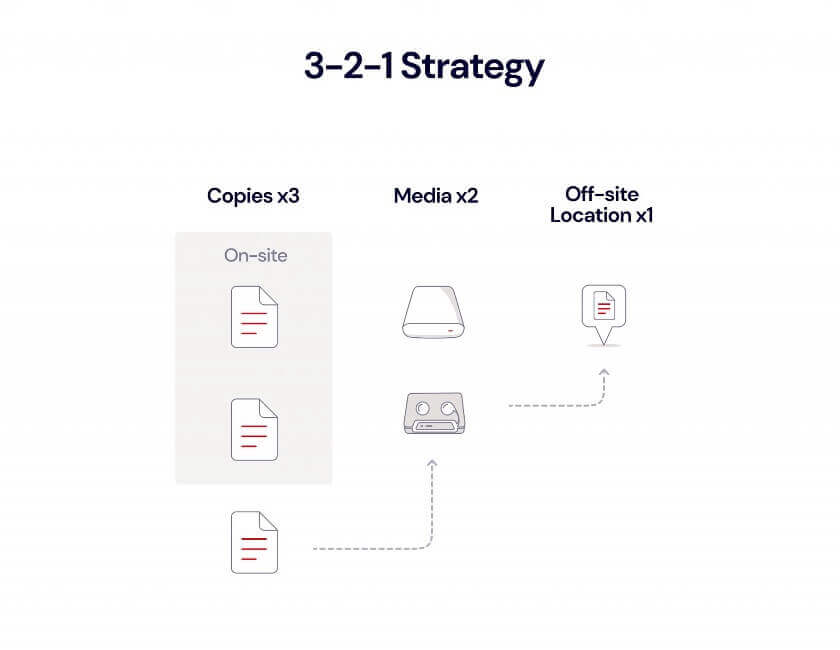
NAS vs. cloud: Which is best for your business?
Choosing between NAS and cloud storage for your business largely depends on your specific use cases and operational needs. NAS provides fast local access, control, and cost efficiency for businesses with stable storage needs and on-premises operations. In contrast, cloud storage offers unparalleled scalability, remote access, and maintenance-free operation, making it ideal for organizations with dynamic storage needs and remote workforces.
However, many businesses find that a combination of both, known as a hybrid cloud solution, offers the best of both worlds by combining the control of NAS with the scalability of cloud storage.
Ultimately, the right choice will depend on a thorough evaluation of your business needs and operational workflows. By understanding the strengths and limitations of both NAS and cloud storage, you can make an informed decision that ensures your data is secure, accessible, and available when you need it.
FAQs about NAS and cloud storage
Is cloud storage better than NAS?
The answer depends on your specific business needs. Cloud storage offers scalability, remote access, and minimal maintenance requirements. NAS, on the other hand, provides fast local access and higher control over data management and security settings. Each solution has its strengths, and the best choice will depend on your priorities regarding data security, access, and cost.
Can I use a NAS as a cloud?
Yes, many modern NAS devices come with built-in features that allow them to function similarly to cloud storage, or to connect to a cloud storage provider of your choice. These NAS systems can be accessed remotely over the internet, creating a private cloud or hybrid cloud solution. However, it requires proper configuration, secure settings and a reliable internet connection to ensure seamless remote access.
Why use NAS instead of a server?
NAS devices are purpose-built for storage, offering simplicity, ease of management, and lower costs compared to traditional servers. While servers are multifunctional and can handle a variety of tasks, they are more complex to set up and maintain. NAS provides a straightforward solution for file sharing, backups, and media streaming without the need for extensive IT infrastructure. This makes NAS an excellent choice for small to medium-sized businesses that primarily need a dedicated storage solution.
Can NAS work without the internet?
Yes, NAS devices are designed to operate within a local area network (LAN) and do not require an internet connection for local access and file sharing. Users can store, access, and collaborate on files within local networks without internet access. However, for remote access or to leverage additional features such as cloud backups, an internet connection is necessary.
The post NAS vs. Cloud Storage: Which Remote Storage Option Is Best? appeared first on Backblaze Blog | Cloud Storage & Cloud Backup
Get notifications FROM mobile phone (apps) into Home Assistant
Post Syndicated from BeardedTinker original https://www.youtube.com/watch?v=TvvGs668tAw