Post Syndicated from digiblurDIY original https://www.youtube.com/watch?v=tGhz9N2aAAg
A Conversation with Walter Isaacson and Jeffrey Goldberg | New Orleans Book Festival
Post Syndicated from The Atlantic original https://www.youtube.com/watch?v=s8xh7Vu-iKs
[$] Toward a real “too small to fail” rule
Post Syndicated from corbet original https://lwn.net/Articles/964793/
Kernel developers have long been told that any attempt to allocate memory
might fail, so their code must be prepared for memory to be unavailable.
Informally, though, the kernel’s memory-management subsystem implements a
policy whereby requests below a certain size will not fail (in process
context, at least), regardless of
how tight memory may be. A recent discussion on the linux-mm list has
looked at the idea of making the “too small to
fail” rule a policy that developers can rely on.
Rapid7 offers continued vulnerability coverage in the face of NVD delays
Post Syndicated from Tyler Terenzoni original https://blog.rapid7.com/2024/03/18/rapid7-offers-continued-vulnerability-coverage-in-the-face-of-nvd-delays/

Recently, the US National Institute of Standards and Technology (NIST) announced on the National Vulnerability Database (NVD) site that there would be delays in adding information on newly published CVEs. NVD enriches CVEs with basic details about a vulnerability like the vulnerability’s CVSS score, software products impacted by a CVE, information on the bug, patching status, etc. Since February 12th, 2024, NVD has largely stopped enriching vulnerabilities.
Given the broad usage and visibility into the NVD, the delays are sure to have a widespread impact on security operations that rely on timely and effective vulnerability information to prioritize and respond to risk introduced by software vulnerabilities.
We want to assure our customers that this does not impact Rapid7’s ability to provide coverage and checks for vulnerabilities in our products. At Rapid7, we believe in a multi-layered approach to vulnerability detection creation and risk scoring, which means that our products are not completely reliant on any single source of information, NVD included.
In fact, for vulnerability creation, we largely use vendor advisories, and as such our customers will continue to see new vulnerability detections made available without interruption. For vulnerability prioritization, our vulnerability researchers aggregate vulnerability intelligence from multiple sources, including our own research, to provide accurate information and risk scoring. Example areas of our coverage that are currently unaffected by the NVD delays include:
- Microsoft vulnerabilities – CVSS information is pulled directly from Microsoft advisory,
- Vulnerabilities with coverage that are present on the CISA KEV list, and,
- Any vulnerabilities that qualify for our Emergent Threat Response process – our researchers manually analyze and enrich these vulnerabilities as part of our ETR process
Below is an example of a latest vulnerability for Microsoft CVE-2024-26166 with the CVSS and Active Risk scores unaffected by NVD:
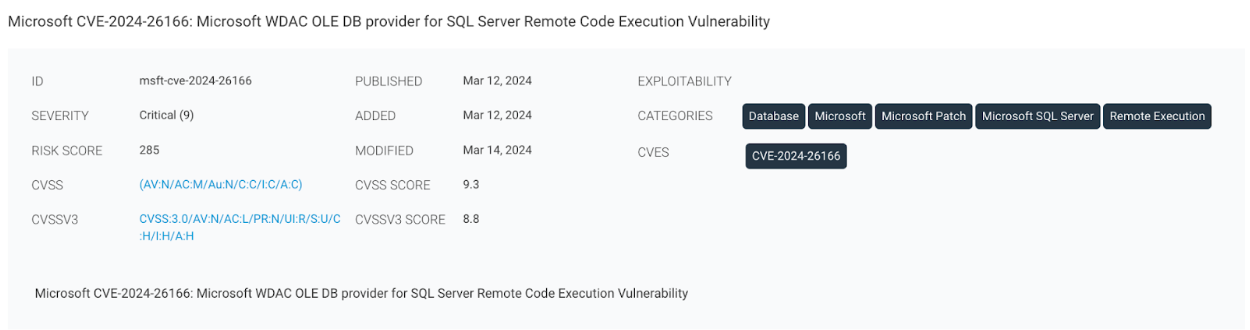
All our vulnerability detections, including the ones leveraging NVD for enrichment details, will continue to be supplemented by our proprietary risk scoring algorithm, Active Risk.
Active Risk leverages intelligence from multiple threat feeds, in addition to CVSS score, like AttackerKB, Metasploit, ExploitDB, Project Heisenberg, CISA KEV list, and other third-party dark web sources to provide security teams with threat-aware vulnerability risk scores on scale of 0-1000. This approach ensures customers can continue to prioritize and remediate risk despite the NVD delays.
First and foremost, we want to assure our customers that they will continue to have coverage and checks across emergent and active vulnerabilities across our products. Our teams will continue to invest in diverse vulnerability enrichment information, and we are actively working on new updates that will ensure there is no additional impact to risk scoring. We continue to monitor the situation, share relevant information as it becomes available, and offer additional guidance for customers via our support channels.
Security updates for Monday
Post Syndicated from jake original https://lwn.net/Articles/965829/
Security updates have been issued by Debian (curl, spip, and unadf), Fedora (chromium, iwd, opensc, openvswitch, python3.6, shim, shim-unsigned-aarch64, and shim-unsigned-x64), Mageia (batik, imagemagick, irssi, jackson-databind, jupyter-notebook, ncurses, and yajl), Oracle (.NET 7.0, .NET 8.0, and dnsmasq), Red Hat (postgresql:10), SUSE (chromium, kernel, openvswitch, python-rpyc, and tiff), and Ubuntu (openjdk-8).
Sequential Testing Keeps the World Streaming Netflix Part 2: Counting Processes
Post Syndicated from Netflix Technology Blog original https://netflixtechblog.com/sequential-testing-keeps-the-world-streaming-netflix-part-2-counting-processes-da6805341642
Michael Lindon, Chris Sanden, Vache Shirikian, Yanjun Liu, Minal Mishra, Martin Tingley

Have you ever encountered a bug while streaming Netflix? Did your title stop unexpectedly, or not start at all? In the first installment of this blog series on sequential testing, we described our canary testing methodology for continuous metrics such as play-delay. One of our readers commented
What if the new release is not related to a new play/streaming feature? For example, what if the new release includes modified login functionality? Will you still monitor the “play-delay” metric?
Netflix monitors a large suite of metrics, many of which can be classified as counts. These include metrics such as the number of logins, errors, successful play starts, and even the number of customer call center contacts. In this second installment, we describe our sequential methodology for testing count metrics, outlined in the NeurIPS paper Anytime Valid Inference for Multinomial Count Data.
Spot the Difference
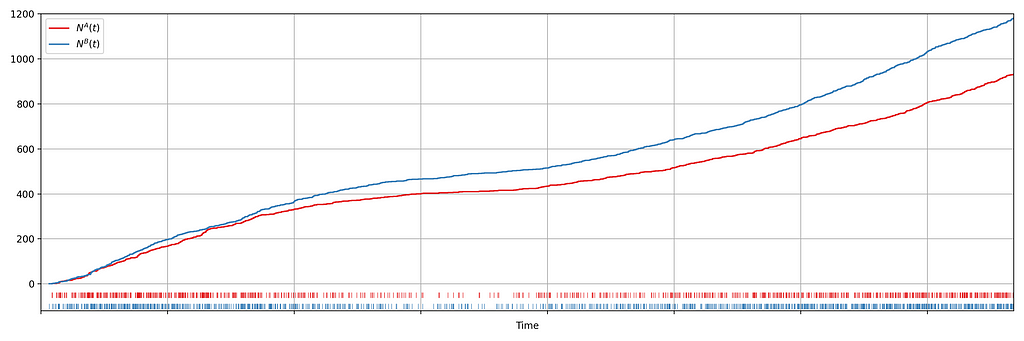
Suppose we are about to deploy new code that changes the login behavior. To de-risk the software rollout we A/B test the new code, known also as a canary test. Whenever an event such as a login occurs, a log flows through our real-time backend and the corresponding timestamp is recorded. Figure 1 illustrates the sequences of timestamps generated by devices assigned to the new (treatment) and existing (control) software versions. A question that naturally concerns us is whether there are fewer login events in the treatment. Can you tell?
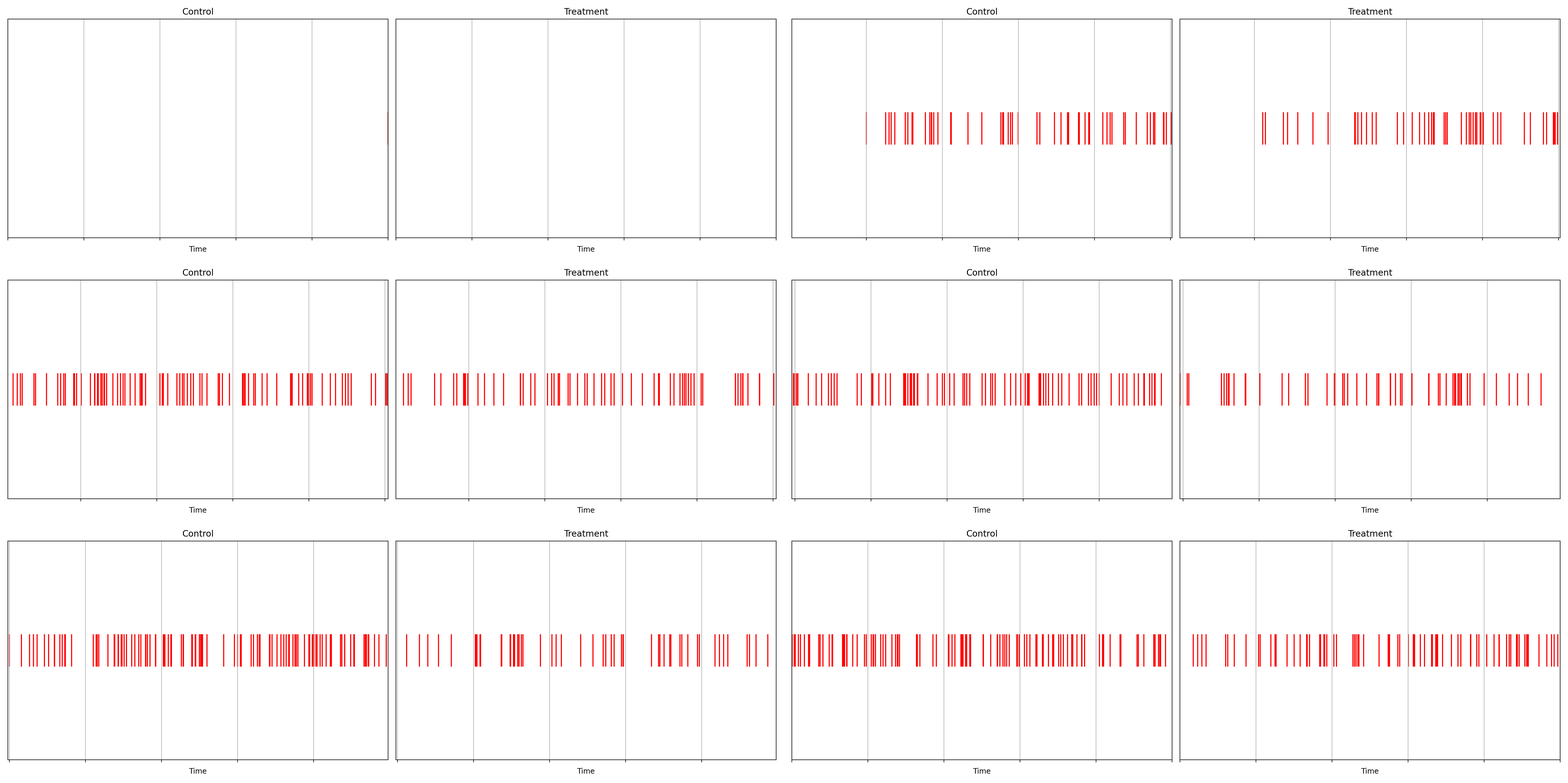
It is not immediately obvious by simple inspection of the point processes in Figure 1. The difference becomes immediately obvious when we visualize the observed counting processes, shown in Figure 2.
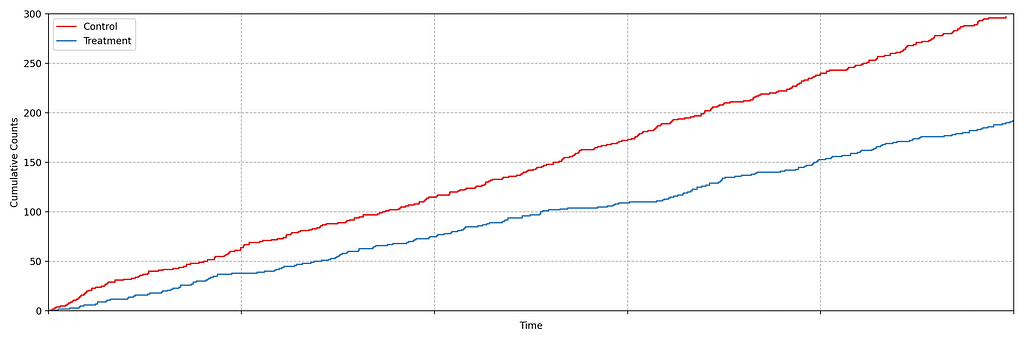
The counting processes are functions that increment by 1 whenever a new event arrives. Clearly, there are fewer events occurring in the treatment than in the control. If these were login events, this would suggest that the new code contains a bug that prevents some users from being able to log in successfully.
This is a common situation when dealing with event timestamps. To give another example, if events corresponded to errors or crashes, we would like to know if these are accruing faster in the treatment than in the control. Moreover, we want to answer that question as quickly as possible to prevent any further disruption to the service. This necessitates sequential testing techniques which were introduced in part 1.
Time-Inhomogeneous Poisson Process
Our data for each treatment group is a realization of a one-dimensional point process, that is, a sequence of timestamps. As the rate at which the events arrive is time-varying (in both treatment and control), we model the point process as a time-inhomogeneous Poisson point process. This point process is defined by an intensity function λ: ℝ → [0, ∞). The number of events in the interval [0,t), denoted N(t), has the following Poisson distribution
N(t) ~ Poisson(Λ(t)), where Λ(t) = ∫₀ᵗ λ(s) ds.
We seek to test the null hypothesis H₀: λᴬ(t) = λᴮ(t) for all t i.e. the intensity functions for control (A) and treatment (B) are the same. This can be done semiparametrically without making any assumptions about the intensity functions λᴬ and λᴮ. Moreover, the novelty of the research is that this can be done sequentially, as described in section 4 of our paper. Conveniently, the only data required to test this hypothesis at time t is Nᴬ(t) and Nᴮ(t), the total number of events observed so far in control and treatment. In other words, all you need to test the null hypothesis is two integers, which can easily be updated as new events arrive. Here is an example from a simulated A/A test, in which we know by design that the intensity function is the same for the control (A) and the treatment (B), albeit nonstationary.
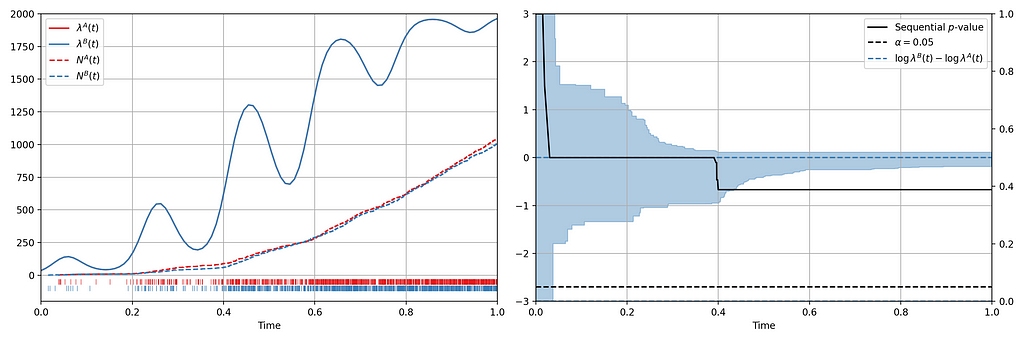
Figure 3 provides an illustration of an A/A setting. The left figure presents the raw data and the intensity functions, and the right figure presents the sequential statistical analysis. The blue and red rug plots indicate the observed arrival timestamps of events from the treatment and control streams respectively. The dashed lines are the observed counting processes. As this data is simulated under the null, the intensity functions are identical and overlay each other. The left axis of the right figure visualizes the evolution of the confidence sequence on the log-difference of intensity functions. The right axis of the right figure visualizes the evolution of the sequential p-value. We can make the two following observations
- Under the null, the difference of log intensities is zero, which is correctly covered by the 0.95 confidence sequence at all times.
- The sequential p-value is greater than 0.05 at all times
Now let’s consider an illustration of an A/B setting. Figure 4 shows observed arrival times for treatment and control when the intensity functions differ. As this is a simulation, the true difference between log intensities is known.
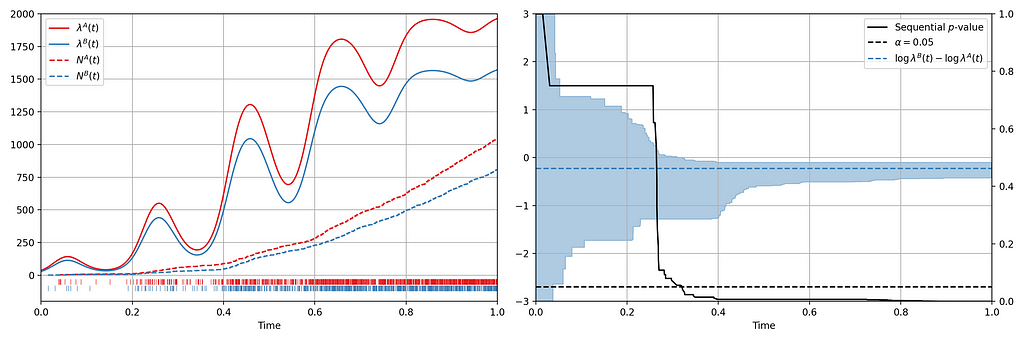
We can make the following observations
- The 0.95 confidence sequence covers the true log-difference at all times
- The sequential p-value falls below 0.05 at the same time the 0.95 confidence sequence excludes the null value of zero
Now we present a number of case studies where this methodology has rapidly detected serious problems in a number of count metrics
Case Study 1: Drop in Successful Title Starts
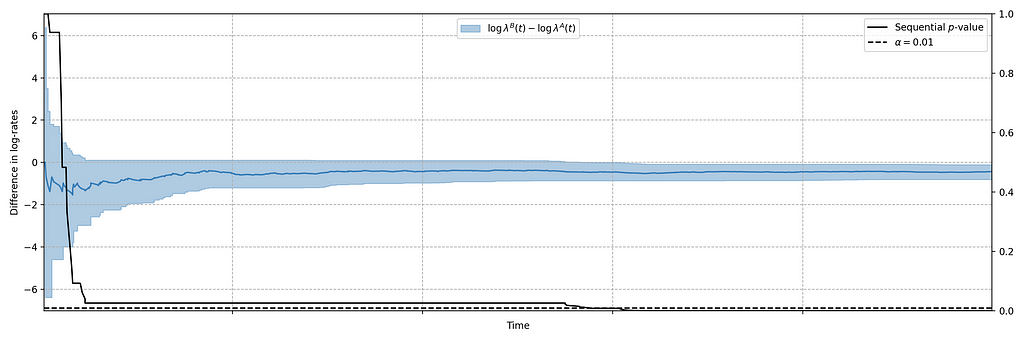
Figure 2 actually presents counts of title start events from a real canary test. Whenever a title starts successfully, an event is sent from the device to Netflix. We have a stream of title start events from treatment devices and a stream of title start events from control devices. Whenever fewer title starts are observed among treatment devices, there is usually a bug in the new client preventing playback.
In this case, the canary test detected a bug that was later determined to have prevented approximately 60% of treatment devices from being able to start their streams. The confidence sequence is shown in Figure 5, in addition to the (sequential) p-value. While the exact units of time have been omitted, this bug was detected at the sub-second level.
Case Study 2: Increase in Abnormal Shutdowns
In addition to title start events, we also monitor whenever the Netflix client shuts down unexpectedly. As before, we have two streams of abnormal shutdown events, one from treatment devices, and one from control devices. The following screenshots are taken directly from our Lumen dashboards.
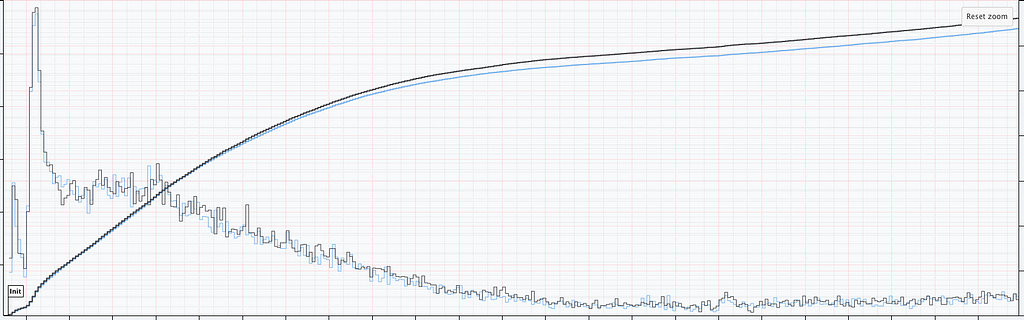
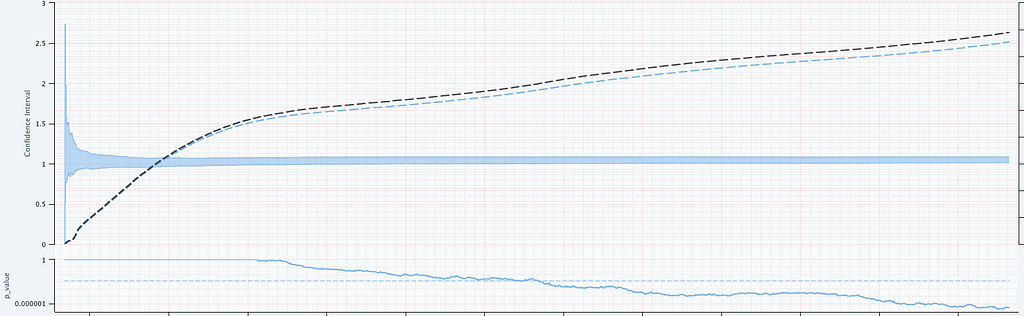
Figure 6 illustrates two important points. There is clearly nonstationarity in the arrival of abnormal shutdown events. It is also not easy to visibly see any difference between treatment and control from the non-cumulative view. The difference is, however, much easier to see from the cumulative view by observing the counting process. There is a small but visible increase in the number of abnormal shutdowns in the treatment. Figure 7 shows how our sequential statistical methodology is even able to identify such small differences.
Case Study 3: Increase in Errors
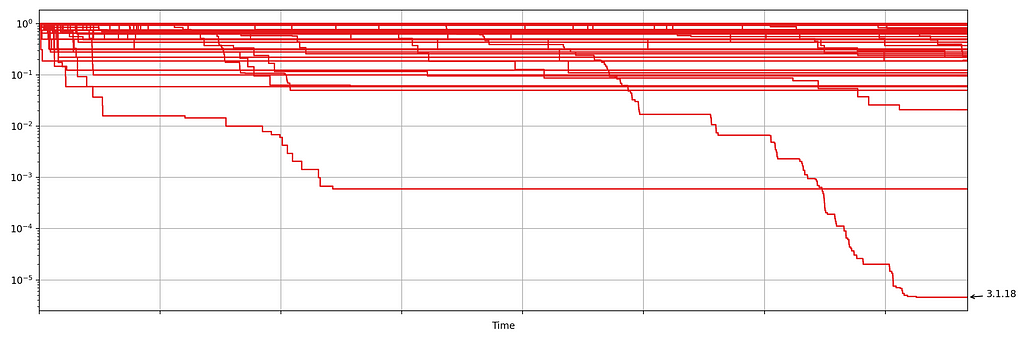
Netflix also monitors the number of errors produced by treatment and control. This is a high cardinality metric as every error is annotated with a code indicating the type of error. Monitoring errors segmented by code helps developers diagnose issues quickly. Figure 8 shows the sequential p-values, on the log scale, for a set of error codes that Netflix monitors during client rollouts. In this example, we have detected a higher volume of 3.1.18 errors being produced by treatment devices. Devices experiencing this error are presented with the following message:
“We’re having trouble playing this title right now”
Knowing which errors increased can streamline the process of identifying the bug for our developers. We immediately send developers alerts through Slack integrations, such as the following
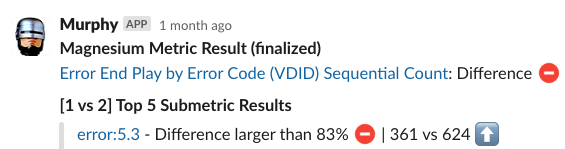
The next time you are watching Netflix and encounter an error, know that we’re on it!
Try it Out!
The statistical approach outlined in our paper is remarkably easy to implement in practice. All you need are two integers, the number of events observed so far in the treatment and control. The code is available in this short GitHub gist. Here are two usage examples:
> counts = [100, 101]
> assignment_probabilities = [0.5, 0.5]
> sequential_p_value(counts, assignment_probabilities)
  1

> counts = [100, 201]
> assignment_probabilities = [0.5, 0.5]
> sequential_p_value(counts, assignment_probabilities)
  5.06061172163498e-06
The code generalizes to more than just two treatment groups. For full details, including hyperparameter tuning, see section 4 of the paper.
Further Reading
- Anytime Valid Inference for Multinomial Count Data
- Sequential A/B Testing Keeps the World Streaming Netflix Part 1: Continuous Data

Sequential Testing Keeps the World Streaming Netflix Part 2: Counting Processes was originally published in Netflix TechBlog on Medium, where people are continuing the conversation by highlighting and responding to this story.
The Lowdown Murder of Morgan Earp
Post Syndicated from The History Guy: History Deserves to Be Remembered original https://www.youtube.com/watch?v=UMvlEgjPm9M
Drones and the US Air Force
Post Syndicated from Bruce Schneier original https://www.schneier.com/blog/archives/2024/03/drones-and-the-us-air-force.html
Fascinating analysis of the use of drones on a modern battlefield—that is, Ukraine—and the inability of the US Air Force to react to this change.
The F-35A certainly remains an important platform for high-intensity conventional warfare. But the Air Force is planning to buy 1,763 of the aircraft, which will remain in service through the year 2070. These jets, which are wholly unsuited for countering proliferated low-cost enemy drones in the air littoral, present enormous opportunity costs for the service as a whole. In a set of comments posted on LinkedIn last month, defense analyst T.X. Hammes estimated the following. The delivered cost of a single F-35A is around $130 million, but buying and operating that plane throughout its lifecycle will cost at least $460 million. He estimated that a single Chinese Sunflower suicide drone costs about $30,000—so you could purchase 16,000 Sunflowers for the cost of one F-35A. And since the full mission capable rate of the F-35A has hovered around 50 percent in recent years, you need two to ensure that all missions can be completed—for an opportunity cost of 32,000 Sunflowers. As Hammes concluded, “Which do you think creates more problems for air defense?”
Ironically, the first service to respond decisively to the new contestation of the air littoral has been the U.S. Army. Its soldiers are directly threatened by lethal drones, as the Tower 22 attack demonstrated all too clearly. Quite unexpectedly, last month the Army cancelled its future reconnaissance helicopter which has already cost the service $2 billion—because fielding a costly manned reconnaissance aircraft no longer makes sense. Today, the same mission can be performed by far less expensive drones—without putting any pilots at risk. The Army also decided to retire its aging Shadow and Raven legacy drones, whose declining survivability and capabilities have rendered them obsolete, and announced a new rapid buy of 600 Coyote counter-drone drones in order to help protect its troops.
AtomStack X24 Pro: Easy Setup and Incredible Precision
Post Syndicated from BeardedTinker original https://www.youtube.com/watch?v=Eatl4mNcb9g
chroot
Post Syndicated from turnoff.us original http://turnoff.us/geek/chroot/

Season 6 of the Hello World podcast is here
Post Syndicated from James Robinson original https://www.raspberrypi.org/blog/hello-world-podcast-season-6-computing-education/
Through the Hello World podcast, we help to connect computing educators around the world and share their experiences. In each episode, we expand on a topic from a recent Hello World magazine issue. After 5 seasons, and a break last year, we are back with season 6 today.

Episode 1: Do kids still need to learn how to code?
In the recent ‘Teaching & AI’ issue of Hello World, our CEO Philip Colligan discussed what AI means for computing education, including for learning to program. And our first new podcast episode is all about this question, which every computing educator has probably thought about at least once in recent months: Do kids still need to learn how to code?
Joining my co-host Veronica and me are two computing educators: Pete Dring, Head of Computing at Fulford School in York, and Chris Coetzee, a computer science teacher for 24 years and currently a PhD student in Computer Science Education at Abertay Dundee. Given the recent developments in AI-based code generators, we talk about whether such tools will remove our learners’ need to learn to code or simply change what coding, and learning to code, looks like*.
What’s coming up in future episodes?
New episode of season 6 will come out every 2 weeks. In each episode we explore computing, coding, and digital making education by delving into an exciting topic together with our guests: experts, practitioners, and other members of the Hello World community.
Also in season 6, we’ll explore:
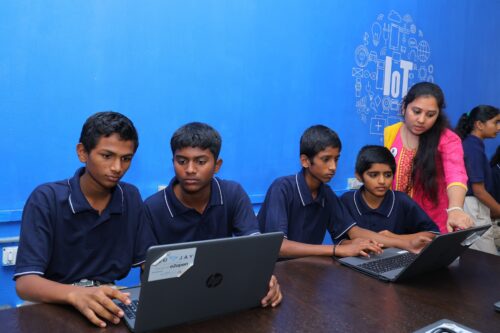
The role of computing communities
We discuss the value and importance of being connected to other computing educators through the many different teaching communities that exist around the world. What makes effective communities, and how do we build and sustain them?
Why is understanding cybersecurity so important?
From classroom lessons to challenges and competitions, there are lots of opportunities for learners to discover cybersecurity. There are also many pitfalls where learners’ online activities put them at risk of breaking the law. We discuss some of these pitfalls along with the many career opportunities in cybersecurity.
How to develop as a computing educator?
What is involved in becoming an effective computing educator? What knowledge, skills, and behaviours are needed, and how do we go about developing them? We sit down with teacher trainers and trainees to explore this topic.

What is the state of computing education and where is it heading?
Computing education has come a long way in the last decade in terms of practice and policy, as well as research. Together with our guests we discuss where computing education is today around the world, and we consider the lessons we can learn and the challenges ahead
What is the role of AI in your classroom?
AI continues to be a disruptive technology in many spaces, and the classroom is no exception. We hear examples of practices and approaches being explored by teachers in the classroom.
Listen and subscribe today
If you’ve not listened to the Hello World podcast yet, there are 5 whole seasons for you to discover. We talk about everything from ecology and quantum computing to philosophy, ethics, and inclusion, and our conversations always focus on the practicalities of teaching in the classroom.

Many of our podcast guests are Hello World authors, so if you’re an educator who wants to share your insights into how to teach young people about digital technology, please let us know. Your words could end up in the pages as well as on the airwaves of Hello World.
You’ll find the upcoming Hello World season and past episodes on your favourite podcast platform, including YouTube now, where you can also subscribe to never miss an episode. Alternatively, you can listen here via your browser.
* If you want to dive into the newest research on programming education with and without AI, check out our current seminar series.
The post Season 6 of the Hello World podcast is here appeared first on Raspberry Pi Foundation.
Real HD SW8-1-2G 8-port 2.5GbE 1-port 10G Switch Review
Post Syndicated from Rohit Kumar original https://www.servethehome.com/real-hd-8-port-2-5gbe-1-port-10g-switch-review-realtek/
We review the Real HD SW8-1-2G. This is another Realtek-based 8-port 2.5GbE 1-port 10GbE fanless switch designed to be cheap
The post Real HD SW8-1-2G 8-port 2.5GbE 1-port 10G Switch Review appeared first on ServeTheHome.
S11 E05: Student Loans, House Republicans & TikTok: 3/17/24: Last Week Tonight with John Oliver
Post Syndicated from LastWeekTonight original https://www.youtube.com/watch?v=DNVwnkgTzbY
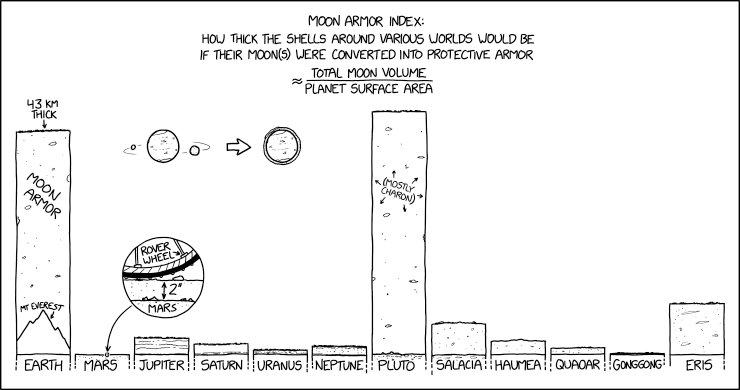
Moon Armor Index
Post Syndicated from xkcd.com original https://xkcd.com/2908/
Olympic gold medalist and FIFA World Cup Champion on how she does hard things
Post Syndicated from Talks at Google original https://www.youtube.com/watch?v=bDKYo_CMXJo
to automate or not to automate
Post Syndicated from turnoff.us original http://turnoff.us/geek/to-automate-or-not-to-automate/

Driving Development Forward: How the PGA TOUR speeds up Development with the AWS CDK
Post Syndicated from Evgeny Karasik original https://aws.amazon.com/blogs/devops/driving-development-forward-how-the-pga-tour-speeds-up-development-with-the-aws-cdk/
This post is written by Jeff Kammerer, Senior Solutions Architect.
The PGA TOUR is the world’s premier membership organization for touring professional golfers, co-sanctioning tournaments on the PGA TOUR along with several other developmental, senior, and international tournament series.
The PGA TOUR is passionate about bringing its fans closer to the players, tournaments, and courses. They developed a new mobile app and the PGATOUR.com website to give fans immersive, enhanced, and personalized access to near-real-time leaderboards, shot-by-shot data, video highlights, sports news, statistics, and 3D shot tracking. It is critical for PGA TOUR, which operates in a highly competitive space, to keep up with fans’ demands and deliver engaging content. The maturing DevOps culture, partnered with accelerating the development process, was crucial to the PGA TOUR’s fan engagement transformation.
The PGA TOUR’s fans want near real-time and highly accurate data. To deliver and evolve engaging fan experiences, the PGA TOUR needed to empower their team of developers to quickly release new updates and features. However, the TOUR’s previous architecture required separate code bases for their website and mobile app in a monolithic technology stack. Each update required changes in both code bases, causing feature turnaround time of a minimum of two weeks. The cost and time required to deliver features fans wanted to see in both the app and website were not sustainable. As a result, the TOUR redesigned their mobile app and website using AWS native services and a microservice based architecture to alleviate these pain points.
Accelerating Development with Infrastructure as Code (IaC)
The TOUR’s cloud infrastructure team used AWS CloudFormation for several years to model, provision, and manage their cloud infrastructure. However, the app and web development team within the PGA Tour were not familiar with and did not want to use the JSON and YAML templates that CloudFormation requires, and preferred the coding languages that the AWS Cloud Development Kit (CDK) supports. The developers use TypeScript to develop the new mobile app and website using services like AWS AppSync, AWS Lambda, AWS Step Functions, and AWS Batch. Additionally, the PGA TOUR wanted to simplify how they assigned the correct and minimal IAM permissions needed. As a result, the TOUR developers started using the CDK for IaC because it offered a natural extension to how they were already writing code.
The TOUR leverages all three layers of the AWS CDK Construct Library. They take advantage of higher-layer Pattern Constructs for key services like AWS Lambda and AWS Elastic Container Service (Amazon ECS). The CDK pattern constructs provide a reference architecture or design patterns intended to help complete common tasks. The pattern constructs for AWS Lambda, Amazon ECS, and existing patterns saved the TOUR hours and weeks of development time. They also use the lower-level Layer 2 and Layer 1 Constructs for services like Amazon DynamoDB and AWS AppSync.

Figure1. Welcome to the PGA TOUR’s New App
PGA TOUR Benefits From Using AWS CDK
Using AWS CDK enabled and empowered the platform and development teams and changed how the PGA TOUR operates their technical environments. They create and de-provision environments as needed to build, test, and deploy new features into production. Automating changes in their underlying infrastructure has become very easy for the PGA TOUR. As an example, the TOUR wanted to update their Lambda runtimes to release 18. With AWS CDK, this change was implemented with a single-line change in their Lambda Common stack and pushed to the over 300 Lambda functions they deployed.
The CDK provides flexibility and agility, which helps the TOUR manage constant change in the appearance of their mobile app and website content given they run different tournaments each week. The TOUR uses the CDK to provision parallel environments where they prepare for the next tournament with unique functions and content without risking impact to services during the current tournament. Once the current tournament is complete, they can flip to the new stack and de-provision the old. The CDK has allowed the TOUR to move from a bi-weekly three-hour maintenance window release schedule to multiple as needed releases per day that take approximately 7 minutes. It has enabled the TOUR to push production releases and fixes, even in the middle of tournament play which previously had been deemed too risky under the prior monolithic technology stack. In one case, the TOUR developers could go from identifying a bug to coding a fix with push through User Acceptance Testing (UAT) and into production in 42 minutes. This is a process that was previously measured in hours or days.

Figure2. High level AWS CDK/App Architecture
Expressing the organizational capability change AWS CDK facilitates for the PGA TOUR Digital team in context of the widely accepted DevOps Research & Assessment (DORA) metrics which assesses organizational maturity in DevOps:

One of the best benefits the TOUR realized using AWS CDK was how much it helped reduce complexity of managing AWS Identity and Access Management (IAM) permissions. The TOUR understands how important it is to maintain granular control of IAM trust policies, especially when working in a serverless architecture. David Provan, shared “AWS CDK encourages security by design and you end up considering security through the entire project rather than coming back to do security hardening after development”. AWS CDK automates the necessary IAM permissions at an atomic level in a manner where they are set and managed correctly. When the PGA TOUR takes resources down, AWS CDK removes the IAM permissions.
Lessons Learned and Looking Forward
The steepest learning curve for the PGA TOUR was in the granularity of their CDK Stacks. They initially started with a single large stack, but found that breaking the application into smaller stacks allowed them to be more surgical with granular deployments and updates. They found some services like AWS Lambda update very quickly, whereas DynamoDB deployed with global tables across multiple regions takes longer and benefit from being in their own stack. This balance is something the TOUR is still working on as they iterate after the initial launch.
Looking forward, the PGA TOUR sees longer-range benefits where the CDK will allow them to reuse their stacks and accelerate development for other departments or entities in the future. They also see benefit for reusing code and patterns across different workloads entirely.
Conclusion
The AWS Cloud Development Kit has been transformational to how the PGA TOUR is deploying their services on AWS and working to bring exciting and immersive experiences to fans. To learn more, review the AWS CDK Developer Guide to read about best practices for developing cloud applications, and review this blog that provides an overview of Working with the AWS Cloud Development kit and AWS Construct Library. Also, explore what CDK can do for you.
NVIDIA Jetson Orin Developer Kits the Arm Future Video
Post Syndicated from Eric Smith original https://www.servethehome.com/nvidia-jetson-orin-developer-kits-the-arm-future-video-ampere-qct/
The NVIDIA Jetson Orin developer kits including the AGX and Nano variants offer a cool glimpse into the future of NVIDIA’s GPUs
The post NVIDIA Jetson Orin Developer Kits the Arm Future Video appeared first on ServeTheHome.
Comic for 2024.03.17 – Your Money
Post Syndicated from Explosm.net original https://explosm.net/comics/your-money
New Cyanide and Happiness Comic
Streaky Beef
Post Syndicated from Oglaf! -- Comics. Often dirty. original https://www.oglaf.com/streakybeef/

