PSA: upgrade your LUKS key derivation function

Post Syndicated from original https://mjg59.dreamwidth.org/66429.html

Here’s an article from a French anarchist describing how his (encrypted) laptop was seized after he was arrested, and material from the encrypted partition has since been entered as evidence against him. His encryption password was supposedly greater than 20 characters and included a mixture of cases, numbers, and punctuation, so in the absence of any sort of opsec failures this implies that even relatively complex passwords can now be brute forced, and we should be transitioning to even more secure passphrases.

Or does it? Let’s go into what LUKS is doing in the first place. The actual data is typically encrypted with AES, an extremely popular and well-tested encryption algorithm. AES has no known major weaknesses and is not considered to be practically brute-forceable – at least, assuming you have a random key. Unfortunately it’s not really practical to ask a user to type in 128 bits of binary every time they want to unlock their drive, so another approach has to be taken.

This is handled using something called a “key derivation function”, or KDF. A KDF is a function that takes some input (in this case the user’s password) and generates a key. As an extremely simple example, think of MD5 – it takes an input and generates a 128-bit output, so we could simply MD5 the user’s password and use the output as an AES key. While this could technically be considered a KDF, it would be an extremely bad one! MD5s can be calculated extremely quickly, so someone attempting to brute-force a disk encryption key could simply generate the MD5 of every plausible password (probably on a lot of machines in parallel, likely using GPUs) and test each of them to see whether it decrypts the drive.

(things are actually slightly more complicated than this – your password is used to generate a key that is then used to encrypt and decrypt the actual encryption key. This is necessary in order to allow you to change your password without having to re-encrypt the entire drive – instead you simply re-encrypt the encryption key with the new password-derived key. This also allows you to have multiple passwords or unlock mechanisms per drive)

Good KDFs reduce this risk by being what’s technically referred to as “expensive”. Rather than performing one simple calculation to turn a password into a key, they perform a lot of calculations. The number of calculations performed is generally configurable, in order to let you trade off between the amount of security (the number of calculations you’ll force an attacker to perform when attempting to generate a key from a potential password) and performance (the amount of time you’re willing to wait for your laptop to generate the key after you type in your password so it can actually boot). But, obviously, this tradeoff changes over time – defaults that made sense 10 years ago are not necessarily good defaults now. If you set up your encrypted partition some time ago, the number of calculations required may no longer be considered up to scratch.

And, well, some of these assumptions are kind of bad in the first place! Just making things computationally expensive doesn’t help a lot if your adversary has the ability to test a large number of passwords in parallel. GPUs are extremely good at performing the sort of calculations that KDFs generally use, so an attacker can “just” get a whole pile of GPUs and throw them at the problem. KDFs that are computationally expensive don’t do a great deal to protect against this. However, there’s another axis of expense that can be considered – memory. If the KDF algorithm requires a significant amount of RAM, the degree to which it can be performed in parallel on a GPU is massively reduced. A Geforce 4090 may have 16,384 execution units, but if each password attempt requires 1GB of RAM and the card only has 24GB on board, the attacker is restricted to running 24 attempts in parallel.

So, in these days of attackers with access to a pile of GPUs, a purely computationally expensive KDF is just not a good choice. And, unfortunately, the subject of this story was almost certainly using one of those. Ubuntu 18.04 used the LUKS1 header format, and the only KDF supported in this format is PBKDF2. This is not a memory expensive KDF, and so is vulnerable to GPU-based attacks. But even so, systems using the LUKS2 header format used to default to argon2i, again not a memory expensive KDF. New versions default to argon2id, which is. You want to be using argon2id.

What makes this worse is that distributions generally don’t update this in any way. If you installed your system and it gave you pbkdf2 as your KDF, you’re probably still using pbkdf2 even if you’ve upgraded to a system that would use argon2id on a fresh install. Thankfully, this can all be fixed-up in place. But note that if anything goes wrong here you could lose access to all your encrypted data, so before doing anything make sure it’s all backed up (and figure out how to keep said backup secure so you don’t just have your data seized that way).

First, make sure you’re running as up-to-date a version of your distribution as possible. Having tools that support the LUKS2 format doesn’t mean that your distribution has all of that integrated, and old distribution versions may allow you to update your LUKS setup without actually supporting booting from it. Also, if you’re using an encrypted /boot, stop now – very recent versions of grub2 support LUKS2, but they don’t support argon2id, and this will render your system unbootable.

Next, figure out which device under /dev corresponds to your encrypted partition. Run

lsblk

and look for entries that have a type of “crypt”. The device above that in the tree is the actual encrypted device. Record that name, and run

sudo cryptsetup luksHeaderBackup /dev/whatever --header-backup-file /tmp/luksheader

and copy that to a USB stick or something. If something goes wrong here you’ll be able to boot a live image and run

sudo cryptsetup luksHeaderRestore /dev/whatever --header-backup-file luksheader

to restore it. Next, run

sudo cryptsetup luksDump /dev/whatever

and look for the Version: line. If it’s version 1, you need to update the header to LUKS2. Run

sudo cryptsetup convert /dev/whatever --type luks2

and follow the prompts. Make sure your system still boots, and if not go back and restore the backup of your header. Assuming everything is ok at this point, run

sudo cryptsetup luksDump /dev/whatever

again and look for the PBKDF: line in each keyslot (pay attention only to the keyslots, ignore any references to pbkdf2 that come after the Digests: line). If the PBKDF is either “pbkdf2” or “argon2i” you should convert to argon2id. Run the following:

sudo cryptsetup luksConvertKey /dev/whatever --pbkdf argon2id

and follow the prompts. If you have multiple passwords associated with your drive you’ll have multiple keyslots, and you’ll need to repeat this for each password.

Distributions! You should really be handling this sort of thing on upgrade. People who installed their systems with your encryption defaults several years ago are now much less secure than people who perform a fresh install today. Please please please do something about this.

comment count unavailable comments

За Darien Gap, мигрантите през него и нас българите

Post Syndicated from original http://www.gatchev.info/blog/?p=2571

Наскоро ми пратиха линк към статия на CNN за Darien Gap. Ако не знаете – това е над сто километра силно пресечен терен на границата между Колумбия и Панама, покрит с тропическа джунгла. Изключително трудно проходим е, не са успели да построят дори Трансамериканската магистрала през него.

Много от мигрантите, които се опитват да достигнат САЩ, са или от Южна Америка, или нямат как да се доберат до централноамерикански страни по някаква причина. Така че им се налага да пресекат Darien Gap. Пресичането е пеша, в ужасяващи условия. Кореспондент на CNN го е пресякъл с група от тях и разказва какво е.

Повече можете да научите от статията. Има много неща, които могат да впечатлят човек. Мен конкретно ме впечатли най-много невероятната взаимопомощ между мигрантите. Обикновено хората в група са напълно непознати. Но въпреки това се подкрепят по начини, непредставими за средностатистическия българин.

И това помага жертвите на ужасния преход да са сравнително малко. Особено при положение, че много от мигрантите биват лъгани, че е само два часа ходене, и не взимат никакви запаси и нужни неща. (В реалността късметлиите успяват да го вземат за пет дни… но не всеки е късметлия.)

Какво представлява подкрепата им? Споделянето или дори подаряването на пълни непознати на последния залък храна, отчаяно нужна дреха или лекарство е най-обичайно нещо – необичаен е отказът. Ето накратко няколко истории на взаимопомощ, най-обикновени там, от тази статия и от други, които описват прехода:

  • Още първия ден на прехода петгодишно момченце е откъснато от родителите си. Успяват да се намерят едва на края на пътешествието, пет дни по-късно. През цялото това време по някой е носил на гръб непознатото дете, хранил го е от храната си, бдял е да го пази от змии и хищници, плащал му е „такса преминаване“, „такса превоз“ или „такса водачество“ от собствените си топящи се пари…
  • При пресичане на река течението събаря и отнася във въртоп жена, която не може да плува. Трима от случайните ѝ спътници се хвърлят във въртопа да я спасяват и успяват да я издърпат на брега и реанимират с подръчни средства. След това остават да я пазят един ден, докато тя събере сили да може да върви отново.
  • Шейсетинагодишна жена заедно с дъщеря си тръгват напълно неподготвени – казали са им, че преходът е само два часа. (А и това би било сериозно усилие за майката.) И двете на няколко пъти загазват зле, но успяват да продължат благодарение на помощта на околните. Те ги хранят, поят, поддържат, носят където е необходимо.
  • Млад мъж си изкълчва глезена и вече не може да върви. Един минаващ му оставя запаса си от храна. Друг му дава антибиотик, за да не се възпалят другите му рани. Четирима млади непознати – и за него, и помежду си – отсичат клони, сглобяват носилка и го носят чак до крайната точка.
  • По средата на пътешествието старец изгубва и последните си сили. Моли две минаващи млади жени да вземат детето, което той носи, и да се грижат за него. Жените отрязват два клона, импровизират от тях влачеща се носилка, натоварват и него и го влачат (на места с помощта на други хора) до края на прехода…

Мога да изброявам още и още такива истории – прочел съм поне десетина статии за Darien Gap. Надали обаче има нужда. По-важен е въпросът, който си задавам с лек ужас. Как щяхме да се държим в такива обстоятелства българите? Колко от нас щяха да споделят последната си храна със случайни непознати? Или дори с добри познати?…

Нямам представа колко от мигрантите през Darien Gap ще успеят да си осигурят приемане в САЩ. Но знам, че ако САЩ имат разум, ще ги приемат всички, без колебание. Хора, способни на такава помощ към непознати, са цветът и солта на всяко общество, на всеки народ. Без значение дали са нобелисти или неграмотни, богаташи или напълно разорени.

Ако имате за съседи сто българи и един от тези мигранти, кой смятате, че ще ви помогне, ако закъсате? Сред кои бихте искали да живеете? Ако сте достоен човек, който също не се колебае да помага дори на непознати – кой е вашият по-истински народ, българите или тези мигранти? (Ако не сте – …)

… А ние също си имаме мигранти. Много от тях преминали през немалко изпитания, за да потърсят убежище при нас. Много от тях точно по същия начин помагали дори на непознатите – защото пресичащите Darien Gap надали са по-специални с нещо от другите мигранти… И си имаме и хора, които ни обясняват как тези мигранти идват, за да ни прережат гърлата. И на всяка цена трябва да ги вкараме в затвора и после върнем обратно без нито капка милост, за да се опазим от тях.

Питам се – дали този, който търси да ме скара с който ще ме подкрепи при нужда, ми е добър приятел? Всъщност, не се питам. Трябва да съм идиот, за да го правя.

Питам се обаче – по какво друго ще позная опитващите се да ме скарат с който ще ме подкрепи при нужда. С какви други възгледи и позиции корелират тези опити за скарване… Всъщност, и това не се питам. Също трябва да съм идиот, за да не съм забелязал отдавна.

Sapienti sat.

AWS Security Profile – Cryptography Edition: Panos Kampanakis, Principal Security Engineer

Post Syndicated from Roger Park original https://aws.amazon.com/blogs/security/aws-security-profile-panos-kampanakis/

AWS Security Profile – Cryptography Edition: Panos Kampanakis, Principal Security Engineer

In the AWS Security Profile — Cryptography Edition series, we interview Amazon Web Services (AWS) thought leaders who help keep our customers safe and secure. This interview features Panos Kampanakis, Principal Security Engineer, AWS Cryptography. Panos shares thoughts on data protection, cloud security, post-quantum cryptography, and more.


What do you do in your current role and how long have you been at AWS?

I have been with AWS for two years. I started as a Technical Program Manager in AWS Cryptography, where I led some AWS Cryptography projects related to cryptographic libraries and FIPS, but I’m currently working as a Principal Security Engineer on a team that focuses on applied cryptography, research, and cryptographic software. I also participate in standardization efforts in the security space, especially in cryptographic applications. It’s a very active space that can consume as much time as you have to offer.

How did you get started in the data protection/ cryptography space? What about it piqued your interest?

I always found cybersecurity fascinating. The idea of proactively focusing on security and enabling engineers to protect their assets against malicious activity was exciting. After working in organizations that deal with network security, application security, vulnerability management, and security information sharing, I found myself going back to what I did in graduate school: applied cryptography. 

Cryptography is a constantly evolving, fundamental area of security that requires breadth of technical knowledge and understanding of mathematics. It provides a challenging environment for those that like to constantly learn. Cryptography is so critical to the security and privacy of data and assets that it is top of mind for the private and public sector worldwide.

How do you explain your job to your non-tech friends?

I usually tell them that my work focuses on protecting digital assets, information, and the internet from malicious actors. With cybersecurity incidents constantly in the news, it’s an easy picture to paint. Some of my non-technical friends still joke that I work as a security guard!

What makes cryptography exciting to you?

Cryptography is fundamental to security. It’s critical for the protection of data and many other secure information use cases. It combines deep mathematical topics, data information, practical performance challenges that threaten deployments at scale, compliance with various requirements, and subtle potential security issues. It’s certainly a challenging space that keeps evolving. Post-quantum or privacy preserving cryptography are examples of areas that have gained a lot of attention recently and have been consistently growing.

Given the consistent evolution of security in general, this is an important and impactful space where you can work on challenging topics. Additionally, working in cryptography, you are surrounded by intelligent people who you can learn from.

AWS has invested in the migration to post-quantum cryptography by contributing to post-quantum key agreement and post-quantum signature schemes to protect the confidentiality, integrity, and authenticity of customer data. What should customers do to prepare for post-quantum cryptography?

There are a few things that customers can do while waiting for the ratification of the new quantum-safe algorithms and their deployment. For example, you can inventory the use of asymmetric cryptography in your applications and software. Admittedly, this is not a simple task, but with proper subject matter expertise and instrumentation where necessary, you can identify where you’re using quantum-vulnerable algorithms in order to prioritize the uses. AWS is doing this exercise to have a prioritized plan for the upcoming migration.

You can also study and experiment with the potential impact of these new algorithms in critical use cases. There have been many studies on transport protocols like TLS, virtual private networks (VPNs), Secure Shell (SSH), and QUIC, but organizations might have unique uses that haven’t been accounted for yet. For example, a firm that specializes in document signing might require efficient signature methods with small size constraints, so deploying Dilithium, NIST’s preferred quantum-safe signature, could come at a cost. Evaluating its impact and performance implications would be important. If you write your own crypto software, you can also strive for algorithm agility, which would allow you to swap in new algorithms when they become available. 

More importantly, you should push your vendors, your hardware suppliers, the software and open-source community, and cloud providers to adjust and enable their solutions to become quantum-safe in the near future.

What’s been the most dramatic change you’ve seen in the data protection and post-quantum cryptography landscape?

The transition from typical cryptographic algorithms to ones that can operate on encrypted data is an important shift in the last decade. This is a field that’s still seeing great development. It’s interesting how the power of data has brought forward a whole new area of being able to operate on encrypted information so that we can benefit from the analytics. For more information on the work that AWS is doing in this space, see Cryptographic Computing.

In terms of post-quantum cryptography, it’s exciting to see how an important potential risk brought a community from academia, industry, and research together to collaborate and bring new schemes to life. It’s also interesting how existing cryptography has reached optimal efficiency levels that the new cryptographic primitives sometimes cannot meet, which pushes the industry to reconsider some of our uses. Sometimes the industry might overestimate the potential impact of quantum computing to technology, but I don’t believe we should disregard the effect of heavier algorithms on performance, our carbon footprint, energy consumption, and cost. We ought to aim for efficient solutions that don’t undermine security.

Where do you see post-quantum cryptography heading in the future?

Post-quantum cryptography has received a lot of attention, and a transition is about to start ramping up after we have ratified algorithms. Although it’s sometimes considered a Herculian effort, some use cases can transition smoothly.

AWS and other industry peers and researchers have already evaluated some post-quantum migration strategies. With proper prioritization and focus, we can address some of the most important applications and gradually transition the rest. There might be some applications that will have no clear path to a post-quantum future, but most will. At AWS, we are committed to making the transitions necessary to protect our customer data against future threats.

What are you currently working on that you look forward to sharing with customers’?

I’m currently focused on bringing post-quantum algorithms to our customers’ cryptographic use cases. I’m looking into the challenges that this upcoming migration will bring and participating in standards and industry collaborations that will hopefully enable a simpler transition for everyone. 

I also engage on various topics with our cryptographic libraries teams (for example, AWS-LC and s2n-tls). We build these libraries with security and performance in mind, and they are used in software across AWS.

Additionally, I work with some AWS service teams to help enable compliance with various cryptographic requirements and regulations.

Is there something you wish customers would ask you about more often?

I wish customers asked more often about provable security and how to integrate such solutions in their software. This is a fascinating field that can prevent serious issues where cryptography can go wrong. It’s a complicated topic. I would like for customers to become more aware of the importance of provable security especially in open-source software before adopting it in their solutions. Using provably secure software that is designed for performance and compliance with crypto requirements is beneficial to everyone.

I also wish customers asked more about why AWS made certain choices when deploying new mechanisms. In areas of active research, it’s often simpler to experimentally build a proof-of-concept of a new mechanism and test and prove its performance in a controlled benchmark scenario. On the other hand, it’s usually not trivial to deploy new solutions at scale (especially given the size and technological breadth of AWS), to help ensure backwards compatibility, commit to supporting these solutions in the long run, and make sure they’re suitable for various uses. I wish I had more opportunities to go over with customers the effort that goes into vetting and deploying new mechanisms at scale.

You have frequently contributed to cybersecurity publications, what is your favorite recent article and why?

I’m excited about a vision paper that I co-authored with Tancrède Lepoint called Do we need to change some things? Open questions posed by the upcoming post-quantum migration to existing standards and deployments. We are presenting this paper at the Security Standardisation Research Conference 2023. The paper discussed some open questions posed by the upcoming post-quantum transition. It also proposed some standards updates and research topics on cryptographic issues that we haven’t addressed yet.

How about outside of work—any hobbies?

I used to play basketball when I was younger, but I no longer have time. I spend most of my time with my family and little toddlers who have infinite amounts of energy. When I find an opportunity, I like reading books and short stories or watching quality films.

 
If you have feedback about this post, submit comments in the Comments section below. If you have questions about this post, contact AWS Support.

Want more AWS Security news? Follow us on Twitter.

Roger Park

Roger Park

Roger is a Senior Security Content Specialist at AWS Security focusing on data protection. He has worked in cybersecurity for almost ten years as a writer and content producer. In his spare time, he enjoys trying new cuisines, gardening, and collecting records.

Panos Kampanakis

Panos Kampanakis

Panos has extensive experience with cyber security, applied cryptography, security automation, and vulnerability management. In his professional career, he has trained and presented on various security topics at technical events for numerous years. He has co-authored cybersecurity publications and participated in various security standards bodies to provide common interoperable protocols and languages for security information sharing, cryptography, and PKI. Currently, he works with engineers and industry standards partners to provide cryptographically secure tools, protocols, and standards.

New release: digiKam 8.0.0

Post Syndicated from original https://lwn.net/Articles/929322/

The digiKam photo-management tool has announced its 8.0.0 release, after two years of development, bug fixing, and testing. Major new features include a documentation overhaul (with a new web site), support for more file formats, a new optical character recognition (OCR) tool, improved metadata handling, a neural-net-based image quality classifier, better integration with G’MIC-Qt, a Qt6-compatible code base, and lots more. See the announcement for all the details.

How CyberSolutions built a scalable data pipeline using Amazon EMR Serverless and the AWS Data Lab

Post Syndicated from Constantin Scoarță original https://aws.amazon.com/blogs/big-data/how-cybersolutions-built-a-scalable-data-pipeline-using-amazon-emr-serverless-and-the-aws-data-lab/

This post is co-written by Constantin Scoarță and Horațiu Măiereanu from CyberSolutions Tech.

CyberSolutions is one of the leading ecommerce enablers in Germany. We design, implement, maintain, and optimize award-winning ecommerce platforms end to end. Our solutions are based on best-in-class software like SAP Hybris and Adobe Experience Manager, and complemented by unique services that help automate the pricing and sourcing processes.

We have built data pipelines to process, aggregate, and clean our data for our forecasting service. With the growing interest in our services, we wanted to scale our batch-based data pipeline to process more historical data on a daily basis and yet remain performant, cost-efficient, and predictable. To meet our requirements, we have been exploring the use of Amazon EMR Serverless as a potential solution.

To accelerate our initiative, we worked with the AWS Data Lab team. They offer joint engineering engagements between customers and AWS technical resources to create tangible deliverables that accelerate data and analytics initiatives. We chose to work through a Build Lab, which is a 2–5-day intensive build with a technical customer team.

In this post, we share how we engaged with the AWS Data Lab program to build a scalable and performant data pipeline using EMR Serverless.

Use case

Our forecasting and recommendation algorithm is fed with historical data, which needs to be curated, cleaned, and aggregated. Our solution was based on AWS Glue workflows orchestrating a set of AWS Glue jobs, which worked fine for our requirements. However, as our use case developed, it required more computations and bigger datasets, resulting into unpredictable performance and cost.

This pipeline performs daily extracts from our data warehouse and a few other systems, curates the data, and does some aggregations (such as daily average). Those will be consumed by our internal tools and generate recommendations accordingly. Prior to the engagement, the pipeline was processing 28 days’ worth of historical data in approximately 70 minutes. We wanted to extend that to 100 days and 365 days of data without having to extend the extraction window or factor in the resources configured.

Solution overview

While working with the Data Lab team, we decided to structure our efforts into two approaches. As a short-term improvement, we were looking into optimizing the existing pipeline based on AWS Glue extract, transform, and load (ETL) jobs, orchestrated via AWS Glue workflows. However, for the mid-term to long-term, we looked at EMR Serverless to run our forecasting data pipeline.

EMR Serverless is an option in Amazon EMR that makes it easy and cost-effective for data engineers and analysts to run petabyte-scale data analytics in the cloud. With EMR Serverless, we could run applications built using open-source frameworks such as Apache Spark (as in our case) without having to configure, manage, optimize, or secure clusters. The following factors influenced our decision to use EMR Serverless:

  • Our pipeline had minimal dependency on the AWS Glue context and its features, instead running native Apache Spark
  • EMR Serverless offers configurable drivers and workers
  • With EMR Serverless, we were able to take advantage of its cost tracking feature for applications
  • The need for managing our own Spark History Server was eliminated because EMR Serverless automatically creates a monitoring Spark UI for each job

Therefore, we planned the lab activities to be categorized as follows:

  • Improve the existing code to be more performant and scalable
  • Create an EMR Serverless application and adapt the pipeline
  • Run the entire pipeline with different date intervals

The following solution architecture depicts the high-level components we worked with during the Build Lab.

In the following sections, we dive into the lab implementation in more detail.

Improve the existing code

After examining our code decisions, we identified a step in our pipeline that consumed the most time and resources, and we decided to focus on improving it. Our target job for this optimization was the “Create Moving Average” job, which involves computing various aggregations such as averages, medians, and sums on a moving window. Initially, this step took around 4.7 minutes to process an interval of 28 days. However, running the job for larger datasets proved to be challenging – it didn’t scale well and even resulted in errors in some cases.

While reviewing our code, we focused on several areas, including checking data frames at certain steps to ensure that they contained content before proceeding. Initially, we used the count() API to achieve this, but we discovered that head() was a better alternative because it returns the first n rows only and is faster than count() for large input data. With this change, we were able to save around 15 seconds when processing 28 days’ worth of data. Additionally, we optimized our output writing by using coalesce() instead of repartition().

These changes managed to shave off some time, down to 4 minutes per run. However, we could achieve a better performance by using cache() on data frames before performing the aggregations, which materializes the data frame upon the following transformation. Additionally, we used unpersist() to free up executors’ memory after we were done with the mentioned aggregations. This led to a runtime of approximately 3.5 minutes for this job.

Following the successful code improvements, we managed to extend the data input to 100 days, 1 year, and 3 years. For this specific job, the coalesce() function wasn’t avoiding the shuffle operation and caused uneven data distribution per executor, so we switched back to repartition() for this job. By the end, we managed to get successful runs in 4.7, 12, and 57 minutes, using the same number of workers in AWS Glue (10 standard workers).

Adapt code to EMR Serverless

To observe if running the same job in EMR Serverless would yield better results, we configured an application that uses a comparable number of executors as in AWS Glue jobs. In the job configurations, we used 2 cores and 6 GB of memory for the driver and 20 executors with 4 cores and 16 GB of memory. However, we didn’t use additional ephemeral storage (by default, workers come with free 20 GB).

By the time we had the Build Lab, AWS Glue supported Apache Spark 3.1.1; however, we opted to use Spark 3.2.0 (Amazon EMR version 6.6.0) instead. Additionally, during the Build Lab, only x86_64 EMR Serverless applications were available, although it now also supports arm64-based architecture.

We adapted the code utilizing AWS Glue context to work with native Apache Spark. For instance, we needed to overwrite existing partitions and sync updates with the AWS Glue Data Catalog, especially when old partitions were replaced and new ones were added. We achieved this by setting spark.conf.set("spark.sql.sources.partitionOverwriteMode", "DYNAMIC") and using an MSCK REPAIR query to sync the relevant table. Similarly, we replaced the read and write operations to rely on Apache Spark APIs.

During the tests, we intentionally disabled the fine-grained auto scaling feature of EMR Serverless while running jobs, in order to observe how the code would perform with the same number of workers but different date intervals. We achieved that by setting spark.dynamicAllocation.enabled to disabled (the default is true).

For the same code, number of workers, and data inputs, we managed to get better performance results with EMR Serverless, which were 2.5, 2.9, 6, and 16 minutes for 28 days, 100 days, 1 year, and 3 years, respectively.

Run the entire pipeline with different date intervals

Because the code for our jobs was implemented in a modular fashion, we were able to quickly test all of them with EMR Serverless and then link them together to orchestrate the pipeline via Amazon Managed Workflows for Apache Airflow (Amazon MWAA).

Regarding performance, our previous pipeline using AWS Glue took around 70 minutes to run with our regular workload. However, our new pipeline, powered by Amazon MWAA-backed EMR Serverless, achieved similar results in approximately 60 minutes. Although this is a notable improvement, the most significant benefit was our ability to scale up to process larger amounts of data using the same number of workers. For instance, processing 1 year’s worth of data only took around 107 minutes to complete.

Conclusion and key takeaways

In this post, we outlined the approach taken by the CyberSolutions team in conjunction with the AWS Data Lab to create a high-performing and scalable demand forecasting pipeline. By using optimized Apache Spark jobs on customizable EMR Serverless workers, we were able to surpass the performance of our previous workflow. Specifically, the new setup resulted in 50–72% better performance for most jobs when processing 100 days of data, resulting in an overall cost savings of around 38%.

EMR Serverless applications’ features helped us have better control over cost. For example, we configured the pre-initialized capacity, which resulted in job start times of 1–4 seconds. And we set up the application behavior to start with the first submitted job and automatically stop after a configurable idle time.

As a next step, we are actively testing AWS Graviton2-based EMR applications, which come with more performance gains and lower cost.


About the Authors

 Constantin Scoarță is a Software Engineer at CyberSolutions Tech. He is mainly focused on building data cleaning and forecasting pipelines. In his spare time, he enjoys hiking, cycling, and skiing.

Horațiu Măiereanu is the Head of Python Development at CyberSolutions Tech. His team builds smart microservices for ecommerce retailers to help them improve and automate their workloads. In his free time, he likes hiking and traveling with his family and friends.

Ahmed Ewis is a Solutions Architect at the AWS Data Lab. He helps AWS customers design and build scalable data platforms using AWS database and analytics services. Outside of work, Ahmed enjoys playing with his child and cooking.

AWS Week in Review: New Service for Generative AI and Amazon EC2 Trn1n, Inf2, and CodeWhisperer now GA – April 17, 2023

Post Syndicated from Antje Barth original https://aws.amazon.com/blogs/aws/aws-week-in-review-new-service-for-generative-ai-and-amazon-ec2-trn1n-inf2-and-codewhisperer-now-ga-april-17-2023/

I could almost title this blog post the “AWS AI/ML Week in Review.” This past week, we announced several new innovations and tools for building with generative AI on AWS. Let’s dive right into it.

Last Week’s Launches
Here are some launches that got my attention during the previous week:

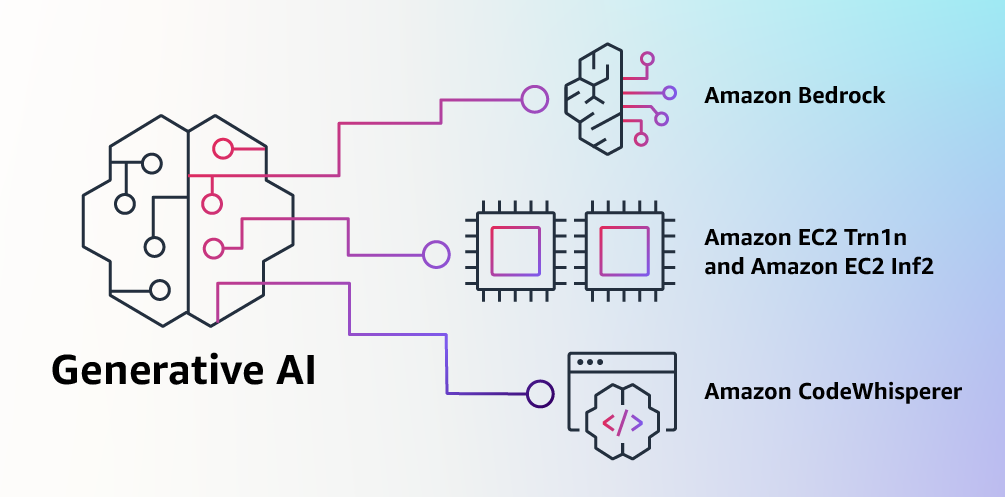
Announcing Amazon Bedrock and Amazon Titan models – Amazon Bedrock is a new service to accelerate your development of generative AI applications using foundation models through an API without managing infrastructure. You can choose from a wide range of foundation models built by leading AI startups and Amazon. The new Amazon Titan foundation models are pre-trained on large datasets, making them powerful, general-purpose models. You can use them as-is or privately to customize them with your own data for a particular task without annotating large volumes of data. Amazon Bedrock is currently in limited preview. Sign up here to learn more.

Building with Generative AI on AWS

Amazon EC2 Trn1n and Inf2 instances are now generally available – Trn1n instances, powered by AWS Trainium accelerators, double the network bandwidth (compared to Trn1 instances) to 1,600 Gbps of Elastic Fabric Adapter (EFAv2). The increased bandwidth delivers even higher performance for training network-intensive generative AI models such as large language models (LLMs) and mixture of experts (MoE). Inf2 instances, powered by AWS Inferentia2 accelerators, deliver high performance at the lowest cost in Amazon EC2 for generative AI models, including LLMs and vision transformers. They are the first inference-optimized instances in Amazon EC2 to support scale-out distributed inference with ultra-high-speed connectivity between accelerators. Compared to Inf1 instances, Inf2 instances deliver up to 4x higher throughput and up to 10x lower latency. Check out my blog posts on Trn1 instances and Inf2 instances for more details.

Amazon CodeWhisperer, free for individual use, is now generally available – Amazon CodeWhisperer is an AI coding companion that generates real-time single-line or full-function code suggestions in your IDE to help you build applications faster. With GA, we introduce two tiers: CodeWhisperer Individual and CodeWhisperer Professional. CodeWhisperer Individual is free to use for generating code. You can sign up with an AWS Builder ID based on your email address. The Individual Tier provides code recommendations, reference tracking, and security scans. CodeWhisperer Professional—priced at $19 per user, per month—offers additional enterprise administration capabilities. Steve’s blog post has all the details.

Amazon GameLift adds support for Unreal Engine 5 – Amazon GameLift is a fully managed solution that allows you to manage and scale dedicated game servers for session-based multiplayer games. The latest version of the Amazon GameLift Server SDK 5.0 lets you integrate your Unreal 5-based game servers with the Amazon GameLift service. In addition, the latest Amazon GameLift Server SDK with Unreal 5 plugin is built to work with Amazon GameLift Anywhere so that you can test and iterate Unreal game builds faster and manage game sessions across any server hosting infrastructure. Check out the release notes to learn more.

Amazon Rekognition launches Face Liveness to deter fraud in facial verification – Face Liveness verifies that only real users, not bad actors using spoofs, can access your services. Amazon Rekognition Face Liveness analyzes a short selfie video to detect spoofs presented to the camera, such as printed photos, digital photos, digital videos, or 3D masks, as well as spoofs that bypass the camera, such as pre-recorded or deepfake videos. This AWS Machine Learning Blog post walks you through the details and shows how you can add Face Liveness to your web and mobile applications.

For a full list of AWS announcements, be sure to keep an eye on the What’s New at AWS page.

Other AWS News
Here are some additional news items and blog posts that you may find interesting:

Updates to the AWS Well-Architected Framework – The most recent content updates and improvements focus on providing expanded guidance across the AWS service portfolio to help you make more informed decisions when developing implementation plans. Services that were added or expanded in coverage include AWS Elastic Disaster Recovery, AWS Trusted Advisor, AWS Resilience Hub, AWS Config, AWS Security Hub, Amazon GuardDuty, AWS Organizations, AWS Control Tower, AWS Compute Optimizer, AWS Budgets, Amazon CodeWhisperer, and Amazon CodeGuru. This AWS Architecture Blog post has all the details.

Amazon releases largest dataset for training “pick and place” robots – In an effort to improve the performance of robots that pick, sort, and pack products in warehouses, Amazon has publicly released the largest dataset of images captured in an industrial product-sorting setting. Where the largest previous dataset of industrial images featured on the order of 100 objects, the Amazon dataset, called ARMBench, features more than 190,000 objects. Check out this Amazon Science Blog post to learn more.

AWS open-source news and updates – My colleague Ricardo writes this weekly open-source newsletter in which he highlights new open-source projects, tools, and demos from the AWS Community. Read edition #153 here.

Upcoming AWS Events
Check your calendars and sign up for these AWS events:

Build On AWS - Generative AI#BuildOn Generative AI – Join our weekly live Build On Generative AI Twitch show. Every Monday morning, 9:00 US PT, my colleagues Emily and Darko take a look at aspects of generative AI. They host developers, scientists, startup founders, and AI leaders and discuss how to build generative AI applications on AWS.

In today’s episode, Emily walks us through the latest AWS generative AI announcements. You can watch the video here.

Dot Net Developer Day.NET Developer Day – .NET Enterprise Developer Day EMEA 2023 (April 25) is a free, one-day virtual event providing enterprise developers with the most relevant information to swiftly and efficiently migrate and modernize their .NET applications and workloads on AWS.

AWS Developer Innovation DayAWS Developer Innovation Day – AWS Developer Innovation Day (April 26) is a new, free, one-day virtual event designed to help developers and teams be productive and collaborate from discovery to delivery, to running software and building applications. Get a first look at exciting product updates, technical deep dives, and keynotes.

AWS Global Summits – Check your calendars and sign up for the AWS Summit close to where you live or work: Tokyo (April 20–21), Singapore (May 4), Stockholm (May 11), Hong Kong (May 23), Tel Aviv (May 31), Amsterdam (June 1), London (June 7), Washington, DC (June 7–8), Toronto (June 14), Madrid (June 15), and Milano (June 22).
You can browse all upcoming AWS-led in-person and virtual events and developer-focused events such as Community Days.

That’s all for this week. Check back next Monday for another Week in Review!

— Antje

This post is part of our Week in Review series. Check back each week for a quick roundup of interesting news and announcements from AWS!

Lenovo ThinkCentre M80q Tiny Gen 3 Review A Big Lesson Learned

Post Syndicated from Patrick Kennedy original https://www.servethehome.com/lenovo-thinkcentre-m80q-tiny-gen-3-review-a-big-lesson-learned-intel/

Our Lenovo ThinkCentre M80q Tiny Gen 3 review shows how this 35W Intel Core 1L PC performs and left us with a big lesson learned

The post Lenovo ThinkCentre M80q Tiny Gen 3 Review A Big Lesson Learned appeared first on ServeTheHome.

[$] Avoiding the merge trap

Post Syndicated from original https://lwn.net/Articles/926240/

The kernel subsystem maintainers out there probably have a deep
understanding of the sinking feeling that results from opening one’s inbox
and seeing a response from Linus Torvalds to a pull request. When all goes
well, pull requests are acted upon silently; a response usually means that
all has not gone well. Several maintainers got to experience that
feeling during the 6.3 merge window, which seemed to generate more than the
usual number of grumpy responses related to merge commits. Avoiding that
situation is not hard, though, with a bit of attention paid to how merges
are done.

Security updates for Monday

Post Syndicated from original https://lwn.net/Articles/929303/

Security updates have been issued by Debian (chromium, rails, and ruby-rack), Fedora (firefox, ghostscript, libldb, samba, and tigervnc), Mageia (ceph, davmail, firefox, golang, jpegoptim, libheif, python-certifi, python-flask-restx, thunderbird, and tomcat), Oracle (firefox), Red Hat (firefox), Scientific Linux (firefox), SUSE (apache2-mod_auth_openidc, aws-nitro-enclaves-cli, container-suseconnect, firefox, golang-github-prometheus-prometheus, harfbuzz, java-1_8_0-ibm, kernel, liblouis, php7, tftpboot-installation images, tomcat, and wayland), and Ubuntu (chromium-browser, imagemagick, kamailio, and libreoffice).

Swatting as a Service

Post Syndicated from Bruce Schneier original https://www.schneier.com/blog/archives/2023/04/swatting-as-a-service.html

Motherboard is reporting on AI-generated voices being used for “swatting”:

In fact, Motherboard has found, this synthesized call and another against Hempstead High School were just one small part of a months-long, nationwide campaign of dozens, and potentially hundreds, of threats made by one swatter in particular who has weaponized computer generated voices. Known as “Torswats” on the messaging app Telegram, the swatter has been calling in bomb and mass shooting threats against highschools and other locations across the country. Torswat’s connection to these wide ranging swatting incidents has not been previously reported. The further automation of swatting techniques threatens to make an already dangerous harassment technique more prevalent.

Message Center – Redesigning the messaging experience on the Grab superapp

Post Syndicated from Grab Tech original https://engineering.grab.com/message-center

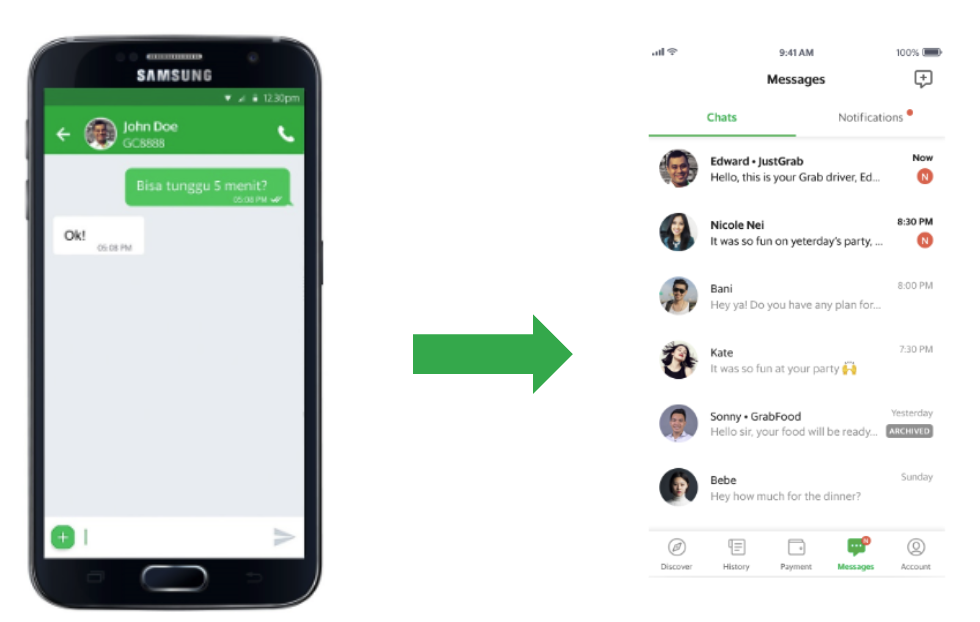
Since 2016, Grab has been using GrabChat, a built-in messaging feature to connect our users with delivery-partners or driver-partners. However, as the Grab superapp grew to include more features, the limitations of the old system became apparent. GrabChat could only handle two-party chats because that’s what it was designed to do. To make our messaging feature more extensible for future features, we decided to redesign the messaging experience, which is now called Message Center.

Migrating from the old GrabChat to the new Message Center

To some, building our own chat function might not be the ideal approach, especially with open source alternatives like Signal. However, Grab’s business requirements introduce some level of complexity, which required us to develop our own solution.

Some of these requirements include, but are not limited to:

  • Handle multiple user types (passengers, driver-partners, consumers, delivery-partners, customer support agents, merchant-partners, etc.) with custom user interface (UI) rendering logic and behaviour.
  • Enable other Grab backend services to send system generated messages (e.g. your driver is reaching) and customise push notifications.
  • Persist message state even if users uninstall and reinstall their apps. Users should be able to receive undelivered messages even if they were offline for hours.
  • Provide translation options for non-native speakers.
  • Filter profanities in the chat.
  • Allow users to handle group chats. This feature might come in handy in future if there needs to be communication between passengers, driver-partners, and delivery-partners.

Solution architecture

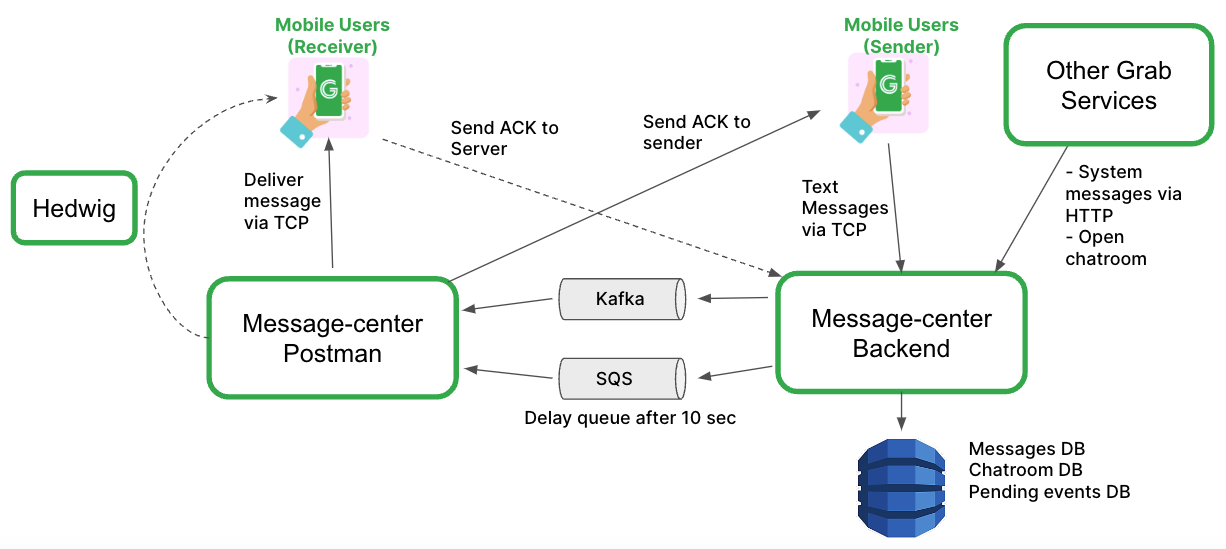
Message Center architecture

The new Message Center was designed to have two components:

  1. Message-center backend: Message processor service that handles logical and database operations.
  2. Message-center postman: Message delivery service that can scale independently from the backend service.

This architecture allows the services to be sufficiently decoupled and scale independently. For example, if you have a group chat with N participants and each message sent results in N messages being delivered, this architecture would enable message-center postman to scale accordingly to handle the higher load.

As Grab delivers millions of events a day via the Message Center service, we need to ensure that our system can handle high throughput. As such, we are using Apache Kafka as the low-latency high-throughput event stream connecting both services and Amazon SQS as a redundant delay queue that attempts a retry 10 seconds later.

Another important aspect for this service is the ability to support low-latency and bi-directional communications from the client to the server. That’s why we chose Transmission Control Protocol (TCP) as the main protocol for client-server communication. Mobile and web clients connect to Hermes, Grab’s TCP gateway service, which then digests the TCP packets and proxies the payloads to Message Center via gRPC. If both recipients and senders are online, the message is successfully delivered in a matter of milliseconds.

Unlike HTTP, individual TCP packets do not require a response so there is an inherent uncertainty in whether the messages were successfully delivered. Message delivery can fail due to several reasons, such as the client terminating the connection but the server’s connection remaining established. This is why we built a system of acknowledgements (ACKs) between the client and server, which ensures that every event is received by the receiving party.

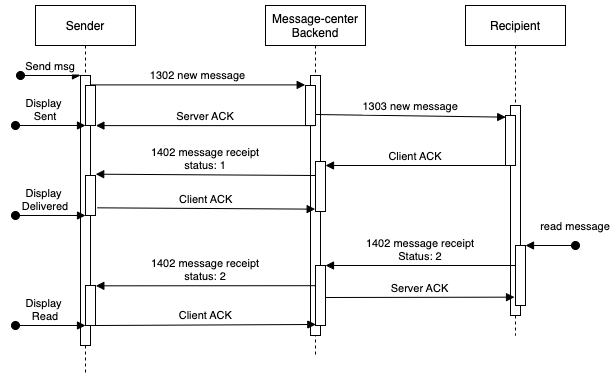
The following diagram shows the high-level sequence of events when sending a message.

Events involved in sending a message on Message Center

Following the sequence of events involved in sending a message and updating its status for the sender from sending to sent to delivered to read, the process can get very complicated quickly. For example, the sender will retry the 1302 TCP new message until it receives a server ACK. Similarly, the server will also keep attempting to send the 1402 TCP message receipt or 1303 TCP message unless it receives a client ACK. With this in mind, we knew we had to give special attention to the ACK implementation, to prevent infinite retries on the client and server, which can quickly cascade to a system-wide failure.

Lastly, we also had to consider dropped TCP connections on mobile devices, which happens quite frequently. What happens then? Message Center relies on Hedwig, another in-house notification service, to send push notifications to the mobile device when it receives a failed response from Hermes. Message Center also maintains a user-events DynamoDB database, which updates the state of every pending event of the client to delivered whenever a client ACK is received.

Every time the mobile client reconnects to Hermes, it also sends a special TCP message to notify Message Center that the client is back online, and then the server retries sending all the pending events to the client.

Learnings/Conclusion

With large-scale features like Message Center, it’s important to:

  • Decouple services so that each microservice can function and scale as needed.
  • Understand our feature requirements well so that we can make the best choices and design for extensibility.
  • Implement safeguards to prevent system timeouts, infinite loops, or other failures from cascading to the entire system, i.e. rate limiting, message batching, and idempotent eventIDs.

Join us

Grab is the leading superapp platform in Southeast Asia, providing everyday services that matter to consumers. More than just a ride-hailing and food delivery app, Grab offers a wide range of on-demand services in the region, including mobility, food, package and grocery delivery services, mobile payments, and financial services across 428 cities in eight countries.

Powered by technology and driven by heart, our mission is to drive Southeast Asia forward by creating economic empowerment for everyone. If this mission speaks to you, join our team today!

Booting modern Intel CPUs

Post Syndicated from original https://mjg59.dreamwidth.org/66109.html

CPUs can’t do anything without being told what to do, which leaves the obvious problem of how do you tell a CPU to do something in the first place. On many CPUs this is handled in the form of a reset vector – an address the CPU is hardcoded to start reading instructions from when power is applied. The address the reset vector points to will typically be some form of ROM or flash that can be read by the CPU even if no other hardware has been configured yet. This allows the system vendor to ship code that will be executed immediately after poweron, configuring the rest of the hardware and eventually getting the system into a state where it can run user-supplied code.

The specific nature of the reset vector on x86 systems has varied over time, but it’s effectively always been 16 bytes below the top of the address space – so, 0xffff0 on the 20-bit 8086, 0xfffff0 on the 24-bit 80286, and 0xfffffff0 on the 32-bit 80386. Convention on x86 systems is to have RAM starting at address 0, so the top of address space could be used to house the reset vector with as low a probability of conflicting with RAM as possible.

The most notable thing about x86 here, though, is that when it starts running code from the reset vector, it’s still in real mode. x86 real mode is a holdover from a much earlier era of computing. Rather than addresses being absolute (ie, if you refer to a 32-bit address, you store the entire address in a 32-bit or larger register), they are 16-bit offsets that are added to the value stored in a “segment register”. Different segment registers existed for code, data, and stack, so a 16-bit address could refer to different actual addresses depending on host it was being interpreted – jumping to a 16 bit address would result in that address being added to the code segment register, while reading from a 16 bit address would result in that address being added to the data segment register, and so on. This is all in order to retain compatibility with older chips, to the extent that even 64-bit x86 starts in real mode with segments and everything (and, also, still starts executing at 0xfffffff0 rather than 0xfffffffffffffff0 – 64-bit mode doesn’t support real mode, so there’s no way to express a 64-bit physical address using the segment registers, so we still start just below 4GB even though we have massively more address space available).

Anyway. Everyone knows all this. For modern UEFI systems, the firmware that’s launched from the reset vector then reprograms the CPU into a sensible mode (ie, one without all this segmentation bullshit), does things like configure the memory controller so you can actually access RAM (a process which involves using CPU cache as RAM, because programming a memory controller is sufficiently hard that you need to store more state than you can fit in registers alone, which means you need RAM, but you don’t have RAM until the memory controller is working, but thankfully the CPU comes with several megabytes of RAM on its own in the form of cache, so phew). It’s kind of ugly, but that’s a consequence of a bunch of well-understood legacy decisions.

Except. This is not how modern Intel x86 boots. It’s far stranger than that. Oh, yes, this is what it looks like is happening, but there’s a bunch of stuff going on behind the scenes. Let’s talk about boot security. The idea of any form of verified boot (such as UEFI Secure Boot) is that a signature on the next component of the boot chain is validated before that component is executed. But what verifies the first component in the boot chain? You can’t simply ask the BIOS to verify itself – if an attacker can replace the BIOS, they can replace it with one that simply lies about having done so. Intel’s solution to this is called Boot Guard.

But before we get to Boot Guard, we need to ensure the CPU is running in as bug-free a state as possible. So, when the CPU starts up, it examines the system flash and looks for a header that points at CPU microcode updates. Intel CPUs ship with built-in microcode, but it’s frequently old and buggy and it’s up to the system firmware to include a copy that’s new enough that it’s actually expected to work reliably. The microcode image is pulled out of flash, a signature is verified, and the new microcode starts running. This is true in both the Boot Guard and the non-Boot Guard scenarios. But for Boot Guard, before jumping to the reset vector, the microcode on the CPU reads an Authenticated Code Module (ACM) out of flash and verifies its signature against a hardcoded Intel key. If that checks out, it starts executing the ACM. Now, bear in mind that the CPU can’t just verify the ACM and then execute it directly from flash – if it did, the flash could detect this, hand over a legitimate ACM for the verification, and then feed the CPU different instructions when it reads them again to execute them (a Time of Check vs Time of Use, or TOCTOU, vulnerability). So the ACM has to be copied onto the CPU before it’s verified and executed, which means we need RAM, which means the CPU already needs to know how to configure its cache to be used as RAM.

Anyway. We now have an ACM loaded and verified, and it can safely be executed. The ACM does various things, but the most important from the Boot Guard perspective is that it reads a set of write-once fuses in the motherboard chipset that represent the SHA256 of a public key. It then reads the initial block of the firmware (the Initial Boot Block, or IBB) into RAM (or, well, cache, as previously described) and parses it. There’s a block that contains a public key – it hashes that key and verifies that it matches the SHA256 from the fuses. It then uses that key to validate a signature on the IBB. If it all checks out, it executes the IBB and everything starts looking like the nice simple model we had before.

Except, well, doesn’t this seem like an awfully complicated bunch of code to implement in real mode? And yes, doing all of this modern crypto with only 16-bit registers does sound like a pain. So, it doesn’t. All of this is happening in a perfectly sensible 32 bit mode, and the CPU actually switches back to the awful segmented configuration afterwards so it’s still compatible with an 80386 from 1986. The “good” news is that at least firmware can detect that the CPU has already configured the cache as RAM and can skip doing that itself.

I’m skipping over some steps here – the ACM actually does other stuff around measuring the firmware into the TPM and doing various bits of TXT setup for people who want DRTM in their lives, but the short version is that the CPU bootstraps itself into a state where it works like a modern CPU and then deliberately turns a bunch of the sensible functionality off again before it starts executing firmware. I’m also missing out the fact that this entire process only kicks off after the Management Engine says it can, which means we’re waiting for an entirely independent x86 to boot an entire OS before our CPU even starts pretending to execute the system firmware.

Of course, as mentioned before, on modern systems the firmware will then reprogram the CPU into something actually sensible so OS developers no longer need to care about this[1][2], which means we’ve bounced between multiple states for no reason other than the possibility that someone wants to run legacy BIOS and then boot DOS on a CPU with like 5 orders of magnitude more transistors than the 8086.

tl;dr why can’t my x86 wake up with the gin protected mode already inside it

[1] Ha uh except that on ACPI resume we’re going to skip most of the firmware setup code so we still need to handle the CPU being in fucking 16-bit mode because suspend/resume is basically an extremely long reboot cycle

[2] Oh yeah also you probably have multiple cores on your CPU and well bad news about the state most of the cores are in when the OS boots because the firmware never started them up so they’re going to come up in 16-bit real mode even if your boot CPU is already in 64-bit protected mode, unless you were using TXT in which case you have a different sort of nightmare that if we’re going to try to map it onto real world nightmare concepts is one that involves a lot of teeth

comment count unavailable comments

The collective thoughts of the interwebz