Post Syndicated from digiblurDIY original https://www.youtube.com/watch?v=L9lC0Mse0K4
Systemd 251 released
Post Syndicated from original https://lwn.net/Articles/896043/
Systemd 251 is out. The list of changes includes an increase of the
minimum kernel version
to 4.15, use of C11 to build the program, increased use of filesystem ID mapping, and many other things;
see the announcement for all the details.
Security updates for Monday
Post Syndicated from original https://lwn.net/Articles/896032/
Security updates have been issued by Debian (admesh, condor, firefox-esr, libpgjava, libxml2, rsyslog, and thunderbird), Fedora (dotnet6.0, libarchive, php-openpsa-universalfeedcreator, thunderbird, and vim), Mageia (ffmpeg, kernel, kernel-linus, microcode, netatalk, nvidia-current, nvidia390, opencontainers-runc, postgresql, and ruby-nokogiri), Slackware (mariadb and mozilla), and SUSE (curl, firefox, libarchive, librecad, libxls, openldap2, php7, and postgresql10).
The Largest Airship of its Time: The Morrell Airship
Post Syndicated from The History Guy: History Deserves to Be Remembered original https://www.youtube.com/watch?v=vR-yQ4TObJ8
Forging Australian Driver’s Licenses
Post Syndicated from Bruce Schneier original https://www.schneier.com/blog/archives/2022/05/forging-australian-drivers.html
The New South Wales digital driver’s license has multiple implementation flaws that allow for easy forgeries.
This file is encrypted using AES-256-CBC encryption combined with Base64 encoding.
A 4-digit application PIN (which gets set during the initial onboarding when a user first instals the application) is the encryption password used to protect or encrypt the licence data.
The problem here is that an attacker who has access to the encrypted licence data (whether that be through accessing a phone backup, direct access to the device or remote compromise) could easily brute-force this 4-digit PIN by using a script that would try all 10,000 combinations….
[…]
The second design flaw that is favourable for attackers is that the Digital Driver Licence data is never validated against the back-end authority which is the Service NSW API/database.
This means that the application has no native method to validate the Digital Driver Licence data that exists on the phone and thus cannot perform further actions such as warn users when this data has been modified.
As the Digital Licence is stored on the client’s device, validation should take place to ensure the local copy of the data actually matches the Digital Driver’s Licence data that was originally downloaded from the Service NSW API.
As this verification does not take place, an attacker is able to display the edited data on the Service NSW application without any preventative factors.
There’s a lot more in the blog post.
Cloudflare achieves key cloud computing certifications — and there’s more to come
Post Syndicated from Rory Malone original https://blog.cloudflare.com/iso-27018-second-privacy-certification-and-c5/


Back in the early days of the Internet, you could physically see the hardware where your data was stored. You knew where your data was and what kind of locks and security protections you had in place. Fast-forward a few decades, and data is all “in the cloud”. Now, you have to trust that your cloud services provider is putting security precautions in place just as you would have if your data was still sitting on your hardware. The good news is, you don’t have to merely trust your provider anymore. There are a number of ways a cloud services provider can prove it has robust privacy and security protections in place.
Today, we are excited to announce that Cloudflare has taken three major steps forward in proving the security and privacy protections we provide to customers of our cloud services: we achieved a key cloud services certification, ISO/IEC 27018:2019; we completed our independent audit and received our Cloud Computing Compliance Criteria Catalog (“C5”) attestation; and we have joined the EU Cloud Code of Conduct General Assembly to help increase the impact of the trusted cloud ecosystem and encourage more organizations to adopt GDPR-compliant cloud services.
Cloudflare has been committed to data privacy and security since our founding, and it is important to us that we can demonstrate these commitments. Certification provides assurance to our customers that a third party has independently verified that Cloudflare meets the requirements set out in the standard.
ISO/IEC 27018:2019 – Cloud Services Certification
2022 has been a big year for people who like the number ‘two’. February marked the second when the 22nd Feb 2022 20:22:02 passed: the second second of the twenty-second minute of the twentieth hour of the twenty-second day of the second month, of the year twenty-twenty-two! As well as the date being a palindrome — something that reads the same forwards and backwards — on an vintage ‘80s LCD clock, the date and time could be written as an ambigram too — something that can be read upside down as well as the right way up:

When we hit 2022 02 22, our team was busy completing our second annual audit to certify to ISO/IEC 27701:2019, having been one of the first organizations in our industry to have achieved this new ISO privacy certification in 2021, and the first Internet performance & security company to be certified to it. And now Cloudflare has now been certified to a second international privacy standard related to the processing of personal data — ISO/IEC 27018:2019.1
ISO 27018 is a privacy extension to the widespread industry standards ISO/IEC 27001 and ISO/IEC 27002, which describe how to establish and run an Information Security Management System. ISO 27018 extends the standards into a code of practice for how any personal information should be protected when processed in a public cloud, such as Cloudflare’s.
What does ISO 27018 mean for Cloudflare customers?
Put simply, with Cloudflare’s certifications to both ISO 27701 and ISO 27018, customers can be assured that Cloudflare both has a privacy program that meets GDPR-aligned industry standards and also that Cloudflare protects the personal data processed in our network as part of that privacy program.
These certifications, in addition to the Data Processing Addendum (“DPA”) we make available to our customers, offer our customers multiple layers of assurance that any personal data that Cloudflare processes on their behalf will be handled in a way that meets the GDPR’s requirements.
The ISO 271018 standard contains enhancements to existing ISO 27002 controls and an additional set of 25 controls identified for organizations that are personal data processors. Controls are essentially a set of best practices that processors must meet in terms of data handling practices and transparency about those practices, protecting and encrypting the personal data processed, and handling data subject rights, among others. As an example, one of the ISO 27018 requirements is:
Where the organization is contracted to process personal data, that personal data may not be used for the purpose of marketing and advertising without establishing that prior consent was obtained from the appropriate data subject. Such consent shall not be a condition for receiving the service.
When Cloudflare acts as a data processor for our customers’ data, that data (and any personal data it may contain) belongs to our customers, not to us. Cloudflare does not track our customers’ end users for marketing or advertising purposes, and we never will. We even went beyond what the ISO control required and added this commitment to our customer DPA:
“… Cloudflare shall not use the Personal Data for the purposes of marketing or advertising…”
– 3.1(b), Cloudflare Data Protection Addendum
Cloudflare achieves ISO 27018:2019 Certification
For ISO 27018, Cloudflare was assessed by a third-party auditor, Schellman, between December 2021 and February 2022. Certifying to an ISO privacy standard is a multi-step process that includes an internal and an external audit, before finally being certified against the standard by the independent auditor. Cloudflare’s new single joint certificate, covering ISO 27001:2013, ISO 27018:2019, and ISO 27701:2019 is now available to download from the Cloudflare Dashboard.

C5:2020 – Cloud Computing Compliance Criteria Catalog
ISO 27108 isn’t all we’re announcing: as we blogged in February, Cloudflare has also been undergoing a separate independent audit for the Cloud Computing Compliance Criteria Catalog certification — also known as C5 — which was introduced by the German government’s Federal Office for Information Security (“BSI”) in 2016 and updated in 2020. C5 evaluates an organization’s security program against a standard of robust cloud security controls. Both German government agencies and private companies place a high level of importance on aligning their cloud computing requirements with these standards. Learn more about C5 here.
Today, we’re excited to announce that we have completed our independent audit and received our C5 attestation from our third-party auditors. The C5 attestation report is now available to download from the Cloudflare Dashboard.
And we’re not done yet…
When the European Union’s benchmark-setting General Data Protection Regulation (“GDPR”) was adopted four years ago this week, Article 40 encouraged:
“…the drawing up of codes of conduct intended to contribute to the proper application of this Regulation, taking account of the specific features of the various processing sectors and the specific needs of micro, small and medium-sized enterprises.”
The first code officially approved as GDPR-compliant by the EU one year ago this past weekend is ‘The EU Cloud Code of Conduct’. This code is designed to help cloud service providers demonstrate the protections they provide for the personal data they process on behalf of their customers. It covers all cloud service layers, and its compliance is overseen by accredited monitoring body SCOPE Europe. Initially, cloud service providers join as members of the code’s General Assembly, and then the second step is to undergo an audit to validate their adherence to the code.
Today, we are pleased to announce today that Cloudflare has joined the General Assembly of the EU Cloud Code of Conduct. We look forward to the second stage in this process, undertaking our audit and publicly affirming our compliance to the GDPR as a processor of personal data.
Cloudflare Certifications
Customers may now download a copy of Cloudflare’s certifications and reports from the Cloudflare Dashboard; new customers may request these from your sales representative. For the latest information about our certifications and reports, please visit our Trust Hub.
…
1The International Organization for Standardization (“ISO”) is an international, nongovernmental organization made up of national standards bodies that develops and publishes a wide range of proprietary, industrial, and commercial standards.
Subway: Last Week Tonight with John Oliver (HBO)
Post Syndicated from LastWeekTonight original https://www.youtube.com/watch?v=jDdYFhzVCDM
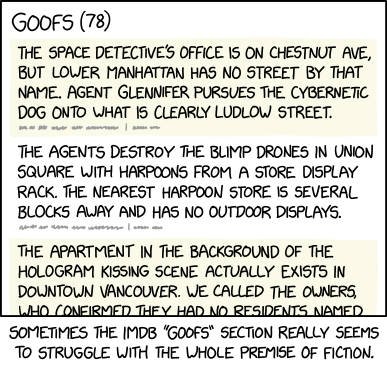
Goofs
Post Syndicated from original https://xkcd.com/2623/
The 5.18 kernel has been released
Post Syndicated from original https://lwn.net/Articles/895969/
Linus has released the 5.18 kernel.
“No unexpected nasty surprises this last week, so here we go with the
5.18 release right on schedule.” Some of the headline changes in
this release include
the DAMOS memory-management interface,
a number of random-number-generator improvements,
the Intel software-defined silicon driver,
strict memcpy() bounds checking,
a switch to the C11 standard, and more.
Also, the Reiserfs filesystem has been
deprecated and the last vestiges of a.out
support have been removed.
See the LWN merge-window summaries (part 1, part 1) and the KernelNewbies 5.18 page
for more details.
Mail day 37 – ERCF special – ERCF Kit, board, tool-head sensor etc
Post Syndicated from BeardedTinker original https://www.youtube.com/watch?v=CrIPept-yNQ
Tusking
Post Syndicated from Oglaf! -- Comics. Often dirty. original https://www.oglaf.com/tusking/


Marisa Renee Lee | Grief Is Love: Living with Loss | Talks at Google
Post Syndicated from Talks at Google original https://www.youtube.com/watch?v=SAPq24gCmP8
A Survey of Causal Inference Applications at Netflix
Post Syndicated from Netflix Technology Blog original https://netflixtechblog.com/a-survey-of-causal-inference-applications-at-netflix-b62d25175e6f
At Netflix, we want to entertain the world through creating engaging content and helping members discover the titles they will love. Key to that is understanding causal effects that connect changes we make in the product to indicators of member joy.
To measure causal effects we rely heavily on AB testing, but we also leverage quasi-experimentation in cases where AB testing is limited. Many scientists across Netflix have contributed to the way that Netflix analyzes these causal effects.
To celebrate that impact and learn from each other, Netflix scientists recently came together for an internal Causal Inference and Experimentation Summit. The weeklong conference brought speakers from across the content, product, and member experience teams to learn about methodological developments and applications in estimating causal effects. We covered a wide range of topics including difference-in-difference estimation, double machine learning, Bayesian AB testing, and causal inference in recommender systems among many others.
We are excited to share a sneak peek of the event with you in this blog post through selected examples of the talks, giving a behind the scenes look at our community and the breadth of causal inference at Netflix. We look forward to connecting with you through a future external event and additional blog posts!
Incremental Impact of Localization
Yinghong Lan, Vinod Bakthavachalam, Lavanya Sharan, Marie Douriez, Bahar Azarnoush, Mason Kroll
At Netflix, we are passionate about connecting our members with great stories that can come from anywhere, and be loved everywhere. In fact, we stream in more than 30 languages and 190 countries and strive to localize the content, through subtitles and dubs, that our members will enjoy the most. Understanding the heterogenous incremental value of localization to member viewing is key to these efforts!
In order to estimate the incremental value of localization, we turned to causal inference methods using historical data. Running large scale, randomized experiments has both technical and operational challenges, especially because we want to avoid withholding localization from members who might need it to access the content they love.
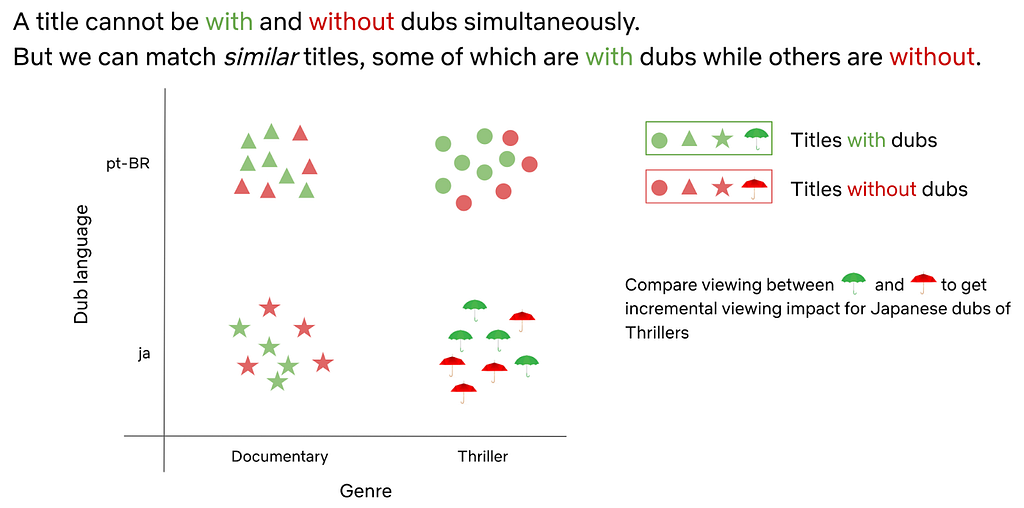
We analyzed the data across various languages and applied double machine learning methods to properly control for measured confounders. We not only studied the impact of localization on overall title viewing but also investigated how localization adds value at different parts of the member journey. As a robustness check, we explored various simulations to evaluate the consistency and variance of our incrementality estimates. These insights have played a key role in our decisions to scale localization and delight our members around the world.
A related application of causal inference methods to localization arose when some dubs were delayed due to pandemic-related shutdowns of production studios. To understand the impact of these dub delays on title viewing, we simulated viewing in the absence of delays using the method of synthetic control. We compared simulated viewing to observed viewing at title launch (when dubs were missing) and after title launch (when dubs were added back).
To control for confounders, we used a placebo test to repeat the analysis for titles that were not affected by dub delays. In this way, we were able to estimate the incremental impact of delayed dub availability on member viewing for impacted titles. Should there be another shutdown of dub productions, this analysis enables our teams to make informed decisions about delays with greater confidence.
Holdback Experiments for Product Innovation
Travis Brooks, Cassiano Coria, Greg Nettles, Molly Jackman, Claire Lackner
At Netflix, there are many examples of holdback AB tests, which show some users an experience without a specific feature. They have substantially improved the member experience by measuring long term effects of new features or re-examining old assumptions. However, when the topic of holdback tests is raised, it can seem too complicated in terms of experimental design and/or engineering costs.
We aimed to share best practices we have learned about holdback test design and execution in order to create more clarity around holdback tests at Netflix, so they can be used more broadly across product innovation teams by:
- Defining the types of holdbacks and their use cases with past examples
- Suggesting future opportunities where holdback testing may be valuable
- Enumerating the challenges that holdback tests pose
- Identifying future investments that can reduce the cost of deploying and maintaining holdback tests for product and engineering teams
Holdback tests have clear value in many product areas to confirm learnings, understand long term effects, retest old assumptions on newer members, and measure cumulative value. They can also serve as a way to test simplifying the product by removing unused features, creating a more seamless user experience. In many areas at Netflix they are already commonly used for these purposes.

We believe by unifying best practices and providing simpler tools, we can accelerate our learnings and create the best product experience for our members to access the content they love.
Causal Ranker: A Causal Adaptation Framework for Recommendation Models
Most machine learning algorithms used in personalization and search, including deep learning algorithms, are purely associative. They learn from the correlations between features and outcomes how to best predict a target.
In many scenarios, going beyond the purely associative nature to understanding the causal mechanism between taking a certain action and the resulting incremental outcome becomes key to decision making. Causal inference gives us a principled way of learning such relationships, and when coupled with machine learning, becomes a powerful tool that can be leveraged at scale.
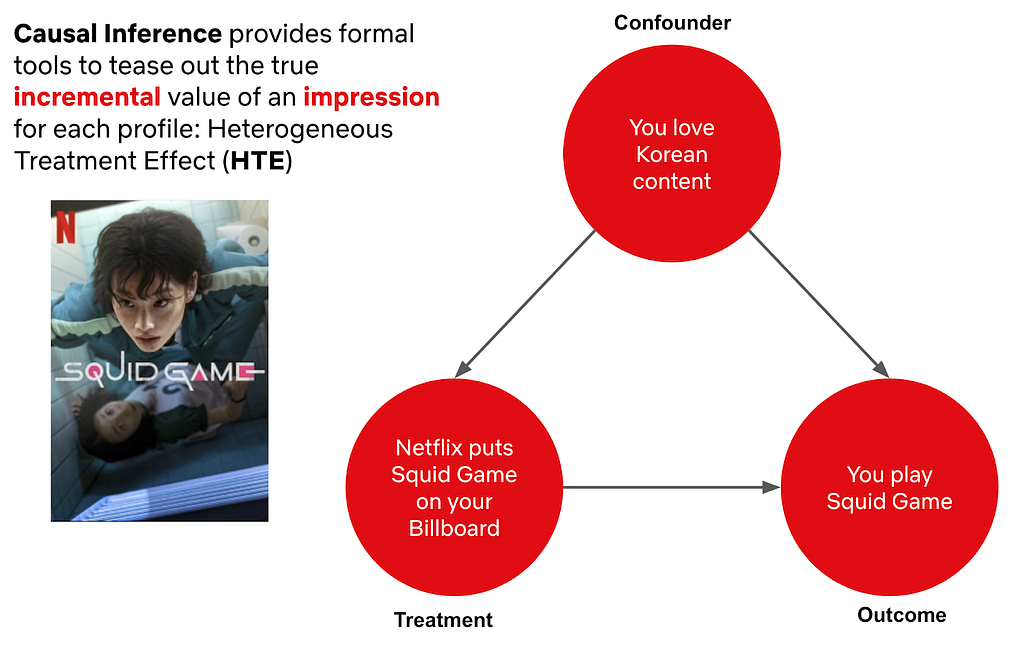
At Netflix, many surfaces today are powered by recommendation models like the personalized rows you see on your homepage. We believe that many of these surfaces can benefit from additional algorithms that focus on making each recommendation as useful to our members as possible, beyond just identifying the title or feature someone is most likely to engage with. Adding this new model on top of existing systems can help improve recommendations to those that are right in the moment, helping find the exact title members are looking to stream now.
This led us to create a framework that applies a light, causal adaptive layer on top of the base recommendation system called the Causal Ranker Framework. The framework consists of several components: impression (treatment) to play (outcome) attribution, true negative label collection, causal estimation, offline evaluation, and model serving.
We are building this framework in a generic way with reusable components so that any interested team within Netflix can adopt this framework for their use case, improving our recommendations throughout the product.
Bellmania: Incremental Account Lifetime Valuation at Netflix and its Applications
Understanding the value of acquiring or retaining subscribers is crucial for any subscription business like Netflix. While customer lifetime value (LTV) is commonly used to value members, simple measures of LTV likely overstate the true value of acquisition or retention because there is always a chance that potential members may join in the future on their own without any intervention.
We establish a methodology and necessary assumptions to estimate the monetary value of acquiring or retaining subscribers based on a causal interpretation of incremental LTV. This requires us to estimate both on Netflix and off Netflix LTV.
To overcome the lack of data for off Netflix members, we use an approach based on Markov chains that recovers off Netflix LTV from minimal data on non-subscriber transitions between being a subscriber and canceling over time.

Furthermore, we demonstrate how this methodology can be used to (1) forecast aggregate subscriber numbers that respect both addressable market constraints and account-level dynamics, (2) estimate the impact of price changes on revenue and subscription growth, and (3) provide optimal policies, such as price discounting, that maximize expected lifetime revenue of members.
Measuring causality is a large part of the data science culture at Netflix, and we are proud to have so many stunning colleagues leverage both experimentation and quasi-experimentation to drive member impact. The conference was a great way to celebrate each other’s work and highlight the ways in which causal methodology can create value for the business.
We look forward to sharing more about our work with the community in upcoming posts. To stay up to date on our work, follow the Netflix Tech Blog, and if you are interested in joining us, we are currently looking for new stunning colleagues to help us entertain the world!

A Survey of Causal Inference Applications at Netflix was originally published in Netflix TechBlog on Medium, where people are continuing the conversation by highlighting and responding to this story.
Ultimate Battery Doorbell Showdown 2022 || Ring, Eufy, Nest, Blink, and 360.
Post Syndicated from The Hook Up original https://www.youtube.com/watch?v=BCjxcBOcyTo
Playaway : The audiobook players that smartphones couldn’t kill
Post Syndicated from Techmoan original https://www.youtube.com/watch?v=qF42AJw1nhs
Friday Squid Blogging: Squid Street Art
Post Syndicated from Bruce Schneier original https://www.schneier.com/blog/archives/2022/05/friday-squid-blogging-squid-street-art.html
As usual, you can also use this squid post to talk about the security stories in the news that I haven’t covered.
Read my blog posting guidelines here.
Седмицата (16–21 май)
Post Syndicated from Йовко Ламбрев original https://toest.bg/editorial-16-21-may-2022/
Войната продължава. Героичната съпротива на Украйна срещу руската агресия е доста резултатна досега. Но развръзка още не се очертава. Британското разузнаване коментира, че се очаква няколкомесечна фаза на война на изтощение.

В „Тоест“ наричаме Русия агресор и конфликта война от самото начало. Защото други оценки не са възможни. Украйна се защитава в съответствие с международното право, а руската инвазия „грубо погазва установените в международните отношения и право норми за легитимност и легалност – от проблема със справедливостта на каузата и пропорционалността на мащабите на инвазията спрямо предвоенната ситуация, през размера и характера на унищоженията по време на военните действия, до тоталната липса на международна подкрепа“. Това пише Александър Нуцов в много полезния си материал, озаглавен „(Не)моралните аспекти на войната“, който публикувахме през седмицата. Статията би била от помощ за хора без практически и академичен опит да се ориентират в някои понятия и критерии, за да могат да си изградят по-задълбочена представа за даден конфликт.
Историческият момент и контекстът на близката до нас война са важни за преоценка и осмисляне на отношението на българското общество към Русия. В България по целесъобразност блюдолизците на тоталитарния режим наложиха лъжата за двойното ни „освобождение“. По инерция някои повтарят това и до днес. Затова е много важно, че точно сега се появява документалният филм на Евелина Келбечева и Светослав Овчаров „Второто освобождение“, който вече е достъпен за напълно свободно гледане в YouTube в официалния акаунт на Държавна агенция „Архиви“.
Филмът разказва чрез архивни документи, повечето от които показвани за първи път, за съветската окупация на България от есента на 1944 г. до зимата на 1947 г. И е задължителен за всички, но особено за онези, които продължават да се поддават на заблудата за двукратното „освобождаване“ на България от Русия/СССР.

Образованието има ключова роля за развиването на критично мислене, което е спасителният пояс за съвременния човек във времена на много истини. Същевременно е жизненоважно да правим разлика между цензура и ограничаване на дезинформацията и заблудите. Проф. Яна Хашъмова от Охайския университет забелязва в последните години упорита и твърда държавна намеса в образователните процеси както в някои американски щати, така и в Русия. От цензуриране или дори пренаписване на историята до забрани за преподаване или обсъждане на теми като сексуална ориентация и джендър идентичност – налаганите политики на двете държави имат притеснителни сходства. Прочетете повече в статията ѝ „Цензура, пропаганда и образование. Тенденциите в Русия и САЩ“.

Правителството е подложено на всевъзможен натиск от всички страни, включително отвътре. И предвид крехката конструкция, върху която се крепи, не е изненада, че се огъва. Но пък огъването засега го спасява от срутване и му печели време. Което може да се окаже критично важно за геополитическата посока на България в бъдеще. Лошото е, че цената на това е залитане към популизъм, в опити „да се харесаме на всички“, а в действителност обявените от правителството мерки против бурята от кризи носят повече изгода на едрия бизнес и по-заможните хора. Нищо че самите мерки са оцветени като социални. Прочетете повече в анализа „Промяна, ама за бизнеса“ на Емилия Милчева, според която на тезгяха на правителството вече няма нито леви цели, нито десни инструменти. Публикувахме нейния материал в четвъртък.

И докато в редакцията се забавлявахме с очакваните обвинения към Емилия в социализъм (само защото е цитирала Бърни Сандърс), дойде време за поредното чудесно интервю на Слава Савова с представители на организации, ангажирани с опазването на следвоенното архитектурно наследство на Германия. Този път неин събеседник е Оливер Елзер, куратор в Немския архитектурен музей във Франкфурт и един от основателите на платформата #SOSBrutalism. А заглавието на интервюто е взето от негова реплика в разговора – „Архитектурата не е въпрос на ляво или дясно“.

Както обещахме миналата седмица, в рубриката „На второ четене“ Стефан Иванов този път споделя размислите си за книгата на норвежкия писател Даг Сулста „Т. Сингер“. „Романът е сериозно изследване на трудността да се впишеш в собствения си живот. За това как катастрофално намаляват възможностите и желанието за непосредственост, спонтанност и свързаност между хората. Как да си себе си може да се окаже непосилна задача“, пише Стефан. А ако сте пропуснали, миналата седмица публикувахме post mortem интервю на Марин Бодаков с Даг Сулста, което ни застигна чак сега.
Приятно четене!
Цензура, пропаганда и образование. Тенденции в Русия и САЩ
Post Syndicated from Яна Хашъмова original https://toest.bg/tsenzura-propaganda-i-obrazovanie/
По време на късния социализъм, когато бях в гимназията, изучавахме литературните течения, към които принадлежаха дадени произведения. Най-тясно обвързаното с идеологията и политиката на държавата беше течението, наречено социалистически реализъм. Спомням си, когато решихме да спорим с нашата учителка по българска литература, че втората сюжетна линия на „Тютюн“ на Димитър Димов е напълно излишна и само влошава художествените качества на романа. Димов е бил принуден да я добави, за да внесе елементи на социалистически реализъм и да задоволи изискванията на цензурата.
Учителката интелигентно ни се усмихна и ни разреши да продължим да спорим, да градим аргументите си и да посочваме доказателства от текста. Тя обаче бе част от малкото учители по онова време, за които беше по-важно учениците им да придобият умения като критично мислене, представяне на аргументи и развиване на различни идеи, отколкото стриктно да следват предписаните норми от тогавашното Министерство на народната просвета.
Разказвам това, защото в последните години забелязвам упорита и твърда държавна намеса в образователните процеси както в Русия, така и в някои американски щати. В Тексас например се гласува закон с инструкции как да се преподава темата за расизма в американската история и как да се обсъждат съвременни събития. По-конкретно губернаторът на Тексас Грег Абът подписа закон, който забранява преподаването на „критическа теория на расизма“ в училищата от предучилищен до ХII клас.
„Критическа теория на расизма“ е академичен термин и най-общо казано, дефинира разбирането, че расизмът в САЩ има системен и структурен характер и не предоставя на афроамериканци и други расови малцинства същите възможности, каквито имат белите. В интерес на истината, сенаторите демократи в Тексас наложиха текст в закона, който същевременно задължава учителите да преподават история на робството в САЩ и на „Ку Клукс Клан“ и да ги определят като морално недопустими.
Ако учителите пък решат да дискутират съвременни събития, то те са задължени да обяснят „двете гледни точки“ по темата. Задължителното представяне на „двете гледни точки“ вероятно би могло да ограничи откровените дискусии за расовите проблеми и расизма в САЩ и да доведе до изкуствен баланс между утвърдени научни истини и съмнителни интерпретации. През 2020 г. президентът Доналд Тръмп забрани на всички държавни служители да участват в образователни програми, които се основават на „критическа теория на расизма“ и на идеята за „бяла привилегия“, като обяви тези понятия за пропаганда.
Паралелно с вмешателството на политици в образователния процес, родители изискват да се забрани преподаването на някои книги и те да се изземат от обществените библиотеки. Миналата година в Хюстън, Далас, Сан Антонио и Остин са подадени 75 молби от родители да се забранят определени книги, които развиват темите на расизма или сексуалната ориентация на юношите. А за предишната година подобна молба е била само една. Очевидно тези родители се чувстват насърчени от щатската политика в Тексас. Във Флорида пък нов закон забранява преподаването или обсъждането на теми като сексуална ориентация и джендър идентичност от предучилищен до III клас. В други щати се готвят подобни закони.
За разлика от Флорида, в Русия няма подобна намеса в образованието. Това не означава обаче, че в училищата не се наблюдава и преследва споменаването на теми, свързани с джендър идентичността. През 2020 г. групи за защита на човешките права съобщиха за случаи, в които учители следят профилите на учениците в социалните мрежи и докладват за всякакви изказвания, които може да се изтълкуват като „гей пропаганда“. Съгласно закон, приет в Русия още през 2013 г., глоба се налага за всяка публична проява на чувства или отношения между еднополови двойки или други действия, които може да се тълкуват като „гей пропаганда“.
Редактирането на учебниците по история в Русия, които трябва да изтъкват положителните аспекти на миналото и крият агресията на Руската империя и Съветския съюз, подобно на опитите на политиците в Тексас, цели да представи еднозначна картина на миналото, която да служи на политическите интереси на властта. Но още по-опасно е, че тези намеси градят национално самосъзнание, което се основава на избирателни факти и прикрити истини.
До последните 10–15 години например руската историография традиционно представяше Петър Велики като просветен и прогресивен владетел, а Иван Грозни – като безпощаден и жесток. Напоследък (както и по времето на Сталин) се наблюдават явни предпочитания на някои политици към личността на Иван Грозни и неговата роля в историята на Русия. През 2016 г. в град Орлов беше издигнат първият паметник на Иван Грозни в Руската федерация и местният губернатор заяви на откриването:
Иван Грозни принуди всеки да забележи Русия. Той я направи такава, каквато е. Аз имам голям респект към силни лидери.
В навечерието на откриването пък Владимир Медински, тогава министър на културата на Русия, изнесе лекция в Държавния исторически музей, като сравни руския цар с европейски монарси и вмъкна, че Иван Грозни все пак не е толкова „грозен“ (рус. „жесток, суров“ – б.р.), защото е заповядал екзекуцията само на 37 000 души по време на „опричнината“, когато властва личната гвардия на руския владетел, известна с особената си жестокост при изпълнението на исканията на царя.
Ненужно е, мисля, да обръщам внимание, че в хвалбите, изказани за Иван Грозни, са прикрити ласкателствата на тези политици към настоящия президент Владимир Путин и неговия все по-репресивен стил на управление. Политическите пристрастия към жестокия цар не остават само в публичното пространство. Достатъчно е да се спомене, че в момента се редактират всички учебници по история в Русия под ръководството и контрола на споменатия по-горе Медински. А след началото на войната в Украйна в училищата се разпространиха специални инструкции как да се преподава информацията за „специалната операция“. За разлика от закона в Тексас, който задължава учителите да представят „двете гледни точки“ при обсъждането на съвременни събития, в Русия другата гледна точка не е необходима.
Към какво се стремят тези политици?
Такова образование води до изграждането на общество от слабо образовани и немислещи хора, до оформянето на масов човек (ако се позовем на Хана Аренд). Масовият човек следва начертани постулати и е лишен от диалогично мислене, за което е настоявал руският философ Михаил Бахтин. Без диалогично мислене човек не разпознава другия и живее в собствения си свят на еднопластова информация. Такива хора са добър електорат за управляващите политици, но крайно неполезни за бъдещото развитие на едно общество.
Заглавна снимка: © Redd / Unsplash
На второ четене: „Т. Сингер“ от Даг Сулста
Post Syndicated from Стефан Иванов original https://toest.bg/na-vtoro-chetene-t-singer-dag-solstad/
Никой от нас не чете единствено най-новите книги. Тогава защо само за тях се пише? „На второ четене“ е рубрика, в която отваряме списъците с книги, публикувани преди поне година, четем ги и препоръчваме любимите си от тях. Рубриката е част от партньорската програма Читателски клуб „Тоест“. Изборът на заглавия обаче е единствено на авторите – Стефан Иванов и Севда Семер, които биха ви препоръчали тези книги и ако имаше как веднъж на две седмици да се разходите с тях в книжарницата.
„Т. Сингер“ от Даг Сулста
 Надявам се това да е само началото на дълга поредица книги от Даг Сулста на български. Надявам се такъв късмет да имат и други норвежки писатели – като Тор Улвен, а защо не и изключително харесваният от мен Карл Уве Кнаусгор, от когото на български имаме само първия от общо шест тома на „Моята лична борба“.
Знаех малко за Даг Сулста, преди да прочета романа за Сингер. След като с удоволствие го завърших, се заех да запълня пропуските в познанията си. Имах смътен спомен, че Кнаусгор пише за него на някоя от хилядите страници от автобиографичния си епос – но толкова.
Сулста (р. 1941) е все още активен писател с петдесетгодишна кариера. Автор е на над 30 книги, от които 19 романа, и е многократен носител на най-престижните норвежки и скандинавски литературни награди. Писал е романи за разходките си в Берлин и за историята на индустриална компания, която буквално се явява и главен герой на една от книгите му. Има дългогодишен проект в съавторство, в чийто фокус са пет поредни световни първенства по футбол – може да се създава литература и от аналитичната и артистична комбинация на политически и културен коментар, докато се гледат мачове. Двайсетина години по-късно Кнаусгор прави същото за първенството през 2014 г. в Бразилия. Сулста харесва защитния футбол и срещи, които завършват наравно и без никакви голове.
Разностранните интереси и умения на Сулста може да са предмет на отделно обсъждане, но аз по-скоро бих продължил с това, че е наричан „най-великият съвременен норвежки писател“ от литературната критика в лицето на Ингер Йостенстад. И не само. По-младите му колеги и сънародници Пер Петершон и Карл Уве Кнаусгор открито признават колко важен и ценен е Сулста за собственото им писане.
Кнаусгор например казва, че „езикът на Сулста блести с винаги нова старомодна елегантност и излъчва неподражаем и уникален блясък, пълен с жар“. За Петершон той е „несъмнено най-смелият и най-интелигентен норвежки романист“. Лидия Дейвис, носителка на „Букър“ за прозата си, преводачка на Флобер и Пруст на английски и бивша съпруга на Пол Остър, научава норвежки, четейки в оригинал негов роман. Нобеловият лауреат Петер Хандке открито предпочита Сулста пред Кнаусгор, а Харуки Мураками е публикувал собствен превод на Сулста на японски. Романът му „Арман В.“ от 2006 г. за ролята на Норвегия във войната в Афганистан е толкова неочаквано полемичен, че подтиква външния министър на Норвегия да напише в отговор рецензия на книгата.
Общото мнение за Сулста е, че е провокатор, експериментатор, икона.
Стилът му се характеризира с дълги изречения със сухи логически завои, изпъстрени с особена ирония, реализъм и понякога сюрреализъм. Постоянно критичен е спрямо статуквото. Без значение дали става въпрос за политика, книгоиздаване, или медии. Американската литературна критика го сравнява с добре познатия им Филип Рот, но през различните десетилетия е бил по-близък до писатели като Витолд Гомбрович и Томас Бернхард, а сам заявява родството си по избор с Томас Ман и Марсел Пруст. Сулста, след като чете Кнут Хамсун на 16-годишна възраст, не е имал друга цел, освен да стане писател.
За него предпочитаният читател е този в 20-те си години, когато най-лошата възможна сантименталност е отминала и идва време за важни решения. Именно тогава, твърди Сулста, човек най-много слуша, наблюдава, трупа познания и впечатления; тогава има възможността да избегне бъдещи нещастия и страдания. Писателят се опитва да помогне за това с писането си и с радикалното си нежелание да е повърхностен. И наистина, много щеше да ми помогне да прочета „Т. Сингер“ преди десетина години. Вероятно щеше да ми спести лични тревоги и изгубено време… но какво да се прави.
На пръв поглед „Т. Сингер“ се родее с „Чужденецът“ на Камю или „Самотникът“ на Йонеско, но
най-близък, поне според мен, е до шедьовъра „Стоунър“ на Джон Уилямс.
Сингер е аутсайдер, който живее по инерция своя неутрален, сив и празен живот. И желае да е точно така. На колосална дистанция е от всичко живо. Отказва да се занимава със света, не иска и той да го закача. Дълго време не знае какво да прави със себе си, но все пак решава да стане библиотекар. Да работи и живее с ясен ритъм и с много тишина. Оженва се, вписва се в ролята на съпруг, но само донякъде. В момента, в който жена му иска да се разделят, тя загива и той остава да се грижи за детето, което тя има от предишна връзка. С детето никога не стават наистина близки.
Той е погълнат от себе си, неспирно прави философски наблюдения и води екзистенциални дебати сам със себе си. Те са гарант за автентичността и идентичността му. Те са алибито му, че е живял. Действията и изборите му през цялото време казват единствено „предпочитам да откажа“ (както не спира до смъртта си да повтаря Бартълби на Херман Мелвил).
Даже „предпочитам да откажа да живея“.
Живот, застинал завинаги на ръба между удовлетворението и разочарованието. Живот в самота и изолация за сметка на пълноценно включване и интеграция в обществото. Сингер е последното парче от пъзела, което все изчезва, и този роман дава отговор на въпроса как и къде се губи то, каква е съдбата му. Литературата за пореден път по майсторски начин ясно и категорично потвърждава, че няма живот, който да не заслужава да бъде изследван и описан.
Лесно е да се изпитва съчувствие и състрадание към Сингер, но по-трудно е да бъде разбран и приет без снизхождение. Сякаш за него е написан най-известният стих на Марк Странд – „където и да съм, аз съм нещо отсъстващо“. Самият Сулста описва героя си с грижовна ирония и му дарява сложност, достойнство, пълноценност и свобода, които отдавна не бях срещал в съвременна книга.
В романа няма нито затихваща пандемия, нито война, но има всекидневни трудности. Има срам, паника, притеснение и тревога. Има полуприятелства, които отдавна са приключили, но някак са поддържани по силата на навика. Има нерешителност и страх, които са част от баналното и от бита, но натрупването им може да доведе до обсесивно-компулсивно разстройство или синдром на дефицит на вниманието и хиперактивност. Сякаш Сингер страда и от тях. Искал е да стане писател, но творчеството му започва и свършва само с едно изречение, което редактира стотици пъти в продължение на десетилетия.
В крайна сметка романът е сериозно изследване на трудността да се впишеш в собствения си живот.
За това как катастрофално намаляват възможностите и желанието за непосредственост, спонтанност и свързаност между хората. Как да си себе си може да се окаже непосилна задача. И колко тежко може да е всъщност да живееш в автентична безтегловност – като сфинкс без загадка. Животът ти може да се е разпаднал и без да се е счупило нещо особено забележително. Даже и без да имаш билет, за да си зрител в него. Това е неподражаем поглед към една идея за човек, изведена до възможната ѝ крайност.
Впечатляваща е свободата, с която Сулста е едновременно толкова интимен, интелектуален и литературен, но същевременно и толкова политически и полемичен. Потвърждавам думите на литературната критика за него, че е неочаквано удоволствие да четеш писател, който пише по съвременен и сериозен начин за самота и използва думи и понятия като душа, дух и плът, без те да олекват, а тъкмо обратното – да звучат сериозно и честно. Кнаусгор използва донякъде същата реторическа техника и сега виждам откъде още се е учил на нея.
Наистина важното, което си припомних, докато четях романа, е колко е лесно никой да не знае кой си всъщност, ако откажеш да говориш за това. И колко болезнено може да бъде.
Заглавно изображение: Колаж от корицата на „Т. Сингер“ (худ. Росица Ралева, изд. „Аквариус“) и снимка на NMG Network / Unsplash
Активните дарители на „Тоест“ получават постоянна отстъпка в размер на 20% от коричната цена на всички заглавия от каталога на „Аквариус“, както и на няколко други български издателства в рамките на партньорската програма Читателски клуб „Тоест“. За повече информация прочетете на toest.bg/club.
Spring 2022 SOC reports now available with 150 services in scope
Post Syndicated from Emma Zhang original https://aws.amazon.com/blogs/security/spring-2022-soc-reports-now-available-with-150-services-in-scope/
At Amazon Web Services (AWS), we’re committed to providing our customers with continued assurance over the security, availability and confidentiality of the AWS control environment. We’re proud to deliver the Spring 2022 System and Organizational (SOC) 1, 2 and 3 reports, which cover October 1, 2021 to March 31, 2022, to support our AWS customers’ confidence in AWS services.
The Spring 2022 SOC reports now include the Asia Pacific (Jakarta) Region, newly added to scope. The associated infrastructure supporting our in-scope products and services is also updated to reflect new edge locations, AWS Wavelength zones, and AWS Local Zones.
The Spring 2022 SOC reports include an additional 9 new services in scope, for a total of 150 services. See the full list on our Services in Scope by Compliance Program page.
Here are the 9 new services in scope for the Spring 2022 SOC reports:
- Amazon AppFlow
- AWS App Runner
- AWS Application Migration Service
- Amazon HealthLake
- AWS IoT SiteWise
- AWS Lake Formation
- Amazon Location Service
- AWS Private Certificate Authority
- AWS Resource Access Manager
The Spring 2022 SOC reports are now available to AWS customers through AWS Artifact in the AWS Management Console, or you can see our publicly-accessible PDF of the SOC 3 Report.
AWS strives to bring services into scope of our compliance programs to help you meet your architectural and regulatory needs. If there are additional AWS services you would like to see added to the scope of our SOC reports or other compliance programs, reach out to your AWS representatives.
As always, we value your feedback and questions. Feel free to reach out to the team through the Contact Us page. If you have feedback about this post, submit comments in the Comments section below.
Want more AWS Security how-to-content, news, and feature announcements? Follow us on Twitter.