AMD CES 2026 Keynote Live Coverage

Post Syndicated from Ryan Smith original https://www.servethehome.com/amd-ces-2026-keynote-live-coverage/

We’re down to our third and final chipmaker keynote of the day. Closing out a busy day for press conferences is AMD, who this year gets the honor of holding CES’s official opening keynote. The subject of AMD’s keynote, like so many others this year, will be a broad focus on AI, with CEO Dr. […]

The post AMD CES 2026 Keynote Live Coverage appeared first on ServeTheHome.

Kinabalu AI SRE – Leveraging AI for scalable diagnostics and alert management (Part 1)

Post Syndicated from Grab Tech original https://engineering.grab.com/kinabalu-ai-sre

Introduction

If you’ve ever been on-call during an outage, you know the drill: a flood of alerts, five dashboards open, logs streaming from different places, a dozen threads in Slack, and still no clear picture. Context-switching kills velocity, and “where do I even start?” becomes the default question.

Kinabalu AI Site Reliability Engineering (AI SRE for short) is our attempt to transform this experience. It consolidates the right context in one place, analyzes it with assistive AI agents, and helps us move from alert to action quickly.

Target audience:

  • On-call engineers and incident commanders.
  • Service owners validating health, dependencies, and changes.
  • SRE/platform teams standardizing triage and root cause analysis (RCA) quality.

Background

Incidents today suffer from several issues, including alert overload, fragmented context across tools, slow RCA, operational redundancy from tool-hopping, and scattered runbooks that are hard to find and apply under pressure.

AI SRE solves these issues by serving a unified view that streamlines diagnostics and correlates signals to recommend the best next actions. This approach accelerates response time, further reducing time-to-resolution (TTR), lowers the cognitive load on on-calls by keeping all relevant context in one place, and strengthens collaboration through evidence-backed updates and clear ownership.

A typical user journey

Kinabalu’s AI SRE is a 24/7 automator reachable via Slack and a Web UI. It takes input in the form of an automated alert or a direct question and responds with an evidence-backed, actionable insight.

In a hypothetical user journey with AI SRE, the process might begin with a trigger. For instance, if a monitoring alert is triggered by a fivefold increase in a Datadog report and increasing latency for a service, AI SRE initiates an incident thread and gathers the initial context.

The following components of AI SRE are then executed in sequence:

Component 1: Auto-triage with context from incident records, tagging on severity, priority, owner/oncall, as well as issue types.

Component 2: AI SRE (static diagnostics) establishes correlations by

  • Metrics and dashboards: analyzes recent deltas and compares against time-of-day/week baselines.
  • Dependencies: checks upstream/downstream services to separate causes from symptoms.
  • Changes: retrieves recent deployments, config updates, and feature-flag flips.
  • Logs: clusters error signatures and tracks frequency shifts.

Delivers an incident summary with actionable insights, aRCA draft, and concrete recommendations (queries to run, rollback/feature-flag options, runbook links).

Component 3: Dynamic conversation.

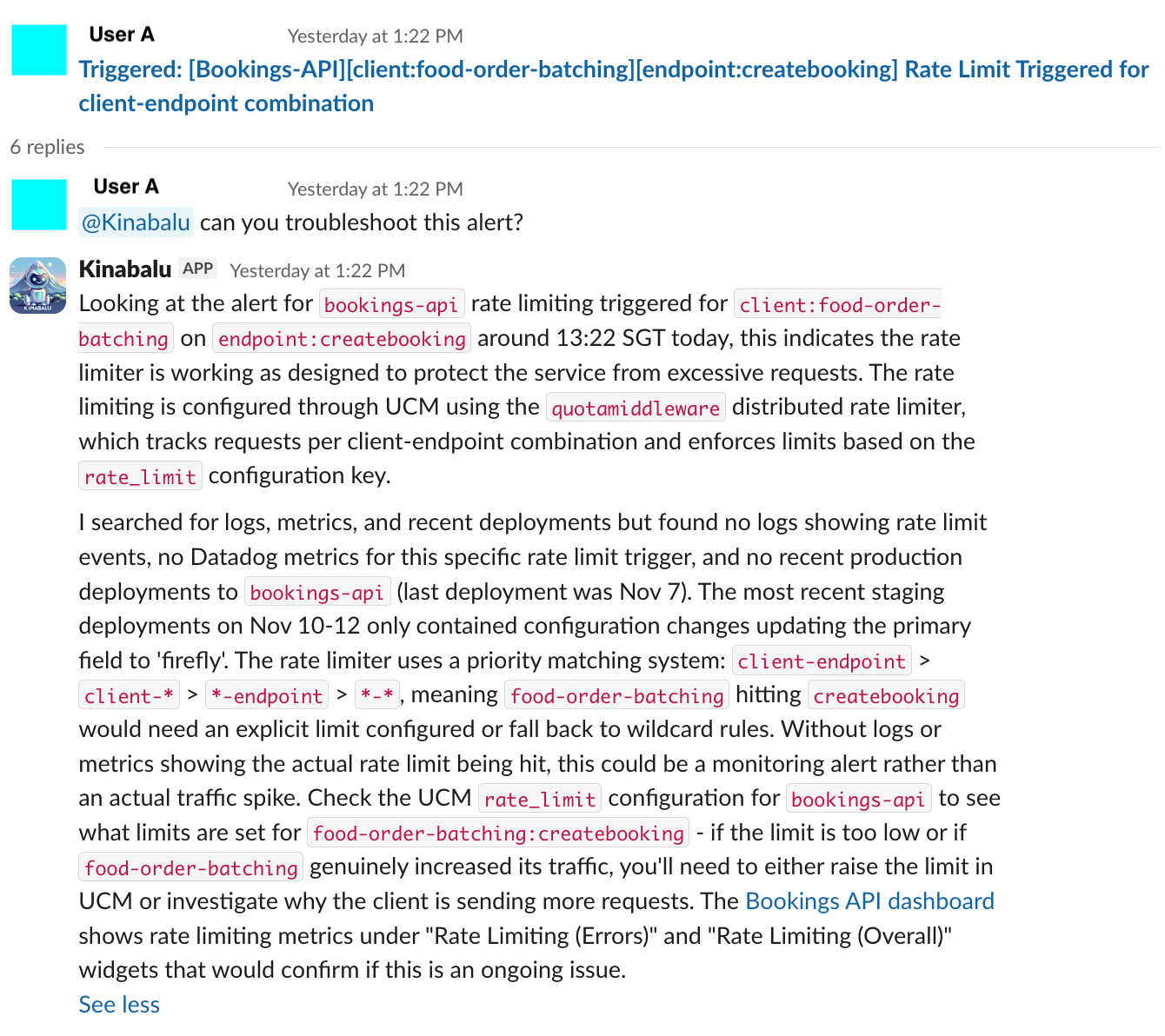
  • Conversational follow-up where user enters questions in Slack, such as “List owners for impacted services”, or “Compare p95 across top markets”. AI SRE replies with evidence-backed answers and provides links for further drill-down.

Architecture

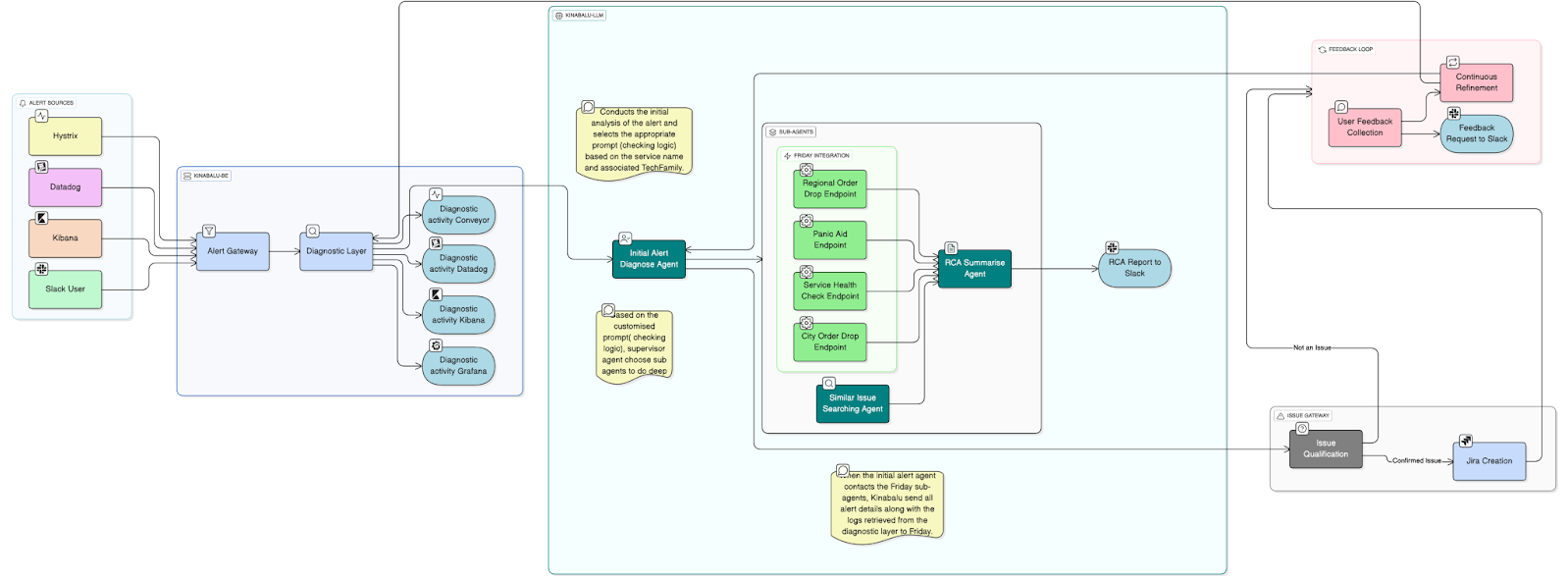
Under the hood, the backend combines a central signal aggregator with Model Context Protocol (MCP) servers for instant search, and a Large Language Model (LLM) powered intelligence layer that analyzes signals to auto-triage incidents and produce actionable insights.

Figure 1. SRE AI architecture.

Signal aggregator: Context engineering

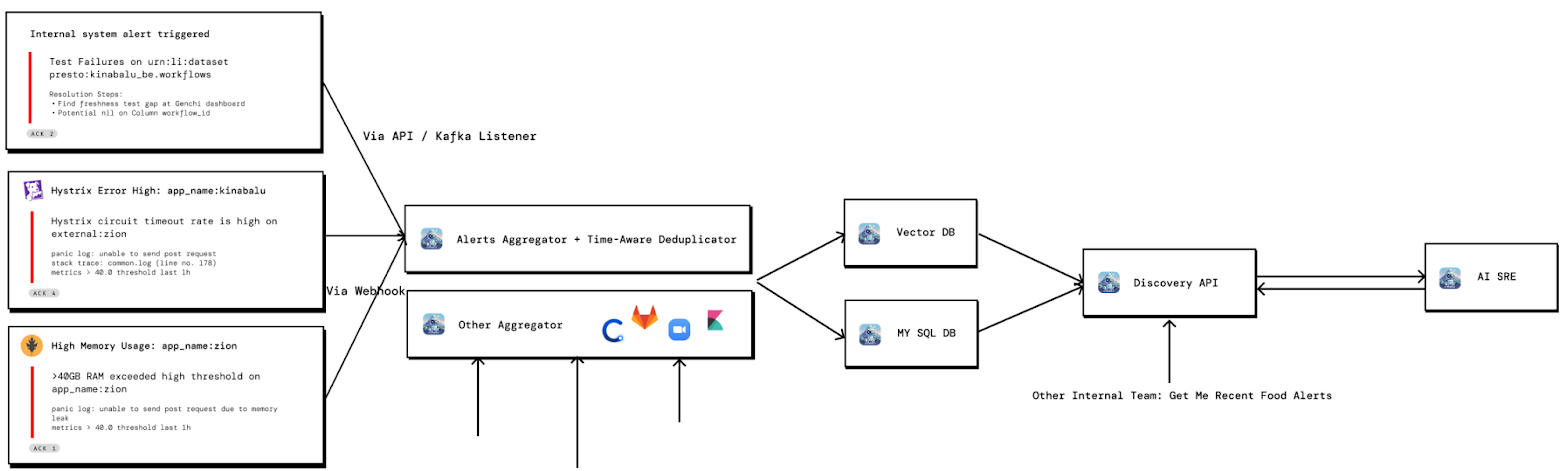
We follow a Retrieval Augmented Generation (RAG) approach and are building a knowledge graph that stitches together incident signals across the stack. The aggregator ingests the information as follows:

  • Datadog (metrics, monitors)
  • Kibana/Elasticsearch (logs)
  • Grafana (dashboards)
  • Hystrix (circuit state)
  • GitLab/Jira (changes/issues)
  • CI/CD and deployment metadata
  • Service/product catalog (ownership, dependencies)

With this context, AI SRE agents can provide a clear view of what changed, when it changed, and who owns it, making incident understanding and debugging faster and more reliable in a near-real-time manner.

Figure 2. Examples of signal aggregation for building context.

Unified intelligence: An agentic approach

Agents can basically “normalize” the alerts and signals, meaning they standardize and interpret them for better understanding. They can semantically search through historical changes that can explain current symptoms, correlate co-occurring signals, and surface likely causes.

AI SRE uses the SuperAgent and A2A multi-agent frameworks to analyze incidents using two workflows, which can coexist.

  • For static diagnosis, a separate flow collects all data and logs for services via the MCP toolkit and sends them to A2A multi-agents for a deep-dive investigation.
  • For dynamic analysis, SuperAgent uses the MCP toolkit to investigate and pull real-time data.

Static diagnosis

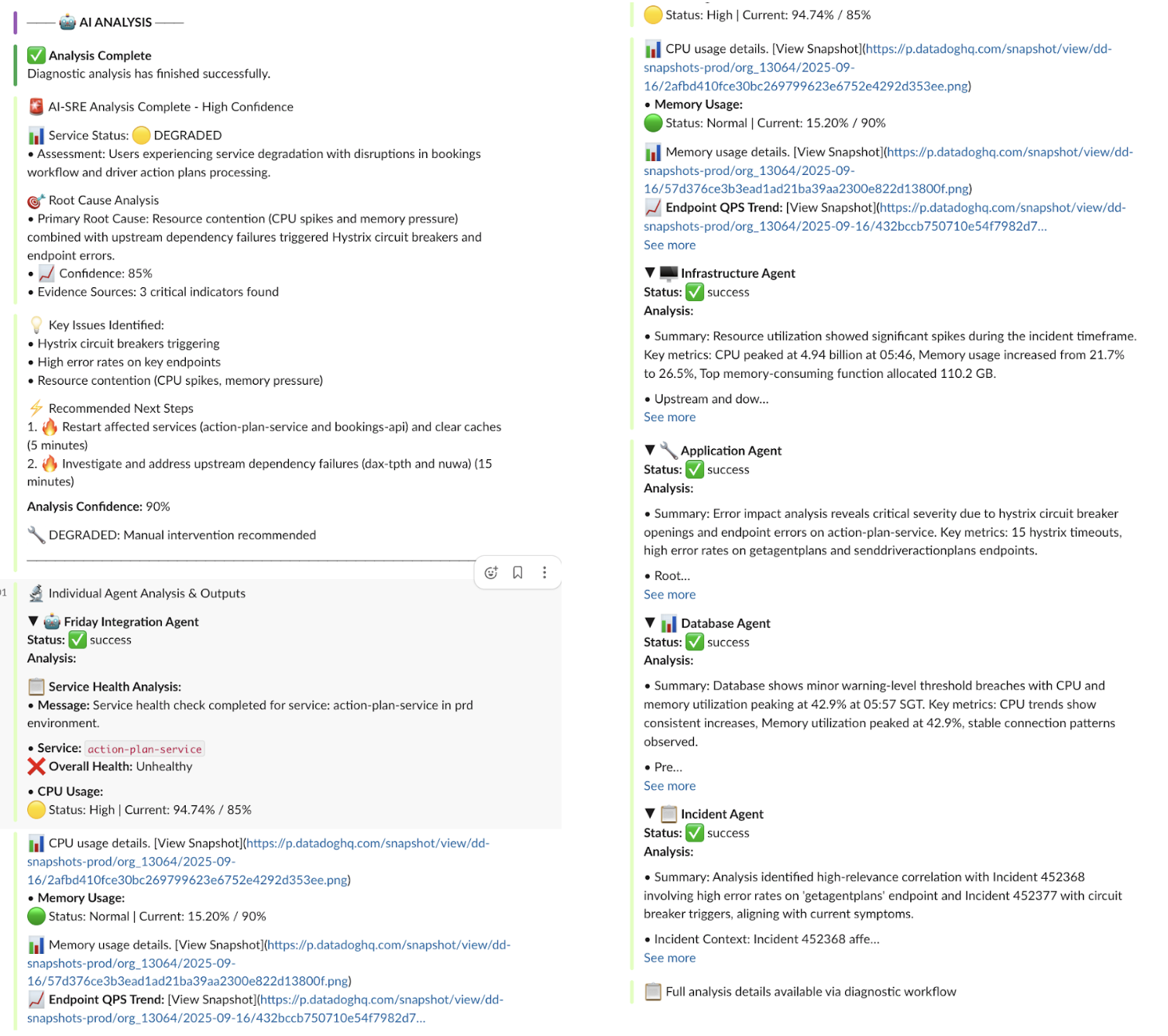
The static diagnostics workflow starts with a trigger from Slack or the Web UI and ends with a comprehensive service health report. It coordinates six domain-specific sub-agents encompassing the areas of incident management, deployment, application, database, infrastructure, and external APIs. Each sub-agent pulls the relevant signals and runs targeted checks, producing detailed findings. The supervisor then synthesizes these into an investigation-ready brief. The brief contains a concise summary of suspects and blast radius, timeline, and recommended next steps. The briefs are grounded in logs and metrics, so engineers can quickly understand the impact and move toward resolution.

Figure 3. Examples of static diagnosis by AI SRE.

Dynamic chat

Users can inquire via Slack or the Web UI to receive an immediate, evidence-supported action plan. Examples of such questions include:

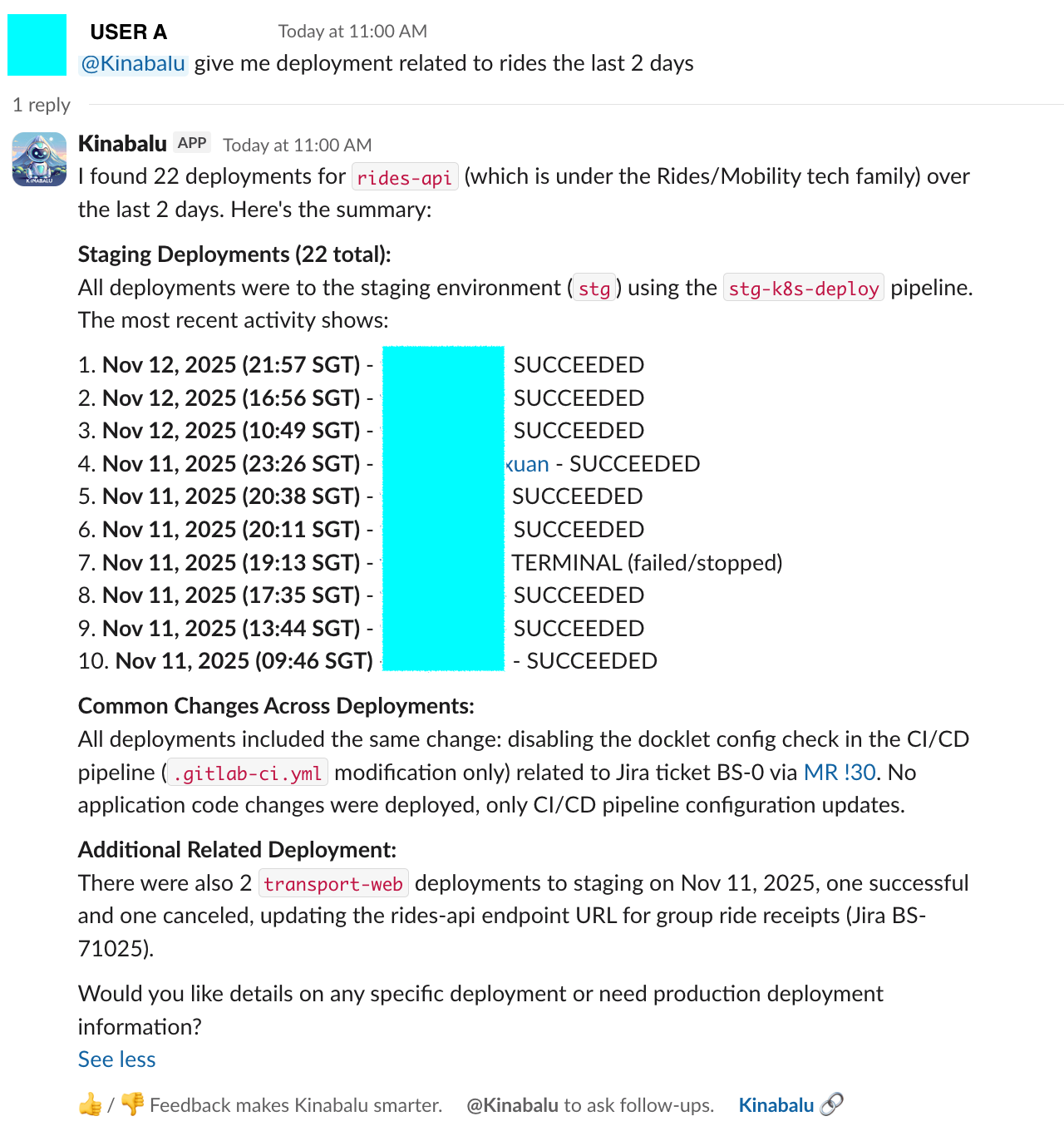
  • “How many recent deployments touched the food service?”
  • “How many Terraform changes in the past 5 minutes?”

Powered by our SuperAgent and MCP tool layer, dynamic chat queries live systems such as metrics, logs, deploy history, and configs. It then returns cited data, comparisons, and next-best actions. On-call engineers can diagnose issues and pull logs on the fly, before escalating actions (e.g., open a ticket, compare regions, list owners, suggest rollbacks). It’s human-in-the-loop (HITL) by design.

Figure 4. Example of examining related deployments within the same time frame.
Figure 5. Example of analyzing Splunk or DataDog alerts to identify the root cause of an issue.

MCP toolkit

The Kinabalu MCP Toolkit serves as a universal integration layer that empowers AI SRE by unifying 25 operational tools into a single, consistent interface. This comprehensive toolkit spans six key domains:

  • Incident and communications: Manages historical incidents, Slack thread context, and ticketing.
  • Internal platforms: Includes changelogs, experiments, rollout history, and automated analyses.
  • Knowledge and AI: Facilitates enterprise document search/chat and unstructured data analysis.
  • Service and configuration: Offers topology and configuration introspection.
  • Observability: Provides insights through metrics, logs, and profiling.
  • Deployment: Tracks recent releases and commit history.

The Kinabalu MCP Toolkit is designed to provide AI SRE with a 360 degree view of incidents, significantly accelerating root-cause discovery and response.

Conclusion

Our journey highlights the importance of structured context, robust diagnostic layers, and hybrid AI models for dependable incident automation. With Kinabalu AI SRE, we’re moving toward an ecosystem where alerts are normalized, evidence is automatically synthesized, and engineers can focus on higher level decision-making rather than firefighting.

Stay tuned for part 2, where we will cover the challenges, design decisions, and lessons that shaped Kinabalu AI SRE.

Join us

Grab is a leading superapp in Southeast Asia, operating across the deliveries, mobility and digital financial services sectors. Serving over 800 cities in eight Southeast Asian countries, Grab enables millions of people everyday to order food or groceries, send packages, hail a ride or taxi, pay for online purchases or access services such as lending and insurance, all through a single app. Grab was founded in 2012 with the mission to drive Southeast Asia forward by creating economic empowerment for everyone. Grab strives to serve a triple bottom line – we aim to simultaneously deliver financial performance for our shareholders and have a positive social impact, which includes economic empowerment for millions of people in the region, while mitigating our environmental footprint.

Powered by technology and driven by heart, our mission is to drive Southeast Asia forward by creating economic empowerment for everyone. If this mission speaks to you, join our team today!

Intel CES 2026 Keynote Live Coverage

Post Syndicated from Ryan Smith original https://www.servethehome.com/intel-ces-2026-keynote-live-coverage/

After a brief break following NVIDIA’s enterprise-focused keynote, we’re back for our second chipmaker keynote of the day: Intel. Unlike NVIDIA’s presentation, Intel’s presentation promises to be far more on-brand for CES, with a focus on consumer electronics via their Core Ultra Series 3 processors – better known as Panther Lake. Intel CES 2026 Keynote […]

The post Intel CES 2026 Keynote Live Coverage appeared first on ServeTheHome.

NVIDIA Launches Next-Generation Rubin AI Compute Platform at CES 2026

Post Syndicated from Ryan Smith original https://www.servethehome.com/nvidia-launches-next-generation-rubin-ai-compute-platform-at-ces-2026/

CES may still informally be the Consumer Electronics Show. But that does not mean everyone got the memo – or at least, cares to pay attention to it. Case in point is NVIDIA, who in the first major chipmaker press conference of the day opted for nothing less than to announce the launch of Rubin, […]

The post NVIDIA Launches Next-Generation Rubin AI Compute Platform at CES 2026 appeared first on ServeTheHome.

Simplify multi-warehouse data governance with Amazon Redshift federated permissions

Post Syndicated from Satesh Sonti original https://aws.amazon.com/blogs/big-data/simplify-multi-warehouse-data-governance-with-amazon-redshift-federated-permissions/

Modern data architectures increasingly rely on multi-warehouse deployments to achieve workload isolation, cost optimization, and performance scaling. Amazon Redshift federated permissions simplify permissions management across multiple Redshift warehouses.

With federated permissions, you register Redshift warehouse namespaces with the AWS Glue Data Catalog, creating a unified catalog that spans your entire warehouse fleet in the account. Registered namespaces are automatically mounted in every warehouse, providing data discovery without manual configuration. You can define permissions on database objects using familiar Redshift SQL commands, specifying global identities through AWS Identity and Access Management (IAM) or AWS IAM Identity Center (IDC). These permissions are stored alongside the warehouse data and enforced consistently, regardless of which warehouse runs the query. This provides a unified and secure access control model across your Redshift environment.

In this post, we show you how to define data permissions one time and automatically enforce them across warehouses in your AWS account, removing the need to re-create security policies in each warehouse.

Key capabilities of Amazon Redshift federated permissions

Federated permissions in Amazon Redshift offer the following key capabilities:

  • Global identity integration – Federated permissions use IAM and IAM Identity Center to provide single sign-on (SSO) across all registered warehouses. Users authenticate one time through their existing identity provider (IdP) and receive consistent access based on their global identity, regardless of which warehouse they connect to. This alleviates the need to create and manage separate user accounts in each warehouse, reducing administrative overhead and improving the user experience.
  • Unified catalog with automatic mounting – When you register a Redshift namespace with the Data Catalog using federated permissions, it becomes automatically visible in all warehouses within your account. Analysts using the Amazon Redshift Query Editor v2 or their preferred SQL client can discover and query tables across registered warehouses without manual catalog configuration. This automatic mounting capability simplifies data discovery and enables cross-warehouse analytics.
  • Consistent fine-grained access control – Row-level security (RLS) policies, dynamic data masking (DDM) policies, and column-level security (CLS) defined on warehouses using Amazon Redshift federated permissions automatically enforce when data is queried from consuming warehouses. You can implement advanced access controls—such as AWS Region-based row filtering, role-based masking for sensitive columns like SSN or credit card numbers, and time-based access restrictions—with confidence that these policies apply across warehouses.
  • SQL-based permission management – Federated permissions use familiar Redshift SQL syntax for permission management. You create RLS policies with CREATE RLS POLICY, attach them to tables and roles with ATTACH RLS POLICY, define masking policies with CREATE MASKING POLICY, and grant permissions with standard GRANT statements. This SQL interface enables infrastructure as code (IaC) approaches, supports database administrators to use their existing skills, and integrates naturally with existing extract, transform, and load (ETL) and automation workflows that use IAM or IAM Identity Center authentication.

Multi-warehouse architecture with federated permissions

The multi-warehouse architecture with federated permissions in Amazon Redshift represents a data mesh approach where multiple independent compute resources operate on shared data with unified governance. The following diagram illustrates the Redshift federated permissions setup process with the Data Catalog.

The process consists of the following steps:

  1. Each Redshift warehouse (1,2…N) registers with the Data Catalog. Refer onboarding documentation on registering the warehouse.
  2. After you register your Redshift warehouses with the Data Catalog, you can query data across your warehouses. Registered catalogs are automatically mounted in every warehouse in the account, appearing in the database explorer of Query Editor v2, and SQL clients connected to Amazon Redshift. To query a table in a registered catalog, use the three-part naming convention: database@catalog_name.schema_name.table_name.
  3. When you run a cross-catalog query, Amazon Redshift propagates your global identity (IAM role or IAM Identity Center user) to the remote warehouse. The remote warehouse’s catalog instance validates your permissions against the grants and fine-grained access control policies defined on the queried tables. If you have the necessary permissions, the table metadata and any applicable RLS, DDM, or CLS policies are returned to the consuming warehouse. Your local warehouse’s compute instance integrates these security policies into the query execution plan and runs the query on Redshift Managed Storage (RMS).

The enforcement of fine-grained access controls on remote data is a key differentiator of federated permissions. Traditional Redshift data sharing doesn’t support RLS or DDM policies on shared tables. With federated permissions, the security policies defined on the remote warehouse automatically apply when data is queried from any consumer warehouse. This supports compliance with data governance requirements without requiring administrators to duplicate security policies across warehouses.

The multi-warehouse architecture scales horizontally without increasing governance complexity. When you add a new warehouse to your account and register it with federated permissions, it automatically inherits the appropriate permission model without manual configuration. Analysts connecting to the new warehouse immediately see all databases they have access to across the mesh, and all security policies apply automatically. This alleviates the N-squared problem of managing permissions across N warehouses, reducing the administrative burden from N separate configurations to a single unified governance model.

Query lifecycle

The following diagram illustrates the step-by-step flow of how a user query on Redshift Warehouse 1 accesses objects in Redshift Warehouse N with federated permissions.

Note: Steps 2, 3, and 4 will be skipped if permission details are available in the local cache

The workflow consists of the following steps:

  1. The user connects to Redshift Warehouse 1 and queries a table in Federated Catalog N.
  2. Redshift Warehouse 1 calls the Data Catalog GetTable API. This request includes the user’s token.
  3. The request routes to Redshift Warehouse N.
  4. Redshift Warehouse N verifies the user permissions. If it’s authorized, it returns the table metadata and security policy details such as RLS policies, DDM rules, and CLS settings.
  5. Redshift Warehouse 1 applies the security policies in the query plan and runs the query against Redshift Managed Storage (RMS), where Redshift stores data in an optimized format.
  6. The results are returned to the user.

Solution overview

The example in this post demonstrates how to define RLS and DDM policies on a data warehouse and verify that these policies are enforced when querying from another data warehouse.

We will create a table with credit card data and apply RLS and DDM policies to limit consumer cards data and mask credit card values for non-admin users. These policies will be applied across all the data warehouses consistently and mask the credit card details when non-admin users query the table.

Prerequisites

Create the following IAM roles:

Create table and load data

Run following steps to create a credit_card table and load sample data.

  1. Connect to the first Redshift data warehouse1 using the IAM Aadmin role
  2. Create a credit_cards table
    -- Create table
    CREATE TABLE credit_cards (
      customer_id INT,
      credit_card varchar(16),
      card_type varchar(10)
    );

  3. Insert sample data
    -- Insert sample data
    INSERT INTO credit_cards
    VALUES
      (100, '4532993817514842', 'consumer'),
      (100, '4716002041425888', 'corporate'),
      (102, '5243112427642649', 'consumer'),
      (102, '6011720771834675', 'consumer'),
      (102, '6011378662059710', 'corporate'),
      (103, '373611968625635', 'consumer');

Apply RLS and DDM policies

Run following steps to create and apply RLS and DDM policies.

  1. Create an RLS policy to filter only consumer card types:
    -- Create RLS policy
    CREATE RLS POLICY consumer_cards
    WITH (card_type VARCHAR(10))
    USING (card_type = 'consumer');

  2. Create a DDM policy that masks credit cards:
    -- Create masking policy
    CREATE MASKING POLICY mask_credit_card_full
    WITH (credit_card VARCHAR(256))
    USING ('000000XXXX0000'::TEXT);

  3. Attach RLS and DDM Policies to RedOnly role
    -- Attach RLS and DDM policies to ReadOnly role
    ATTACH RLS POLICY consumer_cards 
    ON credit_cards 
    TO "IAMR:ReadOnly";
    
    ATTACH MASKING POLICY mask_credit_card_full
    ON credit_cards(credit_card)
    TO "IAMR:ReadOnly";

  4. Enable Row Level Security on the table
    ALTER TABLE credit_cards ROW LEVEL SECURITY ON;

  5. Grant select on the table to Readonly role
    GRANT SELECT ON credit_cards TO "IAMR:ReadOnly";

Connect to data warehouse 2 as read-only user

Run following steps on data warehouse 2 to query the data.

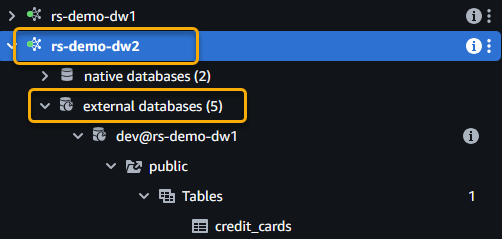
  1. Connect to data warehouse 2 as a read-only user and expand the external databases. The following screenshot shows an example using Query Editor V2.
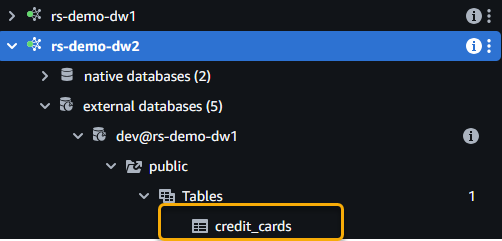
  2. Notice the credit_cards table from data warehouse 1 when you expand the catalog.
  3. Run the following SQL to query the table. Replace rs-demo-dw1 in the following SQL with the catalog name you gave while registering data warehouse 1:
    -- SQL to query credit cards table in data warehouse1. 
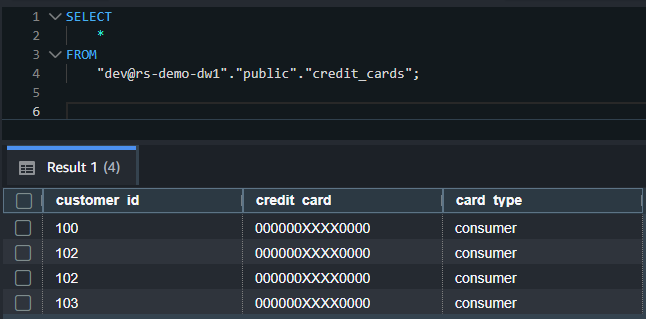
    SELECT * FROM "dev@rs-demo-dw1"."public"."credit_cards";

  4. You should see only consumer type credit cards with card details masked in the output. The RLS and DDM policies applied in data warehouse 1 on the IAMR:ReadOnly user are enforced even though you queried the table from a different data warehouse.
    The following screenshot shows an example output.
  5. For auditing, you can run SHOW commands to view the policies applied on the tables for the roles:
    -- Show all RLS policies in the database.
    SHOW RLS POLICIES FROM DATABASE "dev@rs-demo-dw1";
    -- Show all masking policies in the database.
    SHOW MASKING POLICIES FROM DATABASE "dev@rs-demo-dw1";

This example demonstrates the power of federated permissions: security policies defined one time on a warehouse automatically enforce across your warehouses, maintaining compliance without duplicating policy definitions.

Considerations

Keep in mind the following when using federated permissions:

Clean up

To avoid incurring future charges, delete the resources you created, including the Redshift data warehouses and IAM roles.

Conclusion

Amazon Redshift federated permissions transform multi-warehouse data governance into a streamlined, automated process. For organizations operating multiple Redshift warehouses, federated permissions deliver immediate value by reducing administrative time and supporting consistent security enforcement. The familiar SQL interface and backward compatibility with existing Redshift permissions enable rapid adoption without requiring teams to learn new governance models.

The integration with IAM and IAM Identity Center provides enterprise-grade identity management with SSO capabilities, and the automatic mounting of registered catalogs simplifies data discovery and cross-warehouse analytics. If you are currently using Amazon Redshift local permissions, refer to the tool described in Modernize Amazon Redshift authentication by migrating user management to AWS IAM Identity Center.

To learn more and get started, see Amazon Redshift Federated Permissions documentation.


About the authors

Satesh Sonti

Satesh Sonti

Satesh is a Principal Analytics Specialist Solutions Architect based out of Atlanta, specializing in building enterprise data platforms, data warehousing, and analytics solutions. He has over 20 years of experience in building data assets and leading complex data platform programs for banking and insurance clients across the globe.

Sandeep Adwankar

Sandeep Adwankar

Sandeep is a Senior Product Manager with Amazon SageMaker Lakehouse . Based in the California Bay Area, he works with customers around the globe to translate business and technical requirements into products that help customers improve how they manage, secure, and access data.

Abhishek Rai Sharma

Abhishek Rai Sharma

Abhishek is a Senior Software Engineer focused on Amazon Redshift Catalog and Governance. He is passionate about creating reliable, scalable infrastructure solutions for distributed analytics workloads and enterprise data mesh architectures.

Ramchandra Anil Kulkarni

Ramchandra Anil Kulkarni

Anil is a Senior Software Engineer at Amazon Redshift with expertise in the Governance and Query Processing areas. He is passionate about distributed systems and solving impactful problems for AWS customers.

Ning Di

Ning Di

Ning is a Senior Software Development Engineer at Amazon Redshift, driven by a genuine passion for exploring all aspects of technology.

NVIDIA CES 2026 Keynote Live Coverage

Post Syndicated from Ryan Smith original https://www.servethehome.com/nvidia-ces-2026-keynote-live-coverage/

CES 2026 is here! Kicking things off for the major chipmakers today is NVIDIA, who is at the show to talk about all things AI – a hot topic across the entire industry at the moment. NVIDIA CES 2026 Keynote Live Coverage Preview As with most of NVIDIA’s major presentations, company CEO (and leather jacket […]

The post NVIDIA CES 2026 Keynote Live Coverage appeared first on ServeTheHome.

Metasploit 2025 Annual Wrap-Up

Post Syndicated from Spencer McIntyre original https://www.rapid7.com/blog/post/pt-metasploit-2025-annual-wrap-up

Hard to believe it’s that time again, and that Metasploit Framework will see the dawn of another Annual Wrap-Up (and a New Year). All of the metrics and modules you see here would in large part not be possible without the dedicated community members who care about the Framework and its mission on all the days of the year. It is their hard work and dedication that makes it look like magic, and sometimes, it feels like it too. A heartfelt thank you to all of our researchers and contributors, you’re what makes Metasploit Framework so resilient.

This year brought its share of notable vulnerabilities, substantial framework improvements, and continued evolution of the project. Whether you submitted a module, filed an issue, or helped triage a bug, your contributions have kept Metasploit relevant and powerful. So without further ado, let’s dive into the highlights from 2025.

Persistence Overhaul

One of the year’s significant infrastructure improvements came from community contributor h00die, who spearheaded a massive refactor of Metasploit’s persistence modules. The project, tracked in issue #20374, involved reorganizing dozens of persistence modules from their scattered locations across the framework into a dedicated persistence directory under exploits. This wasn’t just housekeeping—h00die created a standardized persistence mixin that brought consistency to how modules handle installation, cleanup, and option handling. The refactor touched over 30 modules spanning Linux, Windows, OSX, and multi-platform techniques, modernizing each one with proper check methods, MITRE ATT&CK references, and standardized options like WritableDir. The work also laid the groundwork for a persistence suggester module that can automatically recommend viable persistence techniques based on session characteristics.

The sheer scope of this effort can’t be overstated. Breaking the work into manageable chunks, h00die systematically converted modules from the old post-exploitation style to proper exploit modules with the new persistence mixin, handling everything from cron jobs and SSH keys to Windows registry modifications and service installations. The standardization means that all persistence modules now share common behaviors, produce cleanup scripts in a consistent format, and integrate cleanly with the rest of the framework. It’s the kind of unglamorous but essential work that improves the entire framework’s usability and maintainability, and we’re grateful to h00die for taking on such an ambitious project and seeing it through.

AD CS Vulnerable Certificate Template Detection and Exploitation Additions

This year, Metasploit expanded its Active Directory Certificate Services (AD CS) coverage by adding detection and exploitation support for certificate templates vulnerable to ESC9, ESC10, and ESC16. Checks for these misconfigured certificate templates were integrated into the existing ldap_esc_vulnerable_template module, allowing users to easily identify misconfigured templates during assessments.

To complement this detection capability, we introduced the new esc_update_ldap_object module, which enables reliable exploitation of these vulnerable templates to escalate privileges. ESC9, ESC10, and ESC16 share a common pattern: each requires control of a user account with write privileges over another user that is permitted to enroll in the vulnerable template. While exploiting these techniques with other tools typically involves multiple manual and error-prone steps, the new module streamlines the entire workflow. Users configure the required datastore options, run the module, and receive a certificate that can be used to escalate privileges within the domain.

As part of this effort, we also introduced the ldap_object_attribute module, which provides standard CRUD operations for manipulating LDAP objects in Active Directory. This module — along with existing functionality such as shadow_credentials and get_ticket — is used internally by esc_update_ldap_object to abstract away low-level LDAP interactions and simplify exploitation.

This work included comprehensive documentation covering the configuration of templates vulnerable to ESC9, ESC10, and ESC16, as well as detailed instructions for exploiting each technique using the new module.

Active Directory Improvements

Related to our AD CS improvements, came new low-level functionality for interacting with Active Directory (AD) Domain Controllers over LDAP. Over the past couple of years, Metasploit has seen multiple modules added that facilitate AD attack workflows including Shadow Credentials, RBCD, Unconstrained Delegation, etc. Like the AD CS attacks, many of these techniques are reliant on access control to some degree. Over the summer, Metasploit introduced new functionality to facilitate checking for these types of attacks. This new library provides Active Directory specific functionality, most notably, the ability to remotely evaluate security descriptors to determine whether a particular user or group has a specific access right. This has already been incorporated into the following modules to either enable or improve the existing detection capabilities.

  • auxiliary/admin/ldap/shadow_credentials
  • auxiliary/admin/ldap/rbcd
  • auxiliary/admin/ldap/ad_cs_cert_template
  • auxiliary/gather/ldap_esc_vulnerable_cert_finder

For module authors, the library provides a composable API for determining if an object grants a particular permission to an optional SID. The SID can be either a user or group, and when omitted is automatically set to the authenticating user, i.e. to check if the current connection has the permissions.

For example, check if the object grants the read and write property permissions with:

adds_obj_grants_permissions?(@ldap, obj, SecurityDescriptorMatcher::Allow.all(%i[RP WP]))

Code Cleanup At Scale

Beyond new features and modules, 2025 also saw substantial code quality improvements thanks to community contributor bcoles, who took on the often-thankless task of resolving RuboCop violations across the codebase. Throughout the year, bcoles systematically worked through older modules, cleaning up style inconsistencies, fixing syntax violations, and converting outdated property types to proper boolean values in auxiliary scanners and exploit modules. This kind of incremental maintenance work—fixing redundant parentheses here, resolving style violations there—doesn’t make for flashy headlines, but it keeps the codebase maintainable and makes life easier for everyone working in the framework. Code quality matters, and we’re grateful to bcoles for putting in the work to keep Metasploit’s technical debt in check.

Payload Improvements

It may be a fun fact, or perhaps tribal knowledge that an “exploit” to Metasploit is a module that delivers a payload. All the great exploit content this year would be nothing without corresponding payloads to deliver and we make sure that those get plenty of our time as well. The following changes in particular are highly impactful and may have gone unnoticed while the flashier exploits received all the attention.

Windows Meterpreter Improvements

The biggest updates for the Windows Meterpreter revolve around two major improvements: the first is the upgrade to ReflectiveDLLInjection, made by Alex (xaitax) Hagenah, for which we express our gratitude for improving this area of the Metasploit Framework that requires a high level of attention to detail. This update introduces full, production-ready ARM64 support and a comprehensive architectural modernization of the whole library. These changes open the door to future support for a native ARM64 Meterpreter on Windows. Additionally, Metasploit split the standard API extension for Windows this year. This was actually the design used in the original Meterpreter implementation and we’ve reconsidered the monolithic approach. This improvement is one of the multiple steps we have in the pipeline to improve the evasion capabilities for our Windows Meterpreter. The standard API library now allows the user to load only specific subcomponents of the extension (for example, the component for network or file-system interaction), reducing the memory footprint for memory scanners. To leverage this new functionality, set AutoLoadStdapi to False, and then load one or more extensions manually, e.g. load stdapi_fs. To maintain backwards compatibility, a single stdapi extension is also still available and can be loaded with load stdapi.

Fetch Payload Improvements

The first milestone was the introduction of fileless execution for Linux fetch payloads, enabling payloads to run directly from memory using anonymous files. This advancement greatly enhances operational stealth by minimizing forensic traces and avoiding file-based detection, with careful attention to safe, opt-in behavior and collaborative code refinement. Following this, the FETCH_PIPE option streamlined payload deployment into a single, compact command. This improvement enhanced both usability and evasion, while also supporting larger, more complex command payloads (such as fileless execution) to be executed even with reduced command size. Additionally, fetch payload support has expanded to seven additional CPU architectures: aarch64, armbe, armle, mipsbe, mipsle, ppc, and ppc64le. This significantly broadens Metasploit’s reach across embedded and legacy systems. Both features are thoroughly tested and future-proof, making the framework more versatile and powerful.

New Architectures Basic Support

This year, we have also updated the framework to support new basic payloads. We have introduced the exec payload for Windows ARM64 (provided by Alex (xaitax) Hagenah), reverse shell for RISC-V 32 and 64 bit, and Loongarch64 (both provided by bcoles).

COMING SOON

As much as we try, everything doesn’t always fit into one year. With that in mind, we wanted to highlight some upcoming features that we’re particularly excited to complete in the coming months.

Malleable C2

The malleable c2 will allow the user to specify with a .profile scribing how the HTTP requests between meterpreter and metasploit-framework should look like, allowing metasploit to hide the distinctive traffic generated by the session communication.

Direct Syscall in Metsrv

We have updated the Meterpreter core (metsrv) to remove common static signatures, such as specific strings and function imports, making it harder to detect.

PoolParty for 32-bit systems

Additional work to port the poolparty injection on native 32 bit system, Huge thanks to xHector1337 for taking over the research and extension of the code injection for the new architecture.

SCCM Modules

This year, Metasploit added two modules for targeting SCCM instances and recovering the Network Access Account credentials. These modules differ in how they perform the authentication. The first, auxiliary/admin/sccm/get_naa_credentials accepts credentials from the operator and will use them to authenticate and run the attack on demand. This pairs nicely with the auxiliary/admin/dcerpc/samr_account module when the operator can create a new machine account. However, when that’s not an option, Metasploit still has you covered with the auxiliary/server/relay/relay_get_naa_credentials variant that enables relaying NTLM authentication from an SMB server. These attack workflows were demonstrated at Black Hat and DEF CON over the summer and we anticipate they’ll remain useful in the future.

Module Highlights

  • CVE-2025-9316, CVE-2025-11700 N-able N-Central XXE – N-able N-Central is a popular Remote Monitoring and Management (RMM) platform. These two vulnerabilities, when combined, enable Metasploit to read local files without authenticating. This can be used to obtain a number of sensitive backup files from the application itself, or anything else on the host system. XXE attacks are a less common vulnerability, at least in Metasploit-land but this is a fantastic example of how impactful they can be.
  • CVE-2025-22457 Ivanti Connect Secure Unauthenticated RCE – Ivanti RCEs are always valuable and this module shows that memory corruption lives on in 2025. Not only is this exploit unauthenticated and reliable, it is a great example of how ROP chains can be used.
  • CVE-2024-55555 Invoice Ninja RCE – This particular module leverages a PHP deserialization vulnerability within the application. While this vulnerability requires knowledge of the APP_KEY, successful exploitation could have significant financial implications. As an added bonus, this module came with a new library adding support for Laravel Framework-specific cryptography methods.
  • CVE-2024-55556 InvoiceShelf RCE – Everyone loves a good pairing, and this module continues h00die-gr3y’s work on invoicing software, showing that they’re useful for receiving more than just payments.
  • LDAP Password Disclosure – This module has been around for a while, but received some new features in 2025 for targeting Active Directory Domain Controllers. The first added support for LAPSv1 and v2, enabling the module to recover the local admin account on systems. Later in the year, a second improvement added support for gMSA accounts. This module also pairs nicely with the new SMB to LDAP NTLM Relay module we added this year as well.
  • Microsoft SharePoint ToolPane Unauthenticated RCE (CVE-2025-53770 and CVE-2025-53771)
  • Exploit module for CVE-2025-32433 (Erlang/OTP)

SMB Relay Expansion

This year, Metasploit significantly leveled up its relaying capabilities, transforming the framework’s only SMB to SMB relay capability into a powerful engine for lateral movement. Traditionally, SMB relaying was often the domain of standalone external tools, but through the dedicated work of the Metasploit team, these workflows are now seamlessly integrated into the framework

Community Stats Recap

A huge thank you from the entire Metasploit team to all 66 contributors in 2025. Your contributions and ideas are what continue to improve this tool every year. Notably, 41 of these were first-time contributors who added new code.

Here are some stats for 2025:

  • Number of new modules: 139
  • Number of new bug fixes: 133
  • Number of new enhancements: 115
  • Number of new documentations: 19
  • Number of new payload enhancements: 18

Contributors in 2025 (ordered by count)

  • bcoles
  • h00die
  • Chocapikk
  • h00die-gr3y
  • Takahiro-Yoko
  • h4x-x0r
  • smashery
  • vognik (new in 2025)
  • jvoisin
  • xHector1337 (new in 2025)
  • jmartin-tech
  • mariomontecatine (new in 2025)
  • blue0x1 (new in 2025)
  • nakkouchtarek (new in 2025)
  • molecula2788
  • xaitax
  • happybear-21 (new in 2025)
  • e2002e
  • fabpiaf (new in 2025)
  • mekhalleh
  • JohannesLks (new in 2025)
  • BitTheByte (new in 2025)
  • todb
  • 00nx (new in 2025)
  • DevBuiHieu (new in 2025)
  • SweilemCodes (new in 2025)
  • arpitjain099 (new in 2025)
  • L-codes
  • Zeecka (new in 2025)
  • aaryan-11-x
  • whotwagner
  • lafried (new in 2025)
  • sebaspf (new in 2025)
  • hantwister (new in 2025)
  • tastyrce (new in 2025)
  • easymoney322 (new in 2025)
  • gardnerapp
  • TheBigStonk (new in 2025)
  • 0xAryan (new in 2025)
  • sempervictus
  • szymonj99
  • Mathiou04
  • vultza (new in 2025)
  • enty8080 (new in 2025)
  • SaiSakthidar (new in 2025)
  • Zedeldi (new in 2025)
  • stfnw (new in 2025)
  • mmacfadden (new in 2025)
  • daffainfo (new in 2025)
  • HamzaSahin61 (new in 2025)
  • survivant (new in 2025)
  • uhei
  • EchoSl0w (new in 2025)
  • jeffmcjunkin
  • BenoitDePaoli (new in 2025)
  • randomstr1ng
  • 2tunnels (new in 2025)
  • rodolphopivetta (new in 2025)
  • RakRakGaming (new in 2025)
  • Desiree05 (new in 2025)
  • Wopseeion (new in 2025)
  • jphamgithub (new in 2025)
  • H4k1l (new in 2025)
  • fishBone000 (new in 2025)
  • xl4635 (new in 2025)

[$] Predictions for the new year

Post Syndicated from corbet original https://lwn.net/Articles/1052269/

The calendar has flipped over to 2026; a new year has begun. That means
the moment we all dread has arrived: it is time for LWN to put out a set of
lame predictions for what may happen in the coming year. Needless to say,
we do not know any more than anybody else, but that doesn’t stop us from
making authoritative-sounding pronouncements anyway.

Happy New Year! AWS Weekly Roundup: 10,000 AIdeas Competition, Amazon EC2, Amazon ECS Managed Instances and more (January 5, 2026)

Post Syndicated from Prasad Rao original https://aws.amazon.com/blogs/aws/happy-new-year-aws-weekly-roundup-10000-aideas-competition-amazon-ec2-amazon-ecs-managed-instances-and-more-january-5-2026/

Happy New Year! I hope the holidays gave you time to recharge and spend time with your loved ones.

Like every year, I took a few weeks off after AWS re:Invent to rest and plan ahead. I used some of that downtime to plan the next cohort for Become a Solutions Architect (BeSA). BeSA is a free mentoring program that I, along with a few other Amazon Web Services (AWS) employees, volunteer to host as a way to help people excel in their cloud and AI careers. We’re kicking off a 6-week cohort on “Agentic AI on AWS” starting February 21, 2026. Visit the BeSA website to learn more.

There is still time to submit your idea for the Global 10,000 AIdeas Competition and compete for $250,000 in cash prizes, AWS credits, and recognition, including potential featured placement at AWS re:Invent 2026 and across AWS channels.

You will gain hands-on experience with next-generation AI development tools, connect with innovators globally, and access technical enablement through biweekly workshops, AWS User Groups, and AWS Builder Center resources.

The deadline is January 21, 2026, and no code is required yet. If you’re selected as a semifinalist, you’ll build your app then. Your finished app needs to use Kiro for at least part of development, stay within AWS Free Tier limits, and be completely original and not yet published.

If you haven’t yet caught up with all the new releases and announcements from AWS re:Invent 2025, check out our top announcements post or watch the keynotes, innovation talks, and breakout sessions on-demand.

Launches from the last few weeks
I’d like to highlight some launches that got my attention since our last Week in Review on December 15, 2025:

  • Amazon EC2 M8gn and M8gb instances – New M8gn and M8gb instances are powered by AWS Graviton4 processors to deliver up to 30% better compute performance than AWS Graviton3 processors. M8gn instances feature the latest 6th generation AWS Nitro Cards, and offer up to 600 Gbps network bandwidth, the highest network bandwidth among network-optimized EC2 instances. M8gb offer up to 150 Gbps of Amazon EBS bandwidth to provide higher EBS performance compared to same-sized equivalent Graviton4-based instances.
  • AWS Direct Connect supports resilience testing with AWS Fault Injection Service – You can now use AWS Fault Injection Service to test how your applications handle Direct Connect Border Gateway Protocol (BGP) failover in a controlled environment. For example, you can validate that traffic routes to redundant virtual interfaces when a primary virtual interface’s BGP session is disrupted and your applications continue to function as expected.
  • New AWS Security Hub controls in AWS Control Tower – AWS Control Tower now supports 176 additional Security Hub controls in the Control Catalog, covering use cases including security, cost, durability, and operations. With this launch, you can search, discover, enable, and manage these controls directly from AWS Control Tower to govern additional use cases across your multi-account environment.
  • AWS Transform supports network conversion for hybrid data center migrations – You can now use AWS Transform for VMware to automatically convert networks from hybrid data centers. This removes manual network mapping for environments running both VMware and other workloads. The service analyzes VLANs and IP ranges across all exported source networks and maps them to AWS constructs such as virtual private clouds (VPCs), subnets, and security groups.
  • NVIDIA Nemotron 3 Nano available on Amazon Bedrock – Amazon Bedrock now supports NVIDIA Nemotron 3 Nano 30B A3B model, NVIDIA’s latest breakthrough in efficient language modeling that delivers high reasoning performance, built-in tool calling support, and extended context processing with 256K token context window.
  • Amazon EC2 supports Availability Zone ID across its APIs – You can specify the Availability Zone ID (AZ ID) parameter directly in your Amazon EC2 APIs to guarantee consistent placement of resources. AZ IDs are consistent and static identifiers that represent the same physical location across all AWS accounts, helping you optimize resource placement. Prior to this launch, you had to use an AZ name while creating a resource, but these names could map to different physical locations. This mapping made it difficult to ensure resources were always co-located, especially when operating with multiple accounts.
  • Amazon ECS Managed Instances supports Amazon EC2 Spot Instances – Amazon ECS Managed Instances now supports Amazon EC2 Spot Instances, extending the range of capabilities available with AWS managed infrastructure. You can use spare EC2 capacity at up to 90% discount compared to On-Demand prices for fault-tolerant workloads in Amazon ECS Managed Instances.

See AWS What’s New for more launch news that I haven’t covered here. That’s all for this week. Check back next Monday for another Weekly Roundup!

Here’s to a fantastic start to 2026. Happy building!

– Prasad

Security updates for Monday

Post Syndicated from jzb original https://lwn.net/Articles/1052795/

Security updates have been issued by AlmaLinux (tar), Debian (curl and gimp), Fedora (doctl, gitleaks, gnupg2, grpcurl, nginx, nginx-mod-brotli, nginx-mod-fancyindex, nginx-mod-headers-more, nginx-mod-modsecurity, nginx-mod-naxsi, nginx-mod-vts, and usd), Mageia (cups), Red Hat (container-tools:rhel8, go-toolset:rhel8, grafana, and skopeo), and SUSE (dirmngr, fluidsynth, gnu-recutils, libmatio-devel, python311-marshmallow, python312-Django6, rsync, and thunderbird).

Telegram Hosting World’s Largest Darknet Market

Post Syndicated from Bruce Schneier original https://www.schneier.com/blog/archives/2026/01/telegram-hosting-worlds-largest-darknet-market.html

Wired is reporting on Chinese darknet markets on Telegram.

The ecosystem of marketplaces for Chinese-speaking crypto scammers hosted on the messaging service Telegram have now grown to be bigger than ever before, according to a new analysis from the crypto tracing firm Elliptic. Despite a brief drop after Telegram banned two of the biggest such markets in early 2025, the two current top markets, known as Tudou Guarantee and Xinbi Guarantee, are together enabling close to $2 billion a month in money-laundering transactions, sales of scam tools like stolen data, fake investment websites, and AI deepfake tools, as well as other black market services as varied as pregnancy surrogacy and teen prostitution.

The crypto romance and investment scams regrettably known as “pig butchering”—carried out largely from compounds in Southeast Asia staffed with thousands of human trafficking victims—have grown to become the world’s most lucrative form of cybercrime. They pull in around $10 billion annually from US victims alone, according to the FBI. By selling money-laundering services and other scam-related offerings to those operations, markets like Tudou Guarantee and Xinbi Guarantee have grown in parallel to an immense scale.

Възможно ли е градската среда да изглежда добре с ниски местни данъци?

Post Syndicated from Боян Юруков original https://yurukov.net/blog/2026/mestni-danaci/

Наскоро в групите в район Изгрев, София се отвори тема за ремонти с публични средства направени изглежда приоритетно пред новия хотел на 4-ти километър. Писал съм за това преди. Районният кмет отрича да има връзка, но нов асфалт на навярно най-разбитата улица в района е положен буквално до гаражите на сданието, а парк в края на района до булеварда беше направен скоростно точно след като заработи хотела при множество проблемни детски площадки и паркове до училища и градини из целия район.

Има съмнения за доста проблеми около разрешенията на самия хотел, озеленяването му и огромния билборд, който са направили. Обърнаха се към мен обаче в една група с принципен въпрос – как се очаква с толкова ниски местни данъци да се оправят градинки, паркове, детски площадки и цялата инфраструктура.

Отговорът ми се получи доста изчерпателен и тъй като не обичам да обяснявам едно и също на много места, ще го поместя тук с дребни корекции, за да препращам към него в бъдеще. Сложих и няколко линка към стари статии, в които съм разгледал в детайли аспекти от темата.


Новото строителство има задължителна озеленяване, което трябва да се поддържа. Често не се прави въобще или недостатъчно или не по изискванията или просто 2 до 5 години каквото има като зеленина се бетонира за паркоместа. Отговорност на районният кмет е да не го допуска, но не го прави. Подавал съм много сигнали за такива проблеми, но или ги заравя, или зачерква без реални проверки.

Ако се поддържа въобще, както е в комплексите, това идва от таксата на сградата. Решава се от блока, но като цяло не отиват повече от 5 до 20 лв. на месец. Това обаче е само за прилежащата зеленина към имота.

В квартала, където живеех във Франкфурт, нямаше такава такса, каквато говорите. Имаше си такса към блока отново за прилежащата зеленина. Парковете и зеленината в квартала се поддържаха от данъка на жилищата. Всеки град в Германия има различни политики и такси. Често по квартали е различно дори, особено в историческите части. Във Франкфурт имаше дори обществени съвети по квартали, където да се обсъждат и поставят такива теми. Понякога и да се налагат местни такси за определена цел. В някои села, поне в Хесен, карат живеещите според зоната да плащат част от разхода за ремонт на пътища, тротоари и зеленина. Не е пожелателно и стига десетки хиляди. Чел съм за случаи, в които хора продават къщите си заради такива наложени такси.

В София всичко на общинска собственост се поддържа от бюджета на общината. Той идва както от данъците на жилищата, така и от доста други проходи като такси за строителство, продажба или наеми на общински имоти за сгради, търговски площи и билбордове и прочие. Голяма част идва директно от държавния бюджет, както и конкретни целеви програми – предимно за инфраструктура. От същият бюджет идва чистенето на улиците, махането на снега и прочие.

Дали софиянци биха се съгласили на нова такса е спорно. Повечето по-скоро не, защото не смятат, че ще се използва рационално. Пример са таксите и глобите за паркиране, които трябваше да отиват за оправяне на тротоари и пътища, но потъват предимно в частни ръце заради ръководството на ЦГМ.

В този смисъл проблемът си остава управлението на сегашните приходи и да се покаже на жителите на града, че ако дават повече, ще получават повече. Отделно го има политическия аспект, че СОС в сегашния си формат може и да приеме вдигане на данъците, но предвид историята му ще ги натика в общински фирми с лошо управление, за да изтекат, а вината за това ще прехвърли на общината. Разбира се, харченето на публични средства в полза на няколко едри инвеститори, а не мнозинството живеещи в един квартал, каквито съмнения има нерядко, също разрушава доверието, че се използват целесъобразно. Не на последно място в зависимо какъв данък се вдига, вероятно ще трябват законодателни промени, за да се предвиди новата схема от ставки и намаления за първо жилище и/или необитавани такива.

Определено данък жилища е много нисък. Говори се отдавна за вдигане на процентът от данъчната оценка, особено за второ и трето жилище и такива, в които не се живее. Не бяха приети предложенията, а Конституционният съд излезе преди години с доста странно и изпълнено със съмнения за лобизъм решение, че не можело данъка да зависи от използването на даден имот. Миналата година имаше инициатива да се преизчислят данъчните оценки на реални пазарни цени, защото сега са многократно по-ниски, но беше блокирано отново от икономически интереси. Местните данъци и много други такси се изчисляват на база данъчна оценка. Та има много законодателни и нормативни инициативи за това, но се блокират по политически или лобистки причини в СОС и НС.

Друг важен детайл е, че в София много зелени площи всъщност са частни, а не държавни. Особено междублокови пространства. Затова направих карта на известната собственост в 25 български града, за да може всеки от нас да провери. Общината няма задължение, а в известен смисъл и право, да поддържа тези площи. Понякога хора от квартала се хващат и ги оправят, включително с пейки и алеи. След това се появява собственика, загражда и строи. Има отново редовно инициативи да се изкупят тези пространства, както и аналогични в паркове, но са нужни милиарди евро за целта. Имаше шанс да струват стотици милиони и по-малко ако по времето на Фандъкова бяха използвали възможност в закона преди повече от 5 г., но отчасти нарочно не беше направено.

Иначе детските градини и инфраструктура се плащат често от държавния бюджет или европрограми. Компенсациите за неприемане на дете в градина или ясла, например, са от държавния бюджет. Има и доста държавни имоти, за които отговаря държавата или държавни фирми, но буренясват.

Още информация по тази тема:

ASUS Ascent GX10 Review A New NVIDIA GB10 Solution

Post Syndicated from Ryan Smith original https://www.servethehome.com/asus-ascent-gx10-review-a-new-nvidia-gb10-solution/

Asus has released their NVIDIA GB10-based mini-PC, the Ascent GX10. Based on NVIDIA’s powerful Spark platform, the GX10 offers a large amount of high-end AI hardware in a tiny box

The post ASUS Ascent GX10 Review A New NVIDIA GB10 Solution appeared first on ServeTheHome.

Kernel prepatch 6.19-rc4

Post Syndicated from corbet original https://lwn.net/Articles/1052732/

The 6.19-rc4 kernel prepatch is out for
testing.

So this rc is still a bit smaller than usual, but it’s not _much_
smaller, and I think next week is likely going to be more or less
back to normal.

Which is all exactly as expected, and nothing here looks
particularly odd. I’ll make an rc8 this release just because of the
time lost to the holidays, not because it looks like we’d have any
particular issues pending (knock wood).

The collective thoughts of the interwebz