Tracepoints in the kernel are useful for a variety of purposes: debugging,
active monitoring, and performance measurements, among other things. Previously,
any given BPF program could only be attached to a single tracepoint.
Jiri Olsa has been working to change that, and led a discussion about
his progress at the 2026
Linux Storage, Filesystem, Memory-Management, and BPF
Summit. That work has since been
merged, and can be expected as part of the 7.2
kernel.
AWS CloudFormation is the foundational tool of infrastructure-as-code for thousands of organizations running workloads on AWS. But as teams push the boundaries of what CloudFormation can do natively, custom resources have emerged as a powerful extension mechanism that unlocks a broad range of possibilities. Yet, when it comes to building resilient, multi-Region deployments with custom resources, customers quickly discover a gap: there is no built-in multi-Region support. In this post, we will explore that challenge and go over a robust active-active architecture that solves it.
A CloudFormation custom resource allows you to write custom provisioning logic that AWS CloudFormation invokes during stack operations (Create, Update, or Delete). When CloudFormation encounters a custom resource in a template, it sends a lifecycle event to a target, typically an AWS Lambda function through an Amazon Simple Notification Service topic. CloudFormation waits for a response with a presigned URL, and then proceeds or rolls back based on that response.
Customers use Custom Resources for a wide variety of use cases, including:
Third-party API integrations to provision resources in external systems (for example, DNS providers, SaaS providers) as part of a CloudFormation stack.
Complex initialization logic for seeding databases, generating secrets, or bootstrapping configurations that CloudFormation doesn’t natively support.
Cross-account or cross-service orchestration for triggering workflows in other AWS accounts or services during stack lifecycle events.
Custom validation and compliance checks enforcing organizational policies before a stack is allowed to complete.
Resource types not yet supported natively for bridging the gap until AWS adds first-class support.
In short, Custom Resources turn CloudFormation into a fully extensible orchestration engine instead of only an AWS resource provisioner.
While single-Region deployments can achieve high resilience, multi-Region architectures become essential for organizations that need to meet specific business requirements. These include stringent disaster recovery objectives, data residency mandates, latency-sensitive use cases across geographies, and mission-critical business continuity needs. However, when it comes to CloudFormation Custom Resources, multi-Region design introduces a set of hard problems that CloudFormation does not solve natively:
No native fan-out mechanism: CloudFormation stacks in different Regions each trigger their own custom resource events independently. There is no built-in way to coordinate these events across Regions.
Duplicate execution risk: If you deploy the same Lambda function handler in multiple Regions to achieve redundancy, both instances may process the same event. This can lead to duplicate side effects (for example, creating the same record twice in a database or calling an external API multiple times).
No distributed locking: CloudFormation provides no mechanism to verify that only one handler processes a given event, even when multiple handlers are active.
No automated failover: If the primary Region’s Lambda function handler fails, there is no built-in mechanism to automatically route the event to a secondary Region.
Idempotency is your problem: Helping verify that retries and failover scenarios don’t cause unintended duplicate operations is entirely the responsibility of the developer.
Until now, these gaps meant that teams either accept the risk of single-Region custom resource handlers (a reliability concern) or build complex, bespoke solutions to handle multi-Region scenarios.
This proposed architecture delivers an active-active multi-Region solution for CloudFormation custom resource processing. It is designed around four core principles:
Active-Active processing: Both the primary Region (us-east-1) and secondary Region (us-west-2) are always live and capable of handling events.
No duplicate execution: A DynamoDB Global Table-based distributed locking mechanism helps verify that only one Region processes any given event, regardless of which Region receives it first.
Idempotency mechanism: Every request is tracked by state, so retries and failover scenarios are designed to avoid duplicate side effects.
Fully automated failover: Amazon Application Recovery Controller detects failures and triggers failover without manual intervention.
This architecture avoids the single points of failure inherent in single-Region custom resource designs while preventing the duplicate processing risks of naive multi-Region approaches. This architecture is ideal for mission-critical workloads where regional failures cannot be tolerated.
The following section provides a detailed walkthrough of how this architecture processes a CloudFormation lifecycle event from end to end.
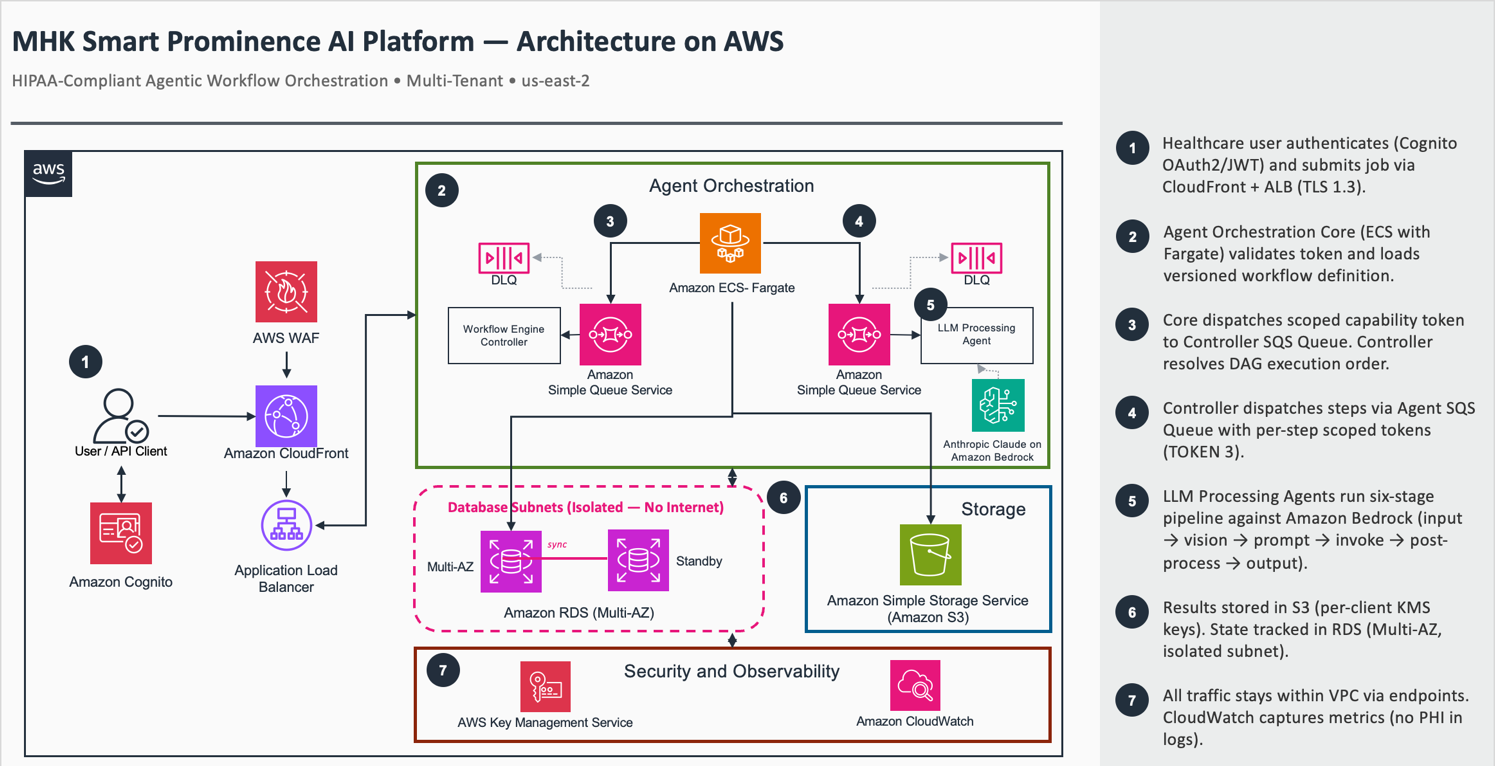
This architecture diagram describes a multi-Region CloudFormation custom resource architecture operating in an Active-Active configuration. It handles CloudFormation lifecycle events (Create/Update/Delete) with high availability and no duplicate processing across multiple AWS Regions. The architecture uses a central primary Region (us-east-1) and a secondary Region (us-west-2) to process custom resource events, with Amazon DynamoDB Global Tables providing distributed locking and idempotency, and Amazon Application Recovery Controller providing automated failover. Customer AWS Regions fan out events simultaneously to both infrastructure Regions, supporting resilience even if the primary Region fails.
Step 1: Event initiation (Customer Regions)
A CloudFormation Stack in one of the customer Regions (us-east-1, eu-west-1, or ap-southeast-1) initiates a Create, Update, or Delete lifecycle event. Along with the event payload, CloudFormation generates a presigned response URL that the handler must call to signal success or failure. This event is published to a local Amazon Simple Notification Service (SNS) topic within that customer Region.
Step 2: Cross-Region fan-out with SNS subscriptions
The Amazon SNS topic is configured with cross-region subscriptions that simultaneously fan out the event to two Amazon SQS queues in the central infrastructure AWS Regions:
Primary SQS queue: Central Infrastructure Region: us-east-1.
Secondary SQS queue: Central Infrastructure Region: us-west-2.
Both queues receive the event at the same time, setting up the Active-Active processing model.
Step 3: Primary Lambda function handler (Immediate processing)
The Primary SQS queue triggers the Primary Lambda Custom Resource Handler immediately, with no delay. The Lambda function executes the following steps:
Check the DynamoDB Global Table for an existing lock on this request.
Acquire the lock by using a conditional write (only succeeds if no lock exists, preventing race conditions).
Execute the custom resource business logic.
Send a SUCCESS or FAILED response back to CloudFormation using the presigned URL.
Update the DynamoDB state to mark the request as fully processed.
Step 4: Secondary Lambda function handler (Delayed processing)
The Secondary SQS queue is configured with a delay, implemented by using either an SQS Delay Queue or a Visibility Timeout. After this delay, the Secondary Lambda Custom Resource Handler runs:
Check the DynamoDB Global Table Replica for an existing lock.
Skip processing if the primary has already handled the request (idempotency check).
Acquire the lock if the primary has not yet processed it (failover scenario).
Execute the custom resource logic if the lock was successfully acquired.
Send the response to CloudFormation.
The delay is intended to give the primary Region time to process the event first. The secondary only takes over if the primary has not completed processing within the delay window.
Step 5: DynamoDB Global Tables: Distributed locking and idempotency
Amazon DynamoDB Global Tables are the backbone of coordination in this architecture. Both Regions read from and write to the Global Table with strong consistency. The table tracks:
Lock state: Which Region holds the lock for a given request.
Idempotency records: Whether a request has already been processed.
Request state: The full lifecycle status of each event.
Bidirectional replication is designed to help maintain both Regions with the latest state, supporting the lock mechanism’s reliability despite network partitions or regional degradation.
Step 6: CloudFormation response
After either the primary or secondary Lambda function handler completes processing, CloudFormation receives the SUCCESS or FAILED callback using the pre-signed URL. Based on this response, CloudFormation either continues the stack operation or initiates a rollback.
Step 7: Amazon CloudWatch monitoring
Amazon CloudWatch alarms continuously monitor SQS queue depth and Lambda execution health in both Regions. These alarms serve as the early warning system for the automated failover mechanism.
Step 8: Automated failover with ARC
If the primary Region (us-east-1) experiences a failure, CloudWatch detects it and triggers Amazon Application Recovery Controller to initiate automated failover to the secondary Region (us-west-2). No manual intervention is typically required. The secondary Region is designed to take over processing responsibilities.
Clean up
Delete resources created using the following AWS services in every Region to avoid additional costs:
ARC.
SNS topic.
SQS queue/messages.
DynamoDB table.
Lambda code.
CloudWatch Log Groups.
IAM roles.
CloudFormation (if used for automation).
Any other AWS service used for customizing your deployment.
Conclusion
CloudFormation Custom Resources are an indispensable tool for teams building sophisticated infrastructure automation on AWS. However, the lack of native multi-Region support has long been a barrier to building truly resilient custom resource architectures.
This architecture addresses the major challenge directly:
Resilience: Active-Active design means no single Region is a bottleneck or single point of failure.
Correctness: Amazon DynamoDB distributed locking and idempotency designed to eliminate duplicate processing.
Automation: Amazon Application Recovery Controller-driven failover removes the need for manual intervention during regional outages.
Scalability: The fan-out model with SNS cross-Region subscriptions supports multiple customer Regions simultaneously.
For teams operating at scale across multiple AWS Regions, this architecture provides a blueprint for extending the power of CloudFormation without sacrificing reliability. Whether you’re managing compliance-driven multi-Region deployments or building for global high availability, this pattern gives you a foundation for resilient custom resource processing.
Call to action
Refer to the following content to learn more about relevant AWS services:
САЩ е съюзник и стратегически партньор на България. А режимът на аятоласите е репресивен режим, който стреля по собствените си граждани по улиците.
Но за съжаление никое българско правителство не би имало лукса да вземе свободно решение дали да разположи американските цистерни на българско летище. Защото realpolitik фактите са, че ако откажем, дерогацията за рафинерията в Бургас може да бъде отменена, а никое правителство не може да остави страната без бензин, дизел и авиационно гориво.
И ние разбираме това. Затова няма да злорадстваме, да ехидничим, да наричаме Прогресивна България „войнолюбци“, да плашим хората или да се отдаваме на евтин популизъм. Но именно Радев и Прогресивна България се отдадоха на такъв популизъм само преди няколко месеца. Обясняваха какви заплахи имало за страната и продаваха страх.
Очакванията на обществото трябва да се посрещат, но като политици имаме отговорност и да създаваме разумни очаквания. Да не злоупотребяваме с трибуната, която ни е дадена и да не се заиграваме със страхове. Нещо, което сега управляващите и конкретно Радев правеха дълго време.
Но когато дълбаеш разделителни линии в обществото дълги години, неизбежно пропадаш в тях.
Разбираме и желанието им да удържат несъвместимата електорална коалиция, която ги избра, но със захаросване на фактите, с атака по опозицията и с приказки за грандизиони бъдещи сделки няма да стане.
Всичко ни се представя като серия от сделки, транзакции, от които уж България печели. Но сме наясно, че няма как да си най-хитрия, и да въртиш едностранни „сделки“ със САЩ, Русия, Китай, Турция – това няма да свърши добре.
За съжаление, правителството на Радев не говори за Европейския съюз като за решение на всички тези проблеми, които сега се налага да решаваме с непрозрачни транзакции. Вероятно защото Европейският съюз е съюз на ценности и на солидарност, а не на политически транзакции.
ЕС е формиран на база на отстъпките, на консенсуса, на солидарността и на споделените ценности, а правителството на Прогресивна България руши презумпцията за солидарност – казва „дайте ни еврофондовете и ние няма да ви пречим“ – нещо, което противоречи на европейската идея.
Дългосрочното решение за сигурността на България минава през превръщането на ЕС в силен геополитически полюс. Иначе всяка държава ще се превърне в плячка на по-големите, защото никоя държава сама не може да преговаря от достатъчно добра позиция. А ние, с нашите пробити служби и неизградени институции ще сме сред най-лесните плячки. И докато си мислим, че се договаряме със САЩ, Русия, Китай и Турция, всъщност ще губим още и още суверенитет – т.е. способността да вземаме сами решения, без някоЙ да ни казва „ако не го направиш, ще ти спра това или онова“.
Правителството няма мандат за руши европейския консенсус, няма мандат да отклонява България от европейската солидарност. И трябва да бъде честно с българските граждани, да каже какъв курс реално поема.
Правителството днес можеше да получи нашата подкрепа за трудното и непопулярно решение, ако бяха честни, смиерни и ако с действията си до момента представяха план за алтернатива на транзакционното затъване.
Но вместо това те внесоха за гласуване решението без да ни предоставят нотата на САЩ, без цялостен доклад за рисковете от военното разузнаване и без отговор за това каква сделка всъщнсот сключват.
Затова днес не участвахме в гласуването, оставяйки управлявщите насаме със собственото си лицемерие и популизъм, и в компанията на Пеевски, който гласува всичко американско, с продължаващата надежда да бъде изваден от санкционния списък.
И правим това не за да натрием носа на управляващите за предишните им изказвания, с които насаждаха страх и разделение, а за да разберат, че когато управляваш, носиш много повече отговорност от това да казваш няколко добре формулирани изречения пред камери.
According to Siemens’ 2024 report The True Cost of Downtime, Fortune 500 companies lose an estimated $1.4 trillion annually because of unplanned downtime. This downtime is often worsened by a lack of skills to detect and resolve issues quickly. Generative AI offers a promising path to address this, but deploying these capabilities in industrial environments introduces a distinct architectural challenge: how do you bring the power of large-scale AI to locations where cloud connectivity is unreliable or unavailable?
The answer lies in an offline-first architecture, one that moves AI inference to the edge while using cloud services for model customization, deployment orchestration, and continuous improvement. This pattern requires careful coordination across multiple AWS services spanning artificial intelligence and machine learning (AI/ML), Internet of Things (IoT), and storage, and demands deliberate trade-offs between model capability, hardware constraints, and operational complexity.
The following are a few potential use cases that could benefit smart applications at the edge:
Maintenance crews struggle to correlate real-time log feeds with relevant machine manuals, and analyze situations in-hand.
Offshore platforms, remote drilling sites, and pipeline maintenance crews operating in areas with limited satellite connectivity requiring instant access to safety procedures, equipment manuals, and regulatory compliance documentation.
Remote agricultural facilities with precision farming equipment requiring access to machinery manuals, crop management protocols, and safety procedures.
In this post, we walk through a reference architecture for building and deploying a generative AI application at the edge using AWS services. We cover the end-to-end pattern, from model customization in the cloud using Amazon Bedrock and Amazon SageMaker AI, to edge deployment using AWS IoT Greengrass, to local inference orchestrated by Strands Agents. Along the way, we highlight the key architectural decisions and service integration patterns that make this approach work.
This post describes a reference architecture. It is not intended for direct production use. Perform a security review and implement controls appropriate to your workload before deploying to production.
Architectural decisions for offline-first AI
Designing an offline-first AI architecture starts with a critical decision: how to customize a language model for your domain while keeping it small enough to run on edge hardware. The model must fit within the compute and memory constraints of site-level devices (typically GPUs with 16 GB or more of VRAM), which means working with small language models (SLMs). The customization strategy you choose directly affects your architecture’s complexity, cost, and data pipeline requirements.
The following strategies represent increasing levels of architectural complexity, each with different infrastructure requirements and expected outcomes:
Model fine-tuning (FT): A relatively lightweight process to adapt a pre-trained model for specialized tasks. For example, you could fine-tune a model to answer troubleshooting questions about specific equipment using labeled Q&A pairs from maintenance tickets. Fine-tuning excels at teaching a model the format, style, and structure of the outputs you want. However, it’s less effective at injecting new domain knowledge that wasn’t in the base model’s original training data.
Continued pre-training (CPT): A more resource-intensive process that extends the base model’s training with domain-specific unlabeled data to embed new knowledge. For example, you could continue training on technical manuals, repair logs, and engineering documentation to teach the model equipment-specific terminology, failure patterns, and diagnostic procedures. This approach effectively injects domain knowledge into model parameters but requires significant computational resources and larger datasets compared to fine-tuning.
Hybrid approach (FT + RAG): Retrieval Augmented Generation (RAG) enhances model responses by retrieving relevant documents at inference time, which provides accurate, up-to-date answers with source citations and reduces hallucinations. For our edge implementation, we use ChromaDB (SQLite + HNSW defaults) with a sentence-transformer embedding model (384 dimensions) running on CPU. Documents are chunked at 512 tokens with 50-token overlap. With a dataset up to 5 GB, retrieval latency stays under 50 ms. The entire RAG pipeline lives on CPU/SSD with zero GPU VRAM consumption, keeping the full 16 GB dedicated to the large language model (LLM).
Hybrid approach (CPT + RAG + FT): Combines continued pre-training of the embedding model with fine-tuning of the language model to optimize the entire RAG pipeline. Through continuing training your embedding model on domain-specific queries to better understand domain-specific terminology and jargon, while fine-tuning your language model on Q&A pairs for the format and tone you want. For example, when an operator asks about the state of a cookie machine, they expect to get the application to check current state, throughput per minute, and visual quality of Cookies! This dual optimization ensures both accurate retrieval and high-quality responses, ideal for knowledge-intensive applications.
To decide on the right strategy for your application, you need to work backward from the use case requirements and expected outcomes.
Reference architecture
Let’s examine a reference architecture for an edge-deployed generative AI solution built on AWS. This architecture addresses a manufacturing use case where operators need instant access to equipment documentation, log correlation, and troubleshooting guidance, all without depending on cloud connectivity. We chose the hybrid approach (FT + RAG) because it balances two architectural concerns: keeping the on-device model compact through fine-tuning for task-specific behavior, while using RAG to provide up-to-date knowledge retrieval without retraining. The following diagram depicts the end-to-end architecture:
Note: The architecture spans two trust domains. On the cloud side, each service (Amazon Simple Storage Service (Amazon S3), Amazon Bedrock, SageMaker AI, IoT Greengrass) operates under a dedicated least-privilege AWS Identity and Access Management (IAM) role. All cloud-to-edge communication uses mutual TLS using IoT Greengrass device certificates. The operator portal requires authentication. On the edge device, the operator.
The architecture is organized into three layers: cloud-side preparation (steps 1–3), deployment orchestration (step 4), and edge-side inference (steps 5–9). Each layer uses specific AWS services chosen for their integration capabilities.
1. Document base setup
Technical manuals and Standard Operating Procedures (SOPs) are stored in Amazon S3, serving as the single source of truth for both the cloud-side training pipeline and the edge-side RAG knowledge base. The integration of Amazon S3 with both SageMaker AI and IoT Greengrass makes it the natural choice for artifacts that must flow between cloud and edge.
2. Preparing labeled data
Using Amazon Nova Pro on Amazon Bedrock, we process raw documentation into structured question-answer-context pairs for fine-tuning. This is a key architectural decision: rather than manually curating training data, we use a large foundation model (FM) in the cloud to generate high-quality labeled data at scale. The serverless inference of Amazon Bedrock keeps this step cost-effective, and the output feeds directly into the SageMaker AI pipeline.
3. Model customization (FMOps pipeline)
Amazon SageMaker AI Pipelines orchestrates an automated FMOps pipeline that fine-tunes gpt-oss-20b (Mixture of Experts (MoE) architecture: 21B total parameters, 3.6B active per token, 32 experts, 128k context length) on the domain-specific Q&A pairs. The pipeline pattern here is deliberate: it enables repeatable, versioned model customization that can be triggered whenever new documentation is added. The pipeline trains the model to understand equipment-specific terminology and response formats, then stores the customized model artifact in S3 for downstream deployment.
4. Edge deployment
The edge device (in our case, a g4dn.12xlarge with 4× NVIDIA T4 GPUs, 16 GiB each, 64 GiB total accelerator memory, 48 vCPUs, and 129 GiB system RAM) provides the GPU compute necessary for local inference. The hardware selection is an important architectural constraint that directly influences model viability and serving strategy. With gpt-oss-20b occupying 13 GB per T4 GPU, two deployment strategies are available depending on your throughput and latency priorities:
Model Replication — a full model copy on each of the four GPUs, which supports four concurrent client requests without queuing. This maximizes throughput at the cost of using 81 percent of each GPU’s memory for model weights alone.
Tensor Parallelism — the model is sharded across all four GPUs at 3.2 GB per GPU, leaving approximately 12.8 GB available on each GPU. This remaining memory serves as KV cache, supporting the full 128K context window for long-form interactions.
The choice between these strategies depends on your workload profile: replication suits high-concurrency, short-query environments, while tensor parallelism suits fewer concurrent users with longer, more complex interactions.
5. Edge device (manufacturing facility)
The edge device (in our case, NVIDIA Jetson Xavier) provides the GPU compute necessary for local inference. The hardware selection is an important architectural constraint: you need sufficient VRAM (16 GB or more) to run the quantized SLM, which directly influences which models are viable for your deployment.
6. User interface (Flask operator portal)
A Flask-based web interface running locally on the device allows maintenance operators and technicians to submit queries about equipment issues, safety procedures, or maintenance tasks. Running the UI on-device eliminates any dependency on external connectivity for the user-facing layer.
7. Off-cloud generative AI
The fine-tuned SLM runs on-premises using Ollama as the inference runtime. Ollama provides a lightweight, container-friendly serving layer that supports quantized model formats (GGUF) for efficient inference within the device’s memory constraints. This decouples the model serving infrastructure from any cloud dependency.
8. Generative AI orchestration
Strands Agents provides the orchestration layer that coordinates the query processing workflow. It routes requests to the appropriate tools: querying the on-site RAG knowledge base, collecting device telemetry data. This agent-based pattern provides extensibility. You can add new tools and data sources without modifying the core inference pipeline.
9. Continuous improvement (feedback loop)
When connectivity is available, user interactions and feedback flow back to the cloud, enabling ongoing model refinement through the FMOps pipeline. This creates a virtuous cycle: edge usage data improves the next model version, which Greengrass deploys back to the device. The architecture is designed to be resilient to connectivity gaps. Feedback is queued locally and synchronized opportunistically.
Prerequisites
To be able to implement a similar solution, you need:
An AWS account. If you don’t already have an AWS account, you can create one.
Your access to the AWS account must have IAM permissions to services including Amazon SageMaker AI, Amazon Bedrock, AWS IoT Greengrass, and Amazon S3.
A hardware device preferably with a GPU that has a sufficient VRAM (>16 GB) to run an SLM.
Implementation overview
This section summarizes the key implementation steps. Each component uses standard AWS service configurations:
Data preparation – Amazon Nova Pro on Amazon Bedrock generates structured Q&A pairs from raw documentation, producing training data for the SageMaker AI fine-tuning pipeline.
Model fine-tuning – SageMaker AI Pipelines runs a QLoRA fine-tuning job on gpt-oss-20b using the generated dataset, then stores the customized model artifact in S3.
Edge deployment – AWS IoT Greengrass (or AWS Systems Manager) transfers the quantized model (GGUF format) to the edge device.
Local inference – Ollama serves the fine-tuned model with a domain-specific system prompt constraining responses to equipment-relevant answers.
Orchestration – Strands Agents coordinates the workflow, routing queries to the RAG knowledge base or telemetry tools as needed.
For the fine-tuning notebook, refer to this example notebook for fine-tuning an SLM using Amazon SageMaker AI.
Security considerations
Moving inference to the edge shifts the security perimeter. In a cloud-native deployment, AWS manages much of the infrastructure security. At the edge, you own the full stack, which spans physical device access through application-layer controls. This section outlines the security controls to implement when adapting this architecture for your environment.
Authentication and access control. The Flask operator portal runs on an isolated device, but physical proximity doesn’t replace authentication. Integrate with your organization’s identity provider (SAML/OIDC) or implement certificate-based mutual TLS. Enforce role-based access so that operators, administrators, and maintenance personnel each see only the interfaces relevant to their function.
Encryption at rest. Model artifacts and the ChromaDB vector database contain proprietary knowledge. Encrypt the edge device’s storage volume using full-disk encryption (for example, LUKS on Linux or BitLocker on Windows). Manage encryption keys through AWS IoT Greengrass secret manager or a hardware Trusted Platform Module (TPM) on the device.
Encryption in transit. All communication between the edge device and AWS (including the IoT Greengrass deployment channel and the feedback synchronization loop) must use TLS 1.2 or later. For internal communication between edge components (Flask portal to Ollama, Strands Agents to ChromaDB), enforce TLS even on the loopback interface to prevent local interception.
Input validation and prompt guardrails. The Strands Agents orchestration layer accepts natural language input from operators. Apply input validation to reject malformed or excessively long queries. Implement prompt guardrails to detect and block prompt injection attempts. On the output side, apply content filtering to prevent the model from surfacing sensitive information outside its intended scope.
Network segmentation. Separate edge components into distinct network zones: the operator-facing portal in a perimeter network, the inference runtime in a restricted zone, and the cloud sync channel on an isolated outbound-only interface. Use firewall rules to enforce that only the expected traffic flows between zones.
IAM least privilege. On the cloud side, each AWS service in the pipeline should operate with its own IAM role scoped to minimum required permissions. The IoT Greengrass core device role should only access the specific S3 prefixes and IoT topics it needs. SageMaker pipeline execution roles shouldn’t have access to production S3 buckets.
Logging and monitoring. Enable AWS CloudTrail and Amazon CloudWatch for all cloud-side services. On the edge device, log all operator queries, model responses, and sync events locally. When connectivity is available, forward edge logs to Amazon CloudWatch Logs or Amazon S3 for centralized analysis. Set up alerts for anomalous patterns such as unexpected query volumes, repeated authentication failures, or unauthorized access attempts.
Results
We evaluated the fine-tuned gpt-oss-20b model against the base model using 30 domain-specific question-answer pairs. Both configurations use the full RAG pipeline (ChromaDB + sentence-transformer embedding model) as the retrieval layer. The variable being tested is whether fine-tuning the language model improves generation quality when given the same retrieved context. Three LLM judges (Claude 4.5 Haiku and Claude 4.5 Sonnet using Amazon Bedrock, and Amazon Nova Pro) scored responses on a 12-point scale across accuracy, completeness, and relevance.
LLM Evaluator
SLM
Average score
Claude 4.5 Haiku
Fine-tuned gpt-oss-20b + RAG
10.20/12 (85%)
Base gpt-oss-20b + RAG
8.20/12 (68.3%)
Claude 4.5 Sonnet
Fine-tuned gpt-oss-20b + RAG
9.20/12 (76.7%)
Base gpt-oss-20b + RAG
7.49/12 (61.7%)
Nova Pro
Fine-tuned gpt-oss-20b + RAG
9.90/12 (82.5%)
Base gpt-oss-20b +RAG
8.70/12 (72.5%)
These results support the hybrid approach (FT + RAG) outlined in our solution architecture, demonstrating that even with a relatively small fine-tuning dataset, significant performance improvements can be achieved for domain-specific applications at the edge.
Cleanup
The AWS services used in this architecture are fully managed services that follow a pay-as-you-go pricing model, meaning you only pay for actual invocations. Exception for this can be the storage costs for the labeled data and the finetuned model in Amazon S3 which you can consider to delete if not in use.
Conclusion
This post presents a reference architecture for deploying generative AI at the edge using AWS services. The key architectural patterns demonstrated include:
Cloud-side model factory – Using Amazon Bedrock for automated training data generation and Amazon SageMaker AI Pipelines for repeatable, versioned model customization, creating a scalable FMOps workflow that decouples model preparation from deployment.
Managed cloud-to-edge bridge – AWS IoT Greengrass provides the deployment orchestration layer, handling model packaging, versioning, and lifecycle management without requiring persistent connectivity to target devices.
Self-contained edge inference stack – A lightweight runtime (Ollama) combined with an agent-based orchestration framework (Strands Agents) supports local AI inference with extensible tool integration, all operating independently of cloud availability.
Feedback-driven continuous improvement – An asynchronous feedback loop synchronizes usage data back to the cloud when connectivity permits, for iterative model refinement without disrupting edge operations.
These patterns are applicable beyond manufacturing. Any environment with intermittent connectivity, strict latency requirements, or data locality constraints (offshore energy, remote agriculture, transportation, defense) can benefit from this architectural approach. The critical design decisions will vary by use case: selecting the right model customization strategy, sizing edge hardware to model requirements, and choosing between RAG and fine-tuning. The overall integration pattern remains consistent.
As with any reference architecture, we recommend that you conduct a security review before production deployment.
To explore this pattern, consider identifying a use case with clear connectivity constraints and working backward from your edge hardware requirements to select a model customization strategy. The hybrid (FT + RAG) approach described in this post offers the right balance of capability and complexity. Expand it as you validate operational improvements.
Ready to explore more? Join us at re:Invent for related sessions: Real-time insights for smart manufacturing with AWS Serverless (CNS375) and Implement Agentic AI at the edge for industrial automation (HMC317).
Organizations in regulated industries like financial services, insurance, healthcare, and government ingest large volumes of data containing personally identifiable information (PII). Your applications, claims processing systems, partner data feeds, and internal workflows produce files that may include names, addresses, Social Security numbers, and domain-specific identifiers such as policy numbers, member IDs, and medical record numbers.
Identifying and classifying this sensitive data is a compliance imperative. Regulations such as GDPR, HIPAA, CCPA, and PCI DSS require you to know where PII resides, who can access it, and how it is protected. Manual classification does not scale. While Amazon Macie provides managed sensitive-data discovery, there could be formats that standard detection engines do not recognize by default. You can extend the detection capability with custom identifiers unique to your business.
In this post, you learn how to build and deploy an event-driven pipeline that automatically detects PII the moment a file arrives in Amazon Simple Storage Service (Amazon S3). It then extends beyond Macie built-in managed data identifiers by incorporating your own custom identifiers, which can detect organization-specific sensitive data types alongside standard PII.
Solution overview
The solution uses Amazon EventBridge to trigger an AWS Step Functions workflow, which orchestrates Macie classification jobs, including custom data identifiers, and produces compliance reports with zero manual intervention. As each file lands in Amazon S3, the pipeline automatically invokes Macie to scan it using built-in and custom data identifiers, detecting standard and organization-specific PII without manual intervention. It then generates audit-ready reports in both CSV and JSON formats with full timestamps, giving your compliance team the documentation they need. For high-severity findings, the pipeline publishes real-time notifications through Amazon Simple Notification Service (Amazon SNS) so your security team can respond immediately. To maintain clear data lineage throughout the process, the architecture implements a three-bucket pattern. This helps isolate objects by their processing state and ensures that unscanned data never mixes with validated data.
Architecture
This pipeline uses an event-driven architecture built on the following AWS services:
Amazon S3 – Storage layer organizing data across three buckets that represent each processing state: raw, staged, and scanned.
Amazon EventBridge – Detects new object uploads and triggers the workflow automatically, without polling.
AWS Step Functions – Orchestrates the entire scan lifecycle, coordinating each step from job creation through report generation.
Amazon Macie – Detects PII, scanning objects for sensitive data using both built-in and custom data identifiers.
AWS Lambda – Supplies the compute logic between orchestration steps from initiating Macie classification jobs, polling job status, parsing findings, generating reports, and moving objects between buckets.
Amazon SNS – Delivers real-time alerts to notify your team when high-severity findings are detected.
The following figure provides an overview of the solution architecture using the listed services.
Figure 1 — Architecture overview
Several design decisions shape this architecture. The pipeline creates a dedicated Macie classification job for each object rather than batching, which enables real-time PII detection at the point of ingestion. The three-bucket pattern noted earlier isolates unprocessed data from validated data, with the staging bucket configured to auto-expire objects. Step Functions orchestrates the workflow, using built-in retry logic and wait states to handle asynchronous job execution in Macie. Custom data identifiers extend detection capabilities of Macie to cover domain-specific patterns unique to your organization. Finally, Amazon EventBridge triggers the pipeline instead of native S3 event notifications, providing advanced filtering, support for multiple targets, and cross-account routing.
Walkthrough
In this section, you deploy and configure the automated PII detection pipeline.
Prerequisites
A sandbox or non-prod AWS account with administrative access.
Open the confirmation email and choose Confirm subscription.
✓ Expected result: Subscription shows Confirmed in Amazon SNS console as demonstrated in the following screenshot
Figure 3 — Amazon SNS confirmed subscription
Step 3: Configure custom data identifiers
The stack automatically provisions custom data identifiers from the CustomIdentifierPatterns parameter you provided during deployment. Verify they exist in the Macie console.
✓ Expected result: Step Functions execution starts within seconds.
The following image shows the test files copied to the S3 bucket:
Figure 5 — Test file uploaded to raw bucket
Monitor the pipeline progression
On your Step Functions console > choose state machine > view running operation.
Note: The underlying Macie jobs may take some time to complete. Scan duration varies from job to job. The amount and type of data being scanned, its compression, and the number of data identifiers used all dictate how long a job takes to run. For the example illustrated in this post, jobs took roughly 15–20 minutes to complete. As a best practice, consider enabling S3 AWS CloudTrail data-event logging to audit the PII pipeline.
✓ Expected result: Graph inspector shows active state in blue, completed in green.
Figure 6 — Step Functions pipeline
Figure 7 — Step Functions Graph inspector
The Step Functions state machine orchestrates the end-to-end scanning workflow through five sequential states. First, TriggerScan copies newly uploaded objects to a staging bucket and creates a Macie classification job targeting that staged data. Once the job is submitted, the workflow enters WaitForMacie, which pauses execution for 60 seconds to allow the classification job time to process. Next, CheckStatus polls the Macie DescribeClassificationJob API to determine whether the job has completed. When the job finishes, GetFindings retrieves the classification results, generates detailed findings reports, and publishes a notification to an Amazon SNS topic for downstream consumers. Finally, MoveFiles relocates the original object from the raw bucket to a permanent scanned-data location and cleans up the staging copy.
Verify the reports
aws s3 ls s3://macie-pii-pipeline-<ACCOUNT_ID>-scanned/reports/
✓ Expected result: Two timestamped files (CSV + JSON) per scan as shown in the following image
Figure 8 — Reports in scanned bucket
Next, Amazon SNS triggers a notification email to the intended recipients. The following screenshot shows a sample notification.
Figure 9 — Amazon SNS notification email
Step 5: Review the data flow
raw bucket → stage bucket → scanned bucket
Raw bucket – The file is removed after processing (versioning enabled).
Stage bucket – Auto-expires after seven days.
Scanned bucket – Contains the processed files and the reports.
The following images show the three sample buckets created as part of this walkthrough.
Figure 10 — Three-bucket state after execution
Hardening measures to deploy in production
For multi-tenant environments, deploy a separate stack per tenant using a distinct BucketNamePrefix to maintain strict data isolation.
Configure cross-account Amazon EventBridge rules for data sources spanning multiple accounts.
Be mindful of Macie quotas for custom data identifiers: up to 10,000 per account, but a maximum of 30 per classification job. Split them across multiple jobs if you need more.
For high-volume workloads, batch multiple objects into a single Macie classification job to reduce API overhead and stay within the CreateClassificationJob throttle of 0.1 requests per second (one job every 10 seconds). See Macie quotas.
Enable Amazon S3 AWS CloudTrail events to maintain a complete audit trail of every object access and movement throughout the pipeline.
Data lake integration – Route JSON findings to Amazon Athena or AWS Glue for trend analysis. Build Amazon QuickSight dashboards for PII density visualization.
Remediation workflows – Extend Step Functions with a remediation branch to quarantine files or revoke access when high-severity PII is found.
Multi-account environments – Use AWS Organizations and Amazon EventBridge cross-account rules to centralize scanning in a dedicated security account.
Enhanced security posture – Publish findings to AWS Security Hub for unified security posture management.
Batch for high-volume – Modify Trigger Scan to batch objects into a single Macie job for cost optimization at scale.
Cleaning up
To avoid ongoing charges, delete all resources created by this solution:
Empty all S3 buckets created by the stack. CloudFormation cannot delete non-empty buckets.
In this post, we demonstrated building an event-driven pipeline that automatically detects PII in files uploaded to Amazon S3. By combining Macie’s managed classification with custom data identifiers, orchestrated by AWS Step Functions and triggered in real time through Amazon EventBridge, the solution detects both standard and domain-specific sensitive data without manual intervention. The pipeline responds to S3 bucket uploads within seconds, runs each object through the full scan lifecycle, generates timestamped CSV and JSON reports for compliance, and delivers real-time Amazon SNS notifications when high-severity findings are detected.
Getting started
To deploy this solution in your own environment, clone the GitHub repository and follow the step-by-step deployment instructions in the README. This is a non-prod sample code without the listed hardening measures. You can extend the pipeline by adding custom data identifiers for your organization’s unique data formats, configuring cross-account Amazon EventBridge rules for multi-account environments, or batching objects per Macie job to optimize for high-volume workloads.
If Q1 set the pace for Rapid7’s tools, Q2 accelerated it. This quarter brought a steady stream of product enhancements, platform investments, and customer-driven innovation across Rapid7’s portfolio. Each release was designed with a clear goal in mind: helping security teams reduce complexity while increasing speed, context, and confidence in their day-to-day operations. Here’s a closer look at what launched in Q2.
Detection and response
Streamline investigations with bidirectional and enriched Microsoft Defender alerts
Bidirectional synchronization and enriched alert context for Microsoft Defender is now generally available for SIEM and MDR customers, enabling security teams to automatically synchronize alert status between Rapid7’s SIEM and the Microsoft Defender console. With added process tree and user identity context, analysts can investigate threats more efficiently while reducing manual effort.
Confidently scale detection engineering with Detection as Code
Detection as Code enables security teams to build, test, version, and deploy detections using Terraform and modern engineering workflows. Built-in validation, guardrails, and version control help teams deliver higher-quality alerts, maintain more consistent coverage, and scale detection engineering more effectively.
Figure 1: Rapid7’s Detection as Code methodology.
Strengthen ransomware resilience with Ransomware Prevention for Incident Command
Ransomware Prevention for Incident Command adds an intent-based layer of protection designed to stop ransomware encryption and endpoint damage before they disrupt operations. Built into the Insight Agent, this capability strengthens ransomware resilience while working alongside existing endpoint security investments, without adding operational complexity.
Compliance
New solutions webpages
Across the globe, cybersecurity regulation is shifting away from static compliance checklists and toward ongoing risk management that blends proactive defense with effective detection and response. Rapid7’s platform, which brings exposure management and CTEM together with detection, response, and MDR, is well positioned to help organizations operationalize compliance across mandates such as NIS2, NIST CSF 2.0, DORA, HIPAA, HITRUST, and GovRAMP. To support that effort, Rapid7 has launched an updated library of dedicated compliance solution pages that map platform capabilities to the requirements that matter most across industries and regions. The first set of pages is live now, with more to follow in the coming weeks.
Figure 2: Rapid7’s new GovRAMP compliance solutions page.
Exposure management
Turn prioritized exposures into remediation progress
We improved Remediation Hub to help teams turn prioritized exposures into more actionable remediation progress. Updates to the Top Remediations Report add asset-level context, including operating system, IP address, cloud provider, tags, endpoint protection, and patch management details, so teams can better understand what needs to be fixed and who needs to act.
With clearer patch and endpoint coverage signals, reboot status, customizable filters, exportable reports, and scheduled email delivery, teams can spend less time assembling manual updates and more time tracking the remediation work that reduces risk. Read the full blog to learn more about how Exposure Command helps teams move from prioritized exposures to remediation progress.
AI pre-triage for AppSec findings
Rapid7 is also making application security testing faster and more focused with AI vulnerability pre-triaging for InsightAppSec. Available now for AppSec customers in supported regions, the capability uses AI to automatically remove false positives during the scan process, helping teams spend less time manually reviewing findings and more time remediating actual risk.
Initial coverage started with BlindSQL, and the latest engine release adds AI validation for BlindNoSQL findings, including content-based and timing-based detections. The result is a cleaner, more confident view of application risk, so security teams can focus on high-impact vulnerabilities and accelerate remediation with less manual effort.
Attack surface management
Open-source MCP Server and Agent Skill
We are delighted to announce the introduction of a free, open-source MCP Server and Agent Skill for Bulk Export. Bulk export is a highly efficient way to access all your Rapid7 vulnerability and exposure data to AI assistants and custom AI workflows. Built as an open-source bridge, it helps customers bring their Rapid7 data into the tools and experiences that work best for their teams. Check out our blog for more detail.
Figure 3: Agent Skill for Bulk Export.
Turn exposure filters into live dashboards
Surface Command also made exposure reporting easier with filter-based dashboard widgets. Teams can now turn saved asset and identity filters into live dashboards without writing Cypher queries, making it faster to track high-risk internet-facing assets, identity-driven exposure hotspots, unmanaged cloud infrastructure, and business-unit risk.
For continuous threat exposure management programs, this helps teams move from one-off reporting to repeatable, always-on views of exposure risk and remediation progress. Read this blog to learn more.
Platform and Labs
Rapid7 Command Platform
Cyber GRC
Rapid7 introduced Cyber GRC to select customers in Q2, giving teams an early look at a new way to connect security, risk, compliance, and third-party risk management in one program. Available to both Exposure Management and Detection and Response customers, Cyber GRC brings governance and compliance workflows closer to the security data teams already use every day.
Cyber GRC will be broadly available in late July. It helps organizations move toward continuous compliance by mapping controls to real environment telemetry, automating evidence collection, and prioritizing risk with live attack surface context. That means teams can spend less time chasing audit artifacts, screenshots, and vendor risk details, and more time understanding which controls, assets, third parties, and risks need attention now.
Rapid7 Labs
Rapid7 Quarterly Threat Landscape Report
The Rapid7 Quarterly Threat Landscape Report examines the key trends shaping today’s threat landscape, drawing on MDR incident response, vulnerability intelligence, ransomware monitoring, and dark web telemetry. Q1 2026 data highlights the growing dominance of vulnerability exploitation as an initial access vector, the rise of zero-click vulnerabilities, evolving ransomware operations, and the accelerating pace at which attackers operationalize newly disclosed vulnerabilities. Read the report to explore all key findings and takeaways.
Figure 4: Rapid7’s quarterly threat report.
The latest threat research
Rapid7 researchers explored emerging trends shaping the threat landscape, including the growing commercialization of criminal AI-as-a-Service and the evolving tradecraft of advanced threat actors. From the underground adoption of AI tools for fraud and social engineering to an in-depth analysis of the Dropping Elephant malware campaign, these reports provide actionable intelligence on how attackers are adapting their techniques and what defenders can do to stay ahead.
Emergent Threat Response
This quarter’s Emergent Threat Response (ETR) coverage highlights a sustained wave of high-impact vulnerabilities affecting widely deployed enterprise technologies, including Oracle PeopleSoft, Palo Alto Networks PAN-OS, Check Point VPN, Ivanti Sentry, cPanel/WHM, and Nginx UI. For each of these CVEs, Rapid7 tracked active exploitation and rapidly evolving attacker activity to provide timely guidance to help defenders assess risk and respond quickly. See all the details, and our latest ETR coverage, here.
From strengthening detection and response to advancing exposure management, expanding governance capabilities, and delivering actionable threat intelligence, Q2 demonstrated Rapid7’s continued focus on helping security teams do more with less complexity. Every enhancement this quarter was designed to reduce manual effort, surface the context that matters, and help organizations make faster, more confident security decisions. We’re carrying that momentum into the rest of the year, so stay tuned to our blog and releases as we continue building the security operations platform that helps defenders stay ahead of what’s next.
Yes, the person made a mistake—they gave the scammer a two-factor authentication code that allowed the scammer to take over their email address. But the real story here is how, for many of us, the security of most of our accounts hangs on the security of our email accounts.
AWS WAF classifies web traffic by attaching metadata to each request it evaluates. Managed rule groups such as AWS WAF Bot Control and AWS WAF Fraud Control account takeover prevention (ATP) attach labels that describe what they found. A label can record that a request came from a known bot category or that it matched a credential-stuffing pattern. You can forward that metadata to your origin as request headers, which gives your backend visibility into the decisions AWS WAF made at the edge. You can also use labels to build tiered policies: a low-confidence bot signal might trigger a CAPTCHA challenge, whereas a high-confidence signal blocks the request outright.
With the AWS WAF AI Activity Dashboard, launched February 24, 2026, Bot Control now identifies more than 650 bots and agents, including search engine crawlers, data collectors, AI assistants, and large language model (LLM) training crawlers, which is ever increasing over time. In an earlier post, we showed how to group Bot Control labels into confidence levels and use them to drive adaptive user experiences in your application. That approach works well when you can list the labels you care about. After the catalog grows past what you can reasonably enumerate, writing a rule for each label becomes a maintenance burden and consumes rule capacity you’d rather spend elsewhere.
With dynamic label interpolation, you can reference labels by namespace instead of by individual name, so a single rule resolves to whichever labels matched during evaluation with no requirement to enumerate each one. You write a ${namespace:} clause in a header value or custom response body, and AWS WAF substitutes the matched values at evaluation time. The feature also gives you synthetic labels you can embed directly in responses, including the client IP address, request JA3 and JA4 fingerprints, and WAF request ID. The rest of this post explains how interpolation resolves labels by referencing four scenarios: forwarding classification data to your application, building custom block and challenge pages, redirecting traffic to a verification step, and segmenting Amazon CloudFront caches by bot category.
Interpolation syntax and behavior
Dynamic label interpolation uses a ${namespace:} syntax that resolves label values at evaluation time. You can use it in three places:
Where
What it does
Syntax
Custom request headers
Inserts resolved label values into headers that AWS WAF forwards to your origin. For example, set X-Bot-Category to so your application receives the matched bot category directly.
in the header value field
Custom response bodies
Embeds label values and synthetic labels (such as client IP or request ID) in block pages, challenge pages, and other custom responses.
in the response body Content field
Custom response headers
Insert label values into response headers (for example, Location for redirects).
in the response header Value field
In each case, AWS WAF reads the labels attached to the request and substitutes the resolved values into the string you provide.
The interpolation syntax
Include a ${namespace:} clause anywhere you would normally put a header value or custom response body. The trailing colon is what signals interpolation, telling AWS WAF to resolve every label in that namespace rather than match a single named label. AWS WAF evaluates each clause against the labels on the request and follows three rules:
Single match – The clause resolves to the label’s terminal value. If the request carries awswaf:managed:aws:bot-control:bot:category:scraping, then ${awswaf:managed:aws:bot-control:bot:category:} resolves to scraping.
Multiple matches – AWS WAF strips the namespace prefix and returns the values as a comma-separated list, such as scraping,advertising.
No match – The clause resolves to an empty string.
This is backward compatible. AWS WAF only interpolates a value when it contains a ${...} clause, so anything else passes through unchanged. There are no new API fields to set because the syntax is written directly into your existing string values. AWS WAF label namespaces are already colon-delimited (for example, awswaf:managed:aws:bot-control:bot:category:), meaning the required trailing colon won’t collide with header values that don’t follow that pattern.
Synthetic labels
Not every value you might want comes from a rule match. Synthetic labels are derived from the request itself, such as the client’s IP address, the AWS WAF request ID, or the TLS fingerprint, and you interpolate them with the same syntax.
Synthetic label
Description
${awswaf:request_id:}
The unique AWS WAF request identifier
${awswaf:ip:}
The client IP address
${awswaf:ja3:}
The JA3 TLS fingerprint
${awswaf:ja4:}
The JA4 TLS fingerprint
Because synthetic labels work everywhere ${namespace:} interpolation does, you can mix them with namespace-based labels in a single value and pass both to your origin in whatever format suits your application.
The following examples use Bot Control labels, but interpolation isn’t limited to them. It works with most namespaces including labels from other AWS Managed Rules, such as account takeover prevention, account creation fraud prevention, and the IP reputation and anonymous IP lists, as well as labels from AWS Marketplace managed rule groups. This works with labels you custom define based on your own requirements in your own rules.
The same applies to custom labels you define in your own rules. Consider a configuration that classifies requests into tiers based on an API key header, where one rule applies the label and a second interpolates the namespace to forward the result. The first rule matches requests whose x-api-key header begins with pk_enterprise_ and applies the label app:tier:enterprise.
In rule_labels, you use the short label name, app:tier:enterprise, and AWS WAF prefixes it with the web ACL context to produce the fully qualified label awswaf:ACCOUNT_ID:webacl:WEBACL_NAME:app:tier:enterprise. A label match statement accepts the short namespace (app:tier:) however an interpolation reference must use the fully qualified the account and web access control list (ACL) context. The payoff is that you can add app:tier:standard, app:tier:trial, or other tiers later, and the forwarding rule picks them up with no changes.
Interpolation also reaches namespaces that the static model never could. Values like the browser fingerprint (awswaf:managed:token:fingerprint) and the unique browser ID (awswaf:managed:token:id) change from request to request, so you can’t write a rule for each one. With interpolation you forward them as ${awswaf:managed:token:fingerprint:} and ${awswaf:managed:token:id:}, which means you can perform in real time device-level tracking, session correlation, and fraud detection that depend on these token-derived signals.
Application signaling
An application signaling pattern uses the labels and forwards them to the origin as customer request headers. After the headers arrive, your application can see how AWS WAF classified the request and decide what to do with that verdict.
Enumerating each label individually doesn’t scale. The common protection level of Bot Control alone tracks more than 650 self-identifying bots and agents, from crawlers to AI data collectors to monitoring services, and targeted protection adds behavioral and machine learning (ML) detection for bots that don’t announce themselves. Mapping only the known bot:category namespace to headers would take hundreds of rules, each one identical except for a hardcoded value. If you followed steps in the blog post How to use AWS WAF Bot Control for Targeted Bots signals and mitigate evasive bots with adaptive user experience, you’ve already mapped labels to confidence levels this way.
The following example forwards the advertising bot category as a header, one of the hundreds you would write to cover the namespace.
Interpolation collapses that into a single rule. The scope changes from LABEL to NAMESPACE, and the value uses a ${...} clause instead of a hardcoded string. When a request matches, each header resolves to whatever the managed rule group actually applied, whether that is advertising, scraping, or a category that doesn’t exist yet.
This rule matches on the bot:category namespace, then forwards several related namespaces alongside it as separate headers. A more detailed analysis of The x-waf-bot-signals header shows multi-value resolution: the signal: namespace can hold several labels at one time, such as non_browser_user_agent and automated_browser, and they resolve to a comma-separated list. The x-waf-fingerprint and x-waf-token-id headers carry token-derived values unique to each device, which your origin can use for session correlation and fraud detection. And x-waf-client-ip uses a synthetic label to pass the client IP as AWS WAF sees it.
Using these headers, your application can make decisions that AWS WAF can’t make on its own. A signed-in customer flagged with a bot signal might get a simplified page or a different backend, whereas an anonymous session carrying the same signal is blocked outright. A request with several bot signals during a flash sale might be pushed down a queue rather than rejected. A load balancer or API gateway can read the headers and route to different origin pools, sending search_engine traffic, for instance, to a rendering service tuned for crawlers.
These headers are also available to Amazon CloudFront Functions so you can configure custom logic before the request ever reaches your origin.
AWS WAF supplies the signal, and your application supplies the judgment with AWS planning to keep extending this pattern with more detection signals at the edge and more ways to act on them in your application.
Custom block and challenge pages with debug information
False positives are an unavoidable cost of bot mitigation, and the harder problem is usually diagnosing them after they have occurred. Synthetic labels assist with this by embedding the client IP and the AWS WAF request ID in a custom response body, and you give blocked or challenged users a concrete reference to quote when they report a problem. The same approach works for a block page, a CAPTCHA challenge, or a silent challenge because each one supports interpolation in its response body.
{
"CustomResponseBodies": {
"BlockPage": {
"Content": "Your request was blocked.\n\nIP: ${awswaf:ip:}\nRequestID: ${awswaf:request_id:}\n\nIfyou believe this is an error, contact support with the Request ID above.",
"ContentType": "TEXT_PLAIN"
}
}
}
This helps your support workflow because a user who reports they’re blocked can give you the request ID from the page. You search the AWS WAF logs for that ID, look at the rules and labels that matched, and decide whether it was a false positive. There’s no requirement to go back to the user and ask them to reproduce the issue or guess when it happened. For applications where a wrongful block is costly, that shortcut between the user’s screen and your logs is worth building in.
Verification redirects with embedded context
Sometimes the right response isn’t a block but a detour sending suspicious traffic to a verification page before letting it continue. You can build this with AWS WAF by interpolating the client IP and request ID into the redirect target, which is shown in the following example.
The Location header resolves to an example such as /verify?ip=203.0.113.42&rid=a1b2c3d4-.... The verification endpoint can use the IP for a geo or rate-limit check and the request ID to align the visit with your AWS WAF logs, then send the user on when they pass. Because the redirect is constructed in AWS WAF, you get this behavior without touching the origin application.
CloudFront cache segmentation with AWS WAF labels
When AWS WAF is used in front of Amazon CloudFront, a header that a rule inserts is available to CloudFront when it computes the cache key, which means you can configure and segment your cache by classification. You can interpolate the bot category into a custom header to instruct CloudFront to include that header in the cache key and keep a separate cached response per category. The x-waf-bot-category header from the example forwarding rule above performs this action.
To put this into context, a search_engine request gets a pre-rendered, edge-cached version of the page built for crawling, and if there is a request with no bot label, this request gets the full dynamic page. A scraping request gets a minimal response, also from cache. Crawlers receive indexable content, scrapers stop consuming origin capacity, and human visitors notice no difference. After the first request in each category, all subsequent requests are served from the edge.
You can run the same approach at the origin instead for finer control over freshness. Configure your application to read the classification header and set Cache-Control accordingly and use no-store for unlabeled human traffic to provide fresh content, and longer TTLs for bot-targeted responses so they stay at the edge and off your origin. Which layer you choose depends on how much of this logic you want in CloudFront compared to your own code.
Conclusion
Dynamic label interpolation doesn’t change how labels work, it changes how much rule configuration you need to act on them. A namespace that used to take one rule per value now takes one rule total, and it keeps working as the Bot Control catalog grows past its current 650-plus entries. Along the way, you pick up request-specific block pages, redirects that carry their own context, and cache segmentation keyed on classification. None of these capabilities is dramatic on its own, but when you put them together, you can pair edge classification with judgment in your application.
The feature fits AWS WAF the same way you already use it, with no breaking changes, making adoption a matter of editing rule configurations rather than rebuilding anything. AWS will improve these features in the future by adding detection signals and interpolation capabilities. If you build something with this or would like to see a use case covered in a future post, let us know. You can contribute examples to the AWS Samples repository, start a discussion on AWS re:Post, or leave a comment.
Using the URL of this post, you can enter the following examples as prompts in your coding assistant to use this new feature in your preferred environment.
“Using the patterns in the blog post, review my current AWS WAF configuration and identify which static label-to-header mappings can be replaced with dynamic interpolation rules.”
“Create a minimal WAF WebACL (CDK or AWS CloudFormation) with one rule that forwards Bot Control labels to the origin as request headers using `${namespace:}` syntax.”
“Using the AWS Sample referenced in this post, add a new rule that demonstrates dynamic label interpolation with a different managed rule group such as account takeover prevention.”
“My `${namespace:}` interpolation resolves to an empty string. Walk me through the debugging steps: verify the label namespace, check rule priority ordering, and confirm the fully qualified namespace for custom labels.”
“Design a CloudFront cache segmentation strategy using WAF dynamic label interpolation. Include the WAF rule and the origin-side Cache-Control header approach.”
If you have feedback about this post, submit comments in the Comments section below.
Businesses rely on email to deliver critical notifications, nurture customer relationships, and grow revenue. But their success depends on more than just sending the right message. It depends on emails getting delivered to the inbox and ultimately getting read. When emails land in spam or go unread, the business impact is real and measurable: missed engagement, eroded customer trust, and lost revenue.
Most email providers offer capabilities to help improve deliverability, including dedicated sending infrastructure, reputation monitoring, address validation, and inbox placement testing. But these capabilities are typically sold as individual add-ons, each priced separately. Reaching the inbox consistently shouldn’t require evaluating dozens of options independently.
That changes today with Amazon SES pricing plans. Pick a plan, and the right capabilities are already included at up to 22% less than purchasing them individually.
Amazon SES pricing plans
Amazon SES offers three plans: Essentials, Pro, and Enterprise. Each builds on the one before it, offering more capability, so you choose the one that fits your email needs.
Essentials
Get started with Amazon SES. Monitor how emails perform and get insights to help improve deliverability over time.
Send email reliably at scale and see what’s happening: which emails are landing, which are bouncing, and what needs attention. Essentials gives you the data and recommendations to guide your improvements, with the flexibility to upgrade to Pro as your deliverability needs grow.
Pro
Get higher deliverability with dedicated infrastructure and proactive reputation protection. Reach the inbox consistently as sending scales.
Pro shifts deliverability from reactive to proactive. With Pro, your sending runs on dedicated IPs, keeping your reputation isolated from other senders. Invalid addresses are caught before they bounce, and you see inbox placement across providers your domains send through, not just within SES. Pro helps you prevent problems, not just discover them after the fact.
Enterprise
Get the most out of Amazon SES. Reach the inbox reliably, stay resilient globally, and isolate sending reputation across workloads.
Everything in Pro, plus resilience that keeps email flowing if a region goes down, reputation isolation across separate workloads, and an annual deliverability assessment. This is the most comprehensive SES experience available.
For full pricing details and a complete feature comparison across all three plans, visit the Amazon SES Pricing page.
Getting started
Starting July 21, 2026, all new SES accounts begin on the Essentials plan. Returning customers who have not sent or processed email through SES since June 1, 2025 also begin on the Essentials plan. From there, you can upgrade to Pro or Enterprise, or switch to à-la-carte pricing at any time. Customers who have sent or processed email through SES on or after June 1, 2025 remain on à-la-carte pricing and can switch to a plan anytime.
If you are new to AWS, the AWS Free Tier provides up to $200 in credits during your first six months that you can apply toward Amazon SES pricing plans. As of July 21, 2026, the SES-specific free tier (3,000 email message charges per month for your first 12 months after first SES use) is no longer available for new customers. If you are currently on the SES-specific free tier, your benefits continue for the remainder of your 12-month period.
Version
153.0 of the Firefox web browser has been released. Notable
changes in this release include a change to the default
local-file-access permissions for extensions, enabling LAN
restrictions by default for all users, a visual indicator when a web
site has access to the user’s location, the ability to merge PDFs and
add images as pages within PDFs, as well as experimental support for
the JPEG XL image format.
NVIDIA this morning has released a trove of new technical details on Vera, their upcoming server CPU, as well as the Olympus CPU core. The company is also publishing the first SPEC CPU 2026 benchmarks, giving us our best look yet at the performance of the chip
R2 gives developers object storage, without the egress fees. Before R2, cloud providers taught us to expect a data transfer tax every time we actually used the data we stored with them. Who stores data with the goal of never reading it? No one. Yet, every time you read data, the egress tax is applied. R2 gives developers the ability to access data freely, breaking the ecosystem lock-in that has long tied the hands of application builders.
In May 2022, we launched R2 into open beta. In just four short months we’ve been overwhelmed with over 12k developers (and rapidly growing) getting started with R2. Those developers came to us with a wide range of use cases from podcast applications to video platforms to ecommerce websites, and users like Vecteezy who was spending six figures in egress fees. We’ve learned quickly, gotten great feedback, and today we’re excited to announce R2 is now generally available.
We wouldn’t ask you to bet on tech we weren’t willing to bet on ourselves. While in open beta, we spent time moving our own products to R2. One such example, Cloudflare Images, proudly serving thousands of customers in production, is now powered by R2.
What can you expect from R2?
S3 Compatibility
R2 gives developers a familiar interface for object storage, the S3 API. With S3 Compatibility, you can easily migrate your applications and start taking advantage of what R2 has to offer right out of the gate.
Let’s take a look at some basic data operations in javascript. To try this out on your own, you’ll need to generate an Access Key.
Regardless of the language, the S3 API offers familiarity. We have examples in Go, Java, PHP, and Ruby.
Region: Automatic
We don’t want to live in a world where developers are spending time looking into a crystal ball and predicting where application traffic might come from. Choosing a region as the first step in application development forces optimization decisions long before the first users show up.
While S3 compatibility requires you to specify a region, the only region we support is ‘auto’. Today, R2 automatically selects a bucket location in the closest available region to the create bucket request. If I create a bucket from my home in Austin, that bucket will live in the closest available R2 region to Austin.
In the future, R2 will use data access patterns to automatically optimize where data is stored for the best user experience.
Cloudflare Workers Integration
The Workers platform offers developers powerful compute across Cloudflare’s network. When you deploy on Workers, your code is deployed to Cloudflare’s more than 275 locations across the globe, automatically. When paired with R2, Workers allows developers to add custom logic around their data without any performance overhead. Workers is built on isolates and not containers, and as a result you don’t have to deal with lengthy cold starts.
Let’s try creating a simple REST API for an R2 bucket! First, create your bucket and then add an R2 binding to your worker.
Through this Workers API, we can add all sorts of useful logic to the hot path of a R2 request.
Presigned URLs
Sometimes you’ll want to give your users permissions to specific objects in R2 without requiring them to jump through hoops. Through pre-signed URLs you can delegate your permissions to your users for any unique combination of object and action. Mint a pre-signed URL to let a user upload a file or share a file without giving access to the entire bucket.
Presigned URLs make it easy for developers to build applications that let end users safely access R2 directly.
Public buckets
Enabling public access for a R2 bucket allows you to expose that bucket to unauthenticated requests. While doing so on its own is of limited use, when those buckets are linked to a domain under your account on Cloudflare you can enable other Cloudflare features such as Access, Cache and bot management seamlessly on top of your data in R2.
Bottom line: public buckets help to bridge the gap between domain oriented Cloudflare features and the buckets you have in R2.
But before you’re ready to start paying for R2, we allow you to get up and running at absolutely no cost. The included usage is as follows:
10 GB-months of stored data
1,000,000 Class A operations, per month
10,000,000 Class B operations, per month
What’s next?
Making R2 generally available is just the beginning of our object storage journey. We’re excited to share what we plan to build next.
Object Lifecycles
In the future R2 will allow developers to set policies on objects. For example, setting a policy that deletes an object 60 days after it was last accessed. Object Lifecycles pushes object management down to the object store.
Jurisdictional Restrictions
While we don’t have plans to support regions explicitly, we know that data locality is important for a good deal of compliance use cases. Jurisdictional restrictions will allow developers to set a jurisdiction like the ‘EU’ that would prevent data from leaving the jurisdiction.
Live Migration without Downtime
For large datasets, migrations are live and ongoing, as it takes time to move data over. Cache reserve is an easy way to quickly migrate your assets into a managed R2 instance to reduce your egress costs at the touch of a button. In the future, we'll be extending this mechanism so that you can migrate any of your existing S3 object storage buckets to R2.
We invite everyone to sign up and get started with R2 today. Join the growing community of developers building on Cloudflare. If you have any feedback or questions, find us on our Discord server here! We can’t wait to see what you build.
Like many development communities, the kernel community has been struggling
to determine how large language models will be used in its development
process. The news has been dominated recently by a strongly worded missive
from Linus Torvalds on the subject, but the discussion has been rather more
wide-ranging and nuanced than that. Topics that have been considered
recently include the LLM attribution requirement, code-review tools,
dependence on proprietary tools, and whether there is a place for concerns
about the ethics of LLMs.
През лятото на 2023 г. бяха приети изменения в Закона за закрила на детето (ЗЗД), според които се създават Национална информационна система за превенция и защита от педофилия и Национален регистър за случаите на педофилия. В началото на 2026 г. се прие поправка, с която достъпът до регистъра става публичен. До този момент обаче не може да се намери такъв регистър, нито информация как да се стигне до него.
Според вносителите на двете предложения в България съществува проблем с повишаващия се брой сексуални посегателства над деца, а вписването на извършителите в единна информационна система е най-добрият вариант за превенция. Целта е гражданите да могат да се информират дали в обкръжението им има потенциално опасни хора. Всичко се прави „за доброто на българските деца“.
Какво обаче са сексуалните посегателства над деца от гледна точка на закона? С каква информация разполага държавата за тях? И ще се реши ли проблемът с един публичен регистър?
Педофилията според българското законодателство
За вносителите от „Възраждане“ „педофилия“ е всяко престъпление по раздел VIII (озаглавен „Разврат“) в глава II от Наказателния кодекс (НК). Адвокат Силвия Петкова обаче, с която „Тоест“ разговаря, е на друго мнение. Тя обръща внимание, че понятието е не правен, а медицински термин и че за него не е посочена ясна дефиниция в НК, в който се описва само какви могат да бъдат пострадалите малолетни и непълнолетни.
Кои са педофилите?
Макар в НК да не става дума за това, по логиката на „Възраждане“ педофили би следвало да са осъдените по раздел VIII за престъпления срещу малолетни и непълнолетни. С тази подробност, че както пострадалите, така и извършителите могат да са малолетни или непълнолетни. Според разпоредбите в ЗЗД, където са описани функциите на т.нар. регистър, в него се вписват „актовете на сексуално посегателство срещу малолетни и непълнолетни, по които има постановени присъди“. По тази логика, ако 17-годишен ученик изнасили своя 15-годишна съученичка и има влязла в сила присъда, той ще бъде вписан в регистъра на педофилите, тъй като е извършил престъпление спрямо непълнолетно лице.
Следва обаче да се прави разлика между изнасилване и престъпно съвкупление, обръща внимание адв. Петкова. При първото е приложена сила, а пострадалият или е в безпомощно състояние, или е приведен в такова. Престъпното съвкупление се извършва спрямо лице ненавършило 16 години, без да са налице горните обстоятелства. Но то отново ще се води престъпление, тъй като според закона лицата под тази възраст не могат да дадат съгласие за секс. Следователно, в случай че 14-годишен се съвкупи с 15-годишна по взаимно съгласие, може да се започне наказателна процедура срещу него, ако се прецени, че е бил наясно какво върши. И ако съдът го признае за виновен, ще бъде вписан в регистъра. По същата логика впрочем на съд може да бъде дадено и момичето.
Този абсурд може да се избегне с въвеждане на долна граница за възрастовата разлика между партньорите – например партньорите на тийнейджъри на 14–15 години да не може да са с повече от 5 години по-възрастни от тях или пък да са навършили пълнолетие. Въпреки липсата на разлика в годините за българското законодателство адв. Петкова посочва, че може да се прецени за всеки отделен случай индивидуално наличието или липсата на обществена опасност.
С новите промени в НК възрастта за съгласие се вдигна до 16 години вместо досегашните 14. Ограничението на възрастта има за цел да предпази децата от сексуална злоупотреба от страна на по-възрастни хора, смята Силвия Петкова, като в същото време го определя като „законодателна недомислица“. Според нея е от огромно значение дали извършителят е пълнолетен, или не. При пълнолетните лица има неравнопоставеност в опита, интелектуалното и емоционалното развитие спрямо подрастващите и те може да се възползват от незрелостта им. При непълнолетните тази асиметрия липсва.
Ако законът третира като тежки престъпници абсолютно всички тийнейджъри, които изследват своята сексуалност помежду си по взаимно съгласие, това би означавало да се криминализира естествено човешко поведение. Вместо да защити младежите, държавата би съсипала живота им с присъди и съдебни досиета в най-ранна възраст,
казва Петкова и добавя, че в много държави съществуват т.нар. Romeo and Juliet закони, според които, ако и двамата партньори са под възрастта на съгласие, деянието не се криминализира.
Има случаи, в които насилието срещу детето е предизвикано и съпроводено от насилие срещу майката. […] Именно затова е тясна и неразривна връзката между педофилията, в частност инцестът [сексуална връзка между роднини – б.а.] от една страна и домашното насилие, от друга.
Посочва се и че един от факторите за нарастващия брой сексуални престъпления срещу деца са „дисфункционални семейства“.
Често извършителите са членове на семейството и в по-голяма степен са мъже – баща, пастрок, дядо, чичо, разказа пред „Тоест“ Стела Билева, психоложка към Асоциация „Анимус“. Наблюдава се и разлика в подходите на насилниците спрямо възрастта на детето. Когато пострадалият е между 11–14-годишна възраст, подходът е по-фин и манипулативен, а извършителите рядко прибягват до директна принуда. Децата в тази възраст могат ясно да разказват за преживяванията си, затова извършителите
се представят за подкрепящ детето възрастен, някой, с когото те могат да споделят, някой, който много се интересува от това дете. И лека-полека почват да тестват границите, докато извършат най-рязката злоупотреба,
казва Билева и добавя, че този тип извършители се представят за „много мили, много хрисими, много добри хора“. Така, ако някога детето проговори, е много вероятно да не му повярват заради положителната обществена репутация на извършителя. В тази връзка Билева припомня класическия стереотип „Но той беше много добър съсед, винаги поздравяваше“.
Агресивно поведение от страна на насилника според психоложката се среща в семейства, в които сексуалната злоупотреба е извършена спрямо дете под 10-годишна възраст,
особено когато злоупотребата се случва в рамките на семейството. При по-малките деца извършителите са по-склонни да използват пряка принуда, тъй като разчитат на възрастовите особености на детето и ограничената му способност да разбере и разкаже за преживяното.
Разследване и присъди
По данни на Висшия съдебен съвет (ВСС), които „Тоест“ получи по Закона за достъп до обществена информация (ЗДОИ), 106 души са съдени за блудство с малолетни и непълнолетни в районните съдилища през 2024 г. От тях с осъдителна присъда са 85, 9 от които са непълнолетни. Лишаване от свобода до 3 години са получили 76 души, вкл. 40 условно. Четирима са получили между 3 и 15 години лишаване от свобода, а петима – пробация.
Данните на районните съдилища за 2025 г. включват 56 осъдени за блудство с малолетно лице, сред които трима непълнолетни. На лишаване от свобода до 3 години са осъдени 51 души, 38 от тях – условно. Двама получават присъда от 3 до 15 години, трима са с пробация и двама – със споразумение. За блудство с непълнолетно лице са осъдени 35 души, като двама са непълнолетни. От тях 31 са с присъда до 3 години, 20 от тях – условни. Трима са лишени от свобода до 15 години, а един е наказан с глоба.
От тези данни следва, че ако регистърът на случаите на педофилия се прилага, само за 2024 и 2025 г. 14 от включените „педофили“ в него биха били все още деца.
Деца, осъдени за сексуални престъпления срещу деца
Година
Престъпления по раздел VIII от НК („Разврат“)
Осъдени непълнолетни
2024
Блудство с лице, ненавършило 14 г.
8
Блудство с лице, навършило 14 г.
1
2025
Блудство с лице, ненавършило 14 г.
3
Блудство с лице, навършило 14 г.
2
Общо
14
Източник: ВСС
Окръжните съдилища са осъдили 9 души за блудство с малолетно лице през 2025 г., като от тях трима са лишени от свобода до 3 години, но две от присъдите са условни. Четирима получават до 10 години, а двама – до 30 години лишаване от свобода. През 2024 г. са осъдени 11 души: трима – до 3 години, един от тях – условно. Лишените от свобода до 10 години са 7, а един е осъден на между 10 и 30 години.
Продължителността на наказателното производство се смята за смекчаващо отговорността обстоятелство, смята Силвия Петкова. Тоест някои присъди са по-ниски, защото наказателното производство срещу тях е продължило твърде дълго. С други думи, тези присъди са
форма на компенсация в полза на извършителя за нарушаването на правото му наказателното дело да завърши в „разумен срок“ – основно човешко право съгласно Европейската конвенция за защита правата на човека.
Ниските присъди обаче не се отразяват добре на пострадалите, които имат нужда да знаят, че са получили някаква справедливост, смята Стела Билева. Според нея те забавят възстановяването след преживяното и могат да се превърнат в спирачка за сигнализиране на престъпления в бъдеще. Разпитите в т.нар. сини стаи може допълнително да травматизират децата, въпреки че идеята на сините стаи е да предоставят щадяща среда. Експертите препоръчват тези разпити да са сведени до минимум, а в идеалния случай разпитът да е само един. В България обаче се правят често между два и три: един, когато се разбере за престъплението – т.нар. беседа в полицията, още един в досъдебното производство и е възможно да има трети по време на делото, ако съдията прецени, казаха и Билева, и Петкова.
Освен от ВСС, „Тоест“ изиска по ЗДОИ информация, свързана със сексуалните престъпления срещу деца, и от МВР, Агенцията за социално подпомагане (АСП), Министерството на здравеопазването (МЗ) и Държавната агенция за закрила на детето (ДАЗД).
По данни на МВР през 2024 и 2025 г. общият брой малолетни, за които е подаван сигнал, е 530. По-малко са сигналите за непълнолетни – 310. През първите 5 месеца на 2026 г. са подадени сигнали за 146 малолетни и 87 непълнолетни.
Данните на МВР се отнасят само до случаи, в които е подаден сигнал за пострадало дете. Не се знае колко са недокладваните сексуални престъпления срещу малолетни и непълнолетни. Концепциите за „разврат“, „блудствени действия“ и „насилствен хомосексуализъм“ не са осъвременени в НК и затова днес звучат неестествено и неразбираемо.
Регистрирани престъпления по раздел VIII от НК („Разврат“)
Престъпления по раздел VIII от НК („Разврат“)
2024 и 2025 г.
Януари–май 2026 г.
За малолетни
За непълнолетни
За малолетни
За непълнолетни
Изнасилване
16
43
5
6
Опит за изнасилване
1
–
–
–
Блудствени действия
189
77
37
20
Разврат
304
171
88
53
Сводничество и отвличане за разврат
11
11
14
6
Насилствен хомосексуализъм
9
8
2
2
Общо
530
310
146
87
Източник: МВР
АСП е регистрирала 1079 пострадали от домашно насилие през 2024 г. От тях 757 са били деца, което е малко над 70%. През 2025 г. са идентифицирани 1051 пострадали от домашно насилие, като 679 (близо 65%) са били деца. За първите три месеца на 2026 г. са установени 254 случая на домашно насилие и 200 пострадали деца (почти 79% от случаите).
Дял на децата сред пострадалите от домашно насилие
Година
Дял на децата
2024
70,56%
2025
64,61%
Януари–март 2026
78,74%
Източник: АСП
Интересно е с какви данни институциите не разполагат.
МВР не успя да отговори – защото не събира такава информация – на въпросите: в колко от случаите извършител е бил роднина или член на семейството, дали сигналът за насилие над дете е бил предхождан от сигнали за домашно насилие в дома и колко от осъдените са включени в Националния регистър на случаите на педофилия.
Нито АСП, нито МВР водят статистика за пола на пострадалото дете. Следователно не е ясно какъв е профилът на извършителя, нито този на пострадалия, не се знае в какво домакинство са живели и каква е връзката между тях. Вносителите на законопроекта за педофилия твърдят, че тези случаи се наблюдават в условия на домашно насилие, но МВР не може да подкрепи това твърдение с данни, а е видно, че най-често пострадали от домашно насилие са децата. Не е задължително обаче, както отбелязва и Стела Билева, пострадалото дете да живее в условия на домашно насилие.
Как институциите (не) идентифицират сексуалната злоупотреба с деца?
МЗ разполага с данни за общо 10 007 раждания на момичета, ненавършили пълнолетие, в периода от 2022 г. до началото на юни 2026 г. От тях 861 са на малолетни родилки, като най-младите майки са на 11 години – и петте раждания на тези момичета са в периода 2022–2023 г. Сексуалните контакти с лице под 14-годишна възраст са забранени от НК, следователно всички тези 861 раждания са знак за извършено престъпление. Ражданията от 15-годишни майки са 1580. Следователно след промените в НК, според които сексуалните контакти с лица под 16 години са незаконни, тези раждания също са доказателство за нарушаване на закона.
Раждания на малолетни и непълнолетни в България
Възраст
Брой раждания
2022 г.
2023 г.
2024 г.
2025 г.
Ян.–юни 2026 г.
11 г.
1
4
–
–
–
12 г.
3
5
3
1
1
13 г.
24
33
30
30
17
14 г.
83
196
180
175
75
15 г.
194
488
527
471
192
16 г.
332
811
820
854
311
17 г.
462
1086
1122
1045
431
Общо
1099
2623
2682
2576
1027
Източник: МЗ
В действащото законодателство не е предвидена правна норма, която да въвежда задължение на медицинските специалисти да сигнализират органите на Министерството на вътрешните работи при постъпване на родилка под 16 години и под 14 години в лечебно заведение,
подчертаха от МЗ. И добавиха, че в задълженията им влиза информиране на Дирекция „Социално подпомагане“ за всяко дете, родено в лечебно заведение, за което съществува риск от изоставяне. Това включва случаи с майки без документ за самоличност, самотни, многодетни и майки с увреждания или множество заболявания. Здравните специалисти са длъжни и да уведомят за дете, пострадало от насилие, и за такова, за което преценят, че се нуждае от закрила.
ДАЗД поддържа Националната телефонна линия за деца – 116 111. Разговорите, свързани със сексуално посегателство спрямо дете, са 122 за 2024 г., 109 за 2025 г. и 47 за първите 6 месеца на 2026 г. И тази институция, също като МВР и АСП, не събира и не обработва информация за връзката между извършител и пострадал.
При постъпване на информация за сексуално посегателство над дете се образува сигнал, който се изпраща до МВР, отдел „Закрила на детето“ и Дирекция „Социално подпомагане“. За периода 2024–2025 г. са извършени 14 проверки по сигнали за нарушени права, подадени на телефонната линия. За първите три месеца на 2026 г. проверките са две. Това означава, че за огромната част от сигналите за 2024 и 2025 г. – общо 262, или близо 94% – не е извършена проверка.
„Зона ЗаКрила“ предлага психологическа подкрепа, юридическа помощ и застъпничество на деца, преживели насилие, и техните родители. Услугата е държавно делегирана, безплатна и се предоставя от Асоциация „Анимус“. До тях може да се стигне чрез молба в отдел „Закрила на детето“ за издаване на насочващ документ. При телефонен разговор с рецепцията, кризисния център или Националната гореща телефонна линия за пострадали от насилие случаят се насочва към отдел „Закрила на детето“ за документ и се разпределя, за да започне работа по случая в „Зона ЗаКрила“.
Не може да се осъществи превенция на проблем, който не познаваме.
Борбата с педофилията е приела истерична форма, при която държавата дори не се опитва трезво да проучи проблема и да предложи информирана политика за превенция. Единственият източник на „Тоест“ например, който потвърди връзката между домашно насилие и сексуални злоупотреби с деца, работи в неправителствения сектор. Вместо това институционалните усилия за спиране на сексуалната злоупотреба с деца се изчерпват с публичен регистър на осъдените, който всъщност не е публичен. И може да включва малолетни и непълнолетни, каквито уж защитава. Наказанията за извършителите са ниски, докато на пострадалите се налага да изживяват травмата неколкократно – по време на делото и след това.
Не съществува и механизъм за защита на малолетни родилки, които също са деца в риск и може да са пострадали от сексуални злоупотреби. Подаването на сигнал до компетентните институции невинаги води до проверки в семейството, което се оказва най-сериозната заплаха за детето.
Какво коментират експерти по отношение на превенцията на сексуалните престъпления срещу деца, какви са знаците, че едно дете може да се намира в ситуация на насилие, и какви са обществените и институционалните реакции на подобни случаи, ще разгледаме в следващата статия по темата.
The collective thoughts of the interwebz
Manage Consent
To provide the best experiences, we use technologies like cookies to store and/or access device information. Consenting to these technologies will allow us to process data such as browsing behavior or unique IDs on this site. Not consenting or withdrawing consent, may adversely affect certain features and functions.
Functional
Always active
The technical storage or access is strictly necessary for the legitimate purpose of enabling the use of a specific service explicitly requested by the subscriber or user, or for the sole purpose of carrying out the transmission of a communication over an electronic communications network.
Preferences
The technical storage or access is necessary for the legitimate purpose of storing preferences that are not requested by the subscriber or user.
Statistics
The technical storage or access that is used exclusively for statistical purposes.The technical storage or access that is used exclusively for anonymous statistical purposes. Without a subpoena, voluntary compliance on the part of your Internet Service Provider, or additional records from a third party, information stored or retrieved for this purpose alone cannot usually be used to identify you.
Marketing
The technical storage or access is required to create user profiles to send advertising, or to track the user on a website or across several websites for similar marketing purposes.