Post Syndicated from Explosm.net original https://explosm.net/comics/the-dock
New Cyanide and Happiness Comic
Post Syndicated from Explosm.net original https://explosm.net/comics/the-dock
New Cyanide and Happiness Comic
Post Syndicated from Christiaan Beek original https://blog.rapid7.com/2025/05/01/why-is-ransomware-still-a-thing-in-2025/

When was the last time you had a serious conversation about cybersecurity that didn’t touch on ransomware?
We all know that it’s one of the most persistent and damaging threats out there. Yet, this isn’t because it’s new—ransomware’s been around since 1989—but because we are making it far too easy for threat actors.
This year at RSA Conference, I gave a talk on why ransomware is still a thing in the year 2025. I explored key challenges, the rapid attack evolution, how the industry has responded, and whether today’s ransomware actors are truly innovating or just recycling old tricks.
Ransomware remains a crisis because we are still giving attackers the upper hand. To regain control, we need to understand how we’ve made it so easy for them, and what we can do to change that.
Cybersecurity investments continue to climb, with worldwide end-user spending on information security projected to reach $212 billion in 2025, according to Gartner. Still, the costs of cybercrime are continuing to escalate. With the FBI reporting a record $16.6 billion in losses in 2024 and identifying 67 new ransomware variants, it’s clear the threat landscape continues to thrive.
How is still this happening? With the steady increase in global law enforcement and legislative initiatives, as well as advancements in offensive and defensive technologies, shouldn’t progress be happening?
The fact is, attacks are escalating just as quickly. As defenders look to shift left, so do attackers who are probing earlier and adapting faster.
For example, stronger endpoint protection pushed attackers to target the network edge, exploiting vulnerabilities in firewalls, VPNs, file transfer solutions, and cloud infrastructure. The shift to multi-factor authentication (MFA) adoption was countered by attackers adjusting their social engineering to create MFA fatigue attacks. As early AI-powered threat detection improved security, ransomware groups adjusted their tactics to better blend into normal network traffic.
Continued successes have enabled the underground cybercriminal economy to flourish and invest in even better tools and tactics. The more mature groups now run structured, professional operations that are reinvesting ransom payments into new exploits, tools, and personnel.
Successful groups like RansomHub are estimated to be pulling in more than $40m, with profits at around $12m after expenses and splitting with affiliates.
Leaked chat logs from ransomware groups such as Black Basta and Conti reveal that they often function like legitimate tech start-ups, complete with affiliate programs, customer support teams, and even bonuses for their top-performing operatives.
With six-figure sums being spent on exploits—leaked Black Basta chat logs confirmed the offer of an Ivanti zero-day for $200,000—attackers can acquire new tools faster than security teams can patch vulnerabilities. This constant reinvestment fuels an escalating cycle of attacks.
Established gangs are branching out into RaaS as a reliable money spinner, allowing lesser groups to launch attacks above their paygrade.
The more organizations are tempted by the ‘easy’ way out by paying up, the more capital threat groups have at their disposal. Big payouts also encourage gangs to hike up their ransom demands further. Meanwhile, paying is no guarantee of regaining stolen data—and attackers may return to exploit previous victims all over again.
One of the biggest fears around ransomware gangs is the prospect of them bringing out advanced and unknown new attack tactics.
We certainly do see some top-tier gangs investing in cutting-edge techniques. These include branching out into new programming languages such as Rust, Go, and Nim to evade traditional detection methods and developing stronger encryption techniques to make data recovery more difficult.
Meanwhile, some groups are exploring firmware-based ransomware, embedding malware in UEFI/BIOS to evade detection. Conti chat logs confirm active research into these techniques. If adopted widely, these threats could eventually take ransomware to a new level.
While AI is a leading concern, it isn’t widespread in ransomware yet. Chiefly because the old methods are still working for the threat groups. However, attackers are using AI for social engineering, including phishing chatbots and deepfake scams.
So, certainly there is innovation in the field, at least at the top end. But when you start looking at the trends, it’s apparent that groups are usually doing just enough to stay ahead of their victims and aren’t typically experimenting the way the forefront of the legitimate tech sector does.
There are a lot of fields we aren’t really seeing them explore. For example, I’ve considered the potential around targeting chipsets in an attack. If you put some malicious code into the firmware controlling your operating system, I can load ransomware in the CPU and execute the ransomware from the chipset. There’s really no way for an antivirus tool to spot that before it activates during boot up. We’ll leave that there though for now—we don’t want to give them ideas…
Anyway, the fact is most threat groups prioritize efficiency over true innovation, and there are clear signs of groups cutting corners wherever possible. Groups such as LockBit and Conti have borrowed from REvil’s leaked source code instead of writing their own, for example. As the old saying goes, “if it ain’t broke…”
While groups have become more automated, they typically scale up existing operations rather than investing in new malware and tactics. Further, simple phishing attacks continue to do the trick in most cases. Why bother with advanced exploits and AI-powered campaigns if your target still isn’t using MFA?
A dozen years after attacks like CryptoLocker set the trend for modern ransomware, it remains a critical threat as attackers continue exploiting the same gaps repeatedly. Weak credentials, unpatched vulnerabilities, and poor incident response planning are all maintaining ransomware’s status as a reliable moneymaker.
Enterprises must get their fundamentals right to break the cycle of attacks.
Many firms still lack full visibility into their attack surface, for example. Security teams cannot effectively defend their organizations without comprehensive visibility of their systems and the ability to identify where to implement controls that prevent unauthorized access, privilege escalation, and lateral movement.
MFA, while highly effective, is often deployed and configured incorrectly and does not cover critical systems, especially edge technologies like SSL VPNs, firewalls, and cloud services.
Likewise, vulnerability patching is another critical area that is often not completed quickly or thoroughly enough, creating a wide window for attackers to use exploits before fixes are applied.
At first, addressing the prioritization issue can seem daunting. Out of the hundreds of vulnerabilities a business may face, where do they start? In these situations context is key, so a good place to start is by bringing together technologies and curated intelligence, which provide the necessary context to prioritize patching. If organizations can boost awareness of actively exploited vulnerabilities, and patch these proactively, then the overall risk they face will be lowered.
Beyond prevention, organizations need to test their response capabilities. Red team and tabletop exercises are essential to testing how well teams can detect, contain, and recover from an attack. Firms must develop response and data recovery strategies that do not rely on paying ransoms, removing the financial incentive behind groups carrying out attacks.
While a lot of companies have this down on paper, they may not have gone into enough depth for the real thing. What if an attack strikes and the main decision-maker is on vacation and they didn’t bring their cell to the beach? Who’s the replacement, what happens next? All these things need to be planned out and tested in detail.
So yes, ransomware is still a problem in 2025, and it will remain central to security discussions. However, the sophistication of this threat is not as daunting as it may seem. Threat actors are opportunists who cut corners and rely more on defenders making mistakes than their own skillsets.
To start winning this battle, organizations don’t need to take drastic measures. They need to get the basics right and take back control. No more giving the adversary easy wins.
Post Syndicated from Madhunika Reddy Mikkili original https://aws.amazon.com/blogs/security/use-an-amazon-bedrock-powered-chatbot-with-amazon-security-lake-to-help-investigate-incidents/
In part 2 of this series, we showed you how to use Amazon SageMaker Studio notebooks with natural language input to assist with threat hunting. This is done by using SageMaker Studio to automatically generate and run SQL queries on Amazon Athena with Amazon Bedrock and Amazon Security Lake. The Security Lake service team and the Open Cybersecurity Schema Framework (OCSF) community continue to add additional log sources and OCSF mappings to enable Security Lake to provide a consolidated source for customers to conduct security investigation.
Because security logging data sources continually grow, organizations need to provide a mechanism for their security teams to understand and query those data sources. You might have existing investigation and response playbooks that your security teams need to be well-versed in and know when to use. It can take security teams an extended period of time to onboard and understand the available security data sources and playbooks and how to efficiently use them to reduce the mean time to respond.
In this post, we show you how to extend the functionality from the previous post. You will learn how to deploy a security chatbot with a graphical user interface (GUI) and a serverless backend powered by an Amazon Bedrock agent that incorporates existing playbooks to investigate or respond to a security event. The chatbot demonstrates purpose-built Amazon Bedrock agents that help address security concerns depending on the user’s natural language input. The solution has a single GUI that provides a direct interface with the Amazon Bedrock agent to create and invoke SQL queries or provide recommendations for internal incident response playbooks to investigate or respond to possible security events.

Figure 1: Security chatbot sample solution architecture diagram
Application flow as shown in Figure 1:
Note: The React UI used in this solution doesn’t have authentication built in. It’s recommended that you add authentication capabilities that follow your organization’s security requirements. You can add authentication capabilities by using Amazon Cognito and AWS Amplify UI.
Invoke Agent AWS Lambda function.For playbook knowledge base queries:
For Security Lake data queries:
Execute SQL on Athena Lambda function, which executes the query on Athena and returns the results to the Amazon Bedrock agent.After retrieving results from the knowledge base or action group:
Invoke Agent Lambda function.Before deploying the sample solution, complete the following prerequisites:
With the prerequisites in place, the sample solution architecture provisions the following resources:
Before deploying the sample solution and walking through this post, it’s important to understand the cost of the AWS services being used. The cost will largely depend on the amount of data you interact with in Amazon Bedrock and by querying Security Lake with Athena.
You can deploy the sample solution by using AWS Cloud Development Kit (AWS CDK). For instructions and more information on using the AWS CDK, see Get Started with AWS CDK.
<INSERT_AWS_ACCOUNT> with your account number and replace <INSERT_REGION> with the AWS Region that you want the solution deployed to.
As part of the CDK deployment, there is an Output value for the React Application URL (FrontendAppStack.ReactAppUrl). You will use this value to interact with the GenAI application. Wait up to 5 mins for the URL to be live.
Now that you’ve deployed the solution, you need to add permissions to allow the Lambda function’s AWS Identity and Access Management (IAM) role and Amazon Bedrock to interact with your Security Lake data.
<YOUR-REGION> database. For example, if your Security Lake is in us-east-1, the value would be amazon_security_lake_glue_db_us_east_1You must repeat the following steps for each source configured within Security Lake. For example, if you have four sources configured within Security Lake, you must grant permissions for the Lambda function IAM role to each table. If you have multiple sources that are in separate Regions and you don’t have a rollup Region configured in Security Lake, you must repeat the steps for each source in each Region.
The following example grants permissions to the Security Hub table within Security Lake. For more information about granting table permissions, see the AWS Lake Formation user guide.
amazon_security_lake_glue_db_<YOUR-REGION> database.amazon_security_lake_table_<YOUR-REGION>_sh_findings_1_0 table.Note: Each table must be granted access individually. Selecting All Tables won’t grant the access needed to query Security Lake.
After you deploy the infrastructure, you need to sync the data sources in the Amazon Bedrock knowledge bases so that the data in Amazon S3 can be vectorized and made available in Amazon OpenSearch Serverless, which is the service used as a vector source by the knowledge bases in this solution.
gen-ai-sec-lake-table-schema and gen-ai-sec-lake-runbooks. Navigate to each knowledge base and its data source. Then choose Sync for each data source.As part of the sample solution, the chatbot uses an externally available CloudFront distribution URL. It’s recommended that you add appropriate security controls that align to your organization’s security requirements to the sample solution. For example, you might want to add authentication to CloudFront using Amazon Cognito and Lambda@Edge to help prevent unauthorized users from accessing this chatbot. You can also configure secure access and restrict access to the content.
Now that you’ve deployed the sample solution and configured the appropriate permissions, you’re ready to use natural language input to generate and invoke SQL queries and to recommend internal incident response playbooks.
Although most security professionals already know how to create and invoke SQL queries, time is extremely important during a possible security event. Adding natural-language-to-SQL capability to the security agent can help reduce your mean time to respond, which can reduce the overall impact of a security event. Furthermore, you can use these same techniques for threat hunting in your AWS environment.
Question 1: Which AWS accounts have the most security findings for EC2 instances in the last 7 days?
Answer 1: The query results show the top two AWS accounts with the most security findings related to EC2 instances in the last 7 days. The account with ID XXXXXX10 had the highest number of findings at 252, followed by account XXXXXX28 with 197 findings.
The query covered the key requirements, so I provided the final answer summarizing the top accounts and their finding counts.
The question and response are shown in Figure 2.

Figure 2: Response for most EC2 security findings
The more context you provide to the chatbot, the better the query that will be generated. Providing a time window also gives a smaller data set to review and give quicker results.
Question 2: In those AWS accounts, what were the top EC2 security finding types?
Answer 2: Based on the query results, the top EC2 security finding types in the AWS accounts with the most EC2 instance findings in the last 7 days were:
For account XXXXXX10:
For account XXXXXX28:
The question and response are shown in Figure 3.

Figure 3: Response for top EC2 security finding types
The results show that the issues are primarily around Security Hub controls mapped to the type_name OCSF column. If you want to look at a different column, you can provide additional instructions or update the question.
Question 3: Which EC2 instances had vulnerability security findings?
Answer 3: Based on the query results, the following EC2 instances had vulnerability security findings in the AWS account with the most EC2 instance findings in the last 7 days:
In account XXXXXX28:
There were no vulnerability findings for EC2 instances in account XXXXXX10 during this time period.
The question and response are shown in Figure 4.

Figure 4: Response for EC2 instances with vulnerability security findings
In this question, the search is narrowed down to two Amazon Elastic Compute Cloud (Amazon EC2) instances within a specific AWS account to take a deeper look into.
As part of this sample solution, we used the AWS Incident Response Playbook Samples GitHub repository and uploaded them to an S3 bucket. Alternatively, you can create or reference your own playbooks to investigate and respond to various security events to refer to. After each question, the chatbot provides an answer along with an Amazon S3 URL to the playbook. The security analyst must have the appropriate permissions to download the playbook from Amazon S3.
Question 1: Do I have any playbooks that would help investigate a compromised EC2 instance for crypto mining or malware?
Answer 1: Yes, the search results include a relevant playbook for investigating a potentially compromised EC2 instance that could be used for crypto mining, malware, or ransomware. The key steps outlined in the playbook are:
The playbook provides detailed guidance on each of these phases in the context of an EC2 ransomware incident, but the overall process can be adapted for investigating crypto mining, malware, or other threats on EC2 as well.
The question and response are shown in Figure 5.

Figure 5: Response for EC2 IR playbooks
The previous threat-hunting exercise identified two EC2 instances that had vulnerabilities present. After further investigation, if a security analyst believes the EC2 instance is compromised, they can ask for an IR playbook to respond to the security event. Once they determine which playbook makes the most sense, they can either click on the S3 URL or look at other playbooks to use.
Question 2: Do I have any playbooks that would help respond to ransomware in my S3 bucket?
Answer 2: Yes, the search results include a playbook that can help respond to a ransomware incident involving an S3 bucket. The “Incident Response Playbook Template for Unintended Access to an Amazon S3 Bucket” outlines steps for:
While focused on generic unintended access rather than ransomware specifically, many of these steps could be adapted and applied to a ransomware scenario targeting data in S3. The playbook provides a solid framework for incident response on S3.
Additionally, the general “Ransomware Incident Response Playbook” template covers common steps for any ransomware incident, such as:
While not S3-specific, this playbook provides complementary guidance that could be used in conjunction with the S3 access playbook for an S3 ransomware incident.
The question and response are shown in Figure 6.

Figure 6: Response for S3 ransomware IR playbooks
The response provides a high-level overview of the specific playbook that’s being referenced to provide the analyst with context before diving deeper into any single playbook.
This sample solution was developed to show the art of the possible. Each customer uses AWS resources to address their business needs in their own way, and security teams must be appropriately equipped to help secure their respective environments. Here are some possible enhancements that you can incorporate into the sample solution to align to your security use-cases and needs.
If you deployed the security chatbot sample solution by using the Launch Stack button and the console with the CloudFormation template security_genai_chatbot_cfn, do the following to clean up:
If you deployed the solution by using the AWS CDK, run the command cdk destroy --all.
The sample solution demonstrates how you can use task-oriented Amazon Bedrock agents and natural language input to help accelerate investigation and analysis and increase your overall security posture. We provided an example of a sample solution with a user interface that is powered by an Amazon Bedrock agent, which you can extend to add additional task-oriented agents, each with their own instructions, knowledge bases, and models. By extending the use of AI-powered agents, you can help your security team operate more efficiently across multiple security domains within your AWS environment.
The backend for the chatbot to investigate security events uses Security Lake, which normalizes data into Open Cybersecurity Schema Framework (OCSF); as long as the data schema is normalized, the solution can be applied to other data lakes within your AWS environment.
To learn more, see the other posts in this series:
Use the comments section to provide feedback. If you have questions about this post, start a new thread on the Generative AI on AWS re:Post or contact AWS Support.
Post Syndicated from The Atlantic original https://www.youtube.com/watch?v=UJlUY-MmTEo
Post Syndicated from corbet original https://lwn.net/Articles/1019230/
The out-of-memory (OOM) killer has long been a scary and controversial part
of the Linux kernel. It is summoned from some dark place when the system
as a whole (or, more recently, any given control group) is running so low
on memory that further allocations are not possible; its job is to kill off
processes until a sufficient amount of memory has been freed. Roman
Gushchin has found a way to make the OOM killer even scarier: adding the
ability to load
custom OOM killers in BPF.
Post Syndicated from jake original https://lwn.net/Articles/1019645/
Security updates have been issued by Debian (expat, fig2dev, firefox-esr, golang-github-gorilla-csrf, jinja2, libxml2, nagvis, qemu, request-tracker4, request-tracker5, u-boot, and vips), Fedora (firefox, giflib, and thunderbird), Mageia (imagemagick), Red Hat (thunderbird), SUSE (amber-cli, libjxl, and redis), and Ubuntu (h2o, poppler, and postgresql-10).
Post Syndicated from Nevi Shah original https://blog.cloudflare.com/thirteen-new-mcp-servers-from-cloudflare/
You can now connect to Cloudflare’s first publicly available remote Model Context Protocol (MCP) servers from Claude.ai (now supporting remote MCP connections!) and other MCP clients like Cursor, Windsurf, or our own AI Playground. Unlock Cloudflare tools, resources, and real time information through our new suite of MCP servers including:
| Server | Description |
|---|---|
| Cloudflare Documentation server | Get up to date reference information from Cloudflare Developer Documentation |
| Workers Bindings server | Build Workers applications with storage, AI, and compute primitives |
| Workers Observability server | Debug and get insight into your Workers application’s logs and analytics |
| Container server | Spin up a sandbox development environment |
| Browser rendering server | Fetch web pages, convert them to markdown and take screenshots |
| Radar server | Get global Internet traffic insights, trends, URL scans, and other utilities |
| Logpush server | Get quick summaries for Logpush job health |
| AI Gateway server | Search your logs, get details about the prompts and responses |
| AutoRAG server | List and search documents on your AutoRAGs |
| Audit Logs server | Query audit logs and generate reports for review |
| DNS Analytics server | Optimize DNS performance and debug issues based on current set up |
| Digital Experience Monitoring server | Get quick insight on critical applications for your organization |
| Cloudflare One CASB server | Quickly identify any security misconfigurations for SaaS applications to safeguard applications, users, and data |
… all through a natural language interface!
Today, we also announced our collaboration with Anthropic to bring remote MCP to Claude users, and showcased how other leading companies such as Atlassian, PayPal, Sentry, and Webflow have built remote MCP servers on Cloudflare to extend their service to their users. We’ve also been using the same infrastructure and tooling to build out our own suite of remote servers, and today we’re excited to show customers what’s ready for use and share what we’ve learned along the way.
These MCP servers allow your MCP Client to read configurations from your account, process information, make suggestions based on data, and even make those suggested changes for you. All of these actions can happen across Cloudflare’s many services including application development, security, and performance.
Our Cloudflare Documentation server enables any MCP Client to access up-to-date documentation in real-time, rather than relying on potentially outdated information from the model’s training data. If you’re new to building with Cloudflare, this server synthesizes information right from our documentation and exposes it to your MCP Client, so you can get reliable, up-to-date responses to any complex question like “Search Cloudflare for the best way to build an AI Agent”.

Connecting to the Bindings MCP server lets you leverage application development primitives like D1 databases, R2 object storage and Key Value stores on the fly as you build out a Workers application. If you’re leveraging your MCP Client to generate code, the bindings server provides access to read existing resources from your account or create fresh resources to implement in your application. In combination with our base prompt designed to help you build robust Workers applications, you can add the Bindings MCP server to give your client all it needs to start generating full stack applications from natural language.

Full example output using the Workers Bindings MCP server can be found here.
The Workers Observability MCP server integrates with Workers Logs to browse invocation logs and errors, compute statistics across invocations, and find specific invocations matching specific criteria. By querying logs across all of your Workers, this MCP server can help isolate errors and trends quickly. The telemetry data that the MCP server returns can also be used to create new visualizations and improve observability.

The Container MCP server provides any MCP client with access to a secure, isolated execution environment running on Cloudflare’s network where it can run and test code if your MCP client does not have a built in development environment (e.g. claude.ai). When building and generating application code, this lets the AI run its own commands and validate its assumptions in real time.

The Browser Rendering MCP server provides AI friendly tools from our RESTful interface for common browser actions such as capturing screenshots, extracting HTML content, and converting pages to Markdown. These are particularly useful when building agents that require interacting with a web browser.

The Cloudflare Radar MCP server exposes tools that allow any MCP client to explore our aggregated HTTP traffic data, get information on Autonomous Systems (AS) and IP addresses, list traffic anomalies from our Outage Center, get trending domains, and domain rank information. It can even create charts. Here’s a chat where we ask “show me the HTTP traffic from Portugal for the last week”:

Logpush jobs deliver comprehensive logs to your destination of choice, allowing near real-time information processing. The Logpush MCP server can help you analyze your Logpush job results and understand your job health at a high level, allowing you to filter and narrow down for jobs or scenarios you care about. For example, you can ask “provide me with a list of recently failed jobs.” Now, you can quickly find out which jobs are failing with which error message and when, summarized in a human-readable format.

Use this MCP server to inspect your AI Gateway logs and get details about the data from your prompts and the AI models responses. In this example we ask our agent “What is my average latency for my AI Gateway logs in the Cloudflare Radar account?”

Having AutoRAG RAGs available to query as MCP tools greatly expands the typical static one-shot retrieval and opens doors to use cases where the agent can dynamically decide if and when to retrieve information from one or more RAGs, combine them with other tools and APIs, cross-check information and generate a much more rich and complete final answer.
Here we have a RAG that has a few blog posts that talk about retrocomputers. If we ask “tell me about restoring an amiga 1000 using the blog-celso autorag” the agent will go into a sequence of reasoning steps:
“Now that I have some information about Amiga 1000 restoration from blog-celso, let me search for more specific details.”
“Let me get more specific information about hardware upgrades and fixes for the Amiga 1000.”
“Let me get more information about the DiagROM and other tools used in the restoration.”
“Let me search for information about GBA1000 and other expansions mentioned in the blog.”
And finally, “Based on the comprehensive information I’ve gathered from the blog-celso AutoRAG, I can now provide you with a detailed guide on restoring an Amiga 1000.”
And at the end, it generates a very detailed answer based on all of the data from all of the queries:

Audit Logs record detailed information about actions and events within a system, providing a transparent history of all activity. However, because these logs can be large and complex, it may take effort to query and reconstruct a clear sequence of events. The Audit Logs MCP server helps by allowing you to query audit logs and generate reports. Common queries include if anything notable happened in a Cloudflare account under a user around a particular time of the day, or identifying whether any users used API keys to perform actions on the account. For example, you can ask “Were there any suspicious changes made to my Cloudflare account yesterday around lunch time?” and obtain the following response:

Cloudflare’s DNS Analytics provides detailed insights into DNS traffic, which helps you monitor, analyze, and troubleshoot DNS performance and security across your domains. With Cloudflare’s DNS Analytics MCP server, you can review DNS configurations across all domains in your account, access comprehensive DNS performance reports, and receive recommendations for performance improvements. By leveraging documentation, the MCP server can help identify opportunities for improving performance.

Cloudflare Digital Experience Monitoring (DEM) was built to help network professionals understand the performance and availability of their critical applications from self-hosted applications like Jira and Bitbucket to SaaS applications like Figma or Salesforce. The Digital Experience Monitoring MCP server fetches DEM test results to surface performance and availability trends within your Cloudflare One deployment, providing quick insights on users, applications, and the networks they are connected to. You can ask questions like: Which users had the worst experience? What times of the day were applications most and least performant? When do I see the most HTTP status errors? When do I see the shortest, longest, or most instability in the network path?

Cloudflare CASB provides the ability to integrate with your organization’s SaaS and cloud applications to discover assets and surface any security misconfigurations that may be present. A core task is helping security teams understand information about users, files, and other assets they care about that transcends any one SaaS application. The CASB MCP server can explore across users, files, and the many other asset categories to help understand relationships from data that can exist across many different integrations. A common query may include “Tell me about “Frank Meszaros” and what SaaS tools they appear to have accessed”.

You can start using our Cloudflare MCP servers today! If you’d like to read more about specific tools available in each server, you can find them in our public GitHub repository. Each server is deployed to a server URL, such as
https://observability.mcp.cloudflare.com/sse.
If your MCP client has first class support for remote MCP servers, the client will provide a way to accept the server URL directly within its interface. For example, if you are using claude.ai, you can:
Navigate to your settings and add a new “Integration” by entering the URL of your MCP server
Authenticate with Cloudflare
Select the tools you’d like claude.ai to be able to call

If your client does not yet support remote MCP servers, you will need to set up its respective configuration file (mcp_config.json) using mcp-remote to specify which servers your client can access.
{
	"mcpServers": {
		"cloudflare-observability": {
			"command": "npx",
			"args": ["mcp-remote", "https://observability.mcp.cloudflare.com/sse"]
		},
		"cloudflare-bindings": {
			"command": "npx",
			"args": ["mcp-remote", "https://bindings.mcp.cloudflare.com/sse"]
		}
	}
}
While we’re launching with these initial 13 MCP servers, we are just getting started! We want to hear your feedback as we shape existing and build out more Cloudflare MCP servers that unlock the most value for your teams leveraging AI in their daily workflows. If you’d like to provide feedback, request a new MCP server, or report bugs, please raise an issue on our GitHub repository.
If you’re interested in building your own servers, we’ve discovered valuable best practices that we’re excited to share with you as we’ve been building ours. While MCP is really starting to gain momentum and many organizations are just beginning to build their own servers, these principals should help guide you as you start building out MCP servers for your customers.
An MCP server is not our entire API schema: Our goal isn’t to build a large wrapper around all of Cloudflare’s API schema, but instead focus on optimizing for specific jobs to be done and reliability of the outcome. This means while one tool from our MCP server may map to one API, another tool may map to many. We’ve found that fewer but more powerful tools may be better for the agent with smaller context windows, less costs, a faster output, and likely more valid answers from LLMs. Our MCP servers were created directly by the product teams who are responsible for each of these areas of Cloudflare – application development, security and performance – and are designed with user stories in mind. This is a pattern you will continue to see us use as we build out more Cloudflare servers.
Specialize permissions with multiple servers: We built out several specialized servers rather than one for a critical reason: security through precise permission scoping. Each MCP server operates with exactly the permissions needed for its specific task – nothing more. By separating capabilities across multiple servers, each with its own authentication scope, we prevent the common security pitfall of over-privileged access.
Add robust server descriptions within parameters: Tool descriptions were core to providing helpful context to the agent. We’ve found that more detailed descriptions help the agent understand not just the expected data type, but also the parameter’s purpose, acceptable value ranges, and impact on server behavior. This context allows agents to make intelligent decisions about parameter values rather than providing arbitrary and potentially problematic inputs, allowing your natural language to go further with the agent.
Using evals at each iteration: For each server, we implemented evaluation tests or “evals” to assess the model’s ability to follow instructions, select appropriate tools, and provide correct arguments to those tools. This gave us a programmatic way to understand if any regressions occurred through each iteration, especially when tweaking tool descriptions.
Ready to start building? Click the button below to deploy your first remote MCP server to production:

Or check out our documentation to learn more! If you have any questions or feedback for us, you can reach us via email at [email protected] or join the chatter in the Cloudflare Developers Discord.
Post Syndicated from Dina Kozlov original https://blog.cloudflare.com/mcp-demo-day/
Today, we’re excited to collaborate with Anthropic, Asana, Atlassian, Block, Intercom, Linear, PayPal, Sentry, Stripe, and Webflow to bring a whole new set of remote MCP servers, all built on Cloudflare, to enable Claude users to manage projects, generate invoices, query databases, and even deploy full stack applications — without ever leaving the chat interface.
Since Anthropic’s introduction of the Model Context Protocol (MCP) in November, there’s been more and more excitement about it, and it seems like a new MCP server is being released nearly every day. And for good reason! MCP has been the missing piece to make AI agents a reality, and helped define how AI agents interact with tools to take actions and get additional context.
But to date, end-users have had to install MCP servers on their local machine to use them. Today, with Anthropic’s announcement of Integrations, you can access an MCP server the same way you would a website: type a URL and go.

At Cloudflare, we’ve been focused on building out the tooling that simplifies the development of remote MCP servers, so that our customers’ engineering teams can focus their time on building out the MCP tools for their application, rather than managing the complexities of the protocol. And if you’re wondering just how easy is it to deploy a remote MCP server on Cloudflare, we’re happy to tell you that it only takes one click to get an MCP server — pre-built with support for the latest MCP standards — deployed.
But you don’t have to take our word for it, see it for yourself! Industry leaders are taking advantage of the ease of use to deliver new AI-powered experiences to their users by building their MCP servers on Cloudflare and now, you can do the same — just click “Deploy to Cloudflare” to get started.
Keep reading to learn more about the new capabilities that these companies are unlocking for their users and how they were able to deliver them. Or, see it in action by joining us for Demo Day on May 1 (today) at 10:00 AM PST.
We’re also making Cloudflare’s remote MCP servers available to customers today and sharing what we learned from building them out.
It wasn’t always the expectation that every service, whether a store, real estate agent, or service would have a website. But as more people gained access to an Internet connection, that quickly became the case.
We’re in the midst of a similar transition now to every web user having access to AI tools, turning to them for many tasks. If you’re a developer, it’s likely the case that the first place you turn when you go to write code now is to a tool like Claude. It seems reasonable then, that if Claude helped you write the code, it would also help you deploy it.
Or if you’re not a developer, if Claude helped you come up with a recipe, that it would also help you order the required groceries.
With remote MCP, all of these scenarios are now possible. And just like the first businesses built on the web had a first mover advantage, the first businesses to be built in an MCP-forward way are likely to reap the benefits.
The faster a user can experience the value of your product, the more likely they will be to succeed, upgrade, and continue to use your product. By connecting services to agents through MCP, users can simply ask for what they need and the agent will handle the rest, getting them to that “aha” moment faster.
Businesses that adopt MCP will quickly see the impact:
Not every user has the time to learn your dashboard or read through documentation to understand your product. With MCP, they don’t need to. They just describe what they want, and the agent figures out the rest.
MCP can keep track of a user’s requests and interactions, so future tool calls can be adapted to their usage patterns and preferences. This makes it easy to deliver more personalized, relevant experiences based on how each person actually uses your product.
Rather than relying on feature comparison tables, the AI agent can explain how a higher-tier plan helps a specific user accomplish their goals.
You don’t need to build every integration or experience in-house. By exposing your tools via MCP, you let users connect your product to the rest of their stack. Agents can combine tools across providers, enabling integrations without requiring you to support every third-party service directly.
Since the launch of MCP, we’ve shared how we’re making it easy for developers to build and deploy remote MCP servers — from abstracting away protocol complexity to handling auth and transport, to supporting fully stateful MCP servers (by default) that “sleep” when they’re not used to minimize idle costs.

We’re continuing to ship updates regularly — adding support for the latest changes to the MCP standard and making it even easier to get your server to production:
Supporting the new Streamable HTTP transport: Your MCP servers can now use the latest Streamable HTTP transport alongside SSE, ensuring compatibility with the latest standards. We’ve updated the AI Playground and mcp-remote proxy as well, giving you a remote MCP client to easily test the new transport.
Python support for MCP servers: You can now build MCP servers on Cloudflare using Python, not just JavaScript/TypeScript.
Improved docs, starter templates, and deploy flows: We’ve added new quickstart templates, expanded our documentation to cover the new transport method, and shared best practices for building MCP servers based on our learnings.
But rather than telling you, we thought it would be better to show you what our customers have built and why they chose Cloudflare for their MCP deployment.
Today, work lives across many different apps and services. By investing in MCP, Asana can meet users where they are, enabling agent-driven interoperability across tools and workflows. Users can interact with the Asana Work Graph using natural language to get project updates, search for tasks, manage projects, send comments, and update deadlines from an MCP client.
Users will be able to orchestrate and integrate different pieces of work seamlessly — for example, turning a project plan or meeting notes from another app into a fully assigned set of tasks in Asana, or pulling Asana tasks directly into an MCP-enabled IDE for implementation. This flexibility makes managing work across systems easier, faster, and more natural than ever before.
To accelerate the launch of our first-party MCP server, Asana built on Cloudflare’s tooling, taking advantage of the foundational infrastructure to move quickly and reliably in this fast-evolving space.
“At Asana, we’ve always focused on helping teams coordinate work effortlessly. MCP connects our Work Graph directly to AI tools like Claude.ai, enabling AI to become a true teammate in work management. Our integration transforms natural language into structured work – creating projects from meeting notes or pulling updates into AI. Building on Cloudflare’s infrastructure allowed us to deploy quickly, handling authentication and scaling while we focused on creating the best experience for our users.” – Prashant Pandey, Chief Technology Officer, Asana
Learn more about Asana’s MCP server here.
Jira and Confluence Cloud customers can now securely interact with their data directly from Anthropic’s Claude app via the Atlassian Remote MCP Server in beta. Hosted on Cloudflare infrastructure, users can summarize work, create issues or pages, and perform multi-step actions, all while keeping data secure and within permissioned boundaries.
Users can access information from Jira and Confluence wherever they use Claude to:
Summarize Jira work items or Confluence pages
Create Jira work items or Confluence pages directly from Claude
Get the model to take multiple actions in one go, like creating issues or pages in bulk
Enrich Jira work items with context from many different sources to which Claude has access
And so much more!
“AI is not one-size-fits-all and we believe that it needs to be embedded within a team’s jobs to be done. That’s why we’re so excited to invest in MCP and meet teams in more places where they already work. Hosting on Cloudflare infrastructure means we can bring this powerful integration to our customers faster and empower them to do more than ever with Jira and Confluence, all while keeping their enterprise data secure. Cloudflare provided everything from OAuth to out-of-the-box remote MCP support so we could quickly build, secure, and scale a fully operational setup.” — Taroon Mandhana, Head of Product Engineering, Atlassian
Learn more about Atlassian’s MCP server here.
At Intercom, the transformative power of AI is becoming increasingly clear. Fin, Intercom’s AI Agent, is now autonomously resolving over 50% of customer support conversations for leading companies such as Anthropic. With MCP, connecting AI to internal tools and systems is easier than ever, enabling greater business value.
Customer conversations, for instance, offer valuable insights into how products are being used and the experiences customers are having. However, this data is often locked within the support platform. The Intercom MCP server unlocks this rich source of customer data, making it accessible to anyone in the organization using AI tools. Engineers, for example, can leverage conversation history and user data from Intercom in tools like Cursor or Claude Code to diagnose and resolve issues more efficiently.
“The momentum behind MCP is exciting. It’s making it easier and easier to connect assistants like Claude.ai and agents like Fin to your systems and get real work done. Cloudflare’s toolkit is accelerating that movement even faster. Their clear documentation, purpose-built tools, and developer-first platform helped Intercom go from concept to production in under a day, making the Intercom MCP server launch effortless. We’ll be encouraging our customers to leverage Cloudflare to build and deploy their own MCP servers to securely and reliably connect their internal systems to Fin and other clients.” — Jordan Neill, SVP Engineering, Intercom
The Linear MCP server allows users to bring the context of their issues and product development process directly into AI assistants when it’s needed. Whether that is refining a product spec in Claude, collaborating on fixing a bug with Cursor, or creating issues on the fly from an email.
“We’re building on Cloudflare to take advantage of their frameworks in this fast-moving space and flexible, fast, compute at the edge. With MCP, we’re bringing Linear’s issue tracking and product development workflows directly into their AI tools of choice, eliminating context switching for teams. Our goal is simple: let developers and product teams access their work where they already are—whether refining specs in Claude, debugging in Cursor, or creating issues from conversations. This seamless integration helps our customers stay in flow and focused on building great products” — Tom Moor, Head of US Engineering, Linear
Learn more about Linear’s MCP server here.
“MCPs represent a new paradigm for software development. With PayPal’s remote MCP server on Cloudflare, now developers can delegate to an agent with natural language to seamlessly integrate with PayPal’s portfolio of commerce capabilities. Whether it’s managing inventory, processing payments, tracking shipping, handling refunds, AI agents via MCP can tap into these capabilities to autonomously execute and optimize commerce workflows. This is a revolutionary development for commerce, and the best part is, developers can begin integrating with our MCP server on Cloudflare today.” – Prakhar Mehrotra, SVP of Artificial Intelligence, PayPal
Learn more about PayPal’s MCP server here.
With the Sentry MCP server, developers are able to query Sentry’s context right from their IDE, or an assistant like Claude, to get errors and issue information across projects or even for individual files.
Developers can also use the MCP to create projects, capture setup information, and query project and organization information – and use the information to set up their applications for Sentry. As we continue to build out the MCP further, we’ll allow teams to bring in root cause analysis and solution information from Seer, our Agent, and also look at simplifying instrumentation for sentry functionality like traces, and exception handling.
Hosting this on Cloudflare and using Remote MCP, we were able to sidestep a number of the complications of trying to run locally, like scaling or authentication. Remote MCP lets us leverage Sentry’s own OAuth configuration directly. Durable Object support also lets us maintain state within the MCP, which is important when you’re not running locally.
“Sentry’s commitment has always been to the developer, and making it easier to keep production software running stable, and that’s going to be even more true in the AI era. Developers are utilizing tools like MCP to integrate their stack with AI models and data sources. We chose to build our MCP on Cloudflare because we share a vision of making it easier for developers to ship software, and are both invested in ensuring teams can build and safely run the next generation of AI agents. Debugging the complex interactions arising from these integrations is increasingly vital, and Sentry provides the essential visibility needed to rapidly diagnose and resolve issues. MCP integrates this crucial Sentry context directly into the developer workflow, empowering teams to consistently build and deploy reliable applications.” — David Cramer, CPO and Co-Founder, Sentry
Learn more about Sentry’s MCP server here.
Square’s APIs are a comprehensive set of tools that help sellers take payments, create and track orders, manage inventory, organize customers, and more. Now, with a dedicated Square MCP server, sellers can enlist the help of an AI agent to build their business on Square’s entire suite of API resources and endpoints. By integrating with AI agents like Claude and codename goose, sellers can craft sophisticated, customized use cases that fully utilize Square’s capabilities, at a lower technical barrier.
Learn more about Block’s MCP server here.
“MCP is emerging as a new AI interface. In the near-future, MCP may become the default way, or in some cases the only way, people, businesses, and code discover and interact with services. With Stripe’s agent toolkit and Cloudflare’s Agent SDK, developers can now monetize their MCPs with just a few lines of code.” — Jeff Weinstein, Product Lead at Stripe
The Webflow MCP server supports CMS management, auditing and improving SEO, content localization, site publishing, and more. This enables users to manage and improve their site directly from their AI agent.
“We see MCP as a new way to interact with Webflow that aligns well with our mission of bringing development superpowers to everyone. MCP is not just a different surface over our APIs, instead we’re thinking of it in terms of the actions it supports: publish a website, create a CMS collection, update content, and more. MCP lets us expose those actions in a way that’s discoverable, secure, and deeply contextual. It opens the door to new workflows where AI and humans can work side-by-side, without needing to cobble together solutions or handle low-level API details. Cloudflare supports this aim by offering the reliability, performance, and developer tooling we need to build modern web infrastructure. Their support for remote MCP servers is mature and well-integrated, and their approach to authentication and durability aligns with how we think about the scale and security of these offerings.” — Utkarsh Sengar, VP of Engineering, Webflow
Learn more about Webflow’s MCP server here.
If you’re looking to build a remote MCP server for your service, get started with our documentation, watch the tutorial below, or use the button below to get a starter remote MCP server deployed to production. Once the remote MCP server is deployed, it can be used from Claude, Cloudflare’s AI playground, or any remote MCP client.
In addition, we launched a new YouTube video walking you through building MCP servers, using two of our MCP templates.
If you have any questions or feedback for us, you can reach us via email at [email protected].

Post Syndicated from Rapid7 original https://blog.rapid7.com/2025/05/01/ai-and-resilience-take-the-spotlight-in-2025-key-trends-from-gartner-r-cybersecurity-research/

Cybersecurity has never stood still — but in 2025, it’s not just evolving. It’s transforming.
Cybersecurity has entered a pivotal new phase. According to Gartner®, Top Trends in Cybersecurity for 2025, “Security and risk management (SRM) leaders must enable business value and double down on embedding organizational, personal and team resilience to prove security program effectiveness in 2025.”*
That’s not just a shift in tactics — it’s a mandate to rethink how security supports transformation, agility, and sustainability in a world that’s constantly changing. At Rapid7, we’re offering complimentary access to this Gartner research to help you explore what’s next and how to prepare.
Here are three trends that stand out for leaders aiming to build a more resilient, AI-ready security program in 2025.
Security teams are moving beyond the fascination phase with GenAI. Now, it’s about real use cases with measurable benefits. Gartner states:
“SRM leaders are learning from AI transformation pilots and refining their processes based on initial success in taking a more tactical approach to AI integration.”*
Rather than chasing sweeping AI promises, forward-looking teams are prioritizing specific, achievable objectives. This approach is helping reduce risk and maintain credibility by “delivering more incremental security benefits than myopically striving for hype-driven seismic change.”*
From documentation assistance to incident triage and threat analysis, AI is no longer an experiment — it’s becoming a reliable tool for making overburdened teams more effective.
According to Gartner, we are seeing increasing recognition that a “zero-tolerance for failure” mindset has reached its peak in achieving sustainable risk buy-down and only increases the risk of security team burnout. At Rapid7, we see that In their place is a rising focus on resilience — not just in infrastructure, but in people, processes, and culture. It’s a hard pivot for many security programs built on prevention and perimeter defense, but it’s overdue.
From board-level priorities to frontline operations, security is now recognized as a business enabler. And enabling business requires adaptability. That means investing in burnout prevention, embedding resilience in security culture, and measuring success not just by how few incidents occur, but how effectively teams recover and evolve from them.
Gartner predicts that by 2027, CISOs investing in cybersecurity-specific personal resilience programming will see 50% less burnout-related attrition than peers who don’t.
That’s not just a wellness metric. It’s a business continuity strategy.
Most security teams today are managing dozens of tools. But consolidation without strategy is risky. Gartner notes that “SRM leaders are shifting focus to tool optimization rather than vendor consolidation,” urging leaders to strike a balance between integration and effectiveness.
“Organizations are seeking to strike the right balance between consolidation of commodity capabilities and purchase of separate, differentiated products to address niche requirements,”* Gartner explains. The message is clear: platform thinking matters — but only when it enhances outcomes, not complexity.
That’s why at Rapid7, we’ve built the Command platform to deliver comprehensive visibility and control, integrating detection, response, and exposure management into a unified experience backed by expert services.
If there’s one unifying message in Top Trends in Cybersecurity for 2025, it’s this: transformation doesn’t have to come at the cost of control. AI doesn’t have to erode trust. Automation doesn’t have to sideline expertise. And resilience isn’t a soft goal — it’s the foundation of sustainable security.
By anchoring your program in clarity, resilience, and targeted innovation, you can move faster — and more confidently — than ever before.
Ready to see what’s ahead?
Access this complimentary Gartner research to explore trends shaping security in 2025 — and how to make them work for your team.
Gartner Top Trends in Cybersecurity for 2025, Richard Addiscott, et al., 12 December 2024 GARTNER is a registered trademark and service mark of Gartner, Inc. and/or its affiliates in the U.S. and internationally and is used herein with permission. All rights reserved.
Post Syndicated from Brian Beach original https://aws.amazon.com/blogs/devops/april-2025-amazon-q-developer/
As April 2025 comes to a close, I’m amazed by the innovations that Amazon Q Developer has launched in the past few weeks. Generative AI is evolving fast, enabling developer experiences that were just not possible a few months ago. Each new launch helps make Q Developer the most capable generative AI–powered assistant for software development. Let’s explore the announcements from April.
Amazon Q Developer expanded its customization capabilities to include C# and C++ support, enabling developers to tailor AI suggestions based on their company’s proprietary codebase. This enhancement allows for more accurate inline suggestions and contextual code understanding across C# and C++ projects, while maintaining support for existing languages like Python, Java, JavaScript, and TypeScript. You can read more in Customizing C# and C++ with Amazon Q Developer
In 2024, Amazon integrated its internal knowledge repository of millions of documents into Amazon Q Business, resulting in over 450,000 hours saved in technical query time. Using AI for software transformations integrated with internal development tools saved 4,500 developer years of effort and more than $260M. Perhaps most importantly, the technology is changing how developers approach problem-solving itself, enabling more creative and experimental development practices. You can read more in How generative AI is transforming developer workflows at Amazon.
Amazon Q Developer now gives you more control over your conversation history. Your conversation is preserved between sessions, letting you pick up where you left off. In addition, you can search the conversation history and export the conversation as markdown. Conversation history features are now available in VS Code and will be added to other IDEs soon.
Back in March, I wrote a post about taking control of your code with Amazon Q Developer’s new context features. This allowed you to specify files and folders to add to the context. You can now include classes, functions, and global variables into the input context. In addition, the context size was increased to 100k characters in chat. These features are now available in VS Code and will be added to other IDEs soon.
Amazon Q Developer now supports multiple languages across its IDE and CLI interfaces, enabling developers to discuss architecture, create documentation, and build applications in your preferred language. This enhancement creates a more inclusive and accessible development environment. You can read more in Speaking Your Language: Expanded language support in Amazon Q Developer.
The new inline chat feature in Eclipse allows developers to edit code in place using natural language commands. This powerful capability streamlines tasks like refactoring, optimization, and code maintenance without breaking development flow. You can read more in Announcing inline chat in Eclipse with Amazon Q Developer.
Amazon Q Developer Pro Tier is now available in the Frankfurt (eu-central-1) region, addressing data residency requirements for European customers while improving performance through reduced latency. The launch includes cross-region inferencing optimization across Frankfurt, Ireland, Paris and Stockholm. You can read more in Announcing the European region for Amazon Q Developer.
GitLab Duo with Amazon Q brings Amazon Q’s generative AI capabilities directly into GitLab’s DevSecOps platform and is now generally available. This integration enables AI-assisted development throughout your entire workflow—from idea conception to deployment—all within the familiar GitLab environment. You can read more in Announcing General Availability of GitLab Duo with Amazon Q.
Amazon Q Developer updated the software development agent. This new agent achieves state-of-the-art performance on industry benchmark SWTBench Verified (49%) and sits among the top ranking models on SWEBench Verified (66%). The agent has access to tools for planning and reasoning that use the capacity of advanced models to their fullest. You can read more in Amazon Q Developer releases state of the art agent for feature development
Amazon has introduced SWE-PolyBench, a new industry benchmark to evaluate the performance of AI coding agents across multiple programming languages and real-world coding scenarios. Unlike previous benchmarks that focused mainly on Python and bug fixes, SWE-PolyBench contains over 2,000 curated coding tasks spanning Java, JavaScript, TypeScript, and Python, covering a variety of challenges including feature requests and refactoring. You can read more in Amazon introduces SWE-PolyBench, a multilingual benchmark for AI Coding Agents
The addition of model context protocol (MCP) support in the Amazon Q Developer CLI standardizes how applications provide context to Large Language Models, allowing developers to seamlessly integrate additional tools and data sources into their AI-assisted workflow. You can read more in Extend the Amazon Q Developer CLI with Model Context Protocol (MCP) for Richer Context.
Less that one month after adding support for C# and C++, the Q Developer customizations team was hard at work adding support for: Dart, Go, Kotlin, PHP, Ruby, Rust, Scala, Bash, PowerShell, CloudFormation, and Terraform. This is, of course, in addition to the existing supported languages: Python, Java, JavaScript, TypeScript, Markdown, reStructuredText, and Text. Wow!
April 2025 has been a transformative month for Amazon Q Developer, with launches spanning global expansion, IDE enhancements, and deeper integrations. From bringing the service to European customers to enabling multilingual support and introducing powerful new capabilities like inline chat in Eclipse and GitLab integration, Amazon Q Developer significantly expanded how developers can leverage AI assistance in their daily workflows. These launches reflect a commitment to making AI-assisted development more accessible, powerful, and integrated into existing tools and processes. I encourage you to try these new features and share your feedback as we continue to enhance Amazon Q Developer.
Post Syndicated from Paul Akwabi original https://www.raspberrypi.org/blog/impact-of-experience-ai-in-kenya/
Today’s blog post is written by Paul Akwabi, Executive Director at Tech Kidz Africa, part of our global partner network for Experience AI.
As artificial intelligence (AI) continues to reshape industries and redefine how we work and learn, it is essential that Kenyan educators are equipped with the knowledge and skills to introduce AI concepts to their learners.
In Kenya, the education system has taken significant steps towards digital literacy through the Competency Based Curriculum (CBC), which has introduced young learners to coding using Scratch and laid a foundation for tech skills. However, AI is yet to be formally integrated into the curriculum. This has presented an opportunity to prepare teachers to integrate AI into their lessons and inspire the next generation of innovators.
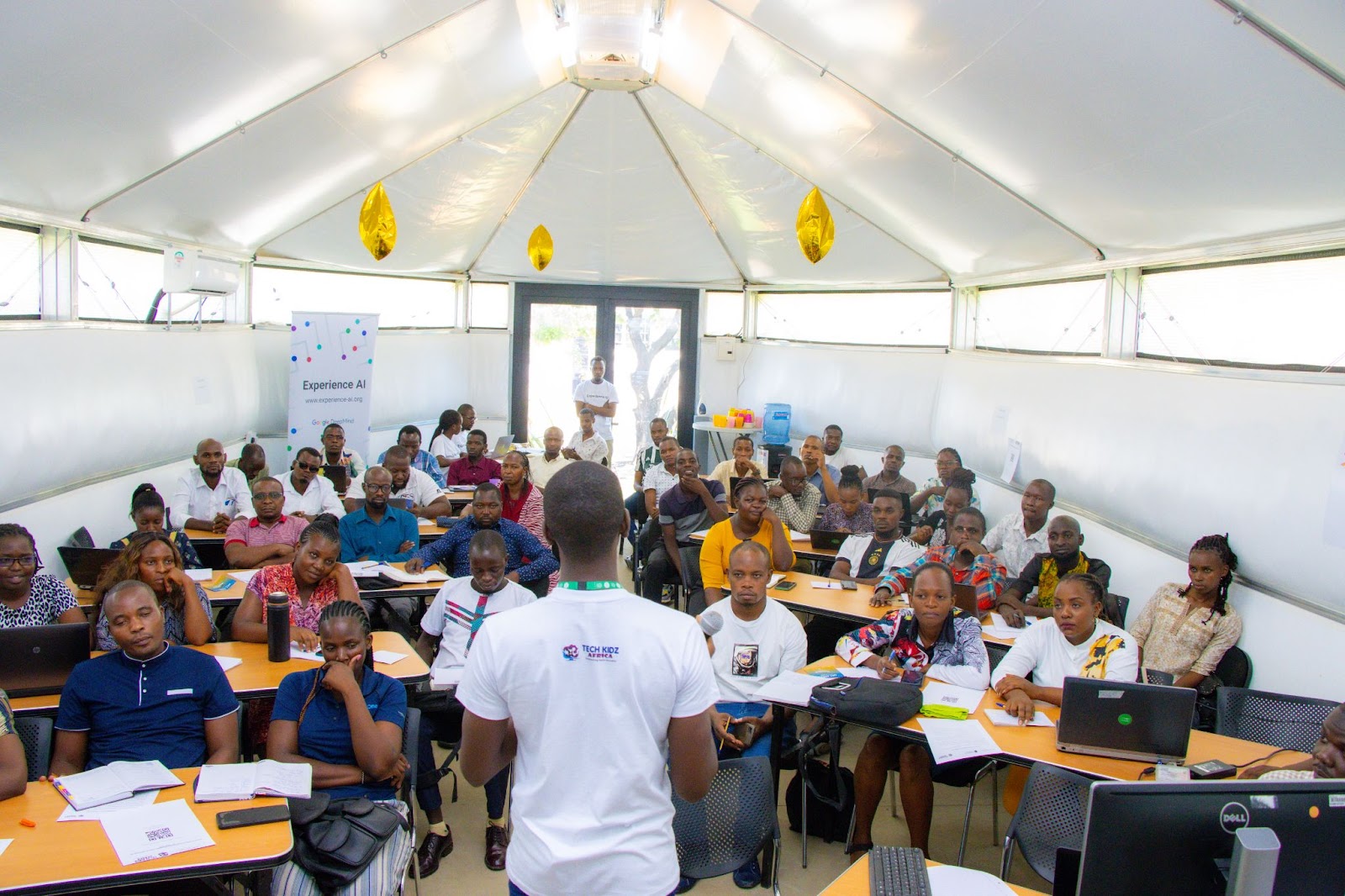
Our partnership with the Raspberry Pi Foundation has been a vital element in the retooling of Kenyan educators. Using the Foundation’s Experience AI resources, which they co-developed with Google DeepMind, we have equipped 441 teachers with practical AI and machine learning skills through hands-on training sessions in five counties: Mombasa, Nairobi, Taita Taveta, Meru, and Nakuru.
Our work to empower young learners with coding, robotics, and AI skills has positioned us as a key driver of digital literacy in Kenya. The Experience AI materials have helped us take key next steps — we’ve scaled up AI education, reached more teachers, and further democratised access to emerging technologies, supporting our goal of ensuring that no child is left behind in the digital revolution.
To make the delivery of our training sessions as smooth as possible, we’ve joined hands with county governments and local education authorities like the Teachers Service Commission (TSC). In all the counties we’ve been working in, the TSC are actively promoting digital literacy among teachers and have made sure we equip teachers with the understanding and skills to use AI effectively.
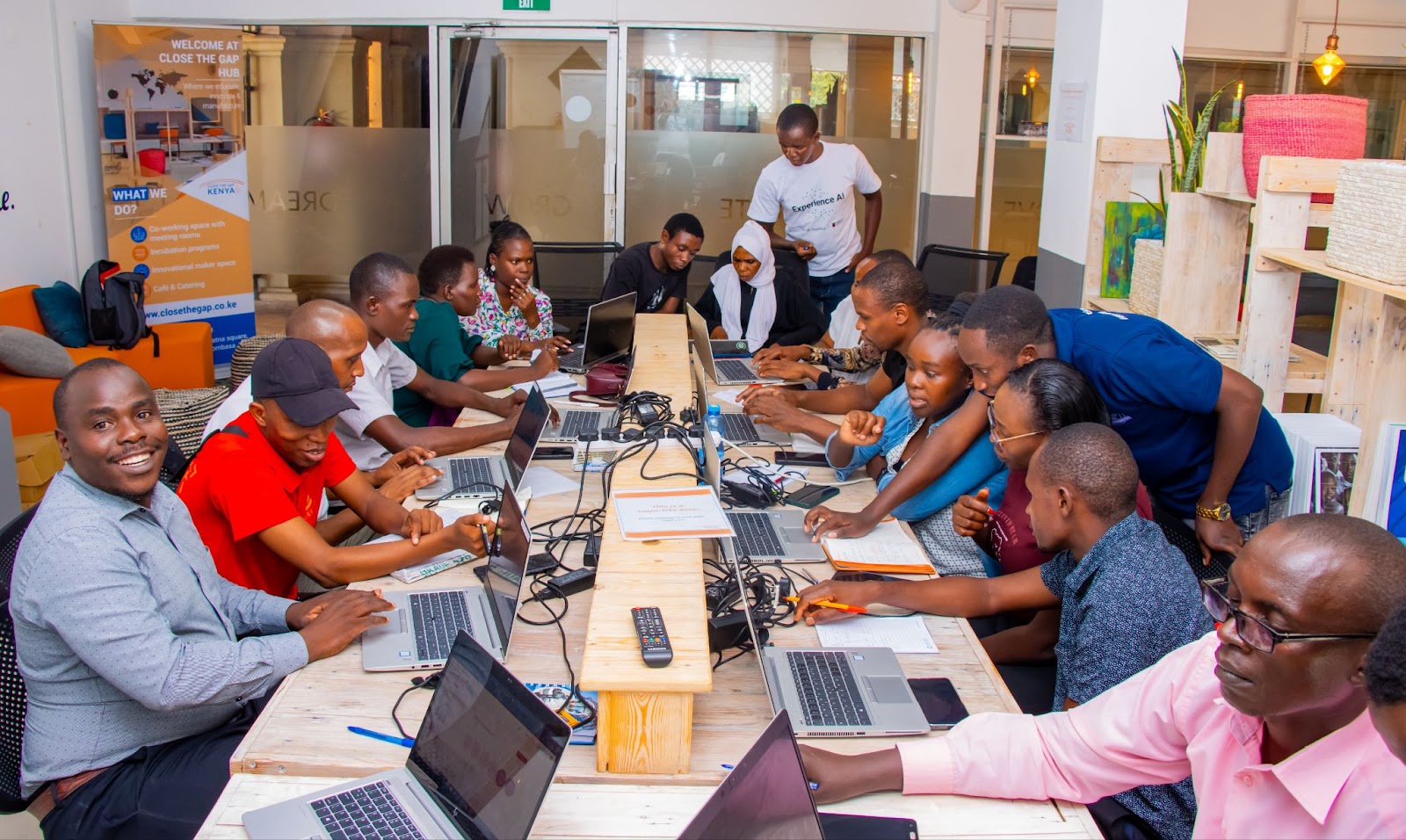
Through our expert trainers, we’ve been able to offer hands-on introductions to AI concepts, provide opportunities for practical problem-solving with machine learning models, and expose participants to real-world AI applications. A great example of the work we’ve done is the training we gave to teachers in Meru County, where they learned to create an AI model that recognises certain food types in supermarkets. Later, in group sessions, participants developed their own diverse and innovative AI models. One group, for instance, designed an AI model for dishwashing that detects dirty dishes and automates the water removal process.

Through the Experience AI training sessions, many educators gained new confidence and skills, and have already started to integrate AI into their classrooms.
“I am grateful for the invaluable skills gained through the Experience AI training. The knowledge I’ve acquired will not only enhance my ability to conduct research but also empower me to teach my students how to effectively use AI. This is just the beginning. I look forward to building on this foundation and exploring even greater possibilities with AI.” — Mr. Githinji, Meru, Kenya
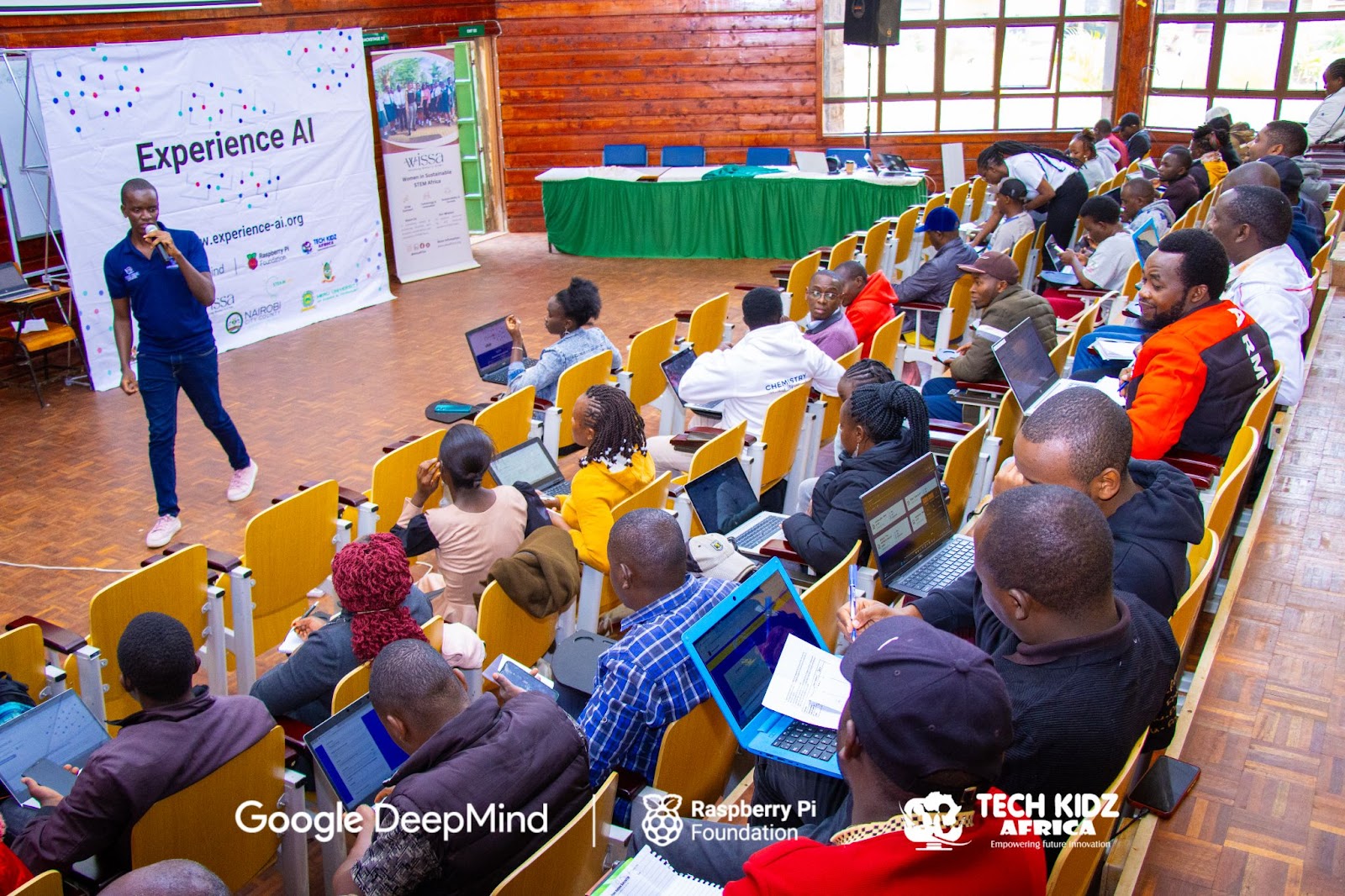
In any aspect of life, learning is about shifting perspectives, nurturing curiosity, and embracing new possibilities — this is what drives innovation. The Experience AI training in Kenya has exemplified this, transforming how we think and approach technology.
“I am glad that my county has been considered in this training. I challenge the teachers here to make use of these useful resources to spice up learning in the classroom. I was once a mathematics teacher and I wish I had technology to teach. Thank you Tech Kidz Africa, Raspberry Pi Foundation and Google DeepMind for empowering these teachers.” — His Excellency Andrew Mwadime, Governor Taita Taveta County
The overwhelming enthusiasm from educators and learners is evidence that the Experience AI lessons have been highly impactful. Teachers have expressed a strong desire for more training opportunities to support them in equipping students for the future. Many of the teachers have also expressed how the training has demystified AI, enhancing accessibility and giving their daily teaching added relevance. In addition, there is a clear call to scale up these efforts to reach more teachers across the counties in Kenya to ensure that AI education is widespread and inclusive.

Experience AI is bringing a unique AI experience to teachers, helping ease fears that AI might render them obsolete or take away their jobs. Educators are excited to explore how AI algorithms work and how they can train them for the benefit of both themselves and their students. They recognise that AI can help create an equal playing field, offering tools worldwide that can showcase and accentuate their talents, capabilities, and skill sets.
If you’re interested in finding out more about the Experience AI resources, visit the Experience AI website.
The post Impact of Experience AI in Kenya appeared first on Raspberry Pi Foundation.
Post Syndicated from The Atlantic original https://www.youtube.com/watch?v=uVCOHC_ktlg
Post Syndicated from corbet original https://lwn.net/Articles/1018680/
Inside this week’s LWN.net Weekly Edition:
Post Syndicated from The History Guy: History Deserves to Be Remembered original https://www.youtube.com/watch?v=a3QafBZhQJk
Post Syndicated from Danilo Poccia original https://aws.amazon.com/blogs/aws/amazon-nova-premier-our-most-capable-model-for-complex-tasks-and-teacher-for-model-distillation/
Today we’re expanding the Amazon Nova family of foundation models announced at AWS re:Invent with the general availability of Amazon Nova Premier, our most capable model for complex tasks and teacher for model distillation.
Nova Premier joins the existing Amazon Nova understanding models available in Amazon Bedrock. Similar to Nova Lite and Pro, Premier can process input text, images, and videos (excluding audio). With its advanced capabilities, Nova Premier excels at complex tasks that require deep understanding of context, multistep planning, and precise execution across multiple tools and data sources. With a context length of one million tokens, Nova Premier can process extremely long documents or large code bases.
With Nova Premier and Amazon Bedrock Model Distillation, you can create highly capable, cost-effective, and low-latency versions of Nova Pro, Lite, and Micro, for your specific needs. For example, we used Nova Premier to distill Nova Pro for complex tool selection and API calling. The distilled Nova Pro had a 20% higher accuracy for API invocations compared to the base model and consistently matched the performance of the teacher, with the speed and cost benefits of Nova Pro.
Amazon Nova Premier benchmark evaluation
We evaluated Nova Premier on a broad range of benchmarks across text intelligence, visual intelligence, and agentic workflows. Nova Premier is the most capable model in the Nova family as measured across 17 benchmarks as shown in the table below.

Nova Premier is also comparable to the best non-reasoning models in the industry and is equal or better on approximately half of these benchmarks when compared to other models in the same intelligence tier. Details of these evaluations are in the technical report.
Nova Premier is also the fastest and the most cost-effective model in Amazon Bedrock for its intelligence tier. For further details and comparison on pricing, please refer to the Bedrock pricing page.
Nova Premier can also be used as a teacher model for distillation, which means you can transfer its advanced capabilities for a specific use case into smaller, faster, and more efficient models like Nova Pro, Micro, and Lite for production deployments.
Using Amazon Nova Premier
To get started with Nova Premier, you first need to request access to the model in the Amazon Bedrock console. Navigate to Model access in the navigation pane, find Nova Premier, and toggle access.

Once you have access, you can use Nova Premier through the Amazon Bedrock Converse API providing in input a list of messages from the user and the assistant. Messages can include text, images, and videos. Here’s an example of a straightforward invocation using the AWS SDK for Python (Boto3):
import boto3
import json

AWS_REGION = "us-east-1"
MODEL_ID = "us.amazon.nova-premier-v1:0"

bedrock_runtime = boto3.client('bedrock-runtime', region_name=AWS_REGION)
messages = [
    {
        "role": "user",
        "content": [
            {
                "text": "Explain the differences between vector databases and traditional relational databases for AI applications."
            }
        ]
    }
]

response = bedrock_runtime.converse(
    modelId=MODEL_ID,
    messages=messages
)

response_text = response["output"]["message"]["content"][-1]["text"]

print(response_text)
This example shows how Nova Premier can provide detailed explanations for complex technical questions. But the real power of Premier comes with its ability to handle sophisticated workflows.
Multi-agent collaboration use case
Let’s explore a more complex scenario that showcases how Nova Premier works a multi-agent collaboration architecture for investment research.
The equity research process typically involves multiple stages: identifying relevant data sources for specific investments, retrieving required information from those sources, and synthesizing the data into actionable insights. This process becomes increasingly complex when dealing with different types of financial instruments like stock indices, individual equities, and currencies.
We can build this type of application using multi-agent collaboration in Amazon Bedrock, with Nova Premier powering the supervisor agent that orchestrates the entire workflow. The supervisor agent analyzes the initial query (for example, “What are the emerging trends in renewable energy investments?”), breaks it down into logical steps, determines which specialized subagents to engage, and synthesizes the final response.
For this scenario, I’ve created a system with the following components:

When I submit a query about emerging trends in renewable energy investments, the supervisor agent powered by Nova Premier does the following:
Utilizing Nova Premier in a multi-agent collaboration architecture such as this streamlines the financial professional’s work and helps them formulate their investment analysis faster. The following video provides a visual description of this scenario.
The key advantage of using Nova Premier for the supervisor role is its accuracy in coordinating complex workflows, so that the right data sources are consulted in the optimal sequence and each subagent receives in input the correct information for their work, resulting in higher quality insights.
Multi-agent collaboration with model distillation
Although Nova Premier provides the highest level of accuracy of its family of models, you might want to optimize latency and cost in production environments. This is where the strength of Nova Premier as a teacher model for distillation becomes interesting. Using Amazon Bedrock Model Distillation, we can customize Nova Micro from the results of Nova Premier for this specific investment research use case.
Unlike traditional fine-tuning that requires human feedback and labeled examples, with model distillation you can generate high-quality training data by having a teacher model produce the desired outputs, streamlining the data acquisition process.

The process to distill a model involves:
With Amazon Bedrock, you can further streamline the process and use invocation logs for data preparation. To do that, you need to set the model invocation logging on and set up an Amazon Simple Storage Service (Amazon S3) bucket as the destination for the logs.
Customer voices
Some of our customers had early access to Nova Premier. This is what they shared with us:
“Amazon Nova Premier has been outstanding in its ability to execute interactive analysis workflows, while still being faster and nearly half the cost compared to other leading models in our tests,” said Curtis Allen, Senior Staff Engineer at Slack, a company bringing conversations, apps, and customers together in one place.
“Implementing new solutions built on top of Amazon Nova has helped us with our mission of democratizing finance for all,” said Dev Tagare, Head of AI and Data at Robinhood Markets, a company on a mission to democratize finance for all. “We’re particularly excited about the ability to explore new avenues like complex multi-agent collaborations that are not just highly performing but also cost effective and fast. The intelligence of Nova Premier and what it can transfer to the other models like Nova Micro, Nova Lite, and Nova Pro unlocks multi-agent collaboration at a performance, price, and speed that will make it accessible to everyday customers.”
“Accelerating real-world AI deployments—not just prototypes—requires the ability to build models that are specialized for the unique needs of real world applications,” said Henry Ehrenberg, co-founder of Snorkel AI, a technology company that empowers data scientists and developers to quickly turn data into accurate and adaptable AI applications. “We’re excited to see AWS pushing efficient model customization forward with Amazon Bedrock Model Distillation and Amazon Nova Premier. These new model capabilities have the potential to accelerate our enterprise customers in building production AI applications, including Q&A applications with multimodal data and more.”
Things to know
Nova Premier is available in Amazon Bedrock in the US East (N. Virginia), US East (Ohio), and US West (Oregon) AWS Regions today via cross-Region inference. With Amazon Bedrock, you only pay for what you use. For more information, visit Amazon Bedrock pricing.
Customers in the US can also access Amazon Nova models at https://nova.amazon.com, a website to easily explore our FMs.
Nova Premier is our best teacher for distilling custom variants of Nova Pro, Micro, and Lite, which means you can capture the capabilities offered by Premier in smaller, faster models for production deployment.
Nova Premier includes built-in safety controls to promote responsible AI use, with content moderation capabilities that help maintain appropriate outputs across a wide range of applications.
To get started with Nova Premier, visit the Amazon Bedrock console today. For more information, see the Amazon Nova User Guide and send feedback to AWS re:Post for Amazon Bedrock. Explore the generative AI section of our community.aws site to see how our Builder communities are using Amazon Bedrock in their solutions.
– Danilo
How is the News Blog doing? Take this 1 minute survey!
(This survey is hosted by an external company. AWS handles your information as described in the AWS Privacy Notice. AWS will own the data gathered via this survey and will not share the information collected with survey respondents.)
Post Syndicated from Noritaka Sekiyama original https://aws.amazon.com/blogs/big-data/unified-scheduling-for-visual-etl-flows-and-query-books-in-amazon-sagemaker-unified-studio/
Data engineers and analysts often need to automate their data processing workflows and queries to maintain up-to-date data pipelines and reports. Amazon SageMaker Unified Studio provides a unified environment for data, analytics, machine learning (ML), and AI workloads. Amazon SageMaker Unified Studio provides powerful tools for visual extract, transform, and load (ETL) flows and query books. Until today, scheduling these workflows has required additional setup and infrastructure.
Today, we’re excited to introduce a new unified scheduling feature that simplifies this process. SageMaker Unified Studio allows you to create ETL flows using a visual interface and write SQL analytics queries using query books. This new unified scheduling feature allows you to schedule your visual ETL flows and query books directly from SageMaker Unified Studio within the same interface, eliminating the need for visiting other consoles or complex configurations. Using Amazon EventBridge Scheduler, this feature provides a seamless and easy-to-use scheduling experience.
In this post, we walk through how to schedule your visual ETL flows and query books with just a few clicks, explore the underlying architecture, and demonstrate how this feature can streamline your data workflow automation.
SageMaker Unified Studio unified scheduling is built on top of EventBridge Scheduler and Amazon SageMaker Training. When you configure a new schedule from SageMaker Unified Studio, a new EventBridge schedule is automatically created in your AWS account. The EventBridge schedule is configured with the SageMaker CreateTrainingJob API. The SageMaker Training job runs visual ETL flows or query books.
The following diagram illustrates how it works.

To run the instruction, you must have the following prerequisites:
Complete the following steps to configure a schedule on a visual ETL flow:

everyday).1.
You have successfully configured the schedule. Because Start date and time is not given, the visual ETL flow is triggered immediately and then it is triggered once a day after that.
You can view the configured schedules with the following steps:


If you want to pause the schedule, complete the following steps:

On the same Schedule tab, Status of the schedule will be updated to Paused.


To delete the schedule, complete the following steps:

On the same Schedule tab, you can verify that the deleted schedule disappears.
Complete the following steps to configure a schedule on a query book:
AwsDataCatalog.venue_event_agg. This table is created in the previous section.

You have successfully configured the schedule. Because Start date and time was not set, the query book is triggered immediately and then it is triggered once a day after that. You can optionally configure start and end times if you want to limit your schedule to run in a specific date range.
To view the configured schedules, in the navigation pane, choose Scheduled queries.

You can view the list of scheduled queries and edit, pause, resume, or delete them, as shown in the previous section.

To avoid incurring future charges, clean up the resources you created during this walkthrough:
everyday schedule, and choose Delete schedule under Actions. The related EventBridge schedule is automatically deleted as well.everyday-.The new unified scheduling experience in SageMaker Unified Studio simplifies workflow automation. With unified scheduling, you can seamlessly orchestrate your visual ETL flows and query books in one centralized location.
Whether you’re running daily data transformations, weekly analytical queries, or monthly reporting workflows, the unified scheduling experience provides a straightforward path to automation. This capability enables data teams to focus more on deriving insights from their data and less on managing infrastructure and scheduling configurations.
We encourage you to try out this new experience and share your feedback with us. For more information about SageMaker Unified Studio and its capabilities, visit our documentation or explore our other blog posts about visual ETL flows and query books.
 Noritaka Sekiyama is a Principal Big Data Architect for AWS Analytics services with a strong focus on data engineering. He is responsible for building software artifacts to help customers. In his spare time, he enjoys cycling on his road bike.
 Daniel Obi is a Frontend Engineer on the Amazon SageMaker Unified Studio team. He is dedicated to building intuitive and effective solutions that enhance user experience and technical functionality. Outside of his professional work, he enjoys watching and playing basketball.
 Vasudevan Venkataramanan is a Senior Software Engineer on the Amazon SageMaker Unified Studio team. He is responsible for technical direction of scheduling and orchestration within SageMaker Unified Studio. Outside of his professional work, he enjoys spending time with his kid, and playing pickleball and cricket.
 Yuhang Huang is a Software Development Manager on the Amazon SageMaker Unified Studio team. He leads the engineering team to design, build, and operate scheduling and orchestration capabilities in SageMaker Unified Studio. In his free time, he enjoys playing tennis.
 Gal Heyne is a Senior Technical Product Manager for AWS Analytics services with a strong focus on AI/ML and data engineering. She is passionate about developing a deep understanding of customers’ business needs and collaborating with engineers to design simple-to-use data products.
Post Syndicated from Crosstalk Solutions original https://www.youtube.com/watch?v=_6MuOR4nwH4
Post Syndicated from corbet original https://lwn.net/Articles/1019520/
Lance Albertson writes
that the Oregon State University Open Source Lab, the home of many
prominent free-software projects over the years, has run into financial
trouble:
I am writing to inform you about a critical and time-sensitive
situation facing the Open Source Lab. Over the past several years,
we have been operating at a deficit due to a decline in corporate
donations. While OSU’s College of Engineering (CoE) has generously
filled this gap, recent changes in university funding have led to a
significant reduction in CoE’s budget. As a result, our current
funding model is no longer sustainable and CoE needs to find ways
to cut programs.Earlier this week, I was informed that unless we secure $250,000 in
committed funds, the OSL will be forced to shut down later this
year.
Post Syndicated from Fahim Sajjad original https://aws.amazon.com/blogs/devops/awss-well-architected-framework-transformed-by-amazon-q-developer/
In the rapidly evolving landscape of cloud computing, developers, and architects face unprecedented challenges. These challenges include designing, implementing, and maintaining robust cloud infrastructures. The AWS Well-Architected Framework is the gold standard for building secure, efficient, and optimized cloud solutions. Traditionally, complying with this framework required deep expertise and manual analysis.
Now, Amazon Q Developer changes this paradigm. It introduces intelligent, context-aware recommendations. This framework is built on six pillars: operational excellence, security, reliability, performance efficiency, cost optimization, and sustainability. Without careful attention to these foundational elements, organizations risk developing systems that fall short of both their business objectives and technical requirements, potentially compromising long-term scalability and performance.
In this blog, we will explore how Amazon Q Developer can help across the six pillars of the Well-Architected Framework.
In this section, we will explore practical examples across the following pillars:
Operational Excellence is a key pillar of the AWS Well-Architected Framework. It guides teams in running efficient workloads and monitoring systems. The pillar emphasizes continuous improvement to deliver business value. Amazon Q Developer enhances operations through AI-powered assistance for infrastructure as code, automated testing, and documentation. The service automatically creates runbooks and suggests safe infrastructure changes. It analyzes your environment and offers recommendations based on AWS best practices. Teams can implement operational excellence with reduced manual effort and fewer potential errors.
Let’s ask Amazon Q Developer in the console how it can help me improve operational excellence in my AWS Infrastructure: “How can I improve the Operational Excellence of my AWS infrastructure?”
Amazon Q Developer analyzes your prompt and generates comprehensive recommendations:

Figure 1: Prompting Amazon Q about Operational Excellence
Based on Amazon Q Developer’s guidance, Infrastructure as Code (IaC) is recommended for managing our AWS resources. Let’s open Visual Studio Code IDE and see how Amazon Q Developer Chat can help us implement IaC. We’ll create a CloudFormation template for a resilient web application by asking Amazon Q Developer to generate a template that includes an Application Load Balancer, EC2 instances, and an RDS database: “Generate a CloudFormation template for a highly available web application with an Application Load Balancer, EC2 instances, and an RDS database. Include best practices for operational excellence”

Figure 2: Amazon Q Developer generating a CloudFormation template for a highly available web application architecture.
It also explains the template and lists the best practices for operational excellence that were followed:

Figure 3: Amazon Q explaining Generated template and Best Practices
Amazon Q Developer automates documentation to track and approve infrastructure changes effectively. It performs automatic code reviews to check quality and identify security vulnerabilities. The service detects code duplication and guides developers in making small, predictable changes. When issues arise, Amazon Q Developer quickly investigates operational problems across AWS environments. This rapid troubleshooting helps businesses maintain high application availability.
Cloud security at AWS is the highest priority. The AWS Well-Architected Framework’s Security Pillar provides a comprehensive approach to implementing robust protective measures. Even though traditionally security has been an afterthought in development often sacrificed for speed and automation, Amazon Q Developer transforms this by enabling security checks at every stage of the software development lifecycle. By embedding continuous security validation, you can significantly reduce vulnerabilities in production environments. This shifts security from reactive to proactive, ensuring your cloud applications are not just functional, but fundamentally secure.
Amazon Q Developer can streamline this process serving as an intelligent security assistant for AWS environments. It can help create robust Identity and Access Management (IAM) policies, including role-based access controls, user permissions, and multi-factor authentication. For data protection, Amazon Q Developer supports encryption strategies, key management, and secure backup procedures. Additionally, Amazon Q Developer guides users in infrastructure protection planning through secure network architectures and VPC segmentation, offering comprehensive support across critical security areas.
Amazon Q Developer enhances security beyond basic configurations. It helps set up advanced monitoring solutions using CloudWatch and CloudTrail. The service creates intelligent security alerts and automates incident response mechanisms. It protects your AWS environment against emerging threats through security scanning. Amazon Q Developer identifies potential vulnerabilities in your infrastructure. These capabilities align with AWS Well-Architected Framework security best practices. To illustrate Amazon Q Developer’s practical application in enhancing workload security, let’s consider implementing VPC flow logs for improved network monitoring in our web application CloudFormation file that we created before: “How can we implement VPC flow logs for better network monitoring?”

Figure 4: Prompting Amazon Q about implementing VPC flow logs for better network monitoring
We can also ask Amazon Q Developer to check if there are any security best practices that is missing in our code. “What IAM security best practices are missing?”

Figure 5: Prompting Amazon Q about implementing VPC flow logs for better network monitoring.
These examples demonstrates how developers can leverage Amazon Q Developer to bolster their security posture effectively.
Reliability is a critical pillar of the AWS Well-Architected Framework. It extends beyond maintaining system uptime. A reliable architecture must handle unexpected disruptions and recover gracefully. Amazon Q Developer brings AI-powered intelligence to reliability engineering. It helps organizations design resilient, self-healing cloud infrastructures. The service anticipates potential failures and suggests mitigation strategies before business operations are affected.
Amazon Q Developer guides users in implementing AWS reliability best practices. It helps architect resilient systems through multi-AZ deployments and auto-scaling configurations. The service assists in setting up automated recovery procedures and fault-tolerant systems. It streamlines the configuration of health checks, load balancers, and redundant components. Amazon Q Developer enables effective monitoring through CloudWatch alarms and automated failover mechanisms. It supports infrastructure as code implementation with proper testing procedures. The service helps establish cross-region redundancy and appropriate service quotas. These features ensure systems maintain high availability and recover quickly from failures.
By interacting with Amazon Q Developer in the AWS Management Console, you can receive intelligent recommendations for improving your infrastructure’s reliability by asking Amazon Q Developer: “Can you provide recommendations to eliminate single point of failures?”

Figure 6: Prompting Amazon Q about reliabilityPerformance Efficiency pillar with Amazon Q Developer
Performance can determine an application’s success in cloud computing. The Performance Efficiency pillar guides organizations in maximizing their computational resources. Amazon Q Developer enhances this pillar through AI-powered recommendations. It helps organizations design and optimize their cloud infrastructure more effectively.
Amazon Q Developer uses machine learning to deliver advanced performance insights. It recommends architectural improvements like serverless adoption and optimal service configurations. The AI assistant suggests effective caching strategies and data processing optimizations. It analyzes system metrics and infrastructure patterns to guide improvements. Development teams can enhance system performance and reduce computational overhead. Amazon Q Developer helps create adaptive architectures that respond effectively to changing workload demands.
For example, let’s say you’re an IT Professional with a monolithic three-tier web application on AWS and wanted to get recommendation on performance efficiency. The IT Professional could open a new Amazon Q Developer chat in the AWS Management Console, and enter a prompt such as: “Based on my current monolithic application on AWS, what are some things I should do as it relates to the performance efficiency pillar of the Well-Architected Framework?”

Figure 7: Prompting Amazon Q about performance efficiency
As shown above in figure 7, Amazon Q Developer made multiple recommendations based on the monolith application in the prompt. Amazon Q Developer makes recommendations such as using Serverless options and breaking the application into microservices, which is a design principal in the performance efficiency pillar of the Well-Architected Framework.
Amazon Q Developer has the ability to give general recommendations for Cost Optimization based on the Well-Architected Framework. For example, let’s say an IT Professional wants to get more information about ways they can generally optimize their compute costs in AWS. The IT Professional could open a new Amazon Q chat in the AWS Management Console, and enter a prompt such as: “What are some ways I can cost optimize my compute infrastructure I have running in AWS based on the cost optimization pillar of the Well Architected Framework?”

Figure 8: Prompting Amazon Q about cost optimization
As shown above in figure 8, Amazon Q Developer was able to make recommendations based on the Well-architected framework to help the developer cost optimize their compute through reserved instances and savings plans, auto scaling, rightsizing, and more, while also providing links to resources to help dive in further.
Additionally, Amazon Q Developer has revolutionized AWS cost analysis by introducing natural language processing capabilities directly integrated with AWS Cost Explorer. This innovative feature allows users to gain deep insights into cloud spending through simple, conversational queries, enabling professionals to understand complex cost structures, identify spending trends, and forecast future expenses with unprecedented ease. By transforming technical cost data into actionable insights, Amazon Q Developer empowers organizations to make more informed financial decisions about their cloud infrastructure.
For comprehensive details and specific use case, please refer to the full blog post: Analyzing your AWS Cost Explorer data with Amazon Q Developer: Now Generally Available.
Sustainability represents a critical emerging pillar of the AWS Well-Architected Framework, focusing on minimizing the environmental impact of cloud computing infrastructure and operations. Amazon Q Developer introduces AI-powered capabilities that help organizations optimize their cloud resources to reduce carbon footprint, improve energy efficiency, and align technological strategies with environmental responsibility.
Through intelligent analysis and context-aware recommendations, Amazon Q Developer enables teams to make more sustainable architectural decisions. The AI assistant can provide insights into resource optimization, suggesting ways to reduce unnecessary compute power, recommend more energy-efficient service configurations, and help developers understand the environmental implications of their architectural choices. By leveraging machine learning and comprehensive AWS infrastructure knowledge, Amazon Q Developer empowers organizations to not only meet their technological requirements but also contribute to broader environmental sustainability goals in cloud computing.
In the below example, you can see how you can ask Amazon Q Developer to help meet your company’s sustainability goals by asking Amazon Q: “How can I review my sustainability objectives on AWS?”

Figure 9: Prompting Amazon Q about sustainability
As you can see above Amazon Q Developer generated recommendations showing how you can review your sustainability objectives.
Now let’s take the first recommendation: Carbon Footprint tool as an example and ask Amazon Q Developer in the console to ask a follow up question We will be using the following prompt to generate response: “How do I view my carbon footprint on AWS?”

Figure 10: Prompting Amazon Q about carbon footprint
Amazon Q Developer represents a pivotal moment in cloud computing, transforming the AWS Well-Architected Framework from a static set of guidelines to a dynamic, intelligent system of continuous improvement. By integrating advanced AI capabilities across operational excellence, security, reliability, performance efficiency, cost optimization, and sustainability, this innovative tool democratizes sophisticated cloud architecture strategies for organizations of all sizes. The true power of Amazon Q Developer lies not just in its ability to provide recommendations, but in its capacity to learn, adapt, and evolve alongside your infrastructure, bridging the gap between complex technical knowledge and actionable insights. As cloud technologies continue to advance, AI-powered tools like Amazon Q Developer will become increasingly essential, signifying a fundamental shift in how we approach cloud infrastructure: proactively, intelligently, and with a holistic understanding of technological and business requirements.
To get started with Amazon Q Developer in the AWS console, check out the documentation on chatting with Amazon Q Developer in AWS Console Home.
Post Syndicated from Dr. Rahul Sharad Gaikwad original https://aws.amazon.com/blogs/devops/migrating-a-cdk-v1-application-to-cdk-v2-with-amazon-q-developer/
AWS Cloud Development Kit (AWS CDK) is an open-source software development framework for defining cloud infrastructure in code and provisioning it through AWS CloudFormation. As of June 1, 2023, AWS CDK version 1 is no longer supported. To avoid the potential issues that come with using an outdated version and to take advantage of the latest features and improvements, we highly recommend upgrading to AWS CDK version 2.
Amazon Q Developer, a generative AI-powered assistant for software development, enhances the efficiency of software development teams. It facilitates the creation of deployment-ready infrastructure as code (IaC) for AWS CloudFormation, AWS CDK, and Terraform. By using Amazon Q, developers can accelerate IaC development, enhance code quality, and decrease the likelihood of configuration errors.
This post demonstrates how Amazon Q Developer helps in upgrading the existing AWS CDK v1 application to AWS CDK v2.
In this blog post, I will explore a code example where I have created a VPC, Subnets, and an ECS Fargate cluster using AWS CDK version 1. I will then explain how you can use Amazon Q to transform the code from CDK v1 to CDK v2.
1. In order to initiate this process, I have begun by asking Amazon Q Developer for the necessary steps to migrate from CDK version 1 to version 2, which are outlined below.
Can you provide the steps to migrate from cdk version 1 to version 2?

2. In the above screenshot Amazon Q Developer outlined several steps we can take to make the necessary changes. The first step is to update the dependencies. If I need guidance on how to update the dependencies, I can ask the Amazon Q Developer again for help by asking the steps regarding updating dependencies as below .
Can you provide the steps to update dependencies?

3. After updating the dependencies, the next step is to update the import statements. To get guidance on how to update the import statements, I can ask the Amazon Q Developer assistant again for help by asking the steps regarding how to import statements as shown below.
@workspace Can you provide the steps to update import statements?

In the above screenshot if you have noticed I have added @workspace before the question which automatically includes the most relevant chunks of my workspace code as context.
4. If any errors occur while updating the code as recommended by Amazon Q Developer, I can use Amazon Q Developer to debug the issue and provide the needed inputs to resolve it.

5. Once I have finished the required steps, I can deploy the application using version 2 of the AWS CDK by running the cdk deploy command.

6. In addition to its other capabilities, Amazon Q offers code review functionality. To initiate a code review, simply select Amazon Q and use the /review command. I’ll then have the option to review either the active files or the entire open workspace. Select your preference, and Amazon Q will analyze your project and provide comprehensive review results.

7. Amazon Q Developer can also generate documentation, including README files. To create documentation, select Amazon Q and enter the /doc command. Amazon Q will automatically generate a README file for your project. I can then review the generated documentation, accept the changes, or provide specific instructions for further modifications.

In this blog, I demonstrated how Amazon Q Developer can simplify and accelerate the upgrade process from AWS CDK version 1 to version 2, ensuring your cloud infrastructure remains secure, efficient, and aligned with the latest AWS innovations. AWS CDK v2 offers a streamlined, consolidated library with improved performance and ongoing support, making infrastructure management easier and more reliable.
By leveraging Amazon Q Developer, a generative AI-powered assistant, teams can automate Infrastructure as Code development, enhance code quality, and minimize configuration errors. Together, these tools empower development teams to confidently modernize and scale their AWS environments, turning the upgrade process into a seamless opportunity for innovation and growth.
To learn more about Amazon Q Developer, see the following resources:
To learn more about the AWS CDK, see the following resources:
About the authors: