Post Syndicated from The Atlantic original https://www.youtube.com/watch?v=PUwfIheOvho
Comic for 2025.04.18 – Early Bird
Post Syndicated from Explosm.net original https://explosm.net/comics/early-bird
New Cyanide and Happiness Comic
How Smartsheet reduced latency and optimized costs in their serverless architecture
Post Syndicated from Anton Aleksandrov original https://aws.amazon.com/blogs/architecture/how-smartsheet-reduced-latency-and-optimized-costs-in-their-serverless-architecture/
Cloud software as a service (SaaS) companies are often looking for ways to enhance their architectures for performance and cost-efficiency. Serverless technologies offload infrastructure management, allowing development teams to focus on innovation and delivering business value. As application architectures grow and face more demanding requirements, continued optimization helps maximize both the technical and financial advantages of the serverless approach.
In this post, we discuss Smartsheet’s journey optimizing its serverless architecture. We explore the solution, the stringent requirements Smartsheet faced, and how they’ve achieved an over 80% latency reduction. This technical journey offers valuable insights for organizations looking to enhance their serverless architectures with proven enterprise-grade optimization techniques.
Solution overview
Smartsheet is a leading cloud-based enterprise work management platform, enabling millions of users worldwide to plan, manage, track, automate, and report on work at scale. At the core of the platform lies an event-driven architecture that processes real-time user activity across various document types. Given the collaborative nature of the platform, multiple users can work on these documents concurrently. Every document interaction triggers a series of events that must be processed with minimal latency to maintain data consistency and provide immediate feedback. Processing delays can impact user experience and productivity, making consistently low latency a fundamental business requirement.
Smartsheet’s traffic pattern is spiky during business hours and mostly dormant during nights and weekends. Within peak periods, traffic can fluctuate as users collaborate in real time. To efficiently manage dynamic workloads, which can surge from hundreds to tens of thousands of events per second within minutes, Smartsheet implements a serverless event processing architecture using services such as Amazon Simple Queue Service (Amazon SQS) and AWS Lambda. This architecture uses the elasticity of serverless services and the ability to automatically scale dynamically based on the traffic volume. It makes sure Smartsheet can efficiently handle sudden traffic surges while automatically scaling down during off-peak hours, optimizing for both performance and cost-efficiency.
The following diagram illustrates the high-level architecture of the Smartsheet event processing pipeline.

Optimization opportunity
Smartsheet uses Lambda functions to serve both batch jobs and API requests. The primary runtime used for building those functions is Java. Lambda automatically scales the number of execution environments allocated to your function on demand to accommodate traffic volume. When Lambda receives an incoming request, it attempts to serve it with an existing execution environment first. If no execution environments are available, the service initializes a new one. During initialization, the Smartsheet’s function code commonly sends several requests to external dependencies, such as databases and REST APIs, which might take time to reply.
The following diagram illustrates how Lambda functions reach out to external dependencies during initialization.

These tasks introduced execution environment initialization latency, commonly referred to as a cold start. Although cold starts typically affect less than 1% of requests, Smartsheet had stringent low latency requirements for their architecture to further prioritize the best possible end-user experience.
“To reduce customer request latency while keeping costs low, our engineering team utilized Lambda provisioned concurrency with auto scaling and Graviton, which resulted in an 83% reduction in P95 latency while providing a high quality of service as we continue to scale our platform and its limits,” says Abhishek Gurunathan, Sr Director of Engineering at Smartsheet.
Addressing the cold start with provisioned concurrency
To reduce cold start latency, the Smartsheet team adopted provisioned concurrency in their architecture, a capability that allows developers to specify the number of execution environments that Lambda should keep warm to instantly handle invocations. The following diagram illustrates the difference. Without provisioned concurrency, execution environments are created on demand, which means some invocations (typically less than 1%) need to wait for the execution environment to be created and initialization code to be run. With provisioned concurrency, Lambda creates execution environments and runs initialization code preemptively, making sure invocations are served by warm execution environments.

Provisioned concurrency includes a dynamic spillover mechanism, making your serverless architecture highly resilient to traffic spikes. When incoming traffic exceeds the preconfigured provisioned concurrency, additional requests are automatically served by on-demand concurrency rather than being throttled. This provides seamless scalability and maintains service availability even during traffic surges, while still providing the performance benefits of pre-warmed execution environments for the majority of requests.
The Smartsheet team configured provisioned concurrency to match their historical P95 concurrency needs. This resulted in immediate improvements—the number of cold starts dropped dramatically and P95 invocation latency dropped by 83%. As the team monitored system performance, they quickly identified another architecture optimization opportunity—the Lambda functions were heavily used during work hours but had significantly fewer invocations at night and on weekends, as illustrated in the following graph.

Setting a static provisioned concurrency configuration worked great for busy periods, but was underutilized during off-times. The Smartsheet team wanted to further fine-tune their architecture and increase provisioned concurrency utilization rates to achieve higher cost-efficiency. This led them to look into provisioned concurrency auto scaling to match traffic patterns as well as adopting an AWS Graviton architecture.
Auto scaling provisioned concurrency and Graviton architecture
Two common approaches to enable provisioned concurrency are setting a static value and using auto scaling. With static configuration, you specify a fixed number of pre-initialized execution environments that remain continuously warm to serve invocations. This approach is highly effective for architectures that handle predictable traffic patterns. Unpredictable traffic patterns, however, can lead to under-provisioning during peak periods (with spillover to on-demand concurrency resulting in more cold starts) or underutilization during low-usage periods. To address that, provisioned concurrency with auto scaling dynamically adjusts the configuration based on utilization metrics, automatically scaling the number of execution environments up or down to match the actual demand. This dynamic approach optimizes for cost-efficiency and is particularly recommended for architectures with fluctuating traffic patterns.
The following figure compares static and dynamic provisioned concurrency.

To further optimize the architecture for cost-efficiency, the Smartsheet team has implemented provisioned concurrency auto scaling based on utilization metrics. Smartsheet used an infrastructure as code (IaC) approach with Terraform to define auto scaling policies for maximum reusability across hundreds of functions. The policies track the LambdaProvisionedConcurrencyUtilization metric and define the scaling threshold according to the function purpose. For functions implementing interactive APIs, the auto scale threshold is 60% utilization to pre-provision execution environments early, keeping latency extra-low, and making functions more resilient towards traffic surges. For functions that implement asynchronous data processing, Smartsheet’s goal was to achieve the highest utilization rate and cost-efficiency, so they’ve defined the auto scale threshold at 90%.
The following diagram illustrates the architecture of auto scaling policies based on provisioned concurrency utilization rate and workload type.
Another optimization technique Smartsheet employed was switching the CPU architecture used by their Lambda functions from x86_64 to arm64 Graviton. To achieve this, Smartsheet adopted the ARM versions of Lambda layers they’ve used, such as Datadog and Lambda Insights extensions. This was required because binaries built using one architecture might be incompatible with a different one. Because Smartsheet functions were implemented with Java and packaged as JAR files, they didn’t have any compatibility issues when moving to Graviton. With Terraform used for codifying the infrastructure, this architecture switch was a simple property change in aws_lambda_function resources, as illustrated in the following code:

By switching to a Graviton architecture, Smartsheet saved 20% on function GB-second costs. See AWS Lambda pricing for details.
Best practices
Use the following techniques and best practices to optimize your serverless architectures, reduce cold starts, and increase cost-efficiency:
- Fine-tune your Lambda functions to find the optimal balance between cost and performance. Increasing memory allocation also adds CPU capacity, which often means faster execution and can lead to reduced overall costs.
- Use a Graviton2 architecture for compatible workloads to benefit from a better price-performance ratio. Depending on the workload type, switching to Graviton can yield up to 34% improvement.
- Use provisioned concurrency and Lambda SnapStart to reduce cold starts in your serverless architectures. Start with static provisioned concurrency based on your historical concurrency requirements, monitor utilization, and introduce auto scaling into your architecture to achieve the optimal cost-performance profile.
Conclusion
Serverless architectures using services like Lambda and Amazon SQS offload the infrastructure management and scaling concerns to AWS, allowing teams to focus on innovation and delivering business value. As Smartsheet’s journey demonstrates, using provisioned concurrency and Graviton in your architectures can help significantly improve user experience by reducing latencies while also achieving better cost-efficiency, providing a practical blueprint for optimization across the organization. Whether you’re running large-scale enterprise applications or building new cloud solutions, these proven techniques can help you unlock similar performance gains and cost-efficiencies in your serverless architectures.
To learn more about serverless architectures, see Serverless Land.
About the authors
2025.4 Feature Highlight #homeassistant #homeautomation #smarthome
Post Syndicated from Home Assistant original https://www.youtube.com/watch?v=Tbvd8c8_eu0
Tariffs & U.S. Manufacturing #lastweektonight
Post Syndicated from LastWeekTonight original https://www.youtube.com/watch?v=J7cFzj1tUpg
EU OS: A European Proposal for a Public Sector Linux Desktop (The New Stack)
Post Syndicated from corbet original https://lwn.net/Articles/1018058/
The New Stack looks
at EU OS, an attempt to create a desktop system for the European public
sector.
EU OS is not a brand-new Linux distribution in the traditional
sense. Instead, it is a proof-of-concept built atop Fedora’s
immutable KDE Plasma spin (Kinoite). EU OS takes a layered approach
to customization. The project’s vision is to provide a standard,
adaptable Linux base that can be extended with national, regional
or sector-specific customizations, making it suitable for a wide
range of European public sector needs.
Metasploit Wrap-Up 04/18/2025
Post Syndicated from Christophe De La Fuente original https://blog.rapid7.com/2025/04/18/metasploit-wrap-up-04-18-2025/
Smaller Fetch Payloads

This week, a significant enhancement was made to the already awesome fetch payload feature by our very own bwatters-r7. The improvement introduces a new option, PIPE_FETCH, which optimizes the process by serving both the payload and the command to be executed simultaneously.
This enhancement directly addresses the challenge of limited space by significantly reducing the size of the command that needs to be run. The PIPE_FETCH option works by initially generating a small command. When this compact command is executed, it fetches the actual, larger command that needs to be run. The fetched command is then directly piped into the shell, streamlining the execution process and making it feasible to use fetch payloads in scenarios where space constraints were previously a limitation.
New module content (2)
BentoML RCE
Authors: Takahiro Yokoyama and c2an1
Type: Exploit
Pull request: #20041 contributed by Takahiro-Yoko
Path: linux/http/bentoml_rce_cve_2025_27520
AttackerKB reference: CVE-2025-27520
Description: This adds a module for an unauthenticated remote code execution in BentoML (CVE-2025-27520).
Langflow AI RCE
Authors: Naveen Sunkavally (Horizon3.ai) and Takahiro Yokoyama
Type: Exploit
Pull request: #20022 contributed by Takahiro-Yoko
Path: multi/http/langflow_unauth_rce_cve_2025_3248
AttackerKB reference: CVE-2025-3248
Description: This adds a module for CVE-2025-3248, an unauthenticated RCE vulnerability that affects Langflow versions prior to 1.3.0.
Enhancements and features (4)
- #19982 from jvoisin – Updates the Linux enum_protections module to use proper names instead of executable names and add a file-based detection method.
- #20031 from bcoles – Adds metadata and improves the code quality of multiple FreeBSD exploit modules.
- #20032 from bcoles – Improves the code quality of multiple
nopsmodules. - #20035 from bcoles – Enhances the code quality of multiple
encodermodules.
Bugs fixed (3)
- #20005 from fabpiaf – Fixes a LoadError when loading sqlite3 modules in Metasploit’s Docker support.
- #20036 from bcoles – Fixes an issue with the
exploit/windows/local/unquoted_service_pathmodule that previously claimed a file upload was successful regardless of whether the file upload was successful or not. - #20043 from adfoster-r7 – Update Open WAN-to-LAN proxy on AT&T routers error handling when an older Python version is detected.
Documentation
You can find the latest Metasploit documentation on our docsite at docs.metasploit.com.
Get it
As always, you can update to the latest Metasploit Framework with msfupdate and you can get more details on the changes since the last blog post from GitHub:
If you are a git user, you can clone the Metasploit Framework repo (master branch) for the latest. To install fresh without using git, you can use the open-source-only Nightly Installers or the commercial edition Metasploit Pro.
[$] The problem of unnecessary readahead
Post Syndicated from corbet original https://lwn.net/Articles/1016860/
The final session in the memory-management track of the 2025 Linux Storage,
Filesystem, Memory-Management, and BPF Summit was a brief, last-minute
addition run by Kalesh Singh. The kernel’s readahead mechanism is
generally good for performance; it ensures that data is present by the time
an application gets around to asking for it. Sometimes, though, readahead
can go a little too far.
[$] Tracepoints for the VFS?
Post Syndicated from jake original https://lwn.net/Articles/1017573/
Adding tracepoints to some kernel subsystems has been controversial—or
disallowed—due to concerns about the user-space
ABI that they might create. The virtual filesystem (VFS) layer has
long been one of the subsystems that has not allowed any tracepoints, but
that may be changing. At the 2025 Linux Storage, Filesystem, Memory
Management, and BPF Summit (LSFMM+BPF), Ted Ts’o led a discussion about
whether the ABI concerns are outweighed by the utility of tracepoints for
the VFS.
Security updates for Friday
Post Syndicated from daroc original https://lwn.net/Articles/1018020/
Security updates have been issued by Debian (graphicsmagick and libapache2-mod-auth-openidc), Fedora (giflib, mod_auth_openidc, mysql8.0, perl, perl-Devel-Cover, perl-PAR-Packer, perl-String-Compare-ConstantTime, rust-openssl, rust-openssl-sys, trunk, and workrave), Mageia (chromium-browser-stable and rust), Oracle (java-1.8.0-openjdk, java-17-openjdk, java-21-openjdk, kernel, libreoffice, and webkit2gtk3), Red Hat (gvisor-tap-vsock), SUSE (containerd, docker, docker-stable, forgejo, GraphicsMagick, libmozjs-115-0, perl-32bit, poppler, subfinder, and thunderbird), and Ubuntu (erlang and ruby2.3, ruby2.5).
Beyond Doolittle: The Navy Role in the Doolittle Raid
Post Syndicated from The History Guy: History Deserves to Be Remembered original https://www.youtube.com/watch?v=ezR8GpSYPAI
Ту-тууу! И Тръмп им се показа
Post Syndicated from Емилия Милчева original https://www.toest.bg/tu-tuuu-i-trump-im-se-pokaza/

На Велика сряда, когато Исус Христос поставя опрощаването на грешниците над това на праведниците, лидерът на ГЕРБ Бойко Борисов се врече, че Пеевски и Горанов ще излязат от списъка със санкционирани лица по глобалния закон „Магнитски“. Дали разполага с някаква информация, или пък участва в процесите по избелване на политическия си съюзник и на бившия си министър? Те бездруго изглеждат чисти по български – обрасли с подозрения и уличаващи факти, но без обвинения и присъди.
Към ноември 2024 г. Съединените щати са наложили санкции по Глобалния закон „Магнитски“ на 245 чуждестранни физически лица и 310 юридически лица от над 50 държави по света. Българите в този списък са осем – впечатляващо като за 6-милионна страна, все емблематични лица за система, срещу която е насочен самият закон.
Това са:
- олигархът Делян Пеевски;
- бившият финансов министър Владислав Горанов;
- хазартният бос Васил Божков;
- Илко Желязков, известен като Лейтенанта на Доган;
- Николай Малинов от Национално движение „Русофили“;
- бившите шефове на АЕЦ „Козлодуй“ Александър Николов и Иван Генов;
- бившият енергиен министър Румен Овчаров.
Нито един от тях не е осъден в България за корупционно поведение, констатирано и описано в мотивите при налагане на санкциите от Вашингтон (при управлението на президента Джо Байдън).
Когато Горанов беше включен в списъка през 2023 г., Борисов побърза да заяви, че ГЕРБ се разграничава от него; че партията не е получила „нито стотинка“ от хазартния бос Васил Божков (заявил, че е плащал редовно всеки месец, а „вратичката“, недогледана от Министерството на финансите, струва на бюджета 600 млн. лв. – б.а.); че вярва, че Горанов не е виновен.
Сега Борисов открито заговори за „опрощение“, в тон с унгарския премиер Виктор Орбан, известен като един от малцината европейски лидери, близки на американския президент Доналд Тръмп. Не морално, а политическо опрощение – чрез лични контакти (особено с Тръмп!), лобизъм и натиск върху външни фактори. Процесът тече не отсега. Известно е, че Пеевски е наел адвокатски кантори и лобисти, за да направи всичко възможно да излезе от списъка и да оперира с активите си. Също и Горанов, който след известно скриване от публичност вече е чест коментатор по различни теми в мейнстрийм медиите.
Санкциите удрят по парите им и по възможностите за бизнес, тъй като достъпът до глобалната финансова система е почти невъзможен. Дори ако използват офшорни компании или доверителни фондове, те също попадат под санкции, стига да се установи, че са под контрола на лица от списъка „Магнитски“ или действат от тяхно име.
Всички техни активи на територията на САЩ или под контрола на американски лица (включително банки) са замразени и те не могат да се разпореждат с тях – да ги прехвърлят, продават или използват по какъвто и да е начин.
Американски граждани, компании и финансови институции нямат право да влизат във финансови или в търговски взаимоотношения със санкционираните по „Магнитски“ или със свързани с тях фирми. Всякакви опити за заобикаляне на санкциите – чрез посредници или прикрити структури – също подлежат на наказание.
Много международни банки и компании, включително извън САЩ, избягват да правят бизнес със санкционирани лица от страх да не нарушат американското законодателство или да попаднат под вторични санкции.
Ренесанс за клептократичните системи
И ето че от инструмент за борба с корупцията и за именуването ѝ законът „Магнитски“ се превръща в разменна монета и в инструмент, който укрепва властта на санкционираните. Ако изобщо се стигне до това, Тръмп, който прави политика така, както прави бизнес, би подходил прагматично, търсейки стратегически отстъпки от страна на България. Намеса в сделката за продажба на „Лукойл Нефтохим“, още оръжейни сделки, център за данни, прекратяване на зависимости от руски енергийни източници и подкрепа за американски енергийни проекти в региона…
Службата за контрол на чуждестранните активи на Министерството на финансите на САЩ (OFAC) има правомощието да добавя или да премахва лица от списъка със санкционирани. Но политическото решение за налагането или вдигането на санкциите винаги идва от най-високо ниво – от президента.
Премахнатите наскоро санкции срещу унгарския политик Антал Роган, близък на Виктор Орбан и шеф на кабинета му, несъмнено са видимата част от много по-широка задкулисна сделка между Вашингтон и Будапеща. Когато администрацията на Байдън го вкара в черния списък, го определи като ключова фигура в „клептократична екосистема“, която подкопава демократичните институции в Унгария. Американското Министерство на финансите обвини Роган, че е използвал служебното си положение, за да обогати себе си и политическите си съюзници чрез насочване на обществени поръчки към приближени бизнесмени.
Сега държавният секретар на САЩ Марко Рубио заяви, че ако Антал Роган остане в списъка, това ще е несъвместимо с външнополитическите интереси на САЩ.
И лидерът на ГЕРБ е вдъхновен от тези „опрощения“ за клептократичните системи. Стигна се дотам, че дори отрече онова, което е написано черно на бяло при налагане на санкциите – че Пеевски не бил санкциониран за корупция.
Той [Делян Пеевски – б.а.] не е санкциониран за корупция. Ще дойде време и за него, и за Горанов да излезе истината, както излезе и за Унгария.
Дали не гледа на Пеевски и ДПС – Ново начало като на дългосрочен партньор? Привикването с Пеевски във властта започна да става факт, за което помагат и всички разкази за неговото всемогъщество и влияние във всяка сфера – съдебната система, службите за сигурност, строителството, спорта. Той изглежда като некоронования български Орбан.
Кой върви по стъпките на Орбан?
А Борисов не просто се опитва да изпере Пеевски и Горанов, той пренаписва разказа за корупцията – от провал на държавата в наказването ѝ до сделка между власт и влияние. Орбан рекламира своята сделка с видео от Мар-а-Лаго, където се видя с Тръмп осем месеца преди президентските избори и получи комплимент какъв „фантастичен лидер“ е. Сигурно защото е превърнал Унгария в партия държава, подчинена на автократичния му режим.
Със или без санкции за Роган никой не се заблуждава каква е истината за Унгария. Хиляди унгарци протестираха с искания за оставки на Орбан и главния прокурор Петер Полт при скандала Шадл–Вьолнер. Той избухна, след като бивш съпартиец на Орбан – Петeр Магяр, публикува запис от разговор с правосъдната министърка Юдит Варга (от времето, когато двамата са били съпрузи). В разговора Варга описва как помощници на началника на кабинета на Орбан (Антал Роган) искат да премахнат определени части от документи по дело за подкуп.
В опит за сближаване с европейския приятел на Тръмп – Виктор Орбан, партия ДПС – Ново начало, която до миналата година беше част от семейството на Алианса на либералите и демократите в Европа (АЛДЕ), вече е в Групата на консерваторите и патриотите в Парламентарната асамблея на Съвета на Европа (ПАСЕ). Съюзът е скрепен на среща между председателя на Групата на консерваторите и патриотите – унгареца Жолт Немет от партията на Орбан „Фидес“, и Атидже Вели от формацията на Пеевски.
В България има двама политици, които се ползват от публично изразените симпатии на Орбан – Борисов (наричат се един друг „стари приятелю“) и президентът Радев, който също е щедър на комплименти към изолирания в ЕС лидер.
Вече и друг силен човек в България бърза да си проправи път към Орбан, но бъдещето не изглежда розово за унгарския премиер. „Фидес“, която управлява Унгария в последните 18 години, може да изгуби изборите през април 2026 г. заради инфлацията, растящия дълг, слабата национална валута, натиска върху медийната свобода. Тези проблеми сриват държавата, която осъществи най-успешните реформи към пазарна икономика в Източна Европа. Създадена от споменатия Магяр, понастоящем евродепутат, партия „Тиса“, вече част от ЕНП, набира популярност с фокус върху борбата с корупцията, възстановяване на демократичните институции и по-дълбока интеграция с ЕС. Формацията на Магяр се утвърждава като сериозен претендент за властта – в едни социологически проучвания е първа, в други – втора, с незначителна разлика с „Фидес“. Въпросът е колко различна от „Фидес“ е „Тиса“.
Ту-тууу
Как би могъл Борисов да се помоли за „опрощение“ за Пеевски и изваждането му от списъка „Магнитски“? Единствено чрез създаденото с мандата на ГЕРБ правителство, което да откликва на инициативи и предложения от страна на новата американска администрация.
Борисов дори обяви, че интерес към българските реактори имало и от Доналд Тръмп, който в първия си мандат изпращал експерти да ги видят.
Искам с президента Тръмп, с Мъск, с „Mайкрософт“, Бил Гейтс – имат интерес, ако можем да го направим това нещо – не вярвам да има българин да не иска най-мощният изкуствен интелект да е тука. Аз мисля за държавата, ако ме разбирате.
Изявлението му бе гарнирано с типичния Бойко-Борисов превод на Възкресението, предизвикал смях и сарказъм в социалните мрежи.
Господ са го мъчили по най-отвратителния начин, тръни му забива̀ли в главата, пирони в ръцете, върза̀ли го на дървото, на кръста. И когато всички се отрекли от него, изведнъж се показал отгоре и казал: „Ту-туу.“ Даже накарал Тома Неверни, понеже имал много дупки от пироните, и му казал: „Избери си една, мушни си пръста, ама само в една, няма да ме мушиш по цялото тяло“…
На Борисов и на Пеевски, изглежда, им се е показал Тръмп.
А по улиците тръгват нови протести „Вън Пеевски от властта“. Но с него трябва да си отиде и Бойко Борисов.
История на женското здраве(опазване). Сексуалната революция
Post Syndicated from Надежда Цекулова original https://www.toest.bg/istoria-na-zhenskoto-zdraveopazvane-seksualnata-revolyutsia/

In 20th century a new kind of man was invented: a woman. Social scientists realized she could do any job a man could, but without the need to talk about it. She has even been given a right to vote so she could choose herself which man would tell them what to do.1
В първия текст от поредицата „Анатомия на пола: Жена“ преминахме бързо през дългия път на отношението към женското здраве от древността до началото на XX в. И без особена изненада установихме, че макар в различните епохи и култури социалната роля на жената да се е различавала значимо – от полубогиня до полуробиня, фокусът винаги е бил нейните репродуктивни способности и органи.
През XX в. икономическите и социалните промени в индустриализиращите се общества вдъхновяват нови посоки в развитието не само на женското здраве(опазване), а и в историята на жените въобще. Tова е столетието, в което ще се проведат първите съвременни научни изследвания, в които се сравнява например как дадена здравна технология повлиява върху жени и мъже, и ще бъдат направени проучвания защо телата нерядко реагират различно. Би било обаче твърде оптимистично да смятаме, че векът ще остане в историята с това, при положение че тогава избухва и сексуалната революция.
Раждайте повече, но само от правилната раса
Първата световна война разтърсва основите на европейските общества. Докато мъжете загиват в окопите, жените заемат работните им места в заводите, фермите, пощите, транспорта, болниците, навлизайки масово в професии, които дотогава са им били отказвани. Въпреки острата нужда от работата и уменията им обаче, мъжкият свят все още ги приема с несигурност. В среда на бурни промени се поставят основите на нов поглед към жената и съответно – към нейното здраве. До трансформацията на този нов поглед в реални подходи обаче предстои да бъде изминат дълъг и болезнен път.
След края на Първата световна война вниманието на европейските държави се насочва към възстановяването на населението и инфраструктурата. В този контекст женското здравеопазване се превръща във водеща грижа, но отново с фокус жените да бъдат здрави, за да раждат повече здрави деца. Държавите започват да въвеждат програми за пренатални грижи, подкрепа за кърмене и профилактика на детски болести като част от усилията за подобряване на общественото здраве и демографските перспективи. Паралелно с това обаче се смразява съвсем крехкият към онзи момент разговор за контрол на раждаемостта и за контрацепцията като право на избор на жената.
Във Франция например следвоенната загуба на население води до разгръщане на зaродилите се в началото на века т.нар. pro-natalist policies, насочени към повишаване на раждаемостта, включващи както насърчителни мерки (медицински грижи за бъдещи майки, финансови стимули за многодетни семейства), така и ограничения (строги рестрикции на контрацепцията и абортите).
Във Ваймарска Германия през 20-те години здравната система полага основите на обществените профилактични грижи, включително майчински и детски консултации. В този период обаче се заражда и движението за „расова хигиена“ (Rassenhygiene). Когато нацисткият режим идва на власт, се приема Законът за предотвратяване на потомство при наследствено болни (Gesetz zur Verhütung erbkranken Nachwuchses). Законът влиза в сила на 1 януари 1934 г. и определя категории лица, подлежащи на принудителна стерилизация, като наред с различни видове увреждания, под ударите на процедурата попадат и жени с „асоциално поведение“. Смята се, че до 1945 г. са стерилизирани поне 200 000 жени, като сред тях, освен изброените категории, са попаднали и хиляди роми и синти, подбрани по етнически признак.
Докато между двете световни войни европейските правителства търсят пътища за демографско възстановяване, женските движения се опитват да поставят други въпроси. Колко деца иска да има една жена? Кога и при какви условия? И има ли тя правото да не иска изобщо? Периодът е белязан от икономически кризи и нарастващ национализъм, но жените продължават да се организират и да настояват за равенство, здравни реформи и социална справедливост.
Тези дебати често се водят встрани от официалния здравен дискурс и далеч не са еднозначни. В Нидерландия например Алета Якобс – първата жена лекар в страната и дългогодишна застъпничка за женски права – поддържа неотстъпчиво идеята, че здравето и правото на избор не са част от „медицински“ или „демографски“ дебат – а въпрос на човешко достойнство. Якобс е авторка на богато илюстрована книга за анатомията на женското тяло, която е уникална за своето време. Якобс обаче остава непопулярна и сравнително изолирана в разбиранията си. Паралелно в Британия се появява книгата Married Love на Мари Стопс, в която авторката изказва скандалното за времето си твърдение, че жената има право на сексуално удоволствие в брака. Идеите на Стопс обаче са крайно противоречиви, тъй като наред с правото на жената на избор тя поддържа и популяризира расова чистота и осигуряване на „качество“ на потомството чрез принудителна стерилизация на определени категории хора.
Макар в междувоенната епоха жените да не успяват да насочат разговора за женско здраве отвъд традиционното вглеждане в репродуктивните си способности, те създават основата, върху която след още няколко десетилетия ще разцъфти сексуалната революция.
Следвоенният „домашен идеал“ и първите пукнатини
След края на Втората световна война милиони жени в Европа и САЩ се оказват в парадоксално положение. По време на войната те са изучили нови професии, участвали са в помощни медицински мисии, изнасяли са на гърба си голяма част от икономиката. А мирът ги приканва да се върнат „там, където им е мястото“ – затворени у дома.
В САЩ активно се популяризира идеализираният образ на домакинята, чийто основен дълг е да бъде добра съпруга и майка. Женското здравеопазване се фокусира почти изключително върху бременността и раждането, а разговорът за сексуалност, удоволствие или контрол върху плодовитостта остава маргинализиран в малки общности и неформални канали. В Западна Европа следвоенните години също са период на демографски страхове – обществата са травмирани от загуби и насърчаването на раждаемостта остава централна политическа цел. Здравната система в страни като Франция, Италия и Западна Германия осигурява достъпни майчинско-детски грижи, но все с подчертан интерес единствено към подкрепа на репродуктивната роля на жената. Контрацепцията почти навсякъде е ограничена или незаконна, а темите за сексуалното образование, менструацията или аборта се разглеждат не в рамките на здравната култура, а като морални въпроси, често под силното влияние на Църквата.
Точно в тази среда започва един от най-важните проекти в историята на женското здраве – създаването на орално противозачатъчно средство, което да е надеждно, дискретно и в ръцете на самата жена.
Инициативата тръгва от Маргарет Сангър, дългогодишна активистка за контрол на раждаемостта, която получава подкрепа и средства от Катрин Маккормак – богата вдовица, мотивирана да инвестира в търсенето на превантивно средство срещу бременност. Ученият, превърнал идеите им в реалност, е д-р Грегъри Пинкус, специалист по хормонална биология, който започва клинични изпитвания върху нов синтетичен прогестин. След години опити, през 1960 г. в САЩ е одобрено първото орално противозачатъчно хапче. То дава на жените възможност самостоятелно, дългосрочно и ефективно да контролират тялото си, без да зависят от партньора си или от лекар.
Сексуалната революция – не нов разговор за секса, а нов език за тялото
През 60-те години в Европа започва да се разгръща нова културна вълна, която поставя под въпрос старите догми. Това, което днес наричаме сексуална революция, е не просто промяна в поведението, а трансформация на отношението към тялото – особено женското. Жените започват открито да говорят за менструация, аборт, удоволствие, сексуално насилие — теми, които до този момент са били или табу, или медицински опростени и сведени до репродукцията като най-малко общо кратно.
Под натиска на обществените промени и новите разбирания за сексуалното здраве много европейски държави започват бавно и мъчително да либерализират законодателството си в посока разрешаване на контрацепцията и абортите. Паралелно се разгръща и нов тип здравно образование, включващо сексуално възпитание в училищата, създаване на клиники по семейно планиране и възможност за женското тяло да се говори като за нещо надхвърлящо репродуктивната функция.
Сексуалната революция не премахва стереотипите, но успява да промени перспективата. Жената вече не е просто майка или съпруга – тя започва да се утвърждава и като субект в грижите за своето тяло, което разтваря вратите за много по-широк и цялостен поглед върху медицината за жени.
Така се откроява нуждата от ново отношение към женското тяло – не като временен носител на нов живот, а като пълноценен биологичен, емоционален и социален организъм, който има свои ритми, уязвимости и нужди. Започва да се говори за менопауза, остеопороза, сърдечносъдови заболявания, злокачествени заболявания при жени, както и за това как се различават симптомите, лечението и реакцията на женското тяло в сравнение с мъжкото.
И все пак дори когато жените започват да бъдат разпознавани като пълноценни участници в грижите за собственото си здраве, медицинската наука дълго време продължава да говори за тях, но не и със тях – и най-често на базата на мъжкото тяло. Въпреки постигнатия напредък жените остават слабо представени в клинични проучвания, симптомите им често се игнорират или тълкуват погрешно, а болестите, засягащи предимно жени, получават по-малко внимание и финансиране. Така развитието на женското здраве(опазване) навлиза в нова фаза, в която науката трябва да се научи да бъде по-точна, по-представителна и по-справедлива.
Ако бях цинична, бих отбелязала, че нещата тъкмо бяха тръгнали бавно в правилната посока, когато един възрастен, богат и влиятелен бял президент заповяда думата „жена“ да бъде изтрита от научните масиви на американското правителство, а хиляди хора по света се втурнаха да изтриват целия прогрес в отношението към жените. И добре че не съм такъв човек, та няма да го кажа.
Докъде стигна медицината в изследването на женското здраве и дали в момента този напредък е поставен на пауза – четете следващия месец в „Тоест“.
1 През XX в. бил открит нов вид човек – жената. Изследователи осъзнали, че тя може да върши всяка работа, която и мъжът, но без да има нужда да говори за това. Дори ѝ било дадено правото да гласува, за да може да си избере кой точно мъж да ѝ казва какво да прави. (Cunck on Earth – британски комедиен документален сериал)
„Анатомия на пола: Жена“ разглежда здравето на жените като неразривна част от обществото, историята и културата. В поредицата изследваме как са се променяли нагласите към женското здраве, как медицината е възприемала специфичните потребности на жените и какви процеси са повлияли на достъпа им до качествени здравни грижи. Вглеждаме се в научните открития, но и в културните митове; в официалните политики, но и в личните истории на жени, борещи се за правото си на здраве и достойнство.
Т.Е. от Е.Т. – епизод 11
Post Syndicated from Тоест original https://www.toest.bg/t-e-ot-e-t-epizod-11/

Аз съм ту-туу.
Ти си ту-туу.
Той/тя/то е ту-туу.
Ние сме ту-туу.
Вие сте ту-туу.
Те са ту-туу.
В случай че искате да го използвате в изречение.
Следете видеорубриката на Елена Телбис за „Тоест“ и в Instagram и TikTok.
Crucial X10 Pro 4TB USB Type-C SSD Review
Post Syndicated from Eric Smith original https://www.servethehome.com/crucial-x10-pro-4tb-usb-type-c-ssd-review/
In our Crucial X10 Pro 4TB portable SSD review, we see how well this USB Type-C 2×2 drive performs despite its tiny size
The post Crucial X10 Pro 4TB USB Type-C SSD Review appeared first on ServeTheHome.
Odd Aircraft of WWII
Post Syndicated from The History Guy: History Deserves to Be Remembered original https://www.youtube.com/watch?v=sqV-ERi0ED0
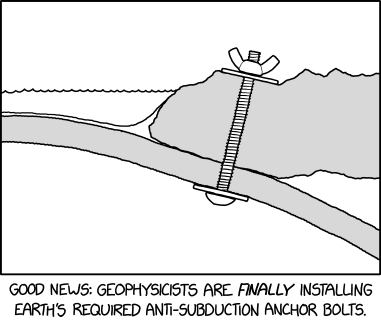
Anchor Bolts
Post Syndicated from xkcd.com original https://xkcd.com/3078/
Announcing the AWS Well-Architected Generative AI Lens
Post Syndicated from Dan Ferguson original https://aws.amazon.com/blogs/architecture/announcing-the-aws-well-architected-generative-ai-lens/
We are delighted to introduce the new AWS Well-Architected Generative AI Lens. The AWS Well-Architected Framework provides architectural best practices for designing and operating generative AI workloads on AWS. The Generative AI Lens uses the Well-Architected Framework to outline the steps for performing a Well-Architected Framework Review for your generative AI workloads.
The Generative AI Lens provides a consistent approach for customers to evaluate architectures that use large language models (LLMs) to achieve their business goals. This lens addresses common considerations relevant to model selection, prompt engineering, model customization, workload integration, and continuous improvement. Specifically excluded from this lens are best practices associated with model training and advanced model customization techniques. We identify best practices that help you architect your cloud-based applications and workloads according to AWS Well-Architected design principles gathered from supporting thousands of customer implementations.
The Generative AI Lens joins a collection of Well-Architected lenses published under AWS Well-Architected Lenses.
What is the Generative AI Lens?
The Well-Architected Generative AI Lens focuses on the six pillars of the Well-Architected Framework across six phases of the generative AI lifecycle, as illustrated in the following figure.

The six phases are:
- Scoping the impact of generative AI in solving your problem.
- Selecting a model that sufficiently addresses the task.
- Customizing the model with prompts, data sources, or updated weights to improve performance.
- Integrating the model into your existing applications.
- Deploying the new generative AI capability into your environment.
- Iterating and improving on the generative AI capabilities you have released.
Unlike the traditional waterfall approach, an iterative approach is required to achieve a working prototype based on the six phases of the generative AI lifecycle. The lens provides you with a set of established cloud-agnostic best practices in the form of Well-Architected Framework pillars for each generative AI lifecycle phase.
You can also use the Well-Architected Generative AI Lens wherever you are on your cloud journey. You can choose to apply this guidance either during the design of your generative AI workloads or after your workloads have entered production as a part of the continuous improvement process.
What’s else is discussed in the Generative AI Lens?
The Generative AI Lens also discusses the following key topics:
- Responsible AI – Responsible implementation of generative AI workloads is discussed in this paper. We describe some of the common considerations facing customers as they address the responsible implementation and deployment of generative AI.
- Data architecture for generative AI – At the core of any AI workload is data. We feature a brief survey on the nuances of data architectures with regards to generative AI workloads.
Who should use the Generative AI Lens?
The Generative AI Lens is of use to many roles. Business leaders can use this lens to acquire a broader appreciation of the end-to-end implementation and benefits of generative AI. Data scientists and engineers can read this lens to understand how to use, secure, and gain insights from their data at scale. Risk and compliance leaders can understand how generative AI is implemented responsibly by providing compliance with regulatory and governance requirements.
Generative AI Lens components
The lens includes four focus areas:
- The Well-Architected Generative AI Lens design principles – Design principles are the guidelines and value statements that frame the presented best practices.
- The Generative AI lifecycle and the Well Architected Framework pillars – This considers all aspects of the generative AI lifecycle and reviews design strategies to align to the pillars of the overall Well-Architected Framework:
- Operational excellence – Ability to support ongoing development, run operational workloads effectively, gain insight into your operations, and continuously improve supporting processes and procedures to deliver business value.
- Security – Ability to protect data, systems, and assets, and to take advantage of cloud technologies to improve your security.
- Reliability – Ability of a workload to perform its intended function correctly and consistently, and to automatically recover from failure situations.
- Performance efficiency – Ability to use computing resources efficiently to meet system requirements, and to maintain that efficiency as system demand changes and technologies evolve.
- Cost optimization – Ability to run systems to deliver business value at the lowest price point.
- Sustainability – Addresses the long-term environmental, economic, and societal impact of your business activities.
- Cloud-agnostic best practices – These are best practices for each generative AI lifecycle phase across the Well-Architected Framework pillars irrespective of your technology setting. The best practices are accompanied by:
- Implementation guidance – The AWS implementation plans for each best practice with references to AWS technologies and resources.
- Resources – A set of links to AWS documents, blogs, videos, and code examples as supporting resources to the best practices and their implementation plans.
- Related generative AI architecture considerations – This includes discussions on the generative AI application lifecycle, and where the listed best practices in this lens could fit into the lifecycle. Additionally, we discuss elements of data architecture for generative AI workloads, and Well-Architected considerations for responsible AI.
What are the next steps?
The new Well-Architected Generative AI Lens is available now. Use the lens to make sure that your generative AI workloads are architected with operational excellence, security, reliability, performance efficiency, cost optimization, and sustainability in mind.
If you require support on the implementation or assessment of your generative AI workloads, please contact your AWS Solutions Architect or Account Representative.
Special thanks to everyone across the AWS Solution Architecture, AWS Professional Services, and Machine Learning communities who contributed to the Generative AI Lens. These contributions encompassed diverse perspectives, expertise, backgrounds, and experiences in developing the new AWS Well-Architected Generative AI Lens.
For additional reading, refer to the AWS Well-Architected Framework and pillar whitepapers, or use the AWS Well-Architected Machine Learning Lens and its custom lens accessible from the AWS Well-Architected Tool.
About the authors
Accelerate your analytics with Amazon S3 Tables and Amazon SageMaker Lakehouse
Post Syndicated from Sandeep Adwankar original https://aws.amazon.com/blogs/big-data/accelerate-your-analytics-with-amazon-s3-tables-and-amazon-sagemaker-lakehouse/
Amazon SageMaker Lakehouse is a unified, open, and secure data lakehouse that now seamlessly integrates with Amazon S3 Tables, the first cloud object store with built-in Apache Iceberg support. With this integration, SageMaker Lakehouse provides unified access to S3 Tables, general purpose Amazon S3 buckets, Amazon Redshift data warehouses, and data sources such as Amazon DynamoDB or PostgreSQL. You can then query, analyze, and join the data using Redshift, Amazon Athena, Amazon EMR, and AWS Glue. In addition to your familiar AWS services, you can access and query your data in-place with your choice of Iceberg-compatible tools and engines, providing you the flexibility to use SQL or Spark-based tools and collaborate on this data the way you like. You can secure and centrally manage your data in the lakehouse by defining fine-grained permissions with AWS Lake Formation that are consistently applied across all analytics and machine learning(ML) tools and engines.
Organizations are becoming increasingly data driven, and as data becomes a differentiator in business, organizations need faster access to all their data in all locations, using preferred engines to support rapidly expanding analytics and AI/ML use cases. Let’s take an example of a retail company that started by storing their customer sales and churn data in their data warehouse for business intelligence reports. With massive growth in business, they need to manage a variety of data sources as well as exponential growth in data volume. The company builds a data lake using Apache Iceberg to store new data such as customer reviews and social media interactions.
This enables them to cater to their end customers with new personalized marketing campaigns and understand its impact on sales and churn. However, data distributed across data lakes and warehouses limits their ability to move quickly, as it may require them to set up specialized connectors, manage multiple access policies, and often resort to copying data, that can increase cost in both managing the separate datasets as well as redundant data stored. SageMaker Lakehouse addresses these challenges by providing secure and centralized management of data in data lakes, data warehouses, and data sources such as MySQL, and SQL Server by defining fine-grained permissions that are consistently applied across data in all analytics engines.
In this post, we guide you how to use various analytics services using the integration of SageMaker Lakehouse with S3 Tables. We begin by enabling integration of S3 Tables with AWS analytics services. We create S3 Tables and Redshift tables and populate them with data. We then set up SageMaker Unified Studio by creating a company specific domain, new project with users, and fine-grained permissions. This lets us unify data lakes and data warehouses and use them with analytics services such as Athena, Redshift, Glue, and EMR.
Solution overview
To illustrate the solution, we are going to consider a fictional company called Example Retail Corp. Example Retail’s leadership is interested in understanding customer and business insights across thousands of customer touchpoints for millions of their customers that will help them build sales, marketing, and investment plans. Leadership wants to conduct an analysis across all their data to identify at-risk customers, understand impact of personalized marketing campaigns on customer churn, and develop targeted retention and sales strategies.
Alice is a data administrator in Example Retail Corp who has embarked on an initiative to consolidate customer information from multiple touchpoints, including social media, sales, and support requests. She decides to use S3 Tables with Iceberg transactional capability to achieve scalability as updates are streamed across billions of customer interactions, while providing same durability, availability, and performance characteristics that S3 is known for. Alice already has built a large warehouse with Redshift, which contains historical and current data about sales, customers prospects, and churn information.
Alice supports an extended team of developers, engineers, and data scientists who require access to the data environment to develop business insights, dashboards, ML models, and knowledge bases. This team includes:
Bob, a data analyst who needs to access to S3 Tables and warehouse data to automate building customer interactions growth and churn across various customer touchpoints for daily reports sent to leadership.
Charlie, a Business Intelligence analyst who is tasked to build interactive dashboards for funnel of customer prospects and their conversions across multiple touchpoints and make those available to thousands of Sales team members.
Doug, a data engineer responsible for building ML forecasting models for sales growth using the pipeline and/or customer conversion across multiple touchpoints and make those available to finance and planning teams.
Alice decides to use SageMaker Lakehouse to unify data across S3 Tables and Redshift data warehouse. Bob is excited about this decision as he can now build daily reports using his expertise with Athena. Charlie now knows that he can quickly build Amazon QuickSight dashboards with queries that are optimized using Redshift’s cost-based optimizer. Doug, being an open source Apache Spark contributor, is excited that he can build Spark based processing with AWS Glue or Amazon EMR to build ML forecasting models.
The following diagram illustrates the solution architecture.
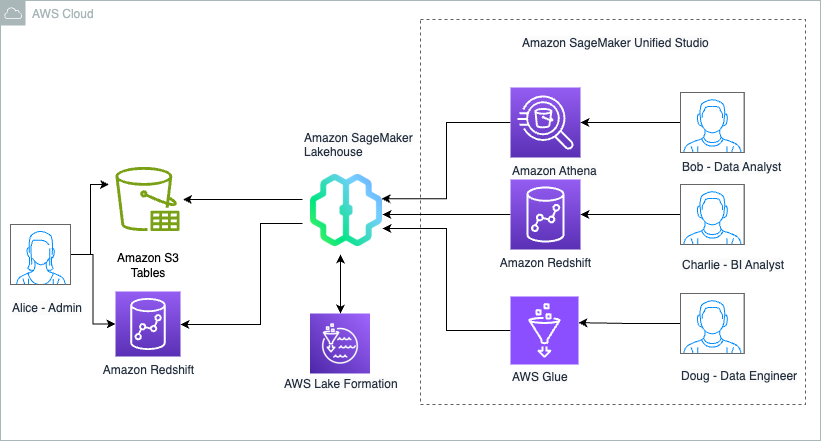
Implementing this solution consists of the following high-level steps. For Example Retail, Alice as a data Administrator performs these steps:
- Create a table bucket. S3 Tables stores Apache Iceberg tables as S3 resources, and customer details are managed in S3 Tables. You can then enable integration with AWS analytics services, which automatically sets up the SageMaker Lakehouse integration so that the tables bucket is shown as a child catalog under the federated
s3tablescatalogin the AWS Glue Data Catalog and is registered with AWS Lake Formation for access control. Next, you create a table namespace or database which is a logical construct that you group tables under and create a table using Athena SQL CREATE TABLE statement. - Publish your data warehouse to Glue Data Catalog. Churn data is managed in a Redshift data warehouse, which is published to the Data Catalog as a federated catalog and is available in SageMaker Lakehouse.
- Create a SageMaker Unified Studio project. SageMaker Unified Studio integrates with SageMaker Lakehouse and simplifies analytics and AI with a unified experience. Start by creating a domain and adding all users (Bob, Charlie, Doug). Then create a project in the domain, choosing project profile that provisions various resources and the project AWS Identity and Access Management (IAM) role that manages resource access. Alice adds Bob, Charlie, and Doug to the project as members.
- Onboard S3 Tables and Redshift tables to SageMaker Unified Studio. To onboard the S3 Tables to the project, in Lake Formation, you grant permission on the resource to the SageMaker Unified Studio project role. This enables the catalog to be discoverable within the lakehouse data explorer for users (Bob, Charlie, and Doug) to start querying tables .SageMaker Lakehouse resources can now be accessed from computes like Athena, Redshift, and Apache Spark based computes like Glue to derive churn analysis insights, with Lake Formation managing the data permissions.
Prerequisites
To follow the steps in this post, you must complete the following prerequisites:
Alice completes the following steps to create the S3 Table bucket for the new data she plans to add/import into an S3 Table.
- AWS account with access to the following AWS services:
- Amazon S3 including S3 Tables
- Amazon Redshift
- AWS Identity and Access Management (IAM)
- Amazon SageMaker Unified Studio
- AWS Lake Formation and AWS Glue Data Catalog
- AWS Glue
- Create a user with administrative access.
- Have access to an IAM role that is a Lake Formation data lake administrator. For instructions, refer to Create a data lake administrator.
- Enable AWS IAM Identity Center in the same AWS Region where you want to create your SageMaker Unified Studio domain. Set up your identity provider (IdP) and synchronize identities and groups with AWS IAM Identity Center. For more information, refer to IAM Identity Center Identity source tutorials.
- Create a read-only administrator role to discover the Amazon Redshift federated catalogs in the Data Catalog. For instructions, refer to Prerequisites for managing Amazon Redshift namespaces in the AWS Glue Data Catalog.
- Create an IAM role named
DataTransferRole. For instructions, refer to Prerequisites for managing Amazon Redshift namespaces in the AWS Glue Data Catalog. - Create an Amazon Redshift Serverless namespace called
churnwg. For more information, see Get started with Amazon Redshift Serverless data warehouses.
Create a table bucket and enable integration with analytics services
Alice completes the following steps to create the S3 Table bucket for the new data she plans to add/import into an S3 Tables.
Follow the below steps to create a table bucket to enable integration with SageMaker Lakehouse:
- Sign in to the S3 console as user created in prerequisite step 2.
- Choose Table buckets in the navigation pane and choose Enable integration.

- Choose Table buckets in the navigation pane and choose Create table bucket.
- For Table bucket name, enter a name such as
blog-customer-bucket. - Choose Create table bucket.

- Choose Create table with Athena.
- Select Create a namespace and provide a namespace (for example,
customernamespace). - Choose Create namespace.

- Choose Create table with Athena.
- On the Athena console, run the following SQL script to create a table:


This is just an example of adding a few rows to the table, but generally for production use cases, customers use engines such as Spark to add data to the table.
S3 Tables customer is now created, populated with data and integrated with SageMaker Lakehouse.
Set up Redshift tables and publish to the Data Catalog
Alice completes the following steps to connect the data in Redshift to be published into the data catalog. We’ll also demonstrate how the Redshift table is created and populated, but in Alice’s case Redshift table already exists with all the historic data on sales revenue.
- Sign in to the Redshift endpoint
churnwgas an admin user. - Run the following script to create a table under the
devdatabase under the public schema: - On the Redshift Serverless console, navigate to the namespace.
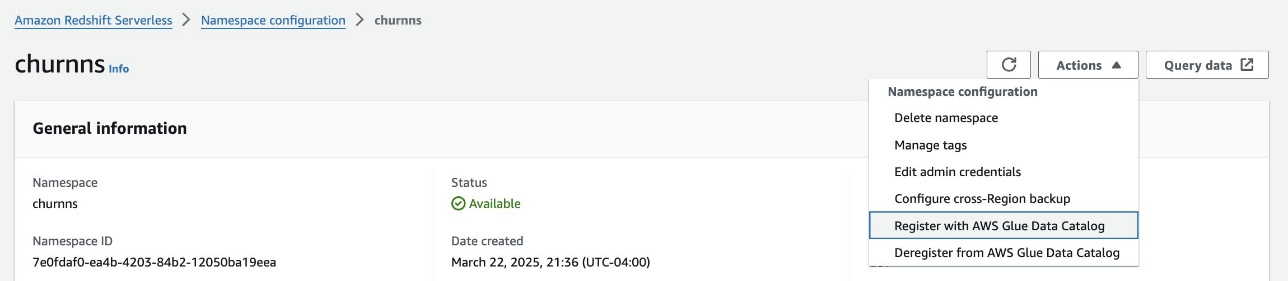
- On the Action dropdown menu, choose Register with AWS Glue Data Catalog to integrate with SageMaker Lakehouse.
- Choose Register.

- Sign in to the Lake Formation console as the data lake administrator.
- Under Data Catalog in the navigation pane, choose Catalogs and Pending catalog invitations.
- Select the pending invitation and choose Approve and create catalog.

- Provide a name for the catalog (for example,
churn_lakehouse). - Under Access from engines, select Access this catalog from Iceberg-compatible engines and choose
DataTransferRolefor the IAM role. - Choose Next.
- Choose Add permissions.
- Under Principals, choose the
datalakeadminrole for IAM users and roles, Super user for Catalog permissions, and choose Add. - Choose Create catalog.

Redshift Table customer_churn is now created, populated with data and integrated with SageMaker Lakehouse.
Create a SageMaker Unified Studio domain and project
Alice now sets up SageMaker Unified Studio domain and projects so that she can bring users (Bob, Charlie and Doug) together in the new project.
Complete the following steps to create a SageMaker domain and project using SageMaker Unified Studio:
- On the SageMaker Unified Studio console, create a SageMaker Unified Studio domain and project using the All Capabilities profile template. For more details, refer to Setting up Amazon SageMaker Unified Studio. For this post, we create a project named
churn_analysis. - Setup AWS Identity center with users Bob, Charlie and Doug, Add them to domain and project.
- From SageMaker Unified Studio, navigate to the project overview and on the Project details tab, note the project role Amazon Resource Name (ARN).

- Sign in to the IAM console as an admin user.
- In the navigation pane, choose Roles.
- Search for the project role and add AmazonS3TablesReadOnlyAccess by choosing Add permissions.

SageMaker Unified Studio is now setup with domain, project and users.
Onboard S3 Tables and Redshift tables to the SageMaker Unified Studio project
Alice now configures SageMaker Unified Studio project role for fine-grained access control to determine who on her team gets to access what data sets.
Grant the project role full table access on customer dataset. For that, complete the following steps:
- Sign in to the Lake Formation console as the data lake administrator.
- In the navigation pane, choose Data lake permissions, then choose Grant.
- In the Principals section, for IAM users and roles, choose the project role ARN noted earlier.
- In the LF-Tags or catalog resources section, select Named Data Catalog resources:
- Choose
<account_id>:s3tablescatalog/blog-customer-bucketfor Catalogs. - Choose
customernamespacefor Databases. - Choose customer for Tables.
- Choose
- In the Table permissions section, select Select and Describe for permissions.
- Choose Grant.
Now grant the project role access to subset of columns from customer_churn dataset.
- In the navigation pane, choose Data lake permissions, then choose Grant.
- In the Principals section, for IAM users and roles, choose the project role ARN noted earlier.
- In the LF-Tags or catalog resources section, select Named Data Catalog resources:
- Choose
<account_id>:churn_lakehouse/devfor Catalogs. - Choose public for Databases.
- Choose
customer_churnfor Tables.
- Choose
- In the Table Permissions section, select Select.
- In the Data Permissions section, select Column-based access.
- For Choose permission filter, select Include columns and choose
customer_id,internet_service, andis_churned. - Choose Grant.


All users in the project churn_analysis in SageMaker Unified Studio are now setup. They have access to all columns in the table and fine-grained access permissions for Redshift table where they have access to only three columns.
Verify data access in SageMaker Unified Studio
Alice can now do a final verification if the data is all available to ensure that each of her team members are set up to access the datasets.
Now you can verify data access for different users in SageMaker Unified Studio.
- Sign in to SageMaker Unified Studio as Bob and choose the
churn_analysis - Navigate to the Data explorer to view
s3tablescatalogandchurn_lakehouseunder Lakehouse.

Data Analyst uses Athena for analyzing customer churn
Bob, the data analyst can now logs into to the SageMaker Unified Studio, chooses the churn_analysis project and navigates to the Build options and choose Query Editor under Data Analysis & Integration.

Bob chooses the connection as Athena (Lakehouse), the catalog as s3tablescatalog/blog-customer-bucket, and the database as customernamespace. And runs the following SQL to analyze the data for customer churn:

Bob can now join the data across S3 Tables and Redshift in Athena and now can proceed to build full SQL analytics capability to automate building customer growth and churn leadership daily reports.
BI Analyst uses Redshift engine for analyzing customer data
Charlie, the BI Analyst can now logs into the SageMaker Unified Studio and chooses the churn_analysis project. He navigates to the Build options and choose Query Editor under Data Analysis & Integration. He chooses the connection as Redshift (Lakehouse), Databases as dev, Schemas as public.

He then runs the follow SQL to perform his specific analysis.
 Charlie can now further update the SQL query and use it to power QuickSight dashboards that can be shared with Sales team members.
Data engineer uses AWS Glue Spark engine to process customer data
Finally, Doug logs in to SageMaker Unified Studio as Doug and chooses the churn_analysis project to perform his analysis. He navigates to the Build options and choose JupyterLab under IDE & Applications. He downloads the churn_analysis.ipynb notebook and upload it into the explorer. He then runs the cells by selecting compute as project.spark.compatibility.
He runs the following SQL to analyze the data for customer churn:

Doug, now can use Spark SQL and start processing data from both S3 tables and Redshift tables and start building forecasting models for customer growth and churn
Cleaning up
If you implemented the example and want to remove the resources, complete the following steps:
- Clean up S3 Tables resources:
- Clean up the Redshift data resources:
- On the Lake Formation console, choose Catalogs in the navigation pane.
- Delete the
churn_lakehousecatalog.
- Delete SageMaker project, IAM roles, Glue resources, Athena workgroup, S3 buckets created for domain.
- Delete SageMaker domain and VPC created for the setup.
Conclusion
In this post, we showed how you can use SageMaker Lakehouse to unify data across S3 Tables and Redshift data warehouses, which can help you build powerful analytics and AI/ML applications on a single copy of data. SageMaker Lakehouse gives you the flexibility to access and query your data in-place with Iceberg-compatible tools and engines. You can secure your data in the lakehouse by defining fine-grained permissions that are enforced across analytics and ML tools and engines.
For more information, refer to Tutorial: Getting started with S3 Tables, S3 Tables integration, and Connecting to the Data Catalog using AWS Glue Iceberg REST endpoint. We encourage you to try out the S3 Tables integration with SageMaker Lakehouse integration and share your feedback with us.
About the authors
 Sandeep Adwankar is a Senior Technical Product Manager at AWS. Based in the California Bay Area, he works with customers around the globe to translate business and technical requirements into products that enable customers to improve how they manage, secure, and access data.
 Srividya Parthasarathy is a Senior Big Data Architect on the AWS Lake Formation team. She works with the product team and customers to build robust features and solutions for their analytical data platform. She enjoys building data mesh solutions and sharing them with the community.
 Aditya Kalyanakrishnan is a Senior Product Manager on the Amazon S3 team at AWS. He enjoys learning from customers about how they use Amazon S3 and helping them scale performance. Adi’s based in Seattle, and in his spare time enjoys hiking and occasionally brewing beer.
Announcing AWS Security Reference Architecture Code Examples for Generative AI
Post Syndicated from Ievgeniia Ieromenko original https://aws.amazon.com/blogs/security/announcing-aws-security-reference-architecture-code-examples-for-generative-ai/
Amazon Web Services (AWS) is pleased to announce the release of new Security Reference Architecture (SRA) code examples for securing generative AI workloads. The examples include two comprehensive capabilities focusing on secure model inference and RAG implementations, covering a wide range of security controls and best practices for AWS generative AI services.
These new code examples are available in the AWS SRA Examples Repository and include ready-to-deploy CloudFormation templates for implementing detective security controls such as network segmentation, identity management, encryption, prompt injection detection, and logging and monitoring. The solutions align with the AWS SRA Design Guidance page and demonstrate our commitment to helping customers secure their generative AI implementations.
Customers can get started with these examples by following the implementation instructions for each solution in the AWS SRA Examples Repository Solutions GenAI page. Additional documentation and implementation guidance is available in the AWS SRA Design Guidance Generative AI Architecture Deep Dive.
AWS strives to continuously provide security solutions that help customers meet their security architecture needs. Customers can reach out to the team by submitting an issue in the code repository.
If you have feedback about this post, submit comments in the Comments section below.