Workers AI gets a speed boost, batch workload support, more LoRAs, new models, and a refreshed dashboard

Post Syndicated from Michelle Chen original https://blog.cloudflare.com/workers-ai-improvements/

Since the launch of Workers AI in September 2023, our mission has been to make inference accessible to everyone.

Over the last few quarters, our Workers AI team has been heads down on improving the quality of our platform, working on various routing improvements, GPU optimizations, and capacity management improvements. Managing a distributed inference platform is not a simple task, but distributed systems are also what we do best. You’ll notice a recurring theme from all these announcements that has always been part of the core Cloudflare ethos — we try to solve problems through clever engineering so that we are able to do more with less.

Today, we’re excited to introduce speculative decoding to bring you faster inference, an asynchronous batch API for large workloads, and expanded LoRA support for more customized responses. Lastly, we’ll be recapping some of our newly added models, updated pricing, and unveiling a new dashboard to round out the usability of the platform.

Speeding up inference by 2-4x with speculative decoding and more

We’re excited to roll out speed improvements to models in our catalog, starting with the Llama 3.3 70b model. These improvements include speculative decoding, prefix caching, an updated inference backend, and more. We’ve previously done a technical deep dive on speculative decoding and how we’re making Workers AI faster, which you can read about here. With these changes, we’ve been able to improve inference times by 2-4x, without any significant change to the quality of answers generated. We’re planning to incorporate these improvements into more models in the future as we release them. Today, we’re starting to roll out these changes so all Workers AI users of @cf/meta/llama-3.3-70b-instruct-fp8-fast will enjoy this automatic speed boost.
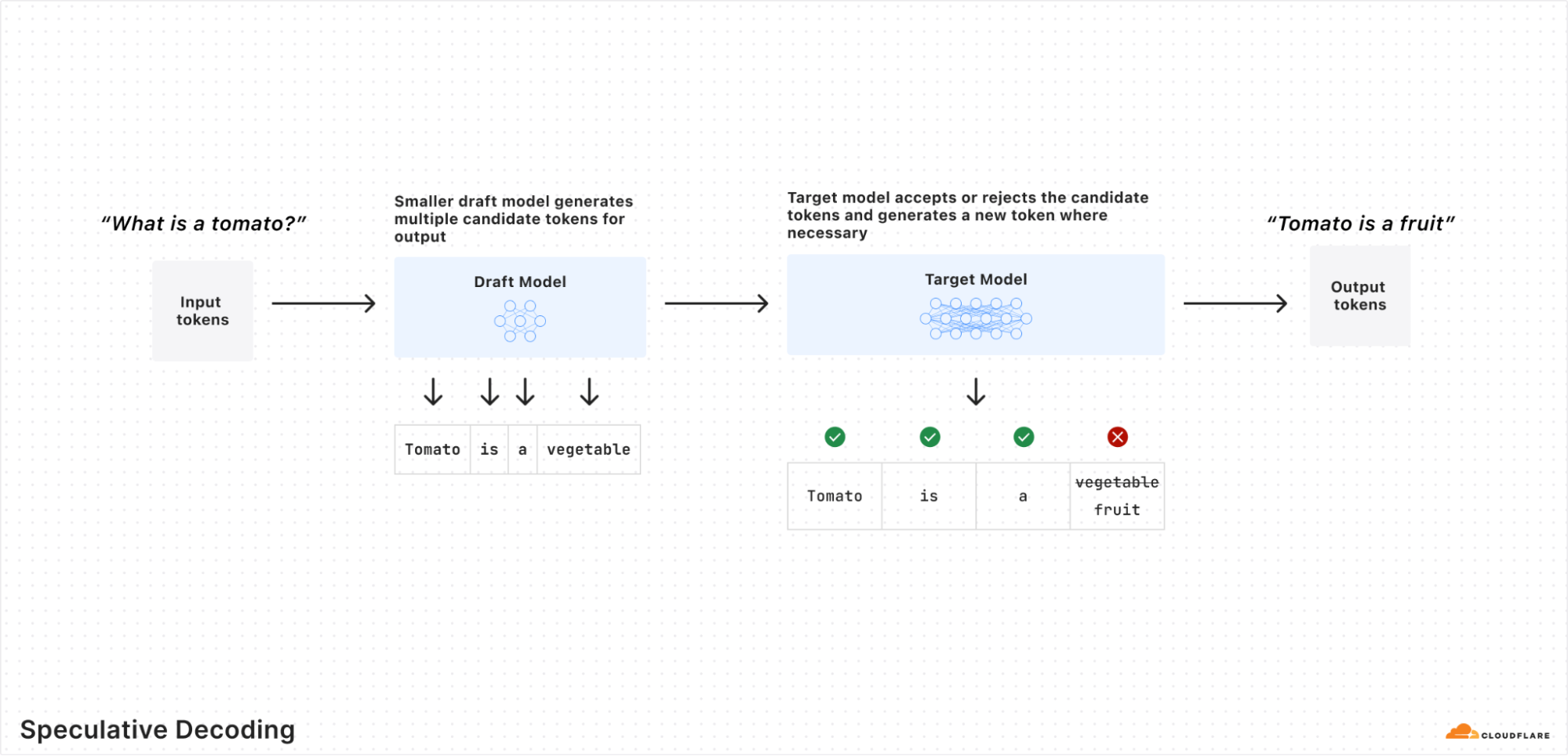
What is speculative decoding?


The way LLMs work is by generating text by predicting the next token in a sentence given the previous tokens. Typically, an LLM is able to predict a single future token (n+1) with one forward pass through the model. These forward passes can be computationally expensive, since they need to work through all the parameters of a model to generate one token (e.g., 70 billion parameters for Llama 3.3 70b).

With speculative decoding, we put a small model (known as the draft model) in front of the original model that helps predict n+x future tokens. The draft model generates a subset of candidate tokens, and the original model just has to evaluate and confirm if they should be incorporated into the generation. Evaluating tokens is less computationally expensive, as the model can evaluate multiple tokens concurrently in a forward pass. As such, inference times can be sped up by 2-4x — meaning that users can get responses much faster.

What makes speculative decoding particularly efficient is that it’s able to use unused GPU compute left behind due to the GPU memory bottleneck LLMs create. Speculative decoding takes advantage of the unused compute by squeezing in a draft model to generate tokens faster. This means we’re able to improve the utilization of our GPUs by using them to their full extent without having parts of the GPU sit idle.

What is prefix caching?

With LLMs, there are usually two stages of generation – the first is known as “pre-fill”, which processes the user’s input tokens such as the prompt and context. Prefix caching is aimed at reducing the pre-fill time of a request. As an example, if you were asking a model to generate code based on a given file, you might insert the whole file into the context window of a request. Then, if you want to make a second request to generate the next line of code, you might send us the whole file again in the second request. Prefix caching allows us to cache the pre-fill tokens so we don’t have to process the context twice. With the same example, we would only do the pre-fill stage once for both requests, rather than doing it per request. This method is especially useful for requests that reuse the same context, such as Retrieval Augmented Generation (RAG), code generation, chatbots with memory, and more. Skipping the pre-fill stage for similar requests means faster responses for our users and more efficient usage of resources. 

How did you validate that quality is preserved through these optimizations?

Since this is an in-place update to an existing model, we were particularly cautious in ensuring that we would not break any existing applications with this update. We did extensive A/B testing through a blind arena with internal employees to validate the model quality, and we asked internal and external customers to test the new version of the model to ensure that response formats were compatible and model quality was acceptable. Our testing concluded that the model performed up to standards, with people being extremely excited about the speed of the model. Most LLMs are not perfectly deterministic even with the same set of inputs, but if you do notice something off, please let us know through Discord or X.

Asynchronous batch API

Next up, we’re announcing an asynchronous (async) batch API which is helpful for users of large workloads. This feature allows customers to receive their inference responses asynchronously, with the promise that the inference will be completed at a later time rather than immediately erroring out due to capacity.

An example use case of batch workloads is people generating summaries of a large number of documents. You probably don’t need to use those summaries immediately, as you’ll likely use them once the whole document is complete versus one paragraph at a time. For these use cases, we’ve made it super simple for you to start sending us these requests in batches.

Why batch requests?

From talking to our customers, the most common use case we hear about is people creating embeddings or summarizing a large number of documents. Unfortunately, this is also one of the hardest use cases to manage capacity for as a serverless platform.

To illustrate this, imagine that you want to summarize a 70 page PDF. You typically chunk the document and then send an inference request for each chunk. If each chunk is a few paragraphs on a page, that means that we receive around 4 requests per page multiplied by 70 pages, which is about 280 requests. Multiply that by tens or hundreds of documents, and multiply that by a handful of concurrent users — this means that we get a sudden massive influx of thousands of requests when users start these large workloads.

The way we originally built Workers AI was to handle incoming requests as quickly as possible, assuming there’s a human on the other side that needed an immediate response. The unique thing about batch workloads is that while they’re not latency sensitive, they do require completeness guarantees — you don’t want to come back the next day to realize none of your inference requests actually executed.

With the async API, you send us a batch of requests, and we promise to fulfill them as fast as possible and return them to you as a batch. This guarantees that your inference request will be fulfilled, rather than immediately (or eventually) erroring out. The async API also benefits users who have real-time use cases, as the model instances won’t be immediately consumed by these batch requests that can wait for a response. Inference times will be faster since there won’t be a bunch of competing requests in a queue waiting to reach the inference servers. 

We have select models that support batch inference today, which include:

How can I use the batch API?

Users can send a batch request to supported models by passing a flag:

let res = await env.AI.run("@cf/meta/llama-3.3-70b-instruct-batch", {
  "requests": [{
    "prompt": "Explain mechanics of wormholes"
  }, {
    "prompt": "List different plant species found in America"
  }]
}, {
  queueRequest: true
});

Check out our developer docs to learn more about the batch API, or use our template to deploy a worker that implements the batch API.

Today, our batch API can be used by sending us an array of requests, and we’ll return your responses in an array.  This is helpful for use cases like summarizing large amounts of data that you know beforehand. This means you can send us a single HTTP request with all of your requests, and receive a single HTTP request back with your responses. You can check on the status of the batch by polling it with the request ID we return when your batch is submitted. For the next iteration of our async API, we plan to allow queue-based inputs and outputs, where you push requests and pull responses from a queue. This will integrate tightly with Event Notifications and Workflows, so you can execute subsequent actions upon receiving a response.

Expanded LoRA support

At Birthday Week last year, we announced limited LoRA support for a handful of models. We’ve 

iterated on this and now support 8 models as well as larger ranks of up to 32 and LoRA files up to 500 MB. Models that support LoRA inference now include:

What is LoRA?

In essence, a Low Rank Adaptation (LoRA) adapter allows people to take a trained adapter file and use it in conjunction with a model to alter the response of a model. We did a deep dive on LoRAs in our Birthday Week blog post, which goes into further technical detail. LoRA adapters are great alternatives to fine-tuning a model, as it isn’t as expensive to train and adapters are much smaller and more portable. They are also effective enough to tweak the output of a model to fit a certain style of response.

How do I get started?

To get started, you first need to train your own LoRA adapter or find a public one on HuggingFace. Then, you’ll upload the adapter_model.safetensors and adapter_config.json to your account with the documented wrangler commands or through the REST API. LoRA files are private and scoped to your own account. After that, you can start running fine-tuned inference — check out our LoRA developer docs to get started.

const response = await env.AI.run(
  "@cf/qwen/qwen2.5-coder-32b-instruct", //the model supporting LoRAs
  {
      messages: [{"role": "user", "content": "Hello world"}],
      raw: true, //skip applying the default chat template
      lora: "00000000-0000-0000-0000-000000000", //the finetune id OR finetune name
  }
);

Quality of life improvements: updated pricing and a new dashboard for Workers AI

While the team has been focused on large engineering milestones, we’ve also landed some quality of life improvements over the last few months. In case you missed it, we’ve announced an updated pricing model where usage will be shown in units such as tokens, audio seconds, image size/steps, etc. but still billed in neurons in the backend.

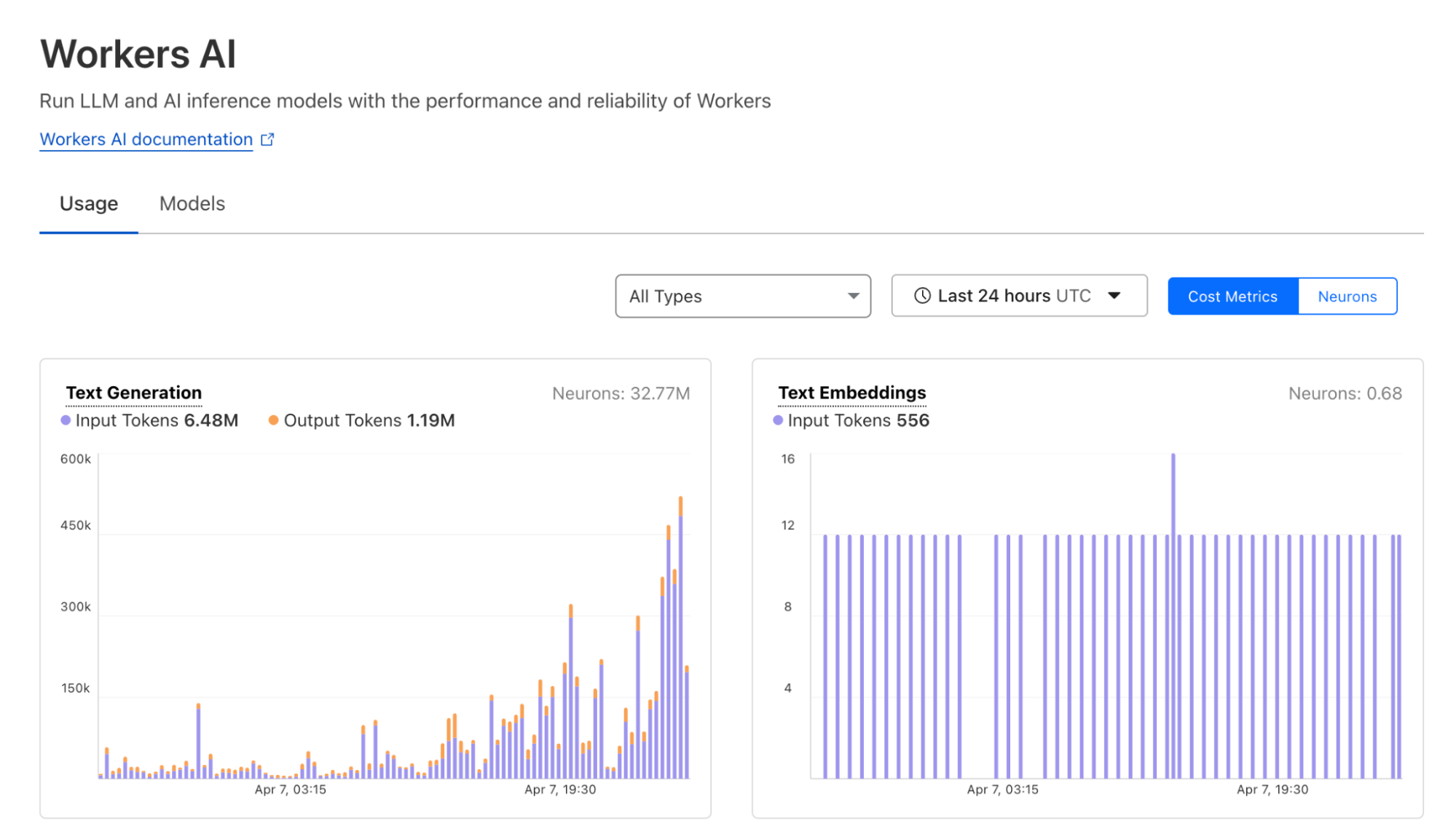
Today, we’re unveiling a new dashboard that allows users to see their usage in both units as well as neurons (built on new Workers Observability components!). Model pricing is also available via dashboard and developer docs on the models page. And if you use AI Gateway, Workers AI usage will also be displayed as metrics now.

New models available in Workers AI

Lastly, we’ve steadily been adding new models on Workers AI, with over 10 new models and a few updates on existing models. Pricing is also now listed directly on the model page in the developer docs. To summarize, here are the new models we’ve added on Workers AI, including four new ones we’re releasing today:

  • @cf/deepseek-ai/deepseek-r1-distill-qwen-32b: a version of Qwen 32B distilled from Deepseek’s R1 that is capable of doing chain-of-thought reasoning.

  • @cf/baai/bge-m3: a multi-lingual embeddings model that supports over 100 languages. It can also simultaneously perform dense retrieval, multi-vector retrieval, and sparse retrieval, with the ability to process inputs of different granularities.

  • @cf/baai/bge-reranker-base: our first reranker model! Rerankers are a type of text classification model that takes a query and context, and outputs a similarity score between the two. When used in RAG systems, you can use a reranker after the initial vector search to find the most relevant documents to return to a user by reranking the outputs.

  • @cf/openai/whisper-large-v3-turbo: a faster, more accurate speech-to-text model. This model was added earlier but is graduating out of beta with pricing included today.

  • @cf/myshell-ai/melotts: our first text-to-speech model that allows users to generate an MP3 with voice audio from text input.

  • @cf/meta/llama-4-scout-17b-16e-instruct: 17 billion parameter MoE model with 16 experts that is natively multimodal. Offers industry-leading performance in text and image understanding.

  • [NEW] @cf/mistralai/mistral-small-3.1-24b-instruct: a 24B parameter model achieving state-of-the-art capabilities comparable to larger models, with support for vision and tool calling.

  • [NEW] @cf/google/gemma-3-12b-it: well-suited for a variety of text generation and image understanding tasks, including question answering, summarization and reasoning, with a 128K context window, and multilingual support in over 140 languages.

  • [NEW] @cf/qwen/qwq-32b: a medium-sized reasoning model, which is capable of achieving competitive performance against state-of-the-art reasoning models, e.g., DeepSeek-R1, o1-mini.

  • [NEW] @cf/qwen/qwen2.5-coder-32b-instruct: the current state-of-the-art open-source code LLM, with its coding abilities matching those of GPT-4o.

In addition, we are rolling out some in-place updates to existing models in our catalog:

As we release these new models, we’ll be deprecating old models to encourage use of the state-of-the-art models and make room in our catalog. We will send out an email notice on this shortly. Stay up to date with our model releases and deprecation announcements by subscribing to our Developer Docs changelog.

We’re (still) just getting started

Workers AI is one of Cloudflare’s newer products in a nascent industry, but we still operate with very traditional Cloudflare principles – learning how we can do more with less. Our engineering team is focused on solving the difficult problems that come with growing a distributed inference platform at a global scale, and we’re excited to release these new features today that we think will improve the platform as a whole for all our users. With faster inference times, better reliability, more customization possibilities, and better usability, we’re excited to see what you can do with more Workers AI — let us know what you think!


Разговор за образователната система, каквато искаме да бъде

Post Syndicated from original https://www.toest.bg/razgovor-za-obrazovatelnata-sistema-kakvato-iskame-da-bude/

Разговор за образователната система, каквато искаме да бъде

След дълги разговори за непродуктивното изучаване на чужди езици потърсих представители на онези образователни структури, към които се обръщат родителите, когато търсят качествено чуждоезиково обучение. Това са занимални, езикови центрове и частни училища. Разговорът ни с Ирина Мартинова, Мария Караиванова и Смиляна Димитрова логично се разшири и излезе извън темата за ученето на език, но бяхме единодушни – всичко е възможно дори при сегашните не съвсем оптимални условия. Вижте как може да бъде.


Вас ви има до голяма степен защото образователната система не смогва. Ние нямаме достатъчно места в училищата в големите градове, затова имаме огромни класове и учене на смени. Занималните на практика съществуват само за съвсем начален етап. Езиковото обучение е на все по-ниско ниво, изглежда, се обсъжда и намаляване на часовете по чужд език, а от езикова гимназия се излиза с ниво В2, което е абсолютно недостатъчно, като се има предвид, че в университетите в Австрия и Германия например се изисква ниво C1. Защо правите това, което правите? Бизнес ли е?

Смиляна: Образователната сфера в България е последното място, на което се търси икономическа полза, и между другото, в много други държави също няма такава, защото с труда си в образователната система не произвеждаме продукт, носещ финансова печалба, която да се връща към нас. А всъщност за да се развива добре образованието, както и всичко друго, има нужда от финансиране – това трябва да бъде политика на държавата. Докато тя не вижда смисъл качествено да образова гражданите си, няма как образователната система да се самоиздържа, независимо под каква форма. 

Според мен съществуват все повече алтернативни и допълнителни форми на образователни структури, защото толкова е изчезнал фокусът защо го има това училище, каква е целта му, какво се прави в него, че оттам нататък всичко по пътя е обезсмислено.

Няма яснота какво и защо правят децата в часовете. Системата и формата на преподаване са създадени преди столетия и през XVII век са били действително иновация, която позволява достъп до образование на много по-широк кръг от населението. От него се възползва и индустриализацията, като тази форма спомага за подготовката на така необходимата тогава работна ръка. Вече живеем в абсолютно различна реалност, а в същото време подготвяме децата за тази нова реалност по онзи стар начин. И са малко хората, които си казват: „Това не върши работа.“ 

Мария: Нашия езиков център го има също извън въпроса за икономическите ползи, защото такива на практика почти не съществуват. Има ни заради ефективността на методите, които използваме. Остарелите методи все още са ежедневна практика в училищата – например Grammar-Translation Method, който е въведен през XIX век, за да могат да се четат и превеждат текстове на класически езици. В съвременния свят обаче всички виждаме колко бързо се променя всичко, децата вече са различни, дори не са като тези отпреди пет години. Ето защо да ги караш да преписват и да превеждат текстове е съвсем различно от преподаването на умения за комуникация на съответния чужд език. 

Стартирахме занималнята, защото искахме да предложим спокойна среда на децата, възможности за изграждане на умения, необходими за живота в XXI век, възможност за подготовка на учебния материал след училище и преди всичко да освободим семействата от задължението да учат с детето вкъщи. А и заради търсенето от страна на родителите, защото всички знаем за училища, в чиито занимални с 35 деца сборна група работи един учител, който няма как да се справи качествено с този брой ученици. Често чуваме и от децата, че при нас е много спокойно, и те не искат да тръгват по обяд за училище. 

Разговор за образователната система, каквато искаме да бъде
Ирина Мартинова: Ръководя курсовете и изпитите в Гьоте-институт България. Моят фокус е върху обучението и квалификацията на учителите по съвременните методи и дидактика на преподаване. Освен това имам дългогодишен опит като преподавател по немски език за възрастни и младежи. За мен най-важното в образованието са принципите на активно учене, което има връзка с реалния живот.

Значи, получавате доверие. Никой не е задължил вашите ученици и родителите им, те идват по собствено желание при всяка една от вас. 

Ирина: Да, точно така. Наскоро чух от наш ученик: „Ех, да можеше ученето на немски в училище да е толкова интересно! Там е скучно, а тук е готино. Трябва да се замислим за начина, по който преподаваме.

Смиляна: Ние всички, на първо място, осигуряваме среда, в която децата се чувстват добре. Защото тайната на успешното учене е отношението. Тук преди всичко говоря за емоционалната среда, едва след това за физическата, която също не е маловажна. За да се развива едно дете, то най-напред трябва да е в save mode, в безопасна среда. Когато детето се чувства прието, на сигурно място, и са задоволени базовите му потребности, тогава то се отваря да учи и да развива потенциала си.

Много пъти сме си говорили какво трябва да се промени в образователната система, каква е нормативната рамка, която ни пречи. Няма такава.

Когато работиш с други хора, особено с деца, особено в ролята на учител, е много важно ти самият да бъдеш балансиран, стабилен и емоционално интелигентен. Ако не показваш уважение към детето, няма как да изискваш от него уважение. Ако ти не се държиш с него като с личност и не спазваш същите правила, които изискваш от него – не става. Ние възпитаваме чрез поведението си, не само чрез думите си. 

Наистина ли е неефективно изучаването на чужд език в повечето български училища?

Мария: Редовно когато децата идват при нас в частната занималня и се стигне до домашното по чужд език, виждаме, че основното е да преписват текст или думи. Един от най-фрапиращите случаи беше, когато второкласничка дойде с 14 нови думи по испански и трябваше всяка дума да бъде написана по 10 пъти, което е 140 думи. Аз карам шестокласниците по време на тестовете за умения за писане да ми напишат между 80 и 100 думи. Това дете във втори клас трябваше да напише 140 думи, плюс да си напише домашното по математика, плюс да си напише домашното по български. Сами можете да си представите едно дете във втори клас каква скорост на писане има, колко време му отнема това домашно и после колко запомня от правописа на тези думи.

Защо писането на думи не помага? Защо вашите ученици например не пишат думи по пет реда?

Мария: Нашите ученици пишат думи, но не ги преписват. Защото преписването на думи по Х на брой пъти прескача цялата фоник система, която е много естествен начин за децата да научат буквите и четенето на английски език. Фотографското запаметяване чрез повторения как се пише всяка дума няма същия ефект и не включва необходимия мисловен процес, ако изобщо включва някакъв. Нашите ученици пишат думи в различни видове контекст, в който сами трябва да изберат коя дума как да използват. Включваме разнообразни игри, като скрабъл, магнитни буквички и други, които извеждат писането извън стандартния формат на листа и химикалката. Постепенно децата откриват, че да се чете и пише на английски е забавно и не е страшно. Имаме първокласници, които вече четат на английски. 

Ирина: Езикът се учи в неговата структурна цялост и никога една дума не може да бъде изолирана, защото тя не съществува никъде така, освен в речника. Нито една граматика или пък дума не може да бъде самоцел. Те са само начинът да изразим това, което искаме да кажем. В Гьоте-институт учим чрез конкретни действия – искам да поръчам нещо в ресторанта, значи уча цялата фраза: „Бихте ли ми донесли…“ или „Моля да поръчам…“. Автоматизацията, запомнянето на тези структури допринасят за запомнянето и на думите. Знаете ли колко пъти трябва да бъде срещната една дума, за да бъде запомнена? Преди години се твърдеше, че е 76 пъти. Най-актуалните невродидактически проучвания обаче показват, че думата трябва да бъде употребена 100 пъти, така че тя никога повече да не излезе от главата ти.

Смиляна: Дори в българския език не вадим думата просто така, а по-скоро я включваме в контекста на цялата речева ситуация. Невролозите казват, че за да запомниш нещо, трябва да направиш нови връзки в мозъка си. Не правиш никакви връзки, пишейки механично една дума. Да не говорим за децата, които имат да напишат думата 10 пъти и пишат 10 пъти първата буква, 10 пъти втората и т.н. Виждала съм и два химикала, залепени един за друг, за да пишат наведнъж на два реда. Дори самите деца показват, че това е абсолютно губене на време, и търсят всяка вратичка, за да го заобиколят. 

Разговор за образователната система, каквато искаме да бъде
Мария Караиванова: Преподавам английски език и работя с деца от 25 години. Имам и над 15-годишен опит в обучението и изграждането на преподавателски екипи по чужди езици. Преди 13 години основах и ръководя своя чуждоезикова школа – Mary Eton Language Club, в която използваме съвременни методи за учене на чужди езици. В последните няколко години успешно превръщаме ученето на английски език в ефективна възможност за разгръщане на уменията на XXI век у децата.

Често чувам от родители: „Ние едно време, като правихме това в училище – и какво ни е станало?“ Наясно са, че е имало години наред безсмислен труд, например преписването на думи, но факт – какво пък толкова ни е станало на нас и защо да не продължаваме така, както си е било досега…

Ирина: Това ни отне възможността да се научим на критично мислене. А то е много важно.

Ние бяхме научени да преповтаряме, но не и сами да произвеждаме, което дава отражение в цялото ни общество. 

Мария: Преписването на думи и на текстове кара децата да чакат нещо наготово да се случи с тях. Те не са проактивни и този процес ги лишава от развиването на всички мисловни умения, на които всеки един от нас би бил способен, а именно критичното мислене, творческото мислене…

Тези умения са вписани във всички нормативни документи като цели на образованието. Погледнете държавните образователни стандарти.

Мария: Как точно се развива критично мислене с преписване? И още повече – съвременните деца са заобиколени от езика. Деца в IV и V клас владеят английски по-добре от изискваното от тях ниво в училище. Защото те имат много по-обширен достъп до езика посредством медии, хобита, музика, филми. Вече говорим за мултимодалност при ученето на чужди езици. Освен четене, писане, слушане и говорене включваме и гледане на видеа, постери, шрифтове, мемета и всичко останало, което носи смисъл в комуникацията.

Децата комуникират свободно, разбират дори мемета, в които е заложен хумор – те го схващат, това е усвояването, живеенето в езика. Основната цел на ученето на който и да било език всъщност е комуникацията. Тя при преписване не съществува. Познавам петокласници, които си говорят и пишат в чатовете на английски. А в училище им дават да преписват думи. После се чудим откъде идва невниманието в час, говоренето, така дискутираната „лоша дисциплина“. Това често избива в междуличностни конфликти с учителя. Който от своя страна трябва да е емоционално стабилен, за да реагира адекватно.

Смиляна: Правя стъпка назад и си припомням любим цитат, че детето всъщност учи това, което прави. Ако аз преписвам думи, се уча да преписвам думи. Ако гледам как някой решава задачи, се уча да гледам как някой решава задачи. Тук въпросът отново е какво целим с определени упражнения или начин на учене. При нас освен часовете, в които децата учат граматика и правопис, имаме часове с нейтив спийкър, в които децата са свободни да разговарят на различни теми. Там не се обръща толкова внимание на правилната граматика, а се учиш да комуникираш, да разбираш. Ето го и повтарянето на думи, но през изживяването. Граматиката също си идва на мястото с практика. Имаме и специален предмет – сценичен английски. В него децата използват езика в съвсем различна ситуация. Не ограничаваме учителите с конкретен учебник. Моята дъщеря вече трета година има веднъж седмично едно и също домашно по английски – есе от определен брой думи на всякакви теми от живота, които са свързани с възрастта ѝ и с нещата, които я вълнуват. 

Всичко това е много хубаво, но какво става в голяма група, каквито са повечето класове в училищата?

Ирина: Има как да се работи в много големи групи. Има методика и дидактика, която владее голямата група, но пак стигаме до квалификацията на преподавателите, които трябва да знаят как става, с какви форми, с какви методи и тук апелът към университетите, които подготвят тези кадри, е да се ориентират към модерните практики на преподаване. Които, за съжаление, едва сега си пробиват път и не са основна част от университетското образование. Те могат да бъдат придобити алтернативно, след като вече си учил няколко години филология. След това започваш да учиш как всъщност да преподаваш.

Смиляна: Да не забравяме, че в училищната система има страшно много преподаватели, които са специалисти в областта си, но не знаят как да преподават. И това, че са взели една педагогическа квалификация за един семестър и са минали някаква дидактика набързо, не ги прави в никакъв случай добри преподаватели.

Когато търсим диалог с образователната система, много често насреща ни цитират наредби. Коя е наредбата, която забранява по-адекватни образователни действия? Вие правите ли нещо забранено?

Смиляна: Не съм съгласна, че съществуващите наредби налагат крайни ограничения. Че има безсмислици, че има противоречащи си наредби, е безспорно. Има някои спънки от нормативната уредба, но също така бих казала, че през годините много от ограниченията отпаднаха, например тези за разпределението на учебен материал, промяната на норматива часове от седмична на годишна база и т.н. Тоест ако има желание, има как в настоящата нормативна уредба да се правят нещата по смислен начин. Частните училища са доказателството за това.

Според мен проблемът е другаде. Той е в нас, хората. От една страна, имаме онази част от учителите, които са решили, че това е удобна професия, защото си тръгват уж на обяд, и някои действително така правят – влизат в клас, изпяват си урока и си тръгват. Все едно да си спортист, който не тренира, а само се явява на състезания. От друга страна, имаме родители с различни, често дори противоречащи си изисквания и очаквания и вместо да са партньори в образователния процес, създават конфликт, от който страда най-много собственото им дете. Може би защото са загубили доверие в системата – аз не ги упреквам. Моята роля като педагог е не само да подпомагам и развивам децата, а и да създавам доверена връзка с техните родители. И в това се включва непрекъснато да усъвършенствам себе си. А колко по-удобно е да не правиш нищо различно, криейки се зад ограниченията на системата.

Ирина: Давам ви пример с две преподавателки, които работят в общинско училище в по-малък град. От две години те са част от нашите преподаватели в Зелената диплома, с която може да преподаваш в Гьоте институт в цял свят. Преподавателките придобиха такава квалификация и казват: „Прекрасно е, че посещаваме от две години тези стойностни обучения, но абсурдът е, че вече не сме харесвани от колегите. Ние вече знаем как може да бъде и как не е в училище. Искаме да променим например подредбата на масите и столовете в класната стая, но не ни е позволено от директора. Математичката, която след това ще влезе в същата стая, започва да недоволства – тя не иска да има такива островчета, на които да се работи по групи, иска да преподава фронтално.“ Разбирате ли за колко елементарни неща трябва да се водят битки?

Разговор за образователната система, каквато искаме да бъде
Смиляна Димитрова: По професия съм начален учител и обичам професията си, защото виждам смисъл в нея. За разлика от системата, в която се налага да я практикувам. През последните 25 години преминах като учител през всички форми на образование – държавни и частни училища, школи, занимални, частни групови и индивидуални уроци, неформално образование. От 6 години съм част от ръководството на ЧОУ „Фюжън“, в което основна цел е да подпомагаме цялостното и пълноценно развитие на децата. Заедно с най-прекрасния и вдъхновяващ екип ежедневно работим за създаването на подкрепяща среда, в която децата да разгръщат неограничения си потенциал.

Вие идвате от стандартното средно образование в България и сте негови „продукти“. Какво ви направи различни?

Ирина: Знаеш ли колко пъти съм си мислила точно това? Знам как сме учили немски с таблиците, които трябва да бъдат наизустени – винаги таблици, винаги контролни, червени от горе до долу, които демотивират… При мен беше стечение на обстоятелствата, щастлива развръзка в моя живот, че все пак се занимавам с немски, противно на системата, в която съм и от която съм произлязла. Мотивацията е невидимата сила, която те тегли нагоре. Само когато се чувстваш приет, можеш мотивирано да преследваш своите цели, така че не е редно да си казваме: „Ама и ние просто излязохме от тази система.“

Мария:

Не искам да съм продукт на системата. Искам да мога да предоставя на децата алтернатива на това, от което сме излезли.

Когато ние бяхме ученици, за съжаление, нямаше алтернативи. Но след това, когато започнах да се образовам по педагогика, филология, други методи на преподаване и на учене, съм виждала примери, за които да си кажа: „Ето така трябваше да бъде, така е можело да бъде.“ Искам да бъда алтернативата.

Смиляна: Имах късмет с прекрасна начална учителка. След това имах късмета да съм в специализирана паралелка, в която най-важното беше математиката, а аз я обичам. След това имах късмета родителите ми да ме подкрепят и да отида в алтернативно образование, защото завърших художествено училище, в което нещата стоят доста по-различно от стандартната образователна система. Реших да се занимавам с образование, защото си мислех, че е суперяко, понеже моят път е бил такъв.

Моята баба е мечтала да стане учителка, за да дава на децата и да им помага. На мен учителската професия ми е била показвана от тази страна, от смислената страна.

Когато реших да се занимавам с образование и минах през различните му форми, първо започнах в частна занималня, после в държавно училище, където останах 4 години и от което си тръгнах силно огорчена. Тогава си казах, че ако се върна някога в образователната система, няма да е в никакъв случай в държавния сектор, защото искам да имам по-голяма свобода да направя нещата така, както е необходимо. Продължавах да се лутам, докато не създадохме училище, чиято основа беше да видим какво досега не работи и как би трябвало да работи.

Представете си, че сте насаме с образователната система. Можете да ѝ кажете всичко. Какво ще е то?

Ирина: „Научете децата на критично мислене. Задайте рамката в часа. Провокирайте децата, за да могат да мислят, а не да възпроизвеждат каквото учителят е изпял.“

Мария: Аз бих ѝ казала, че ѝ съчувствам за условията, в които е поставена, и се опитвам да я разбера, но тя също да се опита да бъде малко по-кооперативна и да не застава на нож с родители и с частния сектор. 

Смиляна: „Моля те, осъзнай се! Каква ти е целта? Постигаш ли я? Ти можеш повече! Трябват ти само малко желание и смисъл!“

Friday Squid Blogging: Squid and Efficient Solar Tech

Post Syndicated from Bruce Schneier original https://www.schneier.com/blog/archives/2025/04/friday-squid-blogging-squid-and-efficient-solar-tech.html

Researchers are trying to use squid color-changing biochemistry for solar tech.

This appears to be new and related research to a 2019 squid post.

As usual, you can also use this squid post to talk about the security stories in the news that I haven’t covered.

AI Vulnerability Finding

Post Syndicated from Bruce Schneier original https://www.schneier.com/blog/archives/2025/04/ai-vulnerability-finding.html

Microsoft is reporting that its AI systems are able to find new vulnerabilities in source code:

Microsoft discovered eleven vulnerabilities in GRUB2, including integer and buffer overflows in filesystem parsers, command flaws, and a side-channel in cryptographic comparison.

Additionally, 9 buffer overflows in parsing SquashFS, EXT4, CramFS, JFFS2, and symlinks were discovered in U-Boot and Barebox, which require physical access to exploit.

The newly discovered flaws impact devices relying on UEFI Secure Boot, and if the right conditions are met, attackers can bypass security protections to execute arbitrary code on the device.

Nothing major here. These aren’t exploitable out of the box. But that an AI system can do this at all is impressive, and I expect their capabilities to continue to improve.

Т.Е. от Е.Т. – епизод 10

Post Syndicated from Тоест original https://www.toest.bg/t-e-ot-e-t-epizod-10/

Т.Е. от Е.Т. – епизод 10

Може ли някой да се справи с 8 джуджета накуп, къде ще се озове Мъск скоро и кое ще е следващото число, което ще се падне в 5 от 35? Отговорите – само тук, само сега, само за вас!

Следете видеорубриката на Елена Телбис за „Тоест“ и в Instagram и TikTok.

Покупка на имот – инвестиция или спестяване

Post Syndicated from VassilKendov original https://kendov.com/%D0%BF%D0%BE%D0%BA%D1%83%D0%BF%D0%BA%D0%B0-%D0%BD%D0%B0-%D0%B8%D0%BC%D0%BE%D1%82-%D0%B8%D0%BD%D0%B2%D0%B5%D1%81%D1%82%D0%B8%D1%86%D0%B8%D1%8F-%D0%B8%D0%BB%D0%B8-%D1%81%D0%BF%D0%B5%D1%81%D1%82%D1%8F/

Видео – https://www.youtube.com/watch?v=IvLDzX5mb3U

Добрата инвестицията винаги носи в себе си доза риск. Въпросът е той да бъде минимизиран и пресметнат преди да се хвърлим в ново начинание.

В последно време инвестицията в недвижм имот е доста популярна, въпреки че доходността от нея е сравнително ниска.

Повлияни от множеството подкасти и обучения, купувачите гледат на покупката на недвижим имот като на инвестиция, но на практика това е по-скоро спестяване под формата на недвижим имот.
За да гледаме на покупката на имот като на инвестиция, следва да реализираме и определена печалба. Но зад всяка печалба стои и съответното изразходвано време. Много често отдаването под наем на имот се счита за пасивен доход. През последните години обаче това не е точно така. Изобщо схващанията за доходите, бизнеса и парите, които се налагат чрез обучения и тренинги са доста остарели концепции, и не отговарят на съвременните условия. Примерът за пасивния доход от наем е особено подходящ в случая.

Към днешна дата около 62% от сделките с недвижими имоти в София и Пловдив са с ипотечен кредит, който има своите разходи под формата на лихви, такси, застраховки… С две думи изтеглянето на ипотечен кредит и покупката на недвижим имот е всичко друго само не и пасивно занимание. Имате вадене на документи за кредит, имате обикаляне за избор на жилище и може би най-големият ужас за дамите – майсторите, които да направят ремонт и превърнат мястото от апартамент в дом, за който някой би платил разумна цена. Всичко това се заплаща с колосално време и средства. В изключително редки случаи е възможно да се наемат дизайнерки бюра, които пък да намерят майстори и да упражнят адекватен контрол върху тяхната дейност. Обикновенно, ако се използва тази схема координацията и контрола се изпълнява от собственика на апартамента с цел намаляването на разходи.

Веднъж завършен и обзаведен апартаментът продължава да се нуждае от време и средства. Следва адвокат, който да изготви договор за наем и срещи с потенциални наематели. Често брокерите на недвими имоти се опитват да изземат функциите на адвоката и да предложат „стандартен договор“ за наем, но това е защото в поседствие те не носят отговорност, ако наемателите са некоректни. Проблемите с наематели стават все по-чести и почти винаги водят до нова сага с майстори. Затова договорите за наем не бива да бъдат подценявани. Няколко наема като депозит вършат работа за отсяване на потенциални наематели, но не решават проблема с щетите, които обикновено надхвърлят сериозно тези депозити.
Текущият контрол върху използването на имота се оказва най-добрата превантивна мярка за бъдещи проблеми, но това също изисква време и внимание.

В крайна сметка доходността от отдаването под наем на един имот се „върти“ около 3-4% годишно, ако вземем предвид разходите по освежителен ремонт след всеки наемател, разходите по ипотеката, поддръжката, данъците и амортизацията на обзавеждането и уредите. Разбира се винаги има варианти имотът да се дава необзаведен, да се включват в договорите клаузи за ремонт, но това пък се отразява върху наемната цена и сътветно доходността от инвестицията.

От моята практика, най-печаливши от покупката на второ жилище са хората, които гледат на него като на форма на спестявания, което изгражда една по-ралична концепция.
Когато говорим за спестявания това означава достатъчно високи доходи, които не се харчат в рамките на месеца. Никога не е било разумно тези пари да се спестяват в банка, а недвижимите имоти винаги са било доста добра алтернатива за спестяване. Една от причините е, че чисто исторически цената им расте повече от нивото на инфлацията. Имайте предвид, че лихвите по депозитите в банките винаги са по-ниски от инфлацията и затова парите в банка се обезценяват.

Ефекта от спестяване в имот се мултиплицира многократно, когато обвържем срока на кредита (ако ползваме кредит) с възрастта на децата. Тогава нашите наследници получават наистина добър старт в живота, а цената на имота може да им послужи за добър стартов капитал за бизнес, пътуване или образование. Малко хора съобразяват, че спестяването под формата на имот е много по-доходоносно от примерно спестовна застраховка живот. Освен това вложените средства са добре защитени от актив, чиято цена расте с времето и ако поддържаме имота в добро състояние, то той ще бъде ликвиден във всеки един момент. Дори да изпаднем във временна невъзможност да изплащаме ипотеката, опцията с продажбата му винаги е налице, като това най-вероятно ще доведе до реализиране на печалба от разликата в цената, което вече ще превърне спестяванията в инвестиция, а доходността доста прилична, имайки предвид дългите години, в които сме получавали наем.

В заключние можем да кажем, че покупката на втори имот с ипотека осигурява доста по-добра защита на спестяванията от банковия депозит или животозастраховката, стига договорът за кредит да бъде разумен и подходящ. Това вече зависи от нас, като консултанти по лични и фирмени финанси, а в този вид съветване имаме над 19 години опит, който сме готови да споделим в детайли на нашите клиенти.

The post Покупка на имот – инвестиция или спестяване appeared first on KENDOV.COM.

Reimagining Democracy

Post Syndicated from B. Schneier original https://www.schneier.com/blog/archives/2025/04/reimagining-democracy-2.html

Imagine that all of us—all of society—have landed on some alien planet and need to form a government: clean slate. We do not have any legacy systems from the United States or any other country. We do not have any special or unique interests to perturb our thinking. How would we govern ourselves? It is unlikely that we would use the systems we have today. Modern representative democracy was the best form of government that eighteenth-century technology could invent. The twenty-first century is very different: scientifically, technically, and philosophically. For example, eighteenth-century democracy was designed under the assumption that travel and communications were both hard.

Indeed, the very idea of representative government was a hack to get around technological limitations. Voting is easier now. Does it still make sense for all of us living in the same place to organize every few years and choose one of us to go to a single big room far away and make laws in our name? Representative districts are organized around geography because that was the only way that made sense two hundred-plus years ago. But we do not need to do it that way anymore. We could organize representation by age: one representative for the thirty-year-olds, another for the forty-year-olds, and so on. We could organize representation randomly: by birthday, perhaps. We can organize in any way we want. American citizens currently elect people to federal posts for terms ranging from two to six years. Would ten years be better for some posts? Would ten days be better for others? There are lots of possibilities. Maybe we can make more use of direct democracy by way of plebiscites. Certainly we do not want all of us, individually, to vote on every amendment to every bill, but what is the optimal balance between votes made in our name and ballot initiatives that we all vote on?

For the past three years, I have organized a series of annual two-day workshops to discuss these and other such questions.1 For each event, I brought together fifty people from around the world: political scientists, economists, law professors, experts in artificial intelligence, activists, government types, historians, science-fiction writers, and more. We did not come up with any answers to our questions—and I would have been surprised if we had—but several themes emerged from the event. Misinformation and propaganda was a theme, of course, and the inability to engage in rational policy discussions when we cannot agree on facts. The deleterious effects of optimizing a political system for economic outcomes was another theme. Given the ability to start over, would anyone design a system of government for the near-term financial interest of the wealthiest few? Another theme was capitalism and how it is or is not intertwined with democracy. While the modern market economy made a lot of sense in the industrial age, it is starting to fray in the information age. What comes after capitalism, and how will it affect the way we govern ourselves?

Many participants examined the effects of technology, especially artificial intelligence (AI). We looked at whether—and when—we might be comfortable ceding power to an AI system. Sometimes deciding is easy. I am happy for an AI system to figure out the optimal timing of traffic lights to ensure the smoothest flow of cars through my city. When will we be able to say the same thing about the setting of interest rates? Or taxation? How would we feel about an AI device in our pocket that voted in our name, thousands of times per day, based on preferences that it inferred from our actions? Or how would we feel if an AI system could determine optimal policy solutions that balanced every voter’s preferences: Would it still make sense to have a legislature and representatives? Possibly we should vote directly for ideas and goals instead, and then leave the details to the computers.

These conversations became more pointed in the second and third years of our workshop, after generative AI exploded onto the internet. Large language models are poised to write laws, enforce both laws and regulations, act as lawyers and judges, and plan political strategy. How this capacity will compare to human expertise and capability is still unclear, but the technology is changing quickly and dramatically. We will not have AI legislators anytime soon, but just as today we accept that all political speeches are professionally written by speechwriters, will we accept that future political speeches will all be written by AI devices? Will legislators accept AI-written legislation, especially when that legislation includes a level of detail that human-based legislation generally does not? And if so, how will that change affect the balance of power between the legislature and the administrative state? Most interestingly, what happens when the AI tools we use to both write and enforce laws start to suggest policy options that are beyond human understanding? Will we accept them, because they work? Or will we reject a system of governance where humans are only nominally in charge?

Scale was another theme of the workshops. The size of modern governments reflects the technology at the time of their founding. European countries and the early American states are a particular size because that was a governable size in the eighteenth and nineteenth centuries. Larger governments—those of the United States as a whole and of the European Union—reflect a world where travel and communications are easier. Today, though, the problems we have are either local, at the scale of cities and towns, or global. Do we really have need for a political unit the size of France or Virginia? Or is it a mixture of scales that we really need, one that moves effectively between the local and the global?

As to other forms of democracy, we discussed one from history and another made possible by today’s technology. Sortition is a system of choosing political officials randomly. We use it today when we pick juries, but both the ancient Greeks and some cities in Renaissance Italy used it to select major political officials. Today, several countries—largely in Europe—are using the process to decide policy on complex issues. We might randomly choose a few hundred people, representative of the population, to spend a few weeks being briefed by experts, debating the issues, and then deciding on environmental regulations, or a budget, or pretty much anything.

“Liquid democracy” is a way of doing away with elections altogether. The idea is that everyone has a vote and can assign it to anyone they choose. A representative collects the proxies assigned to him or her and can either vote directly on the issues or assign all the proxies to someone else. Perhaps proxies could be divided: this person for economic matters, another for health matters, a third for national defense, and so on. In the purer forms of this system, people might transfer their votes to someone else at any time. There would be no more election days: vote counts might change every day.

And then, there is the question of participation and, more generally, whose interests are taken into account. Early democracies were really not democracies at all; they limited participation by gender, race, and land ownership. These days, to achieve a more comprehensive electorate we could lower the voting age. But, of course, even children too young to vote have rights, and in some cases so do other species. Should future generations be given a “voice,” whatever that means? What about nonhumans, or whole ecosystems? Should everyone have the same volume and type of voice? Right now, in the United States, the very wealthy have much more influence than others do. Should we encode that superiority explicitly? Perhaps younger people should have a more powerful vote than everyone else. Or maybe older people should.

In the workshops, those questions led to others about the limits of democracy. All democracies have boundaries limiting what the majority can decide. We are not allowed to vote Common Knowledge out of existence, for example, but can generally regulate speech to some degree. We cannot vote, in an election, to jail someone, but we can craft laws that make a particular action illegal. We all have the right to certain things that cannot be taken away from us. In the community of our future, what should be our rights as individuals? What should be the rights of society, superseding those of individuals?

Personally, I was most interested, at each of the three workshops, in how political systems fail. As a security technologist, I study how complex systems are subverted—hacked, in my parlance—for the benefit of a few at the expense of the many. Think of tax loopholes, or tricks to avoid government regulation. These hacks are common today, and AI tools will make them easier to find—and even to design—in the future. I would want any government system to be resistant to trickery. Or, to put it another way: I want the interests of each individual to align with the interests of the group at every level. We have never had a system of government with this property, but—in a time of existential risks such as climate change—it is important that we develop one.

Would this new system of government even be called “democracy”? I truly do not know.

Such speculation is not practical, of course, but still is valuable. Our workshops did not produce final answers and were not intended to do so. Our discourse was filled with suggestions about how to patch our political system where it is fraying. People regularly debate changes to the US Electoral College, or the process of determining voting districts, or the setting of term limits. But those are incremental changes. It is difficult to find people who are thinking more radically: looking beyond the horizon—not at what is possible today but at what may be possible eventually. Thinking incrementally is critically important, but it is also myopic. It represents a hill-climbing strategy of continuous but quite limited improvements. We also need to think about discontinuous changes that we cannot easily get to from here; otherwise, we may be forever stuck at local maxima. And while true innovation in politics is a lot harder than innovation in technology, especially without a violent revolution forcing changes on us, it is something that we as a species are going to have to get good at, one way or another.

Our workshop will reconvene for a fourth meeting in December 2025.

Note

  1. The First International Workshop on Reimagining Democracy (IWORD) was held December 7—8, 2022. The Second IWORD was held December 12—13, 2023. Both took place at the Harvard Kennedy School. The sponsors were the Ford Foundation, the Knight Foundation, and the Ash and Belfer Centers of the Kennedy School. See Schneier, “Recreating Democracy” and Schneier, “Second Interdisciplinary Workshop.”

This essay was originally published in Common Knowledge.

Evaluating performance impact of removing Redis-cache from a Scylla-backed service

Post Syndicated from Grab Tech original https://engineering.grab.com/evaluate-performance-remove-redis-from-scylla-service

Introduction

At Grab, we operate a set of services that manage and provide counts of various items. While this may seem straightforward, the scale at which this feature operates—benefiting millions of Grab users daily—introduces complexity. This feature is divided into three microservices: one for “writing” counts, another for handling “read” requests, and a third serving as the backend for a portal used by data scientists and analysts to configure these counters.

This article focuses on the service responsible for handling “read” requests. This service is backed by Scylla storage and a Redis cache. It also connects to a MySQL RDS to retrieve “counter configurations” that are necessary for processing incoming requests. Written in Rust, the service serves tens of thousands of queries per second (QPS) during peak times, with each request typically being a “batch request” requiring multiple lookups (~10) on Scylla.

Recently, the service has encountered performance challenges, causing periodic spikes in Scylla QPS. These spikes occur throughout the day but are particularly evident during peak hours. To understand this better, we’ll first walk you through how this service operates, particularly how it serves incoming requests. We will then explain our proposed solution and the outcomes of our experiment.

Anatomy of a request

Each counter configuration stored in MySQL has a template that dictates the format of incoming queries. For example, this sample counter configuration is used to count the raindrops for a specific city:

{
    "id": 34,
    "name": "count_rain_drops",
    "template": "rain_drops:city:{city_id}"
    ....
    ....
}

An incoming request using this counter might look like this:

{
    "key": "rain_drops:city:111222",
    "fromTime": 1727215430, // 24 September 2024 22:03:50
    "toTime": 1727400000, // 27 September 2024 01:20:00
}

This request seeks the number of raindrops in our imaginary city with city ID: 111222, between 1727215430 (24 September 2024 22:03:50) and 1727400000 (27 September 2024 01:20:00).

Another service keeps track of raindrops by city and writes the minutely (truncated at 15 minutes), hourly, and daily counts to three different Scylla tables:

  • minutely_count_table
  • hourly_count_table
  • daily_count_table

The service processing the request rounds down the time to the nearest 15 minutes. As a result, the request is processed with the following time range:

  • Start time: 24 September 2024 22:00:00
  • End time: 27 September 2024 01:15:00

Let’s assume we have the following data in these three tables for “rain_drops:city:111222”. The datapoints used in the above example request are highlighted in bold.

minutely_count_table:

key minutely_timestamp count
rain_drops:city:111222 2024-09-24T22:00:00Z 3
rain_drops:city:111222 2024-09-24T22:15:00Z 2
rain_drops:city:111222 2024-09-24T22:30:00Z 4
rain_drops:city:111222 2024-09-24T22:45:00Z 1
… … …
rain_drops:city:111222 2024-09-27T01:00:00Z 2
rain_drops:city:111222 2024-09-27T01:15:00Z 3

hourly_count_table:

key hourly_timestamp count
rain_drops:city:111222 2024-09-24T22:00:00Z 18
rain_drops:city:111222 2024-09-24T23:00:00Z 22
rain_drops:city:111222 2024-09-25T00:00:00Z 15
… … …
rain_drops:city:111222 2024-09-27T00:00:00Z 11
rain_drops:city:111222 2024-09-27T01:00:00Z 9

daily_count_table:

key daily_timestamp count
rain_drops:city:111222 2024-09-24T00:00:00Z 214
rain_drops:city:111222 2024-09-25T00:00:00Z 189
rain_drops:city:111222 2024-09-26T00:00:00Z 245
rain_drops:city:111222 2024-09-27T00:00:00Z 78

Now, let’s see how the service calculates the total count for the incoming request with “rain_drops:city:111222” based on the provided data:

Time range:

  • From: 24 September 2024 22:03:50
  • To: 27 September 2024 01:20:00

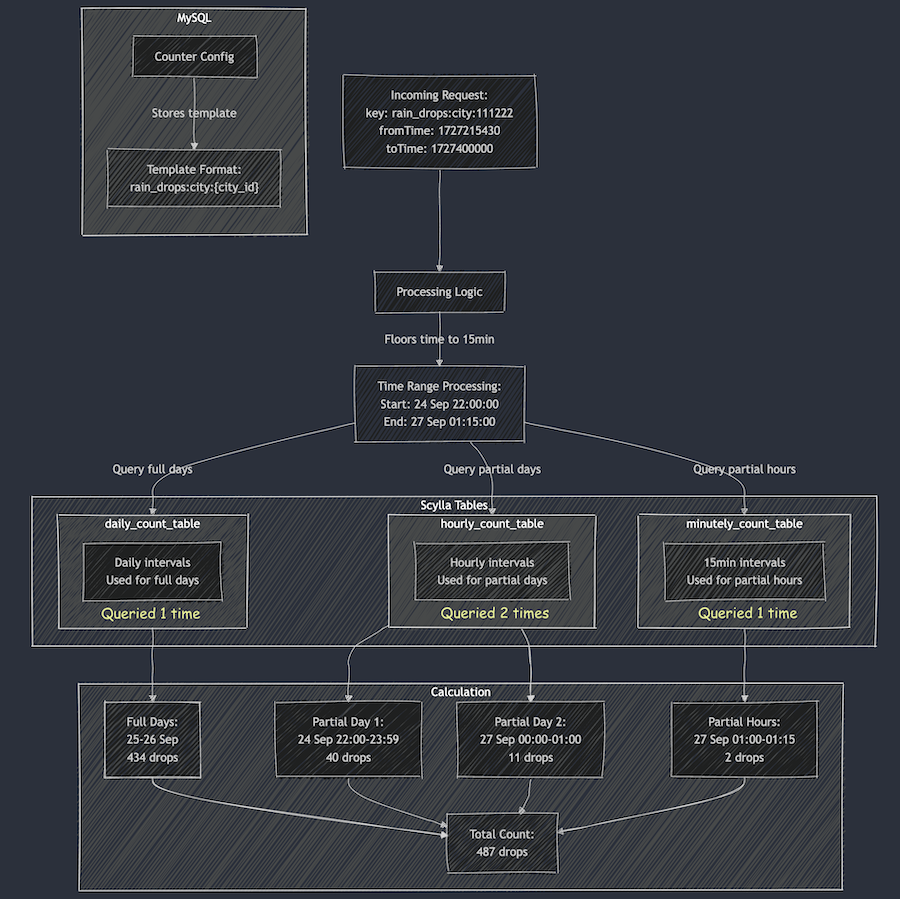
For the full days within the range, specifically 25th and 26th September, we can use data from the daily_count_table. However, for the start (24th September) and end (27th September) date of the range, we cannot use data from the daily_count_table as the range only includes portions of these dates. Instead, we will use a combination of data from the hourly_count_table and minutely_count_table to accurately capture the counts for these days.

  1. Query the daily_count_table:

    Sum (full day: 25 and 26th Sep): 189 + 245 = 434

  2. Query the hourly_count_table:
    • For 24th September (from 22:00:00 to 23:59:59):

      Hourly count: 18 + 22 = 40

    • For 27th September (from 00:00:00 to 01:00:00):

      Hourly count: 11

  3. Query the minutely_count_table:

    For 27th September (from 01:00:00 to 01:15:00):

    Minutely count: 2

  4. Total count:

    Total = Daily count (25th and 26th) + Hourly count (24th) + Hourly count (27th) + Minutely count (27th)

    = 434 + 40 + 11 + 2

    = 487

Figure 1: The example request for “rain_drops:city:111222” is handled using data from three different Scylla tables.

As shown in the calculation, when the service receives the request, it comes up with the total count of raindrops by querying three Scylla tables and summing them up using some specific rules within the service itself.

Querying the cache

In the previous section, we explained how Scylla handles a query. If we cached the response for the same request earlier, retrieval from the cache follows a simpler logic. For instance, for the example request, the total count is stored using the floored start and end times (rounded to the nearest 15-minute window within an hour), which was used for the Scylla query instead of the original time in the request. The cache key-value pair would look like this:

  • key: id:34:rain_drops:city:111222:1727215200:1727399700
  • value: 487

Timestamps 1727215200 and 1727399700 represent the adjusted start and end times of 24 September 2024 22:00:00 and 27 September 2024 01:15:00, respectively. It has a Time-To-Live (TTL) of 5 minutes. During this TTL window, any request for the key “rain_drops:city:111222” having the same start and end times (after rounding to the nearest 15 minutes) will be read from the cache instead of querying Scylla.

For example, for the following three start times, although they are different, after flooring the request to the nearest 15 minutes, the start time becomes 24 September 2024 22:00:00 for all of them, which is the same start time as the one in the cache.

  • 24 September 2024 22:01:00
  • 24 September 2024 22:02:00
  • 24 September 2024 22:06:00

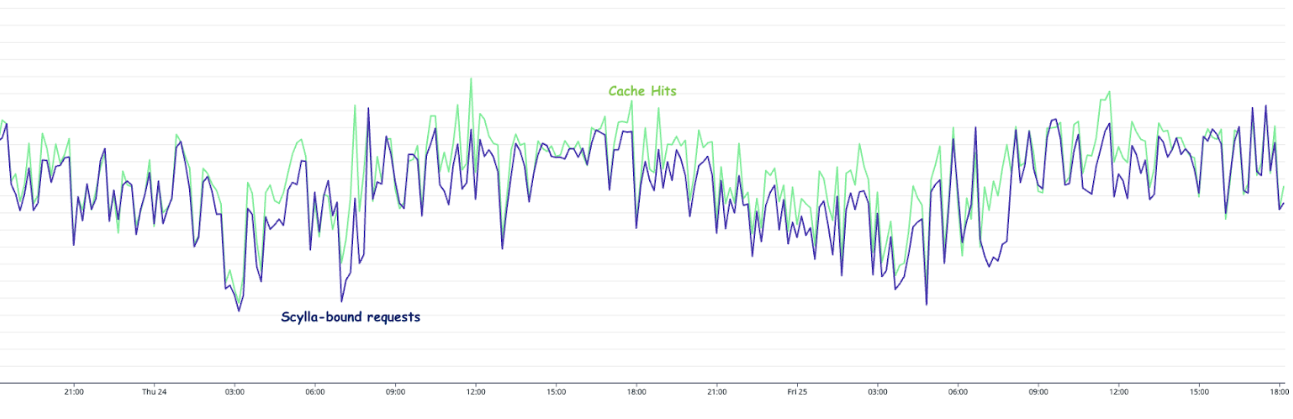
In day-to-day operations, this caching setup allows roughly half of our total production requests to be served by the Redis cache.

Figure 2. The graph visualises the relative quantity of cache hits vs Scylla-bound requests.

Problem statement

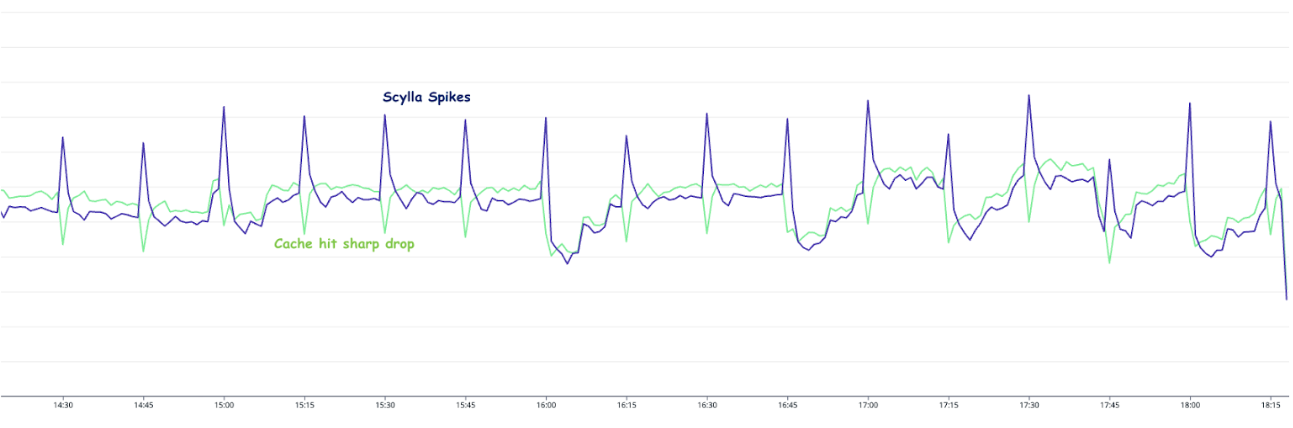
The setup consisting of Scylla and Redis cache works well. Particularly because Scylla-bound queries need to look up 1-3 tables (minutely, hourly, daily, depending on the time range) and perform the summation as explained earlier, whereas a single cache lookup gets the final value for the same query. However, as our cache key pattern follows the 15-minute truncation strategy, along with a 5-minute cache TTL, it leads to an interesting phenomenon – our cache hits plummet and Scylla QPS spikes at the end of every 15 minutes.

Figure 3. Graph showing 15-minute spikes in Scylla-bound requests accompanied by a decline in cache hit rates.

This occurs primarily due to the fact that almost all requests to our service are for recent data. Due to this, at the end of every 15-minute block within an hour (i.e., 00, 15, 30, 45), most of the requests require creating new cache keys for the latest 15-minute block. At this point in time, there may be many unexpired (i.e., have not reached 5 min TTL) cache keys from the previous 15-minutes block, but they become less relevant as most requests are asking for recent data.

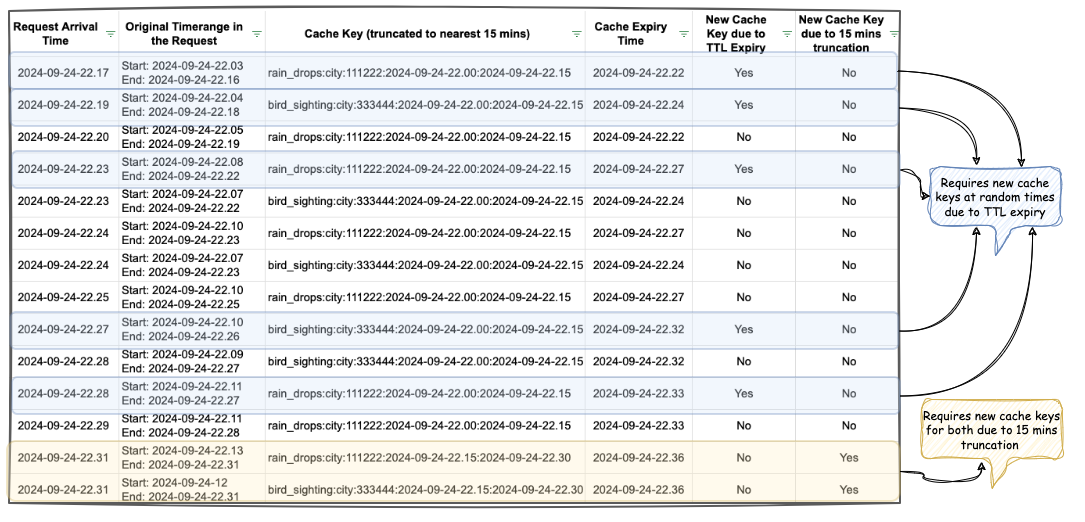
The table in Figure 4 shows example data for configurations “rain_drops:city:111222” and “bird_sighting:city:333444”. For these two configurations, new cache keys are created due to TTL expiry at random times. However, at the end of the 15-minute block, which, in this case is at the end of 22:00-22:15 block, both configurations need new cache keys for the new 15-minute time block that has just started (i.e., start of 22:15-22:30), even though some of their cache keys from the previous 15-minute block are still valid. This requirement of creating new cache keys for most of the requests at the end of a 15-minute block causes spikes in Scylla QPS and a sharp decline in cache hits.

One question that arises is – “Why don’t we see a spike every 5 minutes for cache key TTL expiry?” This is because, within the 15 minutes block, new cache keys are continuously created when a key reaches TTL and a new request for that is received. Since this happens all the time as shown in Figure 4, we do not see a sharp spike. In other words, although Scylla does receive more queries due to cache TTL expiry, it does not lead to a spike in Scylla queries or a sharp drop in cache hits. This is because the cache keys are always being created and invalidated due to TTL expiry instead of following a fixed 5-minute block similar to the 15-minute block we use for our truncation strategy.

Figure 4. This table visualises scenarios when new cache keys are required due to TTL expiry vs due to 15-minute truncation strategy.

These Scylla QPS spikes at the end of every 15-minute block lead to a highly imbalanced Scylla QPS. This often causes high latency in our service during the 15-minute blocks that fall within the peak traffic hours. This further causes more requests to time out, eventually increasing the number of failed requests.

Proposed solution

We propose mitigating this issue by completely removing the Redis-backed caching mechanism from the service. Our observations indicate that the Scylla spikes at the end of 15-minute blocks occur due to cache hit misses. Therefore, removing the caching should eliminate the spikes and provide for a more balanced load.

We acknowledge that this may seem counterintuitive from an overall performance standpoint as removing caching means all queries will be Scylla-bound, potentially impacting the overall performance since caching usually speeds up processes. In addition, caching also comes with an advantage where for cache hits, the service does not need to do the summation on Scylla results from minutely, hourly, and the daily table. Despite these shortcomings, we hypothesise that removing caching should not have an adverse impact on the overall performance. This is based on the fact the Scylla has its own sophisticated caching mechanism. However, our existing setup uses Redis for caching, underutilising Scylla’s cache as the most subsequent queries hit the Redis cache instead.

In summary, we propose eliminating the Redis caching component from our current architecture. This change is expected to resolve the Scylla query spikes observed at the end of every 15-minute block. By relying on Scylla’s native caching mechanism, we anticipate maintaining the service’s overall performance more effectively. The removal of Redis is counterbalanced by the optimised utilisation of Scylla’s built-in caching capabilities.

Experiment

Procedure

The experiment was done on an important live service serving thousands of QPS. To avoid disruptions, we followed a gradual approach. We first turned off caching for a few configurations. If there were no adverse impacts observed, we incrementally disabled cache for more configurations. We controlled the rollout increment by using a mathematical operator on the configuration IDs. This approach is simple and allows us to deterministically disable the cache for specific configurations across all requests, as opposed to using a percentage rollout which randomly disables the cache for different configurations across different requests. This is also due to the fact that the number of configurations is relatively steady and small (less than a thousand). Since these configurations are already fully cached in the service memory from RDS, there will be no performance impact of having a condition that operates on these configurations.

To make sense of the graphs and metrics reported in this section, it is important to understand the traffic pattern of this service. The service usually sees two peaks every day: noon and another around 6-7 PM. On a weekly basis, we usually see the highest traffic on Friday, with the busiest period being from 6-8 PM.

In addition, the timeline of when and how we made various changes to our setup is important to accurately interpret our results.

Experiment timeline: Nov 5 – Nov 13, 2024:

  • Redis cache disabled for ~5% of the counter configurations – Nov 5, 2024, 10.26 AM (Canary started: 10.00 AM)

  • Redis cache disabled for ~25% of the counter configurations – Nov 5, 2024, 12.44 PM (Canary started: 12.20 PM)

  • Redis cache disabled for ~35% of the counter configurations – Nov 6, 2024, 10.50 AM (Canary started: 10.21 AM)

  • Redis cache disabled for ~75% of the counter configurations – Nov 7, 2024, 10.53 AM (Canary started: 10.26 AM) 

  • Experimenting with running a major compaction job during the day time: Tue, Nov 12, 2024, between 2-5 PM (on all nodes)

  • Day time scheduled major compaction job starts from: Tue, Nov 13, 2024, between 2-5 PM (on all nodes)

  • Redis cache disabled for 100% of the counter configs – Wed, 13 Nov 2024, 10:56 AM (Canary started: 10:32 AM)

Unless otherwise specified, the graphs and metrics we report in this article uses this fixed time window: Oct 31 (Thu) 12.00 AM – Nov 15 (Friday) 11.59 PM SGT. This time window covers the entire experiment period with some buffer to observe the experiment’s impact.

Observations

As we progressively disabled read from external Redis cache over the span of 8 days (Nov 5 – Nov 13), we made interesting observations and experimented with some Scylla configuration changes on our end. We describe them in the following sections.

Scylla hit vs. cache hit

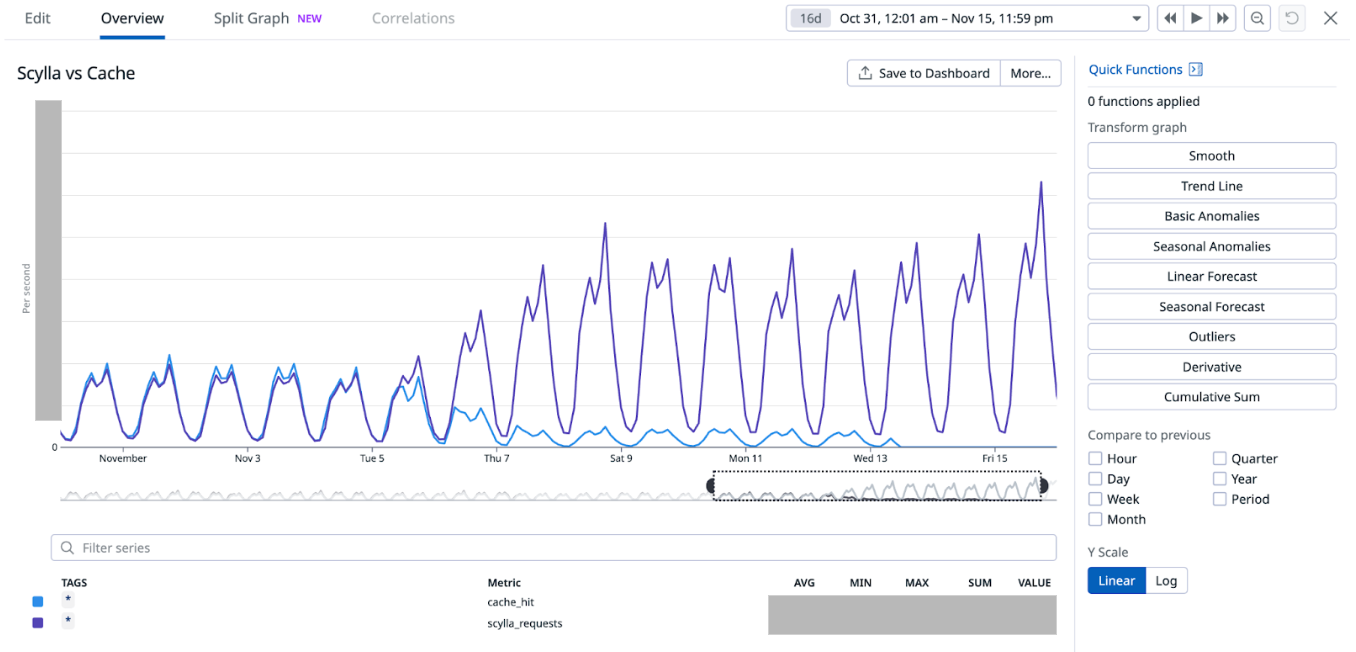
As we progressively disabled Redis cache for most of the counters, one obvious impact was the gradual increase in Scylla-bound QPS and similar decrease in Redis-cache hit. When Redis-cache was enabled for 100% of the configurations, 50% of the requests were bound for Scylla and the other 50% were for Redis. At the end of the experiment, after fully disabling Redis cache, 100% of the requests were Scylla-bound.

Figure 5. Gradual increase in Scylla QPS and simultaneous decrease in Redis cache hit.

15-minutes and hourly spikes

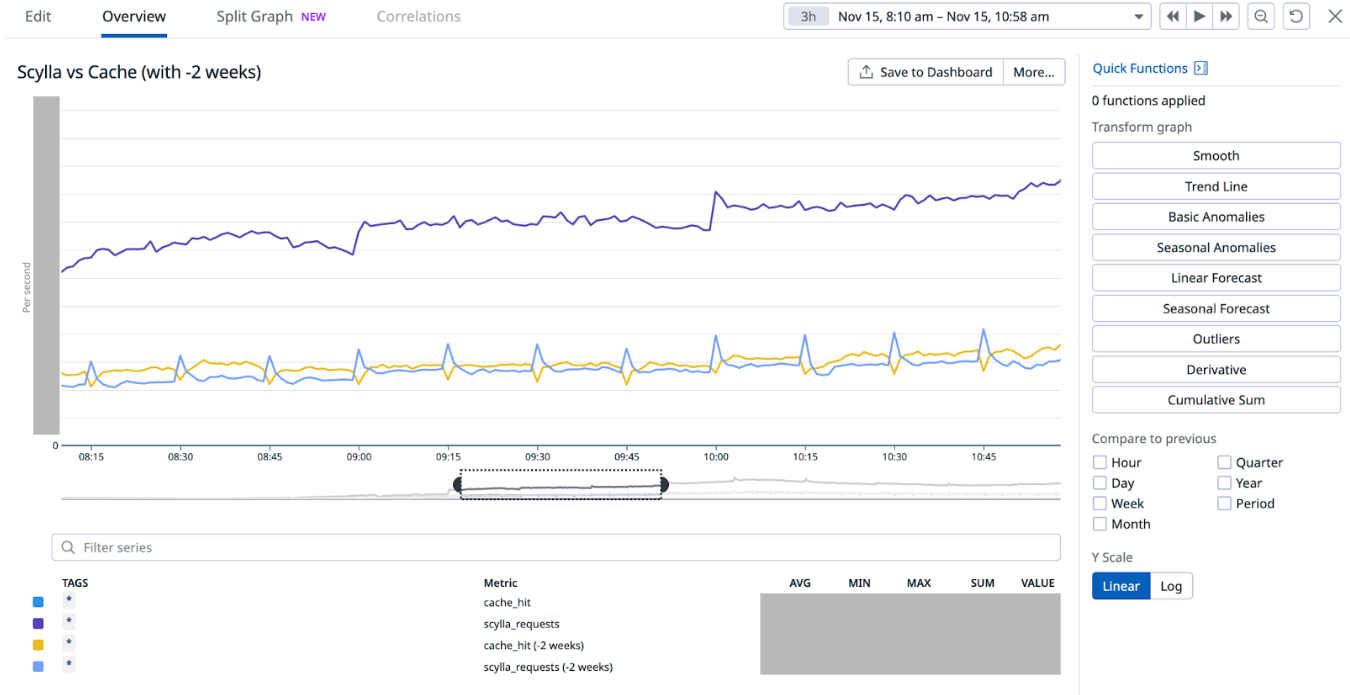
We noticed that the 15-minute spikes in Scylla QPS as well as the associated latency slowly became less prominent and eventually disappeared from the graph after we completely disabled the Redis cache. However, we noticed that the hourly spike still remained. This is attributed to the higher QPS from the clients calling this service at the turn of every hour. As a result, limited optimisation can be done to reduce the hourly spike on this service’s end.

Figure 6. The 15-minute spikes in Scylla QPS disappeared after the external Redis cache was fully disabled. This graph uses a smaller time window to show the earlier spikes. It also shows the persistence of hourly spikes after the experiment which is attributed to the clients of this service sending more requests at the start of every hour.
Figure 7. The graph shows that the 15-minute spikes in Scylla’s latency disappeared after the external Redis cache was fully disabled. This graph uses a smaller time window to show the earlier spikes. It also shows the persistence of hourly spikes in latency after the experiment which is attributed to the clients of this service sending more requests at the start of every hour.

Service latency and additional Scylla compaction job

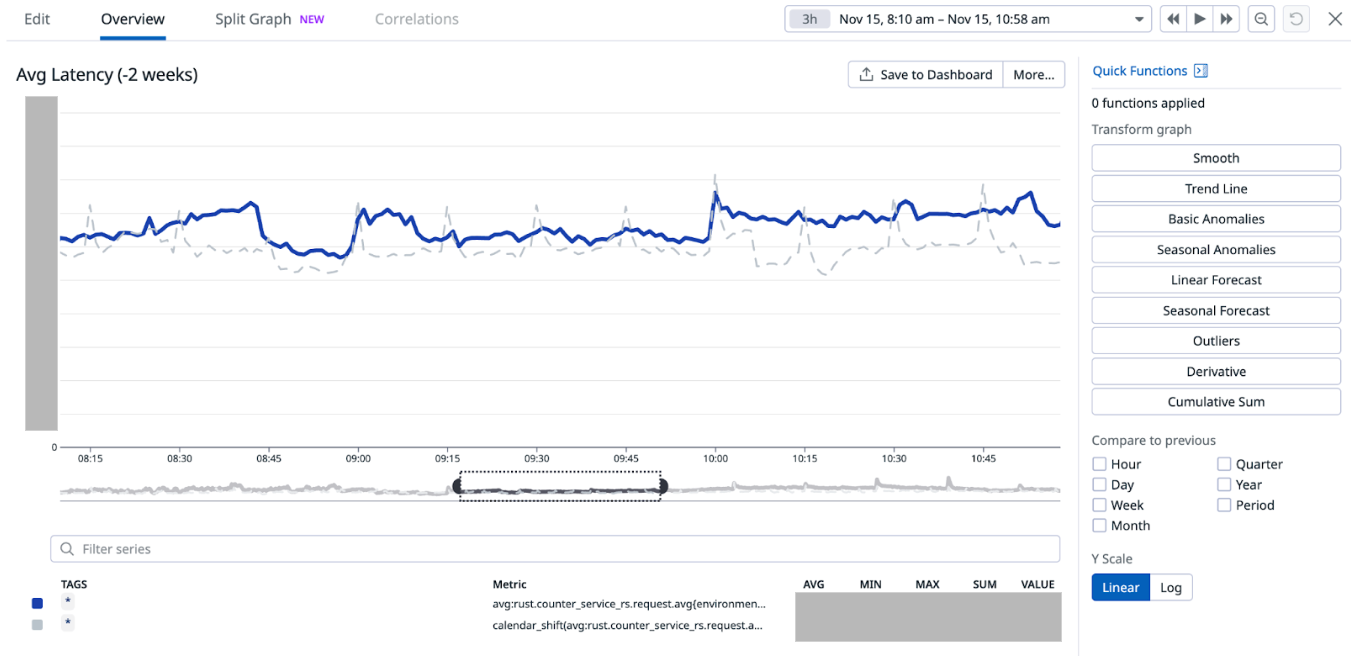
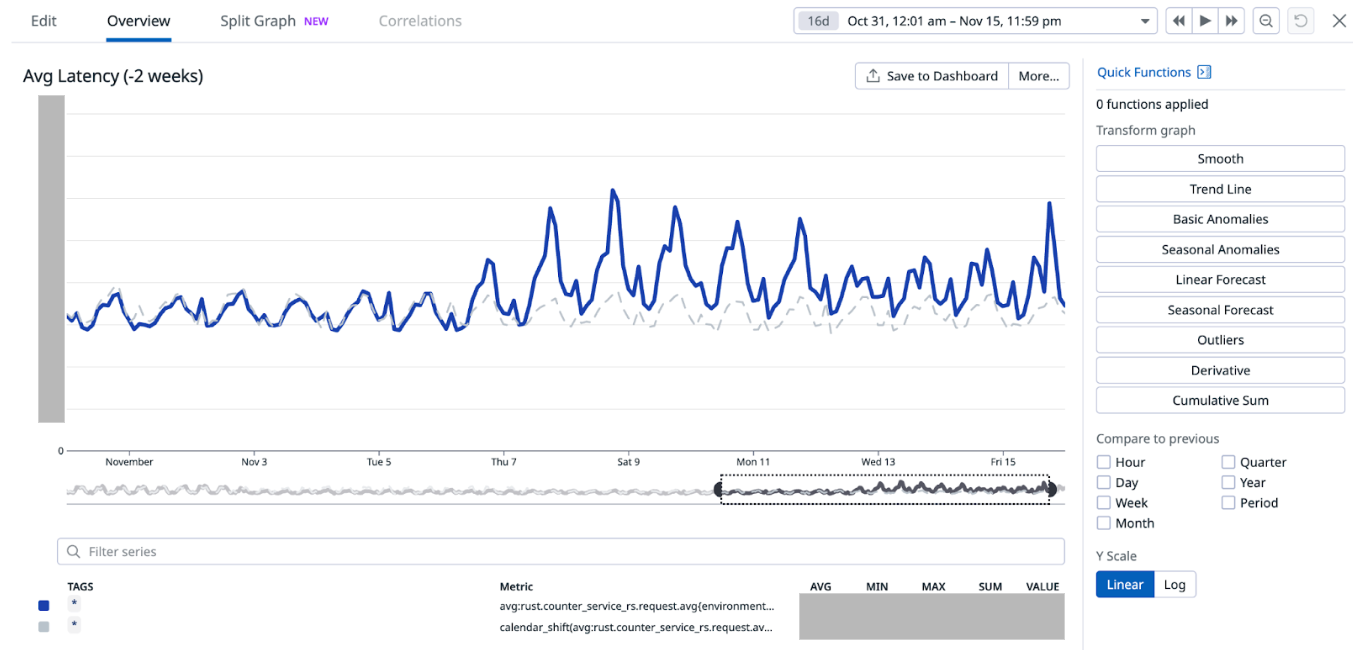
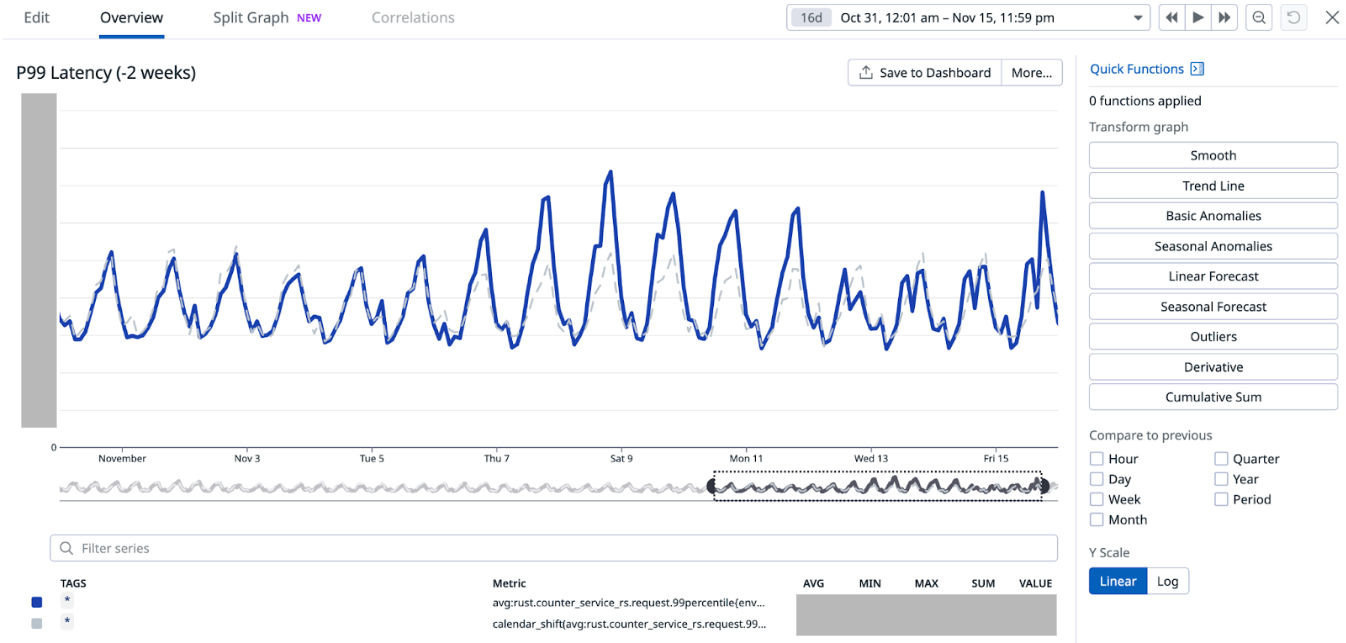
When we disabled Redis cache for about 75% of the counters configurations on Nov 7 (which accounts for about 85% of the overall QPS), we noticed an increase in the overall average service latency, from between 6-8 ms to 7-12 ms (P99 went from ~30-50ms to ~30-70ms). This caused a spike in open circuit breaker (CB) events on Hystrix. At this point, before disabling cache for more counters, on Nov 12, we experimented with running an additional major compaction job on Scylla between 2-5 PM on all our Scylla nodes, progressively on each availability zone (AZ). It is noteworthy that we already have a scheduled major compaction job that runs around 3 AM every day. The outcome of this experiment was quite positive. It brought back the average and P99 latency almost to the prior level when we had Redis cache enabled for 100% of the counters. This also had a similar effect on the Hystrix CB open events. Based on this observation, we made this additional day time major compaction job as a daily scheduled job. We disabled Redis cache for 100% of the counters the next day (Nov 13). This expectedly increased the Scylla QPS, with no noticeable adverse effect on the service latency or Hystrix CB open events.

Figure 8. This graph shows how the average latency changed as a result of the experiment. The higher spikes correspond to the time when Redis cache was being progressively disabled before introducing the day time Scylla compaction job. The spikes lessened after the compaction job was introduced on Nov 12 (Note: Friday spike was due to higher traffic in general).
Figure 9. This graph shows how the P99 latency changed as a result of the experiment. The higher spikes correspond to the time when Redis cache was being progressively disabled before introducing the day time Scylla compaction job. The spikes lessened after the compaction job was introduced on Nov 12 (Note: Friday spike was due to higher traffic in general).

Scylla’s own cache

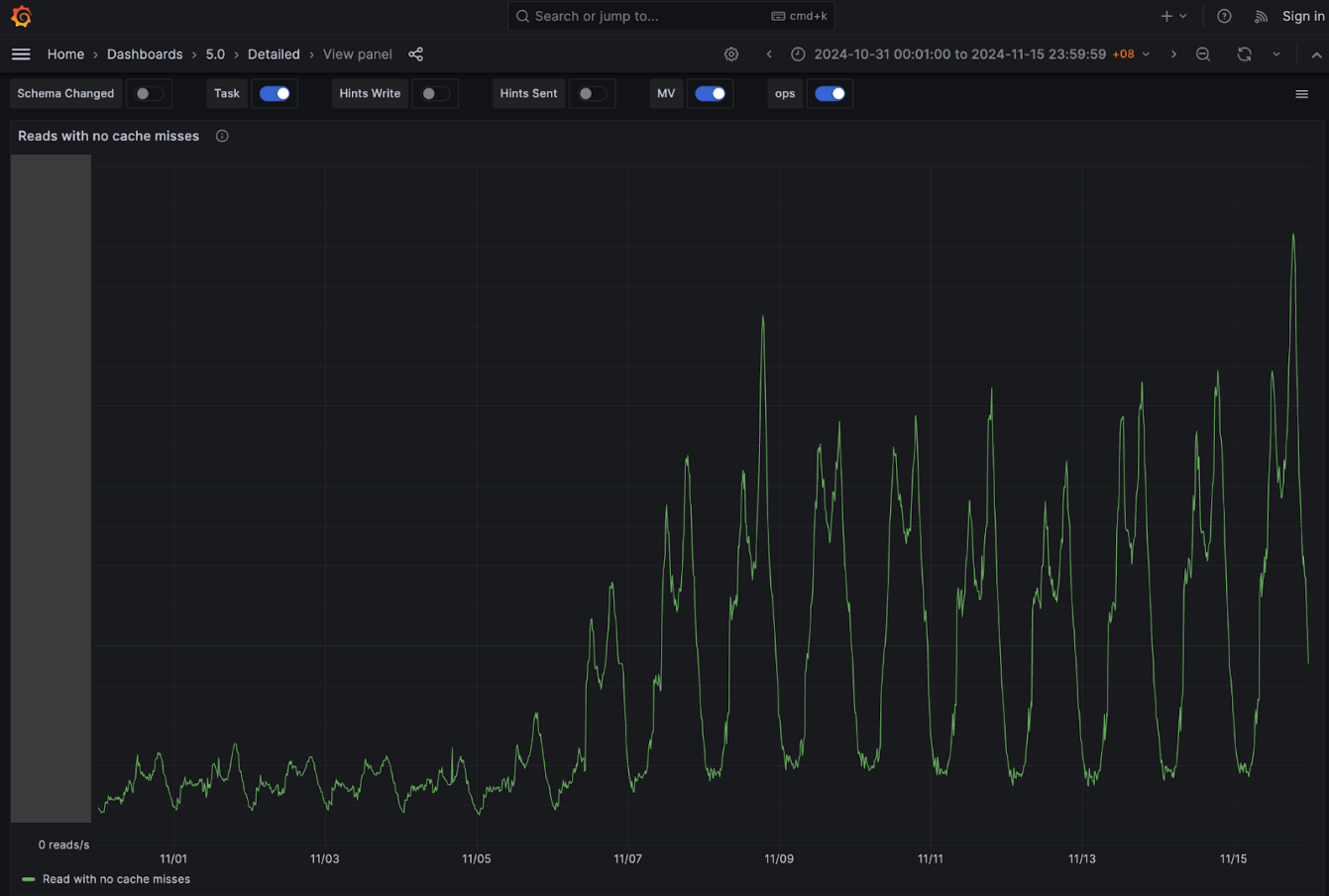
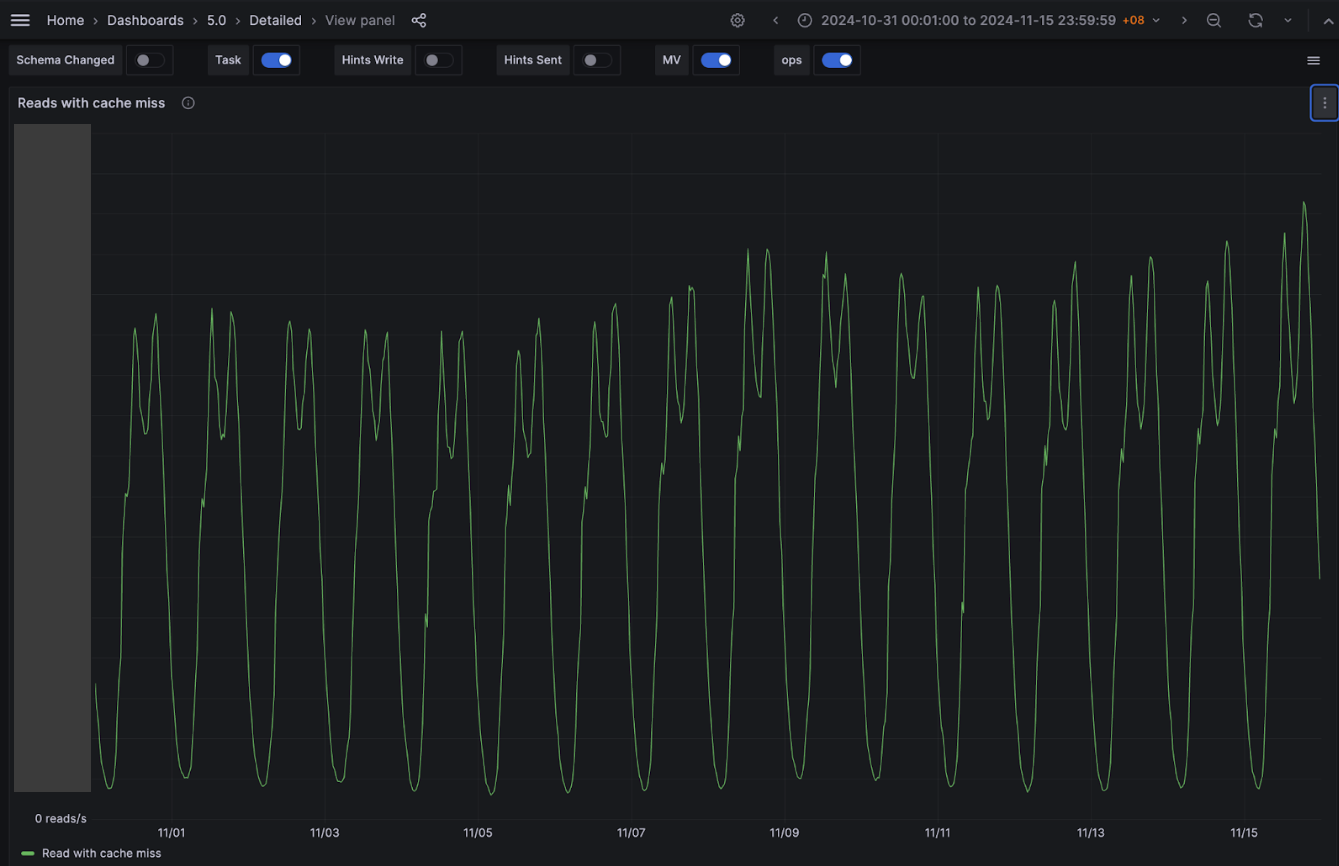
One of our hypotheses was that we were not using Scylla cache due to our system’s design, along with all the service specific characteristics discussed earlier. Our experimental results show that this is indeed the case. We observed a significant increase in Scylla reads with Scylla’s own cache hits, while Scylla reads with Scylla’s own cache misses remained about the same despite our Scylla cluster receiving double the traffic. Percentage-wise, before disabling the external Redis cache, Scylla hit its own cache for ~30% of the total reads, and after we have completely disabled the external Redis cache, Scylla hit its cache for about 70% of the reads. We believe that this largely contributes to the overall performance of the service despite fully decommissioning the expensive Redis cache component from our system architecture.

Figure 10. Significant increase in Scylla reads after disable Redis cache.
Figure 11. No change in Scylla cache miss despite the doubling of Scylla traffic.

Scylla CPU and memory usage

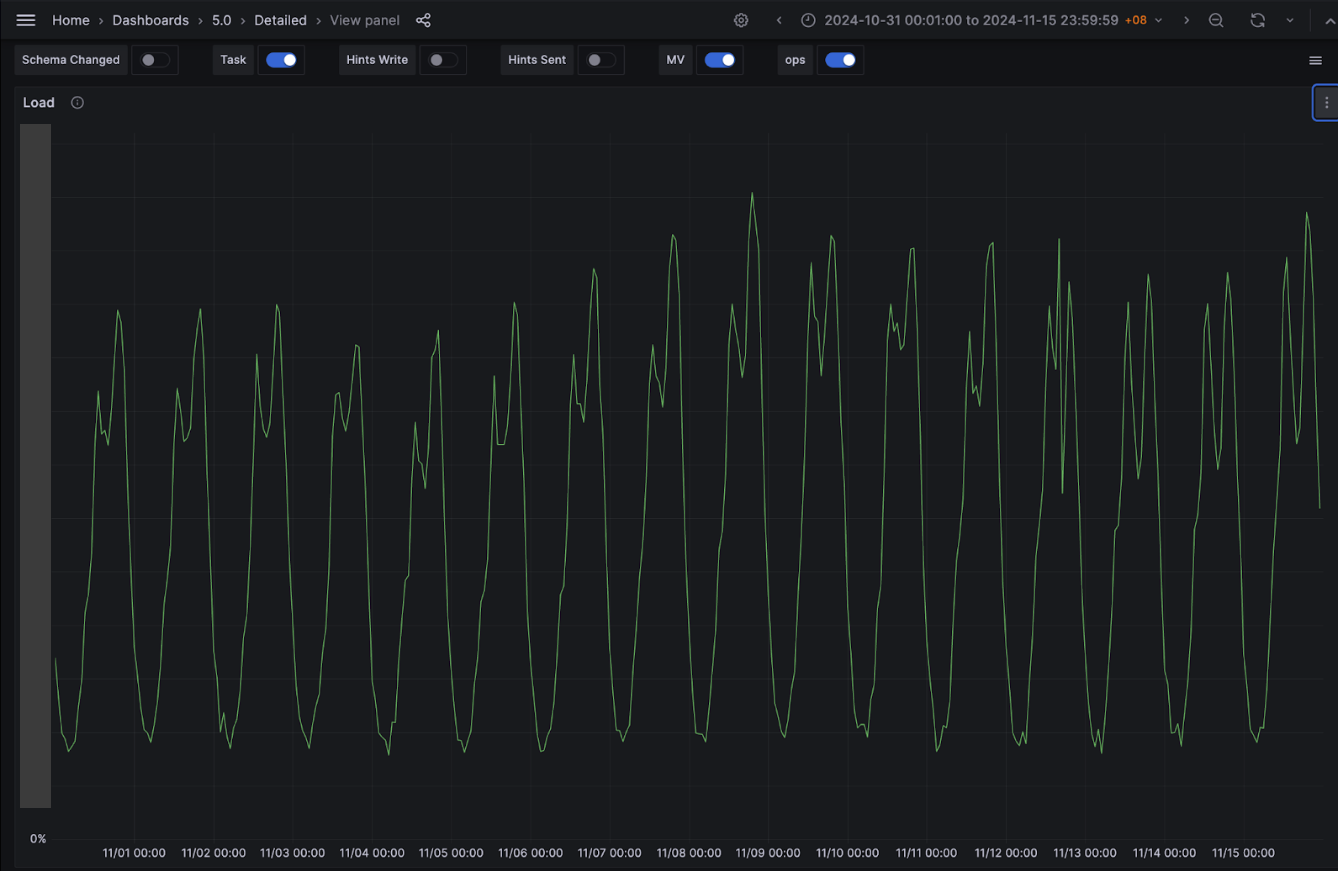
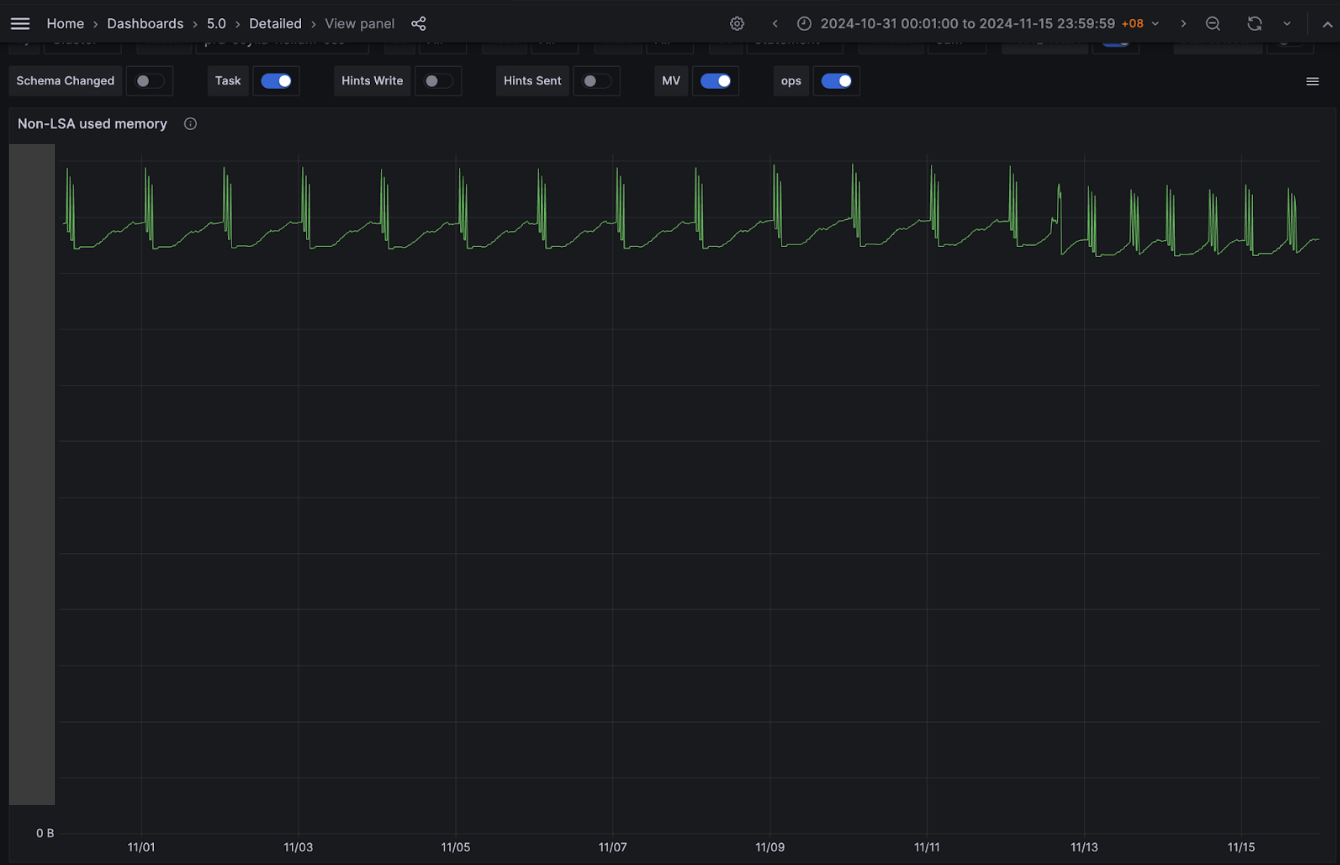
Contrary to our assumption, although the Scylla QPS doubled due to the change done as part of this experiment, there was marginal increase in Scylla CPU usage (from ~50% to ~52% at peak). In terms of memory, Scylla log-structured allocator (LSA) memory usage remains consistent. For Non-LSA memory, the maximum utilisation did not increase. However, we noticed two daily spikes instead of one existed before the experiment. The second spike results from the newly added daily major compaction job. Notably,the overall non-LSA peak has slightly decreased after the introduction of the new compaction job.

Figure 12. Relatively steady Scylla CPU utilisation.
Figure 13. Non-LSA memory usage spikes twice a day after the experiment. The new spike corresponds to the newly added day time compaction job.

Conclusion

In summary, we were able to maintain the same service performance while removing an expensive Redis cache component from our system architecture, which accounted for about 25% of the overall service cost. This has been made possible primarily by significant increase in the utilisation of Scylla’s own cache and adding a daily major compaction job on all our Scylla nodes.

In the future, we plan to further experiment with different Scylla configurations for potential performance gain, specifically to improve the latency.

Join us

Grab is a leading superapp in Southeast Asia, operating across the deliveries, mobility and digital financial services sectors. Serving over 800 cities in eight Southeast Asian countries, Grab enables millions of people everyday to order food or groceries, send packages, hail a ride or taxi, pay for online purchases or access services such as lending and insurance, all through a single app. Grab was founded in 2012 with the mission to drive Southeast Asia forward by creating economic empowerment for everyone. Grab strives to serve a triple bottom line – we aim to simultaneously deliver financial performance for our shareholders and have a positive social impact, which includes economic empowerment for millions of people in the region, while mitigating our environmental footprint.

Powered by technology and driven by heart, our mission is to drive Southeast Asia forward by creating economic empowerment for everyone. If this mission speaks to you, join our team today!

Evaluating performance impact of removing Redis-cache from a Scylla-backed service

Post Syndicated from Grab Tech original https://engineering.grab.com/evalutate-performance-remove-redis-from-scylla-service

Introduction

At Grab, we operate a set of services that manage and provide counts of various items. While this may seem straightforward, the scale at which this feature operates—benefiting millions of Grab users daily—introduces complexity. This feature is divided into three microservices: one for “writing” counts, another for handling “read” requests, and a third serving as the backend for a portal used by data scientists and analysts to configure these counters.

This article focuses on the service responsible for handling “read” requests. This service is backed by Scylla storage and a Redis cache. It also connects to a MySQL RDS to retrieve “counter configurations” that are necessary for processing incoming requests. Written in Rust, the service serves tens of thousands of queries per second (QPS) during peak times, with each request typically being a “batch request” requiring multiple lookups (~10) on Scylla.

Recently, the service has encountered performance challenges, causing periodic spikes in Scylla QPS. These spikes occur throughout the day but are particularly evident during peak hours. To understand this better, we’ll first walk you through how this service operates, particularly how it serves incoming requests. We will then explain our proposed solution and the outcomes of our experiment.

Anatomy of a request

Each counter configuration stored in MySQL has a template that dictates the format of incoming queries. For example, this sample counter configuration is used to count the raindrops for a specific city:

{
    "id": 34,
    "name": "count_rain_drops",
    "template": "rain_drops:city:{city_id}"
    ....
    ....
}

An incoming request using this counter might look like this:

{
    "key": "rain_drops:city:111222",
    "fromTime": 1727215430, // 24 September 2024 22:03:50
    "toTime": 1727400000, // 27 September 2024 01:20:00
}

This request seeks the number of raindrops in our imaginary city with city ID: 111222, between 1727215430 (24 September 2024 22:03:50) and 1727400000 (27 September 2024 01:20:00).

Another service keeps track of raindrops by city and writes the minutely (truncated at 15 minutes), hourly, and daily counts to three different Scylla tables:

  • minutely_count_table
  • hourly_count_table
  • daily_count_table

The service processing the request rounds down the time to the nearest 15 minutes. As a result, the request is processed with the following time range:

  • Start time: 24 September 2024 22:00:00
  • End time: 27 September 2024 01:15:00

Let’s assume we have the following data in these three tables for “rain_drops:city:111222”. The datapoints used in the above example request are highlighted in bold.

minutely_count_table:

key minutely_timestamp count
rain_drops:city:111222 2024-09-24T22:00:00Z 3
rain_drops:city:111222 2024-09-24T22:15:00Z 2
rain_drops:city:111222 2024-09-24T22:30:00Z 4
rain_drops:city:111222 2024-09-24T22:45:00Z 1
… … …
rain_drops:city:111222 2024-09-27T01:00:00Z 2
rain_drops:city:111222 2024-09-27T01:15:00Z 3

hourly_count_table:

key hourly_timestamp count
rain_drops:city:111222 2024-09-24T22:00:00Z 18
rain_drops:city:111222 2024-09-24T23:00:00Z 22
rain_drops:city:111222 2024-09-25T00:00:00Z 15
… … …
rain_drops:city:111222 2024-09-27T00:00:00Z 11
rain_drops:city:111222 2024-09-27T01:00:00Z 9

daily_count_table:

key daily_timestamp count
rain_drops:city:111222 2024-09-24T00:00:00Z 214
rain_drops:city:111222 2024-09-25T00:00:00Z 189
rain_drops:city:111222 2024-09-26T00:00:00Z 245
rain_drops:city:111222 2024-09-27T00:00:00Z 78

Now, let’s see how the service calculates the total count for the incoming request with “rain_drops:city:111222” based on the provided data:

Time range:

  • From: 24 September 2024 22:03:50
  • To: 27 September 2024 01:20:00

For the full days within the range, specifically 25th and 26th September, we can use data from the daily_count_table. However, for the start (24th September) and end (27th September) date of the range, we cannot use data from the daily_count_table as the range only includes portions of these dates. Instead, we will use a combination of data from the hourly_count_table and minutely_count_table to accurately capture the counts for these days.

  1. Query the daily_count_table:

    Sum (full day: 25 and 26th Sep): 189 + 245 = 434

  2. Query the hourly_count_table:
    • For 24th September (from 22:00:00 to 23:59:59):

      Hourly count: 18 + 22 = 40

    • For 27th September (from 00:00:00 to 01:00:00):

      Hourly count: 11

  3. Query the minutely_count_table:

    For 27th September (from 01:00:00 to 01:15:00):

    Minutely count: 2

  4. Total count:

    Total = Daily count (25th and 26th) + Hourly count (24th) + Hourly count (27th) + Minutely count (27th)

    = 434 + 40 + 11 + 2

    = 487

Figure 1: The example request for “rain_drops:city:111222” is handled using data from three different Scylla tables.

As shown in the calculation, when the service receives the request, it comes up with the total count of raindrops by querying three Scylla tables and summing them up using some specific rules within the service itself.

Querying the cache

In the previous section, we explained how Scylla handles a query. If we cached the response for the same request earlier, retrieval from the cache follows a simpler logic. For instance, for the example request, the total count is stored using the floored start and end times (rounded to the nearest 15-minute window within an hour), which was used for the Scylla query instead of the original time in the request. The cache key-value pair would look like this:

  • key: id:34:rain_drops:city:111222:1727215200:1727399700
  • value: 487

Timestamps 1727215200 and 1727399700 represent the adjusted start and end times of 24 September 2024 22:00:00 and 27 September 2024 01:15:00, respectively. It has a Time-To-Live (TTL) of 5 minutes. During this TTL window, any request for the key “rain_drops:city:111222” having the same start and end times (after rounding to the nearest 15 minutes) will be read from the cache instead of querying Scylla.

For example, for the following three start times, although they are different, after flooring the request to the nearest 15 minutes, the start time becomes 24 September 2024 22:00:00 for all of them, which is the same start time as the one in the cache.

  • 24 September 2024 22:01:00
  • 24 September 2024 22:02:00
  • 24 September 2024 22:06:00

In day-to-day operations, this caching setup allows roughly half of our total production requests to be served by the Redis cache.

Figure 2. The graph visualises the relative quantity of cache hits vs Scylla-bound requests.

Problem statement

The setup consisting of Scylla and Redis cache works well. Particularly because Scylla-bound queries need to look up 1-3 tables (minutely, hourly, daily, depending on the time range) and perform the summation as explained earlier, whereas a single cache lookup gets the final value for the same query. However, as our cache key pattern follows the 15-minute truncation strategy, along with a 5-minute cache TTL, it leads to an interesting phenomenon – our cache hits plummet and Scylla QPS spikes at the end of every 15 minutes.

Figure 3. Graph showing 15-minute spikes in Scylla-bound requests accompanied by a decline in cache hit rates.

This occurs primarily due to the fact that almost all requests to our service are for recent data. Due to this, at the end of every 15-minute block within an hour (i.e., 00, 15, 30, 45), most of the requests require creating new cache keys for the latest 15-minute block. At this point in time, there may be many unexpired (i.e., have not reached 5 min TTL) cache keys from the previous 15-minutes block, but they become less relevant as most requests are asking for recent data.

The table in Figure 4 shows example data for configurations “rain_drops:city:111222” and “bird_sighting:city:333444”. For these two configurations, new cache keys are created due to TTL expiry at random times. However, at the end of the 15-minute block, which, in this case is at the end of 22:00-22:15 block, both configurations need new cache keys for the new 15-minute time block that has just started (i.e., start of 22:15-22:30), even though some of their cache keys from the previous 15-minute block are still valid. This requirement of creating new cache keys for most of the requests at the end of a 15-minute block causes spikes in Scylla QPS and a sharp decline in cache hits.

One question that arises is – “Why don’t we see a spike every 5 minutes for cache key TTL expiry?” This is because, within the 15 minutes block, new cache keys are continuously created when a key reaches TTL and a new request for that is received. Since this happens all the time as shown in Figure 4, we do not see a sharp spike. In other words, although Scylla does receive more queries due to cache TTL expiry, it does not lead to a spike in Scylla queries or a sharp drop in cache hits. This is because the cache keys are always being created and invalidated due to TTL expiry instead of following a fixed 5-minute block similar to the 15-minute block we use for our truncation strategy.

Figure 4. This table visualises scenarios when new cache keys are required due to TTL expiry vs due to 15-minute truncation strategy.

These Scylla QPS spikes at the end of every 15-minute block lead to a highly imbalanced Scylla QPS. This often causes high latency in our service during the 15-minute blocks that fall within the peak traffic hours. This further causes more requests to time out, eventually increasing the number of failed requests.

Proposed solution

We propose mitigating this issue by completely removing the Redis-backed caching mechanism from the service. Our observations indicate that the Scylla spikes at the end of 15-minute blocks occur due to cache hit misses. Therefore, removing the caching should eliminate the spikes and provide for a more balanced load.

We acknowledge that this may seem counterintuitive from an overall performance standpoint as removing caching means all queries will be Scylla-bound, potentially impacting the overall performance since caching usually speeds up processes. In addition, caching also comes with an advantage where for cache hits, the service does not need to do the summation on Scylla results from minutely, hourly, and the daily table. Despite these shortcomings, we hypothesise that removing caching should not have an adverse impact on the overall performance. This is based on the fact the Scylla has its own sophisticated caching mechanism. However, our existing setup uses Redis for caching, underutilising Scylla’s cache as the most subsequent queries hit the Redis cache instead.

In summary, we propose eliminating the Redis caching component from our current architecture. This change is expected to resolve the Scylla query spikes observed at the end of every 15-minute block. By relying on Scylla’s native caching mechanism, we anticipate maintaining the service’s overall performance more effectively. The removal of Redis is counterbalanced by the optimised utilisation of Scylla’s built-in caching capabilities.

Experiment

Procedure

The experiment was done on an important live service serving thousands of QPS. To avoid disruptions, we followed a gradual approach. We first turned off caching for a few configurations. If there were no adverse impacts observed, we incrementally disabled cache for more configurations. We controlled the rollout increment by using a mathematical operator on the configuration IDs. This approach is simple and allows us to deterministically disable the cache for specific configurations across all requests, as opposed to using a percentage rollout which randomly disables the cache for different configurations across different requests. This is also due to the fact that the number of configurations is relatively steady and small (less than a thousand). Since these configurations are already fully cached in the service memory from RDS, there will be no performance impact of having a condition that operates on these configurations.

To make sense of the graphs and metrics reported in this section, it is important to understand the traffic pattern of this service. The service usually sees two peaks every day: noon and another around 6-7 PM. On a weekly basis, we usually see the highest traffic on Friday, with the busiest period being from 6-8 PM.

In addition, the timeline of when and how we made various changes to our setup is important to accurately interpret our results.

Experiment timeline: Nov 5 – Nov 13, 2024:

  • Redis cache disabled for ~5% of the counter configurations – Nov 5, 2024, 10.26 AM (Canary started: 10.00 AM)

  • Redis cache disabled for ~25% of the counter configurations – Nov 5, 2024, 12.44 PM (Canary started: 12.20 PM)

  • Redis cache disabled for ~35% of the counter configurations – Nov 6, 2024, 10.50 AM (Canary started: 10.21 AM)

  • Redis cache disabled for ~75% of the counter configurations – Nov 7, 2024, 10.53 AM (Canary started: 10.26 AM) 

  • Experimenting with running a major compaction job during the day time: Tue, Nov 12, 2024, between 2-5 PM (on all nodes)

  • Day time scheduled major compaction job starts from: Tue, Nov 13, 2024, between 2-5 PM (on all nodes)

  • Redis cache disabled for 100% of the counter configs – Wed, 13 Nov 2024, 10:56 AM (Canary started: 10:32 AM)

Unless otherwise specified, the graphs and metrics we report in this article uses this fixed time window: Oct 31 (Thu) 12.00 AM – Nov 15 (Friday) 11.59 PM SGT. This time window covers the entire experiment period with some buffer to observe the experiment’s impact.

Observations

As we progressively disabled read from external Redis cache over the span of 8 days (Nov 5 – Nov 13), we made interesting observations and experimented with some Scylla configuration changes on our end. We describe them in the following sections.

Scylla hit vs. cache hit

As we progressively disabled Redis cache for most of the counters, one obvious impact was the gradual increase in Scylla-bound QPS and similar decrease in Redis-cache hit. When Redis-cache was enabled for 100% of the configurations, 50% of the requests were bound for Scylla and the other 50% were for Redis. At the end of the experiment, after fully disabling Redis cache, 100% of the requests were Scylla-bound.

Figure 5. Gradual increase in Scylla QPS and simultaneous decrease in Redis cache hit.

15-minutes and hourly spikes

We noticed that the 15-minute spikes in Scylla QPS as well as the associated latency slowly became less prominent and eventually disappeared from the graph after we completely disabled the Redis cache. However, we noticed that the hourly spike still remained. This is attributed to the higher QPS from the clients calling this service at the turn of every hour. As a result, limited optimisation can be done to reduce the hourly spike on this service’s end.

Figure 6. The 15-minute spikes in Scylla QPS disappeared after the external Redis cache was fully disabled. This graph uses a smaller time window to show the earlier spikes. It also shows the persistence of hourly spikes after the experiment which is attributed to the clients of this service sending more requests at the start of every hour.
Figure 7. The graph shows that the 15-minute spikes in Scylla’s latency disappeared after the external Redis cache was fully disabled. This graph uses a smaller time window to show the earlier spikes. It also shows the persistence of hourly spikes in latency after the experiment which is attributed to the clients of this service sending more requests at the start of every hour.

Service latency and additional Scylla compaction job

When we disabled Redis cache for about 75% of the counters configurations on Nov 7 (which accounts for about 85% of the overall QPS), we noticed an increase in the overall average service latency, from between 6-8 ms to 7-12 ms (P99 went from ~30-50ms to ~30-70ms). This caused a spike in open circuit breaker (CB) events on Hystrix. At this point, before disabling cache for more counters, on Nov 12, we experimented with running an additional major compaction job on Scylla between 2-5 PM on all our Scylla nodes, progressively on each availability zone (AZ). It is noteworthy that we already have a scheduled major compaction job that runs around 3 AM every day. The outcome of this experiment was quite positive. It brought back the average and P99 latency almost to the prior level when we had Redis cache enabled for 100% of the counters. This also had a similar effect on the Hystrix CB open events. Based on this observation, we made this additional day time major compaction job as a daily scheduled job. We disabled Redis cache for 100% of the counters the next day (Nov 13). This expectedly increased the Scylla QPS, with no noticeable adverse effect on the service latency or Hystrix CB open events.

Figure 8. This graph shows how the average latency changed as a result of the experiment. The higher spikes correspond to the time when Redis cache was being progressively disabled before introducing the day time Scylla compaction job. The spikes lessened after the compaction job was introduced on Nov 12 (Note: Friday spike was due to higher traffic in general).
Figure 9. This graph shows how the P99 latency changed as a result of the experiment. The higher spikes correspond to the time when Redis cache was being progressively disabled before introducing the day time Scylla compaction job. The spikes lessened after the compaction job was introduced on Nov 12 (Note: Friday spike was due to higher traffic in general).

Scylla’s own cache

One of our hypotheses was that we were not using Scylla cache due to our system’s design, along with all the service specific characteristics discussed earlier. Our experimental results show that this is indeed the case. We observed a significant increase in Scylla reads with Scylla’s own cache hits, while Scylla reads with Scylla’s own cache misses remained about the same despite our Scylla cluster receiving double the traffic. Percentage-wise, before disabling the external Redis cache, Scylla hit its own cache for ~30% of the total reads, and after we have completely disabled the external Redis cache, Scylla hit its cache for about 70% of the reads. We believe that this largely contributes to the overall performance of the service despite fully decommissioning the expensive Redis cache component from our system architecture.

Figure 10. Significant increase in Scylla reads after disable Redis cache.
Figure 11. No change in Scylla cache miss despite the doubling of Scylla traffic.

Scylla CPU and memory usage

Contrary to our assumption, although the Scylla QPS doubled due to the change done as part of this experiment, there was marginal increase in Scylla CPU usage (from ~50% to ~52% at peak). In terms of memory, Scylla log-structured allocator (LSA) memory usage remains consistent. For Non-LSA memory, the maximum utilisation did not increase. However, we noticed two daily spikes instead of one existed before the experiment. The second spike results from the newly added daily major compaction job. Notably,the overall non-LSA peak has slightly decreased after the introduction of the new compaction job.

Figure 12. Relatively steady Scylla CPU utilisation.
Figure 13. Non-LSA memory usage spikes twice a day after the experiment. The new spike corresponds to the newly added day time compaction job.

Conclusion

In summary, we were able to maintain the same service performance while removing an expensive Redis cache component from our system architecture, which accounted for about 25% of the overall service cost. This has been made possible primarily by significant increase in the utilisation of Scylla’s own cache and adding a daily major compaction job on all our Scylla nodes.

In the future, we plan to further experiment with different Scylla configurations for potential performance gain, specifically to improve the latency.

Join us

Grab is a leading superapp in Southeast Asia, operating across the deliveries, mobility and digital financial services sectors. Serving over 800 cities in eight Southeast Asian countries, Grab enables millions of people everyday to order food or groceries, send packages, hail a ride or taxi, pay for online purchases or access services such as lending and insurance, all through a single app. Grab was founded in 2012 with the mission to drive Southeast Asia forward by creating economic empowerment for everyone. Grab strives to serve a triple bottom line – we aim to simultaneously deliver financial performance for our shareholders and have a positive social impact, which includes economic empowerment for millions of people in the region, while mitigating our environmental footprint.

Powered by technology and driven by heart, our mission is to drive Southeast Asia forward by creating economic empowerment for everyone. If this mission speaks to you, join our team today!

Announcing up to 85% price reductions for Amazon S3 Express One Zone

Post Syndicated from Channy Yun (윤석찬) original https://aws.amazon.com/blogs/aws/up-to-85-price-reductions-for-amazon-s3-express-one-zone/

At re:Invent 2023, we introduced Amazon S3 Express One Zone, a high-performance, single-Availability Zone (AZ) storage class purpose-built to deliver consistent single-digit millisecond data access for your most frequently accessed data and latency-sensitive applications.

S3 Express One Zone delivers data access speed up to 10 times faster than S3 Standard, and it can support up to 2 million GET transactions per second (TPS) and up to 200,000 PUT TPS per directory bucket. This makes it ideal for performance-intensive workloads such as interactive data analytics, data streaming, media rendering and transcoding, high performance computing (HPC), and AI/ML trainings. Using S3 Express One Zone, customers like Fundrise, Aura, Lyrebird, Vivian Health, and Fetch improved the performance and reduced the costs of their data-intensive workloads.

Since launch, we’ve introduced a number of features for our customers using S3 Express One Zone. For example, S3 Express One Zone started to support object expiration using S3 Lifecycle to expire objects based on age to help you automatically optimize storage costs. In addition, your log-processing or media-broadcasting applications can directly append new data to the end of existing objects and then immediately read the object, all within S3 Express One Zone.

Today we’re announcing that, effective April 10, 2025, S3 Express One Zone has reduced storage prices by 31 percent, PUT request prices by 55 percent, and GET request prices by 85 percent. In addition, S3 Express One Zone has reduced the per-GB charges for data uploads and retrievals by 60 percent, and these charges now apply to all bytes transferred rather than just portions of requests greater than 512 KB.

Here is a price reduction table in the US East (N. Virginia) Region:

Price Previous New Price reduction
Storage
(per GB-Month)
$0.16 $0.11 31%
Writes
(PUT requests)
$0.0025 per 1,000 requests up to 512 KB $0.00113 per 1,000 requests 55%
Reads
(GET requests)
$0.0002 per 1,000 requests up to 512 KB $0.00003 per 1,000 requests 85%
Data upload
(per GB)
$0.008 $0.0032 60%
Data retrievals
(per GB)
$0.0015 $0.0006 60%

For S3 Express One Zone pricing examples, go to the S3 billing FAQs or use the AWS Pricing Calculator.

These pricing reductions apply to S3 Express One Zone in all AWS Regions where the storage class is available: US East (N. Virginia), US East (Ohio), US West (Oregon), Asia Pacific (Mumbai), Asia Pacific (Tokyo), Europe (Ireland), and Europe (Stockholm) Regions. To learn more, visit the Amazon S3 pricing page and S3 Express One Zone in the AWS Documentation.

Give S3 Express One Zone a try in the S3 console today and send feedback to AWS re:Post for Amazon S3 or through your usual AWS Support contacts.

— Channy

[$] Atomic writes for ext4

Post Syndicated from jake original https://lwn.net/Articles/1016879/

Building on the discussion in the two previous sessions on untorn (or
atomic) writes, for buffered I/O and for XFS using direct I/O, Ojaswin Mujoo
remotely led a
session on support for the feature on ext4. That took place in the combined storage and
filesystem track at the
2025 Linux Storage, Filesystem, Memory Management, and BPF Summit. Part of
the support for the feature is already in the upstream kernel, with more
coming. But
there are still some challenges that Mujoo wanted to discuss.

Malcolm: 6 usability improvements in GCC 15

Post Syndicated from jake original https://lwn.net/Articles/1017132/

Over on the Red Hat Developer site, David Malcolm has an article
about improvements in GCC 15
, specifically focusing on the diagnostic
information that the compiler emits. This includes ASCII art with a “⚠️”
warning emoji to display the execution path when it detects a problem (like
an infinite loop in one of his examples), better C++ template errors,
machine-readable diagnostics using Static
Analysis Results Interchange Format
(SARIF), better messages regarding
C23 compatibility since that is the default C version for GCC 15, and more.
Since the changes are focused on messages, there is the inevitable color
scheme update as well:

GCC will use color when emitting its text messages on stderr at a suitably modern terminal, using a few colors that seem to work well in a number of different terminal themes—but the exact rules for choosing which color to use for each aspect of the output have been rather arbitrary.

For GCC 15, I’ve gone through C and C++’s errors, looking for places where two different things in the source are being contrasted, such as type mismatches. These diagnostics now use color to visually highlight and distinguish the differences.

Build unified pipelines spanning multiple AWS accounts and Regions with Amazon MWAA

Post Syndicated from Anubhav Gupta original https://aws.amazon.com/blogs/big-data/build-unified-pipelines-spanning-multiple-aws-accounts-and-regions-with-amazon-mwaa/

As organizations scale their Amazon Web Services (AWS) infrastructure, they frequently encounter challenges in orchestrating data and analytics workloads across multiple AWS accounts and AWS Regions. While multi-account strategy is essential for organizational separation and governance, it creates complexity in maintaining secure data pipelines and managing fine-grained permissions particularly when different teams manage resources in separate accounts.

Amazon Managed Workflows for Apache Airflow (Amazon MWAA) is a managed orchestration service for Apache Airflow that you can use to set up and operate data pipelines in the Amazon Cloud at scale. Apache Airflow is an open source tool used to programmatically author, schedule, and monitor sequences of processes and tasks, referred to as workflows. With Amazon MWAA, you can use Apache Airflow to create workflows without having to manage the underlying infrastructure for scalability, availability, and security.

In this blog post, we demonstrate how to use Amazon MWAA for centralized orchestration, while distributing data processing and machine learning tasks across different AWS accounts and Regions for optimal performance and compliance.

Solution overview

Let’s consider an example of a global enterprise with distributed teams spread across different AWS regions. Each team generates and processes valuable data that is often required by other teams for comprehensive insights and streamlined operations. In this post, we consider a scenario where the data processing team sits in one region and the machine learning (ML) team sits in another region and there is a central team that manages the tasks between the two teams.

To address this complex challenge of orchestrating dependent teams across geographic regions, we’ve designed a data pipeline that spans multiple AWS accounts across different AWS Regions and is centrally orchestrated using Amazon MWAA. This design enables seamless data flow between teams, making sure that each team has access to the necessary data from other AWS accounts and Regions while maintaining compliance and operational efficiency.

Here’s a high-level overview of the architecture:

  • Centralized orchestration hub (Account A, us-east-1)
    • Amazon MWAA serves as the central orchestrator, coordinating operations across all regional data pipelines.
  • Regional data pipelines (Account B, two Regions)

This architecture maintains the concept of separate regional operations within Account B, with data processing in AWS Region 1 and ML in AWS Region 2. The central Amazon MWAA instance in Account A orchestrates these operations across AWS Regions, enabling different teams to work with the data they need. It enables scalability, automation, and streamlined data processing and ML workflows across multiple AWS environments.

Architecture Diagram

Prerequisites

 This solution requires two AWS accounts:

  • Account A: Central managed account for the Amazon MWAA environment.
  • Account B: Data processing and ML operations
    • Primary Region: US East (N. Virginia) [us-east-1]: Data processing workloads
    • Secondary Region: US West (Oregon) [us-west-2]: ML workloads

Step 1: Set up Account B (data processing and ML tasks)

Launch Button in us-east-1 and provide Account A as input. This template creates the following three stacks:

  • Stack in us-east-1: Creates the required roles for stackset execution.
  • Second stack in us-east-1: Creates an S3 bucket, S3 folders, and AWS Glue job.
  • Stack in us-west-2: Creates a S3 bucket, S3 folders, Amazon SageMaker Config file, cross-account-role, and AWS Lambda function.

Collect stack outputs: After successful deployment, gather the following output values from the created stacks. These outputs will be used in subsequent steps of the setup process.

  • From the us-east-1 stack:
    • The value of SourceBucketName
  • From the us-west-2 stack:
    • The value of DestinationBucketName
    • The value of CrossAccountRoleArn

 Step 2: Set up Account A (central orchestration)

Launch Button in us-east-1. Provide value of CrossAccountRoleArn from Account B setup as input. This template does the following:

  • Deploys an Amazon MWAA environment
  • Sets up an Amazon MWAA Execution role with a cross-account trust policy.

Step 3: Setting up S3 CRR and bucket policies in Account B

Launch Button in us-east-1 for cross-Region replication of the S3 data-processing bucket in us-east-1 and the ML pipeline bucket in us-west-1. Provide values of SourceBucketName, DestinationBucketName, and AccountAId as input parameters.

This stack should be deployed after completing the Amazon MWAA setup. This sequence is necessary because you need to grant the Amazon MWAA execution role appropriate permissions to access both the source and destination buckets.

Step 4: Implement cross-account, cross-Region orchestration

IAM cross-account role in Account B

The stack in Step 2 created an AWS Identity and Access Management (IAM) role in Account B with a trust relationship that allows the Amazon MWAA execution role from Account A (the central orchestration account) to assume it. Additionally, this role is granted the necessary permissions to access AWS resources in both Regions of Account B.

This setup enables the Amazon MWAA environment in Account A to securely perform actions and access resources across different Regions in Account B, maintaining the principle of least privilege while allowing for flexible, cross-account orchestration.

Airflow connection in Account A

To establish cross-account connections in Amazon MWAA:

Create a connection for us-east-1. Open the Airflow UI and navigate to Admin and then to Connections. Choose the plus (+) icon to add a new connection and enter the following details:

  • Connection ID: Enter aws_crossaccount_role_conn_east1
  • Connection type: Select Amazon Web Services.
  • Extras: Add the cross-account-role and Region name using the following code. Replace <CrossAccountRoleArn> with the cross-account role Amazon Resource Name (ARN) created while setting Account B in Step 1, in Region 2 (us-west-2):
{
"role_arn": "<CrossAccountRoleArn>",
"region_name": "us-east-1"
}

Create a second connection for us-west-2.

  • Connection ID: Enter aws_crossaccount_role_conn_west2
  • Connecton type: Select Amazon Web Services.
  • Extras: Add a CrossAccountRoleArn and Region name using the following code:
{
"role_arn": "<CrossAccountRoleArn>",
"region_name": "us-west-2"
}

By setting up these Airflow connections, Amazon MWAA can securely access resources in both us-east-1 and us-west-2, helping to ensure seamless workflow execution.

Implement cross-account workflows in Account A

Now that your environment is set up with the necessary IAM roles and Airflow connections, you can create data processing and ML workflows that span across accounts and Regions.

DAG 1: Cross-account data processing

Airflow DAG1 Workflow for Data Processing

The directed acyclic graph (DAG) depicted in the preceding figure demonstrates a cross-account data processing workflow using Amazon MWAA and AWS services.

To implement this DAG:

Here’s a description of its key operators:

  • S3KeySensor: This sensor monitors a specified S3 bucket for the presence of a raw data file (raw/ml_train_data.csv). It uses a cross-account AWS connection (aws_crossaccount_role_conn_east1) to access the S3 bucket in a different AWS account. The sensor checks every 60 seconds and times out after 1 hour if the file is not detected.
  • GlueJobOperator: This operator triggers an AWS Glue job (mwaa_glue_raw_to_transform) for data preprocessing. It passes the bucket name as a script argument to the AWS Glue job. Like the S3KeySensor, it uses the cross-account AWS connection to execute the AWS Glue job in the target account.

 DAG 2: Cross-account and cross-Region ML

Airflow DAG2 Workflow for Machine Learning

The DAG in the preceding figure demonstrates a cross-account machine learning workflow using Amazon MWAA and AWS services. It shows Airflow’s flexibility in enabling users to write custom operators for specific use cases, particularly for cross-account operations.

To implement this DAG:

Here’s a description of the custom operators and key components:

  • CrossAccountSageMakerHook: This custom hook extends the SageMakerHook to enable cross-account access. It uses AWS Security Token Service (AWS STS) to assume a role in the target account, enabling seamless interaction with SageMaker across account boundaries.
  • CrossAccountSageMakerTrainingOperator: Building on the CrossAccountSageMakerHook, this operator enables SageMaker training jobs to be executed in a different AWS account. It overrides the default SageMakerTrainingOperator to use the cross-account hook.
  • S3KeySensor: Used to monitor the presence of training data in a specified S3 bucket. These sensors verify that the required data is available before proceeding with the machine learning workflow. It uses a cross-account AWS connection (aws_crossaccount_role_conn_west2) to access the S3 bucket in a different AWS account.
  • SageMakerTrainingOperator: Uses the custom CrossAccountSageMakerTrainingOperator to initiate a SageMaker training job in the target account. The configuration for this job is dynamically loaded from an S3 bucket.
  • LambdaInvokeFunctionOperator: Invokes a Lambda function named dagcleanup after the SageMaker training job completes. This can be used for post-processing or cleanup tasks.

Step 5: Schedule and verify the Airflow DAGs

  1. To schedule the DAGs, copy the Python scripts cross_account_data_processing_dag.py and cross_account_machine_learning_dag.py to the S3 location associated with Amazon MWAA in central Account A. Go to the Airflow environment created in Account A, us-east-1, and locate the S3 bucket link and upload them to the dags folder.
  2. Download data file to the source bucket created in Account B, us-east-1, under raw folder.
  3. Navigate to the Airflow UI.
  4. Locate your DAG in the DAGs tab. The DAG automatically syncs from Amazon S3 to the Airflow UI. Choose the toggle button to enable the DAGs.
  5. Trigger the DAG runs.

DAGs Dashboard

Best practices for cross-account integration

When implementing cross-account, cross-Region workflows with Amazon MWAA, consider the following best practices to help ensure security, efficiency, and maintainability.

  • Secrets management: Use AWS Secrets Manager to securely store and manage sensitive information such as database credentials, API keys, or cross-account role ARNs. Rotate secrets regularly using Secrets Manager automatic rotation. For more information, see Using a secret key in AWS Secrets Manager for an Apache Airflow connection.
  • Networking: Choose the appropriate networking solution (AWS Transit Gateway, VPC Peering, AWS PrivateLink) based on your specific requirements, considering factors such as the number of VPCs, security needs, and scalability requirements. Implement appropriate security groups and network ACLs to control traffic flow between connected networks.
  • IAM role management: Follow the principle of least privilege when creating IAM roles for cross-account access.
  • Error handling and retries: Implement robust error handling in your DAGs to manage cross-account access issues. Use Airflow’s retry mechanisms to handle transient failures in cross-account operations.
  • Managing Python dependencies: Use a requirements.txt file to specify exact versions of required packages. Test your dependencies locally using the Amazon MWAA local runner before deploying to production. For more information, see Amazon MWAA best practices for managing Python dependencies

Clean up

To avoid future charges, remove any resources you created for this solution.

  • Empty the S3 buckets: Manually delete all objects within each bucket, verify they are empty, then delete the buckets themselves.
  • Delete the CloudFormation stacks: Identify and delete the stacks associated with the architecture.
  • Verify resource cleanup: Make sure that Amazon MWAA, AWS Glue, SageMaker, Lambda, and other services are terminated.
  • Remove remaining resources: Delete any manually created IAM roles, policies, or security groups.

Conclusion

By using Airflow connections, custom operators, and features such as Amazon S3 cross-Region replication, you can create a sophisticated workflow that seamlessly operates across multiple AWS accounts and Regions. This approach allows for complex, distributed data processing and machine learning pipelines that can take advantage of resources spread across your entire AWS infrastructure. The combination of cross-account access, cross-Region replication, and custom operators provides a powerful toolkit for building scalable and flexible data workflows. As always, careful planning and adherence to security best practices are crucial when implementing these advanced multi-account, multi-Region architectures.

Ready to tackle your own cross-account orchestration challenges? Test this approach and share your experience in the comments section.


About the authors

Suba Palanisamy is a Senior Technical Account Manager helping customers achieve operational excellence using AWS. Suba is passionate about all things data and analytics. She enjoys traveling with her family and playing board games

Anubhav Gupta is a Solutions Architect at AWS supporting enterprise greenfield customers, focusing on the financial services industry. He has worked with hundreds of customers worldwide building their cloud foundational environments and platforms, architecting new workloads, and creating governance strategy for their cloud environments. In his free time, he enjoys traveling and spending time outdoors

Anusha Pininti is a Solutions Architect guiding enterprise greenfield customers through every stage of their cloud transformation, specializing in data analytics. She supports customers across various industries, helping them achieve their business objectives through cloud-based solutions. In her free time, Anusha loves to travel, spend time with family, and experiment with new dishes

Sriharsh Adari is a Senior Solutions Architect at AWS, where he helps customers work backward from business outcomes to develop innovative solutions on AWS. Over the years, he has helped multiple customers on data platform transformations across industry verticals. His core area of expertise includes technology strategy, data analytics, and data science. In his spare time, he enjoys playing sports, watching TV shows, and playing Tabla

Geetha Penmatsa is a Solutions Architect supporting enterprise greenfield customers through their cloud journey. She helps customers across various industries transform their business with the AWS Cloud. She has a background in data analytics and is specializing in Amazon Connect Cloud contact center to help transform customer experience at scale. Outside work, Geetha loves to travel, ski, hike, and spend time with friends and family

The collective thoughts of the interwebz