Post Syndicated from Oglaf! -- Comics. Often dirty. original https://www.oglaf.com/herp/


Post Syndicated from Oglaf! -- Comics. Often dirty. original https://www.oglaf.com/herp/
Post Syndicated from jzb original https://lwn.net/Articles/1015183/
Greg Kroah-Hartman has announced the release of the 6.13.8, 6.12.20, and 6.6.84 stable kernels. Each contains a
number of important fixes throughout the kernel tree; users of those
series should upgrade.
Post Syndicated from Explosm.net original https://explosm.net/comics/greatest-weakness
New Cyanide and Happiness Comic
Post Syndicated from BeardedTinker original https://www.youtube.com/watch?v=lom9cs3mI4A
Post Syndicated from Cliff Robinson original https://www.servethehome.com/kioxia-lc9-122-88tb-pcie-gen5-nvme-ssd-at-nvidia-gtc-2025/
At NVIDIA GTC 2025, we saw the Kioxia LC9, a new 122.88TB capacity PCIe Gen5 NVMe SSD with cool features like supporting HA arrays
The post Kioxia LC9 122.88TB PCIe Gen5 NVMe SSD at NVIDIA GTC 2025 appeared first on ServeTheHome.
Post Syndicated from Techmoan original https://www.youtube.com/watch?v=AqMGMZjAKZw
Post Syndicated from Светла Енчева original https://www.toest.bg/sedmitsata-17-22-mart/

Освен че пролетта дойде, толкова неща се случиха през седмицата, скъпи читатели на „Тоест“, че не знам откъде да започна. Чудя се обаче следното: ако българин, работещ в международна хуманитарна организация, загине във военен конфликт, това би следвало да е водеща новина, нали? Очевидно не, ако въпросният българин е убит в Газа от израелски снаряд. Информацията за смъртта на Марин Маринов се загуби в новинарския поток, в който дори не се споменава името му. Премиерът нарече убийството „неприятен инцидент“. Не, господин Желязков, неприятен инцидент е човек да го ужили оса. Когато танк стреля по сграда, в която пребивава персонал на ООН, това прилича повече на военно престъпление. И не, критикуването на политиката на една държава не означава омраза към народа ѝ.
Водещата новина в централните емисии беше трагедията в северномакедонския град Кочани, където по време на концерт в дискотека с незаконно разрешително избухна пожар и загинаха 59 души, основно деца и младежи, но и членове на групата, изнасяща концерта, а много са в критично състояние. У нас акцентът е върху помощта, която България оказва на пострадалите. А аз се питам: трябва ли съседите ни македонци да страдат, за да имаме човешко отношение към тях?
В България пък бяха арестувани млади мъж и жена – тя е участвала в клипове с измъчване и убиване на животни по поръчка, а той я е снимал. Повече от клиповете ме ужасява мисълта, че по света има много хора, които се възбуждат от такива неща и си плащат за тях.
Вече става все по-ясно, че не Украйна не иска мир, а Русия. Според Тръмп обаче преговорите с Путин вървят много добре. След като американският президент, изглежда, се отказа от идеята си да придобие редкоземните минерали на Украйна, той хвърли око на атомните ѝ електроцентрали. Зеленски обаче не е склонен да му ги даде. И аз не бих била на негово място – ами ако с Мъск решат, че някакви си реактори на другия край на света не са им на сметка, и просто им хлопнат кепенците, както направиха с USAID, с издирването на отвлечени украински деца и с американското Образователно министерство? Или ако ги продаде изгодно на Путин?
Тръмп впрочем издаде заповед и за закриване на медийната група, част от която е „Свободна Европа“. Тя обаче не се дава без бой и съди президентската администрация с аргумента, че заповедта е не само незаконна, а и противоконституционна.
Ердоган пък арестува основния си политически опонент – кмета на Истанбул Екрем Имамоглу. Нашите политици има от кого да черпят вдъхновение. Кеф ти Тръмп, кеф ти Путин, кеф ти Ердоган.
Но кой да ни помага да понасяме всичко случващо се по света и в България, ако не Елена Телбис с лечебната за душата рубрика „Т.Е. от Е.Т.“?
И след като Елена ни приземи на родна почва, логично преминаваме към тазседмичния политически анализ на Емилия Милчева „Пеевски 3.0. Поглъщането“. В него пише как Пеевски поглъща държавността като питон, а от нея остава само фасадата. Затова за конституционен съдия е избран не юрист с международна репутация като Йонко Грозев, а Орлин Колев, завършил право, където и Пеевски – в ЮЗУ. Пак с подкрепата на Пеевски беше избран и управител на Здравната каса, а посред нощ парламентът прие абсурдистката му идея за държавни магазини в пощите. Но не се отчайвайте – питонът има още какво да лапа.
В тази ситуация не е учудващо защо България не извлича полза от едно от най-големите си природни богатства – минералните води, в които има бизнес, както ни убеждава Иво Анев от „Екипът на София“. Понастоящем ситуацията е абсурдна – минералната вода е до 71 пъти по-евтина от обикновената, доставяна по водопроводната мрежа. А наличието на минерални води носи и много косвени ползи – вижте Карлови Вари или Баден-Баден. Тук обаче е късмет, ако една минерална баня изобщо работи, а не е оставена да се саморазрушава. Или пък е превърната в музей.
И докато сме на българска вълна, съгласни ли сте децата да учат в училище, че заслужават страдание и смърт? Ако се приеме задължителното образование по религия, точно през такова задължително образование по самоомраза ще трябва да преминат представителите на една конкретна група деца – ЛГБТИ тийнейджърите. А на тях и без това не им е леко насред отхвърлящата ги среда в България. Затова някои едва издържат тежестта на живота. А има и такива, които не издържат. И после се тръшкаме – какво му беше, защо се самоуби.
Вторачили сме се в България, Украйна и САЩ, а междувременно войната в Сирия навърши 15 години. Искрен Иванов анализира сирийския въпрос в раздаването на картите между Великите сили в исторически контекст – от края на Втората световна война до наши дни. В настоящата ситуация единственият надежден съюзник на Сирия остава Турция, и то докато Ердоган все още управлява.
На фона на безрадостната реалност може да потърсим убежище в игрите. Миглена Николчина и Северина Станкева разговарят за съдбата, свободата и игровата механика в компютърната игра „Индика“, която според Николчина има редица аналогии с „Престъпление и наказание“ на Достоевски. Индика се бунтува срещу факта, че е създадена със свободна воля. Според Северина Станкева играта е притча. Изобщо, прелюбопитен диалог, който ще има и продължение.
От игрите прехождаме към книгите. В рубриката „На второ четене“ Антония Апостолова ни връща към „Голямо червено слънце, самотни електрически светлини“ от Пламен Антов. Антония е в раздвоена позиция – тя се усеща не просто рецензент, а автор на книгата, тъй като вижда в лицето на писателя своеобразен свой литературен близнак. Радостта автор да срещне и припознае себе си като друг е рядка, особена и плътна, признава тя. Така че не само разказите на Антов са „по пътя“ – и прочитът им извървява пътя между автора и читателката му, която хем е себе си, хем него.
Дойде време и за препоръката ми. През октомври бях споделила в бюлетина, че още събирам сили да гледам „Съседната стая“ на Педро Алмодовар. Е, събрах. И останах изненадана, защото, макар във филма да става въпрос за евтаназия, погледът към нея е по някакъв начин ведър. А цветовете, ах, цветовете – всеки носи символно значение и всеки кадър е картина.
Приятно четене и гледане! И ви благодаря, защото „Тоест“ съществува единствено поради вашата подкрепа.
Post Syndicated from Art Baudo original https://aws.amazon.com/blogs/compute/implementing-network-traffic-inspection-on-aws-outposts-rack-2/
This post is written by Arun Kumar N C, Technical Account Manager; Debapriyo Jogi, Technical Account Manager; and Ashish Nagaraj, Cloud Support Engineer 2
Organizations are increasingly adopting hybrid cloud architectures that combine the scalability of cloud computing with the control and compliance benefits of on-premises infrastructure. AWS Outposts extends AWS infrastructure, AWS services, APIs, and tools to on-premises locations for workloads that require low latency, local data processing, or data residency. Outposts comes in a variety of form factors, from 42U Outposts racks to 1U and 2U Outposts servers. This post will focus on implementing network traffic inspection on Outposts rack.
Comprehensive security is critical for organizations deploying production workloads on Outposts. Network traffic inspection serves as a crucial security control, protecting against threats while enabling secure communication between different network segments. This post provides guidance on how to implement effective network traffic inspection across your hybrid cloud infrastructure using Outposts rack.
In the coming sections we will cover strategies for network traffic inspection on Outposts rack, focusing on outbound internet access and communication with on-premises networks. We explore AWS native services and third-party tools, offering a comprehensive overview of your options. We will cover architectural patterns, implementation guides, and best practices to help build a strong security posture for your hybrid cloud environment.
Securing internet-facing applications on Outposts requires a robust, multi-layered approach for high availability and comprehensive security. We will explore two key architectural patterns that ensure enterprise-grade security for your workloads below.
This architecture uses multiple AWS services including AWS Shield and AWS WAF for multi-layered security, Amazon CloudFront for global content delivery, and an Application Load Balancer (ALB) on Outposts for on-premises traffic management. Applications are deployed on Outposts, with CloudFront as the content delivery network. AWS WAF rules on CloudFront protect against web exploits, while the ALB distributes requests to application instances within Outposts.

Figure 1 – Amazon CloudFront with AWS WAF integration
This flow ensures secure and efficient handling of user requests using both cloud and on-premises resources.
This architecture offers more control over traffic routing while using AWS WAF for security. Applications are deployed on Outposts, but the ALB is in the parent Region, as AWS WAF cannot be associated with Outposts ALBs. The regional ALB handles incoming traffic, with AWS WAF providing firewall capabilities. After passing through AWS WAF, traffic is routed to Outposts applications. This configuration allows advanced WAF features but may introduce latency, as traffic must first reach the regional ALB. This trade-off between security and latency should be considered based on application needs.
Note: A critical dependency exists on the service link connection, as application traffic routing relies on the regional ALB. Service link failures will disrupt workload operations, making connection resilience essential for this architecture.

Figure 2 – ALB with AWS WAF
Network traffic inspection between the Outpost and regional subnets is vital for security in hybrid cloud deployments. It makes sure traffic between Outposts and the parent Region complies with security policies and requirements. Two main architectural approaches exist for implementing this inspection:
Both approaches support various connectivity (service link) options between Outposts and the Region, including AWS Direct Connect.
Using third-party firewall in the Outpost subnet
This architecture uses a third-party firewall in the Outposts subnet, routing all traffic between the Outposts and regio0nal subnets through it. This setup enables local traffic inspection, reducing latency while enforcing security policies before traffic leaves the Outposts.

Figure 3 – Third-party firewall in the Outpost subnet
Traffic can originate from either Outposts or AWS regional subnet.
a. Traffic is sent to the third-party firewall in the Outpost.
b. The firewall inspects the traffic and applies security policies.
c. If allowed, the firewall forwards traffic to the Region.
d. Traffic travels via service link connectivity (Direct Connect or public internet) to the regional subnet.
a. Traffic originates in the regional subnet.
b. Traffic travels via service link connectivity (Direct Connect or public internet).
c. Upon reaching the Outpost, the traffic is sent to the third-party firewall.
d. The firewall inspects packets and applies security policies.
e. If allowed, the firewall forwards traffic to the Outpost subnet destination.
In this architecture, a Network Firewall is deployed in the regional VPC, routing all traffic between the Outpost and regional subnets through it. This centralized approach ensures consistent policy enforcement with AWS native tools. The firewall inspects all traffic between Outposts and the AWS infrastructure in the Region.

Figure 4 – AWS Network Firewall in an AWS Region
Traffic can originate from either the Outposts subnet or AWS regional subnet.
All traffic is routed to the Network Firewall in the AWS Region.
Network traffic inspection between on-premises networks and Outposts via Local Gateway (LGW) is essential for securing hybrid environments. It helps you make sure safe communication is happening between Outposts workloads and on-premises infrastructure.
Two primary architectural approaches are available explained below. The choice depends on infrastructure, security needs, and operational preferences.
For more details on implementing network traffic inspection between on-premises networks and Outposts via LGW, refer to Implementing network traffic inspection on AWS Outposts rack.
This post expands on the preceding blog by offering detailed guidance on architectural options and traffic flows for inspecting network traffic between on-premises environments and Outposts via LGW.
This approach uses the existing firewall capabilities of your on-premises router/firewall. The network is configured to route all traffic between the on-premises environment and Outposts through this router/firewall. The LGW on your Outpost connects directly to your router/firewall, which handles the firewall functions. This setup uses the on-premises security infrastructure and policies, ensuring continuity in security management while integrating Outposts into the broader network security strategy.
Traffic flow:
Outbound internet traffic inspection for Outposts instances is useful for security and controlling access to external resources. Three architectural approaches are available for implementing this inspection, which are discussed in the following sections.
In this architecture, Outposts instances are assigned Customer-Owned IP (CoIP) addresses, with all outbound internet traffic routed through the on-premises network and firewall. The LGW connects the Outposts environment to the on-premises network. This setup enables organizations to leverage existing on-premises security and internet connectivity while ensuring consistent IP addressing across their hybrid environment.

Figure 5 – Customer-Owned IP (CoIP) with on-premises firewall
Using this configuration, you would assign a CoIP addresses to your Outposts instances and deploy a third-party firewall appliance directly on the Outposts rack. Outbound internet traffic from these instances is routed through the local firewall running on EC2 before reaching the internet via the LGW. This approach ensures local traffic inspection while preserving the advantages of CoIP addressing, enabling seamless integration with existing IP management systems.

Figure 6 – CoIP with third-party firewalls on Outposts
This architecture provides secure outbound internet access for Outposts workloads by using services in the parent Region. The VPC extends to include the Outposts rack, with internet-bound traffic routed via the service link to the AWS Region. In the Region, the Network Firewall inspects the traffic before forwarding it to the Internet Gateway (IGW) for internet access.
Traffic flow:
Implementing effective network traffic inspection for AWS Outposts requires a strategic approach balancing security, efficiency, and architectural complexity. We’ve explored multiple architectural patterns for implementing network traffic inspection with Outposts rack.
Reach out to your AWS account team or AWS support to learn more about inspection in Outpost.
Post Syndicated from Crosstalk Solutions original https://www.youtube.com/watch?v=byb2C6IsXus
Post Syndicated from The History Guy: History Deserves to Be Remembered original https://www.youtube.com/watch?v=7q5BEoZG4D4
Post Syndicated from jzb original https://lwn.net/Articles/1014603/
The Open Source Initiative
(OSI) has announced
the results of its recent board of directors election. Ruth Suehle and
McCoy Smith are new to the board, while Carlo Piana will serve another
term. The results, however, seem tainted in the eyes of some
participants and observers. The election has been plagued by missteps
from the beginning. It has culminated with the exclusion of three
candidates for failing to meet a requirement to sign the OSI board agreement, which was added after the election was over and before results were tallied or announced.
Post Syndicated from Crosstalk Solutions original https://www.youtube.com/watch?v=scpGaFxm3Dc
Post Syndicated from Bruce Schneier original https://www.schneier.com/blog/archives/2025/03/friday-squid-blogging-a-new-explanation-of-squid-camouflage.html
New research:
An associate professor of chemistry and chemical biology at Northeastern University, Deravi’s recently published paper in the Journal of Materials Chemistry C sheds new light on how squid use organs that essentially function as organic solar cells to help power their camouflage abilities.
As usual, you can also use this squid post to talk about the security stories in the news that I haven’t covered.
Post Syndicated from Zip Zieper original https://aws.amazon.com/blogs/messaging-and-targeting/improving-email-security-with-amazon-ses-mail-manager-and-hornetsecuritys-vade-advanced-email-security-add-on/
Email continues to be a critical communication channel for businesses, powering essential communications across time zones and locations. But as cyber threats grow more sophisticated, how can organizations protect their most vulnerable communication channel? With the increasing complexity of email-based security risks, businesses need robust solutions to safeguard their digital communications. Today, we’re excited to announce the launch of Hornetsecurity’s Vade Advanced Email Security Add On for Amazon Simple Email Service (SES) Mail Manager, a powerful new tool in the fight against email-borne threats.
Amazon SES is a cloud-based email service that helps you automate high-volume email communications seamlessly. In May 2024, we launched Mail Manager, introducing email relay and gateway features that help you manage email traffic, ensure compliance and enforce corporate policies. The launch also included an introduction to Mail Manager Email Add Ons which provides optional access to a collection of powerful security tools from certified providers that help you manage and filter incoming emails. Add Ons from our partners deliver advanced email security with flexible, meter-based pricing that is easily activated and integrated into your email workflows directly from the Mail Manager console or Mail Manager APIs.
In this blog, we’ll introduce Hornetsecurity’s Vade Email Add On for Amazon SES Mail Manager, and demonstrate how to enable its advanced email security capabilities to help protect your critical email communications.
Hornetsecurity, a global leader in email security, produces next-generation cloud-based security, compliance, backup, and security awareness solutions that help companies and organizations of all sizes around the world. Its email filters process billions of emails daily, using a vast global email database to power their artificial intelligence (AI) engine. This approach allows the Vade Email Add On to continuously refine and adapt to the latest email threats and filter-bypassing techniques.
The Vade Email Add On brings Vade’s expertise directly to you, providing a seamless and powerful email security solution within the familiar AWS environment:
“Enhance your email service with advanced cybersecurity capabilities by integrating Vade Email Security’s state-of-the-art filtering solution. This Add On empowers users with automated, real-time defense against spam, malware, and phishing—ensuring safer communication. Vade’s AI-powered technology employs a multi-layered approach—combining heuristics, behavioral analysis, and natural language processing—to analyze messages in real time. Strengthen your platform by ensuring ongoing protection against evolving cyber threats.”
Hornetsecurity’s Vade Add On for Mail Manager provides automated, real-time defense against spam, malware, and phishing, which help ensure safer communication, including:
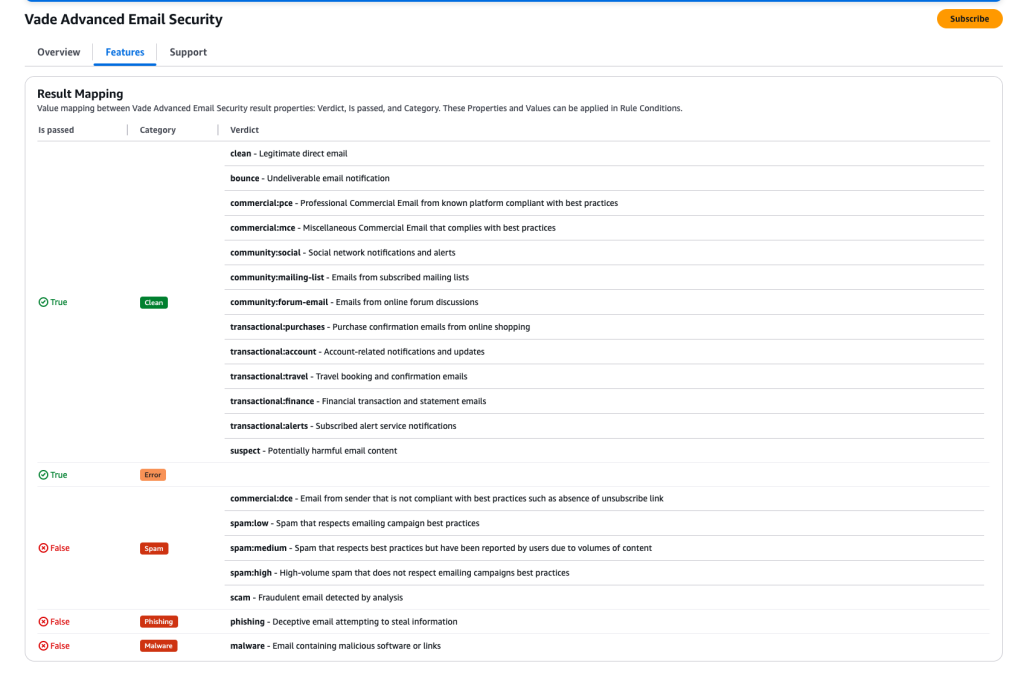
The Vade Email Add-On integrates with Mail Manager’s rules engine. This engine routes messages based on Vade’s scan results and optional detailed verdicts. These verdicts enable precise categorization and handling of incoming emails, improving security and email management.
In the following example, we’ll walk thru the steps needed to subscribe and configure a rule set with two rules that are processed in priority order:
drop-all-malicious-emails This rule has a condition that uses Vade to scan all incoming email and identify messages that are malicious (contain malware or phishing). These messages are then processed by Rule 1’s “Drop action“. Messages that are deemed “safe” are passed to Rule 2 after automatically being inspected and marked as “likely to be spam”, or “not-spam”.forward-to-mailbox Messages passed into Rule 2 are immediately forwarded to the user’s mailbox. In our example, we’re using Amazon WorkMail and Mail Manager’s built-in “Deliver to mailbox” action.
X-SES-Vade-Advanced-Email-Security-AddonVerdict: spam:high
Follow the steps below to configure the Vade Email Add On using the Amazon SES console for the simple mail flow described above (note – the SES Mail Manager API can be used in lieu of the console).

process-via-vade ) (or modify an existing Rule set).
drop-all-malicious-emails )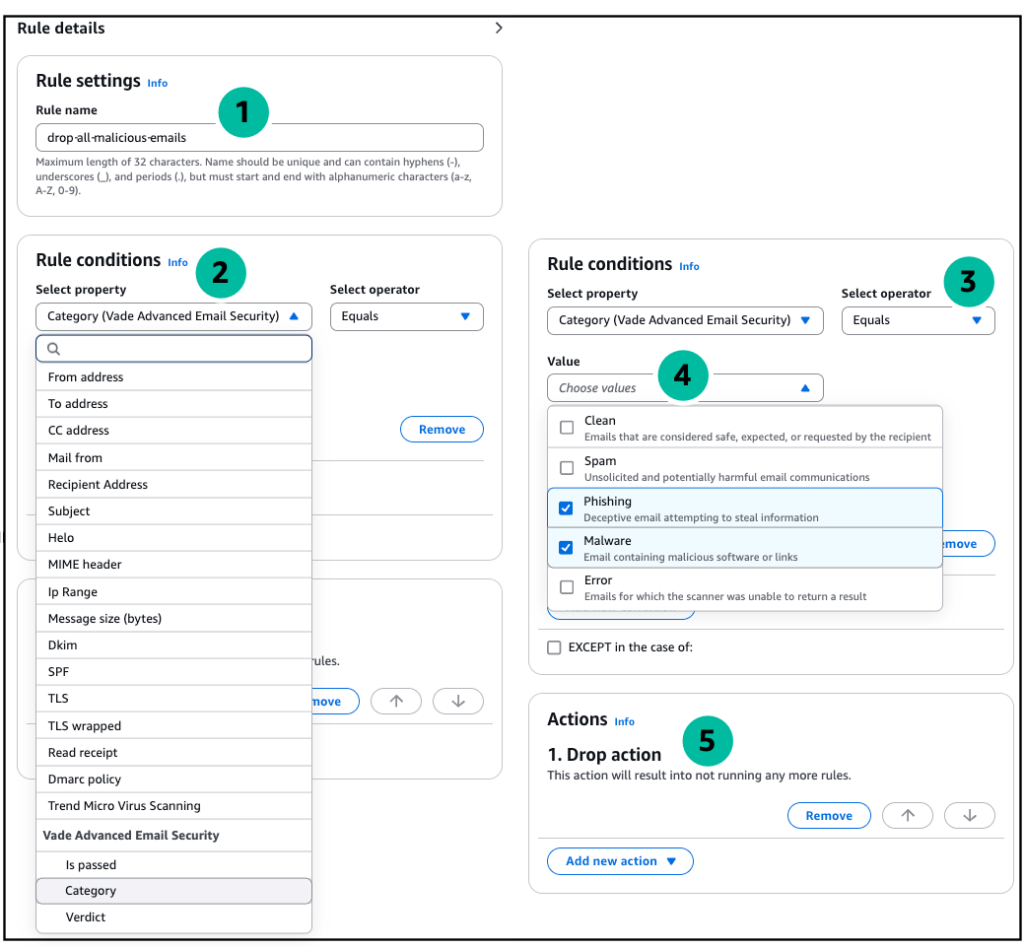
forward-to-mailbox ) to process messages that were passed along by Rule 1.

The Vade Add-On’s rule conditions (below) enable granular control of email routing. When combined with customizable actions, these rules create an automated email handling system that matches your business needs.
Hornetsecurity’s Vade Email Add On for Amazon SES Mail Manager represents a significant step forward in email security for Amazon SES Mail Manager customers. By combining an advanced artificial intelligence (AI)-driven security engine with the powerful management capabilities of Mail Manager, you can enhance your defense against email-borne threats while maintaining precise control over your email workflows.
Get started today and take your email security to the next level with the Vade Add On for Amazon SES Mail Manager
We encourage you to try the Vade Add On for Amazon SES Mail Manager and experience the benefits of enhanced email security firsthand. To learn more about implementation details and best practices, please visit:
Join the Conversation:
Connect with other administrators and security professionals on the AWS re:Post community to share insights and learn best practices.
Post Syndicated from Chris McPeek original https://aws.amazon.com/blogs/compute/optimizing-network-footprint-in-serverless-applications/
This post is authored by Anton Aleksandrov, Principal Solution Architect, AWS Serverless and Daniel Abib, Senior Specialist Solutions Architect, AWS
Serverless application developers may commonly encounter scenarios where they need to transport large payloads, especially when building modern cloud applications that need rich data. Examples include analytics services with detailed reports, e-commerce platforms with extensive product catalogs, healthcare applications transmitting patient records, or financial services aggregating transactional data.
Many serverless services have a well-defined maximum payload size. For example, AWS Lambda maximum request/response payload size is 6 MB, and Amazon Simple Queue Service (Amazon SQS) and Amazon EventBridge maximum message size is 256 KB. In this post, you will learn how to use data compression techniques to reduce your network footprint and transport larger payloads under existing constraints.
Cloud applications evolve continuously and need to be adjusted frequently for new requirements, such as new business features or new Service Level Objectives (SLO) for higher throughput and lower latency. As new use cases and data patterns are added, it is common to see request and response payload sizes increase. At some point, you might hit the maximum service payload size limits, such as 6 MB for synchronous Lambda function invokes, 10 MB for Amazon API Gateway, and 256 KB for Amazon SQS, EventBridge, and asynchronous Lambda invokes.
There are several techniques you can apply when dealing with large payloads. If your payloads are tens of MBs or more, or you need to transport large binary objects with API Gateway, you can store the payload on Amazon Simple Storage Service (Amazon S3) and use pre-signed URLs for clients to directly upload and download from S3.

Figure 1. A sample of architecture for handling large payloads
Lambda function URLs response streaming supports up to 20 MB responses. For handling large messages with services such as SQS or EventBridge, you can store the message in S3 and pass a reference. The downstream consumer will use the reference to download the message directly from S3. One common characteristic of these techniques is that they introduce architectural complexity and may necessitate modifications to your existing solution architecture and data flow patterns.
Furthermore, as your payloads grow in size, you will see increased data transfer costs, especially if your solution is transporting data through Amazon Virtual Private Cloud (VPC) NAT Gateways, VPC endpoints, or sending data across AWS Regions. For example, it is common for VPC-based solutions to have Lambda functions in their architecture. A container running on Amazon Elastic Kubernetes Service (Amazon EKS) might need to invoke a Lambda function, or a VPC-attached Lambda function might need to reach out to the public internet.

Figure 2. Examples of using virtual network appliances with serverless applications
Both NAT Gateway and VPC Endpoint are billed per GB of data processed, which makes data compression a valuable optimization technique. Go to NAT Gateway pricing and VPC Endpoint pricing for details.
The following sections explore data compression techniques and demonstrate how to apply them in your serverless applications. You can learn how to send larger payloads within the existing payload size boundaries and reduce your network footprint without significant architectural changes. This post discusses compression techniques in the context of Lambda and API Gateway, but the same principles can be applied to other services, such as SQS, EventBridge, and AWS AppSync. Understanding compression concepts better equips you to optimize your application’s data-handling capabilities.
Compression is a widely used approach to reduce data size in order to improve cost-effectiveness and performance for data storage and transmission. Many tools and frameworks incorporate data compression techniques, such as gzip or zstd. It is thoroughly documented in the official IANA specification and IETF RFC 9110. Browsers such as Chrome and Firefox, HTTP toolkits such as curl and Postman, and runtimes such as Node.js and Python natively handle compression, often without user involvement.
Consider HTTP protocol. When a client wants to send a compressed payload, it specifies it in the Content-Type header. To receive a compressed response, the client specifies supported compression methods in the Accept-Encoding request header.

Figure 3. Accept-Encoding request header specifying supported compression methods
The server compresses the response payload using one of the supported methods and uses the Content-Encoding response header to indicate the method to the client.

Figure 4. Content-Encoding response header specifying compression method
This mechanism can accelerate client-server communications by reducing the number of bytes transmitted over the network. Compression efficiency depends on the data type. Text-based formats like JSON, XML, HTML, and YAML compress well, while binary data such as PDF and JPEG generally compress less effectively.
API Gateway provides built-in compression support. Use the minimumCompressionSize configuration to set the smallest payload size to compress automatically. The value can be between 0 bytes to 10 MB. Compressing very small payloads might actually increase the final payload size, and you should always test with your real payload patterns to determine the optimal threshold.

Figure 5. Handling data compression in API Gateway
API Gateway enables clients to interact with your API using compressed payloads through supported content encodings. The compression mechanism works bi-directionally. For JSON payloads, API Gateway seamlessly handles compression and decompression, maintaining compatibility with mapping templates. It decompresses incoming payloads before applying request mapping templates and compresses outgoing responses after applying response mapping templates. This automated compression optimizes data transfer:
A sample test using the compression technique with API Gateway and JSON payload yielded the following results.
Compressing data resulted in 78% network footprint reduction and improved latency by 110 ms.
This configuration-based technique uses the API Gateway native compression. However, payloads are decompressed before being delivered to downstream integrations, thus they still remain subject to Lambda’s 6 MB max payload size. To address this, you can configure binaryMediaTypes in the API Gateway to pass compressed payloads to Lambda directly, enabling the function to handle decompression.
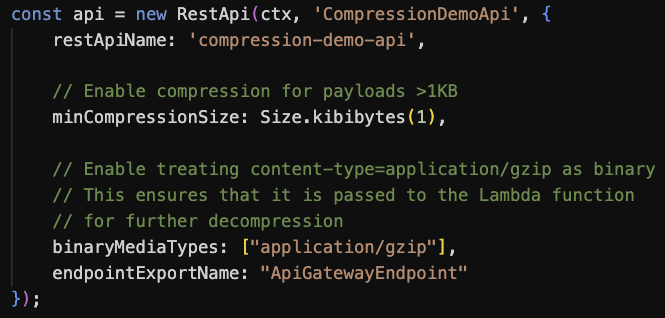
Figure 6. CDK code to configure API Gateway for data compression and binary data passthrough
The Lambda Invoke API supports payloads in plain-text formats, such as JSON. The maximum payload size is 6 MB for synchronous invocations and 256 KB for asynchronous. Although the Invoke API supports uncompressed text-based payloads, you can introduce data compression in your function code and use API Gateway or Function URLs to facilitate content conversion, as illustrated in the following figure.

Figure 7. Transporting compressed payloads in a serverless applications
Handling data compression in your Lambda function code can be done through libraries commonly embedded in the runtime. The following code snippet shows the compressing response payload using Node.js. Similar techniques can be applied to other runtimes.
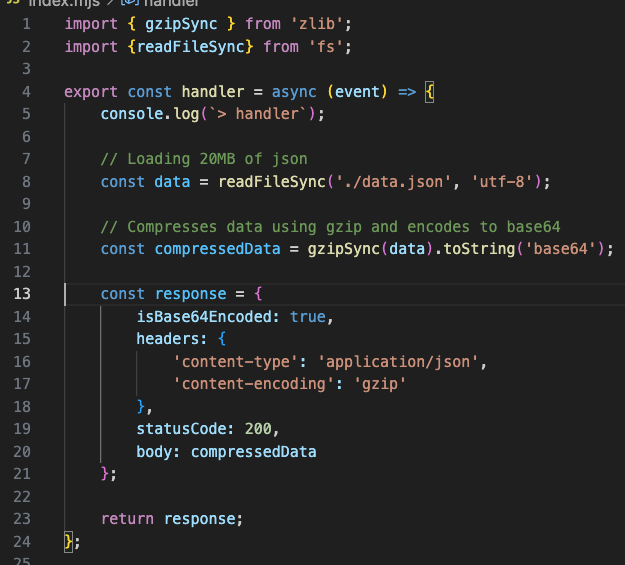
Figure 8. Sample code implementing response payload compression in a Lambda function
The following screenshot shows the result: 20 MB uncompressed JSON returned from a Lambda function as a 2.5 MB compressed response body. Network footprint reduced by over 80%.

Figure 9. A screenshot from Postman showing the original and compressed payload size
Using this technique, you can reduce your network footprint and transport payload sizes several times higher than the Lambda maximum payload size.
Transporting compressed payloads through Lambda Function URLs doesn’t necessitate any extra configuration. For handler responses, your code needs to compress and Base64-encode the data as shown in the preceding figure. For invocation requests, the Function URL endpoint recognizes the incoming compressed payload as binary and passes it to your handler as a Base64 encoded string in the event body.

Figure 10. Sample code implementing request payload decompression in a Lambda function
Compressing data in function code is a CPU-intensive activity, potentially increasing invocation duration and, as a result, function cost. This, however, can be balanced by the benefits of data compression. As you’ve seen in previous sections, while compressing data adds compute latency, transporting smaller payloads over the network reduces network latency. The following section summarizes a series of tests performed to estimate the impact of data compression on Lambda function invocation duration, Lambda function invocation cost, and data transfer savings with both NAT Gateway and VPC Endpoint. The tests were performed with several assumptions and randomly generated JSON data. You can see full testing results in the sample GitHub.com repo.
Test results demonstrated that the impact on function latency and cost primarily depends on two key factors: payload size and allocated memory (which determines vCPU capacity). Using a Node.js runtime with ARM architecture as an example, compressing a 1 MB JSON object in a function with 1 GB of allocated memory resulted in 124 ms of added processing time on average. For 10 million invocations, this extra processing time adds approximately $16. At the same time, the compression yielded a 70% reduction in payload size. With the same number of invocations, this translates to approximately $300 in savings when using NAT Gateway and $70 in savings when using VPC Endpoints (depending on the number of Availability Zones (AZs)).
AWS Service pricing is updated regularly, you should always consult the respective pricing pages for the latest information. Moreover, you should conduct your own performance and cost estimates using payloads that represent your workloads. Compression effectiveness varies significantly depending on the data type: payloads with low compression rates might not benefit from this technique.
Follow the instructions in this GitHub repository to provision the sample in your AWS account. The project creates two Lambda functions to demonstrate receiving and returning compressed JSON using Function URLs and API Gateway.
The sample shows how to GET and POST JSON payloads using gzip compression to reduce the network footprint by over 80%.

Figure 11. A screenshot from Postman showing the original and compressed payload size
Data compression enables larger payload transfers and reduces network footprint. It can help to lower network latencies and optimize data transfer costs. When implementing compression within Lambda functions, it is important to consider its CPU-bound nature, which may increase function duration and costs. You should always evaluate the added compute cost against potential data transfer savings to make sure the technique benefits your use case.
Compression is most effective for handling large text-based payloads and when a slight increase in compute latency balanced by reduced network latency is acceptable.
To learn more about Serverless architectures and asynchronous Lambda invocation patterns, see Serverless Land.
Post Syndicated from Simon Janusz original https://blog.rapid7.com/2025/03/21/metasploit-wrap-up-03-21-2025/
This week, the Metasploit team have added an exciting relay module that has been in the works for a long time. This relay module is used to host an SMB server, and execute an SMB to LDAP relay attack against a Domain controller with an LDAP server when NTLMv1 is being used as the SMB authentication method. PetitPotam can be used to coerce authentication on the victim system and relay it to the Domain Controller.
The module automatically takes care of removing the relevant flags to bypass signing.
This module supports the usage of SMBv2 and SMBv3, and captures NTLMv1 and NTLMv2 hashes which can be used for a pass-the-hash attack, or cracked locally to retrieve raw passwords.
When successful, this attack can also open a Metasploit Framework LDAP session. This session can then be leveraged to set up a Resource-Based Constrained Delegation (RBCD) on the Domain Controller to get remote code execution on the victim system.
Authors: Christophe De La Fuente and Spencer McIntyre
Type: Auxiliary
Pull request: #19832 contributed by cdelafuente-r7
Path: server/relay/smb_to_ldap
Description: Adds a module that runs an SMB capture server that relays the credentials to one or more LDAP servers, verifies the credentials, and can establish an LDAP session with the relayed authentication.
You can find the latest Metasploit documentation on our docsite at docs.metasploit.com.
As always, you can update to the latest Metasploit Framework with msfupdate
and you can get more details on the changes since the last blog post from
GitHub:
If you are a git user, you can clone the Metasploit Framework repo (master branch) for the latest.
To install fresh without using git, you can use the open-source-only Nightly Installers or the
commercial edition Metasploit Pro
Post Syndicated from Bruce Schneier original https://www.schneier.com/blog/archives/2025/03/my-writings-are-in-the-libgen-ai-training-corpus.html
The Atlantic has a search tool that allows you to search for specific works in the “LibGen” database of copyrighted works that Meta used to train its AI models. (The rest of the article is behind a paywall, but not the search tool.)
It’s impossible to know exactly which parts of LibGen Meta used to train its AI, and which parts it might have decided to exclude; this snapshot was taken in January 2025, after Meta is known to have accessed the database, so some titles here would not have been available to download.
Still…interesting.
Searching my name yields 199 results: all of my books in different versions, plus a bunch of shorter items.
Post Syndicated from corbet original https://lwn.net/Articles/1015000/
As a system runs and its memory becomes fragmented, allocating large,
physically contiguous regions of memory becomes increasingly difficult.
Much effort over the years has gone into avoiding the need to make such
allocations whenever possible, but there are times when they simply cannot
be avoided. The kernel’s contiguous memory
allocator (CMA) subsystem attempts to make such allocations possible,
but it has never been a perfect solution. Suren Baghdasaryan is is trying
to improve that situation with the guaranteed
contiguous memory allocator patch set, which includes work from Minchan
Kim as well.
Post Syndicated from daroc original https://lwn.net/Articles/1015095/
Julien Malka has
called for the NixOS project to use build-reproducibility to detect when a program has a maintainer-generated tarball that results in a different artifact than building from source. There are good reasons for projects to release maintainer-generated tarballs, but since the materials included in them are usually documentation, extra build scripts, and so on, it makes sense to check that they don’t influence the final build output. While this would not have stopped
last year’s XZ backdoor, it would have made it harder to hide.
People are often convinced that OSS is more trustworthy than closed-source software because the code can be audited by practitioners and security professionals in order to detect vulnerabilities or backdoors. In this instance, this procedure has been made difficult by the fact that part of the code activating the backdoor was not included in the sources available within the git repository but was instead present in the maintainer-provided tarball. While this was used to hide the backdoor out of sight of most investigating eyes, this is also an opportunity for us to improve our software supply chain security processes.
Post Syndicated from daroc original https://lwn.net/Articles/1014440/
Brendan Jackman has been working to try to get ahead of the next hardware CPU
vulnerability
before it gets discovered. In January, he posted the second version of
a patch set that introduces
address-space isolation (ASI) as a way of
preventing future CPU vulnerabilities from leaking important
information. The core concept is to ensure that data that is not currently
needed is not present in memory, so that speculative execution cannot leak it.
The work is nowhere near ready to be incorporated into the mainline
kernel — not least of all because it has a large performance impact in its
current form — but it is likely to once again be a topic of discussion at the
2025
Linux Filesystem, Memory Management, and BPF Summit.