Post Syndicated from The History Guy: History Deserves to Be Remembered original https://www.youtube.com/watch?v=b6yM-TYrc2k
Comic for 2025.02.07 – Pain Machine
Post Syndicated from Explosm.net original https://explosm.net/comics/pain-machine
New Cyanide and Happiness Comic
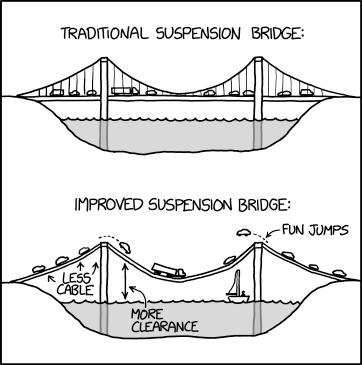
Suspension Bridge
Post Syndicated from xkcd.com original https://xkcd.com/3048/
Cloudflare Incident on February 6, 2025
Post Syndicated from Matt Silverlock original https://blog.cloudflare.com/cloudflare-incident-on-february-6-2025/
Multiple Cloudflare services, including our R2 object storage, were unavailable for 59 minutes on Thursday, February 6th. This caused all operations against R2 to fail for the duration of the incident, and caused a number of other Cloudflare services that depend on R2 — including Stream, Images, Cache Reserve, Vectorize and Log Delivery — to suffer significant failures.
The incident occurred due to human error and insufficient validation safeguards during a routine abuse remediation for a report about a phishing site hosted on R2. The action taken on the complaint resulted in an advanced product disablement action on the site that led to disabling the production R2 Gateway service responsible for the R2 API.
Critically, this incident did not result in the loss or corruption of any data stored on R2.
We’re deeply sorry for this incident: this was a failure of a number of controls and we are prioritizing work to implement additional system-level controls related not only to our abuse processing systems, but so that we continue to reduce the blast radius of any system- or human- action that could result in disabling any production service at Cloudflare.
All customers using Cloudflare R2 would have observed a 100% failure rate against their R2 buckets and objects during the primary incident window. Services that depend on R2 (detailed in the table below) observed heightened error rates and failure modes depending on their usage of R2.
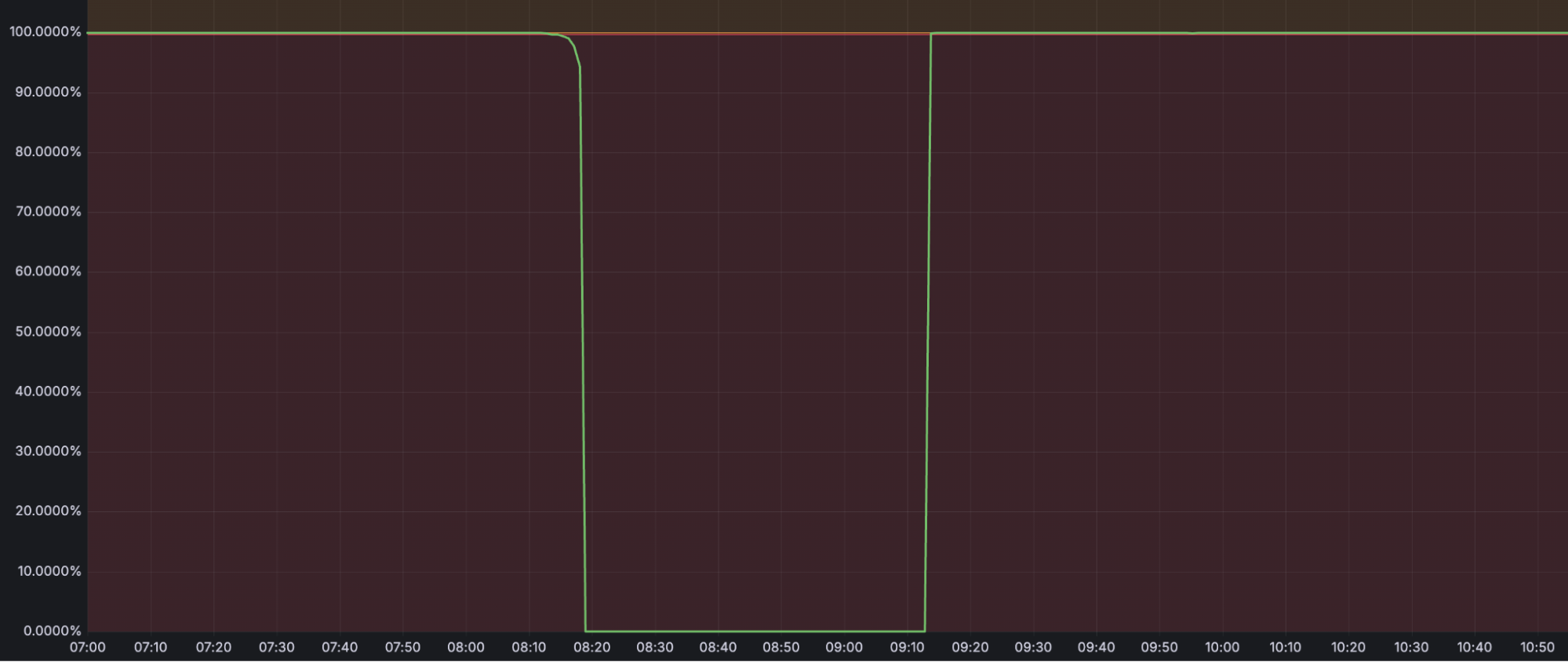
The primary incident window occurred between 08:14 UTC to 09:13 UTC, when operations against R2 had a 100% error rate. Dependent services (detailed below) observed increased failure rates for operations that relied on R2.
From 09:13 UTC to 09:36 UTC, as R2 recovered and clients reconnected, the backlog and resulting spike in client operations caused load issues with R2’s metadata layer (built on Durable Objects). This impact was significantly more isolated: we observed a 0.09% increase in error rates in calls to Durable Objects running in North America during this window.
The following table details the impacted services, including the user-facing impact, operation failures, and increases in error rates observed:
|
Product/Service |
Impact |
|
R2 |
100% of operations against R2 buckets and objects, including uploads, downloads, and associated metadata operations were impacted during the primary incident window. During the secondary incident window, we observed a <1% increase in errors as clients reconnected and increased pressure on R2’s metadata layer. There was no data loss within the R2 storage subsystem: this incident impacted the HTTP frontend of R2. Separation of concerns and blast radius management meant that the underlying R2 infrastructure was unaffected by this. |
|
Stream |
100% of operations (upload & streaming delivery) against assets managed by Stream were impacted during the primary incident window. |
|
Images |
100% of operations (uploads & downloads) against assets managed by Images were impacted during the primary incident window. Impact to Image Delivery was minor: success rate dropped to 97% as these assets are fetched from existing customer backends and do not rely on intermediate storage. |
|
Cache Reserve |
Cache Reserve customers observed an increase in requests to their origin during the incident window as 100% of operations failed. This resulted in an increase in requests to origins to fetch assets unavailable in Cache Reserve during this period. This impacted less than 0.049% of all cacheable requests served during the incident window. User-facing requests for assets to sites with Cache Reserve did not observe failures as cache misses failed over to the origin. |
|
Log Delivery |
Log delivery was delayed during the primary incident window, resulting in significant delays (up to an hour) in log processing, as well as some dropped logs. Specifically: Non-R2 delivery jobs would have experienced up to 4.5% data loss during the incident. This level of data loss could have been different between jobs depending on log volume and buffer capacity in a given location. R2 delivery jobs would have experienced up to 13.6% data loss during the incident. R2 is a major destination for Cloudflare Logs. During the primary incident window, all available resources became saturated attempting to buffer and deliver data to R2. This prevented other jobs from acquiring resources to process their queues. Data loss (dropped logs) occurred when the job queues expired their data (to allow for new, incoming data). The system recovered when we enabled a kill switch to stop processing jobs sending data to R2. |
|
Durable Objects |
Durable Objects, and services that rely on it for coordination & storage, were impacted as the stampeding horde of clients re-connecting to R2 drove an increase in load. We observed a 0.09% actual) increase in error rates in calls to Durable Objects running in North America, starting at 09:13 UTC and recovering by 09:36 UTC. |
|
Cache Purge |
Requests to the Cache Purge API saw a 1.8% error rate (HTTP 5xx) increase and a 10x increase in p90 latency for purge operations during the primary incident window. Error rates returned to normal immediately after this. |
|
Vectorize |
Queries and operations against Vectorize indexes were impacted during the primary incident window. 75% of queries to indexes failed (the remainder were served out of cache) and 100% of insert, upsert, and delete operations failed during the incident window as Vectorize depends on R2 for persistent storage. Once R2 recovered, Vectorize systems recovered in full. We observed no continued impact during the secondary incident window, and we have not observed any index corruption as the Vectorize system has protections in place for this. |
|
Key Transparency Auditor |
100% of signature publish & read operations to the KT auditor service failed during the primary incident window. No third party reads occurred during this window and thus were not impacted by the incident. |
|
Workers & Pages |
A small volume (0.002%) of deployments to Workers and Pages projects failed during the primary incident window. These failures were limited to services with bindings to R2, as our control plane was unable to communicate with the R2 service during this period. |
The incident timeline, including the initial impact, investigation, root cause, and remediation, are detailed below.
All timestamps referenced are in Coordinated Universal Time (UTC).
| Time | Event |
|---|---|
| 2025-02-06 08:12 | The R2 Gateway service is inadvertently disabled while responding to an abuse report. |
| 2025-02-06 08:14 | — IMPACT BEGINS — |
| 2025-02-06 08:15 | R2 service metrics begin to show signs of service degradation. |
| 2025-02-06 08:17 | Critical R2 alerts begin to fire due to our service no longer responding to our health checks. |
| 2025-02-06 08:18 | R2 on-call engaged and began looking at our operational dashboards and service logs to understand impact to availability. |
| 2025-02-06 08:23 | Sales engineering escalated to the R2 engineering team that customers are experiencing a rapid increase in HTTP 500’s from all R2 APIs. |
| 2025-02-06 08:25 | Internal incident declared. |
| 2025-02-06 08:33 | R2 on-call was unable to identify the root cause and escalated to the lead on-call for assistance. |
| 2025-02-06 08:42 | Root cause identified as R2 team reviews service deployment history and configuration, which surfaces the action and the validation gap that allowed this to impact a production service. |
| 2025-02-06 08:46 | On-call attempts to re-enable the R2 Gateway service using our internal admin tooling, however this tooling was unavailable because it relies on R2. |
| 2025-02-06 08:49 | On-call escalates to an operations team who has lower level system access and can re-enable the R2 Gateway service. |
| 2025-02-06 08:57 | The operations team engaged and began to re-enable the R2 Gateway service. |
| 2025-02-06 09:09 | R2 team triggers a redeployment of the R2 Gateway service. |
| 2025-02-06 09:10 | R2 began to recover as the forced re-deployment rolled out as clients were able to reconnect to R2. |
| 2025-02-06 09:13 | — IMPACT ENDS — R2 availability recovers to within its service-level objective (SLO). Durable Objects begins to observe a slight increase in error rate (0.09%) for Durable Objects running in North America due to the spike in R2 clients reconnecting. |
| 2025-02-06 09:36 | The Durable Objects error rate recovers. |
| 2025-02-06 10:29 | The incident is closed after monitoring error rates. |
At the R2 service level, our internal Prometheus metrics showed R2’s SLO near-immediately drop to 0% as R2’s Gateway service stopped serving all requests and terminated in-flight requests.
The slight delay in failure was due to the product disablement action taking 1-2 minutes to take effect as well as our configured metrics aggregation intervals:
For context, R2’s architecture separates the Gateway service, which is responsible for authenticating and serving requests to R2’s S3 & REST APIs and is the “front door” for R2 — its metadata store (built on Durable Objects), our intermediate caches, and the underlying, distributed storage subsystem responsible for durably storing objects.
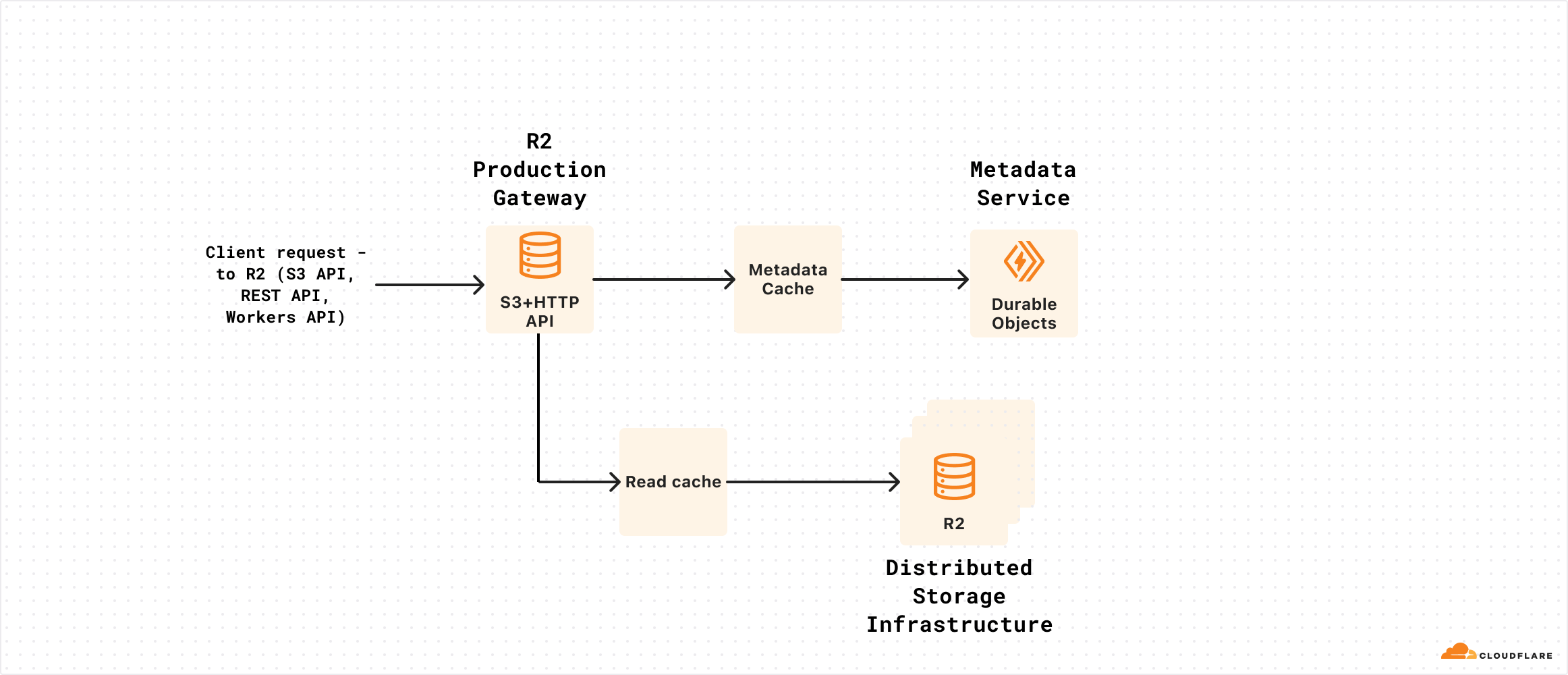
During the incident, all other components of R2 remained up: this is what allowed the service to recover so quickly once the R2 Gateway service was restored and re-deployed. The R2 Gateway acts as the coordinator for all work when operations are made against R2. During the request lifecycle, we validate authentication and authorization, write any new data to a new immutable key in our object store, then update our metadata layer to point to the new object. When the service was disabled, all running processes stopped.
While this means that all in-flight and subsequent requests fail, anything that had received a HTTP 200 response had already succeeded with no risk of reverting to a prior version when the service recovered. This is critical to R2’s consistency guarantees and mitigates the chance of a client receiving a successful API response without the underlying metadata and storage infrastructure having persisted the change.
Due to human error and insufficient validation safeguards in our admin tooling, the R2 Gateway service was taken down as part of a routine remediation for a phishing URL.
During a routine abuse remediation, action was taken on a complaint that inadvertently disabled the R2 Gateway service instead of the specific endpoint/bucket associated with the report. This was a failure of multiple system level controls (first and foremost) and operator training.
A key system-level control that led to this incident was in how we identify (or “tag”) internal accounts used by our teams. Teams typically have multiple accounts (dev, staging, prod) to reduce the blast radius of any configuration changes or deployments, but our abuse processing systems were not explicitly configured to identify these accounts and block disablement actions against them. Instead of disabling the specific endpoint associated with the abuse report, the system allowed the operator to (incorrectly) disable the R2 Gateway service.
Once we identified this as the cause of the outage, remediation and recovery was inhibited by the lack of direct controls to revert the product disablement action and the need to engage an operations team with lower level access than is routine. The R2 Gateway service then required a re-deployment in order to rebuild its routing pipeline across our edge network.
Once re-deployed, clients were able to re-connect to R2, and error rates for dependent services (including Stream, Images, Cache Reserve and Vectorize) returned to normal levels.
We have taken immediate steps to resolve the validation gaps in our tooling to prevent this specific failure from occurring in the future.
We are prioritizing several work-streams to implement stronger, system-wide controls (defense-in-depth) to prevent this, including how we provision internal accounts so that we are not relying on our teams to correctly and reliably tag accounts. A key theme to our remediation efforts here is around removing the need to rely on training or process, and instead ensuring that our systems have the right guardrails and controls built-in to prevent operator errors.
These work-streams include (but are not limited to) the following:
-
Actioned: deployed additional guardrails implemented in the Admin API to prevent product disablement of services running in internal accounts.
-
Actioned: Product disablement actions in the abuse review UI have been disabled while we add more robust safeguards. This will prevent us from inadvertently repeating similar high-risk manual actions.
-
In-flight: Changing how we create all internal accounts (staging, dev, production) to ensure that all accounts are correctly provisioned into the correct organization. This must include protections against creating standalone accounts to avoid re-occurrence of this incident (or similar) in the future.
-
In-flight: Further restricting access to product disablement actions beyond the remediations recommended by the system to a smaller group of senior operators.
-
In-flight: Two-party approval required for ad-hoc product disablement actions. Going forward, if an investigator requires additional remediations, they must be submitted to a manager or a person on our approved remediation acceptance list to approve their additional actions on an abuse report.
-
In-flight: Expand existing abuse checks that prevent accidental blocking of internal hostnames to also prevent any product disablement action of products associated with an internal Cloudflare account.
-
In-flight: Internal accounts are being moved to our new Organizations model ahead of public release of this feature. The R2 production account was a member of this organization but our abuse remediation engine did not have the necessary protections to prevent acting against accounts within this organization.
We’re continuing to discuss & review additional steps and effort that can continue to reduce the blast radius of any system- or human- action that could result in disabling any production service at Cloudflare.
We understand this was a serious incident and we are painfully aware of — and extremely sorry for — the impact it caused to customers and teams building and running their businesses on Cloudflare.
This is the first (and ideally, the last) incident of this kind and duration for R2, and we’re committed to improving controls across our systems and workflows to prevent this in the future.
2024 PiTuKri ISAE 3000 Type II attestation report available with 179 services in scope
Post Syndicated from Tariro Dongo original https://aws.amazon.com/blogs/security/2024-pitukri-isae-3000-type-ii-attestation-report-available-with-179-services-in-scope/
Amazon Web Services (AWS) is pleased to announce the issuance of the Criteria to Assess the Information Security of Cloud Services (PiTuKri) Type II attestation report with 179 services in scope.
The Finnish Transport and Communications Agency (Traficom) Cyber Security Centre published PiTuKri, which consists of 52 criteria that provide guidance across 11 domains for assessing the security of cloud service providers.
An independent third-party audit firm issued the report to assure customers that the AWS control environment is appropriately designed and operating effectively to demonstrate adherence with PiTuKri requirements. This attestation demonstrates the AWS commitment to adhere to security expectations for cloud service providers set by Traficom.
The latest report covers a 12-month period from October 1, 2023 to September 30, 2024. AWS has added the following 10 services to the current PiTuKri scope:
- Amazon DataZone
- AWS Entity Resolution
- AWS Mainframe Modernization
- AWS Payment Cryptography
- Amazon Q Business
- Amazon Q Developer
- Amazon Application Recovery Controller
- Amazon Security Lake
- AWS Verified Access
- Amazon WorkSpaces Thin Client
Customers can find the PiTuKri ISAE 3000 report on AWS Artifact. To learn more about the complete list of services in scope, see AWS Compliance Programs and AWS Services in Scope for PiTuKri.
AWS strives to continuously bring new services into the scope of its compliance programs to help you meet your architectural and regulatory needs. Contact your AWS account team for questions about the PiTuKri report.
To learn more about our compliance and security programs, see AWS Compliance Programs. As always, we value your feedback and questions; reach out to the AWS Compliance team through the Contact Us page.
If you have feedback about this post, submit comments in the Comments section below.
2024 FINMA ISAE 3000 Type II attestation report available with 179 services in scope
Post Syndicated from Tariro Dongo original https://aws.amazon.com/blogs/security/2024-finma-isae-3000-type-ii-attestation-report-available-with-179-services-in-scope/
Amazon Web Services (AWS) is pleased to announce the issuance of the Swiss Financial Market Supervisory Authority (FINMA) Type II attestation report with 179 services in scope.
The Swiss Financial Market Supervisory Authority (FINMA) has published several requirements and guidelines about engaging with outsourced services for the regulated financial services customers in Switzerland.
An independent third-party audit firm issued the report to assure customers that the AWS control environment is appropriately designed and operating effectively to support adherence with FINMA requirements.
The latest report covers the 12-month period from October 1, 2023 to September 30, 2024, for the following circulars:
- 2018/03 “Outsourcing – banks, insurance companies and selected financial institutions under FinIA”
- 2023/01 “Operational risks and resilience – banks”
- Business Continuity Management (BCM) minimum standards proposed by the Swiss Insurance Association
AWS has added the following 10 services to the current FINMA scope:
- Amazon DataZone
- AWS Entity Resolution
- AWS Mainframe Modernization
- AWS Payment Cryptography
- Amazon Q Business
- Amazon Q Developer
- Amazon Application Recovery Controller
- Amazon Security Lake
- AWS Verified Access
- Amazon WorkSpaces Thin Client
Customers can find the FINMA ISAE 3000 report on AWS Artifact. To learn more about the complete list of services in scope, see AWS Compliance Programs and AWS Services in Scope for FINMA.
AWS strives to continuously bring new services into the scope of its compliance programs to help you meet your architectural and regulatory needs. Contact your AWS account team for questions about the FINMA report.
To learn more about our compliance and security programs, see AWS Compliance Programs. As always, we value your feedback and questions; reach out to the AWS Compliance team through the Contact Us page.
If you have feedback about this post, submit comments in the Comments section below.
February 6, 1952
Post Syndicated from The History Guy: History Deserves to Be Remembered original https://www.youtube.com/watch?v=DBMpEbJRWU4
Introducing AWS CloudFormation Stack Refactoring
Post Syndicated from Kevin DeJong original https://aws.amazon.com/blogs/devops/introducing-aws-cloudformation-stack-refactoring/
Introduction
As your cloud infrastructure grows and evolves, you may find the need to reorganize your AWS CloudFormation stacks for better management, for improved modularity, or to align with changing business requirements. CloudFormation now offers a powerful feature that allows you to move resources between stacks. In this post, we’ll explore the process of stack refactoring and how it can help you maintain a well-organized and efficient cloud infrastructure.
Understanding Stack Refactoring
Stack refactoring is the process of restructuring your CloudFormation stacks by moving resources from one stack to another or renaming a resource with a new logical ID within the same stack. This capability is particularly useful when you want to:
- Split a large, monolithic stack into smaller, more manageable stacks
- Reorganize resources to better align with your application architecture or organizational structure
- Rename the logical IDs of resources to make templates more readable
Example Scenario
To demonstrate this capability, you are going to create a stack and then move some of its resources into a new stack. You will evaluate the new CLI commands that you need to leverage to make this possible. For this example, you are going to have an SNS topic with a lambda function subscribed to your SNS topic. As your usage of the SNS topic expands, you want to break apart the subscriptions into a different stack.
- Create a new template called
before.yamlwith your starting template:AWSTemplateFormatVersion: "2010-09-09" Resources: Topic: Type: AWS::SNS::Topic MyFunction: Type: AWS::Lambda::Function Properties: FunctionName: my-function Handler: index.handler Runtime: python3.12 Code: ZipFile: | import json def handler(event, context): print(json.dumps(event)) return event Role: !GetAtt FunctionRole.Arn Timeout: 30 Subscription: Type: AWS::SNS::Subscription Properties: Endpoint: !GetAtt MyFunction.Arn Protocol: lambda TopicArn: !Ref Topic FunctionInvokePermission: Type: AWS::Lambda::Permission Properties: Action: lambda:InvokeFunction Principal: sns.amazonaws.com FunctionName: !GetAtt MyFunction.Arn SourceArn: !Ref Topic FunctionRole: Type: AWS::IAM::Role Properties: AssumeRolePolicyDocument: Version: "2012-10-17" Statement: - Action: - sts:AssumeRole Effect: Allow Principal: Service: - lambda.amazonaws.com Condition: StringEquals: aws:SourceAccount: !Ref AWS::AccountId ArnLike: aws:SourceArn: !Sub "arn:${AWS::Partition}:lambda:${AWS::Region}:${AWS::AccountId}:function:my-function" Policies: - PolicyName: LambdaPolicy PolicyDocument: Version: "2012-10-17" Statement: - Action: - logs:CreateLogGroup - logs:CreateLogStream - logs:PutLogEvents Resource: - arn:aws:logs:*:*:* Effect: Allow - Create a new stack using the
before.yamltemplate.aws cloudformation create-stack --stack-name MySns --template-body file://before.yaml --capabilities CAPABILITY_IAM - Create a new template called
afterSns.yamlwith the content below. This template has your SNS topic in it and has a new export in it that will export the SNS topic ARN. This export will be used by your other templates to get the required SNS topic ARN.AWSTemplateFormatVersion: "2010-09-09" Resources: Topic: Type: AWS::SNS::Topic Outputs: TopicArn: Value: !Ref Topic Export: Name: TopicArn - Create a new template called
afterLambda.yamlwith the content below. This template includes all the resources to create a Lambda subscription to your SNS topic. This template switched the!Ref Topicto use the exported valued by using!ImportValue TopicArn.AWSTemplateFormatVersion: "2010-09-09" Resources: Function: Type: AWS::Lambda::Function Properties: FunctionName: my-function Handler: index.handler Runtime: python3.12 Code: ZipFile: | import json def handler(event, context): print(json.dumps(event)) return event Role: !GetAtt FunctionRole.Arn Timeout: 30 Subscription: Type: AWS::SNS::Subscription Properties: Endpoint: !GetAtt Function.Arn Protocol: lambda TopicArn: !ImportValue TopicArn FunctionInvokePermission: Type: AWS::Lambda::Permission Properties: Action: lambda:InvokeFunction Principal: sns.amazonaws.com FunctionName: !GetAtt Function.Arn SourceArn: !ImportValue TopicArn FunctionRole: Type: AWS::IAM::Role Properties: AssumeRolePolicyDocument: Version: "2012-10-17" Statement: - Action: - sts:AssumeRole Effect: Allow Principal: Service: - lambda.amazonaws.com Condition: StringEquals: aws:SourceAccount: !Ref AWS::AccountId ArnLike: aws:SourceArn: !Sub arn:${AWS::Partition}:lambda:${AWS::Region}:${AWS::AccountId}:function:* Policies: - PolicyName: LambdaPolicy PolicyDocument: Version: "2012-10-17" Statement: - Action: - logs:CreateLogGroup - logs:CreateLogStream - logs:PutLogEvents Resource: - arn:aws:logs:*:*:* Effect: Allow - Create a resource mappings file called
refactor.jsonto rename the logical ID of a resource. This file defines the source and destination stack names and logical IDs for resources being refactored. If the logical IDs don’t change, this file doesn’t need to be specified.[ { "Source": { "StackName": "MySns", "LogicalResourceId": "MyFunction" }, "Destination": { "StackName": "MyLambdaSubscription", "LogicalResourceId": "Function" } } ] - Create a stack refactor task. You are using enable-stack-creation to tell the refactoring capability to create the destination stack for us. If the destination stack already exists you don’t have to provide this option.
aws cloudformation create-stack-refactor --stack-definitions StackName=MySns,TemplateBody@=file://afterSns.yaml StackName=MyLambdaSubscription,TemplateBody@=file://afterLambda.yaml --enable-stack-creation --resource-mappings file://refactor.jsonResults:
{
    "StackRefactorId": "56b06a9a-72ff-4f87-8205-32111bff83f9"
}
Capture the stack refactor ID for the following steps.
- Evaluate the stack refactor task.
aws cloudformation describe-stack-refactor --stack-refactor-id 56b06a9a-72ff-4f87-8205-32111bff83f9results:
{
    "StackRefactorId": "56b06a9a-72ff-4f87-8205-32111bff83f9",
    "StackIds": [
        "arn:aws:cloudformation:<<AWS::Region>>:<<AWS::AccountId>>:stack/MySns/a10bfd30-cc67-11ef-877a-023cc5780193",
        "arn:aws:cloudformation:<<AWS::Region>>:<<AWS::AccountId>>:stack/MyLambdaSubscription/6d117360-cc68-11ef-ba33-06338dcc9d39"
    ],
    "ExecutionStatus": "AVAILABLE",
    "Status": "CREATE_COMPLETE"
}
If you forgot to capture the stack refactor ID you can run:
aws cloudformation list-stack-refactorsYou can list stack the actions that the refactor did by running:
aws cloudformation list-stack-refactor-actions —stack-refactor-id 56b06a9a-72ff-4f87-8205-32111bff83f9You will see that the refactor will create a new stack and what resources are being moved.
{ "StackRefactorActions": [ { "Action": "Move", "Entity": "Resource", "PhysicalResourceId": "MySns-FunctionRole-BMO7ohLu4S6a", "Description": "No configuration changes detected.", "Detection": "Auto", "TagResources": [], "UntagResources": [], "ResourceMapping": { "Source": { "StackName": "arn:aws:cloudformation:<<AWS::Region>>:<<AWS::AccountId>>:stack/MySns/a10bfd30-cc67-11ef-877a-023cc5780193", "LogicalResourceId": "FunctionRole" }, "Destination": { "StackName": "arn:aws:cloudformation:<<AWS::Region>>:<<AWS::AccountId>>:stack/MyLambdaSubscription/6d117360-cc68-11ef-ba33-06338dcc9d39", "LogicalResourceId": "FunctionRole" } } }, { "Action": "Create", "Entity": "Stack", "Description": "Stack arn:aws:cloudformation:<<AWS::Region>>:<<AWS::AccountId>>:stack/MyLambdaSubscription/6d117360-cc68-11ef-ba33-06338dcc9d39 created.", "Detection": "Manual", "TagResources": [], "UntagResources": [], "ResourceMapping": { "Source": {}, "Destination": {} } }, ... - Execute the stack refactor
aws cloudformation execute-stack-refactor --stack-refactor-id 56b06a9a-72ff-4f87-8205-32111bff83f9 - Wait for the stack refactor to complete. Evaluate the stack refactor status by executing:
aws cloudformation describe-stack-refactor --stack-refactor-id 56b06a9a-72ff-4f87-8205-32111bff83f9{ "StackRefactorId": "56b06a9a-72ff-4f87-8205-32111bff83f9", "StackIds": [ "arn:aws:cloudformation:<<AWS::Region>>:<<AWS::AccountId>>:stack/MySns/a10bfd30-cc67-11ef-877a-023cc5780193", "arn:aws:cloudformation:<<AWS::Region>>:<<AWS::AccountId>>:stack/MyLambdaSubscription/6d117360-cc68-11ef-ba33-06338dcc9d39" ], "ExecutionStatus": "EXECUTE_COMPLETE", "Status": "CREATE_COMPLETE" }
Conclusion
Stack refactoring in AWS CloudFormation represents a significant advancement in infrastructure management, offering a safer and more efficient way to reorganize your cloud resources without disruption. This feature eliminates the traditional need to remove the resource, with a retain policy, and then import the resource when restructuring stacks, helping you reduce misconfiguration risk and save time. Through the example demonstrated in this post, you’ve seen how to split a monolithic stack into smaller, focused stacks while using exports and imports to maintain dependencies between stacks. You’ve also explored the new CloudFormation CLI commands that make stack refactoring possible while maintaining resource stability during reorganization.
As your infrastructure evolves, stack refactoring provides the flexibility needed to adapt your CloudFormation stack organization to changing requirements while maintaining the integrity of your cloud resources. This capability is particularly valuable for teams looking to improve their infrastructure maintainability and align their resource organization with evolving architectural patterns. Remember to thoroughly test your refactoring plans in a non-production environment first, and always ensure your new stack structure maintains the necessary security and access controls.
OpenInfra board calls for input on joining Linux Foundation
Post Syndicated from jzb original https://lwn.net/Articles/1008386/
Jonathan Bryce has announced two open community meetings to hear
input on the topic of the OpenInfra
Foundation migrating to the Linux Foundation. Bryce
wrote that the OpenInfra board has carefully evaluated its options,
and sees joining the Linux Foundation as the best way forward.
Like the Linux Foundation, the OpenInfra Foundation is 501(c)(6)
nonprofit. According to the FAQ,
OpenInfra “is in great health, financially and otherwise
” with
a growth in membership of about 15% in the last year. However, its
needs in 2025 are different than when it was founded as the OpenStack
Foundation in 2012.
While the opportunities ahead for open source to make a positive
impact on the world are greater than they have ever been, the
challenges are more significant as well, particularly with respect to
regulations, licensing and geopolitical tensions that threaten global
collaboration.
The meetings will be held on February 11 and February 13 as
Zoom calls. The OpenInfra board will schedule a vote after feedback
has been collected and draft governance documents have been
published.
SeeStar S30 Telescope
Post Syndicated from digiblur DIY original https://www.youtube.com/watch?v=x5IYfpawZys
PHOBOS: MARS’ DOOMED MOON?
Post Syndicated from Geographics original https://www.youtube.com/watch?v=9jJQgl5IPh0
The Philadelphia Eagles Make Real-Time Content Production a Reality
Post Syndicated from Laquie Campbell original https://www.backblaze.com/blog/how-to-migrate-mam-to-cloud/

Media and entertainment professionals have long debated how and where cloud services best fit in their workflows. Archive was initially seen as the most natural fit. But end-to-end cloud workflows and cloud-based production were viewed with skepticism due to the network bandwidth required to edit full resolution content. Now, as more organizations lean into REMI workflows, and new cloud-oriented creative tools enable real-time content production, the cloud is playing a role at every step of creative workflows.
Of course, it’s one thing to talk about real-time production in the cloud and it’s another thing to show how the cloud has transformed an actual workflow from end-to-end. But that’s exactly what the Philadelphia Eagles media team did by building a streamlined work-from-anywhere solution with cloud storage and cloud-delivered asset management. The best part was that rolling out the new cloud workflow was just as painless as it was transformative for their business.
We went from frequent LTO crashes and long restore times to near-instant access for every stored clip.
—Stacy Kelleher, Director of Production, Philadelphia Eagles
Archive availability sidelines production efforts
The Eagles were using a portfolio of different storage systems to store petabytes of content with different availability for each tier. The best they could hope for when restoring clips from LTO, for example, was half real-time. So, a three hour clip might take an hour and half to restore—and that’s if the LTO system was working at all. It became so problematic that they stopped archiving content to LTO altogether, opting to max out their SAN to ensure fast access.
The desire for faster file-sharing led the business requirements for overhauling their storage infrastructure. They needed to:
- Consolidate their storage infrastructure.
- Improve remote access faster for sharing content internally or even monetizing it outside the organization.
- Improve the reliability of their backup and archive solution.
But migrating data and setting up a new system is no small feat.
Migration can’t run down the clock
Anyone who’s ever done a legacy migration knows moving to a new system is a quagmire. You can’t tell IT: You need to stop syncs and backups for three weeks while we do a migration.
—Ryan Lakey, Principal Lead, Solutions, CHESA
There’s a reason folks in the media and entertainment space dread a migration. It’s slow. It’s semi-painful. And, everything has to port over correctly.
The Eagles approached their migration in the off season. They needed some flexibility to consolidate their multiple SANs, stadium production operations, and LTO system into something that helped them fly higher.
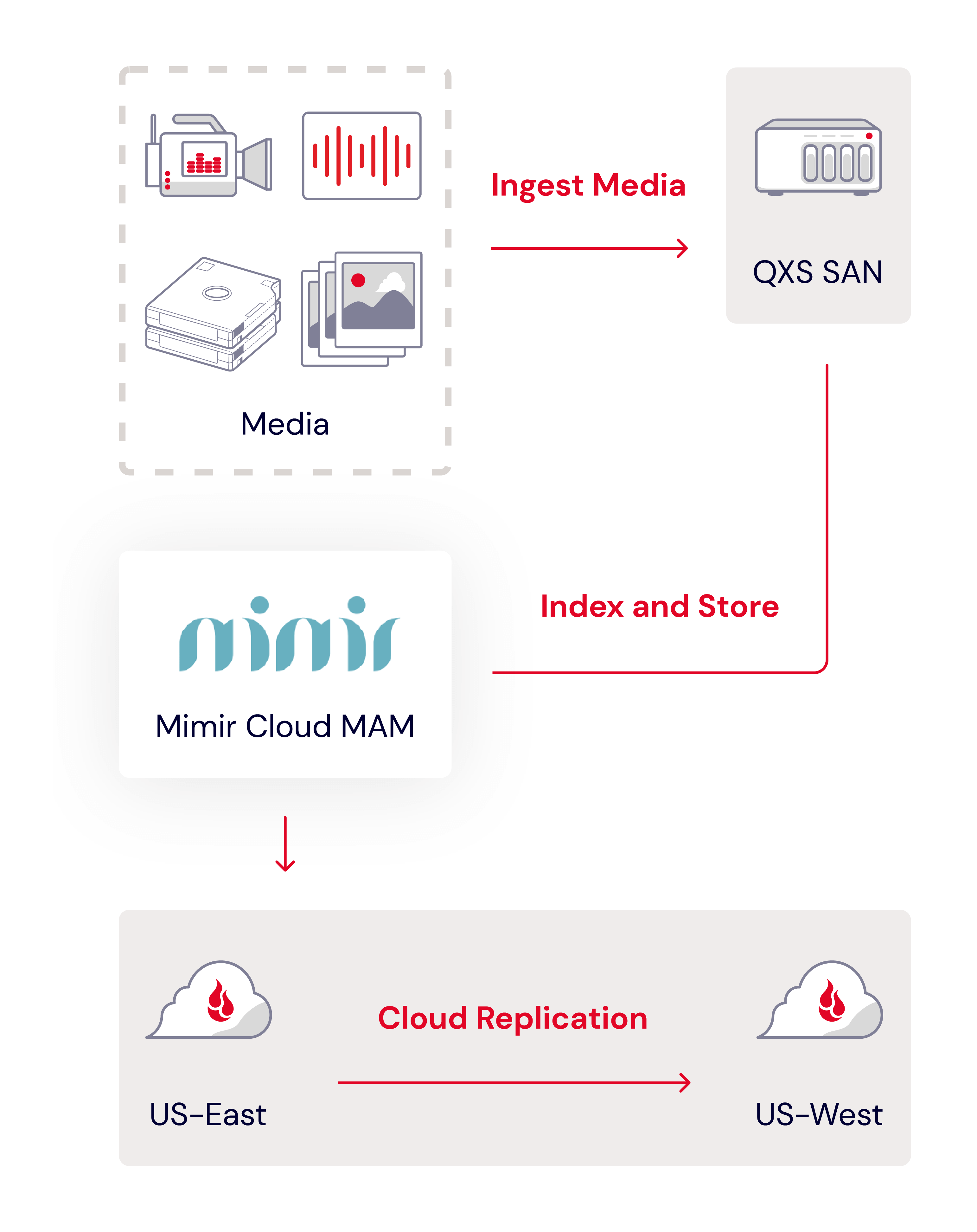
They consolidated the data into one single tier with a Quantum QSX on site for nearline storage and shifted hundreds of terabytes from their SAN and LTO system to Backblaze as their off-site storage for backup and archive.
Cloud MAM for the win
With storage sorted, the Eagles then integrated Mimir, a video collaboration and production platform that includes production asset management, archive, and object-store integration, to keep everything organized and on time. Whenever a file is uploaded to Mimir, it’s automatically stored in Backblaze B2 via Mimir’s file indexer system Kelda. This covered the game day action—their production team had fast access to recently recorded content, providing flexibility to work from home after those late night games.
Getting our sponsored, highest-performing content out quickly drives more views and boosts revenue, so efficiency on game day is critical. Our newly streamlined workflows ensure our editors can deliver while the content is still relevant and engaging.
—Stacy Kelleher, Director of Production, Philadelphia Eagles
The final score
The new system empowers their production team by giving them instant access and fast workflows so they can work without slowdowns. Kelleher noted that restoring a clip is nearly instant.
They have the ability to share links directly from Mimir to users outside the organization for things like pre-season broadcasts, which comes in handy especially when those users don’t want, need, or have the equipment to download the entire broadcast file. Stacy can just copy and paste a Mimir link into an email, and outside agencies or users can watch entire games at speed.
Finally, they freed up IT staff time spent managing all that tape and old hardware, not to mention physical space. It all added up to a big win for the IT team, the franchise, and the fans.
Now I can easily share entire broadcasts by copying and sharing a link from our MAM. No need for FTP downloads or uploading to other platforms. It’s fast, seamless, and ensures everyone can view the content without issues.
—Stacy Kelleher, Director of Production, Philadelphia Eagles
The post The Philadelphia Eagles Make Real-Time Content Production a Reality appeared first on Backblaze Blog | Cloud Storage & Cloud Backup
LibreOffice 25.2 released
Post Syndicated from corbet original https://lwn.net/Articles/1008342/
Version 25.2 of the LibreOffice productivity suite is out. Changes include
the ability to remove all personal information from any document, support
for ODF version 1.4, a number of accessibility improvements, and more;
see the
release notes for details.
OpenWrt 24.10.0 released
Post Syndicated from corbet original https://lwn.net/Articles/1008339/
Version
24.10.0 of the OpenWrt router-oriented distribution has been released.
Changes include an update to the 6.6 kernel, use of access control lists on
larger systems, multipath TCP support, better WiFi6 support, the
beginning of WiFi7 support, and more.
Big Screen Battle! 100" QLED TV vs Projector vs UST
Post Syndicated from The Hook Up original https://www.youtube.com/watch?v=vPikt0UbhPk
Tailscale Setup on GL.iNet: Remote Access Made Easy
Post Syndicated from Crosstalk Solutions original https://www.youtube.com/watch?v=JQLXMNibLHs
Handle errors in Apache Flink applications on AWS
Post Syndicated from Alexis Tekin original https://aws.amazon.com/blogs/big-data/error-handling-in-apache-flink-applications/
Data streaming applications continuously process incoming data, much like a never-ending query against a database. Unlike traditional database queries where you request data one time and receive a single response, streaming data applications constantly receive new data in real time. This introduces some complexity, particularly around error handling. This post discusses the strategies for handling errors in Apache Flink applications. However, the general principles discussed here apply to stream processing applications at large.
Error handling in streaming applications
When developing stream processing applications, navigating complexities—especially around error handling—is crucial. Fostering data integrity and system reliability requires effective strategies to tackle failures while maintaining high performance. Striking this balance is essential for building resilient streaming applications that can handle real-world demands. In this post, we explore the significance of error handling and outline best practices for achieving both reliability and efficiency.
Before we can talk about how to handle errors in our consumer applications, we first need to consider the two most common types of errors that we encounter: transient and nontransient.
Transient errors, or retryable errors, are temporary issues that usually resolve themselves without requiring significant intervention. These can include network timeouts, temporary service unavailability, or minor glitches that don’t indicate a fundamental problem with the system. The key characteristic of transient errors is that they’re often short-lived and retrying the operation after a brief delay is usually enough to successfully complete the task. We dive deeper into how to implement retries in your system in the following section.
Nontransient errors, on the other hand, are persistent issues that don’t go away with retries and may indicate a more serious underlying problem. These could involve things such as data corruption or business logic violations. Nontransient errors require more comprehensive solutions, such as alerting operators, skipping the problematic data, or routing it to a dead letter queue (DLQ) for manual review and remediation. These errors need to be addressed directly to prevent ongoing issues within the system. For these types of errors, we explore DLQ topics as a viable solution.
Retries
As previously mentioned, retries are mechanisms used to handle transient errors by reprocessing messages that initially failed due to temporary issues. The goal of retries is to make sure that messages are successfully processed when the necessary conditions—such as resource availability—are met. By incorporating a retry mechanism, messages that can’t be processed immediately are reattempted after a delay, increasing the likelihood of successful processing.
We explore this approach through the use of an example based on the Amazon Managed Service for Apache Flink retries with Async I/O code sample. The example focuses on implementing a retry mechanism in a streaming application that calls an external endpoint during processing for purposes such as data enrichment or real-time validation
The application does the following:
- Generates data simulating a streaming data source
- Makes an asynchronous API call to an Amazon API Gateway or AWS Lambda endpoint, which randomly returns success, failure, or timeout. This call is made to emulate the enrichment of the stream with external data, potentially stored in a database or data store.
- Processes the application based on the response returned from the API Gateway endpoint:
-
- If the API Gateway response is successful, processing will continue as normal
- If the API Gateway response times out or returns a retryable error, the record will be retried a configurable number of times
- Reformats the message in a readable format, extracting the result
- Sends messages to the sink topic in our streaming storage layer
In this example, we use an asynchronous request that allows our system to handle many requests and their responses concurrently—increasing the overall throughput of our application. For more information on how to implement asynchronous API calls in Amazon Managed Service for Apache Flink, refer to Enrich your data stream asynchronously using Amazon Kinesis Data Analytics for Apache Flink.
Before we explain the application of retries for the Async function call, here is the AsyncInvoke implementation that will call our external API:
This example uses an AsyncHttpClient to call an HTTP endpoint that is a proxy to calling a Lambda function. The Lambda function is relatively straightforward, in that it merely returns SUCCESS. Async I/O in Apache Flink allows for making asynchronous requests to an HTTP endpoint for individual records and handles responses as they arrive back to the application. However, Async I/O can work with any asynchronous client that returns a Future or CompletableFuture object. This means that you can also query databases and other endpoints that support this return type. If the client in question makes blocking requests or can’t support asynchronous requests with Future return types, there isn’t any benefit to using Async I/O.
Some helpful notes when defining your Async I/O function:
- Increasing the
capacityparameter in your Async I/O function call will increase the number of in-flight requests. Keep in mind this will cause some overhead on checkpointing, and will introduce more load to your external system. - Keep in mind that your external requests are saved in application state. If the resulting object from the Async I/O function call is complex, object serialization may fall back to Kryo serialization which can impact performance.
The Async I/O function can process multiple requests concurrently without waiting for each one to be complete before processing the next. Apache Flink’s Async I/O function provides functionality for both ordered and unordered results when receiving responses back from an asynchronous call, giving flexibility based on your use case.
Errors during Async I/O requests
In the case that there is a transient error in your HTTP endpoint, there could be a timeout in the Async HTTP request. The timeout could be caused by the Apache Flink application overwhelming your HTTP endpoint, for example. This will, by default, result in an exception in the Apache Flink job, forcing a job restart from the latest checkpoint, effectively retrying all data from an earlier point in time. This restart strategy is expected and typical for Apache Flink applications, built to withstand errors without data loss or reprocessing of data. Restoring from the checkpoint should result in a fast restart with 30 seconds (P90) of downtime.
Because network errors could be temporary, backing off for a period and retrying the HTTP request could have a different result. Network errors could mean receiving an error status code back from the endpoint, but it could also mean not getting a response at all, and the request timing out. We can handle such cases within the Async I/O framework and use an Async retry strategy to retry the requests as needed. Async retry strategies are invoked when the ResultFuture request to an external endpoint is complete with an exception that you define in the preceding code snippet. The Async retry strategy is defined as follows:
When implementing this retry strategy, it’s important to have a solid understanding of the system you will be querying. How will retries impact performance? In the code snippet, we’re using a FixedDelayRetryStrategy that retries requests upon error one time every second with a delay of one second. The FixedDelayRetryStrategy is only one of several available options. Other retry strategies built into Apache Flink’s Async I/O library include the ExponentialBackoffDelayRetryStrategy, which increases the delay between retries exponentially upon every retry. It’s important to tailor your retry strategy to the specific needs and constraints of your target system.
Additionally, within the retry strategy, you can optionally define what happens when there are no results returned from the system or when there are exceptions. The Async I/O function in Flink uses two important predicates: isResult and isException.
The isResult predicate determines whether a returned value should be considered a valid result. If isResult returns false, in the case of empty or null responses, it will trigger a retry attempt.
The isException predicate evaluates whether a given exception should lead to a retry. If isException returns true for a particular exception, it will initiate a retry. Otherwise, the exception will be propagated and the job will fail.
If there is a timeout, you can override the timeout function within the Async I/O function to return zero results, which will result in a retry in the preceding block. This is also true for exceptions, which will result in retries, depending on the logic you determine to cause the .compleExceptionally() function to trigger.
By carefully configuring these predicates, you can fine-tune your retry logic to handle various scenarios, such as timeouts, network issues, or specific application-level exceptions, making sure your asynchronous processing is robust and efficient.
One key factor to keep in mind when implementing retries is the potential impact on overall system performance. Retrying operations too aggressively or with insufficient delays can lead to resource contention and reduced throughput. Therefore, it’s crucial to thoroughly test your retry configuration with representative data and loads to make sure you strike the right balance between resilience and efficiency.
A full code sample can be found at the amazon-managed-service-for-apache-flink-examples repository.
Dead letter queue
Although retries are effective for managing transient errors, not all issues can be resolved by reattempting the operation. Nontransient errors, such as data corruption or validation failures, persist despite retries and require a different approach to protect the integrity and reliability of the streaming application. In these cases, the concept of DLQs comes into play as a vital mechanism for capturing and isolating individual messages that can’t be processed successfully.
DLQs are intended to handle nontransient errors affecting individual messages, not system-wide issues, which require a different approach. Additionally, the use of DLQs might impact the order of messages being processed. In cases where processing order is important, implementing a DLQ may require a more detailed approach to make sure it aligns with your specific business use case.
Data corruption can’t be handled in the source operator of the Apache Flink application and will cause the application to fail and restart from the latest checkpoint. This issue will persist unless the message is handled outside of the source operator, downstream in a map operator or similar. Otherwise, the application will continue retrying and retrying.
In this section, we focus on how DLQs in the form of a dead letter sink can be used to separate messages from the main processing application and isolate them for a more focused or manual processing mechanism.
Consider an application that is receiving messages, transforming the data, and sending the results to a message sink. If a message is identified by the system as corrupt, and therefore can’t be processed, merely retrying the operation won’t fix the issue. This could result in the application getting stuck in a continuous loop of retries and failures. To prevent this from happening, such messages can be rerouted to a dead letter sink for further downstream exception handling.
This implementation results in our application having two different sinks: one for successfully processed messages (sink-topic) and one for messages that couldn’t be processed (exception-topic), as shown in the following diagram. To achieve this data flow, we need to “split” our stream so that each message goes to its appropriate sink topic. To do this in our Flink application, we can use side outputs.
The diagram demonstrates the DLQ concept through Amazon Managed Streaming for Apache Kafka topics and an Amazon Managed Service for Apache Flink application. However, this concept can be implemented through other AWS streaming services such as Amazon Kinesis Data Streams.

Side outputs
Using side outputs in Apache Flink, you can direct specific parts of your data stream to different logical streams based on conditions, enabling the efficient management of multiple data flows within a single job. In the context of handling nontransient errors, you can use side outputs to split your stream into two paths: one for successfully processed messages and another for those requiring additional handling (i.e. routing to a dead letter sink). The dead letter sink, often external to the application, means that problematic messages are captured without disrupting the main flow. This approach maintains the integrity of your primary data stream while making sure errors are managed efficiently and in isolation from the overall application.
The following shows how to implement side outputs into your Flink application.
Consider the example that you have a map transformation to identify poison messages and produce a stream of tuples:
Based on the processing result, you know whether you want to send this message to your dead letter sink or continue processing it in your application. Therefore, you need to split the stream to handle the message accordingly:
First create an OutputTag to route invalid events to a side output stream. This OutputTag is a typed and named identifier you can use to separately manage and direct specific events, such as invalid ones, to a distinct stream for further handling.
Next, apply a ProcessFunction to the stream. The ProcessFunction is a low-level stream processing operation that gives access to the basic building blocks of streaming applications. This operation will process each event and decide its path based on its validity. If an event is marked as invalid, it’s sent to the side output stream defined by the OutputTag. Valid events are emitted to the main output stream, allowing for continued processing without disruption.
Then retrieve the side output stream for invalid events using getSideOutput(invalidEventsTag). You can use this to independently access the events that were tagged and send them to the dead letter sink. The remainder of the messages will remain in the mainStream , where they can either continue to be processed or be sent to their respective sink:
The following diagram shows this workflow.

A full code sample can be found at the amazon-managed-service-for-apache-flink-examples repository.
What to do with messages in the DLQ
After successfully routing problematic messages to a DLQ using side outputs, the next step is determining how to handle these messages downstream. There isn’t a one-size-fits-all approach for managing dead letter messages. The best strategy depends on your application’s specific needs and the nature of the errors encountered. Some messages might be resolved though specialized applications or automated processing, while others might require manual intervention. Regardless of the approach, it’s crucial to make sure there is sufficient visibility and control over failed messages to facilitate any necessary manual handling.
A common approach is to send notifications through services such as Amazon Simple Notification Service (Amazon SNS), alerting administrators that certain messages weren’t processed successfully. This can help make sure that issues are promptly addressed, reducing the risk of prolonged data loss or system inefficiencies. Notifications can include details about the nature of the failure, enabling quick and informed responses.
Another effective strategy is to store dead letter messages externally from the stream, such as in an Amazon Simple Storage Service (Amazon S3) bucket. By archiving these messages in a central, accessible location, you enhance visibility into what went wrong and provide a long-term record of unprocessed data. This stored data can be reviewed, corrected, and even re-ingested into the stream if necessary.
Ultimately, the goal is to design a downstream handling process that fits your operational needs, providing the right balance of automation and manual oversight.
Conclusion
In this post, we looked at how you can leverage concepts such as retries and dead letter sinks for maintaining the integrity and efficiency of your streaming applications. We demonstrated how you can implement these concepts through Apache Flink code samples highlighting Async I/O and Side Output capabilities:
To supplement, we’ve included the code examples highlighted in this post in the above list. For more details, refer to the respective code samples. It’s best to test these solutions with sample data and known results to understand their respective behaviors.
About the Authors
 Alexis Tekin is a Solutions Architect at AWS, working with startups to help them scale and innovate using AWS services. Previously, she supported financial services customers by developing prototype solutions, leveraging her expertise in software development and cloud architecture. Alexis is a former Texas Longhorn, where she graduated with a degree in Management Information Systems from the University of Texas at Austin.
 Jeremy Ber has been in the software space for over 10 years with experience ranging from Software Engineering, Data Engineering, Data Science and most recently Streaming Data. He currently serves as a Streaming Specialist Solutions Architect at Amazon Web Services, focused on Amazon Managed Streaming for Apache Kafka (MSK) and Amazon Managed Service for Apache Flink (MSF).
[$] The selfish contributor revisited
Post Syndicated from jzb original https://lwn.net/Articles/1007426/
Open source is often described as a “gift economy”—an
ecosystem where contributors are motivated by a desire to make the
world a better place. That is, sometimes, true. However, James
Bottomley used his main
track slot at FOSDEM 2025,
on February 1, to make the case that it is better to bank on the
selfish motivations of individuals to drive community success than to
rely on their altruism.
Security updates for Thursday
Post Syndicated from jake original https://lwn.net/Articles/1008275/
Security updates have been issued by Debian (asterisk and chromium), Fedora (FlightGear, java-1.8.0-openjdk, java-11-openjdk, java-17-openjdk, java-latest-openjdk, and SimGear), Mageia (bind, chromium-browser-stable, python-django, and vim), Oracle (buildah, bzip2, firefox, keepalived, mariadb:10.11, and podman), Slackware (curl, mariadb, and mozilla), SUSE (cargo-audit-advisory-db-20250204 and python311-scikit-learn), and Ubuntu (ckeditor, krb5, and ruby2.7).
Comic for 2025.02.06 – Duck
Post Syndicated from Explosm.net original https://explosm.net/comics/duck
New Cyanide and Happiness Comic