Post Syndicated from The History Guy: History Deserves to Be Remembered original https://www.youtube.com/watch?v=60SUGnS9esg
Details of Alan Turing’s Voice Encryption System
Post Syndicated from Bruce Schneier original https://www.schneier.com/blog/archives/2026/07/details-of-alan-turings-voice-encryption-system.html
Really interesting piece of cryptographic history:
In November 2023, a large cache of his wartime papers—nicknamed the “Bayley papers”—was auctioned in London for almost half a million U.S. dollars. The previously unknown cache contains many sheets in Turing’s own handwriting, telling of his top-secret “Delilah” engineering project from 1943 to 1945. Delilah was Turing’s portable voice-encryption system, named after the biblical deceiver of men. There is also material written by Bayley, often in the form of notes he took while Turing was speaking. It is thanks to Bayley that the papers survived: He kept them until he died in 2020, 66 years after Turing passed away.
Introducing self-managed Amazon S3 buckets for AWS Lambda function code
Post Syndicated from Doug Perkes original https://aws.amazon.com/blogs/compute/introducing-self-managed-amazon-s3-buckets-for-aws-lambda-function-code/
If you manage Lambda functions at scale, you’ve likely hit the 75 GB code storage limit or explained to your security team why deployment artifacts live in an S3 bucket you don’t control. Today, we’re announcing self-managed Amazon S3 buckets for AWS Lambda deployment packages. Lambda reads your code directly from your bucket, eliminating quota pressure and giving you full security control.
Previously, the default AWS-managed code storage created three challenges at scale. First, all copies count toward your 75 GB code storage quota. Second, you cannot apply your own encryption, access controls, or compliance tags to the internal bucket. Third, the copy cannot be incorporated into your disaster recovery strategies.
With self-managed S3 buckets, Lambda reads your function code directly from your bucket. No copy, no duplication. Your S3 object becomes the single source of truth for your functions. Deployment packages no longer count against your account’s code storage limit. You manage the bucket’s security and compliance posture: choosing the encryption, defining the access policies, managing lifecycle transitions, and maintaining the audit trail. And because you own the bucket, you can use S3 Cross-Region Replication to maintain fallback copies of your code in a secondary Region, so that your functions remain deployable even if your primary Region experiences an issue. Using self-managed S3 buckets also results in a faster time to first invoke for new functions and after function updates, because Lambda no longer needs to copy your zip package to a Lambda-managed S3 bucket.
You can use this feature today in all AWS standard regions where Lambda is available, at no additional charge beyond your standard Amazon S3 storage and request costs. Let’s look at some use cases, how it works, and how to use it at scale.
Use cases
Here are a few patterns where owning your deployment bucket makes a real difference.
CI/CD pipelines and artifact management
With self-managed storage, your CI/CD pipeline uploads once, and Lambda references the same object. One set of lifecycle rules and access controls covers all artifacts, and rollbacks mean pointing the function to a previous S3 object version.
Multi-account and multi-team architectures
Organizations using AWS Organizations often separate workloads into multiple accounts: a development account, a staging account, and a production account. They centralize shared resources in a tooling or shared-services account.
Self-managed buckets integrate naturally with this pattern:
- Store all deployment artifacts in a central “artifact account” bucket.
- Grant cross-account
s3:GetObjectaccess to Lambda execution roles in each workload account through bucket policies. - Maintain a single inventory of what code is deployed where, managed by your platform or DevOps team.
- Enforce consistent encryption, versioning, and retention policies from one place.
Disaster recovery and business continuity
Because your deployment artifacts live in a bucket you own, you can use the built-in replication features of S3, Cross-Region Replication (CRR) or Same-Region Replication (SRR), to maintain copies of your code artifacts in backup locations. Combined with S3 Versioning and Object Lock, this gives you a durable, tamper-proof code archive that supports rapid recovery if a deployment is accidentally corrupted or deleted.
How it worked before
When you deploy a Lambda function using a .zip deployment package stored in Amazon S3, the process has traditionally worked like this:
- You upload your .zip deployment package to your S3 bucket.
- You call
CreateFunctionorUpdateFunctionCode, specifying the S3 bucket and S3 key. - Lambda copies the .zip artifact from your bucket into an internal, service-managed bucket.
- Lambda uses this copy to create the optimized version of your function that runs at invocation time.
- The copied artifact counts toward your account’s 75 GB code storage quota.
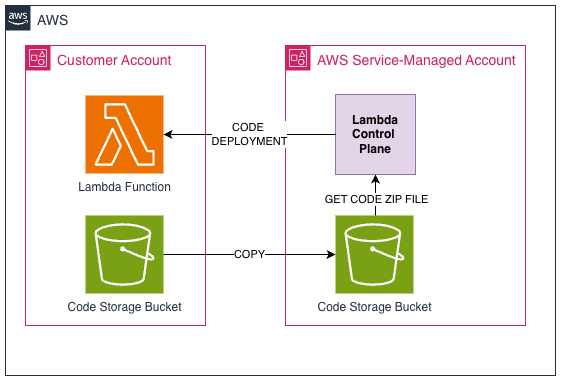
Figure 1 — Standard Lambda deployment
This model is straightforward and works well for most workloads. However, it creates three friction points at scale:
- Storage quota pressure: Every deployment package copy counts toward your account’s 75 GB total code storage limit. Organizations with hundreds of functions and multiple published versions can exhaust this quota.
- No control over stored artifacts: You cannot configure encryption (beyond the service default), access logging, lifecycle policies, Object Lock, or compliance tags on the internal bucket.
- Redundant storage: Your original artifact remains in your bucket while a copy lives in the Lambda bucket used for provisioning new instances of your Lambda function.
What’s new: REFERENCE mode
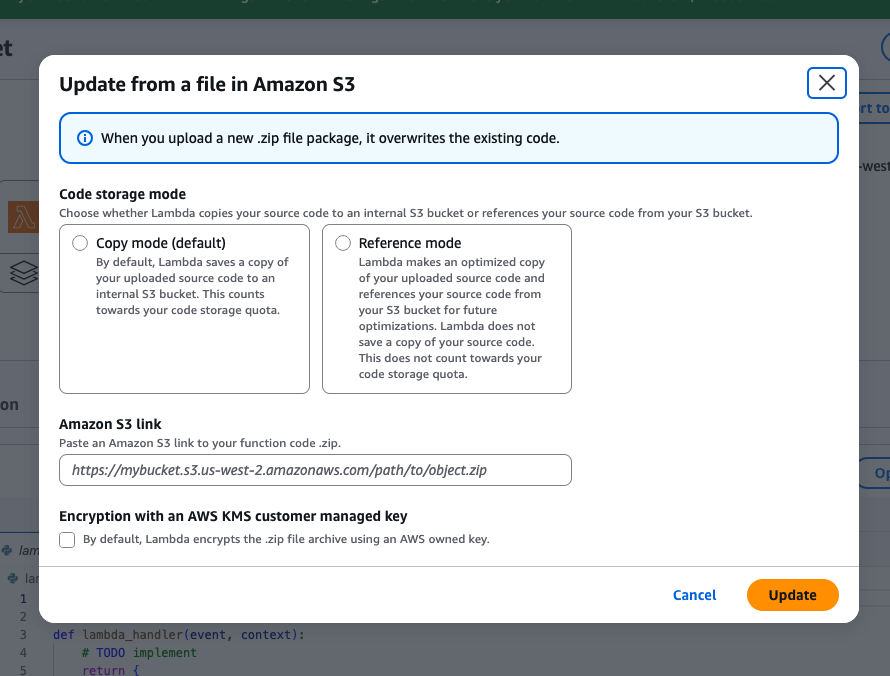
This launch introduced a new function configuration setting, S3ObjectStorageMode. The default value is COPY, which provides the existing behavior described in the preceding section. To enable self-managed S3 buckets, set S3ObjectStorageMode to REFERENCE when creating or updating a function. In this mode, Lambda no longer copies your deployment package. Instead, it stores a reference to your S3 object and reads the code directly from your bucket when needed. If you do not specify S3ObjectStorageMode, Lambda still takes a copy by default.
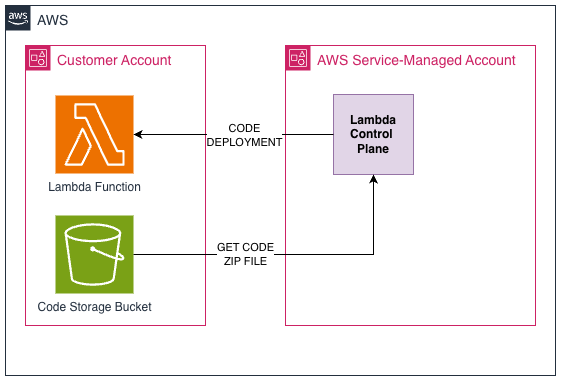
Figure 2 — Lambda deployment with self-managed storage
This gives you:
- No quota consumption. Deployment packages in your bucket don’t count against the 75 GB Function and layer storage account limit.
- Improved performance. Lambda no longer copies the code to an internal bucket, so function creation and updates are faster.
- Full security and compliance control. Apply your own bucket policies, encryption, Object Lock, versioning, access logging, and compliance tags.
- Single source of truth. Your S3 object is the canonical artifact with no additional copies and no drift.
- Disaster recovery options. Use S3 Cross-Region Replication to maintain fallback copies in a secondary Region.
How it works
To use this feature, specify the S3ObjectStorageMode parameter when creating or updating your function.
Creating a new function (AWS CLI):
Updating an existing function:
AWS Identity and Access Management (IAM) permissions
Lambda needs permission to read the deployment package from your bucket. You can grant access through an S3 bucket policy.
S3 bucket policy
We recommend including the aws:SourceArn condition key scoped to your specific function ARN to allow for least-privileged access. Note the Resource is scoped to the exact S3 key rather than a wildcard prefix. This follows least-privilege and matches how the aws:SourceArn condition locks down which function can access which object.
Bucket requirements
Your S3 bucket must meet the following requirements:
- Versioning (required). You must enable S3 versioning to make sure that Lambda references a specific, immutable artifact and to protect against accidental overwrites.
- Encryption. The following encryption types are supported: SSE-S3, SSE-KMS (including customer-managed KMS keys), and DSSE-KMS. If you use SSE-KMS, the Lambda principal must have
kms:Decryptpermission on the key. - Object Lock. Supported. You can apply Object Lock in Compliance or Governance mode to prevent accidental deletion of deployment artifacts.
- Access logging. You can enable S3 server access logging or AWS CloudTrail data events to audit every time Lambda reads your code.
What happens when the object is unavailable
Lambda periodically accesses the source object from your S3 bucket to reoptimize your function code. You must maintain access to the source object for your function to remain active.
If Lambda loses access to the source object for a function, the function transitions to the Inactive state. To restore the function, restore access to the source object and then update the function.
Performance considerations
Lambda functions with self-managed code storage behave the same as standard Lambda functions with one difference during function creation and update. Lambda does not copy your deployment package to a Lambda-managed S3 bucket. In our testing with a 200MB Python 3.13 function, functions using self-managed storage showed function creation times approximately 5s less than the default COPY mode. Reading directly from your S3 bucket without an intermediate copy step can provide a modest advantage, particularly for larger deployment packages.
Getting started with infrastructure as code
Self-managed code storage can be implemented using infrastructure-as-code tooling with either the AWS CLI or AWS CloudFormation today.
AWS CLI
AWS CloudFormation
Using it at scale
Once you adopt self-managed S3 buckets for your Lambda deployment packages, your artifact bucket grows over time as you deploy new versions of your functions. This section covers strategies for managing that growth efficiently, keeping your versions organized, and planning for cross-Region deployments.
Managing artifact lifecycle with S3 lifecycle policies
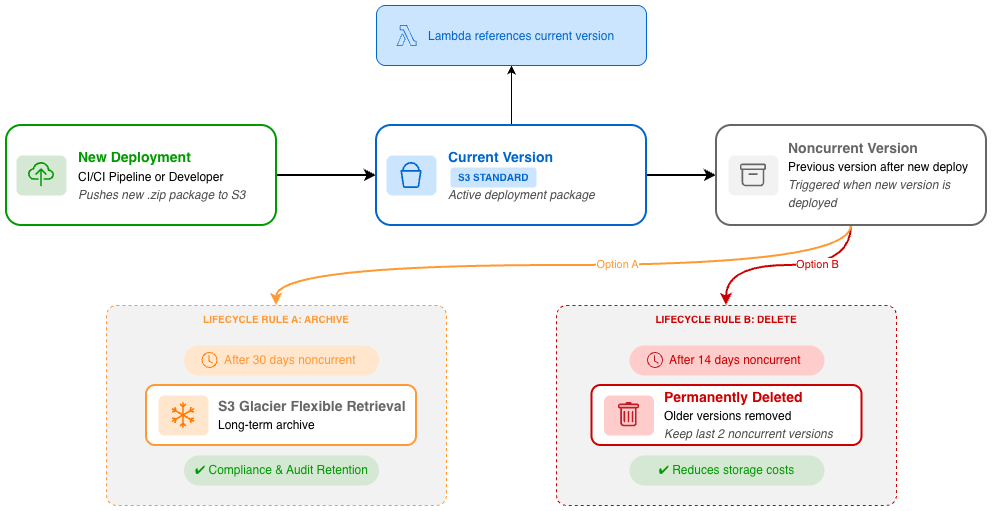
Every time you update a function’s code, S3 creates a new object version in your bucket. The previous objects don’t disappear. They accumulate. Without a cleanup strategy, your storage grows indefinitely and old artifacts clutter your bucket.
S3 Lifecycle policies let you automate this entirely. You define rules that transition or delete objects based on age, and S3 executes them on your behalf: no scripts, no cron jobs, no manual intervention.
Strategy 1: Archive old versions to Glacier
If compliance or audit requirements mandate that you retain all historical deployment packages, but you rarely need to access them, transition old object versions to a lower-cost storage class:
This rule transitions any non-current object version to S3 Glacier Flexible Retrieval after 30 days. Your active deployment packages remain in S3 Standard for fast access, while historical versions move to archival storage at a fraction of the cost.
For artifacts you need to retain for years but will rarely access again, consider a tiered approach: moving to Glacier Flexible Retrieval first, then to Deep Archive:
Strategy 2: Delete old versions you no longer need
If you don’t have a compliance requirement to retain every historical artifact, you can expire old versions outright:
This rule keeps the 2 most recent non-current versions of each object (giving you a rollback path) and deletes anything older than 14 days beyond that. This aligns well with a deployment strategy where you want the ability to quickly roll back to your previous one or two releases, but don’t need to retain anything older.
Tracking object and function versions
With REFERENCE mode, there is a direct relationship between your S3 object version and your Lambda function version. We recommend the following practices:
- Tag your objects with metadata from your CI/CD pipeline (commit SHA, build ID, pipeline run ID) so you can trace any deployed function back to the exact source that produced it.
- Document the mapping between Lambda function versions (or aliases) and S3 object version IDs. This makes rollbacks straightforward: update the function to reference the previous object version.
Cross-account considerations
How you organize your artifact buckets across AWS accounts depends on your operational model:
- Centralized artifact account: A single bucket in a shared-services or tooling account, with bucket policies granting cross-account
s3:GetObjectaccess to Lambda execution roles in workload accounts. This gives your platform team a single inventory of all deployment artifacts with consistent lifecycle, encryption, and access policies. - Per-account buckets: Each workload account owns its own artifact bucket. Requires less effort to set up, but harder to enforce consistent governance across many accounts.
Either pattern works with self-managed storage. Choose based on how your organization balances centralized control against team autonomy.
Cross-Region considerations
With REFERENCE mode, your S3 object is the authoritative copy for your function. Self-managed code storage supports cross-Region function creation within a partition for all default Regions (non-opt-in Regions). You can store your code packages in one Region and deploy your functions in another. This makes cross-Region planning critical. There are four factors to balance:
Disaster recovery
This is the most critical consideration. Because your S3 object is the single source of truth in REFERENCE mode, you do not want all your deployment artifacts in a single Region with no fallback. A recommended pattern:
- Primary Region: Your main artifact bucket where CI/CD pipelines deposit new deployment packages.
- Fallback Region: A secondary bucket populated via S3 Cross-Region Replication (CRR). If your primary Region becomes unavailable, you can update your Lambda functions to reference the replicated objects in the fallback Region.
Enable S3 Replication Time Control (RTC) if you need a guaranteed SLA (15 minutes) for replication completion.
Cost
Weigh replication + storage costs against per-deploy cross-Region data transfer. If you deploy frequently, storing replicated copies in each target Region is usually cheaper. For infrequent deployments, a one-time transfer may suffice.
Governance and data residency
Some organizations, particularly in regulated industries, have strict requirements about where code artifacts can reside. Before configuring cross-Region replication, confirm that your data is permitted to leave its current Region. Certain regulatory frameworks (for example, data sovereignty laws, FedRAMP boundaries) may restrict replication to specific Region pairs.
Performance
If your workload requires fast function creation and activation times, for example, in a CI/CD pipeline where deployment speed is critical, keep your S3 objects in the same Region where you are creating your Lambda functions. Cross-Region reads add latency to the initial code download, which directly impacts how quickly a new function version becomes active after deployment.
For workloads where creation speed is less critical (for example, batch processing functions that are updated infrequently), the latency of a cross-Region read might be acceptable and can simplify your architecture.
Things to know
Before adopting self-managed S3 buckets for your Lambda functions, keep the following in mind:
- Availability: You can use this feature today in all AWS standard regions where Lambda is supported.
- Pricing: There is no additional Lambda charge. You pay standard S3 costs for storage, and any cross-Region data transfer.
- Maximum deployment package size: The existing limits apply: 250 MB unzipped.
- Supported runtimes: All Lambda runtimes that support .zip deployment packages are compatible. Container image deployments are not affected by this feature.
- Migration: You can switch an existing function from service-managed to self-managed storage by calling
UpdateFunctionCodewith the--s3-object-storage-mode REFERENCEparameter. Lambda recreates the function by referencing the object in your S3 bucket and deletes the saved copy. - Reverting: You can switch back to service-managed storage at any time by updating the function with
--s3-object-storage-mode COPY. Lambda resumes copying the artifact to its internal bucket. - Object availability is your responsibility: In
REFERENCEmode, Lambda depends on your S3 object being accessible. If the object is deleted, the bucket policy changes, or the KMS key is disabled, new invocations requiring a cold start will fail.
Conclusion
In this post, we showed how self-managed S3 buckets for Lambda give you more capacity, more control, and simpler compliance, all without changing how you write or invoke your functions. Your deployment packages no longer count against account quotas, your security team can apply the same policies to code artifacts that they apply everywhere else, and your disaster recovery story is as strong as the replication capabilities of S3.
To get started:
- Read the Lambda Developer Guide: Self-managed S3 code storage for full documentation.
- Try it in the AWS Lambda Console. Choose Reference Mode under Code storage mode when creating your next function.
- Review S3 Lifecycle Configuration examples to plan your artifact retention strategy.
- Explore S3 Cross-Region Replication for disaster recovery planning.
Comic for 2026.07.17 – Promise
Post Syndicated from Explosm.net original https://explosm.net/comics/promise
New Cyanide and Happiness Comic
Когато умира дете. Палиативни грижи в края на живота
Post Syndicated from Надежда Цекулова original https://www.toest.bg/kogato-umira-dete-paliativni-grizhi-v-kraya-na-zhivota/

От началото на тази поредица (а и доста преди нея) непрекъснато обясняваме, че съвременните палиативни грижи са много повече от „грижи в края на живота“. И все пак те са и това. Понякога сред пациентите, които се нуждаят от палиативни грижи в края на живота, има и деца.
Децата страдат и умират. Но в болестта и в смъртта си те остават деца със своите детски нужди и особености – разбиране, което, както видяхме в предходните текстове от поредицата „Да говорим с грижа“, не е утвърдено в българския публичен дебат и публични политики. Нашите държавни системи не са пригодени да подкрепят детството нито в живота, нито в смъртта.
Затова тази подкрепа остава въпрос на разбиране и хуманност от страна на хората, през чиито ръце, умове и сърца преминават тънките нишки на детския живот. В следващите редове ще ви срещнем с двама от тях.
В България няма ясна система за детски палиативни грижи. Няма медицински стандарт, специалност, научно дружество или какъвто и да е друг формален документ или орган, които да регламентират какви са добрите практики в грижите за деца със заболяване, преминаващо в терминален стадий. Съществува клинична пътека, която обаче е по-скоро механизъм за заплащане на медицински дейности и гарантира до 30 дни болничен престой на онкологичен пациент в рамките на последните 6 месеца от живота му.
А това е далеч от достатъчно – и като обхват на допустимите диагнози, и като обхват на допустимите дейности, и като продължителност на грижите, а в повечето случаи и като себестойност, заплащана от НЗОК за ден болничен престой по тази клинична пътека.
Просто добави радост. Какво са съвременните палиативни грижи за деца
Разполагаме със здравна система, която все още не успява да се пречупи така, че да осигури детство там, където заболяването е отнело почти всичко друго. Как изглеждат детските палиативни грижи в България? Първи текст от новата поредица на Надежда Цекулова за детските палиативни грижи.
Така грижите за децата в края на живота им и подкрепата за техните семейства са оставени на съвестта и възможностите на отделните специалисти и клиники. Ето защо деца със сходни нужди могат да получат напълно различно отношение, условия и грижи в различните лечебни заведения. Или дори в едно и също лечебно заведение, но в различни моменти в зависимост от различните обстоятелства и… от случайността.

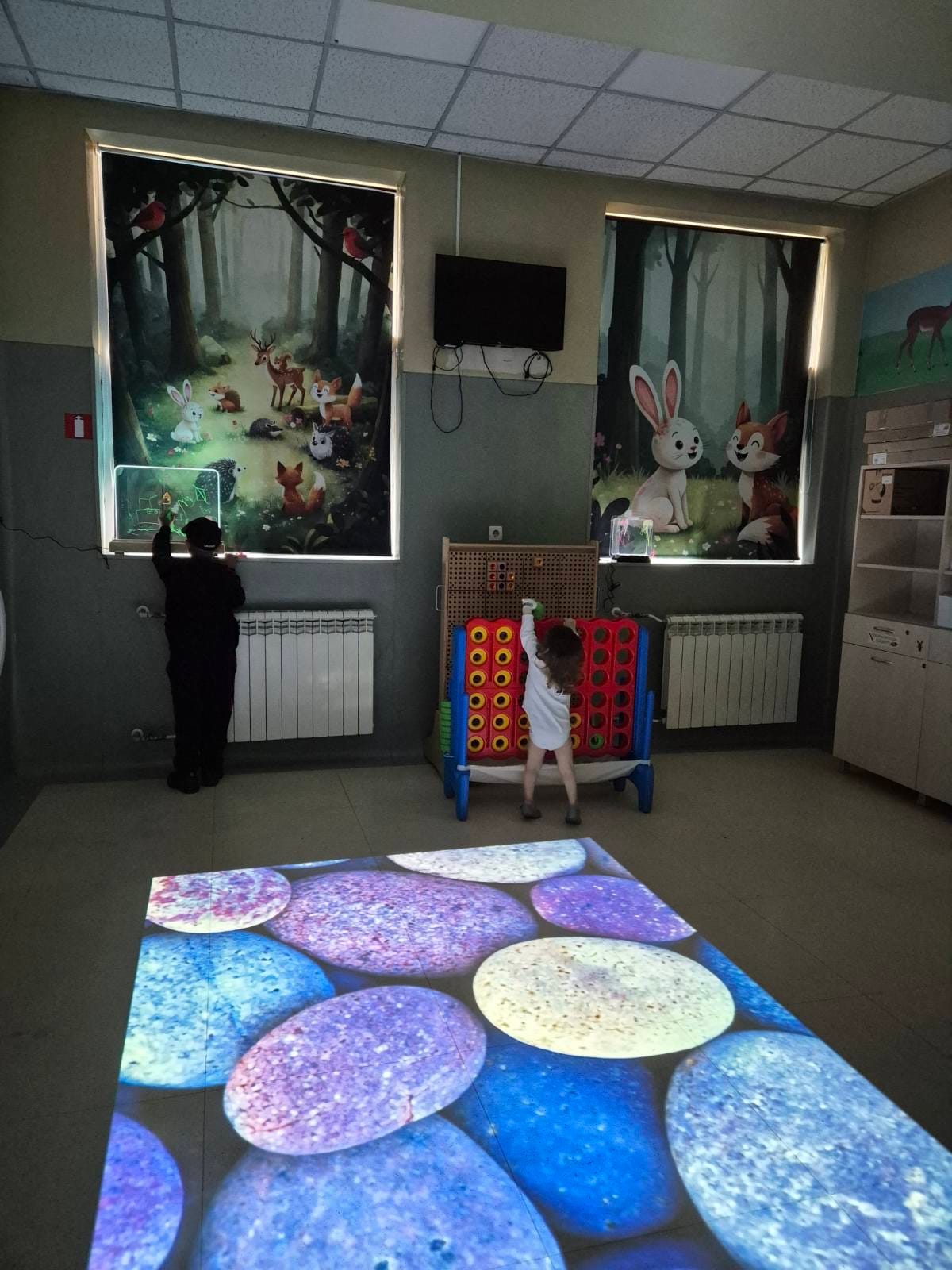



Сензорна стая в Клиниката по детска клинична хематология и онкология в УМБАЛ „Царица Йоанна“ – ИСУЛ
„Всъщност най-важното е да си човек“
Едно от местата, в които детската смърт не може да бъде забранена тема, е Клиниката по детска клинична хематология и онкология в УМБАЛ „Царица Йоанна“ – ИСУЛ в София. Там годишно се лекуват средно стотина деца, 50–60 от които са новодиагностицирани.
Между 10 и 15 са случаите, в които оказваме палиативна грижа, като не във всички това е грижа в края на живота“,
разказва клиничната психоложка Камелия Стоянова. И там, както и в Центъра за настаняване от семеен тип на деца с потребност от постоянни медицински грижи, за които разказахме в предишния текст, палиативните грижи невинаги се наричат така, пояснява Камелия. Самата тя е немска възпитаничка и продължава да прилага протоколи, познати от практиката ѝ в клиника в Германия. „Бихме могли да започваме по-рано с палиативните интервенции“, казва психоложката и допълва, че нагласата и на лекари, и на родители в България е да се гони упорито излекуването, понякога дори след като е пределно ясно, че няма как да бъде постигнато, докато „в Германия е по-различно“.
В практиката ѝ палиативните грижи нямат начало, отбелязано с формуляр, диагноза или нов надпис на вратата на болничната стая. Те постепенно се вплитат в лечението, когато това се наложи – чрез обезболяването, терапиите, които вече не могат да излекуват, но могат да дадат още време или повече комфорт, чрез психологическата подкрепа за детето и разговорите с родителите за страховете им, за другите им деца и за живота след това.
Когато стане ясно, че краят наближава, грижите се съсредоточават върху малките неща, които още може да се направят.
Екипът се опитва да събере семейството и да разбере дали има конкретен човек, когото детето иска да види. Ако състоянието му позволява, заедно изработват нещо, което да остане за родителите – рисунка, малък предмет или просто отпечатък от ръчичката. Психолозите окуражават близките да говорят на детето, да го докосват дори когато то вече не може да им отговори.
Най-вече ги окуражаваме да не се страхуват да си обичат детето – дори и в последните моменти, когато това изглежда много страшно. Всъщност най-важното в тези моменти е наистина да си човек. Никоя техника, никоя добра практика не може да замени този човешки фактор.
Как да говорим за деца с тежки заболявания. Право, етика и човечност
Публичният разговор за тежко болните деца често се движи между две крайности – патетична жалост и почти пълно мълчание. Там някъде са и самите деца и семействата им. Как да се говори за страдание, без то да се превръща в сюжет? От Надежда Цекулова.
„Подкрепата от родителя е незаменима“
На човешкия фактор разчитат и в Клиниката по детска анестезиология и интензивно лечение на УМБАЛСМ „Пирогов“ в София – друго лечебно заведение, в което оказват грижи за деца в края на живота им. През детската реанимация на „Пирогов“ преминават около 400 деца годишно, като повечето от тях получават краткосрочни грижи след хирургични процедури. Между 10 и 15 деца постъпват в клиниката с нужда от грижи в края на живота. Към 8 юли тази година починалите са осем, пет от които са били деца с онкологични заболявания и са прекарали там последните часове или дни от живота си.
В тези случаи работата на екипа вече е насочена не към излекуване, а към спиране на дискомфорта – болка, задух, страх.
Това, което със сигурност можем да обещаем и да гарантираме, е, че няма да има страдание,
казва доц. Богдан Младенов, началник на клиниката.
В реанимацията може да се приложат обезболяващи и успокояващи медикаменти в дози, чиито странични ефекти не биха могли да се овладеят извън интензивно отделение. „Стараем се да не казваме, че няма какво повече да се направи, защото то не е и вярно – обяснява лекарят. – Може да го обезболим, да се погрижим да няма задух, да няма запек, да няма повръщане. Това не е нищо, нали?“
Ако детето е достатъчно стабилно и родителите имат желание и възможност да се грижат за него, то може да се прибере у дома. „Нашето старание, когато имаме такова детенце, е винаги когато може, то да си е с близките – дали вкъщи, дали в болнично отделение. Да прекара максимално време, по възможност качествено време, обезболено, с близките си. Да не го отнемаме от тях“, обяснява доц. Младенов.
Когато има нужда от кислород, венозно обезболяване, аспирация или други грижи, които семейството не може да осигури у дома, следващата стъпка е детето да бъде настанено в болнично отделение, където има възможност родителят да остане в стаята. Едва когато нарушенията на дишането, съзнанието или останалите жизнени функции вече не могат да бъдат овладени там, детето се приема в реанимация.
Самата клиника по реанимация и интензивно лечение е построена във време, когато присъствието на родителите не е било част от представата за медицински грижи, и пространството не позволява те да остават непрекъснато до леглото. Официалното свиждане е кратко – 30 минути в денонощие. Доц. Младенов разказва, че когато е ясно, че животът на детето е към края си, екипът се опитва да не се придържа механично към ограничението. „Пускаме хората колкото пъти и за колкото време можем, когато няма работа – обяснява лекарят. – Насърчаваме ги да участват и в немедицинските грижи.“
Младенов е убеден, че присъствието на родителите в този момент е незаменимо – те могат да дадат на детето спокойствие, кураж и познатото усещане, че не е само̀: „Аз не мога да го направя вместо майката. Вместо бащата. Без семейството няма как. Особено при малки деца е абсурдно.“
Трудностите – административни и емоционални
Липсата на стандарт за детски палиативни грижи означава, че разказаното дотук от Камелия Стоянова и доц. Богдан Младенов е много повече въпрос на осъзнатост на конкретни специалисти, отколкото гаранция, че всяко дете и семейството му, стигнали до последния етап на терминално заболяване, ще получат нужните хуманни грижи. Наред с несигурността за самите пациенти това повишава и натиска върху медиците.
Тъй като в българските лечебни заведения не съществува „палиативен екип“, едни и същи лекари и медицински сестри участват в диагностиката, в активното лечение, а когато медицината изчерпи възможностите си за излекуване – и в грижите в края на живота.
„За нас е особено трудно да дефинираме кога да спрем с всичко това – споделя доц. Младенов, визирайки реанимационните дейности, популярни като „изкуствено“ поддържане на живота. – В момента се опитваме частично да дефинираме това в проекта за нов стандарт по интензивни грижи, но най-добре би било, естествено, да има отделен стандарт по палиативни грижи, в частност детски палиативни грижи.“
Големият отсъстващ. Детските палиативни грижи в публичните политики и в публичния дебат
Детските палиативни грижи в България остават почти невидими – и в законите, и в обществения разговор. Политиките свеждат темата до болници и терминални състояния, а медиите рядко говорят за качество на живот, достойнство, радост и игра. Цената я плащат децата и семействата им. От Надежда Цекулова.
Анестезиологът обяснява, че конкретно в неговата клиника един такъв стандарт трябва да посочва кога целта на лечението се променя от удължаване на живота към осигуряване на комфорт и облекчаване на страданието. Без такъв регламент лекарите остават уязвими пред обвинението, че не са направили „всичко“, а реанимационните действия могат да продължат дълго без добавена стойност за самия пациент до пълното изчерпване на възможностите.
Психологическите предизвикателства обаче често се оказват по-сериозни от административните.
И в двете клиники има опити екипите да бъдат подготвяни за разговорите, за които по време на медицинското си образование невинаги са получавали достатъчно насоки. В ИСУЛ Камелия Стоянова организира семинари за комуникация в трудни ситуации. Това не е професионална супервизия (тя изрично подчертава, че не е супервайзър), а защитено пространство, в което членовете на екипа могат да разглеждат случаи, останали дълго в съзнанието им, и да се упражняват в разговори, преди да се наложи да ги водят с истинско дете или семейство. Групите са смесени, а участниците разменят ролите си, за да видят ситуацията и през погледа на другия.
„Моето лично мнение е, че супервизията е нещо задължително. Няма как иначе да гарантираме качеството на нашата работа, на нашата услуга, независимо дали сме лекари, психолози, медицински сестри, социални работници“, казва тя. И за да гарантира това качество на собствената си работа, продължава да получава подобен вид подкрепа от специалисти в Германия, заплащайки я с лични средства.
В „Пирогов“ част от лекарите са преминавали обучения, свързани с грижите за тежко болни деца, а през годините са организирани и обучения за съобщаване на лоши новини. Но доц. Младенов не смята, че това е умение, което се усвоява отведнъж. Пред екипа всеки път отново стоят въпросите колко надежда може да бъде оставена, как да се каже истината, кой трябва да присъства на разговора, дори как да седнат хората в стаята; къде е балансът между това родителите да разберат какво се случва, без да бъдат напълно сринати в момент, когато детето все още има нужда от тях. „Това ни е много трудно и колкото и пъти да ни обучават, всеки път ще ни е полезно“, признава специалистът.
Подкрепящите грижи за семейството
В терминалния етап родителите са едновременно най-важната опора за детето и хората, които имат най-голяма нужда от подкрепа. Камелия Стоянова разказва, че почти неизбежно се появява и чувството за вина: „Има ли нещо, което направих, за да се случи това?“, питат родителите, а понякога дори не поставят под съмнение убеждението, че тежката прогноза е по тяхна вина. В същото време доц. Богдан Младенов подчертава колко важна остава подкрепата на майката и бащата за самото дете:
Има родители, които успяват да запазят присъствие на духа през цялото време, да са в помощ на детето си и да не показват уплах, тревога, отчаяние пред него. Това се предава и на детето и му осигурява спокойствие по начин, който медицината не може да постигне с лекарства.
Съвременното разбиране за палиативните грижи в края на живота предполага подкрепа не само за детето пациент, но и за неговото семейство както в терминалния етап, така и след смъртта му. У нас обаче поради липса на системна подкрепа често семействата остават сами със своята загуба. В рамките на практиката си в клиниката Камелия Стоянова се опитва да компенсира този дефицит поне за конкретните семейства, с които е работила. „Със сигурност връзката не приключва дотам“, казва тя, но подчертава, че това става само ако семейството го желае. Случаите са различни – има родители, които сами идват в клиниката и искат да споделят, и други, които, след като изгубят детето си, прекъсват връзката.
Между лекарствата и играчките – да избягаме от медицинския модел
В Русе има място с почти невъзможно за запомняне име, но с трудно забравими истории. Надежда Цекулова посещава център, в който живеят деца с тежки заболявания и комплексни потребности, за да се опита да разбере какво означава добра грижа в България днес.
Професионалният траур
Камелия Стоянова споделя, че в тяхната клиника лечението обичайно е продължително, екипите изграждат отношения с пациентите и семействата им и загубата преминава през всички. „Болезнено е за екипа, когато загубим пациент. Това наистина се приема като лична загуба, защото всеки се бори да даде още малко – още малко качество на живот, още малко да се закрепи детето, още малко да поживее – казва тя. – Имам чувството, че понякога дори болката обединява много. Това сплотява по някакъв начин екипа.“
Психоложката работи с колегите си върху разбирането, че
професионалният траур не е слабост и че всеки трябва да намери начин да се сбогува с пациента – понякога чрез разговор с колегите, друг път чрез писмо, което може никога да не бъде изпратено, или чрез друг символичен жест.
Това сбогуване обаче следва да бъде отделено от потребностите на семейството: „Трябва наистина много внимателно да оценим от какво има нужда семейството, от какво има нужда пациентът или съответно близките, които са загубили дете, и от какво имам нужда аз като професионалист, който също преживява тази загуба.“
Детската реанимация на „Пирогов“ разполага три дни седмично с психолог, който разговаря с децата, когато това е възможно, с родителите им, а при нужда и с персонала. „Никой не обича да гледа как умират деца“, казва доц. Младенов и споделя, че понякога има особено тежки моменти. Неотдавна за период от около две седмици в клиниката умират три деца, като една от медицинските сестри се случва на дежурство и при трите. „Това е огромен емоционален товар, впоследствие няколко сестри искаха да напуснат“, признава Младенов.
Психологът се включва в подкрепата на персонала, но това отново зависи от личната му мотивация и натовареността, липсва установена система за подкрепа на специалистите как да се справят с преживяванията си. Според доц. Младенов подобна подкрепа трябва да бъде ясно уредена, защото за хората, които професионално се срещат с детската смърт, преживяното „не е безплатно“.
От пожелателно стечение на обстоятелствата към дължими грижи
В края на живота на едно дете понякога най-важното се събира в наглед малки неща: да не го боли, да чува познат глас, да усеща ръцете на майка си и баща си и те да не са от другата страна на стерилните болнични стени. В момента в България нищо от това не е в достатъчна степен гарантирано за всяко дете и близките му.
Как едно семейство ще преживее последния етап от живота и раздялата с тежко болно дете, зависи до голяма степен от специалистите, при които детето ще попадне – дали те ще разпознаят нуждите отвъд „медицинския модел“, дали ще имат уменията, условията и ресурса да отговорят на тези нужди. Но нито семействата трябва да разчитат на случайността да срещнат такива специалисти, нито специалистите трябва да остават сами с решенията, отговорността и траура си. Гарантирането и регламентирането на детските палиативни грижи в края на живота няма да заменят човечността, но може да я превърнат от пожелателно стечение на обстоятелствата в дължими грижи.

Настоящата публикация е създадена по проект „Да говорим с грижа: Палиативните грижи за деца през погледа на медиите“. Проектът се осъществява благодарение на най-голямата социално отговорна инициатива на Лидл България „Ти и Lidl“, в партньорство с Фондация „Работилница за граждански инициативи“, Български дарителски форум и Асоциация на европейските журналисти. Отговорността за съдържанието е на журналистката Надежда Цекулова и по никакъв начин не отразява официалните позиции на финансиращите организации.

Latitude and Longitude
Post Syndicated from xkcd.com original https://xkcd.com/3273/

1994 Keytec Magic Touch Screen – LGR Oddware
Post Syndicated from LGR original https://www.youtube.com/watch?v=nQXltwj6kzU
NVIDIA Announces Expanded Jetson Thor Lineup with Mid-Range T3000 and T2000 Modules
Post Syndicated from Ryan Smith original https://www.servethehome.com/nvidia-announces-expanded-jetson-thor-lineup-with-mid-range-t3000-and-t2000-modules/
NVIDIA has announced the addition of two new mid-range boards to their Jetson Thor lineup, the T3000 and T2000, which will arrive in Q1’27. The new boards aim to be a cheaper offering for customers feeling pressured by the high cost of memory
The post NVIDIA Announces Expanded Jetson Thor Lineup with Mid-Range T3000 and T2000 Modules appeared first on ServeTheHome.
Welcome to our live show!
Post Syndicated from The Atlantic original https://www.youtube.com/watch?v=LPs-5KzWPrc
S9 E5: England’s Royal Tour & Harm Reduction: Last Week Tonight with John Oliver
Post Syndicated from LastWeekTonight original https://www.youtube.com/watch?v=kGbY6db4cjw
Migrate from Apache Solr to Amazon OpenSearch Serverless
Post Syndicated from Jon Handler original https://aws.amazon.com/blogs/big-data/migrate-from-apache-solr-to-amazon-opensearch-serverless/
If you’re running Apache Solr for search, now is a great time to migrate to Amazon OpenSearch Service. Amazon OpenSearch Serverless offers a modern, managed destination that greatly reduces operational overhead. Migration Assistant for Amazon OpenSearch Service now supports Apache Solr sources from versions 6.x through 9.x. Migration Assistant now includes an AI assistant that you can drive from your preferred AI tools. The assistant walks you through the migration, providing a detailed report with timelines, blockers, schema and query translation.
In this post, you will learn why now is the time to take advantage of the ease of operations and native AI capabilities of OpenSearch Serverless, and migrate from Solr.
The challenge of managing Solr
Many organizations have Solr deployments that have run for years, carrying accumulated technical debt: older versions, custom patches, and operational processes originating with engineers who have left. Running Solr in production requires ongoing investment in upgrades, security patches, monitoring, failure recovery, and capacity planning. The operational burden compounds as your deployment ages and the engineers who built it move on, leaving the remaining team with a system that is difficult to modify safely.
Meanwhile, search has evolved. Users interact through chat interfaces and AI agents that synthesize information on their behalf. These patterns require semantic understanding, hybrid retrieval, and agentic capabilities like memory and Model Context Protocol (MCP) support. OpenSearch is an open source software suite for search, analytics, and observability, licensed under the Apache License V2.0 and based on Apache Lucene. OpenSearch provides a broad and deep set of vector capabilities for AI workloads: multiple engines (Facebook AI Similarity Search (FAISS) and Lucene), multiple algorithms (Hierarchical Navigable Small World (HNSW) and Inverted File (IVF)), quantization for cost management, hybrid search with score normalization, neural sparse search, and a connector framework. You can use the OpenSearch connector framework to connect to your own models hosted in services such as Amazon Bedrock and Amazon SageMaker. With these capabilities, you can build chat-based search, power AI agents, and implement Retrieval Augmented Generation (RAG) workflows on your search engine.
Technical debt in custom patches and undocumented procedures can make shipping new features on Solr slow and risky. OpenSearch Serverless provides a modern engine with all the capabilities just mentioned, along with automatic scaling, and minimal infrastructure to maintain. Even if you remain focused on traditional search, OpenSearch Serverless delivers relevant results with less operational effort.
OpenSearch Serverless simplifies search
Amazon OpenSearch Serverless alleviates infrastructure provisioning, capacity planning, and data lifecycle management. You create a collection, send data, and run queries. OpenSearch Serverless automatically matches compute to your workload, independently scaling up indexing and search compute during spikes, and scaling compute to zero when idle. You pay only for storage when no requests are being processed. For variable traffic patterns, OpenSearch Serverless can cost up to 60% less than an OpenSearch Service domain provisioned for peak.
The vector engine supports HNSW and IVF with FAISS and Lucene, plus quantization techniques to manage cost as your collection grows. With Automatic Semantic Enrichment, you can enable a sparse model with a single setting to augment text with vectors and improve relevance without building an embedding pipeline. GPU acceleration reduces HNSW index build times from hours to minutes. OpenSearch Serverless also supports agents and RAG workflows.
If your workload requires tight control over infrastructure: specific instance types, custom plugin configurations, or extreme scale beyond what serverless deployments target, Amazon OpenSearch Service domains are the alternative destination. Domains give you full control over the cluster with one-click provisioning, patching, and backups. Migration Assistant supports both destinations, so you can pick the deployment model that fits your workload without changing your migration approach.
Migration Assistant for Amazon OpenSearch Service
Migration Assistant has helped customers move from self-managed Elasticsearch and OpenSearch to OpenSearch Service since December 2023. It now supports Solr sources. Migration Assistant now includes an AI-assisted experience that you can drive from your preferred AI tools, like Kiro, Claude Code, and others, to plan a migration, deploy the necessary infrastructure, and execute both historical and live traffic migration.
Historically, migrations required weeks of planning and assessments before any data movement could begin, and the process was often error-prone. The AI-assisted experience provides an agent-guided workflow that helps you structure, execute, and validate your migration faster and more reliably. You can use Migration Assistant itself to do your assessment, or connect with the skills in the AWS Model Context Protocol (MCP) server. Migration Assistant also now supports live traffic capture and replay for Solr, so you can validate the new environment with real workloads before cutting over.
Migration Assistant supports migrations to OpenSearch Serverless and OpenSearch Service domains from a range of Solr, Elasticsearch, and OpenSearch versions. It’s open source, so you can use it for migrating to OpenSearch Serverless in all commercial AWS Regions and AWS GovCloud (US) Regions where OpenSearch Serverless is available.
Migrate now
OpenSearch Serverless gives you vector, hybrid, and semantic search, automatic scaling, scale-to-zero compute, and zero operational overhead. Migration Assistant for Amazon OpenSearch Service provides the AI-assisted tools to get there: plan with the agent, deploy the infrastructure, run a backfill from your Solr backups, and validate with live traffic capture and replay before you cut over. Start by pointing your AI tool of choice to Migration Assistant to get a plan, timeline, and cost estimate.
For more information, see the Amazon OpenSearch Service documentation and the Migration Assistant for Amazon OpenSearch Service documentation.
About the author
Prioritize your AWS Health alerts using AWS User Notifications
Post Syndicated from Naga Bhargav original https://aws.amazon.com/blogs/architecture/prioritize-your-aws-health-alerts-using-aws-user-notifications/
If you run critical workloads on AWS, such as a contact center on Amazon Connect Customer, database workloads on Amazon Relational Database Service (Amazon RDS), or hybrid connectivity through AWS Direct Connect, service health events demand your attention. But not all events are equal. An operational issue, a scheduled maintenance window, and a deprecation notice buried in your inbox have very different consequences. The problem is that they all arrive through the same channel, making their urgency difficult to determine.
AWS Health generates events for every service, every account, every Region. The service delivers ongoing issues, scheduled changes, account notifications, and deprecation notices in one undifferentiated stream. For operations teams, this creates a familiar problem: either you treat every notification as urgent with unwanted triage noise, or you start ignoring them and risk missing something that matters. Both paths lead to slower response times and unwanted escalations.
This post walks you through a lightweight approach to solving this problem using AWS User Notifications, a fully managed service for routing AWS events to your preferred delivery channels. This solution filters health events to only the services you want to be notified about, then separates what remains into two priority tiers. Critical events arrive immediately. Informational events arrive as batched summaries. In this post, we address this problem with a single AWS CloudFormation template with four deployment approaches that you can deploy in your AWS environment.
Solution overview
The design follows a simple principle: filter first, then separate by priority.
The first layer filters out noise. Event rules match health events only for the services your organization depends on, such as AWS Direct Connect, Amazon Connect Customer, and Amazon RDS. Everything else is silenced before it reaches your inbox.
The second layer separates what remains by urgency. Two notification configurations handle different priority tiers:
- CRITICAL — Matches events where eventTypeCategory is issue or scheduledChange. These arrive immediately as individual notifications with no batching.
- INFORMATIONAL — Matches everything else using an anything-but filter such as accountNotification. AWS User Notifications batches these within a five-minute window and delivers them as grouped summaries.
In this solution, a CloudFormation template supports four deployment modes through a DeploymentMode parameter:
| Mode | Scope | What you get |
| Linked (default) | Single account | Email contacts + User Notifications event rules + channel associations |
| Payer | Entire organization or OU | Everything in Linked, plus organizational unit associations scoped to a root or OU |
| Combined | Single account | Everything in Linked, plus Amazon EventBridge rules and an Amazon Simple Notification Service (Amazon SNS) topic with [CRITICAL]/[INFORMATIONAL] prefixed custom email |
| PayerCombined | Entire organization or OU | Everything in Linked, plus org associations AND Amazon EventBridge rules with SNS custom email messages |
The following diagram shows how health events flow through the solution:
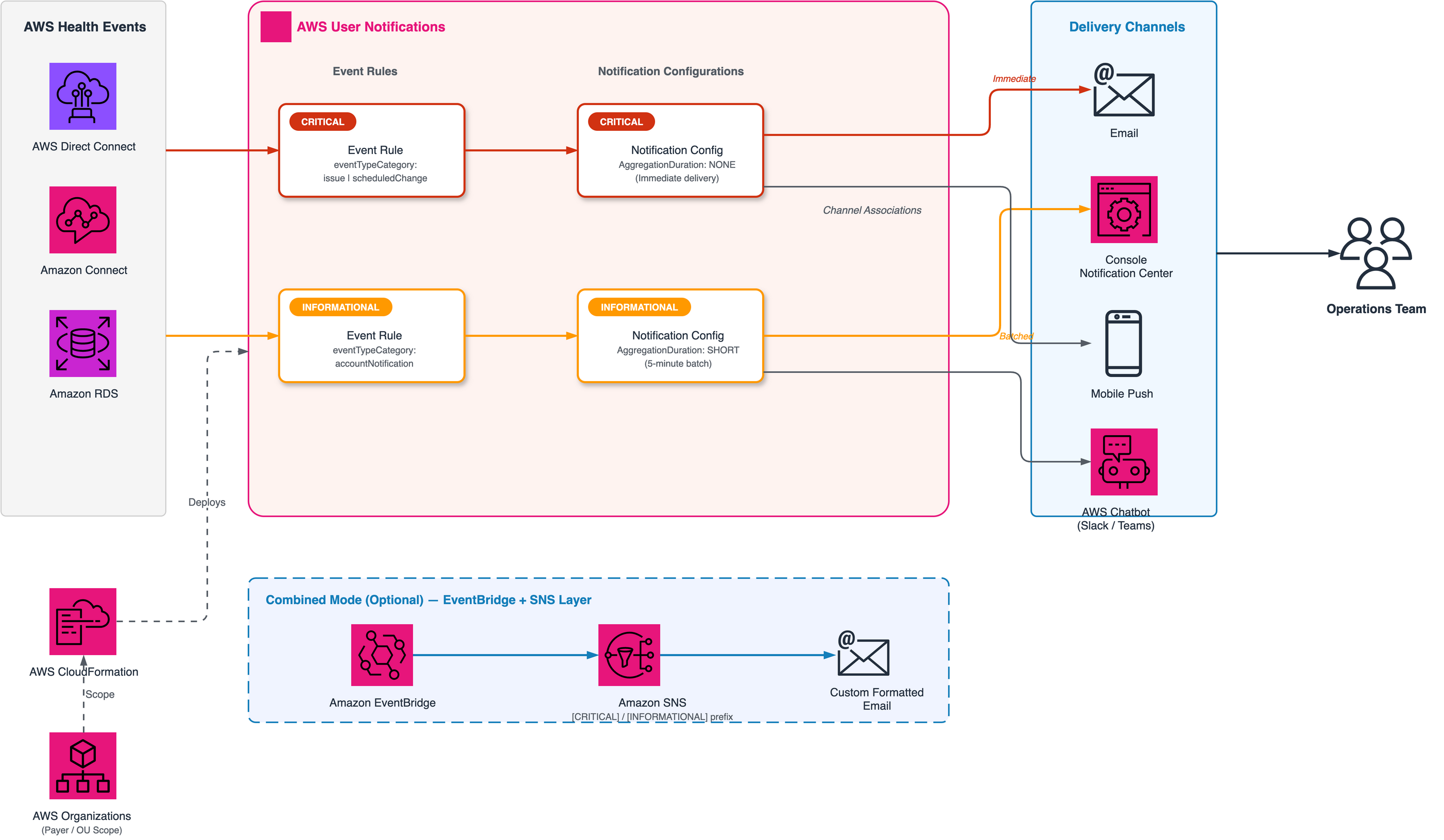
Figure 1: Architecture diagram showing priority-based AWS Health alerting using AWS User Notifications
What gets deployed
Once you deploy the CloudFormation stack, AWS provisions the following resources:
- Prioritized AWS services — AWS Direct Connect, Amazon Connect Customer, and Amazon RDS are pre-configured as the monitored services. You can customize this list directly in the CloudFormation template parameters.
- Two notification configurations on AWS User Notifications — one scoped for CRITICAL events (service issues and scheduled changes) and one for INFORMATIONAL events (account notifications), ensuring targeted alerting.
- Email delivery channel — AWS automatically links both notification configurations to the email address you provide during stack deployment, so alerts reach the right contacts from day one.
How the notification flow works
User Notifications path (all deployment modes)
- AWS Health emits an event and lands on the default Amazon EventBridge event bus.
- User Notifications event rule filters by service + category → two priority tiers.
- Notification configuration routes: Critical = immediate, Informational = 5-min batch.
- Email contact receives AWS-standard formatted notification.
Amazon EventBridge + SNS path (Combined and PayerCombined modes only)
In parallel with the above, a second delivery path activates:
- Same AWS Health events land on the default Amazon EventBridge event bus.
- Custom Amazon EventBridge rules (deployed by the template) evaluate the events on the default event bus and filter by the same service and category criteria as the AWS User Notifications event rules.
InputTransformerreformats the event into a human-readable message with [CRITICAL] and [INFORMATIONAL] prefix.- Amazon SNS delivers the custom formatted email to all subscribers via the Amazon SNS topic.
- Failed deliveries route to an Amazon Simple Queue Service dead letter queue and an Amazon CloudWatch alarm triggers if an Amazon SNS delivery fails.
Prerequisites
To follow along, you need:
- An active AWS account.
- Permissions to deploy AWS CloudFormation stacks and create AWS User Notifications resources.
- For organization-wide deployment: access to the management (payer) account and the organization root ID or organizational unit (OU) ID.
- (Optional) The AWS Command Line Interface (AWS CLI), installed and configured, for CLI-based deployment.
Deployment walkthrough
This section walks you through deploying, verifying, and testing the solution. Choose one of the four deployment modes based on your scope, then follow the remaining steps to confirm everything works.
Step 1: Deploy the AWS CloudFormation stack
Download and deploy the complete solution through this sample CloudFormation template
Select the deployment option that matches your requirements:
Option A: Single account (Linked mode)
Deploy using the AWS CLI:
Note : Set NotificationHubAlreadyEnabled=Yes if your AWS account already has a notification hub enabled in AWS User Notifications.
Or deploy through the AWS CloudFormation console:
- Open the CloudFormation console and choose Create stack.
- Upload the prioritize-aws-health-notifications.yaml template file.
- For Stack name, enter health-notifications.
- For DeploymentMode, select Linked.
- For NotificationEmail, enter the email address for notifications.
- For NotificationRegions, enter the Regions to monitor (comma-separated)
- For NotificationHubAlreadyEnabled, select Yes/No
- Choose Submit.
Option B: Organization-wide (Payer mode)
Before deploying, run the following command from the payer account to grant the AWS Health service access to your organization:
Then deploy:
Replace r-xxxx with your organization root ID to cover all accounts, or use an OU ID (for example, ou-xxxx-xxxxxxxx) to scope coverage to a specific unit.
Option C: Single account with custom SNS email (Combined mode)
Option D: Organization-wide with custom SNS email (PayerCombined mode)
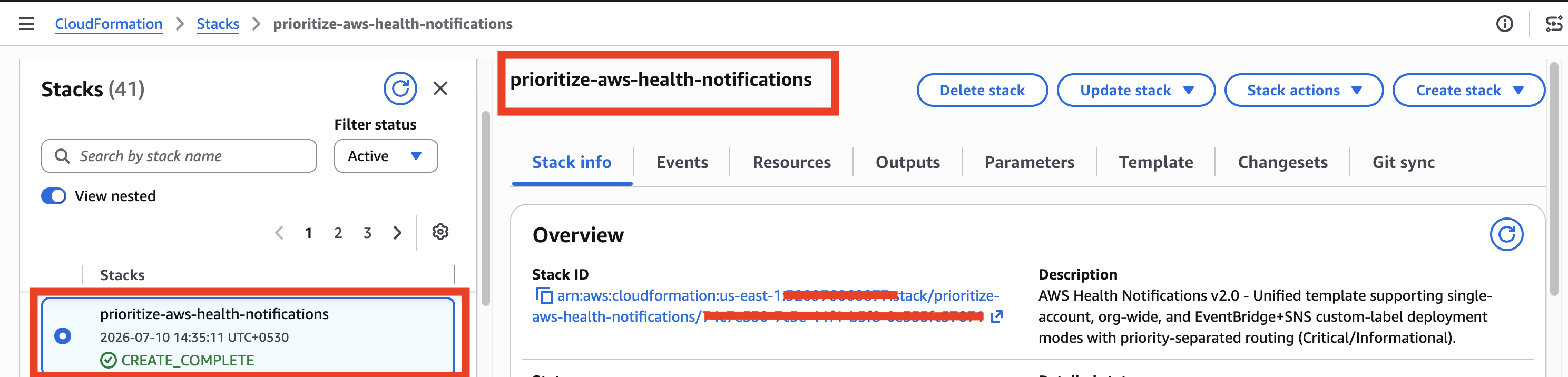
Figure 2: CloudFormation console showing CREATE_COMPLETE status.
Step 2: Confirm the email subscription
After the stack deploys, check the email inbox you specified during deployment. You will receive a subscription confirmation from AWS User Notifications.
- Open the confirmation email.
- Choose Confirm subscription.
Important: Notifications will not be delivered until you confirm the email contact.
Expected result: The email contact shows Verified in the AWS User Notifications console
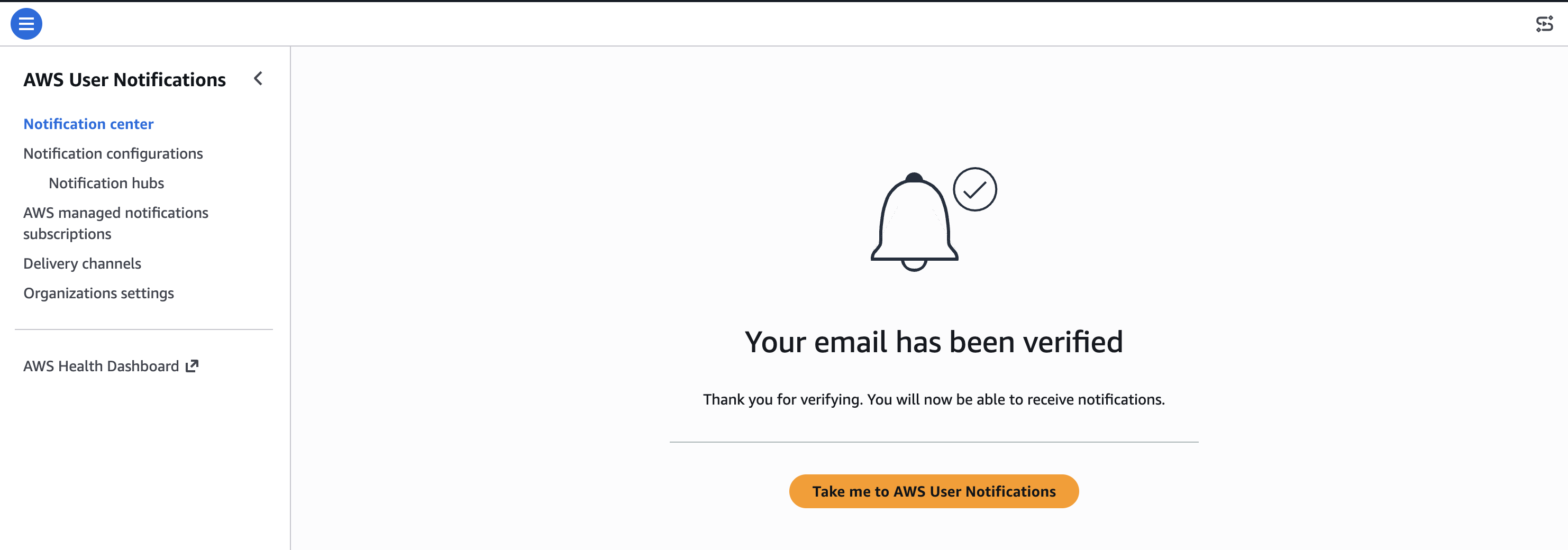
Figure 3: AWS User Notifications console showing verified email contact.
Step 3: Verify the notification configurations
Open the AWS User Notifications console and confirm the following resources were created:
- Navigate to Notification configurations — you should see two entries:.
- Health-Critical-Notifications — scoped to issue and scheduledChange event types.
- Health-Informational-Notifications — matches all event categories except issue and scheduledChange using an anything-but filter.
- Choose each configuration and verify:.
- Event rules list your selected services (AWS Direct Connect, Amazon Connect Customer, Amazon RDS).
- Delivery channels show your confirmed email contact.
Expected result: Two notification configurations visible, each with event rules matching your monitored services and the email channel associated.
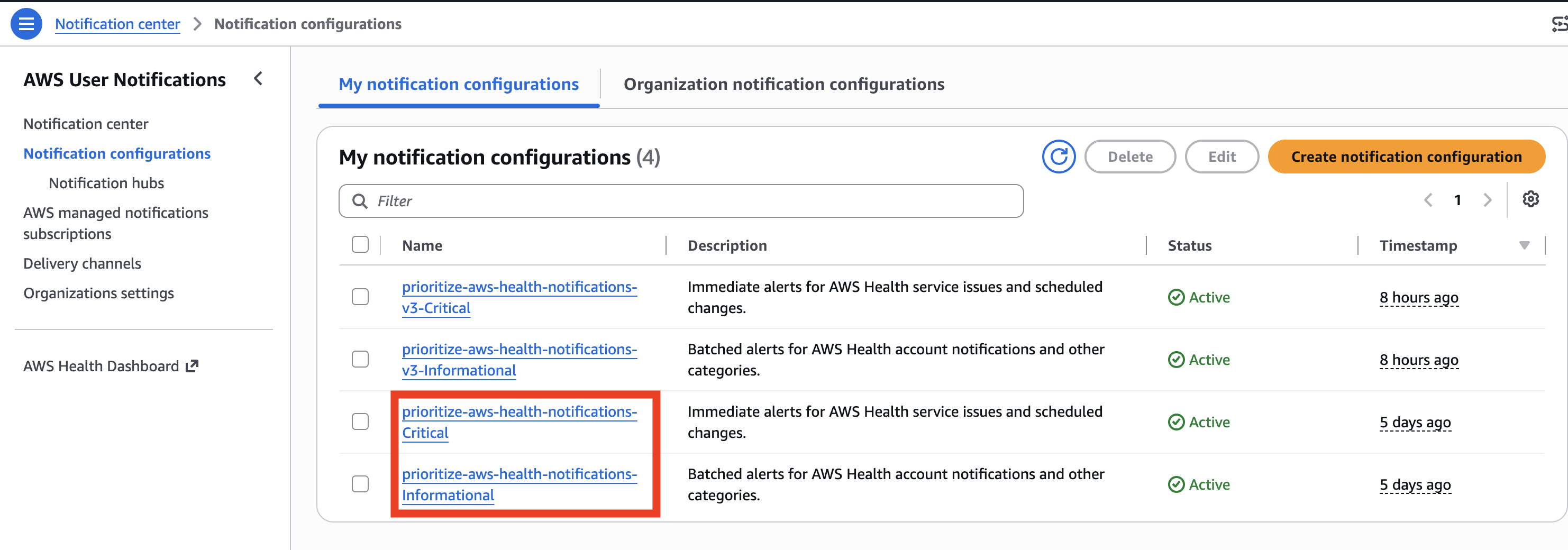
Figure 4: AWS User Notifications console showing two notification configurations.
Step 4: Test the solution
Validate the deployed resources via the AWS CLI:
Expected result: Returns two configurations with their ARNs and aggregation settings — CRITICAL with no aggregation (NONE) and INFORMATIONAL with a 5-minute aggregation window (SHORT).
To verify end-to-end delivery, check the AWS Health Dashboard for any active events in your monitored Regions. When a matching event occurs:
- CRITICAL (issue or scheduled change): Email arrives immediately with event details, affected resources, and recommended actions.
- INFORMATIONAL (account notification): Email arrives as a grouped summary within 5 minutes.
Expected result: Email notification received with the correct delivery pattern — standalone for critical, batched for informational.
What you receive
The pattern is simple: a standalone email means something needs attention now. A batched summary means routine updates you can review on your own schedule. The email format is controlled by AWS User Notifications and cannot be customized. The priority distinction comes from the delivery pattern, not from text labels in the email body.
For teams using AWS Chatbot in chat applications (Slack or Microsoft Teams) or the console Notification Center, the configuration names [CRITICAL] and [INFORMATIONAL] appear directly in the notification, providing explicit priority context.
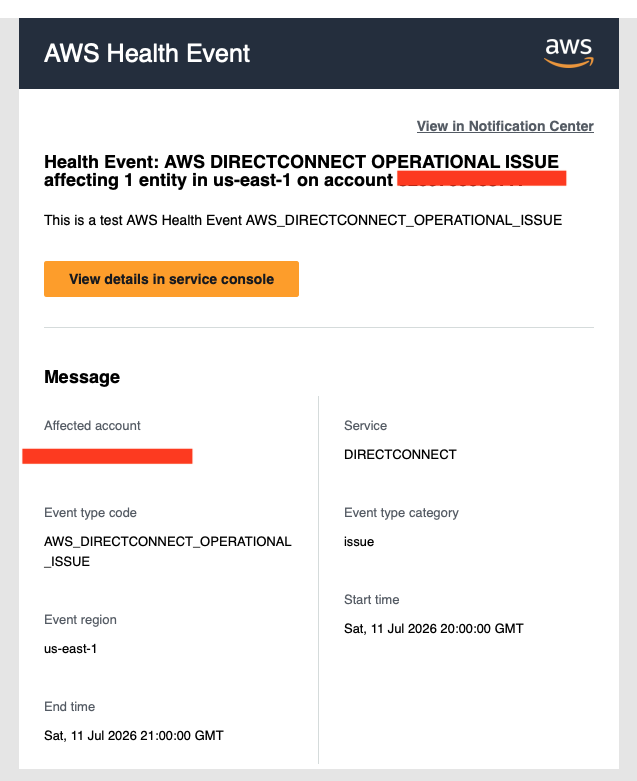
Figure 5: Sample CRITICAL email notification from AWS User Notifications related to an ISSUE.
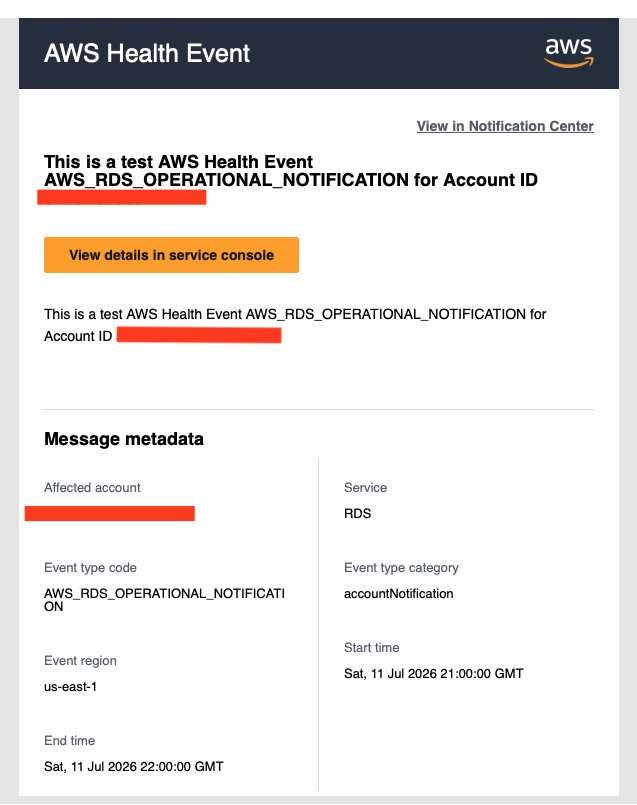
Figure 6: Sample INFORMATIONAL digest email from AWS User Notifications related to an accountNotification.
Customizing the solution
You can tailor the solution to your environment by adjusting which services are monitored and which Regions are covered.
Adding or removing monitored services
This template monitors AWS Direct Connect, Amazon Connect Customer, and Amazon RDS by default. To monitor additional services, update the service array in the EventPattern of both event rules. For example, to add Amazon Elastic Compute Cloud (Amazon EC2):
Update the stack, and the new services are covered immediately.
Multi-Region monitoring
To get notifications about other AWS Regions, pass multiple Regions in the NotificationRegions parameter:
Always include us-east-1 regardless of where your workloads run. AWS Health global events — such as those for AWS Identity and Access Management (IAM), Amazon Route 53, and Amazon CloudFront — are delivered to us-east-1. If you exclude it, you miss global events.
Adding delivery channels
The solution starts with an email, but you can extend it without modifying the core event rules or notification configurations:
- More email recipients: Create additional EmailContact resources and associate them with the existing CRITICAL and INFORMATIONAL configurations.
- Slack or Microsoft Teams: Set up an AWS Chatbot in chat applications channel and create a ChannelAssociation linking it to the notification configurations.
- Mobile push: Install the AWS Console Mobile App and sign in. User Notifications delivers to the mobile app automatically — no additional CloudFormation resources needed.
- Team-based routing: Associate the network team’s email only with the CRITICAL configuration, and the general ops team with both CRITICAL and INFORMATIONAL. This is done through channel associations alone — no changes to event rules.
How this solution compares to existing approaches
Several tools exist for routing AWS Health events, each designed for different operational needs. This solution is not a replacement for all of them — it fills a specific gap.
| Approach | What it does | Trade-offs |
| AWS Health Aware (AHA) | Open-source framework with Lambda, DynamoDB, Secrets Manager. Supports Slack, Teams, Chime, and email with event deduplication. | Requires Business or Enterprise Support plan. Ongoing maintenance of deployed components. |
| HEIDI / CID Health Events Dashboard | Historical analysis and trend visualization using Amazon QuickSight , Amazon Athena , and Amazon S3 . | Designed for operational planning and post-incident review — not real-time alerting. Requires Business or Enterprise Support plan. |
| Custom Amazon EventBridge + Lambda + SNS | Full flexibility for routing and transformation. | Requires writing, testing, and maintaining application code. |
| Third-party tools (PagerDuty, Datadog) | Escalation, on-call routing, and acknowledgment workflows. | Licensing costs and vendor dependencies. |
| This solution | Simplest path to priority-separated, real-time health alerting. One stack, no code, no compute, no support plan requirement. | No deduplication, no escalation/acknowledgment, no historical storage. |
The approach in this post sits at a different point on the spectrum. It works well as a standalone solution for teams that need straightforward alerting, and it works equally well as a foundation layer that feeds into more advanced tools as operational needs grow.
You can start with this solution for immediate coverage, then consider adding PagerDuty by subscribing it to the Amazon SNS topic (Combined mode) for escalation and on-call routing, or pair it with HEIDI for historical trend analysis.
Things to consider
This solution is intentionally lightweight, and that comes with trade-offs worth understanding:
- Email format: AWS User Notifications controls the email body and subject line. You cannot add custom text like ‘[CRITICAL]’ to the email itself by default. The priority signal is the delivery pattern — standalone means critical, batched means informational. For teams that need explicit priority labels in email, the Combined deployment mode adds an Amazon EventBridge + SNS layer with
InputTransformerthat prefixes the email body with ‘[CRITICAL]’ or ‘[INFORMATIONAL]’. - Delivery monitoring (Combined modes): The Amazon EventBridge + SNS layer includes built-in reliability. A dead letter queue (DLQ) retains failed deliveries for 14 days for troubleshooting, and a CloudWatch alarm fires if SNS fails to deliver notifications. This means you are alerted not just about AWS Health issues, but also about failures in the notification pipeline itself.
- No deduplication: AWS Health events have a lifecycle — created, updated, resolved. Each update triggers a new notification. A single incident might generate 2–4 emails as the event progresses. For strict deduplication, consider pairing with AHA or adding a lightweight Lambda function.
- No escalation or acknowledgment: This solution sends notifications but does not track whether anyone acted on them. For on-call routing and escalation chains, integrate with an incident management tool like PagerDuty or OpsGenie via the SNS topic.
- No historical storage: Notifications are delivered in real time but not stored for later analysis. For post-incident review and trend reporting, pair with HEIDI or the CID Health Events Dashboard.
The advantage of this approach is that it does not lock you into a single path. The notification configurations and event rules remain in place as you layer on additional capabilities.
Cleanup
If you no longer need the health notification resources, delete the CloudFormation stack:
Note: AWS CloudFormation preserves resources with DeletionPolicy: Retain (notification configurations, event rules, email contacts, and channel associations) after you delete the stack. To fully remove them, delete the resources manually through the AWS User Notifications console or the AWS CLI.
Expected result: Stack reaches DELETE_COMPLETE within 2–3 minutes.
Conclusion
In this post, we walked through how to set up priority-based AWS Health alerting using AWS User Notifications and a single CloudFormation template. The solution filters health events to only the services that matter to your organization, then separates what remains into immediate critical alerts and batched informational summaries.
The core value is simplicity. No Lambda functions to patch. No DynamoDB tables to manage. No code to maintain. One stack, deployed in minutes, covering a single account or an entire organization. Because it uses only native AWS services with no support plan requirement, any team can adopt it regardless of their current tooling or support tier.
This approach works as a standalone alerting solution. It also works as a starting point that you can extend with Slack and Microsoft Teams integration through AWS Chatbot in chat applications, escalation workflows through PagerDuty or OpsGenie, and historical analysis through HEIDI or CID.
To get started, download the CloudFormation templates from the GitHub repository. For more information, see the AWS User Notifications User Guide and the AWS Health User Guide.
If you have questions or want help implementing this solution for your organization, contact your AWS account team or visit the AWS Contact Us page.
About the Authors
Protecting Privacy in an AI Era
Post Syndicated from Bruce Schneier original https://www.schneier.com/blog/archives/2026/07/protecting-privacy-in-an-ai-era.html
Daniel Solove argues in the Wall Street Journal (alternate link) that giving people control of their personal data is not an effective way to regulate privacy in this era. Instead, we need to hold companies accountable for their actions, similar to what we do with food and drug companies. Measures such as rigorous data minimization, fiduciary duties, liability for negligent or reckless technological design, liability for algorithms that cause harm, and multi-stakeholder review of technologies will be far more effective.
[$] Sched-ext: enqueue() for sub-schedulers and proxy-execution support
Post Syndicated from corbet original https://lwn.net/Articles/1082717/
The extensible
scheduler class (sched_ext) allows the installation of custom CPU
schedulers as a set of BPF programs. While sched_ext, in its current form,
has already led to a lot of interesting scheduler-development work, the
subsystem itself is still undergoing rapid evolution. Among other work,
the ability to set up a hierarchy of sub-schedulers is approaching completion, and
a longstanding incompatibility with proxy
execution is coming to an end.
Security updates for Thursday
Post Syndicated from jzb original https://lwn.net/Articles/1083201/
Security updates have been issued by AlmaLinux (cups, git-lfs, kernel, libsolv, libxml2, python3.12, and python3.9), Debian (chromium, dhcpcd5, and ntfs-3g), Fedora (firefox, perl-Imager, python-bcrypt, python-tiktoken, roundcubemail, and xrdp), Mageia (openssl, poppler, python-mistune, and tmux), Oracle (389-ds-base, cups, git-lfs, glibc, host-metering, kernel, libsolv, libxml2, nginx:1.24, PackageKit, python-pillow, and qemu-kvm), Red Hat (buildah, containernetworking-plugins, and skopeo), SUSE (buildah, cosign, curl, distribution, dnsmasq, glib-networking, glibc, gnutls, gstreamer-plugins-bad, ImageMagick, kernel, podman, python-cryptography, python313-django-debug-toolbar, rekor, sccache, sssd, and yelp), and Ubuntu (dotnet8, dotnet10, libslirp, luajit, python-idna, sympa, and tomcat8).
Sunsetting the Public AttackerKB Platform
Post Syndicated from Douglas McKee, Director, Vulnerability Intelligence original https://www.rapid7.com/blog/post/ve-sunsetting-public-attackerkb-platform
What’s changing, where AttackerKB-style analysis will live, and how users can continue finding Rapid7 vulnerability intelligence.
On August 18, Rapid7 will sunset the standalone public AttackerKB website as part of a broader effort to unify our vulnerability intelligence, exploit analysis, and research resources.
Security practitioners, researchers, vulnerability managers, and current AttackerKB API users will still be able to find Rapid7 vulnerability intelligence through the Rapid7 blog, the recently revamped Rapid7 Vulnerability and Exploit Database, and customer-specific API experiences, where applicable.
The public AttackerKB platform is going away, but the intelligence and analysis that security teams rely on are not disappearing. Instead, they’re moving into experiences more closely connected with Rapid7’s broader research and vulnerability intelligence ecosystem.
What’s changing
-
The public AttackerKB website will be retired on August 18.
-
AttackerKB-style Rapid7 technical write-ups will continue on the Rapid7 blog.
-
Vulnerability intelligence will remain connected to the Rapid7 Vulnerability and Exploit Database.
-
Open community contributions and the current public AttackerKB API will be retired.
Where AttackerKB-style content will live
After the AttackerKB site is retired, that particular style of technical write-up will continue to be published through the Rapid7 blog, and will remain connected to the Rapid7 Vulnerability and Exploit Database.
This approach brings vulnerability analysis, exploit intelligence, and security research into a more centralized experience for anyone and everyone who accesses the current standalone site. For security practitioners, researchers, and vulnerability managers, the goal is simple: Make it easier to find the information you need without moving between separate platforms.
Why we’re retiring community contributions
We’re also retiring the open community contribution model of AttackerKB. This decision enables Rapid7 to maintain tighter control over the quality and accuracy of the intelligence we publish. By moving to a more curated model, we can ensure users receive high-fidelity, verified vulnerability intelligence backed by our expert research teams.
The change helps protect and fortify the integrity of the intelligence associated with Rapid7, by reducing the risk of inaccurate submissions (especially hastily AI-generated ones), and attempts to manipulate vulnerability information. Maintaining trust in security data is what matters here, and this next step means we can continue delivering intelligence practitioners can use with confidence.
What AttackerKB API users should know
The current public AttackerKB API will be retired alongside the public platform and community features.
Going forward, access to this vulnerability intelligence through APIs will be restructured as a dedicated capability for Rapid7 customers. If your organization currently depends on the public AttackerKB API, Rapid7 will share customer-specific guidance on available options, timing, and transition details.
Next steps for AttackerKB users
If you currently use AttackerKB, here are the quick-hits for August 18 and onwards:
-
Visit the Rapid7 blog for new technical write-ups and vulnerability analysis.
-
Look for a dedicated “Technical Analysis” (linked above) tag to help make AttackerKB-style content and legacy write-ups easier to find.
-
The AttackerKB domain will automatically redirect to the Rapid7 Vulnerability and Exploit Database.
-
Use the Vulnerability and Exploit Database as your central source for vulnerability intelligence moving forward.
AttackerKB has played an important role in helping security teams understand risk and prioritize action. We’re grateful to everyone who contributed, shared knowledge, and helped shape the platform over the years, and we’re excited to deliver the same trusted intelligence through a more unified experience.
The Election Deniers Are in Charge Now
Post Syndicated from The Atlantic original https://www.youtube.com/watch?v=WpYUc3Zjymo
Забранен или не точно? Филмът отмъстител
Post Syndicated from Светла Енчева original https://www.toest.bg/zabranen-ili-ne-tochno-filmut-otmustitel/

Тревата винаги е по-зелена от другата страна, гласи стара английска поговорка, изразяваща разпространената нагласа, че чуждото е по-хубаво от нашето. С възприятието на цензурата нещата стоят по-скоро по обратния начин – налагащите цензура обикновено са другите, докато ние сме борци за свободата на изразяване. Освен когато искаме да „предпазим“ обществото или определени групи от него (например децата). А кое е легитимна проява на свободата на изразяване и кое – злоупотреба с нея, е въпрос на ценности. Освен, разбира се, когато е резултат от политически, корпоративни или други зависимости.
До ценности опират и споровете около наложените в Германия ограничения на новия филм на немския режисьор Уве Бол Citizen Vigilante. Но за него – след малко.
В началото на юли 2026 г. в България също избухна скандал заради филм.
Половинчасовото произведение, озаглавено „Да бъдем себе си“, не е гледал почти никой. Но според политици от „Възраждане“, които подемат кампания срещу филма, той нарушава Закона за предучилищното и училищното образование. По-точно инициираната от партията поправка, забраняваща т.нар. ЛГБТ пропаганда. Защото кадрите са снимани в Немската гимназия, сред статистите са ученици и от друго училище, а сюжетът е за тийнейджър, който осъзнава, че е гей. Според депутатката от „Да, България“ Елисавета Белобрадова, чиято партия оттегли предложението си за отмяна на поправката на „Възраждане“ за пропагандата, това е
един „мъртъв“ текст, касаещ измислен и несъществуващ проблем.
Ала независимо дали проблемът е несъществуващ, текстът очевидно си е жив. Някой мислил ли е сериозно, че щом една поправка в духа на руското законодателство е влязла в закона, вносителите ѝ няма да се опитват да я прилагат?
Що за филм е Citizen Vigilante?
Да се върнем на новия филм на Уве Бол. На български заглавието Citizen Vigilante се среща като „Гражданинът отмъстител“, но може би е по-коректно то да се преведе като „Саморазправящият се гражданин“. Защото vigilante означава точно това – някой, който раздава правосъдие на своя глава вместо институциите.
Такъв е и Майкъл Сандърс, героят на Арми Хамър – американец, бивш военен, заселил се в неназована европейска държава.
Там имигрантите от ислямски страни са се превърнали в напаст – те по подразбиране са нелегални, колят и изнасилват жени и момичета, не си плащат наема на квартирата. Институциите са вдигнали ръце, защото са твърде толерантни. Съдия например оправдава шестима изнасилвачи на тийнейджърка с аргумента, че те самите са жертви на обществото, затрудняващо тяхната интеграция.
Сандърс взема правосъдието в свои ръце – избива не само виновните имигранти (сцените на убийство се показват във филма натуралистично и с много кръв), а и семейството на един от тях, включително жена и деца. Също и представители на институции – например съдията, за когото стана дума.
Тук съм, за да ви помогна да си върнете контрола,
заявява героят на Хамър, възпроизвеждайки злополучния лозунг на Брекзит „Да си върнем контрола“. Той нарежда на разследващия го шеф на Интерпол да предаде на правителството, че обществото няма да толерира т.нар. уок левица и ислямските екстремисти, които ще унищожат демокрацията. Ръководителят на Интерпол се превръща в ретранслатор на посланията на Сандърс, който успява да разпространи видео, съдържащо посланието, че ще продължи да се саморазправя, докато гражданите не се научат да се защитават.
Иронично, героят на Сандърс също е имигрант.
И също нарушава закона, макар и в името на справедливостта – така, както я разбира. Той раздава правосъдие от името на местните, които, чудно защо, също като него говорят английски. Само че с акцент, което някак неявно внушава, че те са чужденците, а не протагонистът.
Под „чужденци“ те имат предвид арабите.
Така коментира преди години тунизийски студент в Берлин наблюдението ми, че български имигранти в Германия се оплакват как страната се е „напълнила с чужденци“, без да отчитат, че и те са такива. Според героя на Арми Хамър, изглежда, всеки извършител на престъпление от мюсюлманска страна е ислямист, независимо дали религията е била мотив за престъплението, както и дали изобщо е вярващ.
Електоралната енигма – защо българите в чужбина гласуват за „Възраждане“
За пореден път след поредните избори се чудим защо българите в чужбина – тази тъй митологизирана група хора – гласуват за „Възраждане“. Марина Лякова прави анализ кои са българите в чужбина, които реално гласуват, и когато го правят, защо вотът им изглежда тъкмо по този начин.
Европейска страна като тази от филма няма.
Тази измислена държава всъщност изобразява представите за Европа на последователите на MAGA (републиканците, последователи на Тръмп), както и на крайнодесните в Европа (например „Алтернатива за Германия“), според които виновниците за несгодите им винаги са другите, чуждите, а не те самите.
Затова според тях европейците трябва да разполагат с нещо като Втората поправка в американската Конституция – да имат право да се защитават с оръжие. Друг е въпросът, че и в САЩ човек не може безнаказано да отнема живота на всеки, когото смята за лош.
Експлоатирайки клишета като „те изнасилват и убиват нашите жени и дъщери“, „ние трябва да защитим жените и дъщерите си“, филмът не само проповядва ксенофобия, ислямофобия и насилие. Той смита под килима теми като домашното насилие и сексуалното насилие, извършвано от съграждани, близки, познати, членове на семейството. Помните ли историята на Жизел Пелико?
Нейното тяло – негов избор. Какво ни казва историята на Жизел Пелико
Случаят на Жизел Пелико няма да бъде забравен не само заради чудовищния си мащаб и дързост, а и заради факта, че показва една проста истина – насилието е банално и обикновено идва от тези, които са най-близо до теб. Коментар на Светла Енчева.
Казусът със Citizen Vigilante в Германия
В Германия организацията, която поставя възрастови ограничения на филми по силата на Закона за защита на младежта, е известна като FSK (Freiwillige Selbstkontrolle der Filmwirtschaft – „Доброволна саморегулация на филмовата индустрия“). За филми, за които прецени, че съдържат сериозна опасност за обществото и/или е възможно сами по себе си да представляват престъпление, FSK може да откаже да им даде рейтинг. От това следва, че разпространението на такъв филм ще е много трудно, макар и на теория възможно. Той няма да може да се рекламира, а кината, които го прожектират, може да попаднат под ударите на закона, ако съдът реши, че филмът нарушава Наказателния кодекс.
Първо действие: две блокиращи решения и скандал
Два пъти поред FSK отказва да предостави рейтинг на Citizen Vigilante – както за кината, така и за онлайн платформите. Реакцията трудно би могла да е друга в страна, в която поколения наред са възпитавани в осъзнаване на историческата вина на държавата си за Холокоста и в нетърпимост към ксенофобията и престъпленията от омраза. Това означава, че филмът би могъл да бъде конфискуван от съд по силата на германския Наказателен кодекс, който определя като престъпление възхваляването и омаловажаването на жестоки и нечовешки актове на насилие, както и производството, притежанието, предлагането и рекламирането на подобно съдържание.
Очаквано Уве Бол обвинява организацията в цензура. Според него решението ѝ е политически мотивирано, а за разлика от отказа от рейтинг, маркирането на филма с 18+ би гарантирало защитата на непълнолетните, без да блокира разпространението на филма.
Историята стига до Илън Мъск, който неведнъж е заявявал, че е привърженик на абсолютната свобода на словото. Той публикува за 48 часа линк към филма в акаунта си в притежаваната от него социална мрежа X. Макар технически Citizen Vigilante да не е забранен, булевардни и симпатизиращи на крайнодесния популизъм медии, като например германския таблоид Bild, говорят за „забрана“.
Как е възможно хомосексуална жена да е начело на „Алтернатива за Германия“
В случай че някой се чуди как точно се връзва личността на Алис Вайдел с посоката и позициите на партията ѝ, Светла Енчева дава някои много интересни отговори. И не, „Алтернатива за Германия“ не е германското „Възраждане“, защото радикализацията там върви по съвсем друга линия.
Самият Мъск впрочем съвсем не е последователен в защитата на свободата на словото, колкото твърди, че е. Той е премахвал например акаунтите в X на журналисти и коментатори, критични към Тръмп, както и на профила @ElonJet, проследяващ частните му полети. Давал е под съд организация, според която той допуска излъчването на реклами, включващи реч на омразата. Също така Мъск не приема свободата на самоизразяване на собствената си трансджендър дъщеря, чиято полова идентичност не приема. Той смята, че „синът“ му е „убит“ от „вируса на уок ума“, и е цензурирал в X акаунти само защото използват думи като „цисджендър“.
У нас ограничението на Citizen Vigilante в Германия също се възприема като забрана, без обаче тази дума да е свързана непременно с отрицателна оценка. Селекционерът на „Киномания“ Христо Христозов определя в разговор с Васил Христов в „Извън ефир“ решението на FSK като оправдано.
Второ действие: компромисно решение на FSK
След двата отказа за определяне на рейтинг компанията FreeWind Media, която е дистрибутор на Citizen Vigilante за Германия, подава трето искане, но този път – единствено за киноразпространението, не и за стрийминг платформите. И блокадата се пропуква – на 6 юли филмът получава рейтинг 18+, което означава, че може да бъде прожектиран в кината, макар и само за пълнолетни.
Ден по-късно FSK внася уточнение в решението си, че то не се отнася за сектора на домашните развлечения, тоест за стрийминг платформите (или други форми на разпространение за гледане на компютър или по телевизията). Основанието е, че филмът включва сцени на насилие и представя саморазправата като легитимно средство за борба с престъпността и може да повлияе на младежите. А тъй като за непълнолетните гледането на филм вкъщи е по-лесно осъществимо, отколкото на кино, където има контрол на входа, прагът на изискванията за рейтинг е по-нисък.
В решението на FSK се подчертава, че липсата на рейтинг в сектора на домашните развлечения не е равносилна на забрана. Филми без рейтинг може да бъдат пускани по кината и в стрийминг платформите, както и продавани на физически носители, но само на пълнолетни. И на риска на доставчиците.
Няколко финала
Навремето работех в един университет с кинооператора Христо Тотев. В общуването ми с него ме беше впечатлила способността му да анализира филми, разказвайки ги в четири-пет изречения. На един филм му беше намерил четири финала. Сещам се за това, защото ми хрумват няколко заключения на този текст.
Първи финал
Въпреки предоставянето на рейтинг 18+, до редакционното приключване на статията липсва информация за пускането на Citizen Vigilante по германските кина. Възможно е правните спорове около филма да са направили собствениците на повечето киносалони по-предпазливи. Включването на филма в програмата им би могло да се интерпретира и като политическа позиция, с каквато в Германия не е проява на добър вкус да се ангажираш, освен ако си крайнодесен. Допускам, че филмът ще се излъчва на някои места, посещавани от последователи на „Алтернатива за Германия“ и „Гражданите на райха“.
Възходът на крайната десница в Германия – как и защо?
Тайна сбирка на дяснорадикални лидери, на която се е обсъждала „ремиграция“, стана причината за многохилядни протести в Германия. Защо дясната реторика и формации като „Алтернатива за Германия“ стават все по-силни? От Марина Лякова.
Втори финал
И без да броим последния му филм Citizen Vigilante, Уве Бол не е известен като добър режисьор. Дори напротив – носи му се славата на „най-лошия режисьор в света“. Негови филми многократно са номинирани, че и удостоявани с приза за лошо кино „Златната малина“. През 2006 г. той кани критиците си да премерят сили на боксовия ринг. Отзовават се петима. Бол печели и петте мача, понеже е тренирал бокс.
Дори Арми Хамър, изиграл главния герой в Citizen Vigilante, не защитава филма и режисьора му. Той оправдава участието си с изолацията, споходила го, след като беше кенсълнат заради обвинения в сексуално насилие и закани за канибализъм към негови партньорки. Те не бяха доказани в съда, но съмненията останаха. „Бих правил и реклама за котешка храна“, оправдава той участието си във филма на Бол, който е първото предложение след кенсълването му.
Както го е подкарал, току-виж Хамър действително стигне до реклами за котешка храна. А на онези, които го помним най-вече с участието му във филма на Лука Гуаданино „Призови ме с твоето име“, ни остава да въздъхнем носталгично.
Трети финал
Пиша тези редове в Германия. В деня, след като научих за драмите около Citizen Vigilante, на вратата се звънна. Беше съседът от Ирак – дребничък човек на средна възраст, с брада и дяволита усмивка. Държеше щайгичка, пълна с плодове и зеленчуци. Каза, че са за нас. „Бях на пазар и взех много неща. Тези не ми трябват.“ На въпроса на приятелката ми колко му дължим, отговори: „Нищо.“ Така се сдобихме с няколко килограма картофи, към кило лимони, няколко десетки чери доматчета на клонки, две големи краставици и една салата айсберг.
Да са разпространени подобни жестове в Германия – не са. Да ни е близък съседът иракчанин – не е. Замислих се по този повод, че тъкмо такива като този съсед – имигранти от мюсюлмански страни – избива героят на Арми Хамър. Е, нашият съсед вероятно не е нелегален, а и не сме чули да не си плаща наема. Работи като нощен пазач в библиотека. Но Сандърс не иска да му се представят лични документи, разрешения за работа и договори за наем, преди да открие огън. Такава е логиката на престъпленията от омраза – всички представители на определена група се смятат за виновни за прегрешенията на отделни нейни членове.
Край.
Building education technology that children can trust
Post Syndicated from Laura Kirsop original https://www.raspberrypi.org/blog/draft-principles-for-safe-responsible-edtech/
Millions of young people and educators around the world use our technology to teach, learn, and create with code. Building it safely and responsibly is intrinsic to who we are and what we stand for.
A growing body of research and public commentary links the use of social media, smartphones, and algorithmic platforms to declining mental health and attention in young people. Public attitudes are shifting in response, and parents, teachers, and governments are increasingly demanding action. Phone bans in schools and restrictions on social media are spreading across many countries. The technology sector can no longer take public trust for granted.
None of this is new territory for researchers, who have argued for decades that technology is not neutral, and that the choices made in designing it can either embed harm or help prevent it (1). We think this moment calls for a calm, evidence-led response, and we want to be open about how we are approaching it and to do this work alongside others rather than on our own.
Standing on existing research
We have always been a research-led organisation. When we face a difficult question, we look at the evidence and learn from the people who have studied it.
Children’s digital rights is a rich and well-established field. Researchers and experts have spent years thinking carefully about what children need from the technology they use, and how their rights apply in a digital world. The United Nations set out a clear framework in 2021 with General Comment No. 25, which describes how children’s rights apply to the digital environment. Organisations like UNICEF and the 5Rights Foundation have built on this with practical guidance for the people who design and build products.
This body of work gives us firm ground to stand on. Rather than starting from scratch, we have used it to shape our own approach. We have drawn in particular on UNICEF’s Responsible Innovation in Technology for Children framework, UNICEF’s EdTech for Good Framework 1.0, the UN’s General Comment No. 25, and the Digital Futures Commission’s Child Rights by Design principles.
Eight principles to guide our work on edtech
We have begun by writing eight principles, designed to guide the decisions we make as we build and run our products.
Our principles:
1. The best interests of the child come first. We design for children’s wellbeing, which means more than safety and privacy. It includes their agency, their emotional health, their relationships, and the space to create. Sometimes putting that first means choosing against growth, engagement, or speed.
2. Our technology supports human relationships. It does not replace them. Any personalised or AI-supported features we build are there to strengthen the relationships between young people, educators, and caregivers. People stay in control, and we do not hand decisions about a child’s learning or wellbeing to a machine.
3. We only collect the data we need. By the time a child turns 13, more than 72 million pieces of personal data will have been collected about them. We collect the minimum we need to help children learn and to measure our impact. We do not sell data, and we never will.
4. We design for learning, and we prove its impact. Our products are grounded in evidence about how children learn, and we evaluate whether they actually work. We avoid designs that keep learners hooked rather than helping them learn.
5. We design with children and educators, not for them. The people who use our products are the experts on their own needs. We involve them in research, testing, and feedback, and we make sure what they tell us shapes the product, not just a report at the end.
6. We design for diverse needs, abilities, and contexts. Our technology adapts to people, not the other way around. We do not assume constant connectivity, confidence with digital technologies, or a classroom that looks like anyone else’s.
7. We are transparent and accountable. We use plain language to explain how our products work, how data is used, and what rights people have. And we give people clear ways to question or challenge the decisions our systems make.
8. We apply the highest standards of children’s rights everywhere we work. Where local rules fall short of international best practice, we choose the higher standard. A child’s rights should not depend on where they happen to live.
You can read the full set of draft principles, and the research behind each one, in this PDF:
Committed, not perfect
Publishing these principles is a statement of intent, not a claim that we have got everything right. This is a fast-moving area. Regulation is changing quickly, the research keeps developing, and we grow and change our own products. There are areas where we know we have work to do, and almost certainly areas we have not yet spotted.
These principles are how we hold ourselves to account, and they are only a start. Alongside them, we are mapping the regulatory landscape across the countries where we work, developing ways to assess our products against these principles, and building these commitments into how we make decisions. We will keep listening to the people who use our products, and making sure children themselves have a voice in shaping the technology built for them.
We also know we cannot do this alone, so we have two asks for you:
If you have a view on these principles, tell us. Whether you are a researcher, educator, parent, young person, or policymaker, we want to hear where you think we have got it right, where we have not, and what we have missed. Honest challenge is genuinely useful to us. Give your feedback and sign up to be involved in shaping them.
If you are part of a non-profit or organisation working on similar questions, get in touch. We would like to build a coalition of like-minded organisations to share what we are learning and raise standards across the sector.
(1) See for example:
- Friedman, B., & Nissenbaum, H. (1996). Bias in computer systems. ACM Transactions on Information Systems, 14(3), 330–347. https://doi.org/10.1145/230538.230561
- Noble, S. U. (2018). Algorithms of Oppression: How Search Engines Reinforce Racism. NYU Press.
- O’Neil, C. (2016). Weapons of Math Destruction: How Big Data Increases Inequality and Threatens Democracy. Crown.
The post Building education technology that children can trust appeared first on Raspberry Pi Foundation.
На второ четене: „Черешата на един народ“
Post Syndicated from Стефан Иванов original https://www.toest.bg/na-vtoro-chetene-chereshata-na-edin-narod/
„Черешата на един народ“ от Георги Господинов

Пловдив: изд. „Жанет 45“, 1996, 2026
Има нещо дълбоко господиновско във факта, че „Черешата на един народ“ се преиздава точно в годината, в която по площадите ще гърмят възстановки на черешови топчета за 150-годишнината от Априлското въстание. Историята, която книгата от 1996-та описва като вечно отлагано събитие, услужливо е доставила декора. Юбилейни залпове за нещо, което по вътрешната логика на самата книга така и не се е случило докрай.
И тази година, дядовото, няма да има априлско въстание
Стихът се оказва с неограничен срок на годност – като компот, забравен в мазето на националното съзнание.
Юбилейното издание прави още един жест, прибирайки в тялото на книгата собствената ѝ рецепция. Така критическите прочити на Светлозар Игов, Албена Хранова, Бойко Пенчев, Пламен Антов и Биляна Курташева вече са част от корпуса, както бележките под линия у Борхес са част от разказа. Книгата пристига при новия читател предварително коментирана, като ръкопис с глоси по полетата, и това е формален аргумент.
„Черешата“ винаги е твърдяла, че българското съществува преди всичко като текст върху текст, и сега тя демонстрира палимпсеста със собственото си тяло.
Светлозар Игов пръв формулира централната категория на несбъднатото и я обръща във философска теза, защото „всяка история е история на несбъднатости. Ако историята можеше да се сбъдва, нямаше да има история.“ Тезата има славно родословие. Музил нарича същото Möglichkeitssinn, усет за възможното. Неговата Какания и черешовата България са братовчедки, държави на генералната репетиция без премиера. Кавафисовите варвари, чието вечно неидване организира живота по-надеждно от всяко идване („тези хора бяха все пак някакво решение“), и Бекетовият Годо, за когото всеки ден пристига известие, че днес няма да дойде, но утре непременно, са задочните роднини на априлското въстание, което всяка пролет е възможно и всяка пролет се отлага в полза на компота. Разликата е климатична. При Бекет дървото е голо, при Господинов е отрупано с цвят.
Българското несбъдване е плодородно. Ражда сладко, ракия, лютеница, литература.
Игов настоява, че поезията е мястото, където историята единствено може да се сбъдне, и в тази светлина „Черешата“ е парадоксално оптимистична книга и гърмежът е пренесен от цевта в езика.
Заглавната метафора крие цяла литературна геополитика. От едната страна стоят Вазов и черешовото топче, и градината като арсенал, а от другата са Чехов и вишневата градина, и красотата, изсичана от новото време. Господинов застава по средата и иронизира двупосочно. Неговата череша нито гърми, нито бива изсечена. Тя ражда компоти. Хранова показва механиката с хирургическа точност. Вазовият език на бунта е наложен върху всекидневието, без да може да го промени. Настоящето умее единствено да рецитира наизустената класика. Това е операция от типа на Борхесовия Пиер Менар, защото, да, „Делото ще пламне и начаса всякой / ще вземе участье в това предприятье“, да, думите са автентични, ситуацията е компотена, смисълът се е обърнал, без нито една буква да е предадена. И най-фината подробност – свалената главна буква на „априлско въстание“ връща историческото понятие в регистъра на сезонните повторения. Единствено децата поддържат бунтовната образност, детството е като последен резерват на историческото въображение – теза, която авторът ще разгърне след години във „Физика на тъгата“.
Пламен Антов дава най-концептуалната формула и я нарича „дядо-ми-в-мен“. Българският постмодернизъм на 90-те подменя Лакановото „име на Бащата“ с името на Дядото. Освобождаването от бащината инстанция върви ръка за ръка със сантиментално отношение към прародителя. Дядото, който никога не е виждал море, милее за Босфора от песента. Внукът милее за дядовото милеене. Носталгията тук е втора производна, копнеж по чуждия копнеж. Световната литература познава фигурата добре. Полковник Аурелиано Буендия със златните рибки, които претопява, за да ги направи наново, е латиноамериканският еквивалент на дядото с несъстоялото се топче. Това е героика, рециклирана в цикличен занаят. А „Първи стъпки“, където селският клозет се оказва пряк вход към тартара, е шулцовска митологизация на двора, издържана с онази сериозност, която единствена прави иронията възможна.
Курташева посочва домашния първоизточник. Още Пенчо Славейков знае, че съчиняването на своето поколение минава през измислянето на предците. В „Родства по избор“ авторът сам изважда в новия предговор Гьотевата формула, пренесена от химията на брака в химията на традицията с „език на дядо Уитман и на дядо ми“, с „на татко Елиът и на баща ми“ (с „познанството им твърде бегло“, един от най-елегантните автоиронични стихове на 90-те). Дикинсън и селската баба на една трапеза е фамилна снимка, за която българската поезия дотогава нямаше техническата смелост.
Бойко Пенчев дефинира носталгията на Господинов като „носталгия по съредността на думите и нещата“ по време, в което думите са имали плът, вкус и мирис. Намекът към Фуко е обявен от самия Пенчев за банализиран, но истинският подтекст е Еко: „от някогашната роза остана само името“ перифразира финала на „Името на розата“, а „За вкуса на имената“ го разиграва буквално и от „Роза Бяла“ остава само името, което е по-вкусно от пастата, а при дòсега с рецептата Бьоф Строганов се разпада до говеждо с картофи. Ема Бовари умира от несъответствието между албуми със снимки и Париж, а героите на Господинов познават Айфеловата кула като сувенир с термометър и оцеляват, защото никога не стигат до оригинала. Бодрияр е цитиран в текста откъм кухнята, където соцбитът е изпреварил френската теория с десетилетия. Цяла държава живя сред копия без оригинали и нарече това обща култура.

На „Тайните вечери на езика“ Хранова посвещава страници, които сами са малка класика. В роднинската редица на езика липсва „майчин език“, защото майката е притежавана от езика, преди да го притежава, тя се появява само като зов, „мааать – mat – мааать“, звук отпреди Вавилон. Езикът въобще е „нещо голямо и нечовешко като пчелата-майка с роя“. Авторът очевидно помни и в предговора от 2026-та троловете оспорват „правото на пчелата майка на езика“, метафората на Хранова се е върнала в авторския речник, кръгът поезия–критика се е затворил. Другите две езикови лаборатории на книгата допълват картината. „Техниката за обезкостяване“, при която Дебеляновото „Помниш ли, помниш ли“ се свежда до „о и и, о и и“, плува в едни води с Хлебниковия заум и Моргенщерновата „Нощна песен на рибата“, само че с обратен темперамент. Авангардът обезкостяваше езика с манифестен патос, а Господинов го прави с нежност, като баба, която чисти риба за внука. А „Да попушим Пушкин“ довежда Манделщамовия „краден въздух“ до физиологичния му предел. Духът на поезията е Дим, четенето става причастие в най-буквалния и канибалски смисъл, а изгарянето е върховна форма на прочит, обърнат Бредбъри. И тук е забито най-болезненото изречение в книгата:
защо не можем да имаме лична история, без тя да бъде тъкмо българската.
Цялата източноевропейска литература на ХХ век е коментар под него.
Вторият цикъл има за герой едно отсъствие. Българските 60-те, които „никога не са се състояли“. Докато Прага гори, Ямбол консервира. Революцията на цветята ври в лютеницата заедно със стъкления лук на „Бийтълс“. Кундера построи „Книга за смеха и забравата“ върху организираното забравяне на чешката 68-ма. Господинов пише за по-коварното, за носталгия по непреживяно събитие, спомен втора употреба, което Светлана Бойм би нарекла „рефлексивна носталгия“, копнеж, който знае за невъзможността си и от това знание се храни. „Girl“ (Курташева отбелязва, че стихотворението „може да се казва и СПИН“) подрежда телата във верига по образеца на Шницлеровия „Хоровод“ – „Ах колко общество в едно момиче“. Игов вижда „промискуитетното братство“ на консумацията с изпреварилото дебатите уточнение, че една феминистка би обърнала стихотворението в „Boy“ без загуба на внушение. „Умирам по Пастернак“ полага „Зимна нощ“ в сцена с пиян съсед и легло, минаващо „в анапест“ – пародията като форма на вярност. А финалното „За леката душа“ е българският Иван Илич, животът „най-обикновен и затова най-ужасен“, разказан без Толстоевия метафизичен вопъл, с изсулване вместо агония, „няма даже драма / няма нищо после / нищо няма / няма“. Игов задава върху него въпроса на въпросите, като пита
дали историята-нищо създава хора-нищо, или е обратното, и трийсет години по-късно въпросът стои все така неудобен, което вероятно значи, че е зададен правилно.
Новият предговор изрично кани към сравнение между двата края на дъгата и резултатите са двусмислени. На повърхността всичко се е сбъднало, дядовият Босфор е дестинация на нискотарифни авиолинии, „Европа квартална“ от първи януари дели с нас и валутата си, границите от „Зоо на географията“ са разтворени в Шенген. Книгата обаче е за друго. За това, че сбъдването по каталог е фалшиво сбъдване. Достъпният Босфор оставя дядовата тъга без наследник, а носталгията сменя адреса си – днес се носталгира по самите 90-те, по „мрежата от смисли и жужащи гласове“, която предговорът оплаква. Несбъднатото е пропълзяло едно поколение напред, точно както стихотворението предсказваше, че ще „трупа исторически дефицити за нашите деца“.
Под повърхността приликите са по-мрачни. Мизерната 1996-та и днешното „усещане за катастрофа (в града и в света)“ авторът свързва в „едно пълзящо отчаяние“. Между двете дати се редят януари 97-ма, протестите на 2013-та и 2020-та, поредица „априлски ставания“, за всяко от които легендата към второто издание е написала епикризата, че „нито някой знае дали онова наистина се случи докрай“. Междувременно самата дума „Възраждане“, на която книгата правеше своето „йе-йе-йе“, днес е регистрирана политическа марка с парламентарна група. За съжаление, пред професионализма на историята иронията на поета изглежда като безсилна добронамереност. А „смисловият кит, върху чийто гръб се крепеше литературната ни вселена“, по диагнозата на предговора „се е буквализирал в плоска конспиративна теория“. Там, където иронията се чете буквално, а буквалното като заговор, постмодерната игра губи партньора си. И географията се завърна без чувство за хумор. Броилката „оттам ще ни застрелят“ през 1996-та беше детска геополитическа параноя – днес, с война на два дни път с кола, се чете със свито гърло.
Най-тихото мерило дава „Бащината къща“. През 1996-та смокът под прага беше елегия за умиращото село. Днес къщата е или погълната от къпините, или ремонтирана по европейска програма в къща за гости с джакузи. Трудно е да се каже кой вариант е по-меланхоличен. Лютеницата се продава в бурканчета „като едно време“ и носталгията, за която Пенчев писа като за екзистенциална категория, е усвоена от търговията на дребно. Компотът победи по всички линии. Въстанието не се яви и на този кръг.
„Чети бавно!“, нарежда мотото на „Много бавен страх“ и Курташева превърна повелята в метод, с намигване към Кундеровата „Бавност“. Бавността се оказа вярната стратегия.
Книга, замислена като снимка на 90-те, се чете през 2026-та с непредвидена острота, защото несбъднатото, за разлика от сбъднатото, има неограничен срок на годност.
Игов завършва рецензията си с изречението, че книгата, потопена в историчността, „не е исторична. Тя е Поезия“, и това се потвърди емпирично. Историчното от 1996-та остаря, но поезията – не. А дървото, да си припомним, първо цъфти в бяло, после зеленее и накрая дава червено. Националното дърво на българите изпълнява трикольора по чисто ботанически път, без въстание, юбилей и възстановки. Достатъчно е да не го поливаш с гореща вода. И да четеш бавно.
Никой от нас не чете единствено най-новите книги. Тогава защо само за тях се пише? „На второ четене“ е рубрика, в която отваряме списъците с книги, публикувани преди поне година, четем ги и препоръчваме любимите си от тях. За нея медията „Тоест“ е отличена с Националната награда „Христо Г. Данов“ (2025) за принос в представянето на българската книга.
Рубриката е част от партньорската програма Читателски клуб „Тоест“, благодарение на която активните дарители на „Тоест“ получават 20% отстъпка от коричната цена на всички книги на включените издателства. Изборът на заглавия обаче е единствено на авторите Стефан Иванов, Севда Семер и Антония Апостолова, които биха ви препоръчали тези книги и ако имаше как да се разходите с тях в книжарницата.