Post Syndicated from xkcd.com original https://xkcd.com/2886/

Post Syndicated from xkcd.com original https://xkcd.com/2886/
Post Syndicated from Macey Neff original https://aws.amazon.com/blogs/compute/announcing-ipv6-instance-bundles-and-pricing-update-on-amazon-lightsail/
Amazon Lightsail is the easiest way to get started on AWS, allowing you to get your application running on your own virtual server in a matter of minutes. Lightsail bundles all the resources you need like memory, vCPU, solid-state drive (SSD), and data transfer allowance into a predictable monthly price, so budgeting is easy and straightforward.
Announcing the availability of new IPv6 instance bundles on Lightsail. With the new bundles, you can now create and use Lightsail instances without a public IPv4 address. These bundles include an IPv6 address for use cases that do not require a public IPv4 address. Both Linux and Windows IPv6 bundles are available. See the full list of Amazon Lightsail instance blueprints compatible with IPv6 instances. If you have existing Lightsail instances with a public IPv4 address, you can migrate the instance to IPv6-only in a couple of steps: Create a snapshot of an existing instance, then create a new instance from the snapshot and select IPv6-only networking when choosing your instance plan.
To learn more about IPv6 bundles, read Lightsail documentation.
Lightsail will continue to offer bundles that include one public IPv4 address and IPv6 address. Following AWS’s announcement on public IPv4 address charge, the prices of Lightsail bundles offered with a public IPv4 address will reflect the charge associated with the public IPv4 address.
Revised prices for bundles that include a public IPv4 address will be effective on all new and existing Lightsail bundles starting May 1, 2024.
The tables below outline all Lightsail instance bundles and pricing.
Linux-based bundles:

Windows-based bundles:

*Bundles in the Asia Pacific (Mumbai) and Asia Pacific (Sydney) AWS Regions include lower data transfer allowances than other regions.
To learn more about Lightsail’s bundled offerings and pricing, please see the Lightsail pricing page.
Post Syndicated from Tariro Dongo original https://aws.amazon.com/blogs/security/2023-pitukri-isae-3000-type-ii-attestation-report-available-with-171-services-in-scope/
Amazon Web Services (AWS) is pleased to announce the issuance of the Criteria to Assess the Information Security of Cloud Services (PiTuKri) International Standard on Assurance Engagements (ISAE) 3000 Type II attestation report. The scope of the report covers a total of 171 services and 29 global AWS Regions.
The Finnish Transport and Communications Agency (Traficom) Cyber Security Centre published PiTuKri, which consists of 52 criteria that provide guidance when assessing the security of cloud service providers. The criteria are organized into the following 11 subdivisions:
The report includes 17 additional services in scope, for a total of 171 services. See the full list on our Services in Scope by Compliance Program page.
The following are the 17 additional services now in scope for the 2023 Pitukri report:
Five additional AWS Regions have been added to the scope, for a total of 29 Regions. The following are the five additional Regions now in scope:
The latest report covers the period from October 1, 2022, to September 30, 2023. An independent third-party audit firm issued the report to assure customers that the AWS control environment is appropriately designed and implemented for support of adherence with PiTuKri requirements. This attestation demonstrates the AWS commitment to meet security expectations for cloud service providers set by Traficom.
Customers can find the full PiTuKri ISAE 3000 report on AWS Artifact. To learn more about the complete list of certified services and Regions, see AWS Compliance Programs and AWS Services in Scope for PiTuKri.
AWS strives to continuously bring new services into the scope of its compliance programs to help you meet your architectural and regulatory needs. Contact your AWS account team for questions about the PiTuKri report.
If you have feedback about this post, submit comments in the Comments section below. If you have questions about this post, contact AWS Support.
Want more AWS Security news? Follow us on Twitter.
Post Syndicated from Pat Patterson original https://www.backblaze.com/blog/exploring-aws-lite-a-community-driven-javascript-sdk-for-aws/
One of the benefits of the Backblaze B2 Storage Cloud having an S3 compatible API is that developers can take advantage of the wide range of Amazon Web Services SDKs when building their apps. The AWS team has released over a dozen SDKs covering a broad range of programming languages, including Java, Python, and JavaScript, and the latter supports both frontend (browser) and backend (Node.js) applications.
With all of this tooling available, you might be surprised to discover aws-lite. In the words of its creators, it is “a simple, extremely fast, extensible Node.js client for interacting with AWS services.” After meeting Brian LeRoux, cofounder and chief technology officer (CTO) of Begin, the company that created the aws-lite project, at the AWS re:Invent conference last year, I decided to give aws-lite a try and share the experience. Read on for the learnings I discovered along the way.
The AWS SDK has been through a few iterations. The initial release, way back in May 2013, focused on Node.js, while version 2, released in June 2014, added support for JavaScript running on a web page. We had to wait until December 2020 for the next major revision of the SDK, with version 3 adding TypeScript support and switching to an all-new modular architecture.
However, not all developers saw version 3 as an improvement. Let’s look at a simple example of the evolution of the SDK. The simplest operation you can perform against an S3 compatible cloud object store, such as Backblaze B2, is to list the buckets in an account. Here’s how you would do that in the AWS SDK for JavaScript v2:
var AWS = require('aws-sdk');

var client = new AWS.S3({
  region: 'us-west-004',
  endpoint: 's3.us-west-004.backblazeb2.com'
});

client.listBuckets(function (err, data) {
  if (err) {
    console.log("Error", err);
  } else {
    console.log("Success", data.Buckets);
  }
});
Looking back from 2023, passing a callback function to the listBuckets() method looks quite archaic! Version 2.3.0 of the SDK, released in 2016, added support for JavaScript promises, and, since async/await arrived in JavaScript in 2017, today we can write the above example a little more clearly and concisely:
const AWS = require('aws-sdk');

const client = new AWS.S3({
  region: 'us-west-004',
  endpoint: 's3.us-west-004.backblazeb2.com'
});

try {
  const data = await client.listBuckets().promise();
  console.log("Success", data.Buckets);
} catch (err) {
  console.log("Error", err);
}
One major drawback with version 2 of the AWS SDK for JavaScript is that it is a single, monolithic, JavaScript module. The most recent version, 2.1539.0, weighs in at 92.9MB of code and resources. Even the most minimal app using the SDK has to include all that, plus another couple of MB of dependencies, causing performance issues in resource-constrained environments such as internet of things (IoT) devices, or browsers on low-end mobile devices.
Version 3 of the AWS SDK for JavaScript aimed to fix this, taking a modular approach. Rather than a single JavaScript module there are now over 300 packages published under the @aws-sdk/ scope on NPM. Now, rather than the entire SDK, an app using S3 need only install @aws-sdk/client-s3, which, with its dependencies, adds up to just 20MB.
One issue is that, to fully take advantage of modularization, you must adopt an unfamiliar coding style, creating a command object and passing it to the client’s send() method. Here is the “new way” of listing buckets:
const { S3Client, ListBucketsCommand } = require("@aws-sdk/client-s3");

// Since v3.378, S3Client can read region and endpoint, as well as
// credentials, from configuration, so no need to pass any arguments
const client = new S3Client();

try {
  // Inexplicably, you must pass an empty object to
  // ListBucketsCommand() to avoid the SDK throwing an error
  const data = await client.send(new ListBucketsCommand({}));
  console.log("Success", data.Buckets);
} catch (err) {
  console.log("Error", err);
}
The second issue is that, to help manage the complexity of keeping the SDK packages in sync with the 200+ services and their APIs, AWS now generates the SDK code from the API specifications. The problem with generated code is that, as the aws-lite home page says, it can result in “large dependencies, poor performance, awkward semantics, difficult to understand documentation, and errors without usable stack traces.”
A couple of these effects are evident even in the short code sample above. The underlying ListBuckets API call does not accept any parameters, so you might expect to be able to call the ListBucketsCommand constructor without any arguments. In fact, you have to supply an empty object, otherwise the SDK throws an error. Digging into the error reveals that a module named middleware-sdk-s3 is validating that, if the object passed to the constructor has a Bucket property, it is a valid bucket name. This is a bit odd since, as I mentioned above, ListBuckets doesn’t take any parameters, let alone a bucket name. The documentation for ListBucketsCommand contains two code samples, one with the empty object, one without. (I filed an issue for the AWS team to fix this.)
“Okay,” you might be thinking, “I’ll just carry on using v2.” After all, the AWS team is still releasing regular updates, right? Not so fast! When you run the v2 code above, you’ll see the following warning before the list of buckets:
(node:35814) NOTE: We are formalizing our plans to enter AWS SDK for JavaScript (v2) into maintenance mode in 2023.
Please migrate your code to use AWS SDK for JavaScript (v3).
For more information, check the migration guide at https://a.co/7PzMCcy
At some (as yet unspecified) time in the future, v2 of the SDK will enter maintenance mode, during which, according to the AWS SDKs and Tools maintenance policy, “AWS limits SDK releases to address critical bug fixes and security issues only.” Sometime after that, v2 will reach the end of support, and it will no longer receive any updates or releases.
Faced with a forced migration to what they judged to be an inferior SDK, Brian’s team got to work on aws-lite, posting the initial code to the aws-lite GitHub repository in September last year, under the Apache 2.0 open source license. At present the project comprises a core client and 13 plugins covering a range of AWS services including S3, Lambda, and DynamoDB.
Following the instructions on the aws-lite site, I installed the client module and the S3 plugin, and implemented the ListBuckets sample:
import awsLite from '@aws-lite/client';

const aws = await awsLite();

try {
  const data = await aws.S3.ListBuckets();
  console.log("Success", data.Buckets);
} catch (err) {
  console.log("Error", err);
}
For me, this combines the best of both worlds—concise code, like AWS SDK v2, and full support for modern JavaScript features, like v3. Best of all, the aws-lite client, S3 plugin, and their dependencies occupy just 284KB of disk space, which is less than 2% of the modular AWS SDK’s 20MB, and less than 0.5% of the monolith’s 92.9MB!
(Not to kill the punchline here, but for those of you who might not have studied Latin or law, this is a play on the phrase, “caveat emptor”, meaning “buyer beware”.)
I have to mention, at this point, that aws-lite is still very much under construction. Only a small fraction of AWS services are covered by plugins, although it is possible (with a little extra code) to use the client to call services without a plugin. Also, not all operations are covered by the plugins that do exist. For example, at present, the S3 plugin supports 10 of the most frequently used S3 operations, such as PutObject, GetObject, and ListObjectsV2, leaving the remaining 89 operations TBD.
That said, it’s straightforward to add more operations and services, and the aws-lite team welcomes pull requests. We’re big believers in being active participants in the open source community, and I’ve already contributed the ListBuckets operation, a fix for HeadObject, and I’m working on adding tests for the S3 plugin using a mock S3 server. If you’re a JavaScript developer working with cloud services, this is a great opportunity to contribute to an open source project that promises to make your coding life better!
The post Exploring aws-lite, a Community-Driven JavaScript SDK for AWS appeared first on Backblaze Blog | Cloud Storage & Cloud Backup.
Post Syndicated from turnoff.us - geek comic site original http://turnoff.us/geek/irrelevance/
Post Syndicated from turnoff.us - geek comic site original http://turnoff.us/geek/bash-gpt/
Post Syndicated from turnoff.us - geek comic site original http://turnoff.us/geek/irrelevance
Post Syndicated from turnoff.us - geek comic site original http://turnoff.us/geek/bash-gpt
Post Syndicated from Matt Granger original https://www.youtube.com/watch?v=Z70oUHJp3jQ
Post Syndicated from BeardedTinker original https://www.youtube.com/watch?v=6gdvSSIUc5g
Post Syndicated from corbet original https://lwn.net/Articles/959069/
The free-software community has managed to build a body of software that is
worth, by most estimates, many billions of dollars; all of this code is
freely available to anybody who wants to use or modify it. It is an
unparalleled example of independent actors working cooperatively on a
common resource. Free software is certainly a success story, but all is
not perfect. One of the community’s greatest strengths — convincing
companies to contribute to this common resource — is also part of one of
its biggest weaknesses.
Post Syndicated from Екип на Биволъ original https://bivol.bg/peyo-peev-video.html

Биволъ се сдоби с основното доказателство въз основа на което бе разкрито зверското убийство на 44 г. Пейо Пеев. Съществуването на видеозапис на охранителна камера бе широко популяризирано, коментирано и…
Post Syndicated from corbet original https://lwn.net/Articles/959461/
The AdaCore blog describes
some hardening features contributed to GCC for the GCC 14 release.
With -fharden-control-flow-redundancy, the compiler now verifies,
at the end of functions, whether the traversed basic blocks align
with a legitimate execution path. The purpose of this protective
measure is to detect and thwart attacks attempting to infiltrate
the middle of functions, thereby enhancing the overall security
posture of the compiled code.
Post Syndicated from Rapid7 original https://blog.rapid7.com/2024/01/25/building-the-best-soc-takes-strategic-thinking/

So your security team is ready to scale up its security operations center, or SOC, to better meet the security needs of your organization. That’s great news. But there are some very important strategic questions that need to be answered if you want to build the most effective SOC you can and avoid some of the most common pitfalls teams of any size can encounter.
The Gartner® report SOC Model Guide, is an excellent resource for understanding how to ask the right questions regarding your security needs and what to do once those questions are answered.
There are several different ways to build an effective SOC. And while some are more complicated (perhaps even prohibitively so) than others, knowing what your needs and resources are at the outset will help you make this crucial initial decision.
Gartner puts it this way:
“A SOC model defines a strategy for variation in the use of internal teams and external service providers when running a SOC. It ensures all roles required to operate a SOC are allocated to those best suited to discharge the associated responsibilities. An effective SOC model lets SRM leaders allocate resources based on business priorities, available skill sets and budget…”
There are effectively three ways to build a SOC: internal, external, and hybrid. The report has this to say:
“Opting for a hybrid SOC is one way to help grow capabilities, while managing scale and cost. A hybrid SOC is one in which more than one team, both insourced and outsourced, plays a role in the activities required for proper SOC operation. The question of which teams, roles, jobs and activities are best kept in-house or outsourced is complex. Building a SOC model helps you answer it and ensure a hybrid SOC is well-balanced.”
Let’s assume your organization is opting for a hybrid approach. The next question you will need to ask yourself is what roles am I outsourcing and what roles am I keeping in-house? Understanding your business needs and whether internal or external partners are the best course of action can take some serious soul-searching on your part.
Luckily, Gartner has some recommendations. From the report:
Gartner says “Some SOC tasks are strategic, such as those performed by the roles of senior investigator, incident response manager and red team tester. They are often best performed by in-house staff who understand the business’s needs and the security issues.
“Other SOC tasks are tactical, such as building detection content for common
attacks. They are generally best performed by a larger external team, which can do
them more efficiently, on a bigger scale, and for longer periods.”
Once you’ve chosen your SOC model and built your team, it is important to be monitoring and reacting to the ways in which the internal and external partners work together. Let’s assume you’ve followed Gartner recommendations and outsourced your tactical needs and some highly specific skill sets and kept your strategic thinkers in-house, then you need to have a way for the teams to work together that is as dynamic as the environment they are seeking to protect.
Gartner offers this advice:
“Have clear demarcations between objective handlers, but ensure there is shared awareness. A challenge with hybrid models that use different providers or teams to handle objectives is that it can be hard to instill a results-oriented mindset. An external provider or internal team often gets “tunnel vision” — focusing only on its own individual objective — and loses sight of the big picture of SOC performance. You must ensure each provider or team is aware of its impact on adjacent objectives, not just its own.”
Just because different teams are going to have relatively different goals does not mean they should operate in silos. Ensuring that internal and external team members are able to see the big picture and understand the capabilities and limitations of others on the team is a critical component of building a SOC that works well today and grows well together.
Building a SOC from scratch is no easy feat and it is made harder without some serious strategic thinking and soul searching before building the team. Understand your unique needs, the general needs of a SOC team, what your resources are, and the expectations of your organization before building your own A-team of crack security professionals.
To read more about SOC Models check out Gartner SOC Model Guide here.
Gartner, SOC Model Guide, Eric Ahlm, Mitchell Schneider, Pete Shoard, 18 October 2023
GARTNER is a registered trademark and service mark of Gartner, Inc. and/or its affiliates in the U.S. and internationally and is used herein with permission. All rights reserved.
Post Syndicated from jake original https://lwn.net/Articles/959455/
Security updates have been issued by Debian (chromium, firefox-esr, php-phpseclib, phpseclib, thunderbird, and zabbix), Fedora (dotnet7.0, firefox, fonttools, and python-jinja2), Mageia (avahi and chromium-browser-stable), Oracle (java-1.8.0-openjdk, java-11-openjdk, LibRaw, openssl, and python-pillow), Red Hat (gnutls, kpatch-patch, php:8.1, and squid:4), SUSE (apache-parent, apache-sshd, bluez, cacti, cacti-spine, erlang, firefox, java-11-openjdk, opera, python-Pillow, tomcat, tomcat10, and xwayland), and Ubuntu (paramiko and puma).
Post Syndicated from Philip Colligan original https://www.raspberrypi.org/blog/code-club-number-ten-downing-street/
With the rapid advances in digital technologies like artificial intelligence, it’s more important than ever that every young person has the opportunity to learn how computers are being used to change the world and to develop the skills and confidence to get creative with technology.
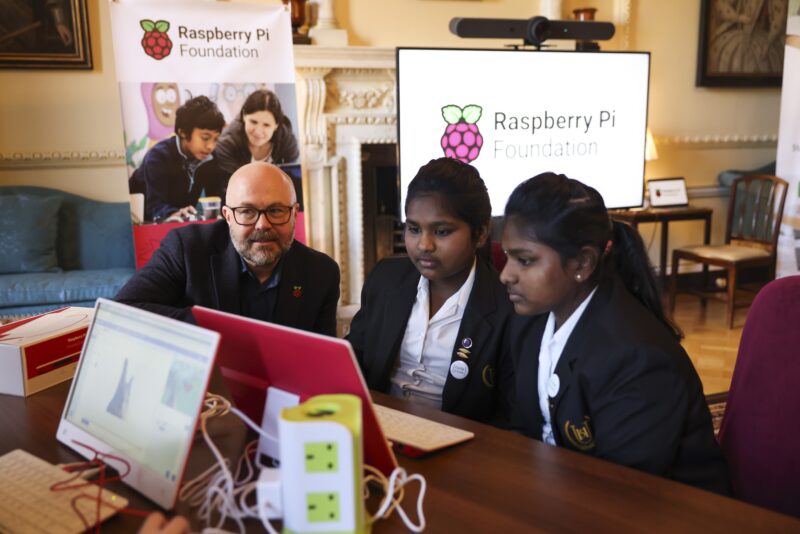
There’s no better way to develop those abilities (super powers even) than getting hands-on experience of programming, whether that’s coding an animation, designing a game, creating a website, building a robot buggy, or training an AI classification model. That’s what tens of thousands of young people do every day in Code Clubs all over the world.
We were absolutely thrilled to organise a Code Club at Number Ten Downing Street last week, hosted by the UK Prime Minister’s wife Akshata Murty as part of Lessons at 10.
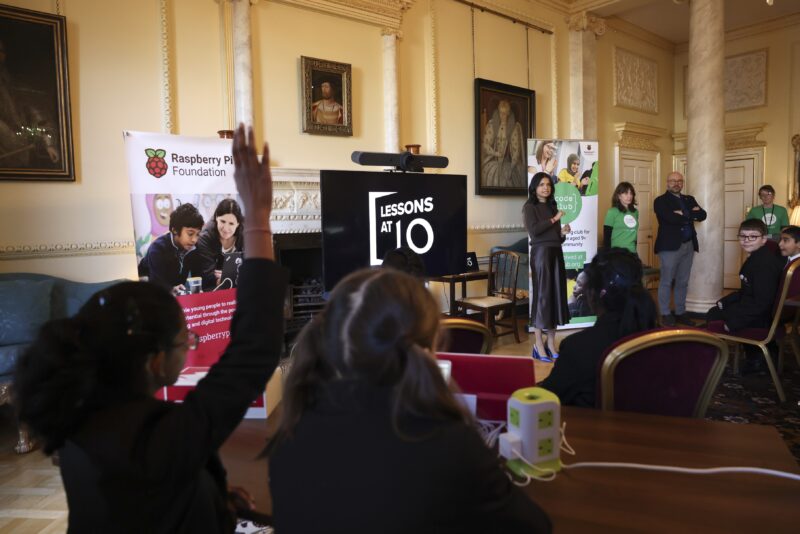
Lessons at 10 is an initiative to bring school children from all over the UK into Number Ten Downing Street, the official residence of the Prime Minister. Every week different schools visit to attend lessons led by education partners covering all kinds of subjects.
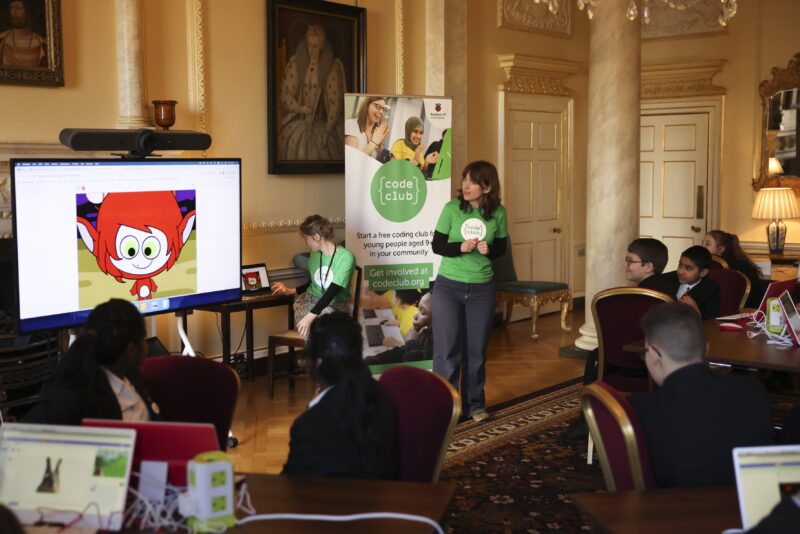
We ran a Code Club for 20 Year 7 students (ages 11 to 12) from schools in Coventry and Middlesex. The young people had a great time with the Silly eyes and Ghostbusters projects from our collections of Scratch projects. Both stone-cold classics in my opinion, and a great place to start if you’re new to programming.
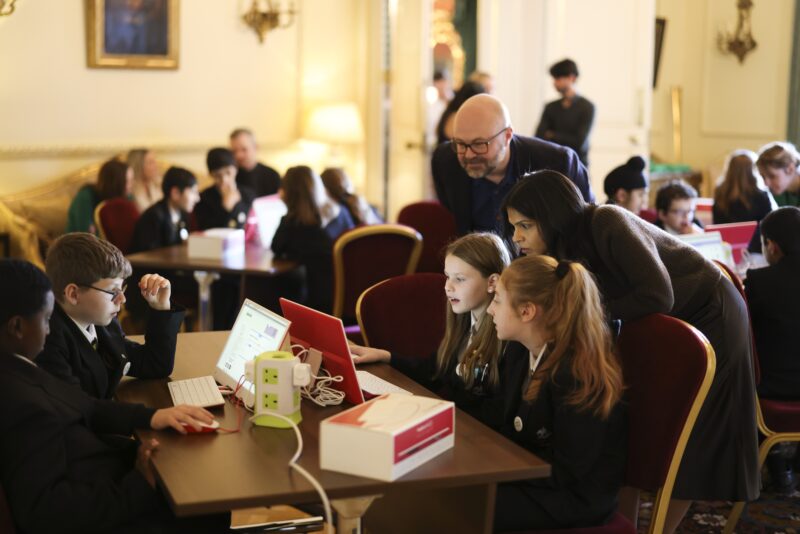
You may have spotted in the photos that the young people were programming on Raspberry Pi computers (the incredible Raspberry Pi 400 made in Wales). We also managed to get our hands on some cool new monitors.
Mrs Murty’s father was one of the founders of Infosys, which ranks among the world’s most successful technology companies, founded in India and now operating all over the world. So it is perhaps no surprise that she spoke eloquently to the students about the importance of every young person learning about technology and seeing themselves as digital creators not consumers.

We were lucky enough to be in one of the rather fancy rooms in Number Ten, featuring a portrait by John Constable of his niece Ada Lovelace, the world’s first computer programmer. Mrs Murty reminded us that one of the lessons we learn from Ada Lovelace is that computer programming combines both the logical and artistic aspects of human intelligence. So true.
Since Code Club’s launch in April 2012, it has grown to be the world’s largest movement of free computing clubs and has supported over 2 million young people to get creative with technology.

Code Clubs provide a free, fun, and safe environment for young people from all backgrounds to develop their digital skills. Run by teachers and volunteers, most Code Clubs take place in schools, and there are also lots in libraries and other community venues.
The Raspberry Pi Foundation provides a broad range of projects that young people use to build their confidence and skills with lots of different hardware and software. The ultimate goal is that they are empowered to combine their logical and artistic skills to create something original. Just like Ada Lovelace did all those years ago.

All of our projects are designed to be self-directed, so young people can learn independently or in groups. That means that you don’t need to be a tech expert to set up or run a Code Club. We provide you with all the support that you need to get started.
If you want to find out more about how to set up a Code Club, visit the website here.
The post Code Club at Number Ten Downing Street appeared first on Raspberry Pi Foundation.
Post Syndicated from Bruce Schneier original https://www.schneier.com/blog/archives/2024/01/quantum-computing-skeptics.html
Interesting article. I am also skeptical that we are going to see useful quantum computers anytime soon. Since at least 2019, I have been saying that this is hard. And that we don’t know if it’s “land a person on the surface of the moon” hard, or “land a person on the surface of the sun” hard. They’re both hard, but very different.
Post Syndicated from Michael Kammer original https://blog.zabbix.com/2023-in-review-a-bigger-bolder-and-better-zabbix/27272/
It hardly seems possible, but somehow 2023 is already in the rearview mirror. It’s been quite a ride, full of dynamic growth, popular events, new releases, and exciting additions to our global community. Without further ado, let’s take a look at the highlights!
Table of Contents
We radically expanded our slate of events this year in an attempt to spread the good word about the world’s finest open-source monitoring solution and meet our vibrant community. Our efforts took the form of:
• 31 meetings (in locations ranging from Kuala Lumpur to Seoul to Paris)
• 3 forums (in Shenzhen, Shanghai, and Mexico City)
• 16 meetups (online and in multiple locations around the globe)
• 5 conferences (in Germany, Benelux, China, Japan, and Latin America)
• Countless exhibitions, trade fairs, and expos from Las Vegas to Tokyo and all points in between
Oh, and one blowout Zabbix Summit in Riga in October!
This year we released Zabbix 6.4, which included many important new features:
• Just-in-time (JIT) user provisioning
• Cause and symptom events
• Instant propagation of configuration changes
• Zero-downtime upgrades
• SNMP discovery/bulk data collection speed and performance improvements
• A new menu layout
• The ability to stream metrics and events from Zabbix to external systems over HTTP
• Template versioning
• A development framework for widget creation
• Optional interfaces for server-originated checks
• Streamlined media type configuration for multiple email service providers
Zabbix 6.4 also comes with many new templates for the most popular vendors and cloud providers, including:
• Microsoft Azure MySQL servers
• Microsoft Azure PostgreSQL servers
• Microsoft Azure virtual machines
• Low-level discovery improvements in AWS by HTTP template
• Veeam Backup Enterprise Manager
• Veeam Backup and Replication
• Cisco Nexus 9000 Series
• BMC Control-M
• Cisco Meraki dashboard
• OS processes by Zabbix agent
• Improvements to filesystem discovery in official Zabbix OS templates
Speaking of templates, since the release of Zabbix 6.0, we have developed 38 new integrations, including:
• 16 application templates
• 4 cloud templates
• 2 database templates
• 6 webhooks
• 2 net templates
• 3 SAN templates
• 5 server templates
In January, we received an ISO/IEC 27001:2013 certificate for information security. The certification stands as proof positive that Zabbix protects all our information within the highest internationally acknowledged security standards and reaffirms our commitment to prioritize information security best practices everywhere within our organization.
February saw us launch a public bug bounty program in partnership with HackerOne, the world’s number one ethical hacker-powered platform. The program’s purpose is to discover potential security vulnerabilities by letting hackers proactively search for and report Zabbix security vulnerabilities and get rewarded for found and validated issues. The program has been a massive success, with 15 reports resolved and $17,800 in bounties being paid out so far.
In 2023 we managed to grow our headcount across every location we operate in, while adding to a growing roster of remote workers from around the world. On March 29, we officially opened a new office in Mexico, joining our offices in Brazil (opened in 2020), the United States (2016), Japan (2012), and Latvia (2005).
To celebrate this momentous occasion, we invited our community of users, partners, and customers to participate in a free and exclusive event dedicated entirely to Zabbix. They were able to learn a little more about the company, ask questions about the plans for the new office, and share knowledge with our team of experts.
Our Integration team also saw significant growth in 2023, which has resulted in a faster rollout of popular templates and integrations as well as higher levels of quality than ever before. The Partners team had a busy year as well, adding 19 new certified partners around the globe and upgrading several others to Premium and Certified Reseller status.
As an open-source company, we champion knowledge sharing and a more open world. It’s why we took part in the career day at the Transport and Telecommunication Institute in Riga, supported the “Youth Has Talent” contest in Latvia organized by the Laiks Jauniešiem association, and sent our Head of Training Kristine Lamberte as a guest speaker to Rezekne Technical School.
Our team in Latin America got in on the action by working with the DEDICATE Foundation to develop the Zabbix Innova Challenge. It’s a free activity that’s designed to promote the development of technological projects that involve young people in Mexico, while boosting the technology community and stimulating the development of creative solutions.
Our goal in showing up at all these events is to encourage young talent, support and invest in local social projects that empower and inspire future generations, share our skills and experience, and showcase some of the amazing career opportunities that Zabbix can offer.
We aim to create a world without interruption, and just as we strive to make the world a better place by building the best monitoring tool possible, we also do what we can to help those around us whose lives have been interrupted by circumstances beyond their control.
In 2023, that involved donating a total of €378,000 to organizations like the Children’s Hospital Foundation, Samaritan International Latvia, The Oncological Patient Support Association “Tree of Life”, the Children’s Foundation of Latvia, the Autism Support Point in Rēzekne, and ziedot.lv.
The world continued to sit up and take notice of what we’ve been doing in 2023. Brazilian tech journal iMasters started off the year by noting Zabbix LATAM’s incredible 300% growth rate, while another Brazilian journal, Baguete, published an outstanding piece on the opening of the Zabbix office in Mexico.
In May, we were recognized as the top monitoring solution on Peerspot, and July saw us spotlighted in Labs of Latvia, a media platform for tech and innovation, which reported on our global expansion.
October brought with it a wave of favorable press coverage – Zabbix Summit 2023 speaker Dr. Hiroshi Abe had great things to say about us when profiled in El Español, and the same publication also published a well-researched company profile after the Summit.
In addition, Guaratã Almeida, a Zabbix partner and the technology director of the Brazilian city of Maceió, was an enthusiastic4 participant in the Summit, as noted by the city’s website.
Meanwhile, ThinkIT in Japan published an insightful interview with Zabbix Engineers Elina Pulke and Eliza Sekace, plus an inside look at the Summit proceedings.
Belgian website ITdaily followed that up with a post-Summit look at our business model and future plans, while Techzine published a glowing profile of their own as November drew to a close.
The icing on the cake of 2023 was Zabbix being named to the list of the “Top 101 Latvia’s Most Valuable Enterprises in 2023.” It’s a good measure of our significant contribution to Latvia’s economy and a reminder of our increasingly global impact.
It was a year full of growth and accomplishments, and it was all possible because of our incredible community of customers and contributors! As 2024 approaches, you can look forward to a long list of new upgrades, events, and inspiration. Keep following us on social media, reading our blog, and checking our forum to stay on top of all the latest Zabbix news and events!
The post 2023 in Review: A Bigger, Bolder, and Better Zabbix appeared first on Zabbix Blog.
Post Syndicated from Matt Granger original https://www.youtube.com/watch?v=4dzqMx9iPTk
Post Syndicated from original https://www.toest.bg/dumi-na-godinata-2023/

Кампанията на образователната платформа „Как се пише?“ приключи, победителите са ясни и са публично достояние. А оттук нататък? Това, че знаем думите на 2023 година, само по себе си е интересно, дори любопитно, но нека да отидем отвъд занимателната страна и да се запитаме: какво ни казват те?
Вече за трети път заедно с Доротея Николова – преподавателка по български език и литература и журналистка, организираме това своеобразно проучване на обществените нагласи, допитвайки се направо до хората. Една от целите ни е да направим бърз „преговор“ на годината чрез знаковите, ключовите думи, бележещи отминалите събития, като изследваме онова, което се е запечатало по-трайно в съзнанието на българите. За всяко общество е важно да знае какво го е вълнувало, тревожило, на какво е отдало значение, какво е пренебрегнало. Защото думите на годината синтезирано казват много – и присъстващите в класацията, и отсъстващите, заметените под килима, – стига да можем да ги разтълкуваме.
Процедурата, през която премина допитването, тръгна от хората и завърши с тях. В първия етап всеки желаещ можеше да даде своите предложения на страницата на „Как се пише?“ във Facebook и в Threads, както и в личния ми профил в Х. След това обобщихме резултатите и съставихме списък с 30-те думи и словосъчетания, за които получихме най-много предложения, и го изпратихме на членовете на журито. Освен мен и Доротея Николова като организатори, то включваше: доц. Георги Лозанов, философ и медиен експерт, Веселина Седларска, писателка и журналистка, и д-р Иван Ланджев, поет и есеист. След като дискутирахме предложенията, всички се обединихме около 10 от тях, които според нас най-адекватно отразяват духа на изминалата година и покриват възможно най-много теми. Финалните думи и словосъчетания включихме в анкета на „Как се пише?“, в която отново всеки желаещ можеше да участва. Резултатите от нея обявихме публично и ги изпратихме до медиите.
Отделна и независима част от проучването „Думи на годината 2023“ е анализът на езика в медиите през изминалата година, за който ни помагат специалистите от Sensika и който се основава на обработения от тях огромен текстов материал от онлайн източници на български език.
Но може да ги анализират. Очаквано или не, изкуствен интелект, сглобка и времеубежище оглавиха класацията.
Безспорната новина е, че естественият интелект издигна изкуствения интелект на пиедестала на 2023-та. Дали защото създава неподозирани възможности във всички сфери на живота, или защото заплашва съществуващите модели – пак във всички сфери на живота? Или защото събужда у нас любопитството да проверим какво може, но и страха да не се окажем ненужни? Със сигурност технологичният феномен ни вълнува и трябва да следим какви права му делегираме. Това словосъчетание ни сближава и със света: през декември речникът „Колинс“ обяви съкращението AI (ИИ) за дума на годината във Великобритания, а според речника на Кеймбридж знаков е бил глаголът халюцинирам, свързан отново с изкуствения интелект, този път – с произвеждането на невярна информация от него. Наблюденията на специалистите от „Колинс“ показват, че употребата на изкуствен интелект е скочила четири пъти в сравнения с предишната година. Отново може да се сравним със света – в българските медийни публикации това словосъчетание се е срещало почти пет пъти по-често през 2023 година, отколкото през предходната¹.
Преди началото на кампанията прогнозата ми беше, че сглобката трудно може да бъде победена. Думата стана удобна за назоваване на една форма на управление, за която на самите участници в него не им стигна смелостта или пък откровеността да я нарекат коалиция. Мисля, че именно отказът им да си послужат със съществуваща дума в езика вдъхна нов живот на сглобка, която доскоро означаваше само проста по същността си връзка, съединение. Названието заживя нов, политически живот, но върху него продължава да тегне стигмата на механичното свързване, лишено от сложността и смислеността на едни връзки от доста по-високо ниво, каквито (би трябвало да) са управленските. Ето защо сглобка се оказа толкова предпочитана дума от критиците на правителството, които не пропускат възможност да го иронизират чрез нея.
Един неологизъм си проби път в класацията, а вече го прави и в самия език. Времеубежище е преди всичко заглавие на роман, но има достатъчно свидетелства, че се употребява като съществително нарицателно име². С членовете на журито отчетохме факта и затова решихме да включим думата с малка буква и без кавички в анкетата. За мен ще е интересно да наблюдавам дали времеубежище ще се утвърди в езика. Първо, защото е създадена от писател, а не се случва всеки ден български писател да изкове нова дума; второ, защото е сложна, има специфично значение, което тежнее към абстрактното. Опитвайки се да го изясня за себе си, се питам: времеубежището (извън романа) всъщност убежище във или от времето е? Ето такива въпроси пораждат сложните думи, защото, когато двете им части се споят в едно цяло, между тях възникват куп отношения. А многото гласове, които думата получи, си обяснявам с това, че ние, българите, все пак сме способни да оценим успеха на наш сънародник и да се зарадваме.
Познатите ни политически теми са тук, за да ни напомнят, че ни е трудно да мислим за важното и ключовото за страната, без да споменем война, демонтаж, ротация, Шенген, евроатлантик. Неслучайно извън десетте думи в анкетата остана не-коалиция, макар да беше предложена от доста хора в първия етап от кампанията. Журито реши, че три думи за формата на управление (заедно със сглобка и ротация) много биха натежали, да не говорим че включихме и евроатлантик – евроатлантизмът беше едно от ключовите понятия за миналата година, отнасящи се за властовата спойка.
Без да подценявам резултата на демонтаж и важността на събитието, възможно е немалка роля да е изиграло и времето. Паметникът на Съветската армия беше актуална тема съвсем наскоро, през месец декември, и все още помним добре какво се случи. Дали обаче нямаше да позабравим демонтажа, ако се беше състоял през февруари например? Забравяме със страшна сила и скорост. Вижте примерите в следващата част.
Името на една международна награда – „Букър“, присъства в класацията, за да ни каже, че и ний сме дали нещо на световната литература, но на другия полюс, за отрезвяване, е PISA. За да ни напомня – веднъж на три години – колко далеч е образователната ни система от международните стандарти и достижения. Впрочем и това удобно ще го забравим.
Както писа Георги Лозанов в „Дойче Веле“, класациите „Думи на годината“ са „най-бързият начин да разбереш за какво на хората им се мисли и за какво не“. По съществени теми и за значими събития не ни се мисли: домашното насилие, войната в Близкия изток, промените в Конституцията… В началото на кампанията получихме само единични предложения за „домашно насилие“, „макетно ножче“, „ивицата Газа“, „Конституция“. И трите теми привлякоха общественото внимание през миналата година, първите две акумулираха енергия и в социалните мрежи, медиите отразиха събитията, но човешкото съзнание ги счете за незначими. Може би защото насилието в семейството е твърде болезнено или не се отнася до нас конкретно, войната в Газа е далече, а конституционните промени вече станаха банални. Причини и обяснения ще намерим, стига да ги потърсим. Но ще потърсим ли решения поне за това, което сме в състояние да променим?
Все пак има и добри новини. Да погледнем отново към победителите в класацията, но в съпоставка с думите на предишните години: преценям, антиваксър и изчегъртване за 2021-ва и война, инфлация, избори и Украйна за 2022-ра. С избора на изкуствен интелект – от технологичната сфера, и на времеубежище – от културната, като че ли се опитваме да се откъснем от тягостното политическо говорене и да се насочим към нови хоризонти. Колкото и да е определяща политиката за живота в едно общество, не бива да допускаме общественият разговор да се води под нейния диктат. Дано лека-полека започнем да го осъзнаваме.
2 Невярващите може да напишат например „времеубежището“, „моето времеубежище“ или „нашето времеубежище“ (в кавички) в някоя търсачка, която услужливо ще им предложи резултати, включително и в текстове, нямащи нищо общо с творбата на Георги Господинов.
Езикът всъщност може да е вкусен и извън блюдото – онзи, българският език, на който говорим от малки и на който около 24 май се кълнем в обич. А той в основната си същност е средство за общуване и за да ни служи добре, непрекъснато се променя. Да го погледнем в неговата динамика и да се опитаме да разберем какво всъщност става и защо, кои са движещите механизми и как те са свързани с обществените процеси. И тъй като задачата не е лека, ще го правим постепенно – на порции.