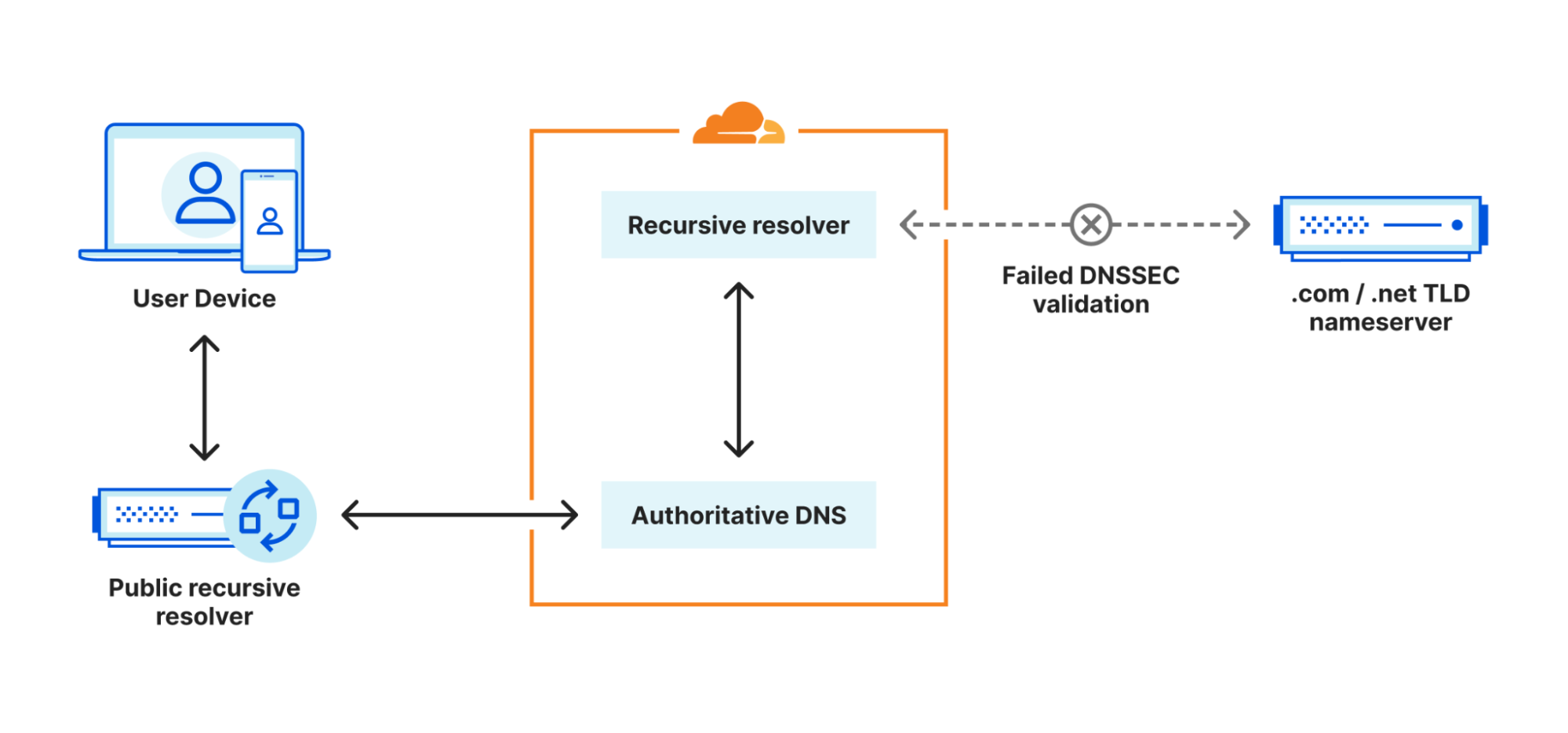
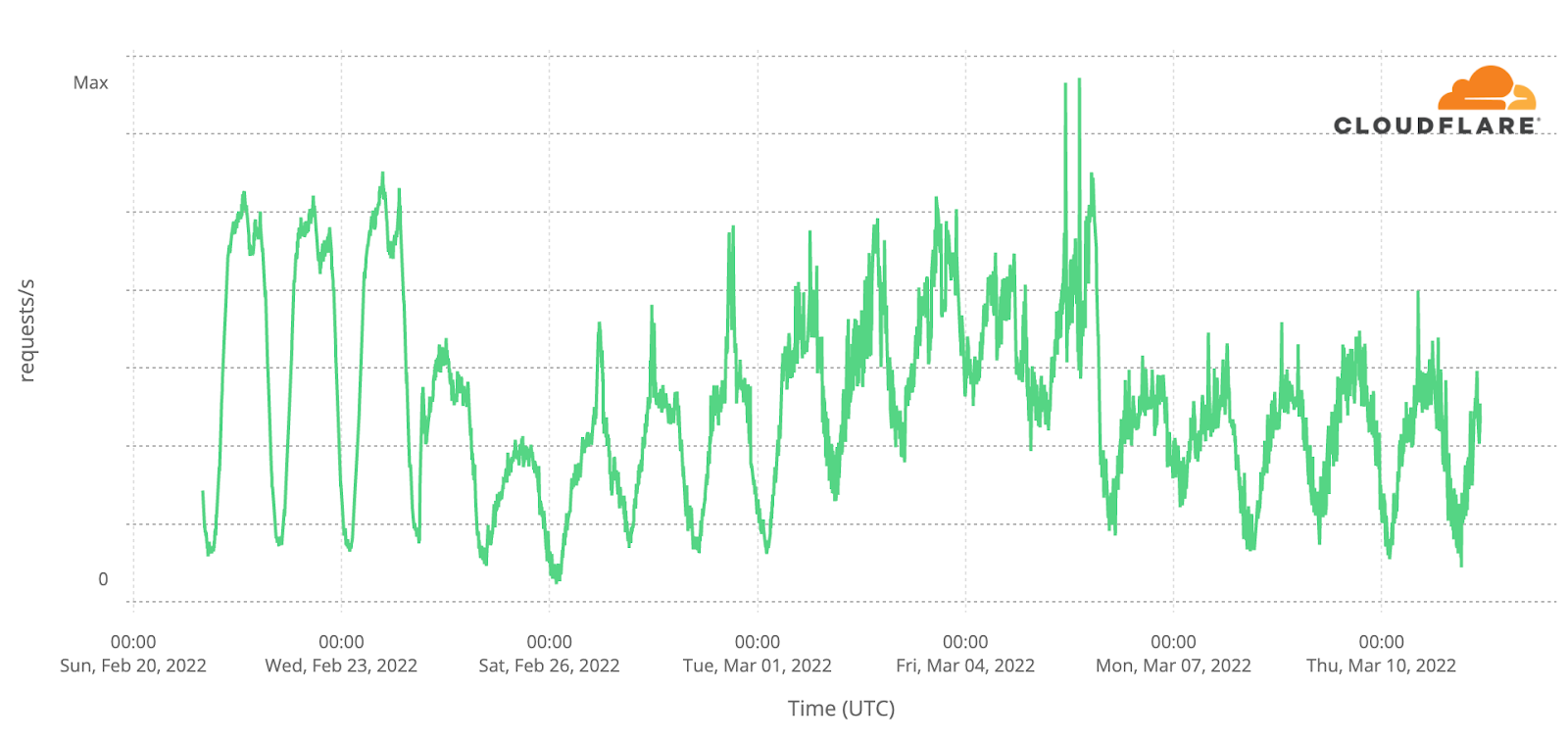
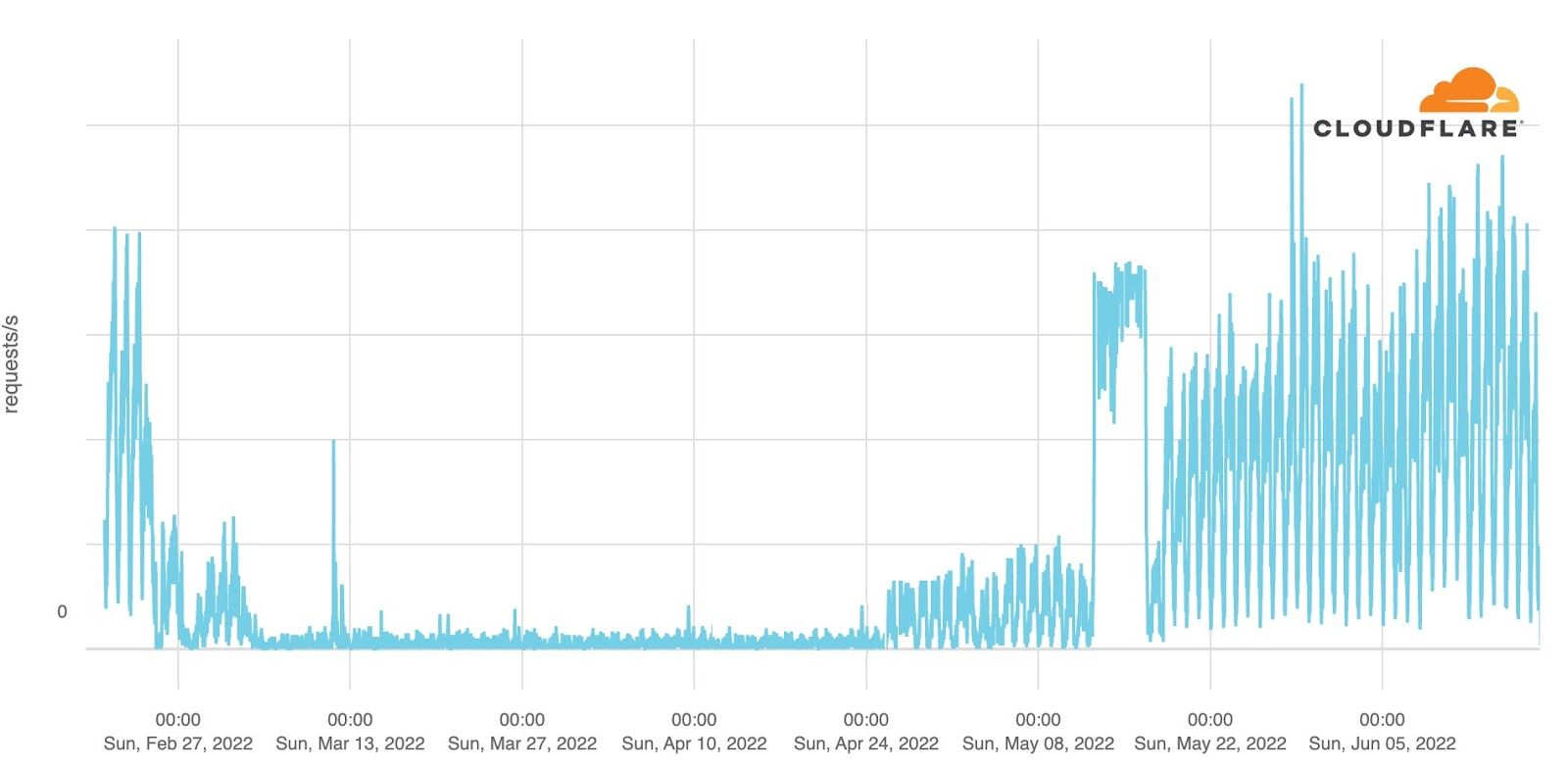
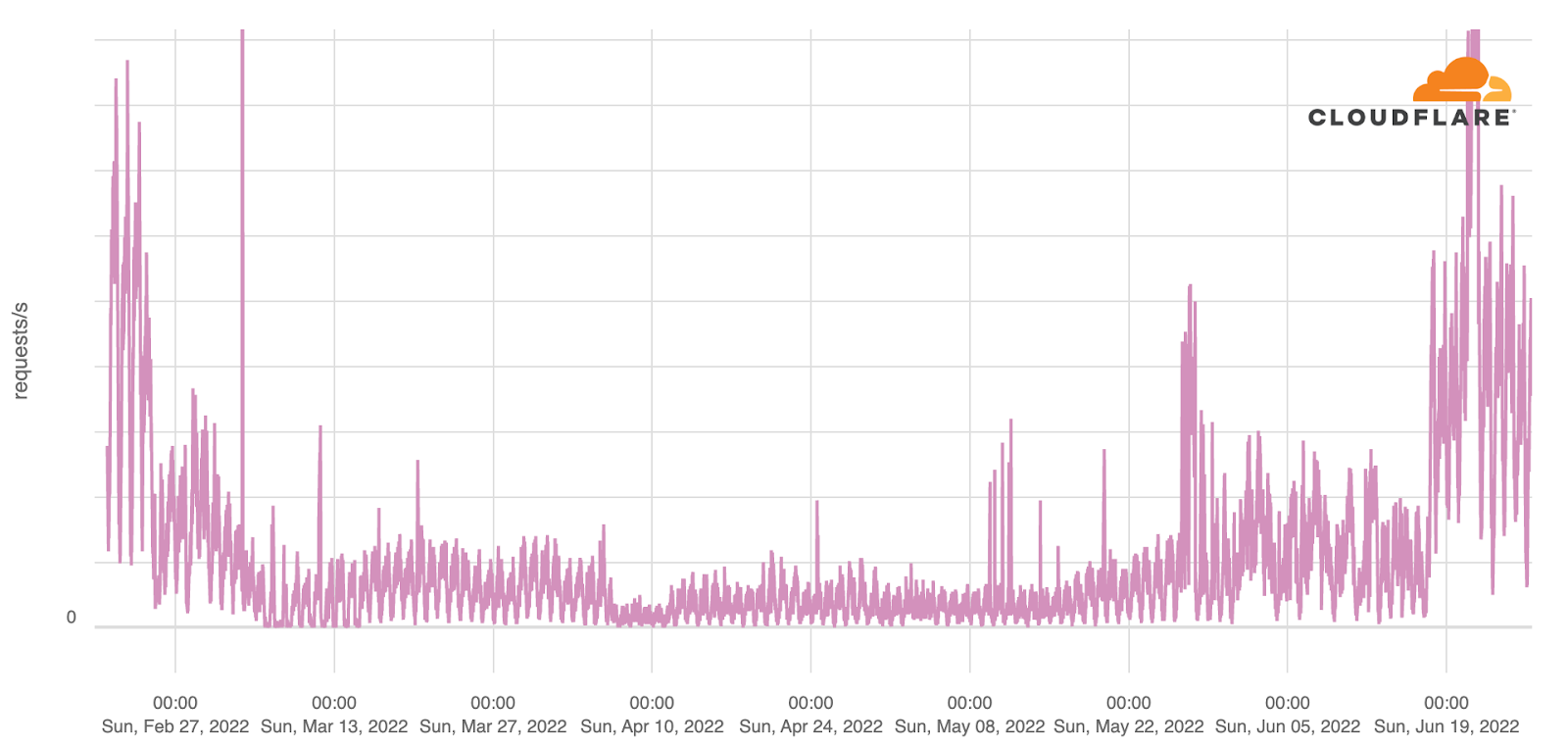
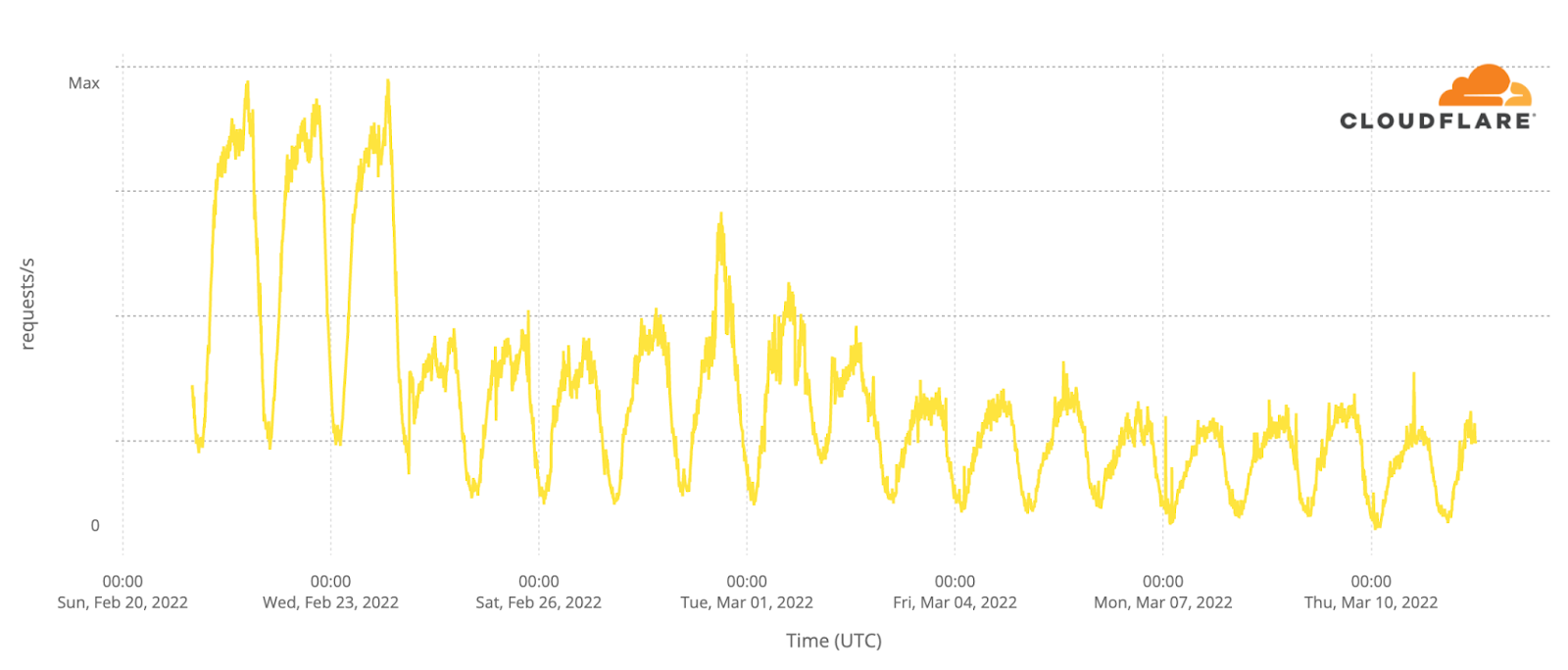
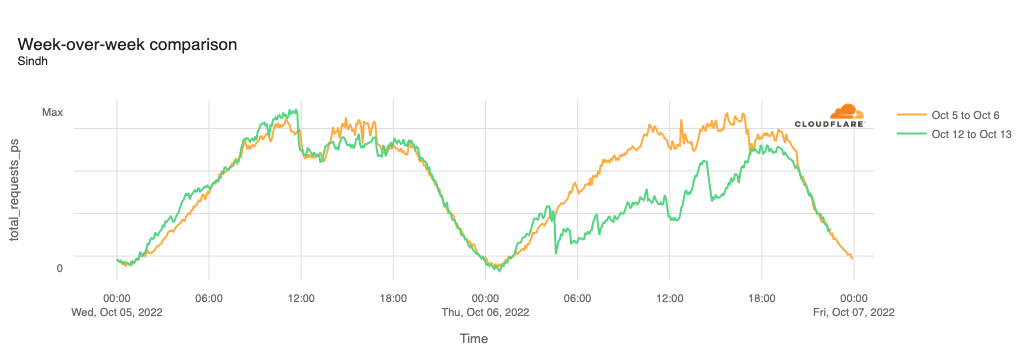
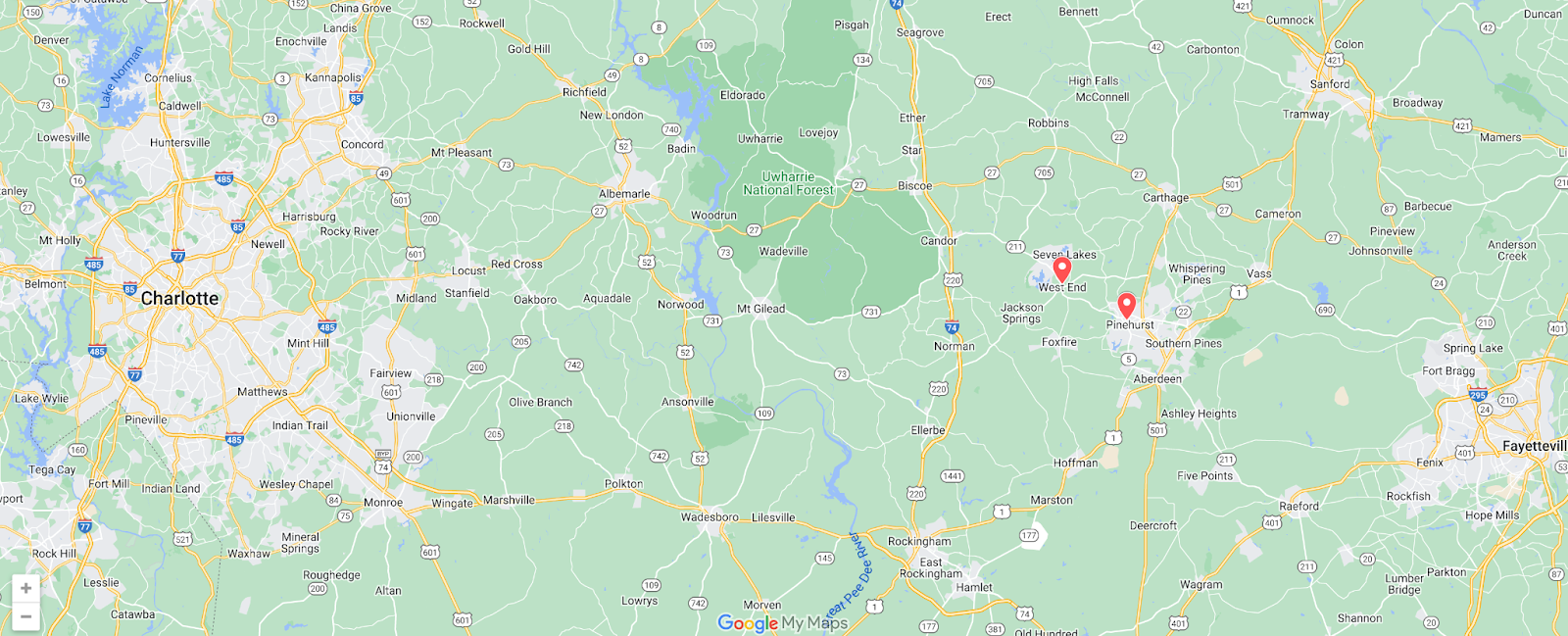
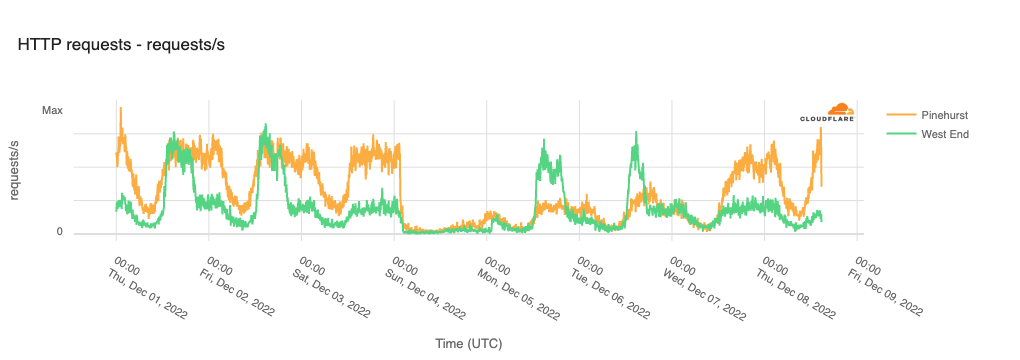
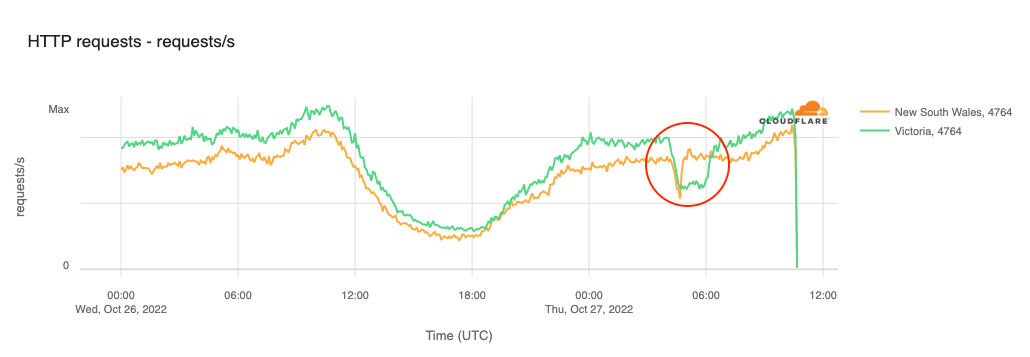
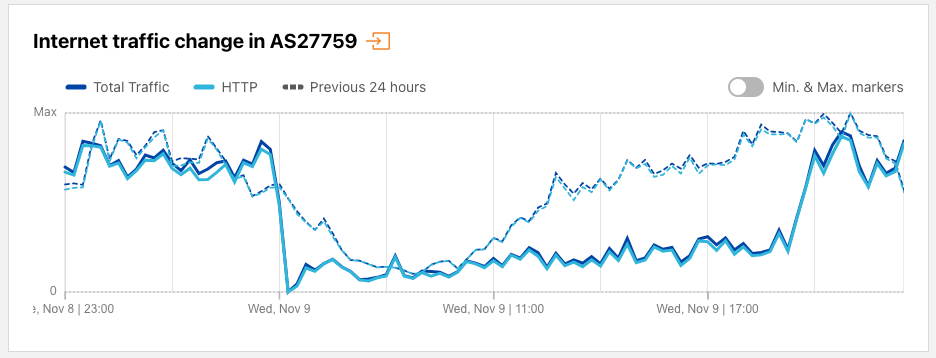
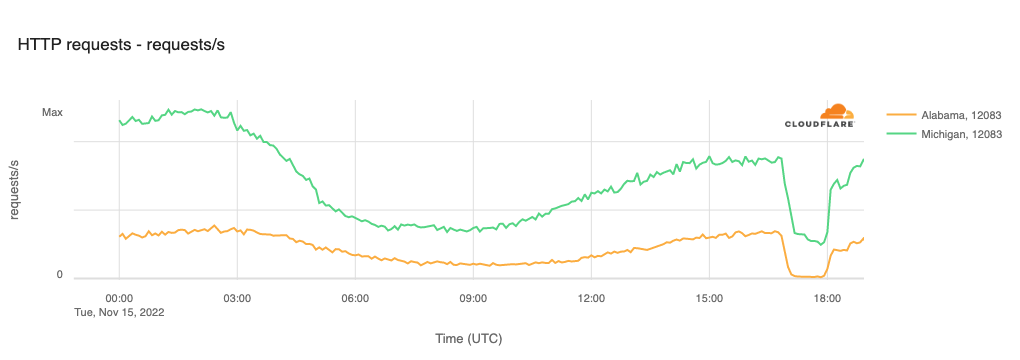
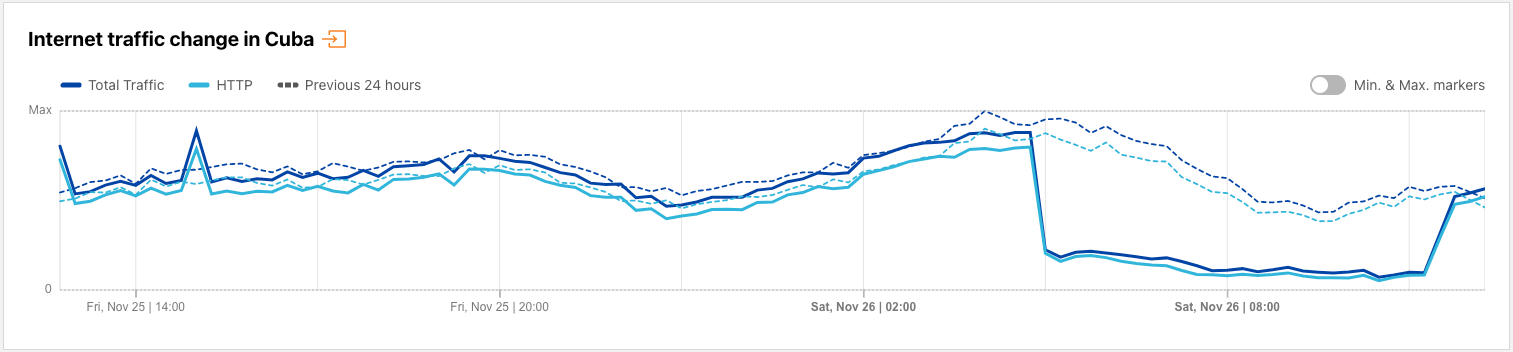
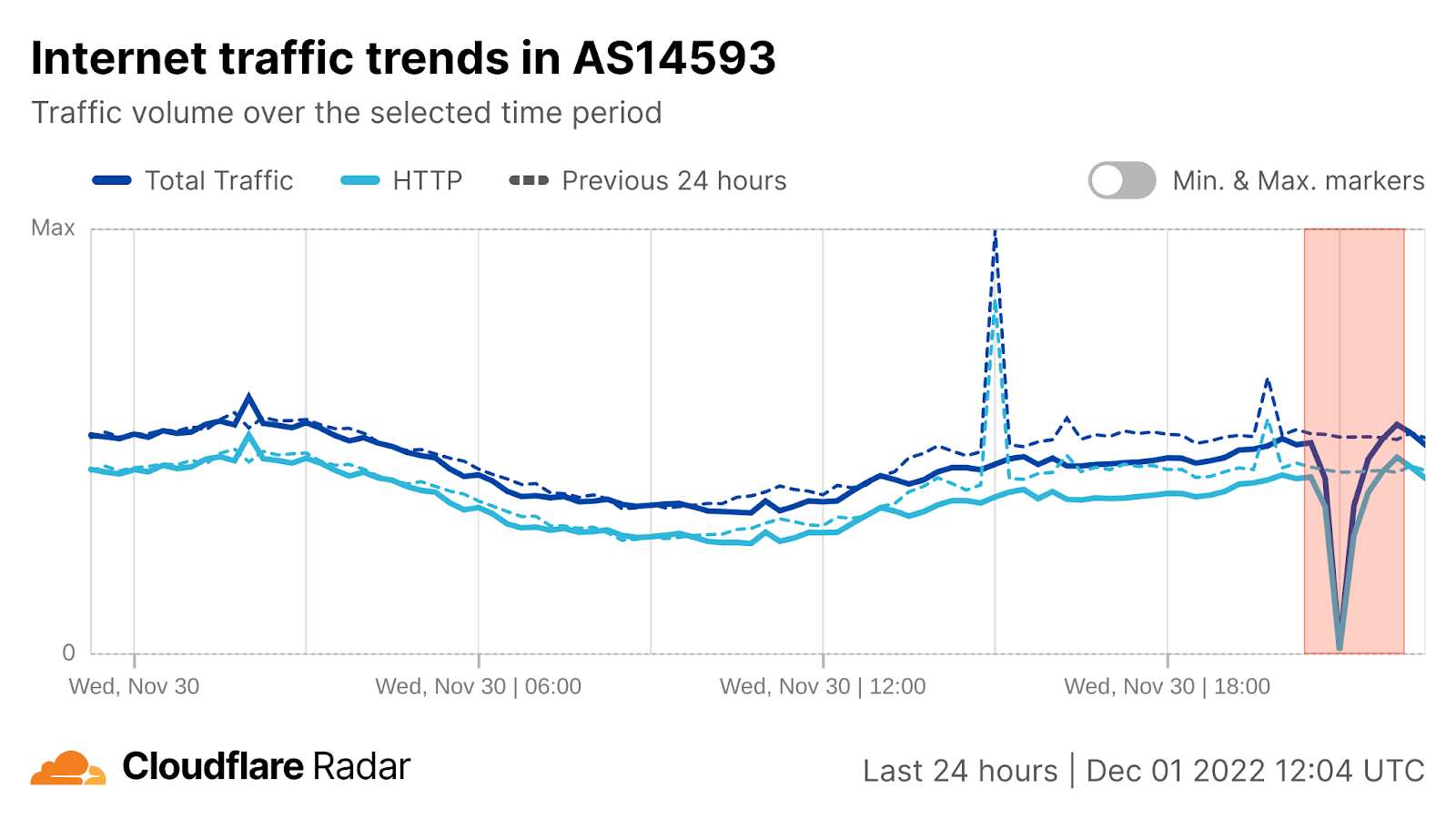
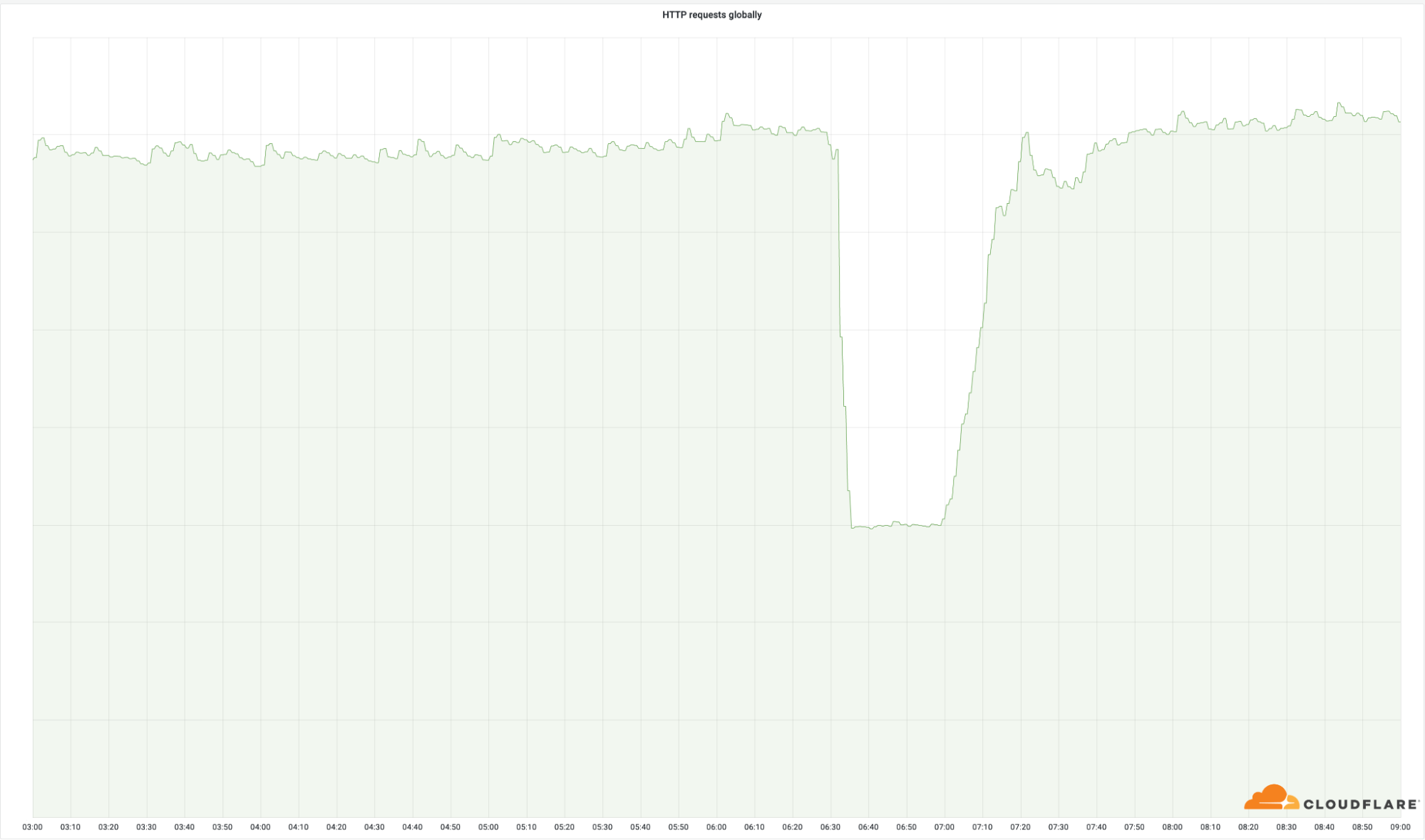
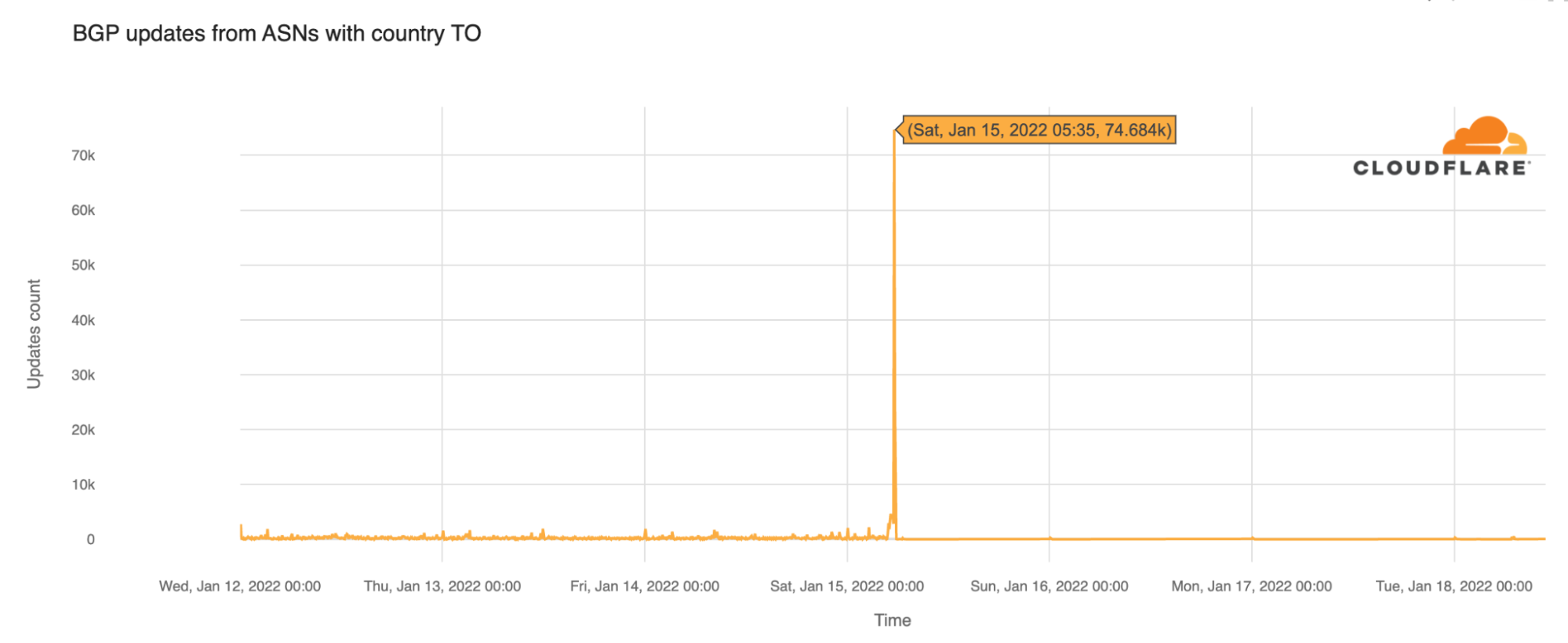
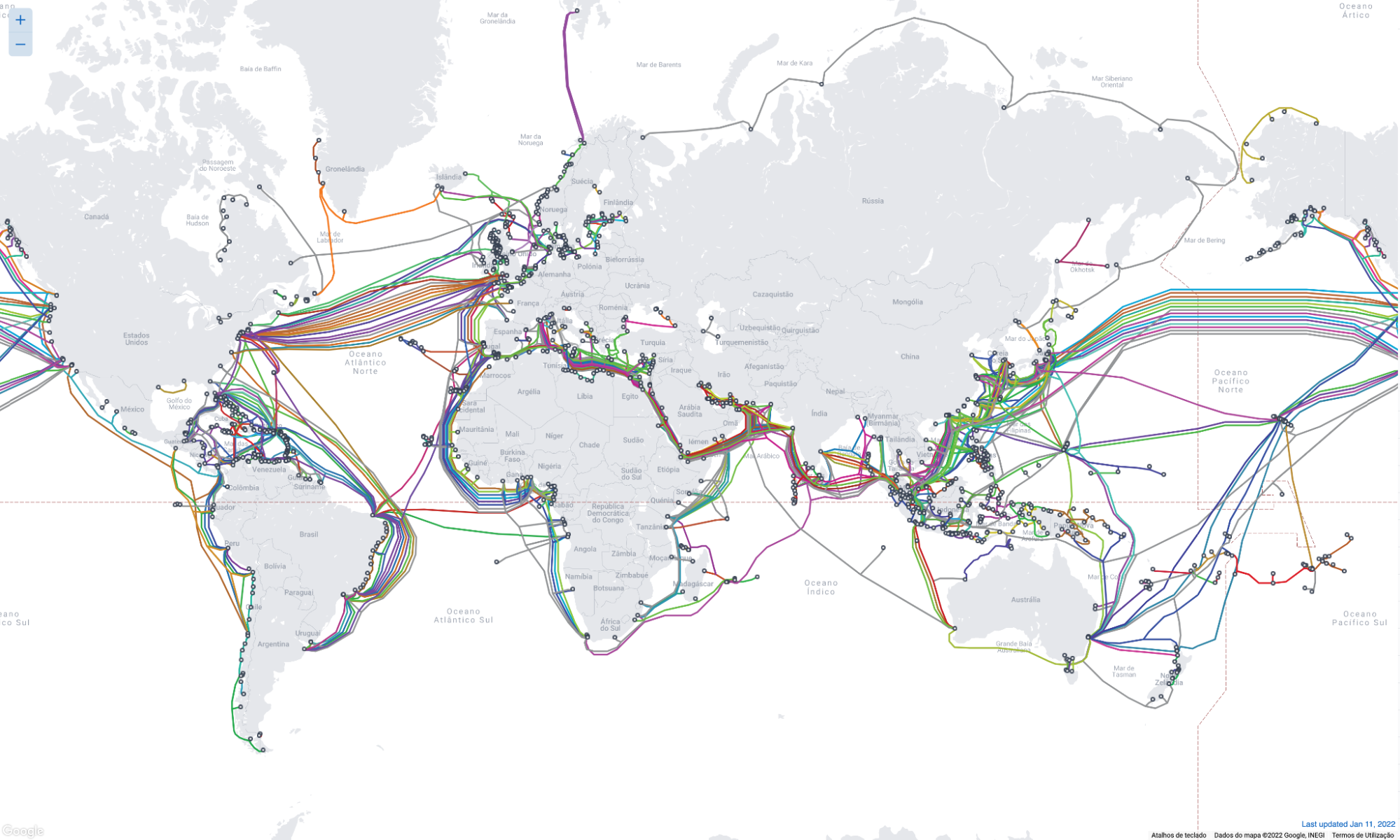
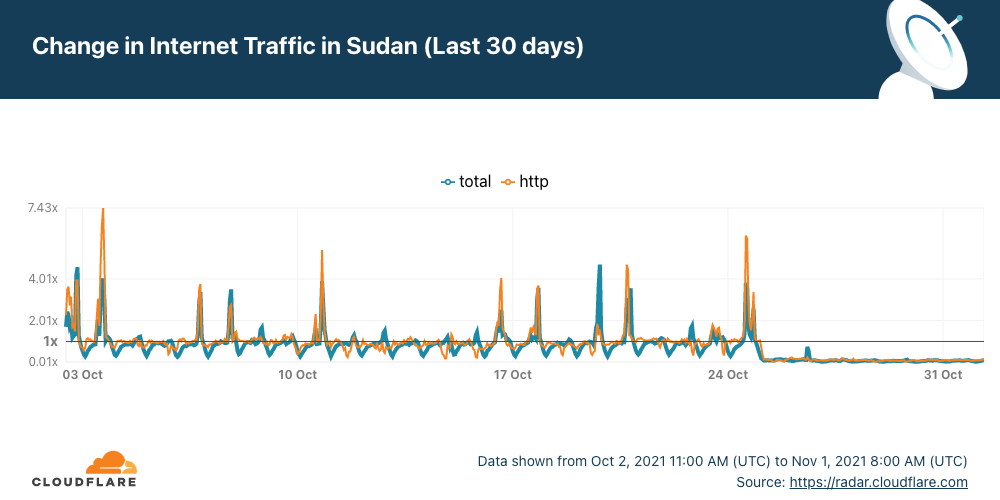
On Sunday, July 9, 2023, early morning UTC time, we observed a high number of DNS resolution failures — up to 7% of all DNS queries across the Asia Pacific region — caused by invalid DNSSEC signatures from Verisign .com and .net Top Level Domain (TLD) nameservers. This resulted in connection errors for visitors of Internet properties on Cloudflare in the region.
The local instances of Verisign’s nameservers started to respond with expired DNSSEC signatures in the Asia Pacific region. In order to remediate the impact, we have rerouted upstream DNS queries towards Verisign to locations on the US west coast which are returning valid signatures.
We have already reached out to Verisign to get more information on the root cause. Until their issues have been resolved, we will keep our DNS traffic to .com and .net TLD nameservers rerouted, which might cause slightly increased latency for the first visitor to domains under .com and .net in the region.
Background
In order to proxy a domain’s traffic through Cloudflare’s network, there are two components involved with respect to the Domain Name System (DNS) from the perspective of a Cloudflare data center: external DNS resolution, and upstream or origin DNS resolution.
To understand this, let’s look at the domain name blog.cloudflare.com — which is proxied through Cloudflare’s network — and let’s assume it is configured to use origin.example as the origin server:
Here, the external DNS resolution is the part where DNS queries to blog.cloudflare.com sent by public resolvers like 1.1.1.1 or 8.8.8.8 on behalf of a visitor return a set of Cloudflare Anycast IP addresses. This ensures that the visitor’s browser knows where to send an HTTPS request to load the website. Under the hood your browser performs a DNS query that looks something like this (the trailing dot indicates the DNS root zone):
(Your computer doesn’t actually use the dig command internally; we’ve used it to illustrate the process) Then when the next closest Cloudflare data center receives the HTTPS request for blog.cloudflare.com, it needs to fetch the content from the origin server (assuming it is not cached).
There are two ways Cloudflare can reach the origin server. If the DNS settings in Cloudflare contain IP addresses then we can connect directly to the origin. In some cases, our customers use a CNAME which means Cloudflare has to perform another DNS query to get the IP addresses associated with the CNAME. In the example above, blog.cloudflare.com has a CNAME record instructing us to look at origin.example for IP addresses. During the incident, only customers with CNAME records like this going to .com and .net domain names may have been affected.
The domain origin.example needs to be resolved by Cloudflare as part of the upstream or origin DNS resolution. This time, the Cloudflare data center needs to perform an outbound DNS query that looks like this:
$ dig origin.example. +short
192.0.2.1
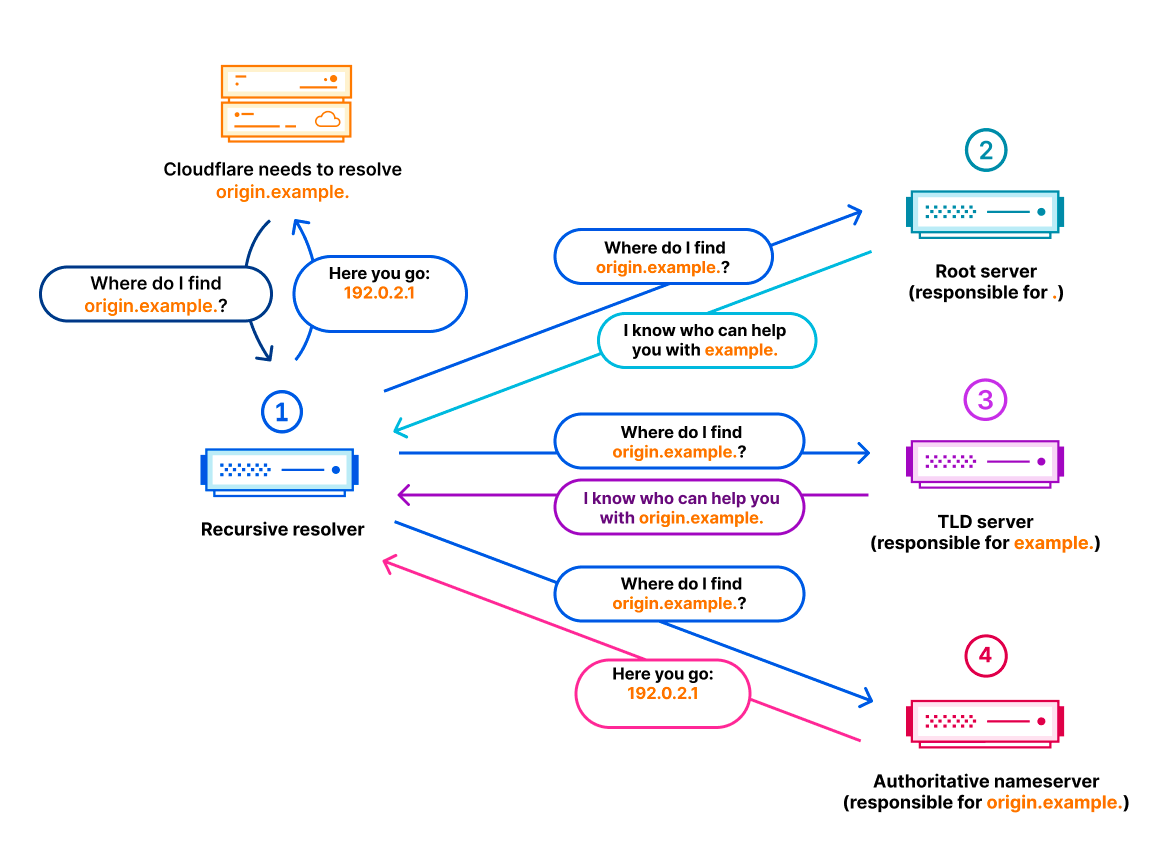
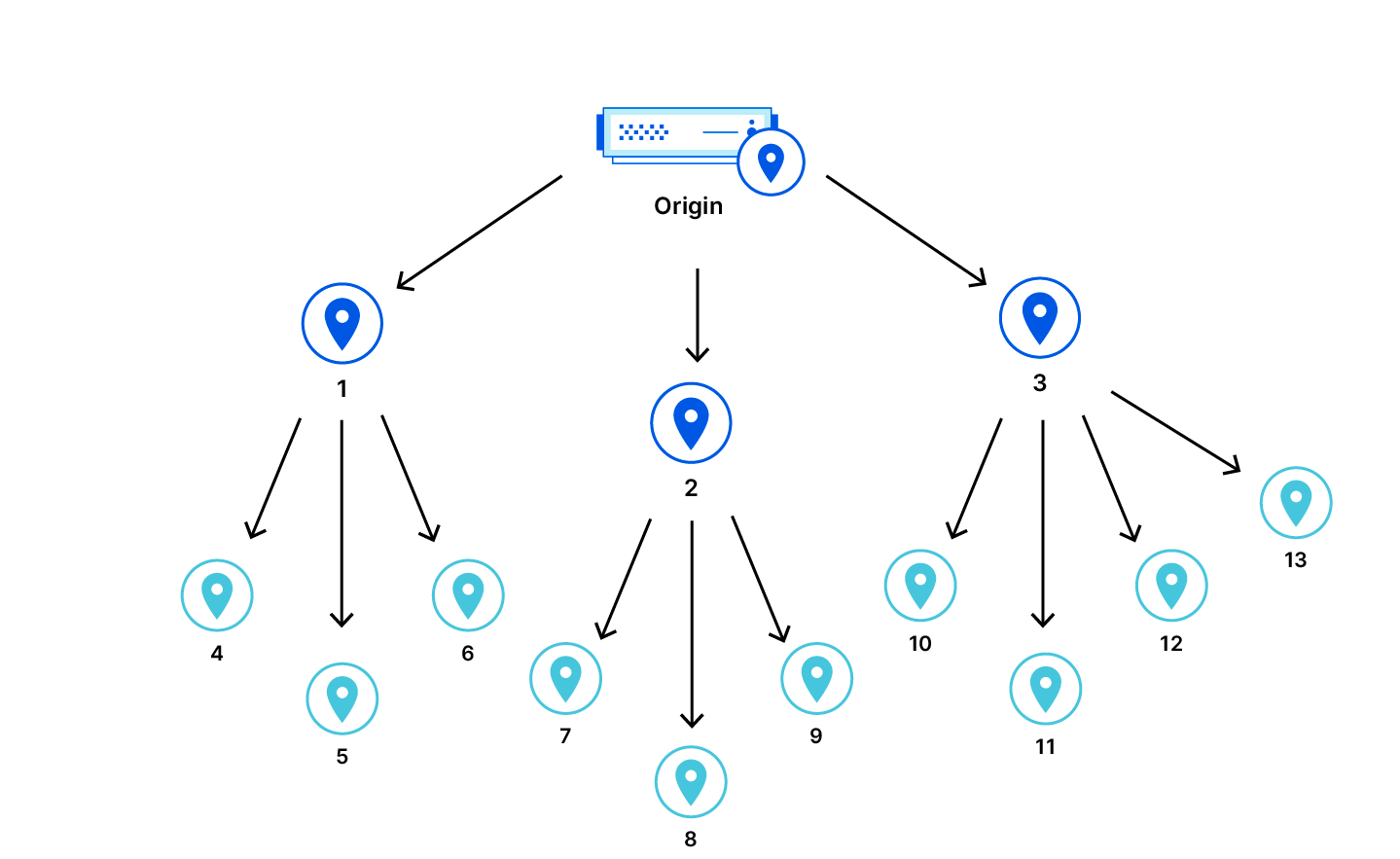
DNS is a hierarchical protocol, so the recursive DNS resolver, which usually handles DNS resolution for whoever wants to resolve a domain name, needs to talk to several involved nameservers until it finally gets an answer from the authoritative nameservers of the domain (assuming no DNS responses are cached). This is the same process during the external DNS resolution and the origin DNS resolution. Here is an example for the origin DNS resolution:
Inherently, DNS is a public system that was initially published without any means to validate the integrity of the DNS traffic. So in order to prevent someone from spoofing DNS responses, DNS Security Extensions (DNSSEC) were introduced as a means to authenticate that DNS responses really come from who they claim to come from. This is achieved by generating cryptographic signatures alongside existing DNS records like A, AAAA, MX, CNAME, etc. By validating a DNS record’s associated signature, it is possible to verify that a requested DNS record really comes from its authoritative nameserver and wasn’t altered en-route. If a signature cannot be validated successfully, recursive resolvers usually return an error indicating the invalid signature. This is exactly what happened on Sunday.
Incident timeline and impact
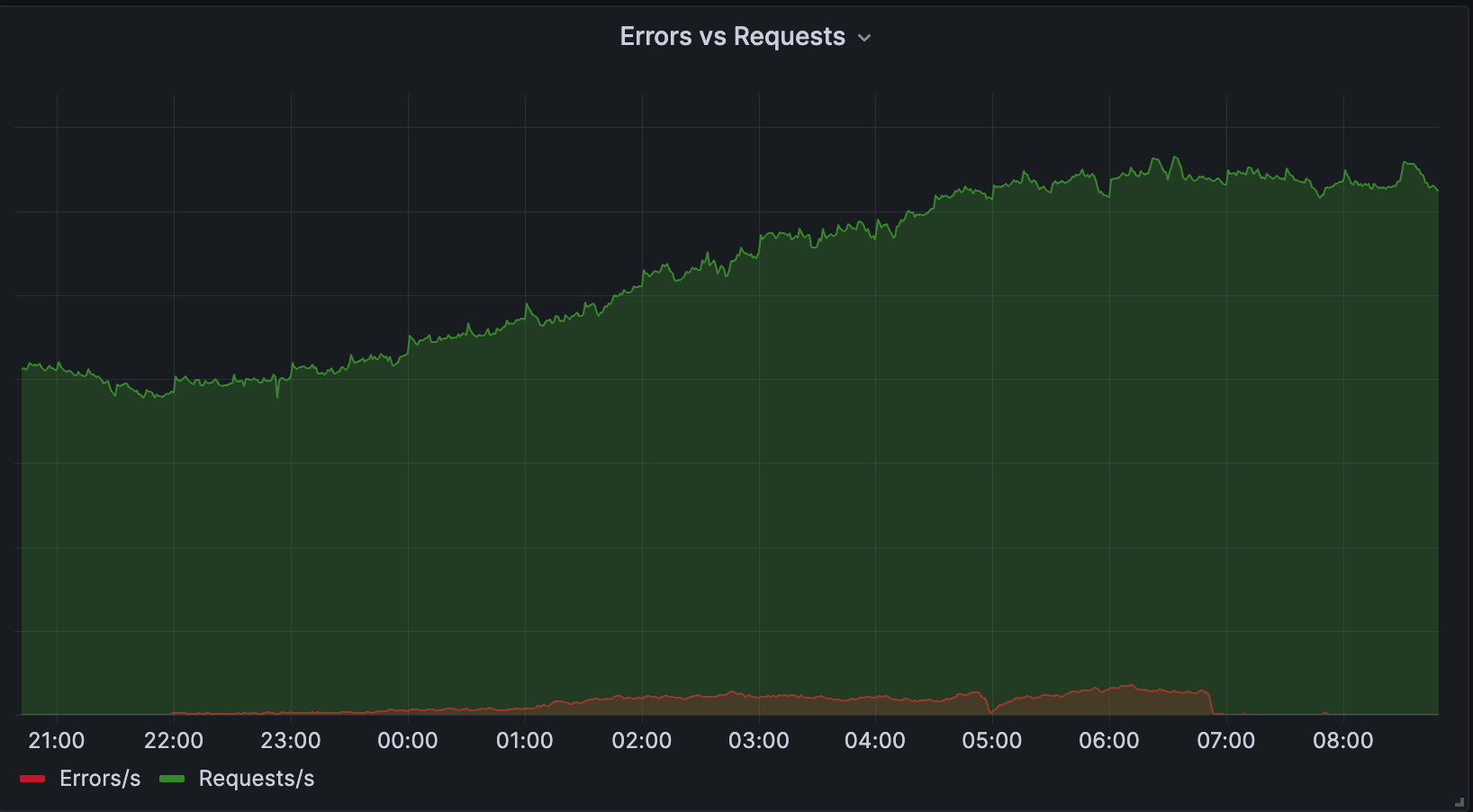
On Saturday, July 8, 2023, at 21:10 UTC our logs show the first instances of DNSSEC validation errors that happened during upstream DNS resolution from multiple Cloudflare data centers in the Asia Pacific region. It appeared DNS responses from the TLD nameservers of .com and .net of the type NSEC3 (a DNSSEC mechanism to prove non-existing DNS records) did not include signatures. About an hour later at 22:16 UTC, the first internal alerts went off (since it required issues to be consistent over a certain period of time), but error rates were still at a level at around 0.5% of all upstream DNS queries.
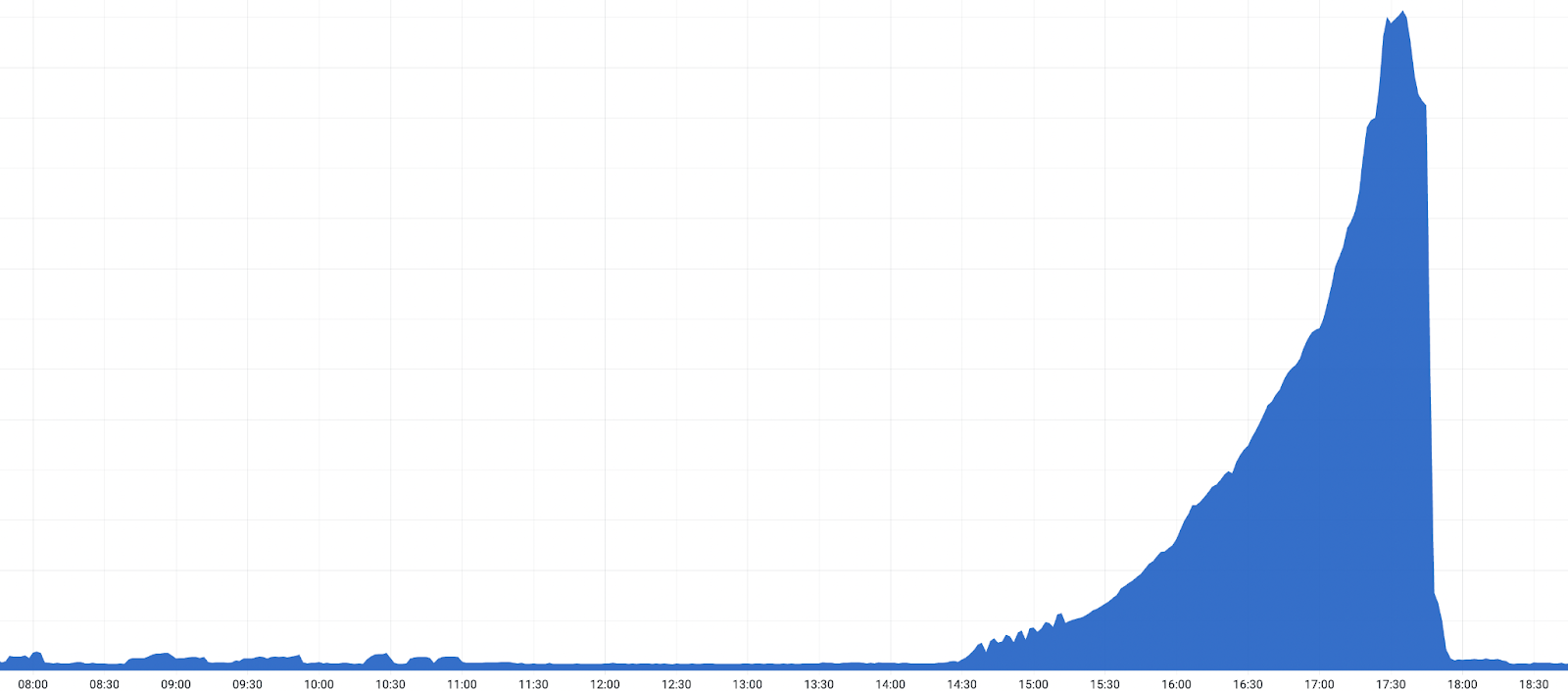
After several hours, the error rate had increased to a point in which ~13% of our upstream DNS queries in affected locations were failing. This percentage continued to fluctuate over the duration of the incident between the ranges of 10-15% of upstream DNS queries, and roughly 5-7% of all DNS queries (external & upstream resolution) to affected Cloudflare data centers in the Asia Pacific region.
Initially it appeared as though only a single upstream nameserver was having issues with DNS resolution, however upon further investigation it was discovered that the issue was more widespread. Ultimately, we were able to verify that the Verisign nameservers for .com and .net were returning expired DNSSEC signatures on a portion of DNS queries in the Asia Pacific region. Based on our tests, other nameserver locations were correctly returning valid DNSSEC signatures.
In response, we rerouted our DNS traffic to the .com and .net TLD nameserver IP addresses to Verisign’s US west locations. After this change was propagated, the issue very quickly subsided and origin resolution error rates returned to normal levels.
All times are in UTC:
2023-07-08 21:10 First instances of DNSSEC validation errors appear in our logs for origin DNS resolution.
2023-07-08 22:16 First internal alerts for Asia Pacific data centers go off indicating origin DNS resolution error on our test domain. Very few errors for other domains at this point.
2023-07-09 02:58 Error rates have increased substantially since the first instance. An incident is declared.
2023-07-09 03:28 DNSSEC validation issues seem to be isolated to a single upstream provider. It is not abnormal that a single upstream has issues that propagate back to us, and in this case our logs were predominantly showing errors from domains that resolve to this specific upstream.
2023-07-09 04:52 We realize that DNSSEC validation issues are more widespread and affect multiple .com and .net domains. Validation issues continue to be isolated to the Asia Pacific region only, and appear to be intermittent.
2023-07-09 05:15 DNS queries via popular recursive resolvers like 8.8.8.8 and 1.1.1.1 do not return invalid DNSSEC signatures at this point. DNS queries using the local stub resolver continue to return DNSSEC errors.
2023-07-09 06:24 Responses from .com and .net Verisign nameservers in Singapore contain expired DNSSEC signatures, but responses from Verisign TLD nameservers in other locations are fine.
2023-07-09 06:41 We contact Verisign and notify them about expired DNSSEC signatures.
2023-07-09 06:50 In order to remediate the impact, we reroute DNS traffic via IPv4 for the .com and .net Verisign nameserver IPs to US west IPs instead. This immediately leads to a substantial drop in the error rate.
2023-07-09 07:06 We also reroute DNS traffic via IPv6 for the .com and .net Verisign nameserver IPs to US west IPs. This leads to the error rate going down to zero.
2023-07-10 09:23 The rerouting is still in place, but the underlying issue with expired signatures in the Asia Pacific region has still not been resolved.
2023-07-10 18:23 Versign gets back to us confirming that they “were serving stale data” at their local site and have resolved the issues.
Technical description of the error and how it happened
As mentioned in the introduction, the underlying cause for this incident was expired DNSSEC signatures for .net and .com zones. Expired DNSSEC signatures will cause a DNS response to be interpreted as invalid. There are two main scenarios in which this error was observed by a user:
CNAME flattening for external DNS resolution. This is when our authoritative nameservers attempt to return the IP address(es) that a CNAME record target resolves to rather than the CNAME record itself.
CNAME target lookup for origin DNS resolution. This is most commonly used when an HTTPS request is sent to a Cloudflare anycast IP address, and we need to determine what IP address to forward the request to. See How Cloudflare works for more details.
In both cases, behind the scenes the DNS query goes through an in-house recursive DNS resolver in order to lookup what a hostname resolves to. The purpose of this resolver is to cache queries, optimize future queries and provide DNSSEC validation. If the query from this resolver fails for whatever reason, our authoritative DNS system will not be able to perform the two scenarios outlined above.
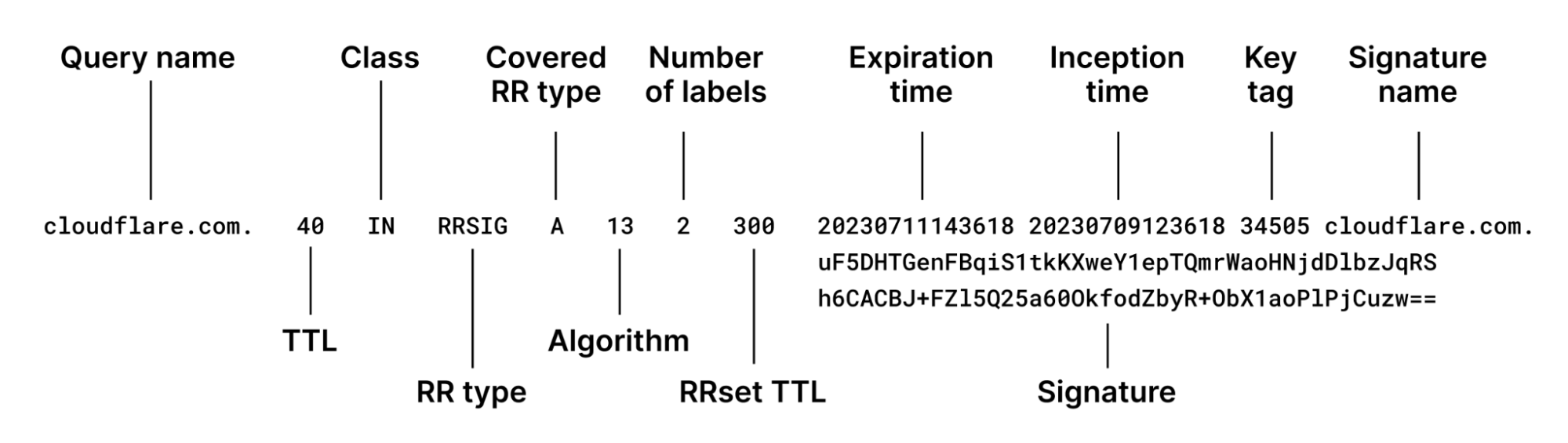
During the incident, the recursive resolver was failing to validate the DNSSEC signatures in DNS responses for domains ending in .com and .net. These signatures are sent in the form of an RRSIG record alongside the other DNS records they cover. Together they form a Resource Record set (RRset). Each RRSIG has the corresponding fields:
As you can see, the main part of the payload is associated with the signature and its corresponding metadata. Each recursive resolver is responsible for not only checking the signature but also the expiration time of the signature. It is important to obey the expiration time in order to avoid returning responses for RRsets that have been signed by old keys, which could have potentially been compromised by that time.
During this incident, Verisign, the authoritative operator for the .com and .net TLD zones, was occasionally returning expired signatures in its DNS responses in the Asia Pacific region. As a result our recursive resolver was not able to validate the corresponding RRset. Ultimately this meant that a percentage of DNS queries would return SERVFAIL as response code to our authoritative nameserver. This in turn caused connection issues for users trying to connect to a domain on Cloudflare, because we weren't able to resolve the upstream target of affected domain names and thus didn’t know where to send proxied HTTPS requests to upstream servers.
Remediation and follow-up steps
Once we had identified the root cause we started to look at different ways to remedy the issue. We came to the conclusion that the fastest way to work around this very regionalized issue was to stop using the local route to Verisign's nameservers. This means that, at the time of writing this, our outgoing DNS traffic towards Verisign's nameservers in the Asia Pacific region now traverses the Pacific and ends up at the US west coast, rather than being served by closer nameservers. Due to the nature of DNS and the important role of DNS caching, this has less impact than you might initially expect. Frequently looked up names will be cached after the first request, and this only needs to happen once per data center, as we share and pool the local DNS recursor caches to maximize their efficiency.
Ideally, we would have been able to fix the issue right away as it potentially affected others in the region too, not just our customers. We will therefore work diligently to improve our incident communications channels with other providers in order to ensure that the DNS ecosystem remains robust against issues such as this. Being able to quickly get hold of other providers that can take action is vital when urgent issues like these arise.
Conclusion
This incident once again shows how impactful DNS failures are and how crucial this technology is for the Internet. We will investigate how we can improve our systems to detect and resolve issues like this more efficiently and quickly if they occur again in the future.
While Cloudflare was not the cause of this issue, and we are certain that we were not the only ones affected by this, we are still sorry for the disruption to our customers and to all the users who were unable to access Internet properties during this incident.
Over the last several years, governments in a number of countries in the Middle East/Northern Africa (MENA) region have taken to implementing widespread nationwide shutdowns in an effort to prevent cheating on nationwide academic exams. Although it is unclear whether such shutdowns are actually successful in curbing cheating, it is clear that they take a financial toll on the impacted countries, with estimated losses in the millions of US dollars.
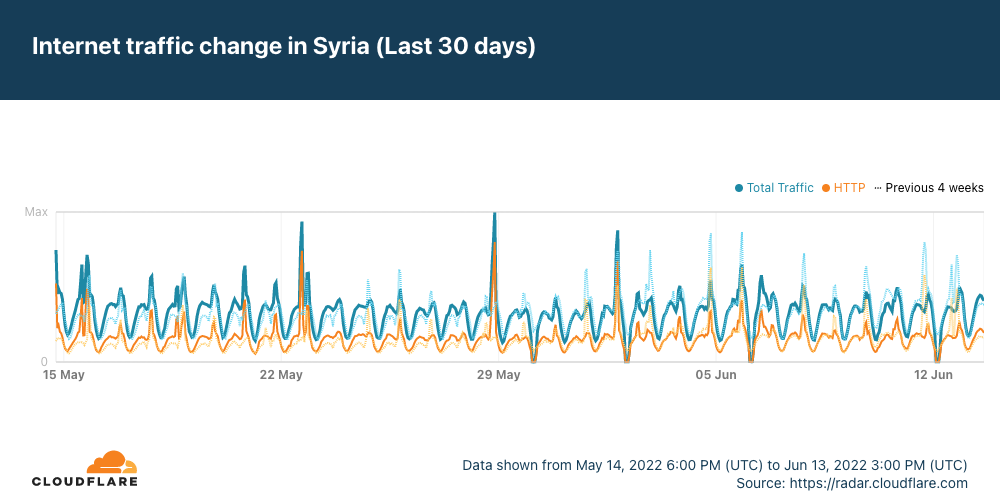
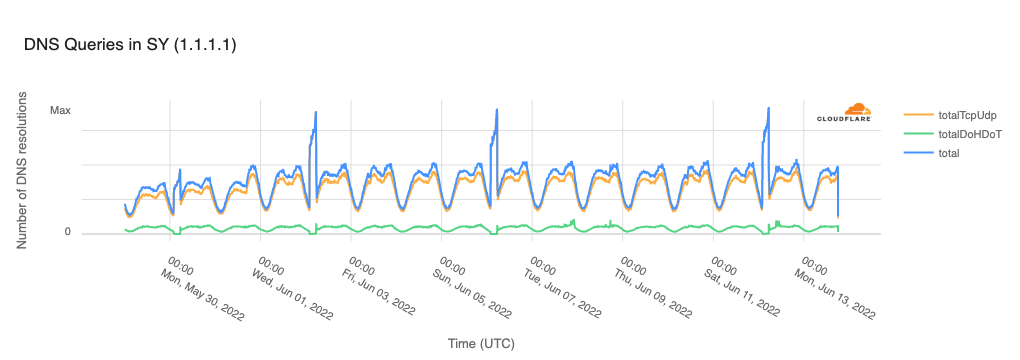
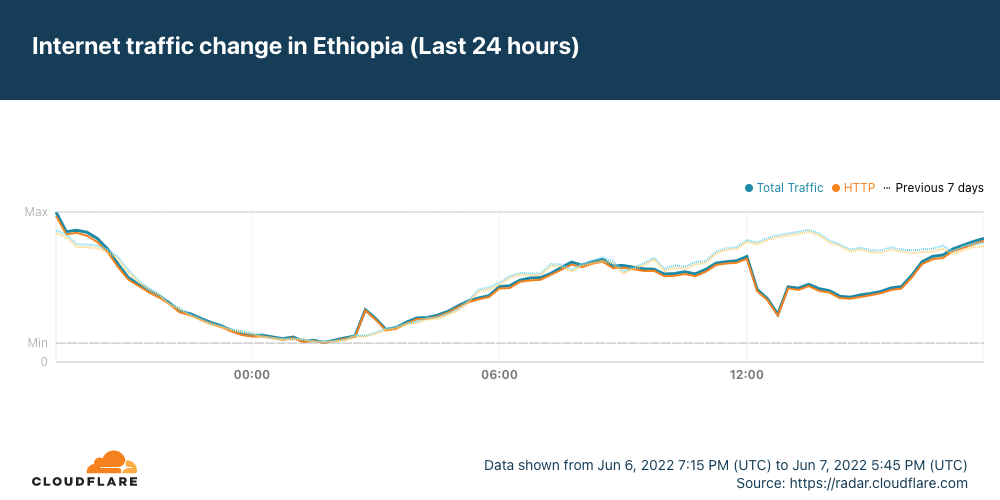
During the first two weeks of June 2023, we’ve seen Iraq implementing a series of multi-hour shutdowns that will reportedly occur through mid-July, as well as Algeria taking similar actions to prevent cheating on baccalaureate exams. Shutdowns in Syria were reported to begin on June 7, but there’s been no indication of them in traffic data as of this writing (June 13). These actions echo those taken in Iraq, Syria, Sudan, and Algeria in 2022 and in Syria and Sudan in 2021.
(Note: The interactive graphs below have been embedded directly into the blog post using a new Cloudflare Radar feature. This post is best viewed in landscape mode when on a mobile device.)
Iraq
Iraq had reportedly committed on May 15 to not implementing Internet shutdowns during the 2023 exam season, with a now unavailable page on the Iraqi Ministry of Communications web site (although captured in the Internet Archive’s Wayback Machine) noting (via Google Translate) “Her Excellency the Minister of Communications, Dr. Hayam Al-Yasiri: We rejected a request to cut off the internet service during the ministerial exams.” However, that commitment was apparently short-lived, as the first shutdown was implemented just a couple of weeks later, on June 1. The shutdowns observed across Iraq thus far have impacted networks and localities nationwide, with the exception of the autonomous Kurdistan region. However, networks in that region have experienced their own set of connectivity restrictions due to local exams.
In Iraq, the impact of the shutdowns between 04:00 – 08:00 local time (01:00 – 05:00 UTC) is clearly visible at a country level, as seen in the figure below.
The impact is, of course, also visible in the network-level graphs shown below, with traffic dropping to or near zero during each of the four-hour shutdown windows.
The shutdowns are also visible in the BGP announcement activity from the impacted networks, with spikes in announcement volume clearly visible around the shutdown windows each day that they have occurred. The announcement activity represents withdrawals ahead of the shutdown, removing routes to prefixes within the network, effectively cutting them off from the Internet, and updates after the shutdown period has ended, restoring the previously withdrawn routes, effectively reconnecting the prefixes to the Internet. (Additional announcement activity may also be visible for periods outside of the scheduled shutdowns, and is likely unrelated.)
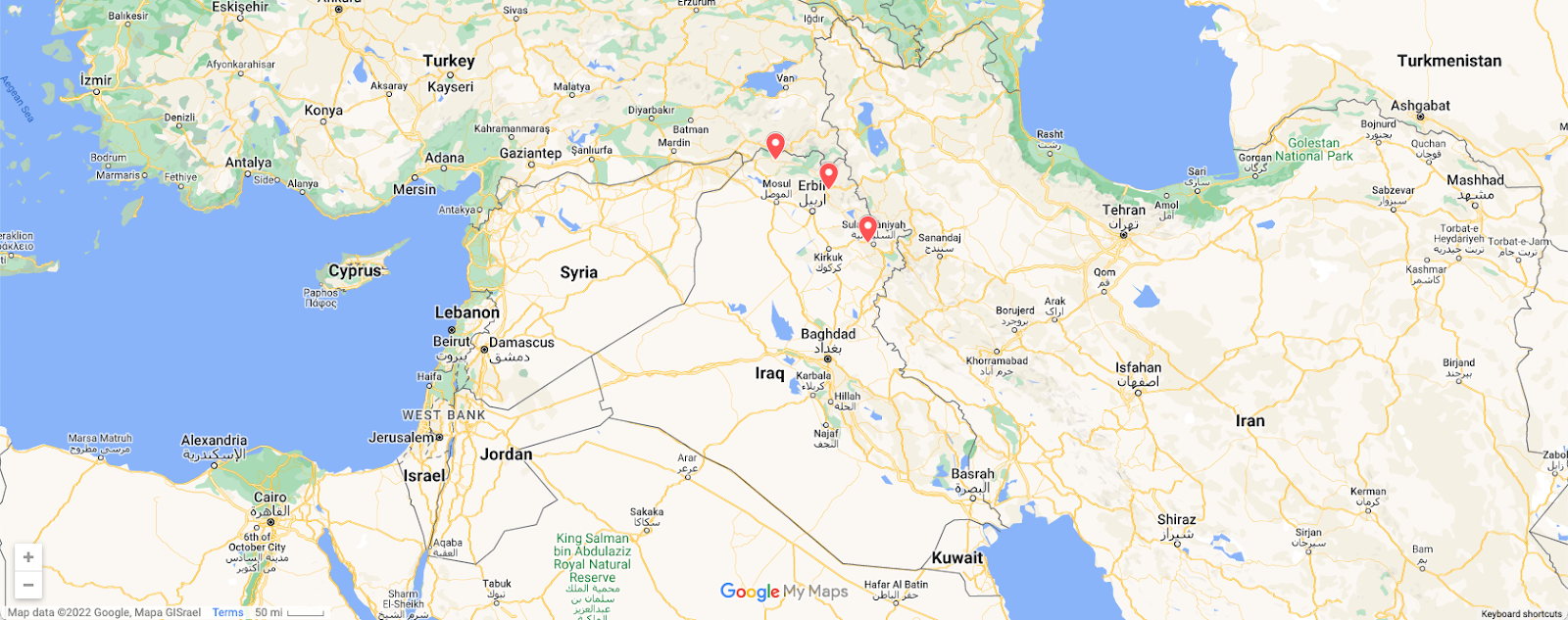
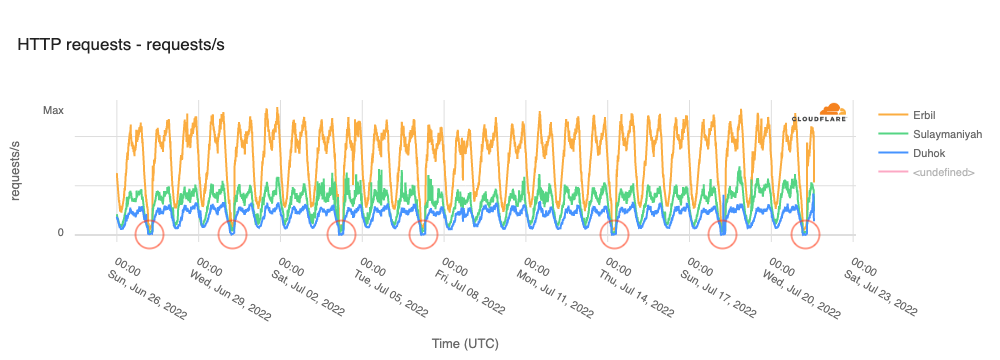
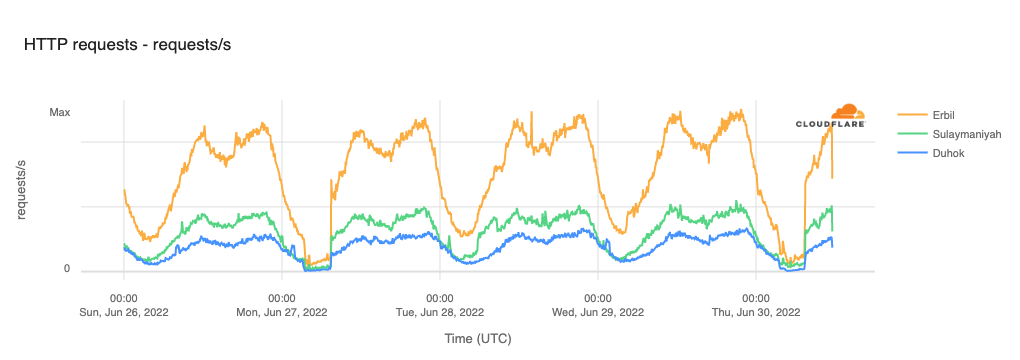
While the shutdowns discussed above didn’t impact the Kurdistan region of Iraq, that region has also chosen to implement their own shutdowns. In the Kurdistan region, exams started June 3, we saw shorter traffic disruptions across three local network providers on June 3, 6, 10, and 13. The disruptions lasted from 06:30 – 07:30 local time (03:30 to 04:30 UTC) on the 3rd, and 06:40 – 08:30 local time (03:30 to 05:30 UTC) on the 6th, 10th, and 13th). Impacted regions include Erbil, Sulaymaniyah, and Duhok.
BGP announcement activity for the impacted networks in the Kurdistan region did not show the same patterns as those observed on the other Iraqi network providers discussed above.
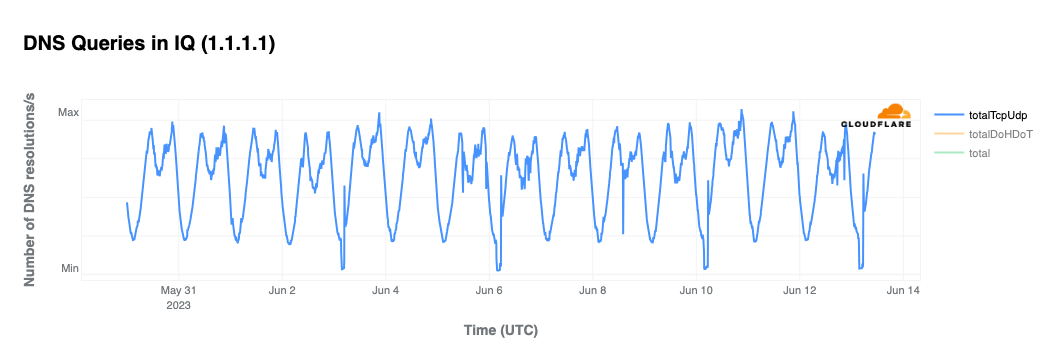
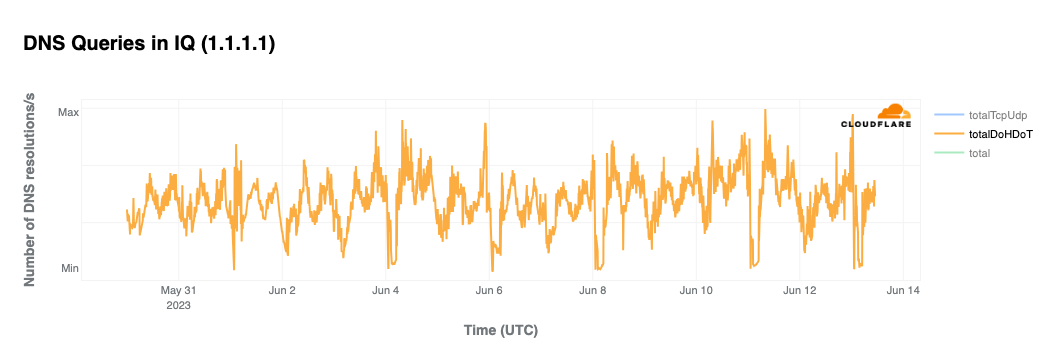
Both sets of shutdowns in Iraq are also visible in traffic to Cloudflare’s 1.1.1.1 DNS resolver, although they highlight a difference in usage between the autonomous Kurdistan region and the rest of the country. The “totalTcpUdp” graph (blue line) below shows requests made to the resolver over UDP or TCP on port 53, the standard port used for DNS requests. The “totalDoHDoT” graph (orange line) below shows requests made to the resolver using DNS-over-HTTPS or DNS-over-TLS using port 443 or 853 respectively.
In the “totalTcpUdp” graph, we can see noticeable drops in traffic that align with the dates and times where we observed the traffic disruptions across Kurdistani networks. This drop in DNS traffic, combined with the lack of BGP announcement activity, suggests that the Internet disruptions in the Kurdistan region may be implemented as widespread blocking of Internet traffic, rather than routing-based shutdowns.
In the “totalDoHDoT” graph below, we can see noticeable drops in traffic that align with the dates and times where we observed the traffic disruptions in the rest of Iraq.
It isn’t immediately clear why there is a difference in the use of 1.1.1.1 between the two parts of the country.
Algeria
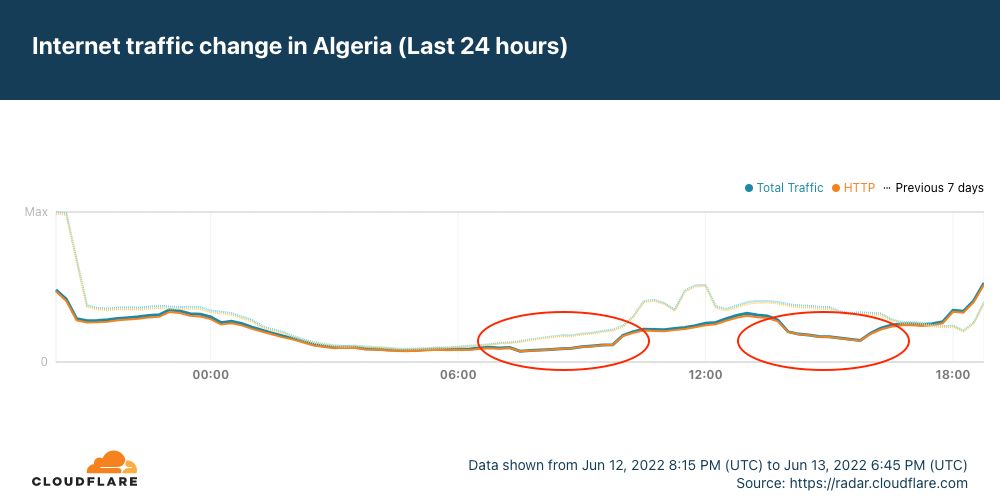
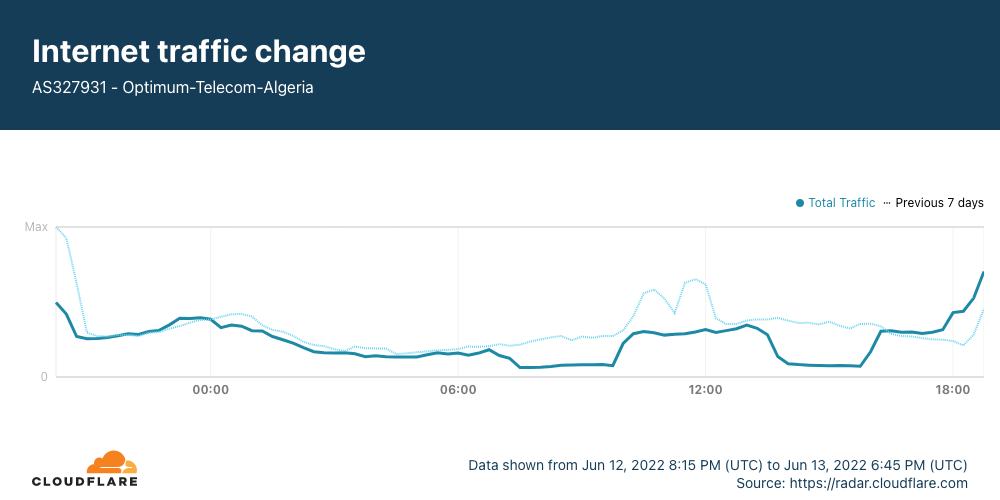
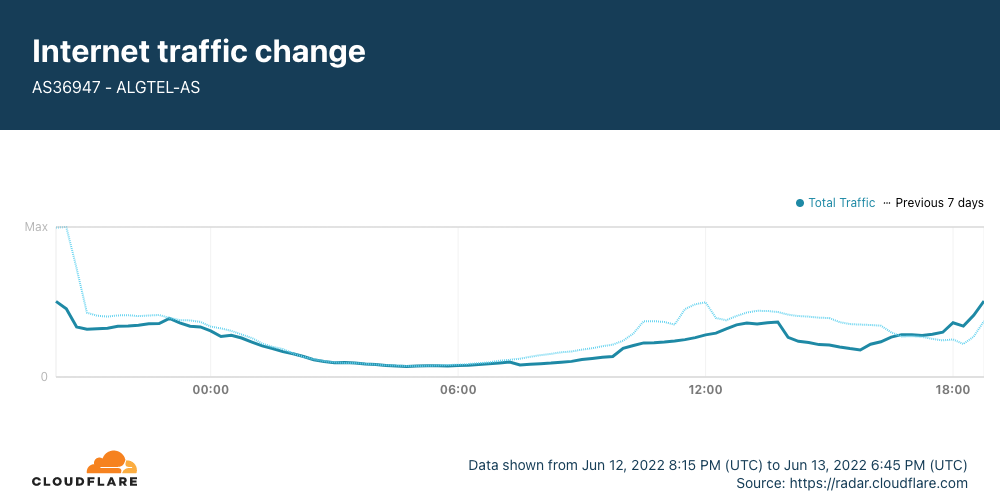
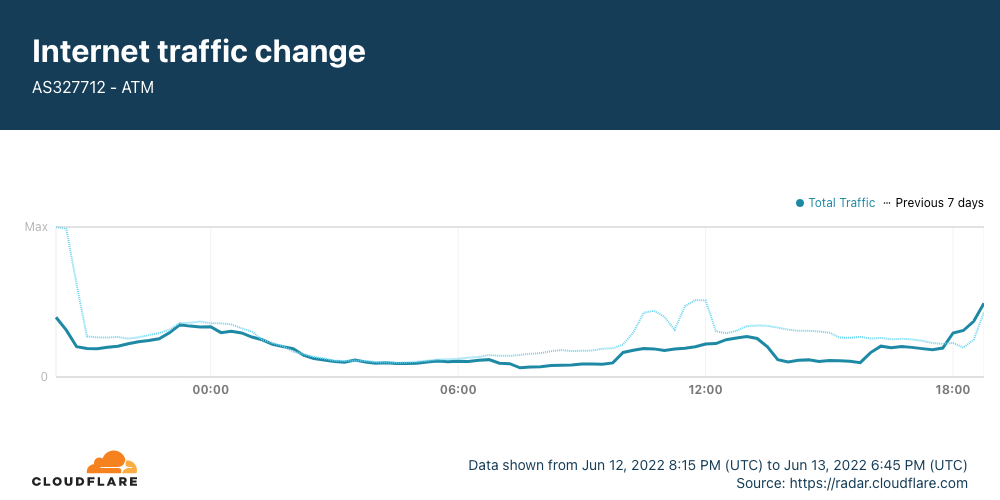
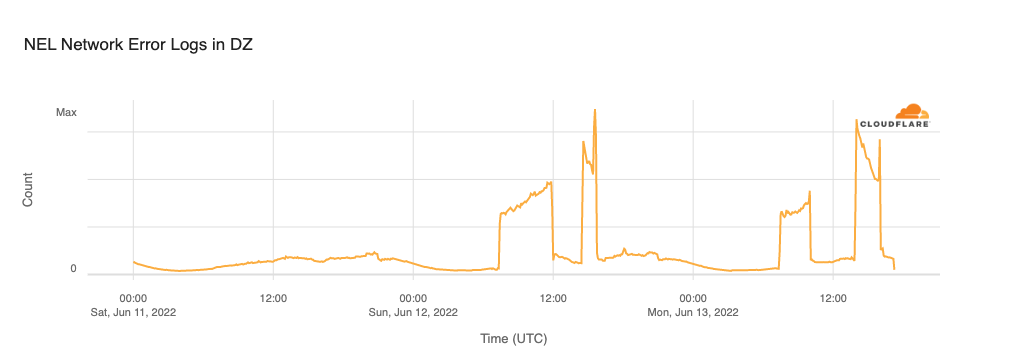
In Algeria, it appears that the country is following a similar pattern as that seen in 2021 and 2022, with two multi-hour Internet disruptions each day. Also similar to last year, it appears that they are pursuing a content blocking-based approach, instead of the wide-scale Internet shutdowns implemented in 2021, as impacted networks are not experiencing complete outages, nor do they show patterns of BGP announcement activity.
A published report indicates that two Internet disruptions will be implemented each day between June 11 and June 15. The first takes place between 08:00 – 12:00 local time (07:00 – 11:00 UTC), with the second occurring between 14:00 – 17:00 local time (13:00 – 16:00 UTC). These disruptions are visible in the shaded areas of the network-level graphs below as two distinct drops in traffic each day.
Conclusion
In cooperation with the Internet Society and Lebanese digital rights organization SMEX, digital rights organization Access Now is coordinating a #NoExamShutdown campaign across social media platforms. The campaign calls on MENA governments to end the practice of Internet shutdowns during exams, and aims to highlight how these shutdowns undermine human rights and disrupt essential social, political, economic, and cultural activities. Cloudflare Radar will continue to bring visibility to these, and other similar Internet disruptions, as they occur. You can follow them through the Cloudflare Radar Outage Center, or by following Cloudflare Radar on Twitter or Mastodon.
Cloudflare operates in more than 285 cities in over 100 countries, where we interconnect with over 11,500 network providers in order to provide a broad range of services to millions of customers. The breadth of both our network and our customer base provides us with a unique perspective on Internet resilience, enabling us to observe the impact of Internet disruptions.
We entered 2023 with Internet disruptions due to causes that ran the gamut, including several government-directed Internet shutdowns, cyclones, a massive earthquake, power outages, cable cuts, cyberattacks, technical problems, and military action. As we have noted in the past, this post is intended as a summary overview of observed disruptions, and is not an exhaustive or complete list of issues that have occurred during the quarter.
Government directed
Iran
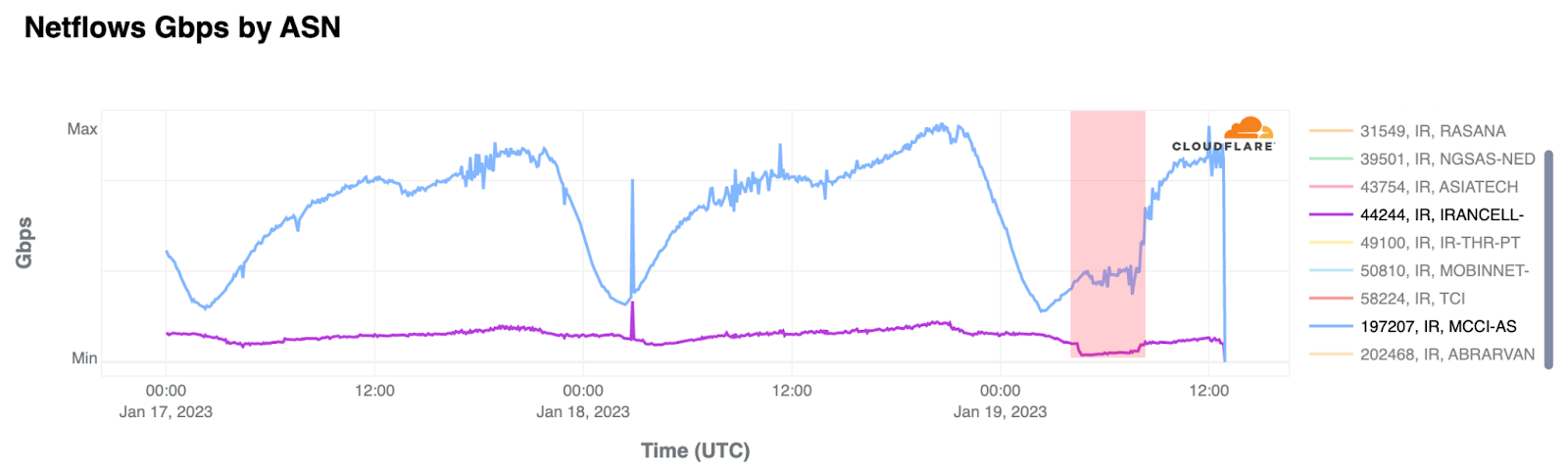
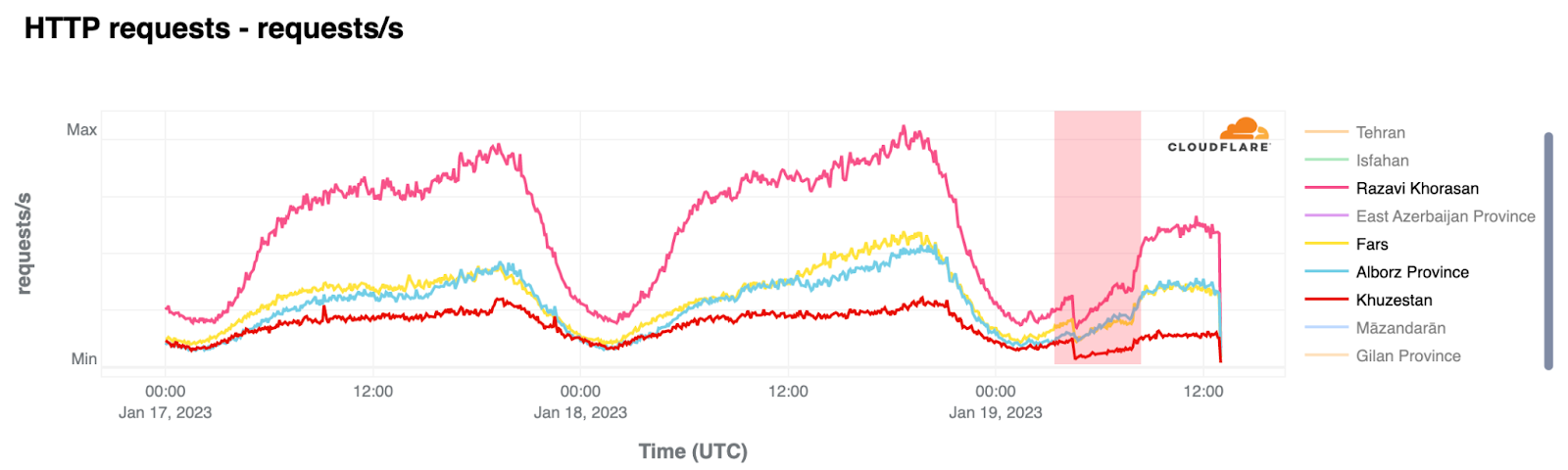
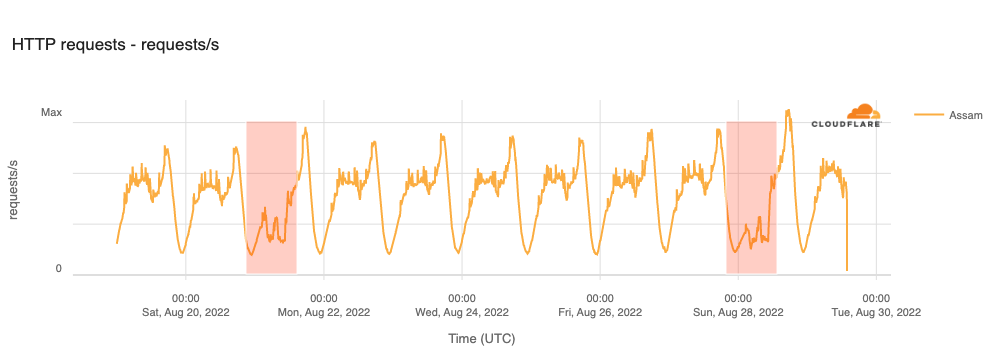
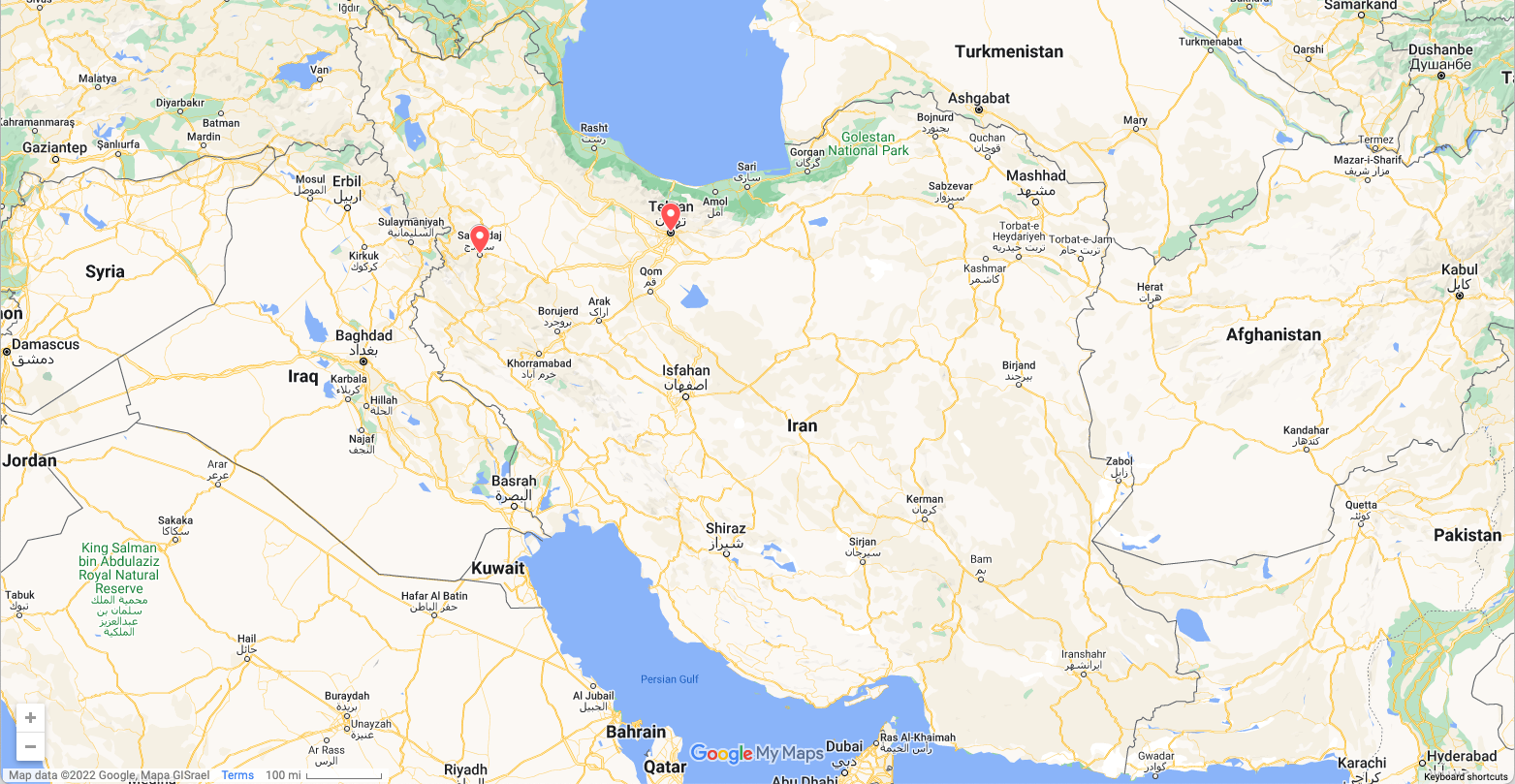
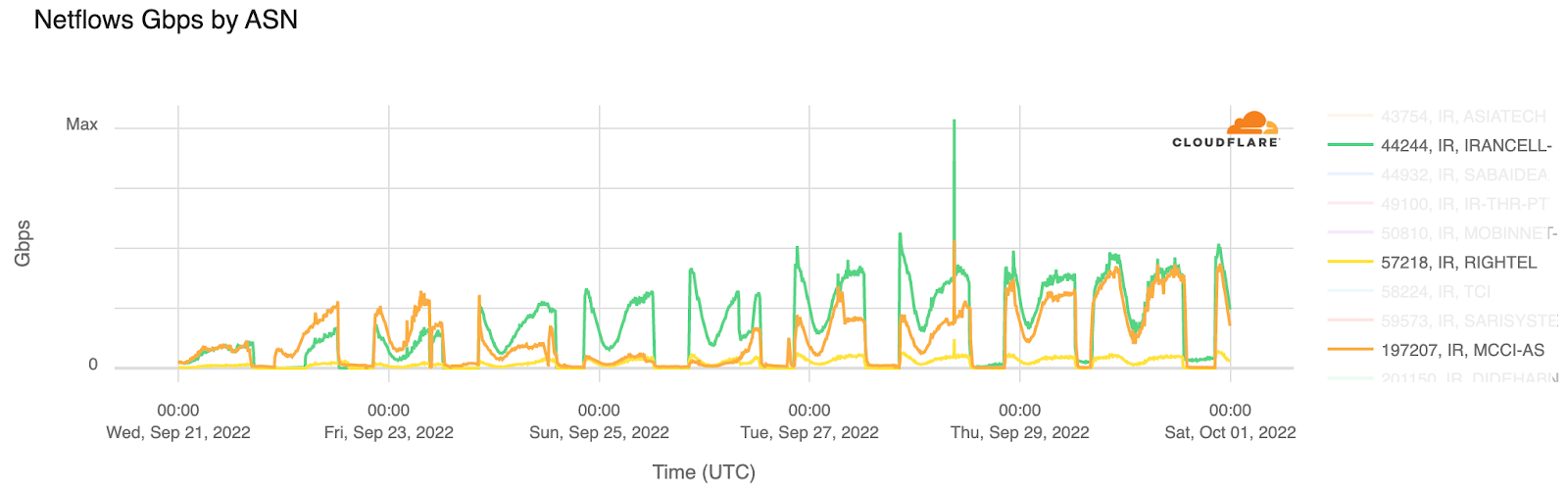
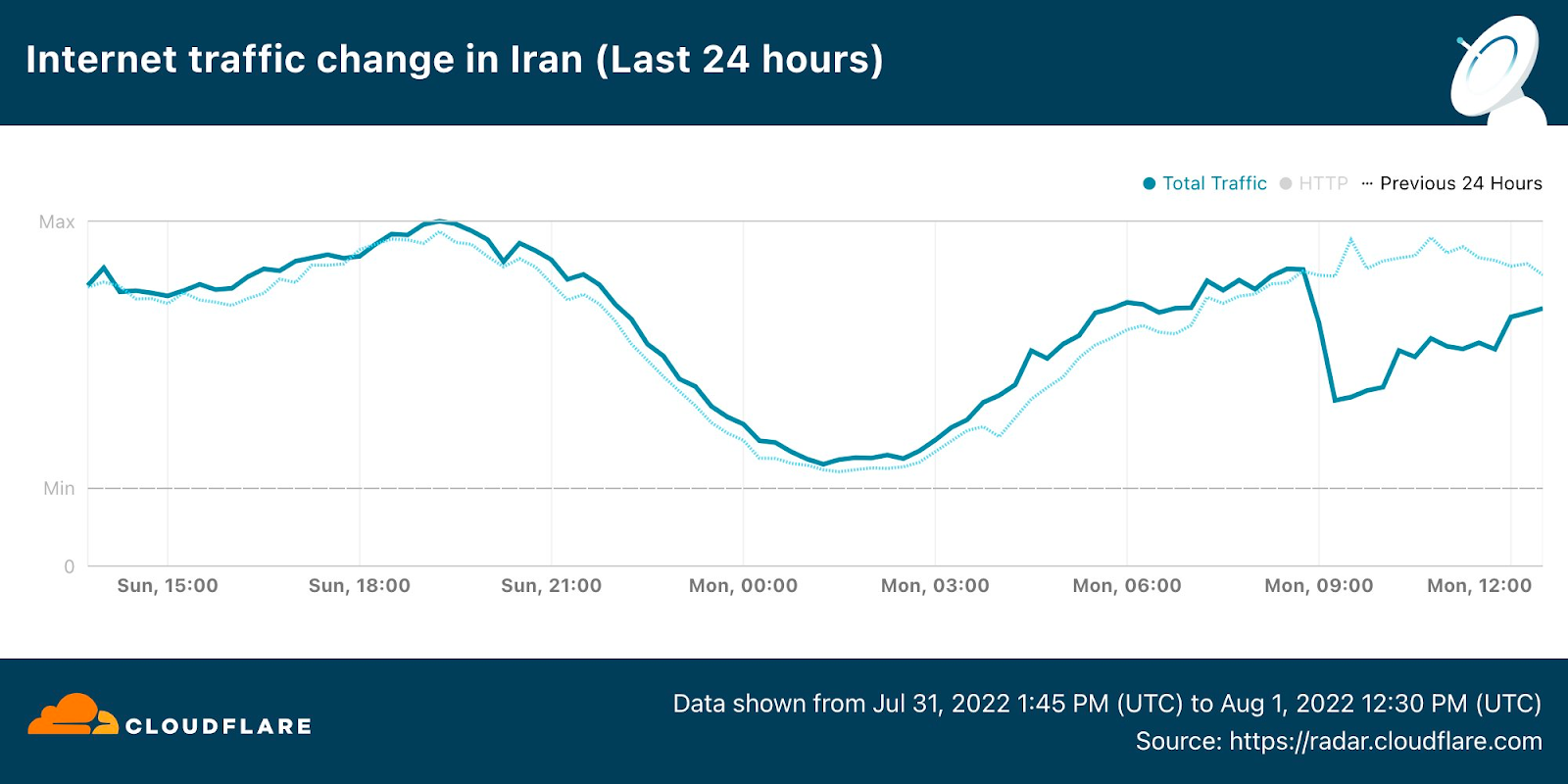
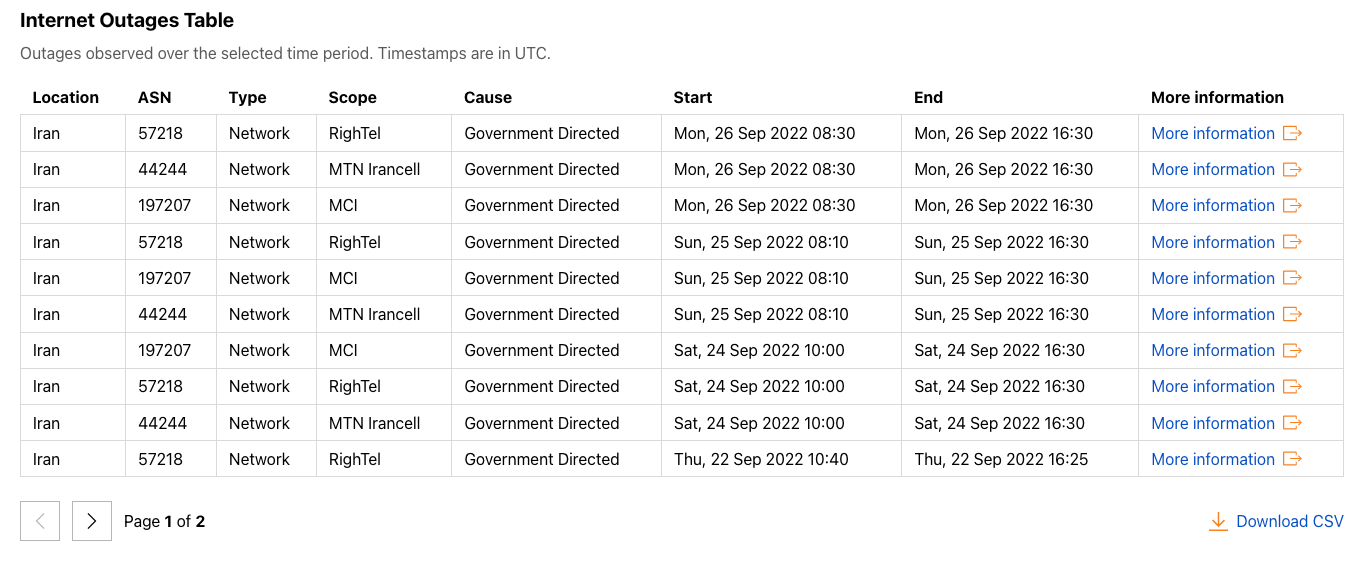
Over the last six-plus months, government-directed Internet shutdowns in Iran have largely been in response to protests over the death of Mahsa Amini while in police custody. While these shutdowns are still occurring in a limited fashion, a notable shutdown observed in January was intended to prevent cheating on academic exams. Internet shutdowns with a similar purpose have been observed across a number of other countries, and have also occurred in Iran in the past. Access was restricted across AS44244 (Irancell) and AS197207 (MCCI), with lower traffic levels observed in Alborz Province, Fars, Khuzestan, and Razavi Khorasan between 08:00 to 11:30 local time (04:30 to 08:00 UTC) on January 19.
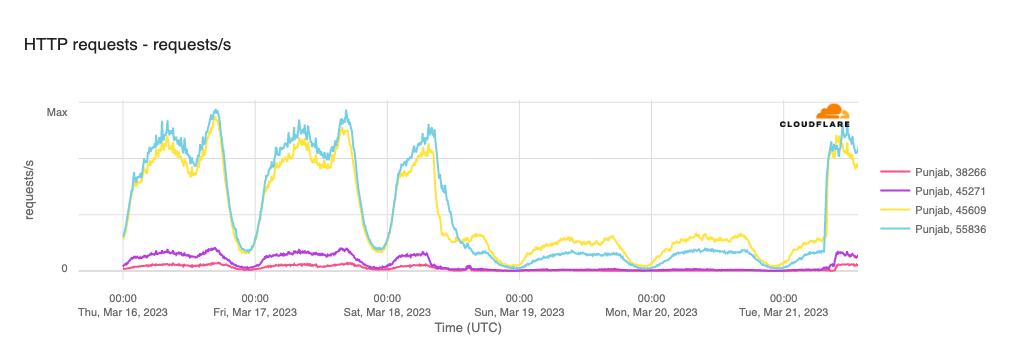
A shutdown of mobile Internet connectivity in Punjab, India began on March 19, ordered by the local government amid concerns of protest-related violence. Although the initial shutdown was ordered to take place between March 18, 12:00 local time and March 19, 12:00 local time, it was extended several times, ultimately lasting for three days. Traffic for AS38266 (Vodafone India), AS45271 (Idea Cellular Limited), AS45609 (Bharti Mobility), and AS55836 (Reliance Jio Infocomm) began to fall around 12:30 local time (07:00 UTC) on March 18, recovering around 12:30 local time (07:00 UTC) on March 21. However, it was subsequently reported that connectivity remained shut down in some districts until March 23 or 24.
Cable cuts
Bolivia
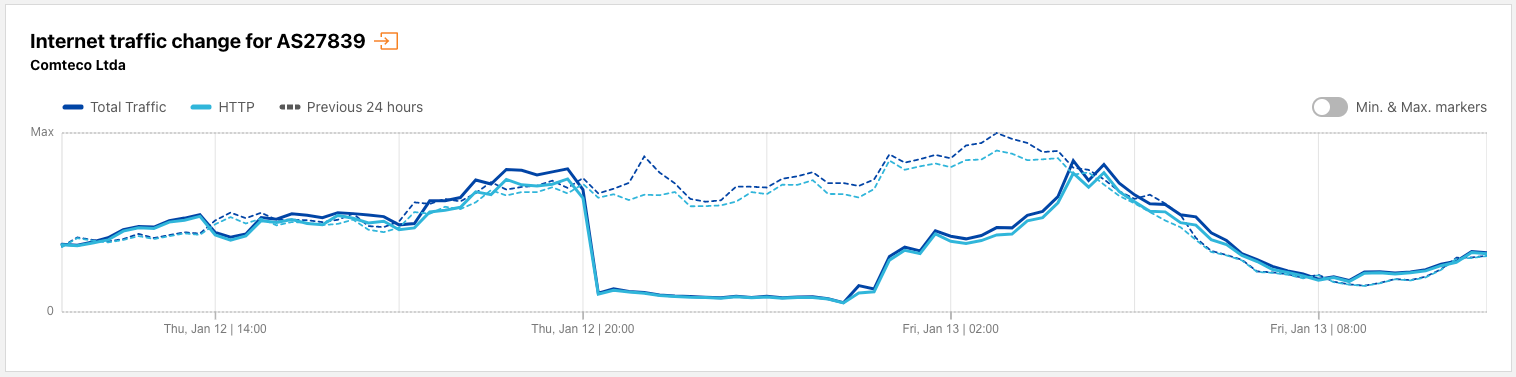
Bolivian ISP Cometco (AS27839)reported on January 12 that problems with international fiber links were causing degradation of Internet service. Traffic from the network dropped by approximately 80% starting around 16:00 local time (20:00 UTC) before returning to normal approximately eight hours later. It isn’t clear whether the referenced international fiber links were terrestrial connections to neighboring countries, or issues with submarine cables several network hops upstream. As a landlocked country, Bolivia is not directly connected to any submarine cables.
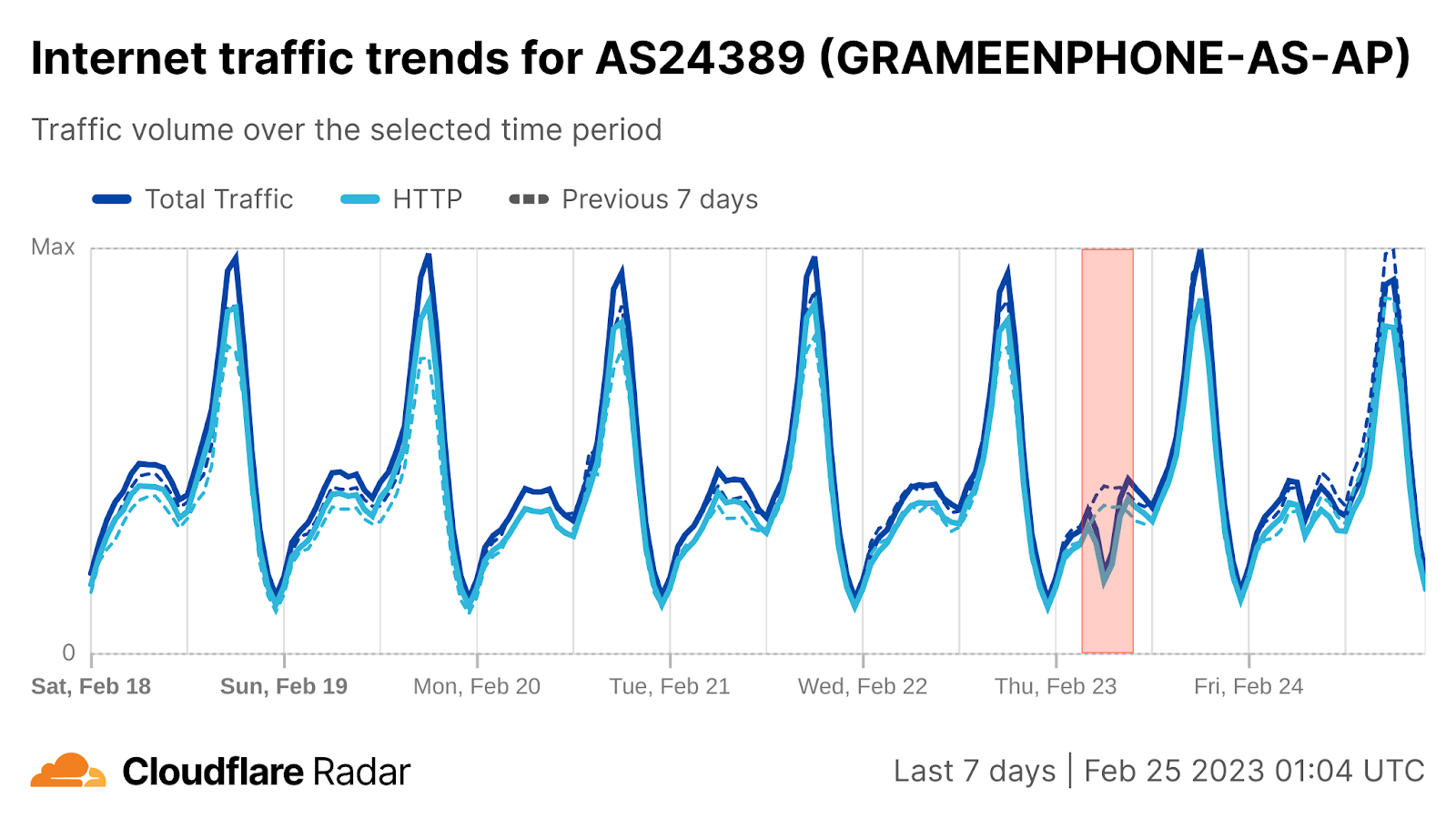
A brief connectivity disruption was observed on Bangladeshi provider Grameenphone on February 23, between 11:45-14:00 local time (05:45-08:00 UTC). According to a Facebook post from Grameenphone, the outage was caused by fiber cuts due to road maintenance.
Venezuela
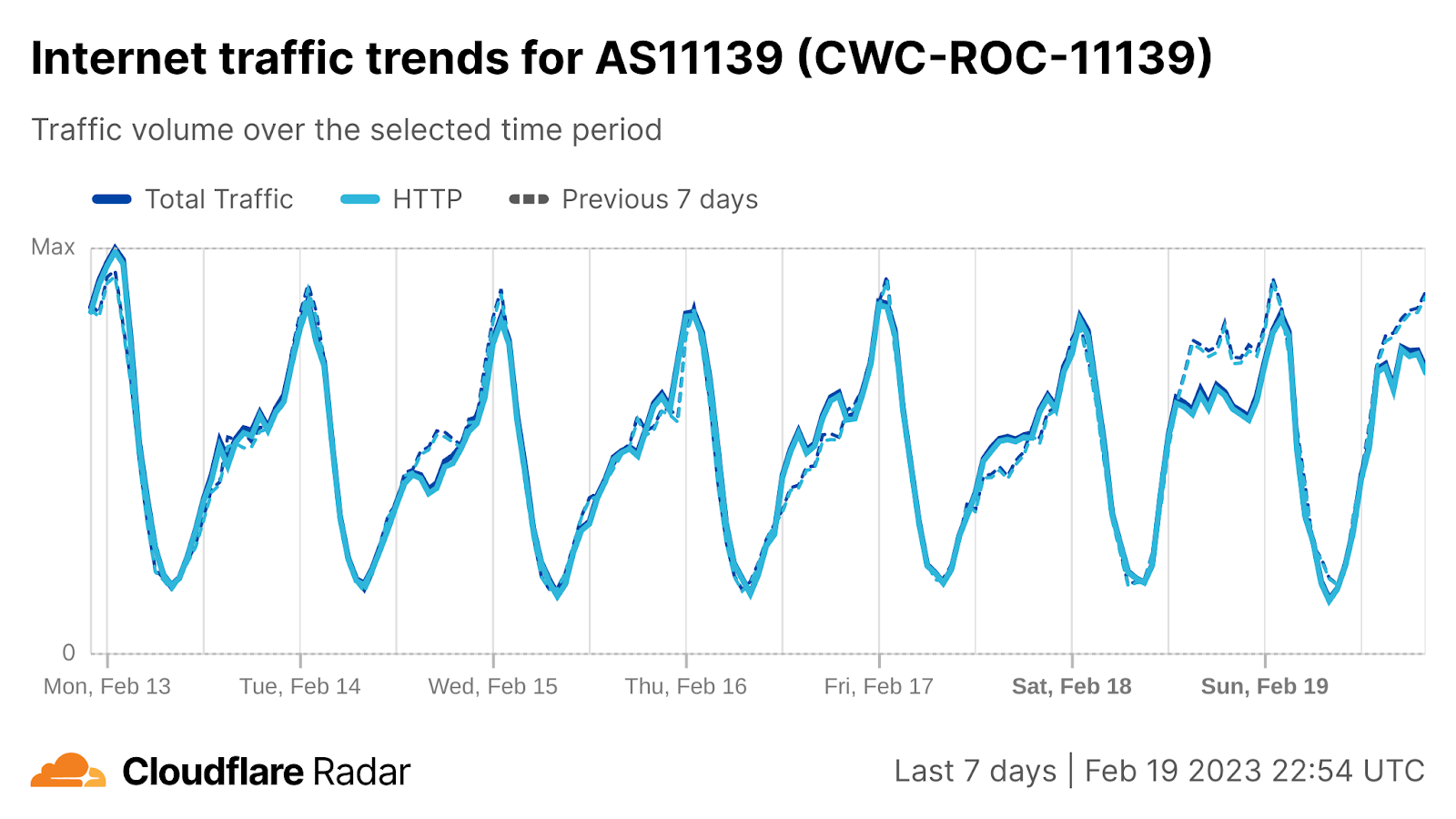
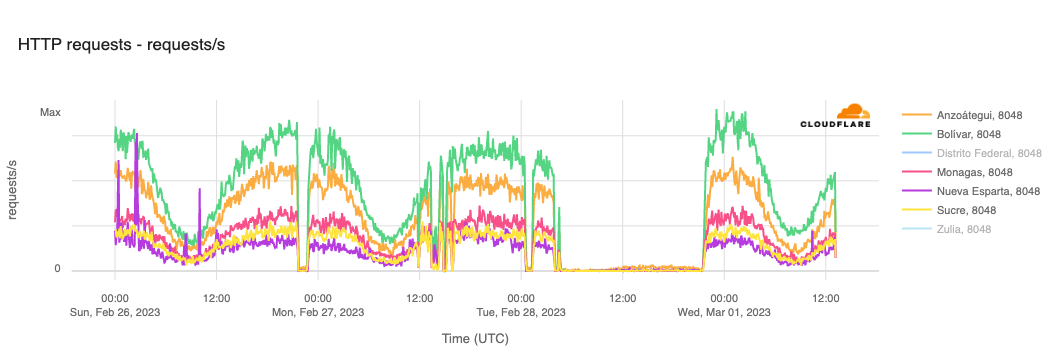
Venezuela, and more specifically, AS8048 (CANTV), are no stranger to Internet disruptions, seeing several (Q1, Q2) during 2022, as well as others in previous years. During the last couple of days in February, a few small outages were observed on CANTV’s network in several Venezuelan states. However, a more significant near-complete outage occurred on February 28, starting around midnight local time (04:00 UTC), and lasting for the better part of the day, with traffic recovering at 17:30 local time (21:30 UTC). A Tweet posted the morning of February 28 by CANTV referenced an outage in their fiber optic network, which was presumably the cause.
Power outages
Pakistan
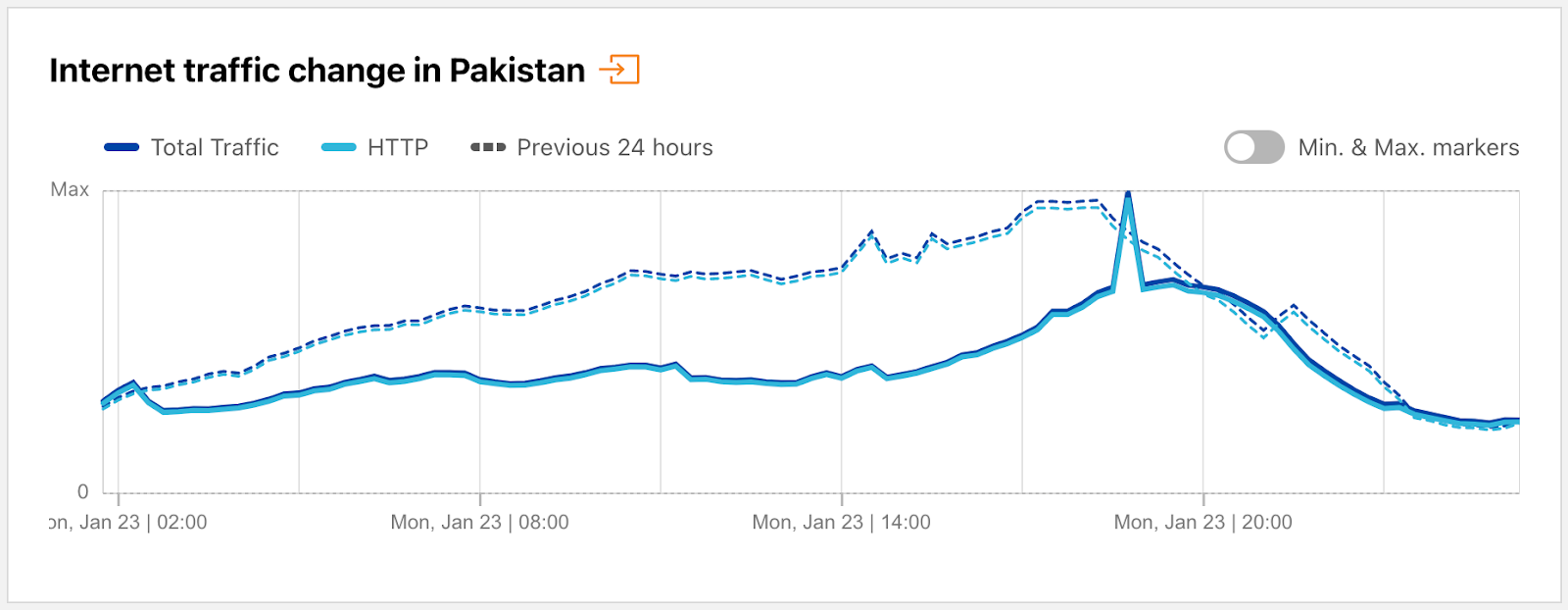
A country-wide power outage in Pakistan on January 23 impacted more than 220 million people, and resulted in a significant drop in Internet traffic being observed in the country. The power outage began at 07:34 local time (02:34 UTC), with Internet traffic starting to drop almost immediately. The figure below shows that traffic volumes dropped as much as 50% from normal levels before recovering around 04:15 local time on January 24 (23:15 UTC on January 23). This power outage was reportedly due to a “sudden drop in the frequency of the power transmission system”, which led to a “widespread breakdown”. Nationwide power outages have also occurred in Pakistan in January 2021, May 2018, and January 2015.
Bermuda
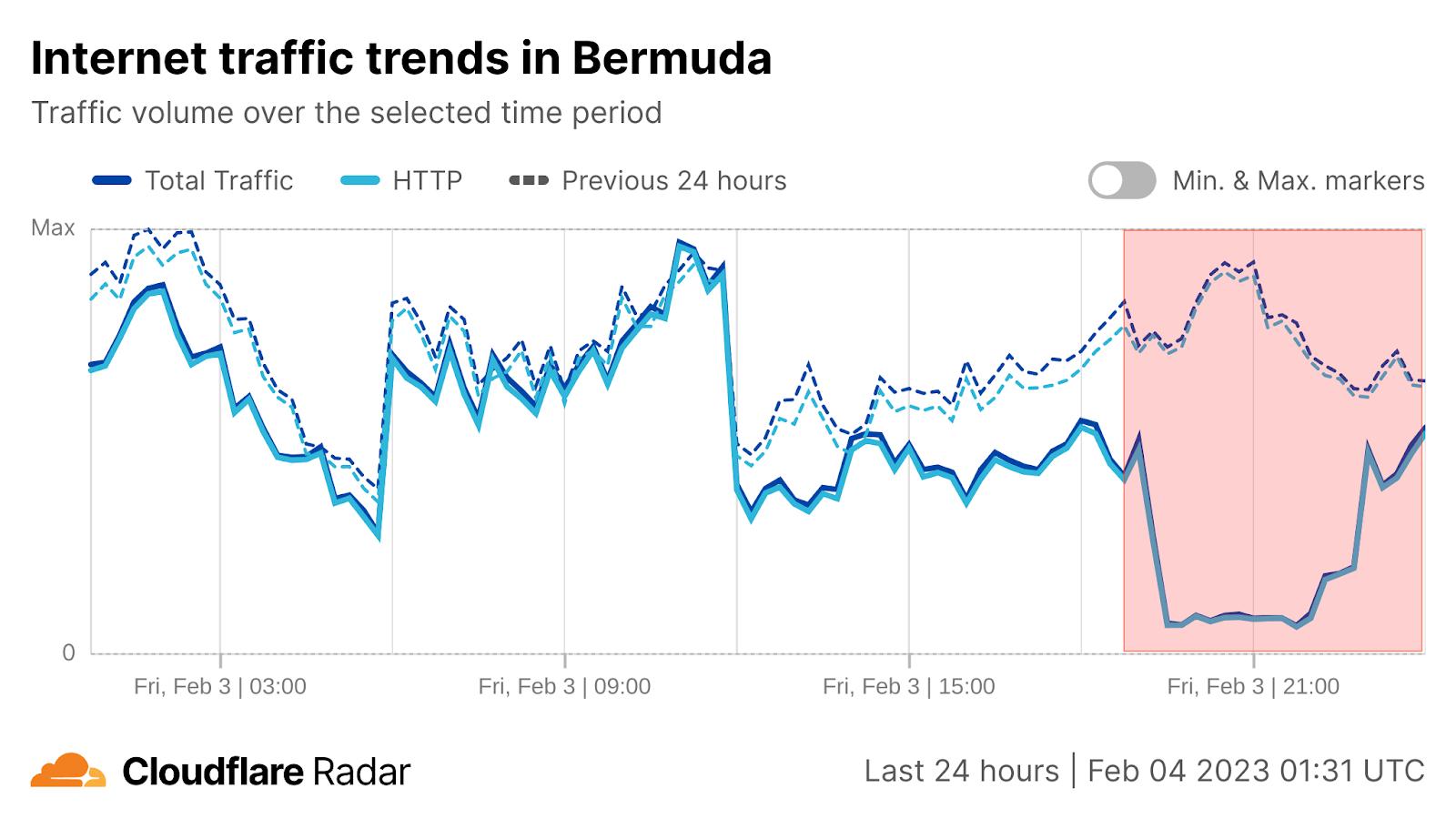
BELCO, the power company servicing the island of Bermuda, tweeted about a mass power outage affecting the island on February 3, and linked to their outage map so that customers could track restoration efforts. BELCO’s tweet was posted at 16:10 local time (20:10 UTC), approximately one hour after a significant drop was observed in Bermuda’s Internet traffic. The power outage, and subsequent Internet disruption, lasted over five hours, as BELCO later tweeted that “As of 9.45 pm [00:45 UTC, February 4], all circuits have been restored.”
Argentina
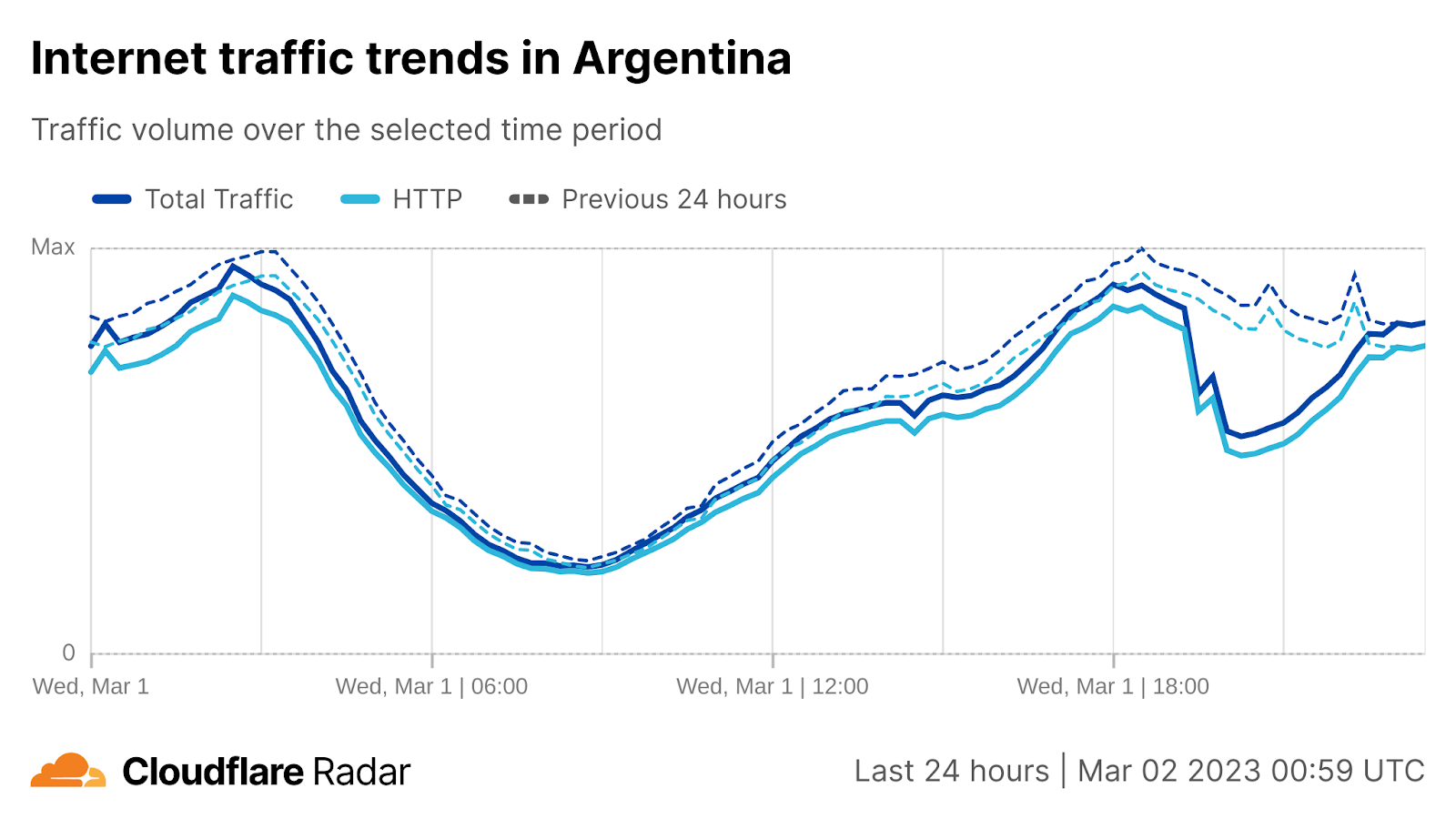
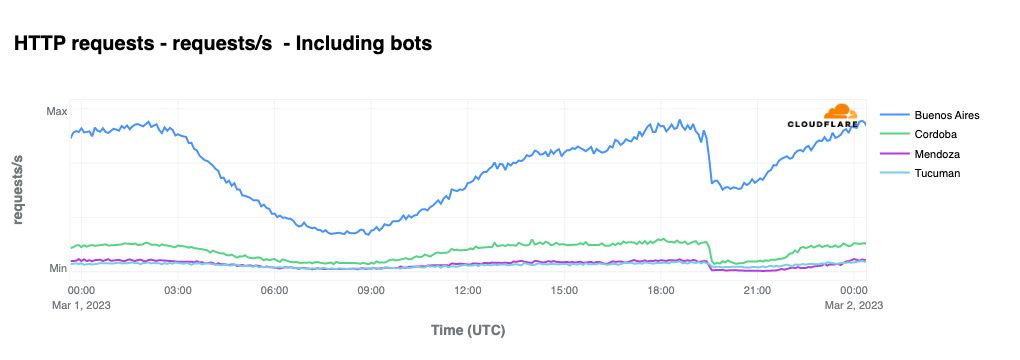
Soaring temperatures in Argentina triggered a large-scale power outage across the country that resulted in multi-hour Internet disruption on March 1. Internet traffic dropped by approximately one-third during the disruption, which lasted from 16:30 to 19:30 local time (19:30 to 22:30 UTC). Cities that experienced visible impacts to Internet traffic during the power outage included Buenos Aires, Cordoba, Mendoza, and Tucuman.
Kenya
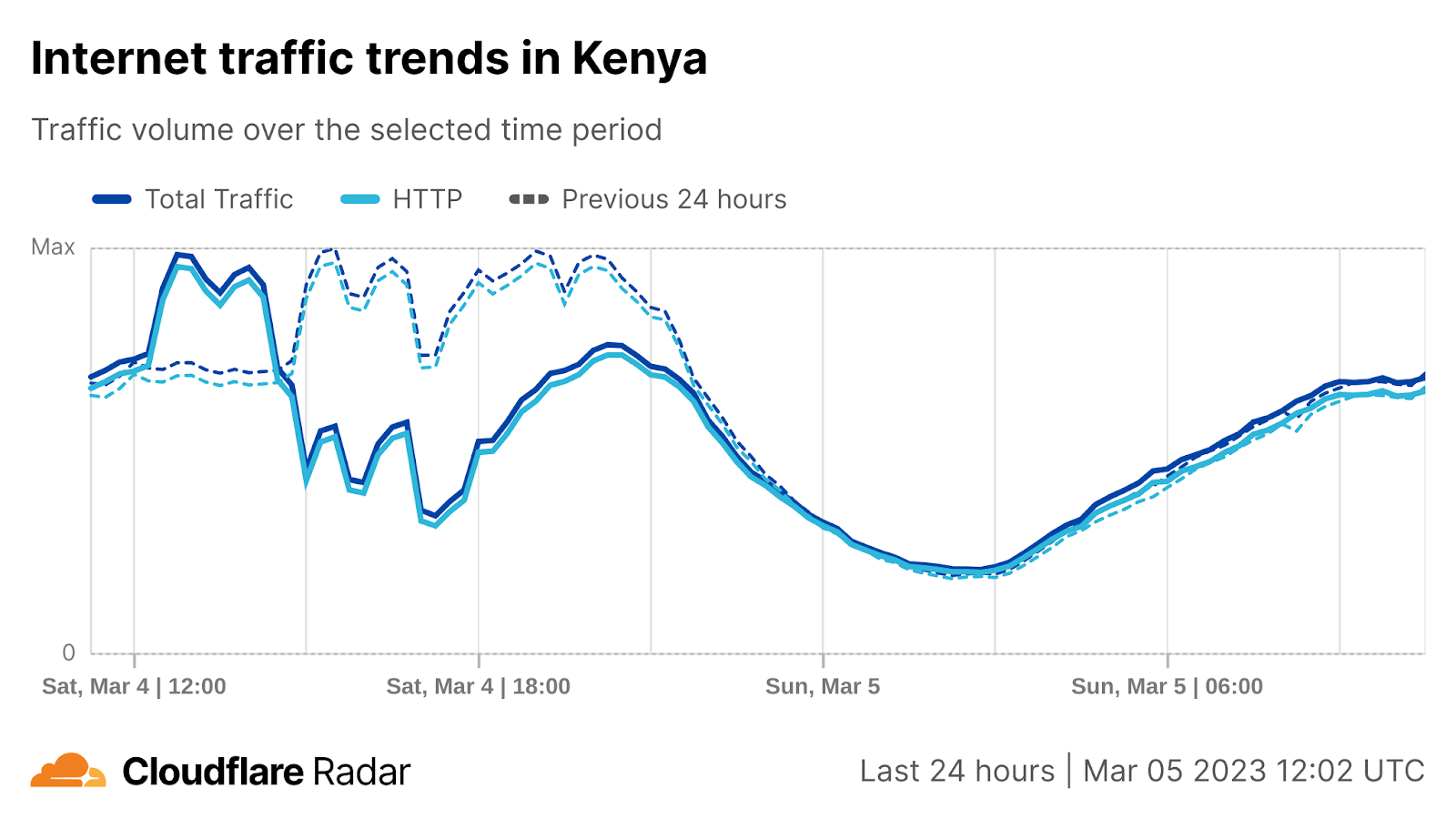
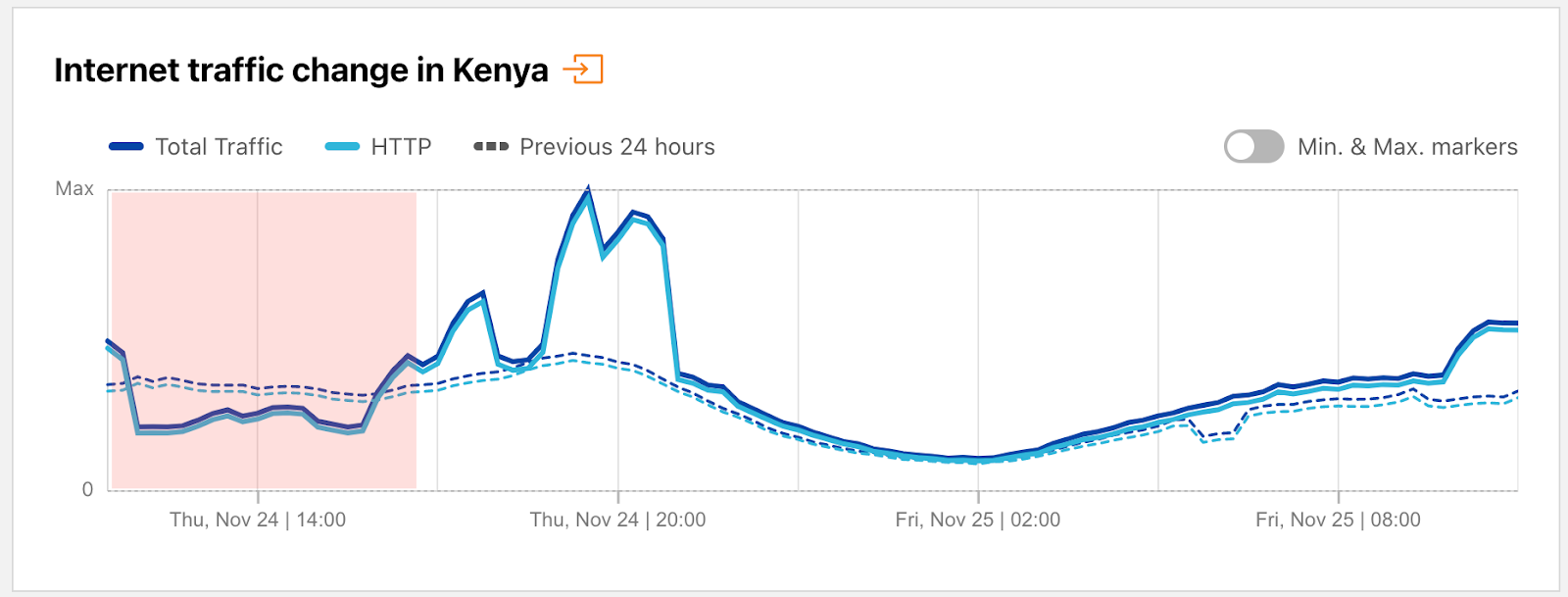
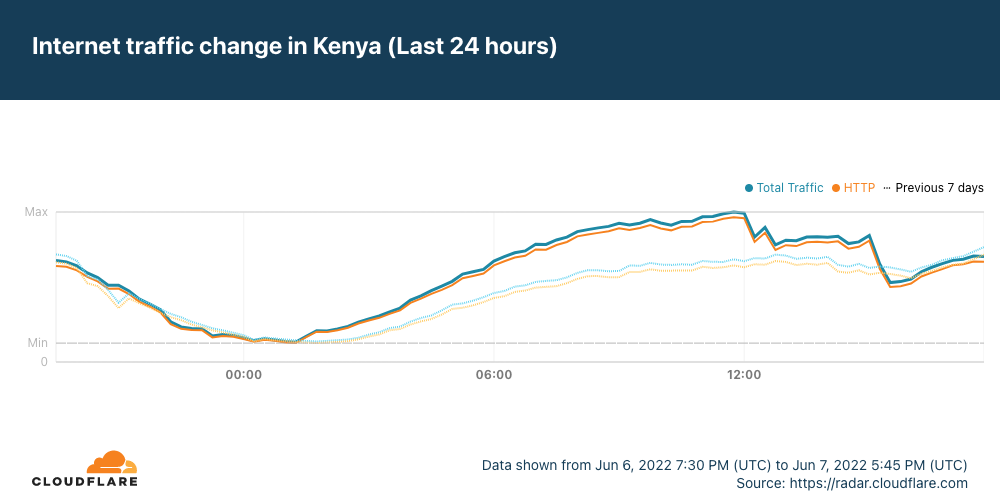
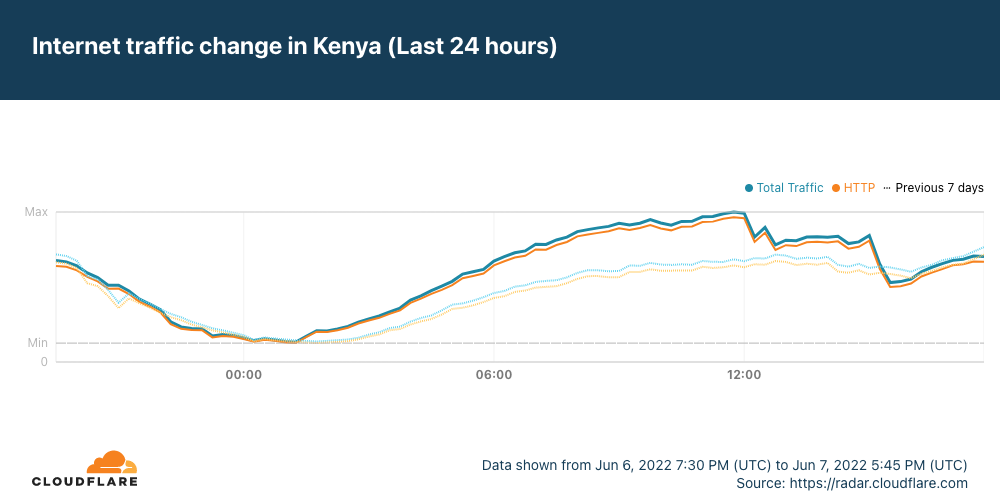
Just a few days later on March 4, Kenya Power issued a Customer Alert at 18:25 local time (15:25 UTC) regarding a nationwide power outage, noting that it had “lost bulk power supply to various parts of the country due to a system disturbance.” The alert came approximately an hour after the country’s Internet traffic dropped significantly. A subsequent tweet dated midnight local time (21:00 UTC) claimed that “electricity supply has been restored to all areas countrywide” and the figure below shows that traffic levels returned to normal levels shortly thereafter.
Earthquake
Turkey
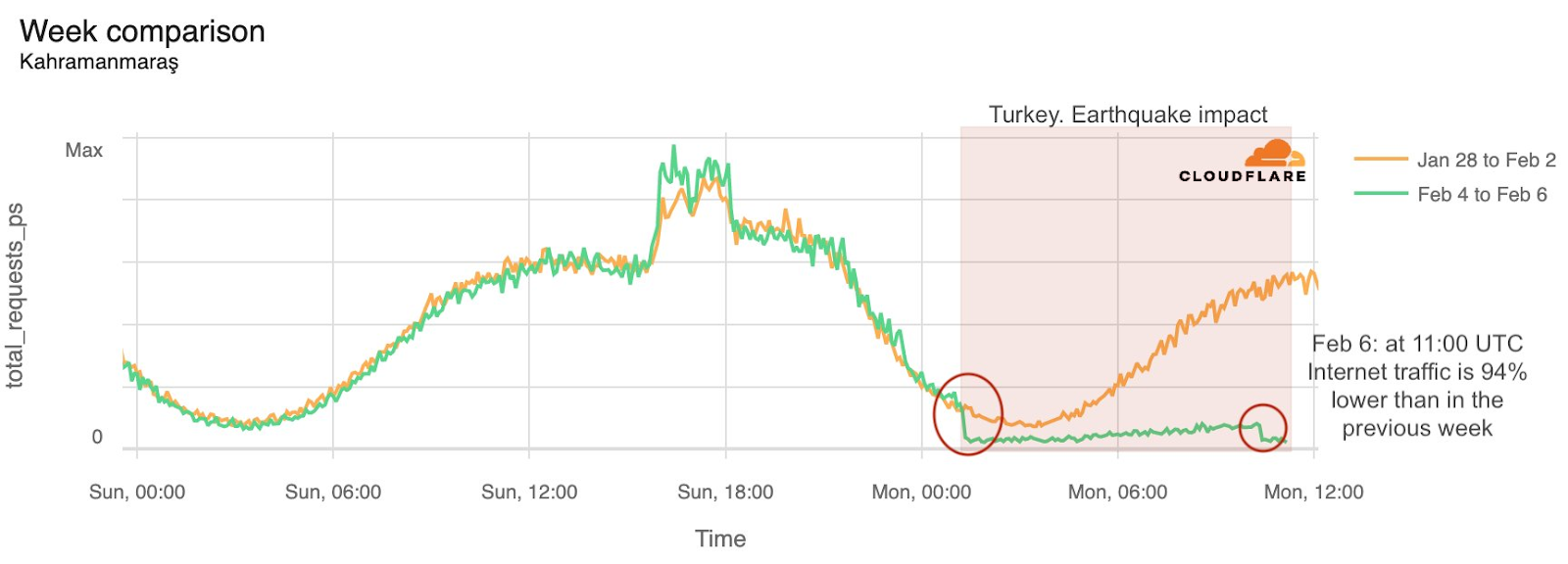
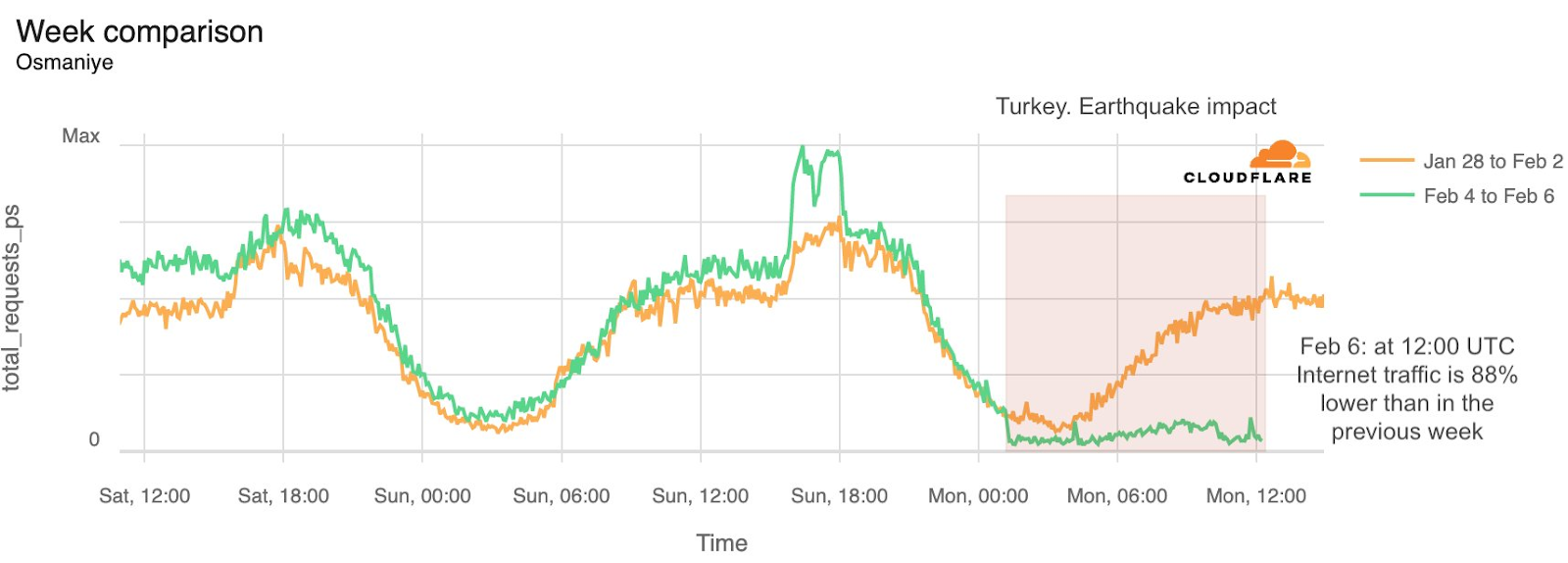
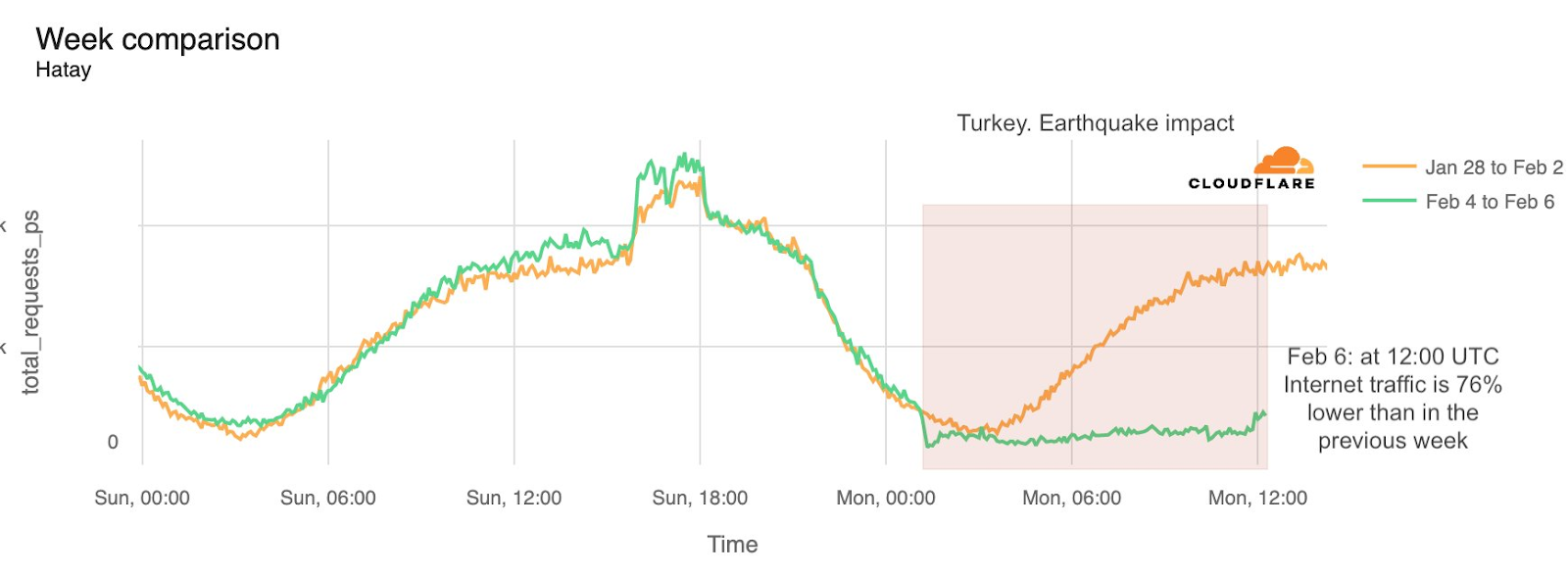
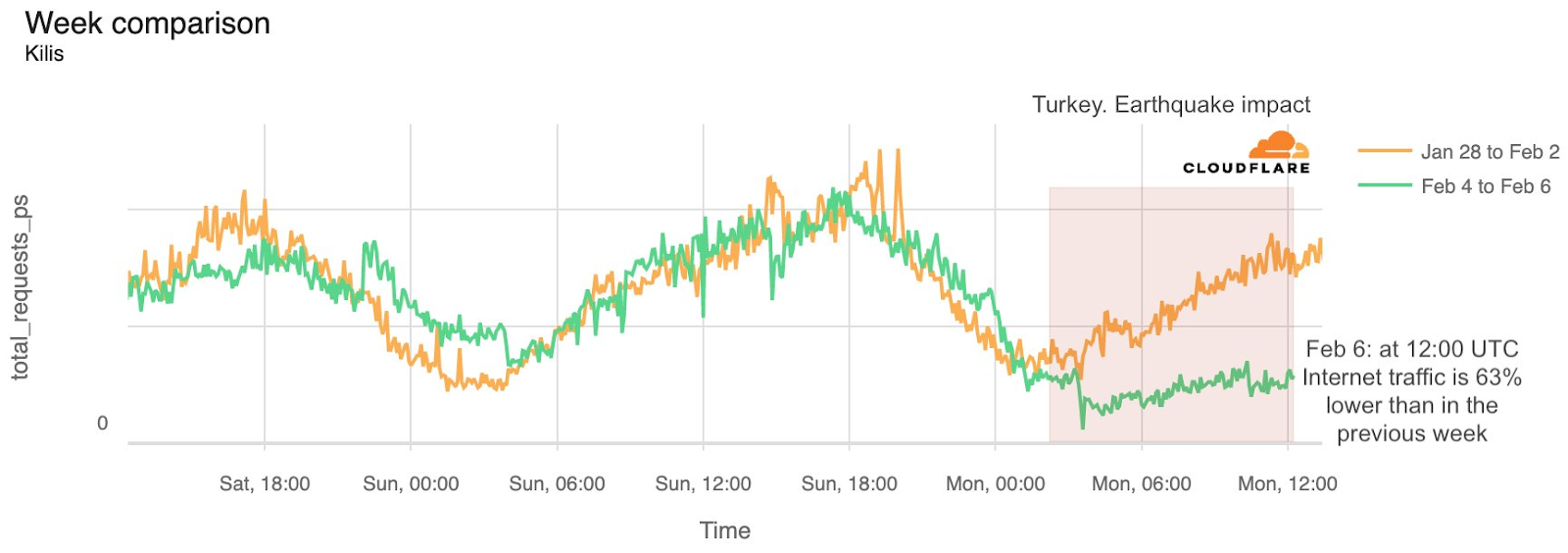
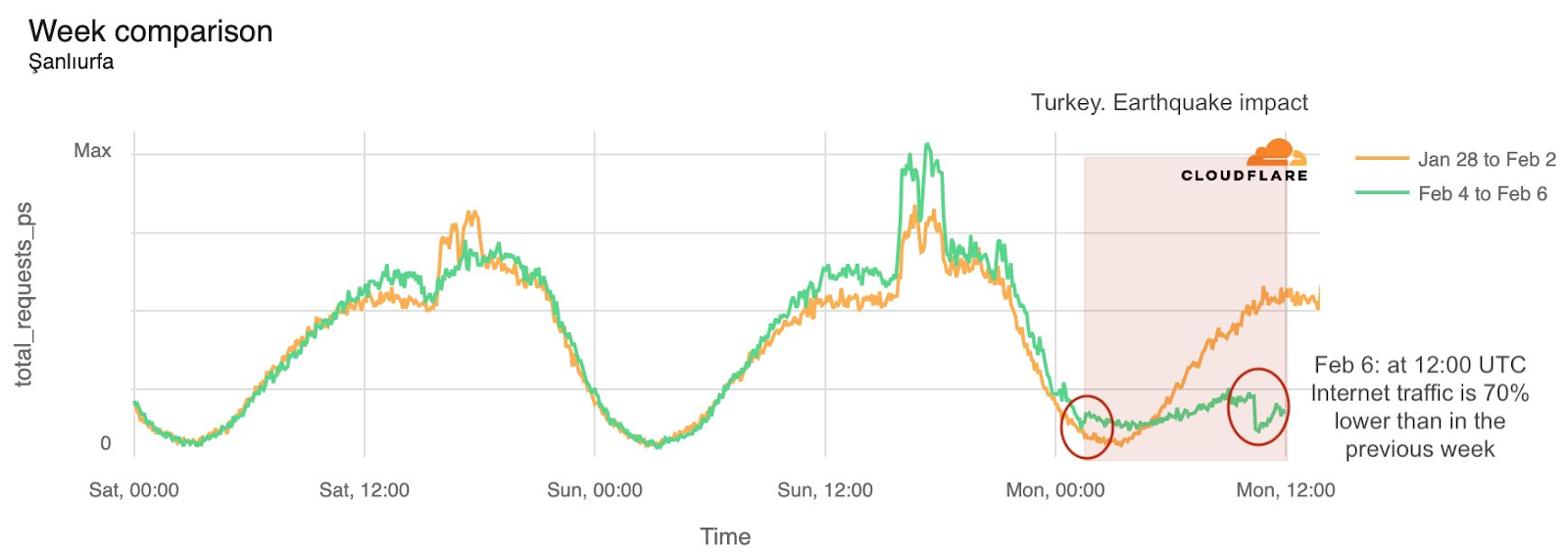
On February 5, a magnitude 7.8 earthquake occurred 23 km east of Nurdağı, Turkey, leaving many thousands dead and injured. The quake, which occurred at 04:17 local time (01:17 UTC), was believed to be the strongest to hit Turkey since 1939. The widespread damage and destruction resulted in significant disruptions to Internet connectivity in multiple areas of the country, as shown in the figures below. Although Internet traffic volumes were relatively low because it was so early in the morning, the graphs show it dropping even further at or around the time of the earthquake. Nearly half a day later, traffic volumes in selected locations were between 63-94% lower than at the same time the previous week. A month later, after several aftershocks, traffic volumes had mostly recovered, although some regions were still struggling to recover.
Weather
New Zealand
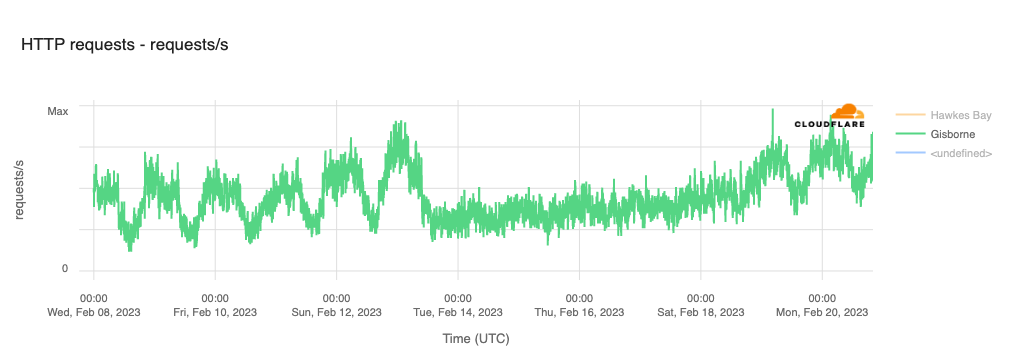
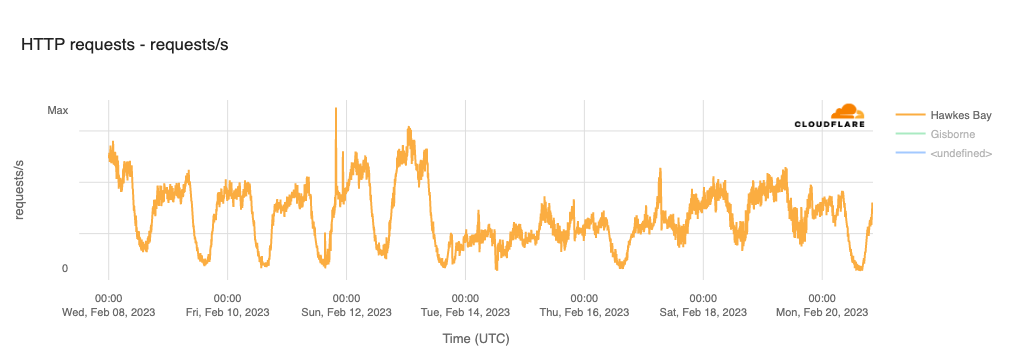
Called the “country’s biggest weather event in a century”, Cyclone Gabrielle wreaked havoc on northern New Zealand, including infrastructure damage and power outages impacting tens of thousands of homes. As a result, regions including Gisborne and Hawkes Bay experienced Internet disruptions that lasted several days, starting at 00:00 local time on February 14 (11:00 UTC on February 13). The figures below show that in both regions, peak traffic volume returned to pre-cyclone levels around February 19.
Vanuatu
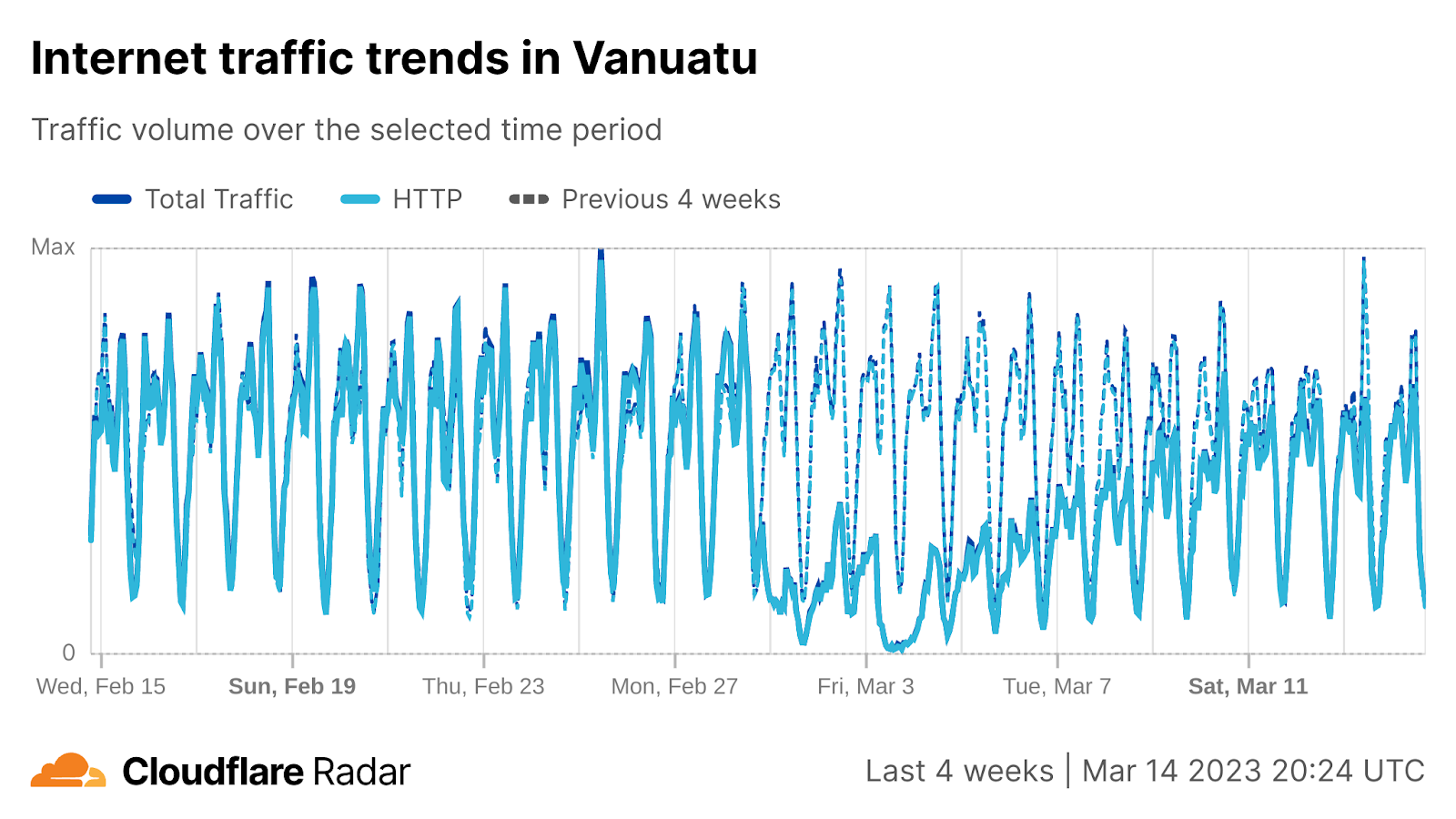
Later in February, Cyclone Judy hit the South Pacific Ocean nation of Vanuatu, the South Pacific Ocean nation made up of roughly 80 islands that stretch 1,300 kilometers. The Category 4 cyclone damaged homes and caused power outages, resulting in a significant drop in the country’s Internet traffic. On February 28, Vanuatu’s traffic dropped by nearly 80% as the cyclone struck, and as seen in the figure below, it took nearly two weeks for traffic to recover to the levels seen earlier in February.
Malawi
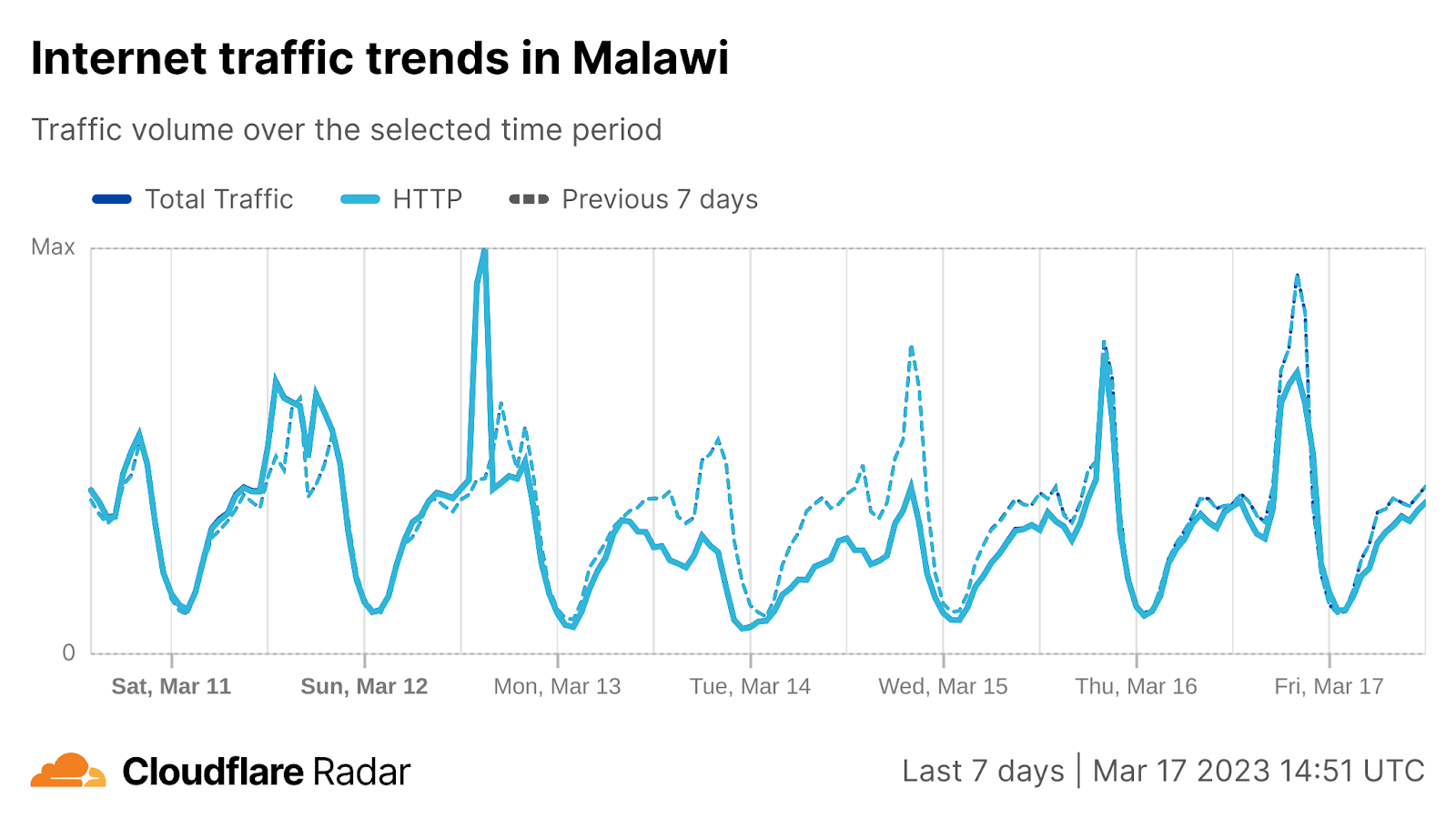
Cyclone Freddy, said to be the longest-lasting, most powerful cyclone on record, hit Malawi during the weekend of March 11-12, and into Monday, March 13. The resulting damage disrupted Internet connectivity in the east African country, with traffic dropping around 11:00 local time (09:00 UTC) on March 13. The disruption lasted for over two days, with traffic levels recovering around 21:00 local time (19:00 UTC) on March 15.
Technical problems
South Africa
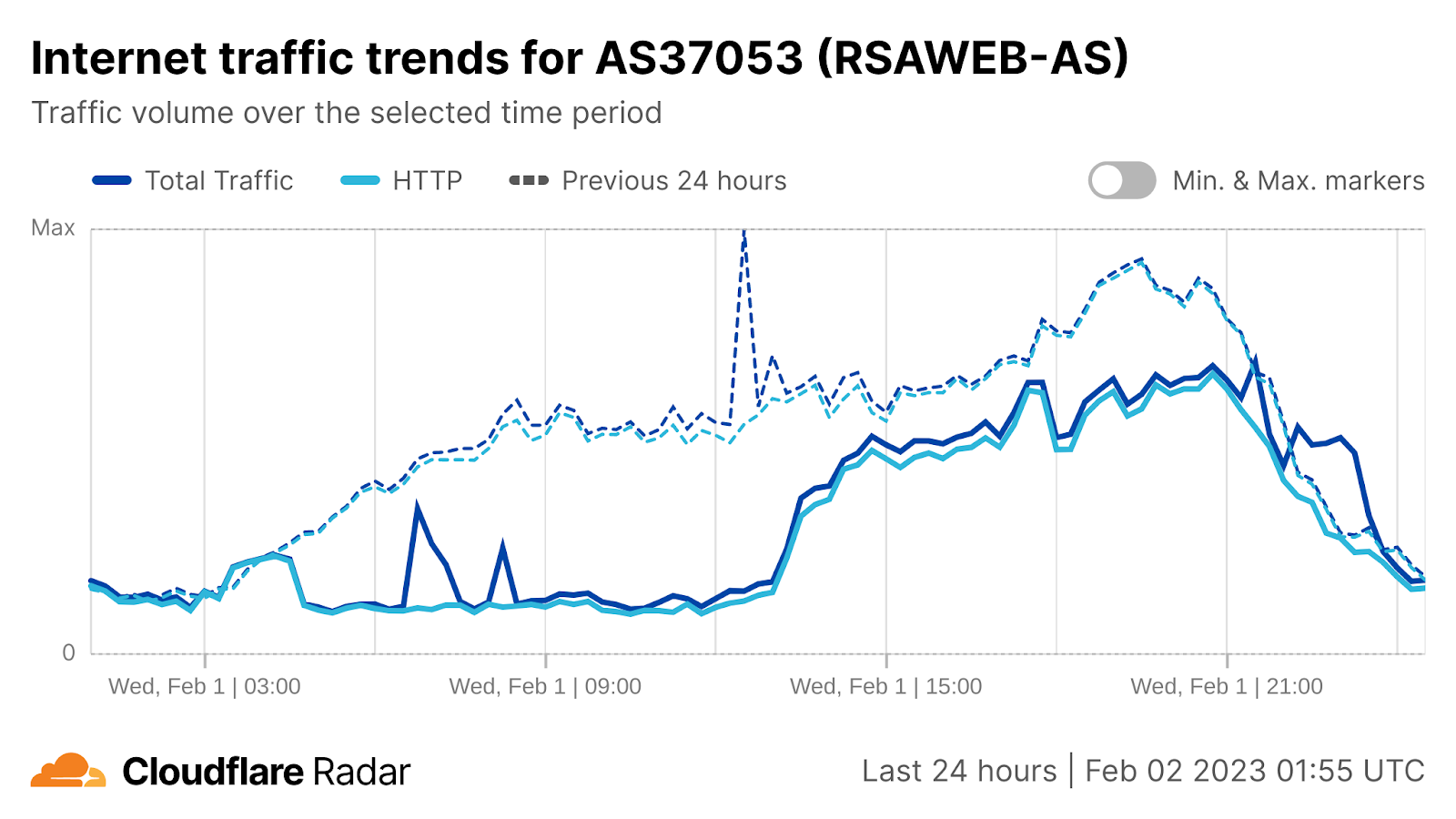
Just before 07:00 local time (05:00 UTC) on February 1, South African service provider RSAWEB initially tweeted about a problem that they said was impacting their cloud and VOIP platforms. However, in several subsequent tweets, they noted that the problem was also impacting internal systems, as well as fiber and mobile connectivity. The figure below shows traffic for RSAWEB dropping at 06:30 local time (04:30 UTC), a point at which it would normally be starting to increase for the day. Just before 16:00 local time (14:00 UTC), RSAWEB tweeted“…engineers are actively working on restoring services post the major incident. Customers who experienced no connectivity may see some services restoring.” The figure below shows a sharp increase in traffic around that time with gradual growth through the evening. However, full restoration of services across all of RSAWEB’s impacted platforms took a full week, according to a February 8 tweet.
Italy
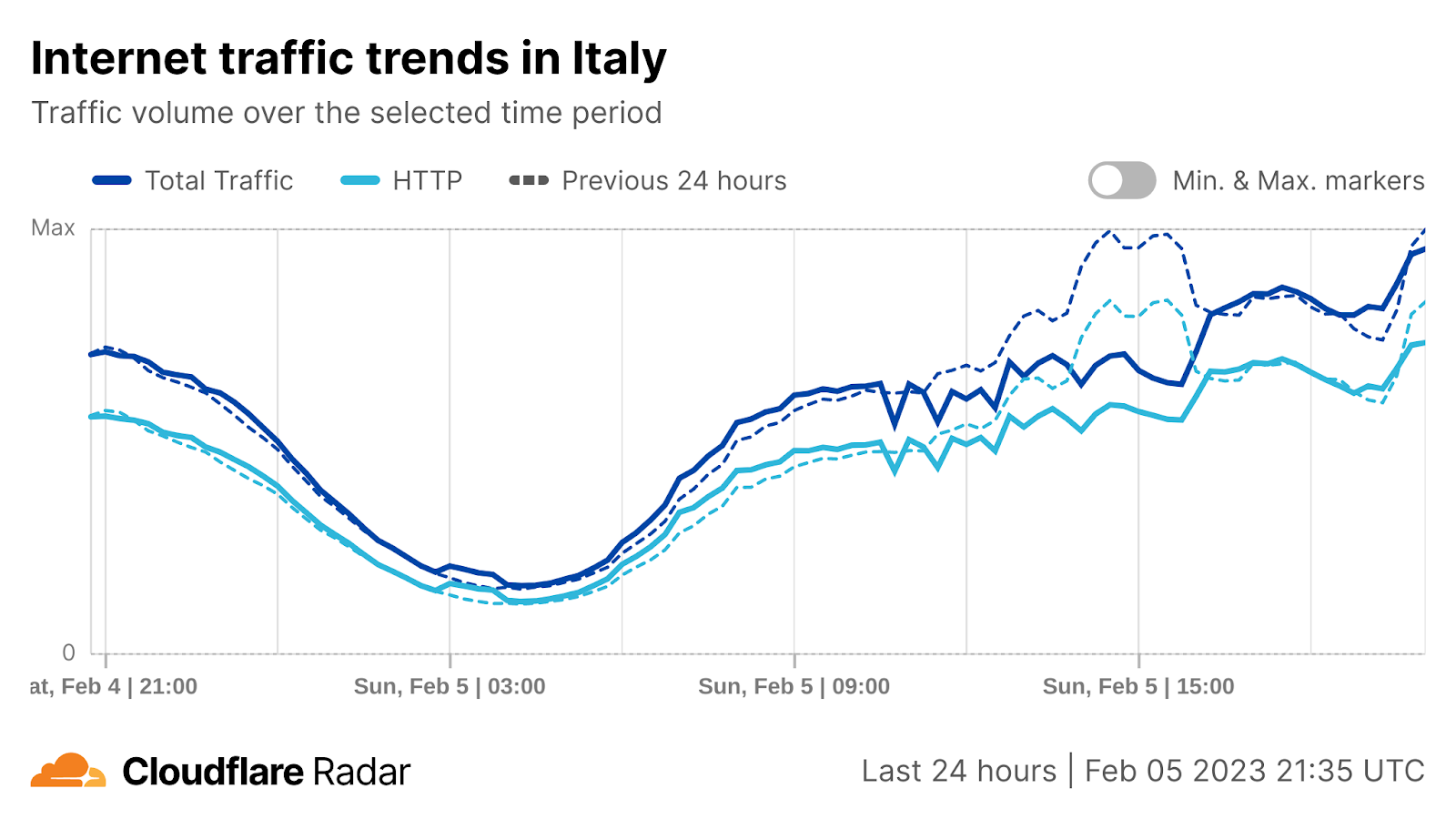
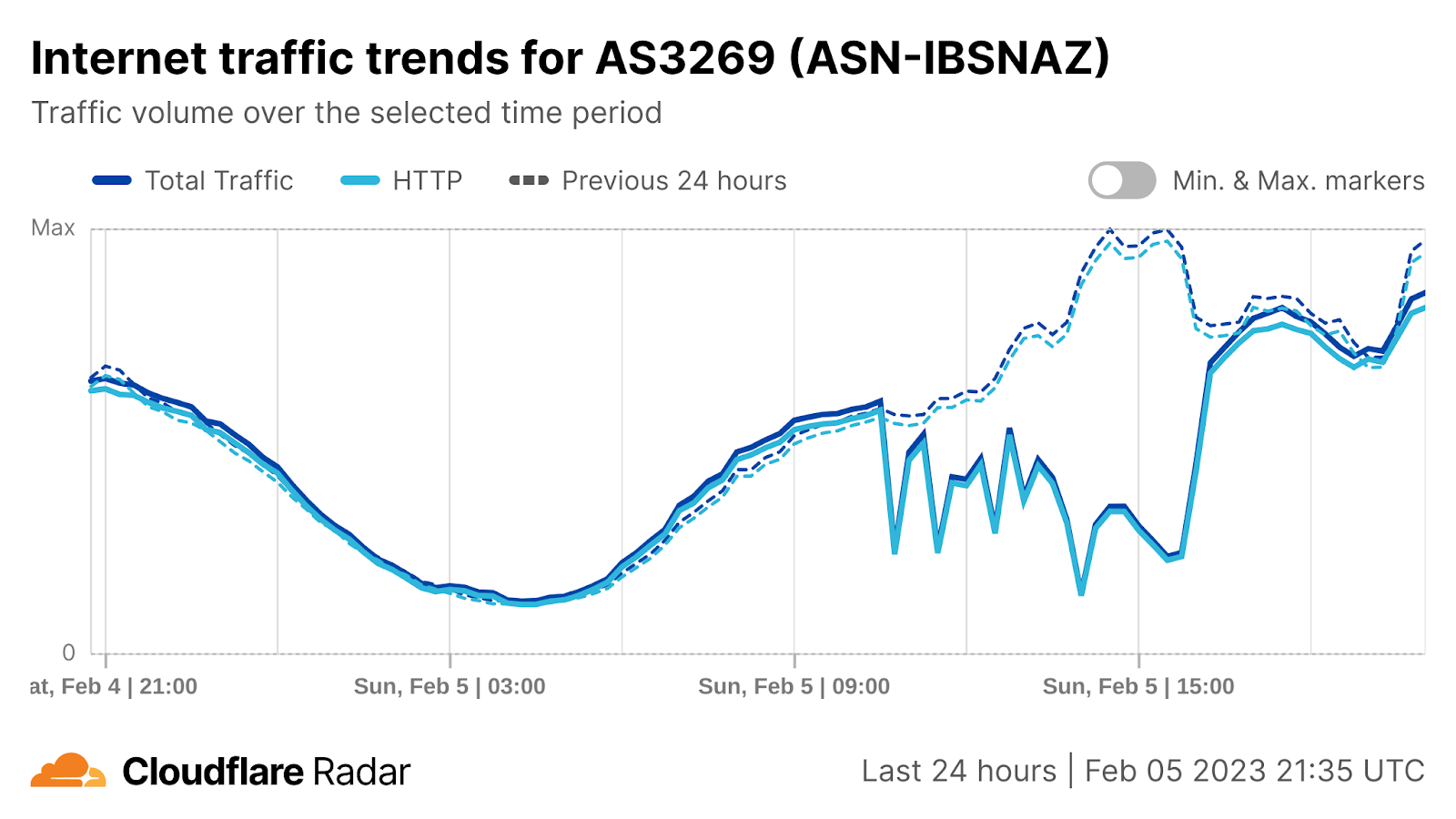
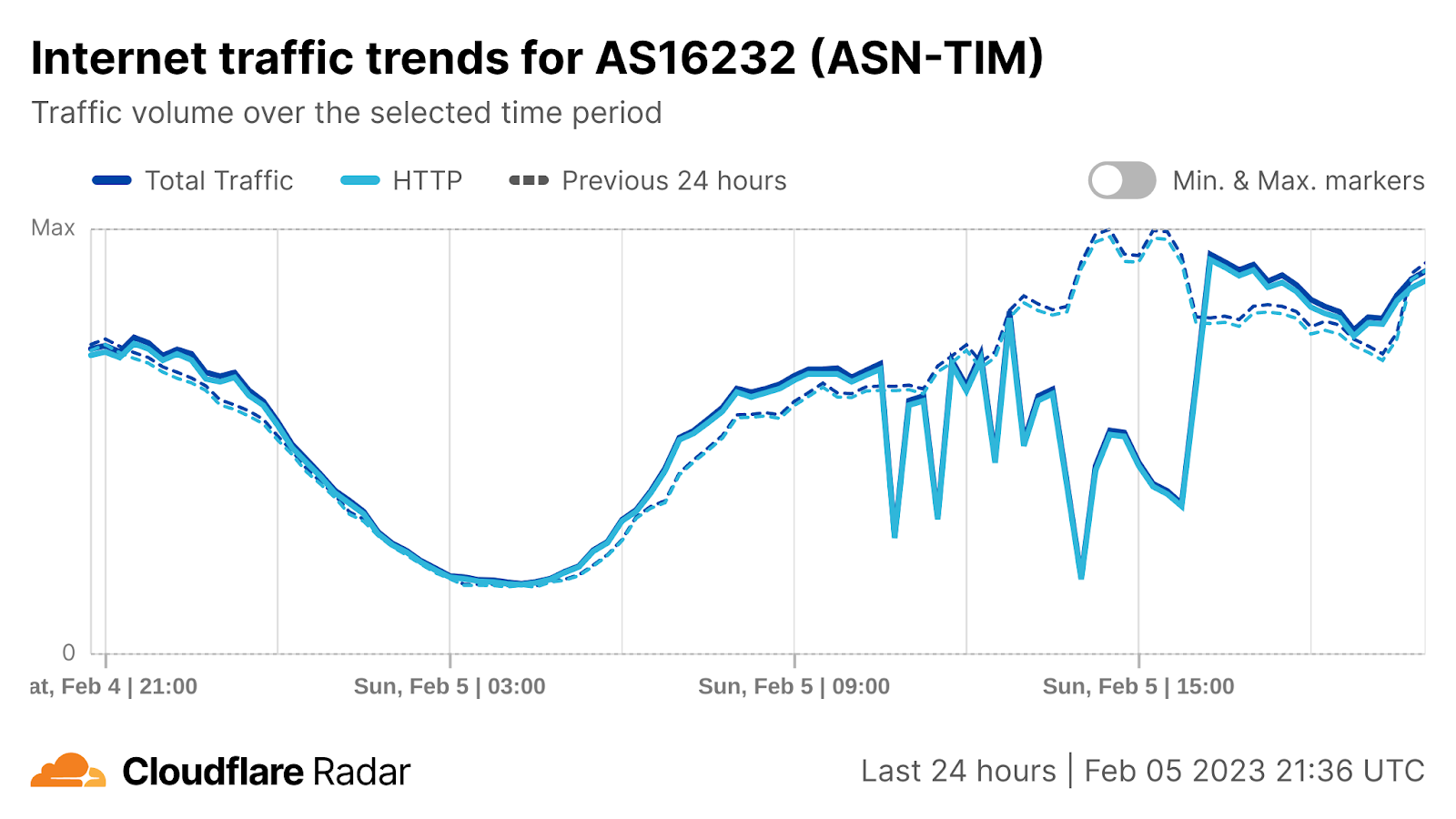
An unspecified “international interconnectivity problem” impacting Telecom Italia caused a multi-hour Internet disruption in Italy on February 5. At a country level, a nominal drop in traffic is visible in the figure below starting around 11:45 local time (10:45 UTC) with some volatility visible in the lower traffic through 17:15 local time (16:15 UTC). However, the impact of the problem is more obvious in the traffic graphs for AS3269 and AS16232, both owned by Telecom Italia. Both graphs show a more significant loss of traffic, as well as greater volatility through the five-plus hour disruption.
Myanmar
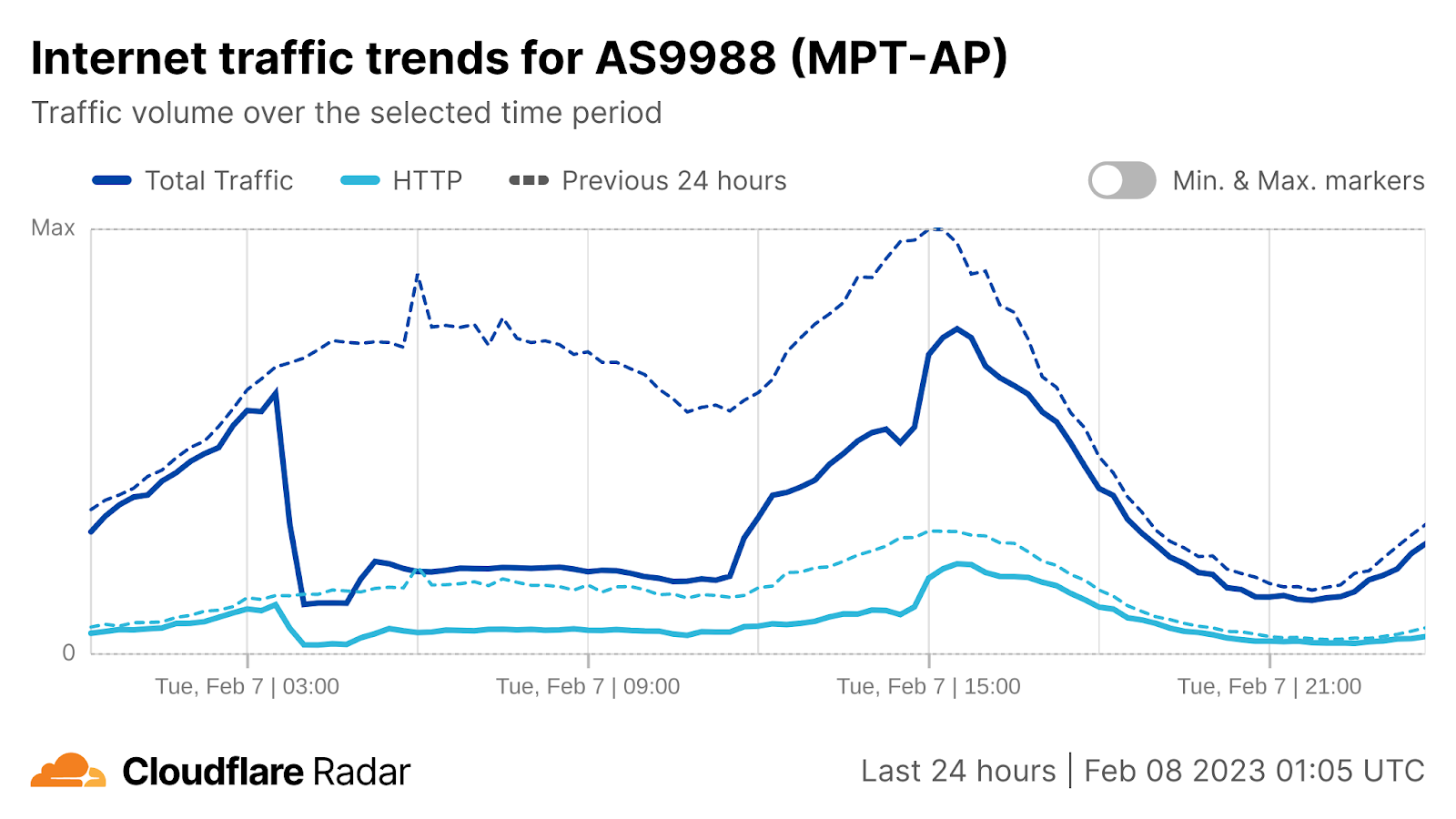
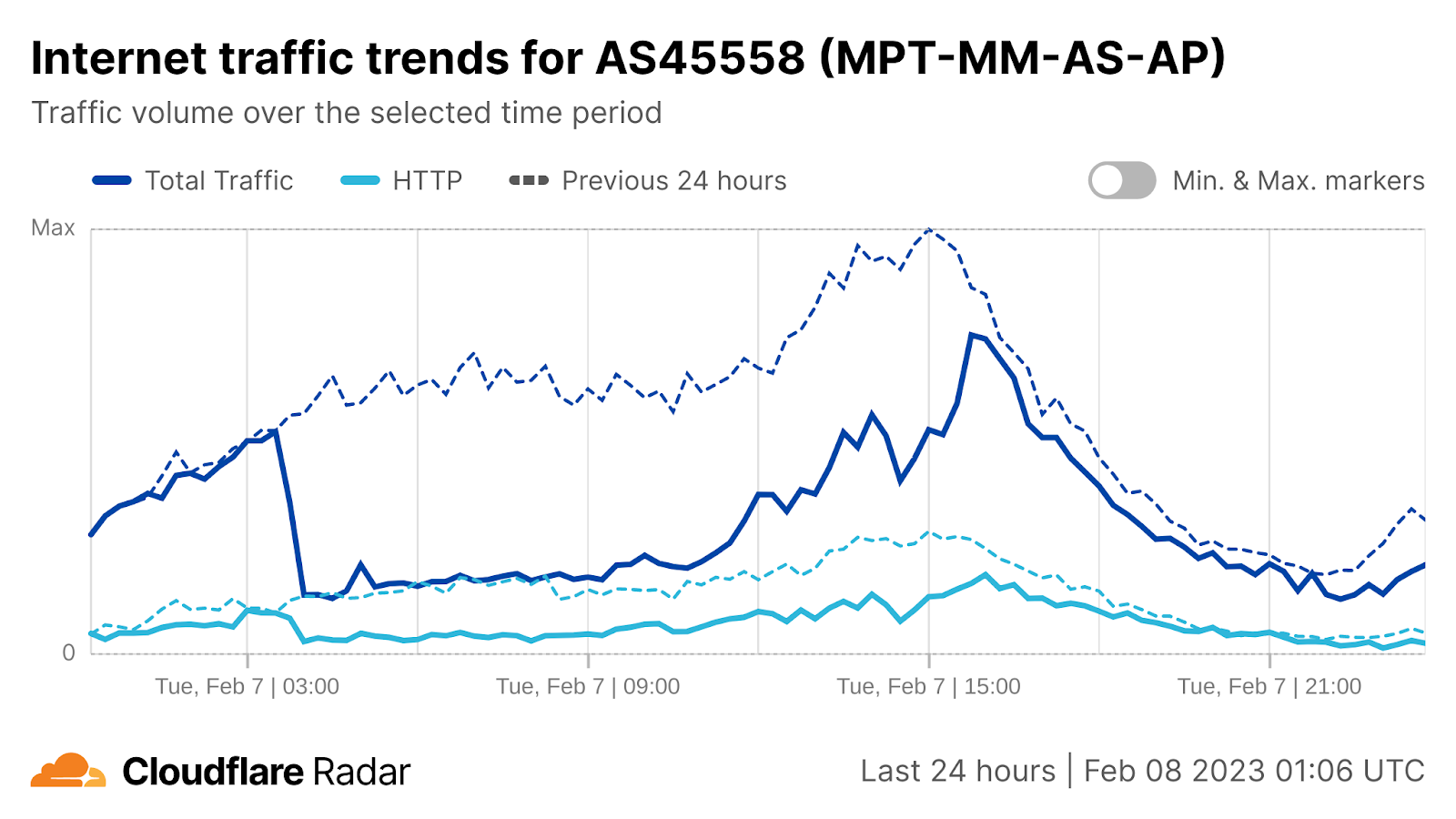
A fire at an exchange office of MPT (Myanma Posts and Telecommunications) on February 7 disrupted Internet connectivity for customers of the Myanmar service provider. A Facebook post from MPT informed customers that “We are currently experiencing disruptions to our MPT’s services including MPT’s call centre, fiber internet, mobile internet and mobile and telephone communications.” The figure below shows the impact of this disruption on MPT-owned AS9988 and AS45558, with traffic dropping significantly at 10:00 local time (03:30 UTC). Significant recovery was seen by 22:00 local time (15:30 local time).
Republic of the Congo (Brazzaville)
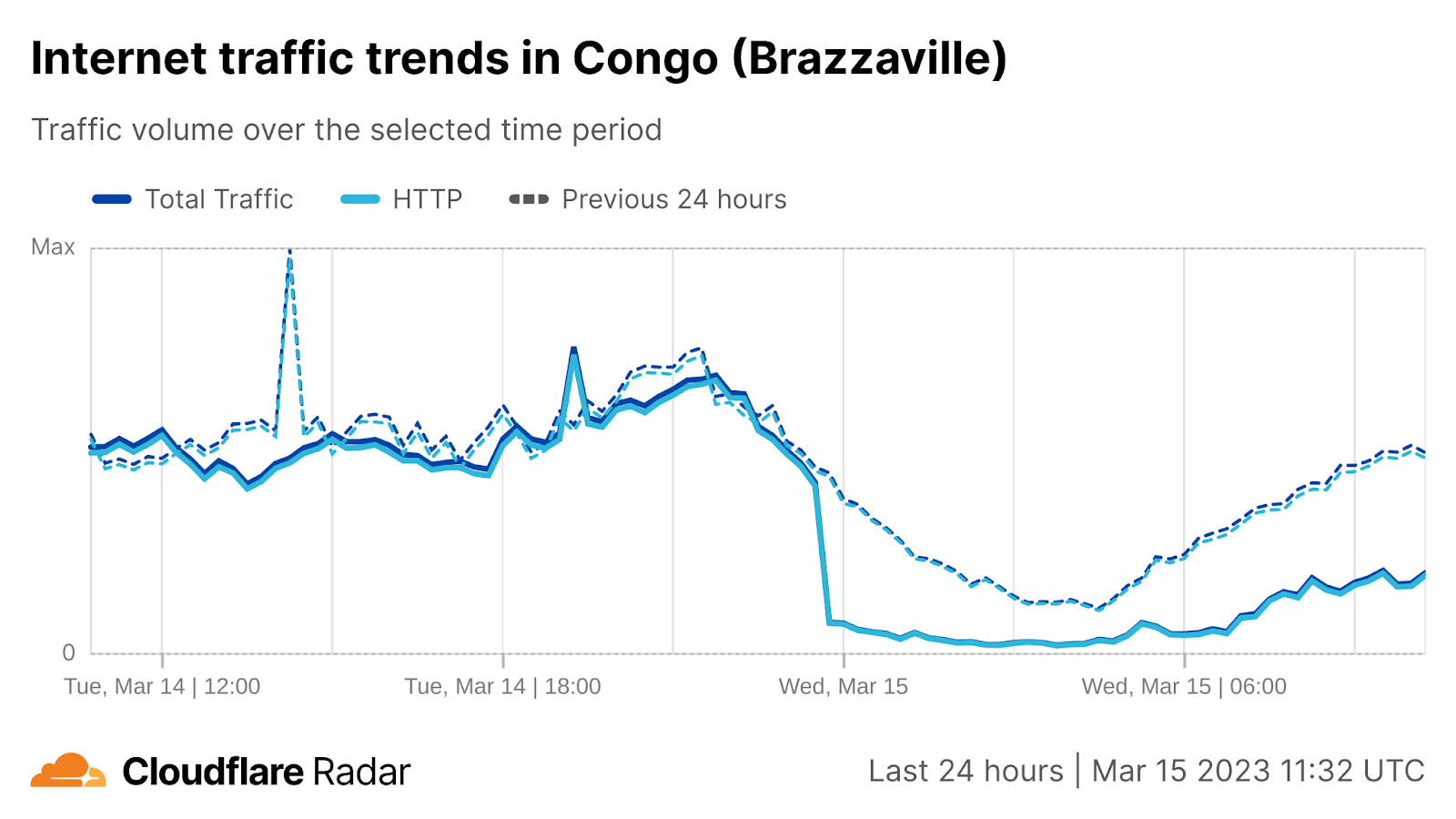
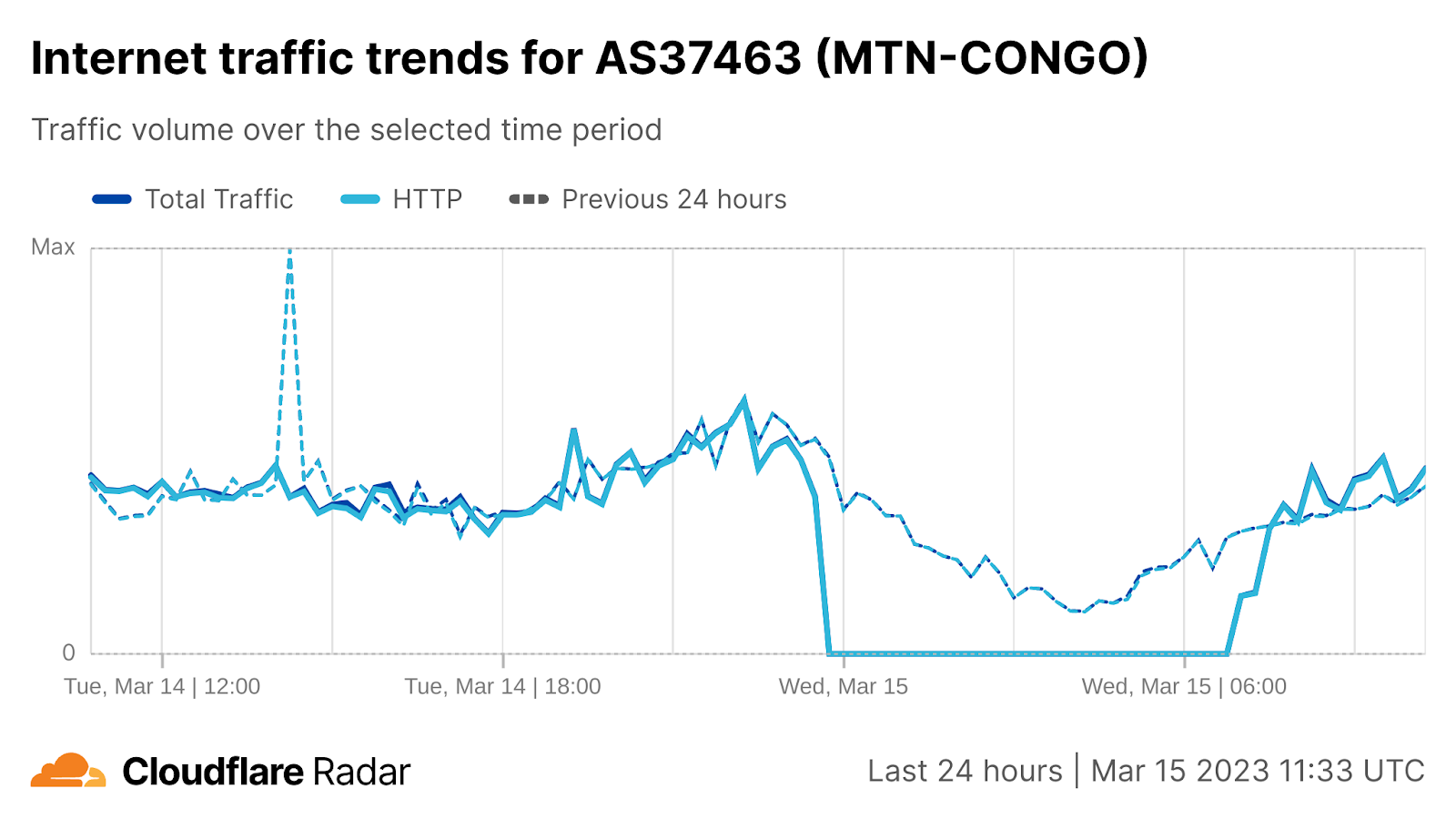
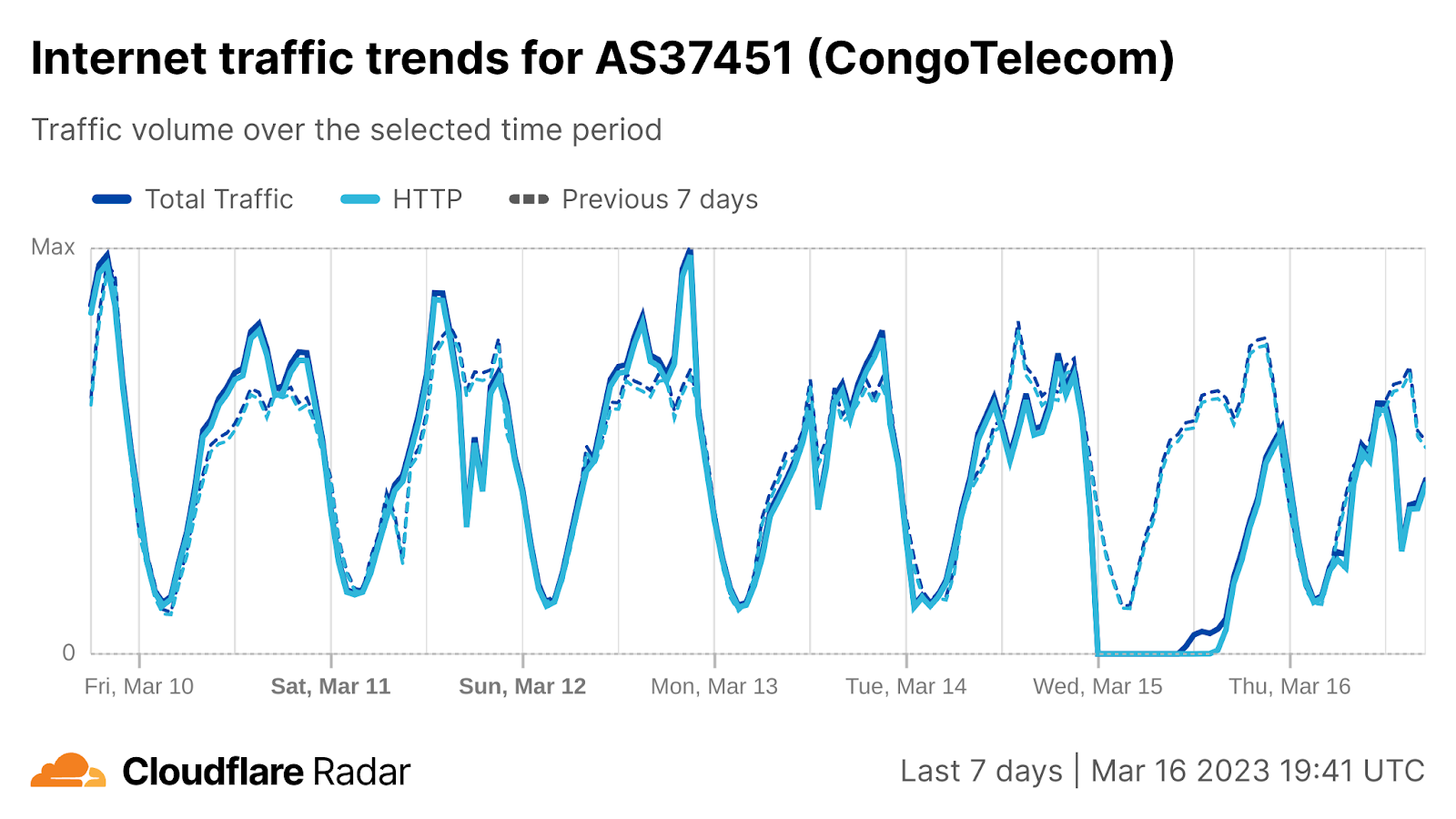
Congo Telecomtweeted a “COMMUNIQUÉ” on March 15, alerting users to a service disruption due to a “network incident”. The impact of this disruption is clearly visible at a country level, with traffic dropping sharply at 00:45 local time (23:45 on March 14 UTC), driven by complete outages at MTN Congo and Congo Telecom, as seen in the graphs below. While traffic at MTN Congo began to recover around 08:00 local time (07:00 UTC), Congo Telecom’s recovery took longer, with traffic beginning to increase around 17:00 local time (16:00 UTC). Congo Telecom tweeted on March 16 that the nationwide Internet outage had been resolved. MTN Congo did not acknowledge the disruption on social media, and neither company provided more specific information about the reported “network incident”.
Lebanon
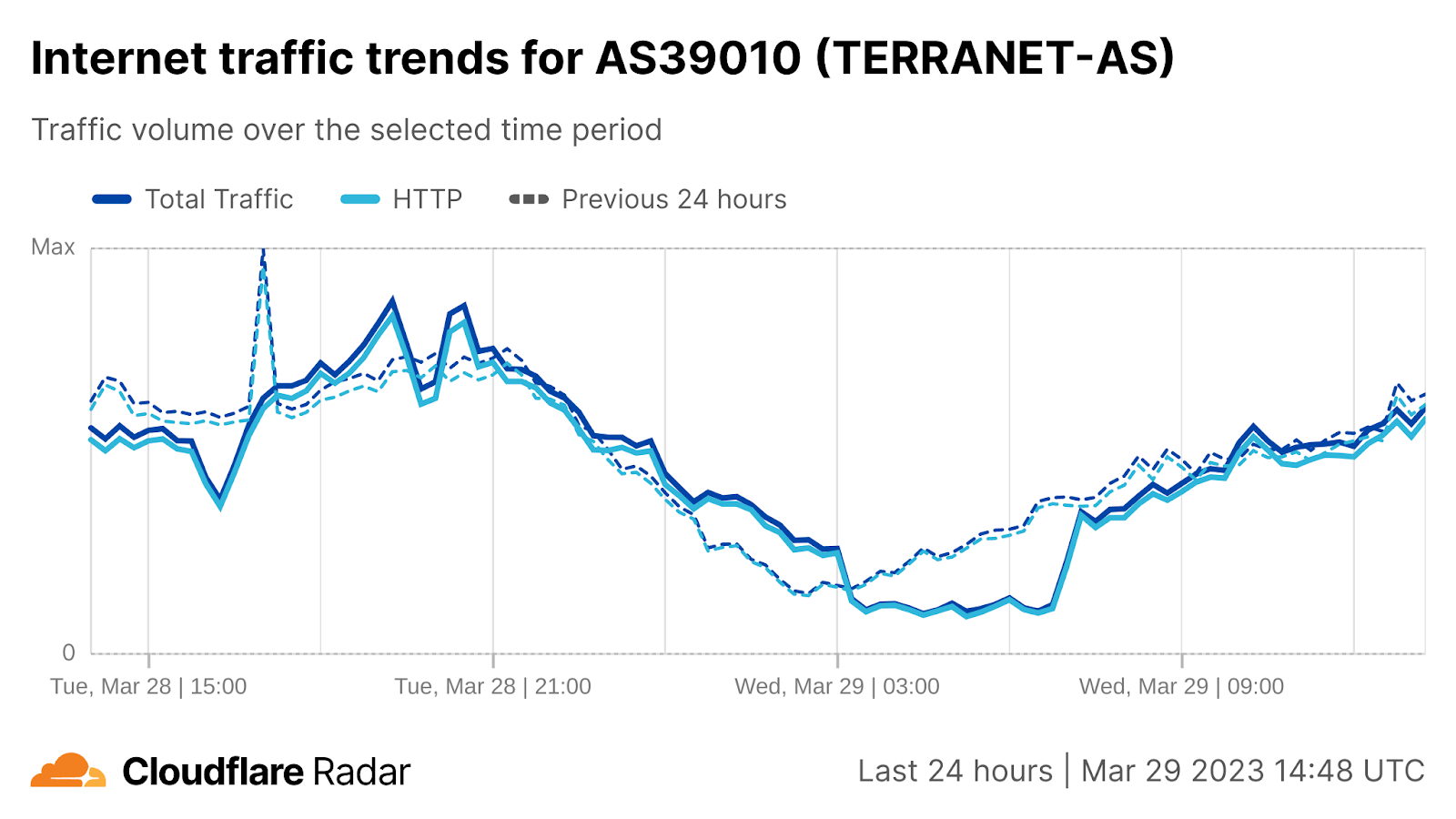
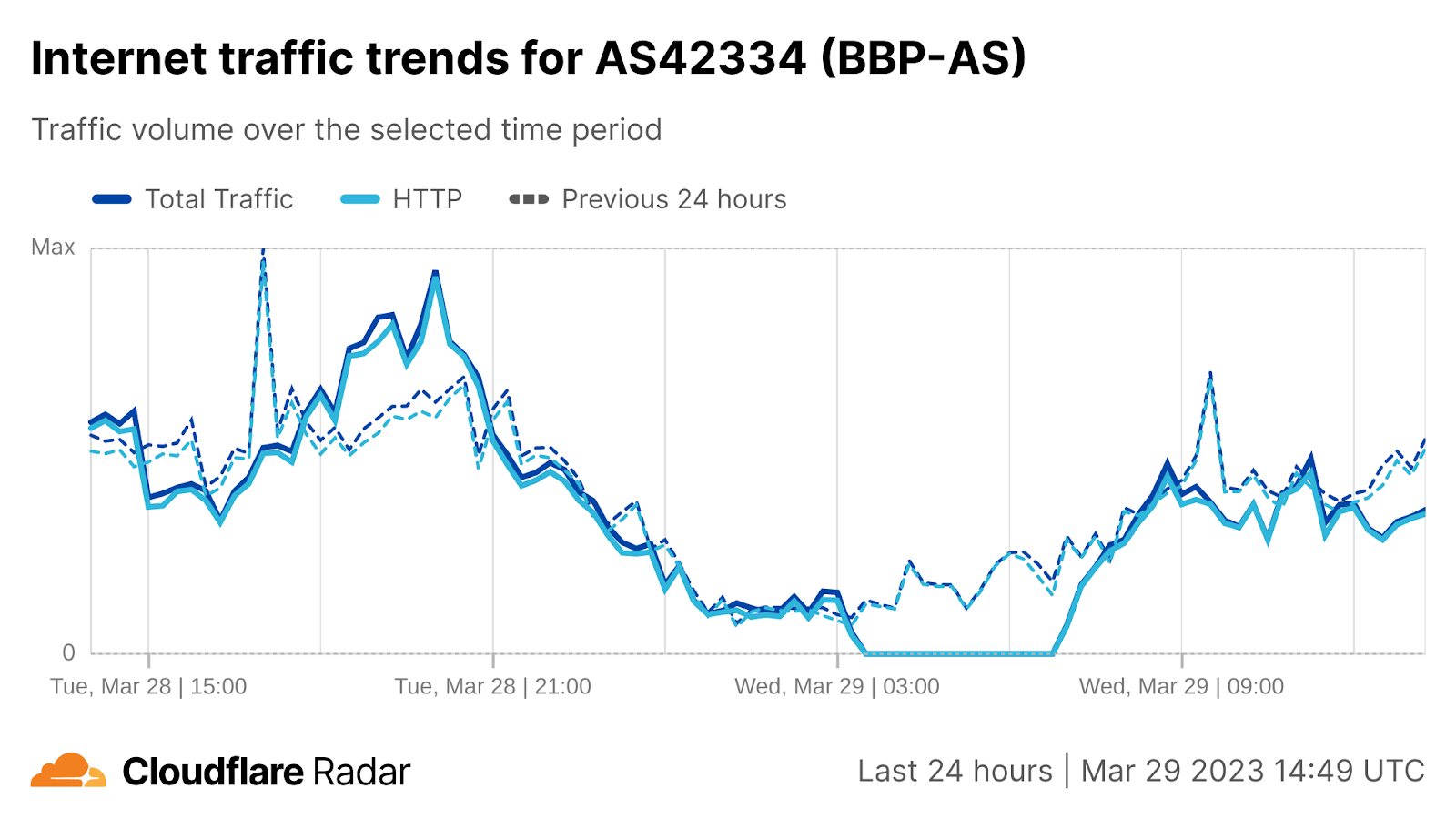
Closing out March, disruptions observed at AS39010 (Terranet) and AS42334 (Mobi) in Lebanon may have been related to a strike at upstream provider Ogero Telecom, common to both networks. A published report quoted the Chairman of Ogero commenting on the strike, “We are heading to a catastrophe if a deal is not found with the government: the network will completely stop working as our generators will gradually run out of fuel. Lebanon completely relies on Ogero for its bandwidth, leaving no one exempt from a blackout.” Traffic at both Terranet and Mobi dropped around 05:00 local time (03:00 UTC) on March 29, with the disruption lasting approximately 4.5 hours, as traffic recovered at 09:30 local time (07:30 UTC).
Cyberattacks
South Korea
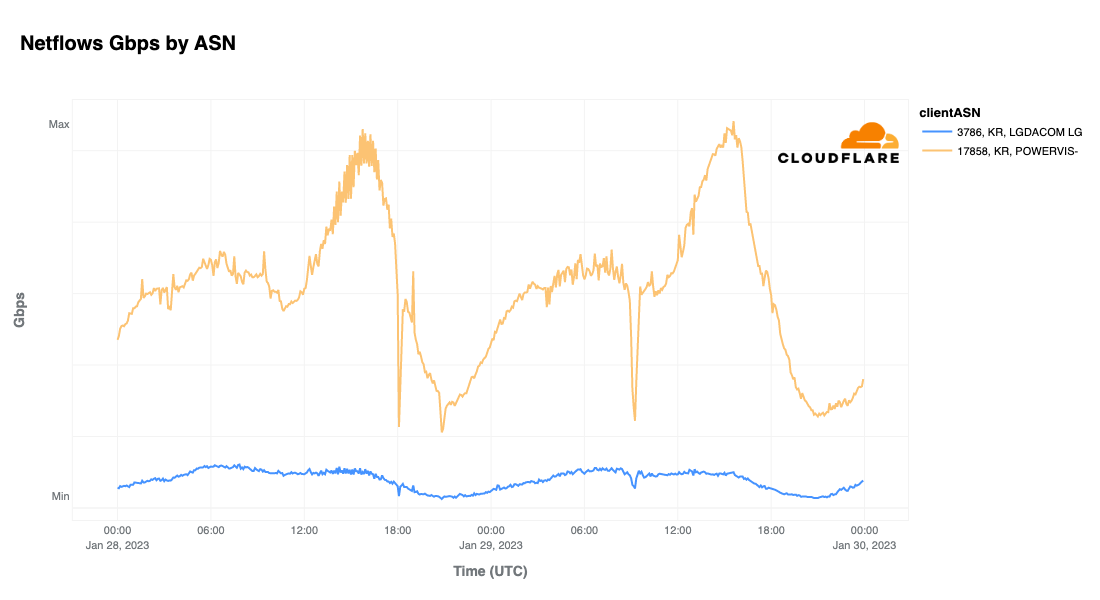
On January 29, South Korean Internet provider LG Uplus suffered two brief Internet disruptions which were reportedly caused by possible DDoS attacks. The first disruption occurred at 03:00 local time (18:00 UTC on January 28), and the second occurred at 18:15 local time (09:15 UTC). The disruptions impacted traffic on AS17858 and AS3786, both owned by LG. The company was reportedly hit by a second pair of DDoS attacks on February 4.
Guam
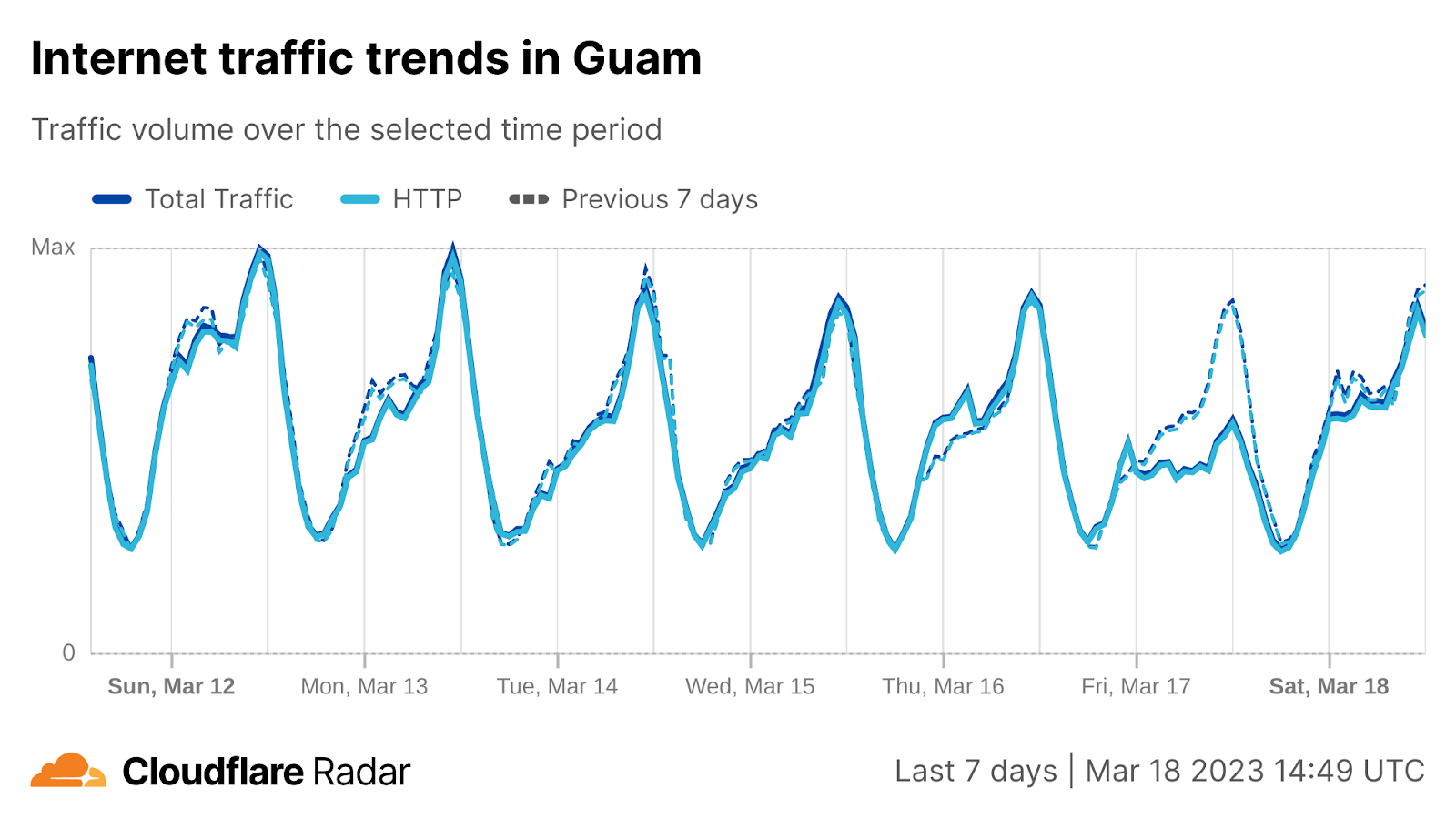
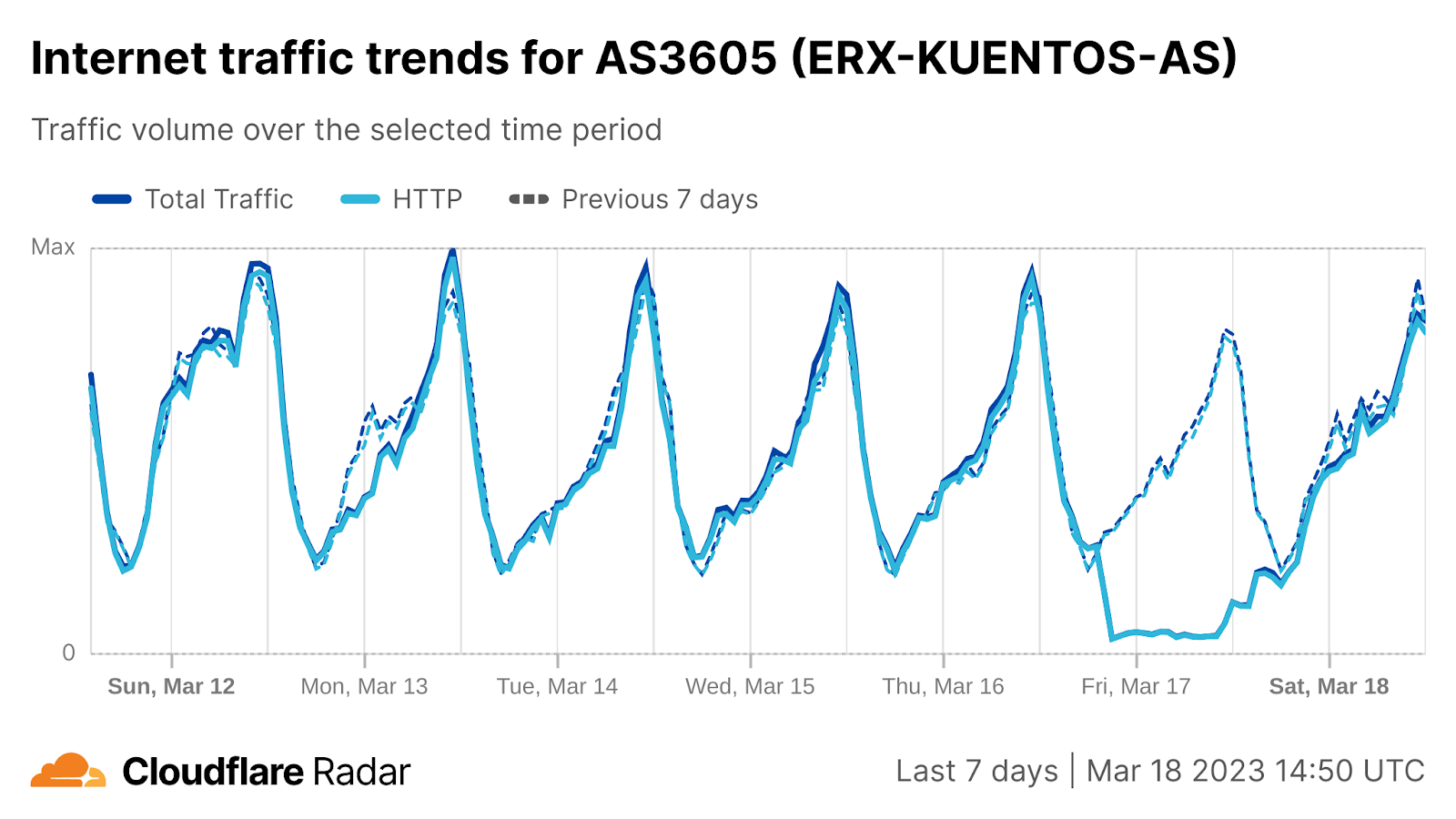
In a March 17 tweet posted at 11:30 local time (01:30 UTC), Docomo Pacific reported an outage affecting multiple services, with a subsequent tweet noting that “Early this morning, a cyber security incident occurred and some of our servers were attacked”. This outage is visible at a country level in Guam, seen as a significant drop in traffic starting around 10:00 local time (00:00 UTC) in the figure below. However, in the graph below for AS3605 (ERX-KUENTOS/Guam Cablevision/Docomo Pacific), the cited outage results in a near-complete loss of traffic starting around 05:00 local time (19:00 on March 16 UTC). Traffic returned to normal levels by 18:00 local time on March 18 (08:00 UTC).
Ukraine/Military Action
In February, the conflict in Ukraine entered its second year, and over this past year, we have tracked its impact on the Internet, highlighting traffic shifts, attacks, routing changes, and connectivity disruptions. In the fourth quarter of 2022, a number of disruptions were related to attacks on electrical infrastructure, and this pattern continued into the first quarter of 2023.
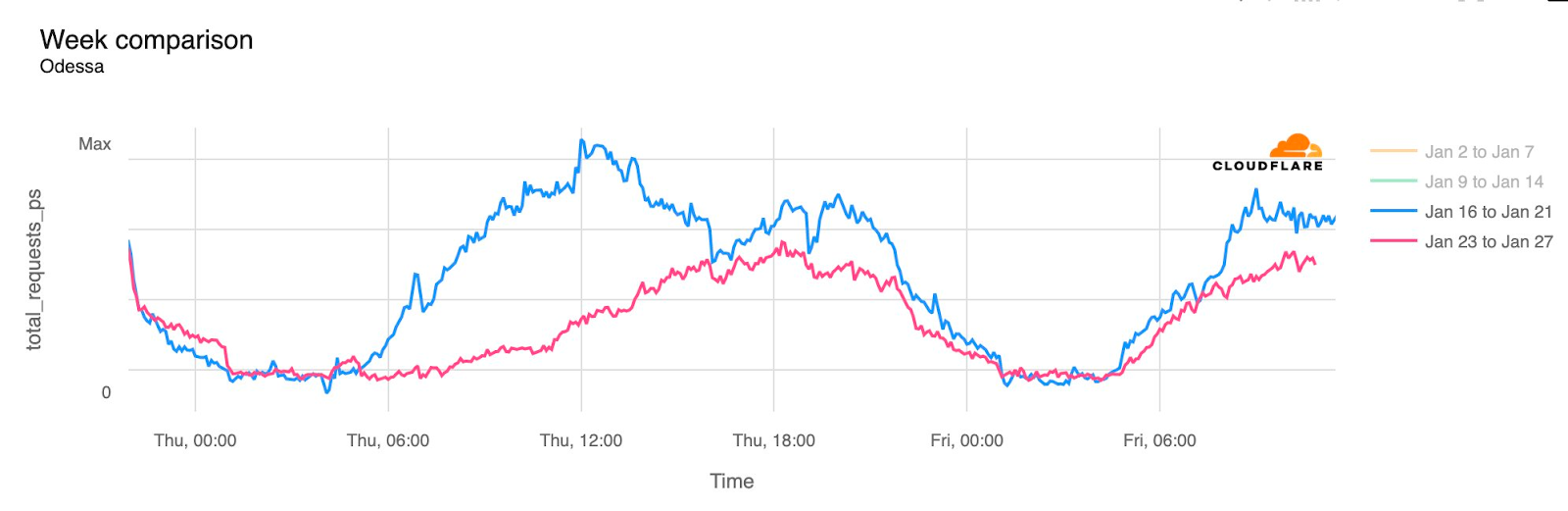
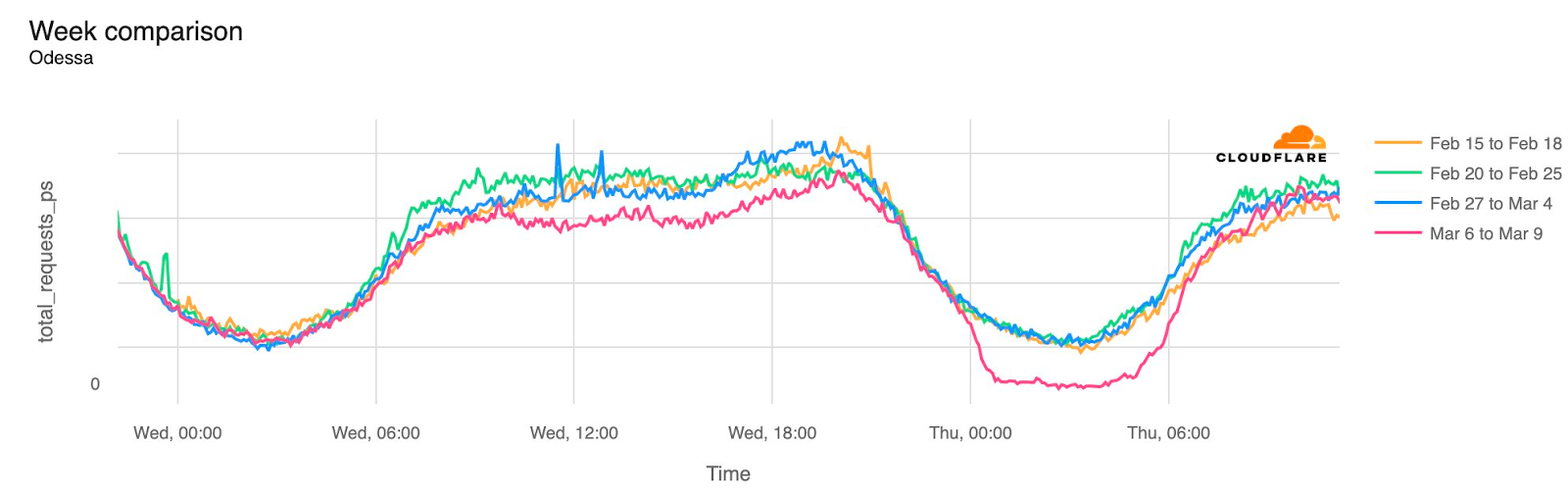
One such disruption occurred in Odessa on January 27, amid news of Russian airstrikes on local energy infrastructure. As seen in the figure below, Internet traffic in Odessa usually begins to climb just before 08:00 local time (06:00 UTC), but failed to do so that morning after several energy infrastructure facilities near Odessa were hit and damaged. Traffic remained lower than levels seen the previous week for approximately 18 hours.
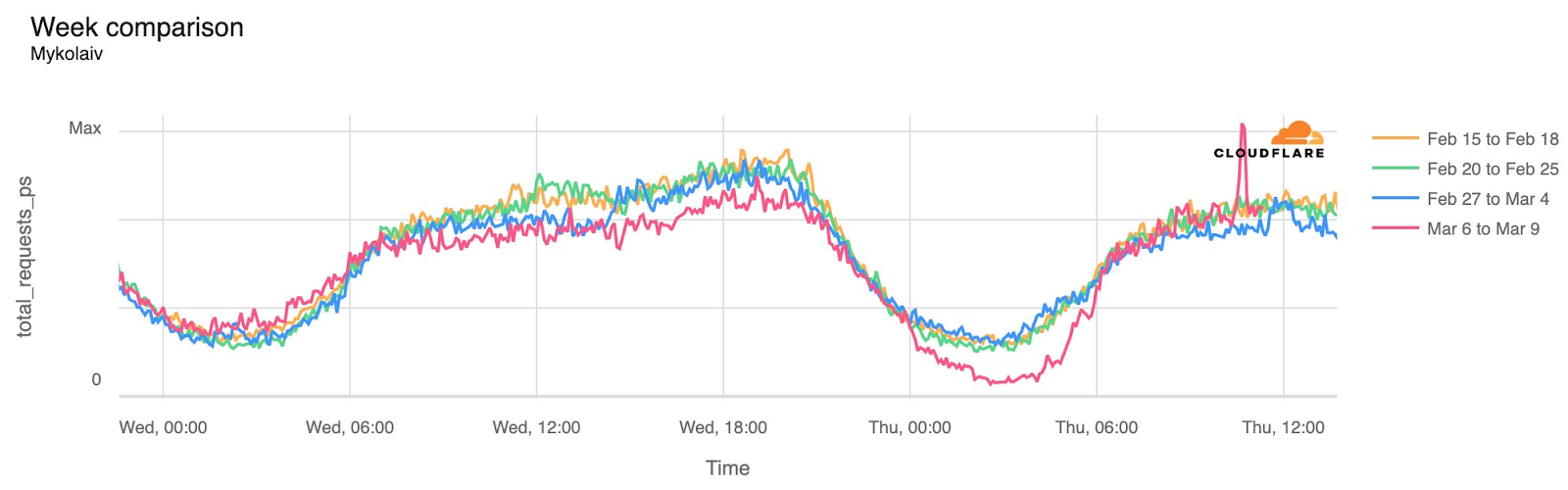
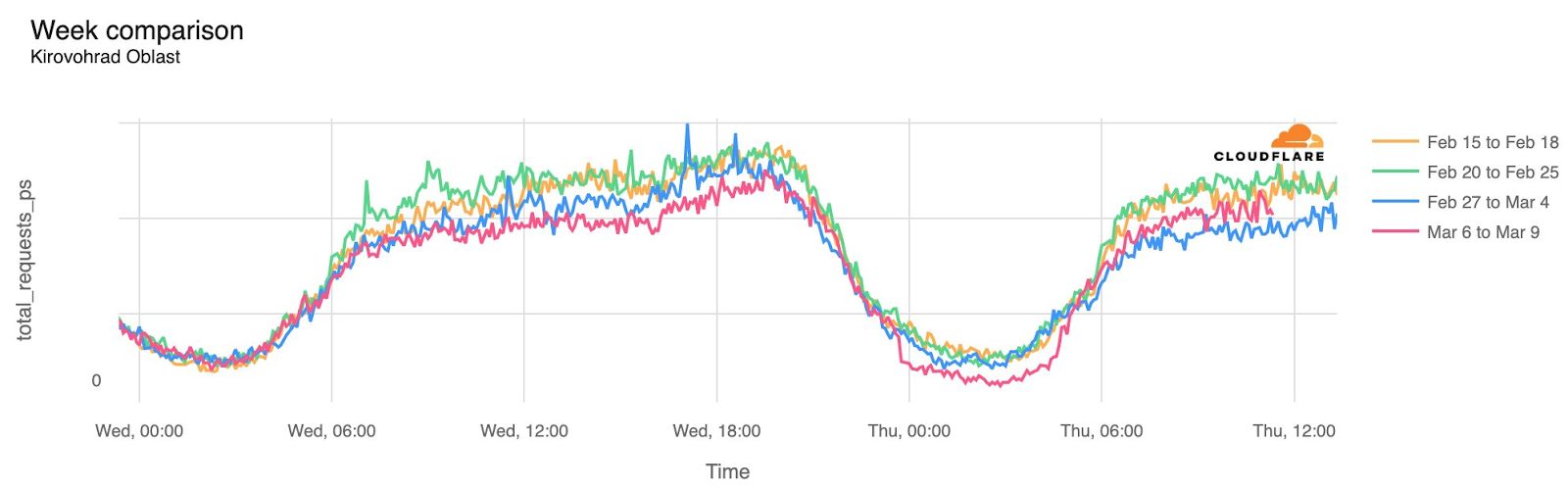
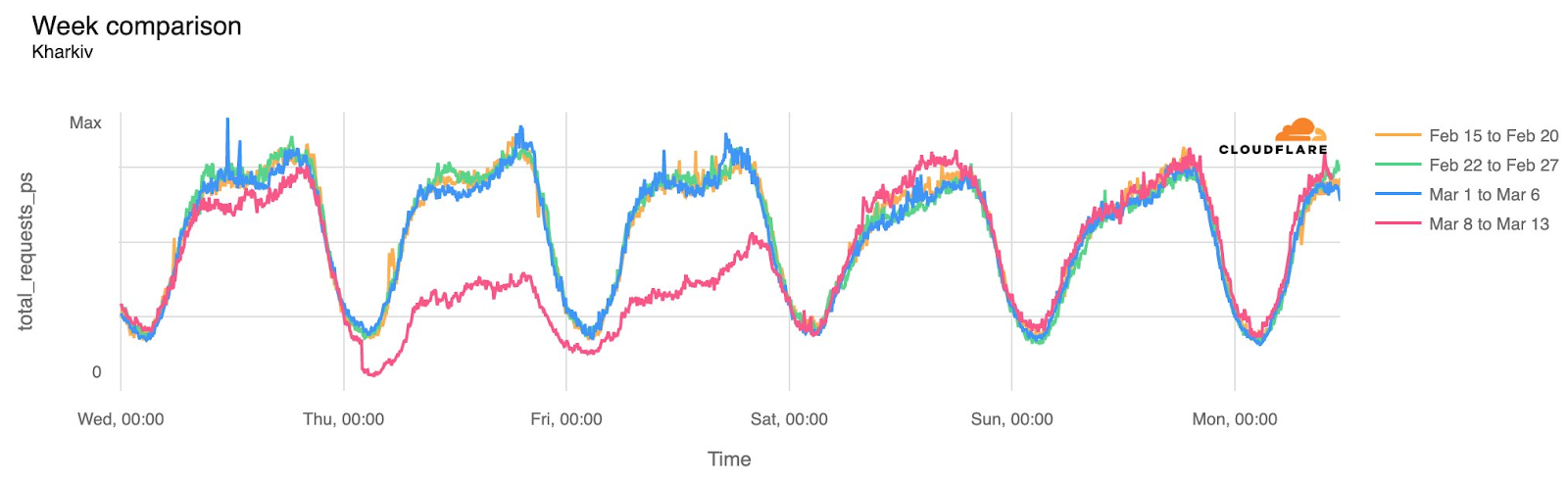
Power outages resulting from Russian attacks on energy generation and distribution facilities on March 9 resulted in disruptions to Internet connectivity in multiple locations around Ukraine. As seen in the figures below, traffic dropped below normal levels after 02:00 local time (00:00 UTC) on March 9. Traffic in Kharkiv fell over 50% as compared to previous week, while in Odessa, traffic fell as much as 60%. In Odessa, Mykolaiv, and Kirovohrad Oblast, traffic recovered by around 08:00 local time (06:00 UTC), while in Kharkiv, the disruption lasted nearly two days, returning to normal levels around 23:45 local time (21:45 UTC) on Friday, March 10.
Conclusion
The first quarter of 2023 seemed to be particularly active from an Internet disruption perspective, but hopefully it is not a harbinger of things to come through the rest of the year. This is especially true of government-directed shutdowns, which occurred fairly regularly through 2022. To that end, civil society organization Access Now recently published their Internet shutdowns in 2022 report, finding that In 2022, governments and other actors disrupted the internet at least 187 times across 35 countries. Cloudflare Radar is proud to support Access Now’s #KeepItOn initiative, using our data to help illustrate the impact of Internet shutdowns and other disruptions.
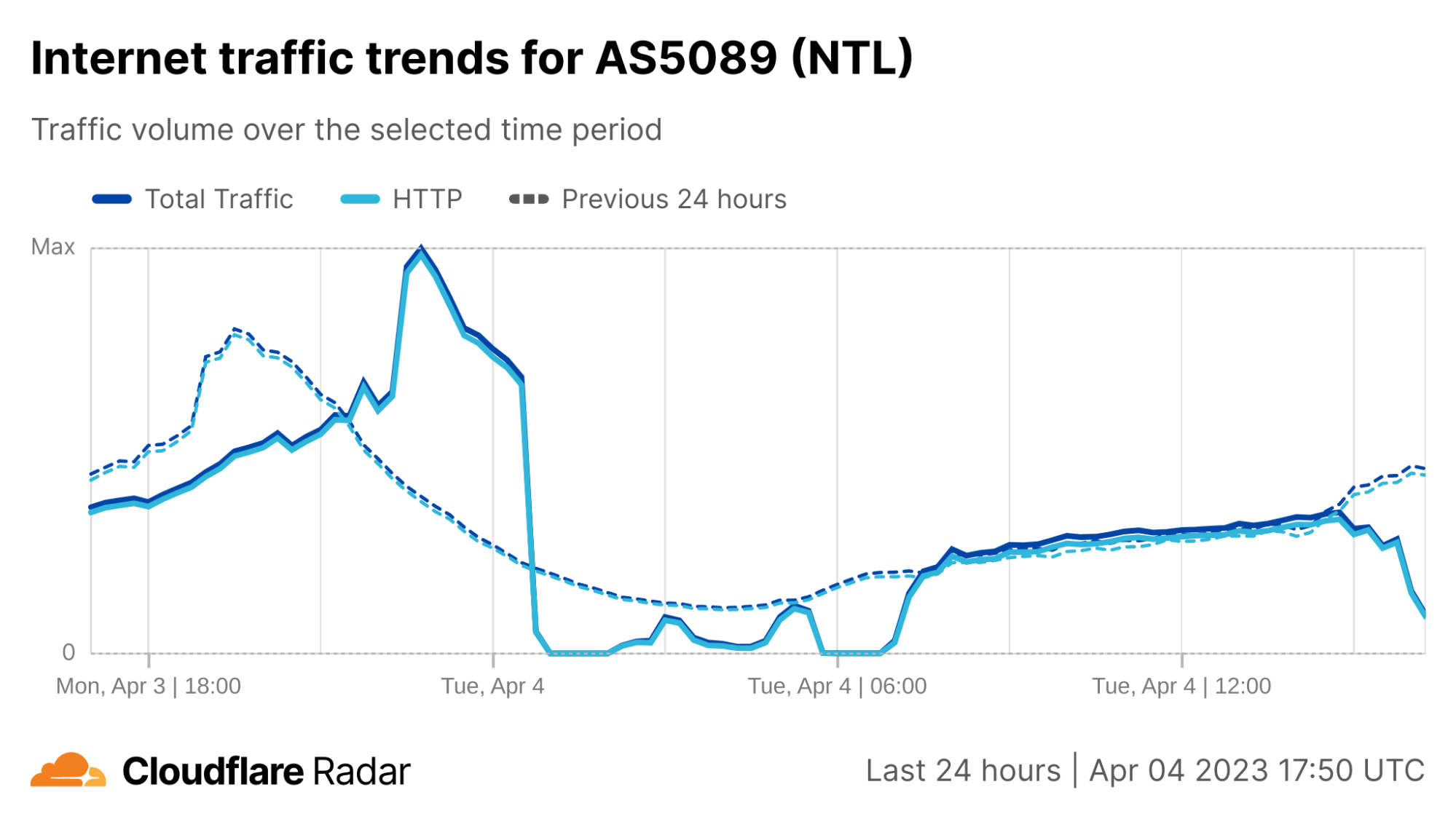
Just after midnight (UTC) on April 4, subscribers to UK ISP Virgin Media (AS5089) began experiencing an Internet outage, with subscriber complaints multiplying rapidly on platforms including Twitter and Reddit.
Cloudflare Radar data shows Virgin Media traffic dropping to near-zero around 00:30 UTC, as seen in the figure below. Connectivity showed some signs of recovery around 02:30 UTC, but fell again an hour later. Further nominal recovery was seen around 04:45 UTC, before again experiencing another complete outage between around 05:45-06:45 UTC, after which traffic began to recover, reaching expected levels around 07:30 UTC.
After the initial set of early-morning disruptions, Virgin Media experienced another round of issues in the afternoon. Cloudflare observed instability in traffic from Virgin Media’s network (called an autonomous system in Internet jargon) AS5089 starting around 15:00 UTC, with a significant drop just before 16:00 UTC. However in this case, it did not appear to be a complete outage, with traffic recovering approximately a half hour later.
Virgin Media’s Twitter account acknowledged the early morning disruption several hours after it began, posting responses stating “We’re aware of an issue that is affecting broadband services for Virgin Media customers as well as our contact centres. Our teams are currently working to identify and fix the problem as quickly as possible and we apologise to those customers affected.” Further responses after service restoration noted “We’ve restored broadband services for customers but are closely monitoring the situation as our engineers continue to investigate. We apologise for any inconvenience caused.”
However, the second disruption was acknowledged on Virgin Media’s Twitter account much more rapidly, with a post at 16:25 UTC stating “Unfortunately we have seen a repeat of an earlier issue which is causing intermittent broadband connectivity problems for some Virgin Media customers. We apologise again to those impacted, our teams are continuing to work flat out to find the root cause of the problem and fix it.”
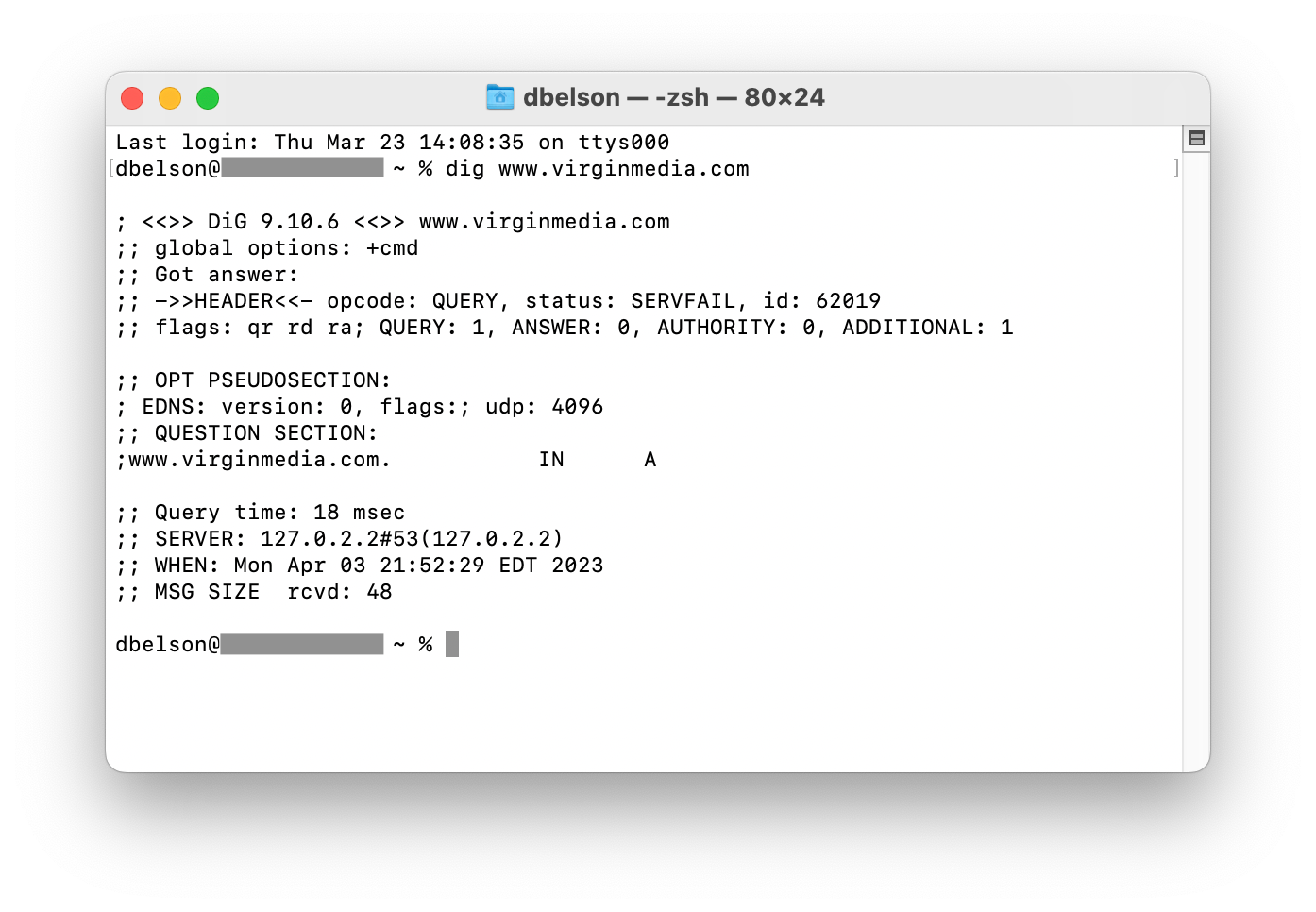
At the time of the outages, www.virginmedia.com, which includes the provider’s status page, was unavailable. As seen in the figure below, a DNS lookup for the hostname resulted in a SERVFAIL error, indicating that the lookup failed to return a response. This is because the authoritative nameservers for virginmedia.com are listed as ns{1-4}.virginmedia.net, and these nameservers are all hosted within Virgin Media’s network (AS5089) and thus are not accessible during the outage.
Although Virgin Media has not publicly released a root cause for the series of disruptions that its network has experienced, looking at BGP activity can be instructive.
BGP is a mechanism to exchange routing information between networks on the Internet. The big routers that make the Internet work have huge, constantly updated lists of the possible routes that can be used to deliver each network packet to its final destination. Without BGP, the Internet routers wouldn’t know what to do, and the Internet wouldn’t exist.
The Internet is literally a network of networks, or for math fans, a graph, with each individual network a node in it, and the edges representing the interconnections. All of this is bound together by BGP, which allows one network (Virgin Media, for instance) to advertise its presence to other networks that form the Internet. When Virgin Media is not advertising its presence, other networks can’t find its network and it becomes effectively unavailable.
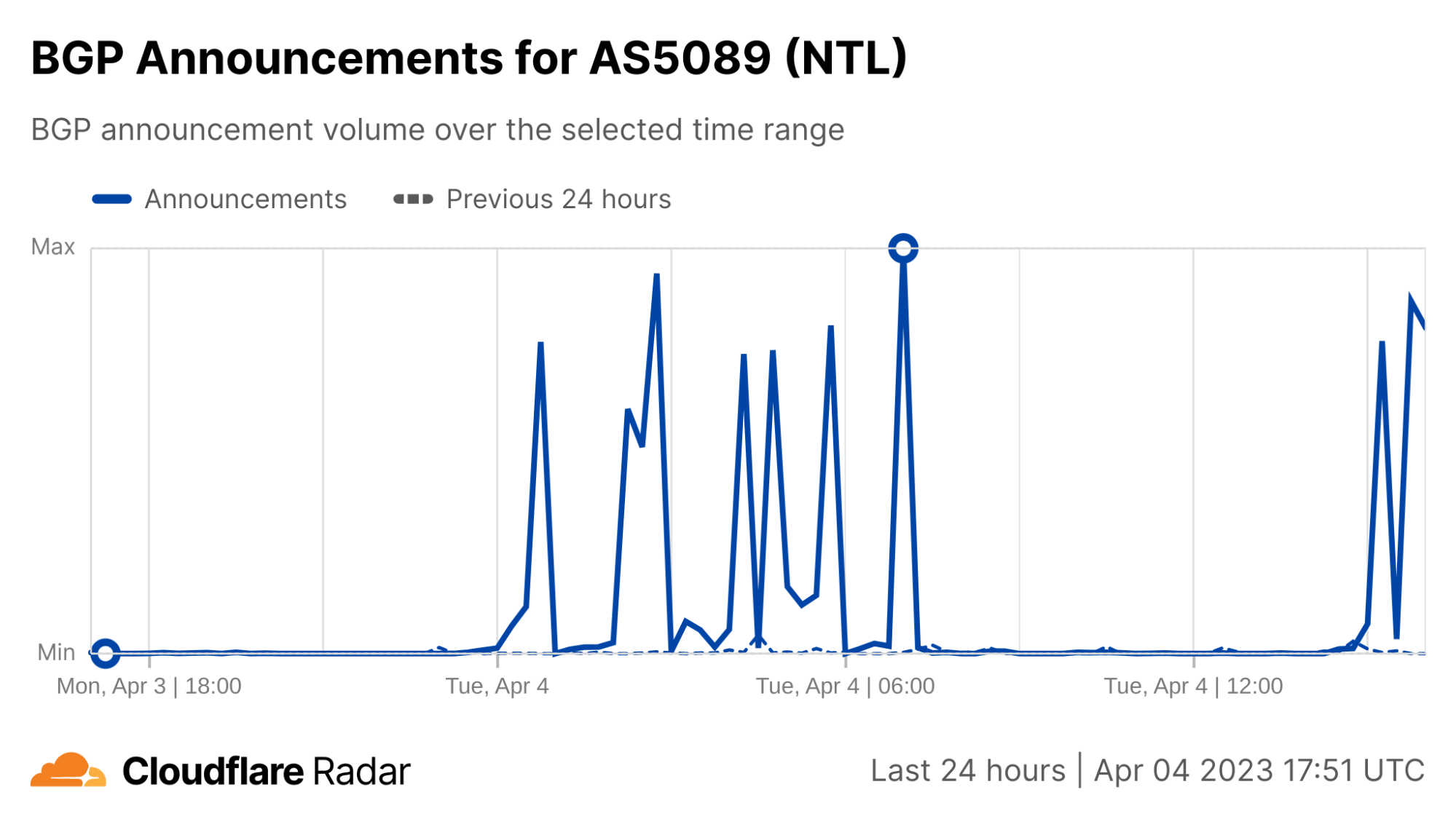
BGP announcements inform a router of changes made to the routing of a prefix (a group of IP addresses) or entirely withdraws the prefix, removing it from the routing table. The figure below shows aggregate BGP announcement activity from AS5089 with spikes that align with the decreases and increases seen in the traffic graph above, suggesting that the underlying cause may in fact be BGP-related, or related to problems with core network infrastructure.
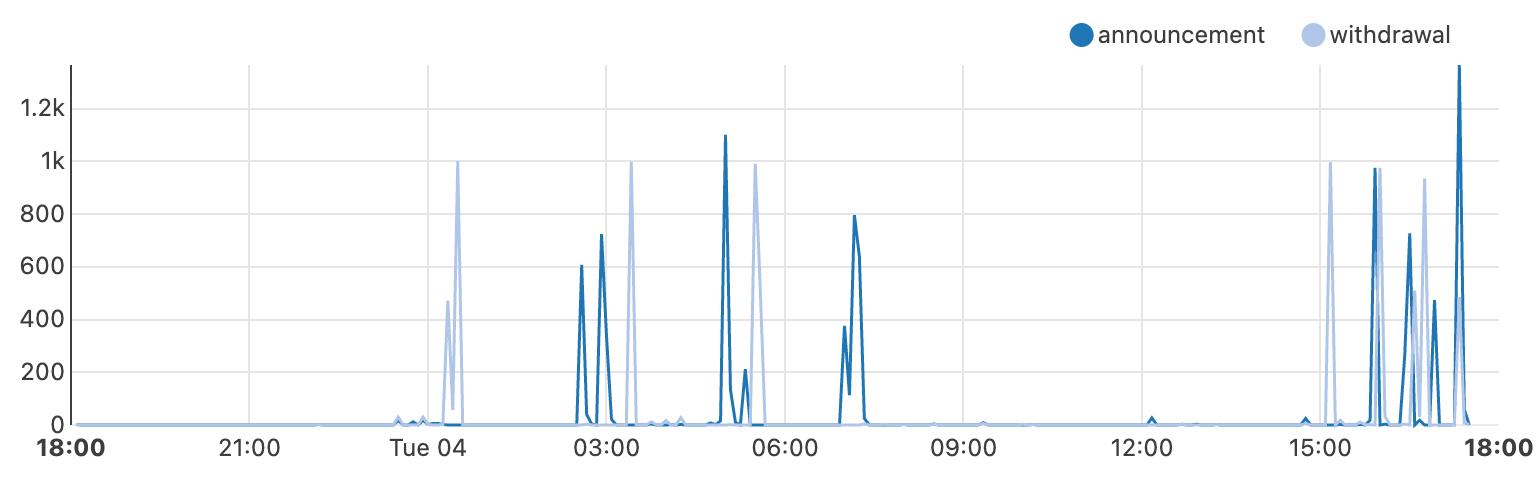
We can drill down further to break out the observed activity between BGP announcements (dark blue) and withdrawals (light blue) seen in the figure below, with key activity coincident with the loss and return of traffic. An initial set of withdrawals are seen just after midnight, effectively removing Virgin Media from the Internet resulting in the initial outage.
A set of announcements occurred just before 03:00 UTC, aligning with the nominal increase in traffic noted above, but those were followed quickly by another set of withdrawals. A similar announcement/withdrawal exchange was observed at 05:00 and 05:30 UTC respectively, before a final set of announcements restored connectivity at 07:00 UTC.
Things remained relatively stable through the morning into the afternoon, before another set of withdrawals presaged the afternoon’s connectivity problems, with a spike of withdrawals at 15:00 UTC, followed by additional withdrawal/announcement exchanges over the next several hours.
The Internet has become a significant factor in geopolitical conflicts, such as the ongoing war in Ukraine. Tomorrow marks one year since the Russian invasion of that country. This post reports on Internet insights and discusses how Ukraine’s Internet remained resilient in spite of dozens of disruptions in three different stages of the conflict.
Key takeaways:
Internet traffic shifts in Ukraine are clearly visible from east to west as Ukrainians fled the war, with country-wide traffic dropping as much as 33% after February 24, 2022.
Air strikes on energy infrastructure starting in October led to widespread Internet disruptions that continue in 2023.
Application-layer cyber attacks in Ukraine rose 1,300% in early March 2022 compared to pre-war levels.
Government administration, financial services, and the media saw the most attacks targeting Ukraine.
Traffic from a number of networks in Kherson was re-routed through Russia between June and October, subjecting traffic to Russia’s restrictions and limitations, including content filtering. Even after traffic ceased to reroute through Russia, those Ukrainian networks saw major outages through at least the end of the year, while two networks remain offline.
Through efforts on the ground to repair damaged fiber optics and restore electrical power, Ukraine’s networks have remained resilient from both an infrastructure and routing perspective. This is partly due to Ukraine’s widespread connectivity to networks outside the country and large number of IXPs.
Starlink traffic in Ukraine grew over 500% between mid-March and mid-May, and continued to grow from mid-May through mid-November, increasing nearly 300% over that six-month period. For the full period from mid-March (two weeks after it was made available) to mid-December, it was over a 1,600% increase, dropping a bit after that.
Internet changes and disruptions
An Internet shock after February 24, 2022
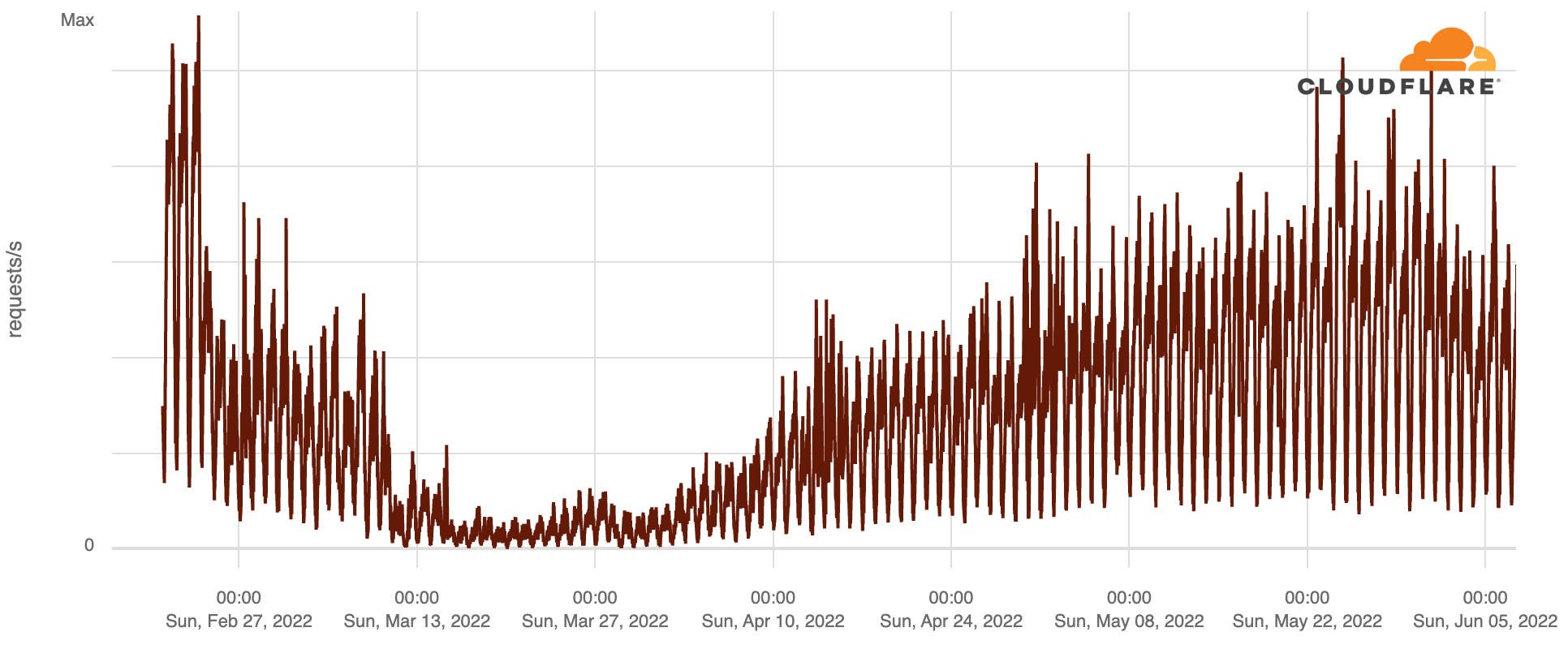
In Ukraine, human Internet traffic dropped as much as 33% in the weeks following February 24. The following chart shows Cloudflare’s perspective on daily traffic (by number of requests).
Internet traffic levels recovered over the next few months, including strong growth seen in September and October, when many Ukrainian refugees returned to the country. That said, there were also country-wide outages, mostly after October, that are discussed below.
14% of total traffic from Ukraine (including traffic from Crimea and other occupied regions) was mitigated as potential attacks, while 10% of total traffic to Ukraine was mitigated as potential attacks in the last 12 months.
Before February 24, 2022, typical weekday Internet traffic in Ukraine initially peaked after lunch, around 15:00 local time, dropped between 17:00 and 18:00 (consistent with people leaving work), and reached the biggest peak of the day at around 21:00 (possibly after dinner for mobile and streaming use).
After the invasion started, we observed less variation during the day in a clear change in the usual pattern given the reported disruption and “exodus” from the country. During the first few days after the invasion began, peak traffic occurred around 19:00, at a time when nights for many in cities such as Kyiv were spent in improvised underground bunkers. By late March, the 21:00 peak had returned, but the early evening drop in traffic did not return until May.
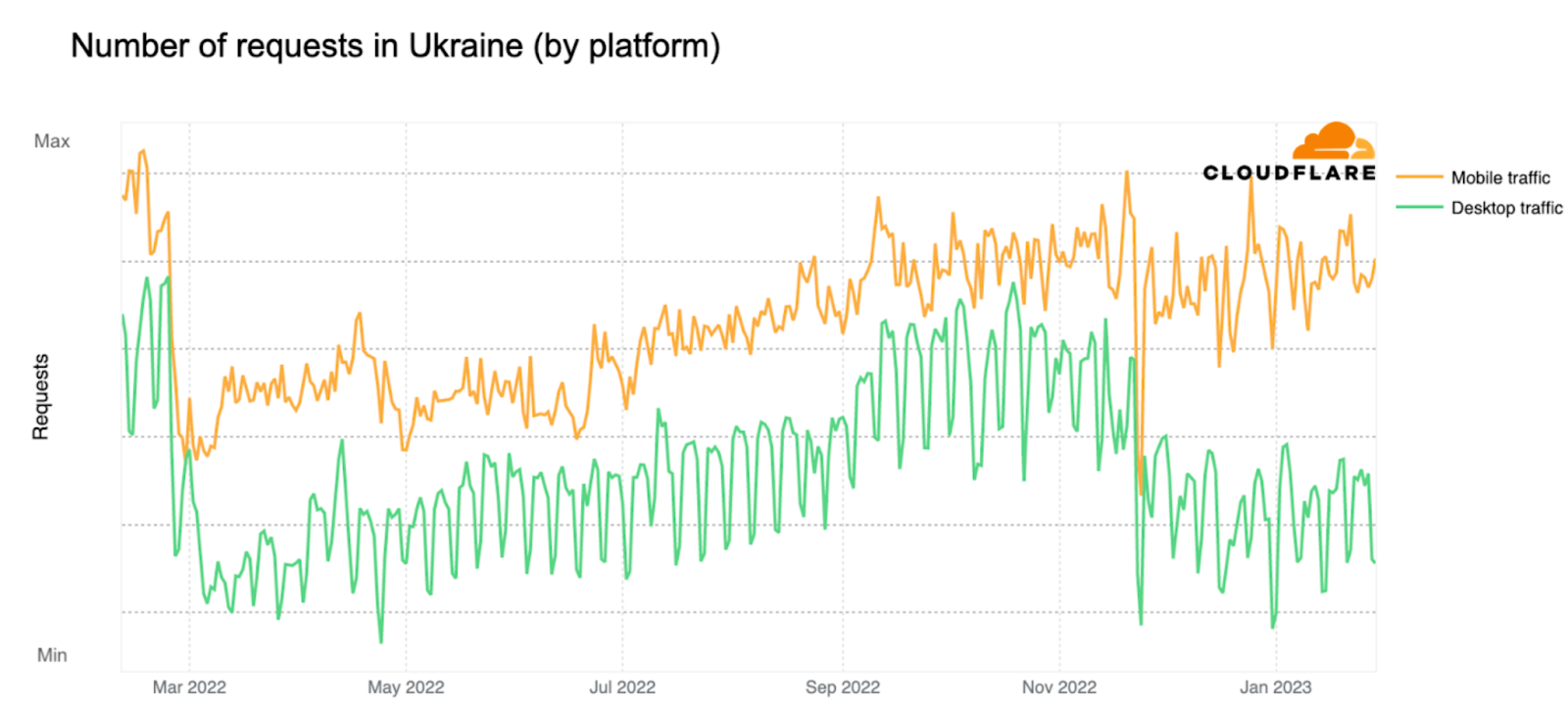
When looking at Ukraine Internet requests by type of trafficin the chart below (from February 10, 2022, through February 2023), we observe that while traffic from both mobile and desktop devices dropped after the invasion, request volume from mobile devices has remained higher over the past year. Pre-war, mobile devices accounted for around 53% of traffic, and grew to around 60% during the first weeks of the invasion. By late April, it had returned to typical pre-war levels, falling back to around 54% of traffic. There’s also a noticeable December drop/outage that we’ll go over below.
Millions moving from east to west in Ukraine
The invasion brought attacks and failing infrastructure across a number of cities, but the target in the early days wasn’t the country’s energy infrastructure, as it was in October 2022. In the first weeks of the war, Internet traffic changes were largely driven by people evacuating conflict zones with their families. Over eight million Ukrainians left the country in the first three months, and many more relocated internally to safer cities, although many returned during the summer of 2022. The Internet played a critical role during this refugee crisis, supporting communications and access to real-time information that could save lives, as well as apps providing services, among others.
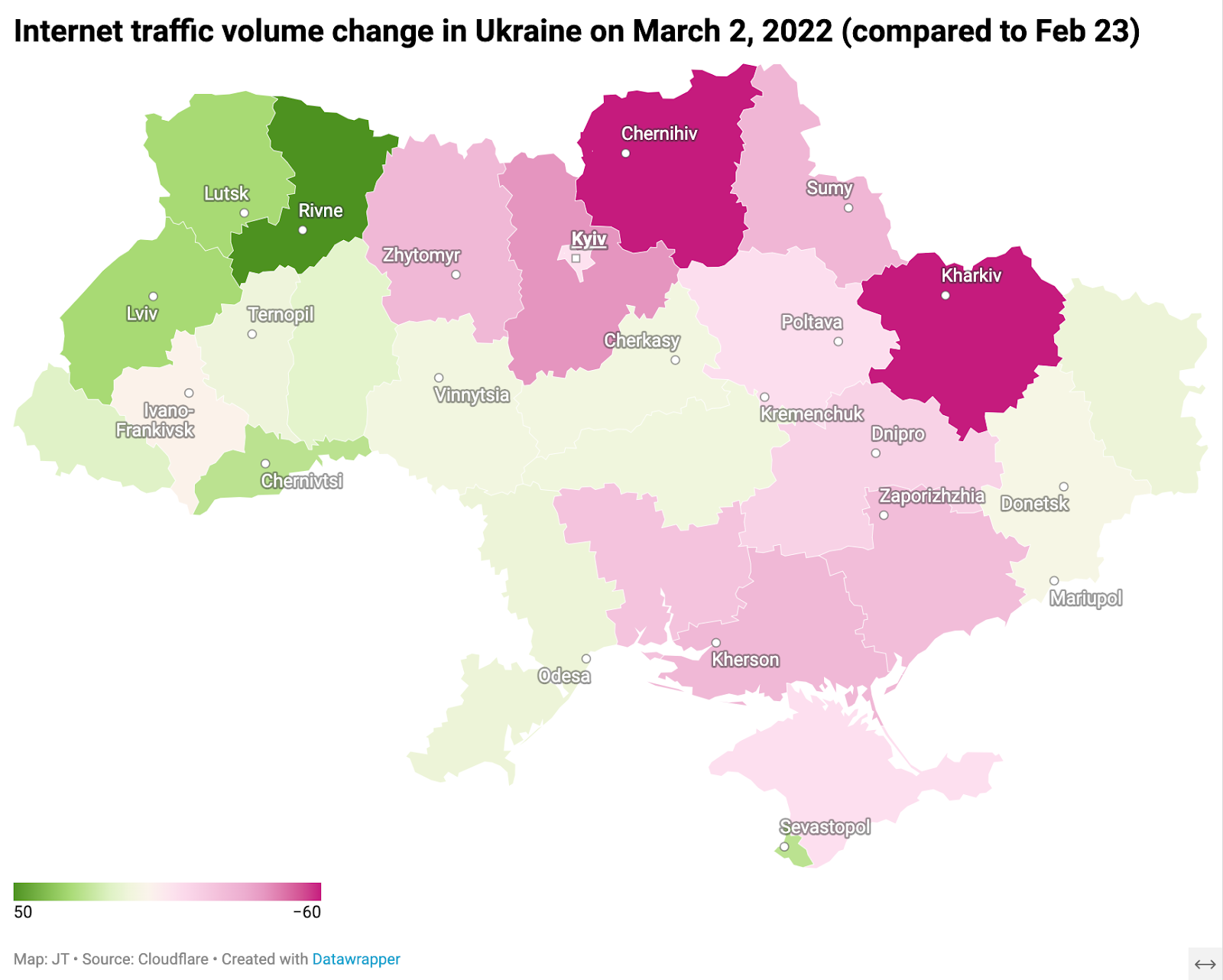
There was also an increase in traffic in the western part of Ukraine, in areas such as Lviv (further away from the conflict areas), and a decrease in the east, in areas like Kharkiv, where the Russian military was arriving and attacks were a constant threat. The figure below provides a view of how Internet traffic across Ukraine changed in the week after the war began (a darker pink means a drop in traffic — as much as 60% — while a darker green indicates an increase in Internet traffic — as much as 50%).
The biggest drops in Internet traffic observed in Ukraine in the first days of the war were in Kharkiv Oblast in the east, and Chernihiv in the north, both with a 60% decrease, followed by Kyiv Oblast, with traffic 40% lower on March 2, 2022, as compared with February 23.
In western Ukraine, traffic surged. The regions with the highest observed traffic growth included Rivne (50%), Volyn (30%), Lviv (28%), Chernivtsi (25%), and Zakarpattia (15%).
At the city level, analysis of Internet traffic in Ukraine gives us some insight into usage of the Internet and availability of Internet access in those first weeks, with noticeable outages in places where direct conflict was going on or that was already occupied by Russian soldiers.
North of Kyiv, the city of Chernihiv had a significant drop in traffic the first week of the war and residual traffic by mid-March, with traffic picking up only after the Russians retreated in early April.
In the capital city of Kyiv, there is a clear disruption in Internet traffic right after the war started, possibly caused by people leaving, attacks and use of underground shelters.
Near Kyiv, we observed a clear outage in early March in Bucha. After April 1, when the Russians withdrew, Internet traffic started to come back a few weeks later.
In Irpin, just outside Kyiv, close to the Hostomel airport and Bucha, a similar outage pattern to Bucha was observed. Traffic only began to come back more clearly in late May.
In the east, in the city of Kharkiv, traffic dropped 50% on March 3, with a similar scenario seen not far away in Sumy. The disruption was related to people leaving and also by power outages affecting some networks.
Other cities in the south of Ukraine, like Berdyansk, had outages. This graph shows Enerhodar, the small city where Europe’s largest nuclear plant, Zaporizhzhya NPP, is located, with residual traffic compared to before.
In the cities located in the south of Ukraine, there were clear Internet disruptions. The Russians laid siege to Mariupol on February 24. Energy infrastructure strikes and shutdowns had an impact on local networks and Internet traffic, which fell to minimal levels by March 1. Estimates indicate that 95% of the buildings in the city were destroyed, and by mid-May, the city was fully under Russian control. While there was some increase in traffic by the end of April, it reached only ~22% of what it was before the war’s start.
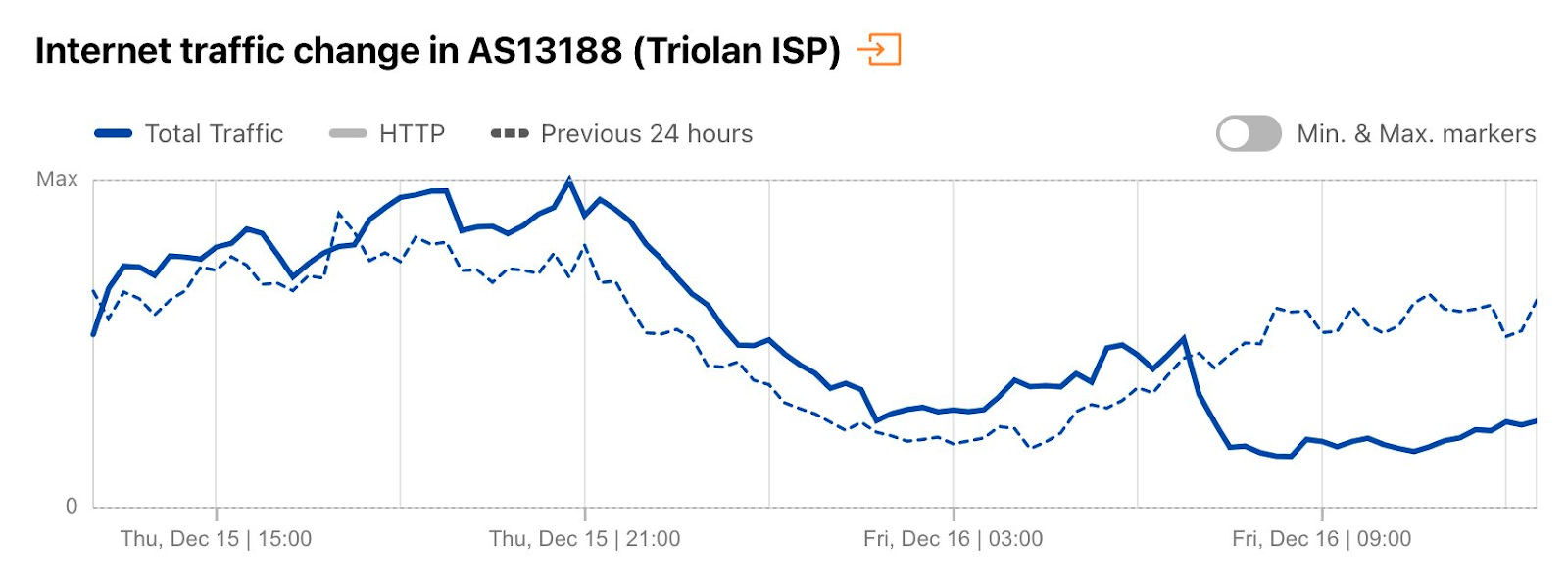
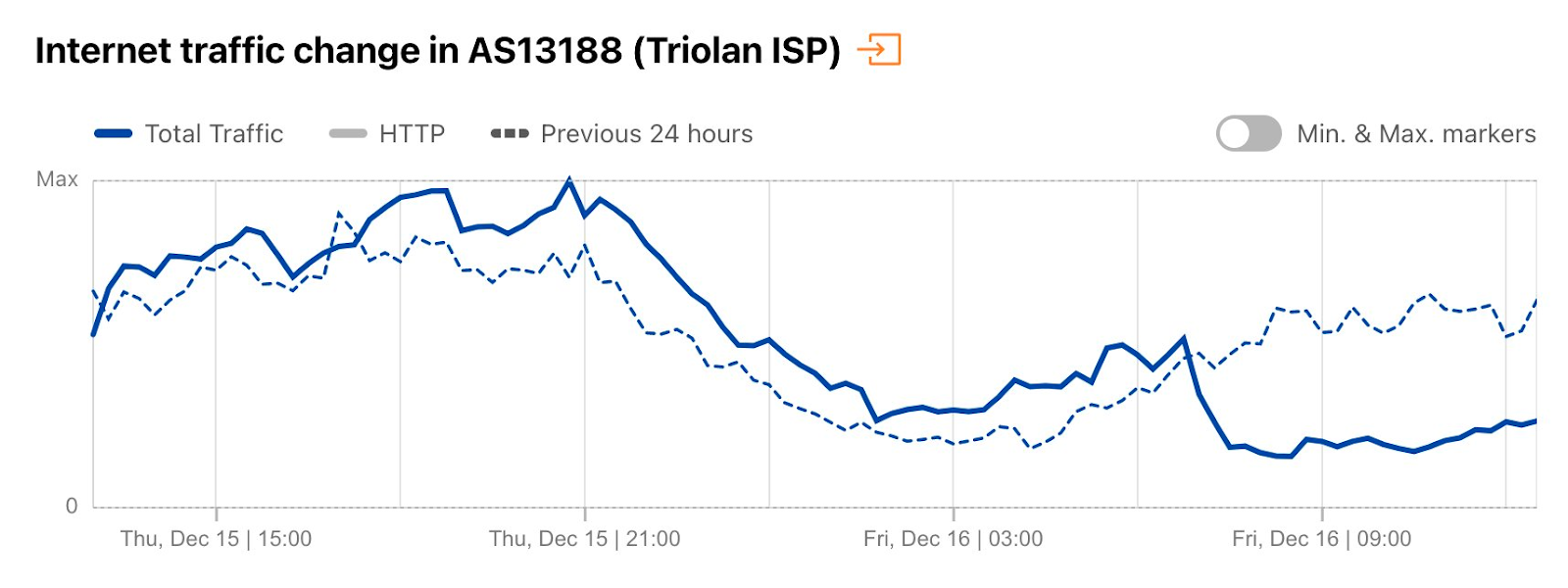
When looking at Ukrainian Internet Service Providers (ISPs) or the autonomous systems (ASNs) they use, we observed more localized disruptions in certain regions during the first months of the war, but recovery was almost always swift. AS6849 (Ukrtel) experienced problems with very short-term outages in mid-March. AS13188 (Triolan), which services Kyiv, Chernihiv, and Kharkiv, was another provider experiencing problems (they reported a cyberattack on March 9), as could be observed in the next chart:
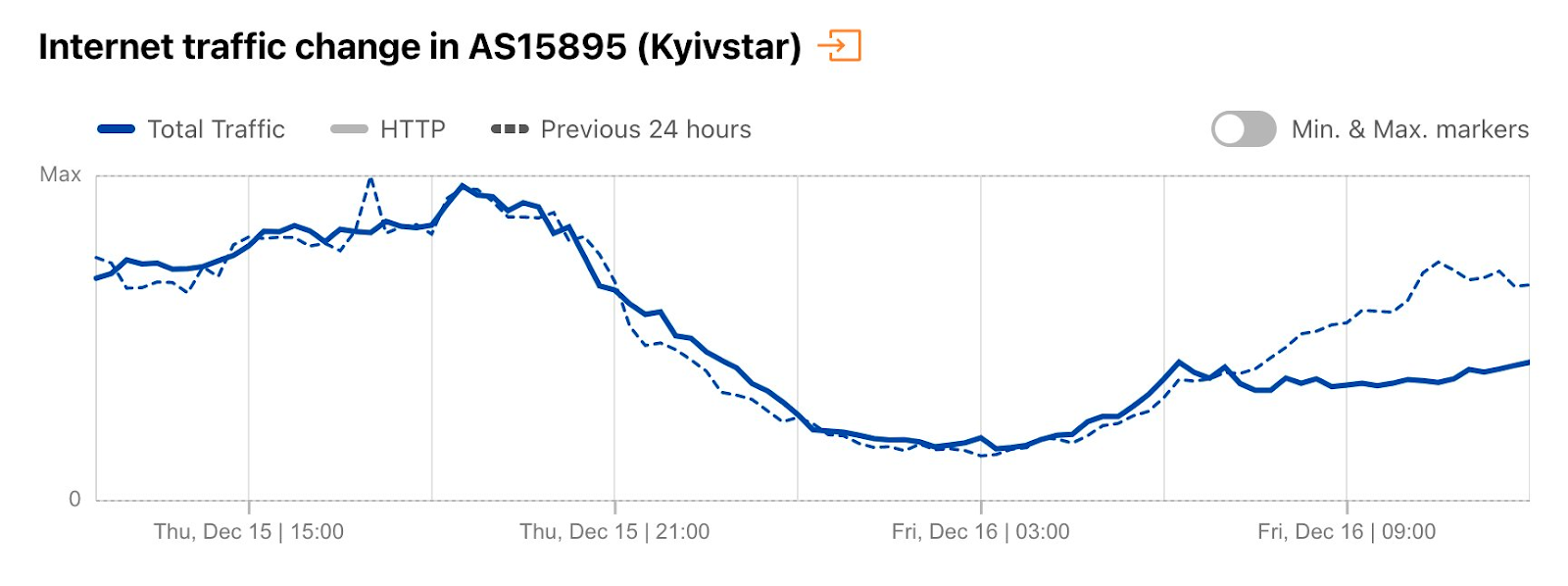
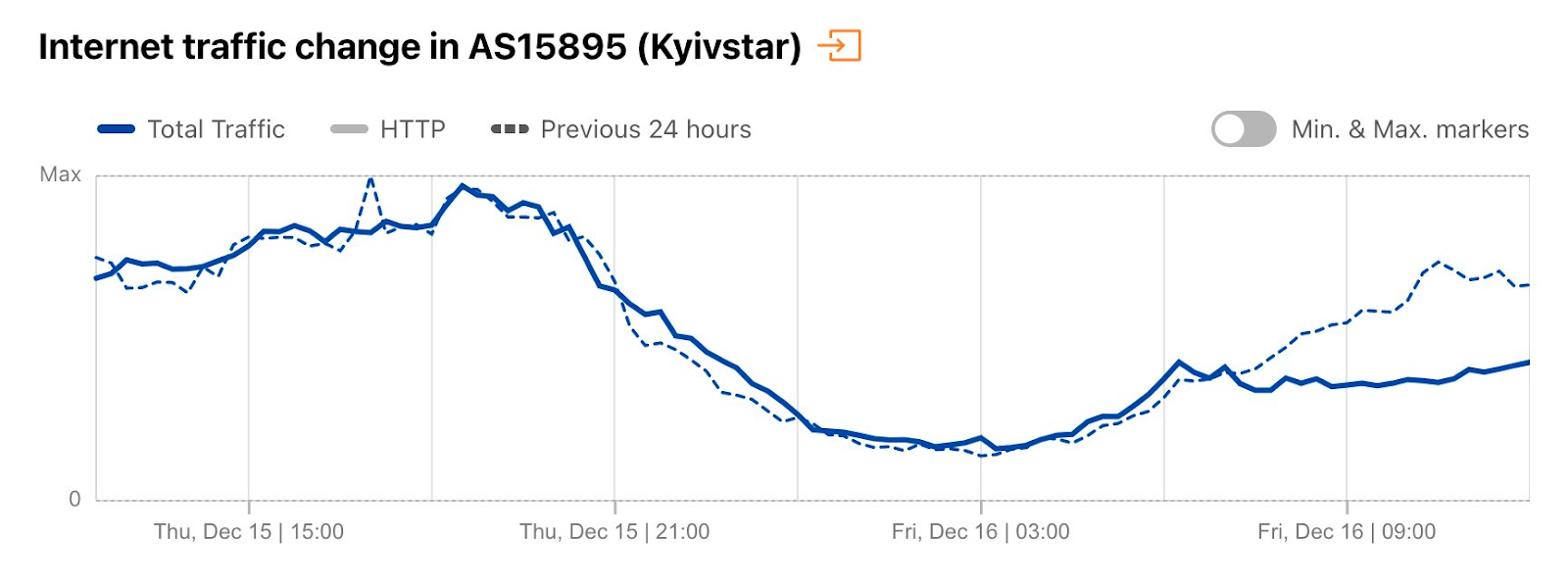
We did not observe a clear national outage in Ukraine’s main ISP, AS15895 (Kyivstar) until the October-November attacks on energy infrastructure, which also shows some early resilience of Ukrainian networks.
Ukraine’s counteroffensive and its Internet impact
As Russian troops retreated from the northern front in Ukraine, they shifted their efforts to gain ground in the east (Battle of Donbas) and south (occupation of the Kherson region) after late April. This resulted in Internet disruptions and traffic shifts, which are discussed in more detail in a section below. However, Internet traffic in the Kherson region was intermittent and included outages after May, given the battle for Internet control. News reports in June revealed that ISP workers damaged their own equipment to thwart Russia’s efforts to control the Ukrainian Internet.
Before the September Ukrainian counteroffensive, another example of the war’s impact on a city’s Internet traffic occurred during the summer, when Russian troops seized Lysychansk in eastern Ukraine in early July after what became known as the Battle of Lysychansk. Internet traffic in Lysychansk clearly decreased after the war started. That slide continues during the intense fighting that took place after April, which led to most of the city’s population leaving. By May, traffic was almost residual (with a mid-May few days short term increase).
In early September the Ukrainian counteroffensive took off in the east, although the media initially reported a south offensive in Kherson Oblast that was a “deception” move. The Kherson offensive only came to fruition in late October and early November. Ukraine was able to retake in September over 500 settlements and 12,000 square kilometers of territory in the Kharkiv region. At that time, there were Internet outages in several of those settlements.
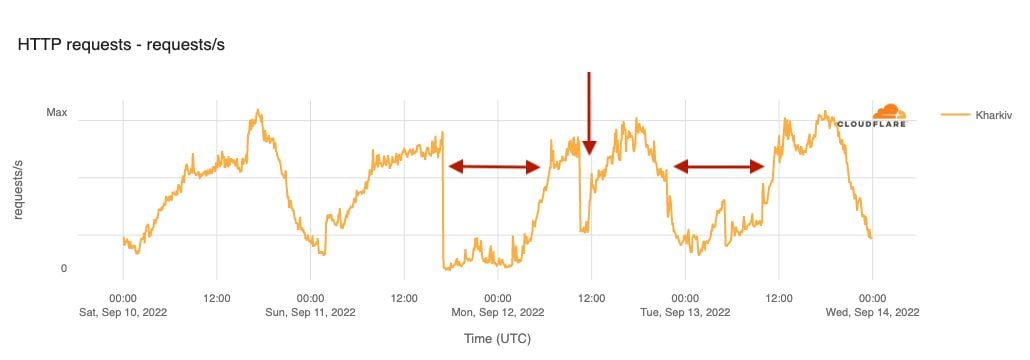
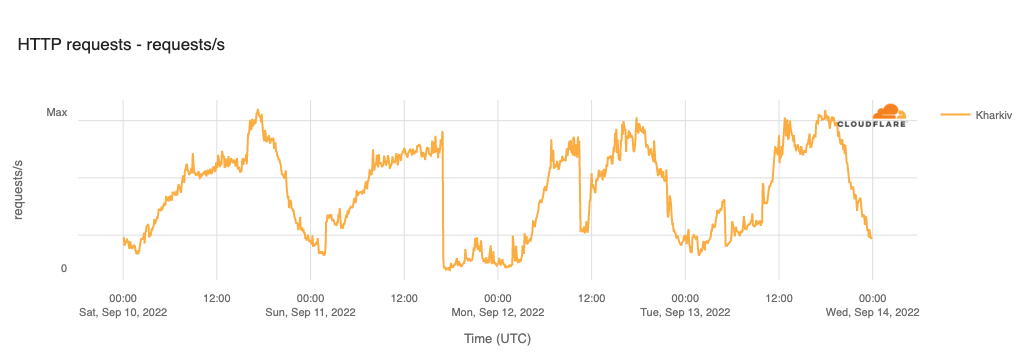
In response to the successful Ukrainian counteroffensive, Russian airstrikes caused power outages and Internet disruptions in the region. That was the case in Kharkiv on September 11, 12, and 13. The figure below shows a 12-hour near-complete outage on September 11, followed by two other periods of drop in traffic.
When nuclear inspectors arrive, so do Internet outages
In the Zaporizhzhia region, there were also outages. On September 1, 2022, the day the International Atomic Energy Agency (IAEA) inspectors arrived at the Russian-controlled Zaporizhzhia nuclear power plant in Enerhodar, there were Internet outages in two local ASNs that service the area: AS199560 (Engrup) and AS197002(OOO Tenor). Those outages lasted until September 10, as shown in the charts below.
More broadly, the city of Enerhodar, where the nuclear power plant is located, experienced a four-day outage after September 6.
Mid-September traffic drop in Crimea
In mid-September, following Ukraine’s counteroffensive, there were questions as to when Crimea might be targeted by Ukrainian forces, with news reports indicating that there was an evacuation of the Russian population from Crimea around September 13. We saw a clear drop in traffic on that Tuesday, compared with the previous day, as seen in the map of Crimea below (red is decrease in traffic, green is increase).
October brings energy infrastructure attacks and country-wide disruptions
As we have seen, the Russian air strikes targeting critical energy infrastructure began in September as a retaliation to Ukraine’s counteroffensive. The following month, the Crimean Bridge explosion on Saturday, October 8 (when a truck-borne bomb destroyed part of the bridge) led to more air strikes that affected networks and Internet traffic across Ukraine.
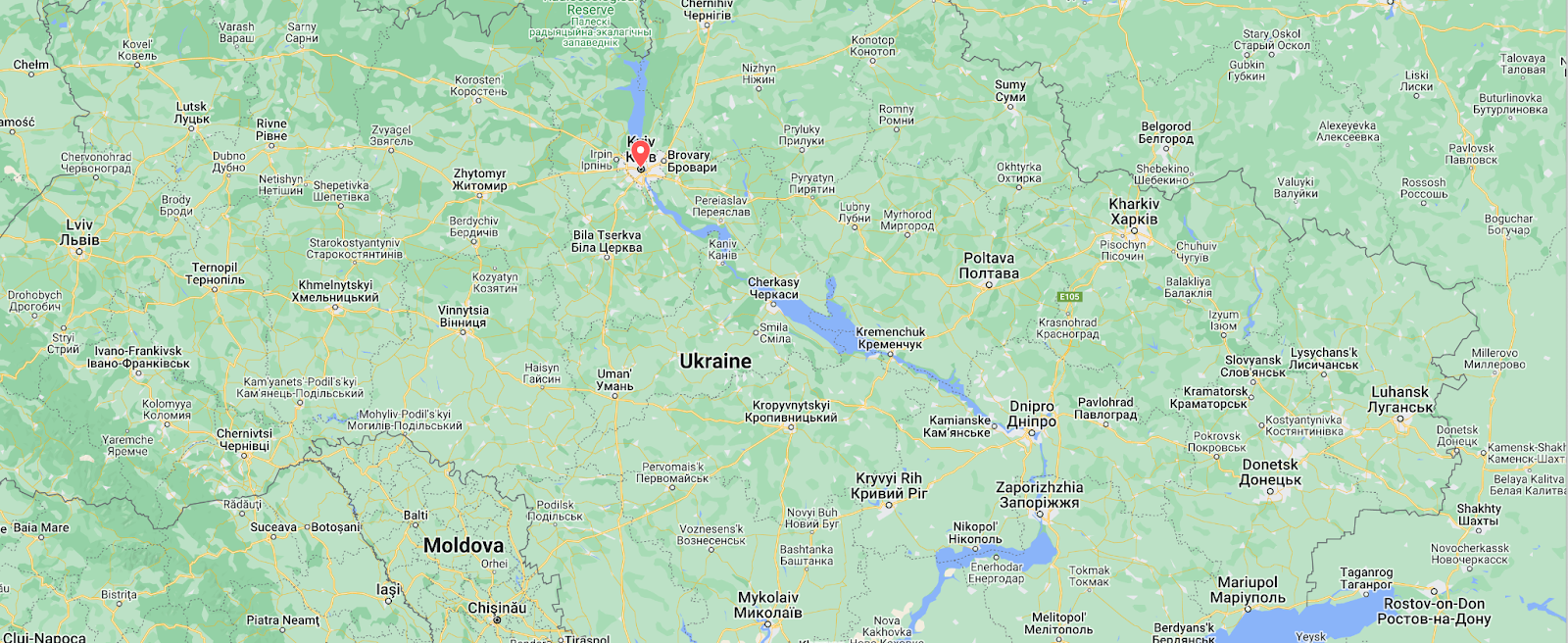
On Monday, October 10, Ukraine woke up to air strikes on energy infrastructure and experienced severe electricity and Internet outages. At 07:35 UTC, traffic in the country was 35% below its usual level compared with the previous week and only fully recovered more than 24 hours later. The impact was particularly significant in regions like Kharkiv, where traffic was down by around 80%, and Lviv, where it dropped by about 60%. The graph below shows how new air strikes in Lviv Oblast the following day affected Internet traffic.
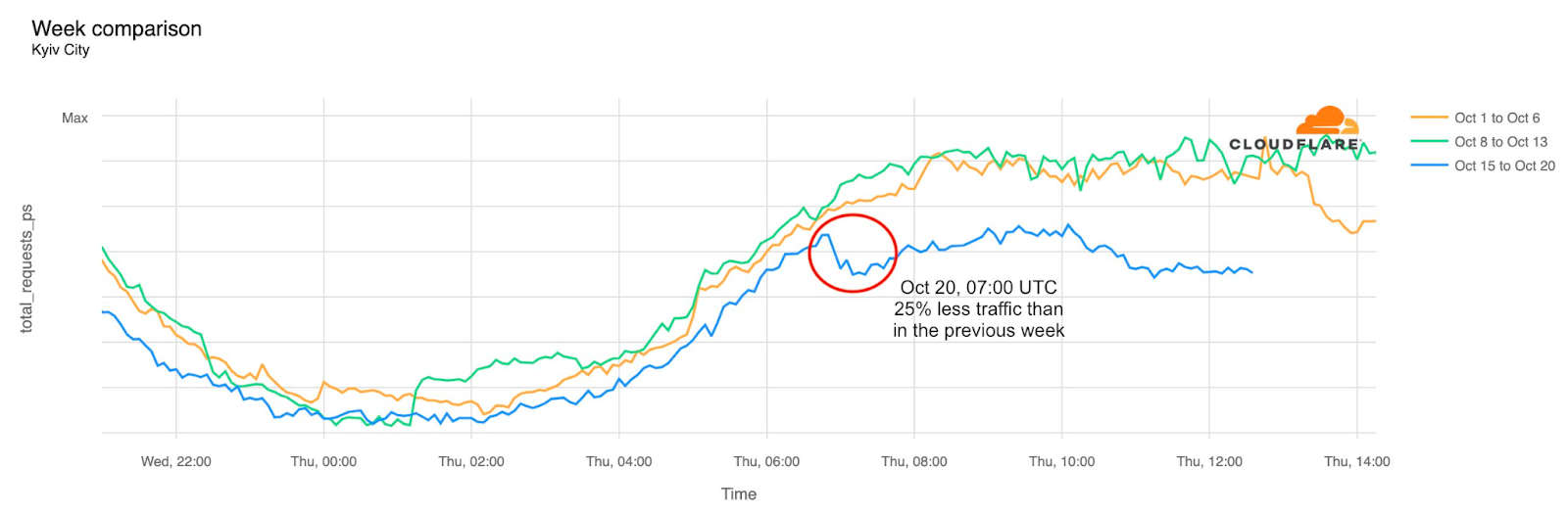
There were clear disruptions in Internet connectivity in several regions on October 17, but also on October 20, when the destruction of several power stations in Kyiv resulted in a 25% drop in Internet traffic from Kyiv City as compared to the two previous weeks. It lasted 12 hours, and was followed the next day by a shorter partial outage as seen in the graph below.
In late October, according to Ukrainian officials, 30% of Ukraine’s power stations were destroyed. Self-imposed power limitations because of this destruction resulted in drops in Internet traffic observed in places like Kyiv and the surrounding region.
The start of a multi-week Internet disruption in Kherson Oblast can be seen in the graph below, showing ~70% lower traffic than in previous weeks. The disruption began on Saturday, October 22, when Ukrainians were gaining ground in the Kherson region.
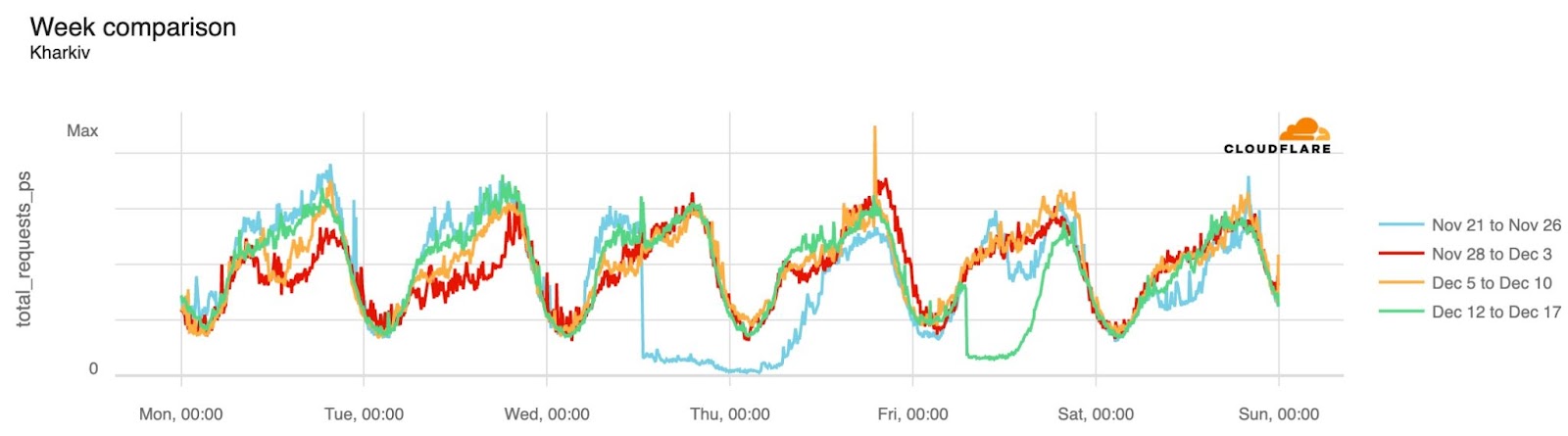
Traffic began to return after Ukrainian forces took Kherson city on November 11, 2022. The graph below shows a week-over-week comparison for Kherson Oblast for the weeks of November 7, November 28, and December 19 for better visualization in the chart while showing the evolution through a seven-week period.
Ongoing strikes and Internet disruptions
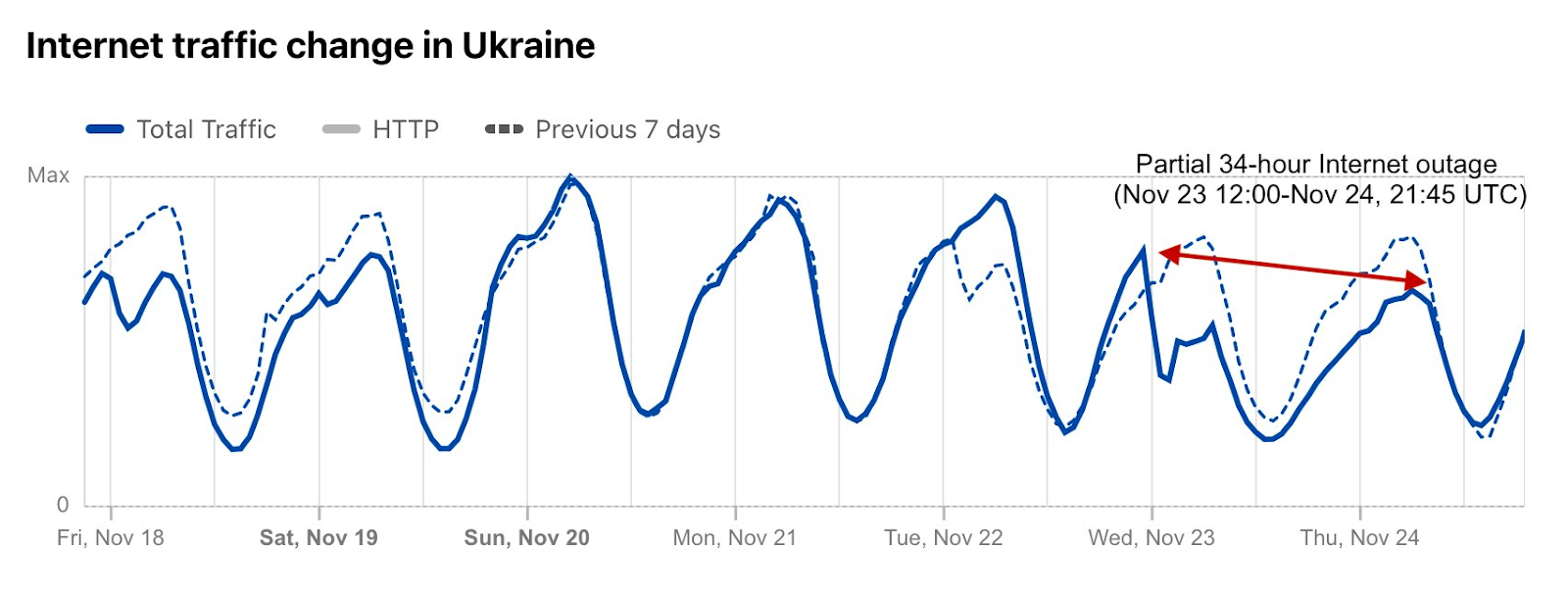
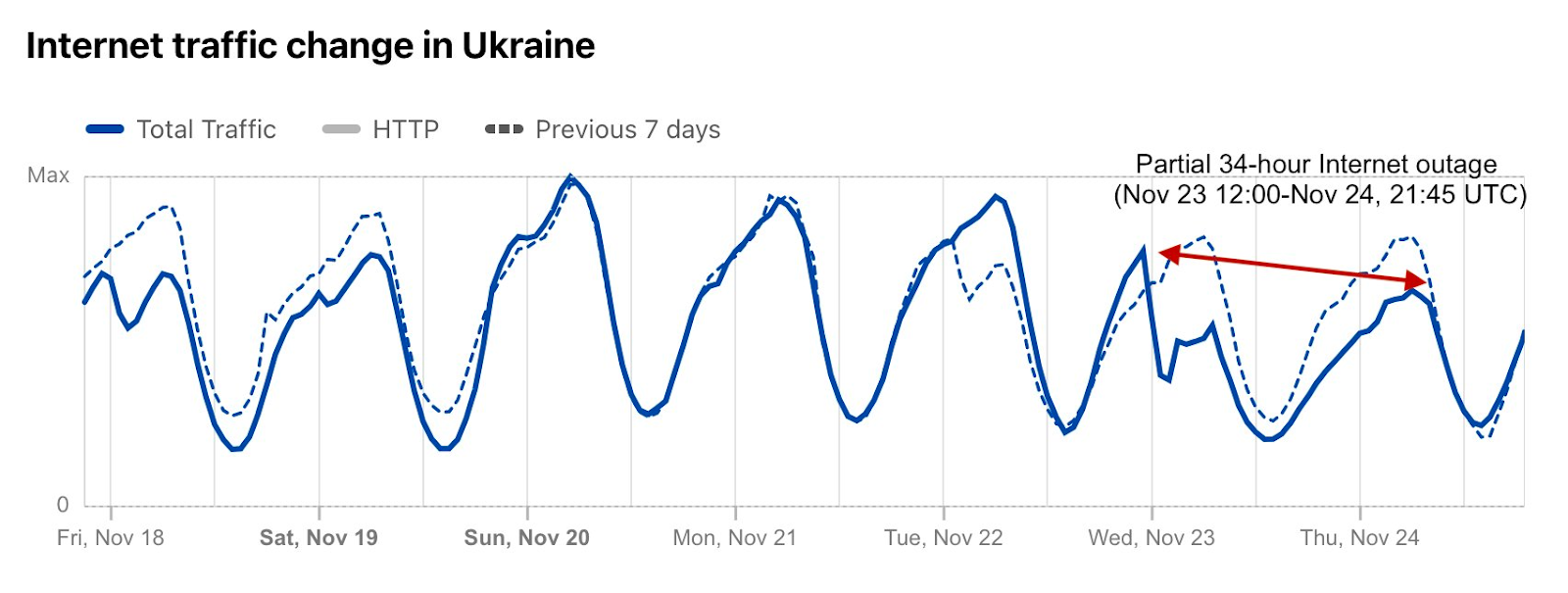
Throughout the rest of the year and into 2023, Ukraine has continued to face intermittent Internet disruptions. On November 23, 2022, the country experienced widespread power outages after Russian strikes, causing a nearly 50% decrease in Internet traffic in Ukraine. This disruption lasted for almost a day and a half, further emphasizing the ongoing impact of the conflict on Ukraine’s infrastructure.
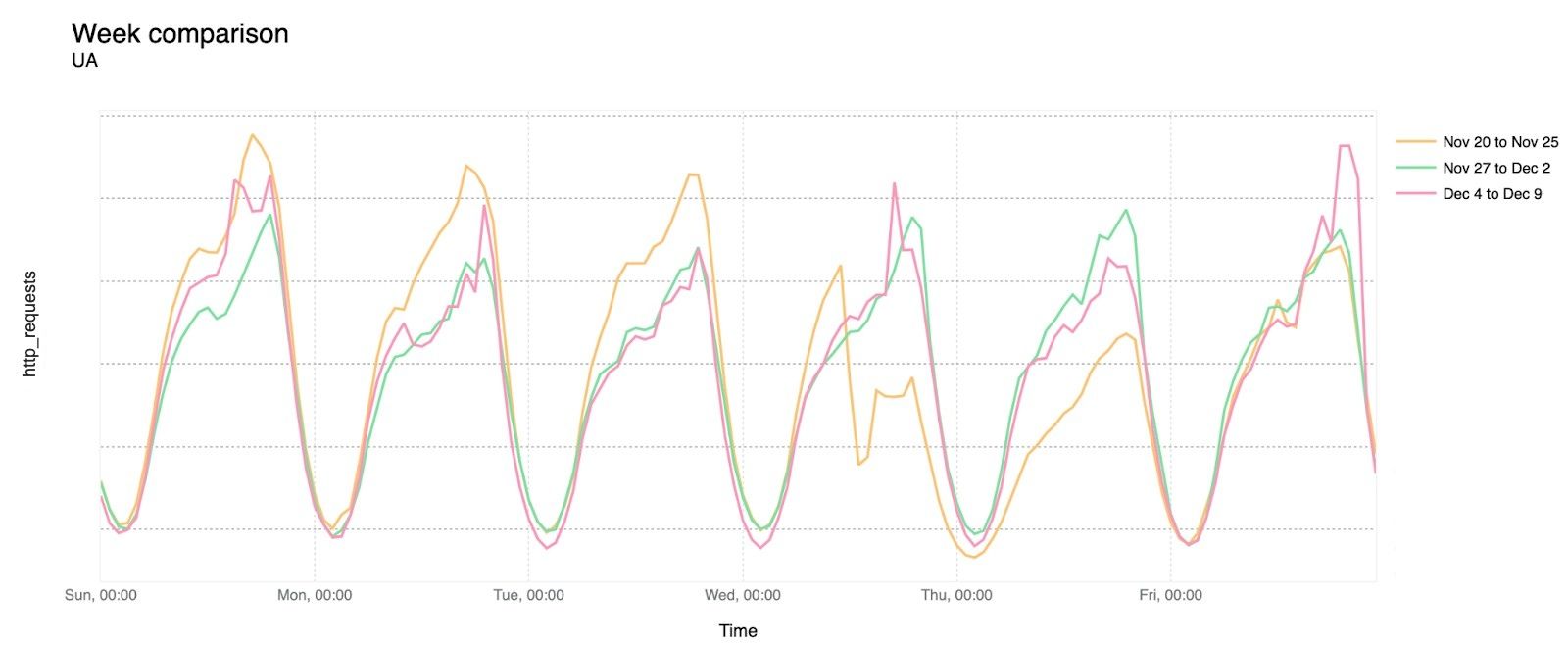
Although there was a recovery after that late November outage, only a few days later traffic seemed closer to normal levels. Below is a chart of the week-over-week evolution of Internet traffic in Ukraine at both a national and local level during that time:
In Kyiv Oblast:
In the Odessa region:
And Kharkiv (where a December 16 outage is also clear — in the green line):
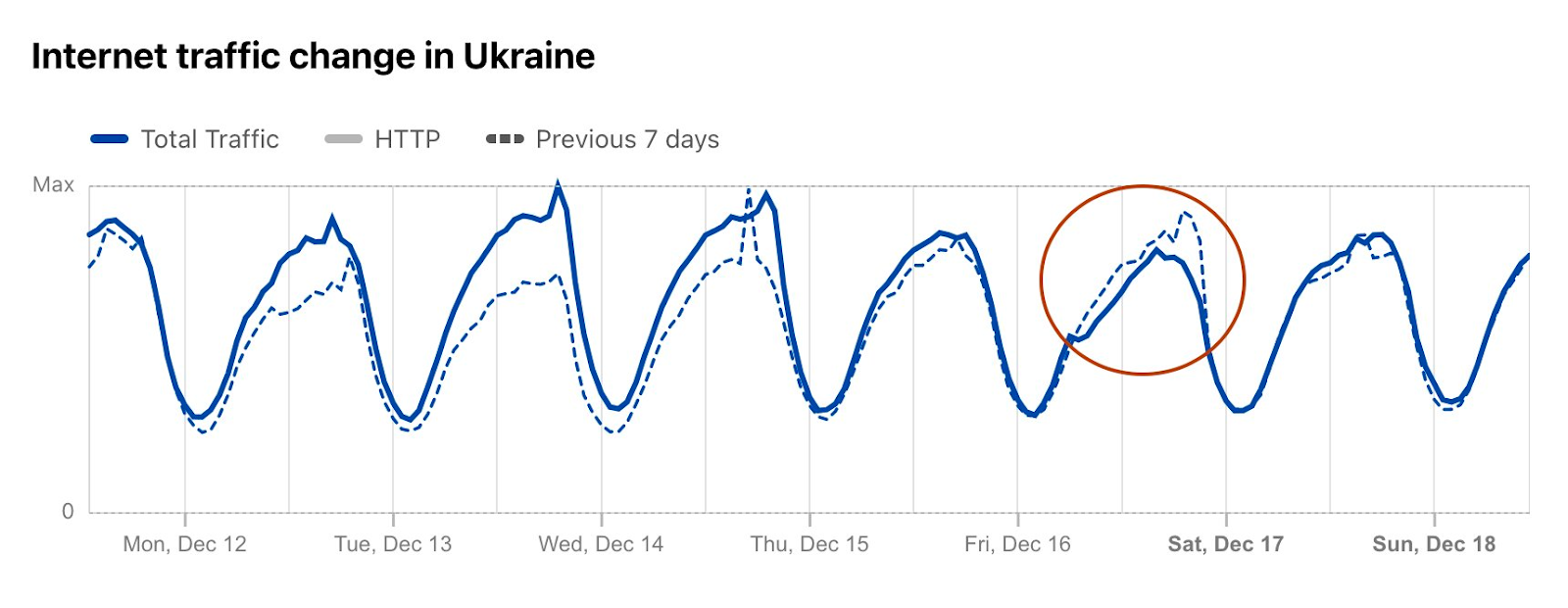
On December 16, there was another country-level Internet disruption caused by air strikes targeting energy infrastructure. Traffic at a national level dropped as much as 13% compared with the previous week, but Ukrainian networks were even more affected. AS13188 (Triolan) had a 70% drop in traffic, and AS15895 (Kyivstar) a 40% drop, both shown in the figures below.
In January 2023, air strikes caused additional Internet disruptions. One such recent event was in Odessa, where traffic dropped as low as 54% compared with the previous week during an 18-hour disruption.
A cyber war with global impact
“Shields Up” on cyber attacks
The US government and the FBI issued warnings in March to all citizens, businesses, and organizations in the country, as well as allies and partners, to be aware of the need to “enhance cybersecurity.” The US Cybersecurity and Infrastructure Security Agency (CISA) launched the Shields Up initiative, noting that “Russia’s invasion of Ukraine could impact organizations both within and beyond the region.” The UK and Japan, among others, also issued warnings.
Below, we discuss Web Application Firewall (WAF) mitigations and DDoS attacks. A WAF helps protect web applications by filtering and monitoring HTTP traffic between a web application and the Internet. A WAF is a protocol layer 7 defense (in the OSI model), and is not designed to defend against all types of attacks. Distributed Denial of Service (DDoS) attacks are cyber attacks that aim to take down Internet properties and make them unavailable for users.
Cyber attacks rose 1,300% in Ukraine by early March
The charts below are based on normalized data, and show threats mitigated by our WAF.
Mitigated application-layer threats blocked by our WAF skyrocketed after the war started on February 24. Mitigated requests were 105% higher on Monday, February 28 than in the previous (pre-war) Monday, and peaked on March 8, reaching 1,300% higher than pre-war levels.
Between February 2022 and February 2023, an average of 10% of all traffic to Ukraine was mitigations of potential attacks.
The graph below shows the daily percentage of application layer traffic to Ukraine that Cloudflare mitigated as potential attacks. In early March, 30% of all traffic was mitigated. This fell in April, and remained low for several months, but it picked up in early September around the time of the Ukrainian counteroffensive in east and south Ukraine. The peak was reached on October 29 when DDoS attack traffic constituted 39% of total traffic to Cloudflare’s Ukrainian customer websites.
This trend is more evident when looking at all traffic to sites on the “.ua” top-level domain (from Cloudflare’s perspective). The chart below shows that DDoS attack traffic accounted for over 80% of all traffic by early March 2022. The first clear spikes occurred on February 16 and 19, with around 25% of traffic mitigated. There was no moment of rest after the war started, except towards the end of November and December, but the attacks resumed just before Christmas. An average of 13% of all traffic to “.ua”, between February 2022 and February 2023 was mitigations of potential attacks. The following graph provides a comprehensive view of DDoS application layer attacks on “.ua” sites:
Moving on to types of mitigations of product groups that were used (related to “.ua” sites), as seen in the next chart, around 57% were done by the ruleset which automatically detects and mitigates HTTP DDoS attacks (DDoS Mitigation), 31% were being mitigated by firewall rules put in place (WAF), and 10% were blocking requests based on our IP threat reputation database (IP Reputation).
It’s important to note that WAF rules in the graph above are also associated with custom firewall rules created by customers to provide a more tailored protection. “DDoS Mitigation” (application layer DDoS protection) and “Access Rules” (rate limiting) are specifically used for DDoS protection.
In contrast to the first graph shown in this section, which looked at mitigated attack traffic targeting Ukraine, we can also look at mitigated attack traffic originating in Ukraine. The graph below also shows that the share of mitigated traffic from Ukraine also increased considerably after the invasion started.
Top attacked industries: from government to news media
The industries sectors that had a higher share of WAF mitigations were government administration, financial services, and the media, representing almost half of all WAF mitigations targeting Ukraine during 2022.
Looking at DDoS attacks, there was a surge in attacks on media and publishing companies during 2022 in Ukraine. Entities targeting Ukrainian companies appeared to be focused on information-related websites. The top five most attacked industries in the Ukraine in the first two quarters of 2022 were all in broadcasting, Internet, online media, and publishing, accounting for almost 80% of all DDoS attacks targeting Ukraine.
In a more focused look at the type of websites Cloudflare has protected throughout the war, the next two graphs provide a view of mitigated application layer attacks by the type of “.ua” sites we helped to protect. In the first days of the war, mitigation spikes were observed at a news service, a TV channel, a government website, and a bank.
In July, spikes in mitigations we observed across other types of “.ua” websites, including food delivery, e-commerce, auto parts, news, and government.
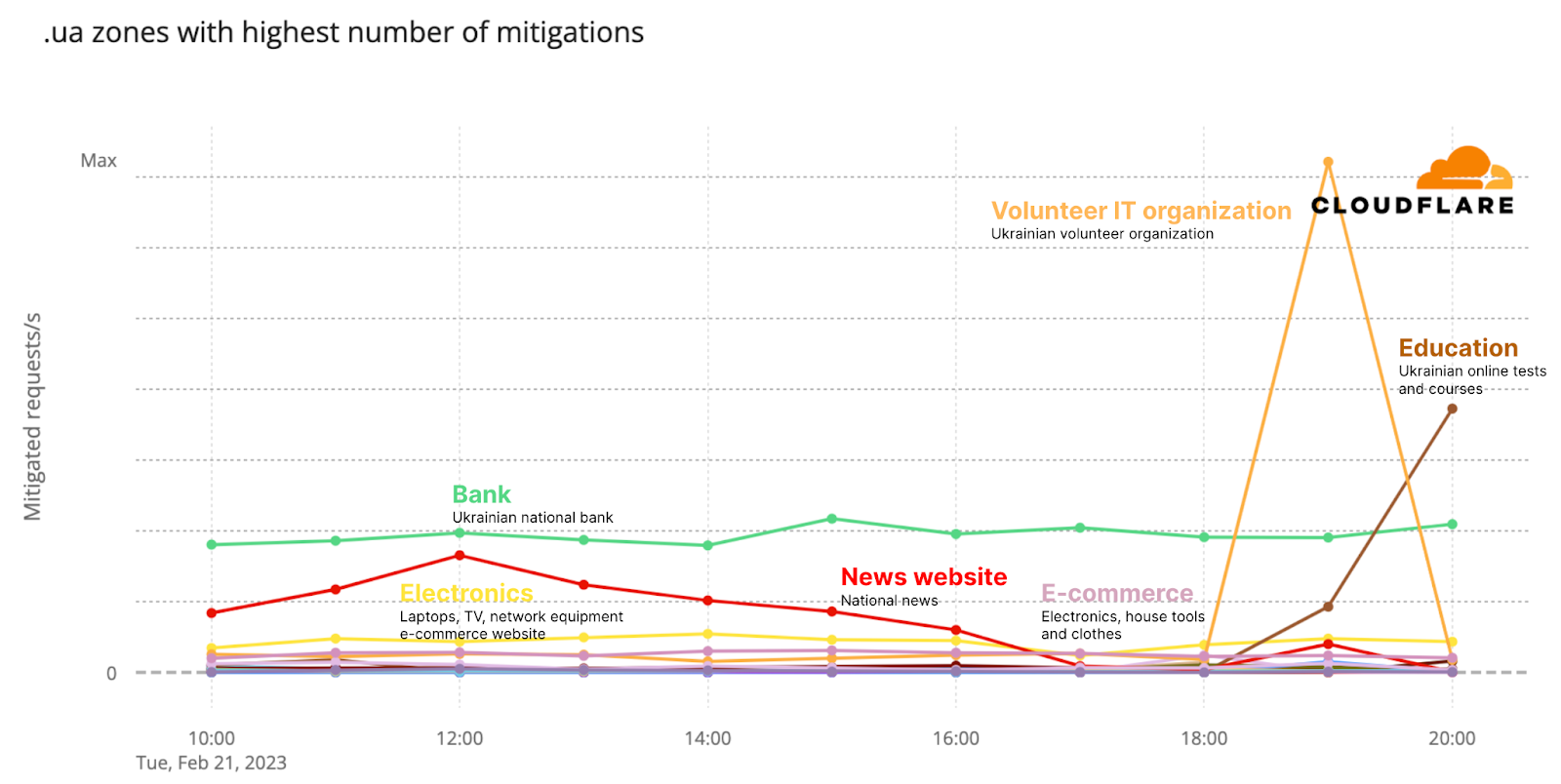
More recently, in February 2023, the spikes in mitigations were somewhat similar to what we saw one year ago, including electronics, e-commerce, IT, and education websites.
12.6% of network-layer traffic was DDoS activity in Q1 2022
Network-layer (layer 3 and 4) traffic is harder to attribute to a specific domain or target because IP addresses are shared across different customers. Looking at network-level DDoS traffic hitting our Kyiv data center, we saw peaks of DDoS traffic higher than before the war in early March, but they were much higher in June and August.
Several of our quarterly DDoS reports from 2022 include attack trends related to the war in Ukraine, with quarter over quarter interactive comparisons.
Network re-routing in Kherson
On February 24, 2022, Russian forces invaded Ukraine’s Kherson Oblast region. The city of Kherson was captured on March 2, as the first major city and only regional capital to be captured by Russian forces during the initial invasion. The Russian occupation of Kherson Oblast continued until Ukrainian forces resumed control on November 11, after launching a counteroffensive at the end of August.
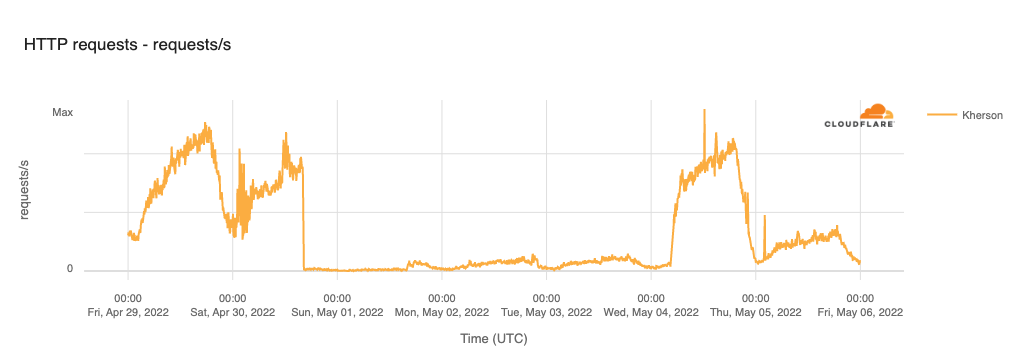
On May 4, 2022, we published Tracking shifts in Internet connectivity in Kherson, Ukraine, a blog post that explored a re-routing event that impacted AS47598 (Khersontelecom), a telecommunications provider in Kherson Oblast. Below, we summarize this event, and explore similar activity across other providers in Kherson that has taken place since then.
On May 1, 2022, we observed a shift in routing for the IPv4 prefix announced by Ukrainian network AS47598 (Khersontelecom). During April, it reached the Internet through several other Ukrainian network providers, including AS12883 (Vega Telecom) and AS3326 (Datagroup). However, after the shift, its routing path now showed a Russian network, AS201776 (Miranda-Media), as the sole upstream provider. With traffic from KhersonTelecom passing through a Russian network, it was subject to the restrictions and limitations imposed on any traffic transiting Russian networks, including content filtering.
The flow of traffic from Khersontelecom before and after May 1, with rerouting through Russian network provider Miranda-Media, is illustrated in the chart below. This particular re-routing event was short-lived, as a routing update for AS47598 on May 4 saw it return to reaching the Internet through other Ukrainian providers.
As a basis for our analysis, we started with a list of 15 Autonomous System Numbers (ASNs) belonging to networks in Kherson Oblast. Using that list, we analyzed routing information collected by route-views2 over the past year, from February 1, 2022, to February 15, 2023. route-views2 is a BGP route collector run by the University of Oregon Route Views Project. Note that with respect to the discussions of ASNs in this and the following section, we are treating them equally, and have not specifically factored estimated user population into these analyses.
The figure below illustrates the result of this analysis, showing that re-routing of Kherson network providers (listed along the y-axis) through Russian upstream networks was fairly widespread, and for some networks, has continued into 2023. During the analysis time frame, there were three primary Russian networks that appeared as upstream providers: AS201776 (Miranda-Media), AS52091 (Level-MSK Ltd.), and AS8492 (OBIT Ltd.).
Within the graph, black bars indicate periods when the ASN effectively disappeared from the Internet; white segments indicate the ASN was dependent on other Ukraine networks as immediate upstreams; and red indicates the presence of Russian networks in the set of upstream providers. The intensity of the red shading corresponds to the percentage of announced prefixes for which a Russian network provider is present in the routing path as observed from networks outside Ukraine. Bright red shading, equivalent to “1” in the legend, indicates the presence of a Russian provider in all routing paths for announced prefixes.
In the blog post linked above, we referenced an outage that began on April 30. This is clearly visible in the figure as a black bar that runs for several days across all the listed ASNs. In this instance, AS47598 (KhersonTelecom) recovered a day later, but was sending traffic through AS201776 (Miranda-Media), a Russian provider, as discussed above.
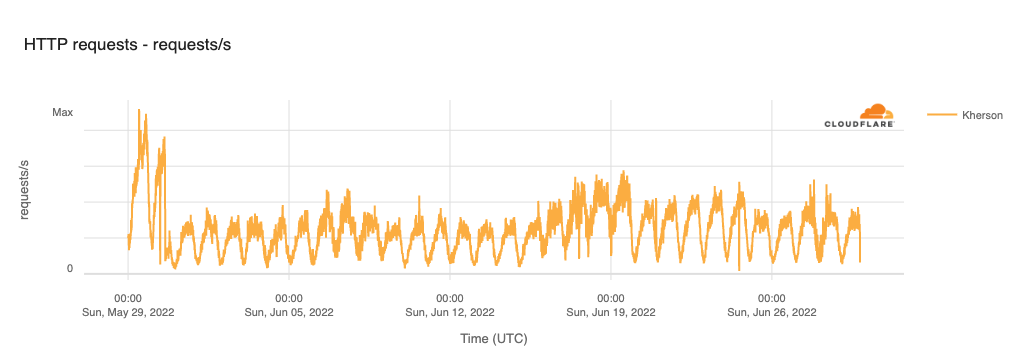
Another Ukrainian network, AS49168 (Brok-X), recovered from the outage on May 2, and was also sending traffic through Miranda-Media. By May 4, most of the other Kherson networks recovered from the outage, and both AS47598 and AS49168 returned to using Ukrainian networks as immediate upstream providers. Routing remained “normal” until May 30. Then, a more widespread shift to routing traffic through Russian providers began, although it appears that this shift was preceded by a brief outage for a few networks. For the most part, this re-routing lasted through the summer and into October. Some networks saw a brief outage on October 17, but most stopped routing directly through Russia by October 22.
However, this shift away from Russia was followed by periods of extended outages. KhersonTelecom suffered such an outage, and has remained offline since October, except for the first week of November when all of its traffic routed through Russia. Many other networks rejoined the Internet in early December, relying mostly on other Ukrainian providers for Internet connectivity. However, since early December, AS204485 (PE Berislav Cable Television), AS56359 (CHP Melnikov Roman Sergeevich), and AS49465 (Teleradiocompany RubinTelecom Ltd.) have continued to use Miranda-Media as an upstream provider, in addition to experiencing several brief outages. In addition, over the last several months, AS25082 (Viner Telecom) has used both a Ukrainian network and Miranda-Media as upstream providers.
Internet resilience in Ukraine
In the context of the Internet, “resilience” refers to the ability of a network to operate continuously in a manner that is highly resistant to disruption. This includes the ability of a network to: (1) operate in a degraded mode if damaged, (2) rapidly recover if failure does occur, and (3) scale to meet rapid or unpredictable demands. Throughout the Russia-Ukraine conflict, media coverage (VICE, Bloomberg, Washington Post) has highlighted the work done in Ukraine to repair damaged fiber-optic cables and mobile network infrastructure to keep the country online. This work has been critically important to maintaining the resilience of Ukrainian Internet infrastructure.
According to PeeringDB, as of February 2023, there are 25 Internet Exchange Points (IXPs) in Ukraine and 50 interconnection facilities. (An IXP may span multiple physical facilities.) Within this set of IXPs, Autonomous Systems (ASes) belonging to international providers are currently present in over half of them. The number of facilities, IXPs, and international ASes present in Ukraine points to a resilient interconnection fabric, with multiple locations for both domestic and international providers to exchange traffic.
To better understand these international interconnections, we first analyze the connectivity of ASes in Ukraine, and we classify the links to domestic networks (links where both ASes are registered in Ukraine) and international networks (links between ASes in Ukraine and ASes outside Ukraine). To determine which ASes are domestic in Ukraine, we can use information from the extended delegation reports from the Réseaux IP Européens Network Coordination Centre (RIPE NCC), the Regional Internet Registry that covers Ukraine. We also parsed collected BGP data to extract the AS-level links between Ukrainian ASes and ASes registered in a different country, and we consider these the international connectivity of the domestic ASes.
A March 2022 article in The Economist noted that “For one thing, Ukraine boasts an unusually large number of internet-service providers—by one reckoning the country has the world’s fourth-least-concentrated Internet market. This means the network has few choke points, so is hard to disable.” As of the writing of this blog post, there are 2,190 ASes registered in Ukraine (UA ASes), and 1,574 of those ASes appear in the BGP routing table as active. These counts support the article’s characterization, and below we discuss several additional observations that reinforce Ukraine’s Internet resilience.
The figure above is a cumulative distribution function showing the fraction of domestic Ukrainian ASes that have direct connections to international networks. In February 2023, approximately 50% had more than one (100) international link, while approximately 10% had more than 10, and approximately 2% had 100 or more. Although these numbers have dropped slightly over the last year, they underscore the lack of centralized choke points in the Ukrainian Internet.
For the networks with international connectivity, we can also look at the distribution of “next-hop” countries – countries with which those international networks are associated. (Note that some networks may have a global footprint, and for these, the associated country is the one recorded in their autonomous system registration.) Comparing the choropleth maps below illustrates how this set of countries, and their fraction of international paths, have changed between February 2022 and February 2023. The data underlying these maps shows that international connectivity from Ukraine is distributed across 18 countries — unsurprisingly, mostly in Europe.
In February 2022, these countries/locations accounted for 77% of Ukraine’s next-hop international paths. The top four all had 7.8% each. However, in February 2023, the top 10 next-hop countries/locations dropped slightly to 76% of international paths. While just a slight change from the previous year, the set of countries/locations and many of their respective fractions saw considerable change.
February 2022
February 2023
1
Germany
7.85%
Russia
11.62%
2
Netherlands
7.85%
Germany
11.43%
3
United Kingdom
7.83%
Hong Kong
8.38%
4
Hong Kong
7.81%
Poland
7.93%
5
Sweden
7.77%
Italy
7.75%
6
Romania
7.72%
Turkey
6.86%
7
Russia
7.67%
Bulgaria
6.20%
8
Italy
7.64%
Netherlands
5.31%
9
Poland
7.60%
United Kingdom
5.30%
10
Hungary
7.54%
Sweden
5.26%
Russia’s share grew by 50% year to 11.6%, giving it the biggest share of next-hop ASes. Germany also grew to account for more than 11% of paths.
Satellite Internet connectivity
Cloudflare observed a rapid growth in Starlink’s ASN (AS14593) traffic to Ukraine during 2022 and into 2023. Between mid-March and mid-May, Starlink’s traffic in the country grew over 530%, and continued to grow from mid-May up until mid-November, increasing nearly 300% over that six-month period — from mid-March to mid-December the growth percentage was over 1600%. After that, traffic stabilized and even dropped a bit during January 2023.
Our data shows that between November and December 2022, Starlink represented between 0.22% and 0.3% of traffic from Ukraine, but that number is now lower than 0.2%.
Conclusion
One year in, the war in Ukraine has taken an unimaginable humanitarian toll. The Internet in Ukraine has also become a battleground, suffering attacks, re-routing, and disruptions. But it has proven to be exceptionally resilient, recovering time and time again from each setback.
We know that the need for a secure and reliable Internet there is more critical than ever. At Cloudflare, we’re committed to continue providing tools that protect Internet services from cyber attack, improve security for those operating in the region, and share information about Internet connectivity and routing inside Ukraine.
Several Cloudflare services became unavailable for 121 minutes on January 24th, 2023 due to an error releasing code that manages service tokens. The incident degraded a wide range of Cloudflare products including aspects of our Workers platform, our Zero Trust solution, and control plane functions in our content delivery network (CDN).
Cloudflare provides a service token functionality to allow automated services to authenticate to other services. Customers can use service tokens to secure the interaction between an application running in a data center and a resource in a public cloud provider, for example. As part of the release, we intended to introduce a feature that showed administrators the time that a token was last used, giving users the ability to safely clean up unused tokens. The change inadvertently overwrote other metadata about the service tokens and rendered the tokens of impacted accounts invalid for the duration of the incident.
The reason a single release caused so much damage is because Cloudflare runs on Cloudflare. Service tokens impact the ability for accounts to authenticate, and two of the impacted accounts power multiple Cloudflare services. When these accounts’ service tokens were overwritten, the services that run on these accounts began to experience failed requests and other unexpected errors.
We know this impacted several customers and we know the impact was painful. We’re documenting what went wrong so that you can understand why this happened and the steps we are taking to prevent this from occurring again.
What is a service token?
When users log into an application or identity provider, they typically input a username and a password. The password allows that user to demonstrate that they are in control of the username and that the service should allow them to proceed. Layers of additional authentication can be added, like hard keys or device posture, but the workflow consists of a human proving they are who they say they are to a service.
However, humans are not the only users that need to authenticate to a service. Applications frequently need to talk to other applications. For example, imagine you build an application that shows a user information about their upcoming travel plans.
The airline holds details about the flight and its duration in their own system. They do not want to make the details of every individual trip public on the Internet and they do not want to invite your application into their private network. Likewise, the hotel wants to make sure that they only send details of a room booking to a valid, approved third party service.
Your application needs a trusted way to authenticate with those external systems. Service tokens solve this problem by functioning as a kind of username and password for your service. Like usernames and passwords, service tokens come in two parts: a Client ID and a Client Secret. Both the ID and Secret must be sent with a request for authentication. Tokens are also assigned a duration, after which they become invalid and must be rotated. You can grant your application a service token and, if the upstream systems you need validate it, your service can grab airline and hotel information and present it to the end user in a joint report.
When administrators create Cloudflare service tokens, we generate the Client ID and the Client Secret pair. Customers can then configure their requesting services to send both values as HTTP headers when they need to reach a protected resource. The requesting service can run in any environment, including inside of Cloudflare’s network in the form of a Worker or in a separate location like a public cloud provider. Customers need to deploy the corresponding protected resource behind Cloudflare’s reverse proxy. Our network checks every request bound for a configured service for the HTTP headers. If present, Cloudflare validates their authenticity and either blocks the request or allows it to proceed. We also log the authentication event.
Incident Timeline
All Timestamps are UTC
At 2023-01-24 16:55 UTC the Access engineering team initiated the release that inadvertently began to overwrite service token metadata, causing the incident.
At 2023-01-24 17:05 UTC a member of the Access engineering team noticed an unrelated issue and rolled back the release which stopped any further overwrites of service token metadata.
Service token values are not updated across Cloudflare’s network until the service token itself is updated (more details below). This caused a staggered impact of the service token’s that had their metadata overwritten.
2023-01-24 17:50 UTC: The first invalid service token for Cloudflare WARP was synced to the edge. Impact began for WARP and Zero Trust users.
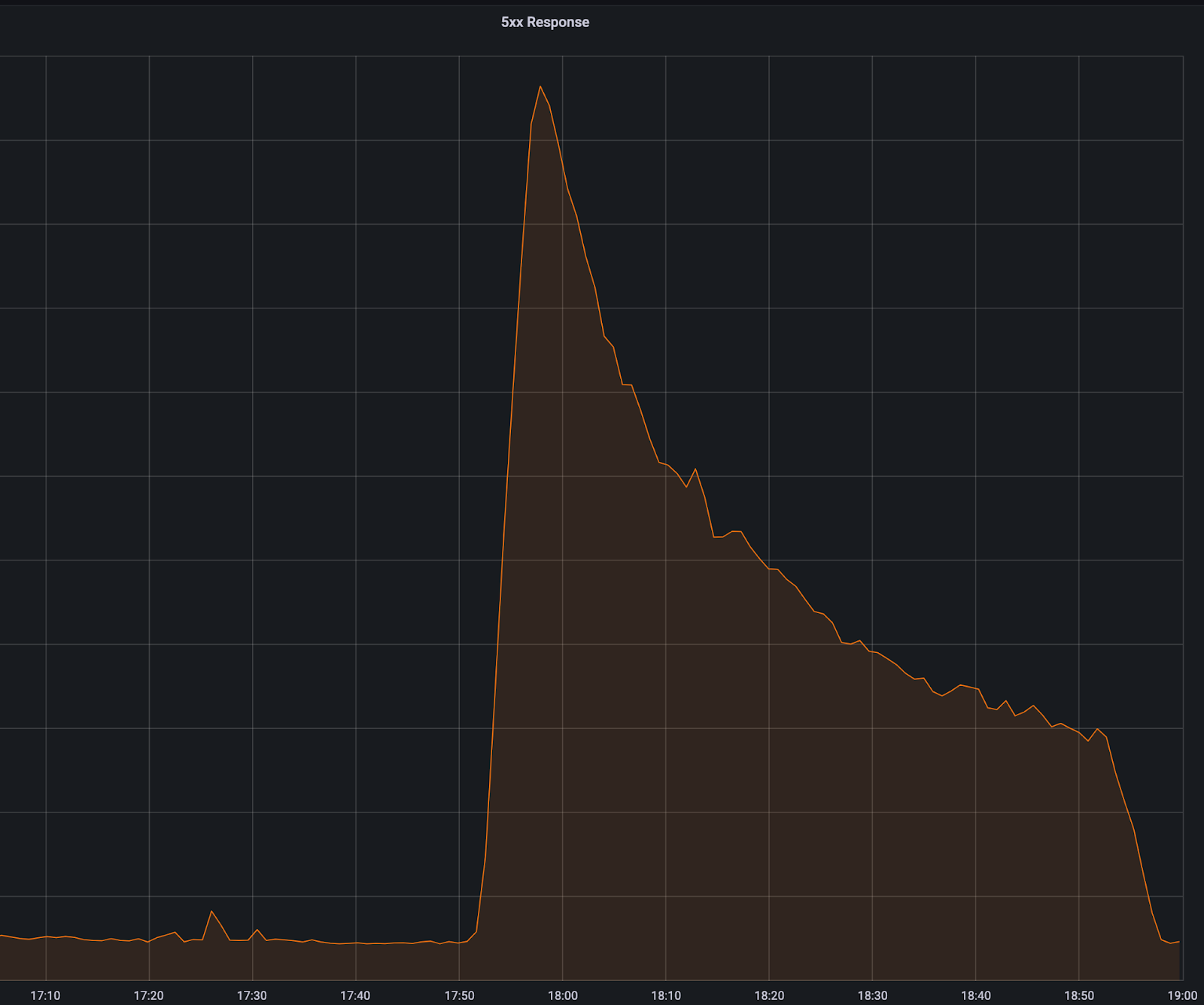
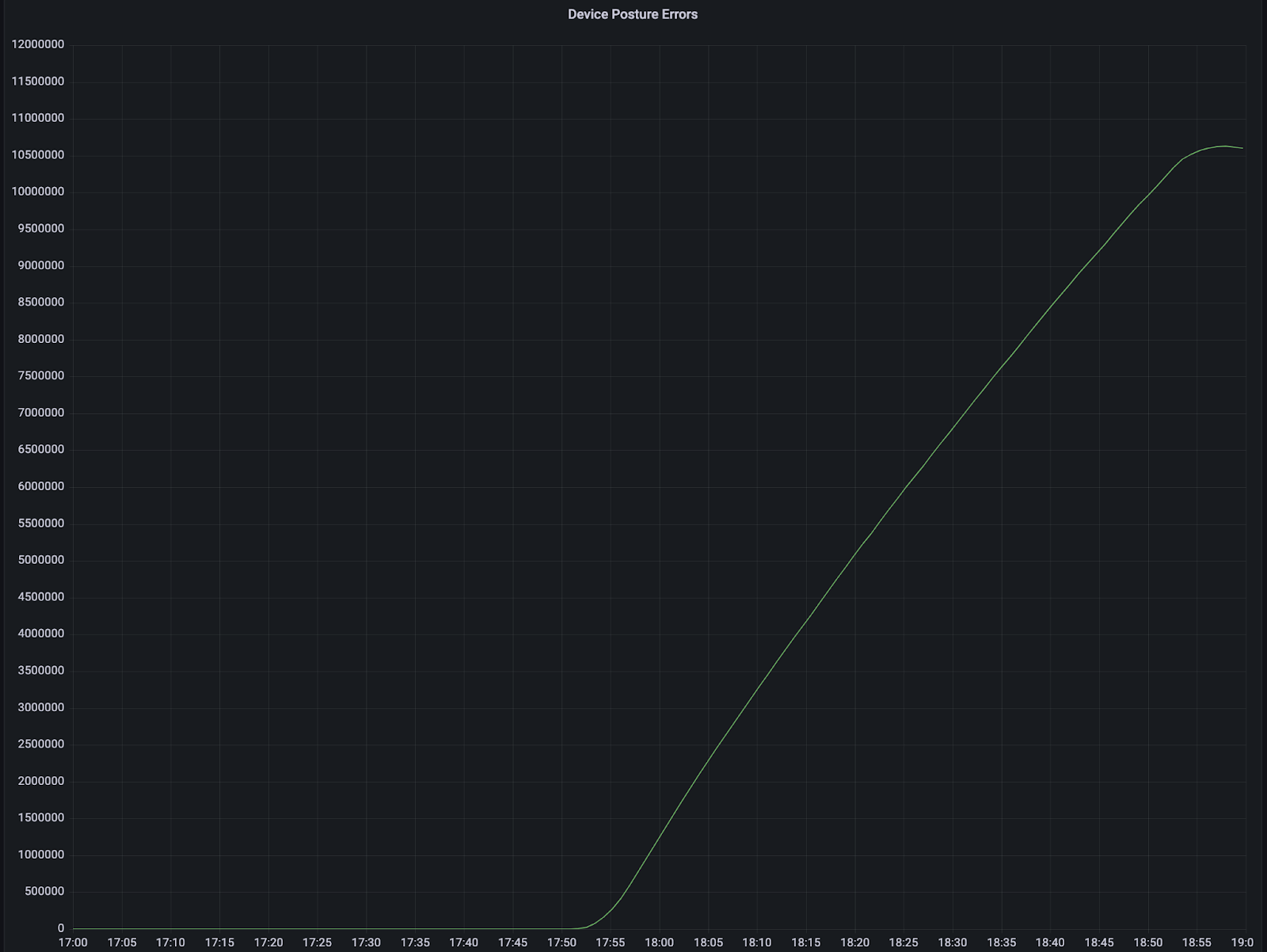
WARP device posture uploads dropped to zero which raised an internal alert
At 2023-01-24 18:12 an incident was declared due to the large drop in successful WARP device posture uploads.
2023-01-24 18:19 UTC: The first invalid service token for the Cloudflare API was synced to the edge. Impact began for Cache Purge, Cache Reserve, Images and R2. Alerts were triggered for these products which identified a larger scope of the incident.
At 2023-01-24 18:21 the overwritten services tokens were discovered during the initial investigation.
At 2023-01-24 18:28 the incident was elevated to include all impacted products.
At 2023-01-24 18:51 An initial solution was identified and implemented to revert the service token to its original value for the Cloudflare WARP account, impacting WARP and Zero Trust. Impact ended for WARP and Zero Trust.
At 2023-01-24 18:56 The same solution was implemented on the Cloudflare API account, impacting Cache Purge, Cache Reserve, Images and R2. Impact ended for Cache Purge, Cache Reserve, Images and R2.
At 2023-01-24 19:00 An update was made to the Cloudflare API account which incorrectly overwrote the Cloudflare API account. Impact restarted for Cache Purge, Cache Reserve, Images and R2. All internal Cloudflare account changes were then locked until incident resolution.
At 2023-01-24 19:07 the Cloudflare API was updated to include the correct service token value. Impact ended for Cache Purge, Cache Reserve, Images and R2.
At 2023-01-24 19:51 all affected accounts had their service tokens restored from a database backup. Incident Ends.
What was released and how did it break?
The Access team was rolling out a new change to service tokens that added a “Last seen at” field. This was a popular feature request to help identify which service tokens were actively in use.
What went wrong?
The “last seen at” value was derived by scanning all new login events in an account’s login event Kafka queue. If a login event using a service token was detected, an update to the corresponding service token’s last seen value was initiated.
In order to update the service token’s “last seen at” value a read write transaction is made to collect the information about the corresponding service token. Service token read requests redact the “client secret” value by default for security reasons. The “last seen at” update to the service token then used that information from the read did not include the “client secret” and updated the service token with an empty “client secret” on the write.
An example of the correct and incorrect service token values shown below:
Example Access Service Token values
{
  "1a4ddc9e-a1234-4acc-a623-7e775e579c87": {
    "client_id": "6b12308372690a99277e970a3039343c.access",
    "client_secret": "<hashed-value>", <-- what you would expect
    "expires_at": 1698331351
  },
  "23ade6c6-a123-4747-818a-cd7c20c83d15": {
    "client_id": "1ab44976dbbbdadc6d3e16453c096b00.access",
    "client_secret": "", <--- this is the problem
    "expires_at": 1670621577
  }
}
The service token “client secret” database did have a “not null” check however in this situation an empty text string did not trigger as a null value.
As a result of the bug, any Cloudflare account that used a service token to authenticate during the 10 minutes “last seen at” release was out would have its “client secret” value set to an empty string. The service token then needed to be modified in order for the empty “client secret” to be used for authentication. There were a total of 4 accounts in this state, all of which are internal to Cloudflare.
How did we fix the issue?
As a temporary solution, we were able to manually restore the correct service token values for the accounts with overwritten service tokens. This stopped the immediate impact across the affected Cloudflare services.
The database team was then able to implement a solution to restore the service tokens of all impacted accounts from an older database copy. This concluded any impact from this incident.
Why did this impact other Cloudflare services?
Service tokens impact the ability for accounts to authenticate. Two of the impacted accounts power multiple Cloudflare services. When these accounts’ services tokens were overwritten, the services that run on these accounts began to experience failed requests and other unexpected errors.
Cloudflare WARP Enrollment
Cloudflare provides a mobile and desktop forward proxy, Cloudflare WARP (our “1.1.1.1” app), that any user can install on a device to improve the privacy of their Internet traffic. Any individual can install this service without the need for a Cloudflare account and we do not retain logs that map activity to a user.
When a user connects using WARP, Cloudflare validates the enrollment of a device by relying on a service that receives and validates the keys on the device. In turn, that service communicates with another system that tells our network to provide the newly enrolled device with access to our network
During the incident, the enrollment service could no longer communicate with systems in our network that would validate the device. As a result, users could no longer register new devices and/or install the app on a new device, and may have experienced issues upgrading to a new version of the app (which also triggers re-registration).
Cloudflare Zero Trust Device Posture and Re-Auth Policies
Cloudflare provides a comprehensive Zero Trust solution that customers can deploy with or without an agent living on the device. Some use cases are only available when using the Cloudflare agent on the device. The agent is an enterprise version of the same Cloudflare WARP solution and experienced similar degradation anytime the agent needed to send or receive device state. This impacted three use cases in Cloudflare Zero Trust.
First, similar to the consumer product, new devices could not be enrolled and existing devices could not be revoked. Administrators were also unable to modify settings of enrolled devices.. In all cases errors would have been presented to the user.
Second, many customers who replace their existing private network with Cloudflare’s Zero Trust solution may add rules that continually validate a user’s identity through the use of session duration policies. The goal of these rules is to enforce users to reauthenticate in order to prevent stale sessions from having ongoing access to internal systems. The agent on the device prompts the user to reauthenticate based on signals from Cloudflare’s control plane. During the incident, the signals were not sent and users could not successfully reauthenticate.
Finally, customers who rely on device posture rules also experienced impact. Device posture rules allow customers who use Access or Gateway policies to rely on the WARP agent to continually enforce that a device meets corporate compliance rules.
The agent communicates these signals to a Cloudflare service responsible for maintaining the state of the device. Cloudflare’s Zero Trust access control product uses a service token to receive this signal and evaluate it along with other rules to determine if a user can access a given resource. During this incident those rules defaulted to a block action, meaning that traffic modified by these policies would appear broken to the user. In some cases this meant that all internet bound traffic from a device was completely blocked leaving users unable to access anything.
Cloudflare Gateway caches the device posture state for users every 5 minutes to apply Gateway policies. The device posture state is cached so Gateway can apply policies without having to verify device state on every request. Depending on which Gateway policy type was matched, the user would experience two different outcomes. If they matched a network policy the user would experience a dropped connection and for an HTTP policy they would see a 5XX error page. We peaked at over 50,000 5XX errors/minute over baseline and had over 10.5 million posture read errors until the incident was resolved.
Gateway 5XX errors per minute
Total count of Gateway Device posture errors
Cloudflare R2 Storage and Cache Reserve
Cloudflare R2 Storage allows developers to store large amounts of unstructured data without the costly egress bandwidth fees associated with typical cloud storage services.
During the incident, the R2 service was unable to make outbound API requests to other parts of the Cloudflare infrastructure. As a result, R2 users saw elevated request failure rates when making requests to R2.
Many Cloudflare products also depend on R2 for data storage and were also affected. For example, Cache Reserve users were impacted during this window and saw increased origin load for any items not in the primary cache. The majority of read and write operations to the Cache Reserve service were impacted during this incident causing entries into and out of Cache Reserve to fail. However, when Cache Reserve sees an R2 error, it falls back to the customer origin, so user traffic was still serviced during this period.
Cloudflare Cache Purge
Cloudflare’s content delivery network (CDN) caches the content of Internet properties on our network in our data centers around the world to reduce the distance that a user’s request needs to travel for a response. In some cases, customers want to purge what we cache and replace it with different data.
The Cloudflare control plane, the place where an administrator interacts with our network, uses a service token to authenticate and reach the cache purge service. During the incident, many purge requests failed while the service token was invalid. We saw an average impact of 20 purge requests/second failing and a maximum of 70 requests/second.
What are we doing to prevent this from happening again?
We take incidents like this seriously and recognize the impact it had. We have identified several steps we can take to address the risk of a similar problem occurring in the future. We are implementing the following remediation plan as a result of this incident:
Test: The Access engineering team will add unit tests that would automatically catch any similar issues with service token overwrites before any new features are launched.
Alert: The Access team will implement an automatic alert for any dramatic increase in failed service token authentication requests to catch issues before they are fully launched.
Process: The Access team has identified process improvements to allow for faster rollbacks for specific database tables.
Implementation: All relevant database fields will be updated to include checks for empty strings on top of existing “not null checks”
We are sorry for the disruption this caused for our customers across a number of Cloudflare services. We are actively making these improvements to ensure improved stability moving forward and that this problem will not happen again.
Cloudflare operates in more than 250 cities in over 100 countries, where we interconnect with over 10,000 network providers in order to provide a broad range of services to millions of customers. The breadth of both our network and our customer base provides us with a unique perspective on Internet resilience, enabling us to observe the impact of Internet disruptions.
While Internet disruptions are never convenient, online interest in the 2022 World Cup in mid-November and the growth in online holiday shopping in many areas during November and December meant that connectivity issues could be particularly disruptive. Having said that, the fourth quarter appeared to be a bit quieter from an Internet disruptions perspective, although Iran and Ukraine continued to be hotspots, as we discuss below.
Government directed
Multi-hour Internet shutdowns are frequently used by authoritarian governments in response to widespread protests as a means of limiting communications among protestors, as well preventing protestors from sharing information and video with the outside world. During the fourth quarter Cuba and Sudan again implemented such shutdowns, while Iran continued the series of “Internet curfews” across mobile networks it started in mid-September, in addition to implementing several other regional Internet shutdowns.
Cuba
In late September, Hurricane Ian knocked out power across Cuba. While officials worked to restore service as quickly as possible, some citizens responded to perceived delays with protests that were reportedly the largest since anti-government demonstrations over a year earlier. In response to these protests, the Cuban government reportedly cut off Internet access several times. A shutdown on September 29-30 was covered in the Internet disruptions overview for Q3 2022, and the impact of the shutdown that occurred on October 1 (UTC) is shown in the figure below. The timing of this one was similar to the previous one, taking place between 1900 on September 30 and 0245 on October 1 (0000-0745 UTC on October 1).
Sudan
October 25 marked the first anniversary of a coup in Sudan that derailed the country’s transition to civilian rule, and thousands of Sudanese citizens marked the anniversary by taking to the streets in protest. Sudan’s government has a multi-year history of shutting down Internet access during times of civil unrest, and once again implemented an Internet shutdown in response to these protests. The figure below shows a near complete loss of Internet traffic from Sudan on October 25 between 0945-1740 local time (0745 – 1540 UTC).
Iran
As we covered in last quarter’s blog post, the Iranian government implemented daily Internet “curfews”, generally taking place between 1600 and midnight local time (1230-2030 UTC) across three mobile network providers — AS44244 (Irancell), AS57218 (RighTel), and AS197207 (MCCI) — in response to protests surrounding the death of Mahsa Amini. These multi-hour Internet curfew shutdowns continued into early October, with additional similar outages also observed on October 8, 12 and 15 as seen in the figure below. (The graph’s line for AS57218 (Rightel), the smallest of the three mobile providers, suggests that the shutdowns on this network were not implemented after the end of September.)
In addition to the mobile network shutdowns, several regional Internet disruptions were also observed in Iran during the fourth quarter, two of which we review below. The first was in Sanandaj, Kurdistan Province on October 26, where a complete Internet shutdown was implemented in response to demonstrations marking the 40th day since the death of Mahsa Amini. The figure below shows a complete loss of traffic starting at 1030 local time (0700 UTC), with the outage lasting until 0805 local time on October 27 (0435 UTC). In December, a province-level Internet disruption was observed starting on December 18, lasting through December 25.
The Internet disruptions that have taken place in Iran over the last several months have had a significant economic impact on the country. A December post from Filterwatch shared concerns stated in a letter from mobile operator Rightel:
The letter, signed by the network’s Managing Director Yasser Rezakhah, states that “during the past few weeks, the company’s resources and income have significantly decreased during Internet shutdowns and other restrictions, such as limiting Internet bandwidth from 21 September. They have also caused a decrease in data use from subscribers, decreasing data traffic by around 50%.” The letter also states that the “continued lack of compensation for losses could lead to bankruptcy.”
The post also highlighted economic concerns shared by Iranian officials:
Some Iranian officials have expressed concern about the cost of Internet shutdowns, including Valiollah Bayati, MP for Tafresh and Ashtian in Markazi province. In a public session in Majles (parliament), he stated that continued Internet shutdowns have led to the closure of many jobs and people are worried, the government and the President must provide necessary measures.
Since the 30th of Shahrivar month and with the beginning of the government disruption in the Internet, the country’s businesses have been damaged daily at least 50 million tomans and at most 500 million tomans. More than 41% of companies have lost 25-50% of their income during this period, and about 47% have had more than 50% reduction in sales. A review of the data of the research assistant of the country’s tax affairs organization shows that the Internet outage in Iran has caused 3000 billion tomans of damage per day. That is, the cost of 3 months of Internet outage in Iran is equal to 43% of one year’s oil revenue of the country ($25 billion).
Power outages
Bangladesh, October 4
Over 140 million people in Bangladesh were left without electricity on October 4 as the result of a reported grid failure caused by a failure by power distribution companies to follow instructions from the National Load Dispatch Centre to shed load. The resultant power outage resulted in an observed drop in Internet traffic from the country, starting at 1405 local time (0805 UTC), as shown in the figure below. The disruption lasted approximately seven hours, with traffic returning to expected levels around 1900 local time (1500 UTC).
Pakistan
Over a week later, a similar issue in Pakistan caused power outages across the southern part of the country, including Sindh, Punjab, and Balochistan. The power outages were caused by a fault in the national grid’s southern transmission system, reportedly due to faulty equipment and sub-standard maintenance. As expected, the power outages resulted in disruptions to Internet connectivity, and the figure below illustrates the impact observed in Sindh, where traffic dropped nearly 30% as compared to the previous week starting at 0935 local time (0435 UTC) on October 6. The disruption lasted over 15 hours, with traffic returning to expected levels at 0100 on October 7 (2000 UTC on October 6).
On November 24, a Tweet from Kenya Power at 1525 local time noted that they had “lost bulk power supply to various parts of the country due to a system disturbance”. A subsequent Tweet published just over six hours later at 2150 local time stated that “normal power supply has been restored to all parts of the country.” The time stamps on these notifications align with the loss of Internet traffic visible in the figure below, which lasted between 1500-2050 local time (1200-1750 UTC).
United States (Moore County, North Carolina)
On December 3, two electrical substations in Moore County, North Carolina were targeted by gunfire, with the resultant damage causing localized power outages that took multiple days to resolve. The power outages reportedly began just after 1900 local time (0000 UTC on December 4), resulting in the concurrent loss of Internet traffic from communities within Moore County, as seen in the figure below.
Internet traffic within the community of West End appeared to return midday (UTC) on December 5, but that recovery was apparently short-lived, as it fell again during the afternoon of December 6. In Pinehurst, traffic began to slowly recover after about a day, but returned to more normal levels around 0800 local time (1300 UTC) on December 7.
The war in Ukraine has been going on since February 24, and Cloudflare has covered the impact of the war on the country’s Internet connectivity in a number of blog posts across the year (March, March, April, May, June, July, October, December). Throughout the fourth quarter of 2022, Russian missile strikes causedwidespreaddamage to electrical infrastructure, resulting in power outages and disruptions to Internet connectivity. Below, we highlight several examples of the Internet disruptions observed in Ukraine during the fourth quarter, but they are just a few of the many disruptions that occurred.
On October 20, the destruction of several power stations in Kyiv resulted in a 25% drop in Internet traffic from Kyiv City as compared to the two previous weeks. The disruption began around 0900 local time (0700 UTC).
On November 23, widespread power outages after Russian strikes caused a nearly 50% decrease in Internet traffic in Ukraine, starting just after 1400 local time (1200 UTC). This disruption lasted for nearly a day and a half, with traffic returning to expected levels around 2345 local time on November 24 (2145 UTC).
On December 16, power outages resulting from Russian air strikes targeting power infrastructure caused country-level Internet traffic to drop around 13% at 0915 local time (0715 UTC), with the disruption lasting until midnight local time (2200 UTC). However, at a network level, the impact was more significant, with AS13188 (Triolan) seeing a 70% drop in traffic, and AS15895 (Kyivstar) a 40% drop, both shown in the figures below.
Cable cuts
Shetland Islands, United Kingdom
The Shetland Islands are primarily dependent on the SHEFA-2 submarine cable system for Internet connectivity, connecting through the Scottish mainland. Late in the evening of October 19, damage to this cable knocked the Shetland Islands almost completely offline. At the time, there was heightened concern about the potential sabotage of submarine cables due to the reported sabotage of the Nord Stream natural gas pipelines in late September, but authorities believed that this cable damage was due to errant fishing vessels, and not sabotage.
The figure below shows that the impact of the damage to the cable was relatively short-lived, compared to the multi-day Internet disruptions often associated with submarine cable cuts. Traffic dropped just after 2300 local time (2200 UTC) on October 19, and recovered 14.5 hours later, just after 1430 local time (1330 UTC) on October 20.
Earthquakes frequently cause infrastructure damage and power outages in affected areas, resulting in disruptions to Internet connectivity. We observed such a disruption in the Solomon Islands after a magnitude 7.0 earthquake occurred near there on November 22. The figure below shows Internet traffic from the country dropping significantly at 1300 local time (0200 UTC), and recovering 11 hours later at around 2000 local time (0900 UTC).
Technical problems
Kyrgyzstan
On October 24, a three-hour Internet disruption was observed in Kyrgyzstan lasting between 1100-1400 local time (0500-0800 UTC), as seen in the figure below. According to the country’s Ministry of Digital Development, the issue was caused by “an accident on one of the main lines that supply the Internet”, but no additional details were provided regarding the type of accident or where it had occurred.
Australia (Aussie Broadband)
Customers of Australian broadband Internet provider Aussie Broadband in Victoria and New South Wales suffered brief Internet disruptions on October 27. As shown in the figure below, AS4764 (Aussie Broadband) traffic from Victoria dropped by approximately 40% between 1505-1745 local time (0405-0645 UTC). A similar, but briefer, loss of traffic from New South Wales was also observed, lasting between 1515-1550 local time (0415-0450 UTC). A representative of Aussie Broadband provided insight into the underlying cause of the disruption, stating “A config change was made which was pushed out through automation to the DHCP servers in those states. … The change has been rolled back but getting the sessions back online is taking time for VIC, and we are now manually bringing areas up one at a time.”
In Haiti, customers of Internet service provider Access Haiti experienced disrupted service for more than half a day on November 9. The figure below shows that Internet traffic for AS27759 (Access Haiti) fell precipitously around midnight local time (0500 UTC), remaining depressed until 1430 local time (1930 UTC), at which time it recovered quickly. A Facebook post from Access Haiti explained to customers that “Due to an intermittent outage on one of our international circuits, our network is experiencing difficulties that cause your Internet service to slow down.” While Access Haiti didn’t provide additional details on which international circuit was experiencing an outage, submarinecablemap.com shows that two submarine cables provide international Internet connectivity to Haiti — the Bahamas Domestic Submarine Network (BDSNi), which connects Haiti to the Bahamas, and Fibralink, which connects Haiti to the Dominican Republic and Jamaica.
Unknown
Many Internet disruptions can be easily tied to an underlying cause, whether through coverage in the press, a concurrent weather or natural disaster event, or communication from an impacted provider. However, the causes of other observed disruptions remain unknown as the impacted providers remain silent about what caused the problem.
United States (Wide Open West)
On November 15, customers of Wide Open West, an Internet service provider with a multi-state footprint in the United States, experienced an Internet service disruption that lasted a little over an hour. The figure below illustrates the impact of the disruption in Alabama and Michigan on AS12083 (Wide Open West), with traffic dropping at 1150 local time (1650 UTC) and recovering just after 1300 local time (1800 UTC).
Cuba
Cuba is no stranger to Internet disruptions, whether due to government-directed shutdowns (such as the one discussed above), fiber cuts, or power outages. However, no underlying cause was ever shared for the seven-hour disruption in the country’s Internet traffic observed between 2345 on November 25 and 0645 on November 26 local time (0445-1145 UTC on November 26). Traffic was down as much as 75% from previous levels during the disruption.
SpaceX Starlink
As a provider of low earth orbit (LEO) satellite Internet connectivity services, disruptions to SpaceX Starlink’s service can have a global impact. On November 30, a disruption was observed on AS14593 (SPACEX-STARLINK) between 2050-2130 UTC, with traffic volume briefly dropping to near zero. Unfortunately, Starlink did not acknowledge the incident, nor did they provide any reason for the disruption.
Conclusion
Looking back at the Internet disruptions observed during 2022, a number of common themes can be found. In countries with more authoritarian governments, the Internet is often weaponized as a means of limiting communication within the country and with the outside world through network-level, regional, or national Internet shutdowns. As noted above, this approach was used aggressively in Iran during the last few months of the year.
Internet connectivity quickly became a casualty of war in Ukraine. Early in the conflict, network-level outages were common, and some Ukrainian networks ultimately saw traffic re-routed through upstream Russian Internet service providers. Later in the year, as electrical power infrastructure was increasingly targeted by Russian attacks, widespread power outages resulted in multi-hour disruptions of Internet traffic across the country.
While the volcanic eruption in Tonga took the country offline for over a month due to its reliance on a single submarine cable for Internet connectivity, the damage caused by earthquakes in other countries throughout the year resulted in much shorter and more limited disruptions.
And while submarine cable issues can impact multiple countries along its route, the advent of services with an increasingly global footprint like SpaceX Starlink mean that service disruptions will ultimately have a much broader impact. (Starlink’s subscriber base is comparatively small at the moment, but it currently has a service footprint in over 30 countries around the world.)
Today, a change to our Tiered Cache system caused some requests to fail for users with status code 530. The impact lasted for almost six hours in total. We estimate that about 5% of all requests failed at peak. Because of the complexity of our system and a blind spot in our tests, we did not spot this when the change was released to our test environment.
The failures were caused by side effects of how we handle cacheable requests across locations. At first glance, the errors looked like they were caused by a different system that had started a release some time before. It took our teams a number of tries to identify exactly what was causing the problems. Once identified we expedited a rollback which completed in 87 minutes.
We’re sorry, and we’re taking steps to make sure this does not happen again.
Background
One of Cloudflare’s products is our Content Delivery Network, or CDN. This is used to cache assets for websites globally. However, a data center is not guaranteed to have an asset cached. It could be new, expired, or has been purged. If that happens, and a user requests that asset, our CDN needs to retrieve a fresh copy from a website’s origin server. But the data center that the user is accessing might still be pretty far away from the origin server. This presents an additional issue for customers: every time an asset is not cached in the data center, we need to retrieve a new copy from the origin server.
To improve cache hit ratios, we introduced Tiered Cache. With Tiered Cache, we organize our data centers in the CDN into a hierarchy of “lower tiers” which are closer to the end users and “upper tiers” that are closer to the origin. When a cache-miss occurs in a lower tier, the upper tier is checked. If the upper tier has a fresh copy of the asset, we can serve that in response to the request. This improves performance and reduces the amount of times that Cloudflare has to reach out to an origin server to retrieve assets that are not cached in lower tier data centers.
Incident timeline and impact
At 08:40 UTC, a software release of a CDN component containing a bug began slowly rolling out. The bug was triggered when a user visited a site with either Tiered Cache, Cloudflare Images, or Bandwidth Alliance configured. This bug caused a subset of those customers to return HTTP Status Code 530 — an error. Content that could be served directly from a data center’s local cache was unaffected.
We started an investigation after receiving customer reports of an intermittent increase in 530s after the faulty component was released to a subset of data centers.
Once the release started rolling out globally to the remaining data centers, a sharp increase in 530s triggered alerts along with more customer reports, and an incident was declared.
Requests resulting in a response with status code 530
We confirmed a bad release was responsible by rolling back the release in a data center at 17:03 UTC. After the rollback, we observed a drop in 530 errors. After this confirmation, an accelerated global rollback began and the 530s started to decrease. Impact ended once the release was reverted in all data centers configured as Tiered Cache upper tiers at 18:04 UTC.
Timeline:
2022-10-25 08:40: The release started to roll out to a small subset of data centers.
2022-10-25 10:35: An individual customer alert fires, indicating an increase in 500 error codes.
2022-10-25 11:20: After an investigation, a single small data center is pinpointed as the source of the issue and removed from production while teams investigate the issue there.
2022-10-25 12:30: Issue begins spreading more broadly as more data centers get the code changes.
2022-10-25 14:22: 530s errors increase as the release starts to slowly roll out to our largest data centers.
2022-10-25 14:39: Multiple teams become involved in the investigation as more customers start reporting increases in errors.
2022-10-25 17:03: CDN Release is rolled back in Atlanta and root cause is confirmed.
2022-10-25 17:28: Peak impact with approximately 5% of all HTTP requests resulting in an error with status code 530.
2022-10-25 17:38: An accelerated rollback continues with large data centers acting as Upper tier for many customers.
2022-10-25 18:04: Rollback is complete in all Upper Tiers.
2022-10-25 18:30: Rollback is complete.
During the early phases of the investigation, the indicators were that this was a problem with our internal DNS system that also had a release rolling out at the same time. As the following section shows, that was a side effect rather than the cause of the outage.
Adding distributed tracing to Tiered Cache introduced the problem
In order to help improve our performance, we routinely add monitoring code to various parts of our services. Monitoring code helps by giving us visibility into how various components are performing, allowing us to determine bottlenecks that we can improve on. Our team recently added additional distributed tracing to our Tiered Cache logic. The tiered cache entrypoint code is as follows:
* Before:
function _M.go()
   -- code to run here
end
* After:
local trace_fn = require("opentracing").trace_fn
local function go()
-- code to run here
end
function _M.go()
trace_fn(ngx.ctx, "tiered_cache_rewrite", go)
end
The code above wraps the existing go() function with trace_fn() which will call the go() function and then reports its execution time.
However, the logic that injects a function to the opentracing module clears control headers on every request:
require("opentracing").configure_module(conf,
-- control header extractor
function(ctx)
-- Always clear the headers.
clear_control_headers()
Normally, we extract data from these control headers before clearing them as a routine part of how we process requests.
But internal tiered cache traffic expects the control headers from the lower tier to be passed as-is. The combination of clearing headers and using an upper tier meant that information that might be critical to the routing of the request was not available. In the subset of requests affected, we were missing the hostname to resolve by our internal DNS lookup for origin server IP addresses. As a result, a 530 DNS error was returned to the client.
Remediation and follow-up steps
To prevent this from happening again, in addition to the fixing the bug, we have identified a set of changes that help us detect and prevent issues like this in the future:
Include a larger data center that is configured as a Tiered Cache upper tier in an earlier stage in the release plan. This will allow us to notice similar issues more quickly, before a global release.
Expand our acceptance test coverage to include a broader set of configurations, including various Tiered Cache topologies.
Alert more aggressively in situations where we do not have full context on requests, and need the extra host information in the control headers.
Ensure that our system correctly fails fast in an error like this, which would have helped identify the problem during development and test.
Conclusion
We experienced an incident that affected a significant set of customers using Tiered Cache. After identifying the faulty component, we were able to quickly rollback and remediate the issue. We are sorry for any disruption this has caused our customers and end users trying to access services.
Remediations to prevent such an incident from happening in the future will be put in place as soon as possible.
Cloudflare operates in more than 275 cities in over 100 countries, where we interconnect with over 10,000 network providers in order to provide a broad range of services to millions of customers. The breadth of both our network and our customer base provides us with a unique perspective on Internet resilience, enabling us to observe the impact of Internet disruptions. In many cases, these disruptions can be attributed to a physical event, while in other cases, they are due to an intentional government-directed shutdown. In this post, we review selected Internet disruptions observed by Cloudflare during the third quarter of 2022, supported by traffic graphs from Cloudflare Radar and other internal Cloudflare tools, and grouped by associated cause or common geography. The new Cloudflare Radar Outage Center provides additional information on these, and other historical, disruptions.
Government directed shutdowns
Unfortunately, for the last decade, governments around the world have turned to shutting down the Internet as a means of controlling or limiting communication among citizens and with the outside world. In the third quarter, this was an all too popular cause of observed disruptions, impacting countries and regions in Africa, the Middle East, Asia, and the Caribbean.
Iraq
As mentioned in our Q2 summary blog post, on June 27, the Kurdistan Regional Government in Iraq began to implement twice-weekly (Mondays and Thursday) multi-hour regional Internet shutdowns over the following four weeks, intended to prevent cheating on high school final exams. As seen in the figure below, these shutdowns occurred as expected each Monday and Thursday through July 21, with the exception of July 21. They impacted three governorates in Iraq, and lasted from 0630–1030 local time (0330–0730 UTC) each day.
In Cuba, an Internet disruption was observed between 0055-0150 local time (0455-0550 UTC) on July 15 amid reported anti-government protests in Los Palacios and Pinar del Rio.
Closing out the quarter, another significant disruption was observed in Cuba, reportedly in response to protests over the lack of electricity in the wake of Hurricane Ian. A complete outage is visible in the figure below between 2030 on September 29 and 0315 on September 30 local time (0030-0715 UTC on September 30).
Afghanistan
Telecommunications services were reportedly shut down in part of Kabul, Afghanistan on the morning of August 8. The figure below shows traffic dropping starting around 0930 local time (0500 UTC), recovering 11 hours later, around 2030 local time (1600 UTC).
Protests in Freetown, Sierra Leone over the rising cost of living likely drove the Internet disruptions observed within the country on August 10 & 11. The first one occurred between 1200-1400 local time (1200-1400 UTC) on August 10. While this outage is believed to have been government directed as a means of quelling the protests, Zoodlabs, which manages Sierra Leone Cable Limited, claimed that the outage was the result of “emergency technical maintenance on some of our international routes”.
A second longer outage was observed between 0100-0730 local time (0100-0730 UTC) on August 11, as seen in the figure below. These shutdowns follow similar behavior in years past, where Internet connectivity was shut off following elections within the country.
In Somaliland, local authorities reportedly cut off Internet service on August 11 ahead of scheduled opposition demonstrations. The figure below shows a complete Internet outage in Woqooyi Galbeed between 0645-1355 local time (0345-1055 UTC.)
At a network level, the observed outage was due to a loss of traffic from AS37425 (SomCable) and AS37563 (Somtel), as shown in the figures below. Somtel is a mobile services provider, while SomCable is focused on providing wireline Internet access.
India
India is no stranger to government-directed Internet shutdowns, taking such action hundreds of times over the last decade. This may be changing in the future, however, as the country’s Supreme Court ordered the Ministry of Electronics and Information Technology (MEITY) to reveal the grounds upon which it imposes or approves Internet shutdowns. Until this issue is resolved, we will continue to see regional shutdowns across the country.
One such example occurred in Assam, where mobile Internet connectivity was shut down to prevent cheating on exams. The figure below shows that these shutdowns were implemented twice daily on August 21 and August 28. While the shutdowns were officially scheduled to take place between 1000-1200 and 1400-1600 local time (0430-0630 and 0830-1030 UTC), some providers reportedly suspended connectivity starting in the early morning.
In addition to multi-hour outages in Sanadij and Tehran province on September 19 and 21 that were covered in a blog post, three mobile network providers — AS44244 (Irancell), AS57218 (RighTel), and AS197207 (MCCI) — implemented daily Internet “curfews”, generally taking place between 1600 and midnight local time (1230-2030 UTC), although the start times varied on several days. These regular shutdowns are clearly visible in the figure below, and continued into early October.
As noted in the blog post, access to DNS-over-HTTPS (DoH) and DNS-over-TLS (DoT) services was also blocked in Iran starting on September 20, and in a move that is likely related, connections over HTTP/3 and QUIC were blocked starting on September 22, as shown in the figure below from Cloudflare Radar.
Natural disasters
Natural disasters such as earthquakes and hurricanes wreak havoc on impacted geographies, often causing loss of life, as well as significant structural damage to buildings of all types. Infrastructure damage is also extremely common, with widespread loss of both electrical power and telecommunications infrastructure.
Papua New Guinea
On September 11, a 7.6 magnitude earthquake struck Papua New Guinea, resulting in landslides, cracked roads, and Internet connectivity disruptions. Traffic to the country dropped by 26% just after 1100 local time (0100 UTC) . The figure below shows that traffic volumes remained lower into the following day as well. An announcement from PNG DataCo, a local provider, noted that the earthquake “has affected the operations of the Kumul Submarine Cable Network (KSCN) Express Link between Port Moresby and Madang and the PPC-1 Cable between Madang and Sydney.” This damage, they stated, resulted in the observed outage and degraded service.
Several major hurricanes plowed their way up the east coast of North America in late September, causing significant damage, resulting in Internet disruptions. On September 18, island-wide power outages caused by Hurricane Fiona disrupted Internet connectivity on Puerto Rico. As the figure below illustrates, it took over 10 days for traffic volumes to return to expected levels. Luma Energy, the local power company, kept customers apprised of repair progress through regular updates to its Twitter feed.
Two days later, Hurricane Fiona slammed the Turks and Caicos islands, causing flooding and significant damage, as well as disrupting Internet connectivity. The figure below shows traffic starting to drop below expected levels around 1245 local time (1645 UTC) on September 20. Recovery took approximately a day, with traffic returning to expected levels around 1100 local time (1500 UTC) on September 21.
Continuing to head north, Hurricane Fiona ultimately made landfall in the Canadian province of Nova Scotia on September 24, causing power outages and disrupting Internet connectivity. The figure below shows that the most significant impact was seen in Nova Scotia. As Nova Scotia Power worked to restore service to customers, traffic volumes gradually increased, as seen in the figure below. By September 29, traffic volumes on the island had returned to normal levels.
Hurricane Ian
On September 28, Hurricane Ian made landfall in Florida, and was the strongest hurricane to hit Florida since Hurricane Michael in 2018. With over four million customers losing power due to damage from the storm, a number of cities experienced associated Internet disruptions. Traffic from impacted cities dropped significantly starting around 1500 local time (1900 UTC), and as the figure below shows, recovery has been slow, with traffic levels still not back to pre-storm volumes more than two weeks later.
In addition to power outages caused by earthquakes and hurricanes, a number of other power outages caused multi-hour Internet disruptions during the third quarter.
Iran
A reported power outage in a key data center building disrupted Internet connectivity for customers of local ISP Shatel in Iran on July 25. As seen in the figure below, traffic dropped significantly at approximately 0715 local time (0345 UTC). Recovery began almost immediately, with traffic nearing expected levels by 0830 local time (0500 UTC).
Venezuela
Electrical issues frequently disrupt Internet connectivity in Venezuela, and the independent @vesinfiltro Twitter account tracks these events closely. One such example occurred on August 9, when electrical issues disrupted connectivity across multiple states, including Mérida, Táchira, Barinas, Portuguesa, and Estado Trujillo. The figure below shows evidence of two disruptions, the first around 1340 local time (1740 UTC) and the second a few hours later, starting at around 1615 local time (2015 UTC). In both cases, traffic volumes appeared to recover fairly quickly.
On September 5, a power outage in Oman impacted energy, aviation, and telecommunications services. The latter is evident in the figure below, which shows the country’s traffic volume dropping nearly 60% when the outage began just before 1515 local time (0915 UTC). Although authorities claimed that “the electricity network would be restored within four hours,” traffic did not fully return to normal levels until 0400 local time on September 6 (2200 UTC on September 5) the following day, approximately 11 hours later.
Ukraine
Over the last seven-plus months of war in Ukraine, we have observed multiple Internet disruptions due to infrastructure damage and power outages related to the fighting. We have covered these disruptions in our first and second quarter summary blog posts, and continue to do so on our @CloudflareRadar Twitter account as they occur. Power outages were behind Internet disruptions observed in Kharkiv on September 11, 12, and 13.
The figure below shows that the first disruption started around 2000 local time (1700 UTC) on September 11. This near-complete outage lasted just over 12 hours, with traffic returning to normal levels around 0830 local time (0530 UTC) on the 12th. However, later that day, another partial outage occurred, with a 50% traffic drop seen at 1330 local time (1030 UTC). This one was much shorter, with recovery starting approximately an hour later. Finally, a nominal disruption is visible at 0800 local time (0500 UTC) on September 13, with lower than expected traffic volumes lasting for around five hours.
Cable damage
Damage to both terrestrial and submarine cables have caused many Internet disruptions over the years. The recent alleged sabotage of the sub-sea Nord Stream natural gas pipelines has brought an increasing level of interest from European media (including Swiss and French publications) around just how important submarine cables are to the Internet, and an increasing level of concern among policymakers about the safety of these cable systems and the potential impact of damage to them. However, the three instances of cable damage reviewed below are all related to terrestrial cable.
Iran
On August 1, a reported “fiber optic cable” problem caused by a fire in a telecommunications manhole disrupted connectivity across multiple network providers, including AS31549 (Aria Shatel), AS58224 (TIC), AS43754 (Asiatech), AS44244 (Irancell), and AS197207 (MCCI). The disruption started around 1215 local time (0845 UTC) and lasted for approximately four hours. Because it impacted a number of major wireless and wireline networks, the impact was visible at a country level as well, as seen in the figure below.
Pakistan
Cable damage due to heavy rains and flooding caused several Internet disruptions in Pakistan in August. The first notable disruption occurred on August 19, starting around 0700 local time (0200 UTC) and lasted just over six and a half hours. On August 22, another significant disruption is also visible, starting at 2250 local time (1750 UTC), with a further drop at 0530 local time (0030 UTC) on the 23rd. The second more significant drop was brief, lasting only 45 minutes, after which traffic began to recover.
Haiti
Amidst protests over fuel price hikes, fiber cuts in Haiti caused Internet outages on multiple network providers. Starting at 1500 local time (1900 UTC) on September 14, traffic on AS27759 (Access Haiti) fell to zero. According to a (translated) Twitter post from the provider, they had several fiber optic cables that were cut in various areas of the country, and blocked roads made it “really difficult” for their technicians to reach the problem areas. Repairs were eventually made, with traffic starting to increase again around 0830 local time (1230 UTC) on September 15, as shown in the figure below.
Access Haiti provides AS27774 (Haiti Networking Group) with Internet connectivity (as an “upstream” provider), so the fiber cut impacted their connectivity as well, causing the outage shown in the figure below.
Technical problems
As a heading, “technical problems” can be a catch-all, referring to multiple types of issues, including misconfigurations and routing problems. However, it is also sometimes the official explanation given by a government or telecommunications company for an observed Internet disruption.
Rogers
Arguably the most significant Internet disruption so far this year took place on AS812 (Rogers), one of Canada’s largest Internet service providers. At around 0845 UTC on July 8, a near complete loss of traffic was observed, as seen in the figure below.
The figure below shows that small amounts of traffic were seen from the network over the course of the outage, but it took nearly 24 hours for traffic to return to normal levels.
A notice posted by the Rogers CEO explained that “We now believe we’ve narrowed the cause to a network system failure following a maintenance update in our core network, which caused some of our routers to malfunction early Friday morning. We disconnected the specific equipment and redirected traffic, which allowed our network and services to come back online over time as we managed traffic volumes returning to normal levels.” A Cloudflare blog post covered the Rogers outage in real-time, highlighting related BGP activity and small increases of traffic.
Chad
A four-hour near-complete Internet outage took place in Chad on August 12, occurring between 1045 and 1300 local time (0945 to 1400 UTC). Authorities in Chad said that the disruption was due to a “technical problem” on connections between Sudachad and networks in Cameroon and Sudan.
Unknown
In many cases, observed Internet disruptions are attributed to underlying causes thanks to statements by service providers, government officials, or media coverage of an associated event. However, for some disruptions, no published explanation or associated event could be found.
On August 11, a multi-hour outage impacted customers of US telecommunications provider Centurylink in states including Colorado, Iowa, Missouri, Montana, New Mexico, Utah, and Wyoming, as shown in the figure below. The outage was also visible in a traffic graph for AS209, the associated autonomous system.
Starlink
On August 30, satellite Internet provider suffered a global service disruption, lasting between 0630-1030 UTC as seen in the figure below.
Conclusion
As part of Cloudflare’s Birthday Week at the end of September, we launched the Cloudflare Radar Outage Center (CROC). The CROC is a section of our new Radar 2.0 site that archives information about observed Internet disruptions. The underlying data that powers the CROC is also available through an API, enabling interested parties to incorporate data into their own tools, sites, and applications. For regular updates on Internet disruptions as they occur and other Internet trends, follow @CloudflareRadar on Twitter.
Historically, Cloudflare has covered large-scale Internet outages with timely blog posts, such as those published for Iran, Sudan, Facebook, and Syria. While we still explore such outages on the Cloudflare blog, throughout 2022 we have ramped up our monitoring of Internet outages around the world, posting timely information about those outages to @CloudflareRadar on Twitter.
Furthermore, this initial release is also laying the groundwork for the CROC to become a first stop and key resource for civil society organizations, journalists/news media, and impacted parties to get information on, or corroboration of, reported or observed Internet outages.
What information does the CROC contain?
At launch, the CROC includes summary information about observed outage events. This information includes:
Location: Where was the outage?
ASN: What autonomous system experienced a disruption in connectivity?
Type: How broad was the outage? Did connectivity fail nationwide, or at a sub-national level? Did just a single network provider have an outage?
Scope: If it was a sub-national/regional outage, what state or city was impacted? If it was a network-level outage, which one?
Cause: Insight into the likely cause of the outage, based on publicly available information. Historically, some have been government directed shutdowns, while others are caused by severe weather or natural disasters, or by infrastructure issues such as cable cuts, power outages, or filtering/blocking.
Start time: When did the outage start?
End time: When did the outage end?
Using the CROC
Radar pages, including the main landing page, include a card displaying information about the most recently observed outage, along with a link to the CROC. The CROC will also be linked from the left-side navigation bar
Within the CROC, we have tried to keep the interface simple and easily understandable. Based on the selected time period, the global map highlights locations where Internet outages have been observed, along with a tooltip showing the number of outages observed during that period. Similarly, the table includes information (as described above) about each observed outage, along with a link to more information. The linked information may be a Twitter post, a blog post, or a custom Radar graph.
As mentioned in the Radar 2.0 launch blog post, we launched an associated API alongside the new site. Outage information is available through this API as well — in fact, the CROC is built on top of this API. Interested parties, including civil society organizations, data journalists, or others, can use the API to integrate the available outage data with their own data sets, build their own related tools, or even develop a custom interface.
Information about the related API endpoint and how to access it can be found in the Cloudflare API documentation.
We recognize that some users may want to download the whole list of observed outages for local consumption and analysis. They can do so by clicking the “Download CSV” link below the table.
The status page the Internet needs (coming soon)
Today’s launch of the Cloudflare Radar Outage Center is just the beginning, as we plan to improve it over time. This includes increased automation of outage detection, enabling us to publish more timely information through both the API and the CROC tool, which is important for members of the community that track and respond to Internet outages. We are also exploring how we can use synthetic monitoring in combination with other network-level performance and availability information to detect outages of popular consumer and business applications/platforms.
And anyone who uses a cloud platform provider (such as AWS) will know that those companies’ status pages take a surprisingly long time to update when there’s an outage. It’s very common to experience difficulty accessing a service, see hundreds of messages on Twitter and message boards about a service being down, only to go to the cloud platform provider’s status page and see everything green and “All systems normal”.
For the last few months we’ve been monitoring the performance of cloud platform providers to see if we can detect when they go down and provide our own, real time status page for them. We believe we can and Cloudflare Radar Outage Center will be extended to include cloud service providers and give the Internet the status page it needs.
If you have questions about the CROC, or suggestions for features that you would like to see, please reach out to us on Twitter at @CloudflareRadar.
Cloudflare operates in more than 270 cities in over 100 countries, where we interconnect with over 10,000 network providers in order to provide a broad range of services to millions of customers. The breadth of both our network and our customer base provides us with a unique perspective on Internet resilience, enabling us to observe the impact of Internet disruptions. In many cases, these disruptions can be attributed to a physical event, while in other cases, they are due to an intentional government-directed shutdown. In this post, we review selected Internet disruptions observed by Cloudflare during the second quarter of 2022, supported by traffic graphs from Cloudflare Radar and other internal Cloudflare tools, and grouped by associated cause or common geography.
Optic outages
This quarter, we saw the usual complement of damage to both terrestrial and submarine fiber-optic cables, including one that impacted multiple countries across thousands of miles, and another more localized outage that was due to an errant rodent.
Comcast
On April 25, Comcast subscribers in nearly 20 southwestern Florida cities experienced an outage, reportedly due to a fiber cut. The traffic impact of this cut is clearly visible in the graph below, with Cloudflare traffic for these cities dropping to zero between 1915–2050 UTC (1515–1850 local time).
Not only did the fiber cut force a significant number of Comcast subscribers offline, but it also impacted the types of traffic observed across Comcast as a whole. The graphs below illustrate the mix of mobile vs desktop clients, as well as IPv4 vs. IPv6 request volume across AS7922, Comcast’s primary autonomous system. During the brief disruption period, the percentage of Comcast traffic from mobile devices increased, while desktop devices dropped, and the percentage of IPv4 traffic dropped, with a corresponding increase in IPv6 traffic share.
South Africa
On the morning of May 17, Telkom SA, a South African telecommunications provider, tweeted an “important notice” to customers, noting that “Damage to a Fibre cable was detected on the Telkom network around 8:00am on Tuesday, 17 May 2022.” and outlining the impacted services and geographies. The graphs below show the impact to Cloudflare traffic from the Telkom autonomous system in three South African provinces. The top graph shows the impact to traffic in Gauteng, while the lower graph shows the impact in Limpopo and North West. Across all three, traffic falls at 0600 UTC (0800 local time), recovering around 1300 UTC (1500 local time). Telkom SA did not provide any additional information on where the fiber cut occurred or what caused it.
Venezuela
Although unconfirmed, a fiber cut was suspected to be the cause of an Internet disruption experienced by CANTV subscribers in Venezuela on May 19, the latest of several such incidents affecting that provider. Although the fiber cut reportedly impacted subscribers in multiple states, the most significant impact was measured in Falcón, as shown in the graph below. In this state, traffic dropped precipitously at 1800 UTC (1400 local time), finally recovering approximately 24 hours later.
AAE-1 & SMW-5
Just after 1200 UTC on Tuesday, June 7, the Africa-Asia-Europe-1 (AAE-1) and SEA-ME-WE-5 (SMW-5) submarine cables suffered cable cuts, impacting Internet connectivity for millions of Internet users across multiple countries in the Middle East and Africa, as well as thousands of miles away in Asia. Although specific details are sparse, the cable damage reportedly occurred in Egypt – both of the impacted cables land in Abu Talat and Zafarana, which also serve as landing points for a number of other submarine cables.
Finally, on June 13, a beaver was responsible for an outage that impacted Internet users in British Columbia, Canada. According to a published report, a beaver gnawed its way through a tree, causing it to fall on both power lines and a Telus fiber optic cable. The damage to the fiber optic cable affected connectivity customers in over a dozen communities across British Columbia, including those using CityWest (AS18988), a utility company that uses the Telus cable. In the graph below, the impact of the damage to the fiber optic cable is clearly visible, with no traffic to Cloudflare from CityWest subscribers in British Columbia between 1800 UTC on June 7 until 0310 UTC on June 8 (1100–2010 local time).
School’s in, Internet’s out
Nationwide Internet shutdowns have, unfortunately, become a popular approach taken by authoritarian regimes over the past half dozen years to prevent cheating on secondary school exams. It is not clear that this heavy-handed tactic is actually effective in preventing cheating, but the associated damage to the national economies has been estimated to be in the tens to hundreds of millions of US dollars, depending on the duration and frequency of the shutdowns.
This year, governments in Sudan and Syria implemented a number of multi-hour shutdowns in late May into June, while Algeria’s government appears to have resorted to more targeted content blocking. Additional details on these Internet disruptions can be found in the recent “Exam time means Internet disruptions in Syria, Sudan and Algeria” blog post.
Starting on May 30, Syria implemented the first of four nationwide Internet shutdowns, the last of which occurred on June 12, as seen in the graph below. Interestingly, we have observed that these shutdowns tend to be “asymmetric” in nature — that is, inbound traffic (into the country) is disabled, but egress traffic (from the country) remains. One effect of this is visible as spikes in the DNS graph below. During three of the four shutdowns, requests to Cloudflare’s 1.1.1.1 resolver from clients in Syria increased because DNS queries were able to exit the country, but responses couldn’t return, leading to retry floods.
In Sudan, daily shutdowns were implemented 0530-0830 UTC (0730–1030 local time) between June 11 and June 22, except for June 17. (It isn’t clear why that date was skipped.) The graph below shows that these shutdowns were nationwide, but not complete, as traffic from the country did not drop to zero.
In Algeria, exams took place June 12 through June 16. In the past, the country has implemented nationwide shutdowns, but after recognizing the enormous cost to the economy, the government has apparently chosen an alternate tactic this year. The graph below shows nominal drops in country-level traffic during the two times each day that the exams took place—0730–1000 UTC (0830–1100 am local time) and 1330–1600 UTC (1430–1700 local time). These drops in traffic are likely more indicative of a content-blocking approach, instead of a broad Internet shutdown.
On June 27, the Kurdistan Regional Government in Iraq began to implement twice-weekly (Mondays and Thursday) multi-hour regional Internet shutdowns, expected to last for a four-week period. The shutdowns are intended to prevent cheating on high school final exams, according to a published report, and are scheduled for 0630–1030 am local time (0330–0730 UTC). The graph below shows the impact to traffic from three governorates in Kurdistan, with traffic dropping to near zero in all three areas during the duration of the shutdowns.
Government-guided
In addition to shutting down the Internet to prevent cheating on exams, governments have also been known to use shutdowns as a tool to limit or control communication around elections, rallies, protests, etc. During the second quarter, we observed several such shutdowns of note.
A month and a half later, on May 25, an Internet disruption was observed in Pakistan amid protests led by the country’s former Prime Minister. The disruption lasted only two hours, and was limited in scope — it was not a nationwide shutdown. (Telecom providers claimed that it was due to problems with a web filtering system.) At a national level, the impact of the disruption is visible as a slight drop in traffic.
In the cities of Lahore and Karachi, the disruption is visible a little more clearly, as is the rapid recovery in traffic.
The impact of the disruption is most evident at a network level, as seen in the graphs below. Cyber Internet Services (AS9541) saw a modest drop in traffic, while Mobilink (AS45669) experienced a near complete outage.
Closing out the quarter, a communications blackout, including an Internet shutdown, was imposed in Sudan on June 30 as protestors staged rallies against the country’s military leadership. This shutdown follows similar disruptions seen in October 2021 after the military toppled the transitional government and attempted to limit protests, as well the shutdowns seen earlier in June as the government attempted to prevent cheating on exams. The graphs below show that the shutdown started at 0600 UTC (0800 local time) and initially ended almost 12 hours later at 1740 UTC (1940 local time). Connectivity returned for approximately three hours, with traffic again dropping to near-zero levels again around 2040 UTC (2240 local time). This second outage remained active at the end of the day.
In addition to fiber/cable cuts, as discussed above, problems with other infrastructure, whether due to fires, electrical issues, or maintenance, can also disrupt Internet services.
Around 2030 local time on April 6 (0030 UTC on April 7), a fire erupted at the Costa Sur generation plant, one of the largest power plants in Puerto Rico, resulting in a widespread power outage across the island territory. This island-wide outage caused a significant interruption to Internet services, clearly visible in Cloudflare traffic data. The graph below shows that as the power failed, traffic from Puerto Rico immediately fell by more than half. The regular diurnal pattern remained in place, albeit at lower levels, over the next three days, with traffic returning to “normal levels” three days later. By April 10, Luma Energy reported that it had restored electrical power to 99.7% of its 1.5M customers.
The impact of the Internet service disruption is also fairly significant when viewed at a network level. The graphs below show traffic for Datacom Caribe/Claro (AS10396) and Liberty Cablevision of Puerto Rico (AS14638). At Datacom Caribe/Claro, traffic immediately fell by more than half, while Liberty Cablevision traffic declined approximately 85%.
On the evening of May 3, Swiss telecom provider Swisscom tweeted that there had been an interruption to Internet service following maintenance work. A published report noted that the interruption occurred between 2223–2253 local time (2023–2053 UTC), and the graph below shows a complete loss of traffic, but quick recovery, during that 30-minute window. Beyond citing maintenance work, Swisscom did not provide any additional details about the Internet disruption.
On May 6, the government disrupted Internet connectivity in Khuzestan province, reportedly in response to mass protests around shortages of bread and water. It was reported that mobile data had been cut off locally, and that fixed connectivity speeds were significantly reduced. To this end, we observed a drop in traffic for Irancell (AS44244) (a mobile network provider) in Khuzestan starting around 1000 UTC as seen in the graph below.
A similar disruption affecting Irancell, occurring amid reports of ongoing protests in the country, was observed on May 12, with lower peak traffic during the day, and a further drop around 1800 UTC.
Mobile provider Mobinnet (AS50810) experienced a multi-hour Internet disruption on May 14, lasting from 1230–1530 UTC (1700–2000 local time). According to a tweet from Mobinnet, the disruption was due to a “widespread cyber attack of foreign origin”.
Ukraine
Now more than four months into the war in Ukraine, the Internet continues to be an active battlefield, with ongoing Internet outages in multiple cities and across multiple networks. However, we want to highlight here two similar events observed during the second quarter.
The Russian-occupied city of Kherson experienced a near-complete Internet outage between 1600 UTC (1900 local time) on April 30 and 0430 UTC (0730 local time) on May 4. According to social media posts from Ukraine’s vice Prime-Minister Mykhailo Fedorov and the State Service of Special Communications and Information Protection, the outage was caused by “interruptions of fiber-optic trunk lines and disconnection from the power supply of equipment of operators in the region”. The graph below shows effectively no traffic for Kherson for approximately 24 hours after the disruption began, followed by a nominal amount of traffic for the next several days.
Around the time that the nominal amount of traffic returned, we also observed a shift in routing for an IPv4 prefix announced by AS47598 (Khersontelecom). As shown in the table below, prior to the outage, it reached the Internet through several other Ukrainian network providers, including AS12883, AS3326, and AS35213. However, as traffic returned, its routing path now showed a Russian network, AS201776 (Miranda) as the upstream provider. The path through Miranda also includes AS12389 (Rostelecom), which bills itself as “the largest digital services provider in Russia”.
Peer AS
Last Update
AS Path
AS1299 (TWELVE99 Arelion, fka Telia Carrier)
5/1/2022 16:02:26
1299 12389 201776 47598
AS6777 (AMS-IX-RS)
4/28/2022 11:23:33
12883 47598
As the disruption ended on May 4, we observed updates to Khersontelecom’s routing path that enabled it to return to reaching the global Internet through non-Russian upstream providers.
A month later, on May 30, we again observed a significant Internet disruption in Kherson starting at 1435 UTC (1735 local time). And once again, we observed updated routing for Khersontelecom, as it shifted from Ukrainian upstream providers to Russian ones. As of the end of June, the Internet disruption in Kherson and the routing through Russian upstream providers both remain firmly in place, although the loss of traffic has not been nearly as significant as the April/May disruption.
Peer AS
Last Update
AS Path
AS4775 (Globe Telecoms)
5/30/2022 13:56:22
4775 1273 12389 201776 47598
AS9002 (RETN-AS)
5/30/2022 09:58:16
9002 3326 47598
Conclusion
This post is by no means an exhaustive review of the Internet outages, shutdowns, and disruptions that have occurred throughout the second quarter. Some were extremely brief or limited in scope, while others were observed but had no known or publicly conjectured underlying cause. Having said that, it is important to bring increased visibility to these events so that the community can share information on what is happening, why it happened, and what the impact was — human, financial, or otherwise.
Follow @CloudflareRadar on Twitter for updates on Internet disruptions as they occur, and find up-to-date information on Internet trends using Cloudflare Radar.
Today, June 21, 2022, Cloudflare suffered an outage that affected traffic in 19 of our data centers. Unfortunately, these 19 locations handle a significant proportion of our global traffic. This outage was caused by a change that was part of a long-running project to increase resilience in our busiest locations. A change to the network configuration in those locations caused an outage which started at 06:27 UTC. At 06:58 UTC the first data center was brought back online and by 07:42 UTC all data centers were online and working correctly.
Depending on your location in the world you may have been unable to access websites and services that rely on Cloudflare. In other locations, Cloudflare continued to operate normally.
We are very sorry for this outage. This was our error and not the result of an attack or malicious activity.
Background
Over the last 18 months, Cloudflare has been working to convert all of our busiest locations to a more flexible and resilient architecture. In this time, we’ve converted 19 of our data centers to this architecture, internally called Multi-Colo PoP (MCP): Amsterdam, Atlanta, Ashburn, Chicago, Frankfurt, London, Los Angeles, Madrid, Manchester, Miami, Milan, Mumbai, Newark, Osaka, São Paulo, San Jose, Singapore, Sydney, Tokyo.
A critical part of this new architecture, which is designed as a Clos network, is an added layer of routing that creates a mesh of connections. This mesh allows us to easily disable and enable parts of the internal network in a data center for maintenance or to deal with a problem. This layer is represented by the spines in the following diagram.
This new architecture has provided us with significant reliability improvements, as well as allowing us to run maintenance in these locations without disrupting customer traffic. As these locations also carry a significant proportion of the Cloudflare traffic, any problem here can have a very wide impact, and unfortunately, that’s what happened today.
Incident timeline and impact
In order to be reachable on the Internet, networks like Cloudflare make use of a protocol called BGP. As part of this protocol, operators define policies which decide which prefixes (a collection of adjacent IP addresses) are advertised to peers (the other networks they connect to), or accepted from peers.
These policies have individual components, which are evaluated sequentially. The end result is that any given prefixes will either be advertised or not advertised. A change in policy can mean a previously advertised prefix is no longer advertised, known as being “withdrawn”, and those IP addresses will no longer be reachable on the Internet.
While deploying a change to our prefix advertisement policies, a re-ordering of terms caused us to withdraw a critical subset of prefixes.
Due to this withdrawal, Cloudflare engineers experienced added difficulty in reaching the affected locations to revert the problematic change. We have backup procedures for handling such an event and used them to take control of the affected locations.
03:56 UTC: We deploy the change to our first location. None of our locations are impacted by the change, as these are using our older architecture. 06:17: The change is deployed to our busiest locations, but not the locations with the MCP architecture. 06:27: The rollout reached the MCP-enabled locations, and the change is deployed to our spines. This is when the incident started, as this swiftly took these 19 locations offline. 06:32: Internal Cloudflare incident declared. 06:51: First change made on a router to verify the root cause. 06:58: Root cause found and understood. Work begins to revert the problematic change. 07:42: The last of the reverts has been completed. This was delayed as network engineers walked over each other’s changes, reverting the previous reverts, causing the problem to re-appear sporadically. 09:00: Incident closed.
The criticality of these data centers can clearly be seen in the volume of successful HTTP requests we handled globally:
Even though these locations are only 4% of our total network, the outage impacted 50% of total requests. The same can be seen in our egress bandwidth:
Technical description of the error and how it happened
As part of our continued effort to standardize our infrastructure configuration, we were rolling out a change to standardize the BGP communities we attach to a subset of the prefixes we advertise. Specifically, we were adding informational communities to our site-local prefixes.
These prefixes allow our metals to communicate with each other, as well as connect to customer origins. As part of the change procedure at Cloudflare, a Change Request ticket was created, which includes a dry-run of the change, as well as a stepped rollout procedure. Before it was allowed to go out, it was also peer reviewed by multiple engineers. Unfortunately, in this case, the steps weren’t small enough to catch the error before it hit all of our spines.
The change looked like this on one of the routers:
[edit policy-options policy-statement 4-COGENT-TRANSIT-OUT term ADV-SITELOCAL then]
+      community add STATIC-ROUTE;
+      community add SITE-LOCAL-ROUTE;
+      community add TLL01;
+      community add EUROPE;
[edit policy-options policy-statement 4-PUBLIC-PEER-ANYCAST-OUT term ADV-SITELOCAL then]
+      community add STATIC-ROUTE;
+      community add SITE-LOCAL-ROUTE;
+      community add TLL01;
+      community add EUROPE;
[edit policy-options policy-statement 6-COGENT-TRANSIT-OUT term ADV-SITELOCAL then]
+      community add STATIC-ROUTE;
+      community add SITE-LOCAL-ROUTE;
+      community add TLL01;
+      community add EUROPE;
[edit policy-options policy-statement 6-PUBLIC-PEER-ANYCAST-OUT term ADV-SITELOCAL then]
+      community add STATIC-ROUTE;
+      community add SITE-LOCAL-ROUTE;
+      community add TLL01;
+      community add EUROPE;
This was harmless, and just added some additional information to these prefix advertisements. The change on the spines was the following:
[edit policy-options policy-statement AGGREGATES-OUT]
term 6-DISABLED_PREFIXES { ... }
!    term 6-ADV-TRAFFIC-PREDICTOR { ... }
!    term 4-ADV-TRAFFIC-PREDICTOR { ... }
!    term ADV-FREE { ... }
!    term ADV-PRO { ... }
!    term ADV-BIZ { ... }
!    term ADV-ENT { ... }
!    term ADV-DNS { ... }
!    term REJECT-THE-REST { ... }
!    term 4-ADV-SITE-LOCALS { ... }
!    term 6-ADV-SITE-LOCALS { ... }
[edit policy-options policy-statement AGGREGATES-OUT term 4-ADV-SITE-LOCALS then]
community delete NO-EXPORT { ... }
+      community add STATIC-ROUTE;
+      community add SITE-LOCAL-ROUTE;
+      community add AMS07;
+      community add EUROPE;
[edit policy-options policy-statement AGGREGATES-OUT term 6-ADV-SITE-LOCALS then]
community delete NO-EXPORT { ... }
+      community add STATIC-ROUTE;
+      community add SITE-LOCAL-ROUTE;
+      community add AMS07;
+      community add EUROPE;
An initial glance at this diff might give the impression that this change is identical, but unfortunately, that’s not the case. If we focus on one part of the diff, it might become clear why:
!    term REJECT-THE-REST { ... }
!    term 4-ADV-SITE-LOCALS { ... }
!    term 6-ADV-SITE-LOCALS { ... }
In this diff format, the exclamation marks in front of the terms indicate a re-ordering of the terms. In this case, multiple terms moved up, and two terms were added to the bottom. Specifically, the 4-ADV-SITE-LOCALS and 6-ADV-SITE-LOCALS terms moved from the top to the bottom. These terms were now behind the REJECT-THE-REST term, and as might be clear from the name, this term is an explicit reject:
term REJECT-THE-REST {
    then reject;
}
As this term is now before the site-local terms, we immediately stopped advertising our site-local prefixes, removing our direct access to all the impacted locations, as well as removing the ability of our servers to reach origin servers.
On top of the inability to contact origins, the removal of these site-local prefixes also caused our internal load balancing system Multimog (a variation of our Unimog load-balancer) to stop working, as it could no longer forward requests between the servers in our MCPs. This meant that our smaller compute clusters in an MCP received the same amount of traffic as our largest clusters, causing the smaller ones to overload.
Remediation and follow-up steps
This incident had widespread impact, and we take availability very seriously. We have identified several areas of improvement and will continue to work on uncovering any other gaps that could cause a recurrence.
Here is what we are working on immediately:
Process: While the MCP program was designed to improve availability, a procedural gap in how we updated these data centers ultimately caused a broader impact in MCP locations specifically. While we did use a stagger procedure for this change, the stagger policy did not include an MCP data center until the final step. Change procedures and automation need to include MCP-specific test and deploy procedures to ensure there are no unintended consequences.
Architecture: The incorrect router configuration prevented the proper routes from being announced, preventing traffic from flowing properly to our infrastructure. Ultimately the policy statement that caused the incorrect routing advertisement will be redesigned to prevent an unintentional incorrect ordering.
Automation: There are several opportunities in our automation suite that would mitigate some or all of the impact seen from this event. Primarily, we will be concentrating on automation improvements that enforce an improved stagger policy for rollouts of network configuration and provide an automated “commit-confirm” rollback. The former enhancement would have significantly lessened the overall impact, and the latter would have greatly reduced the Time-to-Resolve during the incident.
Conclusion
Although Cloudflare has invested significantly in our MCP design to improve service availability, we clearly fell short of our customer expectations with this very painful incident. We are deeply sorry for the disruption to our customers and to all the users who were unable to access Internet properties during the outage. We have already started working on the changes outlined above and will continue our diligence to ensure this cannot happen again.
It is once again exam time in Syria, Sudan, and Algeria, and with it, we find these countries disrupting Internet connectivity in an effort to prevent cheating on these exams. As they have done over the past several years, Syria and Sudan are implementing multi-hour nationwide Internet shutdowns. Algeria has also taken a similar approach in the past, but this year appears to be implementing more targeted website/application blocking.
Syria
Syria has been implementing Internet shutdowns across the country since 2011, but exam-related shutdowns have only been in place since 2016. In 2021, exams took place between May 31 and June 22, with multi-hour shutdowns observed on each of the exam days.
This year, the first shutdown was observed on May 30, with subsequent shutdowns (to date) seen on June 2, 6, and 12. In the Cloudflare Radar graph below, traffic for Syria drops to zero while the shutdowns are active. According to Internet Society Pulse, several additional shutdowns are expected through June 21. Each takes place between 02000530 UTC (0500–0830 local time). According to a published report, the current exam cycle covers more than 500,000 students for basic and general secondary education certificates.
Consistent with shutdowns observed in prior years, Syria is once again implementing them in an asymmetric fashion – that is, inbound traffic is disabled, but egress traffic remains. This is clearly visible in request traffic from Syria to Cloudflare’s 1.1.1.1 DNS resolver. As the graph below shows, queries from clients in Syria are able to exit the country and reach Cloudflare, but responses can’t return, leading to retry floods, visible as spikes in the graph.
Last year, the Syrian Minister of Education noted that, for the first time, encryption and surveillance technologies would be used in an effort to curtail cheating, with an apparent promise to suspend Internet shutdowns in the future if these technologies proved successful.
Sudan
Sudan is also no stranger to nationwide Internet shutdowns, with some last lasting for multiple weeks. Over the last several years, Sudan has also implemented Internet shutdowns during secondary school exams in an effort to limit cheating or leaking of exam questions. (We covered the 2021 round of shutdowns in a blog post.)
According to a schedule published by digital rights organization AccessNow, this year’s Secondary Certificate Exams will be taking place in Sudan daily between June 11–22, except June 17. As of this writing, near-complete shutdowns have been observed on June 11, 12, and 13 between 0530-0830 UTC (0730-1030 local time), as seen in the graph below. The timing of these shutdowns aligns with a communication reportedly sent to subscribers of telecommunications services in the country, which stated “In implementation of the decision of the Attorney General, the Internet service will be suspended during the Sudanese certificate exam sessions from 8 in the morning until 11 in the morning.”
It is interesting to note that the shutdown, while nationwide, does not appear to be complete. The graph below shows that Cloudflare continues to see a small volume of HTTP requests from Sudatel during the shutdown periods. This is not completely unusual, as Sudatel may have public sector, financial services, or other types of customers that remain online.
Algeria
Since 2018, Algeria has been shutting down the Internet nationwide during baccalaureate exams, following widespread cheating in 2016 that saw questions leaked online both before and during tests. These shutdowns reportedly cost businesses across the country an estimated 500 million Algerian Dinars (approximately $3.4 million USD) for every hour the Internet was unavailable. In 2021, there were two Internet shutdowns each day that exams took place—the first between 0700–1100 UTC (0800–1200 local time), and the second between 1330–1600 UTC (1430–1700 local time).
Perhaps recognizing the economic damage caused by these Internet shutdowns, this year the Algerian Minister of National Education announced that there would be no Internet shutdowns on exam days.
Thus far, it appears that this has been the case. However, it appears that the Algerian government has shifted to a content blocking-based approach, instead of a wide-scale Internet shutdown. The Cloudflare Radar graph below shows two nominal drops in country-level traffic during the two times on June 13 that the exams took place—0730–1000 UTC (0830–1100 local time) and 1330–1600 UTC (1430–1700 local time), similar to last year’s timing.
The disruptions are also visible in traffic graphs for several major Algerian network providers, as shown below.
Analysis of additional Cloudflare data further supports the hypothesis that Algeria is blocking access to specific websites and applications, rather than shutting down the Internet completely.
As described in a previous blog post, Network Error Logging (NEL) is a browser-based reporting system that allows users’ browsers to report connection failures to an endpoint specified by the webpage that failed to load. Below, a graph of NEL reports from browsers in Algeria shows clear spikes during the times (thus far) that the exams have taken place, with report levels significantly lower and more consistent during other times of the day.
Conclusion
In addition to Syria, Sudan, and Algeria, countries including India, Jordan, Iraq, Uzbekistan, and Ethiopia have shut down or limited access to the Internet as exams took place. It is unclear whether these brute-force methods are truly effective at preventing cheating on these exams. However, it is clear that the impact of these shutdowns goes beyond students, as they impose a significant financial cost on businesses within the affected countries as they lose Internet access for multiple hours a day over the course of several weeks.
If you want to follow the remaining scheduled disruptions for these countries, you can see live data on the Cloudflare Radar pages for Syria, Sudan, and Algeria.
Just after 1200 UTC on Tuesday, June 7, the Africa-Asia-Europe-1 (AAE-1) and SEA-ME-WE-5 (SMW-5) submarine cables suffered cable cuts. The damage reportedly occurred in Egypt, and impacted Internet connectivity for millions of Internet users across multiple countries in the Middle East and Africa, as well as thousands of miles away in Asia. In addition, Google Cloud Platform and OVHcloud reported connectivity issues due to these cable cuts.
The impact
Data from Cloudflare Radar showed significant drops in traffic across the impacted countries as the cable damage occurred, recovering approximately four hours later as the cables were repaired.
It appears that Saudi Arabia may have also been affected by the cable cut(s), but the impact was much less significant, and traffic recovered almost immediately.
In the graphs above, we show that Ethiopia was one of the impacted countries. However, as it is landlocked, there are obviously no submarine cable landing points within the country. The Afterfibre map from the Network Startup Resource Center (NSRC) shows that that fiber in Ethiopia connects to fiber in Somalia, which experienced an impact. In addition, Ethio Telecom also routes traffic through network providers in Kenya and Djibouti. Djibouti Telecom, one of these providers, in turn peers with larger global providers like Telecom Italia (TI) Sparkle, which is one of the owners of SMW5.
In addition to impacting end-user connectivity in the impacted countries, the cable cuts also reportedly impacted cloud providers including Google Cloud Platform and OVHcloud. In their incident report, Google Cloud noted“Google Cloud Networking experienced increased packet loss for egress traffic from Google to the Middle East, and elevated latency between our Europe and Asia Regions as a result, for 3 hours and 12 minutes, affecting several related products including Cloud NAT, Hybrid Connectivity and Virtual Private Cloud (VPC). From preliminary analysis, the root cause of the issue was a capacity shortage following two simultaneous fiber-cuts.” OVHcloud noted that “Backbone links between Marseille and Singapore are currently down” and that “Upon further investigation, our Network OPERATION teams advised that the fault was related to our partner fiber cuts.”
When concurrent disruptions like those highlighted above are observed across multiple countries in one or more geographic areas, the culprit is often a submarine cable that connects the impacted countries to the global Internet. The impact of such cable cuts will vary across countries, largely due to the levels of redundancy that they may have in place. That is, are these countries solely dependent on an impacted cable for global Internet connectivity, or do they have redundant connectivity across other submarine or terrestrial cables? Additionally, the location of the country relative to the cable cut will also impact how connectivity in a given country may be affected. Due to these factors, we didn’t see a similar impact across all of the countries connected to the AAE-1 and SMW5 cables.
What happened?
Specific details are sparse, but as noted above, the cable damage reportedly occurred in Egypt – both of the impacted cables land in Abu Talat and Zafarana, which also serve as landing points for a number of other submarine cables. According to a 2021 article in Middle East Eye, “There are 10 cable landing stations on Egypt’s Mediterranean and Red Sea coastlines, and some 15 terrestrial crossing routes across the country.” Alan Mauldin, research director at telecommunications research firm TeleGeography, notes that routing cables between Europe and the Middle East to India is done via Egypt, because there is the least amount of land to cross. This places the country in a unique position as a choke point for international Internet connectivity, with damage to infrastructure locally impacting the ability of millions of people thousands of miles away to access websites and applications, as well as impacting connectivity for leading cloud platform providers.
As the graphs above show, traffic returned to normal levels within a matter of hours, with tweets from telecommunications authorities in Pakistan and Oman also noting that Internet services had returned to their countries. Such rapid repairs to submarine cable infrastructure are unusual, as repair timeframes are often measured in days or weeks, as we saw with the cables damaged by the volcanic eruption in Tonga earlier this year. This is due to the need to locate the fault, send repair ships to the appropriate location, and then retrieve the cable and repair it. Given this, the damage to these cables likely occurred on land, after they came ashore.
Keeping content available
By deploying in data centers close to end users, Cloudflare helps to keep traffic local, which can mitigate the impact of catastrophic events like cable cuts, while improving performance, availability, and security. Being able to deliver content from our network generally requires first retrieving it from an origin, and with end users around the world, Cloudflare needs to be able to reach origins from multiple points around the world at the same time. However, a customer origin may be reachable from some networks but not from others, due to a cable cut or some other network disruption.
In September 2021, Cloudflare announced Orpheus, which provides reachability benefits for customers by finding unreachable paths on the Internet in real time, and guiding traffic away from those paths, ensuring that Cloudflare will always be able to reach an origin no matter what is happening on the Internet.
Conclusion
Because the Internet is an interconnected network of networks, an event such as a cable cut can have a ripple effect across the whole Internet, impacting connectivity for users thousands of miles away from where the incident occurred. Users may be unable to access content or applications, or the content/applications may suffer from reduced performance. Additionally, the providers of those applications may experience problems within their own network infrastructure due to such an event.
For network providers, the impact of such events can be mitigated through the use of multiple upstream providers/peers, and diverse physical paths for critical infrastructure like submarine cables. Cloudflare’s globally deployed network can help content and application providers ensure that their content and applications remain available and performant in the face of network disruptions.
At Cloudflare, we’re used to being the fastest in the world. However, for approximately 30 minutes last December, Cloudflare was slow. Between 20:10 and 20:40 UTC on December 16, 2021, web requests served by Cloudflare were artificially delayed by up to five seconds before being processed. This post tells the story of how a missing shell option called “pipefail” slowed Cloudflare down.
Background
Before we can tell this story, we need to introduce you to some of its characters.
Cloudflare’s Front Line protects millions of users from some of the largest attacks ever recorded. This protection is orchestrated by a sidecar service called dosd, which analyzes traffic and looks for attacks. When dosd detects an attack, it provides Front Line with a list of attack fingerprints that describe how Front Line can match and block the attack traffic.
Instances of dosd run on every Cloudflare server, and they communicate with each other using a peer-to-peer mesh to identify malicious traffic patterns. This decentralized design allows dosd to perform analysis with much higher fidelity than is possible with a centralized system, but its scale also imposes some strict performance requirements. To meet these requirements, we need to provide dosd with very fast access to large amounts of configuration data, which naturally means that dosd depends on Quicksilver. Cloudflare developed Quicksilver to manage configuration data and replicate it around the world in milliseconds, allowing it to be accessed by services like dosd in microseconds.
One piece of configuration data that dosd needs comes from the Addressing API, which is our authoritative IP address management service. The addressing data it provides is important because dosd uses it to understand what kind of traffic is expected on particular IPs. Since addressing data doesn’t change very frequently, we use a simple Kubernetes cron job to query it at 10 minutes past each hour and write it into Quicksilver, allowing it to be efficiently accessed by dosd.
With this context, let’s walk through the change we made on December 16 that ultimately led to the slowdown.
The Change
Approximately once a week, all of our Bug Fixes and Performance Improvements to the Front Line codebase are released to the network. On December 16, the Front Line team released a fix for a subtle bug in how the code handled compression in the presence of a Cache-Control: no-transform header. Unfortunately, the team realized pretty quickly that this fix actually broke some customers who had started depending on that buggy behavior, so the team decided to roll back the release and work with those customers to correct the issue.
Here’s a graph showing the progression of the rollback. While most releases and rollbacks are fully automated, this particular rollback needed to be performed manually due to its urgency. Since this was a manual rollback, SREs decided to perform it in two batches as a safety measure. The first batch went to our smaller tier 2 and 3 data centers, and the second batch went to our larger tier 1 data centers.
SREs started the first batch at 19:25 UTC, and it completed in about 30 minutes. Then, after verifying that there were no issues, they started the second batch at 20:10. That’s when the slowdown started.
The Slowdown
Within minutes of starting the second batch of rollbacks, alerts started firing. “Traffic levels are dropping.” “CPU utilization is dropping.” “A P0 incident has been automatically declared.” The timing could not be a coincidence. Somehow, a deployment of known-good code, which had been limited to a subset of the network and which had just been successfully performed 40 minutes earlier, appeared to be causing a global problem.
A P0 incident is an “all hands on deck” emergency, so dozens of Cloudflare engineers quickly began to assess impact to their services and test their theories about the root cause. The rollback was paused, but that did not fix the problem. Then, approximately 10 minutes after the start of the incident, my team – the DOS team – received a concerning alert: “dosd is not running on numerous servers.” Before that alert fired we had been investigating whether the slowdown was caused by an unmitigated attack, but this required our immediate attention.
Based on service logs, we were able to see that dosd was panicking because the customer addressing data in Quicksilver was corrupted in some way. Remember: the data in this Quicksilver key is important. Without it, dosd could not make correct choices anymore, so it refused to continue.
Once we realized that the addressing data was corrupted, we had to figure out how it was corrupted so that we could fix it. The answer turned out to be pretty obvious: the Quicksilver key was completely empty.
Following the old adage – “did you try restarting it?” – we decided to manually re-run the Kubernetes cron job that populates this key and see what happened. At 20:40 UTC, the cron job was manually triggered. Seconds after it completed, dosd started running again, and traffic levels began returning to normal. We confirmed that the Quicksilver key was no longer empty, and the incident was over.
The Aftermath
Despite fixing the problem, we still didn’t really understand what had just happened.
Why was the Quicksilver key empty?
It was urgent that we quickly figure out how an empty value was written into that Quicksilver key, because for all we knew, it could happen again at any moment.
We started by looking at the Kubernetes cron job, which turned out to have a bug:
This cron job is implemented using a small Bash script. If you’re unfamiliar with Bash (particularly shell pipelining), here’s what it does:
First, the dos-make-addr-conf executable runs. Its job is to query the Addressing API for various bits of JSON data and serialize it into a Toml document. Afterward, that Toml is “piped” as input into the dosctl executable, whose job is to simply write it into a Quicksilver key called template_vars.
Can you spot the bug? Here’s a hint: what happens if dos-make-addr-conf fails for some reason and exits with a non-zero error code? It turns out that, by default, the shell pipeline ignores the error code and continues executing the next command! This means that the output of dos-make-addr-conf (which could be empty) gets unconditionally piped into dosctl and used as the value of the template_vars key, regardless of whether dos-make-addr-conf succeeded or failed.
30 years ago, when the first users of Bourne shell were burned by this problem, a shell option called “pipefail” was introduced. Enabling this option changes the shell’s behavior so that, when any command in a pipeline series fails, the entire pipeline stops processing. However, this option is not enabled by default, so it’s widely recommended as best practice that all scripts should start by enabling this (and a few other) options.
Here’s the fixed version of that cron job:
This bug was particularly insidious because dosd actually did attempt to gracefully handle the case where this Quicksilver key contained invalid Toml. However, an empty string is a perfectly valid Toml document. If an error message had been accidentally written into this Quicksilver key instead of an empty string, then dosd would have rejected the update and continued to use the previous value.
Why did that cause the Front Line to slow down?
We had figured out how an empty key could be written into Quicksilver, and we were confident that it wouldn’t happen again. However, we still needed to untangle how that empty key caused such a severe incident.
As I mentioned earlier, the Front Line relies on dosd to tell it how to mitigate attacks, but it doesn’t depend on dosd directly to serve requests. Instead, once every few seconds, the Front Line asynchronously asks dosd for new attack fingerprints and stores them in an in-memory cache. This cache is consulted while serving each request, and if dosd ever fails to provide fresh attack fingerprints, then the stale fingerprints will continue to be used instead. So how could this have caused the impact that we saw?
As part of the rollback process, the Front Line’s code needed to be reloaded. Reloading this code implicitly flushed the in-memory caches, including the attack fingerprint data from dosd. The next time that a request tried to consult with the cache, the caching layer realized that it had no attack fingerprints to return and a “cache miss” happened.
To handle a cache miss, the caching layer tried to reach out to dosd, and this is when the slowdown happened. While the caching layer was waiting for dosd to reply, it blocked all pending requests from progressing. Since dosd wasn’t running, the attempt eventually timed out after five seconds when the caching layer gave up. But in the meantime, each pending request was stuck waiting for the timeout to happen. Once it did, all the pending requests that were queued up over the five-second timeout period became unblocked and were finally allowed to progress. This cycle repeated over and over again every five seconds on every server until the dosd failure was resolved.
To trigger this slowdown, not only did dosd have to fail, but the Front Line’s in-memory cache had to also be flushed at the same time. If dosd had failed, but the Front Line’s cache had not been flushed, then the stale attack fingerprints would have remained in the cache and request processing would not have been impacted.
Why didn’t the first rollback cause this problem?
These two batches of rollbacks were performed by forcing servers to run a Salt highstate. When each batch was executed, thousands of servers began running highstates at the same time. The highstate process involves, among other things, contacting the Addressing API in order to retrieve various bits of customer addressing information.
The first rollback started at 19:25 UTC, and the second rollback started 45 minutes later at 20:10. Remember how I mentioned that our Kubernetes cron job only runs on the 10th minute of every hour? At 21:10 – exactly the time that our cron job started executing – thousands of servers also began to highstate, flooding the Addressing API with requests. All of these requests were queued up and eventually served, but it took the Addressing API a few minutes to work through the backlog. This delay was long enough to cause our cron job to time out, and, due to the “pipefail” bug, inadvertently clobber the Quicksilver key that it was responsible for updating.
To trigger the “pipefail” bug, not only did we have to flood the Addressing API with requests, we also had to do it at exactly 10 minutes after the hour. If SREs had started the second batch of rollbacks a few minutes earlier or later, this bug would have continued to lay dormant.
Lessons Learned
This was a unique incident where a chain of small or unlikely failures cascaded into a severe and painful outage that we deeply regret. In response, we have hardened each link in the chain:
A manual rollback inadvertently triggered the thundering herd problem, which overwhelmed the Addressing API. We have since significantly scaled out the Addressing API, so that it can handle high request rates if it ever again has to.
An error in a Kubernetes cron job caused invalid data to be written to Quicksilver. We have since made sure that, when this cron job fails, it is no longer possible for that failure to clobber the Quicksilver key.
dosd did not correctly handle all possible error conditions when loading configuration data from Quicksilver, causing it to fail. We have since taken these additional conditions into account where necessary, so that dosd will gracefully degrade in the face of corrupt Quicksilver data.
The Front Line had an unexpected dependency on dosd, which caused it to fail when dosd failed. We have since removed all such dependencies, and the Front Line will now gracefully survive dosd failures.
More broadly, this incident has served as an example to us of why code and systems must always be resilient to failure, no matter how unlikely that failure may seem.
On the morning of March 8, a post to Hacker News stated that “All .fj domains have gone offline”, listing several hostnames in domains within the Fiji top level domain (known as a ccTLD) that had become unreachable. Commenters in the associated discussion thread had mixed results in being able to reach .fj hostnames—some were successful, while others saw failures. The fijivillage news site also highlighted the problem, noting that the issue also impacted Vodafone’s M-PAiSA app/service, preventing users from completing financial transactions.
The impact of this issue can be seen in traffic to Cloudflare customer zones in the .com.fj second-level domain. The graph below shows that HTTP traffic to these zones dropped by approximately 40% almost immediately starting around midnight UTC on March 8. Traffic volumes continued to decline throughout the rest of the morning.
Looking at Cloudflare’s 1.1.1.1 resolver data for queries for .com.fj hostnames, we can also see that error volume associated with those queries climbs significantly starting just after midnight as well. This means that our resolvers encountered issues with the answers from .fj servers.
This observation suggests that the problem was strictly DNS related, rather than connectivity related—Cloudflare Radar does not show any indication of an Internet disruption in Fiji coincident with the start of this problem.
It was suggested within the Hacker News comments that the problem could be DNSSEC related. Upon further investigation, it appears that may be the cause. In verifying the DNSSEC record for the .fj ccTLD, shown in the dig output below, we see that it states EDE: 9 (DNSKEY Missing): 'no SEP matching the DS found for fj.'
kdig fj. soa +dnssec @1.1.1.1
;; ->>HEADER<<- opcode: QUERY; status: SERVFAIL; id: 12710
;; Flags: qr rd ra; QUERY: 1; ANSWER: 0; AUTHORITY: 0; ADDITIONAL: 1

;; EDNS PSEUDOSECTION:
;; Version: 0; flags: do; UDP size: 1232 B; ext-rcode: NOERROR
;; EDE: 9 (DNSKEY Missing): 'no SEP matching the DS found for fj.'

;; QUESTION SECTION:
;; fj.                          IN      SOA

;; Received 73 B
;; Time 2022-03-08 08:57:41 EST
;; From 1.1.1.1@53(UDP) in 17.2 ms
Extended DNS Error 9 (EDE: 9) is defined as “A DS record existed at a parent, but no supported matching DNSKEY record could be found for the child.” The Cloudflare Learning Center article on DNSKEY and DS records explains this relationship:
The DS record is used to verify the authenticity of child zones of DNSSEC zones. The DS key record on a parent zone contains a hash of the KSK in a child zone. A DNSSEC resolver can therefore verify the authenticity of the child zone by hashing its KSK record, and comparing that to what is in the parent zone’s DS record.
Ultimately, it appears that around midnight UTC, the .fj zone started to be signed with a key that was not in the root zone DS, possibly as the result of a scheduled rollover that happened without checking that the root zone was updated first by IANA, which updates the root zone. (IANA owns contact with the TLD operators, and instructs the Root Zone Publisher on the changes to make in the next version of the root zone.)
DNSSEC problems as the root cause of the observed issue align with the observation in the Hacker News comments that some were able to access .fj websites, while others were not. Users behind resolvers doing strict DNSSEC validation would have seen an error in their browser, while users behind less strict resolvers would have been able to access the sites without a problem.
Conclusion
Further analysis of Cloudflare resolver metrics indicates that the problem was resolved around 1400 UTC, when the DS was updated. When DNSSEC is improperly configured for a single domain name, it can cause problems accessing websites or applications in that zone. However, when the misconfiguration occurs at a ccTLD level, the impact is much more significant. Unfortunately, this seems to occur all too often.
(Thank you to Ólafur Guðmundsson for his DNSSEC expertise.)
Tonga, the South Pacific archipelago nation (with 169 islands), was reconnected to the Internet this early morning (UTC) and is back online after successful repairs to the undersea cable that was damaged on Saturday, January 15, 2022, by the January 14, volcanic eruption.
After 38 days without full access to the Internet, Cloudflare Radar shows that a little after midnight (UTC) — it was around 13:00 local time — on February 22, 2022, Internet traffic in Tonga started to increase to levels similar to those seen before the eruption.
The faded line shows what was normal in Tonga at the start of the year, and the dark blue line shows the evolution of traffic in the last 30 days. Digicel, Tonga’s main ISP announced at 02:13 UTC that “data connectivity has been restored on the main island Tongatapu and Eua after undersea submarine cable repairs”.
When we expand the view to the previous 45 days, we can see more clearly how Internet traffic evolved before the volcanic eruption and after the undersea cable was repaired.
The repair ship Reliance took 20 days to replace a 92 km (57 mile) section of the 827 km submarine fiber optical cable that connects Tonga to Fiji and international networks and had “multiple faults and breaks due to the volcanic eruption”, according to Digicel.
Tonga Cable chief executive James Panuve told Reuters that people on the main island “will have access almost immediately”, and that was what we saw on Radar with a large increase in traffic persisting.
The residual traffic we saw from Tonga a few days after January 15, 2022, comes from satellite services that were used with difficulty by some businesses.
James Panuve also highlighted that the undersea work is still being finished to repair the domestic cable connecting the main island of Tongatapu with outlying islands that were worst hit by the tsunami, which, he told Reuters, could take six to nine months more.
So, for some of the people who live on the 36 inhabited islands, normal use of the Internet could take a lot longer. Tonga has a population of around 105,000, 70% of whom reside on the main island, Tongatapu and around 5% (5,000) live on the nearby island of Eua (now also connected to the Internet).
Telecommunication companies in neighboring Pacific islands, particularly New Caledonia, provided lengths of cable when Tonga ran out, said Panuve.
A world of undersea cables for the world’s communications
We have mentioned before, for example in our first blog post about the Tonga outage, how undersea cables are important to global Internet traffic that is mostly carried by a complex network that connects countries and continents.
The full submarine cable system (the first communications cables laid were from the 1850s and carried telegraphy traffic) is what makes most of the world’s Internet function between countries and continents. There are 428 active submarine cables (36 are planned), running to an estimated 1.3 million km around the globe.
World map of submarine cables. Antartida is the only continent not yet reached by a submarine telecommunications cable. Source: TeleGeography (www.submarinecablemap.com
The reliability of submarine Internet is high, especially when multiple paths are available in the event of a cable break. That wasn’t the case for the Tonga outage, given that the 827 km submarine cable only connects Fiji to the Tonga archipelago — Fiji is connected to the main Southern Cross Cable, as the next image illustrates.
Submarine Cable Map shows the undersea cables that connect Australia to Fiji and the following connections to other archipelagos like Tonga. Source: TeleGeography (www.submarinecablemap.com)
In a recent conversation on a Cloudflare TV segment we discussed the importance of undersea cables with Tom Paseka, Network Strategist who is celebrating 10 years at Cloudflare and worked previously for undersea cable companies in Australia. Here’s a clip:
The early hours of Friday, January 21, 2022, started in Yemen with a country-wide Internet outage. According to local and global news reports airstrikes are happening in the country and the outage is likely related as there are reports that a telecommunications building in Al-Hudaydah where the FALCON undersea cable lands.
The outage affected the main state-owned ISP, Public Telecommunication Corporation (AS30873 in blue in the next chart), which represents almost all the Internet traffic in the country.
Looking at BGP (Border Gateway Protocol) updates from Yemen’s ASNs around the time of the outage, we see a clear spike at the same time the main ASN was affected ~21:55 UTC, January 20, 2022. These update messages are BGP signalling that Yemen’s main ASN was no longer routable, something similar to what we saw happening in The Gambia and Kazakhstan but for very different reasons.
So far, 2022 has started with a few significant Internet disruptions for different reasons:
1. An Internet outage in The Gambia because of a cable problem. 2. An Internet shutdown in Kazakhstan because of unrest. 3. A mobile Internet shutdown in Burkina Faso because of a coup plot. 4. An Internet outage in Tonga because of a volcanic eruption (still ongoing).
You can keep an eye on Cloudflare Radar to monitor this situation as it unfolds.
2022 only has 19 days of existence but so far this January, there have already been four significant Internet disruptions:
1. An Internet outage in The Gambia because of a cable problem. 2. An Internet shutdown in Kazakhstan because of unrest. 3. A mobile Internet shutdown in Burkina Faso because of a coup plot. 4. An Internet outage in Tonga because of a volcanic eruption.
The latest Internet outage, in the South Pacific country of Tonga (with 169 islands), is still ongoing. It started with the large eruption of Hunga Tonga–Hunga Haʻapai, an uninhabited volcanic island of the Tongan archipelago on Friday, January 14, 2022. The next day, Cloudflare Radar shows that the Internet outage started at around 03:00 UTC (16:00 local time) — Saturday, January 15, 2022 — and is ongoing for more than four days. Tonga’s 105,000 residents are almost entirely unreachable, according to the BBC.
When we focus on the number of requests by ASN, the country’s main ISPs Digicel and Kalianet started to lose traffic after 03:00 UTC and by 05:30 UTC January 15, 2022, Cloudflare saw close to no traffic at all from them, as shown in the graph below.
Looking at the BGP (Border Gateway Protocol) updates from Tonga’s ASNs around the time of the outage, we see a clear spike at 05:35 UTC (18:35 local time). These update messages are BGP signalling that the Tongan ASNs are no longer routable. We saw the same trend in The Gambia outage of January 4, 2022 — there you can read about the importance of BGP as a mechanism to exchange routing information between autonomous systems on the Internet, something that was also seen in the 2021 Facebook outage.
BGP updates from Tongan ASNs around the time of the outage.
Cloudflare Radar data doesn’t show any significant disruptions for Internet traffic in Tonga’s neighbours American Samoa (although there was a small decrease in traffic on Friday and Saturday, January 14 and 15, 2022 in comparison with the previous week) and Fiji. In American Samoa, all schools were closed on Friday, January 14, because of severe weather, and on the same day, after the volcanic eruption, there were tsunami warnings and evacuation to higher ground was advised (that continued through the weekend).
Tonga, as a geographically remote Polynesian country more than 800 km from the Fiji archipelago, is highly dependent on the Internet for communications. That is something that was improved five years ago with an infrastructure connectivity program from the World Bank. Prior to that, the country was dependent on satellite links for Internet that included a very small percentage of the population.
Repairs could take a few weeks
Southern Cross Cable Network confirmed that the 827 km fiber-optic undersea communications cable connecting Tonga to the outside world may have been broken. The company is assisting Tonga Cable Limited (TCL), which owns the single cable that provides Internet access and almost all communications to and from the archipelago.
The eruption resulted in a fault in the international cable 37 kilometres from Nukuʻalofa (Tonga’s capital), and a further fault in a domestic cable 47 km from the capital.
TCL announced that it has already met with the US cable company SubCom to start preparations for SubCom’s cable repair ship Reliance to be dispatched from Papua New Guinea to Tonga, possibly via Samoa (more than 4,000 km away).
The repairs could take “at least” four weeks, given that a repair to a fiber-optic cable that has been cut on the seabed is considered more complicated than misconfigurations, power outages or other types of infrastructure damage. “The site conditions in Tonga have to be assessed thoroughly because of volcanic activities,” according to TCL chairman Samiuela Fonua.
Fonua also mentioned that the last cable cut (back in 2019) took nearly two weeks to repair, but this time the site conditions will determine the time it will take — the two cables are not far away from the eruption site (the volcano is still active). According to ZDNet, in 2019 Tonga signed a 15-year deal with Kacific for satellite connectivity, but since then the satellite provider says it is waiting on the Tongan government to activate its contract.
Svalbard Undersea Cable System also disrupted in January
Also in January, Space Norway, the operator of the world’s most northern submarine cable — the Svalbard Undersea Cable System — announced that on January 7 it located a disruption in one of the two twin submarine fiber optic communication cables connecting Longyearbyen with Andøya north of Harstad in northern Norway (in the area where the seabed goes from 300 meters down to 2,700 meters in the Greenland Sea). A repair mission is being planned.
A world of undersea cables for the world’s communications
A significant amount of Internet traffic is carried by a complex network of undersea fiber-optic cables that connect countries and continents. The full submarine cable system (the first communications cables laid were from the 1850s and carried telegraphy traffic) is what makes most of the world’s Internet function between countries and continents. There are 428 active submarine cables (36 are planned), running in an estimate of 1.3 million km around the globe.
World map of submarine cables. Antarctica is the only continent not yet reached by a submarine telecommunications cable. Source: TeleGeography (www.submarinecablemap.com)
This gives a sense that the Internet is literally a network of networks in a world where estimates indicate that around 99% of the data traffic that is crossing oceans is carried by these undersea cables (satellite Internet, so far, is still residual — SpaceX has around 145,000 users).
The reliability of submarine cables is high, especially when multiple paths are available in the event of a cable break. That’s not the case for the Tonga outage, given that the 827 km submarine cable only connects Fiji to the Tonga archipelago — Fiji is connected to the main Southern Cross Cable, as the next image illustrates.
Submarine Cable Map shows the undersea cables that connect Australia to Fiji and the following connections to other archipelagos like Tonga. Source: TeleGeography (www.submarinecablemap.com)
🇹🇴Volcano Tonga-Hunga erupted Sat 15JAN22, causing extensive damage to the region, cutting off communications over both the TDCE domestic cable and the 🇹🇴-🇫🇯 international cable
The total carrying capacity of submarine cables is enormous (EllaLink, the optical submarine cable linking the European and South American continents, for example, has 100 Tbps capacity) and grows year after year as the world gets more and more connected. For example, Google has recently finished a new cable with 350 Tbps of capacity. But, a transoceanic submarine cable system costs several hundred million dollars to construct. One of the latest, between Portugal and Egypt, with a total of 8,700 kilometers, is budgeted at 326 million euros.
The Tonga outage was not the only one of 2022 (so far) that happened because of cable problems. The Gambia outage that affected the country’s main ISP, Gamtel, was because of “a primary link failure at ACE”, the cable system that serves 24 countries, from Europe to Africa, namely in the points of cable connections from Senegal to The Gambia.
In spite of these two fiber cable problems being separated by a few days at the start of 2022, Internet outages are more common because of situations like misconfigurations, power outages, extreme weather or the frequent state-imposed shutdowns to deal with unrest, elections or exams — recently this was the case of Sudan or Kazakhstan.
It’s not every day that there is no Internet access in an entire country. In the case of Sudan, it has been five days without Internet after political turmoil that started last Monday, October 25, 2021 (as we described).
The outage continues with almost a flat line and just a trickle of Internet traffic from Sudan. Cloudflare Radar shows that the Internet in Sudan is still almost completely cut off.
There was a blip of traffic on Tuesday at ~14:00 UTC, for about one hour, but it flattened out again, and it continues like that — anyone can track the evolution on the Sudan page of Cloudflare Radar.
Internet shutdowns are not that rare
Internet disruptions, including shutdowns and social media restrictions, are common occurrences in some countries and Sudan is one where this happens more frequently than most countries according to Human Rights Watch. In our June blog, we talked about Sudan when the country decided to shut down the Internet to prevent cheating in exams, but there were situations in the past more similar to this days-long shutdown — something that usually happens when there’s political unrest.
The country’s longest recorded network disruption was back in 2018, when Sudanese authorities cut off access to social media (and messaging apps like WhatsApp) for 68 consecutive days from December 21, 2018 to February 26, 2019. There was a full mobile Internet shutdown reported from June 3 to July 9, 2019 that lasted 36 days.
You can keep an eye on Cloudflare Radar to monitor how we see the Internet traffic globally and in every country.
The collective thoughts of the interwebz
Manage Consent
To provide the best experiences, we use technologies like cookies to store and/or access device information. Consenting to these technologies will allow us to process data such as browsing behavior or unique IDs on this site. Not consenting or withdrawing consent, may adversely affect certain features and functions.
Functional
Always active
The technical storage or access is strictly necessary for the legitimate purpose of enabling the use of a specific service explicitly requested by the subscriber or user, or for the sole purpose of carrying out the transmission of a communication over an electronic communications network.
Preferences
The technical storage or access is necessary for the legitimate purpose of storing preferences that are not requested by the subscriber or user.
Statistics
The technical storage or access that is used exclusively for statistical purposes.The technical storage or access that is used exclusively for anonymous statistical purposes. Without a subpoena, voluntary compliance on the part of your Internet Service Provider, or additional records from a third party, information stored or retrieved for this purpose alone cannot usually be used to identify you.
Marketing
The technical storage or access is required to create user profiles to send advertising, or to track the user on a website or across several websites for similar marketing purposes.