Tag Archives: Privacy

Privacy needs to be built into the Internet

Post Syndicated from John Graham-Cumming original https://blog.cloudflare.com/internet-privacy/
Privacy needs to be built into the Internet

Privacy needs to be built into the Internet

The first phase of the Internet lasted until the early 1990s. During that time it was created and debugged, and grew globally. Its growth was not hampered by concerns about data security or privacy. Until the 1990s the race was for connectivity.

Connectivity meant that people could get online and use the Internet wherever they were. Because the “inter” in Internet implied interoperability the network was able to grow rapidly using a variety of technologies. Think dialup modems using ordinary phones lines, cable modems sending the Internet over coax originally designed for television, Ethernet, and, later, fibre optic connections and WiFi.

By the 1990s, the Internet was being used widely and for uses far beyond its academic origins. Early web pioneers, like Netscape, realized that the potential for e-commerce was gigantic but would be held back if people couldn’t have confidence in the security of online transactions.

Thus, with the introduction of SSL in 1994, the Internet moved to a second phase where security became paramount. Securing the web, and the Internet more generally, helped create the dotcom rush and the secure, online world we live in today. But this security was misunderstood by some as providing guarantees about privacy which it did not.

People feel safe going online to shop, read the news, look up ailments and search for a life partner because cryptography prevents an eavesdropper from seeing what they are doing, and provides a guarantee that a website is who it claims to be. But it does not provide any privacy guarantee. The website you are visiting knows, at the very least, the IP address of your Internet connection.

And even with encryption a well placed eavesdropper can learn at least the names of websites you are visiting because of that information leaks from protocols that weren’t designed to preserve privacy.

People who aim to remain anonymous on the Internet therefore turn to technologies like Tor or VPNs. But remaining anonymous from a website you shop from or an airline’s online booking site doesn’t make any sense. In those instances, the company you are dealing with will know who you are because you tell them your home address, name, passport number etc. You want them to know.

That makes privacy a nuanced thing: you want to remain anonymous to an eavesdropper but make sure a retailer knows where you live.

The connectivity phase of the Internet made it possible for you to connect to a computer anywhere in the world just as easily as one in your own city. The security phase of the Internet solved the problem of giving you confidence to hand over information to an airline or a retailer. Combining these two phases resulted in an Internet you can trust to transmit your data, but little control over where that data ultimately ended up.

Phase 3

A French citizen could just as easily buy goods from a Spanish website as from a North American one. In both cases, the retailer would know the French name and address where the purchases were to be delivered. This creates a conundrum for a privacy-conscious citizen. The Internet created an amazing global platform for commerce, news and information (how easy it is for the French citizen to stay in contact with family in Cote d’Ivoire and even read the local news there from afar).

And while shopping an eavesdropper (such as an ISP, a coffee shop owner or an intelligence agency) could tell which website the French citizen was visiting.

And the Internet also meant that your and my information is dispersed across the world. And different countries have different rules about how that data is to be stored and shared. And countries and regions have data sharing agreements to allow cross-border transfer of private information about citizens.

Concerns about eavesdropping and where data ends up have created the world we are living in today where privacy concerns are coming to the forefront, especially in Europe but in many other countries as well.

In addition, the economics and flexibility of SaaS and cloud applications meant that it made sense to actually transfer data to a limited number of large data centers (which are sometimes confusingly called regions) where data from people all over the world can be processed. And, by and large, that was the world of the Internet, universal connectivity, widespread security, and data sharing through cross-border agreements.

This apparent utopia got snowed on by the leaking of secret documents describing the relationship between the US NSA (and its Five Eyes partners) and large Internet companies, and that intelligence agencies were scooping up data from choke points on the Internet. Those revelations brought to the public’s attention the fact that their data could, in some cases, be accessed by foreign intelligence agencies

Quite quickly those large data centers in far flung countries looked like a bad idea, and governments and citizens started to demand control of data. This is the third phase of the Internet. Privacy joins universal connectivity and security as core.

But what is control over data or privacy? Different governments have different ideas and different requirements, which can differ for different data sets. Some countries are convinced that the only way to control data is to keep it inside their countries, where they believe they can control who gets access to it. Other countries believe that they can address the risks by putting restrictions to prevent certain governments or companies from getting access to data. And the regulatory challenges are only getting more complicated.

This will be an enormous challenge for companies that have built a business on aggregating citizens’ information in order to target advertising, but it is also a challenge for anyone offering an Internet service. Just as companies have had to face the scourge of DDoS attacks and hacking, and have had to stay up to date with the latest in encryption technology, they will fundamentally have to store and process their customers’ data in different countries in different ways.

The European Union, in particular, has pushed a comprehensive approach to data privacy. Although the EU has had data protection principles in place since 1995, the implementation of the EU’s General Data Protection Regulation (GDPR) in 2018 has generated a new era of privacy online. GDPR imposes limitations on how the personal data of EU residents can be collected, stored, deleted, modified and otherwise processed.

Among the GDPR’s requirements are provisions on how EU personal data should be protected if that personal data leaves the EU. Although the US and the EU worked together to develop a set of voluntary commitments to make it easier for companies to transfer data between the two countries, that framework — the Privacy Shield — was invalidated this past summer. As a result, companies are grappling with how they can transfer data outside the EU, consistent with GDPR requirements. Recommendations recently issued by the European Data Protection Board (EDPB), which require data exporters to assess the law in third countries, determine whether that law adequately protects privacy, and if necessary, obtain guarantees of additional safeguards from data importers, have only added to companies’ concerns.

This anxiety over whether there are controls over data adequate to address the concerns of European regulators has prompted many of our customers to explore whether it is possible to prevent data subject to the GDPR from leaving the EU at all.

Gone are the days when all the world’s data could be processed in a massive data center regardless of its provenance.

One reaction to this change could be a retreat into every country building its own online email services, HR systems, e-commerce providers, and more. This would be a massive wasted effort. There are economies of scale if the same service can be used by Germans, Peruvians, Indonesians, Australians…

The answer to this privacy challenge is the same as the answer to the connectivity and security phases of the Internet: build it! We need to build a privacy-respecting Internet and give companies the tools to easily build privacy-respecting applications.

This week we’ll be talking about new tools from Cloudflare that make building privacy-respecting applications easy by allowing companies to situate their users’ data in the countries and regions of their choosing. And we’ll be talking about new protocols that build privacy into the very structure of the Internet. We’ll update on the latest quantum-resistant algorithms that help keep private data private today and into the far future.

We’ll show how it’s possible to run a massive DNS resolver service like 1.1.1.1 and preserve users’ privacy through a clever new protocol. We’ll look at how to make passwords that can’t be leaked. And we’ll give everyone the power to get web analytics without tracking people.

Welcome to Phase 3 of the Internet: always on, always secure, always private.
Introducing the Cloudflare Data Localization Suite

Post Syndicated from John Graham-Cumming original https://blog.cloudflare.com/introducing-the-cloudflare-data-localization-suite/

Introducing the Cloudflare Data Localization Suite

Introducing the Cloudflare Data Localization Suite

Today we’re excited to announce the Cloudflare Data Localization Suite, which helps businesses get the performance and security benefits of Cloudflare’s global network, while making it easy to set rules and controls at the edge about where their data is stored and protected.

The Data Localization Suite is available now as an add-on for Enterprise customers.

Cloudflare’s network is private and compliant by design. Preserving end-user privacy is core to our mission of helping to build a better Internet; we’ve never sold personal data about customers or end users of our network. We comply with laws like GDPR and maintain certifications such as ISO-27001.

Today, we’re announcing tools that make it simple for our customers to build the same rigor into their own applications. In this post, I’ll explain the different types of data that we process and how the Data Localization Suite keeps this data local.

We’ll also talk about how Cloudflare makes it possible to build applications that comply with data locality laws, while remaining fast, secure and scalable.

Why keep data local?

Cloudflare’s customers have increasing desire or face legal requirements for data locality: they want to control the geographic location where their data is handled. Many categories of data that our customers process (including healthcare, legal, or financial data) may be subject to obligations that specify the data be stored or processed in a specific location. The preference or requirement for data localization is growing across jurisdictions such as the EU, India, and Brazil; over time, we expect more customers in more places will be expected to keep data local.

Although “data locality” sounds like a simple concept, our conversations with Cloudflare customers make clear that there are a number of unique challenges they face in the attempt to move toward this goal.  The availability of information on their Internet properties will remain global–they don’t want to limit access to their websites to local jurisdictions–but they want to make sure data stays local. Variously, they are trying to figure out:

  • How do I build local requirements into my global online operations?
  • How do I make sure unencrypted traffic is only available locally?
  • How do I make sure personal data is handled according to localization obligations?
  • How do I make sure my applications only store data in certain locations?

The Cloudflare Data Localization Suite attempts to respond to these questions.

Until now, customers who wanted to localize their data had to choose to restrict their application to one data center, or to one cloud provider’s region. This is a fragile approach, fraught with performance, reliability, and security challenges. Cloudflare is creating a new paradigm: customers should be able to get the performance and security benefits of our global network, while effortlessly keeping their data local.

Encryption is the backbone of privacy

Before we go into data locality, we should discuss encryption. Privacy isn’t possible without strong encryption; otherwise, anyone could snoop your customers’ data, regardless of where it’s stored.

Data is often described as being “in transit” and “at rest”. It’s critically important that both are encrypted. Data “in transit” refers to just that—data while it’s moving about on the wire, whether a local network or the public Internet. “At rest” generally means stored on a disk somewhere, whether a spinning HDD or a modern SSD.

In transit, Cloudflare can enforce that all traffic to end-users uses modern TLS and gets the highest level of encryption possible. We can also enforce that all traffic back to customers’ origin servers is always encrypted. Communication between all our edge and core data centers is always encrypted.

Cloudflare encrypts all of the data we handle at rest, usually with disk-level encryption. From cached files on our edge network, to configuration state in databases in our core data centers—every byte is encrypted at rest.

Control where TLS private keys can be accessed

Given the importance of encryption, one of the most sensitive pieces of data that our customers trust us to protect are their cryptographic keys, which enable data to be decrypted. Cloudflare offers two ways for customers to ensure that their private keys are only accessible in locations they specify.

Keyless SSL allows a customer to store and manage their own SSL private keys for use with Cloudflare on any external infrastructure of their choosing. Customers can use a variety of systems for their keystore, including hardware security modules (“HSMs”), virtual servers, and hardware running Unix/Linux and Windows that is housed in environments customers control. Cloudflare never has access to the private key with Keyless SSL.

Geo Key Manager gives customers granular control over which locations should store their keys. For example, a customer can choose for the private keys required for inspection of traffic to only be accessible inside data centers located in the European Union.

Manage where HTTPS requests and responses are inspected

In order to deploy our WAF, or detect malicious bot traffic, Cloudflare must terminate TLS in our edge data centers and inspect HTTPS request and response payloads.

Regional Services gives organizations control over where their traffic is inspected. With Regional Services enabled, traffic is ingested on Cloudflare’s global Anycast network at the location closest to the client, where we can provide L3 and L4 DDoS protection. Instead of being inspected at the HTTP level at that data center, this traffic is securely transmitted to Cloudflare data centers inside the region selected by the customer and handled there.

Introducing the Cloudflare Data Localization Suite

Control the logs and analytics generated by your traffic

In addition to making our customers’ infrastructure and teams faster, more secure, and more reliable, we also provide insights into what our services do, and how customers can make better use of them. We gather metadata about the traffic that goes through our edge data centers, and use this to improve the operation of our own network: for example, by crafting WAF rules to block the latest attacks, or by developing machine learning models to detect malicious bots. We also make this data available to our customers in the form of logs and analytics.

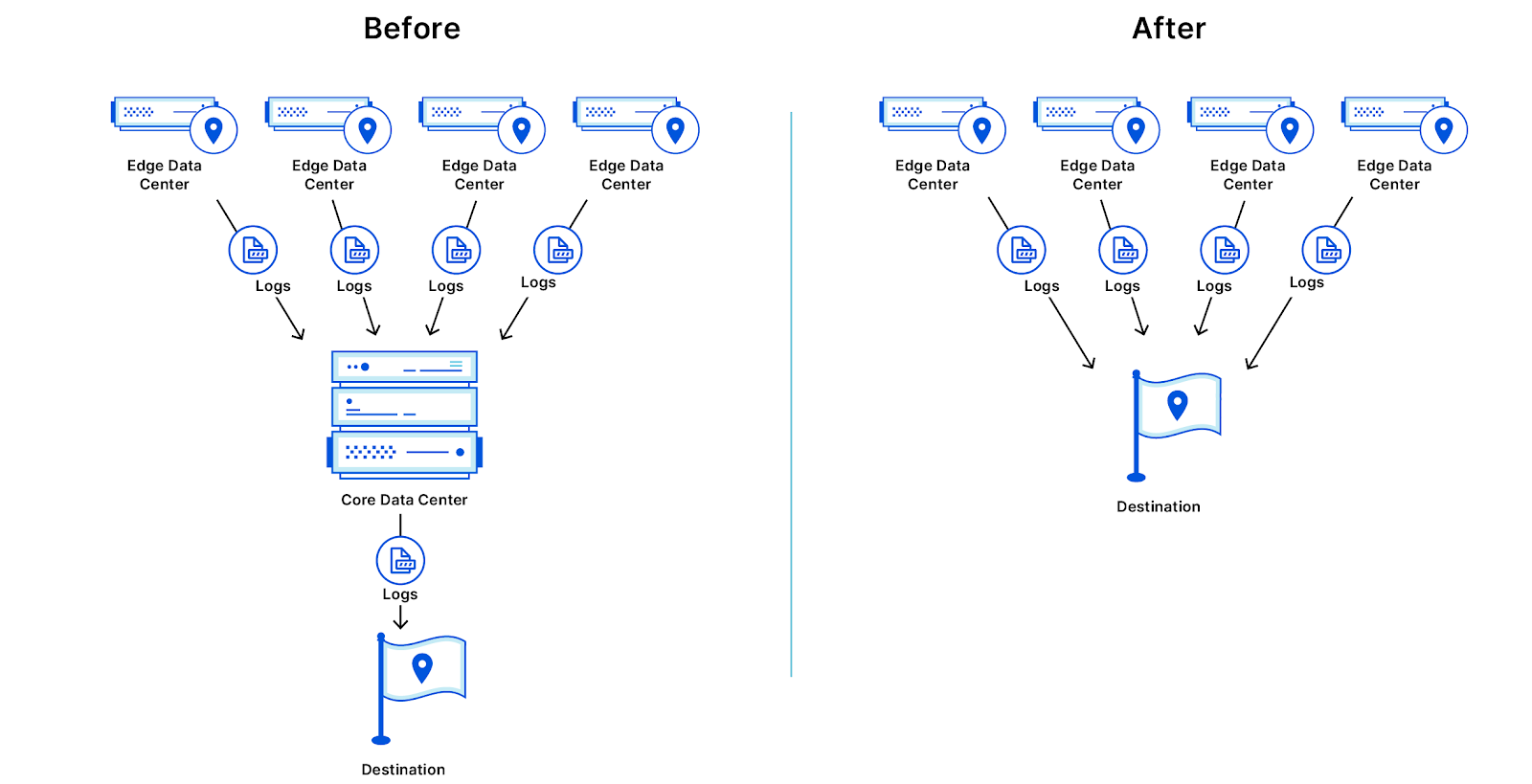
This only requires a subset of the metadata to be processed in our core data centers in the US/EU. This data contains information about how many requests were served, how much data was sent, how long requests took, and other information that is essential for the operation of our network.

With Edge Log Delivery, customers can send logs directly from the edge to their partner of choice—for example, an Azure storage bucket in their preferred region, or an instance of Splunk that runs in an on-premise data center. With this option, customers can still get their complete logs in their preferred region, without these logs first flowing through either of our US or EU core data centers.

Introducing the Cloudflare Data Localization Suite

Edge Log Delivery is in early beta for Enterprise customers today—please visit our product page for more information.

Ultimately, we are working towards providing customers full control over where their metadata is stored, and for how long. In the coming year, we plan to allow customers to be able to choose exactly which fields are stored, and for how long, and in which location.

Building location-aware applications from the ground up

So far, we’ve discussed how Cloudflare’s products can offer global performance and security solutions for our customers, while keeping their existing keys, application data, and metadata local.

But we know that customers are also struggling to use existing, traditional cloud systems to manage their data locality needs. Existing platforms may allow code or data to be deployed to a specific region, but having copies of applications in each region, and managing state across each of them, can be challenging at best (or impossible at worst).

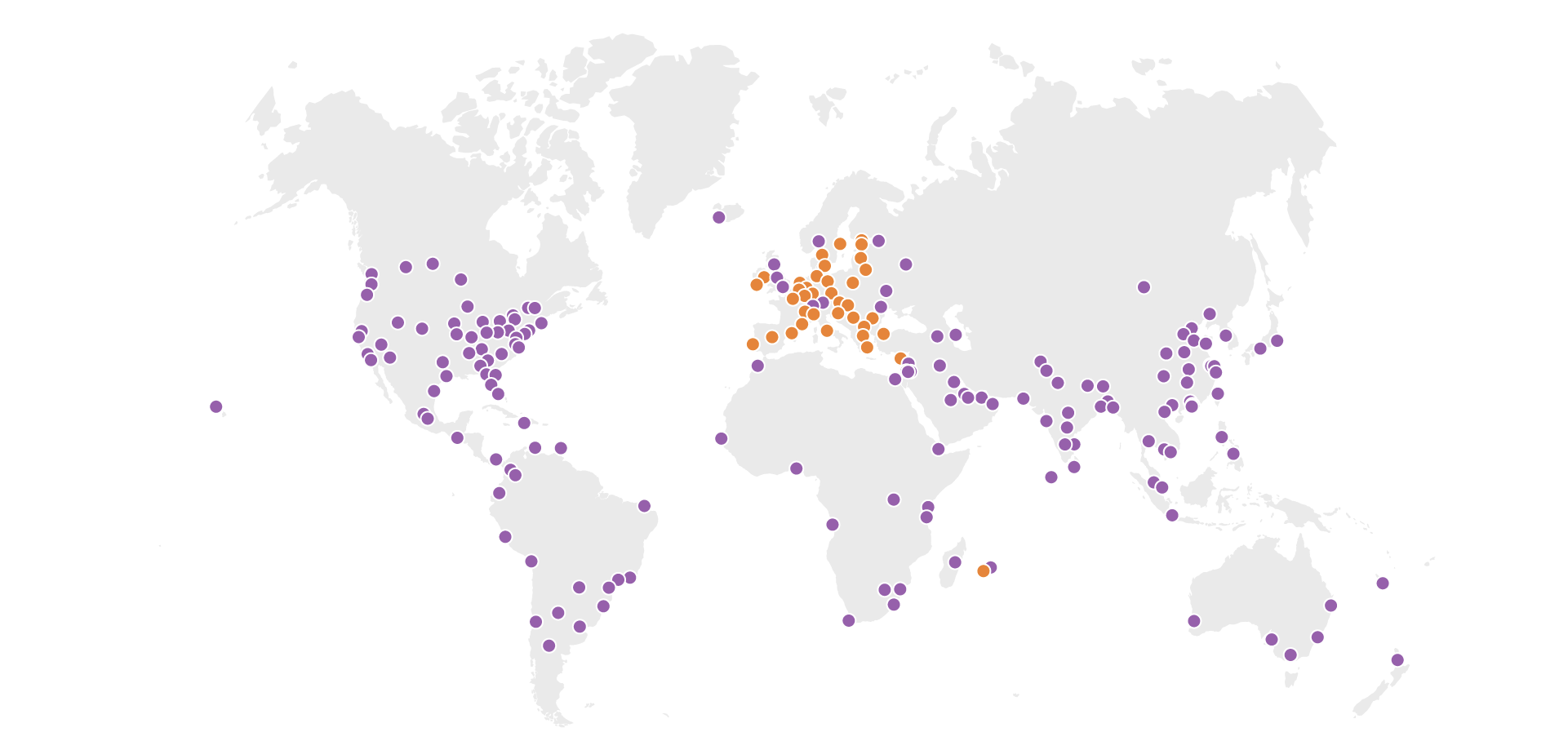
The ultimate promise of serverless has been to allow any developer to say “I don’t care where my code runs, just make it scale.” Increasingly, another promise will need to be “I do care where my code runs, and I need more control to satisfy my compliance department.” Cloudflare Workers allows you the best of both worlds, with instant scaling, locations that span more than 100 countries around the world, and the granularity to choose exactly what you need.

Introducing the Cloudflare Data Localization Suite

We are announcing a major improvement that lets customers control where their applications store data: Workers Durable Objects will support Jurisdiction Restrictions.  Durable Objects provide globally consistent state and coordination to serverless applications running on the Cloudflare Workers platform. Jurisdiction Restrictions will make it possible for users to ensure that their Durable Objects do not store data or run outside of a given jurisdiction—making it trivially simple to build applications that combine global performance with local compliance. With automatic migration of Durable Objects, adapting to new rules will be as simple as adding a tag to a set of Durable Objects.

Building for the long haul

The data localization landscape is constantly evolving. Since we began working on the Data Localization Suite, the European Data Protection Board has released new guidance about how data may be transferred between the EU and the US. And we know this is just the beginning — over time, more regions and more industries will have data localization requirements.

At Cloudflare, we stay on top of the latest developments around data protection so our customers don’t have to. The Data Localization Suite gives our customers the tools to set rules and controls at the edge about where their data is stored and protected, while taking advantage of our global network.

Welcome to Privacy & Compliance Week

Post Syndicated from Matthew Prince original https://blog.cloudflare.com/welcome-to-privacy-and-compliance-week/

Welcome to Privacy & Compliance Week

Welcome to Privacy & Compliance Week

Tomorrow kicks off Cloudflare’s Privacy & Compliance Week. Over the course of the week, we’ll be announcing ways that our customers can use our service to ensure they are in compliance with an increasingly complicated set of rules and laws around the world.

Early in Cloudflare’s history, when Michelle, Lee, and I were talking about the business we wanted to build, we kept coming back to the word trust. We realized early on that if we were not trustworthy then no one would ever choose to route their Internet traffic through us. Above all else, we are in the trust business.

Every employee at Cloudflare goes through orientation. I teach one of the sessions titled “What Is Cloudflare?” I fill several white boards with notes and diagrams talking about where we fit in to the market. But I leave one for the end so I can write the word TRUST, in capital letters, and underline it three times. Trust is the foundation of our business.

Standing Up For Our Customers from Our Early Days

That’s why we’ve made decisions that other companies may not have. In January 2013 the FBI showed up at our door with a National Security Letter requesting information on a customer. It was incredibly scary.

We had fewer than 30 employees at the time. The agents, while professional, were incredibly intimidating. And the letter ordered us to turn over information and forbid us from discussing it with anyone other than our attorneys.

Welcome to Privacy & Compliance Week

There’s a proper role for law enforcement, but National Security Letters, which at the time had almost no oversight, could be written and enforced by a single branch of the US government, and gagged recipients from talking about them indefinitely, ran counter to the foundational principles of due process. So we decided to sue the United States government.

I am thankful for Cloudflare’s Board for encouraging us to always fight for our principles. I am also thankful for the Electronic Frontier Foundation, who served as our attorneys in the case. It took several years, and we were gagged from talking about it until 2017, but ultimately the FBI withdrew the letter and Congress has taken steps to reform the law and ensure better oversight. There is a proper role for law enforcement, but when it crosses a line and infringes on basic principles of due process, then we believe it’s important to challenge it.

It’s all about trust.

Recognizing It’s Not Our Data

The same is true for the commercial side of our business. As soon as Cloudflare took off, the ad tech companies came knocking: “Do you have any idea how much you could make if you just let us cookie and retarget individuals passing through your network?” I took a lot of those meetings in our early days, but always came away feeling uneasy. Talking through it with Michelle she concisely expressed why we would never be in the advertising business: “It’s not our data.”

And that’s right. For our customers who do run ads on their sites, if we sold the data then we’d effectively be undercutting them. And, more fundamentally, if we were some invisible service that tracked you online without your knowledge then that would fail the creepiness test. While we believe there can be good ad-supported businesses, Cloudflare will never be one.

Welcome to Privacy & Compliance Week

As a result, we’ve always seen any personally identifiable information that passes through our network as a toxic asset and purged it as quickly as possible. That can be a tension because we are a security company and part of security requires us to be able to know, for instance, if a particular IP address is sending DDoS traffic. But we’ve invested in implementing or inventing technologies — like Universal SSL, Privacy Pass, Encrypted DNS, and ESNI — that keep your private data private, including from us.

Again, it’s all about trust.

Privacy In Our DNA

While Cloudflare started in California, we have had a global perspective from our earliest days. Today, nearly half of our C-level executives are Europeans, including our CTO, CIO, and CFO. Michelle, my co-founder and Cloudflare’s COO, is Canadian, a country that shares many of Europe’s values around privacy. We have offices around the world and far more engineers working outside of Silicon Valley than inside of it.

I wrote the first version of our Privacy Policy back in 2010. It included from the first draft this clear statement: “Cloudflare will not sell, rent, or give away any of your personal information without your consent. It is our overriding privacy principle that any personal information you provide to us is just that: private.” That is still true today. While other tech companies have made their policies more flexible over time, we’ve made ours stricter, including committing to a list of things we have never done and will fight like hell to never do:

  • Cloudflare has never turned over our encryption or authentication keys or our customers’ encryption or authentication keys to anyone.
  • Cloudflare has never installed any law enforcement software or equipment anywhere on our network.
  • Cloudflare has never provided any law enforcement organization a feed of our customers’ content transiting our network.
  • Cloudflare has never modified customer content at the request of law enforcement or another third party.
  • Cloudflare has never modified the intended destination of DNS responses at the request of law enforcement or another third party.
  • Cloudflare has never weakened, compromised, or subverted any of its encryption at the request of law enforcement or another third party.
Welcome to Privacy & Compliance Week

While many tech companies struggled to comply with privacy regulations such as GDPR, at Cloudflare it was relatively easy because the principles it imposed were at our core from our very outset. We don’t have a business if we don’t have trust, and being transparent, principled, and respecting the sanctity of personal data is critical to us continuously earning that trust.

Improving the Privacy of Our Service

But we’re not done; we can do more. There are things that have irked me about our service for a long time. For instance, from our earliest days we’ve used the _cfduid cookie to help with some of our security functions. That has meant that if you used Cloudflare you couldn’t be completely cookieless. John Graham-Cumming and I challenged the team earlier this year to see if we could kill it. Our team rose to the challenge and this week we’re announcing its deprecation. To my mind, that announcement alone is worth an entire week of celebrations.

Welcome to Privacy & Compliance Week

We have multiple data centers around the world that aggregate and process data in order to display logs and provide features. While having geographic redundancy helps with availability, some customers want to make sure their data never leaves a particular region. This week we’ll be giving users a lot more control over what data is processed where.

And, like we have during Privacy and Encryption weeks in years past, we will continue to invest in technologies to enable better encryption and more private use of core Internet services like DNS. Wouldn’t it be cool if, for example, we could ensure that no DNS provider could ever see both who is using their service and also where on the Internet those users are going? Stay tuned!

Helping Customers With Increasingly Complex Compliance Challenges

While we continue to invest in ensuring Cloudflare leads the way on privacy, more and more of our customers are also looking for solutions to be more private themselves. This month we expect that the EU’s new Digital Services Act will be proposed. We expect that it will continue to raise the bar on how companies doing business in Europe have to handle customers’ data. While the Internet giants will have the resources to comply with these heightened requirements, for everyone else they will create new challenges.

To that end, this week we’re announcing the Cloudflare Data Localization Suite. It provides our customers with a powerful set of tools to ensure they have control over how and where their data is processed in order to help comply with increasingly complex local data processing requirements. This includes enhancements to Workers, our edge computing and storage platform, to help modern applications get built such that users’ data never leaves their own country or region.

Welcome to Privacy & Compliance Week

It’s clear to us that the model of sending all your customer data back to a data center in Ashburn, VA, regardless of where those customers are located in the world, will look as antiquated in an increasingly privacy-conscious world as carrying a stack of punch cards to a central mainframe would today. In the not too distant future, regulations are inevitably going to force data storage and processing to be local. And, with a network that today already spans more than 100 countries, Cloudflare stands ready to help our customers enable that more private future.

Stay Tuned

Stay tuned this week to our blog for a series of announcements. Since these are topics that are so important in Europe right now, we’ll be simultaneously publishing most of them in French, Italian, Spanish, Portuguese, and German as well as English. Also check out Cloudflare TV where we’ll be interviewing a series of people whose views on privacy and compliance we respect and have learned from.

Cloudflare’s mission is to help build a better Internet. And there is no doubt that a better Internet is a more private Internet. With that in mind, welcome to Privacy & Compliance Week.

re:Invent 2020 – Your guide to AWS Identity and Data Protection sessions

Post Syndicated from Marta Taggart original https://aws.amazon.com/blogs/security/reinvent-2020-your-guide-to-aws-identity-and-data-protection-sessions/

AWS re:Invent will certainly be different in 2020! Instead of seeing you all in Las Vegas, this year re:Invent will be a free, three-week virtual conference. One thing that will remain the same is the variety of sessions, including many Security, Identity, and Compliance sessions. As we developed sessions, we looked to customers—asking where they would like to expand their knowledge. One way we did this was shared in a recent Security blog post, where we introduced a new customer polling feature that provides us with feedback directly from customers. The initial results of the poll showed that Identity and Access Management and Data Protection are top-ranking topics for customers. We wanted to highlight some of the re:Invent sessions for these two important topics so that you can start building your re:Invent schedule. Each session is offered at multiple times, so you can sign up for the time that works best for your location and schedule.

Managing your Identities and Access in AWS

AWS identity: Secure account and application access with AWS SSO
Ron Cully, Principal Product Manager, AWS

Dec 1, 2020 | 12:00 PM – 12:30 PM PST
Dec 1, 2020 | 8:00 PM – 8:30 PM PST
Dec 2, 2020 | 4:00 AM – 4:30 AM PST

AWS SSO provides an easy way to centrally manage access at scale across all your AWS Organizations accounts, using identities you create and manage in AWS SSO, Microsoft Active Directory, or external identity providers (such as Okta Universal Directory or Azure AD). This session explains how you can use AWS SSO to manage your AWS environment, and it covers key new features to help you secure and automate account access authorization.

Getting started with AWS identity services
Becky Weiss, Senior Principal Engineer, AWS

Dec 1, 2020 | 1:30 PM – 2:00 PM PST
Dec 1, 2020 | 9:30 PM – 10:00 PM PST
Dec 2, 2020 | 5:30 AM – 6:00 AM PST

The number, range, and breadth of AWS services are large, but the set of techniques that you need to secure them is not. Your journey as a builder in the cloud starts with this session, in which practical examples help you quickly get up to speed on the fundamentals of becoming authenticated and authorized in the cloud, as well as on securing your resources and data correctly.

AWS identity: Ten identity health checks to improve security in the cloud
Cassia Martin, Senior Security Solutions Architect, AWS

Dec 2, 2020 | 9:30 AM – 10:00 AM PST
Dec 2, 2020 | 5:30 PM – 6:00 PM PST
Dec 3, 2020 | 1:30 AM – 2:00 AM PST

Get practical advice and code to help you achieve the principle of least privilege in your existing AWS environment. From enabling logs to disabling root, the provided checklist helps you find and fix permissions issues in your resources, your accounts, and throughout your organization. With these ten health checks, you can improve your AWS identity and achieve better security every day.

AWS identity: Choosing the right mix of AWS IAM policies for scale
Josh Du Lac, Principal Security Solutions Architect, AWS

Dec 2, 2020 | 11:00 AM – 11:30 AM PST
Dec 2, 2020 | 7:00 PM – 7:30 PM PST
Dec 3, 2020 | 3:00 AM – 3:30 AM PST

This session provides both a strategic and tactical overview of various AWS Identity and Access Management (IAM) policies that provide a range of capabilities for the security of your AWS accounts. You probably already use a number of these policies today, but this session will dive into the tactical reasons for choosing one capability over another. This session zooms out to help you understand how to manage these IAM policies across a multi-account environment, covering their purpose, deployment, validation, limitations, monitoring, and more.

Zero Trust: An AWS perspective
Quint Van Deman, Principal WW Identity Specialist, AWS

Dec 2, 2020 | 12:30 PM – 1:00 PM PST
Dec 2, 2020 | 8:30 PM – 9:00 PM PST
Dec 3, 2020 | 4:30 AM – 5:00 AM PST

AWS customers have continuously asked, “What are the optimal patterns for ensuring the right levels of security and availability for my systems and data?” Increasingly, they are asking how patterns that fall under the banner of Zero Trust might apply to this question. In this session, you learn about the AWS guiding principles for Zero Trust and explore the larger subdomains that have emerged within this space. Then the session dives deep into how AWS has incorporated some of these concepts, and how AWS can help you on your own Zero Trust journey.

AWS identity: Next-generation permission management
Brigid Johnson, Senior Software Development Manager, AWS

Dec 3, 2020 | 11:00 AM – 11:30 AM PST
Dec 3, 2020 | 7:00 PM – 7:30 PM PST
Dec 4, 2020 | 3:00 AM – 3:30 AM PST

This session is for central security teams and developers who manage application permissions. This session reviews a permissions model that enables you to scale your permissions management with confidence. Learn how to set your organization up for access management success with permission guardrails. Then, learn about granting workforce permissions based on attributes, so they scale as your users and teams adjust. Finally, learn about the access analysis tools and how to use them to identify and reduce broad permissions and give users and systems access to only what they need.

How Goldman Sachs administers temporary elevated AWS access
Harsha Sharma, Solutions Architect, AWS
Chana Garbow Pardes, Associate, Goldman Sachs
Jewel Brown, Analyst, Goldman Sachs

Dec 16, 2020 | 2:00 PM – 2:30 PM PST
Dec 16, 2020 | 10:00 PM – 10:30 PM PST
Dec 17, 2020 | 6:00 AM – 6:30 AM PST

Goldman Sachs takes security and access to AWS accounts seriously. While empowering teams with the freedom to build applications autonomously is critical for scaling cloud usage across the firm, guardrails and controls need to be set in place to enable secure administrative access. In this session, learn how the company built its credential brokering workflow and administrator access for its users. Learn how, with its simple application that uses proprietary and AWS services, including Amazon DynamoDB, AWS Lambda, AWS CloudTrail, Amazon S3, and Amazon Athena, Goldman Sachs is able to control administrator credentials and monitor and report on actions taken for audits and compliance.

Data Protection

Do you need an AWS KMS custom key store?
Tracy Pierce, Senior Consultant, AWS

Dec 15, 2020 | 9:45 AM – 10:15 AM PST
Dec 15, 2020 | 5:45 PM – 6:15 PM PST
Dec 16, 2020 | 1:45 AM – 2:15 AM PST

AWS Key Management Service (AWS KMS) has integrated with AWS CloudHSM, giving you the option to create your own AWS KMS custom key store. In this session, you learn more about how a KMS custom key store is backed by an AWS CloudHSM cluster and how it enables you to generate, store, and use your KMS keys in the hardware security modules that you control. You also learn when and if you really need a custom key store. Join this session to learn why you might choose not to use a custom key store and instead use the AWS KMS default.

Using certificate-based authentication on containers & web servers on AWS
Josh Rosenthol, Senior Product Manager, AWS
Kevin Rioles, Manager, Infrastructure & Security, BlackSky

Dec 8, 2020 | 12:45 PM – 1:15 PM PST
Dec 8, 2020 | 8:45 PM – 9:15 PM PST
Dec 9, 2020 | 4:45 AM – 5:15 AM PST

In this session, BlackSky talks about its experience using AWS Certificate Manager (ACM) end-entity certificates for the processing and distribution of real-time satellite geospatial intelligence and monitoring. Learn how BlackSky uses certificate-based authentication on containers and web servers within its AWS environment to help make TLS ubiquitous in its deployments. The session details the implementation, architecture, and operations best practices that the company chose and how it was able to operate ACM at scale across multiple accounts and regions.

The busy manager’s guide to encryption
Spencer Janyk, Senior Product Manager, AWS

Dec 9, 2020 | 11:45 AM – 12:15 PM PST
Dec 9, 2020 | 7:45 PM – 8:15 PM PST
Dec 10, 2020 | 3:45 AM – 4:15 AM PST

In this session, explore the functionality of AWS cryptography services and learn when and where to deploy each of the following: AWS Key Management Service, AWS Encryption SDK, AWS Certificate Manager, AWS CloudHSM, and AWS Secrets Manager. You also learn about defense-in-depth strategies including asymmetric permissions models, client-side encryption, and permission segmentation by role.

Building post-quantum cryptography for the cloud
Alex Weibel, Senior Software Development Engineer, AWS

Dec 15, 2020 | 12:45 PM – 1:15 PM PST
Dec 15, 2020 | 8:45 PM – 9:15 PM PST
Dec 16, 2020 | 4:45 AM – 5:15 AM PST

This session introduces post-quantum cryptography and how you can use it today to secure TLS communication. Learn about recent updates on standards and existing deployments, including the AWS post-quantum TLS implementation (pq-s2n). A description of the hybrid key agreement method shows how you can combine a new post-quantum key encapsulation method with a classical key exchange to secure network traffic today.

Data protection at scale using Amazon Macie
Neel Sendas, Senior Technical Account Manager, AWS

Dec 17, 2020 | 7:15 AM – 7:45 AM PST
Dec 17, 2020 | 3:15 PM – 3:45 PM PST
Dec 17, 2020 | 11:15 PM – 11:45 PM PST

Data Loss Prevention (DLP) is a common topic among companies that work with sensitive data. If an organization can’t identify its sensitive data, it can’t protect it. Amazon Macie is a fully managed data security and data privacy service that uses machine learning and pattern matching to discover and protect your sensitive data in AWS. In this session, we will share details of the design and architecture you can use to deploy Macie at large scale.

While sessions are virtual this year, they will be offered at multiple times with live moderators and “Ask the Expert” sessions available to help answer any questions that you may have. We look forward to “seeing” you in these sessions. Please see the re:Invent agenda for more details and to build your schedule.

If you have feedback about this post, submit comments in the Comments section below.

Want more AWS Security how-to content, news, and feature announcements? Follow us on Twitter.

Author

Marta Taggart

Marta is a Seattle-native and Senior Program Manager in AWS Security, where she focuses on privacy, content development, and educational programs. Her interest in education stems from two years she spent in the education sector while serving in the Peace Corps in Romania. In her free time, she’s on a global hunt for the perfect cup of coffee.

Author

Himanshu Verma

Himanshu is a Worldwide Specialist for AWS Security Services. In this role, he leads the go-to-market creation and execution for AWS Data Protection and Threat Detection & Monitoring services, field enablement, and strategic customer advisement. Prior to AWS, he held roles as Director of Product Management, engineering and development, working on various identity, information security and data protection technologies.

Verified, episode 2 – A Conversation with Emma Smith, Director of Global Cyber Security at Vodafone

Post Syndicated from Stephen Schmidt original https://aws.amazon.com/blogs/security/verified-episode-2-conversation-with-emma-smith-director-of-global-cyber-security-at-vodafone/

Over the past 8 months, it’s become more important for us all to stay in contact with peers around the globe. Today, I’m proud to bring you the second episode of our new video series, Verified: Presented by AWS re:Inforce. Even though we couldn’t be together this year at re:Inforce, our annual security conference, we still wanted to share some of the conversations with security leaders that would have taken place at the conference. The series showcases conversations with security leaders around the globe. In episode two, I’m talking to Emma Smith, Vodafone’s Global Cyber Security Director.

Vodafone is a global technology communications company with an optimistic culture. Their focus is connecting people and building the digital future for society. During our conversation, Emma detailed how the core values of the Global Cyber Security team were inspired by the company. “We’ve got a team of people who are ultimately passionate about protecting customers, protecting society, protecting Vodafone, protecting all of our services and our employees.” Emma shared experiences about the evolution of the security organization during her past 5 years with the company.

We were also able to touch on one of Emma’s passions, diversity and inclusion. Emma has worked to implement diversity and drive a policy of inclusion at Vodafone. In June, she was named Diversity Champion in the SC Awards Europe. In her own words: “It makes me realize that my job is to smooth the way for everybody else and to try and remove some of those obstacles or barriers that were put in their way… it means that I’m really passionate about trying to get a very diverse team in security, but also in Vodafone, so that we reflect our customer base, so that we’ve got diversity of thinking, of backgrounds, of experience, and people who genuinely feel comfortable being themselves at work—which is easy to say but really hard to create that culture of safety and belonging.”

Stay tuned for future episodes of Verified: Presented by AWS re:Inforce here on the AWS Security Blog. You can watch episode one, an interview with Jason Chan, Vice President of Information Security at Netflix on YouTube. If you have an idea or a topic you’d like covered in this series, please drop us a comment below.

Want more AWS Security how-to content, news, and feature announcements? Follow us on Twitter.

Author

Steve Schmidt

Steve is Vice President and Chief Information Security Officer for AWS. His duties include leading product design, management, and engineering development efforts focused on bringing the competitive, economic, and security benefits of cloud computing to business and government customers. Prior to AWS, he had an extensive career at the Federal Bureau of Investigation, where he served as a senior executive and section chief. He currently holds 11 patents in the field of cloud security architecture. Follow Steve on Twitter.

California Proposition 24 Passes

Post Syndicated from Bruce Schneier original https://www.schneier.com/blog/archives/2020/11/california-proposition-24-passes.html

California’s Proposition 24, aimed at improving the California Consumer Privacy Act, passed this week. Analyses are very mixed. I was very mixed on the proposition, but on the whole I supported it. The proposition has some serious flaws, and was watered down by industry, but voting for privacy feels like it’s generally a good thing.

The NSA is Refusing to Disclose its Policy on Backdooring Commercial Products

Post Syndicated from Bruce Schneier original https://www.schneier.com/blog/archives/2020/10/the-nsa-is-refusing-to-disclose-its-policy-on-backdooring-commercial-products.html

Senator Ron Wyden asked, and the NSA didn’t answer:

The NSA has long sought agreements with technology companies under which they would build special access for the spy agency into their products, according to disclosures by former NSA contractor Edward Snowden and reporting by Reuters and others.

These so-called back doors enable the NSA and other agencies to scan large amounts of traffic without a warrant. Agency advocates say the practice has eased collection of vital intelligence in other countries, including interception of terrorist communications.

The agency developed new rules for such practices after the Snowden leaks in order to reduce the chances of exposure and compromise, three former intelligence officials told Reuters. But aides to Senator Ron Wyden, a leading Democrat on the Senate Intelligence Committee, say the NSA has stonewalled on providing even the gist of the new guidelines.

[…]

The agency declined to say how it had updated its policies on obtaining special access to commercial products. NSA officials said the agency has been rebuilding trust with the private sector through such measures as offering warnings about software flaws.

“At NSA, it’s common practice to constantly assess processes to identify and determine best practices,” said Anne Neuberger, who heads NSA’s year-old Cybersecurity Directorate. “We don’t share specific processes and procedures.”

Three former senior intelligence agency figures told Reuters that the NSA now requires that before a back door is sought, the agency must weigh the potential fallout and arrange for some kind of warning if the back door gets discovered and manipulated by adversaries.

The article goes on to talk about Juniper Networks equipment, which had the NSA-created DUAL_EC PRNG backdoor in its products. That backdoor was taken advantage of by an unnamed foreign adversary.

Juniper Networks got into hot water over Dual EC two years later. At the end of 2015, the maker of internet switches disclosed that it had detected malicious code in some firewall products. Researchers later determined that hackers had turned the firewalls into their own spy tool here by altering Juniper’s version of Dual EC.

Juniper said little about the incident. But the company acknowledged to security researcher Andy Isaacson in 2016 that it had installed Dual EC as part of a “customer requirement,” according to a previously undisclosed contemporaneous message seen by Reuters. Isaacson and other researchers believe that customer was a U.S. government agency, since only the U.S. is known to have insisted on Dual EC elsewhere.

Juniper has never identified the customer, and declined to comment for this story.

Likewise, the company never identified the hackers. But two people familiar with the case told Reuters that investigators concluded the Chinese government was behind it. They declined to detail the evidence they used.

Okay, lots of unsubstantiated claims and innuendo here. And Neuberger is right; the NSA shouldn’t share specific processes and procedures. But as long as this is a democratic country, the NSA has an obligation to disclose its general processes and procedures so we all know what they’re doing in our name. And if it’s still putting surveillance ahead of security.

IMSI-Catchers from Canada

Post Syndicated from Bruce Schneier original https://www.schneier.com/blog/archives/2020/10/imsi-catchers-from-canada.html

Gizmodo is reporting that Harris Corp. is no longer selling Stingray IMSI-catchers (and, presumably, its follow-on models Hailstorm and Crossbow) to local governments:

L3Harris Technologies, formerly known as the Harris Corporation, notified police agencies last year that it planned to discontinue sales of its surveillance boxes at the local level, according to government records. Additionally, the company would no longer offer access to software upgrades or replacement parts, effectively slapping an expiration date on boxes currently in use. Any advancements in cellular technology, such as the rollout of 5G networks in most major U.S. cities, would render them obsolete.

The article goes on to talk about replacement surveillance systems from the Canadian company Octasic.

Octasic’s Nyxcell V800 can target most modern phones while maintaining the ability to capture older GSM devices. Florida’s state police agency described the device, made for in-vehicle use, as capable of targeting eight frequency bands including GSM (2G), CDMA2000 (3G), and LTE (4G).

[…]

A 2018 patent assigned to Octasic claims that Nyxcell forces a connection with nearby mobile devices when its signal is stronger than the nearest legitimate cellular tower. Once connected, Nyxcell prompts devices to divulge information about its signal strength relative to nearby cell towers. These reported signal strengths (intra-frequency measurement reports) are then used to triangulate the position of a phone.

Octasic appears to lean heavily on the work of Indian engineers and scientists overseas. A self-published biography of the company notes that while the company is headquartered in Montreal, it has “R&D facilities in India,” as well as a “worldwide sales support network.” Nyxcell’s website, which is only a single page requesting contact information, does not mention Octasic by name. Gizmodo was, however, able to recover domain records identifying Octasic as the owner.

Introducing the first video in our new series, Verified, featuring Netflix’s Jason Chan

Post Syndicated from Stephen Schmidt original https://aws.amazon.com/blogs/security/introducing-first-video-new-series-verified-featuring-netflix-jason-chan/

The year has been a profoundly different one for us all, and like many of you, I’ve been adjusting, both professionally and personally, to this “new normal.” Here at AWS we’ve seen an increase in customers looking for secure solutions to maintain productivity in an increased work-from-home world. We’ve also seen an uptick in requests for training; it’s clear, a sense of community and learning are critically important as workforces physically distance.

For these reasons, I’m happy to announce the launch of Verified: Presented by AWS re:Inforce. I’m hosting this series, but I’ll be joined by leaders in cloud security across a variety of industries. The goal is to have an open conversation about the common issues we face in securing our systems and tools. Topics will include how the pandemic is impacting cloud security, tips for creating an effective security program from the ground up, how to create a culture of security, emerging security trends, and more. Learn more by following me on Twitter (@StephenSchmidt), and get regular updates from @AWSSecurityInfo. Verified is just one of the many ways we will continue sharing best practices with our customers during this time. You can find more by reading the AWS Security Blog, reviewing our documentation, visiting the AWS Security and Compliance webpages, watching re:Invent and re:Inforce playlists, and/or reviewing the Security Pillar of Well Architected.

Our first conversation, above, is with Jason Chan, Vice President of Information Security at Netflix. Jason spoke to us about the security program at Netflix, his approach to hiring security talent, and how Zero Trust enables a remote workforce. Jason also has solid insights to share about how he started and grew the security program at Netflix.

“In the early days, what we were really trying to figure out is how do we build a large-scale consumer video-streaming service in the public cloud, and how do you do that in a secure way? There wasn’t a ton of expertise in that, so when I was building the security team at Netflix, I thought, ‘how do we bring in folks from a variety of backgrounds, generalists … to tackle this problem?’”

He also gave his view on how a growing security team can measure ROI. “I think it’s difficult to have a pure equation around that. So what we try to spend our time doing is really making sure that we, as a team, are aligned on what is the most important—what are the most important assets to protect, what are the most critical risks that we’re trying to prevent—and then make sure that leadership is aligned with that, because, as we all know, there’s not unlimited resources, right? You can’t hire an unlimited number of folks or spend an unlimited amount of money, so you’re always trying to figure out how do you prioritize, and how do you find where is going to be the biggest impact for your value?”

Check out Jason’s full interview above, and stay tuned for further videos in this series. If you have an idea or a topic you’d like covered in this series, please drop us a comment below. Thanks!

Want more AWS Security how-to content, news, and feature announcements? Follow us on Twitter.

Author

Steve Schmidt

Steve is Vice President and Chief Information Security Officer for AWS. His duties include leading product design, management, and engineering development efforts focused on bringing the competitive, economic, and security benefits of cloud computing to business and government customers. Prior to AWS, he had an extensive career at the Federal Bureau of Investigation, where he served as a senior executive and section chief. He currently holds 11 patents in the field of cloud security architecture. Follow Steve on Twitter.

Google Responds to Warrants for “About” Searches

Post Syndicated from Bruce Schneier original https://www.schneier.com/blog/archives/2020/10/google-responds-to-warrants-for-about-searches.html

One of the things we learned from the Snowden documents is that the NSA conducts “about” searches. That is, searches based on activities and not identifiers. A normal search would be on a name, or IP address, or phone number. An about search would something like “show me anyone that has used this particular name in a communications,” or “show me anyone who was at this particular location within this time frame.” These searches are legal when conducted for the purpose of foreign surveillance, but the worry about using them domestically is that they are unconstitutionally broad. After all, the only way to know who said a particular name is to know what everyone said, and the only way to know who was at a particular location is to know where everyone was. The very nature of these searches requires mass surveillance.

The FBI does not conduct mass surveillance. But many US corporations do, as a normal part of their business model. And the FBI uses that surveillance infrastructure to conduct its own about searches. Here’s an arson case where the FBI asked Google who searched for a particular street address:

Homeland Security special agent Sylvette Reynoso testified that her team began by asking Google to produce a list of public IP addresses used to google the home of the victim in the run-up to the arson. The Chocolate Factory [Google] complied with the warrant, and gave the investigators the list. As Reynoso put it:

On June 15, 2020, the Honorable Ramon E. Reyes, Jr., United States Magistrate Judge for the Eastern District of New York, authorized a search warrant to Google for users who had searched the address of the Residence close in time to the arson.

The records indicated two IPv6 addresses had been used to search for the address three times: one the day before the SUV was set on fire, and the other two about an hour before the attack. The IPv6 addresses were traced to Verizon Wireless, which told the investigators that the addresses were in use by an account belonging to Williams.

Google’s response is that this is rare:

While word of these sort of requests for the identities of people making specific searches will raise the eyebrows of privacy-conscious users, Google told The Register the warrants are a very rare occurrence, and its team fights overly broad or vague requests.

“We vigorously protect the privacy of our users while supporting the important work of law enforcement,” Google’s director of law enforcement and information security Richard Salgado told us. “We require a warrant and push to narrow the scope of these particular demands when overly broad, including by objecting in court when appropriate.

“These data demands represent less than one per cent of total warrants and a small fraction of the overall legal demands for user data that we currently receive.”

Here’s another example of what seems to be about data leading to a false arrest.

According to the lawsuit, police investigating the murder knew months before they arrested Molina that the location data obtained from Google often showed him in two places at once, and that he was not the only person who drove the Honda registered under his name.

Avondale police knew almost two months before they arrested Molina that another man ­ his stepfather ­ sometimes drove Molina’s white Honda. On October 25, 2018, police obtained records showing that Molina’s Honda had been impounded earlier that year after Molina’s stepfather was caught driving the car without a license.

Data obtained by Avondale police from Google did show that a device logged into Molina’s Google account was in the area at the time of Knight’s murder. Yet on a different date, the location data from Google also showed that Molina was at a retirement community in Scottsdale (where his mother worked) while debit card records showed that Molina had made a purchase at a Walmart across town at the exact same time.

Molina’s attorneys argue that this and other instances like it should have made it clear to Avondale police that Google’s account-location data is not always reliable in determining the actual location of a person.

“About” searches might be rare, but that doesn’t make them a good idea. We have knowingly and willingly built the architecture of a police state, just so companies can show us ads. (And it is increasingly apparent that the advertising-supported Internet is heading for a crash.)

Free, Privacy-First Analytics for a Better Web

Post Syndicated from Jon Levine original https://blog.cloudflare.com/free-privacy-first-analytics-for-a-better-web/

Free, Privacy-First Analytics for a Better Web

Everyone with a website needs to know some basic facts about their website: what pages are people visiting? Where in the world are they? What other sites sent traffic to my website?

There are “free” analytics tools out there, but they come at a cost: not money, but your users’ privacy. Today we’re announcing a brand new, privacy-first analytics service that’s open to everyone — even if they’re not already a Cloudflare customer. And if you’re a Cloudflare customer, we’ve enhanced our analytics to make them even more powerful than before.

The most important analytics feature: Privacy

The most popular analytics services available were built to help ad-supported sites sell more ads. But, a lot of websites don’t have ads. So if you use those services, you’re giving up the privacy of your users in order to understand how what you’ve put online is performing.

Cloudflare’s business has never been built around tracking users or selling advertising. We don’t want to know what you do on the Internet — it’s not our business. So we wanted to build an analytics service that gets back to what really matters for web creators, not necessarily marketers, and to give web creators the information they need in a simple, clean way that doesn’t sacrifice their visitors’ privacy. And giving web creators these analytics shouldn’t depend on their use of Cloudflare’s infrastructure for performance and security. (More on that in a bit.)

What does it mean for us to make our analytics “privacy-first”? Most importantly, it means we don’t need to track individual users over time for the purposes of serving analytics. We don’t use any client-side state, like cookies or localStorage, for the purposes of tracking users. And we don’t “fingerprint” individuals via their IP address, User Agent string, or any other data for the purpose of displaying analytics. (We consider fingerprinting even more intrusive than cookies, because users have no way to opt out.)

Counting visits without tracking users

One of the most essential stats about any website is: “how many people went there”? Analytics tools frequently show counts of “unique” visitors, which requires tracking individual users by a cookie or IP address.

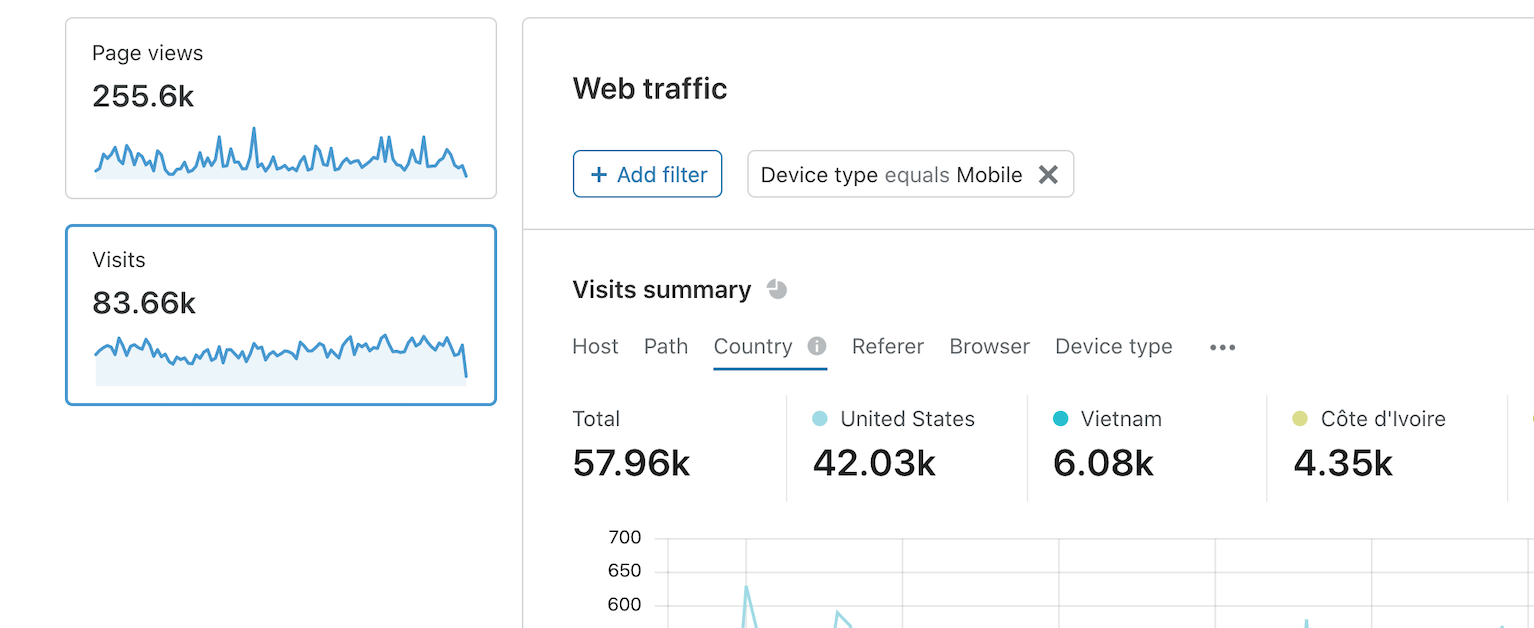
We use the concept of a visit: a privacy-friendly measure of how people have interacted with your website. A visit is defined simply as a successful page view that has an HTTP referer that doesn’t match the hostname of the request. This tells you how many times people came to your website and clicked around before navigating away, but doesn’t require tracking individuals.

Free, Privacy-First Analytics for a Better Web

A visit has slightly different semantics from a “unique”, and you should expect this number to differ from other analytics tools.

All of the details, none of the bots

Our analytics deliver the most important metrics about your website, like page views and visits. But we know that an essential analytics feature is flexibility: the ability to add arbitrary filters, and slice-and-dice data as you see fit. Our analytics can show you the top hostnames, URLs, countries, and other critical metrics like status codes. You can filter on any of these metrics with a click and see the whole dashboard update.

I’m especially excited about two features in our time series charts: the ability to drag-to-zoom into a narrower time range, and the ability to “group by” different dimensions to see data in a different way. This is a super powerful way to drill into an anomaly in traffic and quickly see what’s going on. For example, you might notice a spike in traffic, zoom into that spike, and then try different groupings to see what contributed the extra clicks. A GIF is worth a thousand words:

And for customers of our Bot Management product, we’re working on the ability to detect (and remove) automated traffic. Coming very soon, you’ll be able to see which bots are reaching your website — with just a click, block them by using Firewall Rules.

This is all possible thanks to our ABR analytics technology, which enables us to serve analytics very quickly for websites large and small. Check out our blog post to learn more about how this works.

Edge or Browser analytics? Why not both?

There are two ways to collect web analytics data: at the edge (or on an origin server), or in the client using a JavaScript beacon.

Historically, Cloudflare has collected analytics data at our edge. This has some nice benefits over traditional, client-side analytics approaches:

  • It’s more accurate because you don’t miss users who block third-party scripts, or JavaScript altogether
  • You can see all of the traffic back to your origin server, even if an HTML page doesn’t load
  • We can detect (and block bots), apply Firewall rules, and generally scrub traffic of unwanted noise
  • You can measure the performance of your origin server

More commonly, most web analytics providers use client-side measurement. This has some benefits as well:

  • You can understand performance as your users see it — e.g. how long did the page actually take to render
  • You can detect errors in client-side JavaScript execution
  • You can define custom event types emitted by JavaScript frameworks

Ultimately, we want our customers to have the best of both worlds. We think it’s really powerful to get web traffic numbers directly from the edge. We also launched Browser Insights a year ago to augment our existing edge analytics with more performance information, and today Browser Insights are taking a big step forward by incorporating Web Vitals metrics.

But, we know not everyone can modify their DNS to take advantage of Cloudflare’s edge services. That’s why today we’re announcing a free, standalone analytics product for everyone.

How do I get it?

For existing Cloudflare customers on our Pro, Biz, and Enterprise plans, just go to your Analytics tab! Starting today, you’ll see a banner to opt-in to the new analytics experience. (We plan to make this the default in a few weeks.)

But when building privacy-first analytics, we realized it’s important to make this accessible even to folks who don’t use Cloudflare today. You’ll be able to use Cloudflare’s web analytics even if you can’t change your DNS servers — just add our JavaScript, and you’re good to go.

We’re still putting on the finishing touches on our JavaScript-based analytics, but you can sign up here and we’ll let you know when it’s ready.

The evolution of analytics at Cloudflare

Just over a year ago, Cloudflare’s analytics consisted of a simple set of metrics: cached vs uncached data transfer, or how many requests were blocked by the Firewall. Today we provide flexible, powerful analytics across all our products, including Firewall, Cache, Load Balancing and Network traffic.

While we’ve been focused on building analytics about our products, we realized that our analytics are also powerful as a standalone product. Today is just the first step on that journey. We have so much more planned: from real-time analytics, to ever-more performance analysis, and even allowing customers to add custom events.

We want to hear what you want most out of analytics — drop a note in the comments to let us know what you want to see next.

On Executive Order 12333

Post Syndicated from Bruce Schneier original https://www.schneier.com/blog/archives/2020/09/on-executive-order-12333.html

Mark Jaycox has written a long article on the US Executive Order 12333: “No Oversight, No Limits, No Worries: A Primer on Presidential Spying and Executive Order 12,333“:

Abstract: Executive Order 12,333 (“EO 12333”) is a 1980s Executive Order signed by President Ronald Reagan that, among other things, establishes an overarching policy framework for the Executive Branch’s spying powers. Although electronic surveillance programs authorized by EO 12333 generally target foreign intelligence from foreign targets, its permissive targeting standards allow for the substantial collection of Americans’ communications containing little to no foreign intelligence value. This fact alone necessitates closer inspection.

This working draft conducts such an inspection by collecting and coalescing the various declassifications, disclosures, legislative investigations, and news reports concerning EO 12333 electronic surveillance programs in order to provide a better understanding of how the Executive Branch implements the order and the surveillance programs it authorizes. The Article pays particular attention to EO 12333’s designation of the National Security Agency as primarily responsible for conducting signals intelligence, which includes the installation of malware, the analysis of internet traffic traversing the telecommunications backbone, the hacking of U.S.-based companies like Yahoo and Google, and the analysis of Americans’ communications, contact lists, text messages, geolocation data, and other information.

After exploring the electronic surveillance programs authorized by EO 12333, this Article proposes reforms to the existing policy framework, including narrowing the aperture of authorized surveillance, increasing privacy standards for the retention of data, and requiring greater transparency and accountability.

Cory Doctorow on The Age of Surveillance Capitalism

Post Syndicated from Bruce Schneier original https://www.schneier.com/blog/archives/2020/08/cory_doctorow_o_2.html

Cory Doctorow has writtten an extended rebuttal of The Age of Surveillance Capitalism by Shoshana Zuboff. He summarized the argument on Twitter.

Shorter summary: it’s not the surveillance part, it’s the fact that these companies are monopolies.

I think it’s both. Surveillance capitalism has some unique properties that make it particularly unethical and incompatible with a free society, and Zuboff makes them clear in her book. But the current acceptance of monopolies in our society is also extremely damaging — which Doctorow makes clear.

Identifying People by Their Browsing Histories

Post Syndicated from Bruce Schneier original https://www.schneier.com/blog/archives/2020/08/identifying_peo_9.html

Interesting paper: “Replication: Why We Still Can’t Browse in Peace: On the Uniqueness and Reidentifiability of Web Browsing Histories“:

We examine the threat to individuals’ privacy based on the feasibility of reidentifying users through distinctive profiles of their browsing history visible to websites and third parties. This work replicates and extends the 2012 paper Why Johnny Can’t Browse in Peace: On the Uniqueness of Web Browsing History Patterns[48]. The original work demonstrated that browsing profiles are highly distinctive and stable.We reproduce those results and extend the original work to detail the privacy risk posed by the aggregation of browsing histories. Our dataset consists of two weeks of browsing data from ~52,000 Firefox users. Our work replicates the original paper’s core findings by identifying 48,919 distinct browsing profiles, of which 99% are unique. High uniqueness hold seven when histories are truncated to just 100 top sites. Wethen find that for users who visited 50 or more distinct do-mains in the two-week data collection period, ~50% can be reidentified using the top 10k sites. Reidentifiability rose to over 80% for users that browsed 150 or more distinct domains.Finally, we observe numerous third parties pervasive enough to gather web histories sufficient to leverage browsing history as an identifier.

One of the authors of the original study comments on the replication.