Tag Archives: reports

Gimme! Gimme! Gimme! (More Data): What Security Pros Are Saying

Post Syndicated from Dina Durutlic original https://blog.rapid7.com/2022/07/19/gimme-gimme-gimme-more-data-what-security-pros-are-saying/

Gimme! Gimme! Gimme! (More Data): What Security Pros Are Saying

Eight in 10 organizations collect, process, and analyze security operations data from more than 10 sources, ESG identified in a new ebook SOC Modernization and the Role of XDR, sponsored by Rapid7. Security professionals believe that the most important sources are endpoint security data (24%), threat intelligence feeds (21%), security device logs (20%), cloud posture management data (20%), and network flow logs (18%).

While this seems like a lot of data, survey respondents actually want to use more data for security operations in order to keep up with the proliferation of the attack surface. This expansion is driving the need for scalable, high-performance, cloud-based back-end data repositories.

More data, more noise

Organizations are increasingly investing in technology to achieve executive goals and deliver on digital transformation strategies – every company is becoming a software company in order to remain competitive and support the new work normal.

With more technology comes greater potential for vulnerabilities and threats. Security operations center (SOC) analysts are an organization’s first line of defense. In order to effectively stay ahead of potential threats and attacks, security teams rely on vast amounts of data to get an overview of the organization and ensure protection of any vulnerabilities or threats.

However, it’s nearly impossible for organizations to prioritize and mitigate hundreds of risks effectively – and not just due to the skilled resource and knowledge shortage. Security teams need to filter through the noise and identify the right data to act on.

“In security, what we don’t look at, don’t listen to, don’t evaluate, and don’t act upon may actually be more important than what we do,” Joshua Goldfarb recently wrote in Dark Reading.

Focus on what matters with stronger signal-to-noise

Though SOC analysts are adept at collecting vast amounts of security data, they face a multitude of challenges in discerning the most severe, imminent threats and responding to them in an effective, timely manner. These teams are inundated with low-fidelity data and bogged down with repetitive tasks dealing with false positives. In order to reduce the noise, security professionals need a good signal-to-noise ratio. They need high-fidelity intelligence, actionable insight, and contextual data to quickly identify and respond to threats.

With Rapid7, organizations can ensure visibility for their security teams, eliminating blindspots and extinguishing threats earlier and faster. InsightIDR, Rapid7’s cloud-native SIEM and XDR, provides SOC analysts with comprehensive detection and response.

With InsightIDR, security professionals can leverage complete coverage with a native endpoint agent, network sensors, collectors, and APIs. Teams can go beyond unifying data to correlate, attribute, and enrich diverse datasets into a single harmonious picture.

  • Detailed events and investigations Track users and assets as they move around the network, auto-enriching every log line.
  • Correlation across diverse telemetry – Single investigation timeline for each alert, and all the details of an attack in one place.
  • Expert response recommendations – Alerts come with recommended actions from Rapid7’s global MDR SOC and Velociraptor’s digital forensics and incident response playbooks.

Additional reading:

NEVER MISS A BLOG

Get the latest stories, expertise, and news about security today.

Security Vulnerabilities in Honda’s Keyless Entry System

Post Syndicated from Bruce Schneier original https://www.schneier.com/blog/archives/2022/07/security-vulnerabilities-in-hondas-keyless-entry-system.html

Honda vehicles from 2021 to 2022 are vulnerable to this attack:

On Thursday, a security researcher who goes by Kevin2600 published a technical report and videos on a vulnerability that he claims allows anyone armed with a simple hardware device to steal the code to unlock Honda vehicles. Kevin2600, who works for cybersecurity firm Star-V Lab, dubbed the attack RollingPWN.

[…]

In a phone call, Kevin2600 explained that the attack relies on a weakness that allows someone using a software defined radio—such as HackRF—to capture the code that the car owner uses to open the car, and then replay it so that the hacker can open the car as well. In some cases, he said, the attack can be performed from 30 meters (approximately 98 feet) away.

In the videos, Kevin2600 and his colleagues show how the attack works by unlocking different models of Honda cars with a device connected to a laptop.

The Honda models that Kevin2600 and his colleagues tested the attack on use a so-called rolling code mechanism, which means that­—in theory­—every time the car owner uses the keyfob, it sends a different code to open it. This should make it impossible to capture the code and use it again. But the researchers found that there is a flaw that allows them to roll back the codes and reuse old codes to open the car, Kevin2600 said.

Rapid7 MDR Reduced Breaches by 90% via Greater Efficiency to Detect, Investigate, Respond to, and Remediate Breaches

Post Syndicated from Jake Godgart original https://blog.rapid7.com/2022/07/11/rapid7-mdr-reduced-breaches-by-90-via-greater-efficiency-to-detect-investigate-respond-to-and-remediate-breaches/

Rapid7 MDR Reduced Breaches by 90% via Greater Efficiency to Detect, Investigate, Respond to, and Remediate Breaches

When a security operations center (SOC) is operating at a deficit, they increase the possibility of beach reductions. That is, the likelihood they won’t be able to travel to any beaches – or any vacation destinations whatsoever – anytime in the near future. That can lead to burnout, which can lead to security talent loss, which can lead to the entire business being incredibly vulnerable.

So now let’s talk about breach reduction. As in, the charter of any security team.

No team can investigate every alert, but forging a valuable partnership with a Managed Detection and Response (MDR) provider can provide a turnkey solution and near-immediate headcount extension to your SOC.

A June 2022 Total Economic Impact™ study by Forrester Consulting commissioned by Rapid7 found that Rapid7’s SOC expertise – with XDR technology that generated improved visibility – enabled a composite organization using Rapid7 MDR to reduce the likelihood of a breach by 90% in the first year of partnership

The analysis was conducted using a hypothetical composite organization created for the purposes of the study, with insights gleaned from four real-life MDR customers. This composite reflects a security team profile we see often: a small team of two security analysts tasked with protecting 1,800 employees and 2,100 assets. We at Rapid7 see this as a tall order, but it’s one that (unfortunately) represents the state of security operations today.

The study concluded that partnering with Rapid7 MDR services experts enabled the composite organization to achieve end-to-end coverage and cut down on detection and response times. Let’s break down how Rapid7 MDR helped security teams reduce the likelihood of breaches by 90%.

1. Complete visibility into security environments

OK, so extended detection and response (XDR) isn’t exactly apples-to-apples with X-ray technology, but it’s an apt metaphor. Greater visibility, after all, helps to improve your overall security risk posture, and customers interviewed for the TEI study said their organizations were more secure thanks in part to this improved visibility. Rapid7’s InsightIDR uses its XDR superpowers to unify data from all over and beyond your modern environment, so it’s easier than ever to see and respond to a transgression.

The Rapid7 MDR team’s expertise in cloud-scalable XDR technology enables stronger signal-to-noise capabilities, so you only become aware of alerts that matter and get the peace of mind that comes from knowing we’ve got you covered. After all, being aware of a breach is better than not being aware of one – or having a customer alert you to the existence of a breach, which could lead to a different kind of breach: the relationship.

2. Detect and respond literally all day, every day

According to the Forrester TEI study, interviewed organizations had outdated technology that was used by staff to manually investigate each alert prior to partnering with Rapid7 MDR. These organizations’ security teams lacked expertise, were understaffed, and lacked visibility – the perfect storm to miss security incidents. Interviewees said there would be no way for them to implement a 24×7 detection and response program on their own without using Rapid7 MDR. As an interviewed director of information security for a financial services company said, “If we didn’t acquire Rapid7 MDR, I would have had to do a lot more manual work, and it would have kept me from other tasks.”  

With the modern proliferation of threats, the only thing to do is to have 24x7x365 coverage of your entire network. As referenced above, that can be expensive and near-impossible to maintain, unless you’re gaining leverage with the right MDR partner.

For example, with Rapid7 MDR, customers can opt in to Active Response, which enables our expert SOC analysts to respond to a validated threat on your behalf. The service also removes quite a few headaches, providing the flexibility to configure or cancel responses so that unauthorized quarantines occur less frequently (as they may with automated containment actions).

A customer SOC team will also have their own access to InsightIDR, the underlying technology of Rapid7’s MDR services. With the ability to also run your own investigations, your team will be able to see what we see, and follow along with the process. No black boxes or Wizard of Oz reenactments here.

These days we say that round-the-clock monitoring isn’t just important – it’s a must. A good MDR provider will be able to take on those duties, raising any incidents discovered and validated, day and night. In particular, Rapid7 utilizes a follow-the-sun methodology. This purpose-built monitoring engine leverages incident-response (IR) teams all over the world – Australia, Ireland, the United States, and more – to ensure awake and active detection and response experts are investigating security alerts and only notifying you when there’s an actual incident. From the SOC or remote locations, these IR teams can perform real-time log analysis, threat hunting, and alert validation, for any customer.

Redundancy is key here. Attackers never take a day off, but security professionals working 9 to 5 do. Whether it’s national holidays or vacation season, the majority of attacks occur around these specific times security experts might set their status to “away.”

3. Gain more freedom to focus their energy elsewhere

In the TEI study, Forrester found that Rapid7 MDR was able to provide security teams with greater information and curated alert detections, with the ability to block specific threats. MDR also improved response times to detections by providing teams with a security resource dedicated to security incidents that require any response. This meant internal security teams could focus on other priorities and business objectives without dealing with:

Alert triage and investigations

An interviewed senior cybersecurity analyst at a technology solutions firm said analysts previously spent three to four hours a day on alert management. Now, with MDR, that same process only takes 10 minutes of their time! That means the small team can focus on other elements of their security program knowing there’s another team of experts monitoring their environment around the clock.

Threat response

An interviewed CISO at a healthcare firm reported that their response could take up to two weeks prior to MDR. That’s a long time! With Rapid7 MDR, the security team was able to detect and respond in three days instead. The interviewed senior cybersecurity analyst from the technology solutions firm said response may have taken days prior to Rapid7 MDR, but now the security team can respond in 30 minutes! Greater efficiency (and faster response) meant lower likelihood of future breaches and lower impact of any breaches.

Post-detection reporting

The interviewed cybersecurity analyst from the technology solutions firm said that before Rapid7 MDR, it took an entire day to compile a quarterly executive summary and two monthly reports because it meant parsing through log data and finding the right information. Now with MDR, the report is created for them and their ability to create and deliver this to their team is more efficient. That means they can spend more time protecting the organization, not reporting.

4. $1.6 million in savings over 3 years

When an organization can reduce the likelihood of attacks by 90%, that can result in some serious ROI. How serious? The composite organization profiled in the Forrester study was able to see a breach cost avoidance – or savings – of $1.6 million over three years when partnered with Rapid7 MDR.

The composite organization saw an average of 2.5 incidents per year, with an average cost per security breach $654,846. This average cost included damage to brand equity and customer loyalty. We at Rapid7 are also cognizant of the mental toll those incidents take on the entire business, as well as the loss of forward momentum on any current initiatives – it all comes to a stop when a breach occurs and disrupts. This is why it’s critical to have a team spot threats early and respond to them quickly.

For the more advanced, large-scale breaches, sometimes it requires backup. Luckily, Rapid7 MDR now includes Unlimited IR to ensure major incidents are handled by our Digital Forensics and Incident Response (DFIR) experts. The merger of the MDR and IR Consulting teams accelerates a breach investigation by instantly pulling in senior-level IR experts to an emergency situation and ensuring the response is as efficient as possible.

Rapid7 MDR teams use our open-source DFIR tool, Velociraptor, the same tools and experience you’d receive if you called the breach hotline. These experts leverage multiple types of forensics (file-system, memory, and network), as well as attack intelligence and enhanced endpoint visibility to quickly organize and interpret data. Then? Kick the threat out and slam the door behind them.

Defense in depth

Beyond the need for agile detection and response abilities, preventive solutions are also of critical importance. At a device level, it is of course always prudent to ensure things like multifactor authentication (MFA), antivirus or NGAV (NextGen Antivirus) software, and/or an endpoint protection platform (EPP) – designed to detect suspicious behavior and stop attacks – are part of your preventive behavior.

At a more macro level (i.e., a SOC in the security organization of a Fortune 500 company independent of the Forrester study), the following preventive solutions should always be part of the mix:  

  • Vulnerability Risk Management: It’s easier to detect and respond to the bad guys in the environment when you limit the number of doors they can walk through. Vulnerabilities are always at risk of exploitation. Managing that risk is what InsightVM was made to do. It helps to secure your entire attack surface with visibility and behavioral assessment of your network-wide assets, as well as analyzing business context so it can prioritize the most critical issues.
  • Cloud Security: It takes cloud-native to protect cloud-based. InsightCloudSec provides visibility of all of your cloud assets in one, user-friendly place. Get immediate risk assessment with full context across infrastructure, orchestration, workload, and data tiers.    
  • Application Security: More complex apps means more security required. With the ability to crawl and assess these modern web apps, InsightAppSec returns fewer false positives via features like the Universal Translator and its ability to bring flexibility to the security testing process. Finding threats with Dynamic Application Security Testing (DAST) – using the same exploits that an attacker would – is one of the keys to stopping web application-based attacks.
  • Security Orchestration Automation and Response (SOAR): The composite organization from the Forrester study took advantage of Rapid7 MDR’s utilization of Active Response, Rapid7’s Security Orchestration, Automation, and Response (SOAR) technology, as well as skilled SOC experts to quickly respond to and remediate threats.  

By incorporating preventive and responsive solutions, you’ll work less by working smarter. Which, oftentimes, means letting someone else take on key aspects of your program. You can read the entire Forrester TEI study to get the deep-dive from interviewed customers – along with the numbers and stories they shared – on Rapid7 MDR.

But what the study does not quantify is Rapid7’s commitment to partnering with our customers to improve their security maturity, providing expertise that drives returns for your detection and response program where and when you need it. Considering MDR but don’t know where to start? We put together an MDR Buyer’s Guide that includes priority questions to ask when you’re seeking the right partner.

Additional reading:

NEVER MISS A BLOG

Get the latest stories, expertise, and news about security today.

Today’s SOC Strategies Will Soon Be Inadequate

Post Syndicated from Dina Durutlic original https://blog.rapid7.com/2022/07/08/todays-soc-strategies-will-soon-be-inadequate/

Today’s SOC Strategies Will Soon Be Inadequate

New research sponsored by Rapid7 explores the momentum behind security operations center (SOC) modernization and the role extended detection and response (XDR) plays. ESG surveyed over 370 IT and cybersecurity professionals in the US and Canada –  responsible for evaluating, purchasing, and utilizing threat detection and response security products and services – and identified key trends in the space.

The first major finding won’t surprise you: Security operations remain challenging.

Cybersecurity is dynamic

A growing attack surface, the volume and complexity of security alerts, and public cloud proliferation add to the intricacy of security operations today. Attacks increased 31% from 2020 to 2021, according to Accenture’s State of Cybersecurity Resilience 2021 report. The number of attacks per company increased from 206 to 270 year over year. The disruptions will continue, ultimately making many current SOC strategies inadequate if teams don’t evolve from reactive to proactive.

In parallel, many organizations are facing tremendous challenges closer to home due to a lack of skilled resources. At the end of 2021, there was a security workforce gap of 377,000 jobs in the US and 2.7 million globally, according to the (ISC)2 Cybersecurity Workforce Study. Already-lean teams are experiencing increased workloads often resulting in burnout or churn.

Key findings on the state of the SOC

In the new ebook, SOC Modernization and the Role of XDR, you’ll learn more about the increasing difficulty in security operations, as well as the other key findings, which include:

  • Security professionals want more data and better detection rules – Despite the massive amount of security data collected, respondents want more scope and diversity.
  • SecOps process automation investments are proving valuable – Many organizations have realized benefits from security process automation, but challenges persist.
  • XDR momentum continues to build – XDR awareness continues to grow, though most see XDR supplementing or consolidating SOC technologies.
  • MDR is mainstream and expanding – Organizations need help from service providers for security operations; 85% use managed services for a portion or a majority of their security operations.

Download the full report to learn more.

Additional reading:

NEVER MISS A BLOG

Get the latest stories, expertise, and news about security today.

Ubiquitous Surveillance by ICE

Post Syndicated from Bruce Schneier original https://www.schneier.com/blog/archives/2022/07/ubiquitous-surveillance-by-ice.html

Report by Georgetown’s Center on Privacy and Technology published a comprehensive report on the surprising amount of mass surveillance conducted by Immigration and Customs Enforcement (ICE).

Our two-year investigation, including hundreds of Freedom of Information Act requests and a comprehensive review of ICE’s contracting and procurement records, reveals that ICE now operates as a domestic surveillance agency. Since its founding in 2003, ICE has not only been building its own capacity to use surveillance to carry out deportations but has also played a key role in the federal government’s larger push to amass as much information as possible about all of our lives. By reaching into the digital records of state and local governments and buying databases with billions of data points from private companies, ICE has created a surveillance infrastructure that enables it to pull detailed dossiers on nearly anyone, seemingly at any time. In its efforts to arrest and deport, ICE has ­ without any judicial, legislative or public oversight ­ reached into datasets containing personal information about the vast majority of people living in the U.S., whose records can end up in the hands of immigration enforcement simply because they apply for driver’s licenses; drive on the roads; or sign up with their local utilities to get access to heat, water and electricity.

ICE has built its dragnet surveillance system by crossing legal and ethical lines, leveraging the trust that people place in state agencies and essential service providers, and exploiting the vulnerability of people who volunteer their information to reunite with their families. Despite the incredible scope and evident civil rights implications of ICE’s surveillance practices, the agency has managed to shroud those practices in near-total secrecy, evading enforcement of even the handful of laws and policies that could be invoked to impose limitations. Federal and state lawmakers, for the most part, have yet to confront this reality.

Application Security in 2022: Where Are We Now?

Post Syndicated from Bria Grangard original https://blog.rapid7.com/2022/06/29/application-security-in-2022-where-are-we-now/

Application Security in 2022: Where Are We Now?

It’s always a good thing to take a step back every once in a while to take the lay of the land. Like you, we are always working at a breakneck pace to help secure the web applications being built today and ready ourselves to secure the innovations of the future. When Forrester put out The State of Application Security, 2022 report a few weeks ago, we thought it was a great time to share where we think AppSec is headed and several places where we agree with Forrester’s take on the state of play.

Here are a few of the highlights.

Modern apps require end-to-end SDLC coverage

When we think of the software development life cycle (SDLC), there is always a key focus on “shifting left.” This makes sense: We want to find security vulnerabilities earlier to save time, money, and risk exposure in production. However, if there’s one thing we’ve learned in the last 12 months with recent emergent threats, it’s that no matter how much you try to secure your applications pre-production, you still need to have runtime protections in place for your business-critical applications. The Forrester report notes that the idea of “shift everywhere” seems to be gaining traction, which is inclusive of shifting both left and right. According to Forrester’s report, 58% of global senior security decision-makers plan to increase their application security budget this year. We can expect the spend on tooling across the SDLC to be prioritized.

An example of this – highlighted by recent vulnerabilities such as Log4Shell and Spring4Shell – is the adoption of software composition analysis (SCA) in-production. While finding and fixing third-party packages with vulnerabilities in pre-production environments is absolutely critical, customers are also going to require production coverage for open-source libraries. Rapid7 tools have helped our customers detect vulnerable third-party packages in their runtime environments. You can check out more how we helped our customers do this at this blog.

As infrastructure continues to become code and modern development technologies such as containers are adopted, the risk associated with these technologies grows as well. This modern approach to application development means investment in modern security practices like container and IaC scanning are key to a best-in-class AppSec program.

APIs are growing, as is their risk

APIs are the way in which modern applications communicate. Nearly every modern application utilizes one or multiple APIs – or even is an API. API usage continues to rise across the world – and attackers have started to take notice. Malicious API traffic almost doubled from the timeframe of Dec 2020 to January 2021, Forrester reports.

APIs are now clearly a part of organizations’ growing attack surface, and their importance will continue to grow over the next few years. That means they need to be a critical component of any security program. There are many ways to secure APIs, including proactively scanning and monitoring them for any malicious activity.

Developers’ influence is increasing

Between the threats we’ve experienced from vulnerabilities in open-source software components and the fact that open source accounts for 75% of audited code bases, as Forrester’s latest State of Application Security Report points out, we see the growing need for including developers in security decision-making. Development teams are critical stakeholders – and often, they need just as much input when it comes to what security tools and practices to implement.

As modern applications require modern development technologies, development teams are looking to partner with security teams on ways to implement compensating controls, without slowing down the speed of development. We can continue to expect an increase in the influence that development teams will have on security programs.

These are just a few highlights about the current state of application security and the trends that will shape it this year, next year, and years to come. As always, we will keep our finger on the pulse of application security and help to drive the practice forward to help you keep your organization safe.

Additional reading:

NEVER MISS A BLOG

Get the latest stories, expertise, and news about security today.

Rapid7 MDR Delivered 549% ROI via Headcount Avoidance, Time Savings, and Breach Risk Reduction

Post Syndicated from Jake Godgart original https://blog.rapid7.com/2022/06/23/rapid7-mdr-delivered-549-roi-via-headcount-avoidance-time-savings-and-breach-risk-reduction/

Rapid7 MDR Delivered 549% ROI via Headcount Avoidance, Time Savings, and Breach Risk Reduction

In-house security organizations these days are operating at an extreme deficit. Skeleton crews are running entire security operations centers (SOCs). A constant barrage of alerts is making it difficult for these teams to detect and investigate every alert and stay ahead of today’s evolving threats. The odds are heavily in favor of the attacker.

But there is hope. Managed security service providers (MSSPs) – and more specifically, managed detection and response (MDR) providers – enable access to specialized detection and response expertise and headcount, bypassing the talent- and skill-gap challenges that plague the industry.

MDR offers a way for internal security teams to extend their capabilities in threat detection, alert triage, malware analysis, incident investigation, and response capabilities quickly and at scale. For under-resourced teams, MDR is a turnkey solution for a fully operational SOC at a fraction of the cost to build one out internally. How much, exactly?

A June 2022 Total Economic Impact™ study by Forrester Consulting commissioned by Rapid7 found that Rapid7’s “secret sauce” – a blend of extended detection and response (XDR) technology, improved visibility, and SOC expertise – enabled a composite Rapid7 MDR customer to capture an estimated 549% return on their investment (ROI) over three years and to see a payback for that investment in less than 3 months! That’s almost a 5.5x ROI!

The analysis was conducted using a hypothetical composite organization created for the purposes of the study, using insights gleaned from four real-life MDR customers. This composite reflects a security team profile we see often: a small team of two security professionals tasked with protecting 1,800 employees and 2,100 assets. A tall order, and one that (unfortunately) represents the state of security operations today.

The study concluded that Rapid7 MDR services experts integrate with an existing security organization to quickly cut down on detection and response times. Subsequently, the interviewed customers saw substantial returns from working alongside the MDR team as a trusted partner to mature their program.

Here are four key takeaways from the Forrester Consulting study.

Rapid7 MDR offered improved visibility through XDR technology

Detection can only be as good as the visibility the technology provides and what’s being monitored. In the words of an interviewed director of information security for a financial services company, “I didn’t have full visibility into the security activity of all devices across my enterprise. It was a ‘fingers-crossed’ [hope] that there isn’t something going on within my network.”

Luckily, MDR as a partner can ensure complete monitoring and visibility across the entire environment – comprehensive coverage to detect across all endpoints, user accounts, network traffic, deception technologies, the cloud, and more – offering a winning strategy.

In the study, Forrester found that Rapid7 MDR utilizes XDR capabilities to help customers see beyond the confines of a traditional security information and event management (SIEM) and endpoint detection and response (EDR) tools, with coverage across the entire modern environment.

Combined with the latest threat intelligence and machine learning to continuously analyze attacker activity, the MDR provider can help you anticipate that threat and form a more proactive response. That’s a winning strategy.

Rapid7 MDR saved time for security teams

Alerts can fire constantly. Each of them needs triaging and investigation. Every confirmed incident then needs a response plan, remediation, mitigation actions, and a post-incident report. The challenge is, all of this takes time.

With MDR, those alerts are handled without spending countless cycles from the customer’s internal teams. Investigation, response, and reporting are, too. This frees up the security team to focus on other aspects of their program.

Going from understaffed to capably staffed can be an incredible time saver. As a director of information security in financial services said to Forrester, “If we didn’t acquire MDR, I would have had to do a lot more manual work and it would have kept me from other tasks.”

The Forrester study concluded that Rapid7 MDR – by providing improved focus and outsourcing of detection and response activities – reduced the amount of time spent by:

  • 87.5% on alert investigation
  • 97.5% on response, remediation, and recovery
  • 83.3% on research and reporting

Rapid7 MDR helped avoid the hefty costs of hiring security talent

The Gartner® 2021 SOC Model Guide report suggests that “by 2025, 33% of organizations that currently have internal security functions will attempt and fail to build an effective internal SOC due to resource constraints, such as lack of budget, expertise, and staffing.” This is partially because of the difficulty to hire and retain top detection and response talent.

Hiring a full SOC team is incredibly expensive. For example, the Gartner SOC Model Guide suggested an industry benchmark closer to “at least 10-12 personnel for 24/7 coverage,” with the Forrester TEI study placing one full-time employee (FTE) at $135,000 annually.

Because of this, many teams are turning to MDR to implement a hybrid-SOC model that integrates an MDR SOC alongside an internal SOC team. Gartner suggests, “By 2025, 90% of SOCs in the G2000 will use a hybrid model by outsourcing at least 50% of the operational workload.” This approach has certainly become the most optimal and economic option.

Partnering with an MDR provider is certainly one way to avoid prohibitive time and hiring costs. According to the Forrester Consulting study, Rapid7 was able to save the composite organization $1.5 million over the course of three years by avoiding the need to hire five full-time security analysts in order to achieve 24×7 coverage (in year 1). And those numbers might be low compared to other industry SOC FTE benchmarks.

Rapid7 MDR greatly reduced the risk of a security breach

There will always be new zero-days, new TTPs, and emerging threats that make it impossible to prevent (and stop) every breach. The Forrester Consulting Cost Of A Cybersecurity Breach Survey from 2020 Q4 estimated that an organization will have an average of 2.5 significant security breaches each year with an average cost of $654,846 per breach.

That’s where partnering with an MDR provider can help reduce that number. In fact, the Forrester study notes that Rapid7 MDR reduced the likelihood of a major security breach by 90% for the composite organization!

At Rapid7, some of our MDR capabilities that help prevent breaches from occurring are:

  • XDR technology to see complete visibility across your attack surface (with an ability for customers to have full access to InsightIDR for log search, data storage, reporting, and more)
  • 24x7x365 monitoring of the environment from a global, follow-the-sun SOC team of detection and response experts
  • Proactive, hypothesis-driven threat hunts from human MDR analysts
  • Active Response to contain assets and users instantly when there’s a validated incident

What about the 10% of incidents that get through? We at Rapid7 offer an industry-first, unlimited Incident/Breach Response baked into our MDR service, leveraging our integrated Digital Forensics and Incident Response (DFIR) team to ensure we’re able to assist customers with any security incident, no matter how minor or major.

All of this is why a director of information security in financial services who was interviewed for the Forrester study said, “I’d say we’re 100% more prepared to handle a security incident with Rapid7 MDR.”

MDROI

Ultimately, the goal of the security department is to invest in technology and services that help protect the organization. But when that investment is able to positively impact the company’s bottom line, it’s a win-win.

It’s not just about alleviating some of the stress on the security team. It’s also about having access to that MDR provider’s technology, their library of advanced detection methodologies and resources, and the collaboration that can lead to strengthening your security posture.

You can read the entire Forrester TEI study to get the full breakdown on Rapid7 MDR alongside the numbers and stories from customers.

But what the study does not quantify is our commitment to partnering with our customers to improve their security maturity, providing expertise that drives returns for your detection and response program where and when you need it.

Considering MDR but don’t know where to start? We put together an MDR Buyer’s Guide that includes the questions to ask and what to look for to help the decision-making process.

Forrester Consulting Study, “The Total Economic Impact™ Of Rapid7 Managed Detection And Response (MDR)” commissioned by Rapid7.

The Gartner® 2021 SOC Model Guide, 19 October 2021, John Collins, Mitchell Schneider, Pete Shoard

Gartner® is a registered trademark and service mark of Gartner, Inc. and/or its affiliates in the U.S. and internationally and are used herein with permission. All rights reserved.

Additional reading:

NEVER MISS A BLOG

Get the latest stories, expertise, and news about security today.

New Report Shows What Data Is Most at Risk to (and Prized by) Ransomware Attackers

Post Syndicated from Rapid7 original https://blog.rapid7.com/2022/06/16/new-report-shows-what-data-is-most-at-risk-to-and-prized-by-ransomware-attackers/

New Report Shows What Data Is Most at Risk to (and Prized by) Ransomware Attackers

Ransomware is one of the most pressing and diabolical threats faced by cybersecurity teams today. Gaining access to a network and holding that data for ransom has caused billions in losses across nearly every industry and around the world. It has stopped critical infrastructure like healthcare services in its tracks, putting the lives and livelihoods of many at risk.

In recent years, threat actors have upped the ante by using “double extortion” as a way to inflict maximum pain on an organization. Through this method, not only are threat actors holding data hostage for money – they also threaten to release that data (either publicly or for sale on dark web outlets) to extract even more money from companies.

At Rapid7, we often say that when it comes to ransomware, we may all be targets, but we don’t all have to be victims. We have means and tools to mitigate the impact of ransomware — and one of the most important assets we have on our side is data about ransomware attackers themselves.

Reports about trends in ransomware are pretty common these days. But what isn’t common is information about what kinds of data threat actors prefer to collect and release.

A new report from Rapid7’s Paul Prudhomme uses proprietary data collection tools to analyze the disclosure layer of double-extortion ransomware attacks. He identified the types of data attackers initially disclose to coerce victims into paying ransom, determining trends across industry, and released it in a first-of-its-kind analysis.

“Pain Points: Ransomware Data Disclosure Trends” reveals a story of how ransomware attackers think, what they value, and how they approach applying the most pressure on victims to get them to pay.

The report looks at all ransomware data disclosure incidents reported to customers through our Threat Command threat intelligence platform (TIP). It also incorporates threat intelligence coverage and Rapid7’s institutional knowledge of ransomware threat actors.

From this, we were able to determine:

  • The most common types of data attackers disclosed in some of the most highly affected industries, and how they differ
  • How leaked data differs by threat actor group and target industry
  • The current state of the ransomware market share among threat actors, and how that has changed over time

Finance, pharma, and healthcare

Overall, trends in ransomware data disclosures pertaining to double extortion varied slightly, except in a few key verticals: pharmaceuticals, financial services, and healthcare. In general, financial data was leaked most often (63%), followed by customer/patient data (48%).

However, in the financial services sector, customer data was leaked most of all, rather than financial data from the firms themselves. Some 82% of disclosures linked to the financial services sector were of customer data. Internal company financial data, which was the most exposed data in the overall sample, made up just 50% of data disclosures in the financial services sector. Employees’ personally identifiable information (PII) and HR data were more prevalent, at 59%.

In the healthcare and pharmaceutical sectors, internal financial data was leaked some 71% of the time, more than any other industry — even the financial services sector itself. Customer/patient data also appeared with high frequency, having been released in 58% of disclosures from the combined sectors.

One thing that stood out about the pharmaceutical industry was the prevalence of threat actors to release intellectual property (IP) files. In the overall sample, just 12% of disclosures included IP files, but in the pharma industry, 43% of all disclosures included IP. This is likely due to the high value placed on research and development within this industry.

The state of ransomware actors

One of the more interesting results of the analysis was a clearer understanding of the state of ransomware threat actors. It’s always critical to know your enemy, and with this analysis, we can pinpoint the evolution of ransomware groups, what data the individual groups value for initial disclosures, and their prevalence in the “market.”

For instance, between April and December 2020, the now-defunct Maze Ransomware group was responsible for 30%. This “market share” was only slightly lower than that of the next two most prevalent groups combined (REvil/Sodinokibi at 19% and Conti at 14%). However, the demise of Maze in November of 2020 saw many smaller actors stepping in to take its place. Conti and REvil/Sodinokibi swapped places respectively (19% and 15%), barely making up for the shortfall left by Maze. The top five groups in 2021 made up just 56% of all attacks with a variety of smaller, lesser-known groups being responsible for the rest.

Recommendations for security operations

While there is no silver bullet to the ransomware problem, there are silver linings in the form of best practices that can help to protect against ransomware threat actors and minimize the damage, should they strike. This report offers several that are aimed around double extortion, including:

  • Going beyond backing up data and including strong encryption and network segmentation
  • Prioritizing certain types of data for extra protection, particularly for those in fields where threat actors seek out that data in particular to put the hammer to those organizations the hardest
  • Understanding that certain industries are going to be targets of certain types of leaks and ensuring that customers, partners, and employees understand the heightened risk of disclosures of those types of data and to be prepared for them

To get more insights and view some (well redacted) real-world examples of data breaches, check out the full paper.

Additional reading:

NEVER MISS A BLOG

Get the latest stories, expertise, and news about security today.

Complimentary GartnerⓇ Report “How to Respond to the 2022 Cyberthreat Landscape”: Ransomware Edition

Post Syndicated from Tom Caiazza original https://blog.rapid7.com/2022/06/15/complimentary-gartner-report-how-to-respond-to-the-2022-cyberthreat-landscape-ransomware-edition/

Complimentary GartnerⓇ Report

First things first — if you’re a member of a cybersecurity team bouncing from one stressful identify vulnerability, patch, repeat cycle to another, claim your copy of the GartnerⓇ report “How to Respond to the 2022 Cyberthreat Landscape” right now. It will help you understand the current landscape and better plan for what’s happening now and in the near term.

Ransomware is on the tip of every security professional’s tongue right now, and for good reason. It’s growing, spreading, and evolving faster than many organizations can keep up with. But just because we may all be targets doesn’t mean we have to be victims.

The analysts at Gartner have taken a good, long look at the latest trends in security, with a particular eye toward ransomware, and they had this to say about attacker trends in their report.

Expect attackers to:

  • “Diversify their targets by pursuing lower-profile targets more frequently, using smaller attacks to avoid attention from well-funded nation states.”
  • “Attack critical CPS, particularly when motivated by geopolitical tensions and aligned ransomware actors.”
  • “Optimize ransomware delivery by using ‘known good’ cloud applications, such as enterprise productivity software as a service (SaaS) suites, and using encryption to hide their activities.”
  • “Target individual employees, particularly those working remotely using potentially vulnerable remote access services like Remote Desktop Protocol (RDP) services, or simply bribe employees for access to organizations with a view to launching larger ransomware campaigns.”
  • “Exfiltrate data as part of attempts to blackmail companies into paying ransom or risk data breach disclosure, which may result in regulatory fines and limits the benefits of the traditional mitigation method of ‘just restore quickly.'”
  • “Combine ransomware with other techniques, such as distributed denial of service (DDoS) attacks, to force public-facing services offline until organizations pay a ransom.”

Ransomware is most definitely considered a “top threat,” and it has moved beyond just an IT problem but one that involves governments around the globe. Attackers recognize that the game got a lot bigger with well-funded nations joining the fray to combat it, so their tactics will be targeted, small, diverse, and more frequent to avoid poking the bear(s). Expect to see smaller organizations targeted more often and as part of ransomware-as-a-service campaigns.

Gartner also says that attackers will use RaaS to attack critical infrastructure like CPS more frequently:

“Attackers will aim at smaller targets and deliver ‘ransomware as a service’ to other groups. This will enable more targeted and sophisticated attacks, as the group targeting an organization will have access to ransomware developed by a specialist group. Attackers will also target critical assets, such as CPS.”

Mitigating ransomware

But there are things we can do to mitigate ransomware attacks and push back against the attackers. Gartner suggests several key recommendations, including:

  • “Construct a pre-incident strategy that includes backup (including a restore test), asset management, and restriction of user privileges.”
  • “Build post-incident response procedures by training staff and scheduling regular drills.”
  • “Expand the scope of ransomware protection programs to CPS.”
  • “Increase cross-team training for the nontechnical aspects of a ransomware incident.
  • “Remember that payment of a ransom does not guarantee erasure of exfiltrated data, full recovery of encrypted data, or immediate restoration of operations.”
  • “Don’t rely on cyber insurance only. There is frequently a disconnect between what executive leaders expect a cybersecurity insurance policy to cover and what it actually does cover.”

At Rapid7, we have the risk management, detection and response, and threat intelligence tools your organization needs to not only keep up with the evolution in ransomware threat actors, but to implement best practices of the industry.

If you want to learn more about what cybersecurity threats are out there now and on the horizon, check out the complimentary Gartner report.

Gartner, How to Respond to the 2022 Cyberthreat Landscape, 1 April 2022, by Jeremy D’Hoinne, John Watts, Katell Thielemann

GARTNER is a registered trademark and service mark of Gartner, Inc. and/or its affiliates in the U.S. and internationally and is used herein with permission. All rights reserved.

NEVER MISS A BLOG

Get the latest stories, expertise, and news about security today.

Additional reading:

ICE Is a Domestic Surveillance Agency

Post Syndicated from Bruce Schneier original https://www.schneier.com/blog/archives/2022/05/ice-is-a-domestic-surveillance-agency.html

Georgetown has a new report on the highly secretive bulk surveillance activities of ICE in the US:

When you think about government surveillance in the United States, you likely think of the National Security Agency or the FBI. You might even think of a powerful police agency, such as the New York Police Department. But unless you or someone you love has been targeted for deportation, you probably don’t immediately think of Immigration and Customs Enforcement (ICE).

This report argues that you should. Our two-year investigation, including hundreds of Freedom of Information Act requests and a comprehensive review of ICE’s contracting and procurement records, reveals that ICE now operates as a domestic surveillance agency. Since its founding in 2003, ICE has not only been building its own capacity to use surveillance to carry out deportations but has also played a key role in the federal government’s larger push to amass as much information as possible about all of our lives. By reaching into the digital records of state and local governments and buying databases with billions of data points from private companies, ICE has created a surveillance infrastructure that enables it to pull detailed dossiers on nearly anyone, seemingly at any time. In its efforts to arrest and deport, ICE has — without any judicial, legislative or public oversight — reached into datasets containing personal information about the vast majority of people living in the U.S., whose records can end up in the hands of immigration enforcement simply because they apply for driver’s licenses; drive on the roads; or sign up with their local utilities to get access to heat, water and electricity.

ICE has built its dragnet surveillance system by crossing legal and ethical lines, leveraging the trust that people place in state agencies and essential service providers, and exploiting the vulnerability of people who volunteer their information to reunite with their families. Despite the incredible scope and evident civil rights implications of ICE’s surveillance practices, the agency has managed to shroud those practices in near-total secrecy, evading enforcement of even the handful of laws and policies that could be invoked to impose limitations. Federal and state lawmakers, for the most part, have yet to confront this reality.

EDITED TO ADD (5/13): A news article.

What’s Changed for Cybersecurity in Banking and Finance: New Study

Post Syndicated from Jesse Mack original https://blog.rapid7.com/2022/05/10/whats-changed-for-cybersecurity-in-banking-and-finance-new-study/

What's Changed for Cybersecurity in Banking and Finance: New Study

Cybersecurity in financial services is a complex picture. Not only has a range of new tech hit the industry in the last 5 years, but compliance requirements introduce another layer of difficulty to the lives of infosec teams in this sector. To add to this picture, the overall cybersecurity landscape has rapidly transformed, with ransomware attacks picking up speed and high-profile vulnerabilities hitting the headlines at an alarming pace.

VMware recently released the 5th annual installment of their Modern Bank Heists report, and the results show a changing landscape for cybersecurity in banking and finance. Here’s a closer look at what CISOs and security leaders in finance said about the security challenges they’re facing — and what they’re doing to solve them.

Destructive threats and ransomware attacks on banks are increasing

The stakes for cybersecurity are higher than ever at financial institutions, as threat actors are increasingly using more vicious tactics. Banks have seen an uptick in destructive cyberattacks — those that delete data, damage hard drives, disrupt network connections, or otherwise leave a trail of digital wreckage in their wake.

63% of financial institutions surveyed in the VMware report said they’ve seen an increase in these destructive attacks targeting their organization — that’s 17% more than said the same in last year’s version of the report.

At the same time, finance hasn’t been spared from the rise in ransomware attacks, which have also become increasingly disruptive. Nearly 3 out of 4 respondents to the survey said they’d been hit by at least one ransomware attack. What’s more, 63% of those ended up paying the ransom.

Supply chain security: No fun in the sun

Like ransomware, island hopping is also on the rise — and while that might sound like something to do on a beach vacation, that’s likely the last thing the phrase brings to mind for security pros at today’s financial institutions.

IT Pro describes island hopping attacks as “the process of undermining a company’s cyber defenses by going after its vulnerable partner network, rather than launching a direct attack.” The source points to the high-profile data breach that rocked big-box retailer Target in 2017. Hackers found an entry point to the company’s data not through its own servers, but those of Fazio Mechanical Services, a third-party vendor.

In the years since the Target breach, supply chain cybersecurity has become an even greater area of focus for security pros across industries, thanks to incidents like the SolarWinds breach and large-scale vulnerabilities like Log4Shell that reveal just how many interdependencies are out there. Now, threats in the software supply chain are becoming more apparent by the day.

VMware’s study found that 60% of security leaders in finance have seen an increase in island hopping attacks — 58% more than said the same last year. The uptick in threats originating from partners’ systems is clearly keeping security officers up at night: 87% said they’re concerned about the security posture of the service providers they rely on.

The proliferation of mobile and web applications associated with the rise of financial technology (fintech) may be exacerbating the problem. VMware notes API attacks are one of the primary methods of island hopping — and they found a whopping 94% of financial-industry security leaders have experienced an API attack through a fintech application, while 58% said they’ve seen an increase in application security incidents overall.

How financial institutions are improving cybersecurity

With attacks growing more dangerous and more frequent, security leaders in finance are doubling down on their efforts to protect their organizations. The majority of companies surveyed in VMware’s study said they planned a 20% to 30% boost to their cybersecurity budget in 2022. But what types of solutions are they investing in with that added cash?

The number 1 security investment for CISOs this year is extended detection and response (XDR), with 24% listing this as their top priority. Closely following were workload security at 22%, mobile security at 21%, threat intelligence at 15%, and managed detection and response (MDR) at 11%. In addition, 51% said they’re investing in threat hunting to help them stay ahead of the attackers.

Today’s threat landscape has grown difficult to navigate — especially when financial institutions are competing for candidates in a tight cybersecurity talent market. In the meantime, the financial industry has only grown more competitive, and the pace of innovation is at an all-time high. Having powerful, flexible tools that can streamline and automate security processes is essential to keep up with change. For banks and finance organizations to attain the level of visibility they need to innovate while keeping their systems protected, these tools are crucial.

Additional reading:

NEVER MISS A BLOG

Get the latest stories, expertise, and news about security today.

Microsoft Issues Report of Russian Cyberattacks against Ukraine

Post Syndicated from Bruce Schneier original https://www.schneier.com/blog/archives/2022/04/microsoft-issues-report-of-russian-cyberattacks-against-ukraine.html

Microsoft has a comprehensive report on the dozens of cyberattacks — and even more espionage operations — Russia has conducted against Ukraine as part of this war:

At least six Russian Advanced Persistent Threat (APT) actors and other unattributed threats, have conducted destructive attacks, espionage operations, or both, while Russian military forces attack the country by land, air, and sea. It is unclear whether computer network operators and physical forces are just independently pursuing a common set of priorities or actively coordinating. However, collectively, the cyber and kinetic actions work to disrupt or degrade Ukrainian government and military functions and undermine the public’s trust in those same institutions.

[…]

Threat groups with known or suspected ties to the GRU have continuously developed and used destructive wiper malware or similarly destructive tools on targeted Ukrainian networks at a pace of two to three incidents a week since the eve of invasion. From February 23 to April 8, we saw evidence of nearly 40 discrete destructive attacks that permanently destroyed files in hundreds of systems across dozens of organizations in Ukraine.

NASA’s Insider Threat Program

Post Syndicated from Bruce Schneier original https://www.schneier.com/blog/archives/2022/03/nasas-insider-threat-program.html

The Office of Inspector General has audited NASA’s insider threat program:

While NASA has a fully operational insider threat program for its classified systems, the vast majority of the Agency’s information technology (IT) systems — including many containing high-value assets or critical infrastructure — are unclassified and are therefore not covered by its current insider threat program. Consequently, the Agency may be facing a higher-than-necessary risk to its unclassified systems and data. While NASA’s exclusion of unclassified systems from its insider threat program is common among federal agencies, adding those systems to a multi-faceted security program could provide an additional level of maturity to the program and better protect agency resources. According to Agency officials, expanding the insider threat program to unclassified systems would benefit the Agency’s cybersecurity posture if incremental improvements, such as focusing on IT systems and people at the most risk, were implemented. However, on-going concerns including staffing challenges, technology resource limitations, and lack of funding to support such an expansion would need to be addressed prior to enhancing the existing program.

Further amplifying the complexities of insider threats are the cross-discipline challenges surrounding cybersecurity expertise. At NASA, responsibilities for unclassified systems are largely shared between the Office of Protective Services and the Office of the Chief Information Officer. In addition, Agency contracts are managed by the Office of Procurement while grants and cooperative agreements are managed by the Office of the Chief Financial Officer. Nonetheless, in our view, mitigating the risk of an insider threat is a team sport in which a comprehensive insider threat risk assessment would allow the Agency to gather key information on weak spots or gaps in administrative processes and cybersecurity. At a time when there is growing concern about the continuing threats of foreign influence, taking the proactive step to conduct a risk assessment to evaluate NASA’s unclassified systems ensures that gaps cannot be exploited in ways that undermine the Agency’s ability to carry out its mission.

Friday Squid Blogging: The Costs of Unregulated Squid Fishing

Post Syndicated from Bruce Schneier original https://www.schneier.com/blog/archives/2022/03/friday-squid-blogging-the-costs-of-unregulated-squid-fishing.html

Greenpeace has published a report, “Squids in the Spotlight,” on the extent and externalities of global squid fishing.

News article.

As usual, you can also use this squid post to talk about the security stories in the news that I haven’t covered.

Read my blog posting guidelines here.

On the Irish Health Services Executive Hack

Post Syndicated from Bruce Schneier original https://www.schneier.com/blog/archives/2022/02/on-the-irish-health-services-executive-hack.html

A detailed report of the 2021 ransomware attack against Ireland’s Health Services Executive lists some really bad security practices:

The report notes that:

  • The HSE did not have a Chief Information Security Officer (CISO) or a “single responsible owner for cybersecurity at either senior executive or management level to provide leadership and direction.
  • It had no documented cyber incident response runbooks or IT recovery plans (apart from documented AD recovery plans) for recovering from a wide-scale ransomware event.
  • Under-resourced Information Security Managers were not performing their business as usual role (including a NIST-based cybersecurity review of systems) but were working on evaluating security controls for the COVID-19 vaccination system. Antivirus software triggered numerous alerts after detecting Cobalt Strike activity but these were not escalated. (The antivirus server was later encrypted in the attack).
  • There was no security monitoring capability that was able to effectively detect, investigate and respond to security alerts across HSE’s IT environment or the wider National Healthcare Network (NHN).
  • There was a lack of effective patching (updates, bug fixes etc.) across the IT estate and reliance was placed on a single antivirus product that was not monitored or effectively maintained with updates across the estate. (The initial workstation attacked had not had antivirus signatures updated for over a year.)
  • Over 30,000 machines were running Windows 7 (out of support since January 2020).
  • The initial breach came after a HSE staff member interacted with a malicious Microsoft Office Excel file attached to a phishing email; numerous subsequent alerts were not effectively investigated.

PwC’s crisp list of recommendations in the wake of the incident ­ as well as detail on the business impact of the HSE ransomware attack ­ may prove highly useful guidance on best practice for IT professionals looking to set up a security programme and get it funded.

An Examination of the Bug Bounty Marketplace

Post Syndicated from Bruce Schneier original https://www.schneier.com/blog/archives/2022/01/an-examination-of-the-bug-bounty-marketplace.html

Here’s a fascinating report: “Bounty Everything: Hackers and the Making of the Global Bug Marketplace.” From a summary:

…researchers Ryan Ellis and Yuan Stevens provide a window into the working lives of hackers who participate in “bug bounty” programs­ — programs that hire hackers to discover and report bugs or other vulnerabilities in their systems. This report illuminates the risks and insecurities for hackers as gig workers, and how bounty programs rely on vulnerable workers to fix their vulnerable systems.

Ellis and Stevens’s research offers a historical overview of bounty programs and an analysis of contemporary bug bounty platforms — ­the new intermediaries that now structure the vast majority of bounty work. The report draws directly from interviews with hackers, who recount that bounty programs seem willing to integrate a diverse workforce in their practices, but only on terms that deny them the job security and access enjoyed by core security workforces. These inequities go far beyond the difference experienced by temporary and permanent employees at companies such as Google and Apple, contend the authors. The global bug bounty workforce is doing piecework — they are paid for each bug, and the conditions under which a bug is paid vary greatly from one company to the next.

The 2021 OWASP Top 10 Have Evolved: Here’s What You Should Know

Post Syndicated from Bria Grangard original https://blog.rapid7.com/2021/09/30/the-2021-owasp-top-10-have-evolved-heres-what-you-should-know/

The 2021 OWASP Top 10 Have Evolved: Here's What You Should Know

Late last week, the Open Web Application Security Project (OWASP) released its top 10 list of critical web application security risks. The last OWASP Top 10 came out in 2017, and in the intervening 4 years, we’ve seen a fundamental shift in application security that includes greater emphasis on securing web applications during the ever-evolving development process.

In this post, we’re going to discuss the 2021 OWASP Top 10, how the list is evolving alongside the web application security discussion, and what you should take away from this year’s Top 10. And if you want to learn more, stay tuned in the coming weeks for deeper dives into several of the main recommendations this year’s OWASP team has identified.

What is the OWASP Top 10?

The OWASP Top 10 is an awareness document that highlights the top 10 most critical web application security risks. The risks are in a ranked order based on frequency, severity, and magnitude for impact.

OWASP has maintained this list since 2003, and every few years, they update the list based on advancements in both application development and application security. Many organizations look to the OWASP Top 10 as a guide for minimizing risk.

So, what’s changed?

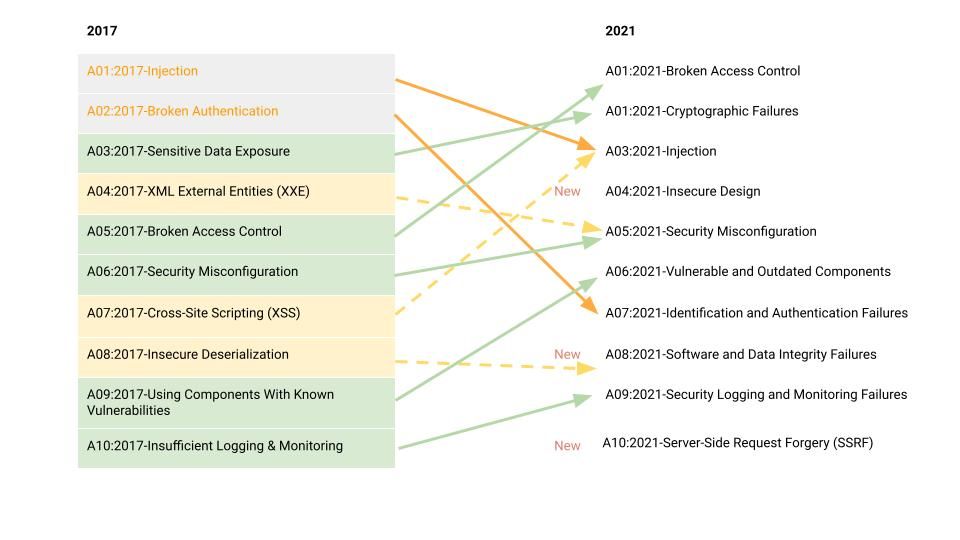
As mentioned above, OWASP and their Top 10 have evolved to focus more on helping developers build secure applications and work with security teams. After partnering with organizations and once again taking into consideration frequency, severity, and magnitude for risk that these vulnerabilities introduce, OWASP recently released their new OWASP Top 10 for 2021. Check out the changes below:

The 2021 OWASP Top 10 Have Evolved: Here's What You Should Know

Some of the notable changes include the introduction of new categories, consolidation, and scope changes to categories. Examples of these changes include:

  • The introduction of insecure design — We’ve seen this repeatedly highlighted as an area to watch, as the pressure mounts to continuously deliver new apps and features. An application’s architecture must take thoughtful security principles into account from the very beginning of the design process.
  • Broadened focus of injections — The new injection vulnerability category now includes 33 CWEs and many common injection types, such as SQL and NoSQL. The notable consolidation that took place this year was the inclusion of Cross-Site Scripting (XSS) into the injection category.
  • Vulnerable and outdated components replace “using components with known vulnerabilities” This is an example of an expanded scope of category to include using outdated open-source libraries and their associated vulnerabilities.

What do these changes mean?

The changes to the OWASP Top 10 reflect the shifts we’ve witnessed in application development and security. As the pressure mounts for teams to deliver high-quality products faster than ever, and we see the introduction of many cloud-native technologies to facilitate the acceleration of development cycles, developers must focus on scalable security from the start.

The 2021 OWASP Top 10 highlights a strategic approach to security that includes the architecture that supports the application, as well as the APIs, data, and so much more. The methodologies for testing and monitoring your applications through development to production are also critical in this framework. The 2021 OWASP Top 10 highlights many of these changes with the adoption of best-in-class tools and practices such as shifting left, DevSecOps, and a focus on preventing risk through a combination of both testing and monitoring.

Want to learn more? Stay tuned for our follow-up blogs, where we’ll take a deeper dive into some of the OWASP Top 10 to discuss what’s changed and why these updates are important.

NEVER MISS A BLOG

Get the latest stories, expertise, and news about security today.

SANS 2021 Threat Hunting Survey: How Organizations’ Security Postures Have Evolved in the New Normal

Post Syndicated from Margaret Wei original https://blog.rapid7.com/2021/09/17/sans-2021-threat-hunting-survey-how-organizations-security-postures-have-evolved-in-the-new-normal/

SANS 2021 Threat Hunting Survey: How Organizations' Security Postures Have Evolved in the New Normal

It’s that time of year once again: The SANS Institute — the most trusted resource for cybersecurity research — has conducted its sixth annual Threat Hunting Survey, sponsored by Rapid7. The goal of this survey is to better understand the current threat hunting landscape and the benefits provided to an organization’s security posture as a result of threat hunting.

This year’s survey, “A SANS 2021 Survey: Threat Hunting in Uncertain Times,” has a unique focus, one that’s taken into consideration the impact of COVID-19 and how it’s affected organizations’ threat hunting. The findings indicate that the global pandemic has had a relatively mixed impact on the organizations surveyed, with many respondents unsure of what type of impact it’s had — and will have — on their threat hunting efforts.

Here’s a preview of the survey’s findings and its takeaways for organizations navigating today’s cybersecurity landscape.

Fewer organizations are performing threat hunting in 2021

According to the survey results, 12.6% fewer organizations are performing threat hunting in 2021 when compared to those surveyed in 2020. This is concerning, as threat hunting is an ever-evolving field, and organizations that don’t dedicate resources to it won’t be able to keep pace with the changes in tactics and techniques needed to find threat actors.

But what caused this dip? It seems to be a combination of organizations reducing their external spend with third parties and their overall internal staff in response to COVID-19. That said, this reduction cannot be fully accounted for by the pandemic.

Despite this decrease, there is good news: 93.1% of respondents indicated they have dedicated threat hunting staff, and the majority of respondents plan to increase spending on staffing and tools for threat hunting in the near future. Over the year to come, we’ll likely see an extended detection and response (XDR) approach leveraging tools like InsightIDR playing a key role in these efforts.

The threat hunting toolbox is evolving

The tools organizations are using to conduct threat hunting are evolving — but have they advanced enough to keep up with the modern cybersecurity landscape?

The output of threat hunting depends on three factors: visibility, skills, and threat intelligence. To achieve this output, threat hunters need the right tools. After asking respondents about their organizations’ tool chests, SANS found that over 75% of respondents are using a tool set that includes EDRs, SIEMs, and IDS/IPS.

It should come as no surprise that these tools are at the top — these are essential to establishing visibility. What is interesting, however, is the second-place spot taken by customizable tools, followed by threat intelligence platforms. This indicates there’s room for improvement for solutions vendors regarding threat hunting — and users are looking for deep insights. Tools like Rapid7’s cloud SIEM solution that cut through the noise and surface the threats that really matter are key in today’s complex IT environments.

Overall security posture has improved — but there’s room to grow

The improvements seen in organizations’ overall security posture as a result of threat hunting continue to show steady numbers. According to the study, organizations have seen anywhere from a 10-25% improvement in their security posture from threat hunting over the last year. In addition, 72.3% of respondents claimed threat hunting had a positive improvement on their organization over time.

These are brilliant results to see, and they reinforce the positive impact threat hunting can have, even in the face of today’s extraordinary challenges.

That said, while there are clear benefits to threat hunting, there are some barriers to success for organizations, namely:

  • Over half (51.3%) of all respondents indicated the primary barrier for them as threat hunters is a lack of skilled staff and training.
  • This was closely followed (43%) by an even split of challenges between the limitations of tools or technologies and a lack of defined processes.

Organizations can start addressing these challenges in a variety of ways, including adopting best-in-class detection and response tooling and owning documentation, education, and maintenance at scale. These are manageable barriers that will come down with time, and despite a global pandemic, the overall outlook is good, as the general trend to more threat hunting appears to sustain with this year’s survey.

Hopefully, these numbers continue to increase next year, and more organizations will reap the benefits of threat hunting.

To take a deeper dive into the survey’s findings, download the full report: A SANS 2021 Survey: Threat Hunting in Uncertain Times.

Learn more about how Rapid7’s Incident Detection and Response solutions can help you protect your organization and boost your ability to swiftly thwart attackers.

Cloud Challenges in the Age of Remote Work: Rapid7’s 2021 Cloud Misconfigurations Report

Post Syndicated from Shelby Matthews original https://blog.rapid7.com/2021/09/09/cloud-challenges-in-the-age-of-remote-work-rapid7s-2021-cloud-misconfigurations-report/

Cloud Challenges in the Age of Remote Work: Rapid7’s 2021 Cloud Misconfigurations Report

A lot changed in 2020, and the way businesses use the cloud was no exception. According to one study, 90% of organizations plan to increase their use of cloud infrastructure following the COVID-19 pandemic, and 61% are planning to optimize the way they currently use the cloud. The move to the cloud has increased organizations’ ability to innovate, but it’s also significantly impacted security risks.

Cloud misconfigurations have been among the leading sources of attacks and data breaches in recent years. One report found the top causes of cloud misconfigurations were lack of awareness of cloud security and policies, lack of adequate controls and oversight, and the presence of too many APIs and interfaces. As employees started working from home, the problem only got worse. IBM’s 2021 Cost of a Data Breach report found the difference in cost of a data breach involving remote work was 24.2% higher than those involving non-remote work.

What’s causing misconfigurations?

Rapid7 researchers found and studied 121 publicly reported cases of data exposures in 2020 that were directly caused by a misconfiguration in the organization’s cloud environment. The good news is that 62% of these cases were discovered by independent researchers and not hackers. The bad news? There are likely many more data exposures that hackers have found but the impacted organizations still don’t know about.

Here are some of our key findings:

  • A lot of misconfigurations happen because an organization wants to make access to a resource easier
  • The top three industries impacted by data exposure incidents were information, entertainment, and healthcare.
  • AWS S3 and ElasticSearch databases accounted for 45% of the incidents.
  • On average, there were 10 reported incidents a month across 15 industries.
  • The median data exposure was 10 million records.

Traditionally, security has been at the end of the cycle, allowing for vulnerabilities to get missed — but we’re here to help. InsightCloudSec is a cloud-native security platform meant to help you shift your cloud security programs left to allow security to become an earlier part of the cycle along with increasing workflow automation and reducing noise in your cloud environment.

Check out our full report that goes deeper into how and why these data breaches are occurring.