Tag Archives: canada

Support Canada’s CCCS PBHVA overlay compliance with the Landing Zone Accelerator on AWS

Post Syndicated from Naranjan Goklani original https://aws.amazon.com/blogs/security/support-canadas-cccs-pbhva-overlay-compliance-with-the-landing-zone-accelerator-on-aws/

Organizations seeking to adhere to the Canadian Centre for Cyber Security (CCCS) Protected B High Value Assets (PBHVA) overlay requirements can use the Landing Zone Accelerator (LZA) on AWS solution with the CCCS Medium configuration to accelerate their compliance journey. To further support customers, AWS recently collaborated with Coalfire to assess and verify the LZA solution’s ability to support CCCS PBHVA overlay controls.

By implementing the PBHVA control overlay over a CCCS Medium baseline, you can better protect your organization’s most critical assets from potential threats and vulnerabilities, providing continuity of essential government operations and safeguarding sensitive information.

Understanding CCCS PBHVA overlay requirements

The CCCS PBHVA overlay consists of 137 controls designed to protect high-value assets, including 69 new controls and 68 controls from CCCS Medium. These controls provide enhanced data protection, particularly for integrity and availability, and are based on NIST SP 800-53 Revision 5.

Key findings from the Coalfire assessment

Coalfire’s assessment found that the LZA on AWS solution significantly supports CCCS PBHVA overlay compliance requirements:

  • 71 percent of in-scope controls (97 of 137) are supported by the AWS contribution to compliance in the shared responsibility model
  • The solution uses over 35 AWS services to provide comprehensive security capabilities
  • Strong network segmentation is achieved through network account and network-boundary VPC design
  • Infrastructure-as-code (IaC) enables reliable build and deployment results

The 29 percent of controls not addressed by the LZA are on the customer side of the shared responsibility model. They are addressed in the customer’s application stack or as non-technical controls such as policies and procedures.

Key security capabilities

The LZA solution implements several critical security features:

Implementation considerations

While the LZA solution provides significant compliance support, organizations should note:

  • The solution alone does not guarantee compliance
  • Organizations must implement their own policies, standards, and procedures
  • A thorough understanding of the shared responsibility model is essential

The AWS Landing Zone Accelerator Verified Reference Architecture documentation is available for customer download in AWS Artifact. This resource can help organizations reduce the time and effort required to deploy an environment that aligns with CCCS PBHVA overlay requirements.

Conclusion

The Coalfire assessment confirms that the LZA on AWS solution provides effective support for CCCS PBHVA overlay compliance objectives. However, organizations should remember that compliance is an ongoing process that requires active management and cannot be achieved through technology alone.

For more information about implementing the Landing Zone Accelerator for CCCS PBHVA overlay requirements, contact your AWS account team or the AWS Public Sector team directly.

 
If you have feedback about this post, submit comments in the Comments section below. If you have questions about this post, contact AWS Support.
 

Naranjan Goklani
Naranjan Goklani

Naranjan is an Audit Lead for Canada based in Toronto. He has experience leading audits, attestations, certifications, and assessments across North America and Europe. Naranjan has more than 15 years of experience in risk management, security assurance, and performing technology audits. Naranjan previously worked in one of the Big 4 accounting firms and supported clients from the financial services, technology, retail, e-commerce, and utilities industries as part of the first and third line of defense.
Michael Davie
Michael Davie

Michael is the Canada lead for Amazon Web Services (AWS) Compliance and Security Assurance. He works with customers, regulators, and AWS teams to help raise the bar on secure cloud adoption and usage. Michael has more than 20 years of experience working in the defence, intelligence, and technology sectors in Canada, and is a licensed professional engineer.
James Kierstead
James Kierstead

James is a senior solutions architect at Amazon Web Services (AWS) based in Ottawa, Canada. He is passionate about helping Canada’s federal government use AWS to deliver services to Canadians.

Using OSCAL to express Canadian cybersecurity requirements as compliance-as-code

Post Syndicated from Michael Davie original https://aws.amazon.com/blogs/security/using-oscal-to-express-canadian-cybersecurity-requirements-as-compliance-as-code/

The Open Security Controls Assessment Language (OSCAL) is a project led by the National Institute of Standards and Technology (NIST) that allows security professionals to express control-related information in machine-readable formats. Expressing compliance information in this way allows security practitioners to use automated tools to support data analysis, while making it easier to address downstream requirements such as translation and accessibility. In the United States, Amazon Web Services (AWS) has collaborated closely with NIST and the FedRAMP program to advance the adoption of OSCAL, and was the first cloud service provider to submit a FedRAMP system security plan (SSP) in OSCAL format in 2022.

In Canada, the Canadian Centre for Cyber Security (CCCS) is the national technical authority for cybersecurity. CCCS publishes cybersecurity advice and guidance, including ITSG-33 Annex 3A, a catalog of security controls based on NIST Special Publication 800-53. When CCCS recently published new cloud security profiles based on NIST 800-53 Revision 5, we undertook a project to encode the relevant information in OSCAL. Expressing CCCS’s catalog and profile information in OSCAL facilitates automated analysis, including comparisons with OSCAL catalogs and profiles published by NIST and FedRAMP. This post explores the approach we took to express CCCS’s profiles in OSCAL, in addition to opportunities for future work.

OSCAL fundamentals

For the purposes of this discussion, there are two important OSCAL concepts to understand: catalogs and profiles. A catalog is a collection of security controls, such as NIST 800-53 or ITSG-33. An OSCAL catalog expresses control-specific information, including statements, parameters, and implementation guidance, in a structured and machine-readable format using either JSON, XML, or YAML.

OSCAL profiles import controls from catalogs (and other profiles) and express more specific implementation guidance. For example, the FedRAMP Moderate profile selects a subset of controls from NIST 800-53, specifies constraints for certain parameters, and provides assessment guidance. Profiles can also modify controls as they’re imported, which proved very useful for our purposes.

Expressing CCCS controls in OSCAL

Because CCCS’s ITSG-33 is based on NIST 800-53, most NIST controls can be used in CCCS profiles without modification. However, in some cases CCCS has modified the language of NIST 800-53 controls; for example, to replace mentions of a US agency or standard with a Canadian equivalent, or to add additional content specific to CCCS. Therefore, the first step in expressing CCCS requirements in OSCAL was to create a profile that makes the necessary control-level modifications. In some cases, CCCS has also created controls that are not part of NIST 800-53; these are specified in a separate catalog.

When an OSCAL profile is resolved, the information from the upstream catalogs and profiles that it’s importing controls from is assembled—along with modifications—and expressed as a catalog. By resolving the ITSG-33 modifications profile, we can programmatically generate the complete ITSG-33 catalog, incorporating NIST 800-53 controls, CCCS controls, and required modifications.

CCCS cloud security profiles

CCCS has created two profiles that are used to assess the security of cloud services: CCCS Medium and Protected B High Value Assets (PBHVA). Each of these profiles specifies a selection of controls from ITSG-33, in addition to the values for a number of parameters. Working backwards from the profiles published by CCCS as spreadsheets, we extracted the control and parameter information from each profile and expressed them in OSCAL. This exercise also informed the creation of the ITSG-33 modifications profile discussed previously, which captured control-level changes made by CCCS to NIST 800-53 controls, as well as the separate catalog of CCCS-specific controls.

Resources

In support of furthering this work within the Canadian security community, we’ve published the OSCAL files that we created as part of this project on GitHub, including:

  • CCCS-specific control catalog
  • ITSG-33 modifications profile and resolved catalog
  • CCCS Medium profile, resolved catalog, and CSV
  • PBVHA profile, resolved catalog, and CSV

We used an open-source tool, oscal-cli, to validate the structure of the OSCAL files that we created and to resolve the profiles into catalogs.

Future work

AWS is interested in further exploring the use of OSCAL to help us and our customers adhere to CCCS requirements as efficiently as possible. In the future, we want to explore how OSCAL data and tools can be used to support the efficient translation of the ITSG-33 catalog and CCCS profiles into French and the presentation of compliance information in accessible formats.

If you have feedback about this post, submit comments in the Comments section below.

Michael Davie

Michael Davie

Michael is the Canada lead for Amazon Web Services (AWS) Security Assurance. He works with customers, regulators, and AWS teams to help raise the bar on secure cloud adoption and usage. Michael has more than 20 years of experience working in the defence, intelligence, and technology sectors in Canada, and is a licensed professional engineer.

AWS completes the CCCS PBHVA assessment with 149 services and features in scope

Post Syndicated from Naranjan Goklani original https://aws.amazon.com/blogs/security/aws-completes-the-cccs-pbhva-assessment-with-149-services-and-features-in-scope/

We continue to expand the scope of our assurance programs at Amazon Web Services (AWS) and are pleased to announce the successful completion of our first ever Protected B High Value Assets (PBHVA) assessment with 149 assessed services and features. Completion of this assessment effective October 4, 2024, makes AWS the first cloud service provider (CSP) in Canada to meet this high security bar and provide assurance to our valued customers. This assessment also re-affirms our commitment to helping public and commercial customers achieve and maintain the highest-grade security standard for workloads with increased sensitivity.

What is the PBHVA assessment and why is it important?

The Protected B High Value Asset (PBHVA) overlay seeks to enhance the integrity and availability of customer organizational workloads that are considered to have an increased level of sensitivity. These are systems that the Government of Canada (GC) and its service providers use to support delivery of services at a national scale or that are determined to be significant for handling sensitive information. The overlay is a set of 117 controls from the ITSG-33 security control catalogue (baselined against NIST 800-53), which augments the security safeguards to enhance integrity and availability.

As of October 4, 2024, there are a total of 149 AWS services and features that were assessed by the Canadian Centre for Cyber Security (CCCS) under PBHVA assessment criteria. The assessment covers services and features that are available in both the Canada (Central) and Canada West (Calgary) AWS Regions.

How can you access the assessment?

The summary assessment is available through AWS Artifact. You can also learn more about the PBHVA assessment on our AWS PBHVA webpage.

AWS strives to continuously bring services into scope of its compliance programs to help you meet your architectural and regulatory needs. Please reach out to your AWS account team if you have questions or feedback about the PBHVA assessment.

To learn more about our compliance and security programs, see AWS Compliance Programs. As always, we value your feedback and questions; reach out to the AWS Compliance team through the Contact Us page.

If you have feedback about this post, submit comments in the Comments section below.

Naranjan Goklani

Naranjan is an Audit Lead for Canada. He has experience leading audits, attestations, certifications, and assessments across the Americas. Naranjan has more than 15 years of experience in risk management, security assurance, and performing technology audits. He previously worked in one of the Big 4 accounting firms and supported clients from the financial services, technology, retail, and utilities industries.

Patrick Finn: why I joined Cloudflare as VP Sales for the Americas

Post Syndicated from Patrick S. Finn original https://blog.cloudflare.com/patrick-finn


I’m delighted to be joining Cloudflare as Vice President of Sales in the US, Canada, and Latin America.

I’ve had the privilege of leading sales for some of the world’s most iconic tech companies, including IBM and Cisco. During my career I’ve led international teams numbering in the thousands and driving revenue in the billions of dollars while serving some of the world’s largest enterprise customers. I’ve seen first-hand the evolution of technology and what it can achieve for businesses, from robotics, automation, and data analytics, to cloud computing, cybersecurity, and AI.

I firmly believe Cloudflare is well on its way to being one of the next iconic tech companies.

Why Cloudflare

Cloudflare has a unique opportunity to help businesses navigate an enduring wave of technological change. There are few companies in the world that operate in the three most exciting fields of innovation that will continue to shape our world in the coming years: cloud computing, AI, and cybersecurity. Cloudflare is one of those companies. When I was approached for this role, I spoke to a wide range of connections across the financial sector, private companies, and government. The feedback was unanimous that Cloudflare is poised on the edge of exhilarating growth.

Driving predictable, profitable revenue

I was fortunate to join Cisco two years after its annual revenue passed the $1 billion mark and had the privilege of helping scale the business to more than $49 billion in revenue the year I left. Cloudflare passed the $1 billion milestone just last year, and I see the same potential for growth here as I saw at Cisco.

Cloudflare’s global sales organization is growing. I’m excited to help accelerate that process in a way that delivers recurring revenue for the business while ensuring we retain a very high bar in terms of the talent we bring onto the team. My experience leading complex, cross-functional sales organizations within large global companies has taught me a great deal about the common traits among highly effective sales functions.

The groups of individuals that come together to make true teams are the ones that successfully focus on a unifying goal and develop skills like communication, attitude, process, organization, consistency, collaboration, partnership, and accountability.  These teams embrace diversity and bring out of each other the best expertise, creativity, and skills, making the team stronger and keeping the goal in focus.

Making our customers our north star

We will achieve the opportunity ahead of us only as long as we have our customers as our north star. Today, the Americas represent more than half of Cloudflare’s revenue worldwide and are home to some of our largest and most strategic customers – both in the private and public sectors – including 30% of the Fortune 1000. Brands from Zendesk to Shopify and from Colgate-Palmolive to Mars rely on Cloudflare to operate their businesses in a fast, secure, and reliable way.

Whatever the technology, there are three common fundamentals I’ve found essential to creating value for customers: being the expert on their challenges, understanding how to pick the right combination of products, services, and solutions from those available, and knowing your competition.

Cloudflare already has an incredible and growing range of products and services that are helping millions of individuals and organizations maximize the opportunities presented by cloud computing and generative AI, all while staying safe from the threat of cyberattacks.

What helping to build a better Internet means to me

If it were needed, one additional deciding factor behind my excitement in joining Cloudflare is its ambitious mission to help build a better Internet. As a father, I want the Internet to be a safe and valuable resource for my family and friends and for generations to come. I don’t want my daughter to have to worry about her personal data and privacy as she’s buying Billie Eilish concert tickets online (and, yes, I’m going too).

Today Cloudflare’s connectivity cloud protects nearly 20% of all websites online and stops 209 billion cyber attacks daily. In addition to its growing customer base, Cloudflare is living up to its mission by offering its services for free to millions more individuals and small businesses, including the most vulnerable voices online through its Project Galileo initiative.

The combination of a strong mission, genuine values, a great team, and incredible technology isn’t a given in every company, but is evident at Cloudflare. I’m excited to play a part as Cloudflare continues to scale its business and help build a better Internet for everyone.

If you’re interested in learning more about what Cloudflare can do for your organization, please get in touch here. If you’re an ambitious, talented sales professional looking for your next challenging and rewarding career move, check out our open positions here.

New AWS whitepaper: AWS User Guide for Federally Regulated Financial Institutions in Canada

Post Syndicated from Dan MacKay original https://aws.amazon.com/blogs/security/new-aws-whitepaper-aws-user-guide-for-federally-regulated-financial-institutions-in-canada/

Amazon Web Services (AWS) has released a new whitepaper to help financial services customers in Canada accelerate their use of the AWS Cloud.

The new AWS User Guide for Federally Regulated Financial Institutions in Canada helps AWS customers navigate the regulatory expectations of the Office of the Superintendent of Financial Institutions (OSFI) in a shared responsibility environment. It is intended for OSFI-regulated institutions that are looking to run material workloads in the AWS Cloud, and is particularly useful for leadership, security, risk, and compliance teams that need to understand OSFI requirements and guidance applicable to the use of AWS services.

This whitepaper summarizes OSFI’s expectations with respect to Technology and Cyber Risk Management (OSFI Guideline B-13). It also gives OSFI-regulated institutions information that they can use to commence their due diligence and assess how to implement the appropriate programs for their use of AWS Cloud services. In subsequent versions of the whitepaper, we will provide considerations for other OSFI guidelines as applicable.

In addition to this whitepaper, AWS provides updates on the evolving Canadian regulatory landscape on the AWS Security Blog and the AWS Compliance page. Customers looking for more information on cloud-related regulatory compliance in different countries around the world can refer to the AWS Compliance Center. For additional resources or support, reach out to your AWS account manager or contact us here.

If you have feedback about this post, submit comments in the Comments section below. If you have questions about this post, contact AWS Support.

Dan MacKay

Dan MacKay

Dan is the Financial Services Compliance Specialist for AWS Canada. He advises financial services customers on best practices and practical solutions for cloud-related governance, risk, and compliance. Dan specializes in helping AWS customers navigate financial services and privacy regulations applicable to the use of cloud technology in Canada with a focus on third-party risk management and operational resilience.

Dave Trieu

Dave Trieu

Dave is an AWS Solutions Architect Manager with over two decades in the tech industry. He excels in guiding organizations through modernization and using cloud technologies for transformation. Dave helps businesses navigate the digital landscape and maintain a competitive edge by crafting and implementing cutting-edge solutions that address immediate business needs while anticipating future trends.

2023 Canadian Centre for Cyber Security Assessment Summary report available with 20 additional services

Post Syndicated from Naranjan Goklani original https://aws.amazon.com/blogs/security/2023-canadian-centre-for-cyber-security-assessment-summary-report-available-with-20-additional-services/

At Amazon Web Services (AWS), we are committed to providing continued assurance to our customers through assessments, certifications, and attestations that support the adoption of current and new AWS services and features. We are pleased to announce the availability of the 2023 Canadian Centre for Cyber Security (CCCS) assessment summary report for AWS. With this assessment, a total of 150 AWS services and features are assessed in the Canada (Central) Region, including 20 additional AWS services and features. The assessment report is available for review and download on demand through AWS Artifact.

The full list of services in scope for the CCCS assessment is available on the Services in Scope page. The 20 new services and features are the following:

The CCCS is Canada’s authoritative source of cyber security expert guidance for the Canadian government, industry, and the general public. Public and commercial sector organizations across Canada rely on CCCS’s rigorous Cloud Service Provider (CSP) IT Security (ITS) assessment in their decision to use CSP services. In addition, CCCS’s ITS assessment process is a mandatory requirement for AWS to provide cloud services to Canadian federal government departments and agencies.  

The CCCS cloud service provider information technology security assessment process determines if the Government of Canada (GC) ITS requirements for the CCCS Medium cloud security profile (previously referred to as GC’s PROTECTED B/Medium Integrity/Medium Availability [PBMM] profile) are met as described in ITSG-33 (IT security risk management: A lifecycle approach, Annex 3 – Security control catalogue). As of November 2023, 150 AWS services in the Canada (Central) Region have been assessed by CCCS and meet the requirements for the Medium cloud security profile. Meeting the Medium cloud security profile is required to host workloads that are classified up to and including Medium categorization. On a periodic basis, CCCS assesses new or previously unassessed services and re-assesses the AWS services that were previously assessed to verify that they continue to meet the GC’s requirements. CCCS prioritizes the assessment of new AWS services based on their availability in Canada, and customer demand for the AWS services. The full list of AWS services that have been assessed by CCCS is available on our Services in Scope for CCCS Assessment page.

To learn more about the CCCS assessment or our other compliance and security programs, visit AWS Compliance Programs. As always, we value your feedback and questions; reach out to the AWS Compliance team through the Contact Us page.

 
If you have feedback about this post, submit comments in the Comments section below. If you have questions about this post, contact AWS Support.

Want more AWS Security news? Follow us on Twitter.

Naranjan Goklani

Naranjan Goklani

Naranjan is an Audit Lead for Canada. He has experience leading audits, attestations, certifications, and assessments across the Americas. Naranjan has more than 13 years of experience in risk management, security assurance, and performing technology audits. He previously worked in one of the Big 4 accounting firms and supported clients from the financial services, technology, retail, and utilities industries.

AI literacy for teachers and students all over the world

Post Syndicated from Philip Colligan original https://www.raspberrypi.org/blog/experience-ai-canada-kenya-romania/

I am delighted to announce that the Raspberry Pi Foundation and Google DeepMind are building a global network of educational organisations to bring AI literacy to teachers and students all over the world, starting with Canada, Kenya, and Romania.

Learners in a classroom in Kenya.
Learners around the world will gain AI literacy skills through Experience AI.

Experience AI 

We launched Experience AI in September 2022 to help teachers and students learn about AI technologies and how they are changing the world. 

Developed by the Raspberry Pi Foundation and Google DeepMind, Experience AI provides everything that teachers need to confidently deliver engaging lessons that will inspire and educate young people about AI and the role that it could play in their lives.

A group of young people investigate computer hardware together.
Experience AI is designed to inspire learners about AI through real-world contexts.

We provide lesson plans, classroom resources, worksheets, hands-on activities, and videos that introduce a wide range of AI applications and the underlying technologies that make them work. The materials are designed to be relatable to young people and can be taught by any teacher, whether or not they have a technical background. Alongside the classroom resources, we provide teacher professional development, including an online course that provides an introduction to machine learning and AI. 

Part of Experience AI are video interviews with AI developers at Google DeepMind.

The materials are grounded in real-world contexts and emphasise the potential for young people to positively change the world through a mastery of AI technologies. 

Since launching the first resources, we have seen significant demand from teachers and students all over the world, with over 200,000 students already learning with Experience AI. 

Experience AI network

Building on that initial success and in response to huge demand, we are now building a global network of educational organisations to expand the reach and impact of Experience AI by translating and localising the materials, promoting them to schools, and supporting teacher professional development.

Obum Ekeke OBE, Head of Education Partnerships at Google DeepMind, says:

“We have been blown away by the interest we have seen in Experience AI since its launch and are thrilled to be working with the Raspberry Pi Foundation and local partners to expand the reach of the programme. AI literacy is a critical skill in today’s world, but not every young person currently has access to relevant education and resources. By making AI education more inclusive, we can help young people make more informed decisions about using AI applications in their daily lives, and encourage safe and responsible use of the technology.”

Learner in a computing classroom.
Experience AI helps learners understand how they might use AI to positively change the world.

Today we are announcing the first three organisations that we are working with, each of which is already doing fantastic work to democratise digital skills in their part of the world. All three are already working in partnership with the Raspberry Pi Foundation and we are excited to be deepening and expanding our collaboration to include AI literacy.

Digital Moment, Canada

Digital Moment is a Montreal-based nonprofit focused on empowering young changemakers through digital skills. Founded in 2013, Digital Moment has a track record of supporting teachers and students across Canada to learn about computing, coding, and AI literacy, including through supporting one of the world’s largest networks of Code Clubs

Digital Moment logo.

“We’re excited to be working with the Raspberry Pi Foundation and Google DeepMind to bring Experience AI to teachers across Canada. Since 2018, Digital Moment has been introducing rich training experiences and educational resources to make sure that Canadian teachers have the support to navigate the impacts of AI in education for their students. Through this partnership, we will be able to reach more teachers and with more resources, to keep up with the incredible pace and disruption of AI.”

Indra Kubicek, President, Digital Moment

Tech Kidz Africa, Kenya

Tech Kidz Africa is a Mobasa-based social enterprise that nurtures creativity in young people across Kenya through digital skills including coding, robotics, app and web development, and creative design thinking.

Tech Kidz Africa logo.

“With the retooling of teachers as a key objective of Tech Kidz Africa, working with Google DeepMind and the Raspberry Pi Foundation will enable us to build the capacity of educators to empower the 21st century learner, enhancing the teaching and learning experience to encourage innovation and  prepare the next generation for the future of work.”

Grace Irungu, CEO, Tech Kidz Africa

Asociația Techsoup, Romania

Asociația Techsoup works with teachers and students across Romania and Moldova, training Computer Science, ICT, and primary school teachers to build their competencies around coding and technology. A longstanding partner of the Raspberry Pi Foundation, they foster a vibrant community of CoderDojos and support young people to participate in Coolest Projects and the European Astro Pi Challenge

Asociata Techsoup logo.

“We are enthusiastic about participating in this global partnership to bring high-quality AI education to all students, regardless of their background. Given the current exponential growth of AI tools and instruments in our daily lives, it is crucial to ensure that students and teachers everywhere comprehend and effectively utilise these tools to enhance their human, civic, and professional potential. Experience AI is the best available method for AI education for middle school students. We couldn’t be more thrilled to work with the Raspberry Pi Foundation and Google DeepMind to make it accessible in Romanian for teachers in Romania and the Republic of Moldova, and to assist teachers in fully integrating it into their classes.”

Elena Coman, Director of Development, Asociația Techsoup

Get involved

These are the first of what will become a global network of organisations supporting tens of thousands of teachers to equip millions of students with a foundational understanding of AI technologies through Experience AI. If you want to get involved in inspiring the next generation of AI leaders, we would love to hear from you.

The post AI literacy for teachers and students all over the world appeared first on Raspberry Pi Foundation.

2022 Canadian Centre for Cyber Security Assessment Summary report available with 12 additional services

Post Syndicated from Naranjan Goklani original https://aws.amazon.com/blogs/security/2022-canadian-centre-for-cyber-security-assessment-summary-report-available-with-12-additional-services/

We are pleased to announce the availability of the 2022 Canadian Centre for Cyber Security (CCCS) assessment summary report for Amazon Web Services (AWS). This assessment will bring the total to 132 AWS services and features assessed in the Canada (Central) AWS Region, including 12 additional AWS services. A copy of the summary assessment report is available for review and download on demand through AWS Artifact.

The full list of services in scope for the CCCS assessment is available on the AWS Services in Scope page. The 12 new services are:

The CCCS is Canada’s authoritative source of cyber security expert guidance for the Canadian government, industry, and the general public. Public and commercial sector organizations across Canada rely on CCCS’s rigorous Cloud Service Provider (CSP) IT Security (ITS) assessment in their decisions to use cloud services. In addition, CCCS’s ITS assessment process is a mandatory requirement for AWS to provide cloud services to Canadian federal government departments and agencies.

The CCCS Cloud Service Provider Information Technology Security Assessment Process determines if the Government of Canada (GC) ITS requirements for the CCCS Medium cloud security profile (previously referred to as GC’s Protected B/Medium Integrity/Medium Availability [PBMM] profile) are met as described in ITSG-33 (IT security risk management: A lifecycle approach). As of November 2022, 132 AWS services in the Canada (Central) Region have been assessed by the CCCS and meet the requirements for the CCCS Medium cloud security profile. Meeting the CCCS Medium cloud security profile is required to host workloads that are classified up to and including the medium categorization. On a periodic basis, CCCS assesses new or previously unassessed services and reassesses the AWS services that were previously assessed to verify that they continue to meet the GC’s requirements. CCCS prioritizes the assessment of new AWS services based on their availability in Canada, and on customer demand for the AWS services. The full list of AWS services that have been assessed by CCCS is available on our Services in Scope for CCCS Assessment page.

To learn more about the CCCS assessment or our other compliance and security programs, visit AWS Compliance Programs. As always, we value your feedback and questions; you can reach out to the AWS Compliance team through the Contact Us page.

If you have feedback about this post, submit comments in the Comments section below. Want more AWS Security news? Follow us on Twitter.

Naranjan Goklani

Naranjan Goklani

Naranjan is a Security Audit Manager at AWS, based in Toronto (Canada). He leads audits, attestations, certifications, and assessments across North America and Europe. Naranjan has more than 13 years of experience in risk management, security assurance, and performing technology audits. Naranjan previously worked in one of the Big 4 accounting firms and supported clients from the financial services, technology, retail, ecommerce, and utilities industries.

New AWS whitepaper: Using AWS in the Context of Canada’s Controlled Goods Program (CGP)

Post Syndicated from Michael Davie original https://aws.amazon.com/blogs/security/new-aws-whitepaper-using-aws-in-the-context-of-canadas-controlled-goods-program-cgp/

Amazon Web Services (AWS) has released a new whitepaper to help Canadian defense and security customers accelerate their use of the AWS Cloud.

The new guide, Using AWS in the Context of Canada’s Controlled Goods Program (CGP), continues our efforts to help AWS customers navigate the regulatory expectations of the Government of Canada’s Controlled Goods Program in a shared responsibility environment.

This whitepaper is intended for customers that are looking to store and process controlled goods information in the AWS Cloud, and is particularly useful for leadership, security, risk, and compliance teams that need to understand CGP requirements and guidance.

The whitepaper summarizes CGP requirements and guidance related to the protection of controlled goods information, and gives CGP-regulated customers information they can use to commence their due diligence and assess how to implement the appropriate programs for their use of AWS Cloud services.

This document is our first that is specific to Canadian regulatory requirements and joins other guides related to specific regulatory regimes around the world. As the regulatory environment continues to evolve, we’ll provide further updates on the AWS Security Blog and the AWS Compliance page. You can find more information on cloud-related regulatory compliance at the AWS Compliance Center. You can also reach out to your AWS account manager for help finding the resources you need.

 
If you have feedback about this blog post, submit comments in the Comments section below. You can also start a new thread on re:Post to get answers from the community.

Want more AWS Security news? Follow us on Twitter.

Michael Davie

Michael Davie

Michael is a Senior Industry Specialist with AWS Security Assurance. He works with our customers, their regulators, and AWS teams to help raise the bar on secure cloud adoption and usage. Michael has over 20 years of experience working in the defence, intelligence, and technology sectors in Canada and is a licensed professional engineer.

Cloudflare’s view of the Rogers Communications outage in Canada

Post Syndicated from João Tomé original https://blog.cloudflare.com/cloudflares-view-of-the-rogers-communications-outage-in-canada/

Cloudflare’s view of the Rogers Communications outage in Canada

Cloudflare’s view of the Rogers Communications outage in Canada

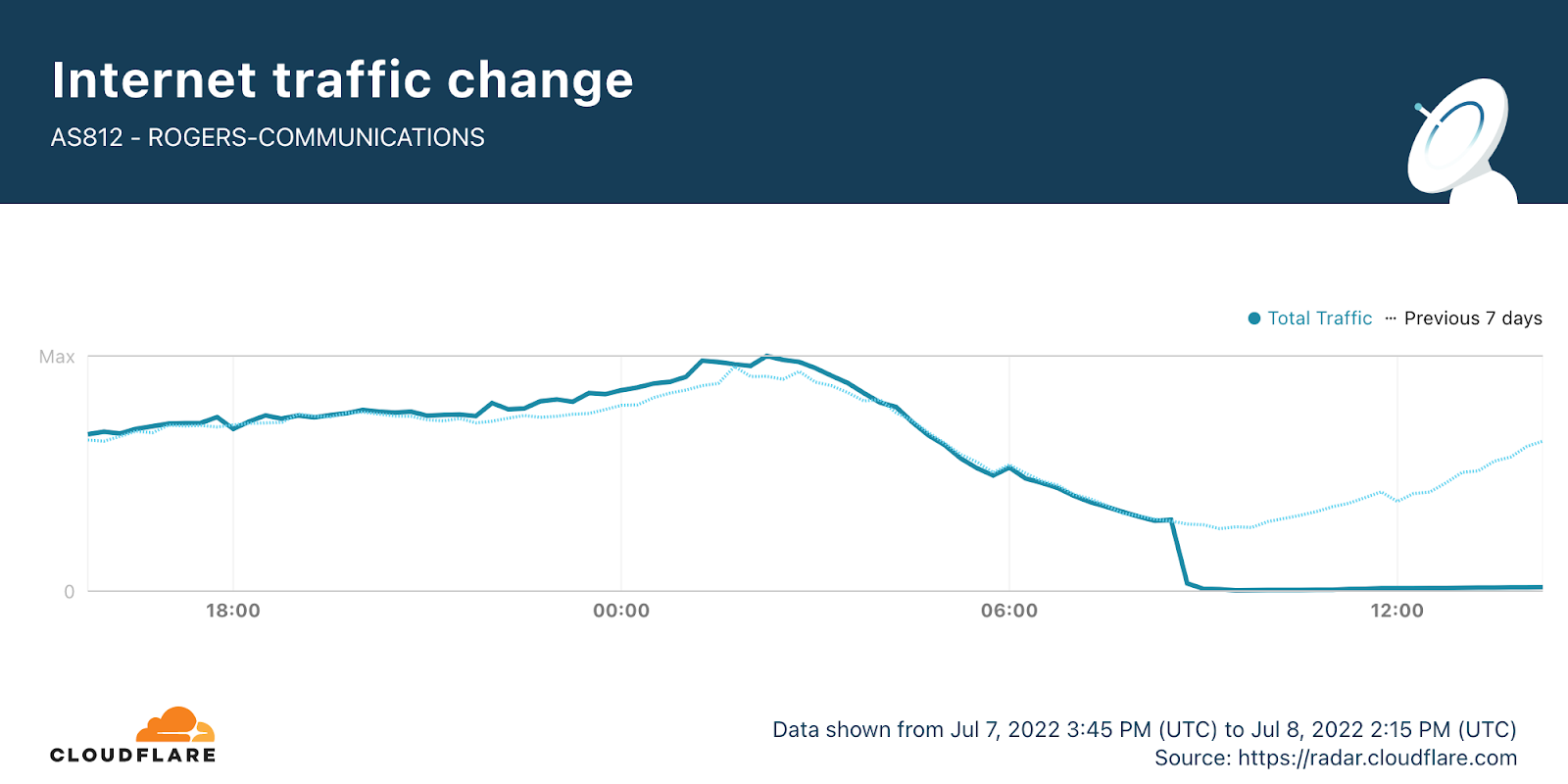
An outage at one of the largest ISPs in Canada, Rogers Communications, started earlier today, July 8, 2022, and is ongoing (eight hours and counting), and is impacting businesses and consumers. At the time of writing, we are seeing a very small amount of traffic from Rogers, but we are only seeing residual traffic, and nothing close to a full recovery to normal traffic levels.

Based on what we’re seeing and similar incidents in the past, we believe this is likely to be an internal error, not a cyber attack.

Cloudflare Radar shows a near complete loss of traffic from Roger’s ASN, AS812, that started around 08:45 UTC (all times in this blog are UTC).

Cloudflare’s view of the Rogers Communications outage in Canada

What happened?

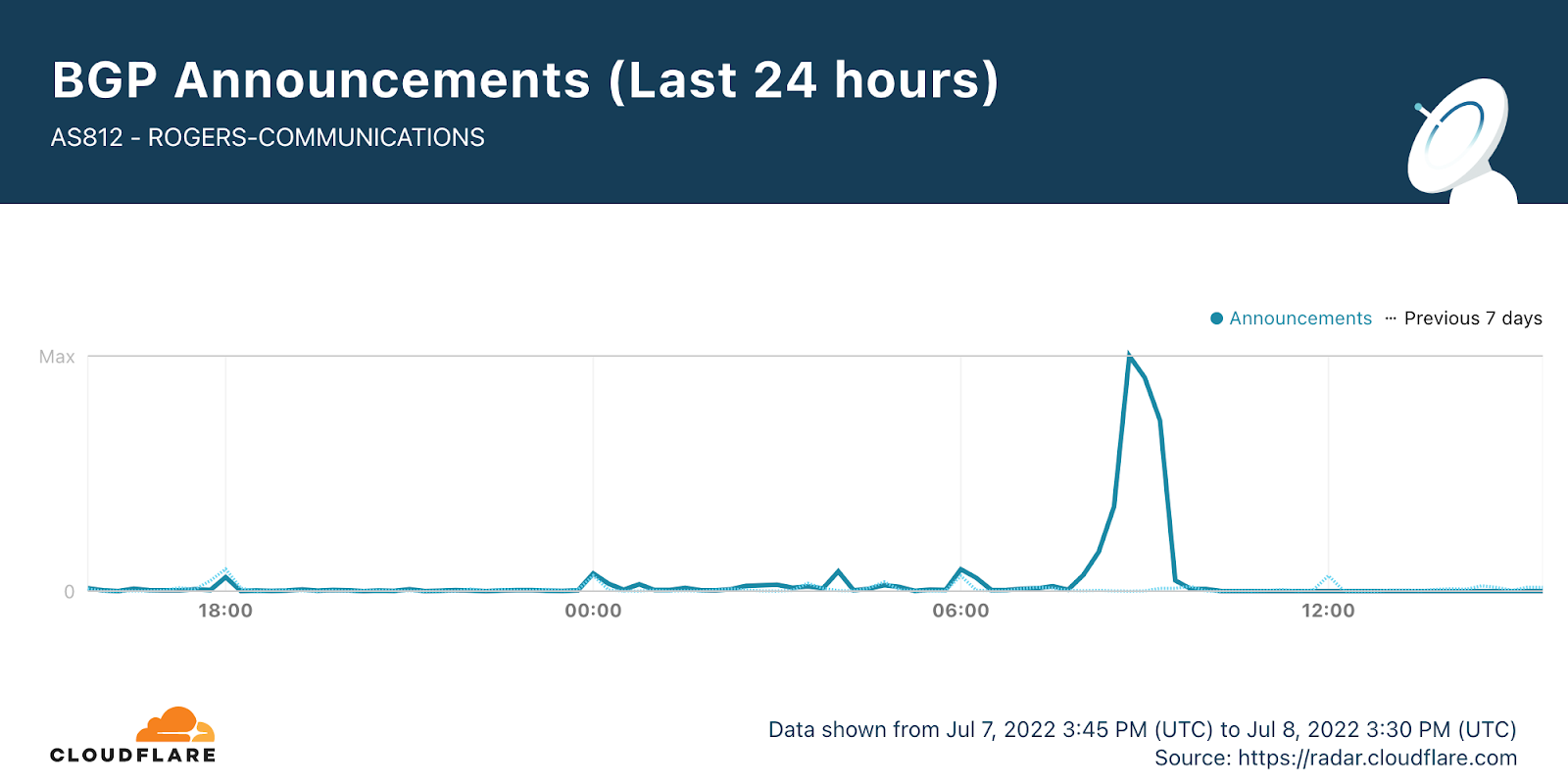
Cloudflare data shows that there was a clear spike in BGP (Border Gateway Protocol) updates after 08:15, reaching its peak at 08:45.

Cloudflare’s view of the Rogers Communications outage in Canada

BGP is a mechanism to exchange routing information between networks on the Internet. The big routers that make the Internet work have huge, constantly updated lists of the possible routes that can be used to deliver each network packet to its final destination. Without BGP, the Internet routers wouldn’t know what to do, and the Internet wouldn’t exist.

The Internet is literally a network of networks, or for the maths fans, a graph, with each individual network a node in it, and the edges representing the interconnections. All of this is bound together by BGP. BGP allows one network (say Rogers) to advertise its presence to other networks that form the Internet. Rogers is not advertising its presence, so other networks can’t find Roger’s network and so it is unavailable.

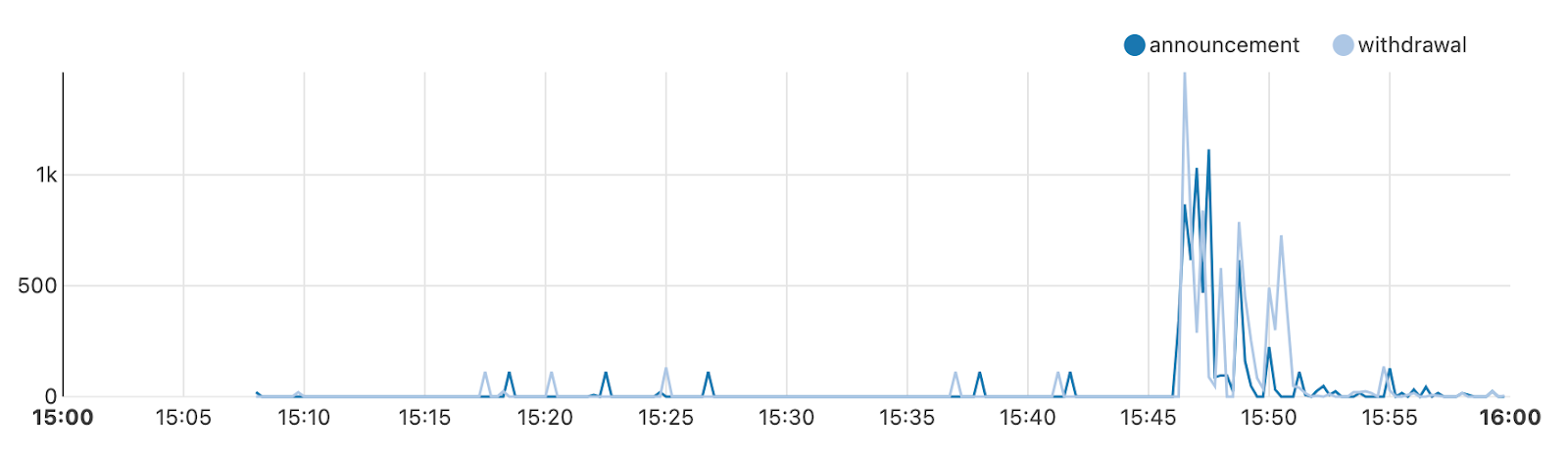
A BGP update message informs a router of changes made to a prefix (a group of IP addresses) advertisement or entirely withdraws the prefix. In this next chart, we can see that at 08:45 there was a withdrawal of prefixes from Roger’s ASN.

Cloudflare’s view of the Rogers Communications outage in Canada

Since then, at 14:30, attempts seem to be made to advertise their prefixes again. This maps to us seeing a slow increase in traffic again from Rogers’ end users.

Cloudflare’s view of the Rogers Communications outage in Canada

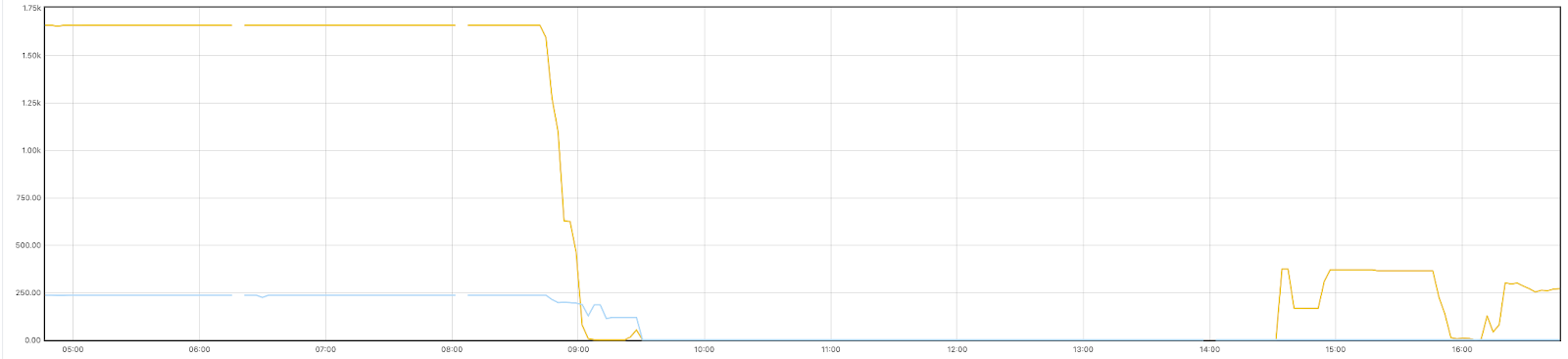
The graph below, which shows the prefixes we were receiving from Rogers in Toronto, clearly shows the withdrawal of prefixes around 08:45, and the slow start in recovery at 14:30, with another round of withdraws at around 15:45.

Cloudflare’s view of the Rogers Communications outage in Canada

Outages happen more regularly than people think. This week we did an Internet disruptions overview for Q2 2022 where you can get a better sense of that, and on how collaborative and interconnected the Internet (the network of networks) is. And not so long ago Facebook had an hours long outage where BGP updates showed Facebook itself disappearing from the Internet.

Follow @CloudflareRadar on Twitter for updates on Internet disruptions as they occur, and find up-to-date information on Internet trends using Cloudflare Radar.

Canadian Centre for Cyber Security Assessment Summary report now available in AWS Artifact

Post Syndicated from Rob Samuel original https://aws.amazon.com/blogs/security/canadian-centre-for-cyber-security-assessment-summary-report-now-available-in-aws-artifact/

French version

At Amazon Web Services (AWS), we are committed to providing continued assurance to our customers through assessments, certifications, and attestations that support the adoption of AWS services. We are pleased to announce the availability of the Canadian Centre for Cyber Security (CCCS) assessment summary report for AWS, which you can view and download on demand through AWS Artifact.

The CCCS is Canada’s authoritative source of cyber security expert guidance for the Canadian government, industry, and the general public. Public and commercial sector organizations across Canada rely on CCCS’s rigorous Cloud Service Provider (CSP) IT Security (ITS) assessment in their decision to use CSP services. In addition, CCCS’s ITS assessment process is a mandatory requirement for AWS to provide cloud services to Canadian federal government departments and agencies.

The CCCS Cloud Service Provider Information Technology Security Assessment Process determines if the Government of Canada (GC) ITS requirements for the CCCS Medium Cloud Security Profile (previously referred to as GC’s PROTECTED B/Medium Integrity/Medium Availability [PBMM] profile) are met as described in ITSG-33 (IT Security Risk Management: A Lifecycle Approach, Annex 3 – Security Control Catalogue). As of September, 2021, 120 AWS services in the Canada (Central) Region have been assessed by the CCCS, and meet the requirements for medium cloud security profile. Meeting the medium cloud security profile is required to host workloads that are classified up to and including medium categorization. On a periodic basis, CCCS assesses new or previously unassessed services and re-assesses the AWS services that were previously assessed to verify that they continue to meet the GC’s requirements. CCCS prioritizes the assessment of new AWS services based on their availability in Canada, and customer demand for the AWS services. The full list of AWS services that have been assessed by CCCS is available on our Services in Scope by Compliance Program page.

To learn more about the CCCS assessment or our other compliance and security programs, visit AWS Compliance Programs. If you have questions about this blog post, please start a new thread on the AWS Artifact forum or contact AWS Support.

If you have feedback about this post, submit comments in the Comments section below. Want more AWS Security news? Follow us on Twitter.

Rob Samuel

Rob Samuel

Rob Samuel is a Principal technical leader for AWS Security Assurance. He partners with teams across AWS to translate data protection principles into technical requirements, aligns technical direction and priorities, orchestrates new technical solutions, helps integrate security and privacy solutions into AWS services and features, and addresses cross-cutting security and privacy requirements and expectations. Rob has more than 20 years of experience in the technology industry, and has previously held leadership roles, including Head of Security Assurance for AWS Canada, Chief Information Security Officer (CISO) for the Province of Nova Scotia, various security leadership roles as a public servant, and served as a Communications and Electronics Engineering Officer in the Canadian Armed Forces.

Naranjan Goklani

Naranjan Goklani

Naranjan Goklani is a Security Audit Manager at AWS, based in Toronto (Canada). He leads audits, attestations, certifications, and assessments across North America and Europe. Naranjan has more than 12 years of experience in risk management, security assurance, and performing technology audits. Naranjan previously worked in one of the Big 4 accounting firms and supported clients from the retail, ecommerce, and utilities industries.

Brian Mycroft

Brian Mycroft

Brian Mycroft is a Chief Technologist at AWS, based in Ottawa (Canada), specializing in national security, intelligence, and the Canadian federal government. Brian is the lead architect of the AWS Secure Environment Accelerator (ASEA) and focuses on removing public sector barriers to cloud adoption.

.


Rapport sommaire de l’évaluation du Centre canadien pour la cybersécurité disponible sur AWS Artifact

Par Robert Samuel, Naranjan Goklani et Brian Mycroft
Amazon Web Services (AWS) s’engage à fournir à ses clients une assurance continue à travers des évaluations, des certifications et des attestations qui appuient l’adoption des services proposés par AWS. Nous avons le plaisir d’annoncer la mise à disposition du rapport sommaire de l’évaluation du Centre canadien pour la cybersécurité (CCCS) pour AWS, que vous pouvez dès à présent consulter et télécharger à la demande sur AWS Artifact.

Le CCC est l’autorité canadienne qui met son expertise en matière de cybersécurité au service du gouvernement canadien, du secteur privé et du grand public. Les organisations des secteurs public et privé établies au Canada dépendent de la rigoureuse évaluation de la sécurité des technologies de l’information s’appliquant aux fournisseurs de services infonuagiques conduite par le CCC pour leur décision relative à l’utilisation de ces services infonuagiques. De plus, le processus d’évaluation de la sécurité des technologies de l’information est une étape obligatoire pour permettre à AWS de fournir des services infonuagiques aux agences et aux ministères du gouvernement fédéral canadien.

Le Processus d’évaluation de la sécurité des technologies de l’information s’appliquant aux fournisseurs de services infonuagiques détermine si les exigences en matière de technologie de l’information du Gouvernement du Canada (GC) pour le profil de contrôle de la sécurité infonuagique moyen (précédemment connu sous le nom de Protégé B/Intégrité moyenne/Disponibilité moyenne) sont satisfaites conformément à l’ITSG-33 (Gestion des risques liés à la sécurité des TI : Une méthode axée sur le cycle de vie, Annexe 3 – Catalogue des contrôles de sécurité). En date de septembre 2021, 120 services AWS de la région (centrale) du Canada ont été évalués par le CCC et satisfont aux exigences du profil de sécurité moyen du nuage. Satisfaire les exigences du niveau moyen du nuage est nécessaire pour héberger des applications classées jusqu’à la catégorie moyenne incluse. Le CCC évalue périodiquement les nouveaux services, ou les services qui n’ont pas encore été évalués, et réévalue les services AWS précédemment évalués pour s’assurer qu’ils continuent de satisfaire aux exigences du Gouvernement du Canada. Le CCC priorise l’évaluation des nouveaux services AWS selon leur disponibilité au Canada et en fonction de la demande des clients pour les services AWS. La liste complète des services AWS évalués par le CCC est consultable sur notre page Services AWS concernés par le programme de conformité.

Pour en savoir plus sur l’évaluation du CCC ainsi que sur nos autres programmes de conformité et de sécurité, visitez la page Programmes de conformité AWS. Comme toujours, nous accordons beaucoup de valeur à vos commentaires et à vos questions; vous pouvez communiquer avec l’équipe Conformité AWS via la page Communiquer avec nous.

Si vous avez des commentaires sur cette publication, n’hésitez pas à les partager dans la section Commentaires ci-dessous. Vous souhaitez en savoir plus sur AWS Security? Retrouvez-nous sur Twitter.

Biographies des auteurs :

Rob Samuel : Rob Samuel est responsable technique principal d’AWS Security Assurance. Il collabore avec les équipes AWS pour traduire les principes de protection des données en recommandations techniques, aligne la direction technique et les priorités, met en œuvre les nouvelles solutions techniques, aide à intégrer les solutions de sécurité et de confidentialité aux services et fonctionnalités proposés par AWS et répond aux exigences et aux attentes en matière de confidentialité et de sécurité transversale. Rob a plus de 20 ans d’expérience dans le secteur de la technologie et a déjà occupé des fonctions dirigeantes, comme directeur de l’assurance sécurité pour AWS Canada, responsable de la cybersécurité et des systèmes d’information (RSSI) pour la province de la Nouvelle-Écosse, divers postes à responsabilités en tant que fonctionnaire et a servi dans les Forces armées canadiennes en tant qu’officier du génie électronique et des communications.

Naranjan Goklani : Naranjan Goklani est responsable des audits de sécurité pour AWS, il est basé à Toronto (Canada). Il est responsable des audits, des attestations, des certifications et des évaluations pour l’Amérique du Nord et l’Europe. Naranjan a plus de 12 ans d’expérience dans la gestion des risques, l’assurance de la sécurité et la réalisation d’audits de technologie. Naranjan a exercé dans l’une des quatre plus grandes sociétés de comptabilité et accompagné des clients des industries de la distribution, du commerce en ligne et des services publics.

Brian Mycroft : Brian Mycroft est technologue en chef pour AWS, il est basé à Ottawa (Canada) et se spécialise dans la sécurité nationale, le renseignement et le gouvernement fédéral du Canada. Brian est l’architecte principal de l’AWS Secure Environment Accelerator (ASEA) et s’intéresse principalement à la suppression des barrières à l’adoption du nuage pour le secteur public.

Disaster recovery compliance in the cloud, part 2: A structured approach

Post Syndicated from Dan MacKay original https://aws.amazon.com/blogs/security/disaster-recovery-compliance-in-the-cloud-part-2-a-structured-approach/

Compliance in the cloud is fraught with myths and misconceptions. This is particularly true when it comes to something as broad as disaster recovery (DR) compliance where the requirements are rarely prescriptive and often based on legacy risk-mitigation techniques that don’t account for the exceptional resilience of modern cloud-based architectures. For regulated entities subject to principles-based supervision such as many financial institutions (FIs), the responsibility lies with the FI to determine what’s necessary to adequately recover from a disaster event. Without clear instructions, FIs are susceptible to making incorrect assumptions regarding their compliance requirements for DR.

In Part 1 of this two-part series, I provided some examples of common misconceptions FIs have about compliance requirements for disaster recovery in the cloud. In Part 2, I outline five steps you can take to avoid these misconceptions when architecting DR-compliant workloads for deployment on Amazon Web Services (AWS).

1. Identify workloads planned for deployment

It’s common for FIs to have a portfolio of workloads they are considering deploying to the cloud and often want to know that they can be compliant across the board. But compliance isn’t a one-size-fits-all domain—it’s based on the characteristics of each workload. For example, does the workload contain personally identifiable information (PII)? Will it be used to store, process, or transmit credit card information? Compliance is dependent on the answers to questions such as these and must be assessed on a case-by-case basis. Therefore, the first step in architecting for compliance is to identify the specific workloads you plan to deploy to the cloud. This way, you can assess the requirements of these specific workloads and not be distracted by aspects of compliance that might not be relevant.

2. Define the workload’s resiliency requirements

Resiliency is the ability of a workload to recover from infrastructure or service disruptions. DR is an important part of your resiliency strategy and concerns how your workload responds to a disaster event. DR strategies on AWS range from simple, low cost options such as backup and restore, to more complex options such as multi-site active-active, as shown in Figure 1.
 

For more information, I encourage you to read Seth Eliot’s blog series on DR Architecture on AWS as well as the AWS whitepaper Disaster Recovery of Workloads on AWS: Recovery in the Cloud.

The DR strategy you choose for a particular workload is dependent on your organization’s requirements for avoiding loss of data—known as the recovery point objective (RPO)—and reducing downtime where the workload isn’t available —known as the recovery time objective (RTO). RPO and RTO are key factors for determining the minimum architectural specifications necessary to meet the workload’s resiliency requirements. For example, can the workload’s RPO and RTO be achieved using a multi-AZ architecture in a single AWS Region, or do the resiliency requirements necessitate deploying the workload across multiple AWS Regions? Even if your workload is not subject to explicit compliance requirements for resiliency, understanding these requirements is necessary for assessing other aspects of DR compliance, including data residency and geodiversity.

3. Confirm the workload’s data residency requirements

As I mentioned in Part 1, data residency requirements might restrict which AWS Region or Regions you can deploy your workload to. Therefore, you need to confirm whether the workload is subject to any data residency requirements within applicable laws and regulations, corporate policies, or contractual obligations.

In order to properly assess these requirements, you must review the explicit language of the requirements so as to understand the specific constraints they impose. You should also consult legal, privacy, and compliance subject-matter specialists to help you interpret these requirements based on the characteristics of the workload. For example, do the requirements specifically state that the data cannot leave the country, or can the requirement be met so long as the data can be accessed from that country? Does the requirement restrict you from storing a copy of the data in another country—for example, for backup and recovery purposes? What if the data is encrypted and can only be read using decryption keys kept within the home country? Consulting subject-matter specialists to help interpret these requirements can help you avoid making overly restrictive assumptions and imposing unnecessary constraints on the workload’s architecture.

4. Confirm the workload’s geodiversity requirements

A single Region, multiple-AZ architecture is often sufficient to meet a workload’s resiliency requirements. However, if the workload is subject to geodiversity requirements, the distance between the AZs in an AWS Region might not conform to the minimum distance between individual data centers specified by the requirements. Therefore, it’s critical to confirm whether any geodiversity requirements apply to the workload.

Like data residency, it’s important to assess the explicit language of geodiversity requirements. Are they written down in a regulation or corporate policy, or are they just a recommended practice? Can the requirements be met if the workload is deployed across three or more AZs even if the minimum distance between those AZs is less than the specified minimum distance between the primary and backup data centers? If it’s a corporate policy, does it allow for exceptions if an alternative method provides equal or greater resiliency than asynchronous replication between two geographically distant data centers? Or perhaps the corporate policy is outdated and should be revised to reflect modern risk mitigation techniques. Understanding these parameters can help you avoid unnecessary constraints as you assess architectural options for your workloads.

5. Assess architectural options to meet the workload’s requirements

Now that you understand the workload’s requirements for resiliency, data residency, and geodiversity, you can assess the architectural options that meet these requirements in the cloud.

As per AWS Well-Architected best practices, you should strive for the simplest architecture necessary to meet your requirements. This includes assessing whether the workload can be accommodated within a single AWS Region. If the workload is constrained by explicit geographic diversity requirements or has resiliency requirements that cannot be accommodated by a single AWS Region, then you might need to architect the workload for deployment across multiple AWS Regions. If the workload is also constrained by explicit data residency requirements, then it might not be possible to deploy to multiple AWS Regions. In cases such as these, you can work with our AWS Solution Architects to assess hybrid options that might meet your compliance requirements, such as using AWS Outposts, Amazon Elastic Container Service (Amazon ECS) Anywhere, or Amazon Elastic Kubernetes Service (Amazon EKS) Anywhere. Another option may be to consider a DR solution in which your on-premises infrastructure is used as a backup for a workload running on AWS. In some cases, this might be a long-term solution. In others, it might be an interim solution until certain constraints can be removed—for example, a change to corporate policy or the introduction of additional AWS Regions in a particular country.

Conclusion

Let’s recap by summarizing some guiding principles for architecting compliant DR workloads as outlined in this two-part series:

  • Avoid assumptions; confirm the facts. If it’s not written down, it’s unlikely to be considered a mandatory compliance requirement.
  • Consult the experts. Legal, privacy, and compliance, as well as AWS Solution Architects, AWS security and compliance specialists, and other subject-matter specialists.
  • Avoid generalities; focus on the specifics. There is no one-size-fits-all approach.
  • Strive for simplicity, not zero risk. Don’t use multiple AWS Regions when one will suffice.
  • Don’t get distracted by exceptions. Focus on your current requirements, not workloads you’re not yet prepared to deploy to the cloud.

If you have feedback about this post, submit comments in the Comments section below.

Want more AWS Security how-to content, news, and feature announcements? Follow us on Twitter.

Author

Dan MacKay

Dan is the Financial Services Compliance Specialist for AWS Canada. As a member of the Worldwide Financial Services Security & Compliance team, Dan advises financial services customers on best practices and practical solutions for cloud-related governance, risk, and compliance. He specializes in helping AWS customers navigate financial services and privacy regulations applicable to the use of cloud technology in Canada.

Disaster recovery compliance in the cloud, part 1: Common misconceptions

Post Syndicated from Dan MacKay original https://aws.amazon.com/blogs/security/disaster-recovery-compliance-in-the-cloud-part-1-common-misconceptions/

Compliance in the cloud can seem challenging, especially for organizations in heavily regulated sectors such as financial services. Regulated financial institutions (FIs) must comply with laws and regulations (often in multiple jurisdictions), global security standards, their own corporate policies, and even contractual obligations with their customers and counterparties. These various compliance requirements may impose constraints on how their workloads can be architected for the cloud, and may require interpretation on what FIs must do in order to be compliant. It’s common for FIs to make assumptions regarding their compliance requirements, which can result in unnecessary costs and increased complexity, and might not align with their strategic objectives. A modern, rationalized approach to compliance can help FIs avoid imposing unnecessary constraints while meeting their mandatory requirements.

In my role as an Amazon Web Services (AWS) Compliance Specialist, I work with our financial services customers to identify, assess, and determine solutions to address their compliance requirements as they move to the cloud. One of the most common challenges customers ask me about is how to comply with disaster recovery (DR) requirements for workloads they plan to run in the cloud. In this blog post, I share some of the typical misconceptions FIs have about DR compliance in the cloud. In Part 2, I outline a structured approach to designing compliant architectures for your DR workloads. As my primary market is Canada, the examples in this blog post largely pertain to FIs operating in Canada, but the principles and best practices are relevant to regulated organizations in any country.

“Why isn’t there a checklist for compliance in the cloud?”

Compliance requirements are sometimes prescriptive: “if X, then you must do Y.” When requirements are prescriptive, it’s usually clear what you must do in order to be compliant. For example, the Payment Card Industry Data Security Standard (PCI DSS) requirement 8.2.4 obliges companies that process, store, or transmit credit card information to “change user passwords/passphrases at least once every 90 days.” But in the financial services sector, compliance requirements for managing operational risks can be subjective. When regulators take what is known as a principles-based approach to setting regulatory expectations, each FI is required to assess their specific risks and determine the mitigating controls necessary to conform with the organization’s tolerance for operational risk. Because the rules aren’t prescriptive, there is no “checklist for achieving compliance.” Instead, principles-based requirements are guidelines that FIs are expected to consider as they design and implement technology solutions. They are, by definition, subject to interpretation and can be prone to myths and misconceptions among FIs and their service providers. To illustrate this, let’s look at two aspects of DR that are frequently misunderstood within the Canadian financial services industry: data residency and geodiversity.

“My data has to stay in country X”

Data residency or data localization is a requirement for specific data-sets processed and stored in an IT system to remain within a specific jurisdiction (for example, a country). As discussed in our Policy Perspectives whitepaper, contrary to historical perspectives, data residency doesn’t provide better security. Most cyber-attacks are perpetrated remotely and attackers aren’t deterred by the physical location of their victims. In fact, data residency can run counter to an organization’s objectives for security and resilience. For example, data residency requirements can limit the options our customers have when choosing the AWS Region or Regions in which to run their production workloads. This is especially challenging for customers who want to use multiple Regions for backup and recovery purposes.

It’s common for FIs operating in Canada to assume that they’re required to keep their data—particularly customer data—in Canada. In reality, there’s very little from a statutory perspective that imposes such a constraint. None of the private sector privacy laws include data residency requirements, nor do any of the financial services regulatory guidelines. There are some place of records requirements in Canadian federal financial services legislation such as The Bank Act and The Insurance Companies Act, but these are relatively narrow in scope and apply primarily to corporate records. For most Canadian FIs, their requirements are more often a result of their own corporate policies or contractual obligations, not externally imposed by public policies or regulations.

“My data centers have to be X kilometers apart”

Geodiversity—short for geographic diversity—is the concept of maintaining a minimum distance between primary and backup data processing sites. Geodiversity is based on the principle that requiring a certain distance between data centers mitigates the risk of location-based disruptions such as natural disasters. The principle is still relevant in a cloud computing context, but is not the only consideration when it comes to planning for DR. The cloud allows FIs to define operational resilience requirements instead of limiting themselves to antiquated business continuity planning and DR concepts like physical data center implementation requirements. Legacy disaster recovery solutions and architectures, and lifting and shifting such DR strategies into the cloud, can diminish the potential benefits of using the cloud to improve operational resilience. Modernizing your information technology also means modernizing your organization’s approach to DR.

In the cloud, vast physical distance separation is an anti-pattern—it’s an arbitrary metric that does little to help organizations achieve availability and recovery objectives. At AWS, we design our global infrastructure so that there’s a meaningful distance between the Availability Zones (AZs) within an AWS Region to support high availability, but close enough to facilitate synchronous replication across those AZs (an AZ being a cluster of data centers). Figure 1 shows the relationship between Regions, AZs, and data centers.
 

Synchronous replication across multiple AZs enables you to minimize data loss (defined as the recovery point objective or RPO) and reduce the amount of time that workloads are unavailable (defined as the recovery time objective or RTO). However, the low latency required for synchronous replication becomes less achievable as the distance between data centers increases. Therefore, a geodiversity requirement that mandates a minimum distance between data centers that’s too far for synchronous replication might prohibit you from taking advantage of AWS’s multiple-AZ architecture. A multiple-AZ architecture can achieve RTOs and RPOs that aren’t possible with a simple geodiversity mitigation strategy. For more information, refer to the AWS whitepaper Disaster Recovery of Workloads on AWS: Recovery in the Cloud.

Again, it’s a common perception among Canadian FIs that the disaster recovery architecture for their production workloads must comply with specific geodiversity requirements. However, there are no statutory requirements applicable to FIs operating in Canada that mandate a minimum distance between data centers. Some FIs might have corporate policies or contractual obligations that impose geodiversity requirements, but for most FIs I’ve worked with, geodiversity is usually a recommended practice rather than a formal policy. Informal corporate guidelines can have some value, but they aren’t absolute rules and shouldn’t be treated the same as mandatory compliance requirements. Otherwise, you might be unintentionally restricting yourself from taking advantage of more effective risk management techniques.

“But if it is a compliance requirement, doesn’t that mean I have no choice?”

Both of the previous examples illustrate the importance of not only confirming your compliance requirements, but also recognizing the source of those requirements. It might be infeasible to obtain an exception to an externally-imposed obligation such as a regulatory requirement, but exceptions or even revisions to corporate policies aren’t out of the question if you can demonstrate that modern approaches provide equal or greater protection against a particular risk—for example, the high availability and rapid recoverability supported by a multiple-AZ architecture. Consider whether your compliance requirements provide for some level of flexibility in their application.

Also, because many of these requirements are principles-based, they might be subject to interpretation. You have to consider the specific language of the requirement in the context of the workload. For example, a data residency requirement might not explicitly prohibit you from storing a copy of the content in another country for backup and recovery purposes. For this reason, I recommend that you consult applicable specialists from your legal, privacy, and compliance teams to aid in the interpretation of compliance requirements. Once you understand the legal boundaries of your compliance requirements, AWS Solutions Architects and other financial services industry specialists such as myself can help you assess viable options to meet your needs.

Conclusion

In this first part of a two-part series, I provided some examples of common misconceptions FIs have about compliance requirements for disaster recovery in the cloud. The key is to avoid making assumptions that might impose greater constraints on your architecture than are necessary. In Part 2, I show you a structured approach for architecting compliant DR workloads that can help you to avoid these preventable missteps.

If you have feedback about this post, submit comments in the Comments section below.

Want more AWS Security how-to content, news, and feature announcements? Follow us on Twitter.

Author

Dan MacKay

Dan is the Financial Services Compliance Specialist for AWS Canada. As a member of the Worldwide Financial Services Security & Compliance team, Dan advises financial services customers on best practices and practical solutions for cloud-related governance, risk, and compliance. He specializes in helping AWS customers navigate financial services and privacy regulations applicable to the use of cloud technology in Canada.