Post Syndicated from The History Guy: History Deserves to Be Remembered original https://www.youtube.com/watch?v=Vkol_T4fD-g
Karen Bakker – The Sounds of Life #SHORT
Post Syndicated from Talks at Google original https://www.youtube.com/watch?v=juAvBTOpQME
NetWire Remote Access Trojan Maker Arrested
Post Syndicated from Bruce Schneier original https://www.schneier.com/blog/archives/2023/03/netwire-remote-access-trojan-maker-arrested.html
From Brian Krebs:
A Croatian national has been arrested for allegedly operating NetWire, a Remote Access Trojan (RAT) marketed on cybercrime forums since 2012 as a stealthy way to spy on infected systems and siphon passwords. The arrest coincided with a seizure of the NetWire sales website by the U.S. Federal Bureau of Investigation (FBI). While the defendant in this case hasn’t yet been named publicly, the NetWire website has been leaking information about the likely true identity and location of its owner for the past 11 years.
The article details the mistakes that led to the person’s address.
Celebrate Pi Day by supporting the Raspberry Pi Foundation
Post Syndicated from Philip Colligan original https://www.raspberrypi.org/blog/pi-day-2023-support-computing-education/
Today is officially Pi Day.
While 14 March is an opportunity for our American friends to celebrate the mathematical constant Pi, we are also very happy to make this day a chance to say a massive thank you to everyone who supports the Raspberry Pi Foundation’s work through their generous donations.
More than computers
You may know that the Raspberry Pi story started in Cambridge, UK, in 2008 when a group of engineers-cum-entrepreuers set out to improve computing education by inventing a programmable computer for the price of a textbook.

Fast forward 15 years and there are 50 million Raspberry Pi computers in the world, being used to revolutionise education and industry alike. Removing price as a barrier for anyone to own a powerful, general-purpose computer will always be an important part of our mission to democratise access to computing.
What we also know today is that access to low-cost, high-quality hardware is essential, but it’s not enough.
If we want all young people to be able to take advantage of the potential offered by technological innovation, then we also need to support teachers to introduce computing in schools, find ways to inspire young people to learn outside of their formal education, and make sure that everything we do is informed by rigorous research.

That’s the focus of our educational mission at the Raspberry Pi Foundation, and we couldn’t do this work without your support.
What we achieve for young people thanks to your support
We are fortunate that a large and growing community of people, corporations, trusts, and foundations makes very generous donations to support our educational mission. It’s thanks to you that we are able to achieve what we do for young people and educators:
- In 2022 alone, over 3.54m people engaged with our free online learning resources for young people, including brand-new pathways of projects for HTML/CSS, Python, and Raspberry Pi Pico.
- Supported by us, more than 4500 Code Club and CoderDojos are running in 103 countries, and an additional 2891 clubs that were disrupted by the coronavirus pandemic tell us that they are actively planning to start running sessions for young people again soon.
- We engaged over 30,000 young people in challenges such as Astro Pi and Coolest Projects, enabling them to showcase their skills, think about how to solve problems using technology, and connect with like-minded peers.

- We have supported tens of thousands of computing teachers through our curriculum, resources, and online training. For example, The Computing Curriculum, which we developed as part of the National Centre for Computing Education in England, is now being used by educators all over the world, with 1.7m global downloads in 2022.
- We completed and published the findings of the world’s largest-ever research programme testing how to improve the gender balance in computing. We are now working on integrating the insights from the programme into our own work and making them accessible and actionable for practitioners.
Trust me when I say this is just a small selection of highlights, all of which are made possible by our amazing supporters. Thank you, and I hope that we made you proud.
Get involved today
If you haven’t yet made a donation to our Pi Day campaign, it’s not too late to get involved. Your donation will help inspire the next generation of digital technology creators.
The post Celebrate Pi Day by supporting the Raspberry Pi Foundation appeared first on Raspberry Pi.
Implementing an event-driven serverless story generation application with ChatGPT and DALL-E
Post Syndicated from David Boyne original https://aws.amazon.com/blogs/compute/implementing-an-event-driven-serverless-story-generation-application-with-chatgpt-and-dall-e/
This post demonstrates how to integrate AWS serverless services with artificial intelligence (AI) technologies, ChatGPT, and DALL-E. This full stack event-driven application showcases a method of generating unique bedtime stories for children by using predetermined characters and scenes as a prompt for ChatGPT.
Every night at bedtime, the serverless scheduler triggers the application, initiating an event-driven workflow to create and store new unique AI-generated stories with AI-generated images and supporting audio.
These datasets are used to showcase the story on a custom website built with Next.js hosted with AWS App Runner. After the story is created, a notification is sent to the user containing a URL to view and read the story to the children.

Example notification of a story hosted with Next.js and App Runner
By integrating AWS services with AI technologies, you can now create new and innovative ideas that were previously unimaginable.
The application mentioned in this blog post demonstrates examples of point-to-point messaging with Amazon EventBridge pipes, publish/subscribe patterns with Amazon EventBridge and reacting to change data capture events with DynamoDB Streams.
Understanding the architecture
The following image shows the serverless architecture used to generate stories:
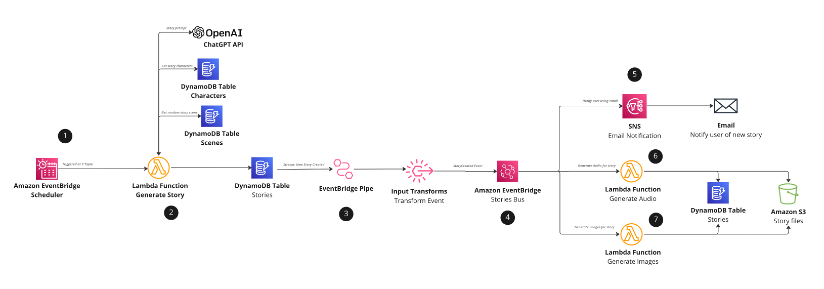
Architecture diagram for Serverless bed time story generation with ChatGPT and DALL-E
A new children’s story is generated every day at configured time using Amazon EventBridge Scheduler (Step 1). EventBridge Scheduler is a service capable of scaling millions of schedules with over 200 targets and over 6000 API calls. This example application uses EventBridge scheduler to trigger an AWS Lambda function every night at the same time (7:15pm). The Lambda function is triggered to start the generation of the story.

EventBridge scheduler triggers Lambda function every day at 7:15pm (bed time)
The “Scenes” and “Characters” Amazon DynamoDB tables contain the characters involved in the story and a scene that is randomly selected during its creation. As a result, ChatGPT receives a unique prompt each time. An example of the prompt may look like this:
“`
Write a title and a rhyming story on 2 main characters called Parker and Jackson. The story needs to be set within the scene haunted woods and be at least 200 words long
“`
After the story is created, it is then saved in the “Stories” DynamoDB table (Step 2).
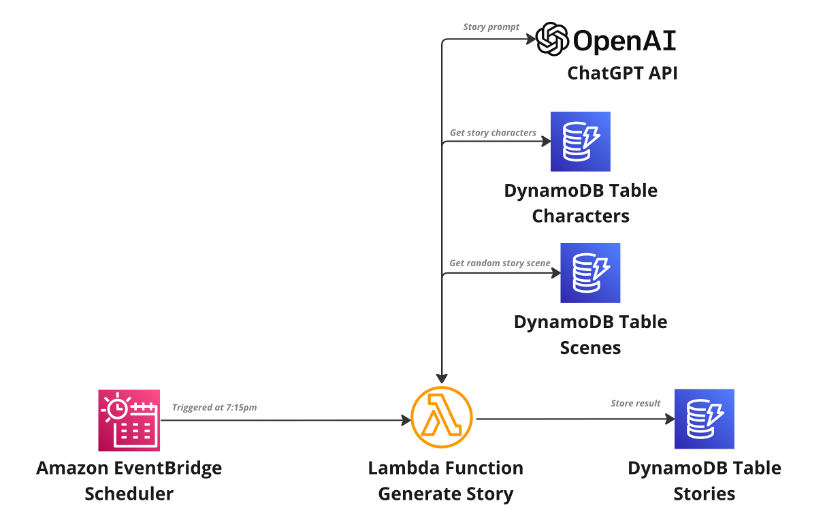
Scheduler triggering Lambda function to generate the story and store story into DynamoDB
Once the story is created this initiates a change data capture event using DynamoDB Streams (Step 3). This event flows through point-to-point messaging with EventBridge pipes and directly into EventBridge. Input transforms are then used to convert the DynamoDB Stream event into a custom EventBridge event, which downstream consumers can comprehend. Adopting this pattern is beneficial as it allows us to separate contracts from the DynamoDB event schema and not having downstream consumers conform to this schema structure, this mapping allows us to remain decoupled from implementation details.

EventBridge Pipes connecting DynamoDB streams directly into EventBridge.
Upon triggering the StoryCreated event in EventBridge, three targets are triggered to carry out several processes (Step 4). Firstly, AI Images are processed, followed by the creation of audio for the story. Finally, the end user is notified of the completed story through Amazon SNS and email subscriptions. This fan-out pattern enables these tasks to be run asynchronously and in parallel, allowing for faster processing times.

EventBridge pub/sub pattern used to start async processing of notifications, audio, and images.
An SNS topic is triggered by the `StoryCreated` event to send an email to the end user using email subscriptions (Step 6). The email consists of a URL with the id of the story that has been created. Clicking on the URL takes the user to the frontend application that is hosted with App Runner.

Using SNS to notify the user of a new story

Example email sent to the user
Amazon Polly is used to generate the audio files for the story (Step 6). Upon triggering the `StoryCreated` event, a Lambda function is triggered, and the story description is used and given to Amazon Polly. Amazon Polly then creates an audio file of the story, which is stored in Amazon S3. A presigned URL is generated and saved in DynamoDB against the created story. This allows the frontend application and browser to retrieve the audio file when the user views the page. The presigned URL has a validity of two days, after which it can no longer be accessed or listened to.
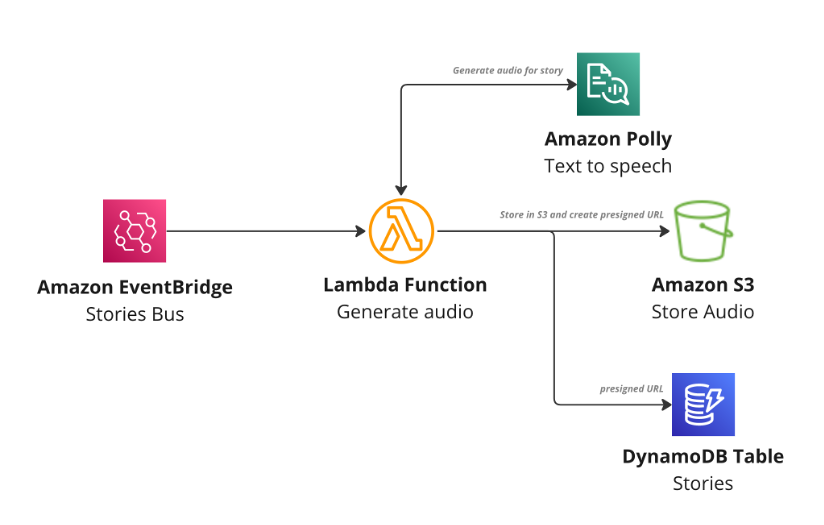
Lambda function to generate audio using Amazon Polly, store in S3 and update story with presigned URL
The `StoryCreated` event also triggers another Lambda function, which uses the OpenAI API to generate an AI image using DALL-E based on the generated story (Step 7). Once the image is generated, the image is downloaded and stored in Amazon S3. Similar to the audio file, the system generates a presigned URL for the image and saves it in DynamoDB against the story. The presigned URL is only valid for two days, after which it becomes inaccessible for download or viewing.

Lambda function to generate images, store in S3 and update story with presigned URL.
In the event of a failure in audio or image generation, the frontend application still loads the story, but does not display the missing image or audio at that moment. This ensures that the frontend can continue working and provide value. If you wanted more control and only trigger the user’s notification event once all parallel tasks are complete the aggregator messaging pattern can be considered.
Hosting the frontend Next.js application with AWS App Runner
Next.js is used by the frontend application to render server-side rendered (SSR) pages that can access the stories from the DynamoDB table, which are then hosted with AWS App Runner after being containerized.

Next.js application hosted with App Runner, with permissions into DynamoDB table.
AWS App Runner enables you to deploy containerized web applications and APIs securely, without needing any prior knowledge of containers or infrastructure. With App Runner, developers can concentrate on their application, while the service handles container startup, running, scaling, and load balancing. After deployment, App Runner provides a secure URL for clients to begin making HTTP requests against.
With App Runner, you have two primary options for deploying your container: source code connections or source images. Using source code connections grants App Runner permission to pull the image file directly from your source code, and with Automatic deployment configured, it can redeploy the application when changes are made. Alternatively, source images provide App Runner with the image’s location in an image registry, and this image is deployed by App Runner.
In this example application, CDK deploys the application using the DockerImageAsset construct with the App Runner construct. Once deployed, App Runner builds and uploads the frontend image to Amazon Elastic Container Registry (ECR) and deploys it. Downstream consumers can access the application using the secure URL provided by App Runner. In this example, the URL is used when the SNS notification is sent to the user when the story is ready to be viewed.
Giving the frontend container permission to DynamoDB table
To grant the Next.js application permission to obtain stories from the Stories DynamoDB table, App Runner instance roles are configured. These roles are optional and can provide the necessary permissions for the container to access AWS services required by the compute service.
If you want to learn more about AWS App Runner, you can explore the free workshop.
Design choices and assumptions
The DynamoDB Time to Live (TTL) feature is ideal for the short-lived nature of daily generated stories. DynamoDB handle the deletion of stories after two days by setting the TTL attribute on each story. Once a story is deleted, it becomes inaccessible through the generated story URLs.
Using Amazon S3 presigned URLs is a method to grant temporary access to a file in S3. This application creates presigned URLs for the audio file and generated images that last for 2 days, after which the URLs for the S3 items become invalid.
Input transforms are used between DynamoDB streams and EventBridge events to decouple the schemas and events consumed by downstream targets. Consuming the events as they are is known as the “conformist” pattern, and couples us to implementation details of DynamoDB streams with downstream EventBridge consumers. This allows the application to remain decoupled from implementation details and remain flexible.
Conclusion
The adoption of artificial intelligence (AI) technology has significantly increased in various industries. ChatGPT, a large language model that can understand and generate human-like responses in natural language, and DALL-E, an image generation system that can create realistic images based on textual descriptions, are examples of such technology. These systems have demonstrated the potential for AI to provide innovative solutions and transform the way we interact with technology.
This blog post explores ways in which you can utilize AWS serverless services with ChatGTP and DALL-E to create a story generation application fronted by a Next.js application hosted with App Runner. EventBridge Scheduler is used to trigger the story creation process then react to change data capture events with DynamoDB streams and EventBridge Pipes, and use Amazon EventBridge to fan out compute tasks to process notifications, images, and audio files.
You can find the documentation and the source code for this application in GitHub.
For more serverless learning resources, visit Serverless Land.
AWS Week in Review – March 13, 2023
Post Syndicated from Steve Roberts original https://aws.amazon.com/blogs/aws/aws-week-in-review-march-13-2023/
It seems like only yesterday I was last writing the Week in Review post, at the end of January, and now here we are almost mid-way through March, almost into spring in the northern hemisphere, and close to a quarter way through 2023. Where does time fly?!
Last Week’s Launches
Here’s some of the launches and other news from the past week that I want to bring to your attention:
New AWS Heroes: At the center of the AWS Community around the globe, Heroes share their knowledge and enthusiasm. Welcome to Ananda in Indonesia, and Aidan and Wendy in Australia, our newly announced Heroes!
General Availability of AWS Application Composer: Launched in preview during Dr. Werner Vogel’s re:Invent 2022 keynote, AWS Application Composer is a tool enabling the composition and configuration of serverless applications using a visual design surface. The visual design is backed by an AWS CloudFormation template, making it deployment ready.
What I find particularly cool about Application Composer is that it also works on existing serverless application templates, and round-trips changes to the template made in either a code editor or the visual designer. This makes it ideal for both new developers, and experienced serverless developers with existing applications.
My colleague Channy’s post provides an introduction, and Application Composer is also featured in last Friday’s AWS on Air show, available to watch on-demand.
Get daily feature updates via Amazon SNS: One thing I’ve learned since joining AWS is that the service teams don’t stand still, and are releasing something new pretty much every day. Sometimes, multiple things! This can, however, make it hard to keep up. So, I was interested to read that you can now receive daily feature updates, in email, by subscribing to an Amazon Simple Notification Service (Amazon SNS) topic. As usual, Jeff’s post has all the details you need to get started.
Using up to 10GB of ephemeral storage for AWS Lambda functions: If you use Lambda for Extract-Transform-Load (ETL) jobs, or any data-intensive jobs that require temporary storage of data during processing, you can now configure up to 10GB of ephemeral storage, mounted at /tmp, for your functions in six additional Regions – Asia Pacific (Hyderabad), Asia Pacific (Jakarta), Asia Pacific (Melbourne), Europe (Spain), Europe (Zurich), and Middle East (UAE). More information on using ephemeral storage with Lambda functions can be found in this blog post.
Increased table counts for Amazon Redshift: workloads that require large numbers of tables can now take advantage of using up to 200K tables, avoiding the need to split tables across multiple data warehouses. The updated limit is available to workloads using the ra3.4xlarge, ra3.16xlarge, and dc2.8xlarge node types with Redshift Serverless and data warehouse clusters.
Faster, simpler permissions setup for AWS Glue: Glue is a serverless data integration and ETL service for discovering, preparing, moving, and integrating data intended for use in analytics and machine learning (ML) workloads. A new guided permissions setup process, available in the AWS Management Console, makes it simpler and easier to grant access to AWS Identity and Access Management (IAM) Roles and users to Glue, and use a default role for running jobs and working with notebooks. This simpler, guided approach helps users start authoring jobs, and work with the Data Catalog, without further setup.
Microsoft Active Directory authentication for the MySQL-Compatible Edition of Amazon Aurora: You can now use Active Directory, either with an existing on-premises directory or with AWS Directory Service for Microsoft Active Directory, to authenticate database users when accessing Amazon Aurora MySQL-Compatible Edition instances, helping reduce operational overhead. It also enables you to make use of native Active Directory credential management capabilities to manage password complexities and rotation, helping you stay in step with your compliance and security requirements.
Launch of the 2023 AWS DeepRacer League and new competition structure: The DeepRacer tracks are one of my favorite things to visit and watch at AWS events, so I was happy to learn the new 2023 league is now underway. If you’ve not heard of DeepRacer, it’s the world’s first global racing league featuring autonomous vehicles, enabling developers of all skill levels to not only compete to complete the track in the shortest time but also to advance their knowledge of machine learning (ML) in the process. Along with the new league, there are now more chances to earn achievements and prizes using an all new three-tier competition spanning national and regional races. Racers compete for a chance to win a spot in the World Championship, held at AWS re:Invent, and a $43,000 prize purse. What are you waiting for, start your (ML) engines today!
AWS open-source news and updates: The latest newsletter highlighting open-source projects, tools, and demos from the AWS Community is now available. The newsletter is published weekly, and you can find edition 148 here.
For a full list of AWS announcements, be sure to keep an eye on the What’s New at AWS page.
Upcoming AWS Events
Here’s some upcoming events you may be interested in checking out:
AWS Pi Day: March 14th is the third annual AWS Pi Day. Join in with the celebrations of the 17th birthday of Amazon Simple Storage Service (Amazon S3) and the cloud in a live virtual event hosted on the AWS on Air channel. There’ll also be news and discussions on the latest innovations across Data services on AWS, including storage, analytics, AI/ML, and more.
.NET developers and architects looking to modernize their applications will be interested in an upcoming webinar, Modernize and Optimize by Containerizing .NET Applications on AWS, scheduled for March 22nd. In this webinar, you’ll find demonstrations on how you can enhance the security of legacy .NET applications through modernizing to containers, update to a modern version of .NET, and run them on the latest versions of Windows. Registration for the online event is open now.
You can find details on all upcoming events, in-person and virtual, here.
New Livestream Shows
There’s some new livestream shows that launched recently I’d like to bring to your attention:
My colleague Isaac has started a new .NET on AWS show, streaming on Twitch. The second episode was live last week; catch up here on demand. Episode 1 is also available here.
I mentioned AWS on Air earlier in this post, and hopefully you’ve caught our weekly Friday show streaming on Twitch, Twitter, YouTube, and LinkedIn. Or, maybe you’ve seen us broadcasting live from AWS events such as Summits or AWS re:Invent. But did you know that some of the hosts of the shows have recently started their own individual shows too? Check out these new shows below:
- AWS on Air: Startup! – hosted by Jillian Forde, this show focuses on learning technical and business strategies from startup experts to build and scale your startup in AWS. The show runs every Tuesday at 10am PT/1pm ET.
- AWS On Air: Under the Hood with AWS – in this show, host Art Baudo chats with guests, including AWS technical leaders and customers, about Cloud infrastructure. In last week’s show, the discussion centered around Amazon Elastic Compute Cloud (Amazon EC2) Mac Instances. Watch live every Tuesday at 2pm PT/5pm ET.
- AWS on Air: Lockdown! – join host Kyle Dickinson each Tuesday at 11am PT/2pm ET for this show, covering a breadth of AWS security topics in an approachable way that’s suitable for all levels of AWS experience. You’ll encounter demos, guest speakers from AWS, AWS Heroes, and AWS Community Builders.
- AWS on Air: Step up your GameDay – hosts AM Grobelny and James Spencer are joined by special guests to strategize and navigate through an AWS GameDay, a fun and challenge-oriented way to learn about AWS. You’ll find this show every second Wednesday at 11am PT/2pm ET.
- AWS on Air: AMster & the Brit’s Code Corner – join AM Grobelny and myself as we chat about and illustrate cloud development. In Beginners Corner, we answer your questions and try to demystify this strange thing called “coding”, and in Project Corner we tackle slightly larger projects of interest to more experienced developers. There’s something for everyone in Code Corner, live on the 3rd Thursday of each month at 11am PT/2pm ET.
You’ll find all these AWS on Air shows in the published schedule. We hope you can join us!
That’s all for this week – check back next Monday for another AWS Week in Review.
Comic for 2023.03.14 – 1986 Called
Post Syndicated from Explosm.net original https://explosm.net/comics/1986-called
New Cyanide and Happiness Comic
Hasan Jeffries and Janai Nelson on the Future of Civil Rights | The Atlantic at SXSW
Post Syndicated from The Atlantic original https://www.youtube.com/watch?v=jb7F_RleW9U
Nevada and Georgia Secretaries of State on the Future of Elections | The Atlantic at SXSW
Post Syndicated from The Atlantic original https://www.youtube.com/watch?v=oQOpSMV7mHs
Comic for 2023.03.13 – Family
Post Syndicated from Explosm.net original https://explosm.net/comics/family
New Cyanide and Happiness Comic
How to choose the right Amazon MSK cluster type for you
Post Syndicated from Ali Alemi original https://aws.amazon.com/blogs/big-data/how-to-choose-the-right-amazon-msk-cluster-type-for-you/
Amazon Managed Streaming for Apache Kafka (Amazon MSK) is an AWS streaming data service that manages Apache Kafka infrastructure and operations, making it easy for developers and DevOps managers to run Apache Kafka applications and Kafka Connect connectors on AWS, without the need to become experts in operating Apache Kafka. Amazon MSK operates, maintains, and scales Apache Kafka clusters, provides enterprise-grade security features out of the box, and has built-in AWS integrations that accelerate development of streaming data applications. You can easily get started by creating an MSK cluster using the AWS Management Console with a few clicks.
When creating a cluster, you must choose a cluster type from two options: provisioned or serverless. Choosing the best cluster type for each workload depends on the type of workload and your DevOps preferences. Amazon MSK provisioned clusters offer more flexibility in how you scale, configure, and optimize your cluster. Amazon MSK Serverless, on the other hand, makes scaling, load management, and operation of the cluster easier for you. With MSK Serverless, you can run your applications without having to configure, manage the infrastructure, or optimize clusters, and you pay for the data volume you stream and retain. MSK Serverless fully manages partitions, including monitoring as well as ensuring an even balance of partition distribution across brokers in the cluster (auto-balancing).
In this post, I examine a use case with the fictitious company AnyCompany, who plans to use Amazon MSK for two applications. They must decide between provisioned or serverless cluster types. I describe a process by which they work backward from the applications’ requirements to find the best MSK cluster type for their workloads, including how the organizational structure and application requirements are relevant in finding the best offering. Lastly, I examine the requirements and their relationship to Amazon MSK features.
Use case
AnyCompany is an enterprise organization that is ready to move two of their Kafka applications to Amazon MSK.
The first is a large ecommerce platform, which is a legacy application that currently uses a self-managed Apache Kafka cluster run in their data centers. AnyCompany wants to migrate this application to the AWS Cloud and use Amazon MSK to reduce maintenance and operations overhead. AnyCompany has a DataOps team that has been operating self-managed Kafka clusters in their data centers for years. AnyCompany wants to continue using the DataOps team to manage the MSK cluster on behalf of the development team. There is very little flexibility for code changes. For example, a few modules of the application require plaintext communication and access to the Apache ZooKeeper cluster that comes with an MSK cluster. The ingress throughput for this application doesn’t fluctuate often. The ecommerce platform only experiences a surge in user activity during special sales events. The DataOps team has a good understanding of this application’s traffic pattern, and are confident that they can optimize an MSK cluster by setting some custom broker-level configurations.
The second application is a new cloud-native gaming application currently in development. AnyCompany hopes to launch this gaming application soon followed by a marketing campaign. Throughput needs for this application are unknown. The application is expected to receive high traffic initially, then user activity should decline gradually. Because the application is going to launch first in the US, traffic during the day is expected to be higher than at night. This application offers a lot of flexibility in terms of Kafka client version, encryption in transit, and authentication. Because this is a cloud-native application, AnyCompany hopes they can delegate full ownership of its infrastructure to the development team.
Solution overview
Let’s examine a process that helps AnyCompany decide between the two Amazon MSK offerings. The following diagram shows this process at a high level.
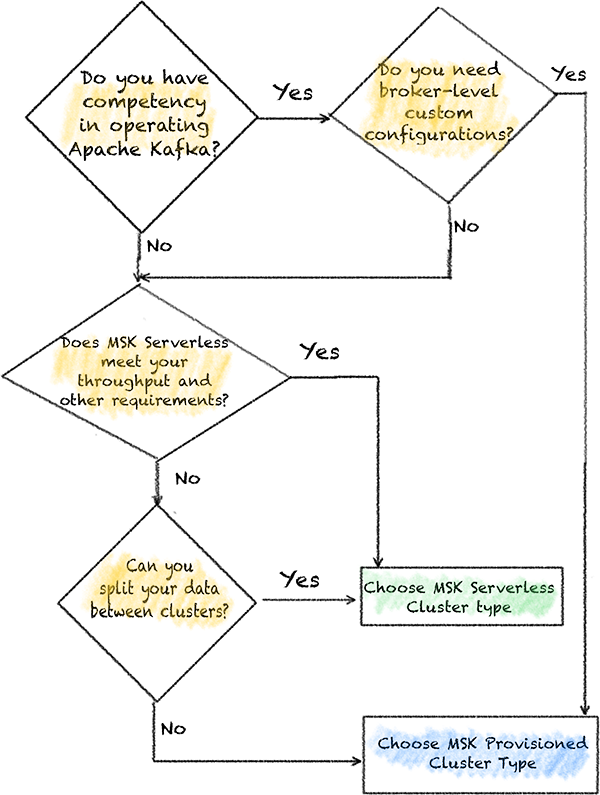
In the following sections, I explain each step in detail and the relevant information that AnyCompany needs to collect before they make a decision.
Competency in Apache Kafka
AWS recommends a list of best practices to follow when using the Amazon MSK provisioned offering. Amazon MSK provisioned, offers more flexibility so you make scaling decisions based on what’s best for your workloads. For example, you can save on cost by consolidating a group of workloads into a single cluster. You can decide which metrics are important to monitor and optimize your cluster through applying custom configurations to your brokers. You can choose your Apache Kafka version, among different supported versions, and decide when to upgrade to a new version. Amazon MSK takes care of applying your configuration and upgrading each broker in a rolling fashion.
With more flexibility, you have more responsibilities. You need to make sure your cluster is right-sized at any time. You can achieve this by monitoring a set of cluster-level, broker-level, and topic-level metrics to ensure you have enough resources that are needed for your throughput. You also need to make sure the number of partitions assigned to each broker doesn’t exceed the numbers suggested by Amazon MSK. If partitions are unbalanced, you need to even-load them across all brokers. If you have more partitions than recommended, you need to either upgrade brokers to a larger size or increase the number of brokers in your cluster. There are also best practices for the number of TCP connections when using AWS Identity and Access Management (IAM) authentication.
An MSK Serverless cluster takes away the complexity of right-sizing clusters and balancing partitions across brokers. This makes it easy for developers to focus on writing application code.
AnyCompany has an experienced DataOps team who are familiar with scaling operations and best practices for the MSK provisioned cluster type. AnyCompany can use their DataOps team’s Kafka expertise for building automations and easy-to-follow standard procedures on behalf of the ecommerce application team. The gaming development team is an exception, because they are expected to take the full ownership of the infrastructure.
In the following sections, I discuss other steps in the process before deciding which cluster type is right for each application.
Custom configuration
In certain use cases, you need to configure your MSK cluster differently from its default settings. This could be due to your application requirements. For example, AnyCompany’s ecommerce platform requires setting up brokers such that the default retention period for all topics is set to 72 hours. Also, topics should be or auto-created when they are requested and don’t exist.
The Amazon MSK provisioned offering provides a default configuration for brokers, topics, and Apache ZooKeeper nodes. It also allows you to create custom configurations and use them to create new MSK clusters or update existing clusters. An MSK cluster configuration consists of a set of properties and their corresponding values.
MSK Serverless doesn’t allow applying broker-level configuration. This is because AWS takes care of configuring and managing the backend nodes. It takes away the heavy lifting of configuring the broker nodes. You only need to manage your applications’ topics. To learn more, refer to the list of topic-level configurations that MSK Serverless allows you to change.
Unlike the ecommerce platform, AnyCompany’s gaming application doesn’t need broker-level custom configuration. The developers want to set the retention.ms and max.message.bytes per each topic only.
Application requirements
Apache Kafka applications differ in terms of their security; the way they connect, write, or read data; data retention period; and scaling patterns. For example, some applications can only scale vertically, whereas other applications can scale only horizontally. Although a flexible application can work with encryption in transit, a legacy application may only be able to communicate in plaintext format.
Cluster-level quotas
Amazon MSK enforces some quotas to ensure the performance, reliability, and availability of the service for all customers. These quotas are subject to change at any time. To access the latest values for each dimension, refer to Amazon MSK quota. Note that some of the quotas are soft limits and can be increased using a support ticket.
When choosing a cluster type in Amazon MSK, it’s important to understand your application requirements and compare those against quotas in relation with each offering. This makes sure you choose the best cluster type that meets your goals and application’s needs. Let’s examine how you can calculate the throughput you need and other important dimensions you need to compare with Amazon MSK quotas:
- Number of clusters per account – Amazon MSK may have quotas for how many clusters you can create in a single AWS account. If this is limiting your ability to create more clusters, you can consider creating those in multiple AWS accounts and using secure connectivity patterns to provide access to your applications.
- Message size – You need to make sure the maximum message size that your producer writes for a single message is lower than the configured size in the MSK cluster. MSK provisioned clusters allow you to change the default value in a custom configuration. If you choose MSK Serverless, check this value in Amazon MSK quota. The average message size is helpful when calculating the total ingress or egress throughput of the cluster, which I demonstrate later in this post.
- Message rate per second – This directly influences total ingress and egress throughput of the cluster. Total ingress throughput equals the message rate per second multiplied by message size. You need to make sure your producer is configured for optimal throughput by adjusting
batch.sizeandlinger.msproperties. If you’re choosing MSK Serverless, you need to make sure you configure your producer to optimal batches with the rate that is lower than its request rate quota. - Number of consumer groups – This directly influences the total egress throughput of the cluster. Total egress throughput equals the ingress throughput multiplied by the number of consumer groups. If you’re choosing MSK Serverless, you need to make sure your application can work with these quotas.
- Maximum number of partitions – Amazon MSK provisioned recommends not exceeding certain limits per broker (depending the broker size). If the number of partitions per broker exceeds the maximum value specified in the previous table, you can’t perform certain upgrade or update operations. MSK Serverless also has a quota of maximum number of partitions per cluster. You can request to increase the quota by creating a support case.
Partition-level quotas
Apache Kafka organizes data in structures called topics. Each topic consists of a single or many partitions. Partitions are the degree of parallelism in Apache Kafka. The data is distributed across brokers using data partitioning. Let’s examine a few important Amazon MSK requirements, and how you can make sure which cluster type works better for your application:
- Maximum throughput per partition – MSK Serverless automatically balances the partitions of your topic between the backend nodes. It instantly scales when your ingress throughput increases. However, each partition has a quota of how much data it accepts. This is to ensure the data is distributed evenly across all partitions and backend nodes. In an MSK Serverless cluster, you need to create your topic with enough partitions such that the aggregated throughput is equal to the maximum throughput your application requires. You also need to make sure your consumers read data with a rate that is below the maximum egress throughput per partition quota. If you’re using Amazon MSK provisioned, there is no partition-level quota for write and read operations. However, AWS recommends you monitor and detect hot partitions and control how partitions should balance among the broker nodes.
- Data storage – The amount of time each message is kept in a particular topic directly influences the total amount of storage needed for your cluster. Amazon MSK allows you to manage the retention period at the topic level. MSK provisioned clusters allow broker-level configuration to set the default data retention period. MSK Serverless clusters allow unlimited data retention, but there is a separate quota for the maximum data that can be stored in each partition.
Security
Amazon MSK recommends that you secure your data in the following ways. Availability of the security features varies depending on the cluster type. Before making a decision about your cluster type, check if your preferred security options are supported by your choice of cluster type.
- Encryption at rest – Amazon MSK integrates with AWS Key Management Service (AWS KMS) to offer transparent server-side encryption. Amazon MSK always encrypts your data at rest. When you create an MSK cluster, you can specify the KMS key that you want Amazon MSK to use to encrypt your data at rest.
- Encryption in transit – Amazon MSK uses TLS 1.2. By default, it encrypts data in transit between the brokers of your MSK cluster. You can override this default when you create the cluster. For communication between clients and brokers, you must specify one of the following settings:
- Only allow TLS encrypted data. This is the default setting.
- Allow both plaintext and TLS encrypted data.
- Only allow plaintext data.
- Authentication and authorization – Use IAM to authenticate clients and allow or deny Apache Kafka actions. Alternatively, you can use TLS or SASL/SCRAM to authenticate clients, and Apache Kafka ACLs to allow or deny actions.
Cost of ownership
Amazon MSK helps you avoid spending countless hours and significant resources just managing your Apache Kafka cluster, adding little or no value to your business. With a few clicks on the Amazon MSK console, you can create highly available Apache Kafka clusters with settings and configuration based on Apache Kafka’s deployment best practices. Amazon MSK automatically provisions and runs Apache Kafka clusters. Amazon MSK continuously monitors cluster health and automatically replaces unhealthy nodes with no application downtime. In addition, Amazon MSK secures Apache Kafka clusters by encrypting data at rest and in transit. These capabilities can significantly reduce your Total Cost of Ownership (TCO).
With MSK provisioned clusters, you can specify and then scale cluster capacity to meet your needs. With MSK Serverless clusters, you don’t need to specify or scale cluster capacity. MSK Serverless automatically scales the cluster capacity based on the throughput, and you only pay per GB of data that your producers write to and your consumers read from the topics in your cluster. Additionally, you pay an hourly rate for your serverless clusters and an hourly rate for each partition that you create. The MSK Serverless cluster type generally offers a lower cost of ownership by taking away the cost of engineering resources needed for monitoring, capacity planning, and scaling MSK clusters. However, if your organization has a DataOps team with Kafka competency, you can use this competency to operate optimized MSK provisioned clusters. This allows you to save on Amazon MSK costs by consolidating several Kafka applications into a single cluster. There are a few critical considerations to decide when and how to split your workloads between multiple MSK clusters.
Apache ZooKeeper
Apache ZooKeeper is a service included in Amazon MSK when you create a cluster. It manages the Apache Kafka metadata and acts as a quorum controller for leader elections. Although interacting with ZooKeeper is not a recommended pattern, some Kafka applications have a dependency to connect directly to ZooKeeper. During the migration to Amazon MSK, you may find a few of these applications in your organization. This could be because they use an older version of the Kafka client library or other reasons. For example, applications that help with Apache Kafka admin operations or visibility such as Cruise Control usually need this kind of access.
Before you choose your cluster type, you first need to check which offering provides direct access to the ZooKeeper cluster. As of writing this post, only Amazon MSK provisioned provides direct access to ZooKeeper.
How AnyCompany chooses their cluster types
AnyCompany first needs to collect some important requirements about each of their applications. The following table shows these requirements. The rows marked with an asterisk (*) are calculated based on the values in previous rows.
| Dimension | Ecommerce Platform | Gaming Application |
| Message rate per second | 150,000 | 1,000 |
| Maximum message size | 15 MB | 1 MB |
| Average message size | 30 KB | 15 KB |
| * Ingress throughput (average message size * message rate per second) | 4.5GBps | 15MBps |
| Number of consumer groups | 2 | 1 |
| * Outgress throughput (ingress throughput * number of consumer groups) | 9 GBps | 15 MBps |
| Number of topics | 100 | 10 |
| Average partition per topic | 100 | 5 |
| * Total number of partitions (number of topics * average partition per topic) | 10,000 | 50 |
| * Ingress per partition (ingress throughput / total number of partitions) | 450 KBps | 300 KBps |
| * Outgress per partition (outgress throughput / total number of partitions) | 900 KBps | 300 KBps |
| Data retention | 72 hours | 168 hours |
| * Total storage needed (ingress throughput * retention period in seconds) | 1,139.06 TB | 1.3 TB |
| Authentication | Plaintext and SASL/SCRAM | IAM |
| Need ZooKeeper access | Yes | No |
For the gaming application, AnyCompany doesn’t want to use their in-house Kafka competency to support an MSK provisioned cluster. Also, the gaming application doesn’t need custom configuration, and its throughput needs are below the quotas set by the MSK Serverless cluster type. In this scenario, an MSK Serverless cluster makes more sense.
For the e-commerce platform, AnyCompany wants to use their Kafka competency. Moreover, their throughput needs exceed the MSK Serverless quotas, and the application requires some broker-level custom configuration. The ecommerce platform also can’t split between multiple clusters. Because of these reasons, AnyCompany chooses the MSK provisioned cluster type in this scenario. Additionally, AnyCompany can save more on cost with the Amazon MSK provisioned pricing model. Their throughput is consistent at most times and AnyCompany wants to use their DataOps team to optimize a provisioned MSK cluster and make scaling decisions based on their own expertise.
Conclusion
Choosing the best cluster type for your applications may seem complicated at first. In this post, I showed a process that helps you work backward from your application’s requirement and the resources available to you. MSK provisioned clusters offer more flexibility in how you scale, configure, and optimize your cluster. MSK Serverless, on the other hand, is a cluster type that makes it easier for you to run Apache Kafka clusters without having to manage compute and storage capacity. I generally recommend you begin with MSK Serverless if your application doesn’t require broker-level custom configurations, and your application throughput needs don’t exceed the quotas for the MSK Serverless cluster type. Sometimes it’s best to split your workloads between multiple MSK Serverless clusters, but if that isn’t possible, you may need to consider an MSK provisioned cluster. To operate an optimized MSK provisioned cluster, you need to have Kafka competency within your organization.
For further reading on Amazon MSK, visit the official product page.
About the author
 Ali Alemi is a Streaming Specialist Solutions Architect at AWS. Ali advises AWS customers with architectural best practices and helps them design real-time analytics data systems that are reliable, secure, efficient, and cost-effective. He works backward from customers’ use cases and designs data solutions to solve their business problems. Prior to joining AWS, Ali supported several public sector customers and AWS consulting partners in their application modernization journey and migration to the cloud.
New Hampshire Governor Chris Sununu on the Future of American Conservatism | The Atlantic at SXSW
Post Syndicated from The Atlantic original https://www.youtube.com/watch?v=ViFcOSvpu5w
Git 2.40.0 released
Post Syndicated from original https://lwn.net/Articles/926033/
Version 2.40.0 of the Git source-code management system is out.
Changes include a new --merge-base option for merges,
a built-in implementation of bisection,
Emacs support for git jump,
a fair number of smallish user-interface tweaks, and a lot of bug fixes.
See the announcement and this GitHub
blog entry for the details.
Highlights from Git 2.40
Post Syndicated from Taylor Blau original https://github.blog/2023-03-13-highlights-from-git-2-40/
The open source Git project just released Git 2.40 with features and bug fixes from over 88 contributors, 30 of them new.
We last caught up with you on the latest in Git when 2.39 was released. To celebrate this most recent release, here’s GitHub’s look at some of the most interesting features and changes introduced since last time.
- Longtime readers will recall our coverage of
git jumpfrom way back in our Highlights from Git 2.19 post. If you’re new around here, don’t worry: here’s a brief refresher.git jumpis an optional tool that ships with Git in itscontrib directory.git jumpwraps other Git commands, likegit grepand feeds their results into Vim’s quickfix list. This makes it possible to write something likegit jump grep fooand have Vim be able to quickly navigate between all matches of “foo” in your project.git jumpalso works withdiffandmerge. When invoked indiffmode, the quickfix list is populated with the beginning of each changed hunk in your repository, allowing you to quickly scan your changes in your editor before committing them.git jump merge, on the other hand, opens Vim to the list of merge conflicts.In Git 2.40,
git jumpnow supports Emacs in addition to Vim, allowing you to usegit jumpto populate a list of locations to your Emacs client. If you’re an Emacs user, you can try outgit jumpby running:M-x grepgit jump --stdout grep foo [source]
-
If you’ve ever scripted around a Git repository, you may be familiar with Git’s
cat-filetool, which can be used to print out the contents of arbitrary objects.Back when v2.38.0 was released, we talked about how
cat-filegained support to apply Git’s mailmap rules when printing out the contents of a commit. To summarize, Git allows rewriting name and email pairs according to a repository’s mailmap. In v2.38.0,git cat-filelearned how to apply those transformations before printing out object contents with the new--use-mailmapoption.But what if you don’t care about the contents of a particular object, and instead want to know the size? For that, you might turn to something like
--batch-check=%(objectsize), or-sif you’re just checking a single object.But you’d be mistaken! In previous versions of Git, both the
--batch-checkand-soptions togit cat-fileignored the presence of--use-mailmap, leading to potentially incorrect results when the name/email pairs on either side of a mailmap rewrite were different lengths.In Git 2.40, this has been corrected, and
git cat-file -sand--batch-checkwith will faithfully report the object size as if it had been written using the replacement identities when invoked with--use-mailmap.[source]
-
While we’re talking about scripting, here’s a lesser-known Git command that you might not have used:
git check-attr.check-attris used to determine whichgitattributesare set for a given path.These attributes are defined and set by one or more
.gitattributesfile(s) in your repository. For simple examples, it’s easy enough to read them off from a.gitattributesfile, like this:$ head -n 2 .gitattributes * whitespace=!indent,trail,space *.[ch] whitespace=indent,trail,space diff=cppHere, it’s relatively easy to see that any file ending in
*.cor*.hwill have the attributes set above. But what happens when there are more complex rules at play, or your project is using multiple.gitattributesfiles? For those tasks, we can usecheck-attr:$ git check-attr -a git.c git.c: diff: cpp git.c: whitespace: indent,trail,spaceIn the past, one crucial limitation of
check-attris that it required an index, meaning that if you wanted to usecheck-attrin a bare repository, you had to resort to temporarily reading in the index, like so:TEMP_INDEX="$(mktemp ...)" git read-tree --index-output="$TEMP_INDEX" HEAD GIT_INDEX_FILE="$TEMP_INDEX" git check-attr ...This kind of workaround is no longer required in Git 2.40 and newer. In Git 2.40,
check-attrsupports a new--source=to scan for.gitattributesin, meaning that the following will work as an alternative to the above, even in a bare repository:$ git check-attr -a --source=HEAD^{tree} git.c git.c: diff: cpp git.c: whitespace: indent,trail,space[source]
-
Over the years, there has been a long-running effort to rewrite old parts of Git from their original Perl or Shell implementations into more modern C equivalents. Aside from being able to use Git’s own APIs natively, consolidating Git commands into a single process means that they are able to run much more quickly on platforms that have a high process start-up cost, such as Windows.
On that front, there are a couple of highlights worth mentioning in this release:
In Git 2.40,
git bisectis now fully implemented in C as a native builtin. This is the result of years of effort from many Git contributors, including a large handful of Google Summer of Code and Outreachy students.Similarly, Git 2.40 retired the legacy implementation of
git add --interactive, which also began as a Shell script and was re-introduced as a native builtin back in version 2.26, supporting both the new and old implementation behind an experimentaladd.interactive.useBuiltinconfiguration.Since that default has been “true” since version 2.37, the Git project has decided that it is time to get rid of the now-legacy implementation entirely, marking the end of another years-long effort to improve Git’s performance and reduce the footprint of legacy scripts.
-
Last but not least, there are a few under-the-hood improvements to Git’s CI infrastructure. Git has a handful of long-running Windows-specific CI builds that have been disabled in this release (outside of the
git-for-windowsrepository). If you’re a Git developer, this means that your CI runs should complete more quickly, and consume fewer resources per push.On a similar front, you can now configure whether or not pushes to branches that already have active CI jobs running should cancel those jobs or not. This may be useful when pushing to the same branch multiple times while working on a topic.
This can be configured using Git’s
ci-configmechanism, by adding a special script calledskip-concurrentto a branch calledci-config. If your fork of Git has that branch then Git will consult the relevant scripts there to determine whether CI should be run concurrently or not based on which branch you’re working on.
The rest of the iceberg
That’s just a sample of changes from the latest release. For more, check out the release notes for 2.40, or any previous version in the Git repository.
HP Elite Mini 600 G9 Review an Updated HP Returns to Project TinyMiniMicro
Post Syndicated from Patrick Kennedy original https://www.servethehome.com/hp-elite-mini-600-g9-review-an-updated-hp-returns-to-project-tinyminimicro-intel/
We rekindle the Project TinyMiniMicro series with our HP Elite Mini 600 G9 1L PC review. With 12th Gen Intel Core and DDR5 there is a lot new
The post HP Elite Mini 600 G9 Review an Updated HP Returns to Project TinyMiniMicro appeared first on ServeTheHome.
A 24-hour test run of the Hyundai Ioniq 5’s Vehicle-to-Load function
Post Syndicated from Technology Connextras original https://www.youtube.com/watch?v=yO5fJ8z66Z8
Nancy Pelosi on the Future of Global Democracy | The Atlantic at SXSW
Post Syndicated from The Atlantic original https://www.youtube.com/watch?v=uhl2lyIzzME
[$] Heuristics for software-interrupt processing
Post Syndicated from original https://lwn.net/Articles/925540/
The kernel’s software-interrupt (“softirq”) mechanism was added prior to
the 1.0 kernel release, but it implements a design seen in systems that were
already old when Linux was born. For much of that time, softirqs have been
an impediment to the kernel community’s scalability and response-time
goals, but they have proved resistant to removal. A recent discussion on a
proposed new heuristic to mitigate a softirq-related performance problem
may have reinvigorated interested in doing something about this subsystem
as a whole rather than just tweaking the parameters of how it operates.
What’s Up, Home? – Raspberry Pi 4: goodbye or good buy for running Zabbix?
Post Syndicated from Janne Pikkarainen original https://blog.zabbix.com/whats-up-home-raspberry-pi-4-goodbye-or-good-buy-for-running-zabbix/25558/
Is Raspberry Pi 4 a goodbye or a good buy for running Zabbix? How is it performance-wise? Is it reliable? Here’s my nine-month review of it, with a splash of appliance/application performance monitoring.
In about April 2022 when it became clear that I am going to continue my home monitoring project, I bought a Raspberry Pi 4 to run the show. Here’s my opinion on how well it is suited for running Zabbix.
Installing Zabbix
Applying that delicious layer of Zabbix on top of your Raspberry Pi 4 cake is extremely straightforward, as just like for every other platform that Zabbix officially supports, they do have packages and instructions to set up what you’d like to run.

After installing the packages, the next steps are just like with Zabbix running on any other platform, so I am not going to dive into that now.
Modifications to my Raspberry setup
As I do not need to run a graphical environment on my Raspberry, I did disable the graphical environment from starting at all to save some precious RAM and other resources.
After some time I did also purchase an external USB hard disk, as the memory card from where Raspberry Pi 4 runs its OS is not very snappy, especially with write operations, and can also run tight on free space.
Other than that, my Raspberry Pi 4 is running pretty much by default.
How about the performance?
The graphs that you are about to see are from nine months period of time, as that’s about as long I have had the device.

No problem with the CPU usage. It’s been creeping up a little bit over time though, as I have been adding new items to monitoring and also additional software, such as HomeBridge and Home Assistant.

It still has available memory, even though the device runs Zabbix server, MariaDB, Grafana, Mosquitto, Home Assistant and HomeBridge.

As you can see, the number of running processes has grown significantly as I have been adding other stuff than Zabbix.

It’s easy to see when I did switch from an internal memory card to an external USB drive. The disk I/O utilization percentage is hovering at very tolerable levels.

I/O latency has remained about the same.

With only Zabbix, MariaDB and Grafana running the device remained around the 55-60C area, but has been warming to about 70C with the additional software. Still not too bad.
Splash of APM
Have you ever wondered what happens to the memory usage of a wrapper shell script that runs other scripts in a loop and keeps doing that until it’s manually stopped? This happens, it’s boringly stable. The results are brought you to by Zabbix Agent 2 process discovery.

Really, it does not vary much.

But as I have been adding new stuff, clearly the OS needs to do some more swapping and even the script has more page faults than before.
There’s more than that to process discovery, but those were some examples.

Zabbix server itself is doing very well, here are some example stats.
My conclusion: Raspberry Pi 4 is an excellent Zabbix server for smaller environments and a very good Zabbix proxy candidate. It’s been rock solid.
This post was originally published on the author’s page.
Top 50 most impersonated brands in phishing attacks and new tools you can use to protect your employees from them
Post Syndicated from Alexandra Moraru original https://blog.cloudflare.com/50-most-impersonated-brands-protect-phishing/


Someone in your organization may have just submitted an administrator username and password for an internal system to the wrong website. And just like that, an attacker is now able to exfiltrate sensitive data.
How did it all happen? A well crafted email.
Detecting, blocking, and mitigating the risks of phishing attacks is arguably one of the hardest challenges any security team is constantly facing.
Starting today, we are opening beta access to our new brand and anti-phishing tools directly from our Security Center dashboard, allowing you to catch and mitigate phishing campaigns targeting your organization even before they happen.
The challenge of phishing attacks
Perhaps the most publicized threat vector over the past several months has been phishing attacks. These attacks are highly sophisticated, difficult to detect, becoming more frequent, and can have devastating consequences for businesses that fall victim to them.
One of the biggest challenges in preventing phishing attacks is the sheer volume and the difficulty of distinguishing legitimate emails and websites from fraudulent ones. Even when users are vigilant, it can be hard to spot the subtle differences that attackers use to make their phishing emails and websites look convincing.
For example, last July our Cloudflare One suite of products and use of physical security keys thwarted the sophisticated “Oktapus” phishing attack targeting Cloudflare employees. The attacker behind the “Oktapus” attack that successfully compromised more than one hundred companies, registered the “cloudflare-okta.com” domain name just 40 minutes before sending it to our employees.
At that time, we identified phishing domains with our secure registrar product—but there was a delay in receiving the list of newly registered domains for monitoring purposes. Today, by streaming newly observed domains resolved by our 1.1.1.1 resolver (and other resolvers), we are able to detect phishing domains almost immediately. This gives us the upper hand and allows us to block phishing attempts before they happen.
We want to start giving our customers access to the same tools we use internally, to help you fight the ongoing challenge.
New Brand and Phishing Protection tools in Cloudflare’s Security Center
We’re expanding the phishing protections available to Cloudflare One customers by automatically identifying—and blocking—so-called “confusable” domains. Common misspellings (clodflare.com) and concatenation of services (cloudflare-okta.com) are often registered by attackers to trick unsuspecting victims into submitting private information such as passwords, and these new tools provide an additional layer of protection against such attempts.
The new Brand and Phishing Protection tools can be found under the Cloudflare Security Center, and provide even more controls (e.g. custom strings to monitor, searchable list of historical domains, etc.) to our customers. Cloudflare One plans can have access, with the level of control, visibility, and automation based on their plan type.
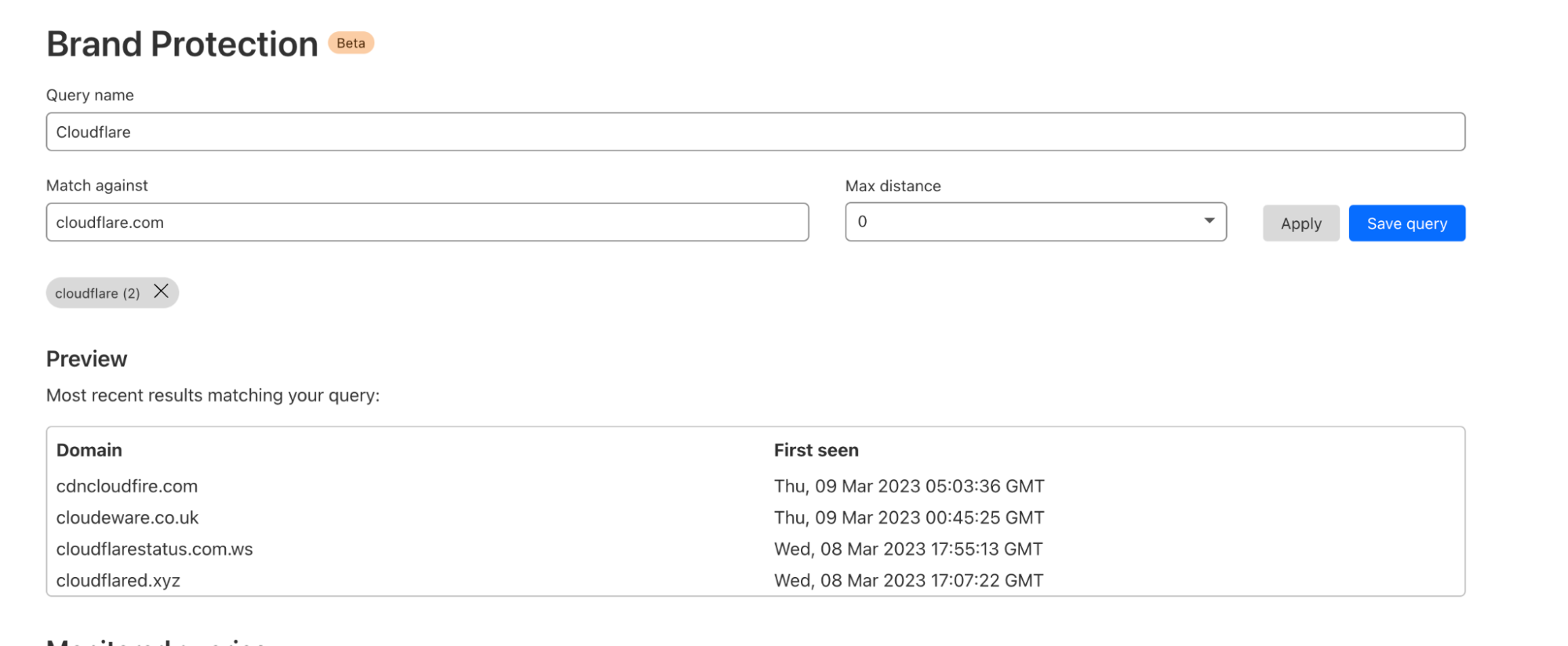
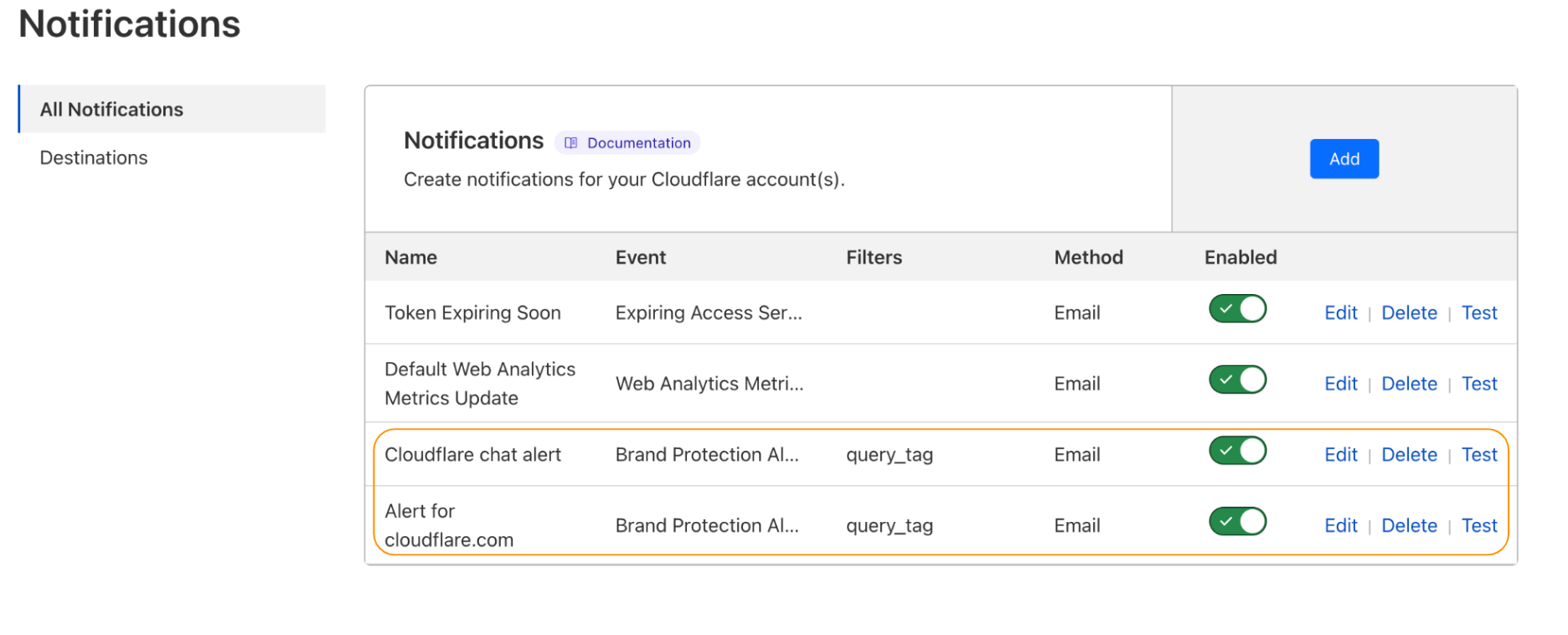
New domain brand matching and alerting
At the heart of our new brand protection feature is our ability to detect hostnames created specifically for phishing legitimate brands. We start by monitoring the first use of a domain or subdomain by sifting through trillions of daily DNS queries made to 1.1.1.1, Cloudflare’s public DNS resolver, in order to compile a list of hostnames in the wild for the first time.
Using this list, we perform ”fuzzy” matching, a technique used to match two strings that are similar in meaning or spelling, against our users’ saved patterns in real-time. We compare the strings and calculate a similarity score based on various factors (ie: phonetics, distance, substring matching). These saved patterns, which can be strings with edit distances, enable our system to generate alerts whenever we detect a match with any of the domains in the list.
While our users currently have to create and save these queries, we will introduce an automated matching system in the future. This system will simplify the process of detecting matches for our users, though custom strings will still be available for security teams tracking more complex patterns.
Historical searches
In addition to real-time monitoring, we offer historical searches (saved queries) and alerts for newly observed domains within the last 30 days. When a new pattern is created, we will display search results from the last 30 days to show any potential matches. This allows security teams to quickly assess the potential threat level of a new domain and take necessary actions.
Furthermore, this search mechanism can also be used for ad hoc domain hunting, providing additional flexibility for security teams who may need to investigate specific domains or patterns.
Observations in the wild: most phished brands
While building out these new Brand Protection tools, we wanted to test our capabilities against a broad set of commonly phished brands. To do so, we examined the frequency that domains containing phishing URLs were resolved against our 1.1.1.1 resolver. All domains that are used for shared services (like hosting sites Google, Amazon, GoDaddy) that could not be verified as a phishing attempt were removed from the data set.
The top 50 brands we found, along with one of the most commonly used domains for phishing those brands can be found in the table below.
| Rank | Brand | Sample domain used to phish brand[1] |
|---|---|---|
| 1 | AT&T Inc. | att-rsshelp[.]com |
| 2 | PayPal | paypal-opladen[.]be |
| 3 | Microsoft | login[.]microsoftonline.ccisystems[.]us |
| 4 | DHL | dhlinfos[.]link |
| 5 | Meta | facebookztv[.]com |
| 6 | Internal Revenue Service | irs-contact-payments[.]com |
| 7 | Verizon | loginnnaolcccom[.]weebly[.]com |
| 8 | Mitsubishi UFJ NICOS Co., Ltd. | cufjaj[.]id |
| 9 | Adobe | adobe-pdf-sick-alley[.]surge[.]sh |
| 10 | Amazon | login-amazon-account[.]com |
| 11 | Apple | apple-grx-support-online[.]com |
| 12 | Wells Fargo & Company | connect-secure-wellsfargo-com.herokuapp[.]com |
| 13 | eBay, Inc. | www[.]ebay8[.]bar |
| 14 | Swiss Post | www[.]swiss-post-ch[.]com |
| 15 | Naver | uzzmuqwv[.]naveicoipa[.]tech |
| 16 | Instagram (Meta) | instagram-com-p[.]proxy.webtoppings[.]bar |
| 17 | WhatsApp (Meta) | joingrub-whatsapp-pistol90[.]duckdns[.]org |
| 18 | Rakuten | rakutentk[.]com |
| 19 | East Japan Railway Company | www[.]jreast[.]co[.]jp[.]card[.]servicelist[].bcens[.]net |
| 20 | American Express Company | www[.]webcome-aexp[.]com |
| 21 | KDDI | aupay[.]kddi-fshruyrt[.]com |
| 22 | Office365 (Microsoft) | office365loginonlinemicrosoft[.]weebly[.]com |
| 23 | Chase Bank | safemailschaseonlineserviceupgrade09[.]weebly[.]com |
| 24 | AEON | aeon-ver1fy[.]shop |
| 25 | Singtel Optus Pty Limited | myoptus[.]mobi |
| 26 | Coinbase Global, Inc. | supp0rt-coinbase[.]com |
| 27 | Banco Bradesco S.A. | portalbradesco-acesso[.]com |
| 28 | Caixa Econômica Federal | lnternetbanklng-caixa[.]com |
| 29 | JCB Co., Ltd. | www[.]jcb-co-jp[.]ascaceeccea[.]ioukrg[.]top |
| 30 | ING Group | ing-ingdirect-movil[.]com |
| 31 | HSBC Holdings plc | hsbc-bm-online[.]com |
| 32 | Netflix Inc | renew-netflix[.]com |
| 33 | Sumitomo Mitsui Banking Corporation | smbc[.]co[.]jp[.]xazee[.]com |
| 34 | Nubank | nuvip2[.]ru |
| 35 | Bank Millennium SA | www[.]bankmillenium-pl[.]com |
| 36 | National Police Agency Japan | sun[.]pollice[.]xyz |
| 37 | Allegro | powiadomienieallegro[.]net |
| 38 | InPost | www.inpost-polska-lox.order9512951[.]info |
| 39 | Correos | correosa[.]online |
| 40 | FedEx | fedexpress-couriers[.]com |
| 41 | LinkedIn (Microsoft) | linkkedin-2[.]weebly[.]com |
| 42 | United States Postal Service | uspstrack-7518276417-addressredelivery-itemnumber.netlify[.]app |
| 43 | Alphabet | www[.]googlecom[.]vn10000[.]cc |
| 44 | The Bank of America Corporation | baanofamericase8[.]hostfree[.]pw |
| 45 | Deutscher Paketdienst | dpd-info[.]net |
| 46 | Banco Itaú Unibanco S.A. | silly-itauu[.]netlify[.]app |
| 47 | Steam | gift-steam-discord[.]com |
| 48 | Swisscom AG | swiss-comch[.]duckdns[.]org |
| 49 | LexisNexis | mexce[.]live |
| 50 | Orange S.A. | orange-france24[.]yolasite[.]com |
[1] Phishing sites are typically served on a specific URL and not on the root, e.g., hxxp://example.com/login.html rather than hxxp://example.com/. Full URLs are not provided here.
Combining threat intelligence capabilities with Zero Trust enforcement
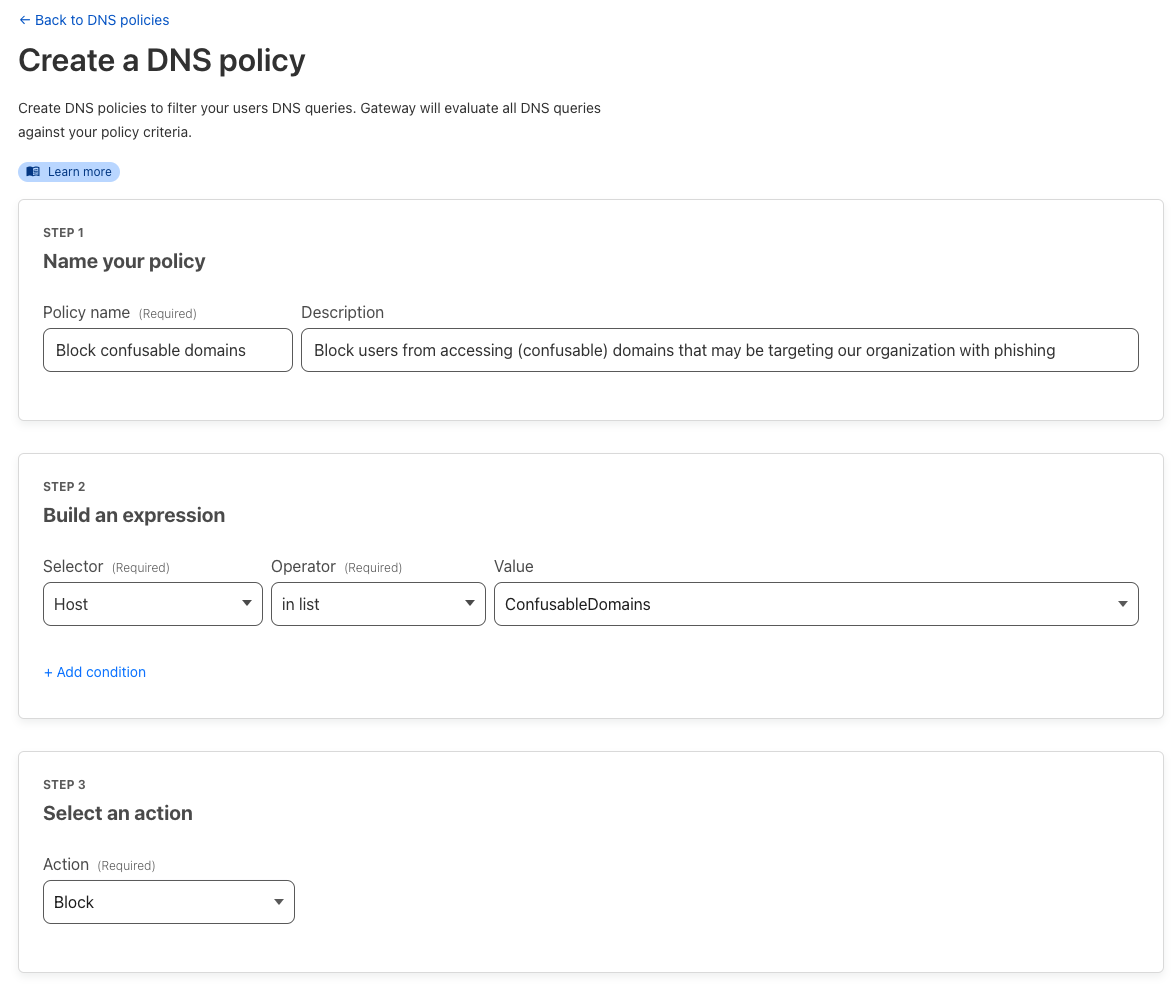
The new features become a lot more effective for customers using our Zero Trust product suite. You can in fact easily block any confusable domains found as soon as they are detected by creating Cloudflare Gateway or DNS policy rules. This immediately stops your users from resolving or browsing to potentially malicious sites thwarting attacks before they happen.
Future enhancements
The new features are just the start of our broader brand infringement and anti-phishing security portfolio.
Matching against SSL/TLS certificates
In addition to matching against domains, we plan to also match against new SSL/TLS certificates logged to Nimbus, our Certificate Transparency log. By analyzing CT logs, we can identify potentially fraudulent certificates that may be used in phishing attacks. This is helpful as certificates are typically created shortly after domain registration in an attempt to give the phishing site more legitimacy by supporting HTTPS.
Automatic population of managed lists
While today customers can script updates to custom lists referenced in a Zero Trust blocking rule, as mentioned above, we plan to automatically add domains to dynamically updating lists. Additionally, we will automatically add matching domains to lists that can be used in Zero Trust rules, e.g. blocking from Gateway.
Changes in domain ownership and other metadata
Lastly, we plan to provide the ability to monitor domains for changes in ownership or other metadata, such as registrant, name servers, or resolved IP addresses. This would enable customers to track changes in key information related to their domains and take appropriate action if necessary.
Getting started
If you’re an Enterprise customer, sign up for Beta access for Brand protection now to gain access to private scanning for your domains, save queries and set up alerts on matched domains.